See whether Helium helps you make better-informed decisions. Try every Pro Trader feature for 30 days. No credit card required.
Try every Pro Trader feature for 30 days. No credit card required.
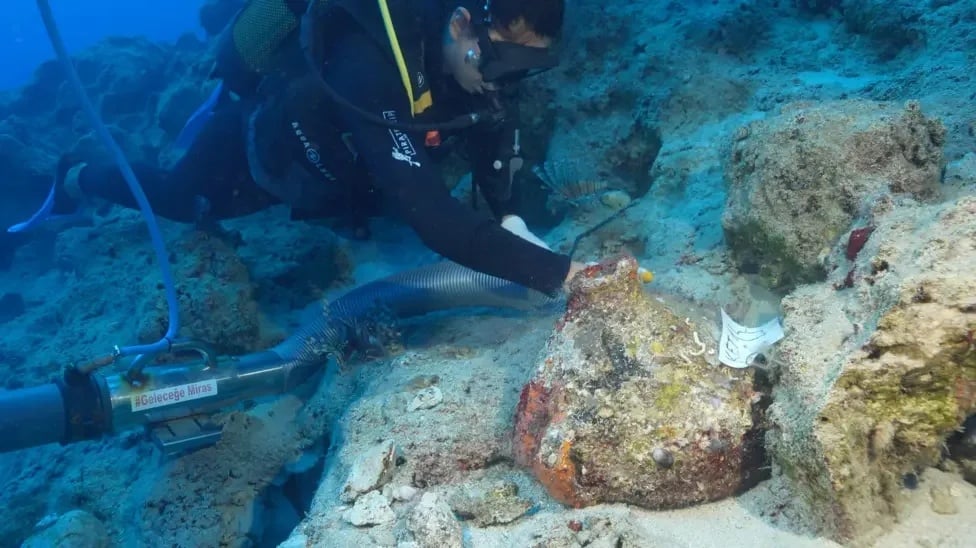
October 14, 2026 · 0 shares
The article is a first-person academic account that is transparent about the tentative, unpublished nature of the dating while presenting the discovery's significance with restrained optimism.
Maritime archaeology is a relatively recent field, and the eastern Mediterranean during the third millennium BCE (3000–2000 BCE) is poorly understood compared to later periods.
Automated analysis; not human reviewed.
Limitations: The article text is a first-person academic piece with self-disclosed affiliations, so the analysis is limited to the supplied content; external verification of the discovery and dating is not possible.
·
55 of 55 available dimensions scored; omitted dimensions are not treated as neutral.
·
Verified supporting quotes for 17 of 55 scored dimensions.
Claim: The article presents the discovery with explicit caveats about tentative dating and pending peer review.
“Much work remains to be done to finesse the conclusions, and a paper outlining the results is yet to be published in a peer-reviewed journal.” · exact text match
Why: The author acknowledges uncertainty and the provisional nature of the findings rather than asserting them as settled fact.
Claim: The article uses measured, evidence-bound language rather than sensational claims.
“However, the precise dating is still under consideration.
Earlier or later dates on either side of this initial determination are also possible.”
· exact text match
Why: The author repeatedly qualifies the dating and avoids exaggerated language.
Claim: The article has a mildly optimistic tone about the discovery's significance.
“This discovery promises to re-write our understanding of early trade networks from around 4,500 years ago.” · exact text match
Why: Positive framing of the discovery's potential impact.
Claim: The discovery of the world's oldest shipwreck is inherently interesting.
“A shipwreck off the coast of Turkey is the oldest shipwreck in the world, our team of archaeologists believes.” · exact text match
Why: The subject matter is compelling and significant.
Claim: The article is primarily descriptive of the discovery and its context.
“Here, and perhaps even earlier, lie the foundations of extensive trade routes as we know them today.” · exact text match
Why: It describes rather than prescribes actions or policies.
Claim: The article includes the author's personal reflections and opinions.
“As an archaeologist specialising in desert sites, this was a singular experience.” · exact text match
Why: First-person commentary introduces subjective elements.
Claim: The article relies on expert authority but also presents evidence.
“Associate Professor Hakan Öniz of Akdeniz University, Antalya, has worked along this coastline for decades excavating ancient shipwrecks.” · exact text match
Why: Citing experts is appropriate in academic reporting, though it is a form of authority appeal.
Claim: The article covers the archaeological research and its context thoroughly.
“The coast of southern Turkey is littered with ancient shipwrecks.
While maritime archaeology is a relatively recent phenomenon, some of the world’s most famous wrecks have been discovered there.”
· exact text match
Why: It provides context and background for the discovery.
Claim: The article avoids overconfidence, explicitly stating dating is tentative.
“There’s little left of the ship itself but based on clues from its cargo – including pottery vessels – a research team I was part of has tentatively dated the wreck to around 2700–2400 BCE.” · exact text match
Why: The word 'tentatively' and subsequent caveats indicate appropriate caution.
Claim: The article has a slightly positive emotional tone about the discovery.
“This discovery promises to re-write our understanding of early trade networks from around 4,500 years ago.” · exact text match
Why: The word 'promises' conveys mild optimism.
Claim: The article is credible, with named experts, institutional affiliations, and caveats about peer review.
“The research on which this article is based was led by Associate Professor Hakan Öniz, head of the Division of Mediterranean Underwater Cultural Heritage Research, and the Department of Restoration and Conservation of Cultural Heritage in the Faculty of Art at the Akdeniz University, Antalya, Turkey.” · exact text match
Why: Clear attribution to a named researcher and institution supports credibility.
Claim: The reasoning is logical, based on archaeological evidence and acknowledged uncertainty.
“Through these vessels was possible to ascertain many pieces of information.
This includes the likely origin of the jars and the contents exchanged across the region.”
· verified after text normalization
Why: The article builds inferences from material evidence and notes what remains unknown.
Claim: The article is grounded in scientific method and empirical evidence.
“Analyses showed this silver was acquired from the Lavrion mines east of modern Athens.” · exact text match
Why: It cites scientific analyses and material evidence rather than supernatural explanations.
Claim: The article includes some speculative elements about the ship's journey and cargo.
“One could imagine the terror of the sailors – possibly coastal people from the Levant region – as their ship crashed against the rocks.” · exact text match
Why: The author speculates about the sailors' experience, though clearly marked as imagination.
Claim: The author discloses potential conflicts and the lack of peer review.
“Karin Sowada does not work for, consult, own shares in or receive funding from any company or organization that would benefit from this article, and has disclosed no relevant affiliations beyond their academic appointment.” · exact text match
Why: Transparent disclosure of funding and affiliations supports high integrity.
Claim: The article is well-informed and analytically sophisticated.
“Compared to later periods, trade and exchange in the eastern Mediterranean during the third millennium (3000–2000 BCE) is poorly understood.” · exact text match
Why: It situates the find in broader archaeological and historical context.
Claim: The article is truth-seeking, noting limitations and pending work.
“Again, scientific analyses are pending, but could be some of the products mentioned in the Egyptian texts, possibly olive oil, wine or tree resin.” · exact text match
Why: The author avoids presenting unconfirmed residues as established fact.
The article text is a first-person academic piece with self-disclosed affiliations, so the analysis is limited to the supplied content; external verification of the discovery and dating is not possible.
October 14, 2026 · 0 shares
Carefully hedged, attribution-driven science reporting that frames the 'world's oldest shipwreck' claim as the research team's 'generally confident' assessment rather than an established fact.
Automated analysis; not human reviewed.
Limitations: Bylines and outlet names were stripped from the supplied text (e.g., 'who told that') and the article body appears duplicated, so the original attribution and exact published wording could not be fully verified.
·
9 of 55 available dimensions scored; omitted dimensions are not treated as neutral.
·
Verified supporting quotes for 9 of 9 scored dimensions.
Claim: Key claims are attributed to named sources and official statements rather than asserted in the publisher's own voice.
“according to a statement from the country’s culture ministry, published Wednesday” · exact text match
“Ersoy said in the statement” · exact text match
Why: Attribution-heavy reporting with no editorializing supports an objective classification.
Claim: The notable 'world's oldest' superlative is presented with hedging rather than hype.
“the team are “generally confident” that this is the oldest shipwreck in the world” · exact text match
Why: The headline finding is qualified as the team's confidence level, not dramatized.
Claim: A record-setting archaeological find with unusual operational detail is inherently newsworthy.
“making it the oldest in the world” · exact text match
“may mean that sailors took goats with them on their voyages” · exact text match
Why: A first-of-its-kind discovery plus vivid human-interest detail supports above-average interest.
Claim: The content is confined to reporting findings and source quotes, with no recommendations or normative claims.
“The amphorae date from 4,400-4,700 years ago and provide new information on maritime history, the daily lives of mariners and trade connections at the time.” · exact text match
Why: Purely informational reporting with no prescriptive language present.
Claim: The report cites an official ministry statement, a named lead archaeologist, and an independent foreign expert's examination.
“They then invited a leading expert on amphorae, Australian archaeologist Karin Sowada, to visit the shipwreck and examine the evidence.” · exact text match
Why: Named, checkable sources and a described verification process support above-average credibility.
Claim: Claims about the wreck's use and route are consistently hedged as probabilities rather than asserted as certainties.
“which suggest it could have been used to make cheese or butter” · exact text match
“may have been traveling from the Levantine coast” · exact text match
Why: Probability language ('suggest', 'may') keeps the interpretations proportionate to the available evidence.
Claim: Interpretive hypotheses about shipboard dairying and the wreck's route are included, though attributed and hedged.
“may mean that sailors took goats with them on their voyages” · exact text match
“Researchers believe the ship may have been traveling from the Levantine coast” · exact text match
Why: Two 'may' hypotheses are speculative in content but flagged as researcher interpretations.
Claim: The reporting discloses the initial misdating and conveys the claim with a hedged confidence level rather than certainty.
“The amphorae were initially thought to be much more recent” · exact text match
“the team are “generally confident” that this is the oldest shipwreck in the world” · exact text match
Why: Disclosing the revised dating and using 'generally confident' instead of an absolute claim are observable honesty signals.
Claim: The report connects the find to wider Bronze Age trade networks and explains how the dating was established.
“Öniz read a publication on amphorae that had been found near the Giza pyramids in Egypt” · exact text match
““Clay analyses indicate that the amphorae were likely produced in workshops in the Jordan Valley,” Ersoy said in the statement.” · exact text match
Why: Contextual links to Giza chronology and Eastern Mediterranean production origins go beyond a bare discovery announcement.
Bylines and outlet names were stripped from the supplied text (e.g., 'who told that') and the article body appears duplicated, so the original attribution and exact published wording could not be fully verified.
October 14, 2026 · 0 shares
Heavily attributed, hedge-filled archaeology reporting whose most notable framing is an unhedged 'world's oldest shipwreck' headline resting on belief-based claims dated only by pottery style.
Automated analysis; not human reviewed.
Limitations: The source text is a scrape mixing the article body with GB News navigation and promotional strings and duplicated fragments; the 'world's oldest' claim rests on the expedition team's typological dating without independent verification in the supplied text.
·
13 of 55 available dimensions scored; omitted dimensions are not treated as neutral.
·
Verified supporting quotes for 12 of 13 scored dimensions.
Claim: Substantive claims are consistently attributed to named researchers and hedged rather than asserted in the publisher's own voice.
“what they believe is the world's oldest shipwreck” · verified after text normalization
“estimated to be as much as 4,700 years old” · exact text match
Why: The superlative and age claims are framed as researcher belief and estimation, with named experts carrying nearly all factual assertions.
Claim: A mild sensational tilt comes from an unhedged superlative headline and emotive quote selection.
“World's oldest shipwreck dating back to the Great Pyramid found off coast of Turkey” · exact text match
“I looked inside and nearly fainted” · exact text match
Why: The headline drops the body's 'believed' hedge and the piece foregrounds dramatic quotes, while core claims remain attributed.
Claim: The discovery is framed in terms of positive scientific payoff.
“could offer new insights into maritime commerce during the Early Bronze Age” · exact text match
Why: Significance is framed as promising new knowledge rather than loss or threat.
Claim: A potential record-breaking Bronze Age wreck with surviving cargo residue is highly novel subject matter.
“estimated to be as much as 4,700 years old” · exact text match
“some still contained a thick, glossy substance” · exact text match
Why: The superlative age and preserved contents after millennia make the story unusually notable.
Claim: The reporting stays descriptive, with no prescriptions or calls to action.
“could offer new insights into maritime commerce during the Early Bronze Age” · exact text match
Why: The text reports findings and their possible significance without advocating any action or policy.
Claim: The headline and one body sentence state the dating as fact despite belief-based framing elsewhere.
“The ancient discovery dates to the period when Egypt's Great Pyramid was being built.” · verified after text normalization
“World's oldest shipwreck dating back to the Great Pyramid found off coast of Turkey” · exact text match
Why: These unattributed assertions treat the researchers' belief and estimate as established, exceeding the hedged support supplied.
Claim: Warm human-interest quotes lend mild positive sentiment at the close.
“and the women who were waiting for their husbands, and they unfortunately couldn't go back” · not found in supplied text
Why: The closing pathos is attributed to the researcher, producing gentle warmth rather than publisher emotionality.
Claim: Named, affiliated experts and comparative records support the report, but no independent verification of the age claim appears.
“said Professor Hakan Öniz of Akdeniz University in Turkey, who led the Mediterranean Archaeology Association expedition” · exact text match
“Dr Karin Sowada, an archaeologist at Macquarie University in Australia, examined the recovered amphorae” · exact text match
Why: Sourcing is transparent and includes an outside specialist, yet the superlative age claim rests on the discovering team's typological dating.
Claim: The report explains the dating method and its limitations rather than asserting conclusions.
“Without surviving timber, scientists could not use radiocarbon dating to establish the vessel's age.” · verified after text normalization
Why: Methodological reasoning, including why radiocarbon was impossible, grounds the age claim in evidence rather than bare assertion.
Claim: The account relies on archaeological dating method and expert analysis rather than conjecture or myth.
“they examined the distinctive design of the ceramic containers, known as amphorae, with shapes and decorative styles that can be linked to specific historical periods” · exact text match
Why: The age claim is grounded in described empirical typology, not superstition.
Claim: Several speculative elements appear, all hedged and attributed.
“It could be olive oil, it could be wine, it could be tree resins” · exact text match
“potentially carrying goods towards the ancient city of Troy” · exact text match
Why: Cargo contents and destination are explicitly framed as possibilities, not findings.
Claim: Hedged claims and disclosed method limits are honesty signals, though the researcher's absolute certainty is relayed without scrutiny.
“Although the ship's wooden structure has all but faded” · verified after text normalization
“what they believe is the world's oldest shipwreck” · verified after text normalization
Counterevidence:
“Comparing the decoration techniques, we can definitely say our wreck is Early Bronze Age. This is 100 per cent” · exact text match
Why: The report preserves uncertainty and discloses the radiocarbon limitation, but passes along an unqualified '100 per cent' certainty claim without noting typological dating's limits.
Claim: The report explains method limits and situates the find against prior records.
“Without surviving timber, scientists could not use radiocarbon dating to establish the vessel's age.” · verified after text normalization
“The find surpasses the previous oldest known shipwreck, discovered near Greece's Dokos island, which dated to around 4,200 years ago.” · verified after text normalization
Why: Methodological transparency and comparative historical context exceed average news processing.
The source text is a scrape mixing the article body with GB News navigation and promotional strings and duplicated fragments; the 'world's oldest' claim rests on the expedition team's typological dating without independent verification in the supplied text.
October 14, 2026 · 0 shares
Carefully hedged, attribution-driven science reporting that frames the 'world's oldest shipwreck' claim as the research team's 'generally confident' assessment rather than an established fact.
Automated analysis; not human reviewed.
Limitations: Bylines and outlet names were stripped from the supplied text (e.g., 'who told that') and the article body appears duplicated, so the original attribution and exact published wording could not be fully verified.
·
9 of 55 available dimensions scored; omitted dimensions are not treated as neutral.
·
Verified supporting quotes for 9 of 9 scored dimensions.
Claim: Key claims are attributed to named sources and official statements rather than asserted in the publisher's own voice.
“according to a statement from the country’s culture ministry, published Wednesday” · exact text match
“Ersoy said in the statement” · exact text match
Why: Attribution-heavy reporting with no editorializing supports an objective classification.
Claim: The notable 'world's oldest' superlative is presented with hedging rather than hype.
“the team are “generally confident” that this is the oldest shipwreck in the world” · exact text match
Why: The headline finding is qualified as the team's confidence level, not dramatized.
Claim: A record-setting archaeological find with unusual operational detail is inherently newsworthy.
“making it the oldest in the world” · exact text match
“may mean that sailors took goats with them on their voyages” · exact text match
Why: A first-of-its-kind discovery plus vivid human-interest detail supports above-average interest.
Claim: The content is confined to reporting findings and source quotes, with no recommendations or normative claims.
“The amphorae date from 4,400-4,700 years ago and provide new information on maritime history, the daily lives of mariners and trade connections at the time.” · exact text match
Why: Purely informational reporting with no prescriptive language present.
Claim: The report cites an official ministry statement, a named lead archaeologist, and an independent foreign expert's examination.
“They then invited a leading expert on amphorae, Australian archaeologist Karin Sowada, to visit the shipwreck and examine the evidence.” · exact text match
Why: Named, checkable sources and a described verification process support above-average credibility.
Claim: Claims about the wreck's use and route are consistently hedged as probabilities rather than asserted as certainties.
“which suggest it could have been used to make cheese or butter” · exact text match
“may have been traveling from the Levantine coast” · exact text match
Why: Probability language ('suggest', 'may') keeps the interpretations proportionate to the available evidence.
Claim: Interpretive hypotheses about shipboard dairying and the wreck's route are included, though attributed and hedged.
“may mean that sailors took goats with them on their voyages” · exact text match
“Researchers believe the ship may have been traveling from the Levantine coast” · exact text match
Why: Two 'may' hypotheses are speculative in content but flagged as researcher interpretations.
Claim: The reporting discloses the initial misdating and conveys the claim with a hedged confidence level rather than certainty.
“The amphorae were initially thought to be much more recent” · exact text match
“the team are “generally confident” that this is the oldest shipwreck in the world” · exact text match
Why: Disclosing the revised dating and using 'generally confident' instead of an absolute claim are observable honesty signals.
Claim: The report connects the find to wider Bronze Age trade networks and explains how the dating was established.
“Öniz read a publication on amphorae that had been found near the Giza pyramids in Egypt” · exact text match
““Clay analyses indicate that the amphorae were likely produced in workshops in the Jordan Valley,” Ersoy said in the statement.” · exact text match
Why: Contextual links to Giza chronology and Eastern Mediterranean production origins go beyond a bare discovery announcement.
Bylines and outlet names were stripped from the supplied text (e.g., 'who told that') and the article body appears duplicated, so the original attribution and exact published wording could not be fully verified.
October 14, 2026 · 0 shares
Heavily attributed, hedge-filled archaeology reporting whose most notable framing is an unhedged 'world's oldest shipwreck' headline resting on belief-based claims dated only by pottery style.
Automated analysis; not human reviewed.
Limitations: The source text is a scrape mixing the article body with GB News navigation and promotional strings and duplicated fragments; the 'world's oldest' claim rests on the expedition team's typological dating without independent verification in the supplied text.
·
13 of 55 available dimensions scored; omitted dimensions are not treated as neutral.
·
Verified supporting quotes for 12 of 13 scored dimensions.
Claim: Substantive claims are consistently attributed to named researchers and hedged rather than asserted in the publisher's own voice.
“what they believe is the world's oldest shipwreck” · verified after text normalization
“estimated to be as much as 4,700 years old” · exact text match
Why: The superlative and age claims are framed as researcher belief and estimation, with named experts carrying nearly all factual assertions.
Claim: A mild sensational tilt comes from an unhedged superlative headline and emotive quote selection.
“World's oldest shipwreck dating back to the Great Pyramid found off coast of Turkey” · exact text match
“I looked inside and nearly fainted” · exact text match
Why: The headline drops the body's 'believed' hedge and the piece foregrounds dramatic quotes, while core claims remain attributed.
Claim: The discovery is framed in terms of positive scientific payoff.
“could offer new insights into maritime commerce during the Early Bronze Age” · exact text match
Why: Significance is framed as promising new knowledge rather than loss or threat.
Claim: A potential record-breaking Bronze Age wreck with surviving cargo residue is highly novel subject matter.
“estimated to be as much as 4,700 years old” · exact text match
“some still contained a thick, glossy substance” · exact text match
Why: The superlative age and preserved contents after millennia make the story unusually notable.
Claim: The reporting stays descriptive, with no prescriptions or calls to action.
“could offer new insights into maritime commerce during the Early Bronze Age” · exact text match
Why: The text reports findings and their possible significance without advocating any action or policy.
Claim: The headline and one body sentence state the dating as fact despite belief-based framing elsewhere.
“The ancient discovery dates to the period when Egypt's Great Pyramid was being built.” · verified after text normalization
“World's oldest shipwreck dating back to the Great Pyramid found off coast of Turkey” · exact text match
Why: These unattributed assertions treat the researchers' belief and estimate as established, exceeding the hedged support supplied.
Claim: Warm human-interest quotes lend mild positive sentiment at the close.
“and the women who were waiting for their husbands, and they unfortunately couldn't go back” · not found in supplied text
Why: The closing pathos is attributed to the researcher, producing gentle warmth rather than publisher emotionality.
Claim: Named, affiliated experts and comparative records support the report, but no independent verification of the age claim appears.
“said Professor Hakan Öniz of Akdeniz University in Turkey, who led the Mediterranean Archaeology Association expedition” · exact text match
“Dr Karin Sowada, an archaeologist at Macquarie University in Australia, examined the recovered amphorae” · exact text match
Why: Sourcing is transparent and includes an outside specialist, yet the superlative age claim rests on the discovering team's typological dating.
Claim: The report explains the dating method and its limitations rather than asserting conclusions.
“Without surviving timber, scientists could not use radiocarbon dating to establish the vessel's age.” · verified after text normalization
Why: Methodological reasoning, including why radiocarbon was impossible, grounds the age claim in evidence rather than bare assertion.
Claim: The account relies on archaeological dating method and expert analysis rather than conjecture or myth.
“they examined the distinctive design of the ceramic containers, known as amphorae, with shapes and decorative styles that can be linked to specific historical periods” · exact text match
Why: The age claim is grounded in described empirical typology, not superstition.
Claim: Several speculative elements appear, all hedged and attributed.
“It could be olive oil, it could be wine, it could be tree resins” · exact text match
“potentially carrying goods towards the ancient city of Troy” · exact text match
Why: Cargo contents and destination are explicitly framed as possibilities, not findings.
Claim: Hedged claims and disclosed method limits are honesty signals, though the researcher's absolute certainty is relayed without scrutiny.
“Although the ship's wooden structure has all but faded” · verified after text normalization
“what they believe is the world's oldest shipwreck” · verified after text normalization
Counterevidence:
“Comparing the decoration techniques, we can definitely say our wreck is Early Bronze Age. This is 100 per cent” · exact text match
Why: The report preserves uncertainty and discloses the radiocarbon limitation, but passes along an unqualified '100 per cent' certainty claim without noting typological dating's limits.
Claim: The report explains method limits and situates the find against prior records.
“Without surviving timber, scientists could not use radiocarbon dating to establish the vessel's age.” · verified after text normalization
“The find surpasses the previous oldest known shipwreck, discovered near Greece's Dokos island, which dated to around 4,200 years ago.” · verified after text normalization
Why: Methodological transparency and comparative historical context exceed average news processing.
The source text is a scrape mixing the article body with GB News navigation and promotional strings and duplicated fragments; the 'world's oldest' claim rests on the expedition team's typological dating without independent verification in the supplied text.
Largely factual and attributed archaeological reporting, with mild sensational flourishes such as "frenzy of delight" and "incredible feat".
Automated analysis; not human reviewed.
Limitations: Age, route, and cargo are based on expert estimates and BBC-attributed quotes; the supplied text offers no independent verification.
·
7 of 55 available dimensions scored; omitted dimensions are not treated as neutral.
·
Verified supporting quotes for 7 of 7 scored dimensions.
Claim: The reporting is mostly factual and attributed, but includes evaluative language about the discovery.
“This incredible feat has led scientists to label this the oldest shipwreck ever discovered.” · exact text match
Why: An evaluative adjective ('incredible feat') indicates mild subjective framing, though most text is descriptive.
Claim: Framing uses some dramatic language while remaining largely factual.
“has sparked a frenzy of delight among archaeologists” · exact text match
Why: The phrase 'frenzy of delight' adds mild sensational color to an otherwise factual report.
Claim: The text reports findings and evidence without urging action or policy.
“Dated between 4,400 and 4,700 years old, this particular ship wreckage has been placed in the Early Bronze Age” · exact text match
Why: Representative sentence is descriptive dating, not prescription.
Claim: Claims are attributed to named archaeologists and BBC reporting, with uncertainty hedges.
“Dr Karin Sowada, an archaeologist from Macquarie University, Australia, noted her surprise at how intact some of them remained while others still carried a viscous, glossy residue.” · exact text match
Why: Named expert sourcing and explicit attribution to BBC support credibility.
Claim: Dating and interpretation rest on archaeological evidence and expert typology, not superstition.
“archaeologists have instead been able to use 30 ceramic storage pots (called amphorae) to accurately date the ship.” · exact text match
Why: The method described is empirical and archaeological.
Claim: The article includes hedged speculation about cargo and route.
“Olive oil, wine, and tree resins are all believed to be possible contenders in this selection.” · exact text match
Why: Possible cargo is explicitly framed as belief or possibility rather than confirmed fact.
Claim: The report gives context about prior record-holders and avoids hiding comparison.
“beating the record previously held by 4200-year-old wreckage discovered off the coast of Dokos, an island in southern Greece.” · exact text match
Why: Including the prior record and alternate wreck context signals fairness.
Age, route, and cargo are based on expert estimates and BBC-attributed quotes; the supplied text offers no independent verification.
October 14, 2026 · 0 shares
Carefully hedged, attribution-driven science reporting that frames the 'world's oldest shipwreck' claim as the research team's 'generally confident' assessment rather than an established fact.
Automated analysis; not human reviewed.
Limitations: Bylines and outlet names were stripped from the supplied text (e.g., 'who told that') and the article body appears duplicated, so the original attribution and exact published wording could not be fully verified.
·
9 of 55 available dimensions scored; omitted dimensions are not treated as neutral.
·
Verified supporting quotes for 9 of 9 scored dimensions.
Claim: Key claims are attributed to named sources and official statements rather than asserted in the publisher's own voice.
“according to a statement from the country’s culture ministry, published Wednesday” · exact text match
“Ersoy said in the statement” · exact text match
Why: Attribution-heavy reporting with no editorializing supports an objective classification.
Claim: The notable 'world's oldest' superlative is presented with hedging rather than hype.
“the team are “generally confident” that this is the oldest shipwreck in the world” · exact text match
Why: The headline finding is qualified as the team's confidence level, not dramatized.
Claim: A record-setting archaeological find with unusual operational detail is inherently newsworthy.
“making it the oldest in the world” · exact text match
“may mean that sailors took goats with them on their voyages” · exact text match
Why: A first-of-its-kind discovery plus vivid human-interest detail supports above-average interest.
Claim: The content is confined to reporting findings and source quotes, with no recommendations or normative claims.
“The amphorae date from 4,400-4,700 years ago and provide new information on maritime history, the daily lives of mariners and trade connections at the time.” · exact text match
Why: Purely informational reporting with no prescriptive language present.
Claim: The report cites an official ministry statement, a named lead archaeologist, and an independent foreign expert's examination.
“They then invited a leading expert on amphorae, Australian archaeologist Karin Sowada, to visit the shipwreck and examine the evidence.” · exact text match
Why: Named, checkable sources and a described verification process support above-average credibility.
Claim: Claims about the wreck's use and route are consistently hedged as probabilities rather than asserted as certainties.
“which suggest it could have been used to make cheese or butter” · exact text match
“may have been traveling from the Levantine coast” · exact text match
Why: Probability language ('suggest', 'may') keeps the interpretations proportionate to the available evidence.
Claim: Interpretive hypotheses about shipboard dairying and the wreck's route are included, though attributed and hedged.
“may mean that sailors took goats with them on their voyages” · exact text match
“Researchers believe the ship may have been traveling from the Levantine coast” · exact text match
Why: Two 'may' hypotheses are speculative in content but flagged as researcher interpretations.
Claim: The reporting discloses the initial misdating and conveys the claim with a hedged confidence level rather than certainty.
“The amphorae were initially thought to be much more recent” · exact text match
“the team are “generally confident” that this is the oldest shipwreck in the world” · exact text match
Why: Disclosing the revised dating and using 'generally confident' instead of an absolute claim are observable honesty signals.
Claim: The report connects the find to wider Bronze Age trade networks and explains how the dating was established.
“Öniz read a publication on amphorae that had been found near the Giza pyramids in Egypt” · exact text match
““Clay analyses indicate that the amphorae were likely produced in workshops in the Jordan Valley,” Ersoy said in the statement.” · exact text match
Why: Contextual links to Giza chronology and Eastern Mediterranean production origins go beyond a bare discovery announcement.
Bylines and outlet names were stripped from the supplied text (e.g., 'who told that') and the article body appears duplicated, so the original attribution and exact published wording could not be fully verified.
October 14, 2026 · 0 shares
Largely descriptive archaeology report that leans on official and expert attribution, though the 'world's oldest shipwreck' framing in the headline outruns the hedged, provisional language used in the body.
Amphorae are ancient clay jars thought here to have carried olive oil or wine; the wreck's identification came from earlier survey work before the 2026 excavation permits were granted.
Automated analysis; not human reviewed.
Limitations: The 'world's oldest shipwreck' claim appears mainly in the headline and a minister's quote rather than in substantiated evidence, and the text contains a future-dated excavation year (2026) that limits verification.
·
55 of 55 available dimensions scored; omitted dimensions are not treated as neutral.
·
Verified supporting quotes for 17 of 55 scored dimensions.
Claim: Findings are reported with hedged, attributed language rather than the reporter's own judgment.
“The finds, which are said to belong to a wreck from the Early Bronze Age, are expected to shed light on Anatolia's maritime history” · exact text match
Why: Passive attribution ('are said to belong') marks reported claims rather than subjective editorializing.
Claim: Headline elevates the find with a superlative framing beyond the body's hedging.
“World's oldest shipwreck off Turkey: 4,700-year-old amphorae discovered” · exact text match
Counterevidence:
“The finds, which are said to belong to a wreck from the Early Bronze Age, are expected to shed light” · exact text match
Why: Superlative 'world's oldest' headline is mildly sensational relative to the cautiously worded body.
Claim: Framing is mildly positive about the discovery's significance.
“are expected to shed light on Anatolia's maritime history and trade links in the Eastern Mediterranean” · exact text match
Why: Prospective benefit framing skews slightly optimistic.
Claim: The subject matter is distinctive and curiosity-driven.
“One of the amphorae found in the excavations stands out with two holes in its body and nine distinct marks on it.” · exact text match
Why: Unusual artifact detail and oldest-wreck framing raise interest.
Claim: The report describes findings and official statements without prescribing policy or action.
“Underwater excavations carried out off the island of Kekova in Antalya have brought to light amphorae dating back around 4,400–4,700 years.” · exact text match
Why: Content is entirely descriptive of discovery and interpretation, with no advocacy.
Claim: Official state framing and a minister's national-heritage language are incorporated without scrutiny.
“In our 'Blue Homeland', we are bringing to light traces of the world's oldest shipwreck.” · not found in supplied text
Why: National branding from a government minister is quoted prominently, giving the piece a mild political dimension.
Claim: Complex trade-network inference is compressed into a brief, confident summary.
“The discovery of similar examples in Egypt, Troy and Crete reveals traces of trade and cultural interaction between different regions.” · exact text match
Why: 'Reveals' states the interpretive leap more strongly than the underlying evidence allows.
Claim: Authority and official permission underpin the report's credibility.
“Acting on permits from the Ministry of Culture and Tourism, excavations in the area began in 2026 under the leadership of the Antalya Museum Directorate.” · exact text match
Why: Institutional authorization and ministry involvement are invoked as validation.
Claim: Superlative claim of 'oldest' is asserted in framing while the body only offers hedged provenance.
“World’s oldest shipwreck off Turkey: 4,700-year-old amphorae discovered” · exact text match
Counterevidence:
“are said to belong to a wreck from the Early Bronze Age” · exact text match
Why: Certainty in the framing exceeds the supplied evidentiary support.
Claim: Ideological content is minimal, limited to quoted national-heritage framing.
“In our 'Blue Homeland', we are bringing to light traces of the world's oldest shipwreck.” · not found in supplied text
Why: National branding appears only via quotation, not the publisher's own argument.
Claim: Framing aligns with official ministry promotion of the excavation.
“Turkey's Minister of Culture and Tourism Mehmet Nuri Ersoy, in a post on his social media account, underlined the importance of the ancient vases recovered during the excavations” · not found in supplied text
Why: Official statements are treated deferentially, mildly pro-establishment, though largely descriptive.
Claim: Tone is mildly positive and celebratory about the discovery.
“Still toast-worthy? 19th-century Champagne found in Baltic Sea” · exact text match
Why: Positive, appreciative framing of heritage discoveries; weak but not negative affect.
Claim: Sourcing is attributable to named institutions and researchers, but the superlative claim is not independently substantiated.
“The minister also congratulated Associate Professor Hakan Öniz, who's leading the scientific excavations, and the team involved in the work.” · exact text match
Why: Named experts and institutions support credibility, tempered by unsupported superlative framing.
Claim: Claims are grounded in stated material analysis and attributed expert inference rather than assertion alone.
“Clay analyses carried out on the amphorae, which are thought to have been used to transport olive oil or wine, indicate that the jars were probably produced in workshops in the Jordan Valley.” · exact text match
Why: Empirical method (clay analysis) and comparative finds are cited as the basis for conclusions.
Claim: Explanation is empirical, resting on clay analysis, dating and comparative archaeology.
“Amphora samples taken from the remains of a wreck identified off the island of Kekova during underwater surveys carried out in previous years by Akdeniz University showed that the ship may date back to the Early Bronze Age.” · exact text match
Why: Scientific survey and sampling methods, not supernatural or folk explanation, structure the account.
Claim: Forward-looking reconstructions of route and daily life rest on explicitly tentative wording.
“Researchers believe that the ship set sail from a port on the Levantine coast and headed towards Troy or Crete.” · exact text match
Why: Route and onboard dairy hypotheses are inference presented with hedges, indicating speculative content.
Claim: Selective superlative framing in headline and omission of any challenge to the 'oldest' claim.
“World’s oldest shipwreck discovered off Turkey’s Mediterranean coast” · exact text match
Why: Mild framing asymmetry between headline certainty and body hedging; no strong techniques observed.
Claim: The text flags uncertainty and provisional interpretation rather than presenting conclusions flatly.
“Initial examinations suggest that the jar may have been a churning amphora used in the production of cheese or butter.” · exact text match
Why: Explicit hedging and provisional language signal fair, honest reporting of evidentiary status.
Claim: The piece integrates dating, clay sourcing, comparative finds and daily-life inference coherently.
“This possibility raises the prospect that sailors of the period may have carried goats on long voyages, milked them on board and produced their own dairy products.” · exact text match
Why: Reasoned interpretive chain from artifact features to lifeways indicates above-average analytical content.
Claim: Minor heritage-preservation affirmation without strong moral display.
“Ersoy stated that they would continue to illuminate Anatolia's maritime history with new findings and to preserve the underwater cultural heritage for future generations.” · exact text match
Why: Preservation language is quoted rather than authored; weak virtue-signaling signal.
The 'world's oldest shipwreck' claim appears mainly in the headline and a minister's quote rather than in substantiated evidence, and the text contains a future-dated excavation year (2026) that limits verification.
The report is scientifically grounded and attribution-rich, using cautious language ("could be," "likely") and named expert sources rather than sensational or ideological framing.
Automated analysis; not human reviewed.
·
10 of 55 available dimensions scored; omitted dimensions are not treated as neutral.
·
Verified supporting quotes for 10 of 10 scored dimensions.
Claim: The framing is objective, relying on attributed expert statements and cautious language.
““These are the oldest known remains of a seagoing ship yet found,” Karin Sowada, an archaeologist at Macquarie University in Australia who worked on the project, tells People’s Becca Longmire.” · exact text match
Why: Named attribution and quotation rather than first-person commentary support an objective framing.
Claim: The report avoids sensationalism, presenting the discovery with caveats and attribution.
“Archaeologists have discovered remnants of what could be the world’s oldest known shipwreck, located off the coast of modern-day Turkey.” · exact text match
Why: The hedged phrase 'could be' and straight news lede indicate low sensationalism.
Claim: The discovery is presented as historically significant and intriguing.
““These are the oldest known remains of a seagoing ship yet found,” Karin Sowada, an archaeologist at Macquarie University in Australia who worked on the project, tells People’s Becca Longmire.” · exact text match
Why: The superlative and expert wonder framing make the discovery notably interesting.
Claim: The report is descriptive, presenting findings without prescribing policy or action.
“Archaeologists have discovered remnants of what could be the world’s oldest known shipwreck, located off the coast of modern-day Turkey.” · exact text match
Why: The text reports a discovery rather than advocating a course of action.
Claim: The report is highly credible through named experts, institutions, multiple media attributions, and explicit uncertainty.
““These are the oldest known remains of a seagoing ship yet found,” Karin Sowada, an archaeologist at Macquarie University in Australia who worked on the project, tells People’s Becca Longmire.” · exact text match
Why: Named, affiliated experts and clear attribution support high credibility.
Claim: The report uses scientific dating methods and expert attribution rather than irrational or emotional reasoning.
“The archaeologists dated the finds by “comparing the decoration techniques” on the amphorae to other examples unearthed in the Egypt and the Middle East that were known to be between 4,400 and 4,700 years old, Öniz tells the BBC’s Alison Francis, Rebecca Morelle and Kevin Church.” · exact text match
Why: Methodological detail and named expert sourcing indicate rational, evidence-based framing.
Claim: The report is strongly scientific, using archaeological dating and laboratory examination rather than superstition.
“The researchers brought the finds back to a laboratory, where Sowada examined them.” · exact text match
Why: Laboratory examination and comparative dating are empirical scientific methods.
Claim: The report includes some speculation about the ship's route, cargo, and appearance, but attributes it and uses hedged language.
““It appears the vessel sank while transporting olive oil or wine from that region westward—perhaps to Troy or to the Minoan civilization in Crete,” Öniz tells CBS News’ Archie Clarke.” · exact text match
Why: Hedged expert inference about the vessel's route constitutes moderate speculative content.
Claim: The report demonstrates fairness and honesty through named sourcing, multiple outlets, and caveats.
“The archaeologists dated the finds by “comparing the decoration techniques” on the amphorae to other examples unearthed in the Egypt and the Middle East that were known to be between 4,400 and 4,700 years old, Öniz tells the BBC’s Alison Francis, Rebecca Morelle and Kevin Church.” · exact text match
Why: Explicit sourcing and transparent dating method support high integrity.
Claim: The report is intelligent and informative, explaining dating methods and uncertainty.
“The archaeologists dated the finds by “comparing the decoration techniques” on the amphorae to other examples unearthed in the Egypt and the Middle East that were known to be between 4,400 and 4,700 years old, Öniz tells the BBC’s Alison Francis, Rebecca Morelle and Kevin Church.” · exact text match
Why: Methodological explanation and expert context demonstrate above-average informativeness.
October 14, 2026 · 0 shares
The article is a first-person academic account that is transparent about the tentative, unpublished nature of the dating while presenting the discovery's significance with restrained optimism.
Maritime archaeology is a relatively recent field, and the eastern Mediterranean during the third millennium BCE (3000–2000 BCE) is poorly understood compared to later periods.
Automated analysis; not human reviewed.
Limitations: The article text is a first-person academic piece with self-disclosed affiliations, so the analysis is limited to the supplied content; external verification of the discovery and dating is not possible.
·
55 of 55 available dimensions scored; omitted dimensions are not treated as neutral.
·
Verified supporting quotes for 17 of 55 scored dimensions.
Claim: The article presents the discovery with explicit caveats about tentative dating and pending peer review.
“Much work remains to be done to finesse the conclusions, and a paper outlining the results is yet to be published in a peer-reviewed journal.” · exact text match
Why: The author acknowledges uncertainty and the provisional nature of the findings rather than asserting them as settled fact.
Claim: The article uses measured, evidence-bound language rather than sensational claims.
“However, the precise dating is still under consideration.
Earlier or later dates on either side of this initial determination are also possible.”
· exact text match
Why: The author repeatedly qualifies the dating and avoids exaggerated language.
Claim: The article has a mildly optimistic tone about the discovery's significance.
“This discovery promises to re-write our understanding of early trade networks from around 4,500 years ago.” · exact text match
Why: Positive framing of the discovery's potential impact.
Claim: The discovery of the world's oldest shipwreck is inherently interesting.
“A shipwreck off the coast of Turkey is the oldest shipwreck in the world, our team of archaeologists believes.” · exact text match
Why: The subject matter is compelling and significant.
Claim: The article is primarily descriptive of the discovery and its context.
“Here, and perhaps even earlier, lie the foundations of extensive trade routes as we know them today.” · exact text match
Why: It describes rather than prescribes actions or policies.
Claim: The article includes the author's personal reflections and opinions.
“As an archaeologist specialising in desert sites, this was a singular experience.” · exact text match
Why: First-person commentary introduces subjective elements.
Claim: The article relies on expert authority but also presents evidence.
“Associate Professor Hakan Öniz of Akdeniz University, Antalya, has worked along this coastline for decades excavating ancient shipwrecks.” · exact text match
Why: Citing experts is appropriate in academic reporting, though it is a form of authority appeal.
Claim: The article covers the archaeological research and its context thoroughly.
“The coast of southern Turkey is littered with ancient shipwrecks.
While maritime archaeology is a relatively recent phenomenon, some of the world’s most famous wrecks have been discovered there.”
· exact text match
Why: It provides context and background for the discovery.
Claim: The article avoids overconfidence, explicitly stating dating is tentative.
“There’s little left of the ship itself but based on clues from its cargo – including pottery vessels – a research team I was part of has tentatively dated the wreck to around 2700–2400 BCE.” · exact text match
Why: The word 'tentatively' and subsequent caveats indicate appropriate caution.
Claim: The article has a slightly positive emotional tone about the discovery.
“This discovery promises to re-write our understanding of early trade networks from around 4,500 years ago.” · exact text match
Why: The word 'promises' conveys mild optimism.
Claim: The article is credible, with named experts, institutional affiliations, and caveats about peer review.
“The research on which this article is based was led by Associate Professor Hakan Öniz, head of the Division of Mediterranean Underwater Cultural Heritage Research, and the Department of Restoration and Conservation of Cultural Heritage in the Faculty of Art at the Akdeniz University, Antalya, Turkey.” · exact text match
Why: Clear attribution to a named researcher and institution supports credibility.
Claim: The reasoning is logical, based on archaeological evidence and acknowledged uncertainty.
“Through these vessels was possible to ascertain many pieces of information.
This includes the likely origin of the jars and the contents exchanged across the region.”
· verified after text normalization
Why: The article builds inferences from material evidence and notes what remains unknown.
Claim: The article is grounded in scientific method and empirical evidence.
“Analyses showed this silver was acquired from the Lavrion mines east of modern Athens.” · exact text match
Why: It cites scientific analyses and material evidence rather than supernatural explanations.
Claim: The article includes some speculative elements about the ship's journey and cargo.
“One could imagine the terror of the sailors – possibly coastal people from the Levant region – as their ship crashed against the rocks.” · exact text match
Why: The author speculates about the sailors' experience, though clearly marked as imagination.
Claim: The author discloses potential conflicts and the lack of peer review.
“Karin Sowada does not work for, consult, own shares in or receive funding from any company or organization that would benefit from this article, and has disclosed no relevant affiliations beyond their academic appointment.” · exact text match
Why: Transparent disclosure of funding and affiliations supports high integrity.
Claim: The article is well-informed and analytically sophisticated.
“Compared to later periods, trade and exchange in the eastern Mediterranean during the third millennium (3000–2000 BCE) is poorly understood.” · exact text match
Why: It situates the find in broader archaeological and historical context.
Claim: The article is truth-seeking, noting limitations and pending work.
“Again, scientific analyses are pending, but could be some of the products mentioned in the Egyptian texts, possibly olive oil, wine or tree resin.” · exact text match
Why: The author avoids presenting unconfirmed residues as established fact.
The article text is a first-person academic piece with self-disclosed affiliations, so the analysis is limited to the supplied content; external verification of the discovery and dating is not possible.
October 14, 2026 · 0 shares
Carefully hedged, attribution-driven science reporting that frames the 'world's oldest shipwreck' claim as the research team's 'generally confident' assessment rather than an established fact.
Automated analysis; not human reviewed.
Limitations: Bylines and outlet names were stripped from the supplied text (e.g., 'who told that') and the article body appears duplicated, so the original attribution and exact published wording could not be fully verified.
·
9 of 55 available dimensions scored; omitted dimensions are not treated as neutral.
·
Verified supporting quotes for 9 of 9 scored dimensions.
Claim: Key claims are attributed to named sources and official statements rather than asserted in the publisher's own voice.
“according to a statement from the country’s culture ministry, published Wednesday” · exact text match
“Ersoy said in the statement” · exact text match
Why: Attribution-heavy reporting with no editorializing supports an objective classification.
Claim: The notable 'world's oldest' superlative is presented with hedging rather than hype.
“the team are “generally confident” that this is the oldest shipwreck in the world” · exact text match
Why: The headline finding is qualified as the team's confidence level, not dramatized.
Claim: A record-setting archaeological find with unusual operational detail is inherently newsworthy.
“making it the oldest in the world” · exact text match
“may mean that sailors took goats with them on their voyages” · exact text match
Why: A first-of-its-kind discovery plus vivid human-interest detail supports above-average interest.
Claim: The content is confined to reporting findings and source quotes, with no recommendations or normative claims.
“The amphorae date from 4,400-4,700 years ago and provide new information on maritime history, the daily lives of mariners and trade connections at the time.” · exact text match
Why: Purely informational reporting with no prescriptive language present.
Claim: The report cites an official ministry statement, a named lead archaeologist, and an independent foreign expert's examination.
“They then invited a leading expert on amphorae, Australian archaeologist Karin Sowada, to visit the shipwreck and examine the evidence.” · exact text match
Why: Named, checkable sources and a described verification process support above-average credibility.
Claim: Claims about the wreck's use and route are consistently hedged as probabilities rather than asserted as certainties.
“which suggest it could have been used to make cheese or butter” · exact text match
“may have been traveling from the Levantine coast” · exact text match
Why: Probability language ('suggest', 'may') keeps the interpretations proportionate to the available evidence.
Claim: Interpretive hypotheses about shipboard dairying and the wreck's route are included, though attributed and hedged.
“may mean that sailors took goats with them on their voyages” · exact text match
“Researchers believe the ship may have been traveling from the Levantine coast” · exact text match
Why: Two 'may' hypotheses are speculative in content but flagged as researcher interpretations.
Claim: The reporting discloses the initial misdating and conveys the claim with a hedged confidence level rather than certainty.
“The amphorae were initially thought to be much more recent” · exact text match
“the team are “generally confident” that this is the oldest shipwreck in the world” · exact text match
Why: Disclosing the revised dating and using 'generally confident' instead of an absolute claim are observable honesty signals.
Claim: The report connects the find to wider Bronze Age trade networks and explains how the dating was established.
“Öniz read a publication on amphorae that had been found near the Giza pyramids in Egypt” · exact text match
““Clay analyses indicate that the amphorae were likely produced in workshops in the Jordan Valley,” Ersoy said in the statement.” · exact text match
Why: Contextual links to Giza chronology and Eastern Mediterranean production origins go beyond a bare discovery announcement.
Bylines and outlet names were stripped from the supplied text (e.g., 'who told that') and the article body appears duplicated, so the original attribution and exact published wording could not be fully verified.
The report is scientifically grounded and attribution-rich, using cautious language ("could be," "likely") and named expert sources rather than sensational or ideological framing.
Automated analysis; not human reviewed.
·
10 of 55 available dimensions scored; omitted dimensions are not treated as neutral.
·
Verified supporting quotes for 10 of 10 scored dimensions.
Claim: The framing is objective, relying on attributed expert statements and cautious language.
““These are the oldest known remains of a seagoing ship yet found,” Karin Sowada, an archaeologist at Macquarie University in Australia who worked on the project, tells People’s Becca Longmire.” · exact text match
Why: Named attribution and quotation rather than first-person commentary support an objective framing.
Claim: The report avoids sensationalism, presenting the discovery with caveats and attribution.
“Archaeologists have discovered remnants of what could be the world’s oldest known shipwreck, located off the coast of modern-day Turkey.” · exact text match
Why: The hedged phrase 'could be' and straight news lede indicate low sensationalism.
Claim: The discovery is presented as historically significant and intriguing.
““These are the oldest known remains of a seagoing ship yet found,” Karin Sowada, an archaeologist at Macquarie University in Australia who worked on the project, tells People’s Becca Longmire.” · exact text match
Why: The superlative and expert wonder framing make the discovery notably interesting.
Claim: The report is descriptive, presenting findings without prescribing policy or action.
“Archaeologists have discovered remnants of what could be the world’s oldest known shipwreck, located off the coast of modern-day Turkey.” · exact text match
Why: The text reports a discovery rather than advocating a course of action.
Claim: The report is highly credible through named experts, institutions, multiple media attributions, and explicit uncertainty.
““These are the oldest known remains of a seagoing ship yet found,” Karin Sowada, an archaeologist at Macquarie University in Australia who worked on the project, tells People’s Becca Longmire.” · exact text match
Why: Named, affiliated experts and clear attribution support high credibility.
Claim: The report uses scientific dating methods and expert attribution rather than irrational or emotional reasoning.
“The archaeologists dated the finds by “comparing the decoration techniques” on the amphorae to other examples unearthed in the Egypt and the Middle East that were known to be between 4,400 and 4,700 years old, Öniz tells the BBC’s Alison Francis, Rebecca Morelle and Kevin Church.” · exact text match
Why: Methodological detail and named expert sourcing indicate rational, evidence-based framing.
Claim: The report is strongly scientific, using archaeological dating and laboratory examination rather than superstition.
“The researchers brought the finds back to a laboratory, where Sowada examined them.” · exact text match
Why: Laboratory examination and comparative dating are empirical scientific methods.
Claim: The report includes some speculation about the ship's route, cargo, and appearance, but attributes it and uses hedged language.
““It appears the vessel sank while transporting olive oil or wine from that region westward—perhaps to Troy or to the Minoan civilization in Crete,” Öniz tells CBS News’ Archie Clarke.” · exact text match
Why: Hedged expert inference about the vessel's route constitutes moderate speculative content.
Claim: The report demonstrates fairness and honesty through named sourcing, multiple outlets, and caveats.
“The archaeologists dated the finds by “comparing the decoration techniques” on the amphorae to other examples unearthed in the Egypt and the Middle East that were known to be between 4,400 and 4,700 years old, Öniz tells the BBC’s Alison Francis, Rebecca Morelle and Kevin Church.” · exact text match
Why: Explicit sourcing and transparent dating method support high integrity.
Claim: The report is intelligent and informative, explaining dating methods and uncertainty.
“The archaeologists dated the finds by “comparing the decoration techniques” on the amphorae to other examples unearthed in the Egypt and the Middle East that were known to be between 4,400 and 4,700 years old, Öniz tells the BBC’s Alison Francis, Rebecca Morelle and Kevin Church.” · exact text match
Why: Methodological explanation and expert context demonstrate above-average informativeness.
October 14, 2026 · 0 shares
The article is a first-person academic account that is transparent about the tentative, unpublished nature of the dating while presenting the discovery's significance with restrained optimism.
Maritime archaeology is a relatively recent field, and the eastern Mediterranean during the third millennium BCE (3000–2000 BCE) is poorly understood compared to later periods.
Automated analysis; not human reviewed.
Limitations: The article text is a first-person academic piece with self-disclosed affiliations, so the analysis is limited to the supplied content; external verification of the discovery and dating is not possible.
·
55 of 55 available dimensions scored; omitted dimensions are not treated as neutral.
·
Verified supporting quotes for 17 of 55 scored dimensions.
Claim: The article presents the discovery with explicit caveats about tentative dating and pending peer review.
“Much work remains to be done to finesse the conclusions, and a paper outlining the results is yet to be published in a peer-reviewed journal.” · exact text match
Why: The author acknowledges uncertainty and the provisional nature of the findings rather than asserting them as settled fact.
Claim: The article uses measured, evidence-bound language rather than sensational claims.
“However, the precise dating is still under consideration.
Earlier or later dates on either side of this initial determination are also possible.”
· exact text match
Why: The author repeatedly qualifies the dating and avoids exaggerated language.
Claim: The article has a mildly optimistic tone about the discovery's significance.
“This discovery promises to re-write our understanding of early trade networks from around 4,500 years ago.” · exact text match
Why: Positive framing of the discovery's potential impact.
Claim: The discovery of the world's oldest shipwreck is inherently interesting.
“A shipwreck off the coast of Turkey is the oldest shipwreck in the world, our team of archaeologists believes.” · exact text match
Why: The subject matter is compelling and significant.
Claim: The article is primarily descriptive of the discovery and its context.
“Here, and perhaps even earlier, lie the foundations of extensive trade routes as we know them today.” · exact text match
Why: It describes rather than prescribes actions or policies.
Claim: The article includes the author's personal reflections and opinions.
“As an archaeologist specialising in desert sites, this was a singular experience.” · exact text match
Why: First-person commentary introduces subjective elements.
Claim: The article relies on expert authority but also presents evidence.
“Associate Professor Hakan Öniz of Akdeniz University, Antalya, has worked along this coastline for decades excavating ancient shipwrecks.” · exact text match
Why: Citing experts is appropriate in academic reporting, though it is a form of authority appeal.
Claim: The article covers the archaeological research and its context thoroughly.
“The coast of southern Turkey is littered with ancient shipwrecks.
While maritime archaeology is a relatively recent phenomenon, some of the world’s most famous wrecks have been discovered there.”
· exact text match
Why: It provides context and background for the discovery.
Claim: The article avoids overconfidence, explicitly stating dating is tentative.
“There’s little left of the ship itself but based on clues from its cargo – including pottery vessels – a research team I was part of has tentatively dated the wreck to around 2700–2400 BCE.” · exact text match
Why: The word 'tentatively' and subsequent caveats indicate appropriate caution.
Claim: The article has a slightly positive emotional tone about the discovery.
“This discovery promises to re-write our understanding of early trade networks from around 4,500 years ago.” · exact text match
Why: The word 'promises' conveys mild optimism.
Claim: The article is credible, with named experts, institutional affiliations, and caveats about peer review.
“The research on which this article is based was led by Associate Professor Hakan Öniz, head of the Division of Mediterranean Underwater Cultural Heritage Research, and the Department of Restoration and Conservation of Cultural Heritage in the Faculty of Art at the Akdeniz University, Antalya, Turkey.” · exact text match
Why: Clear attribution to a named researcher and institution supports credibility.
Claim: The reasoning is logical, based on archaeological evidence and acknowledged uncertainty.
“Through these vessels was possible to ascertain many pieces of information.
This includes the likely origin of the jars and the contents exchanged across the region.”
· verified after text normalization
Why: The article builds inferences from material evidence and notes what remains unknown.
Claim: The article is grounded in scientific method and empirical evidence.
“Analyses showed this silver was acquired from the Lavrion mines east of modern Athens.” · exact text match
Why: It cites scientific analyses and material evidence rather than supernatural explanations.
Claim: The article includes some speculative elements about the ship's journey and cargo.
“One could imagine the terror of the sailors – possibly coastal people from the Levant region – as their ship crashed against the rocks.” · exact text match
Why: The author speculates about the sailors' experience, though clearly marked as imagination.
Claim: The author discloses potential conflicts and the lack of peer review.
“Karin Sowada does not work for, consult, own shares in or receive funding from any company or organization that would benefit from this article, and has disclosed no relevant affiliations beyond their academic appointment.” · exact text match
Why: Transparent disclosure of funding and affiliations supports high integrity.
Claim: The article is well-informed and analytically sophisticated.
“Compared to later periods, trade and exchange in the eastern Mediterranean during the third millennium (3000–2000 BCE) is poorly understood.” · exact text match
Why: It situates the find in broader archaeological and historical context.
Claim: The article is truth-seeking, noting limitations and pending work.
“Again, scientific analyses are pending, but could be some of the products mentioned in the Egyptian texts, possibly olive oil, wine or tree resin.” · exact text match
Why: The author avoids presenting unconfirmed residues as established fact.
The article text is a first-person academic piece with self-disclosed affiliations, so the analysis is limited to the supplied content; external verification of the discovery and dating is not possible.
October 14, 2026 · 0 shares
Heavily attributed, hedge-filled archaeology reporting whose most notable framing is an unhedged 'world's oldest shipwreck' headline resting on belief-based claims dated only by pottery style.
Automated analysis; not human reviewed.
Limitations: The source text is a scrape mixing the article body with GB News navigation and promotional strings and duplicated fragments; the 'world's oldest' claim rests on the expedition team's typological dating without independent verification in the supplied text.
·
13 of 55 available dimensions scored; omitted dimensions are not treated as neutral.
·
Verified supporting quotes for 12 of 13 scored dimensions.
Claim: Substantive claims are consistently attributed to named researchers and hedged rather than asserted in the publisher's own voice.
“what they believe is the world's oldest shipwreck” · verified after text normalization
“estimated to be as much as 4,700 years old” · exact text match
Why: The superlative and age claims are framed as researcher belief and estimation, with named experts carrying nearly all factual assertions.
Claim: A mild sensational tilt comes from an unhedged superlative headline and emotive quote selection.
“World's oldest shipwreck dating back to the Great Pyramid found off coast of Turkey” · exact text match
“I looked inside and nearly fainted” · exact text match
Why: The headline drops the body's 'believed' hedge and the piece foregrounds dramatic quotes, while core claims remain attributed.
Claim: The discovery is framed in terms of positive scientific payoff.
“could offer new insights into maritime commerce during the Early Bronze Age” · exact text match
Why: Significance is framed as promising new knowledge rather than loss or threat.
Claim: A potential record-breaking Bronze Age wreck with surviving cargo residue is highly novel subject matter.
“estimated to be as much as 4,700 years old” · exact text match
“some still contained a thick, glossy substance” · exact text match
Why: The superlative age and preserved contents after millennia make the story unusually notable.
Claim: The reporting stays descriptive, with no prescriptions or calls to action.
“could offer new insights into maritime commerce during the Early Bronze Age” · exact text match
Why: The text reports findings and their possible significance without advocating any action or policy.
Claim: The headline and one body sentence state the dating as fact despite belief-based framing elsewhere.
“The ancient discovery dates to the period when Egypt's Great Pyramid was being built.” · verified after text normalization
“World's oldest shipwreck dating back to the Great Pyramid found off coast of Turkey” · exact text match
Why: These unattributed assertions treat the researchers' belief and estimate as established, exceeding the hedged support supplied.
Claim: Warm human-interest quotes lend mild positive sentiment at the close.
“and the women who were waiting for their husbands, and they unfortunately couldn't go back” · not found in supplied text
Why: The closing pathos is attributed to the researcher, producing gentle warmth rather than publisher emotionality.
Claim: Named, affiliated experts and comparative records support the report, but no independent verification of the age claim appears.
“said Professor Hakan Öniz of Akdeniz University in Turkey, who led the Mediterranean Archaeology Association expedition” · exact text match
“Dr Karin Sowada, an archaeologist at Macquarie University in Australia, examined the recovered amphorae” · exact text match
Why: Sourcing is transparent and includes an outside specialist, yet the superlative age claim rests on the discovering team's typological dating.
Claim: The report explains the dating method and its limitations rather than asserting conclusions.
“Without surviving timber, scientists could not use radiocarbon dating to establish the vessel's age.” · verified after text normalization
Why: Methodological reasoning, including why radiocarbon was impossible, grounds the age claim in evidence rather than bare assertion.
Claim: The account relies on archaeological dating method and expert analysis rather than conjecture or myth.
“they examined the distinctive design of the ceramic containers, known as amphorae, with shapes and decorative styles that can be linked to specific historical periods” · exact text match
Why: The age claim is grounded in described empirical typology, not superstition.
Claim: Several speculative elements appear, all hedged and attributed.
“It could be olive oil, it could be wine, it could be tree resins” · exact text match
“potentially carrying goods towards the ancient city of Troy” · exact text match
Why: Cargo contents and destination are explicitly framed as possibilities, not findings.
Claim: Hedged claims and disclosed method limits are honesty signals, though the researcher's absolute certainty is relayed without scrutiny.
“Although the ship's wooden structure has all but faded” · verified after text normalization
“what they believe is the world's oldest shipwreck” · verified after text normalization
Counterevidence:
“Comparing the decoration techniques, we can definitely say our wreck is Early Bronze Age. This is 100 per cent” · exact text match
Why: The report preserves uncertainty and discloses the radiocarbon limitation, but passes along an unqualified '100 per cent' certainty claim without noting typological dating's limits.
Claim: The report explains method limits and situates the find against prior records.
“Without surviving timber, scientists could not use radiocarbon dating to establish the vessel's age.” · verified after text normalization
“The find surpasses the previous oldest known shipwreck, discovered near Greece's Dokos island, which dated to around 4,200 years ago.” · verified after text normalization
Why: Methodological transparency and comparative historical context exceed average news processing.
The source text is a scrape mixing the article body with GB News navigation and promotional strings and duplicated fragments; the 'world's oldest' claim rests on the expedition team's typological dating without independent verification in the supplied text.
Largely factual and attributed archaeological reporting, with mild sensational flourishes such as "frenzy of delight" and "incredible feat".
Automated analysis; not human reviewed.
Limitations: Age, route, and cargo are based on expert estimates and BBC-attributed quotes; the supplied text offers no independent verification.
·
7 of 55 available dimensions scored; omitted dimensions are not treated as neutral.
·
Verified supporting quotes for 7 of 7 scored dimensions.
Claim: The reporting is mostly factual and attributed, but includes evaluative language about the discovery.
“This incredible feat has led scientists to label this the oldest shipwreck ever discovered.” · exact text match
Why: An evaluative adjective ('incredible feat') indicates mild subjective framing, though most text is descriptive.
Claim: Framing uses some dramatic language while remaining largely factual.
“has sparked a frenzy of delight among archaeologists” · exact text match
Why: The phrase 'frenzy of delight' adds mild sensational color to an otherwise factual report.
Claim: The text reports findings and evidence without urging action or policy.
“Dated between 4,400 and 4,700 years old, this particular ship wreckage has been placed in the Early Bronze Age” · exact text match
Why: Representative sentence is descriptive dating, not prescription.
Claim: Claims are attributed to named archaeologists and BBC reporting, with uncertainty hedges.
“Dr Karin Sowada, an archaeologist from Macquarie University, Australia, noted her surprise at how intact some of them remained while others still carried a viscous, glossy residue.” · exact text match
Why: Named expert sourcing and explicit attribution to BBC support credibility.
Claim: Dating and interpretation rest on archaeological evidence and expert typology, not superstition.
“archaeologists have instead been able to use 30 ceramic storage pots (called amphorae) to accurately date the ship.” · exact text match
Why: The method described is empirical and archaeological.
Claim: The article includes hedged speculation about cargo and route.
“Olive oil, wine, and tree resins are all believed to be possible contenders in this selection.” · exact text match
Why: Possible cargo is explicitly framed as belief or possibility rather than confirmed fact.
Claim: The report gives context about prior record-holders and avoids hiding comparison.
“beating the record previously held by 4200-year-old wreckage discovered off the coast of Dokos, an island in southern Greece.” · exact text match
Why: Including the prior record and alternate wreck context signals fairness.
Age, route, and cargo are based on expert estimates and BBC-attributed quotes; the supplied text offers no independent verification.
October 14, 2026 · 0 shares
Largely descriptive archaeology report that leans on official and expert attribution, though the 'world's oldest shipwreck' framing in the headline outruns the hedged, provisional language used in the body.
Amphorae are ancient clay jars thought here to have carried olive oil or wine; the wreck's identification came from earlier survey work before the 2026 excavation permits were granted.
Automated analysis; not human reviewed.
Limitations: The 'world's oldest shipwreck' claim appears mainly in the headline and a minister's quote rather than in substantiated evidence, and the text contains a future-dated excavation year (2026) that limits verification.
·
55 of 55 available dimensions scored; omitted dimensions are not treated as neutral.
·
Verified supporting quotes for 17 of 55 scored dimensions.
Claim: Findings are reported with hedged, attributed language rather than the reporter's own judgment.
“The finds, which are said to belong to a wreck from the Early Bronze Age, are expected to shed light on Anatolia's maritime history” · exact text match
Why: Passive attribution ('are said to belong') marks reported claims rather than subjective editorializing.
Claim: Headline elevates the find with a superlative framing beyond the body's hedging.
“World's oldest shipwreck off Turkey: 4,700-year-old amphorae discovered” · exact text match
Counterevidence:
“The finds, which are said to belong to a wreck from the Early Bronze Age, are expected to shed light” · exact text match
Why: Superlative 'world's oldest' headline is mildly sensational relative to the cautiously worded body.
Claim: Framing is mildly positive about the discovery's significance.
“are expected to shed light on Anatolia's maritime history and trade links in the Eastern Mediterranean” · exact text match
Why: Prospective benefit framing skews slightly optimistic.
Claim: The subject matter is distinctive and curiosity-driven.
“One of the amphorae found in the excavations stands out with two holes in its body and nine distinct marks on it.” · exact text match
Why: Unusual artifact detail and oldest-wreck framing raise interest.
Claim: The report describes findings and official statements without prescribing policy or action.
“Underwater excavations carried out off the island of Kekova in Antalya have brought to light amphorae dating back around 4,400–4,700 years.” · exact text match
Why: Content is entirely descriptive of discovery and interpretation, with no advocacy.
Claim: Official state framing and a minister's national-heritage language are incorporated without scrutiny.
“In our 'Blue Homeland', we are bringing to light traces of the world's oldest shipwreck.” · not found in supplied text
Why: National branding from a government minister is quoted prominently, giving the piece a mild political dimension.
Claim: Complex trade-network inference is compressed into a brief, confident summary.
“The discovery of similar examples in Egypt, Troy and Crete reveals traces of trade and cultural interaction between different regions.” · exact text match
Why: 'Reveals' states the interpretive leap more strongly than the underlying evidence allows.
Claim: Authority and official permission underpin the report's credibility.
“Acting on permits from the Ministry of Culture and Tourism, excavations in the area began in 2026 under the leadership of the Antalya Museum Directorate.” · exact text match
Why: Institutional authorization and ministry involvement are invoked as validation.
Claim: Superlative claim of 'oldest' is asserted in framing while the body only offers hedged provenance.
“World’s oldest shipwreck off Turkey: 4,700-year-old amphorae discovered” · exact text match
Counterevidence:
“are said to belong to a wreck from the Early Bronze Age” · exact text match
Why: Certainty in the framing exceeds the supplied evidentiary support.
Claim: Ideological content is minimal, limited to quoted national-heritage framing.
“In our 'Blue Homeland', we are bringing to light traces of the world's oldest shipwreck.” · not found in supplied text
Why: National branding appears only via quotation, not the publisher's own argument.
Claim: Framing aligns with official ministry promotion of the excavation.
“Turkey's Minister of Culture and Tourism Mehmet Nuri Ersoy, in a post on his social media account, underlined the importance of the ancient vases recovered during the excavations” · not found in supplied text
Why: Official statements are treated deferentially, mildly pro-establishment, though largely descriptive.
Claim: Tone is mildly positive and celebratory about the discovery.
“Still toast-worthy? 19th-century Champagne found in Baltic Sea” · exact text match
Why: Positive, appreciative framing of heritage discoveries; weak but not negative affect.
Claim: Sourcing is attributable to named institutions and researchers, but the superlative claim is not independently substantiated.
“The minister also congratulated Associate Professor Hakan Öniz, who's leading the scientific excavations, and the team involved in the work.” · exact text match
Why: Named experts and institutions support credibility, tempered by unsupported superlative framing.
Claim: Claims are grounded in stated material analysis and attributed expert inference rather than assertion alone.
“Clay analyses carried out on the amphorae, which are thought to have been used to transport olive oil or wine, indicate that the jars were probably produced in workshops in the Jordan Valley.” · exact text match
Why: Empirical method (clay analysis) and comparative finds are cited as the basis for conclusions.
Claim: Explanation is empirical, resting on clay analysis, dating and comparative archaeology.
“Amphora samples taken from the remains of a wreck identified off the island of Kekova during underwater surveys carried out in previous years by Akdeniz University showed that the ship may date back to the Early Bronze Age.” · exact text match
Why: Scientific survey and sampling methods, not supernatural or folk explanation, structure the account.
Claim: Forward-looking reconstructions of route and daily life rest on explicitly tentative wording.
“Researchers believe that the ship set sail from a port on the Levantine coast and headed towards Troy or Crete.” · exact text match
Why: Route and onboard dairy hypotheses are inference presented with hedges, indicating speculative content.
Claim: Selective superlative framing in headline and omission of any challenge to the 'oldest' claim.
“World’s oldest shipwreck discovered off Turkey’s Mediterranean coast” · exact text match
Why: Mild framing asymmetry between headline certainty and body hedging; no strong techniques observed.
Claim: The text flags uncertainty and provisional interpretation rather than presenting conclusions flatly.
“Initial examinations suggest that the jar may have been a churning amphora used in the production of cheese or butter.” · exact text match
Why: Explicit hedging and provisional language signal fair, honest reporting of evidentiary status.
Claim: The piece integrates dating, clay sourcing, comparative finds and daily-life inference coherently.
“This possibility raises the prospect that sailors of the period may have carried goats on long voyages, milked them on board and produced their own dairy products.” · exact text match
Why: Reasoned interpretive chain from artifact features to lifeways indicates above-average analytical content.
Claim: Minor heritage-preservation affirmation without strong moral display.
“Ersoy stated that they would continue to illuminate Anatolia's maritime history with new findings and to preserve the underwater cultural heritage for future generations.” · exact text match
Why: Preservation language is quoted rather than authored; weak virtue-signaling signal.
The 'world's oldest shipwreck' claim appears mainly in the headline and a minister's quote rather than in substantiated evidence, and the text contains a future-dated excavation year (2026) that limits verification.
October 14, 2026 · 0 shares
The article is a first-person academic account that is transparent about the tentative, unpublished nature of the dating while presenting the discovery's significance with restrained optimism.
Maritime archaeology is a relatively recent field, and the eastern Mediterranean during the third millennium BCE (3000–2000 BCE) is poorly understood compared to later periods.
Automated analysis; not human reviewed. Limitations: The article text is a first-person academic piece with self-disclosed affiliations, so the analysis is limited to the supplied content; external verification of the discovery and dating is not possible. · 55 of 55 available dimensions scored; omitted dimensions are not treated as neutral. · Verified supporting quotes for 17 of 55 scored dimensions.
Claim: The article presents the discovery with explicit caveats about tentative dating and pending peer review.
“Much work remains to be done to finesse the conclusions, and a paper outlining the results is yet to be published in a peer-reviewed journal.” · exact text match
Why: The author acknowledges uncertainty and the provisional nature of the findings rather than asserting them as settled fact.
Claim: The article uses measured, evidence-bound language rather than sensational claims.
“However, the precise dating is still under consideration. Earlier or later dates on either side of this initial determination are also possible.” · exact text match
Why: The author repeatedly qualifies the dating and avoids exaggerated language.
Claim: The article has a mildly optimistic tone about the discovery's significance.
“This discovery promises to re-write our understanding of early trade networks from around 4,500 years ago.” · exact text match
Why: Positive framing of the discovery's potential impact.
Claim: The discovery of the world's oldest shipwreck is inherently interesting.
“A shipwreck off the coast of Turkey is the oldest shipwreck in the world, our team of archaeologists believes.” · exact text match
Why: The subject matter is compelling and significant.
Claim: The article is primarily descriptive of the discovery and its context.
“Here, and perhaps even earlier, lie the foundations of extensive trade routes as we know them today.” · exact text match
Why: It describes rather than prescribes actions or policies.
Claim: The article includes the author's personal reflections and opinions.
“As an archaeologist specialising in desert sites, this was a singular experience.” · exact text match
Why: First-person commentary introduces subjective elements.
Claim: The article relies on expert authority but also presents evidence.
“Associate Professor Hakan Öniz of Akdeniz University, Antalya, has worked along this coastline for decades excavating ancient shipwrecks.” · exact text match
Why: Citing experts is appropriate in academic reporting, though it is a form of authority appeal.
Claim: The article covers the archaeological research and its context thoroughly.
“The coast of southern Turkey is littered with ancient shipwrecks. While maritime archaeology is a relatively recent phenomenon, some of the world’s most famous wrecks have been discovered there.” · exact text match
Why: It provides context and background for the discovery.
Claim: The article avoids overconfidence, explicitly stating dating is tentative.
“There’s little left of the ship itself but based on clues from its cargo – including pottery vessels – a research team I was part of has tentatively dated the wreck to around 2700–2400 BCE.” · exact text match
Why: The word 'tentatively' and subsequent caveats indicate appropriate caution.
Claim: The article has a slightly positive emotional tone about the discovery.
“This discovery promises to re-write our understanding of early trade networks from around 4,500 years ago.” · exact text match
Why: The word 'promises' conveys mild optimism.
Claim: The article is credible, with named experts, institutional affiliations, and caveats about peer review.
“The research on which this article is based was led by Associate Professor Hakan Öniz, head of the Division of Mediterranean Underwater Cultural Heritage Research, and the Department of Restoration and Conservation of Cultural Heritage in the Faculty of Art at the Akdeniz University, Antalya, Turkey.” · exact text match
Why: Clear attribution to a named researcher and institution supports credibility.
Claim: The reasoning is logical, based on archaeological evidence and acknowledged uncertainty.
“Through these vessels was possible to ascertain many pieces of information. This includes the likely origin of the jars and the contents exchanged across the region.” · verified after text normalization
Why: The article builds inferences from material evidence and notes what remains unknown.
Claim: The article is grounded in scientific method and empirical evidence.
“Analyses showed this silver was acquired from the Lavrion mines east of modern Athens.” · exact text match
Why: It cites scientific analyses and material evidence rather than supernatural explanations.
Claim: The article includes some speculative elements about the ship's journey and cargo.
“One could imagine the terror of the sailors – possibly coastal people from the Levant region – as their ship crashed against the rocks.” · exact text match
Why: The author speculates about the sailors' experience, though clearly marked as imagination.
Claim: The author discloses potential conflicts and the lack of peer review.
“Karin Sowada does not work for, consult, own shares in or receive funding from any company or organization that would benefit from this article, and has disclosed no relevant affiliations beyond their academic appointment.” · exact text match
Why: Transparent disclosure of funding and affiliations supports high integrity.
Claim: The article is well-informed and analytically sophisticated.
“Compared to later periods, trade and exchange in the eastern Mediterranean during the third millennium (3000–2000 BCE) is poorly understood.” · exact text match
Why: It situates the find in broader archaeological and historical context.
Claim: The article is truth-seeking, noting limitations and pending work.
“Again, scientific analyses are pending, but could be some of the products mentioned in the Egyptian texts, possibly olive oil, wine or tree resin.” · exact text match
Why: The author avoids presenting unconfirmed residues as established fact.
The article text is a first-person academic piece with self-disclosed affiliations, so the analysis is limited to the supplied content; external verification of the discovery and dating is not possible.
October 14, 2026 · 0 shares
Carefully hedged, attribution-driven science reporting that frames the 'world's oldest shipwreck' claim as the research team's 'generally confident' assessment rather than an established fact.
Automated analysis; not human reviewed. Limitations: Bylines and outlet names were stripped from the supplied text (e.g., 'who told that') and the article body appears duplicated, so the original attribution and exact published wording could not be fully verified. · 9 of 55 available dimensions scored; omitted dimensions are not treated as neutral. · Verified supporting quotes for 9 of 9 scored dimensions.
Claim: Key claims are attributed to named sources and official statements rather than asserted in the publisher's own voice.
“according to a statement from the country’s culture ministry, published Wednesday” · exact text match
“Ersoy said in the statement” · exact text match
Why: Attribution-heavy reporting with no editorializing supports an objective classification.
Claim: The notable 'world's oldest' superlative is presented with hedging rather than hype.
“the team are “generally confident” that this is the oldest shipwreck in the world” · exact text match
Why: The headline finding is qualified as the team's confidence level, not dramatized.
Claim: A record-setting archaeological find with unusual operational detail is inherently newsworthy.
“making it the oldest in the world” · exact text match
“may mean that sailors took goats with them on their voyages” · exact text match
Why: A first-of-its-kind discovery plus vivid human-interest detail supports above-average interest.
Claim: The content is confined to reporting findings and source quotes, with no recommendations or normative claims.
“The amphorae date from 4,400-4,700 years ago and provide new information on maritime history, the daily lives of mariners and trade connections at the time.” · exact text match
Why: Purely informational reporting with no prescriptive language present.
Claim: The report cites an official ministry statement, a named lead archaeologist, and an independent foreign expert's examination.
“They then invited a leading expert on amphorae, Australian archaeologist Karin Sowada, to visit the shipwreck and examine the evidence.” · exact text match
Why: Named, checkable sources and a described verification process support above-average credibility.
Claim: Claims about the wreck's use and route are consistently hedged as probabilities rather than asserted as certainties.
“which suggest it could have been used to make cheese or butter” · exact text match
“may have been traveling from the Levantine coast” · exact text match
Why: Probability language ('suggest', 'may') keeps the interpretations proportionate to the available evidence.
Claim: Interpretive hypotheses about shipboard dairying and the wreck's route are included, though attributed and hedged.
“may mean that sailors took goats with them on their voyages” · exact text match
“Researchers believe the ship may have been traveling from the Levantine coast” · exact text match
Why: Two 'may' hypotheses are speculative in content but flagged as researcher interpretations.
Claim: The reporting discloses the initial misdating and conveys the claim with a hedged confidence level rather than certainty.
“The amphorae were initially thought to be much more recent” · exact text match
“the team are “generally confident” that this is the oldest shipwreck in the world” · exact text match
Why: Disclosing the revised dating and using 'generally confident' instead of an absolute claim are observable honesty signals.
Claim: The report connects the find to wider Bronze Age trade networks and explains how the dating was established.
“Öniz read a publication on amphorae that had been found near the Giza pyramids in Egypt” · exact text match
““Clay analyses indicate that the amphorae were likely produced in workshops in the Jordan Valley,” Ersoy said in the statement.” · exact text match
Why: Contextual links to Giza chronology and Eastern Mediterranean production origins go beyond a bare discovery announcement.
Bylines and outlet names were stripped from the supplied text (e.g., 'who told that') and the article body appears duplicated, so the original attribution and exact published wording could not be fully verified.
October 14, 2026 · 0 shares
Heavily attributed, hedge-filled archaeology reporting whose most notable framing is an unhedged 'world's oldest shipwreck' headline resting on belief-based claims dated only by pottery style.
Automated analysis; not human reviewed. Limitations: The source text is a scrape mixing the article body with GB News navigation and promotional strings and duplicated fragments; the 'world's oldest' claim rests on the expedition team's typological dating without independent verification in the supplied text. · 13 of 55 available dimensions scored; omitted dimensions are not treated as neutral. · Verified supporting quotes for 12 of 13 scored dimensions.
Claim: Substantive claims are consistently attributed to named researchers and hedged rather than asserted in the publisher's own voice.
“what they believe is the world's oldest shipwreck” · verified after text normalization
“estimated to be as much as 4,700 years old” · exact text match
Why: The superlative and age claims are framed as researcher belief and estimation, with named experts carrying nearly all factual assertions.
Claim: A mild sensational tilt comes from an unhedged superlative headline and emotive quote selection.
“World's oldest shipwreck dating back to the Great Pyramid found off coast of Turkey” · exact text match
“I looked inside and nearly fainted” · exact text match
Why: The headline drops the body's 'believed' hedge and the piece foregrounds dramatic quotes, while core claims remain attributed.
Claim: The discovery is framed in terms of positive scientific payoff.
“could offer new insights into maritime commerce during the Early Bronze Age” · exact text match
Why: Significance is framed as promising new knowledge rather than loss or threat.
Claim: A potential record-breaking Bronze Age wreck with surviving cargo residue is highly novel subject matter.
“estimated to be as much as 4,700 years old” · exact text match
“some still contained a thick, glossy substance” · exact text match
Why: The superlative age and preserved contents after millennia make the story unusually notable.
Claim: The reporting stays descriptive, with no prescriptions or calls to action.
“could offer new insights into maritime commerce during the Early Bronze Age” · exact text match
Why: The text reports findings and their possible significance without advocating any action or policy.
Claim: The headline and one body sentence state the dating as fact despite belief-based framing elsewhere.
“The ancient discovery dates to the period when Egypt's Great Pyramid was being built.” · verified after text normalization
“World's oldest shipwreck dating back to the Great Pyramid found off coast of Turkey” · exact text match
Why: These unattributed assertions treat the researchers' belief and estimate as established, exceeding the hedged support supplied.
Claim: Warm human-interest quotes lend mild positive sentiment at the close.
“and the women who were waiting for their husbands, and they unfortunately couldn't go back” · not found in supplied text
Why: The closing pathos is attributed to the researcher, producing gentle warmth rather than publisher emotionality.
Claim: Named, affiliated experts and comparative records support the report, but no independent verification of the age claim appears.
“said Professor Hakan Öniz of Akdeniz University in Turkey, who led the Mediterranean Archaeology Association expedition” · exact text match
“Dr Karin Sowada, an archaeologist at Macquarie University in Australia, examined the recovered amphorae” · exact text match
Why: Sourcing is transparent and includes an outside specialist, yet the superlative age claim rests on the discovering team's typological dating.
Claim: The report explains the dating method and its limitations rather than asserting conclusions.
“Without surviving timber, scientists could not use radiocarbon dating to establish the vessel's age.” · verified after text normalization
Why: Methodological reasoning, including why radiocarbon was impossible, grounds the age claim in evidence rather than bare assertion.
Claim: The account relies on archaeological dating method and expert analysis rather than conjecture or myth.
“they examined the distinctive design of the ceramic containers, known as amphorae, with shapes and decorative styles that can be linked to specific historical periods” · exact text match
Why: The age claim is grounded in described empirical typology, not superstition.
Claim: Several speculative elements appear, all hedged and attributed.
“It could be olive oil, it could be wine, it could be tree resins” · exact text match
“potentially carrying goods towards the ancient city of Troy” · exact text match
Why: Cargo contents and destination are explicitly framed as possibilities, not findings.
Claim: Hedged claims and disclosed method limits are honesty signals, though the researcher's absolute certainty is relayed without scrutiny.
“Although the ship's wooden structure has all but faded” · verified after text normalization
“what they believe is the world's oldest shipwreck” · verified after text normalization
Counterevidence:
“Comparing the decoration techniques, we can definitely say our wreck is Early Bronze Age. This is 100 per cent” · exact text match
Why: The report preserves uncertainty and discloses the radiocarbon limitation, but passes along an unqualified '100 per cent' certainty claim without noting typological dating's limits.
Claim: The report explains method limits and situates the find against prior records.
“Without surviving timber, scientists could not use radiocarbon dating to establish the vessel's age.” · verified after text normalization
“The find surpasses the previous oldest known shipwreck, discovered near Greece's Dokos island, which dated to around 4,200 years ago.” · verified after text normalization
Why: Methodological transparency and comparative historical context exceed average news processing.
The source text is a scrape mixing the article body with GB News navigation and promotional strings and duplicated fragments; the 'world's oldest' claim rests on the expedition team's typological dating without independent verification in the supplied text.
October 14, 2026 · 0 shares
Largely descriptive archaeology report that leans on official and expert attribution, though the 'world's oldest shipwreck' framing in the headline outruns the hedged, provisional language used in the body.
Amphorae are ancient clay jars thought here to have carried olive oil or wine; the wreck's identification came from earlier survey work before the 2026 excavation permits were granted.
Automated analysis; not human reviewed. Limitations: The 'world's oldest shipwreck' claim appears mainly in the headline and a minister's quote rather than in substantiated evidence, and the text contains a future-dated excavation year (2026) that limits verification. · 55 of 55 available dimensions scored; omitted dimensions are not treated as neutral. · Verified supporting quotes for 17 of 55 scored dimensions.
Claim: Findings are reported with hedged, attributed language rather than the reporter's own judgment.
“The finds, which are said to belong to a wreck from the Early Bronze Age, are expected to shed light on Anatolia's maritime history” · exact text match
Why: Passive attribution ('are said to belong') marks reported claims rather than subjective editorializing.
Claim: Headline elevates the find with a superlative framing beyond the body's hedging.
“World's oldest shipwreck off Turkey: 4,700-year-old amphorae discovered” · exact text match
Counterevidence:
“The finds, which are said to belong to a wreck from the Early Bronze Age, are expected to shed light” · exact text match
Why: Superlative 'world's oldest' headline is mildly sensational relative to the cautiously worded body.
Claim: Framing is mildly positive about the discovery's significance.
“are expected to shed light on Anatolia's maritime history and trade links in the Eastern Mediterranean” · exact text match
Why: Prospective benefit framing skews slightly optimistic.
Claim: The subject matter is distinctive and curiosity-driven.
“One of the amphorae found in the excavations stands out with two holes in its body and nine distinct marks on it.” · exact text match
Why: Unusual artifact detail and oldest-wreck framing raise interest.
Claim: The report describes findings and official statements without prescribing policy or action.
“Underwater excavations carried out off the island of Kekova in Antalya have brought to light amphorae dating back around 4,400–4,700 years.” · exact text match
Why: Content is entirely descriptive of discovery and interpretation, with no advocacy.
Claim: Official state framing and a minister's national-heritage language are incorporated without scrutiny.
“In our 'Blue Homeland', we are bringing to light traces of the world's oldest shipwreck.” · not found in supplied text
Why: National branding from a government minister is quoted prominently, giving the piece a mild political dimension.
Claim: Complex trade-network inference is compressed into a brief, confident summary.
“The discovery of similar examples in Egypt, Troy and Crete reveals traces of trade and cultural interaction between different regions.” · exact text match
Why: 'Reveals' states the interpretive leap more strongly than the underlying evidence allows.
Claim: Authority and official permission underpin the report's credibility.
“Acting on permits from the Ministry of Culture and Tourism, excavations in the area began in 2026 under the leadership of the Antalya Museum Directorate.” · exact text match
Why: Institutional authorization and ministry involvement are invoked as validation.
Claim: Superlative claim of 'oldest' is asserted in framing while the body only offers hedged provenance.
“World’s oldest shipwreck off Turkey: 4,700-year-old amphorae discovered” · exact text match
Counterevidence:
“are said to belong to a wreck from the Early Bronze Age” · exact text match
Why: Certainty in the framing exceeds the supplied evidentiary support.
Claim: Ideological content is minimal, limited to quoted national-heritage framing.
“In our 'Blue Homeland', we are bringing to light traces of the world's oldest shipwreck.” · not found in supplied text
Why: National branding appears only via quotation, not the publisher's own argument.
Claim: Framing aligns with official ministry promotion of the excavation.
“Turkey's Minister of Culture and Tourism Mehmet Nuri Ersoy, in a post on his social media account, underlined the importance of the ancient vases recovered during the excavations” · not found in supplied text
Why: Official statements are treated deferentially, mildly pro-establishment, though largely descriptive.
Claim: Tone is mildly positive and celebratory about the discovery.
“Still toast-worthy? 19th-century Champagne found in Baltic Sea” · exact text match
Why: Positive, appreciative framing of heritage discoveries; weak but not negative affect.
Claim: Sourcing is attributable to named institutions and researchers, but the superlative claim is not independently substantiated.
“The minister also congratulated Associate Professor Hakan Öniz, who's leading the scientific excavations, and the team involved in the work.” · exact text match
Why: Named experts and institutions support credibility, tempered by unsupported superlative framing.
Claim: Claims are grounded in stated material analysis and attributed expert inference rather than assertion alone.
“Clay analyses carried out on the amphorae, which are thought to have been used to transport olive oil or wine, indicate that the jars were probably produced in workshops in the Jordan Valley.” · exact text match
Why: Empirical method (clay analysis) and comparative finds are cited as the basis for conclusions.
Claim: Explanation is empirical, resting on clay analysis, dating and comparative archaeology.
“Amphora samples taken from the remains of a wreck identified off the island of Kekova during underwater surveys carried out in previous years by Akdeniz University showed that the ship may date back to the Early Bronze Age.” · exact text match
Why: Scientific survey and sampling methods, not supernatural or folk explanation, structure the account.
Claim: Forward-looking reconstructions of route and daily life rest on explicitly tentative wording.
“Researchers believe that the ship set sail from a port on the Levantine coast and headed towards Troy or Crete.” · exact text match
Why: Route and onboard dairy hypotheses are inference presented with hedges, indicating speculative content.
Claim: Selective superlative framing in headline and omission of any challenge to the 'oldest' claim.
“World’s oldest shipwreck discovered off Turkey’s Mediterranean coast” · exact text match
Why: Mild framing asymmetry between headline certainty and body hedging; no strong techniques observed.
Claim: The text flags uncertainty and provisional interpretation rather than presenting conclusions flatly.
“Initial examinations suggest that the jar may have been a churning amphora used in the production of cheese or butter.” · exact text match
Why: Explicit hedging and provisional language signal fair, honest reporting of evidentiary status.
Claim: The piece integrates dating, clay sourcing, comparative finds and daily-life inference coherently.
“This possibility raises the prospect that sailors of the period may have carried goats on long voyages, milked them on board and produced their own dairy products.” · exact text match
Why: Reasoned interpretive chain from artifact features to lifeways indicates above-average analytical content.
Claim: Minor heritage-preservation affirmation without strong moral display.
“Ersoy stated that they would continue to illuminate Anatolia's maritime history with new findings and to preserve the underwater cultural heritage for future generations.” · exact text match
Why: Preservation language is quoted rather than authored; weak virtue-signaling signal.
The 'world's oldest shipwreck' claim appears mainly in the headline and a minister's quote rather than in substantiated evidence, and the text contains a future-dated excavation year (2026) that limits verification.
Largely factual and attributed archaeological reporting, with mild sensational flourishes such as "frenzy of delight" and "incredible feat".
Automated analysis; not human reviewed. Limitations: Age, route, and cargo are based on expert estimates and BBC-attributed quotes; the supplied text offers no independent verification. · 7 of 55 available dimensions scored; omitted dimensions are not treated as neutral. · Verified supporting quotes for 7 of 7 scored dimensions.
Claim: The reporting is mostly factual and attributed, but includes evaluative language about the discovery.
“This incredible feat has led scientists to label this the oldest shipwreck ever discovered.” · exact text match
Why: An evaluative adjective ('incredible feat') indicates mild subjective framing, though most text is descriptive.
Claim: Framing uses some dramatic language while remaining largely factual.
“has sparked a frenzy of delight among archaeologists” · exact text match
Why: The phrase 'frenzy of delight' adds mild sensational color to an otherwise factual report.
Claim: The text reports findings and evidence without urging action or policy.
“Dated between 4,400 and 4,700 years old, this particular ship wreckage has been placed in the Early Bronze Age” · exact text match
Why: Representative sentence is descriptive dating, not prescription.
Claim: Claims are attributed to named archaeologists and BBC reporting, with uncertainty hedges.
“Dr Karin Sowada, an archaeologist from Macquarie University, Australia, noted her surprise at how intact some of them remained while others still carried a viscous, glossy residue.” · exact text match
Why: Named expert sourcing and explicit attribution to BBC support credibility.
Claim: Dating and interpretation rest on archaeological evidence and expert typology, not superstition.
“archaeologists have instead been able to use 30 ceramic storage pots (called amphorae) to accurately date the ship.” · exact text match
Why: The method described is empirical and archaeological.
Claim: The article includes hedged speculation about cargo and route.
“Olive oil, wine, and tree resins are all believed to be possible contenders in this selection.” · exact text match
Why: Possible cargo is explicitly framed as belief or possibility rather than confirmed fact.
Claim: The report gives context about prior record-holders and avoids hiding comparison.
“beating the record previously held by 4200-year-old wreckage discovered off the coast of Dokos, an island in southern Greece.” · exact text match
Why: Including the prior record and alternate wreck context signals fairness.
Age, route, and cargo are based on expert estimates and BBC-attributed quotes; the supplied text offers no independent verification.
October 14, 2026 · 0 shares
Carefully hedged, attribution-driven science reporting that frames the 'world's oldest shipwreck' claim as the research team's 'generally confident' assessment rather than an established fact.
Automated analysis; not human reviewed. Limitations: Bylines and outlet names were stripped from the supplied text (e.g., 'who told that') and the article body appears duplicated, so the original attribution and exact published wording could not be fully verified. · 9 of 55 available dimensions scored; omitted dimensions are not treated as neutral. · Verified supporting quotes for 9 of 9 scored dimensions.
Claim: Key claims are attributed to named sources and official statements rather than asserted in the publisher's own voice.
“according to a statement from the country’s culture ministry, published Wednesday” · exact text match
“Ersoy said in the statement” · exact text match
Why: Attribution-heavy reporting with no editorializing supports an objective classification.
Claim: The notable 'world's oldest' superlative is presented with hedging rather than hype.
“the team are “generally confident” that this is the oldest shipwreck in the world” · exact text match
Why: The headline finding is qualified as the team's confidence level, not dramatized.
Claim: A record-setting archaeological find with unusual operational detail is inherently newsworthy.
“making it the oldest in the world” · exact text match
“may mean that sailors took goats with them on their voyages” · exact text match
Why: A first-of-its-kind discovery plus vivid human-interest detail supports above-average interest.
Claim: The content is confined to reporting findings and source quotes, with no recommendations or normative claims.
“The amphorae date from 4,400-4,700 years ago and provide new information on maritime history, the daily lives of mariners and trade connections at the time.” · exact text match
Why: Purely informational reporting with no prescriptive language present.
Claim: The report cites an official ministry statement, a named lead archaeologist, and an independent foreign expert's examination.
“They then invited a leading expert on amphorae, Australian archaeologist Karin Sowada, to visit the shipwreck and examine the evidence.” · exact text match
Why: Named, checkable sources and a described verification process support above-average credibility.
Claim: Claims about the wreck's use and route are consistently hedged as probabilities rather than asserted as certainties.
“which suggest it could have been used to make cheese or butter” · exact text match
“may have been traveling from the Levantine coast” · exact text match
Why: Probability language ('suggest', 'may') keeps the interpretations proportionate to the available evidence.
Claim: Interpretive hypotheses about shipboard dairying and the wreck's route are included, though attributed and hedged.
“may mean that sailors took goats with them on their voyages” · exact text match
“Researchers believe the ship may have been traveling from the Levantine coast” · exact text match
Why: Two 'may' hypotheses are speculative in content but flagged as researcher interpretations.
Claim: The reporting discloses the initial misdating and conveys the claim with a hedged confidence level rather than certainty.
“The amphorae were initially thought to be much more recent” · exact text match
“the team are “generally confident” that this is the oldest shipwreck in the world” · exact text match
Why: Disclosing the revised dating and using 'generally confident' instead of an absolute claim are observable honesty signals.
Claim: The report connects the find to wider Bronze Age trade networks and explains how the dating was established.
“Öniz read a publication on amphorae that had been found near the Giza pyramids in Egypt” · exact text match
““Clay analyses indicate that the amphorae were likely produced in workshops in the Jordan Valley,” Ersoy said in the statement.” · exact text match
Why: Contextual links to Giza chronology and Eastern Mediterranean production origins go beyond a bare discovery announcement.
Bylines and outlet names were stripped from the supplied text (e.g., 'who told that') and the article body appears duplicated, so the original attribution and exact published wording could not be fully verified.
October 14, 2026 · 0 shares
Largely descriptive archaeology report that leans on official and expert attribution, though the 'world's oldest shipwreck' framing in the headline outruns the hedged, provisional language used in the body.
Amphorae are ancient clay jars thought here to have carried olive oil or wine; the wreck's identification came from earlier survey work before the 2026 excavation permits were granted.
Automated analysis; not human reviewed. Limitations: The 'world's oldest shipwreck' claim appears mainly in the headline and a minister's quote rather than in substantiated evidence, and the text contains a future-dated excavation year (2026) that limits verification. · 55 of 55 available dimensions scored; omitted dimensions are not treated as neutral. · Verified supporting quotes for 17 of 55 scored dimensions.
Claim: Findings are reported with hedged, attributed language rather than the reporter's own judgment.
“The finds, which are said to belong to a wreck from the Early Bronze Age, are expected to shed light on Anatolia's maritime history” · exact text match
Why: Passive attribution ('are said to belong') marks reported claims rather than subjective editorializing.
Claim: Headline elevates the find with a superlative framing beyond the body's hedging.
“World's oldest shipwreck off Turkey: 4,700-year-old amphorae discovered” · exact text match
Counterevidence:
“The finds, which are said to belong to a wreck from the Early Bronze Age, are expected to shed light” · exact text match
Why: Superlative 'world's oldest' headline is mildly sensational relative to the cautiously worded body.
Claim: Framing is mildly positive about the discovery's significance.
“are expected to shed light on Anatolia's maritime history and trade links in the Eastern Mediterranean” · exact text match
Why: Prospective benefit framing skews slightly optimistic.
Claim: The subject matter is distinctive and curiosity-driven.
“One of the amphorae found in the excavations stands out with two holes in its body and nine distinct marks on it.” · exact text match
Why: Unusual artifact detail and oldest-wreck framing raise interest.
Claim: The report describes findings and official statements without prescribing policy or action.
“Underwater excavations carried out off the island of Kekova in Antalya have brought to light amphorae dating back around 4,400–4,700 years.” · exact text match
Why: Content is entirely descriptive of discovery and interpretation, with no advocacy.
Claim: Official state framing and a minister's national-heritage language are incorporated without scrutiny.
“In our 'Blue Homeland', we are bringing to light traces of the world's oldest shipwreck.” · not found in supplied text
Why: National branding from a government minister is quoted prominently, giving the piece a mild political dimension.
Claim: Complex trade-network inference is compressed into a brief, confident summary.
“The discovery of similar examples in Egypt, Troy and Crete reveals traces of trade and cultural interaction between different regions.” · exact text match
Why: 'Reveals' states the interpretive leap more strongly than the underlying evidence allows.
Claim: Authority and official permission underpin the report's credibility.
“Acting on permits from the Ministry of Culture and Tourism, excavations in the area began in 2026 under the leadership of the Antalya Museum Directorate.” · exact text match
Why: Institutional authorization and ministry involvement are invoked as validation.
Claim: Superlative claim of 'oldest' is asserted in framing while the body only offers hedged provenance.
“World’s oldest shipwreck off Turkey: 4,700-year-old amphorae discovered” · exact text match
Counterevidence:
“are said to belong to a wreck from the Early Bronze Age” · exact text match
Why: Certainty in the framing exceeds the supplied evidentiary support.
Claim: Ideological content is minimal, limited to quoted national-heritage framing.
“In our 'Blue Homeland', we are bringing to light traces of the world's oldest shipwreck.” · not found in supplied text
Why: National branding appears only via quotation, not the publisher's own argument.
Claim: Framing aligns with official ministry promotion of the excavation.
“Turkey's Minister of Culture and Tourism Mehmet Nuri Ersoy, in a post on his social media account, underlined the importance of the ancient vases recovered during the excavations” · not found in supplied text
Why: Official statements are treated deferentially, mildly pro-establishment, though largely descriptive.
Claim: Tone is mildly positive and celebratory about the discovery.
“Still toast-worthy? 19th-century Champagne found in Baltic Sea” · exact text match
Why: Positive, appreciative framing of heritage discoveries; weak but not negative affect.
Claim: Sourcing is attributable to named institutions and researchers, but the superlative claim is not independently substantiated.
“The minister also congratulated Associate Professor Hakan Öniz, who's leading the scientific excavations, and the team involved in the work.” · exact text match
Why: Named experts and institutions support credibility, tempered by unsupported superlative framing.
Claim: Claims are grounded in stated material analysis and attributed expert inference rather than assertion alone.
“Clay analyses carried out on the amphorae, which are thought to have been used to transport olive oil or wine, indicate that the jars were probably produced in workshops in the Jordan Valley.” · exact text match
Why: Empirical method (clay analysis) and comparative finds are cited as the basis for conclusions.
Claim: Explanation is empirical, resting on clay analysis, dating and comparative archaeology.
“Amphora samples taken from the remains of a wreck identified off the island of Kekova during underwater surveys carried out in previous years by Akdeniz University showed that the ship may date back to the Early Bronze Age.” · exact text match
Why: Scientific survey and sampling methods, not supernatural or folk explanation, structure the account.
Claim: Forward-looking reconstructions of route and daily life rest on explicitly tentative wording.
“Researchers believe that the ship set sail from a port on the Levantine coast and headed towards Troy or Crete.” · exact text match
Why: Route and onboard dairy hypotheses are inference presented with hedges, indicating speculative content.
Claim: Selective superlative framing in headline and omission of any challenge to the 'oldest' claim.
“World’s oldest shipwreck discovered off Turkey’s Mediterranean coast” · exact text match
Why: Mild framing asymmetry between headline certainty and body hedging; no strong techniques observed.
Claim: The text flags uncertainty and provisional interpretation rather than presenting conclusions flatly.
“Initial examinations suggest that the jar may have been a churning amphora used in the production of cheese or butter.” · exact text match
Why: Explicit hedging and provisional language signal fair, honest reporting of evidentiary status.
Claim: The piece integrates dating, clay sourcing, comparative finds and daily-life inference coherently.
“This possibility raises the prospect that sailors of the period may have carried goats on long voyages, milked them on board and produced their own dairy products.” · exact text match
Why: Reasoned interpretive chain from artifact features to lifeways indicates above-average analytical content.
Claim: Minor heritage-preservation affirmation without strong moral display.
“Ersoy stated that they would continue to illuminate Anatolia's maritime history with new findings and to preserve the underwater cultural heritage for future generations.” · exact text match
Why: Preservation language is quoted rather than authored; weak virtue-signaling signal.
The 'world's oldest shipwreck' claim appears mainly in the headline and a minister's quote rather than in substantiated evidence, and the text contains a future-dated excavation year (2026) that limits verification.
The report is scientifically grounded and attribution-rich, using cautious language ("could be," "likely") and named expert sources rather than sensational or ideological framing.
Automated analysis; not human reviewed. · 10 of 55 available dimensions scored; omitted dimensions are not treated as neutral. · Verified supporting quotes for 10 of 10 scored dimensions.
Claim: The framing is objective, relying on attributed expert statements and cautious language.
““These are the oldest known remains of a seagoing ship yet found,” Karin Sowada, an archaeologist at Macquarie University in Australia who worked on the project, tells People’s Becca Longmire.” · exact text match
Why: Named attribution and quotation rather than first-person commentary support an objective framing.
Claim: The report avoids sensationalism, presenting the discovery with caveats and attribution.
“Archaeologists have discovered remnants of what could be the world’s oldest known shipwreck, located off the coast of modern-day Turkey.” · exact text match
Why: The hedged phrase 'could be' and straight news lede indicate low sensationalism.
Claim: The discovery is presented as historically significant and intriguing.
““These are the oldest known remains of a seagoing ship yet found,” Karin Sowada, an archaeologist at Macquarie University in Australia who worked on the project, tells People’s Becca Longmire.” · exact text match
Why: The superlative and expert wonder framing make the discovery notably interesting.
Claim: The report is descriptive, presenting findings without prescribing policy or action.
“Archaeologists have discovered remnants of what could be the world’s oldest known shipwreck, located off the coast of modern-day Turkey.” · exact text match
Why: The text reports a discovery rather than advocating a course of action.
Claim: The report is highly credible through named experts, institutions, multiple media attributions, and explicit uncertainty.
““These are the oldest known remains of a seagoing ship yet found,” Karin Sowada, an archaeologist at Macquarie University in Australia who worked on the project, tells People’s Becca Longmire.” · exact text match
Why: Named, affiliated experts and clear attribution support high credibility.
Claim: The report uses scientific dating methods and expert attribution rather than irrational or emotional reasoning.
“The archaeologists dated the finds by “comparing the decoration techniques” on the amphorae to other examples unearthed in the Egypt and the Middle East that were known to be between 4,400 and 4,700 years old, Öniz tells the BBC’s Alison Francis, Rebecca Morelle and Kevin Church.” · exact text match
Why: Methodological detail and named expert sourcing indicate rational, evidence-based framing.
Claim: The report is strongly scientific, using archaeological dating and laboratory examination rather than superstition.
“The researchers brought the finds back to a laboratory, where Sowada examined them.” · exact text match
Why: Laboratory examination and comparative dating are empirical scientific methods.
Claim: The report includes some speculation about the ship's route, cargo, and appearance, but attributes it and uses hedged language.
““It appears the vessel sank while transporting olive oil or wine from that region westward—perhaps to Troy or to the Minoan civilization in Crete,” Öniz tells CBS News’ Archie Clarke.” · exact text match
Why: Hedged expert inference about the vessel's route constitutes moderate speculative content.
Claim: The report demonstrates fairness and honesty through named sourcing, multiple outlets, and caveats.
“The archaeologists dated the finds by “comparing the decoration techniques” on the amphorae to other examples unearthed in the Egypt and the Middle East that were known to be between 4,400 and 4,700 years old, Öniz tells the BBC’s Alison Francis, Rebecca Morelle and Kevin Church.” · exact text match
Why: Explicit sourcing and transparent dating method support high integrity.
Claim: The report is intelligent and informative, explaining dating methods and uncertainty.
“The archaeologists dated the finds by “comparing the decoration techniques” on the amphorae to other examples unearthed in the Egypt and the Middle East that were known to be between 4,400 and 4,700 years old, Öniz tells the BBC’s Alison Francis, Rebecca Morelle and Kevin Church.” · exact text match
Why: Methodological explanation and expert context demonstrate above-average informativeness.
October 14, 2026 · 0 shares
The article is a first-person academic account that is transparent about the tentative, unpublished nature of the dating while presenting the discovery's significance with restrained optimism.
Maritime archaeology is a relatively recent field, and the eastern Mediterranean during the third millennium BCE (3000–2000 BCE) is poorly understood compared to later periods.
Automated analysis; not human reviewed. Limitations: The article text is a first-person academic piece with self-disclosed affiliations, so the analysis is limited to the supplied content; external verification of the discovery and dating is not possible. · 55 of 55 available dimensions scored; omitted dimensions are not treated as neutral. · Verified supporting quotes for 17 of 55 scored dimensions.
Claim: The article presents the discovery with explicit caveats about tentative dating and pending peer review.
“Much work remains to be done to finesse the conclusions, and a paper outlining the results is yet to be published in a peer-reviewed journal.” · exact text match
Why: The author acknowledges uncertainty and the provisional nature of the findings rather than asserting them as settled fact.
Claim: The article uses measured, evidence-bound language rather than sensational claims.
“However, the precise dating is still under consideration. Earlier or later dates on either side of this initial determination are also possible.” · exact text match
Why: The author repeatedly qualifies the dating and avoids exaggerated language.
Claim: The article has a mildly optimistic tone about the discovery's significance.
“This discovery promises to re-write our understanding of early trade networks from around 4,500 years ago.” · exact text match
Why: Positive framing of the discovery's potential impact.
Claim: The discovery of the world's oldest shipwreck is inherently interesting.
“A shipwreck off the coast of Turkey is the oldest shipwreck in the world, our team of archaeologists believes.” · exact text match
Why: The subject matter is compelling and significant.
Claim: The article is primarily descriptive of the discovery and its context.
“Here, and perhaps even earlier, lie the foundations of extensive trade routes as we know them today.” · exact text match
Why: It describes rather than prescribes actions or policies.
Claim: The article includes the author's personal reflections and opinions.
“As an archaeologist specialising in desert sites, this was a singular experience.” · exact text match
Why: First-person commentary introduces subjective elements.
Claim: The article relies on expert authority but also presents evidence.
“Associate Professor Hakan Öniz of Akdeniz University, Antalya, has worked along this coastline for decades excavating ancient shipwrecks.” · exact text match
Why: Citing experts is appropriate in academic reporting, though it is a form of authority appeal.
Claim: The article covers the archaeological research and its context thoroughly.
“The coast of southern Turkey is littered with ancient shipwrecks. While maritime archaeology is a relatively recent phenomenon, some of the world’s most famous wrecks have been discovered there.” · exact text match
Why: It provides context and background for the discovery.
Claim: The article avoids overconfidence, explicitly stating dating is tentative.
“There’s little left of the ship itself but based on clues from its cargo – including pottery vessels – a research team I was part of has tentatively dated the wreck to around 2700–2400 BCE.” · exact text match
Why: The word 'tentatively' and subsequent caveats indicate appropriate caution.
Claim: The article has a slightly positive emotional tone about the discovery.
“This discovery promises to re-write our understanding of early trade networks from around 4,500 years ago.” · exact text match
Why: The word 'promises' conveys mild optimism.
Claim: The article is credible, with named experts, institutional affiliations, and caveats about peer review.
“The research on which this article is based was led by Associate Professor Hakan Öniz, head of the Division of Mediterranean Underwater Cultural Heritage Research, and the Department of Restoration and Conservation of Cultural Heritage in the Faculty of Art at the Akdeniz University, Antalya, Turkey.” · exact text match
Why: Clear attribution to a named researcher and institution supports credibility.
Claim: The reasoning is logical, based on archaeological evidence and acknowledged uncertainty.
“Through these vessels was possible to ascertain many pieces of information. This includes the likely origin of the jars and the contents exchanged across the region.” · verified after text normalization
Why: The article builds inferences from material evidence and notes what remains unknown.
Claim: The article is grounded in scientific method and empirical evidence.
“Analyses showed this silver was acquired from the Lavrion mines east of modern Athens.” · exact text match
Why: It cites scientific analyses and material evidence rather than supernatural explanations.
Claim: The article includes some speculative elements about the ship's journey and cargo.
“One could imagine the terror of the sailors – possibly coastal people from the Levant region – as their ship crashed against the rocks.” · exact text match
Why: The author speculates about the sailors' experience, though clearly marked as imagination.
Claim: The author discloses potential conflicts and the lack of peer review.
“Karin Sowada does not work for, consult, own shares in or receive funding from any company or organization that would benefit from this article, and has disclosed no relevant affiliations beyond their academic appointment.” · exact text match
Why: Transparent disclosure of funding and affiliations supports high integrity.
Claim: The article is well-informed and analytically sophisticated.
“Compared to later periods, trade and exchange in the eastern Mediterranean during the third millennium (3000–2000 BCE) is poorly understood.” · exact text match
Why: It situates the find in broader archaeological and historical context.
Claim: The article is truth-seeking, noting limitations and pending work.
“Again, scientific analyses are pending, but could be some of the products mentioned in the Egyptian texts, possibly olive oil, wine or tree resin.” · exact text match
Why: The author avoids presenting unconfirmed residues as established fact.
The article text is a first-person academic piece with self-disclosed affiliations, so the analysis is limited to the supplied content; external verification of the discovery and dating is not possible.
October 14, 2026 · 0 shares
Heavily attributed, hedge-filled archaeology reporting whose most notable framing is an unhedged 'world's oldest shipwreck' headline resting on belief-based claims dated only by pottery style.
Automated analysis; not human reviewed. Limitations: The source text is a scrape mixing the article body with GB News navigation and promotional strings and duplicated fragments; the 'world's oldest' claim rests on the expedition team's typological dating without independent verification in the supplied text. · 13 of 55 available dimensions scored; omitted dimensions are not treated as neutral. · Verified supporting quotes for 12 of 13 scored dimensions.
Claim: Substantive claims are consistently attributed to named researchers and hedged rather than asserted in the publisher's own voice.
“what they believe is the world's oldest shipwreck” · verified after text normalization
“estimated to be as much as 4,700 years old” · exact text match
Why: The superlative and age claims are framed as researcher belief and estimation, with named experts carrying nearly all factual assertions.
Claim: A mild sensational tilt comes from an unhedged superlative headline and emotive quote selection.
“World's oldest shipwreck dating back to the Great Pyramid found off coast of Turkey” · exact text match
“I looked inside and nearly fainted” · exact text match
Why: The headline drops the body's 'believed' hedge and the piece foregrounds dramatic quotes, while core claims remain attributed.
Claim: The discovery is framed in terms of positive scientific payoff.
“could offer new insights into maritime commerce during the Early Bronze Age” · exact text match
Why: Significance is framed as promising new knowledge rather than loss or threat.
Claim: A potential record-breaking Bronze Age wreck with surviving cargo residue is highly novel subject matter.
“estimated to be as much as 4,700 years old” · exact text match
“some still contained a thick, glossy substance” · exact text match
Why: The superlative age and preserved contents after millennia make the story unusually notable.
Claim: The reporting stays descriptive, with no prescriptions or calls to action.
“could offer new insights into maritime commerce during the Early Bronze Age” · exact text match
Why: The text reports findings and their possible significance without advocating any action or policy.
Claim: The headline and one body sentence state the dating as fact despite belief-based framing elsewhere.
“The ancient discovery dates to the period when Egypt's Great Pyramid was being built.” · verified after text normalization
“World's oldest shipwreck dating back to the Great Pyramid found off coast of Turkey” · exact text match
Why: These unattributed assertions treat the researchers' belief and estimate as established, exceeding the hedged support supplied.
Claim: Warm human-interest quotes lend mild positive sentiment at the close.
“and the women who were waiting for their husbands, and they unfortunately couldn't go back” · not found in supplied text
Why: The closing pathos is attributed to the researcher, producing gentle warmth rather than publisher emotionality.
Claim: Named, affiliated experts and comparative records support the report, but no independent verification of the age claim appears.
“said Professor Hakan Öniz of Akdeniz University in Turkey, who led the Mediterranean Archaeology Association expedition” · exact text match
“Dr Karin Sowada, an archaeologist at Macquarie University in Australia, examined the recovered amphorae” · exact text match
Why: Sourcing is transparent and includes an outside specialist, yet the superlative age claim rests on the discovering team's typological dating.
Claim: The report explains the dating method and its limitations rather than asserting conclusions.
“Without surviving timber, scientists could not use radiocarbon dating to establish the vessel's age.” · verified after text normalization
Why: Methodological reasoning, including why radiocarbon was impossible, grounds the age claim in evidence rather than bare assertion.
Claim: The account relies on archaeological dating method and expert analysis rather than conjecture or myth.
“they examined the distinctive design of the ceramic containers, known as amphorae, with shapes and decorative styles that can be linked to specific historical periods” · exact text match
Why: The age claim is grounded in described empirical typology, not superstition.
Claim: Several speculative elements appear, all hedged and attributed.
“It could be olive oil, it could be wine, it could be tree resins” · exact text match
“potentially carrying goods towards the ancient city of Troy” · exact text match
Why: Cargo contents and destination are explicitly framed as possibilities, not findings.
Claim: Hedged claims and disclosed method limits are honesty signals, though the researcher's absolute certainty is relayed without scrutiny.
“Although the ship's wooden structure has all but faded” · verified after text normalization
“what they believe is the world's oldest shipwreck” · verified after text normalization
Counterevidence:
“Comparing the decoration techniques, we can definitely say our wreck is Early Bronze Age. This is 100 per cent” · exact text match
Why: The report preserves uncertainty and discloses the radiocarbon limitation, but passes along an unqualified '100 per cent' certainty claim without noting typological dating's limits.
Claim: The report explains method limits and situates the find against prior records.
“Without surviving timber, scientists could not use radiocarbon dating to establish the vessel's age.” · verified after text normalization
“The find surpasses the previous oldest known shipwreck, discovered near Greece's Dokos island, which dated to around 4,200 years ago.” · verified after text normalization
Why: Methodological transparency and comparative historical context exceed average news processing.
The source text is a scrape mixing the article body with GB News navigation and promotional strings and duplicated fragments; the 'world's oldest' claim rests on the expedition team's typological dating without independent verification in the supplied text.
Largely factual and attributed archaeological reporting, with mild sensational flourishes such as "frenzy of delight" and "incredible feat".
Automated analysis; not human reviewed. Limitations: Age, route, and cargo are based on expert estimates and BBC-attributed quotes; the supplied text offers no independent verification. · 7 of 55 available dimensions scored; omitted dimensions are not treated as neutral. · Verified supporting quotes for 7 of 7 scored dimensions.
Claim: The reporting is mostly factual and attributed, but includes evaluative language about the discovery.
“This incredible feat has led scientists to label this the oldest shipwreck ever discovered.” · exact text match
Why: An evaluative adjective ('incredible feat') indicates mild subjective framing, though most text is descriptive.
Claim: Framing uses some dramatic language while remaining largely factual.
“has sparked a frenzy of delight among archaeologists” · exact text match
Why: The phrase 'frenzy of delight' adds mild sensational color to an otherwise factual report.
Claim: The text reports findings and evidence without urging action or policy.
“Dated between 4,400 and 4,700 years old, this particular ship wreckage has been placed in the Early Bronze Age” · exact text match
Why: Representative sentence is descriptive dating, not prescription.
Claim: Claims are attributed to named archaeologists and BBC reporting, with uncertainty hedges.
“Dr Karin Sowada, an archaeologist from Macquarie University, Australia, noted her surprise at how intact some of them remained while others still carried a viscous, glossy residue.” · exact text match
Why: Named expert sourcing and explicit attribution to BBC support credibility.
Claim: Dating and interpretation rest on archaeological evidence and expert typology, not superstition.
“archaeologists have instead been able to use 30 ceramic storage pots (called amphorae) to accurately date the ship.” · exact text match
Why: The method described is empirical and archaeological.
Claim: The article includes hedged speculation about cargo and route.
“Olive oil, wine, and tree resins are all believed to be possible contenders in this selection.” · exact text match
Why: Possible cargo is explicitly framed as belief or possibility rather than confirmed fact.
Claim: The report gives context about prior record-holders and avoids hiding comparison.
“beating the record previously held by 4200-year-old wreckage discovered off the coast of Dokos, an island in southern Greece.” · exact text match
Why: Including the prior record and alternate wreck context signals fairness.
Age, route, and cargo are based on expert estimates and BBC-attributed quotes; the supplied text offers no independent verification.
The Discovery Team (Öniz, Mediterranean Archaeology Association)
October 14, 2026 · 0 shares
Heavily attributed, hedge-filled archaeology reporting whose most notable framing is an unhedged 'world's oldest shipwreck' headline resting on belief-based claims dated only by pottery style.
Automated analysis; not human reviewed. Limitations: The source text is a scrape mixing the article body with GB News navigation and promotional strings and duplicated fragments; the 'world's oldest' claim rests on the expedition team's typological dating without independent verification in the supplied text. · 13 of 55 available dimensions scored; omitted dimensions are not treated as neutral. · Verified supporting quotes for 12 of 13 scored dimensions.
Claim: Substantive claims are consistently attributed to named researchers and hedged rather than asserted in the publisher's own voice.
“what they believe is the world's oldest shipwreck” · verified after text normalization
“estimated to be as much as 4,700 years old” · exact text match
Why: The superlative and age claims are framed as researcher belief and estimation, with named experts carrying nearly all factual assertions.
Claim: A mild sensational tilt comes from an unhedged superlative headline and emotive quote selection.
“World's oldest shipwreck dating back to the Great Pyramid found off coast of Turkey” · exact text match
“I looked inside and nearly fainted” · exact text match
Why: The headline drops the body's 'believed' hedge and the piece foregrounds dramatic quotes, while core claims remain attributed.
Claim: The discovery is framed in terms of positive scientific payoff.
“could offer new insights into maritime commerce during the Early Bronze Age” · exact text match
Why: Significance is framed as promising new knowledge rather than loss or threat.
Claim: A potential record-breaking Bronze Age wreck with surviving cargo residue is highly novel subject matter.
“estimated to be as much as 4,700 years old” · exact text match
“some still contained a thick, glossy substance” · exact text match
Why: The superlative age and preserved contents after millennia make the story unusually notable.
Claim: The reporting stays descriptive, with no prescriptions or calls to action.
“could offer new insights into maritime commerce during the Early Bronze Age” · exact text match
Why: The text reports findings and their possible significance without advocating any action or policy.
Claim: The headline and one body sentence state the dating as fact despite belief-based framing elsewhere.
“The ancient discovery dates to the period when Egypt's Great Pyramid was being built.” · verified after text normalization
“World's oldest shipwreck dating back to the Great Pyramid found off coast of Turkey” · exact text match
Why: These unattributed assertions treat the researchers' belief and estimate as established, exceeding the hedged support supplied.
Claim: Warm human-interest quotes lend mild positive sentiment at the close.
“and the women who were waiting for their husbands, and they unfortunately couldn't go back” · not found in supplied text
Why: The closing pathos is attributed to the researcher, producing gentle warmth rather than publisher emotionality.
Claim: Named, affiliated experts and comparative records support the report, but no independent verification of the age claim appears.
“said Professor Hakan Öniz of Akdeniz University in Turkey, who led the Mediterranean Archaeology Association expedition” · exact text match
“Dr Karin Sowada, an archaeologist at Macquarie University in Australia, examined the recovered amphorae” · exact text match
Why: Sourcing is transparent and includes an outside specialist, yet the superlative age claim rests on the discovering team's typological dating.
Claim: The report explains the dating method and its limitations rather than asserting conclusions.
“Without surviving timber, scientists could not use radiocarbon dating to establish the vessel's age.” · verified after text normalization
Why: Methodological reasoning, including why radiocarbon was impossible, grounds the age claim in evidence rather than bare assertion.
Claim: The account relies on archaeological dating method and expert analysis rather than conjecture or myth.
“they examined the distinctive design of the ceramic containers, known as amphorae, with shapes and decorative styles that can be linked to specific historical periods” · exact text match
Why: The age claim is grounded in described empirical typology, not superstition.
Claim: Several speculative elements appear, all hedged and attributed.
“It could be olive oil, it could be wine, it could be tree resins” · exact text match
“potentially carrying goods towards the ancient city of Troy” · exact text match
Why: Cargo contents and destination are explicitly framed as possibilities, not findings.
Claim: Hedged claims and disclosed method limits are honesty signals, though the researcher's absolute certainty is relayed without scrutiny.
“Although the ship's wooden structure has all but faded” · verified after text normalization
“what they believe is the world's oldest shipwreck” · verified after text normalization
Counterevidence:
“Comparing the decoration techniques, we can definitely say our wreck is Early Bronze Age. This is 100 per cent” · exact text match
Why: The report preserves uncertainty and discloses the radiocarbon limitation, but passes along an unqualified '100 per cent' certainty claim without noting typological dating's limits.
Claim: The report explains method limits and situates the find against prior records.
“Without surviving timber, scientists could not use radiocarbon dating to establish the vessel's age.” · verified after text normalization
“The find surpasses the previous oldest known shipwreck, discovered near Greece's Dokos island, which dated to around 4,200 years ago.” · verified after text normalization
Why: Methodological transparency and comparative historical context exceed average news processing.
The source text is a scrape mixing the article body with GB News navigation and promotional strings and duplicated fragments; the 'world's oldest' claim rests on the expedition team's typological dating without independent verification in the supplied text.
October 14, 2026 · 0 shares
The article is a first-person academic account that is transparent about the tentative, unpublished nature of the dating while presenting the discovery's significance with restrained optimism.
Maritime archaeology is a relatively recent field, and the eastern Mediterranean during the third millennium BCE (3000–2000 BCE) is poorly understood compared to later periods.
Automated analysis; not human reviewed. Limitations: The article text is a first-person academic piece with self-disclosed affiliations, so the analysis is limited to the supplied content; external verification of the discovery and dating is not possible. · 55 of 55 available dimensions scored; omitted dimensions are not treated as neutral. · Verified supporting quotes for 17 of 55 scored dimensions.
Claim: The article presents the discovery with explicit caveats about tentative dating and pending peer review.
“Much work remains to be done to finesse the conclusions, and a paper outlining the results is yet to be published in a peer-reviewed journal.” · exact text match
Why: The author acknowledges uncertainty and the provisional nature of the findings rather than asserting them as settled fact.
Claim: The article uses measured, evidence-bound language rather than sensational claims.
“However, the precise dating is still under consideration. Earlier or later dates on either side of this initial determination are also possible.” · exact text match
Why: The author repeatedly qualifies the dating and avoids exaggerated language.
Claim: The article has a mildly optimistic tone about the discovery's significance.
“This discovery promises to re-write our understanding of early trade networks from around 4,500 years ago.” · exact text match
Why: Positive framing of the discovery's potential impact.
Claim: The discovery of the world's oldest shipwreck is inherently interesting.
“A shipwreck off the coast of Turkey is the oldest shipwreck in the world, our team of archaeologists believes.” · exact text match
Why: The subject matter is compelling and significant.
Claim: The article is primarily descriptive of the discovery and its context.
“Here, and perhaps even earlier, lie the foundations of extensive trade routes as we know them today.” · exact text match
Why: It describes rather than prescribes actions or policies.
Claim: The article includes the author's personal reflections and opinions.
“As an archaeologist specialising in desert sites, this was a singular experience.” · exact text match
Why: First-person commentary introduces subjective elements.
Claim: The article relies on expert authority but also presents evidence.
“Associate Professor Hakan Öniz of Akdeniz University, Antalya, has worked along this coastline for decades excavating ancient shipwrecks.” · exact text match
Why: Citing experts is appropriate in academic reporting, though it is a form of authority appeal.
Claim: The article covers the archaeological research and its context thoroughly.
“The coast of southern Turkey is littered with ancient shipwrecks. While maritime archaeology is a relatively recent phenomenon, some of the world’s most famous wrecks have been discovered there.” · exact text match
Why: It provides context and background for the discovery.
Claim: The article avoids overconfidence, explicitly stating dating is tentative.
“There’s little left of the ship itself but based on clues from its cargo – including pottery vessels – a research team I was part of has tentatively dated the wreck to around 2700–2400 BCE.” · exact text match
Why: The word 'tentatively' and subsequent caveats indicate appropriate caution.
Claim: The article has a slightly positive emotional tone about the discovery.
“This discovery promises to re-write our understanding of early trade networks from around 4,500 years ago.” · exact text match
Why: The word 'promises' conveys mild optimism.
Claim: The article is credible, with named experts, institutional affiliations, and caveats about peer review.
“The research on which this article is based was led by Associate Professor Hakan Öniz, head of the Division of Mediterranean Underwater Cultural Heritage Research, and the Department of Restoration and Conservation of Cultural Heritage in the Faculty of Art at the Akdeniz University, Antalya, Turkey.” · exact text match
Why: Clear attribution to a named researcher and institution supports credibility.
Claim: The reasoning is logical, based on archaeological evidence and acknowledged uncertainty.
“Through these vessels was possible to ascertain many pieces of information. This includes the likely origin of the jars and the contents exchanged across the region.” · verified after text normalization
Why: The article builds inferences from material evidence and notes what remains unknown.
Claim: The article is grounded in scientific method and empirical evidence.
“Analyses showed this silver was acquired from the Lavrion mines east of modern Athens.” · exact text match
Why: It cites scientific analyses and material evidence rather than supernatural explanations.
Claim: The article includes some speculative elements about the ship's journey and cargo.
“One could imagine the terror of the sailors – possibly coastal people from the Levant region – as their ship crashed against the rocks.” · exact text match
Why: The author speculates about the sailors' experience, though clearly marked as imagination.
Claim: The author discloses potential conflicts and the lack of peer review.
“Karin Sowada does not work for, consult, own shares in or receive funding from any company or organization that would benefit from this article, and has disclosed no relevant affiliations beyond their academic appointment.” · exact text match
Why: Transparent disclosure of funding and affiliations supports high integrity.
Claim: The article is well-informed and analytically sophisticated.
“Compared to later periods, trade and exchange in the eastern Mediterranean during the third millennium (3000–2000 BCE) is poorly understood.” · exact text match
Why: It situates the find in broader archaeological and historical context.
Claim: The article is truth-seeking, noting limitations and pending work.
“Again, scientific analyses are pending, but could be some of the products mentioned in the Egyptian texts, possibly olive oil, wine or tree resin.” · exact text match
Why: The author avoids presenting unconfirmed residues as established fact.
The article text is a first-person academic piece with self-disclosed affiliations, so the analysis is limited to the supplied content; external verification of the discovery and dating is not possible.
October 14, 2026 · 0 shares
The article is a first-person academic account that is transparent about the tentative, unpublished nature of the dating while presenting the discovery's significance with restrained optimism.
Maritime archaeology is a relatively recent field, and the eastern Mediterranean during the third millennium BCE (3000–2000 BCE) is poorly understood compared to later periods.
Automated analysis; not human reviewed. Limitations: The article text is a first-person academic piece with self-disclosed affiliations, so the analysis is limited to the supplied content; external verification of the discovery and dating is not possible. · 55 of 55 available dimensions scored; omitted dimensions are not treated as neutral. · Verified supporting quotes for 17 of 55 scored dimensions.
Claim: The article presents the discovery with explicit caveats about tentative dating and pending peer review.
“Much work remains to be done to finesse the conclusions, and a paper outlining the results is yet to be published in a peer-reviewed journal.” · exact text match
Why: The author acknowledges uncertainty and the provisional nature of the findings rather than asserting them as settled fact.
Claim: The article uses measured, evidence-bound language rather than sensational claims.
“However, the precise dating is still under consideration. Earlier or later dates on either side of this initial determination are also possible.” · exact text match
Why: The author repeatedly qualifies the dating and avoids exaggerated language.
Claim: The article has a mildly optimistic tone about the discovery's significance.
“This discovery promises to re-write our understanding of early trade networks from around 4,500 years ago.” · exact text match
Why: Positive framing of the discovery's potential impact.
Claim: The discovery of the world's oldest shipwreck is inherently interesting.
“A shipwreck off the coast of Turkey is the oldest shipwreck in the world, our team of archaeologists believes.” · exact text match
Why: The subject matter is compelling and significant.
Claim: The article is primarily descriptive of the discovery and its context.
“Here, and perhaps even earlier, lie the foundations of extensive trade routes as we know them today.” · exact text match
Why: It describes rather than prescribes actions or policies.
Claim: The article includes the author's personal reflections and opinions.
“As an archaeologist specialising in desert sites, this was a singular experience.” · exact text match
Why: First-person commentary introduces subjective elements.
Claim: The article relies on expert authority but also presents evidence.
“Associate Professor Hakan Öniz of Akdeniz University, Antalya, has worked along this coastline for decades excavating ancient shipwrecks.” · exact text match
Why: Citing experts is appropriate in academic reporting, though it is a form of authority appeal.
Claim: The article covers the archaeological research and its context thoroughly.
“The coast of southern Turkey is littered with ancient shipwrecks. While maritime archaeology is a relatively recent phenomenon, some of the world’s most famous wrecks have been discovered there.” · exact text match
Why: It provides context and background for the discovery.
Claim: The article avoids overconfidence, explicitly stating dating is tentative.
“There’s little left of the ship itself but based on clues from its cargo – including pottery vessels – a research team I was part of has tentatively dated the wreck to around 2700–2400 BCE.” · exact text match
Why: The word 'tentatively' and subsequent caveats indicate appropriate caution.
Claim: The article has a slightly positive emotional tone about the discovery.
“This discovery promises to re-write our understanding of early trade networks from around 4,500 years ago.” · exact text match
Why: The word 'promises' conveys mild optimism.
Claim: The article is credible, with named experts, institutional affiliations, and caveats about peer review.
“The research on which this article is based was led by Associate Professor Hakan Öniz, head of the Division of Mediterranean Underwater Cultural Heritage Research, and the Department of Restoration and Conservation of Cultural Heritage in the Faculty of Art at the Akdeniz University, Antalya, Turkey.” · exact text match
Why: Clear attribution to a named researcher and institution supports credibility.
Claim: The reasoning is logical, based on archaeological evidence and acknowledged uncertainty.
“Through these vessels was possible to ascertain many pieces of information. This includes the likely origin of the jars and the contents exchanged across the region.” · verified after text normalization
Why: The article builds inferences from material evidence and notes what remains unknown.
Claim: The article is grounded in scientific method and empirical evidence.
“Analyses showed this silver was acquired from the Lavrion mines east of modern Athens.” · exact text match
Why: It cites scientific analyses and material evidence rather than supernatural explanations.
Claim: The article includes some speculative elements about the ship's journey and cargo.
“One could imagine the terror of the sailors – possibly coastal people from the Levant region – as their ship crashed against the rocks.” · exact text match
Why: The author speculates about the sailors' experience, though clearly marked as imagination.
Claim: The author discloses potential conflicts and the lack of peer review.
“Karin Sowada does not work for, consult, own shares in or receive funding from any company or organization that would benefit from this article, and has disclosed no relevant affiliations beyond their academic appointment.” · exact text match
Why: Transparent disclosure of funding and affiliations supports high integrity.
Claim: The article is well-informed and analytically sophisticated.
“Compared to later periods, trade and exchange in the eastern Mediterranean during the third millennium (3000–2000 BCE) is poorly understood.” · exact text match
Why: It situates the find in broader archaeological and historical context.
Claim: The article is truth-seeking, noting limitations and pending work.
“Again, scientific analyses are pending, but could be some of the products mentioned in the Egyptian texts, possibly olive oil, wine or tree resin.” · exact text match
Why: The author avoids presenting unconfirmed residues as established fact.
The article text is a first-person academic piece with self-disclosed affiliations, so the analysis is limited to the supplied content; external verification of the discovery and dating is not possible.
October 14, 2026 · 0 shares
Largely descriptive archaeology report that leans on official and expert attribution, though the 'world's oldest shipwreck' framing in the headline outruns the hedged, provisional language used in the body.
Amphorae are ancient clay jars thought here to have carried olive oil or wine; the wreck's identification came from earlier survey work before the 2026 excavation permits were granted.
Automated analysis; not human reviewed. Limitations: The 'world's oldest shipwreck' claim appears mainly in the headline and a minister's quote rather than in substantiated evidence, and the text contains a future-dated excavation year (2026) that limits verification. · 55 of 55 available dimensions scored; omitted dimensions are not treated as neutral. · Verified supporting quotes for 17 of 55 scored dimensions.
Claim: Findings are reported with hedged, attributed language rather than the reporter's own judgment.
“The finds, which are said to belong to a wreck from the Early Bronze Age, are expected to shed light on Anatolia's maritime history” · exact text match
Why: Passive attribution ('are said to belong') marks reported claims rather than subjective editorializing.
Claim: Headline elevates the find with a superlative framing beyond the body's hedging.
“World's oldest shipwreck off Turkey: 4,700-year-old amphorae discovered” · exact text match
Counterevidence:
“The finds, which are said to belong to a wreck from the Early Bronze Age, are expected to shed light” · exact text match
Why: Superlative 'world's oldest' headline is mildly sensational relative to the cautiously worded body.
Claim: Framing is mildly positive about the discovery's significance.
“are expected to shed light on Anatolia's maritime history and trade links in the Eastern Mediterranean” · exact text match
Why: Prospective benefit framing skews slightly optimistic.
Claim: The subject matter is distinctive and curiosity-driven.
“One of the amphorae found in the excavations stands out with two holes in its body and nine distinct marks on it.” · exact text match
Why: Unusual artifact detail and oldest-wreck framing raise interest.
Claim: The report describes findings and official statements without prescribing policy or action.
“Underwater excavations carried out off the island of Kekova in Antalya have brought to light amphorae dating back around 4,400–4,700 years.” · exact text match
Why: Content is entirely descriptive of discovery and interpretation, with no advocacy.
Claim: Official state framing and a minister's national-heritage language are incorporated without scrutiny.
“In our 'Blue Homeland', we are bringing to light traces of the world's oldest shipwreck.” · not found in supplied text
Why: National branding from a government minister is quoted prominently, giving the piece a mild political dimension.
Claim: Complex trade-network inference is compressed into a brief, confident summary.
“The discovery of similar examples in Egypt, Troy and Crete reveals traces of trade and cultural interaction between different regions.” · exact text match
Why: 'Reveals' states the interpretive leap more strongly than the underlying evidence allows.
Claim: Authority and official permission underpin the report's credibility.
“Acting on permits from the Ministry of Culture and Tourism, excavations in the area began in 2026 under the leadership of the Antalya Museum Directorate.” · exact text match
Why: Institutional authorization and ministry involvement are invoked as validation.
Claim: Superlative claim of 'oldest' is asserted in framing while the body only offers hedged provenance.
“World’s oldest shipwreck off Turkey: 4,700-year-old amphorae discovered” · exact text match
Counterevidence:
“are said to belong to a wreck from the Early Bronze Age” · exact text match
Why: Certainty in the framing exceeds the supplied evidentiary support.
Claim: Ideological content is minimal, limited to quoted national-heritage framing.
“In our 'Blue Homeland', we are bringing to light traces of the world's oldest shipwreck.” · not found in supplied text
Why: National branding appears only via quotation, not the publisher's own argument.
Claim: Framing aligns with official ministry promotion of the excavation.
“Turkey's Minister of Culture and Tourism Mehmet Nuri Ersoy, in a post on his social media account, underlined the importance of the ancient vases recovered during the excavations” · not found in supplied text
Why: Official statements are treated deferentially, mildly pro-establishment, though largely descriptive.
Claim: Tone is mildly positive and celebratory about the discovery.
“Still toast-worthy? 19th-century Champagne found in Baltic Sea” · exact text match
Why: Positive, appreciative framing of heritage discoveries; weak but not negative affect.
Claim: Sourcing is attributable to named institutions and researchers, but the superlative claim is not independently substantiated.
“The minister also congratulated Associate Professor Hakan Öniz, who's leading the scientific excavations, and the team involved in the work.” · exact text match
Why: Named experts and institutions support credibility, tempered by unsupported superlative framing.
Claim: Claims are grounded in stated material analysis and attributed expert inference rather than assertion alone.
“Clay analyses carried out on the amphorae, which are thought to have been used to transport olive oil or wine, indicate that the jars were probably produced in workshops in the Jordan Valley.” · exact text match
Why: Empirical method (clay analysis) and comparative finds are cited as the basis for conclusions.
Claim: Explanation is empirical, resting on clay analysis, dating and comparative archaeology.
“Amphora samples taken from the remains of a wreck identified off the island of Kekova during underwater surveys carried out in previous years by Akdeniz University showed that the ship may date back to the Early Bronze Age.” · exact text match
Why: Scientific survey and sampling methods, not supernatural or folk explanation, structure the account.
Claim: Forward-looking reconstructions of route and daily life rest on explicitly tentative wording.
“Researchers believe that the ship set sail from a port on the Levantine coast and headed towards Troy or Crete.” · exact text match
Why: Route and onboard dairy hypotheses are inference presented with hedges, indicating speculative content.
Claim: Selective superlative framing in headline and omission of any challenge to the 'oldest' claim.
“World’s oldest shipwreck discovered off Turkey’s Mediterranean coast” · exact text match
Why: Mild framing asymmetry between headline certainty and body hedging; no strong techniques observed.
Claim: The text flags uncertainty and provisional interpretation rather than presenting conclusions flatly.
“Initial examinations suggest that the jar may have been a churning amphora used in the production of cheese or butter.” · exact text match
Why: Explicit hedging and provisional language signal fair, honest reporting of evidentiary status.
Claim: The piece integrates dating, clay sourcing, comparative finds and daily-life inference coherently.
“This possibility raises the prospect that sailors of the period may have carried goats on long voyages, milked them on board and produced their own dairy products.” · exact text match
Why: Reasoned interpretive chain from artifact features to lifeways indicates above-average analytical content.
Claim: Minor heritage-preservation affirmation without strong moral display.
“Ersoy stated that they would continue to illuminate Anatolia's maritime history with new findings and to preserve the underwater cultural heritage for future generations.” · exact text match
Why: Preservation language is quoted rather than authored; weak virtue-signaling signal.
The 'world's oldest shipwreck' claim appears mainly in the headline and a minister's quote rather than in substantiated evidence, and the text contains a future-dated excavation year (2026) that limits verification.
Independent Expert Verification (Karin Sowada, Macquarie University)
The report is scientifically grounded and attribution-rich, using cautious language ("could be," "likely") and named expert sources rather than sensational or ideological framing.
Automated analysis; not human reviewed. · 10 of 55 available dimensions scored; omitted dimensions are not treated as neutral. · Verified supporting quotes for 10 of 10 scored dimensions.
Claim: The framing is objective, relying on attributed expert statements and cautious language.
““These are the oldest known remains of a seagoing ship yet found,” Karin Sowada, an archaeologist at Macquarie University in Australia who worked on the project, tells People’s Becca Longmire.” · exact text match
Why: Named attribution and quotation rather than first-person commentary support an objective framing.
Claim: The report avoids sensationalism, presenting the discovery with caveats and attribution.
“Archaeologists have discovered remnants of what could be the world’s oldest known shipwreck, located off the coast of modern-day Turkey.” · exact text match
Why: The hedged phrase 'could be' and straight news lede indicate low sensationalism.
Claim: The discovery is presented as historically significant and intriguing.
““These are the oldest known remains of a seagoing ship yet found,” Karin Sowada, an archaeologist at Macquarie University in Australia who worked on the project, tells People’s Becca Longmire.” · exact text match
Why: The superlative and expert wonder framing make the discovery notably interesting.
Claim: The report is descriptive, presenting findings without prescribing policy or action.
“Archaeologists have discovered remnants of what could be the world’s oldest known shipwreck, located off the coast of modern-day Turkey.” · exact text match
Why: The text reports a discovery rather than advocating a course of action.
Claim: The report is highly credible through named experts, institutions, multiple media attributions, and explicit uncertainty.
““These are the oldest known remains of a seagoing ship yet found,” Karin Sowada, an archaeologist at Macquarie University in Australia who worked on the project, tells People’s Becca Longmire.” · exact text match
Why: Named, affiliated experts and clear attribution support high credibility.
Claim: The report uses scientific dating methods and expert attribution rather than irrational or emotional reasoning.
“The archaeologists dated the finds by “comparing the decoration techniques” on the amphorae to other examples unearthed in the Egypt and the Middle East that were known to be between 4,400 and 4,700 years old, Öniz tells the BBC’s Alison Francis, Rebecca Morelle and Kevin Church.” · exact text match
Why: Methodological detail and named expert sourcing indicate rational, evidence-based framing.
Claim: The report is strongly scientific, using archaeological dating and laboratory examination rather than superstition.
“The researchers brought the finds back to a laboratory, where Sowada examined them.” · exact text match
Why: Laboratory examination and comparative dating are empirical scientific methods.
Claim: The report includes some speculation about the ship's route, cargo, and appearance, but attributes it and uses hedged language.
““It appears the vessel sank while transporting olive oil or wine from that region westward—perhaps to Troy or to the Minoan civilization in Crete,” Öniz tells CBS News’ Archie Clarke.” · exact text match
Why: Hedged expert inference about the vessel's route constitutes moderate speculative content.
Claim: The report demonstrates fairness and honesty through named sourcing, multiple outlets, and caveats.
“The archaeologists dated the finds by “comparing the decoration techniques” on the amphorae to other examples unearthed in the Egypt and the Middle East that were known to be between 4,400 and 4,700 years old, Öniz tells the BBC’s Alison Francis, Rebecca Morelle and Kevin Church.” · exact text match
Why: Explicit sourcing and transparent dating method support high integrity.
Claim: The report is intelligent and informative, explaining dating methods and uncertainty.
“The archaeologists dated the finds by “comparing the decoration techniques” on the amphorae to other examples unearthed in the Egypt and the Middle East that were known to be between 4,400 and 4,700 years old, Öniz tells the BBC’s Alison Francis, Rebecca Morelle and Kevin Church.” · exact text match
Why: Methodological explanation and expert context demonstrate above-average informativeness.
Largely factual and attributed archaeological reporting, with mild sensational flourishes such as "frenzy of delight" and "incredible feat".
Automated analysis; not human reviewed. Limitations: Age, route, and cargo are based on expert estimates and BBC-attributed quotes; the supplied text offers no independent verification. · 7 of 55 available dimensions scored; omitted dimensions are not treated as neutral. · Verified supporting quotes for 7 of 7 scored dimensions.
Claim: The reporting is mostly factual and attributed, but includes evaluative language about the discovery.
“This incredible feat has led scientists to label this the oldest shipwreck ever discovered.” · exact text match
Why: An evaluative adjective ('incredible feat') indicates mild subjective framing, though most text is descriptive.
Claim: Framing uses some dramatic language while remaining largely factual.
“has sparked a frenzy of delight among archaeologists” · exact text match
Why: The phrase 'frenzy of delight' adds mild sensational color to an otherwise factual report.
Claim: The text reports findings and evidence without urging action or policy.
“Dated between 4,400 and 4,700 years old, this particular ship wreckage has been placed in the Early Bronze Age” · exact text match
Why: Representative sentence is descriptive dating, not prescription.
Claim: Claims are attributed to named archaeologists and BBC reporting, with uncertainty hedges.
“Dr Karin Sowada, an archaeologist from Macquarie University, Australia, noted her surprise at how intact some of them remained while others still carried a viscous, glossy residue.” · exact text match
Why: Named expert sourcing and explicit attribution to BBC support credibility.
Claim: Dating and interpretation rest on archaeological evidence and expert typology, not superstition.
“archaeologists have instead been able to use 30 ceramic storage pots (called amphorae) to accurately date the ship.” · exact text match
Why: The method described is empirical and archaeological.
Claim: The article includes hedged speculation about cargo and route.
“Olive oil, wine, and tree resins are all believed to be possible contenders in this selection.” · exact text match
Why: Possible cargo is explicitly framed as belief or possibility rather than confirmed fact.
Claim: The report gives context about prior record-holders and avoids hiding comparison.
“beating the record previously held by 4200-year-old wreckage discovered off the coast of Dokos, an island in southern Greece.” · exact text match
Why: Including the prior record and alternate wreck context signals fairness.
Age, route, and cargo are based on expert estimates and BBC-attributed quotes; the supplied text offers no independent verification.
The report is scientifically grounded and attribution-rich, using cautious language ("could be," "likely") and named expert sources rather than sensational or ideological framing.
Automated analysis; not human reviewed. · 10 of 55 available dimensions scored; omitted dimensions are not treated as neutral. · Verified supporting quotes for 10 of 10 scored dimensions.
Claim: The framing is objective, relying on attributed expert statements and cautious language.
““These are the oldest known remains of a seagoing ship yet found,” Karin Sowada, an archaeologist at Macquarie University in Australia who worked on the project, tells People’s Becca Longmire.” · exact text match
Why: Named attribution and quotation rather than first-person commentary support an objective framing.
Claim: The report avoids sensationalism, presenting the discovery with caveats and attribution.
“Archaeologists have discovered remnants of what could be the world’s oldest known shipwreck, located off the coast of modern-day Turkey.” · exact text match
Why: The hedged phrase 'could be' and straight news lede indicate low sensationalism.
Claim: The discovery is presented as historically significant and intriguing.
““These are the oldest known remains of a seagoing ship yet found,” Karin Sowada, an archaeologist at Macquarie University in Australia who worked on the project, tells People’s Becca Longmire.” · exact text match
Why: The superlative and expert wonder framing make the discovery notably interesting.
Claim: The report is descriptive, presenting findings without prescribing policy or action.
“Archaeologists have discovered remnants of what could be the world’s oldest known shipwreck, located off the coast of modern-day Turkey.” · exact text match
Why: The text reports a discovery rather than advocating a course of action.
Claim: The report is highly credible through named experts, institutions, multiple media attributions, and explicit uncertainty.
““These are the oldest known remains of a seagoing ship yet found,” Karin Sowada, an archaeologist at Macquarie University in Australia who worked on the project, tells People’s Becca Longmire.” · exact text match
Why: Named, affiliated experts and clear attribution support high credibility.
Claim: The report uses scientific dating methods and expert attribution rather than irrational or emotional reasoning.
“The archaeologists dated the finds by “comparing the decoration techniques” on the amphorae to other examples unearthed in the Egypt and the Middle East that were known to be between 4,400 and 4,700 years old, Öniz tells the BBC’s Alison Francis, Rebecca Morelle and Kevin Church.” · exact text match
Why: Methodological detail and named expert sourcing indicate rational, evidence-based framing.
Claim: The report is strongly scientific, using archaeological dating and laboratory examination rather than superstition.
“The researchers brought the finds back to a laboratory, where Sowada examined them.” · exact text match
Why: Laboratory examination and comparative dating are empirical scientific methods.
Claim: The report includes some speculation about the ship's route, cargo, and appearance, but attributes it and uses hedged language.
““It appears the vessel sank while transporting olive oil or wine from that region westward—perhaps to Troy or to the Minoan civilization in Crete,” Öniz tells CBS News’ Archie Clarke.” · exact text match
Why: Hedged expert inference about the vessel's route constitutes moderate speculative content.
Claim: The report demonstrates fairness and honesty through named sourcing, multiple outlets, and caveats.
“The archaeologists dated the finds by “comparing the decoration techniques” on the amphorae to other examples unearthed in the Egypt and the Middle East that were known to be between 4,400 and 4,700 years old, Öniz tells the BBC’s Alison Francis, Rebecca Morelle and Kevin Church.” · exact text match
Why: Explicit sourcing and transparent dating method support high integrity.
Claim: The report is intelligent and informative, explaining dating methods and uncertainty.
“The archaeologists dated the finds by “comparing the decoration techniques” on the amphorae to other examples unearthed in the Egypt and the Middle East that were known to be between 4,400 and 4,700 years old, Öniz tells the BBC’s Alison Francis, Rebecca Morelle and Kevin Church.” · exact text match
Why: Methodological explanation and expert context demonstrate above-average informativeness.
October 14, 2026 · 0 shares
Carefully hedged, attribution-driven science reporting that frames the 'world's oldest shipwreck' claim as the research team's 'generally confident' assessment rather than an established fact.
Automated analysis; not human reviewed. Limitations: Bylines and outlet names were stripped from the supplied text (e.g., 'who told that') and the article body appears duplicated, so the original attribution and exact published wording could not be fully verified. · 9 of 55 available dimensions scored; omitted dimensions are not treated as neutral. · Verified supporting quotes for 9 of 9 scored dimensions.
Claim: Key claims are attributed to named sources and official statements rather than asserted in the publisher's own voice.
“according to a statement from the country’s culture ministry, published Wednesday” · exact text match
“Ersoy said in the statement” · exact text match
Why: Attribution-heavy reporting with no editorializing supports an objective classification.
Claim: The notable 'world's oldest' superlative is presented with hedging rather than hype.
“the team are “generally confident” that this is the oldest shipwreck in the world” · exact text match
Why: The headline finding is qualified as the team's confidence level, not dramatized.
Claim: A record-setting archaeological find with unusual operational detail is inherently newsworthy.
“making it the oldest in the world” · exact text match
“may mean that sailors took goats with them on their voyages” · exact text match
Why: A first-of-its-kind discovery plus vivid human-interest detail supports above-average interest.
Claim: The content is confined to reporting findings and source quotes, with no recommendations or normative claims.
“The amphorae date from 4,400-4,700 years ago and provide new information on maritime history, the daily lives of mariners and trade connections at the time.” · exact text match
Why: Purely informational reporting with no prescriptive language present.
Claim: The report cites an official ministry statement, a named lead archaeologist, and an independent foreign expert's examination.
“They then invited a leading expert on amphorae, Australian archaeologist Karin Sowada, to visit the shipwreck and examine the evidence.” · exact text match
Why: Named, checkable sources and a described verification process support above-average credibility.
Claim: Claims about the wreck's use and route are consistently hedged as probabilities rather than asserted as certainties.
“which suggest it could have been used to make cheese or butter” · exact text match
“may have been traveling from the Levantine coast” · exact text match
Why: Probability language ('suggest', 'may') keeps the interpretations proportionate to the available evidence.
Claim: Interpretive hypotheses about shipboard dairying and the wreck's route are included, though attributed and hedged.
“may mean that sailors took goats with them on their voyages” · exact text match
“Researchers believe the ship may have been traveling from the Levantine coast” · exact text match
Why: Two 'may' hypotheses are speculative in content but flagged as researcher interpretations.
Claim: The reporting discloses the initial misdating and conveys the claim with a hedged confidence level rather than certainty.
“The amphorae were initially thought to be much more recent” · exact text match
“the team are “generally confident” that this is the oldest shipwreck in the world” · exact text match
Why: Disclosing the revised dating and using 'generally confident' instead of an absolute claim are observable honesty signals.
Claim: The report connects the find to wider Bronze Age trade networks and explains how the dating was established.
“Öniz read a publication on amphorae that had been found near the Giza pyramids in Egypt” · exact text match
““Clay analyses indicate that the amphorae were likely produced in workshops in the Jordan Valley,” Ersoy said in the statement.” · exact text match
Why: Contextual links to Giza chronology and Eastern Mediterranean production origins go beyond a bare discovery announcement.
Bylines and outlet names were stripped from the supplied text (e.g., 'who told that') and the article body appears duplicated, so the original attribution and exact published wording could not be fully verified.
Turkish Government / Ersoy's 'Blue Homeland' framing
October 14, 2026 · 0 shares
Largely descriptive archaeology report that leans on official and expert attribution, though the 'world's oldest shipwreck' framing in the headline outruns the hedged, provisional language used in the body.
Amphorae are ancient clay jars thought here to have carried olive oil or wine; the wreck's identification came from earlier survey work before the 2026 excavation permits were granted.
Automated analysis; not human reviewed. Limitations: The 'world's oldest shipwreck' claim appears mainly in the headline and a minister's quote rather than in substantiated evidence, and the text contains a future-dated excavation year (2026) that limits verification. · 55 of 55 available dimensions scored; omitted dimensions are not treated as neutral. · Verified supporting quotes for 17 of 55 scored dimensions.
Claim: Findings are reported with hedged, attributed language rather than the reporter's own judgment.
“The finds, which are said to belong to a wreck from the Early Bronze Age, are expected to shed light on Anatolia's maritime history” · exact text match
Why: Passive attribution ('are said to belong') marks reported claims rather than subjective editorializing.
Claim: Headline elevates the find with a superlative framing beyond the body's hedging.
“World's oldest shipwreck off Turkey: 4,700-year-old amphorae discovered” · exact text match
Counterevidence:
“The finds, which are said to belong to a wreck from the Early Bronze Age, are expected to shed light” · exact text match
Why: Superlative 'world's oldest' headline is mildly sensational relative to the cautiously worded body.
Claim: Framing is mildly positive about the discovery's significance.
“are expected to shed light on Anatolia's maritime history and trade links in the Eastern Mediterranean” · exact text match
Why: Prospective benefit framing skews slightly optimistic.
Claim: The subject matter is distinctive and curiosity-driven.
“One of the amphorae found in the excavations stands out with two holes in its body and nine distinct marks on it.” · exact text match
Why: Unusual artifact detail and oldest-wreck framing raise interest.
Claim: The report describes findings and official statements without prescribing policy or action.
“Underwater excavations carried out off the island of Kekova in Antalya have brought to light amphorae dating back around 4,400–4,700 years.” · exact text match
Why: Content is entirely descriptive of discovery and interpretation, with no advocacy.
Claim: Official state framing and a minister's national-heritage language are incorporated without scrutiny.
“In our 'Blue Homeland', we are bringing to light traces of the world's oldest shipwreck.” · not found in supplied text
Why: National branding from a government minister is quoted prominently, giving the piece a mild political dimension.
Claim: Complex trade-network inference is compressed into a brief, confident summary.
“The discovery of similar examples in Egypt, Troy and Crete reveals traces of trade and cultural interaction between different regions.” · exact text match
Why: 'Reveals' states the interpretive leap more strongly than the underlying evidence allows.
Claim: Authority and official permission underpin the report's credibility.
“Acting on permits from the Ministry of Culture and Tourism, excavations in the area began in 2026 under the leadership of the Antalya Museum Directorate.” · exact text match
Why: Institutional authorization and ministry involvement are invoked as validation.
Claim: Superlative claim of 'oldest' is asserted in framing while the body only offers hedged provenance.
“World’s oldest shipwreck off Turkey: 4,700-year-old amphorae discovered” · exact text match
Counterevidence:
“are said to belong to a wreck from the Early Bronze Age” · exact text match
Why: Certainty in the framing exceeds the supplied evidentiary support.
Claim: Ideological content is minimal, limited to quoted national-heritage framing.
“In our 'Blue Homeland', we are bringing to light traces of the world's oldest shipwreck.” · not found in supplied text
Why: National branding appears only via quotation, not the publisher's own argument.
Claim: Framing aligns with official ministry promotion of the excavation.
“Turkey's Minister of Culture and Tourism Mehmet Nuri Ersoy, in a post on his social media account, underlined the importance of the ancient vases recovered during the excavations” · not found in supplied text
Why: Official statements are treated deferentially, mildly pro-establishment, though largely descriptive.
Claim: Tone is mildly positive and celebratory about the discovery.
“Still toast-worthy? 19th-century Champagne found in Baltic Sea” · exact text match
Why: Positive, appreciative framing of heritage discoveries; weak but not negative affect.
Claim: Sourcing is attributable to named institutions and researchers, but the superlative claim is not independently substantiated.
“The minister also congratulated Associate Professor Hakan Öniz, who's leading the scientific excavations, and the team involved in the work.” · exact text match
Why: Named experts and institutions support credibility, tempered by unsupported superlative framing.
Claim: Claims are grounded in stated material analysis and attributed expert inference rather than assertion alone.
“Clay analyses carried out on the amphorae, which are thought to have been used to transport olive oil or wine, indicate that the jars were probably produced in workshops in the Jordan Valley.” · exact text match
Why: Empirical method (clay analysis) and comparative finds are cited as the basis for conclusions.
Claim: Explanation is empirical, resting on clay analysis, dating and comparative archaeology.
“Amphora samples taken from the remains of a wreck identified off the island of Kekova during underwater surveys carried out in previous years by Akdeniz University showed that the ship may date back to the Early Bronze Age.” · exact text match
Why: Scientific survey and sampling methods, not supernatural or folk explanation, structure the account.
Claim: Forward-looking reconstructions of route and daily life rest on explicitly tentative wording.
“Researchers believe that the ship set sail from a port on the Levantine coast and headed towards Troy or Crete.” · exact text match
Why: Route and onboard dairy hypotheses are inference presented with hedges, indicating speculative content.
Claim: Selective superlative framing in headline and omission of any challenge to the 'oldest' claim.
“World’s oldest shipwreck discovered off Turkey’s Mediterranean coast” · exact text match
Why: Mild framing asymmetry between headline certainty and body hedging; no strong techniques observed.
Claim: The text flags uncertainty and provisional interpretation rather than presenting conclusions flatly.
“Initial examinations suggest that the jar may have been a churning amphora used in the production of cheese or butter.” · exact text match
Why: Explicit hedging and provisional language signal fair, honest reporting of evidentiary status.
Claim: The piece integrates dating, clay sourcing, comparative finds and daily-life inference coherently.
“This possibility raises the prospect that sailors of the period may have carried goats on long voyages, milked them on board and produced their own dairy products.” · exact text match
Why: Reasoned interpretive chain from artifact features to lifeways indicates above-average analytical content.
Claim: Minor heritage-preservation affirmation without strong moral display.
“Ersoy stated that they would continue to illuminate Anatolia's maritime history with new findings and to preserve the underwater cultural heritage for future generations.” · exact text match
Why: Preservation language is quoted rather than authored; weak virtue-signaling signal.
The 'world's oldest shipwreck' claim appears mainly in the headline and a minister's quote rather than in substantiated evidence, and the text contains a future-dated excavation year (2026) that limits verification.
October 14, 2026 · 0 shares
Largely descriptive archaeology report that leans on official and expert attribution, though the 'world's oldest shipwreck' framing in the headline outruns the hedged, provisional language used in the body.
Amphorae are ancient clay jars thought here to have carried olive oil or wine; the wreck's identification came from earlier survey work before the 2026 excavation permits were granted.
Automated analysis; not human reviewed. Limitations: The 'world's oldest shipwreck' claim appears mainly in the headline and a minister's quote rather than in substantiated evidence, and the text contains a future-dated excavation year (2026) that limits verification. · 55 of 55 available dimensions scored; omitted dimensions are not treated as neutral. · Verified supporting quotes for 17 of 55 scored dimensions.
Claim: Findings are reported with hedged, attributed language rather than the reporter's own judgment.
“The finds, which are said to belong to a wreck from the Early Bronze Age, are expected to shed light on Anatolia's maritime history” · exact text match
Why: Passive attribution ('are said to belong') marks reported claims rather than subjective editorializing.
Claim: Headline elevates the find with a superlative framing beyond the body's hedging.
“World's oldest shipwreck off Turkey: 4,700-year-old amphorae discovered” · exact text match
Counterevidence:
“The finds, which are said to belong to a wreck from the Early Bronze Age, are expected to shed light” · exact text match
Why: Superlative 'world's oldest' headline is mildly sensational relative to the cautiously worded body.
Claim: Framing is mildly positive about the discovery's significance.
“are expected to shed light on Anatolia's maritime history and trade links in the Eastern Mediterranean” · exact text match
Why: Prospective benefit framing skews slightly optimistic.
Claim: The subject matter is distinctive and curiosity-driven.
“One of the amphorae found in the excavations stands out with two holes in its body and nine distinct marks on it.” · exact text match
Why: Unusual artifact detail and oldest-wreck framing raise interest.
Claim: The report describes findings and official statements without prescribing policy or action.
“Underwater excavations carried out off the island of Kekova in Antalya have brought to light amphorae dating back around 4,400–4,700 years.” · exact text match
Why: Content is entirely descriptive of discovery and interpretation, with no advocacy.
Claim: Official state framing and a minister's national-heritage language are incorporated without scrutiny.
“In our 'Blue Homeland', we are bringing to light traces of the world's oldest shipwreck.” · not found in supplied text
Why: National branding from a government minister is quoted prominently, giving the piece a mild political dimension.
Claim: Complex trade-network inference is compressed into a brief, confident summary.
“The discovery of similar examples in Egypt, Troy and Crete reveals traces of trade and cultural interaction between different regions.” · exact text match
Why: 'Reveals' states the interpretive leap more strongly than the underlying evidence allows.
Claim: Authority and official permission underpin the report's credibility.
“Acting on permits from the Ministry of Culture and Tourism, excavations in the area began in 2026 under the leadership of the Antalya Museum Directorate.” · exact text match
Why: Institutional authorization and ministry involvement are invoked as validation.
Claim: Superlative claim of 'oldest' is asserted in framing while the body only offers hedged provenance.
“World’s oldest shipwreck off Turkey: 4,700-year-old amphorae discovered” · exact text match
Counterevidence:
“are said to belong to a wreck from the Early Bronze Age” · exact text match
Why: Certainty in the framing exceeds the supplied evidentiary support.
Claim: Ideological content is minimal, limited to quoted national-heritage framing.
“In our 'Blue Homeland', we are bringing to light traces of the world's oldest shipwreck.” · not found in supplied text
Why: National branding appears only via quotation, not the publisher's own argument.
Claim: Framing aligns with official ministry promotion of the excavation.
“Turkey's Minister of Culture and Tourism Mehmet Nuri Ersoy, in a post on his social media account, underlined the importance of the ancient vases recovered during the excavations” · not found in supplied text
Why: Official statements are treated deferentially, mildly pro-establishment, though largely descriptive.
Claim: Tone is mildly positive and celebratory about the discovery.
“Still toast-worthy? 19th-century Champagne found in Baltic Sea” · exact text match
Why: Positive, appreciative framing of heritage discoveries; weak but not negative affect.
Claim: Sourcing is attributable to named institutions and researchers, but the superlative claim is not independently substantiated.
“The minister also congratulated Associate Professor Hakan Öniz, who's leading the scientific excavations, and the team involved in the work.” · exact text match
Why: Named experts and institutions support credibility, tempered by unsupported superlative framing.
Claim: Claims are grounded in stated material analysis and attributed expert inference rather than assertion alone.
“Clay analyses carried out on the amphorae, which are thought to have been used to transport olive oil or wine, indicate that the jars were probably produced in workshops in the Jordan Valley.” · exact text match
Why: Empirical method (clay analysis) and comparative finds are cited as the basis for conclusions.
Claim: Explanation is empirical, resting on clay analysis, dating and comparative archaeology.
“Amphora samples taken from the remains of a wreck identified off the island of Kekova during underwater surveys carried out in previous years by Akdeniz University showed that the ship may date back to the Early Bronze Age.” · exact text match
Why: Scientific survey and sampling methods, not supernatural or folk explanation, structure the account.
Claim: Forward-looking reconstructions of route and daily life rest on explicitly tentative wording.
“Researchers believe that the ship set sail from a port on the Levantine coast and headed towards Troy or Crete.” · exact text match
Why: Route and onboard dairy hypotheses are inference presented with hedges, indicating speculative content.
Claim: Selective superlative framing in headline and omission of any challenge to the 'oldest' claim.
“World’s oldest shipwreck discovered off Turkey’s Mediterranean coast” · exact text match
Why: Mild framing asymmetry between headline certainty and body hedging; no strong techniques observed.
Claim: The text flags uncertainty and provisional interpretation rather than presenting conclusions flatly.
“Initial examinations suggest that the jar may have been a churning amphora used in the production of cheese or butter.” · exact text match
Why: Explicit hedging and provisional language signal fair, honest reporting of evidentiary status.
Claim: The piece integrates dating, clay sourcing, comparative finds and daily-life inference coherently.
“This possibility raises the prospect that sailors of the period may have carried goats on long voyages, milked them on board and produced their own dairy products.” · exact text match
Why: Reasoned interpretive chain from artifact features to lifeways indicates above-average analytical content.
Claim: Minor heritage-preservation affirmation without strong moral display.
“Ersoy stated that they would continue to illuminate Anatolia's maritime history with new findings and to preserve the underwater cultural heritage for future generations.” · exact text match
Why: Preservation language is quoted rather than authored; weak virtue-signaling signal.
The 'world's oldest shipwreck' claim appears mainly in the headline and a minister's quote rather than in substantiated evidence, and the text contains a future-dated excavation year (2026) that limits verification.
Skeptical Archaeologist / Methodological Caution
October 14, 2026 · 0 shares
Heavily attributed, hedge-filled archaeology reporting whose most notable framing is an unhedged 'world's oldest shipwreck' headline resting on belief-based claims dated only by pottery style.
Automated analysis; not human reviewed. Limitations: The source text is a scrape mixing the article body with GB News navigation and promotional strings and duplicated fragments; the 'world's oldest' claim rests on the expedition team's typological dating without independent verification in the supplied text. · 13 of 55 available dimensions scored; omitted dimensions are not treated as neutral. · Verified supporting quotes for 12 of 13 scored dimensions.
Claim: Substantive claims are consistently attributed to named researchers and hedged rather than asserted in the publisher's own voice.
“what they believe is the world's oldest shipwreck” · verified after text normalization
“estimated to be as much as 4,700 years old” · exact text match
Why: The superlative and age claims are framed as researcher belief and estimation, with named experts carrying nearly all factual assertions.
Claim: A mild sensational tilt comes from an unhedged superlative headline and emotive quote selection.
“World's oldest shipwreck dating back to the Great Pyramid found off coast of Turkey” · exact text match
“I looked inside and nearly fainted” · exact text match
Why: The headline drops the body's 'believed' hedge and the piece foregrounds dramatic quotes, while core claims remain attributed.
Claim: The discovery is framed in terms of positive scientific payoff.
“could offer new insights into maritime commerce during the Early Bronze Age” · exact text match
Why: Significance is framed as promising new knowledge rather than loss or threat.
Claim: A potential record-breaking Bronze Age wreck with surviving cargo residue is highly novel subject matter.
“estimated to be as much as 4,700 years old” · exact text match
“some still contained a thick, glossy substance” · exact text match
Why: The superlative age and preserved contents after millennia make the story unusually notable.
Claim: The reporting stays descriptive, with no prescriptions or calls to action.
“could offer new insights into maritime commerce during the Early Bronze Age” · exact text match
Why: The text reports findings and their possible significance without advocating any action or policy.
Claim: The headline and one body sentence state the dating as fact despite belief-based framing elsewhere.
“The ancient discovery dates to the period when Egypt's Great Pyramid was being built.” · verified after text normalization
“World's oldest shipwreck dating back to the Great Pyramid found off coast of Turkey” · exact text match
Why: These unattributed assertions treat the researchers' belief and estimate as established, exceeding the hedged support supplied.
Claim: Warm human-interest quotes lend mild positive sentiment at the close.
“and the women who were waiting for their husbands, and they unfortunately couldn't go back” · not found in supplied text
Why: The closing pathos is attributed to the researcher, producing gentle warmth rather than publisher emotionality.
Claim: Named, affiliated experts and comparative records support the report, but no independent verification of the age claim appears.
“said Professor Hakan Öniz of Akdeniz University in Turkey, who led the Mediterranean Archaeology Association expedition” · exact text match
“Dr Karin Sowada, an archaeologist at Macquarie University in Australia, examined the recovered amphorae” · exact text match
Why: Sourcing is transparent and includes an outside specialist, yet the superlative age claim rests on the discovering team's typological dating.
Claim: The report explains the dating method and its limitations rather than asserting conclusions.
“Without surviving timber, scientists could not use radiocarbon dating to establish the vessel's age.” · verified after text normalization
Why: Methodological reasoning, including why radiocarbon was impossible, grounds the age claim in evidence rather than bare assertion.
Claim: The account relies on archaeological dating method and expert analysis rather than conjecture or myth.
“they examined the distinctive design of the ceramic containers, known as amphorae, with shapes and decorative styles that can be linked to specific historical periods” · exact text match
Why: The age claim is grounded in described empirical typology, not superstition.
Claim: Several speculative elements appear, all hedged and attributed.
“It could be olive oil, it could be wine, it could be tree resins” · exact text match
“potentially carrying goods towards the ancient city of Troy” · exact text match
Why: Cargo contents and destination are explicitly framed as possibilities, not findings.
Claim: Hedged claims and disclosed method limits are honesty signals, though the researcher's absolute certainty is relayed without scrutiny.
“Although the ship's wooden structure has all but faded” · verified after text normalization
“what they believe is the world's oldest shipwreck” · verified after text normalization
Counterevidence:
“Comparing the decoration techniques, we can definitely say our wreck is Early Bronze Age. This is 100 per cent” · exact text match
Why: The report preserves uncertainty and discloses the radiocarbon limitation, but passes along an unqualified '100 per cent' certainty claim without noting typological dating's limits.
Claim: The report explains method limits and situates the find against prior records.
“Without surviving timber, scientists could not use radiocarbon dating to establish the vessel's age.” · verified after text normalization
“The find surpasses the previous oldest known shipwreck, discovered near Greece's Dokos island, which dated to around 4,200 years ago.” · verified after text normalization
Why: Methodological transparency and comparative historical context exceed average news processing.
The source text is a scrape mixing the article body with GB News navigation and promotional strings and duplicated fragments; the 'world's oldest' claim rests on the expedition team's typological dating without independent verification in the supplied text.
Largely factual and attributed archaeological reporting, with mild sensational flourishes such as "frenzy of delight" and "incredible feat".
Automated analysis; not human reviewed. Limitations: Age, route, and cargo are based on expert estimates and BBC-attributed quotes; the supplied text offers no independent verification. · 7 of 55 available dimensions scored; omitted dimensions are not treated as neutral. · Verified supporting quotes for 7 of 7 scored dimensions.
Claim: The reporting is mostly factual and attributed, but includes evaluative language about the discovery.
“This incredible feat has led scientists to label this the oldest shipwreck ever discovered.” · exact text match
Why: An evaluative adjective ('incredible feat') indicates mild subjective framing, though most text is descriptive.
Claim: Framing uses some dramatic language while remaining largely factual.
“has sparked a frenzy of delight among archaeologists” · exact text match
Why: The phrase 'frenzy of delight' adds mild sensational color to an otherwise factual report.
Claim: The text reports findings and evidence without urging action or policy.
“Dated between 4,400 and 4,700 years old, this particular ship wreckage has been placed in the Early Bronze Age” · exact text match
Why: Representative sentence is descriptive dating, not prescription.
Claim: Claims are attributed to named archaeologists and BBC reporting, with uncertainty hedges.
“Dr Karin Sowada, an archaeologist from Macquarie University, Australia, noted her surprise at how intact some of them remained while others still carried a viscous, glossy residue.” · exact text match
Why: Named expert sourcing and explicit attribution to BBC support credibility.
Claim: Dating and interpretation rest on archaeological evidence and expert typology, not superstition.
“archaeologists have instead been able to use 30 ceramic storage pots (called amphorae) to accurately date the ship.” · exact text match
Why: The method described is empirical and archaeological.
Claim: The article includes hedged speculation about cargo and route.
“Olive oil, wine, and tree resins are all believed to be possible contenders in this selection.” · exact text match
Why: Possible cargo is explicitly framed as belief or possibility rather than confirmed fact.
Claim: The report gives context about prior record-holders and avoids hiding comparison.
“beating the record previously held by 4200-year-old wreckage discovered off the coast of Dokos, an island in southern Greece.” · exact text match
Why: Including the prior record and alternate wreck context signals fairness.
Age, route, and cargo are based on expert estimates and BBC-attributed quotes; the supplied text offers no independent verification.
October 14, 2026 · 0 shares
Heavily attributed, hedge-filled archaeology reporting whose most notable framing is an unhedged 'world's oldest shipwreck' headline resting on belief-based claims dated only by pottery style.
Automated analysis; not human reviewed. Limitations: The source text is a scrape mixing the article body with GB News navigation and promotional strings and duplicated fragments; the 'world's oldest' claim rests on the expedition team's typological dating without independent verification in the supplied text. · 13 of 55 available dimensions scored; omitted dimensions are not treated as neutral. · Verified supporting quotes for 12 of 13 scored dimensions.
Claim: Substantive claims are consistently attributed to named researchers and hedged rather than asserted in the publisher's own voice.
“what they believe is the world's oldest shipwreck” · verified after text normalization
“estimated to be as much as 4,700 years old” · exact text match
Why: The superlative and age claims are framed as researcher belief and estimation, with named experts carrying nearly all factual assertions.
Claim: A mild sensational tilt comes from an unhedged superlative headline and emotive quote selection.
“World's oldest shipwreck dating back to the Great Pyramid found off coast of Turkey” · exact text match
“I looked inside and nearly fainted” · exact text match
Why: The headline drops the body's 'believed' hedge and the piece foregrounds dramatic quotes, while core claims remain attributed.
Claim: The discovery is framed in terms of positive scientific payoff.
“could offer new insights into maritime commerce during the Early Bronze Age” · exact text match
Why: Significance is framed as promising new knowledge rather than loss or threat.
Claim: A potential record-breaking Bronze Age wreck with surviving cargo residue is highly novel subject matter.
“estimated to be as much as 4,700 years old” · exact text match
“some still contained a thick, glossy substance” · exact text match
Why: The superlative age and preserved contents after millennia make the story unusually notable.
Claim: The reporting stays descriptive, with no prescriptions or calls to action.
“could offer new insights into maritime commerce during the Early Bronze Age” · exact text match
Why: The text reports findings and their possible significance without advocating any action or policy.
Claim: The headline and one body sentence state the dating as fact despite belief-based framing elsewhere.
“The ancient discovery dates to the period when Egypt's Great Pyramid was being built.” · verified after text normalization
“World's oldest shipwreck dating back to the Great Pyramid found off coast of Turkey” · exact text match
Why: These unattributed assertions treat the researchers' belief and estimate as established, exceeding the hedged support supplied.
Claim: Warm human-interest quotes lend mild positive sentiment at the close.
“and the women who were waiting for their husbands, and they unfortunately couldn't go back” · not found in supplied text
Why: The closing pathos is attributed to the researcher, producing gentle warmth rather than publisher emotionality.
Claim: Named, affiliated experts and comparative records support the report, but no independent verification of the age claim appears.
“said Professor Hakan Öniz of Akdeniz University in Turkey, who led the Mediterranean Archaeology Association expedition” · exact text match
“Dr Karin Sowada, an archaeologist at Macquarie University in Australia, examined the recovered amphorae” · exact text match
Why: Sourcing is transparent and includes an outside specialist, yet the superlative age claim rests on the discovering team's typological dating.
Claim: The report explains the dating method and its limitations rather than asserting conclusions.
“Without surviving timber, scientists could not use radiocarbon dating to establish the vessel's age.” · verified after text normalization
Why: Methodological reasoning, including why radiocarbon was impossible, grounds the age claim in evidence rather than bare assertion.
Claim: The account relies on archaeological dating method and expert analysis rather than conjecture or myth.
“they examined the distinctive design of the ceramic containers, known as amphorae, with shapes and decorative styles that can be linked to specific historical periods” · exact text match
Why: The age claim is grounded in described empirical typology, not superstition.
Claim: Several speculative elements appear, all hedged and attributed.
“It could be olive oil, it could be wine, it could be tree resins” · exact text match
“potentially carrying goods towards the ancient city of Troy” · exact text match
Why: Cargo contents and destination are explicitly framed as possibilities, not findings.
Claim: Hedged claims and disclosed method limits are honesty signals, though the researcher's absolute certainty is relayed without scrutiny.
“Although the ship's wooden structure has all but faded” · verified after text normalization
“what they believe is the world's oldest shipwreck” · verified after text normalization
Counterevidence:
“Comparing the decoration techniques, we can definitely say our wreck is Early Bronze Age. This is 100 per cent” · exact text match
Why: The report preserves uncertainty and discloses the radiocarbon limitation, but passes along an unqualified '100 per cent' certainty claim without noting typological dating's limits.
Claim: The report explains method limits and situates the find against prior records.
“Without surviving timber, scientists could not use radiocarbon dating to establish the vessel's age.” · verified after text normalization
“The find surpasses the previous oldest known shipwreck, discovered near Greece's Dokos island, which dated to around 4,200 years ago.” · verified after text normalization
Why: Methodological transparency and comparative historical context exceed average news processing.
The source text is a scrape mixing the article body with GB News navigation and promotional strings and duplicated fragments; the 'world's oldest' claim rests on the expedition team's typological dating without independent verification in the supplied text.
October 14, 2026 · 0 shares
Heavily attributed, hedge-filled archaeology reporting whose most notable framing is an unhedged 'world's oldest shipwreck' headline resting on belief-based claims dated only by pottery style.
Automated analysis; not human reviewed. Limitations: The source text is a scrape mixing the article body with GB News navigation and promotional strings and duplicated fragments; the 'world's oldest' claim rests on the expedition team's typological dating without independent verification in the supplied text. · 13 of 55 available dimensions scored; omitted dimensions are not treated as neutral. · Verified supporting quotes for 12 of 13 scored dimensions.
Claim: Substantive claims are consistently attributed to named researchers and hedged rather than asserted in the publisher's own voice.
“what they believe is the world's oldest shipwreck” · verified after text normalization
“estimated to be as much as 4,700 years old” · exact text match
Why: The superlative and age claims are framed as researcher belief and estimation, with named experts carrying nearly all factual assertions.
Claim: A mild sensational tilt comes from an unhedged superlative headline and emotive quote selection.
“World's oldest shipwreck dating back to the Great Pyramid found off coast of Turkey” · exact text match
“I looked inside and nearly fainted” · exact text match
Why: The headline drops the body's 'believed' hedge and the piece foregrounds dramatic quotes, while core claims remain attributed.
Claim: The discovery is framed in terms of positive scientific payoff.
“could offer new insights into maritime commerce during the Early Bronze Age” · exact text match
Why: Significance is framed as promising new knowledge rather than loss or threat.
Claim: A potential record-breaking Bronze Age wreck with surviving cargo residue is highly novel subject matter.
“estimated to be as much as 4,700 years old” · exact text match
“some still contained a thick, glossy substance” · exact text match
Why: The superlative age and preserved contents after millennia make the story unusually notable.
Claim: The reporting stays descriptive, with no prescriptions or calls to action.
“could offer new insights into maritime commerce during the Early Bronze Age” · exact text match
Why: The text reports findings and their possible significance without advocating any action or policy.
Claim: The headline and one body sentence state the dating as fact despite belief-based framing elsewhere.
“The ancient discovery dates to the period when Egypt's Great Pyramid was being built.” · verified after text normalization
“World's oldest shipwreck dating back to the Great Pyramid found off coast of Turkey” · exact text match
Why: These unattributed assertions treat the researchers' belief and estimate as established, exceeding the hedged support supplied.
Claim: Warm human-interest quotes lend mild positive sentiment at the close.
“and the women who were waiting for their husbands, and they unfortunately couldn't go back” · not found in supplied text
Why: The closing pathos is attributed to the researcher, producing gentle warmth rather than publisher emotionality.
Claim: Named, affiliated experts and comparative records support the report, but no independent verification of the age claim appears.
“said Professor Hakan Öniz of Akdeniz University in Turkey, who led the Mediterranean Archaeology Association expedition” · exact text match
“Dr Karin Sowada, an archaeologist at Macquarie University in Australia, examined the recovered amphorae” · exact text match
Why: Sourcing is transparent and includes an outside specialist, yet the superlative age claim rests on the discovering team's typological dating.
Claim: The report explains the dating method and its limitations rather than asserting conclusions.
“Without surviving timber, scientists could not use radiocarbon dating to establish the vessel's age.” · verified after text normalization
Why: Methodological reasoning, including why radiocarbon was impossible, grounds the age claim in evidence rather than bare assertion.
Claim: The account relies on archaeological dating method and expert analysis rather than conjecture or myth.
“they examined the distinctive design of the ceramic containers, known as amphorae, with shapes and decorative styles that can be linked to specific historical periods” · exact text match
Why: The age claim is grounded in described empirical typology, not superstition.
Claim: Several speculative elements appear, all hedged and attributed.
“It could be olive oil, it could be wine, it could be tree resins” · exact text match
“potentially carrying goods towards the ancient city of Troy” · exact text match
Why: Cargo contents and destination are explicitly framed as possibilities, not findings.
Claim: Hedged claims and disclosed method limits are honesty signals, though the researcher's absolute certainty is relayed without scrutiny.
“Although the ship's wooden structure has all but faded” · verified after text normalization
“what they believe is the world's oldest shipwreck” · verified after text normalization
Counterevidence:
“Comparing the decoration techniques, we can definitely say our wreck is Early Bronze Age. This is 100 per cent” · exact text match
Why: The report preserves uncertainty and discloses the radiocarbon limitation, but passes along an unqualified '100 per cent' certainty claim without noting typological dating's limits.
Claim: The report explains method limits and situates the find against prior records.
“Without surviving timber, scientists could not use radiocarbon dating to establish the vessel's age.” · verified after text normalization
“The find surpasses the previous oldest known shipwreck, discovered near Greece's Dokos island, which dated to around 4,200 years ago.” · verified after text normalization
Why: Methodological transparency and comparative historical context exceed average news processing.
The source text is a scrape mixing the article body with GB News navigation and promotional strings and duplicated fragments; the 'world's oldest' claim rests on the expedition team's typological dating without independent verification in the supplied text.
October 14, 2026 · 0 shares
Heavily attributed, hedge-filled archaeology reporting whose most notable framing is an unhedged 'world's oldest shipwreck' headline resting on belief-based claims dated only by pottery style.
Automated analysis; not human reviewed. Limitations: The source text is a scrape mixing the article body with GB News navigation and promotional strings and duplicated fragments; the 'world's oldest' claim rests on the expedition team's typological dating without independent verification in the supplied text. · 13 of 55 available dimensions scored; omitted dimensions are not treated as neutral. · Verified supporting quotes for 12 of 13 scored dimensions.
Claim: Substantive claims are consistently attributed to named researchers and hedged rather than asserted in the publisher's own voice.
“what they believe is the world's oldest shipwreck” · verified after text normalization
“estimated to be as much as 4,700 years old” · exact text match
Why: The superlative and age claims are framed as researcher belief and estimation, with named experts carrying nearly all factual assertions.
Claim: A mild sensational tilt comes from an unhedged superlative headline and emotive quote selection.
“World's oldest shipwreck dating back to the Great Pyramid found off coast of Turkey” · exact text match
“I looked inside and nearly fainted” · exact text match
Why: The headline drops the body's 'believed' hedge and the piece foregrounds dramatic quotes, while core claims remain attributed.
Claim: The discovery is framed in terms of positive scientific payoff.
“could offer new insights into maritime commerce during the Early Bronze Age” · exact text match
Why: Significance is framed as promising new knowledge rather than loss or threat.
Claim: A potential record-breaking Bronze Age wreck with surviving cargo residue is highly novel subject matter.
“estimated to be as much as 4,700 years old” · exact text match
“some still contained a thick, glossy substance” · exact text match
Why: The superlative age and preserved contents after millennia make the story unusually notable.
Claim: The reporting stays descriptive, with no prescriptions or calls to action.
“could offer new insights into maritime commerce during the Early Bronze Age” · exact text match
Why: The text reports findings and their possible significance without advocating any action or policy.
Claim: The headline and one body sentence state the dating as fact despite belief-based framing elsewhere.
“The ancient discovery dates to the period when Egypt's Great Pyramid was being built.” · verified after text normalization
“World's oldest shipwreck dating back to the Great Pyramid found off coast of Turkey” · exact text match
Why: These unattributed assertions treat the researchers' belief and estimate as established, exceeding the hedged support supplied.
Claim: Warm human-interest quotes lend mild positive sentiment at the close.
“and the women who were waiting for their husbands, and they unfortunately couldn't go back” · not found in supplied text
Why: The closing pathos is attributed to the researcher, producing gentle warmth rather than publisher emotionality.
Claim: Named, affiliated experts and comparative records support the report, but no independent verification of the age claim appears.
“said Professor Hakan Öniz of Akdeniz University in Turkey, who led the Mediterranean Archaeology Association expedition” · exact text match
“Dr Karin Sowada, an archaeologist at Macquarie University in Australia, examined the recovered amphorae” · exact text match
Why: Sourcing is transparent and includes an outside specialist, yet the superlative age claim rests on the discovering team's typological dating.
Claim: The report explains the dating method and its limitations rather than asserting conclusions.
“Without surviving timber, scientists could not use radiocarbon dating to establish the vessel's age.” · verified after text normalization
Why: Methodological reasoning, including why radiocarbon was impossible, grounds the age claim in evidence rather than bare assertion.
Claim: The account relies on archaeological dating method and expert analysis rather than conjecture or myth.
“they examined the distinctive design of the ceramic containers, known as amphorae, with shapes and decorative styles that can be linked to specific historical periods” · exact text match
Why: The age claim is grounded in described empirical typology, not superstition.
Claim: Several speculative elements appear, all hedged and attributed.
“It could be olive oil, it could be wine, it could be tree resins” · exact text match
“potentially carrying goods towards the ancient city of Troy” · exact text match
Why: Cargo contents and destination are explicitly framed as possibilities, not findings.
Claim: Hedged claims and disclosed method limits are honesty signals, though the researcher's absolute certainty is relayed without scrutiny.
“Although the ship's wooden structure has all but faded” · verified after text normalization
“what they believe is the world's oldest shipwreck” · verified after text normalization
Counterevidence:
“Comparing the decoration techniques, we can definitely say our wreck is Early Bronze Age. This is 100 per cent” · exact text match
Why: The report preserves uncertainty and discloses the radiocarbon limitation, but passes along an unqualified '100 per cent' certainty claim without noting typological dating's limits.
Claim: The report explains method limits and situates the find against prior records.
“Without surviving timber, scientists could not use radiocarbon dating to establish the vessel's age.” · verified after text normalization
“The find surpasses the previous oldest known shipwreck, discovered near Greece's Dokos island, which dated to around 4,200 years ago.” · verified after text normalization
Why: Methodological transparency and comparative historical context exceed average news processing.
The source text is a scrape mixing the article body with GB News navigation and promotional strings and duplicated fragments; the 'world's oldest' claim rests on the expedition team's typological dating without independent verification in the supplied text.
Largely factual and attributed archaeological reporting, with mild sensational flourishes such as "frenzy of delight" and "incredible feat".
Automated analysis; not human reviewed. Limitations: Age, route, and cargo are based on expert estimates and BBC-attributed quotes; the supplied text offers no independent verification. · 7 of 55 available dimensions scored; omitted dimensions are not treated as neutral. · Verified supporting quotes for 7 of 7 scored dimensions.
Claim: The reporting is mostly factual and attributed, but includes evaluative language about the discovery.
“This incredible feat has led scientists to label this the oldest shipwreck ever discovered.” · exact text match
Why: An evaluative adjective ('incredible feat') indicates mild subjective framing, though most text is descriptive.
Claim: Framing uses some dramatic language while remaining largely factual.
“has sparked a frenzy of delight among archaeologists” · exact text match
Why: The phrase 'frenzy of delight' adds mild sensational color to an otherwise factual report.
Claim: The text reports findings and evidence without urging action or policy.
“Dated between 4,400 and 4,700 years old, this particular ship wreckage has been placed in the Early Bronze Age” · exact text match
Why: Representative sentence is descriptive dating, not prescription.
Claim: Claims are attributed to named archaeologists and BBC reporting, with uncertainty hedges.
“Dr Karin Sowada, an archaeologist from Macquarie University, Australia, noted her surprise at how intact some of them remained while others still carried a viscous, glossy residue.” · exact text match
Why: Named expert sourcing and explicit attribution to BBC support credibility.
Claim: Dating and interpretation rest on archaeological evidence and expert typology, not superstition.
“archaeologists have instead been able to use 30 ceramic storage pots (called amphorae) to accurately date the ship.” · exact text match
Why: The method described is empirical and archaeological.
Claim: The article includes hedged speculation about cargo and route.
“Olive oil, wine, and tree resins are all believed to be possible contenders in this selection.” · exact text match
Why: Possible cargo is explicitly framed as belief or possibility rather than confirmed fact.
Claim: The report gives context about prior record-holders and avoids hiding comparison.
“beating the record previously held by 4200-year-old wreckage discovered off the coast of Dokos, an island in southern Greece.” · exact text match
Why: Including the prior record and alternate wreck context signals fairness.
Age, route, and cargo are based on expert estimates and BBC-attributed quotes; the supplied text offers no independent verification.
Helium Bias
Story Blindspots
October 14, 2026 · 0 shares
The article is a first-person academic account that is transparent about the tentative, unpublished nature of the dating while presenting the discovery's significance with restrained optimism.
Maritime archaeology is a relatively recent field, and the eastern Mediterranean during the third millennium BCE (3000–2000 BCE) is poorly understood compared to later periods.
Automated analysis; not human reviewed. Limitations: The article text is a first-person academic piece with self-disclosed affiliations, so the analysis is limited to the supplied content; external verification of the discovery and dating is not possible. · 55 of 55 available dimensions scored; omitted dimensions are not treated as neutral. · Verified supporting quotes for 17 of 55 scored dimensions.
Claim: The article presents the discovery with explicit caveats about tentative dating and pending peer review.
“Much work remains to be done to finesse the conclusions, and a paper outlining the results is yet to be published in a peer-reviewed journal.” · exact text match
Why: The author acknowledges uncertainty and the provisional nature of the findings rather than asserting them as settled fact.
Claim: The article uses measured, evidence-bound language rather than sensational claims.
“However, the precise dating is still under consideration. Earlier or later dates on either side of this initial determination are also possible.” · exact text match
Why: The author repeatedly qualifies the dating and avoids exaggerated language.
Claim: The article has a mildly optimistic tone about the discovery's significance.
“This discovery promises to re-write our understanding of early trade networks from around 4,500 years ago.” · exact text match
Why: Positive framing of the discovery's potential impact.
Claim: The discovery of the world's oldest shipwreck is inherently interesting.
“A shipwreck off the coast of Turkey is the oldest shipwreck in the world, our team of archaeologists believes.” · exact text match
Why: The subject matter is compelling and significant.
Claim: The article is primarily descriptive of the discovery and its context.
“Here, and perhaps even earlier, lie the foundations of extensive trade routes as we know them today.” · exact text match
Why: It describes rather than prescribes actions or policies.
Claim: The article includes the author's personal reflections and opinions.
“As an archaeologist specialising in desert sites, this was a singular experience.” · exact text match
Why: First-person commentary introduces subjective elements.
Claim: The article relies on expert authority but also presents evidence.
“Associate Professor Hakan Öniz of Akdeniz University, Antalya, has worked along this coastline for decades excavating ancient shipwrecks.” · exact text match
Why: Citing experts is appropriate in academic reporting, though it is a form of authority appeal.
Claim: The article covers the archaeological research and its context thoroughly.
“The coast of southern Turkey is littered with ancient shipwrecks. While maritime archaeology is a relatively recent phenomenon, some of the world’s most famous wrecks have been discovered there.” · exact text match
Why: It provides context and background for the discovery.
Claim: The article avoids overconfidence, explicitly stating dating is tentative.
“There’s little left of the ship itself but based on clues from its cargo – including pottery vessels – a research team I was part of has tentatively dated the wreck to around 2700–2400 BCE.” · exact text match
Why: The word 'tentatively' and subsequent caveats indicate appropriate caution.
Claim: The article has a slightly positive emotional tone about the discovery.
“This discovery promises to re-write our understanding of early trade networks from around 4,500 years ago.” · exact text match
Why: The word 'promises' conveys mild optimism.
Claim: The article is credible, with named experts, institutional affiliations, and caveats about peer review.
“The research on which this article is based was led by Associate Professor Hakan Öniz, head of the Division of Mediterranean Underwater Cultural Heritage Research, and the Department of Restoration and Conservation of Cultural Heritage in the Faculty of Art at the Akdeniz University, Antalya, Turkey.” · exact text match
Why: Clear attribution to a named researcher and institution supports credibility.
Claim: The reasoning is logical, based on archaeological evidence and acknowledged uncertainty.
“Through these vessels was possible to ascertain many pieces of information. This includes the likely origin of the jars and the contents exchanged across the region.” · verified after text normalization
Why: The article builds inferences from material evidence and notes what remains unknown.
Claim: The article is grounded in scientific method and empirical evidence.
“Analyses showed this silver was acquired from the Lavrion mines east of modern Athens.” · exact text match
Why: It cites scientific analyses and material evidence rather than supernatural explanations.
Claim: The article includes some speculative elements about the ship's journey and cargo.
“One could imagine the terror of the sailors – possibly coastal people from the Levant region – as their ship crashed against the rocks.” · exact text match
Why: The author speculates about the sailors' experience, though clearly marked as imagination.
Claim: The author discloses potential conflicts and the lack of peer review.
“Karin Sowada does not work for, consult, own shares in or receive funding from any company or organization that would benefit from this article, and has disclosed no relevant affiliations beyond their academic appointment.” · exact text match
Why: Transparent disclosure of funding and affiliations supports high integrity.
Claim: The article is well-informed and analytically sophisticated.
“Compared to later periods, trade and exchange in the eastern Mediterranean during the third millennium (3000–2000 BCE) is poorly understood.” · exact text match
Why: It situates the find in broader archaeological and historical context.
Claim: The article is truth-seeking, noting limitations and pending work.
“Again, scientific analyses are pending, but could be some of the products mentioned in the Egyptian texts, possibly olive oil, wine or tree resin.” · exact text match
Why: The author avoids presenting unconfirmed residues as established fact.
The article text is a first-person academic piece with self-disclosed affiliations, so the analysis is limited to the supplied content; external verification of the discovery and dating is not possible.
October 14, 2026 · 0 shares
Carefully hedged, attribution-driven science reporting that frames the 'world's oldest shipwreck' claim as the research team's 'generally confident' assessment rather than an established fact.
Automated analysis; not human reviewed. Limitations: Bylines and outlet names were stripped from the supplied text (e.g., 'who told that') and the article body appears duplicated, so the original attribution and exact published wording could not be fully verified. · 9 of 55 available dimensions scored; omitted dimensions are not treated as neutral. · Verified supporting quotes for 9 of 9 scored dimensions.
Claim: Key claims are attributed to named sources and official statements rather than asserted in the publisher's own voice.
“according to a statement from the country’s culture ministry, published Wednesday” · exact text match
“Ersoy said in the statement” · exact text match
Why: Attribution-heavy reporting with no editorializing supports an objective classification.
Claim: The notable 'world's oldest' superlative is presented with hedging rather than hype.
“the team are “generally confident” that this is the oldest shipwreck in the world” · exact text match
Why: The headline finding is qualified as the team's confidence level, not dramatized.
Claim: A record-setting archaeological find with unusual operational detail is inherently newsworthy.
“making it the oldest in the world” · exact text match
“may mean that sailors took goats with them on their voyages” · exact text match
Why: A first-of-its-kind discovery plus vivid human-interest detail supports above-average interest.
Claim: The content is confined to reporting findings and source quotes, with no recommendations or normative claims.
“The amphorae date from 4,400-4,700 years ago and provide new information on maritime history, the daily lives of mariners and trade connections at the time.” · exact text match
Why: Purely informational reporting with no prescriptive language present.
Claim: The report cites an official ministry statement, a named lead archaeologist, and an independent foreign expert's examination.
“They then invited a leading expert on amphorae, Australian archaeologist Karin Sowada, to visit the shipwreck and examine the evidence.” · exact text match
Why: Named, checkable sources and a described verification process support above-average credibility.
Claim: Claims about the wreck's use and route are consistently hedged as probabilities rather than asserted as certainties.
“which suggest it could have been used to make cheese or butter” · exact text match
“may have been traveling from the Levantine coast” · exact text match
Why: Probability language ('suggest', 'may') keeps the interpretations proportionate to the available evidence.
Claim: Interpretive hypotheses about shipboard dairying and the wreck's route are included, though attributed and hedged.
“may mean that sailors took goats with them on their voyages” · exact text match
“Researchers believe the ship may have been traveling from the Levantine coast” · exact text match
Why: Two 'may' hypotheses are speculative in content but flagged as researcher interpretations.
Claim: The reporting discloses the initial misdating and conveys the claim with a hedged confidence level rather than certainty.
“The amphorae were initially thought to be much more recent” · exact text match
“the team are “generally confident” that this is the oldest shipwreck in the world” · exact text match
Why: Disclosing the revised dating and using 'generally confident' instead of an absolute claim are observable honesty signals.
Claim: The report connects the find to wider Bronze Age trade networks and explains how the dating was established.
“Öniz read a publication on amphorae that had been found near the Giza pyramids in Egypt” · exact text match
““Clay analyses indicate that the amphorae were likely produced in workshops in the Jordan Valley,” Ersoy said in the statement.” · exact text match
Why: Contextual links to Giza chronology and Eastern Mediterranean production origins go beyond a bare discovery announcement.
Bylines and outlet names were stripped from the supplied text (e.g., 'who told that') and the article body appears duplicated, so the original attribution and exact published wording could not be fully verified.
October 14, 2026 · 0 shares
No substantive article text was supplied beyond a headline and publisher label, so no publisher framing can be reliably assessed.
Automated analysis; not human reviewed. Limitations: Only a headline and publisher name were supplied; the body content was unavailable, so all bias scores are omitted rather than scored from insufficient evidence.
Only a headline and publisher name were supplied; the body content was unavailable, so all bias scores are omitted rather than scored from insufficient evidence.
Terse headline-and-standfirst reporting attributes the superlative find entirely to unnamed archaeologists and hedges the age estimate, providing no independent sourcing, method, or detail.
Automated analysis; not human reviewed. Limitations: The supplied text consists solely of a duplicated headline and standfirst, so every score and extraction rests on minimal content and the archaeologists' claim cannot be checked against any detail. · 7 of 55 available dimensions scored; omitted dimensions are not treated as neutral. · Verified supporting quotes for 7 of 7 scored dimensions.
Claim: The find is attributed to archaeologists and the age is hedged as an upper bound rather than asserted directly.
“Archaeologists say the wreck is up to 4,700 years old” · exact text match
Why: Attribution plus the 'up to' hedge show attribution-based reporting with no editorializing or assertion beyond the source.
Claim: The headline is a plain descriptive superlative without emotive, urgent, or dramatizing language.
“World's oldest shipwreck found off coast of Turkey” · exact text match
Why: The superlative restates the reported claim itself; no loaded or hype wording appears anywhere in the text.
Claim: A claimed world-record archaeological discovery is the story's hook.
“World's oldest shipwreck found off coast of Turkey” · exact text match
Why: A 4,700-year-old wreck presented as the oldest ever found is an inherently notable discovery.
Claim: The text is entirely a factual report of a discovery with no recommendations or normative guidance.
“Archaeologists say the wreck is up to 4,700 years old, dating to the Early Bronze Age” · exact text match
Why: Both sentences report a find; nothing prescribes action, policy, or judgment.
Claim: The find is attributed to archaeologists with a hedged date, but no named source, institution, or dating method is given.
“Archaeologists say the wreck is up to 4,700 years old” · exact text match
Why: Visible attribution and uncertainty hedging support modest credibility; the lack of any named or verifiable source caps it.
Claim: The central age claim is attributed and hedged, though the headline states the superlative as flat fact.
“Archaeologists say the wreck is up to 4,700 years old” · exact text match
Counterevidence:
“World's oldest shipwreck found off coast of Turkey” · exact text match
Why: Attribution and the 'up to' hedge are honesty signals, but the unattributed headline asserts 'world's oldest' as fact.
Claim: The supplied content is only a duplicated headline and standfirst with no analysis, named sources, or detail.
“dating to the Early Bronze Age.. World's oldest shipwreck found off coast of Turkey” · exact text match
Why: Verbatim repetition and the absence of any body text indicate minimal informational depth, slightly below average.
The supplied text consists solely of a duplicated headline and standfirst, so every score and extraction rests on minimal content and the archaeologists' claim cannot be checked against any detail.
October 14, 2026 · 0 shares
The article is a first-person academic account that is transparent about the tentative, unpublished nature of the dating while presenting the discovery's significance with restrained optimism.
Maritime archaeology is a relatively recent field, and the eastern Mediterranean during the third millennium BCE (3000–2000 BCE) is poorly understood compared to later periods.
Automated analysis; not human reviewed. Limitations: The article text is a first-person academic piece with self-disclosed affiliations, so the analysis is limited to the supplied content; external verification of the discovery and dating is not possible. · 55 of 55 available dimensions scored; omitted dimensions are not treated as neutral. · Verified supporting quotes for 17 of 55 scored dimensions.
Claim: The article presents the discovery with explicit caveats about tentative dating and pending peer review.
“Much work remains to be done to finesse the conclusions, and a paper outlining the results is yet to be published in a peer-reviewed journal.” · exact text match
Why: The author acknowledges uncertainty and the provisional nature of the findings rather than asserting them as settled fact.
Claim: The article uses measured, evidence-bound language rather than sensational claims.
“However, the precise dating is still under consideration. Earlier or later dates on either side of this initial determination are also possible.” · exact text match
Why: The author repeatedly qualifies the dating and avoids exaggerated language.
Claim: The article has a mildly optimistic tone about the discovery's significance.
“This discovery promises to re-write our understanding of early trade networks from around 4,500 years ago.” · exact text match
Why: Positive framing of the discovery's potential impact.
Claim: The discovery of the world's oldest shipwreck is inherently interesting.
“A shipwreck off the coast of Turkey is the oldest shipwreck in the world, our team of archaeologists believes.” · exact text match
Why: The subject matter is compelling and significant.
Claim: The article is primarily descriptive of the discovery and its context.
“Here, and perhaps even earlier, lie the foundations of extensive trade routes as we know them today.” · exact text match
Why: It describes rather than prescribes actions or policies.
Claim: The article includes the author's personal reflections and opinions.
“As an archaeologist specialising in desert sites, this was a singular experience.” · exact text match
Why: First-person commentary introduces subjective elements.
Claim: The article relies on expert authority but also presents evidence.
“Associate Professor Hakan Öniz of Akdeniz University, Antalya, has worked along this coastline for decades excavating ancient shipwrecks.” · exact text match
Why: Citing experts is appropriate in academic reporting, though it is a form of authority appeal.
Claim: The article covers the archaeological research and its context thoroughly.
“The coast of southern Turkey is littered with ancient shipwrecks. While maritime archaeology is a relatively recent phenomenon, some of the world’s most famous wrecks have been discovered there.” · exact text match
Why: It provides context and background for the discovery.
Claim: The article avoids overconfidence, explicitly stating dating is tentative.
“There’s little left of the ship itself but based on clues from its cargo – including pottery vessels – a research team I was part of has tentatively dated the wreck to around 2700–2400 BCE.” · exact text match
Why: The word 'tentatively' and subsequent caveats indicate appropriate caution.
Claim: The article has a slightly positive emotional tone about the discovery.
“This discovery promises to re-write our understanding of early trade networks from around 4,500 years ago.” · exact text match
Why: The word 'promises' conveys mild optimism.
Claim: The article is credible, with named experts, institutional affiliations, and caveats about peer review.
“The research on which this article is based was led by Associate Professor Hakan Öniz, head of the Division of Mediterranean Underwater Cultural Heritage Research, and the Department of Restoration and Conservation of Cultural Heritage in the Faculty of Art at the Akdeniz University, Antalya, Turkey.” · exact text match
Why: Clear attribution to a named researcher and institution supports credibility.
Claim: The reasoning is logical, based on archaeological evidence and acknowledged uncertainty.
“Through these vessels was possible to ascertain many pieces of information. This includes the likely origin of the jars and the contents exchanged across the region.” · verified after text normalization
Why: The article builds inferences from material evidence and notes what remains unknown.
Claim: The article is grounded in scientific method and empirical evidence.
“Analyses showed this silver was acquired from the Lavrion mines east of modern Athens.” · exact text match
Why: It cites scientific analyses and material evidence rather than supernatural explanations.
Claim: The article includes some speculative elements about the ship's journey and cargo.
“One could imagine the terror of the sailors – possibly coastal people from the Levant region – as their ship crashed against the rocks.” · exact text match
Why: The author speculates about the sailors' experience, though clearly marked as imagination.
Claim: The author discloses potential conflicts and the lack of peer review.
“Karin Sowada does not work for, consult, own shares in or receive funding from any company or organization that would benefit from this article, and has disclosed no relevant affiliations beyond their academic appointment.” · exact text match
Why: Transparent disclosure of funding and affiliations supports high integrity.
Claim: The article is well-informed and analytically sophisticated.
“Compared to later periods, trade and exchange in the eastern Mediterranean during the third millennium (3000–2000 BCE) is poorly understood.” · exact text match
Why: It situates the find in broader archaeological and historical context.
Claim: The article is truth-seeking, noting limitations and pending work.
“Again, scientific analyses are pending, but could be some of the products mentioned in the Egyptian texts, possibly olive oil, wine or tree resin.” · exact text match
Why: The author avoids presenting unconfirmed residues as established fact.
The article text is a first-person academic piece with self-disclosed affiliations, so the analysis is limited to the supplied content; external verification of the discovery and dating is not possible.
October 14, 2026 · 0 shares
Carefully hedged, attribution-driven science reporting that frames the 'world's oldest shipwreck' claim as the research team's 'generally confident' assessment rather than an established fact.
Automated analysis; not human reviewed. Limitations: Bylines and outlet names were stripped from the supplied text (e.g., 'who told that') and the article body appears duplicated, so the original attribution and exact published wording could not be fully verified. · 9 of 55 available dimensions scored; omitted dimensions are not treated as neutral. · Verified supporting quotes for 9 of 9 scored dimensions.
Claim: Key claims are attributed to named sources and official statements rather than asserted in the publisher's own voice.
“according to a statement from the country’s culture ministry, published Wednesday” · exact text match
“Ersoy said in the statement” · exact text match
Why: Attribution-heavy reporting with no editorializing supports an objective classification.
Claim: The notable 'world's oldest' superlative is presented with hedging rather than hype.
“the team are “generally confident” that this is the oldest shipwreck in the world” · exact text match
Why: The headline finding is qualified as the team's confidence level, not dramatized.
Claim: A record-setting archaeological find with unusual operational detail is inherently newsworthy.
“making it the oldest in the world” · exact text match
“may mean that sailors took goats with them on their voyages” · exact text match
Why: A first-of-its-kind discovery plus vivid human-interest detail supports above-average interest.
Claim: The content is confined to reporting findings and source quotes, with no recommendations or normative claims.
“The amphorae date from 4,400-4,700 years ago and provide new information on maritime history, the daily lives of mariners and trade connections at the time.” · exact text match
Why: Purely informational reporting with no prescriptive language present.
Claim: The report cites an official ministry statement, a named lead archaeologist, and an independent foreign expert's examination.
“They then invited a leading expert on amphorae, Australian archaeologist Karin Sowada, to visit the shipwreck and examine the evidence.” · exact text match
Why: Named, checkable sources and a described verification process support above-average credibility.
Claim: Claims about the wreck's use and route are consistently hedged as probabilities rather than asserted as certainties.
“which suggest it could have been used to make cheese or butter” · exact text match
“may have been traveling from the Levantine coast” · exact text match
Why: Probability language ('suggest', 'may') keeps the interpretations proportionate to the available evidence.
Claim: Interpretive hypotheses about shipboard dairying and the wreck's route are included, though attributed and hedged.
“may mean that sailors took goats with them on their voyages” · exact text match
“Researchers believe the ship may have been traveling from the Levantine coast” · exact text match
Why: Two 'may' hypotheses are speculative in content but flagged as researcher interpretations.
Claim: The reporting discloses the initial misdating and conveys the claim with a hedged confidence level rather than certainty.
“The amphorae were initially thought to be much more recent” · exact text match
“the team are “generally confident” that this is the oldest shipwreck in the world” · exact text match
Why: Disclosing the revised dating and using 'generally confident' instead of an absolute claim are observable honesty signals.
Claim: The report connects the find to wider Bronze Age trade networks and explains how the dating was established.
“Öniz read a publication on amphorae that had been found near the Giza pyramids in Egypt” · exact text match
““Clay analyses indicate that the amphorae were likely produced in workshops in the Jordan Valley,” Ersoy said in the statement.” · exact text match
Why: Contextual links to Giza chronology and Eastern Mediterranean production origins go beyond a bare discovery announcement.
Bylines and outlet names were stripped from the supplied text (e.g., 'who told that') and the article body appears duplicated, so the original attribution and exact published wording could not be fully verified.
October 14, 2026 · 0 shares
The article is a first-person academic account that is transparent about the tentative, unpublished nature of the dating while presenting the discovery's significance with restrained optimism.
Maritime archaeology is a relatively recent field, and the eastern Mediterranean during the third millennium BCE (3000–2000 BCE) is poorly understood compared to later periods.
Automated analysis; not human reviewed. Limitations: The article text is a first-person academic piece with self-disclosed affiliations, so the analysis is limited to the supplied content; external verification of the discovery and dating is not possible. · 55 of 55 available dimensions scored; omitted dimensions are not treated as neutral. · Verified supporting quotes for 17 of 55 scored dimensions.
Claim: The article presents the discovery with explicit caveats about tentative dating and pending peer review.
“Much work remains to be done to finesse the conclusions, and a paper outlining the results is yet to be published in a peer-reviewed journal.” · exact text match
Why: The author acknowledges uncertainty and the provisional nature of the findings rather than asserting them as settled fact.
Claim: The article uses measured, evidence-bound language rather than sensational claims.
“However, the precise dating is still under consideration. Earlier or later dates on either side of this initial determination are also possible.” · exact text match
Why: The author repeatedly qualifies the dating and avoids exaggerated language.
Claim: The article has a mildly optimistic tone about the discovery's significance.
“This discovery promises to re-write our understanding of early trade networks from around 4,500 years ago.” · exact text match
Why: Positive framing of the discovery's potential impact.
Claim: The discovery of the world's oldest shipwreck is inherently interesting.
“A shipwreck off the coast of Turkey is the oldest shipwreck in the world, our team of archaeologists believes.” · exact text match
Why: The subject matter is compelling and significant.
Claim: The article is primarily descriptive of the discovery and its context.
“Here, and perhaps even earlier, lie the foundations of extensive trade routes as we know them today.” · exact text match
Why: It describes rather than prescribes actions or policies.
Claim: The article includes the author's personal reflections and opinions.
“As an archaeologist specialising in desert sites, this was a singular experience.” · exact text match
Why: First-person commentary introduces subjective elements.
Claim: The article relies on expert authority but also presents evidence.
“Associate Professor Hakan Öniz of Akdeniz University, Antalya, has worked along this coastline for decades excavating ancient shipwrecks.” · exact text match
Why: Citing experts is appropriate in academic reporting, though it is a form of authority appeal.
Claim: The article covers the archaeological research and its context thoroughly.
“The coast of southern Turkey is littered with ancient shipwrecks. While maritime archaeology is a relatively recent phenomenon, some of the world’s most famous wrecks have been discovered there.” · exact text match
Why: It provides context and background for the discovery.
Claim: The article avoids overconfidence, explicitly stating dating is tentative.
“There’s little left of the ship itself but based on clues from its cargo – including pottery vessels – a research team I was part of has tentatively dated the wreck to around 2700–2400 BCE.” · exact text match
Why: The word 'tentatively' and subsequent caveats indicate appropriate caution.
Claim: The article has a slightly positive emotional tone about the discovery.
“This discovery promises to re-write our understanding of early trade networks from around 4,500 years ago.” · exact text match
Why: The word 'promises' conveys mild optimism.
Claim: The article is credible, with named experts, institutional affiliations, and caveats about peer review.
“The research on which this article is based was led by Associate Professor Hakan Öniz, head of the Division of Mediterranean Underwater Cultural Heritage Research, and the Department of Restoration and Conservation of Cultural Heritage in the Faculty of Art at the Akdeniz University, Antalya, Turkey.” · exact text match
Why: Clear attribution to a named researcher and institution supports credibility.
Claim: The reasoning is logical, based on archaeological evidence and acknowledged uncertainty.
“Through these vessels was possible to ascertain many pieces of information. This includes the likely origin of the jars and the contents exchanged across the region.” · verified after text normalization
Why: The article builds inferences from material evidence and notes what remains unknown.
Claim: The article is grounded in scientific method and empirical evidence.
“Analyses showed this silver was acquired from the Lavrion mines east of modern Athens.” · exact text match
Why: It cites scientific analyses and material evidence rather than supernatural explanations.
Claim: The article includes some speculative elements about the ship's journey and cargo.
“One could imagine the terror of the sailors – possibly coastal people from the Levant region – as their ship crashed against the rocks.” · exact text match
Why: The author speculates about the sailors' experience, though clearly marked as imagination.
Claim: The author discloses potential conflicts and the lack of peer review.
“Karin Sowada does not work for, consult, own shares in or receive funding from any company or organization that would benefit from this article, and has disclosed no relevant affiliations beyond their academic appointment.” · exact text match
Why: Transparent disclosure of funding and affiliations supports high integrity.
Claim: The article is well-informed and analytically sophisticated.
“Compared to later periods, trade and exchange in the eastern Mediterranean during the third millennium (3000–2000 BCE) is poorly understood.” · exact text match
Why: It situates the find in broader archaeological and historical context.
Claim: The article is truth-seeking, noting limitations and pending work.
“Again, scientific analyses are pending, but could be some of the products mentioned in the Egyptian texts, possibly olive oil, wine or tree resin.” · exact text match
Why: The author avoids presenting unconfirmed residues as established fact.
The article text is a first-person academic piece with self-disclosed affiliations, so the analysis is limited to the supplied content; external verification of the discovery and dating is not possible.
October 14, 2026 · 0 shares
Carefully hedged, attribution-driven science reporting that frames the 'world's oldest shipwreck' claim as the research team's 'generally confident' assessment rather than an established fact.
Automated analysis; not human reviewed. Limitations: Bylines and outlet names were stripped from the supplied text (e.g., 'who told that') and the article body appears duplicated, so the original attribution and exact published wording could not be fully verified. · 9 of 55 available dimensions scored; omitted dimensions are not treated as neutral. · Verified supporting quotes for 9 of 9 scored dimensions.
Claim: Key claims are attributed to named sources and official statements rather than asserted in the publisher's own voice.
“according to a statement from the country’s culture ministry, published Wednesday” · exact text match
“Ersoy said in the statement” · exact text match
Why: Attribution-heavy reporting with no editorializing supports an objective classification.
Claim: The notable 'world's oldest' superlative is presented with hedging rather than hype.
“the team are “generally confident” that this is the oldest shipwreck in the world” · exact text match
Why: The headline finding is qualified as the team's confidence level, not dramatized.
Claim: A record-setting archaeological find with unusual operational detail is inherently newsworthy.
“making it the oldest in the world” · exact text match
“may mean that sailors took goats with them on their voyages” · exact text match
Why: A first-of-its-kind discovery plus vivid human-interest detail supports above-average interest.
Claim: The content is confined to reporting findings and source quotes, with no recommendations or normative claims.
“The amphorae date from 4,400-4,700 years ago and provide new information on maritime history, the daily lives of mariners and trade connections at the time.” · exact text match
Why: Purely informational reporting with no prescriptive language present.
Claim: The report cites an official ministry statement, a named lead archaeologist, and an independent foreign expert's examination.
“They then invited a leading expert on amphorae, Australian archaeologist Karin Sowada, to visit the shipwreck and examine the evidence.” · exact text match
Why: Named, checkable sources and a described verification process support above-average credibility.
Claim: Claims about the wreck's use and route are consistently hedged as probabilities rather than asserted as certainties.
“which suggest it could have been used to make cheese or butter” · exact text match
“may have been traveling from the Levantine coast” · exact text match
Why: Probability language ('suggest', 'may') keeps the interpretations proportionate to the available evidence.
Claim: Interpretive hypotheses about shipboard dairying and the wreck's route are included, though attributed and hedged.
“may mean that sailors took goats with them on their voyages” · exact text match
“Researchers believe the ship may have been traveling from the Levantine coast” · exact text match
Why: Two 'may' hypotheses are speculative in content but flagged as researcher interpretations.
Claim: The reporting discloses the initial misdating and conveys the claim with a hedged confidence level rather than certainty.
“The amphorae were initially thought to be much more recent” · exact text match
“the team are “generally confident” that this is the oldest shipwreck in the world” · exact text match
Why: Disclosing the revised dating and using 'generally confident' instead of an absolute claim are observable honesty signals.
Claim: The report connects the find to wider Bronze Age trade networks and explains how the dating was established.
“Öniz read a publication on amphorae that had been found near the Giza pyramids in Egypt” · exact text match
““Clay analyses indicate that the amphorae were likely produced in workshops in the Jordan Valley,” Ersoy said in the statement.” · exact text match
Why: Contextual links to Giza chronology and Eastern Mediterranean production origins go beyond a bare discovery announcement.
Bylines and outlet names were stripped from the supplied text (e.g., 'who told that') and the article body appears duplicated, so the original attribution and exact published wording could not be fully verified.
October 14, 2026 · 0 shares
Heavily attributed, hedge-filled archaeology reporting whose most notable framing is an unhedged 'world's oldest shipwreck' headline resting on belief-based claims dated only by pottery style.
Automated analysis; not human reviewed. Limitations: The source text is a scrape mixing the article body with GB News navigation and promotional strings and duplicated fragments; the 'world's oldest' claim rests on the expedition team's typological dating without independent verification in the supplied text. · 13 of 55 available dimensions scored; omitted dimensions are not treated as neutral. · Verified supporting quotes for 12 of 13 scored dimensions.
Claim: Substantive claims are consistently attributed to named researchers and hedged rather than asserted in the publisher's own voice.
“what they believe is the world's oldest shipwreck” · verified after text normalization
“estimated to be as much as 4,700 years old” · exact text match
Why: The superlative and age claims are framed as researcher belief and estimation, with named experts carrying nearly all factual assertions.
Claim: A mild sensational tilt comes from an unhedged superlative headline and emotive quote selection.
“World's oldest shipwreck dating back to the Great Pyramid found off coast of Turkey” · exact text match
“I looked inside and nearly fainted” · exact text match
Why: The headline drops the body's 'believed' hedge and the piece foregrounds dramatic quotes, while core claims remain attributed.
Claim: The discovery is framed in terms of positive scientific payoff.
“could offer new insights into maritime commerce during the Early Bronze Age” · exact text match
Why: Significance is framed as promising new knowledge rather than loss or threat.
Claim: A potential record-breaking Bronze Age wreck with surviving cargo residue is highly novel subject matter.
“estimated to be as much as 4,700 years old” · exact text match
“some still contained a thick, glossy substance” · exact text match
Why: The superlative age and preserved contents after millennia make the story unusually notable.
Claim: The reporting stays descriptive, with no prescriptions or calls to action.
“could offer new insights into maritime commerce during the Early Bronze Age” · exact text match
Why: The text reports findings and their possible significance without advocating any action or policy.
Claim: The headline and one body sentence state the dating as fact despite belief-based framing elsewhere.
“The ancient discovery dates to the period when Egypt's Great Pyramid was being built.” · verified after text normalization
“World's oldest shipwreck dating back to the Great Pyramid found off coast of Turkey” · exact text match
Why: These unattributed assertions treat the researchers' belief and estimate as established, exceeding the hedged support supplied.
Claim: Warm human-interest quotes lend mild positive sentiment at the close.
“and the women who were waiting for their husbands, and they unfortunately couldn't go back” · not found in supplied text
Why: The closing pathos is attributed to the researcher, producing gentle warmth rather than publisher emotionality.
Claim: Named, affiliated experts and comparative records support the report, but no independent verification of the age claim appears.
“said Professor Hakan Öniz of Akdeniz University in Turkey, who led the Mediterranean Archaeology Association expedition” · exact text match
“Dr Karin Sowada, an archaeologist at Macquarie University in Australia, examined the recovered amphorae” · exact text match
Why: Sourcing is transparent and includes an outside specialist, yet the superlative age claim rests on the discovering team's typological dating.
Claim: The report explains the dating method and its limitations rather than asserting conclusions.
“Without surviving timber, scientists could not use radiocarbon dating to establish the vessel's age.” · verified after text normalization
Why: Methodological reasoning, including why radiocarbon was impossible, grounds the age claim in evidence rather than bare assertion.
Claim: The account relies on archaeological dating method and expert analysis rather than conjecture or myth.
“they examined the distinctive design of the ceramic containers, known as amphorae, with shapes and decorative styles that can be linked to specific historical periods” · exact text match
Why: The age claim is grounded in described empirical typology, not superstition.
Claim: Several speculative elements appear, all hedged and attributed.
“It could be olive oil, it could be wine, it could be tree resins” · exact text match
“potentially carrying goods towards the ancient city of Troy” · exact text match
Why: Cargo contents and destination are explicitly framed as possibilities, not findings.
Claim: Hedged claims and disclosed method limits are honesty signals, though the researcher's absolute certainty is relayed without scrutiny.
“Although the ship's wooden structure has all but faded” · verified after text normalization
“what they believe is the world's oldest shipwreck” · verified after text normalization
Counterevidence:
“Comparing the decoration techniques, we can definitely say our wreck is Early Bronze Age. This is 100 per cent” · exact text match
Why: The report preserves uncertainty and discloses the radiocarbon limitation, but passes along an unqualified '100 per cent' certainty claim without noting typological dating's limits.
Claim: The report explains method limits and situates the find against prior records.
“Without surviving timber, scientists could not use radiocarbon dating to establish the vessel's age.” · verified after text normalization
“The find surpasses the previous oldest known shipwreck, discovered near Greece's Dokos island, which dated to around 4,200 years ago.” · verified after text normalization
Why: Methodological transparency and comparative historical context exceed average news processing.
The source text is a scrape mixing the article body with GB News navigation and promotional strings and duplicated fragments; the 'world's oldest' claim rests on the expedition team's typological dating without independent verification in the supplied text.
October 14, 2026 · 0 shares
Largely descriptive archaeology report that leans on official and expert attribution, though the 'world's oldest shipwreck' framing in the headline outruns the hedged, provisional language used in the body.
Amphorae are ancient clay jars thought here to have carried olive oil or wine; the wreck's identification came from earlier survey work before the 2026 excavation permits were granted.
Automated analysis; not human reviewed. Limitations: The 'world's oldest shipwreck' claim appears mainly in the headline and a minister's quote rather than in substantiated evidence, and the text contains a future-dated excavation year (2026) that limits verification. · 55 of 55 available dimensions scored; omitted dimensions are not treated as neutral. · Verified supporting quotes for 17 of 55 scored dimensions.
Claim: Findings are reported with hedged, attributed language rather than the reporter's own judgment.
“The finds, which are said to belong to a wreck from the Early Bronze Age, are expected to shed light on Anatolia's maritime history” · exact text match
Why: Passive attribution ('are said to belong') marks reported claims rather than subjective editorializing.
Claim: Headline elevates the find with a superlative framing beyond the body's hedging.
“World's oldest shipwreck off Turkey: 4,700-year-old amphorae discovered” · exact text match
Counterevidence:
“The finds, which are said to belong to a wreck from the Early Bronze Age, are expected to shed light” · exact text match
Why: Superlative 'world's oldest' headline is mildly sensational relative to the cautiously worded body.
Claim: Framing is mildly positive about the discovery's significance.
“are expected to shed light on Anatolia's maritime history and trade links in the Eastern Mediterranean” · exact text match
Why: Prospective benefit framing skews slightly optimistic.
Claim: The subject matter is distinctive and curiosity-driven.
“One of the amphorae found in the excavations stands out with two holes in its body and nine distinct marks on it.” · exact text match
Why: Unusual artifact detail and oldest-wreck framing raise interest.
Claim: The report describes findings and official statements without prescribing policy or action.
“Underwater excavations carried out off the island of Kekova in Antalya have brought to light amphorae dating back around 4,400–4,700 years.” · exact text match
Why: Content is entirely descriptive of discovery and interpretation, with no advocacy.
Claim: Official state framing and a minister's national-heritage language are incorporated without scrutiny.
“In our 'Blue Homeland', we are bringing to light traces of the world's oldest shipwreck.” · not found in supplied text
Why: National branding from a government minister is quoted prominently, giving the piece a mild political dimension.
Claim: Complex trade-network inference is compressed into a brief, confident summary.
“The discovery of similar examples in Egypt, Troy and Crete reveals traces of trade and cultural interaction between different regions.” · exact text match
Why: 'Reveals' states the interpretive leap more strongly than the underlying evidence allows.
Claim: Authority and official permission underpin the report's credibility.
“Acting on permits from the Ministry of Culture and Tourism, excavations in the area began in 2026 under the leadership of the Antalya Museum Directorate.” · exact text match
Why: Institutional authorization and ministry involvement are invoked as validation.
Claim: Superlative claim of 'oldest' is asserted in framing while the body only offers hedged provenance.
“World’s oldest shipwreck off Turkey: 4,700-year-old amphorae discovered” · exact text match
Counterevidence:
“are said to belong to a wreck from the Early Bronze Age” · exact text match
Why: Certainty in the framing exceeds the supplied evidentiary support.
Claim: Ideological content is minimal, limited to quoted national-heritage framing.
“In our 'Blue Homeland', we are bringing to light traces of the world's oldest shipwreck.” · not found in supplied text
Why: National branding appears only via quotation, not the publisher's own argument.
Claim: Framing aligns with official ministry promotion of the excavation.
“Turkey's Minister of Culture and Tourism Mehmet Nuri Ersoy, in a post on his social media account, underlined the importance of the ancient vases recovered during the excavations” · not found in supplied text
Why: Official statements are treated deferentially, mildly pro-establishment, though largely descriptive.
Claim: Tone is mildly positive and celebratory about the discovery.
“Still toast-worthy? 19th-century Champagne found in Baltic Sea” · exact text match
Why: Positive, appreciative framing of heritage discoveries; weak but not negative affect.
Claim: Sourcing is attributable to named institutions and researchers, but the superlative claim is not independently substantiated.
“The minister also congratulated Associate Professor Hakan Öniz, who's leading the scientific excavations, and the team involved in the work.” · exact text match
Why: Named experts and institutions support credibility, tempered by unsupported superlative framing.
Claim: Claims are grounded in stated material analysis and attributed expert inference rather than assertion alone.
“Clay analyses carried out on the amphorae, which are thought to have been used to transport olive oil or wine, indicate that the jars were probably produced in workshops in the Jordan Valley.” · exact text match
Why: Empirical method (clay analysis) and comparative finds are cited as the basis for conclusions.
Claim: Explanation is empirical, resting on clay analysis, dating and comparative archaeology.
“Amphora samples taken from the remains of a wreck identified off the island of Kekova during underwater surveys carried out in previous years by Akdeniz University showed that the ship may date back to the Early Bronze Age.” · exact text match
Why: Scientific survey and sampling methods, not supernatural or folk explanation, structure the account.
Claim: Forward-looking reconstructions of route and daily life rest on explicitly tentative wording.
“Researchers believe that the ship set sail from a port on the Levantine coast and headed towards Troy or Crete.” · exact text match
Why: Route and onboard dairy hypotheses are inference presented with hedges, indicating speculative content.
Claim: Selective superlative framing in headline and omission of any challenge to the 'oldest' claim.
“World’s oldest shipwreck discovered off Turkey’s Mediterranean coast” · exact text match
Why: Mild framing asymmetry between headline certainty and body hedging; no strong techniques observed.
Claim: The text flags uncertainty and provisional interpretation rather than presenting conclusions flatly.
“Initial examinations suggest that the jar may have been a churning amphora used in the production of cheese or butter.” · exact text match
Why: Explicit hedging and provisional language signal fair, honest reporting of evidentiary status.
Claim: The piece integrates dating, clay sourcing, comparative finds and daily-life inference coherently.
“This possibility raises the prospect that sailors of the period may have carried goats on long voyages, milked them on board and produced their own dairy products.” · exact text match
Why: Reasoned interpretive chain from artifact features to lifeways indicates above-average analytical content.
Claim: Minor heritage-preservation affirmation without strong moral display.
“Ersoy stated that they would continue to illuminate Anatolia's maritime history with new findings and to preserve the underwater cultural heritage for future generations.” · exact text match
Why: Preservation language is quoted rather than authored; weak virtue-signaling signal.
The 'world's oldest shipwreck' claim appears mainly in the headline and a minister's quote rather than in substantiated evidence, and the text contains a future-dated excavation year (2026) that limits verification.
October 14, 2026 · 0 shares
The article is a first-person academic account that is transparent about the tentative, unpublished nature of the dating while presenting the discovery's significance with restrained optimism.
Maritime archaeology is a relatively recent field, and the eastern Mediterranean during the third millennium BCE (3000–2000 BCE) is poorly understood compared to later periods.
Automated analysis; not human reviewed. Limitations: The article text is a first-person academic piece with self-disclosed affiliations, so the analysis is limited to the supplied content; external verification of the discovery and dating is not possible. · 55 of 55 available dimensions scored; omitted dimensions are not treated as neutral. · Verified supporting quotes for 17 of 55 scored dimensions.
Claim: The article presents the discovery with explicit caveats about tentative dating and pending peer review.
“Much work remains to be done to finesse the conclusions, and a paper outlining the results is yet to be published in a peer-reviewed journal.” · exact text match
Why: The author acknowledges uncertainty and the provisional nature of the findings rather than asserting them as settled fact.
Claim: The article uses measured, evidence-bound language rather than sensational claims.
“However, the precise dating is still under consideration. Earlier or later dates on either side of this initial determination are also possible.” · exact text match
Why: The author repeatedly qualifies the dating and avoids exaggerated language.
Claim: The article has a mildly optimistic tone about the discovery's significance.
“This discovery promises to re-write our understanding of early trade networks from around 4,500 years ago.” · exact text match
Why: Positive framing of the discovery's potential impact.
Claim: The discovery of the world's oldest shipwreck is inherently interesting.
“A shipwreck off the coast of Turkey is the oldest shipwreck in the world, our team of archaeologists believes.” · exact text match
Why: The subject matter is compelling and significant.
Claim: The article is primarily descriptive of the discovery and its context.
“Here, and perhaps even earlier, lie the foundations of extensive trade routes as we know them today.” · exact text match
Why: It describes rather than prescribes actions or policies.
Claim: The article includes the author's personal reflections and opinions.
“As an archaeologist specialising in desert sites, this was a singular experience.” · exact text match
Why: First-person commentary introduces subjective elements.
Claim: The article relies on expert authority but also presents evidence.
“Associate Professor Hakan Öniz of Akdeniz University, Antalya, has worked along this coastline for decades excavating ancient shipwrecks.” · exact text match
Why: Citing experts is appropriate in academic reporting, though it is a form of authority appeal.
Claim: The article covers the archaeological research and its context thoroughly.
“The coast of southern Turkey is littered with ancient shipwrecks. While maritime archaeology is a relatively recent phenomenon, some of the world’s most famous wrecks have been discovered there.” · exact text match
Why: It provides context and background for the discovery.
Claim: The article avoids overconfidence, explicitly stating dating is tentative.
“There’s little left of the ship itself but based on clues from its cargo – including pottery vessels – a research team I was part of has tentatively dated the wreck to around 2700–2400 BCE.” · exact text match
Why: The word 'tentatively' and subsequent caveats indicate appropriate caution.
Claim: The article has a slightly positive emotional tone about the discovery.
“This discovery promises to re-write our understanding of early trade networks from around 4,500 years ago.” · exact text match
Why: The word 'promises' conveys mild optimism.
Claim: The article is credible, with named experts, institutional affiliations, and caveats about peer review.
“The research on which this article is based was led by Associate Professor Hakan Öniz, head of the Division of Mediterranean Underwater Cultural Heritage Research, and the Department of Restoration and Conservation of Cultural Heritage in the Faculty of Art at the Akdeniz University, Antalya, Turkey.” · exact text match
Why: Clear attribution to a named researcher and institution supports credibility.
Claim: The reasoning is logical, based on archaeological evidence and acknowledged uncertainty.
“Through these vessels was possible to ascertain many pieces of information. This includes the likely origin of the jars and the contents exchanged across the region.” · verified after text normalization
Why: The article builds inferences from material evidence and notes what remains unknown.
Claim: The article is grounded in scientific method and empirical evidence.
“Analyses showed this silver was acquired from the Lavrion mines east of modern Athens.” · exact text match
Why: It cites scientific analyses and material evidence rather than supernatural explanations.
Claim: The article includes some speculative elements about the ship's journey and cargo.
“One could imagine the terror of the sailors – possibly coastal people from the Levant region – as their ship crashed against the rocks.” · exact text match
Why: The author speculates about the sailors' experience, though clearly marked as imagination.
Claim: The author discloses potential conflicts and the lack of peer review.
“Karin Sowada does not work for, consult, own shares in or receive funding from any company or organization that would benefit from this article, and has disclosed no relevant affiliations beyond their academic appointment.” · exact text match
Why: Transparent disclosure of funding and affiliations supports high integrity.
Claim: The article is well-informed and analytically sophisticated.
“Compared to later periods, trade and exchange in the eastern Mediterranean during the third millennium (3000–2000 BCE) is poorly understood.” · exact text match
Why: It situates the find in broader archaeological and historical context.
Claim: The article is truth-seeking, noting limitations and pending work.
“Again, scientific analyses are pending, but could be some of the products mentioned in the Egyptian texts, possibly olive oil, wine or tree resin.” · exact text match
Why: The author avoids presenting unconfirmed residues as established fact.
The article text is a first-person academic piece with self-disclosed affiliations, so the analysis is limited to the supplied content; external verification of the discovery and dating is not possible.
October 14, 2026 · 0 shares
Carefully hedged, attribution-driven science reporting that frames the 'world's oldest shipwreck' claim as the research team's 'generally confident' assessment rather than an established fact.
Automated analysis; not human reviewed. Limitations: Bylines and outlet names were stripped from the supplied text (e.g., 'who told that') and the article body appears duplicated, so the original attribution and exact published wording could not be fully verified. · 9 of 55 available dimensions scored; omitted dimensions are not treated as neutral. · Verified supporting quotes for 9 of 9 scored dimensions.
Claim: Key claims are attributed to named sources and official statements rather than asserted in the publisher's own voice.
“according to a statement from the country’s culture ministry, published Wednesday” · exact text match
“Ersoy said in the statement” · exact text match
Why: Attribution-heavy reporting with no editorializing supports an objective classification.
Claim: The notable 'world's oldest' superlative is presented with hedging rather than hype.
“the team are “generally confident” that this is the oldest shipwreck in the world” · exact text match
Why: The headline finding is qualified as the team's confidence level, not dramatized.
Claim: A record-setting archaeological find with unusual operational detail is inherently newsworthy.
“making it the oldest in the world” · exact text match
“may mean that sailors took goats with them on their voyages” · exact text match
Why: A first-of-its-kind discovery plus vivid human-interest detail supports above-average interest.
Claim: The content is confined to reporting findings and source quotes, with no recommendations or normative claims.
“The amphorae date from 4,400-4,700 years ago and provide new information on maritime history, the daily lives of mariners and trade connections at the time.” · exact text match
Why: Purely informational reporting with no prescriptive language present.
Claim: The report cites an official ministry statement, a named lead archaeologist, and an independent foreign expert's examination.
“They then invited a leading expert on amphorae, Australian archaeologist Karin Sowada, to visit the shipwreck and examine the evidence.” · exact text match
Why: Named, checkable sources and a described verification process support above-average credibility.
Claim: Claims about the wreck's use and route are consistently hedged as probabilities rather than asserted as certainties.
“which suggest it could have been used to make cheese or butter” · exact text match
“may have been traveling from the Levantine coast” · exact text match
Why: Probability language ('suggest', 'may') keeps the interpretations proportionate to the available evidence.
Claim: Interpretive hypotheses about shipboard dairying and the wreck's route are included, though attributed and hedged.
“may mean that sailors took goats with them on their voyages” · exact text match
“Researchers believe the ship may have been traveling from the Levantine coast” · exact text match
Why: Two 'may' hypotheses are speculative in content but flagged as researcher interpretations.
Claim: The reporting discloses the initial misdating and conveys the claim with a hedged confidence level rather than certainty.
“The amphorae were initially thought to be much more recent” · exact text match
“the team are “generally confident” that this is the oldest shipwreck in the world” · exact text match
Why: Disclosing the revised dating and using 'generally confident' instead of an absolute claim are observable honesty signals.
Claim: The report connects the find to wider Bronze Age trade networks and explains how the dating was established.
“Öniz read a publication on amphorae that had been found near the Giza pyramids in Egypt” · exact text match
““Clay analyses indicate that the amphorae were likely produced in workshops in the Jordan Valley,” Ersoy said in the statement.” · exact text match
Why: Contextual links to Giza chronology and Eastern Mediterranean production origins go beyond a bare discovery announcement.
Bylines and outlet names were stripped from the supplied text (e.g., 'who told that') and the article body appears duplicated, so the original attribution and exact published wording could not be fully verified.
October 14, 2026 · 0 shares
Largely descriptive archaeology report that leans on official and expert attribution, though the 'world's oldest shipwreck' framing in the headline outruns the hedged, provisional language used in the body.
Amphorae are ancient clay jars thought here to have carried olive oil or wine; the wreck's identification came from earlier survey work before the 2026 excavation permits were granted.
Automated analysis; not human reviewed. Limitations: The 'world's oldest shipwreck' claim appears mainly in the headline and a minister's quote rather than in substantiated evidence, and the text contains a future-dated excavation year (2026) that limits verification. · 55 of 55 available dimensions scored; omitted dimensions are not treated as neutral. · Verified supporting quotes for 17 of 55 scored dimensions.
Claim: Findings are reported with hedged, attributed language rather than the reporter's own judgment.
“The finds, which are said to belong to a wreck from the Early Bronze Age, are expected to shed light on Anatolia's maritime history” · exact text match
Why: Passive attribution ('are said to belong') marks reported claims rather than subjective editorializing.
Claim: Headline elevates the find with a superlative framing beyond the body's hedging.
“World's oldest shipwreck off Turkey: 4,700-year-old amphorae discovered” · exact text match
Counterevidence:
“The finds, which are said to belong to a wreck from the Early Bronze Age, are expected to shed light” · exact text match
Why: Superlative 'world's oldest' headline is mildly sensational relative to the cautiously worded body.
Claim: Framing is mildly positive about the discovery's significance.
“are expected to shed light on Anatolia's maritime history and trade links in the Eastern Mediterranean” · exact text match
Why: Prospective benefit framing skews slightly optimistic.
Claim: The subject matter is distinctive and curiosity-driven.
“One of the amphorae found in the excavations stands out with two holes in its body and nine distinct marks on it.” · exact text match
Why: Unusual artifact detail and oldest-wreck framing raise interest.
Claim: The report describes findings and official statements without prescribing policy or action.
“Underwater excavations carried out off the island of Kekova in Antalya have brought to light amphorae dating back around 4,400–4,700 years.” · exact text match
Why: Content is entirely descriptive of discovery and interpretation, with no advocacy.
Claim: Official state framing and a minister's national-heritage language are incorporated without scrutiny.
“In our 'Blue Homeland', we are bringing to light traces of the world's oldest shipwreck.” · not found in supplied text
Why: National branding from a government minister is quoted prominently, giving the piece a mild political dimension.
Claim: Complex trade-network inference is compressed into a brief, confident summary.
“The discovery of similar examples in Egypt, Troy and Crete reveals traces of trade and cultural interaction between different regions.” · exact text match
Why: 'Reveals' states the interpretive leap more strongly than the underlying evidence allows.
Claim: Authority and official permission underpin the report's credibility.
“Acting on permits from the Ministry of Culture and Tourism, excavations in the area began in 2026 under the leadership of the Antalya Museum Directorate.” · exact text match
Why: Institutional authorization and ministry involvement are invoked as validation.
Claim: Superlative claim of 'oldest' is asserted in framing while the body only offers hedged provenance.
“World’s oldest shipwreck off Turkey: 4,700-year-old amphorae discovered” · exact text match
Counterevidence:
“are said to belong to a wreck from the Early Bronze Age” · exact text match
Why: Certainty in the framing exceeds the supplied evidentiary support.
Claim: Ideological content is minimal, limited to quoted national-heritage framing.
“In our 'Blue Homeland', we are bringing to light traces of the world's oldest shipwreck.” · not found in supplied text
Why: National branding appears only via quotation, not the publisher's own argument.
Claim: Framing aligns with official ministry promotion of the excavation.
“Turkey's Minister of Culture and Tourism Mehmet Nuri Ersoy, in a post on his social media account, underlined the importance of the ancient vases recovered during the excavations” · not found in supplied text
Why: Official statements are treated deferentially, mildly pro-establishment, though largely descriptive.
Claim: Tone is mildly positive and celebratory about the discovery.
“Still toast-worthy? 19th-century Champagne found in Baltic Sea” · exact text match
Why: Positive, appreciative framing of heritage discoveries; weak but not negative affect.
Claim: Sourcing is attributable to named institutions and researchers, but the superlative claim is not independently substantiated.
“The minister also congratulated Associate Professor Hakan Öniz, who's leading the scientific excavations, and the team involved in the work.” · exact text match
Why: Named experts and institutions support credibility, tempered by unsupported superlative framing.
Claim: Claims are grounded in stated material analysis and attributed expert inference rather than assertion alone.
“Clay analyses carried out on the amphorae, which are thought to have been used to transport olive oil or wine, indicate that the jars were probably produced in workshops in the Jordan Valley.” · exact text match
Why: Empirical method (clay analysis) and comparative finds are cited as the basis for conclusions.
Claim: Explanation is empirical, resting on clay analysis, dating and comparative archaeology.
“Amphora samples taken from the remains of a wreck identified off the island of Kekova during underwater surveys carried out in previous years by Akdeniz University showed that the ship may date back to the Early Bronze Age.” · exact text match
Why: Scientific survey and sampling methods, not supernatural or folk explanation, structure the account.
Claim: Forward-looking reconstructions of route and daily life rest on explicitly tentative wording.
“Researchers believe that the ship set sail from a port on the Levantine coast and headed towards Troy or Crete.” · exact text match
Why: Route and onboard dairy hypotheses are inference presented with hedges, indicating speculative content.
Claim: Selective superlative framing in headline and omission of any challenge to the 'oldest' claim.
“World’s oldest shipwreck discovered off Turkey’s Mediterranean coast” · exact text match
Why: Mild framing asymmetry between headline certainty and body hedging; no strong techniques observed.
Claim: The text flags uncertainty and provisional interpretation rather than presenting conclusions flatly.
“Initial examinations suggest that the jar may have been a churning amphora used in the production of cheese or butter.” · exact text match
Why: Explicit hedging and provisional language signal fair, honest reporting of evidentiary status.
Claim: The piece integrates dating, clay sourcing, comparative finds and daily-life inference coherently.
“This possibility raises the prospect that sailors of the period may have carried goats on long voyages, milked them on board and produced their own dairy products.” · exact text match
Why: Reasoned interpretive chain from artifact features to lifeways indicates above-average analytical content.
Claim: Minor heritage-preservation affirmation without strong moral display.
“Ersoy stated that they would continue to illuminate Anatolia's maritime history with new findings and to preserve the underwater cultural heritage for future generations.” · exact text match
Why: Preservation language is quoted rather than authored; weak virtue-signaling signal.
The 'world's oldest shipwreck' claim appears mainly in the headline and a minister's quote rather than in substantiated evidence, and the text contains a future-dated excavation year (2026) that limits verification.
The report is scientifically grounded and attribution-rich, using cautious language ("could be," "likely") and named expert sources rather than sensational or ideological framing.
Automated analysis; not human reviewed. · 10 of 55 available dimensions scored; omitted dimensions are not treated as neutral. · Verified supporting quotes for 10 of 10 scored dimensions.
Claim: The framing is objective, relying on attributed expert statements and cautious language.
““These are the oldest known remains of a seagoing ship yet found,” Karin Sowada, an archaeologist at Macquarie University in Australia who worked on the project, tells People’s Becca Longmire.” · exact text match
Why: Named attribution and quotation rather than first-person commentary support an objective framing.
Claim: The report avoids sensationalism, presenting the discovery with caveats and attribution.
“Archaeologists have discovered remnants of what could be the world’s oldest known shipwreck, located off the coast of modern-day Turkey.” · exact text match
Why: The hedged phrase 'could be' and straight news lede indicate low sensationalism.
Claim: The discovery is presented as historically significant and intriguing.
““These are the oldest known remains of a seagoing ship yet found,” Karin Sowada, an archaeologist at Macquarie University in Australia who worked on the project, tells People’s Becca Longmire.” · exact text match
Why: The superlative and expert wonder framing make the discovery notably interesting.
Claim: The report is descriptive, presenting findings without prescribing policy or action.
“Archaeologists have discovered remnants of what could be the world’s oldest known shipwreck, located off the coast of modern-day Turkey.” · exact text match
Why: The text reports a discovery rather than advocating a course of action.
Claim: The report is highly credible through named experts, institutions, multiple media attributions, and explicit uncertainty.
““These are the oldest known remains of a seagoing ship yet found,” Karin Sowada, an archaeologist at Macquarie University in Australia who worked on the project, tells People’s Becca Longmire.” · exact text match
Why: Named, affiliated experts and clear attribution support high credibility.
Claim: The report uses scientific dating methods and expert attribution rather than irrational or emotional reasoning.
“The archaeologists dated the finds by “comparing the decoration techniques” on the amphorae to other examples unearthed in the Egypt and the Middle East that were known to be between 4,400 and 4,700 years old, Öniz tells the BBC’s Alison Francis, Rebecca Morelle and Kevin Church.” · exact text match
Why: Methodological detail and named expert sourcing indicate rational, evidence-based framing.
Claim: The report is strongly scientific, using archaeological dating and laboratory examination rather than superstition.
“The researchers brought the finds back to a laboratory, where Sowada examined them.” · exact text match
Why: Laboratory examination and comparative dating are empirical scientific methods.
Claim: The report includes some speculation about the ship's route, cargo, and appearance, but attributes it and uses hedged language.
““It appears the vessel sank while transporting olive oil or wine from that region westward—perhaps to Troy or to the Minoan civilization in Crete,” Öniz tells CBS News’ Archie Clarke.” · exact text match
Why: Hedged expert inference about the vessel's route constitutes moderate speculative content.
Claim: The report demonstrates fairness and honesty through named sourcing, multiple outlets, and caveats.
“The archaeologists dated the finds by “comparing the decoration techniques” on the amphorae to other examples unearthed in the Egypt and the Middle East that were known to be between 4,400 and 4,700 years old, Öniz tells the BBC’s Alison Francis, Rebecca Morelle and Kevin Church.” · exact text match
Why: Explicit sourcing and transparent dating method support high integrity.
Claim: The report is intelligent and informative, explaining dating methods and uncertainty.
“The archaeologists dated the finds by “comparing the decoration techniques” on the amphorae to other examples unearthed in the Egypt and the Middle East that were known to be between 4,400 and 4,700 years old, Öniz tells the BBC’s Alison Francis, Rebecca Morelle and Kevin Church.” · exact text match
Why: Methodological explanation and expert context demonstrate above-average informativeness.
October 14, 2026 · 0 shares
The article is a first-person academic account that is transparent about the tentative, unpublished nature of the dating while presenting the discovery's significance with restrained optimism.
Maritime archaeology is a relatively recent field, and the eastern Mediterranean during the third millennium BCE (3000–2000 BCE) is poorly understood compared to later periods.
Automated analysis; not human reviewed. Limitations: The article text is a first-person academic piece with self-disclosed affiliations, so the analysis is limited to the supplied content; external verification of the discovery and dating is not possible. · 55 of 55 available dimensions scored; omitted dimensions are not treated as neutral. · Verified supporting quotes for 17 of 55 scored dimensions.
Claim: The article presents the discovery with explicit caveats about tentative dating and pending peer review.
“Much work remains to be done to finesse the conclusions, and a paper outlining the results is yet to be published in a peer-reviewed journal.” · exact text match
Why: The author acknowledges uncertainty and the provisional nature of the findings rather than asserting them as settled fact.
Claim: The article uses measured, evidence-bound language rather than sensational claims.
“However, the precise dating is still under consideration. Earlier or later dates on either side of this initial determination are also possible.” · exact text match
Why: The author repeatedly qualifies the dating and avoids exaggerated language.
Claim: The article has a mildly optimistic tone about the discovery's significance.
“This discovery promises to re-write our understanding of early trade networks from around 4,500 years ago.” · exact text match
Why: Positive framing of the discovery's potential impact.
Claim: The discovery of the world's oldest shipwreck is inherently interesting.
“A shipwreck off the coast of Turkey is the oldest shipwreck in the world, our team of archaeologists believes.” · exact text match
Why: The subject matter is compelling and significant.
Claim: The article is primarily descriptive of the discovery and its context.
“Here, and perhaps even earlier, lie the foundations of extensive trade routes as we know them today.” · exact text match
Why: It describes rather than prescribes actions or policies.
Claim: The article includes the author's personal reflections and opinions.
“As an archaeologist specialising in desert sites, this was a singular experience.” · exact text match
Why: First-person commentary introduces subjective elements.
Claim: The article relies on expert authority but also presents evidence.
“Associate Professor Hakan Öniz of Akdeniz University, Antalya, has worked along this coastline for decades excavating ancient shipwrecks.” · exact text match
Why: Citing experts is appropriate in academic reporting, though it is a form of authority appeal.
Claim: The article covers the archaeological research and its context thoroughly.
“The coast of southern Turkey is littered with ancient shipwrecks. While maritime archaeology is a relatively recent phenomenon, some of the world’s most famous wrecks have been discovered there.” · exact text match
Why: It provides context and background for the discovery.
Claim: The article avoids overconfidence, explicitly stating dating is tentative.
“There’s little left of the ship itself but based on clues from its cargo – including pottery vessels – a research team I was part of has tentatively dated the wreck to around 2700–2400 BCE.” · exact text match
Why: The word 'tentatively' and subsequent caveats indicate appropriate caution.
Claim: The article has a slightly positive emotional tone about the discovery.
“This discovery promises to re-write our understanding of early trade networks from around 4,500 years ago.” · exact text match
Why: The word 'promises' conveys mild optimism.
Claim: The article is credible, with named experts, institutional affiliations, and caveats about peer review.
“The research on which this article is based was led by Associate Professor Hakan Öniz, head of the Division of Mediterranean Underwater Cultural Heritage Research, and the Department of Restoration and Conservation of Cultural Heritage in the Faculty of Art at the Akdeniz University, Antalya, Turkey.” · exact text match
Why: Clear attribution to a named researcher and institution supports credibility.
Claim: The reasoning is logical, based on archaeological evidence and acknowledged uncertainty.
“Through these vessels was possible to ascertain many pieces of information. This includes the likely origin of the jars and the contents exchanged across the region.” · verified after text normalization
Why: The article builds inferences from material evidence and notes what remains unknown.
Claim: The article is grounded in scientific method and empirical evidence.
“Analyses showed this silver was acquired from the Lavrion mines east of modern Athens.” · exact text match
Why: It cites scientific analyses and material evidence rather than supernatural explanations.
Claim: The article includes some speculative elements about the ship's journey and cargo.
“One could imagine the terror of the sailors – possibly coastal people from the Levant region – as their ship crashed against the rocks.” · exact text match
Why: The author speculates about the sailors' experience, though clearly marked as imagination.
Claim: The author discloses potential conflicts and the lack of peer review.
“Karin Sowada does not work for, consult, own shares in or receive funding from any company or organization that would benefit from this article, and has disclosed no relevant affiliations beyond their academic appointment.” · exact text match
Why: Transparent disclosure of funding and affiliations supports high integrity.
Claim: The article is well-informed and analytically sophisticated.
“Compared to later periods, trade and exchange in the eastern Mediterranean during the third millennium (3000–2000 BCE) is poorly understood.” · exact text match
Why: It situates the find in broader archaeological and historical context.
Claim: The article is truth-seeking, noting limitations and pending work.
“Again, scientific analyses are pending, but could be some of the products mentioned in the Egyptian texts, possibly olive oil, wine or tree resin.” · exact text match
Why: The author avoids presenting unconfirmed residues as established fact.
The article text is a first-person academic piece with self-disclosed affiliations, so the analysis is limited to the supplied content; external verification of the discovery and dating is not possible.
October 14, 2026 · 0 shares
Heavily attributed, hedge-filled archaeology reporting whose most notable framing is an unhedged 'world's oldest shipwreck' headline resting on belief-based claims dated only by pottery style.
Automated analysis; not human reviewed. Limitations: The source text is a scrape mixing the article body with GB News navigation and promotional strings and duplicated fragments; the 'world's oldest' claim rests on the expedition team's typological dating without independent verification in the supplied text. · 13 of 55 available dimensions scored; omitted dimensions are not treated as neutral. · Verified supporting quotes for 12 of 13 scored dimensions.
Claim: Substantive claims are consistently attributed to named researchers and hedged rather than asserted in the publisher's own voice.
“what they believe is the world's oldest shipwreck” · verified after text normalization
“estimated to be as much as 4,700 years old” · exact text match
Why: The superlative and age claims are framed as researcher belief and estimation, with named experts carrying nearly all factual assertions.
Claim: A mild sensational tilt comes from an unhedged superlative headline and emotive quote selection.
“World's oldest shipwreck dating back to the Great Pyramid found off coast of Turkey” · exact text match
“I looked inside and nearly fainted” · exact text match
Why: The headline drops the body's 'believed' hedge and the piece foregrounds dramatic quotes, while core claims remain attributed.
Claim: The discovery is framed in terms of positive scientific payoff.
“could offer new insights into maritime commerce during the Early Bronze Age” · exact text match
Why: Significance is framed as promising new knowledge rather than loss or threat.
Claim: A potential record-breaking Bronze Age wreck with surviving cargo residue is highly novel subject matter.
“estimated to be as much as 4,700 years old” · exact text match
“some still contained a thick, glossy substance” · exact text match
Why: The superlative age and preserved contents after millennia make the story unusually notable.
Claim: The reporting stays descriptive, with no prescriptions or calls to action.
“could offer new insights into maritime commerce during the Early Bronze Age” · exact text match
Why: The text reports findings and their possible significance without advocating any action or policy.
Claim: The headline and one body sentence state the dating as fact despite belief-based framing elsewhere.
“The ancient discovery dates to the period when Egypt's Great Pyramid was being built.” · verified after text normalization
“World's oldest shipwreck dating back to the Great Pyramid found off coast of Turkey” · exact text match
Why: These unattributed assertions treat the researchers' belief and estimate as established, exceeding the hedged support supplied.
Claim: Warm human-interest quotes lend mild positive sentiment at the close.
“and the women who were waiting for their husbands, and they unfortunately couldn't go back” · not found in supplied text
Why: The closing pathos is attributed to the researcher, producing gentle warmth rather than publisher emotionality.
Claim: Named, affiliated experts and comparative records support the report, but no independent verification of the age claim appears.
“said Professor Hakan Öniz of Akdeniz University in Turkey, who led the Mediterranean Archaeology Association expedition” · exact text match
“Dr Karin Sowada, an archaeologist at Macquarie University in Australia, examined the recovered amphorae” · exact text match
Why: Sourcing is transparent and includes an outside specialist, yet the superlative age claim rests on the discovering team's typological dating.
Claim: The report explains the dating method and its limitations rather than asserting conclusions.
“Without surviving timber, scientists could not use radiocarbon dating to establish the vessel's age.” · verified after text normalization
Why: Methodological reasoning, including why radiocarbon was impossible, grounds the age claim in evidence rather than bare assertion.
Claim: The account relies on archaeological dating method and expert analysis rather than conjecture or myth.
“they examined the distinctive design of the ceramic containers, known as amphorae, with shapes and decorative styles that can be linked to specific historical periods” · exact text match
Why: The age claim is grounded in described empirical typology, not superstition.
Claim: Several speculative elements appear, all hedged and attributed.
“It could be olive oil, it could be wine, it could be tree resins” · exact text match
“potentially carrying goods towards the ancient city of Troy” · exact text match
Why: Cargo contents and destination are explicitly framed as possibilities, not findings.
Claim: Hedged claims and disclosed method limits are honesty signals, though the researcher's absolute certainty is relayed without scrutiny.
“Although the ship's wooden structure has all but faded” · verified after text normalization
“what they believe is the world's oldest shipwreck” · verified after text normalization
Counterevidence:
“Comparing the decoration techniques, we can definitely say our wreck is Early Bronze Age. This is 100 per cent” · exact text match
Why: The report preserves uncertainty and discloses the radiocarbon limitation, but passes along an unqualified '100 per cent' certainty claim without noting typological dating's limits.
Claim: The report explains method limits and situates the find against prior records.
“Without surviving timber, scientists could not use radiocarbon dating to establish the vessel's age.” · verified after text normalization
“The find surpasses the previous oldest known shipwreck, discovered near Greece's Dokos island, which dated to around 4,200 years ago.” · verified after text normalization
Why: Methodological transparency and comparative historical context exceed average news processing.
The source text is a scrape mixing the article body with GB News navigation and promotional strings and duplicated fragments; the 'world's oldest' claim rests on the expedition team's typological dating without independent verification in the supplied text.
Largely factual and attributed archaeological reporting, with mild sensational flourishes such as "frenzy of delight" and "incredible feat".
Automated analysis; not human reviewed. Limitations: Age, route, and cargo are based on expert estimates and BBC-attributed quotes; the supplied text offers no independent verification. · 7 of 55 available dimensions scored; omitted dimensions are not treated as neutral. · Verified supporting quotes for 7 of 7 scored dimensions.
Claim: The reporting is mostly factual and attributed, but includes evaluative language about the discovery.
“This incredible feat has led scientists to label this the oldest shipwreck ever discovered.” · exact text match
Why: An evaluative adjective ('incredible feat') indicates mild subjective framing, though most text is descriptive.
Claim: Framing uses some dramatic language while remaining largely factual.
“has sparked a frenzy of delight among archaeologists” · exact text match
Why: The phrase 'frenzy of delight' adds mild sensational color to an otherwise factual report.
Claim: The text reports findings and evidence without urging action or policy.
“Dated between 4,400 and 4,700 years old, this particular ship wreckage has been placed in the Early Bronze Age” · exact text match
Why: Representative sentence is descriptive dating, not prescription.
Claim: Claims are attributed to named archaeologists and BBC reporting, with uncertainty hedges.
“Dr Karin Sowada, an archaeologist from Macquarie University, Australia, noted her surprise at how intact some of them remained while others still carried a viscous, glossy residue.” · exact text match
Why: Named expert sourcing and explicit attribution to BBC support credibility.
Claim: Dating and interpretation rest on archaeological evidence and expert typology, not superstition.
“archaeologists have instead been able to use 30 ceramic storage pots (called amphorae) to accurately date the ship.” · exact text match
Why: The method described is empirical and archaeological.
Claim: The article includes hedged speculation about cargo and route.
“Olive oil, wine, and tree resins are all believed to be possible contenders in this selection.” · exact text match
Why: Possible cargo is explicitly framed as belief or possibility rather than confirmed fact.
Claim: The report gives context about prior record-holders and avoids hiding comparison.
“beating the record previously held by 4200-year-old wreckage discovered off the coast of Dokos, an island in southern Greece.” · exact text match
Why: Including the prior record and alternate wreck context signals fairness.
Age, route, and cargo are based on expert estimates and BBC-attributed quotes; the supplied text offers no independent verification.
October 14, 2026 · 0 shares
Carefully hedged, attribution-driven science reporting that frames the 'world's oldest shipwreck' claim as the research team's 'generally confident' assessment rather than an established fact.
Automated analysis; not human reviewed.
Limitations: Bylines and outlet names were stripped from the supplied text (e.g., 'who told that') and the article body appears duplicated, so the original attribution and exact published wording could not be fully verified.
·
9 of 55 available dimensions scored; omitted dimensions are not treated as neutral.
·
Verified supporting quotes for 9 of 9 scored dimensions.
Claim: Key claims are attributed to named sources and official statements rather than asserted in the publisher's own voice.
“according to a statement from the country’s culture ministry, published Wednesday” · exact text match
“Ersoy said in the statement” · exact text match
Why: Attribution-heavy reporting with no editorializing supports an objective classification.
Claim: The notable 'world's oldest' superlative is presented with hedging rather than hype.
“the team are “generally confident” that this is the oldest shipwreck in the world” · exact text match
Why: The headline finding is qualified as the team's confidence level, not dramatized.
Claim: A record-setting archaeological find with unusual operational detail is inherently newsworthy.
“making it the oldest in the world” · exact text match
“may mean that sailors took goats with them on their voyages” · exact text match
Why: A first-of-its-kind discovery plus vivid human-interest detail supports above-average interest.
Claim: The content is confined to reporting findings and source quotes, with no recommendations or normative claims.
“The amphorae date from 4,400-4,700 years ago and provide new information on maritime history, the daily lives of mariners and trade connections at the time.” · exact text match
Why: Purely informational reporting with no prescriptive language present.
Claim: The report cites an official ministry statement, a named lead archaeologist, and an independent foreign expert's examination.
“They then invited a leading expert on amphorae, Australian archaeologist Karin Sowada, to visit the shipwreck and examine the evidence.” · exact text match
Why: Named, checkable sources and a described verification process support above-average credibility.
Claim: Claims about the wreck's use and route are consistently hedged as probabilities rather than asserted as certainties.
“which suggest it could have been used to make cheese or butter” · exact text match
“may have been traveling from the Levantine coast” · exact text match
Why: Probability language ('suggest', 'may') keeps the interpretations proportionate to the available evidence.
Claim: Interpretive hypotheses about shipboard dairying and the wreck's route are included, though attributed and hedged.
“may mean that sailors took goats with them on their voyages” · exact text match
“Researchers believe the ship may have been traveling from the Levantine coast” · exact text match
Why: Two 'may' hypotheses are speculative in content but flagged as researcher interpretations.
Claim: The reporting discloses the initial misdating and conveys the claim with a hedged confidence level rather than certainty.
“The amphorae were initially thought to be much more recent” · exact text match
“the team are “generally confident” that this is the oldest shipwreck in the world” · exact text match
Why: Disclosing the revised dating and using 'generally confident' instead of an absolute claim are observable honesty signals.
Claim: The report connects the find to wider Bronze Age trade networks and explains how the dating was established.
“Öniz read a publication on amphorae that had been found near the Giza pyramids in Egypt” · exact text match
““Clay analyses indicate that the amphorae were likely produced in workshops in the Jordan Valley,” Ersoy said in the statement.” · exact text match
Why: Contextual links to Giza chronology and Eastern Mediterranean production origins go beyond a bare discovery announcement.
Bylines and outlet names were stripped from the supplied text (e.g., 'who told that') and the article body appears duplicated, so the original attribution and exact published wording could not be fully verified.
October 14, 2026 · 0 shares
The article is a first-person academic account that is transparent about the tentative, unpublished nature of the dating while presenting the discovery's significance with restrained optimism.
Maritime archaeology is a relatively recent field, and the eastern Mediterranean during the third millennium BCE (3000–2000 BCE) is poorly understood compared to later periods.
Automated analysis; not human reviewed.
Limitations: The article text is a first-person academic piece with self-disclosed affiliations, so the analysis is limited to the supplied content; external verification of the discovery and dating is not possible.
·
55 of 55 available dimensions scored; omitted dimensions are not treated as neutral.
·
Verified supporting quotes for 17 of 55 scored dimensions.
Claim: The article presents the discovery with explicit caveats about tentative dating and pending peer review.
“Much work remains to be done to finesse the conclusions, and a paper outlining the results is yet to be published in a peer-reviewed journal.” · exact text match
Why: The author acknowledges uncertainty and the provisional nature of the findings rather than asserting them as settled fact.
Claim: The article uses measured, evidence-bound language rather than sensational claims.
“However, the precise dating is still under consideration.
Earlier or later dates on either side of this initial determination are also possible.”
· exact text match
Why: The author repeatedly qualifies the dating and avoids exaggerated language.
Claim: The article has a mildly optimistic tone about the discovery's significance.
“This discovery promises to re-write our understanding of early trade networks from around 4,500 years ago.” · exact text match
Why: Positive framing of the discovery's potential impact.
Claim: The discovery of the world's oldest shipwreck is inherently interesting.
“A shipwreck off the coast of Turkey is the oldest shipwreck in the world, our team of archaeologists believes.” · exact text match
Why: The subject matter is compelling and significant.
Claim: The article is primarily descriptive of the discovery and its context.
“Here, and perhaps even earlier, lie the foundations of extensive trade routes as we know them today.” · exact text match
Why: It describes rather than prescribes actions or policies.
Claim: The article includes the author's personal reflections and opinions.
“As an archaeologist specialising in desert sites, this was a singular experience.” · exact text match
Why: First-person commentary introduces subjective elements.
Claim: The article relies on expert authority but also presents evidence.
“Associate Professor Hakan Öniz of Akdeniz University, Antalya, has worked along this coastline for decades excavating ancient shipwrecks.” · exact text match
Why: Citing experts is appropriate in academic reporting, though it is a form of authority appeal.
Claim: The article covers the archaeological research and its context thoroughly.
“The coast of southern Turkey is littered with ancient shipwrecks.
While maritime archaeology is a relatively recent phenomenon, some of the world’s most famous wrecks have been discovered there.”
· exact text match
Why: It provides context and background for the discovery.
Claim: The article avoids overconfidence, explicitly stating dating is tentative.
“There’s little left of the ship itself but based on clues from its cargo – including pottery vessels – a research team I was part of has tentatively dated the wreck to around 2700–2400 BCE.” · exact text match
Why: The word 'tentatively' and subsequent caveats indicate appropriate caution.
Claim: The article has a slightly positive emotional tone about the discovery.
“This discovery promises to re-write our understanding of early trade networks from around 4,500 years ago.” · exact text match
Why: The word 'promises' conveys mild optimism.
Claim: The article is credible, with named experts, institutional affiliations, and caveats about peer review.
“The research on which this article is based was led by Associate Professor Hakan Öniz, head of the Division of Mediterranean Underwater Cultural Heritage Research, and the Department of Restoration and Conservation of Cultural Heritage in the Faculty of Art at the Akdeniz University, Antalya, Turkey.” · exact text match
Why: Clear attribution to a named researcher and institution supports credibility.
Claim: The reasoning is logical, based on archaeological evidence and acknowledged uncertainty.
“Through these vessels was possible to ascertain many pieces of information.
This includes the likely origin of the jars and the contents exchanged across the region.”
· verified after text normalization
Why: The article builds inferences from material evidence and notes what remains unknown.
Claim: The article is grounded in scientific method and empirical evidence.
“Analyses showed this silver was acquired from the Lavrion mines east of modern Athens.” · exact text match
Why: It cites scientific analyses and material evidence rather than supernatural explanations.
Claim: The article includes some speculative elements about the ship's journey and cargo.
“One could imagine the terror of the sailors – possibly coastal people from the Levant region – as their ship crashed against the rocks.” · exact text match
Why: The author speculates about the sailors' experience, though clearly marked as imagination.
Claim: The author discloses potential conflicts and the lack of peer review.
“Karin Sowada does not work for, consult, own shares in or receive funding from any company or organization that would benefit from this article, and has disclosed no relevant affiliations beyond their academic appointment.” · exact text match
Why: Transparent disclosure of funding and affiliations supports high integrity.
Claim: The article is well-informed and analytically sophisticated.
“Compared to later periods, trade and exchange in the eastern Mediterranean during the third millennium (3000–2000 BCE) is poorly understood.” · exact text match
Why: It situates the find in broader archaeological and historical context.
Claim: The article is truth-seeking, noting limitations and pending work.
“Again, scientific analyses are pending, but could be some of the products mentioned in the Egyptian texts, possibly olive oil, wine or tree resin.” · exact text match
Why: The author avoids presenting unconfirmed residues as established fact.
The article text is a first-person academic piece with self-disclosed affiliations, so the analysis is limited to the supplied content; external verification of the discovery and dating is not possible.
October 14, 2026 · 0 shares
Heavily attributed, hedge-filled archaeology reporting whose most notable framing is an unhedged 'world's oldest shipwreck' headline resting on belief-based claims dated only by pottery style.
Automated analysis; not human reviewed.
Limitations: The source text is a scrape mixing the article body with GB News navigation and promotional strings and duplicated fragments; the 'world's oldest' claim rests on the expedition team's typological dating without independent verification in the supplied text.
·
13 of 55 available dimensions scored; omitted dimensions are not treated as neutral.
·
Verified supporting quotes for 12 of 13 scored dimensions.
Claim: Substantive claims are consistently attributed to named researchers and hedged rather than asserted in the publisher's own voice.
“what they believe is the world's oldest shipwreck” · verified after text normalization
“estimated to be as much as 4,700 years old” · exact text match
Why: The superlative and age claims are framed as researcher belief and estimation, with named experts carrying nearly all factual assertions.
Claim: A mild sensational tilt comes from an unhedged superlative headline and emotive quote selection.
“World's oldest shipwreck dating back to the Great Pyramid found off coast of Turkey” · exact text match
“I looked inside and nearly fainted” · exact text match
Why: The headline drops the body's 'believed' hedge and the piece foregrounds dramatic quotes, while core claims remain attributed.
Claim: The discovery is framed in terms of positive scientific payoff.
“could offer new insights into maritime commerce during the Early Bronze Age” · exact text match
Why: Significance is framed as promising new knowledge rather than loss or threat.
Claim: A potential record-breaking Bronze Age wreck with surviving cargo residue is highly novel subject matter.
“estimated to be as much as 4,700 years old” · exact text match
“some still contained a thick, glossy substance” · exact text match
Why: The superlative age and preserved contents after millennia make the story unusually notable.
Claim: The reporting stays descriptive, with no prescriptions or calls to action.
“could offer new insights into maritime commerce during the Early Bronze Age” · exact text match
Why: The text reports findings and their possible significance without advocating any action or policy.
Claim: The headline and one body sentence state the dating as fact despite belief-based framing elsewhere.
“The ancient discovery dates to the period when Egypt's Great Pyramid was being built.” · verified after text normalization
“World's oldest shipwreck dating back to the Great Pyramid found off coast of Turkey” · exact text match
Why: These unattributed assertions treat the researchers' belief and estimate as established, exceeding the hedged support supplied.
Claim: Warm human-interest quotes lend mild positive sentiment at the close.
“and the women who were waiting for their husbands, and they unfortunately couldn't go back” · not found in supplied text
Why: The closing pathos is attributed to the researcher, producing gentle warmth rather than publisher emotionality.
Claim: Named, affiliated experts and comparative records support the report, but no independent verification of the age claim appears.
“said Professor Hakan Öniz of Akdeniz University in Turkey, who led the Mediterranean Archaeology Association expedition” · exact text match
“Dr Karin Sowada, an archaeologist at Macquarie University in Australia, examined the recovered amphorae” · exact text match
Why: Sourcing is transparent and includes an outside specialist, yet the superlative age claim rests on the discovering team's typological dating.
Claim: The report explains the dating method and its limitations rather than asserting conclusions.
“Without surviving timber, scientists could not use radiocarbon dating to establish the vessel's age.” · verified after text normalization
Why: Methodological reasoning, including why radiocarbon was impossible, grounds the age claim in evidence rather than bare assertion.
Claim: The account relies on archaeological dating method and expert analysis rather than conjecture or myth.
“they examined the distinctive design of the ceramic containers, known as amphorae, with shapes and decorative styles that can be linked to specific historical periods” · exact text match
Why: The age claim is grounded in described empirical typology, not superstition.
Claim: Several speculative elements appear, all hedged and attributed.
“It could be olive oil, it could be wine, it could be tree resins” · exact text match
“potentially carrying goods towards the ancient city of Troy” · exact text match
Why: Cargo contents and destination are explicitly framed as possibilities, not findings.
Claim: Hedged claims and disclosed method limits are honesty signals, though the researcher's absolute certainty is relayed without scrutiny.
“Although the ship's wooden structure has all but faded” · verified after text normalization
“what they believe is the world's oldest shipwreck” · verified after text normalization
Counterevidence:
“Comparing the decoration techniques, we can definitely say our wreck is Early Bronze Age. This is 100 per cent” · exact text match
Why: The report preserves uncertainty and discloses the radiocarbon limitation, but passes along an unqualified '100 per cent' certainty claim without noting typological dating's limits.
Claim: The report explains method limits and situates the find against prior records.
“Without surviving timber, scientists could not use radiocarbon dating to establish the vessel's age.” · verified after text normalization
“The find surpasses the previous oldest known shipwreck, discovered near Greece's Dokos island, which dated to around 4,200 years ago.” · verified after text normalization
Why: Methodological transparency and comparative historical context exceed average news processing.
The source text is a scrape mixing the article body with GB News navigation and promotional strings and duplicated fragments; the 'world's oldest' claim rests on the expedition team's typological dating without independent verification in the supplied text.
October 14, 2026 · 0 shares
Heavily attributed, hedge-filled archaeology reporting whose most notable framing is an unhedged 'world's oldest shipwreck' headline resting on belief-based claims dated only by pottery style.
Automated analysis; not human reviewed.
Limitations: The source text is a scrape mixing the article body with GB News navigation and promotional strings and duplicated fragments; the 'world's oldest' claim rests on the expedition team's typological dating without independent verification in the supplied text.
·
13 of 55 available dimensions scored; omitted dimensions are not treated as neutral.
·
Verified supporting quotes for 12 of 13 scored dimensions.
Claim: Substantive claims are consistently attributed to named researchers and hedged rather than asserted in the publisher's own voice.
“what they believe is the world's oldest shipwreck” · verified after text normalization
“estimated to be as much as 4,700 years old” · exact text match
Why: The superlative and age claims are framed as researcher belief and estimation, with named experts carrying nearly all factual assertions.
Claim: A mild sensational tilt comes from an unhedged superlative headline and emotive quote selection.
“World's oldest shipwreck dating back to the Great Pyramid found off coast of Turkey” · exact text match
“I looked inside and nearly fainted” · exact text match
Why: The headline drops the body's 'believed' hedge and the piece foregrounds dramatic quotes, while core claims remain attributed.
Claim: The discovery is framed in terms of positive scientific payoff.
“could offer new insights into maritime commerce during the Early Bronze Age” · exact text match
Why: Significance is framed as promising new knowledge rather than loss or threat.
Claim: A potential record-breaking Bronze Age wreck with surviving cargo residue is highly novel subject matter.
“estimated to be as much as 4,700 years old” · exact text match
“some still contained a thick, glossy substance” · exact text match
Why: The superlative age and preserved contents after millennia make the story unusually notable.
Claim: The reporting stays descriptive, with no prescriptions or calls to action.
“could offer new insights into maritime commerce during the Early Bronze Age” · exact text match
Why: The text reports findings and their possible significance without advocating any action or policy.
Claim: The headline and one body sentence state the dating as fact despite belief-based framing elsewhere.
“The ancient discovery dates to the period when Egypt's Great Pyramid was being built.” · verified after text normalization
“World's oldest shipwreck dating back to the Great Pyramid found off coast of Turkey” · exact text match
Why: These unattributed assertions treat the researchers' belief and estimate as established, exceeding the hedged support supplied.
Claim: Warm human-interest quotes lend mild positive sentiment at the close.
“and the women who were waiting for their husbands, and they unfortunately couldn't go back” · not found in supplied text
Why: The closing pathos is attributed to the researcher, producing gentle warmth rather than publisher emotionality.
Claim: Named, affiliated experts and comparative records support the report, but no independent verification of the age claim appears.
“said Professor Hakan Öniz of Akdeniz University in Turkey, who led the Mediterranean Archaeology Association expedition” · exact text match
“Dr Karin Sowada, an archaeologist at Macquarie University in Australia, examined the recovered amphorae” · exact text match
Why: Sourcing is transparent and includes an outside specialist, yet the superlative age claim rests on the discovering team's typological dating.
Claim: The report explains the dating method and its limitations rather than asserting conclusions.
“Without surviving timber, scientists could not use radiocarbon dating to establish the vessel's age.” · verified after text normalization
Why: Methodological reasoning, including why radiocarbon was impossible, grounds the age claim in evidence rather than bare assertion.
Claim: The account relies on archaeological dating method and expert analysis rather than conjecture or myth.
“they examined the distinctive design of the ceramic containers, known as amphorae, with shapes and decorative styles that can be linked to specific historical periods” · exact text match
Why: The age claim is grounded in described empirical typology, not superstition.
Claim: Several speculative elements appear, all hedged and attributed.
“It could be olive oil, it could be wine, it could be tree resins” · exact text match
“potentially carrying goods towards the ancient city of Troy” · exact text match
Why: Cargo contents and destination are explicitly framed as possibilities, not findings.
Claim: Hedged claims and disclosed method limits are honesty signals, though the researcher's absolute certainty is relayed without scrutiny.
“Although the ship's wooden structure has all but faded” · verified after text normalization
“what they believe is the world's oldest shipwreck” · verified after text normalization
Counterevidence:
“Comparing the decoration techniques, we can definitely say our wreck is Early Bronze Age. This is 100 per cent” · exact text match
Why: The report preserves uncertainty and discloses the radiocarbon limitation, but passes along an unqualified '100 per cent' certainty claim without noting typological dating's limits.
Claim: The report explains method limits and situates the find against prior records.
“Without surviving timber, scientists could not use radiocarbon dating to establish the vessel's age.” · verified after text normalization
“The find surpasses the previous oldest known shipwreck, discovered near Greece's Dokos island, which dated to around 4,200 years ago.” · verified after text normalization
Why: Methodological transparency and comparative historical context exceed average news processing.
The source text is a scrape mixing the article body with GB News navigation and promotional strings and duplicated fragments; the 'world's oldest' claim rests on the expedition team's typological dating without independent verification in the supplied text.
Largely factual and attributed archaeological reporting, with mild sensational flourishes such as "frenzy of delight" and "incredible feat".
Automated analysis; not human reviewed.
Limitations: Age, route, and cargo are based on expert estimates and BBC-attributed quotes; the supplied text offers no independent verification.
·
7 of 55 available dimensions scored; omitted dimensions are not treated as neutral.
·
Verified supporting quotes for 7 of 7 scored dimensions.
Claim: The reporting is mostly factual and attributed, but includes evaluative language about the discovery.
“This incredible feat has led scientists to label this the oldest shipwreck ever discovered.” · exact text match
Why: An evaluative adjective ('incredible feat') indicates mild subjective framing, though most text is descriptive.
Claim: Framing uses some dramatic language while remaining largely factual.
“has sparked a frenzy of delight among archaeologists” · exact text match
Why: The phrase 'frenzy of delight' adds mild sensational color to an otherwise factual report.
Claim: The text reports findings and evidence without urging action or policy.
“Dated between 4,400 and 4,700 years old, this particular ship wreckage has been placed in the Early Bronze Age” · exact text match
Why: Representative sentence is descriptive dating, not prescription.
Claim: Claims are attributed to named archaeologists and BBC reporting, with uncertainty hedges.
“Dr Karin Sowada, an archaeologist from Macquarie University, Australia, noted her surprise at how intact some of them remained while others still carried a viscous, glossy residue.” · exact text match
Why: Named expert sourcing and explicit attribution to BBC support credibility.
Claim: Dating and interpretation rest on archaeological evidence and expert typology, not superstition.
“archaeologists have instead been able to use 30 ceramic storage pots (called amphorae) to accurately date the ship.” · exact text match
Why: The method described is empirical and archaeological.
Claim: The article includes hedged speculation about cargo and route.
“Olive oil, wine, and tree resins are all believed to be possible contenders in this selection.” · exact text match
Why: Possible cargo is explicitly framed as belief or possibility rather than confirmed fact.
Claim: The report gives context about prior record-holders and avoids hiding comparison.
“beating the record previously held by 4200-year-old wreckage discovered off the coast of Dokos, an island in southern Greece.” · exact text match
Why: Including the prior record and alternate wreck context signals fairness.
Age, route, and cargo are based on expert estimates and BBC-attributed quotes; the supplied text offers no independent verification.
October 14, 2026 · 0 shares
No substantive article text was supplied beyond a headline and publisher label, so no publisher framing can be reliably assessed.
Automated analysis; not human reviewed. Limitations: Only a headline and publisher name were supplied; the body content was unavailable, so all bias scores are omitted rather than scored from insufficient evidence.
Only a headline and publisher name were supplied; the body content was unavailable, so all bias scores are omitted rather than scored from insufficient evidence.
Terse headline-and-standfirst reporting attributes the superlative find entirely to unnamed archaeologists and hedges the age estimate, providing no independent sourcing, method, or detail.
Automated analysis; not human reviewed.
Limitations: The supplied text consists solely of a duplicated headline and standfirst, so every score and extraction rests on minimal content and the archaeologists' claim cannot be checked against any detail.
·
7 of 55 available dimensions scored; omitted dimensions are not treated as neutral.
·
Verified supporting quotes for 7 of 7 scored dimensions.
Claim: The find is attributed to archaeologists and the age is hedged as an upper bound rather than asserted directly.
“Archaeologists say the wreck is up to 4,700 years old” · exact text match
Why: Attribution plus the 'up to' hedge show attribution-based reporting with no editorializing or assertion beyond the source.
Claim: The headline is a plain descriptive superlative without emotive, urgent, or dramatizing language.
“World's oldest shipwreck found off coast of Turkey” · exact text match
Why: The superlative restates the reported claim itself; no loaded or hype wording appears anywhere in the text.
Claim: A claimed world-record archaeological discovery is the story's hook.
“World's oldest shipwreck found off coast of Turkey” · exact text match
Why: A 4,700-year-old wreck presented as the oldest ever found is an inherently notable discovery.
Claim: The text is entirely a factual report of a discovery with no recommendations or normative guidance.
“Archaeologists say the wreck is up to 4,700 years old, dating to the Early Bronze Age” · exact text match
Why: Both sentences report a find; nothing prescribes action, policy, or judgment.
Claim: The find is attributed to archaeologists with a hedged date, but no named source, institution, or dating method is given.
“Archaeologists say the wreck is up to 4,700 years old” · exact text match
Why: Visible attribution and uncertainty hedging support modest credibility; the lack of any named or verifiable source caps it.
Claim: The central age claim is attributed and hedged, though the headline states the superlative as flat fact.
“Archaeologists say the wreck is up to 4,700 years old” · exact text match
Counterevidence:
“World's oldest shipwreck found off coast of Turkey” · exact text match
Why: Attribution and the 'up to' hedge are honesty signals, but the unattributed headline asserts 'world's oldest' as fact.
Claim: The supplied content is only a duplicated headline and standfirst with no analysis, named sources, or detail.
“dating to the Early Bronze Age.. World's oldest shipwreck found off coast of Turkey” · exact text match
Why: Verbatim repetition and the absence of any body text indicate minimal informational depth, slightly below average.
The supplied text consists solely of a duplicated headline and standfirst, so every score and extraction rests on minimal content and the archaeologists' claim cannot be checked against any detail.
The report is scientifically grounded and attribution-rich, using cautious language ("could be," "likely") and named expert sources rather than sensational or ideological framing.
Automated analysis; not human reviewed.
·
10 of 55 available dimensions scored; omitted dimensions are not treated as neutral.
·
Verified supporting quotes for 10 of 10 scored dimensions.
Claim: The framing is objective, relying on attributed expert statements and cautious language.
““These are the oldest known remains of a seagoing ship yet found,” Karin Sowada, an archaeologist at Macquarie University in Australia who worked on the project, tells People’s Becca Longmire.” · exact text match
Why: Named attribution and quotation rather than first-person commentary support an objective framing.
Claim: The report avoids sensationalism, presenting the discovery with caveats and attribution.
“Archaeologists have discovered remnants of what could be the world’s oldest known shipwreck, located off the coast of modern-day Turkey.” · exact text match
Why: The hedged phrase 'could be' and straight news lede indicate low sensationalism.
Claim: The discovery is presented as historically significant and intriguing.
““These are the oldest known remains of a seagoing ship yet found,” Karin Sowada, an archaeologist at Macquarie University in Australia who worked on the project, tells People’s Becca Longmire.” · exact text match
Why: The superlative and expert wonder framing make the discovery notably interesting.
Claim: The report is descriptive, presenting findings without prescribing policy or action.
“Archaeologists have discovered remnants of what could be the world’s oldest known shipwreck, located off the coast of modern-day Turkey.” · exact text match
Why: The text reports a discovery rather than advocating a course of action.
Claim: The report is highly credible through named experts, institutions, multiple media attributions, and explicit uncertainty.
““These are the oldest known remains of a seagoing ship yet found,” Karin Sowada, an archaeologist at Macquarie University in Australia who worked on the project, tells People’s Becca Longmire.” · exact text match
Why: Named, affiliated experts and clear attribution support high credibility.
Claim: The report uses scientific dating methods and expert attribution rather than irrational or emotional reasoning.
“The archaeologists dated the finds by “comparing the decoration techniques” on the amphorae to other examples unearthed in the Egypt and the Middle East that were known to be between 4,400 and 4,700 years old, Öniz tells the BBC’s Alison Francis, Rebecca Morelle and Kevin Church.” · exact text match
Why: Methodological detail and named expert sourcing indicate rational, evidence-based framing.
Claim: The report is strongly scientific, using archaeological dating and laboratory examination rather than superstition.
“The researchers brought the finds back to a laboratory, where Sowada examined them.” · exact text match
Why: Laboratory examination and comparative dating are empirical scientific methods.
Claim: The report includes some speculation about the ship's route, cargo, and appearance, but attributes it and uses hedged language.
““It appears the vessel sank while transporting olive oil or wine from that region westward—perhaps to Troy or to the Minoan civilization in Crete,” Öniz tells CBS News’ Archie Clarke.” · exact text match
Why: Hedged expert inference about the vessel's route constitutes moderate speculative content.
Claim: The report demonstrates fairness and honesty through named sourcing, multiple outlets, and caveats.
“The archaeologists dated the finds by “comparing the decoration techniques” on the amphorae to other examples unearthed in the Egypt and the Middle East that were known to be between 4,400 and 4,700 years old, Öniz tells the BBC’s Alison Francis, Rebecca Morelle and Kevin Church.” · exact text match
Why: Explicit sourcing and transparent dating method support high integrity.
Claim: The report is intelligent and informative, explaining dating methods and uncertainty.
“The archaeologists dated the finds by “comparing the decoration techniques” on the amphorae to other examples unearthed in the Egypt and the Middle East that were known to be between 4,400 and 4,700 years old, Öniz tells the BBC’s Alison Francis, Rebecca Morelle and Kevin Church.” · exact text match
Why: Methodological explanation and expert context demonstrate above-average informativeness.
October 14, 2026 · 0 shares
Largely descriptive archaeology report that leans on official and expert attribution, though the 'world's oldest shipwreck' framing in the headline outruns the hedged, provisional language used in the body.
Amphorae are ancient clay jars thought here to have carried olive oil or wine; the wreck's identification came from earlier survey work before the 2026 excavation permits were granted.
Automated analysis; not human reviewed.
Limitations: The 'world's oldest shipwreck' claim appears mainly in the headline and a minister's quote rather than in substantiated evidence, and the text contains a future-dated excavation year (2026) that limits verification.
·
55 of 55 available dimensions scored; omitted dimensions are not treated as neutral.
·
Verified supporting quotes for 17 of 55 scored dimensions.
Claim: Findings are reported with hedged, attributed language rather than the reporter's own judgment.
“The finds, which are said to belong to a wreck from the Early Bronze Age, are expected to shed light on Anatolia's maritime history” · exact text match
Why: Passive attribution ('are said to belong') marks reported claims rather than subjective editorializing.
Claim: Headline elevates the find with a superlative framing beyond the body's hedging.
“World's oldest shipwreck off Turkey: 4,700-year-old amphorae discovered” · exact text match
Counterevidence:
“The finds, which are said to belong to a wreck from the Early Bronze Age, are expected to shed light” · exact text match
Why: Superlative 'world's oldest' headline is mildly sensational relative to the cautiously worded body.
Claim: Framing is mildly positive about the discovery's significance.
“are expected to shed light on Anatolia's maritime history and trade links in the Eastern Mediterranean” · exact text match
Why: Prospective benefit framing skews slightly optimistic.
Claim: The subject matter is distinctive and curiosity-driven.
“One of the amphorae found in the excavations stands out with two holes in its body and nine distinct marks on it.” · exact text match
Why: Unusual artifact detail and oldest-wreck framing raise interest.
Claim: The report describes findings and official statements without prescribing policy or action.
“Underwater excavations carried out off the island of Kekova in Antalya have brought to light amphorae dating back around 4,400–4,700 years.” · exact text match
Why: Content is entirely descriptive of discovery and interpretation, with no advocacy.
Claim: Official state framing and a minister's national-heritage language are incorporated without scrutiny.
“In our 'Blue Homeland', we are bringing to light traces of the world's oldest shipwreck.” · not found in supplied text
Why: National branding from a government minister is quoted prominently, giving the piece a mild political dimension.
Claim: Complex trade-network inference is compressed into a brief, confident summary.
“The discovery of similar examples in Egypt, Troy and Crete reveals traces of trade and cultural interaction between different regions.” · exact text match
Why: 'Reveals' states the interpretive leap more strongly than the underlying evidence allows.
Claim: Authority and official permission underpin the report's credibility.
“Acting on permits from the Ministry of Culture and Tourism, excavations in the area began in 2026 under the leadership of the Antalya Museum Directorate.” · exact text match
Why: Institutional authorization and ministry involvement are invoked as validation.
Claim: Superlative claim of 'oldest' is asserted in framing while the body only offers hedged provenance.
“World’s oldest shipwreck off Turkey: 4,700-year-old amphorae discovered” · exact text match
Counterevidence:
“are said to belong to a wreck from the Early Bronze Age” · exact text match
Why: Certainty in the framing exceeds the supplied evidentiary support.
Claim: Ideological content is minimal, limited to quoted national-heritage framing.
“In our 'Blue Homeland', we are bringing to light traces of the world's oldest shipwreck.” · not found in supplied text
Why: National branding appears only via quotation, not the publisher's own argument.
Claim: Framing aligns with official ministry promotion of the excavation.
“Turkey's Minister of Culture and Tourism Mehmet Nuri Ersoy, in a post on his social media account, underlined the importance of the ancient vases recovered during the excavations” · not found in supplied text
Why: Official statements are treated deferentially, mildly pro-establishment, though largely descriptive.
Claim: Tone is mildly positive and celebratory about the discovery.
“Still toast-worthy? 19th-century Champagne found in Baltic Sea” · exact text match
Why: Positive, appreciative framing of heritage discoveries; weak but not negative affect.
Claim: Sourcing is attributable to named institutions and researchers, but the superlative claim is not independently substantiated.
“The minister also congratulated Associate Professor Hakan Öniz, who's leading the scientific excavations, and the team involved in the work.” · exact text match
Why: Named experts and institutions support credibility, tempered by unsupported superlative framing.
Claim: Claims are grounded in stated material analysis and attributed expert inference rather than assertion alone.
“Clay analyses carried out on the amphorae, which are thought to have been used to transport olive oil or wine, indicate that the jars were probably produced in workshops in the Jordan Valley.” · exact text match
Why: Empirical method (clay analysis) and comparative finds are cited as the basis for conclusions.
Claim: Explanation is empirical, resting on clay analysis, dating and comparative archaeology.
“Amphora samples taken from the remains of a wreck identified off the island of Kekova during underwater surveys carried out in previous years by Akdeniz University showed that the ship may date back to the Early Bronze Age.” · exact text match
Why: Scientific survey and sampling methods, not supernatural or folk explanation, structure the account.
Claim: Forward-looking reconstructions of route and daily life rest on explicitly tentative wording.
“Researchers believe that the ship set sail from a port on the Levantine coast and headed towards Troy or Crete.” · exact text match
Why: Route and onboard dairy hypotheses are inference presented with hedges, indicating speculative content.
Claim: Selective superlative framing in headline and omission of any challenge to the 'oldest' claim.
“World’s oldest shipwreck discovered off Turkey’s Mediterranean coast” · exact text match
Why: Mild framing asymmetry between headline certainty and body hedging; no strong techniques observed.
Claim: The text flags uncertainty and provisional interpretation rather than presenting conclusions flatly.
“Initial examinations suggest that the jar may have been a churning amphora used in the production of cheese or butter.” · exact text match
Why: Explicit hedging and provisional language signal fair, honest reporting of evidentiary status.
Claim: The piece integrates dating, clay sourcing, comparative finds and daily-life inference coherently.
“This possibility raises the prospect that sailors of the period may have carried goats on long voyages, milked them on board and produced their own dairy products.” · exact text match
Why: Reasoned interpretive chain from artifact features to lifeways indicates above-average analytical content.
Claim: Minor heritage-preservation affirmation without strong moral display.
“Ersoy stated that they would continue to illuminate Anatolia's maritime history with new findings and to preserve the underwater cultural heritage for future generations.” · exact text match
Why: Preservation language is quoted rather than authored; weak virtue-signaling signal.
The 'world's oldest shipwreck' claim appears mainly in the headline and a minister's quote rather than in substantiated evidence, and the text contains a future-dated excavation year (2026) that limits verification.
October 14, 2026 · 0 shares
Heavily attributed, hedge-filled archaeology reporting whose most notable framing is an unhedged 'world's oldest shipwreck' headline resting on belief-based claims dated only by pottery style.
Automated analysis; not human reviewed.
Limitations: The source text is a scrape mixing the article body with GB News navigation and promotional strings and duplicated fragments; the 'world's oldest' claim rests on the expedition team's typological dating without independent verification in the supplied text.
·
13 of 55 available dimensions scored; omitted dimensions are not treated as neutral.
·
Verified supporting quotes for 12 of 13 scored dimensions.
Claim: Substantive claims are consistently attributed to named researchers and hedged rather than asserted in the publisher's own voice.
“what they believe is the world's oldest shipwreck” · verified after text normalization
“estimated to be as much as 4,700 years old” · exact text match
Why: The superlative and age claims are framed as researcher belief and estimation, with named experts carrying nearly all factual assertions.
Claim: A mild sensational tilt comes from an unhedged superlative headline and emotive quote selection.
“World's oldest shipwreck dating back to the Great Pyramid found off coast of Turkey” · exact text match
“I looked inside and nearly fainted” · exact text match
Why: The headline drops the body's 'believed' hedge and the piece foregrounds dramatic quotes, while core claims remain attributed.
Claim: The discovery is framed in terms of positive scientific payoff.
“could offer new insights into maritime commerce during the Early Bronze Age” · exact text match
Why: Significance is framed as promising new knowledge rather than loss or threat.
Claim: A potential record-breaking Bronze Age wreck with surviving cargo residue is highly novel subject matter.
“estimated to be as much as 4,700 years old” · exact text match
“some still contained a thick, glossy substance” · exact text match
Why: The superlative age and preserved contents after millennia make the story unusually notable.
Claim: The reporting stays descriptive, with no prescriptions or calls to action.
“could offer new insights into maritime commerce during the Early Bronze Age” · exact text match
Why: The text reports findings and their possible significance without advocating any action or policy.
Claim: The headline and one body sentence state the dating as fact despite belief-based framing elsewhere.
“The ancient discovery dates to the period when Egypt's Great Pyramid was being built.” · verified after text normalization
“World's oldest shipwreck dating back to the Great Pyramid found off coast of Turkey” · exact text match
Why: These unattributed assertions treat the researchers' belief and estimate as established, exceeding the hedged support supplied.
Claim: Warm human-interest quotes lend mild positive sentiment at the close.
“and the women who were waiting for their husbands, and they unfortunately couldn't go back” · not found in supplied text
Why: The closing pathos is attributed to the researcher, producing gentle warmth rather than publisher emotionality.
Claim: Named, affiliated experts and comparative records support the report, but no independent verification of the age claim appears.
“said Professor Hakan Öniz of Akdeniz University in Turkey, who led the Mediterranean Archaeology Association expedition” · exact text match
“Dr Karin Sowada, an archaeologist at Macquarie University in Australia, examined the recovered amphorae” · exact text match
Why: Sourcing is transparent and includes an outside specialist, yet the superlative age claim rests on the discovering team's typological dating.
Claim: The report explains the dating method and its limitations rather than asserting conclusions.
“Without surviving timber, scientists could not use radiocarbon dating to establish the vessel's age.” · verified after text normalization
Why: Methodological reasoning, including why radiocarbon was impossible, grounds the age claim in evidence rather than bare assertion.
Claim: The account relies on archaeological dating method and expert analysis rather than conjecture or myth.
“they examined the distinctive design of the ceramic containers, known as amphorae, with shapes and decorative styles that can be linked to specific historical periods” · exact text match
Why: The age claim is grounded in described empirical typology, not superstition.
Claim: Several speculative elements appear, all hedged and attributed.
“It could be olive oil, it could be wine, it could be tree resins” · exact text match
“potentially carrying goods towards the ancient city of Troy” · exact text match
Why: Cargo contents and destination are explicitly framed as possibilities, not findings.
Claim: Hedged claims and disclosed method limits are honesty signals, though the researcher's absolute certainty is relayed without scrutiny.
“Although the ship's wooden structure has all but faded” · verified after text normalization
“what they believe is the world's oldest shipwreck” · verified after text normalization
Counterevidence:
“Comparing the decoration techniques, we can definitely say our wreck is Early Bronze Age. This is 100 per cent” · exact text match
Why: The report preserves uncertainty and discloses the radiocarbon limitation, but passes along an unqualified '100 per cent' certainty claim without noting typological dating's limits.
Claim: The report explains method limits and situates the find against prior records.
“Without surviving timber, scientists could not use radiocarbon dating to establish the vessel's age.” · verified after text normalization
“The find surpasses the previous oldest known shipwreck, discovered near Greece's Dokos island, which dated to around 4,200 years ago.” · verified after text normalization
Why: Methodological transparency and comparative historical context exceed average news processing.
The source text is a scrape mixing the article body with GB News navigation and promotional strings and duplicated fragments; the 'world's oldest' claim rests on the expedition team's typological dating without independent verification in the supplied text.
October 14, 2026 · 0 shares
Carefully hedged, attribution-driven science reporting that frames the 'world's oldest shipwreck' claim as the research team's 'generally confident' assessment rather than an established fact.
Automated analysis; not human reviewed.
Limitations: Bylines and outlet names were stripped from the supplied text (e.g., 'who told that') and the article body appears duplicated, so the original attribution and exact published wording could not be fully verified.
·
9 of 55 available dimensions scored; omitted dimensions are not treated as neutral.
·
Verified supporting quotes for 9 of 9 scored dimensions.
Claim: Key claims are attributed to named sources and official statements rather than asserted in the publisher's own voice.
“according to a statement from the country’s culture ministry, published Wednesday” · exact text match
“Ersoy said in the statement” · exact text match
Why: Attribution-heavy reporting with no editorializing supports an objective classification.
Claim: The notable 'world's oldest' superlative is presented with hedging rather than hype.
“the team are “generally confident” that this is the oldest shipwreck in the world” · exact text match
Why: The headline finding is qualified as the team's confidence level, not dramatized.
Claim: A record-setting archaeological find with unusual operational detail is inherently newsworthy.
“making it the oldest in the world” · exact text match
“may mean that sailors took goats with them on their voyages” · exact text match
Why: A first-of-its-kind discovery plus vivid human-interest detail supports above-average interest.
Claim: The content is confined to reporting findings and source quotes, with no recommendations or normative claims.
“The amphorae date from 4,400-4,700 years ago and provide new information on maritime history, the daily lives of mariners and trade connections at the time.” · exact text match
Why: Purely informational reporting with no prescriptive language present.
Claim: The report cites an official ministry statement, a named lead archaeologist, and an independent foreign expert's examination.
“They then invited a leading expert on amphorae, Australian archaeologist Karin Sowada, to visit the shipwreck and examine the evidence.” · exact text match
Why: Named, checkable sources and a described verification process support above-average credibility.
Claim: Claims about the wreck's use and route are consistently hedged as probabilities rather than asserted as certainties.
“which suggest it could have been used to make cheese or butter” · exact text match
“may have been traveling from the Levantine coast” · exact text match
Why: Probability language ('suggest', 'may') keeps the interpretations proportionate to the available evidence.
Claim: Interpretive hypotheses about shipboard dairying and the wreck's route are included, though attributed and hedged.
“may mean that sailors took goats with them on their voyages” · exact text match
“Researchers believe the ship may have been traveling from the Levantine coast” · exact text match
Why: Two 'may' hypotheses are speculative in content but flagged as researcher interpretations.
Claim: The reporting discloses the initial misdating and conveys the claim with a hedged confidence level rather than certainty.
“The amphorae were initially thought to be much more recent” · exact text match
“the team are “generally confident” that this is the oldest shipwreck in the world” · exact text match
Why: Disclosing the revised dating and using 'generally confident' instead of an absolute claim are observable honesty signals.
Claim: The report connects the find to wider Bronze Age trade networks and explains how the dating was established.
“Öniz read a publication on amphorae that had been found near the Giza pyramids in Egypt” · exact text match
““Clay analyses indicate that the amphorae were likely produced in workshops in the Jordan Valley,” Ersoy said in the statement.” · exact text match
Why: Contextual links to Giza chronology and Eastern Mediterranean production origins go beyond a bare discovery announcement.
Bylines and outlet names were stripped from the supplied text (e.g., 'who told that') and the article body appears duplicated, so the original attribution and exact published wording could not be fully verified.
October 14, 2026 · 0 shares
Largely descriptive archaeology report that leans on official and expert attribution, though the 'world's oldest shipwreck' framing in the headline outruns the hedged, provisional language used in the body.
Amphorae are ancient clay jars thought here to have carried olive oil or wine; the wreck's identification came from earlier survey work before the 2026 excavation permits were granted.
Automated analysis; not human reviewed.
Limitations: The 'world's oldest shipwreck' claim appears mainly in the headline and a minister's quote rather than in substantiated evidence, and the text contains a future-dated excavation year (2026) that limits verification.
·
55 of 55 available dimensions scored; omitted dimensions are not treated as neutral.
·
Verified supporting quotes for 17 of 55 scored dimensions.
Claim: Findings are reported with hedged, attributed language rather than the reporter's own judgment.
“The finds, which are said to belong to a wreck from the Early Bronze Age, are expected to shed light on Anatolia's maritime history” · exact text match
Why: Passive attribution ('are said to belong') marks reported claims rather than subjective editorializing.
Claim: Headline elevates the find with a superlative framing beyond the body's hedging.
“World's oldest shipwreck off Turkey: 4,700-year-old amphorae discovered” · exact text match
Counterevidence:
“The finds, which are said to belong to a wreck from the Early Bronze Age, are expected to shed light” · exact text match
Why: Superlative 'world's oldest' headline is mildly sensational relative to the cautiously worded body.
Claim: Framing is mildly positive about the discovery's significance.
“are expected to shed light on Anatolia's maritime history and trade links in the Eastern Mediterranean” · exact text match
Why: Prospective benefit framing skews slightly optimistic.
Claim: The subject matter is distinctive and curiosity-driven.
“One of the amphorae found in the excavations stands out with two holes in its body and nine distinct marks on it.” · exact text match
Why: Unusual artifact detail and oldest-wreck framing raise interest.
Claim: The report describes findings and official statements without prescribing policy or action.
“Underwater excavations carried out off the island of Kekova in Antalya have brought to light amphorae dating back around 4,400–4,700 years.” · exact text match
Why: Content is entirely descriptive of discovery and interpretation, with no advocacy.
Claim: Official state framing and a minister's national-heritage language are incorporated without scrutiny.
“In our 'Blue Homeland', we are bringing to light traces of the world's oldest shipwreck.” · not found in supplied text
Why: National branding from a government minister is quoted prominently, giving the piece a mild political dimension.
Claim: Complex trade-network inference is compressed into a brief, confident summary.
“The discovery of similar examples in Egypt, Troy and Crete reveals traces of trade and cultural interaction between different regions.” · exact text match
Why: 'Reveals' states the interpretive leap more strongly than the underlying evidence allows.
Claim: Authority and official permission underpin the report's credibility.
“Acting on permits from the Ministry of Culture and Tourism, excavations in the area began in 2026 under the leadership of the Antalya Museum Directorate.” · exact text match
Why: Institutional authorization and ministry involvement are invoked as validation.
Claim: Superlative claim of 'oldest' is asserted in framing while the body only offers hedged provenance.
“World’s oldest shipwreck off Turkey: 4,700-year-old amphorae discovered” · exact text match
Counterevidence:
“are said to belong to a wreck from the Early Bronze Age” · exact text match
Why: Certainty in the framing exceeds the supplied evidentiary support.
Claim: Ideological content is minimal, limited to quoted national-heritage framing.
“In our 'Blue Homeland', we are bringing to light traces of the world's oldest shipwreck.” · not found in supplied text
Why: National branding appears only via quotation, not the publisher's own argument.
Claim: Framing aligns with official ministry promotion of the excavation.
“Turkey's Minister of Culture and Tourism Mehmet Nuri Ersoy, in a post on his social media account, underlined the importance of the ancient vases recovered during the excavations” · not found in supplied text
Why: Official statements are treated deferentially, mildly pro-establishment, though largely descriptive.
Claim: Tone is mildly positive and celebratory about the discovery.
“Still toast-worthy? 19th-century Champagne found in Baltic Sea” · exact text match
Why: Positive, appreciative framing of heritage discoveries; weak but not negative affect.
Claim: Sourcing is attributable to named institutions and researchers, but the superlative claim is not independently substantiated.
“The minister also congratulated Associate Professor Hakan Öniz, who's leading the scientific excavations, and the team involved in the work.” · exact text match
Why: Named experts and institutions support credibility, tempered by unsupported superlative framing.
Claim: Claims are grounded in stated material analysis and attributed expert inference rather than assertion alone.
“Clay analyses carried out on the amphorae, which are thought to have been used to transport olive oil or wine, indicate that the jars were probably produced in workshops in the Jordan Valley.” · exact text match
Why: Empirical method (clay analysis) and comparative finds are cited as the basis for conclusions.
Claim: Explanation is empirical, resting on clay analysis, dating and comparative archaeology.
“Amphora samples taken from the remains of a wreck identified off the island of Kekova during underwater surveys carried out in previous years by Akdeniz University showed that the ship may date back to the Early Bronze Age.” · exact text match
Why: Scientific survey and sampling methods, not supernatural or folk explanation, structure the account.
Claim: Forward-looking reconstructions of route and daily life rest on explicitly tentative wording.
“Researchers believe that the ship set sail from a port on the Levantine coast and headed towards Troy or Crete.” · exact text match
Why: Route and onboard dairy hypotheses are inference presented with hedges, indicating speculative content.
Claim: Selective superlative framing in headline and omission of any challenge to the 'oldest' claim.
“World’s oldest shipwreck discovered off Turkey’s Mediterranean coast” · exact text match
Why: Mild framing asymmetry between headline certainty and body hedging; no strong techniques observed.
Claim: The text flags uncertainty and provisional interpretation rather than presenting conclusions flatly.
“Initial examinations suggest that the jar may have been a churning amphora used in the production of cheese or butter.” · exact text match
Why: Explicit hedging and provisional language signal fair, honest reporting of evidentiary status.
Claim: The piece integrates dating, clay sourcing, comparative finds and daily-life inference coherently.
“This possibility raises the prospect that sailors of the period may have carried goats on long voyages, milked them on board and produced their own dairy products.” · exact text match
Why: Reasoned interpretive chain from artifact features to lifeways indicates above-average analytical content.
Claim: Minor heritage-preservation affirmation without strong moral display.
“Ersoy stated that they would continue to illuminate Anatolia's maritime history with new findings and to preserve the underwater cultural heritage for future generations.” · exact text match
Why: Preservation language is quoted rather than authored; weak virtue-signaling signal.
The 'world's oldest shipwreck' claim appears mainly in the headline and a minister's quote rather than in substantiated evidence, and the text contains a future-dated excavation year (2026) that limits verification.
October 14, 2026 · 0 shares
Largely descriptive archaeology report that leans on official and expert attribution, though the 'world's oldest shipwreck' framing in the headline outruns the hedged, provisional language used in the body.
Amphorae are ancient clay jars thought here to have carried olive oil or wine; the wreck's identification came from earlier survey work before the 2026 excavation permits were granted.
Automated analysis; not human reviewed. Limitations: The 'world's oldest shipwreck' claim appears mainly in the headline and a minister's quote rather than in substantiated evidence, and the text contains a future-dated excavation year (2026) that limits verification. · 55 of 55 available dimensions scored; omitted dimensions are not treated as neutral. · Verified supporting quotes for 17 of 55 scored dimensions.
Claim: Findings are reported with hedged, attributed language rather than the reporter's own judgment.
“The finds, which are said to belong to a wreck from the Early Bronze Age, are expected to shed light on Anatolia's maritime history” · exact text match
Why: Passive attribution ('are said to belong') marks reported claims rather than subjective editorializing.
Claim: Headline elevates the find with a superlative framing beyond the body's hedging.
“World's oldest shipwreck off Turkey: 4,700-year-old amphorae discovered” · exact text match
Counterevidence:
“The finds, which are said to belong to a wreck from the Early Bronze Age, are expected to shed light” · exact text match
Why: Superlative 'world's oldest' headline is mildly sensational relative to the cautiously worded body.
Claim: Framing is mildly positive about the discovery's significance.
“are expected to shed light on Anatolia's maritime history and trade links in the Eastern Mediterranean” · exact text match
Why: Prospective benefit framing skews slightly optimistic.
Claim: The subject matter is distinctive and curiosity-driven.
“One of the amphorae found in the excavations stands out with two holes in its body and nine distinct marks on it.” · exact text match
Why: Unusual artifact detail and oldest-wreck framing raise interest.
Claim: The report describes findings and official statements without prescribing policy or action.
“Underwater excavations carried out off the island of Kekova in Antalya have brought to light amphorae dating back around 4,400–4,700 years.” · exact text match
Why: Content is entirely descriptive of discovery and interpretation, with no advocacy.
Claim: Official state framing and a minister's national-heritage language are incorporated without scrutiny.
“In our 'Blue Homeland', we are bringing to light traces of the world's oldest shipwreck.” · not found in supplied text
Why: National branding from a government minister is quoted prominently, giving the piece a mild political dimension.
Claim: Complex trade-network inference is compressed into a brief, confident summary.
“The discovery of similar examples in Egypt, Troy and Crete reveals traces of trade and cultural interaction between different regions.” · exact text match
Why: 'Reveals' states the interpretive leap more strongly than the underlying evidence allows.
Claim: Authority and official permission underpin the report's credibility.
“Acting on permits from the Ministry of Culture and Tourism, excavations in the area began in 2026 under the leadership of the Antalya Museum Directorate.” · exact text match
Why: Institutional authorization and ministry involvement are invoked as validation.
Claim: Superlative claim of 'oldest' is asserted in framing while the body only offers hedged provenance.
“World’s oldest shipwreck off Turkey: 4,700-year-old amphorae discovered” · exact text match
Counterevidence:
“are said to belong to a wreck from the Early Bronze Age” · exact text match
Why: Certainty in the framing exceeds the supplied evidentiary support.
Claim: Ideological content is minimal, limited to quoted national-heritage framing.
“In our 'Blue Homeland', we are bringing to light traces of the world's oldest shipwreck.” · not found in supplied text
Why: National branding appears only via quotation, not the publisher's own argument.
Claim: Framing aligns with official ministry promotion of the excavation.
“Turkey's Minister of Culture and Tourism Mehmet Nuri Ersoy, in a post on his social media account, underlined the importance of the ancient vases recovered during the excavations” · not found in supplied text
Why: Official statements are treated deferentially, mildly pro-establishment, though largely descriptive.
Claim: Tone is mildly positive and celebratory about the discovery.
“Still toast-worthy? 19th-century Champagne found in Baltic Sea” · exact text match
Why: Positive, appreciative framing of heritage discoveries; weak but not negative affect.
Claim: Sourcing is attributable to named institutions and researchers, but the superlative claim is not independently substantiated.
“The minister also congratulated Associate Professor Hakan Öniz, who's leading the scientific excavations, and the team involved in the work.” · exact text match
Why: Named experts and institutions support credibility, tempered by unsupported superlative framing.
Claim: Claims are grounded in stated material analysis and attributed expert inference rather than assertion alone.
“Clay analyses carried out on the amphorae, which are thought to have been used to transport olive oil or wine, indicate that the jars were probably produced in workshops in the Jordan Valley.” · exact text match
Why: Empirical method (clay analysis) and comparative finds are cited as the basis for conclusions.
Claim: Explanation is empirical, resting on clay analysis, dating and comparative archaeology.
“Amphora samples taken from the remains of a wreck identified off the island of Kekova during underwater surveys carried out in previous years by Akdeniz University showed that the ship may date back to the Early Bronze Age.” · exact text match
Why: Scientific survey and sampling methods, not supernatural or folk explanation, structure the account.
Claim: Forward-looking reconstructions of route and daily life rest on explicitly tentative wording.
“Researchers believe that the ship set sail from a port on the Levantine coast and headed towards Troy or Crete.” · exact text match
Why: Route and onboard dairy hypotheses are inference presented with hedges, indicating speculative content.
Claim: Selective superlative framing in headline and omission of any challenge to the 'oldest' claim.
“World’s oldest shipwreck discovered off Turkey’s Mediterranean coast” · exact text match
Why: Mild framing asymmetry between headline certainty and body hedging; no strong techniques observed.
Claim: The text flags uncertainty and provisional interpretation rather than presenting conclusions flatly.
“Initial examinations suggest that the jar may have been a churning amphora used in the production of cheese or butter.” · exact text match
Why: Explicit hedging and provisional language signal fair, honest reporting of evidentiary status.
Claim: The piece integrates dating, clay sourcing, comparative finds and daily-life inference coherently.
“This possibility raises the prospect that sailors of the period may have carried goats on long voyages, milked them on board and produced their own dairy products.” · exact text match
Why: Reasoned interpretive chain from artifact features to lifeways indicates above-average analytical content.
Claim: Minor heritage-preservation affirmation without strong moral display.
“Ersoy stated that they would continue to illuminate Anatolia's maritime history with new findings and to preserve the underwater cultural heritage for future generations.” · exact text match
Why: Preservation language is quoted rather than authored; weak virtue-signaling signal.
The 'world's oldest shipwreck' claim appears mainly in the headline and a minister's quote rather than in substantiated evidence, and the text contains a future-dated excavation year (2026) that limits verification.
The report is scientifically grounded and attribution-rich, using cautious language ("could be," "likely") and named expert sources rather than sensational or ideological framing.
Automated analysis; not human reviewed. · 10 of 55 available dimensions scored; omitted dimensions are not treated as neutral. · Verified supporting quotes for 10 of 10 scored dimensions.
Claim: The framing is objective, relying on attributed expert statements and cautious language.
““These are the oldest known remains of a seagoing ship yet found,” Karin Sowada, an archaeologist at Macquarie University in Australia who worked on the project, tells People’s Becca Longmire.” · exact text match
Why: Named attribution and quotation rather than first-person commentary support an objective framing.
Claim: The report avoids sensationalism, presenting the discovery with caveats and attribution.
“Archaeologists have discovered remnants of what could be the world’s oldest known shipwreck, located off the coast of modern-day Turkey.” · exact text match
Why: The hedged phrase 'could be' and straight news lede indicate low sensationalism.
Claim: The discovery is presented as historically significant and intriguing.
““These are the oldest known remains of a seagoing ship yet found,” Karin Sowada, an archaeologist at Macquarie University in Australia who worked on the project, tells People’s Becca Longmire.” · exact text match
Why: The superlative and expert wonder framing make the discovery notably interesting.
Claim: The report is descriptive, presenting findings without prescribing policy or action.
“Archaeologists have discovered remnants of what could be the world’s oldest known shipwreck, located off the coast of modern-day Turkey.” · exact text match
Why: The text reports a discovery rather than advocating a course of action.
Claim: The report is highly credible through named experts, institutions, multiple media attributions, and explicit uncertainty.
““These are the oldest known remains of a seagoing ship yet found,” Karin Sowada, an archaeologist at Macquarie University in Australia who worked on the project, tells People’s Becca Longmire.” · exact text match
Why: Named, affiliated experts and clear attribution support high credibility.
Claim: The report uses scientific dating methods and expert attribution rather than irrational or emotional reasoning.
“The archaeologists dated the finds by “comparing the decoration techniques” on the amphorae to other examples unearthed in the Egypt and the Middle East that were known to be between 4,400 and 4,700 years old, Öniz tells the BBC’s Alison Francis, Rebecca Morelle and Kevin Church.” · exact text match
Why: Methodological detail and named expert sourcing indicate rational, evidence-based framing.
Claim: The report is strongly scientific, using archaeological dating and laboratory examination rather than superstition.
“The researchers brought the finds back to a laboratory, where Sowada examined them.” · exact text match
Why: Laboratory examination and comparative dating are empirical scientific methods.
Claim: The report includes some speculation about the ship's route, cargo, and appearance, but attributes it and uses hedged language.
““It appears the vessel sank while transporting olive oil or wine from that region westward—perhaps to Troy or to the Minoan civilization in Crete,” Öniz tells CBS News’ Archie Clarke.” · exact text match
Why: Hedged expert inference about the vessel's route constitutes moderate speculative content.
Claim: The report demonstrates fairness and honesty through named sourcing, multiple outlets, and caveats.
“The archaeologists dated the finds by “comparing the decoration techniques” on the amphorae to other examples unearthed in the Egypt and the Middle East that were known to be between 4,400 and 4,700 years old, Öniz tells the BBC’s Alison Francis, Rebecca Morelle and Kevin Church.” · exact text match
Why: Explicit sourcing and transparent dating method support high integrity.
Claim: The report is intelligent and informative, explaining dating methods and uncertainty.
“The archaeologists dated the finds by “comparing the decoration techniques” on the amphorae to other examples unearthed in the Egypt and the Middle East that were known to be between 4,400 and 4,700 years old, Öniz tells the BBC’s Alison Francis, Rebecca Morelle and Kevin Church.” · exact text match
Why: Methodological explanation and expert context demonstrate above-average informativeness.
October 14, 2026 · 0 shares
The article is a first-person academic account that is transparent about the tentative, unpublished nature of the dating while presenting the discovery's significance with restrained optimism.
Maritime archaeology is a relatively recent field, and the eastern Mediterranean during the third millennium BCE (3000–2000 BCE) is poorly understood compared to later periods.
Automated analysis; not human reviewed. Limitations: The article text is a first-person academic piece with self-disclosed affiliations, so the analysis is limited to the supplied content; external verification of the discovery and dating is not possible. · 55 of 55 available dimensions scored; omitted dimensions are not treated as neutral. · Verified supporting quotes for 17 of 55 scored dimensions.
Claim: The article presents the discovery with explicit caveats about tentative dating and pending peer review.
“Much work remains to be done to finesse the conclusions, and a paper outlining the results is yet to be published in a peer-reviewed journal.” · exact text match
Why: The author acknowledges uncertainty and the provisional nature of the findings rather than asserting them as settled fact.
Claim: The article uses measured, evidence-bound language rather than sensational claims.
“However, the precise dating is still under consideration. Earlier or later dates on either side of this initial determination are also possible.” · exact text match
Why: The author repeatedly qualifies the dating and avoids exaggerated language.
Claim: The article has a mildly optimistic tone about the discovery's significance.
“This discovery promises to re-write our understanding of early trade networks from around 4,500 years ago.” · exact text match
Why: Positive framing of the discovery's potential impact.
Claim: The discovery of the world's oldest shipwreck is inherently interesting.
“A shipwreck off the coast of Turkey is the oldest shipwreck in the world, our team of archaeologists believes.” · exact text match
Why: The subject matter is compelling and significant.
Claim: The article is primarily descriptive of the discovery and its context.
“Here, and perhaps even earlier, lie the foundations of extensive trade routes as we know them today.” · exact text match
Why: It describes rather than prescribes actions or policies.
Claim: The article includes the author's personal reflections and opinions.
“As an archaeologist specialising in desert sites, this was a singular experience.” · exact text match
Why: First-person commentary introduces subjective elements.
Claim: The article relies on expert authority but also presents evidence.
“Associate Professor Hakan Öniz of Akdeniz University, Antalya, has worked along this coastline for decades excavating ancient shipwrecks.” · exact text match
Why: Citing experts is appropriate in academic reporting, though it is a form of authority appeal.
Claim: The article covers the archaeological research and its context thoroughly.
“The coast of southern Turkey is littered with ancient shipwrecks. While maritime archaeology is a relatively recent phenomenon, some of the world’s most famous wrecks have been discovered there.” · exact text match
Why: It provides context and background for the discovery.
Claim: The article avoids overconfidence, explicitly stating dating is tentative.
“There’s little left of the ship itself but based on clues from its cargo – including pottery vessels – a research team I was part of has tentatively dated the wreck to around 2700–2400 BCE.” · exact text match
Why: The word 'tentatively' and subsequent caveats indicate appropriate caution.
Claim: The article has a slightly positive emotional tone about the discovery.
“This discovery promises to re-write our understanding of early trade networks from around 4,500 years ago.” · exact text match
Why: The word 'promises' conveys mild optimism.
Claim: The article is credible, with named experts, institutional affiliations, and caveats about peer review.
“The research on which this article is based was led by Associate Professor Hakan Öniz, head of the Division of Mediterranean Underwater Cultural Heritage Research, and the Department of Restoration and Conservation of Cultural Heritage in the Faculty of Art at the Akdeniz University, Antalya, Turkey.” · exact text match
Why: Clear attribution to a named researcher and institution supports credibility.
Claim: The reasoning is logical, based on archaeological evidence and acknowledged uncertainty.
“Through these vessels was possible to ascertain many pieces of information. This includes the likely origin of the jars and the contents exchanged across the region.” · verified after text normalization
Why: The article builds inferences from material evidence and notes what remains unknown.
Claim: The article is grounded in scientific method and empirical evidence.
“Analyses showed this silver was acquired from the Lavrion mines east of modern Athens.” · exact text match
Why: It cites scientific analyses and material evidence rather than supernatural explanations.
Claim: The article includes some speculative elements about the ship's journey and cargo.
“One could imagine the terror of the sailors – possibly coastal people from the Levant region – as their ship crashed against the rocks.” · exact text match
Why: The author speculates about the sailors' experience, though clearly marked as imagination.
Claim: The author discloses potential conflicts and the lack of peer review.
“Karin Sowada does not work for, consult, own shares in or receive funding from any company or organization that would benefit from this article, and has disclosed no relevant affiliations beyond their academic appointment.” · exact text match
Why: Transparent disclosure of funding and affiliations supports high integrity.
Claim: The article is well-informed and analytically sophisticated.
“Compared to later periods, trade and exchange in the eastern Mediterranean during the third millennium (3000–2000 BCE) is poorly understood.” · exact text match
Why: It situates the find in broader archaeological and historical context.
Claim: The article is truth-seeking, noting limitations and pending work.
“Again, scientific analyses are pending, but could be some of the products mentioned in the Egyptian texts, possibly olive oil, wine or tree resin.” · exact text match
Why: The author avoids presenting unconfirmed residues as established fact.
The article text is a first-person academic piece with self-disclosed affiliations, so the analysis is limited to the supplied content; external verification of the discovery and dating is not possible.
October 14, 2026 · 0 shares
Heavily attributed, hedge-filled archaeology reporting whose most notable framing is an unhedged 'world's oldest shipwreck' headline resting on belief-based claims dated only by pottery style.
Automated analysis; not human reviewed. Limitations: The source text is a scrape mixing the article body with GB News navigation and promotional strings and duplicated fragments; the 'world's oldest' claim rests on the expedition team's typological dating without independent verification in the supplied text. · 13 of 55 available dimensions scored; omitted dimensions are not treated as neutral. · Verified supporting quotes for 12 of 13 scored dimensions.
Claim: Substantive claims are consistently attributed to named researchers and hedged rather than asserted in the publisher's own voice.
“what they believe is the world's oldest shipwreck” · verified after text normalization
“estimated to be as much as 4,700 years old” · exact text match
Why: The superlative and age claims are framed as researcher belief and estimation, with named experts carrying nearly all factual assertions.
Claim: A mild sensational tilt comes from an unhedged superlative headline and emotive quote selection.
“World's oldest shipwreck dating back to the Great Pyramid found off coast of Turkey” · exact text match
“I looked inside and nearly fainted” · exact text match
Why: The headline drops the body's 'believed' hedge and the piece foregrounds dramatic quotes, while core claims remain attributed.
Claim: The discovery is framed in terms of positive scientific payoff.
“could offer new insights into maritime commerce during the Early Bronze Age” · exact text match
Why: Significance is framed as promising new knowledge rather than loss or threat.
Claim: A potential record-breaking Bronze Age wreck with surviving cargo residue is highly novel subject matter.
“estimated to be as much as 4,700 years old” · exact text match
“some still contained a thick, glossy substance” · exact text match
Why: The superlative age and preserved contents after millennia make the story unusually notable.
Claim: The reporting stays descriptive, with no prescriptions or calls to action.
“could offer new insights into maritime commerce during the Early Bronze Age” · exact text match
Why: The text reports findings and their possible significance without advocating any action or policy.
Claim: The headline and one body sentence state the dating as fact despite belief-based framing elsewhere.
“The ancient discovery dates to the period when Egypt's Great Pyramid was being built.” · verified after text normalization
“World's oldest shipwreck dating back to the Great Pyramid found off coast of Turkey” · exact text match
Why: These unattributed assertions treat the researchers' belief and estimate as established, exceeding the hedged support supplied.
Claim: Warm human-interest quotes lend mild positive sentiment at the close.
“and the women who were waiting for their husbands, and they unfortunately couldn't go back” · not found in supplied text
Why: The closing pathos is attributed to the researcher, producing gentle warmth rather than publisher emotionality.
Claim: Named, affiliated experts and comparative records support the report, but no independent verification of the age claim appears.
“said Professor Hakan Öniz of Akdeniz University in Turkey, who led the Mediterranean Archaeology Association expedition” · exact text match
“Dr Karin Sowada, an archaeologist at Macquarie University in Australia, examined the recovered amphorae” · exact text match
Why: Sourcing is transparent and includes an outside specialist, yet the superlative age claim rests on the discovering team's typological dating.
Claim: The report explains the dating method and its limitations rather than asserting conclusions.
“Without surviving timber, scientists could not use radiocarbon dating to establish the vessel's age.” · verified after text normalization
Why: Methodological reasoning, including why radiocarbon was impossible, grounds the age claim in evidence rather than bare assertion.
Claim: The account relies on archaeological dating method and expert analysis rather than conjecture or myth.
“they examined the distinctive design of the ceramic containers, known as amphorae, with shapes and decorative styles that can be linked to specific historical periods” · exact text match
Why: The age claim is grounded in described empirical typology, not superstition.
Claim: Several speculative elements appear, all hedged and attributed.
“It could be olive oil, it could be wine, it could be tree resins” · exact text match
“potentially carrying goods towards the ancient city of Troy” · exact text match
Why: Cargo contents and destination are explicitly framed as possibilities, not findings.
Claim: Hedged claims and disclosed method limits are honesty signals, though the researcher's absolute certainty is relayed without scrutiny.
“Although the ship's wooden structure has all but faded” · verified after text normalization
“what they believe is the world's oldest shipwreck” · verified after text normalization
Counterevidence:
“Comparing the decoration techniques, we can definitely say our wreck is Early Bronze Age. This is 100 per cent” · exact text match
Why: The report preserves uncertainty and discloses the radiocarbon limitation, but passes along an unqualified '100 per cent' certainty claim without noting typological dating's limits.
Claim: The report explains method limits and situates the find against prior records.
“Without surviving timber, scientists could not use radiocarbon dating to establish the vessel's age.” · verified after text normalization
“The find surpasses the previous oldest known shipwreck, discovered near Greece's Dokos island, which dated to around 4,200 years ago.” · verified after text normalization
Why: Methodological transparency and comparative historical context exceed average news processing.
The source text is a scrape mixing the article body with GB News navigation and promotional strings and duplicated fragments; the 'world's oldest' claim rests on the expedition team's typological dating without independent verification in the supplied text.
October 14, 2026 · 0 shares
Carefully hedged, attribution-driven science reporting that frames the 'world's oldest shipwreck' claim as the research team's 'generally confident' assessment rather than an established fact.
Automated analysis; not human reviewed. Limitations: Bylines and outlet names were stripped from the supplied text (e.g., 'who told that') and the article body appears duplicated, so the original attribution and exact published wording could not be fully verified. · 9 of 55 available dimensions scored; omitted dimensions are not treated as neutral. · Verified supporting quotes for 9 of 9 scored dimensions.
Claim: Key claims are attributed to named sources and official statements rather than asserted in the publisher's own voice.
“according to a statement from the country’s culture ministry, published Wednesday” · exact text match
“Ersoy said in the statement” · exact text match
Why: Attribution-heavy reporting with no editorializing supports an objective classification.
Claim: The notable 'world's oldest' superlative is presented with hedging rather than hype.
“the team are “generally confident” that this is the oldest shipwreck in the world” · exact text match
Why: The headline finding is qualified as the team's confidence level, not dramatized.
Claim: A record-setting archaeological find with unusual operational detail is inherently newsworthy.
“making it the oldest in the world” · exact text match
“may mean that sailors took goats with them on their voyages” · exact text match
Why: A first-of-its-kind discovery plus vivid human-interest detail supports above-average interest.
Claim: The content is confined to reporting findings and source quotes, with no recommendations or normative claims.
“The amphorae date from 4,400-4,700 years ago and provide new information on maritime history, the daily lives of mariners and trade connections at the time.” · exact text match
Why: Purely informational reporting with no prescriptive language present.
Claim: The report cites an official ministry statement, a named lead archaeologist, and an independent foreign expert's examination.
“They then invited a leading expert on amphorae, Australian archaeologist Karin Sowada, to visit the shipwreck and examine the evidence.” · exact text match
Why: Named, checkable sources and a described verification process support above-average credibility.
Claim: Claims about the wreck's use and route are consistently hedged as probabilities rather than asserted as certainties.
“which suggest it could have been used to make cheese or butter” · exact text match
“may have been traveling from the Levantine coast” · exact text match
Why: Probability language ('suggest', 'may') keeps the interpretations proportionate to the available evidence.
Claim: Interpretive hypotheses about shipboard dairying and the wreck's route are included, though attributed and hedged.
“may mean that sailors took goats with them on their voyages” · exact text match
“Researchers believe the ship may have been traveling from the Levantine coast” · exact text match
Why: Two 'may' hypotheses are speculative in content but flagged as researcher interpretations.
Claim: The reporting discloses the initial misdating and conveys the claim with a hedged confidence level rather than certainty.
“The amphorae were initially thought to be much more recent” · exact text match
“the team are “generally confident” that this is the oldest shipwreck in the world” · exact text match
Why: Disclosing the revised dating and using 'generally confident' instead of an absolute claim are observable honesty signals.
Claim: The report connects the find to wider Bronze Age trade networks and explains how the dating was established.
“Öniz read a publication on amphorae that had been found near the Giza pyramids in Egypt” · exact text match
““Clay analyses indicate that the amphorae were likely produced in workshops in the Jordan Valley,” Ersoy said in the statement.” · exact text match
Why: Contextual links to Giza chronology and Eastern Mediterranean production origins go beyond a bare discovery announcement.
Bylines and outlet names were stripped from the supplied text (e.g., 'who told that') and the article body appears duplicated, so the original attribution and exact published wording could not be fully verified.
Largely factual and attributed archaeological reporting, with mild sensational flourishes such as "frenzy of delight" and "incredible feat".
Automated analysis; not human reviewed. Limitations: Age, route, and cargo are based on expert estimates and BBC-attributed quotes; the supplied text offers no independent verification. · 7 of 55 available dimensions scored; omitted dimensions are not treated as neutral. · Verified supporting quotes for 7 of 7 scored dimensions.
Claim: The reporting is mostly factual and attributed, but includes evaluative language about the discovery.
“This incredible feat has led scientists to label this the oldest shipwreck ever discovered.” · exact text match
Why: An evaluative adjective ('incredible feat') indicates mild subjective framing, though most text is descriptive.
Claim: Framing uses some dramatic language while remaining largely factual.
“has sparked a frenzy of delight among archaeologists” · exact text match
Why: The phrase 'frenzy of delight' adds mild sensational color to an otherwise factual report.
Claim: The text reports findings and evidence without urging action or policy.
“Dated between 4,400 and 4,700 years old, this particular ship wreckage has been placed in the Early Bronze Age” · exact text match
Why: Representative sentence is descriptive dating, not prescription.
Claim: Claims are attributed to named archaeologists and BBC reporting, with uncertainty hedges.
“Dr Karin Sowada, an archaeologist from Macquarie University, Australia, noted her surprise at how intact some of them remained while others still carried a viscous, glossy residue.” · exact text match
Why: Named expert sourcing and explicit attribution to BBC support credibility.
Claim: Dating and interpretation rest on archaeological evidence and expert typology, not superstition.
“archaeologists have instead been able to use 30 ceramic storage pots (called amphorae) to accurately date the ship.” · exact text match
Why: The method described is empirical and archaeological.
Claim: The article includes hedged speculation about cargo and route.
“Olive oil, wine, and tree resins are all believed to be possible contenders in this selection.” · exact text match
Why: Possible cargo is explicitly framed as belief or possibility rather than confirmed fact.
Claim: The report gives context about prior record-holders and avoids hiding comparison.
“beating the record previously held by 4200-year-old wreckage discovered off the coast of Dokos, an island in southern Greece.” · exact text match
Why: Including the prior record and alternate wreck context signals fairness.
Age, route, and cargo are based on expert estimates and BBC-attributed quotes; the supplied text offers no independent verification.


2026 © Helium Trades
Privacy Policy & Disclosure
* Disclaimer: Nothing on this website constitutes investment advice, performance data or any recommendation that any particular security, portfolio of securities, transaction or investment strategy is suitable for any specific person. Helium Trades is not responsible in any way for the accuracy
of any model predictions or price data. Any mention of a particular security and related prediction data is not a recommendation to buy or sell that security. Investments in securities involve the risk of loss. Past performance is no guarantee of future results. Helium Trades is not responsible for any of your investment decisions,
you should consult a financial expert before engaging in any transaction.
Helium Research Assistant

How can I help you today?
Ask any question about this page.


