See whether Helium helps you make better-informed decisions. Try every Pro Trader feature for 30 days. No credit card required.
Try every Pro Trader feature for 30 days. No credit card required.
November 09, 2026 · 0 shares
The report is largely factual and quote-driven, with a mildly positive, celebratory frame around Pacific Island teams' historic semifinal runs and future prospects.
Automated analysis; not human reviewed.
Limitations: The supplied text includes unrelated related-link headlines and newsletter boilerplate after the sports article; those were excluded, and no author byline was present.
·
10 of 55 available dimensions scored; omitted dimensions are not treated as neutral.
·
Verified supporting quotes for 10 of 10 scored dimensions.
Claim: The report attributes praise and disappointment to team figures rather than presenting them as the publisher's own evaluations.
“Fetu Samoa head coach Frank Pritchard said their campaign was a success but admitted his disappointment at the mistakes the team made against New Zealand on Saturday morning in Newcastle.” · exact text match
Why: The evaluative assessment is explicitly attributed to the coach, supporting objective, attributed framing.
Claim: Despite dramatic sports language, the report grounds results in specific scores and attributed reactions.
“The side scored two tries against the champion Jillaroos, despite losing 30-14.” · exact text match
Why: Specific scoreline and neutral match reporting indicate largely objective rather than sensational framing.
Claim: The report forecasts a brighter future for Pacific Island rugby league despite the semifinal losses.
“the future looks brighter than ever” · exact text match
Why: The phrase directly supports an optimistic framing.
Claim: The report describes results and reactions without prescribing policy or action.
“The finals this upcoming weekend will feature a double header between Australia and New Zealand in both the men and women's competitions.” · exact text match
Why: A straightforward schedule description illustrates descriptive rather than prescriptive framing.
Claim: The report includes a mild evaluative judgment that semifinal appearances were historic.
“Both reaching the semifinals was history in the making.” · exact text match
Why: The phrase is an evaluative characterization by the publisher, supporting a low level of opinionated framing.
Claim: The framing emphasizes pride and optimism despite semifinal defeats.
“While there was general disappointment they could not reach the final, the overall consensus has been that their different campaigns had been the best and that the future looks brighter than ever.” · exact text match
Why: The sentence balances disappointment with a strongly positive assessment, supporting a mildly positive emotional valence.
Claim: The report provides specific scores, pool records, and direct quotes from named team figures.
“Tonga won three out of three in pool play and won the 'Battle of the Pacific' against Samoa, topping the combined Pool B and C to secure their semifinal spot.” · exact text match
Why: Specific, checkable match details and named sourcing support high visible credibility.
Claim: The report uses attributed causal explanations for results rather than irrational or conspiratorial reasoning.
“Head coach Ben Gardiner pointed to the lack of discipline and the bad start they had as factors that led to their semifinal loss.” · exact text match
Why: A coach's specific, attributable explanation for the loss supports rational rather than irrational framing.
Claim: The report gives credit to opposing teams and notes disagreement over a contested Bunker call.
“Paulo said they knew what they were capable of at the start of their campaign and applauded the Kangaroos for their win.” · exact text match
“That viewpoint differed from Roosters coach Trent Robinson on commentary.” · exact text match
Why: Including opponent credit and a contrasting view supports fairness and high integrity.
Claim: The report provides contextual details about qualification pathways and tournament structure.
“Their semifinal appearance means they have also qualified for the next world cup in 2030, having had to qualify for this world cup through a repecharge system, after they had lost the Oceania spot to Fetu Samoa.” · exact text match
Why: Inclusion of qualification mechanics and future implications supports above-average contextual intelligence.
The supplied text includes unrelated related-link headlines and newsletter boilerplate after the sports article; those were excluded, and no author byline was present.
November 10, 2026 · 0 shares
Mostly factual sports reporting, with mild evaluative framing such as 'spring a surprise' and 'big call' around team selections.
The Jillaroos are Australia's women's rugby league team and the Kangaroos are the men's team; the finals are separate men's and women's matches.
Automated analysis; not human reviewed.
Limitations: Substantive article content is limited to the opening rugby-league report; subsequent unrelated related-link headlines were excluded.
·
4 of 55 available dimensions scored; omitted dimensions are not treated as neutral.
·
Verified supporting quotes for 4 of 4 scored dimensions.
Claim: The report is predominantly factual rather than subjective, though it includes some evaluative wording.
“Australia has named its men's and women's sides for this Sunday's Rugby League World Cup finals against New Zealand.” · exact text match
Counterevidence:
“Jillaroos spring a surprise as teams are named for World Cup finals.” · exact text match
Why: Mostly direct team-selection reporting; the headline adds mild evaluative framing.
Claim: The report avoids sensationalism, using mostly plain team-news language.
“Australia has named its men's and women's sides for this Sunday's Rugby League World Cup finals against New Zealand.” · exact text match
Counterevidence:
“Jillaroos spring a surprise as teams are named for World Cup finals.” · exact text match
Why: No dramatic or alarmist language; 'surprise' is a mild sports-page hook.
Claim: There is limited evaluative commentary, including labeling the Jillaroos selection a 'big call'.
“It is a big call by Jillaroos coach Jess Skinner ahead of the showdown with the Kiwi Ferns on Sunday at Lang Park, after Kelleher played in three of the four matches won by Australia in the tournament.” · exact text match
Why: The author characterizes the selection rather than only reporting it, but this is a small part of the article.
Claim: The report supplies specific match results and player statistics with named attribution.
“Southwell, who will partner Tarryn Aiken in the halves, did shine in the record-breaking 124-6 win over Wales, where she had a personal haul of 44 points from a try and 20 goals from 21 attempts.” · exact text match
Why: Specific scores and performance figures are presented in a checkable manner.
Substantive article content is limited to the opening rugby-league report; subsequent unrelated related-link headlines were excluded.
November 08, 2026 · 0 shares
A conventional, largely descriptive match report that uses mild celebratory and colorful sports phrasing while keeping most claims tied to the match and player quotes.
Automated analysis; not human reviewed.
Limitations: The supplied text includes unrelated headline fragments and apparent transcription or name-spelling errors, but the sports report remains analyzable.
·
4 of 55 available dimensions scored; omitted dimensions are not treated as neutral.
·
Verified supporting quotes for 4 of 4 scored dimensions.
Claim: Framing includes mildly subjective sports language beyond neutral score reporting.
“New Zealand ended Tonga's dream run” · exact text match
“the second half saw a dominant display by James Fisher-Harris' men who completely shut Tonga out.” · exact text match
Why: 'Dream run' and 'dominant display' are evaluative and colorful rather than strictly neutral.
Claim: Colorful phrasing adds mild sensational flavor but stops short of sensationalism.
“The Kiwis started with a bang” · exact text match
“left Tonga regretting their lost opportunities.” · exact text match
Why: Idiomatic and dramatic wording is present but sparse and typical for sports reporting.
Claim: The report recounts match events and outcomes without prescribing actions.
“New Zealand ended Tonga's dream run at the Rugby League World Cup in Newcastle, beating the Islanders 34-10 in their semifinal clash.” · exact text match
Why: The sentence is a factual match summary rather than a call to action or normative recommendation.
Claim: Evaluative commentary is limited to mild sports-descriptive opinion.
“the second half saw a dominant display by James Fisher-Harris' men who completely shut Tonga out.” · exact text match
“left Tonga regretting their lost opportunities.” · exact text match
Why: The publisher characterizes performance and emotions rather than presenting only raw results.
The supplied text includes unrelated headline fragments and apparent transcription or name-spelling errors, but the sports report remains analyzable.
November 07, 2026 · 0 shares
A straight sports-match framing emphasizes the score, named try-scorers, and attributed player reactions, with only routine sports color.
Automated analysis; not human reviewed.
Limitations: No byline is supplied, and the supplied text includes duplicated snippets and site chrome around the match report; scores apply to the recoverable article content.
·
4 of 55 available dimensions scored; omitted dimensions are not treated as neutral.
·
Verified supporting quotes for 4 of 4 scored dimensions.
Claim: The report is mostly factual but uses some vivid sports color.
“New Zealand led 12-10 at halftime and scored four unanswered tries in the second 40 to claim victory and secure their final spot.” · exact text match
Counterevidence:
“New Zealand ended Tonga's dream run at the Rugby League World Cup in Newcastle, beating the islanders 34-10 in their semifinal clash.” · exact text match
Why: A factual match chronology dominates, while the phrase 'dream run' shows limited subjective color, supporting a moderately objective classification.
Claim: The report avoids sensationalism, using measured match narration rather than alarmist or hyperbolic claims.
“The win means the Kiwis make their first final since 2013.” · exact text match
Why: A plain result-and-berth statement exemplifies the article's measured delivery.
Claim: The report is descriptive, recounting match events and attributed player reactions without urging action or policy.
“Tongan playmaker Isaiya Katoa thanked the fans, and apologized they had not done the job, while also praising the Kiwis for the win.” · exact text match
Why: The quoted reaction is reported descriptively, with no prescriptive language attached.
Claim: Visible credibility is high because the report names the score, scorers, match sequence, and attributed quotes.
“In the end the Kiwis scored six tries, one each by Briton Nikora, Dane Gagai, Casey McLean, Jahrome Hughes, Xavier Wilson and Charnse Nicoll-Kickstad.” · exact text match
“Man of the match Kalyn Ponga, who fought off an injured arm suffered in the opening clash against Australia, said it was a different game and praised his teammates.” · exact text match
Why: Specific, checkable match details and direct attribution support trustworthiness within the supplied text.
No byline is supplied, and the supplied text includes duplicated snippets and site chrome around the match report; scores apply to the recoverable article content.
November 11, 2026 · 0 shares
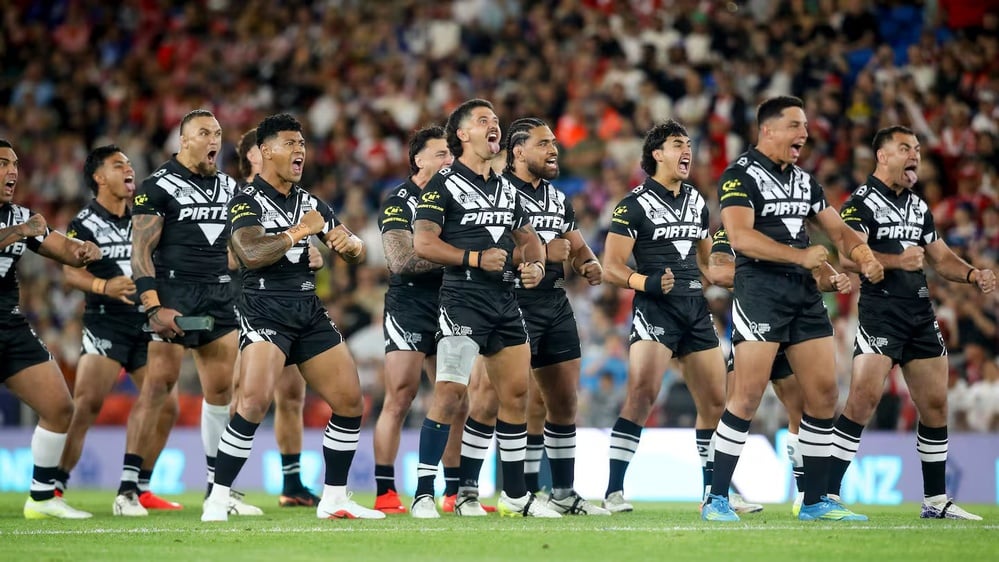
Frames the final around dramatic haka/staredown spectacle and fan nostalgia, with mild sensational adjectives and heavy reliance on player quotes.
Automated analysis; not human reviewed.
Limitations: The supplied text includes unrelated related-link and iHeart promotional boilerplate; those were excluded from analysis.
·
5 of 55 available dimensions scored; omitted dimensions are not treated as neutral.
·
Verified supporting quotes for 5 of 5 scored dimensions.
Claim: The report mixes attributed facts with evaluative, fan-oriented description.
“spine-tingling performance before the 2008 World Cup final against Australia” · exact text match
“stunning comeback 23 days later” · exact text match
Why: Evaluative adjectives frame the haka and comeback subjectively rather than neutrally.
Claim: Dramatic adjectives heighten the spectacle of pre-match rituals and the tournament.
“spine-tingling performance” · exact text match
“incredible rendition of Siva Tau” · exact text match
Why: Sensational wording emphasizes atmosphere and intensity.
Claim: The tone is positive and celebratory toward the Kiwis and tournament atmosphere.
“It’s it’s awesome to see.” · exact text match
“I’m extremely grateful” · exact text match
Why: Positive emotional language and player gratitude shape the tone.
Claim: The report attributes player statements and supplies comparative match statistics.
“Ponga said” · exact text match
“Australia has won eight of the last 10 meetings against New Zealand.” · exact text match
Why: Direct attribution and specific historical records support credibility.
Claim: Some passages speculate about fan hopes and award standing without direct sourcing.
“Many are hoping for something similar at Suncorp Stadium on Sunday” · exact text match
“Ponga is widely considered to be in a battle with Kangaroos fullback Reece Walsh for the Golden Boot prize” · exact text match
Why: Unattributed expectations and 'widely considered' framing introduce mild speculation.
The supplied text includes unrelated related-link and iHeart promotional boilerplate; those were excluded from analysis.
November 08, 2026 · 0 shares
A home-side celebratory match report uses dramatic language such as 'demolish' and 'blockbuster' while grounding the result in attributed scores and statistics.
Automated analysis; not human reviewed.
Limitations: No byline is supplied, and the text includes duplicated paragraphs and headline fragments, limiting source-attribution checks.
·
3 of 55 available dimensions scored; omitted dimensions are not treated as neutral.
·
Verified supporting quotes for 3 of 3 scored dimensions.
Claim: Evaluative adjectives and metaphors make parts of the match report subjective rather than strictly neutral.
“Dearden scythed through some feeble defence” · exact text match
Why: The phrase uses a vivid metaphor and subjective judgment ('feeble') beyond bare factual reporting.
Claim: The headline and prose use dramatic verbs and promotional adjectives that heighten the match's significance.
“Kangaroos demolish Samoa to set up blockbuster Rugby League World Cup final against Kiwis.” · exact text match
Why: 'Demolish' and 'blockbuster' are sensational, promotional descriptors rather than neutral match terms.
Claim: The report provides specific match statistics and attributed quotes, supporting credibility despite colorful phrasing.
“They made nine errors and gave up 12 set restarts or penalties while Spencer Leniu was sin-binned for dissent late in their disastrous first half.” · exact text match
““That’s been the story of the night for Samoa — just taking a little bit too far on discipline,” Trent Robinson said in commentary on Channel 7.” · exact text match
Why: Specific countable details and named attribution are visible, and quotes are clearly sourced to named speakers.
No byline is supplied, and the text includes duplicated paragraphs and headline fragments, limiting source-attribution checks.
November 08, 2026 · 0 shares
Hyperbolic, celebratory sports language dramatizes Reece Walsh's backflip and Australia's first-half dominance.
The Kangaroos are Australia's national rugby league team.
Automated analysis; not human reviewed.
Limitations: The supplied text includes repeated headline fragments and no byline, full match result, or direct quotes, limiting certainty about attribution and final score.
·
4 of 55 available dimensions scored; omitted dimensions are not treated as neutral.
·
Verified supporting quotes for 4 of 4 scored dimensions.
Claim: The report blends factual play-by-play with evaluative, subjective descriptions.
“outrageous try celebration” · exact text match
“rampant first half” · exact text match
Why: Evaluative adjectives frame the event subjectively while the score is reported.
Claim: The report uses hyperbolic, reaction-focused language to dramatize Walsh's celebration.
“left commentators stunned and fans on their feet” · exact text match
“outrageous try celebration” · exact text match
Why: These phrases heighten the moment beyond neutral play-by-play.
Claim: The report spotlights a highlight-reel celebration as a central point of interest.
“pulling off an outrageous try celebration” · exact text match
“pulled off a backflip in front of a Samoan-heavy stand of supporters” · exact text match
Why: The selection and description emphasize spectacle and crowd reaction.
Claim: The report's tone toward Walsh and Australia is enthusiastic and positive.
“red-hot favourites” · exact text match
“energy running through their half-back superstar” · exact text match
Why: Positive descriptors convey admiration and excitement rather than neutral detachment.
The supplied text includes repeated headline fragments and no byline, full match result, or direct quotes, limiting certainty about attribution and final score.
Sports-page framing amplifies a selection update with dramatic language such as 'huge selection hint,' 'major blow,' and 'cruel twist,' while the core claim remains attributed to Kevin Walters.
Automated analysis; not human reviewed.
Limitations: Trailing unrelated news snippets after the rugby league report were treated as page chrome and excluded.
·
3 of 55 available dimensions scored; omitted dimensions are not treated as neutral.
·
Verified supporting quotes for 2 of 3 scored dimensions.
Claim: The report frames Tedesco's possible omission with evaluative language rather than neutral description.
“But in a cruel twist for James Tedesco” · exact text match
Why: 'Cruel twist' adds subjective judgment to the selection report.
Claim: The headline and lead dramatize a likely selection continuity as a major setback.
“Kevin Walters drops huge selection hint for World Cup final in major blow to Kangaroos star.” · exact text match
“It spells more bad news just days after a cruel setback for one Kangaroos star.” · exact text match
Why: 'Huge,' 'major blow,' and 'cruel setback' amplify the stakes beyond neutral reporting.
Claim: The central selection claim is attributed to a named coach and a named television program, with direct quotation and conditional language.
“Walters told Channel Seven's The Agenda Setters rugby league program.” · not found in supplied text
“unless there's anything that pops up in the next couple of days” · not found in supplied text
Why: Named sourcing and explicit uncertainty support visible credibility.
Trailing unrelated news snippets after the rugby league report were treated as page chrome and excluded.
November 07, 2026 · 0 shares
Straightforward match reporting foregrounds the scoreline and Waaka’s hat-trick with limited evaluative or partisan framing.
Automated analysis; not human reviewed.
Limitations: Assessment is limited to a short sports match report excerpt; no byline, sourcing, or broader context is supplied.
·
4 of 55 available dimensions scored; omitted dimensions are not treated as neutral.
·
Verified supporting quotes for 4 of 4 scored dimensions.
Claim: The report is anchored in factual match-result and scoring details rather than subjective commentary.
“A Stacey Waaka hat-trick has helped secure New Zealand their place in the Women’s Rugby League World Cup final.” · exact text match
Why: The quoted passage presents the result and scoring outcome as factual match information.
Claim: The language remains restrained match reporting rather than sensationalized drama.
“The Kiwi Ferns were rarely threatened in their 32-0 victory over an inexperienced Fetu Samoa in Newcastle, running away with it late with four tries in the final 12 minutes on Saturday afternoon.” · exact text match
Why: The wording is largely descriptive, with only mild evaluative phrasing such as “rarely threatened” and “running away with it.”
Claim: The text recounts what happened in the match without prescribing actions or policies.
“The Kiwi Ferns were rarely threatened in their 32-0 victory over an inexperienced Fetu Samoa in Newcastle, running away with it late with four tries in the final 12 minutes on Saturday afternoon.” · exact text match
Why: The passage describes the match outcome and scoring sequence rather than advocating any course of action.
Claim: Specific score, venue, opponent, scoring run, and timing give the report a verifiable, consistent match account.
“The Kiwi Ferns were rarely threatened in their 32-0 victory over an inexperienced Fetu Samoa in Newcastle, running away with it late with four tries in the final 12 minutes on Saturday afternoon.” · exact text match
Why: The supplied text includes concrete match details, though it lacks named sourcing in the excerpt.
Assessment is limited to a short sports match report excerpt; no byline, sourcing, or broader context is supplied.
November 07, 2026 · 0 shares
Dramatic sports-recap framing uses evaluative language such as 'bruising', 'flood gates opened', and 'brave Samoa' while keeping a mostly factual match-report structure.
The Kiwi Ferns are New Zealand’s women’s rugby league team and the Jillaroos are Australia’s women’s national rugby league team.
Automated analysis; not human reviewed.
Limitations: The supplied text is a short sports recap with duplicated paragraphs and app-promotion lines; ideological dimensions are not applicable, so scoring is limited to tone, framing, and descriptive style.
·
6 of 55 available dimensions scored; omitted dimensions are not treated as neutral.
·
Verified supporting quotes for 6 of 6 scored dimensions.
Claim: The report uses evaluative sportswriter judgments beyond raw score facts.
“The Kiwi Ferns were hot favourites against the first-time semi-finalists, but were made to work hard for the victory despite Samoa failing to score.” · exact text match
Why: Terms like 'hot favourites' and 'made to work hard' are subjective assessments of expectation and performance.
Claim: The prose uses mild dramatic clichés to heighten the match narrative.
“The margin was only eight points at half-time before the flood gates opened late on as the Kiwis overpowered the pacific nation.” · exact text match
Why: 'Flood gates opened' and 'overpowered' frame a lopsided score in dramatic, vivid terms.
Claim: The report is overwhelmingly descriptive rather than prescriptive.
“New Zealand have progressed to their seventh Rugby League World Cup final with a bruising 32-0 win over Samoa on Saturday night.” · exact text match
Why: It recounts a match result and events without advocating actions, policies, or norms.
Claim: The article includes mild evaluative opinions about player urgency and consequences.
“Perseverance paid off for the centre – a lack of urgency from winger Mercedez Taulelei-Siala while attempting to secure a Raecene McGregor kick coming back to bite the Samoans.” · exact text match
Why: 'Lack of urgency' and 'coming back to bite' are interpretive judgments about play rather than bare facts.
Claim: The headline gives a mildly positive emotional coloring to Samoa and the victory.
“Kiwi Ferns through to another RLWC final with shutout victory over brave Samoa.” · exact text match
Why: 'Brave Samoa' and 'shutout victory' carry positive, admiring sentiment rather than neutral labeling.
Claim: The match account is coherent and follows a logical sporting narrative.
“In an otherwise error-marred first half, the Samoans had the better of the chances, but failed to register points in good territory.” · exact text match
Why: The sentence links territorial chances to failure to score, supporting a rational, cause-and-effect match account.
The supplied text is a short sports recap with duplicated paragraphs and app-promotion lines; ideological dimensions are not applicable, so scoring is limited to tone, framing, and descriptive style.
November 09, 2026 · 0 shares
The report is largely factual and quote-driven, with a mildly positive, celebratory frame around Pacific Island teams' historic semifinal runs and future prospects.
Automated analysis; not human reviewed.
Limitations: The supplied text includes unrelated related-link headlines and newsletter boilerplate after the sports article; those were excluded, and no author byline was present.
·
10 of 55 available dimensions scored; omitted dimensions are not treated as neutral.
·
Verified supporting quotes for 10 of 10 scored dimensions.
Claim: The report attributes praise and disappointment to team figures rather than presenting them as the publisher's own evaluations.
“Fetu Samoa head coach Frank Pritchard said their campaign was a success but admitted his disappointment at the mistakes the team made against New Zealand on Saturday morning in Newcastle.” · exact text match
Why: The evaluative assessment is explicitly attributed to the coach, supporting objective, attributed framing.
Claim: Despite dramatic sports language, the report grounds results in specific scores and attributed reactions.
“The side scored two tries against the champion Jillaroos, despite losing 30-14.” · exact text match
Why: Specific scoreline and neutral match reporting indicate largely objective rather than sensational framing.
Claim: The report forecasts a brighter future for Pacific Island rugby league despite the semifinal losses.
“the future looks brighter than ever” · exact text match
Why: The phrase directly supports an optimistic framing.
Claim: The report describes results and reactions without prescribing policy or action.
“The finals this upcoming weekend will feature a double header between Australia and New Zealand in both the men and women's competitions.” · exact text match
Why: A straightforward schedule description illustrates descriptive rather than prescriptive framing.
Claim: The report includes a mild evaluative judgment that semifinal appearances were historic.
“Both reaching the semifinals was history in the making.” · exact text match
Why: The phrase is an evaluative characterization by the publisher, supporting a low level of opinionated framing.
Claim: The framing emphasizes pride and optimism despite semifinal defeats.
“While there was general disappointment they could not reach the final, the overall consensus has been that their different campaigns had been the best and that the future looks brighter than ever.” · exact text match
Why: The sentence balances disappointment with a strongly positive assessment, supporting a mildly positive emotional valence.
Claim: The report provides specific scores, pool records, and direct quotes from named team figures.
“Tonga won three out of three in pool play and won the 'Battle of the Pacific' against Samoa, topping the combined Pool B and C to secure their semifinal spot.” · exact text match
Why: Specific, checkable match details and named sourcing support high visible credibility.
Claim: The report uses attributed causal explanations for results rather than irrational or conspiratorial reasoning.
“Head coach Ben Gardiner pointed to the lack of discipline and the bad start they had as factors that led to their semifinal loss.” · exact text match
Why: A coach's specific, attributable explanation for the loss supports rational rather than irrational framing.
Claim: The report gives credit to opposing teams and notes disagreement over a contested Bunker call.
“Paulo said they knew what they were capable of at the start of their campaign and applauded the Kangaroos for their win.” · exact text match
“That viewpoint differed from Roosters coach Trent Robinson on commentary.” · exact text match
Why: Including opponent credit and a contrasting view supports fairness and high integrity.
Claim: The report provides contextual details about qualification pathways and tournament structure.
“Their semifinal appearance means they have also qualified for the next world cup in 2030, having had to qualify for this world cup through a repecharge system, after they had lost the Oceania spot to Fetu Samoa.” · exact text match
Why: Inclusion of qualification mechanics and future implications supports above-average contextual intelligence.
The supplied text includes unrelated related-link headlines and newsletter boilerplate after the sports article; those were excluded, and no author byline was present.
November 08, 2026 · 0 shares
Terse, result-focused sports reporting with neutral framing and only mild evaluative language.
Automated analysis; not human reviewed.
Limitations: Very short brief; limited evidence for broader framing.
·
1 of 55 available dimensions scored; omitted dimensions are not treated as neutral.
·
Verified supporting quotes for 1 of 1 scored dimensions.
Claim: The brief uses measured, result-focused language rather than sensational framing.
“will now take on the Kiwi Ferns in the Rugby League World Cup final.” · exact text match
Why: The final matchup is presented in plain informational terms without heightened drama or alarm.
Very short brief; limited evidence for broader framing.
November 09, 2026 · 0 shares
The report is largely factual and quote-driven, with a mildly positive, celebratory frame around Pacific Island teams' historic semifinal runs and future prospects.
Automated analysis; not human reviewed.
Limitations: The supplied text includes unrelated related-link headlines and newsletter boilerplate after the sports article; those were excluded, and no author byline was present.
·
10 of 55 available dimensions scored; omitted dimensions are not treated as neutral.
·
Verified supporting quotes for 10 of 10 scored dimensions.
Claim: The report attributes praise and disappointment to team figures rather than presenting them as the publisher's own evaluations.
“Fetu Samoa head coach Frank Pritchard said their campaign was a success but admitted his disappointment at the mistakes the team made against New Zealand on Saturday morning in Newcastle.” · exact text match
Why: The evaluative assessment is explicitly attributed to the coach, supporting objective, attributed framing.
Claim: Despite dramatic sports language, the report grounds results in specific scores and attributed reactions.
“The side scored two tries against the champion Jillaroos, despite losing 30-14.” · exact text match
Why: Specific scoreline and neutral match reporting indicate largely objective rather than sensational framing.
Claim: The report forecasts a brighter future for Pacific Island rugby league despite the semifinal losses.
“the future looks brighter than ever” · exact text match
Why: The phrase directly supports an optimistic framing.
Claim: The report describes results and reactions without prescribing policy or action.
“The finals this upcoming weekend will feature a double header between Australia and New Zealand in both the men and women's competitions.” · exact text match
Why: A straightforward schedule description illustrates descriptive rather than prescriptive framing.
Claim: The report includes a mild evaluative judgment that semifinal appearances were historic.
“Both reaching the semifinals was history in the making.” · exact text match
Why: The phrase is an evaluative characterization by the publisher, supporting a low level of opinionated framing.
Claim: The framing emphasizes pride and optimism despite semifinal defeats.
“While there was general disappointment they could not reach the final, the overall consensus has been that their different campaigns had been the best and that the future looks brighter than ever.” · exact text match
Why: The sentence balances disappointment with a strongly positive assessment, supporting a mildly positive emotional valence.
Claim: The report provides specific scores, pool records, and direct quotes from named team figures.
“Tonga won three out of three in pool play and won the 'Battle of the Pacific' against Samoa, topping the combined Pool B and C to secure their semifinal spot.” · exact text match
Why: Specific, checkable match details and named sourcing support high visible credibility.
Claim: The report uses attributed causal explanations for results rather than irrational or conspiratorial reasoning.
“Head coach Ben Gardiner pointed to the lack of discipline and the bad start they had as factors that led to their semifinal loss.” · exact text match
Why: A coach's specific, attributable explanation for the loss supports rational rather than irrational framing.
Claim: The report gives credit to opposing teams and notes disagreement over a contested Bunker call.
“Paulo said they knew what they were capable of at the start of their campaign and applauded the Kangaroos for their win.” · exact text match
“That viewpoint differed from Roosters coach Trent Robinson on commentary.” · exact text match
Why: Including opponent credit and a contrasting view supports fairness and high integrity.
Claim: The report provides contextual details about qualification pathways and tournament structure.
“Their semifinal appearance means they have also qualified for the next world cup in 2030, having had to qualify for this world cup through a repecharge system, after they had lost the Oceania spot to Fetu Samoa.” · exact text match
Why: Inclusion of qualification mechanics and future implications supports above-average contextual intelligence.
The supplied text includes unrelated related-link headlines and newsletter boilerplate after the sports article; those were excluded, and no author byline was present.
November 09, 2026 · 0 shares
Attributed statements from IRL officials and a neutral presentation of expansion plans dominate, with a dissenting player pay complaint included but little overt evaluative framing.
Automated analysis; not human reviewed.
Limitations: The supplied text includes unrelated sports snippets after the main RLWC report and some duplicated or truncated passages; scoring focuses on the main report.
·
4 of 55 available dimensions scored; omitted dimensions are not treated as neutral.
·
Verified supporting quotes for 4 of 4 scored dimensions.
Claim: The report keeps to attributed statements and statistics rather than subordinating facts to the publisher’s subjective viewpoint.
“The US accounted for almost 80 percent of streaming subscriptions for matches in the this year’s tournament, the IRL said in a statement.” · exact text match
“Grant said the 2030 men’s tournament would feature 12 nations, up from 10 this year” · exact text match
Why: Key claims are attributed to the IRL or named official, supporting an objective rather than subjective presentation.
Claim: The main report uses neutral, data-based wording rather than sensational language.
“Grant said the 2030 men’s tournament would feature 12 nations, up from 10 this year” · exact text match
Why: The tournament details are presented as a straightforward attributed statement without dramatic or sensational phrasing.
Claim: The publisher primarily describes announced plans and quoted views rather than advocating a course of action.
“The next edition of the Rugby League World Cup is to be played in a series of “Magic Rounds” in five cities across the Pacific and US, International Rugby League (IRL) board chief Troy Grant said yesterday.” · exact text match
Why: The central sentence reports a planned event and attributes it to an official rather than prescribing a position.
Claim: The report attributes key claims to named officials and IRL statements and includes a dissenting player’s criticism.
“Samoa prop Spencer Leniu said World Cup organizers needed to urgently tackle the pay disparity between the Pacific island nations and the likes of Australia.” · exact text match
“The US accounted for almost 80 percent of streaming subscriptions for matches in the this year’s tournament, the IRL said in a statement.” · exact text match
Why: Named attribution and inclusion of a critical player quote support visible fairness and sourcing in the substantive report.
The supplied text includes unrelated sports snippets after the main RLWC report and some duplicated or truncated passages; scoring focuses on the main report.
A bare, neutral factual announcement carries no evaluative or sensational framing.
Automated analysis; not human reviewed.
Limitations: Extremely limited text; only a duplicated headline-like sentence is available, so most bias dimensions cannot be assessed.
·
2 of 55 available dimensions scored; omitted dimensions are not treated as neutral.
·
Verified supporting quotes for 2 of 2 scored dimensions.
Claim: The supplied text provides only a plain announcement of the 2030 Rugby League World Cup host.
“USA and Pacific Islands announced as Rugby League World Cup 2030 host” · exact text match
Why: Plain declarative announcement with no subjective evaluation, speculation, or opinion.
Claim: The wording is neutral and non-sensational.
“USA and Pacific Islands announced as Rugby League World Cup 2030 host” · exact text match
Why: No dramatic, emotional, or hyperbolic language appears.
Extremely limited text; only a duplicated headline-like sentence is available, so most bias dimensions cannot be assessed.
November 07, 2026 · 0 shares
Promotional expansion framing presents a not-yet-official US host plan as a significant global opportunity while caveating the confirmation status.
Automated analysis; not human reviewed.
Limitations: The supplied text is duplicated and partly truncated, and the central host decision is explicitly unconfirmed; scores assess the report’s framing, not event confirmation.
·
4 of 55 available dimensions scored; omitted dimensions are not treated as neutral.
·
Verified supporting quotes for 4 of 4 scored dimensions.
Claim: Publisher framing uses evaluative language to cast the proposed host plan as a significant and expanding opportunity.
“The move represents a significant push to expand and promote rugby league globally” · exact text match
“this would be even more significant” · exact text match
Why: Evaluative adjectives and expansion framing go beyond neutral event description.
Claim: The report frames the possible US hosting as a positive expansion opportunity and as more significant than prior US market inroads.
“The move represents a significant push to expand and promote rugby league globally” · exact text match
“this would be even more significant” · exact text match
Why: Positive expansion language signals an optimistic outlook on the prospective event.
Claim: Central claims are attributed to a named reporter and explicitly caveated as unofficial.
“according to Channel 7’s David Riccio” · exact text match
“While the move is not yet official, it will likely be confirmed next week.” · exact text match
Why: Named sourcing and an uncertainty caveat support credibility despite reliance on a single report.
Claim: Presents an unconfirmed future host plan with firm and forecast language.
“The 2030 Rugby League World Cup is set to be hosted in the United States, according to Channel 7’s David Riccio.” · exact text match
“While the move is not yet official, it will likely be confirmed next week.” · exact text match
Why: The host plan is future-oriented and explicitly not official, with a predicted confirmation timeline.
The supplied text is duplicated and partly truncated, and the central host decision is explicitly unconfirmed; scores assess the report’s framing, not event confirmation.
November 08, 2026 · 0 shares
A home-side celebratory match report uses dramatic language such as 'demolish' and 'blockbuster' while grounding the result in attributed scores and statistics.
Automated analysis; not human reviewed. Limitations: No byline is supplied, and the text includes duplicated paragraphs and headline fragments, limiting source-attribution checks. · 3 of 55 available dimensions scored; omitted dimensions are not treated as neutral. · Verified supporting quotes for 3 of 3 scored dimensions.
Claim: Evaluative adjectives and metaphors make parts of the match report subjective rather than strictly neutral.
“Dearden scythed through some feeble defence” · exact text match
Why: The phrase uses a vivid metaphor and subjective judgment ('feeble') beyond bare factual reporting.
Claim: The headline and prose use dramatic verbs and promotional adjectives that heighten the match's significance.
“Kangaroos demolish Samoa to set up blockbuster Rugby League World Cup final against Kiwis.” · exact text match
Why: 'Demolish' and 'blockbuster' are sensational, promotional descriptors rather than neutral match terms.
Claim: The report provides specific match statistics and attributed quotes, supporting credibility despite colorful phrasing.
“They made nine errors and gave up 12 set restarts or penalties while Spencer Leniu was sin-binned for dissent late in their disastrous first half.” · exact text match
““That’s been the story of the night for Samoa — just taking a little bit too far on discipline,” Trent Robinson said in commentary on Channel 7.” · exact text match
Why: Specific countable details and named attribution are visible, and quotes are clearly sourced to named speakers.
No byline is supplied, and the text includes duplicated paragraphs and headline fragments, limiting source-attribution checks.
November 08, 2026 · 0 shares
A conventional, largely descriptive match report that uses mild celebratory and colorful sports phrasing while keeping most claims tied to the match and player quotes.
Automated analysis; not human reviewed. Limitations: The supplied text includes unrelated headline fragments and apparent transcription or name-spelling errors, but the sports report remains analyzable. · 4 of 55 available dimensions scored; omitted dimensions are not treated as neutral. · Verified supporting quotes for 4 of 4 scored dimensions.
Claim: Framing includes mildly subjective sports language beyond neutral score reporting.
“New Zealand ended Tonga's dream run” · exact text match
“the second half saw a dominant display by James Fisher-Harris' men who completely shut Tonga out.” · exact text match
Why: 'Dream run' and 'dominant display' are evaluative and colorful rather than strictly neutral.
Claim: Colorful phrasing adds mild sensational flavor but stops short of sensationalism.
“The Kiwis started with a bang” · exact text match
“left Tonga regretting their lost opportunities.” · exact text match
Why: Idiomatic and dramatic wording is present but sparse and typical for sports reporting.
Claim: The report recounts match events and outcomes without prescribing actions.
“New Zealand ended Tonga's dream run at the Rugby League World Cup in Newcastle, beating the Islanders 34-10 in their semifinal clash.” · exact text match
Why: The sentence is a factual match summary rather than a call to action or normative recommendation.
Claim: Evaluative commentary is limited to mild sports-descriptive opinion.
“the second half saw a dominant display by James Fisher-Harris' men who completely shut Tonga out.” · exact text match
“left Tonga regretting their lost opportunities.” · exact text match
Why: The publisher characterizes performance and emotions rather than presenting only raw results.
The supplied text includes unrelated headline fragments and apparent transcription or name-spelling errors, but the sports report remains analyzable.
November 07, 2026 · 0 shares
A straight sports-match framing emphasizes the score, named try-scorers, and attributed player reactions, with only routine sports color.
Automated analysis; not human reviewed. Limitations: No byline is supplied, and the supplied text includes duplicated snippets and site chrome around the match report; scores apply to the recoverable article content. · 4 of 55 available dimensions scored; omitted dimensions are not treated as neutral. · Verified supporting quotes for 4 of 4 scored dimensions.
Claim: The report is mostly factual but uses some vivid sports color.
“New Zealand led 12-10 at halftime and scored four unanswered tries in the second 40 to claim victory and secure their final spot.” · exact text match
Counterevidence:
“New Zealand ended Tonga's dream run at the Rugby League World Cup in Newcastle, beating the islanders 34-10 in their semifinal clash.” · exact text match
Why: A factual match chronology dominates, while the phrase 'dream run' shows limited subjective color, supporting a moderately objective classification.
Claim: The report avoids sensationalism, using measured match narration rather than alarmist or hyperbolic claims.
“The win means the Kiwis make their first final since 2013.” · exact text match
Why: A plain result-and-berth statement exemplifies the article's measured delivery.
Claim: The report is descriptive, recounting match events and attributed player reactions without urging action or policy.
“Tongan playmaker Isaiya Katoa thanked the fans, and apologized they had not done the job, while also praising the Kiwis for the win.” · exact text match
Why: The quoted reaction is reported descriptively, with no prescriptive language attached.
Claim: Visible credibility is high because the report names the score, scorers, match sequence, and attributed quotes.
“In the end the Kiwis scored six tries, one each by Briton Nikora, Dane Gagai, Casey McLean, Jahrome Hughes, Xavier Wilson and Charnse Nicoll-Kickstad.” · exact text match
“Man of the match Kalyn Ponga, who fought off an injured arm suffered in the opening clash against Australia, said it was a different game and praised his teammates.” · exact text match
Why: Specific, checkable match details and direct attribution support trustworthiness within the supplied text.
No byline is supplied, and the supplied text includes duplicated snippets and site chrome around the match report; scores apply to the recoverable article content.
November 07, 2026 · 0 shares
Straightforward match reporting foregrounds the scoreline and Waaka’s hat-trick with limited evaluative or partisan framing.
Automated analysis; not human reviewed. Limitations: Assessment is limited to a short sports match report excerpt; no byline, sourcing, or broader context is supplied. · 4 of 55 available dimensions scored; omitted dimensions are not treated as neutral. · Verified supporting quotes for 4 of 4 scored dimensions.
Claim: The report is anchored in factual match-result and scoring details rather than subjective commentary.
“A Stacey Waaka hat-trick has helped secure New Zealand their place in the Women’s Rugby League World Cup final.” · exact text match
Why: The quoted passage presents the result and scoring outcome as factual match information.
Claim: The language remains restrained match reporting rather than sensationalized drama.
“The Kiwi Ferns were rarely threatened in their 32-0 victory over an inexperienced Fetu Samoa in Newcastle, running away with it late with four tries in the final 12 minutes on Saturday afternoon.” · exact text match
Why: The wording is largely descriptive, with only mild evaluative phrasing such as “rarely threatened” and “running away with it.”
Claim: The text recounts what happened in the match without prescribing actions or policies.
“The Kiwi Ferns were rarely threatened in their 32-0 victory over an inexperienced Fetu Samoa in Newcastle, running away with it late with four tries in the final 12 minutes on Saturday afternoon.” · exact text match
Why: The passage describes the match outcome and scoring sequence rather than advocating any course of action.
Claim: Specific score, venue, opponent, scoring run, and timing give the report a verifiable, consistent match account.
“The Kiwi Ferns were rarely threatened in their 32-0 victory over an inexperienced Fetu Samoa in Newcastle, running away with it late with four tries in the final 12 minutes on Saturday afternoon.” · exact text match
Why: The supplied text includes concrete match details, though it lacks named sourcing in the excerpt.
Assessment is limited to a short sports match report excerpt; no byline, sourcing, or broader context is supplied.
November 07, 2026 · 0 shares
Dramatic sports-recap framing uses evaluative language such as 'bruising', 'flood gates opened', and 'brave Samoa' while keeping a mostly factual match-report structure.
The Kiwi Ferns are New Zealand’s women’s rugby league team and the Jillaroos are Australia’s women’s national rugby league team.
Automated analysis; not human reviewed. Limitations: The supplied text is a short sports recap with duplicated paragraphs and app-promotion lines; ideological dimensions are not applicable, so scoring is limited to tone, framing, and descriptive style. · 6 of 55 available dimensions scored; omitted dimensions are not treated as neutral. · Verified supporting quotes for 6 of 6 scored dimensions.
Claim: The report uses evaluative sportswriter judgments beyond raw score facts.
“The Kiwi Ferns were hot favourites against the first-time semi-finalists, but were made to work hard for the victory despite Samoa failing to score.” · exact text match
Why: Terms like 'hot favourites' and 'made to work hard' are subjective assessments of expectation and performance.
Claim: The prose uses mild dramatic clichés to heighten the match narrative.
“The margin was only eight points at half-time before the flood gates opened late on as the Kiwis overpowered the pacific nation.” · exact text match
Why: 'Flood gates opened' and 'overpowered' frame a lopsided score in dramatic, vivid terms.
Claim: The report is overwhelmingly descriptive rather than prescriptive.
“New Zealand have progressed to their seventh Rugby League World Cup final with a bruising 32-0 win over Samoa on Saturday night.” · exact text match
Why: It recounts a match result and events without advocating actions, policies, or norms.
Claim: The article includes mild evaluative opinions about player urgency and consequences.
“Perseverance paid off for the centre – a lack of urgency from winger Mercedez Taulelei-Siala while attempting to secure a Raecene McGregor kick coming back to bite the Samoans.” · exact text match
Why: 'Lack of urgency' and 'coming back to bite' are interpretive judgments about play rather than bare facts.
Claim: The headline gives a mildly positive emotional coloring to Samoa and the victory.
“Kiwi Ferns through to another RLWC final with shutout victory over brave Samoa.” · exact text match
Why: 'Brave Samoa' and 'shutout victory' carry positive, admiring sentiment rather than neutral labeling.
Claim: The match account is coherent and follows a logical sporting narrative.
“In an otherwise error-marred first half, the Samoans had the better of the chances, but failed to register points in good territory.” · exact text match
Why: The sentence links territorial chances to failure to score, supporting a rational, cause-and-effect match account.
The supplied text is a short sports recap with duplicated paragraphs and app-promotion lines; ideological dimensions are not applicable, so scoring is limited to tone, framing, and descriptive style.
November 09, 2026 · 0 shares
The report is largely factual and quote-driven, with a mildly positive, celebratory frame around Pacific Island teams' historic semifinal runs and future prospects.
Automated analysis; not human reviewed. Limitations: The supplied text includes unrelated related-link headlines and newsletter boilerplate after the sports article; those were excluded, and no author byline was present. · 10 of 55 available dimensions scored; omitted dimensions are not treated as neutral. · Verified supporting quotes for 10 of 10 scored dimensions.
Claim: The report attributes praise and disappointment to team figures rather than presenting them as the publisher's own evaluations.
“Fetu Samoa head coach Frank Pritchard said their campaign was a success but admitted his disappointment at the mistakes the team made against New Zealand on Saturday morning in Newcastle.” · exact text match
Why: The evaluative assessment is explicitly attributed to the coach, supporting objective, attributed framing.
Claim: Despite dramatic sports language, the report grounds results in specific scores and attributed reactions.
“The side scored two tries against the champion Jillaroos, despite losing 30-14.” · exact text match
Why: Specific scoreline and neutral match reporting indicate largely objective rather than sensational framing.
Claim: The report forecasts a brighter future for Pacific Island rugby league despite the semifinal losses.
“the future looks brighter than ever” · exact text match
Why: The phrase directly supports an optimistic framing.
Claim: The report describes results and reactions without prescribing policy or action.
“The finals this upcoming weekend will feature a double header between Australia and New Zealand in both the men and women's competitions.” · exact text match
Why: A straightforward schedule description illustrates descriptive rather than prescriptive framing.
Claim: The report includes a mild evaluative judgment that semifinal appearances were historic.
“Both reaching the semifinals was history in the making.” · exact text match
Why: The phrase is an evaluative characterization by the publisher, supporting a low level of opinionated framing.
Claim: The framing emphasizes pride and optimism despite semifinal defeats.
“While there was general disappointment they could not reach the final, the overall consensus has been that their different campaigns had been the best and that the future looks brighter than ever.” · exact text match
Why: The sentence balances disappointment with a strongly positive assessment, supporting a mildly positive emotional valence.
Claim: The report provides specific scores, pool records, and direct quotes from named team figures.
“Tonga won three out of three in pool play and won the 'Battle of the Pacific' against Samoa, topping the combined Pool B and C to secure their semifinal spot.” · exact text match
Why: Specific, checkable match details and named sourcing support high visible credibility.
Claim: The report uses attributed causal explanations for results rather than irrational or conspiratorial reasoning.
“Head coach Ben Gardiner pointed to the lack of discipline and the bad start they had as factors that led to their semifinal loss.” · exact text match
Why: A coach's specific, attributable explanation for the loss supports rational rather than irrational framing.
Claim: The report gives credit to opposing teams and notes disagreement over a contested Bunker call.
“Paulo said they knew what they were capable of at the start of their campaign and applauded the Kangaroos for their win.” · exact text match
“That viewpoint differed from Roosters coach Trent Robinson on commentary.” · exact text match
Why: Including opponent credit and a contrasting view supports fairness and high integrity.
Claim: The report provides contextual details about qualification pathways and tournament structure.
“Their semifinal appearance means they have also qualified for the next world cup in 2030, having had to qualify for this world cup through a repecharge system, after they had lost the Oceania spot to Fetu Samoa.” · exact text match
Why: Inclusion of qualification mechanics and future implications supports above-average contextual intelligence.
The supplied text includes unrelated related-link headlines and newsletter boilerplate after the sports article; those were excluded, and no author byline was present.
November 08, 2026 · 0 shares
Terse, result-focused sports reporting with neutral framing and only mild evaluative language.
Automated analysis; not human reviewed. Limitations: Very short brief; limited evidence for broader framing. · 1 of 55 available dimensions scored; omitted dimensions are not treated as neutral. · Verified supporting quotes for 1 of 1 scored dimensions.
Claim: The brief uses measured, result-focused language rather than sensational framing.
“will now take on the Kiwi Ferns in the Rugby League World Cup final.” · exact text match
Why: The final matchup is presented in plain informational terms without heightened drama or alarm.
Very short brief; limited evidence for broader framing.
November 09, 2026 · 0 shares
Attributed statements from IRL officials and a neutral presentation of expansion plans dominate, with a dissenting player pay complaint included but little overt evaluative framing.
Automated analysis; not human reviewed. Limitations: The supplied text includes unrelated sports snippets after the main RLWC report and some duplicated or truncated passages; scoring focuses on the main report. · 4 of 55 available dimensions scored; omitted dimensions are not treated as neutral. · Verified supporting quotes for 4 of 4 scored dimensions.
Claim: The report keeps to attributed statements and statistics rather than subordinating facts to the publisher’s subjective viewpoint.
“The US accounted for almost 80 percent of streaming subscriptions for matches in the this year’s tournament, the IRL said in a statement.” · exact text match
“Grant said the 2030 men’s tournament would feature 12 nations, up from 10 this year” · exact text match
Why: Key claims are attributed to the IRL or named official, supporting an objective rather than subjective presentation.
Claim: The main report uses neutral, data-based wording rather than sensational language.
“Grant said the 2030 men’s tournament would feature 12 nations, up from 10 this year” · exact text match
Why: The tournament details are presented as a straightforward attributed statement without dramatic or sensational phrasing.
Claim: The publisher primarily describes announced plans and quoted views rather than advocating a course of action.
“The next edition of the Rugby League World Cup is to be played in a series of “Magic Rounds” in five cities across the Pacific and US, International Rugby League (IRL) board chief Troy Grant said yesterday.” · exact text match
Why: The central sentence reports a planned event and attributes it to an official rather than prescribing a position.
Claim: The report attributes key claims to named officials and IRL statements and includes a dissenting player’s criticism.
“Samoa prop Spencer Leniu said World Cup organizers needed to urgently tackle the pay disparity between the Pacific island nations and the likes of Australia.” · exact text match
“The US accounted for almost 80 percent of streaming subscriptions for matches in the this year’s tournament, the IRL said in a statement.” · exact text match
Why: Named attribution and inclusion of a critical player quote support visible fairness and sourcing in the substantive report.
The supplied text includes unrelated sports snippets after the main RLWC report and some duplicated or truncated passages; scoring focuses on the main report.
A bare, neutral factual announcement carries no evaluative or sensational framing.
Automated analysis; not human reviewed. Limitations: Extremely limited text; only a duplicated headline-like sentence is available, so most bias dimensions cannot be assessed. · 2 of 55 available dimensions scored; omitted dimensions are not treated as neutral. · Verified supporting quotes for 2 of 2 scored dimensions.
Claim: The supplied text provides only a plain announcement of the 2030 Rugby League World Cup host.
“USA and Pacific Islands announced as Rugby League World Cup 2030 host” · exact text match
Why: Plain declarative announcement with no subjective evaluation, speculation, or opinion.
Claim: The wording is neutral and non-sensational.
“USA and Pacific Islands announced as Rugby League World Cup 2030 host” · exact text match
Why: No dramatic, emotional, or hyperbolic language appears.
Extremely limited text; only a duplicated headline-like sentence is available, so most bias dimensions cannot be assessed.
November 07, 2026 · 0 shares
Promotional expansion framing presents a not-yet-official US host plan as a significant global opportunity while caveating the confirmation status.
Automated analysis; not human reviewed. Limitations: The supplied text is duplicated and partly truncated, and the central host decision is explicitly unconfirmed; scores assess the report’s framing, not event confirmation. · 4 of 55 available dimensions scored; omitted dimensions are not treated as neutral. · Verified supporting quotes for 4 of 4 scored dimensions.
Claim: Publisher framing uses evaluative language to cast the proposed host plan as a significant and expanding opportunity.
“The move represents a significant push to expand and promote rugby league globally” · exact text match
“this would be even more significant” · exact text match
Why: Evaluative adjectives and expansion framing go beyond neutral event description.
Claim: The report frames the possible US hosting as a positive expansion opportunity and as more significant than prior US market inroads.
“The move represents a significant push to expand and promote rugby league globally” · exact text match
“this would be even more significant” · exact text match
Why: Positive expansion language signals an optimistic outlook on the prospective event.
Claim: Central claims are attributed to a named reporter and explicitly caveated as unofficial.
“according to Channel 7’s David Riccio” · exact text match
“While the move is not yet official, it will likely be confirmed next week.” · exact text match
Why: Named sourcing and an uncertainty caveat support credibility despite reliance on a single report.
Claim: Presents an unconfirmed future host plan with firm and forecast language.
“The 2030 Rugby League World Cup is set to be hosted in the United States, according to Channel 7’s David Riccio.” · exact text match
“While the move is not yet official, it will likely be confirmed next week.” · exact text match
Why: The host plan is future-oriented and explicitly not official, with a predicted confirmation timeline.
The supplied text is duplicated and partly truncated, and the central host decision is explicitly unconfirmed; scores assess the report’s framing, not event confirmation.
November 06, 2026 · 0 shares
A restrained official-notice frame attributes the motorcade ban to a named public-safety official and stated traffic-safety violations.
Automated analysis; not human reviewed. Limitations: The supplied text is a short paraphrased notice with no byline or publication date and no independent corroboration. · 6 of 55 available dimensions scored; omitted dimensions are not treated as neutral. · Verified supporting quotes for 6 of 6 scored dimensions.
Claim: The report presents the motorcade halt as an attributed official action with stated reasons rather than as the publisher's opinion.
“The Department of Public Safety issued a notice this morning that all rugby games motorcades and floats are now being halted due to previous traffic violations committed during the last rugby games motorcades.” · exact text match
Why: The key development is attributed to a government notice and objective-sounding procedural language.
Claim: The prose is procedural and avoids dramatic or emotive language.
“The Deputy Commissioner said the club has been informed of the decision that all rugby games motorcades will not be allowed.” · exact text match
Why: The decision is reported in plain, non-sensational terms.
Claim: The report describes the DPS decision and its consequences rather than urging a course of action.
“Any motorcades planned for the Toa Samoa and Mate Maa Tonga Rugby League World Cup games this weekend will not go ahead.” · exact text match
Why: The sentence states what will happen, not what readers or officials should do.
Claim: The report cites a specific government agency and named deputy commissioner and includes concrete details about the decision.
“The Department of Public Safety issued a notice this morning that all rugby games motorcades and floats are now being halted due to previous traffic violations committed during the last rugby games motorcades.” · exact text match
“Deputy Commissioner of Public Safety Falanai Taase Sagapolutele explained that during motorcades last week ahead of the Toa o Samoa clash with Mate Maa Tonga, police and members of the public observed rowdy behavior” · exact text match
Why: Specific institutional attribution and named sourcing support credibility, but no independent corroboration is provided.
Claim: The report grounds the motorcade ban in an explicit safety rationale and attributed observations of traffic violations.
“He said it was mainly for safety that DPS has decided to stop the rugby game motorcades.” · exact text match
“due to previous traffic violations committed during the last rugby games motorcades” · exact text match
Why: The decision is presented with stated reasons rather than unexplained assertion, supporting a rational rather than irrational framing.
Claim: The report attributes the decision to a named public-safety official and discloses the stated rationale.
“Deputy Commissioner of Public Safety Falanai Taase Sagapolutele explained that during motorcades last week ahead of the Toa o Samoa clash with Mate Maa Tonga, police and members of the public observed rowdy behavior” · exact text match
Why: Named attribution and specific rationale are visible fairness/honesty signals, though the account relies on one official source.
The supplied text is a short paraphrased notice with no byline or publication date and no independent corroboration.
November 09, 2026 · 0 shares
Police-attributed framing foregrounds 'unacceptable' disorder and public-safety risks while acknowledging most Rugby League World Cup supporters were lawful.
Automated analysis; not human reviewed. Limitations: No byline or publication date is supplied; unrelated link headlines at the end were excluded. · 5 of 55 available dimensions scored; omitted dimensions are not treated as neutral. · Verified supporting quotes for 5 of 5 scored dimensions.
Claim: The report attributes claims to police and discloses undisclosed details rather than asserting an unverified narrative.
“Police did not provide details about where the arrests occurred, the ages of those arrested, whether charges had been laid, or whether anyone was injured.” · exact text match
Why: Explicitly noting missing information and attributing claims to police are objective reporting signals.
Claim: The central prose reports arrests and incidents without prescribing policy or behavior.
“Thirteen people were arrested during Rugby League World Cup-related gatherings in South Auckland over the weekend, with bottles thrown at police and fireworks fired towards petrol stations.” · exact text match
Why: The sentence describes events and outcomes rather than advocating a course of action.
Claim: The report uses a named police commander as source and acknowledges gaps in the information supplied.
“Police Counties Manukau District Commander Superintendent Shanan Gray said most supporters who gathered to celebrate did so safely and lawfully, but police dealt with several incidents described as “unacceptable”.” · exact text match
“Police did not provide details about where the arrests occurred, the ages of those arrested, whether charges had been laid, or whether anyone was injured.” · exact text match
Why: Named attribution plus explicit limitations are visible credibility signals.
Claim: The account presents lawful majority behavior alongside reported disorder instead of treating all supporters as threatening.
“Police Counties Manukau District Commander Superintendent Shanan Gray said most supporters who gathered to celebrate did so safely and lawfully, but police dealt with several incidents described as “unacceptable”.” · exact text match
Why: Balancing lawful majority behavior with specific incidents is evidence-bound rather than irrational or alarmist.
Claim: The report openly states key details police did not provide.
“Police did not provide details about where the arrests occurred, the ages of those arrested, whether charges had been laid, or whether anyone was injured.” · exact text match
Why: Disclosing missing information is a fairness and honesty signal.
No byline or publication date is supplied; unrelated link headlines at the end were excluded.
Australian Rugby Establishment (ARLC/V'Landys)
November 11, 2026 · 0 shares
A first-person sports opinion column that approvingly frames ARLC and Peter V'Landys' control while offering confident predictions and prescriptions.
Automated analysis; not human reviewed. Limitations: The source is a first-person opinion column, so scores reflect commentary framing rather than neutral reporting; no external verification of its claims is possible from the supplied text. · 55 of 55 available dimensions scored; omitted dimensions are not treated as neutral. · Verified supporting quotes for 7 of 55 scored dimensions.
Claim: The column is explicitly first-person opinion and prediction rather than neutral reporting.
“I really cannot split them.” · exact text match
“I would be surprised if that warning shot wasn't felt all the way back in 2017” · exact text match
Why: First-person evaluative language and predictions dominate the text.
Claim: The column moves from analysis to prescriptions about how rugby league should prioritize fans and improve the domestic product.
“We have to improve it for those people, you have to keep the product on top for those people.” · exact text match
Why: The quoted language explicitly prescribes what should be done.
Claim: The column is dominated by the author's evaluative judgments and preferences.
“I say so be it.” · exact text match
“I am fascinated by it.” · exact text match
Why: The text repeatedly states personal judgments rather than neutral facts.
Claim: The column treats Peter V'Landys' track record as a strong reason to trust the 2030 World Cup plan.
“the mastermind and the brains behind it is Peter V'Landys and the Australian Rugby League Commission” · exact text match
“This is the man who brought games to Las Vegas when people said it could and would not happen” · exact text match
Why: The argument leans on V'Landys' personal authority and past success.
Claim: The column frames the ARLC's financial and administrative dominance approvingly as legitimate.
“When you are paying the piper, you call the tune and the ARLC are paying the piper.” · exact text match
Why: The quote endorses the established governing body's control over the sport.
Claim: The column uses positive, enthusiastic language about the finals and the 2030 plan.
“We are in for a sensational final between the two best nations in the world.” · exact text match
“I am fascinated by it.” · exact text match
Why: The quoted language is clearly positive and enthusiastic.
Claim: The column forecasts outcomes and consequences that are not established, such as the NRL partnership's effects.
“if the NRL partnership deal comes to pass, it is a major development in our game” · exact text match
“If the domestic game improves, then you would imagine the international game would improve by extension” · exact text match
Why: The text makes conditional forecasts about future developments.
The source is a first-person opinion column, so scores reflect commentary framing rather than neutral reporting; no external verification of its claims is possible from the supplied text.
November 09, 2026 · 0 shares
Attributed statements from IRL officials and a neutral presentation of expansion plans dominate, with a dissenting player pay complaint included but little overt evaluative framing.
Automated analysis; not human reviewed. Limitations: The supplied text includes unrelated sports snippets after the main RLWC report and some duplicated or truncated passages; scoring focuses on the main report. · 4 of 55 available dimensions scored; omitted dimensions are not treated as neutral. · Verified supporting quotes for 4 of 4 scored dimensions.
Claim: The report keeps to attributed statements and statistics rather than subordinating facts to the publisher’s subjective viewpoint.
“The US accounted for almost 80 percent of streaming subscriptions for matches in the this year’s tournament, the IRL said in a statement.” · exact text match
“Grant said the 2030 men’s tournament would feature 12 nations, up from 10 this year” · exact text match
Why: Key claims are attributed to the IRL or named official, supporting an objective rather than subjective presentation.
Claim: The main report uses neutral, data-based wording rather than sensational language.
“Grant said the 2030 men’s tournament would feature 12 nations, up from 10 this year” · exact text match
Why: The tournament details are presented as a straightforward attributed statement without dramatic or sensational phrasing.
Claim: The publisher primarily describes announced plans and quoted views rather than advocating a course of action.
“The next edition of the Rugby League World Cup is to be played in a series of “Magic Rounds” in five cities across the Pacific and US, International Rugby League (IRL) board chief Troy Grant said yesterday.” · exact text match
Why: The central sentence reports a planned event and attributes it to an official rather than prescribing a position.
Claim: The report attributes key claims to named officials and IRL statements and includes a dissenting player’s criticism.
“Samoa prop Spencer Leniu said World Cup organizers needed to urgently tackle the pay disparity between the Pacific island nations and the likes of Australia.” · exact text match
“The US accounted for almost 80 percent of streaming subscriptions for matches in the this year’s tournament, the IRL said in a statement.” · exact text match
Why: Named attribution and inclusion of a critical player quote support visible fairness and sourcing in the substantive report.
The supplied text includes unrelated sports snippets after the main RLWC report and some duplicated or truncated passages; scoring focuses on the main report.
November 11, 2026 · 0 shares
A first-person sports opinion column that approvingly frames ARLC and Peter V'Landys' control while offering confident predictions and prescriptions.
Automated analysis; not human reviewed. Limitations: The source is a first-person opinion column, so scores reflect commentary framing rather than neutral reporting; no external verification of its claims is possible from the supplied text. · 55 of 55 available dimensions scored; omitted dimensions are not treated as neutral. · Verified supporting quotes for 7 of 55 scored dimensions.
Claim: The column is explicitly first-person opinion and prediction rather than neutral reporting.
“I really cannot split them.” · exact text match
“I would be surprised if that warning shot wasn't felt all the way back in 2017” · exact text match
Why: First-person evaluative language and predictions dominate the text.
Claim: The column moves from analysis to prescriptions about how rugby league should prioritize fans and improve the domestic product.
“We have to improve it for those people, you have to keep the product on top for those people.” · exact text match
Why: The quoted language explicitly prescribes what should be done.
Claim: The column is dominated by the author's evaluative judgments and preferences.
“I say so be it.” · exact text match
“I am fascinated by it.” · exact text match
Why: The text repeatedly states personal judgments rather than neutral facts.
Claim: The column treats Peter V'Landys' track record as a strong reason to trust the 2030 World Cup plan.
“the mastermind and the brains behind it is Peter V'Landys and the Australian Rugby League Commission” · exact text match
“This is the man who brought games to Las Vegas when people said it could and would not happen” · exact text match
Why: The argument leans on V'Landys' personal authority and past success.
Claim: The column frames the ARLC's financial and administrative dominance approvingly as legitimate.
“When you are paying the piper, you call the tune and the ARLC are paying the piper.” · exact text match
Why: The quote endorses the established governing body's control over the sport.
Claim: The column uses positive, enthusiastic language about the finals and the 2030 plan.
“We are in for a sensational final between the two best nations in the world.” · exact text match
“I am fascinated by it.” · exact text match
Why: The quoted language is clearly positive and enthusiastic.
Claim: The column forecasts outcomes and consequences that are not established, such as the NRL partnership's effects.
“if the NRL partnership deal comes to pass, it is a major development in our game” · exact text match
“If the domestic game improves, then you would imagine the international game would improve by extension” · exact text match
Why: The text makes conditional forecasts about future developments.
The source is a first-person opinion column, so scores reflect commentary framing rather than neutral reporting; no external verification of its claims is possible from the supplied text.
Pacific Island Rugby Community
November 09, 2026 · 0 shares
The report is largely factual and quote-driven, with a mildly positive, celebratory frame around Pacific Island teams' historic semifinal runs and future prospects.
Automated analysis; not human reviewed. Limitations: The supplied text includes unrelated related-link headlines and newsletter boilerplate after the sports article; those were excluded, and no author byline was present. · 10 of 55 available dimensions scored; omitted dimensions are not treated as neutral. · Verified supporting quotes for 10 of 10 scored dimensions.
Claim: The report attributes praise and disappointment to team figures rather than presenting them as the publisher's own evaluations.
“Fetu Samoa head coach Frank Pritchard said their campaign was a success but admitted his disappointment at the mistakes the team made against New Zealand on Saturday morning in Newcastle.” · exact text match
Why: The evaluative assessment is explicitly attributed to the coach, supporting objective, attributed framing.
Claim: Despite dramatic sports language, the report grounds results in specific scores and attributed reactions.
“The side scored two tries against the champion Jillaroos, despite losing 30-14.” · exact text match
Why: Specific scoreline and neutral match reporting indicate largely objective rather than sensational framing.
Claim: The report forecasts a brighter future for Pacific Island rugby league despite the semifinal losses.
“the future looks brighter than ever” · exact text match
Why: The phrase directly supports an optimistic framing.
Claim: The report describes results and reactions without prescribing policy or action.
“The finals this upcoming weekend will feature a double header between Australia and New Zealand in both the men and women's competitions.” · exact text match
Why: A straightforward schedule description illustrates descriptive rather than prescriptive framing.
Claim: The report includes a mild evaluative judgment that semifinal appearances were historic.
“Both reaching the semifinals was history in the making.” · exact text match
Why: The phrase is an evaluative characterization by the publisher, supporting a low level of opinionated framing.
Claim: The framing emphasizes pride and optimism despite semifinal defeats.
“While there was general disappointment they could not reach the final, the overall consensus has been that their different campaigns had been the best and that the future looks brighter than ever.” · exact text match
Why: The sentence balances disappointment with a strongly positive assessment, supporting a mildly positive emotional valence.
Claim: The report provides specific scores, pool records, and direct quotes from named team figures.
“Tonga won three out of three in pool play and won the 'Battle of the Pacific' against Samoa, topping the combined Pool B and C to secure their semifinal spot.” · exact text match
Why: Specific, checkable match details and named sourcing support high visible credibility.
Claim: The report uses attributed causal explanations for results rather than irrational or conspiratorial reasoning.
“Head coach Ben Gardiner pointed to the lack of discipline and the bad start they had as factors that led to their semifinal loss.” · exact text match
Why: A coach's specific, attributable explanation for the loss supports rational rather than irrational framing.
Claim: The report gives credit to opposing teams and notes disagreement over a contested Bunker call.
“Paulo said they knew what they were capable of at the start of their campaign and applauded the Kangaroos for their win.” · exact text match
“That viewpoint differed from Roosters coach Trent Robinson on commentary.” · exact text match
Why: Including opponent credit and a contrasting view supports fairness and high integrity.
Claim: The report provides contextual details about qualification pathways and tournament structure.
“Their semifinal appearance means they have also qualified for the next world cup in 2030, having had to qualify for this world cup through a repecharge system, after they had lost the Oceania spot to Fetu Samoa.” · exact text match
Why: Inclusion of qualification mechanics and future implications supports above-average contextual intelligence.
The supplied text includes unrelated related-link headlines and newsletter boilerplate after the sports article; those were excluded, and no author byline was present.
November 09, 2026 · 0 shares
Attributed statements from IRL officials and a neutral presentation of expansion plans dominate, with a dissenting player pay complaint included but little overt evaluative framing.
Automated analysis; not human reviewed. Limitations: The supplied text includes unrelated sports snippets after the main RLWC report and some duplicated or truncated passages; scoring focuses on the main report. · 4 of 55 available dimensions scored; omitted dimensions are not treated as neutral. · Verified supporting quotes for 4 of 4 scored dimensions.
Claim: The report keeps to attributed statements and statistics rather than subordinating facts to the publisher’s subjective viewpoint.
“The US accounted for almost 80 percent of streaming subscriptions for matches in the this year’s tournament, the IRL said in a statement.” · exact text match
“Grant said the 2030 men’s tournament would feature 12 nations, up from 10 this year” · exact text match
Why: Key claims are attributed to the IRL or named official, supporting an objective rather than subjective presentation.
Claim: The main report uses neutral, data-based wording rather than sensational language.
“Grant said the 2030 men’s tournament would feature 12 nations, up from 10 this year” · exact text match
Why: The tournament details are presented as a straightforward attributed statement without dramatic or sensational phrasing.
Claim: The publisher primarily describes announced plans and quoted views rather than advocating a course of action.
“The next edition of the Rugby League World Cup is to be played in a series of “Magic Rounds” in five cities across the Pacific and US, International Rugby League (IRL) board chief Troy Grant said yesterday.” · exact text match
Why: The central sentence reports a planned event and attributes it to an official rather than prescribing a position.
Claim: The report attributes key claims to named officials and IRL statements and includes a dissenting player’s criticism.
“Samoa prop Spencer Leniu said World Cup organizers needed to urgently tackle the pay disparity between the Pacific island nations and the likes of Australia.” · exact text match
“The US accounted for almost 80 percent of streaming subscriptions for matches in the this year’s tournament, the IRL said in a statement.” · exact text match
Why: Named attribution and inclusion of a critical player quote support visible fairness and sourcing in the substantive report.
The supplied text includes unrelated sports snippets after the main RLWC report and some duplicated or truncated passages; scoring focuses on the main report.
November 06, 2026 · 0 shares
A restrained official-notice frame attributes the motorcade ban to a named public-safety official and stated traffic-safety violations.
Automated analysis; not human reviewed. Limitations: The supplied text is a short paraphrased notice with no byline or publication date and no independent corroboration. · 6 of 55 available dimensions scored; omitted dimensions are not treated as neutral. · Verified supporting quotes for 6 of 6 scored dimensions.
Claim: The report presents the motorcade halt as an attributed official action with stated reasons rather than as the publisher's opinion.
“The Department of Public Safety issued a notice this morning that all rugby games motorcades and floats are now being halted due to previous traffic violations committed during the last rugby games motorcades.” · exact text match
Why: The key development is attributed to a government notice and objective-sounding procedural language.
Claim: The prose is procedural and avoids dramatic or emotive language.
“The Deputy Commissioner said the club has been informed of the decision that all rugby games motorcades will not be allowed.” · exact text match
Why: The decision is reported in plain, non-sensational terms.
Claim: The report describes the DPS decision and its consequences rather than urging a course of action.
“Any motorcades planned for the Toa Samoa and Mate Maa Tonga Rugby League World Cup games this weekend will not go ahead.” · exact text match
Why: The sentence states what will happen, not what readers or officials should do.
Claim: The report cites a specific government agency and named deputy commissioner and includes concrete details about the decision.
“The Department of Public Safety issued a notice this morning that all rugby games motorcades and floats are now being halted due to previous traffic violations committed during the last rugby games motorcades.” · exact text match
“Deputy Commissioner of Public Safety Falanai Taase Sagapolutele explained that during motorcades last week ahead of the Toa o Samoa clash with Mate Maa Tonga, police and members of the public observed rowdy behavior” · exact text match
Why: Specific institutional attribution and named sourcing support credibility, but no independent corroboration is provided.
Claim: The report grounds the motorcade ban in an explicit safety rationale and attributed observations of traffic violations.
“He said it was mainly for safety that DPS has decided to stop the rugby game motorcades.” · exact text match
“due to previous traffic violations committed during the last rugby games motorcades” · exact text match
Why: The decision is presented with stated reasons rather than unexplained assertion, supporting a rational rather than irrational framing.
Claim: The report attributes the decision to a named public-safety official and discloses the stated rationale.
“Deputy Commissioner of Public Safety Falanai Taase Sagapolutele explained that during motorcades last week ahead of the Toa o Samoa clash with Mate Maa Tonga, police and members of the public observed rowdy behavior” · exact text match
Why: Named attribution and specific rationale are visible fairness/honesty signals, though the account relies on one official source.
The supplied text is a short paraphrased notice with no byline or publication date and no independent corroboration.
English/Northern Hemisphere Skeptic
November 11, 2026 · 0 shares
A first-person sports opinion column that approvingly frames ARLC and Peter V'Landys' control while offering confident predictions and prescriptions.
Automated analysis; not human reviewed. Limitations: The source is a first-person opinion column, so scores reflect commentary framing rather than neutral reporting; no external verification of its claims is possible from the supplied text. · 55 of 55 available dimensions scored; omitted dimensions are not treated as neutral. · Verified supporting quotes for 7 of 55 scored dimensions.
Claim: The column is explicitly first-person opinion and prediction rather than neutral reporting.
“I really cannot split them.” · exact text match
“I would be surprised if that warning shot wasn't felt all the way back in 2017” · exact text match
Why: First-person evaluative language and predictions dominate the text.
Claim: The column moves from analysis to prescriptions about how rugby league should prioritize fans and improve the domestic product.
“We have to improve it for those people, you have to keep the product on top for those people.” · exact text match
Why: The quoted language explicitly prescribes what should be done.
Claim: The column is dominated by the author's evaluative judgments and preferences.
“I say so be it.” · exact text match
“I am fascinated by it.” · exact text match
Why: The text repeatedly states personal judgments rather than neutral facts.
Claim: The column treats Peter V'Landys' track record as a strong reason to trust the 2030 World Cup plan.
“the mastermind and the brains behind it is Peter V'Landys and the Australian Rugby League Commission” · exact text match
“This is the man who brought games to Las Vegas when people said it could and would not happen” · exact text match
Why: The argument leans on V'Landys' personal authority and past success.
Claim: The column frames the ARLC's financial and administrative dominance approvingly as legitimate.
“When you are paying the piper, you call the tune and the ARLC are paying the piper.” · exact text match
Why: The quote endorses the established governing body's control over the sport.
Claim: The column uses positive, enthusiastic language about the finals and the 2030 plan.
“We are in for a sensational final between the two best nations in the world.” · exact text match
“I am fascinated by it.” · exact text match
Why: The quoted language is clearly positive and enthusiastic.
Claim: The column forecasts outcomes and consequences that are not established, such as the NRL partnership's effects.
“if the NRL partnership deal comes to pass, it is a major development in our game” · exact text match
“If the domestic game improves, then you would imagine the international game would improve by extension” · exact text match
Why: The text makes conditional forecasts about future developments.
The source is a first-person opinion column, so scores reflect commentary framing rather than neutral reporting; no external verification of its claims is possible from the supplied text.
November 07, 2026 · 0 shares
Promotional expansion framing presents a not-yet-official US host plan as a significant global opportunity while caveating the confirmation status.
Automated analysis; not human reviewed. Limitations: The supplied text is duplicated and partly truncated, and the central host decision is explicitly unconfirmed; scores assess the report’s framing, not event confirmation. · 4 of 55 available dimensions scored; omitted dimensions are not treated as neutral. · Verified supporting quotes for 4 of 4 scored dimensions.
Claim: Publisher framing uses evaluative language to cast the proposed host plan as a significant and expanding opportunity.
“The move represents a significant push to expand and promote rugby league globally” · exact text match
“this would be even more significant” · exact text match
Why: Evaluative adjectives and expansion framing go beyond neutral event description.
Claim: The report frames the possible US hosting as a positive expansion opportunity and as more significant than prior US market inroads.
“The move represents a significant push to expand and promote rugby league globally” · exact text match
“this would be even more significant” · exact text match
Why: Positive expansion language signals an optimistic outlook on the prospective event.
Claim: Central claims are attributed to a named reporter and explicitly caveated as unofficial.
“according to Channel 7’s David Riccio” · exact text match
“While the move is not yet official, it will likely be confirmed next week.” · exact text match
Why: Named sourcing and an uncertainty caveat support credibility despite reliance on a single report.
Claim: Presents an unconfirmed future host plan with firm and forecast language.
“The 2030 Rugby League World Cup is set to be hosted in the United States, according to Channel 7’s David Riccio.” · exact text match
“While the move is not yet official, it will likely be confirmed next week.” · exact text match
Why: The host plan is future-oriented and explicitly not official, with a predicted confirmation timeline.
The supplied text is duplicated and partly truncated, and the central host decision is explicitly unconfirmed; scores assess the report’s framing, not event confirmation.
Helium Bias
Story Blindspots
November 09, 2026 · 0 shares
The report is largely factual and quote-driven, with a mildly positive, celebratory frame around Pacific Island teams' historic semifinal runs and future prospects.
Automated analysis; not human reviewed. Limitations: The supplied text includes unrelated related-link headlines and newsletter boilerplate after the sports article; those were excluded, and no author byline was present. · 10 of 55 available dimensions scored; omitted dimensions are not treated as neutral. · Verified supporting quotes for 10 of 10 scored dimensions.
Claim: The report attributes praise and disappointment to team figures rather than presenting them as the publisher's own evaluations.
“Fetu Samoa head coach Frank Pritchard said their campaign was a success but admitted his disappointment at the mistakes the team made against New Zealand on Saturday morning in Newcastle.” · exact text match
Why: The evaluative assessment is explicitly attributed to the coach, supporting objective, attributed framing.
Claim: Despite dramatic sports language, the report grounds results in specific scores and attributed reactions.
“The side scored two tries against the champion Jillaroos, despite losing 30-14.” · exact text match
Why: Specific scoreline and neutral match reporting indicate largely objective rather than sensational framing.
Claim: The report forecasts a brighter future for Pacific Island rugby league despite the semifinal losses.
“the future looks brighter than ever” · exact text match
Why: The phrase directly supports an optimistic framing.
Claim: The report describes results and reactions without prescribing policy or action.
“The finals this upcoming weekend will feature a double header between Australia and New Zealand in both the men and women's competitions.” · exact text match
Why: A straightforward schedule description illustrates descriptive rather than prescriptive framing.
Claim: The report includes a mild evaluative judgment that semifinal appearances were historic.
“Both reaching the semifinals was history in the making.” · exact text match
Why: The phrase is an evaluative characterization by the publisher, supporting a low level of opinionated framing.
Claim: The framing emphasizes pride and optimism despite semifinal defeats.
“While there was general disappointment they could not reach the final, the overall consensus has been that their different campaigns had been the best and that the future looks brighter than ever.” · exact text match
Why: The sentence balances disappointment with a strongly positive assessment, supporting a mildly positive emotional valence.
Claim: The report provides specific scores, pool records, and direct quotes from named team figures.
“Tonga won three out of three in pool play and won the 'Battle of the Pacific' against Samoa, topping the combined Pool B and C to secure their semifinal spot.” · exact text match
Why: Specific, checkable match details and named sourcing support high visible credibility.
Claim: The report uses attributed causal explanations for results rather than irrational or conspiratorial reasoning.
“Head coach Ben Gardiner pointed to the lack of discipline and the bad start they had as factors that led to their semifinal loss.” · exact text match
Why: A coach's specific, attributable explanation for the loss supports rational rather than irrational framing.
Claim: The report gives credit to opposing teams and notes disagreement over a contested Bunker call.
“Paulo said they knew what they were capable of at the start of their campaign and applauded the Kangaroos for their win.” · exact text match
“That viewpoint differed from Roosters coach Trent Robinson on commentary.” · exact text match
Why: Including opponent credit and a contrasting view supports fairness and high integrity.
Claim: The report provides contextual details about qualification pathways and tournament structure.
“Their semifinal appearance means they have also qualified for the next world cup in 2030, having had to qualify for this world cup through a repecharge system, after they had lost the Oceania spot to Fetu Samoa.” · exact text match
Why: Inclusion of qualification mechanics and future implications supports above-average contextual intelligence.
The supplied text includes unrelated related-link headlines and newsletter boilerplate after the sports article; those were excluded, and no author byline was present.
November 09, 2026 · 0 shares
Attributed statements from IRL officials and a neutral presentation of expansion plans dominate, with a dissenting player pay complaint included but little overt evaluative framing.
Automated analysis; not human reviewed. Limitations: The supplied text includes unrelated sports snippets after the main RLWC report and some duplicated or truncated passages; scoring focuses on the main report. · 4 of 55 available dimensions scored; omitted dimensions are not treated as neutral. · Verified supporting quotes for 4 of 4 scored dimensions.
Claim: The report keeps to attributed statements and statistics rather than subordinating facts to the publisher’s subjective viewpoint.
“The US accounted for almost 80 percent of streaming subscriptions for matches in the this year’s tournament, the IRL said in a statement.” · exact text match
“Grant said the 2030 men’s tournament would feature 12 nations, up from 10 this year” · exact text match
Why: Key claims are attributed to the IRL or named official, supporting an objective rather than subjective presentation.
Claim: The main report uses neutral, data-based wording rather than sensational language.
“Grant said the 2030 men’s tournament would feature 12 nations, up from 10 this year” · exact text match
Why: The tournament details are presented as a straightforward attributed statement without dramatic or sensational phrasing.
Claim: The publisher primarily describes announced plans and quoted views rather than advocating a course of action.
“The next edition of the Rugby League World Cup is to be played in a series of “Magic Rounds” in five cities across the Pacific and US, International Rugby League (IRL) board chief Troy Grant said yesterday.” · exact text match
Why: The central sentence reports a planned event and attributes it to an official rather than prescribing a position.
Claim: The report attributes key claims to named officials and IRL statements and includes a dissenting player’s criticism.
“Samoa prop Spencer Leniu said World Cup organizers needed to urgently tackle the pay disparity between the Pacific island nations and the likes of Australia.” · exact text match
“The US accounted for almost 80 percent of streaming subscriptions for matches in the this year’s tournament, the IRL said in a statement.” · exact text match
Why: Named attribution and inclusion of a critical player quote support visible fairness and sourcing in the substantive report.
The supplied text includes unrelated sports snippets after the main RLWC report and some duplicated or truncated passages; scoring focuses on the main report.
November 09, 2026 · 0 shares
Police-attributed framing foregrounds 'unacceptable' disorder and public-safety risks while acknowledging most Rugby League World Cup supporters were lawful.
Automated analysis; not human reviewed. Limitations: No byline or publication date is supplied; unrelated link headlines at the end were excluded. · 5 of 55 available dimensions scored; omitted dimensions are not treated as neutral. · Verified supporting quotes for 5 of 5 scored dimensions.
Claim: The report attributes claims to police and discloses undisclosed details rather than asserting an unverified narrative.
“Police did not provide details about where the arrests occurred, the ages of those arrested, whether charges had been laid, or whether anyone was injured.” · exact text match
Why: Explicitly noting missing information and attributing claims to police are objective reporting signals.
Claim: The central prose reports arrests and incidents without prescribing policy or behavior.
“Thirteen people were arrested during Rugby League World Cup-related gatherings in South Auckland over the weekend, with bottles thrown at police and fireworks fired towards petrol stations.” · exact text match
Why: The sentence describes events and outcomes rather than advocating a course of action.
Claim: The report uses a named police commander as source and acknowledges gaps in the information supplied.
“Police Counties Manukau District Commander Superintendent Shanan Gray said most supporters who gathered to celebrate did so safely and lawfully, but police dealt with several incidents described as “unacceptable”.” · exact text match
“Police did not provide details about where the arrests occurred, the ages of those arrested, whether charges had been laid, or whether anyone was injured.” · exact text match
Why: Named attribution plus explicit limitations are visible credibility signals.
Claim: The account presents lawful majority behavior alongside reported disorder instead of treating all supporters as threatening.
“Police Counties Manukau District Commander Superintendent Shanan Gray said most supporters who gathered to celebrate did so safely and lawfully, but police dealt with several incidents described as “unacceptable”.” · exact text match
Why: Balancing lawful majority behavior with specific incidents is evidence-bound rather than irrational or alarmist.
Claim: The report openly states key details police did not provide.
“Police did not provide details about where the arrests occurred, the ages of those arrested, whether charges had been laid, or whether anyone was injured.” · exact text match
Why: Disclosing missing information is a fairness and honesty signal.
No byline or publication date is supplied; unrelated link headlines at the end were excluded.
November 07, 2026 · 0 shares
Promotional expansion framing presents a not-yet-official US host plan as a significant global opportunity while caveating the confirmation status.
Automated analysis; not human reviewed. Limitations: The supplied text is duplicated and partly truncated, and the central host decision is explicitly unconfirmed; scores assess the report’s framing, not event confirmation. · 4 of 55 available dimensions scored; omitted dimensions are not treated as neutral. · Verified supporting quotes for 4 of 4 scored dimensions.
Claim: Publisher framing uses evaluative language to cast the proposed host plan as a significant and expanding opportunity.
“The move represents a significant push to expand and promote rugby league globally” · exact text match
“this would be even more significant” · exact text match
Why: Evaluative adjectives and expansion framing go beyond neutral event description.
Claim: The report frames the possible US hosting as a positive expansion opportunity and as more significant than prior US market inroads.
“The move represents a significant push to expand and promote rugby league globally” · exact text match
“this would be even more significant” · exact text match
Why: Positive expansion language signals an optimistic outlook on the prospective event.
Claim: Central claims are attributed to a named reporter and explicitly caveated as unofficial.
“according to Channel 7’s David Riccio” · exact text match
“While the move is not yet official, it will likely be confirmed next week.” · exact text match
Why: Named sourcing and an uncertainty caveat support credibility despite reliance on a single report.
Claim: Presents an unconfirmed future host plan with firm and forecast language.
“The 2030 Rugby League World Cup is set to be hosted in the United States, according to Channel 7’s David Riccio.” · exact text match
“While the move is not yet official, it will likely be confirmed next week.” · exact text match
Why: The host plan is future-oriented and explicitly not official, with a predicted confirmation timeline.
The supplied text is duplicated and partly truncated, and the central host decision is explicitly unconfirmed; scores assess the report’s framing, not event confirmation.
November 09, 2026 · 0 shares
Attributed statements from IRL officials and a neutral presentation of expansion plans dominate, with a dissenting player pay complaint included but little overt evaluative framing.
Automated analysis; not human reviewed. Limitations: The supplied text includes unrelated sports snippets after the main RLWC report and some duplicated or truncated passages; scoring focuses on the main report. · 4 of 55 available dimensions scored; omitted dimensions are not treated as neutral. · Verified supporting quotes for 4 of 4 scored dimensions.
Claim: The report keeps to attributed statements and statistics rather than subordinating facts to the publisher’s subjective viewpoint.
“The US accounted for almost 80 percent of streaming subscriptions for matches in the this year’s tournament, the IRL said in a statement.” · exact text match
“Grant said the 2030 men’s tournament would feature 12 nations, up from 10 this year” · exact text match
Why: Key claims are attributed to the IRL or named official, supporting an objective rather than subjective presentation.
Claim: The main report uses neutral, data-based wording rather than sensational language.
“Grant said the 2030 men’s tournament would feature 12 nations, up from 10 this year” · exact text match
Why: The tournament details are presented as a straightforward attributed statement without dramatic or sensational phrasing.
Claim: The publisher primarily describes announced plans and quoted views rather than advocating a course of action.
“The next edition of the Rugby League World Cup is to be played in a series of “Magic Rounds” in five cities across the Pacific and US, International Rugby League (IRL) board chief Troy Grant said yesterday.” · exact text match
Why: The central sentence reports a planned event and attributes it to an official rather than prescribing a position.
Claim: The report attributes key claims to named officials and IRL statements and includes a dissenting player’s criticism.
“Samoa prop Spencer Leniu said World Cup organizers needed to urgently tackle the pay disparity between the Pacific island nations and the likes of Australia.” · exact text match
“The US accounted for almost 80 percent of streaming subscriptions for matches in the this year’s tournament, the IRL said in a statement.” · exact text match
Why: Named attribution and inclusion of a critical player quote support visible fairness and sourcing in the substantive report.
The supplied text includes unrelated sports snippets after the main RLWC report and some duplicated or truncated passages; scoring focuses on the main report.
November 09, 2026 · 0 shares
The report is largely factual and quote-driven, with a mildly positive, celebratory frame around Pacific Island teams' historic semifinal runs and future prospects.
Automated analysis; not human reviewed. Limitations: The supplied text includes unrelated related-link headlines and newsletter boilerplate after the sports article; those were excluded, and no author byline was present. · 10 of 55 available dimensions scored; omitted dimensions are not treated as neutral. · Verified supporting quotes for 10 of 10 scored dimensions.
Claim: The report attributes praise and disappointment to team figures rather than presenting them as the publisher's own evaluations.
“Fetu Samoa head coach Frank Pritchard said their campaign was a success but admitted his disappointment at the mistakes the team made against New Zealand on Saturday morning in Newcastle.” · exact text match
Why: The evaluative assessment is explicitly attributed to the coach, supporting objective, attributed framing.
Claim: Despite dramatic sports language, the report grounds results in specific scores and attributed reactions.
“The side scored two tries against the champion Jillaroos, despite losing 30-14.” · exact text match
Why: Specific scoreline and neutral match reporting indicate largely objective rather than sensational framing.
Claim: The report forecasts a brighter future for Pacific Island rugby league despite the semifinal losses.
“the future looks brighter than ever” · exact text match
Why: The phrase directly supports an optimistic framing.
Claim: The report describes results and reactions without prescribing policy or action.
“The finals this upcoming weekend will feature a double header between Australia and New Zealand in both the men and women's competitions.” · exact text match
Why: A straightforward schedule description illustrates descriptive rather than prescriptive framing.
Claim: The report includes a mild evaluative judgment that semifinal appearances were historic.
“Both reaching the semifinals was history in the making.” · exact text match
Why: The phrase is an evaluative characterization by the publisher, supporting a low level of opinionated framing.
Claim: The framing emphasizes pride and optimism despite semifinal defeats.
“While there was general disappointment they could not reach the final, the overall consensus has been that their different campaigns had been the best and that the future looks brighter than ever.” · exact text match
Why: The sentence balances disappointment with a strongly positive assessment, supporting a mildly positive emotional valence.
Claim: The report provides specific scores, pool records, and direct quotes from named team figures.
“Tonga won three out of three in pool play and won the 'Battle of the Pacific' against Samoa, topping the combined Pool B and C to secure their semifinal spot.” · exact text match
Why: Specific, checkable match details and named sourcing support high visible credibility.
Claim: The report uses attributed causal explanations for results rather than irrational or conspiratorial reasoning.
“Head coach Ben Gardiner pointed to the lack of discipline and the bad start they had as factors that led to their semifinal loss.” · exact text match
Why: A coach's specific, attributable explanation for the loss supports rational rather than irrational framing.
Claim: The report gives credit to opposing teams and notes disagreement over a contested Bunker call.
“Paulo said they knew what they were capable of at the start of their campaign and applauded the Kangaroos for their win.” · exact text match
“That viewpoint differed from Roosters coach Trent Robinson on commentary.” · exact text match
Why: Including opponent credit and a contrasting view supports fairness and high integrity.
Claim: The report provides contextual details about qualification pathways and tournament structure.
“Their semifinal appearance means they have also qualified for the next world cup in 2030, having had to qualify for this world cup through a repecharge system, after they had lost the Oceania spot to Fetu Samoa.” · exact text match
Why: Inclusion of qualification mechanics and future implications supports above-average contextual intelligence.
The supplied text includes unrelated related-link headlines and newsletter boilerplate after the sports article; those were excluded, and no author byline was present.
November 10, 2026 · 0 shares
Mostly factual sports reporting, with mild evaluative framing such as 'spring a surprise' and 'big call' around team selections.
The Jillaroos are Australia's women's rugby league team and the Kangaroos are the men's team; the finals are separate men's and women's matches.
Automated analysis; not human reviewed. Limitations: Substantive article content is limited to the opening rugby-league report; subsequent unrelated related-link headlines were excluded. · 4 of 55 available dimensions scored; omitted dimensions are not treated as neutral. · Verified supporting quotes for 4 of 4 scored dimensions.
Claim: The report is predominantly factual rather than subjective, though it includes some evaluative wording.
“Australia has named its men's and women's sides for this Sunday's Rugby League World Cup finals against New Zealand.” · exact text match
Counterevidence:
“Jillaroos spring a surprise as teams are named for World Cup finals.” · exact text match
Why: Mostly direct team-selection reporting; the headline adds mild evaluative framing.
Claim: The report avoids sensationalism, using mostly plain team-news language.
“Australia has named its men's and women's sides for this Sunday's Rugby League World Cup finals against New Zealand.” · exact text match
Counterevidence:
“Jillaroos spring a surprise as teams are named for World Cup finals.” · exact text match
Why: No dramatic or alarmist language; 'surprise' is a mild sports-page hook.
Claim: There is limited evaluative commentary, including labeling the Jillaroos selection a 'big call'.
“It is a big call by Jillaroos coach Jess Skinner ahead of the showdown with the Kiwi Ferns on Sunday at Lang Park, after Kelleher played in three of the four matches won by Australia in the tournament.” · exact text match
Why: The author characterizes the selection rather than only reporting it, but this is a small part of the article.
Claim: The report supplies specific match results and player statistics with named attribution.
“Southwell, who will partner Tarryn Aiken in the halves, did shine in the record-breaking 124-6 win over Wales, where she had a personal haul of 44 points from a try and 20 goals from 21 attempts.” · exact text match
Why: Specific scores and performance figures are presented in a checkable manner.
Substantive article content is limited to the opening rugby-league report; subsequent unrelated related-link headlines were excluded.
November 08, 2026 · 0 shares
A home-side celebratory match report uses dramatic language such as 'demolish' and 'blockbuster' while grounding the result in attributed scores and statistics.
Automated analysis; not human reviewed. Limitations: No byline is supplied, and the text includes duplicated paragraphs and headline fragments, limiting source-attribution checks. · 3 of 55 available dimensions scored; omitted dimensions are not treated as neutral. · Verified supporting quotes for 3 of 3 scored dimensions.
Claim: Evaluative adjectives and metaphors make parts of the match report subjective rather than strictly neutral.
“Dearden scythed through some feeble defence” · exact text match
Why: The phrase uses a vivid metaphor and subjective judgment ('feeble') beyond bare factual reporting.
Claim: The headline and prose use dramatic verbs and promotional adjectives that heighten the match's significance.
“Kangaroos demolish Samoa to set up blockbuster Rugby League World Cup final against Kiwis.” · exact text match
Why: 'Demolish' and 'blockbuster' are sensational, promotional descriptors rather than neutral match terms.
Claim: The report provides specific match statistics and attributed quotes, supporting credibility despite colorful phrasing.
“They made nine errors and gave up 12 set restarts or penalties while Spencer Leniu was sin-binned for dissent late in their disastrous first half.” · exact text match
““That’s been the story of the night for Samoa — just taking a little bit too far on discipline,” Trent Robinson said in commentary on Channel 7.” · exact text match
Why: Specific countable details and named attribution are visible, and quotes are clearly sourced to named speakers.
No byline is supplied, and the text includes duplicated paragraphs and headline fragments, limiting source-attribution checks.
November 08, 2026 · 0 shares
Terse, result-focused sports reporting with neutral framing and only mild evaluative language.
Automated analysis; not human reviewed. Limitations: Very short brief; limited evidence for broader framing. · 1 of 55 available dimensions scored; omitted dimensions are not treated as neutral. · Verified supporting quotes for 1 of 1 scored dimensions.
Claim: The brief uses measured, result-focused language rather than sensational framing.
“will now take on the Kiwi Ferns in the Rugby League World Cup final.” · exact text match
Why: The final matchup is presented in plain informational terms without heightened drama or alarm.
Very short brief; limited evidence for broader framing.
November 08, 2026 · 0 shares
A home-side celebratory match report uses dramatic language such as 'demolish' and 'blockbuster' while grounding the result in attributed scores and statistics.
Automated analysis; not human reviewed. Limitations: No byline is supplied, and the text includes duplicated paragraphs and headline fragments, limiting source-attribution checks. · 3 of 55 available dimensions scored; omitted dimensions are not treated as neutral. · Verified supporting quotes for 3 of 3 scored dimensions.
Claim: Evaluative adjectives and metaphors make parts of the match report subjective rather than strictly neutral.
“Dearden scythed through some feeble defence” · exact text match
Why: The phrase uses a vivid metaphor and subjective judgment ('feeble') beyond bare factual reporting.
Claim: The headline and prose use dramatic verbs and promotional adjectives that heighten the match's significance.
“Kangaroos demolish Samoa to set up blockbuster Rugby League World Cup final against Kiwis.” · exact text match
Why: 'Demolish' and 'blockbuster' are sensational, promotional descriptors rather than neutral match terms.
Claim: The report provides specific match statistics and attributed quotes, supporting credibility despite colorful phrasing.
“They made nine errors and gave up 12 set restarts or penalties while Spencer Leniu was sin-binned for dissent late in their disastrous first half.” · exact text match
““That’s been the story of the night for Samoa — just taking a little bit too far on discipline,” Trent Robinson said in commentary on Channel 7.” · exact text match
Why: Specific countable details and named attribution are visible, and quotes are clearly sourced to named speakers.
No byline is supplied, and the text includes duplicated paragraphs and headline fragments, limiting source-attribution checks.
November 11, 2026 · 0 shares
Frames the final around dramatic haka/staredown spectacle and fan nostalgia, with mild sensational adjectives and heavy reliance on player quotes.
Automated analysis; not human reviewed. Limitations: The supplied text includes unrelated related-link and iHeart promotional boilerplate; those were excluded from analysis. · 5 of 55 available dimensions scored; omitted dimensions are not treated as neutral. · Verified supporting quotes for 5 of 5 scored dimensions.
Claim: The report mixes attributed facts with evaluative, fan-oriented description.
“spine-tingling performance before the 2008 World Cup final against Australia” · exact text match
“stunning comeback 23 days later” · exact text match
Why: Evaluative adjectives frame the haka and comeback subjectively rather than neutrally.
Claim: Dramatic adjectives heighten the spectacle of pre-match rituals and the tournament.
“spine-tingling performance” · exact text match
“incredible rendition of Siva Tau” · exact text match
Why: Sensational wording emphasizes atmosphere and intensity.
Claim: The tone is positive and celebratory toward the Kiwis and tournament atmosphere.
“It’s it’s awesome to see.” · exact text match
“I’m extremely grateful” · exact text match
Why: Positive emotional language and player gratitude shape the tone.
Claim: The report attributes player statements and supplies comparative match statistics.
“Ponga said” · exact text match
“Australia has won eight of the last 10 meetings against New Zealand.” · exact text match
Why: Direct attribution and specific historical records support credibility.
Claim: Some passages speculate about fan hopes and award standing without direct sourcing.
“Many are hoping for something similar at Suncorp Stadium on Sunday” · exact text match
“Ponga is widely considered to be in a battle with Kangaroos fullback Reece Walsh for the Golden Boot prize” · exact text match
Why: Unattributed expectations and 'widely considered' framing introduce mild speculation.
The supplied text includes unrelated related-link and iHeart promotional boilerplate; those were excluded from analysis.
November 09, 2026 · 0 shares
Attributed statements from IRL officials and a neutral presentation of expansion plans dominate, with a dissenting player pay complaint included but little overt evaluative framing.
Automated analysis; not human reviewed. Limitations: The supplied text includes unrelated sports snippets after the main RLWC report and some duplicated or truncated passages; scoring focuses on the main report. · 4 of 55 available dimensions scored; omitted dimensions are not treated as neutral. · Verified supporting quotes for 4 of 4 scored dimensions.
Claim: The report keeps to attributed statements and statistics rather than subordinating facts to the publisher’s subjective viewpoint.
“The US accounted for almost 80 percent of streaming subscriptions for matches in the this year’s tournament, the IRL said in a statement.” · exact text match
“Grant said the 2030 men’s tournament would feature 12 nations, up from 10 this year” · exact text match
Why: Key claims are attributed to the IRL or named official, supporting an objective rather than subjective presentation.
Claim: The main report uses neutral, data-based wording rather than sensational language.
“Grant said the 2030 men’s tournament would feature 12 nations, up from 10 this year” · exact text match
Why: The tournament details are presented as a straightforward attributed statement without dramatic or sensational phrasing.
Claim: The publisher primarily describes announced plans and quoted views rather than advocating a course of action.
“The next edition of the Rugby League World Cup is to be played in a series of “Magic Rounds” in five cities across the Pacific and US, International Rugby League (IRL) board chief Troy Grant said yesterday.” · exact text match
Why: The central sentence reports a planned event and attributes it to an official rather than prescribing a position.
Claim: The report attributes key claims to named officials and IRL statements and includes a dissenting player’s criticism.
“Samoa prop Spencer Leniu said World Cup organizers needed to urgently tackle the pay disparity between the Pacific island nations and the likes of Australia.” · exact text match
“The US accounted for almost 80 percent of streaming subscriptions for matches in the this year’s tournament, the IRL said in a statement.” · exact text match
Why: Named attribution and inclusion of a critical player quote support visible fairness and sourcing in the substantive report.
The supplied text includes unrelated sports snippets after the main RLWC report and some duplicated or truncated passages; scoring focuses on the main report.
A bare, neutral factual announcement carries no evaluative or sensational framing.
Automated analysis; not human reviewed. Limitations: Extremely limited text; only a duplicated headline-like sentence is available, so most bias dimensions cannot be assessed. · 2 of 55 available dimensions scored; omitted dimensions are not treated as neutral. · Verified supporting quotes for 2 of 2 scored dimensions.
Claim: The supplied text provides only a plain announcement of the 2030 Rugby League World Cup host.
“USA and Pacific Islands announced as Rugby League World Cup 2030 host” · exact text match
Why: Plain declarative announcement with no subjective evaluation, speculation, or opinion.
Claim: The wording is neutral and non-sensational.
“USA and Pacific Islands announced as Rugby League World Cup 2030 host” · exact text match
Why: No dramatic, emotional, or hyperbolic language appears.
Extremely limited text; only a duplicated headline-like sentence is available, so most bias dimensions cannot be assessed.
November 07, 2026 · 0 shares
Promotional expansion framing presents a not-yet-official US host plan as a significant global opportunity while caveating the confirmation status.
Automated analysis; not human reviewed. Limitations: The supplied text is duplicated and partly truncated, and the central host decision is explicitly unconfirmed; scores assess the report’s framing, not event confirmation. · 4 of 55 available dimensions scored; omitted dimensions are not treated as neutral. · Verified supporting quotes for 4 of 4 scored dimensions.
Claim: Publisher framing uses evaluative language to cast the proposed host plan as a significant and expanding opportunity.
“The move represents a significant push to expand and promote rugby league globally” · exact text match
“this would be even more significant” · exact text match
Why: Evaluative adjectives and expansion framing go beyond neutral event description.
Claim: The report frames the possible US hosting as a positive expansion opportunity and as more significant than prior US market inroads.
“The move represents a significant push to expand and promote rugby league globally” · exact text match
“this would be even more significant” · exact text match
Why: Positive expansion language signals an optimistic outlook on the prospective event.
Claim: Central claims are attributed to a named reporter and explicitly caveated as unofficial.
“according to Channel 7’s David Riccio” · exact text match
“While the move is not yet official, it will likely be confirmed next week.” · exact text match
Why: Named sourcing and an uncertainty caveat support credibility despite reliance on a single report.
Claim: Presents an unconfirmed future host plan with firm and forecast language.
“The 2030 Rugby League World Cup is set to be hosted in the United States, according to Channel 7’s David Riccio.” · exact text match
“While the move is not yet official, it will likely be confirmed next week.” · exact text match
Why: The host plan is future-oriented and explicitly not official, with a predicted confirmation timeline.
The supplied text is duplicated and partly truncated, and the central host decision is explicitly unconfirmed; scores assess the report’s framing, not event confirmation.
November 09, 2026 · 0 shares
Attributed statements from IRL officials and a neutral presentation of expansion plans dominate, with a dissenting player pay complaint included but little overt evaluative framing.
Automated analysis; not human reviewed. Limitations: The supplied text includes unrelated sports snippets after the main RLWC report and some duplicated or truncated passages; scoring focuses on the main report. · 4 of 55 available dimensions scored; omitted dimensions are not treated as neutral. · Verified supporting quotes for 4 of 4 scored dimensions.
Claim: The report keeps to attributed statements and statistics rather than subordinating facts to the publisher’s subjective viewpoint.
“The US accounted for almost 80 percent of streaming subscriptions for matches in the this year’s tournament, the IRL said in a statement.” · exact text match
“Grant said the 2030 men’s tournament would feature 12 nations, up from 10 this year” · exact text match
Why: Key claims are attributed to the IRL or named official, supporting an objective rather than subjective presentation.
Claim: The main report uses neutral, data-based wording rather than sensational language.
“Grant said the 2030 men’s tournament would feature 12 nations, up from 10 this year” · exact text match
Why: The tournament details are presented as a straightforward attributed statement without dramatic or sensational phrasing.
Claim: The publisher primarily describes announced plans and quoted views rather than advocating a course of action.
“The next edition of the Rugby League World Cup is to be played in a series of “Magic Rounds” in five cities across the Pacific and US, International Rugby League (IRL) board chief Troy Grant said yesterday.” · exact text match
Why: The central sentence reports a planned event and attributes it to an official rather than prescribing a position.
Claim: The report attributes key claims to named officials and IRL statements and includes a dissenting player’s criticism.
“Samoa prop Spencer Leniu said World Cup organizers needed to urgently tackle the pay disparity between the Pacific island nations and the likes of Australia.” · exact text match
“The US accounted for almost 80 percent of streaming subscriptions for matches in the this year’s tournament, the IRL said in a statement.” · exact text match
Why: Named attribution and inclusion of a critical player quote support visible fairness and sourcing in the substantive report.
The supplied text includes unrelated sports snippets after the main RLWC report and some duplicated or truncated passages; scoring focuses on the main report.
November 11, 2026 · 0 shares
A first-person sports opinion column that approvingly frames ARLC and Peter V'Landys' control while offering confident predictions and prescriptions.
Automated analysis; not human reviewed. Limitations: The source is a first-person opinion column, so scores reflect commentary framing rather than neutral reporting; no external verification of its claims is possible from the supplied text. · 55 of 55 available dimensions scored; omitted dimensions are not treated as neutral. · Verified supporting quotes for 7 of 55 scored dimensions.
Claim: The column is explicitly first-person opinion and prediction rather than neutral reporting.
“I really cannot split them.” · exact text match
“I would be surprised if that warning shot wasn't felt all the way back in 2017” · exact text match
Why: First-person evaluative language and predictions dominate the text.
Claim: The column moves from analysis to prescriptions about how rugby league should prioritize fans and improve the domestic product.
“We have to improve it for those people, you have to keep the product on top for those people.” · exact text match
Why: The quoted language explicitly prescribes what should be done.
Claim: The column is dominated by the author's evaluative judgments and preferences.
“I say so be it.” · exact text match
“I am fascinated by it.” · exact text match
Why: The text repeatedly states personal judgments rather than neutral facts.
Claim: The column treats Peter V'Landys' track record as a strong reason to trust the 2030 World Cup plan.
“the mastermind and the brains behind it is Peter V'Landys and the Australian Rugby League Commission” · exact text match
“This is the man who brought games to Las Vegas when people said it could and would not happen” · exact text match
Why: The argument leans on V'Landys' personal authority and past success.
Claim: The column frames the ARLC's financial and administrative dominance approvingly as legitimate.
“When you are paying the piper, you call the tune and the ARLC are paying the piper.” · exact text match
Why: The quote endorses the established governing body's control over the sport.
Claim: The column uses positive, enthusiastic language about the finals and the 2030 plan.
“We are in for a sensational final between the two best nations in the world.” · exact text match
“I am fascinated by it.” · exact text match
Why: The quoted language is clearly positive and enthusiastic.
Claim: The column forecasts outcomes and consequences that are not established, such as the NRL partnership's effects.
“if the NRL partnership deal comes to pass, it is a major development in our game” · exact text match
“If the domestic game improves, then you would imagine the international game would improve by extension” · exact text match
Why: The text makes conditional forecasts about future developments.
The source is a first-person opinion column, so scores reflect commentary framing rather than neutral reporting; no external verification of its claims is possible from the supplied text.
November 08, 2026 · 0 shares
A home-side celebratory match report uses dramatic language such as 'demolish' and 'blockbuster' while grounding the result in attributed scores and statistics.
Automated analysis; not human reviewed.
Limitations: No byline is supplied, and the text includes duplicated paragraphs and headline fragments, limiting source-attribution checks.
·
3 of 55 available dimensions scored; omitted dimensions are not treated as neutral.
·
Verified supporting quotes for 3 of 3 scored dimensions.
Claim: Evaluative adjectives and metaphors make parts of the match report subjective rather than strictly neutral.
“Dearden scythed through some feeble defence” · exact text match
Why: The phrase uses a vivid metaphor and subjective judgment ('feeble') beyond bare factual reporting.
Claim: The headline and prose use dramatic verbs and promotional adjectives that heighten the match's significance.
“Kangaroos demolish Samoa to set up blockbuster Rugby League World Cup final against Kiwis.” · exact text match
Why: 'Demolish' and 'blockbuster' are sensational, promotional descriptors rather than neutral match terms.
Claim: The report provides specific match statistics and attributed quotes, supporting credibility despite colorful phrasing.
“They made nine errors and gave up 12 set restarts or penalties while Spencer Leniu was sin-binned for dissent late in their disastrous first half.” · exact text match
““That’s been the story of the night for Samoa — just taking a little bit too far on discipline,” Trent Robinson said in commentary on Channel 7.” · exact text match
Why: Specific countable details and named attribution are visible, and quotes are clearly sourced to named speakers.
No byline is supplied, and the text includes duplicated paragraphs and headline fragments, limiting source-attribution checks.
Sports-page framing amplifies a selection update with dramatic language such as 'huge selection hint,' 'major blow,' and 'cruel twist,' while the core claim remains attributed to Kevin Walters.
Automated analysis; not human reviewed.
Limitations: Trailing unrelated news snippets after the rugby league report were treated as page chrome and excluded.
·
3 of 55 available dimensions scored; omitted dimensions are not treated as neutral.
·
Verified supporting quotes for 2 of 3 scored dimensions.
Claim: The report frames Tedesco's possible omission with evaluative language rather than neutral description.
“But in a cruel twist for James Tedesco” · exact text match
Why: 'Cruel twist' adds subjective judgment to the selection report.
Claim: The headline and lead dramatize a likely selection continuity as a major setback.
“Kevin Walters drops huge selection hint for World Cup final in major blow to Kangaroos star.” · exact text match
“It spells more bad news just days after a cruel setback for one Kangaroos star.” · exact text match
Why: 'Huge,' 'major blow,' and 'cruel setback' amplify the stakes beyond neutral reporting.
Claim: The central selection claim is attributed to a named coach and a named television program, with direct quotation and conditional language.
“Walters told Channel Seven's The Agenda Setters rugby league program.” · not found in supplied text
“unless there's anything that pops up in the next couple of days” · not found in supplied text
Why: Named sourcing and explicit uncertainty support visible credibility.
Trailing unrelated news snippets after the rugby league report were treated as page chrome and excluded.
November 08, 2026 · 0 shares
A home-side celebratory match report uses dramatic language such as 'demolish' and 'blockbuster' while grounding the result in attributed scores and statistics.
Automated analysis; not human reviewed.
Limitations: No byline is supplied, and the text includes duplicated paragraphs and headline fragments, limiting source-attribution checks.
·
3 of 55 available dimensions scored; omitted dimensions are not treated as neutral.
·
Verified supporting quotes for 3 of 3 scored dimensions.
Claim: Evaluative adjectives and metaphors make parts of the match report subjective rather than strictly neutral.
“Dearden scythed through some feeble defence” · exact text match
Why: The phrase uses a vivid metaphor and subjective judgment ('feeble') beyond bare factual reporting.
Claim: The headline and prose use dramatic verbs and promotional adjectives that heighten the match's significance.
“Kangaroos demolish Samoa to set up blockbuster Rugby League World Cup final against Kiwis.” · exact text match
Why: 'Demolish' and 'blockbuster' are sensational, promotional descriptors rather than neutral match terms.
Claim: The report provides specific match statistics and attributed quotes, supporting credibility despite colorful phrasing.
“They made nine errors and gave up 12 set restarts or penalties while Spencer Leniu was sin-binned for dissent late in their disastrous first half.” · exact text match
““That’s been the story of the night for Samoa — just taking a little bit too far on discipline,” Trent Robinson said in commentary on Channel 7.” · exact text match
Why: Specific countable details and named attribution are visible, and quotes are clearly sourced to named speakers.
No byline is supplied, and the text includes duplicated paragraphs and headline fragments, limiting source-attribution checks.
November 08, 2026 · 0 shares
A conventional, largely descriptive match report that uses mild celebratory and colorful sports phrasing while keeping most claims tied to the match and player quotes.
Automated analysis; not human reviewed.
Limitations: The supplied text includes unrelated headline fragments and apparent transcription or name-spelling errors, but the sports report remains analyzable.
·
4 of 55 available dimensions scored; omitted dimensions are not treated as neutral.
·
Verified supporting quotes for 4 of 4 scored dimensions.
Claim: Framing includes mildly subjective sports language beyond neutral score reporting.
“New Zealand ended Tonga's dream run” · exact text match
“the second half saw a dominant display by James Fisher-Harris' men who completely shut Tonga out.” · exact text match
Why: 'Dream run' and 'dominant display' are evaluative and colorful rather than strictly neutral.
Claim: Colorful phrasing adds mild sensational flavor but stops short of sensationalism.
“The Kiwis started with a bang” · exact text match
“left Tonga regretting their lost opportunities.” · exact text match
Why: Idiomatic and dramatic wording is present but sparse and typical for sports reporting.
Claim: The report recounts match events and outcomes without prescribing actions.
“New Zealand ended Tonga's dream run at the Rugby League World Cup in Newcastle, beating the Islanders 34-10 in their semifinal clash.” · exact text match
Why: The sentence is a factual match summary rather than a call to action or normative recommendation.
Claim: Evaluative commentary is limited to mild sports-descriptive opinion.
“the second half saw a dominant display by James Fisher-Harris' men who completely shut Tonga out.” · exact text match
“left Tonga regretting their lost opportunities.” · exact text match
Why: The publisher characterizes performance and emotions rather than presenting only raw results.
The supplied text includes unrelated headline fragments and apparent transcription or name-spelling errors, but the sports report remains analyzable.
November 11, 2026 · 0 shares
Frames the final around dramatic haka/staredown spectacle and fan nostalgia, with mild sensational adjectives and heavy reliance on player quotes.
Automated analysis; not human reviewed.
Limitations: The supplied text includes unrelated related-link and iHeart promotional boilerplate; those were excluded from analysis.
·
5 of 55 available dimensions scored; omitted dimensions are not treated as neutral.
·
Verified supporting quotes for 5 of 5 scored dimensions.
Claim: The report mixes attributed facts with evaluative, fan-oriented description.
“spine-tingling performance before the 2008 World Cup final against Australia” · exact text match
“stunning comeback 23 days later” · exact text match
Why: Evaluative adjectives frame the haka and comeback subjectively rather than neutrally.
Claim: Dramatic adjectives heighten the spectacle of pre-match rituals and the tournament.
“spine-tingling performance” · exact text match
“incredible rendition of Siva Tau” · exact text match
Why: Sensational wording emphasizes atmosphere and intensity.
Claim: The tone is positive and celebratory toward the Kiwis and tournament atmosphere.
“It’s it’s awesome to see.” · exact text match
“I’m extremely grateful” · exact text match
Why: Positive emotional language and player gratitude shape the tone.
Claim: The report attributes player statements and supplies comparative match statistics.
“Ponga said” · exact text match
“Australia has won eight of the last 10 meetings against New Zealand.” · exact text match
Why: Direct attribution and specific historical records support credibility.
Claim: Some passages speculate about fan hopes and award standing without direct sourcing.
“Many are hoping for something similar at Suncorp Stadium on Sunday” · exact text match
“Ponga is widely considered to be in a battle with Kangaroos fullback Reece Walsh for the Golden Boot prize” · exact text match
Why: Unattributed expectations and 'widely considered' framing introduce mild speculation.
The supplied text includes unrelated related-link and iHeart promotional boilerplate; those were excluded from analysis.
November 09, 2026 · 0 shares
The report is largely factual and quote-driven, with a mildly positive, celebratory frame around Pacific Island teams' historic semifinal runs and future prospects.
Automated analysis; not human reviewed.
Limitations: The supplied text includes unrelated related-link headlines and newsletter boilerplate after the sports article; those were excluded, and no author byline was present.
·
10 of 55 available dimensions scored; omitted dimensions are not treated as neutral.
·
Verified supporting quotes for 10 of 10 scored dimensions.
Claim: The report attributes praise and disappointment to team figures rather than presenting them as the publisher's own evaluations.
“Fetu Samoa head coach Frank Pritchard said their campaign was a success but admitted his disappointment at the mistakes the team made against New Zealand on Saturday morning in Newcastle.” · exact text match
Why: The evaluative assessment is explicitly attributed to the coach, supporting objective, attributed framing.
Claim: Despite dramatic sports language, the report grounds results in specific scores and attributed reactions.
“The side scored two tries against the champion Jillaroos, despite losing 30-14.” · exact text match
Why: Specific scoreline and neutral match reporting indicate largely objective rather than sensational framing.
Claim: The report forecasts a brighter future for Pacific Island rugby league despite the semifinal losses.
“the future looks brighter than ever” · exact text match
Why: The phrase directly supports an optimistic framing.
Claim: The report describes results and reactions without prescribing policy or action.
“The finals this upcoming weekend will feature a double header between Australia and New Zealand in both the men and women's competitions.” · exact text match
Why: A straightforward schedule description illustrates descriptive rather than prescriptive framing.
Claim: The report includes a mild evaluative judgment that semifinal appearances were historic.
“Both reaching the semifinals was history in the making.” · exact text match
Why: The phrase is an evaluative characterization by the publisher, supporting a low level of opinionated framing.
Claim: The framing emphasizes pride and optimism despite semifinal defeats.
“While there was general disappointment they could not reach the final, the overall consensus has been that their different campaigns had been the best and that the future looks brighter than ever.” · exact text match
Why: The sentence balances disappointment with a strongly positive assessment, supporting a mildly positive emotional valence.
Claim: The report provides specific scores, pool records, and direct quotes from named team figures.
“Tonga won three out of three in pool play and won the 'Battle of the Pacific' against Samoa, topping the combined Pool B and C to secure their semifinal spot.” · exact text match
Why: Specific, checkable match details and named sourcing support high visible credibility.
Claim: The report uses attributed causal explanations for results rather than irrational or conspiratorial reasoning.
“Head coach Ben Gardiner pointed to the lack of discipline and the bad start they had as factors that led to their semifinal loss.” · exact text match
Why: A coach's specific, attributable explanation for the loss supports rational rather than irrational framing.
Claim: The report gives credit to opposing teams and notes disagreement over a contested Bunker call.
“Paulo said they knew what they were capable of at the start of their campaign and applauded the Kangaroos for their win.” · exact text match
“That viewpoint differed from Roosters coach Trent Robinson on commentary.” · exact text match
Why: Including opponent credit and a contrasting view supports fairness and high integrity.
Claim: The report provides contextual details about qualification pathways and tournament structure.
“Their semifinal appearance means they have also qualified for the next world cup in 2030, having had to qualify for this world cup through a repecharge system, after they had lost the Oceania spot to Fetu Samoa.” · exact text match
Why: Inclusion of qualification mechanics and future implications supports above-average contextual intelligence.
The supplied text includes unrelated related-link headlines and newsletter boilerplate after the sports article; those were excluded, and no author byline was present.
November 09, 2026 · 0 shares
Attributed statements from IRL officials and a neutral presentation of expansion plans dominate, with a dissenting player pay complaint included but little overt evaluative framing.
Automated analysis; not human reviewed.
Limitations: The supplied text includes unrelated sports snippets after the main RLWC report and some duplicated or truncated passages; scoring focuses on the main report.
·
4 of 55 available dimensions scored; omitted dimensions are not treated as neutral.
·
Verified supporting quotes for 4 of 4 scored dimensions.
Claim: The report keeps to attributed statements and statistics rather than subordinating facts to the publisher’s subjective viewpoint.
“The US accounted for almost 80 percent of streaming subscriptions for matches in the this year’s tournament, the IRL said in a statement.” · exact text match
“Grant said the 2030 men’s tournament would feature 12 nations, up from 10 this year” · exact text match
Why: Key claims are attributed to the IRL or named official, supporting an objective rather than subjective presentation.
Claim: The main report uses neutral, data-based wording rather than sensational language.
“Grant said the 2030 men’s tournament would feature 12 nations, up from 10 this year” · exact text match
Why: The tournament details are presented as a straightforward attributed statement without dramatic or sensational phrasing.
Claim: The publisher primarily describes announced plans and quoted views rather than advocating a course of action.
“The next edition of the Rugby League World Cup is to be played in a series of “Magic Rounds” in five cities across the Pacific and US, International Rugby League (IRL) board chief Troy Grant said yesterday.” · exact text match
Why: The central sentence reports a planned event and attributes it to an official rather than prescribing a position.
Claim: The report attributes key claims to named officials and IRL statements and includes a dissenting player’s criticism.
“Samoa prop Spencer Leniu said World Cup organizers needed to urgently tackle the pay disparity between the Pacific island nations and the likes of Australia.” · exact text match
“The US accounted for almost 80 percent of streaming subscriptions for matches in the this year’s tournament, the IRL said in a statement.” · exact text match
Why: Named attribution and inclusion of a critical player quote support visible fairness and sourcing in the substantive report.
The supplied text includes unrelated sports snippets after the main RLWC report and some duplicated or truncated passages; scoring focuses on the main report.
November 07, 2026 · 0 shares
Promotional expansion framing presents a not-yet-official US host plan as a significant global opportunity while caveating the confirmation status.
Automated analysis; not human reviewed.
Limitations: The supplied text is duplicated and partly truncated, and the central host decision is explicitly unconfirmed; scores assess the report’s framing, not event confirmation.
·
4 of 55 available dimensions scored; omitted dimensions are not treated as neutral.
·
Verified supporting quotes for 4 of 4 scored dimensions.
Claim: Publisher framing uses evaluative language to cast the proposed host plan as a significant and expanding opportunity.
“The move represents a significant push to expand and promote rugby league globally” · exact text match
“this would be even more significant” · exact text match
Why: Evaluative adjectives and expansion framing go beyond neutral event description.
Claim: The report frames the possible US hosting as a positive expansion opportunity and as more significant than prior US market inroads.
“The move represents a significant push to expand and promote rugby league globally” · exact text match
“this would be even more significant” · exact text match
Why: Positive expansion language signals an optimistic outlook on the prospective event.
Claim: Central claims are attributed to a named reporter and explicitly caveated as unofficial.
“according to Channel 7’s David Riccio” · exact text match
“While the move is not yet official, it will likely be confirmed next week.” · exact text match
Why: Named sourcing and an uncertainty caveat support credibility despite reliance on a single report.
Claim: Presents an unconfirmed future host plan with firm and forecast language.
“The 2030 Rugby League World Cup is set to be hosted in the United States, according to Channel 7’s David Riccio.” · exact text match
“While the move is not yet official, it will likely be confirmed next week.” · exact text match
Why: The host plan is future-oriented and explicitly not official, with a predicted confirmation timeline.
The supplied text is duplicated and partly truncated, and the central host decision is explicitly unconfirmed; scores assess the report’s framing, not event confirmation.
November 09, 2026 · 0 shares
Attributed statements from IRL officials and a neutral presentation of expansion plans dominate, with a dissenting player pay complaint included but little overt evaluative framing.
Automated analysis; not human reviewed.
Limitations: The supplied text includes unrelated sports snippets after the main RLWC report and some duplicated or truncated passages; scoring focuses on the main report.
·
4 of 55 available dimensions scored; omitted dimensions are not treated as neutral.
·
Verified supporting quotes for 4 of 4 scored dimensions.
Claim: The report keeps to attributed statements and statistics rather than subordinating facts to the publisher’s subjective viewpoint.
“The US accounted for almost 80 percent of streaming subscriptions for matches in the this year’s tournament, the IRL said in a statement.” · exact text match
“Grant said the 2030 men’s tournament would feature 12 nations, up from 10 this year” · exact text match
Why: Key claims are attributed to the IRL or named official, supporting an objective rather than subjective presentation.
Claim: The main report uses neutral, data-based wording rather than sensational language.
“Grant said the 2030 men’s tournament would feature 12 nations, up from 10 this year” · exact text match
Why: The tournament details are presented as a straightforward attributed statement without dramatic or sensational phrasing.
Claim: The publisher primarily describes announced plans and quoted views rather than advocating a course of action.
“The next edition of the Rugby League World Cup is to be played in a series of “Magic Rounds” in five cities across the Pacific and US, International Rugby League (IRL) board chief Troy Grant said yesterday.” · exact text match
Why: The central sentence reports a planned event and attributes it to an official rather than prescribing a position.
Claim: The report attributes key claims to named officials and IRL statements and includes a dissenting player’s criticism.
“Samoa prop Spencer Leniu said World Cup organizers needed to urgently tackle the pay disparity between the Pacific island nations and the likes of Australia.” · exact text match
“The US accounted for almost 80 percent of streaming subscriptions for matches in the this year’s tournament, the IRL said in a statement.” · exact text match
Why: Named attribution and inclusion of a critical player quote support visible fairness and sourcing in the substantive report.
The supplied text includes unrelated sports snippets after the main RLWC report and some duplicated or truncated passages; scoring focuses on the main report.
November 10, 2026 · 0 shares
Mostly factual sports reporting, with mild evaluative framing such as 'spring a surprise' and 'big call' around team selections.
The Jillaroos are Australia's women's rugby league team and the Kangaroos are the men's team; the finals are separate men's and women's matches.
Automated analysis; not human reviewed.
Limitations: Substantive article content is limited to the opening rugby-league report; subsequent unrelated related-link headlines were excluded.
·
4 of 55 available dimensions scored; omitted dimensions are not treated as neutral.
·
Verified supporting quotes for 4 of 4 scored dimensions.
Claim: The report is predominantly factual rather than subjective, though it includes some evaluative wording.
“Australia has named its men's and women's sides for this Sunday's Rugby League World Cup finals against New Zealand.” · exact text match
Counterevidence:
“Jillaroos spring a surprise as teams are named for World Cup finals.” · exact text match
Why: Mostly direct team-selection reporting; the headline adds mild evaluative framing.
Claim: The report avoids sensationalism, using mostly plain team-news language.
“Australia has named its men's and women's sides for this Sunday's Rugby League World Cup finals against New Zealand.” · exact text match
Counterevidence:
“Jillaroos spring a surprise as teams are named for World Cup finals.” · exact text match
Why: No dramatic or alarmist language; 'surprise' is a mild sports-page hook.
Claim: There is limited evaluative commentary, including labeling the Jillaroos selection a 'big call'.
“It is a big call by Jillaroos coach Jess Skinner ahead of the showdown with the Kiwi Ferns on Sunday at Lang Park, after Kelleher played in three of the four matches won by Australia in the tournament.” · exact text match
Why: The author characterizes the selection rather than only reporting it, but this is a small part of the article.
Claim: The report supplies specific match results and player statistics with named attribution.
“Southwell, who will partner Tarryn Aiken in the halves, did shine in the record-breaking 124-6 win over Wales, where she had a personal haul of 44 points from a try and 20 goals from 21 attempts.” · exact text match
Why: Specific scores and performance figures are presented in a checkable manner.
Substantive article content is limited to the opening rugby-league report; subsequent unrelated related-link headlines were excluded.
November 06, 2026 · 0 shares
A restrained official-notice frame attributes the motorcade ban to a named public-safety official and stated traffic-safety violations.
Automated analysis; not human reviewed.
Limitations: The supplied text is a short paraphrased notice with no byline or publication date and no independent corroboration.
·
6 of 55 available dimensions scored; omitted dimensions are not treated as neutral.
·
Verified supporting quotes for 6 of 6 scored dimensions.
Claim: The report presents the motorcade halt as an attributed official action with stated reasons rather than as the publisher's opinion.
“The Department of Public Safety issued a notice this morning that all rugby games motorcades and floats are now being halted due to previous traffic violations committed during the last rugby games motorcades.” · exact text match
Why: The key development is attributed to a government notice and objective-sounding procedural language.
Claim: The prose is procedural and avoids dramatic or emotive language.
“The Deputy Commissioner said the club has been informed of the decision that all rugby games motorcades will not be allowed.” · exact text match
Why: The decision is reported in plain, non-sensational terms.
Claim: The report describes the DPS decision and its consequences rather than urging a course of action.
“Any motorcades planned for the Toa Samoa and Mate Maa Tonga Rugby League World Cup games this weekend will not go ahead.” · exact text match
Why: The sentence states what will happen, not what readers or officials should do.
Claim: The report cites a specific government agency and named deputy commissioner and includes concrete details about the decision.
“The Department of Public Safety issued a notice this morning that all rugby games motorcades and floats are now being halted due to previous traffic violations committed during the last rugby games motorcades.” · exact text match
“Deputy Commissioner of Public Safety Falanai Taase Sagapolutele explained that during motorcades last week ahead of the Toa o Samoa clash with Mate Maa Tonga, police and members of the public observed rowdy behavior” · exact text match
Why: Specific institutional attribution and named sourcing support credibility, but no independent corroboration is provided.
Claim: The report grounds the motorcade ban in an explicit safety rationale and attributed observations of traffic violations.
“He said it was mainly for safety that DPS has decided to stop the rugby game motorcades.” · exact text match
“due to previous traffic violations committed during the last rugby games motorcades” · exact text match
Why: The decision is presented with stated reasons rather than unexplained assertion, supporting a rational rather than irrational framing.
Claim: The report attributes the decision to a named public-safety official and discloses the stated rationale.
“Deputy Commissioner of Public Safety Falanai Taase Sagapolutele explained that during motorcades last week ahead of the Toa o Samoa clash with Mate Maa Tonga, police and members of the public observed rowdy behavior” · exact text match
Why: Named attribution and specific rationale are visible fairness/honesty signals, though the account relies on one official source.
The supplied text is a short paraphrased notice with no byline or publication date and no independent corroboration.
November 09, 2026 · 0 shares
Police-attributed framing foregrounds 'unacceptable' disorder and public-safety risks while acknowledging most Rugby League World Cup supporters were lawful.
Automated analysis; not human reviewed.
Limitations: No byline or publication date is supplied; unrelated link headlines at the end were excluded.
·
5 of 55 available dimensions scored; omitted dimensions are not treated as neutral.
·
Verified supporting quotes for 5 of 5 scored dimensions.
Claim: The report attributes claims to police and discloses undisclosed details rather than asserting an unverified narrative.
“Police did not provide details about where the arrests occurred, the ages of those arrested, whether charges had been laid, or whether anyone was injured.” · exact text match
Why: Explicitly noting missing information and attributing claims to police are objective reporting signals.
Claim: The central prose reports arrests and incidents without prescribing policy or behavior.
“Thirteen people were arrested during Rugby League World Cup-related gatherings in South Auckland over the weekend, with bottles thrown at police and fireworks fired towards petrol stations.” · exact text match
Why: The sentence describes events and outcomes rather than advocating a course of action.
Claim: The report uses a named police commander as source and acknowledges gaps in the information supplied.
“Police Counties Manukau District Commander Superintendent Shanan Gray said most supporters who gathered to celebrate did so safely and lawfully, but police dealt with several incidents described as “unacceptable”.” · exact text match
“Police did not provide details about where the arrests occurred, the ages of those arrested, whether charges had been laid, or whether anyone was injured.” · exact text match
Why: Named attribution plus explicit limitations are visible credibility signals.
Claim: The account presents lawful majority behavior alongside reported disorder instead of treating all supporters as threatening.
“Police Counties Manukau District Commander Superintendent Shanan Gray said most supporters who gathered to celebrate did so safely and lawfully, but police dealt with several incidents described as “unacceptable”.” · exact text match
Why: Balancing lawful majority behavior with specific incidents is evidence-bound rather than irrational or alarmist.
Claim: The report openly states key details police did not provide.
“Police did not provide details about where the arrests occurred, the ages of those arrested, whether charges had been laid, or whether anyone was injured.” · exact text match
Why: Disclosing missing information is a fairness and honesty signal.
No byline or publication date is supplied; unrelated link headlines at the end were excluded.
November 09, 2026 · 0 shares
Attributed statements from IRL officials and a neutral presentation of expansion plans dominate, with a dissenting player pay complaint included but little overt evaluative framing.
Automated analysis; not human reviewed. Limitations: The supplied text includes unrelated sports snippets after the main RLWC report and some duplicated or truncated passages; scoring focuses on the main report. · 4 of 55 available dimensions scored; omitted dimensions are not treated as neutral. · Verified supporting quotes for 4 of 4 scored dimensions.
Claim: The report keeps to attributed statements and statistics rather than subordinating facts to the publisher’s subjective viewpoint.
“The US accounted for almost 80 percent of streaming subscriptions for matches in the this year’s tournament, the IRL said in a statement.” · exact text match
“Grant said the 2030 men’s tournament would feature 12 nations, up from 10 this year” · exact text match
Why: Key claims are attributed to the IRL or named official, supporting an objective rather than subjective presentation.
Claim: The main report uses neutral, data-based wording rather than sensational language.
“Grant said the 2030 men’s tournament would feature 12 nations, up from 10 this year” · exact text match
Why: The tournament details are presented as a straightforward attributed statement without dramatic or sensational phrasing.
Claim: The publisher primarily describes announced plans and quoted views rather than advocating a course of action.
“The next edition of the Rugby League World Cup is to be played in a series of “Magic Rounds” in five cities across the Pacific and US, International Rugby League (IRL) board chief Troy Grant said yesterday.” · exact text match
Why: The central sentence reports a planned event and attributes it to an official rather than prescribing a position.
Claim: The report attributes key claims to named officials and IRL statements and includes a dissenting player’s criticism.
“Samoa prop Spencer Leniu said World Cup organizers needed to urgently tackle the pay disparity between the Pacific island nations and the likes of Australia.” · exact text match
“The US accounted for almost 80 percent of streaming subscriptions for matches in the this year’s tournament, the IRL said in a statement.” · exact text match
Why: Named attribution and inclusion of a critical player quote support visible fairness and sourcing in the substantive report.
The supplied text includes unrelated sports snippets after the main RLWC report and some duplicated or truncated passages; scoring focuses on the main report.
November 07, 2026 · 0 shares
Promotional expansion framing presents a not-yet-official US host plan as a significant global opportunity while caveating the confirmation status.
Automated analysis; not human reviewed. Limitations: The supplied text is duplicated and partly truncated, and the central host decision is explicitly unconfirmed; scores assess the report’s framing, not event confirmation. · 4 of 55 available dimensions scored; omitted dimensions are not treated as neutral. · Verified supporting quotes for 4 of 4 scored dimensions.
Claim: Publisher framing uses evaluative language to cast the proposed host plan as a significant and expanding opportunity.
“The move represents a significant push to expand and promote rugby league globally” · exact text match
“this would be even more significant” · exact text match
Why: Evaluative adjectives and expansion framing go beyond neutral event description.
Claim: The report frames the possible US hosting as a positive expansion opportunity and as more significant than prior US market inroads.
“The move represents a significant push to expand and promote rugby league globally” · exact text match
“this would be even more significant” · exact text match
Why: Positive expansion language signals an optimistic outlook on the prospective event.
Claim: Central claims are attributed to a named reporter and explicitly caveated as unofficial.
“according to Channel 7’s David Riccio” · exact text match
“While the move is not yet official, it will likely be confirmed next week.” · exact text match
Why: Named sourcing and an uncertainty caveat support credibility despite reliance on a single report.
Claim: Presents an unconfirmed future host plan with firm and forecast language.
“The 2030 Rugby League World Cup is set to be hosted in the United States, according to Channel 7’s David Riccio.” · exact text match
“While the move is not yet official, it will likely be confirmed next week.” · exact text match
Why: The host plan is future-oriented and explicitly not official, with a predicted confirmation timeline.
The supplied text is duplicated and partly truncated, and the central host decision is explicitly unconfirmed; scores assess the report’s framing, not event confirmation.
November 09, 2026 · 0 shares
The report is largely factual and quote-driven, with a mildly positive, celebratory frame around Pacific Island teams' historic semifinal runs and future prospects.
Automated analysis; not human reviewed. Limitations: The supplied text includes unrelated related-link headlines and newsletter boilerplate after the sports article; those were excluded, and no author byline was present. · 10 of 55 available dimensions scored; omitted dimensions are not treated as neutral. · Verified supporting quotes for 10 of 10 scored dimensions.
Claim: The report attributes praise and disappointment to team figures rather than presenting them as the publisher's own evaluations.
“Fetu Samoa head coach Frank Pritchard said their campaign was a success but admitted his disappointment at the mistakes the team made against New Zealand on Saturday morning in Newcastle.” · exact text match
Why: The evaluative assessment is explicitly attributed to the coach, supporting objective, attributed framing.
Claim: Despite dramatic sports language, the report grounds results in specific scores and attributed reactions.
“The side scored two tries against the champion Jillaroos, despite losing 30-14.” · exact text match
Why: Specific scoreline and neutral match reporting indicate largely objective rather than sensational framing.
Claim: The report forecasts a brighter future for Pacific Island rugby league despite the semifinal losses.
“the future looks brighter than ever” · exact text match
Why: The phrase directly supports an optimistic framing.
Claim: The report describes results and reactions without prescribing policy or action.
“The finals this upcoming weekend will feature a double header between Australia and New Zealand in both the men and women's competitions.” · exact text match
Why: A straightforward schedule description illustrates descriptive rather than prescriptive framing.
Claim: The report includes a mild evaluative judgment that semifinal appearances were historic.
“Both reaching the semifinals was history in the making.” · exact text match
Why: The phrase is an evaluative characterization by the publisher, supporting a low level of opinionated framing.
Claim: The framing emphasizes pride and optimism despite semifinal defeats.
“While there was general disappointment they could not reach the final, the overall consensus has been that their different campaigns had been the best and that the future looks brighter than ever.” · exact text match
Why: The sentence balances disappointment with a strongly positive assessment, supporting a mildly positive emotional valence.
Claim: The report provides specific scores, pool records, and direct quotes from named team figures.
“Tonga won three out of three in pool play and won the 'Battle of the Pacific' against Samoa, topping the combined Pool B and C to secure their semifinal spot.” · exact text match
Why: Specific, checkable match details and named sourcing support high visible credibility.
Claim: The report uses attributed causal explanations for results rather than irrational or conspiratorial reasoning.
“Head coach Ben Gardiner pointed to the lack of discipline and the bad start they had as factors that led to their semifinal loss.” · exact text match
Why: A coach's specific, attributable explanation for the loss supports rational rather than irrational framing.
Claim: The report gives credit to opposing teams and notes disagreement over a contested Bunker call.
“Paulo said they knew what they were capable of at the start of their campaign and applauded the Kangaroos for their win.” · exact text match
“That viewpoint differed from Roosters coach Trent Robinson on commentary.” · exact text match
Why: Including opponent credit and a contrasting view supports fairness and high integrity.
Claim: The report provides contextual details about qualification pathways and tournament structure.
“Their semifinal appearance means they have also qualified for the next world cup in 2030, having had to qualify for this world cup through a repecharge system, after they had lost the Oceania spot to Fetu Samoa.” · exact text match
Why: Inclusion of qualification mechanics and future implications supports above-average contextual intelligence.
The supplied text includes unrelated related-link headlines and newsletter boilerplate after the sports article; those were excluded, and no author byline was present.
November 09, 2026 · 0 shares
Attributed statements from IRL officials and a neutral presentation of expansion plans dominate, with a dissenting player pay complaint included but little overt evaluative framing.
Automated analysis; not human reviewed. Limitations: The supplied text includes unrelated sports snippets after the main RLWC report and some duplicated or truncated passages; scoring focuses on the main report. · 4 of 55 available dimensions scored; omitted dimensions are not treated as neutral. · Verified supporting quotes for 4 of 4 scored dimensions.
Claim: The report keeps to attributed statements and statistics rather than subordinating facts to the publisher’s subjective viewpoint.
“The US accounted for almost 80 percent of streaming subscriptions for matches in the this year’s tournament, the IRL said in a statement.” · exact text match
“Grant said the 2030 men’s tournament would feature 12 nations, up from 10 this year” · exact text match
Why: Key claims are attributed to the IRL or named official, supporting an objective rather than subjective presentation.
Claim: The main report uses neutral, data-based wording rather than sensational language.
“Grant said the 2030 men’s tournament would feature 12 nations, up from 10 this year” · exact text match
Why: The tournament details are presented as a straightforward attributed statement without dramatic or sensational phrasing.
Claim: The publisher primarily describes announced plans and quoted views rather than advocating a course of action.
“The next edition of the Rugby League World Cup is to be played in a series of “Magic Rounds” in five cities across the Pacific and US, International Rugby League (IRL) board chief Troy Grant said yesterday.” · exact text match
Why: The central sentence reports a planned event and attributes it to an official rather than prescribing a position.
Claim: The report attributes key claims to named officials and IRL statements and includes a dissenting player’s criticism.
“Samoa prop Spencer Leniu said World Cup organizers needed to urgently tackle the pay disparity between the Pacific island nations and the likes of Australia.” · exact text match
“The US accounted for almost 80 percent of streaming subscriptions for matches in the this year’s tournament, the IRL said in a statement.” · exact text match
Why: Named attribution and inclusion of a critical player quote support visible fairness and sourcing in the substantive report.
The supplied text includes unrelated sports snippets after the main RLWC report and some duplicated or truncated passages; scoring focuses on the main report.
November 11, 2026 · 0 shares
A first-person sports opinion column that approvingly frames ARLC and Peter V'Landys' control while offering confident predictions and prescriptions.
Automated analysis; not human reviewed. Limitations: The source is a first-person opinion column, so scores reflect commentary framing rather than neutral reporting; no external verification of its claims is possible from the supplied text. · 55 of 55 available dimensions scored; omitted dimensions are not treated as neutral. · Verified supporting quotes for 7 of 55 scored dimensions.
Claim: The column is explicitly first-person opinion and prediction rather than neutral reporting.
“I really cannot split them.” · exact text match
“I would be surprised if that warning shot wasn't felt all the way back in 2017” · exact text match
Why: First-person evaluative language and predictions dominate the text.
Claim: The column moves from analysis to prescriptions about how rugby league should prioritize fans and improve the domestic product.
“We have to improve it for those people, you have to keep the product on top for those people.” · exact text match
Why: The quoted language explicitly prescribes what should be done.
Claim: The column is dominated by the author's evaluative judgments and preferences.
“I say so be it.” · exact text match
“I am fascinated by it.” · exact text match
Why: The text repeatedly states personal judgments rather than neutral facts.
Claim: The column treats Peter V'Landys' track record as a strong reason to trust the 2030 World Cup plan.
“the mastermind and the brains behind it is Peter V'Landys and the Australian Rugby League Commission” · exact text match
“This is the man who brought games to Las Vegas when people said it could and would not happen” · exact text match
Why: The argument leans on V'Landys' personal authority and past success.
Claim: The column frames the ARLC's financial and administrative dominance approvingly as legitimate.
“When you are paying the piper, you call the tune and the ARLC are paying the piper.” · exact text match
Why: The quote endorses the established governing body's control over the sport.
Claim: The column uses positive, enthusiastic language about the finals and the 2030 plan.
“We are in for a sensational final between the two best nations in the world.” · exact text match
“I am fascinated by it.” · exact text match
Why: The quoted language is clearly positive and enthusiastic.
Claim: The column forecasts outcomes and consequences that are not established, such as the NRL partnership's effects.
“if the NRL partnership deal comes to pass, it is a major development in our game” · exact text match
“If the domestic game improves, then you would imagine the international game would improve by extension” · exact text match
Why: The text makes conditional forecasts about future developments.
The source is a first-person opinion column, so scores reflect commentary framing rather than neutral reporting; no external verification of its claims is possible from the supplied text.


2026 © Helium Trades
Privacy Policy & Disclosure
* Disclaimer: Nothing on this website constitutes investment advice, performance data or any recommendation that any particular security, portfolio of securities, transaction or investment strategy is suitable for any specific person. Helium Trades is not responsible in any way for the accuracy
of any model predictions or price data. Any mention of a particular security and related prediction data is not a recommendation to buy or sell that security. Investments in securities involve the risk of loss. Past performance is no guarantee of future results. Helium Trades is not responsible for any of your investment decisions,
you should consult a financial expert before engaging in any transaction.
Helium Research Assistant

How can I help you today?
Ask any question about this page.


