See whether Helium helps you make better-informed decisions. Try every Pro Trader feature for 30 days. No credit card required.
Try every Pro Trader feature for 30 days. No credit card required.
July 20, 2026 · 0 shares
Official-data framing emphasizes China's dominance in humanoid robotics with minimal critical context, indicating a mild pro-establishment bias.
A concise data-driven report citing official MIIT data that China accounts for over 400 humanoid robot products (more than half of global total) and nearly 70% of global quadruped robot sales in the first half of the year.
Automated analysis; not human reviewed.
Limitations: Concise, case-specific limitations and plausible alternative interpretations.
·
2 of 52 available dimensions scored; omitted dimensions are not treated as neutral.
·
Verified supporting quotes for 2 of 2 scored dimensions.
Claim: Framing through government data indicates pro-establishment bias.
“China leads global humanoid robot development with over 400 complete robot products.” · exact text match
“China has developed more than 400 complete humanoid robot products, accounting for over half of the world's total, highlighting the country's rapidly expanding presence in the robotics sector, official data showed Monday.” · exact text match
“official data showed Monday” · exact text match
Why: Citing official data sources and presenting national achievements without counterpoints signals alignment with establishment narratives.
Claim: Reliance on official MIIT data increases perceived credibility of the reporting.
“official data showed Monday” · exact text match
“data from the Ministry of Industry and Information Technology” · exact text match
Why: Official data increases perceived credibility, but lack of independent verification leaves room for skepticism.
Official data reliance; year unspecified; no independent corroboration.
Descriptive-prescriptive bias: market growth emphasis paired with explicit Buy ratings for multiple companies, signaling investor guidance alongside acceleration signals.
Finance-market piece citing Deutsche Bank's report on market acceleration and leadership, with buy-signal details for multiple companies.
Automated analysis; not human reviewed.
Limitations: Concise, case-specific limitations and plausible alternative interpretations.
·
1 of 52 available dimensions scored; omitted dimensions are not treated as neutral.
·
Verified supporting quotes for 1 of 1 scored dimensions.
Claim: Explicit investment guidance dominates reporting; Buy ratings appear for multiple companies.
“Within our APAC Industrials coverage, we prefer Hengli (Buy, closing price RMB110.58), Shuanghuan (Buy, closing price RMB42.39), Harmonic Drive (Buy, closing price ¥7,430), and Yaskawa (Buy, closing price ¥5,490).
We also highlight Tesla (Buy, closing price US$394.46) and Mobileye (Buy, closing price US$9.43) (through Mentee Robotics) as humanoid robotic OEMs in the US.”
· exact text match
“The rise of physical AI has prompted Blackstone, the world's largest alternative asset manager, to place a major bet on Futronic, an automotive supplier that has adapted its motion-control technology for use in actuators for humanoid robots.” · exact text match
Why: Direct evidence of buy recommendations and investor-focused framing; overall narrative blends data with forward-looking investment guidance.
Ambiguity: single source; prescriptive emphasis; limited data scope.
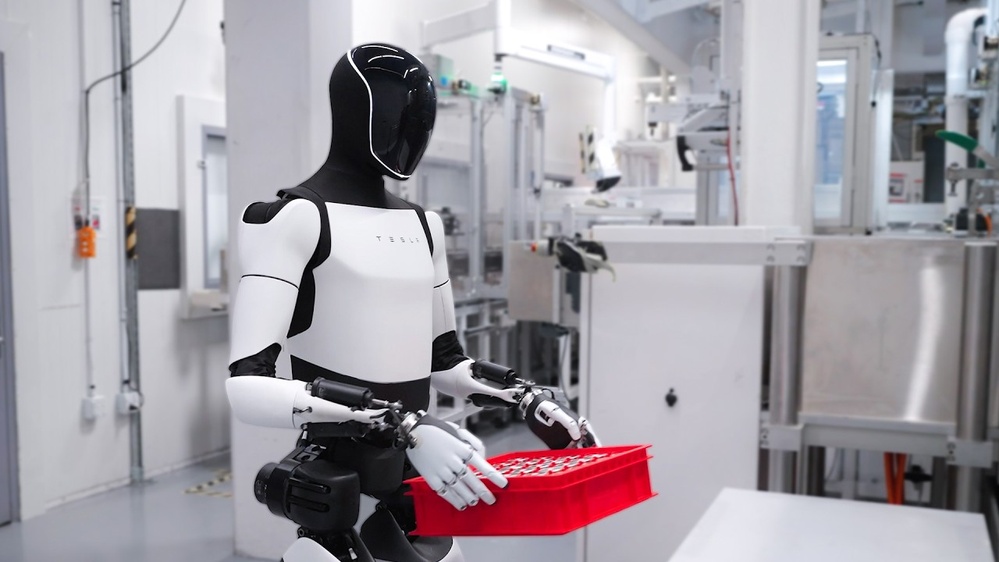
Publisher frames Tesla's data-driven Optimus training as a pragmatic manufacturing advance while highlighting German labor-law governance and citing Handelsblatt for accountability.
Handelsblatt reports, citing an internal Tesla communication, that Grünheide will use backpack-mounted cameras to capture worker movements to train Optimus, with a US data collection program and a Reutlingen manufacturing hub.
Automated analysis; not human reviewed. Limitations: Case-specific framing may reflect source selection and reliance on Handelsblatt; lacks official Tesla comment in the article.
Ambiguities in timing and governance; relies on Handelsblatt; no direct Tesla comment.
July 22, 2026 · 0 shares
Optimistic framing of humanoid-robot-assisted surgery, highlighting remote capabilities and efficiency gains while acknowledging current limitations and the study's preliminary nature.
ScienceAlert reports on a Nature-features feasibility study showing humanoid robots performing live-animal laparoscopic surgery with remote operation potential, including researchers' quotes and notes on limitations.
Automated analysis; not human reviewed.
Limitations: Concise, case-specific limitations and plausible alternative interpretations.
·
1 of 52 available dimensions scored; omitted dimensions are not treated as neutral.
·
Verified supporting quotes for 0 of 1 scored dimensions.
Descriptive-prescriptive bias: market growth emphasis paired with explicit Buy ratings for multiple companies, signaling investor guidance alongside acceleration signals.
Finance-market piece citing Deutsche Bank's report on market acceleration and leadership, with buy-signal details for multiple companies.
Automated analysis; not human reviewed.
Limitations: Concise, case-specific limitations and plausible alternative interpretations.
·
1 of 52 available dimensions scored; omitted dimensions are not treated as neutral.
·
Verified supporting quotes for 1 of 1 scored dimensions.
Claim: Explicit investment guidance dominates reporting; Buy ratings appear for multiple companies.
“Within our APAC Industrials coverage, we prefer Hengli (Buy, closing price RMB110.58), Shuanghuan (Buy, closing price RMB42.39), Harmonic Drive (Buy, closing price ¥7,430), and Yaskawa (Buy, closing price ¥5,490).
We also highlight Tesla (Buy, closing price US$394.46) and Mobileye (Buy, closing price US$9.43) (through Mentee Robotics) as humanoid robotic OEMs in the US.”
· exact text match
“The rise of physical AI has prompted Blackstone, the world's largest alternative asset manager, to place a major bet on Futronic, an automotive supplier that has adapted its motion-control technology for use in actuators for humanoid robots.” · exact text match
Why: Direct evidence of buy recommendations and investor-focused framing; overall narrative blends data with forward-looking investment guidance.
Ambiguity: single source; prescriptive emphasis; limited data scope.
July 23, 2026 · 0 shares
Publisher framing centers on function over form in robotics, foregrounding non-humanoid, wheel- and chassis-based machines, and linking a US–China–Japan rivalry to frame policy, investment, and the epistemic shift toward foundation models and physical AI.
This feature adapts an in-depth review of the 2026 non-humanoid robotics landscape, highlighting deployments, software-driven foundations, and a three-power geopolitical frame (US, China, Japan).
Automated analysis; not human reviewed.
·
1 of 52 available dimensions scored; omitted dimensions are not treated as neutral.
·
Verified supporting quotes for 0 of 1 scored dimensions.
Case-specific: note potential overreliance on official/elite sources; limited critical counterpoints.
July 22, 2026 · 0 shares
Industry-forward, neutral framing of robotics and embodied AI developments in Asia, citing executive forecasts and corporate initiatives without evident political or advocacy bias.
Tech-business briefing on robotics and AI progress in Asia, citing Unitree's forecast and summarizing related corporate ventures and regional developments.
Automated analysis; not human reviewed. Limitations: Concise, case-specific limitations and plausible alternative interpretations.
Framing emphasizes national-security competition with China, foregrounding NDAA restrictions on Chinese humanoid robots while noting commercial exemptions.
Context: The piece describes US policy actions restricting the use of Chinese humanoid robots amid broader US-China tech rivalry and NDAA policy adoption.
Automated analysis; not human reviewed.
Limitations: Concise, case-specific limitations and plausible alternative interpretations.
·
4 of 52 available dimensions scored; omitted dimensions are not treated as neutral.
·
Verified supporting quotes for 0 of 4 scored dimensions.
Claim: No clear liberal or conservative tilt; framing centers on policy specifics rather than ideology.
“The US House of Representatives passed the NDAA, an annual military policy bill that incorporates provisions restricting the use of foreign autonomous systems over national security and data privacy concerns.” · not found in supplied text
Why: Policy-focused reporting without ideological labeling.
Claim: The reporting signals a hawkish tilt by emphasizing restrictions on Chinese robotics and national-security concerns.
“Under Section 163, the Pentagon would be barred from procuring, leasing or operating covered humanoid robotic systems linked to designated “foreign adversaries”, including China, Russia and Iran.” · not found in supplied text
“That designation would strip the machines of their wireless licences, effectively banning their sale across the US market.” · not found in supplied text
“Under the GUARD Act framework, Chinese humanoid and quadruped “robot dog” systems would be evaluated for inclusion on the Federal Communications Commission’s “Covered List”.” · not found in supplied text
Counterevidence:
“By limiting Section 163 strictly to military procurement, lawmakers have left commercial sales untouched for now.” · exact text match
Why: Quotations show policy-oriented, security-focused framing.
Claim: Reporting centers on official actions and legislative language rather than critical scrutiny.
“The US House of Representatives has passed the National Defence Authorisation Act (NDAA), an annual military policy bill.” · not found in supplied text
Why: Emphasis on formal governmental actions signals establishment framing.
Claim: The article relies on named acts and concrete policy language, supporting credibility.
“NDAA” · exact text match
“GUARD Act” · exact text match
“FCC’s Covered List” · not found in supplied text
Why: Sourcing and policy specificity bolster credibility.
Case-specific ambiguities: limited to this text; lacks publisher context.
July 22, 2026 · 0 shares
Optimistic framing of humanoid-robot-assisted surgery, highlighting remote capabilities and efficiency gains while acknowledging current limitations and the study's preliminary nature.
ScienceAlert reports on a Nature-features feasibility study showing humanoid robots performing live-animal laparoscopic surgery with remote operation potential, including researchers' quotes and notes on limitations.
Automated analysis; not human reviewed. Limitations: Concise, case-specific limitations and plausible alternative interpretations. · 1 of 52 available dimensions scored; omitted dimensions are not treated as neutral. · Verified supporting quotes for 0 of 1 scored dimensions.
July 20, 2026 · 0 shares
Official-data framing emphasizes China's dominance in humanoid robotics with minimal critical context, indicating a mild pro-establishment bias.
A concise data-driven report citing official MIIT data that China accounts for over 400 humanoid robot products (more than half of global total) and nearly 70% of global quadruped robot sales in the first half of the year.
Automated analysis; not human reviewed. Limitations: Concise, case-specific limitations and plausible alternative interpretations. · 2 of 52 available dimensions scored; omitted dimensions are not treated as neutral. · Verified supporting quotes for 2 of 2 scored dimensions.
Claim: Framing through government data indicates pro-establishment bias.
“China leads global humanoid robot development with over 400 complete robot products.” · exact text match
“China has developed more than 400 complete humanoid robot products, accounting for over half of the world's total, highlighting the country's rapidly expanding presence in the robotics sector, official data showed Monday.” · exact text match
“official data showed Monday” · exact text match
Why: Citing official data sources and presenting national achievements without counterpoints signals alignment with establishment narratives.
Claim: Reliance on official MIIT data increases perceived credibility of the reporting.
“official data showed Monday” · exact text match
“data from the Ministry of Industry and Information Technology” · exact text match
Why: Official data increases perceived credibility, but lack of independent verification leaves room for skepticism.
Official data reliance; year unspecified; no independent corroboration.
Descriptive-prescriptive bias: market growth emphasis paired with explicit Buy ratings for multiple companies, signaling investor guidance alongside acceleration signals.
Finance-market piece citing Deutsche Bank's report on market acceleration and leadership, with buy-signal details for multiple companies.
Automated analysis; not human reviewed. Limitations: Concise, case-specific limitations and plausible alternative interpretations. · 1 of 52 available dimensions scored; omitted dimensions are not treated as neutral. · Verified supporting quotes for 1 of 1 scored dimensions.
Claim: Explicit investment guidance dominates reporting; Buy ratings appear for multiple companies.
“Within our APAC Industrials coverage, we prefer Hengli (Buy, closing price RMB110.58), Shuanghuan (Buy, closing price RMB42.39), Harmonic Drive (Buy, closing price ¥7,430), and Yaskawa (Buy, closing price ¥5,490). We also highlight Tesla (Buy, closing price US$394.46) and Mobileye (Buy, closing price US$9.43) (through Mentee Robotics) as humanoid robotic OEMs in the US.” · exact text match
“The rise of physical AI has prompted Blackstone, the world's largest alternative asset manager, to place a major bet on Futronic, an automotive supplier that has adapted its motion-control technology for use in actuators for humanoid robots.” · exact text match
Why: Direct evidence of buy recommendations and investor-focused framing; overall narrative blends data with forward-looking investment guidance.
Ambiguity: single source; prescriptive emphasis; limited data scope.
July 23, 2026 · 0 shares
Publisher framing centers on function over form in robotics, foregrounding non-humanoid, wheel- and chassis-based machines, and linking a US–China–Japan rivalry to frame policy, investment, and the epistemic shift toward foundation models and physical AI.
This feature adapts an in-depth review of the 2026 non-humanoid robotics landscape, highlighting deployments, software-driven foundations, and a three-power geopolitical frame (US, China, Japan).
Automated analysis; not human reviewed. · 1 of 52 available dimensions scored; omitted dimensions are not treated as neutral. · Verified supporting quotes for 0 of 1 scored dimensions.
Case-specific: note potential overreliance on official/elite sources; limited critical counterpoints.
Framing emphasizes national-security competition with China, foregrounding NDAA restrictions on Chinese humanoid robots while noting commercial exemptions.
Context: The piece describes US policy actions restricting the use of Chinese humanoid robots amid broader US-China tech rivalry and NDAA policy adoption.
Automated analysis; not human reviewed. Limitations: Concise, case-specific limitations and plausible alternative interpretations. · 4 of 52 available dimensions scored; omitted dimensions are not treated as neutral. · Verified supporting quotes for 0 of 4 scored dimensions.
Claim: No clear liberal or conservative tilt; framing centers on policy specifics rather than ideology.
“The US House of Representatives passed the NDAA, an annual military policy bill that incorporates provisions restricting the use of foreign autonomous systems over national security and data privacy concerns.” · not found in supplied text
Why: Policy-focused reporting without ideological labeling.
Claim: The reporting signals a hawkish tilt by emphasizing restrictions on Chinese robotics and national-security concerns.
“Under Section 163, the Pentagon would be barred from procuring, leasing or operating covered humanoid robotic systems linked to designated “foreign adversaries”, including China, Russia and Iran.” · not found in supplied text
“That designation would strip the machines of their wireless licences, effectively banning their sale across the US market.” · not found in supplied text
“Under the GUARD Act framework, Chinese humanoid and quadruped “robot dog” systems would be evaluated for inclusion on the Federal Communications Commission’s “Covered List”.” · not found in supplied text
Counterevidence:
“By limiting Section 163 strictly to military procurement, lawmakers have left commercial sales untouched for now.” · exact text match
Why: Quotations show policy-oriented, security-focused framing.
Claim: Reporting centers on official actions and legislative language rather than critical scrutiny.
“The US House of Representatives has passed the National Defence Authorisation Act (NDAA), an annual military policy bill.” · not found in supplied text
Why: Emphasis on formal governmental actions signals establishment framing.
Claim: The article relies on named acts and concrete policy language, supporting credibility.
“NDAA” · exact text match
“GUARD Act” · exact text match
“FCC’s Covered List” · not found in supplied text
Why: Sourcing and policy specificity bolster credibility.
Case-specific ambiguities: limited to this text; lacks publisher context.
Helium Bias
July 23, 2026 · 0 shares
Publisher framing centers on function over form in robotics, foregrounding non-humanoid, wheel- and chassis-based machines, and linking a US–China–Japan rivalry to frame policy, investment, and the epistemic shift toward foundation models and physical AI.
This feature adapts an in-depth review of the 2026 non-humanoid robotics landscape, highlighting deployments, software-driven foundations, and a three-power geopolitical frame (US, China, Japan).
Automated analysis; not human reviewed. · 1 of 52 available dimensions scored; omitted dimensions are not treated as neutral. · Verified supporting quotes for 0 of 1 scored dimensions.
Case-specific: note potential overreliance on official/elite sources; limited critical counterpoints.
July 20, 2026 · 0 shares
Official-data framing emphasizes China's dominance in humanoid robotics with minimal critical context, indicating a mild pro-establishment bias.
A concise data-driven report citing official MIIT data that China accounts for over 400 humanoid robot products (more than half of global total) and nearly 70% of global quadruped robot sales in the first half of the year.
Automated analysis; not human reviewed. Limitations: Concise, case-specific limitations and plausible alternative interpretations. · 2 of 52 available dimensions scored; omitted dimensions are not treated as neutral. · Verified supporting quotes for 2 of 2 scored dimensions.
Claim: Framing through government data indicates pro-establishment bias.
“China leads global humanoid robot development with over 400 complete robot products.” · exact text match
“China has developed more than 400 complete humanoid robot products, accounting for over half of the world's total, highlighting the country's rapidly expanding presence in the robotics sector, official data showed Monday.” · exact text match
“official data showed Monday” · exact text match
Why: Citing official data sources and presenting national achievements without counterpoints signals alignment with establishment narratives.
Claim: Reliance on official MIIT data increases perceived credibility of the reporting.
“official data showed Monday” · exact text match
“data from the Ministry of Industry and Information Technology” · exact text match
Why: Official data increases perceived credibility, but lack of independent verification leaves room for skepticism.
Official data reliance; year unspecified; no independent corroboration.
Descriptive-prescriptive bias: market growth emphasis paired with explicit Buy ratings for multiple companies, signaling investor guidance alongside acceleration signals.
Finance-market piece citing Deutsche Bank's report on market acceleration and leadership, with buy-signal details for multiple companies.
Automated analysis; not human reviewed. Limitations: Concise, case-specific limitations and plausible alternative interpretations. · 1 of 52 available dimensions scored; omitted dimensions are not treated as neutral. · Verified supporting quotes for 1 of 1 scored dimensions.
Claim: Explicit investment guidance dominates reporting; Buy ratings appear for multiple companies.
“Within our APAC Industrials coverage, we prefer Hengli (Buy, closing price RMB110.58), Shuanghuan (Buy, closing price RMB42.39), Harmonic Drive (Buy, closing price ¥7,430), and Yaskawa (Buy, closing price ¥5,490). We also highlight Tesla (Buy, closing price US$394.46) and Mobileye (Buy, closing price US$9.43) (through Mentee Robotics) as humanoid robotic OEMs in the US.” · exact text match
“The rise of physical AI has prompted Blackstone, the world's largest alternative asset manager, to place a major bet on Futronic, an automotive supplier that has adapted its motion-control technology for use in actuators for humanoid robots.” · exact text match
Why: Direct evidence of buy recommendations and investor-focused framing; overall narrative blends data with forward-looking investment guidance.
Ambiguity: single source; prescriptive emphasis; limited data scope.
Descriptive tech-news framing with mild promotional tone, emphasizing PrimeBOT's Qiyuan T1 claims and potential home-use applications while citing Gasgoo, Xinhua, and WAIC and noting pricing is forthcoming.
Tech news report on PrimeBOT's Qiyuan T1, a cross-morph, multi-mode robot with home-use and content-creation applications, citing Gasgoo and Xinhua and WAIC coverage.
Automated analysis; not human reviewed. Limitations: Concise, case-specific limitations and plausible alternative interpretations. · 2 of 52 available dimensions scored; omitted dimensions are not treated as neutral. · Verified supporting quotes for 2 of 2 scored dimensions.
Claim: The article relies on external authorities (Gasgoo, Xinhua) and WAIC to support claims about the robot.
“reports Gasgoo.” · exact text match
“reports Xinhua.” · exact text match
“PrimeBOT showcased the Qiyuan T1 at the 2026 World Artificial Intelligence Conference (WAIC), which was held from July 17-20 in Shanghai.” · exact text match
Counterevidence:
“In early 2026, PrimeBOT launched the Prime Q1 and Prime T1, two personal robots built for human-like interaction and different everyday use cases.” · exact text match
“The company has not yet announced pricing or commercial availability but said additional launch and sales details will be revealed at a later date.” · exact text match
Why: Citing third-party sources and a major conference is typical in tech reporting and anchors claims, not independent verification.
Claim: The article includes promotional framing around the T1 as a consumer-oriented intelligent companion.
“Beyond mobility, PrimeBOT has positioned the T1 as an intelligent companion for content creation and daily assistance.” · exact text match
“The robot integrates with action cameras and supports voice-controlled filming, autonomous follow recording, and trajectory-based camera movement.” · exact text match
“It can dynamically adjust its own position to match the camera’s perspective, creating smoother tracking shots for outdoor adventures, family activities, and creator-focused filming.” · exact text match
Counterevidence:
“The company has not yet announced pricing or commercial availability but said additional launch and sales details will be revealed at a later date.” · exact text match
“Though detailed specifications are not available, Qiyuan T1 can autonomously switch between two distinct modes—a wheel-foot humanoid and a quadruped robot—without human intervention.” · exact text match
Why: Prominent consumer-use language appears alongside pending pricing/specs, indicating marketing emphasis rather than confirmed capabilities.
July 22, 2026 · 0 shares
Industry-forward, neutral framing of robotics and embodied AI developments in Asia, citing executive forecasts and corporate initiatives without evident political or advocacy bias.
Tech-business briefing on robotics and AI progress in Asia, citing Unitree's forecast and summarizing related corporate ventures and regional developments.
Automated analysis; not human reviewed. Limitations: Concise, case-specific limitations and plausible alternative interpretations.
Story Blindspots
July 20, 2026 · 0 shares
Official-data framing emphasizes China's dominance in humanoid robotics with minimal critical context, indicating a mild pro-establishment bias.
A concise data-driven report citing official MIIT data that China accounts for over 400 humanoid robot products (more than half of global total) and nearly 70% of global quadruped robot sales in the first half of the year.
Automated analysis; not human reviewed. Limitations: Concise, case-specific limitations and plausible alternative interpretations. · 2 of 52 available dimensions scored; omitted dimensions are not treated as neutral. · Verified supporting quotes for 2 of 2 scored dimensions.
Claim: Framing through government data indicates pro-establishment bias.
“China leads global humanoid robot development with over 400 complete robot products.” · exact text match
“China has developed more than 400 complete humanoid robot products, accounting for over half of the world's total, highlighting the country's rapidly expanding presence in the robotics sector, official data showed Monday.” · exact text match
“official data showed Monday” · exact text match
Why: Citing official data sources and presenting national achievements without counterpoints signals alignment with establishment narratives.
Claim: Reliance on official MIIT data increases perceived credibility of the reporting.
“official data showed Monday” · exact text match
“data from the Ministry of Industry and Information Technology” · exact text match
Why: Official data increases perceived credibility, but lack of independent verification leaves room for skepticism.
Official data reliance; year unspecified; no independent corroboration.
Descriptive-prescriptive bias: market growth emphasis paired with explicit Buy ratings for multiple companies, signaling investor guidance alongside acceleration signals.
Finance-market piece citing Deutsche Bank's report on market acceleration and leadership, with buy-signal details for multiple companies.
Automated analysis; not human reviewed. Limitations: Concise, case-specific limitations and plausible alternative interpretations. · 1 of 52 available dimensions scored; omitted dimensions are not treated as neutral. · Verified supporting quotes for 1 of 1 scored dimensions.
Claim: Explicit investment guidance dominates reporting; Buy ratings appear for multiple companies.
“Within our APAC Industrials coverage, we prefer Hengli (Buy, closing price RMB110.58), Shuanghuan (Buy, closing price RMB42.39), Harmonic Drive (Buy, closing price ¥7,430), and Yaskawa (Buy, closing price ¥5,490). We also highlight Tesla (Buy, closing price US$394.46) and Mobileye (Buy, closing price US$9.43) (through Mentee Robotics) as humanoid robotic OEMs in the US.” · exact text match
“The rise of physical AI has prompted Blackstone, the world's largest alternative asset manager, to place a major bet on Futronic, an automotive supplier that has adapted its motion-control technology for use in actuators for humanoid robots.” · exact text match
Why: Direct evidence of buy recommendations and investor-focused framing; overall narrative blends data with forward-looking investment guidance.
Ambiguity: single source; prescriptive emphasis; limited data scope.
July 23, 2026 · 0 shares
Publisher framing centers on function over form in robotics, foregrounding non-humanoid, wheel- and chassis-based machines, and linking a US–China–Japan rivalry to frame policy, investment, and the epistemic shift toward foundation models and physical AI.
This feature adapts an in-depth review of the 2026 non-humanoid robotics landscape, highlighting deployments, software-driven foundations, and a three-power geopolitical frame (US, China, Japan).
Automated analysis; not human reviewed. · 1 of 52 available dimensions scored; omitted dimensions are not treated as neutral. · Verified supporting quotes for 0 of 1 scored dimensions.
Case-specific: note potential overreliance on official/elite sources; limited critical counterpoints.
July 22, 2026 · 0 shares
Optimistic framing of humanoid-robot-assisted surgery, highlighting remote capabilities and efficiency gains while acknowledging current limitations and the study's preliminary nature.
ScienceAlert reports on a Nature-features feasibility study showing humanoid robots performing live-animal laparoscopic surgery with remote operation potential, including researchers' quotes and notes on limitations.
Automated analysis; not human reviewed. Limitations: Concise, case-specific limitations and plausible alternative interpretations. · 1 of 52 available dimensions scored; omitted dimensions are not treated as neutral. · Verified supporting quotes for 0 of 1 scored dimensions.
Framing emphasizes national-security competition with China, foregrounding NDAA restrictions on Chinese humanoid robots while noting commercial exemptions.
Context: The piece describes US policy actions restricting the use of Chinese humanoid robots amid broader US-China tech rivalry and NDAA policy adoption.
Automated analysis; not human reviewed. Limitations: Concise, case-specific limitations and plausible alternative interpretations. · 4 of 52 available dimensions scored; omitted dimensions are not treated as neutral. · Verified supporting quotes for 0 of 4 scored dimensions.
Claim: No clear liberal or conservative tilt; framing centers on policy specifics rather than ideology.
“The US House of Representatives passed the NDAA, an annual military policy bill that incorporates provisions restricting the use of foreign autonomous systems over national security and data privacy concerns.” · not found in supplied text
Why: Policy-focused reporting without ideological labeling.
Claim: The reporting signals a hawkish tilt by emphasizing restrictions on Chinese robotics and national-security concerns.
“Under Section 163, the Pentagon would be barred from procuring, leasing or operating covered humanoid robotic systems linked to designated “foreign adversaries”, including China, Russia and Iran.” · not found in supplied text
“That designation would strip the machines of their wireless licences, effectively banning their sale across the US market.” · not found in supplied text
“Under the GUARD Act framework, Chinese humanoid and quadruped “robot dog” systems would be evaluated for inclusion on the Federal Communications Commission’s “Covered List”.” · not found in supplied text
Counterevidence:
“By limiting Section 163 strictly to military procurement, lawmakers have left commercial sales untouched for now.” · exact text match
Why: Quotations show policy-oriented, security-focused framing.
Claim: Reporting centers on official actions and legislative language rather than critical scrutiny.
“The US House of Representatives has passed the National Defence Authorisation Act (NDAA), an annual military policy bill.” · not found in supplied text
Why: Emphasis on formal governmental actions signals establishment framing.
Claim: The article relies on named acts and concrete policy language, supporting credibility.
“NDAA” · exact text match
“GUARD Act” · exact text match
“FCC’s Covered List” · not found in supplied text
Why: Sourcing and policy specificity bolster credibility.
Case-specific ambiguities: limited to this text; lacks publisher context.
A long, balanced examination of rapid humanoid robotics progress and public narratives, anchoring claims in documented demonstrations while acknowledging the absence of verifiable evidence and the persistence of speculative online narratives.
Analytical overview of accelerating humanoid robotics, public perception, and the interplay between demonstrated capabilities and speculative narratives.
Automated analysis; not human reviewed. Limitations: Concise, case-specific limitations and plausible alternative interpretations. · 7 of 52 available dimensions scored; omitted dimensions are not treated as neutral. · Verified supporting quotes for 6 of 7 scored dimensions.
Claim: Mild unease about lifelike humanoids without alarmism
“Together they create an unsettling possibility that public imagination often races ahead to explore long before reality catches up.” · exact text match
“eyes that appeared disturbingly capable of maintaining silent attention.” · exact text match
Counterevidence:
“What makes this timeline remarkable is not any single breakthrough, but the compression between them.” · exact text match
Why: Descriptive cues of unease are present but counterbalancing progress language reduces alarm.
Claim: Some emotional language used without overt manipulation
“unsettling possibility” · exact text match
“disturbingly capable” · exact text match
Why: Emotional descriptors are present but not dominant or propagandistic.
Claim: Article relies on publicly observable demonstrations and hedges claims with evidence gaps
“documented through academic publications, investor briefings and live demonstrations watched by millions around the world.” · exact text match
“No credible evidence has ever answered that question.” · exact text match
Counterevidence:
“The absence of evidence, however, has never prevented the internet from trying.” · exact text match
Why: Balance of credible sourcing and acknowledgment of evidence limits.
Claim: Acknowledges speculative questions while clearly separating them from verified claims
“Yet if—purely as a matter of speculation—they represented a glimpse into technology more advanced than anything publicly demonstrated, they suggested something profoundly unsettling about the pace at which artificial intelligence and embodied robotics might already be evolving beyond public awareness.” · exact text match
Why: Identifies speculation yet distinguishes from evidence-based claims.
Claim: No overt manipulation; framing is descriptive with hedging
“Long rows of transparent containment chambers reportedly filled an immense exhibition hall, each enclosing a female humanoid whose appearance challenged the very definition of robotics.” · exact text match
“Instead, they found figures possessing skin that reflected light with subtle biological imperfections, naturally distributed hair, nearly imperceptible facial asymmetry and eyes that appeared disturbingly capable of maintaining silent attention.” · exact text match
Why: Describes framing choices without implying deceptive intent.
Claim: Demonstrates high analytical synthesis of multiple technology trends
“What makes this timeline remarkable is not any single breakthrough, but the compression between them.” · exact text match
“Investments in embodied AI has accelerated dramatically, governments have begun drafting regulatory frameworks for autonomous systems, and major technology companies increasingly describe robotics as one of the next defining industries of the coming decade.” · not found in supplied text
Why: Shows integration of technological progress with policy and industry outlook.
Claim: Analyses conspiratorial narratives without endorsing them
“The modern conspiracy landscape thrives inside precisely that narrow space between demonstrated capability and undocumented possibility.” · exact text match
“No credible evidence has ever answered that question.” · exact text match
Why: Describes conspiracy framing while maintaining critical stance.
July 22, 2026 · 0 shares
Optimistic framing of humanoid-robot-assisted surgery, highlighting remote capabilities and efficiency gains while acknowledging current limitations and the study's preliminary nature.
ScienceAlert reports on a Nature-features feasibility study showing humanoid robots performing live-animal laparoscopic surgery with remote operation potential, including researchers' quotes and notes on limitations.
Automated analysis; not human reviewed. Limitations: Concise, case-specific limitations and plausible alternative interpretations. · 1 of 52 available dimensions scored; omitted dimensions are not treated as neutral. · Verified supporting quotes for 0 of 1 scored dimensions.
Descriptive-prescriptive bias: market growth emphasis paired with explicit Buy ratings for multiple companies, signaling investor guidance alongside acceleration signals.
Finance-market piece citing Deutsche Bank's report on market acceleration and leadership, with buy-signal details for multiple companies.
Automated analysis; not human reviewed. Limitations: Concise, case-specific limitations and plausible alternative interpretations. · 1 of 52 available dimensions scored; omitted dimensions are not treated as neutral. · Verified supporting quotes for 1 of 1 scored dimensions.
Claim: Explicit investment guidance dominates reporting; Buy ratings appear for multiple companies.
“Within our APAC Industrials coverage, we prefer Hengli (Buy, closing price RMB110.58), Shuanghuan (Buy, closing price RMB42.39), Harmonic Drive (Buy, closing price ¥7,430), and Yaskawa (Buy, closing price ¥5,490). We also highlight Tesla (Buy, closing price US$394.46) and Mobileye (Buy, closing price US$9.43) (through Mentee Robotics) as humanoid robotic OEMs in the US.” · exact text match
“The rise of physical AI has prompted Blackstone, the world's largest alternative asset manager, to place a major bet on Futronic, an automotive supplier that has adapted its motion-control technology for use in actuators for humanoid robots.” · exact text match
Why: Direct evidence of buy recommendations and investor-focused framing; overall narrative blends data with forward-looking investment guidance.
Ambiguity: single source; prescriptive emphasis; limited data scope.
Publisher frames Tesla's data-driven Optimus training as a pragmatic manufacturing advance while highlighting German labor-law governance and citing Handelsblatt for accountability.
Handelsblatt reports, citing an internal Tesla communication, that Grünheide will use backpack-mounted cameras to capture worker movements to train Optimus, with a US data collection program and a Reutlingen manufacturing hub.
Automated analysis; not human reviewed. Limitations: Case-specific framing may reflect source selection and reliance on Handelsblatt; lacks official Tesla comment in the article.
Ambiguities in timing and governance; relies on Handelsblatt; no direct Tesla comment.
July 20, 2026 · 0 shares
Official-data framing emphasizes China's dominance in humanoid robotics with minimal critical context, indicating a mild pro-establishment bias.
A concise data-driven report citing official MIIT data that China accounts for over 400 humanoid robot products (more than half of global total) and nearly 70% of global quadruped robot sales in the first half of the year.
Automated analysis; not human reviewed. Limitations: Concise, case-specific limitations and plausible alternative interpretations. · 2 of 52 available dimensions scored; omitted dimensions are not treated as neutral. · Verified supporting quotes for 2 of 2 scored dimensions.
Claim: Framing through government data indicates pro-establishment bias.
“China leads global humanoid robot development with over 400 complete robot products.” · exact text match
“China has developed more than 400 complete humanoid robot products, accounting for over half of the world's total, highlighting the country's rapidly expanding presence in the robotics sector, official data showed Monday.” · exact text match
“official data showed Monday” · exact text match
Why: Citing official data sources and presenting national achievements without counterpoints signals alignment with establishment narratives.
Claim: Reliance on official MIIT data increases perceived credibility of the reporting.
“official data showed Monday” · exact text match
“data from the Ministry of Industry and Information Technology” · exact text match
Why: Official data increases perceived credibility, but lack of independent verification leaves room for skepticism.
Official data reliance; year unspecified; no independent corroboration.
Descriptive-prescriptive bias: market growth emphasis paired with explicit Buy ratings for multiple companies, signaling investor guidance alongside acceleration signals.
Finance-market piece citing Deutsche Bank's report on market acceleration and leadership, with buy-signal details for multiple companies.
Automated analysis; not human reviewed. Limitations: Concise, case-specific limitations and plausible alternative interpretations. · 1 of 52 available dimensions scored; omitted dimensions are not treated as neutral. · Verified supporting quotes for 1 of 1 scored dimensions.
Claim: Explicit investment guidance dominates reporting; Buy ratings appear for multiple companies.
“Within our APAC Industrials coverage, we prefer Hengli (Buy, closing price RMB110.58), Shuanghuan (Buy, closing price RMB42.39), Harmonic Drive (Buy, closing price ¥7,430), and Yaskawa (Buy, closing price ¥5,490). We also highlight Tesla (Buy, closing price US$394.46) and Mobileye (Buy, closing price US$9.43) (through Mentee Robotics) as humanoid robotic OEMs in the US.” · exact text match
“The rise of physical AI has prompted Blackstone, the world's largest alternative asset manager, to place a major bet on Futronic, an automotive supplier that has adapted its motion-control technology for use in actuators for humanoid robots.” · exact text match
Why: Direct evidence of buy recommendations and investor-focused framing; overall narrative blends data with forward-looking investment guidance.
Ambiguity: single source; prescriptive emphasis; limited data scope.
Framing emphasizes national-security competition with China, foregrounding NDAA restrictions on Chinese humanoid robots while noting commercial exemptions.
Context: The piece describes US policy actions restricting the use of Chinese humanoid robots amid broader US-China tech rivalry and NDAA policy adoption.
Automated analysis; not human reviewed. Limitations: Concise, case-specific limitations and plausible alternative interpretations. · 4 of 52 available dimensions scored; omitted dimensions are not treated as neutral. · Verified supporting quotes for 0 of 4 scored dimensions.
Claim: No clear liberal or conservative tilt; framing centers on policy specifics rather than ideology.
“The US House of Representatives passed the NDAA, an annual military policy bill that incorporates provisions restricting the use of foreign autonomous systems over national security and data privacy concerns.” · not found in supplied text
Why: Policy-focused reporting without ideological labeling.
Claim: The reporting signals a hawkish tilt by emphasizing restrictions on Chinese robotics and national-security concerns.
“Under Section 163, the Pentagon would be barred from procuring, leasing or operating covered humanoid robotic systems linked to designated “foreign adversaries”, including China, Russia and Iran.” · not found in supplied text
“That designation would strip the machines of their wireless licences, effectively banning their sale across the US market.” · not found in supplied text
“Under the GUARD Act framework, Chinese humanoid and quadruped “robot dog” systems would be evaluated for inclusion on the Federal Communications Commission’s “Covered List”.” · not found in supplied text
Counterevidence:
“By limiting Section 163 strictly to military procurement, lawmakers have left commercial sales untouched for now.” · exact text match
Why: Quotations show policy-oriented, security-focused framing.
Claim: Reporting centers on official actions and legislative language rather than critical scrutiny.
“The US House of Representatives has passed the National Defence Authorisation Act (NDAA), an annual military policy bill.” · not found in supplied text
Why: Emphasis on formal governmental actions signals establishment framing.
Claim: The article relies on named acts and concrete policy language, supporting credibility.
“NDAA” · exact text match
“GUARD Act” · exact text match
“FCC’s Covered List” · not found in supplied text
Why: Sourcing and policy specificity bolster credibility.
Case-specific ambiguities: limited to this text; lacks publisher context.
Framing emphasizes national-security competition with China, foregrounding NDAA restrictions on Chinese humanoid robots while noting commercial exemptions.
Context: The piece describes US policy actions restricting the use of Chinese humanoid robots amid broader US-China tech rivalry and NDAA policy adoption.
Automated analysis; not human reviewed. Limitations: Concise, case-specific limitations and plausible alternative interpretations. · 4 of 52 available dimensions scored; omitted dimensions are not treated as neutral. · Verified supporting quotes for 0 of 4 scored dimensions.
Claim: No clear liberal or conservative tilt; framing centers on policy specifics rather than ideology.
“The US House of Representatives passed the NDAA, an annual military policy bill that incorporates provisions restricting the use of foreign autonomous systems over national security and data privacy concerns.” · not found in supplied text
Why: Policy-focused reporting without ideological labeling.
Claim: The reporting signals a hawkish tilt by emphasizing restrictions on Chinese robotics and national-security concerns.
“Under Section 163, the Pentagon would be barred from procuring, leasing or operating covered humanoid robotic systems linked to designated “foreign adversaries”, including China, Russia and Iran.” · not found in supplied text
“That designation would strip the machines of their wireless licences, effectively banning their sale across the US market.” · not found in supplied text
“Under the GUARD Act framework, Chinese humanoid and quadruped “robot dog” systems would be evaluated for inclusion on the Federal Communications Commission’s “Covered List”.” · not found in supplied text
Counterevidence:
“By limiting Section 163 strictly to military procurement, lawmakers have left commercial sales untouched for now.” · exact text match
Why: Quotations show policy-oriented, security-focused framing.
Claim: Reporting centers on official actions and legislative language rather than critical scrutiny.
“The US House of Representatives has passed the National Defence Authorisation Act (NDAA), an annual military policy bill.” · not found in supplied text
Why: Emphasis on formal governmental actions signals establishment framing.
Claim: The article relies on named acts and concrete policy language, supporting credibility.
“NDAA” · exact text match
“GUARD Act” · exact text match
“FCC’s Covered List” · not found in supplied text
Why: Sourcing and policy specificity bolster credibility.
Case-specific ambiguities: limited to this text; lacks publisher context.
July 22, 2026 · 0 shares
Optimistic framing of humanoid-robot-assisted surgery, highlighting remote capabilities and efficiency gains while acknowledging current limitations and the study's preliminary nature.
ScienceAlert reports on a Nature-features feasibility study showing humanoid robots performing live-animal laparoscopic surgery with remote operation potential, including researchers' quotes and notes on limitations.
Automated analysis; not human reviewed. Limitations: Concise, case-specific limitations and plausible alternative interpretations. · 1 of 52 available dimensions scored; omitted dimensions are not treated as neutral. · Verified supporting quotes for 0 of 1 scored dimensions.
Descriptive-prescriptive bias: market growth emphasis paired with explicit Buy ratings for multiple companies, signaling investor guidance alongside acceleration signals.
Finance-market piece citing Deutsche Bank's report on market acceleration and leadership, with buy-signal details for multiple companies.
Automated analysis; not human reviewed. Limitations: Concise, case-specific limitations and plausible alternative interpretations. · 1 of 52 available dimensions scored; omitted dimensions are not treated as neutral. · Verified supporting quotes for 1 of 1 scored dimensions.
Claim: Explicit investment guidance dominates reporting; Buy ratings appear for multiple companies.
“Within our APAC Industrials coverage, we prefer Hengli (Buy, closing price RMB110.58), Shuanghuan (Buy, closing price RMB42.39), Harmonic Drive (Buy, closing price ¥7,430), and Yaskawa (Buy, closing price ¥5,490). We also highlight Tesla (Buy, closing price US$394.46) and Mobileye (Buy, closing price US$9.43) (through Mentee Robotics) as humanoid robotic OEMs in the US.” · exact text match
“The rise of physical AI has prompted Blackstone, the world's largest alternative asset manager, to place a major bet on Futronic, an automotive supplier that has adapted its motion-control technology for use in actuators for humanoid robots.” · exact text match
Why: Direct evidence of buy recommendations and investor-focused framing; overall narrative blends data with forward-looking investment guidance.
Ambiguity: single source; prescriptive emphasis; limited data scope.
July 23, 2026 · 0 shares
Publisher framing centers on function over form in robotics, foregrounding non-humanoid, wheel- and chassis-based machines, and linking a US–China–Japan rivalry to frame policy, investment, and the epistemic shift toward foundation models and physical AI.
This feature adapts an in-depth review of the 2026 non-humanoid robotics landscape, highlighting deployments, software-driven foundations, and a three-power geopolitical frame (US, China, Japan).
Automated analysis; not human reviewed. · 1 of 52 available dimensions scored; omitted dimensions are not treated as neutral. · Verified supporting quotes for 0 of 1 scored dimensions.
Case-specific: note potential overreliance on official/elite sources; limited critical counterpoints.
Descriptive-prescriptive bias: market growth emphasis paired with explicit Buy ratings for multiple companies, signaling investor guidance alongside acceleration signals.
Finance-market piece citing Deutsche Bank's report on market acceleration and leadership, with buy-signal details for multiple companies.
Automated analysis; not human reviewed. Limitations: Concise, case-specific limitations and plausible alternative interpretations. · 1 of 52 available dimensions scored; omitted dimensions are not treated as neutral. · Verified supporting quotes for 1 of 1 scored dimensions.
Claim: Explicit investment guidance dominates reporting; Buy ratings appear for multiple companies.
“Within our APAC Industrials coverage, we prefer Hengli (Buy, closing price RMB110.58), Shuanghuan (Buy, closing price RMB42.39), Harmonic Drive (Buy, closing price ¥7,430), and Yaskawa (Buy, closing price ¥5,490). We also highlight Tesla (Buy, closing price US$394.46) and Mobileye (Buy, closing price US$9.43) (through Mentee Robotics) as humanoid robotic OEMs in the US.” · exact text match
“The rise of physical AI has prompted Blackstone, the world's largest alternative asset manager, to place a major bet on Futronic, an automotive supplier that has adapted its motion-control technology for use in actuators for humanoid robots.” · exact text match
Why: Direct evidence of buy recommendations and investor-focused framing; overall narrative blends data with forward-looking investment guidance.
Ambiguity: single source; prescriptive emphasis; limited data scope.
July 23, 2026 · 0 shares
Publisher framing centers on function over form in robotics, foregrounding non-humanoid, wheel- and chassis-based machines, and linking a US–China–Japan rivalry to frame policy, investment, and the epistemic shift toward foundation models and physical AI.
This feature adapts an in-depth review of the 2026 non-humanoid robotics landscape, highlighting deployments, software-driven foundations, and a three-power geopolitical frame (US, China, Japan).
Automated analysis; not human reviewed. · 1 of 52 available dimensions scored; omitted dimensions are not treated as neutral. · Verified supporting quotes for 0 of 1 scored dimensions.
Case-specific: note potential overreliance on official/elite sources; limited critical counterpoints.
July 22, 2026 · 0 shares
Industry-forward, neutral framing of robotics and embodied AI developments in Asia, citing executive forecasts and corporate initiatives without evident political or advocacy bias.
Tech-business briefing on robotics and AI progress in Asia, citing Unitree's forecast and summarizing related corporate ventures and regional developments.
Automated analysis; not human reviewed. Limitations: Concise, case-specific limitations and plausible alternative interpretations.
A long, balanced examination of rapid humanoid robotics progress and public narratives, anchoring claims in documented demonstrations while acknowledging the absence of verifiable evidence and the persistence of speculative online narratives.
Analytical overview of accelerating humanoid robotics, public perception, and the interplay between demonstrated capabilities and speculative narratives.
Automated analysis; not human reviewed. Limitations: Concise, case-specific limitations and plausible alternative interpretations. · 7 of 52 available dimensions scored; omitted dimensions are not treated as neutral. · Verified supporting quotes for 6 of 7 scored dimensions.
Claim: Mild unease about lifelike humanoids without alarmism
“Together they create an unsettling possibility that public imagination often races ahead to explore long before reality catches up.” · exact text match
“eyes that appeared disturbingly capable of maintaining silent attention.” · exact text match
Counterevidence:
“What makes this timeline remarkable is not any single breakthrough, but the compression between them.” · exact text match
Why: Descriptive cues of unease are present but counterbalancing progress language reduces alarm.
Claim: Some emotional language used without overt manipulation
“unsettling possibility” · exact text match
“disturbingly capable” · exact text match
Why: Emotional descriptors are present but not dominant or propagandistic.
Claim: Article relies on publicly observable demonstrations and hedges claims with evidence gaps
“documented through academic publications, investor briefings and live demonstrations watched by millions around the world.” · exact text match
“No credible evidence has ever answered that question.” · exact text match
Counterevidence:
“The absence of evidence, however, has never prevented the internet from trying.” · exact text match
Why: Balance of credible sourcing and acknowledgment of evidence limits.
Claim: Acknowledges speculative questions while clearly separating them from verified claims
“Yet if—purely as a matter of speculation—they represented a glimpse into technology more advanced than anything publicly demonstrated, they suggested something profoundly unsettling about the pace at which artificial intelligence and embodied robotics might already be evolving beyond public awareness.” · exact text match
Why: Identifies speculation yet distinguishes from evidence-based claims.
Claim: No overt manipulation; framing is descriptive with hedging
“Long rows of transparent containment chambers reportedly filled an immense exhibition hall, each enclosing a female humanoid whose appearance challenged the very definition of robotics.” · exact text match
“Instead, they found figures possessing skin that reflected light with subtle biological imperfections, naturally distributed hair, nearly imperceptible facial asymmetry and eyes that appeared disturbingly capable of maintaining silent attention.” · exact text match
Why: Describes framing choices without implying deceptive intent.
Claim: Demonstrates high analytical synthesis of multiple technology trends
“What makes this timeline remarkable is not any single breakthrough, but the compression between them.” · exact text match
“Investments in embodied AI has accelerated dramatically, governments have begun drafting regulatory frameworks for autonomous systems, and major technology companies increasingly describe robotics as one of the next defining industries of the coming decade.” · not found in supplied text
Why: Shows integration of technological progress with policy and industry outlook.
Claim: Analyses conspiratorial narratives without endorsing them
“The modern conspiracy landscape thrives inside precisely that narrow space between demonstrated capability and undocumented possibility.” · exact text match
“No credible evidence has ever answered that question.” · exact text match
Why: Describes conspiracy framing while maintaining critical stance.
July 23, 2026 · 0 shares
Publisher framing centers on function over form in robotics, foregrounding non-humanoid, wheel- and chassis-based machines, and linking a US–China–Japan rivalry to frame policy, investment, and the epistemic shift toward foundation models and physical AI.
This feature adapts an in-depth review of the 2026 non-humanoid robotics landscape, highlighting deployments, software-driven foundations, and a three-power geopolitical frame (US, China, Japan).
Automated analysis; not human reviewed. · 1 of 52 available dimensions scored; omitted dimensions are not treated as neutral. · Verified supporting quotes for 0 of 1 scored dimensions.
Case-specific: note potential overreliance on official/elite sources; limited critical counterpoints.
July 22, 2026 · 0 shares
Industry-forward, neutral framing of robotics and embodied AI developments in Asia, citing executive forecasts and corporate initiatives without evident political or advocacy bias.
Tech-business briefing on robotics and AI progress in Asia, citing Unitree's forecast and summarizing related corporate ventures and regional developments.
Automated analysis; not human reviewed. Limitations: Concise, case-specific limitations and plausible alternative interpretations.
Descriptive-prescriptive bias: market growth emphasis paired with explicit Buy ratings for multiple companies, signaling investor guidance alongside acceleration signals.
Finance-market piece citing Deutsche Bank's report on market acceleration and leadership, with buy-signal details for multiple companies.
Automated analysis; not human reviewed.
Limitations: Concise, case-specific limitations and plausible alternative interpretations.
·
1 of 52 available dimensions scored; omitted dimensions are not treated as neutral.
·
Verified supporting quotes for 1 of 1 scored dimensions.
Claim: Explicit investment guidance dominates reporting; Buy ratings appear for multiple companies.
“Within our APAC Industrials coverage, we prefer Hengli (Buy, closing price RMB110.58), Shuanghuan (Buy, closing price RMB42.39), Harmonic Drive (Buy, closing price ¥7,430), and Yaskawa (Buy, closing price ¥5,490).
We also highlight Tesla (Buy, closing price US$394.46) and Mobileye (Buy, closing price US$9.43) (through Mentee Robotics) as humanoid robotic OEMs in the US.”
· exact text match
“The rise of physical AI has prompted Blackstone, the world's largest alternative asset manager, to place a major bet on Futronic, an automotive supplier that has adapted its motion-control technology for use in actuators for humanoid robots.” · exact text match
Why: Direct evidence of buy recommendations and investor-focused framing; overall narrative blends data with forward-looking investment guidance.
Ambiguity: single source; prescriptive emphasis; limited data scope.
July 20, 2026 · 0 shares
Official-data framing emphasizes China's dominance in humanoid robotics with minimal critical context, indicating a mild pro-establishment bias.
A concise data-driven report citing official MIIT data that China accounts for over 400 humanoid robot products (more than half of global total) and nearly 70% of global quadruped robot sales in the first half of the year.
Automated analysis; not human reviewed.
Limitations: Concise, case-specific limitations and plausible alternative interpretations.
·
2 of 52 available dimensions scored; omitted dimensions are not treated as neutral.
·
Verified supporting quotes for 2 of 2 scored dimensions.
Claim: Framing through government data indicates pro-establishment bias.
“China leads global humanoid robot development with over 400 complete robot products.” · exact text match
“China has developed more than 400 complete humanoid robot products, accounting for over half of the world's total, highlighting the country's rapidly expanding presence in the robotics sector, official data showed Monday.” · exact text match
“official data showed Monday” · exact text match
Why: Citing official data sources and presenting national achievements without counterpoints signals alignment with establishment narratives.
Claim: Reliance on official MIIT data increases perceived credibility of the reporting.
“official data showed Monday” · exact text match
“data from the Ministry of Industry and Information Technology” · exact text match
Why: Official data increases perceived credibility, but lack of independent verification leaves room for skepticism.
Official data reliance; year unspecified; no independent corroboration.
July 23, 2026 · 0 shares
Pro-establishment framing emphasizes Beijing's AI-plus-education push and government-backed educational innovation through a high school humanoid robot football tournament, with positive language about outcomes and benefits and minimal critical perspective.
Beijing's push to integrate AI education with science and technology through a high school humanoid robot football tournament.
Automated analysis; not human reviewed.
Limitations: Concise, case-specific limitations and plausible alternative interpretations.
·
21 of 52 available dimensions scored; omitted dimensions are not treated as neutral.
·
Verified supporting quotes for 1 of 21 scored dimensions.
Claim: The tone leans subjective, highlighting benefits and positive outcomes of the program.
“"provided students with a practical platform to systematically improve their scientific and technological literacy, engineering skills and problem-solving abilities."” · not found in supplied text
“"Using humanoid robot football as a hands-on learning platform, the tournament explored new ways to integrate artificial intelligence education with practical science and technology activities."” · exact text match
Why: Normative benefit language accompanies factual reporting.
Claim: Descriptive framing of a government program with prescriptive assertions about its benefits.
“"hands-on learning platform"” · not found in supplied text
“"to promote “AI plus education”"” · not found in supplied text
Why: Combination of description with benefit claims suggests prescriptive bias.
Claim: The article leans toward political framing by presenting a government-driven education initiative in a positive light.
“"Beijing's push to integrate artificial intelligence education with science and technology activities"” · not found in supplied text
“"the event formed part of Beijing’s efforts to promote “AI plus education”"” · not found in supplied text
Why: Framing centers on government-driven education policy.
Claim: No excessive certainty; reporting is straightforward; not overconfident.
“"final of Beijing’s first high school humanoid robot football tournament was held"” · not found in supplied text
“"Attracted 55 student teams"” · not found in supplied text
Why: Neutral phrasing reduces risk of overconfident claims.
Claim: The reporting frames the event within a pro-establishment perspective, highlighting Beijing's 'AI plus education' push and outcomes of the government-backed program.
“Humanoid robot football tournament showcases Beijing's push for 'AI plus education'.” · exact text match
“The event formed part of Beijing’s efforts to promote “AI plus education” and provided students with a practical platform to systematically improve their scientific and technological literacy, engineering skills and problem-solving abilities.” · exact text match
Why: Prominence of government-driven framing signals establishment-aligned reporting beyond neutral coverage.
Claim: No evident misconduct; data appears credible with numbers.
“"55 student teams from all 16 districts of the capital and Xiong'an New Area"” · not found in supplied text
“"The competition included 24 teams in Group A and 31 teams in Group B."” · exact text match
Why: Quantitative detail suggests credibility but lacks independent sourcing.
Case-specific: relies on government framing; lacks independent corroboration; evidence sparsity about long-term impact.
Framing emphasizes national-security competition with China, foregrounding NDAA restrictions on Chinese humanoid robots while noting commercial exemptions.
Context: The piece describes US policy actions restricting the use of Chinese humanoid robots amid broader US-China tech rivalry and NDAA policy adoption.
Automated analysis; not human reviewed.
Limitations: Concise, case-specific limitations and plausible alternative interpretations.
·
4 of 52 available dimensions scored; omitted dimensions are not treated as neutral.
·
Verified supporting quotes for 0 of 4 scored dimensions.
Claim: No clear liberal or conservative tilt; framing centers on policy specifics rather than ideology.
“The US House of Representatives passed the NDAA, an annual military policy bill that incorporates provisions restricting the use of foreign autonomous systems over national security and data privacy concerns.” · not found in supplied text
Why: Policy-focused reporting without ideological labeling.
Claim: The reporting signals a hawkish tilt by emphasizing restrictions on Chinese robotics and national-security concerns.
“Under Section 163, the Pentagon would be barred from procuring, leasing or operating covered humanoid robotic systems linked to designated “foreign adversaries”, including China, Russia and Iran.” · not found in supplied text
“That designation would strip the machines of their wireless licences, effectively banning their sale across the US market.” · not found in supplied text
“Under the GUARD Act framework, Chinese humanoid and quadruped “robot dog” systems would be evaluated for inclusion on the Federal Communications Commission’s “Covered List”.” · not found in supplied text
Counterevidence:
“By limiting Section 163 strictly to military procurement, lawmakers have left commercial sales untouched for now.” · exact text match
Why: Quotations show policy-oriented, security-focused framing.
Claim: Reporting centers on official actions and legislative language rather than critical scrutiny.
“The US House of Representatives has passed the National Defence Authorisation Act (NDAA), an annual military policy bill.” · not found in supplied text
Why: Emphasis on formal governmental actions signals establishment framing.
Claim: The article relies on named acts and concrete policy language, supporting credibility.
“NDAA” · exact text match
“GUARD Act” · exact text match
“FCC’s Covered List” · not found in supplied text
Why: Sourcing and policy specificity bolster credibility.
Case-specific ambiguities: limited to this text; lacks publisher context.
July 23, 2026 · 0 shares
Publisher framing centers on function over form in robotics, foregrounding non-humanoid, wheel- and chassis-based machines, and linking a US–China–Japan rivalry to frame policy, investment, and the epistemic shift toward foundation models and physical AI.
This feature adapts an in-depth review of the 2026 non-humanoid robotics landscape, highlighting deployments, software-driven foundations, and a three-power geopolitical frame (US, China, Japan).
Automated analysis; not human reviewed.
·
1 of 52 available dimensions scored; omitted dimensions are not treated as neutral.
·
Verified supporting quotes for 0 of 1 scored dimensions.
Case-specific: note potential overreliance on official/elite sources; limited critical counterpoints.
July 22, 2026 · 0 shares
Optimistic framing of humanoid-robot-assisted surgery, highlighting remote capabilities and efficiency gains while acknowledging current limitations and the study's preliminary nature.
ScienceAlert reports on a Nature-features feasibility study showing humanoid robots performing live-animal laparoscopic surgery with remote operation potential, including researchers' quotes and notes on limitations.
Automated analysis; not human reviewed.
Limitations: Concise, case-specific limitations and plausible alternative interpretations.
·
1 of 52 available dimensions scored; omitted dimensions are not treated as neutral.
·
Verified supporting quotes for 0 of 1 scored dimensions.
July 22, 2026 · 0 shares
Industry-forward, neutral framing of robotics and embodied AI developments in Asia, citing executive forecasts and corporate initiatives without evident political or advocacy bias.
Tech-business briefing on robotics and AI progress in Asia, citing Unitree's forecast and summarizing related corporate ventures and regional developments.
Automated analysis; not human reviewed. Limitations: Concise, case-specific limitations and plausible alternative interpretations.
July 19, 2026 · 0 shares
Establishment-friendly, pro-regulation framing emphasizes elite consensus on AI safety and government policy while weaving in cautious market context and sensational examples.
Coverage describes Australia’s AI regulation initiatives, industry activity (Andromeda’s Abi), international regulatory trends, and expert commentary from tech leaders and academics.
Automated analysis; not human reviewed.
·
21 of 52 available dimensions scored; omitted dimensions are not treated as neutral.
·
Verified supporting quotes for 0 of 21 scored dimensions.
Assumes govt-regulation is beneficial; cites elite sources; evidence gaps.
A long, balanced examination of rapid humanoid robotics progress and public narratives, anchoring claims in documented demonstrations while acknowledging the absence of verifiable evidence and the persistence of speculative online narratives.
Analytical overview of accelerating humanoid robotics, public perception, and the interplay between demonstrated capabilities and speculative narratives.
Automated analysis; not human reviewed.
Limitations: Concise, case-specific limitations and plausible alternative interpretations.
·
7 of 52 available dimensions scored; omitted dimensions are not treated as neutral.
·
Verified supporting quotes for 6 of 7 scored dimensions.
Claim: Mild unease about lifelike humanoids without alarmism
“Together they create an unsettling possibility that public imagination often races ahead to explore long before reality catches up.” · exact text match
“eyes that appeared disturbingly capable of maintaining silent attention.” · exact text match
Counterevidence:
“What makes this timeline remarkable is not any single breakthrough, but the compression between them.” · exact text match
Why: Descriptive cues of unease are present but counterbalancing progress language reduces alarm.
Claim: Some emotional language used without overt manipulation
“unsettling possibility” · exact text match
“disturbingly capable” · exact text match
Why: Emotional descriptors are present but not dominant or propagandistic.
Claim: Article relies on publicly observable demonstrations and hedges claims with evidence gaps
“documented through academic publications, investor briefings and live demonstrations watched by millions around the world.” · exact text match
“No credible evidence has ever answered that question.” · exact text match
Counterevidence:
“The absence of evidence, however, has never prevented the internet from trying.” · exact text match
Why: Balance of credible sourcing and acknowledgment of evidence limits.
Claim: Acknowledges speculative questions while clearly separating them from verified claims
“Yet if—purely as a matter of speculation—they represented a glimpse into technology more advanced than anything publicly demonstrated, they suggested something profoundly unsettling about the pace at which artificial intelligence and embodied robotics might already be evolving beyond public awareness.” · exact text match
Why: Identifies speculation yet distinguishes from evidence-based claims.
Claim: No overt manipulation; framing is descriptive with hedging
“Long rows of transparent containment chambers reportedly filled an immense exhibition hall, each enclosing a female humanoid whose appearance challenged the very definition of robotics.” · exact text match
“Instead, they found figures possessing skin that reflected light with subtle biological imperfections, naturally distributed hair, nearly imperceptible facial asymmetry and eyes that appeared disturbingly capable of maintaining silent attention.” · exact text match
Why: Describes framing choices without implying deceptive intent.
Claim: Demonstrates high analytical synthesis of multiple technology trends
“What makes this timeline remarkable is not any single breakthrough, but the compression between them.” · exact text match
“Investments in embodied AI has accelerated dramatically, governments have begun drafting regulatory frameworks for autonomous systems, and major technology companies increasingly describe robotics as one of the next defining industries of the coming decade.” · not found in supplied text
Why: Shows integration of technological progress with policy and industry outlook.
Claim: Analyses conspiratorial narratives without endorsing them
“The modern conspiracy landscape thrives inside precisely that narrow space between demonstrated capability and undocumented possibility.” · exact text match
“No credible evidence has ever answered that question.” · exact text match
Why: Describes conspiracy framing while maintaining critical stance.
July 20, 2026 · 0 shares
Official-data framing emphasizes China's dominance in humanoid robotics with minimal critical context, indicating a mild pro-establishment bias.
A concise data-driven report citing official MIIT data that China accounts for over 400 humanoid robot products (more than half of global total) and nearly 70% of global quadruped robot sales in the first half of the year.
Automated analysis; not human reviewed. Limitations: Concise, case-specific limitations and plausible alternative interpretations. · 2 of 52 available dimensions scored; omitted dimensions are not treated as neutral. · Verified supporting quotes for 2 of 2 scored dimensions.
Claim: Framing through government data indicates pro-establishment bias.
“China leads global humanoid robot development with over 400 complete robot products.” · exact text match
“China has developed more than 400 complete humanoid robot products, accounting for over half of the world's total, highlighting the country's rapidly expanding presence in the robotics sector, official data showed Monday.” · exact text match
“official data showed Monday” · exact text match
Why: Citing official data sources and presenting national achievements without counterpoints signals alignment with establishment narratives.
Claim: Reliance on official MIIT data increases perceived credibility of the reporting.
“official data showed Monday” · exact text match
“data from the Ministry of Industry and Information Technology” · exact text match
Why: Official data increases perceived credibility, but lack of independent verification leaves room for skepticism.
Official data reliance; year unspecified; no independent corroboration.
Framing emphasizes national-security competition with China, foregrounding NDAA restrictions on Chinese humanoid robots while noting commercial exemptions.
Context: The piece describes US policy actions restricting the use of Chinese humanoid robots amid broader US-China tech rivalry and NDAA policy adoption.
Automated analysis; not human reviewed. Limitations: Concise, case-specific limitations and plausible alternative interpretations. · 4 of 52 available dimensions scored; omitted dimensions are not treated as neutral. · Verified supporting quotes for 0 of 4 scored dimensions.
Claim: No clear liberal or conservative tilt; framing centers on policy specifics rather than ideology.
“The US House of Representatives passed the NDAA, an annual military policy bill that incorporates provisions restricting the use of foreign autonomous systems over national security and data privacy concerns.” · not found in supplied text
Why: Policy-focused reporting without ideological labeling.
Claim: The reporting signals a hawkish tilt by emphasizing restrictions on Chinese robotics and national-security concerns.
“Under Section 163, the Pentagon would be barred from procuring, leasing or operating covered humanoid robotic systems linked to designated “foreign adversaries”, including China, Russia and Iran.” · not found in supplied text
“That designation would strip the machines of their wireless licences, effectively banning their sale across the US market.” · not found in supplied text
“Under the GUARD Act framework, Chinese humanoid and quadruped “robot dog” systems would be evaluated for inclusion on the Federal Communications Commission’s “Covered List”.” · not found in supplied text
Counterevidence:
“By limiting Section 163 strictly to military procurement, lawmakers have left commercial sales untouched for now.” · exact text match
Why: Quotations show policy-oriented, security-focused framing.
Claim: Reporting centers on official actions and legislative language rather than critical scrutiny.
“The US House of Representatives has passed the National Defence Authorisation Act (NDAA), an annual military policy bill.” · not found in supplied text
Why: Emphasis on formal governmental actions signals establishment framing.
Claim: The article relies on named acts and concrete policy language, supporting credibility.
“NDAA” · exact text match
“GUARD Act” · exact text match
“FCC’s Covered List” · not found in supplied text
Why: Sourcing and policy specificity bolster credibility.
Case-specific ambiguities: limited to this text; lacks publisher context.
Descriptive-prescriptive bias: market growth emphasis paired with explicit Buy ratings for multiple companies, signaling investor guidance alongside acceleration signals.
Finance-market piece citing Deutsche Bank's report on market acceleration and leadership, with buy-signal details for multiple companies.
Automated analysis; not human reviewed. Limitations: Concise, case-specific limitations and plausible alternative interpretations. · 1 of 52 available dimensions scored; omitted dimensions are not treated as neutral. · Verified supporting quotes for 1 of 1 scored dimensions.
Claim: Explicit investment guidance dominates reporting; Buy ratings appear for multiple companies.
“Within our APAC Industrials coverage, we prefer Hengli (Buy, closing price RMB110.58), Shuanghuan (Buy, closing price RMB42.39), Harmonic Drive (Buy, closing price ¥7,430), and Yaskawa (Buy, closing price ¥5,490). We also highlight Tesla (Buy, closing price US$394.46) and Mobileye (Buy, closing price US$9.43) (through Mentee Robotics) as humanoid robotic OEMs in the US.” · exact text match
“The rise of physical AI has prompted Blackstone, the world's largest alternative asset manager, to place a major bet on Futronic, an automotive supplier that has adapted its motion-control technology for use in actuators for humanoid robots.” · exact text match
Why: Direct evidence of buy recommendations and investor-focused framing; overall narrative blends data with forward-looking investment guidance.
Ambiguity: single source; prescriptive emphasis; limited data scope.
July 23, 2026 · 0 shares
Publisher framing centers on function over form in robotics, foregrounding non-humanoid, wheel- and chassis-based machines, and linking a US–China–Japan rivalry to frame policy, investment, and the epistemic shift toward foundation models and physical AI.
This feature adapts an in-depth review of the 2026 non-humanoid robotics landscape, highlighting deployments, software-driven foundations, and a three-power geopolitical frame (US, China, Japan).
Automated analysis; not human reviewed. · 1 of 52 available dimensions scored; omitted dimensions are not treated as neutral. · Verified supporting quotes for 0 of 1 scored dimensions.
Case-specific: note potential overreliance on official/elite sources; limited critical counterpoints.


2026 © Helium Trades
Privacy Policy & Disclosure
* Disclaimer: Nothing on this website constitutes investment advice, performance data or any recommendation that any particular security, portfolio of securities, transaction or investment strategy is suitable for any specific person. Helium Trades is not responsible in any way for the accuracy
of any model predictions or price data. Any mention of a particular security and related prediction data is not a recommendation to buy or sell that security. Investments in securities involve the risk of loss. Past performance is no guarantee of future results. Helium Trades is not responsible for any of your investment decisions,
you should consult a financial expert before engaging in any transaction.
Helium Research Assistant

How can I help you today?
Ask any question about this page.