See whether Helium helps you make better-informed decisions. Try every Pro Trader feature for 30 days. No credit card required.
Try every Pro Trader feature for 30 days. No credit card required.
July 28, 2026 · 0 shares
Headline uses sensational language ('Powerful earthquake') coexisting with data-driven, official-sourced reporting.
Automated analysis; not human reviewed.
·
1 of 52 available dimensions scored; omitted dimensions are not treated as neutral.
·
Verified supporting quotes for 1 of 1 scored dimensions.
Claim: The framing uses sensational language in the headline and descriptor phrases.
“Powerful earthquake hits Japan's Kyushu, tsunami advisory lifted.” · exact text match
“TV broadcasting programs show information about a massive earthquake that struck Kyushu, Japan, July 28, 2026. /VCG” · exact text match
Why: The headline uses an explicit intensifier ('Powerful') and accompanying material uses the descriptor 'massive,' signaling sensational framing beyond neutral reporting.
July 28, 2026 · 0 shares
Disaster reporting relies on official agencies and authorities, presenting cautious language and minimal interpretive framing.
Kumamoto region experienced a major earthquake in 2016 with significant casualties and damage, providing historical context for current emergency responses.
Automated analysis; not human reviewed.
·
21 of 52 available dimensions scored; omitted dimensions are not treated as neutral.
·
Verified supporting quotes for 1 of 21 scored dimensions.
Claim: Neutral framing with reliance on official sources.
“Japan’s Fire and Disaster Management Agency said there were no reports of damage to major public facilities and infrastructure, though authorities were still assessing the extent of damage.” · exact text match
Why: Official-source statements and minimal editorial commentary indicate neutral framing.
July 28, 2026 · 0 shares
Disaster-response framing emphasizes casualties, evacuations, and rescue efforts, with official briefings and infrastructure damage highlighted.
Kumamoto is on the southern Kyushu island; the quake caused widespread damage, evacuations, and aftershocks, with references to Japan's seismic vulnerability and a previous large Kumamoto quake about a decade earlier.
Automated analysis; not human reviewed. Limitations: The report relies on provisional figures and statements from multiple sources, which may be updated as the situation develops.
The report relies on provisional figures and statements from multiple sources, which may be updated as the situation develops.
July 28, 2026 · 0 shares
Disaster reporting relies on official agencies and authorities, presenting cautious language and minimal interpretive framing.
Kumamoto region experienced a major earthquake in 2016 with significant casualties and damage, providing historical context for current emergency responses.
Automated analysis; not human reviewed.
·
21 of 52 available dimensions scored; omitted dimensions are not treated as neutral.
·
Verified supporting quotes for 1 of 21 scored dimensions.
Claim: Neutral framing with reliance on official sources.
“Japan’s Fire and Disaster Management Agency said there were no reports of damage to major public facilities and infrastructure, though authorities were still assessing the extent of damage.” · exact text match
Why: Official-source statements and minimal editorial commentary indicate neutral framing.
July 28, 2026 · 0 shares
Official-source framing dominates, foregrounding government response, official data from authorities (JMA), and infrastructure disruption as the primary narrative.
Japan sits along the Pacific Ring of Fire, one of the world’s most active seismic zones, making earthquakes a frequent occurrence.
Kumamoto itself experienced a catastrophic series of earthquakes in 2016 that killed hundreds of people and severely damaged historic landmarks, including Kumamoto Castle.
July 28, 2026 · 0 shares
Official-source framing dominates, foregrounding government response, official data from authorities (JMA), and infrastructure disruption as the primary narrative.
Japan sits along the Pacific Ring of Fire, one of the world’s most active seismic zones, making earthquakes a frequent occurrence.
Kumamoto itself experienced a catastrophic series of earthquakes in 2016 that killed hundreds of people and severely damaged historic landmarks, including Kumamoto Castle.
July 28, 2026 · 0 shares
Disaster-response framing emphasizes casualties, evacuations, and rescue efforts, with official briefings and infrastructure damage highlighted.
Kumamoto is on the southern Kyushu island; the quake caused widespread damage, evacuations, and aftershocks, with references to Japan's seismic vulnerability and a previous large Kumamoto quake about a decade earlier.
Automated analysis; not human reviewed. Limitations: The report relies on provisional figures and statements from multiple sources, which may be updated as the situation develops.
The report relies on provisional figures and statements from multiple sources, which may be updated as the situation develops.
Donation-driven framing interweaves fundraising pitches and credibility claims into earthquake coverage, presenting journalism as a trusted, universally accessible service.
Automated analysis; not human reviewed.
Limitations: The embedded fundraising content within a live reporting piece may bias readers toward donating and associate credibility with revenue sources.
·
1 of 52 available dimensions scored; omitted dimensions are not treated as neutral.
·
Verified supporting quotes for 0 of 1 scored dimensions.
Claim: Promotional fundraising language is present and used to frame journalism as accessible without paywalls.
“"Your donation allows us to keep sending journalists to speak to both sides of the story."” · not found in supplied text
“"is trusted by Americans across the entire political spectrum.
And unlike many other quality news outlets, we choose not to lock Americans out of our reporting and analysis with paywalls."”
· not found in supplied text
Why: Direct fundraising language and credibility statements indicate promotional framing within news content.
The embedded fundraising content within a live reporting piece may bias readers toward donating and associate credibility with revenue sources.
July 29, 2026 · 0 shares
Casualty-toll framing centers on 13 deaths from Kumamoto's 7.1 earthquake, with some fatalities under investigation to determine if they are related to the quake.
Donation-driven framing interweaves fundraising pitches and credibility claims into earthquake coverage, presenting journalism as a trusted, universally accessible service.
Automated analysis; not human reviewed.
Limitations: The embedded fundraising content within a live reporting piece may bias readers toward donating and associate credibility with revenue sources.
·
1 of 52 available dimensions scored; omitted dimensions are not treated as neutral.
·
Verified supporting quotes for 0 of 1 scored dimensions.
Claim: Promotional fundraising language is present and used to frame journalism as accessible without paywalls.
“"Your donation allows us to keep sending journalists to speak to both sides of the story."” · not found in supplied text
“"is trusted by Americans across the entire political spectrum.
And unlike many other quality news outlets, we choose not to lock Americans out of our reporting and analysis with paywalls."”
· not found in supplied text
Why: Direct fundraising language and credibility statements indicate promotional framing within news content.
The embedded fundraising content within a live reporting piece may bias readers toward donating and associate credibility with revenue sources.
Disaster-news framing focused on official casualty figures and ongoing rescue operations, with emphasis on responders and authorities.
Automated analysis; not human reviewed.
Limitations: The casualty figures are time-sensitive and taken from a government source; no independent verification is provided.
·
52 of 52 available dimensions scored; omitted dimensions are not treated as neutral.
·
Verified supporting quotes for 8 of 52 scored dimensions.
Claim: Framing is neutral with respect to politics; no partisan framing detected.
“Death toll in Japan earthquake rises to 30 as aftershock and heat hamper rescue efforts.” · exact text match
Why: No explicit political content; framing centers on disaster metrics and responders.
Claim: No populist vs. elitist framing detected.
“The 6.8-magnitude quake, which struck Kumamoto prefecture on the island of Kyushu, injured at least 62 people, according to the prefectural government.” · exact text match
Why: Reliance on official casualty figures and on-site responders rather than populist rhetoric.
Claim: No authoritarian framing; authorities cited for numbers.
“according to the prefectural government.” · exact text match
Why: Government authority cited for casualty numbers; no challenge to authority.
Claim: Neutral, factual framing with minimal subjective commentary.
“Death toll in Japan earthquake rises to 30 as aftershock and heat hamper rescue efforts.” · exact text match
Why: Descriptive language but not opinionated; relies on official data.
Claim: Mild sensational language present in phrasing.
“Death toll in Japan earthquake rises to 30 as aftershock and heat hamper rescue efforts.” · exact text match
Why: Adjectives imply intensity beyond neutral reporting.
Claim: Slight pro-establishment tilt due to reliance on government figures.
“according to the prefectural government.” · exact text match
Why: Use of official government figures as primary data source.
Claim: High credibility given official sourcing and concrete facts.
“prefectural government” · exact text match
“6.8-magnitude quake” · exact text match
“shopping centre, paper mill, and collapsed homes” · not found in supplied text
Why: Explicit attribution to official data and specific infrastructure details.
Claim: Neutral, fact-based presentation with official casualty figures.
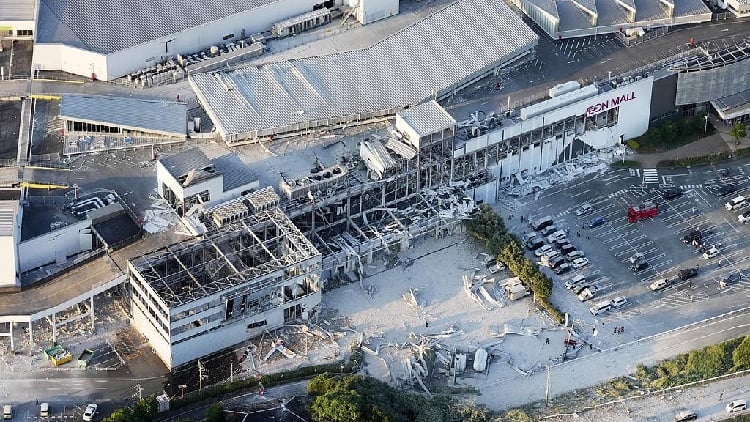
“The death toll from the powerful earthquake that hit Japan on Tuesday has risen to 30, as the search for survivors trapped in a badly damaged shopping centre, paper mill and collapsed homes across the south-west of the country continues.” · exact text match
Why: Use of numbers with official attribution; no speculation.
Claim: High integrity signals through official sourcing and precise locations.
“injured at least 62 people, according to the prefectural government.” · exact text match
Why: Direct quotation of official source and concrete location details.
The casualty figures are time-sensitive and taken from a government source; no independent verification is provided.
July 28, 2026 · 0 shares
Official-source framing dominates, foregrounding government response, official data from authorities (JMA), and infrastructure disruption as the primary narrative.
Japan sits along the Pacific Ring of Fire, one of the world’s most active seismic zones, making earthquakes a frequent occurrence.
Kumamoto itself experienced a catastrophic series of earthquakes in 2016 that killed hundreds of people and severely damaged historic landmarks, including Kumamoto Castle.
July 28, 2026 · 0 shares
Official-sourcing anchors the framing, citing police via NHK to emphasize evacuations and damage in a rapid disaster update.
Automated analysis; not human reviewed. Limitations: Garbled article_text contains extraneous content and omits earthquake magnitude; limits verification to reported figures and official attribution.
Garbled article_text contains extraneous content and omits earthquake magnitude; limits verification to reported figures and official attribution.
July 28, 2026 · 0 shares
Headline uses sensational language ('Powerful earthquake') coexisting with data-driven, official-sourced reporting.
Automated analysis; not human reviewed. · 1 of 52 available dimensions scored; omitted dimensions are not treated as neutral. · Verified supporting quotes for 1 of 1 scored dimensions.
Claim: The framing uses sensational language in the headline and descriptor phrases.
“Powerful earthquake hits Japan's Kyushu, tsunami advisory lifted.” · exact text match
“TV broadcasting programs show information about a massive earthquake that struck Kyushu, Japan, July 28, 2026. /VCG” · exact text match
Why: The headline uses an explicit intensifier ('Powerful') and accompanying material uses the descriptor 'massive,' signaling sensational framing beyond neutral reporting.
July 28, 2026 · 0 shares
Disaster reporting relies on official agencies and authorities, presenting cautious language and minimal interpretive framing.
Kumamoto region experienced a major earthquake in 2016 with significant casualties and damage, providing historical context for current emergency responses.
Automated analysis; not human reviewed. · 21 of 52 available dimensions scored; omitted dimensions are not treated as neutral. · Verified supporting quotes for 1 of 21 scored dimensions.
Claim: Neutral framing with reliance on official sources.
“Japan’s Fire and Disaster Management Agency said there were no reports of damage to major public facilities and infrastructure, though authorities were still assessing the extent of damage.” · exact text match
Why: Official-source statements and minimal editorial commentary indicate neutral framing.
July 28, 2026 · 0 shares
Official-source framing dominates, foregrounding government response, official data from authorities (JMA), and infrastructure disruption as the primary narrative.
Japan sits along the Pacific Ring of Fire, one of the world’s most active seismic zones, making earthquakes a frequent occurrence. Kumamoto itself experienced a catastrophic series of earthquakes in 2016 that killed hundreds of people and severely damaged historic landmarks, including Kumamoto Castle.
July 29, 2026 · 0 shares
Casualty-toll framing centers on 13 deaths from Kumamoto's 7.1 earthquake, with some fatalities under investigation to determine if they are related to the quake.
Donation-driven framing interweaves fundraising pitches and credibility claims into earthquake coverage, presenting journalism as a trusted, universally accessible service.
Automated analysis; not human reviewed. Limitations: The embedded fundraising content within a live reporting piece may bias readers toward donating and associate credibility with revenue sources. · 1 of 52 available dimensions scored; omitted dimensions are not treated as neutral. · Verified supporting quotes for 0 of 1 scored dimensions.
Claim: Promotional fundraising language is present and used to frame journalism as accessible without paywalls.
“"Your donation allows us to keep sending journalists to speak to both sides of the story."” · not found in supplied text
“"is trusted by Americans across the entire political spectrum. And unlike many other quality news outlets, we choose not to lock Americans out of our reporting and analysis with paywalls."” · not found in supplied text
Why: Direct fundraising language and credibility statements indicate promotional framing within news content.
The embedded fundraising content within a live reporting piece may bias readers toward donating and associate credibility with revenue sources.
Disaster-news framing focused on official casualty figures and ongoing rescue operations, with emphasis on responders and authorities.
Automated analysis; not human reviewed. Limitations: The casualty figures are time-sensitive and taken from a government source; no independent verification is provided. · 52 of 52 available dimensions scored; omitted dimensions are not treated as neutral. · Verified supporting quotes for 8 of 52 scored dimensions.
Claim: Framing is neutral with respect to politics; no partisan framing detected.
“Death toll in Japan earthquake rises to 30 as aftershock and heat hamper rescue efforts.” · exact text match
Why: No explicit political content; framing centers on disaster metrics and responders.
Claim: No populist vs. elitist framing detected.
“The 6.8-magnitude quake, which struck Kumamoto prefecture on the island of Kyushu, injured at least 62 people, according to the prefectural government.” · exact text match
Why: Reliance on official casualty figures and on-site responders rather than populist rhetoric.
Claim: No authoritarian framing; authorities cited for numbers.
“according to the prefectural government.” · exact text match
Why: Government authority cited for casualty numbers; no challenge to authority.
Claim: Neutral, factual framing with minimal subjective commentary.
“Death toll in Japan earthquake rises to 30 as aftershock and heat hamper rescue efforts.” · exact text match
Why: Descriptive language but not opinionated; relies on official data.
Claim: Mild sensational language present in phrasing.
“Death toll in Japan earthquake rises to 30 as aftershock and heat hamper rescue efforts.” · exact text match
Why: Adjectives imply intensity beyond neutral reporting.
Claim: Slight pro-establishment tilt due to reliance on government figures.
“according to the prefectural government.” · exact text match
Why: Use of official government figures as primary data source.
Claim: High credibility given official sourcing and concrete facts.
“prefectural government” · exact text match
“6.8-magnitude quake” · exact text match
“shopping centre, paper mill, and collapsed homes” · not found in supplied text
Why: Explicit attribution to official data and specific infrastructure details.
Claim: Neutral, fact-based presentation with official casualty figures.
“The death toll from the powerful earthquake that hit Japan on Tuesday has risen to 30, as the search for survivors trapped in a badly damaged shopping centre, paper mill and collapsed homes across the south-west of the country continues.” · exact text match
Why: Use of numbers with official attribution; no speculation.
Claim: High integrity signals through official sourcing and precise locations.
“injured at least 62 people, according to the prefectural government.” · exact text match
Why: Direct quotation of official source and concrete location details.
The casualty figures are time-sensitive and taken from a government source; no independent verification is provided.
July 28, 2026 · 0 shares
Disaster-response framing emphasizes casualties, evacuations, and rescue efforts, with official briefings and infrastructure damage highlighted.
Kumamoto is on the southern Kyushu island; the quake caused widespread damage, evacuations, and aftershocks, with references to Japan's seismic vulnerability and a previous large Kumamoto quake about a decade earlier.
Automated analysis; not human reviewed. Limitations: The report relies on provisional figures and statements from multiple sources, which may be updated as the situation develops.
The report relies on provisional figures and statements from multiple sources, which may be updated as the situation develops.
July 28, 2026 · 0 shares
Attribution-heavy, uncertainty-aware disaster update foregrounding official sources and conflicting magnitude figures.
Automated analysis; not human reviewed. Limitations: Uncertainty around casualty counts and earthquake magnitude; conflicting reports from NHK, CNNC, and JMA indicate high uncertainty about the incident's scale.
Uncertainty around casualty counts and earthquake magnitude; conflicting reports from NHK, CNNC, and JMA indicate high uncertainty about the incident's scale.
Donation-driven framing interweaves fundraising pitches and credibility claims into earthquake coverage, presenting journalism as a trusted, universally accessible service.
Automated analysis; not human reviewed. Limitations: The embedded fundraising content within a live reporting piece may bias readers toward donating and associate credibility with revenue sources. · 1 of 52 available dimensions scored; omitted dimensions are not treated as neutral. · Verified supporting quotes for 0 of 1 scored dimensions.
Claim: Promotional fundraising language is present and used to frame journalism as accessible without paywalls.
“"Your donation allows us to keep sending journalists to speak to both sides of the story."” · not found in supplied text
“"is trusted by Americans across the entire political spectrum. And unlike many other quality news outlets, we choose not to lock Americans out of our reporting and analysis with paywalls."” · not found in supplied text
Why: Direct fundraising language and credibility statements indicate promotional framing within news content.
The embedded fundraising content within a live reporting piece may bias readers toward donating and associate credibility with revenue sources.
July 28, 2026 · 0 shares
Disaster reporting relies on official agencies and authorities, presenting cautious language and minimal interpretive framing.
Kumamoto region experienced a major earthquake in 2016 with significant casualties and damage, providing historical context for current emergency responses.
Automated analysis; not human reviewed. · 21 of 52 available dimensions scored; omitted dimensions are not treated as neutral. · Verified supporting quotes for 1 of 21 scored dimensions.
Claim: Neutral framing with reliance on official sources.
“Japan’s Fire and Disaster Management Agency said there were no reports of damage to major public facilities and infrastructure, though authorities were still assessing the extent of damage.” · exact text match
Why: Official-source statements and minimal editorial commentary indicate neutral framing.
July 28, 2026 · 0 shares
Official-source framing dominates, foregrounding government response, official data from authorities (JMA), and infrastructure disruption as the primary narrative.
Japan sits along the Pacific Ring of Fire, one of the world’s most active seismic zones, making earthquakes a frequent occurrence. Kumamoto itself experienced a catastrophic series of earthquakes in 2016 that killed hundreds of people and severely damaged historic landmarks, including Kumamoto Castle.
Helium Bias
July 28, 2026 · 0 shares
Official-source framing dominates, foregrounding government response, official data from authorities (JMA), and infrastructure disruption as the primary narrative.
Japan sits along the Pacific Ring of Fire, one of the world’s most active seismic zones, making earthquakes a frequent occurrence. Kumamoto itself experienced a catastrophic series of earthquakes in 2016 that killed hundreds of people and severely damaged historic landmarks, including Kumamoto Castle.
July 28, 2026 · 0 shares
Disaster reporting relies on official agencies and authorities, presenting cautious language and minimal interpretive framing.
Kumamoto region experienced a major earthquake in 2016 with significant casualties and damage, providing historical context for current emergency responses.
Automated analysis; not human reviewed. · 21 of 52 available dimensions scored; omitted dimensions are not treated as neutral. · Verified supporting quotes for 1 of 21 scored dimensions.
Claim: Neutral framing with reliance on official sources.
“Japan’s Fire and Disaster Management Agency said there were no reports of damage to major public facilities and infrastructure, though authorities were still assessing the extent of damage.” · exact text match
Why: Official-source statements and minimal editorial commentary indicate neutral framing.
Story Blindspots
Donation-driven framing interweaves fundraising pitches and credibility claims into earthquake coverage, presenting journalism as a trusted, universally accessible service.
Automated analysis; not human reviewed. Limitations: The embedded fundraising content within a live reporting piece may bias readers toward donating and associate credibility with revenue sources. · 1 of 52 available dimensions scored; omitted dimensions are not treated as neutral. · Verified supporting quotes for 0 of 1 scored dimensions.
Claim: Promotional fundraising language is present and used to frame journalism as accessible without paywalls.
“"Your donation allows us to keep sending journalists to speak to both sides of the story."” · not found in supplied text
“"is trusted by Americans across the entire political spectrum. And unlike many other quality news outlets, we choose not to lock Americans out of our reporting and analysis with paywalls."” · not found in supplied text
Why: Direct fundraising language and credibility statements indicate promotional framing within news content.
The embedded fundraising content within a live reporting piece may bias readers toward donating and associate credibility with revenue sources.
July 28, 2026 · 0 shares
Disaster-response framing emphasizes casualties, evacuations, and rescue efforts, with official briefings and infrastructure damage highlighted.
Kumamoto is on the southern Kyushu island; the quake caused widespread damage, evacuations, and aftershocks, with references to Japan's seismic vulnerability and a previous large Kumamoto quake about a decade earlier.
Automated analysis; not human reviewed. Limitations: The report relies on provisional figures and statements from multiple sources, which may be updated as the situation develops.
The report relies on provisional figures and statements from multiple sources, which may be updated as the situation develops.
July 28, 2026 · 0 shares
Official-source framing dominates, foregrounding government response, official data from authorities (JMA), and infrastructure disruption as the primary narrative.
Japan sits along the Pacific Ring of Fire, one of the world’s most active seismic zones, making earthquakes a frequent occurrence. Kumamoto itself experienced a catastrophic series of earthquakes in 2016 that killed hundreds of people and severely damaged historic landmarks, including Kumamoto Castle.
July 28, 2026 · 0 shares
Official-sourcing anchors the framing, citing police via NHK to emphasize evacuations and damage in a rapid disaster update.
Automated analysis; not human reviewed. Limitations: Garbled article_text contains extraneous content and omits earthquake magnitude; limits verification to reported figures and official attribution.
Garbled article_text contains extraneous content and omits earthquake magnitude; limits verification to reported figures and official attribution.
July 29, 2026 · 0 shares
Casualty-toll framing centers on 13 deaths from Kumamoto's 7.1 earthquake, with some fatalities under investigation to determine if they are related to the quake.
July 28, 2026 · 0 shares
Headline uses sensational language ('Powerful earthquake') coexisting with data-driven, official-sourced reporting.
Automated analysis; not human reviewed. · 1 of 52 available dimensions scored; omitted dimensions are not treated as neutral. · Verified supporting quotes for 1 of 1 scored dimensions.
Claim: The framing uses sensational language in the headline and descriptor phrases.
“Powerful earthquake hits Japan's Kyushu, tsunami advisory lifted.” · exact text match
“TV broadcasting programs show information about a massive earthquake that struck Kyushu, Japan, July 28, 2026. /VCG” · exact text match
Why: The headline uses an explicit intensifier ('Powerful') and accompanying material uses the descriptor 'massive,' signaling sensational framing beyond neutral reporting.
July 28, 2026 · 0 shares
Disaster reporting relies on official agencies and authorities, presenting cautious language and minimal interpretive framing.
Kumamoto region experienced a major earthquake in 2016 with significant casualties and damage, providing historical context for current emergency responses.
Automated analysis; not human reviewed. · 21 of 52 available dimensions scored; omitted dimensions are not treated as neutral. · Verified supporting quotes for 1 of 21 scored dimensions.
Claim: Neutral framing with reliance on official sources.
“Japan’s Fire and Disaster Management Agency said there were no reports of damage to major public facilities and infrastructure, though authorities were still assessing the extent of damage.” · exact text match
Why: Official-source statements and minimal editorial commentary indicate neutral framing.
July 28, 2026 · 0 shares
Attribution-heavy, uncertainty-aware disaster update foregrounding official sources and conflicting magnitude figures.
Automated analysis; not human reviewed. Limitations: Uncertainty around casualty counts and earthquake magnitude; conflicting reports from NHK, CNNC, and JMA indicate high uncertainty about the incident's scale.
Uncertainty around casualty counts and earthquake magnitude; conflicting reports from NHK, CNNC, and JMA indicate high uncertainty about the incident's scale.
July 28, 2026 · 0 shares
Attribution-heavy, uncertainty-aware disaster update foregrounding official sources and conflicting magnitude figures.
Automated analysis; not human reviewed. Limitations: Uncertainty around casualty counts and earthquake magnitude; conflicting reports from NHK, CNNC, and JMA indicate high uncertainty about the incident's scale.
Uncertainty around casualty counts and earthquake magnitude; conflicting reports from NHK, CNNC, and JMA indicate high uncertainty about the incident's scale.
Donation-driven framing interweaves fundraising pitches and credibility claims into earthquake coverage, presenting journalism as a trusted, universally accessible service.
Automated analysis; not human reviewed. Limitations: The embedded fundraising content within a live reporting piece may bias readers toward donating and associate credibility with revenue sources. · 1 of 52 available dimensions scored; omitted dimensions are not treated as neutral. · Verified supporting quotes for 0 of 1 scored dimensions.
Claim: Promotional fundraising language is present and used to frame journalism as accessible without paywalls.
“"Your donation allows us to keep sending journalists to speak to both sides of the story."” · not found in supplied text
“"is trusted by Americans across the entire political spectrum. And unlike many other quality news outlets, we choose not to lock Americans out of our reporting and analysis with paywalls."” · not found in supplied text
Why: Direct fundraising language and credibility statements indicate promotional framing within news content.
The embedded fundraising content within a live reporting piece may bias readers toward donating and associate credibility with revenue sources.
July 28, 2026 · 0 shares
Disaster-response framing emphasizes casualties, evacuations, and rescue efforts, with official briefings and infrastructure damage highlighted.
Kumamoto is on the southern Kyushu island; the quake caused widespread damage, evacuations, and aftershocks, with references to Japan's seismic vulnerability and a previous large Kumamoto quake about a decade earlier.
Automated analysis; not human reviewed. Limitations: The report relies on provisional figures and statements from multiple sources, which may be updated as the situation develops.
The report relies on provisional figures and statements from multiple sources, which may be updated as the situation develops.
July 28, 2026 · 0 shares
Official-sourcing anchors the framing, citing police via NHK to emphasize evacuations and damage in a rapid disaster update.
Automated analysis; not human reviewed. Limitations: Garbled article_text contains extraneous content and omits earthquake magnitude; limits verification to reported figures and official attribution.
Garbled article_text contains extraneous content and omits earthquake magnitude; limits verification to reported figures and official attribution.
July 28, 2026 · 0 shares
Disaster reporting relies on official agencies and authorities, presenting cautious language and minimal interpretive framing.
Kumamoto region experienced a major earthquake in 2016 with significant casualties and damage, providing historical context for current emergency responses.
Automated analysis; not human reviewed.
·
21 of 52 available dimensions scored; omitted dimensions are not treated as neutral.
·
Verified supporting quotes for 1 of 21 scored dimensions.
Claim: Neutral framing with reliance on official sources.
“Japan’s Fire and Disaster Management Agency said there were no reports of damage to major public facilities and infrastructure, though authorities were still assessing the extent of damage.” · exact text match
Why: Official-source statements and minimal editorial commentary indicate neutral framing.
Disaster-news framing focused on official casualty figures and ongoing rescue operations, with emphasis on responders and authorities.
Automated analysis; not human reviewed.
Limitations: The casualty figures are time-sensitive and taken from a government source; no independent verification is provided.
·
52 of 52 available dimensions scored; omitted dimensions are not treated as neutral.
·
Verified supporting quotes for 8 of 52 scored dimensions.
Claim: Framing is neutral with respect to politics; no partisan framing detected.
“Death toll in Japan earthquake rises to 30 as aftershock and heat hamper rescue efforts.” · exact text match
Why: No explicit political content; framing centers on disaster metrics and responders.
Claim: No populist vs. elitist framing detected.
“The 6.8-magnitude quake, which struck Kumamoto prefecture on the island of Kyushu, injured at least 62 people, according to the prefectural government.” · exact text match
Why: Reliance on official casualty figures and on-site responders rather than populist rhetoric.
Claim: No authoritarian framing; authorities cited for numbers.
“according to the prefectural government.” · exact text match
Why: Government authority cited for casualty numbers; no challenge to authority.
Claim: Neutral, factual framing with minimal subjective commentary.
“Death toll in Japan earthquake rises to 30 as aftershock and heat hamper rescue efforts.” · exact text match
Why: Descriptive language but not opinionated; relies on official data.
Claim: Mild sensational language present in phrasing.
“Death toll in Japan earthquake rises to 30 as aftershock and heat hamper rescue efforts.” · exact text match
Why: Adjectives imply intensity beyond neutral reporting.
Claim: Slight pro-establishment tilt due to reliance on government figures.
“according to the prefectural government.” · exact text match
Why: Use of official government figures as primary data source.
Claim: High credibility given official sourcing and concrete facts.
“prefectural government” · exact text match
“6.8-magnitude quake” · exact text match
“shopping centre, paper mill, and collapsed homes” · not found in supplied text
Why: Explicit attribution to official data and specific infrastructure details.
Claim: Neutral, fact-based presentation with official casualty figures.
“The death toll from the powerful earthquake that hit Japan on Tuesday has risen to 30, as the search for survivors trapped in a badly damaged shopping centre, paper mill and collapsed homes across the south-west of the country continues.” · exact text match
Why: Use of numbers with official attribution; no speculation.
Claim: High integrity signals through official sourcing and precise locations.
“injured at least 62 people, according to the prefectural government.” · exact text match
Why: Direct quotation of official source and concrete location details.
The casualty figures are time-sensitive and taken from a government source; no independent verification is provided.
Disaster-news framing focused on official casualty figures and ongoing rescue operations, with emphasis on responders and authorities.
Automated analysis; not human reviewed.
Limitations: The casualty figures are time-sensitive and taken from a government source; no independent verification is provided.
·
52 of 52 available dimensions scored; omitted dimensions are not treated as neutral.
·
Verified supporting quotes for 8 of 52 scored dimensions.
Claim: Framing is neutral with respect to politics; no partisan framing detected.
“Death toll in Japan earthquake rises to 30 as aftershock and heat hamper rescue efforts.” · exact text match
Why: No explicit political content; framing centers on disaster metrics and responders.
Claim: No populist vs. elitist framing detected.
“The 6.8-magnitude quake, which struck Kumamoto prefecture on the island of Kyushu, injured at least 62 people, according to the prefectural government.” · exact text match
Why: Reliance on official casualty figures and on-site responders rather than populist rhetoric.
Claim: No authoritarian framing; authorities cited for numbers.
“according to the prefectural government.” · exact text match
Why: Government authority cited for casualty numbers; no challenge to authority.
Claim: Neutral, factual framing with minimal subjective commentary.
“Death toll in Japan earthquake rises to 30 as aftershock and heat hamper rescue efforts.” · exact text match
Why: Descriptive language but not opinionated; relies on official data.
Claim: Mild sensational language present in phrasing.
“Death toll in Japan earthquake rises to 30 as aftershock and heat hamper rescue efforts.” · exact text match
Why: Adjectives imply intensity beyond neutral reporting.
Claim: Slight pro-establishment tilt due to reliance on government figures.
“according to the prefectural government.” · exact text match
Why: Use of official government figures as primary data source.
Claim: High credibility given official sourcing and concrete facts.
“prefectural government” · exact text match
“6.8-magnitude quake” · exact text match
“shopping centre, paper mill, and collapsed homes” · not found in supplied text
Why: Explicit attribution to official data and specific infrastructure details.
Claim: Neutral, fact-based presentation with official casualty figures.
“The death toll from the powerful earthquake that hit Japan on Tuesday has risen to 30, as the search for survivors trapped in a badly damaged shopping centre, paper mill and collapsed homes across the south-west of the country continues.” · exact text match
Why: Use of numbers with official attribution; no speculation.
Claim: High integrity signals through official sourcing and precise locations.
“injured at least 62 people, according to the prefectural government.” · exact text match
Why: Direct quotation of official source and concrete location details.
The casualty figures are time-sensitive and taken from a government source; no independent verification is provided.
Donation-driven framing interweaves fundraising pitches and credibility claims into earthquake coverage, presenting journalism as a trusted, universally accessible service.
Automated analysis; not human reviewed.
Limitations: The embedded fundraising content within a live reporting piece may bias readers toward donating and associate credibility with revenue sources.
·
1 of 52 available dimensions scored; omitted dimensions are not treated as neutral.
·
Verified supporting quotes for 0 of 1 scored dimensions.
Claim: Promotional fundraising language is present and used to frame journalism as accessible without paywalls.
“"Your donation allows us to keep sending journalists to speak to both sides of the story."” · not found in supplied text
“"is trusted by Americans across the entire political spectrum.
And unlike many other quality news outlets, we choose not to lock Americans out of our reporting and analysis with paywalls."”
· not found in supplied text
Why: Direct fundraising language and credibility statements indicate promotional framing within news content.
The embedded fundraising content within a live reporting piece may bias readers toward donating and associate credibility with revenue sources.
July 28, 2026 · 0 shares
Attribution-heavy, uncertainty-aware disaster update foregrounding official sources and conflicting magnitude figures.
Automated analysis; not human reviewed. Limitations: Uncertainty around casualty counts and earthquake magnitude; conflicting reports from NHK, CNNC, and JMA indicate high uncertainty about the incident's scale.
Uncertainty around casualty counts and earthquake magnitude; conflicting reports from NHK, CNNC, and JMA indicate high uncertainty about the incident's scale.
July 28, 2026 · 0 shares
Official-source framing dominates, foregrounding government response, official data from authorities (JMA), and infrastructure disruption as the primary narrative.
Japan sits along the Pacific Ring of Fire, one of the world’s most active seismic zones, making earthquakes a frequent occurrence.
Kumamoto itself experienced a catastrophic series of earthquakes in 2016 that killed hundreds of people and severely damaged historic landmarks, including Kumamoto Castle.
July 28, 2026 · 0 shares
Attribution-heavy, uncertainty-aware disaster update foregrounding official sources and conflicting magnitude figures.
Automated analysis; not human reviewed. Limitations: Uncertainty around casualty counts and earthquake magnitude; conflicting reports from NHK, CNNC, and JMA indicate high uncertainty about the incident's scale.
Uncertainty around casualty counts and earthquake magnitude; conflicting reports from NHK, CNNC, and JMA indicate high uncertainty about the incident's scale.
July 29, 2026 · 0 shares
Solidarity framing emphasizes Israel's supportive stance toward Japan after a deadly earthquake.
July 29, 2026 · 0 shares
Incident-focused framing emphasizes immediate danger and staff safety, anchored by footage of newsroom staff taking cover during a magnitude-7.1 earthquake.
July 28, 2026 · 0 shares
Neutral, damage-focused framing that emphasizes a historic landmark's damage from earthquakes without editorializing.
July 28, 2026 · 0 shares
Official-source framing dominates, foregrounding government response, official data from authorities (JMA), and infrastructure disruption as the primary narrative.
Japan sits along the Pacific Ring of Fire, one of the world’s most active seismic zones, making earthquakes a frequent occurrence.
Kumamoto itself experienced a catastrophic series of earthquakes in 2016 that killed hundreds of people and severely damaged historic landmarks, including Kumamoto Castle.
July 29, 2026 · 0 shares
Casualty-toll framing centers on 13 deaths from Kumamoto's 7.1 earthquake, with some fatalities under investigation to determine if they are related to the quake.
Donation-driven framing interweaves fundraising pitches and credibility claims into earthquake coverage, presenting journalism as a trusted, universally accessible service.
Automated analysis; not human reviewed.
Limitations: The embedded fundraising content within a live reporting piece may bias readers toward donating and associate credibility with revenue sources.
·
1 of 52 available dimensions scored; omitted dimensions are not treated as neutral.
·
Verified supporting quotes for 0 of 1 scored dimensions.
Claim: Promotional fundraising language is present and used to frame journalism as accessible without paywalls.
“"Your donation allows us to keep sending journalists to speak to both sides of the story."” · not found in supplied text
“"is trusted by Americans across the entire political spectrum.
And unlike many other quality news outlets, we choose not to lock Americans out of our reporting and analysis with paywalls."”
· not found in supplied text
Why: Direct fundraising language and credibility statements indicate promotional framing within news content.
The embedded fundraising content within a live reporting piece may bias readers toward donating and associate credibility with revenue sources.
Disaster-news framing focused on official casualty figures and ongoing rescue operations, with emphasis on responders and authorities.
Automated analysis; not human reviewed.
Limitations: The casualty figures are time-sensitive and taken from a government source; no independent verification is provided.
·
52 of 52 available dimensions scored; omitted dimensions are not treated as neutral.
·
Verified supporting quotes for 8 of 52 scored dimensions.
Claim: Framing is neutral with respect to politics; no partisan framing detected.
“Death toll in Japan earthquake rises to 30 as aftershock and heat hamper rescue efforts.” · exact text match
Why: No explicit political content; framing centers on disaster metrics and responders.
Claim: No populist vs. elitist framing detected.
“The 6.8-magnitude quake, which struck Kumamoto prefecture on the island of Kyushu, injured at least 62 people, according to the prefectural government.” · exact text match
Why: Reliance on official casualty figures and on-site responders rather than populist rhetoric.
Claim: No authoritarian framing; authorities cited for numbers.
“according to the prefectural government.” · exact text match
Why: Government authority cited for casualty numbers; no challenge to authority.
Claim: Neutral, factual framing with minimal subjective commentary.
“Death toll in Japan earthquake rises to 30 as aftershock and heat hamper rescue efforts.” · exact text match
Why: Descriptive language but not opinionated; relies on official data.
Claim: Mild sensational language present in phrasing.
“Death toll in Japan earthquake rises to 30 as aftershock and heat hamper rescue efforts.” · exact text match
Why: Adjectives imply intensity beyond neutral reporting.
Claim: Slight pro-establishment tilt due to reliance on government figures.
“according to the prefectural government.” · exact text match
Why: Use of official government figures as primary data source.
Claim: High credibility given official sourcing and concrete facts.
“prefectural government” · exact text match
“6.8-magnitude quake” · exact text match
“shopping centre, paper mill, and collapsed homes” · not found in supplied text
Why: Explicit attribution to official data and specific infrastructure details.
Claim: Neutral, fact-based presentation with official casualty figures.
“The death toll from the powerful earthquake that hit Japan on Tuesday has risen to 30, as the search for survivors trapped in a badly damaged shopping centre, paper mill and collapsed homes across the south-west of the country continues.” · exact text match
Why: Use of numbers with official attribution; no speculation.
Claim: High integrity signals through official sourcing and precise locations.
“injured at least 62 people, according to the prefectural government.” · exact text match
Why: Direct quotation of official source and concrete location details.
The casualty figures are time-sensitive and taken from a government source; no independent verification is provided.
July 28, 2026 · 0 shares
Disaster-response framing emphasizes casualties, evacuations, and rescue efforts, with official briefings and infrastructure damage highlighted.
Kumamoto is on the southern Kyushu island; the quake caused widespread damage, evacuations, and aftershocks, with references to Japan's seismic vulnerability and a previous large Kumamoto quake about a decade earlier.
Automated analysis; not human reviewed. Limitations: The report relies on provisional figures and statements from multiple sources, which may be updated as the situation develops.
The report relies on provisional figures and statements from multiple sources, which may be updated as the situation develops.
2026 © Helium Trades
Privacy Policy & Disclosure
* Disclaimer: Nothing on this website constitutes investment advice, performance data or any recommendation that any particular security, portfolio of securities, transaction or investment strategy is suitable for any specific person. Helium Trades is not responsible in any way for the accuracy
of any model predictions or price data. Any mention of a particular security and related prediction data is not a recommendation to buy or sell that security. Investments in securities involve the risk of loss. Past performance is no guarantee of future results. Helium Trades is not responsible for any of your investment decisions,
you should consult a financial expert before engaging in any transaction.
Helium Research Assistant

How can I help you today?
Ask any question about this page.