See whether Helium helps you make better-informed decisions. Try every Pro Trader feature for 30 days. No credit card required.
Try every Pro Trader feature for 30 days. No credit card required.
October 09, 2026 · 0 shares
The report frames Australia's selection of Nic Maddinson as a fairytale-defying case study of a wider succession crisis in an aging Test side, blending sympathetic personal narrative with critical scrutiny of selectors.
Australia were touring South Africa for a Test series; Maddinson's previous three Tests came almost a decade earlier, and Cameron Green was injured, opening a spot for an all-rounder in the XI.
Automated analysis; not human reviewed.
Limitations: Article includes a heavily truncated end matter list of unrelated headlines whose relevance to the main report is unclear.
·
55 of 55 available dimensions scored; omitted dimensions are not treated as neutral.
·
Verified supporting quotes for 7 of 55 scored dimensions.
Claim: The central narrative is mostly descriptive but is framed by a subjective thesis about sporting fairytales.
“there are countless more examples of sport refusing to follow the fairytale script” · exact text match
Why: The piece opens with an editorializing framing device before turning to reported facts.
Claim: Coverage leans toward measured match reporting rather than sensationalism.
“Australia recovered somewhat from 124-6 to 187-6 when bad light brought an early close” · exact text match
Why: The core reporting uses plain descriptive tone and cricketing detail.
Claim: The article interleaves reported facts with evaluative framing about selectorial choices and team direction.
“the struggles of Maddinson and the top order pointed to wider issues in this Australia side” · exact text match
Why: The reporter's own assessment is presented alongside attributed facts.
Claim: Claims are anchored in specific numbers, timestamps, and direct attribution to named figures.
“Greenberg told SEN.” · exact text match
Why: Multiple named sources and verbatim quotes support credibility.
Claim: The report relies on observable sporting outcomes and attributed opinions rather than emotional or magical thinking.
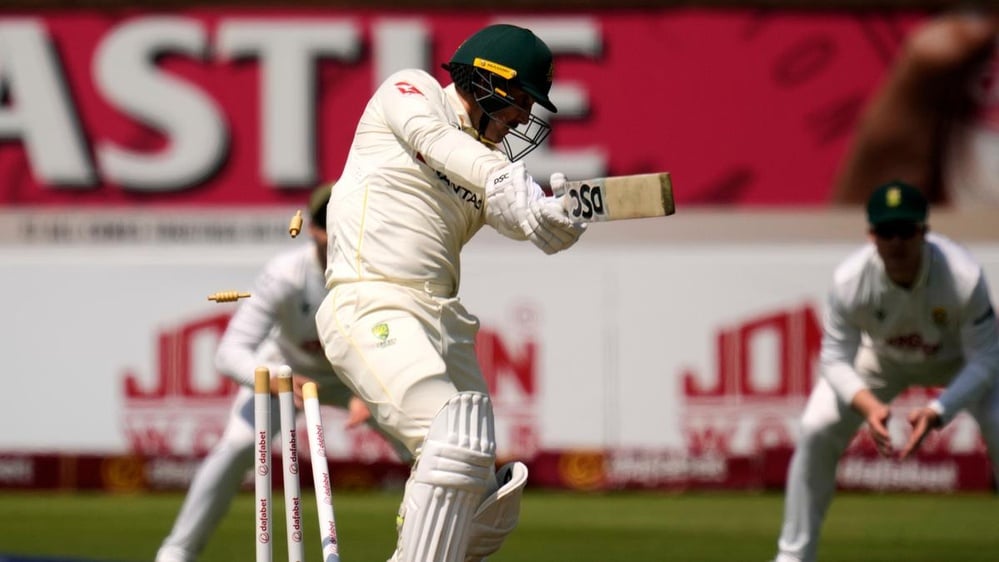
“Of those balls he faced, the left-hander missed 13 and edged one - the attempted cut to Marco Jansen that crashed back on to his stumps.” · exact text match
Why: Concrete, verifiable cricket statistics and attributed quotes support the analysis.
Claim: Prose shows some register shifts but no strong independent AI indicators.
“Even the most partisan of England fans would have wished him well.” · exact text match
Why: Stylistic inconsistency is weak evidence; classification is uncertain.
Claim: The report situates the innings in broader selection, scheduling, and succession context.
“This Test is the third in Australia's possible run of 21 before the end of next summer's Ashes” · exact text match
Why: It combines match detail, quotes, historical context, and forward schedule.
Article includes a heavily truncated end matter list of unrelated headlines whose relevance to the main report is unclear.
October 09, 2026 · 0 shares
The publisher frames the cricket match through strongly evaluative sports commentary, treating Australia's batting collapse as evidence of selection and preparation failures.
Automated analysis; not human reviewed.
Limitations: The supplied text is an opinionated sports analysis column with repeated subscription boilerplate; bias scores reflect its commentary framing rather than a news report.
·
13 of 55 available dimensions scored; omitted dimensions are not treated as neutral.
·
Verified supporting quotes for 13 of 13 scored dimensions.
Claim: The column blends reported events with evaluative judgments about selection, preparation, and player mentality.
“Australia asked too much of Nic Maddinson.
Matt Renshaw showed why.”
· exact text match
Why: Headline-level framing is subjective evaluation.
Claim: The language is mostly analytical but includes mildly alarmist phrasing.
“the list of batting fails is growing to alarming proportions” · exact text match
Why: 'Alarming proportions' is mildly sensational but not tabloid.
Claim: The article is pessimistic about Australia's batting and future Test prospects.
“These queries will be made still more urgent should South Africa make the most of their day one inroads and consign Australia to a third defeat in the space of five Test matches.” · exact text match
Why: Forecasts further failure and urgency.
Claim: The column moves from description to prescription for coaching, selection, and domestic pathways.
“Instead, the questions of Australia’s batting need to be wider and deeper, covering coaching, selection and the domestic pathway.” · exact text match
Why: Explicit prescriptive recommendation.
Claim: The piece is heavily opinionated in evaluating Australia's batting and selection.
“So poor has Australia’s batting been of late that some might be forgiven for thinking that Pat Cummins should consider the old uncovered wicket tactic of reversing the batting order” · exact text match
Why: Strong evaluative and rhetorical commentary.
Claim: It asserts a strong psychological conclusion about Labuschagne with high certainty.
“But certainly in Labuschagne’s case there is now a huge body of evidence that he struggles to keep his mind still enough to bat the sort of time that will win Test matches.” · exact text match
Why: 'Certainly' and 'huge body' exceed immediate evidence for a mental-state claim.
Claim: The tone is negative toward Australia's batting performance.
“Most maddeningly for Australia was the double loss of Labuschagne and Steve Smith either side of lunch” · exact text match
Why: 'Maddeningly' conveys negative emotional framing.
Claim: Claims are grounded in named players, direct quotes, and specific match events.
““It’s just that’s what opening batters have to deal with,” Renshaw said of Maddinson.” · exact text match
Why: Attribution and specificity support credibility.
Claim: The analysis is largely reasoned from specific match events, statistics, and attributed quotes rather than pure assertion.
“A 33-ball duck for Maddinson, the third longest by an opener in Test history, turned into a microcosm of the innings in total” · exact text match
Why: Uses a specific statistic to support an analytical claim.
Claim: It speculates about future consequences and possible alternative selections.
“Among available players, Australia A tourist Nathan McSweeney or the recent Test opener Jake Weatherald may have been alternatives with a little more lead-in than Maddinson.” · exact text match
Why: 'May have been alternatives' is speculative counterfactual.
Claim: The text contains human-specific sports idiom, nicknames, and reported quotes.
“Cummins, nicknamed “7-Eleven” for his propensity to bat like one or the other” · exact text match
Why: Such contextual nickname use is a human-writing indicator.
Claim: It includes mitigating context for Maddinson and acknowledges complexity in blaming individuals.
“That’s quite a contrast with Maddinson, who should not be overly blamed for struggling in his first innings back at Test level after a decade.” · exact text match
Why: Shows a fairness signal by limiting blame.
Claim: The analysis uses technical cricket comparison and contextual knowledge.
“Durban in October could easily have been Darwin in August, or Lord’s in June last year against the Proteas.” · exact text match
Why: Shows informed comparative analysis.
The supplied text is an opinionated sports analysis column with repeated subscription boilerplate; bias scores reflect its commentary framing rather than a news report.
Framing is sympathetic and defensive, presenting Maddinson's possible recall as a fairytale/feelgood story while countering outside criticism with extensive coach quotes.
Australia is on a Test tour of South Africa; the first Test begins Friday at Kingsmead, Durban.
Green, an allrounder, was already managing a shoulder issue, and Josh Inglis had been ruled out with a fractured finger.
Automated analysis; not human reviewed.
·
3 of 55 available dimensions scored; omitted dimensions are not treated as neutral.
·
Verified supporting quotes for 3 of 3 scored dimensions.
Claim: The report uses emotionally loaded, sympathetic framing for Maddinson's possible return while also reporting factual detail.
“The 35-year-old is firming to make a fairytale return despite not playing any first-class cricket in 18 months.” · exact text match
“Maddinson’s Test squad call up following a one-day cup century and Josh Inglis’s fractured finger was a feelgood story, given he beat testicular cancer last year.” · exact text match
Why: Phrases such as 'fairytale return' and 'feelgood story' add subjective, positive framing, though the report is otherwise factual and attributed.
Claim: The article is transparently sourced and attributed, distinguishing an official ruling from expectations and named coach statements.
“Green has been officially ruled out of Australia’s side for the opening Test against South Africa, after failing to overcome the abdominal strain suffered in last week’s final ODI.” · exact text match
“Andrew McDonald insists Nic Maddinson’s Test squad call-up should be no shock, with the left-hander edging closer to replacing the injured Cameron Green in Durban.” · exact text match
Why: The report attributes decisions, medical status, and selection reasoning to named officials and uses 'officially ruled out' for confirmed information.
Claim: The report is balanced in presenting both the criticism of Maddinson's selection and the selectors' defence with statistical context.
“But it was also met with surprise and strong criticism from the likes of Matthew Hayden” · exact text match
“Maddinson did average 52.37 in the Sheffield Shield from December 2018 to March 2024” · exact text match
Why: It names a critic, reports the statistical record, and quotes the coach directly rather than presenting only one side.
October 07, 2026 · 0 shares
The available text consists only of aggregated headlines and a paywall teaser, so no substantive publisher framing can be assessed.
Automated analysis; not human reviewed. Limitations: Only aggregated headlines and a paywall teaser were supplied; the substantive Guardian article body was unavailable, so bias scoring is not possible.
Only aggregated headlines and a paywall teaser were supplied; the substantive Guardian article body was unavailable, so bias scoring is not possible.
October 09, 2026 · 0 shares
The report frames Australia's selection of Nic Maddinson as a fairytale-defying case study of a wider succession crisis in an aging Test side, blending sympathetic personal narrative with critical scrutiny of selectors.
Australia were touring South Africa for a Test series; Maddinson's previous three Tests came almost a decade earlier, and Cameron Green was injured, opening a spot for an all-rounder in the XI.
Automated analysis; not human reviewed.
Limitations: Article includes a heavily truncated end matter list of unrelated headlines whose relevance to the main report is unclear.
·
55 of 55 available dimensions scored; omitted dimensions are not treated as neutral.
·
Verified supporting quotes for 7 of 55 scored dimensions.
Claim: The central narrative is mostly descriptive but is framed by a subjective thesis about sporting fairytales.
“there are countless more examples of sport refusing to follow the fairytale script” · exact text match
Why: The piece opens with an editorializing framing device before turning to reported facts.
Claim: Coverage leans toward measured match reporting rather than sensationalism.
“Australia recovered somewhat from 124-6 to 187-6 when bad light brought an early close” · exact text match
Why: The core reporting uses plain descriptive tone and cricketing detail.
Claim: The article interleaves reported facts with evaluative framing about selectorial choices and team direction.
“the struggles of Maddinson and the top order pointed to wider issues in this Australia side” · exact text match
Why: The reporter's own assessment is presented alongside attributed facts.
Claim: Claims are anchored in specific numbers, timestamps, and direct attribution to named figures.
“Greenberg told SEN.” · exact text match
Why: Multiple named sources and verbatim quotes support credibility.
Claim: The report relies on observable sporting outcomes and attributed opinions rather than emotional or magical thinking.
“Of those balls he faced, the left-hander missed 13 and edged one - the attempted cut to Marco Jansen that crashed back on to his stumps.” · exact text match
Why: Concrete, verifiable cricket statistics and attributed quotes support the analysis.
Claim: Prose shows some register shifts but no strong independent AI indicators.
“Even the most partisan of England fans would have wished him well.” · exact text match
Why: Stylistic inconsistency is weak evidence; classification is uncertain.
Claim: The report situates the innings in broader selection, scheduling, and succession context.
“This Test is the third in Australia's possible run of 21 before the end of next summer's Ashes” · exact text match
Why: It combines match detail, quotes, historical context, and forward schedule.
Article includes a heavily truncated end matter list of unrelated headlines whose relevance to the main report is unclear.
October 09, 2026 · 0 shares
The report adopts a sympathetic, human-interest frame around Nic Maddinson's cancer recovery and fairytale return, casting his record duck as a poignant setback rather than a straight sports statistic.
Maddinson last played Test cricket in December 2016 against Pakistan and was diagnosed with testicular cancer in April 2025.
Automated analysis; not human reviewed.
Limitations: The supplied text includes only a partial excerpt, mostly the headline, lead, and a few paragraphs plus unrelated links; a full-article bias assessment is limited.
Some later links appear to belong to other stories and were excluded.
·
36 of 55 available dimensions scored; omitted dimensions are not treated as neutral.
·
Verified supporting quotes for 0 of 36 scored dimensions.
The supplied text includes only a partial excerpt, mostly the headline, lead, and a few paragraphs plus unrelated links; a full-article bias assessment is limited.
Some later links appear to belong to other stories and were excluded.
Coverage is largely descriptive of match events, with mildly critical framing of the Maddinson selection as a 'shock' call that 'backfired' and emphasis on the selection gamble not paying off.
Australia's Test opening position has been unsettled since David Warner's retirement in January 2024, with multiple specialist opening pairings tried.
Automated analysis; not human reviewed.
Limitations: The article is a truncated sports recap with repeated fragments and app-promotion boilerplate, so scoring is limited to the substantive cricket reporting.
·
53 of 55 available dimensions scored; omitted dimensions are not treated as neutral.
·
Verified supporting quotes for 8 of 53 scored dimensions.
Claim: Framing is mostly event-driven but occasionally adopts evaluative language about the selection outcome.
“A bigger surprise awaited when Maddinson was then selected in the XI on Friday, and then chosen to open the batting” · exact text match
Why: Terms like 'surprise' and 'talking point' introduce mild subjective evaluation into otherwise factual reporting.
Claim: The article uses some dramatized phrasing around the selection gamble.
“The most vocal criticism came from former Test opener Matthew Hayden” · exact text match
Why: Labels like 'vocal' and 'bigger surprise' lean slightly toward dramatic framing.
Claim: The piece describes events and reactions rather than prescribing what selectors or players should do.
“Australia’s coaching staff had talked up Maddinson’s flexibility and ability to play spin this week, but ultimately the call did not receive the pay-off in the first innings.” · exact text match
Why: It reports the rationale and outcome without direct recommendations.
Claim: The report includes some evaluative characterizations alongside factual match details.
“As much as it was a feel-good story, critics also pointed to the fact Maddinson had not played a first-class fixture for more than 18 months.” · exact text match
Why: The phrase 'feel-good story' and the selection 'backfired' framing carry mild opinion.
Claim: The account provides specific scores, ball counts, player names, and attributed criticism, supporting reliability on the supplied facts.
“Nic Maddinson's shock Test return has resulted in Australia’s longest duck by an opener on record” · verified after text normalization
Why: Concrete, verifiable details and named sources improve credibility; minor repetition reduces polish.
Claim: The report stays anchored in concrete, verifiable match events and attributed selection facts rather than unsupported speculation.
“Labuschagne was then lbw to Wiaan Mulder on the last ball before lunch for 37 after a 60-run stand with Steve Smith (25no).” · exact text match
Why: Specific scores, dismissals, and attributions keep the account grounded in observable events.
Claim: The article mostly recounts events but includes some speculative framing about the selection's consequences.
“critics also pointed to the fact Maddinson had not played a first-class fixture for more than 18 months” · exact text match
Why: Limited forecast-style language surrounds the selection outcome, though it is tied to reported reactions.
Claim: Text shows occasional repetition and app-boilerplate but lacks strong independent AI indicators.
“Maddinson returns to Australian Test side after decade” · exact text match
Why: Repeated headline fragments are weak evidence and could reflect mechanical page scraping.
The article is a truncated sports recap with repeated fragments and app-promotion boilerplate, so scoring is limited to the substantive cricket reporting.
October 09, 2026 · 0 shares
Straightforward sports match reporting that favors the home side's perspective, framing South Africa as taking control while attributing Australia's struggles to selection missteps and veteran criticism.
First Test of the series between South Africa and Australia at Kingsmead, Durban, played on a Friday; Australia won the toss and chose to bat.
Automated analysis; not human reviewed.
·
55 of 55 available dimensions scored; omitted dimensions are not treated as neutral.
·
Verified supporting quotes for 16 of 55 scored dimensions.
Claim: No discernible ideological framing.
Why: Sports report with no political dimension.
Claim: No populist or elitist framing.
Why: Content is sports-focused.
Claim: No relevant political dimension.
Why: Sports context.
Claim: The report is predominantly factual match description with limited evaluative framing.
“A wicket in the final over of the session for Mulder, who trapped Marnus Labuschagne lbw, changed the complexion of the morning.” · exact text match
Why: The text largely recounts events and attributions with minimal subjective commentary, though occasional framing like 'changed the complexion' is present.
Claim: The report uses restrained match language with occasional mild hype in social-media captions.
“Chopped on 👀💥Marco Jansen makes a mess of Maddinson's stumps 🔥📺” · exact text match
Why: Most prose is measured, but quoted social-media blurbs include emojis and exaggerated phrasing.
Claim: Not applicable to sports reporting.
Why: No financial content.
Claim: Neutral emotional tone.
Why: Balanced reporting of match events.
Claim: The report describes events rather than prescribing outcomes or actions.
“The tourists, who won the toss, reached 84/3 at lunch with their decision to select Nic Maddinson to open alongside Travis Head failing.” · exact text match
Why: Content is descriptive of play and selection rationale, with no explicit prescriptions.
Claim: No fear-based framing.
Why: No rage-baiting.
Claim: No circular reasoning evident.
Why: Direct reporting.
Claim: The report includes commentary about selection popularity and media criticism, bordering on gossip.
“Maddinson’s selection was not a popular one among the horde of former Australian internationals, now fronting podcasts, or doing commentary.” · exact text match
Why: Mentions of media criticism add a mild gossip element beyond pure match facts.
Claim: The report contains some evaluative opinions alongside factual reporting.
“Despite dismissing Maddinson, Jansen was poor, with lines and lengths not troubling the batters.” · exact text match
Why: Includes subjective assessments like 'Jansen was poor' mixed with descriptive content.
Claim: Report is non-political, centered on sports.
“Wiaan Mulder, the Proteas’ man for all seasons and situations” · exact text match
Why: No political content present.
Claim: Report simplifies complex cricket dynamics into brief causal statements.
“A wicket in the final over of the session for Mulder, who trapped Marnus Labuschagne lbw, changed the complexion of the morning.” · exact text match
Why: Simplifies momentum shift to single wicket, but typical for match reporting.
Claim: The report cites former players' and a captain's comments as supporting perspectives.
“Mulder may have been a surprise choice to take the new ball, but as Temba Bavuma said on Thursday, he’s proved to be effective with it in the past.” · exact text match
Why: Uses authority quotes to support observations, though not excessively.
Claim: Generally mature tone in main text.
Why: Promotional blurbs slightly less formal but not immature.
Claim: No circular reasoning observed.
Why: Linear narrative.
Claim: Ample response coverage from officials and former players.
Why: Includes quotes and reactions.
Claim: No victimization narrative.
Why: No such framing.
Claim: Report asserts judgments like 'selection failing' with some certainty.
“with their decision to select Nic Maddinson to open alongside Travis Head failing” · exact text match
Why: Strong phrasing but supported by outcome (duck), moderate confidence.
Claim: The report contains promotional content for streaming and stadium attendance.
“Stream #SAvAUS on DStv:” · exact text match
“Hurry to the stadium and catch the rest of the day’s action!” · exact text match
Why: Includes promotional calls to action and broadcaster plugs.
Claim: No ideological content.
Why: Non-ideological sports reporting.
Claim: Neutral emotional tone.
Why: Balanced reporting.
Claim: No evidence of double standards.
Why: Consistent coverage.
Claim: The report shows reasonable sourcing and attribution but includes some unsupported evaluative language.
“Replays showed the ball would have hit the stumps.” · exact text match
Why: Balances technical evidence with occasional subjective statements, supporting moderate credibility.
Claim: Report is generally rational in tone and content.
Why: Factual sports reporting.
Claim: The report includes advertorial elements for Dafabet and stadium attendance.
“First Dafabet Test, Day 1! 🏏From arrivals at Hollywoodbets Kingsmead to a thrilling opening hour of play, it’s been nothing but quality cricket!” · exact text match
Why: Prominent sponsor and venue promotion embedded in coverage.
Claim: Report relies on empirical replay technology for evidence.
“TV replays showing the ball would have hit the top of the off-stump.” · exact text match
Why: Use of Snickometer and replays reflects scientific/empirical approach.
Claim: Report includes some forecast-like framing about control of the match.
“saw South Africa take control of the morning session” · exact text match
Why: Minor speculative language about momentum, but mostly descriptive.
Claim: Text shows some AI-authorship indicators such as repetitive structure and mixed formal/informal tone.
“Two wickets for Wiaan Mulder and one for Marco Jansen, saw South Africa take control of the morning session of the first Test against Australia at Kingsmead on Friday.” · exact text match
Why: Repetition and promotional blurbs could indicate AI, but evidence is weak.
Claim: The report includes direct quotes, replay evidence, and attribution without fabrication signals.
“The “Snickometer” indicated the ball had found the edge of Head’s bat.” · exact text match
““Where we are at is that we are promoting the greatest pile of mediocrity that we’ve seen in a generation of cricket,” former opener Matthew Hayden said on the All Over Bar The Cricket podcast this week.” · exact text match
Why: Quotes are attributed and technical evidence cited, supporting a moderate integrity score.
Claim: Average complexity for sports reporting.
Why: Standard sports journalism language.
Claim: Not relevant.
Why: Sports content.
Claim: Not present.
Why: No fraud content.
Claim: Not applicable.
Why: Sports report.
Claim: Not applicable.
Why: No religious content.
Claim: Not present.
Why: No such content.
Claim: Not present.
Why: No such content.
Claim: Not present.
Why: No racial content.
Claim: No woke framing.
Why: No identity politics.
Claim: No cruel framing.
Why: Neutral tone.
Claim: No virtue signaling.
Why: Sports focus.
Claim: No conspiracy content.
Why: Straightforward reporting.
Claim: Not present.
Why: No such framing.
Claim: No scapegoating.
Why: Balanced attribution.
Claim: No double standards evident.
Why: Consistent reporting.
Claim: Not present.
Why: No anti-science framing.
Coverage is largely descriptive of match events, with mildly critical framing of the Maddinson selection as a 'shock' call that 'backfired' and emphasis on the selection gamble not paying off.
Australia's Test opening position has been unsettled since David Warner's retirement in January 2024, with multiple specialist opening pairings tried.
Automated analysis; not human reviewed.
Limitations: The article is a truncated sports recap with repeated fragments and app-promotion boilerplate, so scoring is limited to the substantive cricket reporting.
·
53 of 55 available dimensions scored; omitted dimensions are not treated as neutral.
·
Verified supporting quotes for 8 of 53 scored dimensions.
Claim: Framing is mostly event-driven but occasionally adopts evaluative language about the selection outcome.
“A bigger surprise awaited when Maddinson was then selected in the XI on Friday, and then chosen to open the batting” · exact text match
Why: Terms like 'surprise' and 'talking point' introduce mild subjective evaluation into otherwise factual reporting.
Claim: The article uses some dramatized phrasing around the selection gamble.
“The most vocal criticism came from former Test opener Matthew Hayden” · exact text match
Why: Labels like 'vocal' and 'bigger surprise' lean slightly toward dramatic framing.
Claim: The piece describes events and reactions rather than prescribing what selectors or players should do.
“Australia’s coaching staff had talked up Maddinson’s flexibility and ability to play spin this week, but ultimately the call did not receive the pay-off in the first innings.” · exact text match
Why: It reports the rationale and outcome without direct recommendations.
Claim: The report includes some evaluative characterizations alongside factual match details.
“As much as it was a feel-good story, critics also pointed to the fact Maddinson had not played a first-class fixture for more than 18 months.” · exact text match
Why: The phrase 'feel-good story' and the selection 'backfired' framing carry mild opinion.
Claim: The account provides specific scores, ball counts, player names, and attributed criticism, supporting reliability on the supplied facts.
“Nic Maddinson's shock Test return has resulted in Australia’s longest duck by an opener on record” · verified after text normalization
Why: Concrete, verifiable details and named sources improve credibility; minor repetition reduces polish.
Claim: The report stays anchored in concrete, verifiable match events and attributed selection facts rather than unsupported speculation.
“Labuschagne was then lbw to Wiaan Mulder on the last ball before lunch for 37 after a 60-run stand with Steve Smith (25no).” · exact text match
Why: Specific scores, dismissals, and attributions keep the account grounded in observable events.
Claim: The article mostly recounts events but includes some speculative framing about the selection's consequences.
“critics also pointed to the fact Maddinson had not played a first-class fixture for more than 18 months” · exact text match
Why: Limited forecast-style language surrounds the selection outcome, though it is tied to reported reactions.
Claim: Text shows occasional repetition and app-boilerplate but lacks strong independent AI indicators.
“Maddinson returns to Australian Test side after decade” · exact text match
Why: Repeated headline fragments are weak evidence and could reflect mechanical page scraping.
The article is a truncated sports recap with repeated fragments and app-promotion boilerplate, so scoring is limited to the substantive cricket reporting.
October 09, 2026 · 0 shares
The publisher frames the cricket match through strongly evaluative sports commentary, treating Australia's batting collapse as evidence of selection and preparation failures.
Automated analysis; not human reviewed.
Limitations: The supplied text is an opinionated sports analysis column with repeated subscription boilerplate; bias scores reflect its commentary framing rather than a news report.
·
13 of 55 available dimensions scored; omitted dimensions are not treated as neutral.
·
Verified supporting quotes for 13 of 13 scored dimensions.
Claim: The column blends reported events with evaluative judgments about selection, preparation, and player mentality.
“Australia asked too much of Nic Maddinson.
Matt Renshaw showed why.”
· exact text match
Why: Headline-level framing is subjective evaluation.
Claim: The language is mostly analytical but includes mildly alarmist phrasing.
“the list of batting fails is growing to alarming proportions” · exact text match
Why: 'Alarming proportions' is mildly sensational but not tabloid.
Claim: The article is pessimistic about Australia's batting and future Test prospects.
“These queries will be made still more urgent should South Africa make the most of their day one inroads and consign Australia to a third defeat in the space of five Test matches.” · exact text match
Why: Forecasts further failure and urgency.
Claim: The column moves from description to prescription for coaching, selection, and domestic pathways.
“Instead, the questions of Australia’s batting need to be wider and deeper, covering coaching, selection and the domestic pathway.” · exact text match
Why: Explicit prescriptive recommendation.
Claim: The piece is heavily opinionated in evaluating Australia's batting and selection.
“So poor has Australia’s batting been of late that some might be forgiven for thinking that Pat Cummins should consider the old uncovered wicket tactic of reversing the batting order” · exact text match
Why: Strong evaluative and rhetorical commentary.
Claim: It asserts a strong psychological conclusion about Labuschagne with high certainty.
“But certainly in Labuschagne’s case there is now a huge body of evidence that he struggles to keep his mind still enough to bat the sort of time that will win Test matches.” · exact text match
Why: 'Certainly' and 'huge body' exceed immediate evidence for a mental-state claim.
Claim: The tone is negative toward Australia's batting performance.
“Most maddeningly for Australia was the double loss of Labuschagne and Steve Smith either side of lunch” · exact text match
Why: 'Maddeningly' conveys negative emotional framing.
Claim: Claims are grounded in named players, direct quotes, and specific match events.
““It’s just that’s what opening batters have to deal with,” Renshaw said of Maddinson.” · exact text match
Why: Attribution and specificity support credibility.
Claim: The analysis is largely reasoned from specific match events, statistics, and attributed quotes rather than pure assertion.
“A 33-ball duck for Maddinson, the third longest by an opener in Test history, turned into a microcosm of the innings in total” · exact text match
Why: Uses a specific statistic to support an analytical claim.
Claim: It speculates about future consequences and possible alternative selections.
“Among available players, Australia A tourist Nathan McSweeney or the recent Test opener Jake Weatherald may have been alternatives with a little more lead-in than Maddinson.” · exact text match
Why: 'May have been alternatives' is speculative counterfactual.
Claim: The text contains human-specific sports idiom, nicknames, and reported quotes.
“Cummins, nicknamed “7-Eleven” for his propensity to bat like one or the other” · exact text match
Why: Such contextual nickname use is a human-writing indicator.
Claim: It includes mitigating context for Maddinson and acknowledges complexity in blaming individuals.
“That’s quite a contrast with Maddinson, who should not be overly blamed for struggling in his first innings back at Test level after a decade.” · exact text match
Why: Shows a fairness signal by limiting blame.
Claim: The analysis uses technical cricket comparison and contextual knowledge.
“Durban in October could easily have been Darwin in August, or Lord’s in June last year against the Proteas.” · exact text match
Why: Shows informed comparative analysis.
The supplied text is an opinionated sports analysis column with repeated subscription boilerplate; bias scores reflect its commentary framing rather than a news report.
October 09, 2026 · 0 shares
Straightforward sports match reporting that favors the home side's perspective, framing South Africa as taking control while attributing Australia's struggles to selection missteps and veteran criticism.
First Test of the series between South Africa and Australia at Kingsmead, Durban, played on a Friday; Australia won the toss and chose to bat.
Automated analysis; not human reviewed.
·
55 of 55 available dimensions scored; omitted dimensions are not treated as neutral.
·
Verified supporting quotes for 16 of 55 scored dimensions.
Claim: No discernible ideological framing.
Why: Sports report with no political dimension.
Claim: No populist or elitist framing.
Why: Content is sports-focused.
Claim: No relevant political dimension.
Why: Sports context.
Claim: The report is predominantly factual match description with limited evaluative framing.
“A wicket in the final over of the session for Mulder, who trapped Marnus Labuschagne lbw, changed the complexion of the morning.” · exact text match
Why: The text largely recounts events and attributions with minimal subjective commentary, though occasional framing like 'changed the complexion' is present.
Claim: The report uses restrained match language with occasional mild hype in social-media captions.
“Chopped on 👀💥Marco Jansen makes a mess of Maddinson's stumps 🔥📺” · exact text match
Why: Most prose is measured, but quoted social-media blurbs include emojis and exaggerated phrasing.
Claim: Not applicable to sports reporting.
Why: No financial content.
Claim: Neutral emotional tone.
Why: Balanced reporting of match events.
Claim: The report describes events rather than prescribing outcomes or actions.
“The tourists, who won the toss, reached 84/3 at lunch with their decision to select Nic Maddinson to open alongside Travis Head failing.” · exact text match
Why: Content is descriptive of play and selection rationale, with no explicit prescriptions.
Claim: No fear-based framing.
Why: No rage-baiting.
Claim: No circular reasoning evident.
Why: Direct reporting.
Claim: The report includes commentary about selection popularity and media criticism, bordering on gossip.
“Maddinson’s selection was not a popular one among the horde of former Australian internationals, now fronting podcasts, or doing commentary.” · exact text match
Why: Mentions of media criticism add a mild gossip element beyond pure match facts.
Claim: The report contains some evaluative opinions alongside factual reporting.
“Despite dismissing Maddinson, Jansen was poor, with lines and lengths not troubling the batters.” · exact text match
Why: Includes subjective assessments like 'Jansen was poor' mixed with descriptive content.
Claim: Report is non-political, centered on sports.
“Wiaan Mulder, the Proteas’ man for all seasons and situations” · exact text match
Why: No political content present.
Claim: Report simplifies complex cricket dynamics into brief causal statements.
“A wicket in the final over of the session for Mulder, who trapped Marnus Labuschagne lbw, changed the complexion of the morning.” · exact text match
Why: Simplifies momentum shift to single wicket, but typical for match reporting.
Claim: The report cites former players' and a captain's comments as supporting perspectives.
“Mulder may have been a surprise choice to take the new ball, but as Temba Bavuma said on Thursday, he’s proved to be effective with it in the past.” · exact text match
Why: Uses authority quotes to support observations, though not excessively.
Claim: Generally mature tone in main text.
Why: Promotional blurbs slightly less formal but not immature.
Claim: No circular reasoning observed.
Why: Linear narrative.
Claim: Ample response coverage from officials and former players.
Why: Includes quotes and reactions.
Claim: No victimization narrative.
Why: No such framing.
Claim: Report asserts judgments like 'selection failing' with some certainty.
“with their decision to select Nic Maddinson to open alongside Travis Head failing” · exact text match
Why: Strong phrasing but supported by outcome (duck), moderate confidence.
Claim: The report contains promotional content for streaming and stadium attendance.
“Stream #SAvAUS on DStv:” · exact text match
“Hurry to the stadium and catch the rest of the day’s action!” · exact text match
Why: Includes promotional calls to action and broadcaster plugs.
Claim: No ideological content.
Why: Non-ideological sports reporting.
Claim: Neutral emotional tone.
Why: Balanced reporting.
Claim: No evidence of double standards.
Why: Consistent coverage.
Claim: The report shows reasonable sourcing and attribution but includes some unsupported evaluative language.
“Replays showed the ball would have hit the stumps.” · exact text match
Why: Balances technical evidence with occasional subjective statements, supporting moderate credibility.
Claim: Report is generally rational in tone and content.
Why: Factual sports reporting.
Claim: The report includes advertorial elements for Dafabet and stadium attendance.
“First Dafabet Test, Day 1! 🏏From arrivals at Hollywoodbets Kingsmead to a thrilling opening hour of play, it’s been nothing but quality cricket!” · exact text match
Why: Prominent sponsor and venue promotion embedded in coverage.
Claim: Report relies on empirical replay technology for evidence.
“TV replays showing the ball would have hit the top of the off-stump.” · exact text match
Why: Use of Snickometer and replays reflects scientific/empirical approach.
Claim: Report includes some forecast-like framing about control of the match.
“saw South Africa take control of the morning session” · exact text match
Why: Minor speculative language about momentum, but mostly descriptive.
Claim: Text shows some AI-authorship indicators such as repetitive structure and mixed formal/informal tone.
“Two wickets for Wiaan Mulder and one for Marco Jansen, saw South Africa take control of the morning session of the first Test against Australia at Kingsmead on Friday.” · exact text match
Why: Repetition and promotional blurbs could indicate AI, but evidence is weak.
Claim: The report includes direct quotes, replay evidence, and attribution without fabrication signals.
“The “Snickometer” indicated the ball had found the edge of Head’s bat.” · exact text match
““Where we are at is that we are promoting the greatest pile of mediocrity that we’ve seen in a generation of cricket,” former opener Matthew Hayden said on the All Over Bar The Cricket podcast this week.” · exact text match
Why: Quotes are attributed and technical evidence cited, supporting a moderate integrity score.
Claim: Average complexity for sports reporting.
Why: Standard sports journalism language.
Claim: Not relevant.
Why: Sports content.
Claim: Not present.
Why: No fraud content.
Claim: Not applicable.
Why: Sports report.
Claim: Not applicable.
Why: No religious content.
Claim: Not present.
Why: No such content.
Claim: Not present.
Why: No such content.
Claim: Not present.
Why: No racial content.
Claim: No woke framing.
Why: No identity politics.
Claim: No cruel framing.
Why: Neutral tone.
Claim: No virtue signaling.
Why: Sports focus.
Claim: No conspiracy content.
Why: Straightforward reporting.
Claim: Not present.
Why: No such framing.
Claim: No scapegoating.
Why: Balanced attribution.
Claim: No double standards evident.
Why: Consistent reporting.
Claim: Not present.
Why: No anti-science framing.
October 09, 2026 · 0 shares
The report frames Australia's selection of Nic Maddinson as a fairytale-defying case study of a wider succession crisis in an aging Test side, blending sympathetic personal narrative with critical scrutiny of selectors.
Australia were touring South Africa for a Test series; Maddinson's previous three Tests came almost a decade earlier, and Cameron Green was injured, opening a spot for an all-rounder in the XI.
Automated analysis; not human reviewed.
Limitations: Article includes a heavily truncated end matter list of unrelated headlines whose relevance to the main report is unclear.
·
55 of 55 available dimensions scored; omitted dimensions are not treated as neutral.
·
Verified supporting quotes for 7 of 55 scored dimensions.
Claim: The central narrative is mostly descriptive but is framed by a subjective thesis about sporting fairytales.
“there are countless more examples of sport refusing to follow the fairytale script” · exact text match
Why: The piece opens with an editorializing framing device before turning to reported facts.
Claim: Coverage leans toward measured match reporting rather than sensationalism.
“Australia recovered somewhat from 124-6 to 187-6 when bad light brought an early close” · exact text match
Why: The core reporting uses plain descriptive tone and cricketing detail.
Claim: The article interleaves reported facts with evaluative framing about selectorial choices and team direction.
“the struggles of Maddinson and the top order pointed to wider issues in this Australia side” · exact text match
Why: The reporter's own assessment is presented alongside attributed facts.
Claim: Claims are anchored in specific numbers, timestamps, and direct attribution to named figures.
“Greenberg told SEN.” · exact text match
Why: Multiple named sources and verbatim quotes support credibility.
Claim: The report relies on observable sporting outcomes and attributed opinions rather than emotional or magical thinking.
“Of those balls he faced, the left-hander missed 13 and edged one - the attempted cut to Marco Jansen that crashed back on to his stumps.” · exact text match
Why: Concrete, verifiable cricket statistics and attributed quotes support the analysis.
Claim: Prose shows some register shifts but no strong independent AI indicators.
“Even the most partisan of England fans would have wished him well.” · exact text match
Why: Stylistic inconsistency is weak evidence; classification is uncertain.
Claim: The report situates the innings in broader selection, scheduling, and succession context.
“This Test is the third in Australia's possible run of 21 before the end of next summer's Ashes” · exact text match
Why: It combines match detail, quotes, historical context, and forward schedule.
Article includes a heavily truncated end matter list of unrelated headlines whose relevance to the main report is unclear.
Sensational and evaluative language frames a cricket selection decision as a disastrous mistake, with strongly negative valence.
Automated analysis; not human reviewed.
Limitations: Analysis is limited to a short sports report; most political and ideological bias dimensions are not applicable.
·
4 of 55 available dimensions scored; omitted dimensions are not treated as neutral.
·
Verified supporting quotes for 4 of 4 scored dimensions.
Claim: The publisher's framing is evaluative rather than neutral, calling the selection 'remarkable' and saying it 'backfired horribly'.
“remarkable decision to inject the 34-year-old” · exact text match
“backfired horribly at the first time of asking” · exact text match
Why: These are evaluative characterizations of the selection and its outcome, not neutral descriptions.
Claim: The report uses dramatic, sensational language to describe criticism and the dismissal.
“lashed with a wave of savage criticism” · exact text match
“tortured 33-ball duck” · exact text match
Why: The phrases heighten emotional impact and are characteristic of sensational framing.
Claim: The tone is negatively valenced, emphasizing the player's suffering and failure.
“tortured 33-ball duck” · exact text match
“slow death” · exact text match
Why: Both quotes convey strong negative emotion about the innings.
Claim: The report includes named attributions and specific match details.
“Simon Katich said he felt sorry for Maddinson” · exact text match
“Mark Waugh — who was part of the selection panel which gave Maddinson his first Test chance in 2016 — said” · exact text match
Why: Named sourcing and concrete details support visible credibility despite evaluative wording.
Analysis is limited to a short sports report; most political and ideological bias dimensions are not applicable.
Framing is sympathetic and defensive, presenting Maddinson's possible recall as a fairytale/feelgood story while countering outside criticism with extensive coach quotes.
Australia is on a Test tour of South Africa; the first Test begins Friday at Kingsmead, Durban.
Green, an allrounder, was already managing a shoulder issue, and Josh Inglis had been ruled out with a fractured finger.
Automated analysis; not human reviewed.
·
3 of 55 available dimensions scored; omitted dimensions are not treated as neutral.
·
Verified supporting quotes for 3 of 3 scored dimensions.
Claim: The report uses emotionally loaded, sympathetic framing for Maddinson's possible return while also reporting factual detail.
“The 35-year-old is firming to make a fairytale return despite not playing any first-class cricket in 18 months.” · exact text match
“Maddinson’s Test squad call up following a one-day cup century and Josh Inglis’s fractured finger was a feelgood story, given he beat testicular cancer last year.” · exact text match
Why: Phrases such as 'fairytale return' and 'feelgood story' add subjective, positive framing, though the report is otherwise factual and attributed.
Claim: The article is transparently sourced and attributed, distinguishing an official ruling from expectations and named coach statements.
“Green has been officially ruled out of Australia’s side for the opening Test against South Africa, after failing to overcome the abdominal strain suffered in last week’s final ODI.” · exact text match
“Andrew McDonald insists Nic Maddinson’s Test squad call-up should be no shock, with the left-hander edging closer to replacing the injured Cameron Green in Durban.” · exact text match
Why: The report attributes decisions, medical status, and selection reasoning to named officials and uses 'officially ruled out' for confirmed information.
Claim: The report is balanced in presenting both the criticism of Maddinson's selection and the selectors' defence with statistical context.
“But it was also met with surprise and strong criticism from the likes of Matthew Hayden” · exact text match
“Maddinson did average 52.37 in the Sheffield Shield from December 2018 to March 2024” · exact text match
Why: It names a critic, reports the statistical record, and quotes the coach directly rather than presenting only one side.
October 09, 2026 · 0 shares
The report frames Australia's selection of Nic Maddinson as a fairytale-defying case study of a wider succession crisis in an aging Test side, blending sympathetic personal narrative with critical scrutiny of selectors.
Australia were touring South Africa for a Test series; Maddinson's previous three Tests came almost a decade earlier, and Cameron Green was injured, opening a spot for an all-rounder in the XI.
Automated analysis; not human reviewed.
Limitations: Article includes a heavily truncated end matter list of unrelated headlines whose relevance to the main report is unclear.
·
55 of 55 available dimensions scored; omitted dimensions are not treated as neutral.
·
Verified supporting quotes for 7 of 55 scored dimensions.
Claim: The central narrative is mostly descriptive but is framed by a subjective thesis about sporting fairytales.
“there are countless more examples of sport refusing to follow the fairytale script” · exact text match
Why: The piece opens with an editorializing framing device before turning to reported facts.
Claim: Coverage leans toward measured match reporting rather than sensationalism.
“Australia recovered somewhat from 124-6 to 187-6 when bad light brought an early close” · exact text match
Why: The core reporting uses plain descriptive tone and cricketing detail.
Claim: The article interleaves reported facts with evaluative framing about selectorial choices and team direction.
“the struggles of Maddinson and the top order pointed to wider issues in this Australia side” · exact text match
Why: The reporter's own assessment is presented alongside attributed facts.
Claim: Claims are anchored in specific numbers, timestamps, and direct attribution to named figures.
“Greenberg told SEN.” · exact text match
Why: Multiple named sources and verbatim quotes support credibility.
Claim: The report relies on observable sporting outcomes and attributed opinions rather than emotional or magical thinking.
“Of those balls he faced, the left-hander missed 13 and edged one - the attempted cut to Marco Jansen that crashed back on to his stumps.” · exact text match
Why: Concrete, verifiable cricket statistics and attributed quotes support the analysis.
Claim: Prose shows some register shifts but no strong independent AI indicators.
“Even the most partisan of England fans would have wished him well.” · exact text match
Why: Stylistic inconsistency is weak evidence; classification is uncertain.
Claim: The report situates the innings in broader selection, scheduling, and succession context.
“This Test is the third in Australia's possible run of 21 before the end of next summer's Ashes” · exact text match
Why: It combines match detail, quotes, historical context, and forward schedule.
Article includes a heavily truncated end matter list of unrelated headlines whose relevance to the main report is unclear.
Coverage is largely descriptive of match events, with mildly critical framing of the Maddinson selection as a 'shock' call that 'backfired' and emphasis on the selection gamble not paying off.
Australia's Test opening position has been unsettled since David Warner's retirement in January 2024, with multiple specialist opening pairings tried.
Automated analysis; not human reviewed. Limitations: The article is a truncated sports recap with repeated fragments and app-promotion boilerplate, so scoring is limited to the substantive cricket reporting. · 53 of 55 available dimensions scored; omitted dimensions are not treated as neutral. · Verified supporting quotes for 8 of 53 scored dimensions.
Claim: Framing is mostly event-driven but occasionally adopts evaluative language about the selection outcome.
“A bigger surprise awaited when Maddinson was then selected in the XI on Friday, and then chosen to open the batting” · exact text match
Why: Terms like 'surprise' and 'talking point' introduce mild subjective evaluation into otherwise factual reporting.
Claim: The article uses some dramatized phrasing around the selection gamble.
“The most vocal criticism came from former Test opener Matthew Hayden” · exact text match
Why: Labels like 'vocal' and 'bigger surprise' lean slightly toward dramatic framing.
Claim: The piece describes events and reactions rather than prescribing what selectors or players should do.
“Australia’s coaching staff had talked up Maddinson’s flexibility and ability to play spin this week, but ultimately the call did not receive the pay-off in the first innings.” · exact text match
Why: It reports the rationale and outcome without direct recommendations.
Claim: The report includes some evaluative characterizations alongside factual match details.
“As much as it was a feel-good story, critics also pointed to the fact Maddinson had not played a first-class fixture for more than 18 months.” · exact text match
Why: The phrase 'feel-good story' and the selection 'backfired' framing carry mild opinion.
Claim: The account provides specific scores, ball counts, player names, and attributed criticism, supporting reliability on the supplied facts.
“Nic Maddinson's shock Test return has resulted in Australia’s longest duck by an opener on record” · verified after text normalization
Why: Concrete, verifiable details and named sources improve credibility; minor repetition reduces polish.
Claim: The report stays anchored in concrete, verifiable match events and attributed selection facts rather than unsupported speculation.
“Labuschagne was then lbw to Wiaan Mulder on the last ball before lunch for 37 after a 60-run stand with Steve Smith (25no).” · exact text match
Why: Specific scores, dismissals, and attributions keep the account grounded in observable events.
Claim: The article mostly recounts events but includes some speculative framing about the selection's consequences.
“critics also pointed to the fact Maddinson had not played a first-class fixture for more than 18 months” · exact text match
Why: Limited forecast-style language surrounds the selection outcome, though it is tied to reported reactions.
Claim: Text shows occasional repetition and app-boilerplate but lacks strong independent AI indicators.
“Maddinson returns to Australian Test side after decade” · exact text match
Why: Repeated headline fragments are weak evidence and could reflect mechanical page scraping.
The article is a truncated sports recap with repeated fragments and app-promotion boilerplate, so scoring is limited to the substantive cricket reporting.
October 09, 2026 · 0 shares
The report adopts a sympathetic, human-interest frame around Nic Maddinson's cancer recovery and fairytale return, casting his record duck as a poignant setback rather than a straight sports statistic.
Maddinson last played Test cricket in December 2016 against Pakistan and was diagnosed with testicular cancer in April 2025.
Automated analysis; not human reviewed. Limitations: The supplied text includes only a partial excerpt, mostly the headline, lead, and a few paragraphs plus unrelated links; a full-article bias assessment is limited. Some later links appear to belong to other stories and were excluded. · 36 of 55 available dimensions scored; omitted dimensions are not treated as neutral. · Verified supporting quotes for 0 of 36 scored dimensions.
The supplied text includes only a partial excerpt, mostly the headline, lead, and a few paragraphs plus unrelated links; a full-article bias assessment is limited. Some later links appear to belong to other stories and were excluded.
October 09, 2026 · 0 shares
The report frames Australia's selection of Nic Maddinson as a fairytale-defying case study of a wider succession crisis in an aging Test side, blending sympathetic personal narrative with critical scrutiny of selectors.
Australia were touring South Africa for a Test series; Maddinson's previous three Tests came almost a decade earlier, and Cameron Green was injured, opening a spot for an all-rounder in the XI.
Automated analysis; not human reviewed. Limitations: Article includes a heavily truncated end matter list of unrelated headlines whose relevance to the main report is unclear. · 55 of 55 available dimensions scored; omitted dimensions are not treated as neutral. · Verified supporting quotes for 7 of 55 scored dimensions.
Claim: The central narrative is mostly descriptive but is framed by a subjective thesis about sporting fairytales.
“there are countless more examples of sport refusing to follow the fairytale script” · exact text match
Why: The piece opens with an editorializing framing device before turning to reported facts.
Claim: Coverage leans toward measured match reporting rather than sensationalism.
“Australia recovered somewhat from 124-6 to 187-6 when bad light brought an early close” · exact text match
Why: The core reporting uses plain descriptive tone and cricketing detail.
Claim: The article interleaves reported facts with evaluative framing about selectorial choices and team direction.
“the struggles of Maddinson and the top order pointed to wider issues in this Australia side” · exact text match
Why: The reporter's own assessment is presented alongside attributed facts.
Claim: Claims are anchored in specific numbers, timestamps, and direct attribution to named figures.
“Greenberg told SEN.” · exact text match
Why: Multiple named sources and verbatim quotes support credibility.
Claim: The report relies on observable sporting outcomes and attributed opinions rather than emotional or magical thinking.
“Of those balls he faced, the left-hander missed 13 and edged one - the attempted cut to Marco Jansen that crashed back on to his stumps.” · exact text match
Why: Concrete, verifiable cricket statistics and attributed quotes support the analysis.
Claim: Prose shows some register shifts but no strong independent AI indicators.
“Even the most partisan of England fans would have wished him well.” · exact text match
Why: Stylistic inconsistency is weak evidence; classification is uncertain.
Claim: The report situates the innings in broader selection, scheduling, and succession context.
“This Test is the third in Australia's possible run of 21 before the end of next summer's Ashes” · exact text match
Why: It combines match detail, quotes, historical context, and forward schedule.
Article includes a heavily truncated end matter list of unrelated headlines whose relevance to the main report is unclear.
October 09, 2026 · 0 shares
Straightforward sports match reporting that favors the home side's perspective, framing South Africa as taking control while attributing Australia's struggles to selection missteps and veteran criticism.
First Test of the series between South Africa and Australia at Kingsmead, Durban, played on a Friday; Australia won the toss and chose to bat.
Automated analysis; not human reviewed. · 55 of 55 available dimensions scored; omitted dimensions are not treated as neutral. · Verified supporting quotes for 16 of 55 scored dimensions.
Claim: No discernible ideological framing.
Why: Sports report with no political dimension.
Claim: No populist or elitist framing.
Why: Content is sports-focused.
Claim: No relevant political dimension.
Why: Sports context.
Claim: The report is predominantly factual match description with limited evaluative framing.
“A wicket in the final over of the session for Mulder, who trapped Marnus Labuschagne lbw, changed the complexion of the morning.” · exact text match
Why: The text largely recounts events and attributions with minimal subjective commentary, though occasional framing like 'changed the complexion' is present.
Claim: The report uses restrained match language with occasional mild hype in social-media captions.
“Chopped on 👀💥Marco Jansen makes a mess of Maddinson's stumps 🔥📺” · exact text match
Why: Most prose is measured, but quoted social-media blurbs include emojis and exaggerated phrasing.
Claim: Not applicable to sports reporting.
Why: No financial content.
Claim: Neutral emotional tone.
Why: Balanced reporting of match events.
Claim: The report describes events rather than prescribing outcomes or actions.
“The tourists, who won the toss, reached 84/3 at lunch with their decision to select Nic Maddinson to open alongside Travis Head failing.” · exact text match
Why: Content is descriptive of play and selection rationale, with no explicit prescriptions.
Claim: No fear-based framing.
Why: No rage-baiting.
Claim: No circular reasoning evident.
Why: Direct reporting.
Claim: The report includes commentary about selection popularity and media criticism, bordering on gossip.
“Maddinson’s selection was not a popular one among the horde of former Australian internationals, now fronting podcasts, or doing commentary.” · exact text match
Why: Mentions of media criticism add a mild gossip element beyond pure match facts.
Claim: The report contains some evaluative opinions alongside factual reporting.
“Despite dismissing Maddinson, Jansen was poor, with lines and lengths not troubling the batters.” · exact text match
Why: Includes subjective assessments like 'Jansen was poor' mixed with descriptive content.
Claim: Report is non-political, centered on sports.
“Wiaan Mulder, the Proteas’ man for all seasons and situations” · exact text match
Why: No political content present.
Claim: Report simplifies complex cricket dynamics into brief causal statements.
“A wicket in the final over of the session for Mulder, who trapped Marnus Labuschagne lbw, changed the complexion of the morning.” · exact text match
Why: Simplifies momentum shift to single wicket, but typical for match reporting.
Claim: The report cites former players' and a captain's comments as supporting perspectives.
“Mulder may have been a surprise choice to take the new ball, but as Temba Bavuma said on Thursday, he’s proved to be effective with it in the past.” · exact text match
Why: Uses authority quotes to support observations, though not excessively.
Claim: Generally mature tone in main text.
Why: Promotional blurbs slightly less formal but not immature.
Claim: No circular reasoning observed.
Why: Linear narrative.
Claim: Ample response coverage from officials and former players.
Why: Includes quotes and reactions.
Claim: No victimization narrative.
Why: No such framing.
Claim: Report asserts judgments like 'selection failing' with some certainty.
“with their decision to select Nic Maddinson to open alongside Travis Head failing” · exact text match
Why: Strong phrasing but supported by outcome (duck), moderate confidence.
Claim: The report contains promotional content for streaming and stadium attendance.
“Stream #SAvAUS on DStv:” · exact text match
“Hurry to the stadium and catch the rest of the day’s action!” · exact text match
Why: Includes promotional calls to action and broadcaster plugs.
Claim: No ideological content.
Why: Non-ideological sports reporting.
Claim: Neutral emotional tone.
Why: Balanced reporting.
Claim: No evidence of double standards.
Why: Consistent coverage.
Claim: The report shows reasonable sourcing and attribution but includes some unsupported evaluative language.
“Replays showed the ball would have hit the stumps.” · exact text match
Why: Balances technical evidence with occasional subjective statements, supporting moderate credibility.
Claim: Report is generally rational in tone and content.
Why: Factual sports reporting.
Claim: The report includes advertorial elements for Dafabet and stadium attendance.
“First Dafabet Test, Day 1! 🏏From arrivals at Hollywoodbets Kingsmead to a thrilling opening hour of play, it’s been nothing but quality cricket!” · exact text match
Why: Prominent sponsor and venue promotion embedded in coverage.
Claim: Report relies on empirical replay technology for evidence.
“TV replays showing the ball would have hit the top of the off-stump.” · exact text match
Why: Use of Snickometer and replays reflects scientific/empirical approach.
Claim: Report includes some forecast-like framing about control of the match.
“saw South Africa take control of the morning session” · exact text match
Why: Minor speculative language about momentum, but mostly descriptive.
Claim: Text shows some AI-authorship indicators such as repetitive structure and mixed formal/informal tone.
“Two wickets for Wiaan Mulder and one for Marco Jansen, saw South Africa take control of the morning session of the first Test against Australia at Kingsmead on Friday.” · exact text match
Why: Repetition and promotional blurbs could indicate AI, but evidence is weak.
Claim: The report includes direct quotes, replay evidence, and attribution without fabrication signals.
“The “Snickometer” indicated the ball had found the edge of Head’s bat.” · exact text match
““Where we are at is that we are promoting the greatest pile of mediocrity that we’ve seen in a generation of cricket,” former opener Matthew Hayden said on the All Over Bar The Cricket podcast this week.” · exact text match
Why: Quotes are attributed and technical evidence cited, supporting a moderate integrity score.
Claim: Average complexity for sports reporting.
Why: Standard sports journalism language.
Claim: Not relevant.
Why: Sports content.
Claim: Not present.
Why: No fraud content.
Claim: Not applicable.
Why: Sports report.
Claim: Not applicable.
Why: No religious content.
Claim: Not present.
Why: No such content.
Claim: Not present.
Why: No such content.
Claim: Not present.
Why: No racial content.
Claim: No woke framing.
Why: No identity politics.
Claim: No cruel framing.
Why: Neutral tone.
Claim: No virtue signaling.
Why: Sports focus.
Claim: No conspiracy content.
Why: Straightforward reporting.
Claim: Not present.
Why: No such framing.
Claim: No scapegoating.
Why: Balanced attribution.
Claim: No double standards evident.
Why: Consistent reporting.
Claim: Not present.
Why: No anti-science framing.
October 09, 2026 · 0 shares
The report frames Australia's selection of Nic Maddinson as a fairytale-defying case study of a wider succession crisis in an aging Test side, blending sympathetic personal narrative with critical scrutiny of selectors.
Australia were touring South Africa for a Test series; Maddinson's previous three Tests came almost a decade earlier, and Cameron Green was injured, opening a spot for an all-rounder in the XI.
Automated analysis; not human reviewed. Limitations: Article includes a heavily truncated end matter list of unrelated headlines whose relevance to the main report is unclear. · 55 of 55 available dimensions scored; omitted dimensions are not treated as neutral. · Verified supporting quotes for 7 of 55 scored dimensions.
Claim: The central narrative is mostly descriptive but is framed by a subjective thesis about sporting fairytales.
“there are countless more examples of sport refusing to follow the fairytale script” · exact text match
Why: The piece opens with an editorializing framing device before turning to reported facts.
Claim: Coverage leans toward measured match reporting rather than sensationalism.
“Australia recovered somewhat from 124-6 to 187-6 when bad light brought an early close” · exact text match
Why: The core reporting uses plain descriptive tone and cricketing detail.
Claim: The article interleaves reported facts with evaluative framing about selectorial choices and team direction.
“the struggles of Maddinson and the top order pointed to wider issues in this Australia side” · exact text match
Why: The reporter's own assessment is presented alongside attributed facts.
Claim: Claims are anchored in specific numbers, timestamps, and direct attribution to named figures.
“Greenberg told SEN.” · exact text match
Why: Multiple named sources and verbatim quotes support credibility.
Claim: The report relies on observable sporting outcomes and attributed opinions rather than emotional or magical thinking.
“Of those balls he faced, the left-hander missed 13 and edged one - the attempted cut to Marco Jansen that crashed back on to his stumps.” · exact text match
Why: Concrete, verifiable cricket statistics and attributed quotes support the analysis.
Claim: Prose shows some register shifts but no strong independent AI indicators.
“Even the most partisan of England fans would have wished him well.” · exact text match
Why: Stylistic inconsistency is weak evidence; classification is uncertain.
Claim: The report situates the innings in broader selection, scheduling, and succession context.
“This Test is the third in Australia's possible run of 21 before the end of next summer's Ashes” · exact text match
Why: It combines match detail, quotes, historical context, and forward schedule.
Article includes a heavily truncated end matter list of unrelated headlines whose relevance to the main report is unclear.
October 09, 2026 · 0 shares
The publisher frames the cricket match through strongly evaluative sports commentary, treating Australia's batting collapse as evidence of selection and preparation failures.
Automated analysis; not human reviewed. Limitations: The supplied text is an opinionated sports analysis column with repeated subscription boilerplate; bias scores reflect its commentary framing rather than a news report. · 13 of 55 available dimensions scored; omitted dimensions are not treated as neutral. · Verified supporting quotes for 13 of 13 scored dimensions.
Claim: The column blends reported events with evaluative judgments about selection, preparation, and player mentality.
“Australia asked too much of Nic Maddinson. Matt Renshaw showed why.” · exact text match
Why: Headline-level framing is subjective evaluation.
Claim: The language is mostly analytical but includes mildly alarmist phrasing.
“the list of batting fails is growing to alarming proportions” · exact text match
Why: 'Alarming proportions' is mildly sensational but not tabloid.
Claim: The article is pessimistic about Australia's batting and future Test prospects.
“These queries will be made still more urgent should South Africa make the most of their day one inroads and consign Australia to a third defeat in the space of five Test matches.” · exact text match
Why: Forecasts further failure and urgency.
Claim: The column moves from description to prescription for coaching, selection, and domestic pathways.
“Instead, the questions of Australia’s batting need to be wider and deeper, covering coaching, selection and the domestic pathway.” · exact text match
Why: Explicit prescriptive recommendation.
Claim: The piece is heavily opinionated in evaluating Australia's batting and selection.
“So poor has Australia’s batting been of late that some might be forgiven for thinking that Pat Cummins should consider the old uncovered wicket tactic of reversing the batting order” · exact text match
Why: Strong evaluative and rhetorical commentary.
Claim: It asserts a strong psychological conclusion about Labuschagne with high certainty.
“But certainly in Labuschagne’s case there is now a huge body of evidence that he struggles to keep his mind still enough to bat the sort of time that will win Test matches.” · exact text match
Why: 'Certainly' and 'huge body' exceed immediate evidence for a mental-state claim.
Claim: The tone is negative toward Australia's batting performance.
“Most maddeningly for Australia was the double loss of Labuschagne and Steve Smith either side of lunch” · exact text match
Why: 'Maddeningly' conveys negative emotional framing.
Claim: Claims are grounded in named players, direct quotes, and specific match events.
““It’s just that’s what opening batters have to deal with,” Renshaw said of Maddinson.” · exact text match
Why: Attribution and specificity support credibility.
Claim: The analysis is largely reasoned from specific match events, statistics, and attributed quotes rather than pure assertion.
“A 33-ball duck for Maddinson, the third longest by an opener in Test history, turned into a microcosm of the innings in total” · exact text match
Why: Uses a specific statistic to support an analytical claim.
Claim: It speculates about future consequences and possible alternative selections.
“Among available players, Australia A tourist Nathan McSweeney or the recent Test opener Jake Weatherald may have been alternatives with a little more lead-in than Maddinson.” · exact text match
Why: 'May have been alternatives' is speculative counterfactual.
Claim: The text contains human-specific sports idiom, nicknames, and reported quotes.
“Cummins, nicknamed “7-Eleven” for his propensity to bat like one or the other” · exact text match
Why: Such contextual nickname use is a human-writing indicator.
Claim: It includes mitigating context for Maddinson and acknowledges complexity in blaming individuals.
“That’s quite a contrast with Maddinson, who should not be overly blamed for struggling in his first innings back at Test level after a decade.” · exact text match
Why: Shows a fairness signal by limiting blame.
Claim: The analysis uses technical cricket comparison and contextual knowledge.
“Durban in October could easily have been Darwin in August, or Lord’s in June last year against the Proteas.” · exact text match
Why: Shows informed comparative analysis.
The supplied text is an opinionated sports analysis column with repeated subscription boilerplate; bias scores reflect its commentary framing rather than a news report.
Selectors and Team Management
October 09, 2026 · 0 shares
The report frames Australia's selection of Nic Maddinson as a fairytale-defying case study of a wider succession crisis in an aging Test side, blending sympathetic personal narrative with critical scrutiny of selectors.
Australia were touring South Africa for a Test series; Maddinson's previous three Tests came almost a decade earlier, and Cameron Green was injured, opening a spot for an all-rounder in the XI.
Automated analysis; not human reviewed. Limitations: Article includes a heavily truncated end matter list of unrelated headlines whose relevance to the main report is unclear. · 55 of 55 available dimensions scored; omitted dimensions are not treated as neutral. · Verified supporting quotes for 7 of 55 scored dimensions.
Claim: The central narrative is mostly descriptive but is framed by a subjective thesis about sporting fairytales.
“there are countless more examples of sport refusing to follow the fairytale script” · exact text match
Why: The piece opens with an editorializing framing device before turning to reported facts.
Claim: Coverage leans toward measured match reporting rather than sensationalism.
“Australia recovered somewhat from 124-6 to 187-6 when bad light brought an early close” · exact text match
Why: The core reporting uses plain descriptive tone and cricketing detail.
Claim: The article interleaves reported facts with evaluative framing about selectorial choices and team direction.
“the struggles of Maddinson and the top order pointed to wider issues in this Australia side” · exact text match
Why: The reporter's own assessment is presented alongside attributed facts.
Claim: Claims are anchored in specific numbers, timestamps, and direct attribution to named figures.
“Greenberg told SEN.” · exact text match
Why: Multiple named sources and verbatim quotes support credibility.
Claim: The report relies on observable sporting outcomes and attributed opinions rather than emotional or magical thinking.
“Of those balls he faced, the left-hander missed 13 and edged one - the attempted cut to Marco Jansen that crashed back on to his stumps.” · exact text match
Why: Concrete, verifiable cricket statistics and attributed quotes support the analysis.
Claim: Prose shows some register shifts but no strong independent AI indicators.
“Even the most partisan of England fans would have wished him well.” · exact text match
Why: Stylistic inconsistency is weak evidence; classification is uncertain.
Claim: The report situates the innings in broader selection, scheduling, and succession context.
“This Test is the third in Australia's possible run of 21 before the end of next summer's Ashes” · exact text match
Why: It combines match detail, quotes, historical context, and forward schedule.
Article includes a heavily truncated end matter list of unrelated headlines whose relevance to the main report is unclear.
Framing is sympathetic and defensive, presenting Maddinson's possible recall as a fairytale/feelgood story while countering outside criticism with extensive coach quotes.
Australia is on a Test tour of South Africa; the first Test begins Friday at Kingsmead, Durban. Green, an allrounder, was already managing a shoulder issue, and Josh Inglis had been ruled out with a fractured finger.
Automated analysis; not human reviewed. · 3 of 55 available dimensions scored; omitted dimensions are not treated as neutral. · Verified supporting quotes for 3 of 3 scored dimensions.
Claim: The report uses emotionally loaded, sympathetic framing for Maddinson's possible return while also reporting factual detail.
“The 35-year-old is firming to make a fairytale return despite not playing any first-class cricket in 18 months.” · exact text match
“Maddinson’s Test squad call up following a one-day cup century and Josh Inglis’s fractured finger was a feelgood story, given he beat testicular cancer last year.” · exact text match
Why: Phrases such as 'fairytale return' and 'feelgood story' add subjective, positive framing, though the report is otherwise factual and attributed.
Claim: The article is transparently sourced and attributed, distinguishing an official ruling from expectations and named coach statements.
“Green has been officially ruled out of Australia’s side for the opening Test against South Africa, after failing to overcome the abdominal strain suffered in last week’s final ODI.” · exact text match
“Andrew McDonald insists Nic Maddinson’s Test squad call-up should be no shock, with the left-hander edging closer to replacing the injured Cameron Green in Durban.” · exact text match
Why: The report attributes decisions, medical status, and selection reasoning to named officials and uses 'officially ruled out' for confirmed information.
Claim: The report is balanced in presenting both the criticism of Maddinson's selection and the selectors' defence with statistical context.
“But it was also met with surprise and strong criticism from the likes of Matthew Hayden” · exact text match
“Maddinson did average 52.37 in the Sheffield Shield from December 2018 to March 2024” · exact text match
Why: It names a critic, reports the statistical record, and quotes the coach directly rather than presenting only one side.
Framing is sympathetic and defensive, presenting Maddinson's possible recall as a fairytale/feelgood story while countering outside criticism with extensive coach quotes.
Australia is on a Test tour of South Africa; the first Test begins Friday at Kingsmead, Durban. Green, an allrounder, was already managing a shoulder issue, and Josh Inglis had been ruled out with a fractured finger.
Automated analysis; not human reviewed. · 3 of 55 available dimensions scored; omitted dimensions are not treated as neutral. · Verified supporting quotes for 3 of 3 scored dimensions.
Claim: The report uses emotionally loaded, sympathetic framing for Maddinson's possible return while also reporting factual detail.
“The 35-year-old is firming to make a fairytale return despite not playing any first-class cricket in 18 months.” · exact text match
“Maddinson’s Test squad call up following a one-day cup century and Josh Inglis’s fractured finger was a feelgood story, given he beat testicular cancer last year.” · exact text match
Why: Phrases such as 'fairytale return' and 'feelgood story' add subjective, positive framing, though the report is otherwise factual and attributed.
Claim: The article is transparently sourced and attributed, distinguishing an official ruling from expectations and named coach statements.
“Green has been officially ruled out of Australia’s side for the opening Test against South Africa, after failing to overcome the abdominal strain suffered in last week’s final ODI.” · exact text match
“Andrew McDonald insists Nic Maddinson’s Test squad call-up should be no shock, with the left-hander edging closer to replacing the injured Cameron Green in Durban.” · exact text match
Why: The report attributes decisions, medical status, and selection reasoning to named officials and uses 'officially ruled out' for confirmed information.
Claim: The report is balanced in presenting both the criticism of Maddinson's selection and the selectors' defence with statistical context.
“But it was also met with surprise and strong criticism from the likes of Matthew Hayden” · exact text match
“Maddinson did average 52.37 in the Sheffield Shield from December 2018 to March 2024” · exact text match
Why: It names a critic, reports the statistical record, and quotes the coach directly rather than presenting only one side.
Former Player Critics
October 09, 2026 · 0 shares
Straightforward sports match reporting that favors the home side's perspective, framing South Africa as taking control while attributing Australia's struggles to selection missteps and veteran criticism.
First Test of the series between South Africa and Australia at Kingsmead, Durban, played on a Friday; Australia won the toss and chose to bat.
Automated analysis; not human reviewed. · 55 of 55 available dimensions scored; omitted dimensions are not treated as neutral. · Verified supporting quotes for 16 of 55 scored dimensions.
Claim: No discernible ideological framing.
Why: Sports report with no political dimension.
Claim: No populist or elitist framing.
Why: Content is sports-focused.
Claim: No relevant political dimension.
Why: Sports context.
Claim: The report is predominantly factual match description with limited evaluative framing.
“A wicket in the final over of the session for Mulder, who trapped Marnus Labuschagne lbw, changed the complexion of the morning.” · exact text match
Why: The text largely recounts events and attributions with minimal subjective commentary, though occasional framing like 'changed the complexion' is present.
Claim: The report uses restrained match language with occasional mild hype in social-media captions.
“Chopped on 👀💥Marco Jansen makes a mess of Maddinson's stumps 🔥📺” · exact text match
Why: Most prose is measured, but quoted social-media blurbs include emojis and exaggerated phrasing.
Claim: Not applicable to sports reporting.
Why: No financial content.
Claim: Neutral emotional tone.
Why: Balanced reporting of match events.
Claim: The report describes events rather than prescribing outcomes or actions.
“The tourists, who won the toss, reached 84/3 at lunch with their decision to select Nic Maddinson to open alongside Travis Head failing.” · exact text match
Why: Content is descriptive of play and selection rationale, with no explicit prescriptions.
Claim: No fear-based framing.
Why: No rage-baiting.
Claim: No circular reasoning evident.
Why: Direct reporting.
Claim: The report includes commentary about selection popularity and media criticism, bordering on gossip.
“Maddinson’s selection was not a popular one among the horde of former Australian internationals, now fronting podcasts, or doing commentary.” · exact text match
Why: Mentions of media criticism add a mild gossip element beyond pure match facts.
Claim: The report contains some evaluative opinions alongside factual reporting.
“Despite dismissing Maddinson, Jansen was poor, with lines and lengths not troubling the batters.” · exact text match
Why: Includes subjective assessments like 'Jansen was poor' mixed with descriptive content.
Claim: Report is non-political, centered on sports.
“Wiaan Mulder, the Proteas’ man for all seasons and situations” · exact text match
Why: No political content present.
Claim: Report simplifies complex cricket dynamics into brief causal statements.
“A wicket in the final over of the session for Mulder, who trapped Marnus Labuschagne lbw, changed the complexion of the morning.” · exact text match
Why: Simplifies momentum shift to single wicket, but typical for match reporting.
Claim: The report cites former players' and a captain's comments as supporting perspectives.
“Mulder may have been a surprise choice to take the new ball, but as Temba Bavuma said on Thursday, he’s proved to be effective with it in the past.” · exact text match
Why: Uses authority quotes to support observations, though not excessively.
Claim: Generally mature tone in main text.
Why: Promotional blurbs slightly less formal but not immature.
Claim: No circular reasoning observed.
Why: Linear narrative.
Claim: Ample response coverage from officials and former players.
Why: Includes quotes and reactions.
Claim: No victimization narrative.
Why: No such framing.
Claim: Report asserts judgments like 'selection failing' with some certainty.
“with their decision to select Nic Maddinson to open alongside Travis Head failing” · exact text match
Why: Strong phrasing but supported by outcome (duck), moderate confidence.
Claim: The report contains promotional content for streaming and stadium attendance.
“Stream #SAvAUS on DStv:” · exact text match
“Hurry to the stadium and catch the rest of the day’s action!” · exact text match
Why: Includes promotional calls to action and broadcaster plugs.
Claim: No ideological content.
Why: Non-ideological sports reporting.
Claim: Neutral emotional tone.
Why: Balanced reporting.
Claim: No evidence of double standards.
Why: Consistent coverage.
Claim: The report shows reasonable sourcing and attribution but includes some unsupported evaluative language.
“Replays showed the ball would have hit the stumps.” · exact text match
Why: Balances technical evidence with occasional subjective statements, supporting moderate credibility.
Claim: Report is generally rational in tone and content.
Why: Factual sports reporting.
Claim: The report includes advertorial elements for Dafabet and stadium attendance.
“First Dafabet Test, Day 1! 🏏From arrivals at Hollywoodbets Kingsmead to a thrilling opening hour of play, it’s been nothing but quality cricket!” · exact text match
Why: Prominent sponsor and venue promotion embedded in coverage.
Claim: Report relies on empirical replay technology for evidence.
“TV replays showing the ball would have hit the top of the off-stump.” · exact text match
Why: Use of Snickometer and replays reflects scientific/empirical approach.
Claim: Report includes some forecast-like framing about control of the match.
“saw South Africa take control of the morning session” · exact text match
Why: Minor speculative language about momentum, but mostly descriptive.
Claim: Text shows some AI-authorship indicators such as repetitive structure and mixed formal/informal tone.
“Two wickets for Wiaan Mulder and one for Marco Jansen, saw South Africa take control of the morning session of the first Test against Australia at Kingsmead on Friday.” · exact text match
Why: Repetition and promotional blurbs could indicate AI, but evidence is weak.
Claim: The report includes direct quotes, replay evidence, and attribution without fabrication signals.
“The “Snickometer” indicated the ball had found the edge of Head’s bat.” · exact text match
““Where we are at is that we are promoting the greatest pile of mediocrity that we’ve seen in a generation of cricket,” former opener Matthew Hayden said on the All Over Bar The Cricket podcast this week.” · exact text match
Why: Quotes are attributed and technical evidence cited, supporting a moderate integrity score.
Claim: Average complexity for sports reporting.
Why: Standard sports journalism language.
Claim: Not relevant.
Why: Sports content.
Claim: Not present.
Why: No fraud content.
Claim: Not applicable.
Why: Sports report.
Claim: Not applicable.
Why: No religious content.
Claim: Not present.
Why: No such content.
Claim: Not present.
Why: No such content.
Claim: Not present.
Why: No racial content.
Claim: No woke framing.
Why: No identity politics.
Claim: No cruel framing.
Why: Neutral tone.
Claim: No virtue signaling.
Why: Sports focus.
Claim: No conspiracy content.
Why: Straightforward reporting.
Claim: Not present.
Why: No such framing.
Claim: No scapegoating.
Why: Balanced attribution.
Claim: No double standards evident.
Why: Consistent reporting.
Claim: Not present.
Why: No anti-science framing.
Sensational and evaluative language frames a cricket selection decision as a disastrous mistake, with strongly negative valence.
Automated analysis; not human reviewed. Limitations: Analysis is limited to a short sports report; most political and ideological bias dimensions are not applicable. · 4 of 55 available dimensions scored; omitted dimensions are not treated as neutral. · Verified supporting quotes for 4 of 4 scored dimensions.
Claim: The publisher's framing is evaluative rather than neutral, calling the selection 'remarkable' and saying it 'backfired horribly'.
“remarkable decision to inject the 34-year-old” · exact text match
“backfired horribly at the first time of asking” · exact text match
Why: These are evaluative characterizations of the selection and its outcome, not neutral descriptions.
Claim: The report uses dramatic, sensational language to describe criticism and the dismissal.
“lashed with a wave of savage criticism” · exact text match
“tortured 33-ball duck” · exact text match
Why: The phrases heighten emotional impact and are characteristic of sensational framing.
Claim: The tone is negatively valenced, emphasizing the player's suffering and failure.
“tortured 33-ball duck” · exact text match
“slow death” · exact text match
Why: Both quotes convey strong negative emotion about the innings.
Claim: The report includes named attributions and specific match details.
“Simon Katich said he felt sorry for Maddinson” · exact text match
“Mark Waugh — who was part of the selection panel which gave Maddinson his first Test chance in 2016 — said” · exact text match
Why: Named sourcing and concrete details support visible credibility despite evaluative wording.
Analysis is limited to a short sports report; most political and ideological bias dimensions are not applicable.
October 09, 2026 · 0 shares
Frames Nic Maddinson's 33-ball duck as a 'tortured' and 'unwanted' record that exposes Australia's unresolved Ashes opener problem.
The Ashes is a Test cricket series between Australia and England; the new ball refers to the start of an innings, when the ball is hardest and often most challenging for opening batters.
Automated analysis; not human reviewed. Limitations: Analysis is limited to a headline and subhead, with no full article body or sourcing details. · 4 of 55 available dimensions scored; omitted dimensions are not treated as neutral. · Verified supporting quotes for 4 of 4 scored dimensions.
Claim: The report uses evaluative subjective language to characterize the innings and team situation.
“tortured 33-ball duck” · exact text match
Why: The phrase 'tortured' is a subjective descriptor rather than neutral statistical fact.
Claim: The headline uses figurative, dramatized wording to heighten the significance of the duck.
“tortured 33-ball duck” · exact text match
Why: The word 'tortured' dramatizes a cricket scoreline.
Claim: The subhead advances an evaluative judgment about Australia's opener search rather than only reporting facts.
“Nic Maddinson’s unwanted record suggests team are no nearer to finding a player capable of facing the new ball in England next summer” · exact text match
Why: The phrasing 'unwanted record' and 'no nearer' presents an interpretive assessment.
Claim: The coverage adopts a negative, critical tone toward the innings and team situation.
“tortured 33-ball duck” · exact text match
“unwanted record” · exact text match
Why: Negative descriptors signal a downbeat emotional valence.
Analysis is limited to a headline and subhead, with no full article body or sourcing details.
Sympathetic Human-Interest Framing
October 09, 2026 · 0 shares
The report adopts a sympathetic, human-interest frame around Nic Maddinson's cancer recovery and fairytale return, casting his record duck as a poignant setback rather than a straight sports statistic.
Maddinson last played Test cricket in December 2016 against Pakistan and was diagnosed with testicular cancer in April 2025.
Automated analysis; not human reviewed. Limitations: The supplied text includes only a partial excerpt, mostly the headline, lead, and a few paragraphs plus unrelated links; a full-article bias assessment is limited. Some later links appear to belong to other stories and were excluded. · 36 of 55 available dimensions scored; omitted dimensions are not treated as neutral. · Verified supporting quotes for 0 of 36 scored dimensions.
The supplied text includes only a partial excerpt, mostly the headline, lead, and a few paragraphs plus unrelated links; a full-article bias assessment is limited. Some later links appear to belong to other stories and were excluded.
October 09, 2026 · 0 shares
The report frames Australia's selection of Nic Maddinson as a fairytale-defying case study of a wider succession crisis in an aging Test side, blending sympathetic personal narrative with critical scrutiny of selectors.
Australia were touring South Africa for a Test series; Maddinson's previous three Tests came almost a decade earlier, and Cameron Green was injured, opening a spot for an all-rounder in the XI.
Automated analysis; not human reviewed. Limitations: Article includes a heavily truncated end matter list of unrelated headlines whose relevance to the main report is unclear. · 55 of 55 available dimensions scored; omitted dimensions are not treated as neutral. · Verified supporting quotes for 7 of 55 scored dimensions.
Claim: The central narrative is mostly descriptive but is framed by a subjective thesis about sporting fairytales.
“there are countless more examples of sport refusing to follow the fairytale script” · exact text match
Why: The piece opens with an editorializing framing device before turning to reported facts.
Claim: Coverage leans toward measured match reporting rather than sensationalism.
“Australia recovered somewhat from 124-6 to 187-6 when bad light brought an early close” · exact text match
Why: The core reporting uses plain descriptive tone and cricketing detail.
Claim: The article interleaves reported facts with evaluative framing about selectorial choices and team direction.
“the struggles of Maddinson and the top order pointed to wider issues in this Australia side” · exact text match
Why: The reporter's own assessment is presented alongside attributed facts.
Claim: Claims are anchored in specific numbers, timestamps, and direct attribution to named figures.
“Greenberg told SEN.” · exact text match
Why: Multiple named sources and verbatim quotes support credibility.
Claim: The report relies on observable sporting outcomes and attributed opinions rather than emotional or magical thinking.
“Of those balls he faced, the left-hander missed 13 and edged one - the attempted cut to Marco Jansen that crashed back on to his stumps.” · exact text match
Why: Concrete, verifiable cricket statistics and attributed quotes support the analysis.
Claim: Prose shows some register shifts but no strong independent AI indicators.
“Even the most partisan of England fans would have wished him well.” · exact text match
Why: Stylistic inconsistency is weak evidence; classification is uncertain.
Claim: The report situates the innings in broader selection, scheduling, and succession context.
“This Test is the third in Australia's possible run of 21 before the end of next summer's Ashes” · exact text match
Why: It combines match detail, quotes, historical context, and forward schedule.
Article includes a heavily truncated end matter list of unrelated headlines whose relevance to the main report is unclear.
Structural-Crisis Analysts
October 09, 2026 · 0 shares
Frames Nic Maddinson's 33-ball duck as a 'tortured' and 'unwanted' record that exposes Australia's unresolved Ashes opener problem.
The Ashes is a Test cricket series between Australia and England; the new ball refers to the start of an innings, when the ball is hardest and often most challenging for opening batters.
Automated analysis; not human reviewed. Limitations: Analysis is limited to a headline and subhead, with no full article body or sourcing details. · 4 of 55 available dimensions scored; omitted dimensions are not treated as neutral. · Verified supporting quotes for 4 of 4 scored dimensions.
Claim: The report uses evaluative subjective language to characterize the innings and team situation.
“tortured 33-ball duck” · exact text match
Why: The phrase 'tortured' is a subjective descriptor rather than neutral statistical fact.
Claim: The headline uses figurative, dramatized wording to heighten the significance of the duck.
“tortured 33-ball duck” · exact text match
Why: The word 'tortured' dramatizes a cricket scoreline.
Claim: The subhead advances an evaluative judgment about Australia's opener search rather than only reporting facts.
“Nic Maddinson’s unwanted record suggests team are no nearer to finding a player capable of facing the new ball in England next summer” · exact text match
Why: The phrasing 'unwanted record' and 'no nearer' presents an interpretive assessment.
Claim: The coverage adopts a negative, critical tone toward the innings and team situation.
“tortured 33-ball duck” · exact text match
“unwanted record” · exact text match
Why: Negative descriptors signal a downbeat emotional valence.
Analysis is limited to a headline and subhead, with no full article body or sourcing details.
October 09, 2026 · 0 shares
The publisher frames the cricket match through strongly evaluative sports commentary, treating Australia's batting collapse as evidence of selection and preparation failures.
Automated analysis; not human reviewed. Limitations: The supplied text is an opinionated sports analysis column with repeated subscription boilerplate; bias scores reflect its commentary framing rather than a news report. · 13 of 55 available dimensions scored; omitted dimensions are not treated as neutral. · Verified supporting quotes for 13 of 13 scored dimensions.
Claim: The column blends reported events with evaluative judgments about selection, preparation, and player mentality.
“Australia asked too much of Nic Maddinson. Matt Renshaw showed why.” · exact text match
Why: Headline-level framing is subjective evaluation.
Claim: The language is mostly analytical but includes mildly alarmist phrasing.
“the list of batting fails is growing to alarming proportions” · exact text match
Why: 'Alarming proportions' is mildly sensational but not tabloid.
Claim: The article is pessimistic about Australia's batting and future Test prospects.
“These queries will be made still more urgent should South Africa make the most of their day one inroads and consign Australia to a third defeat in the space of five Test matches.” · exact text match
Why: Forecasts further failure and urgency.
Claim: The column moves from description to prescription for coaching, selection, and domestic pathways.
“Instead, the questions of Australia’s batting need to be wider and deeper, covering coaching, selection and the domestic pathway.” · exact text match
Why: Explicit prescriptive recommendation.
Claim: The piece is heavily opinionated in evaluating Australia's batting and selection.
“So poor has Australia’s batting been of late that some might be forgiven for thinking that Pat Cummins should consider the old uncovered wicket tactic of reversing the batting order” · exact text match
Why: Strong evaluative and rhetorical commentary.
Claim: It asserts a strong psychological conclusion about Labuschagne with high certainty.
“But certainly in Labuschagne’s case there is now a huge body of evidence that he struggles to keep his mind still enough to bat the sort of time that will win Test matches.” · exact text match
Why: 'Certainly' and 'huge body' exceed immediate evidence for a mental-state claim.
Claim: The tone is negative toward Australia's batting performance.
“Most maddeningly for Australia was the double loss of Labuschagne and Steve Smith either side of lunch” · exact text match
Why: 'Maddeningly' conveys negative emotional framing.
Claim: Claims are grounded in named players, direct quotes, and specific match events.
““It’s just that’s what opening batters have to deal with,” Renshaw said of Maddinson.” · exact text match
Why: Attribution and specificity support credibility.
Claim: The analysis is largely reasoned from specific match events, statistics, and attributed quotes rather than pure assertion.
“A 33-ball duck for Maddinson, the third longest by an opener in Test history, turned into a microcosm of the innings in total” · exact text match
Why: Uses a specific statistic to support an analytical claim.
Claim: It speculates about future consequences and possible alternative selections.
“Among available players, Australia A tourist Nathan McSweeney or the recent Test opener Jake Weatherald may have been alternatives with a little more lead-in than Maddinson.” · exact text match
Why: 'May have been alternatives' is speculative counterfactual.
Claim: The text contains human-specific sports idiom, nicknames, and reported quotes.
“Cummins, nicknamed “7-Eleven” for his propensity to bat like one or the other” · exact text match
Why: Such contextual nickname use is a human-writing indicator.
Claim: It includes mitigating context for Maddinson and acknowledges complexity in blaming individuals.
“That’s quite a contrast with Maddinson, who should not be overly blamed for struggling in his first innings back at Test level after a decade.” · exact text match
Why: Shows a fairness signal by limiting blame.
Claim: The analysis uses technical cricket comparison and contextual knowledge.
“Durban in October could easily have been Darwin in August, or Lord’s in June last year against the Proteas.” · exact text match
Why: Shows informed comparative analysis.
The supplied text is an opinionated sports analysis column with repeated subscription boilerplate; bias scores reflect its commentary framing rather than a news report.
October 09, 2026 · 0 shares
The report frames Australia's selection of Nic Maddinson as a fairytale-defying case study of a wider succession crisis in an aging Test side, blending sympathetic personal narrative with critical scrutiny of selectors.
Australia were touring South Africa for a Test series; Maddinson's previous three Tests came almost a decade earlier, and Cameron Green was injured, opening a spot for an all-rounder in the XI.
Automated analysis; not human reviewed. Limitations: Article includes a heavily truncated end matter list of unrelated headlines whose relevance to the main report is unclear. · 55 of 55 available dimensions scored; omitted dimensions are not treated as neutral. · Verified supporting quotes for 7 of 55 scored dimensions.
Claim: The central narrative is mostly descriptive but is framed by a subjective thesis about sporting fairytales.
“there are countless more examples of sport refusing to follow the fairytale script” · exact text match
Why: The piece opens with an editorializing framing device before turning to reported facts.
Claim: Coverage leans toward measured match reporting rather than sensationalism.
“Australia recovered somewhat from 124-6 to 187-6 when bad light brought an early close” · exact text match
Why: The core reporting uses plain descriptive tone and cricketing detail.
Claim: The article interleaves reported facts with evaluative framing about selectorial choices and team direction.
“the struggles of Maddinson and the top order pointed to wider issues in this Australia side” · exact text match
Why: The reporter's own assessment is presented alongside attributed facts.
Claim: Claims are anchored in specific numbers, timestamps, and direct attribution to named figures.
“Greenberg told SEN.” · exact text match
Why: Multiple named sources and verbatim quotes support credibility.
Claim: The report relies on observable sporting outcomes and attributed opinions rather than emotional or magical thinking.
“Of those balls he faced, the left-hander missed 13 and edged one - the attempted cut to Marco Jansen that crashed back on to his stumps.” · exact text match
Why: Concrete, verifiable cricket statistics and attributed quotes support the analysis.
Claim: Prose shows some register shifts but no strong independent AI indicators.
“Even the most partisan of England fans would have wished him well.” · exact text match
Why: Stylistic inconsistency is weak evidence; classification is uncertain.
Claim: The report situates the innings in broader selection, scheduling, and succession context.
“This Test is the third in Australia's possible run of 21 before the end of next summer's Ashes” · exact text match
Why: It combines match detail, quotes, historical context, and forward schedule.
Article includes a heavily truncated end matter list of unrelated headlines whose relevance to the main report is unclear.
Helium Bias
Coverage is largely descriptive of match events, with mildly critical framing of the Maddinson selection as a 'shock' call that 'backfired' and emphasis on the selection gamble not paying off.
Australia's Test opening position has been unsettled since David Warner's retirement in January 2024, with multiple specialist opening pairings tried.
Automated analysis; not human reviewed. Limitations: The article is a truncated sports recap with repeated fragments and app-promotion boilerplate, so scoring is limited to the substantive cricket reporting. · 53 of 55 available dimensions scored; omitted dimensions are not treated as neutral. · Verified supporting quotes for 8 of 53 scored dimensions.
Claim: Framing is mostly event-driven but occasionally adopts evaluative language about the selection outcome.
“A bigger surprise awaited when Maddinson was then selected in the XI on Friday, and then chosen to open the batting” · exact text match
Why: Terms like 'surprise' and 'talking point' introduce mild subjective evaluation into otherwise factual reporting.
Claim: The article uses some dramatized phrasing around the selection gamble.
“The most vocal criticism came from former Test opener Matthew Hayden” · exact text match
Why: Labels like 'vocal' and 'bigger surprise' lean slightly toward dramatic framing.
Claim: The piece describes events and reactions rather than prescribing what selectors or players should do.
“Australia’s coaching staff had talked up Maddinson’s flexibility and ability to play spin this week, but ultimately the call did not receive the pay-off in the first innings.” · exact text match
Why: It reports the rationale and outcome without direct recommendations.
Claim: The report includes some evaluative characterizations alongside factual match details.
“As much as it was a feel-good story, critics also pointed to the fact Maddinson had not played a first-class fixture for more than 18 months.” · exact text match
Why: The phrase 'feel-good story' and the selection 'backfired' framing carry mild opinion.
Claim: The account provides specific scores, ball counts, player names, and attributed criticism, supporting reliability on the supplied facts.
“Nic Maddinson's shock Test return has resulted in Australia’s longest duck by an opener on record” · verified after text normalization
Why: Concrete, verifiable details and named sources improve credibility; minor repetition reduces polish.
Claim: The report stays anchored in concrete, verifiable match events and attributed selection facts rather than unsupported speculation.
“Labuschagne was then lbw to Wiaan Mulder on the last ball before lunch for 37 after a 60-run stand with Steve Smith (25no).” · exact text match
Why: Specific scores, dismissals, and attributions keep the account grounded in observable events.
Claim: The article mostly recounts events but includes some speculative framing about the selection's consequences.
“critics also pointed to the fact Maddinson had not played a first-class fixture for more than 18 months” · exact text match
Why: Limited forecast-style language surrounds the selection outcome, though it is tied to reported reactions.
Claim: Text shows occasional repetition and app-boilerplate but lacks strong independent AI indicators.
“Maddinson returns to Australian Test side after decade” · exact text match
Why: Repeated headline fragments are weak evidence and could reflect mechanical page scraping.
The article is a truncated sports recap with repeated fragments and app-promotion boilerplate, so scoring is limited to the substantive cricket reporting.
October 09, 2026 · 0 shares
The report frames Australia's selection of Nic Maddinson as a fairytale-defying case study of a wider succession crisis in an aging Test side, blending sympathetic personal narrative with critical scrutiny of selectors.
Australia were touring South Africa for a Test series; Maddinson's previous three Tests came almost a decade earlier, and Cameron Green was injured, opening a spot for an all-rounder in the XI.
Automated analysis; not human reviewed. Limitations: Article includes a heavily truncated end matter list of unrelated headlines whose relevance to the main report is unclear. · 55 of 55 available dimensions scored; omitted dimensions are not treated as neutral. · Verified supporting quotes for 7 of 55 scored dimensions.
Claim: The central narrative is mostly descriptive but is framed by a subjective thesis about sporting fairytales.
“there are countless more examples of sport refusing to follow the fairytale script” · exact text match
Why: The piece opens with an editorializing framing device before turning to reported facts.
Claim: Coverage leans toward measured match reporting rather than sensationalism.
“Australia recovered somewhat from 124-6 to 187-6 when bad light brought an early close” · exact text match
Why: The core reporting uses plain descriptive tone and cricketing detail.
Claim: The article interleaves reported facts with evaluative framing about selectorial choices and team direction.
“the struggles of Maddinson and the top order pointed to wider issues in this Australia side” · exact text match
Why: The reporter's own assessment is presented alongside attributed facts.
Claim: Claims are anchored in specific numbers, timestamps, and direct attribution to named figures.
“Greenberg told SEN.” · exact text match
Why: Multiple named sources and verbatim quotes support credibility.
Claim: The report relies on observable sporting outcomes and attributed opinions rather than emotional or magical thinking.
“Of those balls he faced, the left-hander missed 13 and edged one - the attempted cut to Marco Jansen that crashed back on to his stumps.” · exact text match
Why: Concrete, verifiable cricket statistics and attributed quotes support the analysis.
Claim: Prose shows some register shifts but no strong independent AI indicators.
“Even the most partisan of England fans would have wished him well.” · exact text match
Why: Stylistic inconsistency is weak evidence; classification is uncertain.
Claim: The report situates the innings in broader selection, scheduling, and succession context.
“This Test is the third in Australia's possible run of 21 before the end of next summer's Ashes” · exact text match
Why: It combines match detail, quotes, historical context, and forward schedule.
Article includes a heavily truncated end matter list of unrelated headlines whose relevance to the main report is unclear.
October 09, 2026 · 0 shares
Straightforward sports match reporting that favors the home side's perspective, framing South Africa as taking control while attributing Australia's struggles to selection missteps and veteran criticism.
First Test of the series between South Africa and Australia at Kingsmead, Durban, played on a Friday; Australia won the toss and chose to bat.
Automated analysis; not human reviewed. · 55 of 55 available dimensions scored; omitted dimensions are not treated as neutral. · Verified supporting quotes for 16 of 55 scored dimensions.
Claim: No discernible ideological framing.
Why: Sports report with no political dimension.
Claim: No populist or elitist framing.
Why: Content is sports-focused.
Claim: No relevant political dimension.
Why: Sports context.
Claim: The report is predominantly factual match description with limited evaluative framing.
“A wicket in the final over of the session for Mulder, who trapped Marnus Labuschagne lbw, changed the complexion of the morning.” · exact text match
Why: The text largely recounts events and attributions with minimal subjective commentary, though occasional framing like 'changed the complexion' is present.
Claim: The report uses restrained match language with occasional mild hype in social-media captions.
“Chopped on 👀💥Marco Jansen makes a mess of Maddinson's stumps 🔥📺” · exact text match
Why: Most prose is measured, but quoted social-media blurbs include emojis and exaggerated phrasing.
Claim: Not applicable to sports reporting.
Why: No financial content.
Claim: Neutral emotional tone.
Why: Balanced reporting of match events.
Claim: The report describes events rather than prescribing outcomes or actions.
“The tourists, who won the toss, reached 84/3 at lunch with their decision to select Nic Maddinson to open alongside Travis Head failing.” · exact text match
Why: Content is descriptive of play and selection rationale, with no explicit prescriptions.
Claim: No fear-based framing.
Why: No rage-baiting.
Claim: No circular reasoning evident.
Why: Direct reporting.
Claim: The report includes commentary about selection popularity and media criticism, bordering on gossip.
“Maddinson’s selection was not a popular one among the horde of former Australian internationals, now fronting podcasts, or doing commentary.” · exact text match
Why: Mentions of media criticism add a mild gossip element beyond pure match facts.
Claim: The report contains some evaluative opinions alongside factual reporting.
“Despite dismissing Maddinson, Jansen was poor, with lines and lengths not troubling the batters.” · exact text match
Why: Includes subjective assessments like 'Jansen was poor' mixed with descriptive content.
Claim: Report is non-political, centered on sports.
“Wiaan Mulder, the Proteas’ man for all seasons and situations” · exact text match
Why: No political content present.
Claim: Report simplifies complex cricket dynamics into brief causal statements.
“A wicket in the final over of the session for Mulder, who trapped Marnus Labuschagne lbw, changed the complexion of the morning.” · exact text match
Why: Simplifies momentum shift to single wicket, but typical for match reporting.
Claim: The report cites former players' and a captain's comments as supporting perspectives.
“Mulder may have been a surprise choice to take the new ball, but as Temba Bavuma said on Thursday, he’s proved to be effective with it in the past.” · exact text match
Why: Uses authority quotes to support observations, though not excessively.
Claim: Generally mature tone in main text.
Why: Promotional blurbs slightly less formal but not immature.
Claim: No circular reasoning observed.
Why: Linear narrative.
Claim: Ample response coverage from officials and former players.
Why: Includes quotes and reactions.
Claim: No victimization narrative.
Why: No such framing.
Claim: Report asserts judgments like 'selection failing' with some certainty.
“with their decision to select Nic Maddinson to open alongside Travis Head failing” · exact text match
Why: Strong phrasing but supported by outcome (duck), moderate confidence.
Claim: The report contains promotional content for streaming and stadium attendance.
“Stream #SAvAUS on DStv:” · exact text match
“Hurry to the stadium and catch the rest of the day’s action!” · exact text match
Why: Includes promotional calls to action and broadcaster plugs.
Claim: No ideological content.
Why: Non-ideological sports reporting.
Claim: Neutral emotional tone.
Why: Balanced reporting.
Claim: No evidence of double standards.
Why: Consistent coverage.
Claim: The report shows reasonable sourcing and attribution but includes some unsupported evaluative language.
“Replays showed the ball would have hit the stumps.” · exact text match
Why: Balances technical evidence with occasional subjective statements, supporting moderate credibility.
Claim: Report is generally rational in tone and content.
Why: Factual sports reporting.
Claim: The report includes advertorial elements for Dafabet and stadium attendance.
“First Dafabet Test, Day 1! 🏏From arrivals at Hollywoodbets Kingsmead to a thrilling opening hour of play, it’s been nothing but quality cricket!” · exact text match
Why: Prominent sponsor and venue promotion embedded in coverage.
Claim: Report relies on empirical replay technology for evidence.
“TV replays showing the ball would have hit the top of the off-stump.” · exact text match
Why: Use of Snickometer and replays reflects scientific/empirical approach.
Claim: Report includes some forecast-like framing about control of the match.
“saw South Africa take control of the morning session” · exact text match
Why: Minor speculative language about momentum, but mostly descriptive.
Claim: Text shows some AI-authorship indicators such as repetitive structure and mixed formal/informal tone.
“Two wickets for Wiaan Mulder and one for Marco Jansen, saw South Africa take control of the morning session of the first Test against Australia at Kingsmead on Friday.” · exact text match
Why: Repetition and promotional blurbs could indicate AI, but evidence is weak.
Claim: The report includes direct quotes, replay evidence, and attribution without fabrication signals.
“The “Snickometer” indicated the ball had found the edge of Head’s bat.” · exact text match
““Where we are at is that we are promoting the greatest pile of mediocrity that we’ve seen in a generation of cricket,” former opener Matthew Hayden said on the All Over Bar The Cricket podcast this week.” · exact text match
Why: Quotes are attributed and technical evidence cited, supporting a moderate integrity score.
Claim: Average complexity for sports reporting.
Why: Standard sports journalism language.
Claim: Not relevant.
Why: Sports content.
Claim: Not present.
Why: No fraud content.
Claim: Not applicable.
Why: Sports report.
Claim: Not applicable.
Why: No religious content.
Claim: Not present.
Why: No such content.
Claim: Not present.
Why: No such content.
Claim: Not present.
Why: No racial content.
Claim: No woke framing.
Why: No identity politics.
Claim: No cruel framing.
Why: Neutral tone.
Claim: No virtue signaling.
Why: Sports focus.
Claim: No conspiracy content.
Why: Straightforward reporting.
Claim: Not present.
Why: No such framing.
Claim: No scapegoating.
Why: Balanced attribution.
Claim: No double standards evident.
Why: Consistent reporting.
Claim: Not present.
Why: No anti-science framing.
Story Blindspots
October 07, 2026 · 0 shares
The available text consists only of aggregated headlines and a paywall teaser, so no substantive publisher framing can be assessed.
Automated analysis; not human reviewed. Limitations: Only aggregated headlines and a paywall teaser were supplied; the substantive Guardian article body was unavailable, so bias scoring is not possible.
Only aggregated headlines and a paywall teaser were supplied; the substantive Guardian article body was unavailable, so bias scoring is not possible.
Framing is sympathetic and defensive, presenting Maddinson's possible recall as a fairytale/feelgood story while countering outside criticism with extensive coach quotes.
Australia is on a Test tour of South Africa; the first Test begins Friday at Kingsmead, Durban. Green, an allrounder, was already managing a shoulder issue, and Josh Inglis had been ruled out with a fractured finger.
Automated analysis; not human reviewed. · 3 of 55 available dimensions scored; omitted dimensions are not treated as neutral. · Verified supporting quotes for 3 of 3 scored dimensions.
Claim: The report uses emotionally loaded, sympathetic framing for Maddinson's possible return while also reporting factual detail.
“The 35-year-old is firming to make a fairytale return despite not playing any first-class cricket in 18 months.” · exact text match
“Maddinson’s Test squad call up following a one-day cup century and Josh Inglis’s fractured finger was a feelgood story, given he beat testicular cancer last year.” · exact text match
Why: Phrases such as 'fairytale return' and 'feelgood story' add subjective, positive framing, though the report is otherwise factual and attributed.
Claim: The article is transparently sourced and attributed, distinguishing an official ruling from expectations and named coach statements.
“Green has been officially ruled out of Australia’s side for the opening Test against South Africa, after failing to overcome the abdominal strain suffered in last week’s final ODI.” · exact text match
“Andrew McDonald insists Nic Maddinson’s Test squad call-up should be no shock, with the left-hander edging closer to replacing the injured Cameron Green in Durban.” · exact text match
Why: The report attributes decisions, medical status, and selection reasoning to named officials and uses 'officially ruled out' for confirmed information.
Claim: The report is balanced in presenting both the criticism of Maddinson's selection and the selectors' defence with statistical context.
“But it was also met with surprise and strong criticism from the likes of Matthew Hayden” · exact text match
“Maddinson did average 52.37 in the Sheffield Shield from December 2018 to March 2024” · exact text match
Why: It names a critic, reports the statistical record, and quotes the coach directly rather than presenting only one side.
October 09, 2026 · 0 shares
The report frames Australia's selection of Nic Maddinson as a fairytale-defying case study of a wider succession crisis in an aging Test side, blending sympathetic personal narrative with critical scrutiny of selectors.
Australia were touring South Africa for a Test series; Maddinson's previous three Tests came almost a decade earlier, and Cameron Green was injured, opening a spot for an all-rounder in the XI.
Automated analysis; not human reviewed. Limitations: Article includes a heavily truncated end matter list of unrelated headlines whose relevance to the main report is unclear. · 55 of 55 available dimensions scored; omitted dimensions are not treated as neutral. · Verified supporting quotes for 7 of 55 scored dimensions.
Claim: The central narrative is mostly descriptive but is framed by a subjective thesis about sporting fairytales.
“there are countless more examples of sport refusing to follow the fairytale script” · exact text match
Why: The piece opens with an editorializing framing device before turning to reported facts.
Claim: Coverage leans toward measured match reporting rather than sensationalism.
“Australia recovered somewhat from 124-6 to 187-6 when bad light brought an early close” · exact text match
Why: The core reporting uses plain descriptive tone and cricketing detail.
Claim: The article interleaves reported facts with evaluative framing about selectorial choices and team direction.
“the struggles of Maddinson and the top order pointed to wider issues in this Australia side” · exact text match
Why: The reporter's own assessment is presented alongside attributed facts.
Claim: Claims are anchored in specific numbers, timestamps, and direct attribution to named figures.
“Greenberg told SEN.” · exact text match
Why: Multiple named sources and verbatim quotes support credibility.
Claim: The report relies on observable sporting outcomes and attributed opinions rather than emotional or magical thinking.
“Of those balls he faced, the left-hander missed 13 and edged one - the attempted cut to Marco Jansen that crashed back on to his stumps.” · exact text match
Why: Concrete, verifiable cricket statistics and attributed quotes support the analysis.
Claim: Prose shows some register shifts but no strong independent AI indicators.
“Even the most partisan of England fans would have wished him well.” · exact text match
Why: Stylistic inconsistency is weak evidence; classification is uncertain.
Claim: The report situates the innings in broader selection, scheduling, and succession context.
“This Test is the third in Australia's possible run of 21 before the end of next summer's Ashes” · exact text match
Why: It combines match detail, quotes, historical context, and forward schedule.
Article includes a heavily truncated end matter list of unrelated headlines whose relevance to the main report is unclear.
October 09, 2026 · 0 shares
The report adopts a sympathetic, human-interest frame around Nic Maddinson's cancer recovery and fairytale return, casting his record duck as a poignant setback rather than a straight sports statistic.
Maddinson last played Test cricket in December 2016 against Pakistan and was diagnosed with testicular cancer in April 2025.
Automated analysis; not human reviewed. Limitations: The supplied text includes only a partial excerpt, mostly the headline, lead, and a few paragraphs plus unrelated links; a full-article bias assessment is limited. Some later links appear to belong to other stories and were excluded. · 36 of 55 available dimensions scored; omitted dimensions are not treated as neutral. · Verified supporting quotes for 0 of 36 scored dimensions.
The supplied text includes only a partial excerpt, mostly the headline, lead, and a few paragraphs plus unrelated links; a full-article bias assessment is limited. Some later links appear to belong to other stories and were excluded.
Coverage is largely descriptive of match events, with mildly critical framing of the Maddinson selection as a 'shock' call that 'backfired' and emphasis on the selection gamble not paying off.
Australia's Test opening position has been unsettled since David Warner's retirement in January 2024, with multiple specialist opening pairings tried.
Automated analysis; not human reviewed. Limitations: The article is a truncated sports recap with repeated fragments and app-promotion boilerplate, so scoring is limited to the substantive cricket reporting. · 53 of 55 available dimensions scored; omitted dimensions are not treated as neutral. · Verified supporting quotes for 8 of 53 scored dimensions.
Claim: Framing is mostly event-driven but occasionally adopts evaluative language about the selection outcome.
“A bigger surprise awaited when Maddinson was then selected in the XI on Friday, and then chosen to open the batting” · exact text match
Why: Terms like 'surprise' and 'talking point' introduce mild subjective evaluation into otherwise factual reporting.
Claim: The article uses some dramatized phrasing around the selection gamble.
“The most vocal criticism came from former Test opener Matthew Hayden” · exact text match
Why: Labels like 'vocal' and 'bigger surprise' lean slightly toward dramatic framing.
Claim: The piece describes events and reactions rather than prescribing what selectors or players should do.
“Australia’s coaching staff had talked up Maddinson’s flexibility and ability to play spin this week, but ultimately the call did not receive the pay-off in the first innings.” · exact text match
Why: It reports the rationale and outcome without direct recommendations.
Claim: The report includes some evaluative characterizations alongside factual match details.
“As much as it was a feel-good story, critics also pointed to the fact Maddinson had not played a first-class fixture for more than 18 months.” · exact text match
Why: The phrase 'feel-good story' and the selection 'backfired' framing carry mild opinion.
Claim: The account provides specific scores, ball counts, player names, and attributed criticism, supporting reliability on the supplied facts.
“Nic Maddinson's shock Test return has resulted in Australia’s longest duck by an opener on record” · verified after text normalization
Why: Concrete, verifiable details and named sources improve credibility; minor repetition reduces polish.
Claim: The report stays anchored in concrete, verifiable match events and attributed selection facts rather than unsupported speculation.
“Labuschagne was then lbw to Wiaan Mulder on the last ball before lunch for 37 after a 60-run stand with Steve Smith (25no).” · exact text match
Why: Specific scores, dismissals, and attributions keep the account grounded in observable events.
Claim: The article mostly recounts events but includes some speculative framing about the selection's consequences.
“critics also pointed to the fact Maddinson had not played a first-class fixture for more than 18 months” · exact text match
Why: Limited forecast-style language surrounds the selection outcome, though it is tied to reported reactions.
Claim: Text shows occasional repetition and app-boilerplate but lacks strong independent AI indicators.
“Maddinson returns to Australian Test side after decade” · exact text match
Why: Repeated headline fragments are weak evidence and could reflect mechanical page scraping.
The article is a truncated sports recap with repeated fragments and app-promotion boilerplate, so scoring is limited to the substantive cricket reporting.
October 09, 2026 · 0 shares
The report frames Australia's selection of Nic Maddinson as a fairytale-defying case study of a wider succession crisis in an aging Test side, blending sympathetic personal narrative with critical scrutiny of selectors.
Australia were touring South Africa for a Test series; Maddinson's previous three Tests came almost a decade earlier, and Cameron Green was injured, opening a spot for an all-rounder in the XI.
Automated analysis; not human reviewed. Limitations: Article includes a heavily truncated end matter list of unrelated headlines whose relevance to the main report is unclear. · 55 of 55 available dimensions scored; omitted dimensions are not treated as neutral. · Verified supporting quotes for 7 of 55 scored dimensions.
Claim: The central narrative is mostly descriptive but is framed by a subjective thesis about sporting fairytales.
“there are countless more examples of sport refusing to follow the fairytale script” · exact text match
Why: The piece opens with an editorializing framing device before turning to reported facts.
Claim: Coverage leans toward measured match reporting rather than sensationalism.
“Australia recovered somewhat from 124-6 to 187-6 when bad light brought an early close” · exact text match
Why: The core reporting uses plain descriptive tone and cricketing detail.
Claim: The article interleaves reported facts with evaluative framing about selectorial choices and team direction.
“the struggles of Maddinson and the top order pointed to wider issues in this Australia side” · exact text match
Why: The reporter's own assessment is presented alongside attributed facts.
Claim: Claims are anchored in specific numbers, timestamps, and direct attribution to named figures.
“Greenberg told SEN.” · exact text match
Why: Multiple named sources and verbatim quotes support credibility.
Claim: The report relies on observable sporting outcomes and attributed opinions rather than emotional or magical thinking.
“Of those balls he faced, the left-hander missed 13 and edged one - the attempted cut to Marco Jansen that crashed back on to his stumps.” · exact text match
Why: Concrete, verifiable cricket statistics and attributed quotes support the analysis.
Claim: Prose shows some register shifts but no strong independent AI indicators.
“Even the most partisan of England fans would have wished him well.” · exact text match
Why: Stylistic inconsistency is weak evidence; classification is uncertain.
Claim: The report situates the innings in broader selection, scheduling, and succession context.
“This Test is the third in Australia's possible run of 21 before the end of next summer's Ashes” · exact text match
Why: It combines match detail, quotes, historical context, and forward schedule.
Article includes a heavily truncated end matter list of unrelated headlines whose relevance to the main report is unclear.
October 09, 2026 · 0 shares
Straightforward sports match reporting that favors the home side's perspective, framing South Africa as taking control while attributing Australia's struggles to selection missteps and veteran criticism.
First Test of the series between South Africa and Australia at Kingsmead, Durban, played on a Friday; Australia won the toss and chose to bat.
Automated analysis; not human reviewed. · 55 of 55 available dimensions scored; omitted dimensions are not treated as neutral. · Verified supporting quotes for 16 of 55 scored dimensions.
Claim: No discernible ideological framing.
Why: Sports report with no political dimension.
Claim: No populist or elitist framing.
Why: Content is sports-focused.
Claim: No relevant political dimension.
Why: Sports context.
Claim: The report is predominantly factual match description with limited evaluative framing.
“A wicket in the final over of the session for Mulder, who trapped Marnus Labuschagne lbw, changed the complexion of the morning.” · exact text match
Why: The text largely recounts events and attributions with minimal subjective commentary, though occasional framing like 'changed the complexion' is present.
Claim: The report uses restrained match language with occasional mild hype in social-media captions.
“Chopped on 👀💥Marco Jansen makes a mess of Maddinson's stumps 🔥📺” · exact text match
Why: Most prose is measured, but quoted social-media blurbs include emojis and exaggerated phrasing.
Claim: Not applicable to sports reporting.
Why: No financial content.
Claim: Neutral emotional tone.
Why: Balanced reporting of match events.
Claim: The report describes events rather than prescribing outcomes or actions.
“The tourists, who won the toss, reached 84/3 at lunch with their decision to select Nic Maddinson to open alongside Travis Head failing.” · exact text match
Why: Content is descriptive of play and selection rationale, with no explicit prescriptions.
Claim: No fear-based framing.
Why: No rage-baiting.
Claim: No circular reasoning evident.
Why: Direct reporting.
Claim: The report includes commentary about selection popularity and media criticism, bordering on gossip.
“Maddinson’s selection was not a popular one among the horde of former Australian internationals, now fronting podcasts, or doing commentary.” · exact text match
Why: Mentions of media criticism add a mild gossip element beyond pure match facts.
Claim: The report contains some evaluative opinions alongside factual reporting.
“Despite dismissing Maddinson, Jansen was poor, with lines and lengths not troubling the batters.” · exact text match
Why: Includes subjective assessments like 'Jansen was poor' mixed with descriptive content.
Claim: Report is non-political, centered on sports.
“Wiaan Mulder, the Proteas’ man for all seasons and situations” · exact text match
Why: No political content present.
Claim: Report simplifies complex cricket dynamics into brief causal statements.
“A wicket in the final over of the session for Mulder, who trapped Marnus Labuschagne lbw, changed the complexion of the morning.” · exact text match
Why: Simplifies momentum shift to single wicket, but typical for match reporting.
Claim: The report cites former players' and a captain's comments as supporting perspectives.
“Mulder may have been a surprise choice to take the new ball, but as Temba Bavuma said on Thursday, he’s proved to be effective with it in the past.” · exact text match
Why: Uses authority quotes to support observations, though not excessively.
Claim: Generally mature tone in main text.
Why: Promotional blurbs slightly less formal but not immature.
Claim: No circular reasoning observed.
Why: Linear narrative.
Claim: Ample response coverage from officials and former players.
Why: Includes quotes and reactions.
Claim: No victimization narrative.
Why: No such framing.
Claim: Report asserts judgments like 'selection failing' with some certainty.
“with their decision to select Nic Maddinson to open alongside Travis Head failing” · exact text match
Why: Strong phrasing but supported by outcome (duck), moderate confidence.
Claim: The report contains promotional content for streaming and stadium attendance.
“Stream #SAvAUS on DStv:” · exact text match
“Hurry to the stadium and catch the rest of the day’s action!” · exact text match
Why: Includes promotional calls to action and broadcaster plugs.
Claim: No ideological content.
Why: Non-ideological sports reporting.
Claim: Neutral emotional tone.
Why: Balanced reporting.
Claim: No evidence of double standards.
Why: Consistent coverage.
Claim: The report shows reasonable sourcing and attribution but includes some unsupported evaluative language.
“Replays showed the ball would have hit the stumps.” · exact text match
Why: Balances technical evidence with occasional subjective statements, supporting moderate credibility.
Claim: Report is generally rational in tone and content.
Why: Factual sports reporting.
Claim: The report includes advertorial elements for Dafabet and stadium attendance.
“First Dafabet Test, Day 1! 🏏From arrivals at Hollywoodbets Kingsmead to a thrilling opening hour of play, it’s been nothing but quality cricket!” · exact text match
Why: Prominent sponsor and venue promotion embedded in coverage.
Claim: Report relies on empirical replay technology for evidence.
“TV replays showing the ball would have hit the top of the off-stump.” · exact text match
Why: Use of Snickometer and replays reflects scientific/empirical approach.
Claim: Report includes some forecast-like framing about control of the match.
“saw South Africa take control of the morning session” · exact text match
Why: Minor speculative language about momentum, but mostly descriptive.
Claim: Text shows some AI-authorship indicators such as repetitive structure and mixed formal/informal tone.
“Two wickets for Wiaan Mulder and one for Marco Jansen, saw South Africa take control of the morning session of the first Test against Australia at Kingsmead on Friday.” · exact text match
Why: Repetition and promotional blurbs could indicate AI, but evidence is weak.
Claim: The report includes direct quotes, replay evidence, and attribution without fabrication signals.
“The “Snickometer” indicated the ball had found the edge of Head’s bat.” · exact text match
““Where we are at is that we are promoting the greatest pile of mediocrity that we’ve seen in a generation of cricket,” former opener Matthew Hayden said on the All Over Bar The Cricket podcast this week.” · exact text match
Why: Quotes are attributed and technical evidence cited, supporting a moderate integrity score.
Claim: Average complexity for sports reporting.
Why: Standard sports journalism language.
Claim: Not relevant.
Why: Sports content.
Claim: Not present.
Why: No fraud content.
Claim: Not applicable.
Why: Sports report.
Claim: Not applicable.
Why: No religious content.
Claim: Not present.
Why: No such content.
Claim: Not present.
Why: No such content.
Claim: Not present.
Why: No racial content.
Claim: No woke framing.
Why: No identity politics.
Claim: No cruel framing.
Why: Neutral tone.
Claim: No virtue signaling.
Why: Sports focus.
Claim: No conspiracy content.
Why: Straightforward reporting.
Claim: Not present.
Why: No such framing.
Claim: No scapegoating.
Why: Balanced attribution.
Claim: No double standards evident.
Why: Consistent reporting.
Claim: Not present.
Why: No anti-science framing.
October 09, 2026 · 0 shares
The report adopts a sympathetic, human-interest frame around Nic Maddinson's cancer recovery and fairytale return, casting his record duck as a poignant setback rather than a straight sports statistic.
Maddinson last played Test cricket in December 2016 against Pakistan and was diagnosed with testicular cancer in April 2025.
Automated analysis; not human reviewed. Limitations: The supplied text includes only a partial excerpt, mostly the headline, lead, and a few paragraphs plus unrelated links; a full-article bias assessment is limited. Some later links appear to belong to other stories and were excluded. · 36 of 55 available dimensions scored; omitted dimensions are not treated as neutral. · Verified supporting quotes for 0 of 36 scored dimensions.
The supplied text includes only a partial excerpt, mostly the headline, lead, and a few paragraphs plus unrelated links; a full-article bias assessment is limited. Some later links appear to belong to other stories and were excluded.
Sensational and evaluative language frames a cricket selection decision as a disastrous mistake, with strongly negative valence.
Automated analysis; not human reviewed. Limitations: Analysis is limited to a short sports report; most political and ideological bias dimensions are not applicable. · 4 of 55 available dimensions scored; omitted dimensions are not treated as neutral. · Verified supporting quotes for 4 of 4 scored dimensions.
Claim: The publisher's framing is evaluative rather than neutral, calling the selection 'remarkable' and saying it 'backfired horribly'.
“remarkable decision to inject the 34-year-old” · exact text match
“backfired horribly at the first time of asking” · exact text match
Why: These are evaluative characterizations of the selection and its outcome, not neutral descriptions.
Claim: The report uses dramatic, sensational language to describe criticism and the dismissal.
“lashed with a wave of savage criticism” · exact text match
“tortured 33-ball duck” · exact text match
Why: The phrases heighten emotional impact and are characteristic of sensational framing.
Claim: The tone is negatively valenced, emphasizing the player's suffering and failure.
“tortured 33-ball duck” · exact text match
“slow death” · exact text match
Why: Both quotes convey strong negative emotion about the innings.
Claim: The report includes named attributions and specific match details.
“Simon Katich said he felt sorry for Maddinson” · exact text match
“Mark Waugh — who was part of the selection panel which gave Maddinson his first Test chance in 2016 — said” · exact text match
Why: Named sourcing and concrete details support visible credibility despite evaluative wording.
Analysis is limited to a short sports report; most political and ideological bias dimensions are not applicable.
October 09, 2026 · 0 shares
Straightforward sports match reporting that favors the home side's perspective, framing South Africa as taking control while attributing Australia's struggles to selection missteps and veteran criticism.
First Test of the series between South Africa and Australia at Kingsmead, Durban, played on a Friday; Australia won the toss and chose to bat.
Automated analysis; not human reviewed. · 55 of 55 available dimensions scored; omitted dimensions are not treated as neutral. · Verified supporting quotes for 16 of 55 scored dimensions.
Claim: No discernible ideological framing.
Why: Sports report with no political dimension.
Claim: No populist or elitist framing.
Why: Content is sports-focused.
Claim: No relevant political dimension.
Why: Sports context.
Claim: The report is predominantly factual match description with limited evaluative framing.
“A wicket in the final over of the session for Mulder, who trapped Marnus Labuschagne lbw, changed the complexion of the morning.” · exact text match
Why: The text largely recounts events and attributions with minimal subjective commentary, though occasional framing like 'changed the complexion' is present.
Claim: The report uses restrained match language with occasional mild hype in social-media captions.
“Chopped on 👀💥Marco Jansen makes a mess of Maddinson's stumps 🔥📺” · exact text match
Why: Most prose is measured, but quoted social-media blurbs include emojis and exaggerated phrasing.
Claim: Not applicable to sports reporting.
Why: No financial content.
Claim: Neutral emotional tone.
Why: Balanced reporting of match events.
Claim: The report describes events rather than prescribing outcomes or actions.
“The tourists, who won the toss, reached 84/3 at lunch with their decision to select Nic Maddinson to open alongside Travis Head failing.” · exact text match
Why: Content is descriptive of play and selection rationale, with no explicit prescriptions.
Claim: No fear-based framing.
Why: No rage-baiting.
Claim: No circular reasoning evident.
Why: Direct reporting.
Claim: The report includes commentary about selection popularity and media criticism, bordering on gossip.
“Maddinson’s selection was not a popular one among the horde of former Australian internationals, now fronting podcasts, or doing commentary.” · exact text match
Why: Mentions of media criticism add a mild gossip element beyond pure match facts.
Claim: The report contains some evaluative opinions alongside factual reporting.
“Despite dismissing Maddinson, Jansen was poor, with lines and lengths not troubling the batters.” · exact text match
Why: Includes subjective assessments like 'Jansen was poor' mixed with descriptive content.
Claim: Report is non-political, centered on sports.
“Wiaan Mulder, the Proteas’ man for all seasons and situations” · exact text match
Why: No political content present.
Claim: Report simplifies complex cricket dynamics into brief causal statements.
“A wicket in the final over of the session for Mulder, who trapped Marnus Labuschagne lbw, changed the complexion of the morning.” · exact text match
Why: Simplifies momentum shift to single wicket, but typical for match reporting.
Claim: The report cites former players' and a captain's comments as supporting perspectives.
“Mulder may have been a surprise choice to take the new ball, but as Temba Bavuma said on Thursday, he’s proved to be effective with it in the past.” · exact text match
Why: Uses authority quotes to support observations, though not excessively.
Claim: Generally mature tone in main text.
Why: Promotional blurbs slightly less formal but not immature.
Claim: No circular reasoning observed.
Why: Linear narrative.
Claim: Ample response coverage from officials and former players.
Why: Includes quotes and reactions.
Claim: No victimization narrative.
Why: No such framing.
Claim: Report asserts judgments like 'selection failing' with some certainty.
“with their decision to select Nic Maddinson to open alongside Travis Head failing” · exact text match
Why: Strong phrasing but supported by outcome (duck), moderate confidence.
Claim: The report contains promotional content for streaming and stadium attendance.
“Stream #SAvAUS on DStv:” · exact text match
“Hurry to the stadium and catch the rest of the day’s action!” · exact text match
Why: Includes promotional calls to action and broadcaster plugs.
Claim: No ideological content.
Why: Non-ideological sports reporting.
Claim: Neutral emotional tone.
Why: Balanced reporting.
Claim: No evidence of double standards.
Why: Consistent coverage.
Claim: The report shows reasonable sourcing and attribution but includes some unsupported evaluative language.
“Replays showed the ball would have hit the stumps.” · exact text match
Why: Balances technical evidence with occasional subjective statements, supporting moderate credibility.
Claim: Report is generally rational in tone and content.
Why: Factual sports reporting.
Claim: The report includes advertorial elements for Dafabet and stadium attendance.
“First Dafabet Test, Day 1! 🏏From arrivals at Hollywoodbets Kingsmead to a thrilling opening hour of play, it’s been nothing but quality cricket!” · exact text match
Why: Prominent sponsor and venue promotion embedded in coverage.
Claim: Report relies on empirical replay technology for evidence.
“TV replays showing the ball would have hit the top of the off-stump.” · exact text match
Why: Use of Snickometer and replays reflects scientific/empirical approach.
Claim: Report includes some forecast-like framing about control of the match.
“saw South Africa take control of the morning session” · exact text match
Why: Minor speculative language about momentum, but mostly descriptive.
Claim: Text shows some AI-authorship indicators such as repetitive structure and mixed formal/informal tone.
“Two wickets for Wiaan Mulder and one for Marco Jansen, saw South Africa take control of the morning session of the first Test against Australia at Kingsmead on Friday.” · exact text match
Why: Repetition and promotional blurbs could indicate AI, but evidence is weak.
Claim: The report includes direct quotes, replay evidence, and attribution without fabrication signals.
“The “Snickometer” indicated the ball had found the edge of Head’s bat.” · exact text match
““Where we are at is that we are promoting the greatest pile of mediocrity that we’ve seen in a generation of cricket,” former opener Matthew Hayden said on the All Over Bar The Cricket podcast this week.” · exact text match
Why: Quotes are attributed and technical evidence cited, supporting a moderate integrity score.
Claim: Average complexity for sports reporting.
Why: Standard sports journalism language.
Claim: Not relevant.
Why: Sports content.
Claim: Not present.
Why: No fraud content.
Claim: Not applicable.
Why: Sports report.
Claim: Not applicable.
Why: No religious content.
Claim: Not present.
Why: No such content.
Claim: Not present.
Why: No such content.
Claim: Not present.
Why: No racial content.
Claim: No woke framing.
Why: No identity politics.
Claim: No cruel framing.
Why: Neutral tone.
Claim: No virtue signaling.
Why: Sports focus.
Claim: No conspiracy content.
Why: Straightforward reporting.
Claim: Not present.
Why: No such framing.
Claim: No scapegoating.
Why: Balanced attribution.
Claim: No double standards evident.
Why: Consistent reporting.
Claim: Not present.
Why: No anti-science framing.
Coverage is largely descriptive of match events, with mildly critical framing of the Maddinson selection as a 'shock' call that 'backfired' and emphasis on the selection gamble not paying off.
Australia's Test opening position has been unsettled since David Warner's retirement in January 2024, with multiple specialist opening pairings tried.
Automated analysis; not human reviewed. Limitations: The article is a truncated sports recap with repeated fragments and app-promotion boilerplate, so scoring is limited to the substantive cricket reporting. · 53 of 55 available dimensions scored; omitted dimensions are not treated as neutral. · Verified supporting quotes for 8 of 53 scored dimensions.
Claim: Framing is mostly event-driven but occasionally adopts evaluative language about the selection outcome.
“A bigger surprise awaited when Maddinson was then selected in the XI on Friday, and then chosen to open the batting” · exact text match
Why: Terms like 'surprise' and 'talking point' introduce mild subjective evaluation into otherwise factual reporting.
Claim: The article uses some dramatized phrasing around the selection gamble.
“The most vocal criticism came from former Test opener Matthew Hayden” · exact text match
Why: Labels like 'vocal' and 'bigger surprise' lean slightly toward dramatic framing.
Claim: The piece describes events and reactions rather than prescribing what selectors or players should do.
“Australia’s coaching staff had talked up Maddinson’s flexibility and ability to play spin this week, but ultimately the call did not receive the pay-off in the first innings.” · exact text match
Why: It reports the rationale and outcome without direct recommendations.
Claim: The report includes some evaluative characterizations alongside factual match details.
“As much as it was a feel-good story, critics also pointed to the fact Maddinson had not played a first-class fixture for more than 18 months.” · exact text match
Why: The phrase 'feel-good story' and the selection 'backfired' framing carry mild opinion.
Claim: The account provides specific scores, ball counts, player names, and attributed criticism, supporting reliability on the supplied facts.
“Nic Maddinson's shock Test return has resulted in Australia’s longest duck by an opener on record” · verified after text normalization
Why: Concrete, verifiable details and named sources improve credibility; minor repetition reduces polish.
Claim: The report stays anchored in concrete, verifiable match events and attributed selection facts rather than unsupported speculation.
“Labuschagne was then lbw to Wiaan Mulder on the last ball before lunch for 37 after a 60-run stand with Steve Smith (25no).” · exact text match
Why: Specific scores, dismissals, and attributions keep the account grounded in observable events.
Claim: The article mostly recounts events but includes some speculative framing about the selection's consequences.
“critics also pointed to the fact Maddinson had not played a first-class fixture for more than 18 months” · exact text match
Why: Limited forecast-style language surrounds the selection outcome, though it is tied to reported reactions.
Claim: Text shows occasional repetition and app-boilerplate but lacks strong independent AI indicators.
“Maddinson returns to Australian Test side after decade” · exact text match
Why: Repeated headline fragments are weak evidence and could reflect mechanical page scraping.
The article is a truncated sports recap with repeated fragments and app-promotion boilerplate, so scoring is limited to the substantive cricket reporting.
Sensational and evaluative language frames a cricket selection decision as a disastrous mistake, with strongly negative valence.
Automated analysis; not human reviewed.
Limitations: Analysis is limited to a short sports report; most political and ideological bias dimensions are not applicable.
·
4 of 55 available dimensions scored; omitted dimensions are not treated as neutral.
·
Verified supporting quotes for 4 of 4 scored dimensions.
Claim: The publisher's framing is evaluative rather than neutral, calling the selection 'remarkable' and saying it 'backfired horribly'.
“remarkable decision to inject the 34-year-old” · exact text match
“backfired horribly at the first time of asking” · exact text match
Why: These are evaluative characterizations of the selection and its outcome, not neutral descriptions.
Claim: The report uses dramatic, sensational language to describe criticism and the dismissal.
“lashed with a wave of savage criticism” · exact text match
“tortured 33-ball duck” · exact text match
Why: The phrases heighten emotional impact and are characteristic of sensational framing.
Claim: The tone is negatively valenced, emphasizing the player's suffering and failure.
“tortured 33-ball duck” · exact text match
“slow death” · exact text match
Why: Both quotes convey strong negative emotion about the innings.
Claim: The report includes named attributions and specific match details.
“Simon Katich said he felt sorry for Maddinson” · exact text match
“Mark Waugh — who was part of the selection panel which gave Maddinson his first Test chance in 2016 — said” · exact text match
Why: Named sourcing and concrete details support visible credibility despite evaluative wording.
Analysis is limited to a short sports report; most political and ideological bias dimensions are not applicable.
Sensational and evaluative language frames a cricket selection decision as a disastrous mistake, with strongly negative valence.
Automated analysis; not human reviewed.
Limitations: Analysis is limited to a short sports report; most political and ideological bias dimensions are not applicable.
·
4 of 55 available dimensions scored; omitted dimensions are not treated as neutral.
·
Verified supporting quotes for 4 of 4 scored dimensions.
Claim: The publisher's framing is evaluative rather than neutral, calling the selection 'remarkable' and saying it 'backfired horribly'.
“remarkable decision to inject the 34-year-old” · exact text match
“backfired horribly at the first time of asking” · exact text match
Why: These are evaluative characterizations of the selection and its outcome, not neutral descriptions.
Claim: The report uses dramatic, sensational language to describe criticism and the dismissal.
“lashed with a wave of savage criticism” · exact text match
“tortured 33-ball duck” · exact text match
Why: The phrases heighten emotional impact and are characteristic of sensational framing.
Claim: The tone is negatively valenced, emphasizing the player's suffering and failure.
“tortured 33-ball duck” · exact text match
“slow death” · exact text match
Why: Both quotes convey strong negative emotion about the innings.
Claim: The report includes named attributions and specific match details.
“Simon Katich said he felt sorry for Maddinson” · exact text match
“Mark Waugh — who was part of the selection panel which gave Maddinson his first Test chance in 2016 — said” · exact text match
Why: Named sourcing and concrete details support visible credibility despite evaluative wording.
Analysis is limited to a short sports report; most political and ideological bias dimensions are not applicable.
October 09, 2026 · 0 shares
The report adopts a sympathetic, human-interest frame around Nic Maddinson's cancer recovery and fairytale return, casting his record duck as a poignant setback rather than a straight sports statistic.
Maddinson last played Test cricket in December 2016 against Pakistan and was diagnosed with testicular cancer in April 2025.
Automated analysis; not human reviewed.
Limitations: The supplied text includes only a partial excerpt, mostly the headline, lead, and a few paragraphs plus unrelated links; a full-article bias assessment is limited.
Some later links appear to belong to other stories and were excluded.
·
36 of 55 available dimensions scored; omitted dimensions are not treated as neutral.
·
Verified supporting quotes for 0 of 36 scored dimensions.
The supplied text includes only a partial excerpt, mostly the headline, lead, and a few paragraphs plus unrelated links; a full-article bias assessment is limited.
Some later links appear to belong to other stories and were excluded.
October 09, 2026 · 0 shares
The report frames Australia's selection of Nic Maddinson as a fairytale-defying case study of a wider succession crisis in an aging Test side, blending sympathetic personal narrative with critical scrutiny of selectors.
Australia were touring South Africa for a Test series; Maddinson's previous three Tests came almost a decade earlier, and Cameron Green was injured, opening a spot for an all-rounder in the XI.
Automated analysis; not human reviewed.
Limitations: Article includes a heavily truncated end matter list of unrelated headlines whose relevance to the main report is unclear.
·
55 of 55 available dimensions scored; omitted dimensions are not treated as neutral.
·
Verified supporting quotes for 7 of 55 scored dimensions.
Claim: The central narrative is mostly descriptive but is framed by a subjective thesis about sporting fairytales.
“there are countless more examples of sport refusing to follow the fairytale script” · exact text match
Why: The piece opens with an editorializing framing device before turning to reported facts.
Claim: Coverage leans toward measured match reporting rather than sensationalism.
“Australia recovered somewhat from 124-6 to 187-6 when bad light brought an early close” · exact text match
Why: The core reporting uses plain descriptive tone and cricketing detail.
Claim: The article interleaves reported facts with evaluative framing about selectorial choices and team direction.
“the struggles of Maddinson and the top order pointed to wider issues in this Australia side” · exact text match
Why: The reporter's own assessment is presented alongside attributed facts.
Claim: Claims are anchored in specific numbers, timestamps, and direct attribution to named figures.
“Greenberg told SEN.” · exact text match
Why: Multiple named sources and verbatim quotes support credibility.
Claim: The report relies on observable sporting outcomes and attributed opinions rather than emotional or magical thinking.
“Of those balls he faced, the left-hander missed 13 and edged one - the attempted cut to Marco Jansen that crashed back on to his stumps.” · exact text match
Why: Concrete, verifiable cricket statistics and attributed quotes support the analysis.
Claim: Prose shows some register shifts but no strong independent AI indicators.
“Even the most partisan of England fans would have wished him well.” · exact text match
Why: Stylistic inconsistency is weak evidence; classification is uncertain.
Claim: The report situates the innings in broader selection, scheduling, and succession context.
“This Test is the third in Australia's possible run of 21 before the end of next summer's Ashes” · exact text match
Why: It combines match detail, quotes, historical context, and forward schedule.
Article includes a heavily truncated end matter list of unrelated headlines whose relevance to the main report is unclear.
October 09, 2026 · 0 shares
Frames Nic Maddinson's 33-ball duck as a 'tortured' and 'unwanted' record that exposes Australia's unresolved Ashes opener problem.
The Ashes is a Test cricket series between Australia and England; the new ball refers to the start of an innings, when the ball is hardest and often most challenging for opening batters.
Automated analysis; not human reviewed.
Limitations: Analysis is limited to a headline and subhead, with no full article body or sourcing details.
·
4 of 55 available dimensions scored; omitted dimensions are not treated as neutral.
·
Verified supporting quotes for 4 of 4 scored dimensions.
Claim: The report uses evaluative subjective language to characterize the innings and team situation.
“tortured 33-ball duck” · exact text match
Why: The phrase 'tortured' is a subjective descriptor rather than neutral statistical fact.
Claim: The headline uses figurative, dramatized wording to heighten the significance of the duck.
“tortured 33-ball duck” · exact text match
Why: The word 'tortured' dramatizes a cricket scoreline.
Claim: The subhead advances an evaluative judgment about Australia's opener search rather than only reporting facts.
“Nic Maddinson’s unwanted record suggests team are no nearer to finding a player capable of facing the new ball in England next summer” · exact text match
Why: The phrasing 'unwanted record' and 'no nearer' presents an interpretive assessment.
Claim: The coverage adopts a negative, critical tone toward the innings and team situation.
“tortured 33-ball duck” · exact text match
“unwanted record” · exact text match
Why: Negative descriptors signal a downbeat emotional valence.
Analysis is limited to a headline and subhead, with no full article body or sourcing details.
October 09, 2026 · 0 shares
The publisher frames the cricket match through strongly evaluative sports commentary, treating Australia's batting collapse as evidence of selection and preparation failures.
Automated analysis; not human reviewed.
Limitations: The supplied text is an opinionated sports analysis column with repeated subscription boilerplate; bias scores reflect its commentary framing rather than a news report.
·
13 of 55 available dimensions scored; omitted dimensions are not treated as neutral.
·
Verified supporting quotes for 13 of 13 scored dimensions.
Claim: The column blends reported events with evaluative judgments about selection, preparation, and player mentality.
“Australia asked too much of Nic Maddinson.
Matt Renshaw showed why.”
· exact text match
Why: Headline-level framing is subjective evaluation.
Claim: The language is mostly analytical but includes mildly alarmist phrasing.
“the list of batting fails is growing to alarming proportions” · exact text match
Why: 'Alarming proportions' is mildly sensational but not tabloid.
Claim: The article is pessimistic about Australia's batting and future Test prospects.
“These queries will be made still more urgent should South Africa make the most of their day one inroads and consign Australia to a third defeat in the space of five Test matches.” · exact text match
Why: Forecasts further failure and urgency.
Claim: The column moves from description to prescription for coaching, selection, and domestic pathways.
“Instead, the questions of Australia’s batting need to be wider and deeper, covering coaching, selection and the domestic pathway.” · exact text match
Why: Explicit prescriptive recommendation.
Claim: The piece is heavily opinionated in evaluating Australia's batting and selection.
“So poor has Australia’s batting been of late that some might be forgiven for thinking that Pat Cummins should consider the old uncovered wicket tactic of reversing the batting order” · exact text match
Why: Strong evaluative and rhetorical commentary.
Claim: It asserts a strong psychological conclusion about Labuschagne with high certainty.
“But certainly in Labuschagne’s case there is now a huge body of evidence that he struggles to keep his mind still enough to bat the sort of time that will win Test matches.” · exact text match
Why: 'Certainly' and 'huge body' exceed immediate evidence for a mental-state claim.
Claim: The tone is negative toward Australia's batting performance.
“Most maddeningly for Australia was the double loss of Labuschagne and Steve Smith either side of lunch” · exact text match
Why: 'Maddeningly' conveys negative emotional framing.
Claim: Claims are grounded in named players, direct quotes, and specific match events.
““It’s just that’s what opening batters have to deal with,” Renshaw said of Maddinson.” · exact text match
Why: Attribution and specificity support credibility.
Claim: The analysis is largely reasoned from specific match events, statistics, and attributed quotes rather than pure assertion.
“A 33-ball duck for Maddinson, the third longest by an opener in Test history, turned into a microcosm of the innings in total” · exact text match
Why: Uses a specific statistic to support an analytical claim.
Claim: It speculates about future consequences and possible alternative selections.
“Among available players, Australia A tourist Nathan McSweeney or the recent Test opener Jake Weatherald may have been alternatives with a little more lead-in than Maddinson.” · exact text match
Why: 'May have been alternatives' is speculative counterfactual.
Claim: The text contains human-specific sports idiom, nicknames, and reported quotes.
“Cummins, nicknamed “7-Eleven” for his propensity to bat like one or the other” · exact text match
Why: Such contextual nickname use is a human-writing indicator.
Claim: It includes mitigating context for Maddinson and acknowledges complexity in blaming individuals.
“That’s quite a contrast with Maddinson, who should not be overly blamed for struggling in his first innings back at Test level after a decade.” · exact text match
Why: Shows a fairness signal by limiting blame.
Claim: The analysis uses technical cricket comparison and contextual knowledge.
“Durban in October could easily have been Darwin in August, or Lord’s in June last year against the Proteas.” · exact text match
Why: Shows informed comparative analysis.
The supplied text is an opinionated sports analysis column with repeated subscription boilerplate; bias scores reflect its commentary framing rather than a news report.
October 09, 2026 · 0 shares
The report frames Australia's selection of Nic Maddinson as a fairytale-defying case study of a wider succession crisis in an aging Test side, blending sympathetic personal narrative with critical scrutiny of selectors.
Australia were touring South Africa for a Test series; Maddinson's previous three Tests came almost a decade earlier, and Cameron Green was injured, opening a spot for an all-rounder in the XI.
Automated analysis; not human reviewed.
Limitations: Article includes a heavily truncated end matter list of unrelated headlines whose relevance to the main report is unclear.
·
55 of 55 available dimensions scored; omitted dimensions are not treated as neutral.
·
Verified supporting quotes for 7 of 55 scored dimensions.
Claim: The central narrative is mostly descriptive but is framed by a subjective thesis about sporting fairytales.
“there are countless more examples of sport refusing to follow the fairytale script” · exact text match
Why: The piece opens with an editorializing framing device before turning to reported facts.
Claim: Coverage leans toward measured match reporting rather than sensationalism.
“Australia recovered somewhat from 124-6 to 187-6 when bad light brought an early close” · exact text match
Why: The core reporting uses plain descriptive tone and cricketing detail.
Claim: The article interleaves reported facts with evaluative framing about selectorial choices and team direction.
“the struggles of Maddinson and the top order pointed to wider issues in this Australia side” · exact text match
Why: The reporter's own assessment is presented alongside attributed facts.
Claim: Claims are anchored in specific numbers, timestamps, and direct attribution to named figures.
“Greenberg told SEN.” · exact text match
Why: Multiple named sources and verbatim quotes support credibility.
Claim: The report relies on observable sporting outcomes and attributed opinions rather than emotional or magical thinking.
“Of those balls he faced, the left-hander missed 13 and edged one - the attempted cut to Marco Jansen that crashed back on to his stumps.” · exact text match
Why: Concrete, verifiable cricket statistics and attributed quotes support the analysis.
Claim: Prose shows some register shifts but no strong independent AI indicators.
“Even the most partisan of England fans would have wished him well.” · exact text match
Why: Stylistic inconsistency is weak evidence; classification is uncertain.
Claim: The report situates the innings in broader selection, scheduling, and succession context.
“This Test is the third in Australia's possible run of 21 before the end of next summer's Ashes” · exact text match
Why: It combines match detail, quotes, historical context, and forward schedule.
Article includes a heavily truncated end matter list of unrelated headlines whose relevance to the main report is unclear.
October 09, 2026 · 0 shares
Straightforward sports match reporting that favors the home side's perspective, framing South Africa as taking control while attributing Australia's struggles to selection missteps and veteran criticism.
First Test of the series between South Africa and Australia at Kingsmead, Durban, played on a Friday; Australia won the toss and chose to bat.
Automated analysis; not human reviewed.
·
55 of 55 available dimensions scored; omitted dimensions are not treated as neutral.
·
Verified supporting quotes for 16 of 55 scored dimensions.
Claim: No discernible ideological framing.
Why: Sports report with no political dimension.
Claim: No populist or elitist framing.
Why: Content is sports-focused.
Claim: No relevant political dimension.
Why: Sports context.
Claim: The report is predominantly factual match description with limited evaluative framing.
“A wicket in the final over of the session for Mulder, who trapped Marnus Labuschagne lbw, changed the complexion of the morning.” · exact text match
Why: The text largely recounts events and attributions with minimal subjective commentary, though occasional framing like 'changed the complexion' is present.
Claim: The report uses restrained match language with occasional mild hype in social-media captions.
“Chopped on 👀💥Marco Jansen makes a mess of Maddinson's stumps 🔥📺” · exact text match
Why: Most prose is measured, but quoted social-media blurbs include emojis and exaggerated phrasing.
Claim: Not applicable to sports reporting.
Why: No financial content.
Claim: Neutral emotional tone.
Why: Balanced reporting of match events.
Claim: The report describes events rather than prescribing outcomes or actions.
“The tourists, who won the toss, reached 84/3 at lunch with their decision to select Nic Maddinson to open alongside Travis Head failing.” · exact text match
Why: Content is descriptive of play and selection rationale, with no explicit prescriptions.
Claim: No fear-based framing.
Why: No rage-baiting.
Claim: No circular reasoning evident.
Why: Direct reporting.
Claim: The report includes commentary about selection popularity and media criticism, bordering on gossip.
“Maddinson’s selection was not a popular one among the horde of former Australian internationals, now fronting podcasts, or doing commentary.” · exact text match
Why: Mentions of media criticism add a mild gossip element beyond pure match facts.
Claim: The report contains some evaluative opinions alongside factual reporting.
“Despite dismissing Maddinson, Jansen was poor, with lines and lengths not troubling the batters.” · exact text match
Why: Includes subjective assessments like 'Jansen was poor' mixed with descriptive content.
Claim: Report is non-political, centered on sports.
“Wiaan Mulder, the Proteas’ man for all seasons and situations” · exact text match
Why: No political content present.
Claim: Report simplifies complex cricket dynamics into brief causal statements.
“A wicket in the final over of the session for Mulder, who trapped Marnus Labuschagne lbw, changed the complexion of the morning.” · exact text match
Why: Simplifies momentum shift to single wicket, but typical for match reporting.
Claim: The report cites former players' and a captain's comments as supporting perspectives.
“Mulder may have been a surprise choice to take the new ball, but as Temba Bavuma said on Thursday, he’s proved to be effective with it in the past.” · exact text match
Why: Uses authority quotes to support observations, though not excessively.
Claim: Generally mature tone in main text.
Why: Promotional blurbs slightly less formal but not immature.
Claim: No circular reasoning observed.
Why: Linear narrative.
Claim: Ample response coverage from officials and former players.
Why: Includes quotes and reactions.
Claim: No victimization narrative.
Why: No such framing.
Claim: Report asserts judgments like 'selection failing' with some certainty.
“with their decision to select Nic Maddinson to open alongside Travis Head failing” · exact text match
Why: Strong phrasing but supported by outcome (duck), moderate confidence.
Claim: The report contains promotional content for streaming and stadium attendance.
“Stream #SAvAUS on DStv:” · exact text match
“Hurry to the stadium and catch the rest of the day’s action!” · exact text match
Why: Includes promotional calls to action and broadcaster plugs.
Claim: No ideological content.
Why: Non-ideological sports reporting.
Claim: Neutral emotional tone.
Why: Balanced reporting.
Claim: No evidence of double standards.
Why: Consistent coverage.
Claim: The report shows reasonable sourcing and attribution but includes some unsupported evaluative language.
“Replays showed the ball would have hit the stumps.” · exact text match
Why: Balances technical evidence with occasional subjective statements, supporting moderate credibility.
Claim: Report is generally rational in tone and content.
Why: Factual sports reporting.
Claim: The report includes advertorial elements for Dafabet and stadium attendance.
“First Dafabet Test, Day 1! 🏏From arrivals at Hollywoodbets Kingsmead to a thrilling opening hour of play, it’s been nothing but quality cricket!” · exact text match
Why: Prominent sponsor and venue promotion embedded in coverage.
Claim: Report relies on empirical replay technology for evidence.
“TV replays showing the ball would have hit the top of the off-stump.” · exact text match
Why: Use of Snickometer and replays reflects scientific/empirical approach.
Claim: Report includes some forecast-like framing about control of the match.
“saw South Africa take control of the morning session” · exact text match
Why: Minor speculative language about momentum, but mostly descriptive.
Claim: Text shows some AI-authorship indicators such as repetitive structure and mixed formal/informal tone.
“Two wickets for Wiaan Mulder and one for Marco Jansen, saw South Africa take control of the morning session of the first Test against Australia at Kingsmead on Friday.” · exact text match
Why: Repetition and promotional blurbs could indicate AI, but evidence is weak.
Claim: The report includes direct quotes, replay evidence, and attribution without fabrication signals.
“The “Snickometer” indicated the ball had found the edge of Head’s bat.” · exact text match
““Where we are at is that we are promoting the greatest pile of mediocrity that we’ve seen in a generation of cricket,” former opener Matthew Hayden said on the All Over Bar The Cricket podcast this week.” · exact text match
Why: Quotes are attributed and technical evidence cited, supporting a moderate integrity score.
Claim: Average complexity for sports reporting.
Why: Standard sports journalism language.
Claim: Not relevant.
Why: Sports content.
Claim: Not present.
Why: No fraud content.
Claim: Not applicable.
Why: Sports report.
Claim: Not applicable.
Why: No religious content.
Claim: Not present.
Why: No such content.
Claim: Not present.
Why: No such content.
Claim: Not present.
Why: No racial content.
Claim: No woke framing.
Why: No identity politics.
Claim: No cruel framing.
Why: Neutral tone.
Claim: No virtue signaling.
Why: Sports focus.
Claim: No conspiracy content.
Why: Straightforward reporting.
Claim: Not present.
Why: No such framing.
Claim: No scapegoating.
Why: Balanced attribution.
Claim: No double standards evident.
Why: Consistent reporting.
Claim: Not present.
Why: No anti-science framing.
Coverage is largely descriptive of match events, with mildly critical framing of the Maddinson selection as a 'shock' call that 'backfired' and emphasis on the selection gamble not paying off.
Australia's Test opening position has been unsettled since David Warner's retirement in January 2024, with multiple specialist opening pairings tried.
Automated analysis; not human reviewed.
Limitations: The article is a truncated sports recap with repeated fragments and app-promotion boilerplate, so scoring is limited to the substantive cricket reporting.
·
53 of 55 available dimensions scored; omitted dimensions are not treated as neutral.
·
Verified supporting quotes for 8 of 53 scored dimensions.
Claim: Framing is mostly event-driven but occasionally adopts evaluative language about the selection outcome.
“A bigger surprise awaited when Maddinson was then selected in the XI on Friday, and then chosen to open the batting” · exact text match
Why: Terms like 'surprise' and 'talking point' introduce mild subjective evaluation into otherwise factual reporting.
Claim: The article uses some dramatized phrasing around the selection gamble.
“The most vocal criticism came from former Test opener Matthew Hayden” · exact text match
Why: Labels like 'vocal' and 'bigger surprise' lean slightly toward dramatic framing.
Claim: The piece describes events and reactions rather than prescribing what selectors or players should do.
“Australia’s coaching staff had talked up Maddinson’s flexibility and ability to play spin this week, but ultimately the call did not receive the pay-off in the first innings.” · exact text match
Why: It reports the rationale and outcome without direct recommendations.
Claim: The report includes some evaluative characterizations alongside factual match details.
“As much as it was a feel-good story, critics also pointed to the fact Maddinson had not played a first-class fixture for more than 18 months.” · exact text match
Why: The phrase 'feel-good story' and the selection 'backfired' framing carry mild opinion.
Claim: The account provides specific scores, ball counts, player names, and attributed criticism, supporting reliability on the supplied facts.
“Nic Maddinson's shock Test return has resulted in Australia’s longest duck by an opener on record” · verified after text normalization
Why: Concrete, verifiable details and named sources improve credibility; minor repetition reduces polish.
Claim: The report stays anchored in concrete, verifiable match events and attributed selection facts rather than unsupported speculation.
“Labuschagne was then lbw to Wiaan Mulder on the last ball before lunch for 37 after a 60-run stand with Steve Smith (25no).” · exact text match
Why: Specific scores, dismissals, and attributions keep the account grounded in observable events.
Claim: The article mostly recounts events but includes some speculative framing about the selection's consequences.
“critics also pointed to the fact Maddinson had not played a first-class fixture for more than 18 months” · exact text match
Why: Limited forecast-style language surrounds the selection outcome, though it is tied to reported reactions.
Claim: Text shows occasional repetition and app-boilerplate but lacks strong independent AI indicators.
“Maddinson returns to Australian Test side after decade” · exact text match
Why: Repeated headline fragments are weak evidence and could reflect mechanical page scraping.
The article is a truncated sports recap with repeated fragments and app-promotion boilerplate, so scoring is limited to the substantive cricket reporting.
October 09, 2026 · 0 shares
The report frames Australia's selection of Nic Maddinson as a fairytale-defying case study of a wider succession crisis in an aging Test side, blending sympathetic personal narrative with critical scrutiny of selectors.
Australia were touring South Africa for a Test series; Maddinson's previous three Tests came almost a decade earlier, and Cameron Green was injured, opening a spot for an all-rounder in the XI.
Automated analysis; not human reviewed.
Limitations: Article includes a heavily truncated end matter list of unrelated headlines whose relevance to the main report is unclear.
·
55 of 55 available dimensions scored; omitted dimensions are not treated as neutral.
·
Verified supporting quotes for 7 of 55 scored dimensions.
Claim: The central narrative is mostly descriptive but is framed by a subjective thesis about sporting fairytales.
“there are countless more examples of sport refusing to follow the fairytale script” · exact text match
Why: The piece opens with an editorializing framing device before turning to reported facts.
Claim: Coverage leans toward measured match reporting rather than sensationalism.
“Australia recovered somewhat from 124-6 to 187-6 when bad light brought an early close” · exact text match
Why: The core reporting uses plain descriptive tone and cricketing detail.
Claim: The article interleaves reported facts with evaluative framing about selectorial choices and team direction.
“the struggles of Maddinson and the top order pointed to wider issues in this Australia side” · exact text match
Why: The reporter's own assessment is presented alongside attributed facts.
Claim: Claims are anchored in specific numbers, timestamps, and direct attribution to named figures.
“Greenberg told SEN.” · exact text match
Why: Multiple named sources and verbatim quotes support credibility.
Claim: The report relies on observable sporting outcomes and attributed opinions rather than emotional or magical thinking.
“Of those balls he faced, the left-hander missed 13 and edged one - the attempted cut to Marco Jansen that crashed back on to his stumps.” · exact text match
Why: Concrete, verifiable cricket statistics and attributed quotes support the analysis.
Claim: Prose shows some register shifts but no strong independent AI indicators.
“Even the most partisan of England fans would have wished him well.” · exact text match
Why: Stylistic inconsistency is weak evidence; classification is uncertain.
Claim: The report situates the innings in broader selection, scheduling, and succession context.
“This Test is the third in Australia's possible run of 21 before the end of next summer's Ashes” · exact text match
Why: It combines match detail, quotes, historical context, and forward schedule.
Article includes a heavily truncated end matter list of unrelated headlines whose relevance to the main report is unclear.
Framing is sympathetic and defensive, presenting Maddinson's possible recall as a fairytale/feelgood story while countering outside criticism with extensive coach quotes.
Australia is on a Test tour of South Africa; the first Test begins Friday at Kingsmead, Durban.
Green, an allrounder, was already managing a shoulder issue, and Josh Inglis had been ruled out with a fractured finger.
Automated analysis; not human reviewed.
·
3 of 55 available dimensions scored; omitted dimensions are not treated as neutral.
·
Verified supporting quotes for 3 of 3 scored dimensions.
Claim: The report uses emotionally loaded, sympathetic framing for Maddinson's possible return while also reporting factual detail.
“The 35-year-old is firming to make a fairytale return despite not playing any first-class cricket in 18 months.” · exact text match
“Maddinson’s Test squad call up following a one-day cup century and Josh Inglis’s fractured finger was a feelgood story, given he beat testicular cancer last year.” · exact text match
Why: Phrases such as 'fairytale return' and 'feelgood story' add subjective, positive framing, though the report is otherwise factual and attributed.
Claim: The article is transparently sourced and attributed, distinguishing an official ruling from expectations and named coach statements.
“Green has been officially ruled out of Australia’s side for the opening Test against South Africa, after failing to overcome the abdominal strain suffered in last week’s final ODI.” · exact text match
“Andrew McDonald insists Nic Maddinson’s Test squad call-up should be no shock, with the left-hander edging closer to replacing the injured Cameron Green in Durban.” · exact text match
Why: The report attributes decisions, medical status, and selection reasoning to named officials and uses 'officially ruled out' for confirmed information.
Claim: The report is balanced in presenting both the criticism of Maddinson's selection and the selectors' defence with statistical context.
“But it was also met with surprise and strong criticism from the likes of Matthew Hayden” · exact text match
“Maddinson did average 52.37 in the Sheffield Shield from December 2018 to March 2024” · exact text match
Why: It names a critic, reports the statistical record, and quotes the coach directly rather than presenting only one side.
Coverage is largely descriptive of match events, with mildly critical framing of the Maddinson selection as a 'shock' call that 'backfired' and emphasis on the selection gamble not paying off.
Australia's Test opening position has been unsettled since David Warner's retirement in January 2024, with multiple specialist opening pairings tried.
Automated analysis; not human reviewed.
Limitations: The article is a truncated sports recap with repeated fragments and app-promotion boilerplate, so scoring is limited to the substantive cricket reporting.
·
53 of 55 available dimensions scored; omitted dimensions are not treated as neutral.
·
Verified supporting quotes for 8 of 53 scored dimensions.
Claim: Framing is mostly event-driven but occasionally adopts evaluative language about the selection outcome.
“A bigger surprise awaited when Maddinson was then selected in the XI on Friday, and then chosen to open the batting” · exact text match
Why: Terms like 'surprise' and 'talking point' introduce mild subjective evaluation into otherwise factual reporting.
Claim: The article uses some dramatized phrasing around the selection gamble.
“The most vocal criticism came from former Test opener Matthew Hayden” · exact text match
Why: Labels like 'vocal' and 'bigger surprise' lean slightly toward dramatic framing.
Claim: The piece describes events and reactions rather than prescribing what selectors or players should do.
“Australia’s coaching staff had talked up Maddinson’s flexibility and ability to play spin this week, but ultimately the call did not receive the pay-off in the first innings.” · exact text match
Why: It reports the rationale and outcome without direct recommendations.
Claim: The report includes some evaluative characterizations alongside factual match details.
“As much as it was a feel-good story, critics also pointed to the fact Maddinson had not played a first-class fixture for more than 18 months.” · exact text match
Why: The phrase 'feel-good story' and the selection 'backfired' framing carry mild opinion.
Claim: The account provides specific scores, ball counts, player names, and attributed criticism, supporting reliability on the supplied facts.
“Nic Maddinson's shock Test return has resulted in Australia’s longest duck by an opener on record” · verified after text normalization
Why: Concrete, verifiable details and named sources improve credibility; minor repetition reduces polish.
Claim: The report stays anchored in concrete, verifiable match events and attributed selection facts rather than unsupported speculation.
“Labuschagne was then lbw to Wiaan Mulder on the last ball before lunch for 37 after a 60-run stand with Steve Smith (25no).” · exact text match
Why: Specific scores, dismissals, and attributions keep the account grounded in observable events.
Claim: The article mostly recounts events but includes some speculative framing about the selection's consequences.
“critics also pointed to the fact Maddinson had not played a first-class fixture for more than 18 months” · exact text match
Why: Limited forecast-style language surrounds the selection outcome, though it is tied to reported reactions.
Claim: Text shows occasional repetition and app-boilerplate but lacks strong independent AI indicators.
“Maddinson returns to Australian Test side after decade” · exact text match
Why: Repeated headline fragments are weak evidence and could reflect mechanical page scraping.
The article is a truncated sports recap with repeated fragments and app-promotion boilerplate, so scoring is limited to the substantive cricket reporting.
October 09, 2026 · 0 shares
The report frames Australia's selection of Nic Maddinson as a fairytale-defying case study of a wider succession crisis in an aging Test side, blending sympathetic personal narrative with critical scrutiny of selectors.
Australia were touring South Africa for a Test series; Maddinson's previous three Tests came almost a decade earlier, and Cameron Green was injured, opening a spot for an all-rounder in the XI.
Automated analysis; not human reviewed.
Limitations: Article includes a heavily truncated end matter list of unrelated headlines whose relevance to the main report is unclear.
·
55 of 55 available dimensions scored; omitted dimensions are not treated as neutral.
·
Verified supporting quotes for 7 of 55 scored dimensions.
Claim: The central narrative is mostly descriptive but is framed by a subjective thesis about sporting fairytales.
“there are countless more examples of sport refusing to follow the fairytale script” · exact text match
Why: The piece opens with an editorializing framing device before turning to reported facts.
Claim: Coverage leans toward measured match reporting rather than sensationalism.
“Australia recovered somewhat from 124-6 to 187-6 when bad light brought an early close” · exact text match
Why: The core reporting uses plain descriptive tone and cricketing detail.
Claim: The article interleaves reported facts with evaluative framing about selectorial choices and team direction.
“the struggles of Maddinson and the top order pointed to wider issues in this Australia side” · exact text match
Why: The reporter's own assessment is presented alongside attributed facts.
Claim: Claims are anchored in specific numbers, timestamps, and direct attribution to named figures.
“Greenberg told SEN.” · exact text match
Why: Multiple named sources and verbatim quotes support credibility.
Claim: The report relies on observable sporting outcomes and attributed opinions rather than emotional or magical thinking.
“Of those balls he faced, the left-hander missed 13 and edged one - the attempted cut to Marco Jansen that crashed back on to his stumps.” · exact text match
Why: Concrete, verifiable cricket statistics and attributed quotes support the analysis.
Claim: Prose shows some register shifts but no strong independent AI indicators.
“Even the most partisan of England fans would have wished him well.” · exact text match
Why: Stylistic inconsistency is weak evidence; classification is uncertain.
Claim: The report situates the innings in broader selection, scheduling, and succession context.
“This Test is the third in Australia's possible run of 21 before the end of next summer's Ashes” · exact text match
Why: It combines match detail, quotes, historical context, and forward schedule.
Article includes a heavily truncated end matter list of unrelated headlines whose relevance to the main report is unclear.


2026 © Helium Trades
Privacy Policy & Disclosure
* Disclaimer: Nothing on this website constitutes investment advice, performance data or any recommendation that any particular security, portfolio of securities, transaction or investment strategy is suitable for any specific person. Helium Trades is not responsible in any way for the accuracy
of any model predictions or price data. Any mention of a particular security and related prediction data is not a recommendation to buy or sell that security. Investments in securities involve the risk of loss. Past performance is no guarantee of future results. Helium Trades is not responsible for any of your investment decisions,
you should consult a financial expert before engaging in any transaction.
Helium Research Assistant

How can I help you today?
Ask any question about this page.


