See whether Helium helps you make better-informed decisions. Try every Pro Trader feature for 30 days. No credit card required.
Try every Pro Trader feature for 30 days. No credit card required.
Framing is mostly factual and attribution-heavy, with a mild pro-EU/rule-of-law tilt in labels and explanatory emphasis.
The Constitutional Tribunal is Poland’s constitutional court; control over its composition is central to the country’s judicial-independence conflict.
Automated analysis; not human reviewed.
Limitations: Visible article is truncated with an ellipsis and followed by unrelated headline links; bias scores are limited to the available AP report.
·
55 of 55 available dimensions scored; omitted dimensions are not treated as neutral.
·
Verified supporting quotes for 53 of 55 scored dimensions.
Claim: The report gives more explanatory space to the pro-European government’s rule-of-law rationale and EU criticism of PiS than to the opposition’s defense.
“Critics in Poland and the European Union accuse PiS, which led the country between 2015 and 2023, of imposing political control over key judicial institutions.” · exact text match
Counterevidence:
“The pro-European government said the suspension is necessary to restore judicial independence, while critics from the opposition have likened it to a “coup d’etat.”” · exact text match
Why: Repeatedly foregrounding EU/PiS judicial-control criticism gives a mild pro-EU/liberal framing, though much is attributed.
Claim: The report is not framed around a populist-versus-elite conflict.
“The dispute over the long-embattled Constitutional Tribunal is likely to deepen political polarization in Poland a year before a parliamentary election, further intensifying the standoff between the pro-European government and the national-conservative opposition party Law and Justice, or PiS.” · exact text match
Why: Institutional and party-elite conflict is described without populist or anti-elite framing.
Claim: The report describes a rule-of-law dispute without advocating either libertarian or authoritarian institutional control.
“Tusk’s pro-European government came to power in 2023 with a promise to restore the independence of the judiciary.” · exact text match
Why: Judicial-independence language is reported neutrally rather than as an endorsement of centralized control.
Claim: Claims are consistently attributed to named actors rather than presented as the reporter’s own conclusions.
“The government says Święczkowski repeatedly broke the law and jeopardized the tribunal’s work.” · exact text match
“Marcin Przydacz, a top aide to the Polish president, told The Associated Press.” · exact text match
Why: Attribution to government and presidential aide supports an objective/descriptive presentation.
Claim: The report uses factual, measured language for the protest and police action rather than sensational color.
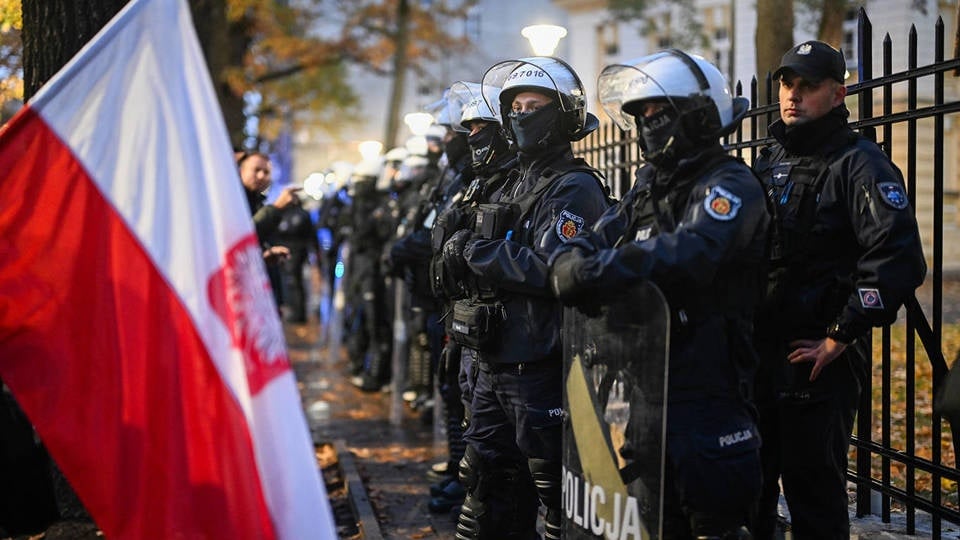
“Police said they detained three protesters on Friday night after some threw objects at officers and tried to break through the security fence around the court.” · exact text match
Why: Specific police attribution and neutral wording indicate low sensationalism.
Claim: The report does not frame the dispute in market or investment terms.
“The functioning of the Constitutional Tribunal had been impaired for years.” · exact text match
Why: No bullish or bearish financial framing is present.
Claim: The report does not adopt an optimistic or pessimistic outlook on the dispute’s resolution.
“The president’s camp is hoping that the crisis surrounding the Constitutional Tribunal will erode Tusk’s parliamentary majority.” · exact text match
Why: The outlook is attributed to political actors rather than endorsed by the publisher.
Claim: The report concerns a high-stakes constitutional and political confrontation.
“Tensions over Poland's top court ignite as the country's prime minister and president square off.” · exact text match
Why: A premier-president standoff and mass protests are inherently newsworthy.
Claim: The report is predominantly descriptive, with prescriptions confined to attributed quotes.
“Tusk had earlier pledged that his government would ensure the tribunal was again staffed with lawfully appointed judges while acknowledging that his methods may not be to everyone’s liking.” · exact text match
Why: The prescriptive language is reported as Tusk’s pledge rather than the publisher’s recommendation.
Claim: The report does not advocate a dovish or hawkish security posture.
“Police said they detained three protesters on Friday night after some threw objects at officers and tried to break through the security fence around the court.” · exact text match
Why: Police action is reported factually without military or security-policy advocacy.
Claim: The report does not use fear-based or rage-baiting language.
“Police said they detained three protesters on Friday night after some threw objects at officers and tried to break through the security fence around the court.” · exact text match
Why: The tone remains factual despite describing protests and police detentions.
Claim: The report does not assume its conclusion through circular argument.
“The government says Święczkowski repeatedly broke the law and jeopardized the tribunal’s work.” · exact text match
Why: Competing claims are attributed rather than asserted as self-justifying premises.
Claim: The report is about institutional conflict, not personal gossip.
“The dispute over the long-embattled Constitutional Tribunal is likely to deepen political polarization in Poland a year before a parliamentary election, further intensifying the standoff between the pro-European government and the national-conservative opposition party Law and Justice, or PiS.” · exact text match
Why: The focus is on constitutional and electoral conflict rather than private lives.
Claim: The report is mostly factual, with evaluative language largely in direct quotes.
“Tusk compared PiS to a man who steals an elderly woman’s purse and then claims to be the victim when police catch him and take it back.” · exact text match
Why: The strongest evaluative analogy is quoted from Tusk rather than stated by the publisher.
Claim: The report is centrally about a political and constitutional conflict.
“The dispute over the long-embattled Constitutional Tribunal is likely to deepen political polarization in Poland a year before a parliamentary election, further intensifying the standoff between the pro-European government and the national-conservative opposition party Law and Justice, or PiS.” · exact text match
Why: The quoted passage explicitly frames the event as a political polarization and election-related standoff.
Claim: The report provides some institutional context rather than reducing the dispute to a simple good-versus-bad narrative.
“The functioning of the Constitutional Tribunal had been impaired for years.
The Court of Justice of the European Union, the EU’s top court, had said it was no longer an impartial court after PiS appointments.”
· exact text match
Why: Inclusion of EU court context adds complexity beyond a simple partisan framing.
Claim: Institutional authorities are cited for context, not used as the sole basis for conclusions.
“The Court of Justice of the European Union, the EU’s top court, had said it was no longer an impartial court after PiS appointments.” · exact text match
Why: EU court authority is cited as one attributed element within a broader report.
Claim: The report maintains a serious institutional tone.
“Przydacz said that the president had invited all parliamentary parties to talks on Saturday in an effort to defuse tensions and find a solution to the crisis.” · exact text match
Why: Focus on negotiation and constitutional process indicates a mature tone.
Claim: The report does not rely on circular reasoning.
“The government says Święczkowski repeatedly broke the law and jeopardized the tribunal’s work.” · exact text match
Why: Claims are attributed rather than logically derived from themselves.
Claim: The report includes responses from the president’s camp and notes cross-party talks.
“Przydacz said that the president had invited all parliamentary parties to talks on Saturday in an effort to defuse tensions and find a solution to the crisis.” · exact text match
Why: Inclusion of the opposing camp’s response reduces one-sided framing.
Claim: Victim language appears through attributed political rhetoric rather than publisher framing.
“Tusk compared PiS to a man who steals an elderly woman’s purse and then claims to be the victim when police catch him and take it back.” · exact text match
Why: The victimization trope is quoted from Tusk and applied to PiS, not adopted by the publisher.
Claim: The report largely attributes claims and forecasts rather than asserting certainty.
“The dispute over the long-embattled Constitutional Tribunal is likely to deepen political polarization in Poland a year before a parliamentary election, further intensifying the standoff between the pro-European government and the national-conservative opposition party Law and Justice, or PiS.” · exact text match
Why: Use of 'likely' and attributed claims signals measured rather than absolute certainty.
Claim: The substantive report is not promotional spam.
“The government says Święczkowski repeatedly broke the law and jeopardized the tribunal’s work.” · exact text match
Why: The text is news reporting, though unrelated headline links follow.
Claim: The report uses some ideological labels but largely reports the dispute through institutional claims.
“The pro-European government said the suspension is necessary to restore judicial independence, while critics from the opposition have likened it to a “coup d’etat.”” · exact text match
Why: Pro-European and opposition labels add ideological framing, though both sides are quoted.
Claim: The report centers on established political institutions rather than anti-establishment advocacy.
“The president had invited all parliamentary parties to talks on Saturday in an effort to defuse tensions and find a solution to the crisis.” · not found in supplied text
Why: Institutional negotiation is described without either attacking or defending the establishment.
Claim: The report’s tone is tense but largely neutral.
“Tensions over Poland's top court ignite as the country's prime minister and president square off.” · exact text match
Why: The headline conveys conflict, but body language remains measured.
Claim: The report gives space to both government and opposition accounts.
“The government says Święczkowski repeatedly broke the law and jeopardized the tribunal’s work.” · exact text match
“Przydacz said that the president had invited all parliamentary parties to talks on Saturday in an effort to defuse tensions and find a solution to the crisis.” · exact text match
Why: Inclusion of both camps’ claims reduces evidence of a double standard.
Claim: The report uses named attribution, specific institutional context, and direct quotes from both sides.
“Marcin Przydacz, a top aide to the Polish president, told The Associated Press.” · exact text match
“The government says Święczkowski repeatedly broke the law and jeopardized the tribunal’s work.” · exact text match
Why: Named sourcing and attribution to both camps indicate high visible credibility.
Claim: The report presents claims in an orderly, attributed manner rather than through emotive or irrational framing.
“The government says Święczkowski repeatedly broke the law and jeopardized the tribunal’s work.” · exact text match
Why: Attribution to governmental claims supports a rational/descriptive presentation.
Claim: The report is not advertorial.
“Police said they detained three protesters on Friday night after some threw objects at officers and tried to break through the security fence around the court.” · exact text match
Why: No promotional product or service content appears in the substantive text.
Claim: The report includes a forecast about deepening polarization and the president’s camp’s hopes.
“The dispute over the long-embattled Constitutional Tribunal is likely to deepen political polarization in Poland a year before a parliamentary election, further intensifying the standoff between the pro-European government and the national-conservative opposition party Law and Justice, or PiS.” · exact text match
“The president’s camp is hoping that the crisis surrounding the Constitutional Tribunal will erode Tusk’s parliamentary majority.” · exact text match
Why: The 'likely' forecast and reported hopes are speculative/analytical elements, though limited and attributed.
Claim: The report does not use strong observable manipulative techniques.
“The government says Święczkowski repeatedly broke the law and jeopardized the tribunal’s work.” · exact text match
Why: Claims are attributed rather than presented through false urgency or loaded assertion.
Claim: The visible text does not show strong AI-authorship indicators.
“Warsaw, Poland AP— Prime Minister Donald Tusk said on Saturday that his government would press ahead with efforts to restore the independence of Poland’s Constitutional Tribunal.” · not found in supplied text
Why: AP dateline and conventional news phrasing provide weak human-authorship signals.
Claim: The report includes attributed claims from both the government and the president’s camp and notes the president’s talks initiative.
“The government says Święczkowski repeatedly broke the law and jeopardized the tribunal’s work.” · exact text match
“Przydacz said that the president had invited all parliamentary parties to talks on Saturday in an effort to defuse tensions and find a solution to the crisis.” · exact text match
Why: Balanced attribution and inclusion of the opposing camp’s account support higher integrity.
Claim: The report supplies legal, EU, and coalition context for the standoff.
“The government is a broad coalition made up of Tusk’s centrist Civic Coalition, the Left, and two more conservative groupings, Poland 2050 and the Polish People’s Party, or PSL.” · exact text match
Why: Detailed coalition and institutional context reflects above-average explanatory intelligence.
Claim: The report does not endorse or sanitize terrorism.
“Police said they detained three protesters on Friday night after some threw objects at officers and tried to break through the security fence around the court.” · exact text match
Why: Protest violence is described as police-reported disorder, not political violence advocacy.
Claim: The report does not normalize or justify fraud.
“The government says Święczkowski repeatedly broke the law and jeopardized the tribunal’s work.” · exact text match
Why: Alleged lawbreaking is reported as a claim, not endorsed or normalized.
Claim: The report does not use Marxist class-conflict or anti-capitalist framing.
“The government is a broad coalition made up of Tusk’s centrist Civic Coalition, the Left, and two more conservative groupings, Poland 2050 and the Polish People’s Party, or PSL.” · exact text match
Why: Coalition description is institutional, not Marxist analysis.
Claim: The report has no Islamist advocacy framing.
“The dispute over the long-embattled Constitutional Tribunal is likely to deepen political polarization in Poland a year before a parliamentary election, further intensifying the standoff between the pro-European government and the national-conservative opposition party Law and Justice, or PiS.” · exact text match
Why: The subject is Polish judicial politics, unrelated to Islamist advocacy.
Claim: The report contains no anti-Jewish framing.
“The functioning of the Constitutional Tribunal had been impaired for years.” · exact text match
Why: No anti-Semitic generalization or conspiracy claim appears.
Claim: The report contains no anti-LGBT framing.
“The government is a broad coalition made up of Tusk’s centrist Civic Coalition, the Left, and two more conservative groupings, Poland 2050 and the Polish People’s Party, or PSL.” · exact text match
Why: No LGBT-related negative generalization appears.
Claim: The report contains no racist framing.
“Police said they detained three protesters on Friday night after some threw objects at officers and tried to break through the security fence around the court.” · exact text match
Why: No racial group generalization or dehumanization appears.
Claim: The report does not use identity-group power framing or prescriptive identity remedies.
“The government is a broad coalition made up of Tusk’s centrist Civic Coalition, the Left, and two more conservative groupings, Poland 2050 and the Polish People’s Party, or PSL.” · exact text match
Why: The framing is institutional and partisan, not woke identity politics.
Claim: The report does not endorse cruel treatment.
“Police said they detained three protesters on Friday night after some threw objects at officers and tried to break through the security fence around the court.” · exact text match
Why: Police action is reported factually without endorsement of cruelty.
Claim: The report does not engage in faux virtue signaling.
“Tusk had earlier pledged that his government would ensure the tribunal was again staffed with lawfully appointed judges while acknowledging that his methods may not be to everyone’s liking.” · exact text match
Why: Normative language is attributed to Tusk and balanced with acknowledgment of controversy.
Claim: The report does not promote conspiratorial thinking.
“The government says Święczkowski repeatedly broke the law and jeopardized the tribunal’s work.” · exact text match
Why: Claims are tied to named institutional actors rather than hidden conspiracies.
Claim: The report does not advocate compassion that ignores severe self-harm tradeoffs.
“Police said they detained three protesters on Friday night after some threw objects at officers and tried to break through the security fence around the court.” · exact text match
Why: No compassion-based policy advocacy appears.
Claim: The report does not scapegoat a group for the crisis.
“The dispute over the long-embattled Constitutional Tribunal is likely to deepen political polarization in Poland a year before a parliamentary election, further intensifying the standoff between the pro-European government and the national-conservative opposition party Law and Justice, or PiS.” · exact text match
Why: Blame is contested between political actors rather than assigned to a scapegoated group.
Claim: The report does not apply incompatible standards to comparable cases.
“The government says Święczkowski repeatedly broke the law and jeopardized the tribunal’s work.” · exact text match
Why: Competing claims are attributed without the publisher applying double standards.
Claim: The report does not reject reason, evidence, or rule-of-law principles.
““Restoring the rule of law is our obligation,” Tusk wrote on X on Friday evening.” · exact text match
Why: Rule-of-law language is reported, not attacked.
Visible article is truncated with an ellipsis and followed by unrelated headline links; bias scores are limited to the available AP report.
The content provides a measured, descriptive account of the political and institutional conflict surrounding the Polish Constitutional Tribunal's independence.
Automated analysis; not human reviewed.
·
55 of 55 available dimensions scored; omitted dimensions are not treated as neutral.
·
Verified supporting quotes for 0 of 55 scored dimensions.
Framing is mostly factual and attribution-heavy, with a mild pro-EU/rule-of-law tilt in labels and explanatory emphasis.
The Constitutional Tribunal is Poland’s constitutional court; control over its composition is central to the country’s judicial-independence conflict.
Automated analysis; not human reviewed.
Limitations: Visible article is truncated with an ellipsis and followed by unrelated headline links; bias scores are limited to the available AP report.
·
55 of 55 available dimensions scored; omitted dimensions are not treated as neutral.
·
Verified supporting quotes for 53 of 55 scored dimensions.
Claim: The report gives more explanatory space to the pro-European government’s rule-of-law rationale and EU criticism of PiS than to the opposition’s defense.
“Critics in Poland and the European Union accuse PiS, which led the country between 2015 and 2023, of imposing political control over key judicial institutions.” · exact text match
Counterevidence:
“The pro-European government said the suspension is necessary to restore judicial independence, while critics from the opposition have likened it to a “coup d’etat.”” · exact text match
Why: Repeatedly foregrounding EU/PiS judicial-control criticism gives a mild pro-EU/liberal framing, though much is attributed.
Claim: The report is not framed around a populist-versus-elite conflict.
“The dispute over the long-embattled Constitutional Tribunal is likely to deepen political polarization in Poland a year before a parliamentary election, further intensifying the standoff between the pro-European government and the national-conservative opposition party Law and Justice, or PiS.” · exact text match
Why: Institutional and party-elite conflict is described without populist or anti-elite framing.
Claim: The report describes a rule-of-law dispute without advocating either libertarian or authoritarian institutional control.
“Tusk’s pro-European government came to power in 2023 with a promise to restore the independence of the judiciary.” · exact text match
Why: Judicial-independence language is reported neutrally rather than as an endorsement of centralized control.
Claim: Claims are consistently attributed to named actors rather than presented as the reporter’s own conclusions.
“The government says Święczkowski repeatedly broke the law and jeopardized the tribunal’s work.” · exact text match
“Marcin Przydacz, a top aide to the Polish president, told The Associated Press.” · exact text match
Why: Attribution to government and presidential aide supports an objective/descriptive presentation.
Claim: The report uses factual, measured language for the protest and police action rather than sensational color.
“Police said they detained three protesters on Friday night after some threw objects at officers and tried to break through the security fence around the court.” · exact text match
Why: Specific police attribution and neutral wording indicate low sensationalism.
Claim: The report does not frame the dispute in market or investment terms.
“The functioning of the Constitutional Tribunal had been impaired for years.” · exact text match
Why: No bullish or bearish financial framing is present.
Claim: The report does not adopt an optimistic or pessimistic outlook on the dispute’s resolution.
“The president’s camp is hoping that the crisis surrounding the Constitutional Tribunal will erode Tusk’s parliamentary majority.” · exact text match
Why: The outlook is attributed to political actors rather than endorsed by the publisher.
Claim: The report concerns a high-stakes constitutional and political confrontation.
“Tensions over Poland's top court ignite as the country's prime minister and president square off.” · exact text match
Why: A premier-president standoff and mass protests are inherently newsworthy.
Claim: The report is predominantly descriptive, with prescriptions confined to attributed quotes.
“Tusk had earlier pledged that his government would ensure the tribunal was again staffed with lawfully appointed judges while acknowledging that his methods may not be to everyone’s liking.” · exact text match
Why: The prescriptive language is reported as Tusk’s pledge rather than the publisher’s recommendation.
Claim: The report does not advocate a dovish or hawkish security posture.
“Police said they detained three protesters on Friday night after some threw objects at officers and tried to break through the security fence around the court.” · exact text match
Why: Police action is reported factually without military or security-policy advocacy.
Claim: The report does not use fear-based or rage-baiting language.
“Police said they detained three protesters on Friday night after some threw objects at officers and tried to break through the security fence around the court.” · exact text match
Why: The tone remains factual despite describing protests and police detentions.
Claim: The report does not assume its conclusion through circular argument.
“The government says Święczkowski repeatedly broke the law and jeopardized the tribunal’s work.” · exact text match
Why: Competing claims are attributed rather than asserted as self-justifying premises.
Claim: The report is about institutional conflict, not personal gossip.
“The dispute over the long-embattled Constitutional Tribunal is likely to deepen political polarization in Poland a year before a parliamentary election, further intensifying the standoff between the pro-European government and the national-conservative opposition party Law and Justice, or PiS.” · exact text match
Why: The focus is on constitutional and electoral conflict rather than private lives.
Claim: The report is mostly factual, with evaluative language largely in direct quotes.
“Tusk compared PiS to a man who steals an elderly woman’s purse and then claims to be the victim when police catch him and take it back.” · exact text match
Why: The strongest evaluative analogy is quoted from Tusk rather than stated by the publisher.
Claim: The report is centrally about a political and constitutional conflict.
“The dispute over the long-embattled Constitutional Tribunal is likely to deepen political polarization in Poland a year before a parliamentary election, further intensifying the standoff between the pro-European government and the national-conservative opposition party Law and Justice, or PiS.” · exact text match
Why: The quoted passage explicitly frames the event as a political polarization and election-related standoff.
Claim: The report provides some institutional context rather than reducing the dispute to a simple good-versus-bad narrative.
“The functioning of the Constitutional Tribunal had been impaired for years.
The Court of Justice of the European Union, the EU’s top court, had said it was no longer an impartial court after PiS appointments.”
· exact text match
Why: Inclusion of EU court context adds complexity beyond a simple partisan framing.
Claim: Institutional authorities are cited for context, not used as the sole basis for conclusions.
“The Court of Justice of the European Union, the EU’s top court, had said it was no longer an impartial court after PiS appointments.” · exact text match
Why: EU court authority is cited as one attributed element within a broader report.
Claim: The report maintains a serious institutional tone.
“Przydacz said that the president had invited all parliamentary parties to talks on Saturday in an effort to defuse tensions and find a solution to the crisis.” · exact text match
Why: Focus on negotiation and constitutional process indicates a mature tone.
Claim: The report does not rely on circular reasoning.
“The government says Święczkowski repeatedly broke the law and jeopardized the tribunal’s work.” · exact text match
Why: Claims are attributed rather than logically derived from themselves.
Claim: The report includes responses from the president’s camp and notes cross-party talks.
“Przydacz said that the president had invited all parliamentary parties to talks on Saturday in an effort to defuse tensions and find a solution to the crisis.” · exact text match
Why: Inclusion of the opposing camp’s response reduces one-sided framing.
Claim: Victim language appears through attributed political rhetoric rather than publisher framing.
“Tusk compared PiS to a man who steals an elderly woman’s purse and then claims to be the victim when police catch him and take it back.” · exact text match
Why: The victimization trope is quoted from Tusk and applied to PiS, not adopted by the publisher.
Claim: The report largely attributes claims and forecasts rather than asserting certainty.
“The dispute over the long-embattled Constitutional Tribunal is likely to deepen political polarization in Poland a year before a parliamentary election, further intensifying the standoff between the pro-European government and the national-conservative opposition party Law and Justice, or PiS.” · exact text match
Why: Use of 'likely' and attributed claims signals measured rather than absolute certainty.
Claim: The substantive report is not promotional spam.
“The government says Święczkowski repeatedly broke the law and jeopardized the tribunal’s work.” · exact text match
Why: The text is news reporting, though unrelated headline links follow.
Claim: The report uses some ideological labels but largely reports the dispute through institutional claims.
“The pro-European government said the suspension is necessary to restore judicial independence, while critics from the opposition have likened it to a “coup d’etat.”” · exact text match
Why: Pro-European and opposition labels add ideological framing, though both sides are quoted.
Claim: The report centers on established political institutions rather than anti-establishment advocacy.
“The president had invited all parliamentary parties to talks on Saturday in an effort to defuse tensions and find a solution to the crisis.” · not found in supplied text
Why: Institutional negotiation is described without either attacking or defending the establishment.
Claim: The report’s tone is tense but largely neutral.
“Tensions over Poland's top court ignite as the country's prime minister and president square off.” · exact text match
Why: The headline conveys conflict, but body language remains measured.
Claim: The report gives space to both government and opposition accounts.
“The government says Święczkowski repeatedly broke the law and jeopardized the tribunal’s work.” · exact text match
“Przydacz said that the president had invited all parliamentary parties to talks on Saturday in an effort to defuse tensions and find a solution to the crisis.” · exact text match
Why: Inclusion of both camps’ claims reduces evidence of a double standard.
Claim: The report uses named attribution, specific institutional context, and direct quotes from both sides.
“Marcin Przydacz, a top aide to the Polish president, told The Associated Press.” · exact text match
“The government says Święczkowski repeatedly broke the law and jeopardized the tribunal’s work.” · exact text match
Why: Named sourcing and attribution to both camps indicate high visible credibility.
Claim: The report presents claims in an orderly, attributed manner rather than through emotive or irrational framing.
“The government says Święczkowski repeatedly broke the law and jeopardized the tribunal’s work.” · exact text match
Why: Attribution to governmental claims supports a rational/descriptive presentation.
Claim: The report is not advertorial.
“Police said they detained three protesters on Friday night after some threw objects at officers and tried to break through the security fence around the court.” · exact text match
Why: No promotional product or service content appears in the substantive text.
Claim: The report includes a forecast about deepening polarization and the president’s camp’s hopes.
“The dispute over the long-embattled Constitutional Tribunal is likely to deepen political polarization in Poland a year before a parliamentary election, further intensifying the standoff between the pro-European government and the national-conservative opposition party Law and Justice, or PiS.” · exact text match
“The president’s camp is hoping that the crisis surrounding the Constitutional Tribunal will erode Tusk’s parliamentary majority.” · exact text match
Why: The 'likely' forecast and reported hopes are speculative/analytical elements, though limited and attributed.
Claim: The report does not use strong observable manipulative techniques.
“The government says Święczkowski repeatedly broke the law and jeopardized the tribunal’s work.” · exact text match
Why: Claims are attributed rather than presented through false urgency or loaded assertion.
Claim: The visible text does not show strong AI-authorship indicators.
“Warsaw, Poland AP— Prime Minister Donald Tusk said on Saturday that his government would press ahead with efforts to restore the independence of Poland’s Constitutional Tribunal.” · not found in supplied text
Why: AP dateline and conventional news phrasing provide weak human-authorship signals.
Claim: The report includes attributed claims from both the government and the president’s camp and notes the president’s talks initiative.
“The government says Święczkowski repeatedly broke the law and jeopardized the tribunal’s work.” · exact text match
“Przydacz said that the president had invited all parliamentary parties to talks on Saturday in an effort to defuse tensions and find a solution to the crisis.” · exact text match
Why: Balanced attribution and inclusion of the opposing camp’s account support higher integrity.
Claim: The report supplies legal, EU, and coalition context for the standoff.
“The government is a broad coalition made up of Tusk’s centrist Civic Coalition, the Left, and two more conservative groupings, Poland 2050 and the Polish People’s Party, or PSL.” · exact text match
Why: Detailed coalition and institutional context reflects above-average explanatory intelligence.
Claim: The report does not endorse or sanitize terrorism.
“Police said they detained three protesters on Friday night after some threw objects at officers and tried to break through the security fence around the court.” · exact text match
Why: Protest violence is described as police-reported disorder, not political violence advocacy.
Claim: The report does not normalize or justify fraud.
“The government says Święczkowski repeatedly broke the law and jeopardized the tribunal’s work.” · exact text match
Why: Alleged lawbreaking is reported as a claim, not endorsed or normalized.
Claim: The report does not use Marxist class-conflict or anti-capitalist framing.
“The government is a broad coalition made up of Tusk’s centrist Civic Coalition, the Left, and two more conservative groupings, Poland 2050 and the Polish People’s Party, or PSL.” · exact text match
Why: Coalition description is institutional, not Marxist analysis.
Claim: The report has no Islamist advocacy framing.
“The dispute over the long-embattled Constitutional Tribunal is likely to deepen political polarization in Poland a year before a parliamentary election, further intensifying the standoff between the pro-European government and the national-conservative opposition party Law and Justice, or PiS.” · exact text match
Why: The subject is Polish judicial politics, unrelated to Islamist advocacy.
Claim: The report contains no anti-Jewish framing.
“The functioning of the Constitutional Tribunal had been impaired for years.” · exact text match
Why: No anti-Semitic generalization or conspiracy claim appears.
Claim: The report contains no anti-LGBT framing.
“The government is a broad coalition made up of Tusk’s centrist Civic Coalition, the Left, and two more conservative groupings, Poland 2050 and the Polish People’s Party, or PSL.” · exact text match
Why: No LGBT-related negative generalization appears.
Claim: The report contains no racist framing.
“Police said they detained three protesters on Friday night after some threw objects at officers and tried to break through the security fence around the court.” · exact text match
Why: No racial group generalization or dehumanization appears.
Claim: The report does not use identity-group power framing or prescriptive identity remedies.
“The government is a broad coalition made up of Tusk’s centrist Civic Coalition, the Left, and two more conservative groupings, Poland 2050 and the Polish People’s Party, or PSL.” · exact text match
Why: The framing is institutional and partisan, not woke identity politics.
Claim: The report does not endorse cruel treatment.
“Police said they detained three protesters on Friday night after some threw objects at officers and tried to break through the security fence around the court.” · exact text match
Why: Police action is reported factually without endorsement of cruelty.
Claim: The report does not engage in faux virtue signaling.
“Tusk had earlier pledged that his government would ensure the tribunal was again staffed with lawfully appointed judges while acknowledging that his methods may not be to everyone’s liking.” · exact text match
Why: Normative language is attributed to Tusk and balanced with acknowledgment of controversy.
Claim: The report does not promote conspiratorial thinking.
“The government says Święczkowski repeatedly broke the law and jeopardized the tribunal’s work.” · exact text match
Why: Claims are tied to named institutional actors rather than hidden conspiracies.
Claim: The report does not advocate compassion that ignores severe self-harm tradeoffs.
“Police said they detained three protesters on Friday night after some threw objects at officers and tried to break through the security fence around the court.” · exact text match
Why: No compassion-based policy advocacy appears.
Claim: The report does not scapegoat a group for the crisis.
“The dispute over the long-embattled Constitutional Tribunal is likely to deepen political polarization in Poland a year before a parliamentary election, further intensifying the standoff between the pro-European government and the national-conservative opposition party Law and Justice, or PiS.” · exact text match
Why: Blame is contested between political actors rather than assigned to a scapegoated group.
Claim: The report does not apply incompatible standards to comparable cases.
“The government says Święczkowski repeatedly broke the law and jeopardized the tribunal’s work.” · exact text match
Why: Competing claims are attributed without the publisher applying double standards.
Claim: The report does not reject reason, evidence, or rule-of-law principles.
““Restoring the rule of law is our obligation,” Tusk wrote on X on Friday evening.” · exact text match
Why: Rule-of-law language is reported, not attacked.
Visible article is truncated with an ellipsis and followed by unrelated headline links; bias scores are limited to the available AP report.
The content provides a measured, descriptive account of the political and institutional conflict surrounding the Polish Constitutional Tribunal's independence.
Automated analysis; not human reviewed.
·
55 of 55 available dimensions scored; omitted dimensions are not treated as neutral.
·
Verified supporting quotes for 0 of 55 scored dimensions.
October 30, 2026 · 0 shares
The piece utilizes high-stakes terminology, such as the use of 'coup,' to frame the political conflict between the executive and judicial branches.
Automated analysis; not human reviewed.
·
55 of 55 available dimensions scored; omitted dimensions are not treated as neutral.
·
Verified supporting quotes for 1 of 55 scored dimensions.
Claim: The report presents the event as a dramatic constitutional crisis and a political confrontation.
“Polish president turns plane around after 'coup' at nation's top court.” · exact text match
“President Karol Nawrocki turned his plane around and returned home after police entered Poland's top court, the Constitutional Tribunal” · exact text match
Why: The headline and opening sentence frame the events as a dramatic political crisis and a 'coup' situation, increasing the perceived weight of the narrative.
Framing is mostly factual and attribution-heavy, with a mild pro-EU/rule-of-law tilt in labels and explanatory emphasis.
The Constitutional Tribunal is Poland’s constitutional court; control over its composition is central to the country’s judicial-independence conflict.
Automated analysis; not human reviewed.
Limitations: Visible article is truncated with an ellipsis and followed by unrelated headline links; bias scores are limited to the available AP report.
·
55 of 55 available dimensions scored; omitted dimensions are not treated as neutral.
·
Verified supporting quotes for 53 of 55 scored dimensions.
Claim: The report gives more explanatory space to the pro-European government’s rule-of-law rationale and EU criticism of PiS than to the opposition’s defense.
“Critics in Poland and the European Union accuse PiS, which led the country between 2015 and 2023, of imposing political control over key judicial institutions.” · exact text match
Counterevidence:
“The pro-European government said the suspension is necessary to restore judicial independence, while critics from the opposition have likened it to a “coup d’etat.”” · exact text match
Why: Repeatedly foregrounding EU/PiS judicial-control criticism gives a mild pro-EU/liberal framing, though much is attributed.
Claim: The report is not framed around a populist-versus-elite conflict.
“The dispute over the long-embattled Constitutional Tribunal is likely to deepen political polarization in Poland a year before a parliamentary election, further intensifying the standoff between the pro-European government and the national-conservative opposition party Law and Justice, or PiS.” · exact text match
Why: Institutional and party-elite conflict is described without populist or anti-elite framing.
Claim: The report describes a rule-of-law dispute without advocating either libertarian or authoritarian institutional control.
“Tusk’s pro-European government came to power in 2023 with a promise to restore the independence of the judiciary.” · exact text match
Why: Judicial-independence language is reported neutrally rather than as an endorsement of centralized control.
Claim: Claims are consistently attributed to named actors rather than presented as the reporter’s own conclusions.
“The government says Święczkowski repeatedly broke the law and jeopardized the tribunal’s work.” · exact text match
“Marcin Przydacz, a top aide to the Polish president, told The Associated Press.” · exact text match
Why: Attribution to government and presidential aide supports an objective/descriptive presentation.
Claim: The report uses factual, measured language for the protest and police action rather than sensational color.
“Police said they detained three protesters on Friday night after some threw objects at officers and tried to break through the security fence around the court.” · exact text match
Why: Specific police attribution and neutral wording indicate low sensationalism.
Claim: The report does not frame the dispute in market or investment terms.
“The functioning of the Constitutional Tribunal had been impaired for years.” · exact text match
Why: No bullish or bearish financial framing is present.
Claim: The report does not adopt an optimistic or pessimistic outlook on the dispute’s resolution.
“The president’s camp is hoping that the crisis surrounding the Constitutional Tribunal will erode Tusk’s parliamentary majority.” · exact text match
Why: The outlook is attributed to political actors rather than endorsed by the publisher.
Claim: The report concerns a high-stakes constitutional and political confrontation.
“Tensions over Poland's top court ignite as the country's prime minister and president square off.” · exact text match
Why: A premier-president standoff and mass protests are inherently newsworthy.
Claim: The report is predominantly descriptive, with prescriptions confined to attributed quotes.
“Tusk had earlier pledged that his government would ensure the tribunal was again staffed with lawfully appointed judges while acknowledging that his methods may not be to everyone’s liking.” · exact text match
Why: The prescriptive language is reported as Tusk’s pledge rather than the publisher’s recommendation.
Claim: The report does not advocate a dovish or hawkish security posture.
“Police said they detained three protesters on Friday night after some threw objects at officers and tried to break through the security fence around the court.” · exact text match
Why: Police action is reported factually without military or security-policy advocacy.
Claim: The report does not use fear-based or rage-baiting language.
“Police said they detained three protesters on Friday night after some threw objects at officers and tried to break through the security fence around the court.” · exact text match
Why: The tone remains factual despite describing protests and police detentions.
Claim: The report does not assume its conclusion through circular argument.
“The government says Święczkowski repeatedly broke the law and jeopardized the tribunal’s work.” · exact text match
Why: Competing claims are attributed rather than asserted as self-justifying premises.
Claim: The report is about institutional conflict, not personal gossip.
“The dispute over the long-embattled Constitutional Tribunal is likely to deepen political polarization in Poland a year before a parliamentary election, further intensifying the standoff between the pro-European government and the national-conservative opposition party Law and Justice, or PiS.” · exact text match
Why: The focus is on constitutional and electoral conflict rather than private lives.
Claim: The report is mostly factual, with evaluative language largely in direct quotes.
“Tusk compared PiS to a man who steals an elderly woman’s purse and then claims to be the victim when police catch him and take it back.” · exact text match
Why: The strongest evaluative analogy is quoted from Tusk rather than stated by the publisher.
Claim: The report is centrally about a political and constitutional conflict.
“The dispute over the long-embattled Constitutional Tribunal is likely to deepen political polarization in Poland a year before a parliamentary election, further intensifying the standoff between the pro-European government and the national-conservative opposition party Law and Justice, or PiS.” · exact text match
Why: The quoted passage explicitly frames the event as a political polarization and election-related standoff.
Claim: The report provides some institutional context rather than reducing the dispute to a simple good-versus-bad narrative.
“The functioning of the Constitutional Tribunal had been impaired for years.
The Court of Justice of the European Union, the EU’s top court, had said it was no longer an impartial court after PiS appointments.”
· exact text match
Why: Inclusion of EU court context adds complexity beyond a simple partisan framing.
Claim: Institutional authorities are cited for context, not used as the sole basis for conclusions.
“The Court of Justice of the European Union, the EU’s top court, had said it was no longer an impartial court after PiS appointments.” · exact text match
Why: EU court authority is cited as one attributed element within a broader report.
Claim: The report maintains a serious institutional tone.
“Przydacz said that the president had invited all parliamentary parties to talks on Saturday in an effort to defuse tensions and find a solution to the crisis.” · exact text match
Why: Focus on negotiation and constitutional process indicates a mature tone.
Claim: The report does not rely on circular reasoning.
“The government says Święczkowski repeatedly broke the law and jeopardized the tribunal’s work.” · exact text match
Why: Claims are attributed rather than logically derived from themselves.
Claim: The report includes responses from the president’s camp and notes cross-party talks.
“Przydacz said that the president had invited all parliamentary parties to talks on Saturday in an effort to defuse tensions and find a solution to the crisis.” · exact text match
Why: Inclusion of the opposing camp’s response reduces one-sided framing.
Claim: Victim language appears through attributed political rhetoric rather than publisher framing.
“Tusk compared PiS to a man who steals an elderly woman’s purse and then claims to be the victim when police catch him and take it back.” · exact text match
Why: The victimization trope is quoted from Tusk and applied to PiS, not adopted by the publisher.
Claim: The report largely attributes claims and forecasts rather than asserting certainty.
“The dispute over the long-embattled Constitutional Tribunal is likely to deepen political polarization in Poland a year before a parliamentary election, further intensifying the standoff between the pro-European government and the national-conservative opposition party Law and Justice, or PiS.” · exact text match
Why: Use of 'likely' and attributed claims signals measured rather than absolute certainty.
Claim: The substantive report is not promotional spam.
“The government says Święczkowski repeatedly broke the law and jeopardized the tribunal’s work.” · exact text match
Why: The text is news reporting, though unrelated headline links follow.
Claim: The report uses some ideological labels but largely reports the dispute through institutional claims.
“The pro-European government said the suspension is necessary to restore judicial independence, while critics from the opposition have likened it to a “coup d’etat.”” · exact text match
Why: Pro-European and opposition labels add ideological framing, though both sides are quoted.
Claim: The report centers on established political institutions rather than anti-establishment advocacy.
“The president had invited all parliamentary parties to talks on Saturday in an effort to defuse tensions and find a solution to the crisis.” · not found in supplied text
Why: Institutional negotiation is described without either attacking or defending the establishment.
Claim: The report’s tone is tense but largely neutral.
“Tensions over Poland's top court ignite as the country's prime minister and president square off.” · exact text match
Why: The headline conveys conflict, but body language remains measured.
Claim: The report gives space to both government and opposition accounts.
“The government says Święczkowski repeatedly broke the law and jeopardized the tribunal’s work.” · exact text match
“Przydacz said that the president had invited all parliamentary parties to talks on Saturday in an effort to defuse tensions and find a solution to the crisis.” · exact text match
Why: Inclusion of both camps’ claims reduces evidence of a double standard.
Claim: The report uses named attribution, specific institutional context, and direct quotes from both sides.
“Marcin Przydacz, a top aide to the Polish president, told The Associated Press.” · exact text match
“The government says Święczkowski repeatedly broke the law and jeopardized the tribunal’s work.” · exact text match
Why: Named sourcing and attribution to both camps indicate high visible credibility.
Claim: The report presents claims in an orderly, attributed manner rather than through emotive or irrational framing.
“The government says Święczkowski repeatedly broke the law and jeopardized the tribunal’s work.” · exact text match
Why: Attribution to governmental claims supports a rational/descriptive presentation.
Claim: The report is not advertorial.
“Police said they detained three protesters on Friday night after some threw objects at officers and tried to break through the security fence around the court.” · exact text match
Why: No promotional product or service content appears in the substantive text.
Claim: The report includes a forecast about deepening polarization and the president’s camp’s hopes.
“The dispute over the long-embattled Constitutional Tribunal is likely to deepen political polarization in Poland a year before a parliamentary election, further intensifying the standoff between the pro-European government and the national-conservative opposition party Law and Justice, or PiS.” · exact text match
“The president’s camp is hoping that the crisis surrounding the Constitutional Tribunal will erode Tusk’s parliamentary majority.” · exact text match
Why: The 'likely' forecast and reported hopes are speculative/analytical elements, though limited and attributed.
Claim: The report does not use strong observable manipulative techniques.
“The government says Święczkowski repeatedly broke the law and jeopardized the tribunal’s work.” · exact text match
Why: Claims are attributed rather than presented through false urgency or loaded assertion.
Claim: The visible text does not show strong AI-authorship indicators.
“Warsaw, Poland AP— Prime Minister Donald Tusk said on Saturday that his government would press ahead with efforts to restore the independence of Poland’s Constitutional Tribunal.” · not found in supplied text
Why: AP dateline and conventional news phrasing provide weak human-authorship signals.
Claim: The report includes attributed claims from both the government and the president’s camp and notes the president’s talks initiative.
“The government says Święczkowski repeatedly broke the law and jeopardized the tribunal’s work.” · exact text match
“Przydacz said that the president had invited all parliamentary parties to talks on Saturday in an effort to defuse tensions and find a solution to the crisis.” · exact text match
Why: Balanced attribution and inclusion of the opposing camp’s account support higher integrity.
Claim: The report supplies legal, EU, and coalition context for the standoff.
“The government is a broad coalition made up of Tusk’s centrist Civic Coalition, the Left, and two more conservative groupings, Poland 2050 and the Polish People’s Party, or PSL.” · exact text match
Why: Detailed coalition and institutional context reflects above-average explanatory intelligence.
Claim: The report does not endorse or sanitize terrorism.
“Police said they detained three protesters on Friday night after some threw objects at officers and tried to break through the security fence around the court.” · exact text match
Why: Protest violence is described as police-reported disorder, not political violence advocacy.
Claim: The report does not normalize or justify fraud.
“The government says Święczkowski repeatedly broke the law and jeopardized the tribunal’s work.” · exact text match
Why: Alleged lawbreaking is reported as a claim, not endorsed or normalized.
Claim: The report does not use Marxist class-conflict or anti-capitalist framing.
“The government is a broad coalition made up of Tusk’s centrist Civic Coalition, the Left, and two more conservative groupings, Poland 2050 and the Polish People’s Party, or PSL.” · exact text match
Why: Coalition description is institutional, not Marxist analysis.
Claim: The report has no Islamist advocacy framing.
“The dispute over the long-embattled Constitutional Tribunal is likely to deepen political polarization in Poland a year before a parliamentary election, further intensifying the standoff between the pro-European government and the national-conservative opposition party Law and Justice, or PiS.” · exact text match
Why: The subject is Polish judicial politics, unrelated to Islamist advocacy.
Claim: The report contains no anti-Jewish framing.
“The functioning of the Constitutional Tribunal had been impaired for years.” · exact text match
Why: No anti-Semitic generalization or conspiracy claim appears.
Claim: The report contains no anti-LGBT framing.
“The government is a broad coalition made up of Tusk’s centrist Civic Coalition, the Left, and two more conservative groupings, Poland 2050 and the Polish People’s Party, or PSL.” · exact text match
Why: No LGBT-related negative generalization appears.
Claim: The report contains no racist framing.
“Police said they detained three protesters on Friday night after some threw objects at officers and tried to break through the security fence around the court.” · exact text match
Why: No racial group generalization or dehumanization appears.
Claim: The report does not use identity-group power framing or prescriptive identity remedies.
“The government is a broad coalition made up of Tusk’s centrist Civic Coalition, the Left, and two more conservative groupings, Poland 2050 and the Polish People’s Party, or PSL.” · exact text match
Why: The framing is institutional and partisan, not woke identity politics.
Claim: The report does not endorse cruel treatment.
“Police said they detained three protesters on Friday night after some threw objects at officers and tried to break through the security fence around the court.” · exact text match
Why: Police action is reported factually without endorsement of cruelty.
Claim: The report does not engage in faux virtue signaling.
“Tusk had earlier pledged that his government would ensure the tribunal was again staffed with lawfully appointed judges while acknowledging that his methods may not be to everyone’s liking.” · exact text match
Why: Normative language is attributed to Tusk and balanced with acknowledgment of controversy.
Claim: The report does not promote conspiratorial thinking.
“The government says Święczkowski repeatedly broke the law and jeopardized the tribunal’s work.” · exact text match
Why: Claims are tied to named institutional actors rather than hidden conspiracies.
Claim: The report does not advocate compassion that ignores severe self-harm tradeoffs.
“Police said they detained three protesters on Friday night after some threw objects at officers and tried to break through the security fence around the court.” · exact text match
Why: No compassion-based policy advocacy appears.
Claim: The report does not scapegoat a group for the crisis.
“The dispute over the long-embattled Constitutional Tribunal is likely to deepen political polarization in Poland a year before a parliamentary election, further intensifying the standoff between the pro-European government and the national-conservative opposition party Law and Justice, or PiS.” · exact text match
Why: Blame is contested between political actors rather than assigned to a scapegoated group.
Claim: The report does not apply incompatible standards to comparable cases.
“The government says Święczkowski repeatedly broke the law and jeopardized the tribunal’s work.” · exact text match
Why: Competing claims are attributed without the publisher applying double standards.
Claim: The report does not reject reason, evidence, or rule-of-law principles.
““Restoring the rule of law is our obligation,” Tusk wrote on X on Friday evening.” · exact text match
Why: Rule-of-law language is reported, not attacked.
Visible article is truncated with an ellipsis and followed by unrelated headline links; bias scores are limited to the available AP report.
November 01, 2026 · 0 shares
The report maintains a neutral, multi-sourced tone by presenting conflicting claims regarding constitutional powers and judicial independence within the context of a political confrontation.
Automated analysis; not human reviewed.
·
55 of 55 available dimensions scored; omitted dimensions are not treated as neutral.
·
Verified supporting quotes for 0 of 55 scored dimensions.
November 02, 2026 · 0 shares
Frames the Polish president and Law and Justice as obstructing rule of law by foregrounding an EPP MEP's accusations and European Commission backing for PM Donald Tusk, while using loaded language such as 'forced his way'.
Automated analysis; not human reviewed.
Limitations: The substantive article body is fragmentary and embedded among many unrelated headline and promotional snippets, limiting assessment of fuller framing.
·
14 of 55 available dimensions scored; omitted dimensions are not treated as neutral.
·
Verified supporting quotes for 9 of 14 scored dimensions.
Claim: The report foregrounds the pro-Tusk/pro-EU side and a critical characterization of the conservative president and Law and Justice.
“Wawrykiewicz, who belongs to Prime Minister Donald Tusk's party, insists the "only competent authority" to appoint judges of the Constitutional Tribunal is the Parliament, and that the President has "no competence".” · not found in supplied text
Why: The selected source and framing align with the pro-EU government side against the conservative presidency.
Claim: The report relies on EU institutional backing for the prime minister's position.
“On Saturday, the European Commission issued a statement supporting the position of Prime Minister Tusk.” · exact text match
Why: European Commission support is foregrounded as validation of the governing elite's position.
Claim: The report includes strongly subjective characterizations from one side without comparable counter-framing.
“The MEP insists Nawrocki's Law and Justice party wants to "keep the political power" over the court which was a "politically manipulated theatre of puppets" during the decade the party was in power.” · not found in supplied text
Why: Loaded evaluative language is presented prominently through the selected quote.
Claim: The report uses charged event framing.
“after Poland's President Karol Nawrocki forced his way into the Constitutional Tribunal amid clashes between riot police and anti-government protesters” · exact text match
Why: 'Forced his way' and clash imagery add dramatic framing beyond neutral procedural description.
Claim: The report is mostly descriptive but carries a prescriptive rule-of-law framing through quoted accusation.
“Michał Wawrykiewicz, European People's Party MEP, said that Poland's President Karol Nawrocki is "trying to block the restoration of Rule of Law"” · not found in supplied text
Why: The rule-of-law accusation frames the dispute in normative terms while remaining largely reported.
Claim: The report incorporates evaluative opinion as a central framing element.
“The MEP insists Nawrocki's Law and Justice party wants to "keep the political power" over the court which was a "politically manipulated theatre of puppets"” · not found in supplied text
Why: The selected quote is highly opinionated and shapes the report's characterization.
Claim: The report is centrally about a political and judicial power struggle.
“Poland's president has 'no competence' to appoint judges, says EPP MEP” · exact text match
Why: The headline and body concern partisan and institutional political conflict.
Claim: The report reduces a complex judicial dispute to a rule-of-law blocking accusation.
“trying to block the restoration of Rule of Law” · exact text match
Why: The framing presents a binary rule-of-law conflict without detailing the legal arguments.
Claim: The report leans on institutional authority to support the governing side.
“On Saturday, the European Commission issued a statement supporting the position of Prime Minister Tusk.” · exact text match
Why: European Commission backing is used as authoritative validation.
Claim: The report states contested event framing as fact in its own voice.
“after Poland's President Karol Nawrocki forced his way into the Constitutional Tribunal” · exact text match
Why: 'Forced his way' is asserted factually without attribution in that sentence.
Claim: The report aligns with established EU and Tusk-government institutions against the president.
“On Saturday, the European Commission issued a statement supporting the position of Prime Minister Tusk.” · exact text match
Why: EU institutional endorsement of the prime minister is highlighted as supporting the establishment side.
Claim: The report carries negative emotional coloring toward the president and Law and Justice.
“which was a "politically manipulated theatre of puppets" during the decade the party was in power” · exact text match
Why: The quoted metaphor is strongly negative and is left unchallenged in the supplied text.
Claim: The report provides named sourcing but remains brief and one-sided.
“Michał Wawrykiewicz, European People's Party MEP, said that Poland's President Karol Nawrocki is "trying to block the restoration of Rule of Law"” · not found in supplied text
Why: Named attribution supports some credibility, but the supplied text lacks direct rebuttal from the president's side.
Claim: The report uses loaded framing and one-sided selection.
“forced his way into the Constitutional Tribunal” · exact text match
Why: The charged phrase shapes interpretation while the president's legal position is not directly presented.
The substantive article body is fragmentary and embedded among many unrelated headline and promotional snippets, limiting assessment of fuller framing.
October 31, 2026 · 0 shares
The reporting of a national political crisis utilizes highly formal and descriptive language to frame the conflict over government authority as a severe constitutional dispute.
The crisis follows the end of eight years of Law and Justice (PiS) rule in 2023.
Automated analysis; not human reviewed.
·
4 of 55 available dimensions scored; omitted dimensions are not treated as neutral.
·
Verified supporting quotes for 0 of 4 scored dimensions.
November 01, 2026 · 0 shares
The report maintains a neutral, multi-sourced tone by presenting conflicting claims regarding constitutional powers and judicial independence within the context of a political confrontation.
Automated analysis; not human reviewed.
·
55 of 55 available dimensions scored; omitted dimensions are not treated as neutral.
·
Verified supporting quotes for 0 of 55 scored dimensions.
Framing is mostly factual and attribution-heavy, with a mild pro-EU/rule-of-law tilt in labels and explanatory emphasis.
The Constitutional Tribunal is Poland’s constitutional court; control over its composition is central to the country’s judicial-independence conflict.
Automated analysis; not human reviewed.
Limitations: Visible article is truncated with an ellipsis and followed by unrelated headline links; bias scores are limited to the available AP report.
·
55 of 55 available dimensions scored; omitted dimensions are not treated as neutral.
·
Verified supporting quotes for 53 of 55 scored dimensions.
Claim: The report gives more explanatory space to the pro-European government’s rule-of-law rationale and EU criticism of PiS than to the opposition’s defense.
“Critics in Poland and the European Union accuse PiS, which led the country between 2015 and 2023, of imposing political control over key judicial institutions.” · exact text match
Counterevidence:
“The pro-European government said the suspension is necessary to restore judicial independence, while critics from the opposition have likened it to a “coup d’etat.”” · exact text match
Why: Repeatedly foregrounding EU/PiS judicial-control criticism gives a mild pro-EU/liberal framing, though much is attributed.
Claim: The report is not framed around a populist-versus-elite conflict.
“The dispute over the long-embattled Constitutional Tribunal is likely to deepen political polarization in Poland a year before a parliamentary election, further intensifying the standoff between the pro-European government and the national-conservative opposition party Law and Justice, or PiS.” · exact text match
Why: Institutional and party-elite conflict is described without populist or anti-elite framing.
Claim: The report describes a rule-of-law dispute without advocating either libertarian or authoritarian institutional control.
“Tusk’s pro-European government came to power in 2023 with a promise to restore the independence of the judiciary.” · exact text match
Why: Judicial-independence language is reported neutrally rather than as an endorsement of centralized control.
Claim: Claims are consistently attributed to named actors rather than presented as the reporter’s own conclusions.
“The government says Święczkowski repeatedly broke the law and jeopardized the tribunal’s work.” · exact text match
“Marcin Przydacz, a top aide to the Polish president, told The Associated Press.” · exact text match
Why: Attribution to government and presidential aide supports an objective/descriptive presentation.
Claim: The report uses factual, measured language for the protest and police action rather than sensational color.
“Police said they detained three protesters on Friday night after some threw objects at officers and tried to break through the security fence around the court.” · exact text match
Why: Specific police attribution and neutral wording indicate low sensationalism.
Claim: The report does not frame the dispute in market or investment terms.
“The functioning of the Constitutional Tribunal had been impaired for years.” · exact text match
Why: No bullish or bearish financial framing is present.
Claim: The report does not adopt an optimistic or pessimistic outlook on the dispute’s resolution.
“The president’s camp is hoping that the crisis surrounding the Constitutional Tribunal will erode Tusk’s parliamentary majority.” · exact text match
Why: The outlook is attributed to political actors rather than endorsed by the publisher.
Claim: The report concerns a high-stakes constitutional and political confrontation.
“Tensions over Poland's top court ignite as the country's prime minister and president square off.” · exact text match
Why: A premier-president standoff and mass protests are inherently newsworthy.
Claim: The report is predominantly descriptive, with prescriptions confined to attributed quotes.
“Tusk had earlier pledged that his government would ensure the tribunal was again staffed with lawfully appointed judges while acknowledging that his methods may not be to everyone’s liking.” · exact text match
Why: The prescriptive language is reported as Tusk’s pledge rather than the publisher’s recommendation.
Claim: The report does not advocate a dovish or hawkish security posture.
“Police said they detained three protesters on Friday night after some threw objects at officers and tried to break through the security fence around the court.” · exact text match
Why: Police action is reported factually without military or security-policy advocacy.
Claim: The report does not use fear-based or rage-baiting language.
“Police said they detained three protesters on Friday night after some threw objects at officers and tried to break through the security fence around the court.” · exact text match
Why: The tone remains factual despite describing protests and police detentions.
Claim: The report does not assume its conclusion through circular argument.
“The government says Święczkowski repeatedly broke the law and jeopardized the tribunal’s work.” · exact text match
Why: Competing claims are attributed rather than asserted as self-justifying premises.
Claim: The report is about institutional conflict, not personal gossip.
“The dispute over the long-embattled Constitutional Tribunal is likely to deepen political polarization in Poland a year before a parliamentary election, further intensifying the standoff between the pro-European government and the national-conservative opposition party Law and Justice, or PiS.” · exact text match
Why: The focus is on constitutional and electoral conflict rather than private lives.
Claim: The report is mostly factual, with evaluative language largely in direct quotes.
“Tusk compared PiS to a man who steals an elderly woman’s purse and then claims to be the victim when police catch him and take it back.” · exact text match
Why: The strongest evaluative analogy is quoted from Tusk rather than stated by the publisher.
Claim: The report is centrally about a political and constitutional conflict.
“The dispute over the long-embattled Constitutional Tribunal is likely to deepen political polarization in Poland a year before a parliamentary election, further intensifying the standoff between the pro-European government and the national-conservative opposition party Law and Justice, or PiS.” · exact text match
Why: The quoted passage explicitly frames the event as a political polarization and election-related standoff.
Claim: The report provides some institutional context rather than reducing the dispute to a simple good-versus-bad narrative.
“The functioning of the Constitutional Tribunal had been impaired for years.
The Court of Justice of the European Union, the EU’s top court, had said it was no longer an impartial court after PiS appointments.”
· exact text match
Why: Inclusion of EU court context adds complexity beyond a simple partisan framing.
Claim: Institutional authorities are cited for context, not used as the sole basis for conclusions.
“The Court of Justice of the European Union, the EU’s top court, had said it was no longer an impartial court after PiS appointments.” · exact text match
Why: EU court authority is cited as one attributed element within a broader report.
Claim: The report maintains a serious institutional tone.
“Przydacz said that the president had invited all parliamentary parties to talks on Saturday in an effort to defuse tensions and find a solution to the crisis.” · exact text match
Why: Focus on negotiation and constitutional process indicates a mature tone.
Claim: The report does not rely on circular reasoning.
“The government says Święczkowski repeatedly broke the law and jeopardized the tribunal’s work.” · exact text match
Why: Claims are attributed rather than logically derived from themselves.
Claim: The report includes responses from the president’s camp and notes cross-party talks.
“Przydacz said that the president had invited all parliamentary parties to talks on Saturday in an effort to defuse tensions and find a solution to the crisis.” · exact text match
Why: Inclusion of the opposing camp’s response reduces one-sided framing.
Claim: Victim language appears through attributed political rhetoric rather than publisher framing.
“Tusk compared PiS to a man who steals an elderly woman’s purse and then claims to be the victim when police catch him and take it back.” · exact text match
Why: The victimization trope is quoted from Tusk and applied to PiS, not adopted by the publisher.
Claim: The report largely attributes claims and forecasts rather than asserting certainty.
“The dispute over the long-embattled Constitutional Tribunal is likely to deepen political polarization in Poland a year before a parliamentary election, further intensifying the standoff between the pro-European government and the national-conservative opposition party Law and Justice, or PiS.” · exact text match
Why: Use of 'likely' and attributed claims signals measured rather than absolute certainty.
Claim: The substantive report is not promotional spam.
“The government says Święczkowski repeatedly broke the law and jeopardized the tribunal’s work.” · exact text match
Why: The text is news reporting, though unrelated headline links follow.
Claim: The report uses some ideological labels but largely reports the dispute through institutional claims.
“The pro-European government said the suspension is necessary to restore judicial independence, while critics from the opposition have likened it to a “coup d’etat.”” · exact text match
Why: Pro-European and opposition labels add ideological framing, though both sides are quoted.
Claim: The report centers on established political institutions rather than anti-establishment advocacy.
“The president had invited all parliamentary parties to talks on Saturday in an effort to defuse tensions and find a solution to the crisis.” · not found in supplied text
Why: Institutional negotiation is described without either attacking or defending the establishment.
Claim: The report’s tone is tense but largely neutral.
“Tensions over Poland's top court ignite as the country's prime minister and president square off.” · exact text match
Why: The headline conveys conflict, but body language remains measured.
Claim: The report gives space to both government and opposition accounts.
“The government says Święczkowski repeatedly broke the law and jeopardized the tribunal’s work.” · exact text match
“Przydacz said that the president had invited all parliamentary parties to talks on Saturday in an effort to defuse tensions and find a solution to the crisis.” · exact text match
Why: Inclusion of both camps’ claims reduces evidence of a double standard.
Claim: The report uses named attribution, specific institutional context, and direct quotes from both sides.
“Marcin Przydacz, a top aide to the Polish president, told The Associated Press.” · exact text match
“The government says Święczkowski repeatedly broke the law and jeopardized the tribunal’s work.” · exact text match
Why: Named sourcing and attribution to both camps indicate high visible credibility.
Claim: The report presents claims in an orderly, attributed manner rather than through emotive or irrational framing.
“The government says Święczkowski repeatedly broke the law and jeopardized the tribunal’s work.” · exact text match
Why: Attribution to governmental claims supports a rational/descriptive presentation.
Claim: The report is not advertorial.
“Police said they detained three protesters on Friday night after some threw objects at officers and tried to break through the security fence around the court.” · exact text match
Why: No promotional product or service content appears in the substantive text.
Claim: The report includes a forecast about deepening polarization and the president’s camp’s hopes.
“The dispute over the long-embattled Constitutional Tribunal is likely to deepen political polarization in Poland a year before a parliamentary election, further intensifying the standoff between the pro-European government and the national-conservative opposition party Law and Justice, or PiS.” · exact text match
“The president’s camp is hoping that the crisis surrounding the Constitutional Tribunal will erode Tusk’s parliamentary majority.” · exact text match
Why: The 'likely' forecast and reported hopes are speculative/analytical elements, though limited and attributed.
Claim: The report does not use strong observable manipulative techniques.
“The government says Święczkowski repeatedly broke the law and jeopardized the tribunal’s work.” · exact text match
Why: Claims are attributed rather than presented through false urgency or loaded assertion.
Claim: The visible text does not show strong AI-authorship indicators.
“Warsaw, Poland AP— Prime Minister Donald Tusk said on Saturday that his government would press ahead with efforts to restore the independence of Poland’s Constitutional Tribunal.” · not found in supplied text
Why: AP dateline and conventional news phrasing provide weak human-authorship signals.
Claim: The report includes attributed claims from both the government and the president’s camp and notes the president’s talks initiative.
“The government says Święczkowski repeatedly broke the law and jeopardized the tribunal’s work.” · exact text match
“Przydacz said that the president had invited all parliamentary parties to talks on Saturday in an effort to defuse tensions and find a solution to the crisis.” · exact text match
Why: Balanced attribution and inclusion of the opposing camp’s account support higher integrity.
Claim: The report supplies legal, EU, and coalition context for the standoff.
“The government is a broad coalition made up of Tusk’s centrist Civic Coalition, the Left, and two more conservative groupings, Poland 2050 and the Polish People’s Party, or PSL.” · exact text match
Why: Detailed coalition and institutional context reflects above-average explanatory intelligence.
Claim: The report does not endorse or sanitize terrorism.
“Police said they detained three protesters on Friday night after some threw objects at officers and tried to break through the security fence around the court.” · exact text match
Why: Protest violence is described as police-reported disorder, not political violence advocacy.
Claim: The report does not normalize or justify fraud.
“The government says Święczkowski repeatedly broke the law and jeopardized the tribunal’s work.” · exact text match
Why: Alleged lawbreaking is reported as a claim, not endorsed or normalized.
Claim: The report does not use Marxist class-conflict or anti-capitalist framing.
“The government is a broad coalition made up of Tusk’s centrist Civic Coalition, the Left, and two more conservative groupings, Poland 2050 and the Polish People’s Party, or PSL.” · exact text match
Why: Coalition description is institutional, not Marxist analysis.
Claim: The report has no Islamist advocacy framing.
“The dispute over the long-embattled Constitutional Tribunal is likely to deepen political polarization in Poland a year before a parliamentary election, further intensifying the standoff between the pro-European government and the national-conservative opposition party Law and Justice, or PiS.” · exact text match
Why: The subject is Polish judicial politics, unrelated to Islamist advocacy.
Claim: The report contains no anti-Jewish framing.
“The functioning of the Constitutional Tribunal had been impaired for years.” · exact text match
Why: No anti-Semitic generalization or conspiracy claim appears.
Claim: The report contains no anti-LGBT framing.
“The government is a broad coalition made up of Tusk’s centrist Civic Coalition, the Left, and two more conservative groupings, Poland 2050 and the Polish People’s Party, or PSL.” · exact text match
Why: No LGBT-related negative generalization appears.
Claim: The report contains no racist framing.
“Police said they detained three protesters on Friday night after some threw objects at officers and tried to break through the security fence around the court.” · exact text match
Why: No racial group generalization or dehumanization appears.
Claim: The report does not use identity-group power framing or prescriptive identity remedies.
“The government is a broad coalition made up of Tusk’s centrist Civic Coalition, the Left, and two more conservative groupings, Poland 2050 and the Polish People’s Party, or PSL.” · exact text match
Why: The framing is institutional and partisan, not woke identity politics.
Claim: The report does not endorse cruel treatment.
“Police said they detained three protesters on Friday night after some threw objects at officers and tried to break through the security fence around the court.” · exact text match
Why: Police action is reported factually without endorsement of cruelty.
Claim: The report does not engage in faux virtue signaling.
“Tusk had earlier pledged that his government would ensure the tribunal was again staffed with lawfully appointed judges while acknowledging that his methods may not be to everyone’s liking.” · exact text match
Why: Normative language is attributed to Tusk and balanced with acknowledgment of controversy.
Claim: The report does not promote conspiratorial thinking.
“The government says Święczkowski repeatedly broke the law and jeopardized the tribunal’s work.” · exact text match
Why: Claims are tied to named institutional actors rather than hidden conspiracies.
Claim: The report does not advocate compassion that ignores severe self-harm tradeoffs.
“Police said they detained three protesters on Friday night after some threw objects at officers and tried to break through the security fence around the court.” · exact text match
Why: No compassion-based policy advocacy appears.
Claim: The report does not scapegoat a group for the crisis.
“The dispute over the long-embattled Constitutional Tribunal is likely to deepen political polarization in Poland a year before a parliamentary election, further intensifying the standoff between the pro-European government and the national-conservative opposition party Law and Justice, or PiS.” · exact text match
Why: Blame is contested between political actors rather than assigned to a scapegoated group.
Claim: The report does not apply incompatible standards to comparable cases.
“The government says Święczkowski repeatedly broke the law and jeopardized the tribunal’s work.” · exact text match
Why: Competing claims are attributed without the publisher applying double standards.
Claim: The report does not reject reason, evidence, or rule-of-law principles.
““Restoring the rule of law is our obligation,” Tusk wrote on X on Friday evening.” · exact text match
Why: Rule-of-law language is reported, not attacked.
Visible article is truncated with an ellipsis and followed by unrelated headline links; bias scores are limited to the available AP report.
The content provides a measured, descriptive account of the political and institutional conflict surrounding the Polish Constitutional Tribunal's independence.
Automated analysis; not human reviewed.
·
55 of 55 available dimensions scored; omitted dimensions are not treated as neutral.
·
Verified supporting quotes for 0 of 55 scored dimensions.
Framing is mostly factual and attribution-heavy, with a mild pro-EU/rule-of-law tilt in labels and explanatory emphasis.
The Constitutional Tribunal is Poland’s constitutional court; control over its composition is central to the country’s judicial-independence conflict.
Automated analysis; not human reviewed. Limitations: Visible article is truncated with an ellipsis and followed by unrelated headline links; bias scores are limited to the available AP report. · 55 of 55 available dimensions scored; omitted dimensions are not treated as neutral. · Verified supporting quotes for 53 of 55 scored dimensions.
Claim: The report gives more explanatory space to the pro-European government’s rule-of-law rationale and EU criticism of PiS than to the opposition’s defense.
“Critics in Poland and the European Union accuse PiS, which led the country between 2015 and 2023, of imposing political control over key judicial institutions.” · exact text match
Counterevidence:
“The pro-European government said the suspension is necessary to restore judicial independence, while critics from the opposition have likened it to a “coup d’etat.”” · exact text match
Why: Repeatedly foregrounding EU/PiS judicial-control criticism gives a mild pro-EU/liberal framing, though much is attributed.
Claim: The report is not framed around a populist-versus-elite conflict.
“The dispute over the long-embattled Constitutional Tribunal is likely to deepen political polarization in Poland a year before a parliamentary election, further intensifying the standoff between the pro-European government and the national-conservative opposition party Law and Justice, or PiS.” · exact text match
Why: Institutional and party-elite conflict is described without populist or anti-elite framing.
Claim: The report describes a rule-of-law dispute without advocating either libertarian or authoritarian institutional control.
“Tusk’s pro-European government came to power in 2023 with a promise to restore the independence of the judiciary.” · exact text match
Why: Judicial-independence language is reported neutrally rather than as an endorsement of centralized control.
Claim: Claims are consistently attributed to named actors rather than presented as the reporter’s own conclusions.
“The government says Święczkowski repeatedly broke the law and jeopardized the tribunal’s work.” · exact text match
“Marcin Przydacz, a top aide to the Polish president, told The Associated Press.” · exact text match
Why: Attribution to government and presidential aide supports an objective/descriptive presentation.
Claim: The report uses factual, measured language for the protest and police action rather than sensational color.
“Police said they detained three protesters on Friday night after some threw objects at officers and tried to break through the security fence around the court.” · exact text match
Why: Specific police attribution and neutral wording indicate low sensationalism.
Claim: The report does not frame the dispute in market or investment terms.
“The functioning of the Constitutional Tribunal had been impaired for years.” · exact text match
Why: No bullish or bearish financial framing is present.
Claim: The report does not adopt an optimistic or pessimistic outlook on the dispute’s resolution.
“The president’s camp is hoping that the crisis surrounding the Constitutional Tribunal will erode Tusk’s parliamentary majority.” · exact text match
Why: The outlook is attributed to political actors rather than endorsed by the publisher.
Claim: The report concerns a high-stakes constitutional and political confrontation.
“Tensions over Poland's top court ignite as the country's prime minister and president square off.” · exact text match
Why: A premier-president standoff and mass protests are inherently newsworthy.
Claim: The report is predominantly descriptive, with prescriptions confined to attributed quotes.
“Tusk had earlier pledged that his government would ensure the tribunal was again staffed with lawfully appointed judges while acknowledging that his methods may not be to everyone’s liking.” · exact text match
Why: The prescriptive language is reported as Tusk’s pledge rather than the publisher’s recommendation.
Claim: The report does not advocate a dovish or hawkish security posture.
“Police said they detained three protesters on Friday night after some threw objects at officers and tried to break through the security fence around the court.” · exact text match
Why: Police action is reported factually without military or security-policy advocacy.
Claim: The report does not use fear-based or rage-baiting language.
“Police said they detained three protesters on Friday night after some threw objects at officers and tried to break through the security fence around the court.” · exact text match
Why: The tone remains factual despite describing protests and police detentions.
Claim: The report does not assume its conclusion through circular argument.
“The government says Święczkowski repeatedly broke the law and jeopardized the tribunal’s work.” · exact text match
Why: Competing claims are attributed rather than asserted as self-justifying premises.
Claim: The report is about institutional conflict, not personal gossip.
“The dispute over the long-embattled Constitutional Tribunal is likely to deepen political polarization in Poland a year before a parliamentary election, further intensifying the standoff between the pro-European government and the national-conservative opposition party Law and Justice, or PiS.” · exact text match
Why: The focus is on constitutional and electoral conflict rather than private lives.
Claim: The report is mostly factual, with evaluative language largely in direct quotes.
“Tusk compared PiS to a man who steals an elderly woman’s purse and then claims to be the victim when police catch him and take it back.” · exact text match
Why: The strongest evaluative analogy is quoted from Tusk rather than stated by the publisher.
Claim: The report is centrally about a political and constitutional conflict.
“The dispute over the long-embattled Constitutional Tribunal is likely to deepen political polarization in Poland a year before a parliamentary election, further intensifying the standoff between the pro-European government and the national-conservative opposition party Law and Justice, or PiS.” · exact text match
Why: The quoted passage explicitly frames the event as a political polarization and election-related standoff.
Claim: The report provides some institutional context rather than reducing the dispute to a simple good-versus-bad narrative.
“The functioning of the Constitutional Tribunal had been impaired for years. The Court of Justice of the European Union, the EU’s top court, had said it was no longer an impartial court after PiS appointments.” · exact text match
Why: Inclusion of EU court context adds complexity beyond a simple partisan framing.
Claim: Institutional authorities are cited for context, not used as the sole basis for conclusions.
“The Court of Justice of the European Union, the EU’s top court, had said it was no longer an impartial court after PiS appointments.” · exact text match
Why: EU court authority is cited as one attributed element within a broader report.
Claim: The report maintains a serious institutional tone.
“Przydacz said that the president had invited all parliamentary parties to talks on Saturday in an effort to defuse tensions and find a solution to the crisis.” · exact text match
Why: Focus on negotiation and constitutional process indicates a mature tone.
Claim: The report does not rely on circular reasoning.
“The government says Święczkowski repeatedly broke the law and jeopardized the tribunal’s work.” · exact text match
Why: Claims are attributed rather than logically derived from themselves.
Claim: The report includes responses from the president’s camp and notes cross-party talks.
“Przydacz said that the president had invited all parliamentary parties to talks on Saturday in an effort to defuse tensions and find a solution to the crisis.” · exact text match
Why: Inclusion of the opposing camp’s response reduces one-sided framing.
Claim: Victim language appears through attributed political rhetoric rather than publisher framing.
“Tusk compared PiS to a man who steals an elderly woman’s purse and then claims to be the victim when police catch him and take it back.” · exact text match
Why: The victimization trope is quoted from Tusk and applied to PiS, not adopted by the publisher.
Claim: The report largely attributes claims and forecasts rather than asserting certainty.
“The dispute over the long-embattled Constitutional Tribunal is likely to deepen political polarization in Poland a year before a parliamentary election, further intensifying the standoff between the pro-European government and the national-conservative opposition party Law and Justice, or PiS.” · exact text match
Why: Use of 'likely' and attributed claims signals measured rather than absolute certainty.
Claim: The substantive report is not promotional spam.
“The government says Święczkowski repeatedly broke the law and jeopardized the tribunal’s work.” · exact text match
Why: The text is news reporting, though unrelated headline links follow.
Claim: The report uses some ideological labels but largely reports the dispute through institutional claims.
“The pro-European government said the suspension is necessary to restore judicial independence, while critics from the opposition have likened it to a “coup d’etat.”” · exact text match
Why: Pro-European and opposition labels add ideological framing, though both sides are quoted.
Claim: The report centers on established political institutions rather than anti-establishment advocacy.
“The president had invited all parliamentary parties to talks on Saturday in an effort to defuse tensions and find a solution to the crisis.” · not found in supplied text
Why: Institutional negotiation is described without either attacking or defending the establishment.
Claim: The report’s tone is tense but largely neutral.
“Tensions over Poland's top court ignite as the country's prime minister and president square off.” · exact text match
Why: The headline conveys conflict, but body language remains measured.
Claim: The report gives space to both government and opposition accounts.
“The government says Święczkowski repeatedly broke the law and jeopardized the tribunal’s work.” · exact text match
“Przydacz said that the president had invited all parliamentary parties to talks on Saturday in an effort to defuse tensions and find a solution to the crisis.” · exact text match
Why: Inclusion of both camps’ claims reduces evidence of a double standard.
Claim: The report uses named attribution, specific institutional context, and direct quotes from both sides.
“Marcin Przydacz, a top aide to the Polish president, told The Associated Press.” · exact text match
“The government says Święczkowski repeatedly broke the law and jeopardized the tribunal’s work.” · exact text match
Why: Named sourcing and attribution to both camps indicate high visible credibility.
Claim: The report presents claims in an orderly, attributed manner rather than through emotive or irrational framing.
“The government says Święczkowski repeatedly broke the law and jeopardized the tribunal’s work.” · exact text match
Why: Attribution to governmental claims supports a rational/descriptive presentation.
Claim: The report is not advertorial.
“Police said they detained three protesters on Friday night after some threw objects at officers and tried to break through the security fence around the court.” · exact text match
Why: No promotional product or service content appears in the substantive text.
Claim: The report includes a forecast about deepening polarization and the president’s camp’s hopes.
“The dispute over the long-embattled Constitutional Tribunal is likely to deepen political polarization in Poland a year before a parliamentary election, further intensifying the standoff between the pro-European government and the national-conservative opposition party Law and Justice, or PiS.” · exact text match
“The president’s camp is hoping that the crisis surrounding the Constitutional Tribunal will erode Tusk’s parliamentary majority.” · exact text match
Why: The 'likely' forecast and reported hopes are speculative/analytical elements, though limited and attributed.
Claim: The report does not use strong observable manipulative techniques.
“The government says Święczkowski repeatedly broke the law and jeopardized the tribunal’s work.” · exact text match
Why: Claims are attributed rather than presented through false urgency or loaded assertion.
Claim: The visible text does not show strong AI-authorship indicators.
“Warsaw, Poland AP— Prime Minister Donald Tusk said on Saturday that his government would press ahead with efforts to restore the independence of Poland’s Constitutional Tribunal.” · not found in supplied text
Why: AP dateline and conventional news phrasing provide weak human-authorship signals.
Claim: The report includes attributed claims from both the government and the president’s camp and notes the president’s talks initiative.
“The government says Święczkowski repeatedly broke the law and jeopardized the tribunal’s work.” · exact text match
“Przydacz said that the president had invited all parliamentary parties to talks on Saturday in an effort to defuse tensions and find a solution to the crisis.” · exact text match
Why: Balanced attribution and inclusion of the opposing camp’s account support higher integrity.
Claim: The report supplies legal, EU, and coalition context for the standoff.
“The government is a broad coalition made up of Tusk’s centrist Civic Coalition, the Left, and two more conservative groupings, Poland 2050 and the Polish People’s Party, or PSL.” · exact text match
Why: Detailed coalition and institutional context reflects above-average explanatory intelligence.
Claim: The report does not endorse or sanitize terrorism.
“Police said they detained three protesters on Friday night after some threw objects at officers and tried to break through the security fence around the court.” · exact text match
Why: Protest violence is described as police-reported disorder, not political violence advocacy.
Claim: The report does not normalize or justify fraud.
“The government says Święczkowski repeatedly broke the law and jeopardized the tribunal’s work.” · exact text match
Why: Alleged lawbreaking is reported as a claim, not endorsed or normalized.
Claim: The report does not use Marxist class-conflict or anti-capitalist framing.
“The government is a broad coalition made up of Tusk’s centrist Civic Coalition, the Left, and two more conservative groupings, Poland 2050 and the Polish People’s Party, or PSL.” · exact text match
Why: Coalition description is institutional, not Marxist analysis.
Claim: The report has no Islamist advocacy framing.
“The dispute over the long-embattled Constitutional Tribunal is likely to deepen political polarization in Poland a year before a parliamentary election, further intensifying the standoff between the pro-European government and the national-conservative opposition party Law and Justice, or PiS.” · exact text match
Why: The subject is Polish judicial politics, unrelated to Islamist advocacy.
Claim: The report contains no anti-Jewish framing.
“The functioning of the Constitutional Tribunal had been impaired for years.” · exact text match
Why: No anti-Semitic generalization or conspiracy claim appears.
Claim: The report contains no anti-LGBT framing.
“The government is a broad coalition made up of Tusk’s centrist Civic Coalition, the Left, and two more conservative groupings, Poland 2050 and the Polish People’s Party, or PSL.” · exact text match
Why: No LGBT-related negative generalization appears.
Claim: The report contains no racist framing.
“Police said they detained three protesters on Friday night after some threw objects at officers and tried to break through the security fence around the court.” · exact text match
Why: No racial group generalization or dehumanization appears.
Claim: The report does not use identity-group power framing or prescriptive identity remedies.
“The government is a broad coalition made up of Tusk’s centrist Civic Coalition, the Left, and two more conservative groupings, Poland 2050 and the Polish People’s Party, or PSL.” · exact text match
Why: The framing is institutional and partisan, not woke identity politics.
Claim: The report does not endorse cruel treatment.
“Police said they detained three protesters on Friday night after some threw objects at officers and tried to break through the security fence around the court.” · exact text match
Why: Police action is reported factually without endorsement of cruelty.
Claim: The report does not engage in faux virtue signaling.
“Tusk had earlier pledged that his government would ensure the tribunal was again staffed with lawfully appointed judges while acknowledging that his methods may not be to everyone’s liking.” · exact text match
Why: Normative language is attributed to Tusk and balanced with acknowledgment of controversy.
Claim: The report does not promote conspiratorial thinking.
“The government says Święczkowski repeatedly broke the law and jeopardized the tribunal’s work.” · exact text match
Why: Claims are tied to named institutional actors rather than hidden conspiracies.
Claim: The report does not advocate compassion that ignores severe self-harm tradeoffs.
“Police said they detained three protesters on Friday night after some threw objects at officers and tried to break through the security fence around the court.” · exact text match
Why: No compassion-based policy advocacy appears.
Claim: The report does not scapegoat a group for the crisis.
“The dispute over the long-embattled Constitutional Tribunal is likely to deepen political polarization in Poland a year before a parliamentary election, further intensifying the standoff between the pro-European government and the national-conservative opposition party Law and Justice, or PiS.” · exact text match
Why: Blame is contested between political actors rather than assigned to a scapegoated group.
Claim: The report does not apply incompatible standards to comparable cases.
“The government says Święczkowski repeatedly broke the law and jeopardized the tribunal’s work.” · exact text match
Why: Competing claims are attributed without the publisher applying double standards.
Claim: The report does not reject reason, evidence, or rule-of-law principles.
““Restoring the rule of law is our obligation,” Tusk wrote on X on Friday evening.” · exact text match
Why: Rule-of-law language is reported, not attacked.
Visible article is truncated with an ellipsis and followed by unrelated headline links; bias scores are limited to the available AP report.
November 01, 2026 · 0 shares
The report maintains a neutral, multi-sourced tone by presenting conflicting claims regarding constitutional powers and judicial independence within the context of a political confrontation.
Automated analysis; not human reviewed. · 55 of 55 available dimensions scored; omitted dimensions are not treated as neutral. · Verified supporting quotes for 0 of 55 scored dimensions.
October 31, 2026 · 0 shares
The reporting of a national political crisis utilizes highly formal and descriptive language to frame the conflict over government authority as a severe constitutional dispute.
The crisis follows the end of eight years of Law and Justice (PiS) rule in 2023.
Automated analysis; not human reviewed. · 4 of 55 available dimensions scored; omitted dimensions are not treated as neutral. · Verified supporting quotes for 0 of 4 scored dimensions.
Story Blindspots
November 01, 2026 · 0 shares
The report maintains a neutral, multi-sourced tone by presenting conflicting claims regarding constitutional powers and judicial independence within the context of a political confrontation.
Automated analysis; not human reviewed. · 55 of 55 available dimensions scored; omitted dimensions are not treated as neutral. · Verified supporting quotes for 0 of 55 scored dimensions.
November 01, 2026 · 0 shares
The visible lede frames Poland's judicial standoff through evaluative labels, casting PiS as 'far-right' and 'populist authoritarians' who 'sabotaged' institutions while asserting as flat fact that the tribunal president held office illegally.
Poland's Constitutional Tribunal has been contested since the previous PiS-led government reshaped its composition and rules; the current dispute concerns who legitimately heads the body.
Automated analysis; not human reviewed. Limitations: Substantive text is limited to the lede; the remainder is paywall, login, and subscription boilerplate, so bias scores rest on a few sentences and carry high uncertainty. · 12 of 55 available dimensions scored; omitted dimensions are not treated as neutral. · Verified supporting quotes for 9 of 12 scored dimensions.
Claim: The framing aligns PiS with far-right populist authoritarianism and the Tusk camp with lawful democratic restoration.
“far-right Law and Justice (PiS) party” · exact text match
“institutions sabotaged by populist authoritarians” · exact text match
Why: Pejorative ideological labels are applied to one side of the dispute while the other side is framed as democratic restoration.
Claim: The article frames the conflict as democrats versus populists, privileging institutionalist actors over the populist party.
“Many will ask whether democrats must break the law to restore institutions sabotaged by populist authoritarians.” · exact text match
Why: 'Democrats' are positioned as legitimate institutional defenders against 'populists'.
Claim: Evaluative characterizations of one party's governance are presented as the article's own framing.
“sabotaged by populist authoritarians” · exact text match
Why: Loaded evaluative language rather than attributed description.
Claim: Language emphasizes confrontation and institutional breakdown.
“triggered a physical confrontation at the court” · exact text match
Why: Mild alarm framing; limited text supports only weak signal.
Claim: The excerpt advances an evaluative judgment about who is sabotaging institutions.
“In the Polish case, it’s the wrong question.” · exact text match
Why: The author dismisses a framing premise, signaling argumentative rather than purely reportorial stance.
Claim: The content is entirely about partisan institutional conflict.
“a political standoff between Donald Tusk’s government and the far-right Law and Justice (PiS) party” · exact text match
Why: Subject matter is inherently political.
Claim: A complex legal- constitutional dispute is compressed into democrats versus authoritarian saboteurs.
“democrats must break the law to restore institutions sabotaged by populist authoritarians” · exact text match
Why: Binary characterization flattens the legal questions at issue.
Claim: The Tusk government and its tribunal appointees are treated as the legitimate institutional baseline.
“the Tribunal judges elected by its liberal parliamentary majority” · exact text match
Why: Institutional incumbency framing, though the legality question is explicitly raised, tempering confidence.
Claim: Framing carries a negative valence toward PiS and dramatic imagery.
“Dramatic scenes are playing out at Poland’s Constitutional Tribunal” · exact text match
Why: Dramatic and accusatory wording skews negatively.
Substantive text is limited to the lede; the remainder is paywall, login, and subscription boilerplate, so bias scores rest on a few sentences and carry high uncertainty.
The content provides a measured, descriptive account of the political and institutional conflict surrounding the Polish Constitutional Tribunal's independence.
Automated analysis; not human reviewed. · 55 of 55 available dimensions scored; omitted dimensions are not treated as neutral. · Verified supporting quotes for 0 of 55 scored dimensions.
Framing is mostly factual and attribution-heavy, with a mild pro-EU/rule-of-law tilt in labels and explanatory emphasis.
The Constitutional Tribunal is Poland’s constitutional court; control over its composition is central to the country’s judicial-independence conflict.
Automated analysis; not human reviewed. Limitations: Visible article is truncated with an ellipsis and followed by unrelated headline links; bias scores are limited to the available AP report. · 55 of 55 available dimensions scored; omitted dimensions are not treated as neutral. · Verified supporting quotes for 53 of 55 scored dimensions.
Claim: The report gives more explanatory space to the pro-European government’s rule-of-law rationale and EU criticism of PiS than to the opposition’s defense.
“Critics in Poland and the European Union accuse PiS, which led the country between 2015 and 2023, of imposing political control over key judicial institutions.” · exact text match
Counterevidence:
“The pro-European government said the suspension is necessary to restore judicial independence, while critics from the opposition have likened it to a “coup d’etat.”” · exact text match
Why: Repeatedly foregrounding EU/PiS judicial-control criticism gives a mild pro-EU/liberal framing, though much is attributed.
Claim: The report is not framed around a populist-versus-elite conflict.
“The dispute over the long-embattled Constitutional Tribunal is likely to deepen political polarization in Poland a year before a parliamentary election, further intensifying the standoff between the pro-European government and the national-conservative opposition party Law and Justice, or PiS.” · exact text match
Why: Institutional and party-elite conflict is described without populist or anti-elite framing.
Claim: The report describes a rule-of-law dispute without advocating either libertarian or authoritarian institutional control.
“Tusk’s pro-European government came to power in 2023 with a promise to restore the independence of the judiciary.” · exact text match
Why: Judicial-independence language is reported neutrally rather than as an endorsement of centralized control.
Claim: Claims are consistently attributed to named actors rather than presented as the reporter’s own conclusions.
“The government says Święczkowski repeatedly broke the law and jeopardized the tribunal’s work.” · exact text match
“Marcin Przydacz, a top aide to the Polish president, told The Associated Press.” · exact text match
Why: Attribution to government and presidential aide supports an objective/descriptive presentation.
Claim: The report uses factual, measured language for the protest and police action rather than sensational color.
“Police said they detained three protesters on Friday night after some threw objects at officers and tried to break through the security fence around the court.” · exact text match
Why: Specific police attribution and neutral wording indicate low sensationalism.
Claim: The report does not frame the dispute in market or investment terms.
“The functioning of the Constitutional Tribunal had been impaired for years.” · exact text match
Why: No bullish or bearish financial framing is present.
Claim: The report does not adopt an optimistic or pessimistic outlook on the dispute’s resolution.
“The president’s camp is hoping that the crisis surrounding the Constitutional Tribunal will erode Tusk’s parliamentary majority.” · exact text match
Why: The outlook is attributed to political actors rather than endorsed by the publisher.
Claim: The report concerns a high-stakes constitutional and political confrontation.
“Tensions over Poland's top court ignite as the country's prime minister and president square off.” · exact text match
Why: A premier-president standoff and mass protests are inherently newsworthy.
Claim: The report is predominantly descriptive, with prescriptions confined to attributed quotes.
“Tusk had earlier pledged that his government would ensure the tribunal was again staffed with lawfully appointed judges while acknowledging that his methods may not be to everyone’s liking.” · exact text match
Why: The prescriptive language is reported as Tusk’s pledge rather than the publisher’s recommendation.
Claim: The report does not advocate a dovish or hawkish security posture.
“Police said they detained three protesters on Friday night after some threw objects at officers and tried to break through the security fence around the court.” · exact text match
Why: Police action is reported factually without military or security-policy advocacy.
Claim: The report does not use fear-based or rage-baiting language.
“Police said they detained three protesters on Friday night after some threw objects at officers and tried to break through the security fence around the court.” · exact text match
Why: The tone remains factual despite describing protests and police detentions.
Claim: The report does not assume its conclusion through circular argument.
“The government says Święczkowski repeatedly broke the law and jeopardized the tribunal’s work.” · exact text match
Why: Competing claims are attributed rather than asserted as self-justifying premises.
Claim: The report is about institutional conflict, not personal gossip.
“The dispute over the long-embattled Constitutional Tribunal is likely to deepen political polarization in Poland a year before a parliamentary election, further intensifying the standoff between the pro-European government and the national-conservative opposition party Law and Justice, or PiS.” · exact text match
Why: The focus is on constitutional and electoral conflict rather than private lives.
Claim: The report is mostly factual, with evaluative language largely in direct quotes.
“Tusk compared PiS to a man who steals an elderly woman’s purse and then claims to be the victim when police catch him and take it back.” · exact text match
Why: The strongest evaluative analogy is quoted from Tusk rather than stated by the publisher.
Claim: The report is centrally about a political and constitutional conflict.
“The dispute over the long-embattled Constitutional Tribunal is likely to deepen political polarization in Poland a year before a parliamentary election, further intensifying the standoff between the pro-European government and the national-conservative opposition party Law and Justice, or PiS.” · exact text match
Why: The quoted passage explicitly frames the event as a political polarization and election-related standoff.
Claim: The report provides some institutional context rather than reducing the dispute to a simple good-versus-bad narrative.
“The functioning of the Constitutional Tribunal had been impaired for years. The Court of Justice of the European Union, the EU’s top court, had said it was no longer an impartial court after PiS appointments.” · exact text match
Why: Inclusion of EU court context adds complexity beyond a simple partisan framing.
Claim: Institutional authorities are cited for context, not used as the sole basis for conclusions.
“The Court of Justice of the European Union, the EU’s top court, had said it was no longer an impartial court after PiS appointments.” · exact text match
Why: EU court authority is cited as one attributed element within a broader report.
Claim: The report maintains a serious institutional tone.
“Przydacz said that the president had invited all parliamentary parties to talks on Saturday in an effort to defuse tensions and find a solution to the crisis.” · exact text match
Why: Focus on negotiation and constitutional process indicates a mature tone.
Claim: The report does not rely on circular reasoning.
“The government says Święczkowski repeatedly broke the law and jeopardized the tribunal’s work.” · exact text match
Why: Claims are attributed rather than logically derived from themselves.
Claim: The report includes responses from the president’s camp and notes cross-party talks.
“Przydacz said that the president had invited all parliamentary parties to talks on Saturday in an effort to defuse tensions and find a solution to the crisis.” · exact text match
Why: Inclusion of the opposing camp’s response reduces one-sided framing.
Claim: Victim language appears through attributed political rhetoric rather than publisher framing.
“Tusk compared PiS to a man who steals an elderly woman’s purse and then claims to be the victim when police catch him and take it back.” · exact text match
Why: The victimization trope is quoted from Tusk and applied to PiS, not adopted by the publisher.
Claim: The report largely attributes claims and forecasts rather than asserting certainty.
“The dispute over the long-embattled Constitutional Tribunal is likely to deepen political polarization in Poland a year before a parliamentary election, further intensifying the standoff between the pro-European government and the national-conservative opposition party Law and Justice, or PiS.” · exact text match
Why: Use of 'likely' and attributed claims signals measured rather than absolute certainty.
Claim: The substantive report is not promotional spam.
“The government says Święczkowski repeatedly broke the law and jeopardized the tribunal’s work.” · exact text match
Why: The text is news reporting, though unrelated headline links follow.
Claim: The report uses some ideological labels but largely reports the dispute through institutional claims.
“The pro-European government said the suspension is necessary to restore judicial independence, while critics from the opposition have likened it to a “coup d’etat.”” · exact text match
Why: Pro-European and opposition labels add ideological framing, though both sides are quoted.
Claim: The report centers on established political institutions rather than anti-establishment advocacy.
“The president had invited all parliamentary parties to talks on Saturday in an effort to defuse tensions and find a solution to the crisis.” · not found in supplied text
Why: Institutional negotiation is described without either attacking or defending the establishment.
Claim: The report’s tone is tense but largely neutral.
“Tensions over Poland's top court ignite as the country's prime minister and president square off.” · exact text match
Why: The headline conveys conflict, but body language remains measured.
Claim: The report gives space to both government and opposition accounts.
“The government says Święczkowski repeatedly broke the law and jeopardized the tribunal’s work.” · exact text match
“Przydacz said that the president had invited all parliamentary parties to talks on Saturday in an effort to defuse tensions and find a solution to the crisis.” · exact text match
Why: Inclusion of both camps’ claims reduces evidence of a double standard.
Claim: The report uses named attribution, specific institutional context, and direct quotes from both sides.
“Marcin Przydacz, a top aide to the Polish president, told The Associated Press.” · exact text match
“The government says Święczkowski repeatedly broke the law and jeopardized the tribunal’s work.” · exact text match
Why: Named sourcing and attribution to both camps indicate high visible credibility.
Claim: The report presents claims in an orderly, attributed manner rather than through emotive or irrational framing.
“The government says Święczkowski repeatedly broke the law and jeopardized the tribunal’s work.” · exact text match
Why: Attribution to governmental claims supports a rational/descriptive presentation.
Claim: The report is not advertorial.
“Police said they detained three protesters on Friday night after some threw objects at officers and tried to break through the security fence around the court.” · exact text match
Why: No promotional product or service content appears in the substantive text.
Claim: The report includes a forecast about deepening polarization and the president’s camp’s hopes.
“The dispute over the long-embattled Constitutional Tribunal is likely to deepen political polarization in Poland a year before a parliamentary election, further intensifying the standoff between the pro-European government and the national-conservative opposition party Law and Justice, or PiS.” · exact text match
“The president’s camp is hoping that the crisis surrounding the Constitutional Tribunal will erode Tusk’s parliamentary majority.” · exact text match
Why: The 'likely' forecast and reported hopes are speculative/analytical elements, though limited and attributed.
Claim: The report does not use strong observable manipulative techniques.
“The government says Święczkowski repeatedly broke the law and jeopardized the tribunal’s work.” · exact text match
Why: Claims are attributed rather than presented through false urgency or loaded assertion.
Claim: The visible text does not show strong AI-authorship indicators.
“Warsaw, Poland AP— Prime Minister Donald Tusk said on Saturday that his government would press ahead with efforts to restore the independence of Poland’s Constitutional Tribunal.” · not found in supplied text
Why: AP dateline and conventional news phrasing provide weak human-authorship signals.
Claim: The report includes attributed claims from both the government and the president’s camp and notes the president’s talks initiative.
“The government says Święczkowski repeatedly broke the law and jeopardized the tribunal’s work.” · exact text match
“Przydacz said that the president had invited all parliamentary parties to talks on Saturday in an effort to defuse tensions and find a solution to the crisis.” · exact text match
Why: Balanced attribution and inclusion of the opposing camp’s account support higher integrity.
Claim: The report supplies legal, EU, and coalition context for the standoff.
“The government is a broad coalition made up of Tusk’s centrist Civic Coalition, the Left, and two more conservative groupings, Poland 2050 and the Polish People’s Party, or PSL.” · exact text match
Why: Detailed coalition and institutional context reflects above-average explanatory intelligence.
Claim: The report does not endorse or sanitize terrorism.
“Police said they detained three protesters on Friday night after some threw objects at officers and tried to break through the security fence around the court.” · exact text match
Why: Protest violence is described as police-reported disorder, not political violence advocacy.
Claim: The report does not normalize or justify fraud.
“The government says Święczkowski repeatedly broke the law and jeopardized the tribunal’s work.” · exact text match
Why: Alleged lawbreaking is reported as a claim, not endorsed or normalized.
Claim: The report does not use Marxist class-conflict or anti-capitalist framing.
“The government is a broad coalition made up of Tusk’s centrist Civic Coalition, the Left, and two more conservative groupings, Poland 2050 and the Polish People’s Party, or PSL.” · exact text match
Why: Coalition description is institutional, not Marxist analysis.
Claim: The report has no Islamist advocacy framing.
“The dispute over the long-embattled Constitutional Tribunal is likely to deepen political polarization in Poland a year before a parliamentary election, further intensifying the standoff between the pro-European government and the national-conservative opposition party Law and Justice, or PiS.” · exact text match
Why: The subject is Polish judicial politics, unrelated to Islamist advocacy.
Claim: The report contains no anti-Jewish framing.
“The functioning of the Constitutional Tribunal had been impaired for years.” · exact text match
Why: No anti-Semitic generalization or conspiracy claim appears.
Claim: The report contains no anti-LGBT framing.
“The government is a broad coalition made up of Tusk’s centrist Civic Coalition, the Left, and two more conservative groupings, Poland 2050 and the Polish People’s Party, or PSL.” · exact text match
Why: No LGBT-related negative generalization appears.
Claim: The report contains no racist framing.
“Police said they detained three protesters on Friday night after some threw objects at officers and tried to break through the security fence around the court.” · exact text match
Why: No racial group generalization or dehumanization appears.
Claim: The report does not use identity-group power framing or prescriptive identity remedies.
“The government is a broad coalition made up of Tusk’s centrist Civic Coalition, the Left, and two more conservative groupings, Poland 2050 and the Polish People’s Party, or PSL.” · exact text match
Why: The framing is institutional and partisan, not woke identity politics.
Claim: The report does not endorse cruel treatment.
“Police said they detained three protesters on Friday night after some threw objects at officers and tried to break through the security fence around the court.” · exact text match
Why: Police action is reported factually without endorsement of cruelty.
Claim: The report does not engage in faux virtue signaling.
“Tusk had earlier pledged that his government would ensure the tribunal was again staffed with lawfully appointed judges while acknowledging that his methods may not be to everyone’s liking.” · exact text match
Why: Normative language is attributed to Tusk and balanced with acknowledgment of controversy.
Claim: The report does not promote conspiratorial thinking.
“The government says Święczkowski repeatedly broke the law and jeopardized the tribunal’s work.” · exact text match
Why: Claims are tied to named institutional actors rather than hidden conspiracies.
Claim: The report does not advocate compassion that ignores severe self-harm tradeoffs.
“Police said they detained three protesters on Friday night after some threw objects at officers and tried to break through the security fence around the court.” · exact text match
Why: No compassion-based policy advocacy appears.
Claim: The report does not scapegoat a group for the crisis.
“The dispute over the long-embattled Constitutional Tribunal is likely to deepen political polarization in Poland a year before a parliamentary election, further intensifying the standoff between the pro-European government and the national-conservative opposition party Law and Justice, or PiS.” · exact text match
Why: Blame is contested between political actors rather than assigned to a scapegoated group.
Claim: The report does not apply incompatible standards to comparable cases.
“The government says Święczkowski repeatedly broke the law and jeopardized the tribunal’s work.” · exact text match
Why: Competing claims are attributed without the publisher applying double standards.
Claim: The report does not reject reason, evidence, or rule-of-law principles.
““Restoring the rule of law is our obligation,” Tusk wrote on X on Friday evening.” · exact text match
Why: Rule-of-law language is reported, not attacked.
Visible article is truncated with an ellipsis and followed by unrelated headline links; bias scores are limited to the available AP report.
November 01, 2026 · 0 shares
The report maintains a neutral, multi-sourced tone by presenting conflicting claims regarding constitutional powers and judicial independence within the context of a political confrontation.
Automated analysis; not human reviewed. · 55 of 55 available dimensions scored; omitted dimensions are not treated as neutral. · Verified supporting quotes for 0 of 55 scored dimensions.
November 01, 2026 · 0 shares
The report maintains a neutral, multi-sourced tone by presenting conflicting claims regarding constitutional powers and judicial independence within the context of a political confrontation.
Automated analysis; not human reviewed. · 55 of 55 available dimensions scored; omitted dimensions are not treated as neutral. · Verified supporting quotes for 0 of 55 scored dimensions.
October 31, 2026 · 0 shares
The reporting of a national political crisis utilizes highly formal and descriptive language to frame the conflict over government authority as a severe constitutional dispute.
The crisis follows the end of eight years of Law and Justice (PiS) rule in 2023.
Automated analysis; not human reviewed. · 4 of 55 available dimensions scored; omitted dimensions are not treated as neutral. · Verified supporting quotes for 0 of 4 scored dimensions.
Framing is mostly factual and attribution-heavy, with a mild pro-EU/rule-of-law tilt in labels and explanatory emphasis.
The Constitutional Tribunal is Poland’s constitutional court; control over its composition is central to the country’s judicial-independence conflict.
Automated analysis; not human reviewed. Limitations: Visible article is truncated with an ellipsis and followed by unrelated headline links; bias scores are limited to the available AP report. · 55 of 55 available dimensions scored; omitted dimensions are not treated as neutral. · Verified supporting quotes for 53 of 55 scored dimensions.
Claim: The report gives more explanatory space to the pro-European government’s rule-of-law rationale and EU criticism of PiS than to the opposition’s defense.
“Critics in Poland and the European Union accuse PiS, which led the country between 2015 and 2023, of imposing political control over key judicial institutions.” · exact text match
Counterevidence:
“The pro-European government said the suspension is necessary to restore judicial independence, while critics from the opposition have likened it to a “coup d’etat.”” · exact text match
Why: Repeatedly foregrounding EU/PiS judicial-control criticism gives a mild pro-EU/liberal framing, though much is attributed.
Claim: The report is not framed around a populist-versus-elite conflict.
“The dispute over the long-embattled Constitutional Tribunal is likely to deepen political polarization in Poland a year before a parliamentary election, further intensifying the standoff between the pro-European government and the national-conservative opposition party Law and Justice, or PiS.” · exact text match
Why: Institutional and party-elite conflict is described without populist or anti-elite framing.
Claim: The report describes a rule-of-law dispute without advocating either libertarian or authoritarian institutional control.
“Tusk’s pro-European government came to power in 2023 with a promise to restore the independence of the judiciary.” · exact text match
Why: Judicial-independence language is reported neutrally rather than as an endorsement of centralized control.
Claim: Claims are consistently attributed to named actors rather than presented as the reporter’s own conclusions.
“The government says Święczkowski repeatedly broke the law and jeopardized the tribunal’s work.” · exact text match
“Marcin Przydacz, a top aide to the Polish president, told The Associated Press.” · exact text match
Why: Attribution to government and presidential aide supports an objective/descriptive presentation.
Claim: The report uses factual, measured language for the protest and police action rather than sensational color.
“Police said they detained three protesters on Friday night after some threw objects at officers and tried to break through the security fence around the court.” · exact text match
Why: Specific police attribution and neutral wording indicate low sensationalism.
Claim: The report does not frame the dispute in market or investment terms.
“The functioning of the Constitutional Tribunal had been impaired for years.” · exact text match
Why: No bullish or bearish financial framing is present.
Claim: The report does not adopt an optimistic or pessimistic outlook on the dispute’s resolution.
“The president’s camp is hoping that the crisis surrounding the Constitutional Tribunal will erode Tusk’s parliamentary majority.” · exact text match
Why: The outlook is attributed to political actors rather than endorsed by the publisher.
Claim: The report concerns a high-stakes constitutional and political confrontation.
“Tensions over Poland's top court ignite as the country's prime minister and president square off.” · exact text match
Why: A premier-president standoff and mass protests are inherently newsworthy.
Claim: The report is predominantly descriptive, with prescriptions confined to attributed quotes.
“Tusk had earlier pledged that his government would ensure the tribunal was again staffed with lawfully appointed judges while acknowledging that his methods may not be to everyone’s liking.” · exact text match
Why: The prescriptive language is reported as Tusk’s pledge rather than the publisher’s recommendation.
Claim: The report does not advocate a dovish or hawkish security posture.
“Police said they detained three protesters on Friday night after some threw objects at officers and tried to break through the security fence around the court.” · exact text match
Why: Police action is reported factually without military or security-policy advocacy.
Claim: The report does not use fear-based or rage-baiting language.
“Police said they detained three protesters on Friday night after some threw objects at officers and tried to break through the security fence around the court.” · exact text match
Why: The tone remains factual despite describing protests and police detentions.
Claim: The report does not assume its conclusion through circular argument.
“The government says Święczkowski repeatedly broke the law and jeopardized the tribunal’s work.” · exact text match
Why: Competing claims are attributed rather than asserted as self-justifying premises.
Claim: The report is about institutional conflict, not personal gossip.
“The dispute over the long-embattled Constitutional Tribunal is likely to deepen political polarization in Poland a year before a parliamentary election, further intensifying the standoff between the pro-European government and the national-conservative opposition party Law and Justice, or PiS.” · exact text match
Why: The focus is on constitutional and electoral conflict rather than private lives.
Claim: The report is mostly factual, with evaluative language largely in direct quotes.
“Tusk compared PiS to a man who steals an elderly woman’s purse and then claims to be the victim when police catch him and take it back.” · exact text match
Why: The strongest evaluative analogy is quoted from Tusk rather than stated by the publisher.
Claim: The report is centrally about a political and constitutional conflict.
“The dispute over the long-embattled Constitutional Tribunal is likely to deepen political polarization in Poland a year before a parliamentary election, further intensifying the standoff between the pro-European government and the national-conservative opposition party Law and Justice, or PiS.” · exact text match
Why: The quoted passage explicitly frames the event as a political polarization and election-related standoff.
Claim: The report provides some institutional context rather than reducing the dispute to a simple good-versus-bad narrative.
“The functioning of the Constitutional Tribunal had been impaired for years. The Court of Justice of the European Union, the EU’s top court, had said it was no longer an impartial court after PiS appointments.” · exact text match
Why: Inclusion of EU court context adds complexity beyond a simple partisan framing.
Claim: Institutional authorities are cited for context, not used as the sole basis for conclusions.
“The Court of Justice of the European Union, the EU’s top court, had said it was no longer an impartial court after PiS appointments.” · exact text match
Why: EU court authority is cited as one attributed element within a broader report.
Claim: The report maintains a serious institutional tone.
“Przydacz said that the president had invited all parliamentary parties to talks on Saturday in an effort to defuse tensions and find a solution to the crisis.” · exact text match
Why: Focus on negotiation and constitutional process indicates a mature tone.
Claim: The report does not rely on circular reasoning.
“The government says Święczkowski repeatedly broke the law and jeopardized the tribunal’s work.” · exact text match
Why: Claims are attributed rather than logically derived from themselves.
Claim: The report includes responses from the president’s camp and notes cross-party talks.
“Przydacz said that the president had invited all parliamentary parties to talks on Saturday in an effort to defuse tensions and find a solution to the crisis.” · exact text match
Why: Inclusion of the opposing camp’s response reduces one-sided framing.
Claim: Victim language appears through attributed political rhetoric rather than publisher framing.
“Tusk compared PiS to a man who steals an elderly woman’s purse and then claims to be the victim when police catch him and take it back.” · exact text match
Why: The victimization trope is quoted from Tusk and applied to PiS, not adopted by the publisher.
Claim: The report largely attributes claims and forecasts rather than asserting certainty.
“The dispute over the long-embattled Constitutional Tribunal is likely to deepen political polarization in Poland a year before a parliamentary election, further intensifying the standoff between the pro-European government and the national-conservative opposition party Law and Justice, or PiS.” · exact text match
Why: Use of 'likely' and attributed claims signals measured rather than absolute certainty.
Claim: The substantive report is not promotional spam.
“The government says Święczkowski repeatedly broke the law and jeopardized the tribunal’s work.” · exact text match
Why: The text is news reporting, though unrelated headline links follow.
Claim: The report uses some ideological labels but largely reports the dispute through institutional claims.
“The pro-European government said the suspension is necessary to restore judicial independence, while critics from the opposition have likened it to a “coup d’etat.”” · exact text match
Why: Pro-European and opposition labels add ideological framing, though both sides are quoted.
Claim: The report centers on established political institutions rather than anti-establishment advocacy.
“The president had invited all parliamentary parties to talks on Saturday in an effort to defuse tensions and find a solution to the crisis.” · not found in supplied text
Why: Institutional negotiation is described without either attacking or defending the establishment.
Claim: The report’s tone is tense but largely neutral.
“Tensions over Poland's top court ignite as the country's prime minister and president square off.” · exact text match
Why: The headline conveys conflict, but body language remains measured.
Claim: The report gives space to both government and opposition accounts.
“The government says Święczkowski repeatedly broke the law and jeopardized the tribunal’s work.” · exact text match
“Przydacz said that the president had invited all parliamentary parties to talks on Saturday in an effort to defuse tensions and find a solution to the crisis.” · exact text match
Why: Inclusion of both camps’ claims reduces evidence of a double standard.
Claim: The report uses named attribution, specific institutional context, and direct quotes from both sides.
“Marcin Przydacz, a top aide to the Polish president, told The Associated Press.” · exact text match
“The government says Święczkowski repeatedly broke the law and jeopardized the tribunal’s work.” · exact text match
Why: Named sourcing and attribution to both camps indicate high visible credibility.
Claim: The report presents claims in an orderly, attributed manner rather than through emotive or irrational framing.
“The government says Święczkowski repeatedly broke the law and jeopardized the tribunal’s work.” · exact text match
Why: Attribution to governmental claims supports a rational/descriptive presentation.
Claim: The report is not advertorial.
“Police said they detained three protesters on Friday night after some threw objects at officers and tried to break through the security fence around the court.” · exact text match
Why: No promotional product or service content appears in the substantive text.
Claim: The report includes a forecast about deepening polarization and the president’s camp’s hopes.
“The dispute over the long-embattled Constitutional Tribunal is likely to deepen political polarization in Poland a year before a parliamentary election, further intensifying the standoff between the pro-European government and the national-conservative opposition party Law and Justice, or PiS.” · exact text match
“The president’s camp is hoping that the crisis surrounding the Constitutional Tribunal will erode Tusk’s parliamentary majority.” · exact text match
Why: The 'likely' forecast and reported hopes are speculative/analytical elements, though limited and attributed.
Claim: The report does not use strong observable manipulative techniques.
“The government says Święczkowski repeatedly broke the law and jeopardized the tribunal’s work.” · exact text match
Why: Claims are attributed rather than presented through false urgency or loaded assertion.
Claim: The visible text does not show strong AI-authorship indicators.
“Warsaw, Poland AP— Prime Minister Donald Tusk said on Saturday that his government would press ahead with efforts to restore the independence of Poland’s Constitutional Tribunal.” · not found in supplied text
Why: AP dateline and conventional news phrasing provide weak human-authorship signals.
Claim: The report includes attributed claims from both the government and the president’s camp and notes the president’s talks initiative.
“The government says Święczkowski repeatedly broke the law and jeopardized the tribunal’s work.” · exact text match
“Przydacz said that the president had invited all parliamentary parties to talks on Saturday in an effort to defuse tensions and find a solution to the crisis.” · exact text match
Why: Balanced attribution and inclusion of the opposing camp’s account support higher integrity.
Claim: The report supplies legal, EU, and coalition context for the standoff.
“The government is a broad coalition made up of Tusk’s centrist Civic Coalition, the Left, and two more conservative groupings, Poland 2050 and the Polish People’s Party, or PSL.” · exact text match
Why: Detailed coalition and institutional context reflects above-average explanatory intelligence.
Claim: The report does not endorse or sanitize terrorism.
“Police said they detained three protesters on Friday night after some threw objects at officers and tried to break through the security fence around the court.” · exact text match
Why: Protest violence is described as police-reported disorder, not political violence advocacy.
Claim: The report does not normalize or justify fraud.
“The government says Święczkowski repeatedly broke the law and jeopardized the tribunal’s work.” · exact text match
Why: Alleged lawbreaking is reported as a claim, not endorsed or normalized.
Claim: The report does not use Marxist class-conflict or anti-capitalist framing.
“The government is a broad coalition made up of Tusk’s centrist Civic Coalition, the Left, and two more conservative groupings, Poland 2050 and the Polish People’s Party, or PSL.” · exact text match
Why: Coalition description is institutional, not Marxist analysis.
Claim: The report has no Islamist advocacy framing.
“The dispute over the long-embattled Constitutional Tribunal is likely to deepen political polarization in Poland a year before a parliamentary election, further intensifying the standoff between the pro-European government and the national-conservative opposition party Law and Justice, or PiS.” · exact text match
Why: The subject is Polish judicial politics, unrelated to Islamist advocacy.
Claim: The report contains no anti-Jewish framing.
“The functioning of the Constitutional Tribunal had been impaired for years.” · exact text match
Why: No anti-Semitic generalization or conspiracy claim appears.
Claim: The report contains no anti-LGBT framing.
“The government is a broad coalition made up of Tusk’s centrist Civic Coalition, the Left, and two more conservative groupings, Poland 2050 and the Polish People’s Party, or PSL.” · exact text match
Why: No LGBT-related negative generalization appears.
Claim: The report contains no racist framing.
“Police said they detained three protesters on Friday night after some threw objects at officers and tried to break through the security fence around the court.” · exact text match
Why: No racial group generalization or dehumanization appears.
Claim: The report does not use identity-group power framing or prescriptive identity remedies.
“The government is a broad coalition made up of Tusk’s centrist Civic Coalition, the Left, and two more conservative groupings, Poland 2050 and the Polish People’s Party, or PSL.” · exact text match
Why: The framing is institutional and partisan, not woke identity politics.
Claim: The report does not endorse cruel treatment.
“Police said they detained three protesters on Friday night after some threw objects at officers and tried to break through the security fence around the court.” · exact text match
Why: Police action is reported factually without endorsement of cruelty.
Claim: The report does not engage in faux virtue signaling.
“Tusk had earlier pledged that his government would ensure the tribunal was again staffed with lawfully appointed judges while acknowledging that his methods may not be to everyone’s liking.” · exact text match
Why: Normative language is attributed to Tusk and balanced with acknowledgment of controversy.
Claim: The report does not promote conspiratorial thinking.
“The government says Święczkowski repeatedly broke the law and jeopardized the tribunal’s work.” · exact text match
Why: Claims are tied to named institutional actors rather than hidden conspiracies.
Claim: The report does not advocate compassion that ignores severe self-harm tradeoffs.
“Police said they detained three protesters on Friday night after some threw objects at officers and tried to break through the security fence around the court.” · exact text match
Why: No compassion-based policy advocacy appears.
Claim: The report does not scapegoat a group for the crisis.
“The dispute over the long-embattled Constitutional Tribunal is likely to deepen political polarization in Poland a year before a parliamentary election, further intensifying the standoff between the pro-European government and the national-conservative opposition party Law and Justice, or PiS.” · exact text match
Why: Blame is contested between political actors rather than assigned to a scapegoated group.
Claim: The report does not apply incompatible standards to comparable cases.
“The government says Święczkowski repeatedly broke the law and jeopardized the tribunal’s work.” · exact text match
Why: Competing claims are attributed without the publisher applying double standards.
Claim: The report does not reject reason, evidence, or rule-of-law principles.
““Restoring the rule of law is our obligation,” Tusk wrote on X on Friday evening.” · exact text match
Why: Rule-of-law language is reported, not attacked.
Visible article is truncated with an ellipsis and followed by unrelated headline links; bias scores are limited to the available AP report.
The report neutrally documents a highly polarized constitutional crisis in Poland, focusing on the conflict between Tusk's administration defending the rule of law and the opposition's challenge to judicial legitimacy.
The dispute is rooted in a long-running conflict over the Constitutional Tribunal and judicial appointments, which the PiS reshaped during its 2015-2023 term, prompting European institutional criticism regarding judicial independence.
Automated analysis; not human reviewed. · 55 of 55 available dimensions scored; omitted dimensions are not treated as neutral. · Verified supporting quotes for 0 of 55 scored dimensions.
Framing is mostly factual and attribution-heavy, with a mild pro-EU/rule-of-law tilt in labels and explanatory emphasis.
The Constitutional Tribunal is Poland’s constitutional court; control over its composition is central to the country’s judicial-independence conflict.
Automated analysis; not human reviewed.
Limitations: Visible article is truncated with an ellipsis and followed by unrelated headline links; bias scores are limited to the available AP report.
·
55 of 55 available dimensions scored; omitted dimensions are not treated as neutral.
·
Verified supporting quotes for 53 of 55 scored dimensions.
Claim: The report gives more explanatory space to the pro-European government’s rule-of-law rationale and EU criticism of PiS than to the opposition’s defense.
“Critics in Poland and the European Union accuse PiS, which led the country between 2015 and 2023, of imposing political control over key judicial institutions.” · exact text match
Counterevidence:
“The pro-European government said the suspension is necessary to restore judicial independence, while critics from the opposition have likened it to a “coup d’etat.”” · exact text match
Why: Repeatedly foregrounding EU/PiS judicial-control criticism gives a mild pro-EU/liberal framing, though much is attributed.
Claim: The report is not framed around a populist-versus-elite conflict.
“The dispute over the long-embattled Constitutional Tribunal is likely to deepen political polarization in Poland a year before a parliamentary election, further intensifying the standoff between the pro-European government and the national-conservative opposition party Law and Justice, or PiS.” · exact text match
Why: Institutional and party-elite conflict is described without populist or anti-elite framing.
Claim: The report describes a rule-of-law dispute without advocating either libertarian or authoritarian institutional control.
“Tusk’s pro-European government came to power in 2023 with a promise to restore the independence of the judiciary.” · exact text match
Why: Judicial-independence language is reported neutrally rather than as an endorsement of centralized control.
Claim: Claims are consistently attributed to named actors rather than presented as the reporter’s own conclusions.
“The government says Święczkowski repeatedly broke the law and jeopardized the tribunal’s work.” · exact text match
“Marcin Przydacz, a top aide to the Polish president, told The Associated Press.” · exact text match
Why: Attribution to government and presidential aide supports an objective/descriptive presentation.
Claim: The report uses factual, measured language for the protest and police action rather than sensational color.
“Police said they detained three protesters on Friday night after some threw objects at officers and tried to break through the security fence around the court.” · exact text match
Why: Specific police attribution and neutral wording indicate low sensationalism.
Claim: The report does not frame the dispute in market or investment terms.
“The functioning of the Constitutional Tribunal had been impaired for years.” · exact text match
Why: No bullish or bearish financial framing is present.
Claim: The report does not adopt an optimistic or pessimistic outlook on the dispute’s resolution.
“The president’s camp is hoping that the crisis surrounding the Constitutional Tribunal will erode Tusk’s parliamentary majority.” · exact text match
Why: The outlook is attributed to political actors rather than endorsed by the publisher.
Claim: The report concerns a high-stakes constitutional and political confrontation.
“Tensions over Poland's top court ignite as the country's prime minister and president square off.” · exact text match
Why: A premier-president standoff and mass protests are inherently newsworthy.
Claim: The report is predominantly descriptive, with prescriptions confined to attributed quotes.
“Tusk had earlier pledged that his government would ensure the tribunal was again staffed with lawfully appointed judges while acknowledging that his methods may not be to everyone’s liking.” · exact text match
Why: The prescriptive language is reported as Tusk’s pledge rather than the publisher’s recommendation.
Claim: The report does not advocate a dovish or hawkish security posture.
“Police said they detained three protesters on Friday night after some threw objects at officers and tried to break through the security fence around the court.” · exact text match
Why: Police action is reported factually without military or security-policy advocacy.
Claim: The report does not use fear-based or rage-baiting language.
“Police said they detained three protesters on Friday night after some threw objects at officers and tried to break through the security fence around the court.” · exact text match
Why: The tone remains factual despite describing protests and police detentions.
Claim: The report does not assume its conclusion through circular argument.
“The government says Święczkowski repeatedly broke the law and jeopardized the tribunal’s work.” · exact text match
Why: Competing claims are attributed rather than asserted as self-justifying premises.
Claim: The report is about institutional conflict, not personal gossip.
“The dispute over the long-embattled Constitutional Tribunal is likely to deepen political polarization in Poland a year before a parliamentary election, further intensifying the standoff between the pro-European government and the national-conservative opposition party Law and Justice, or PiS.” · exact text match
Why: The focus is on constitutional and electoral conflict rather than private lives.
Claim: The report is mostly factual, with evaluative language largely in direct quotes.
“Tusk compared PiS to a man who steals an elderly woman’s purse and then claims to be the victim when police catch him and take it back.” · exact text match
Why: The strongest evaluative analogy is quoted from Tusk rather than stated by the publisher.
Claim: The report is centrally about a political and constitutional conflict.
“The dispute over the long-embattled Constitutional Tribunal is likely to deepen political polarization in Poland a year before a parliamentary election, further intensifying the standoff between the pro-European government and the national-conservative opposition party Law and Justice, or PiS.” · exact text match
Why: The quoted passage explicitly frames the event as a political polarization and election-related standoff.
Claim: The report provides some institutional context rather than reducing the dispute to a simple good-versus-bad narrative.
“The functioning of the Constitutional Tribunal had been impaired for years.
The Court of Justice of the European Union, the EU’s top court, had said it was no longer an impartial court after PiS appointments.”
· exact text match
Why: Inclusion of EU court context adds complexity beyond a simple partisan framing.
Claim: Institutional authorities are cited for context, not used as the sole basis for conclusions.
“The Court of Justice of the European Union, the EU’s top court, had said it was no longer an impartial court after PiS appointments.” · exact text match
Why: EU court authority is cited as one attributed element within a broader report.
Claim: The report maintains a serious institutional tone.
“Przydacz said that the president had invited all parliamentary parties to talks on Saturday in an effort to defuse tensions and find a solution to the crisis.” · exact text match
Why: Focus on negotiation and constitutional process indicates a mature tone.
Claim: The report does not rely on circular reasoning.
“The government says Święczkowski repeatedly broke the law and jeopardized the tribunal’s work.” · exact text match
Why: Claims are attributed rather than logically derived from themselves.
Claim: The report includes responses from the president’s camp and notes cross-party talks.
“Przydacz said that the president had invited all parliamentary parties to talks on Saturday in an effort to defuse tensions and find a solution to the crisis.” · exact text match
Why: Inclusion of the opposing camp’s response reduces one-sided framing.
Claim: Victim language appears through attributed political rhetoric rather than publisher framing.
“Tusk compared PiS to a man who steals an elderly woman’s purse and then claims to be the victim when police catch him and take it back.” · exact text match
Why: The victimization trope is quoted from Tusk and applied to PiS, not adopted by the publisher.
Claim: The report largely attributes claims and forecasts rather than asserting certainty.
“The dispute over the long-embattled Constitutional Tribunal is likely to deepen political polarization in Poland a year before a parliamentary election, further intensifying the standoff between the pro-European government and the national-conservative opposition party Law and Justice, or PiS.” · exact text match
Why: Use of 'likely' and attributed claims signals measured rather than absolute certainty.
Claim: The substantive report is not promotional spam.
“The government says Święczkowski repeatedly broke the law and jeopardized the tribunal’s work.” · exact text match
Why: The text is news reporting, though unrelated headline links follow.
Claim: The report uses some ideological labels but largely reports the dispute through institutional claims.
“The pro-European government said the suspension is necessary to restore judicial independence, while critics from the opposition have likened it to a “coup d’etat.”” · exact text match
Why: Pro-European and opposition labels add ideological framing, though both sides are quoted.
Claim: The report centers on established political institutions rather than anti-establishment advocacy.
“The president had invited all parliamentary parties to talks on Saturday in an effort to defuse tensions and find a solution to the crisis.” · not found in supplied text
Why: Institutional negotiation is described without either attacking or defending the establishment.
Claim: The report’s tone is tense but largely neutral.
“Tensions over Poland's top court ignite as the country's prime minister and president square off.” · exact text match
Why: The headline conveys conflict, but body language remains measured.
Claim: The report gives space to both government and opposition accounts.
“The government says Święczkowski repeatedly broke the law and jeopardized the tribunal’s work.” · exact text match
“Przydacz said that the president had invited all parliamentary parties to talks on Saturday in an effort to defuse tensions and find a solution to the crisis.” · exact text match
Why: Inclusion of both camps’ claims reduces evidence of a double standard.
Claim: The report uses named attribution, specific institutional context, and direct quotes from both sides.
“Marcin Przydacz, a top aide to the Polish president, told The Associated Press.” · exact text match
“The government says Święczkowski repeatedly broke the law and jeopardized the tribunal’s work.” · exact text match
Why: Named sourcing and attribution to both camps indicate high visible credibility.
Claim: The report presents claims in an orderly, attributed manner rather than through emotive or irrational framing.
“The government says Święczkowski repeatedly broke the law and jeopardized the tribunal’s work.” · exact text match
Why: Attribution to governmental claims supports a rational/descriptive presentation.
Claim: The report is not advertorial.
“Police said they detained three protesters on Friday night after some threw objects at officers and tried to break through the security fence around the court.” · exact text match
Why: No promotional product or service content appears in the substantive text.
Claim: The report includes a forecast about deepening polarization and the president’s camp’s hopes.
“The dispute over the long-embattled Constitutional Tribunal is likely to deepen political polarization in Poland a year before a parliamentary election, further intensifying the standoff between the pro-European government and the national-conservative opposition party Law and Justice, or PiS.” · exact text match
“The president’s camp is hoping that the crisis surrounding the Constitutional Tribunal will erode Tusk’s parliamentary majority.” · exact text match
Why: The 'likely' forecast and reported hopes are speculative/analytical elements, though limited and attributed.
Claim: The report does not use strong observable manipulative techniques.
“The government says Święczkowski repeatedly broke the law and jeopardized the tribunal’s work.” · exact text match
Why: Claims are attributed rather than presented through false urgency or loaded assertion.
Claim: The visible text does not show strong AI-authorship indicators.
“Warsaw, Poland AP— Prime Minister Donald Tusk said on Saturday that his government would press ahead with efforts to restore the independence of Poland’s Constitutional Tribunal.” · not found in supplied text
Why: AP dateline and conventional news phrasing provide weak human-authorship signals.
Claim: The report includes attributed claims from both the government and the president’s camp and notes the president’s talks initiative.
“The government says Święczkowski repeatedly broke the law and jeopardized the tribunal’s work.” · exact text match
“Przydacz said that the president had invited all parliamentary parties to talks on Saturday in an effort to defuse tensions and find a solution to the crisis.” · exact text match
Why: Balanced attribution and inclusion of the opposing camp’s account support higher integrity.
Claim: The report supplies legal, EU, and coalition context for the standoff.
“The government is a broad coalition made up of Tusk’s centrist Civic Coalition, the Left, and two more conservative groupings, Poland 2050 and the Polish People’s Party, or PSL.” · exact text match
Why: Detailed coalition and institutional context reflects above-average explanatory intelligence.
Claim: The report does not endorse or sanitize terrorism.
“Police said they detained three protesters on Friday night after some threw objects at officers and tried to break through the security fence around the court.” · exact text match
Why: Protest violence is described as police-reported disorder, not political violence advocacy.
Claim: The report does not normalize or justify fraud.
“The government says Święczkowski repeatedly broke the law and jeopardized the tribunal’s work.” · exact text match
Why: Alleged lawbreaking is reported as a claim, not endorsed or normalized.
Claim: The report does not use Marxist class-conflict or anti-capitalist framing.
“The government is a broad coalition made up of Tusk’s centrist Civic Coalition, the Left, and two more conservative groupings, Poland 2050 and the Polish People’s Party, or PSL.” · exact text match
Why: Coalition description is institutional, not Marxist analysis.
Claim: The report has no Islamist advocacy framing.
“The dispute over the long-embattled Constitutional Tribunal is likely to deepen political polarization in Poland a year before a parliamentary election, further intensifying the standoff between the pro-European government and the national-conservative opposition party Law and Justice, or PiS.” · exact text match
Why: The subject is Polish judicial politics, unrelated to Islamist advocacy.
Claim: The report contains no anti-Jewish framing.
“The functioning of the Constitutional Tribunal had been impaired for years.” · exact text match
Why: No anti-Semitic generalization or conspiracy claim appears.
Claim: The report contains no anti-LGBT framing.
“The government is a broad coalition made up of Tusk’s centrist Civic Coalition, the Left, and two more conservative groupings, Poland 2050 and the Polish People’s Party, or PSL.” · exact text match
Why: No LGBT-related negative generalization appears.
Claim: The report contains no racist framing.
“Police said they detained three protesters on Friday night after some threw objects at officers and tried to break through the security fence around the court.” · exact text match
Why: No racial group generalization or dehumanization appears.
Claim: The report does not use identity-group power framing or prescriptive identity remedies.
“The government is a broad coalition made up of Tusk’s centrist Civic Coalition, the Left, and two more conservative groupings, Poland 2050 and the Polish People’s Party, or PSL.” · exact text match
Why: The framing is institutional and partisan, not woke identity politics.
Claim: The report does not endorse cruel treatment.
“Police said they detained three protesters on Friday night after some threw objects at officers and tried to break through the security fence around the court.” · exact text match
Why: Police action is reported factually without endorsement of cruelty.
Claim: The report does not engage in faux virtue signaling.
“Tusk had earlier pledged that his government would ensure the tribunal was again staffed with lawfully appointed judges while acknowledging that his methods may not be to everyone’s liking.” · exact text match
Why: Normative language is attributed to Tusk and balanced with acknowledgment of controversy.
Claim: The report does not promote conspiratorial thinking.
“The government says Święczkowski repeatedly broke the law and jeopardized the tribunal’s work.” · exact text match
Why: Claims are tied to named institutional actors rather than hidden conspiracies.
Claim: The report does not advocate compassion that ignores severe self-harm tradeoffs.
“Police said they detained three protesters on Friday night after some threw objects at officers and tried to break through the security fence around the court.” · exact text match
Why: No compassion-based policy advocacy appears.
Claim: The report does not scapegoat a group for the crisis.
“The dispute over the long-embattled Constitutional Tribunal is likely to deepen political polarization in Poland a year before a parliamentary election, further intensifying the standoff between the pro-European government and the national-conservative opposition party Law and Justice, or PiS.” · exact text match
Why: Blame is contested between political actors rather than assigned to a scapegoated group.
Claim: The report does not apply incompatible standards to comparable cases.
“The government says Święczkowski repeatedly broke the law and jeopardized the tribunal’s work.” · exact text match
Why: Competing claims are attributed without the publisher applying double standards.
Claim: The report does not reject reason, evidence, or rule-of-law principles.
““Restoring the rule of law is our obligation,” Tusk wrote on X on Friday evening.” · exact text match
Why: Rule-of-law language is reported, not attacked.
Visible article is truncated with an ellipsis and followed by unrelated headline links; bias scores are limited to the available AP report.
November 02, 2026 · 0 shares
Frames the Polish president and Law and Justice as obstructing rule of law by foregrounding an EPP MEP's accusations and European Commission backing for PM Donald Tusk, while using loaded language such as 'forced his way'.
Automated analysis; not human reviewed.
Limitations: The substantive article body is fragmentary and embedded among many unrelated headline and promotional snippets, limiting assessment of fuller framing.
·
14 of 55 available dimensions scored; omitted dimensions are not treated as neutral.
·
Verified supporting quotes for 9 of 14 scored dimensions.
Claim: The report foregrounds the pro-Tusk/pro-EU side and a critical characterization of the conservative president and Law and Justice.
“Wawrykiewicz, who belongs to Prime Minister Donald Tusk's party, insists the "only competent authority" to appoint judges of the Constitutional Tribunal is the Parliament, and that the President has "no competence".” · not found in supplied text
Why: The selected source and framing align with the pro-EU government side against the conservative presidency.
Claim: The report relies on EU institutional backing for the prime minister's position.
“On Saturday, the European Commission issued a statement supporting the position of Prime Minister Tusk.” · exact text match
Why: European Commission support is foregrounded as validation of the governing elite's position.
Claim: The report includes strongly subjective characterizations from one side without comparable counter-framing.
“The MEP insists Nawrocki's Law and Justice party wants to "keep the political power" over the court which was a "politically manipulated theatre of puppets" during the decade the party was in power.” · not found in supplied text
Why: Loaded evaluative language is presented prominently through the selected quote.
Claim: The report uses charged event framing.
“after Poland's President Karol Nawrocki forced his way into the Constitutional Tribunal amid clashes between riot police and anti-government protesters” · exact text match
Why: 'Forced his way' and clash imagery add dramatic framing beyond neutral procedural description.
Claim: The report is mostly descriptive but carries a prescriptive rule-of-law framing through quoted accusation.
“Michał Wawrykiewicz, European People's Party MEP, said that Poland's President Karol Nawrocki is "trying to block the restoration of Rule of Law"” · not found in supplied text
Why: The rule-of-law accusation frames the dispute in normative terms while remaining largely reported.
Claim: The report incorporates evaluative opinion as a central framing element.
“The MEP insists Nawrocki's Law and Justice party wants to "keep the political power" over the court which was a "politically manipulated theatre of puppets"” · not found in supplied text
Why: The selected quote is highly opinionated and shapes the report's characterization.
Claim: The report is centrally about a political and judicial power struggle.
“Poland's president has 'no competence' to appoint judges, says EPP MEP” · exact text match
Why: The headline and body concern partisan and institutional political conflict.
Claim: The report reduces a complex judicial dispute to a rule-of-law blocking accusation.
“trying to block the restoration of Rule of Law” · exact text match
Why: The framing presents a binary rule-of-law conflict without detailing the legal arguments.
Claim: The report leans on institutional authority to support the governing side.
“On Saturday, the European Commission issued a statement supporting the position of Prime Minister Tusk.” · exact text match
Why: European Commission backing is used as authoritative validation.
Claim: The report states contested event framing as fact in its own voice.
“after Poland's President Karol Nawrocki forced his way into the Constitutional Tribunal” · exact text match
Why: 'Forced his way' is asserted factually without attribution in that sentence.
Claim: The report aligns with established EU and Tusk-government institutions against the president.
“On Saturday, the European Commission issued a statement supporting the position of Prime Minister Tusk.” · exact text match
Why: EU institutional endorsement of the prime minister is highlighted as supporting the establishment side.
Claim: The report carries negative emotional coloring toward the president and Law and Justice.
“which was a "politically manipulated theatre of puppets" during the decade the party was in power” · exact text match
Why: The quoted metaphor is strongly negative and is left unchallenged in the supplied text.
Claim: The report provides named sourcing but remains brief and one-sided.
“Michał Wawrykiewicz, European People's Party MEP, said that Poland's President Karol Nawrocki is "trying to block the restoration of Rule of Law"” · not found in supplied text
Why: Named attribution supports some credibility, but the supplied text lacks direct rebuttal from the president's side.
Claim: The report uses loaded framing and one-sided selection.
“forced his way into the Constitutional Tribunal” · exact text match
Why: The charged phrase shapes interpretation while the president's legal position is not directly presented.
The substantive article body is fragmentary and embedded among many unrelated headline and promotional snippets, limiting assessment of fuller framing.
November 01, 2026 · 0 shares
The report maintains a neutral, multi-sourced tone by presenting conflicting claims regarding constitutional powers and judicial independence within the context of a political confrontation.
Automated analysis; not human reviewed.
·
55 of 55 available dimensions scored; omitted dimensions are not treated as neutral.
·
Verified supporting quotes for 0 of 55 scored dimensions.
The report neutrally documents a highly polarized constitutional crisis in Poland, focusing on the conflict between Tusk's administration defending the rule of law and the opposition's challenge to judicial legitimacy.
The dispute is rooted in a long-running conflict over the Constitutional Tribunal and judicial appointments, which the PiS reshaped during its 2015-2023 term, prompting European institutional criticism regarding judicial independence.
Automated analysis; not human reviewed.
·
55 of 55 available dimensions scored; omitted dimensions are not treated as neutral.
·
Verified supporting quotes for 0 of 55 scored dimensions.
Framing is mostly factual and attribution-heavy, with a mild pro-EU/rule-of-law tilt in labels and explanatory emphasis.
The Constitutional Tribunal is Poland’s constitutional court; control over its composition is central to the country’s judicial-independence conflict.
Automated analysis; not human reviewed.
Limitations: Visible article is truncated with an ellipsis and followed by unrelated headline links; bias scores are limited to the available AP report.
·
55 of 55 available dimensions scored; omitted dimensions are not treated as neutral.
·
Verified supporting quotes for 53 of 55 scored dimensions.
Claim: The report gives more explanatory space to the pro-European government’s rule-of-law rationale and EU criticism of PiS than to the opposition’s defense.
“Critics in Poland and the European Union accuse PiS, which led the country between 2015 and 2023, of imposing political control over key judicial institutions.” · exact text match
Counterevidence:
“The pro-European government said the suspension is necessary to restore judicial independence, while critics from the opposition have likened it to a “coup d’etat.”” · exact text match
Why: Repeatedly foregrounding EU/PiS judicial-control criticism gives a mild pro-EU/liberal framing, though much is attributed.
Claim: The report is not framed around a populist-versus-elite conflict.
“The dispute over the long-embattled Constitutional Tribunal is likely to deepen political polarization in Poland a year before a parliamentary election, further intensifying the standoff between the pro-European government and the national-conservative opposition party Law and Justice, or PiS.” · exact text match
Why: Institutional and party-elite conflict is described without populist or anti-elite framing.
Claim: The report describes a rule-of-law dispute without advocating either libertarian or authoritarian institutional control.
“Tusk’s pro-European government came to power in 2023 with a promise to restore the independence of the judiciary.” · exact text match
Why: Judicial-independence language is reported neutrally rather than as an endorsement of centralized control.
Claim: Claims are consistently attributed to named actors rather than presented as the reporter’s own conclusions.
“The government says Święczkowski repeatedly broke the law and jeopardized the tribunal’s work.” · exact text match
“Marcin Przydacz, a top aide to the Polish president, told The Associated Press.” · exact text match
Why: Attribution to government and presidential aide supports an objective/descriptive presentation.
Claim: The report uses factual, measured language for the protest and police action rather than sensational color.
“Police said they detained three protesters on Friday night after some threw objects at officers and tried to break through the security fence around the court.” · exact text match
Why: Specific police attribution and neutral wording indicate low sensationalism.
Claim: The report does not frame the dispute in market or investment terms.
“The functioning of the Constitutional Tribunal had been impaired for years.” · exact text match
Why: No bullish or bearish financial framing is present.
Claim: The report does not adopt an optimistic or pessimistic outlook on the dispute’s resolution.
“The president’s camp is hoping that the crisis surrounding the Constitutional Tribunal will erode Tusk’s parliamentary majority.” · exact text match
Why: The outlook is attributed to political actors rather than endorsed by the publisher.
Claim: The report concerns a high-stakes constitutional and political confrontation.
“Tensions over Poland's top court ignite as the country's prime minister and president square off.” · exact text match
Why: A premier-president standoff and mass protests are inherently newsworthy.
Claim: The report is predominantly descriptive, with prescriptions confined to attributed quotes.
“Tusk had earlier pledged that his government would ensure the tribunal was again staffed with lawfully appointed judges while acknowledging that his methods may not be to everyone’s liking.” · exact text match
Why: The prescriptive language is reported as Tusk’s pledge rather than the publisher’s recommendation.
Claim: The report does not advocate a dovish or hawkish security posture.
“Police said they detained three protesters on Friday night after some threw objects at officers and tried to break through the security fence around the court.” · exact text match
Why: Police action is reported factually without military or security-policy advocacy.
Claim: The report does not use fear-based or rage-baiting language.
“Police said they detained three protesters on Friday night after some threw objects at officers and tried to break through the security fence around the court.” · exact text match
Why: The tone remains factual despite describing protests and police detentions.
Claim: The report does not assume its conclusion through circular argument.
“The government says Święczkowski repeatedly broke the law and jeopardized the tribunal’s work.” · exact text match
Why: Competing claims are attributed rather than asserted as self-justifying premises.
Claim: The report is about institutional conflict, not personal gossip.
“The dispute over the long-embattled Constitutional Tribunal is likely to deepen political polarization in Poland a year before a parliamentary election, further intensifying the standoff between the pro-European government and the national-conservative opposition party Law and Justice, or PiS.” · exact text match
Why: The focus is on constitutional and electoral conflict rather than private lives.
Claim: The report is mostly factual, with evaluative language largely in direct quotes.
“Tusk compared PiS to a man who steals an elderly woman’s purse and then claims to be the victim when police catch him and take it back.” · exact text match
Why: The strongest evaluative analogy is quoted from Tusk rather than stated by the publisher.
Claim: The report is centrally about a political and constitutional conflict.
“The dispute over the long-embattled Constitutional Tribunal is likely to deepen political polarization in Poland a year before a parliamentary election, further intensifying the standoff between the pro-European government and the national-conservative opposition party Law and Justice, or PiS.” · exact text match
Why: The quoted passage explicitly frames the event as a political polarization and election-related standoff.
Claim: The report provides some institutional context rather than reducing the dispute to a simple good-versus-bad narrative.
“The functioning of the Constitutional Tribunal had been impaired for years.
The Court of Justice of the European Union, the EU’s top court, had said it was no longer an impartial court after PiS appointments.”
· exact text match
Why: Inclusion of EU court context adds complexity beyond a simple partisan framing.
Claim: Institutional authorities are cited for context, not used as the sole basis for conclusions.
“The Court of Justice of the European Union, the EU’s top court, had said it was no longer an impartial court after PiS appointments.” · exact text match
Why: EU court authority is cited as one attributed element within a broader report.
Claim: The report maintains a serious institutional tone.
“Przydacz said that the president had invited all parliamentary parties to talks on Saturday in an effort to defuse tensions and find a solution to the crisis.” · exact text match
Why: Focus on negotiation and constitutional process indicates a mature tone.
Claim: The report does not rely on circular reasoning.
“The government says Święczkowski repeatedly broke the law and jeopardized the tribunal’s work.” · exact text match
Why: Claims are attributed rather than logically derived from themselves.
Claim: The report includes responses from the president’s camp and notes cross-party talks.
“Przydacz said that the president had invited all parliamentary parties to talks on Saturday in an effort to defuse tensions and find a solution to the crisis.” · exact text match
Why: Inclusion of the opposing camp’s response reduces one-sided framing.
Claim: Victim language appears through attributed political rhetoric rather than publisher framing.
“Tusk compared PiS to a man who steals an elderly woman’s purse and then claims to be the victim when police catch him and take it back.” · exact text match
Why: The victimization trope is quoted from Tusk and applied to PiS, not adopted by the publisher.
Claim: The report largely attributes claims and forecasts rather than asserting certainty.
“The dispute over the long-embattled Constitutional Tribunal is likely to deepen political polarization in Poland a year before a parliamentary election, further intensifying the standoff between the pro-European government and the national-conservative opposition party Law and Justice, or PiS.” · exact text match
Why: Use of 'likely' and attributed claims signals measured rather than absolute certainty.
Claim: The substantive report is not promotional spam.
“The government says Święczkowski repeatedly broke the law and jeopardized the tribunal’s work.” · exact text match
Why: The text is news reporting, though unrelated headline links follow.
Claim: The report uses some ideological labels but largely reports the dispute through institutional claims.
“The pro-European government said the suspension is necessary to restore judicial independence, while critics from the opposition have likened it to a “coup d’etat.”” · exact text match
Why: Pro-European and opposition labels add ideological framing, though both sides are quoted.
Claim: The report centers on established political institutions rather than anti-establishment advocacy.
“The president had invited all parliamentary parties to talks on Saturday in an effort to defuse tensions and find a solution to the crisis.” · not found in supplied text
Why: Institutional negotiation is described without either attacking or defending the establishment.
Claim: The report’s tone is tense but largely neutral.
“Tensions over Poland's top court ignite as the country's prime minister and president square off.” · exact text match
Why: The headline conveys conflict, but body language remains measured.
Claim: The report gives space to both government and opposition accounts.
“The government says Święczkowski repeatedly broke the law and jeopardized the tribunal’s work.” · exact text match
“Przydacz said that the president had invited all parliamentary parties to talks on Saturday in an effort to defuse tensions and find a solution to the crisis.” · exact text match
Why: Inclusion of both camps’ claims reduces evidence of a double standard.
Claim: The report uses named attribution, specific institutional context, and direct quotes from both sides.
“Marcin Przydacz, a top aide to the Polish president, told The Associated Press.” · exact text match
“The government says Święczkowski repeatedly broke the law and jeopardized the tribunal’s work.” · exact text match
Why: Named sourcing and attribution to both camps indicate high visible credibility.
Claim: The report presents claims in an orderly, attributed manner rather than through emotive or irrational framing.
“The government says Święczkowski repeatedly broke the law and jeopardized the tribunal’s work.” · exact text match
Why: Attribution to governmental claims supports a rational/descriptive presentation.
Claim: The report is not advertorial.
“Police said they detained three protesters on Friday night after some threw objects at officers and tried to break through the security fence around the court.” · exact text match
Why: No promotional product or service content appears in the substantive text.
Claim: The report includes a forecast about deepening polarization and the president’s camp’s hopes.
“The dispute over the long-embattled Constitutional Tribunal is likely to deepen political polarization in Poland a year before a parliamentary election, further intensifying the standoff between the pro-European government and the national-conservative opposition party Law and Justice, or PiS.” · exact text match
“The president’s camp is hoping that the crisis surrounding the Constitutional Tribunal will erode Tusk’s parliamentary majority.” · exact text match
Why: The 'likely' forecast and reported hopes are speculative/analytical elements, though limited and attributed.
Claim: The report does not use strong observable manipulative techniques.
“The government says Święczkowski repeatedly broke the law and jeopardized the tribunal’s work.” · exact text match
Why: Claims are attributed rather than presented through false urgency or loaded assertion.
Claim: The visible text does not show strong AI-authorship indicators.
“Warsaw, Poland AP— Prime Minister Donald Tusk said on Saturday that his government would press ahead with efforts to restore the independence of Poland’s Constitutional Tribunal.” · not found in supplied text
Why: AP dateline and conventional news phrasing provide weak human-authorship signals.
Claim: The report includes attributed claims from both the government and the president’s camp and notes the president’s talks initiative.
“The government says Święczkowski repeatedly broke the law and jeopardized the tribunal’s work.” · exact text match
“Przydacz said that the president had invited all parliamentary parties to talks on Saturday in an effort to defuse tensions and find a solution to the crisis.” · exact text match
Why: Balanced attribution and inclusion of the opposing camp’s account support higher integrity.
Claim: The report supplies legal, EU, and coalition context for the standoff.
“The government is a broad coalition made up of Tusk’s centrist Civic Coalition, the Left, and two more conservative groupings, Poland 2050 and the Polish People’s Party, or PSL.” · exact text match
Why: Detailed coalition and institutional context reflects above-average explanatory intelligence.
Claim: The report does not endorse or sanitize terrorism.
“Police said they detained three protesters on Friday night after some threw objects at officers and tried to break through the security fence around the court.” · exact text match
Why: Protest violence is described as police-reported disorder, not political violence advocacy.
Claim: The report does not normalize or justify fraud.
“The government says Święczkowski repeatedly broke the law and jeopardized the tribunal’s work.” · exact text match
Why: Alleged lawbreaking is reported as a claim, not endorsed or normalized.
Claim: The report does not use Marxist class-conflict or anti-capitalist framing.
“The government is a broad coalition made up of Tusk’s centrist Civic Coalition, the Left, and two more conservative groupings, Poland 2050 and the Polish People’s Party, or PSL.” · exact text match
Why: Coalition description is institutional, not Marxist analysis.
Claim: The report has no Islamist advocacy framing.
“The dispute over the long-embattled Constitutional Tribunal is likely to deepen political polarization in Poland a year before a parliamentary election, further intensifying the standoff between the pro-European government and the national-conservative opposition party Law and Justice, or PiS.” · exact text match
Why: The subject is Polish judicial politics, unrelated to Islamist advocacy.
Claim: The report contains no anti-Jewish framing.
“The functioning of the Constitutional Tribunal had been impaired for years.” · exact text match
Why: No anti-Semitic generalization or conspiracy claim appears.
Claim: The report contains no anti-LGBT framing.
“The government is a broad coalition made up of Tusk’s centrist Civic Coalition, the Left, and two more conservative groupings, Poland 2050 and the Polish People’s Party, or PSL.” · exact text match
Why: No LGBT-related negative generalization appears.
Claim: The report contains no racist framing.
“Police said they detained three protesters on Friday night after some threw objects at officers and tried to break through the security fence around the court.” · exact text match
Why: No racial group generalization or dehumanization appears.
Claim: The report does not use identity-group power framing or prescriptive identity remedies.
“The government is a broad coalition made up of Tusk’s centrist Civic Coalition, the Left, and two more conservative groupings, Poland 2050 and the Polish People’s Party, or PSL.” · exact text match
Why: The framing is institutional and partisan, not woke identity politics.
Claim: The report does not endorse cruel treatment.
“Police said they detained three protesters on Friday night after some threw objects at officers and tried to break through the security fence around the court.” · exact text match
Why: Police action is reported factually without endorsement of cruelty.
Claim: The report does not engage in faux virtue signaling.
“Tusk had earlier pledged that his government would ensure the tribunal was again staffed with lawfully appointed judges while acknowledging that his methods may not be to everyone’s liking.” · exact text match
Why: Normative language is attributed to Tusk and balanced with acknowledgment of controversy.
Claim: The report does not promote conspiratorial thinking.
“The government says Święczkowski repeatedly broke the law and jeopardized the tribunal’s work.” · exact text match
Why: Claims are tied to named institutional actors rather than hidden conspiracies.
Claim: The report does not advocate compassion that ignores severe self-harm tradeoffs.
“Police said they detained three protesters on Friday night after some threw objects at officers and tried to break through the security fence around the court.” · exact text match
Why: No compassion-based policy advocacy appears.
Claim: The report does not scapegoat a group for the crisis.
“The dispute over the long-embattled Constitutional Tribunal is likely to deepen political polarization in Poland a year before a parliamentary election, further intensifying the standoff between the pro-European government and the national-conservative opposition party Law and Justice, or PiS.” · exact text match
Why: Blame is contested between political actors rather than assigned to a scapegoated group.
Claim: The report does not apply incompatible standards to comparable cases.
“The government says Święczkowski repeatedly broke the law and jeopardized the tribunal’s work.” · exact text match
Why: Competing claims are attributed without the publisher applying double standards.
Claim: The report does not reject reason, evidence, or rule-of-law principles.
““Restoring the rule of law is our obligation,” Tusk wrote on X on Friday evening.” · exact text match
Why: Rule-of-law language is reported, not attacked.
Visible article is truncated with an ellipsis and followed by unrelated headline links; bias scores are limited to the available AP report.
November 01, 2026 · 0 shares
The report maintains a neutral, multi-sourced tone by presenting conflicting claims regarding constitutional powers and judicial independence within the context of a political confrontation.
Automated analysis; not human reviewed.
·
55 of 55 available dimensions scored; omitted dimensions are not treated as neutral.
·
Verified supporting quotes for 0 of 55 scored dimensions.
November 02, 2026 · 0 shares
Frames the Polish president and Law and Justice as obstructing rule of law by foregrounding an EPP MEP's accusations and European Commission backing for PM Donald Tusk, while using loaded language such as 'forced his way'.
Automated analysis; not human reviewed.
Limitations: The substantive article body is fragmentary and embedded among many unrelated headline and promotional snippets, limiting assessment of fuller framing.
·
14 of 55 available dimensions scored; omitted dimensions are not treated as neutral.
·
Verified supporting quotes for 9 of 14 scored dimensions.
Claim: The report foregrounds the pro-Tusk/pro-EU side and a critical characterization of the conservative president and Law and Justice.
“Wawrykiewicz, who belongs to Prime Minister Donald Tusk's party, insists the "only competent authority" to appoint judges of the Constitutional Tribunal is the Parliament, and that the President has "no competence".” · not found in supplied text
Why: The selected source and framing align with the pro-EU government side against the conservative presidency.
Claim: The report relies on EU institutional backing for the prime minister's position.
“On Saturday, the European Commission issued a statement supporting the position of Prime Minister Tusk.” · exact text match
Why: European Commission support is foregrounded as validation of the governing elite's position.
Claim: The report includes strongly subjective characterizations from one side without comparable counter-framing.
“The MEP insists Nawrocki's Law and Justice party wants to "keep the political power" over the court which was a "politically manipulated theatre of puppets" during the decade the party was in power.” · not found in supplied text
Why: Loaded evaluative language is presented prominently through the selected quote.
Claim: The report uses charged event framing.
“after Poland's President Karol Nawrocki forced his way into the Constitutional Tribunal amid clashes between riot police and anti-government protesters” · exact text match
Why: 'Forced his way' and clash imagery add dramatic framing beyond neutral procedural description.
Claim: The report is mostly descriptive but carries a prescriptive rule-of-law framing through quoted accusation.
“Michał Wawrykiewicz, European People's Party MEP, said that Poland's President Karol Nawrocki is "trying to block the restoration of Rule of Law"” · not found in supplied text
Why: The rule-of-law accusation frames the dispute in normative terms while remaining largely reported.
Claim: The report incorporates evaluative opinion as a central framing element.
“The MEP insists Nawrocki's Law and Justice party wants to "keep the political power" over the court which was a "politically manipulated theatre of puppets"” · not found in supplied text
Why: The selected quote is highly opinionated and shapes the report's characterization.
Claim: The report is centrally about a political and judicial power struggle.
“Poland's president has 'no competence' to appoint judges, says EPP MEP” · exact text match
Why: The headline and body concern partisan and institutional political conflict.
Claim: The report reduces a complex judicial dispute to a rule-of-law blocking accusation.
“trying to block the restoration of Rule of Law” · exact text match
Why: The framing presents a binary rule-of-law conflict without detailing the legal arguments.
Claim: The report leans on institutional authority to support the governing side.
“On Saturday, the European Commission issued a statement supporting the position of Prime Minister Tusk.” · exact text match
Why: European Commission backing is used as authoritative validation.
Claim: The report states contested event framing as fact in its own voice.
“after Poland's President Karol Nawrocki forced his way into the Constitutional Tribunal” · exact text match
Why: 'Forced his way' is asserted factually without attribution in that sentence.
Claim: The report aligns with established EU and Tusk-government institutions against the president.
“On Saturday, the European Commission issued a statement supporting the position of Prime Minister Tusk.” · exact text match
Why: EU institutional endorsement of the prime minister is highlighted as supporting the establishment side.
Claim: The report carries negative emotional coloring toward the president and Law and Justice.
“which was a "politically manipulated theatre of puppets" during the decade the party was in power” · exact text match
Why: The quoted metaphor is strongly negative and is left unchallenged in the supplied text.
Claim: The report provides named sourcing but remains brief and one-sided.
“Michał Wawrykiewicz, European People's Party MEP, said that Poland's President Karol Nawrocki is "trying to block the restoration of Rule of Law"” · not found in supplied text
Why: Named attribution supports some credibility, but the supplied text lacks direct rebuttal from the president's side.
Claim: The report uses loaded framing and one-sided selection.
“forced his way into the Constitutional Tribunal” · exact text match
Why: The charged phrase shapes interpretation while the president's legal position is not directly presented.
The substantive article body is fragmentary and embedded among many unrelated headline and promotional snippets, limiting assessment of fuller framing.
November 01, 2026 · 0 shares
The visible lede frames Poland's judicial standoff through evaluative labels, casting PiS as 'far-right' and 'populist authoritarians' who 'sabotaged' institutions while asserting as flat fact that the tribunal president held office illegally.
Poland's Constitutional Tribunal has been contested since the previous PiS-led government reshaped its composition and rules; the current dispute concerns who legitimately heads the body.
Automated analysis; not human reviewed.
Limitations: Substantive text is limited to the lede; the remainder is paywall, login, and subscription boilerplate, so bias scores rest on a few sentences and carry high uncertainty.
·
12 of 55 available dimensions scored; omitted dimensions are not treated as neutral.
·
Verified supporting quotes for 9 of 12 scored dimensions.
Claim: The framing aligns PiS with far-right populist authoritarianism and the Tusk camp with lawful democratic restoration.
“far-right Law and Justice (PiS) party” · exact text match
“institutions sabotaged by populist authoritarians” · exact text match
Why: Pejorative ideological labels are applied to one side of the dispute while the other side is framed as democratic restoration.
Claim: The article frames the conflict as democrats versus populists, privileging institutionalist actors over the populist party.
“Many will ask whether democrats must break the law to restore institutions sabotaged by populist authoritarians.” · exact text match
Why: 'Democrats' are positioned as legitimate institutional defenders against 'populists'.
Claim: Evaluative characterizations of one party's governance are presented as the article's own framing.
“sabotaged by populist authoritarians” · exact text match
Why: Loaded evaluative language rather than attributed description.
Claim: Language emphasizes confrontation and institutional breakdown.
“triggered a physical confrontation at the court” · exact text match
Why: Mild alarm framing; limited text supports only weak signal.
Claim: The excerpt advances an evaluative judgment about who is sabotaging institutions.
“In the Polish case, it’s the wrong question.” · exact text match
Why: The author dismisses a framing premise, signaling argumentative rather than purely reportorial stance.
Claim: The content is entirely about partisan institutional conflict.
“a political standoff between Donald Tusk’s government and the far-right Law and Justice (PiS) party” · exact text match
Why: Subject matter is inherently political.
Claim: A complex legal- constitutional dispute is compressed into democrats versus authoritarian saboteurs.
“democrats must break the law to restore institutions sabotaged by populist authoritarians” · exact text match
Why: Binary characterization flattens the legal questions at issue.
Claim: The Tusk government and its tribunal appointees are treated as the legitimate institutional baseline.
“the Tribunal judges elected by its liberal parliamentary majority” · exact text match
Why: Institutional incumbency framing, though the legality question is explicitly raised, tempering confidence.
Claim: Framing carries a negative valence toward PiS and dramatic imagery.
“Dramatic scenes are playing out at Poland’s Constitutional Tribunal” · exact text match
Why: Dramatic and accusatory wording skews negatively.
Substantive text is limited to the lede; the remainder is paywall, login, and subscription boilerplate, so bias scores rest on a few sentences and carry high uncertainty.
Framing is mostly factual and attribution-heavy, with a mild pro-EU/rule-of-law tilt in labels and explanatory emphasis.
The Constitutional Tribunal is Poland’s constitutional court; control over its composition is central to the country’s judicial-independence conflict.
Automated analysis; not human reviewed.
Limitations: Visible article is truncated with an ellipsis and followed by unrelated headline links; bias scores are limited to the available AP report.
·
55 of 55 available dimensions scored; omitted dimensions are not treated as neutral.
·
Verified supporting quotes for 53 of 55 scored dimensions.
Claim: The report gives more explanatory space to the pro-European government’s rule-of-law rationale and EU criticism of PiS than to the opposition’s defense.
“Critics in Poland and the European Union accuse PiS, which led the country between 2015 and 2023, of imposing political control over key judicial institutions.” · exact text match
Counterevidence:
“The pro-European government said the suspension is necessary to restore judicial independence, while critics from the opposition have likened it to a “coup d’etat.”” · exact text match
Why: Repeatedly foregrounding EU/PiS judicial-control criticism gives a mild pro-EU/liberal framing, though much is attributed.
Claim: The report is not framed around a populist-versus-elite conflict.
“The dispute over the long-embattled Constitutional Tribunal is likely to deepen political polarization in Poland a year before a parliamentary election, further intensifying the standoff between the pro-European government and the national-conservative opposition party Law and Justice, or PiS.” · exact text match
Why: Institutional and party-elite conflict is described without populist or anti-elite framing.
Claim: The report describes a rule-of-law dispute without advocating either libertarian or authoritarian institutional control.
“Tusk’s pro-European government came to power in 2023 with a promise to restore the independence of the judiciary.” · exact text match
Why: Judicial-independence language is reported neutrally rather than as an endorsement of centralized control.
Claim: Claims are consistently attributed to named actors rather than presented as the reporter’s own conclusions.
“The government says Święczkowski repeatedly broke the law and jeopardized the tribunal’s work.” · exact text match
“Marcin Przydacz, a top aide to the Polish president, told The Associated Press.” · exact text match
Why: Attribution to government and presidential aide supports an objective/descriptive presentation.
Claim: The report uses factual, measured language for the protest and police action rather than sensational color.
“Police said they detained three protesters on Friday night after some threw objects at officers and tried to break through the security fence around the court.” · exact text match
Why: Specific police attribution and neutral wording indicate low sensationalism.
Claim: The report does not frame the dispute in market or investment terms.
“The functioning of the Constitutional Tribunal had been impaired for years.” · exact text match
Why: No bullish or bearish financial framing is present.
Claim: The report does not adopt an optimistic or pessimistic outlook on the dispute’s resolution.
“The president’s camp is hoping that the crisis surrounding the Constitutional Tribunal will erode Tusk’s parliamentary majority.” · exact text match
Why: The outlook is attributed to political actors rather than endorsed by the publisher.
Claim: The report concerns a high-stakes constitutional and political confrontation.
“Tensions over Poland's top court ignite as the country's prime minister and president square off.” · exact text match
Why: A premier-president standoff and mass protests are inherently newsworthy.
Claim: The report is predominantly descriptive, with prescriptions confined to attributed quotes.
“Tusk had earlier pledged that his government would ensure the tribunal was again staffed with lawfully appointed judges while acknowledging that his methods may not be to everyone’s liking.” · exact text match
Why: The prescriptive language is reported as Tusk’s pledge rather than the publisher’s recommendation.
Claim: The report does not advocate a dovish or hawkish security posture.
“Police said they detained three protesters on Friday night after some threw objects at officers and tried to break through the security fence around the court.” · exact text match
Why: Police action is reported factually without military or security-policy advocacy.
Claim: The report does not use fear-based or rage-baiting language.
“Police said they detained three protesters on Friday night after some threw objects at officers and tried to break through the security fence around the court.” · exact text match
Why: The tone remains factual despite describing protests and police detentions.
Claim: The report does not assume its conclusion through circular argument.
“The government says Święczkowski repeatedly broke the law and jeopardized the tribunal’s work.” · exact text match
Why: Competing claims are attributed rather than asserted as self-justifying premises.
Claim: The report is about institutional conflict, not personal gossip.
“The dispute over the long-embattled Constitutional Tribunal is likely to deepen political polarization in Poland a year before a parliamentary election, further intensifying the standoff between the pro-European government and the national-conservative opposition party Law and Justice, or PiS.” · exact text match
Why: The focus is on constitutional and electoral conflict rather than private lives.
Claim: The report is mostly factual, with evaluative language largely in direct quotes.
“Tusk compared PiS to a man who steals an elderly woman’s purse and then claims to be the victim when police catch him and take it back.” · exact text match
Why: The strongest evaluative analogy is quoted from Tusk rather than stated by the publisher.
Claim: The report is centrally about a political and constitutional conflict.
“The dispute over the long-embattled Constitutional Tribunal is likely to deepen political polarization in Poland a year before a parliamentary election, further intensifying the standoff between the pro-European government and the national-conservative opposition party Law and Justice, or PiS.” · exact text match
Why: The quoted passage explicitly frames the event as a political polarization and election-related standoff.
Claim: The report provides some institutional context rather than reducing the dispute to a simple good-versus-bad narrative.
“The functioning of the Constitutional Tribunal had been impaired for years.
The Court of Justice of the European Union, the EU’s top court, had said it was no longer an impartial court after PiS appointments.”
· exact text match
Why: Inclusion of EU court context adds complexity beyond a simple partisan framing.
Claim: Institutional authorities are cited for context, not used as the sole basis for conclusions.
“The Court of Justice of the European Union, the EU’s top court, had said it was no longer an impartial court after PiS appointments.” · exact text match
Why: EU court authority is cited as one attributed element within a broader report.
Claim: The report maintains a serious institutional tone.
“Przydacz said that the president had invited all parliamentary parties to talks on Saturday in an effort to defuse tensions and find a solution to the crisis.” · exact text match
Why: Focus on negotiation and constitutional process indicates a mature tone.
Claim: The report does not rely on circular reasoning.
“The government says Święczkowski repeatedly broke the law and jeopardized the tribunal’s work.” · exact text match
Why: Claims are attributed rather than logically derived from themselves.
Claim: The report includes responses from the president’s camp and notes cross-party talks.
“Przydacz said that the president had invited all parliamentary parties to talks on Saturday in an effort to defuse tensions and find a solution to the crisis.” · exact text match
Why: Inclusion of the opposing camp’s response reduces one-sided framing.
Claim: Victim language appears through attributed political rhetoric rather than publisher framing.
“Tusk compared PiS to a man who steals an elderly woman’s purse and then claims to be the victim when police catch him and take it back.” · exact text match
Why: The victimization trope is quoted from Tusk and applied to PiS, not adopted by the publisher.
Claim: The report largely attributes claims and forecasts rather than asserting certainty.
“The dispute over the long-embattled Constitutional Tribunal is likely to deepen political polarization in Poland a year before a parliamentary election, further intensifying the standoff between the pro-European government and the national-conservative opposition party Law and Justice, or PiS.” · exact text match
Why: Use of 'likely' and attributed claims signals measured rather than absolute certainty.
Claim: The substantive report is not promotional spam.
“The government says Święczkowski repeatedly broke the law and jeopardized the tribunal’s work.” · exact text match
Why: The text is news reporting, though unrelated headline links follow.
Claim: The report uses some ideological labels but largely reports the dispute through institutional claims.
“The pro-European government said the suspension is necessary to restore judicial independence, while critics from the opposition have likened it to a “coup d’etat.”” · exact text match
Why: Pro-European and opposition labels add ideological framing, though both sides are quoted.
Claim: The report centers on established political institutions rather than anti-establishment advocacy.
“The president had invited all parliamentary parties to talks on Saturday in an effort to defuse tensions and find a solution to the crisis.” · not found in supplied text
Why: Institutional negotiation is described without either attacking or defending the establishment.
Claim: The report’s tone is tense but largely neutral.
“Tensions over Poland's top court ignite as the country's prime minister and president square off.” · exact text match
Why: The headline conveys conflict, but body language remains measured.
Claim: The report gives space to both government and opposition accounts.
“The government says Święczkowski repeatedly broke the law and jeopardized the tribunal’s work.” · exact text match
“Przydacz said that the president had invited all parliamentary parties to talks on Saturday in an effort to defuse tensions and find a solution to the crisis.” · exact text match
Why: Inclusion of both camps’ claims reduces evidence of a double standard.
Claim: The report uses named attribution, specific institutional context, and direct quotes from both sides.
“Marcin Przydacz, a top aide to the Polish president, told The Associated Press.” · exact text match
“The government says Święczkowski repeatedly broke the law and jeopardized the tribunal’s work.” · exact text match
Why: Named sourcing and attribution to both camps indicate high visible credibility.
Claim: The report presents claims in an orderly, attributed manner rather than through emotive or irrational framing.
“The government says Święczkowski repeatedly broke the law and jeopardized the tribunal’s work.” · exact text match
Why: Attribution to governmental claims supports a rational/descriptive presentation.
Claim: The report is not advertorial.
“Police said they detained three protesters on Friday night after some threw objects at officers and tried to break through the security fence around the court.” · exact text match
Why: No promotional product or service content appears in the substantive text.
Claim: The report includes a forecast about deepening polarization and the president’s camp’s hopes.
“The dispute over the long-embattled Constitutional Tribunal is likely to deepen political polarization in Poland a year before a parliamentary election, further intensifying the standoff between the pro-European government and the national-conservative opposition party Law and Justice, or PiS.” · exact text match
“The president’s camp is hoping that the crisis surrounding the Constitutional Tribunal will erode Tusk’s parliamentary majority.” · exact text match
Why: The 'likely' forecast and reported hopes are speculative/analytical elements, though limited and attributed.
Claim: The report does not use strong observable manipulative techniques.
“The government says Święczkowski repeatedly broke the law and jeopardized the tribunal’s work.” · exact text match
Why: Claims are attributed rather than presented through false urgency or loaded assertion.
Claim: The visible text does not show strong AI-authorship indicators.
“Warsaw, Poland AP— Prime Minister Donald Tusk said on Saturday that his government would press ahead with efforts to restore the independence of Poland’s Constitutional Tribunal.” · not found in supplied text
Why: AP dateline and conventional news phrasing provide weak human-authorship signals.
Claim: The report includes attributed claims from both the government and the president’s camp and notes the president’s talks initiative.
“The government says Święczkowski repeatedly broke the law and jeopardized the tribunal’s work.” · exact text match
“Przydacz said that the president had invited all parliamentary parties to talks on Saturday in an effort to defuse tensions and find a solution to the crisis.” · exact text match
Why: Balanced attribution and inclusion of the opposing camp’s account support higher integrity.
Claim: The report supplies legal, EU, and coalition context for the standoff.
“The government is a broad coalition made up of Tusk’s centrist Civic Coalition, the Left, and two more conservative groupings, Poland 2050 and the Polish People’s Party, or PSL.” · exact text match
Why: Detailed coalition and institutional context reflects above-average explanatory intelligence.
Claim: The report does not endorse or sanitize terrorism.
“Police said they detained three protesters on Friday night after some threw objects at officers and tried to break through the security fence around the court.” · exact text match
Why: Protest violence is described as police-reported disorder, not political violence advocacy.
Claim: The report does not normalize or justify fraud.
“The government says Święczkowski repeatedly broke the law and jeopardized the tribunal’s work.” · exact text match
Why: Alleged lawbreaking is reported as a claim, not endorsed or normalized.
Claim: The report does not use Marxist class-conflict or anti-capitalist framing.
“The government is a broad coalition made up of Tusk’s centrist Civic Coalition, the Left, and two more conservative groupings, Poland 2050 and the Polish People’s Party, or PSL.” · exact text match
Why: Coalition description is institutional, not Marxist analysis.
Claim: The report has no Islamist advocacy framing.
“The dispute over the long-embattled Constitutional Tribunal is likely to deepen political polarization in Poland a year before a parliamentary election, further intensifying the standoff between the pro-European government and the national-conservative opposition party Law and Justice, or PiS.” · exact text match
Why: The subject is Polish judicial politics, unrelated to Islamist advocacy.
Claim: The report contains no anti-Jewish framing.
“The functioning of the Constitutional Tribunal had been impaired for years.” · exact text match
Why: No anti-Semitic generalization or conspiracy claim appears.
Claim: The report contains no anti-LGBT framing.
“The government is a broad coalition made up of Tusk’s centrist Civic Coalition, the Left, and two more conservative groupings, Poland 2050 and the Polish People’s Party, or PSL.” · exact text match
Why: No LGBT-related negative generalization appears.
Claim: The report contains no racist framing.
“Police said they detained three protesters on Friday night after some threw objects at officers and tried to break through the security fence around the court.” · exact text match
Why: No racial group generalization or dehumanization appears.
Claim: The report does not use identity-group power framing or prescriptive identity remedies.
“The government is a broad coalition made up of Tusk’s centrist Civic Coalition, the Left, and two more conservative groupings, Poland 2050 and the Polish People’s Party, or PSL.” · exact text match
Why: The framing is institutional and partisan, not woke identity politics.
Claim: The report does not endorse cruel treatment.
“Police said they detained three protesters on Friday night after some threw objects at officers and tried to break through the security fence around the court.” · exact text match
Why: Police action is reported factually without endorsement of cruelty.
Claim: The report does not engage in faux virtue signaling.
“Tusk had earlier pledged that his government would ensure the tribunal was again staffed with lawfully appointed judges while acknowledging that his methods may not be to everyone’s liking.” · exact text match
Why: Normative language is attributed to Tusk and balanced with acknowledgment of controversy.
Claim: The report does not promote conspiratorial thinking.
“The government says Święczkowski repeatedly broke the law and jeopardized the tribunal’s work.” · exact text match
Why: Claims are tied to named institutional actors rather than hidden conspiracies.
Claim: The report does not advocate compassion that ignores severe self-harm tradeoffs.
“Police said they detained three protesters on Friday night after some threw objects at officers and tried to break through the security fence around the court.” · exact text match
Why: No compassion-based policy advocacy appears.
Claim: The report does not scapegoat a group for the crisis.
“The dispute over the long-embattled Constitutional Tribunal is likely to deepen political polarization in Poland a year before a parliamentary election, further intensifying the standoff between the pro-European government and the national-conservative opposition party Law and Justice, or PiS.” · exact text match
Why: Blame is contested between political actors rather than assigned to a scapegoated group.
Claim: The report does not apply incompatible standards to comparable cases.
“The government says Święczkowski repeatedly broke the law and jeopardized the tribunal’s work.” · exact text match
Why: Competing claims are attributed without the publisher applying double standards.
Claim: The report does not reject reason, evidence, or rule-of-law principles.
““Restoring the rule of law is our obligation,” Tusk wrote on X on Friday evening.” · exact text match
Why: Rule-of-law language is reported, not attacked.
Visible article is truncated with an ellipsis and followed by unrelated headline links; bias scores are limited to the available AP report.
October 30, 2026 · 0 shares
The piece utilizes high-stakes terminology, such as the use of 'coup,' to frame the political conflict between the executive and judicial branches.
Automated analysis; not human reviewed.
·
55 of 55 available dimensions scored; omitted dimensions are not treated as neutral.
·
Verified supporting quotes for 1 of 55 scored dimensions.
Claim: The report presents the event as a dramatic constitutional crisis and a political confrontation.
“Polish president turns plane around after 'coup' at nation's top court.” · exact text match
“President Karol Nawrocki turned his plane around and returned home after police entered Poland's top court, the Constitutional Tribunal” · exact text match
Why: The headline and opening sentence frame the events as a dramatic political crisis and a 'coup' situation, increasing the perceived weight of the narrative.
October 31, 2026 · 0 shares
The reporting of a national political crisis utilizes highly formal and descriptive language to frame the conflict over government authority as a severe constitutional dispute.
The crisis follows the end of eight years of Law and Justice (PiS) rule in 2023.
Automated analysis; not human reviewed.
·
4 of 55 available dimensions scored; omitted dimensions are not treated as neutral.
·
Verified supporting quotes for 0 of 4 scored dimensions.
October 30, 2026 · 0 shares
The piece utilizes high-stakes terminology, such as the use of 'coup,' to frame the political conflict between the executive and judicial branches.
Automated analysis; not human reviewed.
·
55 of 55 available dimensions scored; omitted dimensions are not treated as neutral.
·
Verified supporting quotes for 1 of 55 scored dimensions.
Claim: The report presents the event as a dramatic constitutional crisis and a political confrontation.
“Polish president turns plane around after 'coup' at nation's top court.” · exact text match
“President Karol Nawrocki turned his plane around and returned home after police entered Poland's top court, the Constitutional Tribunal” · exact text match
Why: The headline and opening sentence frame the events as a dramatic political crisis and a 'coup' situation, increasing the perceived weight of the narrative.
November 01, 2026 · 0 shares
The report maintains a neutral, multi-sourced tone by presenting conflicting claims regarding constitutional powers and judicial independence within the context of a political confrontation.
Automated analysis; not human reviewed.
·
55 of 55 available dimensions scored; omitted dimensions are not treated as neutral.
·
Verified supporting quotes for 0 of 55 scored dimensions.
The content provides a measured, descriptive account of the political and institutional conflict surrounding the Polish Constitutional Tribunal's independence.
Automated analysis; not human reviewed.
·
55 of 55 available dimensions scored; omitted dimensions are not treated as neutral.
·
Verified supporting quotes for 0 of 55 scored dimensions.
Framing is mostly factual and attribution-heavy, with a mild pro-EU/rule-of-law tilt in labels and explanatory emphasis.
The Constitutional Tribunal is Poland’s constitutional court; control over its composition is central to the country’s judicial-independence conflict.
Automated analysis; not human reviewed. Limitations: Visible article is truncated with an ellipsis and followed by unrelated headline links; bias scores are limited to the available AP report. · 55 of 55 available dimensions scored; omitted dimensions are not treated as neutral. · Verified supporting quotes for 53 of 55 scored dimensions.
Claim: The report gives more explanatory space to the pro-European government’s rule-of-law rationale and EU criticism of PiS than to the opposition’s defense.
“Critics in Poland and the European Union accuse PiS, which led the country between 2015 and 2023, of imposing political control over key judicial institutions.” · exact text match
Counterevidence:
“The pro-European government said the suspension is necessary to restore judicial independence, while critics from the opposition have likened it to a “coup d’etat.”” · exact text match
Why: Repeatedly foregrounding EU/PiS judicial-control criticism gives a mild pro-EU/liberal framing, though much is attributed.
Claim: The report is not framed around a populist-versus-elite conflict.
“The dispute over the long-embattled Constitutional Tribunal is likely to deepen political polarization in Poland a year before a parliamentary election, further intensifying the standoff between the pro-European government and the national-conservative opposition party Law and Justice, or PiS.” · exact text match
Why: Institutional and party-elite conflict is described without populist or anti-elite framing.
Claim: The report describes a rule-of-law dispute without advocating either libertarian or authoritarian institutional control.
“Tusk’s pro-European government came to power in 2023 with a promise to restore the independence of the judiciary.” · exact text match
Why: Judicial-independence language is reported neutrally rather than as an endorsement of centralized control.
Claim: Claims are consistently attributed to named actors rather than presented as the reporter’s own conclusions.
“The government says Święczkowski repeatedly broke the law and jeopardized the tribunal’s work.” · exact text match
“Marcin Przydacz, a top aide to the Polish president, told The Associated Press.” · exact text match
Why: Attribution to government and presidential aide supports an objective/descriptive presentation.
Claim: The report uses factual, measured language for the protest and police action rather than sensational color.
“Police said they detained three protesters on Friday night after some threw objects at officers and tried to break through the security fence around the court.” · exact text match
Why: Specific police attribution and neutral wording indicate low sensationalism.
Claim: The report does not frame the dispute in market or investment terms.
“The functioning of the Constitutional Tribunal had been impaired for years.” · exact text match
Why: No bullish or bearish financial framing is present.
Claim: The report does not adopt an optimistic or pessimistic outlook on the dispute’s resolution.
“The president’s camp is hoping that the crisis surrounding the Constitutional Tribunal will erode Tusk’s parliamentary majority.” · exact text match
Why: The outlook is attributed to political actors rather than endorsed by the publisher.
Claim: The report concerns a high-stakes constitutional and political confrontation.
“Tensions over Poland's top court ignite as the country's prime minister and president square off.” · exact text match
Why: A premier-president standoff and mass protests are inherently newsworthy.
Claim: The report is predominantly descriptive, with prescriptions confined to attributed quotes.
“Tusk had earlier pledged that his government would ensure the tribunal was again staffed with lawfully appointed judges while acknowledging that his methods may not be to everyone’s liking.” · exact text match
Why: The prescriptive language is reported as Tusk’s pledge rather than the publisher’s recommendation.
Claim: The report does not advocate a dovish or hawkish security posture.
“Police said they detained three protesters on Friday night after some threw objects at officers and tried to break through the security fence around the court.” · exact text match
Why: Police action is reported factually without military or security-policy advocacy.
Claim: The report does not use fear-based or rage-baiting language.
“Police said they detained three protesters on Friday night after some threw objects at officers and tried to break through the security fence around the court.” · exact text match
Why: The tone remains factual despite describing protests and police detentions.
Claim: The report does not assume its conclusion through circular argument.
“The government says Święczkowski repeatedly broke the law and jeopardized the tribunal’s work.” · exact text match
Why: Competing claims are attributed rather than asserted as self-justifying premises.
Claim: The report is about institutional conflict, not personal gossip.
“The dispute over the long-embattled Constitutional Tribunal is likely to deepen political polarization in Poland a year before a parliamentary election, further intensifying the standoff between the pro-European government and the national-conservative opposition party Law and Justice, or PiS.” · exact text match
Why: The focus is on constitutional and electoral conflict rather than private lives.
Claim: The report is mostly factual, with evaluative language largely in direct quotes.
“Tusk compared PiS to a man who steals an elderly woman’s purse and then claims to be the victim when police catch him and take it back.” · exact text match
Why: The strongest evaluative analogy is quoted from Tusk rather than stated by the publisher.
Claim: The report is centrally about a political and constitutional conflict.
“The dispute over the long-embattled Constitutional Tribunal is likely to deepen political polarization in Poland a year before a parliamentary election, further intensifying the standoff between the pro-European government and the national-conservative opposition party Law and Justice, or PiS.” · exact text match
Why: The quoted passage explicitly frames the event as a political polarization and election-related standoff.
Claim: The report provides some institutional context rather than reducing the dispute to a simple good-versus-bad narrative.
“The functioning of the Constitutional Tribunal had been impaired for years. The Court of Justice of the European Union, the EU’s top court, had said it was no longer an impartial court after PiS appointments.” · exact text match
Why: Inclusion of EU court context adds complexity beyond a simple partisan framing.
Claim: Institutional authorities are cited for context, not used as the sole basis for conclusions.
“The Court of Justice of the European Union, the EU’s top court, had said it was no longer an impartial court after PiS appointments.” · exact text match
Why: EU court authority is cited as one attributed element within a broader report.
Claim: The report maintains a serious institutional tone.
“Przydacz said that the president had invited all parliamentary parties to talks on Saturday in an effort to defuse tensions and find a solution to the crisis.” · exact text match
Why: Focus on negotiation and constitutional process indicates a mature tone.
Claim: The report does not rely on circular reasoning.
“The government says Święczkowski repeatedly broke the law and jeopardized the tribunal’s work.” · exact text match
Why: Claims are attributed rather than logically derived from themselves.
Claim: The report includes responses from the president’s camp and notes cross-party talks.
“Przydacz said that the president had invited all parliamentary parties to talks on Saturday in an effort to defuse tensions and find a solution to the crisis.” · exact text match
Why: Inclusion of the opposing camp’s response reduces one-sided framing.
Claim: Victim language appears through attributed political rhetoric rather than publisher framing.
“Tusk compared PiS to a man who steals an elderly woman’s purse and then claims to be the victim when police catch him and take it back.” · exact text match
Why: The victimization trope is quoted from Tusk and applied to PiS, not adopted by the publisher.
Claim: The report largely attributes claims and forecasts rather than asserting certainty.
“The dispute over the long-embattled Constitutional Tribunal is likely to deepen political polarization in Poland a year before a parliamentary election, further intensifying the standoff between the pro-European government and the national-conservative opposition party Law and Justice, or PiS.” · exact text match
Why: Use of 'likely' and attributed claims signals measured rather than absolute certainty.
Claim: The substantive report is not promotional spam.
“The government says Święczkowski repeatedly broke the law and jeopardized the tribunal’s work.” · exact text match
Why: The text is news reporting, though unrelated headline links follow.
Claim: The report uses some ideological labels but largely reports the dispute through institutional claims.
“The pro-European government said the suspension is necessary to restore judicial independence, while critics from the opposition have likened it to a “coup d’etat.”” · exact text match
Why: Pro-European and opposition labels add ideological framing, though both sides are quoted.
Claim: The report centers on established political institutions rather than anti-establishment advocacy.
“The president had invited all parliamentary parties to talks on Saturday in an effort to defuse tensions and find a solution to the crisis.” · not found in supplied text
Why: Institutional negotiation is described without either attacking or defending the establishment.
Claim: The report’s tone is tense but largely neutral.
“Tensions over Poland's top court ignite as the country's prime minister and president square off.” · exact text match
Why: The headline conveys conflict, but body language remains measured.
Claim: The report gives space to both government and opposition accounts.
“The government says Święczkowski repeatedly broke the law and jeopardized the tribunal’s work.” · exact text match
“Przydacz said that the president had invited all parliamentary parties to talks on Saturday in an effort to defuse tensions and find a solution to the crisis.” · exact text match
Why: Inclusion of both camps’ claims reduces evidence of a double standard.
Claim: The report uses named attribution, specific institutional context, and direct quotes from both sides.
“Marcin Przydacz, a top aide to the Polish president, told The Associated Press.” · exact text match
“The government says Święczkowski repeatedly broke the law and jeopardized the tribunal’s work.” · exact text match
Why: Named sourcing and attribution to both camps indicate high visible credibility.
Claim: The report presents claims in an orderly, attributed manner rather than through emotive or irrational framing.
“The government says Święczkowski repeatedly broke the law and jeopardized the tribunal’s work.” · exact text match
Why: Attribution to governmental claims supports a rational/descriptive presentation.
Claim: The report is not advertorial.
“Police said they detained three protesters on Friday night after some threw objects at officers and tried to break through the security fence around the court.” · exact text match
Why: No promotional product or service content appears in the substantive text.
Claim: The report includes a forecast about deepening polarization and the president’s camp’s hopes.
“The dispute over the long-embattled Constitutional Tribunal is likely to deepen political polarization in Poland a year before a parliamentary election, further intensifying the standoff between the pro-European government and the national-conservative opposition party Law and Justice, or PiS.” · exact text match
“The president’s camp is hoping that the crisis surrounding the Constitutional Tribunal will erode Tusk’s parliamentary majority.” · exact text match
Why: The 'likely' forecast and reported hopes are speculative/analytical elements, though limited and attributed.
Claim: The report does not use strong observable manipulative techniques.
“The government says Święczkowski repeatedly broke the law and jeopardized the tribunal’s work.” · exact text match
Why: Claims are attributed rather than presented through false urgency or loaded assertion.
Claim: The visible text does not show strong AI-authorship indicators.
“Warsaw, Poland AP— Prime Minister Donald Tusk said on Saturday that his government would press ahead with efforts to restore the independence of Poland’s Constitutional Tribunal.” · not found in supplied text
Why: AP dateline and conventional news phrasing provide weak human-authorship signals.
Claim: The report includes attributed claims from both the government and the president’s camp and notes the president’s talks initiative.
“The government says Święczkowski repeatedly broke the law and jeopardized the tribunal’s work.” · exact text match
“Przydacz said that the president had invited all parliamentary parties to talks on Saturday in an effort to defuse tensions and find a solution to the crisis.” · exact text match
Why: Balanced attribution and inclusion of the opposing camp’s account support higher integrity.
Claim: The report supplies legal, EU, and coalition context for the standoff.
“The government is a broad coalition made up of Tusk’s centrist Civic Coalition, the Left, and two more conservative groupings, Poland 2050 and the Polish People’s Party, or PSL.” · exact text match
Why: Detailed coalition and institutional context reflects above-average explanatory intelligence.
Claim: The report does not endorse or sanitize terrorism.
“Police said they detained three protesters on Friday night after some threw objects at officers and tried to break through the security fence around the court.” · exact text match
Why: Protest violence is described as police-reported disorder, not political violence advocacy.
Claim: The report does not normalize or justify fraud.
“The government says Święczkowski repeatedly broke the law and jeopardized the tribunal’s work.” · exact text match
Why: Alleged lawbreaking is reported as a claim, not endorsed or normalized.
Claim: The report does not use Marxist class-conflict or anti-capitalist framing.
“The government is a broad coalition made up of Tusk’s centrist Civic Coalition, the Left, and two more conservative groupings, Poland 2050 and the Polish People’s Party, or PSL.” · exact text match
Why: Coalition description is institutional, not Marxist analysis.
Claim: The report has no Islamist advocacy framing.
“The dispute over the long-embattled Constitutional Tribunal is likely to deepen political polarization in Poland a year before a parliamentary election, further intensifying the standoff between the pro-European government and the national-conservative opposition party Law and Justice, or PiS.” · exact text match
Why: The subject is Polish judicial politics, unrelated to Islamist advocacy.
Claim: The report contains no anti-Jewish framing.
“The functioning of the Constitutional Tribunal had been impaired for years.” · exact text match
Why: No anti-Semitic generalization or conspiracy claim appears.
Claim: The report contains no anti-LGBT framing.
“The government is a broad coalition made up of Tusk’s centrist Civic Coalition, the Left, and two more conservative groupings, Poland 2050 and the Polish People’s Party, or PSL.” · exact text match
Why: No LGBT-related negative generalization appears.
Claim: The report contains no racist framing.
“Police said they detained three protesters on Friday night after some threw objects at officers and tried to break through the security fence around the court.” · exact text match
Why: No racial group generalization or dehumanization appears.
Claim: The report does not use identity-group power framing or prescriptive identity remedies.
“The government is a broad coalition made up of Tusk’s centrist Civic Coalition, the Left, and two more conservative groupings, Poland 2050 and the Polish People’s Party, or PSL.” · exact text match
Why: The framing is institutional and partisan, not woke identity politics.
Claim: The report does not endorse cruel treatment.
“Police said they detained three protesters on Friday night after some threw objects at officers and tried to break through the security fence around the court.” · exact text match
Why: Police action is reported factually without endorsement of cruelty.
Claim: The report does not engage in faux virtue signaling.
“Tusk had earlier pledged that his government would ensure the tribunal was again staffed with lawfully appointed judges while acknowledging that his methods may not be to everyone’s liking.” · exact text match
Why: Normative language is attributed to Tusk and balanced with acknowledgment of controversy.
Claim: The report does not promote conspiratorial thinking.
“The government says Święczkowski repeatedly broke the law and jeopardized the tribunal’s work.” · exact text match
Why: Claims are tied to named institutional actors rather than hidden conspiracies.
Claim: The report does not advocate compassion that ignores severe self-harm tradeoffs.
“Police said they detained three protesters on Friday night after some threw objects at officers and tried to break through the security fence around the court.” · exact text match
Why: No compassion-based policy advocacy appears.
Claim: The report does not scapegoat a group for the crisis.
“The dispute over the long-embattled Constitutional Tribunal is likely to deepen political polarization in Poland a year before a parliamentary election, further intensifying the standoff between the pro-European government and the national-conservative opposition party Law and Justice, or PiS.” · exact text match
Why: Blame is contested between political actors rather than assigned to a scapegoated group.
Claim: The report does not apply incompatible standards to comparable cases.
“The government says Święczkowski repeatedly broke the law and jeopardized the tribunal’s work.” · exact text match
Why: Competing claims are attributed without the publisher applying double standards.
Claim: The report does not reject reason, evidence, or rule-of-law principles.
““Restoring the rule of law is our obligation,” Tusk wrote on X on Friday evening.” · exact text match
Why: Rule-of-law language is reported, not attacked.
Visible article is truncated with an ellipsis and followed by unrelated headline links; bias scores are limited to the available AP report.
The content provides a measured, descriptive account of the political and institutional conflict surrounding the Polish Constitutional Tribunal's independence.
Automated analysis; not human reviewed. · 55 of 55 available dimensions scored; omitted dimensions are not treated as neutral. · Verified supporting quotes for 0 of 55 scored dimensions.
November 01, 2026 · 0 shares
The report maintains a neutral, multi-sourced tone by presenting conflicting claims regarding constitutional powers and judicial independence within the context of a political confrontation.
Automated analysis; not human reviewed. · 55 of 55 available dimensions scored; omitted dimensions are not treated as neutral. · Verified supporting quotes for 0 of 55 scored dimensions.
November 02, 2026 · 0 shares
Frames the Polish president and Law and Justice as obstructing rule of law by foregrounding an EPP MEP's accusations and European Commission backing for PM Donald Tusk, while using loaded language such as 'forced his way'.
Automated analysis; not human reviewed. Limitations: The substantive article body is fragmentary and embedded among many unrelated headline and promotional snippets, limiting assessment of fuller framing. · 14 of 55 available dimensions scored; omitted dimensions are not treated as neutral. · Verified supporting quotes for 9 of 14 scored dimensions.
Claim: The report foregrounds the pro-Tusk/pro-EU side and a critical characterization of the conservative president and Law and Justice.
“Wawrykiewicz, who belongs to Prime Minister Donald Tusk's party, insists the "only competent authority" to appoint judges of the Constitutional Tribunal is the Parliament, and that the President has "no competence".” · not found in supplied text
Why: The selected source and framing align with the pro-EU government side against the conservative presidency.
Claim: The report relies on EU institutional backing for the prime minister's position.
“On Saturday, the European Commission issued a statement supporting the position of Prime Minister Tusk.” · exact text match
Why: European Commission support is foregrounded as validation of the governing elite's position.
Claim: The report includes strongly subjective characterizations from one side without comparable counter-framing.
“The MEP insists Nawrocki's Law and Justice party wants to "keep the political power" over the court which was a "politically manipulated theatre of puppets" during the decade the party was in power.” · not found in supplied text
Why: Loaded evaluative language is presented prominently through the selected quote.
Claim: The report uses charged event framing.
“after Poland's President Karol Nawrocki forced his way into the Constitutional Tribunal amid clashes between riot police and anti-government protesters” · exact text match
Why: 'Forced his way' and clash imagery add dramatic framing beyond neutral procedural description.
Claim: The report is mostly descriptive but carries a prescriptive rule-of-law framing through quoted accusation.
“Michał Wawrykiewicz, European People's Party MEP, said that Poland's President Karol Nawrocki is "trying to block the restoration of Rule of Law"” · not found in supplied text
Why: The rule-of-law accusation frames the dispute in normative terms while remaining largely reported.
Claim: The report incorporates evaluative opinion as a central framing element.
“The MEP insists Nawrocki's Law and Justice party wants to "keep the political power" over the court which was a "politically manipulated theatre of puppets"” · not found in supplied text
Why: The selected quote is highly opinionated and shapes the report's characterization.
Claim: The report is centrally about a political and judicial power struggle.
“Poland's president has 'no competence' to appoint judges, says EPP MEP” · exact text match
Why: The headline and body concern partisan and institutional political conflict.
Claim: The report reduces a complex judicial dispute to a rule-of-law blocking accusation.
“trying to block the restoration of Rule of Law” · exact text match
Why: The framing presents a binary rule-of-law conflict without detailing the legal arguments.
Claim: The report leans on institutional authority to support the governing side.
“On Saturday, the European Commission issued a statement supporting the position of Prime Minister Tusk.” · exact text match
Why: European Commission backing is used as authoritative validation.
Claim: The report states contested event framing as fact in its own voice.
“after Poland's President Karol Nawrocki forced his way into the Constitutional Tribunal” · exact text match
Why: 'Forced his way' is asserted factually without attribution in that sentence.
Claim: The report aligns with established EU and Tusk-government institutions against the president.
“On Saturday, the European Commission issued a statement supporting the position of Prime Minister Tusk.” · exact text match
Why: EU institutional endorsement of the prime minister is highlighted as supporting the establishment side.
Claim: The report carries negative emotional coloring toward the president and Law and Justice.
“which was a "politically manipulated theatre of puppets" during the decade the party was in power” · exact text match
Why: The quoted metaphor is strongly negative and is left unchallenged in the supplied text.
Claim: The report provides named sourcing but remains brief and one-sided.
“Michał Wawrykiewicz, European People's Party MEP, said that Poland's President Karol Nawrocki is "trying to block the restoration of Rule of Law"” · not found in supplied text
Why: Named attribution supports some credibility, but the supplied text lacks direct rebuttal from the president's side.
Claim: The report uses loaded framing and one-sided selection.
“forced his way into the Constitutional Tribunal” · exact text match
Why: The charged phrase shapes interpretation while the president's legal position is not directly presented.
The substantive article body is fragmentary and embedded among many unrelated headline and promotional snippets, limiting assessment of fuller framing.
Framing is mostly factual and attribution-heavy, with a mild pro-EU/rule-of-law tilt in labels and explanatory emphasis.
The Constitutional Tribunal is Poland’s constitutional court; control over its composition is central to the country’s judicial-independence conflict.
Automated analysis; not human reviewed. Limitations: Visible article is truncated with an ellipsis and followed by unrelated headline links; bias scores are limited to the available AP report. · 55 of 55 available dimensions scored; omitted dimensions are not treated as neutral. · Verified supporting quotes for 53 of 55 scored dimensions.
Claim: The report gives more explanatory space to the pro-European government’s rule-of-law rationale and EU criticism of PiS than to the opposition’s defense.
“Critics in Poland and the European Union accuse PiS, which led the country between 2015 and 2023, of imposing political control over key judicial institutions.” · exact text match
Counterevidence:
“The pro-European government said the suspension is necessary to restore judicial independence, while critics from the opposition have likened it to a “coup d’etat.”” · exact text match
Why: Repeatedly foregrounding EU/PiS judicial-control criticism gives a mild pro-EU/liberal framing, though much is attributed.
Claim: The report is not framed around a populist-versus-elite conflict.
“The dispute over the long-embattled Constitutional Tribunal is likely to deepen political polarization in Poland a year before a parliamentary election, further intensifying the standoff between the pro-European government and the national-conservative opposition party Law and Justice, or PiS.” · exact text match
Why: Institutional and party-elite conflict is described without populist or anti-elite framing.
Claim: The report describes a rule-of-law dispute without advocating either libertarian or authoritarian institutional control.
“Tusk’s pro-European government came to power in 2023 with a promise to restore the independence of the judiciary.” · exact text match
Why: Judicial-independence language is reported neutrally rather than as an endorsement of centralized control.
Claim: Claims are consistently attributed to named actors rather than presented as the reporter’s own conclusions.
“The government says Święczkowski repeatedly broke the law and jeopardized the tribunal’s work.” · exact text match
“Marcin Przydacz, a top aide to the Polish president, told The Associated Press.” · exact text match
Why: Attribution to government and presidential aide supports an objective/descriptive presentation.
Claim: The report uses factual, measured language for the protest and police action rather than sensational color.
“Police said they detained three protesters on Friday night after some threw objects at officers and tried to break through the security fence around the court.” · exact text match
Why: Specific police attribution and neutral wording indicate low sensationalism.
Claim: The report does not frame the dispute in market or investment terms.
“The functioning of the Constitutional Tribunal had been impaired for years.” · exact text match
Why: No bullish or bearish financial framing is present.
Claim: The report does not adopt an optimistic or pessimistic outlook on the dispute’s resolution.
“The president’s camp is hoping that the crisis surrounding the Constitutional Tribunal will erode Tusk’s parliamentary majority.” · exact text match
Why: The outlook is attributed to political actors rather than endorsed by the publisher.
Claim: The report concerns a high-stakes constitutional and political confrontation.
“Tensions over Poland's top court ignite as the country's prime minister and president square off.” · exact text match
Why: A premier-president standoff and mass protests are inherently newsworthy.
Claim: The report is predominantly descriptive, with prescriptions confined to attributed quotes.
“Tusk had earlier pledged that his government would ensure the tribunal was again staffed with lawfully appointed judges while acknowledging that his methods may not be to everyone’s liking.” · exact text match
Why: The prescriptive language is reported as Tusk’s pledge rather than the publisher’s recommendation.
Claim: The report does not advocate a dovish or hawkish security posture.
“Police said they detained three protesters on Friday night after some threw objects at officers and tried to break through the security fence around the court.” · exact text match
Why: Police action is reported factually without military or security-policy advocacy.
Claim: The report does not use fear-based or rage-baiting language.
“Police said they detained three protesters on Friday night after some threw objects at officers and tried to break through the security fence around the court.” · exact text match
Why: The tone remains factual despite describing protests and police detentions.
Claim: The report does not assume its conclusion through circular argument.
“The government says Święczkowski repeatedly broke the law and jeopardized the tribunal’s work.” · exact text match
Why: Competing claims are attributed rather than asserted as self-justifying premises.
Claim: The report is about institutional conflict, not personal gossip.
“The dispute over the long-embattled Constitutional Tribunal is likely to deepen political polarization in Poland a year before a parliamentary election, further intensifying the standoff between the pro-European government and the national-conservative opposition party Law and Justice, or PiS.” · exact text match
Why: The focus is on constitutional and electoral conflict rather than private lives.
Claim: The report is mostly factual, with evaluative language largely in direct quotes.
“Tusk compared PiS to a man who steals an elderly woman’s purse and then claims to be the victim when police catch him and take it back.” · exact text match
Why: The strongest evaluative analogy is quoted from Tusk rather than stated by the publisher.
Claim: The report is centrally about a political and constitutional conflict.
“The dispute over the long-embattled Constitutional Tribunal is likely to deepen political polarization in Poland a year before a parliamentary election, further intensifying the standoff between the pro-European government and the national-conservative opposition party Law and Justice, or PiS.” · exact text match
Why: The quoted passage explicitly frames the event as a political polarization and election-related standoff.
Claim: The report provides some institutional context rather than reducing the dispute to a simple good-versus-bad narrative.
“The functioning of the Constitutional Tribunal had been impaired for years. The Court of Justice of the European Union, the EU’s top court, had said it was no longer an impartial court after PiS appointments.” · exact text match
Why: Inclusion of EU court context adds complexity beyond a simple partisan framing.
Claim: Institutional authorities are cited for context, not used as the sole basis for conclusions.
“The Court of Justice of the European Union, the EU’s top court, had said it was no longer an impartial court after PiS appointments.” · exact text match
Why: EU court authority is cited as one attributed element within a broader report.
Claim: The report maintains a serious institutional tone.
“Przydacz said that the president had invited all parliamentary parties to talks on Saturday in an effort to defuse tensions and find a solution to the crisis.” · exact text match
Why: Focus on negotiation and constitutional process indicates a mature tone.
Claim: The report does not rely on circular reasoning.
“The government says Święczkowski repeatedly broke the law and jeopardized the tribunal’s work.” · exact text match
Why: Claims are attributed rather than logically derived from themselves.
Claim: The report includes responses from the president’s camp and notes cross-party talks.
“Przydacz said that the president had invited all parliamentary parties to talks on Saturday in an effort to defuse tensions and find a solution to the crisis.” · exact text match
Why: Inclusion of the opposing camp’s response reduces one-sided framing.
Claim: Victim language appears through attributed political rhetoric rather than publisher framing.
“Tusk compared PiS to a man who steals an elderly woman’s purse and then claims to be the victim when police catch him and take it back.” · exact text match
Why: The victimization trope is quoted from Tusk and applied to PiS, not adopted by the publisher.
Claim: The report largely attributes claims and forecasts rather than asserting certainty.
“The dispute over the long-embattled Constitutional Tribunal is likely to deepen political polarization in Poland a year before a parliamentary election, further intensifying the standoff between the pro-European government and the national-conservative opposition party Law and Justice, or PiS.” · exact text match
Why: Use of 'likely' and attributed claims signals measured rather than absolute certainty.
Claim: The substantive report is not promotional spam.
“The government says Święczkowski repeatedly broke the law and jeopardized the tribunal’s work.” · exact text match
Why: The text is news reporting, though unrelated headline links follow.
Claim: The report uses some ideological labels but largely reports the dispute through institutional claims.
“The pro-European government said the suspension is necessary to restore judicial independence, while critics from the opposition have likened it to a “coup d’etat.”” · exact text match
Why: Pro-European and opposition labels add ideological framing, though both sides are quoted.
Claim: The report centers on established political institutions rather than anti-establishment advocacy.
“The president had invited all parliamentary parties to talks on Saturday in an effort to defuse tensions and find a solution to the crisis.” · not found in supplied text
Why: Institutional negotiation is described without either attacking or defending the establishment.
Claim: The report’s tone is tense but largely neutral.
“Tensions over Poland's top court ignite as the country's prime minister and president square off.” · exact text match
Why: The headline conveys conflict, but body language remains measured.
Claim: The report gives space to both government and opposition accounts.
“The government says Święczkowski repeatedly broke the law and jeopardized the tribunal’s work.” · exact text match
“Przydacz said that the president had invited all parliamentary parties to talks on Saturday in an effort to defuse tensions and find a solution to the crisis.” · exact text match
Why: Inclusion of both camps’ claims reduces evidence of a double standard.
Claim: The report uses named attribution, specific institutional context, and direct quotes from both sides.
“Marcin Przydacz, a top aide to the Polish president, told The Associated Press.” · exact text match
“The government says Święczkowski repeatedly broke the law and jeopardized the tribunal’s work.” · exact text match
Why: Named sourcing and attribution to both camps indicate high visible credibility.
Claim: The report presents claims in an orderly, attributed manner rather than through emotive or irrational framing.
“The government says Święczkowski repeatedly broke the law and jeopardized the tribunal’s work.” · exact text match
Why: Attribution to governmental claims supports a rational/descriptive presentation.
Claim: The report is not advertorial.
“Police said they detained three protesters on Friday night after some threw objects at officers and tried to break through the security fence around the court.” · exact text match
Why: No promotional product or service content appears in the substantive text.
Claim: The report includes a forecast about deepening polarization and the president’s camp’s hopes.
“The dispute over the long-embattled Constitutional Tribunal is likely to deepen political polarization in Poland a year before a parliamentary election, further intensifying the standoff between the pro-European government and the national-conservative opposition party Law and Justice, or PiS.” · exact text match
“The president’s camp is hoping that the crisis surrounding the Constitutional Tribunal will erode Tusk’s parliamentary majority.” · exact text match
Why: The 'likely' forecast and reported hopes are speculative/analytical elements, though limited and attributed.
Claim: The report does not use strong observable manipulative techniques.
“The government says Święczkowski repeatedly broke the law and jeopardized the tribunal’s work.” · exact text match
Why: Claims are attributed rather than presented through false urgency or loaded assertion.
Claim: The visible text does not show strong AI-authorship indicators.
“Warsaw, Poland AP— Prime Minister Donald Tusk said on Saturday that his government would press ahead with efforts to restore the independence of Poland’s Constitutional Tribunal.” · not found in supplied text
Why: AP dateline and conventional news phrasing provide weak human-authorship signals.
Claim: The report includes attributed claims from both the government and the president’s camp and notes the president’s talks initiative.
“The government says Święczkowski repeatedly broke the law and jeopardized the tribunal’s work.” · exact text match
“Przydacz said that the president had invited all parliamentary parties to talks on Saturday in an effort to defuse tensions and find a solution to the crisis.” · exact text match
Why: Balanced attribution and inclusion of the opposing camp’s account support higher integrity.
Claim: The report supplies legal, EU, and coalition context for the standoff.
“The government is a broad coalition made up of Tusk’s centrist Civic Coalition, the Left, and two more conservative groupings, Poland 2050 and the Polish People’s Party, or PSL.” · exact text match
Why: Detailed coalition and institutional context reflects above-average explanatory intelligence.
Claim: The report does not endorse or sanitize terrorism.
“Police said they detained three protesters on Friday night after some threw objects at officers and tried to break through the security fence around the court.” · exact text match
Why: Protest violence is described as police-reported disorder, not political violence advocacy.
Claim: The report does not normalize or justify fraud.
“The government says Święczkowski repeatedly broke the law and jeopardized the tribunal’s work.” · exact text match
Why: Alleged lawbreaking is reported as a claim, not endorsed or normalized.
Claim: The report does not use Marxist class-conflict or anti-capitalist framing.
“The government is a broad coalition made up of Tusk’s centrist Civic Coalition, the Left, and two more conservative groupings, Poland 2050 and the Polish People’s Party, or PSL.” · exact text match
Why: Coalition description is institutional, not Marxist analysis.
Claim: The report has no Islamist advocacy framing.
“The dispute over the long-embattled Constitutional Tribunal is likely to deepen political polarization in Poland a year before a parliamentary election, further intensifying the standoff between the pro-European government and the national-conservative opposition party Law and Justice, or PiS.” · exact text match
Why: The subject is Polish judicial politics, unrelated to Islamist advocacy.
Claim: The report contains no anti-Jewish framing.
“The functioning of the Constitutional Tribunal had been impaired for years.” · exact text match
Why: No anti-Semitic generalization or conspiracy claim appears.
Claim: The report contains no anti-LGBT framing.
“The government is a broad coalition made up of Tusk’s centrist Civic Coalition, the Left, and two more conservative groupings, Poland 2050 and the Polish People’s Party, or PSL.” · exact text match
Why: No LGBT-related negative generalization appears.
Claim: The report contains no racist framing.
“Police said they detained three protesters on Friday night after some threw objects at officers and tried to break through the security fence around the court.” · exact text match
Why: No racial group generalization or dehumanization appears.
Claim: The report does not use identity-group power framing or prescriptive identity remedies.
“The government is a broad coalition made up of Tusk’s centrist Civic Coalition, the Left, and two more conservative groupings, Poland 2050 and the Polish People’s Party, or PSL.” · exact text match
Why: The framing is institutional and partisan, not woke identity politics.
Claim: The report does not endorse cruel treatment.
“Police said they detained three protesters on Friday night after some threw objects at officers and tried to break through the security fence around the court.” · exact text match
Why: Police action is reported factually without endorsement of cruelty.
Claim: The report does not engage in faux virtue signaling.
“Tusk had earlier pledged that his government would ensure the tribunal was again staffed with lawfully appointed judges while acknowledging that his methods may not be to everyone’s liking.” · exact text match
Why: Normative language is attributed to Tusk and balanced with acknowledgment of controversy.
Claim: The report does not promote conspiratorial thinking.
“The government says Święczkowski repeatedly broke the law and jeopardized the tribunal’s work.” · exact text match
Why: Claims are tied to named institutional actors rather than hidden conspiracies.
Claim: The report does not advocate compassion that ignores severe self-harm tradeoffs.
“Police said they detained three protesters on Friday night after some threw objects at officers and tried to break through the security fence around the court.” · exact text match
Why: No compassion-based policy advocacy appears.
Claim: The report does not scapegoat a group for the crisis.
“The dispute over the long-embattled Constitutional Tribunal is likely to deepen political polarization in Poland a year before a parliamentary election, further intensifying the standoff between the pro-European government and the national-conservative opposition party Law and Justice, or PiS.” · exact text match
Why: Blame is contested between political actors rather than assigned to a scapegoated group.
Claim: The report does not apply incompatible standards to comparable cases.
“The government says Święczkowski repeatedly broke the law and jeopardized the tribunal’s work.” · exact text match
Why: Competing claims are attributed without the publisher applying double standards.
Claim: The report does not reject reason, evidence, or rule-of-law principles.
““Restoring the rule of law is our obligation,” Tusk wrote on X on Friday evening.” · exact text match
Why: Rule-of-law language is reported, not attacked.
Visible article is truncated with an ellipsis and followed by unrelated headline links; bias scores are limited to the available AP report.
2026 © Helium Trades
Privacy Policy & Disclosure
* Disclaimer: Nothing on this website constitutes investment advice, performance data or any recommendation that any particular security, portfolio of securities, transaction or investment strategy is suitable for any specific person. Helium Trades is not responsible in any way for the accuracy
of any model predictions or price data. Any mention of a particular security and related prediction data is not a recommendation to buy or sell that security. Investments in securities involve the risk of loss. Past performance is no guarantee of future results. Helium Trades is not responsible for any of your investment decisions,
you should consult a financial expert before engaging in any transaction.
Helium Research Assistant

How can I help you today?
Ask any question about this page.