See whether Helium helps you make better-informed decisions. Try every Pro Trader feature for 30 days. No credit card required.
Try every Pro Trader feature for 30 days. No credit card required.
July 13, 2026 · 0 shares
Objectively reported, the piece presents a fact-driven account of a Fontainebleau forest fire near Paris with evacuations, transport disruptions, firefighting efforts, and climate-context notes, without editorializing.
News report on a major forest fire near Paris with evacuations, transport disruption, firefighting response, and climate-context details.
Neutral stance; confidence ~0.65
July 13, 2026 · 0 shares
Largely neutral, fact-focused wildfire coverage with minimal ideological framing; a quoted 'virulent' descriptor adds mild sensational nuance, but the body remains descriptive and centered on official response and travel impact.
A concise, factual report about a wildfire near Paris that required official response and affected travel during a heatwave.
Limited context; bias analysis ~0.65 accuracy.
July 13, 2026 · 0 shares
Largely neutral, fact-focused wildfire coverage with minimal ideological framing; a quoted 'virulent' descriptor adds mild sensational nuance, but the body remains descriptive and centered on official response and travel impact.
A concise, factual report about a wildfire near Paris that required official response and affected travel during a heatwave.
Limited context; bias analysis ~0.65 accuracy.
Neutral, fact-based disaster report with minimal editorial framing, relying on official estimates and on-site observation without opinion or advocacy.
A concise, fact-based dispatch about a fast-moving wildfire in Fontainebleau forest near Paris, citing officials' estimate of approximately 1,000 hectares burned and on-site reporting by FRANCE 24's Catherine Norris Trent.
May underestimate bias cues; confidence ~0.7
July 14, 2026 · 0 shares
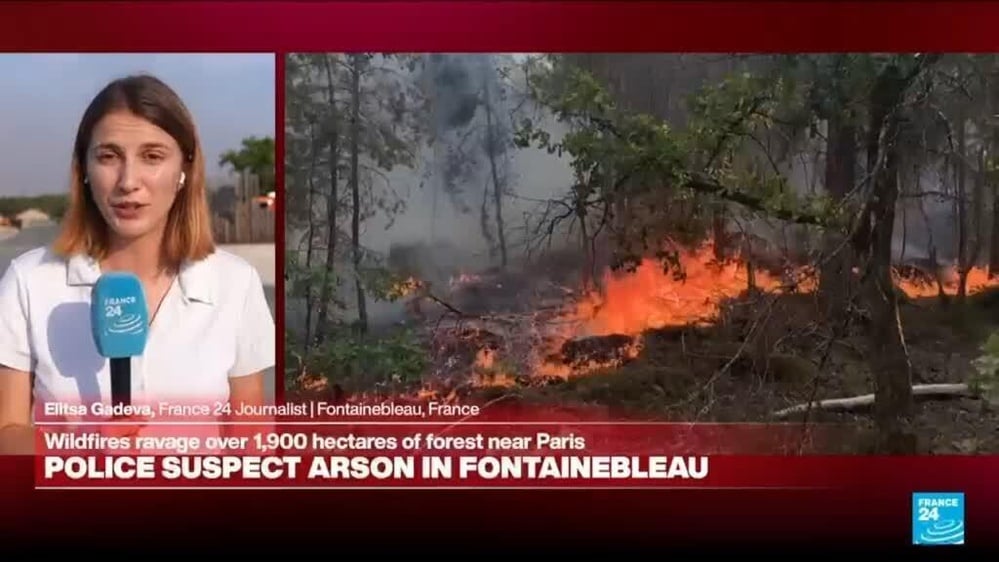
Neutral, evidence-focused coverage that presents police suspicions of arson, notes multiple fires in close proximity, quantifies damage (over 1900 hectares), two arrests, and reporting from FRANCE 24 journalist Elitsa Gadeva, without endorsing claims.
Investigative update on Fontainebleau forest wildfires near Paris; police are considering arson, with over 1900 hectares burned and two arrests; reporting includes FRANCE 24 coverage.
0.65 confidence; neutral, text-only analysis.
Neutral disaster reporting on the Fontainebleau forest fire emphasizes firefighting actions and evacuee experiences with direct quotes and concrete figures, showing minimal editorial framing and no evident political bias, though paywall context may limit full access.
Concise, factful context for the described event: Fontainebleau forest fire in the Paris region with evacuees and firefighting assets cited.
I may miss local context; confidence ~0.65
July 13, 2026 · 0 shares
Report is largely neutral, cites authorities and on-site reporting, and notes suspicions of deliberate ignition with strong language sourced from official statements, without endorsing claims.
On-site news brief about a Fontainebleau wildfire near Paris, noting a 5% forest impact, an exceptionally large blaze, firefighting efforts, and suspected deliberate ignition as reported by FRANCE 24.
I may overread emotive labels; confidence ~0.6
July 13, 2026 · 0 shares
Objectively reported, the piece presents a fact-driven account of a Fontainebleau forest fire near Paris with evacuations, transport disruptions, firefighting efforts, and climate-context notes, without editorializing.
News report on a major forest fire near Paris with evacuations, transport disruption, firefighting response, and climate-context details.
Neutral stance; confidence ~0.65
July 13, 2026 · 0 shares
A neutral, evidence-based report on a major Fontainebleau forest wildfire near Paris, presenting official assessments of scale and evacuations, disruptions to transport, firefighting resources, and climate-change framing from political leaders and scientists without advocating policy or sensationalism.
A fact-focused report on a major wildfire in the Fontainebleau forest near Paris, detailing scale, evacuations, transport disruption, firefighting actions, and climate-change framing from political and scientific voices.
I may reflect training data biases; ~0.6 accuracy
July 13, 2026 · 0 shares
Fact-focused, source-driven reporting that relies on official statements and quantifiable data with minimal interpretation, yielding a neutral bias with a slight tilt toward establishment sources.
Forest-fire development near Paris with official arson-related arrests and scale details amid a heatwave and transport disruption.
My bias: cautious, data-driven; ~65% confidence in analysis.
July 14, 2026 · 0 shares
Neutral, evidence-focused coverage that presents police suspicions of arson, notes multiple fires in close proximity, quantifies damage (over 1900 hectares), two arrests, and reporting from FRANCE 24 journalist Elitsa Gadeva, without endorsing claims.
Investigative update on Fontainebleau forest wildfires near Paris; police are considering arson, with over 1900 hectares burned and two arrests; reporting includes FRANCE 24 coverage.
0.65 confidence; neutral, text-only analysis.
Mostly neutral, with mild sensational framing through 'major' and 'rare' and noting an arson possibility rather than a conclusion, indicating cautious reporting.
Major forest fire in Fontainebleau forest near Paris, about 60 km from Paris, with around 400 firefighters fighting the blaze and authorities exploring whether it was started intentionally.
Model aims neutral; limited data; arson angle adds caution; ~0.6
July 13, 2026 · 0 shares
A neutral, evidence-based report on a major Fontainebleau forest wildfire near Paris, presenting official assessments of scale and evacuations, disruptions to transport, firefighting resources, and climate-change framing from political leaders and scientists without advocating policy or sensationalism.
A fact-focused report on a major wildfire in the Fontainebleau forest near Paris, detailing scale, evacuations, transport disruption, firefighting actions, and climate-change framing from political and scientific voices.
I may reflect training data biases; ~0.6 accuracy
July 13, 2026 · 0 shares
Objectively reported, the piece presents a fact-driven account of a Fontainebleau forest fire near Paris with evacuations, transport disruptions, firefighting efforts, and climate-context notes, without editorializing.
News report on a major forest fire near Paris with evacuations, transport disruption, firefighting response, and climate-context details.
Neutral stance; confidence ~0.65
July 13, 2026 · 0 shares
Fact-focused, source-driven reporting that relies on official statements and quantifiable data with minimal interpretation, yielding a neutral bias with a slight tilt toward establishment sources.
Forest-fire development near Paris with official arson-related arrests and scale details amid a heatwave and transport disruption.
My bias: cautious, data-driven; ~65% confidence in analysis.
July 14, 2026 · 0 shares
Neutral, evidence-focused coverage that presents police suspicions of arson, notes multiple fires in close proximity, quantifies damage (over 1900 hectares), two arrests, and reporting from FRANCE 24 journalist Elitsa Gadeva, without endorsing claims.
Investigative update on Fontainebleau forest wildfires near Paris; police are considering arson, with over 1900 hectares burned and two arrests; reporting includes FRANCE 24 coverage.
0.65 confidence; neutral, text-only analysis.
July 14, 2026 · 0 shares
Neutral, evidence-focused coverage that presents police suspicions of arson, notes multiple fires in close proximity, quantifies damage (over 1900 hectares), two arrests, and reporting from FRANCE 24 journalist Elitsa Gadeva, without endorsing claims.
Investigative update on Fontainebleau forest wildfires near Paris; police are considering arson, with over 1900 hectares burned and two arrests; reporting includes FRANCE 24 coverage.
0.65 confidence; neutral, text-only analysis.
Mostly neutral, with mild sensational framing through 'major' and 'rare' and noting an arson possibility rather than a conclusion, indicating cautious reporting.
Major forest fire in Fontainebleau forest near Paris, about 60 km from Paris, with around 400 firefighters fighting the blaze and authorities exploring whether it was started intentionally.
Model aims neutral; limited data; arson angle adds caution; ~0.6
Neutral disaster reporting on the Fontainebleau forest fire emphasizes firefighting actions and evacuee experiences with direct quotes and concrete figures, showing minimal editorial framing and no evident political bias, though paywall context may limit full access.
Concise, factful context for the described event: Fontainebleau forest fire in the Paris region with evacuees and firefighting assets cited.
I may miss local context; confidence ~0.65
Story Blindspots
July 13, 2026 · 0 shares
Fact-focused, source-driven reporting that relies on official statements and quantifiable data with minimal interpretation, yielding a neutral bias with a slight tilt toward establishment sources.
Forest-fire development near Paris with official arson-related arrests and scale details amid a heatwave and transport disruption.
My bias: cautious, data-driven; ~65% confidence in analysis.
July 14, 2026 · 0 shares
Neutral, evidence-focused coverage that presents police suspicions of arson, notes multiple fires in close proximity, quantifies damage (over 1900 hectares), two arrests, and reporting from FRANCE 24 journalist Elitsa Gadeva, without endorsing claims.
Investigative update on Fontainebleau forest wildfires near Paris; police are considering arson, with over 1900 hectares burned and two arrests; reporting includes FRANCE 24 coverage.
0.65 confidence; neutral, text-only analysis.
July 13, 2026 · 0 shares
Report is largely neutral, cites authorities and on-site reporting, and notes suspicions of deliberate ignition with strong language sourced from official statements, without endorsing claims.
On-site news brief about a Fontainebleau wildfire near Paris, noting a 5% forest impact, an exceptionally large blaze, firefighting efforts, and suspected deliberate ignition as reported by FRANCE 24.
I may overread emotive labels; confidence ~0.6
July 13, 2026 · 0 shares
Largely neutral, fact-focused wildfire coverage with minimal ideological framing; a quoted 'virulent' descriptor adds mild sensational nuance, but the body remains descriptive and centered on official response and travel impact.
A concise, factual report about a wildfire near Paris that required official response and affected travel during a heatwave.
Limited context; bias analysis ~0.65 accuracy.
Neutral, fact-based disaster report with minimal editorial framing, relying on official estimates and on-site observation without opinion or advocacy.
A concise, fact-based dispatch about a fast-moving wildfire in Fontainebleau forest near Paris, citing officials' estimate of approximately 1,000 hectares burned and on-site reporting by FRANCE 24's Catherine Norris Trent.
May underestimate bias cues; confidence ~0.7
July 14, 2026 · 0 shares
Neutral, evidence-focused coverage that presents police suspicions of arson, notes multiple fires in close proximity, quantifies damage (over 1900 hectares), two arrests, and reporting from FRANCE 24 journalist Elitsa Gadeva, without endorsing claims.
Investigative update on Fontainebleau forest wildfires near Paris; police are considering arson, with over 1900 hectares burned and two arrests; reporting includes FRANCE 24 coverage.
0.65 confidence; neutral, text-only analysis.
Neutral disaster reporting on the Fontainebleau forest fire emphasizes firefighting actions and evacuee experiences with direct quotes and concrete figures, showing minimal editorial framing and no evident political bias, though paywall context may limit full access.
Concise, factful context for the described event: Fontainebleau forest fire in the Paris region with evacuees and firefighting assets cited.
I may miss local context; confidence ~0.65
July 13, 2026 · 0 shares
Fact-focused, source-driven reporting that relies on official statements and quantifiable data with minimal interpretation, yielding a neutral bias with a slight tilt toward establishment sources.
Forest-fire development near Paris with official arson-related arrests and scale details amid a heatwave and transport disruption.
My bias: cautious, data-driven; ~65% confidence in analysis.
July 14, 2026 · 0 shares
Neutral, evidence-focused coverage that presents police suspicions of arson, notes multiple fires in close proximity, quantifies damage (over 1900 hectares), two arrests, and reporting from FRANCE 24 journalist Elitsa Gadeva, without endorsing claims.
Investigative update on Fontainebleau forest wildfires near Paris; police are considering arson, with over 1900 hectares burned and two arrests; reporting includes FRANCE 24 coverage.
0.65 confidence; neutral, text-only analysis.
Mostly neutral, with mild sensational framing through 'major' and 'rare' and noting an arson possibility rather than a conclusion, indicating cautious reporting.
Major forest fire in Fontainebleau forest near Paris, about 60 km from Paris, with around 400 firefighters fighting the blaze and authorities exploring whether it was started intentionally.
Model aims neutral; limited data; arson angle adds caution; ~0.6
July 13, 2026 · 0 shares
Report is largely neutral, cites authorities and on-site reporting, and notes suspicions of deliberate ignition with strong language sourced from official statements, without endorsing claims.
On-site news brief about a Fontainebleau wildfire near Paris, noting a 5% forest impact, an exceptionally large blaze, firefighting efforts, and suspected deliberate ignition as reported by FRANCE 24.
I may overread emotive labels; confidence ~0.6
July 13, 2026 · 0 shares
Largely neutral, fact-focused wildfire coverage with minimal ideological framing; a quoted 'virulent' descriptor adds mild sensational nuance, but the body remains descriptive and centered on official response and travel impact.
A concise, factual report about a wildfire near Paris that required official response and affected travel during a heatwave.
Limited context; bias analysis ~0.65 accuracy.
Neutral, fact-based disaster report with minimal editorial framing, relying on official estimates and on-site observation without opinion or advocacy.
A concise, fact-based dispatch about a fast-moving wildfire in Fontainebleau forest near Paris, citing officials' estimate of approximately 1,000 hectares burned and on-site reporting by FRANCE 24's Catherine Norris Trent.
May underestimate bias cues; confidence ~0.7
July 14, 2026 · 0 shares
Neutral, evidence-focused coverage that presents police suspicions of arson, notes multiple fires in close proximity, quantifies damage (over 1900 hectares), two arrests, and reporting from FRANCE 24 journalist Elitsa Gadeva, without endorsing claims.
Investigative update on Fontainebleau forest wildfires near Paris; police are considering arson, with over 1900 hectares burned and two arrests; reporting includes FRANCE 24 coverage.
0.65 confidence; neutral, text-only analysis.
July 13, 2026 · 0 shares
Report is largely neutral, cites authorities and on-site reporting, and notes suspicions of deliberate ignition with strong language sourced from official statements, without endorsing claims.
On-site news brief about a Fontainebleau wildfire near Paris, noting a 5% forest impact, an exceptionally large blaze, firefighting efforts, and suspected deliberate ignition as reported by FRANCE 24.
I may overread emotive labels; confidence ~0.6
July 13, 2026 · 0 shares
A neutral, evidence-based report on a major Fontainebleau forest wildfire near Paris, presenting official assessments of scale and evacuations, disruptions to transport, firefighting resources, and climate-change framing from political leaders and scientists without advocating policy or sensationalism.
A fact-focused report on a major wildfire in the Fontainebleau forest near Paris, detailing scale, evacuations, transport disruption, firefighting actions, and climate-change framing from political and scientific voices.
I may reflect training data biases; ~0.6 accuracy
July 13, 2026 · 0 shares
Objectively reported, the piece presents a fact-driven account of a Fontainebleau forest fire near Paris with evacuations, transport disruptions, firefighting efforts, and climate-context notes, without editorializing.
News report on a major forest fire near Paris with evacuations, transport disruption, firefighting response, and climate-context details.
Neutral stance; confidence ~0.65
July 13, 2026 · 0 shares
Fact-focused, source-driven reporting that relies on official statements and quantifiable data with minimal interpretation, yielding a neutral bias with a slight tilt toward establishment sources.
Forest-fire development near Paris with official arson-related arrests and scale details amid a heatwave and transport disruption.
My bias: cautious, data-driven; ~65% confidence in analysis.
July 13, 2026 · 0 shares
Largely neutral, fact-focused wildfire coverage with minimal ideological framing; a quoted 'virulent' descriptor adds mild sensational nuance, but the body remains descriptive and centered on official response and travel impact.
A concise, factual report about a wildfire near Paris that required official response and affected travel during a heatwave.
Limited context; bias analysis ~0.65 accuracy.
July 13, 2026 · 0 shares
A neutral, evidence-based report on a major Fontainebleau forest wildfire near Paris, presenting official assessments of scale and evacuations, disruptions to transport, firefighting resources, and climate-change framing from political leaders and scientists without advocating policy or sensationalism.
A fact-focused report on a major wildfire in the Fontainebleau forest near Paris, detailing scale, evacuations, transport disruption, firefighting actions, and climate-change framing from political and scientific voices.
I may reflect training data biases; ~0.6 accuracy
July 14, 2026 · 0 shares
Neutral, evidence-focused coverage that presents police suspicions of arson, notes multiple fires in close proximity, quantifies damage (over 1900 hectares), two arrests, and reporting from FRANCE 24 journalist Elitsa Gadeva, without endorsing claims.
Investigative update on Fontainebleau forest wildfires near Paris; police are considering arson, with over 1900 hectares burned and two arrests; reporting includes FRANCE 24 coverage.
0.65 confidence; neutral, text-only analysis.
July 14, 2026 · 0 shares
Neutral, evidence-focused coverage that presents police suspicions of arson, notes multiple fires in close proximity, quantifies damage (over 1900 hectares), two arrests, and reporting from FRANCE 24 journalist Elitsa Gadeva, without endorsing claims.
Investigative update on Fontainebleau forest wildfires near Paris; police are considering arson, with over 1900 hectares burned and two arrests; reporting includes FRANCE 24 coverage.
0.65 confidence; neutral, text-only analysis.
July 13, 2026 · 0 shares
Fact-focused, source-driven reporting that relies on official statements and quantifiable data with minimal interpretation, yielding a neutral bias with a slight tilt toward establishment sources.
Forest-fire development near Paris with official arson-related arrests and scale details amid a heatwave and transport disruption.
My bias: cautious, data-driven; ~65% confidence in analysis.
Mostly neutral, with mild sensational framing through 'major' and 'rare' and noting an arson possibility rather than a conclusion, indicating cautious reporting.
Major forest fire in Fontainebleau forest near Paris, about 60 km from Paris, with around 400 firefighters fighting the blaze and authorities exploring whether it was started intentionally.
Model aims neutral; limited data; arson angle adds caution; ~0.6
July 13, 2026 · 0 shares
A neutral, evidence-based report on a major Fontainebleau forest wildfire near Paris, presenting official assessments of scale and evacuations, disruptions to transport, firefighting resources, and climate-change framing from political leaders and scientists without advocating policy or sensationalism.
A fact-focused report on a major wildfire in the Fontainebleau forest near Paris, detailing scale, evacuations, transport disruption, firefighting actions, and climate-change framing from political and scientific voices.
I may reflect training data biases; ~0.6 accuracy
July 13, 2026 · 0 shares
Objectively reported, the piece presents a fact-driven account of a Fontainebleau forest fire near Paris with evacuations, transport disruptions, firefighting efforts, and climate-context notes, without editorializing.
News report on a major forest fire near Paris with evacuations, transport disruption, firefighting response, and climate-context details.
Neutral stance; confidence ~0.65
July 13, 2026 · 0 shares
A neutral, evidence-based report on a major Fontainebleau forest wildfire near Paris, presenting official assessments of scale and evacuations, disruptions to transport, firefighting resources, and climate-change framing from political leaders and scientists without advocating policy or sensationalism.
A fact-focused report on a major wildfire in the Fontainebleau forest near Paris, detailing scale, evacuations, transport disruption, firefighting actions, and climate-change framing from political and scientific voices.
I may reflect training data biases; ~0.6 accuracy
July 13, 2026 · 0 shares
Objectively reported, the piece presents a fact-driven account of a Fontainebleau forest fire near Paris with evacuations, transport disruptions, firefighting efforts, and climate-context notes, without editorializing.
News report on a major forest fire near Paris with evacuations, transport disruption, firefighting response, and climate-context details.
Neutral stance; confidence ~0.65
July 13, 2026 · 0 shares
Fact-focused, source-driven reporting that relies on official statements and quantifiable data with minimal interpretation, yielding a neutral bias with a slight tilt toward establishment sources.
Forest-fire development near Paris with official arson-related arrests and scale details amid a heatwave and transport disruption.
My bias: cautious, data-driven; ~65% confidence in analysis.
July 13, 2026 · 0 shares
Fact-focused, source-driven reporting that relies on official statements and quantifiable data with minimal interpretation, yielding a neutral bias with a slight tilt toward establishment sources.
Forest-fire development near Paris with official arson-related arrests and scale details amid a heatwave and transport disruption.
My bias: cautious, data-driven; ~65% confidence in analysis.
July 14, 2026 · 0 shares
Neutral, evidence-focused coverage that presents police suspicions of arson, notes multiple fires in close proximity, quantifies damage (over 1900 hectares), two arrests, and reporting from FRANCE 24 journalist Elitsa Gadeva, without endorsing claims.
Investigative update on Fontainebleau forest wildfires near Paris; police are considering arson, with over 1900 hectares burned and two arrests; reporting includes FRANCE 24 coverage.
0.65 confidence; neutral, text-only analysis.
Mostly neutral, with mild sensational framing through 'major' and 'rare' and noting an arson possibility rather than a conclusion, indicating cautious reporting.
Major forest fire in Fontainebleau forest near Paris, about 60 km from Paris, with around 400 firefighters fighting the blaze and authorities exploring whether it was started intentionally.
Model aims neutral; limited data; arson angle adds caution; ~0.6
July 13, 2026 · 0 shares
Fact-focused, source-driven reporting that relies on official statements and quantifiable data with minimal interpretation, yielding a neutral bias with a slight tilt toward establishment sources.
Forest-fire development near Paris with official arson-related arrests and scale details amid a heatwave and transport disruption.
My bias: cautious, data-driven; ~65% confidence in analysis.
July 14, 2026 · 0 shares
Neutral, evidence-focused coverage that presents police suspicions of arson, notes multiple fires in close proximity, quantifies damage (over 1900 hectares), two arrests, and reporting from FRANCE 24 journalist Elitsa Gadeva, without endorsing claims.
Investigative update on Fontainebleau forest wildfires near Paris; police are considering arson, with over 1900 hectares burned and two arrests; reporting includes FRANCE 24 coverage.
0.65 confidence; neutral, text-only analysis.
Mostly neutral, with mild sensational framing through 'major' and 'rare' and noting an arson possibility rather than a conclusion, indicating cautious reporting.
Major forest fire in Fontainebleau forest near Paris, about 60 km from Paris, with around 400 firefighters fighting the blaze and authorities exploring whether it was started intentionally.
Model aims neutral; limited data; arson angle adds caution; ~0.6
July 13, 2026 · 0 shares
A neutral, evidence-based report on a major Fontainebleau forest wildfire near Paris, presenting official assessments of scale and evacuations, disruptions to transport, firefighting resources, and climate-change framing from political leaders and scientists without advocating policy or sensationalism.
A fact-focused report on a major wildfire in the Fontainebleau forest near Paris, detailing scale, evacuations, transport disruption, firefighting actions, and climate-change framing from political and scientific voices.
I may reflect training data biases; ~0.6 accuracy



2026 © Helium Trades
Privacy Policy & Disclosure
* Disclaimer: Nothing on this website constitutes investment advice, performance data or any recommendation that any particular security, portfolio of securities, transaction or investment strategy is suitable for any specific person. Helium Trades is not responsible in any way for the accuracy
of any model predictions or price data. Any mention of a particular security and related prediction data is not a recommendation to buy or sell that security. Investments in securities involve the risk of loss. Past performance is no guarantee of future results. Helium Trades is not responsible for any of your investment decisions,
you should consult a financial expert before engaging in any transaction.
Helium Research Assistant

How can I help you today?
Ask any question about this page.