See whether Helium helps you make better-informed decisions. Try every Pro Trader feature for 30 days. No credit card required.
Try every Pro Trader feature for 30 days. No credit card required.
November 15, 2026 · 0 shares
Framing treats the first tower catch as a major reusability milestone while explicitly recording the missed booster catch and outstanding engineering gaps.
Helium Analysis
Limitations: No author byline appears in the supplied text; launch and catch dates rely on body text and image captions.
·
12 of 55 available dimensions scored; omitted dimensions are not treated as neutral.
·
Verified supporting quotes for 12 of 12 scored dimensions.
Claim: Assessments of the mission are attributed to named outside experts rather than voiced by the publisher.
“Clayton Swope, an aerospace expert at the Center for Strategic and International Studies, called the mission a "huge technical achievement and proves the whole idea of Starship as a fully reusable spaceship can work."” · exact text match
Why: Attribution to named experts supports objective framing.
Claim: Milestone coverage is tempered by explicit caveats about unresolved reusability.
“But SpaceX has yet to recover both stages of Starship in a single mission, and its heat shield, composed of black hexagonal tiles that protect it from the blazing heat of atmospheric reentry, is not yet fully reusable.” · exact text match
Counterevidence:
“marking a major milestone in the company's efforts to develop a fully reusable rocket system” · exact text match
Why: Caveats and technical detail reduce sensational framing despite positive milestone language.
Claim: The milestone is framed as major progress toward full reusability, giving the report a mildly optimistic tilt.
“marking a major milestone in the company's efforts to develop a fully reusable rocket system” · exact text match
Counterevidence:
“But SpaceX has yet to recover both stages of Starship in a single mission” · exact text match
Why: Positive milestone framing is balanced by caveats, supporting a modest positive score.
Claim: The first-of-its-kind tower catch gives the report high novelty interest.
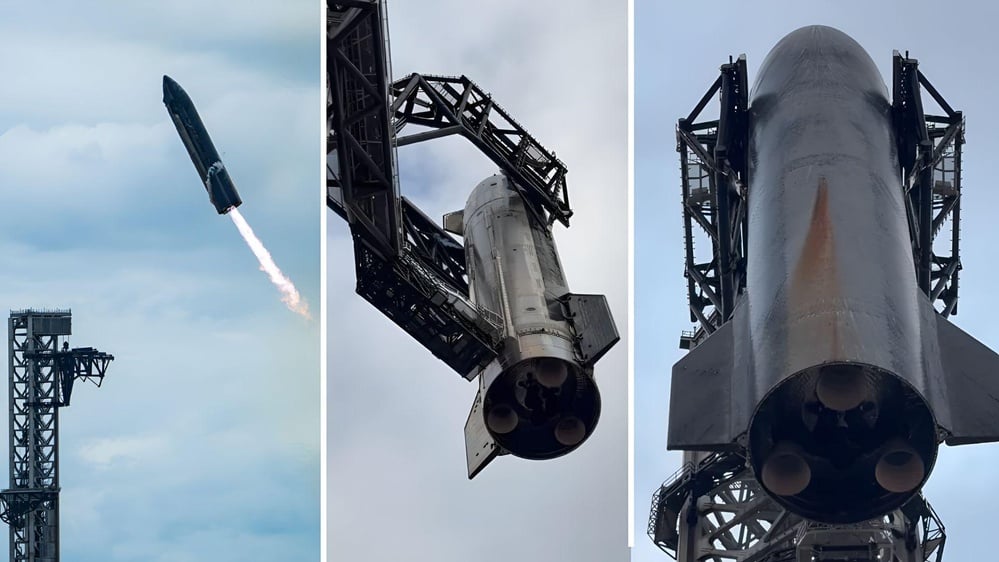
“was successfully caught by the launch tower's giant mechanical arms for the first time” · exact text match
Why: First-time milestone and novel mechanism support high interestingness.
Claim: The report describes mission events and does not prescribe policy or action.
“The Starship spacecraft performed its orbital insertion burn and entered Earth's orbit.
It later deployed 26 Starlink V3 satellites.”
· exact text match
Why: Factual description dominates over prescription.
Claim: The report names expert sources and acknowledges unresolved technical failures.
“Clayton Swope, an aerospace expert at the Center for Strategic and International Studies, called the mission a "huge technical achievement and proves the whole idea of Starship as a fully reusable spaceship can work."” · exact text match
“But SpaceX has yet to recover both stages of Starship in a single mission” · exact text match
Why: Sourcing and caveats support credibility.
Claim: The report explains the catch through a sequential technical description rather than emotive assertion.
“After emerging from thick clouds over the Texas coast, the spacecraft reignited three engines, flipped into a vertical position and slowed its descent toward the launch tower.” · exact text match
Why: Detailed flight-sequence description supports a rational, technical framing.
Claim: The publisher frames SpaceX’s achievement as a major milestone, yielding a mild pro-corporate tilt.
“marking a major milestone in the company's efforts to develop a fully reusable rocket system” · exact text match
Counterevidence:
“But SpaceX has yet to recover both stages of Starship in a single mission” · exact text match
Why: Positive company framing is limited by explicit technical caveats.
Claim: The report explains the mission through orbital and engineering concepts rather than superstition.
“The Starship spacecraft performed its orbital insertion burn and entered Earth's orbit.” · exact text match
Why: Empirical technical framing supports a strongly scientific score.
Claim: Future uses are attributed to Musk and marked as goals rather than achieved facts.
“Musk envisions Starship as the workhorse of "rapidly reusable" rockets, with a goal of hourly launches that could send things like internet satellites and data centers into space.” · exact text match
Why: Limited, attributed forecasting supports low speculation bias.
Claim: The report discloses a failed booster catch and technical issue alongside the successful spacecraft catch.
“The mission had originally aimed to catch both the Starship spacecraft and its Super Heavy booster during the same flight.
However, following a technical issue after stage separation, the booster was diverted from its planned return to the launch site and splashed down in the Gulf of Mexico.”
· exact text match
Why: Including adverse technical outcomes supports high integrity.
Claim: The report connects the successful catch to unresolved orbital-fuel-transfer requirements for future missions.
“The company still has to solve the challenge of transferring fuel to the spacecraft in orbit, a requirement for future missions to the moon and Mars.” · exact text match
Why: Technical synthesis and constraint analysis indicate high article intelligence.
No author byline appears in the supplied text; launch and catch dates rely on body text and image captions.
November 14, 2026 · 0 shares
The report is largely factual and technical but notably celebratory, using evaluative terms such as “historic” and including an unattributed quote calling the catch “one of the greatest engineering achievements in history.”
Helium Analysis
Limitations: The celebratory passage is unattributed in the supplied text, so it is unclear whether it is the publisher’s own wording or an embedded quote.
·
55 of 55 available dimensions scored; omitted dimensions are not treated as neutral.
·
Verified supporting quotes for 17 of 55 scored dimensions.
Claim: Some evaluative and celebratory language qualifies an otherwise factual account.
“The historic maneuver took place on Saturday afternoon” · exact text match
“This is one of the greatest engineering achievements in history.” · exact text match
Why: The first phrase is an evaluative descriptor, and the second is a laudatory quote included in the report.
Claim: Sensationalism is limited but present through superlative and celebratory language.
“This is one of the greatest engineering achievements in history.” · exact text match
Counterevidence:
“The mission suffered an early setback when the Super Heavy first-stage booster failed to return to the launch tower.” · exact text match
Why: The hyperbolic quote raises the sensational tone slightly, while the failure detail keeps the overall report grounded.
Claim: The report frames the catch as a major positive advance for spaceflight and reusability.
“The recovery marks a major step toward SpaceX’s goal of making both stages of Starship fully reusable, potentially reducing launch costs and allowing more frequent flights.” · exact text match
Why: The language emphasizes progress and beneficial potential, yielding a modest optimistic rather than pessimistic tone.
Claim: The report covers a novel spaceflight milestone, making it substantively interesting.
“It’s the first time SpaceX has recovered a Starship spacecraft from orbit.” · exact text match
Why: A first-of-its-kind orbital recovery is an inherently notable development in the article.
Claim: The article is overwhelmingly descriptive and does not explicitly prescribe actions or policy.
“The recovery marks a major step toward SpaceX’s goal of making both stages of Starship fully reusable, potentially reducing launch costs and allowing more frequent flights.” · exact text match
Why: The passage describes the mission’s significance and potential consequences rather than advocating a course of action.
Claim: Mostly factual content is mixed with evaluative wording and a celebratory quote.
“The historic maneuver took place on Saturday afternoon” · exact text match
“This is one of the greatest engineering achievements in history.” · exact text match
Why: The evaluative descriptors and laudatory quote introduce mild opinion into a predominantly factual report.
Claim: The report is mostly event-focused with no explicit ideological program.
“The recovery marks a major step toward SpaceX’s goal of making both stages of Starship fully reusable” · exact text match
Why: The framing is centered on technology and company goals rather than an explicit ideology, though the celebratory tone is mild.
Claim: The overall emotional valence is mildly positive, centered on the successful catch.
“This is one of the greatest engineering achievements in history.
Congrats to the entire @SpaceX team!”
· exact text match
Counterevidence:
“The mission suffered an early setback when the Super Heavy first-stage booster failed to return to the launch tower.” · exact text match
Why: Celebratory language creates a positive tone, though the factual failure detail moderates it.
Claim: Including the booster failure alongside the successful catch is a visible fairness signal that supports credibility.
“The mission suffered an early setback when the Super Heavy first-stage booster failed to return to the launch tower.” · exact text match
Why: Balanced reporting of a major setback alongside the achievement is an observable credibility signal.
Claim: The framing is predominantly technical and empirical, including causal details and acknowledgment of the booster failure.
“SpaceX aborted the planned catch after the booster deviated from its intended trajectory, diverting it toward the Gulf of Mexico, where it exploded.” · exact text match
Why: The report explains mission failure in factual, technical terms rather than through emotive or irrational framing.
Claim: The report presents a commercial space company’s achievement in a favorable light.
“The recovery marks a major step toward SpaceX’s goal of making both stages of Starship fully reusable” · exact text match
Why: Favorable framing of SpaceX’s progress gives a mild pro-corporate tilt, though the article is focused on the engineering event.
Claim: The article is grounded in engineering and empirical mission details rather than superstition.
“The upper stage successfully reached orbit and deployed 26 next-generation Starlink satellites.” · exact text match
Why: Orbital mechanics, vehicle specifications, and mission outcomes are reported in scientific-technical terms.
Claim: The report includes limited future-oriented forecasting about costs, flight frequency, and exploration goals.
“potentially reducing launch costs and allowing more frequent flights” · exact text match
Why: The phrase explicitly marks a potential future effect, making the framing mildly speculative.
Claim: The supplied text has some repetitive and list-like formatting but not enough independent indicators to support an AI-authorship judgment.
“SpaceX catches Starship spacecraft with giant mechanical arms.” · exact text match
Why: The repetition and scraped-list structure could reflect reproduction artifacts rather than AI authorship.
Claim: The report includes the mission’s major setback, showing fair treatment of the event.
“The mission suffered an early setback when the Super Heavy first-stage booster failed to return to the launch tower.” · exact text match
Why: Including the booster failure alongside the successful catch is an observable fairness and honesty signal.
Claim: The report conveys technical mission details with sufficient context and causal explanation.
“The 124-meter Starship, the world’s largest and most powerful rocket, launched from the company’s Starbase facility in southern Texas on Friday.” · exact text match
Why: Specific vehicle, launch-site, timing, and mission details indicate a technically informed account.
Claim: The celebratory quote includes praise but does not clearly rise to faux virtue signaling.
“Congrats to the entire @SpaceX team!” · exact text match
Why: The phrase is congratulatory but brief and tied to the engineering event, so the signal is weak.
The celebratory passage is unattributed in the supplied text, so it is unclear whether it is the publisher’s own wording or an embedded quote.
November 15, 2026 · 0 shares
The strongest observable framing is factual and balanced, presenting the first Starship catch while plainly noting the booster explosion and partial success.
A 'double catch' refers to attempting to recover both the Starship and its booster using launch pad equipment.
Helium Analysis
Limitations: The article is extremely brief and appears to be a social-media-style summary, limiting assessment of sourcing, context, and broader editorial framing.
·
8 of 55 available dimensions scored; omitted dimensions are not treated as neutral.
·
Verified supporting quotes for 8 of 8 scored dimensions.
Claim: The report is mostly factual, qualifying the 'double catch' attempt as only partially successful.
“SpaceX made history Saturday with its so-called “double catch” attempt that was partially successful.” · exact text match
Why: It reports an outcome with a clear qualifier rather than promoting an unalloyed success narrative.
Claim: The booster failure is stated plainly without sensational adjectives.
“The Starship’s booster had to abandon its landing attempt and exploded in the Gulf of Mexico” · exact text match
Why: The language is direct and factual, even when reporting the explosion.
Claim: The content is descriptive, with no recommendations or calls to action.
“SpaceX made history Saturday with its so-called “double catch” attempt that was partially successful.” · exact text match
Why: It reports an event and outcome without prescribing behavior or policy.
Claim: The framing balances a historic achievement with a booster explosion, yielding no strong positive or negative emotional valence.
“SpaceX made history Saturday” · exact text match
“exploded in the Gulf of Mexico” · exact text match
Why: Positive achievement language is offset by the plain report of failure.
Claim: The report gives concrete event details and a qualifier but provides no named sourcing or independent verification.
“SpaceX made history Saturday with its so-called “double catch” attempt that was partially successful.” · exact text match
Why: Specific facts and explicit uncertainty support basic credibility, while the absence of sourcing limits it.
Claim: The account follows a coherent technical sequence from payload deployment to Starship recovery.
“after deploying its payload of 22 satellites, the Starship was caught by the launch pad’s “chopsticks” for the first time ever.” · exact text match
Why: It presents causally ordered technical events rather than emotional or illogical framing.
Claim: The report relies on empirical spaceflight details rather than superstitious or non-scientific framing.
“after deploying its payload of 22 satellites, the Starship was caught by the launch pad’s “chopsticks” for the first time ever.” · exact text match
Why: Specific hardware, payload, and recovery details ground the report in technical observation.
Claim: The report acknowledges the booster failure while noting the Starship catch, avoiding a one-sided success narrative.
“partially successful” · exact text match
“exploded in the Gulf of Mexico” · exact text match
Why: Including the explosion and the qualifier 'partially successful' signals fairness in summarizing the mixed outcome.
The article is extremely brief and appears to be a social-media-style summary, limiting assessment of sourcing, context, and broader editorial framing.
November 14, 2026 · 0 shares
Framing is attribution-heavy and measured, foregrounding a booster-catch failure while presenting SpaceX's status updates and technical explanations with only mild evaluative color.
Helium Analysis
Limitations: The supplied text includes duplicated related-link headlines and page boilerplate, and no clear author byline; extraction is limited to substantive article paragraphs.
·
8 of 55 available dimensions scored; omitted dimensions are not treated as neutral.
·
Verified supporting quotes for 8 of 8 scored dimensions.
Claim: Key status claims are attributed to SpaceX rather than presented as the publisher's own judgment.
“SpaceX said its Starship spacecraft was "healthy" as it orbited the Earth and on track to return Saturday to its Texas launch site” · exact text match
Why: The status of the spacecraft is directly sourced to SpaceX, indicating attribution-driven reporting.
Claim: Vivid language about the booster's end is tied to a factual sequence rather than inflated drama.
“A fireball erupted just before the Super Heavy booster hit the water of the Gulf of Mexico.” · exact text match
Counterevidence:
“The "catch" of Starship is extraordinarily complex because the spaceship will be falling much faster and from a much higher altitude than the booster.” · exact text match
Why: The fireball description is vivid but factual, while the use of "extraordinarily complex" is a mild evaluative qualification.
Claim: The text describes events, plans, and attributed statements rather than prescribing policy or action.
“Flight control will make a decision on whether to proceed with the capture attempt about two hours before its scheduled return at 3:18 p.m. (2118 GMT).” · exact text match
Why: It reports a scheduled operational decision rather than advocating a course of action.
Claim: Mostly factual reporting includes some evaluative phrasing about SpaceX's significance and technical difficulty.
“Musk, the world's richest person, has already revolutionized the space sector with the partially reusable Falcon rockets, which regularly launch satellites and carry astronauts to the International Space Station.” · exact text match
Counterevidence:
“But the Starship project has been plagued by delays as SpaceX grapples with novel engineering challenges” · exact text match
Why: Words such as "revolutionized" and "plagued" are evaluative, but they are limited and balanced by contrary framing.
Claim: The report uses named sources, specific operational details, and explicit uncertainty about the booster failure.
“"The booster was not in the place that it was supposed to be to proceed with the catch," SpaceX spokesman Dan Huot said, adding that engineers were still investigating the root cause.” · exact text match
Why: Named attribution and acknowledgment of an unresolved root cause support credibility within the supplied text.
Claim: The report frames the booster anomaly as an engineering investigation rather than speculative causation.
“"The booster was not in the place that it was supposed to be to proceed with the catch," SpaceX spokesman Dan Huot said, adding that engineers were still investigating the root cause.” · exact text match
Why: It attributes the failure to a specific technical decision and explicitly notes that the root cause is still under investigation.
Claim: The report explains the mission challenge in empirical engineering terms.
“But the Starship project has been plagued by delays as SpaceX grapples with novel engineering challenges, including the unsolved problem of transferring fuel to the spaceship while in orbit—a requirement for any journey to the moon or Mars.” · exact text match
Why: It frames the challenge as a concrete engineering problem rather than a supernatural or speculative one.
Claim: The article provides concise technical context for why the catch attempt is difficult.
“The "catch" of Starship is extraordinarily complex because the spaceship will be falling much faster and from a much higher altitude than the booster.” · exact text match
Why: It explains the physical reason the operation is demanding, showing above-average explanatory clarity.
The supplied text includes duplicated related-link headlines and page boilerplate, and no clear author byline; extraction is limited to substantive article paragraphs.
November 15, 2026 · 0 shares
Framing treats the first tower catch as a major reusability milestone while explicitly recording the missed booster catch and outstanding engineering gaps.
Helium Analysis
Limitations: No author byline appears in the supplied text; launch and catch dates rely on body text and image captions.
·
12 of 55 available dimensions scored; omitted dimensions are not treated as neutral.
·
Verified supporting quotes for 12 of 12 scored dimensions.
Claim: Assessments of the mission are attributed to named outside experts rather than voiced by the publisher.
“Clayton Swope, an aerospace expert at the Center for Strategic and International Studies, called the mission a "huge technical achievement and proves the whole idea of Starship as a fully reusable spaceship can work."” · exact text match
Why: Attribution to named experts supports objective framing.
Claim: Milestone coverage is tempered by explicit caveats about unresolved reusability.
“But SpaceX has yet to recover both stages of Starship in a single mission, and its heat shield, composed of black hexagonal tiles that protect it from the blazing heat of atmospheric reentry, is not yet fully reusable.” · exact text match
Counterevidence:
“marking a major milestone in the company's efforts to develop a fully reusable rocket system” · exact text match
Why: Caveats and technical detail reduce sensational framing despite positive milestone language.
Claim: The milestone is framed as major progress toward full reusability, giving the report a mildly optimistic tilt.
“marking a major milestone in the company's efforts to develop a fully reusable rocket system” · exact text match
Counterevidence:
“But SpaceX has yet to recover both stages of Starship in a single mission” · exact text match
Why: Positive milestone framing is balanced by caveats, supporting a modest positive score.
Claim: The first-of-its-kind tower catch gives the report high novelty interest.
“was successfully caught by the launch tower's giant mechanical arms for the first time” · exact text match
Why: First-time milestone and novel mechanism support high interestingness.
Claim: The report describes mission events and does not prescribe policy or action.
“The Starship spacecraft performed its orbital insertion burn and entered Earth's orbit.
It later deployed 26 Starlink V3 satellites.”
· exact text match
Why: Factual description dominates over prescription.
Claim: The report names expert sources and acknowledges unresolved technical failures.
“Clayton Swope, an aerospace expert at the Center for Strategic and International Studies, called the mission a "huge technical achievement and proves the whole idea of Starship as a fully reusable spaceship can work."” · exact text match
“But SpaceX has yet to recover both stages of Starship in a single mission” · exact text match
Why: Sourcing and caveats support credibility.
Claim: The report explains the catch through a sequential technical description rather than emotive assertion.
“After emerging from thick clouds over the Texas coast, the spacecraft reignited three engines, flipped into a vertical position and slowed its descent toward the launch tower.” · exact text match
Why: Detailed flight-sequence description supports a rational, technical framing.
Claim: The publisher frames SpaceX’s achievement as a major milestone, yielding a mild pro-corporate tilt.
“marking a major milestone in the company's efforts to develop a fully reusable rocket system” · exact text match
Counterevidence:
“But SpaceX has yet to recover both stages of Starship in a single mission” · exact text match
Why: Positive company framing is limited by explicit technical caveats.
Claim: The report explains the mission through orbital and engineering concepts rather than superstition.
“The Starship spacecraft performed its orbital insertion burn and entered Earth's orbit.” · exact text match
Why: Empirical technical framing supports a strongly scientific score.
Claim: Future uses are attributed to Musk and marked as goals rather than achieved facts.
“Musk envisions Starship as the workhorse of "rapidly reusable" rockets, with a goal of hourly launches that could send things like internet satellites and data centers into space.” · exact text match
Why: Limited, attributed forecasting supports low speculation bias.
Claim: The report discloses a failed booster catch and technical issue alongside the successful spacecraft catch.
“The mission had originally aimed to catch both the Starship spacecraft and its Super Heavy booster during the same flight.
However, following a technical issue after stage separation, the booster was diverted from its planned return to the launch site and splashed down in the Gulf of Mexico.”
· exact text match
Why: Including adverse technical outcomes supports high integrity.
Claim: The report connects the successful catch to unresolved orbital-fuel-transfer requirements for future missions.
“The company still has to solve the challenge of transferring fuel to the spacecraft in orbit, a requirement for future missions to the moon and Mars.” · exact text match
Why: Technical synthesis and constraint analysis indicate high article intelligence.
No author byline appears in the supplied text; launch and catch dates rely on body text and image captions.
November 14, 2026 · 0 shares
Achievement-focused framing presents the event as a successful first-ever technical milestone in straightforward, largely neutral terms.
Helium Analysis Limitations: The supplied text is only two sentences and lacks named sources or detailed context; several dimensions are omitted as unsupported. · 7 of 56 available dimensions scored; omitted dimensions are not treated as neutral. · Verified supporting quotes for 6 of 7 scored dimensions.
Claim: The report presents the Starship catch as an observable factual event without subjective commentary.
“SpaceX's Starship spacecraft made a successful return to Earth on Saturday” · exact text match
“completing its first mid-air catch by giant robot arms in Texas” · exact text match
Why: Both statements describe event outcomes and technical details rather than personal interpretation or opinion.
Claim: The wording is measured and avoids sensational or hyperbolic language while noting a milestone and a prior failure.
“completes first-ever mid-air catch” · exact text match
“after an aborted recovery attempt” · exact text match
Why: Milestone and setback are stated in plain terms without emotive intensifiers or dramatic framing.
Claim: The event is presented as a notable spaceflight milestone, enhancing its intrinsic interest.
“first-ever mid-air catch after return from orbit” · exact text match
Why: A first-ever orbital-return catch is an unusual technical event, not routine or mundane.
Claim: The report has a mild positive valence from achievement language while remaining restrained.
“made a successful return to Earth” · exact text match
“first-ever mid-air catch” · exact text match
Why: 'Successful' and 'first-ever' frame the event positively, but there is no emotive or exclamatory language.
Claim: The account follows a clear chronological and technical sequence from return to catch with prior-attempt context.
“made a successful return to Earth on Saturday, completing its first mid-air catch” · exact text match
“after an aborted recovery attempt” · exact text match
Why: The sequence is stated factually and without fallacious or emotive reasoning.
Claim: The report is grounded in a described engineering and spaceflight achievement rather than supernatural or superstitious content.
“first-ever mid-air catch by giant robot arms in Texas” · not found in supplied text
Why: The subject is a technological recovery method, and no superstitious or anti-empirical claims appear.
Claim: The report is concise and technically clear, though too brief for a deep intelligence assessment.
“SpaceX's Starship completes first-ever mid-air catch after return from orbit.” · exact text match
Why: It communicates the milestone and chronology efficiently in a short, clear sentence.
The supplied text is only two sentences and lacks named sources or detailed context; several dimensions are omitted as unsupported.
November 14, 2026 · 0 shares
Framing is attribution-heavy and measured, foregrounding a booster-catch failure while presenting SpaceX's status updates and technical explanations with only mild evaluative color.
Helium Analysis Limitations: The supplied text includes duplicated related-link headlines and page boilerplate, and no clear author byline; extraction is limited to substantive article paragraphs. · 8 of 55 available dimensions scored; omitted dimensions are not treated as neutral. · Verified supporting quotes for 8 of 8 scored dimensions.
Claim: Key status claims are attributed to SpaceX rather than presented as the publisher's own judgment.
“SpaceX said its Starship spacecraft was "healthy" as it orbited the Earth and on track to return Saturday to its Texas launch site” · exact text match
Why: The status of the spacecraft is directly sourced to SpaceX, indicating attribution-driven reporting.
Claim: Vivid language about the booster's end is tied to a factual sequence rather than inflated drama.
“A fireball erupted just before the Super Heavy booster hit the water of the Gulf of Mexico.” · exact text match
Counterevidence:
“The "catch" of Starship is extraordinarily complex because the spaceship will be falling much faster and from a much higher altitude than the booster.” · exact text match
Why: The fireball description is vivid but factual, while the use of "extraordinarily complex" is a mild evaluative qualification.
Claim: The text describes events, plans, and attributed statements rather than prescribing policy or action.
“Flight control will make a decision on whether to proceed with the capture attempt about two hours before its scheduled return at 3:18 p.m. (2118 GMT).” · exact text match
Why: It reports a scheduled operational decision rather than advocating a course of action.
Claim: Mostly factual reporting includes some evaluative phrasing about SpaceX's significance and technical difficulty.
“Musk, the world's richest person, has already revolutionized the space sector with the partially reusable Falcon rockets, which regularly launch satellites and carry astronauts to the International Space Station.” · exact text match
Counterevidence:
“But the Starship project has been plagued by delays as SpaceX grapples with novel engineering challenges” · exact text match
Why: Words such as "revolutionized" and "plagued" are evaluative, but they are limited and balanced by contrary framing.
Claim: The report uses named sources, specific operational details, and explicit uncertainty about the booster failure.
“"The booster was not in the place that it was supposed to be to proceed with the catch," SpaceX spokesman Dan Huot said, adding that engineers were still investigating the root cause.” · exact text match
Why: Named attribution and acknowledgment of an unresolved root cause support credibility within the supplied text.
Claim: The report frames the booster anomaly as an engineering investigation rather than speculative causation.
“"The booster was not in the place that it was supposed to be to proceed with the catch," SpaceX spokesman Dan Huot said, adding that engineers were still investigating the root cause.” · exact text match
Why: It attributes the failure to a specific technical decision and explicitly notes that the root cause is still under investigation.
Claim: The report explains the mission challenge in empirical engineering terms.
“But the Starship project has been plagued by delays as SpaceX grapples with novel engineering challenges, including the unsolved problem of transferring fuel to the spaceship while in orbit—a requirement for any journey to the moon or Mars.” · exact text match
Why: It frames the challenge as a concrete engineering problem rather than a supernatural or speculative one.
Claim: The article provides concise technical context for why the catch attempt is difficult.
“The "catch" of Starship is extraordinarily complex because the spaceship will be falling much faster and from a much higher altitude than the booster.” · exact text match
Why: It explains the physical reason the operation is demanding, showing above-average explanatory clarity.
The supplied text includes duplicated related-link headlines and page boilerplate, and no clear author byline; extraction is limited to substantive article paragraphs.
Presents a SpaceX Starship landing as a positive technological milestone with an unqualified 'major step' characterization and little sourcing.
Helium Analysis Limitations: The supplied text is only two sentences, limiting confidence in sourcing, context, and many bias dimensions. · 7 of 55 available dimensions scored; omitted dimensions are not treated as neutral. · Verified supporting quotes for 7 of 7 scored dimensions.
Claim: Predominantly factual reporting includes an evaluative significance judgment.
“a major step in SpaceX’s quest to build fully reusable rockets” · exact text match
Why: The item reports a concrete landing but adds a subjective 'major step' characterization, leaving it mostly objective.
Claim: The report uses sober, non-sensational language.
“The Starship spacecraft safely landed back at the Starbase launch facility” · exact text match
Why: It states the landing plainly without dramatic or hyperbolic wording.
Claim: Frames the landing as forward progress for SpaceX.
“a major step in SpaceX’s quest to build fully reusable rockets” · exact text match
Why: The milestone language gives the report an optimistic, progress-oriented tone.
Claim: The article describes an event without recommending actions or policies.
“The Starship spacecraft safely landed back at the Starbase launch facility” · exact text match
Why: The content is event reporting rather than advocacy or prescription.
Claim: The article includes a brief evaluative judgment about the landing's significance.
“a major step in SpaceX’s quest to build fully reusable rockets” · exact text match
Why: Most of the text is factual, with one opinion-like significance claim.
Claim: Asserts the landing is a 'major step' without supplying comparative or technical support.
“a major step in SpaceX’s quest to build fully reusable rockets” · exact text match
Why: The certainty of 'major step' exceeds the limited detail provided in the two-sentence item.
Claim: Frames the event around rocket reuse and technological progress.
“build fully reusable rockets” · exact text match
Why: The article is oriented toward engineering achievement rather than superstition or non-empirical claims.
The supplied text is only two sentences, limiting confidence in sourcing, context, and many bias dimensions.
SpaceX/Technological Optimists
November 14, 2026 · 0 shares
Achievement-focused framing presents the event as a successful first-ever technical milestone in straightforward, largely neutral terms.
Helium Analysis Limitations: The supplied text is only two sentences and lacks named sources or detailed context; several dimensions are omitted as unsupported. · 7 of 56 available dimensions scored; omitted dimensions are not treated as neutral. · Verified supporting quotes for 6 of 7 scored dimensions.
Claim: The report presents the Starship catch as an observable factual event without subjective commentary.
“SpaceX's Starship spacecraft made a successful return to Earth on Saturday” · exact text match
“completing its first mid-air catch by giant robot arms in Texas” · exact text match
Why: Both statements describe event outcomes and technical details rather than personal interpretation or opinion.
Claim: The wording is measured and avoids sensational or hyperbolic language while noting a milestone and a prior failure.
“completes first-ever mid-air catch” · exact text match
“after an aborted recovery attempt” · exact text match
Why: Milestone and setback are stated in plain terms without emotive intensifiers or dramatic framing.
Claim: The event is presented as a notable spaceflight milestone, enhancing its intrinsic interest.
“first-ever mid-air catch after return from orbit” · exact text match
Why: A first-ever orbital-return catch is an unusual technical event, not routine or mundane.
Claim: The report has a mild positive valence from achievement language while remaining restrained.
“made a successful return to Earth” · exact text match
“first-ever mid-air catch” · exact text match
Why: 'Successful' and 'first-ever' frame the event positively, but there is no emotive or exclamatory language.
Claim: The account follows a clear chronological and technical sequence from return to catch with prior-attempt context.
“made a successful return to Earth on Saturday, completing its first mid-air catch” · exact text match
“after an aborted recovery attempt” · exact text match
Why: The sequence is stated factually and without fallacious or emotive reasoning.
Claim: The report is grounded in a described engineering and spaceflight achievement rather than supernatural or superstitious content.
“first-ever mid-air catch by giant robot arms in Texas” · not found in supplied text
Why: The subject is a technological recovery method, and no superstitious or anti-empirical claims appear.
Claim: The report is concise and technically clear, though too brief for a deep intelligence assessment.
“SpaceX's Starship completes first-ever mid-air catch after return from orbit.” · exact text match
Why: It communicates the milestone and chronology efficiently in a short, clear sentence.
The supplied text is only two sentences and lacks named sources or detailed context; several dimensions are omitted as unsupported.
Publisher framing is celebratory and hyperbolic, using 'historic first' and 'blistering' to dramatize a brief SpaceX milestone report.
Helium Analysis Limitations: The supplied article text is extremely short, truncated, and duplicated, limiting assessment of full-article framing and sourcing. · 7 of 55 available dimensions scored; omitted dimensions are not treated as neutral. · Verified supporting quotes for 7 of 7 scored dimensions.
Claim: The headline uses evaluative superlatives that go beyond neutral description.
“blistering 17,000 mph orbital return in historic first” · exact text match
Why: 'Blistering' and 'historic first' are subjective, dramatic descriptors.
Claim: The framing heightens the event with dramatic, milestone language.
“blistering 17,000 mph orbital return in historic first” · exact text match
Why: The adjectives and 'historic first' are sensational phrasing rather than flat technical reporting.
Claim: The event is presented as a successful breakthrough, yielding an optimistic tone.
“historic first” · exact text match
Why: The milestone framing emphasizes progress and success.
Claim: The text is declarative and does not urge any action or policy.
“SpaceX has successfully caught its Starship spacecraft at the launch tower for the first time” · exact text match
Why: The sentence reports an event rather than prescribing behavior.
Claim: The text frames the SpaceX catch positively and triumphantly.
“SpaceX has successfully caught its Starship spacecraft at the launch tower for the first time” · exact text match
Why: 'Successfully' and 'for the first time' present the event as a positive achievement.
Claim: The core report is a factual engineering outcome, although the headline adds dramatic descriptors.
“SpaceX has successfully caught its Starship spacecraft at the launch tower for the first time” · exact text match
Why: The central statement is a concrete, testable event rather than an irrational claim.
Claim: The report is grounded in aerospace engineering and a quantified orbital return rather than supernatural or superstitious claims.
“17,000 mph orbital return” · exact text match
Why: The quantitative speed and orbital-return reference are technical and empirical.
The supplied article text is extremely short, truncated, and duplicated, limiting assessment of full-article framing and sourcing.
November 15, 2026 · 0 shares
Triumphant wording such as “makes history” and “major milestone,” plus rocket-and-chopsticks emojis, frames the SpaceX catch as a historic success with minimal sourcing or caveats.
Helium Analysis Limitations: No author byline or named sourcing is provided; the year of the Nov 14 event is not stated. · 9 of 55 available dimensions scored; omitted dimensions are not treated as neutral. · Verified supporting quotes for 9 of 9 scored dimensions.
Claim: The report includes an evaluative characterization beyond neutral description.
“The successful catch marks a major milestone in SpaceX’s decade-long effort to develop a fully reusable rocket system.” · exact text match
Why: Calling the catch a “major milestone” is an evaluative judgment.
Claim: The headline uses sensational emphasis.
“SpaceX makes history with first Starship spacecraft catch after returning from orbit. 🚀🥢” · exact text match
Why: Triumphant wording and emojis heighten the report’s presentation.
Claim: The development is framed positively as a success.
“The successful catch marks a major milestone in SpaceX’s decade-long effort to develop a fully reusable rocket system.” · exact text match
Why: The “successful” catch and “major milestone” language present an optimistic view of progress.
Claim: The article emphasizes a novel and consequential spaceflight event.
“SpaceX makes history with first Starship spacecraft catch after returning from orbit.” · exact text match
Why: The “first” catch and historic framing make the content notable.
Claim: Reports the event descriptively without prescribing actions.
“SpaceX’s Starship spacecraft returned from a 22-hour voyage in orbit on Saturday (Nov 14) and was caught for the first time by giant mechanical arms — nicknamed “chopsticks” — at the same Texas launch tower it had lifted off from a day earlier.” · exact text match
Why: The sentence narrates what occurred rather than advocating a policy or action.
Claim: An evaluative opinion is present but limited.
“The successful catch marks a major milestone in SpaceX’s decade-long effort to develop a fully reusable rocket system.” · exact text match
Why: “Major milestone” expresses an assessment rather than a purely factual detail.
Claim: Positive celebratory tone is used.
“SpaceX makes history with first Starship spacecraft catch after returning from orbit. 🚀🥢” · exact text match
Why: The headline and emojis convey positive excitement.
Claim: Specific event details provide some verification value, though sourcing is absent.
“SpaceX’s Starship spacecraft returned from a 22-hour voyage in orbit on Saturday (Nov 14) and was caught for the first time by giant mechanical arms — nicknamed “chopsticks” — at the same Texas launch tower it had lifted off from a day earlier.” · exact text match
Why: The report includes precise particulars but does not name a source or confirmation.
Claim: The report centers on a technological spaceflight event rather than supernatural claims.
“SpaceX’s Starship spacecraft returned from a 22-hour voyage in orbit on Saturday (Nov 14) and was caught for the first time by giant mechanical arms — nicknamed “chopsticks” — at the same Texas launch tower it had lifted off from a day earlier.” · exact text match
Why: The content is empirical and technological in subject matter.
No author byline or named sourcing is provided; the year of the Nov 14 event is not stated.
November 14, 2026 · 0 shares
The report is largely factual and technical but notably celebratory, using evaluative terms such as “historic” and including an unattributed quote calling the catch “one of the greatest engineering achievements in history.”
Helium Analysis Limitations: The celebratory passage is unattributed in the supplied text, so it is unclear whether it is the publisher’s own wording or an embedded quote. · 55 of 55 available dimensions scored; omitted dimensions are not treated as neutral. · Verified supporting quotes for 17 of 55 scored dimensions.
Claim: Some evaluative and celebratory language qualifies an otherwise factual account.
“The historic maneuver took place on Saturday afternoon” · exact text match
“This is one of the greatest engineering achievements in history.” · exact text match
Why: The first phrase is an evaluative descriptor, and the second is a laudatory quote included in the report.
Claim: Sensationalism is limited but present through superlative and celebratory language.
“This is one of the greatest engineering achievements in history.” · exact text match
Counterevidence:
“The mission suffered an early setback when the Super Heavy first-stage booster failed to return to the launch tower.” · exact text match
Why: The hyperbolic quote raises the sensational tone slightly, while the failure detail keeps the overall report grounded.
Claim: The report frames the catch as a major positive advance for spaceflight and reusability.
“The recovery marks a major step toward SpaceX’s goal of making both stages of Starship fully reusable, potentially reducing launch costs and allowing more frequent flights.” · exact text match
Why: The language emphasizes progress and beneficial potential, yielding a modest optimistic rather than pessimistic tone.
Claim: The report covers a novel spaceflight milestone, making it substantively interesting.
“It’s the first time SpaceX has recovered a Starship spacecraft from orbit.” · exact text match
Why: A first-of-its-kind orbital recovery is an inherently notable development in the article.
Claim: The article is overwhelmingly descriptive and does not explicitly prescribe actions or policy.
“The recovery marks a major step toward SpaceX’s goal of making both stages of Starship fully reusable, potentially reducing launch costs and allowing more frequent flights.” · exact text match
Why: The passage describes the mission’s significance and potential consequences rather than advocating a course of action.
Claim: Mostly factual content is mixed with evaluative wording and a celebratory quote.
“The historic maneuver took place on Saturday afternoon” · exact text match
“This is one of the greatest engineering achievements in history.” · exact text match
Why: The evaluative descriptors and laudatory quote introduce mild opinion into a predominantly factual report.
Claim: The report is mostly event-focused with no explicit ideological program.
“The recovery marks a major step toward SpaceX’s goal of making both stages of Starship fully reusable” · exact text match
Why: The framing is centered on technology and company goals rather than an explicit ideology, though the celebratory tone is mild.
Claim: The overall emotional valence is mildly positive, centered on the successful catch.
“This is one of the greatest engineering achievements in history. Congrats to the entire @SpaceX team!” · exact text match
Counterevidence:
“The mission suffered an early setback when the Super Heavy first-stage booster failed to return to the launch tower.” · exact text match
Why: Celebratory language creates a positive tone, though the factual failure detail moderates it.
Claim: Including the booster failure alongside the successful catch is a visible fairness signal that supports credibility.
“The mission suffered an early setback when the Super Heavy first-stage booster failed to return to the launch tower.” · exact text match
Why: Balanced reporting of a major setback alongside the achievement is an observable credibility signal.
Claim: The framing is predominantly technical and empirical, including causal details and acknowledgment of the booster failure.
“SpaceX aborted the planned catch after the booster deviated from its intended trajectory, diverting it toward the Gulf of Mexico, where it exploded.” · exact text match
Why: The report explains mission failure in factual, technical terms rather than through emotive or irrational framing.
Claim: The report presents a commercial space company’s achievement in a favorable light.
“The recovery marks a major step toward SpaceX’s goal of making both stages of Starship fully reusable” · exact text match
Why: Favorable framing of SpaceX’s progress gives a mild pro-corporate tilt, though the article is focused on the engineering event.
Claim: The article is grounded in engineering and empirical mission details rather than superstition.
“The upper stage successfully reached orbit and deployed 26 next-generation Starlink satellites.” · exact text match
Why: Orbital mechanics, vehicle specifications, and mission outcomes are reported in scientific-technical terms.
Claim: The report includes limited future-oriented forecasting about costs, flight frequency, and exploration goals.
“potentially reducing launch costs and allowing more frequent flights” · exact text match
Why: The phrase explicitly marks a potential future effect, making the framing mildly speculative.
Claim: The supplied text has some repetitive and list-like formatting but not enough independent indicators to support an AI-authorship judgment.
“SpaceX catches Starship spacecraft with giant mechanical arms.” · exact text match
Why: The repetition and scraped-list structure could reflect reproduction artifacts rather than AI authorship.
Claim: The report includes the mission’s major setback, showing fair treatment of the event.
“The mission suffered an early setback when the Super Heavy first-stage booster failed to return to the launch tower.” · exact text match
Why: Including the booster failure alongside the successful catch is an observable fairness and honesty signal.
Claim: The report conveys technical mission details with sufficient context and causal explanation.
“The 124-meter Starship, the world’s largest and most powerful rocket, launched from the company’s Starbase facility in southern Texas on Friday.” · exact text match
Why: Specific vehicle, launch-site, timing, and mission details indicate a technically informed account.
Claim: The celebratory quote includes praise but does not clearly rise to faux virtue signaling.
“Congrats to the entire @SpaceX team!” · exact text match
Why: The phrase is congratulatory but brief and tied to the engineering event, so the signal is weak.
The celebratory passage is unattributed in the supplied text, so it is unclear whether it is the publisher’s own wording or an embedded quote.
November 15, 2026 · 0 shares
Framing treats the first tower catch as a major reusability milestone while explicitly recording the missed booster catch and outstanding engineering gaps.
Helium Analysis Limitations: No author byline appears in the supplied text; launch and catch dates rely on body text and image captions. · 12 of 55 available dimensions scored; omitted dimensions are not treated as neutral. · Verified supporting quotes for 12 of 12 scored dimensions.
Claim: Assessments of the mission are attributed to named outside experts rather than voiced by the publisher.
“Clayton Swope, an aerospace expert at the Center for Strategic and International Studies, called the mission a "huge technical achievement and proves the whole idea of Starship as a fully reusable spaceship can work."” · exact text match
Why: Attribution to named experts supports objective framing.
Claim: Milestone coverage is tempered by explicit caveats about unresolved reusability.
“But SpaceX has yet to recover both stages of Starship in a single mission, and its heat shield, composed of black hexagonal tiles that protect it from the blazing heat of atmospheric reentry, is not yet fully reusable.” · exact text match
Counterevidence:
“marking a major milestone in the company's efforts to develop a fully reusable rocket system” · exact text match
Why: Caveats and technical detail reduce sensational framing despite positive milestone language.
Claim: The milestone is framed as major progress toward full reusability, giving the report a mildly optimistic tilt.
“marking a major milestone in the company's efforts to develop a fully reusable rocket system” · exact text match
Counterevidence:
“But SpaceX has yet to recover both stages of Starship in a single mission” · exact text match
Why: Positive milestone framing is balanced by caveats, supporting a modest positive score.
Claim: The first-of-its-kind tower catch gives the report high novelty interest.
“was successfully caught by the launch tower's giant mechanical arms for the first time” · exact text match
Why: First-time milestone and novel mechanism support high interestingness.
Claim: The report describes mission events and does not prescribe policy or action.
“The Starship spacecraft performed its orbital insertion burn and entered Earth's orbit. It later deployed 26 Starlink V3 satellites.” · exact text match
Why: Factual description dominates over prescription.
Claim: The report names expert sources and acknowledges unresolved technical failures.
“Clayton Swope, an aerospace expert at the Center for Strategic and International Studies, called the mission a "huge technical achievement and proves the whole idea of Starship as a fully reusable spaceship can work."” · exact text match
“But SpaceX has yet to recover both stages of Starship in a single mission” · exact text match
Why: Sourcing and caveats support credibility.
Claim: The report explains the catch through a sequential technical description rather than emotive assertion.
“After emerging from thick clouds over the Texas coast, the spacecraft reignited three engines, flipped into a vertical position and slowed its descent toward the launch tower.” · exact text match
Why: Detailed flight-sequence description supports a rational, technical framing.
Claim: The publisher frames SpaceX’s achievement as a major milestone, yielding a mild pro-corporate tilt.
“marking a major milestone in the company's efforts to develop a fully reusable rocket system” · exact text match
Counterevidence:
“But SpaceX has yet to recover both stages of Starship in a single mission” · exact text match
Why: Positive company framing is limited by explicit technical caveats.
Claim: The report explains the mission through orbital and engineering concepts rather than superstition.
“The Starship spacecraft performed its orbital insertion burn and entered Earth's orbit.” · exact text match
Why: Empirical technical framing supports a strongly scientific score.
Claim: Future uses are attributed to Musk and marked as goals rather than achieved facts.
“Musk envisions Starship as the workhorse of "rapidly reusable" rockets, with a goal of hourly launches that could send things like internet satellites and data centers into space.” · exact text match
Why: Limited, attributed forecasting supports low speculation bias.
Claim: The report discloses a failed booster catch and technical issue alongside the successful spacecraft catch.
“The mission had originally aimed to catch both the Starship spacecraft and its Super Heavy booster during the same flight. However, following a technical issue after stage separation, the booster was diverted from its planned return to the launch site and splashed down in the Gulf of Mexico.” · exact text match
Why: Including adverse technical outcomes supports high integrity.
Claim: The report connects the successful catch to unresolved orbital-fuel-transfer requirements for future missions.
“The company still has to solve the challenge of transferring fuel to the spacecraft in orbit, a requirement for future missions to the moon and Mars.” · exact text match
Why: Technical synthesis and constraint analysis indicate high article intelligence.
No author byline appears in the supplied text; launch and catch dates rely on body text and image captions.
Skeptical/Regulatory Analysts (e.g., CSIS, NASA OIG)
November 15, 2026 · 0 shares
Framing treats the first tower catch as a major reusability milestone while explicitly recording the missed booster catch and outstanding engineering gaps.
Helium Analysis Limitations: No author byline appears in the supplied text; launch and catch dates rely on body text and image captions. · 12 of 55 available dimensions scored; omitted dimensions are not treated as neutral. · Verified supporting quotes for 12 of 12 scored dimensions.
Claim: Assessments of the mission are attributed to named outside experts rather than voiced by the publisher.
“Clayton Swope, an aerospace expert at the Center for Strategic and International Studies, called the mission a "huge technical achievement and proves the whole idea of Starship as a fully reusable spaceship can work."” · exact text match
Why: Attribution to named experts supports objective framing.
Claim: Milestone coverage is tempered by explicit caveats about unresolved reusability.
“But SpaceX has yet to recover both stages of Starship in a single mission, and its heat shield, composed of black hexagonal tiles that protect it from the blazing heat of atmospheric reentry, is not yet fully reusable.” · exact text match
Counterevidence:
“marking a major milestone in the company's efforts to develop a fully reusable rocket system” · exact text match
Why: Caveats and technical detail reduce sensational framing despite positive milestone language.
Claim: The milestone is framed as major progress toward full reusability, giving the report a mildly optimistic tilt.
“marking a major milestone in the company's efforts to develop a fully reusable rocket system” · exact text match
Counterevidence:
“But SpaceX has yet to recover both stages of Starship in a single mission” · exact text match
Why: Positive milestone framing is balanced by caveats, supporting a modest positive score.
Claim: The first-of-its-kind tower catch gives the report high novelty interest.
“was successfully caught by the launch tower's giant mechanical arms for the first time” · exact text match
Why: First-time milestone and novel mechanism support high interestingness.
Claim: The report describes mission events and does not prescribe policy or action.
“The Starship spacecraft performed its orbital insertion burn and entered Earth's orbit. It later deployed 26 Starlink V3 satellites.” · exact text match
Why: Factual description dominates over prescription.
Claim: The report names expert sources and acknowledges unresolved technical failures.
“Clayton Swope, an aerospace expert at the Center for Strategic and International Studies, called the mission a "huge technical achievement and proves the whole idea of Starship as a fully reusable spaceship can work."” · exact text match
“But SpaceX has yet to recover both stages of Starship in a single mission” · exact text match
Why: Sourcing and caveats support credibility.
Claim: The report explains the catch through a sequential technical description rather than emotive assertion.
“After emerging from thick clouds over the Texas coast, the spacecraft reignited three engines, flipped into a vertical position and slowed its descent toward the launch tower.” · exact text match
Why: Detailed flight-sequence description supports a rational, technical framing.
Claim: The publisher frames SpaceX’s achievement as a major milestone, yielding a mild pro-corporate tilt.
“marking a major milestone in the company's efforts to develop a fully reusable rocket system” · exact text match
Counterevidence:
“But SpaceX has yet to recover both stages of Starship in a single mission” · exact text match
Why: Positive company framing is limited by explicit technical caveats.
Claim: The report explains the mission through orbital and engineering concepts rather than superstition.
“The Starship spacecraft performed its orbital insertion burn and entered Earth's orbit.” · exact text match
Why: Empirical technical framing supports a strongly scientific score.
Claim: Future uses are attributed to Musk and marked as goals rather than achieved facts.
“Musk envisions Starship as the workhorse of "rapidly reusable" rockets, with a goal of hourly launches that could send things like internet satellites and data centers into space.” · exact text match
Why: Limited, attributed forecasting supports low speculation bias.
Claim: The report discloses a failed booster catch and technical issue alongside the successful spacecraft catch.
“The mission had originally aimed to catch both the Starship spacecraft and its Super Heavy booster during the same flight. However, following a technical issue after stage separation, the booster was diverted from its planned return to the launch site and splashed down in the Gulf of Mexico.” · exact text match
Why: Including adverse technical outcomes supports high integrity.
Claim: The report connects the successful catch to unresolved orbital-fuel-transfer requirements for future missions.
“The company still has to solve the challenge of transferring fuel to the spacecraft in orbit, a requirement for future missions to the moon and Mars.” · exact text match
Why: Technical synthesis and constraint analysis indicate high article intelligence.
No author byline appears in the supplied text; launch and catch dates rely on body text and image captions.
November 15, 2026 · 0 shares
The publisher frames the Starship catch as a historic but incomplete technical milestone, mixing mild celebratory language with repeated caveats about booster recovery, orbital refueling, and Artemis schedule risk.
Helium Analysis Limitations: The supplied text is duplicated and partially truncated, and the AI disclosure/editor line is garbled, increasing uncertainty about full authorship and completeness. · 14 of 55 available dimensions scored; omitted dimensions are not treated as neutral. · Verified supporting quotes for 13 of 14 scored dimensions.
Claim: The article is predominantly descriptive and evidence-based, with limited evaluative language.
“No mission has yet demonstrated fuel transfer on the scale required by the Starship lunar architecture.” · exact text match
“Saturday’s test showed that the upper stage could survive both the orbital flight and re-entry, complete a controlled descent, and return to the tower.” · exact text match
Why: It grounds claims in test outcomes and stated program constraints, though some adjectives remain.
Claim: Mildly sensational milestone language appears but is checked by technical caveats.
“completing a dramatic test that could eventually make repeated launches cheaper and faster” · exact text match
“a remarkable leap towards reusable spaceflight” · exact text match
Why: Dramatic descriptors are present but not dominant or unsupported.
Claim: The tone is slightly optimistic about technological progress but stresses conditional and unresolved steps.
“But America’s return to the Moon will depend on whether SpaceX can turn one spectacular recovery into a dependable chain of launches, dockings and fuel transfers in orbit.” · exact text match
“It’s an important step, though, because if SpaceX can recover and relaunch Starships quickly, it could make the multiple refueling launches needed for a Moon mission cheaper and more practical.” · exact text match
Why: Positive potential is paired with explicit dependence on unproven execution.
Claim: The article covers a novel orbital recovery with high-stakes lunar implications.
“It was the first time SpaceX had caught the Starship upper stage after an orbital flight.” · exact text match
Why: Novelty and program stakes make the content above average in interest.
Claim: The piece explains program status and requirements rather than advocating a course of action.
“SpaceX must also complete an uncrewed demonstration mission before NASA puts astronauts onboard.” · exact text match
“NASA says its HLS program is working toward returning astronauts to the Moon by 2028” · exact text match
Why: These are descriptive statements of plans and conditions, not prescriptions.
Claim: Mostly fact-based, with a small amount of evaluative language about the test.
“a remarkable leap towards reusable spaceflight” · exact text match
Why: This is a publisher evaluative phrase amid otherwise factual reporting.
Claim: The tone is mildly positive toward the achievement, with enthusiastic descriptors.
“Saturday’s catch shows that a spacecraft the size of Starship can return from orbit and be recovered directly at its launch site which is a remarkable leap towards reusable spaceflight.” · exact text match
Why: The word 'remarkable' signals modest positive affect without dominating the report.
Claim: The report uses named sources, official figures, and explicit caveats about uncertainty.
“NASA has invested nearly $7 billion into the wider HLS program and expects to spend more than $18 billion by 2030.” · exact text match
“NASA’s Office of Inspector General has continued to raise concerns about the technical challenges and schedule risks facing the HLS program.” · exact text match
Why: Specific attributions and inclusion of oversight concerns support visible credibility.
Claim: The report emphasizes unresolved technical prerequisites and does not treat the catch as conclusive.
“But the company must still master another, arguably more complicated, operation before Starship can take astronauts to the Moon: Refueling in orbit.” · exact text match
“SpaceX will need to assess the condition of its heat shield, engines, and other systems before the flight can be considered evidence of genuinely rapid reuse.” · exact text match
Why: Repeated causal and technical caveats show measured, rational framing rather than irrational enthusiasm.
Claim: The framing is empirical and engineering-focused rather than superstitious.
“SpaceX will need to assess the condition of its heat shield, engines, and other systems before the flight can be considered evidence of genuinely rapid reuse.” · exact text match
Why: It treats verification through physical inspection and testing as the standard.
Claim: Future launch counts and schedules are discussed speculatively but with attribution and caveats.
“Exactly how many tanker launches will be necessary remains unknown.” · exact text match
“Charlie Precourt, a member of NASA’s Aerospace Safety Advisory Panel suggested that the operation could require as many as 22 launches, while SpaceX CEO Elon Musk has argued that the figure will be closer to six or eight.” · exact text match
Why: Forecasts are present but flagged as estimates and attributed to named sources.
Claim: The article explicitly discloses use of an AI assistant in producing the story.
“’s reporters and editors used Martyn, our AI assistant to produce this story.” · not found in supplied text
Why: The disclosure is direct evidence of AI assistance, though not proof of full AI authorship.
Claim: The report openly notes the failed booster catch and unresolved questions.
“However, SpaceX didn’t achieve the double catch it had planned.” · exact text match
“Exactly how many tanker launches will be necessary remains unknown.” · exact text match
Why: Directly acknowledging failure and uncertainty is an internal honesty signal.
Claim: The article provides a coherent technical explanation of reusability, refueling, and Artemis dependencies.
“Starship can’t leave Earth carrying all the rocket fuel, or propellant, it needs to reach orbit and then continue to the Moon.” · exact text match
“No mission has yet demonstrated fuel transfer on the scale required by the Starship lunar architecture.” · exact text match
Why: It explains the causal engineering bottleneck and connects it to the lunar mission.
The supplied text is duplicated and partially truncated, and the AI disclosure/editor line is garbled, increasing uncertainty about full authorship and completeness.
November 15, 2026 · 0 shares
Framing treats the first tower catch as a major reusability milestone while explicitly recording the missed booster catch and outstanding engineering gaps.
Helium Analysis Limitations: No author byline appears in the supplied text; launch and catch dates rely on body text and image captions. · 12 of 55 available dimensions scored; omitted dimensions are not treated as neutral. · Verified supporting quotes for 12 of 12 scored dimensions.
Claim: Assessments of the mission are attributed to named outside experts rather than voiced by the publisher.
“Clayton Swope, an aerospace expert at the Center for Strategic and International Studies, called the mission a "huge technical achievement and proves the whole idea of Starship as a fully reusable spaceship can work."” · exact text match
Why: Attribution to named experts supports objective framing.
Claim: Milestone coverage is tempered by explicit caveats about unresolved reusability.
“But SpaceX has yet to recover both stages of Starship in a single mission, and its heat shield, composed of black hexagonal tiles that protect it from the blazing heat of atmospheric reentry, is not yet fully reusable.” · exact text match
Counterevidence:
“marking a major milestone in the company's efforts to develop a fully reusable rocket system” · exact text match
Why: Caveats and technical detail reduce sensational framing despite positive milestone language.
Claim: The milestone is framed as major progress toward full reusability, giving the report a mildly optimistic tilt.
“marking a major milestone in the company's efforts to develop a fully reusable rocket system” · exact text match
Counterevidence:
“But SpaceX has yet to recover both stages of Starship in a single mission” · exact text match
Why: Positive milestone framing is balanced by caveats, supporting a modest positive score.
Claim: The first-of-its-kind tower catch gives the report high novelty interest.
“was successfully caught by the launch tower's giant mechanical arms for the first time” · exact text match
Why: First-time milestone and novel mechanism support high interestingness.
Claim: The report describes mission events and does not prescribe policy or action.
“The Starship spacecraft performed its orbital insertion burn and entered Earth's orbit. It later deployed 26 Starlink V3 satellites.” · exact text match
Why: Factual description dominates over prescription.
Claim: The report names expert sources and acknowledges unresolved technical failures.
“Clayton Swope, an aerospace expert at the Center for Strategic and International Studies, called the mission a "huge technical achievement and proves the whole idea of Starship as a fully reusable spaceship can work."” · exact text match
“But SpaceX has yet to recover both stages of Starship in a single mission” · exact text match
Why: Sourcing and caveats support credibility.
Claim: The report explains the catch through a sequential technical description rather than emotive assertion.
“After emerging from thick clouds over the Texas coast, the spacecraft reignited three engines, flipped into a vertical position and slowed its descent toward the launch tower.” · exact text match
Why: Detailed flight-sequence description supports a rational, technical framing.
Claim: The publisher frames SpaceX’s achievement as a major milestone, yielding a mild pro-corporate tilt.
“marking a major milestone in the company's efforts to develop a fully reusable rocket system” · exact text match
Counterevidence:
“But SpaceX has yet to recover both stages of Starship in a single mission” · exact text match
Why: Positive company framing is limited by explicit technical caveats.
Claim: The report explains the mission through orbital and engineering concepts rather than superstition.
“The Starship spacecraft performed its orbital insertion burn and entered Earth's orbit.” · exact text match
Why: Empirical technical framing supports a strongly scientific score.
Claim: Future uses are attributed to Musk and marked as goals rather than achieved facts.
“Musk envisions Starship as the workhorse of "rapidly reusable" rockets, with a goal of hourly launches that could send things like internet satellites and data centers into space.” · exact text match
Why: Limited, attributed forecasting supports low speculation bias.
Claim: The report discloses a failed booster catch and technical issue alongside the successful spacecraft catch.
“The mission had originally aimed to catch both the Starship spacecraft and its Super Heavy booster during the same flight. However, following a technical issue after stage separation, the booster was diverted from its planned return to the launch site and splashed down in the Gulf of Mexico.” · exact text match
Why: Including adverse technical outcomes supports high integrity.
Claim: The report connects the successful catch to unresolved orbital-fuel-transfer requirements for future missions.
“The company still has to solve the challenge of transferring fuel to the spacecraft in orbit, a requirement for future missions to the moon and Mars.” · exact text match
Why: Technical synthesis and constraint analysis indicate high article intelligence.
No author byline appears in the supplied text; launch and catch dates rely on body text and image captions.
Market/Finance Observers
November 14, 2026 · 0 shares
Framing is attribution-heavy and measured, foregrounding a booster-catch failure while presenting SpaceX's status updates and technical explanations with only mild evaluative color.
Helium Analysis Limitations: The supplied text includes duplicated related-link headlines and page boilerplate, and no clear author byline; extraction is limited to substantive article paragraphs. · 8 of 55 available dimensions scored; omitted dimensions are not treated as neutral. · Verified supporting quotes for 8 of 8 scored dimensions.
Claim: Key status claims are attributed to SpaceX rather than presented as the publisher's own judgment.
“SpaceX said its Starship spacecraft was "healthy" as it orbited the Earth and on track to return Saturday to its Texas launch site” · exact text match
Why: The status of the spacecraft is directly sourced to SpaceX, indicating attribution-driven reporting.
Claim: Vivid language about the booster's end is tied to a factual sequence rather than inflated drama.
“A fireball erupted just before the Super Heavy booster hit the water of the Gulf of Mexico.” · exact text match
Counterevidence:
“The "catch" of Starship is extraordinarily complex because the spaceship will be falling much faster and from a much higher altitude than the booster.” · exact text match
Why: The fireball description is vivid but factual, while the use of "extraordinarily complex" is a mild evaluative qualification.
Claim: The text describes events, plans, and attributed statements rather than prescribing policy or action.
“Flight control will make a decision on whether to proceed with the capture attempt about two hours before its scheduled return at 3:18 p.m. (2118 GMT).” · exact text match
Why: It reports a scheduled operational decision rather than advocating a course of action.
Claim: Mostly factual reporting includes some evaluative phrasing about SpaceX's significance and technical difficulty.
“Musk, the world's richest person, has already revolutionized the space sector with the partially reusable Falcon rockets, which regularly launch satellites and carry astronauts to the International Space Station.” · exact text match
Counterevidence:
“But the Starship project has been plagued by delays as SpaceX grapples with novel engineering challenges” · exact text match
Why: Words such as "revolutionized" and "plagued" are evaluative, but they are limited and balanced by contrary framing.
Claim: The report uses named sources, specific operational details, and explicit uncertainty about the booster failure.
“"The booster was not in the place that it was supposed to be to proceed with the catch," SpaceX spokesman Dan Huot said, adding that engineers were still investigating the root cause.” · exact text match
Why: Named attribution and acknowledgment of an unresolved root cause support credibility within the supplied text.
Claim: The report frames the booster anomaly as an engineering investigation rather than speculative causation.
“"The booster was not in the place that it was supposed to be to proceed with the catch," SpaceX spokesman Dan Huot said, adding that engineers were still investigating the root cause.” · exact text match
Why: It attributes the failure to a specific technical decision and explicitly notes that the root cause is still under investigation.
Claim: The report explains the mission challenge in empirical engineering terms.
“But the Starship project has been plagued by delays as SpaceX grapples with novel engineering challenges, including the unsolved problem of transferring fuel to the spaceship while in orbit—a requirement for any journey to the moon or Mars.” · exact text match
Why: It frames the challenge as a concrete engineering problem rather than a supernatural or speculative one.
Claim: The article provides concise technical context for why the catch attempt is difficult.
“The "catch" of Starship is extraordinarily complex because the spaceship will be falling much faster and from a much higher altitude than the booster.” · exact text match
Why: It explains the physical reason the operation is demanding, showing above-average explanatory clarity.
The supplied text includes duplicated related-link headlines and page boilerplate, and no clear author byline; extraction is limited to substantive article paragraphs.
November 15, 2026 · 0 shares
Framing treats the first tower catch as a major reusability milestone while explicitly recording the missed booster catch and outstanding engineering gaps.
Helium Analysis Limitations: No author byline appears in the supplied text; launch and catch dates rely on body text and image captions. · 12 of 55 available dimensions scored; omitted dimensions are not treated as neutral. · Verified supporting quotes for 12 of 12 scored dimensions.
Claim: Assessments of the mission are attributed to named outside experts rather than voiced by the publisher.
“Clayton Swope, an aerospace expert at the Center for Strategic and International Studies, called the mission a "huge technical achievement and proves the whole idea of Starship as a fully reusable spaceship can work."” · exact text match
Why: Attribution to named experts supports objective framing.
Claim: Milestone coverage is tempered by explicit caveats about unresolved reusability.
“But SpaceX has yet to recover both stages of Starship in a single mission, and its heat shield, composed of black hexagonal tiles that protect it from the blazing heat of atmospheric reentry, is not yet fully reusable.” · exact text match
Counterevidence:
“marking a major milestone in the company's efforts to develop a fully reusable rocket system” · exact text match
Why: Caveats and technical detail reduce sensational framing despite positive milestone language.
Claim: The milestone is framed as major progress toward full reusability, giving the report a mildly optimistic tilt.
“marking a major milestone in the company's efforts to develop a fully reusable rocket system” · exact text match
Counterevidence:
“But SpaceX has yet to recover both stages of Starship in a single mission” · exact text match
Why: Positive milestone framing is balanced by caveats, supporting a modest positive score.
Claim: The first-of-its-kind tower catch gives the report high novelty interest.
“was successfully caught by the launch tower's giant mechanical arms for the first time” · exact text match
Why: First-time milestone and novel mechanism support high interestingness.
Claim: The report describes mission events and does not prescribe policy or action.
“The Starship spacecraft performed its orbital insertion burn and entered Earth's orbit. It later deployed 26 Starlink V3 satellites.” · exact text match
Why: Factual description dominates over prescription.
Claim: The report names expert sources and acknowledges unresolved technical failures.
“Clayton Swope, an aerospace expert at the Center for Strategic and International Studies, called the mission a "huge technical achievement and proves the whole idea of Starship as a fully reusable spaceship can work."” · exact text match
“But SpaceX has yet to recover both stages of Starship in a single mission” · exact text match
Why: Sourcing and caveats support credibility.
Claim: The report explains the catch through a sequential technical description rather than emotive assertion.
“After emerging from thick clouds over the Texas coast, the spacecraft reignited three engines, flipped into a vertical position and slowed its descent toward the launch tower.” · exact text match
Why: Detailed flight-sequence description supports a rational, technical framing.
Claim: The publisher frames SpaceX’s achievement as a major milestone, yielding a mild pro-corporate tilt.
“marking a major milestone in the company's efforts to develop a fully reusable rocket system” · exact text match
Counterevidence:
“But SpaceX has yet to recover both stages of Starship in a single mission” · exact text match
Why: Positive company framing is limited by explicit technical caveats.
Claim: The report explains the mission through orbital and engineering concepts rather than superstition.
“The Starship spacecraft performed its orbital insertion burn and entered Earth's orbit.” · exact text match
Why: Empirical technical framing supports a strongly scientific score.
Claim: Future uses are attributed to Musk and marked as goals rather than achieved facts.
“Musk envisions Starship as the workhorse of "rapidly reusable" rockets, with a goal of hourly launches that could send things like internet satellites and data centers into space.” · exact text match
Why: Limited, attributed forecasting supports low speculation bias.
Claim: The report discloses a failed booster catch and technical issue alongside the successful spacecraft catch.
“The mission had originally aimed to catch both the Starship spacecraft and its Super Heavy booster during the same flight. However, following a technical issue after stage separation, the booster was diverted from its planned return to the launch site and splashed down in the Gulf of Mexico.” · exact text match
Why: Including adverse technical outcomes supports high integrity.
Claim: The report connects the successful catch to unresolved orbital-fuel-transfer requirements for future missions.
“The company still has to solve the challenge of transferring fuel to the spacecraft in orbit, a requirement for future missions to the moon and Mars.” · exact text match
Why: Technical synthesis and constraint analysis indicate high article intelligence.
No author byline appears in the supplied text; launch and catch dates rely on body text and image captions.
November 15, 2026 · 0 shares
The publisher frames the Starship catch as a historic but incomplete technical milestone, mixing mild celebratory language with repeated caveats about booster recovery, orbital refueling, and Artemis schedule risk.
Helium Analysis Limitations: The supplied text is duplicated and partially truncated, and the AI disclosure/editor line is garbled, increasing uncertainty about full authorship and completeness. · 14 of 55 available dimensions scored; omitted dimensions are not treated as neutral. · Verified supporting quotes for 13 of 14 scored dimensions.
Claim: The article is predominantly descriptive and evidence-based, with limited evaluative language.
“No mission has yet demonstrated fuel transfer on the scale required by the Starship lunar architecture.” · exact text match
“Saturday’s test showed that the upper stage could survive both the orbital flight and re-entry, complete a controlled descent, and return to the tower.” · exact text match
Why: It grounds claims in test outcomes and stated program constraints, though some adjectives remain.
Claim: Mildly sensational milestone language appears but is checked by technical caveats.
“completing a dramatic test that could eventually make repeated launches cheaper and faster” · exact text match
“a remarkable leap towards reusable spaceflight” · exact text match
Why: Dramatic descriptors are present but not dominant or unsupported.
Claim: The tone is slightly optimistic about technological progress but stresses conditional and unresolved steps.
“But America’s return to the Moon will depend on whether SpaceX can turn one spectacular recovery into a dependable chain of launches, dockings and fuel transfers in orbit.” · exact text match
“It’s an important step, though, because if SpaceX can recover and relaunch Starships quickly, it could make the multiple refueling launches needed for a Moon mission cheaper and more practical.” · exact text match
Why: Positive potential is paired with explicit dependence on unproven execution.
Claim: The article covers a novel orbital recovery with high-stakes lunar implications.
“It was the first time SpaceX had caught the Starship upper stage after an orbital flight.” · exact text match
Why: Novelty and program stakes make the content above average in interest.
Claim: The piece explains program status and requirements rather than advocating a course of action.
“SpaceX must also complete an uncrewed demonstration mission before NASA puts astronauts onboard.” · exact text match
“NASA says its HLS program is working toward returning astronauts to the Moon by 2028” · exact text match
Why: These are descriptive statements of plans and conditions, not prescriptions.
Claim: Mostly fact-based, with a small amount of evaluative language about the test.
“a remarkable leap towards reusable spaceflight” · exact text match
Why: This is a publisher evaluative phrase amid otherwise factual reporting.
Claim: The tone is mildly positive toward the achievement, with enthusiastic descriptors.
“Saturday’s catch shows that a spacecraft the size of Starship can return from orbit and be recovered directly at its launch site which is a remarkable leap towards reusable spaceflight.” · exact text match
Why: The word 'remarkable' signals modest positive affect without dominating the report.
Claim: The report uses named sources, official figures, and explicit caveats about uncertainty.
“NASA has invested nearly $7 billion into the wider HLS program and expects to spend more than $18 billion by 2030.” · exact text match
“NASA’s Office of Inspector General has continued to raise concerns about the technical challenges and schedule risks facing the HLS program.” · exact text match
Why: Specific attributions and inclusion of oversight concerns support visible credibility.
Claim: The report emphasizes unresolved technical prerequisites and does not treat the catch as conclusive.
“But the company must still master another, arguably more complicated, operation before Starship can take astronauts to the Moon: Refueling in orbit.” · exact text match
“SpaceX will need to assess the condition of its heat shield, engines, and other systems before the flight can be considered evidence of genuinely rapid reuse.” · exact text match
Why: Repeated causal and technical caveats show measured, rational framing rather than irrational enthusiasm.
Claim: The framing is empirical and engineering-focused rather than superstitious.
“SpaceX will need to assess the condition of its heat shield, engines, and other systems before the flight can be considered evidence of genuinely rapid reuse.” · exact text match
Why: It treats verification through physical inspection and testing as the standard.
Claim: Future launch counts and schedules are discussed speculatively but with attribution and caveats.
“Exactly how many tanker launches will be necessary remains unknown.” · exact text match
“Charlie Precourt, a member of NASA’s Aerospace Safety Advisory Panel suggested that the operation could require as many as 22 launches, while SpaceX CEO Elon Musk has argued that the figure will be closer to six or eight.” · exact text match
Why: Forecasts are present but flagged as estimates and attributed to named sources.
Claim: The article explicitly discloses use of an AI assistant in producing the story.
“’s reporters and editors used Martyn, our AI assistant to produce this story.” · not found in supplied text
Why: The disclosure is direct evidence of AI assistance, though not proof of full AI authorship.
Claim: The report openly notes the failed booster catch and unresolved questions.
“However, SpaceX didn’t achieve the double catch it had planned.” · exact text match
“Exactly how many tanker launches will be necessary remains unknown.” · exact text match
Why: Directly acknowledging failure and uncertainty is an internal honesty signal.
Claim: The article provides a coherent technical explanation of reusability, refueling, and Artemis dependencies.
“Starship can’t leave Earth carrying all the rocket fuel, or propellant, it needs to reach orbit and then continue to the Moon.” · exact text match
“No mission has yet demonstrated fuel transfer on the scale required by the Starship lunar architecture.” · exact text match
Why: It explains the causal engineering bottleneck and connects it to the lunar mission.
The supplied text is duplicated and partially truncated, and the AI disclosure/editor line is garbled, increasing uncertainty about full authorship and completeness.
November 15, 2026 · 0 shares
The strongest observable framing is factual and balanced, presenting the first Starship catch while plainly noting the booster explosion and partial success.
A 'double catch' refers to attempting to recover both the Starship and its booster using launch pad equipment.
Helium Analysis Limitations: The article is extremely brief and appears to be a social-media-style summary, limiting assessment of sourcing, context, and broader editorial framing. · 8 of 55 available dimensions scored; omitted dimensions are not treated as neutral. · Verified supporting quotes for 8 of 8 scored dimensions.
Claim: The report is mostly factual, qualifying the 'double catch' attempt as only partially successful.
“SpaceX made history Saturday with its so-called “double catch” attempt that was partially successful.” · exact text match
Why: It reports an outcome with a clear qualifier rather than promoting an unalloyed success narrative.
Claim: The booster failure is stated plainly without sensational adjectives.
“The Starship’s booster had to abandon its landing attempt and exploded in the Gulf of Mexico” · exact text match
Why: The language is direct and factual, even when reporting the explosion.
Claim: The content is descriptive, with no recommendations or calls to action.
“SpaceX made history Saturday with its so-called “double catch” attempt that was partially successful.” · exact text match
Why: It reports an event and outcome without prescribing behavior or policy.
Claim: The framing balances a historic achievement with a booster explosion, yielding no strong positive or negative emotional valence.
“SpaceX made history Saturday” · exact text match
“exploded in the Gulf of Mexico” · exact text match
Why: Positive achievement language is offset by the plain report of failure.
Claim: The report gives concrete event details and a qualifier but provides no named sourcing or independent verification.
“SpaceX made history Saturday with its so-called “double catch” attempt that was partially successful.” · exact text match
Why: Specific facts and explicit uncertainty support basic credibility, while the absence of sourcing limits it.
Claim: The account follows a coherent technical sequence from payload deployment to Starship recovery.
“after deploying its payload of 22 satellites, the Starship was caught by the launch pad’s “chopsticks” for the first time ever.” · exact text match
Why: It presents causally ordered technical events rather than emotional or illogical framing.
Claim: The report relies on empirical spaceflight details rather than superstitious or non-scientific framing.
“after deploying its payload of 22 satellites, the Starship was caught by the launch pad’s “chopsticks” for the first time ever.” · exact text match
Why: Specific hardware, payload, and recovery details ground the report in technical observation.
Claim: The report acknowledges the booster failure while noting the Starship catch, avoiding a one-sided success narrative.
“partially successful” · exact text match
“exploded in the Gulf of Mexico” · exact text match
Why: Including the explosion and the qualifier 'partially successful' signals fairness in summarizing the mixed outcome.
The article is extremely brief and appears to be a social-media-style summary, limiting assessment of sourcing, context, and broader editorial framing.
November 14, 2026 · 0 shares
The report is largely factual and technical but notably celebratory, using evaluative terms such as “historic” and including an unattributed quote calling the catch “one of the greatest engineering achievements in history.”
Helium Analysis Limitations: The celebratory passage is unattributed in the supplied text, so it is unclear whether it is the publisher’s own wording or an embedded quote. · 55 of 55 available dimensions scored; omitted dimensions are not treated as neutral. · Verified supporting quotes for 17 of 55 scored dimensions.
Claim: Some evaluative and celebratory language qualifies an otherwise factual account.
“The historic maneuver took place on Saturday afternoon” · exact text match
“This is one of the greatest engineering achievements in history.” · exact text match
Why: The first phrase is an evaluative descriptor, and the second is a laudatory quote included in the report.
Claim: Sensationalism is limited but present through superlative and celebratory language.
“This is one of the greatest engineering achievements in history.” · exact text match
Counterevidence:
“The mission suffered an early setback when the Super Heavy first-stage booster failed to return to the launch tower.” · exact text match
Why: The hyperbolic quote raises the sensational tone slightly, while the failure detail keeps the overall report grounded.
Claim: The report frames the catch as a major positive advance for spaceflight and reusability.
“The recovery marks a major step toward SpaceX’s goal of making both stages of Starship fully reusable, potentially reducing launch costs and allowing more frequent flights.” · exact text match
Why: The language emphasizes progress and beneficial potential, yielding a modest optimistic rather than pessimistic tone.
Claim: The report covers a novel spaceflight milestone, making it substantively interesting.
“It’s the first time SpaceX has recovered a Starship spacecraft from orbit.” · exact text match
Why: A first-of-its-kind orbital recovery is an inherently notable development in the article.
Claim: The article is overwhelmingly descriptive and does not explicitly prescribe actions or policy.
“The recovery marks a major step toward SpaceX’s goal of making both stages of Starship fully reusable, potentially reducing launch costs and allowing more frequent flights.” · exact text match
Why: The passage describes the mission’s significance and potential consequences rather than advocating a course of action.
Claim: Mostly factual content is mixed with evaluative wording and a celebratory quote.
“The historic maneuver took place on Saturday afternoon” · exact text match
“This is one of the greatest engineering achievements in history.” · exact text match
Why: The evaluative descriptors and laudatory quote introduce mild opinion into a predominantly factual report.
Claim: The report is mostly event-focused with no explicit ideological program.
“The recovery marks a major step toward SpaceX’s goal of making both stages of Starship fully reusable” · exact text match
Why: The framing is centered on technology and company goals rather than an explicit ideology, though the celebratory tone is mild.
Claim: The overall emotional valence is mildly positive, centered on the successful catch.
“This is one of the greatest engineering achievements in history. Congrats to the entire @SpaceX team!” · exact text match
Counterevidence:
“The mission suffered an early setback when the Super Heavy first-stage booster failed to return to the launch tower.” · exact text match
Why: Celebratory language creates a positive tone, though the factual failure detail moderates it.
Claim: Including the booster failure alongside the successful catch is a visible fairness signal that supports credibility.
“The mission suffered an early setback when the Super Heavy first-stage booster failed to return to the launch tower.” · exact text match
Why: Balanced reporting of a major setback alongside the achievement is an observable credibility signal.
Claim: The framing is predominantly technical and empirical, including causal details and acknowledgment of the booster failure.
“SpaceX aborted the planned catch after the booster deviated from its intended trajectory, diverting it toward the Gulf of Mexico, where it exploded.” · exact text match
Why: The report explains mission failure in factual, technical terms rather than through emotive or irrational framing.
Claim: The report presents a commercial space company’s achievement in a favorable light.
“The recovery marks a major step toward SpaceX’s goal of making both stages of Starship fully reusable” · exact text match
Why: Favorable framing of SpaceX’s progress gives a mild pro-corporate tilt, though the article is focused on the engineering event.
Claim: The article is grounded in engineering and empirical mission details rather than superstition.
“The upper stage successfully reached orbit and deployed 26 next-generation Starlink satellites.” · exact text match
Why: Orbital mechanics, vehicle specifications, and mission outcomes are reported in scientific-technical terms.
Claim: The report includes limited future-oriented forecasting about costs, flight frequency, and exploration goals.
“potentially reducing launch costs and allowing more frequent flights” · exact text match
Why: The phrase explicitly marks a potential future effect, making the framing mildly speculative.
Claim: The supplied text has some repetitive and list-like formatting but not enough independent indicators to support an AI-authorship judgment.
“SpaceX catches Starship spacecraft with giant mechanical arms.” · exact text match
Why: The repetition and scraped-list structure could reflect reproduction artifacts rather than AI authorship.
Claim: The report includes the mission’s major setback, showing fair treatment of the event.
“The mission suffered an early setback when the Super Heavy first-stage booster failed to return to the launch tower.” · exact text match
Why: Including the booster failure alongside the successful catch is an observable fairness and honesty signal.
Claim: The report conveys technical mission details with sufficient context and causal explanation.
“The 124-meter Starship, the world’s largest and most powerful rocket, launched from the company’s Starbase facility in southern Texas on Friday.” · exact text match
Why: Specific vehicle, launch-site, timing, and mission details indicate a technically informed account.
Claim: The celebratory quote includes praise but does not clearly rise to faux virtue signaling.
“Congrats to the entire @SpaceX team!” · exact text match
Why: The phrase is congratulatory but brief and tied to the engineering event, so the signal is weak.
The celebratory passage is unattributed in the supplied text, so it is unclear whether it is the publisher’s own wording or an embedded quote.
November 14, 2026 · 0 shares
Achievement-focused framing presents the event as a successful first-ever technical milestone in straightforward, largely neutral terms.
Helium Analysis
Limitations: The supplied text is only two sentences and lacks named sources or detailed context; several dimensions are omitted as unsupported.
·
7 of 56 available dimensions scored; omitted dimensions are not treated as neutral.
·
Verified supporting quotes for 6 of 7 scored dimensions.
Claim: The report presents the Starship catch as an observable factual event without subjective commentary.
“SpaceX's Starship spacecraft made a successful return to Earth on Saturday” · exact text match
“completing its first mid-air catch by giant robot arms in Texas” · exact text match
Why: Both statements describe event outcomes and technical details rather than personal interpretation or opinion.
Claim: The wording is measured and avoids sensational or hyperbolic language while noting a milestone and a prior failure.
“completes first-ever mid-air catch” · exact text match
“after an aborted recovery attempt” · exact text match
Why: Milestone and setback are stated in plain terms without emotive intensifiers or dramatic framing.
Claim: The event is presented as a notable spaceflight milestone, enhancing its intrinsic interest.
“first-ever mid-air catch after return from orbit” · exact text match
Why: A first-ever orbital-return catch is an unusual technical event, not routine or mundane.
Claim: The report has a mild positive valence from achievement language while remaining restrained.
“made a successful return to Earth” · exact text match
“first-ever mid-air catch” · exact text match
Why: 'Successful' and 'first-ever' frame the event positively, but there is no emotive or exclamatory language.
Claim: The account follows a clear chronological and technical sequence from return to catch with prior-attempt context.
“made a successful return to Earth on Saturday, completing its first mid-air catch” · exact text match
“after an aborted recovery attempt” · exact text match
Why: The sequence is stated factually and without fallacious or emotive reasoning.
Claim: The report is grounded in a described engineering and spaceflight achievement rather than supernatural or superstitious content.
“first-ever mid-air catch by giant robot arms in Texas” · not found in supplied text
Why: The subject is a technological recovery method, and no superstitious or anti-empirical claims appear.
Claim: The report is concise and technically clear, though too brief for a deep intelligence assessment.
“SpaceX's Starship completes first-ever mid-air catch after return from orbit.” · exact text match
Why: It communicates the milestone and chronology efficiently in a short, clear sentence.
The supplied text is only two sentences and lacks named sources or detailed context; several dimensions are omitted as unsupported.
November 15, 2026 · 0 shares
Triumphant wording such as “makes history” and “major milestone,” plus rocket-and-chopsticks emojis, frames the SpaceX catch as a historic success with minimal sourcing or caveats.
Helium Analysis
Limitations: No author byline or named sourcing is provided; the year of the Nov 14 event is not stated.
·
9 of 55 available dimensions scored; omitted dimensions are not treated as neutral.
·
Verified supporting quotes for 9 of 9 scored dimensions.
Claim: The report includes an evaluative characterization beyond neutral description.
“The successful catch marks a major milestone in SpaceX’s decade-long effort to develop a fully reusable rocket system.” · exact text match
Why: Calling the catch a “major milestone” is an evaluative judgment.
Claim: The headline uses sensational emphasis.
“SpaceX makes history with first Starship spacecraft catch after returning from orbit.
🚀🥢”
· exact text match
Why: Triumphant wording and emojis heighten the report’s presentation.
Claim: The development is framed positively as a success.
“The successful catch marks a major milestone in SpaceX’s decade-long effort to develop a fully reusable rocket system.” · exact text match
Why: The “successful” catch and “major milestone” language present an optimistic view of progress.
Claim: The article emphasizes a novel and consequential spaceflight event.
“SpaceX makes history with first Starship spacecraft catch after returning from orbit.” · exact text match
Why: The “first” catch and historic framing make the content notable.
Claim: Reports the event descriptively without prescribing actions.
“SpaceX’s Starship spacecraft returned from a 22-hour voyage in orbit on Saturday (Nov 14) and was caught for the first time by giant mechanical arms — nicknamed “chopsticks” — at the same Texas launch tower it had lifted off from a day earlier.” · exact text match
Why: The sentence narrates what occurred rather than advocating a policy or action.
Claim: An evaluative opinion is present but limited.
“The successful catch marks a major milestone in SpaceX’s decade-long effort to develop a fully reusable rocket system.” · exact text match
Why: “Major milestone” expresses an assessment rather than a purely factual detail.
Claim: Positive celebratory tone is used.
“SpaceX makes history with first Starship spacecraft catch after returning from orbit.
🚀🥢”
· exact text match
Why: The headline and emojis convey positive excitement.
Claim: Specific event details provide some verification value, though sourcing is absent.
“SpaceX’s Starship spacecraft returned from a 22-hour voyage in orbit on Saturday (Nov 14) and was caught for the first time by giant mechanical arms — nicknamed “chopsticks” — at the same Texas launch tower it had lifted off from a day earlier.” · exact text match
Why: The report includes precise particulars but does not name a source or confirmation.
Claim: The report centers on a technological spaceflight event rather than supernatural claims.
“SpaceX’s Starship spacecraft returned from a 22-hour voyage in orbit on Saturday (Nov 14) and was caught for the first time by giant mechanical arms — nicknamed “chopsticks” — at the same Texas launch tower it had lifted off from a day earlier.” · exact text match
Why: The content is empirical and technological in subject matter.
No author byline or named sourcing is provided; the year of the Nov 14 event is not stated.
Publisher framing is celebratory and hyperbolic, using 'historic first' and 'blistering' to dramatize a brief SpaceX milestone report.
Helium Analysis
Limitations: The supplied article text is extremely short, truncated, and duplicated, limiting assessment of full-article framing and sourcing.
·
7 of 55 available dimensions scored; omitted dimensions are not treated as neutral.
·
Verified supporting quotes for 7 of 7 scored dimensions.
Claim: The headline uses evaluative superlatives that go beyond neutral description.
“blistering 17,000 mph orbital return in historic first” · exact text match
Why: 'Blistering' and 'historic first' are subjective, dramatic descriptors.
Claim: The framing heightens the event with dramatic, milestone language.
“blistering 17,000 mph orbital return in historic first” · exact text match
Why: The adjectives and 'historic first' are sensational phrasing rather than flat technical reporting.
Claim: The event is presented as a successful breakthrough, yielding an optimistic tone.
“historic first” · exact text match
Why: The milestone framing emphasizes progress and success.
Claim: The text is declarative and does not urge any action or policy.
“SpaceX has successfully caught its Starship spacecraft at the launch tower for the first time” · exact text match
Why: The sentence reports an event rather than prescribing behavior.
Claim: The text frames the SpaceX catch positively and triumphantly.
“SpaceX has successfully caught its Starship spacecraft at the launch tower for the first time” · exact text match
Why: 'Successfully' and 'for the first time' present the event as a positive achievement.
Claim: The core report is a factual engineering outcome, although the headline adds dramatic descriptors.
“SpaceX has successfully caught its Starship spacecraft at the launch tower for the first time” · exact text match
Why: The central statement is a concrete, testable event rather than an irrational claim.
Claim: The report is grounded in aerospace engineering and a quantified orbital return rather than supernatural or superstitious claims.
“17,000 mph orbital return” · exact text match
Why: The quantitative speed and orbital-return reference are technical and empirical.
The supplied article text is extremely short, truncated, and duplicated, limiting assessment of full-article framing and sourcing.
November 15, 2026 · 0 shares
Framing treats the first tower catch as a major reusability milestone while explicitly recording the missed booster catch and outstanding engineering gaps.
Helium Analysis
Limitations: No author byline appears in the supplied text; launch and catch dates rely on body text and image captions.
·
12 of 55 available dimensions scored; omitted dimensions are not treated as neutral.
·
Verified supporting quotes for 12 of 12 scored dimensions.
Claim: Assessments of the mission are attributed to named outside experts rather than voiced by the publisher.
“Clayton Swope, an aerospace expert at the Center for Strategic and International Studies, called the mission a "huge technical achievement and proves the whole idea of Starship as a fully reusable spaceship can work."” · exact text match
Why: Attribution to named experts supports objective framing.
Claim: Milestone coverage is tempered by explicit caveats about unresolved reusability.
“But SpaceX has yet to recover both stages of Starship in a single mission, and its heat shield, composed of black hexagonal tiles that protect it from the blazing heat of atmospheric reentry, is not yet fully reusable.” · exact text match
Counterevidence:
“marking a major milestone in the company's efforts to develop a fully reusable rocket system” · exact text match
Why: Caveats and technical detail reduce sensational framing despite positive milestone language.
Claim: The milestone is framed as major progress toward full reusability, giving the report a mildly optimistic tilt.
“marking a major milestone in the company's efforts to develop a fully reusable rocket system” · exact text match
Counterevidence:
“But SpaceX has yet to recover both stages of Starship in a single mission” · exact text match
Why: Positive milestone framing is balanced by caveats, supporting a modest positive score.
Claim: The first-of-its-kind tower catch gives the report high novelty interest.
“was successfully caught by the launch tower's giant mechanical arms for the first time” · exact text match
Why: First-time milestone and novel mechanism support high interestingness.
Claim: The report describes mission events and does not prescribe policy or action.
“The Starship spacecraft performed its orbital insertion burn and entered Earth's orbit.
It later deployed 26 Starlink V3 satellites.”
· exact text match
Why: Factual description dominates over prescription.
Claim: The report names expert sources and acknowledges unresolved technical failures.
“Clayton Swope, an aerospace expert at the Center for Strategic and International Studies, called the mission a "huge technical achievement and proves the whole idea of Starship as a fully reusable spaceship can work."” · exact text match
“But SpaceX has yet to recover both stages of Starship in a single mission” · exact text match
Why: Sourcing and caveats support credibility.
Claim: The report explains the catch through a sequential technical description rather than emotive assertion.
“After emerging from thick clouds over the Texas coast, the spacecraft reignited three engines, flipped into a vertical position and slowed its descent toward the launch tower.” · exact text match
Why: Detailed flight-sequence description supports a rational, technical framing.
Claim: The publisher frames SpaceX’s achievement as a major milestone, yielding a mild pro-corporate tilt.
“marking a major milestone in the company's efforts to develop a fully reusable rocket system” · exact text match
Counterevidence:
“But SpaceX has yet to recover both stages of Starship in a single mission” · exact text match
Why: Positive company framing is limited by explicit technical caveats.
Claim: The report explains the mission through orbital and engineering concepts rather than superstition.
“The Starship spacecraft performed its orbital insertion burn and entered Earth's orbit.” · exact text match
Why: Empirical technical framing supports a strongly scientific score.
Claim: Future uses are attributed to Musk and marked as goals rather than achieved facts.
“Musk envisions Starship as the workhorse of "rapidly reusable" rockets, with a goal of hourly launches that could send things like internet satellites and data centers into space.” · exact text match
Why: Limited, attributed forecasting supports low speculation bias.
Claim: The report discloses a failed booster catch and technical issue alongside the successful spacecraft catch.
“The mission had originally aimed to catch both the Starship spacecraft and its Super Heavy booster during the same flight.
However, following a technical issue after stage separation, the booster was diverted from its planned return to the launch site and splashed down in the Gulf of Mexico.”
· exact text match
Why: Including adverse technical outcomes supports high integrity.
Claim: The report connects the successful catch to unresolved orbital-fuel-transfer requirements for future missions.
“The company still has to solve the challenge of transferring fuel to the spacecraft in orbit, a requirement for future missions to the moon and Mars.” · exact text match
Why: Technical synthesis and constraint analysis indicate high article intelligence.
No author byline appears in the supplied text; launch and catch dates rely on body text and image captions.
November 15, 2026 · 0 shares
The publisher frames the Starship catch as a historic but incomplete technical milestone, mixing mild celebratory language with repeated caveats about booster recovery, orbital refueling, and Artemis schedule risk.
Helium Analysis
Limitations: The supplied text is duplicated and partially truncated, and the AI disclosure/editor line is garbled, increasing uncertainty about full authorship and completeness.
·
14 of 55 available dimensions scored; omitted dimensions are not treated as neutral.
·
Verified supporting quotes for 13 of 14 scored dimensions.
Claim: The article is predominantly descriptive and evidence-based, with limited evaluative language.
“No mission has yet demonstrated fuel transfer on the scale required by the Starship lunar architecture.” · exact text match
“Saturday’s test showed that the upper stage could survive both the orbital flight and re-entry, complete a controlled descent, and return to the tower.” · exact text match
Why: It grounds claims in test outcomes and stated program constraints, though some adjectives remain.
Claim: Mildly sensational milestone language appears but is checked by technical caveats.
“completing a dramatic test that could eventually make repeated launches cheaper and faster” · exact text match
“a remarkable leap towards reusable spaceflight” · exact text match
Why: Dramatic descriptors are present but not dominant or unsupported.
Claim: The tone is slightly optimistic about technological progress but stresses conditional and unresolved steps.
“But America’s return to the Moon will depend on whether SpaceX can turn one spectacular recovery into a dependable chain of launches, dockings and fuel transfers in orbit.” · exact text match
“It’s an important step, though, because if SpaceX can recover and relaunch Starships quickly, it could make the multiple refueling launches needed for a Moon mission cheaper and more practical.” · exact text match
Why: Positive potential is paired with explicit dependence on unproven execution.
Claim: The article covers a novel orbital recovery with high-stakes lunar implications.
“It was the first time SpaceX had caught the Starship upper stage after an orbital flight.” · exact text match
Why: Novelty and program stakes make the content above average in interest.
Claim: The piece explains program status and requirements rather than advocating a course of action.
“SpaceX must also complete an uncrewed demonstration mission before NASA puts astronauts onboard.” · exact text match
“NASA says its HLS program is working toward returning astronauts to the Moon by 2028” · exact text match
Why: These are descriptive statements of plans and conditions, not prescriptions.
Claim: Mostly fact-based, with a small amount of evaluative language about the test.
“a remarkable leap towards reusable spaceflight” · exact text match
Why: This is a publisher evaluative phrase amid otherwise factual reporting.
Claim: The tone is mildly positive toward the achievement, with enthusiastic descriptors.
“Saturday’s catch shows that a spacecraft the size of Starship can return from orbit and be recovered directly at its launch site which is a remarkable leap towards reusable spaceflight.” · exact text match
Why: The word 'remarkable' signals modest positive affect without dominating the report.
Claim: The report uses named sources, official figures, and explicit caveats about uncertainty.
“NASA has invested nearly $7 billion into the wider HLS program and expects to spend more than $18 billion by 2030.” · exact text match
“NASA’s Office of Inspector General has continued to raise concerns about the technical challenges and schedule risks facing the HLS program.” · exact text match
Why: Specific attributions and inclusion of oversight concerns support visible credibility.
Claim: The report emphasizes unresolved technical prerequisites and does not treat the catch as conclusive.
“But the company must still master another, arguably more complicated, operation before Starship can take astronauts to the Moon: Refueling in orbit.” · exact text match
“SpaceX will need to assess the condition of its heat shield, engines, and other systems before the flight can be considered evidence of genuinely rapid reuse.” · exact text match
Why: Repeated causal and technical caveats show measured, rational framing rather than irrational enthusiasm.
Claim: The framing is empirical and engineering-focused rather than superstitious.
“SpaceX will need to assess the condition of its heat shield, engines, and other systems before the flight can be considered evidence of genuinely rapid reuse.” · exact text match
Why: It treats verification through physical inspection and testing as the standard.
Claim: Future launch counts and schedules are discussed speculatively but with attribution and caveats.
“Exactly how many tanker launches will be necessary remains unknown.” · exact text match
“Charlie Precourt, a member of NASA’s Aerospace Safety Advisory Panel suggested that the operation could require as many as 22 launches, while SpaceX CEO Elon Musk has argued that the figure will be closer to six or eight.” · exact text match
Why: Forecasts are present but flagged as estimates and attributed to named sources.
Claim: The article explicitly discloses use of an AI assistant in producing the story.
“’s reporters and editors used Martyn, our AI assistant to produce this story.” · not found in supplied text
Why: The disclosure is direct evidence of AI assistance, though not proof of full AI authorship.
Claim: The report openly notes the failed booster catch and unresolved questions.
“However, SpaceX didn’t achieve the double catch it had planned.” · exact text match
“Exactly how many tanker launches will be necessary remains unknown.” · exact text match
Why: Directly acknowledging failure and uncertainty is an internal honesty signal.
Claim: The article provides a coherent technical explanation of reusability, refueling, and Artemis dependencies.
“Starship can’t leave Earth carrying all the rocket fuel, or propellant, it needs to reach orbit and then continue to the Moon.” · exact text match
“No mission has yet demonstrated fuel transfer on the scale required by the Starship lunar architecture.” · exact text match
Why: It explains the causal engineering bottleneck and connects it to the lunar mission.
The supplied text is duplicated and partially truncated, and the AI disclosure/editor line is garbled, increasing uncertainty about full authorship and completeness.
November 15, 2026 · 0 shares
The publisher frames the Starship catch as a historic but incomplete technical milestone, mixing mild celebratory language with repeated caveats about booster recovery, orbital refueling, and Artemis schedule risk.
Helium Analysis
Limitations: The supplied text is duplicated and partially truncated, and the AI disclosure/editor line is garbled, increasing uncertainty about full authorship and completeness.
·
14 of 55 available dimensions scored; omitted dimensions are not treated as neutral.
·
Verified supporting quotes for 13 of 14 scored dimensions.
Claim: The article is predominantly descriptive and evidence-based, with limited evaluative language.
“No mission has yet demonstrated fuel transfer on the scale required by the Starship lunar architecture.” · exact text match
“Saturday’s test showed that the upper stage could survive both the orbital flight and re-entry, complete a controlled descent, and return to the tower.” · exact text match
Why: It grounds claims in test outcomes and stated program constraints, though some adjectives remain.
Claim: Mildly sensational milestone language appears but is checked by technical caveats.
“completing a dramatic test that could eventually make repeated launches cheaper and faster” · exact text match
“a remarkable leap towards reusable spaceflight” · exact text match
Why: Dramatic descriptors are present but not dominant or unsupported.
Claim: The tone is slightly optimistic about technological progress but stresses conditional and unresolved steps.
“But America’s return to the Moon will depend on whether SpaceX can turn one spectacular recovery into a dependable chain of launches, dockings and fuel transfers in orbit.” · exact text match
“It’s an important step, though, because if SpaceX can recover and relaunch Starships quickly, it could make the multiple refueling launches needed for a Moon mission cheaper and more practical.” · exact text match
Why: Positive potential is paired with explicit dependence on unproven execution.
Claim: The article covers a novel orbital recovery with high-stakes lunar implications.
“It was the first time SpaceX had caught the Starship upper stage after an orbital flight.” · exact text match
Why: Novelty and program stakes make the content above average in interest.
Claim: The piece explains program status and requirements rather than advocating a course of action.
“SpaceX must also complete an uncrewed demonstration mission before NASA puts astronauts onboard.” · exact text match
“NASA says its HLS program is working toward returning astronauts to the Moon by 2028” · exact text match
Why: These are descriptive statements of plans and conditions, not prescriptions.
Claim: Mostly fact-based, with a small amount of evaluative language about the test.
“a remarkable leap towards reusable spaceflight” · exact text match
Why: This is a publisher evaluative phrase amid otherwise factual reporting.
Claim: The tone is mildly positive toward the achievement, with enthusiastic descriptors.
“Saturday’s catch shows that a spacecraft the size of Starship can return from orbit and be recovered directly at its launch site which is a remarkable leap towards reusable spaceflight.” · exact text match
Why: The word 'remarkable' signals modest positive affect without dominating the report.
Claim: The report uses named sources, official figures, and explicit caveats about uncertainty.
“NASA has invested nearly $7 billion into the wider HLS program and expects to spend more than $18 billion by 2030.” · exact text match
“NASA’s Office of Inspector General has continued to raise concerns about the technical challenges and schedule risks facing the HLS program.” · exact text match
Why: Specific attributions and inclusion of oversight concerns support visible credibility.
Claim: The report emphasizes unresolved technical prerequisites and does not treat the catch as conclusive.
“But the company must still master another, arguably more complicated, operation before Starship can take astronauts to the Moon: Refueling in orbit.” · exact text match
“SpaceX will need to assess the condition of its heat shield, engines, and other systems before the flight can be considered evidence of genuinely rapid reuse.” · exact text match
Why: Repeated causal and technical caveats show measured, rational framing rather than irrational enthusiasm.
Claim: The framing is empirical and engineering-focused rather than superstitious.
“SpaceX will need to assess the condition of its heat shield, engines, and other systems before the flight can be considered evidence of genuinely rapid reuse.” · exact text match
Why: It treats verification through physical inspection and testing as the standard.
Claim: Future launch counts and schedules are discussed speculatively but with attribution and caveats.
“Exactly how many tanker launches will be necessary remains unknown.” · exact text match
“Charlie Precourt, a member of NASA’s Aerospace Safety Advisory Panel suggested that the operation could require as many as 22 launches, while SpaceX CEO Elon Musk has argued that the figure will be closer to six or eight.” · exact text match
Why: Forecasts are present but flagged as estimates and attributed to named sources.
Claim: The article explicitly discloses use of an AI assistant in producing the story.
“’s reporters and editors used Martyn, our AI assistant to produce this story.” · not found in supplied text
Why: The disclosure is direct evidence of AI assistance, though not proof of full AI authorship.
Claim: The report openly notes the failed booster catch and unresolved questions.
“However, SpaceX didn’t achieve the double catch it had planned.” · exact text match
“Exactly how many tanker launches will be necessary remains unknown.” · exact text match
Why: Directly acknowledging failure and uncertainty is an internal honesty signal.
Claim: The article provides a coherent technical explanation of reusability, refueling, and Artemis dependencies.
“Starship can’t leave Earth carrying all the rocket fuel, or propellant, it needs to reach orbit and then continue to the Moon.” · exact text match
“No mission has yet demonstrated fuel transfer on the scale required by the Starship lunar architecture.” · exact text match
Why: It explains the causal engineering bottleneck and connects it to the lunar mission.
The supplied text is duplicated and partially truncated, and the AI disclosure/editor line is garbled, increasing uncertainty about full authorship and completeness.
November 14, 2026 · 0 shares
The report is largely factual and technical but notably celebratory, using evaluative terms such as “historic” and including an unattributed quote calling the catch “one of the greatest engineering achievements in history.”
Helium Analysis
Limitations: The celebratory passage is unattributed in the supplied text, so it is unclear whether it is the publisher’s own wording or an embedded quote.
·
55 of 55 available dimensions scored; omitted dimensions are not treated as neutral.
·
Verified supporting quotes for 17 of 55 scored dimensions.
Claim: Some evaluative and celebratory language qualifies an otherwise factual account.
“The historic maneuver took place on Saturday afternoon” · exact text match
“This is one of the greatest engineering achievements in history.” · exact text match
Why: The first phrase is an evaluative descriptor, and the second is a laudatory quote included in the report.
Claim: Sensationalism is limited but present through superlative and celebratory language.
“This is one of the greatest engineering achievements in history.” · exact text match
Counterevidence:
“The mission suffered an early setback when the Super Heavy first-stage booster failed to return to the launch tower.” · exact text match
Why: The hyperbolic quote raises the sensational tone slightly, while the failure detail keeps the overall report grounded.
Claim: The report frames the catch as a major positive advance for spaceflight and reusability.
“The recovery marks a major step toward SpaceX’s goal of making both stages of Starship fully reusable, potentially reducing launch costs and allowing more frequent flights.” · exact text match
Why: The language emphasizes progress and beneficial potential, yielding a modest optimistic rather than pessimistic tone.
Claim: The report covers a novel spaceflight milestone, making it substantively interesting.
“It’s the first time SpaceX has recovered a Starship spacecraft from orbit.” · exact text match
Why: A first-of-its-kind orbital recovery is an inherently notable development in the article.
Claim: The article is overwhelmingly descriptive and does not explicitly prescribe actions or policy.
“The recovery marks a major step toward SpaceX’s goal of making both stages of Starship fully reusable, potentially reducing launch costs and allowing more frequent flights.” · exact text match
Why: The passage describes the mission’s significance and potential consequences rather than advocating a course of action.
Claim: Mostly factual content is mixed with evaluative wording and a celebratory quote.
“The historic maneuver took place on Saturday afternoon” · exact text match
“This is one of the greatest engineering achievements in history.” · exact text match
Why: The evaluative descriptors and laudatory quote introduce mild opinion into a predominantly factual report.
Claim: The report is mostly event-focused with no explicit ideological program.
“The recovery marks a major step toward SpaceX’s goal of making both stages of Starship fully reusable” · exact text match
Why: The framing is centered on technology and company goals rather than an explicit ideology, though the celebratory tone is mild.
Claim: The overall emotional valence is mildly positive, centered on the successful catch.
“This is one of the greatest engineering achievements in history.
Congrats to the entire @SpaceX team!”
· exact text match
Counterevidence:
“The mission suffered an early setback when the Super Heavy first-stage booster failed to return to the launch tower.” · exact text match
Why: Celebratory language creates a positive tone, though the factual failure detail moderates it.
Claim: Including the booster failure alongside the successful catch is a visible fairness signal that supports credibility.
“The mission suffered an early setback when the Super Heavy first-stage booster failed to return to the launch tower.” · exact text match
Why: Balanced reporting of a major setback alongside the achievement is an observable credibility signal.
Claim: The framing is predominantly technical and empirical, including causal details and acknowledgment of the booster failure.
“SpaceX aborted the planned catch after the booster deviated from its intended trajectory, diverting it toward the Gulf of Mexico, where it exploded.” · exact text match
Why: The report explains mission failure in factual, technical terms rather than through emotive or irrational framing.
Claim: The report presents a commercial space company’s achievement in a favorable light.
“The recovery marks a major step toward SpaceX’s goal of making both stages of Starship fully reusable” · exact text match
Why: Favorable framing of SpaceX’s progress gives a mild pro-corporate tilt, though the article is focused on the engineering event.
Claim: The article is grounded in engineering and empirical mission details rather than superstition.
“The upper stage successfully reached orbit and deployed 26 next-generation Starlink satellites.” · exact text match
Why: Orbital mechanics, vehicle specifications, and mission outcomes are reported in scientific-technical terms.
Claim: The report includes limited future-oriented forecasting about costs, flight frequency, and exploration goals.
“potentially reducing launch costs and allowing more frequent flights” · exact text match
Why: The phrase explicitly marks a potential future effect, making the framing mildly speculative.
Claim: The supplied text has some repetitive and list-like formatting but not enough independent indicators to support an AI-authorship judgment.
“SpaceX catches Starship spacecraft with giant mechanical arms.” · exact text match
Why: The repetition and scraped-list structure could reflect reproduction artifacts rather than AI authorship.
Claim: The report includes the mission’s major setback, showing fair treatment of the event.
“The mission suffered an early setback when the Super Heavy first-stage booster failed to return to the launch tower.” · exact text match
Why: Including the booster failure alongside the successful catch is an observable fairness and honesty signal.
Claim: The report conveys technical mission details with sufficient context and causal explanation.
“The 124-meter Starship, the world’s largest and most powerful rocket, launched from the company’s Starbase facility in southern Texas on Friday.” · exact text match
Why: Specific vehicle, launch-site, timing, and mission details indicate a technically informed account.
Claim: The celebratory quote includes praise but does not clearly rise to faux virtue signaling.
“Congrats to the entire @SpaceX team!” · exact text match
Why: The phrase is congratulatory but brief and tied to the engineering event, so the signal is weak.
The celebratory passage is unattributed in the supplied text, so it is unclear whether it is the publisher’s own wording or an embedded quote.
November 15, 2026 · 0 shares
The publisher frames the Starship catch as a historic but incomplete technical milestone, mixing mild celebratory language with repeated caveats about booster recovery, orbital refueling, and Artemis schedule risk.
Helium Analysis Limitations: The supplied text is duplicated and partially truncated, and the AI disclosure/editor line is garbled, increasing uncertainty about full authorship and completeness. · 14 of 55 available dimensions scored; omitted dimensions are not treated as neutral. · Verified supporting quotes for 13 of 14 scored dimensions.
Claim: The article is predominantly descriptive and evidence-based, with limited evaluative language.
“No mission has yet demonstrated fuel transfer on the scale required by the Starship lunar architecture.” · exact text match
“Saturday’s test showed that the upper stage could survive both the orbital flight and re-entry, complete a controlled descent, and return to the tower.” · exact text match
Why: It grounds claims in test outcomes and stated program constraints, though some adjectives remain.
Claim: Mildly sensational milestone language appears but is checked by technical caveats.
“completing a dramatic test that could eventually make repeated launches cheaper and faster” · exact text match
“a remarkable leap towards reusable spaceflight” · exact text match
Why: Dramatic descriptors are present but not dominant or unsupported.
Claim: The tone is slightly optimistic about technological progress but stresses conditional and unresolved steps.
“But America’s return to the Moon will depend on whether SpaceX can turn one spectacular recovery into a dependable chain of launches, dockings and fuel transfers in orbit.” · exact text match
“It’s an important step, though, because if SpaceX can recover and relaunch Starships quickly, it could make the multiple refueling launches needed for a Moon mission cheaper and more practical.” · exact text match
Why: Positive potential is paired with explicit dependence on unproven execution.
Claim: The article covers a novel orbital recovery with high-stakes lunar implications.
“It was the first time SpaceX had caught the Starship upper stage after an orbital flight.” · exact text match
Why: Novelty and program stakes make the content above average in interest.
Claim: The piece explains program status and requirements rather than advocating a course of action.
“SpaceX must also complete an uncrewed demonstration mission before NASA puts astronauts onboard.” · exact text match
“NASA says its HLS program is working toward returning astronauts to the Moon by 2028” · exact text match
Why: These are descriptive statements of plans and conditions, not prescriptions.
Claim: Mostly fact-based, with a small amount of evaluative language about the test.
“a remarkable leap towards reusable spaceflight” · exact text match
Why: This is a publisher evaluative phrase amid otherwise factual reporting.
Claim: The tone is mildly positive toward the achievement, with enthusiastic descriptors.
“Saturday’s catch shows that a spacecraft the size of Starship can return from orbit and be recovered directly at its launch site which is a remarkable leap towards reusable spaceflight.” · exact text match
Why: The word 'remarkable' signals modest positive affect without dominating the report.
Claim: The report uses named sources, official figures, and explicit caveats about uncertainty.
“NASA has invested nearly $7 billion into the wider HLS program and expects to spend more than $18 billion by 2030.” · exact text match
“NASA’s Office of Inspector General has continued to raise concerns about the technical challenges and schedule risks facing the HLS program.” · exact text match
Why: Specific attributions and inclusion of oversight concerns support visible credibility.
Claim: The report emphasizes unresolved technical prerequisites and does not treat the catch as conclusive.
“But the company must still master another, arguably more complicated, operation before Starship can take astronauts to the Moon: Refueling in orbit.” · exact text match
“SpaceX will need to assess the condition of its heat shield, engines, and other systems before the flight can be considered evidence of genuinely rapid reuse.” · exact text match
Why: Repeated causal and technical caveats show measured, rational framing rather than irrational enthusiasm.
Claim: The framing is empirical and engineering-focused rather than superstitious.
“SpaceX will need to assess the condition of its heat shield, engines, and other systems before the flight can be considered evidence of genuinely rapid reuse.” · exact text match
Why: It treats verification through physical inspection and testing as the standard.
Claim: Future launch counts and schedules are discussed speculatively but with attribution and caveats.
“Exactly how many tanker launches will be necessary remains unknown.” · exact text match
“Charlie Precourt, a member of NASA’s Aerospace Safety Advisory Panel suggested that the operation could require as many as 22 launches, while SpaceX CEO Elon Musk has argued that the figure will be closer to six or eight.” · exact text match
Why: Forecasts are present but flagged as estimates and attributed to named sources.
Claim: The article explicitly discloses use of an AI assistant in producing the story.
“’s reporters and editors used Martyn, our AI assistant to produce this story.” · not found in supplied text
Why: The disclosure is direct evidence of AI assistance, though not proof of full AI authorship.
Claim: The report openly notes the failed booster catch and unresolved questions.
“However, SpaceX didn’t achieve the double catch it had planned.” · exact text match
“Exactly how many tanker launches will be necessary remains unknown.” · exact text match
Why: Directly acknowledging failure and uncertainty is an internal honesty signal.
Claim: The article provides a coherent technical explanation of reusability, refueling, and Artemis dependencies.
“Starship can’t leave Earth carrying all the rocket fuel, or propellant, it needs to reach orbit and then continue to the Moon.” · exact text match
“No mission has yet demonstrated fuel transfer on the scale required by the Starship lunar architecture.” · exact text match
Why: It explains the causal engineering bottleneck and connects it to the lunar mission.
The supplied text is duplicated and partially truncated, and the AI disclosure/editor line is garbled, increasing uncertainty about full authorship and completeness.


Click points to explore news by date. News sentiment ranges from -10 (very negative) to +10 (very positive) where 0 is neutral.
2026 © Helium Trades
Privacy Policy & Disclosure
* Disclaimer: Nothing on this website constitutes investment advice, performance data or any recommendation that any particular security, portfolio of securities, transaction or investment strategy is suitable for any specific person. Helium Trades is not responsible in any way for the accuracy
of any model predictions or price data. Any mention of a particular security and related prediction data is not a recommendation to buy or sell that security. Investments in securities involve the risk of loss. Past performance is no guarantee of future results. Helium Trades is not responsible for any of your investment decisions,
you should consult a financial expert before engaging in any transaction.
Helium Research Assistant

How can I help you today?
Ask any question about this page.