See whether Helium helps you make better-informed decisions. Try every Pro Trader feature for 30 days. No credit card required.
Try every Pro Trader feature for 30 days. No credit card required.
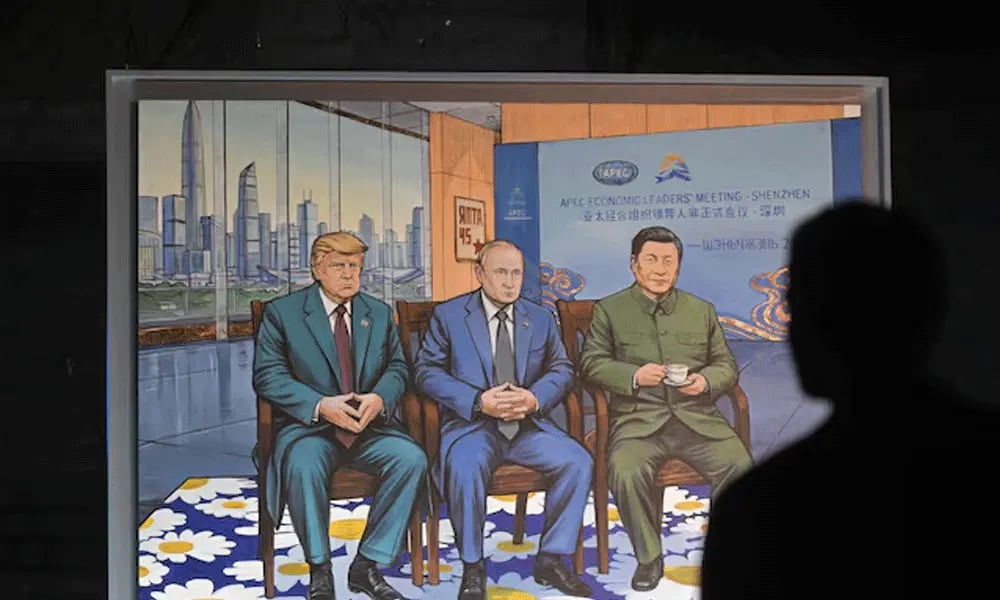
November 14, 2026 · 0 shares
The report is largely attributed news but intermittently adopts evaluative framing—labeling the summit 'historic,' calling Iran 'his war,' and invoking a cautionary Yalta analogy—while relying heavily on unnamed U.S. officials.
Helium Analysis
Limitations: The supplied text is duplicated and includes many unrelated related-link headlines; only the substantive trilateral-meeting report was analyzed.
·
55 of 55 available dimensions scored; omitted dimensions are not treated as neutral.
·
Verified supporting quotes for 8 of 55 scored dimensions.
Claim: The report mostly reports attributed plans but includes evaluative characterizations such as calling Iran 'his war.'
“his war in Iran” · exact text match
Why: Attributing the Iran war personally to Trump is a subjective framing choice rather than neutral description.
Claim: The report uses modestly sensational framing by labeling the planned summit 'historic.'
“historic trilateral meeting” · exact text match
Why: 'Historic' emphasizes significance beyond a routine diplomatic announcement.
Claim: The report is overwhelmingly descriptive of announced plans and official statements rather than prescribing policy.
“Trump wants to talk about reducing nuclear arsenals at the trilateral talks on Thursday” · exact text match
Why: It describes intended agenda items and official expectations without advocating a course of action.
Claim: The report includes some evaluative opinion, notably a cautionary judgment about great-power spheres of influence.
“may not guarantee security” · exact text match
Why: This is an evaluative judgment about the consequences of a 1945-style division, not a direct factual report.
Claim: The report is centrally about a U.S.-Russia-China leaders' summit and geopolitical agenda.
“the first three-way meeting between the leaders of the United States, Russia and China” · exact text match
Why: The entire report concerns heads-of-state diplomacy and security policy.
Claim: The report is generally credible in its visible sourcing, with repeated attribution to named and anonymous U.S. officials and direct quotations.
“the White House said Friday” · exact text match
“a senior US official, speaking on condition of anonymity, told reporters on a call.” · exact text match
Why: It attributes central claims to the White House and quotes officials, though some evaluative framing and anonymous sourcing limit certainty.
Claim: The report is largely rational in structure, providing context and attributing official claims rather than relying on emotional reasoning.
“The meeting calls back to the 1945 Yalta summit in the Soviet Union” · exact text match
Why: It supplies historical context and official attributions, though some loaded phrasing qualifies this.
Claim: The report relies on future expectations and forecasts about what will and will not be discussed.
“he is not expected to discuss Russia’s war in Ukraine” · exact text match
Why: The agenda is framed through expected future conduct rather than confirmed outcomes.
The supplied text is duplicated and includes many unrelated related-link headlines; only the substantive trilateral-meeting report was analyzed.
November 14, 2026 · 0 shares
Framing is largely neutral and source-attributed, with a 'historic' label for the planned trilateral meeting balanced by caveats that Moscow and Beijing have not commented and no agreement is expected.
Helium Analysis
Limitations: The supplied text includes unrelated teaser links and formatting artifacts, and one attribution has a missing outlet name; analysis is limited to the main report.
·
10 of 55 available dimensions scored; omitted dimensions are not treated as neutral.
·
Verified supporting quotes for 10 of 10 scored dimensions.
Claim: Framing mostly reports attributed plans and official statements rather than publisher opinion.
“the White House has said” · exact text match
“an unnamed, senior American official said, according to news agencies AP and Reuters” · exact text match
Why: Attribution to officials and wire agencies keeps the account reportorial.
Claim: The report uses a 'historic' characterization but is otherwise measured and caveated.
“The historic meeting between the leaders of the US, Russia and China will take place” · exact text match
“No agreement was expected to follow the talks” · exact text match
Why: A single significance label is balanced by explicit low expectations, so the overall tone is not strongly sensational.
Claim: The planned trilateral meeting is presented as a major, unusual geopolitical event.
“The historic meeting between the leaders of the US, Russia and China” · exact text match
Why: The subject and 'historic' label signal high newsworthiness.
Claim: The report describes planned events and official statements without advocating a policy.
“the White House has said” · exact text match
“No agreement was expected to follow the talks” · exact text match
Why: No prescriptive recommendation appears; the content is descriptive.
Claim: The report is explicitly about a planned meeting of national political leaders and a summit.
“Donald Trump, Vladimir Putin and Xi Jinping are planning to meet on the sidelines of a summit in China next week” · exact text match
Why: The subject is high-level politics and statecraft, making the coverage political.
Claim: Sourcing is visible through a named White House spokeswoman, wire agencies, state media, and caveats.
“spokeswoman Olivia Wales told reporters” · exact text match
“according to news agencies AP and Reuters” · exact text match
Why: Multiple attributed sources and acknowledged gaps support credibility.
Claim: The report relies on attributed statements and explicitly notes unresolved confirmation and expected outcomes.
“Moscow and Beijing are yet to comment.” · exact text match
“No agreement was expected to follow the talks, an unnamed, senior American official said, according to news agencies AP and Reuters.” · exact text match
Why: Caveats and sourcing indicate evidence-bounded reporting rather than emotional or irrational reasoning.
Claim: The report includes forward-looking expectations about topics and outcomes.
“It is understood Iran may also be discussed during the meeting” · exact text match
“No agreement was expected to follow the talks” · exact text match
Why: Future agenda and expected outcome are forecasts, though attributed and hedged.
Claim: The report discloses key limits: no comment from Moscow or Beijing and no expected agreement.
“Moscow and Beijing are yet to comment.” · exact text match
“No agreement was expected to follow the talks” · exact text match
Why: Explicitly flagging unconfirmed parties and low expected outcomes shows fairness and honesty.
Claim: The report is structured with attribution, context, and caveats rather than simplistic assertion.
“A nuclear weapons control treaty between the US and Russia expired in February” · exact text match
“Moscow and Beijing are yet to comment.” · exact text match
Why: Contextualizing arms control and confirmation status shows analytical coherence.
The supplied text includes unrelated teaser links and formatting artifacts, and one attribution has a missing outlet name; analysis is limited to the main report.
November 14, 2026 · 0 shares
The lead item is a brief, attribution-bound announcement relayed from the White House, framed around an 'unprecedented' trilateral meeting and contextualized by the lapse of US–Russia nuclear arms caps, with no evaluative language beyond those framing choices.
Helium Analysis
Limitations: The supplied text is a scrambled aggregation of unrelated headlines and short snippets from a single outlet, so framing analysis is confined largely to the two-sentence lead item on the Trump–Xi–Putin meeting and a few isolated snippets.
·
11 of 55 available dimensions scored; omitted dimensions are not treated as neutral.
·
Verified supporting quotes for 9 of 11 scored dimensions.
Claim: The lead report is presented through attributed official sourcing rather than the writer's interpretation.
“the White House has said” · exact text match
Why: The central claim is explicitly attributed to an external official source, keeping the framing descriptive.
Claim: Presentation is restrained, with only mild intensification via the word 'unprecedented'.
“are set to hold an unprecedented three-way meeting next week, the White House has said” · exact text match
Why: Aside from one descriptive superlative, the item uses flat announcement language rather than dramatic imagery or urgency cues.
Claim: The reported development is a novel trilateral heads-of-state meeting.
“an unprecedented three-way meeting” · exact text match
Why: Great-power summitry framed as a first-time event carries notable news interest.
Claim: The context paragraph foregrounds a lapse in nuclear arms control.
“leaving the world’s two countries with the largest atomic arsenals without caps for the first time in more than 50 years” · exact text match
Why: The arms-control lapse is stated factually, but its placement adds a mildly ominous frame to the announcement.
Claim: The item is entirely about heads of state and a diplomatic summit.
“US President Donald Trump, Chinese President Xi Jinping and Russian leader Vladimir Putin will meet on the sidelines of the Asia-Pacific Economic Cooperation (APEC) summit” · exact text match
Why: The subject matter is state-level geopolitics, squarely political.
Claim: The report frames the event through official government announcement rather than independent verification or critical scrutiny.
“the White House assistant press secretary confirmed in an announcement” · exact text match
Why: The sole sourcing is an official spokesperson, so the framing aligns with the announcing government's account without additional checks.
Claim: Claims are attributed to named official sources, though sourcing is thin and single-outlet.
“the White House assistant press secretary confirmed in an announcement” · exact text match
Why: Attribution to an official spokesperson is visible, but no named individual, document, or corroboration is provided.
Claim: A future, not-yet-occurred event is reported as settled scheduling.
“are set to hold an unprecedented three-way meeting next week” · exact text match
Why: The item describes a planned future summit without noting confirmation status or logistical uncertainty.
Claim: The report is a short, straightforward announcement with limited analysis.
“Leaders of the United States, China and Russia are set to hold an unprecedented three-way meeting next week, the White House has said.” · exact text match
Why: Simple declarative structure with minimal context or explanatory depth.
The supplied text is a scrambled aggregation of unrelated headlines and short snippets from a single outlet, so framing analysis is confined largely to the two-sentence lead item on the Trump–Xi–Putin meeting and a few isolated snippets.
November 14, 2026 · 0 shares
Framing is largely neutral and source-attributed, with a 'historic' label for the planned trilateral meeting balanced by caveats that Moscow and Beijing have not commented and no agreement is expected.
Helium Analysis Limitations: The supplied text includes unrelated teaser links and formatting artifacts, and one attribution has a missing outlet name; analysis is limited to the main report. · 10 of 55 available dimensions scored; omitted dimensions are not treated as neutral. · Verified supporting quotes for 10 of 10 scored dimensions.
Claim: Framing mostly reports attributed plans and official statements rather than publisher opinion.
“the White House has said” · exact text match
“an unnamed, senior American official said, according to news agencies AP and Reuters” · exact text match
Why: Attribution to officials and wire agencies keeps the account reportorial.
Claim: The report uses a 'historic' characterization but is otherwise measured and caveated.
“The historic meeting between the leaders of the US, Russia and China will take place” · exact text match
“No agreement was expected to follow the talks” · exact text match
Why: A single significance label is balanced by explicit low expectations, so the overall tone is not strongly sensational.
Claim: The planned trilateral meeting is presented as a major, unusual geopolitical event.
“The historic meeting between the leaders of the US, Russia and China” · exact text match
Why: The subject and 'historic' label signal high newsworthiness.
Claim: The report describes planned events and official statements without advocating a policy.
“the White House has said” · exact text match
“No agreement was expected to follow the talks” · exact text match
Why: No prescriptive recommendation appears; the content is descriptive.
Claim: The report is explicitly about a planned meeting of national political leaders and a summit.
“Donald Trump, Vladimir Putin and Xi Jinping are planning to meet on the sidelines of a summit in China next week” · exact text match
Why: The subject is high-level politics and statecraft, making the coverage political.
Claim: Sourcing is visible through a named White House spokeswoman, wire agencies, state media, and caveats.
“spokeswoman Olivia Wales told reporters” · exact text match
“according to news agencies AP and Reuters” · exact text match
Why: Multiple attributed sources and acknowledged gaps support credibility.
Claim: The report relies on attributed statements and explicitly notes unresolved confirmation and expected outcomes.
“Moscow and Beijing are yet to comment.” · exact text match
“No agreement was expected to follow the talks, an unnamed, senior American official said, according to news agencies AP and Reuters.” · exact text match
Why: Caveats and sourcing indicate evidence-bounded reporting rather than emotional or irrational reasoning.
Claim: The report includes forward-looking expectations about topics and outcomes.
“It is understood Iran may also be discussed during the meeting” · exact text match
“No agreement was expected to follow the talks” · exact text match
Why: Future agenda and expected outcome are forecasts, though attributed and hedged.
Claim: The report discloses key limits: no comment from Moscow or Beijing and no expected agreement.
“Moscow and Beijing are yet to comment.” · exact text match
“No agreement was expected to follow the talks” · exact text match
Why: Explicitly flagging unconfirmed parties and low expected outcomes shows fairness and honesty.
Claim: The report is structured with attribution, context, and caveats rather than simplistic assertion.
“A nuclear weapons control treaty between the US and Russia expired in February” · exact text match
“Moscow and Beijing are yet to comment.” · exact text match
Why: Contextualizing arms control and confirmation status shows analytical coherence.
The supplied text includes unrelated teaser links and formatting artifacts, and one attribution has a missing outlet name; analysis is limited to the main report.
November 14, 2026 · 0 shares
Straight wire-service reporting with attributed official statements and balanced inclusion of Chinese reservations, showing minimal publisher framing.
Helium Analysis Limitations: The supplied text includes duplicated blocks and a truncated warhead-stockpile sentence, so some details may be missing. · 13 of 55 available dimensions scored; omitted dimensions are not treated as neutral. · Verified supporting quotes for 13 of 13 scored dimensions.
Claim: The report presents the White House agenda and China's objections without ideological framing.
“Trump’s repeated insistence that the first-of-its-kind meeting of the three leaders focus on nuclear arms reductions has riled China” · exact text match
“China has rebuffed attempts to talk about nuclear arms with Russia and the United States” · exact text match
Why: Including both the US initiative and Chinese resistance shows measured neutrality on the liberal-conservative dimension.
Claim: Official sources dominate the report, but the framing is procedural rather than populist or elitist.
“the White House said on Friday (Nov 14)” · exact text match
“a senior Trump administration official said regarding the nuclear issue” · exact text match
Why: The article relies on official voices without adopting a populist or elitist stance.
Claim: The report relies on official statements and third-party data rather than publisher opinion.
“according to the Stockholm International Peace Research Institute” · exact text match
“the White House said on Friday (Nov 14)” · exact text match
Why: Sourcing and data attribution support an objective classification.
Claim: The language is flat and procedural, without sensational descriptors.
“Putin, Xi and Trump are expected to meet on the sidelines of the Asia-Pacific Economic Cooperation forum in Shenzhen.” · exact text match
Why: Neutral, procedural wording indicates an objective rather than sensational presentation.
Claim: The article describes planned meetings and positions without advocating a policy outcome.
“US President Donald Trump will raise nuclear-arms reduction at a meeting in China next week with Russian President Vladimir Putin and Chinese President Xi Jinping, the White House said on Friday (Nov 14).” · exact text match
Why: The report is descriptive rather than prescriptive.
Claim: The text is almost entirely attributed reporting rather than publisher opinion.
““He will discuss the reduction of nuclear weapons in the world, whose proliferation President Trump believes is very dangerous,” Olivia Wales, a White House spokeswoman, said on a call with reporters.” · exact text match
Why: Opinions are quoted and attributed, not presented as the publisher's own.
Claim: The report centers on presidential diplomacy, summitry, and nuclear-arms policy.
“US President Donald Trump will raise nuclear-arms reduction at a meeting in China next week with Russian President Vladimir Putin and Chinese President Xi Jinping, the White House said on Friday (Nov 14).” · exact text match
Why: The subject matter is explicitly political and diplomatic.
Claim: The report flags uncertainty about whether Russia and China will engage and whether any agreement will be reached.
““We do not expect to get to any kind of agreement,” a senior Trump administration official said regarding the nuclear issue.” · exact text match
“It was not clear whether Russia or China intended to engage in a conversation about arms reductions with Trump.” · exact text match
Why: Explicit uncertainty limits overconfidence.
Claim: The tone is neutral and procedural, with emotional language confined to quotes.
“Trump is leaving on Monday for a four-day trip to Asia that also includes a stop in the Philippines.” · exact text match
Why: Flat factual phrasing indicates low emotional loading.
Claim: Multiple named or official sources, third-party data, and explicit no-comment and uncertainty notes support credibility.
“according to the Stockholm International Peace Research Institute” · exact text match
“The Chinese and Russian embassies in Washington did not immediately respond to emailed requests for comment.” · exact text match
Why: Visible sourcing and transparency support a high credibility score.
Claim: Claims are attributed to named or official sources and uncertainty is acknowledged.
“the White House said on Friday (Nov 14)” · exact text match
“It was not clear whether Russia or China intended to engage in a conversation about arms reductions with Trump.” · exact text match
Why: Attribution and explicit uncertainty indicate rational epistemic practice.
Claim: Future plans and expectations are reported but attributed to officials and framed as expectations.
“Putin, Xi and Trump are expected to meet on the sidelines of the Asia-Pacific Economic Cooperation forum in Shenzhen.” · exact text match
“Trump will also raise the US-Israeli war against Iran in the meeting but is not expected to raise Russia’s war in Ukraine, the official said.” · exact text match
Why: Forward-looking claims are attributed and hedged, indicating moderate rather than high speculation.
Claim: The report includes opposing positions, data attribution, and acknowledgment of unanswered comment requests.
“The Chinese and Russian embassies in Washington did not immediately respond to emailed requests for comment.” · exact text match
“China has rebuffed attempts to talk about nuclear arms with Russia and the United States” · exact text match
Why: Balanced sourcing and transparency about non-responses support high integrity.
The supplied text includes duplicated blocks and a truncated warhead-stockpile sentence, so some details may be missing.
November 14, 2026 · 0 shares
Largely attributed and measured reporting, but it relies on unsourced motive framing about Xi and the Kremlin and on speculative summit consequences.
Helium Analysis Limitations: The supplied text includes repeated subscriber-promo fragments and internally unusual future-dated events; bias scoring is limited to the surviving substantive article. · 10 of 55 available dimensions scored; omitted dimensions are not treated as neutral. · Verified supporting quotes for 10 of 10 scored dimensions.
Claim: Mostly objective attribution is present, but the report also asserts unsourced motives for Xi and the Kremlin.
“according to Pentagon estimates” · exact text match
“By agreeing to host the meeting, Xi may be calculating that the moment offers him an opportunity to flex China’s growing clout and prestige.” · exact text match
Why: Attribution supports objectivity, while speculative motive framing pulls the score toward subjective.
Claim: The report uses measured, non-sensational language about the summit and its limited expected outcomes.
“It is not anticipated that any sort of agreement will come from the trilateral meeting, according to a senior U.S. official” · exact text match
Why: Explicit expectation of no agreement and attributed language are restrained rather than sensational.
Claim: The report describes planned meetings and stated positions rather than prescribing policy.
“Trump intends to discuss the Iran war with the two leaders, but not the war in Ukraine, according to a senior U.S. official” · exact text match
Why: Descriptive reporting of agenda items supports a descriptive classification.
Claim: There is limited evaluative framing in a subheading about Beijing’s uncertainty.
“Beijing was least certain about the value of the summit” · exact text match
Why: This unhedged evaluative line is a small opinionative element in otherwise reported copy.
Claim: The article is centrally about heads of state, nuclear diplomacy, and wars.
“President Donald Trump will meet with the leaders of China and Russia on the sidelines of the Asia-Pacific Economic Cooperation summit in Shenzen” · exact text match
Why: Leadership summit and security policy content make the article highly political.
Claim: The report uses named officials, named experts, estimates, and attributed claims.
“said Hoo Tiang Boon, a professor of Chinese foreign policy at Nanyang Technological University” · exact text match
“according to a senior U.S. official” · exact text match
Why: Visible sourcing and attribution support high credibility.
Claim: The report relies on attributed official statements, estimates, and expert comment rather than emotional assertion.
“according to a senior U.S. official” · exact text match
“said Hoo Tiang Boon, a professor of Chinese foreign policy at Nanyang Technological University” · exact text match
Why: Named attribution and expert sourcing support a rational/evidence-bound classification.
Claim: The report includes speculative motive and consequence framing about the summit.
“By agreeing to host the meeting, Xi may be calculating that the moment offers him an opportunity to flex China’s growing clout and prestige.” · exact text match
“The trilateral meeting could undercut China’s push to portray itself as a defender of free trade at APEC” · exact text match
Why: Motive and consequence forecasts are explicitly speculative, though mixed with reported fact.
Claim: The report includes competing perspectives and qualifications, including Kremlin and Ukrainian concerns.
“Kremlin spokesman Dmitry Peskov has dismissed the Yalta comparisons” · exact text match
“Ukrainian President Volodymyr Zelenskyy has expressed concern that the trilateral meeting could serve as a platform for discussing a possible Ukraine deal behind Kyiv’s back.” · exact text match
Why: Including contrary and concerned voices supports high integrity.
Claim: The report supplies historical and strategic context for the summit.
“The last nuclear arms pact between Russia and the United States expired in February, removing caps on the two largest atomic arsenals for the first time in more than a half-century.” · exact text match
Why: Contextual explanation of New START supports above-average article intelligence.
The supplied text includes repeated subscriber-promo fragments and internally unusual future-dated events; bias scoring is limited to the surviving substantive article.
Official-source-driven framing attributes the summit's agenda, limits, and significance mainly to White House briefers, with little independent confirmation from Chinese or Russian counterparts.
Helium Analysis Limitations: The supplied text appears scraped and possibly synthetic, with a missing publication name and an unverified Nvidia scandal passage, limiting confidence in provenance and AI-authorship judgments. · 16 of 55 available dimensions scored; omitted dimensions are not treated as neutral. · Verified supporting quotes for 15 of 16 scored dimensions.
Claim: No partisan or ideological framing is evident in the diplomatic report.
“The White House confirmed to The that US President Donald Trump will hold a trilateral summit with Chinese President Xi Jinping and Russian President Vladimir Putin” · verified after text normalization
Why: The report stays focused on official diplomatic plans without liberal or conservative ideological descriptors.
Claim: The subhead amplifies a White House official's condescending 'adult conversations' framing of China.
“Time for China to have 'adult conversations,' White House official says” · exact text match
“We do think it's time for China to sort of step up, you know, to the adults' table, if you will, and have adult conversations about adult things” · not found in supplied text
Why: The publisher selects and repeats elite-condescension language, though it is attributed to an official.
Claim: Largely factual and attributed, with limited evaluative framing.
“The White House did not specify the exact date or time of the trilateral summit.” · exact text match
“The official offered no details about what Trump intends to propose to the Russian and Chinese leaders regarding Iran” · exact text match
Why: Notes missing details rather than speculating.
Claim: Measured language avoids sensationalism in the main diplomatic reporting.
“senior US officials cautioned that the administration does not expect the first meeting to produce a nuclear arms control agreement but that it may begin the process.” · exact text match
Why: Cautious phrasing and explicit uncertainty.
Claim: Reports planned meetings and statements without recommending action.
“The official also clarified that there is no separate bilateral meeting scheduled between Trump and Putin during the visit.” · exact text match
Why: Descriptive scheduling detail with no prescriptive language.
Claim: Includes scandal details about Nvidia CEO's extramarital relationships.
“Huang resigned this week following revelations about extramarital relationships, including one involving a woman US intelligence officials reportedly suspect of working for Chinese intelligence, as well as reports of relationships with company employees.” · exact text match
Why: Personal scandal details are included beyond the diplomatic agenda.
Claim: Mostly factual, but contains evaluative characterization of the summit's importance.
“Its centerpiece, however, will be the trilateral summit with Xi and Putin – an effort to initiate a new discussion about nuclear arms control among the three powers while the war in Iran continues and their wider strategic relationships remain under strain.” · exact text match
Why: The 'centerpiece' and 'effort to initiate' language is mildly interpretive.
Claim: Focuses on high-level diplomacy, war, and nuclear-security policy.
“The White House confirmed to The that US President Donald Trump will hold a trilateral summit with Chinese President Xi Jinping and Russian President Vladimir Putin” · verified after text normalization
“A senior US official confirmed that Trump intends to raise the war in Iran during his meeting with Xi and Putin” · exact text match
Why: The subject matter is explicitly political and security-focused.
Claim: Key details rest on unnamed senior US officials and White House briefers.
“a senior US official said” · exact text match
“The official offered no details about what Trump intends to propose to the Russian and Chinese leaders regarding Iran” · exact text match
Why: Authority-based attribution supplies the central facts.
Claim: Relies primarily on White House and senior US officials for the summit account.
“The White House confirmed to The that US President Donald Trump will hold a trilateral summit with Chinese President Xi Jinping and Russian President Vladimir Putin” · verified after text normalization
“During a briefing that the Post attended, senior US officials cautioned that the administration does not expect the first meeting to produce a nuclear arms control agreement but that it may begin the process.” · exact text match
Why: Official sources dominate the report, centering the administration perspective.
Claim: Attributed reporting with caveats supports credibility, though an unverified scandal passage lowers confidence.
“During a briefing that the Post attended, senior US officials cautioned that the administration does not expect the first meeting to produce a nuclear arms control agreement but that it may begin the process.” · exact text match
Counterevidence:
“Huang resigned this week following revelations about extramarital relationships, including one involving a woman US intelligence officials reportedly suspect of working for Chinese intelligence, as well as reports of relationships with company employees.” · exact text match
Why: Sourcing and uncertainty are visible, but not every passage is adequately attributed.
Claim: Uses calibrated, caveated language about what the summit can achieve.
“We do not expect to get to any kind of agreement” · exact text match
“the entry point, the first conversation” · exact text match
Why: Explicitly limits expectations and frames the meeting as preliminary.
Claim: Includes forward-looking expectations about summit outcomes and trip significance.
“officials cautioned that the administration does not expect the first meeting to produce a nuclear arms control agreement but that it may begin the process.” · exact text match
“The trip will place Trump at the center of a series of major diplomatic and economic discussions across Asia.” · exact text match
Why: Forecasts are present, though mostly attributed to officials.
Claim: Formulaic repeated official-attribution sentences and an oddly specific unsourced scandal passage suggest possible AI generation.
“The official also clarified that there is no separate bilateral meeting scheduled between Trump and Putin during the visit.” · exact text match
“Huang resigned this week following revelations about extramarital relationships, including one involving a woman US intelligence officials reportedly suspect of working for Chinese intelligence, as well as reports of relationships with company employees.” · exact text match
Why: Multiple independent textual features align with synthetic or machine-generated news copy.
Claim: Discloses sourcing and limits of official information.
“During a briefing that the Post attended, senior US officials cautioned that the administration does not expect the first meeting to produce a nuclear arms control agreement but that it may begin the process.” · exact text match
“The White House did not specify the exact date or time of the trilateral summit.” · exact text match
Why: Attribution and caveats indicate fair handling, though some passages remain unverified.
Claim: Organizes complex diplomatic details and distinguishes confirmed plans from unspecified outcomes.
“The White House did not specify the exact date or time of the trilateral summit.” · exact text match
“The official offered no details about what Trump intends to propose to the Russian and Chinese leaders regarding Iran, or whether Washington will seek their support for a new diplomatic initiative to end the conflict.” · exact text match
Why: Clear structure and attention to evidentiary limits.
The supplied text appears scraped and possibly synthetic, with a missing publication name and an unverified Nvidia scandal passage, limiting confidence in provenance and AI-authorship judgments.
November 14, 2026 · 0 shares
The report is largely neutral and attribution-driven, though it leans on official US sources and mildly dramatizes the event as 'historic' while using loaded phrasing such as 'his war in Iran'.
Helium Analysis Limitations: The supplied text contains unusual or unverified specifics, such as a supposed Nvidia CEO resignation and the phrase 'his war in Iran', that cannot be checked against outside sources here. · 15 of 55 available dimensions scored; omitted dimensions are not treated as neutral. · Verified supporting quotes for 15 of 15 scored dimensions.
Claim: The report contains no discernible left-right ideological framing.
“the White House said Friday.” · exact text match
“US officials said.” · exact text match
Why: The article attributes plans to official sources without partisan labels or ideological characterization.
Claim: The report is predominantly objective, relying on attributed statements rather than the publisher's subjective evaluation.
“the White House said Friday.” · exact text match
“US officials said.” · exact text match
Why: Official attribution and conditional phrasing dominate the article.
Claim: The piece is largely factual rather than sensational, though the headline uses 'historic'.
“the White House said Friday.” · exact text match
Counterevidence:
“historic meeting” · exact text match
Why: Most body text is procedural and attributed; the headline mildly dramatizes the event.
Claim: The reported first-ever trilateral summit is substantively newsworthy.
“the first ever three-way meeting between the leaders of the United States, Russia and China” · exact text match
Why: The event is novel and high-stakes.
Claim: The article describes planned meetings and agenda items without prescribing policy.
“Trump will also hold a bilateral working lunch and meeting with the Chinese president on Thursday” · exact text match
Why: It reports schedule and intentions, not recommendations.
Claim: It includes a personal scandal detail about Nvidia's CEO but says it is not expected to affect the meetings.
“Nvidia chief executive Jensen Huang's resignation over an affair with an alleged Chinese spy” · exact text match
Why: The affair and spy detail is gossip-adjacent, though contextualized as not expected to arise.
Claim: The content is centrally about heads of state, diplomacy, and war and security policy.
“Trump, Xi, Putin to hold historic meeting in China” · exact text match
Why: The subject is explicitly political and diplomatic.
Claim: The report relies heavily on White House and unnamed US officials as the source of its claims.
“a senior US official, speaking on condition of anonymity, told reporters on a call.” · exact text match
“White House spokeswoman Olivia Wales told reporters.” · exact text match
Why: Agenda details are asserted through official authority, with little independent corroboration in the text.
Claim: The report is sourced almost entirely from US government officials and presents their agenda framing.
“the White House said Friday.” · exact text match
“US officials said.” · exact text match
Why: Official sources define the story's facts and boundaries.
Claim: The tone is neutral and procedural.
“the officials said.” · exact text match
Why: No emotional language or outrage framing appears in the body.
Claim: The article shows visible sourcing and uncertainty but relies on anonymous officials for key claims.
“the White House said Friday.” · exact text match
“speaking on condition of anonymity” · exact text match
Why: Named and anonymous attributions are present, though key details are not independently verified in the supplied text.
Claim: The reporting is structured and evidence-bound rather than irrational or emotive.
“a senior US official, speaking on condition of anonymity, told reporters on a call.” · exact text match
“not expected to discuss Russia's war in Ukraine” · exact text match
Why: It separates known plans from expectations and attributes them to officials.
Claim: It includes forecast and expectation language about what will or will not be discussed.
“is not expected to discuss Russia's war in Ukraine” · exact text match
“But Trump is not scheduled to have a separate one-on-one with Putin.” · exact text match
Why: Planned and expected agenda items are framed prospectively, though attributed.
Claim: The article discloses sourcing and uncertainty.
“speaking on condition of anonymity” · exact text match
“is not expected to discuss Russia's war in Ukraine” · exact text match
Why: It labels anonymous sourcing and distinguishes expectations from confirmed plans.
Claim: The report is organized around agenda, venue, participants, and explicit exclusions.
“One of the major conflicts dominating Trump's second term as president will feature, but the other will not, the US officials said.” · exact text match
Why: It clearly distinguishes included and excluded topics.
The supplied text contains unusual or unverified specifics, such as a supposed Nvidia CEO resignation and the phrase 'his war in Iran', that cannot be checked against outside sources here.
November 14, 2026 · 0 shares
The report is largely neutral and attribution-driven, grounding the meeting claim in White House and anonymous US official statements while noting that Moscow and Beijing had not commented.
Helium Analysis Limitations: The supplied text mixes substantive reporting with Euronews promotional and navigation fragments; the analysis relies only on the meeting report and excludes those wrappers. · 13 of 55 available dimensions scored; omitted dimensions are not treated as neutral. · Verified supporting quotes for 13 of 13 scored dimensions.
Claim: The report avoids left-right ideological framing.
“The trilateral meeting is scheduled to take place in Shenzhen in southeastern China on the sidelines of the Asia-Pacific Economic Cooperation (APEC) summit, according to the White House.” · exact text match
Why: A neutral scheduling statement attributed to the White House without ideological valence supports a measured-neutral score.
Claim: The report is framed objectively through attributed statements.
“The trilateral meeting is scheduled to take place in Shenzhen in southeastern China on the sidelines of the Asia-Pacific Economic Cooperation (APEC) summit, according to the White House.” · exact text match
“US officials said, per the AFP news agency.” · exact text match
Why: The central claims are presented as attributed official statements rather than the reporter's subjective interpretation.
Claim: The language is measured and avoids sensationalism.
“Moscow and Beijing have so far not commented on the reported meeting.” · exact text match
Why: The report notes non-confirmation in sober language rather than using alarmist or dramatic framing.
Claim: The reported leaders' meeting is high-interest geopolitical news.
“US President Donald Trump is set to meet with his Russian and Chinese counterparts Vladimir Putin and Xi Jinping in China next week, the White House said on Friday.” · exact text match
Why: A planned meeting among three major-power leaders is inherently consequential and newsworthy.
Claim: The report is descriptive rather than prescriptive.
“The trilateral meeting is scheduled to take place in Shenzhen in southeastern China on the sidelines of the Asia-Pacific Economic Cooperation (APEC) summit, according to the White House.” · exact text match
Why: It describes a scheduled diplomatic meeting without advocating a policy course.
Claim: The content is centrally political and diplomatic.
“The trilateral meeting is scheduled to take place in Shenzhen in southeastern China on the sidelines of the Asia-Pacific Economic Cooperation (APEC) summit, according to the White House.” · exact text match
“Trump is also expected to discuss the Iran war but not Ukraine, US officials said, per the AFP news agency.” · exact text match
Why: The report concerns heads of state, summit diplomacy, nuclear weapons, and war-related talks.
Claim: The report relies primarily on official US sources.
“the White House said on Friday.” · exact text match
“US officials said, per the AFP news agency.” · exact text match
Why: Official-source attribution without independent confirmation gives a mild pro-establishment sourcing pattern.
Claim: The report uses neutral, unemotional language.
“Moscow and Beijing have so far not commented on the reported meeting.” · exact text match
Why: The phrasing is factual and avoids emotive or evaluative language.
Claim: The report is credible in its visible sourcing and caveats.
“the White House said on Friday.” · exact text match
“Moscow and Beijing have so far not commented on the reported meeting.” · exact text match
Why: Specific attribution and a clear non-confirmation caveat are visible credibility signals in the supplied text.
Claim: The report is evidence-oriented and caveated rather than irrational.
“The trilateral meeting is scheduled to take place in Shenzhen in southeastern China on the sidelines of the Asia-Pacific Economic Cooperation (APEC) summit, according to the White House.” · exact text match
“Moscow and Beijing have so far not commented on the reported meeting.” · exact text match
Why: It attributes the claim and explicitly notes non-confirmation by two key governments.
Claim: The report contains limited future-oriented speculation about planned topics and travel.
“Trump is also expected to discuss the Iran war but not Ukraine, US officials said, per the AFP news agency.” · exact text match
“The president is set to depart Washington on Monday for the Philippines, where he is due to attend a meeting of the Association of Southeast Asian Nations before making his way to Shenzhen.” · exact text match
Why: The forward-looking schedule and topic expectations are attributed to officials but remain forecasts about future events.
Claim: The report shows fairness and honesty by attributing claims and noting non-confirmation.
“the White House said on Friday.” · exact text match
“Moscow and Beijing have so far not commented on the reported meeting.” · exact text match
Why: Clear attribution and disclosure of non-confirmation are observable integrity signals.
Claim: The report distinguishes sources and notes the limits of confirmation.
“A senior US official speaking on condition of anonymity said Washington had a "whole other track" of negotiations with Kyiv and Moscow aimed at bringing about an end to the war in Ukraine.” · exact text match
“Moscow and Beijing have so far not commented on the reported meeting.” · exact text match
Why: It separates named, anonymous, and foreign-government sourcing and flags absent confirmation.
The supplied text mixes substantive reporting with Euronews promotional and navigation fragments; the analysis relies only on the meeting report and excludes those wrappers.
November 14, 2026 · 0 shares
Neutral, official-source-driven diplomatic report that presents the announced trilateral meeting and agenda through White House and unnamed US officials without evaluative language.
Helium Analysis Limitations: No independent corroboration is provided beyond White House and unnamed US officials, and several extraordinary claims are reported only as official plans. · 13 of 55 available dimensions scored; omitted dimensions are not treated as neutral. · Verified supporting quotes for 13 of 13 scored dimensions.
Claim: The report does not use left-right ideological labels; it relays a policy agenda from officials.
“The president has made it clear that, among other topics, he will discuss the reduction of nuclear weapons in the world.” · exact text match
Why: The quoted agenda is a neutral policy topic presented without liberal or conservative framing.
Claim: The report is predominantly objective, attributing plans and expectations to named and unnamed officials rather than expressing the publisher's own judgments.
“the White House has said” · exact text match
“US officials said” · exact text match
Why: Claims are repeatedly attributed to official sources rather than presented as the publisher's subjective conclusions.
Claim: No sensational or emotive language is used to describe the diplomatic meeting.
“White House spokeswoman Olivia Wales told reporters.” · exact text match
Why: The report uses procedural, attributional language rather than dramatic or alarmist phrasing.
Claim: The report describes planned meetings and stated agendas without prescribing policy outcomes.
“Trump wants to talk about reducing nuclear arsenals at the trilateral talks on Thursday” · exact text match
Why: The wording reports an intended agenda rather than advocating a policy prescription.
Claim: The report contains no publisher evaluative conclusions or opinion language.
“US officials said.” · exact text match
Why: Statements are attributed to officials instead of presented as the publisher's opinion.
Claim: The content is overwhelmingly political, concerning heads of state, diplomatic summits, nuclear weapons, war, and export controls.
“Donald Trump, Vladimir Putin and Xi Jinping will hold the first ever three-way meeting between the leaders of the United States, Russia and China” · exact text match
Why: The central subject is a meeting of national leaders and related security and diplomatic issues.
Claim: Nearly all substantive claims are sourced to White House or US officials rather than independent documentation.
“White House spokeswoman Olivia Wales told reporters.” · exact text match
“a senior US official, speaking on condition of anonymity, told reporters on a call.” · exact text match
Why: The report's factual content rests on official authority and anonymous official briefings.
Claim: Framing centers the US administration's official agenda and relies on White House and senior US officials.
“the White House has said” · exact text match
“a senior US official, speaking on condition of anonymity, told reporters on a call.” · exact text match
Why: The report is structured around official US government accounts of the planned meetings.
Claim: The report's tone is unemotional and neutral.
“the White House has said” · exact text match
Why: The language is procedural and lacks emotionally charged descriptors.
Claim: Visible sourcing is attributed to a named White House spokeswoman and senior officials, though key claims rely on anonymous officials.
“White House spokeswoman Olivia Wales told reporters.” · exact text match
“speaking on condition of anonymity” · exact text match
Why: The report uses named and anonymous official attribution, supporting a moderate credibility assessment.
Claim: The report includes limited forward-looking expectations about meeting topics, mostly attributed to officials.
“he is not expected to discuss Russia-Ukraine war” · exact text match
Why: Future agenda expectations are framed as official forecasts rather than independent speculation.
Claim: The report attributes claims to a named spokeswoman and anonymous officials and notes anonymity, showing observable fairness in sourcing.
“White House spokeswoman Olivia Wales told reporters.” · exact text match
“speaking on condition of anonymity” · exact text match
Why: It identifies a named source and explicitly discloses when officials speak anonymously.
Claim: The report is coherent and organized around a clear diplomatic schedule and attributed agenda.
“Trump will leave Washington on Monday and arrive in the Philippines on Tuesday for a summit of the Association of Southeast Asian Nations summit before heading to Shenzhen.” · exact text match
Why: The article presents a structured sequence of meetings, topics, and travel details.
No independent corroboration is provided beyond White House and unnamed US officials, and several extraordinary claims are reported only as official plans.
November 14, 2026 · 0 shares
The lead item is a brief, attribution-bound announcement relayed from the White House, framed around an 'unprecedented' trilateral meeting and contextualized by the lapse of US–Russia nuclear arms caps, with no evaluative language beyond those framing choices.
Helium Analysis Limitations: The supplied text is a scrambled aggregation of unrelated headlines and short snippets from a single outlet, so framing analysis is confined largely to the two-sentence lead item on the Trump–Xi–Putin meeting and a few isolated snippets. · 11 of 55 available dimensions scored; omitted dimensions are not treated as neutral. · Verified supporting quotes for 9 of 11 scored dimensions.
Claim: The lead report is presented through attributed official sourcing rather than the writer's interpretation.
“the White House has said” · exact text match
Why: The central claim is explicitly attributed to an external official source, keeping the framing descriptive.
Claim: Presentation is restrained, with only mild intensification via the word 'unprecedented'.
“are set to hold an unprecedented three-way meeting next week, the White House has said” · exact text match
Why: Aside from one descriptive superlative, the item uses flat announcement language rather than dramatic imagery or urgency cues.
Claim: The reported development is a novel trilateral heads-of-state meeting.
“an unprecedented three-way meeting” · exact text match
Why: Great-power summitry framed as a first-time event carries notable news interest.
Claim: The context paragraph foregrounds a lapse in nuclear arms control.
“leaving the world’s two countries with the largest atomic arsenals without caps for the first time in more than 50 years” · exact text match
Why: The arms-control lapse is stated factually, but its placement adds a mildly ominous frame to the announcement.
Claim: The item is entirely about heads of state and a diplomatic summit.
“US President Donald Trump, Chinese President Xi Jinping and Russian leader Vladimir Putin will meet on the sidelines of the Asia-Pacific Economic Cooperation (APEC) summit” · exact text match
Why: The subject matter is state-level geopolitics, squarely political.
Claim: The report frames the event through official government announcement rather than independent verification or critical scrutiny.
“the White House assistant press secretary confirmed in an announcement” · exact text match
Why: The sole sourcing is an official spokesperson, so the framing aligns with the announcing government's account without additional checks.
Claim: Claims are attributed to named official sources, though sourcing is thin and single-outlet.
“the White House assistant press secretary confirmed in an announcement” · exact text match
Why: Attribution to an official spokesperson is visible, but no named individual, document, or corroboration is provided.
Claim: A future, not-yet-occurred event is reported as settled scheduling.
“are set to hold an unprecedented three-way meeting next week” · exact text match
Why: The item describes a planned future summit without noting confirmation status or logistical uncertainty.
Claim: The report is a short, straightforward announcement with limited analysis.
“Leaders of the United States, China and Russia are set to hold an unprecedented three-way meeting next week, the White House has said.” · exact text match
Why: Simple declarative structure with minimal context or explanatory depth.
The supplied text is a scrambled aggregation of unrelated headlines and short snippets from a single outlet, so framing analysis is confined largely to the two-sentence lead item on the Trump–Xi–Putin meeting and a few isolated snippets.
November 14, 2026 · 0 shares
Largely attributed and measured reporting, but it relies on unsourced motive framing about Xi and the Kremlin and on speculative summit consequences.
Helium Analysis Limitations: The supplied text includes repeated subscriber-promo fragments and internally unusual future-dated events; bias scoring is limited to the surviving substantive article. · 10 of 55 available dimensions scored; omitted dimensions are not treated as neutral. · Verified supporting quotes for 10 of 10 scored dimensions.
Claim: Mostly objective attribution is present, but the report also asserts unsourced motives for Xi and the Kremlin.
“according to Pentagon estimates” · exact text match
“By agreeing to host the meeting, Xi may be calculating that the moment offers him an opportunity to flex China’s growing clout and prestige.” · exact text match
Why: Attribution supports objectivity, while speculative motive framing pulls the score toward subjective.
Claim: The report uses measured, non-sensational language about the summit and its limited expected outcomes.
“It is not anticipated that any sort of agreement will come from the trilateral meeting, according to a senior U.S. official” · exact text match
Why: Explicit expectation of no agreement and attributed language are restrained rather than sensational.
Claim: The report describes planned meetings and stated positions rather than prescribing policy.
“Trump intends to discuss the Iran war with the two leaders, but not the war in Ukraine, according to a senior U.S. official” · exact text match
Why: Descriptive reporting of agenda items supports a descriptive classification.
Claim: There is limited evaluative framing in a subheading about Beijing’s uncertainty.
“Beijing was least certain about the value of the summit” · exact text match
Why: This unhedged evaluative line is a small opinionative element in otherwise reported copy.
Claim: The article is centrally about heads of state, nuclear diplomacy, and wars.
“President Donald Trump will meet with the leaders of China and Russia on the sidelines of the Asia-Pacific Economic Cooperation summit in Shenzen” · exact text match
Why: Leadership summit and security policy content make the article highly political.
Claim: The report uses named officials, named experts, estimates, and attributed claims.
“said Hoo Tiang Boon, a professor of Chinese foreign policy at Nanyang Technological University” · exact text match
“according to a senior U.S. official” · exact text match
Why: Visible sourcing and attribution support high credibility.
Claim: The report relies on attributed official statements, estimates, and expert comment rather than emotional assertion.
“according to a senior U.S. official” · exact text match
“said Hoo Tiang Boon, a professor of Chinese foreign policy at Nanyang Technological University” · exact text match
Why: Named attribution and expert sourcing support a rational/evidence-bound classification.
Claim: The report includes speculative motive and consequence framing about the summit.
“By agreeing to host the meeting, Xi may be calculating that the moment offers him an opportunity to flex China’s growing clout and prestige.” · exact text match
“The trilateral meeting could undercut China’s push to portray itself as a defender of free trade at APEC” · exact text match
Why: Motive and consequence forecasts are explicitly speculative, though mixed with reported fact.
Claim: The report includes competing perspectives and qualifications, including Kremlin and Ukrainian concerns.
“Kremlin spokesman Dmitry Peskov has dismissed the Yalta comparisons” · exact text match
“Ukrainian President Volodymyr Zelenskyy has expressed concern that the trilateral meeting could serve as a platform for discussing a possible Ukraine deal behind Kyiv’s back.” · exact text match
Why: Including contrary and concerned voices supports high integrity.
Claim: The report supplies historical and strategic context for the summit.
“The last nuclear arms pact between Russia and the United States expired in February, removing caps on the two largest atomic arsenals for the first time in more than a half-century.” · exact text match
Why: Contextual explanation of New START supports above-average article intelligence.
The supplied text includes repeated subscriber-promo fragments and internally unusual future-dated events; bias scoring is limited to the surviving substantive article.
November 14, 2026 · 0 shares
Framing is largely neutral and source-attributed, with a 'historic' label for the planned trilateral meeting balanced by caveats that Moscow and Beijing have not commented and no agreement is expected.
Helium Analysis Limitations: The supplied text includes unrelated teaser links and formatting artifacts, and one attribution has a missing outlet name; analysis is limited to the main report. · 10 of 55 available dimensions scored; omitted dimensions are not treated as neutral. · Verified supporting quotes for 10 of 10 scored dimensions.
Claim: Framing mostly reports attributed plans and official statements rather than publisher opinion.
“the White House has said” · exact text match
“an unnamed, senior American official said, according to news agencies AP and Reuters” · exact text match
Why: Attribution to officials and wire agencies keeps the account reportorial.
Claim: The report uses a 'historic' characterization but is otherwise measured and caveated.
“The historic meeting between the leaders of the US, Russia and China will take place” · exact text match
“No agreement was expected to follow the talks” · exact text match
Why: A single significance label is balanced by explicit low expectations, so the overall tone is not strongly sensational.
Claim: The planned trilateral meeting is presented as a major, unusual geopolitical event.
“The historic meeting between the leaders of the US, Russia and China” · exact text match
Why: The subject and 'historic' label signal high newsworthiness.
Claim: The report describes planned events and official statements without advocating a policy.
“the White House has said” · exact text match
“No agreement was expected to follow the talks” · exact text match
Why: No prescriptive recommendation appears; the content is descriptive.
Claim: The report is explicitly about a planned meeting of national political leaders and a summit.
“Donald Trump, Vladimir Putin and Xi Jinping are planning to meet on the sidelines of a summit in China next week” · exact text match
Why: The subject is high-level politics and statecraft, making the coverage political.
Claim: Sourcing is visible through a named White House spokeswoman, wire agencies, state media, and caveats.
“spokeswoman Olivia Wales told reporters” · exact text match
“according to news agencies AP and Reuters” · exact text match
Why: Multiple attributed sources and acknowledged gaps support credibility.
Claim: The report relies on attributed statements and explicitly notes unresolved confirmation and expected outcomes.
“Moscow and Beijing are yet to comment.” · exact text match
“No agreement was expected to follow the talks, an unnamed, senior American official said, according to news agencies AP and Reuters.” · exact text match
Why: Caveats and sourcing indicate evidence-bounded reporting rather than emotional or irrational reasoning.
Claim: The report includes forward-looking expectations about topics and outcomes.
“It is understood Iran may also be discussed during the meeting” · exact text match
“No agreement was expected to follow the talks” · exact text match
Why: Future agenda and expected outcome are forecasts, though attributed and hedged.
Claim: The report discloses key limits: no comment from Moscow or Beijing and no expected agreement.
“Moscow and Beijing are yet to comment.” · exact text match
“No agreement was expected to follow the talks” · exact text match
Why: Explicitly flagging unconfirmed parties and low expected outcomes shows fairness and honesty.
Claim: The report is structured with attribution, context, and caveats rather than simplistic assertion.
“A nuclear weapons control treaty between the US and Russia expired in February” · exact text match
“Moscow and Beijing are yet to comment.” · exact text match
Why: Contextualizing arms control and confirmation status shows analytical coherence.
The supplied text includes unrelated teaser links and formatting artifacts, and one attribution has a missing outlet name; analysis is limited to the main report.
November 14, 2026 · 0 shares
Largely attributed and measured reporting, but it relies on unsourced motive framing about Xi and the Kremlin and on speculative summit consequences.
Helium Analysis Limitations: The supplied text includes repeated subscriber-promo fragments and internally unusual future-dated events; bias scoring is limited to the surviving substantive article. · 10 of 55 available dimensions scored; omitted dimensions are not treated as neutral. · Verified supporting quotes for 10 of 10 scored dimensions.
Claim: Mostly objective attribution is present, but the report also asserts unsourced motives for Xi and the Kremlin.
“according to Pentagon estimates” · exact text match
“By agreeing to host the meeting, Xi may be calculating that the moment offers him an opportunity to flex China’s growing clout and prestige.” · exact text match
Why: Attribution supports objectivity, while speculative motive framing pulls the score toward subjective.
Claim: The report uses measured, non-sensational language about the summit and its limited expected outcomes.
“It is not anticipated that any sort of agreement will come from the trilateral meeting, according to a senior U.S. official” · exact text match
Why: Explicit expectation of no agreement and attributed language are restrained rather than sensational.
Claim: The report describes planned meetings and stated positions rather than prescribing policy.
“Trump intends to discuss the Iran war with the two leaders, but not the war in Ukraine, according to a senior U.S. official” · exact text match
Why: Descriptive reporting of agenda items supports a descriptive classification.
Claim: There is limited evaluative framing in a subheading about Beijing’s uncertainty.
“Beijing was least certain about the value of the summit” · exact text match
Why: This unhedged evaluative line is a small opinionative element in otherwise reported copy.
Claim: The article is centrally about heads of state, nuclear diplomacy, and wars.
“President Donald Trump will meet with the leaders of China and Russia on the sidelines of the Asia-Pacific Economic Cooperation summit in Shenzen” · exact text match
Why: Leadership summit and security policy content make the article highly political.
Claim: The report uses named officials, named experts, estimates, and attributed claims.
“said Hoo Tiang Boon, a professor of Chinese foreign policy at Nanyang Technological University” · exact text match
“according to a senior U.S. official” · exact text match
Why: Visible sourcing and attribution support high credibility.
Claim: The report relies on attributed official statements, estimates, and expert comment rather than emotional assertion.
“according to a senior U.S. official” · exact text match
“said Hoo Tiang Boon, a professor of Chinese foreign policy at Nanyang Technological University” · exact text match
Why: Named attribution and expert sourcing support a rational/evidence-bound classification.
Claim: The report includes speculative motive and consequence framing about the summit.
“By agreeing to host the meeting, Xi may be calculating that the moment offers him an opportunity to flex China’s growing clout and prestige.” · exact text match
“The trilateral meeting could undercut China’s push to portray itself as a defender of free trade at APEC” · exact text match
Why: Motive and consequence forecasts are explicitly speculative, though mixed with reported fact.
Claim: The report includes competing perspectives and qualifications, including Kremlin and Ukrainian concerns.
“Kremlin spokesman Dmitry Peskov has dismissed the Yalta comparisons” · exact text match
“Ukrainian President Volodymyr Zelenskyy has expressed concern that the trilateral meeting could serve as a platform for discussing a possible Ukraine deal behind Kyiv’s back.” · exact text match
Why: Including contrary and concerned voices supports high integrity.
Claim: The report supplies historical and strategic context for the summit.
“The last nuclear arms pact between Russia and the United States expired in February, removing caps on the two largest atomic arsenals for the first time in more than a half-century.” · exact text match
Why: Contextual explanation of New START supports above-average article intelligence.
The supplied text includes repeated subscriber-promo fragments and internally unusual future-dated events; bias scoring is limited to the surviving substantive article.
A measured but strongly prescriptive elite-internationalist framing presents a Trump-Xi-Putin summit as a worthwhile great-power exercise despite caveats about Trump's past coziness with autocrats.
Helium Analysis Limitations: The supplied text is an explicitly argumentative Foreign Affairs essay, so scores reflect the published authorial framing rather than neutral news reporting. · 15 of 55 available dimensions scored; omitted dimensions are not treated as neutral. · Verified supporting quotes for 15 of 15 scored dimensions.
Claim: The piece criticizes Trump for favoring autocrats over democratic allies, indicating a liberal-internationalist tilt.
“Trump has a track record of cozying up to autocrats and turning his back on democratic allies.” · exact text match
Counterevidence:
“Trump deserves credit for starting a trialogue that his successors can carry forward.” · exact text match
Why: The quoted critique is a liberal-internationalist framing, though the counterquote shows some balance.
Claim: The article explicitly favors elite great-power steering over broad representation.
“Concerts sacrifice representation for efficacy and give only the geopolitically influential states that must be there a seat at the table.” · exact text match
Why: This directly endorses elitist international governance by influential states.
Claim: The piece is explicitly normative and argumentative.
“Trump would be right to join a summit with Xi and Putin.” · exact text match
Why: This is a direct evaluative judgment, not neutral description.
Claim: Tone is measured and analytical rather than sensational.
“The prospects for progress toward ending the war in Ukraine are much dimmer but not nonexistent.” · exact text match
Why: The language is restrained and qualifies rather than dramatizes.
Claim: It issues detailed policy prescriptions.
“Trump should aim low and focus on making meaningful, if limited, progress on a small number of core issues” · exact text match
Why: The quote is a direct recommendation for action.
Claim: The article is an opinion argument with evaluative judgments.
“Trump deserves credit for starting a trialogue that his successors can carry forward.” · exact text match
Why: The quote is an evaluative opinion rather than a neutral report.
Claim: The entire piece is framed around geopolitics and U.S. foreign policy.
“The Korean Peninsula presents the best opportunity for the three leaders to collaborate.” · exact text match
Why: The content is centrally political and strategic.
Claim: It frames world politics through a democracy-versus-autocracy lens while advocating cross-ideological cooperation.
“autocracies and democracies must learn not only to live comfortably alongside one another but also to work together” · exact text match
Why: The quote organizes analysis around regime-type categories, a form of ideological framing.
Claim: It advocates a Concert-of-Europe-style great-power steering group, a core establishment internationalist idea.
“a global concert—an informal steering group of great powers modeled on the nineteenth-century Concert of Europe—offers the best hope of curbing geopolitical competition and enabling collective action in a multipolar world” · exact text match
Why: This explicitly promotes elite multilateral coordination.
Claim: Sourcing and caveats are visible.
“According to The Wall Street Journal, Putin floated the idea of a trialogue last month as an opportunity to discuss ending the war in Ukraine.” · exact text match
“The prospects for progress toward ending the war in Ukraine are much dimmer but not nonexistent.” · exact text match
Why: Attribution and explicit uncertainty support credibility in the supplied text.
Claim: The analysis is hedged and cost-benefit based rather than emotive or simplistic.
“The prospects for progress toward ending the war in Ukraine are much dimmer but not nonexistent.” · exact text match
Why: The quote shows calibrated probability assessment and nuance.
Claim: It favors collective great-power management over unilateral action.
“collective action in a multipolar world” · exact text match
Why: The phrase emphasizes collective international coordination.
Claim: Much of the piece forecasts possible summit outcomes and effects.
“could be holding a three-way summit” · exact text match
“might ultimately yield little progress” · exact text match
Why: The language is explicitly conditional and forecasting.
Claim: It attributes claims and acknowledges uncertainty.
“According to The Wall Street Journal, Putin floated the idea of a trialogue last month as an opportunity to discuss ending the war in Ukraine.” · exact text match
Why: Named sourcing and attribution are visible in the supplied text.
Claim: The argument is analytically sophisticated and structured.
“Concerts sacrifice representation for efficacy and give only the geopolitically influential states that must be there a seat at the table.” · exact text match
Why: The quote reflects a sophisticated conceptual framework.
The supplied text is an explicitly argumentative Foreign Affairs essay, so scores reflect the published authorial framing rather than neutral news reporting.
November 14, 2026 · 0 shares
Straight wire-service reporting with attributed official statements and balanced inclusion of Chinese reservations, showing minimal publisher framing.
Helium Analysis Limitations: The supplied text includes duplicated blocks and a truncated warhead-stockpile sentence, so some details may be missing. · 13 of 55 available dimensions scored; omitted dimensions are not treated as neutral. · Verified supporting quotes for 13 of 13 scored dimensions.
Claim: The report presents the White House agenda and China's objections without ideological framing.
“Trump’s repeated insistence that the first-of-its-kind meeting of the three leaders focus on nuclear arms reductions has riled China” · exact text match
“China has rebuffed attempts to talk about nuclear arms with Russia and the United States” · exact text match
Why: Including both the US initiative and Chinese resistance shows measured neutrality on the liberal-conservative dimension.
Claim: Official sources dominate the report, but the framing is procedural rather than populist or elitist.
“the White House said on Friday (Nov 14)” · exact text match
“a senior Trump administration official said regarding the nuclear issue” · exact text match
Why: The article relies on official voices without adopting a populist or elitist stance.
Claim: The report relies on official statements and third-party data rather than publisher opinion.
“according to the Stockholm International Peace Research Institute” · exact text match
“the White House said on Friday (Nov 14)” · exact text match
Why: Sourcing and data attribution support an objective classification.
Claim: The language is flat and procedural, without sensational descriptors.
“Putin, Xi and Trump are expected to meet on the sidelines of the Asia-Pacific Economic Cooperation forum in Shenzhen.” · exact text match
Why: Neutral, procedural wording indicates an objective rather than sensational presentation.
Claim: The article describes planned meetings and positions without advocating a policy outcome.
“US President Donald Trump will raise nuclear-arms reduction at a meeting in China next week with Russian President Vladimir Putin and Chinese President Xi Jinping, the White House said on Friday (Nov 14).” · exact text match
Why: The report is descriptive rather than prescriptive.
Claim: The text is almost entirely attributed reporting rather than publisher opinion.
““He will discuss the reduction of nuclear weapons in the world, whose proliferation President Trump believes is very dangerous,” Olivia Wales, a White House spokeswoman, said on a call with reporters.” · exact text match
Why: Opinions are quoted and attributed, not presented as the publisher's own.
Claim: The report centers on presidential diplomacy, summitry, and nuclear-arms policy.
“US President Donald Trump will raise nuclear-arms reduction at a meeting in China next week with Russian President Vladimir Putin and Chinese President Xi Jinping, the White House said on Friday (Nov 14).” · exact text match
Why: The subject matter is explicitly political and diplomatic.
Claim: The report flags uncertainty about whether Russia and China will engage and whether any agreement will be reached.
““We do not expect to get to any kind of agreement,” a senior Trump administration official said regarding the nuclear issue.” · exact text match
“It was not clear whether Russia or China intended to engage in a conversation about arms reductions with Trump.” · exact text match
Why: Explicit uncertainty limits overconfidence.
Claim: The tone is neutral and procedural, with emotional language confined to quotes.
“Trump is leaving on Monday for a four-day trip to Asia that also includes a stop in the Philippines.” · exact text match
Why: Flat factual phrasing indicates low emotional loading.
Claim: Multiple named or official sources, third-party data, and explicit no-comment and uncertainty notes support credibility.
“according to the Stockholm International Peace Research Institute” · exact text match
“The Chinese and Russian embassies in Washington did not immediately respond to emailed requests for comment.” · exact text match
Why: Visible sourcing and transparency support a high credibility score.
Claim: Claims are attributed to named or official sources and uncertainty is acknowledged.
“the White House said on Friday (Nov 14)” · exact text match
“It was not clear whether Russia or China intended to engage in a conversation about arms reductions with Trump.” · exact text match
Why: Attribution and explicit uncertainty indicate rational epistemic practice.
Claim: Future plans and expectations are reported but attributed to officials and framed as expectations.
“Putin, Xi and Trump are expected to meet on the sidelines of the Asia-Pacific Economic Cooperation forum in Shenzhen.” · exact text match
“Trump will also raise the US-Israeli war against Iran in the meeting but is not expected to raise Russia’s war in Ukraine, the official said.” · exact text match
Why: Forward-looking claims are attributed and hedged, indicating moderate rather than high speculation.
Claim: The report includes opposing positions, data attribution, and acknowledgment of unanswered comment requests.
“The Chinese and Russian embassies in Washington did not immediately respond to emailed requests for comment.” · exact text match
“China has rebuffed attempts to talk about nuclear arms with Russia and the United States” · exact text match
Why: Balanced sourcing and transparency about non-responses support high integrity.
The supplied text includes duplicated blocks and a truncated warhead-stockpile sentence, so some details may be missing.
November 14, 2026 · 0 shares
Attribution-driven and largely neutral, balancing White House claims with Beijing’s stated rationale and explicit uncertainty, while the headline foregrounds China’s resistance.
Helium Analysis Limitations: The supplied text contains duplicated article segments and unrelated headline links, so analysis is confined to the substantive nuclear-meeting report. · 13 of 55 available dimensions scored; omitted dimensions are not treated as neutral. · Verified supporting quotes for 13 of 13 scored dimensions.
Claim: The report separates attributed official claims from its own narration and includes China's stated position.
“the White House said on Friday.” · exact text match
“Beijing has for years resisted direct engagement with Washington about its nuclear programme, saying it is more appropriate for Russia and the US to speak directly because of their large arsenals.” · exact text match
Why: Attribution and inclusion of the opposing rationale indicate objective reporting rather than subjective framing.
Claim: The article reports uncertainty and non-response without sensational language.
“It was not clear whether Russia or China intended to engage in a conversation about arms reductions with Trump.” · exact text match
“The Chinese and Russian embassies in Washington did not immediately respond to emailed requests for comment.” · exact text match
Why: Explicit uncertainty and routine no-comment language indicate low sensationalism.
Claim: The text describes announced agenda and official expectations without prescribing policy.
“Trump will also raise the US-Israeli war against Iran in the meeting but is not expected to raise Russia’s war in Ukraine, the official said.” · exact text match
“The official added: “This is the beginning of hopefully a conversation that can be productive going forward.”” · exact text match
Why: Reporting what officials say will happen rather than advocating action shows descriptive framing.
Claim: Most content is attributed factual reporting rather than the publisher's opinion.
“the White House said on Friday” · exact text match
“according to the official” · exact text match
Why: Key assertions are sourced to named or official speakers, leaving little overt opinion.
Claim: The subject is high-level international politics and diplomacy.
“US President Donald Trump will raise nuclear arms reduction at a meeting in China next week with Russian President Vladimir Putin and Chinese President Xi Jinping, the White House said on Friday.” · exact text match
“Putin, Xi and Trump are expected to meet on the sidelines of the Asia-Pacific Economic Co-operation forum in Shenzhen.” · exact text match
Why: Leaders, nuclear diplomacy, and summit agenda make the article intensely political.
Claim: The article acknowledges competing positions and uncertainty rather than reducing the issue to a simple narrative.
“China has rebuffed attempts to talk about nuclear arms with Russia and the US, which have the largest stockpiles of such weapons.” · exact text match
“It was not clear whether Russia or China intended to engage in a conversation about arms reductions with Trump.” · exact text match
Why: Including resistance and uncertainty limits oversimplification.
Claim: The report explicitly limits expectations and does not assert an outcome.
““We do not expect to get to any kind of agreement,” a senior Trump administration official said regarding the nuclear issue.” · exact text match
“It was not clear whether Russia or China intended to engage in a conversation about arms reductions with Trump.” · exact text match
Why: Stated uncertainty and no-agreement expectation indicate low overconfidence.
Claim: The report's tone is neutral and unemotional.
“It was not clear whether Russia or China intended to engage in a conversation about arms reductions with Trump.” · exact text match
“The Chinese and Russian embassies in Washington did not immediately respond to emailed requests for comment.” · exact text match
Why: Measured uncertainty and routine no-comment language show neutral tone.
Claim: The article uses named sourcing, attribution, contextual data, and uncertainty.
“Olivia Wales, a White House spokesperson, said on a call with reporters.” · exact text match
“The Chinese and Russian embassies in Washington did not immediately respond to emailed requests for comment.” · exact text match
Why: Named sourcing, attribution, and comment-seeking are visible credibility signals.
Claim: The report supplies stated rationales and acknowledges no agreement is expected.
“We do not expect to get to any kind of agreement” · exact text match
“Beijing has for years resisted direct engagement with Washington about its nuclear programme, saying it is more appropriate for Russia and the US to speak directly because of their large arsenals.” · exact text match
Why: Including both sides' reasons and limiting expectations supports rational rather than irrational framing.
Claim: Some content describes expectations and non-events attributed to an official.
“Trump is also not expected to meet North Korean leader Kim Jong Un during his trip to Asia, according to the official.” · exact text match
“Trump will also raise the US-Israeli war against Iran in the meeting but is not expected to raise Russia’s war in Ukraine, the official said.” · exact text match
Why: Forecasts about meeting agenda are present but clearly attributed, so speculation is limited.
Claim: The article attributes claims and notes uncertainty rather than asserting an outcome.
“according to the official” · exact text match
“It was not clear whether Russia or China intended to engage in a conversation about arms reductions with Trump.” · exact text match
Why: Attribution and explicit uncertainty are fairness and honesty signals.
Claim: The report provides context on stockpiles, treaty expiry, venue, and official expectations.
“Russia has the most stored nuclear warheads, followed by the US and China, according to the Stockholm International Peace Research Institute.” · exact text match
“The New Strategic Arms Reduction Treaty between the US and Russia expired this year.” · exact text match
Why: Relevant quantitative and treaty context supports an intelligent presentation.
The supplied text contains duplicated article segments and unrelated headline links, so analysis is confined to the substantive nuclear-meeting report.
November 14, 2026 · 0 shares
Neutral, attribution-heavy diplomatic reporting relies on White House and anonymous US officials while giving limited independent scrutiny.
Helium Analysis Limitations: The supplied text includes unrelated headline fragments and no byline, limiting completeness and attribution assessment. · 6 of 55 available dimensions scored; omitted dimensions are not treated as neutral. · Verified supporting quotes for 6 of 6 scored dimensions.
Claim: Reporting is largely attributed and avoids evaluative language.
“the White House said on Friday” · exact text match
“a senior US official, speaking on condition of anonymity, told reporters on a call” · exact text match
Why: The text repeatedly attributes claims to named or anonymous officials rather than asserting evaluative judgments.
Claim: Presentation is measured and avoids sensational language.
“the White House said on Friday” · exact text match
Why: The lead is a straightforward attribution of an announcement rather than emotive or dramatic prose.
Claim: The content is centrally about heads of state, diplomacy, and security agendas.
“US President Donald Trump, Russian President Vladimir Putin and Chinese President Xi Jinping will hold the first three-way meeting” · exact text match
“with nuclear arms and Iran on the agenda but not Ukraine” · exact text match
Why: The report focuses on a summit among national leaders and their diplomatic agenda.
Claim: Sourcing includes a named White House spokeswoman and anonymous officials, with no independent confirmation of the summit from Russian or Chinese governments in the text.
“White House spokeswoman Olivia Wales told reporters” · exact text match
“speaking on condition of anonymity” · exact text match
Why: The article shows visible attribution but leans partly on anonymous sourcing and lacks independent confirmation in the supplied text.
Claim: The report relies on officials' expectations about what will not be discussed.
“is not expected to discuss Russia’s war in Ukraine” · exact text match
Why: Future agenda exclusions are reported as attributed expectations rather than confirmed outcomes.
Claim: The report includes a critical Zelensky warning and notes topics officials say will not be discussed, alongside official attribution.
“Zelensky has warned that the Shenzhen meeting could amount to a Yalta-like “redistribution of spheres of influence” for the 21st century.” · exact text match
“The officials also addressed topics that are not expected to come up in Trump’s talks with Xi.” · exact text match
Why: Including a critical perspective and caveats about non-discussed topics supports observable fairness.
The supplied text includes unrelated headline fragments and no byline, limiting completeness and attribution assessment.
November 14, 2026 · 0 shares
The report is largely attributed news but intermittently adopts evaluative framing—labeling the summit 'historic,' calling Iran 'his war,' and invoking a cautionary Yalta analogy—while relying heavily on unnamed U.S. officials.
Helium Analysis Limitations: The supplied text is duplicated and includes many unrelated related-link headlines; only the substantive trilateral-meeting report was analyzed. · 55 of 55 available dimensions scored; omitted dimensions are not treated as neutral. · Verified supporting quotes for 8 of 55 scored dimensions.
Claim: The report mostly reports attributed plans but includes evaluative characterizations such as calling Iran 'his war.'
“his war in Iran” · exact text match
Why: Attributing the Iran war personally to Trump is a subjective framing choice rather than neutral description.
Claim: The report uses modestly sensational framing by labeling the planned summit 'historic.'
“historic trilateral meeting” · exact text match
Why: 'Historic' emphasizes significance beyond a routine diplomatic announcement.
Claim: The report is overwhelmingly descriptive of announced plans and official statements rather than prescribing policy.
“Trump wants to talk about reducing nuclear arsenals at the trilateral talks on Thursday” · exact text match
Why: It describes intended agenda items and official expectations without advocating a course of action.
Claim: The report includes some evaluative opinion, notably a cautionary judgment about great-power spheres of influence.
“may not guarantee security” · exact text match
Why: This is an evaluative judgment about the consequences of a 1945-style division, not a direct factual report.
Claim: The report is centrally about a U.S.-Russia-China leaders' summit and geopolitical agenda.
“the first three-way meeting between the leaders of the United States, Russia and China” · exact text match
Why: The entire report concerns heads-of-state diplomacy and security policy.
Claim: The report is generally credible in its visible sourcing, with repeated attribution to named and anonymous U.S. officials and direct quotations.
“the White House said Friday” · exact text match
“a senior US official, speaking on condition of anonymity, told reporters on a call.” · exact text match
Why: It attributes central claims to the White House and quotes officials, though some evaluative framing and anonymous sourcing limit certainty.
Claim: The report is largely rational in structure, providing context and attributing official claims rather than relying on emotional reasoning.
“The meeting calls back to the 1945 Yalta summit in the Soviet Union” · exact text match
Why: It supplies historical context and official attributions, though some loaded phrasing qualifies this.
Claim: The report relies on future expectations and forecasts about what will and will not be discussed.
“he is not expected to discuss Russia’s war in Ukraine” · exact text match
Why: The agenda is framed through expected future conduct rather than confirmed outcomes.
The supplied text is duplicated and includes many unrelated related-link headlines; only the substantive trilateral-meeting report was analyzed.
Framing leans on anonymous U.S. officials and think-tank experts to characterize the summit's motives, with a persistent skeptical emphasis that the meeting will be 'heavier in symbolism than substance'.
Helium Analysis Limitations: Copied wire-style text with a duplicated opening paragraph and appended promotional/related links; several key details rest on a single anonymous senior U.S. official, limiting verifiability. · 17 of 55 available dimensions scored; omitted dimensions are not treated as neutral. · Verified supporting quotes for 15 of 17 scored dimensions.
Claim: Trump's outreach to Putin is framed with a qualifying 'even as' clause that presents the courtship as questionable.
“even as the Russian leader has persisted in his nearly 5-year-old war with Ukraine” · exact text match
Why: The concessive construction mildly invites skepticism toward Trump's Russia outreach, a framing more common in left-leaning coverage, but the effect is weak.
Claim: Interpretation is delegated chiefly to credentialed experts and former officials.
“said Edgard Kagan, a former U.S. ambassador to Malaysia who is now at the Center for Strategic and International Studies.” · exact text match
Why: Analysis is sourced to ambassadors, professors and think tanks rather than ordinary citizens or popular sentiment, a modest elitist tilt.
Claim: Core factual assertions are attributed to identifiable institutional sources.
“Plans for the three-way summit with Donald Trump, Xi Jinping and Vladimir Putin were confirmed Friday by the White House.” · exact text match
Why: Attribution to the White House and officials keeps the reporting largely factual rather than impressionistic.
Claim: The piece downplays drama by stressing that no deliverables are expected.
“said the U.S. official, who added that no agreements are expected to be announced.” · exact text match
Why: Explicitly lowering expectations counters sensational treatment of an 'unprecedented' summit.
Claim: Prospects for the summit are framed in a low-expectation, skeptical register.
“analysts say expectations are low that the talks will lead to major breakthroughs” · exact text match
Why: Repeated emphasis on limited prospects tilts the outlook mildly pessimistic without outright doom framing.
Claim: The text reports plans, motives and expectations without recommending a course of action.
“The U.S. official characterized the meeting as the moment for China to "step up ... to the adult table" on a matter of international importance.” · not found in supplied text
Why: Even the prescriptive-sounding language is attributed to an official rather than adopted by the publisher.
Claim: Analytic judgments appear mainly as attributed commentary, with limited editorializing in the narrative voice.
“While the leaders gathering for joint talks will mark a singular moment” · exact text match
Why: The narrative adopts mild evaluative phrasing, but most interpretation is quoted rather than asserted.
Claim: The report is entirely about heads-of-state diplomacy and geopolitics.
“The leaders of the United States, China and Russia plan to meet Thursday on the sidelines of next week's Asia-Pacific Economic Cooperation summit” · exact text match
Why: Subject matter is squarely political and diplomatic.
Claim: The nuclear-arms question is presented with concrete comparative stockpile figures rather than reduced to a slogan.
“Beijing's arsenal of more than 600 warheads, according to Pentagon estimates, is far smaller than inventories held by the U.S. and Russia, each estimated to have more than 5,000 warheads.” · exact text match
Why: Quantified comparison and stated asymmetry limit oversimplification, though motive explanations remain compressed.
Claim: Estimates and judgments rest on official and expert authority.
“according to Pentagon estimates” · exact text match
Why: Pentagon figures and named experts carry the argument, a reliance on institutional authority for key claims.
Claim: Official U.S. government sources anchor the reporting.
“according to a senior U.S. official who briefed reporters on the condition of anonymity” · exact text match
Why: Reliance on administration briefing lines leans toward official framing, though other perspectives are included.
Claim: Sourcing is attributed and uncertainty about outcomes is explicitly flagged.
“Beijing was least certain about the value of the summit” · exact text match
Why: Named experts, an identified (if anonymous) official, and stated uncertainty support a credible presentation.
Claim: The report evaluates the meeting through analytic, expectation-based reasoning rather than emotive appeals.
“analysts say expectations are low that the talks will lead to major breakthroughs and say they will be heavier in symbolism than substance.” · exact text match
Why: Claims are framed as calibrated assessments of likely outcomes, indicating measured, analytical treatment.
Claim: Motive attribution for Xi is offered as conjecture.
“By agreeing to host the meeting, Xi may be calculating that the moment offers him an opportunity to flex China's growing clout and prestige.” · exact text match
Why: The hedged motive-reading of a foreign leader's calculus is speculative forecasting rather than verified fact.
Claim: Counter-perspectives, including Kremlin pushback, are included and attributed.
“Kremlin spokesman Dmitry Peskov has dismissed the Yalta comparisons, noting that any potential agreements reached in Shenzhen can't be enforced on others.” · exact text match
Why: Including a rival actor's rebuttal and labeling anonymous sourcing signals fair, honest reporting practice.
Claim: The piece situates the summit within arms-control, trade, Ukraine and APEC dynamics rather than treating it in isolation.
“The last nuclear arms pact between Russia and the United States expired in February, removing caps on the two largest atomic arsenals for the first time in more than a half-century.” · exact text match
Why: Layered context and multiple analytic angles indicate above-average explanatory sophistication.
Copied wire-style text with a duplicated opening paragraph and appended promotional/related links; several key details rest on a single anonymous senior U.S. official, limiting verifiability.
November 13, 2026 · 0 shares
Publisher framing is largely neutral and attribution-heavy, presenting the summit as unprecedented while pairing White House confirmation with analyst skepticism and explicit uncertainty.
Helium Analysis Limitations: The supplied text appends unrelated news snippets to the identifiable AP summit story; scoring is limited to the main AP article. · 12 of 55 available dimensions scored; omitted dimensions are not treated as neutral. · Verified supporting quotes for 12 of 12 scored dimensions.
Claim: The report avoids partisan domestic ideological framing, pairing official claims with analyst skepticism about the summit's likely results.
“While the leaders gathering for joint talks will mark a singular moment, analysts say expectations are low that the talks will lead to major breakthroughs and say they will be heavier in symbolism than substance.” · exact text match
Why: The quoted skeptical analysis balances the administration's announcement, supporting measured neutrality rather than a left-right slant.
Claim: Contested and forward-looking claims are attributed to named or anonymous sources rather than presented as the reporter's own viewpoint.
“according to a senior U.S. official who briefed reporters on the condition of anonymity” · exact text match
“said Edgard Kagan, a former U.S. ambassador to Malaysia who is now at the Center for Strategic and International Studies.” · exact text match
Why: Transparent attribution and third-person reporting strongly reduce subjective framing.
Claim: The headline stresses unprecedented stakes and wars, but the body remains measured and repeatedly qualifies expectations.
“Trump, Xi and Putin plan unprecedented summit as wars strain global relations.” · exact text match
“analysts say expectations are low that the talks will lead to major breakthroughs and say they will be heavier in symbolism than substance.” · exact text match
Why: Some dramatic headline language is offset by restrained, uncertainty-heavy body reporting.
Claim: The article reports planned meetings and quoted expectations rather than advocating a policy outcome.
“The leaders of the United States, China and Russia plan to meet Thursday on the sidelines of next week's Asia-Pacific Economic Cooperation summit in China's tech hub of Shenzhen” · exact text match
Why: The dominant mode is descriptive reporting of a scheduled event, not prescription.
Claim: Some passages interpret leaders' motives and likely effects beyond straight factual reporting.
“By agreeing to host the meeting, Xi may be calculating that the moment offers him an opportunity to flex China's growing clout and prestige.” · exact text match
Why: Interpretive motive language adds mild analysis/opinion, though it is hedged.
Claim: The article is centrally about a heads-of-government summit and geopolitical strategy.
“The leaders of the United States, China and Russia plan to meet Thursday on the sidelines of next week's Asia-Pacific Economic Cooperation summit in China's tech hub of Shenzhen” · exact text match
Why: The subject is international political leadership, making the content maximally political.
Claim: The report maintains a neutral emotional register despite describing wars and nuclear risks.
“no agreements are expected to be announced.” · exact text match
Why: The language is restrained and outcome-focused, supporting measured emotional neutrality.
Claim: Credibility is strengthened by on-record experts, transparent anonymous sourcing, and explicit uncertainty about outcomes.
“said Edgard Kagan, a former U.S. ambassador to Malaysia who is now at the Center for Strategic and International Studies.” · exact text match
“no agreements are expected to be announced.” · exact text match
Why: Named expert attribution and stated uncertainty are visible credibility signals in the supplied text.
Claim: The report relies on quantified stockpile estimates and attributed expert analysis rather than emotive assertion.
“Beijing's arsenal of more than 600 warheads, according to Pentagon estimates, is far smaller than inventories held by the U.S. and Russia, each estimated to have more than 5,000 warheads.” · exact text match
Why: Use of official estimates and expert context indicates a rational, evidence-oriented presentation.
Claim: The report includes speculative forecasts and motive inferences, often hedged or attributed.
“The trilateral could very well overshadow the APEC summit.” · exact text match
“By agreeing to host the meeting, Xi may be calculating that the moment offers him an opportunity to flex China's growing clout and prestige.” · exact text match
Why: Future effects and leader calculations are explicitly conjectural, supporting moderate speculation.
Claim: The report discloses anonymous sourcing, attributes key claims, and states that no agreements are expected.
“according to a senior U.S. official who briefed reporters on the condition of anonymity” · exact text match
“no agreements are expected to be announced.” · exact text match
Why: Transparent sourcing limitations and explicit outcome uncertainty are observable integrity signals.
Claim: The article synthesizes strategic context, nuclear inventory estimates, and multiple expert assessments.
“Beijing's arsenal of more than 600 warheads, according to Pentagon estimates, is far smaller than inventories held by the U.S. and Russia, each estimated to have more than 5,000 warheads.” · exact text match
Why: Contextual quantification and expert analysis indicate above-average informational sophistication.
The supplied text appends unrelated news snippets to the identifiable AP summit story; scoring is limited to the main AP article.
November 14, 2026 · 0 shares
Framing is measured and attribution-heavy, presenting low expectations and symbolism-over-substance analysis through official and expert sources.
Helium Analysis Limitations: The supplied text is partially truncated mid-sentence and includes unrelated headline fragments after the main article, limiting completeness. · 12 of 55 available dimensions scored; omitted dimensions are not treated as neutral. · Verified supporting quotes for 11 of 12 scored dimensions.
Claim: The report attributes the meeting plan to a named institutional source and states it as a factual development.
“Plans for the three-way summit with Donald Trump, Xi Jinping and Vladimir Putin were confirmed on Friday by the White House.” · exact text match
Why: Direct attribution to the White House supports an objective, reportorial stance.
Claim: The report emphasizes low expectations rather than sensationalizing the unprecedented summit.
“Expectations are low that the talks in Shenzhen will led to any major breakthroughs.” · exact text match
Why: The language is restrained and explicitly downplays dramatic outcomes.
Claim: The report leans slightly pessimistic by repeatedly stressing low expectations for breakthroughs.
“Expectations are low that the talks in Shenzhen will led to any major breakthroughs.” · exact text match
Why: Low-expectations framing colors the outlook as modest or doubtful.
Claim: The report describes planned diplomacy and stated positions rather than prescribing policy.
“Mr Trump does plan on discussing the Iran war with Mr Xi and Mr Putin, but will steer away from discussing Ukraine, according to a senior official.” · exact text match
Why: It reports an official's account of planned agenda without advocacy.
Claim: The subject is high-level geopolitical statecraft among three nuclear powers.
“The leaders of the United States, China and Russia plan to meet on Thursday on the sidelines of next week’s Asia-Pacific Economic Cooperation (Apec) summit in China’s tech hub of Shenzhen – an unprecedented gathering of the heads of the world’s biggest nuclear powers.” · exact text match
Why: The entire report concerns heads of state, war, and nuclear diplomacy.
Claim: The report relies heavily on official and elite academic perspectives to frame the summit.
“said Hoo Tiang Boon, a professor of Chinese foreign policy at Nanyang Technological University.” · exact text match
Why: Use of government officials and university experts indicates an establishment-sourced frame.
Claim: The report uses named experts and institutional estimates to support its analysis.
“said Edgard Kagan, a former US ambassador to Malaysia who is now at the Centre for Strategic and International Studies.” · exact text match
Why: Named sourcing and identifiable affiliations support credibility.
Claim: The report frames the summit through measured analyst expectations rather than dramatic speculation.
“While the leaders’ gathering for joint talks will mark a singular moment, analysts say expectations are low that the talks will lead to major breakthroughs and say they will be heavier in symbolism than substance.” · exact text match
Why: The quote shows calibrated, attributed analysis of likely outcomes.
Claim: The report includes unattributed speculation about Xi’s motives for hosting the meeting.
“By agreeing to host the meeting, Mr Xi may be calculating that the moment offers him an opportunity to flex China’s growing clout and prestige.” · exact text match
Why: The sentence uses 'may be calculating' to infer motive without a named source.
Claim: The report attributes claims to named or institutional sources and flags that no agreements are expected.
“The trilateral meeting is intended to serve as the “beginning of hopefully a conversation” on nuclear disarmament “that can be productive going forward”, said a US official, who added that no agreements are expected to be announced.” · exact text match
Why: Attribution and stated uncertainty indicate fair, honest reporting.
Claim: The report offers nuanced analysis of symbolism versus substance and multiple national perspectives.
“While the leaders’ gathering for joint talks will mark a singular moment, analysts say expectations are low that the talks will lead to major breakthroughs and say they will be heavier in symbolism than substance.” · exact text match
Why: The framing distinguishes symbolic and substantive dimensions and cites analysis.
The supplied text is partially truncated mid-sentence and includes unrelated headline fragments after the main article, limiting completeness.
A measured but strongly prescriptive elite-internationalist framing presents a Trump-Xi-Putin summit as a worthwhile great-power exercise despite caveats about Trump's past coziness with autocrats.
Helium Analysis Limitations: The supplied text is an explicitly argumentative Foreign Affairs essay, so scores reflect the published authorial framing rather than neutral news reporting. · 15 of 55 available dimensions scored; omitted dimensions are not treated as neutral. · Verified supporting quotes for 15 of 15 scored dimensions.
Claim: The piece criticizes Trump for favoring autocrats over democratic allies, indicating a liberal-internationalist tilt.
“Trump has a track record of cozying up to autocrats and turning his back on democratic allies.” · exact text match
Counterevidence:
“Trump deserves credit for starting a trialogue that his successors can carry forward.” · exact text match
Why: The quoted critique is a liberal-internationalist framing, though the counterquote shows some balance.
Claim: The article explicitly favors elite great-power steering over broad representation.
“Concerts sacrifice representation for efficacy and give only the geopolitically influential states that must be there a seat at the table.” · exact text match
Why: This directly endorses elitist international governance by influential states.
Claim: The piece is explicitly normative and argumentative.
“Trump would be right to join a summit with Xi and Putin.” · exact text match
Why: This is a direct evaluative judgment, not neutral description.
Claim: Tone is measured and analytical rather than sensational.
“The prospects for progress toward ending the war in Ukraine are much dimmer but not nonexistent.” · exact text match
Why: The language is restrained and qualifies rather than dramatizes.
Claim: It issues detailed policy prescriptions.
“Trump should aim low and focus on making meaningful, if limited, progress on a small number of core issues” · exact text match
Why: The quote is a direct recommendation for action.
Claim: The article is an opinion argument with evaluative judgments.
“Trump deserves credit for starting a trialogue that his successors can carry forward.” · exact text match
Why: The quote is an evaluative opinion rather than a neutral report.
Claim: The entire piece is framed around geopolitics and U.S. foreign policy.
“The Korean Peninsula presents the best opportunity for the three leaders to collaborate.” · exact text match
Why: The content is centrally political and strategic.
Claim: It frames world politics through a democracy-versus-autocracy lens while advocating cross-ideological cooperation.
“autocracies and democracies must learn not only to live comfortably alongside one another but also to work together” · exact text match
Why: The quote organizes analysis around regime-type categories, a form of ideological framing.
Claim: It advocates a Concert-of-Europe-style great-power steering group, a core establishment internationalist idea.
“a global concert—an informal steering group of great powers modeled on the nineteenth-century Concert of Europe—offers the best hope of curbing geopolitical competition and enabling collective action in a multipolar world” · exact text match
Why: This explicitly promotes elite multilateral coordination.
Claim: Sourcing and caveats are visible.
“According to The Wall Street Journal, Putin floated the idea of a trialogue last month as an opportunity to discuss ending the war in Ukraine.” · exact text match
“The prospects for progress toward ending the war in Ukraine are much dimmer but not nonexistent.” · exact text match
Why: Attribution and explicit uncertainty support credibility in the supplied text.
Claim: The analysis is hedged and cost-benefit based rather than emotive or simplistic.
“The prospects for progress toward ending the war in Ukraine are much dimmer but not nonexistent.” · exact text match
Why: The quote shows calibrated probability assessment and nuance.
Claim: It favors collective great-power management over unilateral action.
“collective action in a multipolar world” · exact text match
Why: The phrase emphasizes collective international coordination.
Claim: Much of the piece forecasts possible summit outcomes and effects.
“could be holding a three-way summit” · exact text match
“might ultimately yield little progress” · exact text match
Why: The language is explicitly conditional and forecasting.
Claim: It attributes claims and acknowledges uncertainty.
“According to The Wall Street Journal, Putin floated the idea of a trialogue last month as an opportunity to discuss ending the war in Ukraine.” · exact text match
Why: Named sourcing and attribution are visible in the supplied text.
Claim: The argument is analytically sophisticated and structured.
“Concerts sacrifice representation for efficacy and give only the geopolitically influential states that must be there a seat at the table.” · exact text match
Why: The quote reflects a sophisticated conceptual framework.
The supplied text is an explicitly argumentative Foreign Affairs essay, so scores reflect the published authorial framing rather than neutral news reporting.
November 09, 2026 · 0 shares
A skeptical, Europe-focused geopolitical frame treats Beijing’s restraint as risk management and relies on named officials and analysts to warn against a symbolic great-power summit.
Helium Analysis Limitations: The supplied text duplicates blocks and includes newsletter boilerplate; analysis is based on the substantive article, which is a think-tank analysis with forecasts and attributed observer claims. · 13 of 55 available dimensions scored; omitted dimensions are not treated as neutral. · Verified supporting quotes for 10 of 13 scored dimensions.
Claim: The piece relies on interpretive forecasts and prescriptive judgments about Beijing’s intentions and risks.
“Beijing might be uneasy about the prospects of a potential trilateral meeting” · exact text match
“Beijing should know that it could easily antagonise Europe even further” · exact text match
Why: These are interpretive and prescriptive statements about unstated intentions, making the framing subjective.
Claim: The tone is measured and analytical rather than sensational.
“The level of uncertainty surrounding the topic is notable.” · not found in supplied text
Why: It foregrounds uncertainty instead of dramatic language, supporting an objective rather than sensational presentation.
Claim: The analysis emphasizes downside risks for Beijing and Europe.
“might backfire against China” · exact text match
“could ruin its already deteriorating relationship with Europe” · exact text match
Why: Repeated risk and deterioration framing supports a pessimistic orientation.
Claim: The analysis is mostly descriptive but includes a prescriptive judgment about what Beijing should recognize.
“Beijing should know that it could easily antagonise Europe even further” · exact text match
Why: The “should know” formulation adds a prescriptive layer to otherwise descriptive analysis.
Claim: The text is explicitly analytical opinion, offering judgments about strategy and likely outcomes.
“It will be a very difficult balancing act to deconflict the interests of all three parties involved.” · exact text match
“Beijing should know that it could easily antagonise Europe even further” · exact text match
Why: These evaluative and advisory statements make the piece opinionated rather than purely factual.
Claim: The article is centrally about geopolitics, power, and state strategy.
“A trilateral summit lets Washington look powerful, but it could cost Beijing dearly with Europe.” · exact text match
Why: The framing is explicitly about state power and diplomatic positioning, making it highly political.
Claim: The argument leans on named officials and experts for support.
“As noted by Sun Chenghao” · exact text match
“Radosław Sikorski, Poland’s Deputy Prime Minister and Minister of Foreign Affairs, wrote on X” · exact text match
Why: Named authorities are used to bolster claims, though some reasoning is also provided.
Claim: The framing draws on and validates official and elite European and academic perspectives.
“Poland’s Deputy Prime Minister and Minister of Foreign Affairs” · exact text match
“from Tsinghua University” · exact text match
Why: Reliance on senior officials and university experts supports a modest pro-establishment framing.
Claim: The text shows credible sourcing and calibrated uncertainty.
“As noted by Sun Chenghao” · exact text match
“according to local reports” · exact text match
Why: Named attribution and reference to reports support trustworthiness within the supplied text.
Claim: The analysis is reasoned and explicitly acknowledges uncertainty rather than asserting a fixed outcome.
“The level of uncertainty surrounding the topic is notable.” · not found in supplied text
“not merely because the three powers do not share the same strategic calculus” · exact text match
Why: It weighs competing interests and highlights uncertainty, supporting a rational rather than irrational framing.
Claim: The analysis contains substantial forecasting about a future meeting and its likely effects.
“If the meeting takes place, it will most likely focus on reiterating the positions of the three countries involved rather than seeking concrete solutions to the problems they face.” · exact text match
“might backfire against China” · exact text match
Why: Future-oriented predictions about outcomes and optics support high speculation bias.
Claim: The analysis attributes claims to named sources and acknowledges uncertainty.
“The level of uncertainty surrounding the topic is notable.” · not found in supplied text
“according to local reports” · exact text match
Why: Visible hedging and source attribution support high integrity in the supplied text.
Claim: The analysis is structured, comparative, and incorporates multiple strategic perspectives.
“not merely because the three powers do not share the same strategic calculus” · exact text match
“Russia wants the recognition that comes with the format, the US wants arms control, while China would not mind the broker image” · exact text match
Why: It distinguishes the interests of multiple actors and explains mechanisms, indicating high article intelligence.
The supplied text duplicates blocks and includes newsletter boilerplate; analysis is based on the substantive article, which is a think-tank analysis with forecasts and attributed observer claims.
November 13, 2026 · 0 shares
Reuters’s framing is measured and attribution-heavy, treating APEC as a consequential geopolitical and economic summit while using balanced descriptors for China, Hong Kong, and Taiwan and avoiding sensational or prescriptive language.
Helium Analysis Limitations: Supplied text contains duplicated passages and a truncated sentence ('Philippine Presi'), so completeness is limited. · 14 of 55 available dimensions scored; omitted dimensions are not treated as neutral. · Verified supporting quotes for 14 of 14 scored dimensions.
Claim: The report uses balanced, non-ideological descriptors for Hong Kong and Taiwan and no left-right framing.
“the grouping of “member economies” rather than nations allows participation by Chinese-ruled Hong Kong and democratically governed Taiwan, which Beijing claims as its own territory.” · exact text match
Why: The paired descriptors and attribution of Beijing’s claim indicate neutral treatment rather than liberal-conservative advocacy.
Claim: The report centers official leaders, CEOs, and analysts rather than popular or grassroots perspectives.
“preceded by an annual summit of CEOs on November 17-18” · exact text match
Why: The selection emphasizes elite economic and political actors, giving a mild elitist framing.
Claim: The report is primarily factual and attribution-based rather than subjective commentary.
“Accounting for about 62% of global GDP and roughly half of global trade” · exact text match
Why: Concrete economic data and attributed analysis are used in place of personal judgment.
Claim: The report presents the summit in measured, non-sensational terms.
“The APEC Economic Leaders’ Meeting is set for November 18 and 19, preceded by an annual summit of CEOs on November 17-18.” · exact text match
Why: Dates and logistics are reported matter-of-factly without alarmist language.
Claim: The report is descriptive rather than prescribing policy.
“APEC operates on non-binding commitments reached strictly by consensus, with commitments undertaken on a voluntary basis.” · exact text match
Why: It explains how the forum works without urging a course of action.
Claim: The report contains limited quoted analysis but is mostly factual.
“Both sides are falling short on commitments to an extended trade truce, analysts said.” · exact text match
Why: Analytical assertions are attributed to analysts rather than presented as the reporter’s own opinion.
Claim: The report is centrally political, focused on leaders and geopolitics.
“US President Donald Trump, Russian President Vladimir Putin and Philippine President Ferdinand R. Marcos Jr. are among those expected.” · exact text match
Why: The summit framing centers on heads of state and geopolitical attendance.
Claim: The report relies on named and unnamed analysts for several assessments.
“said Chim Lee, senior analyst at the Economist Intelligence Unit.” · exact text match
Why: An expert’s authority is used to explain Shenzhen’s selection.
Claim: The report maintains a neutral emotional tone when discussing risks.
“The economic ripple effects of conflict, such as risks to energy security, trade flows, supply chains and inflation are major concerns expected to figure in talks.” · exact text match
Why: Risks are described as concerns, not with fear-inducing or emotionally charged language.
Claim: The report shows strong credibility signals through specific data, named sourcing, and attributed uncertainty.
“China has said President Xi Jinping will chair the leaders’ meeting and deliver remarks.” · exact text match
Why: It distinguishes official statements from expectations and attributes them.
Claim: The report uses causal and comparative reasoning rather than irrational framing.
“China is hesitant to engage in talks on nuclear disarmament, as it has fewer such weapons than the other two, analysts said.” · exact text match
Why: It offers a reasoned explanation for China’s position, attributed to analysts.
Claim: The report includes forward-looking expectations and possible meetings.
“All eyes are on the possible meeting of Chinese, Russian and US leaders.” · exact text match
Why: 'Possible' signals forecasting/speculation about a future diplomatic encounter.
Claim: The report attributes assessments and maintains visible sourcing.
“Both domestic and international reasons govern the choice of Shenzhen, adjacent to the financial centre of Hong Kong, said Chim Lee, senior analyst at the Economist Intelligence Unit.” · exact text match
Why: Named expert attribution supports transparency and fair presentation.
Claim: The report is a structured, informative explainer with relevant historical and economic context.
“Founded as an informal 12-member dialogue effort in 1989 in the Australian capital of Canberra, it has become the region’s premier economic forum to foster ties on advancing growth, trade and investment.” · exact text match
Why: It synthesizes history, membership, economic weight, and agenda into a coherent briefing.
Supplied text contains duplicated passages and a truncated sentence ('Philippine Presi'), so completeness is limited.
November 12, 2026 · 0 shares
Wire-style framing is measured and attribution-heavy, relying on named analysts to qualify high-stakes summit expectations.
Helium Analysis Limitations: Supplied text interleaves unrelated headline links with the main AFP summit report, limiting certainty about full original context. · 6 of 55 available dimensions scored; omitted dimensions are not treated as neutral. · Verified supporting quotes for 6 of 6 scored dimensions.
Claim: The report is largely objective, grounding summit expectations in attributed analyst statements rather than the author’s own opinion.
“Analysts who spoke to AFP cautioned expectations should be kept to a minimum.” · exact text match
Why: The central claims about likely outcomes are qualified and attributed to analysts.
Claim: The framing is restrained and non-sensational despite describing high-stakes meetings.
“Analysts who spoke to AFP cautioned expectations should be kept to a minimum.” · exact text match
Why: The article uses cautious, analytical language rather than alarmist descriptors.
Claim: The report is primarily descriptive, outlining issues to watch rather than prescribing policy outcomes.
“AFP looks at a few of the key issues to watch for in the days ahead:” · exact text match
Why: The stated purpose is to preview and describe summit issues, not to advocate a course of action.
Claim: The report is centrally political and geopolitical, focused on leaders, summits, security and trade diplomacy.
“Global leaders are set to descend on Asia for a series of high-stakes meetings that will tackle everything from AI to trade to, potentially, nuclear disarmament.” · exact text match
Why: The subject matter concerns international political leadership and state-to-state negotiations.
Claim: The report generally avoids excessive certainty, explicitly cautioning that major outcomes are unlikely or unclear.
“Analysts who spoke to AFP cautioned expectations should be kept to a minimum.” · exact text match
Why: Predictions about breakthroughs are hedged and attributed rather than asserted as certain.
Claim: Credibility is strengthened by named analysts, institutional affiliations and explicit qualification of expectations.
““The symbolism... will account for a good portion of its substance,” the Brookings Institution’s Ryan Hass told AFP.” · exact text match
Why: The article attributes claims to identifiable experts and uses caveats to frame uncertain outcomes.
Supplied text interleaves unrelated headline links with the main AFP summit report, limiting certainty about full original context.
November 12, 2026 · 0 shares
AFP frames the Asia summit preview around high-stakes political diplomacy and expert caution, treating future outcomes as uncertain and largely symbolic.
Helium Analysis Limitations: A corrupted block of unrelated headline text appears inside a quotation and was excluded as a scrape/page artifact. · 5 of 55 available dimensions scored; omitted dimensions are not treated as neutral. · Verified supporting quotes for 3 of 5 scored dimensions.
Claim: Assessments are largely sourced to named experts rather than presented as the publisher's own conclusions.
“Siew Mun Tang, former head of the ASEAN Studies Centre at Singapore's ISEAS-Yusof Ishak Institute, told AFP.” · exact text match
“Harry Murphy Cruise, an economist from Oxford Economics, warned in a note.” · exact text match
Counterevidence:
“the bruising midterm election defeat Trump recently suffered” · exact text match
Why: Attribution to named analysts supports an objective frame, though loaded adjectives slightly qualify it.
Claim: The publisher occasionally uses evaluative adjectives that go beyond neutral event description.
“ending his faltering war in Iran” · exact text match
“the bruising midterm election defeat Trump recently suffered” · exact text match
Why: These loaded phrases add slight evaluative coloring, though most analysis is attributed.
Claim: The report is framed around heads of state, elections, security, and trade diplomacy rather than non-political topics.
“Global leaders are set to descend on Asia for a series of high-stakes meetings” · exact text match
“US President Donald Trump and Canadian Prime Minister Mark Carney will travel to both.” · exact text match
Why: The article's central subject is international political leadership and state-to-state negotiations.
Claim: The report is visibly sourced through multiple named analysts and institutions with attributed expectations.
“the Brookings Institution's Ryan Hass told AFP” · not found in supplied text
“Harry Murphy Cruise, an economist from Oxford Economics, warned in a note.” · exact text match
Why: Named sourcing and explicit uncertainty support credibility, though some claims remain secondhand and unverified.
Claim: The report uses named expert analysis and caveats rather than emotional or logically inconsistent assertions.
“Analysts who spoke to AFP cautioned expectations should be kept to a minimum.” · exact text match
“Wang Wen, dean of Renmin University's Chongyang Institute for Financial Studies, agreed major outcomes were unlikely” · not found in supplied text
Why: Cautious, attributed analysis and explicit uncertainty support a rational classification.
A corrupted block of unrelated headline text appears inside a quotation and was excluded as a scrape/page artifact.
Official-source-driven framing attributes the summit's agenda, limits, and significance mainly to White House briefers, with little independent confirmation from Chinese or Russian counterparts.
Helium Analysis Limitations: The supplied text appears scraped and possibly synthetic, with a missing publication name and an unverified Nvidia scandal passage, limiting confidence in provenance and AI-authorship judgments. · 16 of 55 available dimensions scored; omitted dimensions are not treated as neutral. · Verified supporting quotes for 15 of 16 scored dimensions.
Claim: No partisan or ideological framing is evident in the diplomatic report.
“The White House confirmed to The that US President Donald Trump will hold a trilateral summit with Chinese President Xi Jinping and Russian President Vladimir Putin” · verified after text normalization
Why: The report stays focused on official diplomatic plans without liberal or conservative ideological descriptors.
Claim: The subhead amplifies a White House official's condescending 'adult conversations' framing of China.
“Time for China to have 'adult conversations,' White House official says” · exact text match
“We do think it's time for China to sort of step up, you know, to the adults' table, if you will, and have adult conversations about adult things” · not found in supplied text
Why: The publisher selects and repeats elite-condescension language, though it is attributed to an official.
Claim: Largely factual and attributed, with limited evaluative framing.
“The White House did not specify the exact date or time of the trilateral summit.” · exact text match
“The official offered no details about what Trump intends to propose to the Russian and Chinese leaders regarding Iran” · exact text match
Why: Notes missing details rather than speculating.
Claim: Measured language avoids sensationalism in the main diplomatic reporting.
“senior US officials cautioned that the administration does not expect the first meeting to produce a nuclear arms control agreement but that it may begin the process.” · exact text match
Why: Cautious phrasing and explicit uncertainty.
Claim: Reports planned meetings and statements without recommending action.
“The official also clarified that there is no separate bilateral meeting scheduled between Trump and Putin during the visit.” · exact text match
Why: Descriptive scheduling detail with no prescriptive language.
Claim: Includes scandal details about Nvidia CEO's extramarital relationships.
“Huang resigned this week following revelations about extramarital relationships, including one involving a woman US intelligence officials reportedly suspect of working for Chinese intelligence, as well as reports of relationships with company employees.” · exact text match
Why: Personal scandal details are included beyond the diplomatic agenda.
Claim: Mostly factual, but contains evaluative characterization of the summit's importance.
“Its centerpiece, however, will be the trilateral summit with Xi and Putin – an effort to initiate a new discussion about nuclear arms control among the three powers while the war in Iran continues and their wider strategic relationships remain under strain.” · exact text match
Why: The 'centerpiece' and 'effort to initiate' language is mildly interpretive.
Claim: Focuses on high-level diplomacy, war, and nuclear-security policy.
“The White House confirmed to The that US President Donald Trump will hold a trilateral summit with Chinese President Xi Jinping and Russian President Vladimir Putin” · verified after text normalization
“A senior US official confirmed that Trump intends to raise the war in Iran during his meeting with Xi and Putin” · exact text match
Why: The subject matter is explicitly political and security-focused.
Claim: Key details rest on unnamed senior US officials and White House briefers.
“a senior US official said” · exact text match
“The official offered no details about what Trump intends to propose to the Russian and Chinese leaders regarding Iran” · exact text match
Why: Authority-based attribution supplies the central facts.
Claim: Relies primarily on White House and senior US officials for the summit account.
“The White House confirmed to The that US President Donald Trump will hold a trilateral summit with Chinese President Xi Jinping and Russian President Vladimir Putin” · verified after text normalization
“During a briefing that the Post attended, senior US officials cautioned that the administration does not expect the first meeting to produce a nuclear arms control agreement but that it may begin the process.” · exact text match
Why: Official sources dominate the report, centering the administration perspective.
Claim: Attributed reporting with caveats supports credibility, though an unverified scandal passage lowers confidence.
“During a briefing that the Post attended, senior US officials cautioned that the administration does not expect the first meeting to produce a nuclear arms control agreement but that it may begin the process.” · exact text match
Counterevidence:
“Huang resigned this week following revelations about extramarital relationships, including one involving a woman US intelligence officials reportedly suspect of working for Chinese intelligence, as well as reports of relationships with company employees.” · exact text match
Why: Sourcing and uncertainty are visible, but not every passage is adequately attributed.
Claim: Uses calibrated, caveated language about what the summit can achieve.
“We do not expect to get to any kind of agreement” · exact text match
“the entry point, the first conversation” · exact text match
Why: Explicitly limits expectations and frames the meeting as preliminary.
Claim: Includes forward-looking expectations about summit outcomes and trip significance.
“officials cautioned that the administration does not expect the first meeting to produce a nuclear arms control agreement but that it may begin the process.” · exact text match
“The trip will place Trump at the center of a series of major diplomatic and economic discussions across Asia.” · exact text match
Why: Forecasts are present, though mostly attributed to officials.
Claim: Formulaic repeated official-attribution sentences and an oddly specific unsourced scandal passage suggest possible AI generation.
“The official also clarified that there is no separate bilateral meeting scheduled between Trump and Putin during the visit.” · exact text match
“Huang resigned this week following revelations about extramarital relationships, including one involving a woman US intelligence officials reportedly suspect of working for Chinese intelligence, as well as reports of relationships with company employees.” · exact text match
Why: Multiple independent textual features align with synthetic or machine-generated news copy.
Claim: Discloses sourcing and limits of official information.
“During a briefing that the Post attended, senior US officials cautioned that the administration does not expect the first meeting to produce a nuclear arms control agreement but that it may begin the process.” · exact text match
“The White House did not specify the exact date or time of the trilateral summit.” · exact text match
Why: Attribution and caveats indicate fair handling, though some passages remain unverified.
Claim: Organizes complex diplomatic details and distinguishes confirmed plans from unspecified outcomes.
“The White House did not specify the exact date or time of the trilateral summit.” · exact text match
“The official offered no details about what Trump intends to propose to the Russian and Chinese leaders regarding Iran, or whether Washington will seek their support for a new diplomatic initiative to end the conflict.” · exact text match
Why: Clear structure and attention to evidentiary limits.
The supplied text appears scraped and possibly synthetic, with a missing publication name and an unverified Nvidia scandal passage, limiting confidence in provenance and AI-authorship judgments.
November 14, 2026 · 0 shares
Framing is largely neutral and attribution-driven, relying on White House and unnamed US officials to describe planned summit topics and expected omissions.
Helium Analysis Limitations: The supplied text is short and relies on anonymous US officials; some specific details are not independently corroborated within the text. · 16 of 55 available dimensions scored; omitted dimensions are not treated as neutral. · Verified supporting quotes for 16 of 16 scored dimensions.
Claim: The report does not frame the summit in left-right ideological terms.
“the White House has said” · exact text match
Why: Attribution to the White House rather than partisan characterization supports measured neutrality on the liberal-conservative dimension.
Claim: No populist or elitist appeal is present; the report attributes plans to official spokespeople.
“White House spokeswoman Olivia Wales told reporters” · exact text match
Why: Institutional sourcing is used descriptively, not to champion elites or mobilize populist sentiment.
Claim: The report describes a diplomatic meeting without advocating more or less state authority.
“The three leaders will meet on the sidelines of the Asia-Pacific Economic Cooperation summit” · exact text match
Why: No libertarian or authoritarian policy advocacy is visible.
Claim: The report is predominantly objective, relying on attributed statements and official expectations.
“the White House has said” · exact text match
“US officials said” · exact text match
Why: Sourcing and attribution keep the framing descriptive rather than subjective.
Claim: The presentation is measured and non-sensational.
“However, he is not expected to discuss Russia's war with Ukraine, US officials said.” · exact text match
Why: Cautious wording and absence of dramatic language indicate an objective rather than sensational style.
Claim: The article is descriptive, reporting planned meetings and topics without prescribing policy.
“will hold the first ever three-way meeting” · exact text match
“is not expected to discuss” · exact text match
Why: The text describes announced plans and expectations rather than recommending action.
Claim: The report is fact-based and avoids explicit editorial opinion.
“the officials said” · exact text match
Why: Claims are attributed rather than presented as the publisher's opinion.
Claim: The subject is explicitly political and diplomatic.
“Donald Trump, Vladimir Putin and Xi Jinping will hold the first ever three-way meeting” · exact text match
Why: The report centers on heads of state and a geopolitical summit.
Claim: The report is largely straightforward but does not substantially oversimplify.
“Washington has a "whole other track" of negotiations with Kyiv and Moscow aimed at ending the war in Ukraine” · exact text match
Why: It notes a separate Ukraine negotiation track, adding some nuance.
Claim: The article's claims rest almost entirely on White House and anonymous official authority.
“the White House has said” · exact text match
“a senior US official, speaking on condition of anonymity, told reporters” · exact text match
Why: The sourcing pattern is authority-based, though typical for diplomatic reporting.
Claim: The report uses attributed expectations rather than unsupported certainty.
“is not expected to discuss” · exact text match
“officials said” · exact text match
Why: Hedged, attributed forecasts indicate low overconfidence.
Claim: The report relies heavily on White House and unnamed US officials without competing independent voices.
“the White House has said” · exact text match
“a senior US official, speaking on condition of anonymity, told reporters” · exact text match
Why: Official-source reliance gives a slight pro-establishment tilt, though it is standard diplomatic reporting.
Claim: The article shows conventional credible sourcing and attribution.
“White House spokeswoman Olivia Wales told reporters” · exact text match
“the officials said” · exact text match
Why: Named and unnamed official attribution plus direct quotes support credibility, while anonymous sourcing limits it.
Claim: The report is factually structured and uses cautious attribution rather than emotional or irrational appeals.
“However, he is not expected to discuss Russia's war with Ukraine, US officials said.” · exact text match
Why: The use of expected and not expected language with official attribution supports a mildly rational presentation.
Claim: The report forecasts meeting topics and non-topics based on official expectations.
“is not expected to discuss” · exact text match
“will hold the first ever three-way meeting” · exact text match
Why: Future plans and expected omissions make the report partly speculative, though grounded in official statements.
Claim: The report attributes claims and distinguishes expectations from confirmed events.
“is not expected to discuss” · exact text match
“officials said” · exact text match
Why: Clear attribution and hedging support an above-neutral integrity signal.
The supplied text is short and relies on anonymous US officials; some specific details are not independently corroborated within the text.
November 14, 2026 · 0 shares
The report is largely neutral and attribution-driven, grounding the meeting claim in White House and anonymous US official statements while noting that Moscow and Beijing had not commented.
Helium Analysis Limitations: The supplied text mixes substantive reporting with Euronews promotional and navigation fragments; the analysis relies only on the meeting report and excludes those wrappers. · 13 of 55 available dimensions scored; omitted dimensions are not treated as neutral. · Verified supporting quotes for 13 of 13 scored dimensions.
Claim: The report avoids left-right ideological framing.
“The trilateral meeting is scheduled to take place in Shenzhen in southeastern China on the sidelines of the Asia-Pacific Economic Cooperation (APEC) summit, according to the White House.” · exact text match
Why: A neutral scheduling statement attributed to the White House without ideological valence supports a measured-neutral score.
Claim: The report is framed objectively through attributed statements.
“The trilateral meeting is scheduled to take place in Shenzhen in southeastern China on the sidelines of the Asia-Pacific Economic Cooperation (APEC) summit, according to the White House.” · exact text match
“US officials said, per the AFP news agency.” · exact text match
Why: The central claims are presented as attributed official statements rather than the reporter's subjective interpretation.
Claim: The language is measured and avoids sensationalism.
“Moscow and Beijing have so far not commented on the reported meeting.” · exact text match
Why: The report notes non-confirmation in sober language rather than using alarmist or dramatic framing.
Claim: The reported leaders' meeting is high-interest geopolitical news.
“US President Donald Trump is set to meet with his Russian and Chinese counterparts Vladimir Putin and Xi Jinping in China next week, the White House said on Friday.” · exact text match
Why: A planned meeting among three major-power leaders is inherently consequential and newsworthy.
Claim: The report is descriptive rather than prescriptive.
“The trilateral meeting is scheduled to take place in Shenzhen in southeastern China on the sidelines of the Asia-Pacific Economic Cooperation (APEC) summit, according to the White House.” · exact text match
Why: It describes a scheduled diplomatic meeting without advocating a policy course.
Claim: The content is centrally political and diplomatic.
“The trilateral meeting is scheduled to take place in Shenzhen in southeastern China on the sidelines of the Asia-Pacific Economic Cooperation (APEC) summit, according to the White House.” · exact text match
“Trump is also expected to discuss the Iran war but not Ukraine, US officials said, per the AFP news agency.” · exact text match
Why: The report concerns heads of state, summit diplomacy, nuclear weapons, and war-related talks.
Claim: The report relies primarily on official US sources.
“the White House said on Friday.” · exact text match
“US officials said, per the AFP news agency.” · exact text match
Why: Official-source attribution without independent confirmation gives a mild pro-establishment sourcing pattern.
Claim: The report uses neutral, unemotional language.
“Moscow and Beijing have so far not commented on the reported meeting.” · exact text match
Why: The phrasing is factual and avoids emotive or evaluative language.
Claim: The report is credible in its visible sourcing and caveats.
“the White House said on Friday.” · exact text match
“Moscow and Beijing have so far not commented on the reported meeting.” · exact text match
Why: Specific attribution and a clear non-confirmation caveat are visible credibility signals in the supplied text.
Claim: The report is evidence-oriented and caveated rather than irrational.
“The trilateral meeting is scheduled to take place in Shenzhen in southeastern China on the sidelines of the Asia-Pacific Economic Cooperation (APEC) summit, according to the White House.” · exact text match
“Moscow and Beijing have so far not commented on the reported meeting.” · exact text match
Why: It attributes the claim and explicitly notes non-confirmation by two key governments.
Claim: The report contains limited future-oriented speculation about planned topics and travel.
“Trump is also expected to discuss the Iran war but not Ukraine, US officials said, per the AFP news agency.” · exact text match
“The president is set to depart Washington on Monday for the Philippines, where he is due to attend a meeting of the Association of Southeast Asian Nations before making his way to Shenzhen.” · exact text match
Why: The forward-looking schedule and topic expectations are attributed to officials but remain forecasts about future events.
Claim: The report shows fairness and honesty by attributing claims and noting non-confirmation.
“the White House said on Friday.” · exact text match
“Moscow and Beijing have so far not commented on the reported meeting.” · exact text match
Why: Clear attribution and disclosure of non-confirmation are observable integrity signals.
Claim: The report distinguishes sources and notes the limits of confirmation.
“A senior US official speaking on condition of anonymity said Washington had a "whole other track" of negotiations with Kyiv and Moscow aimed at bringing about an end to the war in Ukraine.” · exact text match
“Moscow and Beijing have so far not commented on the reported meeting.” · exact text match
Why: It separates named, anonymous, and foreign-government sourcing and flags absent confirmation.
The supplied text mixes substantive reporting with Euronews promotional and navigation fragments; the analysis relies only on the meeting report and excludes those wrappers.
November 14, 2026 · 0 shares
Neutral, attribution-heavy diplomatic reporting relies on White House and anonymous US officials while giving limited independent scrutiny.
Helium Analysis Limitations: The supplied text includes unrelated headline fragments and no byline, limiting completeness and attribution assessment. · 6 of 55 available dimensions scored; omitted dimensions are not treated as neutral. · Verified supporting quotes for 6 of 6 scored dimensions.
Claim: Reporting is largely attributed and avoids evaluative language.
“the White House said on Friday” · exact text match
“a senior US official, speaking on condition of anonymity, told reporters on a call” · exact text match
Why: The text repeatedly attributes claims to named or anonymous officials rather than asserting evaluative judgments.
Claim: Presentation is measured and avoids sensational language.
“the White House said on Friday” · exact text match
Why: The lead is a straightforward attribution of an announcement rather than emotive or dramatic prose.
Claim: The content is centrally about heads of state, diplomacy, and security agendas.
“US President Donald Trump, Russian President Vladimir Putin and Chinese President Xi Jinping will hold the first three-way meeting” · exact text match
“with nuclear arms and Iran on the agenda but not Ukraine” · exact text match
Why: The report focuses on a summit among national leaders and their diplomatic agenda.
Claim: Sourcing includes a named White House spokeswoman and anonymous officials, with no independent confirmation of the summit from Russian or Chinese governments in the text.
“White House spokeswoman Olivia Wales told reporters” · exact text match
“speaking on condition of anonymity” · exact text match
Why: The article shows visible attribution but leans partly on anonymous sourcing and lacks independent confirmation in the supplied text.
Claim: The report relies on officials' expectations about what will not be discussed.
“is not expected to discuss Russia’s war in Ukraine” · exact text match
Why: Future agenda exclusions are reported as attributed expectations rather than confirmed outcomes.
Claim: The report includes a critical Zelensky warning and notes topics officials say will not be discussed, alongside official attribution.
“Zelensky has warned that the Shenzhen meeting could amount to a Yalta-like “redistribution of spheres of influence” for the 21st century.” · exact text match
“The officials also addressed topics that are not expected to come up in Trump’s talks with Xi.” · exact text match
Why: Including a critical perspective and caveats about non-discussed topics supports observable fairness.
The supplied text includes unrelated headline fragments and no byline, limiting completeness and attribution assessment.
Helium Bias
A one-sentence, White House-attributed report uses the evaluative label 'unprecedented' while omitting meeting details and independent sourcing.
Helium Analysis Limitations: The supplied text is only a one-sentence headline/snippet, so bias and credibility assessments are limited; 'EC' is not defined. · 7 of 55 available dimensions scored; omitted dimensions are not treated as neutral. · Verified supporting quotes for 7 of 7 scored dimensions.
Claim: The headline's use of 'unprecedented' introduces an evaluative characterization beyond the bare fact of a planned meeting.
“unprecedented” · exact text match
Why: The adjective frames the meeting subjectively rather than reporting only the plan.
Claim: 'Unprecedented' adds a dramatic descriptor to an otherwise bare news headline.
“unprecedented” · exact text match
Why: The term mildly heightens the headline's impact beyond neutral reporting.
Claim: The sentence reports a planned meeting without recommending or prescribing any action.
“plan an unprecedented joint meeting” · exact text match
Why: It is purely descriptive of an announced plan.
Claim: The word 'unprecedented' is an evaluative characterization in an otherwise factual report.
“unprecedented” · exact text match
Why: The term conveys an assessment rather than a neutral factual detail.
Claim: The entire report concerns a planned meeting among heads of state and cites the White House.
“Trump, Xi and Putin plan an unprecedented joint meeting on the sidelines of EC, White House says.” · exact text match
Why: The content is explicitly about political leaders and a government statement.
Claim: The report reduces a major diplomatic meeting to a single sentence without agenda, timing, location detail, or named officials.
“Trump, Xi and Putin plan an unprecedented joint meeting on the sidelines of EC, White House says.” · exact text match
Why: Substantial context and specifics are absent from the one-sentence account.
Claim: The report relies on a bare attribution to the White House without naming an official or providing supporting detail.
“White House says” · exact text match
Why: Attribution is present but thin, limiting visible sourcing and verifiability.
The supplied text is only a one-sentence headline/snippet, so bias and credibility assessments are limited; 'EC' is not defined.
November 13, 2026 · 0 shares
Reuters’s framing is measured and attribution-heavy, treating APEC as a consequential geopolitical and economic summit while using balanced descriptors for China, Hong Kong, and Taiwan and avoiding sensational or prescriptive language.
Helium Analysis Limitations: Supplied text contains duplicated passages and a truncated sentence ('Philippine Presi'), so completeness is limited. · 14 of 55 available dimensions scored; omitted dimensions are not treated as neutral. · Verified supporting quotes for 14 of 14 scored dimensions.
Claim: The report uses balanced, non-ideological descriptors for Hong Kong and Taiwan and no left-right framing.
“the grouping of “member economies” rather than nations allows participation by Chinese-ruled Hong Kong and democratically governed Taiwan, which Beijing claims as its own territory.” · exact text match
Why: The paired descriptors and attribution of Beijing’s claim indicate neutral treatment rather than liberal-conservative advocacy.
Claim: The report centers official leaders, CEOs, and analysts rather than popular or grassroots perspectives.
“preceded by an annual summit of CEOs on November 17-18” · exact text match
Why: The selection emphasizes elite economic and political actors, giving a mild elitist framing.
Claim: The report is primarily factual and attribution-based rather than subjective commentary.
“Accounting for about 62% of global GDP and roughly half of global trade” · exact text match
Why: Concrete economic data and attributed analysis are used in place of personal judgment.
Claim: The report presents the summit in measured, non-sensational terms.
“The APEC Economic Leaders’ Meeting is set for November 18 and 19, preceded by an annual summit of CEOs on November 17-18.” · exact text match
Why: Dates and logistics are reported matter-of-factly without alarmist language.
Claim: The report is descriptive rather than prescribing policy.
“APEC operates on non-binding commitments reached strictly by consensus, with commitments undertaken on a voluntary basis.” · exact text match
Why: It explains how the forum works without urging a course of action.
Claim: The report contains limited quoted analysis but is mostly factual.
“Both sides are falling short on commitments to an extended trade truce, analysts said.” · exact text match
Why: Analytical assertions are attributed to analysts rather than presented as the reporter’s own opinion.
Claim: The report is centrally political, focused on leaders and geopolitics.
“US President Donald Trump, Russian President Vladimir Putin and Philippine President Ferdinand R. Marcos Jr. are among those expected.” · exact text match
Why: The summit framing centers on heads of state and geopolitical attendance.
Claim: The report relies on named and unnamed analysts for several assessments.
“said Chim Lee, senior analyst at the Economist Intelligence Unit.” · exact text match
Why: An expert’s authority is used to explain Shenzhen’s selection.
Claim: The report maintains a neutral emotional tone when discussing risks.
“The economic ripple effects of conflict, such as risks to energy security, trade flows, supply chains and inflation are major concerns expected to figure in talks.” · exact text match
Why: Risks are described as concerns, not with fear-inducing or emotionally charged language.
Claim: The report shows strong credibility signals through specific data, named sourcing, and attributed uncertainty.
“China has said President Xi Jinping will chair the leaders’ meeting and deliver remarks.” · exact text match
Why: It distinguishes official statements from expectations and attributes them.
Claim: The report uses causal and comparative reasoning rather than irrational framing.
“China is hesitant to engage in talks on nuclear disarmament, as it has fewer such weapons than the other two, analysts said.” · exact text match
Why: It offers a reasoned explanation for China’s position, attributed to analysts.
Claim: The report includes forward-looking expectations and possible meetings.
“All eyes are on the possible meeting of Chinese, Russian and US leaders.” · exact text match
Why: 'Possible' signals forecasting/speculation about a future diplomatic encounter.
Claim: The report attributes assessments and maintains visible sourcing.
“Both domestic and international reasons govern the choice of Shenzhen, adjacent to the financial centre of Hong Kong, said Chim Lee, senior analyst at the Economist Intelligence Unit.” · exact text match
Why: Named expert attribution supports transparency and fair presentation.
Claim: The report is a structured, informative explainer with relevant historical and economic context.
“Founded as an informal 12-member dialogue effort in 1989 in the Australian capital of Canberra, it has become the region’s premier economic forum to foster ties on advancing growth, trade and investment.” · exact text match
Why: It synthesizes history, membership, economic weight, and agenda into a coherent briefing.
Supplied text contains duplicated passages and a truncated sentence ('Philippine Presi'), so completeness is limited.
November 14, 2026 · 0 shares
Framing is largely neutral and source-attributed, with a 'historic' label for the planned trilateral meeting balanced by caveats that Moscow and Beijing have not commented and no agreement is expected.
Helium Analysis Limitations: The supplied text includes unrelated teaser links and formatting artifacts, and one attribution has a missing outlet name; analysis is limited to the main report. · 10 of 55 available dimensions scored; omitted dimensions are not treated as neutral. · Verified supporting quotes for 10 of 10 scored dimensions.
Claim: Framing mostly reports attributed plans and official statements rather than publisher opinion.
“the White House has said” · exact text match
“an unnamed, senior American official said, according to news agencies AP and Reuters” · exact text match
Why: Attribution to officials and wire agencies keeps the account reportorial.
Claim: The report uses a 'historic' characterization but is otherwise measured and caveated.
“The historic meeting between the leaders of the US, Russia and China will take place” · exact text match
“No agreement was expected to follow the talks” · exact text match
Why: A single significance label is balanced by explicit low expectations, so the overall tone is not strongly sensational.
Claim: The planned trilateral meeting is presented as a major, unusual geopolitical event.
“The historic meeting between the leaders of the US, Russia and China” · exact text match
Why: The subject and 'historic' label signal high newsworthiness.
Claim: The report describes planned events and official statements without advocating a policy.
“the White House has said” · exact text match
“No agreement was expected to follow the talks” · exact text match
Why: No prescriptive recommendation appears; the content is descriptive.
Claim: The report is explicitly about a planned meeting of national political leaders and a summit.
“Donald Trump, Vladimir Putin and Xi Jinping are planning to meet on the sidelines of a summit in China next week” · exact text match
Why: The subject is high-level politics and statecraft, making the coverage political.
Claim: Sourcing is visible through a named White House spokeswoman, wire agencies, state media, and caveats.
“spokeswoman Olivia Wales told reporters” · exact text match
“according to news agencies AP and Reuters” · exact text match
Why: Multiple attributed sources and acknowledged gaps support credibility.
Claim: The report relies on attributed statements and explicitly notes unresolved confirmation and expected outcomes.
“Moscow and Beijing are yet to comment.” · exact text match
“No agreement was expected to follow the talks, an unnamed, senior American official said, according to news agencies AP and Reuters.” · exact text match
Why: Caveats and sourcing indicate evidence-bounded reporting rather than emotional or irrational reasoning.
Claim: The report includes forward-looking expectations about topics and outcomes.
“It is understood Iran may also be discussed during the meeting” · exact text match
“No agreement was expected to follow the talks” · exact text match
Why: Future agenda and expected outcome are forecasts, though attributed and hedged.
Claim: The report discloses key limits: no comment from Moscow or Beijing and no expected agreement.
“Moscow and Beijing are yet to comment.” · exact text match
“No agreement was expected to follow the talks” · exact text match
Why: Explicitly flagging unconfirmed parties and low expected outcomes shows fairness and honesty.
Claim: The report is structured with attribution, context, and caveats rather than simplistic assertion.
“A nuclear weapons control treaty between the US and Russia expired in February” · exact text match
“Moscow and Beijing are yet to comment.” · exact text match
Why: Contextualizing arms control and confirmation status shows analytical coherence.
The supplied text includes unrelated teaser links and formatting artifacts, and one attribution has a missing outlet name; analysis is limited to the main report.
November 14, 2026 · 0 shares
Neutral, attribution-heavy diplomatic reporting relies on White House and anonymous US officials while giving limited independent scrutiny.
Helium Analysis Limitations: The supplied text includes unrelated headline fragments and no byline, limiting completeness and attribution assessment. · 6 of 55 available dimensions scored; omitted dimensions are not treated as neutral. · Verified supporting quotes for 6 of 6 scored dimensions.
Claim: Reporting is largely attributed and avoids evaluative language.
“the White House said on Friday” · exact text match
“a senior US official, speaking on condition of anonymity, told reporters on a call” · exact text match
Why: The text repeatedly attributes claims to named or anonymous officials rather than asserting evaluative judgments.
Claim: Presentation is measured and avoids sensational language.
“the White House said on Friday” · exact text match
Why: The lead is a straightforward attribution of an announcement rather than emotive or dramatic prose.
Claim: The content is centrally about heads of state, diplomacy, and security agendas.
“US President Donald Trump, Russian President Vladimir Putin and Chinese President Xi Jinping will hold the first three-way meeting” · exact text match
“with nuclear arms and Iran on the agenda but not Ukraine” · exact text match
Why: The report focuses on a summit among national leaders and their diplomatic agenda.
Claim: Sourcing includes a named White House spokeswoman and anonymous officials, with no independent confirmation of the summit from Russian or Chinese governments in the text.
“White House spokeswoman Olivia Wales told reporters” · exact text match
“speaking on condition of anonymity” · exact text match
Why: The article shows visible attribution but leans partly on anonymous sourcing and lacks independent confirmation in the supplied text.
Claim: The report relies on officials' expectations about what will not be discussed.
“is not expected to discuss Russia’s war in Ukraine” · exact text match
Why: Future agenda exclusions are reported as attributed expectations rather than confirmed outcomes.
Claim: The report includes a critical Zelensky warning and notes topics officials say will not be discussed, alongside official attribution.
“Zelensky has warned that the Shenzhen meeting could amount to a Yalta-like “redistribution of spheres of influence” for the 21st century.” · exact text match
“The officials also addressed topics that are not expected to come up in Trump’s talks with Xi.” · exact text match
Why: Including a critical perspective and caveats about non-discussed topics supports observable fairness.
The supplied text includes unrelated headline fragments and no byline, limiting completeness and attribution assessment.
November 09, 2026 · 0 shares
A skeptical, Europe-focused geopolitical frame treats Beijing’s restraint as risk management and relies on named officials and analysts to warn against a symbolic great-power summit.
Helium Analysis Limitations: The supplied text duplicates blocks and includes newsletter boilerplate; analysis is based on the substantive article, which is a think-tank analysis with forecasts and attributed observer claims. · 13 of 55 available dimensions scored; omitted dimensions are not treated as neutral. · Verified supporting quotes for 10 of 13 scored dimensions.
Claim: The piece relies on interpretive forecasts and prescriptive judgments about Beijing’s intentions and risks.
“Beijing might be uneasy about the prospects of a potential trilateral meeting” · exact text match
“Beijing should know that it could easily antagonise Europe even further” · exact text match
Why: These are interpretive and prescriptive statements about unstated intentions, making the framing subjective.
Claim: The tone is measured and analytical rather than sensational.
“The level of uncertainty surrounding the topic is notable.” · not found in supplied text
Why: It foregrounds uncertainty instead of dramatic language, supporting an objective rather than sensational presentation.
Claim: The analysis emphasizes downside risks for Beijing and Europe.
“might backfire against China” · exact text match
“could ruin its already deteriorating relationship with Europe” · exact text match
Why: Repeated risk and deterioration framing supports a pessimistic orientation.
Claim: The analysis is mostly descriptive but includes a prescriptive judgment about what Beijing should recognize.
“Beijing should know that it could easily antagonise Europe even further” · exact text match
Why: The “should know” formulation adds a prescriptive layer to otherwise descriptive analysis.
Claim: The text is explicitly analytical opinion, offering judgments about strategy and likely outcomes.
“It will be a very difficult balancing act to deconflict the interests of all three parties involved.” · exact text match
“Beijing should know that it could easily antagonise Europe even further” · exact text match
Why: These evaluative and advisory statements make the piece opinionated rather than purely factual.
Claim: The article is centrally about geopolitics, power, and state strategy.
“A trilateral summit lets Washington look powerful, but it could cost Beijing dearly with Europe.” · exact text match
Why: The framing is explicitly about state power and diplomatic positioning, making it highly political.
Claim: The argument leans on named officials and experts for support.
“As noted by Sun Chenghao” · exact text match
“Radosław Sikorski, Poland’s Deputy Prime Minister and Minister of Foreign Affairs, wrote on X” · exact text match
Why: Named authorities are used to bolster claims, though some reasoning is also provided.
Claim: The framing draws on and validates official and elite European and academic perspectives.
“Poland’s Deputy Prime Minister and Minister of Foreign Affairs” · exact text match
“from Tsinghua University” · exact text match
Why: Reliance on senior officials and university experts supports a modest pro-establishment framing.
Claim: The text shows credible sourcing and calibrated uncertainty.
“As noted by Sun Chenghao” · exact text match
“according to local reports” · exact text match
Why: Named attribution and reference to reports support trustworthiness within the supplied text.
Claim: The analysis is reasoned and explicitly acknowledges uncertainty rather than asserting a fixed outcome.
“The level of uncertainty surrounding the topic is notable.” · not found in supplied text
“not merely because the three powers do not share the same strategic calculus” · exact text match
Why: It weighs competing interests and highlights uncertainty, supporting a rational rather than irrational framing.
Claim: The analysis contains substantial forecasting about a future meeting and its likely effects.
“If the meeting takes place, it will most likely focus on reiterating the positions of the three countries involved rather than seeking concrete solutions to the problems they face.” · exact text match
“might backfire against China” · exact text match
Why: Future-oriented predictions about outcomes and optics support high speculation bias.
Claim: The analysis attributes claims to named sources and acknowledges uncertainty.
“The level of uncertainty surrounding the topic is notable.” · not found in supplied text
“according to local reports” · exact text match
Why: Visible hedging and source attribution support high integrity in the supplied text.
Claim: The analysis is structured, comparative, and incorporates multiple strategic perspectives.
“not merely because the three powers do not share the same strategic calculus” · exact text match
“Russia wants the recognition that comes with the format, the US wants arms control, while China would not mind the broker image” · exact text match
Why: It distinguishes the interests of multiple actors and explains mechanisms, indicating high article intelligence.
The supplied text duplicates blocks and includes newsletter boilerplate; analysis is based on the substantive article, which is a think-tank analysis with forecasts and attributed observer claims.
A measured but strongly prescriptive elite-internationalist framing presents a Trump-Xi-Putin summit as a worthwhile great-power exercise despite caveats about Trump's past coziness with autocrats.
Helium Analysis Limitations: The supplied text is an explicitly argumentative Foreign Affairs essay, so scores reflect the published authorial framing rather than neutral news reporting. · 15 of 55 available dimensions scored; omitted dimensions are not treated as neutral. · Verified supporting quotes for 15 of 15 scored dimensions.
Claim: The piece criticizes Trump for favoring autocrats over democratic allies, indicating a liberal-internationalist tilt.
“Trump has a track record of cozying up to autocrats and turning his back on democratic allies.” · exact text match
Counterevidence:
“Trump deserves credit for starting a trialogue that his successors can carry forward.” · exact text match
Why: The quoted critique is a liberal-internationalist framing, though the counterquote shows some balance.
Claim: The article explicitly favors elite great-power steering over broad representation.
“Concerts sacrifice representation for efficacy and give only the geopolitically influential states that must be there a seat at the table.” · exact text match
Why: This directly endorses elitist international governance by influential states.
Claim: The piece is explicitly normative and argumentative.
“Trump would be right to join a summit with Xi and Putin.” · exact text match
Why: This is a direct evaluative judgment, not neutral description.
Claim: Tone is measured and analytical rather than sensational.
“The prospects for progress toward ending the war in Ukraine are much dimmer but not nonexistent.” · exact text match
Why: The language is restrained and qualifies rather than dramatizes.
Claim: It issues detailed policy prescriptions.
“Trump should aim low and focus on making meaningful, if limited, progress on a small number of core issues” · exact text match
Why: The quote is a direct recommendation for action.
Claim: The article is an opinion argument with evaluative judgments.
“Trump deserves credit for starting a trialogue that his successors can carry forward.” · exact text match
Why: The quote is an evaluative opinion rather than a neutral report.
Claim: The entire piece is framed around geopolitics and U.S. foreign policy.
“The Korean Peninsula presents the best opportunity for the three leaders to collaborate.” · exact text match
Why: The content is centrally political and strategic.
Claim: It frames world politics through a democracy-versus-autocracy lens while advocating cross-ideological cooperation.
“autocracies and democracies must learn not only to live comfortably alongside one another but also to work together” · exact text match
Why: The quote organizes analysis around regime-type categories, a form of ideological framing.
Claim: It advocates a Concert-of-Europe-style great-power steering group, a core establishment internationalist idea.
“a global concert—an informal steering group of great powers modeled on the nineteenth-century Concert of Europe—offers the best hope of curbing geopolitical competition and enabling collective action in a multipolar world” · exact text match
Why: This explicitly promotes elite multilateral coordination.
Claim: Sourcing and caveats are visible.
“According to The Wall Street Journal, Putin floated the idea of a trialogue last month as an opportunity to discuss ending the war in Ukraine.” · exact text match
“The prospects for progress toward ending the war in Ukraine are much dimmer but not nonexistent.” · exact text match
Why: Attribution and explicit uncertainty support credibility in the supplied text.
Claim: The analysis is hedged and cost-benefit based rather than emotive or simplistic.
“The prospects for progress toward ending the war in Ukraine are much dimmer but not nonexistent.” · exact text match
Why: The quote shows calibrated probability assessment and nuance.
Claim: It favors collective great-power management over unilateral action.
“collective action in a multipolar world” · exact text match
Why: The phrase emphasizes collective international coordination.
Claim: Much of the piece forecasts possible summit outcomes and effects.
“could be holding a three-way summit” · exact text match
“might ultimately yield little progress” · exact text match
Why: The language is explicitly conditional and forecasting.
Claim: It attributes claims and acknowledges uncertainty.
“According to The Wall Street Journal, Putin floated the idea of a trialogue last month as an opportunity to discuss ending the war in Ukraine.” · exact text match
Why: Named sourcing and attribution are visible in the supplied text.
Claim: The argument is analytically sophisticated and structured.
“Concerts sacrifice representation for efficacy and give only the geopolitically influential states that must be there a seat at the table.” · exact text match
Why: The quote reflects a sophisticated conceptual framework.
The supplied text is an explicitly argumentative Foreign Affairs essay, so scores reflect the published authorial framing rather than neutral news reporting.
November 14, 2026 · 0 shares
Largely attributed and measured reporting, but it relies on unsourced motive framing about Xi and the Kremlin and on speculative summit consequences.
Helium Analysis Limitations: The supplied text includes repeated subscriber-promo fragments and internally unusual future-dated events; bias scoring is limited to the surviving substantive article. · 10 of 55 available dimensions scored; omitted dimensions are not treated as neutral. · Verified supporting quotes for 10 of 10 scored dimensions.
Claim: Mostly objective attribution is present, but the report also asserts unsourced motives for Xi and the Kremlin.
“according to Pentagon estimates” · exact text match
“By agreeing to host the meeting, Xi may be calculating that the moment offers him an opportunity to flex China’s growing clout and prestige.” · exact text match
Why: Attribution supports objectivity, while speculative motive framing pulls the score toward subjective.
Claim: The report uses measured, non-sensational language about the summit and its limited expected outcomes.
“It is not anticipated that any sort of agreement will come from the trilateral meeting, according to a senior U.S. official” · exact text match
Why: Explicit expectation of no agreement and attributed language are restrained rather than sensational.
Claim: The report describes planned meetings and stated positions rather than prescribing policy.
“Trump intends to discuss the Iran war with the two leaders, but not the war in Ukraine, according to a senior U.S. official” · exact text match
Why: Descriptive reporting of agenda items supports a descriptive classification.
Claim: There is limited evaluative framing in a subheading about Beijing’s uncertainty.
“Beijing was least certain about the value of the summit” · exact text match
Why: This unhedged evaluative line is a small opinionative element in otherwise reported copy.
Claim: The article is centrally about heads of state, nuclear diplomacy, and wars.
“President Donald Trump will meet with the leaders of China and Russia on the sidelines of the Asia-Pacific Economic Cooperation summit in Shenzen” · exact text match
Why: Leadership summit and security policy content make the article highly political.
Claim: The report uses named officials, named experts, estimates, and attributed claims.
“said Hoo Tiang Boon, a professor of Chinese foreign policy at Nanyang Technological University” · exact text match
“according to a senior U.S. official” · exact text match
Why: Visible sourcing and attribution support high credibility.
Claim: The report relies on attributed official statements, estimates, and expert comment rather than emotional assertion.
“according to a senior U.S. official” · exact text match
“said Hoo Tiang Boon, a professor of Chinese foreign policy at Nanyang Technological University” · exact text match
Why: Named attribution and expert sourcing support a rational/evidence-bound classification.
Claim: The report includes speculative motive and consequence framing about the summit.
“By agreeing to host the meeting, Xi may be calculating that the moment offers him an opportunity to flex China’s growing clout and prestige.” · exact text match
“The trilateral meeting could undercut China’s push to portray itself as a defender of free trade at APEC” · exact text match
Why: Motive and consequence forecasts are explicitly speculative, though mixed with reported fact.
Claim: The report includes competing perspectives and qualifications, including Kremlin and Ukrainian concerns.
“Kremlin spokesman Dmitry Peskov has dismissed the Yalta comparisons” · exact text match
“Ukrainian President Volodymyr Zelenskyy has expressed concern that the trilateral meeting could serve as a platform for discussing a possible Ukraine deal behind Kyiv’s back.” · exact text match
Why: Including contrary and concerned voices supports high integrity.
Claim: The report supplies historical and strategic context for the summit.
“The last nuclear arms pact between Russia and the United States expired in February, removing caps on the two largest atomic arsenals for the first time in more than a half-century.” · exact text match
Why: Contextual explanation of New START supports above-average article intelligence.
The supplied text includes repeated subscriber-promo fragments and internally unusual future-dated events; bias scoring is limited to the surviving substantive article.
November 14, 2026 · 0 shares
Framing is largely neutral and source-attributed, with a 'historic' label for the planned trilateral meeting balanced by caveats that Moscow and Beijing have not commented and no agreement is expected.
Helium Analysis Limitations: The supplied text includes unrelated teaser links and formatting artifacts, and one attribution has a missing outlet name; analysis is limited to the main report. · 10 of 55 available dimensions scored; omitted dimensions are not treated as neutral. · Verified supporting quotes for 10 of 10 scored dimensions.
Claim: Framing mostly reports attributed plans and official statements rather than publisher opinion.
“the White House has said” · exact text match
“an unnamed, senior American official said, according to news agencies AP and Reuters” · exact text match
Why: Attribution to officials and wire agencies keeps the account reportorial.
Claim: The report uses a 'historic' characterization but is otherwise measured and caveated.
“The historic meeting between the leaders of the US, Russia and China will take place” · exact text match
“No agreement was expected to follow the talks” · exact text match
Why: A single significance label is balanced by explicit low expectations, so the overall tone is not strongly sensational.
Claim: The planned trilateral meeting is presented as a major, unusual geopolitical event.
“The historic meeting between the leaders of the US, Russia and China” · exact text match
Why: The subject and 'historic' label signal high newsworthiness.
Claim: The report describes planned events and official statements without advocating a policy.
“the White House has said” · exact text match
“No agreement was expected to follow the talks” · exact text match
Why: No prescriptive recommendation appears; the content is descriptive.
Claim: The report is explicitly about a planned meeting of national political leaders and a summit.
“Donald Trump, Vladimir Putin and Xi Jinping are planning to meet on the sidelines of a summit in China next week” · exact text match
Why: The subject is high-level politics and statecraft, making the coverage political.
Claim: Sourcing is visible through a named White House spokeswoman, wire agencies, state media, and caveats.
“spokeswoman Olivia Wales told reporters” · exact text match
“according to news agencies AP and Reuters” · exact text match
Why: Multiple attributed sources and acknowledged gaps support credibility.
Claim: The report relies on attributed statements and explicitly notes unresolved confirmation and expected outcomes.
“Moscow and Beijing are yet to comment.” · exact text match
“No agreement was expected to follow the talks, an unnamed, senior American official said, according to news agencies AP and Reuters.” · exact text match
Why: Caveats and sourcing indicate evidence-bounded reporting rather than emotional or irrational reasoning.
Claim: The report includes forward-looking expectations about topics and outcomes.
“It is understood Iran may also be discussed during the meeting” · exact text match
“No agreement was expected to follow the talks” · exact text match
Why: Future agenda and expected outcome are forecasts, though attributed and hedged.
Claim: The report discloses key limits: no comment from Moscow or Beijing and no expected agreement.
“Moscow and Beijing are yet to comment.” · exact text match
“No agreement was expected to follow the talks” · exact text match
Why: Explicitly flagging unconfirmed parties and low expected outcomes shows fairness and honesty.
Claim: The report is structured with attribution, context, and caveats rather than simplistic assertion.
“A nuclear weapons control treaty between the US and Russia expired in February” · exact text match
“Moscow and Beijing are yet to comment.” · exact text match
Why: Contextualizing arms control and confirmation status shows analytical coherence.
The supplied text includes unrelated teaser links and formatting artifacts, and one attribution has a missing outlet name; analysis is limited to the main report.
Story Blindspots
November 14, 2026 · 0 shares
Framing is largely neutral and source-attributed, with a 'historic' label for the planned trilateral meeting balanced by caveats that Moscow and Beijing have not commented and no agreement is expected.
Helium Analysis Limitations: The supplied text includes unrelated teaser links and formatting artifacts, and one attribution has a missing outlet name; analysis is limited to the main report. · 10 of 55 available dimensions scored; omitted dimensions are not treated as neutral. · Verified supporting quotes for 10 of 10 scored dimensions.
Claim: Framing mostly reports attributed plans and official statements rather than publisher opinion.
“the White House has said” · exact text match
“an unnamed, senior American official said, according to news agencies AP and Reuters” · exact text match
Why: Attribution to officials and wire agencies keeps the account reportorial.
Claim: The report uses a 'historic' characterization but is otherwise measured and caveated.
“The historic meeting between the leaders of the US, Russia and China will take place” · exact text match
“No agreement was expected to follow the talks” · exact text match
Why: A single significance label is balanced by explicit low expectations, so the overall tone is not strongly sensational.
Claim: The planned trilateral meeting is presented as a major, unusual geopolitical event.
“The historic meeting between the leaders of the US, Russia and China” · exact text match
Why: The subject and 'historic' label signal high newsworthiness.
Claim: The report describes planned events and official statements without advocating a policy.
“the White House has said” · exact text match
“No agreement was expected to follow the talks” · exact text match
Why: No prescriptive recommendation appears; the content is descriptive.
Claim: The report is explicitly about a planned meeting of national political leaders and a summit.
“Donald Trump, Vladimir Putin and Xi Jinping are planning to meet on the sidelines of a summit in China next week” · exact text match
Why: The subject is high-level politics and statecraft, making the coverage political.
Claim: Sourcing is visible through a named White House spokeswoman, wire agencies, state media, and caveats.
“spokeswoman Olivia Wales told reporters” · exact text match
“according to news agencies AP and Reuters” · exact text match
Why: Multiple attributed sources and acknowledged gaps support credibility.
Claim: The report relies on attributed statements and explicitly notes unresolved confirmation and expected outcomes.
“Moscow and Beijing are yet to comment.” · exact text match
“No agreement was expected to follow the talks, an unnamed, senior American official said, according to news agencies AP and Reuters.” · exact text match
Why: Caveats and sourcing indicate evidence-bounded reporting rather than emotional or irrational reasoning.
Claim: The report includes forward-looking expectations about topics and outcomes.
“It is understood Iran may also be discussed during the meeting” · exact text match
“No agreement was expected to follow the talks” · exact text match
Why: Future agenda and expected outcome are forecasts, though attributed and hedged.
Claim: The report discloses key limits: no comment from Moscow or Beijing and no expected agreement.
“Moscow and Beijing are yet to comment.” · exact text match
“No agreement was expected to follow the talks” · exact text match
Why: Explicitly flagging unconfirmed parties and low expected outcomes shows fairness and honesty.
Claim: The report is structured with attribution, context, and caveats rather than simplistic assertion.
“A nuclear weapons control treaty between the US and Russia expired in February” · exact text match
“Moscow and Beijing are yet to comment.” · exact text match
Why: Contextualizing arms control and confirmation status shows analytical coherence.
The supplied text includes unrelated teaser links and formatting artifacts, and one attribution has a missing outlet name; analysis is limited to the main report.
November 14, 2026 · 0 shares
Neutral, official-source-driven diplomatic report that presents the announced trilateral meeting and agenda through White House and unnamed US officials without evaluative language.
Helium Analysis Limitations: No independent corroboration is provided beyond White House and unnamed US officials, and several extraordinary claims are reported only as official plans. · 13 of 55 available dimensions scored; omitted dimensions are not treated as neutral. · Verified supporting quotes for 13 of 13 scored dimensions.
Claim: The report does not use left-right ideological labels; it relays a policy agenda from officials.
“The president has made it clear that, among other topics, he will discuss the reduction of nuclear weapons in the world.” · exact text match
Why: The quoted agenda is a neutral policy topic presented without liberal or conservative framing.
Claim: The report is predominantly objective, attributing plans and expectations to named and unnamed officials rather than expressing the publisher's own judgments.
“the White House has said” · exact text match
“US officials said” · exact text match
Why: Claims are repeatedly attributed to official sources rather than presented as the publisher's subjective conclusions.
Claim: No sensational or emotive language is used to describe the diplomatic meeting.
“White House spokeswoman Olivia Wales told reporters.” · exact text match
Why: The report uses procedural, attributional language rather than dramatic or alarmist phrasing.
Claim: The report describes planned meetings and stated agendas without prescribing policy outcomes.
“Trump wants to talk about reducing nuclear arsenals at the trilateral talks on Thursday” · exact text match
Why: The wording reports an intended agenda rather than advocating a policy prescription.
Claim: The report contains no publisher evaluative conclusions or opinion language.
“US officials said.” · exact text match
Why: Statements are attributed to officials instead of presented as the publisher's opinion.
Claim: The content is overwhelmingly political, concerning heads of state, diplomatic summits, nuclear weapons, war, and export controls.
“Donald Trump, Vladimir Putin and Xi Jinping will hold the first ever three-way meeting between the leaders of the United States, Russia and China” · exact text match
Why: The central subject is a meeting of national leaders and related security and diplomatic issues.
Claim: Nearly all substantive claims are sourced to White House or US officials rather than independent documentation.
“White House spokeswoman Olivia Wales told reporters.” · exact text match
“a senior US official, speaking on condition of anonymity, told reporters on a call.” · exact text match
Why: The report's factual content rests on official authority and anonymous official briefings.
Claim: Framing centers the US administration's official agenda and relies on White House and senior US officials.
“the White House has said” · exact text match
“a senior US official, speaking on condition of anonymity, told reporters on a call.” · exact text match
Why: The report is structured around official US government accounts of the planned meetings.
Claim: The report's tone is unemotional and neutral.
“the White House has said” · exact text match
Why: The language is procedural and lacks emotionally charged descriptors.
Claim: Visible sourcing is attributed to a named White House spokeswoman and senior officials, though key claims rely on anonymous officials.
“White House spokeswoman Olivia Wales told reporters.” · exact text match
“speaking on condition of anonymity” · exact text match
Why: The report uses named and anonymous official attribution, supporting a moderate credibility assessment.
Claim: The report includes limited forward-looking expectations about meeting topics, mostly attributed to officials.
“he is not expected to discuss Russia-Ukraine war” · exact text match
Why: Future agenda expectations are framed as official forecasts rather than independent speculation.
Claim: The report attributes claims to a named spokeswoman and anonymous officials and notes anonymity, showing observable fairness in sourcing.
“White House spokeswoman Olivia Wales told reporters.” · exact text match
“speaking on condition of anonymity” · exact text match
Why: It identifies a named source and explicitly discloses when officials speak anonymously.
Claim: The report is coherent and organized around a clear diplomatic schedule and attributed agenda.
“Trump will leave Washington on Monday and arrive in the Philippines on Tuesday for a summit of the Association of Southeast Asian Nations summit before heading to Shenzhen.” · exact text match
Why: The article presents a structured sequence of meetings, topics, and travel details.
No independent corroboration is provided beyond White House and unnamed US officials, and several extraordinary claims are reported only as official plans.
Official-source-driven framing attributes the summit's agenda, limits, and significance mainly to White House briefers, with little independent confirmation from Chinese or Russian counterparts.
Helium Analysis Limitations: The supplied text appears scraped and possibly synthetic, with a missing publication name and an unverified Nvidia scandal passage, limiting confidence in provenance and AI-authorship judgments. · 16 of 55 available dimensions scored; omitted dimensions are not treated as neutral. · Verified supporting quotes for 15 of 16 scored dimensions.
Claim: No partisan or ideological framing is evident in the diplomatic report.
“The White House confirmed to The that US President Donald Trump will hold a trilateral summit with Chinese President Xi Jinping and Russian President Vladimir Putin” · verified after text normalization
Why: The report stays focused on official diplomatic plans without liberal or conservative ideological descriptors.
Claim: The subhead amplifies a White House official's condescending 'adult conversations' framing of China.
“Time for China to have 'adult conversations,' White House official says” · exact text match
“We do think it's time for China to sort of step up, you know, to the adults' table, if you will, and have adult conversations about adult things” · not found in supplied text
Why: The publisher selects and repeats elite-condescension language, though it is attributed to an official.
Claim: Largely factual and attributed, with limited evaluative framing.
“The White House did not specify the exact date or time of the trilateral summit.” · exact text match
“The official offered no details about what Trump intends to propose to the Russian and Chinese leaders regarding Iran” · exact text match
Why: Notes missing details rather than speculating.
Claim: Measured language avoids sensationalism in the main diplomatic reporting.
“senior US officials cautioned that the administration does not expect the first meeting to produce a nuclear arms control agreement but that it may begin the process.” · exact text match
Why: Cautious phrasing and explicit uncertainty.
Claim: Reports planned meetings and statements without recommending action.
“The official also clarified that there is no separate bilateral meeting scheduled between Trump and Putin during the visit.” · exact text match
Why: Descriptive scheduling detail with no prescriptive language.
Claim: Includes scandal details about Nvidia CEO's extramarital relationships.
“Huang resigned this week following revelations about extramarital relationships, including one involving a woman US intelligence officials reportedly suspect of working for Chinese intelligence, as well as reports of relationships with company employees.” · exact text match
Why: Personal scandal details are included beyond the diplomatic agenda.
Claim: Mostly factual, but contains evaluative characterization of the summit's importance.
“Its centerpiece, however, will be the trilateral summit with Xi and Putin – an effort to initiate a new discussion about nuclear arms control among the three powers while the war in Iran continues and their wider strategic relationships remain under strain.” · exact text match
Why: The 'centerpiece' and 'effort to initiate' language is mildly interpretive.
Claim: Focuses on high-level diplomacy, war, and nuclear-security policy.
“The White House confirmed to The that US President Donald Trump will hold a trilateral summit with Chinese President Xi Jinping and Russian President Vladimir Putin” · verified after text normalization
“A senior US official confirmed that Trump intends to raise the war in Iran during his meeting with Xi and Putin” · exact text match
Why: The subject matter is explicitly political and security-focused.
Claim: Key details rest on unnamed senior US officials and White House briefers.
“a senior US official said” · exact text match
“The official offered no details about what Trump intends to propose to the Russian and Chinese leaders regarding Iran” · exact text match
Why: Authority-based attribution supplies the central facts.
Claim: Relies primarily on White House and senior US officials for the summit account.
“The White House confirmed to The that US President Donald Trump will hold a trilateral summit with Chinese President Xi Jinping and Russian President Vladimir Putin” · verified after text normalization
“During a briefing that the Post attended, senior US officials cautioned that the administration does not expect the first meeting to produce a nuclear arms control agreement but that it may begin the process.” · exact text match
Why: Official sources dominate the report, centering the administration perspective.
Claim: Attributed reporting with caveats supports credibility, though an unverified scandal passage lowers confidence.
“During a briefing that the Post attended, senior US officials cautioned that the administration does not expect the first meeting to produce a nuclear arms control agreement but that it may begin the process.” · exact text match
Counterevidence:
“Huang resigned this week following revelations about extramarital relationships, including one involving a woman US intelligence officials reportedly suspect of working for Chinese intelligence, as well as reports of relationships with company employees.” · exact text match
Why: Sourcing and uncertainty are visible, but not every passage is adequately attributed.
Claim: Uses calibrated, caveated language about what the summit can achieve.
“We do not expect to get to any kind of agreement” · exact text match
“the entry point, the first conversation” · exact text match
Why: Explicitly limits expectations and frames the meeting as preliminary.
Claim: Includes forward-looking expectations about summit outcomes and trip significance.
“officials cautioned that the administration does not expect the first meeting to produce a nuclear arms control agreement but that it may begin the process.” · exact text match
“The trip will place Trump at the center of a series of major diplomatic and economic discussions across Asia.” · exact text match
Why: Forecasts are present, though mostly attributed to officials.
Claim: Formulaic repeated official-attribution sentences and an oddly specific unsourced scandal passage suggest possible AI generation.
“The official also clarified that there is no separate bilateral meeting scheduled between Trump and Putin during the visit.” · exact text match
“Huang resigned this week following revelations about extramarital relationships, including one involving a woman US intelligence officials reportedly suspect of working for Chinese intelligence, as well as reports of relationships with company employees.” · exact text match
Why: Multiple independent textual features align with synthetic or machine-generated news copy.
Claim: Discloses sourcing and limits of official information.
“During a briefing that the Post attended, senior US officials cautioned that the administration does not expect the first meeting to produce a nuclear arms control agreement but that it may begin the process.” · exact text match
“The White House did not specify the exact date or time of the trilateral summit.” · exact text match
Why: Attribution and caveats indicate fair handling, though some passages remain unverified.
Claim: Organizes complex diplomatic details and distinguishes confirmed plans from unspecified outcomes.
“The White House did not specify the exact date or time of the trilateral summit.” · exact text match
“The official offered no details about what Trump intends to propose to the Russian and Chinese leaders regarding Iran, or whether Washington will seek their support for a new diplomatic initiative to end the conflict.” · exact text match
Why: Clear structure and attention to evidentiary limits.
The supplied text appears scraped and possibly synthetic, with a missing publication name and an unverified Nvidia scandal passage, limiting confidence in provenance and AI-authorship judgments.
November 14, 2026 · 0 shares
Framing is largely neutral and source-attributed, with a 'historic' label for the planned trilateral meeting balanced by caveats that Moscow and Beijing have not commented and no agreement is expected.
Helium Analysis Limitations: The supplied text includes unrelated teaser links and formatting artifacts, and one attribution has a missing outlet name; analysis is limited to the main report. · 10 of 55 available dimensions scored; omitted dimensions are not treated as neutral. · Verified supporting quotes for 10 of 10 scored dimensions.
Claim: Framing mostly reports attributed plans and official statements rather than publisher opinion.
“the White House has said” · exact text match
“an unnamed, senior American official said, according to news agencies AP and Reuters” · exact text match
Why: Attribution to officials and wire agencies keeps the account reportorial.
Claim: The report uses a 'historic' characterization but is otherwise measured and caveated.
“The historic meeting between the leaders of the US, Russia and China will take place” · exact text match
“No agreement was expected to follow the talks” · exact text match
Why: A single significance label is balanced by explicit low expectations, so the overall tone is not strongly sensational.
Claim: The planned trilateral meeting is presented as a major, unusual geopolitical event.
“The historic meeting between the leaders of the US, Russia and China” · exact text match
Why: The subject and 'historic' label signal high newsworthiness.
Claim: The report describes planned events and official statements without advocating a policy.
“the White House has said” · exact text match
“No agreement was expected to follow the talks” · exact text match
Why: No prescriptive recommendation appears; the content is descriptive.
Claim: The report is explicitly about a planned meeting of national political leaders and a summit.
“Donald Trump, Vladimir Putin and Xi Jinping are planning to meet on the sidelines of a summit in China next week” · exact text match
Why: The subject is high-level politics and statecraft, making the coverage political.
Claim: Sourcing is visible through a named White House spokeswoman, wire agencies, state media, and caveats.
“spokeswoman Olivia Wales told reporters” · exact text match
“according to news agencies AP and Reuters” · exact text match
Why: Multiple attributed sources and acknowledged gaps support credibility.
Claim: The report relies on attributed statements and explicitly notes unresolved confirmation and expected outcomes.
“Moscow and Beijing are yet to comment.” · exact text match
“No agreement was expected to follow the talks, an unnamed, senior American official said, according to news agencies AP and Reuters.” · exact text match
Why: Caveats and sourcing indicate evidence-bounded reporting rather than emotional or irrational reasoning.
Claim: The report includes forward-looking expectations about topics and outcomes.
“It is understood Iran may also be discussed during the meeting” · exact text match
“No agreement was expected to follow the talks” · exact text match
Why: Future agenda and expected outcome are forecasts, though attributed and hedged.
Claim: The report discloses key limits: no comment from Moscow or Beijing and no expected agreement.
“Moscow and Beijing are yet to comment.” · exact text match
“No agreement was expected to follow the talks” · exact text match
Why: Explicitly flagging unconfirmed parties and low expected outcomes shows fairness and honesty.
Claim: The report is structured with attribution, context, and caveats rather than simplistic assertion.
“A nuclear weapons control treaty between the US and Russia expired in February” · exact text match
“Moscow and Beijing are yet to comment.” · exact text match
Why: Contextualizing arms control and confirmation status shows analytical coherence.
The supplied text includes unrelated teaser links and formatting artifacts, and one attribution has a missing outlet name; analysis is limited to the main report.
November 14, 2026 · 0 shares
The report is largely neutral and attribution-driven, though it leans on official US sources and mildly dramatizes the event as 'historic' while using loaded phrasing such as 'his war in Iran'.
Helium Analysis Limitations: The supplied text contains unusual or unverified specifics, such as a supposed Nvidia CEO resignation and the phrase 'his war in Iran', that cannot be checked against outside sources here. · 15 of 55 available dimensions scored; omitted dimensions are not treated as neutral. · Verified supporting quotes for 15 of 15 scored dimensions.
Claim: The report contains no discernible left-right ideological framing.
“the White House said Friday.” · exact text match
“US officials said.” · exact text match
Why: The article attributes plans to official sources without partisan labels or ideological characterization.
Claim: The report is predominantly objective, relying on attributed statements rather than the publisher's subjective evaluation.
“the White House said Friday.” · exact text match
“US officials said.” · exact text match
Why: Official attribution and conditional phrasing dominate the article.
Claim: The piece is largely factual rather than sensational, though the headline uses 'historic'.
“the White House said Friday.” · exact text match
Counterevidence:
“historic meeting” · exact text match
Why: Most body text is procedural and attributed; the headline mildly dramatizes the event.
Claim: The reported first-ever trilateral summit is substantively newsworthy.
“the first ever three-way meeting between the leaders of the United States, Russia and China” · exact text match
Why: The event is novel and high-stakes.
Claim: The article describes planned meetings and agenda items without prescribing policy.
“Trump will also hold a bilateral working lunch and meeting with the Chinese president on Thursday” · exact text match
Why: It reports schedule and intentions, not recommendations.
Claim: It includes a personal scandal detail about Nvidia's CEO but says it is not expected to affect the meetings.
“Nvidia chief executive Jensen Huang's resignation over an affair with an alleged Chinese spy” · exact text match
Why: The affair and spy detail is gossip-adjacent, though contextualized as not expected to arise.
Claim: The content is centrally about heads of state, diplomacy, and war and security policy.
“Trump, Xi, Putin to hold historic meeting in China” · exact text match
Why: The subject is explicitly political and diplomatic.
Claim: The report relies heavily on White House and unnamed US officials as the source of its claims.
“a senior US official, speaking on condition of anonymity, told reporters on a call.” · exact text match
“White House spokeswoman Olivia Wales told reporters.” · exact text match
Why: Agenda details are asserted through official authority, with little independent corroboration in the text.
Claim: The report is sourced almost entirely from US government officials and presents their agenda framing.
“the White House said Friday.” · exact text match
“US officials said.” · exact text match
Why: Official sources define the story's facts and boundaries.
Claim: The tone is neutral and procedural.
“the officials said.” · exact text match
Why: No emotional language or outrage framing appears in the body.
Claim: The article shows visible sourcing and uncertainty but relies on anonymous officials for key claims.
“the White House said Friday.” · exact text match
“speaking on condition of anonymity” · exact text match
Why: Named and anonymous attributions are present, though key details are not independently verified in the supplied text.
Claim: The reporting is structured and evidence-bound rather than irrational or emotive.
“a senior US official, speaking on condition of anonymity, told reporters on a call.” · exact text match
“not expected to discuss Russia's war in Ukraine” · exact text match
Why: It separates known plans from expectations and attributes them to officials.
Claim: It includes forecast and expectation language about what will or will not be discussed.
“is not expected to discuss Russia's war in Ukraine” · exact text match
“But Trump is not scheduled to have a separate one-on-one with Putin.” · exact text match
Why: Planned and expected agenda items are framed prospectively, though attributed.
Claim: The article discloses sourcing and uncertainty.
“speaking on condition of anonymity” · exact text match
“is not expected to discuss Russia's war in Ukraine” · exact text match
Why: It labels anonymous sourcing and distinguishes expectations from confirmed plans.
Claim: The report is organized around agenda, venue, participants, and explicit exclusions.
“One of the major conflicts dominating Trump's second term as president will feature, but the other will not, the US officials said.” · exact text match
Why: It clearly distinguishes included and excluded topics.
The supplied text contains unusual or unverified specifics, such as a supposed Nvidia CEO resignation and the phrase 'his war in Iran', that cannot be checked against outside sources here.
November 14, 2026 · 0 shares
Neutral, official-source-driven diplomatic report that presents the announced trilateral meeting and agenda through White House and unnamed US officials without evaluative language.
Helium Analysis Limitations: No independent corroboration is provided beyond White House and unnamed US officials, and several extraordinary claims are reported only as official plans. · 13 of 55 available dimensions scored; omitted dimensions are not treated as neutral. · Verified supporting quotes for 13 of 13 scored dimensions.
Claim: The report does not use left-right ideological labels; it relays a policy agenda from officials.
“The president has made it clear that, among other topics, he will discuss the reduction of nuclear weapons in the world.” · exact text match
Why: The quoted agenda is a neutral policy topic presented without liberal or conservative framing.
Claim: The report is predominantly objective, attributing plans and expectations to named and unnamed officials rather than expressing the publisher's own judgments.
“the White House has said” · exact text match
“US officials said” · exact text match
Why: Claims are repeatedly attributed to official sources rather than presented as the publisher's subjective conclusions.
Claim: No sensational or emotive language is used to describe the diplomatic meeting.
“White House spokeswoman Olivia Wales told reporters.” · exact text match
Why: The report uses procedural, attributional language rather than dramatic or alarmist phrasing.
Claim: The report describes planned meetings and stated agendas without prescribing policy outcomes.
“Trump wants to talk about reducing nuclear arsenals at the trilateral talks on Thursday” · exact text match
Why: The wording reports an intended agenda rather than advocating a policy prescription.
Claim: The report contains no publisher evaluative conclusions or opinion language.
“US officials said.” · exact text match
Why: Statements are attributed to officials instead of presented as the publisher's opinion.
Claim: The content is overwhelmingly political, concerning heads of state, diplomatic summits, nuclear weapons, war, and export controls.
“Donald Trump, Vladimir Putin and Xi Jinping will hold the first ever three-way meeting between the leaders of the United States, Russia and China” · exact text match
Why: The central subject is a meeting of national leaders and related security and diplomatic issues.
Claim: Nearly all substantive claims are sourced to White House or US officials rather than independent documentation.
“White House spokeswoman Olivia Wales told reporters.” · exact text match
“a senior US official, speaking on condition of anonymity, told reporters on a call.” · exact text match
Why: The report's factual content rests on official authority and anonymous official briefings.
Claim: Framing centers the US administration's official agenda and relies on White House and senior US officials.
“the White House has said” · exact text match
“a senior US official, speaking on condition of anonymity, told reporters on a call.” · exact text match
Why: The report is structured around official US government accounts of the planned meetings.
Claim: The report's tone is unemotional and neutral.
“the White House has said” · exact text match
Why: The language is procedural and lacks emotionally charged descriptors.
Claim: Visible sourcing is attributed to a named White House spokeswoman and senior officials, though key claims rely on anonymous officials.
“White House spokeswoman Olivia Wales told reporters.” · exact text match
“speaking on condition of anonymity” · exact text match
Why: The report uses named and anonymous official attribution, supporting a moderate credibility assessment.
Claim: The report includes limited forward-looking expectations about meeting topics, mostly attributed to officials.
“he is not expected to discuss Russia-Ukraine war” · exact text match
Why: Future agenda expectations are framed as official forecasts rather than independent speculation.
Claim: The report attributes claims to a named spokeswoman and anonymous officials and notes anonymity, showing observable fairness in sourcing.
“White House spokeswoman Olivia Wales told reporters.” · exact text match
“speaking on condition of anonymity” · exact text match
Why: It identifies a named source and explicitly discloses when officials speak anonymously.
Claim: The report is coherent and organized around a clear diplomatic schedule and attributed agenda.
“Trump will leave Washington on Monday and arrive in the Philippines on Tuesday for a summit of the Association of Southeast Asian Nations summit before heading to Shenzhen.” · exact text match
Why: The article presents a structured sequence of meetings, topics, and travel details.
No independent corroboration is provided beyond White House and unnamed US officials, and several extraordinary claims are reported only as official plans.
November 14, 2026 · 0 shares
The excerpt is a neutral, descriptive diplomatic brief with no evaluative, sensational, or ideological framing.
APEC is an Asia-Pacific economic forum and ASEAN is a Southeast Asian diplomatic grouping.
Helium Analysis Limitations: The supplied article is truncated mid-sentence, limiting assessment of sourcing, agenda details, and completeness. · 10 of 55 available dimensions scored; omitted dimensions are not treated as neutral. · Verified supporting quotes for 10 of 10 scored dimensions.
Claim: The report contains no discernible left-right ideological framing.
“President Trump plans to meet with Russian President Vladimir Putin and Chinese President Xi Jinping” · exact text match
Why: The sentence states a diplomatic plan with no ideological descriptors or partisan valence.
Claim: The report sticks to attributed factual statements about the planned meeting.
“President Trump plans to meet with Russian President Vladimir Putin and Chinese President Xi Jinping” · exact text match
Why: The main sentence describes an event and actors rather than offering subjective interpretation.
Claim: No sensational language or dramatic embellishment is used.
“marking the first-ever trilateral meeting between the three leaders” · exact text match
Why: Even the significance claim is stated in measured, declarative prose rather than sensational terms.
Claim: The text describes an event without prescribing policy or action.
“President Trump plans to meet with Russian President Vladimir Putin and Chinese President Xi Jinping” · exact text match
Why: The sentence is descriptive reporting about a scheduled meeting, not advocacy or advice.
Claim: The report centers on a planned meeting among heads of state and diplomatic summits.
“President Trump plans to meet with Russian President Vladimir Putin and Chinese President Xi Jinping” · exact text match
Why: The subject matter is explicitly about national leaders and international summit diplomacy.
Claim: The language is emotionally neutral.
“President Trump plans to meet with Russian President Vladimir Putin and Chinese President Xi Jinping” · exact text match
Why: The wording carries no positive or negative emotional valence.
Claim: It relies on named leaders and attributed plans, with limited sourcing detail in the excerpt.
“President Trump plans to meet with Russian President Vladimir Putin and Chinese President Xi Jinping” · exact text match
Why: The report names the principals and attributes the meeting as a plan, though the excerpt is brief and does not provide sourcing.
Claim: The account is presented as a factual logistical plan rather than an emotional or irrational narrative.
“President Trump plans to meet with Russian President Vladimir Putin and Chinese President Xi Jinping” · exact text match
Why: The text reports a planned meeting in plain, factual terms without emotive or illogical framing.
Claim: The brief uses cautious attribution ('plans') and avoids unsupported evaluative claims.
“President Trump plans to meet with Russian President Vladimir Putin and Chinese President Xi Jinping” · exact text match
Counterevidence:
“marking the first-ever trilateral meeting between the three leaders” · exact text match
Why: The planned meeting is attributed as a plan, though the 'first-ever' characterization is asserted without sourcing in the excerpt.
Claim: The excerpt is concise and contextually clear about the meeting and summits.
“marking the first-ever trilateral meeting between the three leaders” · exact text match
Why: It identifies the significance of the planned meeting in a compact way, though the excerpt is too short for a strong assessment.
The supplied article is truncated mid-sentence, limiting assessment of sourcing, agenda details, and completeness.
A measured but strongly prescriptive elite-internationalist framing presents a Trump-Xi-Putin summit as a worthwhile great-power exercise despite caveats about Trump's past coziness with autocrats.
Helium Analysis Limitations: The supplied text is an explicitly argumentative Foreign Affairs essay, so scores reflect the published authorial framing rather than neutral news reporting. · 15 of 55 available dimensions scored; omitted dimensions are not treated as neutral. · Verified supporting quotes for 15 of 15 scored dimensions.
Claim: The piece criticizes Trump for favoring autocrats over democratic allies, indicating a liberal-internationalist tilt.
“Trump has a track record of cozying up to autocrats and turning his back on democratic allies.” · exact text match
Counterevidence:
“Trump deserves credit for starting a trialogue that his successors can carry forward.” · exact text match
Why: The quoted critique is a liberal-internationalist framing, though the counterquote shows some balance.
Claim: The article explicitly favors elite great-power steering over broad representation.
“Concerts sacrifice representation for efficacy and give only the geopolitically influential states that must be there a seat at the table.” · exact text match
Why: This directly endorses elitist international governance by influential states.
Claim: The piece is explicitly normative and argumentative.
“Trump would be right to join a summit with Xi and Putin.” · exact text match
Why: This is a direct evaluative judgment, not neutral description.
Claim: Tone is measured and analytical rather than sensational.
“The prospects for progress toward ending the war in Ukraine are much dimmer but not nonexistent.” · exact text match
Why: The language is restrained and qualifies rather than dramatizes.
Claim: It issues detailed policy prescriptions.
“Trump should aim low and focus on making meaningful, if limited, progress on a small number of core issues” · exact text match
Why: The quote is a direct recommendation for action.
Claim: The article is an opinion argument with evaluative judgments.
“Trump deserves credit for starting a trialogue that his successors can carry forward.” · exact text match
Why: The quote is an evaluative opinion rather than a neutral report.
Claim: The entire piece is framed around geopolitics and U.S. foreign policy.
“The Korean Peninsula presents the best opportunity for the three leaders to collaborate.” · exact text match
Why: The content is centrally political and strategic.
Claim: It frames world politics through a democracy-versus-autocracy lens while advocating cross-ideological cooperation.
“autocracies and democracies must learn not only to live comfortably alongside one another but also to work together” · exact text match
Why: The quote organizes analysis around regime-type categories, a form of ideological framing.
Claim: It advocates a Concert-of-Europe-style great-power steering group, a core establishment internationalist idea.
“a global concert—an informal steering group of great powers modeled on the nineteenth-century Concert of Europe—offers the best hope of curbing geopolitical competition and enabling collective action in a multipolar world” · exact text match
Why: This explicitly promotes elite multilateral coordination.
Claim: Sourcing and caveats are visible.
“According to The Wall Street Journal, Putin floated the idea of a trialogue last month as an opportunity to discuss ending the war in Ukraine.” · exact text match
“The prospects for progress toward ending the war in Ukraine are much dimmer but not nonexistent.” · exact text match
Why: Attribution and explicit uncertainty support credibility in the supplied text.
Claim: The analysis is hedged and cost-benefit based rather than emotive or simplistic.
“The prospects for progress toward ending the war in Ukraine are much dimmer but not nonexistent.” · exact text match
Why: The quote shows calibrated probability assessment and nuance.
Claim: It favors collective great-power management over unilateral action.
“collective action in a multipolar world” · exact text match
Why: The phrase emphasizes collective international coordination.
Claim: Much of the piece forecasts possible summit outcomes and effects.
“could be holding a three-way summit” · exact text match
“might ultimately yield little progress” · exact text match
Why: The language is explicitly conditional and forecasting.
Claim: It attributes claims and acknowledges uncertainty.
“According to The Wall Street Journal, Putin floated the idea of a trialogue last month as an opportunity to discuss ending the war in Ukraine.” · exact text match
Why: Named sourcing and attribution are visible in the supplied text.
Claim: The argument is analytically sophisticated and structured.
“Concerts sacrifice representation for efficacy and give only the geopolitically influential states that must be there a seat at the table.” · exact text match
Why: The quote reflects a sophisticated conceptual framework.
The supplied text is an explicitly argumentative Foreign Affairs essay, so scores reflect the published authorial framing rather than neutral news reporting.
November 14, 2026 · 0 shares
The report is largely attributed news but intermittently adopts evaluative framing—labeling the summit 'historic,' calling Iran 'his war,' and invoking a cautionary Yalta analogy—while relying heavily on unnamed U.S. officials.
Helium Analysis Limitations: The supplied text is duplicated and includes many unrelated related-link headlines; only the substantive trilateral-meeting report was analyzed. · 55 of 55 available dimensions scored; omitted dimensions are not treated as neutral. · Verified supporting quotes for 8 of 55 scored dimensions.
Claim: The report mostly reports attributed plans but includes evaluative characterizations such as calling Iran 'his war.'
“his war in Iran” · exact text match
Why: Attributing the Iran war personally to Trump is a subjective framing choice rather than neutral description.
Claim: The report uses modestly sensational framing by labeling the planned summit 'historic.'
“historic trilateral meeting” · exact text match
Why: 'Historic' emphasizes significance beyond a routine diplomatic announcement.
Claim: The report is overwhelmingly descriptive of announced plans and official statements rather than prescribing policy.
“Trump wants to talk about reducing nuclear arsenals at the trilateral talks on Thursday” · exact text match
Why: It describes intended agenda items and official expectations without advocating a course of action.
Claim: The report includes some evaluative opinion, notably a cautionary judgment about great-power spheres of influence.
“may not guarantee security” · exact text match
Why: This is an evaluative judgment about the consequences of a 1945-style division, not a direct factual report.
Claim: The report is centrally about a U.S.-Russia-China leaders' summit and geopolitical agenda.
“the first three-way meeting between the leaders of the United States, Russia and China” · exact text match
Why: The entire report concerns heads-of-state diplomacy and security policy.
Claim: The report is generally credible in its visible sourcing, with repeated attribution to named and anonymous U.S. officials and direct quotations.
“the White House said Friday” · exact text match
“a senior US official, speaking on condition of anonymity, told reporters on a call.” · exact text match
Why: It attributes central claims to the White House and quotes officials, though some evaluative framing and anonymous sourcing limit certainty.
Claim: The report is largely rational in structure, providing context and attributing official claims rather than relying on emotional reasoning.
“The meeting calls back to the 1945 Yalta summit in the Soviet Union” · exact text match
Why: It supplies historical context and official attributions, though some loaded phrasing qualifies this.
Claim: The report relies on future expectations and forecasts about what will and will not be discussed.
“he is not expected to discuss Russia’s war in Ukraine” · exact text match
Why: The agenda is framed through expected future conduct rather than confirmed outcomes.
The supplied text is duplicated and includes many unrelated related-link headlines; only the substantive trilateral-meeting report was analyzed.
November 09, 2026 · 0 shares
A skeptical, Europe-focused geopolitical frame treats Beijing’s restraint as risk management and relies on named officials and analysts to warn against a symbolic great-power summit.
Helium Analysis Limitations: The supplied text duplicates blocks and includes newsletter boilerplate; analysis is based on the substantive article, which is a think-tank analysis with forecasts and attributed observer claims. · 13 of 55 available dimensions scored; omitted dimensions are not treated as neutral. · Verified supporting quotes for 10 of 13 scored dimensions.
Claim: The piece relies on interpretive forecasts and prescriptive judgments about Beijing’s intentions and risks.
“Beijing might be uneasy about the prospects of a potential trilateral meeting” · exact text match
“Beijing should know that it could easily antagonise Europe even further” · exact text match
Why: These are interpretive and prescriptive statements about unstated intentions, making the framing subjective.
Claim: The tone is measured and analytical rather than sensational.
“The level of uncertainty surrounding the topic is notable.” · not found in supplied text
Why: It foregrounds uncertainty instead of dramatic language, supporting an objective rather than sensational presentation.
Claim: The analysis emphasizes downside risks for Beijing and Europe.
“might backfire against China” · exact text match
“could ruin its already deteriorating relationship with Europe” · exact text match
Why: Repeated risk and deterioration framing supports a pessimistic orientation.
Claim: The analysis is mostly descriptive but includes a prescriptive judgment about what Beijing should recognize.
“Beijing should know that it could easily antagonise Europe even further” · exact text match
Why: The “should know” formulation adds a prescriptive layer to otherwise descriptive analysis.
Claim: The text is explicitly analytical opinion, offering judgments about strategy and likely outcomes.
“It will be a very difficult balancing act to deconflict the interests of all three parties involved.” · exact text match
“Beijing should know that it could easily antagonise Europe even further” · exact text match
Why: These evaluative and advisory statements make the piece opinionated rather than purely factual.
Claim: The article is centrally about geopolitics, power, and state strategy.
“A trilateral summit lets Washington look powerful, but it could cost Beijing dearly with Europe.” · exact text match
Why: The framing is explicitly about state power and diplomatic positioning, making it highly political.
Claim: The argument leans on named officials and experts for support.
“As noted by Sun Chenghao” · exact text match
“Radosław Sikorski, Poland’s Deputy Prime Minister and Minister of Foreign Affairs, wrote on X” · exact text match
Why: Named authorities are used to bolster claims, though some reasoning is also provided.
Claim: The framing draws on and validates official and elite European and academic perspectives.
“Poland’s Deputy Prime Minister and Minister of Foreign Affairs” · exact text match
“from Tsinghua University” · exact text match
Why: Reliance on senior officials and university experts supports a modest pro-establishment framing.
Claim: The text shows credible sourcing and calibrated uncertainty.
“As noted by Sun Chenghao” · exact text match
“according to local reports” · exact text match
Why: Named attribution and reference to reports support trustworthiness within the supplied text.
Claim: The analysis is reasoned and explicitly acknowledges uncertainty rather than asserting a fixed outcome.
“The level of uncertainty surrounding the topic is notable.” · not found in supplied text
“not merely because the three powers do not share the same strategic calculus” · exact text match
Why: It weighs competing interests and highlights uncertainty, supporting a rational rather than irrational framing.
Claim: The analysis contains substantial forecasting about a future meeting and its likely effects.
“If the meeting takes place, it will most likely focus on reiterating the positions of the three countries involved rather than seeking concrete solutions to the problems they face.” · exact text match
“might backfire against China” · exact text match
Why: Future-oriented predictions about outcomes and optics support high speculation bias.
Claim: The analysis attributes claims to named sources and acknowledges uncertainty.
“The level of uncertainty surrounding the topic is notable.” · not found in supplied text
“according to local reports” · exact text match
Why: Visible hedging and source attribution support high integrity in the supplied text.
Claim: The analysis is structured, comparative, and incorporates multiple strategic perspectives.
“not merely because the three powers do not share the same strategic calculus” · exact text match
“Russia wants the recognition that comes with the format, the US wants arms control, while China would not mind the broker image” · exact text match
Why: It distinguishes the interests of multiple actors and explains mechanisms, indicating high article intelligence.
The supplied text duplicates blocks and includes newsletter boilerplate; analysis is based on the substantive article, which is a think-tank analysis with forecasts and attributed observer claims.
November 14, 2026 · 0 shares
Framing is largely neutral and source-attributed, with a 'historic' label for the planned trilateral meeting balanced by caveats that Moscow and Beijing have not commented and no agreement is expected.
Helium Analysis Limitations: The supplied text includes unrelated teaser links and formatting artifacts, and one attribution has a missing outlet name; analysis is limited to the main report. · 10 of 55 available dimensions scored; omitted dimensions are not treated as neutral. · Verified supporting quotes for 10 of 10 scored dimensions.
Claim: Framing mostly reports attributed plans and official statements rather than publisher opinion.
“the White House has said” · exact text match
“an unnamed, senior American official said, according to news agencies AP and Reuters” · exact text match
Why: Attribution to officials and wire agencies keeps the account reportorial.
Claim: The report uses a 'historic' characterization but is otherwise measured and caveated.
“The historic meeting between the leaders of the US, Russia and China will take place” · exact text match
“No agreement was expected to follow the talks” · exact text match
Why: A single significance label is balanced by explicit low expectations, so the overall tone is not strongly sensational.
Claim: The planned trilateral meeting is presented as a major, unusual geopolitical event.
“The historic meeting between the leaders of the US, Russia and China” · exact text match
Why: The subject and 'historic' label signal high newsworthiness.
Claim: The report describes planned events and official statements without advocating a policy.
“the White House has said” · exact text match
“No agreement was expected to follow the talks” · exact text match
Why: No prescriptive recommendation appears; the content is descriptive.
Claim: The report is explicitly about a planned meeting of national political leaders and a summit.
“Donald Trump, Vladimir Putin and Xi Jinping are planning to meet on the sidelines of a summit in China next week” · exact text match
Why: The subject is high-level politics and statecraft, making the coverage political.
Claim: Sourcing is visible through a named White House spokeswoman, wire agencies, state media, and caveats.
“spokeswoman Olivia Wales told reporters” · exact text match
“according to news agencies AP and Reuters” · exact text match
Why: Multiple attributed sources and acknowledged gaps support credibility.
Claim: The report relies on attributed statements and explicitly notes unresolved confirmation and expected outcomes.
“Moscow and Beijing are yet to comment.” · exact text match
“No agreement was expected to follow the talks, an unnamed, senior American official said, according to news agencies AP and Reuters.” · exact text match
Why: Caveats and sourcing indicate evidence-bounded reporting rather than emotional or irrational reasoning.
Claim: The report includes forward-looking expectations about topics and outcomes.
“It is understood Iran may also be discussed during the meeting” · exact text match
“No agreement was expected to follow the talks” · exact text match
Why: Future agenda and expected outcome are forecasts, though attributed and hedged.
Claim: The report discloses key limits: no comment from Moscow or Beijing and no expected agreement.
“Moscow and Beijing are yet to comment.” · exact text match
“No agreement was expected to follow the talks” · exact text match
Why: Explicitly flagging unconfirmed parties and low expected outcomes shows fairness and honesty.
Claim: The report is structured with attribution, context, and caveats rather than simplistic assertion.
“A nuclear weapons control treaty between the US and Russia expired in February” · exact text match
“Moscow and Beijing are yet to comment.” · exact text match
Why: Contextualizing arms control and confirmation status shows analytical coherence.
The supplied text includes unrelated teaser links and formatting artifacts, and one attribution has a missing outlet name; analysis is limited to the main report.
November 14, 2026 · 0 shares
Straight wire-service reporting with attributed official statements and balanced inclusion of Chinese reservations, showing minimal publisher framing.
Helium Analysis Limitations: The supplied text includes duplicated blocks and a truncated warhead-stockpile sentence, so some details may be missing. · 13 of 55 available dimensions scored; omitted dimensions are not treated as neutral. · Verified supporting quotes for 13 of 13 scored dimensions.
Claim: The report presents the White House agenda and China's objections without ideological framing.
“Trump’s repeated insistence that the first-of-its-kind meeting of the three leaders focus on nuclear arms reductions has riled China” · exact text match
“China has rebuffed attempts to talk about nuclear arms with Russia and the United States” · exact text match
Why: Including both the US initiative and Chinese resistance shows measured neutrality on the liberal-conservative dimension.
Claim: Official sources dominate the report, but the framing is procedural rather than populist or elitist.
“the White House said on Friday (Nov 14)” · exact text match
“a senior Trump administration official said regarding the nuclear issue” · exact text match
Why: The article relies on official voices without adopting a populist or elitist stance.
Claim: The report relies on official statements and third-party data rather than publisher opinion.
“according to the Stockholm International Peace Research Institute” · exact text match
“the White House said on Friday (Nov 14)” · exact text match
Why: Sourcing and data attribution support an objective classification.
Claim: The language is flat and procedural, without sensational descriptors.
“Putin, Xi and Trump are expected to meet on the sidelines of the Asia-Pacific Economic Cooperation forum in Shenzhen.” · exact text match
Why: Neutral, procedural wording indicates an objective rather than sensational presentation.
Claim: The article describes planned meetings and positions without advocating a policy outcome.
“US President Donald Trump will raise nuclear-arms reduction at a meeting in China next week with Russian President Vladimir Putin and Chinese President Xi Jinping, the White House said on Friday (Nov 14).” · exact text match
Why: The report is descriptive rather than prescriptive.
Claim: The text is almost entirely attributed reporting rather than publisher opinion.
““He will discuss the reduction of nuclear weapons in the world, whose proliferation President Trump believes is very dangerous,” Olivia Wales, a White House spokeswoman, said on a call with reporters.” · exact text match
Why: Opinions are quoted and attributed, not presented as the publisher's own.
Claim: The report centers on presidential diplomacy, summitry, and nuclear-arms policy.
“US President Donald Trump will raise nuclear-arms reduction at a meeting in China next week with Russian President Vladimir Putin and Chinese President Xi Jinping, the White House said on Friday (Nov 14).” · exact text match
Why: The subject matter is explicitly political and diplomatic.
Claim: The report flags uncertainty about whether Russia and China will engage and whether any agreement will be reached.
““We do not expect to get to any kind of agreement,” a senior Trump administration official said regarding the nuclear issue.” · exact text match
“It was not clear whether Russia or China intended to engage in a conversation about arms reductions with Trump.” · exact text match
Why: Explicit uncertainty limits overconfidence.
Claim: The tone is neutral and procedural, with emotional language confined to quotes.
“Trump is leaving on Monday for a four-day trip to Asia that also includes a stop in the Philippines.” · exact text match
Why: Flat factual phrasing indicates low emotional loading.
Claim: Multiple named or official sources, third-party data, and explicit no-comment and uncertainty notes support credibility.
“according to the Stockholm International Peace Research Institute” · exact text match
“The Chinese and Russian embassies in Washington did not immediately respond to emailed requests for comment.” · exact text match
Why: Visible sourcing and transparency support a high credibility score.
Claim: Claims are attributed to named or official sources and uncertainty is acknowledged.
“the White House said on Friday (Nov 14)” · exact text match
“It was not clear whether Russia or China intended to engage in a conversation about arms reductions with Trump.” · exact text match
Why: Attribution and explicit uncertainty indicate rational epistemic practice.
Claim: Future plans and expectations are reported but attributed to officials and framed as expectations.
“Putin, Xi and Trump are expected to meet on the sidelines of the Asia-Pacific Economic Cooperation forum in Shenzhen.” · exact text match
“Trump will also raise the US-Israeli war against Iran in the meeting but is not expected to raise Russia’s war in Ukraine, the official said.” · exact text match
Why: Forward-looking claims are attributed and hedged, indicating moderate rather than high speculation.
Claim: The report includes opposing positions, data attribution, and acknowledgment of unanswered comment requests.
“The Chinese and Russian embassies in Washington did not immediately respond to emailed requests for comment.” · exact text match
“China has rebuffed attempts to talk about nuclear arms with Russia and the United States” · exact text match
Why: Balanced sourcing and transparency about non-responses support high integrity.
The supplied text includes duplicated blocks and a truncated warhead-stockpile sentence, so some details may be missing.
November 14, 2026 · 0 shares
The report is largely attributed news but intermittently adopts evaluative framing—labeling the summit 'historic,' calling Iran 'his war,' and invoking a cautionary Yalta analogy—while relying heavily on unnamed U.S. officials.
Helium Analysis Limitations: The supplied text is duplicated and includes many unrelated related-link headlines; only the substantive trilateral-meeting report was analyzed. · 55 of 55 available dimensions scored; omitted dimensions are not treated as neutral. · Verified supporting quotes for 8 of 55 scored dimensions.
Claim: The report mostly reports attributed plans but includes evaluative characterizations such as calling Iran 'his war.'
“his war in Iran” · exact text match
Why: Attributing the Iran war personally to Trump is a subjective framing choice rather than neutral description.
Claim: The report uses modestly sensational framing by labeling the planned summit 'historic.'
“historic trilateral meeting” · exact text match
Why: 'Historic' emphasizes significance beyond a routine diplomatic announcement.
Claim: The report is overwhelmingly descriptive of announced plans and official statements rather than prescribing policy.
“Trump wants to talk about reducing nuclear arsenals at the trilateral talks on Thursday” · exact text match
Why: It describes intended agenda items and official expectations without advocating a course of action.
Claim: The report includes some evaluative opinion, notably a cautionary judgment about great-power spheres of influence.
“may not guarantee security” · exact text match
Why: This is an evaluative judgment about the consequences of a 1945-style division, not a direct factual report.
Claim: The report is centrally about a U.S.-Russia-China leaders' summit and geopolitical agenda.
“the first three-way meeting between the leaders of the United States, Russia and China” · exact text match
Why: The entire report concerns heads-of-state diplomacy and security policy.
Claim: The report is generally credible in its visible sourcing, with repeated attribution to named and anonymous U.S. officials and direct quotations.
“the White House said Friday” · exact text match
“a senior US official, speaking on condition of anonymity, told reporters on a call.” · exact text match
Why: It attributes central claims to the White House and quotes officials, though some evaluative framing and anonymous sourcing limit certainty.
Claim: The report is largely rational in structure, providing context and attributing official claims rather than relying on emotional reasoning.
“The meeting calls back to the 1945 Yalta summit in the Soviet Union” · exact text match
Why: It supplies historical context and official attributions, though some loaded phrasing qualifies this.
Claim: The report relies on future expectations and forecasts about what will and will not be discussed.
“he is not expected to discuss Russia’s war in Ukraine” · exact text match
Why: The agenda is framed through expected future conduct rather than confirmed outcomes.
The supplied text is duplicated and includes many unrelated related-link headlines; only the substantive trilateral-meeting report was analyzed.
Official-source-driven framing attributes the summit's agenda, limits, and significance mainly to White House briefers, with little independent confirmation from Chinese or Russian counterparts.
Helium Analysis Limitations: The supplied text appears scraped and possibly synthetic, with a missing publication name and an unverified Nvidia scandal passage, limiting confidence in provenance and AI-authorship judgments. · 16 of 55 available dimensions scored; omitted dimensions are not treated as neutral. · Verified supporting quotes for 15 of 16 scored dimensions.
Claim: No partisan or ideological framing is evident in the diplomatic report.
“The White House confirmed to The that US President Donald Trump will hold a trilateral summit with Chinese President Xi Jinping and Russian President Vladimir Putin” · verified after text normalization
Why: The report stays focused on official diplomatic plans without liberal or conservative ideological descriptors.
Claim: The subhead amplifies a White House official's condescending 'adult conversations' framing of China.
“Time for China to have 'adult conversations,' White House official says” · exact text match
“We do think it's time for China to sort of step up, you know, to the adults' table, if you will, and have adult conversations about adult things” · not found in supplied text
Why: The publisher selects and repeats elite-condescension language, though it is attributed to an official.
Claim: Largely factual and attributed, with limited evaluative framing.
“The White House did not specify the exact date or time of the trilateral summit.” · exact text match
“The official offered no details about what Trump intends to propose to the Russian and Chinese leaders regarding Iran” · exact text match
Why: Notes missing details rather than speculating.
Claim: Measured language avoids sensationalism in the main diplomatic reporting.
“senior US officials cautioned that the administration does not expect the first meeting to produce a nuclear arms control agreement but that it may begin the process.” · exact text match
Why: Cautious phrasing and explicit uncertainty.
Claim: Reports planned meetings and statements without recommending action.
“The official also clarified that there is no separate bilateral meeting scheduled between Trump and Putin during the visit.” · exact text match
Why: Descriptive scheduling detail with no prescriptive language.
Claim: Includes scandal details about Nvidia CEO's extramarital relationships.
“Huang resigned this week following revelations about extramarital relationships, including one involving a woman US intelligence officials reportedly suspect of working for Chinese intelligence, as well as reports of relationships with company employees.” · exact text match
Why: Personal scandal details are included beyond the diplomatic agenda.
Claim: Mostly factual, but contains evaluative characterization of the summit's importance.
“Its centerpiece, however, will be the trilateral summit with Xi and Putin – an effort to initiate a new discussion about nuclear arms control among the three powers while the war in Iran continues and their wider strategic relationships remain under strain.” · exact text match
Why: The 'centerpiece' and 'effort to initiate' language is mildly interpretive.
Claim: Focuses on high-level diplomacy, war, and nuclear-security policy.
“The White House confirmed to The that US President Donald Trump will hold a trilateral summit with Chinese President Xi Jinping and Russian President Vladimir Putin” · verified after text normalization
“A senior US official confirmed that Trump intends to raise the war in Iran during his meeting with Xi and Putin” · exact text match
Why: The subject matter is explicitly political and security-focused.
Claim: Key details rest on unnamed senior US officials and White House briefers.
“a senior US official said” · exact text match
“The official offered no details about what Trump intends to propose to the Russian and Chinese leaders regarding Iran” · exact text match
Why: Authority-based attribution supplies the central facts.
Claim: Relies primarily on White House and senior US officials for the summit account.
“The White House confirmed to The that US President Donald Trump will hold a trilateral summit with Chinese President Xi Jinping and Russian President Vladimir Putin” · verified after text normalization
“During a briefing that the Post attended, senior US officials cautioned that the administration does not expect the first meeting to produce a nuclear arms control agreement but that it may begin the process.” · exact text match
Why: Official sources dominate the report, centering the administration perspective.
Claim: Attributed reporting with caveats supports credibility, though an unverified scandal passage lowers confidence.
“During a briefing that the Post attended, senior US officials cautioned that the administration does not expect the first meeting to produce a nuclear arms control agreement but that it may begin the process.” · exact text match
Counterevidence:
“Huang resigned this week following revelations about extramarital relationships, including one involving a woman US intelligence officials reportedly suspect of working for Chinese intelligence, as well as reports of relationships with company employees.” · exact text match
Why: Sourcing and uncertainty are visible, but not every passage is adequately attributed.
Claim: Uses calibrated, caveated language about what the summit can achieve.
“We do not expect to get to any kind of agreement” · exact text match
“the entry point, the first conversation” · exact text match
Why: Explicitly limits expectations and frames the meeting as preliminary.
Claim: Includes forward-looking expectations about summit outcomes and trip significance.
“officials cautioned that the administration does not expect the first meeting to produce a nuclear arms control agreement but that it may begin the process.” · exact text match
“The trip will place Trump at the center of a series of major diplomatic and economic discussions across Asia.” · exact text match
Why: Forecasts are present, though mostly attributed to officials.
Claim: Formulaic repeated official-attribution sentences and an oddly specific unsourced scandal passage suggest possible AI generation.
“The official also clarified that there is no separate bilateral meeting scheduled between Trump and Putin during the visit.” · exact text match
“Huang resigned this week following revelations about extramarital relationships, including one involving a woman US intelligence officials reportedly suspect of working for Chinese intelligence, as well as reports of relationships with company employees.” · exact text match
Why: Multiple independent textual features align with synthetic or machine-generated news copy.
Claim: Discloses sourcing and limits of official information.
“During a briefing that the Post attended, senior US officials cautioned that the administration does not expect the first meeting to produce a nuclear arms control agreement but that it may begin the process.” · exact text match
“The White House did not specify the exact date or time of the trilateral summit.” · exact text match
Why: Attribution and caveats indicate fair handling, though some passages remain unverified.
Claim: Organizes complex diplomatic details and distinguishes confirmed plans from unspecified outcomes.
“The White House did not specify the exact date or time of the trilateral summit.” · exact text match
“The official offered no details about what Trump intends to propose to the Russian and Chinese leaders regarding Iran, or whether Washington will seek their support for a new diplomatic initiative to end the conflict.” · exact text match
Why: Clear structure and attention to evidentiary limits.
The supplied text appears scraped and possibly synthetic, with a missing publication name and an unverified Nvidia scandal passage, limiting confidence in provenance and AI-authorship judgments.
November 14, 2026 · 0 shares
Largely attributed and measured reporting, but it relies on unsourced motive framing about Xi and the Kremlin and on speculative summit consequences.
Helium Analysis Limitations: The supplied text includes repeated subscriber-promo fragments and internally unusual future-dated events; bias scoring is limited to the surviving substantive article. · 10 of 55 available dimensions scored; omitted dimensions are not treated as neutral. · Verified supporting quotes for 10 of 10 scored dimensions.
Claim: Mostly objective attribution is present, but the report also asserts unsourced motives for Xi and the Kremlin.
“according to Pentagon estimates” · exact text match
“By agreeing to host the meeting, Xi may be calculating that the moment offers him an opportunity to flex China’s growing clout and prestige.” · exact text match
Why: Attribution supports objectivity, while speculative motive framing pulls the score toward subjective.
Claim: The report uses measured, non-sensational language about the summit and its limited expected outcomes.
“It is not anticipated that any sort of agreement will come from the trilateral meeting, according to a senior U.S. official” · exact text match
Why: Explicit expectation of no agreement and attributed language are restrained rather than sensational.
Claim: The report describes planned meetings and stated positions rather than prescribing policy.
“Trump intends to discuss the Iran war with the two leaders, but not the war in Ukraine, according to a senior U.S. official” · exact text match
Why: Descriptive reporting of agenda items supports a descriptive classification.
Claim: There is limited evaluative framing in a subheading about Beijing’s uncertainty.
“Beijing was least certain about the value of the summit” · exact text match
Why: This unhedged evaluative line is a small opinionative element in otherwise reported copy.
Claim: The article is centrally about heads of state, nuclear diplomacy, and wars.
“President Donald Trump will meet with the leaders of China and Russia on the sidelines of the Asia-Pacific Economic Cooperation summit in Shenzen” · exact text match
Why: Leadership summit and security policy content make the article highly political.
Claim: The report uses named officials, named experts, estimates, and attributed claims.
“said Hoo Tiang Boon, a professor of Chinese foreign policy at Nanyang Technological University” · exact text match
“according to a senior U.S. official” · exact text match
Why: Visible sourcing and attribution support high credibility.
Claim: The report relies on attributed official statements, estimates, and expert comment rather than emotional assertion.
“according to a senior U.S. official” · exact text match
“said Hoo Tiang Boon, a professor of Chinese foreign policy at Nanyang Technological University” · exact text match
Why: Named attribution and expert sourcing support a rational/evidence-bound classification.
Claim: The report includes speculative motive and consequence framing about the summit.
“By agreeing to host the meeting, Xi may be calculating that the moment offers him an opportunity to flex China’s growing clout and prestige.” · exact text match
“The trilateral meeting could undercut China’s push to portray itself as a defender of free trade at APEC” · exact text match
Why: Motive and consequence forecasts are explicitly speculative, though mixed with reported fact.
Claim: The report includes competing perspectives and qualifications, including Kremlin and Ukrainian concerns.
“Kremlin spokesman Dmitry Peskov has dismissed the Yalta comparisons” · exact text match
“Ukrainian President Volodymyr Zelenskyy has expressed concern that the trilateral meeting could serve as a platform for discussing a possible Ukraine deal behind Kyiv’s back.” · exact text match
Why: Including contrary and concerned voices supports high integrity.
Claim: The report supplies historical and strategic context for the summit.
“The last nuclear arms pact between Russia and the United States expired in February, removing caps on the two largest atomic arsenals for the first time in more than a half-century.” · exact text match
Why: Contextual explanation of New START supports above-average article intelligence.
The supplied text includes repeated subscriber-promo fragments and internally unusual future-dated events; bias scoring is limited to the surviving substantive article.
Official-source-driven framing attributes the summit's agenda, limits, and significance mainly to White House briefers, with little independent confirmation from Chinese or Russian counterparts.
Helium Analysis Limitations: The supplied text appears scraped and possibly synthetic, with a missing publication name and an unverified Nvidia scandal passage, limiting confidence in provenance and AI-authorship judgments. · 16 of 55 available dimensions scored; omitted dimensions are not treated as neutral. · Verified supporting quotes for 15 of 16 scored dimensions.
Claim: No partisan or ideological framing is evident in the diplomatic report.
“The White House confirmed to The that US President Donald Trump will hold a trilateral summit with Chinese President Xi Jinping and Russian President Vladimir Putin” · verified after text normalization
Why: The report stays focused on official diplomatic plans without liberal or conservative ideological descriptors.
Claim: The subhead amplifies a White House official's condescending 'adult conversations' framing of China.
“Time for China to have 'adult conversations,' White House official says” · exact text match
“We do think it's time for China to sort of step up, you know, to the adults' table, if you will, and have adult conversations about adult things” · not found in supplied text
Why: The publisher selects and repeats elite-condescension language, though it is attributed to an official.
Claim: Largely factual and attributed, with limited evaluative framing.
“The White House did not specify the exact date or time of the trilateral summit.” · exact text match
“The official offered no details about what Trump intends to propose to the Russian and Chinese leaders regarding Iran” · exact text match
Why: Notes missing details rather than speculating.
Claim: Measured language avoids sensationalism in the main diplomatic reporting.
“senior US officials cautioned that the administration does not expect the first meeting to produce a nuclear arms control agreement but that it may begin the process.” · exact text match
Why: Cautious phrasing and explicit uncertainty.
Claim: Reports planned meetings and statements without recommending action.
“The official also clarified that there is no separate bilateral meeting scheduled between Trump and Putin during the visit.” · exact text match
Why: Descriptive scheduling detail with no prescriptive language.
Claim: Includes scandal details about Nvidia CEO's extramarital relationships.
“Huang resigned this week following revelations about extramarital relationships, including one involving a woman US intelligence officials reportedly suspect of working for Chinese intelligence, as well as reports of relationships with company employees.” · exact text match
Why: Personal scandal details are included beyond the diplomatic agenda.
Claim: Mostly factual, but contains evaluative characterization of the summit's importance.
“Its centerpiece, however, will be the trilateral summit with Xi and Putin – an effort to initiate a new discussion about nuclear arms control among the three powers while the war in Iran continues and their wider strategic relationships remain under strain.” · exact text match
Why: The 'centerpiece' and 'effort to initiate' language is mildly interpretive.
Claim: Focuses on high-level diplomacy, war, and nuclear-security policy.
“The White House confirmed to The that US President Donald Trump will hold a trilateral summit with Chinese President Xi Jinping and Russian President Vladimir Putin” · verified after text normalization
“A senior US official confirmed that Trump intends to raise the war in Iran during his meeting with Xi and Putin” · exact text match
Why: The subject matter is explicitly political and security-focused.
Claim: Key details rest on unnamed senior US officials and White House briefers.
“a senior US official said” · exact text match
“The official offered no details about what Trump intends to propose to the Russian and Chinese leaders regarding Iran” · exact text match
Why: Authority-based attribution supplies the central facts.
Claim: Relies primarily on White House and senior US officials for the summit account.
“The White House confirmed to The that US President Donald Trump will hold a trilateral summit with Chinese President Xi Jinping and Russian President Vladimir Putin” · verified after text normalization
“During a briefing that the Post attended, senior US officials cautioned that the administration does not expect the first meeting to produce a nuclear arms control agreement but that it may begin the process.” · exact text match
Why: Official sources dominate the report, centering the administration perspective.
Claim: Attributed reporting with caveats supports credibility, though an unverified scandal passage lowers confidence.
“During a briefing that the Post attended, senior US officials cautioned that the administration does not expect the first meeting to produce a nuclear arms control agreement but that it may begin the process.” · exact text match
Counterevidence:
“Huang resigned this week following revelations about extramarital relationships, including one involving a woman US intelligence officials reportedly suspect of working for Chinese intelligence, as well as reports of relationships with company employees.” · exact text match
Why: Sourcing and uncertainty are visible, but not every passage is adequately attributed.
Claim: Uses calibrated, caveated language about what the summit can achieve.
“We do not expect to get to any kind of agreement” · exact text match
“the entry point, the first conversation” · exact text match
Why: Explicitly limits expectations and frames the meeting as preliminary.
Claim: Includes forward-looking expectations about summit outcomes and trip significance.
“officials cautioned that the administration does not expect the first meeting to produce a nuclear arms control agreement but that it may begin the process.” · exact text match
“The trip will place Trump at the center of a series of major diplomatic and economic discussions across Asia.” · exact text match
Why: Forecasts are present, though mostly attributed to officials.
Claim: Formulaic repeated official-attribution sentences and an oddly specific unsourced scandal passage suggest possible AI generation.
“The official also clarified that there is no separate bilateral meeting scheduled between Trump and Putin during the visit.” · exact text match
“Huang resigned this week following revelations about extramarital relationships, including one involving a woman US intelligence officials reportedly suspect of working for Chinese intelligence, as well as reports of relationships with company employees.” · exact text match
Why: Multiple independent textual features align with synthetic or machine-generated news copy.
Claim: Discloses sourcing and limits of official information.
“During a briefing that the Post attended, senior US officials cautioned that the administration does not expect the first meeting to produce a nuclear arms control agreement but that it may begin the process.” · exact text match
“The White House did not specify the exact date or time of the trilateral summit.” · exact text match
Why: Attribution and caveats indicate fair handling, though some passages remain unverified.
Claim: Organizes complex diplomatic details and distinguishes confirmed plans from unspecified outcomes.
“The White House did not specify the exact date or time of the trilateral summit.” · exact text match
“The official offered no details about what Trump intends to propose to the Russian and Chinese leaders regarding Iran, or whether Washington will seek their support for a new diplomatic initiative to end the conflict.” · exact text match
Why: Clear structure and attention to evidentiary limits.
The supplied text appears scraped and possibly synthetic, with a missing publication name and an unverified Nvidia scandal passage, limiting confidence in provenance and AI-authorship judgments.
November 14, 2026 · 0 shares
Framing is largely neutral and source-attributed, with a 'historic' label for the planned trilateral meeting balanced by caveats that Moscow and Beijing have not commented and no agreement is expected.
Helium Analysis Limitations: The supplied text includes unrelated teaser links and formatting artifacts, and one attribution has a missing outlet name; analysis is limited to the main report. · 10 of 55 available dimensions scored; omitted dimensions are not treated as neutral. · Verified supporting quotes for 10 of 10 scored dimensions.
Claim: Framing mostly reports attributed plans and official statements rather than publisher opinion.
“the White House has said” · exact text match
“an unnamed, senior American official said, according to news agencies AP and Reuters” · exact text match
Why: Attribution to officials and wire agencies keeps the account reportorial.
Claim: The report uses a 'historic' characterization but is otherwise measured and caveated.
“The historic meeting between the leaders of the US, Russia and China will take place” · exact text match
“No agreement was expected to follow the talks” · exact text match
Why: A single significance label is balanced by explicit low expectations, so the overall tone is not strongly sensational.
Claim: The planned trilateral meeting is presented as a major, unusual geopolitical event.
“The historic meeting between the leaders of the US, Russia and China” · exact text match
Why: The subject and 'historic' label signal high newsworthiness.
Claim: The report describes planned events and official statements without advocating a policy.
“the White House has said” · exact text match
“No agreement was expected to follow the talks” · exact text match
Why: No prescriptive recommendation appears; the content is descriptive.
Claim: The report is explicitly about a planned meeting of national political leaders and a summit.
“Donald Trump, Vladimir Putin and Xi Jinping are planning to meet on the sidelines of a summit in China next week” · exact text match
Why: The subject is high-level politics and statecraft, making the coverage political.
Claim: Sourcing is visible through a named White House spokeswoman, wire agencies, state media, and caveats.
“spokeswoman Olivia Wales told reporters” · exact text match
“according to news agencies AP and Reuters” · exact text match
Why: Multiple attributed sources and acknowledged gaps support credibility.
Claim: The report relies on attributed statements and explicitly notes unresolved confirmation and expected outcomes.
“Moscow and Beijing are yet to comment.” · exact text match
“No agreement was expected to follow the talks, an unnamed, senior American official said, according to news agencies AP and Reuters.” · exact text match
Why: Caveats and sourcing indicate evidence-bounded reporting rather than emotional or irrational reasoning.
Claim: The report includes forward-looking expectations about topics and outcomes.
“It is understood Iran may also be discussed during the meeting” · exact text match
“No agreement was expected to follow the talks” · exact text match
Why: Future agenda and expected outcome are forecasts, though attributed and hedged.
Claim: The report discloses key limits: no comment from Moscow or Beijing and no expected agreement.
“Moscow and Beijing are yet to comment.” · exact text match
“No agreement was expected to follow the talks” · exact text match
Why: Explicitly flagging unconfirmed parties and low expected outcomes shows fairness and honesty.
Claim: The report is structured with attribution, context, and caveats rather than simplistic assertion.
“A nuclear weapons control treaty between the US and Russia expired in February” · exact text match
“Moscow and Beijing are yet to comment.” · exact text match
Why: Contextualizing arms control and confirmation status shows analytical coherence.
The supplied text includes unrelated teaser links and formatting artifacts, and one attribution has a missing outlet name; analysis is limited to the main report.
November 14, 2026 · 0 shares
Straight wire-service reporting with attributed official statements and balanced inclusion of Chinese reservations, showing minimal publisher framing.
Helium Analysis Limitations: The supplied text includes duplicated blocks and a truncated warhead-stockpile sentence, so some details may be missing. · 13 of 55 available dimensions scored; omitted dimensions are not treated as neutral. · Verified supporting quotes for 13 of 13 scored dimensions.
Claim: The report presents the White House agenda and China's objections without ideological framing.
“Trump’s repeated insistence that the first-of-its-kind meeting of the three leaders focus on nuclear arms reductions has riled China” · exact text match
“China has rebuffed attempts to talk about nuclear arms with Russia and the United States” · exact text match
Why: Including both the US initiative and Chinese resistance shows measured neutrality on the liberal-conservative dimension.
Claim: Official sources dominate the report, but the framing is procedural rather than populist or elitist.
“the White House said on Friday (Nov 14)” · exact text match
“a senior Trump administration official said regarding the nuclear issue” · exact text match
Why: The article relies on official voices without adopting a populist or elitist stance.
Claim: The report relies on official statements and third-party data rather than publisher opinion.
“according to the Stockholm International Peace Research Institute” · exact text match
“the White House said on Friday (Nov 14)” · exact text match
Why: Sourcing and data attribution support an objective classification.
Claim: The language is flat and procedural, without sensational descriptors.
“Putin, Xi and Trump are expected to meet on the sidelines of the Asia-Pacific Economic Cooperation forum in Shenzhen.” · exact text match
Why: Neutral, procedural wording indicates an objective rather than sensational presentation.
Claim: The article describes planned meetings and positions without advocating a policy outcome.
“US President Donald Trump will raise nuclear-arms reduction at a meeting in China next week with Russian President Vladimir Putin and Chinese President Xi Jinping, the White House said on Friday (Nov 14).” · exact text match
Why: The report is descriptive rather than prescriptive.
Claim: The text is almost entirely attributed reporting rather than publisher opinion.
““He will discuss the reduction of nuclear weapons in the world, whose proliferation President Trump believes is very dangerous,” Olivia Wales, a White House spokeswoman, said on a call with reporters.” · exact text match
Why: Opinions are quoted and attributed, not presented as the publisher's own.
Claim: The report centers on presidential diplomacy, summitry, and nuclear-arms policy.
“US President Donald Trump will raise nuclear-arms reduction at a meeting in China next week with Russian President Vladimir Putin and Chinese President Xi Jinping, the White House said on Friday (Nov 14).” · exact text match
Why: The subject matter is explicitly political and diplomatic.
Claim: The report flags uncertainty about whether Russia and China will engage and whether any agreement will be reached.
““We do not expect to get to any kind of agreement,” a senior Trump administration official said regarding the nuclear issue.” · exact text match
“It was not clear whether Russia or China intended to engage in a conversation about arms reductions with Trump.” · exact text match
Why: Explicit uncertainty limits overconfidence.
Claim: The tone is neutral and procedural, with emotional language confined to quotes.
“Trump is leaving on Monday for a four-day trip to Asia that also includes a stop in the Philippines.” · exact text match
Why: Flat factual phrasing indicates low emotional loading.
Claim: Multiple named or official sources, third-party data, and explicit no-comment and uncertainty notes support credibility.
“according to the Stockholm International Peace Research Institute” · exact text match
“The Chinese and Russian embassies in Washington did not immediately respond to emailed requests for comment.” · exact text match
Why: Visible sourcing and transparency support a high credibility score.
Claim: Claims are attributed to named or official sources and uncertainty is acknowledged.
“the White House said on Friday (Nov 14)” · exact text match
“It was not clear whether Russia or China intended to engage in a conversation about arms reductions with Trump.” · exact text match
Why: Attribution and explicit uncertainty indicate rational epistemic practice.
Claim: Future plans and expectations are reported but attributed to officials and framed as expectations.
“Putin, Xi and Trump are expected to meet on the sidelines of the Asia-Pacific Economic Cooperation forum in Shenzhen.” · exact text match
“Trump will also raise the US-Israeli war against Iran in the meeting but is not expected to raise Russia’s war in Ukraine, the official said.” · exact text match
Why: Forward-looking claims are attributed and hedged, indicating moderate rather than high speculation.
Claim: The report includes opposing positions, data attribution, and acknowledgment of unanswered comment requests.
“The Chinese and Russian embassies in Washington did not immediately respond to emailed requests for comment.” · exact text match
“China has rebuffed attempts to talk about nuclear arms with Russia and the United States” · exact text match
Why: Balanced sourcing and transparency about non-responses support high integrity.
The supplied text includes duplicated blocks and a truncated warhead-stockpile sentence, so some details may be missing.
November 14, 2026 · 0 shares
Framing is largely neutral and source-attributed, with a 'historic' label for the planned trilateral meeting balanced by caveats that Moscow and Beijing have not commented and no agreement is expected.
Helium Analysis Limitations: The supplied text includes unrelated teaser links and formatting artifacts, and one attribution has a missing outlet name; analysis is limited to the main report. · 10 of 55 available dimensions scored; omitted dimensions are not treated as neutral. · Verified supporting quotes for 10 of 10 scored dimensions.
Claim: Framing mostly reports attributed plans and official statements rather than publisher opinion.
“the White House has said” · exact text match
“an unnamed, senior American official said, according to news agencies AP and Reuters” · exact text match
Why: Attribution to officials and wire agencies keeps the account reportorial.
Claim: The report uses a 'historic' characterization but is otherwise measured and caveated.
“The historic meeting between the leaders of the US, Russia and China will take place” · exact text match
“No agreement was expected to follow the talks” · exact text match
Why: A single significance label is balanced by explicit low expectations, so the overall tone is not strongly sensational.
Claim: The planned trilateral meeting is presented as a major, unusual geopolitical event.
“The historic meeting between the leaders of the US, Russia and China” · exact text match
Why: The subject and 'historic' label signal high newsworthiness.
Claim: The report describes planned events and official statements without advocating a policy.
“the White House has said” · exact text match
“No agreement was expected to follow the talks” · exact text match
Why: No prescriptive recommendation appears; the content is descriptive.
Claim: The report is explicitly about a planned meeting of national political leaders and a summit.
“Donald Trump, Vladimir Putin and Xi Jinping are planning to meet on the sidelines of a summit in China next week” · exact text match
Why: The subject is high-level politics and statecraft, making the coverage political.
Claim: Sourcing is visible through a named White House spokeswoman, wire agencies, state media, and caveats.
“spokeswoman Olivia Wales told reporters” · exact text match
“according to news agencies AP and Reuters” · exact text match
Why: Multiple attributed sources and acknowledged gaps support credibility.
Claim: The report relies on attributed statements and explicitly notes unresolved confirmation and expected outcomes.
“Moscow and Beijing are yet to comment.” · exact text match
“No agreement was expected to follow the talks, an unnamed, senior American official said, according to news agencies AP and Reuters.” · exact text match
Why: Caveats and sourcing indicate evidence-bounded reporting rather than emotional or irrational reasoning.
Claim: The report includes forward-looking expectations about topics and outcomes.
“It is understood Iran may also be discussed during the meeting” · exact text match
“No agreement was expected to follow the talks” · exact text match
Why: Future agenda and expected outcome are forecasts, though attributed and hedged.
Claim: The report discloses key limits: no comment from Moscow or Beijing and no expected agreement.
“Moscow and Beijing are yet to comment.” · exact text match
“No agreement was expected to follow the talks” · exact text match
Why: Explicitly flagging unconfirmed parties and low expected outcomes shows fairness and honesty.
Claim: The report is structured with attribution, context, and caveats rather than simplistic assertion.
“A nuclear weapons control treaty between the US and Russia expired in February” · exact text match
“Moscow and Beijing are yet to comment.” · exact text match
Why: Contextualizing arms control and confirmation status shows analytical coherence.
The supplied text includes unrelated teaser links and formatting artifacts, and one attribution has a missing outlet name; analysis is limited to the main report.
November 14, 2026 · 0 shares
Neutral, attribution-heavy diplomatic reporting relies on White House and anonymous US officials while giving limited independent scrutiny.
Helium Analysis Limitations: The supplied text includes unrelated headline fragments and no byline, limiting completeness and attribution assessment. · 6 of 55 available dimensions scored; omitted dimensions are not treated as neutral. · Verified supporting quotes for 6 of 6 scored dimensions.
Claim: Reporting is largely attributed and avoids evaluative language.
“the White House said on Friday” · exact text match
“a senior US official, speaking on condition of anonymity, told reporters on a call” · exact text match
Why: The text repeatedly attributes claims to named or anonymous officials rather than asserting evaluative judgments.
Claim: Presentation is measured and avoids sensational language.
“the White House said on Friday” · exact text match
Why: The lead is a straightforward attribution of an announcement rather than emotive or dramatic prose.
Claim: The content is centrally about heads of state, diplomacy, and security agendas.
“US President Donald Trump, Russian President Vladimir Putin and Chinese President Xi Jinping will hold the first three-way meeting” · exact text match
“with nuclear arms and Iran on the agenda but not Ukraine” · exact text match
Why: The report focuses on a summit among national leaders and their diplomatic agenda.
Claim: Sourcing includes a named White House spokeswoman and anonymous officials, with no independent confirmation of the summit from Russian or Chinese governments in the text.
“White House spokeswoman Olivia Wales told reporters” · exact text match
“speaking on condition of anonymity” · exact text match
Why: The article shows visible attribution but leans partly on anonymous sourcing and lacks independent confirmation in the supplied text.
Claim: The report relies on officials' expectations about what will not be discussed.
“is not expected to discuss Russia’s war in Ukraine” · exact text match
Why: Future agenda exclusions are reported as attributed expectations rather than confirmed outcomes.
Claim: The report includes a critical Zelensky warning and notes topics officials say will not be discussed, alongside official attribution.
“Zelensky has warned that the Shenzhen meeting could amount to a Yalta-like “redistribution of spheres of influence” for the 21st century.” · exact text match
“The officials also addressed topics that are not expected to come up in Trump’s talks with Xi.” · exact text match
Why: Including a critical perspective and caveats about non-discussed topics supports observable fairness.
The supplied text includes unrelated headline fragments and no byline, limiting completeness and attribution assessment.
November 14, 2026 · 0 shares
The report is largely neutral and attribution-driven, grounding the meeting claim in White House and anonymous US official statements while noting that Moscow and Beijing had not commented.
Helium Analysis Limitations: The supplied text mixes substantive reporting with Euronews promotional and navigation fragments; the analysis relies only on the meeting report and excludes those wrappers. · 13 of 55 available dimensions scored; omitted dimensions are not treated as neutral. · Verified supporting quotes for 13 of 13 scored dimensions.
Claim: The report avoids left-right ideological framing.
“The trilateral meeting is scheduled to take place in Shenzhen in southeastern China on the sidelines of the Asia-Pacific Economic Cooperation (APEC) summit, according to the White House.” · exact text match
Why: A neutral scheduling statement attributed to the White House without ideological valence supports a measured-neutral score.
Claim: The report is framed objectively through attributed statements.
“The trilateral meeting is scheduled to take place in Shenzhen in southeastern China on the sidelines of the Asia-Pacific Economic Cooperation (APEC) summit, according to the White House.” · exact text match
“US officials said, per the AFP news agency.” · exact text match
Why: The central claims are presented as attributed official statements rather than the reporter's subjective interpretation.
Claim: The language is measured and avoids sensationalism.
“Moscow and Beijing have so far not commented on the reported meeting.” · exact text match
Why: The report notes non-confirmation in sober language rather than using alarmist or dramatic framing.
Claim: The reported leaders' meeting is high-interest geopolitical news.
“US President Donald Trump is set to meet with his Russian and Chinese counterparts Vladimir Putin and Xi Jinping in China next week, the White House said on Friday.” · exact text match
Why: A planned meeting among three major-power leaders is inherently consequential and newsworthy.
Claim: The report is descriptive rather than prescriptive.
“The trilateral meeting is scheduled to take place in Shenzhen in southeastern China on the sidelines of the Asia-Pacific Economic Cooperation (APEC) summit, according to the White House.” · exact text match
Why: It describes a scheduled diplomatic meeting without advocating a policy course.
Claim: The content is centrally political and diplomatic.
“The trilateral meeting is scheduled to take place in Shenzhen in southeastern China on the sidelines of the Asia-Pacific Economic Cooperation (APEC) summit, according to the White House.” · exact text match
“Trump is also expected to discuss the Iran war but not Ukraine, US officials said, per the AFP news agency.” · exact text match
Why: The report concerns heads of state, summit diplomacy, nuclear weapons, and war-related talks.
Claim: The report relies primarily on official US sources.
“the White House said on Friday.” · exact text match
“US officials said, per the AFP news agency.” · exact text match
Why: Official-source attribution without independent confirmation gives a mild pro-establishment sourcing pattern.
Claim: The report uses neutral, unemotional language.
“Moscow and Beijing have so far not commented on the reported meeting.” · exact text match
Why: The phrasing is factual and avoids emotive or evaluative language.
Claim: The report is credible in its visible sourcing and caveats.
“the White House said on Friday.” · exact text match
“Moscow and Beijing have so far not commented on the reported meeting.” · exact text match
Why: Specific attribution and a clear non-confirmation caveat are visible credibility signals in the supplied text.
Claim: The report is evidence-oriented and caveated rather than irrational.
“The trilateral meeting is scheduled to take place in Shenzhen in southeastern China on the sidelines of the Asia-Pacific Economic Cooperation (APEC) summit, according to the White House.” · exact text match
“Moscow and Beijing have so far not commented on the reported meeting.” · exact text match
Why: It attributes the claim and explicitly notes non-confirmation by two key governments.
Claim: The report contains limited future-oriented speculation about planned topics and travel.
“Trump is also expected to discuss the Iran war but not Ukraine, US officials said, per the AFP news agency.” · exact text match
“The president is set to depart Washington on Monday for the Philippines, where he is due to attend a meeting of the Association of Southeast Asian Nations before making his way to Shenzhen.” · exact text match
Why: The forward-looking schedule and topic expectations are attributed to officials but remain forecasts about future events.
Claim: The report shows fairness and honesty by attributing claims and noting non-confirmation.
“the White House said on Friday.” · exact text match
“Moscow and Beijing have so far not commented on the reported meeting.” · exact text match
Why: Clear attribution and disclosure of non-confirmation are observable integrity signals.
Claim: The report distinguishes sources and notes the limits of confirmation.
“A senior US official speaking on condition of anonymity said Washington had a "whole other track" of negotiations with Kyiv and Moscow aimed at bringing about an end to the war in Ukraine.” · exact text match
“Moscow and Beijing have so far not commented on the reported meeting.” · exact text match
Why: It separates named, anonymous, and foreign-government sourcing and flags absent confirmation.
The supplied text mixes substantive reporting with Euronews promotional and navigation fragments; the analysis relies only on the meeting report and excludes those wrappers.
November 14, 2026 · 0 shares
The report is largely neutral and attribution-driven, though it leans on official US sources and mildly dramatizes the event as 'historic' while using loaded phrasing such as 'his war in Iran'.
Helium Analysis Limitations: The supplied text contains unusual or unverified specifics, such as a supposed Nvidia CEO resignation and the phrase 'his war in Iran', that cannot be checked against outside sources here. · 15 of 55 available dimensions scored; omitted dimensions are not treated as neutral. · Verified supporting quotes for 15 of 15 scored dimensions.
Claim: The report contains no discernible left-right ideological framing.
“the White House said Friday.” · exact text match
“US officials said.” · exact text match
Why: The article attributes plans to official sources without partisan labels or ideological characterization.
Claim: The report is predominantly objective, relying on attributed statements rather than the publisher's subjective evaluation.
“the White House said Friday.” · exact text match
“US officials said.” · exact text match
Why: Official attribution and conditional phrasing dominate the article.
Claim: The piece is largely factual rather than sensational, though the headline uses 'historic'.
“the White House said Friday.” · exact text match
Counterevidence:
“historic meeting” · exact text match
Why: Most body text is procedural and attributed; the headline mildly dramatizes the event.
Claim: The reported first-ever trilateral summit is substantively newsworthy.
“the first ever three-way meeting between the leaders of the United States, Russia and China” · exact text match
Why: The event is novel and high-stakes.
Claim: The article describes planned meetings and agenda items without prescribing policy.
“Trump will also hold a bilateral working lunch and meeting with the Chinese president on Thursday” · exact text match
Why: It reports schedule and intentions, not recommendations.
Claim: It includes a personal scandal detail about Nvidia's CEO but says it is not expected to affect the meetings.
“Nvidia chief executive Jensen Huang's resignation over an affair with an alleged Chinese spy” · exact text match
Why: The affair and spy detail is gossip-adjacent, though contextualized as not expected to arise.
Claim: The content is centrally about heads of state, diplomacy, and war and security policy.
“Trump, Xi, Putin to hold historic meeting in China” · exact text match
Why: The subject is explicitly political and diplomatic.
Claim: The report relies heavily on White House and unnamed US officials as the source of its claims.
“a senior US official, speaking on condition of anonymity, told reporters on a call.” · exact text match
“White House spokeswoman Olivia Wales told reporters.” · exact text match
Why: Agenda details are asserted through official authority, with little independent corroboration in the text.
Claim: The report is sourced almost entirely from US government officials and presents their agenda framing.
“the White House said Friday.” · exact text match
“US officials said.” · exact text match
Why: Official sources define the story's facts and boundaries.
Claim: The tone is neutral and procedural.
“the officials said.” · exact text match
Why: No emotional language or outrage framing appears in the body.
Claim: The article shows visible sourcing and uncertainty but relies on anonymous officials for key claims.
“the White House said Friday.” · exact text match
“speaking on condition of anonymity” · exact text match
Why: Named and anonymous attributions are present, though key details are not independently verified in the supplied text.
Claim: The reporting is structured and evidence-bound rather than irrational or emotive.
“a senior US official, speaking on condition of anonymity, told reporters on a call.” · exact text match
“not expected to discuss Russia's war in Ukraine” · exact text match
Why: It separates known plans from expectations and attributes them to officials.
Claim: It includes forecast and expectation language about what will or will not be discussed.
“is not expected to discuss Russia's war in Ukraine” · exact text match
“But Trump is not scheduled to have a separate one-on-one with Putin.” · exact text match
Why: Planned and expected agenda items are framed prospectively, though attributed.
Claim: The article discloses sourcing and uncertainty.
“speaking on condition of anonymity” · exact text match
“is not expected to discuss Russia's war in Ukraine” · exact text match
Why: It labels anonymous sourcing and distinguishes expectations from confirmed plans.
Claim: The report is organized around agenda, venue, participants, and explicit exclusions.
“One of the major conflicts dominating Trump's second term as president will feature, but the other will not, the US officials said.” · exact text match
Why: It clearly distinguishes included and excluded topics.
The supplied text contains unusual or unverified specifics, such as a supposed Nvidia CEO resignation and the phrase 'his war in Iran', that cannot be checked against outside sources here.
November 14, 2026 · 0 shares
Largely attributed and measured reporting, but it relies on unsourced motive framing about Xi and the Kremlin and on speculative summit consequences.
Helium Analysis Limitations: The supplied text includes repeated subscriber-promo fragments and internally unusual future-dated events; bias scoring is limited to the surviving substantive article. · 10 of 55 available dimensions scored; omitted dimensions are not treated as neutral. · Verified supporting quotes for 10 of 10 scored dimensions.
Claim: Mostly objective attribution is present, but the report also asserts unsourced motives for Xi and the Kremlin.
“according to Pentagon estimates” · exact text match
“By agreeing to host the meeting, Xi may be calculating that the moment offers him an opportunity to flex China’s growing clout and prestige.” · exact text match
Why: Attribution supports objectivity, while speculative motive framing pulls the score toward subjective.
Claim: The report uses measured, non-sensational language about the summit and its limited expected outcomes.
“It is not anticipated that any sort of agreement will come from the trilateral meeting, according to a senior U.S. official” · exact text match
Why: Explicit expectation of no agreement and attributed language are restrained rather than sensational.
Claim: The report describes planned meetings and stated positions rather than prescribing policy.
“Trump intends to discuss the Iran war with the two leaders, but not the war in Ukraine, according to a senior U.S. official” · exact text match
Why: Descriptive reporting of agenda items supports a descriptive classification.
Claim: There is limited evaluative framing in a subheading about Beijing’s uncertainty.
“Beijing was least certain about the value of the summit” · exact text match
Why: This unhedged evaluative line is a small opinionative element in otherwise reported copy.
Claim: The article is centrally about heads of state, nuclear diplomacy, and wars.
“President Donald Trump will meet with the leaders of China and Russia on the sidelines of the Asia-Pacific Economic Cooperation summit in Shenzen” · exact text match
Why: Leadership summit and security policy content make the article highly political.
Claim: The report uses named officials, named experts, estimates, and attributed claims.
“said Hoo Tiang Boon, a professor of Chinese foreign policy at Nanyang Technological University” · exact text match
“according to a senior U.S. official” · exact text match
Why: Visible sourcing and attribution support high credibility.
Claim: The report relies on attributed official statements, estimates, and expert comment rather than emotional assertion.
“according to a senior U.S. official” · exact text match
“said Hoo Tiang Boon, a professor of Chinese foreign policy at Nanyang Technological University” · exact text match
Why: Named attribution and expert sourcing support a rational/evidence-bound classification.
Claim: The report includes speculative motive and consequence framing about the summit.
“By agreeing to host the meeting, Xi may be calculating that the moment offers him an opportunity to flex China’s growing clout and prestige.” · exact text match
“The trilateral meeting could undercut China’s push to portray itself as a defender of free trade at APEC” · exact text match
Why: Motive and consequence forecasts are explicitly speculative, though mixed with reported fact.
Claim: The report includes competing perspectives and qualifications, including Kremlin and Ukrainian concerns.
“Kremlin spokesman Dmitry Peskov has dismissed the Yalta comparisons” · exact text match
“Ukrainian President Volodymyr Zelenskyy has expressed concern that the trilateral meeting could serve as a platform for discussing a possible Ukraine deal behind Kyiv’s back.” · exact text match
Why: Including contrary and concerned voices supports high integrity.
Claim: The report supplies historical and strategic context for the summit.
“The last nuclear arms pact between Russia and the United States expired in February, removing caps on the two largest atomic arsenals for the first time in more than a half-century.” · exact text match
Why: Contextual explanation of New START supports above-average article intelligence.
The supplied text includes repeated subscriber-promo fragments and internally unusual future-dated events; bias scoring is limited to the surviving substantive article.
November 14, 2026 · 0 shares
Neutral, attribution-heavy diplomatic reporting relies on White House and anonymous US officials while giving limited independent scrutiny.
Helium Analysis Limitations: The supplied text includes unrelated headline fragments and no byline, limiting completeness and attribution assessment. · 6 of 55 available dimensions scored; omitted dimensions are not treated as neutral. · Verified supporting quotes for 6 of 6 scored dimensions.
Claim: Reporting is largely attributed and avoids evaluative language.
“the White House said on Friday” · exact text match
“a senior US official, speaking on condition of anonymity, told reporters on a call” · exact text match
Why: The text repeatedly attributes claims to named or anonymous officials rather than asserting evaluative judgments.
Claim: Presentation is measured and avoids sensational language.
“the White House said on Friday” · exact text match
Why: The lead is a straightforward attribution of an announcement rather than emotive or dramatic prose.
Claim: The content is centrally about heads of state, diplomacy, and security agendas.
“US President Donald Trump, Russian President Vladimir Putin and Chinese President Xi Jinping will hold the first three-way meeting” · exact text match
“with nuclear arms and Iran on the agenda but not Ukraine” · exact text match
Why: The report focuses on a summit among national leaders and their diplomatic agenda.
Claim: Sourcing includes a named White House spokeswoman and anonymous officials, with no independent confirmation of the summit from Russian or Chinese governments in the text.
“White House spokeswoman Olivia Wales told reporters” · exact text match
“speaking on condition of anonymity” · exact text match
Why: The article shows visible attribution but leans partly on anonymous sourcing and lacks independent confirmation in the supplied text.
Claim: The report relies on officials' expectations about what will not be discussed.
“is not expected to discuss Russia’s war in Ukraine” · exact text match
Why: Future agenda exclusions are reported as attributed expectations rather than confirmed outcomes.
Claim: The report includes a critical Zelensky warning and notes topics officials say will not be discussed, alongside official attribution.
“Zelensky has warned that the Shenzhen meeting could amount to a Yalta-like “redistribution of spheres of influence” for the 21st century.” · exact text match
“The officials also addressed topics that are not expected to come up in Trump’s talks with Xi.” · exact text match
Why: Including a critical perspective and caveats about non-discussed topics supports observable fairness.
The supplied text includes unrelated headline fragments and no byline, limiting completeness and attribution assessment.
A measured but strongly prescriptive elite-internationalist framing presents a Trump-Xi-Putin summit as a worthwhile great-power exercise despite caveats about Trump's past coziness with autocrats.
Helium Analysis Limitations: The supplied text is an explicitly argumentative Foreign Affairs essay, so scores reflect the published authorial framing rather than neutral news reporting. · 15 of 55 available dimensions scored; omitted dimensions are not treated as neutral. · Verified supporting quotes for 15 of 15 scored dimensions.
Claim: The piece criticizes Trump for favoring autocrats over democratic allies, indicating a liberal-internationalist tilt.
“Trump has a track record of cozying up to autocrats and turning his back on democratic allies.” · exact text match
Counterevidence:
“Trump deserves credit for starting a trialogue that his successors can carry forward.” · exact text match
Why: The quoted critique is a liberal-internationalist framing, though the counterquote shows some balance.
Claim: The article explicitly favors elite great-power steering over broad representation.
“Concerts sacrifice representation for efficacy and give only the geopolitically influential states that must be there a seat at the table.” · exact text match
Why: This directly endorses elitist international governance by influential states.
Claim: The piece is explicitly normative and argumentative.
“Trump would be right to join a summit with Xi and Putin.” · exact text match
Why: This is a direct evaluative judgment, not neutral description.
Claim: Tone is measured and analytical rather than sensational.
“The prospects for progress toward ending the war in Ukraine are much dimmer but not nonexistent.” · exact text match
Why: The language is restrained and qualifies rather than dramatizes.
Claim: It issues detailed policy prescriptions.
“Trump should aim low and focus on making meaningful, if limited, progress on a small number of core issues” · exact text match
Why: The quote is a direct recommendation for action.
Claim: The article is an opinion argument with evaluative judgments.
“Trump deserves credit for starting a trialogue that his successors can carry forward.” · exact text match
Why: The quote is an evaluative opinion rather than a neutral report.
Claim: The entire piece is framed around geopolitics and U.S. foreign policy.
“The Korean Peninsula presents the best opportunity for the three leaders to collaborate.” · exact text match
Why: The content is centrally political and strategic.
Claim: It frames world politics through a democracy-versus-autocracy lens while advocating cross-ideological cooperation.
“autocracies and democracies must learn not only to live comfortably alongside one another but also to work together” · exact text match
Why: The quote organizes analysis around regime-type categories, a form of ideological framing.
Claim: It advocates a Concert-of-Europe-style great-power steering group, a core establishment internationalist idea.
“a global concert—an informal steering group of great powers modeled on the nineteenth-century Concert of Europe—offers the best hope of curbing geopolitical competition and enabling collective action in a multipolar world” · exact text match
Why: This explicitly promotes elite multilateral coordination.
Claim: Sourcing and caveats are visible.
“According to The Wall Street Journal, Putin floated the idea of a trialogue last month as an opportunity to discuss ending the war in Ukraine.” · exact text match
“The prospects for progress toward ending the war in Ukraine are much dimmer but not nonexistent.” · exact text match
Why: Attribution and explicit uncertainty support credibility in the supplied text.
Claim: The analysis is hedged and cost-benefit based rather than emotive or simplistic.
“The prospects for progress toward ending the war in Ukraine are much dimmer but not nonexistent.” · exact text match
Why: The quote shows calibrated probability assessment and nuance.
Claim: It favors collective great-power management over unilateral action.
“collective action in a multipolar world” · exact text match
Why: The phrase emphasizes collective international coordination.
Claim: Much of the piece forecasts possible summit outcomes and effects.
“could be holding a three-way summit” · exact text match
“might ultimately yield little progress” · exact text match
Why: The language is explicitly conditional and forecasting.
Claim: It attributes claims and acknowledges uncertainty.
“According to The Wall Street Journal, Putin floated the idea of a trialogue last month as an opportunity to discuss ending the war in Ukraine.” · exact text match
Why: Named sourcing and attribution are visible in the supplied text.
Claim: The argument is analytically sophisticated and structured.
“Concerts sacrifice representation for efficacy and give only the geopolitically influential states that must be there a seat at the table.” · exact text match
Why: The quote reflects a sophisticated conceptual framework.
The supplied text is an explicitly argumentative Foreign Affairs essay, so scores reflect the published authorial framing rather than neutral news reporting.
November 09, 2026 · 0 shares
A skeptical, Europe-focused geopolitical frame treats Beijing’s restraint as risk management and relies on named officials and analysts to warn against a symbolic great-power summit.
Helium Analysis Limitations: The supplied text duplicates blocks and includes newsletter boilerplate; analysis is based on the substantive article, which is a think-tank analysis with forecasts and attributed observer claims. · 13 of 55 available dimensions scored; omitted dimensions are not treated as neutral. · Verified supporting quotes for 10 of 13 scored dimensions.
Claim: The piece relies on interpretive forecasts and prescriptive judgments about Beijing’s intentions and risks.
“Beijing might be uneasy about the prospects of a potential trilateral meeting” · exact text match
“Beijing should know that it could easily antagonise Europe even further” · exact text match
Why: These are interpretive and prescriptive statements about unstated intentions, making the framing subjective.
Claim: The tone is measured and analytical rather than sensational.
“The level of uncertainty surrounding the topic is notable.” · not found in supplied text
Why: It foregrounds uncertainty instead of dramatic language, supporting an objective rather than sensational presentation.
Claim: The analysis emphasizes downside risks for Beijing and Europe.
“might backfire against China” · exact text match
“could ruin its already deteriorating relationship with Europe” · exact text match
Why: Repeated risk and deterioration framing supports a pessimistic orientation.
Claim: The analysis is mostly descriptive but includes a prescriptive judgment about what Beijing should recognize.
“Beijing should know that it could easily antagonise Europe even further” · exact text match
Why: The “should know” formulation adds a prescriptive layer to otherwise descriptive analysis.
Claim: The text is explicitly analytical opinion, offering judgments about strategy and likely outcomes.
“It will be a very difficult balancing act to deconflict the interests of all three parties involved.” · exact text match
“Beijing should know that it could easily antagonise Europe even further” · exact text match
Why: These evaluative and advisory statements make the piece opinionated rather than purely factual.
Claim: The article is centrally about geopolitics, power, and state strategy.
“A trilateral summit lets Washington look powerful, but it could cost Beijing dearly with Europe.” · exact text match
Why: The framing is explicitly about state power and diplomatic positioning, making it highly political.
Claim: The argument leans on named officials and experts for support.
“As noted by Sun Chenghao” · exact text match
“Radosław Sikorski, Poland’s Deputy Prime Minister and Minister of Foreign Affairs, wrote on X” · exact text match
Why: Named authorities are used to bolster claims, though some reasoning is also provided.
Claim: The framing draws on and validates official and elite European and academic perspectives.
“Poland’s Deputy Prime Minister and Minister of Foreign Affairs” · exact text match
“from Tsinghua University” · exact text match
Why: Reliance on senior officials and university experts supports a modest pro-establishment framing.
Claim: The text shows credible sourcing and calibrated uncertainty.
“As noted by Sun Chenghao” · exact text match
“according to local reports” · exact text match
Why: Named attribution and reference to reports support trustworthiness within the supplied text.
Claim: The analysis is reasoned and explicitly acknowledges uncertainty rather than asserting a fixed outcome.
“The level of uncertainty surrounding the topic is notable.” · not found in supplied text
“not merely because the three powers do not share the same strategic calculus” · exact text match
Why: It weighs competing interests and highlights uncertainty, supporting a rational rather than irrational framing.
Claim: The analysis contains substantial forecasting about a future meeting and its likely effects.
“If the meeting takes place, it will most likely focus on reiterating the positions of the three countries involved rather than seeking concrete solutions to the problems they face.” · exact text match
“might backfire against China” · exact text match
Why: Future-oriented predictions about outcomes and optics support high speculation bias.
Claim: The analysis attributes claims to named sources and acknowledges uncertainty.
“The level of uncertainty surrounding the topic is notable.” · not found in supplied text
“according to local reports” · exact text match
Why: Visible hedging and source attribution support high integrity in the supplied text.
Claim: The analysis is structured, comparative, and incorporates multiple strategic perspectives.
“not merely because the three powers do not share the same strategic calculus” · exact text match
“Russia wants the recognition that comes with the format, the US wants arms control, while China would not mind the broker image” · exact text match
Why: It distinguishes the interests of multiple actors and explains mechanisms, indicating high article intelligence.
The supplied text duplicates blocks and includes newsletter boilerplate; analysis is based on the substantive article, which is a think-tank analysis with forecasts and attributed observer claims.
November 14, 2026 · 0 shares
Neutral, official-source-driven diplomatic report that presents the announced trilateral meeting and agenda through White House and unnamed US officials without evaluative language.
Helium Analysis Limitations: No independent corroboration is provided beyond White House and unnamed US officials, and several extraordinary claims are reported only as official plans. · 13 of 55 available dimensions scored; omitted dimensions are not treated as neutral. · Verified supporting quotes for 13 of 13 scored dimensions.
Claim: The report does not use left-right ideological labels; it relays a policy agenda from officials.
“The president has made it clear that, among other topics, he will discuss the reduction of nuclear weapons in the world.” · exact text match
Why: The quoted agenda is a neutral policy topic presented without liberal or conservative framing.
Claim: The report is predominantly objective, attributing plans and expectations to named and unnamed officials rather than expressing the publisher's own judgments.
“the White House has said” · exact text match
“US officials said” · exact text match
Why: Claims are repeatedly attributed to official sources rather than presented as the publisher's subjective conclusions.
Claim: No sensational or emotive language is used to describe the diplomatic meeting.
“White House spokeswoman Olivia Wales told reporters.” · exact text match
Why: The report uses procedural, attributional language rather than dramatic or alarmist phrasing.
Claim: The report describes planned meetings and stated agendas without prescribing policy outcomes.
“Trump wants to talk about reducing nuclear arsenals at the trilateral talks on Thursday” · exact text match
Why: The wording reports an intended agenda rather than advocating a policy prescription.
Claim: The report contains no publisher evaluative conclusions or opinion language.
“US officials said.” · exact text match
Why: Statements are attributed to officials instead of presented as the publisher's opinion.
Claim: The content is overwhelmingly political, concerning heads of state, diplomatic summits, nuclear weapons, war, and export controls.
“Donald Trump, Vladimir Putin and Xi Jinping will hold the first ever three-way meeting between the leaders of the United States, Russia and China” · exact text match
Why: The central subject is a meeting of national leaders and related security and diplomatic issues.
Claim: Nearly all substantive claims are sourced to White House or US officials rather than independent documentation.
“White House spokeswoman Olivia Wales told reporters.” · exact text match
“a senior US official, speaking on condition of anonymity, told reporters on a call.” · exact text match
Why: The report's factual content rests on official authority and anonymous official briefings.
Claim: Framing centers the US administration's official agenda and relies on White House and senior US officials.
“the White House has said” · exact text match
“a senior US official, speaking on condition of anonymity, told reporters on a call.” · exact text match
Why: The report is structured around official US government accounts of the planned meetings.
Claim: The report's tone is unemotional and neutral.
“the White House has said” · exact text match
Why: The language is procedural and lacks emotionally charged descriptors.
Claim: Visible sourcing is attributed to a named White House spokeswoman and senior officials, though key claims rely on anonymous officials.
“White House spokeswoman Olivia Wales told reporters.” · exact text match
“speaking on condition of anonymity” · exact text match
Why: The report uses named and anonymous official attribution, supporting a moderate credibility assessment.
Claim: The report includes limited forward-looking expectations about meeting topics, mostly attributed to officials.
“he is not expected to discuss Russia-Ukraine war” · exact text match
Why: Future agenda expectations are framed as official forecasts rather than independent speculation.
Claim: The report attributes claims to a named spokeswoman and anonymous officials and notes anonymity, showing observable fairness in sourcing.
“White House spokeswoman Olivia Wales told reporters.” · exact text match
“speaking on condition of anonymity” · exact text match
Why: It identifies a named source and explicitly discloses when officials speak anonymously.
Claim: The report is coherent and organized around a clear diplomatic schedule and attributed agenda.
“Trump will leave Washington on Monday and arrive in the Philippines on Tuesday for a summit of the Association of Southeast Asian Nations summit before heading to Shenzhen.” · exact text match
Why: The article presents a structured sequence of meetings, topics, and travel details.
No independent corroboration is provided beyond White House and unnamed US officials, and several extraordinary claims are reported only as official plans.
November 14, 2026 · 0 shares
Largely attributed and measured reporting, but it relies on unsourced motive framing about Xi and the Kremlin and on speculative summit consequences.
Helium Analysis Limitations: The supplied text includes repeated subscriber-promo fragments and internally unusual future-dated events; bias scoring is limited to the surviving substantive article. · 10 of 55 available dimensions scored; omitted dimensions are not treated as neutral. · Verified supporting quotes for 10 of 10 scored dimensions.
Claim: Mostly objective attribution is present, but the report also asserts unsourced motives for Xi and the Kremlin.
“according to Pentagon estimates” · exact text match
“By agreeing to host the meeting, Xi may be calculating that the moment offers him an opportunity to flex China’s growing clout and prestige.” · exact text match
Why: Attribution supports objectivity, while speculative motive framing pulls the score toward subjective.
Claim: The report uses measured, non-sensational language about the summit and its limited expected outcomes.
“It is not anticipated that any sort of agreement will come from the trilateral meeting, according to a senior U.S. official” · exact text match
Why: Explicit expectation of no agreement and attributed language are restrained rather than sensational.
Claim: The report describes planned meetings and stated positions rather than prescribing policy.
“Trump intends to discuss the Iran war with the two leaders, but not the war in Ukraine, according to a senior U.S. official” · exact text match
Why: Descriptive reporting of agenda items supports a descriptive classification.
Claim: There is limited evaluative framing in a subheading about Beijing’s uncertainty.
“Beijing was least certain about the value of the summit” · exact text match
Why: This unhedged evaluative line is a small opinionative element in otherwise reported copy.
Claim: The article is centrally about heads of state, nuclear diplomacy, and wars.
“President Donald Trump will meet with the leaders of China and Russia on the sidelines of the Asia-Pacific Economic Cooperation summit in Shenzen” · exact text match
Why: Leadership summit and security policy content make the article highly political.
Claim: The report uses named officials, named experts, estimates, and attributed claims.
“said Hoo Tiang Boon, a professor of Chinese foreign policy at Nanyang Technological University” · exact text match
“according to a senior U.S. official” · exact text match
Why: Visible sourcing and attribution support high credibility.
Claim: The report relies on attributed official statements, estimates, and expert comment rather than emotional assertion.
“according to a senior U.S. official” · exact text match
“said Hoo Tiang Boon, a professor of Chinese foreign policy at Nanyang Technological University” · exact text match
Why: Named attribution and expert sourcing support a rational/evidence-bound classification.
Claim: The report includes speculative motive and consequence framing about the summit.
“By agreeing to host the meeting, Xi may be calculating that the moment offers him an opportunity to flex China’s growing clout and prestige.” · exact text match
“The trilateral meeting could undercut China’s push to portray itself as a defender of free trade at APEC” · exact text match
Why: Motive and consequence forecasts are explicitly speculative, though mixed with reported fact.
Claim: The report includes competing perspectives and qualifications, including Kremlin and Ukrainian concerns.
“Kremlin spokesman Dmitry Peskov has dismissed the Yalta comparisons” · exact text match
“Ukrainian President Volodymyr Zelenskyy has expressed concern that the trilateral meeting could serve as a platform for discussing a possible Ukraine deal behind Kyiv’s back.” · exact text match
Why: Including contrary and concerned voices supports high integrity.
Claim: The report supplies historical and strategic context for the summit.
“The last nuclear arms pact between Russia and the United States expired in February, removing caps on the two largest atomic arsenals for the first time in more than a half-century.” · exact text match
Why: Contextual explanation of New START supports above-average article intelligence.
The supplied text includes repeated subscriber-promo fragments and internally unusual future-dated events; bias scoring is limited to the surviving substantive article.
A measured but strongly prescriptive elite-internationalist framing presents a Trump-Xi-Putin summit as a worthwhile great-power exercise despite caveats about Trump's past coziness with autocrats.
Helium Analysis Limitations: The supplied text is an explicitly argumentative Foreign Affairs essay, so scores reflect the published authorial framing rather than neutral news reporting. · 15 of 55 available dimensions scored; omitted dimensions are not treated as neutral. · Verified supporting quotes for 15 of 15 scored dimensions.
Claim: The piece criticizes Trump for favoring autocrats over democratic allies, indicating a liberal-internationalist tilt.
“Trump has a track record of cozying up to autocrats and turning his back on democratic allies.” · exact text match
Counterevidence:
“Trump deserves credit for starting a trialogue that his successors can carry forward.” · exact text match
Why: The quoted critique is a liberal-internationalist framing, though the counterquote shows some balance.
Claim: The article explicitly favors elite great-power steering over broad representation.
“Concerts sacrifice representation for efficacy and give only the geopolitically influential states that must be there a seat at the table.” · exact text match
Why: This directly endorses elitist international governance by influential states.
Claim: The piece is explicitly normative and argumentative.
“Trump would be right to join a summit with Xi and Putin.” · exact text match
Why: This is a direct evaluative judgment, not neutral description.
Claim: Tone is measured and analytical rather than sensational.
“The prospects for progress toward ending the war in Ukraine are much dimmer but not nonexistent.” · exact text match
Why: The language is restrained and qualifies rather than dramatizes.
Claim: It issues detailed policy prescriptions.
“Trump should aim low and focus on making meaningful, if limited, progress on a small number of core issues” · exact text match
Why: The quote is a direct recommendation for action.
Claim: The article is an opinion argument with evaluative judgments.
“Trump deserves credit for starting a trialogue that his successors can carry forward.” · exact text match
Why: The quote is an evaluative opinion rather than a neutral report.
Claim: The entire piece is framed around geopolitics and U.S. foreign policy.
“The Korean Peninsula presents the best opportunity for the three leaders to collaborate.” · exact text match
Why: The content is centrally political and strategic.
Claim: It frames world politics through a democracy-versus-autocracy lens while advocating cross-ideological cooperation.
“autocracies and democracies must learn not only to live comfortably alongside one another but also to work together” · exact text match
Why: The quote organizes analysis around regime-type categories, a form of ideological framing.
Claim: It advocates a Concert-of-Europe-style great-power steering group, a core establishment internationalist idea.
“a global concert—an informal steering group of great powers modeled on the nineteenth-century Concert of Europe—offers the best hope of curbing geopolitical competition and enabling collective action in a multipolar world” · exact text match
Why: This explicitly promotes elite multilateral coordination.
Claim: Sourcing and caveats are visible.
“According to The Wall Street Journal, Putin floated the idea of a trialogue last month as an opportunity to discuss ending the war in Ukraine.” · exact text match
“The prospects for progress toward ending the war in Ukraine are much dimmer but not nonexistent.” · exact text match
Why: Attribution and explicit uncertainty support credibility in the supplied text.
Claim: The analysis is hedged and cost-benefit based rather than emotive or simplistic.
“The prospects for progress toward ending the war in Ukraine are much dimmer but not nonexistent.” · exact text match
Why: The quote shows calibrated probability assessment and nuance.
Claim: It favors collective great-power management over unilateral action.
“collective action in a multipolar world” · exact text match
Why: The phrase emphasizes collective international coordination.
Claim: Much of the piece forecasts possible summit outcomes and effects.
“could be holding a three-way summit” · exact text match
“might ultimately yield little progress” · exact text match
Why: The language is explicitly conditional and forecasting.
Claim: It attributes claims and acknowledges uncertainty.
“According to The Wall Street Journal, Putin floated the idea of a trialogue last month as an opportunity to discuss ending the war in Ukraine.” · exact text match
Why: Named sourcing and attribution are visible in the supplied text.
Claim: The argument is analytically sophisticated and structured.
“Concerts sacrifice representation for efficacy and give only the geopolitically influential states that must be there a seat at the table.” · exact text match
Why: The quote reflects a sophisticated conceptual framework.
The supplied text is an explicitly argumentative Foreign Affairs essay, so scores reflect the published authorial framing rather than neutral news reporting.
November 14, 2026 · 0 shares
Straight wire-service reporting with attributed official statements and balanced inclusion of Chinese reservations, showing minimal publisher framing.
Helium Analysis Limitations: The supplied text includes duplicated blocks and a truncated warhead-stockpile sentence, so some details may be missing. · 13 of 55 available dimensions scored; omitted dimensions are not treated as neutral. · Verified supporting quotes for 13 of 13 scored dimensions.
Claim: The report presents the White House agenda and China's objections without ideological framing.
“Trump’s repeated insistence that the first-of-its-kind meeting of the three leaders focus on nuclear arms reductions has riled China” · exact text match
“China has rebuffed attempts to talk about nuclear arms with Russia and the United States” · exact text match
Why: Including both the US initiative and Chinese resistance shows measured neutrality on the liberal-conservative dimension.
Claim: Official sources dominate the report, but the framing is procedural rather than populist or elitist.
“the White House said on Friday (Nov 14)” · exact text match
“a senior Trump administration official said regarding the nuclear issue” · exact text match
Why: The article relies on official voices without adopting a populist or elitist stance.
Claim: The report relies on official statements and third-party data rather than publisher opinion.
“according to the Stockholm International Peace Research Institute” · exact text match
“the White House said on Friday (Nov 14)” · exact text match
Why: Sourcing and data attribution support an objective classification.
Claim: The language is flat and procedural, without sensational descriptors.
“Putin, Xi and Trump are expected to meet on the sidelines of the Asia-Pacific Economic Cooperation forum in Shenzhen.” · exact text match
Why: Neutral, procedural wording indicates an objective rather than sensational presentation.
Claim: The article describes planned meetings and positions without advocating a policy outcome.
“US President Donald Trump will raise nuclear-arms reduction at a meeting in China next week with Russian President Vladimir Putin and Chinese President Xi Jinping, the White House said on Friday (Nov 14).” · exact text match
Why: The report is descriptive rather than prescriptive.
Claim: The text is almost entirely attributed reporting rather than publisher opinion.
““He will discuss the reduction of nuclear weapons in the world, whose proliferation President Trump believes is very dangerous,” Olivia Wales, a White House spokeswoman, said on a call with reporters.” · exact text match
Why: Opinions are quoted and attributed, not presented as the publisher's own.
Claim: The report centers on presidential diplomacy, summitry, and nuclear-arms policy.
“US President Donald Trump will raise nuclear-arms reduction at a meeting in China next week with Russian President Vladimir Putin and Chinese President Xi Jinping, the White House said on Friday (Nov 14).” · exact text match
Why: The subject matter is explicitly political and diplomatic.
Claim: The report flags uncertainty about whether Russia and China will engage and whether any agreement will be reached.
““We do not expect to get to any kind of agreement,” a senior Trump administration official said regarding the nuclear issue.” · exact text match
“It was not clear whether Russia or China intended to engage in a conversation about arms reductions with Trump.” · exact text match
Why: Explicit uncertainty limits overconfidence.
Claim: The tone is neutral and procedural, with emotional language confined to quotes.
“Trump is leaving on Monday for a four-day trip to Asia that also includes a stop in the Philippines.” · exact text match
Why: Flat factual phrasing indicates low emotional loading.
Claim: Multiple named or official sources, third-party data, and explicit no-comment and uncertainty notes support credibility.
“according to the Stockholm International Peace Research Institute” · exact text match
“The Chinese and Russian embassies in Washington did not immediately respond to emailed requests for comment.” · exact text match
Why: Visible sourcing and transparency support a high credibility score.
Claim: Claims are attributed to named or official sources and uncertainty is acknowledged.
“the White House said on Friday (Nov 14)” · exact text match
“It was not clear whether Russia or China intended to engage in a conversation about arms reductions with Trump.” · exact text match
Why: Attribution and explicit uncertainty indicate rational epistemic practice.
Claim: Future plans and expectations are reported but attributed to officials and framed as expectations.
“Putin, Xi and Trump are expected to meet on the sidelines of the Asia-Pacific Economic Cooperation forum in Shenzhen.” · exact text match
“Trump will also raise the US-Israeli war against Iran in the meeting but is not expected to raise Russia’s war in Ukraine, the official said.” · exact text match
Why: Forward-looking claims are attributed and hedged, indicating moderate rather than high speculation.
Claim: The report includes opposing positions, data attribution, and acknowledgment of unanswered comment requests.
“The Chinese and Russian embassies in Washington did not immediately respond to emailed requests for comment.” · exact text match
“China has rebuffed attempts to talk about nuclear arms with Russia and the United States” · exact text match
Why: Balanced sourcing and transparency about non-responses support high integrity.
The supplied text includes duplicated blocks and a truncated warhead-stockpile sentence, so some details may be missing.
November 14, 2026 · 0 shares
Attribution-driven and largely neutral, balancing White House claims with Beijing’s stated rationale and explicit uncertainty, while the headline foregrounds China’s resistance.
Helium Analysis Limitations: The supplied text contains duplicated article segments and unrelated headline links, so analysis is confined to the substantive nuclear-meeting report. · 13 of 55 available dimensions scored; omitted dimensions are not treated as neutral. · Verified supporting quotes for 13 of 13 scored dimensions.
Claim: The report separates attributed official claims from its own narration and includes China's stated position.
“the White House said on Friday.” · exact text match
“Beijing has for years resisted direct engagement with Washington about its nuclear programme, saying it is more appropriate for Russia and the US to speak directly because of their large arsenals.” · exact text match
Why: Attribution and inclusion of the opposing rationale indicate objective reporting rather than subjective framing.
Claim: The article reports uncertainty and non-response without sensational language.
“It was not clear whether Russia or China intended to engage in a conversation about arms reductions with Trump.” · exact text match
“The Chinese and Russian embassies in Washington did not immediately respond to emailed requests for comment.” · exact text match
Why: Explicit uncertainty and routine no-comment language indicate low sensationalism.
Claim: The text describes announced agenda and official expectations without prescribing policy.
“Trump will also raise the US-Israeli war against Iran in the meeting but is not expected to raise Russia’s war in Ukraine, the official said.” · exact text match
“The official added: “This is the beginning of hopefully a conversation that can be productive going forward.”” · exact text match
Why: Reporting what officials say will happen rather than advocating action shows descriptive framing.
Claim: Most content is attributed factual reporting rather than the publisher's opinion.
“the White House said on Friday” · exact text match
“according to the official” · exact text match
Why: Key assertions are sourced to named or official speakers, leaving little overt opinion.
Claim: The subject is high-level international politics and diplomacy.
“US President Donald Trump will raise nuclear arms reduction at a meeting in China next week with Russian President Vladimir Putin and Chinese President Xi Jinping, the White House said on Friday.” · exact text match
“Putin, Xi and Trump are expected to meet on the sidelines of the Asia-Pacific Economic Co-operation forum in Shenzhen.” · exact text match
Why: Leaders, nuclear diplomacy, and summit agenda make the article intensely political.
Claim: The article acknowledges competing positions and uncertainty rather than reducing the issue to a simple narrative.
“China has rebuffed attempts to talk about nuclear arms with Russia and the US, which have the largest stockpiles of such weapons.” · exact text match
“It was not clear whether Russia or China intended to engage in a conversation about arms reductions with Trump.” · exact text match
Why: Including resistance and uncertainty limits oversimplification.
Claim: The report explicitly limits expectations and does not assert an outcome.
““We do not expect to get to any kind of agreement,” a senior Trump administration official said regarding the nuclear issue.” · exact text match
“It was not clear whether Russia or China intended to engage in a conversation about arms reductions with Trump.” · exact text match
Why: Stated uncertainty and no-agreement expectation indicate low overconfidence.
Claim: The report's tone is neutral and unemotional.
“It was not clear whether Russia or China intended to engage in a conversation about arms reductions with Trump.” · exact text match
“The Chinese and Russian embassies in Washington did not immediately respond to emailed requests for comment.” · exact text match
Why: Measured uncertainty and routine no-comment language show neutral tone.
Claim: The article uses named sourcing, attribution, contextual data, and uncertainty.
“Olivia Wales, a White House spokesperson, said on a call with reporters.” · exact text match
“The Chinese and Russian embassies in Washington did not immediately respond to emailed requests for comment.” · exact text match
Why: Named sourcing, attribution, and comment-seeking are visible credibility signals.
Claim: The report supplies stated rationales and acknowledges no agreement is expected.
“We do not expect to get to any kind of agreement” · exact text match
“Beijing has for years resisted direct engagement with Washington about its nuclear programme, saying it is more appropriate for Russia and the US to speak directly because of their large arsenals.” · exact text match
Why: Including both sides' reasons and limiting expectations supports rational rather than irrational framing.
Claim: Some content describes expectations and non-events attributed to an official.
“Trump is also not expected to meet North Korean leader Kim Jong Un during his trip to Asia, according to the official.” · exact text match
“Trump will also raise the US-Israeli war against Iran in the meeting but is not expected to raise Russia’s war in Ukraine, the official said.” · exact text match
Why: Forecasts about meeting agenda are present but clearly attributed, so speculation is limited.
Claim: The article attributes claims and notes uncertainty rather than asserting an outcome.
“according to the official” · exact text match
“It was not clear whether Russia or China intended to engage in a conversation about arms reductions with Trump.” · exact text match
Why: Attribution and explicit uncertainty are fairness and honesty signals.
Claim: The report provides context on stockpiles, treaty expiry, venue, and official expectations.
“Russia has the most stored nuclear warheads, followed by the US and China, according to the Stockholm International Peace Research Institute.” · exact text match
“The New Strategic Arms Reduction Treaty between the US and Russia expired this year.” · exact text match
Why: Relevant quantitative and treaty context supports an intelligent presentation.
The supplied text contains duplicated article segments and unrelated headline links, so analysis is confined to the substantive nuclear-meeting report.
November 14, 2026 · 0 shares
The lead item is a brief, attribution-bound announcement relayed from the White House, framed around an 'unprecedented' trilateral meeting and contextualized by the lapse of US–Russia nuclear arms caps, with no evaluative language beyond those framing choices.
Helium Analysis Limitations: The supplied text is a scrambled aggregation of unrelated headlines and short snippets from a single outlet, so framing analysis is confined largely to the two-sentence lead item on the Trump–Xi–Putin meeting and a few isolated snippets. · 11 of 55 available dimensions scored; omitted dimensions are not treated as neutral. · Verified supporting quotes for 9 of 11 scored dimensions.
Claim: The lead report is presented through attributed official sourcing rather than the writer's interpretation.
“the White House has said” · exact text match
Why: The central claim is explicitly attributed to an external official source, keeping the framing descriptive.
Claim: Presentation is restrained, with only mild intensification via the word 'unprecedented'.
“are set to hold an unprecedented three-way meeting next week, the White House has said” · exact text match
Why: Aside from one descriptive superlative, the item uses flat announcement language rather than dramatic imagery or urgency cues.
Claim: The reported development is a novel trilateral heads-of-state meeting.
“an unprecedented three-way meeting” · exact text match
Why: Great-power summitry framed as a first-time event carries notable news interest.
Claim: The context paragraph foregrounds a lapse in nuclear arms control.
“leaving the world’s two countries with the largest atomic arsenals without caps for the first time in more than 50 years” · exact text match
Why: The arms-control lapse is stated factually, but its placement adds a mildly ominous frame to the announcement.
Claim: The item is entirely about heads of state and a diplomatic summit.
“US President Donald Trump, Chinese President Xi Jinping and Russian leader Vladimir Putin will meet on the sidelines of the Asia-Pacific Economic Cooperation (APEC) summit” · exact text match
Why: The subject matter is state-level geopolitics, squarely political.
Claim: The report frames the event through official government announcement rather than independent verification or critical scrutiny.
“the White House assistant press secretary confirmed in an announcement” · exact text match
Why: The sole sourcing is an official spokesperson, so the framing aligns with the announcing government's account without additional checks.
Claim: Claims are attributed to named official sources, though sourcing is thin and single-outlet.
“the White House assistant press secretary confirmed in an announcement” · exact text match
Why: Attribution to an official spokesperson is visible, but no named individual, document, or corroboration is provided.
Claim: A future, not-yet-occurred event is reported as settled scheduling.
“are set to hold an unprecedented three-way meeting next week” · exact text match
Why: The item describes a planned future summit without noting confirmation status or logistical uncertainty.
Claim: The report is a short, straightforward announcement with limited analysis.
“Leaders of the United States, China and Russia are set to hold an unprecedented three-way meeting next week, the White House has said.” · exact text match
Why: Simple declarative structure with minimal context or explanatory depth.
The supplied text is a scrambled aggregation of unrelated headlines and short snippets from a single outlet, so framing analysis is confined largely to the two-sentence lead item on the Trump–Xi–Putin meeting and a few isolated snippets.
November 14, 2026 · 0 shares
Framing is largely neutral and source-attributed, with a 'historic' label for the planned trilateral meeting balanced by caveats that Moscow and Beijing have not commented and no agreement is expected.
Helium Analysis Limitations: The supplied text includes unrelated teaser links and formatting artifacts, and one attribution has a missing outlet name; analysis is limited to the main report. · 10 of 55 available dimensions scored; omitted dimensions are not treated as neutral. · Verified supporting quotes for 10 of 10 scored dimensions.
Claim: Framing mostly reports attributed plans and official statements rather than publisher opinion.
“the White House has said” · exact text match
“an unnamed, senior American official said, according to news agencies AP and Reuters” · exact text match
Why: Attribution to officials and wire agencies keeps the account reportorial.
Claim: The report uses a 'historic' characterization but is otherwise measured and caveated.
“The historic meeting between the leaders of the US, Russia and China will take place” · exact text match
“No agreement was expected to follow the talks” · exact text match
Why: A single significance label is balanced by explicit low expectations, so the overall tone is not strongly sensational.
Claim: The planned trilateral meeting is presented as a major, unusual geopolitical event.
“The historic meeting between the leaders of the US, Russia and China” · exact text match
Why: The subject and 'historic' label signal high newsworthiness.
Claim: The report describes planned events and official statements without advocating a policy.
“the White House has said” · exact text match
“No agreement was expected to follow the talks” · exact text match
Why: No prescriptive recommendation appears; the content is descriptive.
Claim: The report is explicitly about a planned meeting of national political leaders and a summit.
“Donald Trump, Vladimir Putin and Xi Jinping are planning to meet on the sidelines of a summit in China next week” · exact text match
Why: The subject is high-level politics and statecraft, making the coverage political.
Claim: Sourcing is visible through a named White House spokeswoman, wire agencies, state media, and caveats.
“spokeswoman Olivia Wales told reporters” · exact text match
“according to news agencies AP and Reuters” · exact text match
Why: Multiple attributed sources and acknowledged gaps support credibility.
Claim: The report relies on attributed statements and explicitly notes unresolved confirmation and expected outcomes.
“Moscow and Beijing are yet to comment.” · exact text match
“No agreement was expected to follow the talks, an unnamed, senior American official said, according to news agencies AP and Reuters.” · exact text match
Why: Caveats and sourcing indicate evidence-bounded reporting rather than emotional or irrational reasoning.
Claim: The report includes forward-looking expectations about topics and outcomes.
“It is understood Iran may also be discussed during the meeting” · exact text match
“No agreement was expected to follow the talks” · exact text match
Why: Future agenda and expected outcome are forecasts, though attributed and hedged.
Claim: The report discloses key limits: no comment from Moscow or Beijing and no expected agreement.
“Moscow and Beijing are yet to comment.” · exact text match
“No agreement was expected to follow the talks” · exact text match
Why: Explicitly flagging unconfirmed parties and low expected outcomes shows fairness and honesty.
Claim: The report is structured with attribution, context, and caveats rather than simplistic assertion.
“A nuclear weapons control treaty between the US and Russia expired in February” · exact text match
“Moscow and Beijing are yet to comment.” · exact text match
Why: Contextualizing arms control and confirmation status shows analytical coherence.
The supplied text includes unrelated teaser links and formatting artifacts, and one attribution has a missing outlet name; analysis is limited to the main report.
November 14, 2026 · 0 shares
Largely attributed and measured reporting, but it relies on unsourced motive framing about Xi and the Kremlin and on speculative summit consequences.
Helium Analysis Limitations: The supplied text includes repeated subscriber-promo fragments and internally unusual future-dated events; bias scoring is limited to the surviving substantive article. · 10 of 55 available dimensions scored; omitted dimensions are not treated as neutral. · Verified supporting quotes for 10 of 10 scored dimensions.
Claim: Mostly objective attribution is present, but the report also asserts unsourced motives for Xi and the Kremlin.
“according to Pentagon estimates” · exact text match
“By agreeing to host the meeting, Xi may be calculating that the moment offers him an opportunity to flex China’s growing clout and prestige.” · exact text match
Why: Attribution supports objectivity, while speculative motive framing pulls the score toward subjective.
Claim: The report uses measured, non-sensational language about the summit and its limited expected outcomes.
“It is not anticipated that any sort of agreement will come from the trilateral meeting, according to a senior U.S. official” · exact text match
Why: Explicit expectation of no agreement and attributed language are restrained rather than sensational.
Claim: The report describes planned meetings and stated positions rather than prescribing policy.
“Trump intends to discuss the Iran war with the two leaders, but not the war in Ukraine, according to a senior U.S. official” · exact text match
Why: Descriptive reporting of agenda items supports a descriptive classification.
Claim: There is limited evaluative framing in a subheading about Beijing’s uncertainty.
“Beijing was least certain about the value of the summit” · exact text match
Why: This unhedged evaluative line is a small opinionative element in otherwise reported copy.
Claim: The article is centrally about heads of state, nuclear diplomacy, and wars.
“President Donald Trump will meet with the leaders of China and Russia on the sidelines of the Asia-Pacific Economic Cooperation summit in Shenzen” · exact text match
Why: Leadership summit and security policy content make the article highly political.
Claim: The report uses named officials, named experts, estimates, and attributed claims.
“said Hoo Tiang Boon, a professor of Chinese foreign policy at Nanyang Technological University” · exact text match
“according to a senior U.S. official” · exact text match
Why: Visible sourcing and attribution support high credibility.
Claim: The report relies on attributed official statements, estimates, and expert comment rather than emotional assertion.
“according to a senior U.S. official” · exact text match
“said Hoo Tiang Boon, a professor of Chinese foreign policy at Nanyang Technological University” · exact text match
Why: Named attribution and expert sourcing support a rational/evidence-bound classification.
Claim: The report includes speculative motive and consequence framing about the summit.
“By agreeing to host the meeting, Xi may be calculating that the moment offers him an opportunity to flex China’s growing clout and prestige.” · exact text match
“The trilateral meeting could undercut China’s push to portray itself as a defender of free trade at APEC” · exact text match
Why: Motive and consequence forecasts are explicitly speculative, though mixed with reported fact.
Claim: The report includes competing perspectives and qualifications, including Kremlin and Ukrainian concerns.
“Kremlin spokesman Dmitry Peskov has dismissed the Yalta comparisons” · exact text match
“Ukrainian President Volodymyr Zelenskyy has expressed concern that the trilateral meeting could serve as a platform for discussing a possible Ukraine deal behind Kyiv’s back.” · exact text match
Why: Including contrary and concerned voices supports high integrity.
Claim: The report supplies historical and strategic context for the summit.
“The last nuclear arms pact between Russia and the United States expired in February, removing caps on the two largest atomic arsenals for the first time in more than a half-century.” · exact text match
Why: Contextual explanation of New START supports above-average article intelligence.
The supplied text includes repeated subscriber-promo fragments and internally unusual future-dated events; bias scoring is limited to the surviving substantive article.
November 13, 2026 · 0 shares
Reuters’s framing is measured and attribution-heavy, treating APEC as a consequential geopolitical and economic summit while using balanced descriptors for China, Hong Kong, and Taiwan and avoiding sensational or prescriptive language.
Helium Analysis Limitations: Supplied text contains duplicated passages and a truncated sentence ('Philippine Presi'), so completeness is limited. · 14 of 55 available dimensions scored; omitted dimensions are not treated as neutral. · Verified supporting quotes for 14 of 14 scored dimensions.
Claim: The report uses balanced, non-ideological descriptors for Hong Kong and Taiwan and no left-right framing.
“the grouping of “member economies” rather than nations allows participation by Chinese-ruled Hong Kong and democratically governed Taiwan, which Beijing claims as its own territory.” · exact text match
Why: The paired descriptors and attribution of Beijing’s claim indicate neutral treatment rather than liberal-conservative advocacy.
Claim: The report centers official leaders, CEOs, and analysts rather than popular or grassroots perspectives.
“preceded by an annual summit of CEOs on November 17-18” · exact text match
Why: The selection emphasizes elite economic and political actors, giving a mild elitist framing.
Claim: The report is primarily factual and attribution-based rather than subjective commentary.
“Accounting for about 62% of global GDP and roughly half of global trade” · exact text match
Why: Concrete economic data and attributed analysis are used in place of personal judgment.
Claim: The report presents the summit in measured, non-sensational terms.
“The APEC Economic Leaders’ Meeting is set for November 18 and 19, preceded by an annual summit of CEOs on November 17-18.” · exact text match
Why: Dates and logistics are reported matter-of-factly without alarmist language.
Claim: The report is descriptive rather than prescribing policy.
“APEC operates on non-binding commitments reached strictly by consensus, with commitments undertaken on a voluntary basis.” · exact text match
Why: It explains how the forum works without urging a course of action.
Claim: The report contains limited quoted analysis but is mostly factual.
“Both sides are falling short on commitments to an extended trade truce, analysts said.” · exact text match
Why: Analytical assertions are attributed to analysts rather than presented as the reporter’s own opinion.
Claim: The report is centrally political, focused on leaders and geopolitics.
“US President Donald Trump, Russian President Vladimir Putin and Philippine President Ferdinand R. Marcos Jr. are among those expected.” · exact text match
Why: The summit framing centers on heads of state and geopolitical attendance.
Claim: The report relies on named and unnamed analysts for several assessments.
“said Chim Lee, senior analyst at the Economist Intelligence Unit.” · exact text match
Why: An expert’s authority is used to explain Shenzhen’s selection.
Claim: The report maintains a neutral emotional tone when discussing risks.
“The economic ripple effects of conflict, such as risks to energy security, trade flows, supply chains and inflation are major concerns expected to figure in talks.” · exact text match
Why: Risks are described as concerns, not with fear-inducing or emotionally charged language.
Claim: The report shows strong credibility signals through specific data, named sourcing, and attributed uncertainty.
“China has said President Xi Jinping will chair the leaders’ meeting and deliver remarks.” · exact text match
Why: It distinguishes official statements from expectations and attributes them.
Claim: The report uses causal and comparative reasoning rather than irrational framing.
“China is hesitant to engage in talks on nuclear disarmament, as it has fewer such weapons than the other two, analysts said.” · exact text match
Why: It offers a reasoned explanation for China’s position, attributed to analysts.
Claim: The report includes forward-looking expectations and possible meetings.
“All eyes are on the possible meeting of Chinese, Russian and US leaders.” · exact text match
Why: 'Possible' signals forecasting/speculation about a future diplomatic encounter.
Claim: The report attributes assessments and maintains visible sourcing.
“Both domestic and international reasons govern the choice of Shenzhen, adjacent to the financial centre of Hong Kong, said Chim Lee, senior analyst at the Economist Intelligence Unit.” · exact text match
Why: Named expert attribution supports transparency and fair presentation.
Claim: The report is a structured, informative explainer with relevant historical and economic context.
“Founded as an informal 12-member dialogue effort in 1989 in the Australian capital of Canberra, it has become the region’s premier economic forum to foster ties on advancing growth, trade and investment.” · exact text match
Why: It synthesizes history, membership, economic weight, and agenda into a coherent briefing.
Supplied text contains duplicated passages and a truncated sentence ('Philippine Presi'), so completeness is limited.
Official-source-driven framing attributes the summit's agenda, limits, and significance mainly to White House briefers, with little independent confirmation from Chinese or Russian counterparts.
Helium Analysis Limitations: The supplied text appears scraped and possibly synthetic, with a missing publication name and an unverified Nvidia scandal passage, limiting confidence in provenance and AI-authorship judgments. · 16 of 55 available dimensions scored; omitted dimensions are not treated as neutral. · Verified supporting quotes for 15 of 16 scored dimensions.
Claim: No partisan or ideological framing is evident in the diplomatic report.
“The White House confirmed to The that US President Donald Trump will hold a trilateral summit with Chinese President Xi Jinping and Russian President Vladimir Putin” · verified after text normalization
Why: The report stays focused on official diplomatic plans without liberal or conservative ideological descriptors.
Claim: The subhead amplifies a White House official's condescending 'adult conversations' framing of China.
“Time for China to have 'adult conversations,' White House official says” · exact text match
“We do think it's time for China to sort of step up, you know, to the adults' table, if you will, and have adult conversations about adult things” · not found in supplied text
Why: The publisher selects and repeats elite-condescension language, though it is attributed to an official.
Claim: Largely factual and attributed, with limited evaluative framing.
“The White House did not specify the exact date or time of the trilateral summit.” · exact text match
“The official offered no details about what Trump intends to propose to the Russian and Chinese leaders regarding Iran” · exact text match
Why: Notes missing details rather than speculating.
Claim: Measured language avoids sensationalism in the main diplomatic reporting.
“senior US officials cautioned that the administration does not expect the first meeting to produce a nuclear arms control agreement but that it may begin the process.” · exact text match
Why: Cautious phrasing and explicit uncertainty.
Claim: Reports planned meetings and statements without recommending action.
“The official also clarified that there is no separate bilateral meeting scheduled between Trump and Putin during the visit.” · exact text match
Why: Descriptive scheduling detail with no prescriptive language.
Claim: Includes scandal details about Nvidia CEO's extramarital relationships.
“Huang resigned this week following revelations about extramarital relationships, including one involving a woman US intelligence officials reportedly suspect of working for Chinese intelligence, as well as reports of relationships with company employees.” · exact text match
Why: Personal scandal details are included beyond the diplomatic agenda.
Claim: Mostly factual, but contains evaluative characterization of the summit's importance.
“Its centerpiece, however, will be the trilateral summit with Xi and Putin – an effort to initiate a new discussion about nuclear arms control among the three powers while the war in Iran continues and their wider strategic relationships remain under strain.” · exact text match
Why: The 'centerpiece' and 'effort to initiate' language is mildly interpretive.
Claim: Focuses on high-level diplomacy, war, and nuclear-security policy.
“The White House confirmed to The that US President Donald Trump will hold a trilateral summit with Chinese President Xi Jinping and Russian President Vladimir Putin” · verified after text normalization
“A senior US official confirmed that Trump intends to raise the war in Iran during his meeting with Xi and Putin” · exact text match
Why: The subject matter is explicitly political and security-focused.
Claim: Key details rest on unnamed senior US officials and White House briefers.
“a senior US official said” · exact text match
“The official offered no details about what Trump intends to propose to the Russian and Chinese leaders regarding Iran” · exact text match
Why: Authority-based attribution supplies the central facts.
Claim: Relies primarily on White House and senior US officials for the summit account.
“The White House confirmed to The that US President Donald Trump will hold a trilateral summit with Chinese President Xi Jinping and Russian President Vladimir Putin” · verified after text normalization
“During a briefing that the Post attended, senior US officials cautioned that the administration does not expect the first meeting to produce a nuclear arms control agreement but that it may begin the process.” · exact text match
Why: Official sources dominate the report, centering the administration perspective.
Claim: Attributed reporting with caveats supports credibility, though an unverified scandal passage lowers confidence.
“During a briefing that the Post attended, senior US officials cautioned that the administration does not expect the first meeting to produce a nuclear arms control agreement but that it may begin the process.” · exact text match
Counterevidence:
“Huang resigned this week following revelations about extramarital relationships, including one involving a woman US intelligence officials reportedly suspect of working for Chinese intelligence, as well as reports of relationships with company employees.” · exact text match
Why: Sourcing and uncertainty are visible, but not every passage is adequately attributed.
Claim: Uses calibrated, caveated language about what the summit can achieve.
“We do not expect to get to any kind of agreement” · exact text match
“the entry point, the first conversation” · exact text match
Why: Explicitly limits expectations and frames the meeting as preliminary.
Claim: Includes forward-looking expectations about summit outcomes and trip significance.
“officials cautioned that the administration does not expect the first meeting to produce a nuclear arms control agreement but that it may begin the process.” · exact text match
“The trip will place Trump at the center of a series of major diplomatic and economic discussions across Asia.” · exact text match
Why: Forecasts are present, though mostly attributed to officials.
Claim: Formulaic repeated official-attribution sentences and an oddly specific unsourced scandal passage suggest possible AI generation.
“The official also clarified that there is no separate bilateral meeting scheduled between Trump and Putin during the visit.” · exact text match
“Huang resigned this week following revelations about extramarital relationships, including one involving a woman US intelligence officials reportedly suspect of working for Chinese intelligence, as well as reports of relationships with company employees.” · exact text match
Why: Multiple independent textual features align with synthetic or machine-generated news copy.
Claim: Discloses sourcing and limits of official information.
“During a briefing that the Post attended, senior US officials cautioned that the administration does not expect the first meeting to produce a nuclear arms control agreement but that it may begin the process.” · exact text match
“The White House did not specify the exact date or time of the trilateral summit.” · exact text match
Why: Attribution and caveats indicate fair handling, though some passages remain unverified.
Claim: Organizes complex diplomatic details and distinguishes confirmed plans from unspecified outcomes.
“The White House did not specify the exact date or time of the trilateral summit.” · exact text match
“The official offered no details about what Trump intends to propose to the Russian and Chinese leaders regarding Iran, or whether Washington will seek their support for a new diplomatic initiative to end the conflict.” · exact text match
Why: Clear structure and attention to evidentiary limits.
The supplied text appears scraped and possibly synthetic, with a missing publication name and an unverified Nvidia scandal passage, limiting confidence in provenance and AI-authorship judgments.
November 12, 2026 · 0 shares
Wire-style framing is measured and attribution-heavy, relying on named analysts to qualify high-stakes summit expectations.
Helium Analysis Limitations: Supplied text interleaves unrelated headline links with the main AFP summit report, limiting certainty about full original context. · 6 of 55 available dimensions scored; omitted dimensions are not treated as neutral. · Verified supporting quotes for 6 of 6 scored dimensions.
Claim: The report is largely objective, grounding summit expectations in attributed analyst statements rather than the author’s own opinion.
“Analysts who spoke to AFP cautioned expectations should be kept to a minimum.” · exact text match
Why: The central claims about likely outcomes are qualified and attributed to analysts.
Claim: The framing is restrained and non-sensational despite describing high-stakes meetings.
“Analysts who spoke to AFP cautioned expectations should be kept to a minimum.” · exact text match
Why: The article uses cautious, analytical language rather than alarmist descriptors.
Claim: The report is primarily descriptive, outlining issues to watch rather than prescribing policy outcomes.
“AFP looks at a few of the key issues to watch for in the days ahead:” · exact text match
Why: The stated purpose is to preview and describe summit issues, not to advocate a course of action.
Claim: The report is centrally political and geopolitical, focused on leaders, summits, security and trade diplomacy.
“Global leaders are set to descend on Asia for a series of high-stakes meetings that will tackle everything from AI to trade to, potentially, nuclear disarmament.” · exact text match
Why: The subject matter concerns international political leadership and state-to-state negotiations.
Claim: The report generally avoids excessive certainty, explicitly cautioning that major outcomes are unlikely or unclear.
“Analysts who spoke to AFP cautioned expectations should be kept to a minimum.” · exact text match
Why: Predictions about breakthroughs are hedged and attributed rather than asserted as certain.
Claim: Credibility is strengthened by named analysts, institutional affiliations and explicit qualification of expectations.
““The symbolism... will account for a good portion of its substance,” the Brookings Institution’s Ryan Hass told AFP.” · exact text match
Why: The article attributes claims to identifiable experts and uses caveats to frame uncertain outcomes.
Supplied text interleaves unrelated headline links with the main AFP summit report, limiting certainty about full original context.
November 14, 2026 · 0 shares
The report is largely neutral and attribution-driven, grounding the meeting claim in White House and anonymous US official statements while noting that Moscow and Beijing had not commented.
Helium Analysis Limitations: The supplied text mixes substantive reporting with Euronews promotional and navigation fragments; the analysis relies only on the meeting report and excludes those wrappers. · 13 of 55 available dimensions scored; omitted dimensions are not treated as neutral. · Verified supporting quotes for 13 of 13 scored dimensions.
Claim: The report avoids left-right ideological framing.
“The trilateral meeting is scheduled to take place in Shenzhen in southeastern China on the sidelines of the Asia-Pacific Economic Cooperation (APEC) summit, according to the White House.” · exact text match
Why: A neutral scheduling statement attributed to the White House without ideological valence supports a measured-neutral score.
Claim: The report is framed objectively through attributed statements.
“The trilateral meeting is scheduled to take place in Shenzhen in southeastern China on the sidelines of the Asia-Pacific Economic Cooperation (APEC) summit, according to the White House.” · exact text match
“US officials said, per the AFP news agency.” · exact text match
Why: The central claims are presented as attributed official statements rather than the reporter's subjective interpretation.
Claim: The language is measured and avoids sensationalism.
“Moscow and Beijing have so far not commented on the reported meeting.” · exact text match
Why: The report notes non-confirmation in sober language rather than using alarmist or dramatic framing.
Claim: The reported leaders' meeting is high-interest geopolitical news.
“US President Donald Trump is set to meet with his Russian and Chinese counterparts Vladimir Putin and Xi Jinping in China next week, the White House said on Friday.” · exact text match
Why: A planned meeting among three major-power leaders is inherently consequential and newsworthy.
Claim: The report is descriptive rather than prescriptive.
“The trilateral meeting is scheduled to take place in Shenzhen in southeastern China on the sidelines of the Asia-Pacific Economic Cooperation (APEC) summit, according to the White House.” · exact text match
Why: It describes a scheduled diplomatic meeting without advocating a policy course.
Claim: The content is centrally political and diplomatic.
“The trilateral meeting is scheduled to take place in Shenzhen in southeastern China on the sidelines of the Asia-Pacific Economic Cooperation (APEC) summit, according to the White House.” · exact text match
“Trump is also expected to discuss the Iran war but not Ukraine, US officials said, per the AFP news agency.” · exact text match
Why: The report concerns heads of state, summit diplomacy, nuclear weapons, and war-related talks.
Claim: The report relies primarily on official US sources.
“the White House said on Friday.” · exact text match
“US officials said, per the AFP news agency.” · exact text match
Why: Official-source attribution without independent confirmation gives a mild pro-establishment sourcing pattern.
Claim: The report uses neutral, unemotional language.
“Moscow and Beijing have so far not commented on the reported meeting.” · exact text match
Why: The phrasing is factual and avoids emotive or evaluative language.
Claim: The report is credible in its visible sourcing and caveats.
“the White House said on Friday.” · exact text match
“Moscow and Beijing have so far not commented on the reported meeting.” · exact text match
Why: Specific attribution and a clear non-confirmation caveat are visible credibility signals in the supplied text.
Claim: The report is evidence-oriented and caveated rather than irrational.
“The trilateral meeting is scheduled to take place in Shenzhen in southeastern China on the sidelines of the Asia-Pacific Economic Cooperation (APEC) summit, according to the White House.” · exact text match
“Moscow and Beijing have so far not commented on the reported meeting.” · exact text match
Why: It attributes the claim and explicitly notes non-confirmation by two key governments.
Claim: The report contains limited future-oriented speculation about planned topics and travel.
“Trump is also expected to discuss the Iran war but not Ukraine, US officials said, per the AFP news agency.” · exact text match
“The president is set to depart Washington on Monday for the Philippines, where he is due to attend a meeting of the Association of Southeast Asian Nations before making his way to Shenzhen.” · exact text match
Why: The forward-looking schedule and topic expectations are attributed to officials but remain forecasts about future events.
Claim: The report shows fairness and honesty by attributing claims and noting non-confirmation.
“the White House said on Friday.” · exact text match
“Moscow and Beijing have so far not commented on the reported meeting.” · exact text match
Why: Clear attribution and disclosure of non-confirmation are observable integrity signals.
Claim: The report distinguishes sources and notes the limits of confirmation.
“A senior US official speaking on condition of anonymity said Washington had a "whole other track" of negotiations with Kyiv and Moscow aimed at bringing about an end to the war in Ukraine.” · exact text match
“Moscow and Beijing have so far not commented on the reported meeting.” · exact text match
Why: It separates named, anonymous, and foreign-government sourcing and flags absent confirmation.
The supplied text mixes substantive reporting with Euronews promotional and navigation fragments; the analysis relies only on the meeting report and excludes those wrappers.
November 14, 2026 · 0 shares
Framing is largely neutral and attribution-driven, relying on White House and unnamed US officials to describe planned summit topics and expected omissions.
Helium Analysis Limitations: The supplied text is short and relies on anonymous US officials; some specific details are not independently corroborated within the text. · 16 of 55 available dimensions scored; omitted dimensions are not treated as neutral. · Verified supporting quotes for 16 of 16 scored dimensions.
Claim: The report does not frame the summit in left-right ideological terms.
“the White House has said” · exact text match
Why: Attribution to the White House rather than partisan characterization supports measured neutrality on the liberal-conservative dimension.
Claim: No populist or elitist appeal is present; the report attributes plans to official spokespeople.
“White House spokeswoman Olivia Wales told reporters” · exact text match
Why: Institutional sourcing is used descriptively, not to champion elites or mobilize populist sentiment.
Claim: The report describes a diplomatic meeting without advocating more or less state authority.
“The three leaders will meet on the sidelines of the Asia-Pacific Economic Cooperation summit” · exact text match
Why: No libertarian or authoritarian policy advocacy is visible.
Claim: The report is predominantly objective, relying on attributed statements and official expectations.
“the White House has said” · exact text match
“US officials said” · exact text match
Why: Sourcing and attribution keep the framing descriptive rather than subjective.
Claim: The presentation is measured and non-sensational.
“However, he is not expected to discuss Russia's war with Ukraine, US officials said.” · exact text match
Why: Cautious wording and absence of dramatic language indicate an objective rather than sensational style.
Claim: The article is descriptive, reporting planned meetings and topics without prescribing policy.
“will hold the first ever three-way meeting” · exact text match
“is not expected to discuss” · exact text match
Why: The text describes announced plans and expectations rather than recommending action.
Claim: The report is fact-based and avoids explicit editorial opinion.
“the officials said” · exact text match
Why: Claims are attributed rather than presented as the publisher's opinion.
Claim: The subject is explicitly political and diplomatic.
“Donald Trump, Vladimir Putin and Xi Jinping will hold the first ever three-way meeting” · exact text match
Why: The report centers on heads of state and a geopolitical summit.
Claim: The report is largely straightforward but does not substantially oversimplify.
“Washington has a "whole other track" of negotiations with Kyiv and Moscow aimed at ending the war in Ukraine” · exact text match
Why: It notes a separate Ukraine negotiation track, adding some nuance.
Claim: The article's claims rest almost entirely on White House and anonymous official authority.
“the White House has said” · exact text match
“a senior US official, speaking on condition of anonymity, told reporters” · exact text match
Why: The sourcing pattern is authority-based, though typical for diplomatic reporting.
Claim: The report uses attributed expectations rather than unsupported certainty.
“is not expected to discuss” · exact text match
“officials said” · exact text match
Why: Hedged, attributed forecasts indicate low overconfidence.
Claim: The report relies heavily on White House and unnamed US officials without competing independent voices.
“the White House has said” · exact text match
“a senior US official, speaking on condition of anonymity, told reporters” · exact text match
Why: Official-source reliance gives a slight pro-establishment tilt, though it is standard diplomatic reporting.
Claim: The article shows conventional credible sourcing and attribution.
“White House spokeswoman Olivia Wales told reporters” · exact text match
“the officials said” · exact text match
Why: Named and unnamed official attribution plus direct quotes support credibility, while anonymous sourcing limits it.
Claim: The report is factually structured and uses cautious attribution rather than emotional or irrational appeals.
“However, he is not expected to discuss Russia's war with Ukraine, US officials said.” · exact text match
Why: The use of expected and not expected language with official attribution supports a mildly rational presentation.
Claim: The report forecasts meeting topics and non-topics based on official expectations.
“is not expected to discuss” · exact text match
“will hold the first ever three-way meeting” · exact text match
Why: Future plans and expected omissions make the report partly speculative, though grounded in official statements.
Claim: The report attributes claims and distinguishes expectations from confirmed events.
“is not expected to discuss” · exact text match
“officials said” · exact text match
Why: Clear attribution and hedging support an above-neutral integrity signal.
The supplied text is short and relies on anonymous US officials; some specific details are not independently corroborated within the text.
Official-source-driven framing attributes the summit's agenda, limits, and significance mainly to White House briefers, with little independent confirmation from Chinese or Russian counterparts.
Helium Analysis Limitations: The supplied text appears scraped and possibly synthetic, with a missing publication name and an unverified Nvidia scandal passage, limiting confidence in provenance and AI-authorship judgments. · 16 of 55 available dimensions scored; omitted dimensions are not treated as neutral. · Verified supporting quotes for 15 of 16 scored dimensions.
Claim: No partisan or ideological framing is evident in the diplomatic report.
“The White House confirmed to The that US President Donald Trump will hold a trilateral summit with Chinese President Xi Jinping and Russian President Vladimir Putin” · verified after text normalization
Why: The report stays focused on official diplomatic plans without liberal or conservative ideological descriptors.
Claim: The subhead amplifies a White House official's condescending 'adult conversations' framing of China.
“Time for China to have 'adult conversations,' White House official says” · exact text match
“We do think it's time for China to sort of step up, you know, to the adults' table, if you will, and have adult conversations about adult things” · not found in supplied text
Why: The publisher selects and repeats elite-condescension language, though it is attributed to an official.
Claim: Largely factual and attributed, with limited evaluative framing.
“The White House did not specify the exact date or time of the trilateral summit.” · exact text match
“The official offered no details about what Trump intends to propose to the Russian and Chinese leaders regarding Iran” · exact text match
Why: Notes missing details rather than speculating.
Claim: Measured language avoids sensationalism in the main diplomatic reporting.
“senior US officials cautioned that the administration does not expect the first meeting to produce a nuclear arms control agreement but that it may begin the process.” · exact text match
Why: Cautious phrasing and explicit uncertainty.
Claim: Reports planned meetings and statements without recommending action.
“The official also clarified that there is no separate bilateral meeting scheduled between Trump and Putin during the visit.” · exact text match
Why: Descriptive scheduling detail with no prescriptive language.
Claim: Includes scandal details about Nvidia CEO's extramarital relationships.
“Huang resigned this week following revelations about extramarital relationships, including one involving a woman US intelligence officials reportedly suspect of working for Chinese intelligence, as well as reports of relationships with company employees.” · exact text match
Why: Personal scandal details are included beyond the diplomatic agenda.
Claim: Mostly factual, but contains evaluative characterization of the summit's importance.
“Its centerpiece, however, will be the trilateral summit with Xi and Putin – an effort to initiate a new discussion about nuclear arms control among the three powers while the war in Iran continues and their wider strategic relationships remain under strain.” · exact text match
Why: The 'centerpiece' and 'effort to initiate' language is mildly interpretive.
Claim: Focuses on high-level diplomacy, war, and nuclear-security policy.
“The White House confirmed to The that US President Donald Trump will hold a trilateral summit with Chinese President Xi Jinping and Russian President Vladimir Putin” · verified after text normalization
“A senior US official confirmed that Trump intends to raise the war in Iran during his meeting with Xi and Putin” · exact text match
Why: The subject matter is explicitly political and security-focused.
Claim: Key details rest on unnamed senior US officials and White House briefers.
“a senior US official said” · exact text match
“The official offered no details about what Trump intends to propose to the Russian and Chinese leaders regarding Iran” · exact text match
Why: Authority-based attribution supplies the central facts.
Claim: Relies primarily on White House and senior US officials for the summit account.
“The White House confirmed to The that US President Donald Trump will hold a trilateral summit with Chinese President Xi Jinping and Russian President Vladimir Putin” · verified after text normalization
“During a briefing that the Post attended, senior US officials cautioned that the administration does not expect the first meeting to produce a nuclear arms control agreement but that it may begin the process.” · exact text match
Why: Official sources dominate the report, centering the administration perspective.
Claim: Attributed reporting with caveats supports credibility, though an unverified scandal passage lowers confidence.
“During a briefing that the Post attended, senior US officials cautioned that the administration does not expect the first meeting to produce a nuclear arms control agreement but that it may begin the process.” · exact text match
Counterevidence:
“Huang resigned this week following revelations about extramarital relationships, including one involving a woman US intelligence officials reportedly suspect of working for Chinese intelligence, as well as reports of relationships with company employees.” · exact text match
Why: Sourcing and uncertainty are visible, but not every passage is adequately attributed.
Claim: Uses calibrated, caveated language about what the summit can achieve.
“We do not expect to get to any kind of agreement” · exact text match
“the entry point, the first conversation” · exact text match
Why: Explicitly limits expectations and frames the meeting as preliminary.
Claim: Includes forward-looking expectations about summit outcomes and trip significance.
“officials cautioned that the administration does not expect the first meeting to produce a nuclear arms control agreement but that it may begin the process.” · exact text match
“The trip will place Trump at the center of a series of major diplomatic and economic discussions across Asia.” · exact text match
Why: Forecasts are present, though mostly attributed to officials.
Claim: Formulaic repeated official-attribution sentences and an oddly specific unsourced scandal passage suggest possible AI generation.
“The official also clarified that there is no separate bilateral meeting scheduled between Trump and Putin during the visit.” · exact text match
“Huang resigned this week following revelations about extramarital relationships, including one involving a woman US intelligence officials reportedly suspect of working for Chinese intelligence, as well as reports of relationships with company employees.” · exact text match
Why: Multiple independent textual features align with synthetic or machine-generated news copy.
Claim: Discloses sourcing and limits of official information.
“During a briefing that the Post attended, senior US officials cautioned that the administration does not expect the first meeting to produce a nuclear arms control agreement but that it may begin the process.” · exact text match
“The White House did not specify the exact date or time of the trilateral summit.” · exact text match
Why: Attribution and caveats indicate fair handling, though some passages remain unverified.
Claim: Organizes complex diplomatic details and distinguishes confirmed plans from unspecified outcomes.
“The White House did not specify the exact date or time of the trilateral summit.” · exact text match
“The official offered no details about what Trump intends to propose to the Russian and Chinese leaders regarding Iran, or whether Washington will seek their support for a new diplomatic initiative to end the conflict.” · exact text match
Why: Clear structure and attention to evidentiary limits.
The supplied text appears scraped and possibly synthetic, with a missing publication name and an unverified Nvidia scandal passage, limiting confidence in provenance and AI-authorship judgments.
November 12, 2026 · 0 shares
Wire-style framing is measured and attribution-heavy, relying on named analysts to qualify high-stakes summit expectations.
Helium Analysis Limitations: Supplied text interleaves unrelated headline links with the main AFP summit report, limiting certainty about full original context. · 6 of 55 available dimensions scored; omitted dimensions are not treated as neutral. · Verified supporting quotes for 6 of 6 scored dimensions.
Claim: The report is largely objective, grounding summit expectations in attributed analyst statements rather than the author’s own opinion.
“Analysts who spoke to AFP cautioned expectations should be kept to a minimum.” · exact text match
Why: The central claims about likely outcomes are qualified and attributed to analysts.
Claim: The framing is restrained and non-sensational despite describing high-stakes meetings.
“Analysts who spoke to AFP cautioned expectations should be kept to a minimum.” · exact text match
Why: The article uses cautious, analytical language rather than alarmist descriptors.
Claim: The report is primarily descriptive, outlining issues to watch rather than prescribing policy outcomes.
“AFP looks at a few of the key issues to watch for in the days ahead:” · exact text match
Why: The stated purpose is to preview and describe summit issues, not to advocate a course of action.
Claim: The report is centrally political and geopolitical, focused on leaders, summits, security and trade diplomacy.
“Global leaders are set to descend on Asia for a series of high-stakes meetings that will tackle everything from AI to trade to, potentially, nuclear disarmament.” · exact text match
Why: The subject matter concerns international political leadership and state-to-state negotiations.
Claim: The report generally avoids excessive certainty, explicitly cautioning that major outcomes are unlikely or unclear.
“Analysts who spoke to AFP cautioned expectations should be kept to a minimum.” · exact text match
Why: Predictions about breakthroughs are hedged and attributed rather than asserted as certain.
Claim: Credibility is strengthened by named analysts, institutional affiliations and explicit qualification of expectations.
““The symbolism... will account for a good portion of its substance,” the Brookings Institution’s Ryan Hass told AFP.” · exact text match
Why: The article attributes claims to identifiable experts and uses caveats to frame uncertain outcomes.
Supplied text interleaves unrelated headline links with the main AFP summit report, limiting certainty about full original context.
November 09, 2026 · 0 shares
A skeptical, Europe-focused geopolitical frame treats Beijing’s restraint as risk management and relies on named officials and analysts to warn against a symbolic great-power summit.
Helium Analysis Limitations: The supplied text duplicates blocks and includes newsletter boilerplate; analysis is based on the substantive article, which is a think-tank analysis with forecasts and attributed observer claims. · 13 of 55 available dimensions scored; omitted dimensions are not treated as neutral. · Verified supporting quotes for 10 of 13 scored dimensions.
Claim: The piece relies on interpretive forecasts and prescriptive judgments about Beijing’s intentions and risks.
“Beijing might be uneasy about the prospects of a potential trilateral meeting” · exact text match
“Beijing should know that it could easily antagonise Europe even further” · exact text match
Why: These are interpretive and prescriptive statements about unstated intentions, making the framing subjective.
Claim: The tone is measured and analytical rather than sensational.
“The level of uncertainty surrounding the topic is notable.” · not found in supplied text
Why: It foregrounds uncertainty instead of dramatic language, supporting an objective rather than sensational presentation.
Claim: The analysis emphasizes downside risks for Beijing and Europe.
“might backfire against China” · exact text match
“could ruin its already deteriorating relationship with Europe” · exact text match
Why: Repeated risk and deterioration framing supports a pessimistic orientation.
Claim: The analysis is mostly descriptive but includes a prescriptive judgment about what Beijing should recognize.
“Beijing should know that it could easily antagonise Europe even further” · exact text match
Why: The “should know” formulation adds a prescriptive layer to otherwise descriptive analysis.
Claim: The text is explicitly analytical opinion, offering judgments about strategy and likely outcomes.
“It will be a very difficult balancing act to deconflict the interests of all three parties involved.” · exact text match
“Beijing should know that it could easily antagonise Europe even further” · exact text match
Why: These evaluative and advisory statements make the piece opinionated rather than purely factual.
Claim: The article is centrally about geopolitics, power, and state strategy.
“A trilateral summit lets Washington look powerful, but it could cost Beijing dearly with Europe.” · exact text match
Why: The framing is explicitly about state power and diplomatic positioning, making it highly political.
Claim: The argument leans on named officials and experts for support.
“As noted by Sun Chenghao” · exact text match
“Radosław Sikorski, Poland’s Deputy Prime Minister and Minister of Foreign Affairs, wrote on X” · exact text match
Why: Named authorities are used to bolster claims, though some reasoning is also provided.
Claim: The framing draws on and validates official and elite European and academic perspectives.
“Poland’s Deputy Prime Minister and Minister of Foreign Affairs” · exact text match
“from Tsinghua University” · exact text match
Why: Reliance on senior officials and university experts supports a modest pro-establishment framing.
Claim: The text shows credible sourcing and calibrated uncertainty.
“As noted by Sun Chenghao” · exact text match
“according to local reports” · exact text match
Why: Named attribution and reference to reports support trustworthiness within the supplied text.
Claim: The analysis is reasoned and explicitly acknowledges uncertainty rather than asserting a fixed outcome.
“The level of uncertainty surrounding the topic is notable.” · not found in supplied text
“not merely because the three powers do not share the same strategic calculus” · exact text match
Why: It weighs competing interests and highlights uncertainty, supporting a rational rather than irrational framing.
Claim: The analysis contains substantial forecasting about a future meeting and its likely effects.
“If the meeting takes place, it will most likely focus on reiterating the positions of the three countries involved rather than seeking concrete solutions to the problems they face.” · exact text match
“might backfire against China” · exact text match
Why: Future-oriented predictions about outcomes and optics support high speculation bias.
Claim: The analysis attributes claims to named sources and acknowledges uncertainty.
“The level of uncertainty surrounding the topic is notable.” · not found in supplied text
“according to local reports” · exact text match
Why: Visible hedging and source attribution support high integrity in the supplied text.
Claim: The analysis is structured, comparative, and incorporates multiple strategic perspectives.
“not merely because the three powers do not share the same strategic calculus” · exact text match
“Russia wants the recognition that comes with the format, the US wants arms control, while China would not mind the broker image” · exact text match
Why: It distinguishes the interests of multiple actors and explains mechanisms, indicating high article intelligence.
The supplied text duplicates blocks and includes newsletter boilerplate; analysis is based on the substantive article, which is a think-tank analysis with forecasts and attributed observer claims.
Framing leans on anonymous U.S. officials and think-tank experts to characterize the summit's motives, with a persistent skeptical emphasis that the meeting will be 'heavier in symbolism than substance'.
Helium Analysis Limitations: Copied wire-style text with a duplicated opening paragraph and appended promotional/related links; several key details rest on a single anonymous senior U.S. official, limiting verifiability. · 17 of 55 available dimensions scored; omitted dimensions are not treated as neutral. · Verified supporting quotes for 15 of 17 scored dimensions.
Claim: Trump's outreach to Putin is framed with a qualifying 'even as' clause that presents the courtship as questionable.
“even as the Russian leader has persisted in his nearly 5-year-old war with Ukraine” · exact text match
Why: The concessive construction mildly invites skepticism toward Trump's Russia outreach, a framing more common in left-leaning coverage, but the effect is weak.
Claim: Interpretation is delegated chiefly to credentialed experts and former officials.
“said Edgard Kagan, a former U.S. ambassador to Malaysia who is now at the Center for Strategic and International Studies.” · exact text match
Why: Analysis is sourced to ambassadors, professors and think tanks rather than ordinary citizens or popular sentiment, a modest elitist tilt.
Claim: Core factual assertions are attributed to identifiable institutional sources.
“Plans for the three-way summit with Donald Trump, Xi Jinping and Vladimir Putin were confirmed Friday by the White House.” · exact text match
Why: Attribution to the White House and officials keeps the reporting largely factual rather than impressionistic.
Claim: The piece downplays drama by stressing that no deliverables are expected.
“said the U.S. official, who added that no agreements are expected to be announced.” · exact text match
Why: Explicitly lowering expectations counters sensational treatment of an 'unprecedented' summit.
Claim: Prospects for the summit are framed in a low-expectation, skeptical register.
“analysts say expectations are low that the talks will lead to major breakthroughs” · exact text match
Why: Repeated emphasis on limited prospects tilts the outlook mildly pessimistic without outright doom framing.
Claim: The text reports plans, motives and expectations without recommending a course of action.
“The U.S. official characterized the meeting as the moment for China to "step up ... to the adult table" on a matter of international importance.” · not found in supplied text
Why: Even the prescriptive-sounding language is attributed to an official rather than adopted by the publisher.
Claim: Analytic judgments appear mainly as attributed commentary, with limited editorializing in the narrative voice.
“While the leaders gathering for joint talks will mark a singular moment” · exact text match
Why: The narrative adopts mild evaluative phrasing, but most interpretation is quoted rather than asserted.
Claim: The report is entirely about heads-of-state diplomacy and geopolitics.
“The leaders of the United States, China and Russia plan to meet Thursday on the sidelines of next week's Asia-Pacific Economic Cooperation summit” · exact text match
Why: Subject matter is squarely political and diplomatic.
Claim: The nuclear-arms question is presented with concrete comparative stockpile figures rather than reduced to a slogan.
“Beijing's arsenal of more than 600 warheads, according to Pentagon estimates, is far smaller than inventories held by the U.S. and Russia, each estimated to have more than 5,000 warheads.” · exact text match
Why: Quantified comparison and stated asymmetry limit oversimplification, though motive explanations remain compressed.
Claim: Estimates and judgments rest on official and expert authority.
“according to Pentagon estimates” · exact text match
Why: Pentagon figures and named experts carry the argument, a reliance on institutional authority for key claims.
Claim: Official U.S. government sources anchor the reporting.
“according to a senior U.S. official who briefed reporters on the condition of anonymity” · exact text match
Why: Reliance on administration briefing lines leans toward official framing, though other perspectives are included.
Claim: Sourcing is attributed and uncertainty about outcomes is explicitly flagged.
“Beijing was least certain about the value of the summit” · exact text match
Why: Named experts, an identified (if anonymous) official, and stated uncertainty support a credible presentation.
Claim: The report evaluates the meeting through analytic, expectation-based reasoning rather than emotive appeals.
“analysts say expectations are low that the talks will lead to major breakthroughs and say they will be heavier in symbolism than substance.” · exact text match
Why: Claims are framed as calibrated assessments of likely outcomes, indicating measured, analytical treatment.
Claim: Motive attribution for Xi is offered as conjecture.
“By agreeing to host the meeting, Xi may be calculating that the moment offers him an opportunity to flex China's growing clout and prestige.” · exact text match
Why: The hedged motive-reading of a foreign leader's calculus is speculative forecasting rather than verified fact.
Claim: Counter-perspectives, including Kremlin pushback, are included and attributed.
“Kremlin spokesman Dmitry Peskov has dismissed the Yalta comparisons, noting that any potential agreements reached in Shenzhen can't be enforced on others.” · exact text match
Why: Including a rival actor's rebuttal and labeling anonymous sourcing signals fair, honest reporting practice.
Claim: The piece situates the summit within arms-control, trade, Ukraine and APEC dynamics rather than treating it in isolation.
“The last nuclear arms pact between Russia and the United States expired in February, removing caps on the two largest atomic arsenals for the first time in more than a half-century.” · exact text match
Why: Layered context and multiple analytic angles indicate above-average explanatory sophistication.
Copied wire-style text with a duplicated opening paragraph and appended promotional/related links; several key details rest on a single anonymous senior U.S. official, limiting verifiability.
November 13, 2026 · 0 shares
Publisher framing is largely neutral and attribution-heavy, presenting the summit as unprecedented while pairing White House confirmation with analyst skepticism and explicit uncertainty.
Helium Analysis Limitations: The supplied text appends unrelated news snippets to the identifiable AP summit story; scoring is limited to the main AP article. · 12 of 55 available dimensions scored; omitted dimensions are not treated as neutral. · Verified supporting quotes for 12 of 12 scored dimensions.
Claim: The report avoids partisan domestic ideological framing, pairing official claims with analyst skepticism about the summit's likely results.
“While the leaders gathering for joint talks will mark a singular moment, analysts say expectations are low that the talks will lead to major breakthroughs and say they will be heavier in symbolism than substance.” · exact text match
Why: The quoted skeptical analysis balances the administration's announcement, supporting measured neutrality rather than a left-right slant.
Claim: Contested and forward-looking claims are attributed to named or anonymous sources rather than presented as the reporter's own viewpoint.
“according to a senior U.S. official who briefed reporters on the condition of anonymity” · exact text match
“said Edgard Kagan, a former U.S. ambassador to Malaysia who is now at the Center for Strategic and International Studies.” · exact text match
Why: Transparent attribution and third-person reporting strongly reduce subjective framing.
Claim: The headline stresses unprecedented stakes and wars, but the body remains measured and repeatedly qualifies expectations.
“Trump, Xi and Putin plan unprecedented summit as wars strain global relations.” · exact text match
“analysts say expectations are low that the talks will lead to major breakthroughs and say they will be heavier in symbolism than substance.” · exact text match
Why: Some dramatic headline language is offset by restrained, uncertainty-heavy body reporting.
Claim: The article reports planned meetings and quoted expectations rather than advocating a policy outcome.
“The leaders of the United States, China and Russia plan to meet Thursday on the sidelines of next week's Asia-Pacific Economic Cooperation summit in China's tech hub of Shenzhen” · exact text match
Why: The dominant mode is descriptive reporting of a scheduled event, not prescription.
Claim: Some passages interpret leaders' motives and likely effects beyond straight factual reporting.
“By agreeing to host the meeting, Xi may be calculating that the moment offers him an opportunity to flex China's growing clout and prestige.” · exact text match
Why: Interpretive motive language adds mild analysis/opinion, though it is hedged.
Claim: The article is centrally about a heads-of-government summit and geopolitical strategy.
“The leaders of the United States, China and Russia plan to meet Thursday on the sidelines of next week's Asia-Pacific Economic Cooperation summit in China's tech hub of Shenzhen” · exact text match
Why: The subject is international political leadership, making the content maximally political.
Claim: The report maintains a neutral emotional register despite describing wars and nuclear risks.
“no agreements are expected to be announced.” · exact text match
Why: The language is restrained and outcome-focused, supporting measured emotional neutrality.
Claim: Credibility is strengthened by on-record experts, transparent anonymous sourcing, and explicit uncertainty about outcomes.
“said Edgard Kagan, a former U.S. ambassador to Malaysia who is now at the Center for Strategic and International Studies.” · exact text match
“no agreements are expected to be announced.” · exact text match
Why: Named expert attribution and stated uncertainty are visible credibility signals in the supplied text.
Claim: The report relies on quantified stockpile estimates and attributed expert analysis rather than emotive assertion.
“Beijing's arsenal of more than 600 warheads, according to Pentagon estimates, is far smaller than inventories held by the U.S. and Russia, each estimated to have more than 5,000 warheads.” · exact text match
Why: Use of official estimates and expert context indicates a rational, evidence-oriented presentation.
Claim: The report includes speculative forecasts and motive inferences, often hedged or attributed.
“The trilateral could very well overshadow the APEC summit.” · exact text match
“By agreeing to host the meeting, Xi may be calculating that the moment offers him an opportunity to flex China's growing clout and prestige.” · exact text match
Why: Future effects and leader calculations are explicitly conjectural, supporting moderate speculation.
Claim: The report discloses anonymous sourcing, attributes key claims, and states that no agreements are expected.
“according to a senior U.S. official who briefed reporters on the condition of anonymity” · exact text match
“no agreements are expected to be announced.” · exact text match
Why: Transparent sourcing limitations and explicit outcome uncertainty are observable integrity signals.
Claim: The article synthesizes strategic context, nuclear inventory estimates, and multiple expert assessments.
“Beijing's arsenal of more than 600 warheads, according to Pentagon estimates, is far smaller than inventories held by the U.S. and Russia, each estimated to have more than 5,000 warheads.” · exact text match
Why: Contextual quantification and expert analysis indicate above-average informational sophistication.
The supplied text appends unrelated news snippets to the identifiable AP summit story; scoring is limited to the main AP article.
November 14, 2026 · 0 shares
Framing is measured and attribution-heavy, presenting low expectations and symbolism-over-substance analysis through official and expert sources.
Helium Analysis Limitations: The supplied text is partially truncated mid-sentence and includes unrelated headline fragments after the main article, limiting completeness. · 12 of 55 available dimensions scored; omitted dimensions are not treated as neutral. · Verified supporting quotes for 11 of 12 scored dimensions.
Claim: The report attributes the meeting plan to a named institutional source and states it as a factual development.
“Plans for the three-way summit with Donald Trump, Xi Jinping and Vladimir Putin were confirmed on Friday by the White House.” · exact text match
Why: Direct attribution to the White House supports an objective, reportorial stance.
Claim: The report emphasizes low expectations rather than sensationalizing the unprecedented summit.
“Expectations are low that the talks in Shenzhen will led to any major breakthroughs.” · exact text match
Why: The language is restrained and explicitly downplays dramatic outcomes.
Claim: The report leans slightly pessimistic by repeatedly stressing low expectations for breakthroughs.
“Expectations are low that the talks in Shenzhen will led to any major breakthroughs.” · exact text match
Why: Low-expectations framing colors the outlook as modest or doubtful.
Claim: The report describes planned diplomacy and stated positions rather than prescribing policy.
“Mr Trump does plan on discussing the Iran war with Mr Xi and Mr Putin, but will steer away from discussing Ukraine, according to a senior official.” · exact text match
Why: It reports an official's account of planned agenda without advocacy.
Claim: The subject is high-level geopolitical statecraft among three nuclear powers.
“The leaders of the United States, China and Russia plan to meet on Thursday on the sidelines of next week’s Asia-Pacific Economic Cooperation (Apec) summit in China’s tech hub of Shenzhen – an unprecedented gathering of the heads of the world’s biggest nuclear powers.” · exact text match
Why: The entire report concerns heads of state, war, and nuclear diplomacy.
Claim: The report relies heavily on official and elite academic perspectives to frame the summit.
“said Hoo Tiang Boon, a professor of Chinese foreign policy at Nanyang Technological University.” · exact text match
Why: Use of government officials and university experts indicates an establishment-sourced frame.
Claim: The report uses named experts and institutional estimates to support its analysis.
“said Edgard Kagan, a former US ambassador to Malaysia who is now at the Centre for Strategic and International Studies.” · exact text match
Why: Named sourcing and identifiable affiliations support credibility.
Claim: The report frames the summit through measured analyst expectations rather than dramatic speculation.
“While the leaders’ gathering for joint talks will mark a singular moment, analysts say expectations are low that the talks will lead to major breakthroughs and say they will be heavier in symbolism than substance.” · exact text match
Why: The quote shows calibrated, attributed analysis of likely outcomes.
Claim: The report includes unattributed speculation about Xi’s motives for hosting the meeting.
“By agreeing to host the meeting, Mr Xi may be calculating that the moment offers him an opportunity to flex China’s growing clout and prestige.” · exact text match
Why: The sentence uses 'may be calculating' to infer motive without a named source.
Claim: The report attributes claims to named or institutional sources and flags that no agreements are expected.
“The trilateral meeting is intended to serve as the “beginning of hopefully a conversation” on nuclear disarmament “that can be productive going forward”, said a US official, who added that no agreements are expected to be announced.” · exact text match
Why: Attribution and stated uncertainty indicate fair, honest reporting.
Claim: The report offers nuanced analysis of symbolism versus substance and multiple national perspectives.
“While the leaders’ gathering for joint talks will mark a singular moment, analysts say expectations are low that the talks will lead to major breakthroughs and say they will be heavier in symbolism than substance.” · exact text match
Why: The framing distinguishes symbolic and substantive dimensions and cites analysis.
The supplied text is partially truncated mid-sentence and includes unrelated headline fragments after the main article, limiting completeness.
A one-sentence, White House-attributed report uses the evaluative label 'unprecedented' while omitting meeting details and independent sourcing.
Helium Analysis
Limitations: The supplied text is only a one-sentence headline/snippet, so bias and credibility assessments are limited; 'EC' is not defined.
·
7 of 55 available dimensions scored; omitted dimensions are not treated as neutral.
·
Verified supporting quotes for 7 of 7 scored dimensions.
Claim: The headline's use of 'unprecedented' introduces an evaluative characterization beyond the bare fact of a planned meeting.
“unprecedented” · exact text match
Why: The adjective frames the meeting subjectively rather than reporting only the plan.
Claim: 'Unprecedented' adds a dramatic descriptor to an otherwise bare news headline.
“unprecedented” · exact text match
Why: The term mildly heightens the headline's impact beyond neutral reporting.
Claim: The sentence reports a planned meeting without recommending or prescribing any action.
“plan an unprecedented joint meeting” · exact text match
Why: It is purely descriptive of an announced plan.
Claim: The word 'unprecedented' is an evaluative characterization in an otherwise factual report.
“unprecedented” · exact text match
Why: The term conveys an assessment rather than a neutral factual detail.
Claim: The entire report concerns a planned meeting among heads of state and cites the White House.
“Trump, Xi and Putin plan an unprecedented joint meeting on the sidelines of EC, White House says.” · exact text match
Why: The content is explicitly about political leaders and a government statement.
Claim: The report reduces a major diplomatic meeting to a single sentence without agenda, timing, location detail, or named officials.
“Trump, Xi and Putin plan an unprecedented joint meeting on the sidelines of EC, White House says.” · exact text match
Why: Substantial context and specifics are absent from the one-sentence account.
Claim: The report relies on a bare attribution to the White House without naming an official or providing supporting detail.
“White House says” · exact text match
Why: Attribution is present but thin, limiting visible sourcing and verifiability.
The supplied text is only a one-sentence headline/snippet, so bias and credibility assessments are limited; 'EC' is not defined.
November 14, 2026 · 0 shares
Framing is measured and attribution-heavy, presenting low expectations and symbolism-over-substance analysis through official and expert sources.
Helium Analysis
Limitations: The supplied text is partially truncated mid-sentence and includes unrelated headline fragments after the main article, limiting completeness.
·
12 of 55 available dimensions scored; omitted dimensions are not treated as neutral.
·
Verified supporting quotes for 11 of 12 scored dimensions.
Claim: The report attributes the meeting plan to a named institutional source and states it as a factual development.
“Plans for the three-way summit with Donald Trump, Xi Jinping and Vladimir Putin were confirmed on Friday by the White House.” · exact text match
Why: Direct attribution to the White House supports an objective, reportorial stance.
Claim: The report emphasizes low expectations rather than sensationalizing the unprecedented summit.
“Expectations are low that the talks in Shenzhen will led to any major breakthroughs.” · exact text match
Why: The language is restrained and explicitly downplays dramatic outcomes.
Claim: The report leans slightly pessimistic by repeatedly stressing low expectations for breakthroughs.
“Expectations are low that the talks in Shenzhen will led to any major breakthroughs.” · exact text match
Why: Low-expectations framing colors the outlook as modest or doubtful.
Claim: The report describes planned diplomacy and stated positions rather than prescribing policy.
“Mr Trump does plan on discussing the Iran war with Mr Xi and Mr Putin, but will steer away from discussing Ukraine, according to a senior official.” · exact text match
Why: It reports an official's account of planned agenda without advocacy.
Claim: The subject is high-level geopolitical statecraft among three nuclear powers.
“The leaders of the United States, China and Russia plan to meet on Thursday on the sidelines of next week’s Asia-Pacific Economic Cooperation (Apec) summit in China’s tech hub of Shenzhen – an unprecedented gathering of the heads of the world’s biggest nuclear powers.” · exact text match
Why: The entire report concerns heads of state, war, and nuclear diplomacy.
Claim: The report relies heavily on official and elite academic perspectives to frame the summit.
“said Hoo Tiang Boon, a professor of Chinese foreign policy at Nanyang Technological University.” · exact text match
Why: Use of government officials and university experts indicates an establishment-sourced frame.
Claim: The report uses named experts and institutional estimates to support its analysis.
“said Edgard Kagan, a former US ambassador to Malaysia who is now at the Centre for Strategic and International Studies.” · exact text match
Why: Named sourcing and identifiable affiliations support credibility.
Claim: The report frames the summit through measured analyst expectations rather than dramatic speculation.
“While the leaders’ gathering for joint talks will mark a singular moment, analysts say expectations are low that the talks will lead to major breakthroughs and say they will be heavier in symbolism than substance.” · exact text match
Why: The quote shows calibrated, attributed analysis of likely outcomes.
Claim: The report includes unattributed speculation about Xi’s motives for hosting the meeting.
“By agreeing to host the meeting, Mr Xi may be calculating that the moment offers him an opportunity to flex China’s growing clout and prestige.” · exact text match
Why: The sentence uses 'may be calculating' to infer motive without a named source.
Claim: The report attributes claims to named or institutional sources and flags that no agreements are expected.
“The trilateral meeting is intended to serve as the “beginning of hopefully a conversation” on nuclear disarmament “that can be productive going forward”, said a US official, who added that no agreements are expected to be announced.” · exact text match
Why: Attribution and stated uncertainty indicate fair, honest reporting.
Claim: The report offers nuanced analysis of symbolism versus substance and multiple national perspectives.
“While the leaders’ gathering for joint talks will mark a singular moment, analysts say expectations are low that the talks will lead to major breakthroughs and say they will be heavier in symbolism than substance.” · exact text match
Why: The framing distinguishes symbolic and substantive dimensions and cites analysis.
The supplied text is partially truncated mid-sentence and includes unrelated headline fragments after the main article, limiting completeness.
November 14, 2026 · 0 shares
Framing is largely descriptive and attribution-heavy, presenting the trilateral summit as symbolically notable but substantively uncertain, with mild critical color around Trump's outreach to Xi and Putin.
Helium Analysis
Limitations: The supplied page includes substantial repeated related-link and navigation content after the main story; scoring relies only on the main trilateral-summit article.
·
16 of 55 available dimensions scored; omitted dimensions are not treated as neutral.
·
Verified supporting quotes for 16 of 16 scored dimensions.
Claim: Framing mildly criticizes Trump's outreach to Xi and Putin by juxtaposing warmth with tensions and war.
“Trump has warmly embraced Xi after coming to a truce in their short-lived trade war last year and in spite of differences over the US war with Iran and other tensions between the world's foremost economic powers.” · exact text match
Why: The phrase 'short-lived trade war' and the contrast with unresolved conflicts give a mildly negative cast to Trump's personal diplomacy.
Claim: Interpretation relies heavily on named analysts, former officials, and anonymous senior officials.
“said Edgard Kagan, a former US ambassador to Malaysia who is now at the Centre for Strategic and International Studies.” · exact text match
Why: The article frames the summit through establishment foreign-policy expertise rather than ordinary public perspectives.
Claim: The report mixes factual confirmation with attributed subjective assessments but remains largely reportorial.
“Plans for the three-way summit with Donald Trump, Xi Jinping and Vladimir Putin were confirmed on Saturday by the White House.” · exact text match
Why: The core claim is a factual confirmation, while interpretive material is mostly attributed to analysts and officials.
Claim: Headline and lead emphasize an unprecedented gathering of nuclear powers, adding mild dramatic framing.
“unprecedented gathering of the heads of the world's biggest nuclear powers” · exact text match
Why: The 'unprecedented' nuclear-power framing raises the drama slightly beyond a routine diplomatic report.
Claim: The subject is a rare trilateral meeting among the US, Chinese, and Russian leaders.
“unprecedented gathering of the heads of the world's biggest nuclear powers” · exact text match
Why: A first-of-its-kind summit among major nuclear powers is inherently newsworthy and engaging.
Claim: The report describes plans and attributed expectations without prescribing policy.
“Plans for the three-way summit with Donald Trump, Xi Jinping and Vladimir Putin were confirmed on Saturday by the White House.” · exact text match
Why: The language is declarative and reporting-oriented rather than advocacy or recommendation.
Claim: Some interpretive claims appear in the publisher's voice, though most are attributed.
“For the Kremlin, the planned trilateral meeting is a coveted chance to posture as a superpower on par with Washington and Beijing.” · exact text match
Why: This sentence offers an interpretive characterization of Kremlin motives rather than a direct factual statement.
Claim: The report is entirely about geopolitics and leadership summitry.
“The leaders of the United States, China and Russia plan to meet on the sidelines of next week's Asia-Pacific Economic Cooperation summit in China's tech hub of Shenzhen” · exact text match
Why: The subject matter is explicitly political and international-relations focused.
Claim: The article acknowledges complexity and constraints rather than reducing the summit to a simple breakthrough story.
“While the leaders gathering for joint talks will mark a singular moment, analysts say expectations are low that the talks will lead to major breakthroughs and that they will be heavier in symbolism than substance.” · exact text match
Why: The framing explicitly tempers expectations and notes symbolic versus substantive dimensions.
Claim: Interpretation is heavily sourced to officials, analysts, and academic experts.
“said Hoo Tiang Boon, a professor of Chinese foreign policy at Nanyang Technological University.” · exact text match
Why: Expert and official voices carry much of the explanatory weight in the report.
Claim: The event is framed through official confirmations and establishment expert commentary.
“confirmed on Saturday by the White House” · exact text match
Why: Official sources and institutional experts anchor the report's framing.
Claim: Sourcing and attribution are visible, with uncertainty and competing perspectives acknowledged.
“according to a senior US official who briefed reporters on the condition of anonymity” · exact text match
“Kremlin spokesman Dmitry Peskov has dismissed the Yalta comparisons, noting that any potential agreements reached in Shenzhen can’t be enforced on others.” · exact text match
Why: Attribution to officials, analysts, and a Kremlin spokesman supports a credible reporting presentation.
Claim: The article interprets the summit through low expectations and strategic calculation rather than emotional or alarmist claims.
“analysts say expectations are low that the talks will lead to major breakthroughs and that they will be heavier in symbolism than substance.” · exact text match
Why: The sober, expectation-setting assessment reflects rational analysis rather than irrational fear or hype.
Claim: Includes forecasts about summit effects and strategic signaling, mostly attributed to analysts.
“The trilateral meeting could undercut China's push to portray itself as a defender of free trade at APEC, said Hoo Tiang Boon, a professor of Chinese foreign policy at Nanyang Technological University.” · exact text match
Why: The article contains forward-looking assessments, though they are attributed and hedged with 'could'.
Claim: The article provides named and anonymous sourcing, multiple viewpoints, and explicit uncertainty about outcomes.
“according to a senior US official who briefed reporters on the condition of anonymity” · exact text match
Why: Visible sourcing and hedging signal generally fair, transparent reporting practices.
Claim: The article offers contextual analysis, historical comparison, and multiple strategic perspectives.
“Planning for the summit has drawn comparisons to the Yalta Conference, the 1945 gathering at which the leaders of the US, Britain and the Soviet Union agreed to divide Germany and Berlin into four military occupation zones and finalised plans for establishing the United Nations.” · exact text match
Why: The Yalta comparison and multi-country analysis show a relatively sophisticated explanatory approach.
The supplied page includes substantial repeated related-link and navigation content after the main story; scoring relies only on the main trilateral-summit article.
November 13, 2026 · 0 shares
Publisher framing is largely neutral and attribution-heavy, presenting the summit as unprecedented while pairing White House confirmation with analyst skepticism and explicit uncertainty.
Helium Analysis
Limitations: The supplied text appends unrelated news snippets to the identifiable AP summit story; scoring is limited to the main AP article.
·
12 of 55 available dimensions scored; omitted dimensions are not treated as neutral.
·
Verified supporting quotes for 12 of 12 scored dimensions.
Claim: The report avoids partisan domestic ideological framing, pairing official claims with analyst skepticism about the summit's likely results.
“While the leaders gathering for joint talks will mark a singular moment, analysts say expectations are low that the talks will lead to major breakthroughs and say they will be heavier in symbolism than substance.” · exact text match
Why: The quoted skeptical analysis balances the administration's announcement, supporting measured neutrality rather than a left-right slant.
Claim: Contested and forward-looking claims are attributed to named or anonymous sources rather than presented as the reporter's own viewpoint.
“according to a senior U.S. official who briefed reporters on the condition of anonymity” · exact text match
“said Edgard Kagan, a former U.S. ambassador to Malaysia who is now at the Center for Strategic and International Studies.” · exact text match
Why: Transparent attribution and third-person reporting strongly reduce subjective framing.
Claim: The headline stresses unprecedented stakes and wars, but the body remains measured and repeatedly qualifies expectations.
“Trump, Xi and Putin plan unprecedented summit as wars strain global relations.” · exact text match
“analysts say expectations are low that the talks will lead to major breakthroughs and say they will be heavier in symbolism than substance.” · exact text match
Why: Some dramatic headline language is offset by restrained, uncertainty-heavy body reporting.
Claim: The article reports planned meetings and quoted expectations rather than advocating a policy outcome.
“The leaders of the United States, China and Russia plan to meet Thursday on the sidelines of next week's Asia-Pacific Economic Cooperation summit in China's tech hub of Shenzhen” · exact text match
Why: The dominant mode is descriptive reporting of a scheduled event, not prescription.
Claim: Some passages interpret leaders' motives and likely effects beyond straight factual reporting.
“By agreeing to host the meeting, Xi may be calculating that the moment offers him an opportunity to flex China's growing clout and prestige.” · exact text match
Why: Interpretive motive language adds mild analysis/opinion, though it is hedged.
Claim: The article is centrally about a heads-of-government summit and geopolitical strategy.
“The leaders of the United States, China and Russia plan to meet Thursday on the sidelines of next week's Asia-Pacific Economic Cooperation summit in China's tech hub of Shenzhen” · exact text match
Why: The subject is international political leadership, making the content maximally political.
Claim: The report maintains a neutral emotional register despite describing wars and nuclear risks.
“no agreements are expected to be announced.” · exact text match
Why: The language is restrained and outcome-focused, supporting measured emotional neutrality.
Claim: Credibility is strengthened by on-record experts, transparent anonymous sourcing, and explicit uncertainty about outcomes.
“said Edgard Kagan, a former U.S. ambassador to Malaysia who is now at the Center for Strategic and International Studies.” · exact text match
“no agreements are expected to be announced.” · exact text match
Why: Named expert attribution and stated uncertainty are visible credibility signals in the supplied text.
Claim: The report relies on quantified stockpile estimates and attributed expert analysis rather than emotive assertion.
“Beijing's arsenal of more than 600 warheads, according to Pentagon estimates, is far smaller than inventories held by the U.S. and Russia, each estimated to have more than 5,000 warheads.” · exact text match
Why: Use of official estimates and expert context indicates a rational, evidence-oriented presentation.
Claim: The report includes speculative forecasts and motive inferences, often hedged or attributed.
“The trilateral could very well overshadow the APEC summit.” · exact text match
“By agreeing to host the meeting, Xi may be calculating that the moment offers him an opportunity to flex China's growing clout and prestige.” · exact text match
Why: Future effects and leader calculations are explicitly conjectural, supporting moderate speculation.
Claim: The report discloses anonymous sourcing, attributes key claims, and states that no agreements are expected.
“according to a senior U.S. official who briefed reporters on the condition of anonymity” · exact text match
“no agreements are expected to be announced.” · exact text match
Why: Transparent sourcing limitations and explicit outcome uncertainty are observable integrity signals.
Claim: The article synthesizes strategic context, nuclear inventory estimates, and multiple expert assessments.
“Beijing's arsenal of more than 600 warheads, according to Pentagon estimates, is far smaller than inventories held by the U.S. and Russia, each estimated to have more than 5,000 warheads.” · exact text match
Why: Contextual quantification and expert analysis indicate above-average informational sophistication.
The supplied text appends unrelated news snippets to the identifiable AP summit story; scoring is limited to the main AP article.
Framing leans on anonymous U.S. officials and think-tank experts to characterize the summit's motives, with a persistent skeptical emphasis that the meeting will be 'heavier in symbolism than substance'.
Helium Analysis
Limitations: Copied wire-style text with a duplicated opening paragraph and appended promotional/related links; several key details rest on a single anonymous senior U.S. official, limiting verifiability.
·
17 of 55 available dimensions scored; omitted dimensions are not treated as neutral.
·
Verified supporting quotes for 15 of 17 scored dimensions.
Claim: Trump's outreach to Putin is framed with a qualifying 'even as' clause that presents the courtship as questionable.
“even as the Russian leader has persisted in his nearly 5-year-old war with Ukraine” · exact text match
Why: The concessive construction mildly invites skepticism toward Trump's Russia outreach, a framing more common in left-leaning coverage, but the effect is weak.
Claim: Interpretation is delegated chiefly to credentialed experts and former officials.
“said Edgard Kagan, a former U.S. ambassador to Malaysia who is now at the Center for Strategic and International Studies.” · exact text match
Why: Analysis is sourced to ambassadors, professors and think tanks rather than ordinary citizens or popular sentiment, a modest elitist tilt.
Claim: Core factual assertions are attributed to identifiable institutional sources.
“Plans for the three-way summit with Donald Trump, Xi Jinping and Vladimir Putin were confirmed Friday by the White House.” · exact text match
Why: Attribution to the White House and officials keeps the reporting largely factual rather than impressionistic.
Claim: The piece downplays drama by stressing that no deliverables are expected.
“said the U.S. official, who added that no agreements are expected to be announced.” · exact text match
Why: Explicitly lowering expectations counters sensational treatment of an 'unprecedented' summit.
Claim: Prospects for the summit are framed in a low-expectation, skeptical register.
“analysts say expectations are low that the talks will lead to major breakthroughs” · exact text match
Why: Repeated emphasis on limited prospects tilts the outlook mildly pessimistic without outright doom framing.
Claim: The text reports plans, motives and expectations without recommending a course of action.
“The U.S. official characterized the meeting as the moment for China to "step up ... to the adult table" on a matter of international importance.” · not found in supplied text
Why: Even the prescriptive-sounding language is attributed to an official rather than adopted by the publisher.
Claim: Analytic judgments appear mainly as attributed commentary, with limited editorializing in the narrative voice.
“While the leaders gathering for joint talks will mark a singular moment” · exact text match
Why: The narrative adopts mild evaluative phrasing, but most interpretation is quoted rather than asserted.
Claim: The report is entirely about heads-of-state diplomacy and geopolitics.
“The leaders of the United States, China and Russia plan to meet Thursday on the sidelines of next week's Asia-Pacific Economic Cooperation summit” · exact text match
Why: Subject matter is squarely political and diplomatic.
Claim: The nuclear-arms question is presented with concrete comparative stockpile figures rather than reduced to a slogan.
“Beijing's arsenal of more than 600 warheads, according to Pentagon estimates, is far smaller than inventories held by the U.S. and Russia, each estimated to have more than 5,000 warheads.” · exact text match
Why: Quantified comparison and stated asymmetry limit oversimplification, though motive explanations remain compressed.
Claim: Estimates and judgments rest on official and expert authority.
“according to Pentagon estimates” · exact text match
Why: Pentagon figures and named experts carry the argument, a reliance on institutional authority for key claims.
Claim: Official U.S. government sources anchor the reporting.
“according to a senior U.S. official who briefed reporters on the condition of anonymity” · exact text match
Why: Reliance on administration briefing lines leans toward official framing, though other perspectives are included.
Claim: Sourcing is attributed and uncertainty about outcomes is explicitly flagged.
“Beijing was least certain about the value of the summit” · exact text match
Why: Named experts, an identified (if anonymous) official, and stated uncertainty support a credible presentation.
Claim: The report evaluates the meeting through analytic, expectation-based reasoning rather than emotive appeals.
“analysts say expectations are low that the talks will lead to major breakthroughs and say they will be heavier in symbolism than substance.” · exact text match
Why: Claims are framed as calibrated assessments of likely outcomes, indicating measured, analytical treatment.
Claim: Motive attribution for Xi is offered as conjecture.
“By agreeing to host the meeting, Xi may be calculating that the moment offers him an opportunity to flex China's growing clout and prestige.” · exact text match
Why: The hedged motive-reading of a foreign leader's calculus is speculative forecasting rather than verified fact.
Claim: Counter-perspectives, including Kremlin pushback, are included and attributed.
“Kremlin spokesman Dmitry Peskov has dismissed the Yalta comparisons, noting that any potential agreements reached in Shenzhen can't be enforced on others.” · exact text match
Why: Including a rival actor's rebuttal and labeling anonymous sourcing signals fair, honest reporting practice.
Claim: The piece situates the summit within arms-control, trade, Ukraine and APEC dynamics rather than treating it in isolation.
“The last nuclear arms pact between Russia and the United States expired in February, removing caps on the two largest atomic arsenals for the first time in more than a half-century.” · exact text match
Why: Layered context and multiple analytic angles indicate above-average explanatory sophistication.
Copied wire-style text with a duplicated opening paragraph and appended promotional/related links; several key details rest on a single anonymous senior U.S. official, limiting verifiability.
November 13, 2026 · 0 shares
Publisher framing is largely neutral and attribution-heavy, presenting the summit as unprecedented while pairing White House confirmation with analyst skepticism and explicit uncertainty.
Helium Analysis
Limitations: The supplied text appends unrelated news snippets to the identifiable AP summit story; scoring is limited to the main AP article.
·
12 of 55 available dimensions scored; omitted dimensions are not treated as neutral.
·
Verified supporting quotes for 12 of 12 scored dimensions.
Claim: The report avoids partisan domestic ideological framing, pairing official claims with analyst skepticism about the summit's likely results.
“While the leaders gathering for joint talks will mark a singular moment, analysts say expectations are low that the talks will lead to major breakthroughs and say they will be heavier in symbolism than substance.” · exact text match
Why: The quoted skeptical analysis balances the administration's announcement, supporting measured neutrality rather than a left-right slant.
Claim: Contested and forward-looking claims are attributed to named or anonymous sources rather than presented as the reporter's own viewpoint.
“according to a senior U.S. official who briefed reporters on the condition of anonymity” · exact text match
“said Edgard Kagan, a former U.S. ambassador to Malaysia who is now at the Center for Strategic and International Studies.” · exact text match
Why: Transparent attribution and third-person reporting strongly reduce subjective framing.
Claim: The headline stresses unprecedented stakes and wars, but the body remains measured and repeatedly qualifies expectations.
“Trump, Xi and Putin plan unprecedented summit as wars strain global relations.” · exact text match
“analysts say expectations are low that the talks will lead to major breakthroughs and say they will be heavier in symbolism than substance.” · exact text match
Why: Some dramatic headline language is offset by restrained, uncertainty-heavy body reporting.
Claim: The article reports planned meetings and quoted expectations rather than advocating a policy outcome.
“The leaders of the United States, China and Russia plan to meet Thursday on the sidelines of next week's Asia-Pacific Economic Cooperation summit in China's tech hub of Shenzhen” · exact text match
Why: The dominant mode is descriptive reporting of a scheduled event, not prescription.
Claim: Some passages interpret leaders' motives and likely effects beyond straight factual reporting.
“By agreeing to host the meeting, Xi may be calculating that the moment offers him an opportunity to flex China's growing clout and prestige.” · exact text match
Why: Interpretive motive language adds mild analysis/opinion, though it is hedged.
Claim: The article is centrally about a heads-of-government summit and geopolitical strategy.
“The leaders of the United States, China and Russia plan to meet Thursday on the sidelines of next week's Asia-Pacific Economic Cooperation summit in China's tech hub of Shenzhen” · exact text match
Why: The subject is international political leadership, making the content maximally political.
Claim: The report maintains a neutral emotional register despite describing wars and nuclear risks.
“no agreements are expected to be announced.” · exact text match
Why: The language is restrained and outcome-focused, supporting measured emotional neutrality.
Claim: Credibility is strengthened by on-record experts, transparent anonymous sourcing, and explicit uncertainty about outcomes.
“said Edgard Kagan, a former U.S. ambassador to Malaysia who is now at the Center for Strategic and International Studies.” · exact text match
“no agreements are expected to be announced.” · exact text match
Why: Named expert attribution and stated uncertainty are visible credibility signals in the supplied text.
Claim: The report relies on quantified stockpile estimates and attributed expert analysis rather than emotive assertion.
“Beijing's arsenal of more than 600 warheads, according to Pentagon estimates, is far smaller than inventories held by the U.S. and Russia, each estimated to have more than 5,000 warheads.” · exact text match
Why: Use of official estimates and expert context indicates a rational, evidence-oriented presentation.
Claim: The report includes speculative forecasts and motive inferences, often hedged or attributed.
“The trilateral could very well overshadow the APEC summit.” · exact text match
“By agreeing to host the meeting, Xi may be calculating that the moment offers him an opportunity to flex China's growing clout and prestige.” · exact text match
Why: Future effects and leader calculations are explicitly conjectural, supporting moderate speculation.
Claim: The report discloses anonymous sourcing, attributes key claims, and states that no agreements are expected.
“according to a senior U.S. official who briefed reporters on the condition of anonymity” · exact text match
“no agreements are expected to be announced.” · exact text match
Why: Transparent sourcing limitations and explicit outcome uncertainty are observable integrity signals.
Claim: The article synthesizes strategic context, nuclear inventory estimates, and multiple expert assessments.
“Beijing's arsenal of more than 600 warheads, according to Pentagon estimates, is far smaller than inventories held by the U.S. and Russia, each estimated to have more than 5,000 warheads.” · exact text match
Why: Contextual quantification and expert analysis indicate above-average informational sophistication.
The supplied text appends unrelated news snippets to the identifiable AP summit story; scoring is limited to the main AP article.
November 13, 2026 · 0 shares
Reuters’s framing is measured and attribution-heavy, treating APEC as a consequential geopolitical and economic summit while using balanced descriptors for China, Hong Kong, and Taiwan and avoiding sensational or prescriptive language.
Helium Analysis
Limitations: Supplied text contains duplicated passages and a truncated sentence ('Philippine Presi'), so completeness is limited.
·
14 of 55 available dimensions scored; omitted dimensions are not treated as neutral.
·
Verified supporting quotes for 14 of 14 scored dimensions.
Claim: The report uses balanced, non-ideological descriptors for Hong Kong and Taiwan and no left-right framing.
“the grouping of “member economies” rather than nations allows participation by Chinese-ruled Hong Kong and democratically governed Taiwan, which Beijing claims as its own territory.” · exact text match
Why: The paired descriptors and attribution of Beijing’s claim indicate neutral treatment rather than liberal-conservative advocacy.
Claim: The report centers official leaders, CEOs, and analysts rather than popular or grassroots perspectives.
“preceded by an annual summit of CEOs on November 17-18” · exact text match
Why: The selection emphasizes elite economic and political actors, giving a mild elitist framing.
Claim: The report is primarily factual and attribution-based rather than subjective commentary.
“Accounting for about 62% of global GDP and roughly half of global trade” · exact text match
Why: Concrete economic data and attributed analysis are used in place of personal judgment.
Claim: The report presents the summit in measured, non-sensational terms.
“The APEC Economic Leaders’ Meeting is set for November 18 and 19, preceded by an annual summit of CEOs on November 17-18.” · exact text match
Why: Dates and logistics are reported matter-of-factly without alarmist language.
Claim: The report is descriptive rather than prescribing policy.
“APEC operates on non-binding commitments reached strictly by consensus, with commitments undertaken on a voluntary basis.” · exact text match
Why: It explains how the forum works without urging a course of action.
Claim: The report contains limited quoted analysis but is mostly factual.
“Both sides are falling short on commitments to an extended trade truce, analysts said.” · exact text match
Why: Analytical assertions are attributed to analysts rather than presented as the reporter’s own opinion.
Claim: The report is centrally political, focused on leaders and geopolitics.
“US President Donald Trump, Russian President Vladimir Putin and Philippine President Ferdinand R. Marcos Jr. are among those expected.” · exact text match
Why: The summit framing centers on heads of state and geopolitical attendance.
Claim: The report relies on named and unnamed analysts for several assessments.
“said Chim Lee, senior analyst at the Economist Intelligence Unit.” · exact text match
Why: An expert’s authority is used to explain Shenzhen’s selection.
Claim: The report maintains a neutral emotional tone when discussing risks.
“The economic ripple effects of conflict, such as risks to energy security, trade flows, supply chains and inflation are major concerns expected to figure in talks.” · exact text match
Why: Risks are described as concerns, not with fear-inducing or emotionally charged language.
Claim: The report shows strong credibility signals through specific data, named sourcing, and attributed uncertainty.
“China has said President Xi Jinping will chair the leaders’ meeting and deliver remarks.” · exact text match
Why: It distinguishes official statements from expectations and attributes them.
Claim: The report uses causal and comparative reasoning rather than irrational framing.
“China is hesitant to engage in talks on nuclear disarmament, as it has fewer such weapons than the other two, analysts said.” · exact text match
Why: It offers a reasoned explanation for China’s position, attributed to analysts.
Claim: The report includes forward-looking expectations and possible meetings.
“All eyes are on the possible meeting of Chinese, Russian and US leaders.” · exact text match
Why: 'Possible' signals forecasting/speculation about a future diplomatic encounter.
Claim: The report attributes assessments and maintains visible sourcing.
“Both domestic and international reasons govern the choice of Shenzhen, adjacent to the financial centre of Hong Kong, said Chim Lee, senior analyst at the Economist Intelligence Unit.” · exact text match
Why: Named expert attribution supports transparency and fair presentation.
Claim: The report is a structured, informative explainer with relevant historical and economic context.
“Founded as an informal 12-member dialogue effort in 1989 in the Australian capital of Canberra, it has become the region’s premier economic forum to foster ties on advancing growth, trade and investment.” · exact text match
Why: It synthesizes history, membership, economic weight, and agenda into a coherent briefing.
Supplied text contains duplicated passages and a truncated sentence ('Philippine Presi'), so completeness is limited.
November 12, 2026 · 0 shares
AFP frames the Asia summit preview around high-stakes political diplomacy and expert caution, treating future outcomes as uncertain and largely symbolic.
Helium Analysis
Limitations: A corrupted block of unrelated headline text appears inside a quotation and was excluded as a scrape/page artifact.
·
5 of 55 available dimensions scored; omitted dimensions are not treated as neutral.
·
Verified supporting quotes for 3 of 5 scored dimensions.
Claim: Assessments are largely sourced to named experts rather than presented as the publisher's own conclusions.
“Siew Mun Tang, former head of the ASEAN Studies Centre at Singapore's ISEAS-Yusof Ishak Institute, told AFP.” · exact text match
“Harry Murphy Cruise, an economist from Oxford Economics, warned in a note.” · exact text match
Counterevidence:
“the bruising midterm election defeat Trump recently suffered” · exact text match
Why: Attribution to named analysts supports an objective frame, though loaded adjectives slightly qualify it.
Claim: The publisher occasionally uses evaluative adjectives that go beyond neutral event description.
“ending his faltering war in Iran” · exact text match
“the bruising midterm election defeat Trump recently suffered” · exact text match
Why: These loaded phrases add slight evaluative coloring, though most analysis is attributed.
Claim: The report is framed around heads of state, elections, security, and trade diplomacy rather than non-political topics.
“Global leaders are set to descend on Asia for a series of high-stakes meetings” · exact text match
“US President Donald Trump and Canadian Prime Minister Mark Carney will travel to both.” · exact text match
Why: The article's central subject is international political leadership and state-to-state negotiations.
Claim: The report is visibly sourced through multiple named analysts and institutions with attributed expectations.
“the Brookings Institution's Ryan Hass told AFP” · not found in supplied text
“Harry Murphy Cruise, an economist from Oxford Economics, warned in a note.” · exact text match
Why: Named sourcing and explicit uncertainty support credibility, though some claims remain secondhand and unverified.
Claim: The report uses named expert analysis and caveats rather than emotional or logically inconsistent assertions.
“Analysts who spoke to AFP cautioned expectations should be kept to a minimum.” · exact text match
“Wang Wen, dean of Renmin University's Chongyang Institute for Financial Studies, agreed major outcomes were unlikely” · not found in supplied text
Why: Cautious, attributed analysis and explicit uncertainty support a rational classification.
A corrupted block of unrelated headline text appears inside a quotation and was excluded as a scrape/page artifact.
November 12, 2026 · 0 shares
Wire-style framing is measured and attribution-heavy, relying on named analysts to qualify high-stakes summit expectations.
Helium Analysis
Limitations: Supplied text interleaves unrelated headline links with the main AFP summit report, limiting certainty about full original context.
·
6 of 55 available dimensions scored; omitted dimensions are not treated as neutral.
·
Verified supporting quotes for 6 of 6 scored dimensions.
Claim: The report is largely objective, grounding summit expectations in attributed analyst statements rather than the author’s own opinion.
“Analysts who spoke to AFP cautioned expectations should be kept to a minimum.” · exact text match
Why: The central claims about likely outcomes are qualified and attributed to analysts.
Claim: The framing is restrained and non-sensational despite describing high-stakes meetings.
“Analysts who spoke to AFP cautioned expectations should be kept to a minimum.” · exact text match
Why: The article uses cautious, analytical language rather than alarmist descriptors.
Claim: The report is primarily descriptive, outlining issues to watch rather than prescribing policy outcomes.
“AFP looks at a few of the key issues to watch for in the days ahead:” · exact text match
Why: The stated purpose is to preview and describe summit issues, not to advocate a course of action.
Claim: The report is centrally political and geopolitical, focused on leaders, summits, security and trade diplomacy.
“Global leaders are set to descend on Asia for a series of high-stakes meetings that will tackle everything from AI to trade to, potentially, nuclear disarmament.” · exact text match
Why: The subject matter concerns international political leadership and state-to-state negotiations.
Claim: The report generally avoids excessive certainty, explicitly cautioning that major outcomes are unlikely or unclear.
“Analysts who spoke to AFP cautioned expectations should be kept to a minimum.” · exact text match
Why: Predictions about breakthroughs are hedged and attributed rather than asserted as certain.
Claim: Credibility is strengthened by named analysts, institutional affiliations and explicit qualification of expectations.
““The symbolism... will account for a good portion of its substance,” the Brookings Institution’s Ryan Hass told AFP.” · exact text match
Why: The article attributes claims to identifiable experts and uses caveats to frame uncertain outcomes.
Supplied text interleaves unrelated headline links with the main AFP summit report, limiting certainty about full original context.
November 14, 2026 · 0 shares
Framing is largely neutral and source-attributed, with a 'historic' label for the planned trilateral meeting balanced by caveats that Moscow and Beijing have not commented and no agreement is expected.
Helium Analysis
Limitations: The supplied text includes unrelated teaser links and formatting artifacts, and one attribution has a missing outlet name; analysis is limited to the main report.
·
10 of 55 available dimensions scored; omitted dimensions are not treated as neutral.
·
Verified supporting quotes for 10 of 10 scored dimensions.
Claim: Framing mostly reports attributed plans and official statements rather than publisher opinion.
“the White House has said” · exact text match
“an unnamed, senior American official said, according to news agencies AP and Reuters” · exact text match
Why: Attribution to officials and wire agencies keeps the account reportorial.
Claim: The report uses a 'historic' characterization but is otherwise measured and caveated.
“The historic meeting between the leaders of the US, Russia and China will take place” · exact text match
“No agreement was expected to follow the talks” · exact text match
Why: A single significance label is balanced by explicit low expectations, so the overall tone is not strongly sensational.
Claim: The planned trilateral meeting is presented as a major, unusual geopolitical event.
“The historic meeting between the leaders of the US, Russia and China” · exact text match
Why: The subject and 'historic' label signal high newsworthiness.
Claim: The report describes planned events and official statements without advocating a policy.
“the White House has said” · exact text match
“No agreement was expected to follow the talks” · exact text match
Why: No prescriptive recommendation appears; the content is descriptive.
Claim: The report is explicitly about a planned meeting of national political leaders and a summit.
“Donald Trump, Vladimir Putin and Xi Jinping are planning to meet on the sidelines of a summit in China next week” · exact text match
Why: The subject is high-level politics and statecraft, making the coverage political.
Claim: Sourcing is visible through a named White House spokeswoman, wire agencies, state media, and caveats.
“spokeswoman Olivia Wales told reporters” · exact text match
“according to news agencies AP and Reuters” · exact text match
Why: Multiple attributed sources and acknowledged gaps support credibility.
Claim: The report relies on attributed statements and explicitly notes unresolved confirmation and expected outcomes.
“Moscow and Beijing are yet to comment.” · exact text match
“No agreement was expected to follow the talks, an unnamed, senior American official said, according to news agencies AP and Reuters.” · exact text match
Why: Caveats and sourcing indicate evidence-bounded reporting rather than emotional or irrational reasoning.
Claim: The report includes forward-looking expectations about topics and outcomes.
“It is understood Iran may also be discussed during the meeting” · exact text match
“No agreement was expected to follow the talks” · exact text match
Why: Future agenda and expected outcome are forecasts, though attributed and hedged.
Claim: The report discloses key limits: no comment from Moscow or Beijing and no expected agreement.
“Moscow and Beijing are yet to comment.” · exact text match
“No agreement was expected to follow the talks” · exact text match
Why: Explicitly flagging unconfirmed parties and low expected outcomes shows fairness and honesty.
Claim: The report is structured with attribution, context, and caveats rather than simplistic assertion.
“A nuclear weapons control treaty between the US and Russia expired in February” · exact text match
“Moscow and Beijing are yet to comment.” · exact text match
Why: Contextualizing arms control and confirmation status shows analytical coherence.
The supplied text includes unrelated teaser links and formatting artifacts, and one attribution has a missing outlet name; analysis is limited to the main report.
Official-source-driven framing attributes the summit's agenda, limits, and significance mainly to White House briefers, with little independent confirmation from Chinese or Russian counterparts.
Helium Analysis
Limitations: The supplied text appears scraped and possibly synthetic, with a missing publication name and an unverified Nvidia scandal passage, limiting confidence in provenance and AI-authorship judgments.
·
16 of 55 available dimensions scored; omitted dimensions are not treated as neutral.
·
Verified supporting quotes for 15 of 16 scored dimensions.
Claim: No partisan or ideological framing is evident in the diplomatic report.
“The White House confirmed to The that US President Donald Trump will hold a trilateral summit with Chinese President Xi Jinping and Russian President Vladimir Putin” · verified after text normalization
Why: The report stays focused on official diplomatic plans without liberal or conservative ideological descriptors.
Claim: The subhead amplifies a White House official's condescending 'adult conversations' framing of China.
“Time for China to have 'adult conversations,' White House official says” · exact text match
“We do think it's time for China to sort of step up, you know, to the adults' table, if you will, and have adult conversations about adult things” · not found in supplied text
Why: The publisher selects and repeats elite-condescension language, though it is attributed to an official.
Claim: Largely factual and attributed, with limited evaluative framing.
“The White House did not specify the exact date or time of the trilateral summit.” · exact text match
“The official offered no details about what Trump intends to propose to the Russian and Chinese leaders regarding Iran” · exact text match
Why: Notes missing details rather than speculating.
Claim: Measured language avoids sensationalism in the main diplomatic reporting.
“senior US officials cautioned that the administration does not expect the first meeting to produce a nuclear arms control agreement but that it may begin the process.” · exact text match
Why: Cautious phrasing and explicit uncertainty.
Claim: Reports planned meetings and statements without recommending action.
“The official also clarified that there is no separate bilateral meeting scheduled between Trump and Putin during the visit.” · exact text match
Why: Descriptive scheduling detail with no prescriptive language.
Claim: Includes scandal details about Nvidia CEO's extramarital relationships.
“Huang resigned this week following revelations about extramarital relationships, including one involving a woman US intelligence officials reportedly suspect of working for Chinese intelligence, as well as reports of relationships with company employees.” · exact text match
Why: Personal scandal details are included beyond the diplomatic agenda.
Claim: Mostly factual, but contains evaluative characterization of the summit's importance.
“Its centerpiece, however, will be the trilateral summit with Xi and Putin – an effort to initiate a new discussion about nuclear arms control among the three powers while the war in Iran continues and their wider strategic relationships remain under strain.” · exact text match
Why: The 'centerpiece' and 'effort to initiate' language is mildly interpretive.
Claim: Focuses on high-level diplomacy, war, and nuclear-security policy.
“The White House confirmed to The that US President Donald Trump will hold a trilateral summit with Chinese President Xi Jinping and Russian President Vladimir Putin” · verified after text normalization
“A senior US official confirmed that Trump intends to raise the war in Iran during his meeting with Xi and Putin” · exact text match
Why: The subject matter is explicitly political and security-focused.
Claim: Key details rest on unnamed senior US officials and White House briefers.
“a senior US official said” · exact text match
“The official offered no details about what Trump intends to propose to the Russian and Chinese leaders regarding Iran” · exact text match
Why: Authority-based attribution supplies the central facts.
Claim: Relies primarily on White House and senior US officials for the summit account.
“The White House confirmed to The that US President Donald Trump will hold a trilateral summit with Chinese President Xi Jinping and Russian President Vladimir Putin” · verified after text normalization
“During a briefing that the Post attended, senior US officials cautioned that the administration does not expect the first meeting to produce a nuclear arms control agreement but that it may begin the process.” · exact text match
Why: Official sources dominate the report, centering the administration perspective.
Claim: Attributed reporting with caveats supports credibility, though an unverified scandal passage lowers confidence.
“During a briefing that the Post attended, senior US officials cautioned that the administration does not expect the first meeting to produce a nuclear arms control agreement but that it may begin the process.” · exact text match
Counterevidence:
“Huang resigned this week following revelations about extramarital relationships, including one involving a woman US intelligence officials reportedly suspect of working for Chinese intelligence, as well as reports of relationships with company employees.” · exact text match
Why: Sourcing and uncertainty are visible, but not every passage is adequately attributed.
Claim: Uses calibrated, caveated language about what the summit can achieve.
“We do not expect to get to any kind of agreement” · exact text match
“the entry point, the first conversation” · exact text match
Why: Explicitly limits expectations and frames the meeting as preliminary.
Claim: Includes forward-looking expectations about summit outcomes and trip significance.
“officials cautioned that the administration does not expect the first meeting to produce a nuclear arms control agreement but that it may begin the process.” · exact text match
“The trip will place Trump at the center of a series of major diplomatic and economic discussions across Asia.” · exact text match
Why: Forecasts are present, though mostly attributed to officials.
Claim: Formulaic repeated official-attribution sentences and an oddly specific unsourced scandal passage suggest possible AI generation.
“The official also clarified that there is no separate bilateral meeting scheduled between Trump and Putin during the visit.” · exact text match
“Huang resigned this week following revelations about extramarital relationships, including one involving a woman US intelligence officials reportedly suspect of working for Chinese intelligence, as well as reports of relationships with company employees.” · exact text match
Why: Multiple independent textual features align with synthetic or machine-generated news copy.
Claim: Discloses sourcing and limits of official information.
“During a briefing that the Post attended, senior US officials cautioned that the administration does not expect the first meeting to produce a nuclear arms control agreement but that it may begin the process.” · exact text match
“The White House did not specify the exact date or time of the trilateral summit.” · exact text match
Why: Attribution and caveats indicate fair handling, though some passages remain unverified.
Claim: Organizes complex diplomatic details and distinguishes confirmed plans from unspecified outcomes.
“The White House did not specify the exact date or time of the trilateral summit.” · exact text match
“The official offered no details about what Trump intends to propose to the Russian and Chinese leaders regarding Iran, or whether Washington will seek their support for a new diplomatic initiative to end the conflict.” · exact text match
Why: Clear structure and attention to evidentiary limits.
The supplied text appears scraped and possibly synthetic, with a missing publication name and an unverified Nvidia scandal passage, limiting confidence in provenance and AI-authorship judgments.
November 09, 2026 · 0 shares
A skeptical, Europe-focused geopolitical frame treats Beijing’s restraint as risk management and relies on named officials and analysts to warn against a symbolic great-power summit.
Helium Analysis
Limitations: The supplied text duplicates blocks and includes newsletter boilerplate; analysis is based on the substantive article, which is a think-tank analysis with forecasts and attributed observer claims.
·
13 of 55 available dimensions scored; omitted dimensions are not treated as neutral.
·
Verified supporting quotes for 10 of 13 scored dimensions.
Claim: The piece relies on interpretive forecasts and prescriptive judgments about Beijing’s intentions and risks.
“Beijing might be uneasy about the prospects of a potential trilateral meeting” · exact text match
“Beijing should know that it could easily antagonise Europe even further” · exact text match
Why: These are interpretive and prescriptive statements about unstated intentions, making the framing subjective.
Claim: The tone is measured and analytical rather than sensational.
“The level of uncertainty surrounding the topic is notable.” · not found in supplied text
Why: It foregrounds uncertainty instead of dramatic language, supporting an objective rather than sensational presentation.
Claim: The analysis emphasizes downside risks for Beijing and Europe.
“might backfire against China” · exact text match
“could ruin its already deteriorating relationship with Europe” · exact text match
Why: Repeated risk and deterioration framing supports a pessimistic orientation.
Claim: The analysis is mostly descriptive but includes a prescriptive judgment about what Beijing should recognize.
“Beijing should know that it could easily antagonise Europe even further” · exact text match
Why: The “should know” formulation adds a prescriptive layer to otherwise descriptive analysis.
Claim: The text is explicitly analytical opinion, offering judgments about strategy and likely outcomes.
“It will be a very difficult balancing act to deconflict the interests of all three parties involved.” · exact text match
“Beijing should know that it could easily antagonise Europe even further” · exact text match
Why: These evaluative and advisory statements make the piece opinionated rather than purely factual.
Claim: The article is centrally about geopolitics, power, and state strategy.
“A trilateral summit lets Washington look powerful, but it could cost Beijing dearly with Europe.” · exact text match
Why: The framing is explicitly about state power and diplomatic positioning, making it highly political.
Claim: The argument leans on named officials and experts for support.
“As noted by Sun Chenghao” · exact text match
“Radosław Sikorski, Poland’s Deputy Prime Minister and Minister of Foreign Affairs, wrote on X” · exact text match
Why: Named authorities are used to bolster claims, though some reasoning is also provided.
Claim: The framing draws on and validates official and elite European and academic perspectives.
“Poland’s Deputy Prime Minister and Minister of Foreign Affairs” · exact text match
“from Tsinghua University” · exact text match
Why: Reliance on senior officials and university experts supports a modest pro-establishment framing.
Claim: The text shows credible sourcing and calibrated uncertainty.
“As noted by Sun Chenghao” · exact text match
“according to local reports” · exact text match
Why: Named attribution and reference to reports support trustworthiness within the supplied text.
Claim: The analysis is reasoned and explicitly acknowledges uncertainty rather than asserting a fixed outcome.
“The level of uncertainty surrounding the topic is notable.” · not found in supplied text
“not merely because the three powers do not share the same strategic calculus” · exact text match
Why: It weighs competing interests and highlights uncertainty, supporting a rational rather than irrational framing.
Claim: The analysis contains substantial forecasting about a future meeting and its likely effects.
“If the meeting takes place, it will most likely focus on reiterating the positions of the three countries involved rather than seeking concrete solutions to the problems they face.” · exact text match
“might backfire against China” · exact text match
Why: Future-oriented predictions about outcomes and optics support high speculation bias.
Claim: The analysis attributes claims to named sources and acknowledges uncertainty.
“The level of uncertainty surrounding the topic is notable.” · not found in supplied text
“according to local reports” · exact text match
Why: Visible hedging and source attribution support high integrity in the supplied text.
Claim: The analysis is structured, comparative, and incorporates multiple strategic perspectives.
“not merely because the three powers do not share the same strategic calculus” · exact text match
“Russia wants the recognition that comes with the format, the US wants arms control, while China would not mind the broker image” · exact text match
Why: It distinguishes the interests of multiple actors and explains mechanisms, indicating high article intelligence.
The supplied text duplicates blocks and includes newsletter boilerplate; analysis is based on the substantive article, which is a think-tank analysis with forecasts and attributed observer claims.
A measured but strongly prescriptive elite-internationalist framing presents a Trump-Xi-Putin summit as a worthwhile great-power exercise despite caveats about Trump's past coziness with autocrats.
Helium Analysis
Limitations: The supplied text is an explicitly argumentative Foreign Affairs essay, so scores reflect the published authorial framing rather than neutral news reporting.
·
15 of 55 available dimensions scored; omitted dimensions are not treated as neutral.
·
Verified supporting quotes for 15 of 15 scored dimensions.
Claim: The piece criticizes Trump for favoring autocrats over democratic allies, indicating a liberal-internationalist tilt.
“Trump has a track record of cozying up to autocrats and turning his back on democratic allies.” · exact text match
Counterevidence:
“Trump deserves credit for starting a trialogue that his successors can carry forward.” · exact text match
Why: The quoted critique is a liberal-internationalist framing, though the counterquote shows some balance.
Claim: The article explicitly favors elite great-power steering over broad representation.
“Concerts sacrifice representation for efficacy and give only the geopolitically influential states that must be there a seat at the table.” · exact text match
Why: This directly endorses elitist international governance by influential states.
Claim: The piece is explicitly normative and argumentative.
“Trump would be right to join a summit with Xi and Putin.” · exact text match
Why: This is a direct evaluative judgment, not neutral description.
Claim: Tone is measured and analytical rather than sensational.
“The prospects for progress toward ending the war in Ukraine are much dimmer but not nonexistent.” · exact text match
Why: The language is restrained and qualifies rather than dramatizes.
Claim: It issues detailed policy prescriptions.
“Trump should aim low and focus on making meaningful, if limited, progress on a small number of core issues” · exact text match
Why: The quote is a direct recommendation for action.
Claim: The article is an opinion argument with evaluative judgments.
“Trump deserves credit for starting a trialogue that his successors can carry forward.” · exact text match
Why: The quote is an evaluative opinion rather than a neutral report.
Claim: The entire piece is framed around geopolitics and U.S. foreign policy.
“The Korean Peninsula presents the best opportunity for the three leaders to collaborate.” · exact text match
Why: The content is centrally political and strategic.
Claim: It frames world politics through a democracy-versus-autocracy lens while advocating cross-ideological cooperation.
“autocracies and democracies must learn not only to live comfortably alongside one another but also to work together” · exact text match
Why: The quote organizes analysis around regime-type categories, a form of ideological framing.
Claim: It advocates a Concert-of-Europe-style great-power steering group, a core establishment internationalist idea.
“a global concert—an informal steering group of great powers modeled on the nineteenth-century Concert of Europe—offers the best hope of curbing geopolitical competition and enabling collective action in a multipolar world” · exact text match
Why: This explicitly promotes elite multilateral coordination.
Claim: Sourcing and caveats are visible.
“According to The Wall Street Journal, Putin floated the idea of a trialogue last month as an opportunity to discuss ending the war in Ukraine.” · exact text match
“The prospects for progress toward ending the war in Ukraine are much dimmer but not nonexistent.” · exact text match
Why: Attribution and explicit uncertainty support credibility in the supplied text.
Claim: The analysis is hedged and cost-benefit based rather than emotive or simplistic.
“The prospects for progress toward ending the war in Ukraine are much dimmer but not nonexistent.” · exact text match
Why: The quote shows calibrated probability assessment and nuance.
Claim: It favors collective great-power management over unilateral action.
“collective action in a multipolar world” · exact text match
Why: The phrase emphasizes collective international coordination.
Claim: Much of the piece forecasts possible summit outcomes and effects.
“could be holding a three-way summit” · exact text match
“might ultimately yield little progress” · exact text match
Why: The language is explicitly conditional and forecasting.
Claim: It attributes claims and acknowledges uncertainty.
“According to The Wall Street Journal, Putin floated the idea of a trialogue last month as an opportunity to discuss ending the war in Ukraine.” · exact text match
Why: Named sourcing and attribution are visible in the supplied text.
Claim: The argument is analytically sophisticated and structured.
“Concerts sacrifice representation for efficacy and give only the geopolitically influential states that must be there a seat at the table.” · exact text match
Why: The quote reflects a sophisticated conceptual framework.
The supplied text is an explicitly argumentative Foreign Affairs essay, so scores reflect the published authorial framing rather than neutral news reporting.
November 14, 2026 · 0 shares
The report is largely neutral and attribution-driven, though it leans on official US sources and mildly dramatizes the event as 'historic' while using loaded phrasing such as 'his war in Iran'.
Helium Analysis
Limitations: The supplied text contains unusual or unverified specifics, such as a supposed Nvidia CEO resignation and the phrase 'his war in Iran', that cannot be checked against outside sources here.
·
15 of 55 available dimensions scored; omitted dimensions are not treated as neutral.
·
Verified supporting quotes for 15 of 15 scored dimensions.
Claim: The report contains no discernible left-right ideological framing.
“the White House said Friday.” · exact text match
“US officials said.” · exact text match
Why: The article attributes plans to official sources without partisan labels or ideological characterization.
Claim: The report is predominantly objective, relying on attributed statements rather than the publisher's subjective evaluation.
“the White House said Friday.” · exact text match
“US officials said.” · exact text match
Why: Official attribution and conditional phrasing dominate the article.
Claim: The piece is largely factual rather than sensational, though the headline uses 'historic'.
“the White House said Friday.” · exact text match
Counterevidence:
“historic meeting” · exact text match
Why: Most body text is procedural and attributed; the headline mildly dramatizes the event.
Claim: The reported first-ever trilateral summit is substantively newsworthy.
“the first ever three-way meeting between the leaders of the United States, Russia and China” · exact text match
Why: The event is novel and high-stakes.
Claim: The article describes planned meetings and agenda items without prescribing policy.
“Trump will also hold a bilateral working lunch and meeting with the Chinese president on Thursday” · exact text match
Why: It reports schedule and intentions, not recommendations.
Claim: It includes a personal scandal detail about Nvidia's CEO but says it is not expected to affect the meetings.
“Nvidia chief executive Jensen Huang's resignation over an affair with an alleged Chinese spy” · exact text match
Why: The affair and spy detail is gossip-adjacent, though contextualized as not expected to arise.
Claim: The content is centrally about heads of state, diplomacy, and war and security policy.
“Trump, Xi, Putin to hold historic meeting in China” · exact text match
Why: The subject is explicitly political and diplomatic.
Claim: The report relies heavily on White House and unnamed US officials as the source of its claims.
“a senior US official, speaking on condition of anonymity, told reporters on a call.” · exact text match
“White House spokeswoman Olivia Wales told reporters.” · exact text match
Why: Agenda details are asserted through official authority, with little independent corroboration in the text.
Claim: The report is sourced almost entirely from US government officials and presents their agenda framing.
“the White House said Friday.” · exact text match
“US officials said.” · exact text match
Why: Official sources define the story's facts and boundaries.
Claim: The tone is neutral and procedural.
“the officials said.” · exact text match
Why: No emotional language or outrage framing appears in the body.
Claim: The article shows visible sourcing and uncertainty but relies on anonymous officials for key claims.
“the White House said Friday.” · exact text match
“speaking on condition of anonymity” · exact text match
Why: Named and anonymous attributions are present, though key details are not independently verified in the supplied text.
Claim: The reporting is structured and evidence-bound rather than irrational or emotive.
“a senior US official, speaking on condition of anonymity, told reporters on a call.” · exact text match
“not expected to discuss Russia's war in Ukraine” · exact text match
Why: It separates known plans from expectations and attributes them to officials.
Claim: It includes forecast and expectation language about what will or will not be discussed.
“is not expected to discuss Russia's war in Ukraine” · exact text match
“But Trump is not scheduled to have a separate one-on-one with Putin.” · exact text match
Why: Planned and expected agenda items are framed prospectively, though attributed.
Claim: The article discloses sourcing and uncertainty.
“speaking on condition of anonymity” · exact text match
“is not expected to discuss Russia's war in Ukraine” · exact text match
Why: It labels anonymous sourcing and distinguishes expectations from confirmed plans.
Claim: The report is organized around agenda, venue, participants, and explicit exclusions.
“One of the major conflicts dominating Trump's second term as president will feature, but the other will not, the US officials said.” · exact text match
Why: It clearly distinguishes included and excluded topics.
The supplied text contains unusual or unverified specifics, such as a supposed Nvidia CEO resignation and the phrase 'his war in Iran', that cannot be checked against outside sources here.
November 14, 2026 · 0 shares
Neutral, official-source-driven diplomatic report that presents the announced trilateral meeting and agenda through White House and unnamed US officials without evaluative language.
Helium Analysis
Limitations: No independent corroboration is provided beyond White House and unnamed US officials, and several extraordinary claims are reported only as official plans.
·
13 of 55 available dimensions scored; omitted dimensions are not treated as neutral.
·
Verified supporting quotes for 13 of 13 scored dimensions.
Claim: The report does not use left-right ideological labels; it relays a policy agenda from officials.
“The president has made it clear that, among other topics, he will discuss the reduction of nuclear weapons in the world.” · exact text match
Why: The quoted agenda is a neutral policy topic presented without liberal or conservative framing.
Claim: The report is predominantly objective, attributing plans and expectations to named and unnamed officials rather than expressing the publisher's own judgments.
“the White House has said” · exact text match
“US officials said” · exact text match
Why: Claims are repeatedly attributed to official sources rather than presented as the publisher's subjective conclusions.
Claim: No sensational or emotive language is used to describe the diplomatic meeting.
“White House spokeswoman Olivia Wales told reporters.” · exact text match
Why: The report uses procedural, attributional language rather than dramatic or alarmist phrasing.
Claim: The report describes planned meetings and stated agendas without prescribing policy outcomes.
“Trump wants to talk about reducing nuclear arsenals at the trilateral talks on Thursday” · exact text match
Why: The wording reports an intended agenda rather than advocating a policy prescription.
Claim: The report contains no publisher evaluative conclusions or opinion language.
“US officials said.” · exact text match
Why: Statements are attributed to officials instead of presented as the publisher's opinion.
Claim: The content is overwhelmingly political, concerning heads of state, diplomatic summits, nuclear weapons, war, and export controls.
“Donald Trump, Vladimir Putin and Xi Jinping will hold the first ever three-way meeting between the leaders of the United States, Russia and China” · exact text match
Why: The central subject is a meeting of national leaders and related security and diplomatic issues.
Claim: Nearly all substantive claims are sourced to White House or US officials rather than independent documentation.
“White House spokeswoman Olivia Wales told reporters.” · exact text match
“a senior US official, speaking on condition of anonymity, told reporters on a call.” · exact text match
Why: The report's factual content rests on official authority and anonymous official briefings.
Claim: Framing centers the US administration's official agenda and relies on White House and senior US officials.
“the White House has said” · exact text match
“a senior US official, speaking on condition of anonymity, told reporters on a call.” · exact text match
Why: The report is structured around official US government accounts of the planned meetings.
Claim: The report's tone is unemotional and neutral.
“the White House has said” · exact text match
Why: The language is procedural and lacks emotionally charged descriptors.
Claim: Visible sourcing is attributed to a named White House spokeswoman and senior officials, though key claims rely on anonymous officials.
“White House spokeswoman Olivia Wales told reporters.” · exact text match
“speaking on condition of anonymity” · exact text match
Why: The report uses named and anonymous official attribution, supporting a moderate credibility assessment.
Claim: The report includes limited forward-looking expectations about meeting topics, mostly attributed to officials.
“he is not expected to discuss Russia-Ukraine war” · exact text match
Why: Future agenda expectations are framed as official forecasts rather than independent speculation.
Claim: The report attributes claims to a named spokeswoman and anonymous officials and notes anonymity, showing observable fairness in sourcing.
“White House spokeswoman Olivia Wales told reporters.” · exact text match
“speaking on condition of anonymity” · exact text match
Why: It identifies a named source and explicitly discloses when officials speak anonymously.
Claim: The report is coherent and organized around a clear diplomatic schedule and attributed agenda.
“Trump will leave Washington on Monday and arrive in the Philippines on Tuesday for a summit of the Association of Southeast Asian Nations summit before heading to Shenzhen.” · exact text match
Why: The article presents a structured sequence of meetings, topics, and travel details.
No independent corroboration is provided beyond White House and unnamed US officials, and several extraordinary claims are reported only as official plans.
November 14, 2026 · 0 shares
Neutral, attribution-heavy diplomatic reporting relies on White House and anonymous US officials while giving limited independent scrutiny.
Helium Analysis
Limitations: The supplied text includes unrelated headline fragments and no byline, limiting completeness and attribution assessment.
·
6 of 55 available dimensions scored; omitted dimensions are not treated as neutral.
·
Verified supporting quotes for 6 of 6 scored dimensions.
Claim: Reporting is largely attributed and avoids evaluative language.
“the White House said on Friday” · exact text match
“a senior US official, speaking on condition of anonymity, told reporters on a call” · exact text match
Why: The text repeatedly attributes claims to named or anonymous officials rather than asserting evaluative judgments.
Claim: Presentation is measured and avoids sensational language.
“the White House said on Friday” · exact text match
Why: The lead is a straightforward attribution of an announcement rather than emotive or dramatic prose.
Claim: The content is centrally about heads of state, diplomacy, and security agendas.
“US President Donald Trump, Russian President Vladimir Putin and Chinese President Xi Jinping will hold the first three-way meeting” · exact text match
“with nuclear arms and Iran on the agenda but not Ukraine” · exact text match
Why: The report focuses on a summit among national leaders and their diplomatic agenda.
Claim: Sourcing includes a named White House spokeswoman and anonymous officials, with no independent confirmation of the summit from Russian or Chinese governments in the text.
“White House spokeswoman Olivia Wales told reporters” · exact text match
“speaking on condition of anonymity” · exact text match
Why: The article shows visible attribution but leans partly on anonymous sourcing and lacks independent confirmation in the supplied text.
Claim: The report relies on officials' expectations about what will not be discussed.
“is not expected to discuss Russia’s war in Ukraine” · exact text match
Why: Future agenda exclusions are reported as attributed expectations rather than confirmed outcomes.
Claim: The report includes a critical Zelensky warning and notes topics officials say will not be discussed, alongside official attribution.
“Zelensky has warned that the Shenzhen meeting could amount to a Yalta-like “redistribution of spheres of influence” for the 21st century.” · exact text match
“The officials also addressed topics that are not expected to come up in Trump’s talks with Xi.” · exact text match
Why: Including a critical perspective and caveats about non-discussed topics supports observable fairness.
The supplied text includes unrelated headline fragments and no byline, limiting completeness and attribution assessment.
A measured but strongly prescriptive elite-internationalist framing presents a Trump-Xi-Putin summit as a worthwhile great-power exercise despite caveats about Trump's past coziness with autocrats.
Helium Analysis
Limitations: The supplied text is an explicitly argumentative Foreign Affairs essay, so scores reflect the published authorial framing rather than neutral news reporting.
·
15 of 55 available dimensions scored; omitted dimensions are not treated as neutral.
·
Verified supporting quotes for 15 of 15 scored dimensions.
Claim: The piece criticizes Trump for favoring autocrats over democratic allies, indicating a liberal-internationalist tilt.
“Trump has a track record of cozying up to autocrats and turning his back on democratic allies.” · exact text match
Counterevidence:
“Trump deserves credit for starting a trialogue that his successors can carry forward.” · exact text match
Why: The quoted critique is a liberal-internationalist framing, though the counterquote shows some balance.
Claim: The article explicitly favors elite great-power steering over broad representation.
“Concerts sacrifice representation for efficacy and give only the geopolitically influential states that must be there a seat at the table.” · exact text match
Why: This directly endorses elitist international governance by influential states.
Claim: The piece is explicitly normative and argumentative.
“Trump would be right to join a summit with Xi and Putin.” · exact text match
Why: This is a direct evaluative judgment, not neutral description.
Claim: Tone is measured and analytical rather than sensational.
“The prospects for progress toward ending the war in Ukraine are much dimmer but not nonexistent.” · exact text match
Why: The language is restrained and qualifies rather than dramatizes.
Claim: It issues detailed policy prescriptions.
“Trump should aim low and focus on making meaningful, if limited, progress on a small number of core issues” · exact text match
Why: The quote is a direct recommendation for action.
Claim: The article is an opinion argument with evaluative judgments.
“Trump deserves credit for starting a trialogue that his successors can carry forward.” · exact text match
Why: The quote is an evaluative opinion rather than a neutral report.
Claim: The entire piece is framed around geopolitics and U.S. foreign policy.
“The Korean Peninsula presents the best opportunity for the three leaders to collaborate.” · exact text match
Why: The content is centrally political and strategic.
Claim: It frames world politics through a democracy-versus-autocracy lens while advocating cross-ideological cooperation.
“autocracies and democracies must learn not only to live comfortably alongside one another but also to work together” · exact text match
Why: The quote organizes analysis around regime-type categories, a form of ideological framing.
Claim: It advocates a Concert-of-Europe-style great-power steering group, a core establishment internationalist idea.
“a global concert—an informal steering group of great powers modeled on the nineteenth-century Concert of Europe—offers the best hope of curbing geopolitical competition and enabling collective action in a multipolar world” · exact text match
Why: This explicitly promotes elite multilateral coordination.
Claim: Sourcing and caveats are visible.
“According to The Wall Street Journal, Putin floated the idea of a trialogue last month as an opportunity to discuss ending the war in Ukraine.” · exact text match
“The prospects for progress toward ending the war in Ukraine are much dimmer but not nonexistent.” · exact text match
Why: Attribution and explicit uncertainty support credibility in the supplied text.
Claim: The analysis is hedged and cost-benefit based rather than emotive or simplistic.
“The prospects for progress toward ending the war in Ukraine are much dimmer but not nonexistent.” · exact text match
Why: The quote shows calibrated probability assessment and nuance.
Claim: It favors collective great-power management over unilateral action.
“collective action in a multipolar world” · exact text match
Why: The phrase emphasizes collective international coordination.
Claim: Much of the piece forecasts possible summit outcomes and effects.
“could be holding a three-way summit” · exact text match
“might ultimately yield little progress” · exact text match
Why: The language is explicitly conditional and forecasting.
Claim: It attributes claims and acknowledges uncertainty.
“According to The Wall Street Journal, Putin floated the idea of a trialogue last month as an opportunity to discuss ending the war in Ukraine.” · exact text match
Why: Named sourcing and attribution are visible in the supplied text.
Claim: The argument is analytically sophisticated and structured.
“Concerts sacrifice representation for efficacy and give only the geopolitically influential states that must be there a seat at the table.” · exact text match
Why: The quote reflects a sophisticated conceptual framework.
The supplied text is an explicitly argumentative Foreign Affairs essay, so scores reflect the published authorial framing rather than neutral news reporting.
November 14, 2026 · 0 shares
The lead item is a brief, attribution-bound announcement relayed from the White House, framed around an 'unprecedented' trilateral meeting and contextualized by the lapse of US–Russia nuclear arms caps, with no evaluative language beyond those framing choices.
Helium Analysis
Limitations: The supplied text is a scrambled aggregation of unrelated headlines and short snippets from a single outlet, so framing analysis is confined largely to the two-sentence lead item on the Trump–Xi–Putin meeting and a few isolated snippets.
·
11 of 55 available dimensions scored; omitted dimensions are not treated as neutral.
·
Verified supporting quotes for 9 of 11 scored dimensions.
Claim: The lead report is presented through attributed official sourcing rather than the writer's interpretation.
“the White House has said” · exact text match
Why: The central claim is explicitly attributed to an external official source, keeping the framing descriptive.
Claim: Presentation is restrained, with only mild intensification via the word 'unprecedented'.
“are set to hold an unprecedented three-way meeting next week, the White House has said” · exact text match
Why: Aside from one descriptive superlative, the item uses flat announcement language rather than dramatic imagery or urgency cues.
Claim: The reported development is a novel trilateral heads-of-state meeting.
“an unprecedented three-way meeting” · exact text match
Why: Great-power summitry framed as a first-time event carries notable news interest.
Claim: The context paragraph foregrounds a lapse in nuclear arms control.
“leaving the world’s two countries with the largest atomic arsenals without caps for the first time in more than 50 years” · exact text match
Why: The arms-control lapse is stated factually, but its placement adds a mildly ominous frame to the announcement.
Claim: The item is entirely about heads of state and a diplomatic summit.
“US President Donald Trump, Chinese President Xi Jinping and Russian leader Vladimir Putin will meet on the sidelines of the Asia-Pacific Economic Cooperation (APEC) summit” · exact text match
Why: The subject matter is state-level geopolitics, squarely political.
Claim: The report frames the event through official government announcement rather than independent verification or critical scrutiny.
“the White House assistant press secretary confirmed in an announcement” · exact text match
Why: The sole sourcing is an official spokesperson, so the framing aligns with the announcing government's account without additional checks.
Claim: Claims are attributed to named official sources, though sourcing is thin and single-outlet.
“the White House assistant press secretary confirmed in an announcement” · exact text match
Why: Attribution to an official spokesperson is visible, but no named individual, document, or corroboration is provided.
Claim: A future, not-yet-occurred event is reported as settled scheduling.
“are set to hold an unprecedented three-way meeting next week” · exact text match
Why: The item describes a planned future summit without noting confirmation status or logistical uncertainty.
Claim: The report is a short, straightforward announcement with limited analysis.
“Leaders of the United States, China and Russia are set to hold an unprecedented three-way meeting next week, the White House has said.” · exact text match
Why: Simple declarative structure with minimal context or explanatory depth.
The supplied text is a scrambled aggregation of unrelated headlines and short snippets from a single outlet, so framing analysis is confined largely to the two-sentence lead item on the Trump–Xi–Putin meeting and a few isolated snippets.
Framing leans on anonymous U.S. officials and think-tank experts to characterize the summit's motives, with a persistent skeptical emphasis that the meeting will be 'heavier in symbolism than substance'.
Helium Analysis
Limitations: Copied wire-style text with a duplicated opening paragraph and appended promotional/related links; several key details rest on a single anonymous senior U.S. official, limiting verifiability.
·
17 of 55 available dimensions scored; omitted dimensions are not treated as neutral.
·
Verified supporting quotes for 15 of 17 scored dimensions.
Claim: Trump's outreach to Putin is framed with a qualifying 'even as' clause that presents the courtship as questionable.
“even as the Russian leader has persisted in his nearly 5-year-old war with Ukraine” · exact text match
Why: The concessive construction mildly invites skepticism toward Trump's Russia outreach, a framing more common in left-leaning coverage, but the effect is weak.
Claim: Interpretation is delegated chiefly to credentialed experts and former officials.
“said Edgard Kagan, a former U.S. ambassador to Malaysia who is now at the Center for Strategic and International Studies.” · exact text match
Why: Analysis is sourced to ambassadors, professors and think tanks rather than ordinary citizens or popular sentiment, a modest elitist tilt.
Claim: Core factual assertions are attributed to identifiable institutional sources.
“Plans for the three-way summit with Donald Trump, Xi Jinping and Vladimir Putin were confirmed Friday by the White House.” · exact text match
Why: Attribution to the White House and officials keeps the reporting largely factual rather than impressionistic.
Claim: The piece downplays drama by stressing that no deliverables are expected.
“said the U.S. official, who added that no agreements are expected to be announced.” · exact text match
Why: Explicitly lowering expectations counters sensational treatment of an 'unprecedented' summit.
Claim: Prospects for the summit are framed in a low-expectation, skeptical register.
“analysts say expectations are low that the talks will lead to major breakthroughs” · exact text match
Why: Repeated emphasis on limited prospects tilts the outlook mildly pessimistic without outright doom framing.
Claim: The text reports plans, motives and expectations without recommending a course of action.
“The U.S. official characterized the meeting as the moment for China to "step up ... to the adult table" on a matter of international importance.” · not found in supplied text
Why: Even the prescriptive-sounding language is attributed to an official rather than adopted by the publisher.
Claim: Analytic judgments appear mainly as attributed commentary, with limited editorializing in the narrative voice.
“While the leaders gathering for joint talks will mark a singular moment” · exact text match
Why: The narrative adopts mild evaluative phrasing, but most interpretation is quoted rather than asserted.
Claim: The report is entirely about heads-of-state diplomacy and geopolitics.
“The leaders of the United States, China and Russia plan to meet Thursday on the sidelines of next week's Asia-Pacific Economic Cooperation summit” · exact text match
Why: Subject matter is squarely political and diplomatic.
Claim: The nuclear-arms question is presented with concrete comparative stockpile figures rather than reduced to a slogan.
“Beijing's arsenal of more than 600 warheads, according to Pentagon estimates, is far smaller than inventories held by the U.S. and Russia, each estimated to have more than 5,000 warheads.” · exact text match
Why: Quantified comparison and stated asymmetry limit oversimplification, though motive explanations remain compressed.
Claim: Estimates and judgments rest on official and expert authority.
“according to Pentagon estimates” · exact text match
Why: Pentagon figures and named experts carry the argument, a reliance on institutional authority for key claims.
Claim: Official U.S. government sources anchor the reporting.
“according to a senior U.S. official who briefed reporters on the condition of anonymity” · exact text match
Why: Reliance on administration briefing lines leans toward official framing, though other perspectives are included.
Claim: Sourcing is attributed and uncertainty about outcomes is explicitly flagged.
“Beijing was least certain about the value of the summit” · exact text match
Why: Named experts, an identified (if anonymous) official, and stated uncertainty support a credible presentation.
Claim: The report evaluates the meeting through analytic, expectation-based reasoning rather than emotive appeals.
“analysts say expectations are low that the talks will lead to major breakthroughs and say they will be heavier in symbolism than substance.” · exact text match
Why: Claims are framed as calibrated assessments of likely outcomes, indicating measured, analytical treatment.
Claim: Motive attribution for Xi is offered as conjecture.
“By agreeing to host the meeting, Xi may be calculating that the moment offers him an opportunity to flex China's growing clout and prestige.” · exact text match
Why: The hedged motive-reading of a foreign leader's calculus is speculative forecasting rather than verified fact.
Claim: Counter-perspectives, including Kremlin pushback, are included and attributed.
“Kremlin spokesman Dmitry Peskov has dismissed the Yalta comparisons, noting that any potential agreements reached in Shenzhen can't be enforced on others.” · exact text match
Why: Including a rival actor's rebuttal and labeling anonymous sourcing signals fair, honest reporting practice.
Claim: The piece situates the summit within arms-control, trade, Ukraine and APEC dynamics rather than treating it in isolation.
“The last nuclear arms pact between Russia and the United States expired in February, removing caps on the two largest atomic arsenals for the first time in more than a half-century.” · exact text match
Why: Layered context and multiple analytic angles indicate above-average explanatory sophistication.
Copied wire-style text with a duplicated opening paragraph and appended promotional/related links; several key details rest on a single anonymous senior U.S. official, limiting verifiability.
November 09, 2026 · 0 shares
A skeptical, Europe-focused geopolitical frame treats Beijing’s restraint as risk management and relies on named officials and analysts to warn against a symbolic great-power summit.
Helium Analysis
Limitations: The supplied text duplicates blocks and includes newsletter boilerplate; analysis is based on the substantive article, which is a think-tank analysis with forecasts and attributed observer claims.
·
13 of 55 available dimensions scored; omitted dimensions are not treated as neutral.
·
Verified supporting quotes for 10 of 13 scored dimensions.
Claim: The piece relies on interpretive forecasts and prescriptive judgments about Beijing’s intentions and risks.
“Beijing might be uneasy about the prospects of a potential trilateral meeting” · exact text match
“Beijing should know that it could easily antagonise Europe even further” · exact text match
Why: These are interpretive and prescriptive statements about unstated intentions, making the framing subjective.
Claim: The tone is measured and analytical rather than sensational.
“The level of uncertainty surrounding the topic is notable.” · not found in supplied text
Why: It foregrounds uncertainty instead of dramatic language, supporting an objective rather than sensational presentation.
Claim: The analysis emphasizes downside risks for Beijing and Europe.
“might backfire against China” · exact text match
“could ruin its already deteriorating relationship with Europe” · exact text match
Why: Repeated risk and deterioration framing supports a pessimistic orientation.
Claim: The analysis is mostly descriptive but includes a prescriptive judgment about what Beijing should recognize.
“Beijing should know that it could easily antagonise Europe even further” · exact text match
Why: The “should know” formulation adds a prescriptive layer to otherwise descriptive analysis.
Claim: The text is explicitly analytical opinion, offering judgments about strategy and likely outcomes.
“It will be a very difficult balancing act to deconflict the interests of all three parties involved.” · exact text match
“Beijing should know that it could easily antagonise Europe even further” · exact text match
Why: These evaluative and advisory statements make the piece opinionated rather than purely factual.
Claim: The article is centrally about geopolitics, power, and state strategy.
“A trilateral summit lets Washington look powerful, but it could cost Beijing dearly with Europe.” · exact text match
Why: The framing is explicitly about state power and diplomatic positioning, making it highly political.
Claim: The argument leans on named officials and experts for support.
“As noted by Sun Chenghao” · exact text match
“Radosław Sikorski, Poland’s Deputy Prime Minister and Minister of Foreign Affairs, wrote on X” · exact text match
Why: Named authorities are used to bolster claims, though some reasoning is also provided.
Claim: The framing draws on and validates official and elite European and academic perspectives.
“Poland’s Deputy Prime Minister and Minister of Foreign Affairs” · exact text match
“from Tsinghua University” · exact text match
Why: Reliance on senior officials and university experts supports a modest pro-establishment framing.
Claim: The text shows credible sourcing and calibrated uncertainty.
“As noted by Sun Chenghao” · exact text match
“according to local reports” · exact text match
Why: Named attribution and reference to reports support trustworthiness within the supplied text.
Claim: The analysis is reasoned and explicitly acknowledges uncertainty rather than asserting a fixed outcome.
“The level of uncertainty surrounding the topic is notable.” · not found in supplied text
“not merely because the three powers do not share the same strategic calculus” · exact text match
Why: It weighs competing interests and highlights uncertainty, supporting a rational rather than irrational framing.
Claim: The analysis contains substantial forecasting about a future meeting and its likely effects.
“If the meeting takes place, it will most likely focus on reiterating the positions of the three countries involved rather than seeking concrete solutions to the problems they face.” · exact text match
“might backfire against China” · exact text match
Why: Future-oriented predictions about outcomes and optics support high speculation bias.
Claim: The analysis attributes claims to named sources and acknowledges uncertainty.
“The level of uncertainty surrounding the topic is notable.” · not found in supplied text
“according to local reports” · exact text match
Why: Visible hedging and source attribution support high integrity in the supplied text.
Claim: The analysis is structured, comparative, and incorporates multiple strategic perspectives.
“not merely because the three powers do not share the same strategic calculus” · exact text match
“Russia wants the recognition that comes with the format, the US wants arms control, while China would not mind the broker image” · exact text match
Why: It distinguishes the interests of multiple actors and explains mechanisms, indicating high article intelligence.
The supplied text duplicates blocks and includes newsletter boilerplate; analysis is based on the substantive article, which is a think-tank analysis with forecasts and attributed observer claims.
November 14, 2026 · 0 shares
The lead item is a brief, attribution-bound announcement relayed from the White House, framed around an 'unprecedented' trilateral meeting and contextualized by the lapse of US–Russia nuclear arms caps, with no evaluative language beyond those framing choices.
Helium Analysis Limitations: The supplied text is a scrambled aggregation of unrelated headlines and short snippets from a single outlet, so framing analysis is confined largely to the two-sentence lead item on the Trump–Xi–Putin meeting and a few isolated snippets. · 11 of 55 available dimensions scored; omitted dimensions are not treated as neutral. · Verified supporting quotes for 9 of 11 scored dimensions.
Claim: The lead report is presented through attributed official sourcing rather than the writer's interpretation.
“the White House has said” · exact text match
Why: The central claim is explicitly attributed to an external official source, keeping the framing descriptive.
Claim: Presentation is restrained, with only mild intensification via the word 'unprecedented'.
“are set to hold an unprecedented three-way meeting next week, the White House has said” · exact text match
Why: Aside from one descriptive superlative, the item uses flat announcement language rather than dramatic imagery or urgency cues.
Claim: The reported development is a novel trilateral heads-of-state meeting.
“an unprecedented three-way meeting” · exact text match
Why: Great-power summitry framed as a first-time event carries notable news interest.
Claim: The context paragraph foregrounds a lapse in nuclear arms control.
“leaving the world’s two countries with the largest atomic arsenals without caps for the first time in more than 50 years” · exact text match
Why: The arms-control lapse is stated factually, but its placement adds a mildly ominous frame to the announcement.
Claim: The item is entirely about heads of state and a diplomatic summit.
“US President Donald Trump, Chinese President Xi Jinping and Russian leader Vladimir Putin will meet on the sidelines of the Asia-Pacific Economic Cooperation (APEC) summit” · exact text match
Why: The subject matter is state-level geopolitics, squarely political.
Claim: The report frames the event through official government announcement rather than independent verification or critical scrutiny.
“the White House assistant press secretary confirmed in an announcement” · exact text match
Why: The sole sourcing is an official spokesperson, so the framing aligns with the announcing government's account without additional checks.
Claim: Claims are attributed to named official sources, though sourcing is thin and single-outlet.
“the White House assistant press secretary confirmed in an announcement” · exact text match
Why: Attribution to an official spokesperson is visible, but no named individual, document, or corroboration is provided.
Claim: A future, not-yet-occurred event is reported as settled scheduling.
“are set to hold an unprecedented three-way meeting next week” · exact text match
Why: The item describes a planned future summit without noting confirmation status or logistical uncertainty.
Claim: The report is a short, straightforward announcement with limited analysis.
“Leaders of the United States, China and Russia are set to hold an unprecedented three-way meeting next week, the White House has said.” · exact text match
Why: Simple declarative structure with minimal context or explanatory depth.
The supplied text is a scrambled aggregation of unrelated headlines and short snippets from a single outlet, so framing analysis is confined largely to the two-sentence lead item on the Trump–Xi–Putin meeting and a few isolated snippets.
November 14, 2026 · 0 shares
Largely attributed and measured reporting, but it relies on unsourced motive framing about Xi and the Kremlin and on speculative summit consequences.
Helium Analysis Limitations: The supplied text includes repeated subscriber-promo fragments and internally unusual future-dated events; bias scoring is limited to the surviving substantive article. · 10 of 55 available dimensions scored; omitted dimensions are not treated as neutral. · Verified supporting quotes for 10 of 10 scored dimensions.
Claim: Mostly objective attribution is present, but the report also asserts unsourced motives for Xi and the Kremlin.
“according to Pentagon estimates” · exact text match
“By agreeing to host the meeting, Xi may be calculating that the moment offers him an opportunity to flex China’s growing clout and prestige.” · exact text match
Why: Attribution supports objectivity, while speculative motive framing pulls the score toward subjective.
Claim: The report uses measured, non-sensational language about the summit and its limited expected outcomes.
“It is not anticipated that any sort of agreement will come from the trilateral meeting, according to a senior U.S. official” · exact text match
Why: Explicit expectation of no agreement and attributed language are restrained rather than sensational.
Claim: The report describes planned meetings and stated positions rather than prescribing policy.
“Trump intends to discuss the Iran war with the two leaders, but not the war in Ukraine, according to a senior U.S. official” · exact text match
Why: Descriptive reporting of agenda items supports a descriptive classification.
Claim: There is limited evaluative framing in a subheading about Beijing’s uncertainty.
“Beijing was least certain about the value of the summit” · exact text match
Why: This unhedged evaluative line is a small opinionative element in otherwise reported copy.
Claim: The article is centrally about heads of state, nuclear diplomacy, and wars.
“President Donald Trump will meet with the leaders of China and Russia on the sidelines of the Asia-Pacific Economic Cooperation summit in Shenzen” · exact text match
Why: Leadership summit and security policy content make the article highly political.
Claim: The report uses named officials, named experts, estimates, and attributed claims.
“said Hoo Tiang Boon, a professor of Chinese foreign policy at Nanyang Technological University” · exact text match
“according to a senior U.S. official” · exact text match
Why: Visible sourcing and attribution support high credibility.
Claim: The report relies on attributed official statements, estimates, and expert comment rather than emotional assertion.
“according to a senior U.S. official” · exact text match
“said Hoo Tiang Boon, a professor of Chinese foreign policy at Nanyang Technological University” · exact text match
Why: Named attribution and expert sourcing support a rational/evidence-bound classification.
Claim: The report includes speculative motive and consequence framing about the summit.
“By agreeing to host the meeting, Xi may be calculating that the moment offers him an opportunity to flex China’s growing clout and prestige.” · exact text match
“The trilateral meeting could undercut China’s push to portray itself as a defender of free trade at APEC” · exact text match
Why: Motive and consequence forecasts are explicitly speculative, though mixed with reported fact.
Claim: The report includes competing perspectives and qualifications, including Kremlin and Ukrainian concerns.
“Kremlin spokesman Dmitry Peskov has dismissed the Yalta comparisons” · exact text match
“Ukrainian President Volodymyr Zelenskyy has expressed concern that the trilateral meeting could serve as a platform for discussing a possible Ukraine deal behind Kyiv’s back.” · exact text match
Why: Including contrary and concerned voices supports high integrity.
Claim: The report supplies historical and strategic context for the summit.
“The last nuclear arms pact between Russia and the United States expired in February, removing caps on the two largest atomic arsenals for the first time in more than a half-century.” · exact text match
Why: Contextual explanation of New START supports above-average article intelligence.
The supplied text includes repeated subscriber-promo fragments and internally unusual future-dated events; bias scoring is limited to the surviving substantive article.
November 14, 2026 · 0 shares
The report is largely neutral and attribution-driven, though it leans on official US sources and mildly dramatizes the event as 'historic' while using loaded phrasing such as 'his war in Iran'.
Helium Analysis Limitations: The supplied text contains unusual or unverified specifics, such as a supposed Nvidia CEO resignation and the phrase 'his war in Iran', that cannot be checked against outside sources here. · 15 of 55 available dimensions scored; omitted dimensions are not treated as neutral. · Verified supporting quotes for 15 of 15 scored dimensions.
Claim: The report contains no discernible left-right ideological framing.
“the White House said Friday.” · exact text match
“US officials said.” · exact text match
Why: The article attributes plans to official sources without partisan labels or ideological characterization.
Claim: The report is predominantly objective, relying on attributed statements rather than the publisher's subjective evaluation.
“the White House said Friday.” · exact text match
“US officials said.” · exact text match
Why: Official attribution and conditional phrasing dominate the article.
Claim: The piece is largely factual rather than sensational, though the headline uses 'historic'.
“the White House said Friday.” · exact text match
Counterevidence:
“historic meeting” · exact text match
Why: Most body text is procedural and attributed; the headline mildly dramatizes the event.
Claim: The reported first-ever trilateral summit is substantively newsworthy.
“the first ever three-way meeting between the leaders of the United States, Russia and China” · exact text match
Why: The event is novel and high-stakes.
Claim: The article describes planned meetings and agenda items without prescribing policy.
“Trump will also hold a bilateral working lunch and meeting with the Chinese president on Thursday” · exact text match
Why: It reports schedule and intentions, not recommendations.
Claim: It includes a personal scandal detail about Nvidia's CEO but says it is not expected to affect the meetings.
“Nvidia chief executive Jensen Huang's resignation over an affair with an alleged Chinese spy” · exact text match
Why: The affair and spy detail is gossip-adjacent, though contextualized as not expected to arise.
Claim: The content is centrally about heads of state, diplomacy, and war and security policy.
“Trump, Xi, Putin to hold historic meeting in China” · exact text match
Why: The subject is explicitly political and diplomatic.
Claim: The report relies heavily on White House and unnamed US officials as the source of its claims.
“a senior US official, speaking on condition of anonymity, told reporters on a call.” · exact text match
“White House spokeswoman Olivia Wales told reporters.” · exact text match
Why: Agenda details are asserted through official authority, with little independent corroboration in the text.
Claim: The report is sourced almost entirely from US government officials and presents their agenda framing.
“the White House said Friday.” · exact text match
“US officials said.” · exact text match
Why: Official sources define the story's facts and boundaries.
Claim: The tone is neutral and procedural.
“the officials said.” · exact text match
Why: No emotional language or outrage framing appears in the body.
Claim: The article shows visible sourcing and uncertainty but relies on anonymous officials for key claims.
“the White House said Friday.” · exact text match
“speaking on condition of anonymity” · exact text match
Why: Named and anonymous attributions are present, though key details are not independently verified in the supplied text.
Claim: The reporting is structured and evidence-bound rather than irrational or emotive.
“a senior US official, speaking on condition of anonymity, told reporters on a call.” · exact text match
“not expected to discuss Russia's war in Ukraine” · exact text match
Why: It separates known plans from expectations and attributes them to officials.
Claim: It includes forecast and expectation language about what will or will not be discussed.
“is not expected to discuss Russia's war in Ukraine” · exact text match
“But Trump is not scheduled to have a separate one-on-one with Putin.” · exact text match
Why: Planned and expected agenda items are framed prospectively, though attributed.
Claim: The article discloses sourcing and uncertainty.
“speaking on condition of anonymity” · exact text match
“is not expected to discuss Russia's war in Ukraine” · exact text match
Why: It labels anonymous sourcing and distinguishes expectations from confirmed plans.
Claim: The report is organized around agenda, venue, participants, and explicit exclusions.
“One of the major conflicts dominating Trump's second term as president will feature, but the other will not, the US officials said.” · exact text match
Why: It clearly distinguishes included and excluded topics.
The supplied text contains unusual or unverified specifics, such as a supposed Nvidia CEO resignation and the phrase 'his war in Iran', that cannot be checked against outside sources here.
November 14, 2026 · 0 shares
The report is largely neutral and attribution-driven, grounding the meeting claim in White House and anonymous US official statements while noting that Moscow and Beijing had not commented.
Helium Analysis Limitations: The supplied text mixes substantive reporting with Euronews promotional and navigation fragments; the analysis relies only on the meeting report and excludes those wrappers. · 13 of 55 available dimensions scored; omitted dimensions are not treated as neutral. · Verified supporting quotes for 13 of 13 scored dimensions.
Claim: The report avoids left-right ideological framing.
“The trilateral meeting is scheduled to take place in Shenzhen in southeastern China on the sidelines of the Asia-Pacific Economic Cooperation (APEC) summit, according to the White House.” · exact text match
Why: A neutral scheduling statement attributed to the White House without ideological valence supports a measured-neutral score.
Claim: The report is framed objectively through attributed statements.
“The trilateral meeting is scheduled to take place in Shenzhen in southeastern China on the sidelines of the Asia-Pacific Economic Cooperation (APEC) summit, according to the White House.” · exact text match
“US officials said, per the AFP news agency.” · exact text match
Why: The central claims are presented as attributed official statements rather than the reporter's subjective interpretation.
Claim: The language is measured and avoids sensationalism.
“Moscow and Beijing have so far not commented on the reported meeting.” · exact text match
Why: The report notes non-confirmation in sober language rather than using alarmist or dramatic framing.
Claim: The reported leaders' meeting is high-interest geopolitical news.
“US President Donald Trump is set to meet with his Russian and Chinese counterparts Vladimir Putin and Xi Jinping in China next week, the White House said on Friday.” · exact text match
Why: A planned meeting among three major-power leaders is inherently consequential and newsworthy.
Claim: The report is descriptive rather than prescriptive.
“The trilateral meeting is scheduled to take place in Shenzhen in southeastern China on the sidelines of the Asia-Pacific Economic Cooperation (APEC) summit, according to the White House.” · exact text match
Why: It describes a scheduled diplomatic meeting without advocating a policy course.
Claim: The content is centrally political and diplomatic.
“The trilateral meeting is scheduled to take place in Shenzhen in southeastern China on the sidelines of the Asia-Pacific Economic Cooperation (APEC) summit, according to the White House.” · exact text match
“Trump is also expected to discuss the Iran war but not Ukraine, US officials said, per the AFP news agency.” · exact text match
Why: The report concerns heads of state, summit diplomacy, nuclear weapons, and war-related talks.
Claim: The report relies primarily on official US sources.
“the White House said on Friday.” · exact text match
“US officials said, per the AFP news agency.” · exact text match
Why: Official-source attribution without independent confirmation gives a mild pro-establishment sourcing pattern.
Claim: The report uses neutral, unemotional language.
“Moscow and Beijing have so far not commented on the reported meeting.” · exact text match
Why: The phrasing is factual and avoids emotive or evaluative language.
Claim: The report is credible in its visible sourcing and caveats.
“the White House said on Friday.” · exact text match
“Moscow and Beijing have so far not commented on the reported meeting.” · exact text match
Why: Specific attribution and a clear non-confirmation caveat are visible credibility signals in the supplied text.
Claim: The report is evidence-oriented and caveated rather than irrational.
“The trilateral meeting is scheduled to take place in Shenzhen in southeastern China on the sidelines of the Asia-Pacific Economic Cooperation (APEC) summit, according to the White House.” · exact text match
“Moscow and Beijing have so far not commented on the reported meeting.” · exact text match
Why: It attributes the claim and explicitly notes non-confirmation by two key governments.
Claim: The report contains limited future-oriented speculation about planned topics and travel.
“Trump is also expected to discuss the Iran war but not Ukraine, US officials said, per the AFP news agency.” · exact text match
“The president is set to depart Washington on Monday for the Philippines, where he is due to attend a meeting of the Association of Southeast Asian Nations before making his way to Shenzhen.” · exact text match
Why: The forward-looking schedule and topic expectations are attributed to officials but remain forecasts about future events.
Claim: The report shows fairness and honesty by attributing claims and noting non-confirmation.
“the White House said on Friday.” · exact text match
“Moscow and Beijing have so far not commented on the reported meeting.” · exact text match
Why: Clear attribution and disclosure of non-confirmation are observable integrity signals.
Claim: The report distinguishes sources and notes the limits of confirmation.
“A senior US official speaking on condition of anonymity said Washington had a "whole other track" of negotiations with Kyiv and Moscow aimed at bringing about an end to the war in Ukraine.” · exact text match
“Moscow and Beijing have so far not commented on the reported meeting.” · exact text match
Why: It separates named, anonymous, and foreign-government sourcing and flags absent confirmation.
The supplied text mixes substantive reporting with Euronews promotional and navigation fragments; the analysis relies only on the meeting report and excludes those wrappers.
November 14, 2026 · 0 shares
Straight wire-service reporting with attributed official statements and balanced inclusion of Chinese reservations, showing minimal publisher framing.
Helium Analysis Limitations: The supplied text includes duplicated blocks and a truncated warhead-stockpile sentence, so some details may be missing. · 13 of 55 available dimensions scored; omitted dimensions are not treated as neutral. · Verified supporting quotes for 13 of 13 scored dimensions.
Claim: The report presents the White House agenda and China's objections without ideological framing.
“Trump’s repeated insistence that the first-of-its-kind meeting of the three leaders focus on nuclear arms reductions has riled China” · exact text match
“China has rebuffed attempts to talk about nuclear arms with Russia and the United States” · exact text match
Why: Including both the US initiative and Chinese resistance shows measured neutrality on the liberal-conservative dimension.
Claim: Official sources dominate the report, but the framing is procedural rather than populist or elitist.
“the White House said on Friday (Nov 14)” · exact text match
“a senior Trump administration official said regarding the nuclear issue” · exact text match
Why: The article relies on official voices without adopting a populist or elitist stance.
Claim: The report relies on official statements and third-party data rather than publisher opinion.
“according to the Stockholm International Peace Research Institute” · exact text match
“the White House said on Friday (Nov 14)” · exact text match
Why: Sourcing and data attribution support an objective classification.
Claim: The language is flat and procedural, without sensational descriptors.
“Putin, Xi and Trump are expected to meet on the sidelines of the Asia-Pacific Economic Cooperation forum in Shenzhen.” · exact text match
Why: Neutral, procedural wording indicates an objective rather than sensational presentation.
Claim: The article describes planned meetings and positions without advocating a policy outcome.
“US President Donald Trump will raise nuclear-arms reduction at a meeting in China next week with Russian President Vladimir Putin and Chinese President Xi Jinping, the White House said on Friday (Nov 14).” · exact text match
Why: The report is descriptive rather than prescriptive.
Claim: The text is almost entirely attributed reporting rather than publisher opinion.
““He will discuss the reduction of nuclear weapons in the world, whose proliferation President Trump believes is very dangerous,” Olivia Wales, a White House spokeswoman, said on a call with reporters.” · exact text match
Why: Opinions are quoted and attributed, not presented as the publisher's own.
Claim: The report centers on presidential diplomacy, summitry, and nuclear-arms policy.
“US President Donald Trump will raise nuclear-arms reduction at a meeting in China next week with Russian President Vladimir Putin and Chinese President Xi Jinping, the White House said on Friday (Nov 14).” · exact text match
Why: The subject matter is explicitly political and diplomatic.
Claim: The report flags uncertainty about whether Russia and China will engage and whether any agreement will be reached.
““We do not expect to get to any kind of agreement,” a senior Trump administration official said regarding the nuclear issue.” · exact text match
“It was not clear whether Russia or China intended to engage in a conversation about arms reductions with Trump.” · exact text match
Why: Explicit uncertainty limits overconfidence.
Claim: The tone is neutral and procedural, with emotional language confined to quotes.
“Trump is leaving on Monday for a four-day trip to Asia that also includes a stop in the Philippines.” · exact text match
Why: Flat factual phrasing indicates low emotional loading.
Claim: Multiple named or official sources, third-party data, and explicit no-comment and uncertainty notes support credibility.
“according to the Stockholm International Peace Research Institute” · exact text match
“The Chinese and Russian embassies in Washington did not immediately respond to emailed requests for comment.” · exact text match
Why: Visible sourcing and transparency support a high credibility score.
Claim: Claims are attributed to named or official sources and uncertainty is acknowledged.
“the White House said on Friday (Nov 14)” · exact text match
“It was not clear whether Russia or China intended to engage in a conversation about arms reductions with Trump.” · exact text match
Why: Attribution and explicit uncertainty indicate rational epistemic practice.
Claim: Future plans and expectations are reported but attributed to officials and framed as expectations.
“Putin, Xi and Trump are expected to meet on the sidelines of the Asia-Pacific Economic Cooperation forum in Shenzhen.” · exact text match
“Trump will also raise the US-Israeli war against Iran in the meeting but is not expected to raise Russia’s war in Ukraine, the official said.” · exact text match
Why: Forward-looking claims are attributed and hedged, indicating moderate rather than high speculation.
Claim: The report includes opposing positions, data attribution, and acknowledgment of unanswered comment requests.
“The Chinese and Russian embassies in Washington did not immediately respond to emailed requests for comment.” · exact text match
“China has rebuffed attempts to talk about nuclear arms with Russia and the United States” · exact text match
Why: Balanced sourcing and transparency about non-responses support high integrity.
The supplied text includes duplicated blocks and a truncated warhead-stockpile sentence, so some details may be missing.
November 14, 2026 · 0 shares
Largely attributed and measured reporting, but it relies on unsourced motive framing about Xi and the Kremlin and on speculative summit consequences.
Helium Analysis Limitations: The supplied text includes repeated subscriber-promo fragments and internally unusual future-dated events; bias scoring is limited to the surviving substantive article. · 10 of 55 available dimensions scored; omitted dimensions are not treated as neutral. · Verified supporting quotes for 10 of 10 scored dimensions.
Claim: Mostly objective attribution is present, but the report also asserts unsourced motives for Xi and the Kremlin.
“according to Pentagon estimates” · exact text match
“By agreeing to host the meeting, Xi may be calculating that the moment offers him an opportunity to flex China’s growing clout and prestige.” · exact text match
Why: Attribution supports objectivity, while speculative motive framing pulls the score toward subjective.
Claim: The report uses measured, non-sensational language about the summit and its limited expected outcomes.
“It is not anticipated that any sort of agreement will come from the trilateral meeting, according to a senior U.S. official” · exact text match
Why: Explicit expectation of no agreement and attributed language are restrained rather than sensational.
Claim: The report describes planned meetings and stated positions rather than prescribing policy.
“Trump intends to discuss the Iran war with the two leaders, but not the war in Ukraine, according to a senior U.S. official” · exact text match
Why: Descriptive reporting of agenda items supports a descriptive classification.
Claim: There is limited evaluative framing in a subheading about Beijing’s uncertainty.
“Beijing was least certain about the value of the summit” · exact text match
Why: This unhedged evaluative line is a small opinionative element in otherwise reported copy.
Claim: The article is centrally about heads of state, nuclear diplomacy, and wars.
“President Donald Trump will meet with the leaders of China and Russia on the sidelines of the Asia-Pacific Economic Cooperation summit in Shenzen” · exact text match
Why: Leadership summit and security policy content make the article highly political.
Claim: The report uses named officials, named experts, estimates, and attributed claims.
“said Hoo Tiang Boon, a professor of Chinese foreign policy at Nanyang Technological University” · exact text match
“according to a senior U.S. official” · exact text match
Why: Visible sourcing and attribution support high credibility.
Claim: The report relies on attributed official statements, estimates, and expert comment rather than emotional assertion.
“according to a senior U.S. official” · exact text match
“said Hoo Tiang Boon, a professor of Chinese foreign policy at Nanyang Technological University” · exact text match
Why: Named attribution and expert sourcing support a rational/evidence-bound classification.
Claim: The report includes speculative motive and consequence framing about the summit.
“By agreeing to host the meeting, Xi may be calculating that the moment offers him an opportunity to flex China’s growing clout and prestige.” · exact text match
“The trilateral meeting could undercut China’s push to portray itself as a defender of free trade at APEC” · exact text match
Why: Motive and consequence forecasts are explicitly speculative, though mixed with reported fact.
Claim: The report includes competing perspectives and qualifications, including Kremlin and Ukrainian concerns.
“Kremlin spokesman Dmitry Peskov has dismissed the Yalta comparisons” · exact text match
“Ukrainian President Volodymyr Zelenskyy has expressed concern that the trilateral meeting could serve as a platform for discussing a possible Ukraine deal behind Kyiv’s back.” · exact text match
Why: Including contrary and concerned voices supports high integrity.
Claim: The report supplies historical and strategic context for the summit.
“The last nuclear arms pact between Russia and the United States expired in February, removing caps on the two largest atomic arsenals for the first time in more than a half-century.” · exact text match
Why: Contextual explanation of New START supports above-average article intelligence.
The supplied text includes repeated subscriber-promo fragments and internally unusual future-dated events; bias scoring is limited to the surviving substantive article.


Click points to explore news by date. News sentiment ranges from -10 (very negative) to +10 (very positive) where 0 is neutral.
2026 © Helium Trades
Privacy Policy & Disclosure
* Disclaimer: Nothing on this website constitutes investment advice, performance data or any recommendation that any particular security, portfolio of securities, transaction or investment strategy is suitable for any specific person. Helium Trades is not responsible in any way for the accuracy
of any model predictions or price data. Any mention of a particular security and related prediction data is not a recommendation to buy or sell that security. Investments in securities involve the risk of loss. Past performance is no guarantee of future results. Helium Trades is not responsible for any of your investment decisions,
you should consult a financial expert before engaging in any transaction.
Helium Research Assistant

How can I help you today?
Ask any question about this page.


