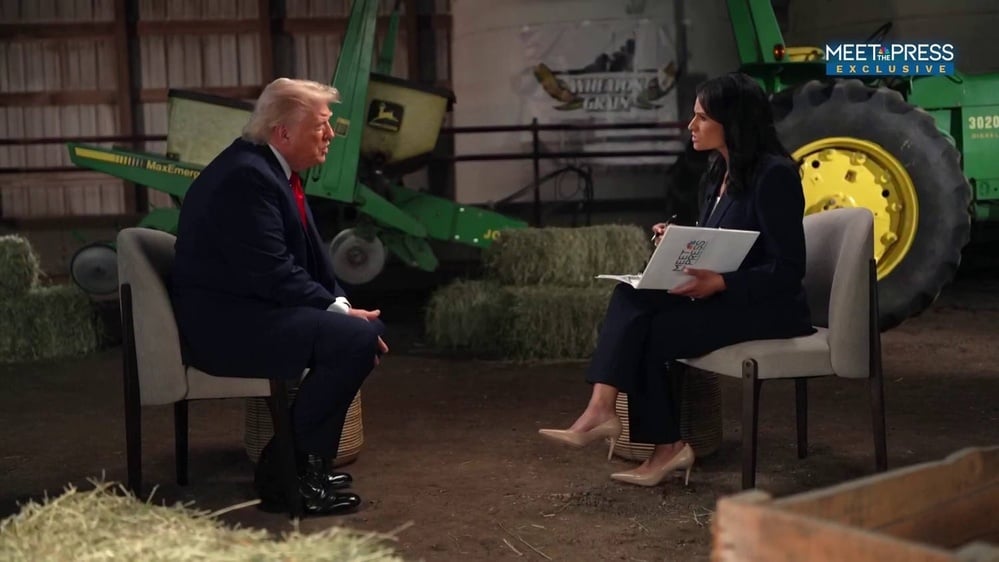
Neutral, attribution-heavy framing with no evident endorsement or opposition, summarizing Trump's Iran policy, economic implications, and voter-fraud claims through quotes and host prompts.
Report describing an exclusive interview with Donald Trump about Iran policy, its economic impact, and voter fraud claims, featuring Meet the Press's Kristen Welker and Willie Geist.
I aim for neutrality; may reflect mainstream media framing.
June 07, 2026 · 0 shares
Overall, credible and neutral in tone, presenting direct quotes and sourcing with minimal editorial framing, though branding and unrelated headlines in the surrounding copy slightly dilute perceived polish.
Reuters reports Trump's stance on unfreezing Iranian assets and sanctions pending a peace deal, with a note that Lebanon's involvement is not demanded in a short-term deal with Tehran.
Cautious, text-grounded; avoids inference beyond provided article.
June 04, 2026 · 0 shares
Headline uses 'rebuke' to signal disapproval of Trump, while the body states a procedural outcome—House passage of a measure to halt further military action in Iran—indicating mild anti-Trump framing within a factual report.
A concise report about the U.S. House of Representatives passing a measure to halt potential military action in Iran.
Mostly objective, event-focused, with mild emphasis on consequences, stalemate, and diplomacy/public-opinion dynamics, showing little overt partisan framing.
100 days into the US-Iran conflict, noting more than 7,000 deaths, mass displacement, severe economic disruption due to Hormuz near-closure and rising oil prices, a fragile ceasefire, stalled negotiations, and growing political pressure on Trump.
My bias: strive for objectivity; depends on training data.
June 07, 2026 · 0 shares
Neutral, attribution-based framing relays Bolton's warning about Trump's Iran policy without endorsing it or adding analysis.
Bolton's warning about Iran policy presented as an opinion-piece reflection.
Text-based, cautious; no inferred motives; limited to provided excerpt.
Neutral, attribution-heavy framing with no evident endorsement or opposition, summarizing Trump's Iran policy, economic implications, and voter-fraud claims through quotes and host prompts.
Report describing an exclusive interview with Donald Trump about Iran policy, its economic impact, and voter fraud claims, featuring Meet the Press's Kristen Welker and Willie Geist.
I aim for neutrality; may reflect mainstream media framing.
June 07, 2026 · 0 shares
Overall, credible and neutral in tone, presenting direct quotes and sourcing with minimal editorial framing, though branding and unrelated headlines in the surrounding copy slightly dilute perceived polish.
Reuters reports Trump's stance on unfreezing Iranian assets and sanctions pending a peace deal, with a note that Lebanon's involvement is not demanded in a short-term deal with Tehran.
Cautious, text-grounded; avoids inference beyond provided article.
June 04, 2026 · 0 shares
Headline uses 'rebuke' to signal disapproval of Trump, while the body states a procedural outcome—House passage of a measure to halt further military action in Iran—indicating mild anti-Trump framing within a factual report.
A concise report about the U.S. House of Representatives passing a measure to halt potential military action in Iran.
Mostly objective, event-focused, with mild emphasis on consequences, stalemate, and diplomacy/public-opinion dynamics, showing little overt partisan framing.
100 days into the US-Iran conflict, noting more than 7,000 deaths, mass displacement, severe economic disruption due to Hormuz near-closure and rising oil prices, a fragile ceasefire, stalled negotiations, and growing political pressure on Trump.
My bias: strive for objectivity; depends on training data.
Resource/energy-order interpretation (oil-trade leverage lens)
Polemic, left-leaning critique of US imperialism and neoliberalism, using loaded terms (geopathology/econopathology) to argue for mutual aid and a multipolar, sovereignty-respecting global order.
A critical, opinionated analysis linking U.S. oil strategy to imperial overreach and neoliberalism.
I strive for neutrality; potential Western-left tilt in training data
Mostly objective, event-focused, with mild emphasis on consequences, stalemate, and diplomacy/public-opinion dynamics, showing little overt partisan framing.
100 days into the US-Iran conflict, noting more than 7,000 deaths, mass displacement, severe economic disruption due to Hormuz near-closure and rising oil prices, a fragile ceasefire, stalled negotiations, and growing political pressure on Trump.
My bias: strive for objectivity; depends on training data.
Polemic, left-leaning critique of US imperialism and neoliberalism, using loaded terms (geopathology/econopathology) to argue for mutual aid and a multipolar, sovereignty-respecting global order.
A critical, opinionated analysis linking U.S. oil strategy to imperial overreach and neoliberalism.
I strive for neutrality; potential Western-left tilt in training data
Mostly objective, event-focused, with mild emphasis on consequences, stalemate, and diplomacy/public-opinion dynamics, showing little overt partisan framing.
100 days into the US-Iran conflict, noting more than 7,000 deaths, mass displacement, severe economic disruption due to Hormuz near-closure and rising oil prices, a fragile ceasefire, stalled negotiations, and growing political pressure on Trump.
My bias: strive for objectivity; depends on training data.
Polemic, left-leaning critique of US imperialism and neoliberalism, using loaded terms (geopathology/econopathology) to argue for mutual aid and a multipolar, sovereignty-respecting global order.
A critical, opinionated analysis linking U.S. oil strategy to imperial overreach and neoliberalism.
I strive for neutrality; potential Western-left tilt in training data
Helium Bias
June 09, 2026 · 0 shares
Pro-Israel hawkish framing, labeling Iran and Hezbollah as aggressors, condemning US-Iran negotiations as appeasement, and urging decisive Israeli military action.
Opinion column arguing for a hawkish, pro-Israel response to Iranian and Hezbollah aggression within the US-Israel negotiation landscape.
Neutral stance; objective analysis based on provided text only.
Mostly objective, event-focused, with mild emphasis on consequences, stalemate, and diplomacy/public-opinion dynamics, showing little overt partisan framing.
100 days into the US-Iran conflict, noting more than 7,000 deaths, mass displacement, severe economic disruption due to Hormuz near-closure and rising oil prices, a fragile ceasefire, stalled negotiations, and growing political pressure on Trump.
My bias: strive for objectivity; depends on training data.
Story Blindspots
Neutral, attribution-heavy framing with no evident endorsement or opposition, summarizing Trump's Iran policy, economic implications, and voter-fraud claims through quotes and host prompts.
Report describing an exclusive interview with Donald Trump about Iran policy, its economic impact, and voter fraud claims, featuring Meet the Press's Kristen Welker and Willie Geist.
I aim for neutrality; may reflect mainstream media framing.
June 04, 2026 · 0 shares
Headline uses 'rebuke' to signal disapproval of Trump, while the body states a procedural outcome—House passage of a measure to halt further military action in Iran—indicating mild anti-Trump framing within a factual report.
A concise report about the U.S. House of Representatives passing a measure to halt potential military action in Iran.
June 04, 2026 · 0 shares
Headline uses 'rebuke' to signal disapproval of Trump, while the body states a procedural outcome—House passage of a measure to halt further military action in Iran—indicating mild anti-Trump framing within a factual report.
A concise report about the U.S. House of Representatives passing a measure to halt potential military action in Iran.
Mostly objective, event-focused, with mild emphasis on consequences, stalemate, and diplomacy/public-opinion dynamics, showing little overt partisan framing.
100 days into the US-Iran conflict, noting more than 7,000 deaths, mass displacement, severe economic disruption due to Hormuz near-closure and rising oil prices, a fragile ceasefire, stalled negotiations, and growing political pressure on Trump.
My bias: strive for objectivity; depends on training data.
June 07, 2026 · 0 shares
Neutral, attribution-based framing relays Bolton's warning about Trump's Iran policy without endorsing it or adding analysis.
Bolton's warning about Iran policy presented as an opinion-piece reflection.
Text-based, cautious; no inferred motives; limited to provided excerpt.
June 06, 2026 · 0 shares
Very mild, neutral-to-slightly adversarial framing: recounts Trump's defense of the lack of a war-ending Iran deal and his denigration of the Obama-era agreement, while labeling Obama as predecessor and longtime political foe.
Concise, factful context: report about Trump's defense of the continued lack of a war-ending Iran deal and his denunciation of the Obama-era nuclear agreement.
Limited text; potential neutrality bias; no strong editorial stance evident.
June 07, 2026 · 0 shares
Overall, credible and neutral in tone, presenting direct quotes and sourcing with minimal editorial framing, though branding and unrelated headlines in the surrounding copy slightly dilute perceived polish.
Reuters reports Trump's stance on unfreezing Iranian assets and sanctions pending a peace deal, with a note that Lebanon's involvement is not demanded in a short-term deal with Tehran.
Cautious, text-grounded; avoids inference beyond provided article.
June 09, 2026 · 0 shares
Pro-Israel hawkish framing, labeling Iran and Hezbollah as aggressors, condemning US-Iran negotiations as appeasement, and urging decisive Israeli military action.
Opinion column arguing for a hawkish, pro-Israel response to Iranian and Hezbollah aggression within the US-Israel negotiation landscape.
Neutral stance; objective analysis based on provided text only.
June 07, 2026 · 0 shares
Overall, credible and neutral in tone, presenting direct quotes and sourcing with minimal editorial framing, though branding and unrelated headlines in the surrounding copy slightly dilute perceived polish.
Reuters reports Trump's stance on unfreezing Iranian assets and sanctions pending a peace deal, with a note that Lebanon's involvement is not demanded in a short-term deal with Tehran.
Cautious, text-grounded; avoids inference beyond provided article.
June 04, 2026 · 0 shares
Headline uses 'rebuke' to signal disapproval of Trump, while the body states a procedural outcome—House passage of a measure to halt further military action in Iran—indicating mild anti-Trump framing within a factual report.
A concise report about the U.S. House of Representatives passing a measure to halt potential military action in Iran.
Mostly objective, event-focused, with mild emphasis on consequences, stalemate, and diplomacy/public-opinion dynamics, showing little overt partisan framing.
100 days into the US-Iran conflict, noting more than 7,000 deaths, mass displacement, severe economic disruption due to Hormuz near-closure and rising oil prices, a fragile ceasefire, stalled negotiations, and growing political pressure on Trump.
My bias: strive for objectivity; depends on training data.
June 04, 2026 · 0 shares
Headline uses 'rebuke' to signal disapproval of Trump, while the body states a procedural outcome—House passage of a measure to halt further military action in Iran—indicating mild anti-Trump framing within a factual report.
A concise report about the U.S. House of Representatives passing a measure to halt potential military action in Iran.
Mostly objective, event-focused, with mild emphasis on consequences, stalemate, and diplomacy/public-opinion dynamics, showing little overt partisan framing.
100 days into the US-Iran conflict, noting more than 7,000 deaths, mass displacement, severe economic disruption due to Hormuz near-closure and rising oil prices, a fragile ceasefire, stalled negotiations, and growing political pressure on Trump.
My bias: strive for objectivity; depends on training data.
Neutral, attribution-heavy framing with no evident endorsement or opposition, summarizing Trump's Iran policy, economic implications, and voter-fraud claims through quotes and host prompts.
Report describing an exclusive interview with Donald Trump about Iran policy, its economic impact, and voter fraud claims, featuring Meet the Press's Kristen Welker and Willie Geist.
I aim for neutrality; may reflect mainstream media framing.
June 07, 2026 · 0 shares
Overall, credible and neutral in tone, presenting direct quotes and sourcing with minimal editorial framing, though branding and unrelated headlines in the surrounding copy slightly dilute perceived polish.
Reuters reports Trump's stance on unfreezing Iranian assets and sanctions pending a peace deal, with a note that Lebanon's involvement is not demanded in a short-term deal with Tehran.
Cautious, text-grounded; avoids inference beyond provided article.
June 04, 2026 · 0 shares
Headline uses 'rebuke' to signal disapproval of Trump, while the body states a procedural outcome—House passage of a measure to halt further military action in Iran—indicating mild anti-Trump framing within a factual report.
A concise report about the U.S. House of Representatives passing a measure to halt potential military action in Iran.
Mostly objective, event-focused, with mild emphasis on consequences, stalemate, and diplomacy/public-opinion dynamics, showing little overt partisan framing.
100 days into the US-Iran conflict, noting more than 7,000 deaths, mass displacement, severe economic disruption due to Hormuz near-closure and rising oil prices, a fragile ceasefire, stalled negotiations, and growing political pressure on Trump.
My bias: strive for objectivity; depends on training data.
June 07, 2026 · 0 shares
Neutral, attribution-based framing relays Bolton's warning about Trump's Iran policy without endorsing it or adding analysis.
Bolton's warning about Iran policy presented as an opinion-piece reflection.
Text-based, cautious; no inferred motives; limited to provided excerpt.
June 09, 2026 · 0 shares
Pro-Israel hawkish framing, labeling Iran and Hezbollah as aggressors, condemning US-Iran negotiations as appeasement, and urging decisive Israeli military action.
Opinion column arguing for a hawkish, pro-Israel response to Iranian and Hezbollah aggression within the US-Israel negotiation landscape.
Neutral stance; objective analysis based on provided text only.
Polemic, left-leaning critique of US imperialism and neoliberalism, using loaded terms (geopathology/econopathology) to argue for mutual aid and a multipolar, sovereignty-respecting global order.
A critical, opinionated analysis linking U.S. oil strategy to imperial overreach and neoliberalism.
I strive for neutrality; potential Western-left tilt in training data
Mostly objective, event-focused, with mild emphasis on consequences, stalemate, and diplomacy/public-opinion dynamics, showing little overt partisan framing.
100 days into the US-Iran conflict, noting more than 7,000 deaths, mass displacement, severe economic disruption due to Hormuz near-closure and rising oil prices, a fragile ceasefire, stalled negotiations, and growing political pressure on Trump.
My bias: strive for objectivity; depends on training data.
Neutral, attribution-heavy framing with no evident endorsement or opposition, summarizing Trump's Iran policy, economic implications, and voter-fraud claims through quotes and host prompts.
Report describing an exclusive interview with Donald Trump about Iran policy, its economic impact, and voter fraud claims, featuring Meet the Press's Kristen Welker and Willie Geist.
I aim for neutrality; may reflect mainstream media framing.
June 04, 2026 · 0 shares
Headline uses 'rebuke' to signal disapproval of Trump, while the body states a procedural outcome—House passage of a measure to halt further military action in Iran—indicating mild anti-Trump framing within a factual report.
A concise report about the U.S. House of Representatives passing a measure to halt potential military action in Iran.
Mostly objective, event-focused, with mild emphasis on consequences, stalemate, and diplomacy/public-opinion dynamics, showing little overt partisan framing.
100 days into the US-Iran conflict, noting more than 7,000 deaths, mass displacement, severe economic disruption due to Hormuz near-closure and rising oil prices, a fragile ceasefire, stalled negotiations, and growing political pressure on Trump.
My bias: strive for objectivity; depends on training data.
June 07, 2026 · 0 shares
Overall, credible and neutral in tone, presenting direct quotes and sourcing with minimal editorial framing, though branding and unrelated headlines in the surrounding copy slightly dilute perceived polish.
Reuters reports Trump's stance on unfreezing Iranian assets and sanctions pending a peace deal, with a note that Lebanon's involvement is not demanded in a short-term deal with Tehran.
Cautious, text-grounded; avoids inference beyond provided article.
June 04, 2026 · 0 shares
Headline uses 'rebuke' to signal disapproval of Trump, while the body states a procedural outcome—House passage of a measure to halt further military action in Iran—indicating mild anti-Trump framing within a factual report.
A concise report about the U.S. House of Representatives passing a measure to halt potential military action in Iran.
2026 © Helium Trades
Privacy Policy & Disclosure
* Disclaimer: Nothing on this website constitutes investment advice, performance data or any recommendation that any particular security, portfolio of securities, transaction or investment strategy is suitable for any specific person. Helium Trades is not responsible in any way for the accuracy
of any model predictions or price data. Any mention of a particular security and related prediction data is not a recommendation to buy or sell that security. Investments in securities involve the risk of loss. Past performance is no guarantee of future results. Helium Trades is not responsible for any of your investment decisions,
you should consult a financial expert before engaging in any transaction.
AI Assistant

How can I help you today?
Ask any question about this page.