See whether Helium helps you make better-informed decisions. Try every Pro Trader feature for 30 days. No credit card required.
Try every Pro Trader feature for 30 days. No credit card required.
Neutral, multi-perspective coverage that quotes Trump and Republican lawmakers on tariffs and wildfire smoke, situating the issue within US-Canada tensions without editorializing.
News report describing Trump's tariff proposal linked to wildfire smoke and the reaction of Republican lawmakers, with notes on bilateral tensions.
Automated analysis; not human reviewed.
Limitations: Case-specific; does not assess broader coverage; neutral framing inferred from quotes and attribution, but cannot rule out subtle bias.
·
47 of 52 available dimensions scored; omitted dimensions are not treated as neutral.
·
Verified supporting quotes for 0 of 47 scored dimensions.
Claim: Neutral framing with quotes from multiple actors; no evident editorial slant.
“"The United States is being unnecessarily invaded by filthy, polluted, and unhealthy air, the quality of which is dangerous, and totally unacceptable!"” · not found in supplied text
“"Canada must take meaningful action to prevent these catastrophic wildfires and protect both Canadians and Americans," he wrote on X. "If it refuses to do so, there should be consequences."” · not found in supplied text
“"We are done accepting apologies in place of action.
If Canada will not manage its forests to prevent these fires, the United States will look elsewhere, and act on our own, to protect our people," the letter said.”
· not found in supplied text
Counterevidence:
“"The close allies have clashed over Trump's tariffs and his expressed wish to make the country the 51st US state."” · not found in supplied text
Why: Direct quotations from both sides with no explicit editorial stance indicate neutral framing.
Claim: Article maintains objective, attribution-based tone with reported data and quotes.
“Canada has over 800 active wildfires burning, with the vast majority labeled 'out of control,' according to government officials.” · not found in supplied text
“Republican lawmakers have blamed Canada's forest management practices for the plumes and are pressuring the country to act.” · exact text match
Counterevidence:
“"The United States is being unnecessarily invaded by filthy, polluted, and unhealthy air, the quality of which is dangerous, and totally unacceptable!"” · not found in supplied text
Why: Factual reporting with attributed quotes supports objectivity; a single inflammatory quote does not constitute bias.
Claim: No evident pro- or anti-establishment tilt; coverage presents official actions and state actors.
“Bernie Moreno; Nick Langworthy; four Michigan Representatives; Mark Carney mentioned in relation to policy actions.” · not found in supplied text
Counterevidence:
“The close allies have clashed over Trump's tariffs and his expressed wish to make the country the 51st US state.” · exact text match
Why: Describes official actors and policy actions without endorsing a stance; some context suggests power dynamics but not establishment bias.
Ambiguities: No independent cost estimates; quotes drive framing.
Neutral, fact-based reporting that presents Trump's claim about Canada causing wildfire smoke and the proposed tariff cost, while citing IQAir data, NWS warnings, and World Cup context without endorsement.
Concise, factful, accurate, balanced context for the article in one sentence.
Automated analysis; not human reviewed.
Limitations: Concise, case-specific limitations and plausible alternative interpretations.
·
52 of 52 available dimensions scored; omitted dimensions are not treated as neutral.
·
Verified supporting quotes for 3 of 52 scored dimensions.
Claim: The report presents Trump's claim without endorsing or criticizing it; uses direct quotes and data.
“Trump blames Canada for wildfire smoke, says he’ll add cost to tariffs.” · verified after text normalization
“US President Donald Trump on Friday blamed Canada for wildfire smoke spreading across the United States and said he would add the “incalculable cost” of dealing with the pollution to existing tariffs on Canadian goods.” · exact text match
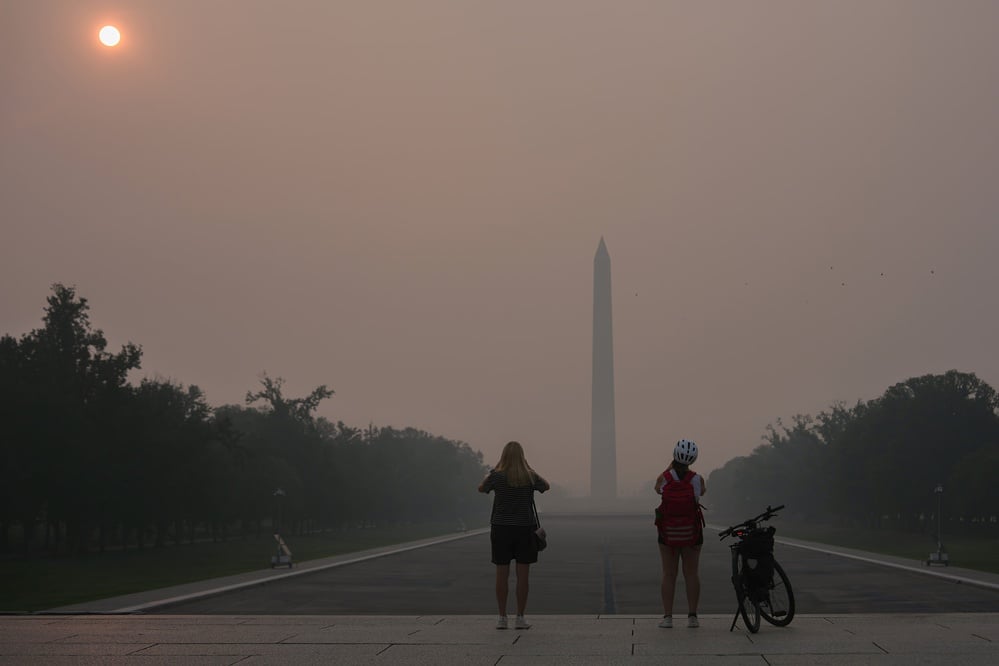
“Heavy smoke from hundreds of Canadian fires enveloped a swathe of the US from the Midwest to the Northeast on Thursday and Friday, prompting warnings to residents to stay indoors.” · exact text match
Why: Neutral, fact-based reporting uses direct quotes and multiple sources; no editorializing.
Claim: Descriptive, not opinionated; uses quotes and official data to describe events.
“Trump blames Canada for wildfire smoke, says he’ll add cost to tariffs.” · verified after text normalization
“Heavy smoke from hundreds of Canadian fires enveloped a swathe of the US from the Midwest to the Northeast on Thursday and Friday, prompting warnings to residents to stay indoors.” · exact text match
“Detroit on Friday remained the most polluted city in the world, according to tracker IQAir.” · exact text match
Why: Uses reported facts and sources rather than evaluative language.
Claim: Cites named data sources and official statements; generally credible.
“Detroit on Friday remained the most polluted city in the world, according to tracker IQAir.” · exact text match
“But the National Weather Service (NWS) warned the smoke may thicken overnight into Saturday morning.” · exact text match
“Tournament organisers are “monitoring closely”, White House World Cup task force executive director Andrew Giuliani told a briefing.” · exact text match
Why: Multiple named sources and official statements support credibility; no obvious editorialization.
Ambiguity about claim's veracity; limited context on Canadian response.
July 18, 2026 · 0 shares
Balanced, multi-sourced coverage presents Trump’s tariff threats against Canada over wildfire smoke alongside responses from Canadian officials and U.S. lawmakers, incorporating climate-context and legal constraints without overt editorializing.
Cross-border policy tension over wildfire smoke, combining Trump tariff rhetoric, Canadian and U.S. official responses, and climate-change framing along with legal context.
Automated analysis; not human reviewed.
·
52 of 52 available dimensions scored; omitted dimensions are not treated as neutral.
·
Verified supporting quotes for 0 of 52 scored dimensions.
Claim: Reporting maintains a balanced, multi-voiced frame without overt editorializing.
“"Fighting climate change is the responsibility of all countries, including the United States," Carney told reporters.” · not found in supplied text
“"I truly believe the Americans are good neighbors," he said Friday.” · not found in supplied text
Counterevidence:
“"This is the third consecutive year we have had to write to Canadian officials about a crisis that Canada has the tools to prevent and has chosen not to," said Rep. John James, Rep. Lisa McClain, Rep. John Moolenaar and Rep. Jack Bergman.” · not found in supplied text
Why: Presence of both cooperative Canadian framing and GOP criticisms suggests attempts at balance rather than a partisan tilt.
Ambiguity in framing; quotes provided may reflect only selected moments.
July 18, 2026 · 0 shares
Neutral-to-mildly critical framing; coverage centers on Trump's tariff threat and costs attribution without substantive analysis.
Concise, factful, accurate, balanced context for the article in one sentence.
Automated analysis; not human reviewed.
Limitations: Concise, case-specific limitations and plausible alternative interpretations.
·
3 of 52 available dimensions scored; omitted dimensions are not treated as neutral.
·
Verified supporting quotes for 3 of 3 scored dimensions.
Claim: No strong liberal or conservative tilt detected; framing centers on Trump's actions rather than ideological commentary.
“Trump fumes over Canadian wildfire smoke and issues tariff threat.” · exact text match
“President Donald Trump on Friday pledged to hold Canada responsible for costs associated with unhealthy air quality in the U.S.” · exact text match
“due to spreading smoke from the Canadian wildfires.” · exact text match
Why: Language focuses on a political actor's action, not an ideological stance.
Claim: Slightly sensational framing via the verb 'fumes' describing Trump's reaction.
“Trump fumes over Canadian wildfire smoke and issues tariff threat.” · exact text match
Why: The term 'fumes' conveys emotion rather than neutral description.
Claim: Negative emotional framing in the portrayal of Trump's reaction.
“Trump fumes over Canadian wildfire smoke and issues tariff threat.” · exact text match
Why: Descriptive wording carries an emotional charge toward the actor.
Only a single sentence; broader context/contextual sources missing.
Neutral, fact-based reporting that presents Trump's claim about Canada causing wildfire smoke and the proposed tariff cost, while citing IQAir data, NWS warnings, and World Cup context without endorsement.
Concise, factful, accurate, balanced context for the article in one sentence.
Automated analysis; not human reviewed.
Limitations: Concise, case-specific limitations and plausible alternative interpretations.
·
52 of 52 available dimensions scored; omitted dimensions are not treated as neutral.
·
Verified supporting quotes for 3 of 52 scored dimensions.
Claim: The report presents Trump's claim without endorsing or criticizing it; uses direct quotes and data.
“Trump blames Canada for wildfire smoke, says he’ll add cost to tariffs.” · verified after text normalization
“US President Donald Trump on Friday blamed Canada for wildfire smoke spreading across the United States and said he would add the “incalculable cost” of dealing with the pollution to existing tariffs on Canadian goods.” · exact text match
“Heavy smoke from hundreds of Canadian fires enveloped a swathe of the US from the Midwest to the Northeast on Thursday and Friday, prompting warnings to residents to stay indoors.” · exact text match
Why: Neutral, fact-based reporting uses direct quotes and multiple sources; no editorializing.
Claim: Descriptive, not opinionated; uses quotes and official data to describe events.
“Trump blames Canada for wildfire smoke, says he’ll add cost to tariffs.” · verified after text normalization
“Heavy smoke from hundreds of Canadian fires enveloped a swathe of the US from the Midwest to the Northeast on Thursday and Friday, prompting warnings to residents to stay indoors.” · exact text match
“Detroit on Friday remained the most polluted city in the world, according to tracker IQAir.” · exact text match
Why: Uses reported facts and sources rather than evaluative language.
Claim: Cites named data sources and official statements; generally credible.
“Detroit on Friday remained the most polluted city in the world, according to tracker IQAir.” · exact text match
“But the National Weather Service (NWS) warned the smoke may thicken overnight into Saturday morning.” · exact text match
“Tournament organisers are “monitoring closely”, White House World Cup task force executive director Andrew Giuliani told a briefing.” · exact text match
Why: Multiple named sources and official statements support credibility; no obvious editorialization.
Ambiguity about claim's veracity; limited context on Canadian response.
July 18, 2026 · 0 shares
Neutral, balanced coverage of Trump's tariff threats toward Canada over wildfire smoke, presenting quotes from Trump and Canadian officials and providing wildfire/air-quality context without editorializing.
News coverage of Trump threatening tariffs on Canada over wildfire smoke, including fire data, air-quality impacts, and cross-border government responses with quotes from Trump, Carney, and Canadian officials.
Automated analysis; not human reviewed.
Limitations: Concise, case-specific limitations and plausible alternative interpretations.
·
47 of 52 available dimensions scored; omitted dimensions are not treated as neutral.
·
Verified supporting quotes for 0 of 47 scored dimensions.
Claim: No detectable tilt toward liberal or conservative ideology; coverage appears balanced.
“President Donald Trump on Friday threatened to impose additional tariffs on Canada, blaming the country for wildfire smoke that has blanketed large swaths of the United States.” · exact text match
“Carney, who leads Canada’s Liberal Party, did not immediately respond to Trump’s post.” · exact text match
“Canada and the United States have a long history of working together to fight wildfires on both sides of the border — it is a history that both countries benefit from and that we are building on during this challenging wildfire season.” · not found in supplied text
Why: Quotes from both sides and emphasis on cooperation suggest neutral framing.
Claim: Article presents facts with minimal editorializing; tone is largely objective.
“The resulting smoke has pushed air quality to hazardous levels across parts of the United States.” · exact text match
“More than a dozen states are under air quality alerts, and officials in cities including New York and Chicago have urged residents to remain indoors when possible.” · exact text match
“Canada and the United States have a long history of working together to fight wildfires on both sides of the border — it is a history that both countries benefit from and that we are building on during this challenging wildfire season.” · not found in supplied text
Why: Descriptive facts and direct quotes support objective framing.
Claim: Promotional lines about trust and paywalls are present, potentially reflecting marketing rather than reporting.
“"is trusted by Americans across the entire political spectrum.
And unlike many other quality news outlets, we choose not to lock Americans out of our reporting and analysis with paywalls."”
· not found in supplied text
Counterevidence:
“"Join thought-provoking conversations, follow other Independent readers and see their replies"” · exact text match
Why: Promotional language appears in the text and could influence perceived neutrality.
Stray promo lines in text; potential context gaps.
July 18, 2026 · 0 shares
Neutral, balanced coverage of Trump's tariff threats toward Canada over wildfire smoke, presenting quotes from Trump and Canadian officials and providing wildfire/air-quality context without editorializing.
News coverage of Trump threatening tariffs on Canada over wildfire smoke, including fire data, air-quality impacts, and cross-border government responses with quotes from Trump, Carney, and Canadian officials.
Automated analysis; not human reviewed.
Limitations: Concise, case-specific limitations and plausible alternative interpretations.
·
47 of 52 available dimensions scored; omitted dimensions are not treated as neutral.
·
Verified supporting quotes for 0 of 47 scored dimensions.
Claim: No detectable tilt toward liberal or conservative ideology; coverage appears balanced.
“President Donald Trump on Friday threatened to impose additional tariffs on Canada, blaming the country for wildfire smoke that has blanketed large swaths of the United States.” · exact text match
“Carney, who leads Canada’s Liberal Party, did not immediately respond to Trump’s post.” · exact text match
“Canada and the United States have a long history of working together to fight wildfires on both sides of the border — it is a history that both countries benefit from and that we are building on during this challenging wildfire season.” · not found in supplied text
Why: Quotes from both sides and emphasis on cooperation suggest neutral framing.
Claim: Article presents facts with minimal editorializing; tone is largely objective.
“The resulting smoke has pushed air quality to hazardous levels across parts of the United States.” · exact text match
“More than a dozen states are under air quality alerts, and officials in cities including New York and Chicago have urged residents to remain indoors when possible.” · exact text match
“Canada and the United States have a long history of working together to fight wildfires on both sides of the border — it is a history that both countries benefit from and that we are building on during this challenging wildfire season.” · not found in supplied text
Why: Descriptive facts and direct quotes support objective framing.
Claim: Promotional lines about trust and paywalls are present, potentially reflecting marketing rather than reporting.
“"is trusted by Americans across the entire political spectrum.
And unlike many other quality news outlets, we choose not to lock Americans out of our reporting and analysis with paywalls."”
· not found in supplied text
Counterevidence:
“"Join thought-provoking conversations, follow other Independent readers and see their replies"” · exact text match
Why: Promotional language appears in the text and could influence perceived neutrality.
Stray promo lines in text; potential context gaps.
Neutral, fact-based reporting that presents Trump's claim about Canada causing wildfire smoke and the proposed tariff cost, while citing IQAir data, NWS warnings, and World Cup context without endorsement.
Concise, factful, accurate, balanced context for the article in one sentence.
Automated analysis; not human reviewed.
Limitations: Concise, case-specific limitations and plausible alternative interpretations.
·
52 of 52 available dimensions scored; omitted dimensions are not treated as neutral.
·
Verified supporting quotes for 3 of 52 scored dimensions.
Claim: The report presents Trump's claim without endorsing or criticizing it; uses direct quotes and data.
“Trump blames Canada for wildfire smoke, says he’ll add cost to tariffs.” · verified after text normalization
“US President Donald Trump on Friday blamed Canada for wildfire smoke spreading across the United States and said he would add the “incalculable cost” of dealing with the pollution to existing tariffs on Canadian goods.” · exact text match
“Heavy smoke from hundreds of Canadian fires enveloped a swathe of the US from the Midwest to the Northeast on Thursday and Friday, prompting warnings to residents to stay indoors.” · exact text match
Why: Neutral, fact-based reporting uses direct quotes and multiple sources; no editorializing.
Claim: Descriptive, not opinionated; uses quotes and official data to describe events.
“Trump blames Canada for wildfire smoke, says he’ll add cost to tariffs.” · verified after text normalization
“Heavy smoke from hundreds of Canadian fires enveloped a swathe of the US from the Midwest to the Northeast on Thursday and Friday, prompting warnings to residents to stay indoors.” · exact text match
“Detroit on Friday remained the most polluted city in the world, according to tracker IQAir.” · exact text match
Why: Uses reported facts and sources rather than evaluative language.
Claim: Cites named data sources and official statements; generally credible.
“Detroit on Friday remained the most polluted city in the world, according to tracker IQAir.” · exact text match
“But the National Weather Service (NWS) warned the smoke may thicken overnight into Saturday morning.” · exact text match
“Tournament organisers are “monitoring closely”, White House World Cup task force executive director Andrew Giuliani told a briefing.” · exact text match
Why: Multiple named sources and official statements support credibility; no obvious editorialization.
Ambiguity about claim's veracity; limited context on Canadian response.
July 18, 2026 · 0 shares
Neutral, balanced coverage of Trump's tariff threats toward Canada over wildfire smoke, presenting quotes from Trump and Canadian officials and providing wildfire/air-quality context without editorializing.
News coverage of Trump threatening tariffs on Canada over wildfire smoke, including fire data, air-quality impacts, and cross-border government responses with quotes from Trump, Carney, and Canadian officials.
Automated analysis; not human reviewed.
Limitations: Concise, case-specific limitations and plausible alternative interpretations.
·
47 of 52 available dimensions scored; omitted dimensions are not treated as neutral.
·
Verified supporting quotes for 0 of 47 scored dimensions.
Claim: No detectable tilt toward liberal or conservative ideology; coverage appears balanced.
“President Donald Trump on Friday threatened to impose additional tariffs on Canada, blaming the country for wildfire smoke that has blanketed large swaths of the United States.” · exact text match
“Carney, who leads Canada’s Liberal Party, did not immediately respond to Trump’s post.” · exact text match
“Canada and the United States have a long history of working together to fight wildfires on both sides of the border — it is a history that both countries benefit from and that we are building on during this challenging wildfire season.” · not found in supplied text
Why: Quotes from both sides and emphasis on cooperation suggest neutral framing.
Claim: Article presents facts with minimal editorializing; tone is largely objective.
“The resulting smoke has pushed air quality to hazardous levels across parts of the United States.” · exact text match
“More than a dozen states are under air quality alerts, and officials in cities including New York and Chicago have urged residents to remain indoors when possible.” · exact text match
“Canada and the United States have a long history of working together to fight wildfires on both sides of the border — it is a history that both countries benefit from and that we are building on during this challenging wildfire season.” · not found in supplied text
Why: Descriptive facts and direct quotes support objective framing.
Claim: Promotional lines about trust and paywalls are present, potentially reflecting marketing rather than reporting.
“"is trusted by Americans across the entire political spectrum.
And unlike many other quality news outlets, we choose not to lock Americans out of our reporting and analysis with paywalls."”
· not found in supplied text
Counterevidence:
“"Join thought-provoking conversations, follow other Independent readers and see their replies"” · exact text match
Why: Promotional language appears in the text and could influence perceived neutrality.
Stray promo lines in text; potential context gaps.
July 17, 2026 · 0 shares
Neutral framing that documents Trump's tariffs against Canada, wildfire-smoke health risks, and expert input on uncertainty, without advocating for a particular policy.
Concise, factful, accurate, balanced context for the article in one sentence.
Automated analysis; not human reviewed.
Limitations: Concise, case-specific limitations and plausible alternative interpretations.
·
52 of 52 available dimensions scored; omitted dimensions are not treated as neutral.
·
Verified supporting quotes for 2 of 52 scored dimensions.
Claim: No clear ideological tilt; article reports Trump tariffs and air-quality facts.
“Mr Trump said he would impose new tariffs on Canada over the wildfire smoke but made no mention of the World Cup final.” · exact text match
“We are holding Canada responsible, the US president posted on his social media site.” · not found in supplied text
“The World Health Organization forecast calls for an improvement to moderate air quality in New Jersey.” · not found in supplied text
Counterevidence:
“'Filthy, polluted': Trump's Canada threat as World Cup smoke risk looms.” · exact text match
“It remains unclear how much, if at all, the smoke will affect the World Cup final on Monday morning AEST.” · exact text match
Why: Balanced reporting suggested by quotes and credible sources, though header may imply tone.
Claim: Balance between factual reporting and subjective framing in header.
“For a game that is as important as a World Cup final, you have to be able to shut out external factors as much as possible, Merino said.” · not found in supplied text
Counterevidence:
“'Filthy, polluted': Trump's Canada threat as World Cup smoke risk looms.” · exact text match
Why: Quotations from players and scientists show balance; header language adds subjectivity.
Claim: Header uses sensational language; body remains evidence-based.
“'Filthy, polluted': Trump's Canada threat as World Cup smoke risk looms.” · exact text match
“The haze has caused complaints across sports, with athletes critical about the decision to play in hazardous conditions.” · exact text match
Counterevidence:
“The article includes quotes from WHO and scientists supporting credible context.” · not found in supplied text
Why: Header sensationalism contrasts with evidence-based body.
Claim: Reliance on established authorities and credible experts.
“The World Health Organization forecast calls for an improvement to moderate air quality in New Jersey.” · not found in supplied text
“Following that, Mark Parrington, a senior scientist at the Copernicus Atmosphere Monitoring Service.” · not found in supplied text
“Current forecast models range from little to no ground-level smoke to levels that could become more concerning for players and fans.” · exact text match
Counterevidence:
“Lack of policy recommendations.” · not found in supplied text
Why: Heavy citation of credible authorities indicates establishment-framed reporting.
Claim: High credibility due to multiple credible sources and direct quotes.
“This service may include material from Agence France-Presse (AFP), APTN, Reuters, AAP, CNN and the BBC World Service which is copyright and cannot be reproduced.” · exact text match
“The World Health Organization forecast” · exact text match
“Copernicus Atmosphere Monitoring Service” · exact text match
Counterevidence:
“Header language may affect perceived credibility.” · not found in supplied text
Why: Credible sources boost credibility; sensational header could undermine perception.
Claim: Evidence-based framing with credible sources and uncertainty acknowledged.
“The World Health Organization forecast calls for an improvement to moderate air quality in New Jersey.” · not found in supplied text
“Current forecast models range from little to no ground-level smoke to levels that could become more concerning for players and fans.” · exact text match
“It's kind of a dose-dependent effect.” · not found in supplied text
Counterevidence:
“'Filthy, polluted': Trump's Canada threat as World Cup smoke risk looms.” · exact text match
Why: Use of authoritative sources and uncertainty supports rational framing; sensational header adds non-rational cues.
Ambiguity and evidence gaps could affect this analysis.
July 18, 2026 · 0 shares
Balanced, multi-sourced coverage presents Trump’s tariff threats against Canada over wildfire smoke alongside responses from Canadian officials and U.S. lawmakers, incorporating climate-context and legal constraints without overt editorializing.
Cross-border policy tension over wildfire smoke, combining Trump tariff rhetoric, Canadian and U.S. official responses, and climate-change framing along with legal context.
Automated analysis; not human reviewed.
·
52 of 52 available dimensions scored; omitted dimensions are not treated as neutral.
·
Verified supporting quotes for 0 of 52 scored dimensions.
Claim: Reporting maintains a balanced, multi-voiced frame without overt editorializing.
“"Fighting climate change is the responsibility of all countries, including the United States," Carney told reporters.” · not found in supplied text
“"I truly believe the Americans are good neighbors," he said Friday.” · not found in supplied text
Counterevidence:
“"This is the third consecutive year we have had to write to Canadian officials about a crisis that Canada has the tools to prevent and has chosen not to," said Rep. John James, Rep. Lisa McClain, Rep. John Moolenaar and Rep. Jack Bergman.” · not found in supplied text
Why: Presence of both cooperative Canadian framing and GOP criticisms suggests attempts at balance rather than a partisan tilt.
Ambiguity in framing; quotes provided may reflect only selected moments.
July 18, 2026 · 0 shares
Neutral, balanced coverage of Trump's tariff threats toward Canada over wildfire smoke, presenting quotes from Trump and Canadian officials and providing wildfire/air-quality context without editorializing.
News coverage of Trump threatening tariffs on Canada over wildfire smoke, including fire data, air-quality impacts, and cross-border government responses with quotes from Trump, Carney, and Canadian officials.
Automated analysis; not human reviewed.
Limitations: Concise, case-specific limitations and plausible alternative interpretations.
·
47 of 52 available dimensions scored; omitted dimensions are not treated as neutral.
·
Verified supporting quotes for 0 of 47 scored dimensions.
Claim: No detectable tilt toward liberal or conservative ideology; coverage appears balanced.
“President Donald Trump on Friday threatened to impose additional tariffs on Canada, blaming the country for wildfire smoke that has blanketed large swaths of the United States.” · exact text match
“Carney, who leads Canada’s Liberal Party, did not immediately respond to Trump’s post.” · exact text match
“Canada and the United States have a long history of working together to fight wildfires on both sides of the border — it is a history that both countries benefit from and that we are building on during this challenging wildfire season.” · not found in supplied text
Why: Quotes from both sides and emphasis on cooperation suggest neutral framing.
Claim: Article presents facts with minimal editorializing; tone is largely objective.
“The resulting smoke has pushed air quality to hazardous levels across parts of the United States.” · exact text match
“More than a dozen states are under air quality alerts, and officials in cities including New York and Chicago have urged residents to remain indoors when possible.” · exact text match
“Canada and the United States have a long history of working together to fight wildfires on both sides of the border — it is a history that both countries benefit from and that we are building on during this challenging wildfire season.” · not found in supplied text
Why: Descriptive facts and direct quotes support objective framing.
Claim: Promotional lines about trust and paywalls are present, potentially reflecting marketing rather than reporting.
“"is trusted by Americans across the entire political spectrum.
And unlike many other quality news outlets, we choose not to lock Americans out of our reporting and analysis with paywalls."”
· not found in supplied text
Counterevidence:
“"Join thought-provoking conversations, follow other Independent readers and see their replies"” · exact text match
Why: Promotional language appears in the text and could influence perceived neutrality.
Stray promo lines in text; potential context gaps.
July 18, 2026 · 0 shares
Balanced, multi-sourced coverage presents Trump’s tariff threats against Canada over wildfire smoke alongside responses from Canadian officials and U.S. lawmakers, incorporating climate-context and legal constraints without overt editorializing.
Cross-border policy tension over wildfire smoke, combining Trump tariff rhetoric, Canadian and U.S. official responses, and climate-change framing along with legal context.
Automated analysis; not human reviewed.
·
52 of 52 available dimensions scored; omitted dimensions are not treated as neutral.
·
Verified supporting quotes for 0 of 52 scored dimensions.
Claim: Reporting maintains a balanced, multi-voiced frame without overt editorializing.
“"Fighting climate change is the responsibility of all countries, including the United States," Carney told reporters.” · not found in supplied text
“"I truly believe the Americans are good neighbors," he said Friday.” · not found in supplied text
Counterevidence:
“"This is the third consecutive year we have had to write to Canadian officials about a crisis that Canada has the tools to prevent and has chosen not to," said Rep. John James, Rep. Lisa McClain, Rep. John Moolenaar and Rep. Jack Bergman.” · not found in supplied text
Why: Presence of both cooperative Canadian framing and GOP criticisms suggests attempts at balance rather than a partisan tilt.
Ambiguity in framing; quotes provided may reflect only selected moments.
July 18, 2026 · 0 shares
Balanced, multi-sourced coverage presents Trump’s tariff threats against Canada over wildfire smoke alongside responses from Canadian officials and U.S. lawmakers, incorporating climate-context and legal constraints without overt editorializing.
Cross-border policy tension over wildfire smoke, combining Trump tariff rhetoric, Canadian and U.S. official responses, and climate-change framing along with legal context.
Automated analysis; not human reviewed.
·
52 of 52 available dimensions scored; omitted dimensions are not treated as neutral.
·
Verified supporting quotes for 0 of 52 scored dimensions.
Claim: Reporting maintains a balanced, multi-voiced frame without overt editorializing.
“"Fighting climate change is the responsibility of all countries, including the United States," Carney told reporters.” · not found in supplied text
“"I truly believe the Americans are good neighbors," he said Friday.” · not found in supplied text
Counterevidence:
“"This is the third consecutive year we have had to write to Canadian officials about a crisis that Canada has the tools to prevent and has chosen not to," said Rep. John James, Rep. Lisa McClain, Rep. John Moolenaar and Rep. Jack Bergman.” · not found in supplied text
Why: Presence of both cooperative Canadian framing and GOP criticisms suggests attempts at balance rather than a partisan tilt.
Ambiguity in framing; quotes provided may reflect only selected moments.
Neutral, fact-based reporting that presents Trump's claim about Canada causing wildfire smoke and the proposed tariff cost, while citing IQAir data, NWS warnings, and World Cup context without endorsement.
Concise, factful, accurate, balanced context for the article in one sentence.
Automated analysis; not human reviewed. Limitations: Concise, case-specific limitations and plausible alternative interpretations. · 52 of 52 available dimensions scored; omitted dimensions are not treated as neutral. · Verified supporting quotes for 3 of 52 scored dimensions.
Claim: The report presents Trump's claim without endorsing or criticizing it; uses direct quotes and data.
“Trump blames Canada for wildfire smoke, says he’ll add cost to tariffs.” · verified after text normalization
“US President Donald Trump on Friday blamed Canada for wildfire smoke spreading across the United States and said he would add the “incalculable cost” of dealing with the pollution to existing tariffs on Canadian goods.” · exact text match
“Heavy smoke from hundreds of Canadian fires enveloped a swathe of the US from the Midwest to the Northeast on Thursday and Friday, prompting warnings to residents to stay indoors.” · exact text match
Why: Neutral, fact-based reporting uses direct quotes and multiple sources; no editorializing.
Claim: Descriptive, not opinionated; uses quotes and official data to describe events.
“Trump blames Canada for wildfire smoke, says he’ll add cost to tariffs.” · verified after text normalization
“Heavy smoke from hundreds of Canadian fires enveloped a swathe of the US from the Midwest to the Northeast on Thursday and Friday, prompting warnings to residents to stay indoors.” · exact text match
“Detroit on Friday remained the most polluted city in the world, according to tracker IQAir.” · exact text match
Why: Uses reported facts and sources rather than evaluative language.
Claim: Cites named data sources and official statements; generally credible.
“Detroit on Friday remained the most polluted city in the world, according to tracker IQAir.” · exact text match
“But the National Weather Service (NWS) warned the smoke may thicken overnight into Saturday morning.” · exact text match
“Tournament organisers are “monitoring closely”, White House World Cup task force executive director Andrew Giuliani told a briefing.” · exact text match
Why: Multiple named sources and official statements support credibility; no obvious editorialization.
Ambiguity about claim's veracity; limited context on Canadian response.
Neutral, multi-perspective coverage that quotes Trump and Republican lawmakers on tariffs and wildfire smoke, situating the issue within US-Canada tensions without editorializing.
News report describing Trump's tariff proposal linked to wildfire smoke and the reaction of Republican lawmakers, with notes on bilateral tensions.
Automated analysis; not human reviewed. Limitations: Case-specific; does not assess broader coverage; neutral framing inferred from quotes and attribution, but cannot rule out subtle bias. · 47 of 52 available dimensions scored; omitted dimensions are not treated as neutral. · Verified supporting quotes for 0 of 47 scored dimensions.
Claim: Neutral framing with quotes from multiple actors; no evident editorial slant.
“"The United States is being unnecessarily invaded by filthy, polluted, and unhealthy air, the quality of which is dangerous, and totally unacceptable!"” · not found in supplied text
“"Canada must take meaningful action to prevent these catastrophic wildfires and protect both Canadians and Americans," he wrote on X. "If it refuses to do so, there should be consequences."” · not found in supplied text
“"We are done accepting apologies in place of action. If Canada will not manage its forests to prevent these fires, the United States will look elsewhere, and act on our own, to protect our people," the letter said.” · not found in supplied text
Counterevidence:
“"The close allies have clashed over Trump's tariffs and his expressed wish to make the country the 51st US state."” · not found in supplied text
Why: Direct quotations from both sides with no explicit editorial stance indicate neutral framing.
Claim: Article maintains objective, attribution-based tone with reported data and quotes.
“Canada has over 800 active wildfires burning, with the vast majority labeled 'out of control,' according to government officials.” · not found in supplied text
“Republican lawmakers have blamed Canada's forest management practices for the plumes and are pressuring the country to act.” · exact text match
Counterevidence:
“"The United States is being unnecessarily invaded by filthy, polluted, and unhealthy air, the quality of which is dangerous, and totally unacceptable!"” · not found in supplied text
Why: Factual reporting with attributed quotes supports objectivity; a single inflammatory quote does not constitute bias.
Claim: No evident pro- or anti-establishment tilt; coverage presents official actions and state actors.
“Bernie Moreno; Nick Langworthy; four Michigan Representatives; Mark Carney mentioned in relation to policy actions.” · not found in supplied text
Counterevidence:
“The close allies have clashed over Trump's tariffs and his expressed wish to make the country the 51st US state.” · exact text match
Why: Describes official actors and policy actions without endorsing a stance; some context suggests power dynamics but not establishment bias.
Ambiguities: No independent cost estimates; quotes drive framing.
July 18, 2026 · 0 shares
Balanced, multi-sourced coverage presents Trump’s tariff threats against Canada over wildfire smoke alongside responses from Canadian officials and U.S. lawmakers, incorporating climate-context and legal constraints without overt editorializing.
Cross-border policy tension over wildfire smoke, combining Trump tariff rhetoric, Canadian and U.S. official responses, and climate-change framing along with legal context.
Automated analysis; not human reviewed. · 52 of 52 available dimensions scored; omitted dimensions are not treated as neutral. · Verified supporting quotes for 0 of 52 scored dimensions.
Claim: Reporting maintains a balanced, multi-voiced frame without overt editorializing.
“"Fighting climate change is the responsibility of all countries, including the United States," Carney told reporters.” · not found in supplied text
“"I truly believe the Americans are good neighbors," he said Friday.” · not found in supplied text
Counterevidence:
“"This is the third consecutive year we have had to write to Canadian officials about a crisis that Canada has the tools to prevent and has chosen not to," said Rep. John James, Rep. Lisa McClain, Rep. John Moolenaar and Rep. Jack Bergman.” · not found in supplied text
Why: Presence of both cooperative Canadian framing and GOP criticisms suggests attempts at balance rather than a partisan tilt.
Ambiguity in framing; quotes provided may reflect only selected moments.
July 18, 2026 · 0 shares
Neutral-to-mildly critical framing; coverage centers on Trump's tariff threat and costs attribution without substantive analysis.
Concise, factful, accurate, balanced context for the article in one sentence.
Automated analysis; not human reviewed. Limitations: Concise, case-specific limitations and plausible alternative interpretations. · 3 of 52 available dimensions scored; omitted dimensions are not treated as neutral. · Verified supporting quotes for 3 of 3 scored dimensions.
Claim: No strong liberal or conservative tilt detected; framing centers on Trump's actions rather than ideological commentary.
“Trump fumes over Canadian wildfire smoke and issues tariff threat.” · exact text match
“President Donald Trump on Friday pledged to hold Canada responsible for costs associated with unhealthy air quality in the U.S.” · exact text match
“due to spreading smoke from the Canadian wildfires.” · exact text match
Why: Language focuses on a political actor's action, not an ideological stance.
Claim: Slightly sensational framing via the verb 'fumes' describing Trump's reaction.
“Trump fumes over Canadian wildfire smoke and issues tariff threat.” · exact text match
Why: The term 'fumes' conveys emotion rather than neutral description.
Claim: Negative emotional framing in the portrayal of Trump's reaction.
“Trump fumes over Canadian wildfire smoke and issues tariff threat.” · exact text match
Why: Descriptive wording carries an emotional charge toward the actor.
Only a single sentence; broader context/contextual sources missing.
Neutral, fact-based reporting that presents Trump's claim about Canada causing wildfire smoke and the proposed tariff cost, while citing IQAir data, NWS warnings, and World Cup context without endorsement.
Concise, factful, accurate, balanced context for the article in one sentence.
Automated analysis; not human reviewed. Limitations: Concise, case-specific limitations and plausible alternative interpretations. · 52 of 52 available dimensions scored; omitted dimensions are not treated as neutral. · Verified supporting quotes for 3 of 52 scored dimensions.
Claim: The report presents Trump's claim without endorsing or criticizing it; uses direct quotes and data.
“Trump blames Canada for wildfire smoke, says he’ll add cost to tariffs.” · verified after text normalization
“US President Donald Trump on Friday blamed Canada for wildfire smoke spreading across the United States and said he would add the “incalculable cost” of dealing with the pollution to existing tariffs on Canadian goods.” · exact text match
“Heavy smoke from hundreds of Canadian fires enveloped a swathe of the US from the Midwest to the Northeast on Thursday and Friday, prompting warnings to residents to stay indoors.” · exact text match
Why: Neutral, fact-based reporting uses direct quotes and multiple sources; no editorializing.
Claim: Descriptive, not opinionated; uses quotes and official data to describe events.
“Trump blames Canada for wildfire smoke, says he’ll add cost to tariffs.” · verified after text normalization
“Heavy smoke from hundreds of Canadian fires enveloped a swathe of the US from the Midwest to the Northeast on Thursday and Friday, prompting warnings to residents to stay indoors.” · exact text match
“Detroit on Friday remained the most polluted city in the world, according to tracker IQAir.” · exact text match
Why: Uses reported facts and sources rather than evaluative language.
Claim: Cites named data sources and official statements; generally credible.
“Detroit on Friday remained the most polluted city in the world, according to tracker IQAir.” · exact text match
“But the National Weather Service (NWS) warned the smoke may thicken overnight into Saturday morning.” · exact text match
“Tournament organisers are “monitoring closely”, White House World Cup task force executive director Andrew Giuliani told a briefing.” · exact text match
Why: Multiple named sources and official statements support credibility; no obvious editorialization.
Ambiguity about claim's veracity; limited context on Canadian response.
July 18, 2026 · 0 shares
Neutral, balanced coverage of Trump's tariff threats toward Canada over wildfire smoke, presenting quotes from Trump and Canadian officials and providing wildfire/air-quality context without editorializing.
News coverage of Trump threatening tariffs on Canada over wildfire smoke, including fire data, air-quality impacts, and cross-border government responses with quotes from Trump, Carney, and Canadian officials.
Automated analysis; not human reviewed. Limitations: Concise, case-specific limitations and plausible alternative interpretations. · 47 of 52 available dimensions scored; omitted dimensions are not treated as neutral. · Verified supporting quotes for 0 of 47 scored dimensions.
Claim: No detectable tilt toward liberal or conservative ideology; coverage appears balanced.
“President Donald Trump on Friday threatened to impose additional tariffs on Canada, blaming the country for wildfire smoke that has blanketed large swaths of the United States.” · exact text match
“Carney, who leads Canada’s Liberal Party, did not immediately respond to Trump’s post.” · exact text match
“Canada and the United States have a long history of working together to fight wildfires on both sides of the border — it is a history that both countries benefit from and that we are building on during this challenging wildfire season.” · not found in supplied text
Why: Quotes from both sides and emphasis on cooperation suggest neutral framing.
Claim: Article presents facts with minimal editorializing; tone is largely objective.
“The resulting smoke has pushed air quality to hazardous levels across parts of the United States.” · exact text match
“More than a dozen states are under air quality alerts, and officials in cities including New York and Chicago have urged residents to remain indoors when possible.” · exact text match
“Canada and the United States have a long history of working together to fight wildfires on both sides of the border — it is a history that both countries benefit from and that we are building on during this challenging wildfire season.” · not found in supplied text
Why: Descriptive facts and direct quotes support objective framing.
Claim: Promotional lines about trust and paywalls are present, potentially reflecting marketing rather than reporting.
“"is trusted by Americans across the entire political spectrum. And unlike many other quality news outlets, we choose not to lock Americans out of our reporting and analysis with paywalls."” · not found in supplied text
Counterevidence:
“"Join thought-provoking conversations, follow other Independent readers and see their replies"” · exact text match
Why: Promotional language appears in the text and could influence perceived neutrality.
Stray promo lines in text; potential context gaps.
July 17, 2026 · 0 shares
Neutral framing that documents Trump's tariffs against Canada, wildfire-smoke health risks, and expert input on uncertainty, without advocating for a particular policy.
Concise, factful, accurate, balanced context for the article in one sentence.
Automated analysis; not human reviewed. Limitations: Concise, case-specific limitations and plausible alternative interpretations. · 52 of 52 available dimensions scored; omitted dimensions are not treated as neutral. · Verified supporting quotes for 2 of 52 scored dimensions.
Claim: No clear ideological tilt; article reports Trump tariffs and air-quality facts.
“Mr Trump said he would impose new tariffs on Canada over the wildfire smoke but made no mention of the World Cup final.” · exact text match
“We are holding Canada responsible, the US president posted on his social media site.” · not found in supplied text
“The World Health Organization forecast calls for an improvement to moderate air quality in New Jersey.” · not found in supplied text
Counterevidence:
“'Filthy, polluted': Trump's Canada threat as World Cup smoke risk looms.” · exact text match
“It remains unclear how much, if at all, the smoke will affect the World Cup final on Monday morning AEST.” · exact text match
Why: Balanced reporting suggested by quotes and credible sources, though header may imply tone.
Claim: Balance between factual reporting and subjective framing in header.
“For a game that is as important as a World Cup final, you have to be able to shut out external factors as much as possible, Merino said.” · not found in supplied text
Counterevidence:
“'Filthy, polluted': Trump's Canada threat as World Cup smoke risk looms.” · exact text match
Why: Quotations from players and scientists show balance; header language adds subjectivity.
Claim: Header uses sensational language; body remains evidence-based.
“'Filthy, polluted': Trump's Canada threat as World Cup smoke risk looms.” · exact text match
“The haze has caused complaints across sports, with athletes critical about the decision to play in hazardous conditions.” · exact text match
Counterevidence:
“The article includes quotes from WHO and scientists supporting credible context.” · not found in supplied text
Why: Header sensationalism contrasts with evidence-based body.
Claim: Reliance on established authorities and credible experts.
“The World Health Organization forecast calls for an improvement to moderate air quality in New Jersey.” · not found in supplied text
“Following that, Mark Parrington, a senior scientist at the Copernicus Atmosphere Monitoring Service.” · not found in supplied text
“Current forecast models range from little to no ground-level smoke to levels that could become more concerning for players and fans.” · exact text match
Counterevidence:
“Lack of policy recommendations.” · not found in supplied text
Why: Heavy citation of credible authorities indicates establishment-framed reporting.
Claim: High credibility due to multiple credible sources and direct quotes.
“This service may include material from Agence France-Presse (AFP), APTN, Reuters, AAP, CNN and the BBC World Service which is copyright and cannot be reproduced.” · exact text match
“The World Health Organization forecast” · exact text match
“Copernicus Atmosphere Monitoring Service” · exact text match
Counterevidence:
“Header language may affect perceived credibility.” · not found in supplied text
Why: Credible sources boost credibility; sensational header could undermine perception.
Claim: Evidence-based framing with credible sources and uncertainty acknowledged.
“The World Health Organization forecast calls for an improvement to moderate air quality in New Jersey.” · not found in supplied text
“Current forecast models range from little to no ground-level smoke to levels that could become more concerning for players and fans.” · exact text match
“It's kind of a dose-dependent effect.” · not found in supplied text
Counterevidence:
“'Filthy, polluted': Trump's Canada threat as World Cup smoke risk looms.” · exact text match
Why: Use of authoritative sources and uncertainty supports rational framing; sensational header adds non-rational cues.
Ambiguity and evidence gaps could affect this analysis.
Helium Bias
July 17, 2026 · 0 shares
Neutral framing that documents Trump's tariffs against Canada, wildfire-smoke health risks, and expert input on uncertainty, without advocating for a particular policy.
Concise, factful, accurate, balanced context for the article in one sentence.
Automated analysis; not human reviewed. Limitations: Concise, case-specific limitations and plausible alternative interpretations. · 52 of 52 available dimensions scored; omitted dimensions are not treated as neutral. · Verified supporting quotes for 2 of 52 scored dimensions.
Claim: No clear ideological tilt; article reports Trump tariffs and air-quality facts.
“Mr Trump said he would impose new tariffs on Canada over the wildfire smoke but made no mention of the World Cup final.” · exact text match
“We are holding Canada responsible, the US president posted on his social media site.” · not found in supplied text
“The World Health Organization forecast calls for an improvement to moderate air quality in New Jersey.” · not found in supplied text
Counterevidence:
“'Filthy, polluted': Trump's Canada threat as World Cup smoke risk looms.” · exact text match
“It remains unclear how much, if at all, the smoke will affect the World Cup final on Monday morning AEST.” · exact text match
Why: Balanced reporting suggested by quotes and credible sources, though header may imply tone.
Claim: Balance between factual reporting and subjective framing in header.
“For a game that is as important as a World Cup final, you have to be able to shut out external factors as much as possible, Merino said.” · not found in supplied text
Counterevidence:
“'Filthy, polluted': Trump's Canada threat as World Cup smoke risk looms.” · exact text match
Why: Quotations from players and scientists show balance; header language adds subjectivity.
Claim: Header uses sensational language; body remains evidence-based.
“'Filthy, polluted': Trump's Canada threat as World Cup smoke risk looms.” · exact text match
“The haze has caused complaints across sports, with athletes critical about the decision to play in hazardous conditions.” · exact text match
Counterevidence:
“The article includes quotes from WHO and scientists supporting credible context.” · not found in supplied text
Why: Header sensationalism contrasts with evidence-based body.
Claim: Reliance on established authorities and credible experts.
“The World Health Organization forecast calls for an improvement to moderate air quality in New Jersey.” · not found in supplied text
“Following that, Mark Parrington, a senior scientist at the Copernicus Atmosphere Monitoring Service.” · not found in supplied text
“Current forecast models range from little to no ground-level smoke to levels that could become more concerning for players and fans.” · exact text match
Counterevidence:
“Lack of policy recommendations.” · not found in supplied text
Why: Heavy citation of credible authorities indicates establishment-framed reporting.
Claim: High credibility due to multiple credible sources and direct quotes.
“This service may include material from Agence France-Presse (AFP), APTN, Reuters, AAP, CNN and the BBC World Service which is copyright and cannot be reproduced.” · exact text match
“The World Health Organization forecast” · exact text match
“Copernicus Atmosphere Monitoring Service” · exact text match
Counterevidence:
“Header language may affect perceived credibility.” · not found in supplied text
Why: Credible sources boost credibility; sensational header could undermine perception.
Claim: Evidence-based framing with credible sources and uncertainty acknowledged.
“The World Health Organization forecast calls for an improvement to moderate air quality in New Jersey.” · not found in supplied text
“Current forecast models range from little to no ground-level smoke to levels that could become more concerning for players and fans.” · exact text match
“It's kind of a dose-dependent effect.” · not found in supplied text
Counterevidence:
“'Filthy, polluted': Trump's Canada threat as World Cup smoke risk looms.” · exact text match
Why: Use of authoritative sources and uncertainty supports rational framing; sensational header adds non-rational cues.
Ambiguity and evidence gaps could affect this analysis.
Neutral, fact-based reporting that presents Trump's claim about Canada causing wildfire smoke and the proposed tariff cost, while citing IQAir data, NWS warnings, and World Cup context without endorsement.
Concise, factful, accurate, balanced context for the article in one sentence.
Automated analysis; not human reviewed. Limitations: Concise, case-specific limitations and plausible alternative interpretations. · 52 of 52 available dimensions scored; omitted dimensions are not treated as neutral. · Verified supporting quotes for 3 of 52 scored dimensions.
Claim: The report presents Trump's claim without endorsing or criticizing it; uses direct quotes and data.
“Trump blames Canada for wildfire smoke, says he’ll add cost to tariffs.” · verified after text normalization
“US President Donald Trump on Friday blamed Canada for wildfire smoke spreading across the United States and said he would add the “incalculable cost” of dealing with the pollution to existing tariffs on Canadian goods.” · exact text match
“Heavy smoke from hundreds of Canadian fires enveloped a swathe of the US from the Midwest to the Northeast on Thursday and Friday, prompting warnings to residents to stay indoors.” · exact text match
Why: Neutral, fact-based reporting uses direct quotes and multiple sources; no editorializing.
Claim: Descriptive, not opinionated; uses quotes and official data to describe events.
“Trump blames Canada for wildfire smoke, says he’ll add cost to tariffs.” · verified after text normalization
“Heavy smoke from hundreds of Canadian fires enveloped a swathe of the US from the Midwest to the Northeast on Thursday and Friday, prompting warnings to residents to stay indoors.” · exact text match
“Detroit on Friday remained the most polluted city in the world, according to tracker IQAir.” · exact text match
Why: Uses reported facts and sources rather than evaluative language.
Claim: Cites named data sources and official statements; generally credible.
“Detroit on Friday remained the most polluted city in the world, according to tracker IQAir.” · exact text match
“But the National Weather Service (NWS) warned the smoke may thicken overnight into Saturday morning.” · exact text match
“Tournament organisers are “monitoring closely”, White House World Cup task force executive director Andrew Giuliani told a briefing.” · exact text match
Why: Multiple named sources and official statements support credibility; no obvious editorialization.
Ambiguity about claim's veracity; limited context on Canadian response.
Neutral, fact-based reporting that presents Trump's claim about Canada causing wildfire smoke and the proposed tariff cost, while citing IQAir data, NWS warnings, and World Cup context without endorsement.
Concise, factful, accurate, balanced context for the article in one sentence.
Automated analysis; not human reviewed. Limitations: Concise, case-specific limitations and plausible alternative interpretations. · 52 of 52 available dimensions scored; omitted dimensions are not treated as neutral. · Verified supporting quotes for 3 of 52 scored dimensions.
Claim: The report presents Trump's claim without endorsing or criticizing it; uses direct quotes and data.
“Trump blames Canada for wildfire smoke, says he’ll add cost to tariffs.” · verified after text normalization
“US President Donald Trump on Friday blamed Canada for wildfire smoke spreading across the United States and said he would add the “incalculable cost” of dealing with the pollution to existing tariffs on Canadian goods.” · exact text match
“Heavy smoke from hundreds of Canadian fires enveloped a swathe of the US from the Midwest to the Northeast on Thursday and Friday, prompting warnings to residents to stay indoors.” · exact text match
Why: Neutral, fact-based reporting uses direct quotes and multiple sources; no editorializing.
Claim: Descriptive, not opinionated; uses quotes and official data to describe events.
“Trump blames Canada for wildfire smoke, says he’ll add cost to tariffs.” · verified after text normalization
“Heavy smoke from hundreds of Canadian fires enveloped a swathe of the US from the Midwest to the Northeast on Thursday and Friday, prompting warnings to residents to stay indoors.” · exact text match
“Detroit on Friday remained the most polluted city in the world, according to tracker IQAir.” · exact text match
Why: Uses reported facts and sources rather than evaluative language.
Claim: Cites named data sources and official statements; generally credible.
“Detroit on Friday remained the most polluted city in the world, according to tracker IQAir.” · exact text match
“But the National Weather Service (NWS) warned the smoke may thicken overnight into Saturday morning.” · exact text match
“Tournament organisers are “monitoring closely”, White House World Cup task force executive director Andrew Giuliani told a briefing.” · exact text match
Why: Multiple named sources and official statements support credibility; no obvious editorialization.
Ambiguity about claim's veracity; limited context on Canadian response.
July 18, 2026 · 0 shares
Balanced, multi-sourced coverage presents Trump’s tariff threats against Canada over wildfire smoke alongside responses from Canadian officials and U.S. lawmakers, incorporating climate-context and legal constraints without overt editorializing.
Cross-border policy tension over wildfire smoke, combining Trump tariff rhetoric, Canadian and U.S. official responses, and climate-change framing along with legal context.
Automated analysis; not human reviewed. · 52 of 52 available dimensions scored; omitted dimensions are not treated as neutral. · Verified supporting quotes for 0 of 52 scored dimensions.
Claim: Reporting maintains a balanced, multi-voiced frame without overt editorializing.
“"Fighting climate change is the responsibility of all countries, including the United States," Carney told reporters.” · not found in supplied text
“"I truly believe the Americans are good neighbors," he said Friday.” · not found in supplied text
Counterevidence:
“"This is the third consecutive year we have had to write to Canadian officials about a crisis that Canada has the tools to prevent and has chosen not to," said Rep. John James, Rep. Lisa McClain, Rep. John Moolenaar and Rep. Jack Bergman.” · not found in supplied text
Why: Presence of both cooperative Canadian framing and GOP criticisms suggests attempts at balance rather than a partisan tilt.
Ambiguity in framing; quotes provided may reflect only selected moments.
July 18, 2026 · 0 shares
Neutral, balanced coverage of Trump's tariff threats toward Canada over wildfire smoke, presenting quotes from Trump and Canadian officials and providing wildfire/air-quality context without editorializing.
News coverage of Trump threatening tariffs on Canada over wildfire smoke, including fire data, air-quality impacts, and cross-border government responses with quotes from Trump, Carney, and Canadian officials.
Automated analysis; not human reviewed. Limitations: Concise, case-specific limitations and plausible alternative interpretations. · 47 of 52 available dimensions scored; omitted dimensions are not treated as neutral. · Verified supporting quotes for 0 of 47 scored dimensions.
Claim: No detectable tilt toward liberal or conservative ideology; coverage appears balanced.
“President Donald Trump on Friday threatened to impose additional tariffs on Canada, blaming the country for wildfire smoke that has blanketed large swaths of the United States.” · exact text match
“Carney, who leads Canada’s Liberal Party, did not immediately respond to Trump’s post.” · exact text match
“Canada and the United States have a long history of working together to fight wildfires on both sides of the border — it is a history that both countries benefit from and that we are building on during this challenging wildfire season.” · not found in supplied text
Why: Quotes from both sides and emphasis on cooperation suggest neutral framing.
Claim: Article presents facts with minimal editorializing; tone is largely objective.
“The resulting smoke has pushed air quality to hazardous levels across parts of the United States.” · exact text match
“More than a dozen states are under air quality alerts, and officials in cities including New York and Chicago have urged residents to remain indoors when possible.” · exact text match
“Canada and the United States have a long history of working together to fight wildfires on both sides of the border — it is a history that both countries benefit from and that we are building on during this challenging wildfire season.” · not found in supplied text
Why: Descriptive facts and direct quotes support objective framing.
Claim: Promotional lines about trust and paywalls are present, potentially reflecting marketing rather than reporting.
“"is trusted by Americans across the entire political spectrum. And unlike many other quality news outlets, we choose not to lock Americans out of our reporting and analysis with paywalls."” · not found in supplied text
Counterevidence:
“"Join thought-provoking conversations, follow other Independent readers and see their replies"” · exact text match
Why: Promotional language appears in the text and could influence perceived neutrality.
Stray promo lines in text; potential context gaps.
Story Blindspots
Neutral, multi-perspective coverage that quotes Trump and Republican lawmakers on tariffs and wildfire smoke, situating the issue within US-Canada tensions without editorializing.
News report describing Trump's tariff proposal linked to wildfire smoke and the reaction of Republican lawmakers, with notes on bilateral tensions.
Automated analysis; not human reviewed. Limitations: Case-specific; does not assess broader coverage; neutral framing inferred from quotes and attribution, but cannot rule out subtle bias. · 47 of 52 available dimensions scored; omitted dimensions are not treated as neutral. · Verified supporting quotes for 0 of 47 scored dimensions.
Claim: Neutral framing with quotes from multiple actors; no evident editorial slant.
“"The United States is being unnecessarily invaded by filthy, polluted, and unhealthy air, the quality of which is dangerous, and totally unacceptable!"” · not found in supplied text
“"Canada must take meaningful action to prevent these catastrophic wildfires and protect both Canadians and Americans," he wrote on X. "If it refuses to do so, there should be consequences."” · not found in supplied text
“"We are done accepting apologies in place of action. If Canada will not manage its forests to prevent these fires, the United States will look elsewhere, and act on our own, to protect our people," the letter said.” · not found in supplied text
Counterevidence:
“"The close allies have clashed over Trump's tariffs and his expressed wish to make the country the 51st US state."” · not found in supplied text
Why: Direct quotations from both sides with no explicit editorial stance indicate neutral framing.
Claim: Article maintains objective, attribution-based tone with reported data and quotes.
“Canada has over 800 active wildfires burning, with the vast majority labeled 'out of control,' according to government officials.” · not found in supplied text
“Republican lawmakers have blamed Canada's forest management practices for the plumes and are pressuring the country to act.” · exact text match
Counterevidence:
“"The United States is being unnecessarily invaded by filthy, polluted, and unhealthy air, the quality of which is dangerous, and totally unacceptable!"” · not found in supplied text
Why: Factual reporting with attributed quotes supports objectivity; a single inflammatory quote does not constitute bias.
Claim: No evident pro- or anti-establishment tilt; coverage presents official actions and state actors.
“Bernie Moreno; Nick Langworthy; four Michigan Representatives; Mark Carney mentioned in relation to policy actions.” · not found in supplied text
Counterevidence:
“The close allies have clashed over Trump's tariffs and his expressed wish to make the country the 51st US state.” · exact text match
Why: Describes official actors and policy actions without endorsing a stance; some context suggests power dynamics but not establishment bias.
Ambiguities: No independent cost estimates; quotes drive framing.
Neutral, multi-perspective coverage that quotes Trump and Republican lawmakers on tariffs and wildfire smoke, situating the issue within US-Canada tensions without editorializing.
News report describing Trump's tariff proposal linked to wildfire smoke and the reaction of Republican lawmakers, with notes on bilateral tensions.
Automated analysis; not human reviewed. Limitations: Case-specific; does not assess broader coverage; neutral framing inferred from quotes and attribution, but cannot rule out subtle bias. · 47 of 52 available dimensions scored; omitted dimensions are not treated as neutral. · Verified supporting quotes for 0 of 47 scored dimensions.
Claim: Neutral framing with quotes from multiple actors; no evident editorial slant.
“"The United States is being unnecessarily invaded by filthy, polluted, and unhealthy air, the quality of which is dangerous, and totally unacceptable!"” · not found in supplied text
“"Canada must take meaningful action to prevent these catastrophic wildfires and protect both Canadians and Americans," he wrote on X. "If it refuses to do so, there should be consequences."” · not found in supplied text
“"We are done accepting apologies in place of action. If Canada will not manage its forests to prevent these fires, the United States will look elsewhere, and act on our own, to protect our people," the letter said.” · not found in supplied text
Counterevidence:
“"The close allies have clashed over Trump's tariffs and his expressed wish to make the country the 51st US state."” · not found in supplied text
Why: Direct quotations from both sides with no explicit editorial stance indicate neutral framing.
Claim: Article maintains objective, attribution-based tone with reported data and quotes.
“Canada has over 800 active wildfires burning, with the vast majority labeled 'out of control,' according to government officials.” · not found in supplied text
“Republican lawmakers have blamed Canada's forest management practices for the plumes and are pressuring the country to act.” · exact text match
Counterevidence:
“"The United States is being unnecessarily invaded by filthy, polluted, and unhealthy air, the quality of which is dangerous, and totally unacceptable!"” · not found in supplied text
Why: Factual reporting with attributed quotes supports objectivity; a single inflammatory quote does not constitute bias.
Claim: No evident pro- or anti-establishment tilt; coverage presents official actions and state actors.
“Bernie Moreno; Nick Langworthy; four Michigan Representatives; Mark Carney mentioned in relation to policy actions.” · not found in supplied text
Counterevidence:
“The close allies have clashed over Trump's tariffs and his expressed wish to make the country the 51st US state.” · exact text match
Why: Describes official actors and policy actions without endorsing a stance; some context suggests power dynamics but not establishment bias.
Ambiguities: No independent cost estimates; quotes drive framing.
Neutral, fact-based reporting that presents Trump's claim about Canada causing wildfire smoke and the proposed tariff cost, while citing IQAir data, NWS warnings, and World Cup context without endorsement.
Concise, factful, accurate, balanced context for the article in one sentence.
Automated analysis; not human reviewed. Limitations: Concise, case-specific limitations and plausible alternative interpretations. · 52 of 52 available dimensions scored; omitted dimensions are not treated as neutral. · Verified supporting quotes for 3 of 52 scored dimensions.
Claim: The report presents Trump's claim without endorsing or criticizing it; uses direct quotes and data.
“Trump blames Canada for wildfire smoke, says he’ll add cost to tariffs.” · verified after text normalization
“US President Donald Trump on Friday blamed Canada for wildfire smoke spreading across the United States and said he would add the “incalculable cost” of dealing with the pollution to existing tariffs on Canadian goods.” · exact text match
“Heavy smoke from hundreds of Canadian fires enveloped a swathe of the US from the Midwest to the Northeast on Thursday and Friday, prompting warnings to residents to stay indoors.” · exact text match
Why: Neutral, fact-based reporting uses direct quotes and multiple sources; no editorializing.
Claim: Descriptive, not opinionated; uses quotes and official data to describe events.
“Trump blames Canada for wildfire smoke, says he’ll add cost to tariffs.” · verified after text normalization
“Heavy smoke from hundreds of Canadian fires enveloped a swathe of the US from the Midwest to the Northeast on Thursday and Friday, prompting warnings to residents to stay indoors.” · exact text match
“Detroit on Friday remained the most polluted city in the world, according to tracker IQAir.” · exact text match
Why: Uses reported facts and sources rather than evaluative language.
Claim: Cites named data sources and official statements; generally credible.
“Detroit on Friday remained the most polluted city in the world, according to tracker IQAir.” · exact text match
“But the National Weather Service (NWS) warned the smoke may thicken overnight into Saturday morning.” · exact text match
“Tournament organisers are “monitoring closely”, White House World Cup task force executive director Andrew Giuliani told a briefing.” · exact text match
Why: Multiple named sources and official statements support credibility; no obvious editorialization.
Ambiguity about claim's veracity; limited context on Canadian response.
July 18, 2026 · 0 shares
Balanced, multi-sourced coverage presents Trump’s tariff threats against Canada over wildfire smoke alongside responses from Canadian officials and U.S. lawmakers, incorporating climate-context and legal constraints without overt editorializing.
Cross-border policy tension over wildfire smoke, combining Trump tariff rhetoric, Canadian and U.S. official responses, and climate-change framing along with legal context.
Automated analysis; not human reviewed. · 52 of 52 available dimensions scored; omitted dimensions are not treated as neutral. · Verified supporting quotes for 0 of 52 scored dimensions.
Claim: Reporting maintains a balanced, multi-voiced frame without overt editorializing.
“"Fighting climate change is the responsibility of all countries, including the United States," Carney told reporters.” · not found in supplied text
“"I truly believe the Americans are good neighbors," he said Friday.” · not found in supplied text
Counterevidence:
“"This is the third consecutive year we have had to write to Canadian officials about a crisis that Canada has the tools to prevent and has chosen not to," said Rep. John James, Rep. Lisa McClain, Rep. John Moolenaar and Rep. Jack Bergman.” · not found in supplied text
Why: Presence of both cooperative Canadian framing and GOP criticisms suggests attempts at balance rather than a partisan tilt.
Ambiguity in framing; quotes provided may reflect only selected moments.
Neutral, fact-based reporting that presents Trump's claim about Canada causing wildfire smoke and the proposed tariff cost, while citing IQAir data, NWS warnings, and World Cup context without endorsement.
Concise, factful, accurate, balanced context for the article in one sentence.
Automated analysis; not human reviewed. Limitations: Concise, case-specific limitations and plausible alternative interpretations. · 52 of 52 available dimensions scored; omitted dimensions are not treated as neutral. · Verified supporting quotes for 3 of 52 scored dimensions.
Claim: The report presents Trump's claim without endorsing or criticizing it; uses direct quotes and data.
“Trump blames Canada for wildfire smoke, says he’ll add cost to tariffs.” · verified after text normalization
“US President Donald Trump on Friday blamed Canada for wildfire smoke spreading across the United States and said he would add the “incalculable cost” of dealing with the pollution to existing tariffs on Canadian goods.” · exact text match
“Heavy smoke from hundreds of Canadian fires enveloped a swathe of the US from the Midwest to the Northeast on Thursday and Friday, prompting warnings to residents to stay indoors.” · exact text match
Why: Neutral, fact-based reporting uses direct quotes and multiple sources; no editorializing.
Claim: Descriptive, not opinionated; uses quotes and official data to describe events.
“Trump blames Canada for wildfire smoke, says he’ll add cost to tariffs.” · verified after text normalization
“Heavy smoke from hundreds of Canadian fires enveloped a swathe of the US from the Midwest to the Northeast on Thursday and Friday, prompting warnings to residents to stay indoors.” · exact text match
“Detroit on Friday remained the most polluted city in the world, according to tracker IQAir.” · exact text match
Why: Uses reported facts and sources rather than evaluative language.
Claim: Cites named data sources and official statements; generally credible.
“Detroit on Friday remained the most polluted city in the world, according to tracker IQAir.” · exact text match
“But the National Weather Service (NWS) warned the smoke may thicken overnight into Saturday morning.” · exact text match
“Tournament organisers are “monitoring closely”, White House World Cup task force executive director Andrew Giuliani told a briefing.” · exact text match
Why: Multiple named sources and official statements support credibility; no obvious editorialization.
Ambiguity about claim's veracity; limited context on Canadian response.
Neutral, fact-based reporting that presents Trump's claim about Canada causing wildfire smoke and the proposed tariff cost, while citing IQAir data, NWS warnings, and World Cup context without endorsement.
Concise, factful, accurate, balanced context for the article in one sentence.
Automated analysis; not human reviewed. Limitations: Concise, case-specific limitations and plausible alternative interpretations. · 52 of 52 available dimensions scored; omitted dimensions are not treated as neutral. · Verified supporting quotes for 3 of 52 scored dimensions.
Claim: The report presents Trump's claim without endorsing or criticizing it; uses direct quotes and data.
“Trump blames Canada for wildfire smoke, says he’ll add cost to tariffs.” · verified after text normalization
“US President Donald Trump on Friday blamed Canada for wildfire smoke spreading across the United States and said he would add the “incalculable cost” of dealing with the pollution to existing tariffs on Canadian goods.” · exact text match
“Heavy smoke from hundreds of Canadian fires enveloped a swathe of the US from the Midwest to the Northeast on Thursday and Friday, prompting warnings to residents to stay indoors.” · exact text match
Why: Neutral, fact-based reporting uses direct quotes and multiple sources; no editorializing.
Claim: Descriptive, not opinionated; uses quotes and official data to describe events.
“Trump blames Canada for wildfire smoke, says he’ll add cost to tariffs.” · verified after text normalization
“Heavy smoke from hundreds of Canadian fires enveloped a swathe of the US from the Midwest to the Northeast on Thursday and Friday, prompting warnings to residents to stay indoors.” · exact text match
“Detroit on Friday remained the most polluted city in the world, according to tracker IQAir.” · exact text match
Why: Uses reported facts and sources rather than evaluative language.
Claim: Cites named data sources and official statements; generally credible.
“Detroit on Friday remained the most polluted city in the world, according to tracker IQAir.” · exact text match
“But the National Weather Service (NWS) warned the smoke may thicken overnight into Saturday morning.” · exact text match
“Tournament organisers are “monitoring closely”, White House World Cup task force executive director Andrew Giuliani told a briefing.” · exact text match
Why: Multiple named sources and official statements support credibility; no obvious editorialization.
Ambiguity about claim's veracity; limited context on Canadian response.
July 18, 2026 · 0 shares
Neutral-to-mildly critical framing; coverage centers on Trump's tariff threat and costs attribution without substantive analysis.
Concise, factful, accurate, balanced context for the article in one sentence.
Automated analysis; not human reviewed. Limitations: Concise, case-specific limitations and plausible alternative interpretations. · 3 of 52 available dimensions scored; omitted dimensions are not treated as neutral. · Verified supporting quotes for 3 of 3 scored dimensions.
Claim: No strong liberal or conservative tilt detected; framing centers on Trump's actions rather than ideological commentary.
“Trump fumes over Canadian wildfire smoke and issues tariff threat.” · exact text match
“President Donald Trump on Friday pledged to hold Canada responsible for costs associated with unhealthy air quality in the U.S.” · exact text match
“due to spreading smoke from the Canadian wildfires.” · exact text match
Why: Language focuses on a political actor's action, not an ideological stance.
Claim: Slightly sensational framing via the verb 'fumes' describing Trump's reaction.
“Trump fumes over Canadian wildfire smoke and issues tariff threat.” · exact text match
Why: The term 'fumes' conveys emotion rather than neutral description.
Claim: Negative emotional framing in the portrayal of Trump's reaction.
“Trump fumes over Canadian wildfire smoke and issues tariff threat.” · exact text match
Why: Descriptive wording carries an emotional charge toward the actor.
Only a single sentence; broader context/contextual sources missing.
July 18, 2026 · 0 shares
Neutral, balanced coverage of Trump's tariff threats toward Canada over wildfire smoke, presenting quotes from Trump and Canadian officials and providing wildfire/air-quality context without editorializing.
News coverage of Trump threatening tariffs on Canada over wildfire smoke, including fire data, air-quality impacts, and cross-border government responses with quotes from Trump, Carney, and Canadian officials.
Automated analysis; not human reviewed. Limitations: Concise, case-specific limitations and plausible alternative interpretations. · 47 of 52 available dimensions scored; omitted dimensions are not treated as neutral. · Verified supporting quotes for 0 of 47 scored dimensions.
Claim: No detectable tilt toward liberal or conservative ideology; coverage appears balanced.
“President Donald Trump on Friday threatened to impose additional tariffs on Canada, blaming the country for wildfire smoke that has blanketed large swaths of the United States.” · exact text match
“Carney, who leads Canada’s Liberal Party, did not immediately respond to Trump’s post.” · exact text match
“Canada and the United States have a long history of working together to fight wildfires on both sides of the border — it is a history that both countries benefit from and that we are building on during this challenging wildfire season.” · not found in supplied text
Why: Quotes from both sides and emphasis on cooperation suggest neutral framing.
Claim: Article presents facts with minimal editorializing; tone is largely objective.
“The resulting smoke has pushed air quality to hazardous levels across parts of the United States.” · exact text match
“More than a dozen states are under air quality alerts, and officials in cities including New York and Chicago have urged residents to remain indoors when possible.” · exact text match
“Canada and the United States have a long history of working together to fight wildfires on both sides of the border — it is a history that both countries benefit from and that we are building on during this challenging wildfire season.” · not found in supplied text
Why: Descriptive facts and direct quotes support objective framing.
Claim: Promotional lines about trust and paywalls are present, potentially reflecting marketing rather than reporting.
“"is trusted by Americans across the entire political spectrum. And unlike many other quality news outlets, we choose not to lock Americans out of our reporting and analysis with paywalls."” · not found in supplied text
Counterevidence:
“"Join thought-provoking conversations, follow other Independent readers and see their replies"” · exact text match
Why: Promotional language appears in the text and could influence perceived neutrality.
Stray promo lines in text; potential context gaps.
July 18, 2026 · 0 shares
Balanced, multi-sourced coverage presents Trump’s tariff threats against Canada over wildfire smoke alongside responses from Canadian officials and U.S. lawmakers, incorporating climate-context and legal constraints without overt editorializing.
Cross-border policy tension over wildfire smoke, combining Trump tariff rhetoric, Canadian and U.S. official responses, and climate-change framing along with legal context.
Automated analysis; not human reviewed. · 52 of 52 available dimensions scored; omitted dimensions are not treated as neutral. · Verified supporting quotes for 0 of 52 scored dimensions.
Claim: Reporting maintains a balanced, multi-voiced frame without overt editorializing.
“"Fighting climate change is the responsibility of all countries, including the United States," Carney told reporters.” · not found in supplied text
“"I truly believe the Americans are good neighbors," he said Friday.” · not found in supplied text
Counterevidence:
“"This is the third consecutive year we have had to write to Canadian officials about a crisis that Canada has the tools to prevent and has chosen not to," said Rep. John James, Rep. Lisa McClain, Rep. John Moolenaar and Rep. Jack Bergman.” · not found in supplied text
Why: Presence of both cooperative Canadian framing and GOP criticisms suggests attempts at balance rather than a partisan tilt.
Ambiguity in framing; quotes provided may reflect only selected moments.
July 18, 2026 · 0 shares
Balanced, multi-sourced coverage presents Trump’s tariff threats against Canada over wildfire smoke alongside responses from Canadian officials and U.S. lawmakers, incorporating climate-context and legal constraints without overt editorializing.
Cross-border policy tension over wildfire smoke, combining Trump tariff rhetoric, Canadian and U.S. official responses, and climate-change framing along with legal context.
Automated analysis; not human reviewed. · 52 of 52 available dimensions scored; omitted dimensions are not treated as neutral. · Verified supporting quotes for 0 of 52 scored dimensions.
Claim: Reporting maintains a balanced, multi-voiced frame without overt editorializing.
“"Fighting climate change is the responsibility of all countries, including the United States," Carney told reporters.” · not found in supplied text
“"I truly believe the Americans are good neighbors," he said Friday.” · not found in supplied text
Counterevidence:
“"This is the third consecutive year we have had to write to Canadian officials about a crisis that Canada has the tools to prevent and has chosen not to," said Rep. John James, Rep. Lisa McClain, Rep. John Moolenaar and Rep. Jack Bergman.” · not found in supplied text
Why: Presence of both cooperative Canadian framing and GOP criticisms suggests attempts at balance rather than a partisan tilt.
Ambiguity in framing; quotes provided may reflect only selected moments.
July 17, 2026 · 0 shares
Neutral framing that documents Trump's tariffs against Canada, wildfire-smoke health risks, and expert input on uncertainty, without advocating for a particular policy.
Concise, factful, accurate, balanced context for the article in one sentence.
Automated analysis; not human reviewed. Limitations: Concise, case-specific limitations and plausible alternative interpretations. · 52 of 52 available dimensions scored; omitted dimensions are not treated as neutral. · Verified supporting quotes for 2 of 52 scored dimensions.
Claim: No clear ideological tilt; article reports Trump tariffs and air-quality facts.
“Mr Trump said he would impose new tariffs on Canada over the wildfire smoke but made no mention of the World Cup final.” · exact text match
“We are holding Canada responsible, the US president posted on his social media site.” · not found in supplied text
“The World Health Organization forecast calls for an improvement to moderate air quality in New Jersey.” · not found in supplied text
Counterevidence:
“'Filthy, polluted': Trump's Canada threat as World Cup smoke risk looms.” · exact text match
“It remains unclear how much, if at all, the smoke will affect the World Cup final on Monday morning AEST.” · exact text match
Why: Balanced reporting suggested by quotes and credible sources, though header may imply tone.
Claim: Balance between factual reporting and subjective framing in header.
“For a game that is as important as a World Cup final, you have to be able to shut out external factors as much as possible, Merino said.” · not found in supplied text
Counterevidence:
“'Filthy, polluted': Trump's Canada threat as World Cup smoke risk looms.” · exact text match
Why: Quotations from players and scientists show balance; header language adds subjectivity.
Claim: Header uses sensational language; body remains evidence-based.
“'Filthy, polluted': Trump's Canada threat as World Cup smoke risk looms.” · exact text match
“The haze has caused complaints across sports, with athletes critical about the decision to play in hazardous conditions.” · exact text match
Counterevidence:
“The article includes quotes from WHO and scientists supporting credible context.” · not found in supplied text
Why: Header sensationalism contrasts with evidence-based body.
Claim: Reliance on established authorities and credible experts.
“The World Health Organization forecast calls for an improvement to moderate air quality in New Jersey.” · not found in supplied text
“Following that, Mark Parrington, a senior scientist at the Copernicus Atmosphere Monitoring Service.” · not found in supplied text
“Current forecast models range from little to no ground-level smoke to levels that could become more concerning for players and fans.” · exact text match
Counterevidence:
“Lack of policy recommendations.” · not found in supplied text
Why: Heavy citation of credible authorities indicates establishment-framed reporting.
Claim: High credibility due to multiple credible sources and direct quotes.
“This service may include material from Agence France-Presse (AFP), APTN, Reuters, AAP, CNN and the BBC World Service which is copyright and cannot be reproduced.” · exact text match
“The World Health Organization forecast” · exact text match
“Copernicus Atmosphere Monitoring Service” · exact text match
Counterevidence:
“Header language may affect perceived credibility.” · not found in supplied text
Why: Credible sources boost credibility; sensational header could undermine perception.
Claim: Evidence-based framing with credible sources and uncertainty acknowledged.
“The World Health Organization forecast calls for an improvement to moderate air quality in New Jersey.” · not found in supplied text
“Current forecast models range from little to no ground-level smoke to levels that could become more concerning for players and fans.” · exact text match
“It's kind of a dose-dependent effect.” · not found in supplied text
Counterevidence:
“'Filthy, polluted': Trump's Canada threat as World Cup smoke risk looms.” · exact text match
Why: Use of authoritative sources and uncertainty supports rational framing; sensational header adds non-rational cues.
Ambiguity and evidence gaps could affect this analysis.
Neutral, fact-based reporting that presents Trump's claim about Canada causing wildfire smoke and the proposed tariff cost, while citing IQAir data, NWS warnings, and World Cup context without endorsement.
Concise, factful, accurate, balanced context for the article in one sentence.
Automated analysis; not human reviewed. Limitations: Concise, case-specific limitations and plausible alternative interpretations. · 52 of 52 available dimensions scored; omitted dimensions are not treated as neutral. · Verified supporting quotes for 3 of 52 scored dimensions.
Claim: The report presents Trump's claim without endorsing or criticizing it; uses direct quotes and data.
“Trump blames Canada for wildfire smoke, says he’ll add cost to tariffs.” · verified after text normalization
“US President Donald Trump on Friday blamed Canada for wildfire smoke spreading across the United States and said he would add the “incalculable cost” of dealing with the pollution to existing tariffs on Canadian goods.” · exact text match
“Heavy smoke from hundreds of Canadian fires enveloped a swathe of the US from the Midwest to the Northeast on Thursday and Friday, prompting warnings to residents to stay indoors.” · exact text match
Why: Neutral, fact-based reporting uses direct quotes and multiple sources; no editorializing.
Claim: Descriptive, not opinionated; uses quotes and official data to describe events.
“Trump blames Canada for wildfire smoke, says he’ll add cost to tariffs.” · verified after text normalization
“Heavy smoke from hundreds of Canadian fires enveloped a swathe of the US from the Midwest to the Northeast on Thursday and Friday, prompting warnings to residents to stay indoors.” · exact text match
“Detroit on Friday remained the most polluted city in the world, according to tracker IQAir.” · exact text match
Why: Uses reported facts and sources rather than evaluative language.
Claim: Cites named data sources and official statements; generally credible.
“Detroit on Friday remained the most polluted city in the world, according to tracker IQAir.” · exact text match
“But the National Weather Service (NWS) warned the smoke may thicken overnight into Saturday morning.” · exact text match
“Tournament organisers are “monitoring closely”, White House World Cup task force executive director Andrew Giuliani told a briefing.” · exact text match
Why: Multiple named sources and official statements support credibility; no obvious editorialization.
Ambiguity about claim's veracity; limited context on Canadian response.
July 17, 2026 · 0 shares
Neutral framing that documents Trump's tariffs against Canada, wildfire-smoke health risks, and expert input on uncertainty, without advocating for a particular policy.
Concise, factful, accurate, balanced context for the article in one sentence.
Automated analysis; not human reviewed. Limitations: Concise, case-specific limitations and plausible alternative interpretations. · 52 of 52 available dimensions scored; omitted dimensions are not treated as neutral. · Verified supporting quotes for 2 of 52 scored dimensions.
Claim: No clear ideological tilt; article reports Trump tariffs and air-quality facts.
“Mr Trump said he would impose new tariffs on Canada over the wildfire smoke but made no mention of the World Cup final.” · exact text match
“We are holding Canada responsible, the US president posted on his social media site.” · not found in supplied text
“The World Health Organization forecast calls for an improvement to moderate air quality in New Jersey.” · not found in supplied text
Counterevidence:
“'Filthy, polluted': Trump's Canada threat as World Cup smoke risk looms.” · exact text match
“It remains unclear how much, if at all, the smoke will affect the World Cup final on Monday morning AEST.” · exact text match
Why: Balanced reporting suggested by quotes and credible sources, though header may imply tone.
Claim: Balance between factual reporting and subjective framing in header.
“For a game that is as important as a World Cup final, you have to be able to shut out external factors as much as possible, Merino said.” · not found in supplied text
Counterevidence:
“'Filthy, polluted': Trump's Canada threat as World Cup smoke risk looms.” · exact text match
Why: Quotations from players and scientists show balance; header language adds subjectivity.
Claim: Header uses sensational language; body remains evidence-based.
“'Filthy, polluted': Trump's Canada threat as World Cup smoke risk looms.” · exact text match
“The haze has caused complaints across sports, with athletes critical about the decision to play in hazardous conditions.” · exact text match
Counterevidence:
“The article includes quotes from WHO and scientists supporting credible context.” · not found in supplied text
Why: Header sensationalism contrasts with evidence-based body.
Claim: Reliance on established authorities and credible experts.
“The World Health Organization forecast calls for an improvement to moderate air quality in New Jersey.” · not found in supplied text
“Following that, Mark Parrington, a senior scientist at the Copernicus Atmosphere Monitoring Service.” · not found in supplied text
“Current forecast models range from little to no ground-level smoke to levels that could become more concerning for players and fans.” · exact text match
Counterevidence:
“Lack of policy recommendations.” · not found in supplied text
Why: Heavy citation of credible authorities indicates establishment-framed reporting.
Claim: High credibility due to multiple credible sources and direct quotes.
“This service may include material from Agence France-Presse (AFP), APTN, Reuters, AAP, CNN and the BBC World Service which is copyright and cannot be reproduced.” · exact text match
“The World Health Organization forecast” · exact text match
“Copernicus Atmosphere Monitoring Service” · exact text match
Counterevidence:
“Header language may affect perceived credibility.” · not found in supplied text
Why: Credible sources boost credibility; sensational header could undermine perception.
Claim: Evidence-based framing with credible sources and uncertainty acknowledged.
“The World Health Organization forecast calls for an improvement to moderate air quality in New Jersey.” · not found in supplied text
“Current forecast models range from little to no ground-level smoke to levels that could become more concerning for players and fans.” · exact text match
“It's kind of a dose-dependent effect.” · not found in supplied text
Counterevidence:
“'Filthy, polluted': Trump's Canada threat as World Cup smoke risk looms.” · exact text match
Why: Use of authoritative sources and uncertainty supports rational framing; sensational header adds non-rational cues.
Ambiguity and evidence gaps could affect this analysis.
Neutral, fact-based reporting that presents Trump's claim about Canada causing wildfire smoke and the proposed tariff cost, while citing IQAir data, NWS warnings, and World Cup context without endorsement.
Concise, factful, accurate, balanced context for the article in one sentence.
Automated analysis; not human reviewed. Limitations: Concise, case-specific limitations and plausible alternative interpretations. · 52 of 52 available dimensions scored; omitted dimensions are not treated as neutral. · Verified supporting quotes for 3 of 52 scored dimensions.
Claim: The report presents Trump's claim without endorsing or criticizing it; uses direct quotes and data.
“Trump blames Canada for wildfire smoke, says he’ll add cost to tariffs.” · verified after text normalization
“US President Donald Trump on Friday blamed Canada for wildfire smoke spreading across the United States and said he would add the “incalculable cost” of dealing with the pollution to existing tariffs on Canadian goods.” · exact text match
“Heavy smoke from hundreds of Canadian fires enveloped a swathe of the US from the Midwest to the Northeast on Thursday and Friday, prompting warnings to residents to stay indoors.” · exact text match
Why: Neutral, fact-based reporting uses direct quotes and multiple sources; no editorializing.
Claim: Descriptive, not opinionated; uses quotes and official data to describe events.
“Trump blames Canada for wildfire smoke, says he’ll add cost to tariffs.” · verified after text normalization
“Heavy smoke from hundreds of Canadian fires enveloped a swathe of the US from the Midwest to the Northeast on Thursday and Friday, prompting warnings to residents to stay indoors.” · exact text match
“Detroit on Friday remained the most polluted city in the world, according to tracker IQAir.” · exact text match
Why: Uses reported facts and sources rather than evaluative language.
Claim: Cites named data sources and official statements; generally credible.
“Detroit on Friday remained the most polluted city in the world, according to tracker IQAir.” · exact text match
“But the National Weather Service (NWS) warned the smoke may thicken overnight into Saturday morning.” · exact text match
“Tournament organisers are “monitoring closely”, White House World Cup task force executive director Andrew Giuliani told a briefing.” · exact text match
Why: Multiple named sources and official statements support credibility; no obvious editorialization.
Ambiguity about claim's veracity; limited context on Canadian response.
July 18, 2026 · 0 shares
Neutral-to-mildly critical framing; coverage centers on Trump's tariff threat and costs attribution without substantive analysis.
Concise, factful, accurate, balanced context for the article in one sentence.
Automated analysis; not human reviewed. Limitations: Concise, case-specific limitations and plausible alternative interpretations. · 3 of 52 available dimensions scored; omitted dimensions are not treated as neutral. · Verified supporting quotes for 3 of 3 scored dimensions.
Claim: No strong liberal or conservative tilt detected; framing centers on Trump's actions rather than ideological commentary.
“Trump fumes over Canadian wildfire smoke and issues tariff threat.” · exact text match
“President Donald Trump on Friday pledged to hold Canada responsible for costs associated with unhealthy air quality in the U.S.” · exact text match
“due to spreading smoke from the Canadian wildfires.” · exact text match
Why: Language focuses on a political actor's action, not an ideological stance.
Claim: Slightly sensational framing via the verb 'fumes' describing Trump's reaction.
“Trump fumes over Canadian wildfire smoke and issues tariff threat.” · exact text match
Why: The term 'fumes' conveys emotion rather than neutral description.
Claim: Negative emotional framing in the portrayal of Trump's reaction.
“Trump fumes over Canadian wildfire smoke and issues tariff threat.” · exact text match
Why: Descriptive wording carries an emotional charge toward the actor.
Only a single sentence; broader context/contextual sources missing.
Neutral, multi-perspective coverage that quotes Trump and Republican lawmakers on tariffs and wildfire smoke, situating the issue within US-Canada tensions without editorializing.
News report describing Trump's tariff proposal linked to wildfire smoke and the reaction of Republican lawmakers, with notes on bilateral tensions.
Automated analysis; not human reviewed. Limitations: Case-specific; does not assess broader coverage; neutral framing inferred from quotes and attribution, but cannot rule out subtle bias. · 47 of 52 available dimensions scored; omitted dimensions are not treated as neutral. · Verified supporting quotes for 0 of 47 scored dimensions.
Claim: Neutral framing with quotes from multiple actors; no evident editorial slant.
“"The United States is being unnecessarily invaded by filthy, polluted, and unhealthy air, the quality of which is dangerous, and totally unacceptable!"” · not found in supplied text
“"Canada must take meaningful action to prevent these catastrophic wildfires and protect both Canadians and Americans," he wrote on X. "If it refuses to do so, there should be consequences."” · not found in supplied text
“"We are done accepting apologies in place of action. If Canada will not manage its forests to prevent these fires, the United States will look elsewhere, and act on our own, to protect our people," the letter said.” · not found in supplied text
Counterevidence:
“"The close allies have clashed over Trump's tariffs and his expressed wish to make the country the 51st US state."” · not found in supplied text
Why: Direct quotations from both sides with no explicit editorial stance indicate neutral framing.
Claim: Article maintains objective, attribution-based tone with reported data and quotes.
“Canada has over 800 active wildfires burning, with the vast majority labeled 'out of control,' according to government officials.” · not found in supplied text
“Republican lawmakers have blamed Canada's forest management practices for the plumes and are pressuring the country to act.” · exact text match
Counterevidence:
“"The United States is being unnecessarily invaded by filthy, polluted, and unhealthy air, the quality of which is dangerous, and totally unacceptable!"” · not found in supplied text
Why: Factual reporting with attributed quotes supports objectivity; a single inflammatory quote does not constitute bias.
Claim: No evident pro- or anti-establishment tilt; coverage presents official actions and state actors.
“Bernie Moreno; Nick Langworthy; four Michigan Representatives; Mark Carney mentioned in relation to policy actions.” · not found in supplied text
Counterevidence:
“The close allies have clashed over Trump's tariffs and his expressed wish to make the country the 51st US state.” · exact text match
Why: Describes official actors and policy actions without endorsing a stance; some context suggests power dynamics but not establishment bias.
Ambiguities: No independent cost estimates; quotes drive framing.
July 18, 2026 · 0 shares
Balanced, multi-sourced coverage presents Trump’s tariff threats against Canada over wildfire smoke alongside responses from Canadian officials and U.S. lawmakers, incorporating climate-context and legal constraints without overt editorializing.
Cross-border policy tension over wildfire smoke, combining Trump tariff rhetoric, Canadian and U.S. official responses, and climate-change framing along with legal context.
Automated analysis; not human reviewed. · 52 of 52 available dimensions scored; omitted dimensions are not treated as neutral. · Verified supporting quotes for 0 of 52 scored dimensions.
Claim: Reporting maintains a balanced, multi-voiced frame without overt editorializing.
“"Fighting climate change is the responsibility of all countries, including the United States," Carney told reporters.” · not found in supplied text
“"I truly believe the Americans are good neighbors," he said Friday.” · not found in supplied text
Counterevidence:
“"This is the third consecutive year we have had to write to Canadian officials about a crisis that Canada has the tools to prevent and has chosen not to," said Rep. John James, Rep. Lisa McClain, Rep. John Moolenaar and Rep. Jack Bergman.” · not found in supplied text
Why: Presence of both cooperative Canadian framing and GOP criticisms suggests attempts at balance rather than a partisan tilt.
Ambiguity in framing; quotes provided may reflect only selected moments.
July 17, 2026 · 0 shares
Neutral framing that documents Trump's tariffs against Canada, wildfire-smoke health risks, and expert input on uncertainty, without advocating for a particular policy.
Concise, factful, accurate, balanced context for the article in one sentence.
Automated analysis; not human reviewed. Limitations: Concise, case-specific limitations and plausible alternative interpretations. · 52 of 52 available dimensions scored; omitted dimensions are not treated as neutral. · Verified supporting quotes for 2 of 52 scored dimensions.
Claim: No clear ideological tilt; article reports Trump tariffs and air-quality facts.
“Mr Trump said he would impose new tariffs on Canada over the wildfire smoke but made no mention of the World Cup final.” · exact text match
“We are holding Canada responsible, the US president posted on his social media site.” · not found in supplied text
“The World Health Organization forecast calls for an improvement to moderate air quality in New Jersey.” · not found in supplied text
Counterevidence:
“'Filthy, polluted': Trump's Canada threat as World Cup smoke risk looms.” · exact text match
“It remains unclear how much, if at all, the smoke will affect the World Cup final on Monday morning AEST.” · exact text match
Why: Balanced reporting suggested by quotes and credible sources, though header may imply tone.
Claim: Balance between factual reporting and subjective framing in header.
“For a game that is as important as a World Cup final, you have to be able to shut out external factors as much as possible, Merino said.” · not found in supplied text
Counterevidence:
“'Filthy, polluted': Trump's Canada threat as World Cup smoke risk looms.” · exact text match
Why: Quotations from players and scientists show balance; header language adds subjectivity.
Claim: Header uses sensational language; body remains evidence-based.
“'Filthy, polluted': Trump's Canada threat as World Cup smoke risk looms.” · exact text match
“The haze has caused complaints across sports, with athletes critical about the decision to play in hazardous conditions.” · exact text match
Counterevidence:
“The article includes quotes from WHO and scientists supporting credible context.” · not found in supplied text
Why: Header sensationalism contrasts with evidence-based body.
Claim: Reliance on established authorities and credible experts.
“The World Health Organization forecast calls for an improvement to moderate air quality in New Jersey.” · not found in supplied text
“Following that, Mark Parrington, a senior scientist at the Copernicus Atmosphere Monitoring Service.” · not found in supplied text
“Current forecast models range from little to no ground-level smoke to levels that could become more concerning for players and fans.” · exact text match
Counterevidence:
“Lack of policy recommendations.” · not found in supplied text
Why: Heavy citation of credible authorities indicates establishment-framed reporting.
Claim: High credibility due to multiple credible sources and direct quotes.
“This service may include material from Agence France-Presse (AFP), APTN, Reuters, AAP, CNN and the BBC World Service which is copyright and cannot be reproduced.” · exact text match
“The World Health Organization forecast” · exact text match
“Copernicus Atmosphere Monitoring Service” · exact text match
Counterevidence:
“Header language may affect perceived credibility.” · not found in supplied text
Why: Credible sources boost credibility; sensational header could undermine perception.
Claim: Evidence-based framing with credible sources and uncertainty acknowledged.
“The World Health Organization forecast calls for an improvement to moderate air quality in New Jersey.” · not found in supplied text
“Current forecast models range from little to no ground-level smoke to levels that could become more concerning for players and fans.” · exact text match
“It's kind of a dose-dependent effect.” · not found in supplied text
Counterevidence:
“'Filthy, polluted': Trump's Canada threat as World Cup smoke risk looms.” · exact text match
Why: Use of authoritative sources and uncertainty supports rational framing; sensational header adds non-rational cues.
Ambiguity and evidence gaps could affect this analysis.
Neutral, fact-based reporting that presents Trump's claim about Canada causing wildfire smoke and the proposed tariff cost, while citing IQAir data, NWS warnings, and World Cup context without endorsement.
Concise, factful, accurate, balanced context for the article in one sentence.
Automated analysis; not human reviewed. Limitations: Concise, case-specific limitations and plausible alternative interpretations. · 52 of 52 available dimensions scored; omitted dimensions are not treated as neutral. · Verified supporting quotes for 3 of 52 scored dimensions.
Claim: The report presents Trump's claim without endorsing or criticizing it; uses direct quotes and data.
“Trump blames Canada for wildfire smoke, says he’ll add cost to tariffs.” · verified after text normalization
“US President Donald Trump on Friday blamed Canada for wildfire smoke spreading across the United States and said he would add the “incalculable cost” of dealing with the pollution to existing tariffs on Canadian goods.” · exact text match
“Heavy smoke from hundreds of Canadian fires enveloped a swathe of the US from the Midwest to the Northeast on Thursday and Friday, prompting warnings to residents to stay indoors.” · exact text match
Why: Neutral, fact-based reporting uses direct quotes and multiple sources; no editorializing.
Claim: Descriptive, not opinionated; uses quotes and official data to describe events.
“Trump blames Canada for wildfire smoke, says he’ll add cost to tariffs.” · verified after text normalization
“Heavy smoke from hundreds of Canadian fires enveloped a swathe of the US from the Midwest to the Northeast on Thursday and Friday, prompting warnings to residents to stay indoors.” · exact text match
“Detroit on Friday remained the most polluted city in the world, according to tracker IQAir.” · exact text match
Why: Uses reported facts and sources rather than evaluative language.
Claim: Cites named data sources and official statements; generally credible.
“Detroit on Friday remained the most polluted city in the world, according to tracker IQAir.” · exact text match
“But the National Weather Service (NWS) warned the smoke may thicken overnight into Saturday morning.” · exact text match
“Tournament organisers are “monitoring closely”, White House World Cup task force executive director Andrew Giuliani told a briefing.” · exact text match
Why: Multiple named sources and official statements support credibility; no obvious editorialization.
Ambiguity about claim's veracity; limited context on Canadian response.
July 18, 2026 · 0 shares
Neutral, balanced coverage of Trump's tariff threats toward Canada over wildfire smoke, presenting quotes from Trump and Canadian officials and providing wildfire/air-quality context without editorializing.
News coverage of Trump threatening tariffs on Canada over wildfire smoke, including fire data, air-quality impacts, and cross-border government responses with quotes from Trump, Carney, and Canadian officials.
Automated analysis; not human reviewed. Limitations: Concise, case-specific limitations and plausible alternative interpretations. · 47 of 52 available dimensions scored; omitted dimensions are not treated as neutral. · Verified supporting quotes for 0 of 47 scored dimensions.
Claim: No detectable tilt toward liberal or conservative ideology; coverage appears balanced.
“President Donald Trump on Friday threatened to impose additional tariffs on Canada, blaming the country for wildfire smoke that has blanketed large swaths of the United States.” · exact text match
“Carney, who leads Canada’s Liberal Party, did not immediately respond to Trump’s post.” · exact text match
“Canada and the United States have a long history of working together to fight wildfires on both sides of the border — it is a history that both countries benefit from and that we are building on during this challenging wildfire season.” · not found in supplied text
Why: Quotes from both sides and emphasis on cooperation suggest neutral framing.
Claim: Article presents facts with minimal editorializing; tone is largely objective.
“The resulting smoke has pushed air quality to hazardous levels across parts of the United States.” · exact text match
“More than a dozen states are under air quality alerts, and officials in cities including New York and Chicago have urged residents to remain indoors when possible.” · exact text match
“Canada and the United States have a long history of working together to fight wildfires on both sides of the border — it is a history that both countries benefit from and that we are building on during this challenging wildfire season.” · not found in supplied text
Why: Descriptive facts and direct quotes support objective framing.
Claim: Promotional lines about trust and paywalls are present, potentially reflecting marketing rather than reporting.
“"is trusted by Americans across the entire political spectrum. And unlike many other quality news outlets, we choose not to lock Americans out of our reporting and analysis with paywalls."” · not found in supplied text
Counterevidence:
“"Join thought-provoking conversations, follow other Independent readers and see their replies"” · exact text match
Why: Promotional language appears in the text and could influence perceived neutrality.
Stray promo lines in text; potential context gaps.
July 18, 2026 · 0 shares
Balanced, multi-sourced coverage presents Trump’s tariff threats against Canada over wildfire smoke alongside responses from Canadian officials and U.S. lawmakers, incorporating climate-context and legal constraints without overt editorializing.
Cross-border policy tension over wildfire smoke, combining Trump tariff rhetoric, Canadian and U.S. official responses, and climate-change framing along with legal context.
Automated analysis; not human reviewed. · 52 of 52 available dimensions scored; omitted dimensions are not treated as neutral. · Verified supporting quotes for 0 of 52 scored dimensions.
Claim: Reporting maintains a balanced, multi-voiced frame without overt editorializing.
“"Fighting climate change is the responsibility of all countries, including the United States," Carney told reporters.” · not found in supplied text
“"I truly believe the Americans are good neighbors," he said Friday.” · not found in supplied text
Counterevidence:
“"This is the third consecutive year we have had to write to Canadian officials about a crisis that Canada has the tools to prevent and has chosen not to," said Rep. John James, Rep. Lisa McClain, Rep. John Moolenaar and Rep. Jack Bergman.” · not found in supplied text
Why: Presence of both cooperative Canadian framing and GOP criticisms suggests attempts at balance rather than a partisan tilt.
Ambiguity in framing; quotes provided may reflect only selected moments.
July 18, 2026 · 0 shares
Balanced, multi-sourced coverage presents Trump’s tariff threats against Canada over wildfire smoke alongside responses from Canadian officials and U.S. lawmakers, incorporating climate-context and legal constraints without overt editorializing.
Cross-border policy tension over wildfire smoke, combining Trump tariff rhetoric, Canadian and U.S. official responses, and climate-change framing along with legal context.
Automated analysis; not human reviewed. · 52 of 52 available dimensions scored; omitted dimensions are not treated as neutral. · Verified supporting quotes for 0 of 52 scored dimensions.
Claim: Reporting maintains a balanced, multi-voiced frame without overt editorializing.
“"Fighting climate change is the responsibility of all countries, including the United States," Carney told reporters.” · not found in supplied text
“"I truly believe the Americans are good neighbors," he said Friday.” · not found in supplied text
Counterevidence:
“"This is the third consecutive year we have had to write to Canadian officials about a crisis that Canada has the tools to prevent and has chosen not to," said Rep. John James, Rep. Lisa McClain, Rep. John Moolenaar and Rep. Jack Bergman.” · not found in supplied text
Why: Presence of both cooperative Canadian framing and GOP criticisms suggests attempts at balance rather than a partisan tilt.
Ambiguity in framing; quotes provided may reflect only selected moments.
Neutral, multi-perspective coverage that quotes Trump and Republican lawmakers on tariffs and wildfire smoke, situating the issue within US-Canada tensions without editorializing.
News report describing Trump's tariff proposal linked to wildfire smoke and the reaction of Republican lawmakers, with notes on bilateral tensions.
Automated analysis; not human reviewed.
Limitations: Case-specific; does not assess broader coverage; neutral framing inferred from quotes and attribution, but cannot rule out subtle bias.
·
47 of 52 available dimensions scored; omitted dimensions are not treated as neutral.
·
Verified supporting quotes for 0 of 47 scored dimensions.
Claim: Neutral framing with quotes from multiple actors; no evident editorial slant.
“"The United States is being unnecessarily invaded by filthy, polluted, and unhealthy air, the quality of which is dangerous, and totally unacceptable!"” · not found in supplied text
“"Canada must take meaningful action to prevent these catastrophic wildfires and protect both Canadians and Americans," he wrote on X. "If it refuses to do so, there should be consequences."” · not found in supplied text
“"We are done accepting apologies in place of action.
If Canada will not manage its forests to prevent these fires, the United States will look elsewhere, and act on our own, to protect our people," the letter said.”
· not found in supplied text
Counterevidence:
“"The close allies have clashed over Trump's tariffs and his expressed wish to make the country the 51st US state."” · not found in supplied text
Why: Direct quotations from both sides with no explicit editorial stance indicate neutral framing.
Claim: Article maintains objective, attribution-based tone with reported data and quotes.
“Canada has over 800 active wildfires burning, with the vast majority labeled 'out of control,' according to government officials.” · not found in supplied text
“Republican lawmakers have blamed Canada's forest management practices for the plumes and are pressuring the country to act.” · exact text match
Counterevidence:
“"The United States is being unnecessarily invaded by filthy, polluted, and unhealthy air, the quality of which is dangerous, and totally unacceptable!"” · not found in supplied text
Why: Factual reporting with attributed quotes supports objectivity; a single inflammatory quote does not constitute bias.
Claim: No evident pro- or anti-establishment tilt; coverage presents official actions and state actors.
“Bernie Moreno; Nick Langworthy; four Michigan Representatives; Mark Carney mentioned in relation to policy actions.” · not found in supplied text
Counterevidence:
“The close allies have clashed over Trump's tariffs and his expressed wish to make the country the 51st US state.” · exact text match
Why: Describes official actors and policy actions without endorsing a stance; some context suggests power dynamics but not establishment bias.
Ambiguities: No independent cost estimates; quotes drive framing.
July 18, 2026 · 0 shares
Balanced, multi-sourced coverage presents Trump’s tariff threats against Canada over wildfire smoke alongside responses from Canadian officials and U.S. lawmakers, incorporating climate-context and legal constraints without overt editorializing.
Cross-border policy tension over wildfire smoke, combining Trump tariff rhetoric, Canadian and U.S. official responses, and climate-change framing along with legal context.
Automated analysis; not human reviewed.
·
52 of 52 available dimensions scored; omitted dimensions are not treated as neutral.
·
Verified supporting quotes for 0 of 52 scored dimensions.
Claim: Reporting maintains a balanced, multi-voiced frame without overt editorializing.
“"Fighting climate change is the responsibility of all countries, including the United States," Carney told reporters.” · not found in supplied text
“"I truly believe the Americans are good neighbors," he said Friday.” · not found in supplied text
Counterevidence:
“"This is the third consecutive year we have had to write to Canadian officials about a crisis that Canada has the tools to prevent and has chosen not to," said Rep. John James, Rep. Lisa McClain, Rep. John Moolenaar and Rep. Jack Bergman.” · not found in supplied text
Why: Presence of both cooperative Canadian framing and GOP criticisms suggests attempts at balance rather than a partisan tilt.
Ambiguity in framing; quotes provided may reflect only selected moments.
July 18, 2026 · 0 shares
Neutral-to-mildly critical framing; coverage centers on Trump's tariff threat and costs attribution without substantive analysis.
Concise, factful, accurate, balanced context for the article in one sentence.
Automated analysis; not human reviewed.
Limitations: Concise, case-specific limitations and plausible alternative interpretations.
·
3 of 52 available dimensions scored; omitted dimensions are not treated as neutral.
·
Verified supporting quotes for 3 of 3 scored dimensions.
Claim: No strong liberal or conservative tilt detected; framing centers on Trump's actions rather than ideological commentary.
“Trump fumes over Canadian wildfire smoke and issues tariff threat.” · exact text match
“President Donald Trump on Friday pledged to hold Canada responsible for costs associated with unhealthy air quality in the U.S.” · exact text match
“due to spreading smoke from the Canadian wildfires.” · exact text match
Why: Language focuses on a political actor's action, not an ideological stance.
Claim: Slightly sensational framing via the verb 'fumes' describing Trump's reaction.
“Trump fumes over Canadian wildfire smoke and issues tariff threat.” · exact text match
Why: The term 'fumes' conveys emotion rather than neutral description.
Claim: Negative emotional framing in the portrayal of Trump's reaction.
“Trump fumes over Canadian wildfire smoke and issues tariff threat.” · exact text match
Why: Descriptive wording carries an emotional charge toward the actor.
Only a single sentence; broader context/contextual sources missing.
July 18, 2026 · 0 shares
Neutral, balanced coverage of Trump's tariff threats toward Canada over wildfire smoke, presenting quotes from Trump and Canadian officials and providing wildfire/air-quality context without editorializing.
News coverage of Trump threatening tariffs on Canada over wildfire smoke, including fire data, air-quality impacts, and cross-border government responses with quotes from Trump, Carney, and Canadian officials.
Automated analysis; not human reviewed.
Limitations: Concise, case-specific limitations and plausible alternative interpretations.
·
47 of 52 available dimensions scored; omitted dimensions are not treated as neutral.
·
Verified supporting quotes for 0 of 47 scored dimensions.
Claim: No detectable tilt toward liberal or conservative ideology; coverage appears balanced.
“President Donald Trump on Friday threatened to impose additional tariffs on Canada, blaming the country for wildfire smoke that has blanketed large swaths of the United States.” · exact text match
“Carney, who leads Canada’s Liberal Party, did not immediately respond to Trump’s post.” · exact text match
“Canada and the United States have a long history of working together to fight wildfires on both sides of the border — it is a history that both countries benefit from and that we are building on during this challenging wildfire season.” · not found in supplied text
Why: Quotes from both sides and emphasis on cooperation suggest neutral framing.
Claim: Article presents facts with minimal editorializing; tone is largely objective.
“The resulting smoke has pushed air quality to hazardous levels across parts of the United States.” · exact text match
“More than a dozen states are under air quality alerts, and officials in cities including New York and Chicago have urged residents to remain indoors when possible.” · exact text match
“Canada and the United States have a long history of working together to fight wildfires on both sides of the border — it is a history that both countries benefit from and that we are building on during this challenging wildfire season.” · not found in supplied text
Why: Descriptive facts and direct quotes support objective framing.
Claim: Promotional lines about trust and paywalls are present, potentially reflecting marketing rather than reporting.
“"is trusted by Americans across the entire political spectrum.
And unlike many other quality news outlets, we choose not to lock Americans out of our reporting and analysis with paywalls."”
· not found in supplied text
Counterevidence:
“"Join thought-provoking conversations, follow other Independent readers and see their replies"” · exact text match
Why: Promotional language appears in the text and could influence perceived neutrality.
Stray promo lines in text; potential context gaps.
July 18, 2026 · 0 shares
Balanced, multi-sourced coverage presents Trump’s tariff threats against Canada over wildfire smoke alongside responses from Canadian officials and U.S. lawmakers, incorporating climate-context and legal constraints without overt editorializing.
Cross-border policy tension over wildfire smoke, combining Trump tariff rhetoric, Canadian and U.S. official responses, and climate-change framing along with legal context.
Automated analysis; not human reviewed.
·
52 of 52 available dimensions scored; omitted dimensions are not treated as neutral.
·
Verified supporting quotes for 0 of 52 scored dimensions.
Claim: Reporting maintains a balanced, multi-voiced frame without overt editorializing.
“"Fighting climate change is the responsibility of all countries, including the United States," Carney told reporters.” · not found in supplied text
“"I truly believe the Americans are good neighbors," he said Friday.” · not found in supplied text
Counterevidence:
“"This is the third consecutive year we have had to write to Canadian officials about a crisis that Canada has the tools to prevent and has chosen not to," said Rep. John James, Rep. Lisa McClain, Rep. John Moolenaar and Rep. Jack Bergman.” · not found in supplied text
Why: Presence of both cooperative Canadian framing and GOP criticisms suggests attempts at balance rather than a partisan tilt.
Ambiguity in framing; quotes provided may reflect only selected moments.
July 18, 2026 · 0 shares
Balanced, multi-sourced coverage presents Trump’s tariff threats against Canada over wildfire smoke alongside responses from Canadian officials and U.S. lawmakers, incorporating climate-context and legal constraints without overt editorializing.
Cross-border policy tension over wildfire smoke, combining Trump tariff rhetoric, Canadian and U.S. official responses, and climate-change framing along with legal context.
Automated analysis; not human reviewed.
·
52 of 52 available dimensions scored; omitted dimensions are not treated as neutral.
·
Verified supporting quotes for 0 of 52 scored dimensions.
Claim: Reporting maintains a balanced, multi-voiced frame without overt editorializing.
“"Fighting climate change is the responsibility of all countries, including the United States," Carney told reporters.” · not found in supplied text
“"I truly believe the Americans are good neighbors," he said Friday.” · not found in supplied text
Counterevidence:
“"This is the third consecutive year we have had to write to Canadian officials about a crisis that Canada has the tools to prevent and has chosen not to," said Rep. John James, Rep. Lisa McClain, Rep. John Moolenaar and Rep. Jack Bergman.” · not found in supplied text
Why: Presence of both cooperative Canadian framing and GOP criticisms suggests attempts at balance rather than a partisan tilt.
Ambiguity in framing; quotes provided may reflect only selected moments.
Neutral, fact-based reporting that presents Trump's claim about Canada causing wildfire smoke and the proposed tariff cost, while citing IQAir data, NWS warnings, and World Cup context without endorsement.
Concise, factful, accurate, balanced context for the article in one sentence.
Automated analysis; not human reviewed.
Limitations: Concise, case-specific limitations and plausible alternative interpretations.
·
52 of 52 available dimensions scored; omitted dimensions are not treated as neutral.
·
Verified supporting quotes for 3 of 52 scored dimensions.
Claim: The report presents Trump's claim without endorsing or criticizing it; uses direct quotes and data.
“Trump blames Canada for wildfire smoke, says he’ll add cost to tariffs.” · verified after text normalization
“US President Donald Trump on Friday blamed Canada for wildfire smoke spreading across the United States and said he would add the “incalculable cost” of dealing with the pollution to existing tariffs on Canadian goods.” · exact text match
“Heavy smoke from hundreds of Canadian fires enveloped a swathe of the US from the Midwest to the Northeast on Thursday and Friday, prompting warnings to residents to stay indoors.” · exact text match
Why: Neutral, fact-based reporting uses direct quotes and multiple sources; no editorializing.
Claim: Descriptive, not opinionated; uses quotes and official data to describe events.
“Trump blames Canada for wildfire smoke, says he’ll add cost to tariffs.” · verified after text normalization
“Heavy smoke from hundreds of Canadian fires enveloped a swathe of the US from the Midwest to the Northeast on Thursday and Friday, prompting warnings to residents to stay indoors.” · exact text match
“Detroit on Friday remained the most polluted city in the world, according to tracker IQAir.” · exact text match
Why: Uses reported facts and sources rather than evaluative language.
Claim: Cites named data sources and official statements; generally credible.
“Detroit on Friday remained the most polluted city in the world, according to tracker IQAir.” · exact text match
“But the National Weather Service (NWS) warned the smoke may thicken overnight into Saturday morning.” · exact text match
“Tournament organisers are “monitoring closely”, White House World Cup task force executive director Andrew Giuliani told a briefing.” · exact text match
Why: Multiple named sources and official statements support credibility; no obvious editorialization.
Ambiguity about claim's veracity; limited context on Canadian response.
July 18, 2026 · 0 shares
Neutral, balanced coverage of Trump's tariff threats toward Canada over wildfire smoke, presenting quotes from Trump and Canadian officials and providing wildfire/air-quality context without editorializing.
News coverage of Trump threatening tariffs on Canada over wildfire smoke, including fire data, air-quality impacts, and cross-border government responses with quotes from Trump, Carney, and Canadian officials.
Automated analysis; not human reviewed.
Limitations: Concise, case-specific limitations and plausible alternative interpretations.
·
47 of 52 available dimensions scored; omitted dimensions are not treated as neutral.
·
Verified supporting quotes for 0 of 47 scored dimensions.
Claim: No detectable tilt toward liberal or conservative ideology; coverage appears balanced.
“President Donald Trump on Friday threatened to impose additional tariffs on Canada, blaming the country for wildfire smoke that has blanketed large swaths of the United States.” · exact text match
“Carney, who leads Canada’s Liberal Party, did not immediately respond to Trump’s post.” · exact text match
“Canada and the United States have a long history of working together to fight wildfires on both sides of the border — it is a history that both countries benefit from and that we are building on during this challenging wildfire season.” · not found in supplied text
Why: Quotes from both sides and emphasis on cooperation suggest neutral framing.
Claim: Article presents facts with minimal editorializing; tone is largely objective.
“The resulting smoke has pushed air quality to hazardous levels across parts of the United States.” · exact text match
“More than a dozen states are under air quality alerts, and officials in cities including New York and Chicago have urged residents to remain indoors when possible.” · exact text match
“Canada and the United States have a long history of working together to fight wildfires on both sides of the border — it is a history that both countries benefit from and that we are building on during this challenging wildfire season.” · not found in supplied text
Why: Descriptive facts and direct quotes support objective framing.
Claim: Promotional lines about trust and paywalls are present, potentially reflecting marketing rather than reporting.
“"is trusted by Americans across the entire political spectrum.
And unlike many other quality news outlets, we choose not to lock Americans out of our reporting and analysis with paywalls."”
· not found in supplied text
Counterevidence:
“"Join thought-provoking conversations, follow other Independent readers and see their replies"” · exact text match
Why: Promotional language appears in the text and could influence perceived neutrality.
Stray promo lines in text; potential context gaps.
July 17, 2026 · 0 shares
Neutral framing that documents Trump's tariffs against Canada, wildfire-smoke health risks, and expert input on uncertainty, without advocating for a particular policy.
Concise, factful, accurate, balanced context for the article in one sentence.
Automated analysis; not human reviewed.
Limitations: Concise, case-specific limitations and plausible alternative interpretations.
·
52 of 52 available dimensions scored; omitted dimensions are not treated as neutral.
·
Verified supporting quotes for 2 of 52 scored dimensions.
Claim: No clear ideological tilt; article reports Trump tariffs and air-quality facts.
“Mr Trump said he would impose new tariffs on Canada over the wildfire smoke but made no mention of the World Cup final.” · exact text match
“We are holding Canada responsible, the US president posted on his social media site.” · not found in supplied text
“The World Health Organization forecast calls for an improvement to moderate air quality in New Jersey.” · not found in supplied text
Counterevidence:
“'Filthy, polluted': Trump's Canada threat as World Cup smoke risk looms.” · exact text match
“It remains unclear how much, if at all, the smoke will affect the World Cup final on Monday morning AEST.” · exact text match
Why: Balanced reporting suggested by quotes and credible sources, though header may imply tone.
Claim: Balance between factual reporting and subjective framing in header.
“For a game that is as important as a World Cup final, you have to be able to shut out external factors as much as possible, Merino said.” · not found in supplied text
Counterevidence:
“'Filthy, polluted': Trump's Canada threat as World Cup smoke risk looms.” · exact text match
Why: Quotations from players and scientists show balance; header language adds subjectivity.
Claim: Header uses sensational language; body remains evidence-based.
“'Filthy, polluted': Trump's Canada threat as World Cup smoke risk looms.” · exact text match
“The haze has caused complaints across sports, with athletes critical about the decision to play in hazardous conditions.” · exact text match
Counterevidence:
“The article includes quotes from WHO and scientists supporting credible context.” · not found in supplied text
Why: Header sensationalism contrasts with evidence-based body.
Claim: Reliance on established authorities and credible experts.
“The World Health Organization forecast calls for an improvement to moderate air quality in New Jersey.” · not found in supplied text
“Following that, Mark Parrington, a senior scientist at the Copernicus Atmosphere Monitoring Service.” · not found in supplied text
“Current forecast models range from little to no ground-level smoke to levels that could become more concerning for players and fans.” · exact text match
Counterevidence:
“Lack of policy recommendations.” · not found in supplied text
Why: Heavy citation of credible authorities indicates establishment-framed reporting.
Claim: High credibility due to multiple credible sources and direct quotes.
“This service may include material from Agence France-Presse (AFP), APTN, Reuters, AAP, CNN and the BBC World Service which is copyright and cannot be reproduced.” · exact text match
“The World Health Organization forecast” · exact text match
“Copernicus Atmosphere Monitoring Service” · exact text match
Counterevidence:
“Header language may affect perceived credibility.” · not found in supplied text
Why: Credible sources boost credibility; sensational header could undermine perception.
Claim: Evidence-based framing with credible sources and uncertainty acknowledged.
“The World Health Organization forecast calls for an improvement to moderate air quality in New Jersey.” · not found in supplied text
“Current forecast models range from little to no ground-level smoke to levels that could become more concerning for players and fans.” · exact text match
“It's kind of a dose-dependent effect.” · not found in supplied text
Counterevidence:
“'Filthy, polluted': Trump's Canada threat as World Cup smoke risk looms.” · exact text match
Why: Use of authoritative sources and uncertainty supports rational framing; sensational header adds non-rational cues.
Ambiguity and evidence gaps could affect this analysis.
Neutral, multi-perspective coverage that quotes Trump and Republican lawmakers on tariffs and wildfire smoke, situating the issue within US-Canada tensions without editorializing.
News report describing Trump's tariff proposal linked to wildfire smoke and the reaction of Republican lawmakers, with notes on bilateral tensions.
Automated analysis; not human reviewed.
Limitations: Case-specific; does not assess broader coverage; neutral framing inferred from quotes and attribution, but cannot rule out subtle bias.
·
47 of 52 available dimensions scored; omitted dimensions are not treated as neutral.
·
Verified supporting quotes for 0 of 47 scored dimensions.
Claim: Neutral framing with quotes from multiple actors; no evident editorial slant.
“"The United States is being unnecessarily invaded by filthy, polluted, and unhealthy air, the quality of which is dangerous, and totally unacceptable!"” · not found in supplied text
“"Canada must take meaningful action to prevent these catastrophic wildfires and protect both Canadians and Americans," he wrote on X. "If it refuses to do so, there should be consequences."” · not found in supplied text
“"We are done accepting apologies in place of action.
If Canada will not manage its forests to prevent these fires, the United States will look elsewhere, and act on our own, to protect our people," the letter said.”
· not found in supplied text
Counterevidence:
“"The close allies have clashed over Trump's tariffs and his expressed wish to make the country the 51st US state."” · not found in supplied text
Why: Direct quotations from both sides with no explicit editorial stance indicate neutral framing.
Claim: Article maintains objective, attribution-based tone with reported data and quotes.
“Canada has over 800 active wildfires burning, with the vast majority labeled 'out of control,' according to government officials.” · not found in supplied text
“Republican lawmakers have blamed Canada's forest management practices for the plumes and are pressuring the country to act.” · exact text match
Counterevidence:
“"The United States is being unnecessarily invaded by filthy, polluted, and unhealthy air, the quality of which is dangerous, and totally unacceptable!"” · not found in supplied text
Why: Factual reporting with attributed quotes supports objectivity; a single inflammatory quote does not constitute bias.
Claim: No evident pro- or anti-establishment tilt; coverage presents official actions and state actors.
“Bernie Moreno; Nick Langworthy; four Michigan Representatives; Mark Carney mentioned in relation to policy actions.” · not found in supplied text
Counterevidence:
“The close allies have clashed over Trump's tariffs and his expressed wish to make the country the 51st US state.” · exact text match
Why: Describes official actors and policy actions without endorsing a stance; some context suggests power dynamics but not establishment bias.
Ambiguities: No independent cost estimates; quotes drive framing.
Neutral, fact-based reporting that presents Trump's claim about Canada causing wildfire smoke and the proposed tariff cost, while citing IQAir data, NWS warnings, and World Cup context without endorsement.
Concise, factful, accurate, balanced context for the article in one sentence.
Automated analysis; not human reviewed.
Limitations: Concise, case-specific limitations and plausible alternative interpretations.
·
52 of 52 available dimensions scored; omitted dimensions are not treated as neutral.
·
Verified supporting quotes for 3 of 52 scored dimensions.
Claim: The report presents Trump's claim without endorsing or criticizing it; uses direct quotes and data.
“Trump blames Canada for wildfire smoke, says he’ll add cost to tariffs.” · verified after text normalization
“US President Donald Trump on Friday blamed Canada for wildfire smoke spreading across the United States and said he would add the “incalculable cost” of dealing with the pollution to existing tariffs on Canadian goods.” · exact text match
“Heavy smoke from hundreds of Canadian fires enveloped a swathe of the US from the Midwest to the Northeast on Thursday and Friday, prompting warnings to residents to stay indoors.” · exact text match
Why: Neutral, fact-based reporting uses direct quotes and multiple sources; no editorializing.
Claim: Descriptive, not opinionated; uses quotes and official data to describe events.
“Trump blames Canada for wildfire smoke, says he’ll add cost to tariffs.” · verified after text normalization
“Heavy smoke from hundreds of Canadian fires enveloped a swathe of the US from the Midwest to the Northeast on Thursday and Friday, prompting warnings to residents to stay indoors.” · exact text match
“Detroit on Friday remained the most polluted city in the world, according to tracker IQAir.” · exact text match
Why: Uses reported facts and sources rather than evaluative language.
Claim: Cites named data sources and official statements; generally credible.
“Detroit on Friday remained the most polluted city in the world, according to tracker IQAir.” · exact text match
“But the National Weather Service (NWS) warned the smoke may thicken overnight into Saturday morning.” · exact text match
“Tournament organisers are “monitoring closely”, White House World Cup task force executive director Andrew Giuliani told a briefing.” · exact text match
Why: Multiple named sources and official statements support credibility; no obvious editorialization.
Ambiguity about claim's veracity; limited context on Canadian response.
July 18, 2026 · 0 shares
Balanced, multi-sourced coverage presents Trump’s tariff threats against Canada over wildfire smoke alongside responses from Canadian officials and U.S. lawmakers, incorporating climate-context and legal constraints without overt editorializing.
Cross-border policy tension over wildfire smoke, combining Trump tariff rhetoric, Canadian and U.S. official responses, and climate-change framing along with legal context.
Automated analysis; not human reviewed.
·
52 of 52 available dimensions scored; omitted dimensions are not treated as neutral.
·
Verified supporting quotes for 0 of 52 scored dimensions.
Claim: Reporting maintains a balanced, multi-voiced frame without overt editorializing.
“"Fighting climate change is the responsibility of all countries, including the United States," Carney told reporters.” · not found in supplied text
“"I truly believe the Americans are good neighbors," he said Friday.” · not found in supplied text
Counterevidence:
“"This is the third consecutive year we have had to write to Canadian officials about a crisis that Canada has the tools to prevent and has chosen not to," said Rep. John James, Rep. Lisa McClain, Rep. John Moolenaar and Rep. Jack Bergman.” · not found in supplied text
Why: Presence of both cooperative Canadian framing and GOP criticisms suggests attempts at balance rather than a partisan tilt.
Ambiguity in framing; quotes provided may reflect only selected moments.
July 18, 2026 · 0 shares
Neutral-to-mildly critical framing; coverage centers on Trump's tariff threat and costs attribution without substantive analysis.
Concise, factful, accurate, balanced context for the article in one sentence.
Automated analysis; not human reviewed.
Limitations: Concise, case-specific limitations and plausible alternative interpretations.
·
3 of 52 available dimensions scored; omitted dimensions are not treated as neutral.
·
Verified supporting quotes for 3 of 3 scored dimensions.
Claim: No strong liberal or conservative tilt detected; framing centers on Trump's actions rather than ideological commentary.
“Trump fumes over Canadian wildfire smoke and issues tariff threat.” · exact text match
“President Donald Trump on Friday pledged to hold Canada responsible for costs associated with unhealthy air quality in the U.S.” · exact text match
“due to spreading smoke from the Canadian wildfires.” · exact text match
Why: Language focuses on a political actor's action, not an ideological stance.
Claim: Slightly sensational framing via the verb 'fumes' describing Trump's reaction.
“Trump fumes over Canadian wildfire smoke and issues tariff threat.” · exact text match
Why: The term 'fumes' conveys emotion rather than neutral description.
Claim: Negative emotional framing in the portrayal of Trump's reaction.
“Trump fumes over Canadian wildfire smoke and issues tariff threat.” · exact text match
Why: Descriptive wording carries an emotional charge toward the actor.
Only a single sentence; broader context/contextual sources missing.
July 18, 2026 · 0 shares
Neutral-to-mildly critical framing; coverage centers on Trump's tariff threat and costs attribution without substantive analysis.
Concise, factful, accurate, balanced context for the article in one sentence.
Automated analysis; not human reviewed.
Limitations: Concise, case-specific limitations and plausible alternative interpretations.
·
3 of 52 available dimensions scored; omitted dimensions are not treated as neutral.
·
Verified supporting quotes for 3 of 3 scored dimensions.
Claim: No strong liberal or conservative tilt detected; framing centers on Trump's actions rather than ideological commentary.
“Trump fumes over Canadian wildfire smoke and issues tariff threat.” · exact text match
“President Donald Trump on Friday pledged to hold Canada responsible for costs associated with unhealthy air quality in the U.S.” · exact text match
“due to spreading smoke from the Canadian wildfires.” · exact text match
Why: Language focuses on a political actor's action, not an ideological stance.
Claim: Slightly sensational framing via the verb 'fumes' describing Trump's reaction.
“Trump fumes over Canadian wildfire smoke and issues tariff threat.” · exact text match
Why: The term 'fumes' conveys emotion rather than neutral description.
Claim: Negative emotional framing in the portrayal of Trump's reaction.
“Trump fumes over Canadian wildfire smoke and issues tariff threat.” · exact text match
Why: Descriptive wording carries an emotional charge toward the actor.
Only a single sentence; broader context/contextual sources missing.
July 17, 2026 · 0 shares
Neutral framing that documents Trump's tariffs against Canada, wildfire-smoke health risks, and expert input on uncertainty, without advocating for a particular policy.
Concise, factful, accurate, balanced context for the article in one sentence.
Automated analysis; not human reviewed.
Limitations: Concise, case-specific limitations and plausible alternative interpretations.
·
52 of 52 available dimensions scored; omitted dimensions are not treated as neutral.
·
Verified supporting quotes for 2 of 52 scored dimensions.
Claim: No clear ideological tilt; article reports Trump tariffs and air-quality facts.
“Mr Trump said he would impose new tariffs on Canada over the wildfire smoke but made no mention of the World Cup final.” · exact text match
“We are holding Canada responsible, the US president posted on his social media site.” · not found in supplied text
“The World Health Organization forecast calls for an improvement to moderate air quality in New Jersey.” · not found in supplied text
Counterevidence:
“'Filthy, polluted': Trump's Canada threat as World Cup smoke risk looms.” · exact text match
“It remains unclear how much, if at all, the smoke will affect the World Cup final on Monday morning AEST.” · exact text match
Why: Balanced reporting suggested by quotes and credible sources, though header may imply tone.
Claim: Balance between factual reporting and subjective framing in header.
“For a game that is as important as a World Cup final, you have to be able to shut out external factors as much as possible, Merino said.” · not found in supplied text
Counterevidence:
“'Filthy, polluted': Trump's Canada threat as World Cup smoke risk looms.” · exact text match
Why: Quotations from players and scientists show balance; header language adds subjectivity.
Claim: Header uses sensational language; body remains evidence-based.
“'Filthy, polluted': Trump's Canada threat as World Cup smoke risk looms.” · exact text match
“The haze has caused complaints across sports, with athletes critical about the decision to play in hazardous conditions.” · exact text match
Counterevidence:
“The article includes quotes from WHO and scientists supporting credible context.” · not found in supplied text
Why: Header sensationalism contrasts with evidence-based body.
Claim: Reliance on established authorities and credible experts.
“The World Health Organization forecast calls for an improvement to moderate air quality in New Jersey.” · not found in supplied text
“Following that, Mark Parrington, a senior scientist at the Copernicus Atmosphere Monitoring Service.” · not found in supplied text
“Current forecast models range from little to no ground-level smoke to levels that could become more concerning for players and fans.” · exact text match
Counterevidence:
“Lack of policy recommendations.” · not found in supplied text
Why: Heavy citation of credible authorities indicates establishment-framed reporting.
Claim: High credibility due to multiple credible sources and direct quotes.
“This service may include material from Agence France-Presse (AFP), APTN, Reuters, AAP, CNN and the BBC World Service which is copyright and cannot be reproduced.” · exact text match
“The World Health Organization forecast” · exact text match
“Copernicus Atmosphere Monitoring Service” · exact text match
Counterevidence:
“Header language may affect perceived credibility.” · not found in supplied text
Why: Credible sources boost credibility; sensational header could undermine perception.
Claim: Evidence-based framing with credible sources and uncertainty acknowledged.
“The World Health Organization forecast calls for an improvement to moderate air quality in New Jersey.” · not found in supplied text
“Current forecast models range from little to no ground-level smoke to levels that could become more concerning for players and fans.” · exact text match
“It's kind of a dose-dependent effect.” · not found in supplied text
Counterevidence:
“'Filthy, polluted': Trump's Canada threat as World Cup smoke risk looms.” · exact text match
Why: Use of authoritative sources and uncertainty supports rational framing; sensational header adds non-rational cues.
Ambiguity and evidence gaps could affect this analysis.
July 17, 2026 · 0 shares
Neutral-to-slightly cautious framing: reports Trump's tariff threat and Republican criticisms as claims without endorsing them, signaling minimal editorial bias.
A brief news item describing Trump's tariff threat against Canada related to wildfire smoke and Republican criticisms of Canada's forest management.
Automated analysis; not human reviewed.
Limitations: Concise, case-specific limitations and plausible alternative interpretations.
·
1 of 52 available dimensions scored; omitted dimensions are not treated as neutral.
·
Verified supporting quotes for 0 of 1 scored dimensions.
Claim: The piece presents the tariff threat and criticisms as reported events/claims, not endorsements.
“"President Trump threatened on Friday to charge Canada tariffs to pay for harms caused by the wildfire smoke affecting American cities, joining a handful of Republican lawmakers who have criticized the Canadian government for what they claimed was poor forest management."” · not found in supplied text
Why: The article describes actions and criticisms without expressing approval or disapproval.
Ambiguity: single-article excerpt; broader context unknown.
Neutral, fact-forward headline collection from mainstream outlets with minimal editorial framing.
Collection of headlines from CP24 and CTV National News covering Ontario politics, public health, weather, and GTA incidents.
Automated analysis; not human reviewed.
Limitations: Concise, case-specific limitations and plausible alternative interpretations.
·
1 of 52 available dimensions scored; omitted dimensions are not treated as neutral.
·
Verified supporting quotes for 1 of 1 scored dimensions.
Claim: The article shows neutral to mild establishment framing by relying on mainstream outlets and reporting events rather than opinion.
“Conservative Cabinet Minister Stan Cho resigns following hotel expense controversy” · exact text match
“Siobhan Morris reports on Ontario Minister Stan Cho’s resignation following reports that several Conservative MPPs claimed taxpayer-funded hotel expenses.” · exact text match
“CTV National News: Trump threatens Canada with tariffs over wildfire smoke” · exact text match
Why: Presence of mainstream outlets and event-focused headlines suggests limited editorializing toward anti- or pro-establishment framing.
Case-specific: headlines only; full article context may reveal framing cues.
Neutral, fact-based reporting that presents Trump's claim about Canada causing wildfire smoke and the proposed tariff cost, while citing IQAir data, NWS warnings, and World Cup context without endorsement.
Concise, factful, accurate, balanced context for the article in one sentence.
Automated analysis; not human reviewed. Limitations: Concise, case-specific limitations and plausible alternative interpretations. · 52 of 52 available dimensions scored; omitted dimensions are not treated as neutral. · Verified supporting quotes for 3 of 52 scored dimensions.
Claim: The report presents Trump's claim without endorsing or criticizing it; uses direct quotes and data.
“Trump blames Canada for wildfire smoke, says he’ll add cost to tariffs.” · verified after text normalization
“US President Donald Trump on Friday blamed Canada for wildfire smoke spreading across the United States and said he would add the “incalculable cost” of dealing with the pollution to existing tariffs on Canadian goods.” · exact text match
“Heavy smoke from hundreds of Canadian fires enveloped a swathe of the US from the Midwest to the Northeast on Thursday and Friday, prompting warnings to residents to stay indoors.” · exact text match
Why: Neutral, fact-based reporting uses direct quotes and multiple sources; no editorializing.
Claim: Descriptive, not opinionated; uses quotes and official data to describe events.
“Trump blames Canada for wildfire smoke, says he’ll add cost to tariffs.” · verified after text normalization
“Heavy smoke from hundreds of Canadian fires enveloped a swathe of the US from the Midwest to the Northeast on Thursday and Friday, prompting warnings to residents to stay indoors.” · exact text match
“Detroit on Friday remained the most polluted city in the world, according to tracker IQAir.” · exact text match
Why: Uses reported facts and sources rather than evaluative language.
Claim: Cites named data sources and official statements; generally credible.
“Detroit on Friday remained the most polluted city in the world, according to tracker IQAir.” · exact text match
“But the National Weather Service (NWS) warned the smoke may thicken overnight into Saturday morning.” · exact text match
“Tournament organisers are “monitoring closely”, White House World Cup task force executive director Andrew Giuliani told a briefing.” · exact text match
Why: Multiple named sources and official statements support credibility; no obvious editorialization.
Ambiguity about claim's veracity; limited context on Canadian response.
July 18, 2026 · 0 shares
Neutral, balanced coverage of Trump's tariff threats toward Canada over wildfire smoke, presenting quotes from Trump and Canadian officials and providing wildfire/air-quality context without editorializing.
News coverage of Trump threatening tariffs on Canada over wildfire smoke, including fire data, air-quality impacts, and cross-border government responses with quotes from Trump, Carney, and Canadian officials.
Automated analysis; not human reviewed. Limitations: Concise, case-specific limitations and plausible alternative interpretations. · 47 of 52 available dimensions scored; omitted dimensions are not treated as neutral. · Verified supporting quotes for 0 of 47 scored dimensions.
Claim: No detectable tilt toward liberal or conservative ideology; coverage appears balanced.
“President Donald Trump on Friday threatened to impose additional tariffs on Canada, blaming the country for wildfire smoke that has blanketed large swaths of the United States.” · exact text match
“Carney, who leads Canada’s Liberal Party, did not immediately respond to Trump’s post.” · exact text match
“Canada and the United States have a long history of working together to fight wildfires on both sides of the border — it is a history that both countries benefit from and that we are building on during this challenging wildfire season.” · not found in supplied text
Why: Quotes from both sides and emphasis on cooperation suggest neutral framing.
Claim: Article presents facts with minimal editorializing; tone is largely objective.
“The resulting smoke has pushed air quality to hazardous levels across parts of the United States.” · exact text match
“More than a dozen states are under air quality alerts, and officials in cities including New York and Chicago have urged residents to remain indoors when possible.” · exact text match
“Canada and the United States have a long history of working together to fight wildfires on both sides of the border — it is a history that both countries benefit from and that we are building on during this challenging wildfire season.” · not found in supplied text
Why: Descriptive facts and direct quotes support objective framing.
Claim: Promotional lines about trust and paywalls are present, potentially reflecting marketing rather than reporting.
“"is trusted by Americans across the entire political spectrum. And unlike many other quality news outlets, we choose not to lock Americans out of our reporting and analysis with paywalls."” · not found in supplied text
Counterevidence:
“"Join thought-provoking conversations, follow other Independent readers and see their replies"” · exact text match
Why: Promotional language appears in the text and could influence perceived neutrality.
Stray promo lines in text; potential context gaps.
July 17, 2026 · 0 shares
Neutral framing that documents Trump's tariffs against Canada, wildfire-smoke health risks, and expert input on uncertainty, without advocating for a particular policy.
Concise, factful, accurate, balanced context for the article in one sentence.
Automated analysis; not human reviewed. Limitations: Concise, case-specific limitations and plausible alternative interpretations. · 52 of 52 available dimensions scored; omitted dimensions are not treated as neutral. · Verified supporting quotes for 2 of 52 scored dimensions.
Claim: No clear ideological tilt; article reports Trump tariffs and air-quality facts.
“Mr Trump said he would impose new tariffs on Canada over the wildfire smoke but made no mention of the World Cup final.” · exact text match
“We are holding Canada responsible, the US president posted on his social media site.” · not found in supplied text
“The World Health Organization forecast calls for an improvement to moderate air quality in New Jersey.” · not found in supplied text
Counterevidence:
“'Filthy, polluted': Trump's Canada threat as World Cup smoke risk looms.” · exact text match
“It remains unclear how much, if at all, the smoke will affect the World Cup final on Monday morning AEST.” · exact text match
Why: Balanced reporting suggested by quotes and credible sources, though header may imply tone.
Claim: Balance between factual reporting and subjective framing in header.
“For a game that is as important as a World Cup final, you have to be able to shut out external factors as much as possible, Merino said.” · not found in supplied text
Counterevidence:
“'Filthy, polluted': Trump's Canada threat as World Cup smoke risk looms.” · exact text match
Why: Quotations from players and scientists show balance; header language adds subjectivity.
Claim: Header uses sensational language; body remains evidence-based.
“'Filthy, polluted': Trump's Canada threat as World Cup smoke risk looms.” · exact text match
“The haze has caused complaints across sports, with athletes critical about the decision to play in hazardous conditions.” · exact text match
Counterevidence:
“The article includes quotes from WHO and scientists supporting credible context.” · not found in supplied text
Why: Header sensationalism contrasts with evidence-based body.
Claim: Reliance on established authorities and credible experts.
“The World Health Organization forecast calls for an improvement to moderate air quality in New Jersey.” · not found in supplied text
“Following that, Mark Parrington, a senior scientist at the Copernicus Atmosphere Monitoring Service.” · not found in supplied text
“Current forecast models range from little to no ground-level smoke to levels that could become more concerning for players and fans.” · exact text match
Counterevidence:
“Lack of policy recommendations.” · not found in supplied text
Why: Heavy citation of credible authorities indicates establishment-framed reporting.
Claim: High credibility due to multiple credible sources and direct quotes.
“This service may include material from Agence France-Presse (AFP), APTN, Reuters, AAP, CNN and the BBC World Service which is copyright and cannot be reproduced.” · exact text match
“The World Health Organization forecast” · exact text match
“Copernicus Atmosphere Monitoring Service” · exact text match
Counterevidence:
“Header language may affect perceived credibility.” · not found in supplied text
Why: Credible sources boost credibility; sensational header could undermine perception.
Claim: Evidence-based framing with credible sources and uncertainty acknowledged.
“The World Health Organization forecast calls for an improvement to moderate air quality in New Jersey.” · not found in supplied text
“Current forecast models range from little to no ground-level smoke to levels that could become more concerning for players and fans.” · exact text match
“It's kind of a dose-dependent effect.” · not found in supplied text
Counterevidence:
“'Filthy, polluted': Trump's Canada threat as World Cup smoke risk looms.” · exact text match
Why: Use of authoritative sources and uncertainty supports rational framing; sensational header adds non-rational cues.
Ambiguity and evidence gaps could affect this analysis.


2026 © Helium Trades
Privacy Policy & Disclosure
* Disclaimer: Nothing on this website constitutes investment advice, performance data or any recommendation that any particular security, portfolio of securities, transaction or investment strategy is suitable for any specific person. Helium Trades is not responsible in any way for the accuracy
of any model predictions or price data. Any mention of a particular security and related prediction data is not a recommendation to buy or sell that security. Investments in securities involve the risk of loss. Past performance is no guarantee of future results. Helium Trades is not responsible for any of your investment decisions,
you should consult a financial expert before engaging in any transaction.
Helium Research Assistant

How can I help you today?
Ask any question about this page.


