See whether Helium helps you make better-informed decisions. Try every Pro Trader feature for 30 days. No credit card required.
Try every Pro Trader feature for 30 days. No credit card required.
October 03, 2026 · 0 shares
Balanced and expert-sourced, the coverage treats the election as a high-stakes contest over Brazil's democratic future while applying equivalent scrutiny to both leading campaigns.
Automated analysis; not human reviewed.
Limitations: The supplied text provides no publication date or election year, so temporal references like 'Sunday,' 'Monday,' and 'this year' cannot be independently anchored.
·
4 of 55 available dimensions scored; omitted dimensions are not treated as neutral.
·
Verified supporting quotes for 3 of 4 scored dimensions.
Claim: The report is evenhanded toward both leading candidates, neither endorsing nor disparaging either campaign.
“At the center of the 12-candidate race are two ideological polar opposites: incumbent President Luiz Inacio Lula da Silva, of the left-wing Workers’ Party (PT), and Senator Flavio Bolsonaro, representing the conservative Liberal Party (PL).” · exact text match
“Bolsonaro has also faced scrutiny over a Supreme Court investigation into alleged corruption and money laundering linked to financial transactions surrounding a biographical film about his father.
He has denied wrongdoing.”
· exact text match
“His campaign has also faced scrutiny over investigations involving his eldest son, Fabio Luis “Lulinha” da Silva.” · exact text match
Why: Descriptions are symmetrical and include each candidate's legal scrutiny and response, with no preference expressed.
Claim: The article relies on attributed data and named expert commentary rather than first-person evaluation.
“A Quaest poll released Monday put Lula at 39% and Bolsonaro at 34%, while showing them tied at 42% in a runoff.” · exact text match
“Lucas de Souza Martins, a professor of US politics and global affairs at Temple University, told Anadolu.” · exact text match
Why: Specific polling numbers and named institutional sources carry the report's claims, while opinion is attributed to identified experts.
Claim: The article explains rules and facts without recommending how voters or officials should act.
“Under Brazilian election law, if no candidate secures more than 50% of valid votes Sunday, the top two will advance to a runoff on Oct.
25.”
· exact text match
“Polls will open at 8 a.m. (1400GMT) and close at 5 p.m. Brasilia time, with voters also choosing state governors, federal and state lawmakers and two-thirds of the Federal Senate.” · exact text match
Why: The publisher states legal thresholds, schedules, and survey results rather than advocating any outcome.
Claim: The report cites verifiable specifics: named pollsters, court outcomes, and identified experts.
“A Quaest poll released Monday put Lula at 39% and Bolsonaro at 34%, while showing them tied at 42% in a runoff.” · exact text match
“Jair Bolsonaro was later convicted of plotting a coup to overturn the 2022 election result and sentenced to 27 years and three months in prison.” · not found in supplied text
Why: Polling firms, legal facts, and expert names are attached to key claims, giving a transparent evidentiary basis.
The supplied text provides no publication date or election year, so temporal references like 'Sunday,' 'Monday,' and 'this year' cannot be independently anchored.
October 04, 2026 · 0 shares
The framing casts the election as high-stakes and ties its outcome to a Trump-championed regional swing to the right, labeling Bolsonaro 'right-wing' while leaving Lula's ideology implicit.
Automated analysis; not human reviewed.
Limitations: Only a brief undated excerpt was supplied; the exact election date, publisher, and surrounding context are unavailable.
·
4 of 55 available dimensions scored; omitted dimensions are not treated as neutral.
·
Verified supporting quotes for 4 of 4 scored dimensions.
Claim: The report does not take a side in the liberal-conservative contest.
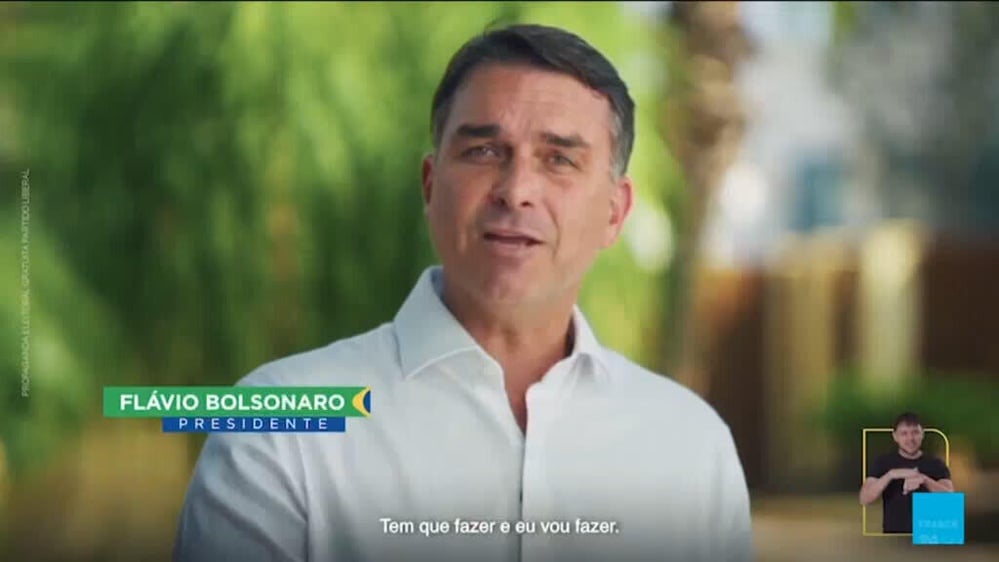
“Brazilians began casting their votes on Sunday in a closely watch presidential election pitting incumbent President Luiz Inacio Lula da Silva against right-wing Senator Flavio Bolsonaro, son of former president Jair Bolsonaro.” · exact text match
Why: It presents both candidates and the election's stakes without endorsing a preferred outcome or ideology; 'right-wing' is descriptive rather than evaluative.
Claim: The report is mostly factual but includes evaluative and predictive framing.
“Brazil heads to the polls for high-stakes election between Lula and Flavio Bolsonaro.” · exact text match
“in an election that will determine whether Latin America's biggest nation follows a regional swing to the right championed by US President Donald Trump” · exact text match
Why: 'High-stakes' and 'will determine whether' are interpretive, while the rest of the text is a plain factual brief.
Claim: The report is politically neutral while covering a political subject.
“Nearly 160 million voters will also pick lawmakers, senators and governors in an election that will determine whether Latin America's biggest nation follows a regional swing to the right championed by US President Donald Trump.” · exact text match
Why: It neither advocates for a candidate nor uses denigrating labels; the geopolitical framing is presented without endorsement.
Claim: The report asserts a definite future consequence of the election.
“an election that will determine whether Latin America's biggest nation follows a regional swing to the right championed by US President Donald Trump” · exact text match
Why: 'Will determine' frames a possible geopolitical outcome as certain, exceeding strictly factual reporting.
Only a brief undated excerpt was supplied; the exact election date, publisher, and surrounding context are unavailable.
Framing is minimal and largely neutral, using only mildly evaluative descriptors such as 'high-stakes' and 'closely watch' and an ideological label for one candidate.
Automated analysis; not human reviewed.
Limitations: Input is a truncated, partly duplicated snippet with no byline or full story, so only the lede supports classification.
·
4 of 55 available dimensions scored; omitted dimensions are not treated as neutral.
·
Verified supporting quotes for 3 of 4 scored dimensions.
Claim: The report is written in a detached, factual register rather than a subjective or opinionated one.
“Brazilians began casting their votes on Sunday in a closely watch presidential election pitting incumbent President Luiz Inacio Lula da Silva against right-wing Senator Flavio Bolsonaro, son of former president Jair Bolsonaro.” · exact text match
Why: The sentence reports who, what, when, and the candidates' relationship; the only mildly subjective terms are 'closely watch' and 'right-wing'.
Claim: The text uses mild flavor words but no sensationalizing language.
“high-stakes election between Lula and Flavio Bolsonaro” · exact text match
“closely watch presidential election” · exact text match
Why: 'high-stakes' and 'closely watch' add emphasis but are conventional campaign descriptors, not alarmist.
Claim: The text describes the vote and offices at stake without telling readers how to vote or what should happen.
“Brazilians began casting their votes on Sunday” · exact text match
“Voters will also pick lawmakers, senators and governors” · not found in supplied text
Why: Statements are indicative and informational; no imperative or recommendation appears.
Claim: The entire supplied content is about election politics, candidates, and offices.
“presidential election pitting incumbent President Luiz Inacio Lula da Silva against right-wing Senator Flavio Bolsonaro” · exact text match
“Nearly 160 million voters will also pick lawmakers, senators and governors” · exact text match
Why: Every substantive sentence concerns voting, candidates, or elected offices, so the report is strongly political in subject and framing.
Input is a truncated, partly duplicated snippet with no byline or full story, so only the lede supports classification.
Framing is minimal and largely neutral, using only mildly evaluative descriptors such as 'high-stakes' and 'closely watch' and an ideological label for one candidate.
Automated analysis; not human reviewed.
Limitations: Input is a truncated, partly duplicated snippet with no byline or full story, so only the lede supports classification.
·
4 of 55 available dimensions scored; omitted dimensions are not treated as neutral.
·
Verified supporting quotes for 3 of 4 scored dimensions.
Claim: The report is written in a detached, factual register rather than a subjective or opinionated one.
“Brazilians began casting their votes on Sunday in a closely watch presidential election pitting incumbent President Luiz Inacio Lula da Silva against right-wing Senator Flavio Bolsonaro, son of former president Jair Bolsonaro.” · exact text match
Why: The sentence reports who, what, when, and the candidates' relationship; the only mildly subjective terms are 'closely watch' and 'right-wing'.
Claim: The text uses mild flavor words but no sensationalizing language.
“high-stakes election between Lula and Flavio Bolsonaro” · exact text match
“closely watch presidential election” · exact text match
Why: 'high-stakes' and 'closely watch' add emphasis but are conventional campaign descriptors, not alarmist.
Claim: The text describes the vote and offices at stake without telling readers how to vote or what should happen.
“Brazilians began casting their votes on Sunday” · exact text match
“Voters will also pick lawmakers, senators and governors” · not found in supplied text
Why: Statements are indicative and informational; no imperative or recommendation appears.
Claim: The entire supplied content is about election politics, candidates, and offices.
“presidential election pitting incumbent President Luiz Inacio Lula da Silva against right-wing Senator Flavio Bolsonaro” · exact text match
“Nearly 160 million voters will also pick lawmakers, senators and governors” · exact text match
Why: Every substantive sentence concerns voting, candidates, or elected offices, so the report is strongly political in subject and framing.
Input is a truncated, partly duplicated snippet with no byline or full story, so only the lede supports classification.
October 03, 2026 · 0 shares
The coverage frames Brazil's election as a close, scandal-tainted, high-stakes race while giving comparable attention to both major campaigns.
Brazilian presidential elections require an absolute majority of valid votes in the first round; otherwise the top two candidates compete in a runoff.
Automated analysis; not human reviewed.
Limitations: No independent verification of opinion polls or the legal characterization of Jair Bolsonaro's sentence was available from the supplied text.
·
55 of 55 available dimensions scored; omitted dimensions are not treated as neutral.
·
Verified supporting quotes for 23 of 55 scored dimensions.
Claim: The article is politically balanced between Lula and Flavio Bolsonaro.
“Lula, 80, toured Brazil's economic powerhouse Sao Paulo on the back of a campaign truck on Saturday, cheered on by a sea of red and vowing to 'defeat the far right.'” · not found in supplied text
“Flavio Bolsonaro led a parade of hundreds of motorcycles in the interior of the state of Sao Paulo, in the style of his father.” · exact text match
Why: The piece devotes comparable descriptive detail to each campaign and quotes voters from both sides.
Claim: The article is mildly populist in tone because it emphasizes mass rallies and ordinary voters over elite policy detail.
“Lula, 80, toured Brazil's economic powerhouse Sao Paulo on the back of a campaign truck on Saturday, cheered on by a sea of red and vowing to 'defeat the far right.'” · not found in supplied text
“Another Lula supporter, accountant Tiago Lorureto, 35, said the election was 'a choice between democracy and barbarism.'” · not found in supplied text
Why: The framing is centered on crowds, popular allegiances, and street-level campaigning rather than detailed institutional or elite policy discussion.
Claim: The article is neutral regarding libertarian versus authoritarian policy preferences.
“The younger Bolsonaro has run on a platform of hardline security policies and fiscal austerity, slamming Lula as 'incompetent' and highlighting the high cost of living.” · not found in supplied text
Why: The article reports a policy platform without endorsing or condemning it from a libertarian or authoritarian standpoint.
Claim: The article is predominantly factual but includes some subjective characterizations.
“Opinion polls show neither candidate is likely to win the first-round election Sunday, and the two are in a statistical tie for an October 25 runoff.” · exact text match
“It has been a bitter campaign in the deeply divided nation.” · exact text match
Why: Most claims are attributed or poll-based, while 'bitter campaign' and 'deeply divided' are evaluative.
Claim: The article uses mildly sensational, dramatic language while remaining fact-based.
“Brazil's Lula, Bolsonaro conclude campaigns ahead of knife-edge Sunday election.” · exact text match
“Brazil's President Luiz Inacio Lula da Silva and his rival Flavio Bolsonaro have wrapped up their campaigns ahead of a nail-biter election that has been marred by scandals and mudslinging.” · exact text match
Why: 'Knife-edge' and 'nail-biter' are dramatic labels, but the surrounding details are attributed and concrete.
Claim: The article is slightly bearish about Brazil's political outlook, emphasizing division and scandal.
“It has been a bitter campaign in the deeply divided nation.” · exact text match
“Policies and promises have been overshadowed by a barrage of scandals and personal attacks as candidates jockey for every undecided voter.” · exact text match
Why: The tone is cautious and negative about the political climate but does not predict economic or market direction.
Claim: The article is mildly pessimistic in tone, focusing on division and scandal.
“It has been a bitter campaign in the deeply divided nation.” · exact text match
Why: The characterization of the campaign as bitter and the nation as deeply divided conveys pessimism.
Claim: The article is moderately interesting because of its close-race framing and colorful campaign details.
“Brazil's Lula, Bolsonaro conclude campaigns ahead of knife-edge Sunday election.” · exact text match
“It emerged during the campaign that Flavio Bolsonaro was under investigation for corruption over the financing of the biopic 'Dark Horse' about his father.” · not found in supplied text
Why: The race's uncertainty and scandal elements add narrative interest.
Claim: The article describes campaign events and voter sentiment rather than telling readers what should happen.
“Lula, 80, toured Brazil's economic powerhouse Sao Paulo on the back of a campaign truck on Saturday, cheered on by a sea of red and vowing to 'defeat the far right.'” · not found in supplied text
“The younger Bolsonaro has run on a platform of hardline security policies and fiscal austerity, slamming Lula as 'incompetent' and highlighting the high cost of living.” · not found in supplied text
Why: It reports actions and platforms without prescribing a vote or policy outcome.
Claim: The article is neutral on military or foreign-policy hawkishness.
“Lula has warned Trump against 'meddling' in Brazil's election.” · not found in supplied text
“The younger Bolsonaro has run on a platform of hardline security policies and fiscal austerity.” · not found in supplied text
Why: The article reports both dovish and hawkish positions without endorsing either.
Claim: The article is minimally fear-oriented, with a few alarming phrases but no sustained fear-mongering.
“Lula is locked in a tight battle against right-wing senator Flavio Bolsonaro, 45, the son of former president Jair Bolsonaro who is serving a 27-year sentence for attempting a coup after his failed 2022 re-election bid.” · exact text match
“The stakes are high: In 2022, Lula beat Jair Bolsonaro by only 1.8 percentage points.” · exact text match
Why: The high-stakes language is tied to actual electoral closeness, not manufactured panic.
Claim: The article does not rely on circular reasoning.
“Opinion polls show neither candidate is likely to win the first-round election Sunday, and the two are in a statistical tie for an October 25 runoff.” · exact text match
Why: Its central claim is supported by an external-source reference rather than assumed as its own proof.
Claim: The article is not gossipy; scandal details are tied to investigation reports and legal context.
“It emerged during the campaign that Flavio Bolsonaro was under investigation for corruption over the financing of the biopic 'Dark Horse' about his father.” · not found in supplied text
Why: The corruption mention is reported as an investigation, not as personal rumor or titillation.
Claim: The article is mostly factual but carries mild editorializing.
“It has been a bitter campaign in the deeply divided nation.” · exact text match
“Policies and promises have been overshadowed by a barrage of scandals and personal attacks as candidates jockey for every undecided voter.” · exact text match
Why: Most content is attributed and factual, but these two lines are un-attributed evaluative summaries.
Claim: The article is saturated with electoral politics.
“Lula is locked in a tight battle against right-wing senator Flavio Bolsonaro, 45, the son of former president Jair Bolsonaro who is serving a 27-year sentence for attempting a coup after his failed 2022 re-election bid.” · exact text match
“While the presidential election is in the spotlight, Brazil's nearly 160 million registered voters are also picking lawmakers, governors and some senators.” · exact text match
Why: The piece is wholly about election campaigns, candidate positioning, scandals, and voter allegiances.
Claim: The article avoids major oversimplification by noting the simultaneous legislative and gubernatorial elections.
“While the presidential election is in the spotlight, Brazil's nearly 160 million registered voters are also picking lawmakers, governors and some senators.” · exact text match
Why: It acknowledges the broader electoral context beyond the presidential race.
Claim: The article relies moderately on named sources and polls, but does not substitute authority for evidence.
“Adriana Lima, 44, an early childhood educator clad all in red, told AFP that Lula was 'the only president who cared about the people.'” · not found in supplied text
Why: It attributes opinions but does not treat supporters as expert authorities on policy.
Claim: The article is not immature; it reports allegations and insults without name-calling.
“Policies and promises have been overshadowed by a barrage of scandals and personal attacks as candidates jockey for every undecided voter.” · exact text match
Why: It describes personal attacks rather than engaging in them.
Claim: The article does not use conclusions as premises.
“Opinion polls show neither candidate is likely to win the first-round election Sunday, and the two are in a statistical tie for an October 25 runoff.” · exact text match
Why: Its forecast is grounded in external polling, not restatement of a conclusion.
Claim: The article does not focus overwhelmingly on reactions to events rather than the events themselves.
“Lula, 80, toured Brazil's economic powerhouse Sao Paulo on the back of a campaign truck on Saturday, cheered on by a sea of red and vowing to 'defeat the far right.'” · not found in supplied text
Why: It covers campaign events themselves, not only commentary about them.
Claim: The article does not frame either candidate primarily as a victim.
“Flavio Bolsonaro has run on a platform of hardline security policies and fiscal austerity, slamming Lula as 'incompetent' and highlighting the high cost of living.” · not found in supplied text
Why: It presents both sides as active campaigners, not as aggrieved victims.
Claim: The article does not overstate certainty; it uses poll-based probabilistic language.
“Opinion polls show neither candidate is likely to win the first-round election Sunday, and the two are in a statistical tie for an October 25 runoff.” · exact text match
Why: It says 'likely' and 'statistical tie' rather than asserting a definitive outcome.
Claim: The article is not spam or promotional fluff.
“Brazil's President Luiz Inacio Lula da Silva and his rival Flavio Bolsonaro have wrapped up their campaigns ahead of a nail-biter election that has been marred by scandals and mudslinging.” · exact text match
Why: It is substantive news reporting, not filler or advertising.
Claim: The article is not ideological; it reports multiple viewpoints.
“Lula, 80, toured Brazil's economic powerhouse Sao Paulo on the back of a campaign truck on Saturday, cheered on by a sea of red and vowing to 'defeat the far right.'” · not found in supplied text
“Flavio Bolsonaro led a parade of hundreds of motorcycles in the interior of the state of Sao Paulo, in the style of his father.” · exact text match
Why: It presents both ideological camps without campaigning for one.
Claim: The article is slightly pro-establishment in that it treats mainstream party politics and poll-based horse-race coverage as the default frame.
“Opinion polls show neither candidate is likely to win the first-round election Sunday, and the two are in a statistical tie for an October 25 runoff.” · exact text match
Why: It centers established candidates and conventional news framing, but does not advocate for institutional power.
Claim: The article has a mildly negative emotional tone.
“It has been a bitter campaign in the deeply divided nation.” · exact text match
Why: Words like 'bitter' and 'deeply divided' convey negativity without severe alarm.
Claim: The article does not show a double standard between the candidates.
“Lula, 80, toured Brazil's economic powerhouse Sao Paulo on the back of a campaign truck on Saturday, cheered on by a sea of red and vowing to 'defeat the far right.'” · not found in supplied text
“Flavio Bolsonaro led a parade of hundreds of motorcycles in the interior of the state of Sao Paulo, in the style of his father.” · exact text match
Why: Both candidates receive similar treatment for campaign coverage and supporter quotes.
Claim: The article shows moderate-to-good sourcing and attribution.
“Adriana Lima, 44, an early childhood educator clad all in red, told AFP that Lula was 'the only president who cared about the people.'” · not found in supplied text
“Opinion polls show neither candidate is likely to win the first-round election Sunday, and the two are in a statistical tie for an October 25 runoff.” · exact text match
Why: It identifies sources, names voters, attributes quotes to AFP, and uses poll-based uncertainty.
Claim: The article's forecast of a likely runoff is grounded in opinion polls rather than speculation.
“Opinion polls show neither candidate is likely to win the first-round election Sunday, and the two are in a statistical tie for an October 25 runoff.” · exact text match
Why: The central electoral projection is visibly based on polling data.
Claim: The article is not advertorial.
Why: No product or service is promoted.
Claim: The article is empirically grounded rather than superstitious.
“Opinion polls show neither candidate is likely to win the first-round election Sunday, and the two are in a statistical tie for an October 25 runoff.” · exact text match
Why: It relies on polling data and observable events.
Claim: The article contains mild speculation, mostly qualified by polling and conditionals.
“Opinion polls show neither candidate is likely to win the first-round election Sunday, and the two are in a statistical tie for an October 25 runoff.” · exact text match
Why: A probable runoff is projected from polls, and other statements are conditional.
Claim: No strong AI-authorship indicators are present.
“Brazil's President Luiz Inacio Lula da Silva and his rival Flavio Bolsonaro have wrapped up their campaigns ahead of a nail-biter election that has been marred by scandals and mudslinging.” · exact text match
Why: The prose is typical wire-news style with named sources and attributed quotes, without identifying AI-generated patterns.
Claim: The article shows internal fairness by attributing opinions and covering both campaigns.
“Lula, 80, toured Brazil's economic powerhouse Sao Paulo on the back of a campaign truck on Saturday, cheered on by a sea of red and vowing to 'defeat the far right.'” · not found in supplied text
“Flavio Bolsonaro led a parade of hundreds of motorcycles in the interior of the state of Sao Paulo, in the style of his father.” · exact text match
Why: The article gives roughly symmetrical treatment to both campaigns and attributes opinions to sources rather than asserting them.
Claim: The article is clear and contextually grounded, with named sources and poll-based reasoning.
“Opinion polls show neither candidate is likely to win the first-round election Sunday, and the two are in a statistical tie for an October 25 runoff.” · exact text match
“In 2022, Lula beat Jair Bolsonaro by only 1.8 percentage points.” · exact text match
Why: It combines reported polling, historical margin, and attributed quotes to explain the race.
Claim: The article is truth-seeking rather than delusion-seeking.
“Opinion polls show neither candidate is likely to win the first-round election Sunday, and the two are in a statistical tie for an October 25 runoff.” · exact text match
Why: It reports empirical uncertainty rather than serving an imagined narrative.
Claim: The article does not endorse or sanitize violence.
“Jair Bolsonaro, Flavio's father, is serving a 27-year sentence for attempting a coup after his failed 2022 re-election bid.” · not found in supplied text
Why: It reports a conviction without justifying political violence.
Claim: The article does not promote or normalize fraud; it reports an investigation.
“It emerged during the campaign that Flavio Bolsonaro was under investigation for corruption over the financing of the biopic 'Dark Horse' about his father.” · not found in supplied text
Why: The corruption investigation is reported as an allegation, not celebrated or excused.
Claim: The article does not endorse Marxist ideology.
“Lula, 80, toured Brazil's economic powerhouse Sao Paulo on the back of a campaign truck on Saturday, cheered on by a sea of red and vowing to 'defeat the far right.'” · not found in supplied text
Why: It reports Lula's campaign language but does not advocate class-conflict materialism or revolutionary change.
Claim: The article contains no Islamist content.
Why: Islamism is not mentioned or relevant.
Claim: The article contains no anti-Jewish content.
Why: There is no reference to Jews or Judaism.
Claim: The article contains no anti-LGBT content.
Why: There is no reference to LGBT people or rights.
Claim: The article contains no racial-group attacks.
Why: There is no racial content.
Claim: The article does not apply identity-group power framing.
Why: Identity-politics demands are not present.
Claim: The article is not cruel.
Why: It does not celebrate harm or suffering.
Claim: The article is not virtue-signaling.
Why: It does not perform moral posturing.
Claim: The article does not promote conspiracy theories.
“It emerged during the campaign that Flavio Bolsonaro was under investigation for corruption over the financing of the biopic 'Dark Horse' about his father.” · not found in supplied text
Why: It reports an investigation as an institutional fact, not as a secret plot.
Claim: The article does not advocate harmful empathy.
Why: No self-harm tradeoff is present.
Claim: The article does not scapegoat a group.
Why: No group is blamed for problems without evidence.
Claim: The article does not apply incompatible standards to comparable cases.
“Lula, 80, toured Brazil's economic powerhouse Sao Paulo on the back of a campaign truck on Saturday, cheered on by a sea of red and vowing to 'defeat the far right.'” · not found in supplied text
“Flavio Bolsonaro led a parade of hundreds of motorcycles in the interior of the state of Sao Paulo, in the style of his father.” · exact text match
Why: It treats both candidates' campaign events in parallel rather than judging one side by different standards.
Claim: The article does not reject reason or evidence.
“Opinion polls show neither candidate is likely to win the first-round election Sunday, and the two are in a statistical tie for an October 25 runoff.” · exact text match
Why: It uses empirical polling data rather than rejecting evidence.
No independent verification of opinion polls or the legal characterization of Jair Bolsonaro's sentence was available from the supplied text.
The framing is neutral and poll-driven, presenting Lula and Flavio Bolsonaro as evenly matched while attributing polling to Quaest/Reuters and including each side's claims and denials.
Automated analysis; not human reviewed.
Limitations: No author byline is provided and the supplied text is a concise wire-style report; related links and video prompts were ignored as page chrome.
·
7 of 55 available dimensions scored; omitted dimensions are not treated as neutral.
·
Verified supporting quotes for 7 of 7 scored dimensions.
Claim: The report gives no net partisan valence; it pairs both candidates' positions and relies on attributed polling.
“The latest polling for the first round of voting shows Lula at 46% and Bolsonaro at 45%, according to the Brazilian data intelligence and public opinion research firm Quaest cited by Reuters news agency.” · exact text match
Why: Balanced inclusion of both campaigns' details and attributed poll numbers supports measured neutrality.
Claim: The report is predominantly factual and attributed, with no overt subjective conclusions.
“Polls show neither candidate is likely to win more than 50% of valid votes on Sunday needed to avoid a runoff that would take place on October 25.” · exact text match
Why: Uses numeric electoral mechanics rather than subjective evaluation.
Claim: The tone is measured and non-sensational despite a contested election.
“In 2022, Lula beat Jair Bolsonaro by only 1.8 percentage points.” · exact text match
Why: The close race is contextualized with data instead of alarmist language.
Claim: The report describes candidates' platforms and campaign events without telling readers how to vote.
“Lula has campaigned on continuing his left-leaning Workers' Party platform, comprising welfare programs, state-funded development and income redistribution.” · exact text match
“The right-wing Bolsonaro has campaigned on hardline security policies and tax cuts, emphasizing high cost of living under Lula, who he has slammed as "incompetent."” · exact text match
Why: Platform summaries are presented as campaign positions rather than recommendations.
Claim: The report demonstrates visible sourcing, attribution, and uncertainty practices.
“The latest polling for the first round of voting shows Lula at 46% and Bolsonaro at 45%, according to the Brazilian data intelligence and public opinion research firm Quaest cited by Reuters news agency.” · exact text match
“He has denied any misconduct.” · exact text match
Why: Named polling firm, Reuters attribution, and inclusion of denial support trustworthiness.
Claim: The report supports its characterization of a tight race with attributed polling data.
“The latest polling for the first round of voting shows Lula at 46% and Bolsonaro at 45%, according to the Brazilian data intelligence and public opinion research firm Quaest cited by Reuters news agency.” · exact text match
Why: The central claim is grounded in named polls and a news agency rather than bare assertion.
Claim: The report signals fairness by attributing sourcing and including candidates' denials.
“He has denied any misconduct.” · exact text match
“according to the Brazilian data intelligence and public opinion research firm Quaest cited by Reuters news agency” · exact text match
Why: Allegations are paired with denial and polling is attributed.
No author byline is provided and the supplied text is a concise wire-style report; related links and video prompts were ignored as page chrome.
October 03, 2026 · 0 shares
Balanced and expert-sourced, the coverage treats the election as a high-stakes contest over Brazil's democratic future while applying equivalent scrutiny to both leading campaigns.
Automated analysis; not human reviewed.
Limitations: The supplied text provides no publication date or election year, so temporal references like 'Sunday,' 'Monday,' and 'this year' cannot be independently anchored.
·
4 of 55 available dimensions scored; omitted dimensions are not treated as neutral.
·
Verified supporting quotes for 3 of 4 scored dimensions.
Claim: The report is evenhanded toward both leading candidates, neither endorsing nor disparaging either campaign.
“At the center of the 12-candidate race are two ideological polar opposites: incumbent President Luiz Inacio Lula da Silva, of the left-wing Workers’ Party (PT), and Senator Flavio Bolsonaro, representing the conservative Liberal Party (PL).” · exact text match
“Bolsonaro has also faced scrutiny over a Supreme Court investigation into alleged corruption and money laundering linked to financial transactions surrounding a biographical film about his father.
He has denied wrongdoing.”
· exact text match
“His campaign has also faced scrutiny over investigations involving his eldest son, Fabio Luis “Lulinha” da Silva.” · exact text match
Why: Descriptions are symmetrical and include each candidate's legal scrutiny and response, with no preference expressed.
Claim: The article relies on attributed data and named expert commentary rather than first-person evaluation.
“A Quaest poll released Monday put Lula at 39% and Bolsonaro at 34%, while showing them tied at 42% in a runoff.” · exact text match
“Lucas de Souza Martins, a professor of US politics and global affairs at Temple University, told Anadolu.” · exact text match
Why: Specific polling numbers and named institutional sources carry the report's claims, while opinion is attributed to identified experts.
Claim: The article explains rules and facts without recommending how voters or officials should act.
“Under Brazilian election law, if no candidate secures more than 50% of valid votes Sunday, the top two will advance to a runoff on Oct.
25.”
· exact text match
“Polls will open at 8 a.m. (1400GMT) and close at 5 p.m. Brasilia time, with voters also choosing state governors, federal and state lawmakers and two-thirds of the Federal Senate.” · exact text match
Why: The publisher states legal thresholds, schedules, and survey results rather than advocating any outcome.
Claim: The report cites verifiable specifics: named pollsters, court outcomes, and identified experts.
“A Quaest poll released Monday put Lula at 39% and Bolsonaro at 34%, while showing them tied at 42% in a runoff.” · exact text match
“Jair Bolsonaro was later convicted of plotting a coup to overturn the 2022 election result and sentenced to 27 years and three months in prison.” · not found in supplied text
Why: Polling firms, legal facts, and expert names are attached to key claims, giving a transparent evidentiary basis.
The supplied text provides no publication date or election year, so temporal references like 'Sunday,' 'Monday,' and 'this year' cannot be independently anchored.
October 03, 2026 · 0 shares
The coverage frames Brazil's election as a close, scandal-tainted, high-stakes race while giving comparable attention to both major campaigns.
Brazilian presidential elections require an absolute majority of valid votes in the first round; otherwise the top two candidates compete in a runoff.
Automated analysis; not human reviewed.
Limitations: No independent verification of opinion polls or the legal characterization of Jair Bolsonaro's sentence was available from the supplied text.
·
55 of 55 available dimensions scored; omitted dimensions are not treated as neutral.
·
Verified supporting quotes for 23 of 55 scored dimensions.
Claim: The article is politically balanced between Lula and Flavio Bolsonaro.
“Lula, 80, toured Brazil's economic powerhouse Sao Paulo on the back of a campaign truck on Saturday, cheered on by a sea of red and vowing to 'defeat the far right.'” · not found in supplied text
“Flavio Bolsonaro led a parade of hundreds of motorcycles in the interior of the state of Sao Paulo, in the style of his father.” · exact text match
Why: The piece devotes comparable descriptive detail to each campaign and quotes voters from both sides.
Claim: The article is mildly populist in tone because it emphasizes mass rallies and ordinary voters over elite policy detail.
“Lula, 80, toured Brazil's economic powerhouse Sao Paulo on the back of a campaign truck on Saturday, cheered on by a sea of red and vowing to 'defeat the far right.'” · not found in supplied text
“Another Lula supporter, accountant Tiago Lorureto, 35, said the election was 'a choice between democracy and barbarism.'” · not found in supplied text
Why: The framing is centered on crowds, popular allegiances, and street-level campaigning rather than detailed institutional or elite policy discussion.
Claim: The article is neutral regarding libertarian versus authoritarian policy preferences.
“The younger Bolsonaro has run on a platform of hardline security policies and fiscal austerity, slamming Lula as 'incompetent' and highlighting the high cost of living.” · not found in supplied text
Why: The article reports a policy platform without endorsing or condemning it from a libertarian or authoritarian standpoint.
Claim: The article is predominantly factual but includes some subjective characterizations.
“Opinion polls show neither candidate is likely to win the first-round election Sunday, and the two are in a statistical tie for an October 25 runoff.” · exact text match
“It has been a bitter campaign in the deeply divided nation.” · exact text match
Why: Most claims are attributed or poll-based, while 'bitter campaign' and 'deeply divided' are evaluative.
Claim: The article uses mildly sensational, dramatic language while remaining fact-based.
“Brazil's Lula, Bolsonaro conclude campaigns ahead of knife-edge Sunday election.” · exact text match
“Brazil's President Luiz Inacio Lula da Silva and his rival Flavio Bolsonaro have wrapped up their campaigns ahead of a nail-biter election that has been marred by scandals and mudslinging.” · exact text match
Why: 'Knife-edge' and 'nail-biter' are dramatic labels, but the surrounding details are attributed and concrete.
Claim: The article is slightly bearish about Brazil's political outlook, emphasizing division and scandal.
“It has been a bitter campaign in the deeply divided nation.” · exact text match
“Policies and promises have been overshadowed by a barrage of scandals and personal attacks as candidates jockey for every undecided voter.” · exact text match
Why: The tone is cautious and negative about the political climate but does not predict economic or market direction.
Claim: The article is mildly pessimistic in tone, focusing on division and scandal.
“It has been a bitter campaign in the deeply divided nation.” · exact text match
Why: The characterization of the campaign as bitter and the nation as deeply divided conveys pessimism.
Claim: The article is moderately interesting because of its close-race framing and colorful campaign details.
“Brazil's Lula, Bolsonaro conclude campaigns ahead of knife-edge Sunday election.” · exact text match
“It emerged during the campaign that Flavio Bolsonaro was under investigation for corruption over the financing of the biopic 'Dark Horse' about his father.” · not found in supplied text
Why: The race's uncertainty and scandal elements add narrative interest.
Claim: The article describes campaign events and voter sentiment rather than telling readers what should happen.
“Lula, 80, toured Brazil's economic powerhouse Sao Paulo on the back of a campaign truck on Saturday, cheered on by a sea of red and vowing to 'defeat the far right.'” · not found in supplied text
“The younger Bolsonaro has run on a platform of hardline security policies and fiscal austerity, slamming Lula as 'incompetent' and highlighting the high cost of living.” · not found in supplied text
Why: It reports actions and platforms without prescribing a vote or policy outcome.
Claim: The article is neutral on military or foreign-policy hawkishness.
“Lula has warned Trump against 'meddling' in Brazil's election.” · not found in supplied text
“The younger Bolsonaro has run on a platform of hardline security policies and fiscal austerity.” · not found in supplied text
Why: The article reports both dovish and hawkish positions without endorsing either.
Claim: The article is minimally fear-oriented, with a few alarming phrases but no sustained fear-mongering.
“Lula is locked in a tight battle against right-wing senator Flavio Bolsonaro, 45, the son of former president Jair Bolsonaro who is serving a 27-year sentence for attempting a coup after his failed 2022 re-election bid.” · exact text match
“The stakes are high: In 2022, Lula beat Jair Bolsonaro by only 1.8 percentage points.” · exact text match
Why: The high-stakes language is tied to actual electoral closeness, not manufactured panic.
Claim: The article does not rely on circular reasoning.
“Opinion polls show neither candidate is likely to win the first-round election Sunday, and the two are in a statistical tie for an October 25 runoff.” · exact text match
Why: Its central claim is supported by an external-source reference rather than assumed as its own proof.
Claim: The article is not gossipy; scandal details are tied to investigation reports and legal context.
“It emerged during the campaign that Flavio Bolsonaro was under investigation for corruption over the financing of the biopic 'Dark Horse' about his father.” · not found in supplied text
Why: The corruption mention is reported as an investigation, not as personal rumor or titillation.
Claim: The article is mostly factual but carries mild editorializing.
“It has been a bitter campaign in the deeply divided nation.” · exact text match
“Policies and promises have been overshadowed by a barrage of scandals and personal attacks as candidates jockey for every undecided voter.” · exact text match
Why: Most content is attributed and factual, but these two lines are un-attributed evaluative summaries.
Claim: The article is saturated with electoral politics.
“Lula is locked in a tight battle against right-wing senator Flavio Bolsonaro, 45, the son of former president Jair Bolsonaro who is serving a 27-year sentence for attempting a coup after his failed 2022 re-election bid.” · exact text match
“While the presidential election is in the spotlight, Brazil's nearly 160 million registered voters are also picking lawmakers, governors and some senators.” · exact text match
Why: The piece is wholly about election campaigns, candidate positioning, scandals, and voter allegiances.
Claim: The article avoids major oversimplification by noting the simultaneous legislative and gubernatorial elections.
“While the presidential election is in the spotlight, Brazil's nearly 160 million registered voters are also picking lawmakers, governors and some senators.” · exact text match
Why: It acknowledges the broader electoral context beyond the presidential race.
Claim: The article relies moderately on named sources and polls, but does not substitute authority for evidence.
“Adriana Lima, 44, an early childhood educator clad all in red, told AFP that Lula was 'the only president who cared about the people.'” · not found in supplied text
Why: It attributes opinions but does not treat supporters as expert authorities on policy.
Claim: The article is not immature; it reports allegations and insults without name-calling.
“Policies and promises have been overshadowed by a barrage of scandals and personal attacks as candidates jockey for every undecided voter.” · exact text match
Why: It describes personal attacks rather than engaging in them.
Claim: The article does not use conclusions as premises.
“Opinion polls show neither candidate is likely to win the first-round election Sunday, and the two are in a statistical tie for an October 25 runoff.” · exact text match
Why: Its forecast is grounded in external polling, not restatement of a conclusion.
Claim: The article does not focus overwhelmingly on reactions to events rather than the events themselves.
“Lula, 80, toured Brazil's economic powerhouse Sao Paulo on the back of a campaign truck on Saturday, cheered on by a sea of red and vowing to 'defeat the far right.'” · not found in supplied text
Why: It covers campaign events themselves, not only commentary about them.
Claim: The article does not frame either candidate primarily as a victim.
“Flavio Bolsonaro has run on a platform of hardline security policies and fiscal austerity, slamming Lula as 'incompetent' and highlighting the high cost of living.” · not found in supplied text
Why: It presents both sides as active campaigners, not as aggrieved victims.
Claim: The article does not overstate certainty; it uses poll-based probabilistic language.
“Opinion polls show neither candidate is likely to win the first-round election Sunday, and the two are in a statistical tie for an October 25 runoff.” · exact text match
Why: It says 'likely' and 'statistical tie' rather than asserting a definitive outcome.
Claim: The article is not spam or promotional fluff.
“Brazil's President Luiz Inacio Lula da Silva and his rival Flavio Bolsonaro have wrapped up their campaigns ahead of a nail-biter election that has been marred by scandals and mudslinging.” · exact text match
Why: It is substantive news reporting, not filler or advertising.
Claim: The article is not ideological; it reports multiple viewpoints.
“Lula, 80, toured Brazil's economic powerhouse Sao Paulo on the back of a campaign truck on Saturday, cheered on by a sea of red and vowing to 'defeat the far right.'” · not found in supplied text
“Flavio Bolsonaro led a parade of hundreds of motorcycles in the interior of the state of Sao Paulo, in the style of his father.” · exact text match
Why: It presents both ideological camps without campaigning for one.
Claim: The article is slightly pro-establishment in that it treats mainstream party politics and poll-based horse-race coverage as the default frame.
“Opinion polls show neither candidate is likely to win the first-round election Sunday, and the two are in a statistical tie for an October 25 runoff.” · exact text match
Why: It centers established candidates and conventional news framing, but does not advocate for institutional power.
Claim: The article has a mildly negative emotional tone.
“It has been a bitter campaign in the deeply divided nation.” · exact text match
Why: Words like 'bitter' and 'deeply divided' convey negativity without severe alarm.
Claim: The article does not show a double standard between the candidates.
“Lula, 80, toured Brazil's economic powerhouse Sao Paulo on the back of a campaign truck on Saturday, cheered on by a sea of red and vowing to 'defeat the far right.'” · not found in supplied text
“Flavio Bolsonaro led a parade of hundreds of motorcycles in the interior of the state of Sao Paulo, in the style of his father.” · exact text match
Why: Both candidates receive similar treatment for campaign coverage and supporter quotes.
Claim: The article shows moderate-to-good sourcing and attribution.
“Adriana Lima, 44, an early childhood educator clad all in red, told AFP that Lula was 'the only president who cared about the people.'” · not found in supplied text
“Opinion polls show neither candidate is likely to win the first-round election Sunday, and the two are in a statistical tie for an October 25 runoff.” · exact text match
Why: It identifies sources, names voters, attributes quotes to AFP, and uses poll-based uncertainty.
Claim: The article's forecast of a likely runoff is grounded in opinion polls rather than speculation.
“Opinion polls show neither candidate is likely to win the first-round election Sunday, and the two are in a statistical tie for an October 25 runoff.” · exact text match
Why: The central electoral projection is visibly based on polling data.
Claim: The article is not advertorial.
Why: No product or service is promoted.
Claim: The article is empirically grounded rather than superstitious.
“Opinion polls show neither candidate is likely to win the first-round election Sunday, and the two are in a statistical tie for an October 25 runoff.” · exact text match
Why: It relies on polling data and observable events.
Claim: The article contains mild speculation, mostly qualified by polling and conditionals.
“Opinion polls show neither candidate is likely to win the first-round election Sunday, and the two are in a statistical tie for an October 25 runoff.” · exact text match
Why: A probable runoff is projected from polls, and other statements are conditional.
Claim: No strong AI-authorship indicators are present.
“Brazil's President Luiz Inacio Lula da Silva and his rival Flavio Bolsonaro have wrapped up their campaigns ahead of a nail-biter election that has been marred by scandals and mudslinging.” · exact text match
Why: The prose is typical wire-news style with named sources and attributed quotes, without identifying AI-generated patterns.
Claim: The article shows internal fairness by attributing opinions and covering both campaigns.
“Lula, 80, toured Brazil's economic powerhouse Sao Paulo on the back of a campaign truck on Saturday, cheered on by a sea of red and vowing to 'defeat the far right.'” · not found in supplied text
“Flavio Bolsonaro led a parade of hundreds of motorcycles in the interior of the state of Sao Paulo, in the style of his father.” · exact text match
Why: The article gives roughly symmetrical treatment to both campaigns and attributes opinions to sources rather than asserting them.
Claim: The article is clear and contextually grounded, with named sources and poll-based reasoning.
“Opinion polls show neither candidate is likely to win the first-round election Sunday, and the two are in a statistical tie for an October 25 runoff.” · exact text match
“In 2022, Lula beat Jair Bolsonaro by only 1.8 percentage points.” · exact text match
Why: It combines reported polling, historical margin, and attributed quotes to explain the race.
Claim: The article is truth-seeking rather than delusion-seeking.
“Opinion polls show neither candidate is likely to win the first-round election Sunday, and the two are in a statistical tie for an October 25 runoff.” · exact text match
Why: It reports empirical uncertainty rather than serving an imagined narrative.
Claim: The article does not endorse or sanitize violence.
“Jair Bolsonaro, Flavio's father, is serving a 27-year sentence for attempting a coup after his failed 2022 re-election bid.” · not found in supplied text
Why: It reports a conviction without justifying political violence.
Claim: The article does not promote or normalize fraud; it reports an investigation.
“It emerged during the campaign that Flavio Bolsonaro was under investigation for corruption over the financing of the biopic 'Dark Horse' about his father.” · not found in supplied text
Why: The corruption investigation is reported as an allegation, not celebrated or excused.
Claim: The article does not endorse Marxist ideology.
“Lula, 80, toured Brazil's economic powerhouse Sao Paulo on the back of a campaign truck on Saturday, cheered on by a sea of red and vowing to 'defeat the far right.'” · not found in supplied text
Why: It reports Lula's campaign language but does not advocate class-conflict materialism or revolutionary change.
Claim: The article contains no Islamist content.
Why: Islamism is not mentioned or relevant.
Claim: The article contains no anti-Jewish content.
Why: There is no reference to Jews or Judaism.
Claim: The article contains no anti-LGBT content.
Why: There is no reference to LGBT people or rights.
Claim: The article contains no racial-group attacks.
Why: There is no racial content.
Claim: The article does not apply identity-group power framing.
Why: Identity-politics demands are not present.
Claim: The article is not cruel.
Why: It does not celebrate harm or suffering.
Claim: The article is not virtue-signaling.
Why: It does not perform moral posturing.
Claim: The article does not promote conspiracy theories.
“It emerged during the campaign that Flavio Bolsonaro was under investigation for corruption over the financing of the biopic 'Dark Horse' about his father.” · not found in supplied text
Why: It reports an investigation as an institutional fact, not as a secret plot.
Claim: The article does not advocate harmful empathy.
Why: No self-harm tradeoff is present.
Claim: The article does not scapegoat a group.
Why: No group is blamed for problems without evidence.
Claim: The article does not apply incompatible standards to comparable cases.
“Lula, 80, toured Brazil's economic powerhouse Sao Paulo on the back of a campaign truck on Saturday, cheered on by a sea of red and vowing to 'defeat the far right.'” · not found in supplied text
“Flavio Bolsonaro led a parade of hundreds of motorcycles in the interior of the state of Sao Paulo, in the style of his father.” · exact text match
Why: It treats both candidates' campaign events in parallel rather than judging one side by different standards.
Claim: The article does not reject reason or evidence.
“Opinion polls show neither candidate is likely to win the first-round election Sunday, and the two are in a statistical tie for an October 25 runoff.” · exact text match
Why: It uses empirical polling data rather than rejecting evidence.
No independent verification of opinion polls or the legal characterization of Jair Bolsonaro's sentence was available from the supplied text.
The framing is neutral and poll-driven, presenting Lula and Flavio Bolsonaro as evenly matched while attributing polling to Quaest/Reuters and including each side's claims and denials.
Automated analysis; not human reviewed.
Limitations: No author byline is provided and the supplied text is a concise wire-style report; related links and video prompts were ignored as page chrome.
·
7 of 55 available dimensions scored; omitted dimensions are not treated as neutral.
·
Verified supporting quotes for 7 of 7 scored dimensions.
Claim: The report gives no net partisan valence; it pairs both candidates' positions and relies on attributed polling.
“The latest polling for the first round of voting shows Lula at 46% and Bolsonaro at 45%, according to the Brazilian data intelligence and public opinion research firm Quaest cited by Reuters news agency.” · exact text match
Why: Balanced inclusion of both campaigns' details and attributed poll numbers supports measured neutrality.
Claim: The report is predominantly factual and attributed, with no overt subjective conclusions.
“Polls show neither candidate is likely to win more than 50% of valid votes on Sunday needed to avoid a runoff that would take place on October 25.” · exact text match
Why: Uses numeric electoral mechanics rather than subjective evaluation.
Claim: The tone is measured and non-sensational despite a contested election.
“In 2022, Lula beat Jair Bolsonaro by only 1.8 percentage points.” · exact text match
Why: The close race is contextualized with data instead of alarmist language.
Claim: The report describes candidates' platforms and campaign events without telling readers how to vote.
“Lula has campaigned on continuing his left-leaning Workers' Party platform, comprising welfare programs, state-funded development and income redistribution.” · exact text match
“The right-wing Bolsonaro has campaigned on hardline security policies and tax cuts, emphasizing high cost of living under Lula, who he has slammed as "incompetent."” · exact text match
Why: Platform summaries are presented as campaign positions rather than recommendations.
Claim: The report demonstrates visible sourcing, attribution, and uncertainty practices.
“The latest polling for the first round of voting shows Lula at 46% and Bolsonaro at 45%, according to the Brazilian data intelligence and public opinion research firm Quaest cited by Reuters news agency.” · exact text match
“He has denied any misconduct.” · exact text match
Why: Named polling firm, Reuters attribution, and inclusion of denial support trustworthiness.
Claim: The report supports its characterization of a tight race with attributed polling data.
“The latest polling for the first round of voting shows Lula at 46% and Bolsonaro at 45%, according to the Brazilian data intelligence and public opinion research firm Quaest cited by Reuters news agency.” · exact text match
Why: The central claim is grounded in named polls and a news agency rather than bare assertion.
Claim: The report signals fairness by attributing sourcing and including candidates' denials.
“He has denied any misconduct.” · exact text match
“according to the Brazilian data intelligence and public opinion research firm Quaest cited by Reuters news agency” · exact text match
Why: Allegations are paired with denial and polling is attributed.
No author byline is provided and the supplied text is a concise wire-style report; related links and video prompts were ignored as page chrome.
The framing is neutral and poll-driven, presenting Lula and Flavio Bolsonaro as evenly matched while attributing polling to Quaest/Reuters and including each side's claims and denials.
Automated analysis; not human reviewed.
Limitations: No author byline is provided and the supplied text is a concise wire-style report; related links and video prompts were ignored as page chrome.
·
7 of 55 available dimensions scored; omitted dimensions are not treated as neutral.
·
Verified supporting quotes for 7 of 7 scored dimensions.
Claim: The report gives no net partisan valence; it pairs both candidates' positions and relies on attributed polling.
“The latest polling for the first round of voting shows Lula at 46% and Bolsonaro at 45%, according to the Brazilian data intelligence and public opinion research firm Quaest cited by Reuters news agency.” · exact text match
Why: Balanced inclusion of both campaigns' details and attributed poll numbers supports measured neutrality.
Claim: The report is predominantly factual and attributed, with no overt subjective conclusions.
“Polls show neither candidate is likely to win more than 50% of valid votes on Sunday needed to avoid a runoff that would take place on October 25.” · exact text match
Why: Uses numeric electoral mechanics rather than subjective evaluation.
Claim: The tone is measured and non-sensational despite a contested election.
“In 2022, Lula beat Jair Bolsonaro by only 1.8 percentage points.” · exact text match
Why: The close race is contextualized with data instead of alarmist language.
Claim: The report describes candidates' platforms and campaign events without telling readers how to vote.
“Lula has campaigned on continuing his left-leaning Workers' Party platform, comprising welfare programs, state-funded development and income redistribution.” · exact text match
“The right-wing Bolsonaro has campaigned on hardline security policies and tax cuts, emphasizing high cost of living under Lula, who he has slammed as "incompetent."” · exact text match
Why: Platform summaries are presented as campaign positions rather than recommendations.
Claim: The report demonstrates visible sourcing, attribution, and uncertainty practices.
“The latest polling for the first round of voting shows Lula at 46% and Bolsonaro at 45%, according to the Brazilian data intelligence and public opinion research firm Quaest cited by Reuters news agency.” · exact text match
“He has denied any misconduct.” · exact text match
Why: Named polling firm, Reuters attribution, and inclusion of denial support trustworthiness.
Claim: The report supports its characterization of a tight race with attributed polling data.
“The latest polling for the first round of voting shows Lula at 46% and Bolsonaro at 45%, according to the Brazilian data intelligence and public opinion research firm Quaest cited by Reuters news agency.” · exact text match
Why: The central claim is grounded in named polls and a news agency rather than bare assertion.
Claim: The report signals fairness by attributing sourcing and including candidates' denials.
“He has denied any misconduct.” · exact text match
“according to the Brazilian data intelligence and public opinion research firm Quaest cited by Reuters news agency” · exact text match
Why: Allegations are paired with denial and polling is attributed.
No author byline is provided and the supplied text is a concise wire-style report; related links and video prompts were ignored as page chrome.
October 04, 2026 · 0 shares
A mostly balanced campaign report whose main observable framing is horse-race coverage, with asymmetric epistemic scrutiny applied to Bolsonaro’s election-integrity claims.
Brazilian presidential elections require a majority in the first round; otherwise the top two candidates face a runoff.
The text is set on the final day of campaigning before that first-round vote.
Automated analysis; not human reviewed.
Limitations: The supplied text includes duplicated passages and embedded related-headline links, so the exact article boundary and original publication metadata are unclear.
·
10 of 55 available dimensions scored; omitted dimensions are not treated as neutral.
·
Verified supporting quotes for 10 of 10 scored dimensions.
Claim: The report gives no observable preference for Lula or Bolsonaro; it structures the story around their competing closing events and attributed claims.
“Lula, 80, closed his re-election bid on Saturday with a march through Sao Paulo, Brazil’s economic powerhouse, drawing what his campaign called a record crowd for a closing rally.” · exact text match
“Bolsonaro led a motorcycle caravan through towns in Sao Paulo state, echoing the campaign style of his father, before rallying later in Rio de Janeiro.” · exact text match
Counterevidence:
“echoed his father’s unsubstantiated claims questioning the reliability of Brazil’s electronic voting system” · exact text match
Why: The coverage is symmetrically structured, but the characterization of voting-system claims as unsubstantiated is a mild critical framing, so the score stays at zero rather than shifting.
Claim: The article is predominantly factual, using attributed quotes, poll data, and institutional detail.
“Polls released on Saturday suggested Lula was still ahead but his lead was narrowing, with neither candidate likely to win outright on Sunday.” · exact text match
Counterevidence:
“echoed his father’s unsubstantiated claims questioning the reliability of Brazil’s electronic voting system” · exact text match
Why: The one editorialized phrase “unsubstantiated claims” prevents a full objective score, but the rest of the report stays in attributed/descriptive mode.
Claim: The article is low-key and procedural, avoiding alarmist or dramatic presentation.
“Such a result would send the race to a run-off on October 25 between the two frontrunners, a contest polls suggest would also be close.” · exact text match
Why: The factual, procedural language about a possible runoff is written without sensational emphasis.
Claim: The article describes events and quotes candidates without telling readers what to do or how to vote.
“Lula, 80, closed his re-election bid on Saturday with a march through Sao Paulo, Brazil’s economic powerhouse, drawing what his campaign called a record crowd for a closing rally.” · exact text match
Why: The sentence is purely descriptive of an event and contains no prescription or call to action.
Claim: The story is almost entirely within the domain of electoral politics.
“Brazilian President Luiz Inacio Lula da Silva and right-wing Senator Flavio Bolsonaro have wrapped up their election campaigns, each voicing confidence in victory ahead of Sunday’s tightly contested first-round presidential vote.” · exact text match
Why: This is a campaign report centered on candidates, polls, legal accusations, and political messaging.
Claim: The article is well-sourced and attributes key facts to polls, courts, campaigns, and analysts.
“Brazil’s Supreme Court authorised federal police in April to investigate whether Flavio Bolsonaro made defamatory statements about Lula.” · exact text match
Why: The specificity of institution, month, and action allows verification; direct quotes and attributed polls support trustworthiness.
Claim: The article draws conclusions from explicit polling evidence and hedges its predictions.
“Latest polls suggest Lula’s lead over Bolsonaro is narrowing, with neither candidate likely to win outright on Sunday.” · exact text match
Why: The use of “suggest” and “likely” shows evidence-based, qualified reasoning rather than assertion.
Claim: The article makes modest poll-based forecasts rather than speculative assertions.
“Latest polls suggest Lula’s lead over Bolsonaro is narrowing, with neither candidate likely to win outright on Sunday.” · exact text match
Why: The forecast is grounded in polling and uses hedge words, but is still a forward-looking inference.
Claim: The article distinguishes between established facts, allegations, and campaign claims, and gives both sides space.
“Trump has not formally endorsed Bolsonaro but has said he is watching the election “very closely”, a level of US interest that has become a flashpoint in the campaign.” · exact text match
Why: It reports the exact scope of Trump’s involvement and avoids overstating it as an endorsement.
Claim: The report synthesizes campaign, polling, legal, and international dimensions into a coherent account.
“Beyond the presidency, Brazil’s nearly 160 million registered voters will also choose lawmakers, governors and senators on Sunday.” · exact text match
Why: Including voter context and simultaneous elections shows a fuller analytical scope than a simple rally story.
The supplied text includes duplicated passages and embedded related-headline links, so the exact article boundary and original publication metadata are unclear.
October 03, 2026 · 0 shares
The coverage frames Brazil's election as a close, scandal-tainted, high-stakes race while giving comparable attention to both major campaigns.
Brazilian presidential elections require an absolute majority of valid votes in the first round; otherwise the top two candidates compete in a runoff.
Automated analysis; not human reviewed.
Limitations: No independent verification of opinion polls or the legal characterization of Jair Bolsonaro's sentence was available from the supplied text.
·
55 of 55 available dimensions scored; omitted dimensions are not treated as neutral.
·
Verified supporting quotes for 23 of 55 scored dimensions.
Claim: The article is politically balanced between Lula and Flavio Bolsonaro.
“Lula, 80, toured Brazil's economic powerhouse Sao Paulo on the back of a campaign truck on Saturday, cheered on by a sea of red and vowing to 'defeat the far right.'” · not found in supplied text
“Flavio Bolsonaro led a parade of hundreds of motorcycles in the interior of the state of Sao Paulo, in the style of his father.” · exact text match
Why: The piece devotes comparable descriptive detail to each campaign and quotes voters from both sides.
Claim: The article is mildly populist in tone because it emphasizes mass rallies and ordinary voters over elite policy detail.
“Lula, 80, toured Brazil's economic powerhouse Sao Paulo on the back of a campaign truck on Saturday, cheered on by a sea of red and vowing to 'defeat the far right.'” · not found in supplied text
“Another Lula supporter, accountant Tiago Lorureto, 35, said the election was 'a choice between democracy and barbarism.'” · not found in supplied text
Why: The framing is centered on crowds, popular allegiances, and street-level campaigning rather than detailed institutional or elite policy discussion.
Claim: The article is neutral regarding libertarian versus authoritarian policy preferences.
“The younger Bolsonaro has run on a platform of hardline security policies and fiscal austerity, slamming Lula as 'incompetent' and highlighting the high cost of living.” · not found in supplied text
Why: The article reports a policy platform without endorsing or condemning it from a libertarian or authoritarian standpoint.
Claim: The article is predominantly factual but includes some subjective characterizations.
“Opinion polls show neither candidate is likely to win the first-round election Sunday, and the two are in a statistical tie for an October 25 runoff.” · exact text match
“It has been a bitter campaign in the deeply divided nation.” · exact text match
Why: Most claims are attributed or poll-based, while 'bitter campaign' and 'deeply divided' are evaluative.
Claim: The article uses mildly sensational, dramatic language while remaining fact-based.
“Brazil's Lula, Bolsonaro conclude campaigns ahead of knife-edge Sunday election.” · exact text match
“Brazil's President Luiz Inacio Lula da Silva and his rival Flavio Bolsonaro have wrapped up their campaigns ahead of a nail-biter election that has been marred by scandals and mudslinging.” · exact text match
Why: 'Knife-edge' and 'nail-biter' are dramatic labels, but the surrounding details are attributed and concrete.
Claim: The article is slightly bearish about Brazil's political outlook, emphasizing division and scandal.
“It has been a bitter campaign in the deeply divided nation.” · exact text match
“Policies and promises have been overshadowed by a barrage of scandals and personal attacks as candidates jockey for every undecided voter.” · exact text match
Why: The tone is cautious and negative about the political climate but does not predict economic or market direction.
Claim: The article is mildly pessimistic in tone, focusing on division and scandal.
“It has been a bitter campaign in the deeply divided nation.” · exact text match
Why: The characterization of the campaign as bitter and the nation as deeply divided conveys pessimism.
Claim: The article is moderately interesting because of its close-race framing and colorful campaign details.
“Brazil's Lula, Bolsonaro conclude campaigns ahead of knife-edge Sunday election.” · exact text match
“It emerged during the campaign that Flavio Bolsonaro was under investigation for corruption over the financing of the biopic 'Dark Horse' about his father.” · not found in supplied text
Why: The race's uncertainty and scandal elements add narrative interest.
Claim: The article describes campaign events and voter sentiment rather than telling readers what should happen.
“Lula, 80, toured Brazil's economic powerhouse Sao Paulo on the back of a campaign truck on Saturday, cheered on by a sea of red and vowing to 'defeat the far right.'” · not found in supplied text
“The younger Bolsonaro has run on a platform of hardline security policies and fiscal austerity, slamming Lula as 'incompetent' and highlighting the high cost of living.” · not found in supplied text
Why: It reports actions and platforms without prescribing a vote or policy outcome.
Claim: The article is neutral on military or foreign-policy hawkishness.
“Lula has warned Trump against 'meddling' in Brazil's election.” · not found in supplied text
“The younger Bolsonaro has run on a platform of hardline security policies and fiscal austerity.” · not found in supplied text
Why: The article reports both dovish and hawkish positions without endorsing either.
Claim: The article is minimally fear-oriented, with a few alarming phrases but no sustained fear-mongering.
“Lula is locked in a tight battle against right-wing senator Flavio Bolsonaro, 45, the son of former president Jair Bolsonaro who is serving a 27-year sentence for attempting a coup after his failed 2022 re-election bid.” · exact text match
“The stakes are high: In 2022, Lula beat Jair Bolsonaro by only 1.8 percentage points.” · exact text match
Why: The high-stakes language is tied to actual electoral closeness, not manufactured panic.
Claim: The article does not rely on circular reasoning.
“Opinion polls show neither candidate is likely to win the first-round election Sunday, and the two are in a statistical tie for an October 25 runoff.” · exact text match
Why: Its central claim is supported by an external-source reference rather than assumed as its own proof.
Claim: The article is not gossipy; scandal details are tied to investigation reports and legal context.
“It emerged during the campaign that Flavio Bolsonaro was under investigation for corruption over the financing of the biopic 'Dark Horse' about his father.” · not found in supplied text
Why: The corruption mention is reported as an investigation, not as personal rumor or titillation.
Claim: The article is mostly factual but carries mild editorializing.
“It has been a bitter campaign in the deeply divided nation.” · exact text match
“Policies and promises have been overshadowed by a barrage of scandals and personal attacks as candidates jockey for every undecided voter.” · exact text match
Why: Most content is attributed and factual, but these two lines are un-attributed evaluative summaries.
Claim: The article is saturated with electoral politics.
“Lula is locked in a tight battle against right-wing senator Flavio Bolsonaro, 45, the son of former president Jair Bolsonaro who is serving a 27-year sentence for attempting a coup after his failed 2022 re-election bid.” · exact text match
“While the presidential election is in the spotlight, Brazil's nearly 160 million registered voters are also picking lawmakers, governors and some senators.” · exact text match
Why: The piece is wholly about election campaigns, candidate positioning, scandals, and voter allegiances.
Claim: The article avoids major oversimplification by noting the simultaneous legislative and gubernatorial elections.
“While the presidential election is in the spotlight, Brazil's nearly 160 million registered voters are also picking lawmakers, governors and some senators.” · exact text match
Why: It acknowledges the broader electoral context beyond the presidential race.
Claim: The article relies moderately on named sources and polls, but does not substitute authority for evidence.
“Adriana Lima, 44, an early childhood educator clad all in red, told AFP that Lula was 'the only president who cared about the people.'” · not found in supplied text
Why: It attributes opinions but does not treat supporters as expert authorities on policy.
Claim: The article is not immature; it reports allegations and insults without name-calling.
“Policies and promises have been overshadowed by a barrage of scandals and personal attacks as candidates jockey for every undecided voter.” · exact text match
Why: It describes personal attacks rather than engaging in them.
Claim: The article does not use conclusions as premises.
“Opinion polls show neither candidate is likely to win the first-round election Sunday, and the two are in a statistical tie for an October 25 runoff.” · exact text match
Why: Its forecast is grounded in external polling, not restatement of a conclusion.
Claim: The article does not focus overwhelmingly on reactions to events rather than the events themselves.
“Lula, 80, toured Brazil's economic powerhouse Sao Paulo on the back of a campaign truck on Saturday, cheered on by a sea of red and vowing to 'defeat the far right.'” · not found in supplied text
Why: It covers campaign events themselves, not only commentary about them.
Claim: The article does not frame either candidate primarily as a victim.
“Flavio Bolsonaro has run on a platform of hardline security policies and fiscal austerity, slamming Lula as 'incompetent' and highlighting the high cost of living.” · not found in supplied text
Why: It presents both sides as active campaigners, not as aggrieved victims.
Claim: The article does not overstate certainty; it uses poll-based probabilistic language.
“Opinion polls show neither candidate is likely to win the first-round election Sunday, and the two are in a statistical tie for an October 25 runoff.” · exact text match
Why: It says 'likely' and 'statistical tie' rather than asserting a definitive outcome.
Claim: The article is not spam or promotional fluff.
“Brazil's President Luiz Inacio Lula da Silva and his rival Flavio Bolsonaro have wrapped up their campaigns ahead of a nail-biter election that has been marred by scandals and mudslinging.” · exact text match
Why: It is substantive news reporting, not filler or advertising.
Claim: The article is not ideological; it reports multiple viewpoints.
“Lula, 80, toured Brazil's economic powerhouse Sao Paulo on the back of a campaign truck on Saturday, cheered on by a sea of red and vowing to 'defeat the far right.'” · not found in supplied text
“Flavio Bolsonaro led a parade of hundreds of motorcycles in the interior of the state of Sao Paulo, in the style of his father.” · exact text match
Why: It presents both ideological camps without campaigning for one.
Claim: The article is slightly pro-establishment in that it treats mainstream party politics and poll-based horse-race coverage as the default frame.
“Opinion polls show neither candidate is likely to win the first-round election Sunday, and the two are in a statistical tie for an October 25 runoff.” · exact text match
Why: It centers established candidates and conventional news framing, but does not advocate for institutional power.
Claim: The article has a mildly negative emotional tone.
“It has been a bitter campaign in the deeply divided nation.” · exact text match
Why: Words like 'bitter' and 'deeply divided' convey negativity without severe alarm.
Claim: The article does not show a double standard between the candidates.
“Lula, 80, toured Brazil's economic powerhouse Sao Paulo on the back of a campaign truck on Saturday, cheered on by a sea of red and vowing to 'defeat the far right.'” · not found in supplied text
“Flavio Bolsonaro led a parade of hundreds of motorcycles in the interior of the state of Sao Paulo, in the style of his father.” · exact text match
Why: Both candidates receive similar treatment for campaign coverage and supporter quotes.
Claim: The article shows moderate-to-good sourcing and attribution.
“Adriana Lima, 44, an early childhood educator clad all in red, told AFP that Lula was 'the only president who cared about the people.'” · not found in supplied text
“Opinion polls show neither candidate is likely to win the first-round election Sunday, and the two are in a statistical tie for an October 25 runoff.” · exact text match
Why: It identifies sources, names voters, attributes quotes to AFP, and uses poll-based uncertainty.
Claim: The article's forecast of a likely runoff is grounded in opinion polls rather than speculation.
“Opinion polls show neither candidate is likely to win the first-round election Sunday, and the two are in a statistical tie for an October 25 runoff.” · exact text match
Why: The central electoral projection is visibly based on polling data.
Claim: The article is not advertorial.
Why: No product or service is promoted.
Claim: The article is empirically grounded rather than superstitious.
“Opinion polls show neither candidate is likely to win the first-round election Sunday, and the two are in a statistical tie for an October 25 runoff.” · exact text match
Why: It relies on polling data and observable events.
Claim: The article contains mild speculation, mostly qualified by polling and conditionals.
“Opinion polls show neither candidate is likely to win the first-round election Sunday, and the two are in a statistical tie for an October 25 runoff.” · exact text match
Why: A probable runoff is projected from polls, and other statements are conditional.
Claim: No strong AI-authorship indicators are present.
“Brazil's President Luiz Inacio Lula da Silva and his rival Flavio Bolsonaro have wrapped up their campaigns ahead of a nail-biter election that has been marred by scandals and mudslinging.” · exact text match
Why: The prose is typical wire-news style with named sources and attributed quotes, without identifying AI-generated patterns.
Claim: The article shows internal fairness by attributing opinions and covering both campaigns.
“Lula, 80, toured Brazil's economic powerhouse Sao Paulo on the back of a campaign truck on Saturday, cheered on by a sea of red and vowing to 'defeat the far right.'” · not found in supplied text
“Flavio Bolsonaro led a parade of hundreds of motorcycles in the interior of the state of Sao Paulo, in the style of his father.” · exact text match
Why: The article gives roughly symmetrical treatment to both campaigns and attributes opinions to sources rather than asserting them.
Claim: The article is clear and contextually grounded, with named sources and poll-based reasoning.
“Opinion polls show neither candidate is likely to win the first-round election Sunday, and the two are in a statistical tie for an October 25 runoff.” · exact text match
“In 2022, Lula beat Jair Bolsonaro by only 1.8 percentage points.” · exact text match
Why: It combines reported polling, historical margin, and attributed quotes to explain the race.
Claim: The article is truth-seeking rather than delusion-seeking.
“Opinion polls show neither candidate is likely to win the first-round election Sunday, and the two are in a statistical tie for an October 25 runoff.” · exact text match
Why: It reports empirical uncertainty rather than serving an imagined narrative.
Claim: The article does not endorse or sanitize violence.
“Jair Bolsonaro, Flavio's father, is serving a 27-year sentence for attempting a coup after his failed 2022 re-election bid.” · not found in supplied text
Why: It reports a conviction without justifying political violence.
Claim: The article does not promote or normalize fraud; it reports an investigation.
“It emerged during the campaign that Flavio Bolsonaro was under investigation for corruption over the financing of the biopic 'Dark Horse' about his father.” · not found in supplied text
Why: The corruption investigation is reported as an allegation, not celebrated or excused.
Claim: The article does not endorse Marxist ideology.
“Lula, 80, toured Brazil's economic powerhouse Sao Paulo on the back of a campaign truck on Saturday, cheered on by a sea of red and vowing to 'defeat the far right.'” · not found in supplied text
Why: It reports Lula's campaign language but does not advocate class-conflict materialism or revolutionary change.
Claim: The article contains no Islamist content.
Why: Islamism is not mentioned or relevant.
Claim: The article contains no anti-Jewish content.
Why: There is no reference to Jews or Judaism.
Claim: The article contains no anti-LGBT content.
Why: There is no reference to LGBT people or rights.
Claim: The article contains no racial-group attacks.
Why: There is no racial content.
Claim: The article does not apply identity-group power framing.
Why: Identity-politics demands are not present.
Claim: The article is not cruel.
Why: It does not celebrate harm or suffering.
Claim: The article is not virtue-signaling.
Why: It does not perform moral posturing.
Claim: The article does not promote conspiracy theories.
“It emerged during the campaign that Flavio Bolsonaro was under investigation for corruption over the financing of the biopic 'Dark Horse' about his father.” · not found in supplied text
Why: It reports an investigation as an institutional fact, not as a secret plot.
Claim: The article does not advocate harmful empathy.
Why: No self-harm tradeoff is present.
Claim: The article does not scapegoat a group.
Why: No group is blamed for problems without evidence.
Claim: The article does not apply incompatible standards to comparable cases.
“Lula, 80, toured Brazil's economic powerhouse Sao Paulo on the back of a campaign truck on Saturday, cheered on by a sea of red and vowing to 'defeat the far right.'” · not found in supplied text
“Flavio Bolsonaro led a parade of hundreds of motorcycles in the interior of the state of Sao Paulo, in the style of his father.” · exact text match
Why: It treats both candidates' campaign events in parallel rather than judging one side by different standards.
Claim: The article does not reject reason or evidence.
“Opinion polls show neither candidate is likely to win the first-round election Sunday, and the two are in a statistical tie for an October 25 runoff.” · exact text match
Why: It uses empirical polling data rather than rejecting evidence.
No independent verification of opinion polls or the legal characterization of Jair Bolsonaro's sentence was available from the supplied text.
October 03, 2026 · 0 shares
Balanced and expert-sourced, the coverage treats the election as a high-stakes contest over Brazil's democratic future while applying equivalent scrutiny to both leading campaigns.
Automated analysis; not human reviewed.
Limitations: The supplied text provides no publication date or election year, so temporal references like 'Sunday,' 'Monday,' and 'this year' cannot be independently anchored.
·
4 of 55 available dimensions scored; omitted dimensions are not treated as neutral.
·
Verified supporting quotes for 3 of 4 scored dimensions.
Claim: The report is evenhanded toward both leading candidates, neither endorsing nor disparaging either campaign.
“At the center of the 12-candidate race are two ideological polar opposites: incumbent President Luiz Inacio Lula da Silva, of the left-wing Workers’ Party (PT), and Senator Flavio Bolsonaro, representing the conservative Liberal Party (PL).” · exact text match
“Bolsonaro has also faced scrutiny over a Supreme Court investigation into alleged corruption and money laundering linked to financial transactions surrounding a biographical film about his father.
He has denied wrongdoing.”
· exact text match
“His campaign has also faced scrutiny over investigations involving his eldest son, Fabio Luis “Lulinha” da Silva.” · exact text match
Why: Descriptions are symmetrical and include each candidate's legal scrutiny and response, with no preference expressed.
Claim: The article relies on attributed data and named expert commentary rather than first-person evaluation.
“A Quaest poll released Monday put Lula at 39% and Bolsonaro at 34%, while showing them tied at 42% in a runoff.” · exact text match
“Lucas de Souza Martins, a professor of US politics and global affairs at Temple University, told Anadolu.” · exact text match
Why: Specific polling numbers and named institutional sources carry the report's claims, while opinion is attributed to identified experts.
Claim: The article explains rules and facts without recommending how voters or officials should act.
“Under Brazilian election law, if no candidate secures more than 50% of valid votes Sunday, the top two will advance to a runoff on Oct.
25.”
· exact text match
“Polls will open at 8 a.m. (1400GMT) and close at 5 p.m. Brasilia time, with voters also choosing state governors, federal and state lawmakers and two-thirds of the Federal Senate.” · exact text match
Why: The publisher states legal thresholds, schedules, and survey results rather than advocating any outcome.
Claim: The report cites verifiable specifics: named pollsters, court outcomes, and identified experts.
“A Quaest poll released Monday put Lula at 39% and Bolsonaro at 34%, while showing them tied at 42% in a runoff.” · exact text match
“Jair Bolsonaro was later convicted of plotting a coup to overturn the 2022 election result and sentenced to 27 years and three months in prison.” · not found in supplied text
Why: Polling firms, legal facts, and expert names are attached to key claims, giving a transparent evidentiary basis.
The supplied text provides no publication date or election year, so temporal references like 'Sunday,' 'Monday,' and 'this year' cannot be independently anchored.
The framing is neutral and poll-driven, presenting Lula and Flavio Bolsonaro as evenly matched while attributing polling to Quaest/Reuters and including each side's claims and denials.
Automated analysis; not human reviewed.
Limitations: No author byline is provided and the supplied text is a concise wire-style report; related links and video prompts were ignored as page chrome.
·
7 of 55 available dimensions scored; omitted dimensions are not treated as neutral.
·
Verified supporting quotes for 7 of 7 scored dimensions.
Claim: The report gives no net partisan valence; it pairs both candidates' positions and relies on attributed polling.
“The latest polling for the first round of voting shows Lula at 46% and Bolsonaro at 45%, according to the Brazilian data intelligence and public opinion research firm Quaest cited by Reuters news agency.” · exact text match
Why: Balanced inclusion of both campaigns' details and attributed poll numbers supports measured neutrality.
Claim: The report is predominantly factual and attributed, with no overt subjective conclusions.
“Polls show neither candidate is likely to win more than 50% of valid votes on Sunday needed to avoid a runoff that would take place on October 25.” · exact text match
Why: Uses numeric electoral mechanics rather than subjective evaluation.
Claim: The tone is measured and non-sensational despite a contested election.
“In 2022, Lula beat Jair Bolsonaro by only 1.8 percentage points.” · exact text match
Why: The close race is contextualized with data instead of alarmist language.
Claim: The report describes candidates' platforms and campaign events without telling readers how to vote.
“Lula has campaigned on continuing his left-leaning Workers' Party platform, comprising welfare programs, state-funded development and income redistribution.” · exact text match
“The right-wing Bolsonaro has campaigned on hardline security policies and tax cuts, emphasizing high cost of living under Lula, who he has slammed as "incompetent."” · exact text match
Why: Platform summaries are presented as campaign positions rather than recommendations.
Claim: The report demonstrates visible sourcing, attribution, and uncertainty practices.
“The latest polling for the first round of voting shows Lula at 46% and Bolsonaro at 45%, according to the Brazilian data intelligence and public opinion research firm Quaest cited by Reuters news agency.” · exact text match
“He has denied any misconduct.” · exact text match
Why: Named polling firm, Reuters attribution, and inclusion of denial support trustworthiness.
Claim: The report supports its characterization of a tight race with attributed polling data.
“The latest polling for the first round of voting shows Lula at 46% and Bolsonaro at 45%, according to the Brazilian data intelligence and public opinion research firm Quaest cited by Reuters news agency.” · exact text match
Why: The central claim is grounded in named polls and a news agency rather than bare assertion.
Claim: The report signals fairness by attributing sourcing and including candidates' denials.
“He has denied any misconduct.” · exact text match
“according to the Brazilian data intelligence and public opinion research firm Quaest cited by Reuters news agency” · exact text match
Why: Allegations are paired with denial and polling is attributed.
No author byline is provided and the supplied text is a concise wire-style report; related links and video prompts were ignored as page chrome.
The publisher's framing relays an alleged Trump-administration funding plan with cautious attribution, centering the attorney general's sovereignty-based objection.
Automated analysis; not human reviewed.
Limitations: The supplied text is a short excerpt, so any responses from the Trump administration, Flavio Bolsonaro's campaign, or The Guardian were not available to weigh.
·
5 of 55 available dimensions scored; omitted dimensions are not treated as neutral.
·
Verified supporting quotes for 3 of 5 scored dimensions.
Claim: The report is mostly objective, using attributed reports and guarded wording rather than subjective editorializing.
“asked the police on Thursday to investigate allegations” · exact text match
“The Guardian newspaper published an article alleging” · exact text match
Why: The publisher attributes the contested claim to the attorney general and to The Guardian rather than asserting it, and uses the hedges 'alleged' and 'allegations.'
Claim: The tone is restrained rather than sensational; dramatic or forecast-like language is attributed.
“what is being described as a consequential election in Brazil” · exact text match
“which Trump slammed as a "witch hunt" against his ally” · exact text match
Why: The publisher hedges the 'consequential election' language with 'being described as' and quotes Trump's heated phrase rather than using it as its own.
Claim: The publisher's voice is descriptive; calls for action appear only inside direct quotations from officials.
“Brazil's attorney general asked the police on Thursday to investigate allegations” · not found in supplied text
“efforts to meddle in Brazilian institutions "cannot be tolerated."” · exact text match
Why: The publisher reports the probe and attributes the evaluative and imperative language to Messias rather than adopting it.
Claim: Credibility is supported by named officials, verbatim quotes, and clear attribution of the contested claim to The Guardian.
“Attorney General Jorge Messias called for the probe” · exact text match
“the attorney general's office said the Guardian report was "particularly serious"” · not found in supplied text
Why: The visible sourcing and direct quotation are strong, though the underlying allegation is not independently verified and no response from accused parties appears.
Claim: The report signals fairness through attribution and quotation, without asserting the underlying allegation as fact.
“asked the police on Thursday to investigate allegations” · exact text match
“Messias wrote in a post on X.” · exact text match
Why: It names the attorney general, points to his post, and identifies the source of the allegation instead of presenting it as established fact.
The supplied text is a short excerpt, so any responses from the Trump administration, Flavio Bolsonaro's campaign, or The Guardian were not available to weigh.
The framing is neutral and poll-driven, presenting Lula and Flavio Bolsonaro as evenly matched while attributing polling to Quaest/Reuters and including each side's claims and denials.
Automated analysis; not human reviewed. Limitations: No author byline is provided and the supplied text is a concise wire-style report; related links and video prompts were ignored as page chrome. · 7 of 55 available dimensions scored; omitted dimensions are not treated as neutral. · Verified supporting quotes for 7 of 7 scored dimensions.
Claim: The report gives no net partisan valence; it pairs both candidates' positions and relies on attributed polling.
“The latest polling for the first round of voting shows Lula at 46% and Bolsonaro at 45%, according to the Brazilian data intelligence and public opinion research firm Quaest cited by Reuters news agency.” · exact text match
Why: Balanced inclusion of both campaigns' details and attributed poll numbers supports measured neutrality.
Claim: The report is predominantly factual and attributed, with no overt subjective conclusions.
“Polls show neither candidate is likely to win more than 50% of valid votes on Sunday needed to avoid a runoff that would take place on October 25.” · exact text match
Why: Uses numeric electoral mechanics rather than subjective evaluation.
Claim: The tone is measured and non-sensational despite a contested election.
“In 2022, Lula beat Jair Bolsonaro by only 1.8 percentage points.” · exact text match
Why: The close race is contextualized with data instead of alarmist language.
Claim: The report describes candidates' platforms and campaign events without telling readers how to vote.
“Lula has campaigned on continuing his left-leaning Workers' Party platform, comprising welfare programs, state-funded development and income redistribution.” · exact text match
“The right-wing Bolsonaro has campaigned on hardline security policies and tax cuts, emphasizing high cost of living under Lula, who he has slammed as "incompetent."” · exact text match
Why: Platform summaries are presented as campaign positions rather than recommendations.
Claim: The report demonstrates visible sourcing, attribution, and uncertainty practices.
“The latest polling for the first round of voting shows Lula at 46% and Bolsonaro at 45%, according to the Brazilian data intelligence and public opinion research firm Quaest cited by Reuters news agency.” · exact text match
“He has denied any misconduct.” · exact text match
Why: Named polling firm, Reuters attribution, and inclusion of denial support trustworthiness.
Claim: The report supports its characterization of a tight race with attributed polling data.
“The latest polling for the first round of voting shows Lula at 46% and Bolsonaro at 45%, according to the Brazilian data intelligence and public opinion research firm Quaest cited by Reuters news agency.” · exact text match
Why: The central claim is grounded in named polls and a news agency rather than bare assertion.
Claim: The report signals fairness by attributing sourcing and including candidates' denials.
“He has denied any misconduct.” · exact text match
“according to the Brazilian data intelligence and public opinion research firm Quaest cited by Reuters news agency” · exact text match
Why: Allegations are paired with denial and polling is attributed.
No author byline is provided and the supplied text is a concise wire-style report; related links and video prompts were ignored as page chrome.
October 03, 2026 · 0 shares
Balanced and expert-sourced, the coverage treats the election as a high-stakes contest over Brazil's democratic future while applying equivalent scrutiny to both leading campaigns.
Automated analysis; not human reviewed. Limitations: The supplied text provides no publication date or election year, so temporal references like 'Sunday,' 'Monday,' and 'this year' cannot be independently anchored. · 4 of 55 available dimensions scored; omitted dimensions are not treated as neutral. · Verified supporting quotes for 3 of 4 scored dimensions.
Claim: The report is evenhanded toward both leading candidates, neither endorsing nor disparaging either campaign.
“At the center of the 12-candidate race are two ideological polar opposites: incumbent President Luiz Inacio Lula da Silva, of the left-wing Workers’ Party (PT), and Senator Flavio Bolsonaro, representing the conservative Liberal Party (PL).” · exact text match
“Bolsonaro has also faced scrutiny over a Supreme Court investigation into alleged corruption and money laundering linked to financial transactions surrounding a biographical film about his father. He has denied wrongdoing.” · exact text match
“His campaign has also faced scrutiny over investigations involving his eldest son, Fabio Luis “Lulinha” da Silva.” · exact text match
Why: Descriptions are symmetrical and include each candidate's legal scrutiny and response, with no preference expressed.
Claim: The article relies on attributed data and named expert commentary rather than first-person evaluation.
“A Quaest poll released Monday put Lula at 39% and Bolsonaro at 34%, while showing them tied at 42% in a runoff.” · exact text match
“Lucas de Souza Martins, a professor of US politics and global affairs at Temple University, told Anadolu.” · exact text match
Why: Specific polling numbers and named institutional sources carry the report's claims, while opinion is attributed to identified experts.
Claim: The article explains rules and facts without recommending how voters or officials should act.
“Under Brazilian election law, if no candidate secures more than 50% of valid votes Sunday, the top two will advance to a runoff on Oct. 25.” · exact text match
“Polls will open at 8 a.m. (1400GMT) and close at 5 p.m. Brasilia time, with voters also choosing state governors, federal and state lawmakers and two-thirds of the Federal Senate.” · exact text match
Why: The publisher states legal thresholds, schedules, and survey results rather than advocating any outcome.
Claim: The report cites verifiable specifics: named pollsters, court outcomes, and identified experts.
“A Quaest poll released Monday put Lula at 39% and Bolsonaro at 34%, while showing them tied at 42% in a runoff.” · exact text match
“Jair Bolsonaro was later convicted of plotting a coup to overturn the 2022 election result and sentenced to 27 years and three months in prison.” · not found in supplied text
Why: Polling firms, legal facts, and expert names are attached to key claims, giving a transparent evidentiary basis.
The supplied text provides no publication date or election year, so temporal references like 'Sunday,' 'Monday,' and 'this year' cannot be independently anchored.
The publisher's framing relays an alleged Trump-administration funding plan with cautious attribution, centering the attorney general's sovereignty-based objection.
Automated analysis; not human reviewed. Limitations: The supplied text is a short excerpt, so any responses from the Trump administration, Flavio Bolsonaro's campaign, or The Guardian were not available to weigh. · 5 of 55 available dimensions scored; omitted dimensions are not treated as neutral. · Verified supporting quotes for 3 of 5 scored dimensions.
Claim: The report is mostly objective, using attributed reports and guarded wording rather than subjective editorializing.
“asked the police on Thursday to investigate allegations” · exact text match
“The Guardian newspaper published an article alleging” · exact text match
Why: The publisher attributes the contested claim to the attorney general and to The Guardian rather than asserting it, and uses the hedges 'alleged' and 'allegations.'
Claim: The tone is restrained rather than sensational; dramatic or forecast-like language is attributed.
“what is being described as a consequential election in Brazil” · exact text match
“which Trump slammed as a "witch hunt" against his ally” · exact text match
Why: The publisher hedges the 'consequential election' language with 'being described as' and quotes Trump's heated phrase rather than using it as its own.
Claim: The publisher's voice is descriptive; calls for action appear only inside direct quotations from officials.
“Brazil's attorney general asked the police on Thursday to investigate allegations” · not found in supplied text
“efforts to meddle in Brazilian institutions "cannot be tolerated."” · exact text match
Why: The publisher reports the probe and attributes the evaluative and imperative language to Messias rather than adopting it.
Claim: Credibility is supported by named officials, verbatim quotes, and clear attribution of the contested claim to The Guardian.
“Attorney General Jorge Messias called for the probe” · exact text match
“the attorney general's office said the Guardian report was "particularly serious"” · not found in supplied text
Why: The visible sourcing and direct quotation are strong, though the underlying allegation is not independently verified and no response from accused parties appears.
Claim: The report signals fairness through attribution and quotation, without asserting the underlying allegation as fact.
“asked the police on Thursday to investigate allegations” · exact text match
“Messias wrote in a post on X.” · exact text match
Why: It names the attorney general, points to his post, and identifies the source of the allegation instead of presenting it as established fact.
The supplied text is a short excerpt, so any responses from the Trump administration, Flavio Bolsonaro's campaign, or The Guardian were not available to weigh.
The framing is neutral and poll-driven, presenting Lula and Flavio Bolsonaro as evenly matched while attributing polling to Quaest/Reuters and including each side's claims and denials.
Automated analysis; not human reviewed. Limitations: No author byline is provided and the supplied text is a concise wire-style report; related links and video prompts were ignored as page chrome. · 7 of 55 available dimensions scored; omitted dimensions are not treated as neutral. · Verified supporting quotes for 7 of 7 scored dimensions.
Claim: The report gives no net partisan valence; it pairs both candidates' positions and relies on attributed polling.
“The latest polling for the first round of voting shows Lula at 46% and Bolsonaro at 45%, according to the Brazilian data intelligence and public opinion research firm Quaest cited by Reuters news agency.” · exact text match
Why: Balanced inclusion of both campaigns' details and attributed poll numbers supports measured neutrality.
Claim: The report is predominantly factual and attributed, with no overt subjective conclusions.
“Polls show neither candidate is likely to win more than 50% of valid votes on Sunday needed to avoid a runoff that would take place on October 25.” · exact text match
Why: Uses numeric electoral mechanics rather than subjective evaluation.
Claim: The tone is measured and non-sensational despite a contested election.
“In 2022, Lula beat Jair Bolsonaro by only 1.8 percentage points.” · exact text match
Why: The close race is contextualized with data instead of alarmist language.
Claim: The report describes candidates' platforms and campaign events without telling readers how to vote.
“Lula has campaigned on continuing his left-leaning Workers' Party platform, comprising welfare programs, state-funded development and income redistribution.” · exact text match
“The right-wing Bolsonaro has campaigned on hardline security policies and tax cuts, emphasizing high cost of living under Lula, who he has slammed as "incompetent."” · exact text match
Why: Platform summaries are presented as campaign positions rather than recommendations.
Claim: The report demonstrates visible sourcing, attribution, and uncertainty practices.
“The latest polling for the first round of voting shows Lula at 46% and Bolsonaro at 45%, according to the Brazilian data intelligence and public opinion research firm Quaest cited by Reuters news agency.” · exact text match
“He has denied any misconduct.” · exact text match
Why: Named polling firm, Reuters attribution, and inclusion of denial support trustworthiness.
Claim: The report supports its characterization of a tight race with attributed polling data.
“The latest polling for the first round of voting shows Lula at 46% and Bolsonaro at 45%, according to the Brazilian data intelligence and public opinion research firm Quaest cited by Reuters news agency.” · exact text match
Why: The central claim is grounded in named polls and a news agency rather than bare assertion.
Claim: The report signals fairness by attributing sourcing and including candidates' denials.
“He has denied any misconduct.” · exact text match
“according to the Brazilian data intelligence and public opinion research firm Quaest cited by Reuters news agency” · exact text match
Why: Allegations are paired with denial and polling is attributed.
No author byline is provided and the supplied text is a concise wire-style report; related links and video prompts were ignored as page chrome.
October 03, 2026 · 0 shares
The coverage frames Brazil's election as a close, scandal-tainted, high-stakes race while giving comparable attention to both major campaigns.
Brazilian presidential elections require an absolute majority of valid votes in the first round; otherwise the top two candidates compete in a runoff.
Automated analysis; not human reviewed. Limitations: No independent verification of opinion polls or the legal characterization of Jair Bolsonaro's sentence was available from the supplied text. · 55 of 55 available dimensions scored; omitted dimensions are not treated as neutral. · Verified supporting quotes for 23 of 55 scored dimensions.
Claim: The article is politically balanced between Lula and Flavio Bolsonaro.
“Lula, 80, toured Brazil's economic powerhouse Sao Paulo on the back of a campaign truck on Saturday, cheered on by a sea of red and vowing to 'defeat the far right.'” · not found in supplied text
“Flavio Bolsonaro led a parade of hundreds of motorcycles in the interior of the state of Sao Paulo, in the style of his father.” · exact text match
Why: The piece devotes comparable descriptive detail to each campaign and quotes voters from both sides.
Claim: The article is mildly populist in tone because it emphasizes mass rallies and ordinary voters over elite policy detail.
“Lula, 80, toured Brazil's economic powerhouse Sao Paulo on the back of a campaign truck on Saturday, cheered on by a sea of red and vowing to 'defeat the far right.'” · not found in supplied text
“Another Lula supporter, accountant Tiago Lorureto, 35, said the election was 'a choice between democracy and barbarism.'” · not found in supplied text
Why: The framing is centered on crowds, popular allegiances, and street-level campaigning rather than detailed institutional or elite policy discussion.
Claim: The article is neutral regarding libertarian versus authoritarian policy preferences.
“The younger Bolsonaro has run on a platform of hardline security policies and fiscal austerity, slamming Lula as 'incompetent' and highlighting the high cost of living.” · not found in supplied text
Why: The article reports a policy platform without endorsing or condemning it from a libertarian or authoritarian standpoint.
Claim: The article is predominantly factual but includes some subjective characterizations.
“Opinion polls show neither candidate is likely to win the first-round election Sunday, and the two are in a statistical tie for an October 25 runoff.” · exact text match
“It has been a bitter campaign in the deeply divided nation.” · exact text match
Why: Most claims are attributed or poll-based, while 'bitter campaign' and 'deeply divided' are evaluative.
Claim: The article uses mildly sensational, dramatic language while remaining fact-based.
“Brazil's Lula, Bolsonaro conclude campaigns ahead of knife-edge Sunday election.” · exact text match
“Brazil's President Luiz Inacio Lula da Silva and his rival Flavio Bolsonaro have wrapped up their campaigns ahead of a nail-biter election that has been marred by scandals and mudslinging.” · exact text match
Why: 'Knife-edge' and 'nail-biter' are dramatic labels, but the surrounding details are attributed and concrete.
Claim: The article is slightly bearish about Brazil's political outlook, emphasizing division and scandal.
“It has been a bitter campaign in the deeply divided nation.” · exact text match
“Policies and promises have been overshadowed by a barrage of scandals and personal attacks as candidates jockey for every undecided voter.” · exact text match
Why: The tone is cautious and negative about the political climate but does not predict economic or market direction.
Claim: The article is mildly pessimistic in tone, focusing on division and scandal.
“It has been a bitter campaign in the deeply divided nation.” · exact text match
Why: The characterization of the campaign as bitter and the nation as deeply divided conveys pessimism.
Claim: The article is moderately interesting because of its close-race framing and colorful campaign details.
“Brazil's Lula, Bolsonaro conclude campaigns ahead of knife-edge Sunday election.” · exact text match
“It emerged during the campaign that Flavio Bolsonaro was under investigation for corruption over the financing of the biopic 'Dark Horse' about his father.” · not found in supplied text
Why: The race's uncertainty and scandal elements add narrative interest.
Claim: The article describes campaign events and voter sentiment rather than telling readers what should happen.
“Lula, 80, toured Brazil's economic powerhouse Sao Paulo on the back of a campaign truck on Saturday, cheered on by a sea of red and vowing to 'defeat the far right.'” · not found in supplied text
“The younger Bolsonaro has run on a platform of hardline security policies and fiscal austerity, slamming Lula as 'incompetent' and highlighting the high cost of living.” · not found in supplied text
Why: It reports actions and platforms without prescribing a vote or policy outcome.
Claim: The article is neutral on military or foreign-policy hawkishness.
“Lula has warned Trump against 'meddling' in Brazil's election.” · not found in supplied text
“The younger Bolsonaro has run on a platform of hardline security policies and fiscal austerity.” · not found in supplied text
Why: The article reports both dovish and hawkish positions without endorsing either.
Claim: The article is minimally fear-oriented, with a few alarming phrases but no sustained fear-mongering.
“Lula is locked in a tight battle against right-wing senator Flavio Bolsonaro, 45, the son of former president Jair Bolsonaro who is serving a 27-year sentence for attempting a coup after his failed 2022 re-election bid.” · exact text match
“The stakes are high: In 2022, Lula beat Jair Bolsonaro by only 1.8 percentage points.” · exact text match
Why: The high-stakes language is tied to actual electoral closeness, not manufactured panic.
Claim: The article does not rely on circular reasoning.
“Opinion polls show neither candidate is likely to win the first-round election Sunday, and the two are in a statistical tie for an October 25 runoff.” · exact text match
Why: Its central claim is supported by an external-source reference rather than assumed as its own proof.
Claim: The article is not gossipy; scandal details are tied to investigation reports and legal context.
“It emerged during the campaign that Flavio Bolsonaro was under investigation for corruption over the financing of the biopic 'Dark Horse' about his father.” · not found in supplied text
Why: The corruption mention is reported as an investigation, not as personal rumor or titillation.
Claim: The article is mostly factual but carries mild editorializing.
“It has been a bitter campaign in the deeply divided nation.” · exact text match
“Policies and promises have been overshadowed by a barrage of scandals and personal attacks as candidates jockey for every undecided voter.” · exact text match
Why: Most content is attributed and factual, but these two lines are un-attributed evaluative summaries.
Claim: The article is saturated with electoral politics.
“Lula is locked in a tight battle against right-wing senator Flavio Bolsonaro, 45, the son of former president Jair Bolsonaro who is serving a 27-year sentence for attempting a coup after his failed 2022 re-election bid.” · exact text match
“While the presidential election is in the spotlight, Brazil's nearly 160 million registered voters are also picking lawmakers, governors and some senators.” · exact text match
Why: The piece is wholly about election campaigns, candidate positioning, scandals, and voter allegiances.
Claim: The article avoids major oversimplification by noting the simultaneous legislative and gubernatorial elections.
“While the presidential election is in the spotlight, Brazil's nearly 160 million registered voters are also picking lawmakers, governors and some senators.” · exact text match
Why: It acknowledges the broader electoral context beyond the presidential race.
Claim: The article relies moderately on named sources and polls, but does not substitute authority for evidence.
“Adriana Lima, 44, an early childhood educator clad all in red, told AFP that Lula was 'the only president who cared about the people.'” · not found in supplied text
Why: It attributes opinions but does not treat supporters as expert authorities on policy.
Claim: The article is not immature; it reports allegations and insults without name-calling.
“Policies and promises have been overshadowed by a barrage of scandals and personal attacks as candidates jockey for every undecided voter.” · exact text match
Why: It describes personal attacks rather than engaging in them.
Claim: The article does not use conclusions as premises.
“Opinion polls show neither candidate is likely to win the first-round election Sunday, and the two are in a statistical tie for an October 25 runoff.” · exact text match
Why: Its forecast is grounded in external polling, not restatement of a conclusion.
Claim: The article does not focus overwhelmingly on reactions to events rather than the events themselves.
“Lula, 80, toured Brazil's economic powerhouse Sao Paulo on the back of a campaign truck on Saturday, cheered on by a sea of red and vowing to 'defeat the far right.'” · not found in supplied text
Why: It covers campaign events themselves, not only commentary about them.
Claim: The article does not frame either candidate primarily as a victim.
“Flavio Bolsonaro has run on a platform of hardline security policies and fiscal austerity, slamming Lula as 'incompetent' and highlighting the high cost of living.” · not found in supplied text
Why: It presents both sides as active campaigners, not as aggrieved victims.
Claim: The article does not overstate certainty; it uses poll-based probabilistic language.
“Opinion polls show neither candidate is likely to win the first-round election Sunday, and the two are in a statistical tie for an October 25 runoff.” · exact text match
Why: It says 'likely' and 'statistical tie' rather than asserting a definitive outcome.
Claim: The article is not spam or promotional fluff.
“Brazil's President Luiz Inacio Lula da Silva and his rival Flavio Bolsonaro have wrapped up their campaigns ahead of a nail-biter election that has been marred by scandals and mudslinging.” · exact text match
Why: It is substantive news reporting, not filler or advertising.
Claim: The article is not ideological; it reports multiple viewpoints.
“Lula, 80, toured Brazil's economic powerhouse Sao Paulo on the back of a campaign truck on Saturday, cheered on by a sea of red and vowing to 'defeat the far right.'” · not found in supplied text
“Flavio Bolsonaro led a parade of hundreds of motorcycles in the interior of the state of Sao Paulo, in the style of his father.” · exact text match
Why: It presents both ideological camps without campaigning for one.
Claim: The article is slightly pro-establishment in that it treats mainstream party politics and poll-based horse-race coverage as the default frame.
“Opinion polls show neither candidate is likely to win the first-round election Sunday, and the two are in a statistical tie for an October 25 runoff.” · exact text match
Why: It centers established candidates and conventional news framing, but does not advocate for institutional power.
Claim: The article has a mildly negative emotional tone.
“It has been a bitter campaign in the deeply divided nation.” · exact text match
Why: Words like 'bitter' and 'deeply divided' convey negativity without severe alarm.
Claim: The article does not show a double standard between the candidates.
“Lula, 80, toured Brazil's economic powerhouse Sao Paulo on the back of a campaign truck on Saturday, cheered on by a sea of red and vowing to 'defeat the far right.'” · not found in supplied text
“Flavio Bolsonaro led a parade of hundreds of motorcycles in the interior of the state of Sao Paulo, in the style of his father.” · exact text match
Why: Both candidates receive similar treatment for campaign coverage and supporter quotes.
Claim: The article shows moderate-to-good sourcing and attribution.
“Adriana Lima, 44, an early childhood educator clad all in red, told AFP that Lula was 'the only president who cared about the people.'” · not found in supplied text
“Opinion polls show neither candidate is likely to win the first-round election Sunday, and the two are in a statistical tie for an October 25 runoff.” · exact text match
Why: It identifies sources, names voters, attributes quotes to AFP, and uses poll-based uncertainty.
Claim: The article's forecast of a likely runoff is grounded in opinion polls rather than speculation.
“Opinion polls show neither candidate is likely to win the first-round election Sunday, and the two are in a statistical tie for an October 25 runoff.” · exact text match
Why: The central electoral projection is visibly based on polling data.
Claim: The article is not advertorial.
Why: No product or service is promoted.
Claim: The article is empirically grounded rather than superstitious.
“Opinion polls show neither candidate is likely to win the first-round election Sunday, and the two are in a statistical tie for an October 25 runoff.” · exact text match
Why: It relies on polling data and observable events.
Claim: The article contains mild speculation, mostly qualified by polling and conditionals.
“Opinion polls show neither candidate is likely to win the first-round election Sunday, and the two are in a statistical tie for an October 25 runoff.” · exact text match
Why: A probable runoff is projected from polls, and other statements are conditional.
Claim: No strong AI-authorship indicators are present.
“Brazil's President Luiz Inacio Lula da Silva and his rival Flavio Bolsonaro have wrapped up their campaigns ahead of a nail-biter election that has been marred by scandals and mudslinging.” · exact text match
Why: The prose is typical wire-news style with named sources and attributed quotes, without identifying AI-generated patterns.
Claim: The article shows internal fairness by attributing opinions and covering both campaigns.
“Lula, 80, toured Brazil's economic powerhouse Sao Paulo on the back of a campaign truck on Saturday, cheered on by a sea of red and vowing to 'defeat the far right.'” · not found in supplied text
“Flavio Bolsonaro led a parade of hundreds of motorcycles in the interior of the state of Sao Paulo, in the style of his father.” · exact text match
Why: The article gives roughly symmetrical treatment to both campaigns and attributes opinions to sources rather than asserting them.
Claim: The article is clear and contextually grounded, with named sources and poll-based reasoning.
“Opinion polls show neither candidate is likely to win the first-round election Sunday, and the two are in a statistical tie for an October 25 runoff.” · exact text match
“In 2022, Lula beat Jair Bolsonaro by only 1.8 percentage points.” · exact text match
Why: It combines reported polling, historical margin, and attributed quotes to explain the race.
Claim: The article is truth-seeking rather than delusion-seeking.
“Opinion polls show neither candidate is likely to win the first-round election Sunday, and the two are in a statistical tie for an October 25 runoff.” · exact text match
Why: It reports empirical uncertainty rather than serving an imagined narrative.
Claim: The article does not endorse or sanitize violence.
“Jair Bolsonaro, Flavio's father, is serving a 27-year sentence for attempting a coup after his failed 2022 re-election bid.” · not found in supplied text
Why: It reports a conviction without justifying political violence.
Claim: The article does not promote or normalize fraud; it reports an investigation.
“It emerged during the campaign that Flavio Bolsonaro was under investigation for corruption over the financing of the biopic 'Dark Horse' about his father.” · not found in supplied text
Why: The corruption investigation is reported as an allegation, not celebrated or excused.
Claim: The article does not endorse Marxist ideology.
“Lula, 80, toured Brazil's economic powerhouse Sao Paulo on the back of a campaign truck on Saturday, cheered on by a sea of red and vowing to 'defeat the far right.'” · not found in supplied text
Why: It reports Lula's campaign language but does not advocate class-conflict materialism or revolutionary change.
Claim: The article contains no Islamist content.
Why: Islamism is not mentioned or relevant.
Claim: The article contains no anti-Jewish content.
Why: There is no reference to Jews or Judaism.
Claim: The article contains no anti-LGBT content.
Why: There is no reference to LGBT people or rights.
Claim: The article contains no racial-group attacks.
Why: There is no racial content.
Claim: The article does not apply identity-group power framing.
Why: Identity-politics demands are not present.
Claim: The article is not cruel.
Why: It does not celebrate harm or suffering.
Claim: The article is not virtue-signaling.
Why: It does not perform moral posturing.
Claim: The article does not promote conspiracy theories.
“It emerged during the campaign that Flavio Bolsonaro was under investigation for corruption over the financing of the biopic 'Dark Horse' about his father.” · not found in supplied text
Why: It reports an investigation as an institutional fact, not as a secret plot.
Claim: The article does not advocate harmful empathy.
Why: No self-harm tradeoff is present.
Claim: The article does not scapegoat a group.
Why: No group is blamed for problems without evidence.
Claim: The article does not apply incompatible standards to comparable cases.
“Lula, 80, toured Brazil's economic powerhouse Sao Paulo on the back of a campaign truck on Saturday, cheered on by a sea of red and vowing to 'defeat the far right.'” · not found in supplied text
“Flavio Bolsonaro led a parade of hundreds of motorcycles in the interior of the state of Sao Paulo, in the style of his father.” · exact text match
Why: It treats both candidates' campaign events in parallel rather than judging one side by different standards.
Claim: The article does not reject reason or evidence.
“Opinion polls show neither candidate is likely to win the first-round election Sunday, and the two are in a statistical tie for an October 25 runoff.” · exact text match
Why: It uses empirical polling data rather than rejecting evidence.
No independent verification of opinion polls or the legal characterization of Jair Bolsonaro's sentence was available from the supplied text.
October 03, 2026 · 0 shares
Balanced and expert-sourced, the coverage treats the election as a high-stakes contest over Brazil's democratic future while applying equivalent scrutiny to both leading campaigns.
Automated analysis; not human reviewed. Limitations: The supplied text provides no publication date or election year, so temporal references like 'Sunday,' 'Monday,' and 'this year' cannot be independently anchored. · 4 of 55 available dimensions scored; omitted dimensions are not treated as neutral. · Verified supporting quotes for 3 of 4 scored dimensions.
Claim: The report is evenhanded toward both leading candidates, neither endorsing nor disparaging either campaign.
“At the center of the 12-candidate race are two ideological polar opposites: incumbent President Luiz Inacio Lula da Silva, of the left-wing Workers’ Party (PT), and Senator Flavio Bolsonaro, representing the conservative Liberal Party (PL).” · exact text match
“Bolsonaro has also faced scrutiny over a Supreme Court investigation into alleged corruption and money laundering linked to financial transactions surrounding a biographical film about his father. He has denied wrongdoing.” · exact text match
“His campaign has also faced scrutiny over investigations involving his eldest son, Fabio Luis “Lulinha” da Silva.” · exact text match
Why: Descriptions are symmetrical and include each candidate's legal scrutiny and response, with no preference expressed.
Claim: The article relies on attributed data and named expert commentary rather than first-person evaluation.
“A Quaest poll released Monday put Lula at 39% and Bolsonaro at 34%, while showing them tied at 42% in a runoff.” · exact text match
“Lucas de Souza Martins, a professor of US politics and global affairs at Temple University, told Anadolu.” · exact text match
Why: Specific polling numbers and named institutional sources carry the report's claims, while opinion is attributed to identified experts.
Claim: The article explains rules and facts without recommending how voters or officials should act.
“Under Brazilian election law, if no candidate secures more than 50% of valid votes Sunday, the top two will advance to a runoff on Oct. 25.” · exact text match
“Polls will open at 8 a.m. (1400GMT) and close at 5 p.m. Brasilia time, with voters also choosing state governors, federal and state lawmakers and two-thirds of the Federal Senate.” · exact text match
Why: The publisher states legal thresholds, schedules, and survey results rather than advocating any outcome.
Claim: The report cites verifiable specifics: named pollsters, court outcomes, and identified experts.
“A Quaest poll released Monday put Lula at 39% and Bolsonaro at 34%, while showing them tied at 42% in a runoff.” · exact text match
“Jair Bolsonaro was later convicted of plotting a coup to overturn the 2022 election result and sentenced to 27 years and three months in prison.” · not found in supplied text
Why: Polling firms, legal facts, and expert names are attached to key claims, giving a transparent evidentiary basis.
The supplied text provides no publication date or election year, so temporal references like 'Sunday,' 'Monday,' and 'this year' cannot be independently anchored.
The framing is neutral and poll-driven, presenting Lula and Flavio Bolsonaro as evenly matched while attributing polling to Quaest/Reuters and including each side's claims and denials.
Automated analysis; not human reviewed. Limitations: No author byline is provided and the supplied text is a concise wire-style report; related links and video prompts were ignored as page chrome. · 7 of 55 available dimensions scored; omitted dimensions are not treated as neutral. · Verified supporting quotes for 7 of 7 scored dimensions.
Claim: The report gives no net partisan valence; it pairs both candidates' positions and relies on attributed polling.
“The latest polling for the first round of voting shows Lula at 46% and Bolsonaro at 45%, according to the Brazilian data intelligence and public opinion research firm Quaest cited by Reuters news agency.” · exact text match
Why: Balanced inclusion of both campaigns' details and attributed poll numbers supports measured neutrality.
Claim: The report is predominantly factual and attributed, with no overt subjective conclusions.
“Polls show neither candidate is likely to win more than 50% of valid votes on Sunday needed to avoid a runoff that would take place on October 25.” · exact text match
Why: Uses numeric electoral mechanics rather than subjective evaluation.
Claim: The tone is measured and non-sensational despite a contested election.
“In 2022, Lula beat Jair Bolsonaro by only 1.8 percentage points.” · exact text match
Why: The close race is contextualized with data instead of alarmist language.
Claim: The report describes candidates' platforms and campaign events without telling readers how to vote.
“Lula has campaigned on continuing his left-leaning Workers' Party platform, comprising welfare programs, state-funded development and income redistribution.” · exact text match
“The right-wing Bolsonaro has campaigned on hardline security policies and tax cuts, emphasizing high cost of living under Lula, who he has slammed as "incompetent."” · exact text match
Why: Platform summaries are presented as campaign positions rather than recommendations.
Claim: The report demonstrates visible sourcing, attribution, and uncertainty practices.
“The latest polling for the first round of voting shows Lula at 46% and Bolsonaro at 45%, according to the Brazilian data intelligence and public opinion research firm Quaest cited by Reuters news agency.” · exact text match
“He has denied any misconduct.” · exact text match
Why: Named polling firm, Reuters attribution, and inclusion of denial support trustworthiness.
Claim: The report supports its characterization of a tight race with attributed polling data.
“The latest polling for the first round of voting shows Lula at 46% and Bolsonaro at 45%, according to the Brazilian data intelligence and public opinion research firm Quaest cited by Reuters news agency.” · exact text match
Why: The central claim is grounded in named polls and a news agency rather than bare assertion.
Claim: The report signals fairness by attributing sourcing and including candidates' denials.
“He has denied any misconduct.” · exact text match
“according to the Brazilian data intelligence and public opinion research firm Quaest cited by Reuters news agency” · exact text match
Why: Allegations are paired with denial and polling is attributed.
No author byline is provided and the supplied text is a concise wire-style report; related links and video prompts were ignored as page chrome.
The framing is neutral and poll-driven, presenting Lula and Flavio Bolsonaro as evenly matched while attributing polling to Quaest/Reuters and including each side's claims and denials.
Automated analysis; not human reviewed. Limitations: No author byline is provided and the supplied text is a concise wire-style report; related links and video prompts were ignored as page chrome. · 7 of 55 available dimensions scored; omitted dimensions are not treated as neutral. · Verified supporting quotes for 7 of 7 scored dimensions.
Claim: The report gives no net partisan valence; it pairs both candidates' positions and relies on attributed polling.
“The latest polling for the first round of voting shows Lula at 46% and Bolsonaro at 45%, according to the Brazilian data intelligence and public opinion research firm Quaest cited by Reuters news agency.” · exact text match
Why: Balanced inclusion of both campaigns' details and attributed poll numbers supports measured neutrality.
Claim: The report is predominantly factual and attributed, with no overt subjective conclusions.
“Polls show neither candidate is likely to win more than 50% of valid votes on Sunday needed to avoid a runoff that would take place on October 25.” · exact text match
Why: Uses numeric electoral mechanics rather than subjective evaluation.
Claim: The tone is measured and non-sensational despite a contested election.
“In 2022, Lula beat Jair Bolsonaro by only 1.8 percentage points.” · exact text match
Why: The close race is contextualized with data instead of alarmist language.
Claim: The report describes candidates' platforms and campaign events without telling readers how to vote.
“Lula has campaigned on continuing his left-leaning Workers' Party platform, comprising welfare programs, state-funded development and income redistribution.” · exact text match
“The right-wing Bolsonaro has campaigned on hardline security policies and tax cuts, emphasizing high cost of living under Lula, who he has slammed as "incompetent."” · exact text match
Why: Platform summaries are presented as campaign positions rather than recommendations.
Claim: The report demonstrates visible sourcing, attribution, and uncertainty practices.
“The latest polling for the first round of voting shows Lula at 46% and Bolsonaro at 45%, according to the Brazilian data intelligence and public opinion research firm Quaest cited by Reuters news agency.” · exact text match
“He has denied any misconduct.” · exact text match
Why: Named polling firm, Reuters attribution, and inclusion of denial support trustworthiness.
Claim: The report supports its characterization of a tight race with attributed polling data.
“The latest polling for the first round of voting shows Lula at 46% and Bolsonaro at 45%, according to the Brazilian data intelligence and public opinion research firm Quaest cited by Reuters news agency.” · exact text match
Why: The central claim is grounded in named polls and a news agency rather than bare assertion.
Claim: The report signals fairness by attributing sourcing and including candidates' denials.
“He has denied any misconduct.” · exact text match
“according to the Brazilian data intelligence and public opinion research firm Quaest cited by Reuters news agency” · exact text match
Why: Allegations are paired with denial and polling is attributed.
No author byline is provided and the supplied text is a concise wire-style report; related links and video prompts were ignored as page chrome.
October 04, 2026 · 0 shares
A mostly balanced campaign report whose main observable framing is horse-race coverage, with asymmetric epistemic scrutiny applied to Bolsonaro’s election-integrity claims.
Brazilian presidential elections require a majority in the first round; otherwise the top two candidates face a runoff. The text is set on the final day of campaigning before that first-round vote.
Automated analysis; not human reviewed. Limitations: The supplied text includes duplicated passages and embedded related-headline links, so the exact article boundary and original publication metadata are unclear. · 10 of 55 available dimensions scored; omitted dimensions are not treated as neutral. · Verified supporting quotes for 10 of 10 scored dimensions.
Claim: The report gives no observable preference for Lula or Bolsonaro; it structures the story around their competing closing events and attributed claims.
“Lula, 80, closed his re-election bid on Saturday with a march through Sao Paulo, Brazil’s economic powerhouse, drawing what his campaign called a record crowd for a closing rally.” · exact text match
“Bolsonaro led a motorcycle caravan through towns in Sao Paulo state, echoing the campaign style of his father, before rallying later in Rio de Janeiro.” · exact text match
Counterevidence:
“echoed his father’s unsubstantiated claims questioning the reliability of Brazil’s electronic voting system” · exact text match
Why: The coverage is symmetrically structured, but the characterization of voting-system claims as unsubstantiated is a mild critical framing, so the score stays at zero rather than shifting.
Claim: The article is predominantly factual, using attributed quotes, poll data, and institutional detail.
“Polls released on Saturday suggested Lula was still ahead but his lead was narrowing, with neither candidate likely to win outright on Sunday.” · exact text match
Counterevidence:
“echoed his father’s unsubstantiated claims questioning the reliability of Brazil’s electronic voting system” · exact text match
Why: The one editorialized phrase “unsubstantiated claims” prevents a full objective score, but the rest of the report stays in attributed/descriptive mode.
Claim: The article is low-key and procedural, avoiding alarmist or dramatic presentation.
“Such a result would send the race to a run-off on October 25 between the two frontrunners, a contest polls suggest would also be close.” · exact text match
Why: The factual, procedural language about a possible runoff is written without sensational emphasis.
Claim: The article describes events and quotes candidates without telling readers what to do or how to vote.
“Lula, 80, closed his re-election bid on Saturday with a march through Sao Paulo, Brazil’s economic powerhouse, drawing what his campaign called a record crowd for a closing rally.” · exact text match
Why: The sentence is purely descriptive of an event and contains no prescription or call to action.
Claim: The story is almost entirely within the domain of electoral politics.
“Brazilian President Luiz Inacio Lula da Silva and right-wing Senator Flavio Bolsonaro have wrapped up their election campaigns, each voicing confidence in victory ahead of Sunday’s tightly contested first-round presidential vote.” · exact text match
Why: This is a campaign report centered on candidates, polls, legal accusations, and political messaging.
Claim: The article is well-sourced and attributes key facts to polls, courts, campaigns, and analysts.
“Brazil’s Supreme Court authorised federal police in April to investigate whether Flavio Bolsonaro made defamatory statements about Lula.” · exact text match
Why: The specificity of institution, month, and action allows verification; direct quotes and attributed polls support trustworthiness.
Claim: The article draws conclusions from explicit polling evidence and hedges its predictions.
“Latest polls suggest Lula’s lead over Bolsonaro is narrowing, with neither candidate likely to win outright on Sunday.” · exact text match
Why: The use of “suggest” and “likely” shows evidence-based, qualified reasoning rather than assertion.
Claim: The article makes modest poll-based forecasts rather than speculative assertions.
“Latest polls suggest Lula’s lead over Bolsonaro is narrowing, with neither candidate likely to win outright on Sunday.” · exact text match
Why: The forecast is grounded in polling and uses hedge words, but is still a forward-looking inference.
Claim: The article distinguishes between established facts, allegations, and campaign claims, and gives both sides space.
“Trump has not formally endorsed Bolsonaro but has said he is watching the election “very closely”, a level of US interest that has become a flashpoint in the campaign.” · exact text match
Why: It reports the exact scope of Trump’s involvement and avoids overstating it as an endorsement.
Claim: The report synthesizes campaign, polling, legal, and international dimensions into a coherent account.
“Beyond the presidency, Brazil’s nearly 160 million registered voters will also choose lawmakers, governors and senators on Sunday.” · exact text match
Why: Including voter context and simultaneous elections shows a fuller analytical scope than a simple rally story.
The supplied text includes duplicated passages and embedded related-headline links, so the exact article boundary and original publication metadata are unclear.
October 03, 2026 · 0 shares
The coverage frames Brazil's election as a close, scandal-tainted, high-stakes race while giving comparable attention to both major campaigns.
Brazilian presidential elections require an absolute majority of valid votes in the first round; otherwise the top two candidates compete in a runoff.
Automated analysis; not human reviewed. Limitations: No independent verification of opinion polls or the legal characterization of Jair Bolsonaro's sentence was available from the supplied text. · 55 of 55 available dimensions scored; omitted dimensions are not treated as neutral. · Verified supporting quotes for 23 of 55 scored dimensions.
Claim: The article is politically balanced between Lula and Flavio Bolsonaro.
“Lula, 80, toured Brazil's economic powerhouse Sao Paulo on the back of a campaign truck on Saturday, cheered on by a sea of red and vowing to 'defeat the far right.'” · not found in supplied text
“Flavio Bolsonaro led a parade of hundreds of motorcycles in the interior of the state of Sao Paulo, in the style of his father.” · exact text match
Why: The piece devotes comparable descriptive detail to each campaign and quotes voters from both sides.
Claim: The article is mildly populist in tone because it emphasizes mass rallies and ordinary voters over elite policy detail.
“Lula, 80, toured Brazil's economic powerhouse Sao Paulo on the back of a campaign truck on Saturday, cheered on by a sea of red and vowing to 'defeat the far right.'” · not found in supplied text
“Another Lula supporter, accountant Tiago Lorureto, 35, said the election was 'a choice between democracy and barbarism.'” · not found in supplied text
Why: The framing is centered on crowds, popular allegiances, and street-level campaigning rather than detailed institutional or elite policy discussion.
Claim: The article is neutral regarding libertarian versus authoritarian policy preferences.
“The younger Bolsonaro has run on a platform of hardline security policies and fiscal austerity, slamming Lula as 'incompetent' and highlighting the high cost of living.” · not found in supplied text
Why: The article reports a policy platform without endorsing or condemning it from a libertarian or authoritarian standpoint.
Claim: The article is predominantly factual but includes some subjective characterizations.
“Opinion polls show neither candidate is likely to win the first-round election Sunday, and the two are in a statistical tie for an October 25 runoff.” · exact text match
“It has been a bitter campaign in the deeply divided nation.” · exact text match
Why: Most claims are attributed or poll-based, while 'bitter campaign' and 'deeply divided' are evaluative.
Claim: The article uses mildly sensational, dramatic language while remaining fact-based.
“Brazil's Lula, Bolsonaro conclude campaigns ahead of knife-edge Sunday election.” · exact text match
“Brazil's President Luiz Inacio Lula da Silva and his rival Flavio Bolsonaro have wrapped up their campaigns ahead of a nail-biter election that has been marred by scandals and mudslinging.” · exact text match
Why: 'Knife-edge' and 'nail-biter' are dramatic labels, but the surrounding details are attributed and concrete.
Claim: The article is slightly bearish about Brazil's political outlook, emphasizing division and scandal.
“It has been a bitter campaign in the deeply divided nation.” · exact text match
“Policies and promises have been overshadowed by a barrage of scandals and personal attacks as candidates jockey for every undecided voter.” · exact text match
Why: The tone is cautious and negative about the political climate but does not predict economic or market direction.
Claim: The article is mildly pessimistic in tone, focusing on division and scandal.
“It has been a bitter campaign in the deeply divided nation.” · exact text match
Why: The characterization of the campaign as bitter and the nation as deeply divided conveys pessimism.
Claim: The article is moderately interesting because of its close-race framing and colorful campaign details.
“Brazil's Lula, Bolsonaro conclude campaigns ahead of knife-edge Sunday election.” · exact text match
“It emerged during the campaign that Flavio Bolsonaro was under investigation for corruption over the financing of the biopic 'Dark Horse' about his father.” · not found in supplied text
Why: The race's uncertainty and scandal elements add narrative interest.
Claim: The article describes campaign events and voter sentiment rather than telling readers what should happen.
“Lula, 80, toured Brazil's economic powerhouse Sao Paulo on the back of a campaign truck on Saturday, cheered on by a sea of red and vowing to 'defeat the far right.'” · not found in supplied text
“The younger Bolsonaro has run on a platform of hardline security policies and fiscal austerity, slamming Lula as 'incompetent' and highlighting the high cost of living.” · not found in supplied text
Why: It reports actions and platforms without prescribing a vote or policy outcome.
Claim: The article is neutral on military or foreign-policy hawkishness.
“Lula has warned Trump against 'meddling' in Brazil's election.” · not found in supplied text
“The younger Bolsonaro has run on a platform of hardline security policies and fiscal austerity.” · not found in supplied text
Why: The article reports both dovish and hawkish positions without endorsing either.
Claim: The article is minimally fear-oriented, with a few alarming phrases but no sustained fear-mongering.
“Lula is locked in a tight battle against right-wing senator Flavio Bolsonaro, 45, the son of former president Jair Bolsonaro who is serving a 27-year sentence for attempting a coup after his failed 2022 re-election bid.” · exact text match
“The stakes are high: In 2022, Lula beat Jair Bolsonaro by only 1.8 percentage points.” · exact text match
Why: The high-stakes language is tied to actual electoral closeness, not manufactured panic.
Claim: The article does not rely on circular reasoning.
“Opinion polls show neither candidate is likely to win the first-round election Sunday, and the two are in a statistical tie for an October 25 runoff.” · exact text match
Why: Its central claim is supported by an external-source reference rather than assumed as its own proof.
Claim: The article is not gossipy; scandal details are tied to investigation reports and legal context.
“It emerged during the campaign that Flavio Bolsonaro was under investigation for corruption over the financing of the biopic 'Dark Horse' about his father.” · not found in supplied text
Why: The corruption mention is reported as an investigation, not as personal rumor or titillation.
Claim: The article is mostly factual but carries mild editorializing.
“It has been a bitter campaign in the deeply divided nation.” · exact text match
“Policies and promises have been overshadowed by a barrage of scandals and personal attacks as candidates jockey for every undecided voter.” · exact text match
Why: Most content is attributed and factual, but these two lines are un-attributed evaluative summaries.
Claim: The article is saturated with electoral politics.
“Lula is locked in a tight battle against right-wing senator Flavio Bolsonaro, 45, the son of former president Jair Bolsonaro who is serving a 27-year sentence for attempting a coup after his failed 2022 re-election bid.” · exact text match
“While the presidential election is in the spotlight, Brazil's nearly 160 million registered voters are also picking lawmakers, governors and some senators.” · exact text match
Why: The piece is wholly about election campaigns, candidate positioning, scandals, and voter allegiances.
Claim: The article avoids major oversimplification by noting the simultaneous legislative and gubernatorial elections.
“While the presidential election is in the spotlight, Brazil's nearly 160 million registered voters are also picking lawmakers, governors and some senators.” · exact text match
Why: It acknowledges the broader electoral context beyond the presidential race.
Claim: The article relies moderately on named sources and polls, but does not substitute authority for evidence.
“Adriana Lima, 44, an early childhood educator clad all in red, told AFP that Lula was 'the only president who cared about the people.'” · not found in supplied text
Why: It attributes opinions but does not treat supporters as expert authorities on policy.
Claim: The article is not immature; it reports allegations and insults without name-calling.
“Policies and promises have been overshadowed by a barrage of scandals and personal attacks as candidates jockey for every undecided voter.” · exact text match
Why: It describes personal attacks rather than engaging in them.
Claim: The article does not use conclusions as premises.
“Opinion polls show neither candidate is likely to win the first-round election Sunday, and the two are in a statistical tie for an October 25 runoff.” · exact text match
Why: Its forecast is grounded in external polling, not restatement of a conclusion.
Claim: The article does not focus overwhelmingly on reactions to events rather than the events themselves.
“Lula, 80, toured Brazil's economic powerhouse Sao Paulo on the back of a campaign truck on Saturday, cheered on by a sea of red and vowing to 'defeat the far right.'” · not found in supplied text
Why: It covers campaign events themselves, not only commentary about them.
Claim: The article does not frame either candidate primarily as a victim.
“Flavio Bolsonaro has run on a platform of hardline security policies and fiscal austerity, slamming Lula as 'incompetent' and highlighting the high cost of living.” · not found in supplied text
Why: It presents both sides as active campaigners, not as aggrieved victims.
Claim: The article does not overstate certainty; it uses poll-based probabilistic language.
“Opinion polls show neither candidate is likely to win the first-round election Sunday, and the two are in a statistical tie for an October 25 runoff.” · exact text match
Why: It says 'likely' and 'statistical tie' rather than asserting a definitive outcome.
Claim: The article is not spam or promotional fluff.
“Brazil's President Luiz Inacio Lula da Silva and his rival Flavio Bolsonaro have wrapped up their campaigns ahead of a nail-biter election that has been marred by scandals and mudslinging.” · exact text match
Why: It is substantive news reporting, not filler or advertising.
Claim: The article is not ideological; it reports multiple viewpoints.
“Lula, 80, toured Brazil's economic powerhouse Sao Paulo on the back of a campaign truck on Saturday, cheered on by a sea of red and vowing to 'defeat the far right.'” · not found in supplied text
“Flavio Bolsonaro led a parade of hundreds of motorcycles in the interior of the state of Sao Paulo, in the style of his father.” · exact text match
Why: It presents both ideological camps without campaigning for one.
Claim: The article is slightly pro-establishment in that it treats mainstream party politics and poll-based horse-race coverage as the default frame.
“Opinion polls show neither candidate is likely to win the first-round election Sunday, and the two are in a statistical tie for an October 25 runoff.” · exact text match
Why: It centers established candidates and conventional news framing, but does not advocate for institutional power.
Claim: The article has a mildly negative emotional tone.
“It has been a bitter campaign in the deeply divided nation.” · exact text match
Why: Words like 'bitter' and 'deeply divided' convey negativity without severe alarm.
Claim: The article does not show a double standard between the candidates.
“Lula, 80, toured Brazil's economic powerhouse Sao Paulo on the back of a campaign truck on Saturday, cheered on by a sea of red and vowing to 'defeat the far right.'” · not found in supplied text
“Flavio Bolsonaro led a parade of hundreds of motorcycles in the interior of the state of Sao Paulo, in the style of his father.” · exact text match
Why: Both candidates receive similar treatment for campaign coverage and supporter quotes.
Claim: The article shows moderate-to-good sourcing and attribution.
“Adriana Lima, 44, an early childhood educator clad all in red, told AFP that Lula was 'the only president who cared about the people.'” · not found in supplied text
“Opinion polls show neither candidate is likely to win the first-round election Sunday, and the two are in a statistical tie for an October 25 runoff.” · exact text match
Why: It identifies sources, names voters, attributes quotes to AFP, and uses poll-based uncertainty.
Claim: The article's forecast of a likely runoff is grounded in opinion polls rather than speculation.
“Opinion polls show neither candidate is likely to win the first-round election Sunday, and the two are in a statistical tie for an October 25 runoff.” · exact text match
Why: The central electoral projection is visibly based on polling data.
Claim: The article is not advertorial.
Why: No product or service is promoted.
Claim: The article is empirically grounded rather than superstitious.
“Opinion polls show neither candidate is likely to win the first-round election Sunday, and the two are in a statistical tie for an October 25 runoff.” · exact text match
Why: It relies on polling data and observable events.
Claim: The article contains mild speculation, mostly qualified by polling and conditionals.
“Opinion polls show neither candidate is likely to win the first-round election Sunday, and the two are in a statistical tie for an October 25 runoff.” · exact text match
Why: A probable runoff is projected from polls, and other statements are conditional.
Claim: No strong AI-authorship indicators are present.
“Brazil's President Luiz Inacio Lula da Silva and his rival Flavio Bolsonaro have wrapped up their campaigns ahead of a nail-biter election that has been marred by scandals and mudslinging.” · exact text match
Why: The prose is typical wire-news style with named sources and attributed quotes, without identifying AI-generated patterns.
Claim: The article shows internal fairness by attributing opinions and covering both campaigns.
“Lula, 80, toured Brazil's economic powerhouse Sao Paulo on the back of a campaign truck on Saturday, cheered on by a sea of red and vowing to 'defeat the far right.'” · not found in supplied text
“Flavio Bolsonaro led a parade of hundreds of motorcycles in the interior of the state of Sao Paulo, in the style of his father.” · exact text match
Why: The article gives roughly symmetrical treatment to both campaigns and attributes opinions to sources rather than asserting them.
Claim: The article is clear and contextually grounded, with named sources and poll-based reasoning.
“Opinion polls show neither candidate is likely to win the first-round election Sunday, and the two are in a statistical tie for an October 25 runoff.” · exact text match
“In 2022, Lula beat Jair Bolsonaro by only 1.8 percentage points.” · exact text match
Why: It combines reported polling, historical margin, and attributed quotes to explain the race.
Claim: The article is truth-seeking rather than delusion-seeking.
“Opinion polls show neither candidate is likely to win the first-round election Sunday, and the two are in a statistical tie for an October 25 runoff.” · exact text match
Why: It reports empirical uncertainty rather than serving an imagined narrative.
Claim: The article does not endorse or sanitize violence.
“Jair Bolsonaro, Flavio's father, is serving a 27-year sentence for attempting a coup after his failed 2022 re-election bid.” · not found in supplied text
Why: It reports a conviction without justifying political violence.
Claim: The article does not promote or normalize fraud; it reports an investigation.
“It emerged during the campaign that Flavio Bolsonaro was under investigation for corruption over the financing of the biopic 'Dark Horse' about his father.” · not found in supplied text
Why: The corruption investigation is reported as an allegation, not celebrated or excused.
Claim: The article does not endorse Marxist ideology.
“Lula, 80, toured Brazil's economic powerhouse Sao Paulo on the back of a campaign truck on Saturday, cheered on by a sea of red and vowing to 'defeat the far right.'” · not found in supplied text
Why: It reports Lula's campaign language but does not advocate class-conflict materialism or revolutionary change.
Claim: The article contains no Islamist content.
Why: Islamism is not mentioned or relevant.
Claim: The article contains no anti-Jewish content.
Why: There is no reference to Jews or Judaism.
Claim: The article contains no anti-LGBT content.
Why: There is no reference to LGBT people or rights.
Claim: The article contains no racial-group attacks.
Why: There is no racial content.
Claim: The article does not apply identity-group power framing.
Why: Identity-politics demands are not present.
Claim: The article is not cruel.
Why: It does not celebrate harm or suffering.
Claim: The article is not virtue-signaling.
Why: It does not perform moral posturing.
Claim: The article does not promote conspiracy theories.
“It emerged during the campaign that Flavio Bolsonaro was under investigation for corruption over the financing of the biopic 'Dark Horse' about his father.” · not found in supplied text
Why: It reports an investigation as an institutional fact, not as a secret plot.
Claim: The article does not advocate harmful empathy.
Why: No self-harm tradeoff is present.
Claim: The article does not scapegoat a group.
Why: No group is blamed for problems without evidence.
Claim: The article does not apply incompatible standards to comparable cases.
“Lula, 80, toured Brazil's economic powerhouse Sao Paulo on the back of a campaign truck on Saturday, cheered on by a sea of red and vowing to 'defeat the far right.'” · not found in supplied text
“Flavio Bolsonaro led a parade of hundreds of motorcycles in the interior of the state of Sao Paulo, in the style of his father.” · exact text match
Why: It treats both candidates' campaign events in parallel rather than judging one side by different standards.
Claim: The article does not reject reason or evidence.
“Opinion polls show neither candidate is likely to win the first-round election Sunday, and the two are in a statistical tie for an October 25 runoff.” · exact text match
Why: It uses empirical polling data rather than rejecting evidence.
No independent verification of opinion polls or the legal characterization of Jair Bolsonaro's sentence was available from the supplied text.
Bolsonarismo / Brazilian right
October 03, 2026 · 0 shares
The coverage frames Brazil's election as a close, scandal-tainted, high-stakes race while giving comparable attention to both major campaigns.
Brazilian presidential elections require an absolute majority of valid votes in the first round; otherwise the top two candidates compete in a runoff.
Automated analysis; not human reviewed. Limitations: No independent verification of opinion polls or the legal characterization of Jair Bolsonaro's sentence was available from the supplied text. · 55 of 55 available dimensions scored; omitted dimensions are not treated as neutral. · Verified supporting quotes for 23 of 55 scored dimensions.
Claim: The article is politically balanced between Lula and Flavio Bolsonaro.
“Lula, 80, toured Brazil's economic powerhouse Sao Paulo on the back of a campaign truck on Saturday, cheered on by a sea of red and vowing to 'defeat the far right.'” · not found in supplied text
“Flavio Bolsonaro led a parade of hundreds of motorcycles in the interior of the state of Sao Paulo, in the style of his father.” · exact text match
Why: The piece devotes comparable descriptive detail to each campaign and quotes voters from both sides.
Claim: The article is mildly populist in tone because it emphasizes mass rallies and ordinary voters over elite policy detail.
“Lula, 80, toured Brazil's economic powerhouse Sao Paulo on the back of a campaign truck on Saturday, cheered on by a sea of red and vowing to 'defeat the far right.'” · not found in supplied text
“Another Lula supporter, accountant Tiago Lorureto, 35, said the election was 'a choice between democracy and barbarism.'” · not found in supplied text
Why: The framing is centered on crowds, popular allegiances, and street-level campaigning rather than detailed institutional or elite policy discussion.
Claim: The article is neutral regarding libertarian versus authoritarian policy preferences.
“The younger Bolsonaro has run on a platform of hardline security policies and fiscal austerity, slamming Lula as 'incompetent' and highlighting the high cost of living.” · not found in supplied text
Why: The article reports a policy platform without endorsing or condemning it from a libertarian or authoritarian standpoint.
Claim: The article is predominantly factual but includes some subjective characterizations.
“Opinion polls show neither candidate is likely to win the first-round election Sunday, and the two are in a statistical tie for an October 25 runoff.” · exact text match
“It has been a bitter campaign in the deeply divided nation.” · exact text match
Why: Most claims are attributed or poll-based, while 'bitter campaign' and 'deeply divided' are evaluative.
Claim: The article uses mildly sensational, dramatic language while remaining fact-based.
“Brazil's Lula, Bolsonaro conclude campaigns ahead of knife-edge Sunday election.” · exact text match
“Brazil's President Luiz Inacio Lula da Silva and his rival Flavio Bolsonaro have wrapped up their campaigns ahead of a nail-biter election that has been marred by scandals and mudslinging.” · exact text match
Why: 'Knife-edge' and 'nail-biter' are dramatic labels, but the surrounding details are attributed and concrete.
Claim: The article is slightly bearish about Brazil's political outlook, emphasizing division and scandal.
“It has been a bitter campaign in the deeply divided nation.” · exact text match
“Policies and promises have been overshadowed by a barrage of scandals and personal attacks as candidates jockey for every undecided voter.” · exact text match
Why: The tone is cautious and negative about the political climate but does not predict economic or market direction.
Claim: The article is mildly pessimistic in tone, focusing on division and scandal.
“It has been a bitter campaign in the deeply divided nation.” · exact text match
Why: The characterization of the campaign as bitter and the nation as deeply divided conveys pessimism.
Claim: The article is moderately interesting because of its close-race framing and colorful campaign details.
“Brazil's Lula, Bolsonaro conclude campaigns ahead of knife-edge Sunday election.” · exact text match
“It emerged during the campaign that Flavio Bolsonaro was under investigation for corruption over the financing of the biopic 'Dark Horse' about his father.” · not found in supplied text
Why: The race's uncertainty and scandal elements add narrative interest.
Claim: The article describes campaign events and voter sentiment rather than telling readers what should happen.
“Lula, 80, toured Brazil's economic powerhouse Sao Paulo on the back of a campaign truck on Saturday, cheered on by a sea of red and vowing to 'defeat the far right.'” · not found in supplied text
“The younger Bolsonaro has run on a platform of hardline security policies and fiscal austerity, slamming Lula as 'incompetent' and highlighting the high cost of living.” · not found in supplied text
Why: It reports actions and platforms without prescribing a vote or policy outcome.
Claim: The article is neutral on military or foreign-policy hawkishness.
“Lula has warned Trump against 'meddling' in Brazil's election.” · not found in supplied text
“The younger Bolsonaro has run on a platform of hardline security policies and fiscal austerity.” · not found in supplied text
Why: The article reports both dovish and hawkish positions without endorsing either.
Claim: The article is minimally fear-oriented, with a few alarming phrases but no sustained fear-mongering.
“Lula is locked in a tight battle against right-wing senator Flavio Bolsonaro, 45, the son of former president Jair Bolsonaro who is serving a 27-year sentence for attempting a coup after his failed 2022 re-election bid.” · exact text match
“The stakes are high: In 2022, Lula beat Jair Bolsonaro by only 1.8 percentage points.” · exact text match
Why: The high-stakes language is tied to actual electoral closeness, not manufactured panic.
Claim: The article does not rely on circular reasoning.
“Opinion polls show neither candidate is likely to win the first-round election Sunday, and the two are in a statistical tie for an October 25 runoff.” · exact text match
Why: Its central claim is supported by an external-source reference rather than assumed as its own proof.
Claim: The article is not gossipy; scandal details are tied to investigation reports and legal context.
“It emerged during the campaign that Flavio Bolsonaro was under investigation for corruption over the financing of the biopic 'Dark Horse' about his father.” · not found in supplied text
Why: The corruption mention is reported as an investigation, not as personal rumor or titillation.
Claim: The article is mostly factual but carries mild editorializing.
“It has been a bitter campaign in the deeply divided nation.” · exact text match
“Policies and promises have been overshadowed by a barrage of scandals and personal attacks as candidates jockey for every undecided voter.” · exact text match
Why: Most content is attributed and factual, but these two lines are un-attributed evaluative summaries.
Claim: The article is saturated with electoral politics.
“Lula is locked in a tight battle against right-wing senator Flavio Bolsonaro, 45, the son of former president Jair Bolsonaro who is serving a 27-year sentence for attempting a coup after his failed 2022 re-election bid.” · exact text match
“While the presidential election is in the spotlight, Brazil's nearly 160 million registered voters are also picking lawmakers, governors and some senators.” · exact text match
Why: The piece is wholly about election campaigns, candidate positioning, scandals, and voter allegiances.
Claim: The article avoids major oversimplification by noting the simultaneous legislative and gubernatorial elections.
“While the presidential election is in the spotlight, Brazil's nearly 160 million registered voters are also picking lawmakers, governors and some senators.” · exact text match
Why: It acknowledges the broader electoral context beyond the presidential race.
Claim: The article relies moderately on named sources and polls, but does not substitute authority for evidence.
“Adriana Lima, 44, an early childhood educator clad all in red, told AFP that Lula was 'the only president who cared about the people.'” · not found in supplied text
Why: It attributes opinions but does not treat supporters as expert authorities on policy.
Claim: The article is not immature; it reports allegations and insults without name-calling.
“Policies and promises have been overshadowed by a barrage of scandals and personal attacks as candidates jockey for every undecided voter.” · exact text match
Why: It describes personal attacks rather than engaging in them.
Claim: The article does not use conclusions as premises.
“Opinion polls show neither candidate is likely to win the first-round election Sunday, and the two are in a statistical tie for an October 25 runoff.” · exact text match
Why: Its forecast is grounded in external polling, not restatement of a conclusion.
Claim: The article does not focus overwhelmingly on reactions to events rather than the events themselves.
“Lula, 80, toured Brazil's economic powerhouse Sao Paulo on the back of a campaign truck on Saturday, cheered on by a sea of red and vowing to 'defeat the far right.'” · not found in supplied text
Why: It covers campaign events themselves, not only commentary about them.
Claim: The article does not frame either candidate primarily as a victim.
“Flavio Bolsonaro has run on a platform of hardline security policies and fiscal austerity, slamming Lula as 'incompetent' and highlighting the high cost of living.” · not found in supplied text
Why: It presents both sides as active campaigners, not as aggrieved victims.
Claim: The article does not overstate certainty; it uses poll-based probabilistic language.
“Opinion polls show neither candidate is likely to win the first-round election Sunday, and the two are in a statistical tie for an October 25 runoff.” · exact text match
Why: It says 'likely' and 'statistical tie' rather than asserting a definitive outcome.
Claim: The article is not spam or promotional fluff.
“Brazil's President Luiz Inacio Lula da Silva and his rival Flavio Bolsonaro have wrapped up their campaigns ahead of a nail-biter election that has been marred by scandals and mudslinging.” · exact text match
Why: It is substantive news reporting, not filler or advertising.
Claim: The article is not ideological; it reports multiple viewpoints.
“Lula, 80, toured Brazil's economic powerhouse Sao Paulo on the back of a campaign truck on Saturday, cheered on by a sea of red and vowing to 'defeat the far right.'” · not found in supplied text
“Flavio Bolsonaro led a parade of hundreds of motorcycles in the interior of the state of Sao Paulo, in the style of his father.” · exact text match
Why: It presents both ideological camps without campaigning for one.
Claim: The article is slightly pro-establishment in that it treats mainstream party politics and poll-based horse-race coverage as the default frame.
“Opinion polls show neither candidate is likely to win the first-round election Sunday, and the two are in a statistical tie for an October 25 runoff.” · exact text match
Why: It centers established candidates and conventional news framing, but does not advocate for institutional power.
Claim: The article has a mildly negative emotional tone.
“It has been a bitter campaign in the deeply divided nation.” · exact text match
Why: Words like 'bitter' and 'deeply divided' convey negativity without severe alarm.
Claim: The article does not show a double standard between the candidates.
“Lula, 80, toured Brazil's economic powerhouse Sao Paulo on the back of a campaign truck on Saturday, cheered on by a sea of red and vowing to 'defeat the far right.'” · not found in supplied text
“Flavio Bolsonaro led a parade of hundreds of motorcycles in the interior of the state of Sao Paulo, in the style of his father.” · exact text match
Why: Both candidates receive similar treatment for campaign coverage and supporter quotes.
Claim: The article shows moderate-to-good sourcing and attribution.
“Adriana Lima, 44, an early childhood educator clad all in red, told AFP that Lula was 'the only president who cared about the people.'” · not found in supplied text
“Opinion polls show neither candidate is likely to win the first-round election Sunday, and the two are in a statistical tie for an October 25 runoff.” · exact text match
Why: It identifies sources, names voters, attributes quotes to AFP, and uses poll-based uncertainty.
Claim: The article's forecast of a likely runoff is grounded in opinion polls rather than speculation.
“Opinion polls show neither candidate is likely to win the first-round election Sunday, and the two are in a statistical tie for an October 25 runoff.” · exact text match
Why: The central electoral projection is visibly based on polling data.
Claim: The article is not advertorial.
Why: No product or service is promoted.
Claim: The article is empirically grounded rather than superstitious.
“Opinion polls show neither candidate is likely to win the first-round election Sunday, and the two are in a statistical tie for an October 25 runoff.” · exact text match
Why: It relies on polling data and observable events.
Claim: The article contains mild speculation, mostly qualified by polling and conditionals.
“Opinion polls show neither candidate is likely to win the first-round election Sunday, and the two are in a statistical tie for an October 25 runoff.” · exact text match
Why: A probable runoff is projected from polls, and other statements are conditional.
Claim: No strong AI-authorship indicators are present.
“Brazil's President Luiz Inacio Lula da Silva and his rival Flavio Bolsonaro have wrapped up their campaigns ahead of a nail-biter election that has been marred by scandals and mudslinging.” · exact text match
Why: The prose is typical wire-news style with named sources and attributed quotes, without identifying AI-generated patterns.
Claim: The article shows internal fairness by attributing opinions and covering both campaigns.
“Lula, 80, toured Brazil's economic powerhouse Sao Paulo on the back of a campaign truck on Saturday, cheered on by a sea of red and vowing to 'defeat the far right.'” · not found in supplied text
“Flavio Bolsonaro led a parade of hundreds of motorcycles in the interior of the state of Sao Paulo, in the style of his father.” · exact text match
Why: The article gives roughly symmetrical treatment to both campaigns and attributes opinions to sources rather than asserting them.
Claim: The article is clear and contextually grounded, with named sources and poll-based reasoning.
“Opinion polls show neither candidate is likely to win the first-round election Sunday, and the two are in a statistical tie for an October 25 runoff.” · exact text match
“In 2022, Lula beat Jair Bolsonaro by only 1.8 percentage points.” · exact text match
Why: It combines reported polling, historical margin, and attributed quotes to explain the race.
Claim: The article is truth-seeking rather than delusion-seeking.
“Opinion polls show neither candidate is likely to win the first-round election Sunday, and the two are in a statistical tie for an October 25 runoff.” · exact text match
Why: It reports empirical uncertainty rather than serving an imagined narrative.
Claim: The article does not endorse or sanitize violence.
“Jair Bolsonaro, Flavio's father, is serving a 27-year sentence for attempting a coup after his failed 2022 re-election bid.” · not found in supplied text
Why: It reports a conviction without justifying political violence.
Claim: The article does not promote or normalize fraud; it reports an investigation.
“It emerged during the campaign that Flavio Bolsonaro was under investigation for corruption over the financing of the biopic 'Dark Horse' about his father.” · not found in supplied text
Why: The corruption investigation is reported as an allegation, not celebrated or excused.
Claim: The article does not endorse Marxist ideology.
“Lula, 80, toured Brazil's economic powerhouse Sao Paulo on the back of a campaign truck on Saturday, cheered on by a sea of red and vowing to 'defeat the far right.'” · not found in supplied text
Why: It reports Lula's campaign language but does not advocate class-conflict materialism or revolutionary change.
Claim: The article contains no Islamist content.
Why: Islamism is not mentioned or relevant.
Claim: The article contains no anti-Jewish content.
Why: There is no reference to Jews or Judaism.
Claim: The article contains no anti-LGBT content.
Why: There is no reference to LGBT people or rights.
Claim: The article contains no racial-group attacks.
Why: There is no racial content.
Claim: The article does not apply identity-group power framing.
Why: Identity-politics demands are not present.
Claim: The article is not cruel.
Why: It does not celebrate harm or suffering.
Claim: The article is not virtue-signaling.
Why: It does not perform moral posturing.
Claim: The article does not promote conspiracy theories.
“It emerged during the campaign that Flavio Bolsonaro was under investigation for corruption over the financing of the biopic 'Dark Horse' about his father.” · not found in supplied text
Why: It reports an investigation as an institutional fact, not as a secret plot.
Claim: The article does not advocate harmful empathy.
Why: No self-harm tradeoff is present.
Claim: The article does not scapegoat a group.
Why: No group is blamed for problems without evidence.
Claim: The article does not apply incompatible standards to comparable cases.
“Lula, 80, toured Brazil's economic powerhouse Sao Paulo on the back of a campaign truck on Saturday, cheered on by a sea of red and vowing to 'defeat the far right.'” · not found in supplied text
“Flavio Bolsonaro led a parade of hundreds of motorcycles in the interior of the state of Sao Paulo, in the style of his father.” · exact text match
Why: It treats both candidates' campaign events in parallel rather than judging one side by different standards.
Claim: The article does not reject reason or evidence.
“Opinion polls show neither candidate is likely to win the first-round election Sunday, and the two are in a statistical tie for an October 25 runoff.” · exact text match
Why: It uses empirical polling data rather than rejecting evidence.
No independent verification of opinion polls or the legal characterization of Jair Bolsonaro's sentence was available from the supplied text.
October 04, 2026 · 0 shares
A mostly balanced campaign report whose main observable framing is horse-race coverage, with asymmetric epistemic scrutiny applied to Bolsonaro’s election-integrity claims.
Brazilian presidential elections require a majority in the first round; otherwise the top two candidates face a runoff. The text is set on the final day of campaigning before that first-round vote.
Automated analysis; not human reviewed. Limitations: The supplied text includes duplicated passages and embedded related-headline links, so the exact article boundary and original publication metadata are unclear. · 10 of 55 available dimensions scored; omitted dimensions are not treated as neutral. · Verified supporting quotes for 10 of 10 scored dimensions.
Claim: The report gives no observable preference for Lula or Bolsonaro; it structures the story around their competing closing events and attributed claims.
“Lula, 80, closed his re-election bid on Saturday with a march through Sao Paulo, Brazil’s economic powerhouse, drawing what his campaign called a record crowd for a closing rally.” · exact text match
“Bolsonaro led a motorcycle caravan through towns in Sao Paulo state, echoing the campaign style of his father, before rallying later in Rio de Janeiro.” · exact text match
Counterevidence:
“echoed his father’s unsubstantiated claims questioning the reliability of Brazil’s electronic voting system” · exact text match
Why: The coverage is symmetrically structured, but the characterization of voting-system claims as unsubstantiated is a mild critical framing, so the score stays at zero rather than shifting.
Claim: The article is predominantly factual, using attributed quotes, poll data, and institutional detail.
“Polls released on Saturday suggested Lula was still ahead but his lead was narrowing, with neither candidate likely to win outright on Sunday.” · exact text match
Counterevidence:
“echoed his father’s unsubstantiated claims questioning the reliability of Brazil’s electronic voting system” · exact text match
Why: The one editorialized phrase “unsubstantiated claims” prevents a full objective score, but the rest of the report stays in attributed/descriptive mode.
Claim: The article is low-key and procedural, avoiding alarmist or dramatic presentation.
“Such a result would send the race to a run-off on October 25 between the two frontrunners, a contest polls suggest would also be close.” · exact text match
Why: The factual, procedural language about a possible runoff is written without sensational emphasis.
Claim: The article describes events and quotes candidates without telling readers what to do or how to vote.
“Lula, 80, closed his re-election bid on Saturday with a march through Sao Paulo, Brazil’s economic powerhouse, drawing what his campaign called a record crowd for a closing rally.” · exact text match
Why: The sentence is purely descriptive of an event and contains no prescription or call to action.
Claim: The story is almost entirely within the domain of electoral politics.
“Brazilian President Luiz Inacio Lula da Silva and right-wing Senator Flavio Bolsonaro have wrapped up their election campaigns, each voicing confidence in victory ahead of Sunday’s tightly contested first-round presidential vote.” · exact text match
Why: This is a campaign report centered on candidates, polls, legal accusations, and political messaging.
Claim: The article is well-sourced and attributes key facts to polls, courts, campaigns, and analysts.
“Brazil’s Supreme Court authorised federal police in April to investigate whether Flavio Bolsonaro made defamatory statements about Lula.” · exact text match
Why: The specificity of institution, month, and action allows verification; direct quotes and attributed polls support trustworthiness.
Claim: The article draws conclusions from explicit polling evidence and hedges its predictions.
“Latest polls suggest Lula’s lead over Bolsonaro is narrowing, with neither candidate likely to win outright on Sunday.” · exact text match
Why: The use of “suggest” and “likely” shows evidence-based, qualified reasoning rather than assertion.
Claim: The article makes modest poll-based forecasts rather than speculative assertions.
“Latest polls suggest Lula’s lead over Bolsonaro is narrowing, with neither candidate likely to win outright on Sunday.” · exact text match
Why: The forecast is grounded in polling and uses hedge words, but is still a forward-looking inference.
Claim: The article distinguishes between established facts, allegations, and campaign claims, and gives both sides space.
“Trump has not formally endorsed Bolsonaro but has said he is watching the election “very closely”, a level of US interest that has become a flashpoint in the campaign.” · exact text match
Why: It reports the exact scope of Trump’s involvement and avoids overstating it as an endorsement.
Claim: The report synthesizes campaign, polling, legal, and international dimensions into a coherent account.
“Beyond the presidency, Brazil’s nearly 160 million registered voters will also choose lawmakers, governors and senators on Sunday.” · exact text match
Why: Including voter context and simultaneous elections shows a fuller analytical scope than a simple rally story.
The supplied text includes duplicated passages and embedded related-headline links, so the exact article boundary and original publication metadata are unclear.
The framing is neutral and poll-driven, presenting Lula and Flavio Bolsonaro as evenly matched while attributing polling to Quaest/Reuters and including each side's claims and denials.
Automated analysis; not human reviewed. Limitations: No author byline is provided and the supplied text is a concise wire-style report; related links and video prompts were ignored as page chrome. · 7 of 55 available dimensions scored; omitted dimensions are not treated as neutral. · Verified supporting quotes for 7 of 7 scored dimensions.
Claim: The report gives no net partisan valence; it pairs both candidates' positions and relies on attributed polling.
“The latest polling for the first round of voting shows Lula at 46% and Bolsonaro at 45%, according to the Brazilian data intelligence and public opinion research firm Quaest cited by Reuters news agency.” · exact text match
Why: Balanced inclusion of both campaigns' details and attributed poll numbers supports measured neutrality.
Claim: The report is predominantly factual and attributed, with no overt subjective conclusions.
“Polls show neither candidate is likely to win more than 50% of valid votes on Sunday needed to avoid a runoff that would take place on October 25.” · exact text match
Why: Uses numeric electoral mechanics rather than subjective evaluation.
Claim: The tone is measured and non-sensational despite a contested election.
“In 2022, Lula beat Jair Bolsonaro by only 1.8 percentage points.” · exact text match
Why: The close race is contextualized with data instead of alarmist language.
Claim: The report describes candidates' platforms and campaign events without telling readers how to vote.
“Lula has campaigned on continuing his left-leaning Workers' Party platform, comprising welfare programs, state-funded development and income redistribution.” · exact text match
“The right-wing Bolsonaro has campaigned on hardline security policies and tax cuts, emphasizing high cost of living under Lula, who he has slammed as "incompetent."” · exact text match
Why: Platform summaries are presented as campaign positions rather than recommendations.
Claim: The report demonstrates visible sourcing, attribution, and uncertainty practices.
“The latest polling for the first round of voting shows Lula at 46% and Bolsonaro at 45%, according to the Brazilian data intelligence and public opinion research firm Quaest cited by Reuters news agency.” · exact text match
“He has denied any misconduct.” · exact text match
Why: Named polling firm, Reuters attribution, and inclusion of denial support trustworthiness.
Claim: The report supports its characterization of a tight race with attributed polling data.
“The latest polling for the first round of voting shows Lula at 46% and Bolsonaro at 45%, according to the Brazilian data intelligence and public opinion research firm Quaest cited by Reuters news agency.” · exact text match
Why: The central claim is grounded in named polls and a news agency rather than bare assertion.
Claim: The report signals fairness by attributing sourcing and including candidates' denials.
“He has denied any misconduct.” · exact text match
“according to the Brazilian data intelligence and public opinion research firm Quaest cited by Reuters news agency” · exact text match
Why: Allegations are paired with denial and polling is attributed.
No author byline is provided and the supplied text is a concise wire-style report; related links and video prompts were ignored as page chrome.
October 04, 2026 · 0 shares
A mostly balanced campaign report whose main observable framing is horse-race coverage, with asymmetric epistemic scrutiny applied to Bolsonaro’s election-integrity claims.
Brazilian presidential elections require a majority in the first round; otherwise the top two candidates face a runoff. The text is set on the final day of campaigning before that first-round vote.
Automated analysis; not human reviewed. Limitations: The supplied text includes duplicated passages and embedded related-headline links, so the exact article boundary and original publication metadata are unclear. · 10 of 55 available dimensions scored; omitted dimensions are not treated as neutral. · Verified supporting quotes for 10 of 10 scored dimensions.
Claim: The report gives no observable preference for Lula or Bolsonaro; it structures the story around their competing closing events and attributed claims.
“Lula, 80, closed his re-election bid on Saturday with a march through Sao Paulo, Brazil’s economic powerhouse, drawing what his campaign called a record crowd for a closing rally.” · exact text match
“Bolsonaro led a motorcycle caravan through towns in Sao Paulo state, echoing the campaign style of his father, before rallying later in Rio de Janeiro.” · exact text match
Counterevidence:
“echoed his father’s unsubstantiated claims questioning the reliability of Brazil’s electronic voting system” · exact text match
Why: The coverage is symmetrically structured, but the characterization of voting-system claims as unsubstantiated is a mild critical framing, so the score stays at zero rather than shifting.
Claim: The article is predominantly factual, using attributed quotes, poll data, and institutional detail.
“Polls released on Saturday suggested Lula was still ahead but his lead was narrowing, with neither candidate likely to win outright on Sunday.” · exact text match
Counterevidence:
“echoed his father’s unsubstantiated claims questioning the reliability of Brazil’s electronic voting system” · exact text match
Why: The one editorialized phrase “unsubstantiated claims” prevents a full objective score, but the rest of the report stays in attributed/descriptive mode.
Claim: The article is low-key and procedural, avoiding alarmist or dramatic presentation.
“Such a result would send the race to a run-off on October 25 between the two frontrunners, a contest polls suggest would also be close.” · exact text match
Why: The factual, procedural language about a possible runoff is written without sensational emphasis.
Claim: The article describes events and quotes candidates without telling readers what to do or how to vote.
“Lula, 80, closed his re-election bid on Saturday with a march through Sao Paulo, Brazil’s economic powerhouse, drawing what his campaign called a record crowd for a closing rally.” · exact text match
Why: The sentence is purely descriptive of an event and contains no prescription or call to action.
Claim: The story is almost entirely within the domain of electoral politics.
“Brazilian President Luiz Inacio Lula da Silva and right-wing Senator Flavio Bolsonaro have wrapped up their election campaigns, each voicing confidence in victory ahead of Sunday’s tightly contested first-round presidential vote.” · exact text match
Why: This is a campaign report centered on candidates, polls, legal accusations, and political messaging.
Claim: The article is well-sourced and attributes key facts to polls, courts, campaigns, and analysts.
“Brazil’s Supreme Court authorised federal police in April to investigate whether Flavio Bolsonaro made defamatory statements about Lula.” · exact text match
Why: The specificity of institution, month, and action allows verification; direct quotes and attributed polls support trustworthiness.
Claim: The article draws conclusions from explicit polling evidence and hedges its predictions.
“Latest polls suggest Lula’s lead over Bolsonaro is narrowing, with neither candidate likely to win outright on Sunday.” · exact text match
Why: The use of “suggest” and “likely” shows evidence-based, qualified reasoning rather than assertion.
Claim: The article makes modest poll-based forecasts rather than speculative assertions.
“Latest polls suggest Lula’s lead over Bolsonaro is narrowing, with neither candidate likely to win outright on Sunday.” · exact text match
Why: The forecast is grounded in polling and uses hedge words, but is still a forward-looking inference.
Claim: The article distinguishes between established facts, allegations, and campaign claims, and gives both sides space.
“Trump has not formally endorsed Bolsonaro but has said he is watching the election “very closely”, a level of US interest that has become a flashpoint in the campaign.” · exact text match
Why: It reports the exact scope of Trump’s involvement and avoids overstating it as an endorsement.
Claim: The report synthesizes campaign, polling, legal, and international dimensions into a coherent account.
“Beyond the presidency, Brazil’s nearly 160 million registered voters will also choose lawmakers, governors and senators on Sunday.” · exact text match
Why: Including voter context and simultaneous elections shows a fuller analytical scope than a simple rally story.
The supplied text includes duplicated passages and embedded related-headline links, so the exact article boundary and original publication metadata are unclear.
The framing is neutral and poll-driven, presenting Lula and Flavio Bolsonaro as evenly matched while attributing polling to Quaest/Reuters and including each side's claims and denials.
Automated analysis; not human reviewed. Limitations: No author byline is provided and the supplied text is a concise wire-style report; related links and video prompts were ignored as page chrome. · 7 of 55 available dimensions scored; omitted dimensions are not treated as neutral. · Verified supporting quotes for 7 of 7 scored dimensions.
Claim: The report gives no net partisan valence; it pairs both candidates' positions and relies on attributed polling.
“The latest polling for the first round of voting shows Lula at 46% and Bolsonaro at 45%, according to the Brazilian data intelligence and public opinion research firm Quaest cited by Reuters news agency.” · exact text match
Why: Balanced inclusion of both campaigns' details and attributed poll numbers supports measured neutrality.
Claim: The report is predominantly factual and attributed, with no overt subjective conclusions.
“Polls show neither candidate is likely to win more than 50% of valid votes on Sunday needed to avoid a runoff that would take place on October 25.” · exact text match
Why: Uses numeric electoral mechanics rather than subjective evaluation.
Claim: The tone is measured and non-sensational despite a contested election.
“In 2022, Lula beat Jair Bolsonaro by only 1.8 percentage points.” · exact text match
Why: The close race is contextualized with data instead of alarmist language.
Claim: The report describes candidates' platforms and campaign events without telling readers how to vote.
“Lula has campaigned on continuing his left-leaning Workers' Party platform, comprising welfare programs, state-funded development and income redistribution.” · exact text match
“The right-wing Bolsonaro has campaigned on hardline security policies and tax cuts, emphasizing high cost of living under Lula, who he has slammed as "incompetent."” · exact text match
Why: Platform summaries are presented as campaign positions rather than recommendations.
Claim: The report demonstrates visible sourcing, attribution, and uncertainty practices.
“The latest polling for the first round of voting shows Lula at 46% and Bolsonaro at 45%, according to the Brazilian data intelligence and public opinion research firm Quaest cited by Reuters news agency.” · exact text match
“He has denied any misconduct.” · exact text match
Why: Named polling firm, Reuters attribution, and inclusion of denial support trustworthiness.
Claim: The report supports its characterization of a tight race with attributed polling data.
“The latest polling for the first round of voting shows Lula at 46% and Bolsonaro at 45%, according to the Brazilian data intelligence and public opinion research firm Quaest cited by Reuters news agency.” · exact text match
Why: The central claim is grounded in named polls and a news agency rather than bare assertion.
Claim: The report signals fairness by attributing sourcing and including candidates' denials.
“He has denied any misconduct.” · exact text match
“according to the Brazilian data intelligence and public opinion research firm Quaest cited by Reuters news agency” · exact text match
Why: Allegations are paired with denial and polling is attributed.
No author byline is provided and the supplied text is a concise wire-style report; related links and video prompts were ignored as page chrome.
The publisher's framing relays an alleged Trump-administration funding plan with cautious attribution, centering the attorney general's sovereignty-based objection.
Automated analysis; not human reviewed. Limitations: The supplied text is a short excerpt, so any responses from the Trump administration, Flavio Bolsonaro's campaign, or The Guardian were not available to weigh. · 5 of 55 available dimensions scored; omitted dimensions are not treated as neutral. · Verified supporting quotes for 3 of 5 scored dimensions.
Claim: The report is mostly objective, using attributed reports and guarded wording rather than subjective editorializing.
“asked the police on Thursday to investigate allegations” · exact text match
“The Guardian newspaper published an article alleging” · exact text match
Why: The publisher attributes the contested claim to the attorney general and to The Guardian rather than asserting it, and uses the hedges 'alleged' and 'allegations.'
Claim: The tone is restrained rather than sensational; dramatic or forecast-like language is attributed.
“what is being described as a consequential election in Brazil” · exact text match
“which Trump slammed as a "witch hunt" against his ally” · exact text match
Why: The publisher hedges the 'consequential election' language with 'being described as' and quotes Trump's heated phrase rather than using it as its own.
Claim: The publisher's voice is descriptive; calls for action appear only inside direct quotations from officials.
“Brazil's attorney general asked the police on Thursday to investigate allegations” · not found in supplied text
“efforts to meddle in Brazilian institutions "cannot be tolerated."” · exact text match
Why: The publisher reports the probe and attributes the evaluative and imperative language to Messias rather than adopting it.
Claim: Credibility is supported by named officials, verbatim quotes, and clear attribution of the contested claim to The Guardian.
“Attorney General Jorge Messias called for the probe” · exact text match
“the attorney general's office said the Guardian report was "particularly serious"” · not found in supplied text
Why: The visible sourcing and direct quotation are strong, though the underlying allegation is not independently verified and no response from accused parties appears.
Claim: The report signals fairness through attribution and quotation, without asserting the underlying allegation as fact.
“asked the police on Thursday to investigate allegations” · exact text match
“Messias wrote in a post on X.” · exact text match
Why: It names the attorney general, points to his post, and identifies the source of the allegation instead of presenting it as established fact.
The supplied text is a short excerpt, so any responses from the Trump administration, Flavio Bolsonaro's campaign, or The Guardian were not available to weigh.
Framing presents Brazil's election as a high-stakes two-person race and relies on the unsubstantiated label 'controversial senator' for Flavio Bolsonaro.
Automated analysis; not human reviewed. Limitations: The supplied text is a very short excerpt that appears to be an anchor-style summary rather than a full article, limiting available evidence. · 2 of 55 available dimensions scored; omitted dimensions are not treated as neutral. · Verified supporting quotes for 2 of 2 scored dimensions.
Claim: The report uses evaluative language and an importance ranking that go beyond neutral factual reporting.
“the biggest stakes are in the presidential race” · exact text match
“the controversial senator” · exact text match
Why: The text mostly relays candidate statements, but calling Bolsonaro 'controversial' and declaring which stakes are biggest are editorial judgments.
Claim: The text attributes candidate messages and hedges the central race assessment, but does not identify the source of that assessment.
“the contest is seen as a toss-up between President Luiz Inacio Lula da Silva and Flavio Bolsonaro” · exact text match
“Lula is seeking a fourth and final term, warning that Brazil’s sovereignty is at stake amid pressure from Donald Trump” · exact text match
Why: Candidate remarks are attributed to Lula and Bolsonaro, and 'seen as' signals uncertainty, yet no pollster, analyst, or campaign source is named.
The supplied text is a very short excerpt that appears to be an anchor-style summary rather than a full article, limiting available evidence.
October 03, 2026 · 0 shares
The coverage frames Brazil's election as a close, scandal-tainted, high-stakes race while giving comparable attention to both major campaigns.
Brazilian presidential elections require an absolute majority of valid votes in the first round; otherwise the top two candidates compete in a runoff.
Automated analysis; not human reviewed. Limitations: No independent verification of opinion polls or the legal characterization of Jair Bolsonaro's sentence was available from the supplied text. · 55 of 55 available dimensions scored; omitted dimensions are not treated as neutral. · Verified supporting quotes for 23 of 55 scored dimensions.
Claim: The article is politically balanced between Lula and Flavio Bolsonaro.
“Lula, 80, toured Brazil's economic powerhouse Sao Paulo on the back of a campaign truck on Saturday, cheered on by a sea of red and vowing to 'defeat the far right.'” · not found in supplied text
“Flavio Bolsonaro led a parade of hundreds of motorcycles in the interior of the state of Sao Paulo, in the style of his father.” · exact text match
Why: The piece devotes comparable descriptive detail to each campaign and quotes voters from both sides.
Claim: The article is mildly populist in tone because it emphasizes mass rallies and ordinary voters over elite policy detail.
“Lula, 80, toured Brazil's economic powerhouse Sao Paulo on the back of a campaign truck on Saturday, cheered on by a sea of red and vowing to 'defeat the far right.'” · not found in supplied text
“Another Lula supporter, accountant Tiago Lorureto, 35, said the election was 'a choice between democracy and barbarism.'” · not found in supplied text
Why: The framing is centered on crowds, popular allegiances, and street-level campaigning rather than detailed institutional or elite policy discussion.
Claim: The article is neutral regarding libertarian versus authoritarian policy preferences.
“The younger Bolsonaro has run on a platform of hardline security policies and fiscal austerity, slamming Lula as 'incompetent' and highlighting the high cost of living.” · not found in supplied text
Why: The article reports a policy platform without endorsing or condemning it from a libertarian or authoritarian standpoint.
Claim: The article is predominantly factual but includes some subjective characterizations.
“Opinion polls show neither candidate is likely to win the first-round election Sunday, and the two are in a statistical tie for an October 25 runoff.” · exact text match
“It has been a bitter campaign in the deeply divided nation.” · exact text match
Why: Most claims are attributed or poll-based, while 'bitter campaign' and 'deeply divided' are evaluative.
Claim: The article uses mildly sensational, dramatic language while remaining fact-based.
“Brazil's Lula, Bolsonaro conclude campaigns ahead of knife-edge Sunday election.” · exact text match
“Brazil's President Luiz Inacio Lula da Silva and his rival Flavio Bolsonaro have wrapped up their campaigns ahead of a nail-biter election that has been marred by scandals and mudslinging.” · exact text match
Why: 'Knife-edge' and 'nail-biter' are dramatic labels, but the surrounding details are attributed and concrete.
Claim: The article is slightly bearish about Brazil's political outlook, emphasizing division and scandal.
“It has been a bitter campaign in the deeply divided nation.” · exact text match
“Policies and promises have been overshadowed by a barrage of scandals and personal attacks as candidates jockey for every undecided voter.” · exact text match
Why: The tone is cautious and negative about the political climate but does not predict economic or market direction.
Claim: The article is mildly pessimistic in tone, focusing on division and scandal.
“It has been a bitter campaign in the deeply divided nation.” · exact text match
Why: The characterization of the campaign as bitter and the nation as deeply divided conveys pessimism.
Claim: The article is moderately interesting because of its close-race framing and colorful campaign details.
“Brazil's Lula, Bolsonaro conclude campaigns ahead of knife-edge Sunday election.” · exact text match
“It emerged during the campaign that Flavio Bolsonaro was under investigation for corruption over the financing of the biopic 'Dark Horse' about his father.” · not found in supplied text
Why: The race's uncertainty and scandal elements add narrative interest.
Claim: The article describes campaign events and voter sentiment rather than telling readers what should happen.
“Lula, 80, toured Brazil's economic powerhouse Sao Paulo on the back of a campaign truck on Saturday, cheered on by a sea of red and vowing to 'defeat the far right.'” · not found in supplied text
“The younger Bolsonaro has run on a platform of hardline security policies and fiscal austerity, slamming Lula as 'incompetent' and highlighting the high cost of living.” · not found in supplied text
Why: It reports actions and platforms without prescribing a vote or policy outcome.
Claim: The article is neutral on military or foreign-policy hawkishness.
“Lula has warned Trump against 'meddling' in Brazil's election.” · not found in supplied text
“The younger Bolsonaro has run on a platform of hardline security policies and fiscal austerity.” · not found in supplied text
Why: The article reports both dovish and hawkish positions without endorsing either.
Claim: The article is minimally fear-oriented, with a few alarming phrases but no sustained fear-mongering.
“Lula is locked in a tight battle against right-wing senator Flavio Bolsonaro, 45, the son of former president Jair Bolsonaro who is serving a 27-year sentence for attempting a coup after his failed 2022 re-election bid.” · exact text match
“The stakes are high: In 2022, Lula beat Jair Bolsonaro by only 1.8 percentage points.” · exact text match
Why: The high-stakes language is tied to actual electoral closeness, not manufactured panic.
Claim: The article does not rely on circular reasoning.
“Opinion polls show neither candidate is likely to win the first-round election Sunday, and the two are in a statistical tie for an October 25 runoff.” · exact text match
Why: Its central claim is supported by an external-source reference rather than assumed as its own proof.
Claim: The article is not gossipy; scandal details are tied to investigation reports and legal context.
“It emerged during the campaign that Flavio Bolsonaro was under investigation for corruption over the financing of the biopic 'Dark Horse' about his father.” · not found in supplied text
Why: The corruption mention is reported as an investigation, not as personal rumor or titillation.
Claim: The article is mostly factual but carries mild editorializing.
“It has been a bitter campaign in the deeply divided nation.” · exact text match
“Policies and promises have been overshadowed by a barrage of scandals and personal attacks as candidates jockey for every undecided voter.” · exact text match
Why: Most content is attributed and factual, but these two lines are un-attributed evaluative summaries.
Claim: The article is saturated with electoral politics.
“Lula is locked in a tight battle against right-wing senator Flavio Bolsonaro, 45, the son of former president Jair Bolsonaro who is serving a 27-year sentence for attempting a coup after his failed 2022 re-election bid.” · exact text match
“While the presidential election is in the spotlight, Brazil's nearly 160 million registered voters are also picking lawmakers, governors and some senators.” · exact text match
Why: The piece is wholly about election campaigns, candidate positioning, scandals, and voter allegiances.
Claim: The article avoids major oversimplification by noting the simultaneous legislative and gubernatorial elections.
“While the presidential election is in the spotlight, Brazil's nearly 160 million registered voters are also picking lawmakers, governors and some senators.” · exact text match
Why: It acknowledges the broader electoral context beyond the presidential race.
Claim: The article relies moderately on named sources and polls, but does not substitute authority for evidence.
“Adriana Lima, 44, an early childhood educator clad all in red, told AFP that Lula was 'the only president who cared about the people.'” · not found in supplied text
Why: It attributes opinions but does not treat supporters as expert authorities on policy.
Claim: The article is not immature; it reports allegations and insults without name-calling.
“Policies and promises have been overshadowed by a barrage of scandals and personal attacks as candidates jockey for every undecided voter.” · exact text match
Why: It describes personal attacks rather than engaging in them.
Claim: The article does not use conclusions as premises.
“Opinion polls show neither candidate is likely to win the first-round election Sunday, and the two are in a statistical tie for an October 25 runoff.” · exact text match
Why: Its forecast is grounded in external polling, not restatement of a conclusion.
Claim: The article does not focus overwhelmingly on reactions to events rather than the events themselves.
“Lula, 80, toured Brazil's economic powerhouse Sao Paulo on the back of a campaign truck on Saturday, cheered on by a sea of red and vowing to 'defeat the far right.'” · not found in supplied text
Why: It covers campaign events themselves, not only commentary about them.
Claim: The article does not frame either candidate primarily as a victim.
“Flavio Bolsonaro has run on a platform of hardline security policies and fiscal austerity, slamming Lula as 'incompetent' and highlighting the high cost of living.” · not found in supplied text
Why: It presents both sides as active campaigners, not as aggrieved victims.
Claim: The article does not overstate certainty; it uses poll-based probabilistic language.
“Opinion polls show neither candidate is likely to win the first-round election Sunday, and the two are in a statistical tie for an October 25 runoff.” · exact text match
Why: It says 'likely' and 'statistical tie' rather than asserting a definitive outcome.
Claim: The article is not spam or promotional fluff.
“Brazil's President Luiz Inacio Lula da Silva and his rival Flavio Bolsonaro have wrapped up their campaigns ahead of a nail-biter election that has been marred by scandals and mudslinging.” · exact text match
Why: It is substantive news reporting, not filler or advertising.
Claim: The article is not ideological; it reports multiple viewpoints.
“Lula, 80, toured Brazil's economic powerhouse Sao Paulo on the back of a campaign truck on Saturday, cheered on by a sea of red and vowing to 'defeat the far right.'” · not found in supplied text
“Flavio Bolsonaro led a parade of hundreds of motorcycles in the interior of the state of Sao Paulo, in the style of his father.” · exact text match
Why: It presents both ideological camps without campaigning for one.
Claim: The article is slightly pro-establishment in that it treats mainstream party politics and poll-based horse-race coverage as the default frame.
“Opinion polls show neither candidate is likely to win the first-round election Sunday, and the two are in a statistical tie for an October 25 runoff.” · exact text match
Why: It centers established candidates and conventional news framing, but does not advocate for institutional power.
Claim: The article has a mildly negative emotional tone.
“It has been a bitter campaign in the deeply divided nation.” · exact text match
Why: Words like 'bitter' and 'deeply divided' convey negativity without severe alarm.
Claim: The article does not show a double standard between the candidates.
“Lula, 80, toured Brazil's economic powerhouse Sao Paulo on the back of a campaign truck on Saturday, cheered on by a sea of red and vowing to 'defeat the far right.'” · not found in supplied text
“Flavio Bolsonaro led a parade of hundreds of motorcycles in the interior of the state of Sao Paulo, in the style of his father.” · exact text match
Why: Both candidates receive similar treatment for campaign coverage and supporter quotes.
Claim: The article shows moderate-to-good sourcing and attribution.
“Adriana Lima, 44, an early childhood educator clad all in red, told AFP that Lula was 'the only president who cared about the people.'” · not found in supplied text
“Opinion polls show neither candidate is likely to win the first-round election Sunday, and the two are in a statistical tie for an October 25 runoff.” · exact text match
Why: It identifies sources, names voters, attributes quotes to AFP, and uses poll-based uncertainty.
Claim: The article's forecast of a likely runoff is grounded in opinion polls rather than speculation.
“Opinion polls show neither candidate is likely to win the first-round election Sunday, and the two are in a statistical tie for an October 25 runoff.” · exact text match
Why: The central electoral projection is visibly based on polling data.
Claim: The article is not advertorial.
Why: No product or service is promoted.
Claim: The article is empirically grounded rather than superstitious.
“Opinion polls show neither candidate is likely to win the first-round election Sunday, and the two are in a statistical tie for an October 25 runoff.” · exact text match
Why: It relies on polling data and observable events.
Claim: The article contains mild speculation, mostly qualified by polling and conditionals.
“Opinion polls show neither candidate is likely to win the first-round election Sunday, and the two are in a statistical tie for an October 25 runoff.” · exact text match
Why: A probable runoff is projected from polls, and other statements are conditional.
Claim: No strong AI-authorship indicators are present.
“Brazil's President Luiz Inacio Lula da Silva and his rival Flavio Bolsonaro have wrapped up their campaigns ahead of a nail-biter election that has been marred by scandals and mudslinging.” · exact text match
Why: The prose is typical wire-news style with named sources and attributed quotes, without identifying AI-generated patterns.
Claim: The article shows internal fairness by attributing opinions and covering both campaigns.
“Lula, 80, toured Brazil's economic powerhouse Sao Paulo on the back of a campaign truck on Saturday, cheered on by a sea of red and vowing to 'defeat the far right.'” · not found in supplied text
“Flavio Bolsonaro led a parade of hundreds of motorcycles in the interior of the state of Sao Paulo, in the style of his father.” · exact text match
Why: The article gives roughly symmetrical treatment to both campaigns and attributes opinions to sources rather than asserting them.
Claim: The article is clear and contextually grounded, with named sources and poll-based reasoning.
“Opinion polls show neither candidate is likely to win the first-round election Sunday, and the two are in a statistical tie for an October 25 runoff.” · exact text match
“In 2022, Lula beat Jair Bolsonaro by only 1.8 percentage points.” · exact text match
Why: It combines reported polling, historical margin, and attributed quotes to explain the race.
Claim: The article is truth-seeking rather than delusion-seeking.
“Opinion polls show neither candidate is likely to win the first-round election Sunday, and the two are in a statistical tie for an October 25 runoff.” · exact text match
Why: It reports empirical uncertainty rather than serving an imagined narrative.
Claim: The article does not endorse or sanitize violence.
“Jair Bolsonaro, Flavio's father, is serving a 27-year sentence for attempting a coup after his failed 2022 re-election bid.” · not found in supplied text
Why: It reports a conviction without justifying political violence.
Claim: The article does not promote or normalize fraud; it reports an investigation.
“It emerged during the campaign that Flavio Bolsonaro was under investigation for corruption over the financing of the biopic 'Dark Horse' about his father.” · not found in supplied text
Why: The corruption investigation is reported as an allegation, not celebrated or excused.
Claim: The article does not endorse Marxist ideology.
“Lula, 80, toured Brazil's economic powerhouse Sao Paulo on the back of a campaign truck on Saturday, cheered on by a sea of red and vowing to 'defeat the far right.'” · not found in supplied text
Why: It reports Lula's campaign language but does not advocate class-conflict materialism or revolutionary change.
Claim: The article contains no Islamist content.
Why: Islamism is not mentioned or relevant.
Claim: The article contains no anti-Jewish content.
Why: There is no reference to Jews or Judaism.
Claim: The article contains no anti-LGBT content.
Why: There is no reference to LGBT people or rights.
Claim: The article contains no racial-group attacks.
Why: There is no racial content.
Claim: The article does not apply identity-group power framing.
Why: Identity-politics demands are not present.
Claim: The article is not cruel.
Why: It does not celebrate harm or suffering.
Claim: The article is not virtue-signaling.
Why: It does not perform moral posturing.
Claim: The article does not promote conspiracy theories.
“It emerged during the campaign that Flavio Bolsonaro was under investigation for corruption over the financing of the biopic 'Dark Horse' about his father.” · not found in supplied text
Why: It reports an investigation as an institutional fact, not as a secret plot.
Claim: The article does not advocate harmful empathy.
Why: No self-harm tradeoff is present.
Claim: The article does not scapegoat a group.
Why: No group is blamed for problems without evidence.
Claim: The article does not apply incompatible standards to comparable cases.
“Lula, 80, toured Brazil's economic powerhouse Sao Paulo on the back of a campaign truck on Saturday, cheered on by a sea of red and vowing to 'defeat the far right.'” · not found in supplied text
“Flavio Bolsonaro led a parade of hundreds of motorcycles in the interior of the state of Sao Paulo, in the style of his father.” · exact text match
Why: It treats both candidates' campaign events in parallel rather than judging one side by different standards.
Claim: The article does not reject reason or evidence.
“Opinion polls show neither candidate is likely to win the first-round election Sunday, and the two are in a statistical tie for an October 25 runoff.” · exact text match
Why: It uses empirical polling data rather than rejecting evidence.
No independent verification of opinion polls or the legal characterization of Jair Bolsonaro's sentence was available from the supplied text.
The framing is neutral and poll-driven, presenting Lula and Flavio Bolsonaro as evenly matched while attributing polling to Quaest/Reuters and including each side's claims and denials.
Automated analysis; not human reviewed. Limitations: No author byline is provided and the supplied text is a concise wire-style report; related links and video prompts were ignored as page chrome. · 7 of 55 available dimensions scored; omitted dimensions are not treated as neutral. · Verified supporting quotes for 7 of 7 scored dimensions.
Claim: The report gives no net partisan valence; it pairs both candidates' positions and relies on attributed polling.
“The latest polling for the first round of voting shows Lula at 46% and Bolsonaro at 45%, according to the Brazilian data intelligence and public opinion research firm Quaest cited by Reuters news agency.” · exact text match
Why: Balanced inclusion of both campaigns' details and attributed poll numbers supports measured neutrality.
Claim: The report is predominantly factual and attributed, with no overt subjective conclusions.
“Polls show neither candidate is likely to win more than 50% of valid votes on Sunday needed to avoid a runoff that would take place on October 25.” · exact text match
Why: Uses numeric electoral mechanics rather than subjective evaluation.
Claim: The tone is measured and non-sensational despite a contested election.
“In 2022, Lula beat Jair Bolsonaro by only 1.8 percentage points.” · exact text match
Why: The close race is contextualized with data instead of alarmist language.
Claim: The report describes candidates' platforms and campaign events without telling readers how to vote.
“Lula has campaigned on continuing his left-leaning Workers' Party platform, comprising welfare programs, state-funded development and income redistribution.” · exact text match
“The right-wing Bolsonaro has campaigned on hardline security policies and tax cuts, emphasizing high cost of living under Lula, who he has slammed as "incompetent."” · exact text match
Why: Platform summaries are presented as campaign positions rather than recommendations.
Claim: The report demonstrates visible sourcing, attribution, and uncertainty practices.
“The latest polling for the first round of voting shows Lula at 46% and Bolsonaro at 45%, according to the Brazilian data intelligence and public opinion research firm Quaest cited by Reuters news agency.” · exact text match
“He has denied any misconduct.” · exact text match
Why: Named polling firm, Reuters attribution, and inclusion of denial support trustworthiness.
Claim: The report supports its characterization of a tight race with attributed polling data.
“The latest polling for the first round of voting shows Lula at 46% and Bolsonaro at 45%, according to the Brazilian data intelligence and public opinion research firm Quaest cited by Reuters news agency.” · exact text match
Why: The central claim is grounded in named polls and a news agency rather than bare assertion.
Claim: The report signals fairness by attributing sourcing and including candidates' denials.
“He has denied any misconduct.” · exact text match
“according to the Brazilian data intelligence and public opinion research firm Quaest cited by Reuters news agency” · exact text match
Why: Allegations are paired with denial and polling is attributed.
No author byline is provided and the supplied text is a concise wire-style report; related links and video prompts were ignored as page chrome.
October 04, 2026 · 0 shares
A mostly balanced campaign report whose main observable framing is horse-race coverage, with asymmetric epistemic scrutiny applied to Bolsonaro’s election-integrity claims.
Brazilian presidential elections require a majority in the first round; otherwise the top two candidates face a runoff. The text is set on the final day of campaigning before that first-round vote.
Automated analysis; not human reviewed. Limitations: The supplied text includes duplicated passages and embedded related-headline links, so the exact article boundary and original publication metadata are unclear. · 10 of 55 available dimensions scored; omitted dimensions are not treated as neutral. · Verified supporting quotes for 10 of 10 scored dimensions.
Claim: The report gives no observable preference for Lula or Bolsonaro; it structures the story around their competing closing events and attributed claims.
“Lula, 80, closed his re-election bid on Saturday with a march through Sao Paulo, Brazil’s economic powerhouse, drawing what his campaign called a record crowd for a closing rally.” · exact text match
“Bolsonaro led a motorcycle caravan through towns in Sao Paulo state, echoing the campaign style of his father, before rallying later in Rio de Janeiro.” · exact text match
Counterevidence:
“echoed his father’s unsubstantiated claims questioning the reliability of Brazil’s electronic voting system” · exact text match
Why: The coverage is symmetrically structured, but the characterization of voting-system claims as unsubstantiated is a mild critical framing, so the score stays at zero rather than shifting.
Claim: The article is predominantly factual, using attributed quotes, poll data, and institutional detail.
“Polls released on Saturday suggested Lula was still ahead but his lead was narrowing, with neither candidate likely to win outright on Sunday.” · exact text match
Counterevidence:
“echoed his father’s unsubstantiated claims questioning the reliability of Brazil’s electronic voting system” · exact text match
Why: The one editorialized phrase “unsubstantiated claims” prevents a full objective score, but the rest of the report stays in attributed/descriptive mode.
Claim: The article is low-key and procedural, avoiding alarmist or dramatic presentation.
“Such a result would send the race to a run-off on October 25 between the two frontrunners, a contest polls suggest would also be close.” · exact text match
Why: The factual, procedural language about a possible runoff is written without sensational emphasis.
Claim: The article describes events and quotes candidates without telling readers what to do or how to vote.
“Lula, 80, closed his re-election bid on Saturday with a march through Sao Paulo, Brazil’s economic powerhouse, drawing what his campaign called a record crowd for a closing rally.” · exact text match
Why: The sentence is purely descriptive of an event and contains no prescription or call to action.
Claim: The story is almost entirely within the domain of electoral politics.
“Brazilian President Luiz Inacio Lula da Silva and right-wing Senator Flavio Bolsonaro have wrapped up their election campaigns, each voicing confidence in victory ahead of Sunday’s tightly contested first-round presidential vote.” · exact text match
Why: This is a campaign report centered on candidates, polls, legal accusations, and political messaging.
Claim: The article is well-sourced and attributes key facts to polls, courts, campaigns, and analysts.
“Brazil’s Supreme Court authorised federal police in April to investigate whether Flavio Bolsonaro made defamatory statements about Lula.” · exact text match
Why: The specificity of institution, month, and action allows verification; direct quotes and attributed polls support trustworthiness.
Claim: The article draws conclusions from explicit polling evidence and hedges its predictions.
“Latest polls suggest Lula’s lead over Bolsonaro is narrowing, with neither candidate likely to win outright on Sunday.” · exact text match
Why: The use of “suggest” and “likely” shows evidence-based, qualified reasoning rather than assertion.
Claim: The article makes modest poll-based forecasts rather than speculative assertions.
“Latest polls suggest Lula’s lead over Bolsonaro is narrowing, with neither candidate likely to win outright on Sunday.” · exact text match
Why: The forecast is grounded in polling and uses hedge words, but is still a forward-looking inference.
Claim: The article distinguishes between established facts, allegations, and campaign claims, and gives both sides space.
“Trump has not formally endorsed Bolsonaro but has said he is watching the election “very closely”, a level of US interest that has become a flashpoint in the campaign.” · exact text match
Why: It reports the exact scope of Trump’s involvement and avoids overstating it as an endorsement.
Claim: The report synthesizes campaign, polling, legal, and international dimensions into a coherent account.
“Beyond the presidency, Brazil’s nearly 160 million registered voters will also choose lawmakers, governors and senators on Sunday.” · exact text match
Why: Including voter context and simultaneous elections shows a fuller analytical scope than a simple rally story.
The supplied text includes duplicated passages and embedded related-headline links, so the exact article boundary and original publication metadata are unclear.
Brazilian institutions / judiciary
October 02, 2026 · 0 shares
Framing treats the Brazilian race as a polarized 'circus' of scandals, rumours, and voter disillusionment while still attributing claims to named sources.
Brazilian presidential elections use a two-round system: if no candidate wins an absolute majority in the first round, the top two candidates compete in a runoff.
Automated analysis; not human reviewed. Limitations: No byline or publication date appears in the supplied text, so the analysis cannot verify timeliness or access the reporter's prior work. · 55 of 55 available dimensions scored; omitted dimensions are not treated as neutral. · Verified supporting quotes for 4 of 55 scored dimensions.
Claim: The report treats both campaigns symmetrically and does not endorse either candidate.
“Lula, 80, is in a dead heat with the son of far-right former president Jair Bolsonaro, and opinion polls predict the vote will go to a runoff on 25 October.” · exact text match
“Bolsonaro was also confident of a first-round win, vowing that Lula would be "ousted from the presidency" on Sunday.” · exact text match
Why: Both candidates' positions and attacks are reported with attribution and no preference is stated.
Claim: The framing uses colorful conflict language and dramatic metaphors typical of horse-race election coverage.
“The nail-biter poll is being "very closely" watched by US President Donald Trump, who has championed Latin America's swing to the right in recent elections.” · not found in supplied text
“The scramble for undecided voters has had both sides on alert for anything they can twist to their advantage.” · exact text match
Why: Dramatic conflict metaphors frame the race as a tense contest, but no fabricated or hyperbolic claims are made.
Claim: The article is predominantly a descriptive news report; it does not advocate a policy or candidate.
“Washington suspended consular services in Brasilia over "security concerns," and Australia closed its embassy for the same reason. Neither gave details.” · exact text match
Why: Sentences report actions and quotes; there are no recommendations, calls to action, or policy prescriptions.
Claim: The report is largely factual but includes evaluative characterizations of the campaign.
“Pressure from Trump has loomed large over a campaign dominated by scandals and insults that has done little to ease Brazil's deep political polarization.” · exact text match
Why: One evaluative characterization appears amid otherwise attributed reporting, so the article is only mildly opinionated.
Claim: The article demonstrates solid sourcing, attribution, and acknowledgment of missing details.
“said Felipe Nunes, director of the Quaest polling institute” · exact text match
“Neither gave details.” · exact text match
Why: A named pollster, direct quotes, a cited court order, and explicit acknowledgment of absent details support credibility, though no corrections policy is visible.
No byline or publication date appears in the supplied text, so the analysis cannot verify timeliness or access the reporter's prior work.
October 03, 2026 · 0 shares
Balanced and expert-sourced, the coverage treats the election as a high-stakes contest over Brazil's democratic future while applying equivalent scrutiny to both leading campaigns.
Automated analysis; not human reviewed. Limitations: The supplied text provides no publication date or election year, so temporal references like 'Sunday,' 'Monday,' and 'this year' cannot be independently anchored. · 4 of 55 available dimensions scored; omitted dimensions are not treated as neutral. · Verified supporting quotes for 3 of 4 scored dimensions.
Claim: The report is evenhanded toward both leading candidates, neither endorsing nor disparaging either campaign.
“At the center of the 12-candidate race are two ideological polar opposites: incumbent President Luiz Inacio Lula da Silva, of the left-wing Workers’ Party (PT), and Senator Flavio Bolsonaro, representing the conservative Liberal Party (PL).” · exact text match
“Bolsonaro has also faced scrutiny over a Supreme Court investigation into alleged corruption and money laundering linked to financial transactions surrounding a biographical film about his father. He has denied wrongdoing.” · exact text match
“His campaign has also faced scrutiny over investigations involving his eldest son, Fabio Luis “Lulinha” da Silva.” · exact text match
Why: Descriptions are symmetrical and include each candidate's legal scrutiny and response, with no preference expressed.
Claim: The article relies on attributed data and named expert commentary rather than first-person evaluation.
“A Quaest poll released Monday put Lula at 39% and Bolsonaro at 34%, while showing them tied at 42% in a runoff.” · exact text match
“Lucas de Souza Martins, a professor of US politics and global affairs at Temple University, told Anadolu.” · exact text match
Why: Specific polling numbers and named institutional sources carry the report's claims, while opinion is attributed to identified experts.
Claim: The article explains rules and facts without recommending how voters or officials should act.
“Under Brazilian election law, if no candidate secures more than 50% of valid votes Sunday, the top two will advance to a runoff on Oct. 25.” · exact text match
“Polls will open at 8 a.m. (1400GMT) and close at 5 p.m. Brasilia time, with voters also choosing state governors, federal and state lawmakers and two-thirds of the Federal Senate.” · exact text match
Why: The publisher states legal thresholds, schedules, and survey results rather than advocating any outcome.
Claim: The report cites verifiable specifics: named pollsters, court outcomes, and identified experts.
“A Quaest poll released Monday put Lula at 39% and Bolsonaro at 34%, while showing them tied at 42% in a runoff.” · exact text match
“Jair Bolsonaro was later convicted of plotting a coup to overturn the 2022 election result and sentenced to 27 years and three months in prison.” · not found in supplied text
Why: Polling firms, legal facts, and expert names are attached to key claims, giving a transparent evidentiary basis.
The supplied text provides no publication date or election year, so temporal references like 'Sunday,' 'Monday,' and 'this year' cannot be independently anchored.
October 02, 2026 · 0 shares
Framing treats the Brazilian race as a polarized 'circus' of scandals, rumours, and voter disillusionment while still attributing claims to named sources.
Brazilian presidential elections use a two-round system: if no candidate wins an absolute majority in the first round, the top two candidates compete in a runoff.
Automated analysis; not human reviewed. Limitations: No byline or publication date appears in the supplied text, so the analysis cannot verify timeliness or access the reporter's prior work. · 55 of 55 available dimensions scored; omitted dimensions are not treated as neutral. · Verified supporting quotes for 4 of 55 scored dimensions.
Claim: The report treats both campaigns symmetrically and does not endorse either candidate.
“Lula, 80, is in a dead heat with the son of far-right former president Jair Bolsonaro, and opinion polls predict the vote will go to a runoff on 25 October.” · exact text match
“Bolsonaro was also confident of a first-round win, vowing that Lula would be "ousted from the presidency" on Sunday.” · exact text match
Why: Both candidates' positions and attacks are reported with attribution and no preference is stated.
Claim: The framing uses colorful conflict language and dramatic metaphors typical of horse-race election coverage.
“The nail-biter poll is being "very closely" watched by US President Donald Trump, who has championed Latin America's swing to the right in recent elections.” · not found in supplied text
“The scramble for undecided voters has had both sides on alert for anything they can twist to their advantage.” · exact text match
Why: Dramatic conflict metaphors frame the race as a tense contest, but no fabricated or hyperbolic claims are made.
Claim: The article is predominantly a descriptive news report; it does not advocate a policy or candidate.
“Washington suspended consular services in Brasilia over "security concerns," and Australia closed its embassy for the same reason. Neither gave details.” · exact text match
Why: Sentences report actions and quotes; there are no recommendations, calls to action, or policy prescriptions.
Claim: The report is largely factual but includes evaluative characterizations of the campaign.
“Pressure from Trump has loomed large over a campaign dominated by scandals and insults that has done little to ease Brazil's deep political polarization.” · exact text match
Why: One evaluative characterization appears amid otherwise attributed reporting, so the article is only mildly opinionated.
Claim: The article demonstrates solid sourcing, attribution, and acknowledgment of missing details.
“said Felipe Nunes, director of the Quaest polling institute” · exact text match
“Neither gave details.” · exact text match
Why: A named pollster, direct quotes, a cited court order, and explicit acknowledgment of absent details support credibility, though no corrections policy is visible.
No byline or publication date appears in the supplied text, so the analysis cannot verify timeliness or access the reporter's prior work.
October 03, 2026 · 0 shares
Balanced and expert-sourced, the coverage treats the election as a high-stakes contest over Brazil's democratic future while applying equivalent scrutiny to both leading campaigns.
Automated analysis; not human reviewed. Limitations: The supplied text provides no publication date or election year, so temporal references like 'Sunday,' 'Monday,' and 'this year' cannot be independently anchored. · 4 of 55 available dimensions scored; omitted dimensions are not treated as neutral. · Verified supporting quotes for 3 of 4 scored dimensions.
Claim: The report is evenhanded toward both leading candidates, neither endorsing nor disparaging either campaign.
“At the center of the 12-candidate race are two ideological polar opposites: incumbent President Luiz Inacio Lula da Silva, of the left-wing Workers’ Party (PT), and Senator Flavio Bolsonaro, representing the conservative Liberal Party (PL).” · exact text match
“Bolsonaro has also faced scrutiny over a Supreme Court investigation into alleged corruption and money laundering linked to financial transactions surrounding a biographical film about his father. He has denied wrongdoing.” · exact text match
“His campaign has also faced scrutiny over investigations involving his eldest son, Fabio Luis “Lulinha” da Silva.” · exact text match
Why: Descriptions are symmetrical and include each candidate's legal scrutiny and response, with no preference expressed.
Claim: The article relies on attributed data and named expert commentary rather than first-person evaluation.
“A Quaest poll released Monday put Lula at 39% and Bolsonaro at 34%, while showing them tied at 42% in a runoff.” · exact text match
“Lucas de Souza Martins, a professor of US politics and global affairs at Temple University, told Anadolu.” · exact text match
Why: Specific polling numbers and named institutional sources carry the report's claims, while opinion is attributed to identified experts.
Claim: The article explains rules and facts without recommending how voters or officials should act.
“Under Brazilian election law, if no candidate secures more than 50% of valid votes Sunday, the top two will advance to a runoff on Oct. 25.” · exact text match
“Polls will open at 8 a.m. (1400GMT) and close at 5 p.m. Brasilia time, with voters also choosing state governors, federal and state lawmakers and two-thirds of the Federal Senate.” · exact text match
Why: The publisher states legal thresholds, schedules, and survey results rather than advocating any outcome.
Claim: The report cites verifiable specifics: named pollsters, court outcomes, and identified experts.
“A Quaest poll released Monday put Lula at 39% and Bolsonaro at 34%, while showing them tied at 42% in a runoff.” · exact text match
“Jair Bolsonaro was later convicted of plotting a coup to overturn the 2022 election result and sentenced to 27 years and three months in prison.” · not found in supplied text
Why: Polling firms, legal facts, and expert names are attached to key claims, giving a transparent evidentiary basis.
The supplied text provides no publication date or election year, so temporal references like 'Sunday,' 'Monday,' and 'this year' cannot be independently anchored.
Helium Bias
Story Blindspots
The framing is neutral and poll-driven, presenting Lula and Flavio Bolsonaro as evenly matched while attributing polling to Quaest/Reuters and including each side's claims and denials.
Automated analysis; not human reviewed. Limitations: No author byline is provided and the supplied text is a concise wire-style report; related links and video prompts were ignored as page chrome. · 7 of 55 available dimensions scored; omitted dimensions are not treated as neutral. · Verified supporting quotes for 7 of 7 scored dimensions.
Claim: The report gives no net partisan valence; it pairs both candidates' positions and relies on attributed polling.
“The latest polling for the first round of voting shows Lula at 46% and Bolsonaro at 45%, according to the Brazilian data intelligence and public opinion research firm Quaest cited by Reuters news agency.” · exact text match
Why: Balanced inclusion of both campaigns' details and attributed poll numbers supports measured neutrality.
Claim: The report is predominantly factual and attributed, with no overt subjective conclusions.
“Polls show neither candidate is likely to win more than 50% of valid votes on Sunday needed to avoid a runoff that would take place on October 25.” · exact text match
Why: Uses numeric electoral mechanics rather than subjective evaluation.
Claim: The tone is measured and non-sensational despite a contested election.
“In 2022, Lula beat Jair Bolsonaro by only 1.8 percentage points.” · exact text match
Why: The close race is contextualized with data instead of alarmist language.
Claim: The report describes candidates' platforms and campaign events without telling readers how to vote.
“Lula has campaigned on continuing his left-leaning Workers' Party platform, comprising welfare programs, state-funded development and income redistribution.” · exact text match
“The right-wing Bolsonaro has campaigned on hardline security policies and tax cuts, emphasizing high cost of living under Lula, who he has slammed as "incompetent."” · exact text match
Why: Platform summaries are presented as campaign positions rather than recommendations.
Claim: The report demonstrates visible sourcing, attribution, and uncertainty practices.
“The latest polling for the first round of voting shows Lula at 46% and Bolsonaro at 45%, according to the Brazilian data intelligence and public opinion research firm Quaest cited by Reuters news agency.” · exact text match
“He has denied any misconduct.” · exact text match
Why: Named polling firm, Reuters attribution, and inclusion of denial support trustworthiness.
Claim: The report supports its characterization of a tight race with attributed polling data.
“The latest polling for the first round of voting shows Lula at 46% and Bolsonaro at 45%, according to the Brazilian data intelligence and public opinion research firm Quaest cited by Reuters news agency.” · exact text match
Why: The central claim is grounded in named polls and a news agency rather than bare assertion.
Claim: The report signals fairness by attributing sourcing and including candidates' denials.
“He has denied any misconduct.” · exact text match
“according to the Brazilian data intelligence and public opinion research firm Quaest cited by Reuters news agency” · exact text match
Why: Allegations are paired with denial and polling is attributed.
No author byline is provided and the supplied text is a concise wire-style report; related links and video prompts were ignored as page chrome.
October 03, 2026 · 0 shares
Balanced and expert-sourced, the coverage treats the election as a high-stakes contest over Brazil's democratic future while applying equivalent scrutiny to both leading campaigns.
Automated analysis; not human reviewed. Limitations: The supplied text provides no publication date or election year, so temporal references like 'Sunday,' 'Monday,' and 'this year' cannot be independently anchored. · 4 of 55 available dimensions scored; omitted dimensions are not treated as neutral. · Verified supporting quotes for 3 of 4 scored dimensions.
Claim: The report is evenhanded toward both leading candidates, neither endorsing nor disparaging either campaign.
“At the center of the 12-candidate race are two ideological polar opposites: incumbent President Luiz Inacio Lula da Silva, of the left-wing Workers’ Party (PT), and Senator Flavio Bolsonaro, representing the conservative Liberal Party (PL).” · exact text match
“Bolsonaro has also faced scrutiny over a Supreme Court investigation into alleged corruption and money laundering linked to financial transactions surrounding a biographical film about his father. He has denied wrongdoing.” · exact text match
“His campaign has also faced scrutiny over investigations involving his eldest son, Fabio Luis “Lulinha” da Silva.” · exact text match
Why: Descriptions are symmetrical and include each candidate's legal scrutiny and response, with no preference expressed.
Claim: The article relies on attributed data and named expert commentary rather than first-person evaluation.
“A Quaest poll released Monday put Lula at 39% and Bolsonaro at 34%, while showing them tied at 42% in a runoff.” · exact text match
“Lucas de Souza Martins, a professor of US politics and global affairs at Temple University, told Anadolu.” · exact text match
Why: Specific polling numbers and named institutional sources carry the report's claims, while opinion is attributed to identified experts.
Claim: The article explains rules and facts without recommending how voters or officials should act.
“Under Brazilian election law, if no candidate secures more than 50% of valid votes Sunday, the top two will advance to a runoff on Oct. 25.” · exact text match
“Polls will open at 8 a.m. (1400GMT) and close at 5 p.m. Brasilia time, with voters also choosing state governors, federal and state lawmakers and two-thirds of the Federal Senate.” · exact text match
Why: The publisher states legal thresholds, schedules, and survey results rather than advocating any outcome.
Claim: The report cites verifiable specifics: named pollsters, court outcomes, and identified experts.
“A Quaest poll released Monday put Lula at 39% and Bolsonaro at 34%, while showing them tied at 42% in a runoff.” · exact text match
“Jair Bolsonaro was later convicted of plotting a coup to overturn the 2022 election result and sentenced to 27 years and three months in prison.” · not found in supplied text
Why: Polling firms, legal facts, and expert names are attached to key claims, giving a transparent evidentiary basis.
The supplied text provides no publication date or election year, so temporal references like 'Sunday,' 'Monday,' and 'this year' cannot be independently anchored.
October 02, 2026 · 0 shares
Framing treats the Brazilian race as a polarized 'circus' of scandals, rumours, and voter disillusionment while still attributing claims to named sources.
Brazilian presidential elections use a two-round system: if no candidate wins an absolute majority in the first round, the top two candidates compete in a runoff.
Automated analysis; not human reviewed. Limitations: No byline or publication date appears in the supplied text, so the analysis cannot verify timeliness or access the reporter's prior work. · 55 of 55 available dimensions scored; omitted dimensions are not treated as neutral. · Verified supporting quotes for 4 of 55 scored dimensions.
Claim: The report treats both campaigns symmetrically and does not endorse either candidate.
“Lula, 80, is in a dead heat with the son of far-right former president Jair Bolsonaro, and opinion polls predict the vote will go to a runoff on 25 October.” · exact text match
“Bolsonaro was also confident of a first-round win, vowing that Lula would be "ousted from the presidency" on Sunday.” · exact text match
Why: Both candidates' positions and attacks are reported with attribution and no preference is stated.
Claim: The framing uses colorful conflict language and dramatic metaphors typical of horse-race election coverage.
“The nail-biter poll is being "very closely" watched by US President Donald Trump, who has championed Latin America's swing to the right in recent elections.” · not found in supplied text
“The scramble for undecided voters has had both sides on alert for anything they can twist to their advantage.” · exact text match
Why: Dramatic conflict metaphors frame the race as a tense contest, but no fabricated or hyperbolic claims are made.
Claim: The article is predominantly a descriptive news report; it does not advocate a policy or candidate.
“Washington suspended consular services in Brasilia over "security concerns," and Australia closed its embassy for the same reason. Neither gave details.” · exact text match
Why: Sentences report actions and quotes; there are no recommendations, calls to action, or policy prescriptions.
Claim: The report is largely factual but includes evaluative characterizations of the campaign.
“Pressure from Trump has loomed large over a campaign dominated by scandals and insults that has done little to ease Brazil's deep political polarization.” · exact text match
Why: One evaluative characterization appears amid otherwise attributed reporting, so the article is only mildly opinionated.
Claim: The article demonstrates solid sourcing, attribution, and acknowledgment of missing details.
“said Felipe Nunes, director of the Quaest polling institute” · exact text match
“Neither gave details.” · exact text match
Why: A named pollster, direct quotes, a cited court order, and explicit acknowledgment of absent details support credibility, though no corrections policy is visible.
No byline or publication date appears in the supplied text, so the analysis cannot verify timeliness or access the reporter's prior work.
The publisher's framing relays an alleged Trump-administration funding plan with cautious attribution, centering the attorney general's sovereignty-based objection.
Automated analysis; not human reviewed. Limitations: The supplied text is a short excerpt, so any responses from the Trump administration, Flavio Bolsonaro's campaign, or The Guardian were not available to weigh. · 5 of 55 available dimensions scored; omitted dimensions are not treated as neutral. · Verified supporting quotes for 3 of 5 scored dimensions.
Claim: The report is mostly objective, using attributed reports and guarded wording rather than subjective editorializing.
“asked the police on Thursday to investigate allegations” · exact text match
“The Guardian newspaper published an article alleging” · exact text match
Why: The publisher attributes the contested claim to the attorney general and to The Guardian rather than asserting it, and uses the hedges 'alleged' and 'allegations.'
Claim: The tone is restrained rather than sensational; dramatic or forecast-like language is attributed.
“what is being described as a consequential election in Brazil” · exact text match
“which Trump slammed as a "witch hunt" against his ally” · exact text match
Why: The publisher hedges the 'consequential election' language with 'being described as' and quotes Trump's heated phrase rather than using it as its own.
Claim: The publisher's voice is descriptive; calls for action appear only inside direct quotations from officials.
“Brazil's attorney general asked the police on Thursday to investigate allegations” · not found in supplied text
“efforts to meddle in Brazilian institutions "cannot be tolerated."” · exact text match
Why: The publisher reports the probe and attributes the evaluative and imperative language to Messias rather than adopting it.
Claim: Credibility is supported by named officials, verbatim quotes, and clear attribution of the contested claim to The Guardian.
“Attorney General Jorge Messias called for the probe” · exact text match
“the attorney general's office said the Guardian report was "particularly serious"” · not found in supplied text
Why: The visible sourcing and direct quotation are strong, though the underlying allegation is not independently verified and no response from accused parties appears.
Claim: The report signals fairness through attribution and quotation, without asserting the underlying allegation as fact.
“asked the police on Thursday to investigate allegations” · exact text match
“Messias wrote in a post on X.” · exact text match
Why: It names the attorney general, points to his post, and identifies the source of the allegation instead of presenting it as established fact.
The supplied text is a short excerpt, so any responses from the Trump administration, Flavio Bolsonaro's campaign, or The Guardian were not available to weigh.
Framing is minimal and largely neutral, using only mildly evaluative descriptors such as 'high-stakes' and 'closely watch' and an ideological label for one candidate.
Automated analysis; not human reviewed. Limitations: Input is a truncated, partly duplicated snippet with no byline or full story, so only the lede supports classification. · 4 of 55 available dimensions scored; omitted dimensions are not treated as neutral. · Verified supporting quotes for 3 of 4 scored dimensions.
Claim: The report is written in a detached, factual register rather than a subjective or opinionated one.
“Brazilians began casting their votes on Sunday in a closely watch presidential election pitting incumbent President Luiz Inacio Lula da Silva against right-wing Senator Flavio Bolsonaro, son of former president Jair Bolsonaro.” · exact text match
Why: The sentence reports who, what, when, and the candidates' relationship; the only mildly subjective terms are 'closely watch' and 'right-wing'.
Claim: The text uses mild flavor words but no sensationalizing language.
“high-stakes election between Lula and Flavio Bolsonaro” · exact text match
“closely watch presidential election” · exact text match
Why: 'high-stakes' and 'closely watch' add emphasis but are conventional campaign descriptors, not alarmist.
Claim: The text describes the vote and offices at stake without telling readers how to vote or what should happen.
“Brazilians began casting their votes on Sunday” · exact text match
“Voters will also pick lawmakers, senators and governors” · not found in supplied text
Why: Statements are indicative and informational; no imperative or recommendation appears.
Claim: The entire supplied content is about election politics, candidates, and offices.
“presidential election pitting incumbent President Luiz Inacio Lula da Silva against right-wing Senator Flavio Bolsonaro” · exact text match
“Nearly 160 million voters will also pick lawmakers, senators and governors” · exact text match
Why: Every substantive sentence concerns voting, candidates, or elected offices, so the report is strongly political in subject and framing.
Input is a truncated, partly duplicated snippet with no byline or full story, so only the lede supports classification.
October 03, 2026 · 0 shares
The coverage frames Brazil's election as a close, scandal-tainted, high-stakes race while giving comparable attention to both major campaigns.
Brazilian presidential elections require an absolute majority of valid votes in the first round; otherwise the top two candidates compete in a runoff.
Automated analysis; not human reviewed. Limitations: No independent verification of opinion polls or the legal characterization of Jair Bolsonaro's sentence was available from the supplied text. · 55 of 55 available dimensions scored; omitted dimensions are not treated as neutral. · Verified supporting quotes for 23 of 55 scored dimensions.
Claim: The article is politically balanced between Lula and Flavio Bolsonaro.
“Lula, 80, toured Brazil's economic powerhouse Sao Paulo on the back of a campaign truck on Saturday, cheered on by a sea of red and vowing to 'defeat the far right.'” · not found in supplied text
“Flavio Bolsonaro led a parade of hundreds of motorcycles in the interior of the state of Sao Paulo, in the style of his father.” · exact text match
Why: The piece devotes comparable descriptive detail to each campaign and quotes voters from both sides.
Claim: The article is mildly populist in tone because it emphasizes mass rallies and ordinary voters over elite policy detail.
“Lula, 80, toured Brazil's economic powerhouse Sao Paulo on the back of a campaign truck on Saturday, cheered on by a sea of red and vowing to 'defeat the far right.'” · not found in supplied text
“Another Lula supporter, accountant Tiago Lorureto, 35, said the election was 'a choice between democracy and barbarism.'” · not found in supplied text
Why: The framing is centered on crowds, popular allegiances, and street-level campaigning rather than detailed institutional or elite policy discussion.
Claim: The article is neutral regarding libertarian versus authoritarian policy preferences.
“The younger Bolsonaro has run on a platform of hardline security policies and fiscal austerity, slamming Lula as 'incompetent' and highlighting the high cost of living.” · not found in supplied text
Why: The article reports a policy platform without endorsing or condemning it from a libertarian or authoritarian standpoint.
Claim: The article is predominantly factual but includes some subjective characterizations.
“Opinion polls show neither candidate is likely to win the first-round election Sunday, and the two are in a statistical tie for an October 25 runoff.” · exact text match
“It has been a bitter campaign in the deeply divided nation.” · exact text match
Why: Most claims are attributed or poll-based, while 'bitter campaign' and 'deeply divided' are evaluative.
Claim: The article uses mildly sensational, dramatic language while remaining fact-based.
“Brazil's Lula, Bolsonaro conclude campaigns ahead of knife-edge Sunday election.” · exact text match
“Brazil's President Luiz Inacio Lula da Silva and his rival Flavio Bolsonaro have wrapped up their campaigns ahead of a nail-biter election that has been marred by scandals and mudslinging.” · exact text match
Why: 'Knife-edge' and 'nail-biter' are dramatic labels, but the surrounding details are attributed and concrete.
Claim: The article is slightly bearish about Brazil's political outlook, emphasizing division and scandal.
“It has been a bitter campaign in the deeply divided nation.” · exact text match
“Policies and promises have been overshadowed by a barrage of scandals and personal attacks as candidates jockey for every undecided voter.” · exact text match
Why: The tone is cautious and negative about the political climate but does not predict economic or market direction.
Claim: The article is mildly pessimistic in tone, focusing on division and scandal.
“It has been a bitter campaign in the deeply divided nation.” · exact text match
Why: The characterization of the campaign as bitter and the nation as deeply divided conveys pessimism.
Claim: The article is moderately interesting because of its close-race framing and colorful campaign details.
“Brazil's Lula, Bolsonaro conclude campaigns ahead of knife-edge Sunday election.” · exact text match
“It emerged during the campaign that Flavio Bolsonaro was under investigation for corruption over the financing of the biopic 'Dark Horse' about his father.” · not found in supplied text
Why: The race's uncertainty and scandal elements add narrative interest.
Claim: The article describes campaign events and voter sentiment rather than telling readers what should happen.
“Lula, 80, toured Brazil's economic powerhouse Sao Paulo on the back of a campaign truck on Saturday, cheered on by a sea of red and vowing to 'defeat the far right.'” · not found in supplied text
“The younger Bolsonaro has run on a platform of hardline security policies and fiscal austerity, slamming Lula as 'incompetent' and highlighting the high cost of living.” · not found in supplied text
Why: It reports actions and platforms without prescribing a vote or policy outcome.
Claim: The article is neutral on military or foreign-policy hawkishness.
“Lula has warned Trump against 'meddling' in Brazil's election.” · not found in supplied text
“The younger Bolsonaro has run on a platform of hardline security policies and fiscal austerity.” · not found in supplied text
Why: The article reports both dovish and hawkish positions without endorsing either.
Claim: The article is minimally fear-oriented, with a few alarming phrases but no sustained fear-mongering.
“Lula is locked in a tight battle against right-wing senator Flavio Bolsonaro, 45, the son of former president Jair Bolsonaro who is serving a 27-year sentence for attempting a coup after his failed 2022 re-election bid.” · exact text match
“The stakes are high: In 2022, Lula beat Jair Bolsonaro by only 1.8 percentage points.” · exact text match
Why: The high-stakes language is tied to actual electoral closeness, not manufactured panic.
Claim: The article does not rely on circular reasoning.
“Opinion polls show neither candidate is likely to win the first-round election Sunday, and the two are in a statistical tie for an October 25 runoff.” · exact text match
Why: Its central claim is supported by an external-source reference rather than assumed as its own proof.
Claim: The article is not gossipy; scandal details are tied to investigation reports and legal context.
“It emerged during the campaign that Flavio Bolsonaro was under investigation for corruption over the financing of the biopic 'Dark Horse' about his father.” · not found in supplied text
Why: The corruption mention is reported as an investigation, not as personal rumor or titillation.
Claim: The article is mostly factual but carries mild editorializing.
“It has been a bitter campaign in the deeply divided nation.” · exact text match
“Policies and promises have been overshadowed by a barrage of scandals and personal attacks as candidates jockey for every undecided voter.” · exact text match
Why: Most content is attributed and factual, but these two lines are un-attributed evaluative summaries.
Claim: The article is saturated with electoral politics.
“Lula is locked in a tight battle against right-wing senator Flavio Bolsonaro, 45, the son of former president Jair Bolsonaro who is serving a 27-year sentence for attempting a coup after his failed 2022 re-election bid.” · exact text match
“While the presidential election is in the spotlight, Brazil's nearly 160 million registered voters are also picking lawmakers, governors and some senators.” · exact text match
Why: The piece is wholly about election campaigns, candidate positioning, scandals, and voter allegiances.
Claim: The article avoids major oversimplification by noting the simultaneous legislative and gubernatorial elections.
“While the presidential election is in the spotlight, Brazil's nearly 160 million registered voters are also picking lawmakers, governors and some senators.” · exact text match
Why: It acknowledges the broader electoral context beyond the presidential race.
Claim: The article relies moderately on named sources and polls, but does not substitute authority for evidence.
“Adriana Lima, 44, an early childhood educator clad all in red, told AFP that Lula was 'the only president who cared about the people.'” · not found in supplied text
Why: It attributes opinions but does not treat supporters as expert authorities on policy.
Claim: The article is not immature; it reports allegations and insults without name-calling.
“Policies and promises have been overshadowed by a barrage of scandals and personal attacks as candidates jockey for every undecided voter.” · exact text match
Why: It describes personal attacks rather than engaging in them.
Claim: The article does not use conclusions as premises.
“Opinion polls show neither candidate is likely to win the first-round election Sunday, and the two are in a statistical tie for an October 25 runoff.” · exact text match
Why: Its forecast is grounded in external polling, not restatement of a conclusion.
Claim: The article does not focus overwhelmingly on reactions to events rather than the events themselves.
“Lula, 80, toured Brazil's economic powerhouse Sao Paulo on the back of a campaign truck on Saturday, cheered on by a sea of red and vowing to 'defeat the far right.'” · not found in supplied text
Why: It covers campaign events themselves, not only commentary about them.
Claim: The article does not frame either candidate primarily as a victim.
“Flavio Bolsonaro has run on a platform of hardline security policies and fiscal austerity, slamming Lula as 'incompetent' and highlighting the high cost of living.” · not found in supplied text
Why: It presents both sides as active campaigners, not as aggrieved victims.
Claim: The article does not overstate certainty; it uses poll-based probabilistic language.
“Opinion polls show neither candidate is likely to win the first-round election Sunday, and the two are in a statistical tie for an October 25 runoff.” · exact text match
Why: It says 'likely' and 'statistical tie' rather than asserting a definitive outcome.
Claim: The article is not spam or promotional fluff.
“Brazil's President Luiz Inacio Lula da Silva and his rival Flavio Bolsonaro have wrapped up their campaigns ahead of a nail-biter election that has been marred by scandals and mudslinging.” · exact text match
Why: It is substantive news reporting, not filler or advertising.
Claim: The article is not ideological; it reports multiple viewpoints.
“Lula, 80, toured Brazil's economic powerhouse Sao Paulo on the back of a campaign truck on Saturday, cheered on by a sea of red and vowing to 'defeat the far right.'” · not found in supplied text
“Flavio Bolsonaro led a parade of hundreds of motorcycles in the interior of the state of Sao Paulo, in the style of his father.” · exact text match
Why: It presents both ideological camps without campaigning for one.
Claim: The article is slightly pro-establishment in that it treats mainstream party politics and poll-based horse-race coverage as the default frame.
“Opinion polls show neither candidate is likely to win the first-round election Sunday, and the two are in a statistical tie for an October 25 runoff.” · exact text match
Why: It centers established candidates and conventional news framing, but does not advocate for institutional power.
Claim: The article has a mildly negative emotional tone.
“It has been a bitter campaign in the deeply divided nation.” · exact text match
Why: Words like 'bitter' and 'deeply divided' convey negativity without severe alarm.
Claim: The article does not show a double standard between the candidates.
“Lula, 80, toured Brazil's economic powerhouse Sao Paulo on the back of a campaign truck on Saturday, cheered on by a sea of red and vowing to 'defeat the far right.'” · not found in supplied text
“Flavio Bolsonaro led a parade of hundreds of motorcycles in the interior of the state of Sao Paulo, in the style of his father.” · exact text match
Why: Both candidates receive similar treatment for campaign coverage and supporter quotes.
Claim: The article shows moderate-to-good sourcing and attribution.
“Adriana Lima, 44, an early childhood educator clad all in red, told AFP that Lula was 'the only president who cared about the people.'” · not found in supplied text
“Opinion polls show neither candidate is likely to win the first-round election Sunday, and the two are in a statistical tie for an October 25 runoff.” · exact text match
Why: It identifies sources, names voters, attributes quotes to AFP, and uses poll-based uncertainty.
Claim: The article's forecast of a likely runoff is grounded in opinion polls rather than speculation.
“Opinion polls show neither candidate is likely to win the first-round election Sunday, and the two are in a statistical tie for an October 25 runoff.” · exact text match
Why: The central electoral projection is visibly based on polling data.
Claim: The article is not advertorial.
Why: No product or service is promoted.
Claim: The article is empirically grounded rather than superstitious.
“Opinion polls show neither candidate is likely to win the first-round election Sunday, and the two are in a statistical tie for an October 25 runoff.” · exact text match
Why: It relies on polling data and observable events.
Claim: The article contains mild speculation, mostly qualified by polling and conditionals.
“Opinion polls show neither candidate is likely to win the first-round election Sunday, and the two are in a statistical tie for an October 25 runoff.” · exact text match
Why: A probable runoff is projected from polls, and other statements are conditional.
Claim: No strong AI-authorship indicators are present.
“Brazil's President Luiz Inacio Lula da Silva and his rival Flavio Bolsonaro have wrapped up their campaigns ahead of a nail-biter election that has been marred by scandals and mudslinging.” · exact text match
Why: The prose is typical wire-news style with named sources and attributed quotes, without identifying AI-generated patterns.
Claim: The article shows internal fairness by attributing opinions and covering both campaigns.
“Lula, 80, toured Brazil's economic powerhouse Sao Paulo on the back of a campaign truck on Saturday, cheered on by a sea of red and vowing to 'defeat the far right.'” · not found in supplied text
“Flavio Bolsonaro led a parade of hundreds of motorcycles in the interior of the state of Sao Paulo, in the style of his father.” · exact text match
Why: The article gives roughly symmetrical treatment to both campaigns and attributes opinions to sources rather than asserting them.
Claim: The article is clear and contextually grounded, with named sources and poll-based reasoning.
“Opinion polls show neither candidate is likely to win the first-round election Sunday, and the two are in a statistical tie for an October 25 runoff.” · exact text match
“In 2022, Lula beat Jair Bolsonaro by only 1.8 percentage points.” · exact text match
Why: It combines reported polling, historical margin, and attributed quotes to explain the race.
Claim: The article is truth-seeking rather than delusion-seeking.
“Opinion polls show neither candidate is likely to win the first-round election Sunday, and the two are in a statistical tie for an October 25 runoff.” · exact text match
Why: It reports empirical uncertainty rather than serving an imagined narrative.
Claim: The article does not endorse or sanitize violence.
“Jair Bolsonaro, Flavio's father, is serving a 27-year sentence for attempting a coup after his failed 2022 re-election bid.” · not found in supplied text
Why: It reports a conviction without justifying political violence.
Claim: The article does not promote or normalize fraud; it reports an investigation.
“It emerged during the campaign that Flavio Bolsonaro was under investigation for corruption over the financing of the biopic 'Dark Horse' about his father.” · not found in supplied text
Why: The corruption investigation is reported as an allegation, not celebrated or excused.
Claim: The article does not endorse Marxist ideology.
“Lula, 80, toured Brazil's economic powerhouse Sao Paulo on the back of a campaign truck on Saturday, cheered on by a sea of red and vowing to 'defeat the far right.'” · not found in supplied text
Why: It reports Lula's campaign language but does not advocate class-conflict materialism or revolutionary change.
Claim: The article contains no Islamist content.
Why: Islamism is not mentioned or relevant.
Claim: The article contains no anti-Jewish content.
Why: There is no reference to Jews or Judaism.
Claim: The article contains no anti-LGBT content.
Why: There is no reference to LGBT people or rights.
Claim: The article contains no racial-group attacks.
Why: There is no racial content.
Claim: The article does not apply identity-group power framing.
Why: Identity-politics demands are not present.
Claim: The article is not cruel.
Why: It does not celebrate harm or suffering.
Claim: The article is not virtue-signaling.
Why: It does not perform moral posturing.
Claim: The article does not promote conspiracy theories.
“It emerged during the campaign that Flavio Bolsonaro was under investigation for corruption over the financing of the biopic 'Dark Horse' about his father.” · not found in supplied text
Why: It reports an investigation as an institutional fact, not as a secret plot.
Claim: The article does not advocate harmful empathy.
Why: No self-harm tradeoff is present.
Claim: The article does not scapegoat a group.
Why: No group is blamed for problems without evidence.
Claim: The article does not apply incompatible standards to comparable cases.
“Lula, 80, toured Brazil's economic powerhouse Sao Paulo on the back of a campaign truck on Saturday, cheered on by a sea of red and vowing to 'defeat the far right.'” · not found in supplied text
“Flavio Bolsonaro led a parade of hundreds of motorcycles in the interior of the state of Sao Paulo, in the style of his father.” · exact text match
Why: It treats both candidates' campaign events in parallel rather than judging one side by different standards.
Claim: The article does not reject reason or evidence.
“Opinion polls show neither candidate is likely to win the first-round election Sunday, and the two are in a statistical tie for an October 25 runoff.” · exact text match
Why: It uses empirical polling data rather than rejecting evidence.
No independent verification of opinion polls or the legal characterization of Jair Bolsonaro's sentence was available from the supplied text.
October 03, 2026 · 0 shares
Balanced and expert-sourced, the coverage treats the election as a high-stakes contest over Brazil's democratic future while applying equivalent scrutiny to both leading campaigns.
Automated analysis; not human reviewed. Limitations: The supplied text provides no publication date or election year, so temporal references like 'Sunday,' 'Monday,' and 'this year' cannot be independently anchored. · 4 of 55 available dimensions scored; omitted dimensions are not treated as neutral. · Verified supporting quotes for 3 of 4 scored dimensions.
Claim: The report is evenhanded toward both leading candidates, neither endorsing nor disparaging either campaign.
“At the center of the 12-candidate race are two ideological polar opposites: incumbent President Luiz Inacio Lula da Silva, of the left-wing Workers’ Party (PT), and Senator Flavio Bolsonaro, representing the conservative Liberal Party (PL).” · exact text match
“Bolsonaro has also faced scrutiny over a Supreme Court investigation into alleged corruption and money laundering linked to financial transactions surrounding a biographical film about his father. He has denied wrongdoing.” · exact text match
“His campaign has also faced scrutiny over investigations involving his eldest son, Fabio Luis “Lulinha” da Silva.” · exact text match
Why: Descriptions are symmetrical and include each candidate's legal scrutiny and response, with no preference expressed.
Claim: The article relies on attributed data and named expert commentary rather than first-person evaluation.
“A Quaest poll released Monday put Lula at 39% and Bolsonaro at 34%, while showing them tied at 42% in a runoff.” · exact text match
“Lucas de Souza Martins, a professor of US politics and global affairs at Temple University, told Anadolu.” · exact text match
Why: Specific polling numbers and named institutional sources carry the report's claims, while opinion is attributed to identified experts.
Claim: The article explains rules and facts without recommending how voters or officials should act.
“Under Brazilian election law, if no candidate secures more than 50% of valid votes Sunday, the top two will advance to a runoff on Oct. 25.” · exact text match
“Polls will open at 8 a.m. (1400GMT) and close at 5 p.m. Brasilia time, with voters also choosing state governors, federal and state lawmakers and two-thirds of the Federal Senate.” · exact text match
Why: The publisher states legal thresholds, schedules, and survey results rather than advocating any outcome.
Claim: The report cites verifiable specifics: named pollsters, court outcomes, and identified experts.
“A Quaest poll released Monday put Lula at 39% and Bolsonaro at 34%, while showing them tied at 42% in a runoff.” · exact text match
“Jair Bolsonaro was later convicted of plotting a coup to overturn the 2022 election result and sentenced to 27 years and three months in prison.” · not found in supplied text
Why: Polling firms, legal facts, and expert names are attached to key claims, giving a transparent evidentiary basis.
The supplied text provides no publication date or election year, so temporal references like 'Sunday,' 'Monday,' and 'this year' cannot be independently anchored.
The framing is neutral and poll-driven, presenting Lula and Flavio Bolsonaro as evenly matched while attributing polling to Quaest/Reuters and including each side's claims and denials.
Automated analysis; not human reviewed. Limitations: No author byline is provided and the supplied text is a concise wire-style report; related links and video prompts were ignored as page chrome. · 7 of 55 available dimensions scored; omitted dimensions are not treated as neutral. · Verified supporting quotes for 7 of 7 scored dimensions.
Claim: The report gives no net partisan valence; it pairs both candidates' positions and relies on attributed polling.
“The latest polling for the first round of voting shows Lula at 46% and Bolsonaro at 45%, according to the Brazilian data intelligence and public opinion research firm Quaest cited by Reuters news agency.” · exact text match
Why: Balanced inclusion of both campaigns' details and attributed poll numbers supports measured neutrality.
Claim: The report is predominantly factual and attributed, with no overt subjective conclusions.
“Polls show neither candidate is likely to win more than 50% of valid votes on Sunday needed to avoid a runoff that would take place on October 25.” · exact text match
Why: Uses numeric electoral mechanics rather than subjective evaluation.
Claim: The tone is measured and non-sensational despite a contested election.
“In 2022, Lula beat Jair Bolsonaro by only 1.8 percentage points.” · exact text match
Why: The close race is contextualized with data instead of alarmist language.
Claim: The report describes candidates' platforms and campaign events without telling readers how to vote.
“Lula has campaigned on continuing his left-leaning Workers' Party platform, comprising welfare programs, state-funded development and income redistribution.” · exact text match
“The right-wing Bolsonaro has campaigned on hardline security policies and tax cuts, emphasizing high cost of living under Lula, who he has slammed as "incompetent."” · exact text match
Why: Platform summaries are presented as campaign positions rather than recommendations.
Claim: The report demonstrates visible sourcing, attribution, and uncertainty practices.
“The latest polling for the first round of voting shows Lula at 46% and Bolsonaro at 45%, according to the Brazilian data intelligence and public opinion research firm Quaest cited by Reuters news agency.” · exact text match
“He has denied any misconduct.” · exact text match
Why: Named polling firm, Reuters attribution, and inclusion of denial support trustworthiness.
Claim: The report supports its characterization of a tight race with attributed polling data.
“The latest polling for the first round of voting shows Lula at 46% and Bolsonaro at 45%, according to the Brazilian data intelligence and public opinion research firm Quaest cited by Reuters news agency.” · exact text match
Why: The central claim is grounded in named polls and a news agency rather than bare assertion.
Claim: The report signals fairness by attributing sourcing and including candidates' denials.
“He has denied any misconduct.” · exact text match
“according to the Brazilian data intelligence and public opinion research firm Quaest cited by Reuters news agency” · exact text match
Why: Allegations are paired with denial and polling is attributed.
No author byline is provided and the supplied text is a concise wire-style report; related links and video prompts were ignored as page chrome.
October 03, 2026 · 0 shares
Balanced and expert-sourced, the coverage treats the election as a high-stakes contest over Brazil's democratic future while applying equivalent scrutiny to both leading campaigns.
Automated analysis; not human reviewed. Limitations: The supplied text provides no publication date or election year, so temporal references like 'Sunday,' 'Monday,' and 'this year' cannot be independently anchored. · 4 of 55 available dimensions scored; omitted dimensions are not treated as neutral. · Verified supporting quotes for 3 of 4 scored dimensions.
Claim: The report is evenhanded toward both leading candidates, neither endorsing nor disparaging either campaign.
“At the center of the 12-candidate race are two ideological polar opposites: incumbent President Luiz Inacio Lula da Silva, of the left-wing Workers’ Party (PT), and Senator Flavio Bolsonaro, representing the conservative Liberal Party (PL).” · exact text match
“Bolsonaro has also faced scrutiny over a Supreme Court investigation into alleged corruption and money laundering linked to financial transactions surrounding a biographical film about his father. He has denied wrongdoing.” · exact text match
“His campaign has also faced scrutiny over investigations involving his eldest son, Fabio Luis “Lulinha” da Silva.” · exact text match
Why: Descriptions are symmetrical and include each candidate's legal scrutiny and response, with no preference expressed.
Claim: The article relies on attributed data and named expert commentary rather than first-person evaluation.
“A Quaest poll released Monday put Lula at 39% and Bolsonaro at 34%, while showing them tied at 42% in a runoff.” · exact text match
“Lucas de Souza Martins, a professor of US politics and global affairs at Temple University, told Anadolu.” · exact text match
Why: Specific polling numbers and named institutional sources carry the report's claims, while opinion is attributed to identified experts.
Claim: The article explains rules and facts without recommending how voters or officials should act.
“Under Brazilian election law, if no candidate secures more than 50% of valid votes Sunday, the top two will advance to a runoff on Oct. 25.” · exact text match
“Polls will open at 8 a.m. (1400GMT) and close at 5 p.m. Brasilia time, with voters also choosing state governors, federal and state lawmakers and two-thirds of the Federal Senate.” · exact text match
Why: The publisher states legal thresholds, schedules, and survey results rather than advocating any outcome.
Claim: The report cites verifiable specifics: named pollsters, court outcomes, and identified experts.
“A Quaest poll released Monday put Lula at 39% and Bolsonaro at 34%, while showing them tied at 42% in a runoff.” · exact text match
“Jair Bolsonaro was later convicted of plotting a coup to overturn the 2022 election result and sentenced to 27 years and three months in prison.” · not found in supplied text
Why: Polling firms, legal facts, and expert names are attached to key claims, giving a transparent evidentiary basis.
The supplied text provides no publication date or election year, so temporal references like 'Sunday,' 'Monday,' and 'this year' cannot be independently anchored.
October 03, 2026 · 0 shares
Balanced and expert-sourced, the coverage treats the election as a high-stakes contest over Brazil's democratic future while applying equivalent scrutiny to both leading campaigns.
Automated analysis; not human reviewed. Limitations: The supplied text provides no publication date or election year, so temporal references like 'Sunday,' 'Monday,' and 'this year' cannot be independently anchored. · 4 of 55 available dimensions scored; omitted dimensions are not treated as neutral. · Verified supporting quotes for 3 of 4 scored dimensions.
Claim: The report is evenhanded toward both leading candidates, neither endorsing nor disparaging either campaign.
“At the center of the 12-candidate race are two ideological polar opposites: incumbent President Luiz Inacio Lula da Silva, of the left-wing Workers’ Party (PT), and Senator Flavio Bolsonaro, representing the conservative Liberal Party (PL).” · exact text match
“Bolsonaro has also faced scrutiny over a Supreme Court investigation into alleged corruption and money laundering linked to financial transactions surrounding a biographical film about his father. He has denied wrongdoing.” · exact text match
“His campaign has also faced scrutiny over investigations involving his eldest son, Fabio Luis “Lulinha” da Silva.” · exact text match
Why: Descriptions are symmetrical and include each candidate's legal scrutiny and response, with no preference expressed.
Claim: The article relies on attributed data and named expert commentary rather than first-person evaluation.
“A Quaest poll released Monday put Lula at 39% and Bolsonaro at 34%, while showing them tied at 42% in a runoff.” · exact text match
“Lucas de Souza Martins, a professor of US politics and global affairs at Temple University, told Anadolu.” · exact text match
Why: Specific polling numbers and named institutional sources carry the report's claims, while opinion is attributed to identified experts.
Claim: The article explains rules and facts without recommending how voters or officials should act.
“Under Brazilian election law, if no candidate secures more than 50% of valid votes Sunday, the top two will advance to a runoff on Oct. 25.” · exact text match
“Polls will open at 8 a.m. (1400GMT) and close at 5 p.m. Brasilia time, with voters also choosing state governors, federal and state lawmakers and two-thirds of the Federal Senate.” · exact text match
Why: The publisher states legal thresholds, schedules, and survey results rather than advocating any outcome.
Claim: The report cites verifiable specifics: named pollsters, court outcomes, and identified experts.
“A Quaest poll released Monday put Lula at 39% and Bolsonaro at 34%, while showing them tied at 42% in a runoff.” · exact text match
“Jair Bolsonaro was later convicted of plotting a coup to overturn the 2022 election result and sentenced to 27 years and three months in prison.” · not found in supplied text
Why: Polling firms, legal facts, and expert names are attached to key claims, giving a transparent evidentiary basis.
The supplied text provides no publication date or election year, so temporal references like 'Sunday,' 'Monday,' and 'this year' cannot be independently anchored.
October 03, 2026 · 0 shares
The coverage frames Brazil's election as a close, scandal-tainted, high-stakes race while giving comparable attention to both major campaigns.
Brazilian presidential elections require an absolute majority of valid votes in the first round; otherwise the top two candidates compete in a runoff.
Automated analysis; not human reviewed. Limitations: No independent verification of opinion polls or the legal characterization of Jair Bolsonaro's sentence was available from the supplied text. · 55 of 55 available dimensions scored; omitted dimensions are not treated as neutral. · Verified supporting quotes for 23 of 55 scored dimensions.
Claim: The article is politically balanced between Lula and Flavio Bolsonaro.
“Lula, 80, toured Brazil's economic powerhouse Sao Paulo on the back of a campaign truck on Saturday, cheered on by a sea of red and vowing to 'defeat the far right.'” · not found in supplied text
“Flavio Bolsonaro led a parade of hundreds of motorcycles in the interior of the state of Sao Paulo, in the style of his father.” · exact text match
Why: The piece devotes comparable descriptive detail to each campaign and quotes voters from both sides.
Claim: The article is mildly populist in tone because it emphasizes mass rallies and ordinary voters over elite policy detail.
“Lula, 80, toured Brazil's economic powerhouse Sao Paulo on the back of a campaign truck on Saturday, cheered on by a sea of red and vowing to 'defeat the far right.'” · not found in supplied text
“Another Lula supporter, accountant Tiago Lorureto, 35, said the election was 'a choice between democracy and barbarism.'” · not found in supplied text
Why: The framing is centered on crowds, popular allegiances, and street-level campaigning rather than detailed institutional or elite policy discussion.
Claim: The article is neutral regarding libertarian versus authoritarian policy preferences.
“The younger Bolsonaro has run on a platform of hardline security policies and fiscal austerity, slamming Lula as 'incompetent' and highlighting the high cost of living.” · not found in supplied text
Why: The article reports a policy platform without endorsing or condemning it from a libertarian or authoritarian standpoint.
Claim: The article is predominantly factual but includes some subjective characterizations.
“Opinion polls show neither candidate is likely to win the first-round election Sunday, and the two are in a statistical tie for an October 25 runoff.” · exact text match
“It has been a bitter campaign in the deeply divided nation.” · exact text match
Why: Most claims are attributed or poll-based, while 'bitter campaign' and 'deeply divided' are evaluative.
Claim: The article uses mildly sensational, dramatic language while remaining fact-based.
“Brazil's Lula, Bolsonaro conclude campaigns ahead of knife-edge Sunday election.” · exact text match
“Brazil's President Luiz Inacio Lula da Silva and his rival Flavio Bolsonaro have wrapped up their campaigns ahead of a nail-biter election that has been marred by scandals and mudslinging.” · exact text match
Why: 'Knife-edge' and 'nail-biter' are dramatic labels, but the surrounding details are attributed and concrete.
Claim: The article is slightly bearish about Brazil's political outlook, emphasizing division and scandal.
“It has been a bitter campaign in the deeply divided nation.” · exact text match
“Policies and promises have been overshadowed by a barrage of scandals and personal attacks as candidates jockey for every undecided voter.” · exact text match
Why: The tone is cautious and negative about the political climate but does not predict economic or market direction.
Claim: The article is mildly pessimistic in tone, focusing on division and scandal.
“It has been a bitter campaign in the deeply divided nation.” · exact text match
Why: The characterization of the campaign as bitter and the nation as deeply divided conveys pessimism.
Claim: The article is moderately interesting because of its close-race framing and colorful campaign details.
“Brazil's Lula, Bolsonaro conclude campaigns ahead of knife-edge Sunday election.” · exact text match
“It emerged during the campaign that Flavio Bolsonaro was under investigation for corruption over the financing of the biopic 'Dark Horse' about his father.” · not found in supplied text
Why: The race's uncertainty and scandal elements add narrative interest.
Claim: The article describes campaign events and voter sentiment rather than telling readers what should happen.
“Lula, 80, toured Brazil's economic powerhouse Sao Paulo on the back of a campaign truck on Saturday, cheered on by a sea of red and vowing to 'defeat the far right.'” · not found in supplied text
“The younger Bolsonaro has run on a platform of hardline security policies and fiscal austerity, slamming Lula as 'incompetent' and highlighting the high cost of living.” · not found in supplied text
Why: It reports actions and platforms without prescribing a vote or policy outcome.
Claim: The article is neutral on military or foreign-policy hawkishness.
“Lula has warned Trump against 'meddling' in Brazil's election.” · not found in supplied text
“The younger Bolsonaro has run on a platform of hardline security policies and fiscal austerity.” · not found in supplied text
Why: The article reports both dovish and hawkish positions without endorsing either.
Claim: The article is minimally fear-oriented, with a few alarming phrases but no sustained fear-mongering.
“Lula is locked in a tight battle against right-wing senator Flavio Bolsonaro, 45, the son of former president Jair Bolsonaro who is serving a 27-year sentence for attempting a coup after his failed 2022 re-election bid.” · exact text match
“The stakes are high: In 2022, Lula beat Jair Bolsonaro by only 1.8 percentage points.” · exact text match
Why: The high-stakes language is tied to actual electoral closeness, not manufactured panic.
Claim: The article does not rely on circular reasoning.
“Opinion polls show neither candidate is likely to win the first-round election Sunday, and the two are in a statistical tie for an October 25 runoff.” · exact text match
Why: Its central claim is supported by an external-source reference rather than assumed as its own proof.
Claim: The article is not gossipy; scandal details are tied to investigation reports and legal context.
“It emerged during the campaign that Flavio Bolsonaro was under investigation for corruption over the financing of the biopic 'Dark Horse' about his father.” · not found in supplied text
Why: The corruption mention is reported as an investigation, not as personal rumor or titillation.
Claim: The article is mostly factual but carries mild editorializing.
“It has been a bitter campaign in the deeply divided nation.” · exact text match
“Policies and promises have been overshadowed by a barrage of scandals and personal attacks as candidates jockey for every undecided voter.” · exact text match
Why: Most content is attributed and factual, but these two lines are un-attributed evaluative summaries.
Claim: The article is saturated with electoral politics.
“Lula is locked in a tight battle against right-wing senator Flavio Bolsonaro, 45, the son of former president Jair Bolsonaro who is serving a 27-year sentence for attempting a coup after his failed 2022 re-election bid.” · exact text match
“While the presidential election is in the spotlight, Brazil's nearly 160 million registered voters are also picking lawmakers, governors and some senators.” · exact text match
Why: The piece is wholly about election campaigns, candidate positioning, scandals, and voter allegiances.
Claim: The article avoids major oversimplification by noting the simultaneous legislative and gubernatorial elections.
“While the presidential election is in the spotlight, Brazil's nearly 160 million registered voters are also picking lawmakers, governors and some senators.” · exact text match
Why: It acknowledges the broader electoral context beyond the presidential race.
Claim: The article relies moderately on named sources and polls, but does not substitute authority for evidence.
“Adriana Lima, 44, an early childhood educator clad all in red, told AFP that Lula was 'the only president who cared about the people.'” · not found in supplied text
Why: It attributes opinions but does not treat supporters as expert authorities on policy.
Claim: The article is not immature; it reports allegations and insults without name-calling.
“Policies and promises have been overshadowed by a barrage of scandals and personal attacks as candidates jockey for every undecided voter.” · exact text match
Why: It describes personal attacks rather than engaging in them.
Claim: The article does not use conclusions as premises.
“Opinion polls show neither candidate is likely to win the first-round election Sunday, and the two are in a statistical tie for an October 25 runoff.” · exact text match
Why: Its forecast is grounded in external polling, not restatement of a conclusion.
Claim: The article does not focus overwhelmingly on reactions to events rather than the events themselves.
“Lula, 80, toured Brazil's economic powerhouse Sao Paulo on the back of a campaign truck on Saturday, cheered on by a sea of red and vowing to 'defeat the far right.'” · not found in supplied text
Why: It covers campaign events themselves, not only commentary about them.
Claim: The article does not frame either candidate primarily as a victim.
“Flavio Bolsonaro has run on a platform of hardline security policies and fiscal austerity, slamming Lula as 'incompetent' and highlighting the high cost of living.” · not found in supplied text
Why: It presents both sides as active campaigners, not as aggrieved victims.
Claim: The article does not overstate certainty; it uses poll-based probabilistic language.
“Opinion polls show neither candidate is likely to win the first-round election Sunday, and the two are in a statistical tie for an October 25 runoff.” · exact text match
Why: It says 'likely' and 'statistical tie' rather than asserting a definitive outcome.
Claim: The article is not spam or promotional fluff.
“Brazil's President Luiz Inacio Lula da Silva and his rival Flavio Bolsonaro have wrapped up their campaigns ahead of a nail-biter election that has been marred by scandals and mudslinging.” · exact text match
Why: It is substantive news reporting, not filler or advertising.
Claim: The article is not ideological; it reports multiple viewpoints.
“Lula, 80, toured Brazil's economic powerhouse Sao Paulo on the back of a campaign truck on Saturday, cheered on by a sea of red and vowing to 'defeat the far right.'” · not found in supplied text
“Flavio Bolsonaro led a parade of hundreds of motorcycles in the interior of the state of Sao Paulo, in the style of his father.” · exact text match
Why: It presents both ideological camps without campaigning for one.
Claim: The article is slightly pro-establishment in that it treats mainstream party politics and poll-based horse-race coverage as the default frame.
“Opinion polls show neither candidate is likely to win the first-round election Sunday, and the two are in a statistical tie for an October 25 runoff.” · exact text match
Why: It centers established candidates and conventional news framing, but does not advocate for institutional power.
Claim: The article has a mildly negative emotional tone.
“It has been a bitter campaign in the deeply divided nation.” · exact text match
Why: Words like 'bitter' and 'deeply divided' convey negativity without severe alarm.
Claim: The article does not show a double standard between the candidates.
“Lula, 80, toured Brazil's economic powerhouse Sao Paulo on the back of a campaign truck on Saturday, cheered on by a sea of red and vowing to 'defeat the far right.'” · not found in supplied text
“Flavio Bolsonaro led a parade of hundreds of motorcycles in the interior of the state of Sao Paulo, in the style of his father.” · exact text match
Why: Both candidates receive similar treatment for campaign coverage and supporter quotes.
Claim: The article shows moderate-to-good sourcing and attribution.
“Adriana Lima, 44, an early childhood educator clad all in red, told AFP that Lula was 'the only president who cared about the people.'” · not found in supplied text
“Opinion polls show neither candidate is likely to win the first-round election Sunday, and the two are in a statistical tie for an October 25 runoff.” · exact text match
Why: It identifies sources, names voters, attributes quotes to AFP, and uses poll-based uncertainty.
Claim: The article's forecast of a likely runoff is grounded in opinion polls rather than speculation.
“Opinion polls show neither candidate is likely to win the first-round election Sunday, and the two are in a statistical tie for an October 25 runoff.” · exact text match
Why: The central electoral projection is visibly based on polling data.
Claim: The article is not advertorial.
Why: No product or service is promoted.
Claim: The article is empirically grounded rather than superstitious.
“Opinion polls show neither candidate is likely to win the first-round election Sunday, and the two are in a statistical tie for an October 25 runoff.” · exact text match
Why: It relies on polling data and observable events.
Claim: The article contains mild speculation, mostly qualified by polling and conditionals.
“Opinion polls show neither candidate is likely to win the first-round election Sunday, and the two are in a statistical tie for an October 25 runoff.” · exact text match
Why: A probable runoff is projected from polls, and other statements are conditional.
Claim: No strong AI-authorship indicators are present.
“Brazil's President Luiz Inacio Lula da Silva and his rival Flavio Bolsonaro have wrapped up their campaigns ahead of a nail-biter election that has been marred by scandals and mudslinging.” · exact text match
Why: The prose is typical wire-news style with named sources and attributed quotes, without identifying AI-generated patterns.
Claim: The article shows internal fairness by attributing opinions and covering both campaigns.
“Lula, 80, toured Brazil's economic powerhouse Sao Paulo on the back of a campaign truck on Saturday, cheered on by a sea of red and vowing to 'defeat the far right.'” · not found in supplied text
“Flavio Bolsonaro led a parade of hundreds of motorcycles in the interior of the state of Sao Paulo, in the style of his father.” · exact text match
Why: The article gives roughly symmetrical treatment to both campaigns and attributes opinions to sources rather than asserting them.
Claim: The article is clear and contextually grounded, with named sources and poll-based reasoning.
“Opinion polls show neither candidate is likely to win the first-round election Sunday, and the two are in a statistical tie for an October 25 runoff.” · exact text match
“In 2022, Lula beat Jair Bolsonaro by only 1.8 percentage points.” · exact text match
Why: It combines reported polling, historical margin, and attributed quotes to explain the race.
Claim: The article is truth-seeking rather than delusion-seeking.
“Opinion polls show neither candidate is likely to win the first-round election Sunday, and the two are in a statistical tie for an October 25 runoff.” · exact text match
Why: It reports empirical uncertainty rather than serving an imagined narrative.
Claim: The article does not endorse or sanitize violence.
“Jair Bolsonaro, Flavio's father, is serving a 27-year sentence for attempting a coup after his failed 2022 re-election bid.” · not found in supplied text
Why: It reports a conviction without justifying political violence.
Claim: The article does not promote or normalize fraud; it reports an investigation.
“It emerged during the campaign that Flavio Bolsonaro was under investigation for corruption over the financing of the biopic 'Dark Horse' about his father.” · not found in supplied text
Why: The corruption investigation is reported as an allegation, not celebrated or excused.
Claim: The article does not endorse Marxist ideology.
“Lula, 80, toured Brazil's economic powerhouse Sao Paulo on the back of a campaign truck on Saturday, cheered on by a sea of red and vowing to 'defeat the far right.'” · not found in supplied text
Why: It reports Lula's campaign language but does not advocate class-conflict materialism or revolutionary change.
Claim: The article contains no Islamist content.
Why: Islamism is not mentioned or relevant.
Claim: The article contains no anti-Jewish content.
Why: There is no reference to Jews or Judaism.
Claim: The article contains no anti-LGBT content.
Why: There is no reference to LGBT people or rights.
Claim: The article contains no racial-group attacks.
Why: There is no racial content.
Claim: The article does not apply identity-group power framing.
Why: Identity-politics demands are not present.
Claim: The article is not cruel.
Why: It does not celebrate harm or suffering.
Claim: The article is not virtue-signaling.
Why: It does not perform moral posturing.
Claim: The article does not promote conspiracy theories.
“It emerged during the campaign that Flavio Bolsonaro was under investigation for corruption over the financing of the biopic 'Dark Horse' about his father.” · not found in supplied text
Why: It reports an investigation as an institutional fact, not as a secret plot.
Claim: The article does not advocate harmful empathy.
Why: No self-harm tradeoff is present.
Claim: The article does not scapegoat a group.
Why: No group is blamed for problems without evidence.
Claim: The article does not apply incompatible standards to comparable cases.
“Lula, 80, toured Brazil's economic powerhouse Sao Paulo on the back of a campaign truck on Saturday, cheered on by a sea of red and vowing to 'defeat the far right.'” · not found in supplied text
“Flavio Bolsonaro led a parade of hundreds of motorcycles in the interior of the state of Sao Paulo, in the style of his father.” · exact text match
Why: It treats both candidates' campaign events in parallel rather than judging one side by different standards.
Claim: The article does not reject reason or evidence.
“Opinion polls show neither candidate is likely to win the first-round election Sunday, and the two are in a statistical tie for an October 25 runoff.” · exact text match
Why: It uses empirical polling data rather than rejecting evidence.
No independent verification of opinion polls or the legal characterization of Jair Bolsonaro's sentence was available from the supplied text.
The framing is neutral and poll-driven, presenting Lula and Flavio Bolsonaro as evenly matched while attributing polling to Quaest/Reuters and including each side's claims and denials.
Automated analysis; not human reviewed. Limitations: No author byline is provided and the supplied text is a concise wire-style report; related links and video prompts were ignored as page chrome. · 7 of 55 available dimensions scored; omitted dimensions are not treated as neutral. · Verified supporting quotes for 7 of 7 scored dimensions.
Claim: The report gives no net partisan valence; it pairs both candidates' positions and relies on attributed polling.
“The latest polling for the first round of voting shows Lula at 46% and Bolsonaro at 45%, according to the Brazilian data intelligence and public opinion research firm Quaest cited by Reuters news agency.” · exact text match
Why: Balanced inclusion of both campaigns' details and attributed poll numbers supports measured neutrality.
Claim: The report is predominantly factual and attributed, with no overt subjective conclusions.
“Polls show neither candidate is likely to win more than 50% of valid votes on Sunday needed to avoid a runoff that would take place on October 25.” · exact text match
Why: Uses numeric electoral mechanics rather than subjective evaluation.
Claim: The tone is measured and non-sensational despite a contested election.
“In 2022, Lula beat Jair Bolsonaro by only 1.8 percentage points.” · exact text match
Why: The close race is contextualized with data instead of alarmist language.
Claim: The report describes candidates' platforms and campaign events without telling readers how to vote.
“Lula has campaigned on continuing his left-leaning Workers' Party platform, comprising welfare programs, state-funded development and income redistribution.” · exact text match
“The right-wing Bolsonaro has campaigned on hardline security policies and tax cuts, emphasizing high cost of living under Lula, who he has slammed as "incompetent."” · exact text match
Why: Platform summaries are presented as campaign positions rather than recommendations.
Claim: The report demonstrates visible sourcing, attribution, and uncertainty practices.
“The latest polling for the first round of voting shows Lula at 46% and Bolsonaro at 45%, according to the Brazilian data intelligence and public opinion research firm Quaest cited by Reuters news agency.” · exact text match
“He has denied any misconduct.” · exact text match
Why: Named polling firm, Reuters attribution, and inclusion of denial support trustworthiness.
Claim: The report supports its characterization of a tight race with attributed polling data.
“The latest polling for the first round of voting shows Lula at 46% and Bolsonaro at 45%, according to the Brazilian data intelligence and public opinion research firm Quaest cited by Reuters news agency.” · exact text match
Why: The central claim is grounded in named polls and a news agency rather than bare assertion.
Claim: The report signals fairness by attributing sourcing and including candidates' denials.
“He has denied any misconduct.” · exact text match
“according to the Brazilian data intelligence and public opinion research firm Quaest cited by Reuters news agency” · exact text match
Why: Allegations are paired with denial and polling is attributed.
No author byline is provided and the supplied text is a concise wire-style report; related links and video prompts were ignored as page chrome.
The publisher's framing relays an alleged Trump-administration funding plan with cautious attribution, centering the attorney general's sovereignty-based objection.
Automated analysis; not human reviewed. Limitations: The supplied text is a short excerpt, so any responses from the Trump administration, Flavio Bolsonaro's campaign, or The Guardian were not available to weigh. · 5 of 55 available dimensions scored; omitted dimensions are not treated as neutral. · Verified supporting quotes for 3 of 5 scored dimensions.
Claim: The report is mostly objective, using attributed reports and guarded wording rather than subjective editorializing.
“asked the police on Thursday to investigate allegations” · exact text match
“The Guardian newspaper published an article alleging” · exact text match
Why: The publisher attributes the contested claim to the attorney general and to The Guardian rather than asserting it, and uses the hedges 'alleged' and 'allegations.'
Claim: The tone is restrained rather than sensational; dramatic or forecast-like language is attributed.
“what is being described as a consequential election in Brazil” · exact text match
“which Trump slammed as a "witch hunt" against his ally” · exact text match
Why: The publisher hedges the 'consequential election' language with 'being described as' and quotes Trump's heated phrase rather than using it as its own.
Claim: The publisher's voice is descriptive; calls for action appear only inside direct quotations from officials.
“Brazil's attorney general asked the police on Thursday to investigate allegations” · not found in supplied text
“efforts to meddle in Brazilian institutions "cannot be tolerated."” · exact text match
Why: The publisher reports the probe and attributes the evaluative and imperative language to Messias rather than adopting it.
Claim: Credibility is supported by named officials, verbatim quotes, and clear attribution of the contested claim to The Guardian.
“Attorney General Jorge Messias called for the probe” · exact text match
“the attorney general's office said the Guardian report was "particularly serious"” · not found in supplied text
Why: The visible sourcing and direct quotation are strong, though the underlying allegation is not independently verified and no response from accused parties appears.
Claim: The report signals fairness through attribution and quotation, without asserting the underlying allegation as fact.
“asked the police on Thursday to investigate allegations” · exact text match
“Messias wrote in a post on X.” · exact text match
Why: It names the attorney general, points to his post, and identifies the source of the allegation instead of presenting it as established fact.
The supplied text is a short excerpt, so any responses from the Trump administration, Flavio Bolsonaro's campaign, or The Guardian were not available to weigh.
The publisher's framing relays an alleged Trump-administration funding plan with cautious attribution, centering the attorney general's sovereignty-based objection.
Automated analysis; not human reviewed. Limitations: The supplied text is a short excerpt, so any responses from the Trump administration, Flavio Bolsonaro's campaign, or The Guardian were not available to weigh. · 5 of 55 available dimensions scored; omitted dimensions are not treated as neutral. · Verified supporting quotes for 3 of 5 scored dimensions.
Claim: The report is mostly objective, using attributed reports and guarded wording rather than subjective editorializing.
“asked the police on Thursday to investigate allegations” · exact text match
“The Guardian newspaper published an article alleging” · exact text match
Why: The publisher attributes the contested claim to the attorney general and to The Guardian rather than asserting it, and uses the hedges 'alleged' and 'allegations.'
Claim: The tone is restrained rather than sensational; dramatic or forecast-like language is attributed.
“what is being described as a consequential election in Brazil” · exact text match
“which Trump slammed as a "witch hunt" against his ally” · exact text match
Why: The publisher hedges the 'consequential election' language with 'being described as' and quotes Trump's heated phrase rather than using it as its own.
Claim: The publisher's voice is descriptive; calls for action appear only inside direct quotations from officials.
“Brazil's attorney general asked the police on Thursday to investigate allegations” · not found in supplied text
“efforts to meddle in Brazilian institutions "cannot be tolerated."” · exact text match
Why: The publisher reports the probe and attributes the evaluative and imperative language to Messias rather than adopting it.
Claim: Credibility is supported by named officials, verbatim quotes, and clear attribution of the contested claim to The Guardian.
“Attorney General Jorge Messias called for the probe” · exact text match
“the attorney general's office said the Guardian report was "particularly serious"” · not found in supplied text
Why: The visible sourcing and direct quotation are strong, though the underlying allegation is not independently verified and no response from accused parties appears.
Claim: The report signals fairness through attribution and quotation, without asserting the underlying allegation as fact.
“asked the police on Thursday to investigate allegations” · exact text match
“Messias wrote in a post on X.” · exact text match
Why: It names the attorney general, points to his post, and identifies the source of the allegation instead of presenting it as established fact.
The supplied text is a short excerpt, so any responses from the Trump administration, Flavio Bolsonaro's campaign, or The Guardian were not available to weigh.
October 03, 2026 · 0 shares
The coverage frames Brazil's election as a close, scandal-tainted, high-stakes race while giving comparable attention to both major campaigns.
Brazilian presidential elections require an absolute majority of valid votes in the first round; otherwise the top two candidates compete in a runoff.
Automated analysis; not human reviewed. Limitations: No independent verification of opinion polls or the legal characterization of Jair Bolsonaro's sentence was available from the supplied text. · 55 of 55 available dimensions scored; omitted dimensions are not treated as neutral. · Verified supporting quotes for 23 of 55 scored dimensions.
Claim: The article is politically balanced between Lula and Flavio Bolsonaro.
“Lula, 80, toured Brazil's economic powerhouse Sao Paulo on the back of a campaign truck on Saturday, cheered on by a sea of red and vowing to 'defeat the far right.'” · not found in supplied text
“Flavio Bolsonaro led a parade of hundreds of motorcycles in the interior of the state of Sao Paulo, in the style of his father.” · exact text match
Why: The piece devotes comparable descriptive detail to each campaign and quotes voters from both sides.
Claim: The article is mildly populist in tone because it emphasizes mass rallies and ordinary voters over elite policy detail.
“Lula, 80, toured Brazil's economic powerhouse Sao Paulo on the back of a campaign truck on Saturday, cheered on by a sea of red and vowing to 'defeat the far right.'” · not found in supplied text
“Another Lula supporter, accountant Tiago Lorureto, 35, said the election was 'a choice between democracy and barbarism.'” · not found in supplied text
Why: The framing is centered on crowds, popular allegiances, and street-level campaigning rather than detailed institutional or elite policy discussion.
Claim: The article is neutral regarding libertarian versus authoritarian policy preferences.
“The younger Bolsonaro has run on a platform of hardline security policies and fiscal austerity, slamming Lula as 'incompetent' and highlighting the high cost of living.” · not found in supplied text
Why: The article reports a policy platform without endorsing or condemning it from a libertarian or authoritarian standpoint.
Claim: The article is predominantly factual but includes some subjective characterizations.
“Opinion polls show neither candidate is likely to win the first-round election Sunday, and the two are in a statistical tie for an October 25 runoff.” · exact text match
“It has been a bitter campaign in the deeply divided nation.” · exact text match
Why: Most claims are attributed or poll-based, while 'bitter campaign' and 'deeply divided' are evaluative.
Claim: The article uses mildly sensational, dramatic language while remaining fact-based.
“Brazil's Lula, Bolsonaro conclude campaigns ahead of knife-edge Sunday election.” · exact text match
“Brazil's President Luiz Inacio Lula da Silva and his rival Flavio Bolsonaro have wrapped up their campaigns ahead of a nail-biter election that has been marred by scandals and mudslinging.” · exact text match
Why: 'Knife-edge' and 'nail-biter' are dramatic labels, but the surrounding details are attributed and concrete.
Claim: The article is slightly bearish about Brazil's political outlook, emphasizing division and scandal.
“It has been a bitter campaign in the deeply divided nation.” · exact text match
“Policies and promises have been overshadowed by a barrage of scandals and personal attacks as candidates jockey for every undecided voter.” · exact text match
Why: The tone is cautious and negative about the political climate but does not predict economic or market direction.
Claim: The article is mildly pessimistic in tone, focusing on division and scandal.
“It has been a bitter campaign in the deeply divided nation.” · exact text match
Why: The characterization of the campaign as bitter and the nation as deeply divided conveys pessimism.
Claim: The article is moderately interesting because of its close-race framing and colorful campaign details.
“Brazil's Lula, Bolsonaro conclude campaigns ahead of knife-edge Sunday election.” · exact text match
“It emerged during the campaign that Flavio Bolsonaro was under investigation for corruption over the financing of the biopic 'Dark Horse' about his father.” · not found in supplied text
Why: The race's uncertainty and scandal elements add narrative interest.
Claim: The article describes campaign events and voter sentiment rather than telling readers what should happen.
“Lula, 80, toured Brazil's economic powerhouse Sao Paulo on the back of a campaign truck on Saturday, cheered on by a sea of red and vowing to 'defeat the far right.'” · not found in supplied text
“The younger Bolsonaro has run on a platform of hardline security policies and fiscal austerity, slamming Lula as 'incompetent' and highlighting the high cost of living.” · not found in supplied text
Why: It reports actions and platforms without prescribing a vote or policy outcome.
Claim: The article is neutral on military or foreign-policy hawkishness.
“Lula has warned Trump against 'meddling' in Brazil's election.” · not found in supplied text
“The younger Bolsonaro has run on a platform of hardline security policies and fiscal austerity.” · not found in supplied text
Why: The article reports both dovish and hawkish positions without endorsing either.
Claim: The article is minimally fear-oriented, with a few alarming phrases but no sustained fear-mongering.
“Lula is locked in a tight battle against right-wing senator Flavio Bolsonaro, 45, the son of former president Jair Bolsonaro who is serving a 27-year sentence for attempting a coup after his failed 2022 re-election bid.” · exact text match
“The stakes are high: In 2022, Lula beat Jair Bolsonaro by only 1.8 percentage points.” · exact text match
Why: The high-stakes language is tied to actual electoral closeness, not manufactured panic.
Claim: The article does not rely on circular reasoning.
“Opinion polls show neither candidate is likely to win the first-round election Sunday, and the two are in a statistical tie for an October 25 runoff.” · exact text match
Why: Its central claim is supported by an external-source reference rather than assumed as its own proof.
Claim: The article is not gossipy; scandal details are tied to investigation reports and legal context.
“It emerged during the campaign that Flavio Bolsonaro was under investigation for corruption over the financing of the biopic 'Dark Horse' about his father.” · not found in supplied text
Why: The corruption mention is reported as an investigation, not as personal rumor or titillation.
Claim: The article is mostly factual but carries mild editorializing.
“It has been a bitter campaign in the deeply divided nation.” · exact text match
“Policies and promises have been overshadowed by a barrage of scandals and personal attacks as candidates jockey for every undecided voter.” · exact text match
Why: Most content is attributed and factual, but these two lines are un-attributed evaluative summaries.
Claim: The article is saturated with electoral politics.
“Lula is locked in a tight battle against right-wing senator Flavio Bolsonaro, 45, the son of former president Jair Bolsonaro who is serving a 27-year sentence for attempting a coup after his failed 2022 re-election bid.” · exact text match
“While the presidential election is in the spotlight, Brazil's nearly 160 million registered voters are also picking lawmakers, governors and some senators.” · exact text match
Why: The piece is wholly about election campaigns, candidate positioning, scandals, and voter allegiances.
Claim: The article avoids major oversimplification by noting the simultaneous legislative and gubernatorial elections.
“While the presidential election is in the spotlight, Brazil's nearly 160 million registered voters are also picking lawmakers, governors and some senators.” · exact text match
Why: It acknowledges the broader electoral context beyond the presidential race.
Claim: The article relies moderately on named sources and polls, but does not substitute authority for evidence.
“Adriana Lima, 44, an early childhood educator clad all in red, told AFP that Lula was 'the only president who cared about the people.'” · not found in supplied text
Why: It attributes opinions but does not treat supporters as expert authorities on policy.
Claim: The article is not immature; it reports allegations and insults without name-calling.
“Policies and promises have been overshadowed by a barrage of scandals and personal attacks as candidates jockey for every undecided voter.” · exact text match
Why: It describes personal attacks rather than engaging in them.
Claim: The article does not use conclusions as premises.
“Opinion polls show neither candidate is likely to win the first-round election Sunday, and the two are in a statistical tie for an October 25 runoff.” · exact text match
Why: Its forecast is grounded in external polling, not restatement of a conclusion.
Claim: The article does not focus overwhelmingly on reactions to events rather than the events themselves.
“Lula, 80, toured Brazil's economic powerhouse Sao Paulo on the back of a campaign truck on Saturday, cheered on by a sea of red and vowing to 'defeat the far right.'” · not found in supplied text
Why: It covers campaign events themselves, not only commentary about them.
Claim: The article does not frame either candidate primarily as a victim.
“Flavio Bolsonaro has run on a platform of hardline security policies and fiscal austerity, slamming Lula as 'incompetent' and highlighting the high cost of living.” · not found in supplied text
Why: It presents both sides as active campaigners, not as aggrieved victims.
Claim: The article does not overstate certainty; it uses poll-based probabilistic language.
“Opinion polls show neither candidate is likely to win the first-round election Sunday, and the two are in a statistical tie for an October 25 runoff.” · exact text match
Why: It says 'likely' and 'statistical tie' rather than asserting a definitive outcome.
Claim: The article is not spam or promotional fluff.
“Brazil's President Luiz Inacio Lula da Silva and his rival Flavio Bolsonaro have wrapped up their campaigns ahead of a nail-biter election that has been marred by scandals and mudslinging.” · exact text match
Why: It is substantive news reporting, not filler or advertising.
Claim: The article is not ideological; it reports multiple viewpoints.
“Lula, 80, toured Brazil's economic powerhouse Sao Paulo on the back of a campaign truck on Saturday, cheered on by a sea of red and vowing to 'defeat the far right.'” · not found in supplied text
“Flavio Bolsonaro led a parade of hundreds of motorcycles in the interior of the state of Sao Paulo, in the style of his father.” · exact text match
Why: It presents both ideological camps without campaigning for one.
Claim: The article is slightly pro-establishment in that it treats mainstream party politics and poll-based horse-race coverage as the default frame.
“Opinion polls show neither candidate is likely to win the first-round election Sunday, and the two are in a statistical tie for an October 25 runoff.” · exact text match
Why: It centers established candidates and conventional news framing, but does not advocate for institutional power.
Claim: The article has a mildly negative emotional tone.
“It has been a bitter campaign in the deeply divided nation.” · exact text match
Why: Words like 'bitter' and 'deeply divided' convey negativity without severe alarm.
Claim: The article does not show a double standard between the candidates.
“Lula, 80, toured Brazil's economic powerhouse Sao Paulo on the back of a campaign truck on Saturday, cheered on by a sea of red and vowing to 'defeat the far right.'” · not found in supplied text
“Flavio Bolsonaro led a parade of hundreds of motorcycles in the interior of the state of Sao Paulo, in the style of his father.” · exact text match
Why: Both candidates receive similar treatment for campaign coverage and supporter quotes.
Claim: The article shows moderate-to-good sourcing and attribution.
“Adriana Lima, 44, an early childhood educator clad all in red, told AFP that Lula was 'the only president who cared about the people.'” · not found in supplied text
“Opinion polls show neither candidate is likely to win the first-round election Sunday, and the two are in a statistical tie for an October 25 runoff.” · exact text match
Why: It identifies sources, names voters, attributes quotes to AFP, and uses poll-based uncertainty.
Claim: The article's forecast of a likely runoff is grounded in opinion polls rather than speculation.
“Opinion polls show neither candidate is likely to win the first-round election Sunday, and the two are in a statistical tie for an October 25 runoff.” · exact text match
Why: The central electoral projection is visibly based on polling data.
Claim: The article is not advertorial.
Why: No product or service is promoted.
Claim: The article is empirically grounded rather than superstitious.
“Opinion polls show neither candidate is likely to win the first-round election Sunday, and the two are in a statistical tie for an October 25 runoff.” · exact text match
Why: It relies on polling data and observable events.
Claim: The article contains mild speculation, mostly qualified by polling and conditionals.
“Opinion polls show neither candidate is likely to win the first-round election Sunday, and the two are in a statistical tie for an October 25 runoff.” · exact text match
Why: A probable runoff is projected from polls, and other statements are conditional.
Claim: No strong AI-authorship indicators are present.
“Brazil's President Luiz Inacio Lula da Silva and his rival Flavio Bolsonaro have wrapped up their campaigns ahead of a nail-biter election that has been marred by scandals and mudslinging.” · exact text match
Why: The prose is typical wire-news style with named sources and attributed quotes, without identifying AI-generated patterns.
Claim: The article shows internal fairness by attributing opinions and covering both campaigns.
“Lula, 80, toured Brazil's economic powerhouse Sao Paulo on the back of a campaign truck on Saturday, cheered on by a sea of red and vowing to 'defeat the far right.'” · not found in supplied text
“Flavio Bolsonaro led a parade of hundreds of motorcycles in the interior of the state of Sao Paulo, in the style of his father.” · exact text match
Why: The article gives roughly symmetrical treatment to both campaigns and attributes opinions to sources rather than asserting them.
Claim: The article is clear and contextually grounded, with named sources and poll-based reasoning.
“Opinion polls show neither candidate is likely to win the first-round election Sunday, and the two are in a statistical tie for an October 25 runoff.” · exact text match
“In 2022, Lula beat Jair Bolsonaro by only 1.8 percentage points.” · exact text match
Why: It combines reported polling, historical margin, and attributed quotes to explain the race.
Claim: The article is truth-seeking rather than delusion-seeking.
“Opinion polls show neither candidate is likely to win the first-round election Sunday, and the two are in a statistical tie for an October 25 runoff.” · exact text match
Why: It reports empirical uncertainty rather than serving an imagined narrative.
Claim: The article does not endorse or sanitize violence.
“Jair Bolsonaro, Flavio's father, is serving a 27-year sentence for attempting a coup after his failed 2022 re-election bid.” · not found in supplied text
Why: It reports a conviction without justifying political violence.
Claim: The article does not promote or normalize fraud; it reports an investigation.
“It emerged during the campaign that Flavio Bolsonaro was under investigation for corruption over the financing of the biopic 'Dark Horse' about his father.” · not found in supplied text
Why: The corruption investigation is reported as an allegation, not celebrated or excused.
Claim: The article does not endorse Marxist ideology.
“Lula, 80, toured Brazil's economic powerhouse Sao Paulo on the back of a campaign truck on Saturday, cheered on by a sea of red and vowing to 'defeat the far right.'” · not found in supplied text
Why: It reports Lula's campaign language but does not advocate class-conflict materialism or revolutionary change.
Claim: The article contains no Islamist content.
Why: Islamism is not mentioned or relevant.
Claim: The article contains no anti-Jewish content.
Why: There is no reference to Jews or Judaism.
Claim: The article contains no anti-LGBT content.
Why: There is no reference to LGBT people or rights.
Claim: The article contains no racial-group attacks.
Why: There is no racial content.
Claim: The article does not apply identity-group power framing.
Why: Identity-politics demands are not present.
Claim: The article is not cruel.
Why: It does not celebrate harm or suffering.
Claim: The article is not virtue-signaling.
Why: It does not perform moral posturing.
Claim: The article does not promote conspiracy theories.
“It emerged during the campaign that Flavio Bolsonaro was under investigation for corruption over the financing of the biopic 'Dark Horse' about his father.” · not found in supplied text
Why: It reports an investigation as an institutional fact, not as a secret plot.
Claim: The article does not advocate harmful empathy.
Why: No self-harm tradeoff is present.
Claim: The article does not scapegoat a group.
Why: No group is blamed for problems without evidence.
Claim: The article does not apply incompatible standards to comparable cases.
“Lula, 80, toured Brazil's economic powerhouse Sao Paulo on the back of a campaign truck on Saturday, cheered on by a sea of red and vowing to 'defeat the far right.'” · not found in supplied text
“Flavio Bolsonaro led a parade of hundreds of motorcycles in the interior of the state of Sao Paulo, in the style of his father.” · exact text match
Why: It treats both candidates' campaign events in parallel rather than judging one side by different standards.
Claim: The article does not reject reason or evidence.
“Opinion polls show neither candidate is likely to win the first-round election Sunday, and the two are in a statistical tie for an October 25 runoff.” · exact text match
Why: It uses empirical polling data rather than rejecting evidence.
No independent verification of opinion polls or the legal characterization of Jair Bolsonaro's sentence was available from the supplied text.
Framing presents Brazil's election as a high-stakes two-person race and relies on the unsubstantiated label 'controversial senator' for Flavio Bolsonaro.
Automated analysis; not human reviewed. Limitations: The supplied text is a very short excerpt that appears to be an anchor-style summary rather than a full article, limiting available evidence. · 2 of 55 available dimensions scored; omitted dimensions are not treated as neutral. · Verified supporting quotes for 2 of 2 scored dimensions.
Claim: The report uses evaluative language and an importance ranking that go beyond neutral factual reporting.
“the biggest stakes are in the presidential race” · exact text match
“the controversial senator” · exact text match
Why: The text mostly relays candidate statements, but calling Bolsonaro 'controversial' and declaring which stakes are biggest are editorial judgments.
Claim: The text attributes candidate messages and hedges the central race assessment, but does not identify the source of that assessment.
“the contest is seen as a toss-up between President Luiz Inacio Lula da Silva and Flavio Bolsonaro” · exact text match
“Lula is seeking a fourth and final term, warning that Brazil’s sovereignty is at stake amid pressure from Donald Trump” · exact text match
Why: Candidate remarks are attributed to Lula and Bolsonaro, and 'seen as' signals uncertainty, yet no pollster, analyst, or campaign source is named.
The supplied text is a very short excerpt that appears to be an anchor-style summary rather than a full article, limiting available evidence.
October 03, 2026 · 0 shares
The coverage frames Brazil's election as a close, scandal-tainted, high-stakes race while giving comparable attention to both major campaigns.
Brazilian presidential elections require an absolute majority of valid votes in the first round; otherwise the top two candidates compete in a runoff.
Automated analysis; not human reviewed. Limitations: No independent verification of opinion polls or the legal characterization of Jair Bolsonaro's sentence was available from the supplied text. · 55 of 55 available dimensions scored; omitted dimensions are not treated as neutral. · Verified supporting quotes for 23 of 55 scored dimensions.
Claim: The article is politically balanced between Lula and Flavio Bolsonaro.
“Lula, 80, toured Brazil's economic powerhouse Sao Paulo on the back of a campaign truck on Saturday, cheered on by a sea of red and vowing to 'defeat the far right.'” · not found in supplied text
“Flavio Bolsonaro led a parade of hundreds of motorcycles in the interior of the state of Sao Paulo, in the style of his father.” · exact text match
Why: The piece devotes comparable descriptive detail to each campaign and quotes voters from both sides.
Claim: The article is mildly populist in tone because it emphasizes mass rallies and ordinary voters over elite policy detail.
“Lula, 80, toured Brazil's economic powerhouse Sao Paulo on the back of a campaign truck on Saturday, cheered on by a sea of red and vowing to 'defeat the far right.'” · not found in supplied text
“Another Lula supporter, accountant Tiago Lorureto, 35, said the election was 'a choice between democracy and barbarism.'” · not found in supplied text
Why: The framing is centered on crowds, popular allegiances, and street-level campaigning rather than detailed institutional or elite policy discussion.
Claim: The article is neutral regarding libertarian versus authoritarian policy preferences.
“The younger Bolsonaro has run on a platform of hardline security policies and fiscal austerity, slamming Lula as 'incompetent' and highlighting the high cost of living.” · not found in supplied text
Why: The article reports a policy platform without endorsing or condemning it from a libertarian or authoritarian standpoint.
Claim: The article is predominantly factual but includes some subjective characterizations.
“Opinion polls show neither candidate is likely to win the first-round election Sunday, and the two are in a statistical tie for an October 25 runoff.” · exact text match
“It has been a bitter campaign in the deeply divided nation.” · exact text match
Why: Most claims are attributed or poll-based, while 'bitter campaign' and 'deeply divided' are evaluative.
Claim: The article uses mildly sensational, dramatic language while remaining fact-based.
“Brazil's Lula, Bolsonaro conclude campaigns ahead of knife-edge Sunday election.” · exact text match
“Brazil's President Luiz Inacio Lula da Silva and his rival Flavio Bolsonaro have wrapped up their campaigns ahead of a nail-biter election that has been marred by scandals and mudslinging.” · exact text match
Why: 'Knife-edge' and 'nail-biter' are dramatic labels, but the surrounding details are attributed and concrete.
Claim: The article is slightly bearish about Brazil's political outlook, emphasizing division and scandal.
“It has been a bitter campaign in the deeply divided nation.” · exact text match
“Policies and promises have been overshadowed by a barrage of scandals and personal attacks as candidates jockey for every undecided voter.” · exact text match
Why: The tone is cautious and negative about the political climate but does not predict economic or market direction.
Claim: The article is mildly pessimistic in tone, focusing on division and scandal.
“It has been a bitter campaign in the deeply divided nation.” · exact text match
Why: The characterization of the campaign as bitter and the nation as deeply divided conveys pessimism.
Claim: The article is moderately interesting because of its close-race framing and colorful campaign details.
“Brazil's Lula, Bolsonaro conclude campaigns ahead of knife-edge Sunday election.” · exact text match
“It emerged during the campaign that Flavio Bolsonaro was under investigation for corruption over the financing of the biopic 'Dark Horse' about his father.” · not found in supplied text
Why: The race's uncertainty and scandal elements add narrative interest.
Claim: The article describes campaign events and voter sentiment rather than telling readers what should happen.
“Lula, 80, toured Brazil's economic powerhouse Sao Paulo on the back of a campaign truck on Saturday, cheered on by a sea of red and vowing to 'defeat the far right.'” · not found in supplied text
“The younger Bolsonaro has run on a platform of hardline security policies and fiscal austerity, slamming Lula as 'incompetent' and highlighting the high cost of living.” · not found in supplied text
Why: It reports actions and platforms without prescribing a vote or policy outcome.
Claim: The article is neutral on military or foreign-policy hawkishness.
“Lula has warned Trump against 'meddling' in Brazil's election.” · not found in supplied text
“The younger Bolsonaro has run on a platform of hardline security policies and fiscal austerity.” · not found in supplied text
Why: The article reports both dovish and hawkish positions without endorsing either.
Claim: The article is minimally fear-oriented, with a few alarming phrases but no sustained fear-mongering.
“Lula is locked in a tight battle against right-wing senator Flavio Bolsonaro, 45, the son of former president Jair Bolsonaro who is serving a 27-year sentence for attempting a coup after his failed 2022 re-election bid.” · exact text match
“The stakes are high: In 2022, Lula beat Jair Bolsonaro by only 1.8 percentage points.” · exact text match
Why: The high-stakes language is tied to actual electoral closeness, not manufactured panic.
Claim: The article does not rely on circular reasoning.
“Opinion polls show neither candidate is likely to win the first-round election Sunday, and the two are in a statistical tie for an October 25 runoff.” · exact text match
Why: Its central claim is supported by an external-source reference rather than assumed as its own proof.
Claim: The article is not gossipy; scandal details are tied to investigation reports and legal context.
“It emerged during the campaign that Flavio Bolsonaro was under investigation for corruption over the financing of the biopic 'Dark Horse' about his father.” · not found in supplied text
Why: The corruption mention is reported as an investigation, not as personal rumor or titillation.
Claim: The article is mostly factual but carries mild editorializing.
“It has been a bitter campaign in the deeply divided nation.” · exact text match
“Policies and promises have been overshadowed by a barrage of scandals and personal attacks as candidates jockey for every undecided voter.” · exact text match
Why: Most content is attributed and factual, but these two lines are un-attributed evaluative summaries.
Claim: The article is saturated with electoral politics.
“Lula is locked in a tight battle against right-wing senator Flavio Bolsonaro, 45, the son of former president Jair Bolsonaro who is serving a 27-year sentence for attempting a coup after his failed 2022 re-election bid.” · exact text match
“While the presidential election is in the spotlight, Brazil's nearly 160 million registered voters are also picking lawmakers, governors and some senators.” · exact text match
Why: The piece is wholly about election campaigns, candidate positioning, scandals, and voter allegiances.
Claim: The article avoids major oversimplification by noting the simultaneous legislative and gubernatorial elections.
“While the presidential election is in the spotlight, Brazil's nearly 160 million registered voters are also picking lawmakers, governors and some senators.” · exact text match
Why: It acknowledges the broader electoral context beyond the presidential race.
Claim: The article relies moderately on named sources and polls, but does not substitute authority for evidence.
“Adriana Lima, 44, an early childhood educator clad all in red, told AFP that Lula was 'the only president who cared about the people.'” · not found in supplied text
Why: It attributes opinions but does not treat supporters as expert authorities on policy.
Claim: The article is not immature; it reports allegations and insults without name-calling.
“Policies and promises have been overshadowed by a barrage of scandals and personal attacks as candidates jockey for every undecided voter.” · exact text match
Why: It describes personal attacks rather than engaging in them.
Claim: The article does not use conclusions as premises.
“Opinion polls show neither candidate is likely to win the first-round election Sunday, and the two are in a statistical tie for an October 25 runoff.” · exact text match
Why: Its forecast is grounded in external polling, not restatement of a conclusion.
Claim: The article does not focus overwhelmingly on reactions to events rather than the events themselves.
“Lula, 80, toured Brazil's economic powerhouse Sao Paulo on the back of a campaign truck on Saturday, cheered on by a sea of red and vowing to 'defeat the far right.'” · not found in supplied text
Why: It covers campaign events themselves, not only commentary about them.
Claim: The article does not frame either candidate primarily as a victim.
“Flavio Bolsonaro has run on a platform of hardline security policies and fiscal austerity, slamming Lula as 'incompetent' and highlighting the high cost of living.” · not found in supplied text
Why: It presents both sides as active campaigners, not as aggrieved victims.
Claim: The article does not overstate certainty; it uses poll-based probabilistic language.
“Opinion polls show neither candidate is likely to win the first-round election Sunday, and the two are in a statistical tie for an October 25 runoff.” · exact text match
Why: It says 'likely' and 'statistical tie' rather than asserting a definitive outcome.
Claim: The article is not spam or promotional fluff.
“Brazil's President Luiz Inacio Lula da Silva and his rival Flavio Bolsonaro have wrapped up their campaigns ahead of a nail-biter election that has been marred by scandals and mudslinging.” · exact text match
Why: It is substantive news reporting, not filler or advertising.
Claim: The article is not ideological; it reports multiple viewpoints.
“Lula, 80, toured Brazil's economic powerhouse Sao Paulo on the back of a campaign truck on Saturday, cheered on by a sea of red and vowing to 'defeat the far right.'” · not found in supplied text
“Flavio Bolsonaro led a parade of hundreds of motorcycles in the interior of the state of Sao Paulo, in the style of his father.” · exact text match
Why: It presents both ideological camps without campaigning for one.
Claim: The article is slightly pro-establishment in that it treats mainstream party politics and poll-based horse-race coverage as the default frame.
“Opinion polls show neither candidate is likely to win the first-round election Sunday, and the two are in a statistical tie for an October 25 runoff.” · exact text match
Why: It centers established candidates and conventional news framing, but does not advocate for institutional power.
Claim: The article has a mildly negative emotional tone.
“It has been a bitter campaign in the deeply divided nation.” · exact text match
Why: Words like 'bitter' and 'deeply divided' convey negativity without severe alarm.
Claim: The article does not show a double standard between the candidates.
“Lula, 80, toured Brazil's economic powerhouse Sao Paulo on the back of a campaign truck on Saturday, cheered on by a sea of red and vowing to 'defeat the far right.'” · not found in supplied text
“Flavio Bolsonaro led a parade of hundreds of motorcycles in the interior of the state of Sao Paulo, in the style of his father.” · exact text match
Why: Both candidates receive similar treatment for campaign coverage and supporter quotes.
Claim: The article shows moderate-to-good sourcing and attribution.
“Adriana Lima, 44, an early childhood educator clad all in red, told AFP that Lula was 'the only president who cared about the people.'” · not found in supplied text
“Opinion polls show neither candidate is likely to win the first-round election Sunday, and the two are in a statistical tie for an October 25 runoff.” · exact text match
Why: It identifies sources, names voters, attributes quotes to AFP, and uses poll-based uncertainty.
Claim: The article's forecast of a likely runoff is grounded in opinion polls rather than speculation.
“Opinion polls show neither candidate is likely to win the first-round election Sunday, and the two are in a statistical tie for an October 25 runoff.” · exact text match
Why: The central electoral projection is visibly based on polling data.
Claim: The article is not advertorial.
Why: No product or service is promoted.
Claim: The article is empirically grounded rather than superstitious.
“Opinion polls show neither candidate is likely to win the first-round election Sunday, and the two are in a statistical tie for an October 25 runoff.” · exact text match
Why: It relies on polling data and observable events.
Claim: The article contains mild speculation, mostly qualified by polling and conditionals.
“Opinion polls show neither candidate is likely to win the first-round election Sunday, and the two are in a statistical tie for an October 25 runoff.” · exact text match
Why: A probable runoff is projected from polls, and other statements are conditional.
Claim: No strong AI-authorship indicators are present.
“Brazil's President Luiz Inacio Lula da Silva and his rival Flavio Bolsonaro have wrapped up their campaigns ahead of a nail-biter election that has been marred by scandals and mudslinging.” · exact text match
Why: The prose is typical wire-news style with named sources and attributed quotes, without identifying AI-generated patterns.
Claim: The article shows internal fairness by attributing opinions and covering both campaigns.
“Lula, 80, toured Brazil's economic powerhouse Sao Paulo on the back of a campaign truck on Saturday, cheered on by a sea of red and vowing to 'defeat the far right.'” · not found in supplied text
“Flavio Bolsonaro led a parade of hundreds of motorcycles in the interior of the state of Sao Paulo, in the style of his father.” · exact text match
Why: The article gives roughly symmetrical treatment to both campaigns and attributes opinions to sources rather than asserting them.
Claim: The article is clear and contextually grounded, with named sources and poll-based reasoning.
“Opinion polls show neither candidate is likely to win the first-round election Sunday, and the two are in a statistical tie for an October 25 runoff.” · exact text match
“In 2022, Lula beat Jair Bolsonaro by only 1.8 percentage points.” · exact text match
Why: It combines reported polling, historical margin, and attributed quotes to explain the race.
Claim: The article is truth-seeking rather than delusion-seeking.
“Opinion polls show neither candidate is likely to win the first-round election Sunday, and the two are in a statistical tie for an October 25 runoff.” · exact text match
Why: It reports empirical uncertainty rather than serving an imagined narrative.
Claim: The article does not endorse or sanitize violence.
“Jair Bolsonaro, Flavio's father, is serving a 27-year sentence for attempting a coup after his failed 2022 re-election bid.” · not found in supplied text
Why: It reports a conviction without justifying political violence.
Claim: The article does not promote or normalize fraud; it reports an investigation.
“It emerged during the campaign that Flavio Bolsonaro was under investigation for corruption over the financing of the biopic 'Dark Horse' about his father.” · not found in supplied text
Why: The corruption investigation is reported as an allegation, not celebrated or excused.
Claim: The article does not endorse Marxist ideology.
“Lula, 80, toured Brazil's economic powerhouse Sao Paulo on the back of a campaign truck on Saturday, cheered on by a sea of red and vowing to 'defeat the far right.'” · not found in supplied text
Why: It reports Lula's campaign language but does not advocate class-conflict materialism or revolutionary change.
Claim: The article contains no Islamist content.
Why: Islamism is not mentioned or relevant.
Claim: The article contains no anti-Jewish content.
Why: There is no reference to Jews or Judaism.
Claim: The article contains no anti-LGBT content.
Why: There is no reference to LGBT people or rights.
Claim: The article contains no racial-group attacks.
Why: There is no racial content.
Claim: The article does not apply identity-group power framing.
Why: Identity-politics demands are not present.
Claim: The article is not cruel.
Why: It does not celebrate harm or suffering.
Claim: The article is not virtue-signaling.
Why: It does not perform moral posturing.
Claim: The article does not promote conspiracy theories.
“It emerged during the campaign that Flavio Bolsonaro was under investigation for corruption over the financing of the biopic 'Dark Horse' about his father.” · not found in supplied text
Why: It reports an investigation as an institutional fact, not as a secret plot.
Claim: The article does not advocate harmful empathy.
Why: No self-harm tradeoff is present.
Claim: The article does not scapegoat a group.
Why: No group is blamed for problems without evidence.
Claim: The article does not apply incompatible standards to comparable cases.
“Lula, 80, toured Brazil's economic powerhouse Sao Paulo on the back of a campaign truck on Saturday, cheered on by a sea of red and vowing to 'defeat the far right.'” · not found in supplied text
“Flavio Bolsonaro led a parade of hundreds of motorcycles in the interior of the state of Sao Paulo, in the style of his father.” · exact text match
Why: It treats both candidates' campaign events in parallel rather than judging one side by different standards.
Claim: The article does not reject reason or evidence.
“Opinion polls show neither candidate is likely to win the first-round election Sunday, and the two are in a statistical tie for an October 25 runoff.” · exact text match
Why: It uses empirical polling data rather than rejecting evidence.
No independent verification of opinion polls or the legal characterization of Jair Bolsonaro's sentence was available from the supplied text.
October 03, 2026 · 0 shares
Balanced and expert-sourced, the coverage treats the election as a high-stakes contest over Brazil's democratic future while applying equivalent scrutiny to both leading campaigns.
Automated analysis; not human reviewed. Limitations: The supplied text provides no publication date or election year, so temporal references like 'Sunday,' 'Monday,' and 'this year' cannot be independently anchored. · 4 of 55 available dimensions scored; omitted dimensions are not treated as neutral. · Verified supporting quotes for 3 of 4 scored dimensions.
Claim: The report is evenhanded toward both leading candidates, neither endorsing nor disparaging either campaign.
“At the center of the 12-candidate race are two ideological polar opposites: incumbent President Luiz Inacio Lula da Silva, of the left-wing Workers’ Party (PT), and Senator Flavio Bolsonaro, representing the conservative Liberal Party (PL).” · exact text match
“Bolsonaro has also faced scrutiny over a Supreme Court investigation into alleged corruption and money laundering linked to financial transactions surrounding a biographical film about his father. He has denied wrongdoing.” · exact text match
“His campaign has also faced scrutiny over investigations involving his eldest son, Fabio Luis “Lulinha” da Silva.” · exact text match
Why: Descriptions are symmetrical and include each candidate's legal scrutiny and response, with no preference expressed.
Claim: The article relies on attributed data and named expert commentary rather than first-person evaluation.
“A Quaest poll released Monday put Lula at 39% and Bolsonaro at 34%, while showing them tied at 42% in a runoff.” · exact text match
“Lucas de Souza Martins, a professor of US politics and global affairs at Temple University, told Anadolu.” · exact text match
Why: Specific polling numbers and named institutional sources carry the report's claims, while opinion is attributed to identified experts.
Claim: The article explains rules and facts without recommending how voters or officials should act.
“Under Brazilian election law, if no candidate secures more than 50% of valid votes Sunday, the top two will advance to a runoff on Oct. 25.” · exact text match
“Polls will open at 8 a.m. (1400GMT) and close at 5 p.m. Brasilia time, with voters also choosing state governors, federal and state lawmakers and two-thirds of the Federal Senate.” · exact text match
Why: The publisher states legal thresholds, schedules, and survey results rather than advocating any outcome.
Claim: The report cites verifiable specifics: named pollsters, court outcomes, and identified experts.
“A Quaest poll released Monday put Lula at 39% and Bolsonaro at 34%, while showing them tied at 42% in a runoff.” · exact text match
“Jair Bolsonaro was later convicted of plotting a coup to overturn the 2022 election result and sentenced to 27 years and three months in prison.” · not found in supplied text
Why: Polling firms, legal facts, and expert names are attached to key claims, giving a transparent evidentiary basis.
The supplied text provides no publication date or election year, so temporal references like 'Sunday,' 'Monday,' and 'this year' cannot be independently anchored.
The framing is neutral and poll-driven, presenting Lula and Flavio Bolsonaro as evenly matched while attributing polling to Quaest/Reuters and including each side's claims and denials.
Automated analysis; not human reviewed. Limitations: No author byline is provided and the supplied text is a concise wire-style report; related links and video prompts were ignored as page chrome. · 7 of 55 available dimensions scored; omitted dimensions are not treated as neutral. · Verified supporting quotes for 7 of 7 scored dimensions.
Claim: The report gives no net partisan valence; it pairs both candidates' positions and relies on attributed polling.
“The latest polling for the first round of voting shows Lula at 46% and Bolsonaro at 45%, according to the Brazilian data intelligence and public opinion research firm Quaest cited by Reuters news agency.” · exact text match
Why: Balanced inclusion of both campaigns' details and attributed poll numbers supports measured neutrality.
Claim: The report is predominantly factual and attributed, with no overt subjective conclusions.
“Polls show neither candidate is likely to win more than 50% of valid votes on Sunday needed to avoid a runoff that would take place on October 25.” · exact text match
Why: Uses numeric electoral mechanics rather than subjective evaluation.
Claim: The tone is measured and non-sensational despite a contested election.
“In 2022, Lula beat Jair Bolsonaro by only 1.8 percentage points.” · exact text match
Why: The close race is contextualized with data instead of alarmist language.
Claim: The report describes candidates' platforms and campaign events without telling readers how to vote.
“Lula has campaigned on continuing his left-leaning Workers' Party platform, comprising welfare programs, state-funded development and income redistribution.” · exact text match
“The right-wing Bolsonaro has campaigned on hardline security policies and tax cuts, emphasizing high cost of living under Lula, who he has slammed as "incompetent."” · exact text match
Why: Platform summaries are presented as campaign positions rather than recommendations.
Claim: The report demonstrates visible sourcing, attribution, and uncertainty practices.
“The latest polling for the first round of voting shows Lula at 46% and Bolsonaro at 45%, according to the Brazilian data intelligence and public opinion research firm Quaest cited by Reuters news agency.” · exact text match
“He has denied any misconduct.” · exact text match
Why: Named polling firm, Reuters attribution, and inclusion of denial support trustworthiness.
Claim: The report supports its characterization of a tight race with attributed polling data.
“The latest polling for the first round of voting shows Lula at 46% and Bolsonaro at 45%, according to the Brazilian data intelligence and public opinion research firm Quaest cited by Reuters news agency.” · exact text match
Why: The central claim is grounded in named polls and a news agency rather than bare assertion.
Claim: The report signals fairness by attributing sourcing and including candidates' denials.
“He has denied any misconduct.” · exact text match
“according to the Brazilian data intelligence and public opinion research firm Quaest cited by Reuters news agency” · exact text match
Why: Allegations are paired with denial and polling is attributed.
No author byline is provided and the supplied text is a concise wire-style report; related links and video prompts were ignored as page chrome.
October 03, 2026 · 0 shares
Balanced and expert-sourced, the coverage treats the election as a high-stakes contest over Brazil's democratic future while applying equivalent scrutiny to both leading campaigns.
Automated analysis; not human reviewed. Limitations: The supplied text provides no publication date or election year, so temporal references like 'Sunday,' 'Monday,' and 'this year' cannot be independently anchored. · 4 of 55 available dimensions scored; omitted dimensions are not treated as neutral. · Verified supporting quotes for 3 of 4 scored dimensions.
Claim: The report is evenhanded toward both leading candidates, neither endorsing nor disparaging either campaign.
“At the center of the 12-candidate race are two ideological polar opposites: incumbent President Luiz Inacio Lula da Silva, of the left-wing Workers’ Party (PT), and Senator Flavio Bolsonaro, representing the conservative Liberal Party (PL).” · exact text match
“Bolsonaro has also faced scrutiny over a Supreme Court investigation into alleged corruption and money laundering linked to financial transactions surrounding a biographical film about his father. He has denied wrongdoing.” · exact text match
“His campaign has also faced scrutiny over investigations involving his eldest son, Fabio Luis “Lulinha” da Silva.” · exact text match
Why: Descriptions are symmetrical and include each candidate's legal scrutiny and response, with no preference expressed.
Claim: The article relies on attributed data and named expert commentary rather than first-person evaluation.
“A Quaest poll released Monday put Lula at 39% and Bolsonaro at 34%, while showing them tied at 42% in a runoff.” · exact text match
“Lucas de Souza Martins, a professor of US politics and global affairs at Temple University, told Anadolu.” · exact text match
Why: Specific polling numbers and named institutional sources carry the report's claims, while opinion is attributed to identified experts.
Claim: The article explains rules and facts without recommending how voters or officials should act.
“Under Brazilian election law, if no candidate secures more than 50% of valid votes Sunday, the top two will advance to a runoff on Oct. 25.” · exact text match
“Polls will open at 8 a.m. (1400GMT) and close at 5 p.m. Brasilia time, with voters also choosing state governors, federal and state lawmakers and two-thirds of the Federal Senate.” · exact text match
Why: The publisher states legal thresholds, schedules, and survey results rather than advocating any outcome.
Claim: The report cites verifiable specifics: named pollsters, court outcomes, and identified experts.
“A Quaest poll released Monday put Lula at 39% and Bolsonaro at 34%, while showing them tied at 42% in a runoff.” · exact text match
“Jair Bolsonaro was later convicted of plotting a coup to overturn the 2022 election result and sentenced to 27 years and three months in prison.” · not found in supplied text
Why: Polling firms, legal facts, and expert names are attached to key claims, giving a transparent evidentiary basis.
The supplied text provides no publication date or election year, so temporal references like 'Sunday,' 'Monday,' and 'this year' cannot be independently anchored.
October 03, 2026 · 0 shares
The coverage frames Brazil's election as a close, scandal-tainted, high-stakes race while giving comparable attention to both major campaigns.
Brazilian presidential elections require an absolute majority of valid votes in the first round; otherwise the top two candidates compete in a runoff.
Automated analysis; not human reviewed. Limitations: No independent verification of opinion polls or the legal characterization of Jair Bolsonaro's sentence was available from the supplied text. · 55 of 55 available dimensions scored; omitted dimensions are not treated as neutral. · Verified supporting quotes for 23 of 55 scored dimensions.
Claim: The article is politically balanced between Lula and Flavio Bolsonaro.
“Lula, 80, toured Brazil's economic powerhouse Sao Paulo on the back of a campaign truck on Saturday, cheered on by a sea of red and vowing to 'defeat the far right.'” · not found in supplied text
“Flavio Bolsonaro led a parade of hundreds of motorcycles in the interior of the state of Sao Paulo, in the style of his father.” · exact text match
Why: The piece devotes comparable descriptive detail to each campaign and quotes voters from both sides.
Claim: The article is mildly populist in tone because it emphasizes mass rallies and ordinary voters over elite policy detail.
“Lula, 80, toured Brazil's economic powerhouse Sao Paulo on the back of a campaign truck on Saturday, cheered on by a sea of red and vowing to 'defeat the far right.'” · not found in supplied text
“Another Lula supporter, accountant Tiago Lorureto, 35, said the election was 'a choice between democracy and barbarism.'” · not found in supplied text
Why: The framing is centered on crowds, popular allegiances, and street-level campaigning rather than detailed institutional or elite policy discussion.
Claim: The article is neutral regarding libertarian versus authoritarian policy preferences.
“The younger Bolsonaro has run on a platform of hardline security policies and fiscal austerity, slamming Lula as 'incompetent' and highlighting the high cost of living.” · not found in supplied text
Why: The article reports a policy platform without endorsing or condemning it from a libertarian or authoritarian standpoint.
Claim: The article is predominantly factual but includes some subjective characterizations.
“Opinion polls show neither candidate is likely to win the first-round election Sunday, and the two are in a statistical tie for an October 25 runoff.” · exact text match
“It has been a bitter campaign in the deeply divided nation.” · exact text match
Why: Most claims are attributed or poll-based, while 'bitter campaign' and 'deeply divided' are evaluative.
Claim: The article uses mildly sensational, dramatic language while remaining fact-based.
“Brazil's Lula, Bolsonaro conclude campaigns ahead of knife-edge Sunday election.” · exact text match
“Brazil's President Luiz Inacio Lula da Silva and his rival Flavio Bolsonaro have wrapped up their campaigns ahead of a nail-biter election that has been marred by scandals and mudslinging.” · exact text match
Why: 'Knife-edge' and 'nail-biter' are dramatic labels, but the surrounding details are attributed and concrete.
Claim: The article is slightly bearish about Brazil's political outlook, emphasizing division and scandal.
“It has been a bitter campaign in the deeply divided nation.” · exact text match
“Policies and promises have been overshadowed by a barrage of scandals and personal attacks as candidates jockey for every undecided voter.” · exact text match
Why: The tone is cautious and negative about the political climate but does not predict economic or market direction.
Claim: The article is mildly pessimistic in tone, focusing on division and scandal.
“It has been a bitter campaign in the deeply divided nation.” · exact text match
Why: The characterization of the campaign as bitter and the nation as deeply divided conveys pessimism.
Claim: The article is moderately interesting because of its close-race framing and colorful campaign details.
“Brazil's Lula, Bolsonaro conclude campaigns ahead of knife-edge Sunday election.” · exact text match
“It emerged during the campaign that Flavio Bolsonaro was under investigation for corruption over the financing of the biopic 'Dark Horse' about his father.” · not found in supplied text
Why: The race's uncertainty and scandal elements add narrative interest.
Claim: The article describes campaign events and voter sentiment rather than telling readers what should happen.
“Lula, 80, toured Brazil's economic powerhouse Sao Paulo on the back of a campaign truck on Saturday, cheered on by a sea of red and vowing to 'defeat the far right.'” · not found in supplied text
“The younger Bolsonaro has run on a platform of hardline security policies and fiscal austerity, slamming Lula as 'incompetent' and highlighting the high cost of living.” · not found in supplied text
Why: It reports actions and platforms without prescribing a vote or policy outcome.
Claim: The article is neutral on military or foreign-policy hawkishness.
“Lula has warned Trump against 'meddling' in Brazil's election.” · not found in supplied text
“The younger Bolsonaro has run on a platform of hardline security policies and fiscal austerity.” · not found in supplied text
Why: The article reports both dovish and hawkish positions without endorsing either.
Claim: The article is minimally fear-oriented, with a few alarming phrases but no sustained fear-mongering.
“Lula is locked in a tight battle against right-wing senator Flavio Bolsonaro, 45, the son of former president Jair Bolsonaro who is serving a 27-year sentence for attempting a coup after his failed 2022 re-election bid.” · exact text match
“The stakes are high: In 2022, Lula beat Jair Bolsonaro by only 1.8 percentage points.” · exact text match
Why: The high-stakes language is tied to actual electoral closeness, not manufactured panic.
Claim: The article does not rely on circular reasoning.
“Opinion polls show neither candidate is likely to win the first-round election Sunday, and the two are in a statistical tie for an October 25 runoff.” · exact text match
Why: Its central claim is supported by an external-source reference rather than assumed as its own proof.
Claim: The article is not gossipy; scandal details are tied to investigation reports and legal context.
“It emerged during the campaign that Flavio Bolsonaro was under investigation for corruption over the financing of the biopic 'Dark Horse' about his father.” · not found in supplied text
Why: The corruption mention is reported as an investigation, not as personal rumor or titillation.
Claim: The article is mostly factual but carries mild editorializing.
“It has been a bitter campaign in the deeply divided nation.” · exact text match
“Policies and promises have been overshadowed by a barrage of scandals and personal attacks as candidates jockey for every undecided voter.” · exact text match
Why: Most content is attributed and factual, but these two lines are un-attributed evaluative summaries.
Claim: The article is saturated with electoral politics.
“Lula is locked in a tight battle against right-wing senator Flavio Bolsonaro, 45, the son of former president Jair Bolsonaro who is serving a 27-year sentence for attempting a coup after his failed 2022 re-election bid.” · exact text match
“While the presidential election is in the spotlight, Brazil's nearly 160 million registered voters are also picking lawmakers, governors and some senators.” · exact text match
Why: The piece is wholly about election campaigns, candidate positioning, scandals, and voter allegiances.
Claim: The article avoids major oversimplification by noting the simultaneous legislative and gubernatorial elections.
“While the presidential election is in the spotlight, Brazil's nearly 160 million registered voters are also picking lawmakers, governors and some senators.” · exact text match
Why: It acknowledges the broader electoral context beyond the presidential race.
Claim: The article relies moderately on named sources and polls, but does not substitute authority for evidence.
“Adriana Lima, 44, an early childhood educator clad all in red, told AFP that Lula was 'the only president who cared about the people.'” · not found in supplied text
Why: It attributes opinions but does not treat supporters as expert authorities on policy.
Claim: The article is not immature; it reports allegations and insults without name-calling.
“Policies and promises have been overshadowed by a barrage of scandals and personal attacks as candidates jockey for every undecided voter.” · exact text match
Why: It describes personal attacks rather than engaging in them.
Claim: The article does not use conclusions as premises.
“Opinion polls show neither candidate is likely to win the first-round election Sunday, and the two are in a statistical tie for an October 25 runoff.” · exact text match
Why: Its forecast is grounded in external polling, not restatement of a conclusion.
Claim: The article does not focus overwhelmingly on reactions to events rather than the events themselves.
“Lula, 80, toured Brazil's economic powerhouse Sao Paulo on the back of a campaign truck on Saturday, cheered on by a sea of red and vowing to 'defeat the far right.'” · not found in supplied text
Why: It covers campaign events themselves, not only commentary about them.
Claim: The article does not frame either candidate primarily as a victim.
“Flavio Bolsonaro has run on a platform of hardline security policies and fiscal austerity, slamming Lula as 'incompetent' and highlighting the high cost of living.” · not found in supplied text
Why: It presents both sides as active campaigners, not as aggrieved victims.
Claim: The article does not overstate certainty; it uses poll-based probabilistic language.
“Opinion polls show neither candidate is likely to win the first-round election Sunday, and the two are in a statistical tie for an October 25 runoff.” · exact text match
Why: It says 'likely' and 'statistical tie' rather than asserting a definitive outcome.
Claim: The article is not spam or promotional fluff.
“Brazil's President Luiz Inacio Lula da Silva and his rival Flavio Bolsonaro have wrapped up their campaigns ahead of a nail-biter election that has been marred by scandals and mudslinging.” · exact text match
Why: It is substantive news reporting, not filler or advertising.
Claim: The article is not ideological; it reports multiple viewpoints.
“Lula, 80, toured Brazil's economic powerhouse Sao Paulo on the back of a campaign truck on Saturday, cheered on by a sea of red and vowing to 'defeat the far right.'” · not found in supplied text
“Flavio Bolsonaro led a parade of hundreds of motorcycles in the interior of the state of Sao Paulo, in the style of his father.” · exact text match
Why: It presents both ideological camps without campaigning for one.
Claim: The article is slightly pro-establishment in that it treats mainstream party politics and poll-based horse-race coverage as the default frame.
“Opinion polls show neither candidate is likely to win the first-round election Sunday, and the two are in a statistical tie for an October 25 runoff.” · exact text match
Why: It centers established candidates and conventional news framing, but does not advocate for institutional power.
Claim: The article has a mildly negative emotional tone.
“It has been a bitter campaign in the deeply divided nation.” · exact text match
Why: Words like 'bitter' and 'deeply divided' convey negativity without severe alarm.
Claim: The article does not show a double standard between the candidates.
“Lula, 80, toured Brazil's economic powerhouse Sao Paulo on the back of a campaign truck on Saturday, cheered on by a sea of red and vowing to 'defeat the far right.'” · not found in supplied text
“Flavio Bolsonaro led a parade of hundreds of motorcycles in the interior of the state of Sao Paulo, in the style of his father.” · exact text match
Why: Both candidates receive similar treatment for campaign coverage and supporter quotes.
Claim: The article shows moderate-to-good sourcing and attribution.
“Adriana Lima, 44, an early childhood educator clad all in red, told AFP that Lula was 'the only president who cared about the people.'” · not found in supplied text
“Opinion polls show neither candidate is likely to win the first-round election Sunday, and the two are in a statistical tie for an October 25 runoff.” · exact text match
Why: It identifies sources, names voters, attributes quotes to AFP, and uses poll-based uncertainty.
Claim: The article's forecast of a likely runoff is grounded in opinion polls rather than speculation.
“Opinion polls show neither candidate is likely to win the first-round election Sunday, and the two are in a statistical tie for an October 25 runoff.” · exact text match
Why: The central electoral projection is visibly based on polling data.
Claim: The article is not advertorial.
Why: No product or service is promoted.
Claim: The article is empirically grounded rather than superstitious.
“Opinion polls show neither candidate is likely to win the first-round election Sunday, and the two are in a statistical tie for an October 25 runoff.” · exact text match
Why: It relies on polling data and observable events.
Claim: The article contains mild speculation, mostly qualified by polling and conditionals.
“Opinion polls show neither candidate is likely to win the first-round election Sunday, and the two are in a statistical tie for an October 25 runoff.” · exact text match
Why: A probable runoff is projected from polls, and other statements are conditional.
Claim: No strong AI-authorship indicators are present.
“Brazil's President Luiz Inacio Lula da Silva and his rival Flavio Bolsonaro have wrapped up their campaigns ahead of a nail-biter election that has been marred by scandals and mudslinging.” · exact text match
Why: The prose is typical wire-news style with named sources and attributed quotes, without identifying AI-generated patterns.
Claim: The article shows internal fairness by attributing opinions and covering both campaigns.
“Lula, 80, toured Brazil's economic powerhouse Sao Paulo on the back of a campaign truck on Saturday, cheered on by a sea of red and vowing to 'defeat the far right.'” · not found in supplied text
“Flavio Bolsonaro led a parade of hundreds of motorcycles in the interior of the state of Sao Paulo, in the style of his father.” · exact text match
Why: The article gives roughly symmetrical treatment to both campaigns and attributes opinions to sources rather than asserting them.
Claim: The article is clear and contextually grounded, with named sources and poll-based reasoning.
“Opinion polls show neither candidate is likely to win the first-round election Sunday, and the two are in a statistical tie for an October 25 runoff.” · exact text match
“In 2022, Lula beat Jair Bolsonaro by only 1.8 percentage points.” · exact text match
Why: It combines reported polling, historical margin, and attributed quotes to explain the race.
Claim: The article is truth-seeking rather than delusion-seeking.
“Opinion polls show neither candidate is likely to win the first-round election Sunday, and the two are in a statistical tie for an October 25 runoff.” · exact text match
Why: It reports empirical uncertainty rather than serving an imagined narrative.
Claim: The article does not endorse or sanitize violence.
“Jair Bolsonaro, Flavio's father, is serving a 27-year sentence for attempting a coup after his failed 2022 re-election bid.” · not found in supplied text
Why: It reports a conviction without justifying political violence.
Claim: The article does not promote or normalize fraud; it reports an investigation.
“It emerged during the campaign that Flavio Bolsonaro was under investigation for corruption over the financing of the biopic 'Dark Horse' about his father.” · not found in supplied text
Why: The corruption investigation is reported as an allegation, not celebrated or excused.
Claim: The article does not endorse Marxist ideology.
“Lula, 80, toured Brazil's economic powerhouse Sao Paulo on the back of a campaign truck on Saturday, cheered on by a sea of red and vowing to 'defeat the far right.'” · not found in supplied text
Why: It reports Lula's campaign language but does not advocate class-conflict materialism or revolutionary change.
Claim: The article contains no Islamist content.
Why: Islamism is not mentioned or relevant.
Claim: The article contains no anti-Jewish content.
Why: There is no reference to Jews or Judaism.
Claim: The article contains no anti-LGBT content.
Why: There is no reference to LGBT people or rights.
Claim: The article contains no racial-group attacks.
Why: There is no racial content.
Claim: The article does not apply identity-group power framing.
Why: Identity-politics demands are not present.
Claim: The article is not cruel.
Why: It does not celebrate harm or suffering.
Claim: The article is not virtue-signaling.
Why: It does not perform moral posturing.
Claim: The article does not promote conspiracy theories.
“It emerged during the campaign that Flavio Bolsonaro was under investigation for corruption over the financing of the biopic 'Dark Horse' about his father.” · not found in supplied text
Why: It reports an investigation as an institutional fact, not as a secret plot.
Claim: The article does not advocate harmful empathy.
Why: No self-harm tradeoff is present.
Claim: The article does not scapegoat a group.
Why: No group is blamed for problems without evidence.
Claim: The article does not apply incompatible standards to comparable cases.
“Lula, 80, toured Brazil's economic powerhouse Sao Paulo on the back of a campaign truck on Saturday, cheered on by a sea of red and vowing to 'defeat the far right.'” · not found in supplied text
“Flavio Bolsonaro led a parade of hundreds of motorcycles in the interior of the state of Sao Paulo, in the style of his father.” · exact text match
Why: It treats both candidates' campaign events in parallel rather than judging one side by different standards.
Claim: The article does not reject reason or evidence.
“Opinion polls show neither candidate is likely to win the first-round election Sunday, and the two are in a statistical tie for an October 25 runoff.” · exact text match
Why: It uses empirical polling data rather than rejecting evidence.
No independent verification of opinion polls or the legal characterization of Jair Bolsonaro's sentence was available from the supplied text.
October 04, 2026 · 0 shares
A mostly balanced campaign report whose main observable framing is horse-race coverage, with asymmetric epistemic scrutiny applied to Bolsonaro’s election-integrity claims.
Brazilian presidential elections require a majority in the first round; otherwise the top two candidates face a runoff. The text is set on the final day of campaigning before that first-round vote.
Automated analysis; not human reviewed. Limitations: The supplied text includes duplicated passages and embedded related-headline links, so the exact article boundary and original publication metadata are unclear. · 10 of 55 available dimensions scored; omitted dimensions are not treated as neutral. · Verified supporting quotes for 10 of 10 scored dimensions.
Claim: The report gives no observable preference for Lula or Bolsonaro; it structures the story around their competing closing events and attributed claims.
“Lula, 80, closed his re-election bid on Saturday with a march through Sao Paulo, Brazil’s economic powerhouse, drawing what his campaign called a record crowd for a closing rally.” · exact text match
“Bolsonaro led a motorcycle caravan through towns in Sao Paulo state, echoing the campaign style of his father, before rallying later in Rio de Janeiro.” · exact text match
Counterevidence:
“echoed his father’s unsubstantiated claims questioning the reliability of Brazil’s electronic voting system” · exact text match
Why: The coverage is symmetrically structured, but the characterization of voting-system claims as unsubstantiated is a mild critical framing, so the score stays at zero rather than shifting.
Claim: The article is predominantly factual, using attributed quotes, poll data, and institutional detail.
“Polls released on Saturday suggested Lula was still ahead but his lead was narrowing, with neither candidate likely to win outright on Sunday.” · exact text match
Counterevidence:
“echoed his father’s unsubstantiated claims questioning the reliability of Brazil’s electronic voting system” · exact text match
Why: The one editorialized phrase “unsubstantiated claims” prevents a full objective score, but the rest of the report stays in attributed/descriptive mode.
Claim: The article is low-key and procedural, avoiding alarmist or dramatic presentation.
“Such a result would send the race to a run-off on October 25 between the two frontrunners, a contest polls suggest would also be close.” · exact text match
Why: The factual, procedural language about a possible runoff is written without sensational emphasis.
Claim: The article describes events and quotes candidates without telling readers what to do or how to vote.
“Lula, 80, closed his re-election bid on Saturday with a march through Sao Paulo, Brazil’s economic powerhouse, drawing what his campaign called a record crowd for a closing rally.” · exact text match
Why: The sentence is purely descriptive of an event and contains no prescription or call to action.
Claim: The story is almost entirely within the domain of electoral politics.
“Brazilian President Luiz Inacio Lula da Silva and right-wing Senator Flavio Bolsonaro have wrapped up their election campaigns, each voicing confidence in victory ahead of Sunday’s tightly contested first-round presidential vote.” · exact text match
Why: This is a campaign report centered on candidates, polls, legal accusations, and political messaging.
Claim: The article is well-sourced and attributes key facts to polls, courts, campaigns, and analysts.
“Brazil’s Supreme Court authorised federal police in April to investigate whether Flavio Bolsonaro made defamatory statements about Lula.” · exact text match
Why: The specificity of institution, month, and action allows verification; direct quotes and attributed polls support trustworthiness.
Claim: The article draws conclusions from explicit polling evidence and hedges its predictions.
“Latest polls suggest Lula’s lead over Bolsonaro is narrowing, with neither candidate likely to win outright on Sunday.” · exact text match
Why: The use of “suggest” and “likely” shows evidence-based, qualified reasoning rather than assertion.
Claim: The article makes modest poll-based forecasts rather than speculative assertions.
“Latest polls suggest Lula’s lead over Bolsonaro is narrowing, with neither candidate likely to win outright on Sunday.” · exact text match
Why: The forecast is grounded in polling and uses hedge words, but is still a forward-looking inference.
Claim: The article distinguishes between established facts, allegations, and campaign claims, and gives both sides space.
“Trump has not formally endorsed Bolsonaro but has said he is watching the election “very closely”, a level of US interest that has become a flashpoint in the campaign.” · exact text match
Why: It reports the exact scope of Trump’s involvement and avoids overstating it as an endorsement.
Claim: The report synthesizes campaign, polling, legal, and international dimensions into a coherent account.
“Beyond the presidency, Brazil’s nearly 160 million registered voters will also choose lawmakers, governors and senators on Sunday.” · exact text match
Why: Including voter context and simultaneous elections shows a fuller analytical scope than a simple rally story.
The supplied text includes duplicated passages and embedded related-headline links, so the exact article boundary and original publication metadata are unclear.
The framing is neutral and poll-driven, presenting Lula and Flavio Bolsonaro as evenly matched while attributing polling to Quaest/Reuters and including each side's claims and denials.
Automated analysis; not human reviewed. Limitations: No author byline is provided and the supplied text is a concise wire-style report; related links and video prompts were ignored as page chrome. · 7 of 55 available dimensions scored; omitted dimensions are not treated as neutral. · Verified supporting quotes for 7 of 7 scored dimensions.
Claim: The report gives no net partisan valence; it pairs both candidates' positions and relies on attributed polling.
“The latest polling for the first round of voting shows Lula at 46% and Bolsonaro at 45%, according to the Brazilian data intelligence and public opinion research firm Quaest cited by Reuters news agency.” · exact text match
Why: Balanced inclusion of both campaigns' details and attributed poll numbers supports measured neutrality.
Claim: The report is predominantly factual and attributed, with no overt subjective conclusions.
“Polls show neither candidate is likely to win more than 50% of valid votes on Sunday needed to avoid a runoff that would take place on October 25.” · exact text match
Why: Uses numeric electoral mechanics rather than subjective evaluation.
Claim: The tone is measured and non-sensational despite a contested election.
“In 2022, Lula beat Jair Bolsonaro by only 1.8 percentage points.” · exact text match
Why: The close race is contextualized with data instead of alarmist language.
Claim: The report describes candidates' platforms and campaign events without telling readers how to vote.
“Lula has campaigned on continuing his left-leaning Workers' Party platform, comprising welfare programs, state-funded development and income redistribution.” · exact text match
“The right-wing Bolsonaro has campaigned on hardline security policies and tax cuts, emphasizing high cost of living under Lula, who he has slammed as "incompetent."” · exact text match
Why: Platform summaries are presented as campaign positions rather than recommendations.
Claim: The report demonstrates visible sourcing, attribution, and uncertainty practices.
“The latest polling for the first round of voting shows Lula at 46% and Bolsonaro at 45%, according to the Brazilian data intelligence and public opinion research firm Quaest cited by Reuters news agency.” · exact text match
“He has denied any misconduct.” · exact text match
Why: Named polling firm, Reuters attribution, and inclusion of denial support trustworthiness.
Claim: The report supports its characterization of a tight race with attributed polling data.
“The latest polling for the first round of voting shows Lula at 46% and Bolsonaro at 45%, according to the Brazilian data intelligence and public opinion research firm Quaest cited by Reuters news agency.” · exact text match
Why: The central claim is grounded in named polls and a news agency rather than bare assertion.
Claim: The report signals fairness by attributing sourcing and including candidates' denials.
“He has denied any misconduct.” · exact text match
“according to the Brazilian data intelligence and public opinion research firm Quaest cited by Reuters news agency” · exact text match
Why: Allegations are paired with denial and polling is attributed.
No author byline is provided and the supplied text is a concise wire-style report; related links and video prompts were ignored as page chrome.
Framing presents Brazil's election as a high-stakes two-person race and relies on the unsubstantiated label 'controversial senator' for Flavio Bolsonaro.
Automated analysis; not human reviewed. Limitations: The supplied text is a very short excerpt that appears to be an anchor-style summary rather than a full article, limiting available evidence. · 2 of 55 available dimensions scored; omitted dimensions are not treated as neutral. · Verified supporting quotes for 2 of 2 scored dimensions.
Claim: The report uses evaluative language and an importance ranking that go beyond neutral factual reporting.
“the biggest stakes are in the presidential race” · exact text match
“the controversial senator” · exact text match
Why: The text mostly relays candidate statements, but calling Bolsonaro 'controversial' and declaring which stakes are biggest are editorial judgments.
Claim: The text attributes candidate messages and hedges the central race assessment, but does not identify the source of that assessment.
“the contest is seen as a toss-up between President Luiz Inacio Lula da Silva and Flavio Bolsonaro” · exact text match
“Lula is seeking a fourth and final term, warning that Brazil’s sovereignty is at stake amid pressure from Donald Trump” · exact text match
Why: Candidate remarks are attributed to Lula and Bolsonaro, and 'seen as' signals uncertainty, yet no pollster, analyst, or campaign source is named.
The supplied text is a very short excerpt that appears to be an anchor-style summary rather than a full article, limiting available evidence.
October 04, 2026 · 0 shares
The framing casts the election as high-stakes and ties its outcome to a Trump-championed regional swing to the right, labeling Bolsonaro 'right-wing' while leaving Lula's ideology implicit.
Automated analysis; not human reviewed. Limitations: Only a brief undated excerpt was supplied; the exact election date, publisher, and surrounding context are unavailable. · 4 of 55 available dimensions scored; omitted dimensions are not treated as neutral. · Verified supporting quotes for 4 of 4 scored dimensions.
Claim: The report does not take a side in the liberal-conservative contest.
“Brazilians began casting their votes on Sunday in a closely watch presidential election pitting incumbent President Luiz Inacio Lula da Silva against right-wing Senator Flavio Bolsonaro, son of former president Jair Bolsonaro.” · exact text match
Why: It presents both candidates and the election's stakes without endorsing a preferred outcome or ideology; 'right-wing' is descriptive rather than evaluative.
Claim: The report is mostly factual but includes evaluative and predictive framing.
“Brazil heads to the polls for high-stakes election between Lula and Flavio Bolsonaro.” · exact text match
“in an election that will determine whether Latin America's biggest nation follows a regional swing to the right championed by US President Donald Trump” · exact text match
Why: 'High-stakes' and 'will determine whether' are interpretive, while the rest of the text is a plain factual brief.
Claim: The report is politically neutral while covering a political subject.
“Nearly 160 million voters will also pick lawmakers, senators and governors in an election that will determine whether Latin America's biggest nation follows a regional swing to the right championed by US President Donald Trump.” · exact text match
Why: It neither advocates for a candidate nor uses denigrating labels; the geopolitical framing is presented without endorsement.
Claim: The report asserts a definite future consequence of the election.
“an election that will determine whether Latin America's biggest nation follows a regional swing to the right championed by US President Donald Trump” · exact text match
Why: 'Will determine' frames a possible geopolitical outcome as certain, exceeding strictly factual reporting.
Only a brief undated excerpt was supplied; the exact election date, publisher, and surrounding context are unavailable.
The framing is neutral and poll-driven, presenting Lula and Flavio Bolsonaro as evenly matched while attributing polling to Quaest/Reuters and including each side's claims and denials.
Automated analysis; not human reviewed.
Limitations: No author byline is provided and the supplied text is a concise wire-style report; related links and video prompts were ignored as page chrome.
·
7 of 55 available dimensions scored; omitted dimensions are not treated as neutral.
·
Verified supporting quotes for 7 of 7 scored dimensions.
Claim: The report gives no net partisan valence; it pairs both candidates' positions and relies on attributed polling.
“The latest polling for the first round of voting shows Lula at 46% and Bolsonaro at 45%, according to the Brazilian data intelligence and public opinion research firm Quaest cited by Reuters news agency.” · exact text match
Why: Balanced inclusion of both campaigns' details and attributed poll numbers supports measured neutrality.
Claim: The report is predominantly factual and attributed, with no overt subjective conclusions.
“Polls show neither candidate is likely to win more than 50% of valid votes on Sunday needed to avoid a runoff that would take place on October 25.” · exact text match
Why: Uses numeric electoral mechanics rather than subjective evaluation.
Claim: The tone is measured and non-sensational despite a contested election.
“In 2022, Lula beat Jair Bolsonaro by only 1.8 percentage points.” · exact text match
Why: The close race is contextualized with data instead of alarmist language.
Claim: The report describes candidates' platforms and campaign events without telling readers how to vote.
“Lula has campaigned on continuing his left-leaning Workers' Party platform, comprising welfare programs, state-funded development and income redistribution.” · exact text match
“The right-wing Bolsonaro has campaigned on hardline security policies and tax cuts, emphasizing high cost of living under Lula, who he has slammed as "incompetent."” · exact text match
Why: Platform summaries are presented as campaign positions rather than recommendations.
Claim: The report demonstrates visible sourcing, attribution, and uncertainty practices.
“The latest polling for the first round of voting shows Lula at 46% and Bolsonaro at 45%, according to the Brazilian data intelligence and public opinion research firm Quaest cited by Reuters news agency.” · exact text match
“He has denied any misconduct.” · exact text match
Why: Named polling firm, Reuters attribution, and inclusion of denial support trustworthiness.
Claim: The report supports its characterization of a tight race with attributed polling data.
“The latest polling for the first round of voting shows Lula at 46% and Bolsonaro at 45%, according to the Brazilian data intelligence and public opinion research firm Quaest cited by Reuters news agency.” · exact text match
Why: The central claim is grounded in named polls and a news agency rather than bare assertion.
Claim: The report signals fairness by attributing sourcing and including candidates' denials.
“He has denied any misconduct.” · exact text match
“according to the Brazilian data intelligence and public opinion research firm Quaest cited by Reuters news agency” · exact text match
Why: Allegations are paired with denial and polling is attributed.
No author byline is provided and the supplied text is a concise wire-style report; related links and video prompts were ignored as page chrome.
October 03, 2026 · 0 shares
The coverage frames Brazil's election as a close, scandal-tainted, high-stakes race while giving comparable attention to both major campaigns.
Brazilian presidential elections require an absolute majority of valid votes in the first round; otherwise the top two candidates compete in a runoff.
Automated analysis; not human reviewed.
Limitations: No independent verification of opinion polls or the legal characterization of Jair Bolsonaro's sentence was available from the supplied text.
·
55 of 55 available dimensions scored; omitted dimensions are not treated as neutral.
·
Verified supporting quotes for 23 of 55 scored dimensions.
Claim: The article is politically balanced between Lula and Flavio Bolsonaro.
“Lula, 80, toured Brazil's economic powerhouse Sao Paulo on the back of a campaign truck on Saturday, cheered on by a sea of red and vowing to 'defeat the far right.'” · not found in supplied text
“Flavio Bolsonaro led a parade of hundreds of motorcycles in the interior of the state of Sao Paulo, in the style of his father.” · exact text match
Why: The piece devotes comparable descriptive detail to each campaign and quotes voters from both sides.
Claim: The article is mildly populist in tone because it emphasizes mass rallies and ordinary voters over elite policy detail.
“Lula, 80, toured Brazil's economic powerhouse Sao Paulo on the back of a campaign truck on Saturday, cheered on by a sea of red and vowing to 'defeat the far right.'” · not found in supplied text
“Another Lula supporter, accountant Tiago Lorureto, 35, said the election was 'a choice between democracy and barbarism.'” · not found in supplied text
Why: The framing is centered on crowds, popular allegiances, and street-level campaigning rather than detailed institutional or elite policy discussion.
Claim: The article is neutral regarding libertarian versus authoritarian policy preferences.
“The younger Bolsonaro has run on a platform of hardline security policies and fiscal austerity, slamming Lula as 'incompetent' and highlighting the high cost of living.” · not found in supplied text
Why: The article reports a policy platform without endorsing or condemning it from a libertarian or authoritarian standpoint.
Claim: The article is predominantly factual but includes some subjective characterizations.
“Opinion polls show neither candidate is likely to win the first-round election Sunday, and the two are in a statistical tie for an October 25 runoff.” · exact text match
“It has been a bitter campaign in the deeply divided nation.” · exact text match
Why: Most claims are attributed or poll-based, while 'bitter campaign' and 'deeply divided' are evaluative.
Claim: The article uses mildly sensational, dramatic language while remaining fact-based.
“Brazil's Lula, Bolsonaro conclude campaigns ahead of knife-edge Sunday election.” · exact text match
“Brazil's President Luiz Inacio Lula da Silva and his rival Flavio Bolsonaro have wrapped up their campaigns ahead of a nail-biter election that has been marred by scandals and mudslinging.” · exact text match
Why: 'Knife-edge' and 'nail-biter' are dramatic labels, but the surrounding details are attributed and concrete.
Claim: The article is slightly bearish about Brazil's political outlook, emphasizing division and scandal.
“It has been a bitter campaign in the deeply divided nation.” · exact text match
“Policies and promises have been overshadowed by a barrage of scandals and personal attacks as candidates jockey for every undecided voter.” · exact text match
Why: The tone is cautious and negative about the political climate but does not predict economic or market direction.
Claim: The article is mildly pessimistic in tone, focusing on division and scandal.
“It has been a bitter campaign in the deeply divided nation.” · exact text match
Why: The characterization of the campaign as bitter and the nation as deeply divided conveys pessimism.
Claim: The article is moderately interesting because of its close-race framing and colorful campaign details.
“Brazil's Lula, Bolsonaro conclude campaigns ahead of knife-edge Sunday election.” · exact text match
“It emerged during the campaign that Flavio Bolsonaro was under investigation for corruption over the financing of the biopic 'Dark Horse' about his father.” · not found in supplied text
Why: The race's uncertainty and scandal elements add narrative interest.
Claim: The article describes campaign events and voter sentiment rather than telling readers what should happen.
“Lula, 80, toured Brazil's economic powerhouse Sao Paulo on the back of a campaign truck on Saturday, cheered on by a sea of red and vowing to 'defeat the far right.'” · not found in supplied text
“The younger Bolsonaro has run on a platform of hardline security policies and fiscal austerity, slamming Lula as 'incompetent' and highlighting the high cost of living.” · not found in supplied text
Why: It reports actions and platforms without prescribing a vote or policy outcome.
Claim: The article is neutral on military or foreign-policy hawkishness.
“Lula has warned Trump against 'meddling' in Brazil's election.” · not found in supplied text
“The younger Bolsonaro has run on a platform of hardline security policies and fiscal austerity.” · not found in supplied text
Why: The article reports both dovish and hawkish positions without endorsing either.
Claim: The article is minimally fear-oriented, with a few alarming phrases but no sustained fear-mongering.
“Lula is locked in a tight battle against right-wing senator Flavio Bolsonaro, 45, the son of former president Jair Bolsonaro who is serving a 27-year sentence for attempting a coup after his failed 2022 re-election bid.” · exact text match
“The stakes are high: In 2022, Lula beat Jair Bolsonaro by only 1.8 percentage points.” · exact text match
Why: The high-stakes language is tied to actual electoral closeness, not manufactured panic.
Claim: The article does not rely on circular reasoning.
“Opinion polls show neither candidate is likely to win the first-round election Sunday, and the two are in a statistical tie for an October 25 runoff.” · exact text match
Why: Its central claim is supported by an external-source reference rather than assumed as its own proof.
Claim: The article is not gossipy; scandal details are tied to investigation reports and legal context.
“It emerged during the campaign that Flavio Bolsonaro was under investigation for corruption over the financing of the biopic 'Dark Horse' about his father.” · not found in supplied text
Why: The corruption mention is reported as an investigation, not as personal rumor or titillation.
Claim: The article is mostly factual but carries mild editorializing.
“It has been a bitter campaign in the deeply divided nation.” · exact text match
“Policies and promises have been overshadowed by a barrage of scandals and personal attacks as candidates jockey for every undecided voter.” · exact text match
Why: Most content is attributed and factual, but these two lines are un-attributed evaluative summaries.
Claim: The article is saturated with electoral politics.
“Lula is locked in a tight battle against right-wing senator Flavio Bolsonaro, 45, the son of former president Jair Bolsonaro who is serving a 27-year sentence for attempting a coup after his failed 2022 re-election bid.” · exact text match
“While the presidential election is in the spotlight, Brazil's nearly 160 million registered voters are also picking lawmakers, governors and some senators.” · exact text match
Why: The piece is wholly about election campaigns, candidate positioning, scandals, and voter allegiances.
Claim: The article avoids major oversimplification by noting the simultaneous legislative and gubernatorial elections.
“While the presidential election is in the spotlight, Brazil's nearly 160 million registered voters are also picking lawmakers, governors and some senators.” · exact text match
Why: It acknowledges the broader electoral context beyond the presidential race.
Claim: The article relies moderately on named sources and polls, but does not substitute authority for evidence.
“Adriana Lima, 44, an early childhood educator clad all in red, told AFP that Lula was 'the only president who cared about the people.'” · not found in supplied text
Why: It attributes opinions but does not treat supporters as expert authorities on policy.
Claim: The article is not immature; it reports allegations and insults without name-calling.
“Policies and promises have been overshadowed by a barrage of scandals and personal attacks as candidates jockey for every undecided voter.” · exact text match
Why: It describes personal attacks rather than engaging in them.
Claim: The article does not use conclusions as premises.
“Opinion polls show neither candidate is likely to win the first-round election Sunday, and the two are in a statistical tie for an October 25 runoff.” · exact text match
Why: Its forecast is grounded in external polling, not restatement of a conclusion.
Claim: The article does not focus overwhelmingly on reactions to events rather than the events themselves.
“Lula, 80, toured Brazil's economic powerhouse Sao Paulo on the back of a campaign truck on Saturday, cheered on by a sea of red and vowing to 'defeat the far right.'” · not found in supplied text
Why: It covers campaign events themselves, not only commentary about them.
Claim: The article does not frame either candidate primarily as a victim.
“Flavio Bolsonaro has run on a platform of hardline security policies and fiscal austerity, slamming Lula as 'incompetent' and highlighting the high cost of living.” · not found in supplied text
Why: It presents both sides as active campaigners, not as aggrieved victims.
Claim: The article does not overstate certainty; it uses poll-based probabilistic language.
“Opinion polls show neither candidate is likely to win the first-round election Sunday, and the two are in a statistical tie for an October 25 runoff.” · exact text match
Why: It says 'likely' and 'statistical tie' rather than asserting a definitive outcome.
Claim: The article is not spam or promotional fluff.
“Brazil's President Luiz Inacio Lula da Silva and his rival Flavio Bolsonaro have wrapped up their campaigns ahead of a nail-biter election that has been marred by scandals and mudslinging.” · exact text match
Why: It is substantive news reporting, not filler or advertising.
Claim: The article is not ideological; it reports multiple viewpoints.
“Lula, 80, toured Brazil's economic powerhouse Sao Paulo on the back of a campaign truck on Saturday, cheered on by a sea of red and vowing to 'defeat the far right.'” · not found in supplied text
“Flavio Bolsonaro led a parade of hundreds of motorcycles in the interior of the state of Sao Paulo, in the style of his father.” · exact text match
Why: It presents both ideological camps without campaigning for one.
Claim: The article is slightly pro-establishment in that it treats mainstream party politics and poll-based horse-race coverage as the default frame.
“Opinion polls show neither candidate is likely to win the first-round election Sunday, and the two are in a statistical tie for an October 25 runoff.” · exact text match
Why: It centers established candidates and conventional news framing, but does not advocate for institutional power.
Claim: The article has a mildly negative emotional tone.
“It has been a bitter campaign in the deeply divided nation.” · exact text match
Why: Words like 'bitter' and 'deeply divided' convey negativity without severe alarm.
Claim: The article does not show a double standard between the candidates.
“Lula, 80, toured Brazil's economic powerhouse Sao Paulo on the back of a campaign truck on Saturday, cheered on by a sea of red and vowing to 'defeat the far right.'” · not found in supplied text
“Flavio Bolsonaro led a parade of hundreds of motorcycles in the interior of the state of Sao Paulo, in the style of his father.” · exact text match
Why: Both candidates receive similar treatment for campaign coverage and supporter quotes.
Claim: The article shows moderate-to-good sourcing and attribution.
“Adriana Lima, 44, an early childhood educator clad all in red, told AFP that Lula was 'the only president who cared about the people.'” · not found in supplied text
“Opinion polls show neither candidate is likely to win the first-round election Sunday, and the two are in a statistical tie for an October 25 runoff.” · exact text match
Why: It identifies sources, names voters, attributes quotes to AFP, and uses poll-based uncertainty.
Claim: The article's forecast of a likely runoff is grounded in opinion polls rather than speculation.
“Opinion polls show neither candidate is likely to win the first-round election Sunday, and the two are in a statistical tie for an October 25 runoff.” · exact text match
Why: The central electoral projection is visibly based on polling data.
Claim: The article is not advertorial.
Why: No product or service is promoted.
Claim: The article is empirically grounded rather than superstitious.
“Opinion polls show neither candidate is likely to win the first-round election Sunday, and the two are in a statistical tie for an October 25 runoff.” · exact text match
Why: It relies on polling data and observable events.
Claim: The article contains mild speculation, mostly qualified by polling and conditionals.
“Opinion polls show neither candidate is likely to win the first-round election Sunday, and the two are in a statistical tie for an October 25 runoff.” · exact text match
Why: A probable runoff is projected from polls, and other statements are conditional.
Claim: No strong AI-authorship indicators are present.
“Brazil's President Luiz Inacio Lula da Silva and his rival Flavio Bolsonaro have wrapped up their campaigns ahead of a nail-biter election that has been marred by scandals and mudslinging.” · exact text match
Why: The prose is typical wire-news style with named sources and attributed quotes, without identifying AI-generated patterns.
Claim: The article shows internal fairness by attributing opinions and covering both campaigns.
“Lula, 80, toured Brazil's economic powerhouse Sao Paulo on the back of a campaign truck on Saturday, cheered on by a sea of red and vowing to 'defeat the far right.'” · not found in supplied text
“Flavio Bolsonaro led a parade of hundreds of motorcycles in the interior of the state of Sao Paulo, in the style of his father.” · exact text match
Why: The article gives roughly symmetrical treatment to both campaigns and attributes opinions to sources rather than asserting them.
Claim: The article is clear and contextually grounded, with named sources and poll-based reasoning.
“Opinion polls show neither candidate is likely to win the first-round election Sunday, and the two are in a statistical tie for an October 25 runoff.” · exact text match
“In 2022, Lula beat Jair Bolsonaro by only 1.8 percentage points.” · exact text match
Why: It combines reported polling, historical margin, and attributed quotes to explain the race.
Claim: The article is truth-seeking rather than delusion-seeking.
“Opinion polls show neither candidate is likely to win the first-round election Sunday, and the two are in a statistical tie for an October 25 runoff.” · exact text match
Why: It reports empirical uncertainty rather than serving an imagined narrative.
Claim: The article does not endorse or sanitize violence.
“Jair Bolsonaro, Flavio's father, is serving a 27-year sentence for attempting a coup after his failed 2022 re-election bid.” · not found in supplied text
Why: It reports a conviction without justifying political violence.
Claim: The article does not promote or normalize fraud; it reports an investigation.
“It emerged during the campaign that Flavio Bolsonaro was under investigation for corruption over the financing of the biopic 'Dark Horse' about his father.” · not found in supplied text
Why: The corruption investigation is reported as an allegation, not celebrated or excused.
Claim: The article does not endorse Marxist ideology.
“Lula, 80, toured Brazil's economic powerhouse Sao Paulo on the back of a campaign truck on Saturday, cheered on by a sea of red and vowing to 'defeat the far right.'” · not found in supplied text
Why: It reports Lula's campaign language but does not advocate class-conflict materialism or revolutionary change.
Claim: The article contains no Islamist content.
Why: Islamism is not mentioned or relevant.
Claim: The article contains no anti-Jewish content.
Why: There is no reference to Jews or Judaism.
Claim: The article contains no anti-LGBT content.
Why: There is no reference to LGBT people or rights.
Claim: The article contains no racial-group attacks.
Why: There is no racial content.
Claim: The article does not apply identity-group power framing.
Why: Identity-politics demands are not present.
Claim: The article is not cruel.
Why: It does not celebrate harm or suffering.
Claim: The article is not virtue-signaling.
Why: It does not perform moral posturing.
Claim: The article does not promote conspiracy theories.
“It emerged during the campaign that Flavio Bolsonaro was under investigation for corruption over the financing of the biopic 'Dark Horse' about his father.” · not found in supplied text
Why: It reports an investigation as an institutional fact, not as a secret plot.
Claim: The article does not advocate harmful empathy.
Why: No self-harm tradeoff is present.
Claim: The article does not scapegoat a group.
Why: No group is blamed for problems without evidence.
Claim: The article does not apply incompatible standards to comparable cases.
“Lula, 80, toured Brazil's economic powerhouse Sao Paulo on the back of a campaign truck on Saturday, cheered on by a sea of red and vowing to 'defeat the far right.'” · not found in supplied text
“Flavio Bolsonaro led a parade of hundreds of motorcycles in the interior of the state of Sao Paulo, in the style of his father.” · exact text match
Why: It treats both candidates' campaign events in parallel rather than judging one side by different standards.
Claim: The article does not reject reason or evidence.
“Opinion polls show neither candidate is likely to win the first-round election Sunday, and the two are in a statistical tie for an October 25 runoff.” · exact text match
Why: It uses empirical polling data rather than rejecting evidence.
No independent verification of opinion polls or the legal characterization of Jair Bolsonaro's sentence was available from the supplied text.
October 03, 2026 · 0 shares
Balanced and expert-sourced, the coverage treats the election as a high-stakes contest over Brazil's democratic future while applying equivalent scrutiny to both leading campaigns.
Automated analysis; not human reviewed.
Limitations: The supplied text provides no publication date or election year, so temporal references like 'Sunday,' 'Monday,' and 'this year' cannot be independently anchored.
·
4 of 55 available dimensions scored; omitted dimensions are not treated as neutral.
·
Verified supporting quotes for 3 of 4 scored dimensions.
Claim: The report is evenhanded toward both leading candidates, neither endorsing nor disparaging either campaign.
“At the center of the 12-candidate race are two ideological polar opposites: incumbent President Luiz Inacio Lula da Silva, of the left-wing Workers’ Party (PT), and Senator Flavio Bolsonaro, representing the conservative Liberal Party (PL).” · exact text match
“Bolsonaro has also faced scrutiny over a Supreme Court investigation into alleged corruption and money laundering linked to financial transactions surrounding a biographical film about his father.
He has denied wrongdoing.”
· exact text match
“His campaign has also faced scrutiny over investigations involving his eldest son, Fabio Luis “Lulinha” da Silva.” · exact text match
Why: Descriptions are symmetrical and include each candidate's legal scrutiny and response, with no preference expressed.
Claim: The article relies on attributed data and named expert commentary rather than first-person evaluation.
“A Quaest poll released Monday put Lula at 39% and Bolsonaro at 34%, while showing them tied at 42% in a runoff.” · exact text match
“Lucas de Souza Martins, a professor of US politics and global affairs at Temple University, told Anadolu.” · exact text match
Why: Specific polling numbers and named institutional sources carry the report's claims, while opinion is attributed to identified experts.
Claim: The article explains rules and facts without recommending how voters or officials should act.
“Under Brazilian election law, if no candidate secures more than 50% of valid votes Sunday, the top two will advance to a runoff on Oct.
25.”
· exact text match
“Polls will open at 8 a.m. (1400GMT) and close at 5 p.m. Brasilia time, with voters also choosing state governors, federal and state lawmakers and two-thirds of the Federal Senate.” · exact text match
Why: The publisher states legal thresholds, schedules, and survey results rather than advocating any outcome.
Claim: The report cites verifiable specifics: named pollsters, court outcomes, and identified experts.
“A Quaest poll released Monday put Lula at 39% and Bolsonaro at 34%, while showing them tied at 42% in a runoff.” · exact text match
“Jair Bolsonaro was later convicted of plotting a coup to overturn the 2022 election result and sentenced to 27 years and three months in prison.” · not found in supplied text
Why: Polling firms, legal facts, and expert names are attached to key claims, giving a transparent evidentiary basis.
The supplied text provides no publication date or election year, so temporal references like 'Sunday,' 'Monday,' and 'this year' cannot be independently anchored.
The publisher's framing relays an alleged Trump-administration funding plan with cautious attribution, centering the attorney general's sovereignty-based objection.
Automated analysis; not human reviewed.
Limitations: The supplied text is a short excerpt, so any responses from the Trump administration, Flavio Bolsonaro's campaign, or The Guardian were not available to weigh.
·
5 of 55 available dimensions scored; omitted dimensions are not treated as neutral.
·
Verified supporting quotes for 3 of 5 scored dimensions.
Claim: The report is mostly objective, using attributed reports and guarded wording rather than subjective editorializing.
“asked the police on Thursday to investigate allegations” · exact text match
“The Guardian newspaper published an article alleging” · exact text match
Why: The publisher attributes the contested claim to the attorney general and to The Guardian rather than asserting it, and uses the hedges 'alleged' and 'allegations.'
Claim: The tone is restrained rather than sensational; dramatic or forecast-like language is attributed.
“what is being described as a consequential election in Brazil” · exact text match
“which Trump slammed as a "witch hunt" against his ally” · exact text match
Why: The publisher hedges the 'consequential election' language with 'being described as' and quotes Trump's heated phrase rather than using it as its own.
Claim: The publisher's voice is descriptive; calls for action appear only inside direct quotations from officials.
“Brazil's attorney general asked the police on Thursday to investigate allegations” · not found in supplied text
“efforts to meddle in Brazilian institutions "cannot be tolerated."” · exact text match
Why: The publisher reports the probe and attributes the evaluative and imperative language to Messias rather than adopting it.
Claim: Credibility is supported by named officials, verbatim quotes, and clear attribution of the contested claim to The Guardian.
“Attorney General Jorge Messias called for the probe” · exact text match
“the attorney general's office said the Guardian report was "particularly serious"” · not found in supplied text
Why: The visible sourcing and direct quotation are strong, though the underlying allegation is not independently verified and no response from accused parties appears.
Claim: The report signals fairness through attribution and quotation, without asserting the underlying allegation as fact.
“asked the police on Thursday to investigate allegations” · exact text match
“Messias wrote in a post on X.” · exact text match
Why: It names the attorney general, points to his post, and identifies the source of the allegation instead of presenting it as established fact.
The supplied text is a short excerpt, so any responses from the Trump administration, Flavio Bolsonaro's campaign, or The Guardian were not available to weigh.
October 03, 2026 · 0 shares
The coverage frames Brazil's election as a close, scandal-tainted, high-stakes race while giving comparable attention to both major campaigns.
Brazilian presidential elections require an absolute majority of valid votes in the first round; otherwise the top two candidates compete in a runoff.
Automated analysis; not human reviewed.
Limitations: No independent verification of opinion polls or the legal characterization of Jair Bolsonaro's sentence was available from the supplied text.
·
55 of 55 available dimensions scored; omitted dimensions are not treated as neutral.
·
Verified supporting quotes for 23 of 55 scored dimensions.
Claim: The article is politically balanced between Lula and Flavio Bolsonaro.
“Lula, 80, toured Brazil's economic powerhouse Sao Paulo on the back of a campaign truck on Saturday, cheered on by a sea of red and vowing to 'defeat the far right.'” · not found in supplied text
“Flavio Bolsonaro led a parade of hundreds of motorcycles in the interior of the state of Sao Paulo, in the style of his father.” · exact text match
Why: The piece devotes comparable descriptive detail to each campaign and quotes voters from both sides.
Claim: The article is mildly populist in tone because it emphasizes mass rallies and ordinary voters over elite policy detail.
“Lula, 80, toured Brazil's economic powerhouse Sao Paulo on the back of a campaign truck on Saturday, cheered on by a sea of red and vowing to 'defeat the far right.'” · not found in supplied text
“Another Lula supporter, accountant Tiago Lorureto, 35, said the election was 'a choice between democracy and barbarism.'” · not found in supplied text
Why: The framing is centered on crowds, popular allegiances, and street-level campaigning rather than detailed institutional or elite policy discussion.
Claim: The article is neutral regarding libertarian versus authoritarian policy preferences.
“The younger Bolsonaro has run on a platform of hardline security policies and fiscal austerity, slamming Lula as 'incompetent' and highlighting the high cost of living.” · not found in supplied text
Why: The article reports a policy platform without endorsing or condemning it from a libertarian or authoritarian standpoint.
Claim: The article is predominantly factual but includes some subjective characterizations.
“Opinion polls show neither candidate is likely to win the first-round election Sunday, and the two are in a statistical tie for an October 25 runoff.” · exact text match
“It has been a bitter campaign in the deeply divided nation.” · exact text match
Why: Most claims are attributed or poll-based, while 'bitter campaign' and 'deeply divided' are evaluative.
Claim: The article uses mildly sensational, dramatic language while remaining fact-based.
“Brazil's Lula, Bolsonaro conclude campaigns ahead of knife-edge Sunday election.” · exact text match
“Brazil's President Luiz Inacio Lula da Silva and his rival Flavio Bolsonaro have wrapped up their campaigns ahead of a nail-biter election that has been marred by scandals and mudslinging.” · exact text match
Why: 'Knife-edge' and 'nail-biter' are dramatic labels, but the surrounding details are attributed and concrete.
Claim: The article is slightly bearish about Brazil's political outlook, emphasizing division and scandal.
“It has been a bitter campaign in the deeply divided nation.” · exact text match
“Policies and promises have been overshadowed by a barrage of scandals and personal attacks as candidates jockey for every undecided voter.” · exact text match
Why: The tone is cautious and negative about the political climate but does not predict economic or market direction.
Claim: The article is mildly pessimistic in tone, focusing on division and scandal.
“It has been a bitter campaign in the deeply divided nation.” · exact text match
Why: The characterization of the campaign as bitter and the nation as deeply divided conveys pessimism.
Claim: The article is moderately interesting because of its close-race framing and colorful campaign details.
“Brazil's Lula, Bolsonaro conclude campaigns ahead of knife-edge Sunday election.” · exact text match
“It emerged during the campaign that Flavio Bolsonaro was under investigation for corruption over the financing of the biopic 'Dark Horse' about his father.” · not found in supplied text
Why: The race's uncertainty and scandal elements add narrative interest.
Claim: The article describes campaign events and voter sentiment rather than telling readers what should happen.
“Lula, 80, toured Brazil's economic powerhouse Sao Paulo on the back of a campaign truck on Saturday, cheered on by a sea of red and vowing to 'defeat the far right.'” · not found in supplied text
“The younger Bolsonaro has run on a platform of hardline security policies and fiscal austerity, slamming Lula as 'incompetent' and highlighting the high cost of living.” · not found in supplied text
Why: It reports actions and platforms without prescribing a vote or policy outcome.
Claim: The article is neutral on military or foreign-policy hawkishness.
“Lula has warned Trump against 'meddling' in Brazil's election.” · not found in supplied text
“The younger Bolsonaro has run on a platform of hardline security policies and fiscal austerity.” · not found in supplied text
Why: The article reports both dovish and hawkish positions without endorsing either.
Claim: The article is minimally fear-oriented, with a few alarming phrases but no sustained fear-mongering.
“Lula is locked in a tight battle against right-wing senator Flavio Bolsonaro, 45, the son of former president Jair Bolsonaro who is serving a 27-year sentence for attempting a coup after his failed 2022 re-election bid.” · exact text match
“The stakes are high: In 2022, Lula beat Jair Bolsonaro by only 1.8 percentage points.” · exact text match
Why: The high-stakes language is tied to actual electoral closeness, not manufactured panic.
Claim: The article does not rely on circular reasoning.
“Opinion polls show neither candidate is likely to win the first-round election Sunday, and the two are in a statistical tie for an October 25 runoff.” · exact text match
Why: Its central claim is supported by an external-source reference rather than assumed as its own proof.
Claim: The article is not gossipy; scandal details are tied to investigation reports and legal context.
“It emerged during the campaign that Flavio Bolsonaro was under investigation for corruption over the financing of the biopic 'Dark Horse' about his father.” · not found in supplied text
Why: The corruption mention is reported as an investigation, not as personal rumor or titillation.
Claim: The article is mostly factual but carries mild editorializing.
“It has been a bitter campaign in the deeply divided nation.” · exact text match
“Policies and promises have been overshadowed by a barrage of scandals and personal attacks as candidates jockey for every undecided voter.” · exact text match
Why: Most content is attributed and factual, but these two lines are un-attributed evaluative summaries.
Claim: The article is saturated with electoral politics.
“Lula is locked in a tight battle against right-wing senator Flavio Bolsonaro, 45, the son of former president Jair Bolsonaro who is serving a 27-year sentence for attempting a coup after his failed 2022 re-election bid.” · exact text match
“While the presidential election is in the spotlight, Brazil's nearly 160 million registered voters are also picking lawmakers, governors and some senators.” · exact text match
Why: The piece is wholly about election campaigns, candidate positioning, scandals, and voter allegiances.
Claim: The article avoids major oversimplification by noting the simultaneous legislative and gubernatorial elections.
“While the presidential election is in the spotlight, Brazil's nearly 160 million registered voters are also picking lawmakers, governors and some senators.” · exact text match
Why: It acknowledges the broader electoral context beyond the presidential race.
Claim: The article relies moderately on named sources and polls, but does not substitute authority for evidence.
“Adriana Lima, 44, an early childhood educator clad all in red, told AFP that Lula was 'the only president who cared about the people.'” · not found in supplied text
Why: It attributes opinions but does not treat supporters as expert authorities on policy.
Claim: The article is not immature; it reports allegations and insults without name-calling.
“Policies and promises have been overshadowed by a barrage of scandals and personal attacks as candidates jockey for every undecided voter.” · exact text match
Why: It describes personal attacks rather than engaging in them.
Claim: The article does not use conclusions as premises.
“Opinion polls show neither candidate is likely to win the first-round election Sunday, and the two are in a statistical tie for an October 25 runoff.” · exact text match
Why: Its forecast is grounded in external polling, not restatement of a conclusion.
Claim: The article does not focus overwhelmingly on reactions to events rather than the events themselves.
“Lula, 80, toured Brazil's economic powerhouse Sao Paulo on the back of a campaign truck on Saturday, cheered on by a sea of red and vowing to 'defeat the far right.'” · not found in supplied text
Why: It covers campaign events themselves, not only commentary about them.
Claim: The article does not frame either candidate primarily as a victim.
“Flavio Bolsonaro has run on a platform of hardline security policies and fiscal austerity, slamming Lula as 'incompetent' and highlighting the high cost of living.” · not found in supplied text
Why: It presents both sides as active campaigners, not as aggrieved victims.
Claim: The article does not overstate certainty; it uses poll-based probabilistic language.
“Opinion polls show neither candidate is likely to win the first-round election Sunday, and the two are in a statistical tie for an October 25 runoff.” · exact text match
Why: It says 'likely' and 'statistical tie' rather than asserting a definitive outcome.
Claim: The article is not spam or promotional fluff.
“Brazil's President Luiz Inacio Lula da Silva and his rival Flavio Bolsonaro have wrapped up their campaigns ahead of a nail-biter election that has been marred by scandals and mudslinging.” · exact text match
Why: It is substantive news reporting, not filler or advertising.
Claim: The article is not ideological; it reports multiple viewpoints.
“Lula, 80, toured Brazil's economic powerhouse Sao Paulo on the back of a campaign truck on Saturday, cheered on by a sea of red and vowing to 'defeat the far right.'” · not found in supplied text
“Flavio Bolsonaro led a parade of hundreds of motorcycles in the interior of the state of Sao Paulo, in the style of his father.” · exact text match
Why: It presents both ideological camps without campaigning for one.
Claim: The article is slightly pro-establishment in that it treats mainstream party politics and poll-based horse-race coverage as the default frame.
“Opinion polls show neither candidate is likely to win the first-round election Sunday, and the two are in a statistical tie for an October 25 runoff.” · exact text match
Why: It centers established candidates and conventional news framing, but does not advocate for institutional power.
Claim: The article has a mildly negative emotional tone.
“It has been a bitter campaign in the deeply divided nation.” · exact text match
Why: Words like 'bitter' and 'deeply divided' convey negativity without severe alarm.
Claim: The article does not show a double standard between the candidates.
“Lula, 80, toured Brazil's economic powerhouse Sao Paulo on the back of a campaign truck on Saturday, cheered on by a sea of red and vowing to 'defeat the far right.'” · not found in supplied text
“Flavio Bolsonaro led a parade of hundreds of motorcycles in the interior of the state of Sao Paulo, in the style of his father.” · exact text match
Why: Both candidates receive similar treatment for campaign coverage and supporter quotes.
Claim: The article shows moderate-to-good sourcing and attribution.
“Adriana Lima, 44, an early childhood educator clad all in red, told AFP that Lula was 'the only president who cared about the people.'” · not found in supplied text
“Opinion polls show neither candidate is likely to win the first-round election Sunday, and the two are in a statistical tie for an October 25 runoff.” · exact text match
Why: It identifies sources, names voters, attributes quotes to AFP, and uses poll-based uncertainty.
Claim: The article's forecast of a likely runoff is grounded in opinion polls rather than speculation.
“Opinion polls show neither candidate is likely to win the first-round election Sunday, and the two are in a statistical tie for an October 25 runoff.” · exact text match
Why: The central electoral projection is visibly based on polling data.
Claim: The article is not advertorial.
Why: No product or service is promoted.
Claim: The article is empirically grounded rather than superstitious.
“Opinion polls show neither candidate is likely to win the first-round election Sunday, and the two are in a statistical tie for an October 25 runoff.” · exact text match
Why: It relies on polling data and observable events.
Claim: The article contains mild speculation, mostly qualified by polling and conditionals.
“Opinion polls show neither candidate is likely to win the first-round election Sunday, and the two are in a statistical tie for an October 25 runoff.” · exact text match
Why: A probable runoff is projected from polls, and other statements are conditional.
Claim: No strong AI-authorship indicators are present.
“Brazil's President Luiz Inacio Lula da Silva and his rival Flavio Bolsonaro have wrapped up their campaigns ahead of a nail-biter election that has been marred by scandals and mudslinging.” · exact text match
Why: The prose is typical wire-news style with named sources and attributed quotes, without identifying AI-generated patterns.
Claim: The article shows internal fairness by attributing opinions and covering both campaigns.
“Lula, 80, toured Brazil's economic powerhouse Sao Paulo on the back of a campaign truck on Saturday, cheered on by a sea of red and vowing to 'defeat the far right.'” · not found in supplied text
“Flavio Bolsonaro led a parade of hundreds of motorcycles in the interior of the state of Sao Paulo, in the style of his father.” · exact text match
Why: The article gives roughly symmetrical treatment to both campaigns and attributes opinions to sources rather than asserting them.
Claim: The article is clear and contextually grounded, with named sources and poll-based reasoning.
“Opinion polls show neither candidate is likely to win the first-round election Sunday, and the two are in a statistical tie for an October 25 runoff.” · exact text match
“In 2022, Lula beat Jair Bolsonaro by only 1.8 percentage points.” · exact text match
Why: It combines reported polling, historical margin, and attributed quotes to explain the race.
Claim: The article is truth-seeking rather than delusion-seeking.
“Opinion polls show neither candidate is likely to win the first-round election Sunday, and the two are in a statistical tie for an October 25 runoff.” · exact text match
Why: It reports empirical uncertainty rather than serving an imagined narrative.
Claim: The article does not endorse or sanitize violence.
“Jair Bolsonaro, Flavio's father, is serving a 27-year sentence for attempting a coup after his failed 2022 re-election bid.” · not found in supplied text
Why: It reports a conviction without justifying political violence.
Claim: The article does not promote or normalize fraud; it reports an investigation.
“It emerged during the campaign that Flavio Bolsonaro was under investigation for corruption over the financing of the biopic 'Dark Horse' about his father.” · not found in supplied text
Why: The corruption investigation is reported as an allegation, not celebrated or excused.
Claim: The article does not endorse Marxist ideology.
“Lula, 80, toured Brazil's economic powerhouse Sao Paulo on the back of a campaign truck on Saturday, cheered on by a sea of red and vowing to 'defeat the far right.'” · not found in supplied text
Why: It reports Lula's campaign language but does not advocate class-conflict materialism or revolutionary change.
Claim: The article contains no Islamist content.
Why: Islamism is not mentioned or relevant.
Claim: The article contains no anti-Jewish content.
Why: There is no reference to Jews or Judaism.
Claim: The article contains no anti-LGBT content.
Why: There is no reference to LGBT people or rights.
Claim: The article contains no racial-group attacks.
Why: There is no racial content.
Claim: The article does not apply identity-group power framing.
Why: Identity-politics demands are not present.
Claim: The article is not cruel.
Why: It does not celebrate harm or suffering.
Claim: The article is not virtue-signaling.
Why: It does not perform moral posturing.
Claim: The article does not promote conspiracy theories.
“It emerged during the campaign that Flavio Bolsonaro was under investigation for corruption over the financing of the biopic 'Dark Horse' about his father.” · not found in supplied text
Why: It reports an investigation as an institutional fact, not as a secret plot.
Claim: The article does not advocate harmful empathy.
Why: No self-harm tradeoff is present.
Claim: The article does not scapegoat a group.
Why: No group is blamed for problems without evidence.
Claim: The article does not apply incompatible standards to comparable cases.
“Lula, 80, toured Brazil's economic powerhouse Sao Paulo on the back of a campaign truck on Saturday, cheered on by a sea of red and vowing to 'defeat the far right.'” · not found in supplied text
“Flavio Bolsonaro led a parade of hundreds of motorcycles in the interior of the state of Sao Paulo, in the style of his father.” · exact text match
Why: It treats both candidates' campaign events in parallel rather than judging one side by different standards.
Claim: The article does not reject reason or evidence.
“Opinion polls show neither candidate is likely to win the first-round election Sunday, and the two are in a statistical tie for an October 25 runoff.” · exact text match
Why: It uses empirical polling data rather than rejecting evidence.
No independent verification of opinion polls or the legal characterization of Jair Bolsonaro's sentence was available from the supplied text.
Framing presents Brazil's election as a high-stakes two-person race and relies on the unsubstantiated label 'controversial senator' for Flavio Bolsonaro.
Automated analysis; not human reviewed.
Limitations: The supplied text is a very short excerpt that appears to be an anchor-style summary rather than a full article, limiting available evidence.
·
2 of 55 available dimensions scored; omitted dimensions are not treated as neutral.
·
Verified supporting quotes for 2 of 2 scored dimensions.
Claim: The report uses evaluative language and an importance ranking that go beyond neutral factual reporting.
“the biggest stakes are in the presidential race” · exact text match
“the controversial senator” · exact text match
Why: The text mostly relays candidate statements, but calling Bolsonaro 'controversial' and declaring which stakes are biggest are editorial judgments.
Claim: The text attributes candidate messages and hedges the central race assessment, but does not identify the source of that assessment.
“the contest is seen as a toss-up between President Luiz Inacio Lula da Silva and Flavio Bolsonaro” · exact text match
“Lula is seeking a fourth and final term, warning that Brazil’s sovereignty is at stake amid pressure from Donald Trump” · exact text match
Why: Candidate remarks are attributed to Lula and Bolsonaro, and 'seen as' signals uncertainty, yet no pollster, analyst, or campaign source is named.
The supplied text is a very short excerpt that appears to be an anchor-style summary rather than a full article, limiting available evidence.
October 04, 2026 · 0 shares
A mostly balanced campaign report whose main observable framing is horse-race coverage, with asymmetric epistemic scrutiny applied to Bolsonaro’s election-integrity claims.
Brazilian presidential elections require a majority in the first round; otherwise the top two candidates face a runoff.
The text is set on the final day of campaigning before that first-round vote.
Automated analysis; not human reviewed.
Limitations: The supplied text includes duplicated passages and embedded related-headline links, so the exact article boundary and original publication metadata are unclear.
·
10 of 55 available dimensions scored; omitted dimensions are not treated as neutral.
·
Verified supporting quotes for 10 of 10 scored dimensions.
Claim: The report gives no observable preference for Lula or Bolsonaro; it structures the story around their competing closing events and attributed claims.
“Lula, 80, closed his re-election bid on Saturday with a march through Sao Paulo, Brazil’s economic powerhouse, drawing what his campaign called a record crowd for a closing rally.” · exact text match
“Bolsonaro led a motorcycle caravan through towns in Sao Paulo state, echoing the campaign style of his father, before rallying later in Rio de Janeiro.” · exact text match
Counterevidence:
“echoed his father’s unsubstantiated claims questioning the reliability of Brazil’s electronic voting system” · exact text match
Why: The coverage is symmetrically structured, but the characterization of voting-system claims as unsubstantiated is a mild critical framing, so the score stays at zero rather than shifting.
Claim: The article is predominantly factual, using attributed quotes, poll data, and institutional detail.
“Polls released on Saturday suggested Lula was still ahead but his lead was narrowing, with neither candidate likely to win outright on Sunday.” · exact text match
Counterevidence:
“echoed his father’s unsubstantiated claims questioning the reliability of Brazil’s electronic voting system” · exact text match
Why: The one editorialized phrase “unsubstantiated claims” prevents a full objective score, but the rest of the report stays in attributed/descriptive mode.
Claim: The article is low-key and procedural, avoiding alarmist or dramatic presentation.
“Such a result would send the race to a run-off on October 25 between the two frontrunners, a contest polls suggest would also be close.” · exact text match
Why: The factual, procedural language about a possible runoff is written without sensational emphasis.
Claim: The article describes events and quotes candidates without telling readers what to do or how to vote.
“Lula, 80, closed his re-election bid on Saturday with a march through Sao Paulo, Brazil’s economic powerhouse, drawing what his campaign called a record crowd for a closing rally.” · exact text match
Why: The sentence is purely descriptive of an event and contains no prescription or call to action.
Claim: The story is almost entirely within the domain of electoral politics.
“Brazilian President Luiz Inacio Lula da Silva and right-wing Senator Flavio Bolsonaro have wrapped up their election campaigns, each voicing confidence in victory ahead of Sunday’s tightly contested first-round presidential vote.” · exact text match
Why: This is a campaign report centered on candidates, polls, legal accusations, and political messaging.
Claim: The article is well-sourced and attributes key facts to polls, courts, campaigns, and analysts.
“Brazil’s Supreme Court authorised federal police in April to investigate whether Flavio Bolsonaro made defamatory statements about Lula.” · exact text match
Why: The specificity of institution, month, and action allows verification; direct quotes and attributed polls support trustworthiness.
Claim: The article draws conclusions from explicit polling evidence and hedges its predictions.
“Latest polls suggest Lula’s lead over Bolsonaro is narrowing, with neither candidate likely to win outright on Sunday.” · exact text match
Why: The use of “suggest” and “likely” shows evidence-based, qualified reasoning rather than assertion.
Claim: The article makes modest poll-based forecasts rather than speculative assertions.
“Latest polls suggest Lula’s lead over Bolsonaro is narrowing, with neither candidate likely to win outright on Sunday.” · exact text match
Why: The forecast is grounded in polling and uses hedge words, but is still a forward-looking inference.
Claim: The article distinguishes between established facts, allegations, and campaign claims, and gives both sides space.
“Trump has not formally endorsed Bolsonaro but has said he is watching the election “very closely”, a level of US interest that has become a flashpoint in the campaign.” · exact text match
Why: It reports the exact scope of Trump’s involvement and avoids overstating it as an endorsement.
Claim: The report synthesizes campaign, polling, legal, and international dimensions into a coherent account.
“Beyond the presidency, Brazil’s nearly 160 million registered voters will also choose lawmakers, governors and senators on Sunday.” · exact text match
Why: Including voter context and simultaneous elections shows a fuller analytical scope than a simple rally story.
The supplied text includes duplicated passages and embedded related-headline links, so the exact article boundary and original publication metadata are unclear.
October 03, 2026 · 0 shares
Balanced and expert-sourced, the coverage treats the election as a high-stakes contest over Brazil's democratic future while applying equivalent scrutiny to both leading campaigns.
Automated analysis; not human reviewed.
Limitations: The supplied text provides no publication date or election year, so temporal references like 'Sunday,' 'Monday,' and 'this year' cannot be independently anchored.
·
4 of 55 available dimensions scored; omitted dimensions are not treated as neutral.
·
Verified supporting quotes for 3 of 4 scored dimensions.
Claim: The report is evenhanded toward both leading candidates, neither endorsing nor disparaging either campaign.
“At the center of the 12-candidate race are two ideological polar opposites: incumbent President Luiz Inacio Lula da Silva, of the left-wing Workers’ Party (PT), and Senator Flavio Bolsonaro, representing the conservative Liberal Party (PL).” · exact text match
“Bolsonaro has also faced scrutiny over a Supreme Court investigation into alleged corruption and money laundering linked to financial transactions surrounding a biographical film about his father.
He has denied wrongdoing.”
· exact text match
“His campaign has also faced scrutiny over investigations involving his eldest son, Fabio Luis “Lulinha” da Silva.” · exact text match
Why: Descriptions are symmetrical and include each candidate's legal scrutiny and response, with no preference expressed.
Claim: The article relies on attributed data and named expert commentary rather than first-person evaluation.
“A Quaest poll released Monday put Lula at 39% and Bolsonaro at 34%, while showing them tied at 42% in a runoff.” · exact text match
“Lucas de Souza Martins, a professor of US politics and global affairs at Temple University, told Anadolu.” · exact text match
Why: Specific polling numbers and named institutional sources carry the report's claims, while opinion is attributed to identified experts.
Claim: The article explains rules and facts without recommending how voters or officials should act.
“Under Brazilian election law, if no candidate secures more than 50% of valid votes Sunday, the top two will advance to a runoff on Oct.
25.”
· exact text match
“Polls will open at 8 a.m. (1400GMT) and close at 5 p.m. Brasilia time, with voters also choosing state governors, federal and state lawmakers and two-thirds of the Federal Senate.” · exact text match
Why: The publisher states legal thresholds, schedules, and survey results rather than advocating any outcome.
Claim: The report cites verifiable specifics: named pollsters, court outcomes, and identified experts.
“A Quaest poll released Monday put Lula at 39% and Bolsonaro at 34%, while showing them tied at 42% in a runoff.” · exact text match
“Jair Bolsonaro was later convicted of plotting a coup to overturn the 2022 election result and sentenced to 27 years and three months in prison.” · not found in supplied text
Why: Polling firms, legal facts, and expert names are attached to key claims, giving a transparent evidentiary basis.
The supplied text provides no publication date or election year, so temporal references like 'Sunday,' 'Monday,' and 'this year' cannot be independently anchored.
October 03, 2026 · 0 shares
Balanced and expert-sourced, the coverage treats the election as a high-stakes contest over Brazil's democratic future while applying equivalent scrutiny to both leading campaigns.
Automated analysis; not human reviewed.
Limitations: The supplied text provides no publication date or election year, so temporal references like 'Sunday,' 'Monday,' and 'this year' cannot be independently anchored.
·
4 of 55 available dimensions scored; omitted dimensions are not treated as neutral.
·
Verified supporting quotes for 3 of 4 scored dimensions.
Claim: The report is evenhanded toward both leading candidates, neither endorsing nor disparaging either campaign.
“At the center of the 12-candidate race are two ideological polar opposites: incumbent President Luiz Inacio Lula da Silva, of the left-wing Workers’ Party (PT), and Senator Flavio Bolsonaro, representing the conservative Liberal Party (PL).” · exact text match
“Bolsonaro has also faced scrutiny over a Supreme Court investigation into alleged corruption and money laundering linked to financial transactions surrounding a biographical film about his father.
He has denied wrongdoing.”
· exact text match
“His campaign has also faced scrutiny over investigations involving his eldest son, Fabio Luis “Lulinha” da Silva.” · exact text match
Why: Descriptions are symmetrical and include each candidate's legal scrutiny and response, with no preference expressed.
Claim: The article relies on attributed data and named expert commentary rather than first-person evaluation.
“A Quaest poll released Monday put Lula at 39% and Bolsonaro at 34%, while showing them tied at 42% in a runoff.” · exact text match
“Lucas de Souza Martins, a professor of US politics and global affairs at Temple University, told Anadolu.” · exact text match
Why: Specific polling numbers and named institutional sources carry the report's claims, while opinion is attributed to identified experts.
Claim: The article explains rules and facts without recommending how voters or officials should act.
“Under Brazilian election law, if no candidate secures more than 50% of valid votes Sunday, the top two will advance to a runoff on Oct.
25.”
· exact text match
“Polls will open at 8 a.m. (1400GMT) and close at 5 p.m. Brasilia time, with voters also choosing state governors, federal and state lawmakers and two-thirds of the Federal Senate.” · exact text match
Why: The publisher states legal thresholds, schedules, and survey results rather than advocating any outcome.
Claim: The report cites verifiable specifics: named pollsters, court outcomes, and identified experts.
“A Quaest poll released Monday put Lula at 39% and Bolsonaro at 34%, while showing them tied at 42% in a runoff.” · exact text match
“Jair Bolsonaro was later convicted of plotting a coup to overturn the 2022 election result and sentenced to 27 years and three months in prison.” · not found in supplied text
Why: Polling firms, legal facts, and expert names are attached to key claims, giving a transparent evidentiary basis.
The supplied text provides no publication date or election year, so temporal references like 'Sunday,' 'Monday,' and 'this year' cannot be independently anchored.
October 03, 2026 · 0 shares
The coverage frames Brazil's election as a close, scandal-tainted, high-stakes race while giving comparable attention to both major campaigns.
Brazilian presidential elections require an absolute majority of valid votes in the first round; otherwise the top two candidates compete in a runoff.
Automated analysis; not human reviewed.
Limitations: No independent verification of opinion polls or the legal characterization of Jair Bolsonaro's sentence was available from the supplied text.
·
55 of 55 available dimensions scored; omitted dimensions are not treated as neutral.
·
Verified supporting quotes for 23 of 55 scored dimensions.
Claim: The article is politically balanced between Lula and Flavio Bolsonaro.
“Lula, 80, toured Brazil's economic powerhouse Sao Paulo on the back of a campaign truck on Saturday, cheered on by a sea of red and vowing to 'defeat the far right.'” · not found in supplied text
“Flavio Bolsonaro led a parade of hundreds of motorcycles in the interior of the state of Sao Paulo, in the style of his father.” · exact text match
Why: The piece devotes comparable descriptive detail to each campaign and quotes voters from both sides.
Claim: The article is mildly populist in tone because it emphasizes mass rallies and ordinary voters over elite policy detail.
“Lula, 80, toured Brazil's economic powerhouse Sao Paulo on the back of a campaign truck on Saturday, cheered on by a sea of red and vowing to 'defeat the far right.'” · not found in supplied text
“Another Lula supporter, accountant Tiago Lorureto, 35, said the election was 'a choice between democracy and barbarism.'” · not found in supplied text
Why: The framing is centered on crowds, popular allegiances, and street-level campaigning rather than detailed institutional or elite policy discussion.
Claim: The article is neutral regarding libertarian versus authoritarian policy preferences.
“The younger Bolsonaro has run on a platform of hardline security policies and fiscal austerity, slamming Lula as 'incompetent' and highlighting the high cost of living.” · not found in supplied text
Why: The article reports a policy platform without endorsing or condemning it from a libertarian or authoritarian standpoint.
Claim: The article is predominantly factual but includes some subjective characterizations.
“Opinion polls show neither candidate is likely to win the first-round election Sunday, and the two are in a statistical tie for an October 25 runoff.” · exact text match
“It has been a bitter campaign in the deeply divided nation.” · exact text match
Why: Most claims are attributed or poll-based, while 'bitter campaign' and 'deeply divided' are evaluative.
Claim: The article uses mildly sensational, dramatic language while remaining fact-based.
“Brazil's Lula, Bolsonaro conclude campaigns ahead of knife-edge Sunday election.” · exact text match
“Brazil's President Luiz Inacio Lula da Silva and his rival Flavio Bolsonaro have wrapped up their campaigns ahead of a nail-biter election that has been marred by scandals and mudslinging.” · exact text match
Why: 'Knife-edge' and 'nail-biter' are dramatic labels, but the surrounding details are attributed and concrete.
Claim: The article is slightly bearish about Brazil's political outlook, emphasizing division and scandal.
“It has been a bitter campaign in the deeply divided nation.” · exact text match
“Policies and promises have been overshadowed by a barrage of scandals and personal attacks as candidates jockey for every undecided voter.” · exact text match
Why: The tone is cautious and negative about the political climate but does not predict economic or market direction.
Claim: The article is mildly pessimistic in tone, focusing on division and scandal.
“It has been a bitter campaign in the deeply divided nation.” · exact text match
Why: The characterization of the campaign as bitter and the nation as deeply divided conveys pessimism.
Claim: The article is moderately interesting because of its close-race framing and colorful campaign details.
“Brazil's Lula, Bolsonaro conclude campaigns ahead of knife-edge Sunday election.” · exact text match
“It emerged during the campaign that Flavio Bolsonaro was under investigation for corruption over the financing of the biopic 'Dark Horse' about his father.” · not found in supplied text
Why: The race's uncertainty and scandal elements add narrative interest.
Claim: The article describes campaign events and voter sentiment rather than telling readers what should happen.
“Lula, 80, toured Brazil's economic powerhouse Sao Paulo on the back of a campaign truck on Saturday, cheered on by a sea of red and vowing to 'defeat the far right.'” · not found in supplied text
“The younger Bolsonaro has run on a platform of hardline security policies and fiscal austerity, slamming Lula as 'incompetent' and highlighting the high cost of living.” · not found in supplied text
Why: It reports actions and platforms without prescribing a vote or policy outcome.
Claim: The article is neutral on military or foreign-policy hawkishness.
“Lula has warned Trump against 'meddling' in Brazil's election.” · not found in supplied text
“The younger Bolsonaro has run on a platform of hardline security policies and fiscal austerity.” · not found in supplied text
Why: The article reports both dovish and hawkish positions without endorsing either.
Claim: The article is minimally fear-oriented, with a few alarming phrases but no sustained fear-mongering.
“Lula is locked in a tight battle against right-wing senator Flavio Bolsonaro, 45, the son of former president Jair Bolsonaro who is serving a 27-year sentence for attempting a coup after his failed 2022 re-election bid.” · exact text match
“The stakes are high: In 2022, Lula beat Jair Bolsonaro by only 1.8 percentage points.” · exact text match
Why: The high-stakes language is tied to actual electoral closeness, not manufactured panic.
Claim: The article does not rely on circular reasoning.
“Opinion polls show neither candidate is likely to win the first-round election Sunday, and the two are in a statistical tie for an October 25 runoff.” · exact text match
Why: Its central claim is supported by an external-source reference rather than assumed as its own proof.
Claim: The article is not gossipy; scandal details are tied to investigation reports and legal context.
“It emerged during the campaign that Flavio Bolsonaro was under investigation for corruption over the financing of the biopic 'Dark Horse' about his father.” · not found in supplied text
Why: The corruption mention is reported as an investigation, not as personal rumor or titillation.
Claim: The article is mostly factual but carries mild editorializing.
“It has been a bitter campaign in the deeply divided nation.” · exact text match
“Policies and promises have been overshadowed by a barrage of scandals and personal attacks as candidates jockey for every undecided voter.” · exact text match
Why: Most content is attributed and factual, but these two lines are un-attributed evaluative summaries.
Claim: The article is saturated with electoral politics.
“Lula is locked in a tight battle against right-wing senator Flavio Bolsonaro, 45, the son of former president Jair Bolsonaro who is serving a 27-year sentence for attempting a coup after his failed 2022 re-election bid.” · exact text match
“While the presidential election is in the spotlight, Brazil's nearly 160 million registered voters are also picking lawmakers, governors and some senators.” · exact text match
Why: The piece is wholly about election campaigns, candidate positioning, scandals, and voter allegiances.
Claim: The article avoids major oversimplification by noting the simultaneous legislative and gubernatorial elections.
“While the presidential election is in the spotlight, Brazil's nearly 160 million registered voters are also picking lawmakers, governors and some senators.” · exact text match
Why: It acknowledges the broader electoral context beyond the presidential race.
Claim: The article relies moderately on named sources and polls, but does not substitute authority for evidence.
“Adriana Lima, 44, an early childhood educator clad all in red, told AFP that Lula was 'the only president who cared about the people.'” · not found in supplied text
Why: It attributes opinions but does not treat supporters as expert authorities on policy.
Claim: The article is not immature; it reports allegations and insults without name-calling.
“Policies and promises have been overshadowed by a barrage of scandals and personal attacks as candidates jockey for every undecided voter.” · exact text match
Why: It describes personal attacks rather than engaging in them.
Claim: The article does not use conclusions as premises.
“Opinion polls show neither candidate is likely to win the first-round election Sunday, and the two are in a statistical tie for an October 25 runoff.” · exact text match
Why: Its forecast is grounded in external polling, not restatement of a conclusion.
Claim: The article does not focus overwhelmingly on reactions to events rather than the events themselves.
“Lula, 80, toured Brazil's economic powerhouse Sao Paulo on the back of a campaign truck on Saturday, cheered on by a sea of red and vowing to 'defeat the far right.'” · not found in supplied text
Why: It covers campaign events themselves, not only commentary about them.
Claim: The article does not frame either candidate primarily as a victim.
“Flavio Bolsonaro has run on a platform of hardline security policies and fiscal austerity, slamming Lula as 'incompetent' and highlighting the high cost of living.” · not found in supplied text
Why: It presents both sides as active campaigners, not as aggrieved victims.
Claim: The article does not overstate certainty; it uses poll-based probabilistic language.
“Opinion polls show neither candidate is likely to win the first-round election Sunday, and the two are in a statistical tie for an October 25 runoff.” · exact text match
Why: It says 'likely' and 'statistical tie' rather than asserting a definitive outcome.
Claim: The article is not spam or promotional fluff.
“Brazil's President Luiz Inacio Lula da Silva and his rival Flavio Bolsonaro have wrapped up their campaigns ahead of a nail-biter election that has been marred by scandals and mudslinging.” · exact text match
Why: It is substantive news reporting, not filler or advertising.
Claim: The article is not ideological; it reports multiple viewpoints.
“Lula, 80, toured Brazil's economic powerhouse Sao Paulo on the back of a campaign truck on Saturday, cheered on by a sea of red and vowing to 'defeat the far right.'” · not found in supplied text
“Flavio Bolsonaro led a parade of hundreds of motorcycles in the interior of the state of Sao Paulo, in the style of his father.” · exact text match
Why: It presents both ideological camps without campaigning for one.
Claim: The article is slightly pro-establishment in that it treats mainstream party politics and poll-based horse-race coverage as the default frame.
“Opinion polls show neither candidate is likely to win the first-round election Sunday, and the two are in a statistical tie for an October 25 runoff.” · exact text match
Why: It centers established candidates and conventional news framing, but does not advocate for institutional power.
Claim: The article has a mildly negative emotional tone.
“It has been a bitter campaign in the deeply divided nation.” · exact text match
Why: Words like 'bitter' and 'deeply divided' convey negativity without severe alarm.
Claim: The article does not show a double standard between the candidates.
“Lula, 80, toured Brazil's economic powerhouse Sao Paulo on the back of a campaign truck on Saturday, cheered on by a sea of red and vowing to 'defeat the far right.'” · not found in supplied text
“Flavio Bolsonaro led a parade of hundreds of motorcycles in the interior of the state of Sao Paulo, in the style of his father.” · exact text match
Why: Both candidates receive similar treatment for campaign coverage and supporter quotes.
Claim: The article shows moderate-to-good sourcing and attribution.
“Adriana Lima, 44, an early childhood educator clad all in red, told AFP that Lula was 'the only president who cared about the people.'” · not found in supplied text
“Opinion polls show neither candidate is likely to win the first-round election Sunday, and the two are in a statistical tie for an October 25 runoff.” · exact text match
Why: It identifies sources, names voters, attributes quotes to AFP, and uses poll-based uncertainty.
Claim: The article's forecast of a likely runoff is grounded in opinion polls rather than speculation.
“Opinion polls show neither candidate is likely to win the first-round election Sunday, and the two are in a statistical tie for an October 25 runoff.” · exact text match
Why: The central electoral projection is visibly based on polling data.
Claim: The article is not advertorial.
Why: No product or service is promoted.
Claim: The article is empirically grounded rather than superstitious.
“Opinion polls show neither candidate is likely to win the first-round election Sunday, and the two are in a statistical tie for an October 25 runoff.” · exact text match
Why: It relies on polling data and observable events.
Claim: The article contains mild speculation, mostly qualified by polling and conditionals.
“Opinion polls show neither candidate is likely to win the first-round election Sunday, and the two are in a statistical tie for an October 25 runoff.” · exact text match
Why: A probable runoff is projected from polls, and other statements are conditional.
Claim: No strong AI-authorship indicators are present.
“Brazil's President Luiz Inacio Lula da Silva and his rival Flavio Bolsonaro have wrapped up their campaigns ahead of a nail-biter election that has been marred by scandals and mudslinging.” · exact text match
Why: The prose is typical wire-news style with named sources and attributed quotes, without identifying AI-generated patterns.
Claim: The article shows internal fairness by attributing opinions and covering both campaigns.
“Lula, 80, toured Brazil's economic powerhouse Sao Paulo on the back of a campaign truck on Saturday, cheered on by a sea of red and vowing to 'defeat the far right.'” · not found in supplied text
“Flavio Bolsonaro led a parade of hundreds of motorcycles in the interior of the state of Sao Paulo, in the style of his father.” · exact text match
Why: The article gives roughly symmetrical treatment to both campaigns and attributes opinions to sources rather than asserting them.
Claim: The article is clear and contextually grounded, with named sources and poll-based reasoning.
“Opinion polls show neither candidate is likely to win the first-round election Sunday, and the two are in a statistical tie for an October 25 runoff.” · exact text match
“In 2022, Lula beat Jair Bolsonaro by only 1.8 percentage points.” · exact text match
Why: It combines reported polling, historical margin, and attributed quotes to explain the race.
Claim: The article is truth-seeking rather than delusion-seeking.
“Opinion polls show neither candidate is likely to win the first-round election Sunday, and the two are in a statistical tie for an October 25 runoff.” · exact text match
Why: It reports empirical uncertainty rather than serving an imagined narrative.
Claim: The article does not endorse or sanitize violence.
“Jair Bolsonaro, Flavio's father, is serving a 27-year sentence for attempting a coup after his failed 2022 re-election bid.” · not found in supplied text
Why: It reports a conviction without justifying political violence.
Claim: The article does not promote or normalize fraud; it reports an investigation.
“It emerged during the campaign that Flavio Bolsonaro was under investigation for corruption over the financing of the biopic 'Dark Horse' about his father.” · not found in supplied text
Why: The corruption investigation is reported as an allegation, not celebrated or excused.
Claim: The article does not endorse Marxist ideology.
“Lula, 80, toured Brazil's economic powerhouse Sao Paulo on the back of a campaign truck on Saturday, cheered on by a sea of red and vowing to 'defeat the far right.'” · not found in supplied text
Why: It reports Lula's campaign language but does not advocate class-conflict materialism or revolutionary change.
Claim: The article contains no Islamist content.
Why: Islamism is not mentioned or relevant.
Claim: The article contains no anti-Jewish content.
Why: There is no reference to Jews or Judaism.
Claim: The article contains no anti-LGBT content.
Why: There is no reference to LGBT people or rights.
Claim: The article contains no racial-group attacks.
Why: There is no racial content.
Claim: The article does not apply identity-group power framing.
Why: Identity-politics demands are not present.
Claim: The article is not cruel.
Why: It does not celebrate harm or suffering.
Claim: The article is not virtue-signaling.
Why: It does not perform moral posturing.
Claim: The article does not promote conspiracy theories.
“It emerged during the campaign that Flavio Bolsonaro was under investigation for corruption over the financing of the biopic 'Dark Horse' about his father.” · not found in supplied text
Why: It reports an investigation as an institutional fact, not as a secret plot.
Claim: The article does not advocate harmful empathy.
Why: No self-harm tradeoff is present.
Claim: The article does not scapegoat a group.
Why: No group is blamed for problems without evidence.
Claim: The article does not apply incompatible standards to comparable cases.
“Lula, 80, toured Brazil's economic powerhouse Sao Paulo on the back of a campaign truck on Saturday, cheered on by a sea of red and vowing to 'defeat the far right.'” · not found in supplied text
“Flavio Bolsonaro led a parade of hundreds of motorcycles in the interior of the state of Sao Paulo, in the style of his father.” · exact text match
Why: It treats both candidates' campaign events in parallel rather than judging one side by different standards.
Claim: The article does not reject reason or evidence.
“Opinion polls show neither candidate is likely to win the first-round election Sunday, and the two are in a statistical tie for an October 25 runoff.” · exact text match
Why: It uses empirical polling data rather than rejecting evidence.
No independent verification of opinion polls or the legal characterization of Jair Bolsonaro's sentence was available from the supplied text.
October 04, 2026 · 0 shares
The framing casts the election as high-stakes and ties its outcome to a Trump-championed regional swing to the right, labeling Bolsonaro 'right-wing' while leaving Lula's ideology implicit.
Automated analysis; not human reviewed.
Limitations: Only a brief undated excerpt was supplied; the exact election date, publisher, and surrounding context are unavailable.
·
4 of 55 available dimensions scored; omitted dimensions are not treated as neutral.
·
Verified supporting quotes for 4 of 4 scored dimensions.
Claim: The report does not take a side in the liberal-conservative contest.
“Brazilians began casting their votes on Sunday in a closely watch presidential election pitting incumbent President Luiz Inacio Lula da Silva against right-wing Senator Flavio Bolsonaro, son of former president Jair Bolsonaro.” · exact text match
Why: It presents both candidates and the election's stakes without endorsing a preferred outcome or ideology; 'right-wing' is descriptive rather than evaluative.
Claim: The report is mostly factual but includes evaluative and predictive framing.
“Brazil heads to the polls for high-stakes election between Lula and Flavio Bolsonaro.” · exact text match
“in an election that will determine whether Latin America's biggest nation follows a regional swing to the right championed by US President Donald Trump” · exact text match
Why: 'High-stakes' and 'will determine whether' are interpretive, while the rest of the text is a plain factual brief.
Claim: The report is politically neutral while covering a political subject.
“Nearly 160 million voters will also pick lawmakers, senators and governors in an election that will determine whether Latin America's biggest nation follows a regional swing to the right championed by US President Donald Trump.” · exact text match
Why: It neither advocates for a candidate nor uses denigrating labels; the geopolitical framing is presented without endorsement.
Claim: The report asserts a definite future consequence of the election.
“an election that will determine whether Latin America's biggest nation follows a regional swing to the right championed by US President Donald Trump” · exact text match
Why: 'Will determine' frames a possible geopolitical outcome as certain, exceeding strictly factual reporting.
Only a brief undated excerpt was supplied; the exact election date, publisher, and surrounding context are unavailable.
Framing presents Brazil's election as a high-stakes two-person race and relies on the unsubstantiated label 'controversial senator' for Flavio Bolsonaro.
Automated analysis; not human reviewed.
Limitations: The supplied text is a very short excerpt that appears to be an anchor-style summary rather than a full article, limiting available evidence.
·
2 of 55 available dimensions scored; omitted dimensions are not treated as neutral.
·
Verified supporting quotes for 2 of 2 scored dimensions.
Claim: The report uses evaluative language and an importance ranking that go beyond neutral factual reporting.
“the biggest stakes are in the presidential race” · exact text match
“the controversial senator” · exact text match
Why: The text mostly relays candidate statements, but calling Bolsonaro 'controversial' and declaring which stakes are biggest are editorial judgments.
Claim: The text attributes candidate messages and hedges the central race assessment, but does not identify the source of that assessment.
“the contest is seen as a toss-up between President Luiz Inacio Lula da Silva and Flavio Bolsonaro” · exact text match
“Lula is seeking a fourth and final term, warning that Brazil’s sovereignty is at stake amid pressure from Donald Trump” · exact text match
Why: Candidate remarks are attributed to Lula and Bolsonaro, and 'seen as' signals uncertainty, yet no pollster, analyst, or campaign source is named.
The supplied text is a very short excerpt that appears to be an anchor-style summary rather than a full article, limiting available evidence.
Framing presents Brazil's election as a high-stakes two-person race and relies on the unsubstantiated label 'controversial senator' for Flavio Bolsonaro.
Automated analysis; not human reviewed.
Limitations: The supplied text is a very short excerpt that appears to be an anchor-style summary rather than a full article, limiting available evidence.
·
2 of 55 available dimensions scored; omitted dimensions are not treated as neutral.
·
Verified supporting quotes for 2 of 2 scored dimensions.
Claim: The report uses evaluative language and an importance ranking that go beyond neutral factual reporting.
“the biggest stakes are in the presidential race” · exact text match
“the controversial senator” · exact text match
Why: The text mostly relays candidate statements, but calling Bolsonaro 'controversial' and declaring which stakes are biggest are editorial judgments.
Claim: The text attributes candidate messages and hedges the central race assessment, but does not identify the source of that assessment.
“the contest is seen as a toss-up between President Luiz Inacio Lula da Silva and Flavio Bolsonaro” · exact text match
“Lula is seeking a fourth and final term, warning that Brazil’s sovereignty is at stake amid pressure from Donald Trump” · exact text match
Why: Candidate remarks are attributed to Lula and Bolsonaro, and 'seen as' signals uncertainty, yet no pollster, analyst, or campaign source is named.
The supplied text is a very short excerpt that appears to be an anchor-style summary rather than a full article, limiting available evidence.
October 02, 2026 · 0 shares
Framing treats the Brazilian race as a polarized 'circus' of scandals, rumours, and voter disillusionment while still attributing claims to named sources.
Brazilian presidential elections use a two-round system: if no candidate wins an absolute majority in the first round, the top two candidates compete in a runoff.
Automated analysis; not human reviewed.
Limitations: No byline or publication date appears in the supplied text, so the analysis cannot verify timeliness or access the reporter's prior work.
·
55 of 55 available dimensions scored; omitted dimensions are not treated as neutral.
·
Verified supporting quotes for 4 of 55 scored dimensions.
Claim: The report treats both campaigns symmetrically and does not endorse either candidate.
“Lula, 80, is in a dead heat with the son of far-right former president Jair Bolsonaro, and opinion polls predict the vote will go to a runoff on 25 October.” · exact text match
“Bolsonaro was also confident of a first-round win, vowing that Lula would be "ousted from the presidency" on Sunday.” · exact text match
Why: Both candidates' positions and attacks are reported with attribution and no preference is stated.
Claim: The framing uses colorful conflict language and dramatic metaphors typical of horse-race election coverage.
“The nail-biter poll is being "very closely" watched by US President Donald Trump, who has championed Latin America's swing to the right in recent elections.” · not found in supplied text
“The scramble for undecided voters has had both sides on alert for anything they can twist to their advantage.” · exact text match
Why: Dramatic conflict metaphors frame the race as a tense contest, but no fabricated or hyperbolic claims are made.
Claim: The article is predominantly a descriptive news report; it does not advocate a policy or candidate.
“Washington suspended consular services in Brasilia over "security concerns," and Australia closed its embassy for the same reason.
Neither gave details.”
· exact text match
Why: Sentences report actions and quotes; there are no recommendations, calls to action, or policy prescriptions.
Claim: The report is largely factual but includes evaluative characterizations of the campaign.
“Pressure from Trump has loomed large over a campaign dominated by scandals and insults that has done little to ease Brazil's deep political polarization.” · exact text match
Why: One evaluative characterization appears amid otherwise attributed reporting, so the article is only mildly opinionated.
Claim: The article demonstrates solid sourcing, attribution, and acknowledgment of missing details.
“said Felipe Nunes, director of the Quaest polling institute” · exact text match
“Neither gave details.” · exact text match
Why: A named pollster, direct quotes, a cited court order, and explicit acknowledgment of absent details support credibility, though no corrections policy is visible.
No byline or publication date appears in the supplied text, so the analysis cannot verify timeliness or access the reporter's prior work.
The framing is neutral and poll-driven, presenting Lula and Flavio Bolsonaro as evenly matched while attributing polling to Quaest/Reuters and including each side's claims and denials.
Automated analysis; not human reviewed.
Limitations: No author byline is provided and the supplied text is a concise wire-style report; related links and video prompts were ignored as page chrome.
·
7 of 55 available dimensions scored; omitted dimensions are not treated as neutral.
·
Verified supporting quotes for 7 of 7 scored dimensions.
Claim: The report gives no net partisan valence; it pairs both candidates' positions and relies on attributed polling.
“The latest polling for the first round of voting shows Lula at 46% and Bolsonaro at 45%, according to the Brazilian data intelligence and public opinion research firm Quaest cited by Reuters news agency.” · exact text match
Why: Balanced inclusion of both campaigns' details and attributed poll numbers supports measured neutrality.
Claim: The report is predominantly factual and attributed, with no overt subjective conclusions.
“Polls show neither candidate is likely to win more than 50% of valid votes on Sunday needed to avoid a runoff that would take place on October 25.” · exact text match
Why: Uses numeric electoral mechanics rather than subjective evaluation.
Claim: The tone is measured and non-sensational despite a contested election.
“In 2022, Lula beat Jair Bolsonaro by only 1.8 percentage points.” · exact text match
Why: The close race is contextualized with data instead of alarmist language.
Claim: The report describes candidates' platforms and campaign events without telling readers how to vote.
“Lula has campaigned on continuing his left-leaning Workers' Party platform, comprising welfare programs, state-funded development and income redistribution.” · exact text match
“The right-wing Bolsonaro has campaigned on hardline security policies and tax cuts, emphasizing high cost of living under Lula, who he has slammed as "incompetent."” · exact text match
Why: Platform summaries are presented as campaign positions rather than recommendations.
Claim: The report demonstrates visible sourcing, attribution, and uncertainty practices.
“The latest polling for the first round of voting shows Lula at 46% and Bolsonaro at 45%, according to the Brazilian data intelligence and public opinion research firm Quaest cited by Reuters news agency.” · exact text match
“He has denied any misconduct.” · exact text match
Why: Named polling firm, Reuters attribution, and inclusion of denial support trustworthiness.
Claim: The report supports its characterization of a tight race with attributed polling data.
“The latest polling for the first round of voting shows Lula at 46% and Bolsonaro at 45%, according to the Brazilian data intelligence and public opinion research firm Quaest cited by Reuters news agency.” · exact text match
Why: The central claim is grounded in named polls and a news agency rather than bare assertion.
Claim: The report signals fairness by attributing sourcing and including candidates' denials.
“He has denied any misconduct.” · exact text match
“according to the Brazilian data intelligence and public opinion research firm Quaest cited by Reuters news agency” · exact text match
Why: Allegations are paired with denial and polling is attributed.
No author byline is provided and the supplied text is a concise wire-style report; related links and video prompts were ignored as page chrome.
October 03, 2026 · 0 shares
The coverage frames Brazil's election as a close, scandal-tainted, high-stakes race while giving comparable attention to both major campaigns.
Brazilian presidential elections require an absolute majority of valid votes in the first round; otherwise the top two candidates compete in a runoff.
Automated analysis; not human reviewed.
Limitations: No independent verification of opinion polls or the legal characterization of Jair Bolsonaro's sentence was available from the supplied text.
·
55 of 55 available dimensions scored; omitted dimensions are not treated as neutral.
·
Verified supporting quotes for 23 of 55 scored dimensions.
Claim: The article is politically balanced between Lula and Flavio Bolsonaro.
“Lula, 80, toured Brazil's economic powerhouse Sao Paulo on the back of a campaign truck on Saturday, cheered on by a sea of red and vowing to 'defeat the far right.'” · not found in supplied text
“Flavio Bolsonaro led a parade of hundreds of motorcycles in the interior of the state of Sao Paulo, in the style of his father.” · exact text match
Why: The piece devotes comparable descriptive detail to each campaign and quotes voters from both sides.
Claim: The article is mildly populist in tone because it emphasizes mass rallies and ordinary voters over elite policy detail.
“Lula, 80, toured Brazil's economic powerhouse Sao Paulo on the back of a campaign truck on Saturday, cheered on by a sea of red and vowing to 'defeat the far right.'” · not found in supplied text
“Another Lula supporter, accountant Tiago Lorureto, 35, said the election was 'a choice between democracy and barbarism.'” · not found in supplied text
Why: The framing is centered on crowds, popular allegiances, and street-level campaigning rather than detailed institutional or elite policy discussion.
Claim: The article is neutral regarding libertarian versus authoritarian policy preferences.
“The younger Bolsonaro has run on a platform of hardline security policies and fiscal austerity, slamming Lula as 'incompetent' and highlighting the high cost of living.” · not found in supplied text
Why: The article reports a policy platform without endorsing or condemning it from a libertarian or authoritarian standpoint.
Claim: The article is predominantly factual but includes some subjective characterizations.
“Opinion polls show neither candidate is likely to win the first-round election Sunday, and the two are in a statistical tie for an October 25 runoff.” · exact text match
“It has been a bitter campaign in the deeply divided nation.” · exact text match
Why: Most claims are attributed or poll-based, while 'bitter campaign' and 'deeply divided' are evaluative.
Claim: The article uses mildly sensational, dramatic language while remaining fact-based.
“Brazil's Lula, Bolsonaro conclude campaigns ahead of knife-edge Sunday election.” · exact text match
“Brazil's President Luiz Inacio Lula da Silva and his rival Flavio Bolsonaro have wrapped up their campaigns ahead of a nail-biter election that has been marred by scandals and mudslinging.” · exact text match
Why: 'Knife-edge' and 'nail-biter' are dramatic labels, but the surrounding details are attributed and concrete.
Claim: The article is slightly bearish about Brazil's political outlook, emphasizing division and scandal.
“It has been a bitter campaign in the deeply divided nation.” · exact text match
“Policies and promises have been overshadowed by a barrage of scandals and personal attacks as candidates jockey for every undecided voter.” · exact text match
Why: The tone is cautious and negative about the political climate but does not predict economic or market direction.
Claim: The article is mildly pessimistic in tone, focusing on division and scandal.
“It has been a bitter campaign in the deeply divided nation.” · exact text match
Why: The characterization of the campaign as bitter and the nation as deeply divided conveys pessimism.
Claim: The article is moderately interesting because of its close-race framing and colorful campaign details.
“Brazil's Lula, Bolsonaro conclude campaigns ahead of knife-edge Sunday election.” · exact text match
“It emerged during the campaign that Flavio Bolsonaro was under investigation for corruption over the financing of the biopic 'Dark Horse' about his father.” · not found in supplied text
Why: The race's uncertainty and scandal elements add narrative interest.
Claim: The article describes campaign events and voter sentiment rather than telling readers what should happen.
“Lula, 80, toured Brazil's economic powerhouse Sao Paulo on the back of a campaign truck on Saturday, cheered on by a sea of red and vowing to 'defeat the far right.'” · not found in supplied text
“The younger Bolsonaro has run on a platform of hardline security policies and fiscal austerity, slamming Lula as 'incompetent' and highlighting the high cost of living.” · not found in supplied text
Why: It reports actions and platforms without prescribing a vote or policy outcome.
Claim: The article is neutral on military or foreign-policy hawkishness.
“Lula has warned Trump against 'meddling' in Brazil's election.” · not found in supplied text
“The younger Bolsonaro has run on a platform of hardline security policies and fiscal austerity.” · not found in supplied text
Why: The article reports both dovish and hawkish positions without endorsing either.
Claim: The article is minimally fear-oriented, with a few alarming phrases but no sustained fear-mongering.
“Lula is locked in a tight battle against right-wing senator Flavio Bolsonaro, 45, the son of former president Jair Bolsonaro who is serving a 27-year sentence for attempting a coup after his failed 2022 re-election bid.” · exact text match
“The stakes are high: In 2022, Lula beat Jair Bolsonaro by only 1.8 percentage points.” · exact text match
Why: The high-stakes language is tied to actual electoral closeness, not manufactured panic.
Claim: The article does not rely on circular reasoning.
“Opinion polls show neither candidate is likely to win the first-round election Sunday, and the two are in a statistical tie for an October 25 runoff.” · exact text match
Why: Its central claim is supported by an external-source reference rather than assumed as its own proof.
Claim: The article is not gossipy; scandal details are tied to investigation reports and legal context.
“It emerged during the campaign that Flavio Bolsonaro was under investigation for corruption over the financing of the biopic 'Dark Horse' about his father.” · not found in supplied text
Why: The corruption mention is reported as an investigation, not as personal rumor or titillation.
Claim: The article is mostly factual but carries mild editorializing.
“It has been a bitter campaign in the deeply divided nation.” · exact text match
“Policies and promises have been overshadowed by a barrage of scandals and personal attacks as candidates jockey for every undecided voter.” · exact text match
Why: Most content is attributed and factual, but these two lines are un-attributed evaluative summaries.
Claim: The article is saturated with electoral politics.
“Lula is locked in a tight battle against right-wing senator Flavio Bolsonaro, 45, the son of former president Jair Bolsonaro who is serving a 27-year sentence for attempting a coup after his failed 2022 re-election bid.” · exact text match
“While the presidential election is in the spotlight, Brazil's nearly 160 million registered voters are also picking lawmakers, governors and some senators.” · exact text match
Why: The piece is wholly about election campaigns, candidate positioning, scandals, and voter allegiances.
Claim: The article avoids major oversimplification by noting the simultaneous legislative and gubernatorial elections.
“While the presidential election is in the spotlight, Brazil's nearly 160 million registered voters are also picking lawmakers, governors and some senators.” · exact text match
Why: It acknowledges the broader electoral context beyond the presidential race.
Claim: The article relies moderately on named sources and polls, but does not substitute authority for evidence.
“Adriana Lima, 44, an early childhood educator clad all in red, told AFP that Lula was 'the only president who cared about the people.'” · not found in supplied text
Why: It attributes opinions but does not treat supporters as expert authorities on policy.
Claim: The article is not immature; it reports allegations and insults without name-calling.
“Policies and promises have been overshadowed by a barrage of scandals and personal attacks as candidates jockey for every undecided voter.” · exact text match
Why: It describes personal attacks rather than engaging in them.
Claim: The article does not use conclusions as premises.
“Opinion polls show neither candidate is likely to win the first-round election Sunday, and the two are in a statistical tie for an October 25 runoff.” · exact text match
Why: Its forecast is grounded in external polling, not restatement of a conclusion.
Claim: The article does not focus overwhelmingly on reactions to events rather than the events themselves.
“Lula, 80, toured Brazil's economic powerhouse Sao Paulo on the back of a campaign truck on Saturday, cheered on by a sea of red and vowing to 'defeat the far right.'” · not found in supplied text
Why: It covers campaign events themselves, not only commentary about them.
Claim: The article does not frame either candidate primarily as a victim.
“Flavio Bolsonaro has run on a platform of hardline security policies and fiscal austerity, slamming Lula as 'incompetent' and highlighting the high cost of living.” · not found in supplied text
Why: It presents both sides as active campaigners, not as aggrieved victims.
Claim: The article does not overstate certainty; it uses poll-based probabilistic language.
“Opinion polls show neither candidate is likely to win the first-round election Sunday, and the two are in a statistical tie for an October 25 runoff.” · exact text match
Why: It says 'likely' and 'statistical tie' rather than asserting a definitive outcome.
Claim: The article is not spam or promotional fluff.
“Brazil's President Luiz Inacio Lula da Silva and his rival Flavio Bolsonaro have wrapped up their campaigns ahead of a nail-biter election that has been marred by scandals and mudslinging.” · exact text match
Why: It is substantive news reporting, not filler or advertising.
Claim: The article is not ideological; it reports multiple viewpoints.
“Lula, 80, toured Brazil's economic powerhouse Sao Paulo on the back of a campaign truck on Saturday, cheered on by a sea of red and vowing to 'defeat the far right.'” · not found in supplied text
“Flavio Bolsonaro led a parade of hundreds of motorcycles in the interior of the state of Sao Paulo, in the style of his father.” · exact text match
Why: It presents both ideological camps without campaigning for one.
Claim: The article is slightly pro-establishment in that it treats mainstream party politics and poll-based horse-race coverage as the default frame.
“Opinion polls show neither candidate is likely to win the first-round election Sunday, and the two are in a statistical tie for an October 25 runoff.” · exact text match
Why: It centers established candidates and conventional news framing, but does not advocate for institutional power.
Claim: The article has a mildly negative emotional tone.
“It has been a bitter campaign in the deeply divided nation.” · exact text match
Why: Words like 'bitter' and 'deeply divided' convey negativity without severe alarm.
Claim: The article does not show a double standard between the candidates.
“Lula, 80, toured Brazil's economic powerhouse Sao Paulo on the back of a campaign truck on Saturday, cheered on by a sea of red and vowing to 'defeat the far right.'” · not found in supplied text
“Flavio Bolsonaro led a parade of hundreds of motorcycles in the interior of the state of Sao Paulo, in the style of his father.” · exact text match
Why: Both candidates receive similar treatment for campaign coverage and supporter quotes.
Claim: The article shows moderate-to-good sourcing and attribution.
“Adriana Lima, 44, an early childhood educator clad all in red, told AFP that Lula was 'the only president who cared about the people.'” · not found in supplied text
“Opinion polls show neither candidate is likely to win the first-round election Sunday, and the two are in a statistical tie for an October 25 runoff.” · exact text match
Why: It identifies sources, names voters, attributes quotes to AFP, and uses poll-based uncertainty.
Claim: The article's forecast of a likely runoff is grounded in opinion polls rather than speculation.
“Opinion polls show neither candidate is likely to win the first-round election Sunday, and the two are in a statistical tie for an October 25 runoff.” · exact text match
Why: The central electoral projection is visibly based on polling data.
Claim: The article is not advertorial.
Why: No product or service is promoted.
Claim: The article is empirically grounded rather than superstitious.
“Opinion polls show neither candidate is likely to win the first-round election Sunday, and the two are in a statistical tie for an October 25 runoff.” · exact text match
Why: It relies on polling data and observable events.
Claim: The article contains mild speculation, mostly qualified by polling and conditionals.
“Opinion polls show neither candidate is likely to win the first-round election Sunday, and the two are in a statistical tie for an October 25 runoff.” · exact text match
Why: A probable runoff is projected from polls, and other statements are conditional.
Claim: No strong AI-authorship indicators are present.
“Brazil's President Luiz Inacio Lula da Silva and his rival Flavio Bolsonaro have wrapped up their campaigns ahead of a nail-biter election that has been marred by scandals and mudslinging.” · exact text match
Why: The prose is typical wire-news style with named sources and attributed quotes, without identifying AI-generated patterns.
Claim: The article shows internal fairness by attributing opinions and covering both campaigns.
“Lula, 80, toured Brazil's economic powerhouse Sao Paulo on the back of a campaign truck on Saturday, cheered on by a sea of red and vowing to 'defeat the far right.'” · not found in supplied text
“Flavio Bolsonaro led a parade of hundreds of motorcycles in the interior of the state of Sao Paulo, in the style of his father.” · exact text match
Why: The article gives roughly symmetrical treatment to both campaigns and attributes opinions to sources rather than asserting them.
Claim: The article is clear and contextually grounded, with named sources and poll-based reasoning.
“Opinion polls show neither candidate is likely to win the first-round election Sunday, and the two are in a statistical tie for an October 25 runoff.” · exact text match
“In 2022, Lula beat Jair Bolsonaro by only 1.8 percentage points.” · exact text match
Why: It combines reported polling, historical margin, and attributed quotes to explain the race.
Claim: The article is truth-seeking rather than delusion-seeking.
“Opinion polls show neither candidate is likely to win the first-round election Sunday, and the two are in a statistical tie for an October 25 runoff.” · exact text match
Why: It reports empirical uncertainty rather than serving an imagined narrative.
Claim: The article does not endorse or sanitize violence.
“Jair Bolsonaro, Flavio's father, is serving a 27-year sentence for attempting a coup after his failed 2022 re-election bid.” · not found in supplied text
Why: It reports a conviction without justifying political violence.
Claim: The article does not promote or normalize fraud; it reports an investigation.
“It emerged during the campaign that Flavio Bolsonaro was under investigation for corruption over the financing of the biopic 'Dark Horse' about his father.” · not found in supplied text
Why: The corruption investigation is reported as an allegation, not celebrated or excused.
Claim: The article does not endorse Marxist ideology.
“Lula, 80, toured Brazil's economic powerhouse Sao Paulo on the back of a campaign truck on Saturday, cheered on by a sea of red and vowing to 'defeat the far right.'” · not found in supplied text
Why: It reports Lula's campaign language but does not advocate class-conflict materialism or revolutionary change.
Claim: The article contains no Islamist content.
Why: Islamism is not mentioned or relevant.
Claim: The article contains no anti-Jewish content.
Why: There is no reference to Jews or Judaism.
Claim: The article contains no anti-LGBT content.
Why: There is no reference to LGBT people or rights.
Claim: The article contains no racial-group attacks.
Why: There is no racial content.
Claim: The article does not apply identity-group power framing.
Why: Identity-politics demands are not present.
Claim: The article is not cruel.
Why: It does not celebrate harm or suffering.
Claim: The article is not virtue-signaling.
Why: It does not perform moral posturing.
Claim: The article does not promote conspiracy theories.
“It emerged during the campaign that Flavio Bolsonaro was under investigation for corruption over the financing of the biopic 'Dark Horse' about his father.” · not found in supplied text
Why: It reports an investigation as an institutional fact, not as a secret plot.
Claim: The article does not advocate harmful empathy.
Why: No self-harm tradeoff is present.
Claim: The article does not scapegoat a group.
Why: No group is blamed for problems without evidence.
Claim: The article does not apply incompatible standards to comparable cases.
“Lula, 80, toured Brazil's economic powerhouse Sao Paulo on the back of a campaign truck on Saturday, cheered on by a sea of red and vowing to 'defeat the far right.'” · not found in supplied text
“Flavio Bolsonaro led a parade of hundreds of motorcycles in the interior of the state of Sao Paulo, in the style of his father.” · exact text match
Why: It treats both candidates' campaign events in parallel rather than judging one side by different standards.
Claim: The article does not reject reason or evidence.
“Opinion polls show neither candidate is likely to win the first-round election Sunday, and the two are in a statistical tie for an October 25 runoff.” · exact text match
Why: It uses empirical polling data rather than rejecting evidence.
No independent verification of opinion polls or the legal characterization of Jair Bolsonaro's sentence was available from the supplied text.
October 04, 2026 · 0 shares
A mostly balanced campaign report whose main observable framing is horse-race coverage, with asymmetric epistemic scrutiny applied to Bolsonaro’s election-integrity claims.
Brazilian presidential elections require a majority in the first round; otherwise the top two candidates face a runoff.
The text is set on the final day of campaigning before that first-round vote.
Automated analysis; not human reviewed.
Limitations: The supplied text includes duplicated passages and embedded related-headline links, so the exact article boundary and original publication metadata are unclear.
·
10 of 55 available dimensions scored; omitted dimensions are not treated as neutral.
·
Verified supporting quotes for 10 of 10 scored dimensions.
Claim: The report gives no observable preference for Lula or Bolsonaro; it structures the story around their competing closing events and attributed claims.
“Lula, 80, closed his re-election bid on Saturday with a march through Sao Paulo, Brazil’s economic powerhouse, drawing what his campaign called a record crowd for a closing rally.” · exact text match
“Bolsonaro led a motorcycle caravan through towns in Sao Paulo state, echoing the campaign style of his father, before rallying later in Rio de Janeiro.” · exact text match
Counterevidence:
“echoed his father’s unsubstantiated claims questioning the reliability of Brazil’s electronic voting system” · exact text match
Why: The coverage is symmetrically structured, but the characterization of voting-system claims as unsubstantiated is a mild critical framing, so the score stays at zero rather than shifting.
Claim: The article is predominantly factual, using attributed quotes, poll data, and institutional detail.
“Polls released on Saturday suggested Lula was still ahead but his lead was narrowing, with neither candidate likely to win outright on Sunday.” · exact text match
Counterevidence:
“echoed his father’s unsubstantiated claims questioning the reliability of Brazil’s electronic voting system” · exact text match
Why: The one editorialized phrase “unsubstantiated claims” prevents a full objective score, but the rest of the report stays in attributed/descriptive mode.
Claim: The article is low-key and procedural, avoiding alarmist or dramatic presentation.
“Such a result would send the race to a run-off on October 25 between the two frontrunners, a contest polls suggest would also be close.” · exact text match
Why: The factual, procedural language about a possible runoff is written without sensational emphasis.
Claim: The article describes events and quotes candidates without telling readers what to do or how to vote.
“Lula, 80, closed his re-election bid on Saturday with a march through Sao Paulo, Brazil’s economic powerhouse, drawing what his campaign called a record crowd for a closing rally.” · exact text match
Why: The sentence is purely descriptive of an event and contains no prescription or call to action.
Claim: The story is almost entirely within the domain of electoral politics.
“Brazilian President Luiz Inacio Lula da Silva and right-wing Senator Flavio Bolsonaro have wrapped up their election campaigns, each voicing confidence in victory ahead of Sunday’s tightly contested first-round presidential vote.” · exact text match
Why: This is a campaign report centered on candidates, polls, legal accusations, and political messaging.
Claim: The article is well-sourced and attributes key facts to polls, courts, campaigns, and analysts.
“Brazil’s Supreme Court authorised federal police in April to investigate whether Flavio Bolsonaro made defamatory statements about Lula.” · exact text match
Why: The specificity of institution, month, and action allows verification; direct quotes and attributed polls support trustworthiness.
Claim: The article draws conclusions from explicit polling evidence and hedges its predictions.
“Latest polls suggest Lula’s lead over Bolsonaro is narrowing, with neither candidate likely to win outright on Sunday.” · exact text match
Why: The use of “suggest” and “likely” shows evidence-based, qualified reasoning rather than assertion.
Claim: The article makes modest poll-based forecasts rather than speculative assertions.
“Latest polls suggest Lula’s lead over Bolsonaro is narrowing, with neither candidate likely to win outright on Sunday.” · exact text match
Why: The forecast is grounded in polling and uses hedge words, but is still a forward-looking inference.
Claim: The article distinguishes between established facts, allegations, and campaign claims, and gives both sides space.
“Trump has not formally endorsed Bolsonaro but has said he is watching the election “very closely”, a level of US interest that has become a flashpoint in the campaign.” · exact text match
Why: It reports the exact scope of Trump’s involvement and avoids overstating it as an endorsement.
Claim: The report synthesizes campaign, polling, legal, and international dimensions into a coherent account.
“Beyond the presidency, Brazil’s nearly 160 million registered voters will also choose lawmakers, governors and senators on Sunday.” · exact text match
Why: Including voter context and simultaneous elections shows a fuller analytical scope than a simple rally story.
The supplied text includes duplicated passages and embedded related-headline links, so the exact article boundary and original publication metadata are unclear.
The publisher's framing relays an alleged Trump-administration funding plan with cautious attribution, centering the attorney general's sovereignty-based objection.
Automated analysis; not human reviewed. Limitations: The supplied text is a short excerpt, so any responses from the Trump administration, Flavio Bolsonaro's campaign, or The Guardian were not available to weigh. · 5 of 55 available dimensions scored; omitted dimensions are not treated as neutral. · Verified supporting quotes for 3 of 5 scored dimensions.
Claim: The report is mostly objective, using attributed reports and guarded wording rather than subjective editorializing.
“asked the police on Thursday to investigate allegations” · exact text match
“The Guardian newspaper published an article alleging” · exact text match
Why: The publisher attributes the contested claim to the attorney general and to The Guardian rather than asserting it, and uses the hedges 'alleged' and 'allegations.'
Claim: The tone is restrained rather than sensational; dramatic or forecast-like language is attributed.
“what is being described as a consequential election in Brazil” · exact text match
“which Trump slammed as a "witch hunt" against his ally” · exact text match
Why: The publisher hedges the 'consequential election' language with 'being described as' and quotes Trump's heated phrase rather than using it as its own.
Claim: The publisher's voice is descriptive; calls for action appear only inside direct quotations from officials.
“Brazil's attorney general asked the police on Thursday to investigate allegations” · not found in supplied text
“efforts to meddle in Brazilian institutions "cannot be tolerated."” · exact text match
Why: The publisher reports the probe and attributes the evaluative and imperative language to Messias rather than adopting it.
Claim: Credibility is supported by named officials, verbatim quotes, and clear attribution of the contested claim to The Guardian.
“Attorney General Jorge Messias called for the probe” · exact text match
“the attorney general's office said the Guardian report was "particularly serious"” · not found in supplied text
Why: The visible sourcing and direct quotation are strong, though the underlying allegation is not independently verified and no response from accused parties appears.
Claim: The report signals fairness through attribution and quotation, without asserting the underlying allegation as fact.
“asked the police on Thursday to investigate allegations” · exact text match
“Messias wrote in a post on X.” · exact text match
Why: It names the attorney general, points to his post, and identifies the source of the allegation instead of presenting it as established fact.
The supplied text is a short excerpt, so any responses from the Trump administration, Flavio Bolsonaro's campaign, or The Guardian were not available to weigh.
The framing is neutral and poll-driven, presenting Lula and Flavio Bolsonaro as evenly matched while attributing polling to Quaest/Reuters and including each side's claims and denials.
Automated analysis; not human reviewed. Limitations: No author byline is provided and the supplied text is a concise wire-style report; related links and video prompts were ignored as page chrome. · 7 of 55 available dimensions scored; omitted dimensions are not treated as neutral. · Verified supporting quotes for 7 of 7 scored dimensions.
Claim: The report gives no net partisan valence; it pairs both candidates' positions and relies on attributed polling.
“The latest polling for the first round of voting shows Lula at 46% and Bolsonaro at 45%, according to the Brazilian data intelligence and public opinion research firm Quaest cited by Reuters news agency.” · exact text match
Why: Balanced inclusion of both campaigns' details and attributed poll numbers supports measured neutrality.
Claim: The report is predominantly factual and attributed, with no overt subjective conclusions.
“Polls show neither candidate is likely to win more than 50% of valid votes on Sunday needed to avoid a runoff that would take place on October 25.” · exact text match
Why: Uses numeric electoral mechanics rather than subjective evaluation.
Claim: The tone is measured and non-sensational despite a contested election.
“In 2022, Lula beat Jair Bolsonaro by only 1.8 percentage points.” · exact text match
Why: The close race is contextualized with data instead of alarmist language.
Claim: The report describes candidates' platforms and campaign events without telling readers how to vote.
“Lula has campaigned on continuing his left-leaning Workers' Party platform, comprising welfare programs, state-funded development and income redistribution.” · exact text match
“The right-wing Bolsonaro has campaigned on hardline security policies and tax cuts, emphasizing high cost of living under Lula, who he has slammed as "incompetent."” · exact text match
Why: Platform summaries are presented as campaign positions rather than recommendations.
Claim: The report demonstrates visible sourcing, attribution, and uncertainty practices.
“The latest polling for the first round of voting shows Lula at 46% and Bolsonaro at 45%, according to the Brazilian data intelligence and public opinion research firm Quaest cited by Reuters news agency.” · exact text match
“He has denied any misconduct.” · exact text match
Why: Named polling firm, Reuters attribution, and inclusion of denial support trustworthiness.
Claim: The report supports its characterization of a tight race with attributed polling data.
“The latest polling for the first round of voting shows Lula at 46% and Bolsonaro at 45%, according to the Brazilian data intelligence and public opinion research firm Quaest cited by Reuters news agency.” · exact text match
Why: The central claim is grounded in named polls and a news agency rather than bare assertion.
Claim: The report signals fairness by attributing sourcing and including candidates' denials.
“He has denied any misconduct.” · exact text match
“according to the Brazilian data intelligence and public opinion research firm Quaest cited by Reuters news agency” · exact text match
Why: Allegations are paired with denial and polling is attributed.
No author byline is provided and the supplied text is a concise wire-style report; related links and video prompts were ignored as page chrome.
Framing presents Brazil's election as a high-stakes two-person race and relies on the unsubstantiated label 'controversial senator' for Flavio Bolsonaro.
Automated analysis; not human reviewed. Limitations: The supplied text is a very short excerpt that appears to be an anchor-style summary rather than a full article, limiting available evidence. · 2 of 55 available dimensions scored; omitted dimensions are not treated as neutral. · Verified supporting quotes for 2 of 2 scored dimensions.
Claim: The report uses evaluative language and an importance ranking that go beyond neutral factual reporting.
“the biggest stakes are in the presidential race” · exact text match
“the controversial senator” · exact text match
Why: The text mostly relays candidate statements, but calling Bolsonaro 'controversial' and declaring which stakes are biggest are editorial judgments.
Claim: The text attributes candidate messages and hedges the central race assessment, but does not identify the source of that assessment.
“the contest is seen as a toss-up between President Luiz Inacio Lula da Silva and Flavio Bolsonaro” · exact text match
“Lula is seeking a fourth and final term, warning that Brazil’s sovereignty is at stake amid pressure from Donald Trump” · exact text match
Why: Candidate remarks are attributed to Lula and Bolsonaro, and 'seen as' signals uncertainty, yet no pollster, analyst, or campaign source is named.
The supplied text is a very short excerpt that appears to be an anchor-style summary rather than a full article, limiting available evidence.
The framing is neutral and poll-driven, presenting Lula and Flavio Bolsonaro as evenly matched while attributing polling to Quaest/Reuters and including each side's claims and denials.
Automated analysis; not human reviewed. Limitations: No author byline is provided and the supplied text is a concise wire-style report; related links and video prompts were ignored as page chrome. · 7 of 55 available dimensions scored; omitted dimensions are not treated as neutral. · Verified supporting quotes for 7 of 7 scored dimensions.
Claim: The report gives no net partisan valence; it pairs both candidates' positions and relies on attributed polling.
“The latest polling for the first round of voting shows Lula at 46% and Bolsonaro at 45%, according to the Brazilian data intelligence and public opinion research firm Quaest cited by Reuters news agency.” · exact text match
Why: Balanced inclusion of both campaigns' details and attributed poll numbers supports measured neutrality.
Claim: The report is predominantly factual and attributed, with no overt subjective conclusions.
“Polls show neither candidate is likely to win more than 50% of valid votes on Sunday needed to avoid a runoff that would take place on October 25.” · exact text match
Why: Uses numeric electoral mechanics rather than subjective evaluation.
Claim: The tone is measured and non-sensational despite a contested election.
“In 2022, Lula beat Jair Bolsonaro by only 1.8 percentage points.” · exact text match
Why: The close race is contextualized with data instead of alarmist language.
Claim: The report describes candidates' platforms and campaign events without telling readers how to vote.
“Lula has campaigned on continuing his left-leaning Workers' Party platform, comprising welfare programs, state-funded development and income redistribution.” · exact text match
“The right-wing Bolsonaro has campaigned on hardline security policies and tax cuts, emphasizing high cost of living under Lula, who he has slammed as "incompetent."” · exact text match
Why: Platform summaries are presented as campaign positions rather than recommendations.
Claim: The report demonstrates visible sourcing, attribution, and uncertainty practices.
“The latest polling for the first round of voting shows Lula at 46% and Bolsonaro at 45%, according to the Brazilian data intelligence and public opinion research firm Quaest cited by Reuters news agency.” · exact text match
“He has denied any misconduct.” · exact text match
Why: Named polling firm, Reuters attribution, and inclusion of denial support trustworthiness.
Claim: The report supports its characterization of a tight race with attributed polling data.
“The latest polling for the first round of voting shows Lula at 46% and Bolsonaro at 45%, according to the Brazilian data intelligence and public opinion research firm Quaest cited by Reuters news agency.” · exact text match
Why: The central claim is grounded in named polls and a news agency rather than bare assertion.
Claim: The report signals fairness by attributing sourcing and including candidates' denials.
“He has denied any misconduct.” · exact text match
“according to the Brazilian data intelligence and public opinion research firm Quaest cited by Reuters news agency” · exact text match
Why: Allegations are paired with denial and polling is attributed.
No author byline is provided and the supplied text is a concise wire-style report; related links and video prompts were ignored as page chrome.
October 03, 2026 · 0 shares
Balanced and expert-sourced, the coverage treats the election as a high-stakes contest over Brazil's democratic future while applying equivalent scrutiny to both leading campaigns.
Automated analysis; not human reviewed. Limitations: The supplied text provides no publication date or election year, so temporal references like 'Sunday,' 'Monday,' and 'this year' cannot be independently anchored. · 4 of 55 available dimensions scored; omitted dimensions are not treated as neutral. · Verified supporting quotes for 3 of 4 scored dimensions.
Claim: The report is evenhanded toward both leading candidates, neither endorsing nor disparaging either campaign.
“At the center of the 12-candidate race are two ideological polar opposites: incumbent President Luiz Inacio Lula da Silva, of the left-wing Workers’ Party (PT), and Senator Flavio Bolsonaro, representing the conservative Liberal Party (PL).” · exact text match
“Bolsonaro has also faced scrutiny over a Supreme Court investigation into alleged corruption and money laundering linked to financial transactions surrounding a biographical film about his father. He has denied wrongdoing.” · exact text match
“His campaign has also faced scrutiny over investigations involving his eldest son, Fabio Luis “Lulinha” da Silva.” · exact text match
Why: Descriptions are symmetrical and include each candidate's legal scrutiny and response, with no preference expressed.
Claim: The article relies on attributed data and named expert commentary rather than first-person evaluation.
“A Quaest poll released Monday put Lula at 39% and Bolsonaro at 34%, while showing them tied at 42% in a runoff.” · exact text match
“Lucas de Souza Martins, a professor of US politics and global affairs at Temple University, told Anadolu.” · exact text match
Why: Specific polling numbers and named institutional sources carry the report's claims, while opinion is attributed to identified experts.
Claim: The article explains rules and facts without recommending how voters or officials should act.
“Under Brazilian election law, if no candidate secures more than 50% of valid votes Sunday, the top two will advance to a runoff on Oct. 25.” · exact text match
“Polls will open at 8 a.m. (1400GMT) and close at 5 p.m. Brasilia time, with voters also choosing state governors, federal and state lawmakers and two-thirds of the Federal Senate.” · exact text match
Why: The publisher states legal thresholds, schedules, and survey results rather than advocating any outcome.
Claim: The report cites verifiable specifics: named pollsters, court outcomes, and identified experts.
“A Quaest poll released Monday put Lula at 39% and Bolsonaro at 34%, while showing them tied at 42% in a runoff.” · exact text match
“Jair Bolsonaro was later convicted of plotting a coup to overturn the 2022 election result and sentenced to 27 years and three months in prison.” · not found in supplied text
Why: Polling firms, legal facts, and expert names are attached to key claims, giving a transparent evidentiary basis.
The supplied text provides no publication date or election year, so temporal references like 'Sunday,' 'Monday,' and 'this year' cannot be independently anchored.

2026 © Helium Trades
Privacy Policy & Disclosure
* Disclaimer: Nothing on this website constitutes investment advice, performance data or any recommendation that any particular security, portfolio of securities, transaction or investment strategy is suitable for any specific person. Helium Trades is not responsible in any way for the accuracy
of any model predictions or price data. Any mention of a particular security and related prediction data is not a recommendation to buy or sell that security. Investments in securities involve the risk of loss. Past performance is no guarantee of future results. Helium Trades is not responsible for any of your investment decisions,
you should consult a financial expert before engaging in any transaction.
Helium Research Assistant

How can I help you today?
Ask any question about this page.