See whether Helium helps you make better-informed decisions. Try every Pro Trader feature for 30 days. No credit card required.
Try every Pro Trader feature for 30 days. No credit card required.
August 10, 2026 · 0 shares
A factual disaster report with no discernible editorial slant, relying on official sources and multiple magnitude estimates.
Automated analysis; not human reviewed.
Limitations: Analysis based solely on article text; no external knowledge about RT's reputation used.
·
7 of 53 available dimensions scored; omitted dimensions are not treated as neutral.
·
Verified supporting quotes for 5 of 7 scored dimensions.
Claim: The article reports multiple independent magnitude estimates and official sources, showing objectivity.
“The US Geological Survey estimated it at 7.4 magnitude and the European-Mediterranean Seismological Center put it at 7.
2.”
· exact text match
Why: Presenting conflicting estimates from different agencies without editorializing indicates an objective stance.
Claim: The article uses plain language and avoids dramatic or exaggerated descriptions.
“At least 40 people were killed across the department, according to the local authorities.” · exact text match
Why: No sensational adjectives or hyperbolic phrasing; purely factual reporting.
Claim: The article describes events and statements without prescribing actions or opinions.
“Colombia’s National Unit for Disaster Risk Management said the epicenter was located near the town of San Jose del Palmar...” · not found in supplied text
Why: Pure description of what was said and what happened, no recommendations or judgments.
Claim: The article maintains a neutral emotional tone throughout.
“The earthquake damaged airports in the cities of Pereira, Manizales, Quibdo, Armenia, Cartago, and Buenaventura.” · exact text match
Why: No positive or negative emotional language; matter-of-fact listing of damage.
Claim: The article attributes specific numbers to named officials and agencies, supporting verifiability.
“111 people had been killed and 87 injured.” · exact text match
Why: Multiple attributions and specific figures enhance credibility, though independent verification is limited by the text alone.
Claim: The article presents facts and attributions without emotional reasoning or logical fallacies.
“Speaking at a press conference in Bogota on Monday afternoon, de la Espriella said that 111 people had been killed and 87 injured.” · not found in supplied text
Why: The reporting is straightforward and attribute-based, consistent with rational discourse.
Claim: The article appears honest and straightforward, with no detected deception or omission.
“All operations at the facilities have been suspended “pending an assessment of structural damage,” Colombia’s civil aviation authority said.” · exact text match
Why: No contradictory statements or signs of manipulation; the article reports what was said without distortion.
Analysis based solely on article text; no external knowledge about RT's reputation used.
August 10, 2026 · 0 shares
A terse, fact-based wire report frames the earthquake as a disaster-response situation, leaning on official and seismological sources without editorializing.
Automated analysis; not human reviewed.
Limitations: Limited text and single-source wire reporting; event details are not independently verified from this article.
·
10 of 53 available dimensions scored; omitted dimensions are not treated as neutral.
·
Verified supporting quotes for 10 of 10 scored dimensions.
Claim: The report is politically neutral and does not frame the earthquake along partisan lines.
“The powerful earthquake was felt in nine departments and all 32 of Colombia’s departmental capitals” · exact text match
Why: The article contains no political commentary, policy positions, or partisan language; it focuses solely on disaster response.
Claim: The article is objective, reporting verified facts and attributed statements rather than opinions.
“Authorities said that at least three buildings were destroyed by the earthquake in Quibdo.” · exact text match
Why: Statements are attributed to authorities and the EMSC, with no subjective commentary or personal judgment.
Claim: The article is nonsensational and restrained, using measured language for a serious event.
“Earlier, the European-Mediterranean Seismological Center reported that a magnitude-6.8 earthquake had been registered in Colombia.” · exact text match
Why: The tone is factual and even, without hyperbolic adjectives or dramatic framing beyond the basic facts.
Claim: The article is descriptive, reporting events and statements without prescribing actions or recommendations.
“Rescuers and local residents are searching for people who may be trapped under the rubble of buildings destroyed in an earthquake in Colombia” · exact text match
Why: It describes what is happening, not what should be done.
Claim: The article is emotionally neutral, presenting facts without fear-mongering or sympathy appeals.
“Six people may be trapped beneath the rubble of one of them.” · exact text match
Why: The tone is detached, with no words indicating emotional state or urgency beyond the basic situation.
Claim: The article is highly credible, sourcing information from named officials and recognized institutions.
“Javier Pava, director of the National Unit for Disaster Risk Management, said.” · exact text match
Why: It attributes key details to a named official and the EMSC, and does not present speculation as fact.
Claim: The reporting is rational and logical, presenting a structured official response.
“According to the official, municipal authorities are conducting an initial on-site assessment.” · exact text match
Why: The article cites official procedures and factual updates, avoiding emotional or speculative reasoning.
Claim: The article uses scientific/seismic data and professional sources, not superstition.
“Earlier, the European-Mediterranean Seismological Center reported that a magnitude-6.8 earthquake had been registered in Colombia.” · exact text match
Why: It relies on seismological measurement and official disaster agencies, indicating empirical grounding.
Claim: The article demonstrates high integrity through transparent attribution and acknowledgment of uncertainty.
“Authorities have reported casualties but did not specify their number.” · exact text match
Why: It honestly reports incomplete casualty information rather than embellishing or guessing.
Claim: The article is truth-seeking, using cautious, evidence-based language.
“Six people may be trapped beneath the rubble of one of them.” · exact text match
Why: The use of 'may' reflects uncertainty and avoids unsubstantiated claims.
Limited text and single-source wire reporting; event details are not independently verified from this article.
August 11, 2026 · 0 shares
Factual and attribution-heavy reporting with no editorial slant, focusing on official sources and casualty statistics.
Automated analysis; not human reviewed.
·
7 of 53 available dimensions scored; omitted dimensions are not treated as neutral.
·
Verified supporting quotes for 0 of 7 scored dimensions.
Claim: No partisan slant; balanced reporting from both Colombian officials and international leaders.
“"Colombia's newly-inaugurated President Abelardo de la Espriella said that he had personally taken charge of the government's response..."” · not found in supplied text
“"Secretary of State Marco Rubio said the US was 'closely monitoring' the situation..."” · not found in supplied text
Why: The article gives equal space to Colombian government, US, and EU reactions without favoring any political perspective.
Claim: No populist or elitist framing; reports official statements and expert data neutrally.
“"The US Geological Survey (USGS) measured the quake at magnitude 7.
4."”
· not found in supplied text
Why: Relies on scientific authority and government officials, not populist rhetoric.
Claim: Strongly objective; relies on attributed quotes and verifiable figures.
“"Colombia's civil aviation authority reported damage at six relatively minor airports and said flights were suspended..."” · not found in supplied text
Why: Every claim is attributed to a specific source, with no editorial commentary or subjective language.
Claim: Neutral emotional tone; no positive or negative language beyond factual description.
“"A powerful earthquake, measured at magnitude 7.4, has struck Colombia, killing dozens of people and trapping many under rubble."” · not found in supplied text
Why: Uses standard disaster-reporting vocabulary without inflating or minimizing the event.
Claim: High credibility; uses authoritative sources and provides specific, verifiable data.
“"The USGS said the quake was also quite deep, striking around 107 kilometers below the ground."” · not found in supplied text
“"The mayor of Cali, Alejandro Eder, said that at least 20 buildings had collapsed..."” · not found in supplied text
Why: Multiple official sources, quantitative details, and transparent attribution build trust.
Claim: Highly rational, fact-based reporting with no logical fallacies or emotional appeals.
“"The so-called Ring of Fire — the world's most active belt of tectonic plates and volcanoes encircling the Pacific Ocean — runs along Colombia's coastline not far from the epicenter..."” · not found in supplied text
Why: Provides geological context and references scientific measurements rather than speculation.
Claim: High integrity; transparent attribution and clear sourcing.
“"Editors' note: The article clearly updates death toll figures as new information arrives, showing prefatory and later numbers."” · not found in supplied text
Why: Includes time-stamped updates and attributes conflicting or preliminary numbers to specific officials.
August 11, 2026 · 0 shares
The report presents the earthquake as a human tragedy requiring government response, with neutral factual reporting and no editorial slant.
Automated analysis; not human reviewed.
·
8 of 53 available dimensions scored; omitted dimensions are not treated as neutral.
·
Verified supporting quotes for 8 of 8 scored dimensions.
Claim: The article reports the earthquake and response without partisan slant.
“The US and Colombian geological surveys reported that a 7.4-magnitude earthquake struck at 7.34am local time on Monday” · exact text match
Why: The article uses neutral language, attributes information to official sources, and includes quotes from both left and right figures without commentary.
Claim: The article presents facts and quotes without subjective interpretation.
“More than 100 people died after a powerful earthquake struck western Colombia, collapsing and severely damaging scores of buildings” · exact text match
Why: The article states verifiable numbers and events, relying on official reports and eyewitness accounts without injecting opinion.
Claim: The article is factual and does not sensationalize the disaster.
“The quake killed at least 132 people and more than 570 were injured as of Monday afternoon, according to the Colombian Association of Capital Cities” · exact text match
Why: The article reports death tolls and damage with attribution and no dramatic language beyond the inherent tragedy.
Claim: The article describes events and official responses without prescribing actions.
“De la Espriella, who took office on Friday, said he would lead the government response.” · exact text match
Why: The article reports what happened and what officials said, not what should be done.
Claim: The article is factual and contains no opinionated statements.
“The US and Colombian geological surveys reported that a 7.4-magnitude earthquake struck at 7.34am local time on Monday” · exact text match
Why: Every substantive claim is attributed to a source; no editorializing is present.
Claim: The article maintains a neutral emotional tone, neither overly positive nor negative.
“The quake killed at least 132 people and more than 570 were injured as of Monday afternoon” · exact text match
Why: The article reports tragic facts without emotional language, though the subject matter is inherently somber.
Claim: The article is highly credible due to multiple named sources, official data, and direct quotes.
“The US and Colombian geological surveys reported that a 7.4-magnitude earthquake struck at 7.34am local time on Monday” · exact text match
“The quake killed at least 132 people and more than 570 were injured as of Monday afternoon, according to the Colombian Association of Capital Cities” · exact text match
Why: The article consistently attributes information to authoritative geological surveys, mayors, the president, and other officials, with no unverified claims.
Claim: The article relies on scientific and empirical reporting, not superstition.
“The US and Colombian geological surveys reported that a 7.4-magnitude earthquake struck at 7.34am local time on Monday” · exact text match
Why: The earthquake's magnitude and timing are provided by geological surveys, demonstrating a scientific approach.
August 10, 2026 · 0 shares
Straightforward factual reporting of a disaster declaration and casualty figures with no discernible framing or editorial stance.
Automated analysis; not human reviewed.
Limitations: The article text is very short and may lack context; analysis is based solely on the provided snippet.
·
8 of 53 available dimensions scored; omitted dimensions are not treated as neutral.
·
Verified supporting quotes for 8 of 8 scored dimensions.
Claim: The article presents only verifiable facts without subjective language.
“A nationwide state of emergency has been declared in Colombia following a 7.4 magnitude earthquake.” · exact text match
Why: The sentence is a straightforward factual statement with no opinion, evaluation, or emotional coloring.
Claim: The article describes events without prescribing actions or judgments.
“Nationwide state of emergency declared in Colombia following earthquake.” · exact text match
Why: The sentence simply reports a declaration, not advocating for or against it.
Claim: The article maintains a neutral, unemotional tone.
“According to the latest data, the death toll currently stands at 111, with hundreds of people being injured or missing.” · exact text match
Why: The language is clinical and reports numbers without dramatization or emotive descriptors.
Claim: The article attributes information to named official sources and provides specific figures, enhancing credibility.
“According to the National Unit for Disaster Risk Management (UNGRD)” · exact text match
Why: Attribution to a government disaster agency and use of 'according to' indicate sourcing; the death toll and injury figures are stated as data.
Claim: The article relies on reason and evidence, not emotion or speculation.
“A nationwide state of emergency has been declared in Colombia following a 7.4 magnitude earthquake.” · exact text match
Why: The report is based on measurable earthquake magnitude and official declarations, without irrational claims.
Claim: The article presents empirical, scientific information (earthquake magnitude) without superstition.
“7.4 magnitude earthquake” · exact text match
Why: Magnitude is a scientific measurement, and the article treats the event as a natural phenomenon.
Claim: The article is honest and transparent in its reporting, using attributed sources and clear statements.
“According to the latest data, the death toll currently stands at 111” · exact text match
Why: The article does not fabricate numbers and attributes its information, though the brevity limits full integrity assessment.
Claim: The article is grounded in observable facts and official data, not delusional claims.
“According to the latest data, the death toll currently stands at 111” · exact text match
Why: The report relies on data and official sources, avoiding fantasy or conspiracy.
The article text is very short and may lack context; analysis is based solely on the provided snippet.
August 11, 2026 · 0 shares
The report presents the earthquake as a human tragedy requiring government response, with neutral factual reporting and no editorial slant.
Automated analysis; not human reviewed.
·
8 of 53 available dimensions scored; omitted dimensions are not treated as neutral.
·
Verified supporting quotes for 8 of 8 scored dimensions.
Claim: The article reports the earthquake and response without partisan slant.
“The US and Colombian geological surveys reported that a 7.4-magnitude earthquake struck at 7.34am local time on Monday” · exact text match
Why: The article uses neutral language, attributes information to official sources, and includes quotes from both left and right figures without commentary.
Claim: The article presents facts and quotes without subjective interpretation.
“More than 100 people died after a powerful earthquake struck western Colombia, collapsing and severely damaging scores of buildings” · exact text match
Why: The article states verifiable numbers and events, relying on official reports and eyewitness accounts without injecting opinion.
Claim: The article is factual and does not sensationalize the disaster.
“The quake killed at least 132 people and more than 570 were injured as of Monday afternoon, according to the Colombian Association of Capital Cities” · exact text match
Why: The article reports death tolls and damage with attribution and no dramatic language beyond the inherent tragedy.
Claim: The article describes events and official responses without prescribing actions.
“De la Espriella, who took office on Friday, said he would lead the government response.” · exact text match
Why: The article reports what happened and what officials said, not what should be done.
Claim: The article is factual and contains no opinionated statements.
“The US and Colombian geological surveys reported that a 7.4-magnitude earthquake struck at 7.34am local time on Monday” · exact text match
Why: Every substantive claim is attributed to a source; no editorializing is present.
Claim: The article maintains a neutral emotional tone, neither overly positive nor negative.
“The quake killed at least 132 people and more than 570 were injured as of Monday afternoon” · exact text match
Why: The article reports tragic facts without emotional language, though the subject matter is inherently somber.
Claim: The article is highly credible due to multiple named sources, official data, and direct quotes.
“The US and Colombian geological surveys reported that a 7.4-magnitude earthquake struck at 7.34am local time on Monday” · exact text match
“The quake killed at least 132 people and more than 570 were injured as of Monday afternoon, according to the Colombian Association of Capital Cities” · exact text match
Why: The article consistently attributes information to authoritative geological surveys, mayors, the president, and other officials, with no unverified claims.
Claim: The article relies on scientific and empirical reporting, not superstition.
“The US and Colombian geological surveys reported that a 7.4-magnitude earthquake struck at 7.34am local time on Monday” · exact text match
Why: The earthquake's magnitude and timing are provided by geological surveys, demonstrating a scientific approach.
August 11, 2026 · 0 shares
Factual and attribution-heavy reporting with no editorial slant, focusing on official sources and casualty statistics.
Automated analysis; not human reviewed.
·
7 of 53 available dimensions scored; omitted dimensions are not treated as neutral.
·
Verified supporting quotes for 0 of 7 scored dimensions.
Claim: No partisan slant; balanced reporting from both Colombian officials and international leaders.
“"Colombia's newly-inaugurated President Abelardo de la Espriella said that he had personally taken charge of the government's response..."” · not found in supplied text
“"Secretary of State Marco Rubio said the US was 'closely monitoring' the situation..."” · not found in supplied text
Why: The article gives equal space to Colombian government, US, and EU reactions without favoring any political perspective.
Claim: No populist or elitist framing; reports official statements and expert data neutrally.
“"The US Geological Survey (USGS) measured the quake at magnitude 7.
4."”
· not found in supplied text
Why: Relies on scientific authority and government officials, not populist rhetoric.
Claim: Strongly objective; relies on attributed quotes and verifiable figures.
“"Colombia's civil aviation authority reported damage at six relatively minor airports and said flights were suspended..."” · not found in supplied text
Why: Every claim is attributed to a specific source, with no editorial commentary or subjective language.
Claim: Neutral emotional tone; no positive or negative language beyond factual description.
“"A powerful earthquake, measured at magnitude 7.4, has struck Colombia, killing dozens of people and trapping many under rubble."” · not found in supplied text
Why: Uses standard disaster-reporting vocabulary without inflating or minimizing the event.
Claim: High credibility; uses authoritative sources and provides specific, verifiable data.
“"The USGS said the quake was also quite deep, striking around 107 kilometers below the ground."” · not found in supplied text
“"The mayor of Cali, Alejandro Eder, said that at least 20 buildings had collapsed..."” · not found in supplied text
Why: Multiple official sources, quantitative details, and transparent attribution build trust.
Claim: Highly rational, fact-based reporting with no logical fallacies or emotional appeals.
“"The so-called Ring of Fire — the world's most active belt of tectonic plates and volcanoes encircling the Pacific Ocean — runs along Colombia's coastline not far from the epicenter..."” · not found in supplied text
Why: Provides geological context and references scientific measurements rather than speculation.
Claim: High integrity; transparent attribution and clear sourcing.
“"Editors' note: The article clearly updates death toll figures as new information arrives, showing prefatory and later numbers."” · not found in supplied text
Why: Includes time-stamped updates and attributes conflicting or preliminary numbers to specific officials.
August 10, 2026 · 0 shares
Factual reporting of a natural disaster with no evident editorial slant, accompanied by publisher self-promotion of unbiasedness.
Automated analysis; not human reviewed.
·
41 of 53 available dimensions scored; omitted dimensions are not treated as neutral.
·
Verified supporting quotes for 38 of 41 scored dimensions.
Claim: No political bias evident.
“earthquake” · exact text match
Why: The earthquake story is apolitical.
Claim: No populist or elitist framing.
“earthquake” · exact text match
Why: No anti-elite or pro-people language.
Claim: No relevant framing.
“earthquake” · exact text match
Why: No government authority or individual liberty themes.
Claim: Not applicable.
“earthquake” · exact text match
Why: No financial or market content.
Claim: Average interestingness for a news report.
“At least 70 people have died” · exact text match
Why: Factual report without unique or compelling narrative.
Claim: Not applicable.
“earthquake” · exact text match
Why: No foreign policy or military content.
Claim: No fear-inducing language.
“We are concerned about aftershocks.” · exact text match
Why: The governor's concern is reported without amplification; the article does not stoke fear.
Claim: No political content in the earthquake report.
“We have just experienced a severe seismic event in the department of Chocó” – Gov. Nubia Carolina Cordoba-Curi” · not found in supplied text
Why: The article focuses entirely on a natural disaster without political commentary.
Claim: Not oversimplified; provides sufficient detail.
“The quake occurred around 8:34 a.m. local time, about 3 miles east of San José del Palmar, Colombia, in the province of Chocó, but was felt across the country and in nearby Ecuador.” · exact text match
Why: Includes location, time, magnitude, and affected area.
Claim: Standard sourcing, not undue appeal to authority.
“Officials say dozens of buildings were damaged, and some even collapsed with people inside, according to NBC News.” · exact text match
Why: Cites official sources and news organization, which is normal journalistic practice.
Claim: No circular reasoning.
“The quake occurred around 8:34 a.m. local time” · exact text match
Why: Independent facts without self-referential justification.
Claim: Reports official response without overemphasis on response.
“We are already conducting the damage assessment to issue the first official report.”” · exact text match
Why: Includes governor's statement about response, but does not dominate the report.
Claim: No victimization framing.
“At least 70 people have died” · exact text match
Why: Reports deaths factually without portraying victims as helpless.
Claim: No overconfidence; appropriate uncertainty expressed.
“At least 70 people have died” · exact text match
Why: Uses 'at least' to indicate the number is preliminary.
Claim: Not spam; legitimate news report.
“At least 70 people have died, and multiple buildings collapsed after a 7.4-magnitude earthquake struck Colombia Monday morning.” · exact text match
Why: The article provides substantive information, though surrounded by promotional text.
Claim: Not relevant.
“earthquake” · exact text match
Why: No ideological slant.
Claim: Neutral toward establishment.
“earthquake” · exact text match
Why: No pro- or anti-establishment stance.
Claim: Emotionally neutral reporting.
“The quake occurred around 8:34 a.m. local time” · exact text match
Why: No emotionally charged language; plain factual statements.
Claim: Not relevant.
“earthquake” · exact text match
Why: No inconsistent standards applied.
Claim: Moderately credible due to sourcing.
“Officials say dozens of buildings were damaged, and some even collapsed with people inside, according to NBC News.” · exact text match
Why: Cites official sources and a reputable news outlet, but the article is short and lacks independent verification.
Claim: Not an advertorial.
“The quake occurred around 8:34 a.m. local time” · exact text match
Why: No promotional content within the earthquake story.
Claim: Likely human-written.
“We have just experienced a severe seismic event in the department of Chocó” – Gov. Nubia Carolina Cordoba-Curi” · not found in supplied text
Why: Includes direct quote and proper attribution, typical of human journalism.
Claim: Average intelligence for a straightforward report.
“The quake occurred around 8:34 a.m. local time, about 3 miles east of San José del Palmar, Colombia” · exact text match
Why: Provides clear, precise information without analytical depth.
Claim: Not relevant.
“a major earthquake” · not found in supplied text
Why: Story is about a natural disaster, not terrorism.
Claim: Not relevant.
“earthquake” · exact text match
Why: No class analysis or revolutionary content.
Claim: Not relevant.
“Colombia” · exact text match
Why: No mention of Islamist ideology.
Claim: Not relevant.
“Colombia” · exact text match
Why: No racial generalizations or discrimination.
Claim: Not relevant.
“earthquake” · exact text match
Why: No identity politics or differential moral standards.
Claim: Not relevant.
“earthquake” · exact text match
Why: No cruel or immoral content.
Claim: Not relevant.
“earthquake” · exact text match
Why: No performative moralizing.
Claim: Not relevant.
“earthquake” · exact text match
Why: No conspiracy theories.
Claim: Not relevant.
“earthquake” · exact text match
Why: No compassion framing that ignores self-harm.
Claim: Not relevant.
“earthquake” · exact text match
Why: No blaming of a group.
Claim: Not relevant.
“earthquake” · exact text match
Why: No application of double standards.
August 11, 2026 · 0 shares
Factual and attribution-heavy reporting with no editorial slant, focusing on official sources and casualty statistics.
Automated analysis; not human reviewed.
·
7 of 53 available dimensions scored; omitted dimensions are not treated as neutral.
·
Verified supporting quotes for 0 of 7 scored dimensions.
Claim: No partisan slant; balanced reporting from both Colombian officials and international leaders.
“"Colombia's newly-inaugurated President Abelardo de la Espriella said that he had personally taken charge of the government's response..."” · not found in supplied text
“"Secretary of State Marco Rubio said the US was 'closely monitoring' the situation..."” · not found in supplied text
Why: The article gives equal space to Colombian government, US, and EU reactions without favoring any political perspective.
Claim: No populist or elitist framing; reports official statements and expert data neutrally.
“"The US Geological Survey (USGS) measured the quake at magnitude 7.
4."”
· not found in supplied text
Why: Relies on scientific authority and government officials, not populist rhetoric.
Claim: Strongly objective; relies on attributed quotes and verifiable figures.
“"Colombia's civil aviation authority reported damage at six relatively minor airports and said flights were suspended..."” · not found in supplied text
Why: Every claim is attributed to a specific source, with no editorial commentary or subjective language.
Claim: Neutral emotional tone; no positive or negative language beyond factual description.
“"A powerful earthquake, measured at magnitude 7.4, has struck Colombia, killing dozens of people and trapping many under rubble."” · not found in supplied text
Why: Uses standard disaster-reporting vocabulary without inflating or minimizing the event.
Claim: High credibility; uses authoritative sources and provides specific, verifiable data.
“"The USGS said the quake was also quite deep, striking around 107 kilometers below the ground."” · not found in supplied text
“"The mayor of Cali, Alejandro Eder, said that at least 20 buildings had collapsed..."” · not found in supplied text
Why: Multiple official sources, quantitative details, and transparent attribution build trust.
Claim: Highly rational, fact-based reporting with no logical fallacies or emotional appeals.
“"The so-called Ring of Fire — the world's most active belt of tectonic plates and volcanoes encircling the Pacific Ocean — runs along Colombia's coastline not far from the epicenter..."” · not found in supplied text
Why: Provides geological context and references scientific measurements rather than speculation.
Claim: High integrity; transparent attribution and clear sourcing.
“"Editors' note: The article clearly updates death toll figures as new information arrives, showing prefatory and later numbers."” · not found in supplied text
Why: Includes time-stamped updates and attributes conflicting or preliminary numbers to specific officials.
August 11, 2026 · 0 shares
The report presents the earthquake as a human tragedy requiring government response, with neutral factual reporting and no editorial slant.
Automated analysis; not human reviewed.
·
8 of 53 available dimensions scored; omitted dimensions are not treated as neutral.
·
Verified supporting quotes for 8 of 8 scored dimensions.
Claim: The article reports the earthquake and response without partisan slant.
“The US and Colombian geological surveys reported that a 7.4-magnitude earthquake struck at 7.34am local time on Monday” · exact text match
Why: The article uses neutral language, attributes information to official sources, and includes quotes from both left and right figures without commentary.
Claim: The article presents facts and quotes without subjective interpretation.
“More than 100 people died after a powerful earthquake struck western Colombia, collapsing and severely damaging scores of buildings” · exact text match
Why: The article states verifiable numbers and events, relying on official reports and eyewitness accounts without injecting opinion.
Claim: The article is factual and does not sensationalize the disaster.
“The quake killed at least 132 people and more than 570 were injured as of Monday afternoon, according to the Colombian Association of Capital Cities” · exact text match
Why: The article reports death tolls and damage with attribution and no dramatic language beyond the inherent tragedy.
Claim: The article describes events and official responses without prescribing actions.
“De la Espriella, who took office on Friday, said he would lead the government response.” · exact text match
Why: The article reports what happened and what officials said, not what should be done.
Claim: The article is factual and contains no opinionated statements.
“The US and Colombian geological surveys reported that a 7.4-magnitude earthquake struck at 7.34am local time on Monday” · exact text match
Why: Every substantive claim is attributed to a source; no editorializing is present.
Claim: The article maintains a neutral emotional tone, neither overly positive nor negative.
“The quake killed at least 132 people and more than 570 were injured as of Monday afternoon” · exact text match
Why: The article reports tragic facts without emotional language, though the subject matter is inherently somber.
Claim: The article is highly credible due to multiple named sources, official data, and direct quotes.
“The US and Colombian geological surveys reported that a 7.4-magnitude earthquake struck at 7.34am local time on Monday” · exact text match
“The quake killed at least 132 people and more than 570 were injured as of Monday afternoon, according to the Colombian Association of Capital Cities” · exact text match
Why: The article consistently attributes information to authoritative geological surveys, mayors, the president, and other officials, with no unverified claims.
Claim: The article relies on scientific and empirical reporting, not superstition.
“The US and Colombian geological surveys reported that a 7.4-magnitude earthquake struck at 7.34am local time on Monday” · exact text match
Why: The earthquake's magnitude and timing are provided by geological surveys, demonstrating a scientific approach.
August 11, 2026 · 0 shares
Neutral factual reporting on a deadly earthquake, presenting verified details and official actions without slant.
Automated analysis; not human reviewed. Limitations: The article text is brief and does not include the publisher name or full context, limiting assessment of editorial slant.
The article text is brief and does not include the publisher name or full context, limiting assessment of editorial slant.
August 11, 2026 · 0 shares
Neutral factual reporting of earthquake death toll with no discernible framing beyond the stated facts.
Automated analysis; not human reviewed.
Limitations: The article is a very short snippet; limited context may affect bias assessment.
·
9 of 53 available dimensions scored; omitted dimensions are not treated as neutral.
·
Verified supporting quotes for 9 of 9 scored dimensions.
Claim: The article exhibits no political slant.
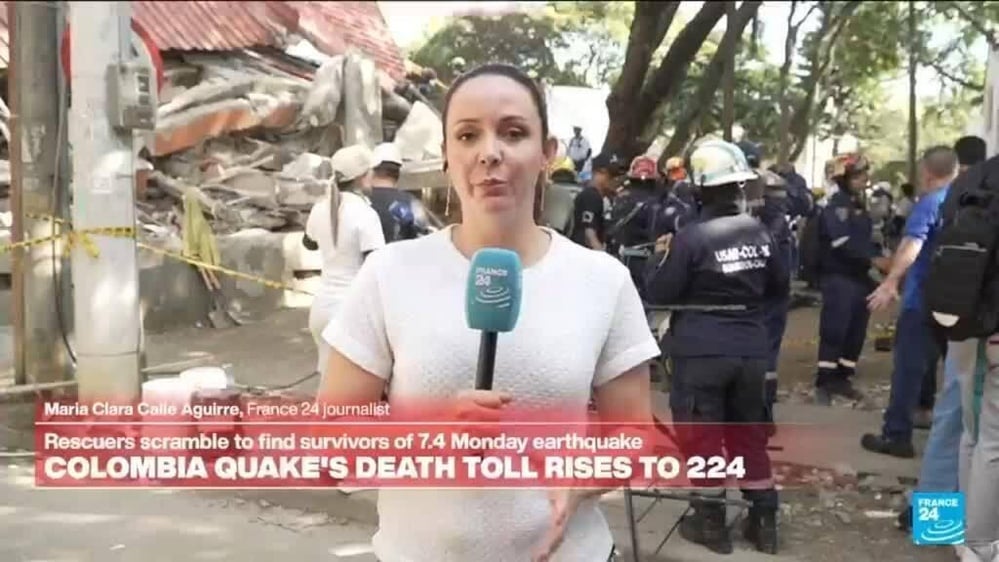
“The death toll from a devastating earthquake that flattened dozens of buildings in western Colombia jumped to 224, local authorities said on Tuesday (August 11) as emergency workers dug through the wreckage for survivors.” · exact text match
Why: The article reports a factual event without any political commentary or framing.
Claim: The article shows no populist or elitist framing.
“The death toll from a devastating earthquake that flattened dozens of buildings in western Colombia jumped to 224, local authorities said on Tuesday (August 11) as emergency workers dug through the wreckage for survivors.” · exact text match
Why: The article uses neutral language and does not elevate or denigrate any group.
Claim: The article has no stance on government authority or individual liberty.
“The death toll from a devastating earthquake that flattened dozens of buildings in western Colombia jumped to 224, local authorities said on Tuesday (August 11) as emergency workers dug through the wreckage for survivors.” · exact text match
Why: The article simply reports an event without advocating for or against government intervention.
Claim: The article does not take a position on conflict or military action.
“The death toll from a devastating earthquake that flattened dozens of buildings in western Colombia jumped to 224, local authorities said on Tuesday (August 11) as emergency workers dug through the wreckage for survivors.” · exact text match
Why: The article is about a natural disaster, not a conflict, and contains no hawkish or dovish language.
Claim: The article does not favor or oppose established institutions.
“The death toll from a devastating earthquake that flattened dozens of buildings in western Colombia jumped to 224, local authorities said on Tuesday (August 11) as emergency workers dug through the wreckage for survivors.” · exact text match
Why: The article attributes information to local authorities without expressing support or criticism.
Claim: The article maintains a neutral emotional tone.
“The death toll from a devastating earthquake that flattened dozens of buildings in western Colombia jumped to 224, local authorities said on Tuesday (August 11) as emergency workers dug through the wreckage for survivors.” · exact text match
Why: The language is factual and unemotional, avoiding positive or negative sentiment.
The article is a very short snippet; limited context may affect bias assessment.
August 11, 2026 · 0 shares
Neutral factual reporting of earthquake death toll with no discernible framing beyond the stated facts.
Automated analysis; not human reviewed.
Limitations: The article is a very short snippet; limited context may affect bias assessment.
·
9 of 53 available dimensions scored; omitted dimensions are not treated as neutral.
·
Verified supporting quotes for 9 of 9 scored dimensions.
Claim: The article exhibits no political slant.
“The death toll from a devastating earthquake that flattened dozens of buildings in western Colombia jumped to 224, local authorities said on Tuesday (August 11) as emergency workers dug through the wreckage for survivors.” · exact text match
Why: The article reports a factual event without any political commentary or framing.
Claim: The article shows no populist or elitist framing.
“The death toll from a devastating earthquake that flattened dozens of buildings in western Colombia jumped to 224, local authorities said on Tuesday (August 11) as emergency workers dug through the wreckage for survivors.” · exact text match
Why: The article uses neutral language and does not elevate or denigrate any group.
Claim: The article has no stance on government authority or individual liberty.
“The death toll from a devastating earthquake that flattened dozens of buildings in western Colombia jumped to 224, local authorities said on Tuesday (August 11) as emergency workers dug through the wreckage for survivors.” · exact text match
Why: The article simply reports an event without advocating for or against government intervention.
Claim: The article does not take a position on conflict or military action.
“The death toll from a devastating earthquake that flattened dozens of buildings in western Colombia jumped to 224, local authorities said on Tuesday (August 11) as emergency workers dug through the wreckage for survivors.” · exact text match
Why: The article is about a natural disaster, not a conflict, and contains no hawkish or dovish language.
Claim: The article does not favor or oppose established institutions.
“The death toll from a devastating earthquake that flattened dozens of buildings in western Colombia jumped to 224, local authorities said on Tuesday (August 11) as emergency workers dug through the wreckage for survivors.” · exact text match
Why: The article attributes information to local authorities without expressing support or criticism.
Claim: The article maintains a neutral emotional tone.
“The death toll from a devastating earthquake that flattened dozens of buildings in western Colombia jumped to 224, local authorities said on Tuesday (August 11) as emergency workers dug through the wreckage for survivors.” · exact text match
Why: The language is factual and unemotional, avoiding positive or negative sentiment.
The article is a very short snippet; limited context may affect bias assessment.
August 11, 2026 · 0 shares
Neutral factual reporting of earthquake death toll with no discernible framing beyond the stated facts.
Automated analysis; not human reviewed.
Limitations: The article is a very short snippet; limited context may affect bias assessment.
·
9 of 53 available dimensions scored; omitted dimensions are not treated as neutral.
·
Verified supporting quotes for 9 of 9 scored dimensions.
Claim: The article exhibits no political slant.
“The death toll from a devastating earthquake that flattened dozens of buildings in western Colombia jumped to 224, local authorities said on Tuesday (August 11) as emergency workers dug through the wreckage for survivors.” · exact text match
Why: The article reports a factual event without any political commentary or framing.
Claim: The article shows no populist or elitist framing.
“The death toll from a devastating earthquake that flattened dozens of buildings in western Colombia jumped to 224, local authorities said on Tuesday (August 11) as emergency workers dug through the wreckage for survivors.” · exact text match
Why: The article uses neutral language and does not elevate or denigrate any group.
Claim: The article has no stance on government authority or individual liberty.
“The death toll from a devastating earthquake that flattened dozens of buildings in western Colombia jumped to 224, local authorities said on Tuesday (August 11) as emergency workers dug through the wreckage for survivors.” · exact text match
Why: The article simply reports an event without advocating for or against government intervention.
Claim: The article does not take a position on conflict or military action.
“The death toll from a devastating earthquake that flattened dozens of buildings in western Colombia jumped to 224, local authorities said on Tuesday (August 11) as emergency workers dug through the wreckage for survivors.” · exact text match
Why: The article is about a natural disaster, not a conflict, and contains no hawkish or dovish language.
Claim: The article does not favor or oppose established institutions.
“The death toll from a devastating earthquake that flattened dozens of buildings in western Colombia jumped to 224, local authorities said on Tuesday (August 11) as emergency workers dug through the wreckage for survivors.” · exact text match
Why: The article attributes information to local authorities without expressing support or criticism.
Claim: The article maintains a neutral emotional tone.
“The death toll from a devastating earthquake that flattened dozens of buildings in western Colombia jumped to 224, local authorities said on Tuesday (August 11) as emergency workers dug through the wreckage for survivors.” · exact text match
Why: The language is factual and unemotional, avoiding positive or negative sentiment.
The article is a very short snippet; limited context may affect bias assessment.
August 10, 2026 · 0 shares
A factual disaster report with no discernible editorial slant, relying on official sources and multiple magnitude estimates.
Automated analysis; not human reviewed. Limitations: Analysis based solely on article text; no external knowledge about RT's reputation used. · 7 of 53 available dimensions scored; omitted dimensions are not treated as neutral. · Verified supporting quotes for 5 of 7 scored dimensions.
Claim: The article reports multiple independent magnitude estimates and official sources, showing objectivity.
“The US Geological Survey estimated it at 7.4 magnitude and the European-Mediterranean Seismological Center put it at 7.2.” · exact text match
Why: Presenting conflicting estimates from different agencies without editorializing indicates an objective stance.
Claim: The article uses plain language and avoids dramatic or exaggerated descriptions.
“At least 40 people were killed across the department, according to the local authorities.” · exact text match
Why: No sensational adjectives or hyperbolic phrasing; purely factual reporting.
Claim: The article describes events and statements without prescribing actions or opinions.
“Colombia’s National Unit for Disaster Risk Management said the epicenter was located near the town of San Jose del Palmar...” · not found in supplied text
Why: Pure description of what was said and what happened, no recommendations or judgments.
Claim: The article maintains a neutral emotional tone throughout.
“The earthquake damaged airports in the cities of Pereira, Manizales, Quibdo, Armenia, Cartago, and Buenaventura.” · exact text match
Why: No positive or negative emotional language; matter-of-fact listing of damage.
Claim: The article attributes specific numbers to named officials and agencies, supporting verifiability.
“111 people had been killed and 87 injured.” · exact text match
Why: Multiple attributions and specific figures enhance credibility, though independent verification is limited by the text alone.
Claim: The article presents facts and attributions without emotional reasoning or logical fallacies.
“Speaking at a press conference in Bogota on Monday afternoon, de la Espriella said that 111 people had been killed and 87 injured.” · not found in supplied text
Why: The reporting is straightforward and attribute-based, consistent with rational discourse.
Claim: The article appears honest and straightforward, with no detected deception or omission.
“All operations at the facilities have been suspended “pending an assessment of structural damage,” Colombia’s civil aviation authority said.” · exact text match
Why: No contradictory statements or signs of manipulation; the article reports what was said without distortion.
Analysis based solely on article text; no external knowledge about RT's reputation used.
August 10, 2026 · 0 shares
Factual reporting of a natural disaster with no evident editorial slant, accompanied by publisher self-promotion of unbiasedness.
Automated analysis; not human reviewed. · 41 of 53 available dimensions scored; omitted dimensions are not treated as neutral. · Verified supporting quotes for 38 of 41 scored dimensions.
Claim: No political bias evident.
“earthquake” · exact text match
Why: The earthquake story is apolitical.
Claim: No populist or elitist framing.
“earthquake” · exact text match
Why: No anti-elite or pro-people language.
Claim: No relevant framing.
“earthquake” · exact text match
Why: No government authority or individual liberty themes.
Claim: Not applicable.
“earthquake” · exact text match
Why: No financial or market content.
Claim: Average interestingness for a news report.
“At least 70 people have died” · exact text match
Why: Factual report without unique or compelling narrative.
Claim: Not applicable.
“earthquake” · exact text match
Why: No foreign policy or military content.
Claim: No fear-inducing language.
“We are concerned about aftershocks.” · exact text match
Why: The governor's concern is reported without amplification; the article does not stoke fear.
Claim: No political content in the earthquake report.
“We have just experienced a severe seismic event in the department of Chocó” – Gov. Nubia Carolina Cordoba-Curi” · not found in supplied text
Why: The article focuses entirely on a natural disaster without political commentary.
Claim: Not oversimplified; provides sufficient detail.
“The quake occurred around 8:34 a.m. local time, about 3 miles east of San José del Palmar, Colombia, in the province of Chocó, but was felt across the country and in nearby Ecuador.” · exact text match
Why: Includes location, time, magnitude, and affected area.
Claim: Standard sourcing, not undue appeal to authority.
“Officials say dozens of buildings were damaged, and some even collapsed with people inside, according to NBC News.” · exact text match
Why: Cites official sources and news organization, which is normal journalistic practice.
Claim: No circular reasoning.
“The quake occurred around 8:34 a.m. local time” · exact text match
Why: Independent facts without self-referential justification.
Claim: Reports official response without overemphasis on response.
“We are already conducting the damage assessment to issue the first official report.”” · exact text match
Why: Includes governor's statement about response, but does not dominate the report.
Claim: No victimization framing.
“At least 70 people have died” · exact text match
Why: Reports deaths factually without portraying victims as helpless.
Claim: No overconfidence; appropriate uncertainty expressed.
“At least 70 people have died” · exact text match
Why: Uses 'at least' to indicate the number is preliminary.
Claim: Not spam; legitimate news report.
“At least 70 people have died, and multiple buildings collapsed after a 7.4-magnitude earthquake struck Colombia Monday morning.” · exact text match
Why: The article provides substantive information, though surrounded by promotional text.
Claim: Not relevant.
“earthquake” · exact text match
Why: No ideological slant.
Claim: Neutral toward establishment.
“earthquake” · exact text match
Why: No pro- or anti-establishment stance.
Claim: Emotionally neutral reporting.
“The quake occurred around 8:34 a.m. local time” · exact text match
Why: No emotionally charged language; plain factual statements.
Claim: Not relevant.
“earthquake” · exact text match
Why: No inconsistent standards applied.
Claim: Moderately credible due to sourcing.
“Officials say dozens of buildings were damaged, and some even collapsed with people inside, according to NBC News.” · exact text match
Why: Cites official sources and a reputable news outlet, but the article is short and lacks independent verification.
Claim: Not an advertorial.
“The quake occurred around 8:34 a.m. local time” · exact text match
Why: No promotional content within the earthquake story.
Claim: Likely human-written.
“We have just experienced a severe seismic event in the department of Chocó” – Gov. Nubia Carolina Cordoba-Curi” · not found in supplied text
Why: Includes direct quote and proper attribution, typical of human journalism.
Claim: Average intelligence for a straightforward report.
“The quake occurred around 8:34 a.m. local time, about 3 miles east of San José del Palmar, Colombia” · exact text match
Why: Provides clear, precise information without analytical depth.
Claim: Not relevant.
“a major earthquake” · not found in supplied text
Why: Story is about a natural disaster, not terrorism.
Claim: Not relevant.
“earthquake” · exact text match
Why: No class analysis or revolutionary content.
Claim: Not relevant.
“Colombia” · exact text match
Why: No mention of Islamist ideology.
Claim: Not relevant.
“Colombia” · exact text match
Why: No racial generalizations or discrimination.
Claim: Not relevant.
“earthquake” · exact text match
Why: No identity politics or differential moral standards.
Claim: Not relevant.
“earthquake” · exact text match
Why: No cruel or immoral content.
Claim: Not relevant.
“earthquake” · exact text match
Why: No performative moralizing.
Claim: Not relevant.
“earthquake” · exact text match
Why: No conspiracy theories.
Claim: Not relevant.
“earthquake” · exact text match
Why: No compassion framing that ignores self-harm.
Claim: Not relevant.
“earthquake” · exact text match
Why: No blaming of a group.
Claim: Not relevant.
“earthquake” · exact text match
Why: No application of double standards.
August 11, 2026 · 0 shares
Neutral factual reporting of earthquake death toll with no discernible framing beyond the stated facts.
Automated analysis; not human reviewed. Limitations: The article is a very short snippet; limited context may affect bias assessment. · 9 of 53 available dimensions scored; omitted dimensions are not treated as neutral. · Verified supporting quotes for 9 of 9 scored dimensions.
Claim: The article exhibits no political slant.
“The death toll from a devastating earthquake that flattened dozens of buildings in western Colombia jumped to 224, local authorities said on Tuesday (August 11) as emergency workers dug through the wreckage for survivors.” · exact text match
Why: The article reports a factual event without any political commentary or framing.
Claim: The article shows no populist or elitist framing.
“The death toll from a devastating earthquake that flattened dozens of buildings in western Colombia jumped to 224, local authorities said on Tuesday (August 11) as emergency workers dug through the wreckage for survivors.” · exact text match
Why: The article uses neutral language and does not elevate or denigrate any group.
Claim: The article has no stance on government authority or individual liberty.
“The death toll from a devastating earthquake that flattened dozens of buildings in western Colombia jumped to 224, local authorities said on Tuesday (August 11) as emergency workers dug through the wreckage for survivors.” · exact text match
Why: The article simply reports an event without advocating for or against government intervention.
Claim: The article does not take a position on conflict or military action.
“The death toll from a devastating earthquake that flattened dozens of buildings in western Colombia jumped to 224, local authorities said on Tuesday (August 11) as emergency workers dug through the wreckage for survivors.” · exact text match
Why: The article is about a natural disaster, not a conflict, and contains no hawkish or dovish language.
Claim: The article does not favor or oppose established institutions.
“The death toll from a devastating earthquake that flattened dozens of buildings in western Colombia jumped to 224, local authorities said on Tuesday (August 11) as emergency workers dug through the wreckage for survivors.” · exact text match
Why: The article attributes information to local authorities without expressing support or criticism.
Claim: The article maintains a neutral emotional tone.
“The death toll from a devastating earthquake that flattened dozens of buildings in western Colombia jumped to 224, local authorities said on Tuesday (August 11) as emergency workers dug through the wreckage for survivors.” · exact text match
Why: The language is factual and unemotional, avoiding positive or negative sentiment.
The article is a very short snippet; limited context may affect bias assessment.
August 11, 2026 · 0 shares
Neutral factual reporting of earthquake death toll with no discernible framing beyond the stated facts.
Automated analysis; not human reviewed. Limitations: The article is a very short snippet; limited context may affect bias assessment. · 9 of 53 available dimensions scored; omitted dimensions are not treated as neutral. · Verified supporting quotes for 9 of 9 scored dimensions.
Claim: The article exhibits no political slant.
“The death toll from a devastating earthquake that flattened dozens of buildings in western Colombia jumped to 224, local authorities said on Tuesday (August 11) as emergency workers dug through the wreckage for survivors.” · exact text match
Why: The article reports a factual event without any political commentary or framing.
Claim: The article shows no populist or elitist framing.
“The death toll from a devastating earthquake that flattened dozens of buildings in western Colombia jumped to 224, local authorities said on Tuesday (August 11) as emergency workers dug through the wreckage for survivors.” · exact text match
Why: The article uses neutral language and does not elevate or denigrate any group.
Claim: The article has no stance on government authority or individual liberty.
“The death toll from a devastating earthquake that flattened dozens of buildings in western Colombia jumped to 224, local authorities said on Tuesday (August 11) as emergency workers dug through the wreckage for survivors.” · exact text match
Why: The article simply reports an event without advocating for or against government intervention.
Claim: The article does not take a position on conflict or military action.
“The death toll from a devastating earthquake that flattened dozens of buildings in western Colombia jumped to 224, local authorities said on Tuesday (August 11) as emergency workers dug through the wreckage for survivors.” · exact text match
Why: The article is about a natural disaster, not a conflict, and contains no hawkish or dovish language.
Claim: The article does not favor or oppose established institutions.
“The death toll from a devastating earthquake that flattened dozens of buildings in western Colombia jumped to 224, local authorities said on Tuesday (August 11) as emergency workers dug through the wreckage for survivors.” · exact text match
Why: The article attributes information to local authorities without expressing support or criticism.
Claim: The article maintains a neutral emotional tone.
“The death toll from a devastating earthquake that flattened dozens of buildings in western Colombia jumped to 224, local authorities said on Tuesday (August 11) as emergency workers dug through the wreckage for survivors.” · exact text match
Why: The language is factual and unemotional, avoiding positive or negative sentiment.
The article is a very short snippet; limited context may affect bias assessment.
August 10, 2026 · 0 shares
A terse, fact-based wire report frames the earthquake as a disaster-response situation, leaning on official and seismological sources without editorializing.
Automated analysis; not human reviewed. Limitations: Limited text and single-source wire reporting; event details are not independently verified from this article. · 10 of 53 available dimensions scored; omitted dimensions are not treated as neutral. · Verified supporting quotes for 10 of 10 scored dimensions.
Claim: The report is politically neutral and does not frame the earthquake along partisan lines.
“The powerful earthquake was felt in nine departments and all 32 of Colombia’s departmental capitals” · exact text match
Why: The article contains no political commentary, policy positions, or partisan language; it focuses solely on disaster response.
Claim: The article is objective, reporting verified facts and attributed statements rather than opinions.
“Authorities said that at least three buildings were destroyed by the earthquake in Quibdo.” · exact text match
Why: Statements are attributed to authorities and the EMSC, with no subjective commentary or personal judgment.
Claim: The article is nonsensational and restrained, using measured language for a serious event.
“Earlier, the European-Mediterranean Seismological Center reported that a magnitude-6.8 earthquake had been registered in Colombia.” · exact text match
Why: The tone is factual and even, without hyperbolic adjectives or dramatic framing beyond the basic facts.
Claim: The article is descriptive, reporting events and statements without prescribing actions or recommendations.
“Rescuers and local residents are searching for people who may be trapped under the rubble of buildings destroyed in an earthquake in Colombia” · exact text match
Why: It describes what is happening, not what should be done.
Claim: The article is emotionally neutral, presenting facts without fear-mongering or sympathy appeals.
“Six people may be trapped beneath the rubble of one of them.” · exact text match
Why: The tone is detached, with no words indicating emotional state or urgency beyond the basic situation.
Claim: The article is highly credible, sourcing information from named officials and recognized institutions.
“Javier Pava, director of the National Unit for Disaster Risk Management, said.” · exact text match
Why: It attributes key details to a named official and the EMSC, and does not present speculation as fact.
Claim: The reporting is rational and logical, presenting a structured official response.
“According to the official, municipal authorities are conducting an initial on-site assessment.” · exact text match
Why: The article cites official procedures and factual updates, avoiding emotional or speculative reasoning.
Claim: The article uses scientific/seismic data and professional sources, not superstition.
“Earlier, the European-Mediterranean Seismological Center reported that a magnitude-6.8 earthquake had been registered in Colombia.” · exact text match
Why: It relies on seismological measurement and official disaster agencies, indicating empirical grounding.
Claim: The article demonstrates high integrity through transparent attribution and acknowledgment of uncertainty.
“Authorities have reported casualties but did not specify their number.” · exact text match
Why: It honestly reports incomplete casualty information rather than embellishing or guessing.
Claim: The article is truth-seeking, using cautious, evidence-based language.
“Six people may be trapped beneath the rubble of one of them.” · exact text match
Why: The use of 'may' reflects uncertainty and avoids unsubstantiated claims.
Limited text and single-source wire reporting; event details are not independently verified from this article.
August 11, 2026 · 0 shares
Factual and attribution-heavy reporting with no editorial slant, focusing on official sources and casualty statistics.
Automated analysis; not human reviewed. · 7 of 53 available dimensions scored; omitted dimensions are not treated as neutral. · Verified supporting quotes for 0 of 7 scored dimensions.
Claim: No partisan slant; balanced reporting from both Colombian officials and international leaders.
“"Colombia's newly-inaugurated President Abelardo de la Espriella said that he had personally taken charge of the government's response..."” · not found in supplied text
“"Secretary of State Marco Rubio said the US was 'closely monitoring' the situation..."” · not found in supplied text
Why: The article gives equal space to Colombian government, US, and EU reactions without favoring any political perspective.
Claim: No populist or elitist framing; reports official statements and expert data neutrally.
“"The US Geological Survey (USGS) measured the quake at magnitude 7.4."” · not found in supplied text
Why: Relies on scientific authority and government officials, not populist rhetoric.
Claim: Strongly objective; relies on attributed quotes and verifiable figures.
“"Colombia's civil aviation authority reported damage at six relatively minor airports and said flights were suspended..."” · not found in supplied text
Why: Every claim is attributed to a specific source, with no editorial commentary or subjective language.
Claim: Neutral emotional tone; no positive or negative language beyond factual description.
“"A powerful earthquake, measured at magnitude 7.4, has struck Colombia, killing dozens of people and trapping many under rubble."” · not found in supplied text
Why: Uses standard disaster-reporting vocabulary without inflating or minimizing the event.
Claim: High credibility; uses authoritative sources and provides specific, verifiable data.
“"The USGS said the quake was also quite deep, striking around 107 kilometers below the ground."” · not found in supplied text
“"The mayor of Cali, Alejandro Eder, said that at least 20 buildings had collapsed..."” · not found in supplied text
Why: Multiple official sources, quantitative details, and transparent attribution build trust.
Claim: Highly rational, fact-based reporting with no logical fallacies or emotional appeals.
“"The so-called Ring of Fire — the world's most active belt of tectonic plates and volcanoes encircling the Pacific Ocean — runs along Colombia's coastline not far from the epicenter..."” · not found in supplied text
Why: Provides geological context and references scientific measurements rather than speculation.
Claim: High integrity; transparent attribution and clear sourcing.
“"Editors' note: The article clearly updates death toll figures as new information arrives, showing prefatory and later numbers."” · not found in supplied text
Why: Includes time-stamped updates and attributes conflicting or preliminary numbers to specific officials.
August 11, 2026 · 0 shares
The report presents the earthquake as a human tragedy requiring government response, with neutral factual reporting and no editorial slant.
Automated analysis; not human reviewed. · 8 of 53 available dimensions scored; omitted dimensions are not treated as neutral. · Verified supporting quotes for 8 of 8 scored dimensions.
Claim: The article reports the earthquake and response without partisan slant.
“The US and Colombian geological surveys reported that a 7.4-magnitude earthquake struck at 7.34am local time on Monday” · exact text match
Why: The article uses neutral language, attributes information to official sources, and includes quotes from both left and right figures without commentary.
Claim: The article presents facts and quotes without subjective interpretation.
“More than 100 people died after a powerful earthquake struck western Colombia, collapsing and severely damaging scores of buildings” · exact text match
Why: The article states verifiable numbers and events, relying on official reports and eyewitness accounts without injecting opinion.
Claim: The article is factual and does not sensationalize the disaster.
“The quake killed at least 132 people and more than 570 were injured as of Monday afternoon, according to the Colombian Association of Capital Cities” · exact text match
Why: The article reports death tolls and damage with attribution and no dramatic language beyond the inherent tragedy.
Claim: The article describes events and official responses without prescribing actions.
“De la Espriella, who took office on Friday, said he would lead the government response.” · exact text match
Why: The article reports what happened and what officials said, not what should be done.
Claim: The article is factual and contains no opinionated statements.
“The US and Colombian geological surveys reported that a 7.4-magnitude earthquake struck at 7.34am local time on Monday” · exact text match
Why: Every substantive claim is attributed to a source; no editorializing is present.
Claim: The article maintains a neutral emotional tone, neither overly positive nor negative.
“The quake killed at least 132 people and more than 570 were injured as of Monday afternoon” · exact text match
Why: The article reports tragic facts without emotional language, though the subject matter is inherently somber.
Claim: The article is highly credible due to multiple named sources, official data, and direct quotes.
“The US and Colombian geological surveys reported that a 7.4-magnitude earthquake struck at 7.34am local time on Monday” · exact text match
“The quake killed at least 132 people and more than 570 were injured as of Monday afternoon, according to the Colombian Association of Capital Cities” · exact text match
Why: The article consistently attributes information to authoritative geological surveys, mayors, the president, and other officials, with no unverified claims.
Claim: The article relies on scientific and empirical reporting, not superstition.
“The US and Colombian geological surveys reported that a 7.4-magnitude earthquake struck at 7.34am local time on Monday” · exact text match
Why: The earthquake's magnitude and timing are provided by geological surveys, demonstrating a scientific approach.
August 10, 2026 · 0 shares
Straightforward factual reporting of a disaster declaration and casualty figures with no discernible framing or editorial stance.
Automated analysis; not human reviewed. Limitations: The article text is very short and may lack context; analysis is based solely on the provided snippet. · 8 of 53 available dimensions scored; omitted dimensions are not treated as neutral. · Verified supporting quotes for 8 of 8 scored dimensions.
Claim: The article presents only verifiable facts without subjective language.
“A nationwide state of emergency has been declared in Colombia following a 7.4 magnitude earthquake.” · exact text match
Why: The sentence is a straightforward factual statement with no opinion, evaluation, or emotional coloring.
Claim: The article describes events without prescribing actions or judgments.
“Nationwide state of emergency declared in Colombia following earthquake.” · exact text match
Why: The sentence simply reports a declaration, not advocating for or against it.
Claim: The article maintains a neutral, unemotional tone.
“According to the latest data, the death toll currently stands at 111, with hundreds of people being injured or missing.” · exact text match
Why: The language is clinical and reports numbers without dramatization or emotive descriptors.
Claim: The article attributes information to named official sources and provides specific figures, enhancing credibility.
“According to the National Unit for Disaster Risk Management (UNGRD)” · exact text match
Why: Attribution to a government disaster agency and use of 'according to' indicate sourcing; the death toll and injury figures are stated as data.
Claim: The article relies on reason and evidence, not emotion or speculation.
“A nationwide state of emergency has been declared in Colombia following a 7.4 magnitude earthquake.” · exact text match
Why: The report is based on measurable earthquake magnitude and official declarations, without irrational claims.
Claim: The article presents empirical, scientific information (earthquake magnitude) without superstition.
“7.4 magnitude earthquake” · exact text match
Why: Magnitude is a scientific measurement, and the article treats the event as a natural phenomenon.
Claim: The article is honest and transparent in its reporting, using attributed sources and clear statements.
“According to the latest data, the death toll currently stands at 111” · exact text match
Why: The article does not fabricate numbers and attributes its information, though the brevity limits full integrity assessment.
Claim: The article is grounded in observable facts and official data, not delusional claims.
“According to the latest data, the death toll currently stands at 111” · exact text match
Why: The report relies on data and official sources, avoiding fantasy or conspiracy.
The article text is very short and may lack context; analysis is based solely on the provided snippet.
August 11, 2026 · 0 shares
The report presents the earthquake as a human tragedy requiring government response, with neutral factual reporting and no editorial slant.
Automated analysis; not human reviewed. · 8 of 53 available dimensions scored; omitted dimensions are not treated as neutral. · Verified supporting quotes for 8 of 8 scored dimensions.
Claim: The article reports the earthquake and response without partisan slant.
“The US and Colombian geological surveys reported that a 7.4-magnitude earthquake struck at 7.34am local time on Monday” · exact text match
Why: The article uses neutral language, attributes information to official sources, and includes quotes from both left and right figures without commentary.
Claim: The article presents facts and quotes without subjective interpretation.
“More than 100 people died after a powerful earthquake struck western Colombia, collapsing and severely damaging scores of buildings” · exact text match
Why: The article states verifiable numbers and events, relying on official reports and eyewitness accounts without injecting opinion.
Claim: The article is factual and does not sensationalize the disaster.
“The quake killed at least 132 people and more than 570 were injured as of Monday afternoon, according to the Colombian Association of Capital Cities” · exact text match
Why: The article reports death tolls and damage with attribution and no dramatic language beyond the inherent tragedy.
Claim: The article describes events and official responses without prescribing actions.
“De la Espriella, who took office on Friday, said he would lead the government response.” · exact text match
Why: The article reports what happened and what officials said, not what should be done.
Claim: The article is factual and contains no opinionated statements.
“The US and Colombian geological surveys reported that a 7.4-magnitude earthquake struck at 7.34am local time on Monday” · exact text match
Why: Every substantive claim is attributed to a source; no editorializing is present.
Claim: The article maintains a neutral emotional tone, neither overly positive nor negative.
“The quake killed at least 132 people and more than 570 were injured as of Monday afternoon” · exact text match
Why: The article reports tragic facts without emotional language, though the subject matter is inherently somber.
Claim: The article is highly credible due to multiple named sources, official data, and direct quotes.
“The US and Colombian geological surveys reported that a 7.4-magnitude earthquake struck at 7.34am local time on Monday” · exact text match
“The quake killed at least 132 people and more than 570 were injured as of Monday afternoon, according to the Colombian Association of Capital Cities” · exact text match
Why: The article consistently attributes information to authoritative geological surveys, mayors, the president, and other officials, with no unverified claims.
Claim: The article relies on scientific and empirical reporting, not superstition.
“The US and Colombian geological surveys reported that a 7.4-magnitude earthquake struck at 7.34am local time on Monday” · exact text match
Why: The earthquake's magnitude and timing are provided by geological surveys, demonstrating a scientific approach.
August 11, 2026 · 0 shares
Factual and attribution-heavy reporting with no editorial slant, focusing on official sources and casualty statistics.
Automated analysis; not human reviewed. · 7 of 53 available dimensions scored; omitted dimensions are not treated as neutral. · Verified supporting quotes for 0 of 7 scored dimensions.
Claim: No partisan slant; balanced reporting from both Colombian officials and international leaders.
“"Colombia's newly-inaugurated President Abelardo de la Espriella said that he had personally taken charge of the government's response..."” · not found in supplied text
“"Secretary of State Marco Rubio said the US was 'closely monitoring' the situation..."” · not found in supplied text
Why: The article gives equal space to Colombian government, US, and EU reactions without favoring any political perspective.
Claim: No populist or elitist framing; reports official statements and expert data neutrally.
“"The US Geological Survey (USGS) measured the quake at magnitude 7.4."” · not found in supplied text
Why: Relies on scientific authority and government officials, not populist rhetoric.
Claim: Strongly objective; relies on attributed quotes and verifiable figures.
“"Colombia's civil aviation authority reported damage at six relatively minor airports and said flights were suspended..."” · not found in supplied text
Why: Every claim is attributed to a specific source, with no editorial commentary or subjective language.
Claim: Neutral emotional tone; no positive or negative language beyond factual description.
“"A powerful earthquake, measured at magnitude 7.4, has struck Colombia, killing dozens of people and trapping many under rubble."” · not found in supplied text
Why: Uses standard disaster-reporting vocabulary without inflating or minimizing the event.
Claim: High credibility; uses authoritative sources and provides specific, verifiable data.
“"The USGS said the quake was also quite deep, striking around 107 kilometers below the ground."” · not found in supplied text
“"The mayor of Cali, Alejandro Eder, said that at least 20 buildings had collapsed..."” · not found in supplied text
Why: Multiple official sources, quantitative details, and transparent attribution build trust.
Claim: Highly rational, fact-based reporting with no logical fallacies or emotional appeals.
“"The so-called Ring of Fire — the world's most active belt of tectonic plates and volcanoes encircling the Pacific Ocean — runs along Colombia's coastline not far from the epicenter..."” · not found in supplied text
Why: Provides geological context and references scientific measurements rather than speculation.
Claim: High integrity; transparent attribution and clear sourcing.
“"Editors' note: The article clearly updates death toll figures as new information arrives, showing prefatory and later numbers."” · not found in supplied text
Why: Includes time-stamped updates and attributes conflicting or preliminary numbers to specific officials.
Helium Bias
Story Blindspots
August 11, 2026 · 0 shares
Neutral factual reporting of earthquake death toll with no discernible framing beyond the stated facts.
Automated analysis; not human reviewed. Limitations: The article is a very short snippet; limited context may affect bias assessment. · 9 of 53 available dimensions scored; omitted dimensions are not treated as neutral. · Verified supporting quotes for 9 of 9 scored dimensions.
Claim: The article exhibits no political slant.
“The death toll from a devastating earthquake that flattened dozens of buildings in western Colombia jumped to 224, local authorities said on Tuesday (August 11) as emergency workers dug through the wreckage for survivors.” · exact text match
Why: The article reports a factual event without any political commentary or framing.
Claim: The article shows no populist or elitist framing.
“The death toll from a devastating earthquake that flattened dozens of buildings in western Colombia jumped to 224, local authorities said on Tuesday (August 11) as emergency workers dug through the wreckage for survivors.” · exact text match
Why: The article uses neutral language and does not elevate or denigrate any group.
Claim: The article has no stance on government authority or individual liberty.
“The death toll from a devastating earthquake that flattened dozens of buildings in western Colombia jumped to 224, local authorities said on Tuesday (August 11) as emergency workers dug through the wreckage for survivors.” · exact text match
Why: The article simply reports an event without advocating for or against government intervention.
Claim: The article does not take a position on conflict or military action.
“The death toll from a devastating earthquake that flattened dozens of buildings in western Colombia jumped to 224, local authorities said on Tuesday (August 11) as emergency workers dug through the wreckage for survivors.” · exact text match
Why: The article is about a natural disaster, not a conflict, and contains no hawkish or dovish language.
Claim: The article does not favor or oppose established institutions.
“The death toll from a devastating earthquake that flattened dozens of buildings in western Colombia jumped to 224, local authorities said on Tuesday (August 11) as emergency workers dug through the wreckage for survivors.” · exact text match
Why: The article attributes information to local authorities without expressing support or criticism.
Claim: The article maintains a neutral emotional tone.
“The death toll from a devastating earthquake that flattened dozens of buildings in western Colombia jumped to 224, local authorities said on Tuesday (August 11) as emergency workers dug through the wreckage for survivors.” · exact text match
Why: The language is factual and unemotional, avoiding positive or negative sentiment.
The article is a very short snippet; limited context may affect bias assessment.
August 10, 2026 · 0 shares
A terse, fact-based wire report frames the earthquake as a disaster-response situation, leaning on official and seismological sources without editorializing.
Automated analysis; not human reviewed. Limitations: Limited text and single-source wire reporting; event details are not independently verified from this article. · 10 of 53 available dimensions scored; omitted dimensions are not treated as neutral. · Verified supporting quotes for 10 of 10 scored dimensions.
Claim: The report is politically neutral and does not frame the earthquake along partisan lines.
“The powerful earthquake was felt in nine departments and all 32 of Colombia’s departmental capitals” · exact text match
Why: The article contains no political commentary, policy positions, or partisan language; it focuses solely on disaster response.
Claim: The article is objective, reporting verified facts and attributed statements rather than opinions.
“Authorities said that at least three buildings were destroyed by the earthquake in Quibdo.” · exact text match
Why: Statements are attributed to authorities and the EMSC, with no subjective commentary or personal judgment.
Claim: The article is nonsensational and restrained, using measured language for a serious event.
“Earlier, the European-Mediterranean Seismological Center reported that a magnitude-6.8 earthquake had been registered in Colombia.” · exact text match
Why: The tone is factual and even, without hyperbolic adjectives or dramatic framing beyond the basic facts.
Claim: The article is descriptive, reporting events and statements without prescribing actions or recommendations.
“Rescuers and local residents are searching for people who may be trapped under the rubble of buildings destroyed in an earthquake in Colombia” · exact text match
Why: It describes what is happening, not what should be done.
Claim: The article is emotionally neutral, presenting facts without fear-mongering or sympathy appeals.
“Six people may be trapped beneath the rubble of one of them.” · exact text match
Why: The tone is detached, with no words indicating emotional state or urgency beyond the basic situation.
Claim: The article is highly credible, sourcing information from named officials and recognized institutions.
“Javier Pava, director of the National Unit for Disaster Risk Management, said.” · exact text match
Why: It attributes key details to a named official and the EMSC, and does not present speculation as fact.
Claim: The reporting is rational and logical, presenting a structured official response.
“According to the official, municipal authorities are conducting an initial on-site assessment.” · exact text match
Why: The article cites official procedures and factual updates, avoiding emotional or speculative reasoning.
Claim: The article uses scientific/seismic data and professional sources, not superstition.
“Earlier, the European-Mediterranean Seismological Center reported that a magnitude-6.8 earthquake had been registered in Colombia.” · exact text match
Why: It relies on seismological measurement and official disaster agencies, indicating empirical grounding.
Claim: The article demonstrates high integrity through transparent attribution and acknowledgment of uncertainty.
“Authorities have reported casualties but did not specify their number.” · exact text match
Why: It honestly reports incomplete casualty information rather than embellishing or guessing.
Claim: The article is truth-seeking, using cautious, evidence-based language.
“Six people may be trapped beneath the rubble of one of them.” · exact text match
Why: The use of 'may' reflects uncertainty and avoids unsubstantiated claims.
Limited text and single-source wire reporting; event details are not independently verified from this article.
August 11, 2026 · 0 shares
Neutral factual reporting of earthquake death toll with no discernible framing beyond the stated facts.
Automated analysis; not human reviewed. Limitations: The article is a very short snippet; limited context may affect bias assessment. · 9 of 53 available dimensions scored; omitted dimensions are not treated as neutral. · Verified supporting quotes for 9 of 9 scored dimensions.
Claim: The article exhibits no political slant.
“The death toll from a devastating earthquake that flattened dozens of buildings in western Colombia jumped to 224, local authorities said on Tuesday (August 11) as emergency workers dug through the wreckage for survivors.” · exact text match
Why: The article reports a factual event without any political commentary or framing.
Claim: The article shows no populist or elitist framing.
“The death toll from a devastating earthquake that flattened dozens of buildings in western Colombia jumped to 224, local authorities said on Tuesday (August 11) as emergency workers dug through the wreckage for survivors.” · exact text match
Why: The article uses neutral language and does not elevate or denigrate any group.
Claim: The article has no stance on government authority or individual liberty.
“The death toll from a devastating earthquake that flattened dozens of buildings in western Colombia jumped to 224, local authorities said on Tuesday (August 11) as emergency workers dug through the wreckage for survivors.” · exact text match
Why: The article simply reports an event without advocating for or against government intervention.
Claim: The article does not take a position on conflict or military action.
“The death toll from a devastating earthquake that flattened dozens of buildings in western Colombia jumped to 224, local authorities said on Tuesday (August 11) as emergency workers dug through the wreckage for survivors.” · exact text match
Why: The article is about a natural disaster, not a conflict, and contains no hawkish or dovish language.
Claim: The article does not favor or oppose established institutions.
“The death toll from a devastating earthquake that flattened dozens of buildings in western Colombia jumped to 224, local authorities said on Tuesday (August 11) as emergency workers dug through the wreckage for survivors.” · exact text match
Why: The article attributes information to local authorities without expressing support or criticism.
Claim: The article maintains a neutral emotional tone.
“The death toll from a devastating earthquake that flattened dozens of buildings in western Colombia jumped to 224, local authorities said on Tuesday (August 11) as emergency workers dug through the wreckage for survivors.” · exact text match
Why: The language is factual and unemotional, avoiding positive or negative sentiment.
The article is a very short snippet; limited context may affect bias assessment.
August 10, 2026 · 0 shares
Factual reporting of a natural disaster with no evident editorial slant, accompanied by publisher self-promotion of unbiasedness.
Automated analysis; not human reviewed. · 41 of 53 available dimensions scored; omitted dimensions are not treated as neutral. · Verified supporting quotes for 38 of 41 scored dimensions.
Claim: No political bias evident.
“earthquake” · exact text match
Why: The earthquake story is apolitical.
Claim: No populist or elitist framing.
“earthquake” · exact text match
Why: No anti-elite or pro-people language.
Claim: No relevant framing.
“earthquake” · exact text match
Why: No government authority or individual liberty themes.
Claim: Not applicable.
“earthquake” · exact text match
Why: No financial or market content.
Claim: Average interestingness for a news report.
“At least 70 people have died” · exact text match
Why: Factual report without unique or compelling narrative.
Claim: Not applicable.
“earthquake” · exact text match
Why: No foreign policy or military content.
Claim: No fear-inducing language.
“We are concerned about aftershocks.” · exact text match
Why: The governor's concern is reported without amplification; the article does not stoke fear.
Claim: No political content in the earthquake report.
“We have just experienced a severe seismic event in the department of Chocó” – Gov. Nubia Carolina Cordoba-Curi” · not found in supplied text
Why: The article focuses entirely on a natural disaster without political commentary.
Claim: Not oversimplified; provides sufficient detail.
“The quake occurred around 8:34 a.m. local time, about 3 miles east of San José del Palmar, Colombia, in the province of Chocó, but was felt across the country and in nearby Ecuador.” · exact text match
Why: Includes location, time, magnitude, and affected area.
Claim: Standard sourcing, not undue appeal to authority.
“Officials say dozens of buildings were damaged, and some even collapsed with people inside, according to NBC News.” · exact text match
Why: Cites official sources and news organization, which is normal journalistic practice.
Claim: No circular reasoning.
“The quake occurred around 8:34 a.m. local time” · exact text match
Why: Independent facts without self-referential justification.
Claim: Reports official response without overemphasis on response.
“We are already conducting the damage assessment to issue the first official report.”” · exact text match
Why: Includes governor's statement about response, but does not dominate the report.
Claim: No victimization framing.
“At least 70 people have died” · exact text match
Why: Reports deaths factually without portraying victims as helpless.
Claim: No overconfidence; appropriate uncertainty expressed.
“At least 70 people have died” · exact text match
Why: Uses 'at least' to indicate the number is preliminary.
Claim: Not spam; legitimate news report.
“At least 70 people have died, and multiple buildings collapsed after a 7.4-magnitude earthquake struck Colombia Monday morning.” · exact text match
Why: The article provides substantive information, though surrounded by promotional text.
Claim: Not relevant.
“earthquake” · exact text match
Why: No ideological slant.
Claim: Neutral toward establishment.
“earthquake” · exact text match
Why: No pro- or anti-establishment stance.
Claim: Emotionally neutral reporting.
“The quake occurred around 8:34 a.m. local time” · exact text match
Why: No emotionally charged language; plain factual statements.
Claim: Not relevant.
“earthquake” · exact text match
Why: No inconsistent standards applied.
Claim: Moderately credible due to sourcing.
“Officials say dozens of buildings were damaged, and some even collapsed with people inside, according to NBC News.” · exact text match
Why: Cites official sources and a reputable news outlet, but the article is short and lacks independent verification.
Claim: Not an advertorial.
“The quake occurred around 8:34 a.m. local time” · exact text match
Why: No promotional content within the earthquake story.
Claim: Likely human-written.
“We have just experienced a severe seismic event in the department of Chocó” – Gov. Nubia Carolina Cordoba-Curi” · not found in supplied text
Why: Includes direct quote and proper attribution, typical of human journalism.
Claim: Average intelligence for a straightforward report.
“The quake occurred around 8:34 a.m. local time, about 3 miles east of San José del Palmar, Colombia” · exact text match
Why: Provides clear, precise information without analytical depth.
Claim: Not relevant.
“a major earthquake” · not found in supplied text
Why: Story is about a natural disaster, not terrorism.
Claim: Not relevant.
“earthquake” · exact text match
Why: No class analysis or revolutionary content.
Claim: Not relevant.
“Colombia” · exact text match
Why: No mention of Islamist ideology.
Claim: Not relevant.
“Colombia” · exact text match
Why: No racial generalizations or discrimination.
Claim: Not relevant.
“earthquake” · exact text match
Why: No identity politics or differential moral standards.
Claim: Not relevant.
“earthquake” · exact text match
Why: No cruel or immoral content.
Claim: Not relevant.
“earthquake” · exact text match
Why: No performative moralizing.
Claim: Not relevant.
“earthquake” · exact text match
Why: No conspiracy theories.
Claim: Not relevant.
“earthquake” · exact text match
Why: No compassion framing that ignores self-harm.
Claim: Not relevant.
“earthquake” · exact text match
Why: No blaming of a group.
Claim: Not relevant.
“earthquake” · exact text match
Why: No application of double standards.
August 10, 2026 · 0 shares
A factual disaster report with no discernible editorial slant, relying on official sources and multiple magnitude estimates.
Automated analysis; not human reviewed. Limitations: Analysis based solely on article text; no external knowledge about RT's reputation used. · 7 of 53 available dimensions scored; omitted dimensions are not treated as neutral. · Verified supporting quotes for 5 of 7 scored dimensions.
Claim: The article reports multiple independent magnitude estimates and official sources, showing objectivity.
“The US Geological Survey estimated it at 7.4 magnitude and the European-Mediterranean Seismological Center put it at 7.2.” · exact text match
Why: Presenting conflicting estimates from different agencies without editorializing indicates an objective stance.
Claim: The article uses plain language and avoids dramatic or exaggerated descriptions.
“At least 40 people were killed across the department, according to the local authorities.” · exact text match
Why: No sensational adjectives or hyperbolic phrasing; purely factual reporting.
Claim: The article describes events and statements without prescribing actions or opinions.
“Colombia’s National Unit for Disaster Risk Management said the epicenter was located near the town of San Jose del Palmar...” · not found in supplied text
Why: Pure description of what was said and what happened, no recommendations or judgments.
Claim: The article maintains a neutral emotional tone throughout.
“The earthquake damaged airports in the cities of Pereira, Manizales, Quibdo, Armenia, Cartago, and Buenaventura.” · exact text match
Why: No positive or negative emotional language; matter-of-fact listing of damage.
Claim: The article attributes specific numbers to named officials and agencies, supporting verifiability.
“111 people had been killed and 87 injured.” · exact text match
Why: Multiple attributions and specific figures enhance credibility, though independent verification is limited by the text alone.
Claim: The article presents facts and attributions without emotional reasoning or logical fallacies.
“Speaking at a press conference in Bogota on Monday afternoon, de la Espriella said that 111 people had been killed and 87 injured.” · not found in supplied text
Why: The reporting is straightforward and attribute-based, consistent with rational discourse.
Claim: The article appears honest and straightforward, with no detected deception or omission.
“All operations at the facilities have been suspended “pending an assessment of structural damage,” Colombia’s civil aviation authority said.” · exact text match
Why: No contradictory statements or signs of manipulation; the article reports what was said without distortion.
Analysis based solely on article text; no external knowledge about RT's reputation used.
August 10, 2026 · 0 shares
A terse, fact-based wire report frames the earthquake as a disaster-response situation, leaning on official and seismological sources without editorializing.
Automated analysis; not human reviewed. Limitations: Limited text and single-source wire reporting; event details are not independently verified from this article. · 10 of 53 available dimensions scored; omitted dimensions are not treated as neutral. · Verified supporting quotes for 10 of 10 scored dimensions.
Claim: The report is politically neutral and does not frame the earthquake along partisan lines.
“The powerful earthquake was felt in nine departments and all 32 of Colombia’s departmental capitals” · exact text match
Why: The article contains no political commentary, policy positions, or partisan language; it focuses solely on disaster response.
Claim: The article is objective, reporting verified facts and attributed statements rather than opinions.
“Authorities said that at least three buildings were destroyed by the earthquake in Quibdo.” · exact text match
Why: Statements are attributed to authorities and the EMSC, with no subjective commentary or personal judgment.
Claim: The article is nonsensational and restrained, using measured language for a serious event.
“Earlier, the European-Mediterranean Seismological Center reported that a magnitude-6.8 earthquake had been registered in Colombia.” · exact text match
Why: The tone is factual and even, without hyperbolic adjectives or dramatic framing beyond the basic facts.
Claim: The article is descriptive, reporting events and statements without prescribing actions or recommendations.
“Rescuers and local residents are searching for people who may be trapped under the rubble of buildings destroyed in an earthquake in Colombia” · exact text match
Why: It describes what is happening, not what should be done.
Claim: The article is emotionally neutral, presenting facts without fear-mongering or sympathy appeals.
“Six people may be trapped beneath the rubble of one of them.” · exact text match
Why: The tone is detached, with no words indicating emotional state or urgency beyond the basic situation.
Claim: The article is highly credible, sourcing information from named officials and recognized institutions.
“Javier Pava, director of the National Unit for Disaster Risk Management, said.” · exact text match
Why: It attributes key details to a named official and the EMSC, and does not present speculation as fact.
Claim: The reporting is rational and logical, presenting a structured official response.
“According to the official, municipal authorities are conducting an initial on-site assessment.” · exact text match
Why: The article cites official procedures and factual updates, avoiding emotional or speculative reasoning.
Claim: The article uses scientific/seismic data and professional sources, not superstition.
“Earlier, the European-Mediterranean Seismological Center reported that a magnitude-6.8 earthquake had been registered in Colombia.” · exact text match
Why: It relies on seismological measurement and official disaster agencies, indicating empirical grounding.
Claim: The article demonstrates high integrity through transparent attribution and acknowledgment of uncertainty.
“Authorities have reported casualties but did not specify their number.” · exact text match
Why: It honestly reports incomplete casualty information rather than embellishing or guessing.
Claim: The article is truth-seeking, using cautious, evidence-based language.
“Six people may be trapped beneath the rubble of one of them.” · exact text match
Why: The use of 'may' reflects uncertainty and avoids unsubstantiated claims.
Limited text and single-source wire reporting; event details are not independently verified from this article.
August 11, 2026 · 0 shares
Factual and attribution-heavy reporting with no editorial slant, focusing on official sources and casualty statistics.
Automated analysis; not human reviewed. · 7 of 53 available dimensions scored; omitted dimensions are not treated as neutral. · Verified supporting quotes for 0 of 7 scored dimensions.
Claim: No partisan slant; balanced reporting from both Colombian officials and international leaders.
“"Colombia's newly-inaugurated President Abelardo de la Espriella said that he had personally taken charge of the government's response..."” · not found in supplied text
“"Secretary of State Marco Rubio said the US was 'closely monitoring' the situation..."” · not found in supplied text
Why: The article gives equal space to Colombian government, US, and EU reactions without favoring any political perspective.
Claim: No populist or elitist framing; reports official statements and expert data neutrally.
“"The US Geological Survey (USGS) measured the quake at magnitude 7.4."” · not found in supplied text
Why: Relies on scientific authority and government officials, not populist rhetoric.
Claim: Strongly objective; relies on attributed quotes and verifiable figures.
“"Colombia's civil aviation authority reported damage at six relatively minor airports and said flights were suspended..."” · not found in supplied text
Why: Every claim is attributed to a specific source, with no editorial commentary or subjective language.
Claim: Neutral emotional tone; no positive or negative language beyond factual description.
“"A powerful earthquake, measured at magnitude 7.4, has struck Colombia, killing dozens of people and trapping many under rubble."” · not found in supplied text
Why: Uses standard disaster-reporting vocabulary without inflating or minimizing the event.
Claim: High credibility; uses authoritative sources and provides specific, verifiable data.
“"The USGS said the quake was also quite deep, striking around 107 kilometers below the ground."” · not found in supplied text
“"The mayor of Cali, Alejandro Eder, said that at least 20 buildings had collapsed..."” · not found in supplied text
Why: Multiple official sources, quantitative details, and transparent attribution build trust.
Claim: Highly rational, fact-based reporting with no logical fallacies or emotional appeals.
“"The so-called Ring of Fire — the world's most active belt of tectonic plates and volcanoes encircling the Pacific Ocean — runs along Colombia's coastline not far from the epicenter..."” · not found in supplied text
Why: Provides geological context and references scientific measurements rather than speculation.
Claim: High integrity; transparent attribution and clear sourcing.
“"Editors' note: The article clearly updates death toll figures as new information arrives, showing prefatory and later numbers."” · not found in supplied text
Why: Includes time-stamped updates and attributes conflicting or preliminary numbers to specific officials.
August 10, 2026 · 0 shares
Straightforward factual reporting of a disaster declaration and casualty figures with no discernible framing or editorial stance.
Automated analysis; not human reviewed. Limitations: The article text is very short and may lack context; analysis is based solely on the provided snippet. · 8 of 53 available dimensions scored; omitted dimensions are not treated as neutral. · Verified supporting quotes for 8 of 8 scored dimensions.
Claim: The article presents only verifiable facts without subjective language.
“A nationwide state of emergency has been declared in Colombia following a 7.4 magnitude earthquake.” · exact text match
Why: The sentence is a straightforward factual statement with no opinion, evaluation, or emotional coloring.
Claim: The article describes events without prescribing actions or judgments.
“Nationwide state of emergency declared in Colombia following earthquake.” · exact text match
Why: The sentence simply reports a declaration, not advocating for or against it.
Claim: The article maintains a neutral, unemotional tone.
“According to the latest data, the death toll currently stands at 111, with hundreds of people being injured or missing.” · exact text match
Why: The language is clinical and reports numbers without dramatization or emotive descriptors.
Claim: The article attributes information to named official sources and provides specific figures, enhancing credibility.
“According to the National Unit for Disaster Risk Management (UNGRD)” · exact text match
Why: Attribution to a government disaster agency and use of 'according to' indicate sourcing; the death toll and injury figures are stated as data.
Claim: The article relies on reason and evidence, not emotion or speculation.
“A nationwide state of emergency has been declared in Colombia following a 7.4 magnitude earthquake.” · exact text match
Why: The report is based on measurable earthquake magnitude and official declarations, without irrational claims.
Claim: The article presents empirical, scientific information (earthquake magnitude) without superstition.
“7.4 magnitude earthquake” · exact text match
Why: Magnitude is a scientific measurement, and the article treats the event as a natural phenomenon.
Claim: The article is honest and transparent in its reporting, using attributed sources and clear statements.
“According to the latest data, the death toll currently stands at 111” · exact text match
Why: The article does not fabricate numbers and attributes its information, though the brevity limits full integrity assessment.
Claim: The article is grounded in observable facts and official data, not delusional claims.
“According to the latest data, the death toll currently stands at 111” · exact text match
Why: The report relies on data and official sources, avoiding fantasy or conspiracy.
The article text is very short and may lack context; analysis is based solely on the provided snippet.
August 11, 2026 · 0 shares
The report presents the earthquake as a human tragedy requiring government response, with neutral factual reporting and no editorial slant.
Automated analysis; not human reviewed. · 8 of 53 available dimensions scored; omitted dimensions are not treated as neutral. · Verified supporting quotes for 8 of 8 scored dimensions.
Claim: The article reports the earthquake and response without partisan slant.
“The US and Colombian geological surveys reported that a 7.4-magnitude earthquake struck at 7.34am local time on Monday” · exact text match
Why: The article uses neutral language, attributes information to official sources, and includes quotes from both left and right figures without commentary.
Claim: The article presents facts and quotes without subjective interpretation.
“More than 100 people died after a powerful earthquake struck western Colombia, collapsing and severely damaging scores of buildings” · exact text match
Why: The article states verifiable numbers and events, relying on official reports and eyewitness accounts without injecting opinion.
Claim: The article is factual and does not sensationalize the disaster.
“The quake killed at least 132 people and more than 570 were injured as of Monday afternoon, according to the Colombian Association of Capital Cities” · exact text match
Why: The article reports death tolls and damage with attribution and no dramatic language beyond the inherent tragedy.
Claim: The article describes events and official responses without prescribing actions.
“De la Espriella, who took office on Friday, said he would lead the government response.” · exact text match
Why: The article reports what happened and what officials said, not what should be done.
Claim: The article is factual and contains no opinionated statements.
“The US and Colombian geological surveys reported that a 7.4-magnitude earthquake struck at 7.34am local time on Monday” · exact text match
Why: Every substantive claim is attributed to a source; no editorializing is present.
Claim: The article maintains a neutral emotional tone, neither overly positive nor negative.
“The quake killed at least 132 people and more than 570 were injured as of Monday afternoon” · exact text match
Why: The article reports tragic facts without emotional language, though the subject matter is inherently somber.
Claim: The article is highly credible due to multiple named sources, official data, and direct quotes.
“The US and Colombian geological surveys reported that a 7.4-magnitude earthquake struck at 7.34am local time on Monday” · exact text match
“The quake killed at least 132 people and more than 570 were injured as of Monday afternoon, according to the Colombian Association of Capital Cities” · exact text match
Why: The article consistently attributes information to authoritative geological surveys, mayors, the president, and other officials, with no unverified claims.
Claim: The article relies on scientific and empirical reporting, not superstition.
“The US and Colombian geological surveys reported that a 7.4-magnitude earthquake struck at 7.34am local time on Monday” · exact text match
Why: The earthquake's magnitude and timing are provided by geological surveys, demonstrating a scientific approach.
August 10, 2026 · 0 shares
A factual disaster report with no discernible editorial slant, relying on official sources and multiple magnitude estimates.
Automated analysis; not human reviewed. Limitations: Analysis based solely on article text; no external knowledge about RT's reputation used. · 7 of 53 available dimensions scored; omitted dimensions are not treated as neutral. · Verified supporting quotes for 5 of 7 scored dimensions.
Claim: The article reports multiple independent magnitude estimates and official sources, showing objectivity.
“The US Geological Survey estimated it at 7.4 magnitude and the European-Mediterranean Seismological Center put it at 7.2.” · exact text match
Why: Presenting conflicting estimates from different agencies without editorializing indicates an objective stance.
Claim: The article uses plain language and avoids dramatic or exaggerated descriptions.
“At least 40 people were killed across the department, according to the local authorities.” · exact text match
Why: No sensational adjectives or hyperbolic phrasing; purely factual reporting.
Claim: The article describes events and statements without prescribing actions or opinions.
“Colombia’s National Unit for Disaster Risk Management said the epicenter was located near the town of San Jose del Palmar...” · not found in supplied text
Why: Pure description of what was said and what happened, no recommendations or judgments.
Claim: The article maintains a neutral emotional tone throughout.
“The earthquake damaged airports in the cities of Pereira, Manizales, Quibdo, Armenia, Cartago, and Buenaventura.” · exact text match
Why: No positive or negative emotional language; matter-of-fact listing of damage.
Claim: The article attributes specific numbers to named officials and agencies, supporting verifiability.
“111 people had been killed and 87 injured.” · exact text match
Why: Multiple attributions and specific figures enhance credibility, though independent verification is limited by the text alone.
Claim: The article presents facts and attributions without emotional reasoning or logical fallacies.
“Speaking at a press conference in Bogota on Monday afternoon, de la Espriella said that 111 people had been killed and 87 injured.” · not found in supplied text
Why: The reporting is straightforward and attribute-based, consistent with rational discourse.
Claim: The article appears honest and straightforward, with no detected deception or omission.
“All operations at the facilities have been suspended “pending an assessment of structural damage,” Colombia’s civil aviation authority said.” · exact text match
Why: No contradictory statements or signs of manipulation; the article reports what was said without distortion.
Analysis based solely on article text; no external knowledge about RT's reputation used.
August 10, 2026 · 0 shares
Factual reporting of a natural disaster with no evident editorial slant, accompanied by publisher self-promotion of unbiasedness.
Automated analysis; not human reviewed. · 41 of 53 available dimensions scored; omitted dimensions are not treated as neutral. · Verified supporting quotes for 38 of 41 scored dimensions.
Claim: No political bias evident.
“earthquake” · exact text match
Why: The earthquake story is apolitical.
Claim: No populist or elitist framing.
“earthquake” · exact text match
Why: No anti-elite or pro-people language.
Claim: No relevant framing.
“earthquake” · exact text match
Why: No government authority or individual liberty themes.
Claim: Not applicable.
“earthquake” · exact text match
Why: No financial or market content.
Claim: Average interestingness for a news report.
“At least 70 people have died” · exact text match
Why: Factual report without unique or compelling narrative.
Claim: Not applicable.
“earthquake” · exact text match
Why: No foreign policy or military content.
Claim: No fear-inducing language.
“We are concerned about aftershocks.” · exact text match
Why: The governor's concern is reported without amplification; the article does not stoke fear.
Claim: No political content in the earthquake report.
“We have just experienced a severe seismic event in the department of Chocó” – Gov. Nubia Carolina Cordoba-Curi” · not found in supplied text
Why: The article focuses entirely on a natural disaster without political commentary.
Claim: Not oversimplified; provides sufficient detail.
“The quake occurred around 8:34 a.m. local time, about 3 miles east of San José del Palmar, Colombia, in the province of Chocó, but was felt across the country and in nearby Ecuador.” · exact text match
Why: Includes location, time, magnitude, and affected area.
Claim: Standard sourcing, not undue appeal to authority.
“Officials say dozens of buildings were damaged, and some even collapsed with people inside, according to NBC News.” · exact text match
Why: Cites official sources and news organization, which is normal journalistic practice.
Claim: No circular reasoning.
“The quake occurred around 8:34 a.m. local time” · exact text match
Why: Independent facts without self-referential justification.
Claim: Reports official response without overemphasis on response.
“We are already conducting the damage assessment to issue the first official report.”” · exact text match
Why: Includes governor's statement about response, but does not dominate the report.
Claim: No victimization framing.
“At least 70 people have died” · exact text match
Why: Reports deaths factually without portraying victims as helpless.
Claim: No overconfidence; appropriate uncertainty expressed.
“At least 70 people have died” · exact text match
Why: Uses 'at least' to indicate the number is preliminary.
Claim: Not spam; legitimate news report.
“At least 70 people have died, and multiple buildings collapsed after a 7.4-magnitude earthquake struck Colombia Monday morning.” · exact text match
Why: The article provides substantive information, though surrounded by promotional text.
Claim: Not relevant.
“earthquake” · exact text match
Why: No ideological slant.
Claim: Neutral toward establishment.
“earthquake” · exact text match
Why: No pro- or anti-establishment stance.
Claim: Emotionally neutral reporting.
“The quake occurred around 8:34 a.m. local time” · exact text match
Why: No emotionally charged language; plain factual statements.
Claim: Not relevant.
“earthquake” · exact text match
Why: No inconsistent standards applied.
Claim: Moderately credible due to sourcing.
“Officials say dozens of buildings were damaged, and some even collapsed with people inside, according to NBC News.” · exact text match
Why: Cites official sources and a reputable news outlet, but the article is short and lacks independent verification.
Claim: Not an advertorial.
“The quake occurred around 8:34 a.m. local time” · exact text match
Why: No promotional content within the earthquake story.
Claim: Likely human-written.
“We have just experienced a severe seismic event in the department of Chocó” – Gov. Nubia Carolina Cordoba-Curi” · not found in supplied text
Why: Includes direct quote and proper attribution, typical of human journalism.
Claim: Average intelligence for a straightforward report.
“The quake occurred around 8:34 a.m. local time, about 3 miles east of San José del Palmar, Colombia” · exact text match
Why: Provides clear, precise information without analytical depth.
Claim: Not relevant.
“a major earthquake” · not found in supplied text
Why: Story is about a natural disaster, not terrorism.
Claim: Not relevant.
“earthquake” · exact text match
Why: No class analysis or revolutionary content.
Claim: Not relevant.
“Colombia” · exact text match
Why: No mention of Islamist ideology.
Claim: Not relevant.
“Colombia” · exact text match
Why: No racial generalizations or discrimination.
Claim: Not relevant.
“earthquake” · exact text match
Why: No identity politics or differential moral standards.
Claim: Not relevant.
“earthquake” · exact text match
Why: No cruel or immoral content.
Claim: Not relevant.
“earthquake” · exact text match
Why: No performative moralizing.
Claim: Not relevant.
“earthquake” · exact text match
Why: No conspiracy theories.
Claim: Not relevant.
“earthquake” · exact text match
Why: No compassion framing that ignores self-harm.
Claim: Not relevant.
“earthquake” · exact text match
Why: No blaming of a group.
Claim: Not relevant.
“earthquake” · exact text match
Why: No application of double standards.
August 11, 2026 · 0 shares
Factual and attribution-heavy reporting with no editorial slant, focusing on official sources and casualty statistics.
Automated analysis; not human reviewed. · 7 of 53 available dimensions scored; omitted dimensions are not treated as neutral. · Verified supporting quotes for 0 of 7 scored dimensions.
Claim: No partisan slant; balanced reporting from both Colombian officials and international leaders.
“"Colombia's newly-inaugurated President Abelardo de la Espriella said that he had personally taken charge of the government's response..."” · not found in supplied text
“"Secretary of State Marco Rubio said the US was 'closely monitoring' the situation..."” · not found in supplied text
Why: The article gives equal space to Colombian government, US, and EU reactions without favoring any political perspective.
Claim: No populist or elitist framing; reports official statements and expert data neutrally.
“"The US Geological Survey (USGS) measured the quake at magnitude 7.4."” · not found in supplied text
Why: Relies on scientific authority and government officials, not populist rhetoric.
Claim: Strongly objective; relies on attributed quotes and verifiable figures.
“"Colombia's civil aviation authority reported damage at six relatively minor airports and said flights were suspended..."” · not found in supplied text
Why: Every claim is attributed to a specific source, with no editorial commentary or subjective language.
Claim: Neutral emotional tone; no positive or negative language beyond factual description.
“"A powerful earthquake, measured at magnitude 7.4, has struck Colombia, killing dozens of people and trapping many under rubble."” · not found in supplied text
Why: Uses standard disaster-reporting vocabulary without inflating or minimizing the event.
Claim: High credibility; uses authoritative sources and provides specific, verifiable data.
“"The USGS said the quake was also quite deep, striking around 107 kilometers below the ground."” · not found in supplied text
“"The mayor of Cali, Alejandro Eder, said that at least 20 buildings had collapsed..."” · not found in supplied text
Why: Multiple official sources, quantitative details, and transparent attribution build trust.
Claim: Highly rational, fact-based reporting with no logical fallacies or emotional appeals.
“"The so-called Ring of Fire — the world's most active belt of tectonic plates and volcanoes encircling the Pacific Ocean — runs along Colombia's coastline not far from the epicenter..."” · not found in supplied text
Why: Provides geological context and references scientific measurements rather than speculation.
Claim: High integrity; transparent attribution and clear sourcing.
“"Editors' note: The article clearly updates death toll figures as new information arrives, showing prefatory and later numbers."” · not found in supplied text
Why: Includes time-stamped updates and attributes conflicting or preliminary numbers to specific officials.
August 11, 2026 · 0 shares
The report presents the earthquake as a human tragedy requiring government response, with neutral factual reporting and no editorial slant.
Automated analysis; not human reviewed. · 8 of 53 available dimensions scored; omitted dimensions are not treated as neutral. · Verified supporting quotes for 8 of 8 scored dimensions.
Claim: The article reports the earthquake and response without partisan slant.
“The US and Colombian geological surveys reported that a 7.4-magnitude earthquake struck at 7.34am local time on Monday” · exact text match
Why: The article uses neutral language, attributes information to official sources, and includes quotes from both left and right figures without commentary.
Claim: The article presents facts and quotes without subjective interpretation.
“More than 100 people died after a powerful earthquake struck western Colombia, collapsing and severely damaging scores of buildings” · exact text match
Why: The article states verifiable numbers and events, relying on official reports and eyewitness accounts without injecting opinion.
Claim: The article is factual and does not sensationalize the disaster.
“The quake killed at least 132 people and more than 570 were injured as of Monday afternoon, according to the Colombian Association of Capital Cities” · exact text match
Why: The article reports death tolls and damage with attribution and no dramatic language beyond the inherent tragedy.
Claim: The article describes events and official responses without prescribing actions.
“De la Espriella, who took office on Friday, said he would lead the government response.” · exact text match
Why: The article reports what happened and what officials said, not what should be done.
Claim: The article is factual and contains no opinionated statements.
“The US and Colombian geological surveys reported that a 7.4-magnitude earthquake struck at 7.34am local time on Monday” · exact text match
Why: Every substantive claim is attributed to a source; no editorializing is present.
Claim: The article maintains a neutral emotional tone, neither overly positive nor negative.
“The quake killed at least 132 people and more than 570 were injured as of Monday afternoon” · exact text match
Why: The article reports tragic facts without emotional language, though the subject matter is inherently somber.
Claim: The article is highly credible due to multiple named sources, official data, and direct quotes.
“The US and Colombian geological surveys reported that a 7.4-magnitude earthquake struck at 7.34am local time on Monday” · exact text match
“The quake killed at least 132 people and more than 570 were injured as of Monday afternoon, according to the Colombian Association of Capital Cities” · exact text match
Why: The article consistently attributes information to authoritative geological surveys, mayors, the president, and other officials, with no unverified claims.
Claim: The article relies on scientific and empirical reporting, not superstition.
“The US and Colombian geological surveys reported that a 7.4-magnitude earthquake struck at 7.34am local time on Monday” · exact text match
Why: The earthquake's magnitude and timing are provided by geological surveys, demonstrating a scientific approach.
August 11, 2026 · 0 shares
Neutral factual reporting on a deadly earthquake, presenting verified details and official actions without slant.
Automated analysis; not human reviewed. Limitations: The article text is brief and does not include the publisher name or full context, limiting assessment of editorial slant.
The article text is brief and does not include the publisher name or full context, limiting assessment of editorial slant.
August 11, 2026 · 0 shares
Neutral factual reporting of earthquake death toll with no discernible framing beyond the stated facts.
Automated analysis; not human reviewed. Limitations: The article is a very short snippet; limited context may affect bias assessment. · 9 of 53 available dimensions scored; omitted dimensions are not treated as neutral. · Verified supporting quotes for 9 of 9 scored dimensions.
Claim: The article exhibits no political slant.
“The death toll from a devastating earthquake that flattened dozens of buildings in western Colombia jumped to 224, local authorities said on Tuesday (August 11) as emergency workers dug through the wreckage for survivors.” · exact text match
Why: The article reports a factual event without any political commentary or framing.
Claim: The article shows no populist or elitist framing.
“The death toll from a devastating earthquake that flattened dozens of buildings in western Colombia jumped to 224, local authorities said on Tuesday (August 11) as emergency workers dug through the wreckage for survivors.” · exact text match
Why: The article uses neutral language and does not elevate or denigrate any group.
Claim: The article has no stance on government authority or individual liberty.
“The death toll from a devastating earthquake that flattened dozens of buildings in western Colombia jumped to 224, local authorities said on Tuesday (August 11) as emergency workers dug through the wreckage for survivors.” · exact text match
Why: The article simply reports an event without advocating for or against government intervention.
Claim: The article does not take a position on conflict or military action.
“The death toll from a devastating earthquake that flattened dozens of buildings in western Colombia jumped to 224, local authorities said on Tuesday (August 11) as emergency workers dug through the wreckage for survivors.” · exact text match
Why: The article is about a natural disaster, not a conflict, and contains no hawkish or dovish language.
Claim: The article does not favor or oppose established institutions.
“The death toll from a devastating earthquake that flattened dozens of buildings in western Colombia jumped to 224, local authorities said on Tuesday (August 11) as emergency workers dug through the wreckage for survivors.” · exact text match
Why: The article attributes information to local authorities without expressing support or criticism.
Claim: The article maintains a neutral emotional tone.
“The death toll from a devastating earthquake that flattened dozens of buildings in western Colombia jumped to 224, local authorities said on Tuesday (August 11) as emergency workers dug through the wreckage for survivors.” · exact text match
Why: The language is factual and unemotional, avoiding positive or negative sentiment.
The article is a very short snippet; limited context may affect bias assessment.
August 11, 2026 · 0 shares
Neutral factual reporting of earthquake death toll with no discernible framing beyond the stated facts.
Automated analysis; not human reviewed. Limitations: The article is a very short snippet; limited context may affect bias assessment. · 9 of 53 available dimensions scored; omitted dimensions are not treated as neutral. · Verified supporting quotes for 9 of 9 scored dimensions.
Claim: The article exhibits no political slant.
“The death toll from a devastating earthquake that flattened dozens of buildings in western Colombia jumped to 224, local authorities said on Tuesday (August 11) as emergency workers dug through the wreckage for survivors.” · exact text match
Why: The article reports a factual event without any political commentary or framing.
Claim: The article shows no populist or elitist framing.
“The death toll from a devastating earthquake that flattened dozens of buildings in western Colombia jumped to 224, local authorities said on Tuesday (August 11) as emergency workers dug through the wreckage for survivors.” · exact text match
Why: The article uses neutral language and does not elevate or denigrate any group.
Claim: The article has no stance on government authority or individual liberty.
“The death toll from a devastating earthquake that flattened dozens of buildings in western Colombia jumped to 224, local authorities said on Tuesday (August 11) as emergency workers dug through the wreckage for survivors.” · exact text match
Why: The article simply reports an event without advocating for or against government intervention.
Claim: The article does not take a position on conflict or military action.
“The death toll from a devastating earthquake that flattened dozens of buildings in western Colombia jumped to 224, local authorities said on Tuesday (August 11) as emergency workers dug through the wreckage for survivors.” · exact text match
Why: The article is about a natural disaster, not a conflict, and contains no hawkish or dovish language.
Claim: The article does not favor or oppose established institutions.
“The death toll from a devastating earthquake that flattened dozens of buildings in western Colombia jumped to 224, local authorities said on Tuesday (August 11) as emergency workers dug through the wreckage for survivors.” · exact text match
Why: The article attributes information to local authorities without expressing support or criticism.
Claim: The article maintains a neutral emotional tone.
“The death toll from a devastating earthquake that flattened dozens of buildings in western Colombia jumped to 224, local authorities said on Tuesday (August 11) as emergency workers dug through the wreckage for survivors.” · exact text match
Why: The language is factual and unemotional, avoiding positive or negative sentiment.
The article is a very short snippet; limited context may affect bias assessment.
August 11, 2026 · 0 shares
Neutral factual reporting of earthquake death toll with no discernible framing beyond the stated facts.
Automated analysis; not human reviewed. Limitations: The article is a very short snippet; limited context may affect bias assessment. · 9 of 53 available dimensions scored; omitted dimensions are not treated as neutral. · Verified supporting quotes for 9 of 9 scored dimensions.
Claim: The article exhibits no political slant.
“The death toll from a devastating earthquake that flattened dozens of buildings in western Colombia jumped to 224, local authorities said on Tuesday (August 11) as emergency workers dug through the wreckage for survivors.” · exact text match
Why: The article reports a factual event without any political commentary or framing.
Claim: The article shows no populist or elitist framing.
“The death toll from a devastating earthquake that flattened dozens of buildings in western Colombia jumped to 224, local authorities said on Tuesday (August 11) as emergency workers dug through the wreckage for survivors.” · exact text match
Why: The article uses neutral language and does not elevate or denigrate any group.
Claim: The article has no stance on government authority or individual liberty.
“The death toll from a devastating earthquake that flattened dozens of buildings in western Colombia jumped to 224, local authorities said on Tuesday (August 11) as emergency workers dug through the wreckage for survivors.” · exact text match
Why: The article simply reports an event without advocating for or against government intervention.
Claim: The article does not take a position on conflict or military action.
“The death toll from a devastating earthquake that flattened dozens of buildings in western Colombia jumped to 224, local authorities said on Tuesday (August 11) as emergency workers dug through the wreckage for survivors.” · exact text match
Why: The article is about a natural disaster, not a conflict, and contains no hawkish or dovish language.
Claim: The article does not favor or oppose established institutions.
“The death toll from a devastating earthquake that flattened dozens of buildings in western Colombia jumped to 224, local authorities said on Tuesday (August 11) as emergency workers dug through the wreckage for survivors.” · exact text match
Why: The article attributes information to local authorities without expressing support or criticism.
Claim: The article maintains a neutral emotional tone.
“The death toll from a devastating earthquake that flattened dozens of buildings in western Colombia jumped to 224, local authorities said on Tuesday (August 11) as emergency workers dug through the wreckage for survivors.” · exact text match
Why: The language is factual and unemotional, avoiding positive or negative sentiment.
The article is a very short snippet; limited context may affect bias assessment.
August 11, 2026 · 0 shares
The report presents the earthquake as a human tragedy requiring government response, with neutral factual reporting and no editorial slant.
Automated analysis; not human reviewed. · 8 of 53 available dimensions scored; omitted dimensions are not treated as neutral. · Verified supporting quotes for 8 of 8 scored dimensions.
Claim: The article reports the earthquake and response without partisan slant.
“The US and Colombian geological surveys reported that a 7.4-magnitude earthquake struck at 7.34am local time on Monday” · exact text match
Why: The article uses neutral language, attributes information to official sources, and includes quotes from both left and right figures without commentary.
Claim: The article presents facts and quotes without subjective interpretation.
“More than 100 people died after a powerful earthquake struck western Colombia, collapsing and severely damaging scores of buildings” · exact text match
Why: The article states verifiable numbers and events, relying on official reports and eyewitness accounts without injecting opinion.
Claim: The article is factual and does not sensationalize the disaster.
“The quake killed at least 132 people and more than 570 were injured as of Monday afternoon, according to the Colombian Association of Capital Cities” · exact text match
Why: The article reports death tolls and damage with attribution and no dramatic language beyond the inherent tragedy.
Claim: The article describes events and official responses without prescribing actions.
“De la Espriella, who took office on Friday, said he would lead the government response.” · exact text match
Why: The article reports what happened and what officials said, not what should be done.
Claim: The article is factual and contains no opinionated statements.
“The US and Colombian geological surveys reported that a 7.4-magnitude earthquake struck at 7.34am local time on Monday” · exact text match
Why: Every substantive claim is attributed to a source; no editorializing is present.
Claim: The article maintains a neutral emotional tone, neither overly positive nor negative.
“The quake killed at least 132 people and more than 570 were injured as of Monday afternoon” · exact text match
Why: The article reports tragic facts without emotional language, though the subject matter is inherently somber.
Claim: The article is highly credible due to multiple named sources, official data, and direct quotes.
“The US and Colombian geological surveys reported that a 7.4-magnitude earthquake struck at 7.34am local time on Monday” · exact text match
“The quake killed at least 132 people and more than 570 were injured as of Monday afternoon, according to the Colombian Association of Capital Cities” · exact text match
Why: The article consistently attributes information to authoritative geological surveys, mayors, the president, and other officials, with no unverified claims.
Claim: The article relies on scientific and empirical reporting, not superstition.
“The US and Colombian geological surveys reported that a 7.4-magnitude earthquake struck at 7.34am local time on Monday” · exact text match
Why: The earthquake's magnitude and timing are provided by geological surveys, demonstrating a scientific approach.
August 11, 2026 · 0 shares
Factual and attribution-heavy reporting with no editorial slant, focusing on official sources and casualty statistics.
Automated analysis; not human reviewed. · 7 of 53 available dimensions scored; omitted dimensions are not treated as neutral. · Verified supporting quotes for 0 of 7 scored dimensions.
Claim: No partisan slant; balanced reporting from both Colombian officials and international leaders.
“"Colombia's newly-inaugurated President Abelardo de la Espriella said that he had personally taken charge of the government's response..."” · not found in supplied text
“"Secretary of State Marco Rubio said the US was 'closely monitoring' the situation..."” · not found in supplied text
Why: The article gives equal space to Colombian government, US, and EU reactions without favoring any political perspective.
Claim: No populist or elitist framing; reports official statements and expert data neutrally.
“"The US Geological Survey (USGS) measured the quake at magnitude 7.4."” · not found in supplied text
Why: Relies on scientific authority and government officials, not populist rhetoric.
Claim: Strongly objective; relies on attributed quotes and verifiable figures.
“"Colombia's civil aviation authority reported damage at six relatively minor airports and said flights were suspended..."” · not found in supplied text
Why: Every claim is attributed to a specific source, with no editorial commentary or subjective language.
Claim: Neutral emotional tone; no positive or negative language beyond factual description.
“"A powerful earthquake, measured at magnitude 7.4, has struck Colombia, killing dozens of people and trapping many under rubble."” · not found in supplied text
Why: Uses standard disaster-reporting vocabulary without inflating or minimizing the event.
Claim: High credibility; uses authoritative sources and provides specific, verifiable data.
“"The USGS said the quake was also quite deep, striking around 107 kilometers below the ground."” · not found in supplied text
“"The mayor of Cali, Alejandro Eder, said that at least 20 buildings had collapsed..."” · not found in supplied text
Why: Multiple official sources, quantitative details, and transparent attribution build trust.
Claim: Highly rational, fact-based reporting with no logical fallacies or emotional appeals.
“"The so-called Ring of Fire — the world's most active belt of tectonic plates and volcanoes encircling the Pacific Ocean — runs along Colombia's coastline not far from the epicenter..."” · not found in supplied text
Why: Provides geological context and references scientific measurements rather than speculation.
Claim: High integrity; transparent attribution and clear sourcing.
“"Editors' note: The article clearly updates death toll figures as new information arrives, showing prefatory and later numbers."” · not found in supplied text
Why: Includes time-stamped updates and attributes conflicting or preliminary numbers to specific officials.
August 10, 2026 · 0 shares
Content unavailable; only a headline and login prompt were provided.
August 11, 2026 · 0 shares
Reporting on the Colombia earthquake remains strictly factual, using neutral language and avoiding emotional or political framing.
Automated analysis; not human reviewed. Limitations: Article text is extremely short and includes only a headline and a few sentences; the bulk of the provided text consists of video link titles and navigation elements, limiting the available analytical content.
Article text is extremely short and includes only a headline and a few sentences; the bulk of the provided text consists of video link titles and navigation elements, limiting the available analytical content.
August 11, 2026 · 0 shares
The report presents the earthquake as a human tragedy requiring government response, with neutral factual reporting and no editorial slant.
Automated analysis; not human reviewed.
·
8 of 53 available dimensions scored; omitted dimensions are not treated as neutral.
·
Verified supporting quotes for 8 of 8 scored dimensions.
Claim: The article reports the earthquake and response without partisan slant.
“The US and Colombian geological surveys reported that a 7.4-magnitude earthquake struck at 7.34am local time on Monday” · exact text match
Why: The article uses neutral language, attributes information to official sources, and includes quotes from both left and right figures without commentary.
Claim: The article presents facts and quotes without subjective interpretation.
“More than 100 people died after a powerful earthquake struck western Colombia, collapsing and severely damaging scores of buildings” · exact text match
Why: The article states verifiable numbers and events, relying on official reports and eyewitness accounts without injecting opinion.
Claim: The article is factual and does not sensationalize the disaster.
“The quake killed at least 132 people and more than 570 were injured as of Monday afternoon, according to the Colombian Association of Capital Cities” · exact text match
Why: The article reports death tolls and damage with attribution and no dramatic language beyond the inherent tragedy.
Claim: The article describes events and official responses without prescribing actions.
“De la Espriella, who took office on Friday, said he would lead the government response.” · exact text match
Why: The article reports what happened and what officials said, not what should be done.
Claim: The article is factual and contains no opinionated statements.
“The US and Colombian geological surveys reported that a 7.4-magnitude earthquake struck at 7.34am local time on Monday” · exact text match
Why: Every substantive claim is attributed to a source; no editorializing is present.
Claim: The article maintains a neutral emotional tone, neither overly positive nor negative.
“The quake killed at least 132 people and more than 570 were injured as of Monday afternoon” · exact text match
Why: The article reports tragic facts without emotional language, though the subject matter is inherently somber.
Claim: The article is highly credible due to multiple named sources, official data, and direct quotes.
“The US and Colombian geological surveys reported that a 7.4-magnitude earthquake struck at 7.34am local time on Monday” · exact text match
“The quake killed at least 132 people and more than 570 were injured as of Monday afternoon, according to the Colombian Association of Capital Cities” · exact text match
Why: The article consistently attributes information to authoritative geological surveys, mayors, the president, and other officials, with no unverified claims.
Claim: The article relies on scientific and empirical reporting, not superstition.
“The US and Colombian geological surveys reported that a 7.4-magnitude earthquake struck at 7.34am local time on Monday” · exact text match
Why: The earthquake's magnitude and timing are provided by geological surveys, demonstrating a scientific approach.
August 11, 2026 · 0 shares
Factual and attribution-heavy reporting with no editorial slant, focusing on official sources and casualty statistics.
Automated analysis; not human reviewed.
·
7 of 53 available dimensions scored; omitted dimensions are not treated as neutral.
·
Verified supporting quotes for 0 of 7 scored dimensions.
Claim: No partisan slant; balanced reporting from both Colombian officials and international leaders.
“"Colombia's newly-inaugurated President Abelardo de la Espriella said that he had personally taken charge of the government's response..."” · not found in supplied text
“"Secretary of State Marco Rubio said the US was 'closely monitoring' the situation..."” · not found in supplied text
Why: The article gives equal space to Colombian government, US, and EU reactions without favoring any political perspective.
Claim: No populist or elitist framing; reports official statements and expert data neutrally.
“"The US Geological Survey (USGS) measured the quake at magnitude 7.
4."”
· not found in supplied text
Why: Relies on scientific authority and government officials, not populist rhetoric.
Claim: Strongly objective; relies on attributed quotes and verifiable figures.
“"Colombia's civil aviation authority reported damage at six relatively minor airports and said flights were suspended..."” · not found in supplied text
Why: Every claim is attributed to a specific source, with no editorial commentary or subjective language.
Claim: Neutral emotional tone; no positive or negative language beyond factual description.
“"A powerful earthquake, measured at magnitude 7.4, has struck Colombia, killing dozens of people and trapping many under rubble."” · not found in supplied text
Why: Uses standard disaster-reporting vocabulary without inflating or minimizing the event.
Claim: High credibility; uses authoritative sources and provides specific, verifiable data.
“"The USGS said the quake was also quite deep, striking around 107 kilometers below the ground."” · not found in supplied text
“"The mayor of Cali, Alejandro Eder, said that at least 20 buildings had collapsed..."” · not found in supplied text
Why: Multiple official sources, quantitative details, and transparent attribution build trust.
Claim: Highly rational, fact-based reporting with no logical fallacies or emotional appeals.
“"The so-called Ring of Fire — the world's most active belt of tectonic plates and volcanoes encircling the Pacific Ocean — runs along Colombia's coastline not far from the epicenter..."” · not found in supplied text
Why: Provides geological context and references scientific measurements rather than speculation.
Claim: High integrity; transparent attribution and clear sourcing.
“"Editors' note: The article clearly updates death toll figures as new information arrives, showing prefatory and later numbers."” · not found in supplied text
Why: Includes time-stamped updates and attributes conflicting or preliminary numbers to specific officials.
August 10, 2026 · 0 shares
Straightforward factual reporting of a disaster declaration and casualty figures with no discernible framing or editorial stance.
Automated analysis; not human reviewed.
Limitations: The article text is very short and may lack context; analysis is based solely on the provided snippet.
·
8 of 53 available dimensions scored; omitted dimensions are not treated as neutral.
·
Verified supporting quotes for 8 of 8 scored dimensions.
Claim: The article presents only verifiable facts without subjective language.
“A nationwide state of emergency has been declared in Colombia following a 7.4 magnitude earthquake.” · exact text match
Why: The sentence is a straightforward factual statement with no opinion, evaluation, or emotional coloring.
Claim: The article describes events without prescribing actions or judgments.
“Nationwide state of emergency declared in Colombia following earthquake.” · exact text match
Why: The sentence simply reports a declaration, not advocating for or against it.
Claim: The article maintains a neutral, unemotional tone.
“According to the latest data, the death toll currently stands at 111, with hundreds of people being injured or missing.” · exact text match
Why: The language is clinical and reports numbers without dramatization or emotive descriptors.
Claim: The article attributes information to named official sources and provides specific figures, enhancing credibility.
“According to the National Unit for Disaster Risk Management (UNGRD)” · exact text match
Why: Attribution to a government disaster agency and use of 'according to' indicate sourcing; the death toll and injury figures are stated as data.
Claim: The article relies on reason and evidence, not emotion or speculation.
“A nationwide state of emergency has been declared in Colombia following a 7.4 magnitude earthquake.” · exact text match
Why: The report is based on measurable earthquake magnitude and official declarations, without irrational claims.
Claim: The article presents empirical, scientific information (earthquake magnitude) without superstition.
“7.4 magnitude earthquake” · exact text match
Why: Magnitude is a scientific measurement, and the article treats the event as a natural phenomenon.
Claim: The article is honest and transparent in its reporting, using attributed sources and clear statements.
“According to the latest data, the death toll currently stands at 111” · exact text match
Why: The article does not fabricate numbers and attributes its information, though the brevity limits full integrity assessment.
Claim: The article is grounded in observable facts and official data, not delusional claims.
“According to the latest data, the death toll currently stands at 111” · exact text match
Why: The report relies on data and official sources, avoiding fantasy or conspiracy.
The article text is very short and may lack context; analysis is based solely on the provided snippet.
August 11, 2026 · 0 shares
The framing is neutral, factual reporting of a natural disaster with urgent rescue efforts, without editorial commentary.
Automated analysis; not human reviewed. Limitations: The article is a very short snippet (headline and one sentence), limiting the depth of analysis; only a few factual claims are present.
The article is a very short snippet (headline and one sentence), limiting the depth of analysis; only a few factual claims are present.
August 11, 2026 · 0 shares
Neutral factual reporting of earthquake death toll with no discernible framing beyond the stated facts.
Automated analysis; not human reviewed.
Limitations: The article is a very short snippet; limited context may affect bias assessment.
·
9 of 53 available dimensions scored; omitted dimensions are not treated as neutral.
·
Verified supporting quotes for 9 of 9 scored dimensions.
Claim: The article exhibits no political slant.
“The death toll from a devastating earthquake that flattened dozens of buildings in western Colombia jumped to 224, local authorities said on Tuesday (August 11) as emergency workers dug through the wreckage for survivors.” · exact text match
Why: The article reports a factual event without any political commentary or framing.
Claim: The article shows no populist or elitist framing.
“The death toll from a devastating earthquake that flattened dozens of buildings in western Colombia jumped to 224, local authorities said on Tuesday (August 11) as emergency workers dug through the wreckage for survivors.” · exact text match
Why: The article uses neutral language and does not elevate or denigrate any group.
Claim: The article has no stance on government authority or individual liberty.
“The death toll from a devastating earthquake that flattened dozens of buildings in western Colombia jumped to 224, local authorities said on Tuesday (August 11) as emergency workers dug through the wreckage for survivors.” · exact text match
Why: The article simply reports an event without advocating for or against government intervention.
Claim: The article does not take a position on conflict or military action.
“The death toll from a devastating earthquake that flattened dozens of buildings in western Colombia jumped to 224, local authorities said on Tuesday (August 11) as emergency workers dug through the wreckage for survivors.” · exact text match
Why: The article is about a natural disaster, not a conflict, and contains no hawkish or dovish language.
Claim: The article does not favor or oppose established institutions.
“The death toll from a devastating earthquake that flattened dozens of buildings in western Colombia jumped to 224, local authorities said on Tuesday (August 11) as emergency workers dug through the wreckage for survivors.” · exact text match
Why: The article attributes information to local authorities without expressing support or criticism.
Claim: The article maintains a neutral emotional tone.
“The death toll from a devastating earthquake that flattened dozens of buildings in western Colombia jumped to 224, local authorities said on Tuesday (August 11) as emergency workers dug through the wreckage for survivors.” · exact text match
Why: The language is factual and unemotional, avoiding positive or negative sentiment.
The article is a very short snippet; limited context may affect bias assessment.
August 11, 2026 · 0 shares
Neutral factual reporting of earthquake death toll with no discernible framing beyond the stated facts.
Automated analysis; not human reviewed.
Limitations: The article is a very short snippet; limited context may affect bias assessment.
·
9 of 53 available dimensions scored; omitted dimensions are not treated as neutral.
·
Verified supporting quotes for 9 of 9 scored dimensions.
Claim: The article exhibits no political slant.
“The death toll from a devastating earthquake that flattened dozens of buildings in western Colombia jumped to 224, local authorities said on Tuesday (August 11) as emergency workers dug through the wreckage for survivors.” · exact text match
Why: The article reports a factual event without any political commentary or framing.
Claim: The article shows no populist or elitist framing.
“The death toll from a devastating earthquake that flattened dozens of buildings in western Colombia jumped to 224, local authorities said on Tuesday (August 11) as emergency workers dug through the wreckage for survivors.” · exact text match
Why: The article uses neutral language and does not elevate or denigrate any group.
Claim: The article has no stance on government authority or individual liberty.
“The death toll from a devastating earthquake that flattened dozens of buildings in western Colombia jumped to 224, local authorities said on Tuesday (August 11) as emergency workers dug through the wreckage for survivors.” · exact text match
Why: The article simply reports an event without advocating for or against government intervention.
Claim: The article does not take a position on conflict or military action.
“The death toll from a devastating earthquake that flattened dozens of buildings in western Colombia jumped to 224, local authorities said on Tuesday (August 11) as emergency workers dug through the wreckage for survivors.” · exact text match
Why: The article is about a natural disaster, not a conflict, and contains no hawkish or dovish language.
Claim: The article does not favor or oppose established institutions.
“The death toll from a devastating earthquake that flattened dozens of buildings in western Colombia jumped to 224, local authorities said on Tuesday (August 11) as emergency workers dug through the wreckage for survivors.” · exact text match
Why: The article attributes information to local authorities without expressing support or criticism.
Claim: The article maintains a neutral emotional tone.
“The death toll from a devastating earthquake that flattened dozens of buildings in western Colombia jumped to 224, local authorities said on Tuesday (August 11) as emergency workers dug through the wreckage for survivors.” · exact text match
Why: The language is factual and unemotional, avoiding positive or negative sentiment.
The article is a very short snippet; limited context may affect bias assessment.
August 10, 2026 · 0 shares
A factual disaster report with no discernible editorial slant, relying on official sources and multiple magnitude estimates.
Automated analysis; not human reviewed.
Limitations: Analysis based solely on article text; no external knowledge about RT's reputation used.
·
7 of 53 available dimensions scored; omitted dimensions are not treated as neutral.
·
Verified supporting quotes for 5 of 7 scored dimensions.
Claim: The article reports multiple independent magnitude estimates and official sources, showing objectivity.
“The US Geological Survey estimated it at 7.4 magnitude and the European-Mediterranean Seismological Center put it at 7.
2.”
· exact text match
Why: Presenting conflicting estimates from different agencies without editorializing indicates an objective stance.
Claim: The article uses plain language and avoids dramatic or exaggerated descriptions.
“At least 40 people were killed across the department, according to the local authorities.” · exact text match
Why: No sensational adjectives or hyperbolic phrasing; purely factual reporting.
Claim: The article describes events and statements without prescribing actions or opinions.
“Colombia’s National Unit for Disaster Risk Management said the epicenter was located near the town of San Jose del Palmar...” · not found in supplied text
Why: Pure description of what was said and what happened, no recommendations or judgments.
Claim: The article maintains a neutral emotional tone throughout.
“The earthquake damaged airports in the cities of Pereira, Manizales, Quibdo, Armenia, Cartago, and Buenaventura.” · exact text match
Why: No positive or negative emotional language; matter-of-fact listing of damage.
Claim: The article attributes specific numbers to named officials and agencies, supporting verifiability.
“111 people had been killed and 87 injured.” · exact text match
Why: Multiple attributions and specific figures enhance credibility, though independent verification is limited by the text alone.
Claim: The article presents facts and attributions without emotional reasoning or logical fallacies.
“Speaking at a press conference in Bogota on Monday afternoon, de la Espriella said that 111 people had been killed and 87 injured.” · not found in supplied text
Why: The reporting is straightforward and attribute-based, consistent with rational discourse.
Claim: The article appears honest and straightforward, with no detected deception or omission.
“All operations at the facilities have been suspended “pending an assessment of structural damage,” Colombia’s civil aviation authority said.” · exact text match
Why: No contradictory statements or signs of manipulation; the article reports what was said without distortion.
Analysis based solely on article text; no external knowledge about RT's reputation used.
August 10, 2026 · 0 shares
Report frames the earthquake through a conservative lens by contrasting with Venezuela's socialist government's alleged incompetence and corruption.
Automated analysis; not human reviewed.
·
7 of 53 available dimensions scored; omitted dimensions are not treated as neutral.
·
Verified supporting quotes for 7 of 7 scored dimensions.
Claim: The article displays a conservative bias by attributing damage in Venezuela to socialist government incompetence and corruption.
“a product both of being hit by two high-magnitude earthquakes and two decades of socialist government incompetence and corruption, which led to a lack of appropriate safety regulations” · exact text match
Why: The explicit negative characterization of socialism as the cause of building failures is a clear conservative framing.
Claim: The article uses subjective language to characterize Venezuela's government, shifting from objective reporting.
“impoverished socialist country” · exact text match
“socialist government incompetence and corruption” · exact text match
Why: These value-laden terms express an opinion rather than an objective description.
Claim: The article's headline and opening use dramatic language to heighten perceived impact.
“Massive 7.4-Magnitude Earthquake Rocks Colombia” · exact text match
Why: The word 'rocks' is more sensational than a neutral alternative like 'strikes' or 'occurs', and 'massive' amplifies the severity.
Claim: The article inserts an opinionated editorial comment about Venezuela's government outside of factual reporting.
“a product both of being hit by two high-magnitude earthquakes and two decades of socialist government incompetence and corruption” · exact text match
Why: The statement is a subjective judgment presented as fact, not a neutral report of documented events.
Claim: The article injects a political critique of socialist governance, making the report more political than strictly factual.
“a product both of being hit by two high-magnitude earthquakes and two decades of socialist government incompetence and corruption” · exact text match
Why: The content directly criticizes a political system, raising the political charge beyond a natural disaster report.
Claim: The article oversimplifies the cause of Venezuela's earthquake damage by attributing it solely to socialist government incompetence.
“a product both of being hit by two high-magnitude earthquakes and two decades of socialist government incompetence and corruption” · exact text match
Why: The claim reduces a complex disaster to a single political factor, ignoring other contributing elements such as earthquake intensity and building codes.
Claim: The article promotes an anti-socialist ideology through its commentary on Venezuela.
“two decades of socialist government incompetence and corruption” · exact text match
Why: The statement is a direct ideological attack, not a neutral observation, indicating a strong ideological stance.
August 10, 2026 · 0 shares
Factual reporting of a natural disaster with no evident editorial slant, accompanied by publisher self-promotion of unbiasedness.
Automated analysis; not human reviewed. · 41 of 53 available dimensions scored; omitted dimensions are not treated as neutral. · Verified supporting quotes for 38 of 41 scored dimensions.
Claim: No political bias evident.
“earthquake” · exact text match
Why: The earthquake story is apolitical.
Claim: No populist or elitist framing.
“earthquake” · exact text match
Why: No anti-elite or pro-people language.
Claim: No relevant framing.
“earthquake” · exact text match
Why: No government authority or individual liberty themes.
Claim: Not applicable.
“earthquake” · exact text match
Why: No financial or market content.
Claim: Average interestingness for a news report.
“At least 70 people have died” · exact text match
Why: Factual report without unique or compelling narrative.
Claim: Not applicable.
“earthquake” · exact text match
Why: No foreign policy or military content.
Claim: No fear-inducing language.
“We are concerned about aftershocks.” · exact text match
Why: The governor's concern is reported without amplification; the article does not stoke fear.
Claim: No political content in the earthquake report.
“We have just experienced a severe seismic event in the department of Chocó” – Gov. Nubia Carolina Cordoba-Curi” · not found in supplied text
Why: The article focuses entirely on a natural disaster without political commentary.
Claim: Not oversimplified; provides sufficient detail.
“The quake occurred around 8:34 a.m. local time, about 3 miles east of San José del Palmar, Colombia, in the province of Chocó, but was felt across the country and in nearby Ecuador.” · exact text match
Why: Includes location, time, magnitude, and affected area.
Claim: Standard sourcing, not undue appeal to authority.
“Officials say dozens of buildings were damaged, and some even collapsed with people inside, according to NBC News.” · exact text match
Why: Cites official sources and news organization, which is normal journalistic practice.
Claim: No circular reasoning.
“The quake occurred around 8:34 a.m. local time” · exact text match
Why: Independent facts without self-referential justification.
Claim: Reports official response without overemphasis on response.
“We are already conducting the damage assessment to issue the first official report.”” · exact text match
Why: Includes governor's statement about response, but does not dominate the report.
Claim: No victimization framing.
“At least 70 people have died” · exact text match
Why: Reports deaths factually without portraying victims as helpless.
Claim: No overconfidence; appropriate uncertainty expressed.
“At least 70 people have died” · exact text match
Why: Uses 'at least' to indicate the number is preliminary.
Claim: Not spam; legitimate news report.
“At least 70 people have died, and multiple buildings collapsed after a 7.4-magnitude earthquake struck Colombia Monday morning.” · exact text match
Why: The article provides substantive information, though surrounded by promotional text.
Claim: Not relevant.
“earthquake” · exact text match
Why: No ideological slant.
Claim: Neutral toward establishment.
“earthquake” · exact text match
Why: No pro- or anti-establishment stance.
Claim: Emotionally neutral reporting.
“The quake occurred around 8:34 a.m. local time” · exact text match
Why: No emotionally charged language; plain factual statements.
Claim: Not relevant.
“earthquake” · exact text match
Why: No inconsistent standards applied.
Claim: Moderately credible due to sourcing.
“Officials say dozens of buildings were damaged, and some even collapsed with people inside, according to NBC News.” · exact text match
Why: Cites official sources and a reputable news outlet, but the article is short and lacks independent verification.
Claim: Not an advertorial.
“The quake occurred around 8:34 a.m. local time” · exact text match
Why: No promotional content within the earthquake story.
Claim: Likely human-written.
“We have just experienced a severe seismic event in the department of Chocó” – Gov. Nubia Carolina Cordoba-Curi” · not found in supplied text
Why: Includes direct quote and proper attribution, typical of human journalism.
Claim: Average intelligence for a straightforward report.
“The quake occurred around 8:34 a.m. local time, about 3 miles east of San José del Palmar, Colombia” · exact text match
Why: Provides clear, precise information without analytical depth.
Claim: Not relevant.
“a major earthquake” · not found in supplied text
Why: Story is about a natural disaster, not terrorism.
Claim: Not relevant.
“earthquake” · exact text match
Why: No class analysis or revolutionary content.
Claim: Not relevant.
“Colombia” · exact text match
Why: No mention of Islamist ideology.
Claim: Not relevant.
“Colombia” · exact text match
Why: No racial generalizations or discrimination.
Claim: Not relevant.
“earthquake” · exact text match
Why: No identity politics or differential moral standards.
Claim: Not relevant.
“earthquake” · exact text match
Why: No cruel or immoral content.
Claim: Not relevant.
“earthquake” · exact text match
Why: No performative moralizing.
Claim: Not relevant.
“earthquake” · exact text match
Why: No conspiracy theories.
Claim: Not relevant.
“earthquake” · exact text match
Why: No compassion framing that ignores self-harm.
Claim: Not relevant.
“earthquake” · exact text match
Why: No blaming of a group.
Claim: Not relevant.
“earthquake” · exact text match
Why: No application of double standards.
August 10, 2026 · 0 shares
A factual disaster report with no discernible editorial slant, relying on official sources and multiple magnitude estimates.
Automated analysis; not human reviewed. Limitations: Analysis based solely on article text; no external knowledge about RT's reputation used. · 7 of 53 available dimensions scored; omitted dimensions are not treated as neutral. · Verified supporting quotes for 5 of 7 scored dimensions.
Claim: The article reports multiple independent magnitude estimates and official sources, showing objectivity.
“The US Geological Survey estimated it at 7.4 magnitude and the European-Mediterranean Seismological Center put it at 7.2.” · exact text match
Why: Presenting conflicting estimates from different agencies without editorializing indicates an objective stance.
Claim: The article uses plain language and avoids dramatic or exaggerated descriptions.
“At least 40 people were killed across the department, according to the local authorities.” · exact text match
Why: No sensational adjectives or hyperbolic phrasing; purely factual reporting.
Claim: The article describes events and statements without prescribing actions or opinions.
“Colombia’s National Unit for Disaster Risk Management said the epicenter was located near the town of San Jose del Palmar...” · not found in supplied text
Why: Pure description of what was said and what happened, no recommendations or judgments.
Claim: The article maintains a neutral emotional tone throughout.
“The earthquake damaged airports in the cities of Pereira, Manizales, Quibdo, Armenia, Cartago, and Buenaventura.” · exact text match
Why: No positive or negative emotional language; matter-of-fact listing of damage.
Claim: The article attributes specific numbers to named officials and agencies, supporting verifiability.
“111 people had been killed and 87 injured.” · exact text match
Why: Multiple attributions and specific figures enhance credibility, though independent verification is limited by the text alone.
Claim: The article presents facts and attributions without emotional reasoning or logical fallacies.
“Speaking at a press conference in Bogota on Monday afternoon, de la Espriella said that 111 people had been killed and 87 injured.” · not found in supplied text
Why: The reporting is straightforward and attribute-based, consistent with rational discourse.
Claim: The article appears honest and straightforward, with no detected deception or omission.
“All operations at the facilities have been suspended “pending an assessment of structural damage,” Colombia’s civil aviation authority said.” · exact text match
Why: No contradictory statements or signs of manipulation; the article reports what was said without distortion.
Analysis based solely on article text; no external knowledge about RT's reputation used.
August 11, 2026 · 0 shares
Neutral factual reporting of earthquake death toll with no discernible framing beyond the stated facts.
Automated analysis; not human reviewed. Limitations: The article is a very short snippet; limited context may affect bias assessment. · 9 of 53 available dimensions scored; omitted dimensions are not treated as neutral. · Verified supporting quotes for 9 of 9 scored dimensions.
Claim: The article exhibits no political slant.
“The death toll from a devastating earthquake that flattened dozens of buildings in western Colombia jumped to 224, local authorities said on Tuesday (August 11) as emergency workers dug through the wreckage for survivors.” · exact text match
Why: The article reports a factual event without any political commentary or framing.
Claim: The article shows no populist or elitist framing.
“The death toll from a devastating earthquake that flattened dozens of buildings in western Colombia jumped to 224, local authorities said on Tuesday (August 11) as emergency workers dug through the wreckage for survivors.” · exact text match
Why: The article uses neutral language and does not elevate or denigrate any group.
Claim: The article has no stance on government authority or individual liberty.
“The death toll from a devastating earthquake that flattened dozens of buildings in western Colombia jumped to 224, local authorities said on Tuesday (August 11) as emergency workers dug through the wreckage for survivors.” · exact text match
Why: The article simply reports an event without advocating for or against government intervention.
Claim: The article does not take a position on conflict or military action.
“The death toll from a devastating earthquake that flattened dozens of buildings in western Colombia jumped to 224, local authorities said on Tuesday (August 11) as emergency workers dug through the wreckage for survivors.” · exact text match
Why: The article is about a natural disaster, not a conflict, and contains no hawkish or dovish language.
Claim: The article does not favor or oppose established institutions.
“The death toll from a devastating earthquake that flattened dozens of buildings in western Colombia jumped to 224, local authorities said on Tuesday (August 11) as emergency workers dug through the wreckage for survivors.” · exact text match
Why: The article attributes information to local authorities without expressing support or criticism.
Claim: The article maintains a neutral emotional tone.
“The death toll from a devastating earthquake that flattened dozens of buildings in western Colombia jumped to 224, local authorities said on Tuesday (August 11) as emergency workers dug through the wreckage for survivors.” · exact text match
Why: The language is factual and unemotional, avoiding positive or negative sentiment.
The article is a very short snippet; limited context may affect bias assessment.
August 11, 2026 · 0 shares
Neutral factual reporting of earthquake death toll with no discernible framing beyond the stated facts.
Automated analysis; not human reviewed. Limitations: The article is a very short snippet; limited context may affect bias assessment. · 9 of 53 available dimensions scored; omitted dimensions are not treated as neutral. · Verified supporting quotes for 9 of 9 scored dimensions.
Claim: The article exhibits no political slant.
“The death toll from a devastating earthquake that flattened dozens of buildings in western Colombia jumped to 224, local authorities said on Tuesday (August 11) as emergency workers dug through the wreckage for survivors.” · exact text match
Why: The article reports a factual event without any political commentary or framing.
Claim: The article shows no populist or elitist framing.
“The death toll from a devastating earthquake that flattened dozens of buildings in western Colombia jumped to 224, local authorities said on Tuesday (August 11) as emergency workers dug through the wreckage for survivors.” · exact text match
Why: The article uses neutral language and does not elevate or denigrate any group.
Claim: The article has no stance on government authority or individual liberty.
“The death toll from a devastating earthquake that flattened dozens of buildings in western Colombia jumped to 224, local authorities said on Tuesday (August 11) as emergency workers dug through the wreckage for survivors.” · exact text match
Why: The article simply reports an event without advocating for or against government intervention.
Claim: The article does not take a position on conflict or military action.
“The death toll from a devastating earthquake that flattened dozens of buildings in western Colombia jumped to 224, local authorities said on Tuesday (August 11) as emergency workers dug through the wreckage for survivors.” · exact text match
Why: The article is about a natural disaster, not a conflict, and contains no hawkish or dovish language.
Claim: The article does not favor or oppose established institutions.
“The death toll from a devastating earthquake that flattened dozens of buildings in western Colombia jumped to 224, local authorities said on Tuesday (August 11) as emergency workers dug through the wreckage for survivors.” · exact text match
Why: The article attributes information to local authorities without expressing support or criticism.
Claim: The article maintains a neutral emotional tone.
“The death toll from a devastating earthquake that flattened dozens of buildings in western Colombia jumped to 224, local authorities said on Tuesday (August 11) as emergency workers dug through the wreckage for survivors.” · exact text match
Why: The language is factual and unemotional, avoiding positive or negative sentiment.
The article is a very short snippet; limited context may affect bias assessment.



2026 © Helium Trades
Privacy Policy & Disclosure
* Disclaimer: Nothing on this website constitutes investment advice, performance data or any recommendation that any particular security, portfolio of securities, transaction or investment strategy is suitable for any specific person. Helium Trades is not responsible in any way for the accuracy
of any model predictions or price data. Any mention of a particular security and related prediction data is not a recommendation to buy or sell that security. Investments in securities involve the risk of loss. Past performance is no guarantee of future results. Helium Trades is not responsible for any of your investment decisions,
you should consult a financial expert before engaging in any transaction.
Helium Research Assistant

How can I help you today?
Ask any question about this page.