See whether Helium helps you make better-informed decisions. Try every Pro Trader feature for 30 days. No credit card required.
Try every Pro Trader feature for 30 days. No credit card required.
October 05, 2026 · 0 shares
The publisher frames the Nobel award as an authoritative, non-controversial science announcement, mixing neutral factual detail with an approving quote from the Nobel committee chair.
Automated analysis; not human reviewed.
Limitations: Only the supplied article text was analyzed; no external verification of the 2026 Nobel announcement was possible, and promotional/editorial chrome (Telegram prompt, related headlines, editor bio) was excluded.
·
7 of 55 available dimensions scored; omitted dimensions are not treated as neutral.
·
Verified supporting quotes for 7 of 7 scored dimensions.
Claim: The report supplies dates, amounts, and institutional details rather than personal commentary.
“The decision was made on 5 October by the Nobel Assembly at Karolinska Institutet.” · exact text match
“The prize is worth 12 million Swedish kronor, which will be shared equally among the three laureates.” · exact text match
Why: Verifiable specifics and attributed facts replace subjective evaluation.
Claim: The wording is sober and understated, with no dramatic or hype language.
“Optogenetic methods are also being used in research aimed at restoring vision in people with visual impairments.” · exact text match
Why: The sentence states a potential use calmly without exaggeration.
Claim: The article describes events and biographies without offering instructions or recommendations.
“Karl Deisseroth was born in 1971. He received his Ph.D. from Stanford University in 1998 and his medical degree in 2000.” · exact text match
Why: The sentence is purely biographical description, not a prescription.
Claim: The tone is neutral and unemotional, with no affective evaluation.
“The research by Hegemann and Nagel recognised by the Nobel Prize was conducted at institutes of the Max Planck Society in Germany.” · exact text match
Why: The sentence is strictly informational and expresses no emotion.
Claim: The report names the awarding body, the committee chair, and specific institutional affiliations, giving readers checkable attribution.
“The decision was made on 5 October by the Nobel Assembly at Karolinska Institutet.” · exact text match
“According to Per Svenningsson, chair of the Nobel Committee for Physiology or Medicine, optogenetics has opened new opportunities for mapping the brain and studying its functions.” · exact text match
Why: Attribution and detail support trustworthiness, although no external verification is provided in the text.
Claim: The science is presented through a causal mechanism rather than emotional or speculative assertion.
“When exposed to blue light, it opens a channel through which charged ions enter the cell, triggering an electrical impulse.” · exact text match
Why: It describes a physical mechanism instead of mystical or unexplained effects.
Claim: The coverage is grounded in empirical molecular discovery and mechanistic explanation.
“Hegemann and Georg Nagel discovered channelrhodopsin in the alga, a light-sensitive protein located on the cell surface.” · exact text match
Why: It centers on a molecular discovery rather than supernatural or unsupported explanation.
Only the supplied article text was analyzed; no external verification of the 2026 Nobel announcement was possible, and promotional/editorial chrome (Telegram prompt, related headlines, editor bio) was excluded.
October 05, 2026 · 0 shares
The report frames the Nobel medicine prize as a factual announcement, relying on the committee's own language and historical context without independent commentary or advocacy.
Automated analysis; not human reviewed.
Limitations: The supplied text mixes the Nobel report with unrelated page elements and sidebar headlines; I analyzed only the Nobel Prize report and ignored page chrome.
·
2 of 55 available dimensions scored; omitted dimensions are not treated as neutral.
·
Verified supporting quotes for 2 of 2 scored dimensions.
Claim: The report is framed as a factual announcement, using attributed committee statements rather than subjective evaluation.
“the award-giving body said on Monday” · exact text match
“the prize-givers said” · exact text match
Why: The article relies on the Nobel Assembly's own description and includes no editorializing or evaluative language.
Claim: The article makes its sourcing visible by naming the Nobel Assembly, quoting the citation, and identifying the laureates with biographical details.
“were selected by the Nobel Assembly of Sweden’s Karolinska Institute medical university and receive a prize sum amounting to” · exact text match
“Last year, US scientists Mary Brunkow and Fred Ramsdell and Japan’s Shimon Sakaguchi won the prize” · exact text match
Why: Direct attribution to the prize committee and the inclusion of names, ages, nationalities, and prize amount support verifiability.
The supplied text mixes the Nobel report with unrelated page elements and sidebar headlines; I analyzed only the Nobel Prize report and ignored page chrome.
October 05, 2026 · 0 shares
Celebratory, institution-sourced framing presents the Nobel Prize in Medicine as a landmark scientific achievement through laudatory quotes and optimistic expert commentary.
Automated analysis; not human reviewed.
Limitations: The supplied text mixes the Nobel Prize report with unrelated headlines and boilerplate, so only the substantive article content was classified.
·
3 of 55 available dimensions scored; omitted dimensions are not treated as neutral.
·
Verified supporting quotes for 1 of 3 scored dimensions.
Claim: The article frames optogenetics with mild optimism, highlighting hoped-for clinical applications and a 'new era' in neuroscience.
“Researchers also hope optogenetics could improve cochlear implants” · exact text match
“Anna Wedell, a professor in genetics and a member of this Nobel committee, said a new era in neuroscience had opened but it was only the beginning.” · not found in supplied text
Why: The publisher selects hopeful statements about restoring vision and improving implants, though it attributes much of the optimism to sources.
Claim: The article is credible because it names sources, specifies the prize amount, institutions, and discovery timeline, and clearly attributes expert statements.
“The Nobel Prizes come with a prize amount of 12 million Swedish crowns ($1.7 million Cdn), which the three scientists will split.” · exact text match
Why: Visible sourcing and concrete detail support trustworthiness; the article distinguishes committee statements from reported facts.
The supplied text mixes the Nobel Prize report with unrelated headlines and boilerplate, so only the substantive article content was classified.
October 05, 2026 · 0 shares
The report frames the Nobel medicine prize as a factual announcement, relying on the committee's own language and historical context without independent commentary or advocacy.
Automated analysis; not human reviewed.
Limitations: The supplied text mixes the Nobel report with unrelated page elements and sidebar headlines; I analyzed only the Nobel Prize report and ignored page chrome.
·
2 of 55 available dimensions scored; omitted dimensions are not treated as neutral.
·
Verified supporting quotes for 2 of 2 scored dimensions.
Claim: The report is framed as a factual announcement, using attributed committee statements rather than subjective evaluation.
“the award-giving body said on Monday” · exact text match
“the prize-givers said” · exact text match
Why: The article relies on the Nobel Assembly's own description and includes no editorializing or evaluative language.
Claim: The article makes its sourcing visible by naming the Nobel Assembly, quoting the citation, and identifying the laureates with biographical details.
“were selected by the Nobel Assembly of Sweden’s Karolinska Institute medical university and receive a prize sum amounting to” · exact text match
“Last year, US scientists Mary Brunkow and Fred Ramsdell and Japan’s Shimon Sakaguchi won the prize” · exact text match
Why: Direct attribution to the prize committee and the inclusion of names, ages, nationalities, and prize amount support verifiability.
The supplied text mixes the Nobel report with unrelated page elements and sidebar headlines; I analyzed only the Nobel Prize report and ignored page chrome.
October 05, 2026 · 0 shares
A neutral, attribution-heavy news brief relays the Nobel committee's announcement and optogenetics description without advocacy.
Automated analysis; not human reviewed.
Limitations: The supplied text mixes substantive article content with membership and donation prompts; I scored only the substantive Nobel report.
·
3 of 55 available dimensions scored; omitted dimensions are not treated as neutral.
·
Verified supporting quotes for 3 of 3 scored dimensions.
Claim: The report uses attributed, factual wording rather than subjective evaluation.
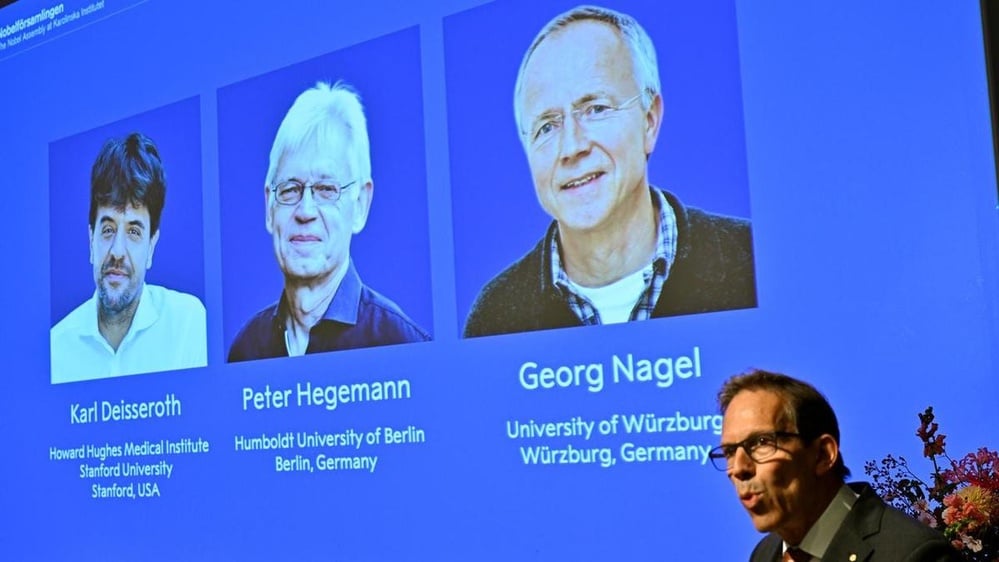
“Three researchers — Karl Deisseroth, Peter Hegemann and Georg Nagel — have been awarded the 2026 Nobel Prize in Physiology or Medicine for "discoveries concerning light-gated ion channels and optogenetics," the award-giving body announced on Monday.” · exact text match
Why: The sentence attributes the award and citation to the awarding body and contains no evaluative or first-person language.
Claim: The article consistently attributes claims and details to the Nobel prize bodies and gives specific information.
“Chosen by the Nobel Assembly at Sweden's Karolinska Institute medical university, American scientist Karl Deisseroth, 54, alongside German researchers Peter Hegemann, 71, and Georg Nagel, 73, will share the 12 million Swedish crowns ($1.2 million) prize sum.” · exact text match
Why: The text identifies the awarding body, names the selection body, and reports specific prize details without unsupported speculation.
Claim: The article presents empirical research and the Nobel committee's scientific explanation without supernatural or anti-scientific framing.
“Optogenetics "makes it possible to switch on, or off, the activity of individual nerve cells in a living brain," the prize-givers stated, noting: "This method is now being used in laboratories around the world to reveal the brain's mysteries."” · verified after text normalization
Why: The report centers on the committee's scientific description of optogenetics and does not invoke non-empirical or supernatural explanations.
The supplied text mixes substantive article content with membership and donation prompts; I scored only the substantive Nobel report.
October 05, 2026 · 0 shares
The publisher frames the Nobel award as an authoritative, non-controversial science announcement, mixing neutral factual detail with an approving quote from the Nobel committee chair.
Automated analysis; not human reviewed.
Limitations: Only the supplied article text was analyzed; no external verification of the 2026 Nobel announcement was possible, and promotional/editorial chrome (Telegram prompt, related headlines, editor bio) was excluded.
·
7 of 55 available dimensions scored; omitted dimensions are not treated as neutral.
·
Verified supporting quotes for 7 of 7 scored dimensions.
Claim: The report supplies dates, amounts, and institutional details rather than personal commentary.
“The decision was made on 5 October by the Nobel Assembly at Karolinska Institutet.” · exact text match
“The prize is worth 12 million Swedish kronor, which will be shared equally among the three laureates.” · exact text match
Why: Verifiable specifics and attributed facts replace subjective evaluation.
Claim: The wording is sober and understated, with no dramatic or hype language.
“Optogenetic methods are also being used in research aimed at restoring vision in people with visual impairments.” · exact text match
Why: The sentence states a potential use calmly without exaggeration.
Claim: The article describes events and biographies without offering instructions or recommendations.
“Karl Deisseroth was born in 1971. He received his Ph.D. from Stanford University in 1998 and his medical degree in 2000.” · exact text match
Why: The sentence is purely biographical description, not a prescription.
Claim: The tone is neutral and unemotional, with no affective evaluation.
“The research by Hegemann and Nagel recognised by the Nobel Prize was conducted at institutes of the Max Planck Society in Germany.” · exact text match
Why: The sentence is strictly informational and expresses no emotion.
Claim: The report names the awarding body, the committee chair, and specific institutional affiliations, giving readers checkable attribution.
“The decision was made on 5 October by the Nobel Assembly at Karolinska Institutet.” · exact text match
“According to Per Svenningsson, chair of the Nobel Committee for Physiology or Medicine, optogenetics has opened new opportunities for mapping the brain and studying its functions.” · exact text match
Why: Attribution and detail support trustworthiness, although no external verification is provided in the text.
Claim: The science is presented through a causal mechanism rather than emotional or speculative assertion.
“When exposed to blue light, it opens a channel through which charged ions enter the cell, triggering an electrical impulse.” · exact text match
Why: It describes a physical mechanism instead of mystical or unexplained effects.
Claim: The coverage is grounded in empirical molecular discovery and mechanistic explanation.
“Hegemann and Georg Nagel discovered channelrhodopsin in the alga, a light-sensitive protein located on the cell surface.” · exact text match
Why: It centers on a molecular discovery rather than supernatural or unsupported explanation.
Only the supplied article text was analyzed; no external verification of the 2026 Nobel announcement was possible, and promotional/editorial chrome (Telegram prompt, related headlines, editor bio) was excluded.
October 05, 2026 · 0 shares
Celebratory, institution-sourced framing presents the Nobel Prize in Medicine as a landmark scientific achievement through laudatory quotes and optimistic expert commentary.
Automated analysis; not human reviewed.
Limitations: The supplied text mixes the Nobel Prize report with unrelated headlines and boilerplate, so only the substantive article content was classified.
·
3 of 55 available dimensions scored; omitted dimensions are not treated as neutral.
·
Verified supporting quotes for 1 of 3 scored dimensions.
Claim: The article frames optogenetics with mild optimism, highlighting hoped-for clinical applications and a 'new era' in neuroscience.
“Researchers also hope optogenetics could improve cochlear implants” · exact text match
“Anna Wedell, a professor in genetics and a member of this Nobel committee, said a new era in neuroscience had opened but it was only the beginning.” · not found in supplied text
Why: The publisher selects hopeful statements about restoring vision and improving implants, though it attributes much of the optimism to sources.
Claim: The article is credible because it names sources, specifies the prize amount, institutions, and discovery timeline, and clearly attributes expert statements.
“The Nobel Prizes come with a prize amount of 12 million Swedish crowns ($1.7 million Cdn), which the three scientists will split.” · exact text match
Why: Visible sourcing and concrete detail support trustworthiness; the article distinguishes committee statements from reported facts.
The supplied text mixes the Nobel Prize report with unrelated headlines and boilerplate, so only the substantive article content was classified.
October 05, 2026 · 0 shares
The publisher frames the Nobel award as an authoritative, non-controversial science announcement, mixing neutral factual detail with an approving quote from the Nobel committee chair.
Automated analysis; not human reviewed.
Limitations: Only the supplied article text was analyzed; no external verification of the 2026 Nobel announcement was possible, and promotional/editorial chrome (Telegram prompt, related headlines, editor bio) was excluded.
·
7 of 55 available dimensions scored; omitted dimensions are not treated as neutral.
·
Verified supporting quotes for 7 of 7 scored dimensions.
Claim: The report supplies dates, amounts, and institutional details rather than personal commentary.
“The decision was made on 5 October by the Nobel Assembly at Karolinska Institutet.” · exact text match
“The prize is worth 12 million Swedish kronor, which will be shared equally among the three laureates.” · exact text match
Why: Verifiable specifics and attributed facts replace subjective evaluation.
Claim: The wording is sober and understated, with no dramatic or hype language.
“Optogenetic methods are also being used in research aimed at restoring vision in people with visual impairments.” · exact text match
Why: The sentence states a potential use calmly without exaggeration.
Claim: The article describes events and biographies without offering instructions or recommendations.
“Karl Deisseroth was born in 1971. He received his Ph.D. from Stanford University in 1998 and his medical degree in 2000.” · exact text match
Why: The sentence is purely biographical description, not a prescription.
Claim: The tone is neutral and unemotional, with no affective evaluation.
“The research by Hegemann and Nagel recognised by the Nobel Prize was conducted at institutes of the Max Planck Society in Germany.” · exact text match
Why: The sentence is strictly informational and expresses no emotion.
Claim: The report names the awarding body, the committee chair, and specific institutional affiliations, giving readers checkable attribution.
“The decision was made on 5 October by the Nobel Assembly at Karolinska Institutet.” · exact text match
“According to Per Svenningsson, chair of the Nobel Committee for Physiology or Medicine, optogenetics has opened new opportunities for mapping the brain and studying its functions.” · exact text match
Why: Attribution and detail support trustworthiness, although no external verification is provided in the text.
Claim: The science is presented through a causal mechanism rather than emotional or speculative assertion.
“When exposed to blue light, it opens a channel through which charged ions enter the cell, triggering an electrical impulse.” · exact text match
Why: It describes a physical mechanism instead of mystical or unexplained effects.
Claim: The coverage is grounded in empirical molecular discovery and mechanistic explanation.
“Hegemann and Georg Nagel discovered channelrhodopsin in the alga, a light-sensitive protein located on the cell surface.” · exact text match
Why: It centers on a molecular discovery rather than supernatural or unsupported explanation.
Only the supplied article text was analyzed; no external verification of the 2026 Nobel announcement was possible, and promotional/editorial chrome (Telegram prompt, related headlines, editor bio) was excluded.
October 05, 2026 · 0 shares
Framing presents the Nobel medicine award as an unqualified scientific milestone, adopting the Nobel Assembly's 'new era' characterization while otherwise keeping the account factual and attributed.
Automated analysis; not human reviewed.
Limitations: The supplied text lacks a dateline and publication name and conflicts with my external knowledge about Nobel laureates, so I limited the analysis to the text's internal framing and did not adjudicate factual accuracy.
·
3 of 55 available dimensions scored; omitted dimensions are not treated as neutral.
·
Verified supporting quotes for 3 of 3 scored dimensions.
Claim: The article is predominantly factual and descriptive rather than subjective.
“The Nobel Prize in medicine has been awarded to three scientists working on the mechanisms the brain uses to switch on, or off, the activity of individual nerve cells.” · exact text match
Why: The lead states a concrete event and subject, with no evaluative language in the publisher's own voice.
Claim: The report avoids sensationalising the discovery, attributing the superlative description to the Nobel Assembly.
“what the Nobel assembly called a new era in neuroscience” · exact text match
Why: The article marks the 'new era' language as the assembly's characterization rather than presenting it as the publisher's own dramatic judgment.
Claim: The article displays strong visible sourcing and attribution practices.
“Thomas Perlmann, the secretary of the medicine committee, said he was able to reach all three winners Monday.” · exact text match
“Karl Deisseroth, 54, Peter Hegemann, 71, and Georg Nagel, 73, have carried out research into light-gated ion channels and optogenetics.” · exact text match
Why: It identifies a named committee official, gives precise ages and affiliations, and quotes both the Nobel Assembly and an awardee, supporting a credible presentation.
The supplied text lacks a dateline and publication name and conflicts with my external knowledge about Nobel laureates, so I limited the analysis to the text's internal framing and did not adjudicate factual accuracy.
October 05, 2026 · 0 shares
A neutral, attribution-heavy news brief relays the Nobel committee's announcement and optogenetics description without advocacy.
Automated analysis; not human reviewed.
Limitations: The supplied text mixes substantive article content with membership and donation prompts; I scored only the substantive Nobel report.
·
3 of 55 available dimensions scored; omitted dimensions are not treated as neutral.
·
Verified supporting quotes for 3 of 3 scored dimensions.
Claim: The report uses attributed, factual wording rather than subjective evaluation.
“Three researchers — Karl Deisseroth, Peter Hegemann and Georg Nagel — have been awarded the 2026 Nobel Prize in Physiology or Medicine for "discoveries concerning light-gated ion channels and optogenetics," the award-giving body announced on Monday.” · exact text match
Why: The sentence attributes the award and citation to the awarding body and contains no evaluative or first-person language.
Claim: The article consistently attributes claims and details to the Nobel prize bodies and gives specific information.
“Chosen by the Nobel Assembly at Sweden's Karolinska Institute medical university, American scientist Karl Deisseroth, 54, alongside German researchers Peter Hegemann, 71, and Georg Nagel, 73, will share the 12 million Swedish crowns ($1.2 million) prize sum.” · exact text match
Why: The text identifies the awarding body, names the selection body, and reports specific prize details without unsupported speculation.
Claim: The article presents empirical research and the Nobel committee's scientific explanation without supernatural or anti-scientific framing.
“Optogenetics "makes it possible to switch on, or off, the activity of individual nerve cells in a living brain," the prize-givers stated, noting: "This method is now being used in laboratories around the world to reveal the brain's mysteries."” · verified after text normalization
Why: The report centers on the committee's scientific description of optogenetics and does not invoke non-empirical or supernatural explanations.
The supplied text mixes substantive article content with membership and donation prompts; I scored only the substantive Nobel report.
October 05, 2026 · 0 shares
The report frames the Nobel medicine prize as a factual announcement, relying on the committee's own language and historical context without independent commentary or advocacy.
Automated analysis; not human reviewed.
Limitations: The supplied text mixes the Nobel report with unrelated page elements and sidebar headlines; I analyzed only the Nobel Prize report and ignored page chrome.
·
2 of 55 available dimensions scored; omitted dimensions are not treated as neutral.
·
Verified supporting quotes for 2 of 2 scored dimensions.
Claim: The report is framed as a factual announcement, using attributed committee statements rather than subjective evaluation.
“the award-giving body said on Monday” · exact text match
“the prize-givers said” · exact text match
Why: The article relies on the Nobel Assembly's own description and includes no editorializing or evaluative language.
Claim: The article makes its sourcing visible by naming the Nobel Assembly, quoting the citation, and identifying the laureates with biographical details.
“were selected by the Nobel Assembly of Sweden’s Karolinska Institute medical university and receive a prize sum amounting to” · exact text match
“Last year, US scientists Mary Brunkow and Fred Ramsdell and Japan’s Shimon Sakaguchi won the prize” · exact text match
Why: Direct attribution to the prize committee and the inclusion of names, ages, nationalities, and prize amount support verifiability.
The supplied text mixes the Nobel report with unrelated page elements and sidebar headlines; I analyzed only the Nobel Prize report and ignored page chrome.
October 05, 2026 · 0 shares
Celebratory, institution-sourced framing presents the Nobel Prize in Medicine as a landmark scientific achievement through laudatory quotes and optimistic expert commentary.
Automated analysis; not human reviewed.
Limitations: The supplied text mixes the Nobel Prize report with unrelated headlines and boilerplate, so only the substantive article content was classified.
·
3 of 55 available dimensions scored; omitted dimensions are not treated as neutral.
·
Verified supporting quotes for 1 of 3 scored dimensions.
Claim: The article frames optogenetics with mild optimism, highlighting hoped-for clinical applications and a 'new era' in neuroscience.
“Researchers also hope optogenetics could improve cochlear implants” · exact text match
“Anna Wedell, a professor in genetics and a member of this Nobel committee, said a new era in neuroscience had opened but it was only the beginning.” · not found in supplied text
Why: The publisher selects hopeful statements about restoring vision and improving implants, though it attributes much of the optimism to sources.
Claim: The article is credible because it names sources, specifies the prize amount, institutions, and discovery timeline, and clearly attributes expert statements.
“The Nobel Prizes come with a prize amount of 12 million Swedish crowns ($1.7 million Cdn), which the three scientists will split.” · exact text match
Why: Visible sourcing and concrete detail support trustworthiness; the article distinguishes committee statements from reported facts.
The supplied text mixes the Nobel Prize report with unrelated headlines and boilerplate, so only the substantive article content was classified.
October 05, 2026 · 0 shares
The Nobel Prize in medicine is framed as well-deserved recognition of a transformative scientific breakthrough, relying on the Nobel Committee's and experts' attributed praise to establish the work's profound significance.
Optogenetics combines optical and genetic techniques to control the activity of individual neurons using light-sensitive proteins called channelrhodopsins.
The Nobel Prize in Physiology or Medicine is one of the original prizes established by Alfred Nobel's will and recognizes groundbreaking discoveries in the life sciences.
Automated analysis; not human reviewed.
Limitations: The supplied article text contains a truncation artifact in the Benucci quote and includes embedded app-download metadata; the extract may not reflect the full original article.
·
9 of 55 available dimensions scored; omitted dimensions are not treated as neutral.
·
Verified supporting quotes for 5 of 9 scored dimensions.
Claim: The article reports the Nobel Prize announcement using attributed quotes and neutral descriptive language.
“The 2026 Nobel Prize in physiology or medicine has been awarded to three scientists – Karl Deisseroth, Peter Hegemann and Georg Nagel – for their work developing a technique to decode the inner workings of the brain.” · exact text match
Why: The article uses attribution and neutral reporting verbs throughout.
Claim: The article frames optogenetics as having profound positive impact and hopeful medical potential.
“laid the foundation for a new era in neuroscience” · exact text match
“The hope is optogenetics will lead to new medical treatments” · exact text match
Why: The selected quotes emphasize the field's transformative and hopeful aspects, though attributed to sources.
Claim: The article covers a Nobel Prize for a neuroscience technique with broad public appeal.
“Nobel Prize in medicine awarded to trio for technique that helps decode mysteries of the brain” · exact text match
Why: The topic of brain science and a prestigious prize is inherently engaging to general audiences.
Claim: The article describes the prize and the science without prescribing policy or action.
“The 2026 Nobel Prize in physiology or medicine has been awarded to three scientists” · exact text match
Why: Purely descriptive reporting of an event with no prescriptive elements.
Claim: The article relies on the Nobel Committee and expert commentary to establish the work's significance.
“The award highlights the 'profound impact of a field that has fundamentally changed how scientists understand the brain and nervous system,' said David Pendlebury” · not found in supplied text
Why: Significance claims come from authorities rather than independent analysis.
Claim: The article attributes claims to named individuals and institutions throughout.
“said Anna Wedell, a member of the Nobel Prize committee” · exact text match
“according to a release from the Nobel committee” · exact text match
“said David Pendlebury, head of research analysis at Clarivate's Institute for Scientific Information” · verified after text normalization
Why: Consistent use of named sources, direct quotes, and clear attribution.
Claim: The article explains the scientific method and discovery without irrational appeals.
“This method – known as optogenetics – acts as a 'light-sensitive switch,' allowing scientists to 'map which cells are responsible for which function' in the brain” · not found in supplied text
Why: The article describes the science coherently and factually.
Claim: The article approaches the topic scientifically, citing experimental methods and empirical findings.
“By using this method, researchers can identify and even control the neural circuits that govern 'specific memories, feelings, and behaviors'” · not found in supplied text
Why: The article maintains an empirical, evidence-based approach throughout.
Claim: The article distinguishes between reported facts, attributed claims, and direct quotes.
“All three laureates were 'very surprised' when they learned of their prize shortly before the public announcement, said the committee's secretary-general Thomas Perlmann.” · not found in supplied text
Why: Clear attribution and separation of reporter's voice from sources.
The supplied article text contains a truncation artifact in the Benucci quote and includes embedded app-download metadata; the extract may not reflect the full original article.
October 05, 2026 · 0 shares
The publisher frames the Nobel award as an authoritative, non-controversial science announcement, mixing neutral factual detail with an approving quote from the Nobel committee chair.
Automated analysis; not human reviewed.
Limitations: Only the supplied article text was analyzed; no external verification of the 2026 Nobel announcement was possible, and promotional/editorial chrome (Telegram prompt, related headlines, editor bio) was excluded.
·
7 of 55 available dimensions scored; omitted dimensions are not treated as neutral.
·
Verified supporting quotes for 7 of 7 scored dimensions.
Claim: The report supplies dates, amounts, and institutional details rather than personal commentary.
“The decision was made on 5 October by the Nobel Assembly at Karolinska Institutet.” · exact text match
“The prize is worth 12 million Swedish kronor, which will be shared equally among the three laureates.” · exact text match
Why: Verifiable specifics and attributed facts replace subjective evaluation.
Claim: The wording is sober and understated, with no dramatic or hype language.
“Optogenetic methods are also being used in research aimed at restoring vision in people with visual impairments.” · exact text match
Why: The sentence states a potential use calmly without exaggeration.
Claim: The article describes events and biographies without offering instructions or recommendations.
“Karl Deisseroth was born in 1971. He received his Ph.D. from Stanford University in 1998 and his medical degree in 2000.” · exact text match
Why: The sentence is purely biographical description, not a prescription.
Claim: The tone is neutral and unemotional, with no affective evaluation.
“The research by Hegemann and Nagel recognised by the Nobel Prize was conducted at institutes of the Max Planck Society in Germany.” · exact text match
Why: The sentence is strictly informational and expresses no emotion.
Claim: The report names the awarding body, the committee chair, and specific institutional affiliations, giving readers checkable attribution.
“The decision was made on 5 October by the Nobel Assembly at Karolinska Institutet.” · exact text match
“According to Per Svenningsson, chair of the Nobel Committee for Physiology or Medicine, optogenetics has opened new opportunities for mapping the brain and studying its functions.” · exact text match
Why: Attribution and detail support trustworthiness, although no external verification is provided in the text.
Claim: The science is presented through a causal mechanism rather than emotional or speculative assertion.
“When exposed to blue light, it opens a channel through which charged ions enter the cell, triggering an electrical impulse.” · exact text match
Why: It describes a physical mechanism instead of mystical or unexplained effects.
Claim: The coverage is grounded in empirical molecular discovery and mechanistic explanation.
“Hegemann and Georg Nagel discovered channelrhodopsin in the alga, a light-sensitive protein located on the cell surface.” · exact text match
Why: It centers on a molecular discovery rather than supernatural or unsupported explanation.
Only the supplied article text was analyzed; no external verification of the 2026 Nobel announcement was possible, and promotional/editorial chrome (Telegram prompt, related headlines, editor bio) was excluded.
October 05, 2026 · 0 shares
Expert-led Nobel speculation is framed around GLP-1/weight-loss research's 'enormous worldwide clinical impact,' with political lobbying around the peace prize noted as background.
Nobel committees do not publish shortlists or nominees in advance, so pre-announcement candidate discussions are inherently speculative.
GLP-1 receptor agonists such as Ozempic and Mounjaro are approved for diabetes and widely used for weight loss.
Automated analysis; not human reviewed.
Limitations: The supplied text mixes the main report with site boilerplate and related-link headlines; I analyzed only the main report and treated its unusual 2026 timeline as given without external verification.
·
7 of 55 available dimensions scored; omitted dimensions are not treated as neutral.
·
Verified supporting quotes for 6 of 7 scored dimensions.
Claim: The report conveys predictions through attributed sources and avoids first-person editorializing.
“Nobel watchers told AFP” · exact text match
“according to Annika Ostman, science reporter at Swedish public broadcaster SR” · exact text match
Why: Almost every speculative claim is explicitly attributed to a named or categorical source.
Claim: Language is hedged and understated rather than alarmist or clickbait.
“could go to research that paved the way for weight-loss drugs such as Ozempic and Mounjaro” · exact text match
“One possibility this year is a joint prize for Save the Children and Mykola Kuleba” · exact text match
Why: Predictions are framed as possibilities with 'could' and 'possibility' rather than as certainties or scandals.
Claim: The report is descriptive, setting out possible outcomes with no recommendation or call to action.
“could go to research that paved the way for weight-loss drugs” · exact text match
“Other possible laureates include Sudan's Emergency Response Rooms (ERR)” · exact text match
Why: The text catalogues candidates and dates without telling readers how to act or what should happen.
Claim: Political dimensions, mainly around the peace prize, are covered neutrally with no endorsement of a side.
“There's always a lot of lobbying, and ultimately perhaps also attempts to exert pressure on the committee," the secretary of the Nobel committee, Kristian Berg Harpviken, told AFP in an interview.
"We're very used to that.”
· not found in supplied text
Why: The political material is presented through a neutral institutional source and treats lobbying as routine context.
Claim: The report names sources, dates, and institutional affiliations for most substantive claims.
“Nobel watchers told AFP” · exact text match
“David Pendlebury, who heads research analysis at data analytics firm Clarivate” · exact text match
“according to Annika Ostman, science reporter at Swedish public broadcaster SR” · exact text match
Why: Claims are generally attributed to identifiable individuals or organizations, and the schedule is stated with specific dates and times.
Claim: The framing uses citation metrics and attributed expert reasoning rather than emotional appeals.
“which predicts potential Nobel winners based on the number of citations of their work” · exact text match
“I would put GLP-1 at the top of the list, just because of its enormous worldwide clinical impact” · exact text match
Why: The prediction is anchored to citation data and clinical-impact statements attributed to a named analyst.
Claim: The report is dominated by forward-looking conjecture about who may win upcoming Nobel prizes.
“A Nobel Prize recognizing any of that work is a likelihood” · exact text match
“One possibility this year is a joint prize for Save the Children and Mykola Kuleba” · exact text match
Why: The article's core content consists of forecasts about multiple unannounced prizes, even though the forecasts are attributed and hedged.
The supplied text mixes the main report with site boilerplate and related-link headlines; I analyzed only the main report and treated its unusual 2026 timeline as given without external verification.
October 05, 2026 · 0 shares
The publisher frames the Nobel award as an authoritative, non-controversial science announcement, mixing neutral factual detail with an approving quote from the Nobel committee chair.
Automated analysis; not human reviewed. Limitations: Only the supplied article text was analyzed; no external verification of the 2026 Nobel announcement was possible, and promotional/editorial chrome (Telegram prompt, related headlines, editor bio) was excluded. · 7 of 55 available dimensions scored; omitted dimensions are not treated as neutral. · Verified supporting quotes for 7 of 7 scored dimensions.
Claim: The report supplies dates, amounts, and institutional details rather than personal commentary.
“The decision was made on 5 October by the Nobel Assembly at Karolinska Institutet.” · exact text match
“The prize is worth 12 million Swedish kronor, which will be shared equally among the three laureates.” · exact text match
Why: Verifiable specifics and attributed facts replace subjective evaluation.
Claim: The wording is sober and understated, with no dramatic or hype language.
“Optogenetic methods are also being used in research aimed at restoring vision in people with visual impairments.” · exact text match
Why: The sentence states a potential use calmly without exaggeration.
Claim: The article describes events and biographies without offering instructions or recommendations.
“Karl Deisseroth was born in 1971. He received his Ph.D. from Stanford University in 1998 and his medical degree in 2000.” · exact text match
Why: The sentence is purely biographical description, not a prescription.
Claim: The tone is neutral and unemotional, with no affective evaluation.
“The research by Hegemann and Nagel recognised by the Nobel Prize was conducted at institutes of the Max Planck Society in Germany.” · exact text match
Why: The sentence is strictly informational and expresses no emotion.
Claim: The report names the awarding body, the committee chair, and specific institutional affiliations, giving readers checkable attribution.
“The decision was made on 5 October by the Nobel Assembly at Karolinska Institutet.” · exact text match
“According to Per Svenningsson, chair of the Nobel Committee for Physiology or Medicine, optogenetics has opened new opportunities for mapping the brain and studying its functions.” · exact text match
Why: Attribution and detail support trustworthiness, although no external verification is provided in the text.
Claim: The science is presented through a causal mechanism rather than emotional or speculative assertion.
“When exposed to blue light, it opens a channel through which charged ions enter the cell, triggering an electrical impulse.” · exact text match
Why: It describes a physical mechanism instead of mystical or unexplained effects.
Claim: The coverage is grounded in empirical molecular discovery and mechanistic explanation.
“Hegemann and Georg Nagel discovered channelrhodopsin in the alga, a light-sensitive protein located on the cell surface.” · exact text match
Why: It centers on a molecular discovery rather than supernatural or unsupported explanation.
Only the supplied article text was analyzed; no external verification of the 2026 Nobel announcement was possible, and promotional/editorial chrome (Telegram prompt, related headlines, editor bio) was excluded.
October 05, 2026 · 0 shares
The report frames the Nobel medicine prize as a factual announcement, relying on the committee's own language and historical context without independent commentary or advocacy.
Automated analysis; not human reviewed. Limitations: The supplied text mixes the Nobel report with unrelated page elements and sidebar headlines; I analyzed only the Nobel Prize report and ignored page chrome. · 2 of 55 available dimensions scored; omitted dimensions are not treated as neutral. · Verified supporting quotes for 2 of 2 scored dimensions.
Claim: The report is framed as a factual announcement, using attributed committee statements rather than subjective evaluation.
“the award-giving body said on Monday” · exact text match
“the prize-givers said” · exact text match
Why: The article relies on the Nobel Assembly's own description and includes no editorializing or evaluative language.
Claim: The article makes its sourcing visible by naming the Nobel Assembly, quoting the citation, and identifying the laureates with biographical details.
“were selected by the Nobel Assembly of Sweden’s Karolinska Institute medical university and receive a prize sum amounting to” · exact text match
“Last year, US scientists Mary Brunkow and Fred Ramsdell and Japan’s Shimon Sakaguchi won the prize” · exact text match
Why: Direct attribution to the prize committee and the inclusion of names, ages, nationalities, and prize amount support verifiability.
The supplied text mixes the Nobel report with unrelated page elements and sidebar headlines; I analyzed only the Nobel Prize report and ignored page chrome.
October 05, 2026 · 0 shares
Celebratory, institution-sourced framing presents the Nobel Prize in Medicine as a landmark scientific achievement through laudatory quotes and optimistic expert commentary.
Automated analysis; not human reviewed. Limitations: The supplied text mixes the Nobel Prize report with unrelated headlines and boilerplate, so only the substantive article content was classified. · 3 of 55 available dimensions scored; omitted dimensions are not treated as neutral. · Verified supporting quotes for 1 of 3 scored dimensions.
Claim: The article frames optogenetics with mild optimism, highlighting hoped-for clinical applications and a 'new era' in neuroscience.
“Researchers also hope optogenetics could improve cochlear implants” · exact text match
“Anna Wedell, a professor in genetics and a member of this Nobel committee, said a new era in neuroscience had opened but it was only the beginning.” · not found in supplied text
Why: The publisher selects hopeful statements about restoring vision and improving implants, though it attributes much of the optimism to sources.
Claim: The article is credible because it names sources, specifies the prize amount, institutions, and discovery timeline, and clearly attributes expert statements.
“The Nobel Prizes come with a prize amount of 12 million Swedish crowns ($1.7 million Cdn), which the three scientists will split.” · exact text match
Why: Visible sourcing and concrete detail support trustworthiness; the article distinguishes committee statements from reported facts.
The supplied text mixes the Nobel Prize report with unrelated headlines and boilerplate, so only the substantive article content was classified.
October 05, 2026 · 0 shares
The publisher frames the Nobel award as an authoritative, non-controversial science announcement, mixing neutral factual detail with an approving quote from the Nobel committee chair.
Automated analysis; not human reviewed. Limitations: Only the supplied article text was analyzed; no external verification of the 2026 Nobel announcement was possible, and promotional/editorial chrome (Telegram prompt, related headlines, editor bio) was excluded. · 7 of 55 available dimensions scored; omitted dimensions are not treated as neutral. · Verified supporting quotes for 7 of 7 scored dimensions.
Claim: The report supplies dates, amounts, and institutional details rather than personal commentary.
“The decision was made on 5 October by the Nobel Assembly at Karolinska Institutet.” · exact text match
“The prize is worth 12 million Swedish kronor, which will be shared equally among the three laureates.” · exact text match
Why: Verifiable specifics and attributed facts replace subjective evaluation.
Claim: The wording is sober and understated, with no dramatic or hype language.
“Optogenetic methods are also being used in research aimed at restoring vision in people with visual impairments.” · exact text match
Why: The sentence states a potential use calmly without exaggeration.
Claim: The article describes events and biographies without offering instructions or recommendations.
“Karl Deisseroth was born in 1971. He received his Ph.D. from Stanford University in 1998 and his medical degree in 2000.” · exact text match
Why: The sentence is purely biographical description, not a prescription.
Claim: The tone is neutral and unemotional, with no affective evaluation.
“The research by Hegemann and Nagel recognised by the Nobel Prize was conducted at institutes of the Max Planck Society in Germany.” · exact text match
Why: The sentence is strictly informational and expresses no emotion.
Claim: The report names the awarding body, the committee chair, and specific institutional affiliations, giving readers checkable attribution.
“The decision was made on 5 October by the Nobel Assembly at Karolinska Institutet.” · exact text match
“According to Per Svenningsson, chair of the Nobel Committee for Physiology or Medicine, optogenetics has opened new opportunities for mapping the brain and studying its functions.” · exact text match
Why: Attribution and detail support trustworthiness, although no external verification is provided in the text.
Claim: The science is presented through a causal mechanism rather than emotional or speculative assertion.
“When exposed to blue light, it opens a channel through which charged ions enter the cell, triggering an electrical impulse.” · exact text match
Why: It describes a physical mechanism instead of mystical or unexplained effects.
Claim: The coverage is grounded in empirical molecular discovery and mechanistic explanation.
“Hegemann and Georg Nagel discovered channelrhodopsin in the alga, a light-sensitive protein located on the cell surface.” · exact text match
Why: It centers on a molecular discovery rather than supernatural or unsupported explanation.
Only the supplied article text was analyzed; no external verification of the 2026 Nobel announcement was possible, and promotional/editorial chrome (Telegram prompt, related headlines, editor bio) was excluded.
October 05, 2026 · 0 shares
Celebratory, institution-sourced framing presents the Nobel Prize in Medicine as a landmark scientific achievement through laudatory quotes and optimistic expert commentary.
Automated analysis; not human reviewed. Limitations: The supplied text mixes the Nobel Prize report with unrelated headlines and boilerplate, so only the substantive article content was classified. · 3 of 55 available dimensions scored; omitted dimensions are not treated as neutral. · Verified supporting quotes for 1 of 3 scored dimensions.
Claim: The article frames optogenetics with mild optimism, highlighting hoped-for clinical applications and a 'new era' in neuroscience.
“Researchers also hope optogenetics could improve cochlear implants” · exact text match
“Anna Wedell, a professor in genetics and a member of this Nobel committee, said a new era in neuroscience had opened but it was only the beginning.” · not found in supplied text
Why: The publisher selects hopeful statements about restoring vision and improving implants, though it attributes much of the optimism to sources.
Claim: The article is credible because it names sources, specifies the prize amount, institutions, and discovery timeline, and clearly attributes expert statements.
“The Nobel Prizes come with a prize amount of 12 million Swedish crowns ($1.7 million Cdn), which the three scientists will split.” · exact text match
Why: Visible sourcing and concrete detail support trustworthiness; the article distinguishes committee statements from reported facts.
The supplied text mixes the Nobel Prize report with unrelated headlines and boilerplate, so only the substantive article content was classified.
October 05, 2026 · 0 shares
Framing presents the Nobel medicine award as an unqualified scientific milestone, adopting the Nobel Assembly's 'new era' characterization while otherwise keeping the account factual and attributed.
Automated analysis; not human reviewed. Limitations: The supplied text lacks a dateline and publication name and conflicts with my external knowledge about Nobel laureates, so I limited the analysis to the text's internal framing and did not adjudicate factual accuracy. · 3 of 55 available dimensions scored; omitted dimensions are not treated as neutral. · Verified supporting quotes for 3 of 3 scored dimensions.
Claim: The article is predominantly factual and descriptive rather than subjective.
“The Nobel Prize in medicine has been awarded to three scientists working on the mechanisms the brain uses to switch on, or off, the activity of individual nerve cells.” · exact text match
Why: The lead states a concrete event and subject, with no evaluative language in the publisher's own voice.
Claim: The report avoids sensationalising the discovery, attributing the superlative description to the Nobel Assembly.
“what the Nobel assembly called a new era in neuroscience” · exact text match
Why: The article marks the 'new era' language as the assembly's characterization rather than presenting it as the publisher's own dramatic judgment.
Claim: The article displays strong visible sourcing and attribution practices.
“Thomas Perlmann, the secretary of the medicine committee, said he was able to reach all three winners Monday.” · exact text match
“Karl Deisseroth, 54, Peter Hegemann, 71, and Georg Nagel, 73, have carried out research into light-gated ion channels and optogenetics.” · exact text match
Why: It identifies a named committee official, gives precise ages and affiliations, and quotes both the Nobel Assembly and an awardee, supporting a credible presentation.
The supplied text lacks a dateline and publication name and conflicts with my external knowledge about Nobel laureates, so I limited the analysis to the text's internal framing and did not adjudicate factual accuracy.
October 05, 2026 · 0 shares
Expert-led Nobel speculation is framed around GLP-1/weight-loss research's 'enormous worldwide clinical impact,' with political lobbying around the peace prize noted as background.
Nobel committees do not publish shortlists or nominees in advance, so pre-announcement candidate discussions are inherently speculative. GLP-1 receptor agonists such as Ozempic and Mounjaro are approved for diabetes and widely used for weight loss.
Automated analysis; not human reviewed. Limitations: The supplied text mixes the main report with site boilerplate and related-link headlines; I analyzed only the main report and treated its unusual 2026 timeline as given without external verification. · 7 of 55 available dimensions scored; omitted dimensions are not treated as neutral. · Verified supporting quotes for 6 of 7 scored dimensions.
Claim: The report conveys predictions through attributed sources and avoids first-person editorializing.
“Nobel watchers told AFP” · exact text match
“according to Annika Ostman, science reporter at Swedish public broadcaster SR” · exact text match
Why: Almost every speculative claim is explicitly attributed to a named or categorical source.
Claim: Language is hedged and understated rather than alarmist or clickbait.
“could go to research that paved the way for weight-loss drugs such as Ozempic and Mounjaro” · exact text match
“One possibility this year is a joint prize for Save the Children and Mykola Kuleba” · exact text match
Why: Predictions are framed as possibilities with 'could' and 'possibility' rather than as certainties or scandals.
Claim: The report is descriptive, setting out possible outcomes with no recommendation or call to action.
“could go to research that paved the way for weight-loss drugs” · exact text match
“Other possible laureates include Sudan's Emergency Response Rooms (ERR)” · exact text match
Why: The text catalogues candidates and dates without telling readers how to act or what should happen.
Claim: Political dimensions, mainly around the peace prize, are covered neutrally with no endorsement of a side.
“There's always a lot of lobbying, and ultimately perhaps also attempts to exert pressure on the committee," the secretary of the Nobel committee, Kristian Berg Harpviken, told AFP in an interview. "We're very used to that.” · not found in supplied text
Why: The political material is presented through a neutral institutional source and treats lobbying as routine context.
Claim: The report names sources, dates, and institutional affiliations for most substantive claims.
“Nobel watchers told AFP” · exact text match
“David Pendlebury, who heads research analysis at data analytics firm Clarivate” · exact text match
“according to Annika Ostman, science reporter at Swedish public broadcaster SR” · exact text match
Why: Claims are generally attributed to identifiable individuals or organizations, and the schedule is stated with specific dates and times.
Claim: The framing uses citation metrics and attributed expert reasoning rather than emotional appeals.
“which predicts potential Nobel winners based on the number of citations of their work” · exact text match
“I would put GLP-1 at the top of the list, just because of its enormous worldwide clinical impact” · exact text match
Why: The prediction is anchored to citation data and clinical-impact statements attributed to a named analyst.
Claim: The report is dominated by forward-looking conjecture about who may win upcoming Nobel prizes.
“A Nobel Prize recognizing any of that work is a likelihood” · exact text match
“One possibility this year is a joint prize for Save the Children and Mykola Kuleba” · exact text match
Why: The article's core content consists of forecasts about multiple unannounced prizes, even though the forecasts are attributed and hedged.
The supplied text mixes the main report with site boilerplate and related-link headlines; I analyzed only the main report and treated its unusual 2026 timeline as given without external verification.
Mainstream Science Journalism
October 05, 2026 · 0 shares
The Nobel Prize in medicine is framed as well-deserved recognition of a transformative scientific breakthrough, relying on the Nobel Committee's and experts' attributed praise to establish the work's profound significance.
Optogenetics combines optical and genetic techniques to control the activity of individual neurons using light-sensitive proteins called channelrhodopsins. The Nobel Prize in Physiology or Medicine is one of the original prizes established by Alfred Nobel's will and recognizes groundbreaking discoveries in the life sciences.
Automated analysis; not human reviewed. Limitations: The supplied article text contains a truncation artifact in the Benucci quote and includes embedded app-download metadata; the extract may not reflect the full original article. · 9 of 55 available dimensions scored; omitted dimensions are not treated as neutral. · Verified supporting quotes for 5 of 9 scored dimensions.
Claim: The article reports the Nobel Prize announcement using attributed quotes and neutral descriptive language.
“The 2026 Nobel Prize in physiology or medicine has been awarded to three scientists – Karl Deisseroth, Peter Hegemann and Georg Nagel – for their work developing a technique to decode the inner workings of the brain.” · exact text match
Why: The article uses attribution and neutral reporting verbs throughout.
Claim: The article frames optogenetics as having profound positive impact and hopeful medical potential.
“laid the foundation for a new era in neuroscience” · exact text match
“The hope is optogenetics will lead to new medical treatments” · exact text match
Why: The selected quotes emphasize the field's transformative and hopeful aspects, though attributed to sources.
Claim: The article covers a Nobel Prize for a neuroscience technique with broad public appeal.
“Nobel Prize in medicine awarded to trio for technique that helps decode mysteries of the brain” · exact text match
Why: The topic of brain science and a prestigious prize is inherently engaging to general audiences.
Claim: The article describes the prize and the science without prescribing policy or action.
“The 2026 Nobel Prize in physiology or medicine has been awarded to three scientists” · exact text match
Why: Purely descriptive reporting of an event with no prescriptive elements.
Claim: The article relies on the Nobel Committee and expert commentary to establish the work's significance.
“The award highlights the 'profound impact of a field that has fundamentally changed how scientists understand the brain and nervous system,' said David Pendlebury” · not found in supplied text
Why: Significance claims come from authorities rather than independent analysis.
Claim: The article attributes claims to named individuals and institutions throughout.
“said Anna Wedell, a member of the Nobel Prize committee” · exact text match
“according to a release from the Nobel committee” · exact text match
“said David Pendlebury, head of research analysis at Clarivate's Institute for Scientific Information” · verified after text normalization
Why: Consistent use of named sources, direct quotes, and clear attribution.
Claim: The article explains the scientific method and discovery without irrational appeals.
“This method – known as optogenetics – acts as a 'light-sensitive switch,' allowing scientists to 'map which cells are responsible for which function' in the brain” · not found in supplied text
Why: The article describes the science coherently and factually.
Claim: The article approaches the topic scientifically, citing experimental methods and empirical findings.
“By using this method, researchers can identify and even control the neural circuits that govern 'specific memories, feelings, and behaviors'” · not found in supplied text
Why: The article maintains an empirical, evidence-based approach throughout.
Claim: The article distinguishes between reported facts, attributed claims, and direct quotes.
“All three laureates were 'very surprised' when they learned of their prize shortly before the public announcement, said the committee's secretary-general Thomas Perlmann.” · not found in supplied text
Why: Clear attribution and separation of reporter's voice from sources.
The supplied article text contains a truncation artifact in the Benucci quote and includes embedded app-download metadata; the extract may not reflect the full original article.
October 05, 2026 · 0 shares
Celebratory, institution-sourced framing presents the Nobel Prize in Medicine as a landmark scientific achievement through laudatory quotes and optimistic expert commentary.
Automated analysis; not human reviewed. Limitations: The supplied text mixes the Nobel Prize report with unrelated headlines and boilerplate, so only the substantive article content was classified. · 3 of 55 available dimensions scored; omitted dimensions are not treated as neutral. · Verified supporting quotes for 1 of 3 scored dimensions.
Claim: The article frames optogenetics with mild optimism, highlighting hoped-for clinical applications and a 'new era' in neuroscience.
“Researchers also hope optogenetics could improve cochlear implants” · exact text match
“Anna Wedell, a professor in genetics and a member of this Nobel committee, said a new era in neuroscience had opened but it was only the beginning.” · not found in supplied text
Why: The publisher selects hopeful statements about restoring vision and improving implants, though it attributes much of the optimism to sources.
Claim: The article is credible because it names sources, specifies the prize amount, institutions, and discovery timeline, and clearly attributes expert statements.
“The Nobel Prizes come with a prize amount of 12 million Swedish crowns ($1.7 million Cdn), which the three scientists will split.” · exact text match
Why: Visible sourcing and concrete detail support trustworthiness; the article distinguishes committee statements from reported facts.
The supplied text mixes the Nobel Prize report with unrelated headlines and boilerplate, so only the substantive article content was classified.
October 05, 2026 · 0 shares
A neutral, attribution-heavy news brief relays the Nobel committee's announcement and optogenetics description without advocacy.
Automated analysis; not human reviewed. Limitations: The supplied text mixes substantive article content with membership and donation prompts; I scored only the substantive Nobel report. · 3 of 55 available dimensions scored; omitted dimensions are not treated as neutral. · Verified supporting quotes for 3 of 3 scored dimensions.
Claim: The report uses attributed, factual wording rather than subjective evaluation.
“Three researchers — Karl Deisseroth, Peter Hegemann and Georg Nagel — have been awarded the 2026 Nobel Prize in Physiology or Medicine for "discoveries concerning light-gated ion channels and optogenetics," the award-giving body announced on Monday.” · exact text match
Why: The sentence attributes the award and citation to the awarding body and contains no evaluative or first-person language.
Claim: The article consistently attributes claims and details to the Nobel prize bodies and gives specific information.
“Chosen by the Nobel Assembly at Sweden's Karolinska Institute medical university, American scientist Karl Deisseroth, 54, alongside German researchers Peter Hegemann, 71, and Georg Nagel, 73, will share the 12 million Swedish crowns ($1.2 million) prize sum.” · exact text match
Why: The text identifies the awarding body, names the selection body, and reports specific prize details without unsupported speculation.
Claim: The article presents empirical research and the Nobel committee's scientific explanation without supernatural or anti-scientific framing.
“Optogenetics "makes it possible to switch on, or off, the activity of individual nerve cells in a living brain," the prize-givers stated, noting: "This method is now being used in laboratories around the world to reveal the brain's mysteries."” · verified after text normalization
Why: The report centers on the committee's scientific description of optogenetics and does not invoke non-empirical or supernatural explanations.
The supplied text mixes substantive article content with membership and donation prompts; I scored only the substantive Nobel report.
Framing is neutral and purely factual, presenting the Nobel medicine award as a bare announcement without commentary, context, or evaluation.
Automated analysis; not human reviewed. Limitations: Only a headline-like snippet was supplied, with no publisher, date, or surrounding article context; framing analysis is therefore limited to the single sentence. · 3 of 55 available dimensions scored; omitted dimensions are not treated as neutral. · Verified supporting quotes for 3 of 3 scored dimensions.
Claim: The article is a neutral factual announcement without subjective evaluation.
“Nobel medicine prize goes to 3 scientists for research into brain activity” · exact text match
Why: The sole content is declarative and factual; no evaluative, emotive, or subjective language appears.
Claim: The article avoids sensational language or dramatic emphasis.
“Nobel medicine prize goes to 3 scientists for research into brain activity” · exact text match
Why: The wording is plain and unadorned, with no dramatic adjectives, urgent calls, or fear/outrage framing.
Claim: The article describes an event rather than prescribing or advocating a course of action.
“Nobel medicine prize goes to 3 scientists for research into brain activity” · exact text match
Why: The sentence simply states the award outcome; it contains no should, must, recommendation, or call to action.
Only a headline-like snippet was supplied, with no publisher, date, or surrounding article context; framing analysis is therefore limited to the single sentence.
October 05, 2026 · 0 shares
The report frames the Nobel medicine prize as a factual announcement, relying on the committee's own language and historical context without independent commentary or advocacy.
Automated analysis; not human reviewed. Limitations: The supplied text mixes the Nobel report with unrelated page elements and sidebar headlines; I analyzed only the Nobel Prize report and ignored page chrome. · 2 of 55 available dimensions scored; omitted dimensions are not treated as neutral. · Verified supporting quotes for 2 of 2 scored dimensions.
Claim: The report is framed as a factual announcement, using attributed committee statements rather than subjective evaluation.
“the award-giving body said on Monday” · exact text match
“the prize-givers said” · exact text match
Why: The article relies on the Nobel Assembly's own description and includes no editorializing or evaluative language.
Claim: The article makes its sourcing visible by naming the Nobel Assembly, quoting the citation, and identifying the laureates with biographical details.
“were selected by the Nobel Assembly of Sweden’s Karolinska Institute medical university and receive a prize sum amounting to” · exact text match
“Last year, US scientists Mary Brunkow and Fred Ramsdell and Japan’s Shimon Sakaguchi won the prize” · exact text match
Why: Direct attribution to the prize committee and the inclusion of names, ages, nationalities, and prize amount support verifiability.
The supplied text mixes the Nobel report with unrelated page elements and sidebar headlines; I analyzed only the Nobel Prize report and ignored page chrome.
October 05, 2026 · 0 shares
Framing presents the Nobel medicine award as an unqualified scientific milestone, adopting the Nobel Assembly's 'new era' characterization while otherwise keeping the account factual and attributed.
Automated analysis; not human reviewed. Limitations: The supplied text lacks a dateline and publication name and conflicts with my external knowledge about Nobel laureates, so I limited the analysis to the text's internal framing and did not adjudicate factual accuracy. · 3 of 55 available dimensions scored; omitted dimensions are not treated as neutral. · Verified supporting quotes for 3 of 3 scored dimensions.
Claim: The article is predominantly factual and descriptive rather than subjective.
“The Nobel Prize in medicine has been awarded to three scientists working on the mechanisms the brain uses to switch on, or off, the activity of individual nerve cells.” · exact text match
Why: The lead states a concrete event and subject, with no evaluative language in the publisher's own voice.
Claim: The report avoids sensationalising the discovery, attributing the superlative description to the Nobel Assembly.
“what the Nobel assembly called a new era in neuroscience” · exact text match
Why: The article marks the 'new era' language as the assembly's characterization rather than presenting it as the publisher's own dramatic judgment.
Claim: The article displays strong visible sourcing and attribution practices.
“Thomas Perlmann, the secretary of the medicine committee, said he was able to reach all three winners Monday.” · exact text match
“Karl Deisseroth, 54, Peter Hegemann, 71, and Georg Nagel, 73, have carried out research into light-gated ion channels and optogenetics.” · exact text match
Why: It identifies a named committee official, gives precise ages and affiliations, and quotes both the Nobel Assembly and an awardee, supporting a credible presentation.
The supplied text lacks a dateline and publication name and conflicts with my external knowledge about Nobel laureates, so I limited the analysis to the text's internal framing and did not adjudicate factual accuracy.
October 05, 2026 · 0 shares
Framing presents the Nobel medicine award as an unqualified scientific milestone, adopting the Nobel Assembly's 'new era' characterization while otherwise keeping the account factual and attributed.
Automated analysis; not human reviewed. Limitations: The supplied text lacks a dateline and publication name and conflicts with my external knowledge about Nobel laureates, so I limited the analysis to the text's internal framing and did not adjudicate factual accuracy. · 3 of 55 available dimensions scored; omitted dimensions are not treated as neutral. · Verified supporting quotes for 3 of 3 scored dimensions.
Claim: The article is predominantly factual and descriptive rather than subjective.
“The Nobel Prize in medicine has been awarded to three scientists working on the mechanisms the brain uses to switch on, or off, the activity of individual nerve cells.” · exact text match
Why: The lead states a concrete event and subject, with no evaluative language in the publisher's own voice.
Claim: The report avoids sensationalising the discovery, attributing the superlative description to the Nobel Assembly.
“what the Nobel assembly called a new era in neuroscience” · exact text match
Why: The article marks the 'new era' language as the assembly's characterization rather than presenting it as the publisher's own dramatic judgment.
Claim: The article displays strong visible sourcing and attribution practices.
“Thomas Perlmann, the secretary of the medicine committee, said he was able to reach all three winners Monday.” · exact text match
“Karl Deisseroth, 54, Peter Hegemann, 71, and Georg Nagel, 73, have carried out research into light-gated ion channels and optogenetics.” · exact text match
Why: It identifies a named committee official, gives precise ages and affiliations, and quotes both the Nobel Assembly and an awardee, supporting a credible presentation.
The supplied text lacks a dateline and publication name and conflicts with my external knowledge about Nobel laureates, so I limited the analysis to the text's internal framing and did not adjudicate factual accuracy.
October 05, 2026 · 0 shares
Celebratory, institution-sourced framing presents the Nobel Prize in Medicine as a landmark scientific achievement through laudatory quotes and optimistic expert commentary.
Automated analysis; not human reviewed. Limitations: The supplied text mixes the Nobel Prize report with unrelated headlines and boilerplate, so only the substantive article content was classified. · 3 of 55 available dimensions scored; omitted dimensions are not treated as neutral. · Verified supporting quotes for 1 of 3 scored dimensions.
Claim: The article frames optogenetics with mild optimism, highlighting hoped-for clinical applications and a 'new era' in neuroscience.
“Researchers also hope optogenetics could improve cochlear implants” · exact text match
“Anna Wedell, a professor in genetics and a member of this Nobel committee, said a new era in neuroscience had opened but it was only the beginning.” · not found in supplied text
Why: The publisher selects hopeful statements about restoring vision and improving implants, though it attributes much of the optimism to sources.
Claim: The article is credible because it names sources, specifies the prize amount, institutions, and discovery timeline, and clearly attributes expert statements.
“The Nobel Prizes come with a prize amount of 12 million Swedish crowns ($1.7 million Cdn), which the three scientists will split.” · exact text match
Why: Visible sourcing and concrete detail support trustworthiness; the article distinguishes committee statements from reported facts.
The supplied text mixes the Nobel Prize report with unrelated headlines and boilerplate, so only the substantive article content was classified.
Nobel Prediction/Watchers Community
October 05, 2026 · 0 shares
Expert-led Nobel speculation is framed around GLP-1/weight-loss research's 'enormous worldwide clinical impact,' with political lobbying around the peace prize noted as background.
Nobel committees do not publish shortlists or nominees in advance, so pre-announcement candidate discussions are inherently speculative. GLP-1 receptor agonists such as Ozempic and Mounjaro are approved for diabetes and widely used for weight loss.
Automated analysis; not human reviewed. Limitations: The supplied text mixes the main report with site boilerplate and related-link headlines; I analyzed only the main report and treated its unusual 2026 timeline as given without external verification. · 7 of 55 available dimensions scored; omitted dimensions are not treated as neutral. · Verified supporting quotes for 6 of 7 scored dimensions.
Claim: The report conveys predictions through attributed sources and avoids first-person editorializing.
“Nobel watchers told AFP” · exact text match
“according to Annika Ostman, science reporter at Swedish public broadcaster SR” · exact text match
Why: Almost every speculative claim is explicitly attributed to a named or categorical source.
Claim: Language is hedged and understated rather than alarmist or clickbait.
“could go to research that paved the way for weight-loss drugs such as Ozempic and Mounjaro” · exact text match
“One possibility this year is a joint prize for Save the Children and Mykola Kuleba” · exact text match
Why: Predictions are framed as possibilities with 'could' and 'possibility' rather than as certainties or scandals.
Claim: The report is descriptive, setting out possible outcomes with no recommendation or call to action.
“could go to research that paved the way for weight-loss drugs” · exact text match
“Other possible laureates include Sudan's Emergency Response Rooms (ERR)” · exact text match
Why: The text catalogues candidates and dates without telling readers how to act or what should happen.
Claim: Political dimensions, mainly around the peace prize, are covered neutrally with no endorsement of a side.
“There's always a lot of lobbying, and ultimately perhaps also attempts to exert pressure on the committee," the secretary of the Nobel committee, Kristian Berg Harpviken, told AFP in an interview. "We're very used to that.” · not found in supplied text
Why: The political material is presented through a neutral institutional source and treats lobbying as routine context.
Claim: The report names sources, dates, and institutional affiliations for most substantive claims.
“Nobel watchers told AFP” · exact text match
“David Pendlebury, who heads research analysis at data analytics firm Clarivate” · exact text match
“according to Annika Ostman, science reporter at Swedish public broadcaster SR” · exact text match
Why: Claims are generally attributed to identifiable individuals or organizations, and the schedule is stated with specific dates and times.
Claim: The framing uses citation metrics and attributed expert reasoning rather than emotional appeals.
“which predicts potential Nobel winners based on the number of citations of their work” · exact text match
“I would put GLP-1 at the top of the list, just because of its enormous worldwide clinical impact” · exact text match
Why: The prediction is anchored to citation data and clinical-impact statements attributed to a named analyst.
Claim: The report is dominated by forward-looking conjecture about who may win upcoming Nobel prizes.
“A Nobel Prize recognizing any of that work is a likelihood” · exact text match
“One possibility this year is a joint prize for Save the Children and Mykola Kuleba” · exact text match
Why: The article's core content consists of forecasts about multiple unannounced prizes, even though the forecasts are attributed and hedged.
The supplied text mixes the main report with site boilerplate and related-link headlines; I analyzed only the main report and treated its unusual 2026 timeline as given without external verification.
October 05, 2026 · 0 shares
Expert-led Nobel speculation is framed around GLP-1/weight-loss research's 'enormous worldwide clinical impact,' with political lobbying around the peace prize noted as background.
Nobel committees do not publish shortlists or nominees in advance, so pre-announcement candidate discussions are inherently speculative. GLP-1 receptor agonists such as Ozempic and Mounjaro are approved for diabetes and widely used for weight loss.
Automated analysis; not human reviewed. Limitations: The supplied text mixes the main report with site boilerplate and related-link headlines; I analyzed only the main report and treated its unusual 2026 timeline as given without external verification. · 7 of 55 available dimensions scored; omitted dimensions are not treated as neutral. · Verified supporting quotes for 6 of 7 scored dimensions.
Claim: The report conveys predictions through attributed sources and avoids first-person editorializing.
“Nobel watchers told AFP” · exact text match
“according to Annika Ostman, science reporter at Swedish public broadcaster SR” · exact text match
Why: Almost every speculative claim is explicitly attributed to a named or categorical source.
Claim: Language is hedged and understated rather than alarmist or clickbait.
“could go to research that paved the way for weight-loss drugs such as Ozempic and Mounjaro” · exact text match
“One possibility this year is a joint prize for Save the Children and Mykola Kuleba” · exact text match
Why: Predictions are framed as possibilities with 'could' and 'possibility' rather than as certainties or scandals.
Claim: The report is descriptive, setting out possible outcomes with no recommendation or call to action.
“could go to research that paved the way for weight-loss drugs” · exact text match
“Other possible laureates include Sudan's Emergency Response Rooms (ERR)” · exact text match
Why: The text catalogues candidates and dates without telling readers how to act or what should happen.
Claim: Political dimensions, mainly around the peace prize, are covered neutrally with no endorsement of a side.
“There's always a lot of lobbying, and ultimately perhaps also attempts to exert pressure on the committee," the secretary of the Nobel committee, Kristian Berg Harpviken, told AFP in an interview. "We're very used to that.” · not found in supplied text
Why: The political material is presented through a neutral institutional source and treats lobbying as routine context.
Claim: The report names sources, dates, and institutional affiliations for most substantive claims.
“Nobel watchers told AFP” · exact text match
“David Pendlebury, who heads research analysis at data analytics firm Clarivate” · exact text match
“according to Annika Ostman, science reporter at Swedish public broadcaster SR” · exact text match
Why: Claims are generally attributed to identifiable individuals or organizations, and the schedule is stated with specific dates and times.
Claim: The framing uses citation metrics and attributed expert reasoning rather than emotional appeals.
“which predicts potential Nobel winners based on the number of citations of their work” · exact text match
“I would put GLP-1 at the top of the list, just because of its enormous worldwide clinical impact” · exact text match
Why: The prediction is anchored to citation data and clinical-impact statements attributed to a named analyst.
Claim: The report is dominated by forward-looking conjecture about who may win upcoming Nobel prizes.
“A Nobel Prize recognizing any of that work is a likelihood” · exact text match
“One possibility this year is a joint prize for Save the Children and Mykola Kuleba” · exact text match
Why: The article's core content consists of forecasts about multiple unannounced prizes, even though the forecasts are attributed and hedged.
The supplied text mixes the main report with site boilerplate and related-link headlines; I analyzed only the main report and treated its unusual 2026 timeline as given without external verification.
October 05, 2026 · 0 shares
The Nobel Prize in medicine is framed as well-deserved recognition of a transformative scientific breakthrough, relying on the Nobel Committee's and experts' attributed praise to establish the work's profound significance.
Optogenetics combines optical and genetic techniques to control the activity of individual neurons using light-sensitive proteins called channelrhodopsins. The Nobel Prize in Physiology or Medicine is one of the original prizes established by Alfred Nobel's will and recognizes groundbreaking discoveries in the life sciences.
Automated analysis; not human reviewed. Limitations: The supplied article text contains a truncation artifact in the Benucci quote and includes embedded app-download metadata; the extract may not reflect the full original article. · 9 of 55 available dimensions scored; omitted dimensions are not treated as neutral. · Verified supporting quotes for 5 of 9 scored dimensions.
Claim: The article reports the Nobel Prize announcement using attributed quotes and neutral descriptive language.
“The 2026 Nobel Prize in physiology or medicine has been awarded to three scientists – Karl Deisseroth, Peter Hegemann and Georg Nagel – for their work developing a technique to decode the inner workings of the brain.” · exact text match
Why: The article uses attribution and neutral reporting verbs throughout.
Claim: The article frames optogenetics as having profound positive impact and hopeful medical potential.
“laid the foundation for a new era in neuroscience” · exact text match
“The hope is optogenetics will lead to new medical treatments” · exact text match
Why: The selected quotes emphasize the field's transformative and hopeful aspects, though attributed to sources.
Claim: The article covers a Nobel Prize for a neuroscience technique with broad public appeal.
“Nobel Prize in medicine awarded to trio for technique that helps decode mysteries of the brain” · exact text match
Why: The topic of brain science and a prestigious prize is inherently engaging to general audiences.
Claim: The article describes the prize and the science without prescribing policy or action.
“The 2026 Nobel Prize in physiology or medicine has been awarded to three scientists” · exact text match
Why: Purely descriptive reporting of an event with no prescriptive elements.
Claim: The article relies on the Nobel Committee and expert commentary to establish the work's significance.
“The award highlights the 'profound impact of a field that has fundamentally changed how scientists understand the brain and nervous system,' said David Pendlebury” · not found in supplied text
Why: Significance claims come from authorities rather than independent analysis.
Claim: The article attributes claims to named individuals and institutions throughout.
“said Anna Wedell, a member of the Nobel Prize committee” · exact text match
“according to a release from the Nobel committee” · exact text match
“said David Pendlebury, head of research analysis at Clarivate's Institute for Scientific Information” · verified after text normalization
Why: Consistent use of named sources, direct quotes, and clear attribution.
Claim: The article explains the scientific method and discovery without irrational appeals.
“This method – known as optogenetics – acts as a 'light-sensitive switch,' allowing scientists to 'map which cells are responsible for which function' in the brain” · not found in supplied text
Why: The article describes the science coherently and factually.
Claim: The article approaches the topic scientifically, citing experimental methods and empirical findings.
“By using this method, researchers can identify and even control the neural circuits that govern 'specific memories, feelings, and behaviors'” · not found in supplied text
Why: The article maintains an empirical, evidence-based approach throughout.
Claim: The article distinguishes between reported facts, attributed claims, and direct quotes.
“All three laureates were 'very surprised' when they learned of their prize shortly before the public announcement, said the committee's secretary-general Thomas Perlmann.” · not found in supplied text
Why: Clear attribution and separation of reporter's voice from sources.
The supplied article text contains a truncation artifact in the Benucci quote and includes embedded app-download metadata; the extract may not reflect the full original article.
Helium Bias
Story Blindspots
October 05, 2026 · 0 shares
Framing presents the Nobel medicine award as an unqualified scientific milestone, adopting the Nobel Assembly's 'new era' characterization while otherwise keeping the account factual and attributed.
Automated analysis; not human reviewed. Limitations: The supplied text lacks a dateline and publication name and conflicts with my external knowledge about Nobel laureates, so I limited the analysis to the text's internal framing and did not adjudicate factual accuracy. · 3 of 55 available dimensions scored; omitted dimensions are not treated as neutral. · Verified supporting quotes for 3 of 3 scored dimensions.
Claim: The article is predominantly factual and descriptive rather than subjective.
“The Nobel Prize in medicine has been awarded to three scientists working on the mechanisms the brain uses to switch on, or off, the activity of individual nerve cells.” · exact text match
Why: The lead states a concrete event and subject, with no evaluative language in the publisher's own voice.
Claim: The report avoids sensationalising the discovery, attributing the superlative description to the Nobel Assembly.
“what the Nobel assembly called a new era in neuroscience” · exact text match
Why: The article marks the 'new era' language as the assembly's characterization rather than presenting it as the publisher's own dramatic judgment.
Claim: The article displays strong visible sourcing and attribution practices.
“Thomas Perlmann, the secretary of the medicine committee, said he was able to reach all three winners Monday.” · exact text match
“Karl Deisseroth, 54, Peter Hegemann, 71, and Georg Nagel, 73, have carried out research into light-gated ion channels and optogenetics.” · exact text match
Why: It identifies a named committee official, gives precise ages and affiliations, and quotes both the Nobel Assembly and an awardee, supporting a credible presentation.
The supplied text lacks a dateline and publication name and conflicts with my external knowledge about Nobel laureates, so I limited the analysis to the text's internal framing and did not adjudicate factual accuracy.
October 05, 2026 · 0 shares
Framing presents the Nobel medicine award as an unqualified scientific milestone, adopting the Nobel Assembly's 'new era' characterization while otherwise keeping the account factual and attributed.
Automated analysis; not human reviewed. Limitations: The supplied text lacks a dateline and publication name and conflicts with my external knowledge about Nobel laureates, so I limited the analysis to the text's internal framing and did not adjudicate factual accuracy. · 3 of 55 available dimensions scored; omitted dimensions are not treated as neutral. · Verified supporting quotes for 3 of 3 scored dimensions.
Claim: The article is predominantly factual and descriptive rather than subjective.
“The Nobel Prize in medicine has been awarded to three scientists working on the mechanisms the brain uses to switch on, or off, the activity of individual nerve cells.” · exact text match
Why: The lead states a concrete event and subject, with no evaluative language in the publisher's own voice.
Claim: The report avoids sensationalising the discovery, attributing the superlative description to the Nobel Assembly.
“what the Nobel assembly called a new era in neuroscience” · exact text match
Why: The article marks the 'new era' language as the assembly's characterization rather than presenting it as the publisher's own dramatic judgment.
Claim: The article displays strong visible sourcing and attribution practices.
“Thomas Perlmann, the secretary of the medicine committee, said he was able to reach all three winners Monday.” · exact text match
“Karl Deisseroth, 54, Peter Hegemann, 71, and Georg Nagel, 73, have carried out research into light-gated ion channels and optogenetics.” · exact text match
Why: It identifies a named committee official, gives precise ages and affiliations, and quotes both the Nobel Assembly and an awardee, supporting a credible presentation.
The supplied text lacks a dateline and publication name and conflicts with my external knowledge about Nobel laureates, so I limited the analysis to the text's internal framing and did not adjudicate factual accuracy.
October 05, 2026 · 0 shares
The report frames the Nobel medicine prize as a factual announcement, relying on the committee's own language and historical context without independent commentary or advocacy.
Automated analysis; not human reviewed. Limitations: The supplied text mixes the Nobel report with unrelated page elements and sidebar headlines; I analyzed only the Nobel Prize report and ignored page chrome. · 2 of 55 available dimensions scored; omitted dimensions are not treated as neutral. · Verified supporting quotes for 2 of 2 scored dimensions.
Claim: The report is framed as a factual announcement, using attributed committee statements rather than subjective evaluation.
“the award-giving body said on Monday” · exact text match
“the prize-givers said” · exact text match
Why: The article relies on the Nobel Assembly's own description and includes no editorializing or evaluative language.
Claim: The article makes its sourcing visible by naming the Nobel Assembly, quoting the citation, and identifying the laureates with biographical details.
“were selected by the Nobel Assembly of Sweden’s Karolinska Institute medical university and receive a prize sum amounting to” · exact text match
“Last year, US scientists Mary Brunkow and Fred Ramsdell and Japan’s Shimon Sakaguchi won the prize” · exact text match
Why: Direct attribution to the prize committee and the inclusion of names, ages, nationalities, and prize amount support verifiability.
The supplied text mixes the Nobel report with unrelated page elements and sidebar headlines; I analyzed only the Nobel Prize report and ignored page chrome.
October 05, 2026 · 0 shares
A neutral, attribution-heavy news brief relays the Nobel committee's announcement and optogenetics description without advocacy.
Automated analysis; not human reviewed. Limitations: The supplied text mixes substantive article content with membership and donation prompts; I scored only the substantive Nobel report. · 3 of 55 available dimensions scored; omitted dimensions are not treated as neutral. · Verified supporting quotes for 3 of 3 scored dimensions.
Claim: The report uses attributed, factual wording rather than subjective evaluation.
“Three researchers — Karl Deisseroth, Peter Hegemann and Georg Nagel — have been awarded the 2026 Nobel Prize in Physiology or Medicine for "discoveries concerning light-gated ion channels and optogenetics," the award-giving body announced on Monday.” · exact text match
Why: The sentence attributes the award and citation to the awarding body and contains no evaluative or first-person language.
Claim: The article consistently attributes claims and details to the Nobel prize bodies and gives specific information.
“Chosen by the Nobel Assembly at Sweden's Karolinska Institute medical university, American scientist Karl Deisseroth, 54, alongside German researchers Peter Hegemann, 71, and Georg Nagel, 73, will share the 12 million Swedish crowns ($1.2 million) prize sum.” · exact text match
Why: The text identifies the awarding body, names the selection body, and reports specific prize details without unsupported speculation.
Claim: The article presents empirical research and the Nobel committee's scientific explanation without supernatural or anti-scientific framing.
“Optogenetics "makes it possible to switch on, or off, the activity of individual nerve cells in a living brain," the prize-givers stated, noting: "This method is now being used in laboratories around the world to reveal the brain's mysteries."” · verified after text normalization
Why: The report centers on the committee's scientific description of optogenetics and does not invoke non-empirical or supernatural explanations.
The supplied text mixes substantive article content with membership and donation prompts; I scored only the substantive Nobel report.
October 05, 2026 · 0 shares
Celebratory, institution-sourced framing presents the Nobel Prize in Medicine as a landmark scientific achievement through laudatory quotes and optimistic expert commentary.
Automated analysis; not human reviewed. Limitations: The supplied text mixes the Nobel Prize report with unrelated headlines and boilerplate, so only the substantive article content was classified. · 3 of 55 available dimensions scored; omitted dimensions are not treated as neutral. · Verified supporting quotes for 1 of 3 scored dimensions.
Claim: The article frames optogenetics with mild optimism, highlighting hoped-for clinical applications and a 'new era' in neuroscience.
“Researchers also hope optogenetics could improve cochlear implants” · exact text match
“Anna Wedell, a professor in genetics and a member of this Nobel committee, said a new era in neuroscience had opened but it was only the beginning.” · not found in supplied text
Why: The publisher selects hopeful statements about restoring vision and improving implants, though it attributes much of the optimism to sources.
Claim: The article is credible because it names sources, specifies the prize amount, institutions, and discovery timeline, and clearly attributes expert statements.
“The Nobel Prizes come with a prize amount of 12 million Swedish crowns ($1.7 million Cdn), which the three scientists will split.” · exact text match
Why: Visible sourcing and concrete detail support trustworthiness; the article distinguishes committee statements from reported facts.
The supplied text mixes the Nobel Prize report with unrelated headlines and boilerplate, so only the substantive article content was classified.
October 05, 2026 · 0 shares
Framing presents the Nobel medicine award as an unqualified scientific milestone, adopting the Nobel Assembly's 'new era' characterization while otherwise keeping the account factual and attributed.
Automated analysis; not human reviewed. Limitations: The supplied text lacks a dateline and publication name and conflicts with my external knowledge about Nobel laureates, so I limited the analysis to the text's internal framing and did not adjudicate factual accuracy. · 3 of 55 available dimensions scored; omitted dimensions are not treated as neutral. · Verified supporting quotes for 3 of 3 scored dimensions.
Claim: The article is predominantly factual and descriptive rather than subjective.
“The Nobel Prize in medicine has been awarded to three scientists working on the mechanisms the brain uses to switch on, or off, the activity of individual nerve cells.” · exact text match
Why: The lead states a concrete event and subject, with no evaluative language in the publisher's own voice.
Claim: The report avoids sensationalising the discovery, attributing the superlative description to the Nobel Assembly.
“what the Nobel assembly called a new era in neuroscience” · exact text match
Why: The article marks the 'new era' language as the assembly's characterization rather than presenting it as the publisher's own dramatic judgment.
Claim: The article displays strong visible sourcing and attribution practices.
“Thomas Perlmann, the secretary of the medicine committee, said he was able to reach all three winners Monday.” · exact text match
“Karl Deisseroth, 54, Peter Hegemann, 71, and Georg Nagel, 73, have carried out research into light-gated ion channels and optogenetics.” · exact text match
Why: It identifies a named committee official, gives precise ages and affiliations, and quotes both the Nobel Assembly and an awardee, supporting a credible presentation.
The supplied text lacks a dateline and publication name and conflicts with my external knowledge about Nobel laureates, so I limited the analysis to the text's internal framing and did not adjudicate factual accuracy.
October 05, 2026 · 0 shares
The publisher frames the Nobel award as an authoritative, non-controversial science announcement, mixing neutral factual detail with an approving quote from the Nobel committee chair.
Automated analysis; not human reviewed. Limitations: Only the supplied article text was analyzed; no external verification of the 2026 Nobel announcement was possible, and promotional/editorial chrome (Telegram prompt, related headlines, editor bio) was excluded. · 7 of 55 available dimensions scored; omitted dimensions are not treated as neutral. · Verified supporting quotes for 7 of 7 scored dimensions.
Claim: The report supplies dates, amounts, and institutional details rather than personal commentary.
“The decision was made on 5 October by the Nobel Assembly at Karolinska Institutet.” · exact text match
“The prize is worth 12 million Swedish kronor, which will be shared equally among the three laureates.” · exact text match
Why: Verifiable specifics and attributed facts replace subjective evaluation.
Claim: The wording is sober and understated, with no dramatic or hype language.
“Optogenetic methods are also being used in research aimed at restoring vision in people with visual impairments.” · exact text match
Why: The sentence states a potential use calmly without exaggeration.
Claim: The article describes events and biographies without offering instructions or recommendations.
“Karl Deisseroth was born in 1971. He received his Ph.D. from Stanford University in 1998 and his medical degree in 2000.” · exact text match
Why: The sentence is purely biographical description, not a prescription.
Claim: The tone is neutral and unemotional, with no affective evaluation.
“The research by Hegemann and Nagel recognised by the Nobel Prize was conducted at institutes of the Max Planck Society in Germany.” · exact text match
Why: The sentence is strictly informational and expresses no emotion.
Claim: The report names the awarding body, the committee chair, and specific institutional affiliations, giving readers checkable attribution.
“The decision was made on 5 October by the Nobel Assembly at Karolinska Institutet.” · exact text match
“According to Per Svenningsson, chair of the Nobel Committee for Physiology or Medicine, optogenetics has opened new opportunities for mapping the brain and studying its functions.” · exact text match
Why: Attribution and detail support trustworthiness, although no external verification is provided in the text.
Claim: The science is presented through a causal mechanism rather than emotional or speculative assertion.
“When exposed to blue light, it opens a channel through which charged ions enter the cell, triggering an electrical impulse.” · exact text match
Why: It describes a physical mechanism instead of mystical or unexplained effects.
Claim: The coverage is grounded in empirical molecular discovery and mechanistic explanation.
“Hegemann and Georg Nagel discovered channelrhodopsin in the alga, a light-sensitive protein located on the cell surface.” · exact text match
Why: It centers on a molecular discovery rather than supernatural or unsupported explanation.
Only the supplied article text was analyzed; no external verification of the 2026 Nobel announcement was possible, and promotional/editorial chrome (Telegram prompt, related headlines, editor bio) was excluded.
October 05, 2026 · 0 shares
The report frames the Nobel medicine prize as a factual announcement, relying on the committee's own language and historical context without independent commentary or advocacy.
Automated analysis; not human reviewed. Limitations: The supplied text mixes the Nobel report with unrelated page elements and sidebar headlines; I analyzed only the Nobel Prize report and ignored page chrome. · 2 of 55 available dimensions scored; omitted dimensions are not treated as neutral. · Verified supporting quotes for 2 of 2 scored dimensions.
Claim: The report is framed as a factual announcement, using attributed committee statements rather than subjective evaluation.
“the award-giving body said on Monday” · exact text match
“the prize-givers said” · exact text match
Why: The article relies on the Nobel Assembly's own description and includes no editorializing or evaluative language.
Claim: The article makes its sourcing visible by naming the Nobel Assembly, quoting the citation, and identifying the laureates with biographical details.
“were selected by the Nobel Assembly of Sweden’s Karolinska Institute medical university and receive a prize sum amounting to” · exact text match
“Last year, US scientists Mary Brunkow and Fred Ramsdell and Japan’s Shimon Sakaguchi won the prize” · exact text match
Why: Direct attribution to the prize committee and the inclusion of names, ages, nationalities, and prize amount support verifiability.
The supplied text mixes the Nobel report with unrelated page elements and sidebar headlines; I analyzed only the Nobel Prize report and ignored page chrome.
October 05, 2026 · 0 shares
Celebratory, institution-sourced framing presents the Nobel Prize in Medicine as a landmark scientific achievement through laudatory quotes and optimistic expert commentary.
Automated analysis; not human reviewed. Limitations: The supplied text mixes the Nobel Prize report with unrelated headlines and boilerplate, so only the substantive article content was classified. · 3 of 55 available dimensions scored; omitted dimensions are not treated as neutral. · Verified supporting quotes for 1 of 3 scored dimensions.
Claim: The article frames optogenetics with mild optimism, highlighting hoped-for clinical applications and a 'new era' in neuroscience.
“Researchers also hope optogenetics could improve cochlear implants” · exact text match
“Anna Wedell, a professor in genetics and a member of this Nobel committee, said a new era in neuroscience had opened but it was only the beginning.” · not found in supplied text
Why: The publisher selects hopeful statements about restoring vision and improving implants, though it attributes much of the optimism to sources.
Claim: The article is credible because it names sources, specifies the prize amount, institutions, and discovery timeline, and clearly attributes expert statements.
“The Nobel Prizes come with a prize amount of 12 million Swedish crowns ($1.7 million Cdn), which the three scientists will split.” · exact text match
Why: Visible sourcing and concrete detail support trustworthiness; the article distinguishes committee statements from reported facts.
The supplied text mixes the Nobel Prize report with unrelated headlines and boilerplate, so only the substantive article content was classified.
October 05, 2026 · 0 shares
A neutral, attribution-heavy news brief relays the Nobel committee's announcement and optogenetics description without advocacy.
Automated analysis; not human reviewed. Limitations: The supplied text mixes substantive article content with membership and donation prompts; I scored only the substantive Nobel report. · 3 of 55 available dimensions scored; omitted dimensions are not treated as neutral. · Verified supporting quotes for 3 of 3 scored dimensions.
Claim: The report uses attributed, factual wording rather than subjective evaluation.
“Three researchers — Karl Deisseroth, Peter Hegemann and Georg Nagel — have been awarded the 2026 Nobel Prize in Physiology or Medicine for "discoveries concerning light-gated ion channels and optogenetics," the award-giving body announced on Monday.” · exact text match
Why: The sentence attributes the award and citation to the awarding body and contains no evaluative or first-person language.
Claim: The article consistently attributes claims and details to the Nobel prize bodies and gives specific information.
“Chosen by the Nobel Assembly at Sweden's Karolinska Institute medical university, American scientist Karl Deisseroth, 54, alongside German researchers Peter Hegemann, 71, and Georg Nagel, 73, will share the 12 million Swedish crowns ($1.2 million) prize sum.” · exact text match
Why: The text identifies the awarding body, names the selection body, and reports specific prize details without unsupported speculation.
Claim: The article presents empirical research and the Nobel committee's scientific explanation without supernatural or anti-scientific framing.
“Optogenetics "makes it possible to switch on, or off, the activity of individual nerve cells in a living brain," the prize-givers stated, noting: "This method is now being used in laboratories around the world to reveal the brain's mysteries."” · verified after text normalization
Why: The report centers on the committee's scientific description of optogenetics and does not invoke non-empirical or supernatural explanations.
The supplied text mixes substantive article content with membership and donation prompts; I scored only the substantive Nobel report.
October 05, 2026 · 0 shares
Expert-led Nobel speculation is framed around GLP-1/weight-loss research's 'enormous worldwide clinical impact,' with political lobbying around the peace prize noted as background.
Nobel committees do not publish shortlists or nominees in advance, so pre-announcement candidate discussions are inherently speculative. GLP-1 receptor agonists such as Ozempic and Mounjaro are approved for diabetes and widely used for weight loss.
Automated analysis; not human reviewed. Limitations: The supplied text mixes the main report with site boilerplate and related-link headlines; I analyzed only the main report and treated its unusual 2026 timeline as given without external verification. · 7 of 55 available dimensions scored; omitted dimensions are not treated as neutral. · Verified supporting quotes for 6 of 7 scored dimensions.
Claim: The report conveys predictions through attributed sources and avoids first-person editorializing.
“Nobel watchers told AFP” · exact text match
“according to Annika Ostman, science reporter at Swedish public broadcaster SR” · exact text match
Why: Almost every speculative claim is explicitly attributed to a named or categorical source.
Claim: Language is hedged and understated rather than alarmist or clickbait.
“could go to research that paved the way for weight-loss drugs such as Ozempic and Mounjaro” · exact text match
“One possibility this year is a joint prize for Save the Children and Mykola Kuleba” · exact text match
Why: Predictions are framed as possibilities with 'could' and 'possibility' rather than as certainties or scandals.
Claim: The report is descriptive, setting out possible outcomes with no recommendation or call to action.
“could go to research that paved the way for weight-loss drugs” · exact text match
“Other possible laureates include Sudan's Emergency Response Rooms (ERR)” · exact text match
Why: The text catalogues candidates and dates without telling readers how to act or what should happen.
Claim: Political dimensions, mainly around the peace prize, are covered neutrally with no endorsement of a side.
“There's always a lot of lobbying, and ultimately perhaps also attempts to exert pressure on the committee," the secretary of the Nobel committee, Kristian Berg Harpviken, told AFP in an interview. "We're very used to that.” · not found in supplied text
Why: The political material is presented through a neutral institutional source and treats lobbying as routine context.
Claim: The report names sources, dates, and institutional affiliations for most substantive claims.
“Nobel watchers told AFP” · exact text match
“David Pendlebury, who heads research analysis at data analytics firm Clarivate” · exact text match
“according to Annika Ostman, science reporter at Swedish public broadcaster SR” · exact text match
Why: Claims are generally attributed to identifiable individuals or organizations, and the schedule is stated with specific dates and times.
Claim: The framing uses citation metrics and attributed expert reasoning rather than emotional appeals.
“which predicts potential Nobel winners based on the number of citations of their work” · exact text match
“I would put GLP-1 at the top of the list, just because of its enormous worldwide clinical impact” · exact text match
Why: The prediction is anchored to citation data and clinical-impact statements attributed to a named analyst.
Claim: The report is dominated by forward-looking conjecture about who may win upcoming Nobel prizes.
“A Nobel Prize recognizing any of that work is a likelihood” · exact text match
“One possibility this year is a joint prize for Save the Children and Mykola Kuleba” · exact text match
Why: The article's core content consists of forecasts about multiple unannounced prizes, even though the forecasts are attributed and hedged.
The supplied text mixes the main report with site boilerplate and related-link headlines; I analyzed only the main report and treated its unusual 2026 timeline as given without external verification.
October 05, 2026 · 0 shares
The publisher frames the Nobel award as an authoritative, non-controversial science announcement, mixing neutral factual detail with an approving quote from the Nobel committee chair.
Automated analysis; not human reviewed. Limitations: Only the supplied article text was analyzed; no external verification of the 2026 Nobel announcement was possible, and promotional/editorial chrome (Telegram prompt, related headlines, editor bio) was excluded. · 7 of 55 available dimensions scored; omitted dimensions are not treated as neutral. · Verified supporting quotes for 7 of 7 scored dimensions.
Claim: The report supplies dates, amounts, and institutional details rather than personal commentary.
“The decision was made on 5 October by the Nobel Assembly at Karolinska Institutet.” · exact text match
“The prize is worth 12 million Swedish kronor, which will be shared equally among the three laureates.” · exact text match
Why: Verifiable specifics and attributed facts replace subjective evaluation.
Claim: The wording is sober and understated, with no dramatic or hype language.
“Optogenetic methods are also being used in research aimed at restoring vision in people with visual impairments.” · exact text match
Why: The sentence states a potential use calmly without exaggeration.
Claim: The article describes events and biographies without offering instructions or recommendations.
“Karl Deisseroth was born in 1971. He received his Ph.D. from Stanford University in 1998 and his medical degree in 2000.” · exact text match
Why: The sentence is purely biographical description, not a prescription.
Claim: The tone is neutral and unemotional, with no affective evaluation.
“The research by Hegemann and Nagel recognised by the Nobel Prize was conducted at institutes of the Max Planck Society in Germany.” · exact text match
Why: The sentence is strictly informational and expresses no emotion.
Claim: The report names the awarding body, the committee chair, and specific institutional affiliations, giving readers checkable attribution.
“The decision was made on 5 October by the Nobel Assembly at Karolinska Institutet.” · exact text match
“According to Per Svenningsson, chair of the Nobel Committee for Physiology or Medicine, optogenetics has opened new opportunities for mapping the brain and studying its functions.” · exact text match
Why: Attribution and detail support trustworthiness, although no external verification is provided in the text.
Claim: The science is presented through a causal mechanism rather than emotional or speculative assertion.
“When exposed to blue light, it opens a channel through which charged ions enter the cell, triggering an electrical impulse.” · exact text match
Why: It describes a physical mechanism instead of mystical or unexplained effects.
Claim: The coverage is grounded in empirical molecular discovery and mechanistic explanation.
“Hegemann and Georg Nagel discovered channelrhodopsin in the alga, a light-sensitive protein located on the cell surface.” · exact text match
Why: It centers on a molecular discovery rather than supernatural or unsupported explanation.
Only the supplied article text was analyzed; no external verification of the 2026 Nobel announcement was possible, and promotional/editorial chrome (Telegram prompt, related headlines, editor bio) was excluded.
October 05, 2026 · 0 shares
The Nobel Prize in medicine is framed as well-deserved recognition of a transformative scientific breakthrough, relying on the Nobel Committee's and experts' attributed praise to establish the work's profound significance.
Optogenetics combines optical and genetic techniques to control the activity of individual neurons using light-sensitive proteins called channelrhodopsins. The Nobel Prize in Physiology or Medicine is one of the original prizes established by Alfred Nobel's will and recognizes groundbreaking discoveries in the life sciences.
Automated analysis; not human reviewed. Limitations: The supplied article text contains a truncation artifact in the Benucci quote and includes embedded app-download metadata; the extract may not reflect the full original article. · 9 of 55 available dimensions scored; omitted dimensions are not treated as neutral. · Verified supporting quotes for 5 of 9 scored dimensions.
Claim: The article reports the Nobel Prize announcement using attributed quotes and neutral descriptive language.
“The 2026 Nobel Prize in physiology or medicine has been awarded to three scientists – Karl Deisseroth, Peter Hegemann and Georg Nagel – for their work developing a technique to decode the inner workings of the brain.” · exact text match
Why: The article uses attribution and neutral reporting verbs throughout.
Claim: The article frames optogenetics as having profound positive impact and hopeful medical potential.
“laid the foundation for a new era in neuroscience” · exact text match
“The hope is optogenetics will lead to new medical treatments” · exact text match
Why: The selected quotes emphasize the field's transformative and hopeful aspects, though attributed to sources.
Claim: The article covers a Nobel Prize for a neuroscience technique with broad public appeal.
“Nobel Prize in medicine awarded to trio for technique that helps decode mysteries of the brain” · exact text match
Why: The topic of brain science and a prestigious prize is inherently engaging to general audiences.
Claim: The article describes the prize and the science without prescribing policy or action.
“The 2026 Nobel Prize in physiology or medicine has been awarded to three scientists” · exact text match
Why: Purely descriptive reporting of an event with no prescriptive elements.
Claim: The article relies on the Nobel Committee and expert commentary to establish the work's significance.
“The award highlights the 'profound impact of a field that has fundamentally changed how scientists understand the brain and nervous system,' said David Pendlebury” · not found in supplied text
Why: Significance claims come from authorities rather than independent analysis.
Claim: The article attributes claims to named individuals and institutions throughout.
“said Anna Wedell, a member of the Nobel Prize committee” · exact text match
“according to a release from the Nobel committee” · exact text match
“said David Pendlebury, head of research analysis at Clarivate's Institute for Scientific Information” · verified after text normalization
Why: Consistent use of named sources, direct quotes, and clear attribution.
Claim: The article explains the scientific method and discovery without irrational appeals.
“This method – known as optogenetics – acts as a 'light-sensitive switch,' allowing scientists to 'map which cells are responsible for which function' in the brain” · not found in supplied text
Why: The article describes the science coherently and factually.
Claim: The article approaches the topic scientifically, citing experimental methods and empirical findings.
“By using this method, researchers can identify and even control the neural circuits that govern 'specific memories, feelings, and behaviors'” · not found in supplied text
Why: The article maintains an empirical, evidence-based approach throughout.
Claim: The article distinguishes between reported facts, attributed claims, and direct quotes.
“All three laureates were 'very surprised' when they learned of their prize shortly before the public announcement, said the committee's secretary-general Thomas Perlmann.” · not found in supplied text
Why: Clear attribution and separation of reporter's voice from sources.
The supplied article text contains a truncation artifact in the Benucci quote and includes embedded app-download metadata; the extract may not reflect the full original article.
October 05, 2026 · 0 shares
A neutral, attribution-heavy news brief relays the Nobel committee's announcement and optogenetics description without advocacy.
Automated analysis; not human reviewed. Limitations: The supplied text mixes substantive article content with membership and donation prompts; I scored only the substantive Nobel report. · 3 of 55 available dimensions scored; omitted dimensions are not treated as neutral. · Verified supporting quotes for 3 of 3 scored dimensions.
Claim: The report uses attributed, factual wording rather than subjective evaluation.
“Three researchers — Karl Deisseroth, Peter Hegemann and Georg Nagel — have been awarded the 2026 Nobel Prize in Physiology or Medicine for "discoveries concerning light-gated ion channels and optogenetics," the award-giving body announced on Monday.” · exact text match
Why: The sentence attributes the award and citation to the awarding body and contains no evaluative or first-person language.
Claim: The article consistently attributes claims and details to the Nobel prize bodies and gives specific information.
“Chosen by the Nobel Assembly at Sweden's Karolinska Institute medical university, American scientist Karl Deisseroth, 54, alongside German researchers Peter Hegemann, 71, and Georg Nagel, 73, will share the 12 million Swedish crowns ($1.2 million) prize sum.” · exact text match
Why: The text identifies the awarding body, names the selection body, and reports specific prize details without unsupported speculation.
Claim: The article presents empirical research and the Nobel committee's scientific explanation without supernatural or anti-scientific framing.
“Optogenetics "makes it possible to switch on, or off, the activity of individual nerve cells in a living brain," the prize-givers stated, noting: "This method is now being used in laboratories around the world to reveal the brain's mysteries."” · verified after text normalization
Why: The report centers on the committee's scientific description of optogenetics and does not invoke non-empirical or supernatural explanations.
The supplied text mixes substantive article content with membership and donation prompts; I scored only the substantive Nobel report.
October 05, 2026 · 0 shares
Celebratory, institution-sourced framing presents the Nobel Prize in Medicine as a landmark scientific achievement through laudatory quotes and optimistic expert commentary.
Automated analysis; not human reviewed. Limitations: The supplied text mixes the Nobel Prize report with unrelated headlines and boilerplate, so only the substantive article content was classified. · 3 of 55 available dimensions scored; omitted dimensions are not treated as neutral. · Verified supporting quotes for 1 of 3 scored dimensions.
Claim: The article frames optogenetics with mild optimism, highlighting hoped-for clinical applications and a 'new era' in neuroscience.
“Researchers also hope optogenetics could improve cochlear implants” · exact text match
“Anna Wedell, a professor in genetics and a member of this Nobel committee, said a new era in neuroscience had opened but it was only the beginning.” · not found in supplied text
Why: The publisher selects hopeful statements about restoring vision and improving implants, though it attributes much of the optimism to sources.
Claim: The article is credible because it names sources, specifies the prize amount, institutions, and discovery timeline, and clearly attributes expert statements.
“The Nobel Prizes come with a prize amount of 12 million Swedish crowns ($1.7 million Cdn), which the three scientists will split.” · exact text match
Why: Visible sourcing and concrete detail support trustworthiness; the article distinguishes committee statements from reported facts.
The supplied text mixes the Nobel Prize report with unrelated headlines and boilerplate, so only the substantive article content was classified.
October 05, 2026 · 0 shares
The Nobel Prize in medicine is framed as well-deserved recognition of a transformative scientific breakthrough, relying on the Nobel Committee's and experts' attributed praise to establish the work's profound significance.
Optogenetics combines optical and genetic techniques to control the activity of individual neurons using light-sensitive proteins called channelrhodopsins. The Nobel Prize in Physiology or Medicine is one of the original prizes established by Alfred Nobel's will and recognizes groundbreaking discoveries in the life sciences.
Automated analysis; not human reviewed. Limitations: The supplied article text contains a truncation artifact in the Benucci quote and includes embedded app-download metadata; the extract may not reflect the full original article. · 9 of 55 available dimensions scored; omitted dimensions are not treated as neutral. · Verified supporting quotes for 5 of 9 scored dimensions.
Claim: The article reports the Nobel Prize announcement using attributed quotes and neutral descriptive language.
“The 2026 Nobel Prize in physiology or medicine has been awarded to three scientists – Karl Deisseroth, Peter Hegemann and Georg Nagel – for their work developing a technique to decode the inner workings of the brain.” · exact text match
Why: The article uses attribution and neutral reporting verbs throughout.
Claim: The article frames optogenetics as having profound positive impact and hopeful medical potential.
“laid the foundation for a new era in neuroscience” · exact text match
“The hope is optogenetics will lead to new medical treatments” · exact text match
Why: The selected quotes emphasize the field's transformative and hopeful aspects, though attributed to sources.
Claim: The article covers a Nobel Prize for a neuroscience technique with broad public appeal.
“Nobel Prize in medicine awarded to trio for technique that helps decode mysteries of the brain” · exact text match
Why: The topic of brain science and a prestigious prize is inherently engaging to general audiences.
Claim: The article describes the prize and the science without prescribing policy or action.
“The 2026 Nobel Prize in physiology or medicine has been awarded to three scientists” · exact text match
Why: Purely descriptive reporting of an event with no prescriptive elements.
Claim: The article relies on the Nobel Committee and expert commentary to establish the work's significance.
“The award highlights the 'profound impact of a field that has fundamentally changed how scientists understand the brain and nervous system,' said David Pendlebury” · not found in supplied text
Why: Significance claims come from authorities rather than independent analysis.
Claim: The article attributes claims to named individuals and institutions throughout.
“said Anna Wedell, a member of the Nobel Prize committee” · exact text match
“according to a release from the Nobel committee” · exact text match
“said David Pendlebury, head of research analysis at Clarivate's Institute for Scientific Information” · verified after text normalization
Why: Consistent use of named sources, direct quotes, and clear attribution.
Claim: The article explains the scientific method and discovery without irrational appeals.
“This method – known as optogenetics – acts as a 'light-sensitive switch,' allowing scientists to 'map which cells are responsible for which function' in the brain” · not found in supplied text
Why: The article describes the science coherently and factually.
Claim: The article approaches the topic scientifically, citing experimental methods and empirical findings.
“By using this method, researchers can identify and even control the neural circuits that govern 'specific memories, feelings, and behaviors'” · not found in supplied text
Why: The article maintains an empirical, evidence-based approach throughout.
Claim: The article distinguishes between reported facts, attributed claims, and direct quotes.
“All three laureates were 'very surprised' when they learned of their prize shortly before the public announcement, said the committee's secretary-general Thomas Perlmann.” · not found in supplied text
Why: Clear attribution and separation of reporter's voice from sources.
The supplied article text contains a truncation artifact in the Benucci quote and includes embedded app-download metadata; the extract may not reflect the full original article.
Framing is neutral and purely factual, presenting the Nobel medicine award as a bare announcement without commentary, context, or evaluation.
Automated analysis; not human reviewed.
Limitations: Only a headline-like snippet was supplied, with no publisher, date, or surrounding article context; framing analysis is therefore limited to the single sentence.
·
3 of 55 available dimensions scored; omitted dimensions are not treated as neutral.
·
Verified supporting quotes for 3 of 3 scored dimensions.
Claim: The article is a neutral factual announcement without subjective evaluation.
“Nobel medicine prize goes to 3 scientists for research into brain activity” · exact text match
Why: The sole content is declarative and factual; no evaluative, emotive, or subjective language appears.
Claim: The article avoids sensational language or dramatic emphasis.
“Nobel medicine prize goes to 3 scientists for research into brain activity” · exact text match
Why: The wording is plain and unadorned, with no dramatic adjectives, urgent calls, or fear/outrage framing.
Claim: The article describes an event rather than prescribing or advocating a course of action.
“Nobel medicine prize goes to 3 scientists for research into brain activity” · exact text match
Why: The sentence simply states the award outcome; it contains no should, must, recommendation, or call to action.
Only a headline-like snippet was supplied, with no publisher, date, or surrounding article context; framing analysis is therefore limited to the single sentence.
October 05, 2026 · 0 shares
The Nobel prize announcement is reported as a plain, straight-news brief with no ideological, emotional, or evaluative framing.
Automated analysis; not human reviewed.
Limitations: Only the headline and one-sentence excerpt were available, so fuller framing and sourcing could not be examined.
·
7 of 55 available dimensions scored; omitted dimensions are not treated as neutral.
·
Verified supporting quotes for 7 of 7 scored dimensions.
Claim: The brief expresses no ideological or partisan preference.
“Nobel medicine prize goes to 3 scientists for research into brain activity.” · exact text match
Why: The text is limited to an announcement and provides no social or political positioning.
Claim: The report is factual and impersonal, without subjective evaluation.
“The Nobel Prize in medicine was awarded Monday to three scientists who created a tool using light to help unravel how the brain works.” · exact text match
Why: It states an event and a characterization of the work with no emotive or opinionated language.
Claim: The report avoids sensationalism and presents the award without exaggeration.
“Nobel medicine prize goes to 3 scientists for research into brain activity.” · exact text match
Why: The wording is plain and restrained, with no dramatic or alarming framing.
Claim: The report describes an event rather than prescribing action or policy.
“The Nobel Prize in medicine was awarded Monday to three scientists who created a tool using light to help unravel how the brain works.” · exact text match
Why: It contains no recommendations, imperative statements, or calls to action.
Claim: The article is factful and neutral, offering no analytical opinion.
“Nobel medicine prize goes to 3 scientists for research into brain activity.” · exact text match
Why: The two supplied sentences state the award and its rationale without commentary.
Claim: The content is non-political.
“The Nobel Prize in medicine was awarded Monday to three scientists who created a tool using light to help unravel how the brain works.” · exact text match
Why: No political actors, policies, or contests are mentioned.
Claim: The report is unemotional and neutral in tone.
“Nobel medicine prize goes to 3 scientists for research into brain activity.” · exact text match
Why: No emotionally charged words or evaluative adjectives are present.
Only the headline and one-sentence excerpt were available, so fuller framing and sourcing could not be examined.
October 05, 2026 · 0 shares
The report frames the Nobel medicine prize as a factual announcement, relying on the committee's own language and historical context without independent commentary or advocacy.
Automated analysis; not human reviewed.
Limitations: The supplied text mixes the Nobel report with unrelated page elements and sidebar headlines; I analyzed only the Nobel Prize report and ignored page chrome.
·
2 of 55 available dimensions scored; omitted dimensions are not treated as neutral.
·
Verified supporting quotes for 2 of 2 scored dimensions.
Claim: The report is framed as a factual announcement, using attributed committee statements rather than subjective evaluation.
“the award-giving body said on Monday” · exact text match
“the prize-givers said” · exact text match
Why: The article relies on the Nobel Assembly's own description and includes no editorializing or evaluative language.
Claim: The article makes its sourcing visible by naming the Nobel Assembly, quoting the citation, and identifying the laureates with biographical details.
“were selected by the Nobel Assembly of Sweden’s Karolinska Institute medical university and receive a prize sum amounting to” · exact text match
“Last year, US scientists Mary Brunkow and Fred Ramsdell and Japan’s Shimon Sakaguchi won the prize” · exact text match
Why: Direct attribution to the prize committee and the inclusion of names, ages, nationalities, and prize amount support verifiability.
The supplied text mixes the Nobel report with unrelated page elements and sidebar headlines; I analyzed only the Nobel Prize report and ignored page chrome.
October 05, 2026 · 0 shares
Celebratory, institution-sourced framing presents the Nobel Prize in Medicine as a landmark scientific achievement through laudatory quotes and optimistic expert commentary.
Automated analysis; not human reviewed.
Limitations: The supplied text mixes the Nobel Prize report with unrelated headlines and boilerplate, so only the substantive article content was classified.
·
3 of 55 available dimensions scored; omitted dimensions are not treated as neutral.
·
Verified supporting quotes for 1 of 3 scored dimensions.
Claim: The article frames optogenetics with mild optimism, highlighting hoped-for clinical applications and a 'new era' in neuroscience.
“Researchers also hope optogenetics could improve cochlear implants” · exact text match
“Anna Wedell, a professor in genetics and a member of this Nobel committee, said a new era in neuroscience had opened but it was only the beginning.” · not found in supplied text
Why: The publisher selects hopeful statements about restoring vision and improving implants, though it attributes much of the optimism to sources.
Claim: The article is credible because it names sources, specifies the prize amount, institutions, and discovery timeline, and clearly attributes expert statements.
“The Nobel Prizes come with a prize amount of 12 million Swedish crowns ($1.7 million Cdn), which the three scientists will split.” · exact text match
Why: Visible sourcing and concrete detail support trustworthiness; the article distinguishes committee statements from reported facts.
The supplied text mixes the Nobel Prize report with unrelated headlines and boilerplate, so only the substantive article content was classified.
October 05, 2026 · 0 shares
The Nobel Prize in medicine is framed as well-deserved recognition of a transformative scientific breakthrough, relying on the Nobel Committee's and experts' attributed praise to establish the work's profound significance.
Optogenetics combines optical and genetic techniques to control the activity of individual neurons using light-sensitive proteins called channelrhodopsins.
The Nobel Prize in Physiology or Medicine is one of the original prizes established by Alfred Nobel's will and recognizes groundbreaking discoveries in the life sciences.
Automated analysis; not human reviewed.
Limitations: The supplied article text contains a truncation artifact in the Benucci quote and includes embedded app-download metadata; the extract may not reflect the full original article.
·
9 of 55 available dimensions scored; omitted dimensions are not treated as neutral.
·
Verified supporting quotes for 5 of 9 scored dimensions.
Claim: The article reports the Nobel Prize announcement using attributed quotes and neutral descriptive language.
“The 2026 Nobel Prize in physiology or medicine has been awarded to three scientists – Karl Deisseroth, Peter Hegemann and Georg Nagel – for their work developing a technique to decode the inner workings of the brain.” · exact text match
Why: The article uses attribution and neutral reporting verbs throughout.
Claim: The article frames optogenetics as having profound positive impact and hopeful medical potential.
“laid the foundation for a new era in neuroscience” · exact text match
“The hope is optogenetics will lead to new medical treatments” · exact text match
Why: The selected quotes emphasize the field's transformative and hopeful aspects, though attributed to sources.
Claim: The article covers a Nobel Prize for a neuroscience technique with broad public appeal.
“Nobel Prize in medicine awarded to trio for technique that helps decode mysteries of the brain” · exact text match
Why: The topic of brain science and a prestigious prize is inherently engaging to general audiences.
Claim: The article describes the prize and the science without prescribing policy or action.
“The 2026 Nobel Prize in physiology or medicine has been awarded to three scientists” · exact text match
Why: Purely descriptive reporting of an event with no prescriptive elements.
Claim: The article relies on the Nobel Committee and expert commentary to establish the work's significance.
“The award highlights the 'profound impact of a field that has fundamentally changed how scientists understand the brain and nervous system,' said David Pendlebury” · not found in supplied text
Why: Significance claims come from authorities rather than independent analysis.
Claim: The article attributes claims to named individuals and institutions throughout.
“said Anna Wedell, a member of the Nobel Prize committee” · exact text match
“according to a release from the Nobel committee” · exact text match
“said David Pendlebury, head of research analysis at Clarivate's Institute for Scientific Information” · verified after text normalization
Why: Consistent use of named sources, direct quotes, and clear attribution.
Claim: The article explains the scientific method and discovery without irrational appeals.
“This method – known as optogenetics – acts as a 'light-sensitive switch,' allowing scientists to 'map which cells are responsible for which function' in the brain” · not found in supplied text
Why: The article describes the science coherently and factually.
Claim: The article approaches the topic scientifically, citing experimental methods and empirical findings.
“By using this method, researchers can identify and even control the neural circuits that govern 'specific memories, feelings, and behaviors'” · not found in supplied text
Why: The article maintains an empirical, evidence-based approach throughout.
Claim: The article distinguishes between reported facts, attributed claims, and direct quotes.
“All three laureates were 'very surprised' when they learned of their prize shortly before the public announcement, said the committee's secretary-general Thomas Perlmann.” · not found in supplied text
Why: Clear attribution and separation of reporter's voice from sources.
The supplied article text contains a truncation artifact in the Benucci quote and includes embedded app-download metadata; the extract may not reflect the full original article.
October 05, 2026 · 0 shares
The publisher frames the Nobel award as an authoritative, non-controversial science announcement, mixing neutral factual detail with an approving quote from the Nobel committee chair.
Automated analysis; not human reviewed.
Limitations: Only the supplied article text was analyzed; no external verification of the 2026 Nobel announcement was possible, and promotional/editorial chrome (Telegram prompt, related headlines, editor bio) was excluded.
·
7 of 55 available dimensions scored; omitted dimensions are not treated as neutral.
·
Verified supporting quotes for 7 of 7 scored dimensions.
Claim: The report supplies dates, amounts, and institutional details rather than personal commentary.
“The decision was made on 5 October by the Nobel Assembly at Karolinska Institutet.” · exact text match
“The prize is worth 12 million Swedish kronor, which will be shared equally among the three laureates.” · exact text match
Why: Verifiable specifics and attributed facts replace subjective evaluation.
Claim: The wording is sober and understated, with no dramatic or hype language.
“Optogenetic methods are also being used in research aimed at restoring vision in people with visual impairments.” · exact text match
Why: The sentence states a potential use calmly without exaggeration.
Claim: The article describes events and biographies without offering instructions or recommendations.
“Karl Deisseroth was born in 1971. He received his Ph.D. from Stanford University in 1998 and his medical degree in 2000.” · exact text match
Why: The sentence is purely biographical description, not a prescription.
Claim: The tone is neutral and unemotional, with no affective evaluation.
“The research by Hegemann and Nagel recognised by the Nobel Prize was conducted at institutes of the Max Planck Society in Germany.” · exact text match
Why: The sentence is strictly informational and expresses no emotion.
Claim: The report names the awarding body, the committee chair, and specific institutional affiliations, giving readers checkable attribution.
“The decision was made on 5 October by the Nobel Assembly at Karolinska Institutet.” · exact text match
“According to Per Svenningsson, chair of the Nobel Committee for Physiology or Medicine, optogenetics has opened new opportunities for mapping the brain and studying its functions.” · exact text match
Why: Attribution and detail support trustworthiness, although no external verification is provided in the text.
Claim: The science is presented through a causal mechanism rather than emotional or speculative assertion.
“When exposed to blue light, it opens a channel through which charged ions enter the cell, triggering an electrical impulse.” · exact text match
Why: It describes a physical mechanism instead of mystical or unexplained effects.
Claim: The coverage is grounded in empirical molecular discovery and mechanistic explanation.
“Hegemann and Georg Nagel discovered channelrhodopsin in the alga, a light-sensitive protein located on the cell surface.” · exact text match
Why: It centers on a molecular discovery rather than supernatural or unsupported explanation.
Only the supplied article text was analyzed; no external verification of the 2026 Nobel announcement was possible, and promotional/editorial chrome (Telegram prompt, related headlines, editor bio) was excluded.
October 05, 2026 · 0 shares
The Nobel Prize in medicine is framed as well-deserved recognition of a transformative scientific breakthrough, relying on the Nobel Committee's and experts' attributed praise to establish the work's profound significance.
Optogenetics combines optical and genetic techniques to control the activity of individual neurons using light-sensitive proteins called channelrhodopsins.
The Nobel Prize in Physiology or Medicine is one of the original prizes established by Alfred Nobel's will and recognizes groundbreaking discoveries in the life sciences.
Automated analysis; not human reviewed.
Limitations: The supplied article text contains a truncation artifact in the Benucci quote and includes embedded app-download metadata; the extract may not reflect the full original article.
·
9 of 55 available dimensions scored; omitted dimensions are not treated as neutral.
·
Verified supporting quotes for 5 of 9 scored dimensions.
Claim: The article reports the Nobel Prize announcement using attributed quotes and neutral descriptive language.
“The 2026 Nobel Prize in physiology or medicine has been awarded to three scientists – Karl Deisseroth, Peter Hegemann and Georg Nagel – for their work developing a technique to decode the inner workings of the brain.” · exact text match
Why: The article uses attribution and neutral reporting verbs throughout.
Claim: The article frames optogenetics as having profound positive impact and hopeful medical potential.
“laid the foundation for a new era in neuroscience” · exact text match
“The hope is optogenetics will lead to new medical treatments” · exact text match
Why: The selected quotes emphasize the field's transformative and hopeful aspects, though attributed to sources.
Claim: The article covers a Nobel Prize for a neuroscience technique with broad public appeal.
“Nobel Prize in medicine awarded to trio for technique that helps decode mysteries of the brain” · exact text match
Why: The topic of brain science and a prestigious prize is inherently engaging to general audiences.
Claim: The article describes the prize and the science without prescribing policy or action.
“The 2026 Nobel Prize in physiology or medicine has been awarded to three scientists” · exact text match
Why: Purely descriptive reporting of an event with no prescriptive elements.
Claim: The article relies on the Nobel Committee and expert commentary to establish the work's significance.
“The award highlights the 'profound impact of a field that has fundamentally changed how scientists understand the brain and nervous system,' said David Pendlebury” · not found in supplied text
Why: Significance claims come from authorities rather than independent analysis.
Claim: The article attributes claims to named individuals and institutions throughout.
“said Anna Wedell, a member of the Nobel Prize committee” · exact text match
“according to a release from the Nobel committee” · exact text match
“said David Pendlebury, head of research analysis at Clarivate's Institute for Scientific Information” · verified after text normalization
Why: Consistent use of named sources, direct quotes, and clear attribution.
Claim: The article explains the scientific method and discovery without irrational appeals.
“This method – known as optogenetics – acts as a 'light-sensitive switch,' allowing scientists to 'map which cells are responsible for which function' in the brain” · not found in supplied text
Why: The article describes the science coherently and factually.
Claim: The article approaches the topic scientifically, citing experimental methods and empirical findings.
“By using this method, researchers can identify and even control the neural circuits that govern 'specific memories, feelings, and behaviors'” · not found in supplied text
Why: The article maintains an empirical, evidence-based approach throughout.
Claim: The article distinguishes between reported facts, attributed claims, and direct quotes.
“All three laureates were 'very surprised' when they learned of their prize shortly before the public announcement, said the committee's secretary-general Thomas Perlmann.” · not found in supplied text
Why: Clear attribution and separation of reporter's voice from sources.
The supplied article text contains a truncation artifact in the Benucci quote and includes embedded app-download metadata; the extract may not reflect the full original article.
October 05, 2026 · 0 shares
Celebratory, institution-sourced framing presents the Nobel Prize in Medicine as a landmark scientific achievement through laudatory quotes and optimistic expert commentary.
Automated analysis; not human reviewed.
Limitations: The supplied text mixes the Nobel Prize report with unrelated headlines and boilerplate, so only the substantive article content was classified.
·
3 of 55 available dimensions scored; omitted dimensions are not treated as neutral.
·
Verified supporting quotes for 1 of 3 scored dimensions.
Claim: The article frames optogenetics with mild optimism, highlighting hoped-for clinical applications and a 'new era' in neuroscience.
“Researchers also hope optogenetics could improve cochlear implants” · exact text match
“Anna Wedell, a professor in genetics and a member of this Nobel committee, said a new era in neuroscience had opened but it was only the beginning.” · not found in supplied text
Why: The publisher selects hopeful statements about restoring vision and improving implants, though it attributes much of the optimism to sources.
Claim: The article is credible because it names sources, specifies the prize amount, institutions, and discovery timeline, and clearly attributes expert statements.
“The Nobel Prizes come with a prize amount of 12 million Swedish crowns ($1.7 million Cdn), which the three scientists will split.” · exact text match
Why: Visible sourcing and concrete detail support trustworthiness; the article distinguishes committee statements from reported facts.
The supplied text mixes the Nobel Prize report with unrelated headlines and boilerplate, so only the substantive article content was classified.
October 05, 2026 · 0 shares
Framing presents the Nobel medicine award as an unqualified scientific milestone, adopting the Nobel Assembly's 'new era' characterization while otherwise keeping the account factual and attributed.
Automated analysis; not human reviewed.
Limitations: The supplied text lacks a dateline and publication name and conflicts with my external knowledge about Nobel laureates, so I limited the analysis to the text's internal framing and did not adjudicate factual accuracy.
·
3 of 55 available dimensions scored; omitted dimensions are not treated as neutral.
·
Verified supporting quotes for 3 of 3 scored dimensions.
Claim: The article is predominantly factual and descriptive rather than subjective.
“The Nobel Prize in medicine has been awarded to three scientists working on the mechanisms the brain uses to switch on, or off, the activity of individual nerve cells.” · exact text match
Why: The lead states a concrete event and subject, with no evaluative language in the publisher's own voice.
Claim: The report avoids sensationalising the discovery, attributing the superlative description to the Nobel Assembly.
“what the Nobel assembly called a new era in neuroscience” · exact text match
Why: The article marks the 'new era' language as the assembly's characterization rather than presenting it as the publisher's own dramatic judgment.
Claim: The article displays strong visible sourcing and attribution practices.
“Thomas Perlmann, the secretary of the medicine committee, said he was able to reach all three winners Monday.” · exact text match
“Karl Deisseroth, 54, Peter Hegemann, 71, and Georg Nagel, 73, have carried out research into light-gated ion channels and optogenetics.” · exact text match
Why: It identifies a named committee official, gives precise ages and affiliations, and quotes both the Nobel Assembly and an awardee, supporting a credible presentation.
The supplied text lacks a dateline and publication name and conflicts with my external knowledge about Nobel laureates, so I limited the analysis to the text's internal framing and did not adjudicate factual accuracy.
October 05, 2026 · 0 shares
The Nobel Prize in medicine is framed as well-deserved recognition of a transformative scientific breakthrough, relying on the Nobel Committee's and experts' attributed praise to establish the work's profound significance.
Optogenetics combines optical and genetic techniques to control the activity of individual neurons using light-sensitive proteins called channelrhodopsins.
The Nobel Prize in Physiology or Medicine is one of the original prizes established by Alfred Nobel's will and recognizes groundbreaking discoveries in the life sciences.
Automated analysis; not human reviewed.
Limitations: The supplied article text contains a truncation artifact in the Benucci quote and includes embedded app-download metadata; the extract may not reflect the full original article.
·
9 of 55 available dimensions scored; omitted dimensions are not treated as neutral.
·
Verified supporting quotes for 5 of 9 scored dimensions.
Claim: The article reports the Nobel Prize announcement using attributed quotes and neutral descriptive language.
“The 2026 Nobel Prize in physiology or medicine has been awarded to three scientists – Karl Deisseroth, Peter Hegemann and Georg Nagel – for their work developing a technique to decode the inner workings of the brain.” · exact text match
Why: The article uses attribution and neutral reporting verbs throughout.
Claim: The article frames optogenetics as having profound positive impact and hopeful medical potential.
“laid the foundation for a new era in neuroscience” · exact text match
“The hope is optogenetics will lead to new medical treatments” · exact text match
Why: The selected quotes emphasize the field's transformative and hopeful aspects, though attributed to sources.
Claim: The article covers a Nobel Prize for a neuroscience technique with broad public appeal.
“Nobel Prize in medicine awarded to trio for technique that helps decode mysteries of the brain” · exact text match
Why: The topic of brain science and a prestigious prize is inherently engaging to general audiences.
Claim: The article describes the prize and the science without prescribing policy or action.
“The 2026 Nobel Prize in physiology or medicine has been awarded to three scientists” · exact text match
Why: Purely descriptive reporting of an event with no prescriptive elements.
Claim: The article relies on the Nobel Committee and expert commentary to establish the work's significance.
“The award highlights the 'profound impact of a field that has fundamentally changed how scientists understand the brain and nervous system,' said David Pendlebury” · not found in supplied text
Why: Significance claims come from authorities rather than independent analysis.
Claim: The article attributes claims to named individuals and institutions throughout.
“said Anna Wedell, a member of the Nobel Prize committee” · exact text match
“according to a release from the Nobel committee” · exact text match
“said David Pendlebury, head of research analysis at Clarivate's Institute for Scientific Information” · verified after text normalization
Why: Consistent use of named sources, direct quotes, and clear attribution.
Claim: The article explains the scientific method and discovery without irrational appeals.
“This method – known as optogenetics – acts as a 'light-sensitive switch,' allowing scientists to 'map which cells are responsible for which function' in the brain” · not found in supplied text
Why: The article describes the science coherently and factually.
Claim: The article approaches the topic scientifically, citing experimental methods and empirical findings.
“By using this method, researchers can identify and even control the neural circuits that govern 'specific memories, feelings, and behaviors'” · not found in supplied text
Why: The article maintains an empirical, evidence-based approach throughout.
Claim: The article distinguishes between reported facts, attributed claims, and direct quotes.
“All three laureates were 'very surprised' when they learned of their prize shortly before the public announcement, said the committee's secretary-general Thomas Perlmann.” · not found in supplied text
Why: Clear attribution and separation of reporter's voice from sources.
The supplied article text contains a truncation artifact in the Benucci quote and includes embedded app-download metadata; the extract may not reflect the full original article.
October 05, 2026 · 0 shares
Expert-led Nobel speculation is framed around GLP-1/weight-loss research's 'enormous worldwide clinical impact,' with political lobbying around the peace prize noted as background.
Nobel committees do not publish shortlists or nominees in advance, so pre-announcement candidate discussions are inherently speculative.
GLP-1 receptor agonists such as Ozempic and Mounjaro are approved for diabetes and widely used for weight loss.
Automated analysis; not human reviewed.
Limitations: The supplied text mixes the main report with site boilerplate and related-link headlines; I analyzed only the main report and treated its unusual 2026 timeline as given without external verification.
·
7 of 55 available dimensions scored; omitted dimensions are not treated as neutral.
·
Verified supporting quotes for 6 of 7 scored dimensions.
Claim: The report conveys predictions through attributed sources and avoids first-person editorializing.
“Nobel watchers told AFP” · exact text match
“according to Annika Ostman, science reporter at Swedish public broadcaster SR” · exact text match
Why: Almost every speculative claim is explicitly attributed to a named or categorical source.
Claim: Language is hedged and understated rather than alarmist or clickbait.
“could go to research that paved the way for weight-loss drugs such as Ozempic and Mounjaro” · exact text match
“One possibility this year is a joint prize for Save the Children and Mykola Kuleba” · exact text match
Why: Predictions are framed as possibilities with 'could' and 'possibility' rather than as certainties or scandals.
Claim: The report is descriptive, setting out possible outcomes with no recommendation or call to action.
“could go to research that paved the way for weight-loss drugs” · exact text match
“Other possible laureates include Sudan's Emergency Response Rooms (ERR)” · exact text match
Why: The text catalogues candidates and dates without telling readers how to act or what should happen.
Claim: Political dimensions, mainly around the peace prize, are covered neutrally with no endorsement of a side.
“There's always a lot of lobbying, and ultimately perhaps also attempts to exert pressure on the committee," the secretary of the Nobel committee, Kristian Berg Harpviken, told AFP in an interview.
"We're very used to that.”
· not found in supplied text
Why: The political material is presented through a neutral institutional source and treats lobbying as routine context.
Claim: The report names sources, dates, and institutional affiliations for most substantive claims.
“Nobel watchers told AFP” · exact text match
“David Pendlebury, who heads research analysis at data analytics firm Clarivate” · exact text match
“according to Annika Ostman, science reporter at Swedish public broadcaster SR” · exact text match
Why: Claims are generally attributed to identifiable individuals or organizations, and the schedule is stated with specific dates and times.
Claim: The framing uses citation metrics and attributed expert reasoning rather than emotional appeals.
“which predicts potential Nobel winners based on the number of citations of their work” · exact text match
“I would put GLP-1 at the top of the list, just because of its enormous worldwide clinical impact” · exact text match
Why: The prediction is anchored to citation data and clinical-impact statements attributed to a named analyst.
Claim: The report is dominated by forward-looking conjecture about who may win upcoming Nobel prizes.
“A Nobel Prize recognizing any of that work is a likelihood” · exact text match
“One possibility this year is a joint prize for Save the Children and Mykola Kuleba” · exact text match
Why: The article's core content consists of forecasts about multiple unannounced prizes, even though the forecasts are attributed and hedged.
The supplied text mixes the main report with site boilerplate and related-link headlines; I analyzed only the main report and treated its unusual 2026 timeline as given without external verification.
October 05, 2026 · 0 shares
Celebratory, institution-sourced framing presents the Nobel Prize in Medicine as a landmark scientific achievement through laudatory quotes and optimistic expert commentary.
Automated analysis; not human reviewed.
Limitations: The supplied text mixes the Nobel Prize report with unrelated headlines and boilerplate, so only the substantive article content was classified.
·
3 of 55 available dimensions scored; omitted dimensions are not treated as neutral.
·
Verified supporting quotes for 1 of 3 scored dimensions.
Claim: The article frames optogenetics with mild optimism, highlighting hoped-for clinical applications and a 'new era' in neuroscience.
“Researchers also hope optogenetics could improve cochlear implants” · exact text match
“Anna Wedell, a professor in genetics and a member of this Nobel committee, said a new era in neuroscience had opened but it was only the beginning.” · not found in supplied text
Why: The publisher selects hopeful statements about restoring vision and improving implants, though it attributes much of the optimism to sources.
Claim: The article is credible because it names sources, specifies the prize amount, institutions, and discovery timeline, and clearly attributes expert statements.
“The Nobel Prizes come with a prize amount of 12 million Swedish crowns ($1.7 million Cdn), which the three scientists will split.” · exact text match
Why: Visible sourcing and concrete detail support trustworthiness; the article distinguishes committee statements from reported facts.
The supplied text mixes the Nobel Prize report with unrelated headlines and boilerplate, so only the substantive article content was classified.
October 05, 2026 · 0 shares
The Nobel Prize in medicine is framed as well-deserved recognition of a transformative scientific breakthrough, relying on the Nobel Committee's and experts' attributed praise to establish the work's profound significance.
Optogenetics combines optical and genetic techniques to control the activity of individual neurons using light-sensitive proteins called channelrhodopsins.
The Nobel Prize in Physiology or Medicine is one of the original prizes established by Alfred Nobel's will and recognizes groundbreaking discoveries in the life sciences.
Automated analysis; not human reviewed.
Limitations: The supplied article text contains a truncation artifact in the Benucci quote and includes embedded app-download metadata; the extract may not reflect the full original article.
·
9 of 55 available dimensions scored; omitted dimensions are not treated as neutral.
·
Verified supporting quotes for 5 of 9 scored dimensions.
Claim: The article reports the Nobel Prize announcement using attributed quotes and neutral descriptive language.
“The 2026 Nobel Prize in physiology or medicine has been awarded to three scientists – Karl Deisseroth, Peter Hegemann and Georg Nagel – for their work developing a technique to decode the inner workings of the brain.” · exact text match
Why: The article uses attribution and neutral reporting verbs throughout.
Claim: The article frames optogenetics as having profound positive impact and hopeful medical potential.
“laid the foundation for a new era in neuroscience” · exact text match
“The hope is optogenetics will lead to new medical treatments” · exact text match
Why: The selected quotes emphasize the field's transformative and hopeful aspects, though attributed to sources.
Claim: The article covers a Nobel Prize for a neuroscience technique with broad public appeal.
“Nobel Prize in medicine awarded to trio for technique that helps decode mysteries of the brain” · exact text match
Why: The topic of brain science and a prestigious prize is inherently engaging to general audiences.
Claim: The article describes the prize and the science without prescribing policy or action.
“The 2026 Nobel Prize in physiology or medicine has been awarded to three scientists” · exact text match
Why: Purely descriptive reporting of an event with no prescriptive elements.
Claim: The article relies on the Nobel Committee and expert commentary to establish the work's significance.
“The award highlights the 'profound impact of a field that has fundamentally changed how scientists understand the brain and nervous system,' said David Pendlebury” · not found in supplied text
Why: Significance claims come from authorities rather than independent analysis.
Claim: The article attributes claims to named individuals and institutions throughout.
“said Anna Wedell, a member of the Nobel Prize committee” · exact text match
“according to a release from the Nobel committee” · exact text match
“said David Pendlebury, head of research analysis at Clarivate's Institute for Scientific Information” · verified after text normalization
Why: Consistent use of named sources, direct quotes, and clear attribution.
Claim: The article explains the scientific method and discovery without irrational appeals.
“This method – known as optogenetics – acts as a 'light-sensitive switch,' allowing scientists to 'map which cells are responsible for which function' in the brain” · not found in supplied text
Why: The article describes the science coherently and factually.
Claim: The article approaches the topic scientifically, citing experimental methods and empirical findings.
“By using this method, researchers can identify and even control the neural circuits that govern 'specific memories, feelings, and behaviors'” · not found in supplied text
Why: The article maintains an empirical, evidence-based approach throughout.
Claim: The article distinguishes between reported facts, attributed claims, and direct quotes.
“All three laureates were 'very surprised' when they learned of their prize shortly before the public announcement, said the committee's secretary-general Thomas Perlmann.” · not found in supplied text
Why: Clear attribution and separation of reporter's voice from sources.
The supplied article text contains a truncation artifact in the Benucci quote and includes embedded app-download metadata; the extract may not reflect the full original article.
October 05, 2026 · 0 shares
Framing presents the Nobel medicine award as an unqualified scientific milestone, adopting the Nobel Assembly's 'new era' characterization while otherwise keeping the account factual and attributed.
Automated analysis; not human reviewed.
Limitations: The supplied text lacks a dateline and publication name and conflicts with my external knowledge about Nobel laureates, so I limited the analysis to the text's internal framing and did not adjudicate factual accuracy.
·
3 of 55 available dimensions scored; omitted dimensions are not treated as neutral.
·
Verified supporting quotes for 3 of 3 scored dimensions.
Claim: The article is predominantly factual and descriptive rather than subjective.
“The Nobel Prize in medicine has been awarded to three scientists working on the mechanisms the brain uses to switch on, or off, the activity of individual nerve cells.” · exact text match
Why: The lead states a concrete event and subject, with no evaluative language in the publisher's own voice.
Claim: The report avoids sensationalising the discovery, attributing the superlative description to the Nobel Assembly.
“what the Nobel assembly called a new era in neuroscience” · exact text match
Why: The article marks the 'new era' language as the assembly's characterization rather than presenting it as the publisher's own dramatic judgment.
Claim: The article displays strong visible sourcing and attribution practices.
“Thomas Perlmann, the secretary of the medicine committee, said he was able to reach all three winners Monday.” · exact text match
“Karl Deisseroth, 54, Peter Hegemann, 71, and Georg Nagel, 73, have carried out research into light-gated ion channels and optogenetics.” · exact text match
Why: It identifies a named committee official, gives precise ages and affiliations, and quotes both the Nobel Assembly and an awardee, supporting a credible presentation.
The supplied text lacks a dateline and publication name and conflicts with my external knowledge about Nobel laureates, so I limited the analysis to the text's internal framing and did not adjudicate factual accuracy.
October 05, 2026 · 0 shares
Expert-led Nobel speculation is framed around GLP-1/weight-loss research's 'enormous worldwide clinical impact,' with political lobbying around the peace prize noted as background.
Nobel committees do not publish shortlists or nominees in advance, so pre-announcement candidate discussions are inherently speculative.
GLP-1 receptor agonists such as Ozempic and Mounjaro are approved for diabetes and widely used for weight loss.
Automated analysis; not human reviewed.
Limitations: The supplied text mixes the main report with site boilerplate and related-link headlines; I analyzed only the main report and treated its unusual 2026 timeline as given without external verification.
·
7 of 55 available dimensions scored; omitted dimensions are not treated as neutral.
·
Verified supporting quotes for 6 of 7 scored dimensions.
Claim: The report conveys predictions through attributed sources and avoids first-person editorializing.
“Nobel watchers told AFP” · exact text match
“according to Annika Ostman, science reporter at Swedish public broadcaster SR” · exact text match
Why: Almost every speculative claim is explicitly attributed to a named or categorical source.
Claim: Language is hedged and understated rather than alarmist or clickbait.
“could go to research that paved the way for weight-loss drugs such as Ozempic and Mounjaro” · exact text match
“One possibility this year is a joint prize for Save the Children and Mykola Kuleba” · exact text match
Why: Predictions are framed as possibilities with 'could' and 'possibility' rather than as certainties or scandals.
Claim: The report is descriptive, setting out possible outcomes with no recommendation or call to action.
“could go to research that paved the way for weight-loss drugs” · exact text match
“Other possible laureates include Sudan's Emergency Response Rooms (ERR)” · exact text match
Why: The text catalogues candidates and dates without telling readers how to act or what should happen.
Claim: Political dimensions, mainly around the peace prize, are covered neutrally with no endorsement of a side.
“There's always a lot of lobbying, and ultimately perhaps also attempts to exert pressure on the committee," the secretary of the Nobel committee, Kristian Berg Harpviken, told AFP in an interview.
"We're very used to that.”
· not found in supplied text
Why: The political material is presented through a neutral institutional source and treats lobbying as routine context.
Claim: The report names sources, dates, and institutional affiliations for most substantive claims.
“Nobel watchers told AFP” · exact text match
“David Pendlebury, who heads research analysis at data analytics firm Clarivate” · exact text match
“according to Annika Ostman, science reporter at Swedish public broadcaster SR” · exact text match
Why: Claims are generally attributed to identifiable individuals or organizations, and the schedule is stated with specific dates and times.
Claim: The framing uses citation metrics and attributed expert reasoning rather than emotional appeals.
“which predicts potential Nobel winners based on the number of citations of their work” · exact text match
“I would put GLP-1 at the top of the list, just because of its enormous worldwide clinical impact” · exact text match
Why: The prediction is anchored to citation data and clinical-impact statements attributed to a named analyst.
Claim: The report is dominated by forward-looking conjecture about who may win upcoming Nobel prizes.
“A Nobel Prize recognizing any of that work is a likelihood” · exact text match
“One possibility this year is a joint prize for Save the Children and Mykola Kuleba” · exact text match
Why: The article's core content consists of forecasts about multiple unannounced prizes, even though the forecasts are attributed and hedged.
The supplied text mixes the main report with site boilerplate and related-link headlines; I analyzed only the main report and treated its unusual 2026 timeline as given without external verification.
October 05, 2026 · 0 shares
Expert-led Nobel speculation is framed around GLP-1/weight-loss research's 'enormous worldwide clinical impact,' with political lobbying around the peace prize noted as background.
Nobel committees do not publish shortlists or nominees in advance, so pre-announcement candidate discussions are inherently speculative. GLP-1 receptor agonists such as Ozempic and Mounjaro are approved for diabetes and widely used for weight loss.
Automated analysis; not human reviewed. Limitations: The supplied text mixes the main report with site boilerplate and related-link headlines; I analyzed only the main report and treated its unusual 2026 timeline as given without external verification. · 7 of 55 available dimensions scored; omitted dimensions are not treated as neutral. · Verified supporting quotes for 6 of 7 scored dimensions.
Claim: The report conveys predictions through attributed sources and avoids first-person editorializing.
“Nobel watchers told AFP” · exact text match
“according to Annika Ostman, science reporter at Swedish public broadcaster SR” · exact text match
Why: Almost every speculative claim is explicitly attributed to a named or categorical source.
Claim: Language is hedged and understated rather than alarmist or clickbait.
“could go to research that paved the way for weight-loss drugs such as Ozempic and Mounjaro” · exact text match
“One possibility this year is a joint prize for Save the Children and Mykola Kuleba” · exact text match
Why: Predictions are framed as possibilities with 'could' and 'possibility' rather than as certainties or scandals.
Claim: The report is descriptive, setting out possible outcomes with no recommendation or call to action.
“could go to research that paved the way for weight-loss drugs” · exact text match
“Other possible laureates include Sudan's Emergency Response Rooms (ERR)” · exact text match
Why: The text catalogues candidates and dates without telling readers how to act or what should happen.
Claim: Political dimensions, mainly around the peace prize, are covered neutrally with no endorsement of a side.
“There's always a lot of lobbying, and ultimately perhaps also attempts to exert pressure on the committee," the secretary of the Nobel committee, Kristian Berg Harpviken, told AFP in an interview. "We're very used to that.” · not found in supplied text
Why: The political material is presented through a neutral institutional source and treats lobbying as routine context.
Claim: The report names sources, dates, and institutional affiliations for most substantive claims.
“Nobel watchers told AFP” · exact text match
“David Pendlebury, who heads research analysis at data analytics firm Clarivate” · exact text match
“according to Annika Ostman, science reporter at Swedish public broadcaster SR” · exact text match
Why: Claims are generally attributed to identifiable individuals or organizations, and the schedule is stated with specific dates and times.
Claim: The framing uses citation metrics and attributed expert reasoning rather than emotional appeals.
“which predicts potential Nobel winners based on the number of citations of their work” · exact text match
“I would put GLP-1 at the top of the list, just because of its enormous worldwide clinical impact” · exact text match
Why: The prediction is anchored to citation data and clinical-impact statements attributed to a named analyst.
Claim: The report is dominated by forward-looking conjecture about who may win upcoming Nobel prizes.
“A Nobel Prize recognizing any of that work is a likelihood” · exact text match
“One possibility this year is a joint prize for Save the Children and Mykola Kuleba” · exact text match
Why: The article's core content consists of forecasts about multiple unannounced prizes, even though the forecasts are attributed and hedged.
The supplied text mixes the main report with site boilerplate and related-link headlines; I analyzed only the main report and treated its unusual 2026 timeline as given without external verification.
October 05, 2026 · 0 shares
The publisher frames the Nobel award as an authoritative, non-controversial science announcement, mixing neutral factual detail with an approving quote from the Nobel committee chair.
Automated analysis; not human reviewed. Limitations: Only the supplied article text was analyzed; no external verification of the 2026 Nobel announcement was possible, and promotional/editorial chrome (Telegram prompt, related headlines, editor bio) was excluded. · 7 of 55 available dimensions scored; omitted dimensions are not treated as neutral. · Verified supporting quotes for 7 of 7 scored dimensions.
Claim: The report supplies dates, amounts, and institutional details rather than personal commentary.
“The decision was made on 5 October by the Nobel Assembly at Karolinska Institutet.” · exact text match
“The prize is worth 12 million Swedish kronor, which will be shared equally among the three laureates.” · exact text match
Why: Verifiable specifics and attributed facts replace subjective evaluation.
Claim: The wording is sober and understated, with no dramatic or hype language.
“Optogenetic methods are also being used in research aimed at restoring vision in people with visual impairments.” · exact text match
Why: The sentence states a potential use calmly without exaggeration.
Claim: The article describes events and biographies without offering instructions or recommendations.
“Karl Deisseroth was born in 1971. He received his Ph.D. from Stanford University in 1998 and his medical degree in 2000.” · exact text match
Why: The sentence is purely biographical description, not a prescription.
Claim: The tone is neutral and unemotional, with no affective evaluation.
“The research by Hegemann and Nagel recognised by the Nobel Prize was conducted at institutes of the Max Planck Society in Germany.” · exact text match
Why: The sentence is strictly informational and expresses no emotion.
Claim: The report names the awarding body, the committee chair, and specific institutional affiliations, giving readers checkable attribution.
“The decision was made on 5 October by the Nobel Assembly at Karolinska Institutet.” · exact text match
“According to Per Svenningsson, chair of the Nobel Committee for Physiology or Medicine, optogenetics has opened new opportunities for mapping the brain and studying its functions.” · exact text match
Why: Attribution and detail support trustworthiness, although no external verification is provided in the text.
Claim: The science is presented through a causal mechanism rather than emotional or speculative assertion.
“When exposed to blue light, it opens a channel through which charged ions enter the cell, triggering an electrical impulse.” · exact text match
Why: It describes a physical mechanism instead of mystical or unexplained effects.
Claim: The coverage is grounded in empirical molecular discovery and mechanistic explanation.
“Hegemann and Georg Nagel discovered channelrhodopsin in the alga, a light-sensitive protein located on the cell surface.” · exact text match
Why: It centers on a molecular discovery rather than supernatural or unsupported explanation.
Only the supplied article text was analyzed; no external verification of the 2026 Nobel announcement was possible, and promotional/editorial chrome (Telegram prompt, related headlines, editor bio) was excluded.
October 05, 2026 · 0 shares
The Nobel Prize in medicine is framed as well-deserved recognition of a transformative scientific breakthrough, relying on the Nobel Committee's and experts' attributed praise to establish the work's profound significance.
Optogenetics combines optical and genetic techniques to control the activity of individual neurons using light-sensitive proteins called channelrhodopsins. The Nobel Prize in Physiology or Medicine is one of the original prizes established by Alfred Nobel's will and recognizes groundbreaking discoveries in the life sciences.
Automated analysis; not human reviewed. Limitations: The supplied article text contains a truncation artifact in the Benucci quote and includes embedded app-download metadata; the extract may not reflect the full original article. · 9 of 55 available dimensions scored; omitted dimensions are not treated as neutral. · Verified supporting quotes for 5 of 9 scored dimensions.
Claim: The article reports the Nobel Prize announcement using attributed quotes and neutral descriptive language.
“The 2026 Nobel Prize in physiology or medicine has been awarded to three scientists – Karl Deisseroth, Peter Hegemann and Georg Nagel – for their work developing a technique to decode the inner workings of the brain.” · exact text match
Why: The article uses attribution and neutral reporting verbs throughout.
Claim: The article frames optogenetics as having profound positive impact and hopeful medical potential.
“laid the foundation for a new era in neuroscience” · exact text match
“The hope is optogenetics will lead to new medical treatments” · exact text match
Why: The selected quotes emphasize the field's transformative and hopeful aspects, though attributed to sources.
Claim: The article covers a Nobel Prize for a neuroscience technique with broad public appeal.
“Nobel Prize in medicine awarded to trio for technique that helps decode mysteries of the brain” · exact text match
Why: The topic of brain science and a prestigious prize is inherently engaging to general audiences.
Claim: The article describes the prize and the science without prescribing policy or action.
“The 2026 Nobel Prize in physiology or medicine has been awarded to three scientists” · exact text match
Why: Purely descriptive reporting of an event with no prescriptive elements.
Claim: The article relies on the Nobel Committee and expert commentary to establish the work's significance.
“The award highlights the 'profound impact of a field that has fundamentally changed how scientists understand the brain and nervous system,' said David Pendlebury” · not found in supplied text
Why: Significance claims come from authorities rather than independent analysis.
Claim: The article attributes claims to named individuals and institutions throughout.
“said Anna Wedell, a member of the Nobel Prize committee” · exact text match
“according to a release from the Nobel committee” · exact text match
“said David Pendlebury, head of research analysis at Clarivate's Institute for Scientific Information” · verified after text normalization
Why: Consistent use of named sources, direct quotes, and clear attribution.
Claim: The article explains the scientific method and discovery without irrational appeals.
“This method – known as optogenetics – acts as a 'light-sensitive switch,' allowing scientists to 'map which cells are responsible for which function' in the brain” · not found in supplied text
Why: The article describes the science coherently and factually.
Claim: The article approaches the topic scientifically, citing experimental methods and empirical findings.
“By using this method, researchers can identify and even control the neural circuits that govern 'specific memories, feelings, and behaviors'” · not found in supplied text
Why: The article maintains an empirical, evidence-based approach throughout.
Claim: The article distinguishes between reported facts, attributed claims, and direct quotes.
“All three laureates were 'very surprised' when they learned of their prize shortly before the public announcement, said the committee's secretary-general Thomas Perlmann.” · not found in supplied text
Why: Clear attribution and separation of reporter's voice from sources.
The supplied article text contains a truncation artifact in the Benucci quote and includes embedded app-download metadata; the extract may not reflect the full original article.
October 05, 2026 · 0 shares
Expert-led Nobel speculation is framed around GLP-1/weight-loss research's 'enormous worldwide clinical impact,' with political lobbying around the peace prize noted as background.
Nobel committees do not publish shortlists or nominees in advance, so pre-announcement candidate discussions are inherently speculative. GLP-1 receptor agonists such as Ozempic and Mounjaro are approved for diabetes and widely used for weight loss.
Automated analysis; not human reviewed. Limitations: The supplied text mixes the main report with site boilerplate and related-link headlines; I analyzed only the main report and treated its unusual 2026 timeline as given without external verification. · 7 of 55 available dimensions scored; omitted dimensions are not treated as neutral. · Verified supporting quotes for 6 of 7 scored dimensions.
Claim: The report conveys predictions through attributed sources and avoids first-person editorializing.
“Nobel watchers told AFP” · exact text match
“according to Annika Ostman, science reporter at Swedish public broadcaster SR” · exact text match
Why: Almost every speculative claim is explicitly attributed to a named or categorical source.
Claim: Language is hedged and understated rather than alarmist or clickbait.
“could go to research that paved the way for weight-loss drugs such as Ozempic and Mounjaro” · exact text match
“One possibility this year is a joint prize for Save the Children and Mykola Kuleba” · exact text match
Why: Predictions are framed as possibilities with 'could' and 'possibility' rather than as certainties or scandals.
Claim: The report is descriptive, setting out possible outcomes with no recommendation or call to action.
“could go to research that paved the way for weight-loss drugs” · exact text match
“Other possible laureates include Sudan's Emergency Response Rooms (ERR)” · exact text match
Why: The text catalogues candidates and dates without telling readers how to act or what should happen.
Claim: Political dimensions, mainly around the peace prize, are covered neutrally with no endorsement of a side.
“There's always a lot of lobbying, and ultimately perhaps also attempts to exert pressure on the committee," the secretary of the Nobel committee, Kristian Berg Harpviken, told AFP in an interview. "We're very used to that.” · not found in supplied text
Why: The political material is presented through a neutral institutional source and treats lobbying as routine context.
Claim: The report names sources, dates, and institutional affiliations for most substantive claims.
“Nobel watchers told AFP” · exact text match
“David Pendlebury, who heads research analysis at data analytics firm Clarivate” · exact text match
“according to Annika Ostman, science reporter at Swedish public broadcaster SR” · exact text match
Why: Claims are generally attributed to identifiable individuals or organizations, and the schedule is stated with specific dates and times.
Claim: The framing uses citation metrics and attributed expert reasoning rather than emotional appeals.
“which predicts potential Nobel winners based on the number of citations of their work” · exact text match
“I would put GLP-1 at the top of the list, just because of its enormous worldwide clinical impact” · exact text match
Why: The prediction is anchored to citation data and clinical-impact statements attributed to a named analyst.
Claim: The report is dominated by forward-looking conjecture about who may win upcoming Nobel prizes.
“A Nobel Prize recognizing any of that work is a likelihood” · exact text match
“One possibility this year is a joint prize for Save the Children and Mykola Kuleba” · exact text match
Why: The article's core content consists of forecasts about multiple unannounced prizes, even though the forecasts are attributed and hedged.
The supplied text mixes the main report with site boilerplate and related-link headlines; I analyzed only the main report and treated its unusual 2026 timeline as given without external verification.
October 05, 2026 · 0 shares
Celebratory, institution-sourced framing presents the Nobel Prize in Medicine as a landmark scientific achievement through laudatory quotes and optimistic expert commentary.
Automated analysis; not human reviewed. Limitations: The supplied text mixes the Nobel Prize report with unrelated headlines and boilerplate, so only the substantive article content was classified. · 3 of 55 available dimensions scored; omitted dimensions are not treated as neutral. · Verified supporting quotes for 1 of 3 scored dimensions.
Claim: The article frames optogenetics with mild optimism, highlighting hoped-for clinical applications and a 'new era' in neuroscience.
“Researchers also hope optogenetics could improve cochlear implants” · exact text match
“Anna Wedell, a professor in genetics and a member of this Nobel committee, said a new era in neuroscience had opened but it was only the beginning.” · not found in supplied text
Why: The publisher selects hopeful statements about restoring vision and improving implants, though it attributes much of the optimism to sources.
Claim: The article is credible because it names sources, specifies the prize amount, institutions, and discovery timeline, and clearly attributes expert statements.
“The Nobel Prizes come with a prize amount of 12 million Swedish crowns ($1.7 million Cdn), which the three scientists will split.” · exact text match
Why: Visible sourcing and concrete detail support trustworthiness; the article distinguishes committee statements from reported facts.
The supplied text mixes the Nobel Prize report with unrelated headlines and boilerplate, so only the substantive article content was classified.
2026 © Helium Trades
Privacy Policy & Disclosure
* Disclaimer: Nothing on this website constitutes investment advice, performance data or any recommendation that any particular security, portfolio of securities, transaction or investment strategy is suitable for any specific person. Helium Trades is not responsible in any way for the accuracy
of any model predictions or price data. Any mention of a particular security and related prediction data is not a recommendation to buy or sell that security. Investments in securities involve the risk of loss. Past performance is no guarantee of future results. Helium Trades is not responsible for any of your investment decisions,
you should consult a financial expert before engaging in any transaction.
Helium Research Assistant

How can I help you today?
Ask any question about this page.