See whether Helium helps you make better-informed decisions. Try every Pro Trader feature for 30 days. No credit card required.
Try every Pro Trader feature for 30 days. No credit card required.
November 10, 2026 · 0 shares
The report frames the cyberattack through a hawkish, right-leaning lens that casts Macron’s Iran diplomacy as appeasement and treats the incident as evidence of a broader Iranian threat to the West.
Helium Analysis
Limitations: Reader comments and site boilerplate were excluded; the analysis covers the article body and quoted reporting only.
·
55 of 55 available dimensions scored; omitted dimensions are not treated as neutral.
·
Verified supporting quotes for 30 of 55 scored dimensions.
Claim: The report frames Macron’s Iran policy as appeasement and contrasts it with Trump’s military posture.
“came despite President Emmanuel Macron’s attempts to appease Tehran by refusing to back President Donald Trump’s military operation against the regime.” · exact text match
Why: This is a conservative critique of diplomatic restraint and an alignment with a hawkish U.S. posture.
Claim: The article adopts an anti-elite tone toward French and EU diplomacy.
“sanctions and diplomatic steps are unlikely to change Iran’s behavior.” · exact text match
Why: It dismisses established diplomatic tools as ineffective, a populist-style critique of elite policy.
Claim: The framing emphasizes state deterrence and retaliatory security measures.
“we rule nothing out and will take all measures – including those we may not disclose publicly – that we deem proportionate and necessary to deter any further attacks” · exact text match
Why: The quoted official response stresses undisclosed state measures, tilting toward security-authority framing.
Claim: The report presents a forecast about sanctions as a conclusion rather than a verified outcome.
“sanctions and diplomatic steps are unlikely to change Iran’s behavior.” · exact text match
Why: This is an evaluative prediction that goes beyond the attributed official statements.
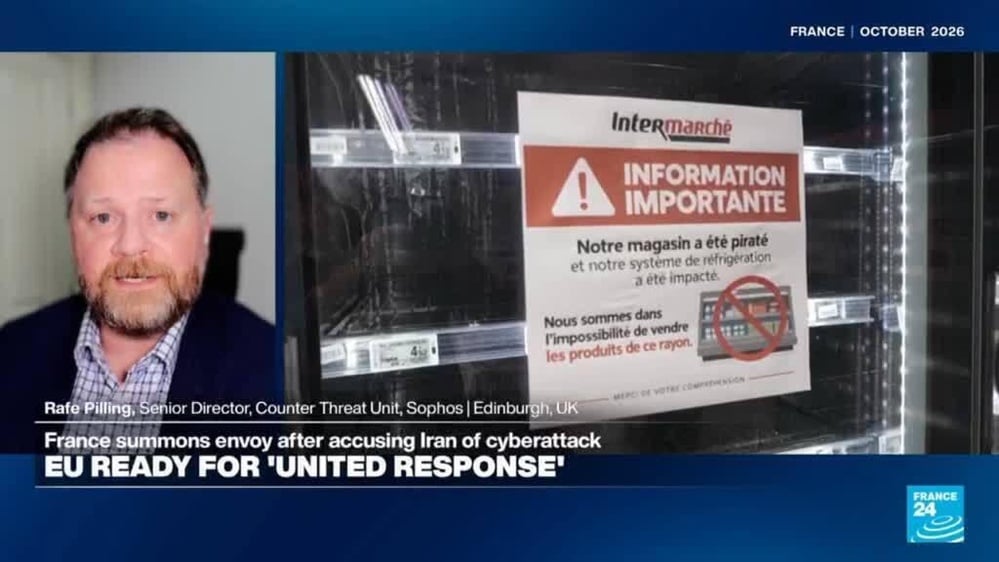
Claim: The report escalates a refrigeration hack into a broader threat to Western food stability.
“shows Iran’s ability to strike consumer chains and fuel public unrest and food crises across the West.” · exact text match
Why: The language dramatizes the incident’s implications beyond the confirmed damage.
Claim: The article frames the attack as a negative security and economic risk.
“fuel public unrest and food crises across the West” · exact text match
Why: The threat framing is bearish for stability and consumer supply chains.
Claim: The report is pessimistic about diplomacy changing Iran’s conduct.
“sanctions and diplomatic steps are unlikely to change Iran’s behavior.” · exact text match
Why: It forecasts failure of diplomatic and sanctions pressure.
Claim: The article combines a novel cyberattack with geopolitical escalation.
“attackers manually overrode fridge temperatures” · exact text match
Why: The specific method and scale make the incident notable.
Claim: The article moves from describing the attack to implying stronger deterrence is needed.
“will take all measures – including those we may not disclose publicly – that we deem proportionate and necessary to deter any further attacks” · exact text match
Why: The quoted response emphasizes prescriptive deterrence measures.
Claim: The report stresses Iran’s terrorist designation and threat while dismissing diplomacy.
“The regime remains the biggest sponsor of terrorism across the world.” · exact text match
Why: This hawkish framing emphasizes threat and justifies confrontational responses.
Claim: The report heightens threat perception by linking the hack to public unrest and food crises.
“fuel public unrest and food crises across the West” · exact text match
Why: This language amplifies fear beyond the confirmed refrigeration damage.
Claim: The report assumes sanctions will fail without demonstrating that conclusion.
“sanctions and diplomatic steps are unlikely to change Iran’s behavior.” · exact text match
Why: The claim is asserted as a premise for dismissing diplomacy rather than proven.
Claim: The report includes evaluative judgments about Iran’s capabilities and Western vulnerability.
“The latest cyberattack shows Iran’s ability to strike consumer chains and fuel public unrest and food crises across the West.” · exact text match
Why: This is an interpretive claim rather than a neutral restatement of confirmed facts.
Claim: The report is centered on state attribution, diplomatic retaliation, and geopolitical conflict.
“Paris ruled out “nothing” to respond to a major cyberattack” · exact text match
Why: The framing is explicitly political and security-oriented.
Claim: The report reduces a complex cyber conflict to a straightforward Iran-versus-West threat narrative.
“The regime remains the biggest sponsor of terrorism across the world.” · exact text match
Why: The sweeping characterization simplifies a complex geopolitical landscape.
Claim: The report leans on official French and EU statements to establish the significance of the attack.
“French Foreign Minister Jean-Noël Barrot said” · not found in supplied text
Why: Official authority is the main basis for the reported attribution and response.
Claim: The report gives substantial space to French and EU retaliatory responses.
“The EU said it would look to provide a “swift and united response” following the attack.” · exact text match
Why: Much of the article covers official reactions and planned responses.
Claim: The report asserts a maximal characterization of Iran’s terrorism role with little support in the text.
“The regime remains the biggest sponsor of terrorism across the world.” · exact text match
Why: This is a strong, broad claim presented without qualification or sourcing in the immediate sentence.
Claim: The report is shaped by a hawkish anti-Iran ideological frame.
“Macron’s attempts to appease Tehran” · exact text match
Why: The language reflects a consistent confrontational worldview.
Claim: The report generally aligns with French, EU, and U.S. security establishments against Iran.
“France’s foreign minister said Tuesday that Paris ruled out “nothing” to respond to a major cyberattack” · exact text match
Why: It treats official Western responses as the central legitimate frame.
Claim: The report uses emotionally loaded language about French diplomacy.
“Macron’s attempts to appease Tehran” · exact text match
Why: “Appease” carries strong negative connotation.
Claim: The report applies a harsh standard to Iranian cyber operations while treating Western deterrence as legitimate.
“we rule nothing out and will take all measures” · exact text match
Why: The asymmetry is implied rather than explicitly argued.
Claim: The report cites Reuters, Euronews, BBC, France24, and named officials but mixes in evaluative claims.
“French TV channel Euronews reported.” · exact text match
Why: Sourcing is visible, though some conclusions exceed the cited evidence.
Claim: The report is mostly evidence-based but includes evaluative leaps about Iran’s intentions and future behavior.
“It appears to be part of a coordinated strike reported in nine other European countries.” · exact text match
Why: The hedge signals inference beyond directly confirmed facts, though the core reporting remains sourced.
Claim: The report speculates that the French attack is part of a coordinated European campaign.
“It appears to be part of a coordinated strike reported in nine other European countries.” · exact text match
Why: The phrasing is explicitly tentative and forward-looking.
Claim: The report uses loaded framing to cast Macron’s diplomacy as capitulation.
“Macron’s attempts to appease Tehran” · exact text match
Why: Loaded word choice shapes interpretation beyond neutral reporting.
Claim: The text shows human blog-style voice and reader comments rather than strong AI markers.
“Maybe this is too inside baseball, but…” · exact text match
Why: The informal, idiosyncratic comment style suggests human authorship.
Claim: The report largely attributes claims to named outlets and officials but includes loaded framing.
“Reuters reported.” · exact text match
Why: Attribution is present, though the surrounding framing is opinionated.
Claim: The report suggests a coordinated multi-country Iranian cyber operation.
“It appears to be part of a coordinated strike reported in nine other European countries.” · exact text match
Why: The coordination claim is speculative but tied to reported incidents.
Claim: Iran is framed as the singular source of a broader European cyber threat.
“The regime remains the biggest sponsor of terrorism across the world.” · exact text match
Why: The sweeping attribution places broad blame on Iran.
Claim: The report implicitly criticizes French diplomacy while treating Western security responses as legitimate.
“Macron’s attempts to appease Tehran” · exact text match
Why: The double standard is mild and inferred from contrast rather than explicit comparison.
Reader comments and site boilerplate were excluded; the analysis covers the article body and quoted reporting only.
November 10, 2026 · 0 shares
The report frames the cyberattack through a hawkish, right-leaning lens that casts Macron’s Iran diplomacy as appeasement and treats the incident as evidence of a broader Iranian threat to the West.
Helium Analysis
Limitations: Reader comments and site boilerplate were excluded; the analysis covers the article body and quoted reporting only.
·
55 of 55 available dimensions scored; omitted dimensions are not treated as neutral.
·
Verified supporting quotes for 30 of 55 scored dimensions.
Claim: The report frames Macron’s Iran policy as appeasement and contrasts it with Trump’s military posture.
“came despite President Emmanuel Macron’s attempts to appease Tehran by refusing to back President Donald Trump’s military operation against the regime.” · exact text match
Why: This is a conservative critique of diplomatic restraint and an alignment with a hawkish U.S. posture.
Claim: The article adopts an anti-elite tone toward French and EU diplomacy.
“sanctions and diplomatic steps are unlikely to change Iran’s behavior.” · exact text match
Why: It dismisses established diplomatic tools as ineffective, a populist-style critique of elite policy.
Claim: The framing emphasizes state deterrence and retaliatory security measures.
“we rule nothing out and will take all measures – including those we may not disclose publicly – that we deem proportionate and necessary to deter any further attacks” · exact text match
Why: The quoted official response stresses undisclosed state measures, tilting toward security-authority framing.
Claim: The report presents a forecast about sanctions as a conclusion rather than a verified outcome.
“sanctions and diplomatic steps are unlikely to change Iran’s behavior.” · exact text match
Why: This is an evaluative prediction that goes beyond the attributed official statements.
Claim: The report escalates a refrigeration hack into a broader threat to Western food stability.
“shows Iran’s ability to strike consumer chains and fuel public unrest and food crises across the West.” · exact text match
Why: The language dramatizes the incident’s implications beyond the confirmed damage.
Claim: The article frames the attack as a negative security and economic risk.
“fuel public unrest and food crises across the West” · exact text match
Why: The threat framing is bearish for stability and consumer supply chains.
Claim: The report is pessimistic about diplomacy changing Iran’s conduct.
“sanctions and diplomatic steps are unlikely to change Iran’s behavior.” · exact text match
Why: It forecasts failure of diplomatic and sanctions pressure.
Claim: The article combines a novel cyberattack with geopolitical escalation.
“attackers manually overrode fridge temperatures” · exact text match
Why: The specific method and scale make the incident notable.
Claim: The article moves from describing the attack to implying stronger deterrence is needed.
“will take all measures – including those we may not disclose publicly – that we deem proportionate and necessary to deter any further attacks” · exact text match
Why: The quoted response emphasizes prescriptive deterrence measures.
Claim: The report stresses Iran’s terrorist designation and threat while dismissing diplomacy.
“The regime remains the biggest sponsor of terrorism across the world.” · exact text match
Why: This hawkish framing emphasizes threat and justifies confrontational responses.
Claim: The report heightens threat perception by linking the hack to public unrest and food crises.
“fuel public unrest and food crises across the West” · exact text match
Why: This language amplifies fear beyond the confirmed refrigeration damage.
Claim: The report assumes sanctions will fail without demonstrating that conclusion.
“sanctions and diplomatic steps are unlikely to change Iran’s behavior.” · exact text match
Why: The claim is asserted as a premise for dismissing diplomacy rather than proven.
Claim: The report includes evaluative judgments about Iran’s capabilities and Western vulnerability.
“The latest cyberattack shows Iran’s ability to strike consumer chains and fuel public unrest and food crises across the West.” · exact text match
Why: This is an interpretive claim rather than a neutral restatement of confirmed facts.
Claim: The report is centered on state attribution, diplomatic retaliation, and geopolitical conflict.
“Paris ruled out “nothing” to respond to a major cyberattack” · exact text match
Why: The framing is explicitly political and security-oriented.
Claim: The report reduces a complex cyber conflict to a straightforward Iran-versus-West threat narrative.
“The regime remains the biggest sponsor of terrorism across the world.” · exact text match
Why: The sweeping characterization simplifies a complex geopolitical landscape.
Claim: The report leans on official French and EU statements to establish the significance of the attack.
“French Foreign Minister Jean-Noël Barrot said” · not found in supplied text
Why: Official authority is the main basis for the reported attribution and response.
Claim: The report gives substantial space to French and EU retaliatory responses.
“The EU said it would look to provide a “swift and united response” following the attack.” · exact text match
Why: Much of the article covers official reactions and planned responses.
Claim: The report asserts a maximal characterization of Iran’s terrorism role with little support in the text.
“The regime remains the biggest sponsor of terrorism across the world.” · exact text match
Why: This is a strong, broad claim presented without qualification or sourcing in the immediate sentence.
Claim: The report is shaped by a hawkish anti-Iran ideological frame.
“Macron’s attempts to appease Tehran” · exact text match
Why: The language reflects a consistent confrontational worldview.
Claim: The report generally aligns with French, EU, and U.S. security establishments against Iran.
“France’s foreign minister said Tuesday that Paris ruled out “nothing” to respond to a major cyberattack” · exact text match
Why: It treats official Western responses as the central legitimate frame.
Claim: The report uses emotionally loaded language about French diplomacy.
“Macron’s attempts to appease Tehran” · exact text match
Why: “Appease” carries strong negative connotation.
Claim: The report applies a harsh standard to Iranian cyber operations while treating Western deterrence as legitimate.
“we rule nothing out and will take all measures” · exact text match
Why: The asymmetry is implied rather than explicitly argued.
Claim: The report cites Reuters, Euronews, BBC, France24, and named officials but mixes in evaluative claims.
“French TV channel Euronews reported.” · exact text match
Why: Sourcing is visible, though some conclusions exceed the cited evidence.
Claim: The report is mostly evidence-based but includes evaluative leaps about Iran’s intentions and future behavior.
“It appears to be part of a coordinated strike reported in nine other European countries.” · exact text match
Why: The hedge signals inference beyond directly confirmed facts, though the core reporting remains sourced.
Claim: The report speculates that the French attack is part of a coordinated European campaign.
“It appears to be part of a coordinated strike reported in nine other European countries.” · exact text match
Why: The phrasing is explicitly tentative and forward-looking.
Claim: The report uses loaded framing to cast Macron’s diplomacy as capitulation.
“Macron’s attempts to appease Tehran” · exact text match
Why: Loaded word choice shapes interpretation beyond neutral reporting.
Claim: The text shows human blog-style voice and reader comments rather than strong AI markers.
“Maybe this is too inside baseball, but…” · exact text match
Why: The informal, idiosyncratic comment style suggests human authorship.
Claim: The report largely attributes claims to named outlets and officials but includes loaded framing.
“Reuters reported.” · exact text match
Why: Attribution is present, though the surrounding framing is opinionated.
Claim: The report suggests a coordinated multi-country Iranian cyber operation.
“It appears to be part of a coordinated strike reported in nine other European countries.” · exact text match
Why: The coordination claim is speculative but tied to reported incidents.
Claim: Iran is framed as the singular source of a broader European cyber threat.
“The regime remains the biggest sponsor of terrorism across the world.” · exact text match
Why: The sweeping attribution places broad blame on Iran.
Claim: The report implicitly criticizes French diplomacy while treating Western security responses as legitimate.
“Macron’s attempts to appease Tehran” · exact text match
Why: The double standard is mild and inferred from contrast rather than explicit comparison.
Reader comments and site boilerplate were excluded; the analysis covers the article body and quoted reporting only.
November 13, 2026 · 0 shares
Coverage is measured, institution-centered, and security-focused, treating Israeli cyber agencies as authoritative while framing resilience as a technical and public-trust problem amid Iranian-linked threats.
Helium Analysis
Limitations: Bias scores are based only on the supplied JNS report and observable framing; no external sources or full-site context were provided.
·
12 of 55 available dimensions scored; omitted dimensions are not treated as neutral.
·
Verified supporting quotes for 12 of 12 scored dimensions.
Claim: The report is mildly oriented toward government-defined cyber obligations and centralized identity infrastructure.
“The directorate’s National Cyber Defense Bill, which passed a first reading and entered Knesset committee deliberations, helps define which organizations fall into that category and what they must do to manage and report cyber risks.” · exact text match
“The proposal would place more interactions behind shared digital credentials, increasing secure access and dependable recovery.” · exact text match
Why: The article presents expanded regulatory obligations and shared digital credentials as responses to cyber risk, leaning mildly toward centralized authority rather than libertarian minimalism.
Claim: The report maintains a largely objective, attribution-conscious stance.
“The report does not say drinking water was contaminated.” · exact text match
“In response to our questioning, he said that after more than three months of preparation with other cyber organizations, he knew of no cyberattack that had harmed election systems.” · exact text match
Why: Explicit limits on what a report says and careful attribution of the official's knowledge show an objective rather than subjective posture.
Claim: The report is measured rather than sensational in presenting cyber threats.
“A hacked refrigerator system can illustrate possible physical consequences, but the experience in Europe is showing how Israel now needs to react: Ensure an operator can keep a service running or restore it, verify that it is safe for citizens, and explain what it knows to the public.” · exact text match
Why: The refrigerator attack is framed as an illustration for operational lessons rather than as dramatic spectacle.
Claim: The report is mostly descriptive but includes mild prescriptive framing about what operators must do.
“Ensure an operator can keep a service running or restore it, verify that it is safe for citizens, and explain what it knows to the public.” · exact text match
Why: The quoted passage states requirements rather than merely describing a past event, though the overall article remains reportorial.
Claim: The report uses a moderate threat/fear frame around cyberattacks.
“The war puts enormous pressure on Israel’s cyber defenses—and there is no ceasefire in cyber” · exact text match
“What happens when the next attack arrives before we recover from the last one? What happens when cyber pressure outpaces recovery?” · exact text match
Why: The language emphasizes unrelenting pressure and recovery gaps, though it remains analytical rather than alarmist.
Claim: The report has substantial policy and political content related to Israeli cybersecurity governance.
“The directorate’s National Cyber Defense Bill, which passed a first reading and entered Knesset committee deliberations, helps define which organizations fall into that category and what they must do to manage and report cyber risks.” · exact text match
“Karadi ended his post-conference remarks by giving an update on Election Shield, the operation set up to protect Israel’s election previously reported by JNS.” · exact text match
Why: The Knesset bill and election-protection operation make the report involve governmental/political processes, not merely technical cyber hygiene.
Claim: The report adopts a pro-establishment frame by presenting Israeli cyber agencies as authoritative and proactive.
“Israel’s National Cyber Directorate was already warning food retailers and logistics operators to check who could remotely access their refrigeration systems.” · exact text match
“Karadi told the conference that no country or organization can defend its systems alone.” · exact text match
Why: The official directorate is shown as ahead of public attribution and as a cooperative authority, with no competing critical perspective.
Claim: The report displays strong visible sourcing and epistemic caution.
“In response to our questioning, he said that after more than three months of preparation with other cyber organizations, he knew of no cyberattack that had harmed election systems.” · exact text match
“The report does not say drinking water was contaminated.” · exact text match
Why: Named officials, direct attribution, and explicit statements about what a source does not establish support high credibility.
Claim: The report frames cyber resilience through verification and evidence rather than emotion or speculation.
“The answer given to the public has to rest on what those checks establish.” · exact text match
Why: The quoted framing makes public trust contingent on concrete checks, indicating a rational/empirical orientation.
Claim: The report is grounded in technical/empirical cyber-defense reasoning.
“It called for stronger authentication, updated equipment, and independent alerts for unusual temperature changes.” · exact text match
“Technical teams may contain an intrusion and restore systems.
Operators may then need to check physical conditions, decide whether a service can be used, and communicate those findings.”
· exact text match
Why: The described measures rely on authentication, monitoring, physical checks, and operational verification rather than superstition.
Claim: The report shows fair, attribution-conscious sourcing and avoids overclaiming.
“The report does not say drinking water was contaminated.” · exact text match
“In response to our questioning, he said that after more than three months of preparation with other cyber organizations, he knew of no cyberattack that had harmed election systems.” · exact text match
Why: It distinguishes what is established from what is not and labels the limits of the official's knowledge.
Claim: The report is analytically nuanced about cyber risk and resilience.
“Faster tools may help both sides, but an exposed controller or an unsecured supplier account can still give attackers access.” · exact text match
“The report does not say drinking water was contaminated.” · exact text match
Why: It balances technological change with persistent basic vulnerabilities and carefully distinguishes reported facts from gaps.
Bias scores are based only on the supplied JNS report and observable framing; no external sources or full-site context were provided.
November 10, 2026 · 0 shares
Framing is neutral and factual, relying on attributed government statements and cybersecurity reporting without ideological or sensational language.
Helium Analysis
Limitations: Newsletter subscription boilerplate and duplicated promotional items were excluded; no author byline was present.
·
10 of 55 available dimensions scored; omitted dimensions are not treated as neutral.
·
Verified supporting quotes for 10 of 10 scored dimensions.
Claim: No left-right ideological framing is evident; the report centers on a federal response to cyber risk.
“After a string of cyberattacks in Europe, the U.S. federal government is looking to prevent similar attacks stateside.” · exact text match
Why: The sentence describes a federal response to cyber risk without left-right ideological cues.
Claim: Publisher framing is highly objective, presenting the cyberattack risk and federal guidance through attributed statements rather than subjective commentary.
“The announcement specifies that hackers can target certain refrigeration system flaws and then alter temperatures that can create fire hazards, cause inventory loss or indirectly harm consumers who eat a product after unsafe storage.” · exact text match
Why: The sentence reports specific claimed risks in indirect, attributed language without evaluative adjectives.
Claim: The report avoids sensationalism despite describing fires and damage, keeping to attributed factual detail.
“The hackers raised the system’s temperature to 120 degrees Fahrenheit, leading to fires, spoiled food and millions of dollars in damage, the publication noted.” · exact text match
Why: Dramatic consequences are reported with attribution and without exclamatory or alarmist framing.
Claim: The publisher remains descriptive, reporting government recommendations rather than issuing its own prescriptions.
“To mitigate the risks, the U.S. government urges owners and operators to “immediately” take several steps, including not connecting control system devices to the public internet, keeping device firmware updated, and reporting unexpected activity.” · exact text match
Why: The only prescriptive content is attributed to the government, so the article itself is descriptive.
Claim: The article is factually framed and does not advance the publisher's own opinion.
“To mitigate the risks, the U.S. government urges owners and operators to “immediately” take several steps, including not connecting control system devices to the public internet, keeping device firmware updated, and reporting unexpected activity.” · exact text match
Why: Recommendations are attributed to the U.S. government rather than presented as the publisher's opinion.
Claim: The report is nonpolitical, focused on cybersecurity guidance rather than partisan or ideological conflict.
“After a string of cyberattacks in Europe, the U.S. federal government is looking to prevent similar attacks stateside.” · exact text match
Why: The framing centers on cross-border cyber risk and federal guidance, not political contestation.
Claim: Certainty is bounded by attribution to official statements and prior reporting.
“The announcement specifies that hackers can target certain refrigeration system flaws and then alter temperatures that can create fire hazards, cause inventory loss or indirectly harm consumers who eat a product after unsafe storage.” · exact text match
Why: Risks are described as possible ('can') and tied to an announcement.
Claim: Credibility is strengthened by named government agencies, a joint statement, and attribution to Cybersecurity Dive.
“The USDA, Health and Human Services and the Department of Transportation — federal agencies overseeing sectors that widely use industrial refrigeration and cold chain monitoring systems — were also part of Thursday’s joint statement.” · exact text match
Why: Specific institutional sources and a named prior report are visible in the text.
Claim: The article is rational and evidence-oriented, grounding claims in a joint statement and prior cybersecurity reporting.
“In early October, hackers manipulated the refrigeration systems of hundreds of grocery stores across France after gaining access to programmable controllers that regulate commercial refrigeration systems, sister publication Cybersecurity Dive reported.” · exact text match
Why: Specific incidents are attributed to a named sister publication, supporting a rational rather than speculative account.
Claim: The publisher shows high integrity by attributing claims to the joint statement and Cybersecurity Dive.
“In early October, hackers manipulated the refrigeration systems of hundreds of grocery stores across France after gaining access to programmable controllers that regulate commercial refrigeration systems, sister publication Cybersecurity Dive reported.” · exact text match
Why: Named attribution and indirect reporting reduce unsupported assertion.
Newsletter subscription boilerplate and duplicated promotional items were excluded; no author byline was present.
Terse, attributional framing pairs Iran’s denial with French official suspicion and avoids declaring guilt.
IRGC stands for Iran’s Islamic Revolutionary Guard Corps, an Iranian military organization.
Helium Analysis
Limitations: The supplied text is a very short social-media-style brief with no named sources, limiting confidence in framing and credibility assessments.
·
55 of 55 available dimensions scored; omitted dimensions are not treated as neutral.
·
Verified supporting quotes for 5 of 55 scored dimensions.
Claim: The brief reports attributed events and official actions without subjective commentary.
“Iran denies involvement in a cyberattack that disrupted refrigeration at around 700 French supermarkets..” · exact text match
Why: The sentence states a denial and an event in factual, attributional terms rather than evaluative language.
Claim: The wording is measured and avoids sensational characterization of the incident.
“France has summoned Tehran’s ambassador and is seeking EU sanctions as investigators probe suspected IRGC links.” · exact text match
Why: Diplomatic and investigative actions are described in neutral terms, with no dramatic or alarmist phrasing.
Claim: The item is political in subject matter, centered on diplomatic retaliation and sanctions.
“France has summoned Tehran’s ambassador and is seeking EU sanctions” · exact text match
Why: The core reported action is a state-to-state diplomatic and sanctions response.
Claim: The brief shows attribution and uncertainty but lacks named sourcing.
“investigators probe suspected IRGC links” · exact text match
Why: It preserves suspicion language and attributes the denial, though no source is named.
Claim: The brief includes Iran’s denial alongside French suspicion, indicating fair inclusion of the accused party’s response.
“Iran denies involvement in a cyberattack” · exact text match
Why: Reporting the denial gives the accused side a stated position rather than presenting suspicion as settled.
The supplied text is a very short social-media-style brief with no named sources, limiting confidence in framing and credibility assessments.
November 11, 2026 · 0 shares
The lead article frames alleged Iran-linked cyberattacks as a European security wake-up call and prescribes coordinated sanctions, infrastructure hardening, and guarded diplomacy.
Helium Analysis
Limitations: Analysis is limited to the lead article on France’s Iran cyberattack attribution; the appended related articles were treated as out of scope.
·
12 of 55 available dimensions scored; omitted dimensions are not treated as neutral.
·
Verified supporting quotes for 12 of 12 scored dimensions.
Claim: The framing is openly prescriptive, urging European policy action rather than merely reporting events.
“France's cyberattack allegations against Iran should wake up Europe.” · exact text match
“A credible European response must combine collective political action with practical protection.” · exact text match
Why: Normative “should” and “must” language marks subjective/prescriptive framing.
Claim: The article emphasizes deterioration and escalation risks.
“The closure of the French Language Centre in Tehran, condemned by Paris in September, and reported attacks against embassy personnel illustrate the deterioration.” · exact text match
“Such threats illustrate the possibility of horizontal escalation: widening a confrontation geographically and expanding the range of potential targets.” · exact text match
Why: The security trajectory is framed as worsening, supporting a pessimistic lean.
Claim: The article advances policy recommendations rather than staying descriptive.
“A credible European response must combine collective political action with practical protection.” · exact text match
“Europe should assess these developments together without treating them as identical threats.” · exact text match
Why: Repeated “must” and “should” recommendations are strongly prescriptive.
Claim: The article favors coercive and security-oriented responses to alleged Iranian attacks.
“A credible European response must combine collective political action with practical protection.” · exact text match
“Where responsibility is established, sanctions should target the institutions and individuals involved.” · exact text match
Why: Advocacy of sanctions and security hardening is hawkish, though it retains diplomacy.
Claim: The article uses alarmist security framing about Iranian threats reaching Europe.
“France's cyberattack allegations against Iran should wake up Europe.” · exact text match
“Such threats illustrate the possibility of horizontal escalation: widening a confrontation geographically and expanding the range of potential targets.” · exact text match
Why: Wake-up call and escalation warnings create a fear appeal, though measured.
Claim: The article is an opinionated policy analysis with explicit recommendations.
“France's cyberattack allegations against Iran should wake up Europe.” · exact text match
“Europe should make clear both the consequences of further attacks and the possibilities for de-escalation.” · exact text match
Why: Direct normative prescriptions dominate the framing.
Claim: The article is centrally about geopolitical and security policy choices.
“France’s decision to name the institution it holds responsible marks a political threshold.” · exact text match
“A credible European response must combine collective political action with practical protection.” · exact text match
Why: Focus on state attribution, sanctions, and alliance politics is highly political.
Claim: The article backs official French attribution and coordinated European state action.
“France’s decision to name the institution it holds responsible marks a political threshold.” · exact text match
“A credible European response must combine collective political action with practical protection.” · exact text match
Why: It treats official attribution and state coordination as a legitimate basis for policy.
Claim: The article attributes claims and notes denials and evidentiary limits.
“Tehran denied the allegations.” · exact text match
“The announcement does not, by itself, establish the deployment of reliable longer-range capabilities.” · exact text match
Why: Sourcing, attribution, and caveats support credibility.
Claim: The article separates attribution from proven capability and avoids overstating consequences.
“This does not establish that the attackers could generate nationwide food shortages.” · exact text match
“The announcement does not, by itself, establish the deployment of reliable longer-range capabilities.” · exact text match
Why: Explicit uncertainty about consequences and capabilities supports a rational framing.
Claim: The article includes denials and caveats about unproven claims.
“Tehran denied the allegations.” · exact text match
“This does not establish that the attackers could generate nationwide food shortages.” · exact text match
Why: Acknowledging counterclaims and limits raises observable fairness/honesty.
Claim: The analysis distinguishes different threat types and avoids treating them as identical.
“Europe should assess these developments together without treating them as identical threats.” · exact text match
“Cyber sabotage, hostage diplomacy, intimidation of diplomats, information operations and missile signaling involve different methods and require different responses.” · exact text match
Why: Nuanced categorization indicates high article intelligence.
Analysis is limited to the lead article on France’s Iran cyberattack attribution; the appended related articles were treated as out of scope.
November 12, 2026 · 0 shares
Attribution-heavy security reporting presents official claims of possible Iranian-linked cyberattacks with calibrated uncertainty and restrained, non-ideological language.
Helium Analysis
Limitations: The supplied text is brief and relies on official statements; no independent technical evidence or Iranian response is included.
·
11 of 55 available dimensions scored; omitted dimensions are not treated as neutral.
·
Verified supporting quotes for 11 of 11 scored dimensions.
Claim: Political affiliation is noted only as identification, with no left-right ideological framing applied to the cyberattack claims.
“Interior and Security Minister Bernard Quintin (Francophone liberal MR) told the Belga news agency.” · exact text match
Why: The party label appears as a source identifier, while the surrounding report is security-focused and non-ideological.
Claim: Publisher framing is objective and attribution-based rather than subjective.
“There is evidence that hacker groups linked to the Islamic Republic of Iran were involved in the recent cyberattacks on refrigeration systems in supermarkets in Belgium, Interior and Security Minister Bernard Quintin (Francophone liberal MR) told the Belga news agency.” · exact text match
“The Paris public prosecutor announced on Monday that hacker groups linked to Iran were behind those attacks.” · exact text match
Why: Central claims are attributed to named officials or prosecutors, with factual incident details and no subjective commentary.
Claim: The article is restrained rather than sensational.
“There is no cause for panic, but we remain extremely vigilant.” · exact text match
Why: It explicitly cautions against panic and avoids hyperbolic language despite covering a security incident.
Claim: The article is descriptive, not prescriptive.
“Earlier this month, a cyberattack disrupted the refrigeration systems of several Belgian supermarkets and retailers.” · exact text match
Why: Publisher prose reports events; any action language appears inside the minister’s quoted response.
Claim: The central Iranian-link claim rests primarily on official authority statements rather than independent technical evidence.
“The Belgian intelligence services also have evidence to suggest this was the case, he says.” · exact text match
“The Federal Public Prosecutor’s Office is investigating these indications further.” · exact text match
Why: Authority attribution is the basis for the claim, though it is reported as an official assertion rather than publisher proof.
Claim: The report relies on official government and prosecutorial accounts.
“Interior and Security Minister Bernard Quintin (Francophone liberal MR) told the Belga news agency.” · exact text match
“The Paris public prosecutor announced on Monday that hacker groups linked to Iran were behind those attacks.” · exact text match
Why: Official sources dominate the account, a mild pro-establishment sourcing pattern.
Claim: Coverage is emotionally neutral despite describing costly disruption and security concern.
“many shops were forced to throw away tens of thousands of euros worth of food.” · exact text match
Why: The loss is reported factually, without emotive adjectives or outrage.
Claim: Visible sourcing and calibrated uncertainty support high credibility.
“The Federal Public Prosecutor’s Office is investigating these indications further.” · exact text match
“There is no cause for panic, but we remain extremely vigilant.” · exact text match
Why: It names investigating authorities, avoids overclaiming, and separates possible links from confirmed facts.
Claim: The report uses calibrated, investigative language and avoids alarmist certainty.
“The Federal Public Prosecutor’s Office is investigating these indications further.” · exact text match
“There is no cause for panic, but we remain extremely vigilant.” · exact text match
Why: It frames Iranian links as evidence/possible and under investigation, and explicitly tempers threat.
Claim: The report attributes sensitive claims and preserves uncertainty, indicating high internal integrity.
“The Belgian intelligence services also have evidence to suggest this was the case, he says.” · exact text match
“The Federal Public Prosecutor’s Office is investigating these indications further.” · exact text match
Why: It distinguishes official evidence and possible links from established findings and names the investigating authority.
Claim: The report is concise, clear, and appropriately qualified.
“There is evidence that hacker groups linked to the Islamic Republic of Iran were involved in the recent cyberattacks on refrigeration systems in supermarkets in Belgium, Interior and Security Minister Bernard Quintin (Francophone liberal MR) told the Belga news agency.” · exact text match
Why: It conveys attribution, incident impact, and uncertainty efficiently.
The supplied text is brief and relies on official statements; no independent technical evidence or Iranian response is included.
November 11, 2026 · 0 shares
Framing emphasizes an alarming European cyber-vulnerability crisis and a digital-sovereignty paradox rooted in dependence on US technology, while qualifying attribution and causal claims.
Helium Analysis
Limitations: The supplied article is an op-ed/analysis with site boilerplate and some truncated passages; several claims are attributed as “reportedly” or to agencies and cannot be independently verified from the excerpt.
·
19 of 55 available dimensions scored; omitted dimensions are not treated as neutral.
·
Verified supporting quotes for 19 of 19 scored dimensions.
Claim: The framing includes subjective editorial language and an explicit authorial thesis.
“Without operational resilience, technological sovereignty risks remaining an empty concept.” · exact text match
Why: The evaluative conclusion signals subjective framing.
Claim: The framing uses heightened language about an unprecedented cyber wave, though it tempers some claims.
“Europe is currently facing an unprecedented wave of cyberattacks.” · exact text match
Counterevidence:
“although these were predominantly low-impact disruptions” · exact text match
Why: “Unprecedented wave” is sensational, while the counterevidence shows some restraint.
Claim: The framing is predominantly pessimistic about Europe’s cyber vulnerability.
“Europe’s widening cyber crisis reveals alarming weaknesses in essential infrastructure.” · exact text match
“Digital insecurity now extends from supermarket freezers to orbital infrastructure.” · exact text match
Why: The emphasis on crisis and expanding insecurity supports a pessimistic valence.
Claim: The framing is substantively interesting because it links cross-sector cyber incidents to geopolitical strategy.
“Digital insecurity now extends from supermarket freezers to orbital infrastructure.” · exact text match
Why: The broad synthesis from food systems to satellites is engaging.
Claim: The framing is mostly descriptive but ends with a normative test for technological sovereignty.
“Without operational resilience, technological sovereignty risks remaining an empty concept.” · exact text match
Why: The evaluative conclusion adds a prescriptive dimension.
Claim: The framing uses fear-adjacent language about crisis and exposed infrastructure.
“Europe’s widening cyber crisis reveals alarming weaknesses in essential infrastructure.” · exact text match
Why: “Alarming” and “crisis” language supports a fearful framing score.
Claim: The framing blends reporting with explicit authorial argument.
“Yet the arrangement, as I previously argued, risks reinforcing Europe’s dependence on American cloud infrastructure, advanced chips and private digital platforms.” · exact text match
“Without operational resilience, technological sovereignty risks remaining an empty concept.” · exact text match
Why: First-person reference and a thesis conclusion support an opinionated framing.
Claim: The framing is heavily geopolitical and focused on digital sovereignty.
“control over semiconductors, cloud services, satellite networks and digital payment systems is becoming inseparable from traditional geopolitical power.” · exact text match
“the European digital sovereignty paradox is once again under the spotlight.” · exact text match
Why: Geopolitical power and sovereignty language supports high political framing.
Claim: The framing has a clear digital-sovereignty ideological lens.
“As the bloc seeks greater technological autonomy, it is simultaneously deepening cooperation with Washington through Pax Silica, a US-led initiative encompassing semiconductors, artificial intelligence, critical minerals and secure supply chains.” · exact text match
“risks reinforcing Europe’s dependence on American cloud infrastructure, advanced chips and private digital platforms.” · exact text match
Why: Framing through autonomy and dependence supports an ideological lens.
Claim: The framing is somewhat anti-establishment in criticizing US-led tech dependence and European cooperation with Washington.
“risks reinforcing Europe’s dependence on American cloud infrastructure, advanced chips and private digital platforms.” · exact text match
“President Donald Trump’s technological strategy, meanwhile, prioritizes American industrial interests.” · exact text match
Counterevidence:
“To be clear, the attacks were neither a consequence of dependence on American tech nor linked to Pax Silica.” · exact text match
Why: Skeptical framing of US tech strategy supports mild anti-establishment bias, while the counterevidence limits it.
Claim: The overall emotional tone is negative and cautionary.
“Europe’s widening cyber crisis reveals alarming weaknesses in essential infrastructure.” · exact text match
Why: The negative crisis language supports a negative emotional valence.
Claim: The framing has moderate credibility through specific agency citations and caveats, though it is an op-ed/analysis.
“ENISA’s 2026 threat assessment found that “denial-of-service” (DoS) intrusions accounted for 51% of recorded incidents in 2025 – although these were predominantly low-impact disruptions.” · exact text match
“the FBI has attributed the theft to North Korea’s hackers known as TraderTraitor.” · exact text match
Why: Named agencies and specific figures support credibility.
Claim: The framing is largely rational and evidence-bound, using attribution caveats and distinguishing separate causal claims.
“To be clear, the attacks were neither a consequence of dependence on American tech nor linked to Pax Silica.” · exact text match
“the November breaches have not been attributed to a single perpetrator, and their connections are unclear.” · exact text match
Why: Explicit caveats and uncertainty about attribution support a rational framing.
Claim: The framing mildly criticizes private digital platforms as sources of dependency.
“risks reinforcing Europe’s dependence on American cloud infrastructure, advanced chips and private digital platforms.” · exact text match
Why: Private platforms are framed as a vulnerability, supporting a slight anti-corporate score.
Claim: The framing is scientific and technical in orientation.
“Researchers had previously flagged vulnerabilities in Danfoss and Copeland refrigeration platforms.” · exact text match
“ENISA’s 2026 threat assessment found that “denial-of-service” (DoS) intrusions accounted for 51% of recorded incidents in 2025” · exact text match
Why: Citing researchers and threat assessments supports a scientific orientation.
Claim: The framing emphasizes collective state capacity for digital sovereignty.
“Ultimately, the test of technological sovereignty is whether states can maintain essential services when their digital infrastructure comes under attack, regardless of who manufactured or operates it.” · exact text match
Why: The state-centric resilience test supports a mild collectivist framing.
Claim: The framing includes some forward-looking risk speculation.
“Without operational resilience, technological sovereignty risks remaining an empty concept.” · exact text match
Why: The risk conclusion projects future implications, supporting mild speculation.
Claim: The framing shows high integrity by qualifying attribution and explicitly limiting causal claims.
“To be clear, the attacks were neither a consequence of dependence on American tech nor linked to Pax Silica.” · exact text match
“the November breaches have not been attributed to a single perpetrator, and their connections are unclear.” · exact text match
Why: Acknowledging uncertainty and avoiding overclaiming supports high integrity.
Claim: The framing is analytically intelligent and conceptually distinguishing.
“Technological sovereignty and cybersecurity are related but distinct challenges – even European-manufactured systems can be vulnerable when basic security precautions are neglected.” · exact text match
Why: A clear conceptual distinction supports an intelligent article score.
The supplied article is an op-ed/analysis with site boilerplate and some truncated passages; several claims are attributed as “reportedly” or to agencies and cannot be independently verified from the excerpt.
November 11, 2026 · 0 shares
The lead article frames alleged Iran-linked cyberattacks as a European security wake-up call and prescribes coordinated sanctions, infrastructure hardening, and guarded diplomacy.
Helium Analysis
Limitations: Analysis is limited to the lead article on France’s Iran cyberattack attribution; the appended related articles were treated as out of scope.
·
12 of 55 available dimensions scored; omitted dimensions are not treated as neutral.
·
Verified supporting quotes for 12 of 12 scored dimensions.
Claim: The framing is openly prescriptive, urging European policy action rather than merely reporting events.
“France's cyberattack allegations against Iran should wake up Europe.” · exact text match
“A credible European response must combine collective political action with practical protection.” · exact text match
Why: Normative “should” and “must” language marks subjective/prescriptive framing.
Claim: The article emphasizes deterioration and escalation risks.
“The closure of the French Language Centre in Tehran, condemned by Paris in September, and reported attacks against embassy personnel illustrate the deterioration.” · exact text match
“Such threats illustrate the possibility of horizontal escalation: widening a confrontation geographically and expanding the range of potential targets.” · exact text match
Why: The security trajectory is framed as worsening, supporting a pessimistic lean.
Claim: The article advances policy recommendations rather than staying descriptive.
“A credible European response must combine collective political action with practical protection.” · exact text match
“Europe should assess these developments together without treating them as identical threats.” · exact text match
Why: Repeated “must” and “should” recommendations are strongly prescriptive.
Claim: The article favors coercive and security-oriented responses to alleged Iranian attacks.
“A credible European response must combine collective political action with practical protection.” · exact text match
“Where responsibility is established, sanctions should target the institutions and individuals involved.” · exact text match
Why: Advocacy of sanctions and security hardening is hawkish, though it retains diplomacy.
Claim: The article uses alarmist security framing about Iranian threats reaching Europe.
“France's cyberattack allegations against Iran should wake up Europe.” · exact text match
“Such threats illustrate the possibility of horizontal escalation: widening a confrontation geographically and expanding the range of potential targets.” · exact text match
Why: Wake-up call and escalation warnings create a fear appeal, though measured.
Claim: The article is an opinionated policy analysis with explicit recommendations.
“France's cyberattack allegations against Iran should wake up Europe.” · exact text match
“Europe should make clear both the consequences of further attacks and the possibilities for de-escalation.” · exact text match
Why: Direct normative prescriptions dominate the framing.
Claim: The article is centrally about geopolitical and security policy choices.
“France’s decision to name the institution it holds responsible marks a political threshold.” · exact text match
“A credible European response must combine collective political action with practical protection.” · exact text match
Why: Focus on state attribution, sanctions, and alliance politics is highly political.
Claim: The article backs official French attribution and coordinated European state action.
“France’s decision to name the institution it holds responsible marks a political threshold.” · exact text match
“A credible European response must combine collective political action with practical protection.” · exact text match
Why: It treats official attribution and state coordination as a legitimate basis for policy.
Claim: The article attributes claims and notes denials and evidentiary limits.
“Tehran denied the allegations.” · exact text match
“The announcement does not, by itself, establish the deployment of reliable longer-range capabilities.” · exact text match
Why: Sourcing, attribution, and caveats support credibility.
Claim: The article separates attribution from proven capability and avoids overstating consequences.
“This does not establish that the attackers could generate nationwide food shortages.” · exact text match
“The announcement does not, by itself, establish the deployment of reliable longer-range capabilities.” · exact text match
Why: Explicit uncertainty about consequences and capabilities supports a rational framing.
Claim: The article includes denials and caveats about unproven claims.
“Tehran denied the allegations.” · exact text match
“This does not establish that the attackers could generate nationwide food shortages.” · exact text match
Why: Acknowledging counterclaims and limits raises observable fairness/honesty.
Claim: The analysis distinguishes different threat types and avoids treating them as identical.
“Europe should assess these developments together without treating them as identical threats.” · exact text match
“Cyber sabotage, hostage diplomacy, intimidation of diplomats, information operations and missile signaling involve different methods and require different responses.” · exact text match
Why: Nuanced categorization indicates high article intelligence.
Analysis is limited to the lead article on France’s Iran cyberattack attribution; the appended related articles were treated as out of scope.
November 10, 2026 · 0 shares
The report frames the cyberattack through a hawkish, right-leaning lens that casts Macron’s Iran diplomacy as appeasement and treats the incident as evidence of a broader Iranian threat to the West.
Helium Analysis
Limitations: Reader comments and site boilerplate were excluded; the analysis covers the article body and quoted reporting only.
·
55 of 55 available dimensions scored; omitted dimensions are not treated as neutral.
·
Verified supporting quotes for 30 of 55 scored dimensions.
Claim: The report frames Macron’s Iran policy as appeasement and contrasts it with Trump’s military posture.
“came despite President Emmanuel Macron’s attempts to appease Tehran by refusing to back President Donald Trump’s military operation against the regime.” · exact text match
Why: This is a conservative critique of diplomatic restraint and an alignment with a hawkish U.S. posture.
Claim: The article adopts an anti-elite tone toward French and EU diplomacy.
“sanctions and diplomatic steps are unlikely to change Iran’s behavior.” · exact text match
Why: It dismisses established diplomatic tools as ineffective, a populist-style critique of elite policy.
Claim: The framing emphasizes state deterrence and retaliatory security measures.
“we rule nothing out and will take all measures – including those we may not disclose publicly – that we deem proportionate and necessary to deter any further attacks” · exact text match
Why: The quoted official response stresses undisclosed state measures, tilting toward security-authority framing.
Claim: The report presents a forecast about sanctions as a conclusion rather than a verified outcome.
“sanctions and diplomatic steps are unlikely to change Iran’s behavior.” · exact text match
Why: This is an evaluative prediction that goes beyond the attributed official statements.
Claim: The report escalates a refrigeration hack into a broader threat to Western food stability.
“shows Iran’s ability to strike consumer chains and fuel public unrest and food crises across the West.” · exact text match
Why: The language dramatizes the incident’s implications beyond the confirmed damage.
Claim: The article frames the attack as a negative security and economic risk.
“fuel public unrest and food crises across the West” · exact text match
Why: The threat framing is bearish for stability and consumer supply chains.
Claim: The report is pessimistic about diplomacy changing Iran’s conduct.
“sanctions and diplomatic steps are unlikely to change Iran’s behavior.” · exact text match
Why: It forecasts failure of diplomatic and sanctions pressure.
Claim: The article combines a novel cyberattack with geopolitical escalation.
“attackers manually overrode fridge temperatures” · exact text match
Why: The specific method and scale make the incident notable.
Claim: The article moves from describing the attack to implying stronger deterrence is needed.
“will take all measures – including those we may not disclose publicly – that we deem proportionate and necessary to deter any further attacks” · exact text match
Why: The quoted response emphasizes prescriptive deterrence measures.
Claim: The report stresses Iran’s terrorist designation and threat while dismissing diplomacy.
“The regime remains the biggest sponsor of terrorism across the world.” · exact text match
Why: This hawkish framing emphasizes threat and justifies confrontational responses.
Claim: The report heightens threat perception by linking the hack to public unrest and food crises.
“fuel public unrest and food crises across the West” · exact text match
Why: This language amplifies fear beyond the confirmed refrigeration damage.
Claim: The report assumes sanctions will fail without demonstrating that conclusion.
“sanctions and diplomatic steps are unlikely to change Iran’s behavior.” · exact text match
Why: The claim is asserted as a premise for dismissing diplomacy rather than proven.
Claim: The report includes evaluative judgments about Iran’s capabilities and Western vulnerability.
“The latest cyberattack shows Iran’s ability to strike consumer chains and fuel public unrest and food crises across the West.” · exact text match
Why: This is an interpretive claim rather than a neutral restatement of confirmed facts.
Claim: The report is centered on state attribution, diplomatic retaliation, and geopolitical conflict.
“Paris ruled out “nothing” to respond to a major cyberattack” · exact text match
Why: The framing is explicitly political and security-oriented.
Claim: The report reduces a complex cyber conflict to a straightforward Iran-versus-West threat narrative.
“The regime remains the biggest sponsor of terrorism across the world.” · exact text match
Why: The sweeping characterization simplifies a complex geopolitical landscape.
Claim: The report leans on official French and EU statements to establish the significance of the attack.
“French Foreign Minister Jean-Noël Barrot said” · not found in supplied text
Why: Official authority is the main basis for the reported attribution and response.
Claim: The report gives substantial space to French and EU retaliatory responses.
“The EU said it would look to provide a “swift and united response” following the attack.” · exact text match
Why: Much of the article covers official reactions and planned responses.
Claim: The report asserts a maximal characterization of Iran’s terrorism role with little support in the text.
“The regime remains the biggest sponsor of terrorism across the world.” · exact text match
Why: This is a strong, broad claim presented without qualification or sourcing in the immediate sentence.
Claim: The report is shaped by a hawkish anti-Iran ideological frame.
“Macron’s attempts to appease Tehran” · exact text match
Why: The language reflects a consistent confrontational worldview.
Claim: The report generally aligns with French, EU, and U.S. security establishments against Iran.
“France’s foreign minister said Tuesday that Paris ruled out “nothing” to respond to a major cyberattack” · exact text match
Why: It treats official Western responses as the central legitimate frame.
Claim: The report uses emotionally loaded language about French diplomacy.
“Macron’s attempts to appease Tehran” · exact text match
Why: “Appease” carries strong negative connotation.
Claim: The report applies a harsh standard to Iranian cyber operations while treating Western deterrence as legitimate.
“we rule nothing out and will take all measures” · exact text match
Why: The asymmetry is implied rather than explicitly argued.
Claim: The report cites Reuters, Euronews, BBC, France24, and named officials but mixes in evaluative claims.
“French TV channel Euronews reported.” · exact text match
Why: Sourcing is visible, though some conclusions exceed the cited evidence.
Claim: The report is mostly evidence-based but includes evaluative leaps about Iran’s intentions and future behavior.
“It appears to be part of a coordinated strike reported in nine other European countries.” · exact text match
Why: The hedge signals inference beyond directly confirmed facts, though the core reporting remains sourced.
Claim: The report speculates that the French attack is part of a coordinated European campaign.
“It appears to be part of a coordinated strike reported in nine other European countries.” · exact text match
Why: The phrasing is explicitly tentative and forward-looking.
Claim: The report uses loaded framing to cast Macron’s diplomacy as capitulation.
“Macron’s attempts to appease Tehran” · exact text match
Why: Loaded word choice shapes interpretation beyond neutral reporting.
Claim: The text shows human blog-style voice and reader comments rather than strong AI markers.
“Maybe this is too inside baseball, but…” · exact text match
Why: The informal, idiosyncratic comment style suggests human authorship.
Claim: The report largely attributes claims to named outlets and officials but includes loaded framing.
“Reuters reported.” · exact text match
Why: Attribution is present, though the surrounding framing is opinionated.
Claim: The report suggests a coordinated multi-country Iranian cyber operation.
“It appears to be part of a coordinated strike reported in nine other European countries.” · exact text match
Why: The coordination claim is speculative but tied to reported incidents.
Claim: Iran is framed as the singular source of a broader European cyber threat.
“The regime remains the biggest sponsor of terrorism across the world.” · exact text match
Why: The sweeping attribution places broad blame on Iran.
Claim: The report implicitly criticizes French diplomacy while treating Western security responses as legitimate.
“Macron’s attempts to appease Tehran” · exact text match
Why: The double standard is mild and inferred from contrast rather than explicit comparison.
Reader comments and site boilerplate were excluded; the analysis covers the article body and quoted reporting only.
November 10, 2026 · 0 shares
The report frames the cyberattack through a hawkish, right-leaning lens that casts Macron’s Iran diplomacy as appeasement and treats the incident as evidence of a broader Iranian threat to the West.
Helium Analysis
Limitations: Reader comments and site boilerplate were excluded; the analysis covers the article body and quoted reporting only.
·
55 of 55 available dimensions scored; omitted dimensions are not treated as neutral.
·
Verified supporting quotes for 30 of 55 scored dimensions.
Claim: The report frames Macron’s Iran policy as appeasement and contrasts it with Trump’s military posture.
“came despite President Emmanuel Macron’s attempts to appease Tehran by refusing to back President Donald Trump’s military operation against the regime.” · exact text match
Why: This is a conservative critique of diplomatic restraint and an alignment with a hawkish U.S. posture.
Claim: The article adopts an anti-elite tone toward French and EU diplomacy.
“sanctions and diplomatic steps are unlikely to change Iran’s behavior.” · exact text match
Why: It dismisses established diplomatic tools as ineffective, a populist-style critique of elite policy.
Claim: The framing emphasizes state deterrence and retaliatory security measures.
“we rule nothing out and will take all measures – including those we may not disclose publicly – that we deem proportionate and necessary to deter any further attacks” · exact text match
Why: The quoted official response stresses undisclosed state measures, tilting toward security-authority framing.
Claim: The report presents a forecast about sanctions as a conclusion rather than a verified outcome.
“sanctions and diplomatic steps are unlikely to change Iran’s behavior.” · exact text match
Why: This is an evaluative prediction that goes beyond the attributed official statements.
Claim: The report escalates a refrigeration hack into a broader threat to Western food stability.
“shows Iran’s ability to strike consumer chains and fuel public unrest and food crises across the West.” · exact text match
Why: The language dramatizes the incident’s implications beyond the confirmed damage.
Claim: The article frames the attack as a negative security and economic risk.
“fuel public unrest and food crises across the West” · exact text match
Why: The threat framing is bearish for stability and consumer supply chains.
Claim: The report is pessimistic about diplomacy changing Iran’s conduct.
“sanctions and diplomatic steps are unlikely to change Iran’s behavior.” · exact text match
Why: It forecasts failure of diplomatic and sanctions pressure.
Claim: The article combines a novel cyberattack with geopolitical escalation.
“attackers manually overrode fridge temperatures” · exact text match
Why: The specific method and scale make the incident notable.
Claim: The article moves from describing the attack to implying stronger deterrence is needed.
“will take all measures – including those we may not disclose publicly – that we deem proportionate and necessary to deter any further attacks” · exact text match
Why: The quoted response emphasizes prescriptive deterrence measures.
Claim: The report stresses Iran’s terrorist designation and threat while dismissing diplomacy.
“The regime remains the biggest sponsor of terrorism across the world.” · exact text match
Why: This hawkish framing emphasizes threat and justifies confrontational responses.
Claim: The report heightens threat perception by linking the hack to public unrest and food crises.
“fuel public unrest and food crises across the West” · exact text match
Why: This language amplifies fear beyond the confirmed refrigeration damage.
Claim: The report assumes sanctions will fail without demonstrating that conclusion.
“sanctions and diplomatic steps are unlikely to change Iran’s behavior.” · exact text match
Why: The claim is asserted as a premise for dismissing diplomacy rather than proven.
Claim: The report includes evaluative judgments about Iran’s capabilities and Western vulnerability.
“The latest cyberattack shows Iran’s ability to strike consumer chains and fuel public unrest and food crises across the West.” · exact text match
Why: This is an interpretive claim rather than a neutral restatement of confirmed facts.
Claim: The report is centered on state attribution, diplomatic retaliation, and geopolitical conflict.
“Paris ruled out “nothing” to respond to a major cyberattack” · exact text match
Why: The framing is explicitly political and security-oriented.
Claim: The report reduces a complex cyber conflict to a straightforward Iran-versus-West threat narrative.
“The regime remains the biggest sponsor of terrorism across the world.” · exact text match
Why: The sweeping characterization simplifies a complex geopolitical landscape.
Claim: The report leans on official French and EU statements to establish the significance of the attack.
“French Foreign Minister Jean-Noël Barrot said” · not found in supplied text
Why: Official authority is the main basis for the reported attribution and response.
Claim: The report gives substantial space to French and EU retaliatory responses.
“The EU said it would look to provide a “swift and united response” following the attack.” · exact text match
Why: Much of the article covers official reactions and planned responses.
Claim: The report asserts a maximal characterization of Iran’s terrorism role with little support in the text.
“The regime remains the biggest sponsor of terrorism across the world.” · exact text match
Why: This is a strong, broad claim presented without qualification or sourcing in the immediate sentence.
Claim: The report is shaped by a hawkish anti-Iran ideological frame.
“Macron’s attempts to appease Tehran” · exact text match
Why: The language reflects a consistent confrontational worldview.
Claim: The report generally aligns with French, EU, and U.S. security establishments against Iran.
“France’s foreign minister said Tuesday that Paris ruled out “nothing” to respond to a major cyberattack” · exact text match
Why: It treats official Western responses as the central legitimate frame.
Claim: The report uses emotionally loaded language about French diplomacy.
“Macron’s attempts to appease Tehran” · exact text match
Why: “Appease” carries strong negative connotation.
Claim: The report applies a harsh standard to Iranian cyber operations while treating Western deterrence as legitimate.
“we rule nothing out and will take all measures” · exact text match
Why: The asymmetry is implied rather than explicitly argued.
Claim: The report cites Reuters, Euronews, BBC, France24, and named officials but mixes in evaluative claims.
“French TV channel Euronews reported.” · exact text match
Why: Sourcing is visible, though some conclusions exceed the cited evidence.
Claim: The report is mostly evidence-based but includes evaluative leaps about Iran’s intentions and future behavior.
“It appears to be part of a coordinated strike reported in nine other European countries.” · exact text match
Why: The hedge signals inference beyond directly confirmed facts, though the core reporting remains sourced.
Claim: The report speculates that the French attack is part of a coordinated European campaign.
“It appears to be part of a coordinated strike reported in nine other European countries.” · exact text match
Why: The phrasing is explicitly tentative and forward-looking.
Claim: The report uses loaded framing to cast Macron’s diplomacy as capitulation.
“Macron’s attempts to appease Tehran” · exact text match
Why: Loaded word choice shapes interpretation beyond neutral reporting.
Claim: The text shows human blog-style voice and reader comments rather than strong AI markers.
“Maybe this is too inside baseball, but…” · exact text match
Why: The informal, idiosyncratic comment style suggests human authorship.
Claim: The report largely attributes claims to named outlets and officials but includes loaded framing.
“Reuters reported.” · exact text match
Why: Attribution is present, though the surrounding framing is opinionated.
Claim: The report suggests a coordinated multi-country Iranian cyber operation.
“It appears to be part of a coordinated strike reported in nine other European countries.” · exact text match
Why: The coordination claim is speculative but tied to reported incidents.
Claim: Iran is framed as the singular source of a broader European cyber threat.
“The regime remains the biggest sponsor of terrorism across the world.” · exact text match
Why: The sweeping attribution places broad blame on Iran.
Claim: The report implicitly criticizes French diplomacy while treating Western security responses as legitimate.
“Macron’s attempts to appease Tehran” · exact text match
Why: The double standard is mild and inferred from contrast rather than explicit comparison.
Reader comments and site boilerplate were excluded; the analysis covers the article body and quoted reporting only.
November 10, 2026 · 0 shares
Framing is neutral and factual, relying on attributed government statements and cybersecurity reporting without ideological or sensational language.
Helium Analysis
Limitations: Newsletter subscription boilerplate and duplicated promotional items were excluded; no author byline was present.
·
10 of 55 available dimensions scored; omitted dimensions are not treated as neutral.
·
Verified supporting quotes for 10 of 10 scored dimensions.
Claim: No left-right ideological framing is evident; the report centers on a federal response to cyber risk.
“After a string of cyberattacks in Europe, the U.S. federal government is looking to prevent similar attacks stateside.” · exact text match
Why: The sentence describes a federal response to cyber risk without left-right ideological cues.
Claim: Publisher framing is highly objective, presenting the cyberattack risk and federal guidance through attributed statements rather than subjective commentary.
“The announcement specifies that hackers can target certain refrigeration system flaws and then alter temperatures that can create fire hazards, cause inventory loss or indirectly harm consumers who eat a product after unsafe storage.” · exact text match
Why: The sentence reports specific claimed risks in indirect, attributed language without evaluative adjectives.
Claim: The report avoids sensationalism despite describing fires and damage, keeping to attributed factual detail.
“The hackers raised the system’s temperature to 120 degrees Fahrenheit, leading to fires, spoiled food and millions of dollars in damage, the publication noted.” · exact text match
Why: Dramatic consequences are reported with attribution and without exclamatory or alarmist framing.
Claim: The publisher remains descriptive, reporting government recommendations rather than issuing its own prescriptions.
“To mitigate the risks, the U.S. government urges owners and operators to “immediately” take several steps, including not connecting control system devices to the public internet, keeping device firmware updated, and reporting unexpected activity.” · exact text match
Why: The only prescriptive content is attributed to the government, so the article itself is descriptive.
Claim: The article is factually framed and does not advance the publisher's own opinion.
“To mitigate the risks, the U.S. government urges owners and operators to “immediately” take several steps, including not connecting control system devices to the public internet, keeping device firmware updated, and reporting unexpected activity.” · exact text match
Why: Recommendations are attributed to the U.S. government rather than presented as the publisher's opinion.
Claim: The report is nonpolitical, focused on cybersecurity guidance rather than partisan or ideological conflict.
“After a string of cyberattacks in Europe, the U.S. federal government is looking to prevent similar attacks stateside.” · exact text match
Why: The framing centers on cross-border cyber risk and federal guidance, not political contestation.
Claim: Certainty is bounded by attribution to official statements and prior reporting.
“The announcement specifies that hackers can target certain refrigeration system flaws and then alter temperatures that can create fire hazards, cause inventory loss or indirectly harm consumers who eat a product after unsafe storage.” · exact text match
Why: Risks are described as possible ('can') and tied to an announcement.
Claim: Credibility is strengthened by named government agencies, a joint statement, and attribution to Cybersecurity Dive.
“The USDA, Health and Human Services and the Department of Transportation — federal agencies overseeing sectors that widely use industrial refrigeration and cold chain monitoring systems — were also part of Thursday’s joint statement.” · exact text match
Why: Specific institutional sources and a named prior report are visible in the text.
Claim: The article is rational and evidence-oriented, grounding claims in a joint statement and prior cybersecurity reporting.
“In early October, hackers manipulated the refrigeration systems of hundreds of grocery stores across France after gaining access to programmable controllers that regulate commercial refrigeration systems, sister publication Cybersecurity Dive reported.” · exact text match
Why: Specific incidents are attributed to a named sister publication, supporting a rational rather than speculative account.
Claim: The publisher shows high integrity by attributing claims to the joint statement and Cybersecurity Dive.
“In early October, hackers manipulated the refrigeration systems of hundreds of grocery stores across France after gaining access to programmable controllers that regulate commercial refrigeration systems, sister publication Cybersecurity Dive reported.” · exact text match
Why: Named attribution and indirect reporting reduce unsupported assertion.
Newsletter subscription boilerplate and duplicated promotional items were excluded; no author byline was present.
November 11, 2026 · 0 shares
Framing casts the refrigerator hacks as an Iranian asymmetric war on Europe, leaning on French and Western security attributions and expert commentary while noting Iran’s denial.
Helium Analysis
Limitations: Unrelated headline links surrounding the AFP text were excluded; the analysis is limited to the substantive cyberattack report.
·
7 of 55 available dimensions scored; omitted dimensions are not treated as neutral.
·
Verified supporting quotes for 7 of 7 scored dimensions.
Claim: The report balances attribution with the accused party’s denial.
“France said Iran’s Revolutionary Guards were behind the “unprecedented” cyberattacks, a charge Iran rejected.” · exact text match
Why: Attribution and denial are both stated, indicating an objective rather than subjective posture.
Claim: Attack details are presented factually without emotive embellishment.
“Scores of French supermarkets were hit in the October 11 and 12 cyberattacks, which raised the temperatures in their refrigerators, in some cases forcing them to throw away entire inventories of perishable food.” · exact text match
Why: The consequences are described in measured factual terms rather than sensational language.
Claim: The hack is framed as geopolitical conflict.
“marks a new phase in the asymmetric campaign Tehran is waging against the United States” · exact text match
Why: The report explicitly places the cyberattack within a state-level shadow war.
Claim: The account relies on French government attribution and Western security sources.
“France said Iran’s Revolutionary Guards were behind the “unprecedented” cyberattacks” · exact text match
“security sources and experts said” · exact text match
Counterevidence:
“a charge Iran rejected” · exact text match
Why: Official and security-source framing dominates, though Iran’s denial is included as a qualifier.
Claim: Sourcing is explicit and includes denial and named experts.
“France said Iran’s Revolutionary Guards were behind the “unprecedented” cyberattacks, a charge Iran rejected.” · exact text match
“Clement Therme, Iran specialist at the University of Montpellier Paul-Valery, told AFP.” · exact text match
Why: Clear attribution to governments, security sources, and named experts supports credibility.
Claim: The report relies on named expert analysis to interpret the campaign.
““We are now seeing a horizontal escalation, a geographical widening of the conflict and a shift in the nature of the targets towards civilian infrastructure such as refrigeration systems,” he added.” · exact text match
Why: Named expert analysis supports a rational rather than irrational framing.
Claim: Future retaliation warnings are included as source-based forecasts.
“Iran has sent very clear signals to a number of countries, warning that if there is another major US-Israeli bombing campaign, there will be consequences in Europe” · exact text match
Why: The warning is attributed speculation about future consequences rather than established fact.
Unrelated headline links surrounding the AFP text were excluded; the analysis is limited to the substantive cyberattack report.
Frames a single refrigeration cyberattack as a revealing illustration of asymmetric cyber conflict, emphasizing disproportionate economic disruption and potential geopolitical threat.
Helium Analysis
Limitations: Short excerpt from an interview; key claims rely on a single expert and lack technical detail or independent corroboration.
·
55 of 55 available dimensions scored; omitted dimensions are not treated as neutral.
·
Verified supporting quotes for 21 of 55 scored dimensions.
Claim: Evaluative framing presents the France incident as a revealing illustration and places asymmetry at the heart of cyber conflict.
“offer a revealing illustration” · exact text match
“This asymmetry lies at the heart of contemporary cyber conflict” · exact text match
Why: These are interpretive characterizations beyond neutral description.
Claim: Threat language emphasizes food destruction, empty shelves, and broader societal danger.
“destroying food and producing empty shelves or empty refrigeration units in stores” · exact text match
“potentially broader threats to society” · exact text match
Why: The wording mildly dramatizes the consequences of the intrusion.
Claim: The excerpt uses a concrete local incident to illustrate a broader cyber-conflict concept.
“offer a revealing illustration of how digital vulnerabilities can translate into tangible economic disruption” · exact text match
Why: The local-to-geopolitical connection is a notable analytical hook.
Claim: The excerpt explains the incident and its significance rather than prescribing a policy response.
“As Pilling explains” · exact text match
Why: The article remains largely explanatory and descriptive.
Claim: Highlights food destruction, empty shelves, and possible broader threats to society.
“destroying food and producing empty shelves or empty refrigeration units in stores” · exact text match
“potentially broader threats to society” · exact text match
Why: The selected consequences heighten concern about cyber vulnerability.
Claim: Advances an interpretive thesis about asymmetry in cyber conflict rather than only reporting the incident.
“This asymmetry lies at the heart of contemporary cyber conflict” · exact text match
“offer a revealing illustration” · exact text match
Why: The article states an analytical conclusion about the significance of the case.
Claim: Frames the cyber incident in state-conflict and geopolitical terms.
“States increasingly use cyberattacks in support of their other objectives” · exact text match
“become an instrument of geopolitical confrontation” · exact text match
Why: The selection and wording place the incident within geopolitical cyber conflict.
Claim: Presents one refrigeration case as a revealing illustration of broad cyber conflict dynamics.
“offer a revealing illustration” · exact text match
“This asymmetry lies at the heart of contemporary cyber conflict” · exact text match
Why: A single example is used to support a broad claim about contemporary cyber conflict.
Claim: Key claims are attributed to a named threat-intelligence director.
“As Pilling explains” · exact text match
Why: The excerpt relies on expert authority to support its interpretation.
Claim: The excerpt states that small adversary effort can create large impact without detailing the mechanism.
“With a small amount of effort from the adversary side, they can create a large impact” · exact text match
Why: The claim is confident but presented as expert explanation with limited technical support.
Claim: The framing centers on strategic cyber conflict rather than a broader ideological program.
“cyberattacks in support of their other objectives” · exact text match
Why: A mild strategic-security lens shapes the interpretation.
Claim: The framing relies on a named cybersecurity vendor's threat-intelligence unit as the authoritative source.
“Rafe Pilling, Director of Threat Intelligence in the Sophos Counter Threat Unit (CTU)” · exact text match
Why: The excerpt presents an established security-industry expert without challenging that framing.
Claim: The tone is threat-oriented rather than positive.
“potentially broader threats to society” · exact text match
Why: The selected language leans negative and cautionary.
Claim: Sourcing is transparent but limited to one named expert and organization.
“Rafe Pilling, Director of Threat Intelligence in the Sophos Counter Threat Unit (CTU)” · exact text match
Why: Named attribution supports credibility, though no independent corroboration is shown.
Claim: The article grounds its interpretation in an expert explanation of asymmetric effort and impact.
“As Pilling explains” · exact text match
“With a small amount of effort from the adversary side, they can create a large impact” · exact text match
Why: The framing uses a causal expert explanation rather than emotional assertion.
Claim: The excerpt names Sophos and its Counter Threat Unit prominently as the expert source.
“Sophos Counter Threat Unit (CTU)” · exact text match
Why: Vendor attribution is visible, though the excerpt is not overtly promotional.
Claim: The excerpt relies on a corporate cybersecurity vendor's expert as its source.
“Sophos Counter Threat Unit (CTU)” · exact text match
Why: A corporate security perspective is present but not strongly advocated.
Claim: The framing is empirical and technical rather than superstitious.
“digital vulnerabilities can translate into tangible economic disruption” · exact text match
Why: The article discusses technical vulnerability and operational impact.
Claim: Extends the France incident toward potential broader threats and geopolitical confrontation.
“potentially broader threats to society” · exact text match
“become an instrument of geopolitical confrontation” · exact text match
Why: The excerpt moves from one case to possible wider consequences.
Claim: The text has interview-style attribution and quoted speech consistent with human-authored reporting.
“As Pilling explains” · exact text match
Why: The structure is consistent with a short human-written interview excerpt.
Claim: Uses a concise expert explanation to connect a local incident to asymmetric cyber conflict.
“This asymmetry lies at the heart of contemporary cyber conflict” · exact text match
Why: The excerpt deploys a clear conceptual frame for the incident.
Short excerpt from an interview; key claims rely on a single expert and lack technical detail or independent corroboration.
November 10, 2026 · 0 shares
The report frames the cyberattack through a hawkish, right-leaning lens that casts Macron’s Iran diplomacy as appeasement and treats the incident as evidence of a broader Iranian threat to the West.
Helium Analysis Limitations: Reader comments and site boilerplate were excluded; the analysis covers the article body and quoted reporting only. · 55 of 55 available dimensions scored; omitted dimensions are not treated as neutral. · Verified supporting quotes for 30 of 55 scored dimensions.
Claim: The report frames Macron’s Iran policy as appeasement and contrasts it with Trump’s military posture.
“came despite President Emmanuel Macron’s attempts to appease Tehran by refusing to back President Donald Trump’s military operation against the regime.” · exact text match
Why: This is a conservative critique of diplomatic restraint and an alignment with a hawkish U.S. posture.
Claim: The article adopts an anti-elite tone toward French and EU diplomacy.
“sanctions and diplomatic steps are unlikely to change Iran’s behavior.” · exact text match
Why: It dismisses established diplomatic tools as ineffective, a populist-style critique of elite policy.
Claim: The framing emphasizes state deterrence and retaliatory security measures.
“we rule nothing out and will take all measures – including those we may not disclose publicly – that we deem proportionate and necessary to deter any further attacks” · exact text match
Why: The quoted official response stresses undisclosed state measures, tilting toward security-authority framing.
Claim: The report presents a forecast about sanctions as a conclusion rather than a verified outcome.
“sanctions and diplomatic steps are unlikely to change Iran’s behavior.” · exact text match
Why: This is an evaluative prediction that goes beyond the attributed official statements.
Claim: The report escalates a refrigeration hack into a broader threat to Western food stability.
“shows Iran’s ability to strike consumer chains and fuel public unrest and food crises across the West.” · exact text match
Why: The language dramatizes the incident’s implications beyond the confirmed damage.
Claim: The article frames the attack as a negative security and economic risk.
“fuel public unrest and food crises across the West” · exact text match
Why: The threat framing is bearish for stability and consumer supply chains.
Claim: The report is pessimistic about diplomacy changing Iran’s conduct.
“sanctions and diplomatic steps are unlikely to change Iran’s behavior.” · exact text match
Why: It forecasts failure of diplomatic and sanctions pressure.
Claim: The article combines a novel cyberattack with geopolitical escalation.
“attackers manually overrode fridge temperatures” · exact text match
Why: The specific method and scale make the incident notable.
Claim: The article moves from describing the attack to implying stronger deterrence is needed.
“will take all measures – including those we may not disclose publicly – that we deem proportionate and necessary to deter any further attacks” · exact text match
Why: The quoted response emphasizes prescriptive deterrence measures.
Claim: The report stresses Iran’s terrorist designation and threat while dismissing diplomacy.
“The regime remains the biggest sponsor of terrorism across the world.” · exact text match
Why: This hawkish framing emphasizes threat and justifies confrontational responses.
Claim: The report heightens threat perception by linking the hack to public unrest and food crises.
“fuel public unrest and food crises across the West” · exact text match
Why: This language amplifies fear beyond the confirmed refrigeration damage.
Claim: The report assumes sanctions will fail without demonstrating that conclusion.
“sanctions and diplomatic steps are unlikely to change Iran’s behavior.” · exact text match
Why: The claim is asserted as a premise for dismissing diplomacy rather than proven.
Claim: The report includes evaluative judgments about Iran’s capabilities and Western vulnerability.
“The latest cyberattack shows Iran’s ability to strike consumer chains and fuel public unrest and food crises across the West.” · exact text match
Why: This is an interpretive claim rather than a neutral restatement of confirmed facts.
Claim: The report is centered on state attribution, diplomatic retaliation, and geopolitical conflict.
“Paris ruled out “nothing” to respond to a major cyberattack” · exact text match
Why: The framing is explicitly political and security-oriented.
Claim: The report reduces a complex cyber conflict to a straightforward Iran-versus-West threat narrative.
“The regime remains the biggest sponsor of terrorism across the world.” · exact text match
Why: The sweeping characterization simplifies a complex geopolitical landscape.
Claim: The report leans on official French and EU statements to establish the significance of the attack.
“French Foreign Minister Jean-Noël Barrot said” · not found in supplied text
Why: Official authority is the main basis for the reported attribution and response.
Claim: The report gives substantial space to French and EU retaliatory responses.
“The EU said it would look to provide a “swift and united response” following the attack.” · exact text match
Why: Much of the article covers official reactions and planned responses.
Claim: The report asserts a maximal characterization of Iran’s terrorism role with little support in the text.
“The regime remains the biggest sponsor of terrorism across the world.” · exact text match
Why: This is a strong, broad claim presented without qualification or sourcing in the immediate sentence.
Claim: The report is shaped by a hawkish anti-Iran ideological frame.
“Macron’s attempts to appease Tehran” · exact text match
Why: The language reflects a consistent confrontational worldview.
Claim: The report generally aligns with French, EU, and U.S. security establishments against Iran.
“France’s foreign minister said Tuesday that Paris ruled out “nothing” to respond to a major cyberattack” · exact text match
Why: It treats official Western responses as the central legitimate frame.
Claim: The report uses emotionally loaded language about French diplomacy.
“Macron’s attempts to appease Tehran” · exact text match
Why: “Appease” carries strong negative connotation.
Claim: The report applies a harsh standard to Iranian cyber operations while treating Western deterrence as legitimate.
“we rule nothing out and will take all measures” · exact text match
Why: The asymmetry is implied rather than explicitly argued.
Claim: The report cites Reuters, Euronews, BBC, France24, and named officials but mixes in evaluative claims.
“French TV channel Euronews reported.” · exact text match
Why: Sourcing is visible, though some conclusions exceed the cited evidence.
Claim: The report is mostly evidence-based but includes evaluative leaps about Iran’s intentions and future behavior.
“It appears to be part of a coordinated strike reported in nine other European countries.” · exact text match
Why: The hedge signals inference beyond directly confirmed facts, though the core reporting remains sourced.
Claim: The report speculates that the French attack is part of a coordinated European campaign.
“It appears to be part of a coordinated strike reported in nine other European countries.” · exact text match
Why: The phrasing is explicitly tentative and forward-looking.
Claim: The report uses loaded framing to cast Macron’s diplomacy as capitulation.
“Macron’s attempts to appease Tehran” · exact text match
Why: Loaded word choice shapes interpretation beyond neutral reporting.
Claim: The text shows human blog-style voice and reader comments rather than strong AI markers.
“Maybe this is too inside baseball, but…” · exact text match
Why: The informal, idiosyncratic comment style suggests human authorship.
Claim: The report largely attributes claims to named outlets and officials but includes loaded framing.
“Reuters reported.” · exact text match
Why: Attribution is present, though the surrounding framing is opinionated.
Claim: The report suggests a coordinated multi-country Iranian cyber operation.
“It appears to be part of a coordinated strike reported in nine other European countries.” · exact text match
Why: The coordination claim is speculative but tied to reported incidents.
Claim: Iran is framed as the singular source of a broader European cyber threat.
“The regime remains the biggest sponsor of terrorism across the world.” · exact text match
Why: The sweeping attribution places broad blame on Iran.
Claim: The report implicitly criticizes French diplomacy while treating Western security responses as legitimate.
“Macron’s attempts to appease Tehran” · exact text match
Why: The double standard is mild and inferred from contrast rather than explicit comparison.
Reader comments and site boilerplate were excluded; the analysis covers the article body and quoted reporting only.
November 11, 2026 · 0 shares
The lead article frames alleged Iran-linked cyberattacks as a European security wake-up call and prescribes coordinated sanctions, infrastructure hardening, and guarded diplomacy.
Helium Analysis Limitations: Analysis is limited to the lead article on France’s Iran cyberattack attribution; the appended related articles were treated as out of scope. · 12 of 55 available dimensions scored; omitted dimensions are not treated as neutral. · Verified supporting quotes for 12 of 12 scored dimensions.
Claim: The framing is openly prescriptive, urging European policy action rather than merely reporting events.
“France's cyberattack allegations against Iran should wake up Europe.” · exact text match
“A credible European response must combine collective political action with practical protection.” · exact text match
Why: Normative “should” and “must” language marks subjective/prescriptive framing.
Claim: The article emphasizes deterioration and escalation risks.
“The closure of the French Language Centre in Tehran, condemned by Paris in September, and reported attacks against embassy personnel illustrate the deterioration.” · exact text match
“Such threats illustrate the possibility of horizontal escalation: widening a confrontation geographically and expanding the range of potential targets.” · exact text match
Why: The security trajectory is framed as worsening, supporting a pessimistic lean.
Claim: The article advances policy recommendations rather than staying descriptive.
“A credible European response must combine collective political action with practical protection.” · exact text match
“Europe should assess these developments together without treating them as identical threats.” · exact text match
Why: Repeated “must” and “should” recommendations are strongly prescriptive.
Claim: The article favors coercive and security-oriented responses to alleged Iranian attacks.
“A credible European response must combine collective political action with practical protection.” · exact text match
“Where responsibility is established, sanctions should target the institutions and individuals involved.” · exact text match
Why: Advocacy of sanctions and security hardening is hawkish, though it retains diplomacy.
Claim: The article uses alarmist security framing about Iranian threats reaching Europe.
“France's cyberattack allegations against Iran should wake up Europe.” · exact text match
“Such threats illustrate the possibility of horizontal escalation: widening a confrontation geographically and expanding the range of potential targets.” · exact text match
Why: Wake-up call and escalation warnings create a fear appeal, though measured.
Claim: The article is an opinionated policy analysis with explicit recommendations.
“France's cyberattack allegations against Iran should wake up Europe.” · exact text match
“Europe should make clear both the consequences of further attacks and the possibilities for de-escalation.” · exact text match
Why: Direct normative prescriptions dominate the framing.
Claim: The article is centrally about geopolitical and security policy choices.
“France’s decision to name the institution it holds responsible marks a political threshold.” · exact text match
“A credible European response must combine collective political action with practical protection.” · exact text match
Why: Focus on state attribution, sanctions, and alliance politics is highly political.
Claim: The article backs official French attribution and coordinated European state action.
“France’s decision to name the institution it holds responsible marks a political threshold.” · exact text match
“A credible European response must combine collective political action with practical protection.” · exact text match
Why: It treats official attribution and state coordination as a legitimate basis for policy.
Claim: The article attributes claims and notes denials and evidentiary limits.
“Tehran denied the allegations.” · exact text match
“The announcement does not, by itself, establish the deployment of reliable longer-range capabilities.” · exact text match
Why: Sourcing, attribution, and caveats support credibility.
Claim: The article separates attribution from proven capability and avoids overstating consequences.
“This does not establish that the attackers could generate nationwide food shortages.” · exact text match
“The announcement does not, by itself, establish the deployment of reliable longer-range capabilities.” · exact text match
Why: Explicit uncertainty about consequences and capabilities supports a rational framing.
Claim: The article includes denials and caveats about unproven claims.
“Tehran denied the allegations.” · exact text match
“This does not establish that the attackers could generate nationwide food shortages.” · exact text match
Why: Acknowledging counterclaims and limits raises observable fairness/honesty.
Claim: The analysis distinguishes different threat types and avoids treating them as identical.
“Europe should assess these developments together without treating them as identical threats.” · exact text match
“Cyber sabotage, hostage diplomacy, intimidation of diplomats, information operations and missile signaling involve different methods and require different responses.” · exact text match
Why: Nuanced categorization indicates high article intelligence.
Analysis is limited to the lead article on France’s Iran cyberattack attribution; the appended related articles were treated as out of scope.
November 11, 2026 · 0 shares
Framing emphasizes an alarming European cyber-vulnerability crisis and a digital-sovereignty paradox rooted in dependence on US technology, while qualifying attribution and causal claims.
Helium Analysis Limitations: The supplied article is an op-ed/analysis with site boilerplate and some truncated passages; several claims are attributed as “reportedly” or to agencies and cannot be independently verified from the excerpt. · 19 of 55 available dimensions scored; omitted dimensions are not treated as neutral. · Verified supporting quotes for 19 of 19 scored dimensions.
Claim: The framing includes subjective editorial language and an explicit authorial thesis.
“Without operational resilience, technological sovereignty risks remaining an empty concept.” · exact text match
Why: The evaluative conclusion signals subjective framing.
Claim: The framing uses heightened language about an unprecedented cyber wave, though it tempers some claims.
“Europe is currently facing an unprecedented wave of cyberattacks.” · exact text match
Counterevidence:
“although these were predominantly low-impact disruptions” · exact text match
Why: “Unprecedented wave” is sensational, while the counterevidence shows some restraint.
Claim: The framing is predominantly pessimistic about Europe’s cyber vulnerability.
“Europe’s widening cyber crisis reveals alarming weaknesses in essential infrastructure.” · exact text match
“Digital insecurity now extends from supermarket freezers to orbital infrastructure.” · exact text match
Why: The emphasis on crisis and expanding insecurity supports a pessimistic valence.
Claim: The framing is substantively interesting because it links cross-sector cyber incidents to geopolitical strategy.
“Digital insecurity now extends from supermarket freezers to orbital infrastructure.” · exact text match
Why: The broad synthesis from food systems to satellites is engaging.
Claim: The framing is mostly descriptive but ends with a normative test for technological sovereignty.
“Without operational resilience, technological sovereignty risks remaining an empty concept.” · exact text match
Why: The evaluative conclusion adds a prescriptive dimension.
Claim: The framing uses fear-adjacent language about crisis and exposed infrastructure.
“Europe’s widening cyber crisis reveals alarming weaknesses in essential infrastructure.” · exact text match
Why: “Alarming” and “crisis” language supports a fearful framing score.
Claim: The framing blends reporting with explicit authorial argument.
“Yet the arrangement, as I previously argued, risks reinforcing Europe’s dependence on American cloud infrastructure, advanced chips and private digital platforms.” · exact text match
“Without operational resilience, technological sovereignty risks remaining an empty concept.” · exact text match
Why: First-person reference and a thesis conclusion support an opinionated framing.
Claim: The framing is heavily geopolitical and focused on digital sovereignty.
“control over semiconductors, cloud services, satellite networks and digital payment systems is becoming inseparable from traditional geopolitical power.” · exact text match
“the European digital sovereignty paradox is once again under the spotlight.” · exact text match
Why: Geopolitical power and sovereignty language supports high political framing.
Claim: The framing has a clear digital-sovereignty ideological lens.
“As the bloc seeks greater technological autonomy, it is simultaneously deepening cooperation with Washington through Pax Silica, a US-led initiative encompassing semiconductors, artificial intelligence, critical minerals and secure supply chains.” · exact text match
“risks reinforcing Europe’s dependence on American cloud infrastructure, advanced chips and private digital platforms.” · exact text match
Why: Framing through autonomy and dependence supports an ideological lens.
Claim: The framing is somewhat anti-establishment in criticizing US-led tech dependence and European cooperation with Washington.
“risks reinforcing Europe’s dependence on American cloud infrastructure, advanced chips and private digital platforms.” · exact text match
“President Donald Trump’s technological strategy, meanwhile, prioritizes American industrial interests.” · exact text match
Counterevidence:
“To be clear, the attacks were neither a consequence of dependence on American tech nor linked to Pax Silica.” · exact text match
Why: Skeptical framing of US tech strategy supports mild anti-establishment bias, while the counterevidence limits it.
Claim: The overall emotional tone is negative and cautionary.
“Europe’s widening cyber crisis reveals alarming weaknesses in essential infrastructure.” · exact text match
Why: The negative crisis language supports a negative emotional valence.
Claim: The framing has moderate credibility through specific agency citations and caveats, though it is an op-ed/analysis.
“ENISA’s 2026 threat assessment found that “denial-of-service” (DoS) intrusions accounted for 51% of recorded incidents in 2025 – although these were predominantly low-impact disruptions.” · exact text match
“the FBI has attributed the theft to North Korea’s hackers known as TraderTraitor.” · exact text match
Why: Named agencies and specific figures support credibility.
Claim: The framing is largely rational and evidence-bound, using attribution caveats and distinguishing separate causal claims.
“To be clear, the attacks were neither a consequence of dependence on American tech nor linked to Pax Silica.” · exact text match
“the November breaches have not been attributed to a single perpetrator, and their connections are unclear.” · exact text match
Why: Explicit caveats and uncertainty about attribution support a rational framing.
Claim: The framing mildly criticizes private digital platforms as sources of dependency.
“risks reinforcing Europe’s dependence on American cloud infrastructure, advanced chips and private digital platforms.” · exact text match
Why: Private platforms are framed as a vulnerability, supporting a slight anti-corporate score.
Claim: The framing is scientific and technical in orientation.
“Researchers had previously flagged vulnerabilities in Danfoss and Copeland refrigeration platforms.” · exact text match
“ENISA’s 2026 threat assessment found that “denial-of-service” (DoS) intrusions accounted for 51% of recorded incidents in 2025” · exact text match
Why: Citing researchers and threat assessments supports a scientific orientation.
Claim: The framing emphasizes collective state capacity for digital sovereignty.
“Ultimately, the test of technological sovereignty is whether states can maintain essential services when their digital infrastructure comes under attack, regardless of who manufactured or operates it.” · exact text match
Why: The state-centric resilience test supports a mild collectivist framing.
Claim: The framing includes some forward-looking risk speculation.
“Without operational resilience, technological sovereignty risks remaining an empty concept.” · exact text match
Why: The risk conclusion projects future implications, supporting mild speculation.
Claim: The framing shows high integrity by qualifying attribution and explicitly limiting causal claims.
“To be clear, the attacks were neither a consequence of dependence on American tech nor linked to Pax Silica.” · exact text match
“the November breaches have not been attributed to a single perpetrator, and their connections are unclear.” · exact text match
Why: Acknowledging uncertainty and avoiding overclaiming supports high integrity.
Claim: The framing is analytically intelligent and conceptually distinguishing.
“Technological sovereignty and cybersecurity are related but distinct challenges – even European-manufactured systems can be vulnerable when basic security precautions are neglected.” · exact text match
Why: A clear conceptual distinction supports an intelligent article score.
The supplied article is an op-ed/analysis with site boilerplate and some truncated passages; several claims are attributed as “reportedly” or to agencies and cannot be independently verified from the excerpt.
November 10, 2026 · 0 shares
Framing is neutral and factual, relying on attributed government statements and cybersecurity reporting without ideological or sensational language.
Helium Analysis Limitations: Newsletter subscription boilerplate and duplicated promotional items were excluded; no author byline was present. · 10 of 55 available dimensions scored; omitted dimensions are not treated as neutral. · Verified supporting quotes for 10 of 10 scored dimensions.
Claim: No left-right ideological framing is evident; the report centers on a federal response to cyber risk.
“After a string of cyberattacks in Europe, the U.S. federal government is looking to prevent similar attacks stateside.” · exact text match
Why: The sentence describes a federal response to cyber risk without left-right ideological cues.
Claim: Publisher framing is highly objective, presenting the cyberattack risk and federal guidance through attributed statements rather than subjective commentary.
“The announcement specifies that hackers can target certain refrigeration system flaws and then alter temperatures that can create fire hazards, cause inventory loss or indirectly harm consumers who eat a product after unsafe storage.” · exact text match
Why: The sentence reports specific claimed risks in indirect, attributed language without evaluative adjectives.
Claim: The report avoids sensationalism despite describing fires and damage, keeping to attributed factual detail.
“The hackers raised the system’s temperature to 120 degrees Fahrenheit, leading to fires, spoiled food and millions of dollars in damage, the publication noted.” · exact text match
Why: Dramatic consequences are reported with attribution and without exclamatory or alarmist framing.
Claim: The publisher remains descriptive, reporting government recommendations rather than issuing its own prescriptions.
“To mitigate the risks, the U.S. government urges owners and operators to “immediately” take several steps, including not connecting control system devices to the public internet, keeping device firmware updated, and reporting unexpected activity.” · exact text match
Why: The only prescriptive content is attributed to the government, so the article itself is descriptive.
Claim: The article is factually framed and does not advance the publisher's own opinion.
“To mitigate the risks, the U.S. government urges owners and operators to “immediately” take several steps, including not connecting control system devices to the public internet, keeping device firmware updated, and reporting unexpected activity.” · exact text match
Why: Recommendations are attributed to the U.S. government rather than presented as the publisher's opinion.
Claim: The report is nonpolitical, focused on cybersecurity guidance rather than partisan or ideological conflict.
“After a string of cyberattacks in Europe, the U.S. federal government is looking to prevent similar attacks stateside.” · exact text match
Why: The framing centers on cross-border cyber risk and federal guidance, not political contestation.
Claim: Certainty is bounded by attribution to official statements and prior reporting.
“The announcement specifies that hackers can target certain refrigeration system flaws and then alter temperatures that can create fire hazards, cause inventory loss or indirectly harm consumers who eat a product after unsafe storage.” · exact text match
Why: Risks are described as possible ('can') and tied to an announcement.
Claim: Credibility is strengthened by named government agencies, a joint statement, and attribution to Cybersecurity Dive.
“The USDA, Health and Human Services and the Department of Transportation — federal agencies overseeing sectors that widely use industrial refrigeration and cold chain monitoring systems — were also part of Thursday’s joint statement.” · exact text match
Why: Specific institutional sources and a named prior report are visible in the text.
Claim: The article is rational and evidence-oriented, grounding claims in a joint statement and prior cybersecurity reporting.
“In early October, hackers manipulated the refrigeration systems of hundreds of grocery stores across France after gaining access to programmable controllers that regulate commercial refrigeration systems, sister publication Cybersecurity Dive reported.” · exact text match
Why: Specific incidents are attributed to a named sister publication, supporting a rational rather than speculative account.
Claim: The publisher shows high integrity by attributing claims to the joint statement and Cybersecurity Dive.
“In early October, hackers manipulated the refrigeration systems of hundreds of grocery stores across France after gaining access to programmable controllers that regulate commercial refrigeration systems, sister publication Cybersecurity Dive reported.” · exact text match
Why: Named attribution and indirect reporting reduce unsupported assertion.
Newsletter subscription boilerplate and duplicated promotional items were excluded; no author byline was present.
November 12, 2026 · 0 shares
Attribution-heavy security reporting presents official claims of possible Iranian-linked cyberattacks with calibrated uncertainty and restrained, non-ideological language.
Helium Analysis Limitations: The supplied text is brief and relies on official statements; no independent technical evidence or Iranian response is included. · 11 of 55 available dimensions scored; omitted dimensions are not treated as neutral. · Verified supporting quotes for 11 of 11 scored dimensions.
Claim: Political affiliation is noted only as identification, with no left-right ideological framing applied to the cyberattack claims.
“Interior and Security Minister Bernard Quintin (Francophone liberal MR) told the Belga news agency.” · exact text match
Why: The party label appears as a source identifier, while the surrounding report is security-focused and non-ideological.
Claim: Publisher framing is objective and attribution-based rather than subjective.
“There is evidence that hacker groups linked to the Islamic Republic of Iran were involved in the recent cyberattacks on refrigeration systems in supermarkets in Belgium, Interior and Security Minister Bernard Quintin (Francophone liberal MR) told the Belga news agency.” · exact text match
“The Paris public prosecutor announced on Monday that hacker groups linked to Iran were behind those attacks.” · exact text match
Why: Central claims are attributed to named officials or prosecutors, with factual incident details and no subjective commentary.
Claim: The article is restrained rather than sensational.
“There is no cause for panic, but we remain extremely vigilant.” · exact text match
Why: It explicitly cautions against panic and avoids hyperbolic language despite covering a security incident.
Claim: The article is descriptive, not prescriptive.
“Earlier this month, a cyberattack disrupted the refrigeration systems of several Belgian supermarkets and retailers.” · exact text match
Why: Publisher prose reports events; any action language appears inside the minister’s quoted response.
Claim: The central Iranian-link claim rests primarily on official authority statements rather than independent technical evidence.
“The Belgian intelligence services also have evidence to suggest this was the case, he says.” · exact text match
“The Federal Public Prosecutor’s Office is investigating these indications further.” · exact text match
Why: Authority attribution is the basis for the claim, though it is reported as an official assertion rather than publisher proof.
Claim: The report relies on official government and prosecutorial accounts.
“Interior and Security Minister Bernard Quintin (Francophone liberal MR) told the Belga news agency.” · exact text match
“The Paris public prosecutor announced on Monday that hacker groups linked to Iran were behind those attacks.” · exact text match
Why: Official sources dominate the account, a mild pro-establishment sourcing pattern.
Claim: Coverage is emotionally neutral despite describing costly disruption and security concern.
“many shops were forced to throw away tens of thousands of euros worth of food.” · exact text match
Why: The loss is reported factually, without emotive adjectives or outrage.
Claim: Visible sourcing and calibrated uncertainty support high credibility.
“The Federal Public Prosecutor’s Office is investigating these indications further.” · exact text match
“There is no cause for panic, but we remain extremely vigilant.” · exact text match
Why: It names investigating authorities, avoids overclaiming, and separates possible links from confirmed facts.
Claim: The report uses calibrated, investigative language and avoids alarmist certainty.
“The Federal Public Prosecutor’s Office is investigating these indications further.” · exact text match
“There is no cause for panic, but we remain extremely vigilant.” · exact text match
Why: It frames Iranian links as evidence/possible and under investigation, and explicitly tempers threat.
Claim: The report attributes sensitive claims and preserves uncertainty, indicating high internal integrity.
“The Belgian intelligence services also have evidence to suggest this was the case, he says.” · exact text match
“The Federal Public Prosecutor’s Office is investigating these indications further.” · exact text match
Why: It distinguishes official evidence and possible links from established findings and names the investigating authority.
Claim: The report is concise, clear, and appropriately qualified.
“There is evidence that hacker groups linked to the Islamic Republic of Iran were involved in the recent cyberattacks on refrigeration systems in supermarkets in Belgium, Interior and Security Minister Bernard Quintin (Francophone liberal MR) told the Belga news agency.” · exact text match
Why: It conveys attribution, incident impact, and uncertainty efficiently.
The supplied text is brief and relies on official statements; no independent technical evidence or Iranian response is included.
November 10, 2026 · 0 shares
The report frames the cyberattack through a hawkish, right-leaning lens that casts Macron’s Iran diplomacy as appeasement and treats the incident as evidence of a broader Iranian threat to the West.
Helium Analysis Limitations: Reader comments and site boilerplate were excluded; the analysis covers the article body and quoted reporting only. · 55 of 55 available dimensions scored; omitted dimensions are not treated as neutral. · Verified supporting quotes for 30 of 55 scored dimensions.
Claim: The report frames Macron’s Iran policy as appeasement and contrasts it with Trump’s military posture.
“came despite President Emmanuel Macron’s attempts to appease Tehran by refusing to back President Donald Trump’s military operation against the regime.” · exact text match
Why: This is a conservative critique of diplomatic restraint and an alignment with a hawkish U.S. posture.
Claim: The article adopts an anti-elite tone toward French and EU diplomacy.
“sanctions and diplomatic steps are unlikely to change Iran’s behavior.” · exact text match
Why: It dismisses established diplomatic tools as ineffective, a populist-style critique of elite policy.
Claim: The framing emphasizes state deterrence and retaliatory security measures.
“we rule nothing out and will take all measures – including those we may not disclose publicly – that we deem proportionate and necessary to deter any further attacks” · exact text match
Why: The quoted official response stresses undisclosed state measures, tilting toward security-authority framing.
Claim: The report presents a forecast about sanctions as a conclusion rather than a verified outcome.
“sanctions and diplomatic steps are unlikely to change Iran’s behavior.” · exact text match
Why: This is an evaluative prediction that goes beyond the attributed official statements.
Claim: The report escalates a refrigeration hack into a broader threat to Western food stability.
“shows Iran’s ability to strike consumer chains and fuel public unrest and food crises across the West.” · exact text match
Why: The language dramatizes the incident’s implications beyond the confirmed damage.
Claim: The article frames the attack as a negative security and economic risk.
“fuel public unrest and food crises across the West” · exact text match
Why: The threat framing is bearish for stability and consumer supply chains.
Claim: The report is pessimistic about diplomacy changing Iran’s conduct.
“sanctions and diplomatic steps are unlikely to change Iran’s behavior.” · exact text match
Why: It forecasts failure of diplomatic and sanctions pressure.
Claim: The article combines a novel cyberattack with geopolitical escalation.
“attackers manually overrode fridge temperatures” · exact text match
Why: The specific method and scale make the incident notable.
Claim: The article moves from describing the attack to implying stronger deterrence is needed.
“will take all measures – including those we may not disclose publicly – that we deem proportionate and necessary to deter any further attacks” · exact text match
Why: The quoted response emphasizes prescriptive deterrence measures.
Claim: The report stresses Iran’s terrorist designation and threat while dismissing diplomacy.
“The regime remains the biggest sponsor of terrorism across the world.” · exact text match
Why: This hawkish framing emphasizes threat and justifies confrontational responses.
Claim: The report heightens threat perception by linking the hack to public unrest and food crises.
“fuel public unrest and food crises across the West” · exact text match
Why: This language amplifies fear beyond the confirmed refrigeration damage.
Claim: The report assumes sanctions will fail without demonstrating that conclusion.
“sanctions and diplomatic steps are unlikely to change Iran’s behavior.” · exact text match
Why: The claim is asserted as a premise for dismissing diplomacy rather than proven.
Claim: The report includes evaluative judgments about Iran’s capabilities and Western vulnerability.
“The latest cyberattack shows Iran’s ability to strike consumer chains and fuel public unrest and food crises across the West.” · exact text match
Why: This is an interpretive claim rather than a neutral restatement of confirmed facts.
Claim: The report is centered on state attribution, diplomatic retaliation, and geopolitical conflict.
“Paris ruled out “nothing” to respond to a major cyberattack” · exact text match
Why: The framing is explicitly political and security-oriented.
Claim: The report reduces a complex cyber conflict to a straightforward Iran-versus-West threat narrative.
“The regime remains the biggest sponsor of terrorism across the world.” · exact text match
Why: The sweeping characterization simplifies a complex geopolitical landscape.
Claim: The report leans on official French and EU statements to establish the significance of the attack.
“French Foreign Minister Jean-Noël Barrot said” · not found in supplied text
Why: Official authority is the main basis for the reported attribution and response.
Claim: The report gives substantial space to French and EU retaliatory responses.
“The EU said it would look to provide a “swift and united response” following the attack.” · exact text match
Why: Much of the article covers official reactions and planned responses.
Claim: The report asserts a maximal characterization of Iran’s terrorism role with little support in the text.
“The regime remains the biggest sponsor of terrorism across the world.” · exact text match
Why: This is a strong, broad claim presented without qualification or sourcing in the immediate sentence.
Claim: The report is shaped by a hawkish anti-Iran ideological frame.
“Macron’s attempts to appease Tehran” · exact text match
Why: The language reflects a consistent confrontational worldview.
Claim: The report generally aligns with French, EU, and U.S. security establishments against Iran.
“France’s foreign minister said Tuesday that Paris ruled out “nothing” to respond to a major cyberattack” · exact text match
Why: It treats official Western responses as the central legitimate frame.
Claim: The report uses emotionally loaded language about French diplomacy.
“Macron’s attempts to appease Tehran” · exact text match
Why: “Appease” carries strong negative connotation.
Claim: The report applies a harsh standard to Iranian cyber operations while treating Western deterrence as legitimate.
“we rule nothing out and will take all measures” · exact text match
Why: The asymmetry is implied rather than explicitly argued.
Claim: The report cites Reuters, Euronews, BBC, France24, and named officials but mixes in evaluative claims.
“French TV channel Euronews reported.” · exact text match
Why: Sourcing is visible, though some conclusions exceed the cited evidence.
Claim: The report is mostly evidence-based but includes evaluative leaps about Iran’s intentions and future behavior.
“It appears to be part of a coordinated strike reported in nine other European countries.” · exact text match
Why: The hedge signals inference beyond directly confirmed facts, though the core reporting remains sourced.
Claim: The report speculates that the French attack is part of a coordinated European campaign.
“It appears to be part of a coordinated strike reported in nine other European countries.” · exact text match
Why: The phrasing is explicitly tentative and forward-looking.
Claim: The report uses loaded framing to cast Macron’s diplomacy as capitulation.
“Macron’s attempts to appease Tehran” · exact text match
Why: Loaded word choice shapes interpretation beyond neutral reporting.
Claim: The text shows human blog-style voice and reader comments rather than strong AI markers.
“Maybe this is too inside baseball, but…” · exact text match
Why: The informal, idiosyncratic comment style suggests human authorship.
Claim: The report largely attributes claims to named outlets and officials but includes loaded framing.
“Reuters reported.” · exact text match
Why: Attribution is present, though the surrounding framing is opinionated.
Claim: The report suggests a coordinated multi-country Iranian cyber operation.
“It appears to be part of a coordinated strike reported in nine other European countries.” · exact text match
Why: The coordination claim is speculative but tied to reported incidents.
Claim: Iran is framed as the singular source of a broader European cyber threat.
“The regime remains the biggest sponsor of terrorism across the world.” · exact text match
Why: The sweeping attribution places broad blame on Iran.
Claim: The report implicitly criticizes French diplomacy while treating Western security responses as legitimate.
“Macron’s attempts to appease Tehran” · exact text match
Why: The double standard is mild and inferred from contrast rather than explicit comparison.
Reader comments and site boilerplate were excluded; the analysis covers the article body and quoted reporting only.
November 11, 2026 · 0 shares
The lead article frames alleged Iran-linked cyberattacks as a European security wake-up call and prescribes coordinated sanctions, infrastructure hardening, and guarded diplomacy.
Helium Analysis Limitations: Analysis is limited to the lead article on France’s Iran cyberattack attribution; the appended related articles were treated as out of scope. · 12 of 55 available dimensions scored; omitted dimensions are not treated as neutral. · Verified supporting quotes for 12 of 12 scored dimensions.
Claim: The framing is openly prescriptive, urging European policy action rather than merely reporting events.
“France's cyberattack allegations against Iran should wake up Europe.” · exact text match
“A credible European response must combine collective political action with practical protection.” · exact text match
Why: Normative “should” and “must” language marks subjective/prescriptive framing.
Claim: The article emphasizes deterioration and escalation risks.
“The closure of the French Language Centre in Tehran, condemned by Paris in September, and reported attacks against embassy personnel illustrate the deterioration.” · exact text match
“Such threats illustrate the possibility of horizontal escalation: widening a confrontation geographically and expanding the range of potential targets.” · exact text match
Why: The security trajectory is framed as worsening, supporting a pessimistic lean.
Claim: The article advances policy recommendations rather than staying descriptive.
“A credible European response must combine collective political action with practical protection.” · exact text match
“Europe should assess these developments together without treating them as identical threats.” · exact text match
Why: Repeated “must” and “should” recommendations are strongly prescriptive.
Claim: The article favors coercive and security-oriented responses to alleged Iranian attacks.
“A credible European response must combine collective political action with practical protection.” · exact text match
“Where responsibility is established, sanctions should target the institutions and individuals involved.” · exact text match
Why: Advocacy of sanctions and security hardening is hawkish, though it retains diplomacy.
Claim: The article uses alarmist security framing about Iranian threats reaching Europe.
“France's cyberattack allegations against Iran should wake up Europe.” · exact text match
“Such threats illustrate the possibility of horizontal escalation: widening a confrontation geographically and expanding the range of potential targets.” · exact text match
Why: Wake-up call and escalation warnings create a fear appeal, though measured.
Claim: The article is an opinionated policy analysis with explicit recommendations.
“France's cyberattack allegations against Iran should wake up Europe.” · exact text match
“Europe should make clear both the consequences of further attacks and the possibilities for de-escalation.” · exact text match
Why: Direct normative prescriptions dominate the framing.
Claim: The article is centrally about geopolitical and security policy choices.
“France’s decision to name the institution it holds responsible marks a political threshold.” · exact text match
“A credible European response must combine collective political action with practical protection.” · exact text match
Why: Focus on state attribution, sanctions, and alliance politics is highly political.
Claim: The article backs official French attribution and coordinated European state action.
“France’s decision to name the institution it holds responsible marks a political threshold.” · exact text match
“A credible European response must combine collective political action with practical protection.” · exact text match
Why: It treats official attribution and state coordination as a legitimate basis for policy.
Claim: The article attributes claims and notes denials and evidentiary limits.
“Tehran denied the allegations.” · exact text match
“The announcement does not, by itself, establish the deployment of reliable longer-range capabilities.” · exact text match
Why: Sourcing, attribution, and caveats support credibility.
Claim: The article separates attribution from proven capability and avoids overstating consequences.
“This does not establish that the attackers could generate nationwide food shortages.” · exact text match
“The announcement does not, by itself, establish the deployment of reliable longer-range capabilities.” · exact text match
Why: Explicit uncertainty about consequences and capabilities supports a rational framing.
Claim: The article includes denials and caveats about unproven claims.
“Tehran denied the allegations.” · exact text match
“This does not establish that the attackers could generate nationwide food shortages.” · exact text match
Why: Acknowledging counterclaims and limits raises observable fairness/honesty.
Claim: The analysis distinguishes different threat types and avoids treating them as identical.
“Europe should assess these developments together without treating them as identical threats.” · exact text match
“Cyber sabotage, hostage diplomacy, intimidation of diplomats, information operations and missile signaling involve different methods and require different responses.” · exact text match
Why: Nuanced categorization indicates high article intelligence.
Analysis is limited to the lead article on France’s Iran cyberattack attribution; the appended related articles were treated as out of scope.
Terse, attributional framing pairs Iran’s denial with French official suspicion and avoids declaring guilt.
IRGC stands for Iran’s Islamic Revolutionary Guard Corps, an Iranian military organization.
Helium Analysis Limitations: The supplied text is a very short social-media-style brief with no named sources, limiting confidence in framing and credibility assessments. · 55 of 55 available dimensions scored; omitted dimensions are not treated as neutral. · Verified supporting quotes for 5 of 55 scored dimensions.
Claim: The brief reports attributed events and official actions without subjective commentary.
“Iran denies involvement in a cyberattack that disrupted refrigeration at around 700 French supermarkets..” · exact text match
Why: The sentence states a denial and an event in factual, attributional terms rather than evaluative language.
Claim: The wording is measured and avoids sensational characterization of the incident.
“France has summoned Tehran’s ambassador and is seeking EU sanctions as investigators probe suspected IRGC links.” · exact text match
Why: Diplomatic and investigative actions are described in neutral terms, with no dramatic or alarmist phrasing.
Claim: The item is political in subject matter, centered on diplomatic retaliation and sanctions.
“France has summoned Tehran’s ambassador and is seeking EU sanctions” · exact text match
Why: The core reported action is a state-to-state diplomatic and sanctions response.
Claim: The brief shows attribution and uncertainty but lacks named sourcing.
“investigators probe suspected IRGC links” · exact text match
Why: It preserves suspicion language and attributes the denial, though no source is named.
Claim: The brief includes Iran’s denial alongside French suspicion, indicating fair inclusion of the accused party’s response.
“Iran denies involvement in a cyberattack” · exact text match
Why: Reporting the denial gives the accused side a stated position rather than presenting suspicion as settled.
The supplied text is a very short social-media-style brief with no named sources, limiting confidence in framing and credibility assessments.
November 11, 2026 · 0 shares
Framing casts the refrigerator hacks as an Iranian asymmetric war on Europe, leaning on French and Western security attributions and expert commentary while noting Iran’s denial.
Helium Analysis Limitations: Unrelated headline links surrounding the AFP text were excluded; the analysis is limited to the substantive cyberattack report. · 7 of 55 available dimensions scored; omitted dimensions are not treated as neutral. · Verified supporting quotes for 7 of 7 scored dimensions.
Claim: The report balances attribution with the accused party’s denial.
“France said Iran’s Revolutionary Guards were behind the “unprecedented” cyberattacks, a charge Iran rejected.” · exact text match
Why: Attribution and denial are both stated, indicating an objective rather than subjective posture.
Claim: Attack details are presented factually without emotive embellishment.
“Scores of French supermarkets were hit in the October 11 and 12 cyberattacks, which raised the temperatures in their refrigerators, in some cases forcing them to throw away entire inventories of perishable food.” · exact text match
Why: The consequences are described in measured factual terms rather than sensational language.
Claim: The hack is framed as geopolitical conflict.
“marks a new phase in the asymmetric campaign Tehran is waging against the United States” · exact text match
Why: The report explicitly places the cyberattack within a state-level shadow war.
Claim: The account relies on French government attribution and Western security sources.
“France said Iran’s Revolutionary Guards were behind the “unprecedented” cyberattacks” · exact text match
“security sources and experts said” · exact text match
Counterevidence:
“a charge Iran rejected” · exact text match
Why: Official and security-source framing dominates, though Iran’s denial is included as a qualifier.
Claim: Sourcing is explicit and includes denial and named experts.
“France said Iran’s Revolutionary Guards were behind the “unprecedented” cyberattacks, a charge Iran rejected.” · exact text match
“Clement Therme, Iran specialist at the University of Montpellier Paul-Valery, told AFP.” · exact text match
Why: Clear attribution to governments, security sources, and named experts supports credibility.
Claim: The report relies on named expert analysis to interpret the campaign.
““We are now seeing a horizontal escalation, a geographical widening of the conflict and a shift in the nature of the targets towards civilian infrastructure such as refrigeration systems,” he added.” · exact text match
Why: Named expert analysis supports a rational rather than irrational framing.
Claim: Future retaliation warnings are included as source-based forecasts.
“Iran has sent very clear signals to a number of countries, warning that if there is another major US-Israeli bombing campaign, there will be consequences in Europe” · exact text match
Why: The warning is attributed speculation about future consequences rather than established fact.
Unrelated headline links surrounding the AFP text were excluded; the analysis is limited to the substantive cyberattack report.
November 10, 2026 · 0 shares
Framing is neutral and factual, relying on attributed government statements and cybersecurity reporting without ideological or sensational language.
Helium Analysis Limitations: Newsletter subscription boilerplate and duplicated promotional items were excluded; no author byline was present. · 10 of 55 available dimensions scored; omitted dimensions are not treated as neutral. · Verified supporting quotes for 10 of 10 scored dimensions.
Claim: No left-right ideological framing is evident; the report centers on a federal response to cyber risk.
“After a string of cyberattacks in Europe, the U.S. federal government is looking to prevent similar attacks stateside.” · exact text match
Why: The sentence describes a federal response to cyber risk without left-right ideological cues.
Claim: Publisher framing is highly objective, presenting the cyberattack risk and federal guidance through attributed statements rather than subjective commentary.
“The announcement specifies that hackers can target certain refrigeration system flaws and then alter temperatures that can create fire hazards, cause inventory loss or indirectly harm consumers who eat a product after unsafe storage.” · exact text match
Why: The sentence reports specific claimed risks in indirect, attributed language without evaluative adjectives.
Claim: The report avoids sensationalism despite describing fires and damage, keeping to attributed factual detail.
“The hackers raised the system’s temperature to 120 degrees Fahrenheit, leading to fires, spoiled food and millions of dollars in damage, the publication noted.” · exact text match
Why: Dramatic consequences are reported with attribution and without exclamatory or alarmist framing.
Claim: The publisher remains descriptive, reporting government recommendations rather than issuing its own prescriptions.
“To mitigate the risks, the U.S. government urges owners and operators to “immediately” take several steps, including not connecting control system devices to the public internet, keeping device firmware updated, and reporting unexpected activity.” · exact text match
Why: The only prescriptive content is attributed to the government, so the article itself is descriptive.
Claim: The article is factually framed and does not advance the publisher's own opinion.
“To mitigate the risks, the U.S. government urges owners and operators to “immediately” take several steps, including not connecting control system devices to the public internet, keeping device firmware updated, and reporting unexpected activity.” · exact text match
Why: Recommendations are attributed to the U.S. government rather than presented as the publisher's opinion.
Claim: The report is nonpolitical, focused on cybersecurity guidance rather than partisan or ideological conflict.
“After a string of cyberattacks in Europe, the U.S. federal government is looking to prevent similar attacks stateside.” · exact text match
Why: The framing centers on cross-border cyber risk and federal guidance, not political contestation.
Claim: Certainty is bounded by attribution to official statements and prior reporting.
“The announcement specifies that hackers can target certain refrigeration system flaws and then alter temperatures that can create fire hazards, cause inventory loss or indirectly harm consumers who eat a product after unsafe storage.” · exact text match
Why: Risks are described as possible ('can') and tied to an announcement.
Claim: Credibility is strengthened by named government agencies, a joint statement, and attribution to Cybersecurity Dive.
“The USDA, Health and Human Services and the Department of Transportation — federal agencies overseeing sectors that widely use industrial refrigeration and cold chain monitoring systems — were also part of Thursday’s joint statement.” · exact text match
Why: Specific institutional sources and a named prior report are visible in the text.
Claim: The article is rational and evidence-oriented, grounding claims in a joint statement and prior cybersecurity reporting.
“In early October, hackers manipulated the refrigeration systems of hundreds of grocery stores across France after gaining access to programmable controllers that regulate commercial refrigeration systems, sister publication Cybersecurity Dive reported.” · exact text match
Why: Specific incidents are attributed to a named sister publication, supporting a rational rather than speculative account.
Claim: The publisher shows high integrity by attributing claims to the joint statement and Cybersecurity Dive.
“In early October, hackers manipulated the refrigeration systems of hundreds of grocery stores across France after gaining access to programmable controllers that regulate commercial refrigeration systems, sister publication Cybersecurity Dive reported.” · exact text match
Why: Named attribution and indirect reporting reduce unsupported assertion.
Newsletter subscription boilerplate and duplicated promotional items were excluded; no author byline was present.
French/European Security Establishment
November 10, 2026 · 0 shares
The report frames the cyberattack through a hawkish, right-leaning lens that casts Macron’s Iran diplomacy as appeasement and treats the incident as evidence of a broader Iranian threat to the West.
Helium Analysis Limitations: Reader comments and site boilerplate were excluded; the analysis covers the article body and quoted reporting only. · 55 of 55 available dimensions scored; omitted dimensions are not treated as neutral. · Verified supporting quotes for 30 of 55 scored dimensions.
Claim: The report frames Macron’s Iran policy as appeasement and contrasts it with Trump’s military posture.
“came despite President Emmanuel Macron’s attempts to appease Tehran by refusing to back President Donald Trump’s military operation against the regime.” · exact text match
Why: This is a conservative critique of diplomatic restraint and an alignment with a hawkish U.S. posture.
Claim: The article adopts an anti-elite tone toward French and EU diplomacy.
“sanctions and diplomatic steps are unlikely to change Iran’s behavior.” · exact text match
Why: It dismisses established diplomatic tools as ineffective, a populist-style critique of elite policy.
Claim: The framing emphasizes state deterrence and retaliatory security measures.
“we rule nothing out and will take all measures – including those we may not disclose publicly – that we deem proportionate and necessary to deter any further attacks” · exact text match
Why: The quoted official response stresses undisclosed state measures, tilting toward security-authority framing.
Claim: The report presents a forecast about sanctions as a conclusion rather than a verified outcome.
“sanctions and diplomatic steps are unlikely to change Iran’s behavior.” · exact text match
Why: This is an evaluative prediction that goes beyond the attributed official statements.
Claim: The report escalates a refrigeration hack into a broader threat to Western food stability.
“shows Iran’s ability to strike consumer chains and fuel public unrest and food crises across the West.” · exact text match
Why: The language dramatizes the incident’s implications beyond the confirmed damage.
Claim: The article frames the attack as a negative security and economic risk.
“fuel public unrest and food crises across the West” · exact text match
Why: The threat framing is bearish for stability and consumer supply chains.
Claim: The report is pessimistic about diplomacy changing Iran’s conduct.
“sanctions and diplomatic steps are unlikely to change Iran’s behavior.” · exact text match
Why: It forecasts failure of diplomatic and sanctions pressure.
Claim: The article combines a novel cyberattack with geopolitical escalation.
“attackers manually overrode fridge temperatures” · exact text match
Why: The specific method and scale make the incident notable.
Claim: The article moves from describing the attack to implying stronger deterrence is needed.
“will take all measures – including those we may not disclose publicly – that we deem proportionate and necessary to deter any further attacks” · exact text match
Why: The quoted response emphasizes prescriptive deterrence measures.
Claim: The report stresses Iran’s terrorist designation and threat while dismissing diplomacy.
“The regime remains the biggest sponsor of terrorism across the world.” · exact text match
Why: This hawkish framing emphasizes threat and justifies confrontational responses.
Claim: The report heightens threat perception by linking the hack to public unrest and food crises.
“fuel public unrest and food crises across the West” · exact text match
Why: This language amplifies fear beyond the confirmed refrigeration damage.
Claim: The report assumes sanctions will fail without demonstrating that conclusion.
“sanctions and diplomatic steps are unlikely to change Iran’s behavior.” · exact text match
Why: The claim is asserted as a premise for dismissing diplomacy rather than proven.
Claim: The report includes evaluative judgments about Iran’s capabilities and Western vulnerability.
“The latest cyberattack shows Iran’s ability to strike consumer chains and fuel public unrest and food crises across the West.” · exact text match
Why: This is an interpretive claim rather than a neutral restatement of confirmed facts.
Claim: The report is centered on state attribution, diplomatic retaliation, and geopolitical conflict.
“Paris ruled out “nothing” to respond to a major cyberattack” · exact text match
Why: The framing is explicitly political and security-oriented.
Claim: The report reduces a complex cyber conflict to a straightforward Iran-versus-West threat narrative.
“The regime remains the biggest sponsor of terrorism across the world.” · exact text match
Why: The sweeping characterization simplifies a complex geopolitical landscape.
Claim: The report leans on official French and EU statements to establish the significance of the attack.
“French Foreign Minister Jean-Noël Barrot said” · not found in supplied text
Why: Official authority is the main basis for the reported attribution and response.
Claim: The report gives substantial space to French and EU retaliatory responses.
“The EU said it would look to provide a “swift and united response” following the attack.” · exact text match
Why: Much of the article covers official reactions and planned responses.
Claim: The report asserts a maximal characterization of Iran’s terrorism role with little support in the text.
“The regime remains the biggest sponsor of terrorism across the world.” · exact text match
Why: This is a strong, broad claim presented without qualification or sourcing in the immediate sentence.
Claim: The report is shaped by a hawkish anti-Iran ideological frame.
“Macron’s attempts to appease Tehran” · exact text match
Why: The language reflects a consistent confrontational worldview.
Claim: The report generally aligns with French, EU, and U.S. security establishments against Iran.
“France’s foreign minister said Tuesday that Paris ruled out “nothing” to respond to a major cyberattack” · exact text match
Why: It treats official Western responses as the central legitimate frame.
Claim: The report uses emotionally loaded language about French diplomacy.
“Macron’s attempts to appease Tehran” · exact text match
Why: “Appease” carries strong negative connotation.
Claim: The report applies a harsh standard to Iranian cyber operations while treating Western deterrence as legitimate.
“we rule nothing out and will take all measures” · exact text match
Why: The asymmetry is implied rather than explicitly argued.
Claim: The report cites Reuters, Euronews, BBC, France24, and named officials but mixes in evaluative claims.
“French TV channel Euronews reported.” · exact text match
Why: Sourcing is visible, though some conclusions exceed the cited evidence.
Claim: The report is mostly evidence-based but includes evaluative leaps about Iran’s intentions and future behavior.
“It appears to be part of a coordinated strike reported in nine other European countries.” · exact text match
Why: The hedge signals inference beyond directly confirmed facts, though the core reporting remains sourced.
Claim: The report speculates that the French attack is part of a coordinated European campaign.
“It appears to be part of a coordinated strike reported in nine other European countries.” · exact text match
Why: The phrasing is explicitly tentative and forward-looking.
Claim: The report uses loaded framing to cast Macron’s diplomacy as capitulation.
“Macron’s attempts to appease Tehran” · exact text match
Why: Loaded word choice shapes interpretation beyond neutral reporting.
Claim: The text shows human blog-style voice and reader comments rather than strong AI markers.
“Maybe this is too inside baseball, but…” · exact text match
Why: The informal, idiosyncratic comment style suggests human authorship.
Claim: The report largely attributes claims to named outlets and officials but includes loaded framing.
“Reuters reported.” · exact text match
Why: Attribution is present, though the surrounding framing is opinionated.
Claim: The report suggests a coordinated multi-country Iranian cyber operation.
“It appears to be part of a coordinated strike reported in nine other European countries.” · exact text match
Why: The coordination claim is speculative but tied to reported incidents.
Claim: Iran is framed as the singular source of a broader European cyber threat.
“The regime remains the biggest sponsor of terrorism across the world.” · exact text match
Why: The sweeping attribution places broad blame on Iran.
Claim: The report implicitly criticizes French diplomacy while treating Western security responses as legitimate.
“Macron’s attempts to appease Tehran” · exact text match
Why: The double standard is mild and inferred from contrast rather than explicit comparison.
Reader comments and site boilerplate were excluded; the analysis covers the article body and quoted reporting only.
November 11, 2026 · 0 shares
The lead article frames alleged Iran-linked cyberattacks as a European security wake-up call and prescribes coordinated sanctions, infrastructure hardening, and guarded diplomacy.
Helium Analysis Limitations: Analysis is limited to the lead article on France’s Iran cyberattack attribution; the appended related articles were treated as out of scope. · 12 of 55 available dimensions scored; omitted dimensions are not treated as neutral. · Verified supporting quotes for 12 of 12 scored dimensions.
Claim: The framing is openly prescriptive, urging European policy action rather than merely reporting events.
“France's cyberattack allegations against Iran should wake up Europe.” · exact text match
“A credible European response must combine collective political action with practical protection.” · exact text match
Why: Normative “should” and “must” language marks subjective/prescriptive framing.
Claim: The article emphasizes deterioration and escalation risks.
“The closure of the French Language Centre in Tehran, condemned by Paris in September, and reported attacks against embassy personnel illustrate the deterioration.” · exact text match
“Such threats illustrate the possibility of horizontal escalation: widening a confrontation geographically and expanding the range of potential targets.” · exact text match
Why: The security trajectory is framed as worsening, supporting a pessimistic lean.
Claim: The article advances policy recommendations rather than staying descriptive.
“A credible European response must combine collective political action with practical protection.” · exact text match
“Europe should assess these developments together without treating them as identical threats.” · exact text match
Why: Repeated “must” and “should” recommendations are strongly prescriptive.
Claim: The article favors coercive and security-oriented responses to alleged Iranian attacks.
“A credible European response must combine collective political action with practical protection.” · exact text match
“Where responsibility is established, sanctions should target the institutions and individuals involved.” · exact text match
Why: Advocacy of sanctions and security hardening is hawkish, though it retains diplomacy.
Claim: The article uses alarmist security framing about Iranian threats reaching Europe.
“France's cyberattack allegations against Iran should wake up Europe.” · exact text match
“Such threats illustrate the possibility of horizontal escalation: widening a confrontation geographically and expanding the range of potential targets.” · exact text match
Why: Wake-up call and escalation warnings create a fear appeal, though measured.
Claim: The article is an opinionated policy analysis with explicit recommendations.
“France's cyberattack allegations against Iran should wake up Europe.” · exact text match
“Europe should make clear both the consequences of further attacks and the possibilities for de-escalation.” · exact text match
Why: Direct normative prescriptions dominate the framing.
Claim: The article is centrally about geopolitical and security policy choices.
“France’s decision to name the institution it holds responsible marks a political threshold.” · exact text match
“A credible European response must combine collective political action with practical protection.” · exact text match
Why: Focus on state attribution, sanctions, and alliance politics is highly political.
Claim: The article backs official French attribution and coordinated European state action.
“France’s decision to name the institution it holds responsible marks a political threshold.” · exact text match
“A credible European response must combine collective political action with practical protection.” · exact text match
Why: It treats official attribution and state coordination as a legitimate basis for policy.
Claim: The article attributes claims and notes denials and evidentiary limits.
“Tehran denied the allegations.” · exact text match
“The announcement does not, by itself, establish the deployment of reliable longer-range capabilities.” · exact text match
Why: Sourcing, attribution, and caveats support credibility.
Claim: The article separates attribution from proven capability and avoids overstating consequences.
“This does not establish that the attackers could generate nationwide food shortages.” · exact text match
“The announcement does not, by itself, establish the deployment of reliable longer-range capabilities.” · exact text match
Why: Explicit uncertainty about consequences and capabilities supports a rational framing.
Claim: The article includes denials and caveats about unproven claims.
“Tehran denied the allegations.” · exact text match
“This does not establish that the attackers could generate nationwide food shortages.” · exact text match
Why: Acknowledging counterclaims and limits raises observable fairness/honesty.
Claim: The analysis distinguishes different threat types and avoids treating them as identical.
“Europe should assess these developments together without treating them as identical threats.” · exact text match
“Cyber sabotage, hostage diplomacy, intimidation of diplomats, information operations and missile signaling involve different methods and require different responses.” · exact text match
Why: Nuanced categorization indicates high article intelligence.
Analysis is limited to the lead article on France’s Iran cyberattack attribution; the appended related articles were treated as out of scope.
November 11, 2026 · 0 shares
Framing casts the refrigerator hacks as an Iranian asymmetric war on Europe, leaning on French and Western security attributions and expert commentary while noting Iran’s denial.
Helium Analysis Limitations: Unrelated headline links surrounding the AFP text were excluded; the analysis is limited to the substantive cyberattack report. · 7 of 55 available dimensions scored; omitted dimensions are not treated as neutral. · Verified supporting quotes for 7 of 7 scored dimensions.
Claim: The report balances attribution with the accused party’s denial.
“France said Iran’s Revolutionary Guards were behind the “unprecedented” cyberattacks, a charge Iran rejected.” · exact text match
Why: Attribution and denial are both stated, indicating an objective rather than subjective posture.
Claim: Attack details are presented factually without emotive embellishment.
“Scores of French supermarkets were hit in the October 11 and 12 cyberattacks, which raised the temperatures in their refrigerators, in some cases forcing them to throw away entire inventories of perishable food.” · exact text match
Why: The consequences are described in measured factual terms rather than sensational language.
Claim: The hack is framed as geopolitical conflict.
“marks a new phase in the asymmetric campaign Tehran is waging against the United States” · exact text match
Why: The report explicitly places the cyberattack within a state-level shadow war.
Claim: The account relies on French government attribution and Western security sources.
“France said Iran’s Revolutionary Guards were behind the “unprecedented” cyberattacks” · exact text match
“security sources and experts said” · exact text match
Counterevidence:
“a charge Iran rejected” · exact text match
Why: Official and security-source framing dominates, though Iran’s denial is included as a qualifier.
Claim: Sourcing is explicit and includes denial and named experts.
“France said Iran’s Revolutionary Guards were behind the “unprecedented” cyberattacks, a charge Iran rejected.” · exact text match
“Clement Therme, Iran specialist at the University of Montpellier Paul-Valery, told AFP.” · exact text match
Why: Clear attribution to governments, security sources, and named experts supports credibility.
Claim: The report relies on named expert analysis to interpret the campaign.
““We are now seeing a horizontal escalation, a geographical widening of the conflict and a shift in the nature of the targets towards civilian infrastructure such as refrigeration systems,” he added.” · exact text match
Why: Named expert analysis supports a rational rather than irrational framing.
Claim: Future retaliation warnings are included as source-based forecasts.
“Iran has sent very clear signals to a number of countries, warning that if there is another major US-Israeli bombing campaign, there will be consequences in Europe” · exact text match
Why: The warning is attributed speculation about future consequences rather than established fact.
Unrelated headline links surrounding the AFP text were excluded; the analysis is limited to the substantive cyberattack report.
November 12, 2026 · 0 shares
Attribution-heavy security reporting presents official claims of possible Iranian-linked cyberattacks with calibrated uncertainty and restrained, non-ideological language.
Helium Analysis Limitations: The supplied text is brief and relies on official statements; no independent technical evidence or Iranian response is included. · 11 of 55 available dimensions scored; omitted dimensions are not treated as neutral. · Verified supporting quotes for 11 of 11 scored dimensions.
Claim: Political affiliation is noted only as identification, with no left-right ideological framing applied to the cyberattack claims.
“Interior and Security Minister Bernard Quintin (Francophone liberal MR) told the Belga news agency.” · exact text match
Why: The party label appears as a source identifier, while the surrounding report is security-focused and non-ideological.
Claim: Publisher framing is objective and attribution-based rather than subjective.
“There is evidence that hacker groups linked to the Islamic Republic of Iran were involved in the recent cyberattacks on refrigeration systems in supermarkets in Belgium, Interior and Security Minister Bernard Quintin (Francophone liberal MR) told the Belga news agency.” · exact text match
“The Paris public prosecutor announced on Monday that hacker groups linked to Iran were behind those attacks.” · exact text match
Why: Central claims are attributed to named officials or prosecutors, with factual incident details and no subjective commentary.
Claim: The article is restrained rather than sensational.
“There is no cause for panic, but we remain extremely vigilant.” · exact text match
Why: It explicitly cautions against panic and avoids hyperbolic language despite covering a security incident.
Claim: The article is descriptive, not prescriptive.
“Earlier this month, a cyberattack disrupted the refrigeration systems of several Belgian supermarkets and retailers.” · exact text match
Why: Publisher prose reports events; any action language appears inside the minister’s quoted response.
Claim: The central Iranian-link claim rests primarily on official authority statements rather than independent technical evidence.
“The Belgian intelligence services also have evidence to suggest this was the case, he says.” · exact text match
“The Federal Public Prosecutor’s Office is investigating these indications further.” · exact text match
Why: Authority attribution is the basis for the claim, though it is reported as an official assertion rather than publisher proof.
Claim: The report relies on official government and prosecutorial accounts.
“Interior and Security Minister Bernard Quintin (Francophone liberal MR) told the Belga news agency.” · exact text match
“The Paris public prosecutor announced on Monday that hacker groups linked to Iran were behind those attacks.” · exact text match
Why: Official sources dominate the account, a mild pro-establishment sourcing pattern.
Claim: Coverage is emotionally neutral despite describing costly disruption and security concern.
“many shops were forced to throw away tens of thousands of euros worth of food.” · exact text match
Why: The loss is reported factually, without emotive adjectives or outrage.
Claim: Visible sourcing and calibrated uncertainty support high credibility.
“The Federal Public Prosecutor’s Office is investigating these indications further.” · exact text match
“There is no cause for panic, but we remain extremely vigilant.” · exact text match
Why: It names investigating authorities, avoids overclaiming, and separates possible links from confirmed facts.
Claim: The report uses calibrated, investigative language and avoids alarmist certainty.
“The Federal Public Prosecutor’s Office is investigating these indications further.” · exact text match
“There is no cause for panic, but we remain extremely vigilant.” · exact text match
Why: It frames Iranian links as evidence/possible and under investigation, and explicitly tempers threat.
Claim: The report attributes sensitive claims and preserves uncertainty, indicating high internal integrity.
“The Belgian intelligence services also have evidence to suggest this was the case, he says.” · exact text match
“The Federal Public Prosecutor’s Office is investigating these indications further.” · exact text match
Why: It distinguishes official evidence and possible links from established findings and names the investigating authority.
Claim: The report is concise, clear, and appropriately qualified.
“There is evidence that hacker groups linked to the Islamic Republic of Iran were involved in the recent cyberattacks on refrigeration systems in supermarkets in Belgium, Interior and Security Minister Bernard Quintin (Francophone liberal MR) told the Belga news agency.” · exact text match
Why: It conveys attribution, incident impact, and uncertainty efficiently.
The supplied text is brief and relies on official statements; no independent technical evidence or Iranian response is included.
Helium Bias
Story Blindspots
November 10, 2026 · 0 shares
The report frames the cyberattack through a hawkish, right-leaning lens that casts Macron’s Iran diplomacy as appeasement and treats the incident as evidence of a broader Iranian threat to the West.
Helium Analysis Limitations: Reader comments and site boilerplate were excluded; the analysis covers the article body and quoted reporting only. · 55 of 55 available dimensions scored; omitted dimensions are not treated as neutral. · Verified supporting quotes for 30 of 55 scored dimensions.
Claim: The report frames Macron’s Iran policy as appeasement and contrasts it with Trump’s military posture.
“came despite President Emmanuel Macron’s attempts to appease Tehran by refusing to back President Donald Trump’s military operation against the regime.” · exact text match
Why: This is a conservative critique of diplomatic restraint and an alignment with a hawkish U.S. posture.
Claim: The article adopts an anti-elite tone toward French and EU diplomacy.
“sanctions and diplomatic steps are unlikely to change Iran’s behavior.” · exact text match
Why: It dismisses established diplomatic tools as ineffective, a populist-style critique of elite policy.
Claim: The framing emphasizes state deterrence and retaliatory security measures.
“we rule nothing out and will take all measures – including those we may not disclose publicly – that we deem proportionate and necessary to deter any further attacks” · exact text match
Why: The quoted official response stresses undisclosed state measures, tilting toward security-authority framing.
Claim: The report presents a forecast about sanctions as a conclusion rather than a verified outcome.
“sanctions and diplomatic steps are unlikely to change Iran’s behavior.” · exact text match
Why: This is an evaluative prediction that goes beyond the attributed official statements.
Claim: The report escalates a refrigeration hack into a broader threat to Western food stability.
“shows Iran’s ability to strike consumer chains and fuel public unrest and food crises across the West.” · exact text match
Why: The language dramatizes the incident’s implications beyond the confirmed damage.
Claim: The article frames the attack as a negative security and economic risk.
“fuel public unrest and food crises across the West” · exact text match
Why: The threat framing is bearish for stability and consumer supply chains.
Claim: The report is pessimistic about diplomacy changing Iran’s conduct.
“sanctions and diplomatic steps are unlikely to change Iran’s behavior.” · exact text match
Why: It forecasts failure of diplomatic and sanctions pressure.
Claim: The article combines a novel cyberattack with geopolitical escalation.
“attackers manually overrode fridge temperatures” · exact text match
Why: The specific method and scale make the incident notable.
Claim: The article moves from describing the attack to implying stronger deterrence is needed.
“will take all measures – including those we may not disclose publicly – that we deem proportionate and necessary to deter any further attacks” · exact text match
Why: The quoted response emphasizes prescriptive deterrence measures.
Claim: The report stresses Iran’s terrorist designation and threat while dismissing diplomacy.
“The regime remains the biggest sponsor of terrorism across the world.” · exact text match
Why: This hawkish framing emphasizes threat and justifies confrontational responses.
Claim: The report heightens threat perception by linking the hack to public unrest and food crises.
“fuel public unrest and food crises across the West” · exact text match
Why: This language amplifies fear beyond the confirmed refrigeration damage.
Claim: The report assumes sanctions will fail without demonstrating that conclusion.
“sanctions and diplomatic steps are unlikely to change Iran’s behavior.” · exact text match
Why: The claim is asserted as a premise for dismissing diplomacy rather than proven.
Claim: The report includes evaluative judgments about Iran’s capabilities and Western vulnerability.
“The latest cyberattack shows Iran’s ability to strike consumer chains and fuel public unrest and food crises across the West.” · exact text match
Why: This is an interpretive claim rather than a neutral restatement of confirmed facts.
Claim: The report is centered on state attribution, diplomatic retaliation, and geopolitical conflict.
“Paris ruled out “nothing” to respond to a major cyberattack” · exact text match
Why: The framing is explicitly political and security-oriented.
Claim: The report reduces a complex cyber conflict to a straightforward Iran-versus-West threat narrative.
“The regime remains the biggest sponsor of terrorism across the world.” · exact text match
Why: The sweeping characterization simplifies a complex geopolitical landscape.
Claim: The report leans on official French and EU statements to establish the significance of the attack.
“French Foreign Minister Jean-Noël Barrot said” · not found in supplied text
Why: Official authority is the main basis for the reported attribution and response.
Claim: The report gives substantial space to French and EU retaliatory responses.
“The EU said it would look to provide a “swift and united response” following the attack.” · exact text match
Why: Much of the article covers official reactions and planned responses.
Claim: The report asserts a maximal characterization of Iran’s terrorism role with little support in the text.
“The regime remains the biggest sponsor of terrorism across the world.” · exact text match
Why: This is a strong, broad claim presented without qualification or sourcing in the immediate sentence.
Claim: The report is shaped by a hawkish anti-Iran ideological frame.
“Macron’s attempts to appease Tehran” · exact text match
Why: The language reflects a consistent confrontational worldview.
Claim: The report generally aligns with French, EU, and U.S. security establishments against Iran.
“France’s foreign minister said Tuesday that Paris ruled out “nothing” to respond to a major cyberattack” · exact text match
Why: It treats official Western responses as the central legitimate frame.
Claim: The report uses emotionally loaded language about French diplomacy.
“Macron’s attempts to appease Tehran” · exact text match
Why: “Appease” carries strong negative connotation.
Claim: The report applies a harsh standard to Iranian cyber operations while treating Western deterrence as legitimate.
“we rule nothing out and will take all measures” · exact text match
Why: The asymmetry is implied rather than explicitly argued.
Claim: The report cites Reuters, Euronews, BBC, France24, and named officials but mixes in evaluative claims.
“French TV channel Euronews reported.” · exact text match
Why: Sourcing is visible, though some conclusions exceed the cited evidence.
Claim: The report is mostly evidence-based but includes evaluative leaps about Iran’s intentions and future behavior.
“It appears to be part of a coordinated strike reported in nine other European countries.” · exact text match
Why: The hedge signals inference beyond directly confirmed facts, though the core reporting remains sourced.
Claim: The report speculates that the French attack is part of a coordinated European campaign.
“It appears to be part of a coordinated strike reported in nine other European countries.” · exact text match
Why: The phrasing is explicitly tentative and forward-looking.
Claim: The report uses loaded framing to cast Macron’s diplomacy as capitulation.
“Macron’s attempts to appease Tehran” · exact text match
Why: Loaded word choice shapes interpretation beyond neutral reporting.
Claim: The text shows human blog-style voice and reader comments rather than strong AI markers.
“Maybe this is too inside baseball, but…” · exact text match
Why: The informal, idiosyncratic comment style suggests human authorship.
Claim: The report largely attributes claims to named outlets and officials but includes loaded framing.
“Reuters reported.” · exact text match
Why: Attribution is present, though the surrounding framing is opinionated.
Claim: The report suggests a coordinated multi-country Iranian cyber operation.
“It appears to be part of a coordinated strike reported in nine other European countries.” · exact text match
Why: The coordination claim is speculative but tied to reported incidents.
Claim: Iran is framed as the singular source of a broader European cyber threat.
“The regime remains the biggest sponsor of terrorism across the world.” · exact text match
Why: The sweeping attribution places broad blame on Iran.
Claim: The report implicitly criticizes French diplomacy while treating Western security responses as legitimate.
“Macron’s attempts to appease Tehran” · exact text match
Why: The double standard is mild and inferred from contrast rather than explicit comparison.
Reader comments and site boilerplate were excluded; the analysis covers the article body and quoted reporting only.
November 12, 2026 · 0 shares
Attribution-heavy security reporting presents official claims of possible Iranian-linked cyberattacks with calibrated uncertainty and restrained, non-ideological language.
Helium Analysis Limitations: The supplied text is brief and relies on official statements; no independent technical evidence or Iranian response is included. · 11 of 55 available dimensions scored; omitted dimensions are not treated as neutral. · Verified supporting quotes for 11 of 11 scored dimensions.
Claim: Political affiliation is noted only as identification, with no left-right ideological framing applied to the cyberattack claims.
“Interior and Security Minister Bernard Quintin (Francophone liberal MR) told the Belga news agency.” · exact text match
Why: The party label appears as a source identifier, while the surrounding report is security-focused and non-ideological.
Claim: Publisher framing is objective and attribution-based rather than subjective.
“There is evidence that hacker groups linked to the Islamic Republic of Iran were involved in the recent cyberattacks on refrigeration systems in supermarkets in Belgium, Interior and Security Minister Bernard Quintin (Francophone liberal MR) told the Belga news agency.” · exact text match
“The Paris public prosecutor announced on Monday that hacker groups linked to Iran were behind those attacks.” · exact text match
Why: Central claims are attributed to named officials or prosecutors, with factual incident details and no subjective commentary.
Claim: The article is restrained rather than sensational.
“There is no cause for panic, but we remain extremely vigilant.” · exact text match
Why: It explicitly cautions against panic and avoids hyperbolic language despite covering a security incident.
Claim: The article is descriptive, not prescriptive.
“Earlier this month, a cyberattack disrupted the refrigeration systems of several Belgian supermarkets and retailers.” · exact text match
Why: Publisher prose reports events; any action language appears inside the minister’s quoted response.
Claim: The central Iranian-link claim rests primarily on official authority statements rather than independent technical evidence.
“The Belgian intelligence services also have evidence to suggest this was the case, he says.” · exact text match
“The Federal Public Prosecutor’s Office is investigating these indications further.” · exact text match
Why: Authority attribution is the basis for the claim, though it is reported as an official assertion rather than publisher proof.
Claim: The report relies on official government and prosecutorial accounts.
“Interior and Security Minister Bernard Quintin (Francophone liberal MR) told the Belga news agency.” · exact text match
“The Paris public prosecutor announced on Monday that hacker groups linked to Iran were behind those attacks.” · exact text match
Why: Official sources dominate the account, a mild pro-establishment sourcing pattern.
Claim: Coverage is emotionally neutral despite describing costly disruption and security concern.
“many shops were forced to throw away tens of thousands of euros worth of food.” · exact text match
Why: The loss is reported factually, without emotive adjectives or outrage.
Claim: Visible sourcing and calibrated uncertainty support high credibility.
“The Federal Public Prosecutor’s Office is investigating these indications further.” · exact text match
“There is no cause for panic, but we remain extremely vigilant.” · exact text match
Why: It names investigating authorities, avoids overclaiming, and separates possible links from confirmed facts.
Claim: The report uses calibrated, investigative language and avoids alarmist certainty.
“The Federal Public Prosecutor’s Office is investigating these indications further.” · exact text match
“There is no cause for panic, but we remain extremely vigilant.” · exact text match
Why: It frames Iranian links as evidence/possible and under investigation, and explicitly tempers threat.
Claim: The report attributes sensitive claims and preserves uncertainty, indicating high internal integrity.
“The Belgian intelligence services also have evidence to suggest this was the case, he says.” · exact text match
“The Federal Public Prosecutor’s Office is investigating these indications further.” · exact text match
Why: It distinguishes official evidence and possible links from established findings and names the investigating authority.
Claim: The report is concise, clear, and appropriately qualified.
“There is evidence that hacker groups linked to the Islamic Republic of Iran were involved in the recent cyberattacks on refrigeration systems in supermarkets in Belgium, Interior and Security Minister Bernard Quintin (Francophone liberal MR) told the Belga news agency.” · exact text match
Why: It conveys attribution, incident impact, and uncertainty efficiently.
The supplied text is brief and relies on official statements; no independent technical evidence or Iranian response is included.
Terse, attributional framing pairs Iran’s denial with French official suspicion and avoids declaring guilt.
IRGC stands for Iran’s Islamic Revolutionary Guard Corps, an Iranian military organization.
Helium Analysis Limitations: The supplied text is a very short social-media-style brief with no named sources, limiting confidence in framing and credibility assessments. · 55 of 55 available dimensions scored; omitted dimensions are not treated as neutral. · Verified supporting quotes for 5 of 55 scored dimensions.
Claim: The brief reports attributed events and official actions without subjective commentary.
“Iran denies involvement in a cyberattack that disrupted refrigeration at around 700 French supermarkets..” · exact text match
Why: The sentence states a denial and an event in factual, attributional terms rather than evaluative language.
Claim: The wording is measured and avoids sensational characterization of the incident.
“France has summoned Tehran’s ambassador and is seeking EU sanctions as investigators probe suspected IRGC links.” · exact text match
Why: Diplomatic and investigative actions are described in neutral terms, with no dramatic or alarmist phrasing.
Claim: The item is political in subject matter, centered on diplomatic retaliation and sanctions.
“France has summoned Tehran’s ambassador and is seeking EU sanctions” · exact text match
Why: The core reported action is a state-to-state diplomatic and sanctions response.
Claim: The brief shows attribution and uncertainty but lacks named sourcing.
“investigators probe suspected IRGC links” · exact text match
Why: It preserves suspicion language and attributes the denial, though no source is named.
Claim: The brief includes Iran’s denial alongside French suspicion, indicating fair inclusion of the accused party’s response.
“Iran denies involvement in a cyberattack” · exact text match
Why: Reporting the denial gives the accused side a stated position rather than presenting suspicion as settled.
The supplied text is a very short social-media-style brief with no named sources, limiting confidence in framing and credibility assessments.
November 11, 2026 · 0 shares
Framing emphasizes an alarming European cyber-vulnerability crisis and a digital-sovereignty paradox rooted in dependence on US technology, while qualifying attribution and causal claims.
Helium Analysis Limitations: The supplied article is an op-ed/analysis with site boilerplate and some truncated passages; several claims are attributed as “reportedly” or to agencies and cannot be independently verified from the excerpt. · 19 of 55 available dimensions scored; omitted dimensions are not treated as neutral. · Verified supporting quotes for 19 of 19 scored dimensions.
Claim: The framing includes subjective editorial language and an explicit authorial thesis.
“Without operational resilience, technological sovereignty risks remaining an empty concept.” · exact text match
Why: The evaluative conclusion signals subjective framing.
Claim: The framing uses heightened language about an unprecedented cyber wave, though it tempers some claims.
“Europe is currently facing an unprecedented wave of cyberattacks.” · exact text match
Counterevidence:
“although these were predominantly low-impact disruptions” · exact text match
Why: “Unprecedented wave” is sensational, while the counterevidence shows some restraint.
Claim: The framing is predominantly pessimistic about Europe’s cyber vulnerability.
“Europe’s widening cyber crisis reveals alarming weaknesses in essential infrastructure.” · exact text match
“Digital insecurity now extends from supermarket freezers to orbital infrastructure.” · exact text match
Why: The emphasis on crisis and expanding insecurity supports a pessimistic valence.
Claim: The framing is substantively interesting because it links cross-sector cyber incidents to geopolitical strategy.
“Digital insecurity now extends from supermarket freezers to orbital infrastructure.” · exact text match
Why: The broad synthesis from food systems to satellites is engaging.
Claim: The framing is mostly descriptive but ends with a normative test for technological sovereignty.
“Without operational resilience, technological sovereignty risks remaining an empty concept.” · exact text match
Why: The evaluative conclusion adds a prescriptive dimension.
Claim: The framing uses fear-adjacent language about crisis and exposed infrastructure.
“Europe’s widening cyber crisis reveals alarming weaknesses in essential infrastructure.” · exact text match
Why: “Alarming” and “crisis” language supports a fearful framing score.
Claim: The framing blends reporting with explicit authorial argument.
“Yet the arrangement, as I previously argued, risks reinforcing Europe’s dependence on American cloud infrastructure, advanced chips and private digital platforms.” · exact text match
“Without operational resilience, technological sovereignty risks remaining an empty concept.” · exact text match
Why: First-person reference and a thesis conclusion support an opinionated framing.
Claim: The framing is heavily geopolitical and focused on digital sovereignty.
“control over semiconductors, cloud services, satellite networks and digital payment systems is becoming inseparable from traditional geopolitical power.” · exact text match
“the European digital sovereignty paradox is once again under the spotlight.” · exact text match
Why: Geopolitical power and sovereignty language supports high political framing.
Claim: The framing has a clear digital-sovereignty ideological lens.
“As the bloc seeks greater technological autonomy, it is simultaneously deepening cooperation with Washington through Pax Silica, a US-led initiative encompassing semiconductors, artificial intelligence, critical minerals and secure supply chains.” · exact text match
“risks reinforcing Europe’s dependence on American cloud infrastructure, advanced chips and private digital platforms.” · exact text match
Why: Framing through autonomy and dependence supports an ideological lens.
Claim: The framing is somewhat anti-establishment in criticizing US-led tech dependence and European cooperation with Washington.
“risks reinforcing Europe’s dependence on American cloud infrastructure, advanced chips and private digital platforms.” · exact text match
“President Donald Trump’s technological strategy, meanwhile, prioritizes American industrial interests.” · exact text match
Counterevidence:
“To be clear, the attacks were neither a consequence of dependence on American tech nor linked to Pax Silica.” · exact text match
Why: Skeptical framing of US tech strategy supports mild anti-establishment bias, while the counterevidence limits it.
Claim: The overall emotional tone is negative and cautionary.
“Europe’s widening cyber crisis reveals alarming weaknesses in essential infrastructure.” · exact text match
Why: The negative crisis language supports a negative emotional valence.
Claim: The framing has moderate credibility through specific agency citations and caveats, though it is an op-ed/analysis.
“ENISA’s 2026 threat assessment found that “denial-of-service” (DoS) intrusions accounted for 51% of recorded incidents in 2025 – although these were predominantly low-impact disruptions.” · exact text match
“the FBI has attributed the theft to North Korea’s hackers known as TraderTraitor.” · exact text match
Why: Named agencies and specific figures support credibility.
Claim: The framing is largely rational and evidence-bound, using attribution caveats and distinguishing separate causal claims.
“To be clear, the attacks were neither a consequence of dependence on American tech nor linked to Pax Silica.” · exact text match
“the November breaches have not been attributed to a single perpetrator, and their connections are unclear.” · exact text match
Why: Explicit caveats and uncertainty about attribution support a rational framing.
Claim: The framing mildly criticizes private digital platforms as sources of dependency.
“risks reinforcing Europe’s dependence on American cloud infrastructure, advanced chips and private digital platforms.” · exact text match
Why: Private platforms are framed as a vulnerability, supporting a slight anti-corporate score.
Claim: The framing is scientific and technical in orientation.
“Researchers had previously flagged vulnerabilities in Danfoss and Copeland refrigeration platforms.” · exact text match
“ENISA’s 2026 threat assessment found that “denial-of-service” (DoS) intrusions accounted for 51% of recorded incidents in 2025” · exact text match
Why: Citing researchers and threat assessments supports a scientific orientation.
Claim: The framing emphasizes collective state capacity for digital sovereignty.
“Ultimately, the test of technological sovereignty is whether states can maintain essential services when their digital infrastructure comes under attack, regardless of who manufactured or operates it.” · exact text match
Why: The state-centric resilience test supports a mild collectivist framing.
Claim: The framing includes some forward-looking risk speculation.
“Without operational resilience, technological sovereignty risks remaining an empty concept.” · exact text match
Why: The risk conclusion projects future implications, supporting mild speculation.
Claim: The framing shows high integrity by qualifying attribution and explicitly limiting causal claims.
“To be clear, the attacks were neither a consequence of dependence on American tech nor linked to Pax Silica.” · exact text match
“the November breaches have not been attributed to a single perpetrator, and their connections are unclear.” · exact text match
Why: Acknowledging uncertainty and avoiding overclaiming supports high integrity.
Claim: The framing is analytically intelligent and conceptually distinguishing.
“Technological sovereignty and cybersecurity are related but distinct challenges – even European-manufactured systems can be vulnerable when basic security precautions are neglected.” · exact text match
Why: A clear conceptual distinction supports an intelligent article score.
The supplied article is an op-ed/analysis with site boilerplate and some truncated passages; several claims are attributed as “reportedly” or to agencies and cannot be independently verified from the excerpt.
November 11, 2026 · 0 shares
Framing emphasizes an alarming European cyber-vulnerability crisis and a digital-sovereignty paradox rooted in dependence on US technology, while qualifying attribution and causal claims.
Helium Analysis Limitations: The supplied article is an op-ed/analysis with site boilerplate and some truncated passages; several claims are attributed as “reportedly” or to agencies and cannot be independently verified from the excerpt. · 19 of 55 available dimensions scored; omitted dimensions are not treated as neutral. · Verified supporting quotes for 19 of 19 scored dimensions.
Claim: The framing includes subjective editorial language and an explicit authorial thesis.
“Without operational resilience, technological sovereignty risks remaining an empty concept.” · exact text match
Why: The evaluative conclusion signals subjective framing.
Claim: The framing uses heightened language about an unprecedented cyber wave, though it tempers some claims.
“Europe is currently facing an unprecedented wave of cyberattacks.” · exact text match
Counterevidence:
“although these were predominantly low-impact disruptions” · exact text match
Why: “Unprecedented wave” is sensational, while the counterevidence shows some restraint.
Claim: The framing is predominantly pessimistic about Europe’s cyber vulnerability.
“Europe’s widening cyber crisis reveals alarming weaknesses in essential infrastructure.” · exact text match
“Digital insecurity now extends from supermarket freezers to orbital infrastructure.” · exact text match
Why: The emphasis on crisis and expanding insecurity supports a pessimistic valence.
Claim: The framing is substantively interesting because it links cross-sector cyber incidents to geopolitical strategy.
“Digital insecurity now extends from supermarket freezers to orbital infrastructure.” · exact text match
Why: The broad synthesis from food systems to satellites is engaging.
Claim: The framing is mostly descriptive but ends with a normative test for technological sovereignty.
“Without operational resilience, technological sovereignty risks remaining an empty concept.” · exact text match
Why: The evaluative conclusion adds a prescriptive dimension.
Claim: The framing uses fear-adjacent language about crisis and exposed infrastructure.
“Europe’s widening cyber crisis reveals alarming weaknesses in essential infrastructure.” · exact text match
Why: “Alarming” and “crisis” language supports a fearful framing score.
Claim: The framing blends reporting with explicit authorial argument.
“Yet the arrangement, as I previously argued, risks reinforcing Europe’s dependence on American cloud infrastructure, advanced chips and private digital platforms.” · exact text match
“Without operational resilience, technological sovereignty risks remaining an empty concept.” · exact text match
Why: First-person reference and a thesis conclusion support an opinionated framing.
Claim: The framing is heavily geopolitical and focused on digital sovereignty.
“control over semiconductors, cloud services, satellite networks and digital payment systems is becoming inseparable from traditional geopolitical power.” · exact text match
“the European digital sovereignty paradox is once again under the spotlight.” · exact text match
Why: Geopolitical power and sovereignty language supports high political framing.
Claim: The framing has a clear digital-sovereignty ideological lens.
“As the bloc seeks greater technological autonomy, it is simultaneously deepening cooperation with Washington through Pax Silica, a US-led initiative encompassing semiconductors, artificial intelligence, critical minerals and secure supply chains.” · exact text match
“risks reinforcing Europe’s dependence on American cloud infrastructure, advanced chips and private digital platforms.” · exact text match
Why: Framing through autonomy and dependence supports an ideological lens.
Claim: The framing is somewhat anti-establishment in criticizing US-led tech dependence and European cooperation with Washington.
“risks reinforcing Europe’s dependence on American cloud infrastructure, advanced chips and private digital platforms.” · exact text match
“President Donald Trump’s technological strategy, meanwhile, prioritizes American industrial interests.” · exact text match
Counterevidence:
“To be clear, the attacks were neither a consequence of dependence on American tech nor linked to Pax Silica.” · exact text match
Why: Skeptical framing of US tech strategy supports mild anti-establishment bias, while the counterevidence limits it.
Claim: The overall emotional tone is negative and cautionary.
“Europe’s widening cyber crisis reveals alarming weaknesses in essential infrastructure.” · exact text match
Why: The negative crisis language supports a negative emotional valence.
Claim: The framing has moderate credibility through specific agency citations and caveats, though it is an op-ed/analysis.
“ENISA’s 2026 threat assessment found that “denial-of-service” (DoS) intrusions accounted for 51% of recorded incidents in 2025 – although these were predominantly low-impact disruptions.” · exact text match
“the FBI has attributed the theft to North Korea’s hackers known as TraderTraitor.” · exact text match
Why: Named agencies and specific figures support credibility.
Claim: The framing is largely rational and evidence-bound, using attribution caveats and distinguishing separate causal claims.
“To be clear, the attacks were neither a consequence of dependence on American tech nor linked to Pax Silica.” · exact text match
“the November breaches have not been attributed to a single perpetrator, and their connections are unclear.” · exact text match
Why: Explicit caveats and uncertainty about attribution support a rational framing.
Claim: The framing mildly criticizes private digital platforms as sources of dependency.
“risks reinforcing Europe’s dependence on American cloud infrastructure, advanced chips and private digital platforms.” · exact text match
Why: Private platforms are framed as a vulnerability, supporting a slight anti-corporate score.
Claim: The framing is scientific and technical in orientation.
“Researchers had previously flagged vulnerabilities in Danfoss and Copeland refrigeration platforms.” · exact text match
“ENISA’s 2026 threat assessment found that “denial-of-service” (DoS) intrusions accounted for 51% of recorded incidents in 2025” · exact text match
Why: Citing researchers and threat assessments supports a scientific orientation.
Claim: The framing emphasizes collective state capacity for digital sovereignty.
“Ultimately, the test of technological sovereignty is whether states can maintain essential services when their digital infrastructure comes under attack, regardless of who manufactured or operates it.” · exact text match
Why: The state-centric resilience test supports a mild collectivist framing.
Claim: The framing includes some forward-looking risk speculation.
“Without operational resilience, technological sovereignty risks remaining an empty concept.” · exact text match
Why: The risk conclusion projects future implications, supporting mild speculation.
Claim: The framing shows high integrity by qualifying attribution and explicitly limiting causal claims.
“To be clear, the attacks were neither a consequence of dependence on American tech nor linked to Pax Silica.” · exact text match
“the November breaches have not been attributed to a single perpetrator, and their connections are unclear.” · exact text match
Why: Acknowledging uncertainty and avoiding overclaiming supports high integrity.
Claim: The framing is analytically intelligent and conceptually distinguishing.
“Technological sovereignty and cybersecurity are related but distinct challenges – even European-manufactured systems can be vulnerable when basic security precautions are neglected.” · exact text match
Why: A clear conceptual distinction supports an intelligent article score.
The supplied article is an op-ed/analysis with site boilerplate and some truncated passages; several claims are attributed as “reportedly” or to agencies and cannot be independently verified from the excerpt.
November 11, 2026 · 0 shares
Coverage is framed through a sensational all-caps 'MAJOR' cyberattack headline and a Fox News Patriot recruitment tagline, while the body only attributes the attack as alleged.
Helium Analysis Limitations: Only a short promotional video description is supplied, limiting assessment of full article framing. · 4 of 55 available dimensions scored; omitted dimensions are not treated as neutral. · Verified supporting quotes for 4 of 4 scored dimensions.
Claim: The headline amplifies the cyberattack with an all-caps 'MAJOR' rather than a neutral description.
“France summons Iranian ambassador after MAJOR cyberattack.” · exact text match
Counterevidence:
“alleged Iranian cyberattack against France” · exact text match
Why: The all-caps intensifier heightens the threat framing beyond neutral reporting.
Claim: The report centers on a diplomatic summons over a state-linked cyberattack.
“France summons Iranian ambassador after MAJOR cyberattack.” · exact text match
Why: A diplomatic dispute over a state-linked cyberattack is political content.
Claim: The headline presents the cyberattack as 'MAJOR' without the 'alleged' qualifier used in the body.
“France summons Iranian ambassador after MAJOR cyberattack.” · exact text match
“alleged Iranian cyberattack against France” · exact text match
Why: Headline intensity and certainty exceed the attributed allegation in the body.
Claim: The text ends with a direct Fox News recruitment and promotional call to action.
“Don’t just watch Fox News—be part of it. Become a Fox News Patriot today.” · exact text match
Why: The closing line is an explicit audience-conversion promotional tagline.
Only a short promotional video description is supplied, limiting assessment of full article framing.
November 10, 2026 · 0 shares
The report frames the cyberattack through a hawkish, right-leaning lens that casts Macron’s Iran diplomacy as appeasement and treats the incident as evidence of a broader Iranian threat to the West.
Helium Analysis Limitations: Reader comments and site boilerplate were excluded; the analysis covers the article body and quoted reporting only. · 55 of 55 available dimensions scored; omitted dimensions are not treated as neutral. · Verified supporting quotes for 30 of 55 scored dimensions.
Claim: The report frames Macron’s Iran policy as appeasement and contrasts it with Trump’s military posture.
“came despite President Emmanuel Macron’s attempts to appease Tehran by refusing to back President Donald Trump’s military operation against the regime.” · exact text match
Why: This is a conservative critique of diplomatic restraint and an alignment with a hawkish U.S. posture.
Claim: The article adopts an anti-elite tone toward French and EU diplomacy.
“sanctions and diplomatic steps are unlikely to change Iran’s behavior.” · exact text match
Why: It dismisses established diplomatic tools as ineffective, a populist-style critique of elite policy.
Claim: The framing emphasizes state deterrence and retaliatory security measures.
“we rule nothing out and will take all measures – including those we may not disclose publicly – that we deem proportionate and necessary to deter any further attacks” · exact text match
Why: The quoted official response stresses undisclosed state measures, tilting toward security-authority framing.
Claim: The report presents a forecast about sanctions as a conclusion rather than a verified outcome.
“sanctions and diplomatic steps are unlikely to change Iran’s behavior.” · exact text match
Why: This is an evaluative prediction that goes beyond the attributed official statements.
Claim: The report escalates a refrigeration hack into a broader threat to Western food stability.
“shows Iran’s ability to strike consumer chains and fuel public unrest and food crises across the West.” · exact text match
Why: The language dramatizes the incident’s implications beyond the confirmed damage.
Claim: The article frames the attack as a negative security and economic risk.
“fuel public unrest and food crises across the West” · exact text match
Why: The threat framing is bearish for stability and consumer supply chains.
Claim: The report is pessimistic about diplomacy changing Iran’s conduct.
“sanctions and diplomatic steps are unlikely to change Iran’s behavior.” · exact text match
Why: It forecasts failure of diplomatic and sanctions pressure.
Claim: The article combines a novel cyberattack with geopolitical escalation.
“attackers manually overrode fridge temperatures” · exact text match
Why: The specific method and scale make the incident notable.
Claim: The article moves from describing the attack to implying stronger deterrence is needed.
“will take all measures – including those we may not disclose publicly – that we deem proportionate and necessary to deter any further attacks” · exact text match
Why: The quoted response emphasizes prescriptive deterrence measures.
Claim: The report stresses Iran’s terrorist designation and threat while dismissing diplomacy.
“The regime remains the biggest sponsor of terrorism across the world.” · exact text match
Why: This hawkish framing emphasizes threat and justifies confrontational responses.
Claim: The report heightens threat perception by linking the hack to public unrest and food crises.
“fuel public unrest and food crises across the West” · exact text match
Why: This language amplifies fear beyond the confirmed refrigeration damage.
Claim: The report assumes sanctions will fail without demonstrating that conclusion.
“sanctions and diplomatic steps are unlikely to change Iran’s behavior.” · exact text match
Why: The claim is asserted as a premise for dismissing diplomacy rather than proven.
Claim: The report includes evaluative judgments about Iran’s capabilities and Western vulnerability.
“The latest cyberattack shows Iran’s ability to strike consumer chains and fuel public unrest and food crises across the West.” · exact text match
Why: This is an interpretive claim rather than a neutral restatement of confirmed facts.
Claim: The report is centered on state attribution, diplomatic retaliation, and geopolitical conflict.
“Paris ruled out “nothing” to respond to a major cyberattack” · exact text match
Why: The framing is explicitly political and security-oriented.
Claim: The report reduces a complex cyber conflict to a straightforward Iran-versus-West threat narrative.
“The regime remains the biggest sponsor of terrorism across the world.” · exact text match
Why: The sweeping characterization simplifies a complex geopolitical landscape.
Claim: The report leans on official French and EU statements to establish the significance of the attack.
“French Foreign Minister Jean-Noël Barrot said” · not found in supplied text
Why: Official authority is the main basis for the reported attribution and response.
Claim: The report gives substantial space to French and EU retaliatory responses.
“The EU said it would look to provide a “swift and united response” following the attack.” · exact text match
Why: Much of the article covers official reactions and planned responses.
Claim: The report asserts a maximal characterization of Iran’s terrorism role with little support in the text.
“The regime remains the biggest sponsor of terrorism across the world.” · exact text match
Why: This is a strong, broad claim presented without qualification or sourcing in the immediate sentence.
Claim: The report is shaped by a hawkish anti-Iran ideological frame.
“Macron’s attempts to appease Tehran” · exact text match
Why: The language reflects a consistent confrontational worldview.
Claim: The report generally aligns with French, EU, and U.S. security establishments against Iran.
“France’s foreign minister said Tuesday that Paris ruled out “nothing” to respond to a major cyberattack” · exact text match
Why: It treats official Western responses as the central legitimate frame.
Claim: The report uses emotionally loaded language about French diplomacy.
“Macron’s attempts to appease Tehran” · exact text match
Why: “Appease” carries strong negative connotation.
Claim: The report applies a harsh standard to Iranian cyber operations while treating Western deterrence as legitimate.
“we rule nothing out and will take all measures” · exact text match
Why: The asymmetry is implied rather than explicitly argued.
Claim: The report cites Reuters, Euronews, BBC, France24, and named officials but mixes in evaluative claims.
“French TV channel Euronews reported.” · exact text match
Why: Sourcing is visible, though some conclusions exceed the cited evidence.
Claim: The report is mostly evidence-based but includes evaluative leaps about Iran’s intentions and future behavior.
“It appears to be part of a coordinated strike reported in nine other European countries.” · exact text match
Why: The hedge signals inference beyond directly confirmed facts, though the core reporting remains sourced.
Claim: The report speculates that the French attack is part of a coordinated European campaign.
“It appears to be part of a coordinated strike reported in nine other European countries.” · exact text match
Why: The phrasing is explicitly tentative and forward-looking.
Claim: The report uses loaded framing to cast Macron’s diplomacy as capitulation.
“Macron’s attempts to appease Tehran” · exact text match
Why: Loaded word choice shapes interpretation beyond neutral reporting.
Claim: The text shows human blog-style voice and reader comments rather than strong AI markers.
“Maybe this is too inside baseball, but…” · exact text match
Why: The informal, idiosyncratic comment style suggests human authorship.
Claim: The report largely attributes claims to named outlets and officials but includes loaded framing.
“Reuters reported.” · exact text match
Why: Attribution is present, though the surrounding framing is opinionated.
Claim: The report suggests a coordinated multi-country Iranian cyber operation.
“It appears to be part of a coordinated strike reported in nine other European countries.” · exact text match
Why: The coordination claim is speculative but tied to reported incidents.
Claim: Iran is framed as the singular source of a broader European cyber threat.
“The regime remains the biggest sponsor of terrorism across the world.” · exact text match
Why: The sweeping attribution places broad blame on Iran.
Claim: The report implicitly criticizes French diplomacy while treating Western security responses as legitimate.
“Macron’s attempts to appease Tehran” · exact text match
Why: The double standard is mild and inferred from contrast rather than explicit comparison.
Reader comments and site boilerplate were excluded; the analysis covers the article body and quoted reporting only.
November 10, 2026 · 0 shares
Framing is neutral and factual, relying on attributed government statements and cybersecurity reporting without ideological or sensational language.
Helium Analysis Limitations: Newsletter subscription boilerplate and duplicated promotional items were excluded; no author byline was present. · 10 of 55 available dimensions scored; omitted dimensions are not treated as neutral. · Verified supporting quotes for 10 of 10 scored dimensions.
Claim: No left-right ideological framing is evident; the report centers on a federal response to cyber risk.
“After a string of cyberattacks in Europe, the U.S. federal government is looking to prevent similar attacks stateside.” · exact text match
Why: The sentence describes a federal response to cyber risk without left-right ideological cues.
Claim: Publisher framing is highly objective, presenting the cyberattack risk and federal guidance through attributed statements rather than subjective commentary.
“The announcement specifies that hackers can target certain refrigeration system flaws and then alter temperatures that can create fire hazards, cause inventory loss or indirectly harm consumers who eat a product after unsafe storage.” · exact text match
Why: The sentence reports specific claimed risks in indirect, attributed language without evaluative adjectives.
Claim: The report avoids sensationalism despite describing fires and damage, keeping to attributed factual detail.
“The hackers raised the system’s temperature to 120 degrees Fahrenheit, leading to fires, spoiled food and millions of dollars in damage, the publication noted.” · exact text match
Why: Dramatic consequences are reported with attribution and without exclamatory or alarmist framing.
Claim: The publisher remains descriptive, reporting government recommendations rather than issuing its own prescriptions.
“To mitigate the risks, the U.S. government urges owners and operators to “immediately” take several steps, including not connecting control system devices to the public internet, keeping device firmware updated, and reporting unexpected activity.” · exact text match
Why: The only prescriptive content is attributed to the government, so the article itself is descriptive.
Claim: The article is factually framed and does not advance the publisher's own opinion.
“To mitigate the risks, the U.S. government urges owners and operators to “immediately” take several steps, including not connecting control system devices to the public internet, keeping device firmware updated, and reporting unexpected activity.” · exact text match
Why: Recommendations are attributed to the U.S. government rather than presented as the publisher's opinion.
Claim: The report is nonpolitical, focused on cybersecurity guidance rather than partisan or ideological conflict.
“After a string of cyberattacks in Europe, the U.S. federal government is looking to prevent similar attacks stateside.” · exact text match
Why: The framing centers on cross-border cyber risk and federal guidance, not political contestation.
Claim: Certainty is bounded by attribution to official statements and prior reporting.
“The announcement specifies that hackers can target certain refrigeration system flaws and then alter temperatures that can create fire hazards, cause inventory loss or indirectly harm consumers who eat a product after unsafe storage.” · exact text match
Why: Risks are described as possible ('can') and tied to an announcement.
Claim: Credibility is strengthened by named government agencies, a joint statement, and attribution to Cybersecurity Dive.
“The USDA, Health and Human Services and the Department of Transportation — federal agencies overseeing sectors that widely use industrial refrigeration and cold chain monitoring systems — were also part of Thursday’s joint statement.” · exact text match
Why: Specific institutional sources and a named prior report are visible in the text.
Claim: The article is rational and evidence-oriented, grounding claims in a joint statement and prior cybersecurity reporting.
“In early October, hackers manipulated the refrigeration systems of hundreds of grocery stores across France after gaining access to programmable controllers that regulate commercial refrigeration systems, sister publication Cybersecurity Dive reported.” · exact text match
Why: Specific incidents are attributed to a named sister publication, supporting a rational rather than speculative account.
Claim: The publisher shows high integrity by attributing claims to the joint statement and Cybersecurity Dive.
“In early October, hackers manipulated the refrigeration systems of hundreds of grocery stores across France after gaining access to programmable controllers that regulate commercial refrigeration systems, sister publication Cybersecurity Dive reported.” · exact text match
Why: Named attribution and indirect reporting reduce unsupported assertion.
Newsletter subscription boilerplate and duplicated promotional items were excluded; no author byline was present.
November 11, 2026 · 0 shares
Framing emphasizes an alarming European cyber-vulnerability crisis and a digital-sovereignty paradox rooted in dependence on US technology, while qualifying attribution and causal claims.
Helium Analysis Limitations: The supplied article is an op-ed/analysis with site boilerplate and some truncated passages; several claims are attributed as “reportedly” or to agencies and cannot be independently verified from the excerpt. · 19 of 55 available dimensions scored; omitted dimensions are not treated as neutral. · Verified supporting quotes for 19 of 19 scored dimensions.
Claim: The framing includes subjective editorial language and an explicit authorial thesis.
“Without operational resilience, technological sovereignty risks remaining an empty concept.” · exact text match
Why: The evaluative conclusion signals subjective framing.
Claim: The framing uses heightened language about an unprecedented cyber wave, though it tempers some claims.
“Europe is currently facing an unprecedented wave of cyberattacks.” · exact text match
Counterevidence:
“although these were predominantly low-impact disruptions” · exact text match
Why: “Unprecedented wave” is sensational, while the counterevidence shows some restraint.
Claim: The framing is predominantly pessimistic about Europe’s cyber vulnerability.
“Europe’s widening cyber crisis reveals alarming weaknesses in essential infrastructure.” · exact text match
“Digital insecurity now extends from supermarket freezers to orbital infrastructure.” · exact text match
Why: The emphasis on crisis and expanding insecurity supports a pessimistic valence.
Claim: The framing is substantively interesting because it links cross-sector cyber incidents to geopolitical strategy.
“Digital insecurity now extends from supermarket freezers to orbital infrastructure.” · exact text match
Why: The broad synthesis from food systems to satellites is engaging.
Claim: The framing is mostly descriptive but ends with a normative test for technological sovereignty.
“Without operational resilience, technological sovereignty risks remaining an empty concept.” · exact text match
Why: The evaluative conclusion adds a prescriptive dimension.
Claim: The framing uses fear-adjacent language about crisis and exposed infrastructure.
“Europe’s widening cyber crisis reveals alarming weaknesses in essential infrastructure.” · exact text match
Why: “Alarming” and “crisis” language supports a fearful framing score.
Claim: The framing blends reporting with explicit authorial argument.
“Yet the arrangement, as I previously argued, risks reinforcing Europe’s dependence on American cloud infrastructure, advanced chips and private digital platforms.” · exact text match
“Without operational resilience, technological sovereignty risks remaining an empty concept.” · exact text match
Why: First-person reference and a thesis conclusion support an opinionated framing.
Claim: The framing is heavily geopolitical and focused on digital sovereignty.
“control over semiconductors, cloud services, satellite networks and digital payment systems is becoming inseparable from traditional geopolitical power.” · exact text match
“the European digital sovereignty paradox is once again under the spotlight.” · exact text match
Why: Geopolitical power and sovereignty language supports high political framing.
Claim: The framing has a clear digital-sovereignty ideological lens.
“As the bloc seeks greater technological autonomy, it is simultaneously deepening cooperation with Washington through Pax Silica, a US-led initiative encompassing semiconductors, artificial intelligence, critical minerals and secure supply chains.” · exact text match
“risks reinforcing Europe’s dependence on American cloud infrastructure, advanced chips and private digital platforms.” · exact text match
Why: Framing through autonomy and dependence supports an ideological lens.
Claim: The framing is somewhat anti-establishment in criticizing US-led tech dependence and European cooperation with Washington.
“risks reinforcing Europe’s dependence on American cloud infrastructure, advanced chips and private digital platforms.” · exact text match
“President Donald Trump’s technological strategy, meanwhile, prioritizes American industrial interests.” · exact text match
Counterevidence:
“To be clear, the attacks were neither a consequence of dependence on American tech nor linked to Pax Silica.” · exact text match
Why: Skeptical framing of US tech strategy supports mild anti-establishment bias, while the counterevidence limits it.
Claim: The overall emotional tone is negative and cautionary.
“Europe’s widening cyber crisis reveals alarming weaknesses in essential infrastructure.” · exact text match
Why: The negative crisis language supports a negative emotional valence.
Claim: The framing has moderate credibility through specific agency citations and caveats, though it is an op-ed/analysis.
“ENISA’s 2026 threat assessment found that “denial-of-service” (DoS) intrusions accounted for 51% of recorded incidents in 2025 – although these were predominantly low-impact disruptions.” · exact text match
“the FBI has attributed the theft to North Korea’s hackers known as TraderTraitor.” · exact text match
Why: Named agencies and specific figures support credibility.
Claim: The framing is largely rational and evidence-bound, using attribution caveats and distinguishing separate causal claims.
“To be clear, the attacks were neither a consequence of dependence on American tech nor linked to Pax Silica.” · exact text match
“the November breaches have not been attributed to a single perpetrator, and their connections are unclear.” · exact text match
Why: Explicit caveats and uncertainty about attribution support a rational framing.
Claim: The framing mildly criticizes private digital platforms as sources of dependency.
“risks reinforcing Europe’s dependence on American cloud infrastructure, advanced chips and private digital platforms.” · exact text match
Why: Private platforms are framed as a vulnerability, supporting a slight anti-corporate score.
Claim: The framing is scientific and technical in orientation.
“Researchers had previously flagged vulnerabilities in Danfoss and Copeland refrigeration platforms.” · exact text match
“ENISA’s 2026 threat assessment found that “denial-of-service” (DoS) intrusions accounted for 51% of recorded incidents in 2025” · exact text match
Why: Citing researchers and threat assessments supports a scientific orientation.
Claim: The framing emphasizes collective state capacity for digital sovereignty.
“Ultimately, the test of technological sovereignty is whether states can maintain essential services when their digital infrastructure comes under attack, regardless of who manufactured or operates it.” · exact text match
Why: The state-centric resilience test supports a mild collectivist framing.
Claim: The framing includes some forward-looking risk speculation.
“Without operational resilience, technological sovereignty risks remaining an empty concept.” · exact text match
Why: The risk conclusion projects future implications, supporting mild speculation.
Claim: The framing shows high integrity by qualifying attribution and explicitly limiting causal claims.
“To be clear, the attacks were neither a consequence of dependence on American tech nor linked to Pax Silica.” · exact text match
“the November breaches have not been attributed to a single perpetrator, and their connections are unclear.” · exact text match
Why: Acknowledging uncertainty and avoiding overclaiming supports high integrity.
Claim: The framing is analytically intelligent and conceptually distinguishing.
“Technological sovereignty and cybersecurity are related but distinct challenges – even European-manufactured systems can be vulnerable when basic security precautions are neglected.” · exact text match
Why: A clear conceptual distinction supports an intelligent article score.
The supplied article is an op-ed/analysis with site boilerplate and some truncated passages; several claims are attributed as “reportedly” or to agencies and cannot be independently verified from the excerpt.
November 10, 2026 · 0 shares
Framing is neutral and factual, relying on attributed government statements and cybersecurity reporting without ideological or sensational language.
Helium Analysis Limitations: Newsletter subscription boilerplate and duplicated promotional items were excluded; no author byline was present. · 10 of 55 available dimensions scored; omitted dimensions are not treated as neutral. · Verified supporting quotes for 10 of 10 scored dimensions.
Claim: No left-right ideological framing is evident; the report centers on a federal response to cyber risk.
“After a string of cyberattacks in Europe, the U.S. federal government is looking to prevent similar attacks stateside.” · exact text match
Why: The sentence describes a federal response to cyber risk without left-right ideological cues.
Claim: Publisher framing is highly objective, presenting the cyberattack risk and federal guidance through attributed statements rather than subjective commentary.
“The announcement specifies that hackers can target certain refrigeration system flaws and then alter temperatures that can create fire hazards, cause inventory loss or indirectly harm consumers who eat a product after unsafe storage.” · exact text match
Why: The sentence reports specific claimed risks in indirect, attributed language without evaluative adjectives.
Claim: The report avoids sensationalism despite describing fires and damage, keeping to attributed factual detail.
“The hackers raised the system’s temperature to 120 degrees Fahrenheit, leading to fires, spoiled food and millions of dollars in damage, the publication noted.” · exact text match
Why: Dramatic consequences are reported with attribution and without exclamatory or alarmist framing.
Claim: The publisher remains descriptive, reporting government recommendations rather than issuing its own prescriptions.
“To mitigate the risks, the U.S. government urges owners and operators to “immediately” take several steps, including not connecting control system devices to the public internet, keeping device firmware updated, and reporting unexpected activity.” · exact text match
Why: The only prescriptive content is attributed to the government, so the article itself is descriptive.
Claim: The article is factually framed and does not advance the publisher's own opinion.
“To mitigate the risks, the U.S. government urges owners and operators to “immediately” take several steps, including not connecting control system devices to the public internet, keeping device firmware updated, and reporting unexpected activity.” · exact text match
Why: Recommendations are attributed to the U.S. government rather than presented as the publisher's opinion.
Claim: The report is nonpolitical, focused on cybersecurity guidance rather than partisan or ideological conflict.
“After a string of cyberattacks in Europe, the U.S. federal government is looking to prevent similar attacks stateside.” · exact text match
Why: The framing centers on cross-border cyber risk and federal guidance, not political contestation.
Claim: Certainty is bounded by attribution to official statements and prior reporting.
“The announcement specifies that hackers can target certain refrigeration system flaws and then alter temperatures that can create fire hazards, cause inventory loss or indirectly harm consumers who eat a product after unsafe storage.” · exact text match
Why: Risks are described as possible ('can') and tied to an announcement.
Claim: Credibility is strengthened by named government agencies, a joint statement, and attribution to Cybersecurity Dive.
“The USDA, Health and Human Services and the Department of Transportation — federal agencies overseeing sectors that widely use industrial refrigeration and cold chain monitoring systems — were also part of Thursday’s joint statement.” · exact text match
Why: Specific institutional sources and a named prior report are visible in the text.
Claim: The article is rational and evidence-oriented, grounding claims in a joint statement and prior cybersecurity reporting.
“In early October, hackers manipulated the refrigeration systems of hundreds of grocery stores across France after gaining access to programmable controllers that regulate commercial refrigeration systems, sister publication Cybersecurity Dive reported.” · exact text match
Why: Specific incidents are attributed to a named sister publication, supporting a rational rather than speculative account.
Claim: The publisher shows high integrity by attributing claims to the joint statement and Cybersecurity Dive.
“In early October, hackers manipulated the refrigeration systems of hundreds of grocery stores across France after gaining access to programmable controllers that regulate commercial refrigeration systems, sister publication Cybersecurity Dive reported.” · exact text match
Why: Named attribution and indirect reporting reduce unsupported assertion.
Newsletter subscription boilerplate and duplicated promotional items were excluded; no author byline was present.
November 11, 2026 · 0 shares
Framing emphasizes an alarming European cyber-vulnerability crisis and a digital-sovereignty paradox rooted in dependence on US technology, while qualifying attribution and causal claims.
Helium Analysis Limitations: The supplied article is an op-ed/analysis with site boilerplate and some truncated passages; several claims are attributed as “reportedly” or to agencies and cannot be independently verified from the excerpt. · 19 of 55 available dimensions scored; omitted dimensions are not treated as neutral. · Verified supporting quotes for 19 of 19 scored dimensions.
Claim: The framing includes subjective editorial language and an explicit authorial thesis.
“Without operational resilience, technological sovereignty risks remaining an empty concept.” · exact text match
Why: The evaluative conclusion signals subjective framing.
Claim: The framing uses heightened language about an unprecedented cyber wave, though it tempers some claims.
“Europe is currently facing an unprecedented wave of cyberattacks.” · exact text match
Counterevidence:
“although these were predominantly low-impact disruptions” · exact text match
Why: “Unprecedented wave” is sensational, while the counterevidence shows some restraint.
Claim: The framing is predominantly pessimistic about Europe’s cyber vulnerability.
“Europe’s widening cyber crisis reveals alarming weaknesses in essential infrastructure.” · exact text match
“Digital insecurity now extends from supermarket freezers to orbital infrastructure.” · exact text match
Why: The emphasis on crisis and expanding insecurity supports a pessimistic valence.
Claim: The framing is substantively interesting because it links cross-sector cyber incidents to geopolitical strategy.
“Digital insecurity now extends from supermarket freezers to orbital infrastructure.” · exact text match
Why: The broad synthesis from food systems to satellites is engaging.
Claim: The framing is mostly descriptive but ends with a normative test for technological sovereignty.
“Without operational resilience, technological sovereignty risks remaining an empty concept.” · exact text match
Why: The evaluative conclusion adds a prescriptive dimension.
Claim: The framing uses fear-adjacent language about crisis and exposed infrastructure.
“Europe’s widening cyber crisis reveals alarming weaknesses in essential infrastructure.” · exact text match
Why: “Alarming” and “crisis” language supports a fearful framing score.
Claim: The framing blends reporting with explicit authorial argument.
“Yet the arrangement, as I previously argued, risks reinforcing Europe’s dependence on American cloud infrastructure, advanced chips and private digital platforms.” · exact text match
“Without operational resilience, technological sovereignty risks remaining an empty concept.” · exact text match
Why: First-person reference and a thesis conclusion support an opinionated framing.
Claim: The framing is heavily geopolitical and focused on digital sovereignty.
“control over semiconductors, cloud services, satellite networks and digital payment systems is becoming inseparable from traditional geopolitical power.” · exact text match
“the European digital sovereignty paradox is once again under the spotlight.” · exact text match
Why: Geopolitical power and sovereignty language supports high political framing.
Claim: The framing has a clear digital-sovereignty ideological lens.
“As the bloc seeks greater technological autonomy, it is simultaneously deepening cooperation with Washington through Pax Silica, a US-led initiative encompassing semiconductors, artificial intelligence, critical minerals and secure supply chains.” · exact text match
“risks reinforcing Europe’s dependence on American cloud infrastructure, advanced chips and private digital platforms.” · exact text match
Why: Framing through autonomy and dependence supports an ideological lens.
Claim: The framing is somewhat anti-establishment in criticizing US-led tech dependence and European cooperation with Washington.
“risks reinforcing Europe’s dependence on American cloud infrastructure, advanced chips and private digital platforms.” · exact text match
“President Donald Trump’s technological strategy, meanwhile, prioritizes American industrial interests.” · exact text match
Counterevidence:
“To be clear, the attacks were neither a consequence of dependence on American tech nor linked to Pax Silica.” · exact text match
Why: Skeptical framing of US tech strategy supports mild anti-establishment bias, while the counterevidence limits it.
Claim: The overall emotional tone is negative and cautionary.
“Europe’s widening cyber crisis reveals alarming weaknesses in essential infrastructure.” · exact text match
Why: The negative crisis language supports a negative emotional valence.
Claim: The framing has moderate credibility through specific agency citations and caveats, though it is an op-ed/analysis.
“ENISA’s 2026 threat assessment found that “denial-of-service” (DoS) intrusions accounted for 51% of recorded incidents in 2025 – although these were predominantly low-impact disruptions.” · exact text match
“the FBI has attributed the theft to North Korea’s hackers known as TraderTraitor.” · exact text match
Why: Named agencies and specific figures support credibility.
Claim: The framing is largely rational and evidence-bound, using attribution caveats and distinguishing separate causal claims.
“To be clear, the attacks were neither a consequence of dependence on American tech nor linked to Pax Silica.” · exact text match
“the November breaches have not been attributed to a single perpetrator, and their connections are unclear.” · exact text match
Why: Explicit caveats and uncertainty about attribution support a rational framing.
Claim: The framing mildly criticizes private digital platforms as sources of dependency.
“risks reinforcing Europe’s dependence on American cloud infrastructure, advanced chips and private digital platforms.” · exact text match
Why: Private platforms are framed as a vulnerability, supporting a slight anti-corporate score.
Claim: The framing is scientific and technical in orientation.
“Researchers had previously flagged vulnerabilities in Danfoss and Copeland refrigeration platforms.” · exact text match
“ENISA’s 2026 threat assessment found that “denial-of-service” (DoS) intrusions accounted for 51% of recorded incidents in 2025” · exact text match
Why: Citing researchers and threat assessments supports a scientific orientation.
Claim: The framing emphasizes collective state capacity for digital sovereignty.
“Ultimately, the test of technological sovereignty is whether states can maintain essential services when their digital infrastructure comes under attack, regardless of who manufactured or operates it.” · exact text match
Why: The state-centric resilience test supports a mild collectivist framing.
Claim: The framing includes some forward-looking risk speculation.
“Without operational resilience, technological sovereignty risks remaining an empty concept.” · exact text match
Why: The risk conclusion projects future implications, supporting mild speculation.
Claim: The framing shows high integrity by qualifying attribution and explicitly limiting causal claims.
“To be clear, the attacks were neither a consequence of dependence on American tech nor linked to Pax Silica.” · exact text match
“the November breaches have not been attributed to a single perpetrator, and their connections are unclear.” · exact text match
Why: Acknowledging uncertainty and avoiding overclaiming supports high integrity.
Claim: The framing is analytically intelligent and conceptually distinguishing.
“Technological sovereignty and cybersecurity are related but distinct challenges – even European-manufactured systems can be vulnerable when basic security precautions are neglected.” · exact text match
Why: A clear conceptual distinction supports an intelligent article score.
The supplied article is an op-ed/analysis with site boilerplate and some truncated passages; several claims are attributed as “reportedly” or to agencies and cannot be independently verified from the excerpt.
Terse, attributional framing pairs Iran’s denial with French official suspicion and avoids declaring guilt.
IRGC stands for Iran’s Islamic Revolutionary Guard Corps, an Iranian military organization.
Helium Analysis Limitations: The supplied text is a very short social-media-style brief with no named sources, limiting confidence in framing and credibility assessments. · 55 of 55 available dimensions scored; omitted dimensions are not treated as neutral. · Verified supporting quotes for 5 of 55 scored dimensions.
Claim: The brief reports attributed events and official actions without subjective commentary.
“Iran denies involvement in a cyberattack that disrupted refrigeration at around 700 French supermarkets..” · exact text match
Why: The sentence states a denial and an event in factual, attributional terms rather than evaluative language.
Claim: The wording is measured and avoids sensational characterization of the incident.
“France has summoned Tehran’s ambassador and is seeking EU sanctions as investigators probe suspected IRGC links.” · exact text match
Why: Diplomatic and investigative actions are described in neutral terms, with no dramatic or alarmist phrasing.
Claim: The item is political in subject matter, centered on diplomatic retaliation and sanctions.
“France has summoned Tehran’s ambassador and is seeking EU sanctions” · exact text match
Why: The core reported action is a state-to-state diplomatic and sanctions response.
Claim: The brief shows attribution and uncertainty but lacks named sourcing.
“investigators probe suspected IRGC links” · exact text match
Why: It preserves suspicion language and attributes the denial, though no source is named.
Claim: The brief includes Iran’s denial alongside French suspicion, indicating fair inclusion of the accused party’s response.
“Iran denies involvement in a cyberattack” · exact text match
Why: Reporting the denial gives the accused side a stated position rather than presenting suspicion as settled.
The supplied text is a very short social-media-style brief with no named sources, limiting confidence in framing and credibility assessments.
November 11, 2026 · 0 shares
The lead article frames alleged Iran-linked cyberattacks as a European security wake-up call and prescribes coordinated sanctions, infrastructure hardening, and guarded diplomacy.
Helium Analysis Limitations: Analysis is limited to the lead article on France’s Iran cyberattack attribution; the appended related articles were treated as out of scope. · 12 of 55 available dimensions scored; omitted dimensions are not treated as neutral. · Verified supporting quotes for 12 of 12 scored dimensions.
Claim: The framing is openly prescriptive, urging European policy action rather than merely reporting events.
“France's cyberattack allegations against Iran should wake up Europe.” · exact text match
“A credible European response must combine collective political action with practical protection.” · exact text match
Why: Normative “should” and “must” language marks subjective/prescriptive framing.
Claim: The article emphasizes deterioration and escalation risks.
“The closure of the French Language Centre in Tehran, condemned by Paris in September, and reported attacks against embassy personnel illustrate the deterioration.” · exact text match
“Such threats illustrate the possibility of horizontal escalation: widening a confrontation geographically and expanding the range of potential targets.” · exact text match
Why: The security trajectory is framed as worsening, supporting a pessimistic lean.
Claim: The article advances policy recommendations rather than staying descriptive.
“A credible European response must combine collective political action with practical protection.” · exact text match
“Europe should assess these developments together without treating them as identical threats.” · exact text match
Why: Repeated “must” and “should” recommendations are strongly prescriptive.
Claim: The article favors coercive and security-oriented responses to alleged Iranian attacks.
“A credible European response must combine collective political action with practical protection.” · exact text match
“Where responsibility is established, sanctions should target the institutions and individuals involved.” · exact text match
Why: Advocacy of sanctions and security hardening is hawkish, though it retains diplomacy.
Claim: The article uses alarmist security framing about Iranian threats reaching Europe.
“France's cyberattack allegations against Iran should wake up Europe.” · exact text match
“Such threats illustrate the possibility of horizontal escalation: widening a confrontation geographically and expanding the range of potential targets.” · exact text match
Why: Wake-up call and escalation warnings create a fear appeal, though measured.
Claim: The article is an opinionated policy analysis with explicit recommendations.
“France's cyberattack allegations against Iran should wake up Europe.” · exact text match
“Europe should make clear both the consequences of further attacks and the possibilities for de-escalation.” · exact text match
Why: Direct normative prescriptions dominate the framing.
Claim: The article is centrally about geopolitical and security policy choices.
“France’s decision to name the institution it holds responsible marks a political threshold.” · exact text match
“A credible European response must combine collective political action with practical protection.” · exact text match
Why: Focus on state attribution, sanctions, and alliance politics is highly political.
Claim: The article backs official French attribution and coordinated European state action.
“France’s decision to name the institution it holds responsible marks a political threshold.” · exact text match
“A credible European response must combine collective political action with practical protection.” · exact text match
Why: It treats official attribution and state coordination as a legitimate basis for policy.
Claim: The article attributes claims and notes denials and evidentiary limits.
“Tehran denied the allegations.” · exact text match
“The announcement does not, by itself, establish the deployment of reliable longer-range capabilities.” · exact text match
Why: Sourcing, attribution, and caveats support credibility.
Claim: The article separates attribution from proven capability and avoids overstating consequences.
“This does not establish that the attackers could generate nationwide food shortages.” · exact text match
“The announcement does not, by itself, establish the deployment of reliable longer-range capabilities.” · exact text match
Why: Explicit uncertainty about consequences and capabilities supports a rational framing.
Claim: The article includes denials and caveats about unproven claims.
“Tehran denied the allegations.” · exact text match
“This does not establish that the attackers could generate nationwide food shortages.” · exact text match
Why: Acknowledging counterclaims and limits raises observable fairness/honesty.
Claim: The analysis distinguishes different threat types and avoids treating them as identical.
“Europe should assess these developments together without treating them as identical threats.” · exact text match
“Cyber sabotage, hostage diplomacy, intimidation of diplomats, information operations and missile signaling involve different methods and require different responses.” · exact text match
Why: Nuanced categorization indicates high article intelligence.
Analysis is limited to the lead article on France’s Iran cyberattack attribution; the appended related articles were treated as out of scope.
November 11, 2026 · 0 shares
The lead article frames alleged Iran-linked cyberattacks as a European security wake-up call and prescribes coordinated sanctions, infrastructure hardening, and guarded diplomacy.
Helium Analysis Limitations: Analysis is limited to the lead article on France’s Iran cyberattack attribution; the appended related articles were treated as out of scope. · 12 of 55 available dimensions scored; omitted dimensions are not treated as neutral. · Verified supporting quotes for 12 of 12 scored dimensions.
Claim: The framing is openly prescriptive, urging European policy action rather than merely reporting events.
“France's cyberattack allegations against Iran should wake up Europe.” · exact text match
“A credible European response must combine collective political action with practical protection.” · exact text match
Why: Normative “should” and “must” language marks subjective/prescriptive framing.
Claim: The article emphasizes deterioration and escalation risks.
“The closure of the French Language Centre in Tehran, condemned by Paris in September, and reported attacks against embassy personnel illustrate the deterioration.” · exact text match
“Such threats illustrate the possibility of horizontal escalation: widening a confrontation geographically and expanding the range of potential targets.” · exact text match
Why: The security trajectory is framed as worsening, supporting a pessimistic lean.
Claim: The article advances policy recommendations rather than staying descriptive.
“A credible European response must combine collective political action with practical protection.” · exact text match
“Europe should assess these developments together without treating them as identical threats.” · exact text match
Why: Repeated “must” and “should” recommendations are strongly prescriptive.
Claim: The article favors coercive and security-oriented responses to alleged Iranian attacks.
“A credible European response must combine collective political action with practical protection.” · exact text match
“Where responsibility is established, sanctions should target the institutions and individuals involved.” · exact text match
Why: Advocacy of sanctions and security hardening is hawkish, though it retains diplomacy.
Claim: The article uses alarmist security framing about Iranian threats reaching Europe.
“France's cyberattack allegations against Iran should wake up Europe.” · exact text match
“Such threats illustrate the possibility of horizontal escalation: widening a confrontation geographically and expanding the range of potential targets.” · exact text match
Why: Wake-up call and escalation warnings create a fear appeal, though measured.
Claim: The article is an opinionated policy analysis with explicit recommendations.
“France's cyberattack allegations against Iran should wake up Europe.” · exact text match
“Europe should make clear both the consequences of further attacks and the possibilities for de-escalation.” · exact text match
Why: Direct normative prescriptions dominate the framing.
Claim: The article is centrally about geopolitical and security policy choices.
“France’s decision to name the institution it holds responsible marks a political threshold.” · exact text match
“A credible European response must combine collective political action with practical protection.” · exact text match
Why: Focus on state attribution, sanctions, and alliance politics is highly political.
Claim: The article backs official French attribution and coordinated European state action.
“France’s decision to name the institution it holds responsible marks a political threshold.” · exact text match
“A credible European response must combine collective political action with practical protection.” · exact text match
Why: It treats official attribution and state coordination as a legitimate basis for policy.
Claim: The article attributes claims and notes denials and evidentiary limits.
“Tehran denied the allegations.” · exact text match
“The announcement does not, by itself, establish the deployment of reliable longer-range capabilities.” · exact text match
Why: Sourcing, attribution, and caveats support credibility.
Claim: The article separates attribution from proven capability and avoids overstating consequences.
“This does not establish that the attackers could generate nationwide food shortages.” · exact text match
“The announcement does not, by itself, establish the deployment of reliable longer-range capabilities.” · exact text match
Why: Explicit uncertainty about consequences and capabilities supports a rational framing.
Claim: The article includes denials and caveats about unproven claims.
“Tehran denied the allegations.” · exact text match
“This does not establish that the attackers could generate nationwide food shortages.” · exact text match
Why: Acknowledging counterclaims and limits raises observable fairness/honesty.
Claim: The analysis distinguishes different threat types and avoids treating them as identical.
“Europe should assess these developments together without treating them as identical threats.” · exact text match
“Cyber sabotage, hostage diplomacy, intimidation of diplomats, information operations and missile signaling involve different methods and require different responses.” · exact text match
Why: Nuanced categorization indicates high article intelligence.
Analysis is limited to the lead article on France’s Iran cyberattack attribution; the appended related articles were treated as out of scope.
November 11, 2026 · 0 shares
The lead article frames alleged Iran-linked cyberattacks as a European security wake-up call and prescribes coordinated sanctions, infrastructure hardening, and guarded diplomacy.
Helium Analysis Limitations: Analysis is limited to the lead article on France’s Iran cyberattack attribution; the appended related articles were treated as out of scope. · 12 of 55 available dimensions scored; omitted dimensions are not treated as neutral. · Verified supporting quotes for 12 of 12 scored dimensions.
Claim: The framing is openly prescriptive, urging European policy action rather than merely reporting events.
“France's cyberattack allegations against Iran should wake up Europe.” · exact text match
“A credible European response must combine collective political action with practical protection.” · exact text match
Why: Normative “should” and “must” language marks subjective/prescriptive framing.
Claim: The article emphasizes deterioration and escalation risks.
“The closure of the French Language Centre in Tehran, condemned by Paris in September, and reported attacks against embassy personnel illustrate the deterioration.” · exact text match
“Such threats illustrate the possibility of horizontal escalation: widening a confrontation geographically and expanding the range of potential targets.” · exact text match
Why: The security trajectory is framed as worsening, supporting a pessimistic lean.
Claim: The article advances policy recommendations rather than staying descriptive.
“A credible European response must combine collective political action with practical protection.” · exact text match
“Europe should assess these developments together without treating them as identical threats.” · exact text match
Why: Repeated “must” and “should” recommendations are strongly prescriptive.
Claim: The article favors coercive and security-oriented responses to alleged Iranian attacks.
“A credible European response must combine collective political action with practical protection.” · exact text match
“Where responsibility is established, sanctions should target the institutions and individuals involved.” · exact text match
Why: Advocacy of sanctions and security hardening is hawkish, though it retains diplomacy.
Claim: The article uses alarmist security framing about Iranian threats reaching Europe.
“France's cyberattack allegations against Iran should wake up Europe.” · exact text match
“Such threats illustrate the possibility of horizontal escalation: widening a confrontation geographically and expanding the range of potential targets.” · exact text match
Why: Wake-up call and escalation warnings create a fear appeal, though measured.
Claim: The article is an opinionated policy analysis with explicit recommendations.
“France's cyberattack allegations against Iran should wake up Europe.” · exact text match
“Europe should make clear both the consequences of further attacks and the possibilities for de-escalation.” · exact text match
Why: Direct normative prescriptions dominate the framing.
Claim: The article is centrally about geopolitical and security policy choices.
“France’s decision to name the institution it holds responsible marks a political threshold.” · exact text match
“A credible European response must combine collective political action with practical protection.” · exact text match
Why: Focus on state attribution, sanctions, and alliance politics is highly political.
Claim: The article backs official French attribution and coordinated European state action.
“France’s decision to name the institution it holds responsible marks a political threshold.” · exact text match
“A credible European response must combine collective political action with practical protection.” · exact text match
Why: It treats official attribution and state coordination as a legitimate basis for policy.
Claim: The article attributes claims and notes denials and evidentiary limits.
“Tehran denied the allegations.” · exact text match
“The announcement does not, by itself, establish the deployment of reliable longer-range capabilities.” · exact text match
Why: Sourcing, attribution, and caveats support credibility.
Claim: The article separates attribution from proven capability and avoids overstating consequences.
“This does not establish that the attackers could generate nationwide food shortages.” · exact text match
“The announcement does not, by itself, establish the deployment of reliable longer-range capabilities.” · exact text match
Why: Explicit uncertainty about consequences and capabilities supports a rational framing.
Claim: The article includes denials and caveats about unproven claims.
“Tehran denied the allegations.” · exact text match
“This does not establish that the attackers could generate nationwide food shortages.” · exact text match
Why: Acknowledging counterclaims and limits raises observable fairness/honesty.
Claim: The analysis distinguishes different threat types and avoids treating them as identical.
“Europe should assess these developments together without treating them as identical threats.” · exact text match
“Cyber sabotage, hostage diplomacy, intimidation of diplomats, information operations and missile signaling involve different methods and require different responses.” · exact text match
Why: Nuanced categorization indicates high article intelligence.
Analysis is limited to the lead article on France’s Iran cyberattack attribution; the appended related articles were treated as out of scope.
November 10, 2026 · 0 shares
The report frames the cyberattack through a hawkish, right-leaning lens that casts Macron’s Iran diplomacy as appeasement and treats the incident as evidence of a broader Iranian threat to the West.
Helium Analysis Limitations: Reader comments and site boilerplate were excluded; the analysis covers the article body and quoted reporting only. · 55 of 55 available dimensions scored; omitted dimensions are not treated as neutral. · Verified supporting quotes for 30 of 55 scored dimensions.
Claim: The report frames Macron’s Iran policy as appeasement and contrasts it with Trump’s military posture.
“came despite President Emmanuel Macron’s attempts to appease Tehran by refusing to back President Donald Trump’s military operation against the regime.” · exact text match
Why: This is a conservative critique of diplomatic restraint and an alignment with a hawkish U.S. posture.
Claim: The article adopts an anti-elite tone toward French and EU diplomacy.
“sanctions and diplomatic steps are unlikely to change Iran’s behavior.” · exact text match
Why: It dismisses established diplomatic tools as ineffective, a populist-style critique of elite policy.
Claim: The framing emphasizes state deterrence and retaliatory security measures.
“we rule nothing out and will take all measures – including those we may not disclose publicly – that we deem proportionate and necessary to deter any further attacks” · exact text match
Why: The quoted official response stresses undisclosed state measures, tilting toward security-authority framing.
Claim: The report presents a forecast about sanctions as a conclusion rather than a verified outcome.
“sanctions and diplomatic steps are unlikely to change Iran’s behavior.” · exact text match
Why: This is an evaluative prediction that goes beyond the attributed official statements.
Claim: The report escalates a refrigeration hack into a broader threat to Western food stability.
“shows Iran’s ability to strike consumer chains and fuel public unrest and food crises across the West.” · exact text match
Why: The language dramatizes the incident’s implications beyond the confirmed damage.
Claim: The article frames the attack as a negative security and economic risk.
“fuel public unrest and food crises across the West” · exact text match
Why: The threat framing is bearish for stability and consumer supply chains.
Claim: The report is pessimistic about diplomacy changing Iran’s conduct.
“sanctions and diplomatic steps are unlikely to change Iran’s behavior.” · exact text match
Why: It forecasts failure of diplomatic and sanctions pressure.
Claim: The article combines a novel cyberattack with geopolitical escalation.
“attackers manually overrode fridge temperatures” · exact text match
Why: The specific method and scale make the incident notable.
Claim: The article moves from describing the attack to implying stronger deterrence is needed.
“will take all measures – including those we may not disclose publicly – that we deem proportionate and necessary to deter any further attacks” · exact text match
Why: The quoted response emphasizes prescriptive deterrence measures.
Claim: The report stresses Iran’s terrorist designation and threat while dismissing diplomacy.
“The regime remains the biggest sponsor of terrorism across the world.” · exact text match
Why: This hawkish framing emphasizes threat and justifies confrontational responses.
Claim: The report heightens threat perception by linking the hack to public unrest and food crises.
“fuel public unrest and food crises across the West” · exact text match
Why: This language amplifies fear beyond the confirmed refrigeration damage.
Claim: The report assumes sanctions will fail without demonstrating that conclusion.
“sanctions and diplomatic steps are unlikely to change Iran’s behavior.” · exact text match
Why: The claim is asserted as a premise for dismissing diplomacy rather than proven.
Claim: The report includes evaluative judgments about Iran’s capabilities and Western vulnerability.
“The latest cyberattack shows Iran’s ability to strike consumer chains and fuel public unrest and food crises across the West.” · exact text match
Why: This is an interpretive claim rather than a neutral restatement of confirmed facts.
Claim: The report is centered on state attribution, diplomatic retaliation, and geopolitical conflict.
“Paris ruled out “nothing” to respond to a major cyberattack” · exact text match
Why: The framing is explicitly political and security-oriented.
Claim: The report reduces a complex cyber conflict to a straightforward Iran-versus-West threat narrative.
“The regime remains the biggest sponsor of terrorism across the world.” · exact text match
Why: The sweeping characterization simplifies a complex geopolitical landscape.
Claim: The report leans on official French and EU statements to establish the significance of the attack.
“French Foreign Minister Jean-Noël Barrot said” · not found in supplied text
Why: Official authority is the main basis for the reported attribution and response.
Claim: The report gives substantial space to French and EU retaliatory responses.
“The EU said it would look to provide a “swift and united response” following the attack.” · exact text match
Why: Much of the article covers official reactions and planned responses.
Claim: The report asserts a maximal characterization of Iran’s terrorism role with little support in the text.
“The regime remains the biggest sponsor of terrorism across the world.” · exact text match
Why: This is a strong, broad claim presented without qualification or sourcing in the immediate sentence.
Claim: The report is shaped by a hawkish anti-Iran ideological frame.
“Macron’s attempts to appease Tehran” · exact text match
Why: The language reflects a consistent confrontational worldview.
Claim: The report generally aligns with French, EU, and U.S. security establishments against Iran.
“France’s foreign minister said Tuesday that Paris ruled out “nothing” to respond to a major cyberattack” · exact text match
Why: It treats official Western responses as the central legitimate frame.
Claim: The report uses emotionally loaded language about French diplomacy.
“Macron’s attempts to appease Tehran” · exact text match
Why: “Appease” carries strong negative connotation.
Claim: The report applies a harsh standard to Iranian cyber operations while treating Western deterrence as legitimate.
“we rule nothing out and will take all measures” · exact text match
Why: The asymmetry is implied rather than explicitly argued.
Claim: The report cites Reuters, Euronews, BBC, France24, and named officials but mixes in evaluative claims.
“French TV channel Euronews reported.” · exact text match
Why: Sourcing is visible, though some conclusions exceed the cited evidence.
Claim: The report is mostly evidence-based but includes evaluative leaps about Iran’s intentions and future behavior.
“It appears to be part of a coordinated strike reported in nine other European countries.” · exact text match
Why: The hedge signals inference beyond directly confirmed facts, though the core reporting remains sourced.
Claim: The report speculates that the French attack is part of a coordinated European campaign.
“It appears to be part of a coordinated strike reported in nine other European countries.” · exact text match
Why: The phrasing is explicitly tentative and forward-looking.
Claim: The report uses loaded framing to cast Macron’s diplomacy as capitulation.
“Macron’s attempts to appease Tehran” · exact text match
Why: Loaded word choice shapes interpretation beyond neutral reporting.
Claim: The text shows human blog-style voice and reader comments rather than strong AI markers.
“Maybe this is too inside baseball, but…” · exact text match
Why: The informal, idiosyncratic comment style suggests human authorship.
Claim: The report largely attributes claims to named outlets and officials but includes loaded framing.
“Reuters reported.” · exact text match
Why: Attribution is present, though the surrounding framing is opinionated.
Claim: The report suggests a coordinated multi-country Iranian cyber operation.
“It appears to be part of a coordinated strike reported in nine other European countries.” · exact text match
Why: The coordination claim is speculative but tied to reported incidents.
Claim: Iran is framed as the singular source of a broader European cyber threat.
“The regime remains the biggest sponsor of terrorism across the world.” · exact text match
Why: The sweeping attribution places broad blame on Iran.
Claim: The report implicitly criticizes French diplomacy while treating Western security responses as legitimate.
“Macron’s attempts to appease Tehran” · exact text match
Why: The double standard is mild and inferred from contrast rather than explicit comparison.
Reader comments and site boilerplate were excluded; the analysis covers the article body and quoted reporting only.
November 10, 2026 · 0 shares
Framing is neutral and factual, relying on attributed government statements and cybersecurity reporting without ideological or sensational language.
Helium Analysis Limitations: Newsletter subscription boilerplate and duplicated promotional items were excluded; no author byline was present. · 10 of 55 available dimensions scored; omitted dimensions are not treated as neutral. · Verified supporting quotes for 10 of 10 scored dimensions.
Claim: No left-right ideological framing is evident; the report centers on a federal response to cyber risk.
“After a string of cyberattacks in Europe, the U.S. federal government is looking to prevent similar attacks stateside.” · exact text match
Why: The sentence describes a federal response to cyber risk without left-right ideological cues.
Claim: Publisher framing is highly objective, presenting the cyberattack risk and federal guidance through attributed statements rather than subjective commentary.
“The announcement specifies that hackers can target certain refrigeration system flaws and then alter temperatures that can create fire hazards, cause inventory loss or indirectly harm consumers who eat a product after unsafe storage.” · exact text match
Why: The sentence reports specific claimed risks in indirect, attributed language without evaluative adjectives.
Claim: The report avoids sensationalism despite describing fires and damage, keeping to attributed factual detail.
“The hackers raised the system’s temperature to 120 degrees Fahrenheit, leading to fires, spoiled food and millions of dollars in damage, the publication noted.” · exact text match
Why: Dramatic consequences are reported with attribution and without exclamatory or alarmist framing.
Claim: The publisher remains descriptive, reporting government recommendations rather than issuing its own prescriptions.
“To mitigate the risks, the U.S. government urges owners and operators to “immediately” take several steps, including not connecting control system devices to the public internet, keeping device firmware updated, and reporting unexpected activity.” · exact text match
Why: The only prescriptive content is attributed to the government, so the article itself is descriptive.
Claim: The article is factually framed and does not advance the publisher's own opinion.
“To mitigate the risks, the U.S. government urges owners and operators to “immediately” take several steps, including not connecting control system devices to the public internet, keeping device firmware updated, and reporting unexpected activity.” · exact text match
Why: Recommendations are attributed to the U.S. government rather than presented as the publisher's opinion.
Claim: The report is nonpolitical, focused on cybersecurity guidance rather than partisan or ideological conflict.
“After a string of cyberattacks in Europe, the U.S. federal government is looking to prevent similar attacks stateside.” · exact text match
Why: The framing centers on cross-border cyber risk and federal guidance, not political contestation.
Claim: Certainty is bounded by attribution to official statements and prior reporting.
“The announcement specifies that hackers can target certain refrigeration system flaws and then alter temperatures that can create fire hazards, cause inventory loss or indirectly harm consumers who eat a product after unsafe storage.” · exact text match
Why: Risks are described as possible ('can') and tied to an announcement.
Claim: Credibility is strengthened by named government agencies, a joint statement, and attribution to Cybersecurity Dive.
“The USDA, Health and Human Services and the Department of Transportation — federal agencies overseeing sectors that widely use industrial refrigeration and cold chain monitoring systems — were also part of Thursday’s joint statement.” · exact text match
Why: Specific institutional sources and a named prior report are visible in the text.
Claim: The article is rational and evidence-oriented, grounding claims in a joint statement and prior cybersecurity reporting.
“In early October, hackers manipulated the refrigeration systems of hundreds of grocery stores across France after gaining access to programmable controllers that regulate commercial refrigeration systems, sister publication Cybersecurity Dive reported.” · exact text match
Why: Specific incidents are attributed to a named sister publication, supporting a rational rather than speculative account.
Claim: The publisher shows high integrity by attributing claims to the joint statement and Cybersecurity Dive.
“In early October, hackers manipulated the refrigeration systems of hundreds of grocery stores across France after gaining access to programmable controllers that regulate commercial refrigeration systems, sister publication Cybersecurity Dive reported.” · exact text match
Why: Named attribution and indirect reporting reduce unsupported assertion.
Newsletter subscription boilerplate and duplicated promotional items were excluded; no author byline was present.
November 10, 2026 · 0 shares
The report frames the cyberattack through a hawkish, right-leaning lens that casts Macron’s Iran diplomacy as appeasement and treats the incident as evidence of a broader Iranian threat to the West.
Helium Analysis
Limitations: Reader comments and site boilerplate were excluded; the analysis covers the article body and quoted reporting only.
·
55 of 55 available dimensions scored; omitted dimensions are not treated as neutral.
·
Verified supporting quotes for 30 of 55 scored dimensions.
Claim: The report frames Macron’s Iran policy as appeasement and contrasts it with Trump’s military posture.
“came despite President Emmanuel Macron’s attempts to appease Tehran by refusing to back President Donald Trump’s military operation against the regime.” · exact text match
Why: This is a conservative critique of diplomatic restraint and an alignment with a hawkish U.S. posture.
Claim: The article adopts an anti-elite tone toward French and EU diplomacy.
“sanctions and diplomatic steps are unlikely to change Iran’s behavior.” · exact text match
Why: It dismisses established diplomatic tools as ineffective, a populist-style critique of elite policy.
Claim: The framing emphasizes state deterrence and retaliatory security measures.
“we rule nothing out and will take all measures – including those we may not disclose publicly – that we deem proportionate and necessary to deter any further attacks” · exact text match
Why: The quoted official response stresses undisclosed state measures, tilting toward security-authority framing.
Claim: The report presents a forecast about sanctions as a conclusion rather than a verified outcome.
“sanctions and diplomatic steps are unlikely to change Iran’s behavior.” · exact text match
Why: This is an evaluative prediction that goes beyond the attributed official statements.
Claim: The report escalates a refrigeration hack into a broader threat to Western food stability.
“shows Iran’s ability to strike consumer chains and fuel public unrest and food crises across the West.” · exact text match
Why: The language dramatizes the incident’s implications beyond the confirmed damage.
Claim: The article frames the attack as a negative security and economic risk.
“fuel public unrest and food crises across the West” · exact text match
Why: The threat framing is bearish for stability and consumer supply chains.
Claim: The report is pessimistic about diplomacy changing Iran’s conduct.
“sanctions and diplomatic steps are unlikely to change Iran’s behavior.” · exact text match
Why: It forecasts failure of diplomatic and sanctions pressure.
Claim: The article combines a novel cyberattack with geopolitical escalation.
“attackers manually overrode fridge temperatures” · exact text match
Why: The specific method and scale make the incident notable.
Claim: The article moves from describing the attack to implying stronger deterrence is needed.
“will take all measures – including those we may not disclose publicly – that we deem proportionate and necessary to deter any further attacks” · exact text match
Why: The quoted response emphasizes prescriptive deterrence measures.
Claim: The report stresses Iran’s terrorist designation and threat while dismissing diplomacy.
“The regime remains the biggest sponsor of terrorism across the world.” · exact text match
Why: This hawkish framing emphasizes threat and justifies confrontational responses.
Claim: The report heightens threat perception by linking the hack to public unrest and food crises.
“fuel public unrest and food crises across the West” · exact text match
Why: This language amplifies fear beyond the confirmed refrigeration damage.
Claim: The report assumes sanctions will fail without demonstrating that conclusion.
“sanctions and diplomatic steps are unlikely to change Iran’s behavior.” · exact text match
Why: The claim is asserted as a premise for dismissing diplomacy rather than proven.
Claim: The report includes evaluative judgments about Iran’s capabilities and Western vulnerability.
“The latest cyberattack shows Iran’s ability to strike consumer chains and fuel public unrest and food crises across the West.” · exact text match
Why: This is an interpretive claim rather than a neutral restatement of confirmed facts.
Claim: The report is centered on state attribution, diplomatic retaliation, and geopolitical conflict.
“Paris ruled out “nothing” to respond to a major cyberattack” · exact text match
Why: The framing is explicitly political and security-oriented.
Claim: The report reduces a complex cyber conflict to a straightforward Iran-versus-West threat narrative.
“The regime remains the biggest sponsor of terrorism across the world.” · exact text match
Why: The sweeping characterization simplifies a complex geopolitical landscape.
Claim: The report leans on official French and EU statements to establish the significance of the attack.
“French Foreign Minister Jean-Noël Barrot said” · not found in supplied text
Why: Official authority is the main basis for the reported attribution and response.
Claim: The report gives substantial space to French and EU retaliatory responses.
“The EU said it would look to provide a “swift and united response” following the attack.” · exact text match
Why: Much of the article covers official reactions and planned responses.
Claim: The report asserts a maximal characterization of Iran’s terrorism role with little support in the text.
“The regime remains the biggest sponsor of terrorism across the world.” · exact text match
Why: This is a strong, broad claim presented without qualification or sourcing in the immediate sentence.
Claim: The report is shaped by a hawkish anti-Iran ideological frame.
“Macron’s attempts to appease Tehran” · exact text match
Why: The language reflects a consistent confrontational worldview.
Claim: The report generally aligns with French, EU, and U.S. security establishments against Iran.
“France’s foreign minister said Tuesday that Paris ruled out “nothing” to respond to a major cyberattack” · exact text match
Why: It treats official Western responses as the central legitimate frame.
Claim: The report uses emotionally loaded language about French diplomacy.
“Macron’s attempts to appease Tehran” · exact text match
Why: “Appease” carries strong negative connotation.
Claim: The report applies a harsh standard to Iranian cyber operations while treating Western deterrence as legitimate.
“we rule nothing out and will take all measures” · exact text match
Why: The asymmetry is implied rather than explicitly argued.
Claim: The report cites Reuters, Euronews, BBC, France24, and named officials but mixes in evaluative claims.
“French TV channel Euronews reported.” · exact text match
Why: Sourcing is visible, though some conclusions exceed the cited evidence.
Claim: The report is mostly evidence-based but includes evaluative leaps about Iran’s intentions and future behavior.
“It appears to be part of a coordinated strike reported in nine other European countries.” · exact text match
Why: The hedge signals inference beyond directly confirmed facts, though the core reporting remains sourced.
Claim: The report speculates that the French attack is part of a coordinated European campaign.
“It appears to be part of a coordinated strike reported in nine other European countries.” · exact text match
Why: The phrasing is explicitly tentative and forward-looking.
Claim: The report uses loaded framing to cast Macron’s diplomacy as capitulation.
“Macron’s attempts to appease Tehran” · exact text match
Why: Loaded word choice shapes interpretation beyond neutral reporting.
Claim: The text shows human blog-style voice and reader comments rather than strong AI markers.
“Maybe this is too inside baseball, but…” · exact text match
Why: The informal, idiosyncratic comment style suggests human authorship.
Claim: The report largely attributes claims to named outlets and officials but includes loaded framing.
“Reuters reported.” · exact text match
Why: Attribution is present, though the surrounding framing is opinionated.
Claim: The report suggests a coordinated multi-country Iranian cyber operation.
“It appears to be part of a coordinated strike reported in nine other European countries.” · exact text match
Why: The coordination claim is speculative but tied to reported incidents.
Claim: Iran is framed as the singular source of a broader European cyber threat.
“The regime remains the biggest sponsor of terrorism across the world.” · exact text match
Why: The sweeping attribution places broad blame on Iran.
Claim: The report implicitly criticizes French diplomacy while treating Western security responses as legitimate.
“Macron’s attempts to appease Tehran” · exact text match
Why: The double standard is mild and inferred from contrast rather than explicit comparison.
Reader comments and site boilerplate were excluded; the analysis covers the article body and quoted reporting only.
Frames a single refrigeration cyberattack as a revealing illustration of asymmetric cyber conflict, emphasizing disproportionate economic disruption and potential geopolitical threat.
Helium Analysis
Limitations: Short excerpt from an interview; key claims rely on a single expert and lack technical detail or independent corroboration.
·
55 of 55 available dimensions scored; omitted dimensions are not treated as neutral.
·
Verified supporting quotes for 21 of 55 scored dimensions.
Claim: Evaluative framing presents the France incident as a revealing illustration and places asymmetry at the heart of cyber conflict.
“offer a revealing illustration” · exact text match
“This asymmetry lies at the heart of contemporary cyber conflict” · exact text match
Why: These are interpretive characterizations beyond neutral description.
Claim: Threat language emphasizes food destruction, empty shelves, and broader societal danger.
“destroying food and producing empty shelves or empty refrigeration units in stores” · exact text match
“potentially broader threats to society” · exact text match
Why: The wording mildly dramatizes the consequences of the intrusion.
Claim: The excerpt uses a concrete local incident to illustrate a broader cyber-conflict concept.
“offer a revealing illustration of how digital vulnerabilities can translate into tangible economic disruption” · exact text match
Why: The local-to-geopolitical connection is a notable analytical hook.
Claim: The excerpt explains the incident and its significance rather than prescribing a policy response.
“As Pilling explains” · exact text match
Why: The article remains largely explanatory and descriptive.
Claim: Highlights food destruction, empty shelves, and possible broader threats to society.
“destroying food and producing empty shelves or empty refrigeration units in stores” · exact text match
“potentially broader threats to society” · exact text match
Why: The selected consequences heighten concern about cyber vulnerability.
Claim: Advances an interpretive thesis about asymmetry in cyber conflict rather than only reporting the incident.
“This asymmetry lies at the heart of contemporary cyber conflict” · exact text match
“offer a revealing illustration” · exact text match
Why: The article states an analytical conclusion about the significance of the case.
Claim: Frames the cyber incident in state-conflict and geopolitical terms.
“States increasingly use cyberattacks in support of their other objectives” · exact text match
“become an instrument of geopolitical confrontation” · exact text match
Why: The selection and wording place the incident within geopolitical cyber conflict.
Claim: Presents one refrigeration case as a revealing illustration of broad cyber conflict dynamics.
“offer a revealing illustration” · exact text match
“This asymmetry lies at the heart of contemporary cyber conflict” · exact text match
Why: A single example is used to support a broad claim about contemporary cyber conflict.
Claim: Key claims are attributed to a named threat-intelligence director.
“As Pilling explains” · exact text match
Why: The excerpt relies on expert authority to support its interpretation.
Claim: The excerpt states that small adversary effort can create large impact without detailing the mechanism.
“With a small amount of effort from the adversary side, they can create a large impact” · exact text match
Why: The claim is confident but presented as expert explanation with limited technical support.
Claim: The framing centers on strategic cyber conflict rather than a broader ideological program.
“cyberattacks in support of their other objectives” · exact text match
Why: A mild strategic-security lens shapes the interpretation.
Claim: The framing relies on a named cybersecurity vendor's threat-intelligence unit as the authoritative source.
“Rafe Pilling, Director of Threat Intelligence in the Sophos Counter Threat Unit (CTU)” · exact text match
Why: The excerpt presents an established security-industry expert without challenging that framing.
Claim: The tone is threat-oriented rather than positive.
“potentially broader threats to society” · exact text match
Why: The selected language leans negative and cautionary.
Claim: Sourcing is transparent but limited to one named expert and organization.
“Rafe Pilling, Director of Threat Intelligence in the Sophos Counter Threat Unit (CTU)” · exact text match
Why: Named attribution supports credibility, though no independent corroboration is shown.
Claim: The article grounds its interpretation in an expert explanation of asymmetric effort and impact.
“As Pilling explains” · exact text match
“With a small amount of effort from the adversary side, they can create a large impact” · exact text match
Why: The framing uses a causal expert explanation rather than emotional assertion.
Claim: The excerpt names Sophos and its Counter Threat Unit prominently as the expert source.
“Sophos Counter Threat Unit (CTU)” · exact text match
Why: Vendor attribution is visible, though the excerpt is not overtly promotional.
Claim: The excerpt relies on a corporate cybersecurity vendor's expert as its source.
“Sophos Counter Threat Unit (CTU)” · exact text match
Why: A corporate security perspective is present but not strongly advocated.
Claim: The framing is empirical and technical rather than superstitious.
“digital vulnerabilities can translate into tangible economic disruption” · exact text match
Why: The article discusses technical vulnerability and operational impact.
Claim: Extends the France incident toward potential broader threats and geopolitical confrontation.
“potentially broader threats to society” · exact text match
“become an instrument of geopolitical confrontation” · exact text match
Why: The excerpt moves from one case to possible wider consequences.
Claim: The text has interview-style attribution and quoted speech consistent with human-authored reporting.
“As Pilling explains” · exact text match
Why: The structure is consistent with a short human-written interview excerpt.
Claim: Uses a concise expert explanation to connect a local incident to asymmetric cyber conflict.
“This asymmetry lies at the heart of contemporary cyber conflict” · exact text match
Why: The excerpt deploys a clear conceptual frame for the incident.
Short excerpt from an interview; key claims rely on a single expert and lack technical detail or independent corroboration.
Frames a single refrigeration cyberattack as a revealing illustration of asymmetric cyber conflict, emphasizing disproportionate economic disruption and potential geopolitical threat.
Helium Analysis
Limitations: Short excerpt from an interview; key claims rely on a single expert and lack technical detail or independent corroboration.
·
55 of 55 available dimensions scored; omitted dimensions are not treated as neutral.
·
Verified supporting quotes for 21 of 55 scored dimensions.
Claim: Evaluative framing presents the France incident as a revealing illustration and places asymmetry at the heart of cyber conflict.
“offer a revealing illustration” · exact text match
“This asymmetry lies at the heart of contemporary cyber conflict” · exact text match
Why: These are interpretive characterizations beyond neutral description.
Claim: Threat language emphasizes food destruction, empty shelves, and broader societal danger.
“destroying food and producing empty shelves or empty refrigeration units in stores” · exact text match
“potentially broader threats to society” · exact text match
Why: The wording mildly dramatizes the consequences of the intrusion.
Claim: The excerpt uses a concrete local incident to illustrate a broader cyber-conflict concept.
“offer a revealing illustration of how digital vulnerabilities can translate into tangible economic disruption” · exact text match
Why: The local-to-geopolitical connection is a notable analytical hook.
Claim: The excerpt explains the incident and its significance rather than prescribing a policy response.
“As Pilling explains” · exact text match
Why: The article remains largely explanatory and descriptive.
Claim: Highlights food destruction, empty shelves, and possible broader threats to society.
“destroying food and producing empty shelves or empty refrigeration units in stores” · exact text match
“potentially broader threats to society” · exact text match
Why: The selected consequences heighten concern about cyber vulnerability.
Claim: Advances an interpretive thesis about asymmetry in cyber conflict rather than only reporting the incident.
“This asymmetry lies at the heart of contemporary cyber conflict” · exact text match
“offer a revealing illustration” · exact text match
Why: The article states an analytical conclusion about the significance of the case.
Claim: Frames the cyber incident in state-conflict and geopolitical terms.
“States increasingly use cyberattacks in support of their other objectives” · exact text match
“become an instrument of geopolitical confrontation” · exact text match
Why: The selection and wording place the incident within geopolitical cyber conflict.
Claim: Presents one refrigeration case as a revealing illustration of broad cyber conflict dynamics.
“offer a revealing illustration” · exact text match
“This asymmetry lies at the heart of contemporary cyber conflict” · exact text match
Why: A single example is used to support a broad claim about contemporary cyber conflict.
Claim: Key claims are attributed to a named threat-intelligence director.
“As Pilling explains” · exact text match
Why: The excerpt relies on expert authority to support its interpretation.
Claim: The excerpt states that small adversary effort can create large impact without detailing the mechanism.
“With a small amount of effort from the adversary side, they can create a large impact” · exact text match
Why: The claim is confident but presented as expert explanation with limited technical support.
Claim: The framing centers on strategic cyber conflict rather than a broader ideological program.
“cyberattacks in support of their other objectives” · exact text match
Why: A mild strategic-security lens shapes the interpretation.
Claim: The framing relies on a named cybersecurity vendor's threat-intelligence unit as the authoritative source.
“Rafe Pilling, Director of Threat Intelligence in the Sophos Counter Threat Unit (CTU)” · exact text match
Why: The excerpt presents an established security-industry expert without challenging that framing.
Claim: The tone is threat-oriented rather than positive.
“potentially broader threats to society” · exact text match
Why: The selected language leans negative and cautionary.
Claim: Sourcing is transparent but limited to one named expert and organization.
“Rafe Pilling, Director of Threat Intelligence in the Sophos Counter Threat Unit (CTU)” · exact text match
Why: Named attribution supports credibility, though no independent corroboration is shown.
Claim: The article grounds its interpretation in an expert explanation of asymmetric effort and impact.
“As Pilling explains” · exact text match
“With a small amount of effort from the adversary side, they can create a large impact” · exact text match
Why: The framing uses a causal expert explanation rather than emotional assertion.
Claim: The excerpt names Sophos and its Counter Threat Unit prominently as the expert source.
“Sophos Counter Threat Unit (CTU)” · exact text match
Why: Vendor attribution is visible, though the excerpt is not overtly promotional.
Claim: The excerpt relies on a corporate cybersecurity vendor's expert as its source.
“Sophos Counter Threat Unit (CTU)” · exact text match
Why: A corporate security perspective is present but not strongly advocated.
Claim: The framing is empirical and technical rather than superstitious.
“digital vulnerabilities can translate into tangible economic disruption” · exact text match
Why: The article discusses technical vulnerability and operational impact.
Claim: Extends the France incident toward potential broader threats and geopolitical confrontation.
“potentially broader threats to society” · exact text match
“become an instrument of geopolitical confrontation” · exact text match
Why: The excerpt moves from one case to possible wider consequences.
Claim: The text has interview-style attribution and quoted speech consistent with human-authored reporting.
“As Pilling explains” · exact text match
Why: The structure is consistent with a short human-written interview excerpt.
Claim: Uses a concise expert explanation to connect a local incident to asymmetric cyber conflict.
“This asymmetry lies at the heart of contemporary cyber conflict” · exact text match
Why: The excerpt deploys a clear conceptual frame for the incident.
Short excerpt from an interview; key claims rely on a single expert and lack technical detail or independent corroboration.
November 11, 2026 · 0 shares
Framing casts the refrigerator hacks as an Iranian asymmetric war on Europe, leaning on French and Western security attributions and expert commentary while noting Iran’s denial.
Helium Analysis
Limitations: Unrelated headline links surrounding the AFP text were excluded; the analysis is limited to the substantive cyberattack report.
·
7 of 55 available dimensions scored; omitted dimensions are not treated as neutral.
·
Verified supporting quotes for 7 of 7 scored dimensions.
Claim: The report balances attribution with the accused party’s denial.
“France said Iran’s Revolutionary Guards were behind the “unprecedented” cyberattacks, a charge Iran rejected.” · exact text match
Why: Attribution and denial are both stated, indicating an objective rather than subjective posture.
Claim: Attack details are presented factually without emotive embellishment.
“Scores of French supermarkets were hit in the October 11 and 12 cyberattacks, which raised the temperatures in their refrigerators, in some cases forcing them to throw away entire inventories of perishable food.” · exact text match
Why: The consequences are described in measured factual terms rather than sensational language.
Claim: The hack is framed as geopolitical conflict.
“marks a new phase in the asymmetric campaign Tehran is waging against the United States” · exact text match
Why: The report explicitly places the cyberattack within a state-level shadow war.
Claim: The account relies on French government attribution and Western security sources.
“France said Iran’s Revolutionary Guards were behind the “unprecedented” cyberattacks” · exact text match
“security sources and experts said” · exact text match
Counterevidence:
“a charge Iran rejected” · exact text match
Why: Official and security-source framing dominates, though Iran’s denial is included as a qualifier.
Claim: Sourcing is explicit and includes denial and named experts.
“France said Iran’s Revolutionary Guards were behind the “unprecedented” cyberattacks, a charge Iran rejected.” · exact text match
“Clement Therme, Iran specialist at the University of Montpellier Paul-Valery, told AFP.” · exact text match
Why: Clear attribution to governments, security sources, and named experts supports credibility.
Claim: The report relies on named expert analysis to interpret the campaign.
““We are now seeing a horizontal escalation, a geographical widening of the conflict and a shift in the nature of the targets towards civilian infrastructure such as refrigeration systems,” he added.” · exact text match
Why: Named expert analysis supports a rational rather than irrational framing.
Claim: Future retaliation warnings are included as source-based forecasts.
“Iran has sent very clear signals to a number of countries, warning that if there is another major US-Israeli bombing campaign, there will be consequences in Europe” · exact text match
Why: The warning is attributed speculation about future consequences rather than established fact.
Unrelated headline links surrounding the AFP text were excluded; the analysis is limited to the substantive cyberattack report.
November 11, 2026 · 0 shares
Frames a French government accusation against Iran as a new phase in Tehran’s “shadow war,” while attributing the escalation claim to analysts and noting Iran’s denial.
Helium Analysis
Limitations: Short report with no byline; several framing judgments rest on headline wording and attributed analyst claims.
·
10 of 55 available dimensions scored; omitted dimensions are not treated as neutral.
·
Verified supporting quotes for 10 of 10 scored dimensions.
Claim: Most factual claims are attributed, but the headline uses evaluative framing.
“France said Iran’s Revolutionary Guard was behind the “unprecedented” cyberattacks, a charge Iran rejected.” · exact text match
“France supermarket hack marks new phase in Iran's shadow war.” · exact text match
Why: Attribution and denial are objective, while the headline’s “new phase” is subjective.
Claim: Headline and lead use conflict-laden terms such as “shadow war” and “new phase” to frame a cyberattack.
“France supermarket hack marks new phase in Iran's shadow war.” · exact text match
“The cyberattack on supermarket refrigerators that France has blamed on Iran marks a new phase in the asymmetric campaign Tehran is waging against the United States, extending it onto European soil, analysts say.” · exact text match
Why: Conflict framing elevates drama beyond the bare facts of refrigerator temperatures and food loss.
Claim: Frames the incident as part of an Iranian asymmetric campaign against the United States extending to Europe.
“The cyberattack on supermarket refrigerators that France has blamed on Iran marks a new phase in the asymmetric campaign Tehran is waging against the United States, extending it onto European soil, analysts say.” · exact text match
“France supermarket hack marks new phase in Iran's shadow war.” · exact text match
Counterevidence:
“France said Iran’s Revolutionary Guard was behind the “unprecedented” cyberattacks, a charge Iran rejected.” · exact text match
Why: Hawkish security framing presents Iran as waging a shadow war, though the escalation claim is attributed to analysts.
Claim: Interpretive framing appears in the headline and lead.
“France supermarket hack marks new phase in Iran's shadow war.” · exact text match
“The cyberattack on supermarket refrigerators that France has blamed on Iran marks a new phase in the asymmetric campaign Tehran is waging against the United States, extending it onto European soil, analysts say.” · exact text match
Why: The report mixes factual incident details with an evaluative “new phase” characterization.
Claim: Centers on state attribution, the Revolutionary Guard, and Iran-U.S. conflict.
“France said Iran’s Revolutionary Guard was behind the “unprecedented” cyberattacks, a charge Iran rejected.” · exact text match
“The cyberattack on supermarket refrigerators that France has blamed on Iran marks a new phase in the asymmetric campaign Tehran is waging against the United States, extending it onto European soil, analysts say.” · exact text match
Why: The report is fundamentally about geopolitical conflict and state actors.
Claim: Relies on the French government and unnamed analysts for key characterizations.
“France said Iran’s Revolutionary Guard was behind the “unprecedented” cyberattacks, a charge Iran rejected.” · exact text match
“analysts say” · exact text match
Why: The “new phase” and campaign framing rest on official and expert assertions rather than independent evidence.
Claim: Headline states “marks new phase” without hedging, while the body attributes it to analysts.
“France supermarket hack marks new phase in Iran's shadow war.” · exact text match
Why: The unhedged headline presents an interpretive escalation claim more certainly than the attributed body.
Claim: Clear attribution and inclusion of denial support credibility.
“France said Iran’s Revolutionary Guard was behind the “unprecedented” cyberattacks, a charge Iran rejected.” · exact text match
“Scores of French supermarkets were hit in the Oct. 11-12 cyberattacks, which raised the temperatures in their refrigerators, in some cases forcing them to throw away entire inventories of perishable food.” · exact text match
Why: Specific dates, effects, and attributed claims are present, though sourcing is thin.
Claim: Headline asserts a “new phase” and analysts project broader campaign significance.
“France supermarket hack marks new phase in Iran's shadow war.” · exact text match
“The cyberattack on supermarket refrigerators that France has blamed on Iran marks a new phase in the asymmetric campaign Tehran is waging against the United States, extending it onto European soil, analysts say.” · exact text match
Why: The “new phase” framing forecasts significance beyond the immediate incident.
Claim: Report attributes the accusation to France and includes Iran’s denial.
“France said Iran’s Revolutionary Guard was behind the “unprecedented” cyberattacks, a charge Iran rejected.” · exact text match
Why: Including the accused party’s denial and clear attribution supports fair, honest reporting.
Short report with no byline; several framing judgments rest on headline wording and attributed analyst claims.
November 10, 2026 · 0 shares
The report frames the cyberattack through a hawkish, right-leaning lens that casts Macron’s Iran diplomacy as appeasement and treats the incident as evidence of a broader Iranian threat to the West.
Helium Analysis
Limitations: Reader comments and site boilerplate were excluded; the analysis covers the article body and quoted reporting only.
·
55 of 55 available dimensions scored; omitted dimensions are not treated as neutral.
·
Verified supporting quotes for 30 of 55 scored dimensions.
Claim: The report frames Macron’s Iran policy as appeasement and contrasts it with Trump’s military posture.
“came despite President Emmanuel Macron’s attempts to appease Tehran by refusing to back President Donald Trump’s military operation against the regime.” · exact text match
Why: This is a conservative critique of diplomatic restraint and an alignment with a hawkish U.S. posture.
Claim: The article adopts an anti-elite tone toward French and EU diplomacy.
“sanctions and diplomatic steps are unlikely to change Iran’s behavior.” · exact text match
Why: It dismisses established diplomatic tools as ineffective, a populist-style critique of elite policy.
Claim: The framing emphasizes state deterrence and retaliatory security measures.
“we rule nothing out and will take all measures – including those we may not disclose publicly – that we deem proportionate and necessary to deter any further attacks” · exact text match
Why: The quoted official response stresses undisclosed state measures, tilting toward security-authority framing.
Claim: The report presents a forecast about sanctions as a conclusion rather than a verified outcome.
“sanctions and diplomatic steps are unlikely to change Iran’s behavior.” · exact text match
Why: This is an evaluative prediction that goes beyond the attributed official statements.
Claim: The report escalates a refrigeration hack into a broader threat to Western food stability.
“shows Iran’s ability to strike consumer chains and fuel public unrest and food crises across the West.” · exact text match
Why: The language dramatizes the incident’s implications beyond the confirmed damage.
Claim: The article frames the attack as a negative security and economic risk.
“fuel public unrest and food crises across the West” · exact text match
Why: The threat framing is bearish for stability and consumer supply chains.
Claim: The report is pessimistic about diplomacy changing Iran’s conduct.
“sanctions and diplomatic steps are unlikely to change Iran’s behavior.” · exact text match
Why: It forecasts failure of diplomatic and sanctions pressure.
Claim: The article combines a novel cyberattack with geopolitical escalation.
“attackers manually overrode fridge temperatures” · exact text match
Why: The specific method and scale make the incident notable.
Claim: The article moves from describing the attack to implying stronger deterrence is needed.
“will take all measures – including those we may not disclose publicly – that we deem proportionate and necessary to deter any further attacks” · exact text match
Why: The quoted response emphasizes prescriptive deterrence measures.
Claim: The report stresses Iran’s terrorist designation and threat while dismissing diplomacy.
“The regime remains the biggest sponsor of terrorism across the world.” · exact text match
Why: This hawkish framing emphasizes threat and justifies confrontational responses.
Claim: The report heightens threat perception by linking the hack to public unrest and food crises.
“fuel public unrest and food crises across the West” · exact text match
Why: This language amplifies fear beyond the confirmed refrigeration damage.
Claim: The report assumes sanctions will fail without demonstrating that conclusion.
“sanctions and diplomatic steps are unlikely to change Iran’s behavior.” · exact text match
Why: The claim is asserted as a premise for dismissing diplomacy rather than proven.
Claim: The report includes evaluative judgments about Iran’s capabilities and Western vulnerability.
“The latest cyberattack shows Iran’s ability to strike consumer chains and fuel public unrest and food crises across the West.” · exact text match
Why: This is an interpretive claim rather than a neutral restatement of confirmed facts.
Claim: The report is centered on state attribution, diplomatic retaliation, and geopolitical conflict.
“Paris ruled out “nothing” to respond to a major cyberattack” · exact text match
Why: The framing is explicitly political and security-oriented.
Claim: The report reduces a complex cyber conflict to a straightforward Iran-versus-West threat narrative.
“The regime remains the biggest sponsor of terrorism across the world.” · exact text match
Why: The sweeping characterization simplifies a complex geopolitical landscape.
Claim: The report leans on official French and EU statements to establish the significance of the attack.
“French Foreign Minister Jean-Noël Barrot said” · not found in supplied text
Why: Official authority is the main basis for the reported attribution and response.
Claim: The report gives substantial space to French and EU retaliatory responses.
“The EU said it would look to provide a “swift and united response” following the attack.” · exact text match
Why: Much of the article covers official reactions and planned responses.
Claim: The report asserts a maximal characterization of Iran’s terrorism role with little support in the text.
“The regime remains the biggest sponsor of terrorism across the world.” · exact text match
Why: This is a strong, broad claim presented without qualification or sourcing in the immediate sentence.
Claim: The report is shaped by a hawkish anti-Iran ideological frame.
“Macron’s attempts to appease Tehran” · exact text match
Why: The language reflects a consistent confrontational worldview.
Claim: The report generally aligns with French, EU, and U.S. security establishments against Iran.
“France’s foreign minister said Tuesday that Paris ruled out “nothing” to respond to a major cyberattack” · exact text match
Why: It treats official Western responses as the central legitimate frame.
Claim: The report uses emotionally loaded language about French diplomacy.
“Macron’s attempts to appease Tehran” · exact text match
Why: “Appease” carries strong negative connotation.
Claim: The report applies a harsh standard to Iranian cyber operations while treating Western deterrence as legitimate.
“we rule nothing out and will take all measures” · exact text match
Why: The asymmetry is implied rather than explicitly argued.
Claim: The report cites Reuters, Euronews, BBC, France24, and named officials but mixes in evaluative claims.
“French TV channel Euronews reported.” · exact text match
Why: Sourcing is visible, though some conclusions exceed the cited evidence.
Claim: The report is mostly evidence-based but includes evaluative leaps about Iran’s intentions and future behavior.
“It appears to be part of a coordinated strike reported in nine other European countries.” · exact text match
Why: The hedge signals inference beyond directly confirmed facts, though the core reporting remains sourced.
Claim: The report speculates that the French attack is part of a coordinated European campaign.
“It appears to be part of a coordinated strike reported in nine other European countries.” · exact text match
Why: The phrasing is explicitly tentative and forward-looking.
Claim: The report uses loaded framing to cast Macron’s diplomacy as capitulation.
“Macron’s attempts to appease Tehran” · exact text match
Why: Loaded word choice shapes interpretation beyond neutral reporting.
Claim: The text shows human blog-style voice and reader comments rather than strong AI markers.
“Maybe this is too inside baseball, but…” · exact text match
Why: The informal, idiosyncratic comment style suggests human authorship.
Claim: The report largely attributes claims to named outlets and officials but includes loaded framing.
“Reuters reported.” · exact text match
Why: Attribution is present, though the surrounding framing is opinionated.
Claim: The report suggests a coordinated multi-country Iranian cyber operation.
“It appears to be part of a coordinated strike reported in nine other European countries.” · exact text match
Why: The coordination claim is speculative but tied to reported incidents.
Claim: Iran is framed as the singular source of a broader European cyber threat.
“The regime remains the biggest sponsor of terrorism across the world.” · exact text match
Why: The sweeping attribution places broad blame on Iran.
Claim: The report implicitly criticizes French diplomacy while treating Western security responses as legitimate.
“Macron’s attempts to appease Tehran” · exact text match
Why: The double standard is mild and inferred from contrast rather than explicit comparison.
Reader comments and site boilerplate were excluded; the analysis covers the article body and quoted reporting only.
November 11, 2026 · 0 shares
Coverage is framed through a sensational all-caps 'MAJOR' cyberattack headline and a Fox News Patriot recruitment tagline, while the body only attributes the attack as alleged.
Helium Analysis
Limitations: Only a short promotional video description is supplied, limiting assessment of full article framing.
·
4 of 55 available dimensions scored; omitted dimensions are not treated as neutral.
·
Verified supporting quotes for 4 of 4 scored dimensions.
Claim: The headline amplifies the cyberattack with an all-caps 'MAJOR' rather than a neutral description.
“France summons Iranian ambassador after MAJOR cyberattack.” · exact text match
Counterevidence:
“alleged Iranian cyberattack against France” · exact text match
Why: The all-caps intensifier heightens the threat framing beyond neutral reporting.
Claim: The report centers on a diplomatic summons over a state-linked cyberattack.
“France summons Iranian ambassador after MAJOR cyberattack.” · exact text match
Why: A diplomatic dispute over a state-linked cyberattack is political content.
Claim: The headline presents the cyberattack as 'MAJOR' without the 'alleged' qualifier used in the body.
“France summons Iranian ambassador after MAJOR cyberattack.” · exact text match
“alleged Iranian cyberattack against France” · exact text match
Why: Headline intensity and certainty exceed the attributed allegation in the body.
Claim: The text ends with a direct Fox News recruitment and promotional call to action.
“Don’t just watch Fox News—be part of it. Become a Fox News Patriot today.” · exact text match
Why: The closing line is an explicit audience-conversion promotional tagline.
Only a short promotional video description is supplied, limiting assessment of full article framing.
November 11, 2026 · 0 shares
The lead article frames alleged Iran-linked cyberattacks as a European security wake-up call and prescribes coordinated sanctions, infrastructure hardening, and guarded diplomacy.
Helium Analysis
Limitations: Analysis is limited to the lead article on France’s Iran cyberattack attribution; the appended related articles were treated as out of scope.
·
12 of 55 available dimensions scored; omitted dimensions are not treated as neutral.
·
Verified supporting quotes for 12 of 12 scored dimensions.
Claim: The framing is openly prescriptive, urging European policy action rather than merely reporting events.
“France's cyberattack allegations against Iran should wake up Europe.” · exact text match
“A credible European response must combine collective political action with practical protection.” · exact text match
Why: Normative “should” and “must” language marks subjective/prescriptive framing.
Claim: The article emphasizes deterioration and escalation risks.
“The closure of the French Language Centre in Tehran, condemned by Paris in September, and reported attacks against embassy personnel illustrate the deterioration.” · exact text match
“Such threats illustrate the possibility of horizontal escalation: widening a confrontation geographically and expanding the range of potential targets.” · exact text match
Why: The security trajectory is framed as worsening, supporting a pessimistic lean.
Claim: The article advances policy recommendations rather than staying descriptive.
“A credible European response must combine collective political action with practical protection.” · exact text match
“Europe should assess these developments together without treating them as identical threats.” · exact text match
Why: Repeated “must” and “should” recommendations are strongly prescriptive.
Claim: The article favors coercive and security-oriented responses to alleged Iranian attacks.
“A credible European response must combine collective political action with practical protection.” · exact text match
“Where responsibility is established, sanctions should target the institutions and individuals involved.” · exact text match
Why: Advocacy of sanctions and security hardening is hawkish, though it retains diplomacy.
Claim: The article uses alarmist security framing about Iranian threats reaching Europe.
“France's cyberattack allegations against Iran should wake up Europe.” · exact text match
“Such threats illustrate the possibility of horizontal escalation: widening a confrontation geographically and expanding the range of potential targets.” · exact text match
Why: Wake-up call and escalation warnings create a fear appeal, though measured.
Claim: The article is an opinionated policy analysis with explicit recommendations.
“France's cyberattack allegations against Iran should wake up Europe.” · exact text match
“Europe should make clear both the consequences of further attacks and the possibilities for de-escalation.” · exact text match
Why: Direct normative prescriptions dominate the framing.
Claim: The article is centrally about geopolitical and security policy choices.
“France’s decision to name the institution it holds responsible marks a political threshold.” · exact text match
“A credible European response must combine collective political action with practical protection.” · exact text match
Why: Focus on state attribution, sanctions, and alliance politics is highly political.
Claim: The article backs official French attribution and coordinated European state action.
“France’s decision to name the institution it holds responsible marks a political threshold.” · exact text match
“A credible European response must combine collective political action with practical protection.” · exact text match
Why: It treats official attribution and state coordination as a legitimate basis for policy.
Claim: The article attributes claims and notes denials and evidentiary limits.
“Tehran denied the allegations.” · exact text match
“The announcement does not, by itself, establish the deployment of reliable longer-range capabilities.” · exact text match
Why: Sourcing, attribution, and caveats support credibility.
Claim: The article separates attribution from proven capability and avoids overstating consequences.
“This does not establish that the attackers could generate nationwide food shortages.” · exact text match
“The announcement does not, by itself, establish the deployment of reliable longer-range capabilities.” · exact text match
Why: Explicit uncertainty about consequences and capabilities supports a rational framing.
Claim: The article includes denials and caveats about unproven claims.
“Tehran denied the allegations.” · exact text match
“This does not establish that the attackers could generate nationwide food shortages.” · exact text match
Why: Acknowledging counterclaims and limits raises observable fairness/honesty.
Claim: The analysis distinguishes different threat types and avoids treating them as identical.
“Europe should assess these developments together without treating them as identical threats.” · exact text match
“Cyber sabotage, hostage diplomacy, intimidation of diplomats, information operations and missile signaling involve different methods and require different responses.” · exact text match
Why: Nuanced categorization indicates high article intelligence.
Analysis is limited to the lead article on France’s Iran cyberattack attribution; the appended related articles were treated as out of scope.
November 13, 2026 · 0 shares
Coverage is measured, institution-centered, and security-focused, treating Israeli cyber agencies as authoritative while framing resilience as a technical and public-trust problem amid Iranian-linked threats.
Helium Analysis
Limitations: Bias scores are based only on the supplied JNS report and observable framing; no external sources or full-site context were provided.
·
12 of 55 available dimensions scored; omitted dimensions are not treated as neutral.
·
Verified supporting quotes for 12 of 12 scored dimensions.
Claim: The report is mildly oriented toward government-defined cyber obligations and centralized identity infrastructure.
“The directorate’s National Cyber Defense Bill, which passed a first reading and entered Knesset committee deliberations, helps define which organizations fall into that category and what they must do to manage and report cyber risks.” · exact text match
“The proposal would place more interactions behind shared digital credentials, increasing secure access and dependable recovery.” · exact text match
Why: The article presents expanded regulatory obligations and shared digital credentials as responses to cyber risk, leaning mildly toward centralized authority rather than libertarian minimalism.
Claim: The report maintains a largely objective, attribution-conscious stance.
“The report does not say drinking water was contaminated.” · exact text match
“In response to our questioning, he said that after more than three months of preparation with other cyber organizations, he knew of no cyberattack that had harmed election systems.” · exact text match
Why: Explicit limits on what a report says and careful attribution of the official's knowledge show an objective rather than subjective posture.
Claim: The report is measured rather than sensational in presenting cyber threats.
“A hacked refrigerator system can illustrate possible physical consequences, but the experience in Europe is showing how Israel now needs to react: Ensure an operator can keep a service running or restore it, verify that it is safe for citizens, and explain what it knows to the public.” · exact text match
Why: The refrigerator attack is framed as an illustration for operational lessons rather than as dramatic spectacle.
Claim: The report is mostly descriptive but includes mild prescriptive framing about what operators must do.
“Ensure an operator can keep a service running or restore it, verify that it is safe for citizens, and explain what it knows to the public.” · exact text match
Why: The quoted passage states requirements rather than merely describing a past event, though the overall article remains reportorial.
Claim: The report uses a moderate threat/fear frame around cyberattacks.
“The war puts enormous pressure on Israel’s cyber defenses—and there is no ceasefire in cyber” · exact text match
“What happens when the next attack arrives before we recover from the last one? What happens when cyber pressure outpaces recovery?” · exact text match
Why: The language emphasizes unrelenting pressure and recovery gaps, though it remains analytical rather than alarmist.
Claim: The report has substantial policy and political content related to Israeli cybersecurity governance.
“The directorate’s National Cyber Defense Bill, which passed a first reading and entered Knesset committee deliberations, helps define which organizations fall into that category and what they must do to manage and report cyber risks.” · exact text match
“Karadi ended his post-conference remarks by giving an update on Election Shield, the operation set up to protect Israel’s election previously reported by JNS.” · exact text match
Why: The Knesset bill and election-protection operation make the report involve governmental/political processes, not merely technical cyber hygiene.
Claim: The report adopts a pro-establishment frame by presenting Israeli cyber agencies as authoritative and proactive.
“Israel’s National Cyber Directorate was already warning food retailers and logistics operators to check who could remotely access their refrigeration systems.” · exact text match
“Karadi told the conference that no country or organization can defend its systems alone.” · exact text match
Why: The official directorate is shown as ahead of public attribution and as a cooperative authority, with no competing critical perspective.
Claim: The report displays strong visible sourcing and epistemic caution.
“In response to our questioning, he said that after more than three months of preparation with other cyber organizations, he knew of no cyberattack that had harmed election systems.” · exact text match
“The report does not say drinking water was contaminated.” · exact text match
Why: Named officials, direct attribution, and explicit statements about what a source does not establish support high credibility.
Claim: The report frames cyber resilience through verification and evidence rather than emotion or speculation.
“The answer given to the public has to rest on what those checks establish.” · exact text match
Why: The quoted framing makes public trust contingent on concrete checks, indicating a rational/empirical orientation.
Claim: The report is grounded in technical/empirical cyber-defense reasoning.
“It called for stronger authentication, updated equipment, and independent alerts for unusual temperature changes.” · exact text match
“Technical teams may contain an intrusion and restore systems.
Operators may then need to check physical conditions, decide whether a service can be used, and communicate those findings.”
· exact text match
Why: The described measures rely on authentication, monitoring, physical checks, and operational verification rather than superstition.
Claim: The report shows fair, attribution-conscious sourcing and avoids overclaiming.
“The report does not say drinking water was contaminated.” · exact text match
“In response to our questioning, he said that after more than three months of preparation with other cyber organizations, he knew of no cyberattack that had harmed election systems.” · exact text match
Why: It distinguishes what is established from what is not and labels the limits of the official's knowledge.
Claim: The report is analytically nuanced about cyber risk and resilience.
“Faster tools may help both sides, but an exposed controller or an unsecured supplier account can still give attackers access.” · exact text match
“The report does not say drinking water was contaminated.” · exact text match
Why: It balances technological change with persistent basic vulnerabilities and carefully distinguishes reported facts from gaps.
Bias scores are based only on the supplied JNS report and observable framing; no external sources or full-site context were provided.
November 11, 2026 · 0 shares
Framing emphasizes an alarming European cyber-vulnerability crisis and a digital-sovereignty paradox rooted in dependence on US technology, while qualifying attribution and causal claims.
Helium Analysis
Limitations: The supplied article is an op-ed/analysis with site boilerplate and some truncated passages; several claims are attributed as “reportedly” or to agencies and cannot be independently verified from the excerpt.
·
19 of 55 available dimensions scored; omitted dimensions are not treated as neutral.
·
Verified supporting quotes for 19 of 19 scored dimensions.
Claim: The framing includes subjective editorial language and an explicit authorial thesis.
“Without operational resilience, technological sovereignty risks remaining an empty concept.” · exact text match
Why: The evaluative conclusion signals subjective framing.
Claim: The framing uses heightened language about an unprecedented cyber wave, though it tempers some claims.
“Europe is currently facing an unprecedented wave of cyberattacks.” · exact text match
Counterevidence:
“although these were predominantly low-impact disruptions” · exact text match
Why: “Unprecedented wave” is sensational, while the counterevidence shows some restraint.
Claim: The framing is predominantly pessimistic about Europe’s cyber vulnerability.
“Europe’s widening cyber crisis reveals alarming weaknesses in essential infrastructure.” · exact text match
“Digital insecurity now extends from supermarket freezers to orbital infrastructure.” · exact text match
Why: The emphasis on crisis and expanding insecurity supports a pessimistic valence.
Claim: The framing is substantively interesting because it links cross-sector cyber incidents to geopolitical strategy.
“Digital insecurity now extends from supermarket freezers to orbital infrastructure.” · exact text match
Why: The broad synthesis from food systems to satellites is engaging.
Claim: The framing is mostly descriptive but ends with a normative test for technological sovereignty.
“Without operational resilience, technological sovereignty risks remaining an empty concept.” · exact text match
Why: The evaluative conclusion adds a prescriptive dimension.
Claim: The framing uses fear-adjacent language about crisis and exposed infrastructure.
“Europe’s widening cyber crisis reveals alarming weaknesses in essential infrastructure.” · exact text match
Why: “Alarming” and “crisis” language supports a fearful framing score.
Claim: The framing blends reporting with explicit authorial argument.
“Yet the arrangement, as I previously argued, risks reinforcing Europe’s dependence on American cloud infrastructure, advanced chips and private digital platforms.” · exact text match
“Without operational resilience, technological sovereignty risks remaining an empty concept.” · exact text match
Why: First-person reference and a thesis conclusion support an opinionated framing.
Claim: The framing is heavily geopolitical and focused on digital sovereignty.
“control over semiconductors, cloud services, satellite networks and digital payment systems is becoming inseparable from traditional geopolitical power.” · exact text match
“the European digital sovereignty paradox is once again under the spotlight.” · exact text match
Why: Geopolitical power and sovereignty language supports high political framing.
Claim: The framing has a clear digital-sovereignty ideological lens.
“As the bloc seeks greater technological autonomy, it is simultaneously deepening cooperation with Washington through Pax Silica, a US-led initiative encompassing semiconductors, artificial intelligence, critical minerals and secure supply chains.” · exact text match
“risks reinforcing Europe’s dependence on American cloud infrastructure, advanced chips and private digital platforms.” · exact text match
Why: Framing through autonomy and dependence supports an ideological lens.
Claim: The framing is somewhat anti-establishment in criticizing US-led tech dependence and European cooperation with Washington.
“risks reinforcing Europe’s dependence on American cloud infrastructure, advanced chips and private digital platforms.” · exact text match
“President Donald Trump’s technological strategy, meanwhile, prioritizes American industrial interests.” · exact text match
Counterevidence:
“To be clear, the attacks were neither a consequence of dependence on American tech nor linked to Pax Silica.” · exact text match
Why: Skeptical framing of US tech strategy supports mild anti-establishment bias, while the counterevidence limits it.
Claim: The overall emotional tone is negative and cautionary.
“Europe’s widening cyber crisis reveals alarming weaknesses in essential infrastructure.” · exact text match
Why: The negative crisis language supports a negative emotional valence.
Claim: The framing has moderate credibility through specific agency citations and caveats, though it is an op-ed/analysis.
“ENISA’s 2026 threat assessment found that “denial-of-service” (DoS) intrusions accounted for 51% of recorded incidents in 2025 – although these were predominantly low-impact disruptions.” · exact text match
“the FBI has attributed the theft to North Korea’s hackers known as TraderTraitor.” · exact text match
Why: Named agencies and specific figures support credibility.
Claim: The framing is largely rational and evidence-bound, using attribution caveats and distinguishing separate causal claims.
“To be clear, the attacks were neither a consequence of dependence on American tech nor linked to Pax Silica.” · exact text match
“the November breaches have not been attributed to a single perpetrator, and their connections are unclear.” · exact text match
Why: Explicit caveats and uncertainty about attribution support a rational framing.
Claim: The framing mildly criticizes private digital platforms as sources of dependency.
“risks reinforcing Europe’s dependence on American cloud infrastructure, advanced chips and private digital platforms.” · exact text match
Why: Private platforms are framed as a vulnerability, supporting a slight anti-corporate score.
Claim: The framing is scientific and technical in orientation.
“Researchers had previously flagged vulnerabilities in Danfoss and Copeland refrigeration platforms.” · exact text match
“ENISA’s 2026 threat assessment found that “denial-of-service” (DoS) intrusions accounted for 51% of recorded incidents in 2025” · exact text match
Why: Citing researchers and threat assessments supports a scientific orientation.
Claim: The framing emphasizes collective state capacity for digital sovereignty.
“Ultimately, the test of technological sovereignty is whether states can maintain essential services when their digital infrastructure comes under attack, regardless of who manufactured or operates it.” · exact text match
Why: The state-centric resilience test supports a mild collectivist framing.
Claim: The framing includes some forward-looking risk speculation.
“Without operational resilience, technological sovereignty risks remaining an empty concept.” · exact text match
Why: The risk conclusion projects future implications, supporting mild speculation.
Claim: The framing shows high integrity by qualifying attribution and explicitly limiting causal claims.
“To be clear, the attacks were neither a consequence of dependence on American tech nor linked to Pax Silica.” · exact text match
“the November breaches have not been attributed to a single perpetrator, and their connections are unclear.” · exact text match
Why: Acknowledging uncertainty and avoiding overclaiming supports high integrity.
Claim: The framing is analytically intelligent and conceptually distinguishing.
“Technological sovereignty and cybersecurity are related but distinct challenges – even European-manufactured systems can be vulnerable when basic security precautions are neglected.” · exact text match
Why: A clear conceptual distinction supports an intelligent article score.
The supplied article is an op-ed/analysis with site boilerplate and some truncated passages; several claims are attributed as “reportedly” or to agencies and cannot be independently verified from the excerpt.
November 12, 2026 · 0 shares
Attribution-heavy security reporting presents official claims of possible Iranian-linked cyberattacks with calibrated uncertainty and restrained, non-ideological language.
Helium Analysis
Limitations: The supplied text is brief and relies on official statements; no independent technical evidence or Iranian response is included.
·
11 of 55 available dimensions scored; omitted dimensions are not treated as neutral.
·
Verified supporting quotes for 11 of 11 scored dimensions.
Claim: Political affiliation is noted only as identification, with no left-right ideological framing applied to the cyberattack claims.
“Interior and Security Minister Bernard Quintin (Francophone liberal MR) told the Belga news agency.” · exact text match
Why: The party label appears as a source identifier, while the surrounding report is security-focused and non-ideological.
Claim: Publisher framing is objective and attribution-based rather than subjective.
“There is evidence that hacker groups linked to the Islamic Republic of Iran were involved in the recent cyberattacks on refrigeration systems in supermarkets in Belgium, Interior and Security Minister Bernard Quintin (Francophone liberal MR) told the Belga news agency.” · exact text match
“The Paris public prosecutor announced on Monday that hacker groups linked to Iran were behind those attacks.” · exact text match
Why: Central claims are attributed to named officials or prosecutors, with factual incident details and no subjective commentary.
Claim: The article is restrained rather than sensational.
“There is no cause for panic, but we remain extremely vigilant.” · exact text match
Why: It explicitly cautions against panic and avoids hyperbolic language despite covering a security incident.
Claim: The article is descriptive, not prescriptive.
“Earlier this month, a cyberattack disrupted the refrigeration systems of several Belgian supermarkets and retailers.” · exact text match
Why: Publisher prose reports events; any action language appears inside the minister’s quoted response.
Claim: The central Iranian-link claim rests primarily on official authority statements rather than independent technical evidence.
“The Belgian intelligence services also have evidence to suggest this was the case, he says.” · exact text match
“The Federal Public Prosecutor’s Office is investigating these indications further.” · exact text match
Why: Authority attribution is the basis for the claim, though it is reported as an official assertion rather than publisher proof.
Claim: The report relies on official government and prosecutorial accounts.
“Interior and Security Minister Bernard Quintin (Francophone liberal MR) told the Belga news agency.” · exact text match
“The Paris public prosecutor announced on Monday that hacker groups linked to Iran were behind those attacks.” · exact text match
Why: Official sources dominate the account, a mild pro-establishment sourcing pattern.
Claim: Coverage is emotionally neutral despite describing costly disruption and security concern.
“many shops were forced to throw away tens of thousands of euros worth of food.” · exact text match
Why: The loss is reported factually, without emotive adjectives or outrage.
Claim: Visible sourcing and calibrated uncertainty support high credibility.
“The Federal Public Prosecutor’s Office is investigating these indications further.” · exact text match
“There is no cause for panic, but we remain extremely vigilant.” · exact text match
Why: It names investigating authorities, avoids overclaiming, and separates possible links from confirmed facts.
Claim: The report uses calibrated, investigative language and avoids alarmist certainty.
“The Federal Public Prosecutor’s Office is investigating these indications further.” · exact text match
“There is no cause for panic, but we remain extremely vigilant.” · exact text match
Why: It frames Iranian links as evidence/possible and under investigation, and explicitly tempers threat.
Claim: The report attributes sensitive claims and preserves uncertainty, indicating high internal integrity.
“The Belgian intelligence services also have evidence to suggest this was the case, he says.” · exact text match
“The Federal Public Prosecutor’s Office is investigating these indications further.” · exact text match
Why: It distinguishes official evidence and possible links from established findings and names the investigating authority.
Claim: The report is concise, clear, and appropriately qualified.
“There is evidence that hacker groups linked to the Islamic Republic of Iran were involved in the recent cyberattacks on refrigeration systems in supermarkets in Belgium, Interior and Security Minister Bernard Quintin (Francophone liberal MR) told the Belga news agency.” · exact text match
Why: It conveys attribution, incident impact, and uncertainty efficiently.
The supplied text is brief and relies on official statements; no independent technical evidence or Iranian response is included.
November 10, 2026 · 0 shares
Framing is neutral and factual, relying on attributed government statements and cybersecurity reporting without ideological or sensational language.
Helium Analysis
Limitations: Newsletter subscription boilerplate and duplicated promotional items were excluded; no author byline was present.
·
10 of 55 available dimensions scored; omitted dimensions are not treated as neutral.
·
Verified supporting quotes for 10 of 10 scored dimensions.
Claim: No left-right ideological framing is evident; the report centers on a federal response to cyber risk.
“After a string of cyberattacks in Europe, the U.S. federal government is looking to prevent similar attacks stateside.” · exact text match
Why: The sentence describes a federal response to cyber risk without left-right ideological cues.
Claim: Publisher framing is highly objective, presenting the cyberattack risk and federal guidance through attributed statements rather than subjective commentary.
“The announcement specifies that hackers can target certain refrigeration system flaws and then alter temperatures that can create fire hazards, cause inventory loss or indirectly harm consumers who eat a product after unsafe storage.” · exact text match
Why: The sentence reports specific claimed risks in indirect, attributed language without evaluative adjectives.
Claim: The report avoids sensationalism despite describing fires and damage, keeping to attributed factual detail.
“The hackers raised the system’s temperature to 120 degrees Fahrenheit, leading to fires, spoiled food and millions of dollars in damage, the publication noted.” · exact text match
Why: Dramatic consequences are reported with attribution and without exclamatory or alarmist framing.
Claim: The publisher remains descriptive, reporting government recommendations rather than issuing its own prescriptions.
“To mitigate the risks, the U.S. government urges owners and operators to “immediately” take several steps, including not connecting control system devices to the public internet, keeping device firmware updated, and reporting unexpected activity.” · exact text match
Why: The only prescriptive content is attributed to the government, so the article itself is descriptive.
Claim: The article is factually framed and does not advance the publisher's own opinion.
“To mitigate the risks, the U.S. government urges owners and operators to “immediately” take several steps, including not connecting control system devices to the public internet, keeping device firmware updated, and reporting unexpected activity.” · exact text match
Why: Recommendations are attributed to the U.S. government rather than presented as the publisher's opinion.
Claim: The report is nonpolitical, focused on cybersecurity guidance rather than partisan or ideological conflict.
“After a string of cyberattacks in Europe, the U.S. federal government is looking to prevent similar attacks stateside.” · exact text match
Why: The framing centers on cross-border cyber risk and federal guidance, not political contestation.
Claim: Certainty is bounded by attribution to official statements and prior reporting.
“The announcement specifies that hackers can target certain refrigeration system flaws and then alter temperatures that can create fire hazards, cause inventory loss or indirectly harm consumers who eat a product after unsafe storage.” · exact text match
Why: Risks are described as possible ('can') and tied to an announcement.
Claim: Credibility is strengthened by named government agencies, a joint statement, and attribution to Cybersecurity Dive.
“The USDA, Health and Human Services and the Department of Transportation — federal agencies overseeing sectors that widely use industrial refrigeration and cold chain monitoring systems — were also part of Thursday’s joint statement.” · exact text match
Why: Specific institutional sources and a named prior report are visible in the text.
Claim: The article is rational and evidence-oriented, grounding claims in a joint statement and prior cybersecurity reporting.
“In early October, hackers manipulated the refrigeration systems of hundreds of grocery stores across France after gaining access to programmable controllers that regulate commercial refrigeration systems, sister publication Cybersecurity Dive reported.” · exact text match
Why: Specific incidents are attributed to a named sister publication, supporting a rational rather than speculative account.
Claim: The publisher shows high integrity by attributing claims to the joint statement and Cybersecurity Dive.
“In early October, hackers manipulated the refrigeration systems of hundreds of grocery stores across France after gaining access to programmable controllers that regulate commercial refrigeration systems, sister publication Cybersecurity Dive reported.” · exact text match
Why: Named attribution and indirect reporting reduce unsupported assertion.
Newsletter subscription boilerplate and duplicated promotional items were excluded; no author byline was present.
Terse, attributional framing pairs Iran’s denial with French official suspicion and avoids declaring guilt.
IRGC stands for Iran’s Islamic Revolutionary Guard Corps, an Iranian military organization.
Helium Analysis
Limitations: The supplied text is a very short social-media-style brief with no named sources, limiting confidence in framing and credibility assessments.
·
55 of 55 available dimensions scored; omitted dimensions are not treated as neutral.
·
Verified supporting quotes for 5 of 55 scored dimensions.
Claim: The brief reports attributed events and official actions without subjective commentary.
“Iran denies involvement in a cyberattack that disrupted refrigeration at around 700 French supermarkets..” · exact text match
Why: The sentence states a denial and an event in factual, attributional terms rather than evaluative language.
Claim: The wording is measured and avoids sensational characterization of the incident.
“France has summoned Tehran’s ambassador and is seeking EU sanctions as investigators probe suspected IRGC links.” · exact text match
Why: Diplomatic and investigative actions are described in neutral terms, with no dramatic or alarmist phrasing.
Claim: The item is political in subject matter, centered on diplomatic retaliation and sanctions.
“France has summoned Tehran’s ambassador and is seeking EU sanctions” · exact text match
Why: The core reported action is a state-to-state diplomatic and sanctions response.
Claim: The brief shows attribution and uncertainty but lacks named sourcing.
“investigators probe suspected IRGC links” · exact text match
Why: It preserves suspicion language and attributes the denial, though no source is named.
Claim: The brief includes Iran’s denial alongside French suspicion, indicating fair inclusion of the accused party’s response.
“Iran denies involvement in a cyberattack” · exact text match
Why: Reporting the denial gives the accused side a stated position rather than presenting suspicion as settled.
The supplied text is a very short social-media-style brief with no named sources, limiting confidence in framing and credibility assessments.
November 11, 2026 · 0 shares
Framing casts the refrigerator hacks as an Iranian asymmetric war on Europe, leaning on French and Western security attributions and expert commentary while noting Iran’s denial.
Helium Analysis
Limitations: Unrelated headline links surrounding the AFP text were excluded; the analysis is limited to the substantive cyberattack report.
·
7 of 55 available dimensions scored; omitted dimensions are not treated as neutral.
·
Verified supporting quotes for 7 of 7 scored dimensions.
Claim: The report balances attribution with the accused party’s denial.
“France said Iran’s Revolutionary Guards were behind the “unprecedented” cyberattacks, a charge Iran rejected.” · exact text match
Why: Attribution and denial are both stated, indicating an objective rather than subjective posture.
Claim: Attack details are presented factually without emotive embellishment.
“Scores of French supermarkets were hit in the October 11 and 12 cyberattacks, which raised the temperatures in their refrigerators, in some cases forcing them to throw away entire inventories of perishable food.” · exact text match
Why: The consequences are described in measured factual terms rather than sensational language.
Claim: The hack is framed as geopolitical conflict.
“marks a new phase in the asymmetric campaign Tehran is waging against the United States” · exact text match
Why: The report explicitly places the cyberattack within a state-level shadow war.
Claim: The account relies on French government attribution and Western security sources.
“France said Iran’s Revolutionary Guards were behind the “unprecedented” cyberattacks” · exact text match
“security sources and experts said” · exact text match
Counterevidence:
“a charge Iran rejected” · exact text match
Why: Official and security-source framing dominates, though Iran’s denial is included as a qualifier.
Claim: Sourcing is explicit and includes denial and named experts.
“France said Iran’s Revolutionary Guards were behind the “unprecedented” cyberattacks, a charge Iran rejected.” · exact text match
“Clement Therme, Iran specialist at the University of Montpellier Paul-Valery, told AFP.” · exact text match
Why: Clear attribution to governments, security sources, and named experts supports credibility.
Claim: The report relies on named expert analysis to interpret the campaign.
““We are now seeing a horizontal escalation, a geographical widening of the conflict and a shift in the nature of the targets towards civilian infrastructure such as refrigeration systems,” he added.” · exact text match
Why: Named expert analysis supports a rational rather than irrational framing.
Claim: Future retaliation warnings are included as source-based forecasts.
“Iran has sent very clear signals to a number of countries, warning that if there is another major US-Israeli bombing campaign, there will be consequences in Europe” · exact text match
Why: The warning is attributed speculation about future consequences rather than established fact.
Unrelated headline links surrounding the AFP text were excluded; the analysis is limited to the substantive cyberattack report.
Frames a single refrigeration cyberattack as a revealing illustration of asymmetric cyber conflict, emphasizing disproportionate economic disruption and potential geopolitical threat.
Helium Analysis Limitations: Short excerpt from an interview; key claims rely on a single expert and lack technical detail or independent corroboration. · 55 of 55 available dimensions scored; omitted dimensions are not treated as neutral. · Verified supporting quotes for 21 of 55 scored dimensions.
Claim: Evaluative framing presents the France incident as a revealing illustration and places asymmetry at the heart of cyber conflict.
“offer a revealing illustration” · exact text match
“This asymmetry lies at the heart of contemporary cyber conflict” · exact text match
Why: These are interpretive characterizations beyond neutral description.
Claim: Threat language emphasizes food destruction, empty shelves, and broader societal danger.
“destroying food and producing empty shelves or empty refrigeration units in stores” · exact text match
“potentially broader threats to society” · exact text match
Why: The wording mildly dramatizes the consequences of the intrusion.
Claim: The excerpt uses a concrete local incident to illustrate a broader cyber-conflict concept.
“offer a revealing illustration of how digital vulnerabilities can translate into tangible economic disruption” · exact text match
Why: The local-to-geopolitical connection is a notable analytical hook.
Claim: The excerpt explains the incident and its significance rather than prescribing a policy response.
“As Pilling explains” · exact text match
Why: The article remains largely explanatory and descriptive.
Claim: Highlights food destruction, empty shelves, and possible broader threats to society.
“destroying food and producing empty shelves or empty refrigeration units in stores” · exact text match
“potentially broader threats to society” · exact text match
Why: The selected consequences heighten concern about cyber vulnerability.
Claim: Advances an interpretive thesis about asymmetry in cyber conflict rather than only reporting the incident.
“This asymmetry lies at the heart of contemporary cyber conflict” · exact text match
“offer a revealing illustration” · exact text match
Why: The article states an analytical conclusion about the significance of the case.
Claim: Frames the cyber incident in state-conflict and geopolitical terms.
“States increasingly use cyberattacks in support of their other objectives” · exact text match
“become an instrument of geopolitical confrontation” · exact text match
Why: The selection and wording place the incident within geopolitical cyber conflict.
Claim: Presents one refrigeration case as a revealing illustration of broad cyber conflict dynamics.
“offer a revealing illustration” · exact text match
“This asymmetry lies at the heart of contemporary cyber conflict” · exact text match
Why: A single example is used to support a broad claim about contemporary cyber conflict.
Claim: Key claims are attributed to a named threat-intelligence director.
“As Pilling explains” · exact text match
Why: The excerpt relies on expert authority to support its interpretation.
Claim: The excerpt states that small adversary effort can create large impact without detailing the mechanism.
“With a small amount of effort from the adversary side, they can create a large impact” · exact text match
Why: The claim is confident but presented as expert explanation with limited technical support.
Claim: The framing centers on strategic cyber conflict rather than a broader ideological program.
“cyberattacks in support of their other objectives” · exact text match
Why: A mild strategic-security lens shapes the interpretation.
Claim: The framing relies on a named cybersecurity vendor's threat-intelligence unit as the authoritative source.
“Rafe Pilling, Director of Threat Intelligence in the Sophos Counter Threat Unit (CTU)” · exact text match
Why: The excerpt presents an established security-industry expert without challenging that framing.
Claim: The tone is threat-oriented rather than positive.
“potentially broader threats to society” · exact text match
Why: The selected language leans negative and cautionary.
Claim: Sourcing is transparent but limited to one named expert and organization.
“Rafe Pilling, Director of Threat Intelligence in the Sophos Counter Threat Unit (CTU)” · exact text match
Why: Named attribution supports credibility, though no independent corroboration is shown.
Claim: The article grounds its interpretation in an expert explanation of asymmetric effort and impact.
“As Pilling explains” · exact text match
“With a small amount of effort from the adversary side, they can create a large impact” · exact text match
Why: The framing uses a causal expert explanation rather than emotional assertion.
Claim: The excerpt names Sophos and its Counter Threat Unit prominently as the expert source.
“Sophos Counter Threat Unit (CTU)” · exact text match
Why: Vendor attribution is visible, though the excerpt is not overtly promotional.
Claim: The excerpt relies on a corporate cybersecurity vendor's expert as its source.
“Sophos Counter Threat Unit (CTU)” · exact text match
Why: A corporate security perspective is present but not strongly advocated.
Claim: The framing is empirical and technical rather than superstitious.
“digital vulnerabilities can translate into tangible economic disruption” · exact text match
Why: The article discusses technical vulnerability and operational impact.
Claim: Extends the France incident toward potential broader threats and geopolitical confrontation.
“potentially broader threats to society” · exact text match
“become an instrument of geopolitical confrontation” · exact text match
Why: The excerpt moves from one case to possible wider consequences.
Claim: The text has interview-style attribution and quoted speech consistent with human-authored reporting.
“As Pilling explains” · exact text match
Why: The structure is consistent with a short human-written interview excerpt.
Claim: Uses a concise expert explanation to connect a local incident to asymmetric cyber conflict.
“This asymmetry lies at the heart of contemporary cyber conflict” · exact text match
Why: The excerpt deploys a clear conceptual frame for the incident.
Short excerpt from an interview; key claims rely on a single expert and lack technical detail or independent corroboration.
November 10, 2026 · 0 shares
Framing is neutral and factual, relying on attributed government statements and cybersecurity reporting without ideological or sensational language.
Helium Analysis Limitations: Newsletter subscription boilerplate and duplicated promotional items were excluded; no author byline was present. · 10 of 55 available dimensions scored; omitted dimensions are not treated as neutral. · Verified supporting quotes for 10 of 10 scored dimensions.
Claim: No left-right ideological framing is evident; the report centers on a federal response to cyber risk.
“After a string of cyberattacks in Europe, the U.S. federal government is looking to prevent similar attacks stateside.” · exact text match
Why: The sentence describes a federal response to cyber risk without left-right ideological cues.
Claim: Publisher framing is highly objective, presenting the cyberattack risk and federal guidance through attributed statements rather than subjective commentary.
“The announcement specifies that hackers can target certain refrigeration system flaws and then alter temperatures that can create fire hazards, cause inventory loss or indirectly harm consumers who eat a product after unsafe storage.” · exact text match
Why: The sentence reports specific claimed risks in indirect, attributed language without evaluative adjectives.
Claim: The report avoids sensationalism despite describing fires and damage, keeping to attributed factual detail.
“The hackers raised the system’s temperature to 120 degrees Fahrenheit, leading to fires, spoiled food and millions of dollars in damage, the publication noted.” · exact text match
Why: Dramatic consequences are reported with attribution and without exclamatory or alarmist framing.
Claim: The publisher remains descriptive, reporting government recommendations rather than issuing its own prescriptions.
“To mitigate the risks, the U.S. government urges owners and operators to “immediately” take several steps, including not connecting control system devices to the public internet, keeping device firmware updated, and reporting unexpected activity.” · exact text match
Why: The only prescriptive content is attributed to the government, so the article itself is descriptive.
Claim: The article is factually framed and does not advance the publisher's own opinion.
“To mitigate the risks, the U.S. government urges owners and operators to “immediately” take several steps, including not connecting control system devices to the public internet, keeping device firmware updated, and reporting unexpected activity.” · exact text match
Why: Recommendations are attributed to the U.S. government rather than presented as the publisher's opinion.
Claim: The report is nonpolitical, focused on cybersecurity guidance rather than partisan or ideological conflict.
“After a string of cyberattacks in Europe, the U.S. federal government is looking to prevent similar attacks stateside.” · exact text match
Why: The framing centers on cross-border cyber risk and federal guidance, not political contestation.
Claim: Certainty is bounded by attribution to official statements and prior reporting.
“The announcement specifies that hackers can target certain refrigeration system flaws and then alter temperatures that can create fire hazards, cause inventory loss or indirectly harm consumers who eat a product after unsafe storage.” · exact text match
Why: Risks are described as possible ('can') and tied to an announcement.
Claim: Credibility is strengthened by named government agencies, a joint statement, and attribution to Cybersecurity Dive.
“The USDA, Health and Human Services and the Department of Transportation — federal agencies overseeing sectors that widely use industrial refrigeration and cold chain monitoring systems — were also part of Thursday’s joint statement.” · exact text match
Why: Specific institutional sources and a named prior report are visible in the text.
Claim: The article is rational and evidence-oriented, grounding claims in a joint statement and prior cybersecurity reporting.
“In early October, hackers manipulated the refrigeration systems of hundreds of grocery stores across France after gaining access to programmable controllers that regulate commercial refrigeration systems, sister publication Cybersecurity Dive reported.” · exact text match
Why: Specific incidents are attributed to a named sister publication, supporting a rational rather than speculative account.
Claim: The publisher shows high integrity by attributing claims to the joint statement and Cybersecurity Dive.
“In early October, hackers manipulated the refrigeration systems of hundreds of grocery stores across France after gaining access to programmable controllers that regulate commercial refrigeration systems, sister publication Cybersecurity Dive reported.” · exact text match
Why: Named attribution and indirect reporting reduce unsupported assertion.
Newsletter subscription boilerplate and duplicated promotional items were excluded; no author byline was present.
November 10, 2026 · 0 shares
The report frames the cyberattack through a hawkish, right-leaning lens that casts Macron’s Iran diplomacy as appeasement and treats the incident as evidence of a broader Iranian threat to the West.
Helium Analysis Limitations: Reader comments and site boilerplate were excluded; the analysis covers the article body and quoted reporting only. · 55 of 55 available dimensions scored; omitted dimensions are not treated as neutral. · Verified supporting quotes for 30 of 55 scored dimensions.
Claim: The report frames Macron’s Iran policy as appeasement and contrasts it with Trump’s military posture.
“came despite President Emmanuel Macron’s attempts to appease Tehran by refusing to back President Donald Trump’s military operation against the regime.” · exact text match
Why: This is a conservative critique of diplomatic restraint and an alignment with a hawkish U.S. posture.
Claim: The article adopts an anti-elite tone toward French and EU diplomacy.
“sanctions and diplomatic steps are unlikely to change Iran’s behavior.” · exact text match
Why: It dismisses established diplomatic tools as ineffective, a populist-style critique of elite policy.
Claim: The framing emphasizes state deterrence and retaliatory security measures.
“we rule nothing out and will take all measures – including those we may not disclose publicly – that we deem proportionate and necessary to deter any further attacks” · exact text match
Why: The quoted official response stresses undisclosed state measures, tilting toward security-authority framing.
Claim: The report presents a forecast about sanctions as a conclusion rather than a verified outcome.
“sanctions and diplomatic steps are unlikely to change Iran’s behavior.” · exact text match
Why: This is an evaluative prediction that goes beyond the attributed official statements.
Claim: The report escalates a refrigeration hack into a broader threat to Western food stability.
“shows Iran’s ability to strike consumer chains and fuel public unrest and food crises across the West.” · exact text match
Why: The language dramatizes the incident’s implications beyond the confirmed damage.
Claim: The article frames the attack as a negative security and economic risk.
“fuel public unrest and food crises across the West” · exact text match
Why: The threat framing is bearish for stability and consumer supply chains.
Claim: The report is pessimistic about diplomacy changing Iran’s conduct.
“sanctions and diplomatic steps are unlikely to change Iran’s behavior.” · exact text match
Why: It forecasts failure of diplomatic and sanctions pressure.
Claim: The article combines a novel cyberattack with geopolitical escalation.
“attackers manually overrode fridge temperatures” · exact text match
Why: The specific method and scale make the incident notable.
Claim: The article moves from describing the attack to implying stronger deterrence is needed.
“will take all measures – including those we may not disclose publicly – that we deem proportionate and necessary to deter any further attacks” · exact text match
Why: The quoted response emphasizes prescriptive deterrence measures.
Claim: The report stresses Iran’s terrorist designation and threat while dismissing diplomacy.
“The regime remains the biggest sponsor of terrorism across the world.” · exact text match
Why: This hawkish framing emphasizes threat and justifies confrontational responses.
Claim: The report heightens threat perception by linking the hack to public unrest and food crises.
“fuel public unrest and food crises across the West” · exact text match
Why: This language amplifies fear beyond the confirmed refrigeration damage.
Claim: The report assumes sanctions will fail without demonstrating that conclusion.
“sanctions and diplomatic steps are unlikely to change Iran’s behavior.” · exact text match
Why: The claim is asserted as a premise for dismissing diplomacy rather than proven.
Claim: The report includes evaluative judgments about Iran’s capabilities and Western vulnerability.
“The latest cyberattack shows Iran’s ability to strike consumer chains and fuel public unrest and food crises across the West.” · exact text match
Why: This is an interpretive claim rather than a neutral restatement of confirmed facts.
Claim: The report is centered on state attribution, diplomatic retaliation, and geopolitical conflict.
“Paris ruled out “nothing” to respond to a major cyberattack” · exact text match
Why: The framing is explicitly political and security-oriented.
Claim: The report reduces a complex cyber conflict to a straightforward Iran-versus-West threat narrative.
“The regime remains the biggest sponsor of terrorism across the world.” · exact text match
Why: The sweeping characterization simplifies a complex geopolitical landscape.
Claim: The report leans on official French and EU statements to establish the significance of the attack.
“French Foreign Minister Jean-Noël Barrot said” · not found in supplied text
Why: Official authority is the main basis for the reported attribution and response.
Claim: The report gives substantial space to French and EU retaliatory responses.
“The EU said it would look to provide a “swift and united response” following the attack.” · exact text match
Why: Much of the article covers official reactions and planned responses.
Claim: The report asserts a maximal characterization of Iran’s terrorism role with little support in the text.
“The regime remains the biggest sponsor of terrorism across the world.” · exact text match
Why: This is a strong, broad claim presented without qualification or sourcing in the immediate sentence.
Claim: The report is shaped by a hawkish anti-Iran ideological frame.
“Macron’s attempts to appease Tehran” · exact text match
Why: The language reflects a consistent confrontational worldview.
Claim: The report generally aligns with French, EU, and U.S. security establishments against Iran.
“France’s foreign minister said Tuesday that Paris ruled out “nothing” to respond to a major cyberattack” · exact text match
Why: It treats official Western responses as the central legitimate frame.
Claim: The report uses emotionally loaded language about French diplomacy.
“Macron’s attempts to appease Tehran” · exact text match
Why: “Appease” carries strong negative connotation.
Claim: The report applies a harsh standard to Iranian cyber operations while treating Western deterrence as legitimate.
“we rule nothing out and will take all measures” · exact text match
Why: The asymmetry is implied rather than explicitly argued.
Claim: The report cites Reuters, Euronews, BBC, France24, and named officials but mixes in evaluative claims.
“French TV channel Euronews reported.” · exact text match
Why: Sourcing is visible, though some conclusions exceed the cited evidence.
Claim: The report is mostly evidence-based but includes evaluative leaps about Iran’s intentions and future behavior.
“It appears to be part of a coordinated strike reported in nine other European countries.” · exact text match
Why: The hedge signals inference beyond directly confirmed facts, though the core reporting remains sourced.
Claim: The report speculates that the French attack is part of a coordinated European campaign.
“It appears to be part of a coordinated strike reported in nine other European countries.” · exact text match
Why: The phrasing is explicitly tentative and forward-looking.
Claim: The report uses loaded framing to cast Macron’s diplomacy as capitulation.
“Macron’s attempts to appease Tehran” · exact text match
Why: Loaded word choice shapes interpretation beyond neutral reporting.
Claim: The text shows human blog-style voice and reader comments rather than strong AI markers.
“Maybe this is too inside baseball, but…” · exact text match
Why: The informal, idiosyncratic comment style suggests human authorship.
Claim: The report largely attributes claims to named outlets and officials but includes loaded framing.
“Reuters reported.” · exact text match
Why: Attribution is present, though the surrounding framing is opinionated.
Claim: The report suggests a coordinated multi-country Iranian cyber operation.
“It appears to be part of a coordinated strike reported in nine other European countries.” · exact text match
Why: The coordination claim is speculative but tied to reported incidents.
Claim: Iran is framed as the singular source of a broader European cyber threat.
“The regime remains the biggest sponsor of terrorism across the world.” · exact text match
Why: The sweeping attribution places broad blame on Iran.
Claim: The report implicitly criticizes French diplomacy while treating Western security responses as legitimate.
“Macron’s attempts to appease Tehran” · exact text match
Why: The double standard is mild and inferred from contrast rather than explicit comparison.
Reader comments and site boilerplate were excluded; the analysis covers the article body and quoted reporting only.
Terse, attributional framing pairs Iran’s denial with French official suspicion and avoids declaring guilt.
IRGC stands for Iran’s Islamic Revolutionary Guard Corps, an Iranian military organization.
Helium Analysis Limitations: The supplied text is a very short social-media-style brief with no named sources, limiting confidence in framing and credibility assessments. · 55 of 55 available dimensions scored; omitted dimensions are not treated as neutral. · Verified supporting quotes for 5 of 55 scored dimensions.
Claim: The brief reports attributed events and official actions without subjective commentary.
“Iran denies involvement in a cyberattack that disrupted refrigeration at around 700 French supermarkets..” · exact text match
Why: The sentence states a denial and an event in factual, attributional terms rather than evaluative language.
Claim: The wording is measured and avoids sensational characterization of the incident.
“France has summoned Tehran’s ambassador and is seeking EU sanctions as investigators probe suspected IRGC links.” · exact text match
Why: Diplomatic and investigative actions are described in neutral terms, with no dramatic or alarmist phrasing.
Claim: The item is political in subject matter, centered on diplomatic retaliation and sanctions.
“France has summoned Tehran’s ambassador and is seeking EU sanctions” · exact text match
Why: The core reported action is a state-to-state diplomatic and sanctions response.
Claim: The brief shows attribution and uncertainty but lacks named sourcing.
“investigators probe suspected IRGC links” · exact text match
Why: It preserves suspicion language and attributes the denial, though no source is named.
Claim: The brief includes Iran’s denial alongside French suspicion, indicating fair inclusion of the accused party’s response.
“Iran denies involvement in a cyberattack” · exact text match
Why: Reporting the denial gives the accused side a stated position rather than presenting suspicion as settled.
The supplied text is a very short social-media-style brief with no named sources, limiting confidence in framing and credibility assessments.
November 11, 2026 · 0 shares
The lead article frames alleged Iran-linked cyberattacks as a European security wake-up call and prescribes coordinated sanctions, infrastructure hardening, and guarded diplomacy.
Helium Analysis Limitations: Analysis is limited to the lead article on France’s Iran cyberattack attribution; the appended related articles were treated as out of scope. · 12 of 55 available dimensions scored; omitted dimensions are not treated as neutral. · Verified supporting quotes for 12 of 12 scored dimensions.
Claim: The framing is openly prescriptive, urging European policy action rather than merely reporting events.
“France's cyberattack allegations against Iran should wake up Europe.” · exact text match
“A credible European response must combine collective political action with practical protection.” · exact text match
Why: Normative “should” and “must” language marks subjective/prescriptive framing.
Claim: The article emphasizes deterioration and escalation risks.
“The closure of the French Language Centre in Tehran, condemned by Paris in September, and reported attacks against embassy personnel illustrate the deterioration.” · exact text match
“Such threats illustrate the possibility of horizontal escalation: widening a confrontation geographically and expanding the range of potential targets.” · exact text match
Why: The security trajectory is framed as worsening, supporting a pessimistic lean.
Claim: The article advances policy recommendations rather than staying descriptive.
“A credible European response must combine collective political action with practical protection.” · exact text match
“Europe should assess these developments together without treating them as identical threats.” · exact text match
Why: Repeated “must” and “should” recommendations are strongly prescriptive.
Claim: The article favors coercive and security-oriented responses to alleged Iranian attacks.
“A credible European response must combine collective political action with practical protection.” · exact text match
“Where responsibility is established, sanctions should target the institutions and individuals involved.” · exact text match
Why: Advocacy of sanctions and security hardening is hawkish, though it retains diplomacy.
Claim: The article uses alarmist security framing about Iranian threats reaching Europe.
“France's cyberattack allegations against Iran should wake up Europe.” · exact text match
“Such threats illustrate the possibility of horizontal escalation: widening a confrontation geographically and expanding the range of potential targets.” · exact text match
Why: Wake-up call and escalation warnings create a fear appeal, though measured.
Claim: The article is an opinionated policy analysis with explicit recommendations.
“France's cyberattack allegations against Iran should wake up Europe.” · exact text match
“Europe should make clear both the consequences of further attacks and the possibilities for de-escalation.” · exact text match
Why: Direct normative prescriptions dominate the framing.
Claim: The article is centrally about geopolitical and security policy choices.
“France’s decision to name the institution it holds responsible marks a political threshold.” · exact text match
“A credible European response must combine collective political action with practical protection.” · exact text match
Why: Focus on state attribution, sanctions, and alliance politics is highly political.
Claim: The article backs official French attribution and coordinated European state action.
“France’s decision to name the institution it holds responsible marks a political threshold.” · exact text match
“A credible European response must combine collective political action with practical protection.” · exact text match
Why: It treats official attribution and state coordination as a legitimate basis for policy.
Claim: The article attributes claims and notes denials and evidentiary limits.
“Tehran denied the allegations.” · exact text match
“The announcement does not, by itself, establish the deployment of reliable longer-range capabilities.” · exact text match
Why: Sourcing, attribution, and caveats support credibility.
Claim: The article separates attribution from proven capability and avoids overstating consequences.
“This does not establish that the attackers could generate nationwide food shortages.” · exact text match
“The announcement does not, by itself, establish the deployment of reliable longer-range capabilities.” · exact text match
Why: Explicit uncertainty about consequences and capabilities supports a rational framing.
Claim: The article includes denials and caveats about unproven claims.
“Tehran denied the allegations.” · exact text match
“This does not establish that the attackers could generate nationwide food shortages.” · exact text match
Why: Acknowledging counterclaims and limits raises observable fairness/honesty.
Claim: The analysis distinguishes different threat types and avoids treating them as identical.
“Europe should assess these developments together without treating them as identical threats.” · exact text match
“Cyber sabotage, hostage diplomacy, intimidation of diplomats, information operations and missile signaling involve different methods and require different responses.” · exact text match
Why: Nuanced categorization indicates high article intelligence.
Analysis is limited to the lead article on France’s Iran cyberattack attribution; the appended related articles were treated as out of scope.
November 11, 2026 · 0 shares
Framing emphasizes an alarming European cyber-vulnerability crisis and a digital-sovereignty paradox rooted in dependence on US technology, while qualifying attribution and causal claims.
Helium Analysis Limitations: The supplied article is an op-ed/analysis with site boilerplate and some truncated passages; several claims are attributed as “reportedly” or to agencies and cannot be independently verified from the excerpt. · 19 of 55 available dimensions scored; omitted dimensions are not treated as neutral. · Verified supporting quotes for 19 of 19 scored dimensions.
Claim: The framing includes subjective editorial language and an explicit authorial thesis.
“Without operational resilience, technological sovereignty risks remaining an empty concept.” · exact text match
Why: The evaluative conclusion signals subjective framing.
Claim: The framing uses heightened language about an unprecedented cyber wave, though it tempers some claims.
“Europe is currently facing an unprecedented wave of cyberattacks.” · exact text match
Counterevidence:
“although these were predominantly low-impact disruptions” · exact text match
Why: “Unprecedented wave” is sensational, while the counterevidence shows some restraint.
Claim: The framing is predominantly pessimistic about Europe’s cyber vulnerability.
“Europe’s widening cyber crisis reveals alarming weaknesses in essential infrastructure.” · exact text match
“Digital insecurity now extends from supermarket freezers to orbital infrastructure.” · exact text match
Why: The emphasis on crisis and expanding insecurity supports a pessimistic valence.
Claim: The framing is substantively interesting because it links cross-sector cyber incidents to geopolitical strategy.
“Digital insecurity now extends from supermarket freezers to orbital infrastructure.” · exact text match
Why: The broad synthesis from food systems to satellites is engaging.
Claim: The framing is mostly descriptive but ends with a normative test for technological sovereignty.
“Without operational resilience, technological sovereignty risks remaining an empty concept.” · exact text match
Why: The evaluative conclusion adds a prescriptive dimension.
Claim: The framing uses fear-adjacent language about crisis and exposed infrastructure.
“Europe’s widening cyber crisis reveals alarming weaknesses in essential infrastructure.” · exact text match
Why: “Alarming” and “crisis” language supports a fearful framing score.
Claim: The framing blends reporting with explicit authorial argument.
“Yet the arrangement, as I previously argued, risks reinforcing Europe’s dependence on American cloud infrastructure, advanced chips and private digital platforms.” · exact text match
“Without operational resilience, technological sovereignty risks remaining an empty concept.” · exact text match
Why: First-person reference and a thesis conclusion support an opinionated framing.
Claim: The framing is heavily geopolitical and focused on digital sovereignty.
“control over semiconductors, cloud services, satellite networks and digital payment systems is becoming inseparable from traditional geopolitical power.” · exact text match
“the European digital sovereignty paradox is once again under the spotlight.” · exact text match
Why: Geopolitical power and sovereignty language supports high political framing.
Claim: The framing has a clear digital-sovereignty ideological lens.
“As the bloc seeks greater technological autonomy, it is simultaneously deepening cooperation with Washington through Pax Silica, a US-led initiative encompassing semiconductors, artificial intelligence, critical minerals and secure supply chains.” · exact text match
“risks reinforcing Europe’s dependence on American cloud infrastructure, advanced chips and private digital platforms.” · exact text match
Why: Framing through autonomy and dependence supports an ideological lens.
Claim: The framing is somewhat anti-establishment in criticizing US-led tech dependence and European cooperation with Washington.
“risks reinforcing Europe’s dependence on American cloud infrastructure, advanced chips and private digital platforms.” · exact text match
“President Donald Trump’s technological strategy, meanwhile, prioritizes American industrial interests.” · exact text match
Counterevidence:
“To be clear, the attacks were neither a consequence of dependence on American tech nor linked to Pax Silica.” · exact text match
Why: Skeptical framing of US tech strategy supports mild anti-establishment bias, while the counterevidence limits it.
Claim: The overall emotional tone is negative and cautionary.
“Europe’s widening cyber crisis reveals alarming weaknesses in essential infrastructure.” · exact text match
Why: The negative crisis language supports a negative emotional valence.
Claim: The framing has moderate credibility through specific agency citations and caveats, though it is an op-ed/analysis.
“ENISA’s 2026 threat assessment found that “denial-of-service” (DoS) intrusions accounted for 51% of recorded incidents in 2025 – although these were predominantly low-impact disruptions.” · exact text match
“the FBI has attributed the theft to North Korea’s hackers known as TraderTraitor.” · exact text match
Why: Named agencies and specific figures support credibility.
Claim: The framing is largely rational and evidence-bound, using attribution caveats and distinguishing separate causal claims.
“To be clear, the attacks were neither a consequence of dependence on American tech nor linked to Pax Silica.” · exact text match
“the November breaches have not been attributed to a single perpetrator, and their connections are unclear.” · exact text match
Why: Explicit caveats and uncertainty about attribution support a rational framing.
Claim: The framing mildly criticizes private digital platforms as sources of dependency.
“risks reinforcing Europe’s dependence on American cloud infrastructure, advanced chips and private digital platforms.” · exact text match
Why: Private platforms are framed as a vulnerability, supporting a slight anti-corporate score.
Claim: The framing is scientific and technical in orientation.
“Researchers had previously flagged vulnerabilities in Danfoss and Copeland refrigeration platforms.” · exact text match
“ENISA’s 2026 threat assessment found that “denial-of-service” (DoS) intrusions accounted for 51% of recorded incidents in 2025” · exact text match
Why: Citing researchers and threat assessments supports a scientific orientation.
Claim: The framing emphasizes collective state capacity for digital sovereignty.
“Ultimately, the test of technological sovereignty is whether states can maintain essential services when their digital infrastructure comes under attack, regardless of who manufactured or operates it.” · exact text match
Why: The state-centric resilience test supports a mild collectivist framing.
Claim: The framing includes some forward-looking risk speculation.
“Without operational resilience, technological sovereignty risks remaining an empty concept.” · exact text match
Why: The risk conclusion projects future implications, supporting mild speculation.
Claim: The framing shows high integrity by qualifying attribution and explicitly limiting causal claims.
“To be clear, the attacks were neither a consequence of dependence on American tech nor linked to Pax Silica.” · exact text match
“the November breaches have not been attributed to a single perpetrator, and their connections are unclear.” · exact text match
Why: Acknowledging uncertainty and avoiding overclaiming supports high integrity.
Claim: The framing is analytically intelligent and conceptually distinguishing.
“Technological sovereignty and cybersecurity are related but distinct challenges – even European-manufactured systems can be vulnerable when basic security precautions are neglected.” · exact text match
Why: A clear conceptual distinction supports an intelligent article score.
The supplied article is an op-ed/analysis with site boilerplate and some truncated passages; several claims are attributed as “reportedly” or to agencies and cannot be independently verified from the excerpt.

2026 © Helium Trades
Privacy Policy & Disclosure
* Disclaimer: Nothing on this website constitutes investment advice, performance data or any recommendation that any particular security, portfolio of securities, transaction or investment strategy is suitable for any specific person. Helium Trades is not responsible in any way for the accuracy
of any model predictions or price data. Any mention of a particular security and related prediction data is not a recommendation to buy or sell that security. Investments in securities involve the risk of loss. Past performance is no guarantee of future results. Helium Trades is not responsible for any of your investment decisions,
you should consult a financial expert before engaging in any transaction.
Helium Research Assistant

How can I help you today?
Ask any question about this page.