See whether Helium helps you make better-informed decisions. Try every Pro Trader feature for 30 days. No credit card required.
Try every Pro Trader feature for 30 days. No credit card required.
April 20, 2026 · 0 shares
A pro-Israel/IDF frame dominates, relying on official statements and loaded descriptors such as terrorist organization and massacred, while acknowledging uncertainty about image authenticity, thereby shaping interpretation toward militaristic, establishment-aligned narratives and downplaying independent verification.
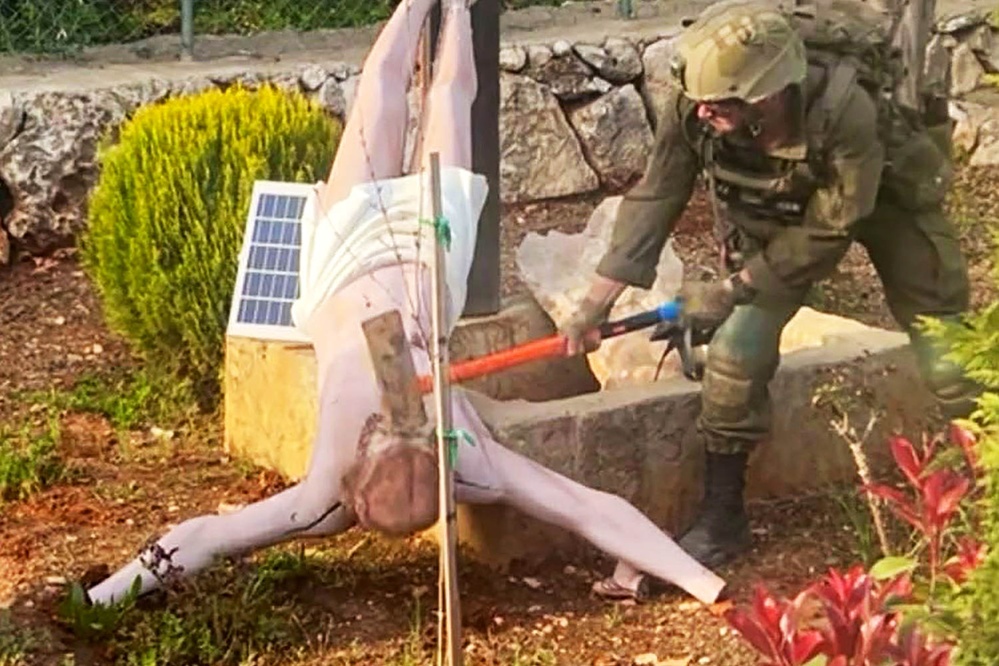
Incident involves an IDF soldier hammering a statue of Jesus in southern Lebanon; IDF condemns and investigates; the report situates the event within Lebanon-Israel hostilities, Hezbollah's actions, Iran's role, and U.S. involvement.
Neutral, evidence-first; relies on cited sources.
April 20, 2026 · 0 shares
Objectively descriptive with minimal framing, presenting the incident and official condemnation without speculative or partisan interpretation.
A concise report describing an Israeli soldier damaging a statue of Jesus Christ in Lebanon, followed by condemnation from Israeli leaders and the military.
Limited context; neutral stance; no external sources.
April 20, 2026 · 0 shares
Objectively descriptive with minimal framing, presenting the incident and official condemnation without speculative or partisan interpretation.
A concise report describing an Israeli soldier damaging a statue of Jesus Christ in Lebanon, followed by condemnation from Israeli leaders and the military.
Limited context; neutral stance; no external sources.
April 19, 2026 · 0 shares
Bias appears neutral to mildly pro-official, prioritizing IDF statements and investigations while including external condemnation without endorsing the wrongdoing.
Report on a purported image of an IDF soldier smashing a Jesus statue in Debel, southern Lebanon; IDF authenticity confirmed; investigation and restoration planned; Christian Forum condemnation; cross-border tensions context.
Balance-first approach; aim for neutral interpretation of provided text.
Coverage presents authenticity confirmation and a formal disciplinary response while situating the event within the Israel-Hezbollah conflict and Christian-community tensions, yielding a measured, establishment-aligned frame that emphasizes accountability and procedural handling over advocacy or sensationalism.
IDF confirms photo authenticity and outlines forthcoming disciplinary steps while placing the incident within the ongoing Israel-Hezbollah conflict and tensions with Christian leaders in Jerusalem, providing background on related regional issues and past conduct warnings.
Neutral default; avoid overreliance on any single source
April 19, 2026 · 0 shares
Text largely reports an IDF soldier smashing a Jesus statue in Debel, southern Lebanon, and includes the IDF's condemnation, signaling a neutral-to-slightly condemnatory bias toward vandalism and reliance on official normative claims.
A brief report about a soldier smashing a Jesus statue in Debel, a Christian village in southern Lebanon, with the IDF describing the act as severe and inconsistent with values.
Limited context; potential training-data bias; aiming for neutral assessment.
April 20, 2026 · 0 shares
Overall, coverage centers on Israeli officials' condemnation and messaging surrounding the desecration incident, while incorporating some critical voices and contextual geopolitical storytelling; this yields a cautious but noticeable pro-establishment, pro-Israel framing through emphasis on Israeli responses and religious-demographic narratives, despite including counterpoints from non-Israeli figures.
Describes an IDF soldier's desecration of a Jesus statue in Debel, Lebanon, Netanyahu's condemnation, and broader Israel-Lebanon and Gaza war context with international reactions and demographic notes.
Concise, cautious, evidence-based; mindful of bias.
April 20, 2026 · 0 shares
Nuanced, cautiously critical coverage condemning the act and emphasizing IDF accountability while situating the incident within broader Israeli military actions and diverse international reactions, using official statements and external voices without overt endorsement.
RT.com reports on an IDF investigation into a soldier who smashed a Jesus statue in southern Lebanon, with official condemnation and contextual reference to past Israeli strikes on Christian sites.
RT framing and Western media biases may influence my view; aim for neutrality.
April 20, 2026 · 0 shares
Overall, the text presents a pro-establishment, pro-Israel frame that condemns vandalism, asserts religious freedom in Israel, and contrasts Christian flourishing there with violence against Christians in neighboring regions.
Israel's leaders publicly condemn the vandalism of a Catholic icon, reaffirm commitment to religious freedom, and frame Christian life in Israel as flourishing relative to regional violence.
April 20, 2026 · 0 shares
Neutral-to-slightly critical framing: reports condemnation by religious authority and Israeli leadership while noting international backlash toward Israel, with no advocacy or visible ideological tilt.
Brief, fact-focused report about a statue destruction incident in Lebanon involving an IDF soldier, with reactions from Catholic Church and Israeli leadership and noting international backlash.
Limitations: training cutoff 2024; possible English-language bias, limited context.
April 20, 2026 · 0 shares
The piece foregrounds condemnation of the statue desecration and broader criticism of Israeli conduct, emphasizing Christian victims and US political critique of support for Israel, while also presenting some pro-Israel voices and Netanyahu's statements.
It uses loaded terms such as 'genocidal war' and 'barbarians' to frame Israeli actions as morally condemnable, and centers calls for accountability, but also acknowledges the political complexity within the MAGA base and US-Israel relations.
A report on an Israeli soldier smashing a statue of Jesus in Debl, Lebanon, and the global condemnation, including voices from Trump allies, Netanyahu, CAIR, and other observers, with references to broader Israeli abuses and the Gaza war.
Slight Western-media tilt; emphasize condemnation.
April 21, 2026 · 0 shares
Multi-voiced, event-driven coverage of desecration in Lebanon and related US-Israel political discourse combines condemnation with NGO critique and references to MAGA allies and European figures, indicating a cautious anti-establishment tilt while preserving diverse perspectives.
Collection of international political headlines about an Israeli soldier's desecration of a Jesus statue in Lebanon, protests, legal actions, and commentary on US-Israel relations and diplomacy.
Western-media-centric framing; may underrepresent non-Western sources.
April 20, 2026 · 0 shares
Objectively descriptive with minimal framing, presenting the incident and official condemnation without speculative or partisan interpretation.
A concise report describing an Israeli soldier damaging a statue of Jesus Christ in Lebanon, followed by condemnation from Israeli leaders and the military.
Limited context; neutral stance; no external sources.
April 20, 2026 · 0 shares
Objectively descriptive with minimal framing, presenting the incident and official condemnation without speculative or partisan interpretation.
A concise report describing an Israeli soldier damaging a statue of Jesus Christ in Lebanon, followed by condemnation from Israeli leaders and the military.
Limited context; neutral stance; no external sources.
April 20, 2026 · 0 shares
The piece foregrounds condemnation of the statue desecration and broader criticism of Israeli conduct, emphasizing Christian victims and US political critique of support for Israel, while also presenting some pro-Israel voices and Netanyahu's statements.
It uses loaded terms such as 'genocidal war' and 'barbarians' to frame Israeli actions as morally condemnable, and centers calls for accountability, but also acknowledges the political complexity within the MAGA base and US-Israel relations.
A report on an Israeli soldier smashing a statue of Jesus in Debl, Lebanon, and the global condemnation, including voices from Trump allies, Netanyahu, CAIR, and other observers, with references to broader Israeli abuses and the Gaza war.
Slight Western-media tilt; emphasize condemnation.
April 19, 2026 · 0 shares
Text largely reports an IDF soldier smashing a Jesus statue in Debel, southern Lebanon, and includes the IDF's condemnation, signaling a neutral-to-slightly condemnatory bias toward vandalism and reliance on official normative claims.
A brief report about a soldier smashing a Jesus statue in Debel, a Christian village in southern Lebanon, with the IDF describing the act as severe and inconsistent with values.
Limited context; potential training-data bias; aiming for neutral assessment.
April 19, 2026 · 0 shares
Bias appears neutral to mildly pro-official, prioritizing IDF statements and investigations while including external condemnation without endorsing the wrongdoing.
Report on a purported image of an IDF soldier smashing a Jesus statue in Debel, southern Lebanon; IDF authenticity confirmed; investigation and restoration planned; Christian Forum condemnation; cross-border tensions context.
Balance-first approach; aim for neutral interpretation of provided text.
Coverage presents authenticity confirmation and a formal disciplinary response while situating the event within the Israel-Hezbollah conflict and Christian-community tensions, yielding a measured, establishment-aligned frame that emphasizes accountability and procedural handling over advocacy or sensationalism.
IDF confirms photo authenticity and outlines forthcoming disciplinary steps while placing the incident within the ongoing Israel-Hezbollah conflict and tensions with Christian leaders in Jerusalem, providing background on related regional issues and past conduct warnings.
Neutral default; avoid overreliance on any single source
April 20, 2026 · 0 shares
Overall, coverage centers on Israeli officials' condemnation and messaging surrounding the desecration incident, while incorporating some critical voices and contextual geopolitical storytelling; this yields a cautious but noticeable pro-establishment, pro-Israel framing through emphasis on Israeli responses and religious-demographic narratives, despite including counterpoints from non-Israeli figures.
Describes an IDF soldier's desecration of a Jesus statue in Debel, Lebanon, Netanyahu's condemnation, and broader Israel-Lebanon and Gaza war context with international reactions and demographic notes.
Concise, cautious, evidence-based; mindful of bias.
April 19, 2026 · 0 shares
Text largely reports an IDF soldier smashing a Jesus statue in Debel, southern Lebanon, and includes the IDF's condemnation, signaling a neutral-to-slightly condemnatory bias toward vandalism and reliance on official normative claims.
A brief report about a soldier smashing a Jesus statue in Debel, a Christian village in southern Lebanon, with the IDF describing the act as severe and inconsistent with values.
Limited context; potential training-data bias; aiming for neutral assessment.
April 20, 2026 · 0 shares
Overall, the text presents a pro-establishment, pro-Israel frame that condemns vandalism, asserts religious freedom in Israel, and contrasts Christian flourishing there with violence against Christians in neighboring regions.
Israel's leaders publicly condemn the vandalism of a Catholic icon, reaffirm commitment to religious freedom, and frame Christian life in Israel as flourishing relative to regional violence.
Israeli Official/IDF Frame
April 19, 2026 · 0 shares
Bias appears neutral to mildly pro-official, prioritizing IDF statements and investigations while including external condemnation without endorsing the wrongdoing.
Report on a purported image of an IDF soldier smashing a Jesus statue in Debel, southern Lebanon; IDF authenticity confirmed; investigation and restoration planned; Christian Forum condemnation; cross-border tensions context.
Balance-first approach; aim for neutral interpretation of provided text.
Coverage presents authenticity confirmation and a formal disciplinary response while situating the event within the Israel-Hezbollah conflict and Christian-community tensions, yielding a measured, establishment-aligned frame that emphasizes accountability and procedural handling over advocacy or sensationalism.
IDF confirms photo authenticity and outlines forthcoming disciplinary steps while placing the incident within the ongoing Israel-Hezbollah conflict and tensions with Christian leaders in Jerusalem, providing background on related regional issues and past conduct warnings.
Neutral default; avoid overreliance on any single source
April 19, 2026 · 0 shares
Text largely reports an IDF soldier smashing a Jesus statue in Debel, southern Lebanon, and includes the IDF's condemnation, signaling a neutral-to-slightly condemnatory bias toward vandalism and reliance on official normative claims.
A brief report about a soldier smashing a Jesus statue in Debel, a Christian village in southern Lebanon, with the IDF describing the act as severe and inconsistent with values.
Limited context; potential training-data bias; aiming for neutral assessment.
April 20, 2026 · 0 shares
Overall, coverage centers on Israeli officials' condemnation and messaging surrounding the desecration incident, while incorporating some critical voices and contextual geopolitical storytelling; this yields a cautious but noticeable pro-establishment, pro-Israel framing through emphasis on Israeli responses and religious-demographic narratives, despite including counterpoints from non-Israeli figures.
Describes an IDF soldier's desecration of a Jesus statue in Debel, Lebanon, Netanyahu's condemnation, and broader Israel-Lebanon and Gaza war context with international reactions and demographic notes.
Concise, cautious, evidence-based; mindful of bias.
Catholic Church and Christian Communities
April 20, 2026 · 0 shares
Neutral-to-slightly critical framing: reports condemnation by religious authority and Israeli leadership while noting international backlash toward Israel, with no advocacy or visible ideological tilt.
Brief, fact-focused report about a statue destruction incident in Lebanon involving an IDF soldier, with reactions from Catholic Church and Israeli leadership and noting international backlash.
Limitations: training cutoff 2024; possible English-language bias, limited context.
April 19, 2026 · 0 shares
Text largely reports an IDF soldier smashing a Jesus statue in Debel, southern Lebanon, and includes the IDF's condemnation, signaling a neutral-to-slightly condemnatory bias toward vandalism and reliance on official normative claims.
A brief report about a soldier smashing a Jesus statue in Debel, a Christian village in southern Lebanon, with the IDF describing the act as severe and inconsistent with values.
Limited context; potential training-data bias; aiming for neutral assessment.
Independent/Global Observers and Media Framing
April 20, 2026 · 0 shares
The piece foregrounds condemnation of the statue desecration and broader criticism of Israeli conduct, emphasizing Christian victims and US political critique of support for Israel, while also presenting some pro-Israel voices and Netanyahu's statements. It uses loaded terms such as 'genocidal war' and 'barbarians' to frame Israeli actions as morally condemnable, and centers calls for accountability, but also acknowledges the political complexity within the MAGA base and US-Israel relations.
A report on an Israeli soldier smashing a statue of Jesus in Debl, Lebanon, and the global condemnation, including voices from Trump allies, Netanyahu, CAIR, and other observers, with references to broader Israeli abuses and the Gaza war.
Slight Western-media tilt; emphasize condemnation.
April 21, 2026 · 0 shares
Multi-voiced, event-driven coverage of desecration in Lebanon and related US-Israel political discourse combines condemnation with NGO critique and references to MAGA allies and European figures, indicating a cautious anti-establishment tilt while preserving diverse perspectives.
Collection of international political headlines about an Israeli soldier's desecration of a Jesus statue in Lebanon, protests, legal actions, and commentary on US-Israel relations and diplomacy.
Western-media-centric framing; may underrepresent non-Western sources.
April 20, 2026 · 0 shares
Objectively descriptive with minimal framing, presenting the incident and official condemnation without speculative or partisan interpretation.
A concise report describing an Israeli soldier damaging a statue of Jesus Christ in Lebanon, followed by condemnation from Israeli leaders and the military.
Limited context; neutral stance; no external sources.
April 20, 2026 · 0 shares
A pro-Israel/IDF frame dominates, relying on official statements and loaded descriptors such as terrorist organization and massacred, while acknowledging uncertainty about image authenticity, thereby shaping interpretation toward militaristic, establishment-aligned narratives and downplaying independent verification.
Incident involves an IDF soldier hammering a statue of Jesus in southern Lebanon; IDF condemns and investigates; the report situates the event within Lebanon-Israel hostilities, Hezbollah's actions, Iran's role, and U.S. involvement.
Neutral, evidence-first; relies on cited sources.
April 20, 2026 · 0 shares
Neutral, evidence-based report of a single incident, incorporating an official condemnation and a priest's account, with limited context about wider regional tensions, and no explicit advocacy or framing.
A concise, factful description of an IDF soldier smashing a statue in Deble, with priest's account and Israeli military condemnation, set against Israel-Hezbollah tensions in the region.
neutral, evidence-first; relies on article content; avoids speculation
April 19, 2026 · 0 shares
Bias appears neutral to mildly pro-official, prioritizing IDF statements and investigations while including external condemnation without endorsing the wrongdoing.
Report on a purported image of an IDF soldier smashing a Jesus statue in Debel, southern Lebanon; IDF authenticity confirmed; investigation and restoration planned; Christian Forum condemnation; cross-border tensions context.
Balance-first approach; aim for neutral interpretation of provided text.
Coverage presents authenticity confirmation and a formal disciplinary response while situating the event within the Israel-Hezbollah conflict and Christian-community tensions, yielding a measured, establishment-aligned frame that emphasizes accountability and procedural handling over advocacy or sensationalism.
IDF confirms photo authenticity and outlines forthcoming disciplinary steps while placing the incident within the ongoing Israel-Hezbollah conflict and tensions with Christian leaders in Jerusalem, providing background on related regional issues and past conduct warnings.
Neutral default; avoid overreliance on any single source
April 19, 2026 · 0 shares
Text largely reports an IDF soldier smashing a Jesus statue in Debel, southern Lebanon, and includes the IDF's condemnation, signaling a neutral-to-slightly condemnatory bias toward vandalism and reliance on official normative claims.
A brief report about a soldier smashing a Jesus statue in Debel, a Christian village in southern Lebanon, with the IDF describing the act as severe and inconsistent with values.
Limited context; potential training-data bias; aiming for neutral assessment.
April 20, 2026 · 0 shares
Overall, coverage centers on Israeli officials' condemnation and messaging surrounding the desecration incident, while incorporating some critical voices and contextual geopolitical storytelling; this yields a cautious but noticeable pro-establishment, pro-Israel framing through emphasis on Israeli responses and religious-demographic narratives, despite including counterpoints from non-Israeli figures.
Describes an IDF soldier's desecration of a Jesus statue in Debel, Lebanon, Netanyahu's condemnation, and broader Israel-Lebanon and Gaza war context with international reactions and demographic notes.
Concise, cautious, evidence-based; mindful of bias.
April 20, 2026 · 0 shares
A pro-Israel/IDF frame dominates, relying on official statements and loaded descriptors such as terrorist organization and massacred, while acknowledging uncertainty about image authenticity, thereby shaping interpretation toward militaristic, establishment-aligned narratives and downplaying independent verification.
Incident involves an IDF soldier hammering a statue of Jesus in southern Lebanon; IDF condemns and investigates; the report situates the event within Lebanon-Israel hostilities, Hezbollah's actions, Iran's role, and U.S. involvement.
Neutral, evidence-first; relies on cited sources.
April 20, 2026 · 0 shares
Objectively descriptive with minimal framing, presenting the incident and official condemnation without speculative or partisan interpretation.
A concise report describing an Israeli soldier damaging a statue of Jesus Christ in Lebanon, followed by condemnation from Israeli leaders and the military.
Limited context; neutral stance; no external sources.
April 20, 2026 · 0 shares
Objectively descriptive with minimal framing, presenting the incident and official condemnation without speculative or partisan interpretation.
A concise report describing an Israeli soldier damaging a statue of Jesus Christ in Lebanon, followed by condemnation from Israeli leaders and the military.
Limited context; neutral stance; no external sources.
April 19, 2026 · 0 shares
Bias appears neutral to mildly pro-official, prioritizing IDF statements and investigations while including external condemnation without endorsing the wrongdoing.
Report on a purported image of an IDF soldier smashing a Jesus statue in Debel, southern Lebanon; IDF authenticity confirmed; investigation and restoration planned; Christian Forum condemnation; cross-border tensions context.
Balance-first approach; aim for neutral interpretation of provided text.
Coverage presents authenticity confirmation and a formal disciplinary response while situating the event within the Israel-Hezbollah conflict and Christian-community tensions, yielding a measured, establishment-aligned frame that emphasizes accountability and procedural handling over advocacy or sensationalism.
IDF confirms photo authenticity and outlines forthcoming disciplinary steps while placing the incident within the ongoing Israel-Hezbollah conflict and tensions with Christian leaders in Jerusalem, providing background on related regional issues and past conduct warnings.
Neutral default; avoid overreliance on any single source
April 19, 2026 · 0 shares
Text largely reports an IDF soldier smashing a Jesus statue in Debel, southern Lebanon, and includes the IDF's condemnation, signaling a neutral-to-slightly condemnatory bias toward vandalism and reliance on official normative claims.
A brief report about a soldier smashing a Jesus statue in Debel, a Christian village in southern Lebanon, with the IDF describing the act as severe and inconsistent with values.
Limited context; potential training-data bias; aiming for neutral assessment.
April 20, 2026 · 0 shares
Neutral-to-slightly critical framing: reports condemnation by religious authority and Israeli leadership while noting international backlash toward Israel, with no advocacy or visible ideological tilt.
Brief, fact-focused report about a statue destruction incident in Lebanon involving an IDF soldier, with reactions from Catholic Church and Israeli leadership and noting international backlash.
Limitations: training cutoff 2024; possible English-language bias, limited context.
April 19, 2026 · 0 shares
Text largely reports an IDF soldier smashing a Jesus statue in Debel, southern Lebanon, and includes the IDF's condemnation, signaling a neutral-to-slightly condemnatory bias toward vandalism and reliance on official normative claims.
A brief report about a soldier smashing a Jesus statue in Debel, a Christian village in southern Lebanon, with the IDF describing the act as severe and inconsistent with values.
Limited context; potential training-data bias; aiming for neutral assessment.
April 20, 2026 · 0 shares
The piece foregrounds condemnation of the statue desecration and broader criticism of Israeli conduct, emphasizing Christian victims and US political critique of support for Israel, while also presenting some pro-Israel voices and Netanyahu's statements.
It uses loaded terms such as 'genocidal war' and 'barbarians' to frame Israeli actions as morally condemnable, and centers calls for accountability, but also acknowledges the political complexity within the MAGA base and US-Israel relations.
A report on an Israeli soldier smashing a statue of Jesus in Debl, Lebanon, and the global condemnation, including voices from Trump allies, Netanyahu, CAIR, and other observers, with references to broader Israeli abuses and the Gaza war.
Slight Western-media tilt; emphasize condemnation.
April 21, 2026 · 0 shares
Multi-voiced, event-driven coverage of desecration in Lebanon and related US-Israel political discourse combines condemnation with NGO critique and references to MAGA allies and European figures, indicating a cautious anti-establishment tilt while preserving diverse perspectives.
Collection of international political headlines about an Israeli soldier's desecration of a Jesus statue in Lebanon, protests, legal actions, and commentary on US-Israel relations and diplomacy.
Western-media-centric framing; may underrepresent non-Western sources.
April 20, 2026 · 0 shares
A pro-Israel/IDF frame dominates, relying on official statements and loaded descriptors such as terrorist organization and massacred, while acknowledging uncertainty about image authenticity, thereby shaping interpretation toward militaristic, establishment-aligned narratives and downplaying independent verification.
Incident involves an IDF soldier hammering a statue of Jesus in southern Lebanon; IDF condemns and investigates; the report situates the event within Lebanon-Israel hostilities, Hezbollah's actions, Iran's role, and U.S. involvement.
Neutral, evidence-first; relies on cited sources.
April 20, 2026 · 0 shares
Overall, the text presents a pro-establishment, pro-Israel frame that condemns vandalism, asserts religious freedom in Israel, and contrasts Christian flourishing there with violence against Christians in neighboring regions.
Israel's leaders publicly condemn the vandalism of a Catholic icon, reaffirm commitment to religious freedom, and frame Christian life in Israel as flourishing relative to regional violence.
April 20, 2026 · 0 shares
Neutral-to-slightly critical framing: reports condemnation by religious authority and Israeli leadership while noting international backlash toward Israel, with no advocacy or visible ideological tilt.
Brief, fact-focused report about a statue destruction incident in Lebanon involving an IDF soldier, with reactions from Catholic Church and Israeli leadership and noting international backlash.
Limitations: training cutoff 2024; possible English-language bias, limited context.
April 20, 2026 · 0 shares
The piece foregrounds condemnation of the statue desecration and broader criticism of Israeli conduct, emphasizing Christian victims and US political critique of support for Israel, while also presenting some pro-Israel voices and Netanyahu's statements.
It uses loaded terms such as 'genocidal war' and 'barbarians' to frame Israeli actions as morally condemnable, and centers calls for accountability, but also acknowledges the political complexity within the MAGA base and US-Israel relations.
A report on an Israeli soldier smashing a statue of Jesus in Debl, Lebanon, and the global condemnation, including voices from Trump allies, Netanyahu, CAIR, and other observers, with references to broader Israeli abuses and the Gaza war.
Slight Western-media tilt; emphasize condemnation.
Coverage presents authenticity confirmation and a formal disciplinary response while situating the event within the Israel-Hezbollah conflict and Christian-community tensions, yielding a measured, establishment-aligned frame that emphasizes accountability and procedural handling over advocacy or sensationalism.
IDF confirms photo authenticity and outlines forthcoming disciplinary steps while placing the incident within the ongoing Israel-Hezbollah conflict and tensions with Christian leaders in Jerusalem, providing background on related regional issues and past conduct warnings.
Neutral default; avoid overreliance on any single source
2026 © Helium Trades
Privacy Policy & Disclosure
* Disclaimer: Nothing on this website constitutes investment advice, performance data or any recommendation that any particular security, portfolio of securities, transaction or investment strategy is suitable for any specific person. Helium Trades is not responsible in any way for the accuracy
of any model predictions or price data. Any mention of a particular security and related prediction data is not a recommendation to buy or sell that security. Investments in securities involve the risk of loss. Past performance is no guarantee of future results. Helium Trades is not responsible for any of your investment decisions,
you should consult a financial expert before engaging in any transaction.
Helium Research Assistant

How can I help you today?
Ask any question about this page.


