See whether Helium helps you make better-informed decisions. Try every Pro Trader feature for 30 days. No credit card required.
Try every Pro Trader feature for 30 days. No credit card required.
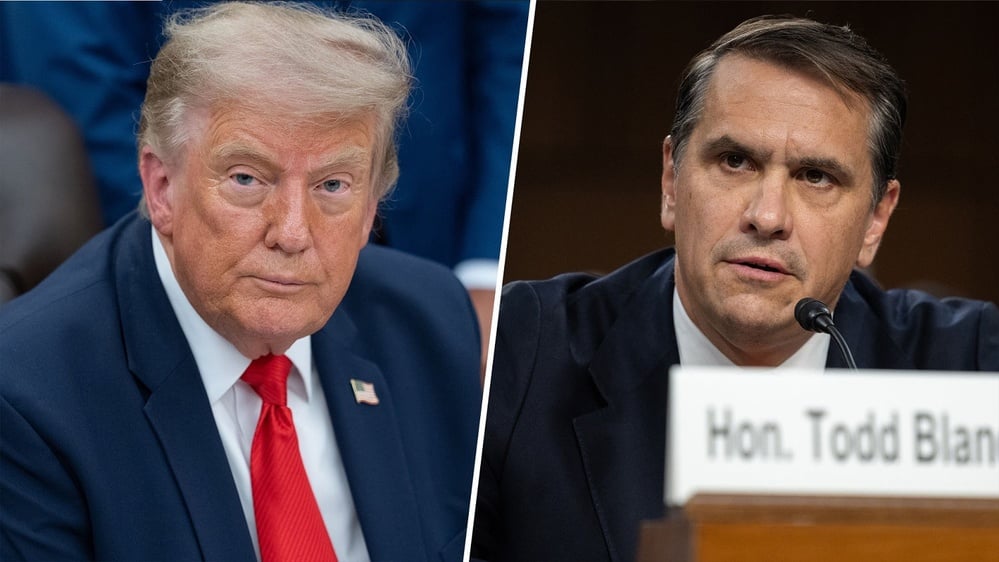
Trump's suggestion to withdraw the nomination is framed as a strategic move amid opposition from two Republican senators.
Todd Blanche is Trump's nominee for attorney-general, and two Republican senators threaten to torpedo his confirmation.
Neutral reporting of a political standoff, using direct quotes from both Trump and Senator Cornyn without editorial commentary.
The dispute centers on a $1.776 billion 'anti-weaponization fund' that originated from a settlement between Trump's legal team and the IRS, which was criticized as a slush fund for Trump allies.
Moderate Republicans and Democrats opposed it. The senators also oppose an IRS audit immunity provision for Trump.
Automated analysis; not human reviewed.
·
8 of 52 available dimensions scored; omitted dimensions are not treated as neutral.
·
Verified supporting quotes for 0 of 8 scored dimensions.
Claim: Presents facts and quotes without subjective evaluation.
“President Donald Trump on Thursday said he would consider withdrawing Todd Blanche’s nomination rather than concede to demands from two Republican senators who want him to guarantee in writing that he’s given up plans to use $1.8 billion in tax dollars to reward criminals who were prosecuted during previous Democratic administrations.” · not found in supplied text
“Cornyn said he was 'prepared to vote no' on the president’s pick.” · not found in supplied text
Why: The article uses direct attributions and does not insert opinion.
Claim: Moderately interesting due to high-stakes political standoff and specific details.
“Trump threatened to pull nomination rather than give in...” · not found in supplied text
“fund amount $1.776 billion” · not found in supplied text
Why: The conflict and specific figures add interest.
Claim: No editorial opinion; all statements are attributed.
“The entire article consists of attributed quotes and reported actions.” · not found in supplied text
Why: No unsupported opinion statements; every claim is sourced.
Claim: Topic is a political conflict, but reporting is neutral.
“Trump threatens to pull nomination...” · not found in supplied text
“Cornyn told MS NOW...” · not found in supplied text
“Both are members of the Senate Judiciary Committee...” · not found in supplied text
Why: Subject matter is inherently political, but the article does not advocate for either side.
Claim: Neutral emotional tone; no emotional language.
“grousing that Sen. John Cornyn... are 'refusing to vote' for Blanche’s confirmation.” · not found in supplied text
Why: The word 'grousing' is the only slight negative connotation, but it describes Trump's post, not an editorial insertion.
Claim: High credibility due to clear sourcing and attribution.
“President Donald Trump on Thursday said...” · not found in supplied text
“Cornyn told MS NOW on Thursday...” · not found in supplied text
“A committee spokesperson said...” · not found in supplied text
Why: Explicit attribution to named individuals and a spokesperson strengthens credibility.
Claim: Demonstrates high integrity by attributing all claims and including dissenting views.
“In a post on Truth Social, Trump called his ex-criminal defense attorney Blanche a 'star'...” · not found in supplied text
“A committee spokesperson said on Wednesday that the hearing had been 'postponed as work continues to secure sufficient support in committee...'” · not found in supplied text
Why: Multiple attributions to named sources (Trump, Cornyn, committee spokesperson) and inclusion of both sides.
July 30, 2026 · 0 shares
Framing emphasizes a conditional presidential maneuver to withdraw Todd Blanche's nomination amid GOP opposition and questions about a Justice Department deal.
Framing emphasizes Republican holdouts' concerns about the IRS settlement and presents Trump's threat to withdraw the nomination as a politically risky maneuver.
Todd Blanche's nomination to be attorney general is under Senate consideration, with two Republican holdouts raising concerns about Trump's tax-returns settlement with the IRS and related DOJ provisions, including an 'anti-weaponization' fund; the article also notes the '1776 fund' and related political dynamics.
Framing centers on intra-party Republican opposition and presents Trump's threat to withdraw Blanche's AG nomination as a bargaining tactic.
July 31, 2026 · 0 shares
Reports a nomination delay as a straightforward political development without added commentary.
Automated analysis; not human reviewed.
·
9 of 52 available dimensions scored; omitted dimensions are not treated as neutral.
·
Verified supporting quotes for 9 of 9 scored dimensions.
Claim: The article shows no left-right political slant.
“Todd Blanche’s path to becoming Attorney General hit a snag after President Donald Trump threatened to withdraw his nomination after two senators delayed a crucial vote.” · exact text match
Why: The sentence is purely factual, reporting a political dispute without evaluative language or partisan framing.
Claim: The article reports events objectively without subjective interpretation.
“Trump Weighs Pulling Todd Blanche Nomination Amid Vote Delay.” · exact text match
Why: The headline and body present verifiable actions and statements without opinion or value judgments.
Claim: The article avoids sensationalism or exaggeration.
“Todd Blanche’s path to becoming Attorney General hit a snag after President Donald Trump threatened to withdraw his nomination after two senators delayed a crucial vote.” · exact text match
Why: Language like 'hit a snag' is mild and proportional; no hyperbolic or dramatic phrasing.
Claim: The article describes what happened rather than prescribing what should happen.
“The sticking point is that Sen. Thom Tillis and Sen. John Cornyn insist that the DOJ commit in writing to drop a nearly $2B compensation fund that could pay Trump allies.” · exact text match
Why: The article reports the demand without endorsing or opposing it, maintaining a descriptive stance.
Claim: The article maintains a neutral emotional tone.
“Trump Weighs Pulling Todd Blanche Nomination Amid Vote Delay.” · exact text match
Why: No emotionally charged words; the tone is factual and detached.
Claim: The article shows standard journalistic credibility through attribution and factual reporting.
“NBC's Kelly O'Donnell reports for TODAY.” · exact text match
Why: The report is attributed to a named NBC reporter, indicating source transparency, though no further verification evidence is present.
Claim: The article presents information logically and without emotional or irrational appeals.
“The sticking point is that Sen. Thom Tillis and Sen. John Cornyn insist that the DOJ commit in writing to drop a nearly $2B compensation fund that could pay Trump allies.” · exact text match
Why: The text states a clear cause-and-effect relationship (sticking point) and uses neutral language.
Claim: The article displays internal fairness and honesty by presenting facts without deception.
“The sticking point is that Sen. Thom Tillis and Sen. John Cornyn insist that the DOJ commit in writing to drop a nearly $2B compensation fund that could pay Trump allies.” · exact text match
Why: The article clearly attributes the demand to the senators and does not misrepresent their position.
Claim: The article is of average intellectual quality, presenting information clearly and concisely.
“Todd Blanche’s path to becoming Attorney General hit a snag after President Donald Trump threatened to withdraw his nomination after two senators delayed a crucial vote.” · exact text match
Why: The text is straightforward and easy to understand, with no complex analysis or errors, but also no depth beyond a briefing.
Framing emphasizes Republican holdouts' concerns about the IRS settlement and presents Trump's threat to withdraw the nomination as a politically risky maneuver.
Todd Blanche's nomination to be attorney general is under Senate consideration, with two Republican holdouts raising concerns about Trump's tax-returns settlement with the IRS and related DOJ provisions, including an 'anti-weaponization' fund; the article also notes the '1776 fund' and related political dynamics.
August 04, 2026 · 0 shares
Frames the nomination as a partisan conflict driven by retribution, emphasizing Trump's defense of Blanche and casting Cornyn's hold as punitive.
The Anti-Weaponization Fund was created through a legal settlement between former President Trump and the IRS; the fund is intended to address claims of weaponization by government agencies.
Automated analysis; not human reviewed.
·
8 of 53 available dimensions scored; omitted dimensions are not treated as neutral.
·
Verified supporting quotes for 8 of 8 scored dimensions.
Claim: The publisher frames the nomination in a conservative-friendly manner, siding with Trump's narrative.
“President Donald Trump said that Cornyn had held up the nomination as retribution after Trump endorsed his opponent, Texas Attorney General Ken Paxton, in the race for the Republican nomination in the Lone Star State’s U.S. Senate race several months ago.” · exact text match
“This fund was for those people that have been weaponized, that have been abused” · exact text match
Why: The article uncritically presents Trump's retribution claim and the weaponization narrative without counterpoint or scrutiny.
Claim: The article adopts an anti-establishment tone, portraying Trump as defending a loyalist against a senator's procedural tactics.
“President Donald Trump said that Cornyn had held up the nomination as retribution after Trump endorsed his opponent” · exact text match
Why: Emphasizes Trump's outsider criticism of a sitting senator, framing the conflict as retribution rather than policy.
Claim: The article mixes factual reporting with subjective opinion from Trump, lacking independent analysis.
“President Donald Trump said that Cornyn had held up the nomination as retribution after Trump endorsed his opponent” · exact text match
Why: A substantial portion of the article is Trump's quoted opinions, and the publisher does not add balancing context.
Claim: The article is heavily opinionated, centering on Trump's defense and allegations.
“President Donald Trump said that Cornyn had held up the nomination as retribution after Trump endorsed his opponent” · exact text match
Why: Most of the article space is devoted to Trump's statements, with minimal neutral reporting.
Claim: The article focuses exclusively on a partisan nomination process and intra-party conflict.
“The Senate Judiciary Committee advanced Todd Blanche’s nomination for attorney general to the Senate floor on Tuesday in a 12-10 vote.” · exact text match
Why: The entire content is about a political appointment and related maneuvering.
Claim: The article portrays Blanche and those covered by the fund as victims of weaponization and political retribution.
“to make him a pawn in this whole thing” · exact text match
“This fund was for those people that have been weaponized, that have been abused” · exact text match
Why: Trump's language explicitly frames Blanche as a pawn and others as victims, and the article reproduces this framing.
Claim: The article reflects a conservative ideological frame emphasizing 'weaponization' and victimization by government.
“This fund was for those people that have been weaponized, that have been abused” · exact text match
Why: The term 'weaponized' is a loaded ideological concept common in conservative discourse, presented without qualification.
Claim: The article carries a slightly negative emotional tone, focusing on retribution and conflict.
“retribution” · exact text match
“pawn” · exact text match
Why: The chosen words imply conflict and unfairness, lending a negative emotional valence.
August 04, 2026 · 0 shares
Straightforward reporting of a procedural Senate vote without editorial commentary.
Automated analysis; not human reviewed.
Limitations: Article content is minimal, limiting bias analysis to surface-level neutrality.
·
9 of 53 available dimensions scored; omitted dimensions are not treated as neutral.
·
Verified supporting quotes for 9 of 9 scored dimensions.
Claim: No liberal or conservative framing is present in the report.
“Republicans on the Senate Judiciary Committee voted to advance acting Attorney General Todd Blanche's nomination to serve in the role permanently.” · exact text match
Why: The sentence merely reports the action without any evaluative language or slant toward either ideological side.
Claim: No populist or elitist framing is present.
“Senate Judiciary Committee advances Todd Blanche's attorney general nomination.” · exact text match
Why: The report is a straightforward procedural update with no language appealing to or criticizing elites or the common person.
Claim: The report is objective, presenting facts without subjective interpretation.
“News' Scott Wong and Gabe Gutierrez have details on what senators had to say in support or opposition of the nomination and when it will face a full Senate vote.” · exact text match
Why: The article attributes details to named reporters and describes the upcoming process without subjective language.
Claim: The report is objective and not sensational.
“Senate Judiciary Committee advances Todd Blanche's attorney general nomination.” · exact text match
Why: The headline and text use plain, factual language with no dramatic or exaggerated wording.
Claim: The report is purely descriptive, stating what happened without prescribing action.
“Republicans on the Senate Judiciary Committee voted to advance acting Attorney General Todd Blanche's nomination to serve in the role permanently.” · exact text match
Why: The language describes the vote and next step without suggesting what should be done.
Claim: No emotional tone is present; the report is neutral in valence.
“Senate Judiciary Committee advances Todd Blanche's attorney general nomination.” · exact text match
Why: The entire text contains only factual statements without positive or negative emotional language.
Claim: The report exhibits moderate credibility through attribution and factual claims.
“News' Scott Wong and Gabe Gutierrez have details on what senators had to say in support or opposition of the nomination and when it will face a full Senate vote.” · exact text match
Why: The article names two reporters and references specific details about the vote and upcoming process, though the brevity limits full verification.
Claim: The report is rational and fact-based, without irrational claims.
“Republicans on the Senate Judiciary Committee voted to advance acting Attorney General Todd Blanche's nomination to serve in the role permanently.” · exact text match
Why: The statement is a factual description of a legislative vote, not containing any emotional or irrational assertions.
Claim: No integrity issues are observable; the report appears straightforward.
“Senate Judiciary Committee advances Todd Blanche's attorney general nomination.” · exact text match
Why: The article presents a simple factual update with no indication of deception or omission.
Article content is minimal, limiting bias analysis to surface-level neutrality.
August 04, 2026 · 0 shares
Reports procedural advancement while noting uncertainty about confirmation votes.
Automated analysis; not human reviewed.
·
4 of 53 available dimensions scored; omitted dimensions are not treated as neutral.
·
Verified supporting quotes for 4 of 4 scored dimensions.
Claim: The article demonstrates political neutrality by reporting a procedural update without partisan framing.
“Blanche advanced out of committee, but there are more Senate Republicans whose support is unclear to confirm him in a floor vote.” · exact text match
Why: No partisan language or slant is present; the report is purely factual.
Claim: The article is entirely objective, reporting facts without subjective language.
“Blanche advanced out of committee, but there are more Senate Republicans whose support is unclear to confirm him in a floor vote.” · exact text match
Why: No opinion, speculation, or emotional wording appears.
Claim: The article describes a sequence of events without prescribing any action or value.
“Blanche advanced out of committee, but there are more Senate Republicans whose support is unclear to confirm him in a floor vote.” · exact text match
Why: The text only states what happened and a current condition; no imperative or judgment.
Claim: The article covers a political process and thus has a political subject.
“Senate Advances Todd Blanche Nomination for Attorney General.” · exact text match
Why: The headline and content explicitly refer to a Senate nomination, a core political process.
August 04, 2026 · 0 shares
Frames the nomination vote as a close partisan battle and includes commentary characterizing the Democratic party's shift toward socialism.
Automated analysis; not human reviewed.
Limitations: The article text is very short and includes commentary; the publisher's framing is inferred from included opinion statements.
·
4 of 53 available dimensions scored; omitted dimensions are not treated as neutral.
·
Verified supporting quotes for 1 of 4 scored dimensions.
Claim: The article includes a conservative framing by highlighting a claim about the Democratic party's socialist shift.
“John Tillman highlights the '25% rule' and how it lead to the Democratic party’s socialist shift” · not found in supplied text
Why: The inclusion of this unattributed opinion about a socialist shift is a common conservative talking point, indicating a conservative leaning.
Claim: The article mixes factual reporting with subjective commentary.
“John Tillman highlights the '25% rule' and how it lead to the Democratic party’s socialist shift” · not found in supplied text
Why: The factual vote report is paired with subjective interpretation about the Democratic party's shift, making the overall article somewhat subjective.
Claim: The article includes opinion statements presented as part of the news report.
“John Tillman highlights the '25% rule' and how it lead to the Democratic party’s socialist shift” · not found in supplied text
“Sen.
Marsha Blackburn expresses concerns over investigations into Republicans and future safeguards”
· exact text match
Why: Both statements are opinions or expressions of concern, not factual reporting, indicating a significant opinion component.
Claim: The article is highly political, covering a partisan nomination vote and including partisan concerns.
“Senate committee advances Todd Blanche nomination by a 12-10 vote” · exact text match
“Sen.
Marsha Blackburn expresses concerns over investigations into Republicans and future safeguards”
· exact text match
Why: The entire subject matter is a political nomination process, and the inclusion of Senator Blackburn's partisan concerns reinforces the political nature.
The article text is very short and includes commentary; the publisher's framing is inferred from included opinion statements.
August 04, 2026 · 0 shares
Frames the nomination as a partisan conflict driven by retribution, emphasizing Trump's defense of Blanche and casting Cornyn's hold as punitive.
The Anti-Weaponization Fund was created through a legal settlement between former President Trump and the IRS; the fund is intended to address claims of weaponization by government agencies.
Automated analysis; not human reviewed.
·
8 of 53 available dimensions scored; omitted dimensions are not treated as neutral.
·
Verified supporting quotes for 8 of 8 scored dimensions.
Claim: The publisher frames the nomination in a conservative-friendly manner, siding with Trump's narrative.
“President Donald Trump said that Cornyn had held up the nomination as retribution after Trump endorsed his opponent, Texas Attorney General Ken Paxton, in the race for the Republican nomination in the Lone Star State’s U.S. Senate race several months ago.” · exact text match
“This fund was for those people that have been weaponized, that have been abused” · exact text match
Why: The article uncritically presents Trump's retribution claim and the weaponization narrative without counterpoint or scrutiny.
Claim: The article adopts an anti-establishment tone, portraying Trump as defending a loyalist against a senator's procedural tactics.
“President Donald Trump said that Cornyn had held up the nomination as retribution after Trump endorsed his opponent” · exact text match
Why: Emphasizes Trump's outsider criticism of a sitting senator, framing the conflict as retribution rather than policy.
Claim: The article mixes factual reporting with subjective opinion from Trump, lacking independent analysis.
“President Donald Trump said that Cornyn had held up the nomination as retribution after Trump endorsed his opponent” · exact text match
Why: A substantial portion of the article is Trump's quoted opinions, and the publisher does not add balancing context.
Claim: The article is heavily opinionated, centering on Trump's defense and allegations.
“President Donald Trump said that Cornyn had held up the nomination as retribution after Trump endorsed his opponent” · exact text match
Why: Most of the article space is devoted to Trump's statements, with minimal neutral reporting.
Claim: The article focuses exclusively on a partisan nomination process and intra-party conflict.
“The Senate Judiciary Committee advanced Todd Blanche’s nomination for attorney general to the Senate floor on Tuesday in a 12-10 vote.” · exact text match
Why: The entire content is about a political appointment and related maneuvering.
Claim: The article portrays Blanche and those covered by the fund as victims of weaponization and political retribution.
“to make him a pawn in this whole thing” · exact text match
“This fund was for those people that have been weaponized, that have been abused” · exact text match
Why: Trump's language explicitly frames Blanche as a pawn and others as victims, and the article reproduces this framing.
Claim: The article reflects a conservative ideological frame emphasizing 'weaponization' and victimization by government.
“This fund was for those people that have been weaponized, that have been abused” · exact text match
Why: The term 'weaponized' is a loaded ideological concept common in conservative discourse, presented without qualification.
Claim: The article carries a slightly negative emotional tone, focusing on retribution and conflict.
“retribution” · exact text match
“pawn” · exact text match
Why: The chosen words imply conflict and unfairness, lending a negative emotional valence.
August 04, 2026 · 0 shares
Frames the nomination as a partisan conflict driven by retribution, emphasizing Trump's defense of Blanche and casting Cornyn's hold as punitive.
The Anti-Weaponization Fund was created through a legal settlement between former President Trump and the IRS; the fund is intended to address claims of weaponization by government agencies.
Automated analysis; not human reviewed.
·
8 of 53 available dimensions scored; omitted dimensions are not treated as neutral.
·
Verified supporting quotes for 8 of 8 scored dimensions.
Claim: The publisher frames the nomination in a conservative-friendly manner, siding with Trump's narrative.
“President Donald Trump said that Cornyn had held up the nomination as retribution after Trump endorsed his opponent, Texas Attorney General Ken Paxton, in the race for the Republican nomination in the Lone Star State’s U.S. Senate race several months ago.” · exact text match
“This fund was for those people that have been weaponized, that have been abused” · exact text match
Why: The article uncritically presents Trump's retribution claim and the weaponization narrative without counterpoint or scrutiny.
Claim: The article adopts an anti-establishment tone, portraying Trump as defending a loyalist against a senator's procedural tactics.
“President Donald Trump said that Cornyn had held up the nomination as retribution after Trump endorsed his opponent” · exact text match
Why: Emphasizes Trump's outsider criticism of a sitting senator, framing the conflict as retribution rather than policy.
Claim: The article mixes factual reporting with subjective opinion from Trump, lacking independent analysis.
“President Donald Trump said that Cornyn had held up the nomination as retribution after Trump endorsed his opponent” · exact text match
Why: A substantial portion of the article is Trump's quoted opinions, and the publisher does not add balancing context.
Claim: The article is heavily opinionated, centering on Trump's defense and allegations.
“President Donald Trump said that Cornyn had held up the nomination as retribution after Trump endorsed his opponent” · exact text match
Why: Most of the article space is devoted to Trump's statements, with minimal neutral reporting.
Claim: The article focuses exclusively on a partisan nomination process and intra-party conflict.
“The Senate Judiciary Committee advanced Todd Blanche’s nomination for attorney general to the Senate floor on Tuesday in a 12-10 vote.” · exact text match
Why: The entire content is about a political appointment and related maneuvering.
Claim: The article portrays Blanche and those covered by the fund as victims of weaponization and political retribution.
“to make him a pawn in this whole thing” · exact text match
“This fund was for those people that have been weaponized, that have been abused” · exact text match
Why: Trump's language explicitly frames Blanche as a pawn and others as victims, and the article reproduces this framing.
Claim: The article reflects a conservative ideological frame emphasizing 'weaponization' and victimization by government.
“This fund was for those people that have been weaponized, that have been abused” · exact text match
Why: The term 'weaponized' is a loaded ideological concept common in conservative discourse, presented without qualification.
Claim: The article carries a slightly negative emotional tone, focusing on retribution and conflict.
“retribution” · exact text match
“pawn” · exact text match
Why: The chosen words imply conflict and unfairness, lending a negative emotional valence.
August 04, 2026 · 0 shares
Straightforward reporting of a procedural Senate vote without editorial commentary.
Automated analysis; not human reviewed.
Limitations: Article content is minimal, limiting bias analysis to surface-level neutrality.
·
9 of 53 available dimensions scored; omitted dimensions are not treated as neutral.
·
Verified supporting quotes for 9 of 9 scored dimensions.
Claim: No liberal or conservative framing is present in the report.
“Republicans on the Senate Judiciary Committee voted to advance acting Attorney General Todd Blanche's nomination to serve in the role permanently.” · exact text match
Why: The sentence merely reports the action without any evaluative language or slant toward either ideological side.
Claim: No populist or elitist framing is present.
“Senate Judiciary Committee advances Todd Blanche's attorney general nomination.” · exact text match
Why: The report is a straightforward procedural update with no language appealing to or criticizing elites or the common person.
Claim: The report is objective, presenting facts without subjective interpretation.
“News' Scott Wong and Gabe Gutierrez have details on what senators had to say in support or opposition of the nomination and when it will face a full Senate vote.” · exact text match
Why: The article attributes details to named reporters and describes the upcoming process without subjective language.
Claim: The report is objective and not sensational.
“Senate Judiciary Committee advances Todd Blanche's attorney general nomination.” · exact text match
Why: The headline and text use plain, factual language with no dramatic or exaggerated wording.
Claim: The report is purely descriptive, stating what happened without prescribing action.
“Republicans on the Senate Judiciary Committee voted to advance acting Attorney General Todd Blanche's nomination to serve in the role permanently.” · exact text match
Why: The language describes the vote and next step without suggesting what should be done.
Claim: No emotional tone is present; the report is neutral in valence.
“Senate Judiciary Committee advances Todd Blanche's attorney general nomination.” · exact text match
Why: The entire text contains only factual statements without positive or negative emotional language.
Claim: The report exhibits moderate credibility through attribution and factual claims.
“News' Scott Wong and Gabe Gutierrez have details on what senators had to say in support or opposition of the nomination and when it will face a full Senate vote.” · exact text match
Why: The article names two reporters and references specific details about the vote and upcoming process, though the brevity limits full verification.
Claim: The report is rational and fact-based, without irrational claims.
“Republicans on the Senate Judiciary Committee voted to advance acting Attorney General Todd Blanche's nomination to serve in the role permanently.” · exact text match
Why: The statement is a factual description of a legislative vote, not containing any emotional or irrational assertions.
Claim: No integrity issues are observable; the report appears straightforward.
“Senate Judiciary Committee advances Todd Blanche's attorney general nomination.” · exact text match
Why: The article presents a simple factual update with no indication of deception or omission.
Article content is minimal, limiting bias analysis to surface-level neutrality.
August 04, 2026 · 0 shares
Reports procedural advancement while noting uncertainty about confirmation votes.
Automated analysis; not human reviewed.
·
4 of 53 available dimensions scored; omitted dimensions are not treated as neutral.
·
Verified supporting quotes for 4 of 4 scored dimensions.
Claim: The article demonstrates political neutrality by reporting a procedural update without partisan framing.
“Blanche advanced out of committee, but there are more Senate Republicans whose support is unclear to confirm him in a floor vote.” · exact text match
Why: No partisan language or slant is present; the report is purely factual.
Claim: The article is entirely objective, reporting facts without subjective language.
“Blanche advanced out of committee, but there are more Senate Republicans whose support is unclear to confirm him in a floor vote.” · exact text match
Why: No opinion, speculation, or emotional wording appears.
Claim: The article describes a sequence of events without prescribing any action or value.
“Blanche advanced out of committee, but there are more Senate Republicans whose support is unclear to confirm him in a floor vote.” · exact text match
Why: The text only states what happened and a current condition; no imperative or judgment.
Claim: The article covers a political process and thus has a political subject.
“Senate Advances Todd Blanche Nomination for Attorney General.” · exact text match
Why: The headline and content explicitly refer to a Senate nomination, a core political process.
August 04, 2026 · 0 shares
Straightforward reporting of a procedural Senate vote without editorial commentary.
Automated analysis; not human reviewed. Limitations: Article content is minimal, limiting bias analysis to surface-level neutrality. · 9 of 53 available dimensions scored; omitted dimensions are not treated as neutral. · Verified supporting quotes for 9 of 9 scored dimensions.
Claim: No liberal or conservative framing is present in the report.
“Republicans on the Senate Judiciary Committee voted to advance acting Attorney General Todd Blanche's nomination to serve in the role permanently.” · exact text match
Why: The sentence merely reports the action without any evaluative language or slant toward either ideological side.
Claim: No populist or elitist framing is present.
“Senate Judiciary Committee advances Todd Blanche's attorney general nomination.” · exact text match
Why: The report is a straightforward procedural update with no language appealing to or criticizing elites or the common person.
Claim: The report is objective, presenting facts without subjective interpretation.
“News' Scott Wong and Gabe Gutierrez have details on what senators had to say in support or opposition of the nomination and when it will face a full Senate vote.” · exact text match
Why: The article attributes details to named reporters and describes the upcoming process without subjective language.
Claim: The report is objective and not sensational.
“Senate Judiciary Committee advances Todd Blanche's attorney general nomination.” · exact text match
Why: The headline and text use plain, factual language with no dramatic or exaggerated wording.
Claim: The report is purely descriptive, stating what happened without prescribing action.
“Republicans on the Senate Judiciary Committee voted to advance acting Attorney General Todd Blanche's nomination to serve in the role permanently.” · exact text match
Why: The language describes the vote and next step without suggesting what should be done.
Claim: No emotional tone is present; the report is neutral in valence.
“Senate Judiciary Committee advances Todd Blanche's attorney general nomination.” · exact text match
Why: The entire text contains only factual statements without positive or negative emotional language.
Claim: The report exhibits moderate credibility through attribution and factual claims.
“News' Scott Wong and Gabe Gutierrez have details on what senators had to say in support or opposition of the nomination and when it will face a full Senate vote.” · exact text match
Why: The article names two reporters and references specific details about the vote and upcoming process, though the brevity limits full verification.
Claim: The report is rational and fact-based, without irrational claims.
“Republicans on the Senate Judiciary Committee voted to advance acting Attorney General Todd Blanche's nomination to serve in the role permanently.” · exact text match
Why: The statement is a factual description of a legislative vote, not containing any emotional or irrational assertions.
Claim: No integrity issues are observable; the report appears straightforward.
“Senate Judiciary Committee advances Todd Blanche's attorney general nomination.” · exact text match
Why: The article presents a simple factual update with no indication of deception or omission.
Article content is minimal, limiting bias analysis to surface-level neutrality.
August 04, 2026 · 0 shares
Reports procedural advancement while noting uncertainty about confirmation votes.
Automated analysis; not human reviewed. · 4 of 53 available dimensions scored; omitted dimensions are not treated as neutral. · Verified supporting quotes for 4 of 4 scored dimensions.
Claim: The article demonstrates political neutrality by reporting a procedural update without partisan framing.
“Blanche advanced out of committee, but there are more Senate Republicans whose support is unclear to confirm him in a floor vote.” · exact text match
Why: No partisan language or slant is present; the report is purely factual.
Claim: The article is entirely objective, reporting facts without subjective language.
“Blanche advanced out of committee, but there are more Senate Republicans whose support is unclear to confirm him in a floor vote.” · exact text match
Why: No opinion, speculation, or emotional wording appears.
Claim: The article describes a sequence of events without prescribing any action or value.
“Blanche advanced out of committee, but there are more Senate Republicans whose support is unclear to confirm him in a floor vote.” · exact text match
Why: The text only states what happened and a current condition; no imperative or judgment.
Claim: The article covers a political process and thus has a political subject.
“Senate Advances Todd Blanche Nomination for Attorney General.” · exact text match
Why: The headline and content explicitly refer to a Senate nomination, a core political process.
August 04, 2026 · 0 shares
Frames the nomination vote as a close partisan battle and includes commentary characterizing the Democratic party's shift toward socialism.
Automated analysis; not human reviewed. Limitations: The article text is very short and includes commentary; the publisher's framing is inferred from included opinion statements. · 4 of 53 available dimensions scored; omitted dimensions are not treated as neutral. · Verified supporting quotes for 1 of 4 scored dimensions.
Claim: The article includes a conservative framing by highlighting a claim about the Democratic party's socialist shift.
“John Tillman highlights the '25% rule' and how it lead to the Democratic party’s socialist shift” · not found in supplied text
Why: The inclusion of this unattributed opinion about a socialist shift is a common conservative talking point, indicating a conservative leaning.
Claim: The article mixes factual reporting with subjective commentary.
“John Tillman highlights the '25% rule' and how it lead to the Democratic party’s socialist shift” · not found in supplied text
Why: The factual vote report is paired with subjective interpretation about the Democratic party's shift, making the overall article somewhat subjective.
Claim: The article includes opinion statements presented as part of the news report.
“John Tillman highlights the '25% rule' and how it lead to the Democratic party’s socialist shift” · not found in supplied text
“Sen. Marsha Blackburn expresses concerns over investigations into Republicans and future safeguards” · exact text match
Why: Both statements are opinions or expressions of concern, not factual reporting, indicating a significant opinion component.
Claim: The article is highly political, covering a partisan nomination vote and including partisan concerns.
“Senate committee advances Todd Blanche nomination by a 12-10 vote” · exact text match
“Sen. Marsha Blackburn expresses concerns over investigations into Republicans and future safeguards” · exact text match
Why: The entire subject matter is a political nomination process, and the inclusion of Senator Blackburn's partisan concerns reinforces the political nature.
The article text is very short and includes commentary; the publisher's framing is inferred from included opinion statements.
August 04, 2026 · 0 shares
Frames the nomination as a partisan conflict driven by retribution, emphasizing Trump's defense of Blanche and casting Cornyn's hold as punitive.
The Anti-Weaponization Fund was created through a legal settlement between former President Trump and the IRS; the fund is intended to address claims of weaponization by government agencies.
Automated analysis; not human reviewed. · 8 of 53 available dimensions scored; omitted dimensions are not treated as neutral. · Verified supporting quotes for 8 of 8 scored dimensions.
Claim: The publisher frames the nomination in a conservative-friendly manner, siding with Trump's narrative.
“President Donald Trump said that Cornyn had held up the nomination as retribution after Trump endorsed his opponent, Texas Attorney General Ken Paxton, in the race for the Republican nomination in the Lone Star State’s U.S. Senate race several months ago.” · exact text match
“This fund was for those people that have been weaponized, that have been abused” · exact text match
Why: The article uncritically presents Trump's retribution claim and the weaponization narrative without counterpoint or scrutiny.
Claim: The article adopts an anti-establishment tone, portraying Trump as defending a loyalist against a senator's procedural tactics.
“President Donald Trump said that Cornyn had held up the nomination as retribution after Trump endorsed his opponent” · exact text match
Why: Emphasizes Trump's outsider criticism of a sitting senator, framing the conflict as retribution rather than policy.
Claim: The article mixes factual reporting with subjective opinion from Trump, lacking independent analysis.
“President Donald Trump said that Cornyn had held up the nomination as retribution after Trump endorsed his opponent” · exact text match
Why: A substantial portion of the article is Trump's quoted opinions, and the publisher does not add balancing context.
Claim: The article is heavily opinionated, centering on Trump's defense and allegations.
“President Donald Trump said that Cornyn had held up the nomination as retribution after Trump endorsed his opponent” · exact text match
Why: Most of the article space is devoted to Trump's statements, with minimal neutral reporting.
Claim: The article focuses exclusively on a partisan nomination process and intra-party conflict.
“The Senate Judiciary Committee advanced Todd Blanche’s nomination for attorney general to the Senate floor on Tuesday in a 12-10 vote.” · exact text match
Why: The entire content is about a political appointment and related maneuvering.
Claim: The article portrays Blanche and those covered by the fund as victims of weaponization and political retribution.
“to make him a pawn in this whole thing” · exact text match
“This fund was for those people that have been weaponized, that have been abused” · exact text match
Why: Trump's language explicitly frames Blanche as a pawn and others as victims, and the article reproduces this framing.
Claim: The article reflects a conservative ideological frame emphasizing 'weaponization' and victimization by government.
“This fund was for those people that have been weaponized, that have been abused” · exact text match
Why: The term 'weaponized' is a loaded ideological concept common in conservative discourse, presented without qualification.
Claim: The article carries a slightly negative emotional tone, focusing on retribution and conflict.
“retribution” · exact text match
“pawn” · exact text match
Why: The chosen words imply conflict and unfairness, lending a negative emotional valence.
Neutral reporting of a political standoff, using direct quotes from both Trump and Senator Cornyn without editorial commentary.
The dispute centers on a $1.776 billion 'anti-weaponization fund' that originated from a settlement between Trump's legal team and the IRS, which was criticized as a slush fund for Trump allies. Moderate Republicans and Democrats opposed it. The senators also oppose an IRS audit immunity provision for Trump.
Automated analysis; not human reviewed. · 8 of 52 available dimensions scored; omitted dimensions are not treated as neutral. · Verified supporting quotes for 0 of 8 scored dimensions.
Claim: Presents facts and quotes without subjective evaluation.
“President Donald Trump on Thursday said he would consider withdrawing Todd Blanche’s nomination rather than concede to demands from two Republican senators who want him to guarantee in writing that he’s given up plans to use $1.8 billion in tax dollars to reward criminals who were prosecuted during previous Democratic administrations.” · not found in supplied text
“Cornyn said he was 'prepared to vote no' on the president’s pick.” · not found in supplied text
Why: The article uses direct attributions and does not insert opinion.
Claim: Moderately interesting due to high-stakes political standoff and specific details.
“Trump threatened to pull nomination rather than give in...” · not found in supplied text
“fund amount $1.776 billion” · not found in supplied text
Why: The conflict and specific figures add interest.
Claim: No editorial opinion; all statements are attributed.
“The entire article consists of attributed quotes and reported actions.” · not found in supplied text
Why: No unsupported opinion statements; every claim is sourced.
Claim: Topic is a political conflict, but reporting is neutral.
“Trump threatens to pull nomination...” · not found in supplied text
“Cornyn told MS NOW...” · not found in supplied text
“Both are members of the Senate Judiciary Committee...” · not found in supplied text
Why: Subject matter is inherently political, but the article does not advocate for either side.
Claim: Neutral emotional tone; no emotional language.
“grousing that Sen. John Cornyn... are 'refusing to vote' for Blanche’s confirmation.” · not found in supplied text
Why: The word 'grousing' is the only slight negative connotation, but it describes Trump's post, not an editorial insertion.
Claim: High credibility due to clear sourcing and attribution.
“President Donald Trump on Thursday said...” · not found in supplied text
“Cornyn told MS NOW on Thursday...” · not found in supplied text
“A committee spokesperson said...” · not found in supplied text
Why: Explicit attribution to named individuals and a spokesperson strengthens credibility.
Claim: Demonstrates high integrity by attributing all claims and including dissenting views.
“In a post on Truth Social, Trump called his ex-criminal defense attorney Blanche a 'star'...” · not found in supplied text
“A committee spokesperson said on Wednesday that the hearing had been 'postponed as work continues to secure sufficient support in committee...'” · not found in supplied text
Why: Multiple attributions to named sources (Trump, Cornyn, committee spokesperson) and inclusion of both sides.
Framing emphasizes Republican holdouts' concerns about the IRS settlement and presents Trump's threat to withdraw the nomination as a politically risky maneuver.
Todd Blanche's nomination to be attorney general is under Senate consideration, with two Republican holdouts raising concerns about Trump's tax-returns settlement with the IRS and related DOJ provisions, including an 'anti-weaponization' fund; the article also notes the '1776 fund' and related political dynamics.
July 30, 2026 · 0 shares
Framing emphasizes a conditional presidential maneuver to withdraw Todd Blanche's nomination amid GOP opposition and questions about a Justice Department deal.
Strongly frames Todd Blanche as an obstacle to justice, supports Epstein survivors, and condemns Israeli occupation as apartheid.
Automated analysis; not human reviewed. Limitations: The article is a single interview; publisher framing is interwoven with the guest's views, making it difficult to separate publisher stance from quoted opinions. · 1 of 52 available dimensions scored; omitted dimensions are not treated as neutral. · Verified supporting quotes for 1 of 1 scored dimensions.
Claim: The article includes credible direct testimony and quotes, but is one-sided.
“DANI BENSKY: In that first release, I found my name in two places.” · exact text match
Why: Direct testimony increases credibility, but the selection is biased.
The article is a single interview; publisher framing is interwoven with the guest's views, making it difficult to separate publisher stance from quoted opinions.
July 31, 2026 · 0 shares
Reports a nomination delay as a straightforward political development without added commentary.
Automated analysis; not human reviewed. · 9 of 52 available dimensions scored; omitted dimensions are not treated as neutral. · Verified supporting quotes for 9 of 9 scored dimensions.
Claim: The article shows no left-right political slant.
“Todd Blanche’s path to becoming Attorney General hit a snag after President Donald Trump threatened to withdraw his nomination after two senators delayed a crucial vote.” · exact text match
Why: The sentence is purely factual, reporting a political dispute without evaluative language or partisan framing.
Claim: The article reports events objectively without subjective interpretation.
“Trump Weighs Pulling Todd Blanche Nomination Amid Vote Delay.” · exact text match
Why: The headline and body present verifiable actions and statements without opinion or value judgments.
Claim: The article avoids sensationalism or exaggeration.
“Todd Blanche’s path to becoming Attorney General hit a snag after President Donald Trump threatened to withdraw his nomination after two senators delayed a crucial vote.” · exact text match
Why: Language like 'hit a snag' is mild and proportional; no hyperbolic or dramatic phrasing.
Claim: The article describes what happened rather than prescribing what should happen.
“The sticking point is that Sen. Thom Tillis and Sen. John Cornyn insist that the DOJ commit in writing to drop a nearly $2B compensation fund that could pay Trump allies.” · exact text match
Why: The article reports the demand without endorsing or opposing it, maintaining a descriptive stance.
Claim: The article maintains a neutral emotional tone.
“Trump Weighs Pulling Todd Blanche Nomination Amid Vote Delay.” · exact text match
Why: No emotionally charged words; the tone is factual and detached.
Claim: The article shows standard journalistic credibility through attribution and factual reporting.
“NBC's Kelly O'Donnell reports for TODAY.” · exact text match
Why: The report is attributed to a named NBC reporter, indicating source transparency, though no further verification evidence is present.
Claim: The article presents information logically and without emotional or irrational appeals.
“The sticking point is that Sen. Thom Tillis and Sen. John Cornyn insist that the DOJ commit in writing to drop a nearly $2B compensation fund that could pay Trump allies.” · exact text match
Why: The text states a clear cause-and-effect relationship (sticking point) and uses neutral language.
Claim: The article displays internal fairness and honesty by presenting facts without deception.
“The sticking point is that Sen. Thom Tillis and Sen. John Cornyn insist that the DOJ commit in writing to drop a nearly $2B compensation fund that could pay Trump allies.” · exact text match
Why: The article clearly attributes the demand to the senators and does not misrepresent their position.
Claim: The article is of average intellectual quality, presenting information clearly and concisely.
“Todd Blanche’s path to becoming Attorney General hit a snag after President Donald Trump threatened to withdraw his nomination after two senators delayed a crucial vote.” · exact text match
Why: The text is straightforward and easy to understand, with no complex analysis or errors, but also no depth beyond a briefing.
Framing emphasizes Republican holdouts' concerns about the IRS settlement and presents Trump's threat to withdraw the nomination as a politically risky maneuver.
Todd Blanche's nomination to be attorney general is under Senate consideration, with two Republican holdouts raising concerns about Trump's tax-returns settlement with the IRS and related DOJ provisions, including an 'anti-weaponization' fund; the article also notes the '1776 fund' and related political dynamics.
August 04, 2026 · 0 shares
Frames the nomination as a partisan conflict driven by retribution, emphasizing Trump's defense of Blanche and casting Cornyn's hold as punitive.
The Anti-Weaponization Fund was created through a legal settlement between former President Trump and the IRS; the fund is intended to address claims of weaponization by government agencies.
Automated analysis; not human reviewed. · 8 of 53 available dimensions scored; omitted dimensions are not treated as neutral. · Verified supporting quotes for 8 of 8 scored dimensions.
Claim: The publisher frames the nomination in a conservative-friendly manner, siding with Trump's narrative.
“President Donald Trump said that Cornyn had held up the nomination as retribution after Trump endorsed his opponent, Texas Attorney General Ken Paxton, in the race for the Republican nomination in the Lone Star State’s U.S. Senate race several months ago.” · exact text match
“This fund was for those people that have been weaponized, that have been abused” · exact text match
Why: The article uncritically presents Trump's retribution claim and the weaponization narrative without counterpoint or scrutiny.
Claim: The article adopts an anti-establishment tone, portraying Trump as defending a loyalist against a senator's procedural tactics.
“President Donald Trump said that Cornyn had held up the nomination as retribution after Trump endorsed his opponent” · exact text match
Why: Emphasizes Trump's outsider criticism of a sitting senator, framing the conflict as retribution rather than policy.
Claim: The article mixes factual reporting with subjective opinion from Trump, lacking independent analysis.
“President Donald Trump said that Cornyn had held up the nomination as retribution after Trump endorsed his opponent” · exact text match
Why: A substantial portion of the article is Trump's quoted opinions, and the publisher does not add balancing context.
Claim: The article is heavily opinionated, centering on Trump's defense and allegations.
“President Donald Trump said that Cornyn had held up the nomination as retribution after Trump endorsed his opponent” · exact text match
Why: Most of the article space is devoted to Trump's statements, with minimal neutral reporting.
Claim: The article focuses exclusively on a partisan nomination process and intra-party conflict.
“The Senate Judiciary Committee advanced Todd Blanche’s nomination for attorney general to the Senate floor on Tuesday in a 12-10 vote.” · exact text match
Why: The entire content is about a political appointment and related maneuvering.
Claim: The article portrays Blanche and those covered by the fund as victims of weaponization and political retribution.
“to make him a pawn in this whole thing” · exact text match
“This fund was for those people that have been weaponized, that have been abused” · exact text match
Why: Trump's language explicitly frames Blanche as a pawn and others as victims, and the article reproduces this framing.
Claim: The article reflects a conservative ideological frame emphasizing 'weaponization' and victimization by government.
“This fund was for those people that have been weaponized, that have been abused” · exact text match
Why: The term 'weaponized' is a loaded ideological concept common in conservative discourse, presented without qualification.
Claim: The article carries a slightly negative emotional tone, focusing on retribution and conflict.
“retribution” · exact text match
“pawn” · exact text match
Why: The chosen words imply conflict and unfairness, lending a negative emotional valence.
Trump and Blanche supporters
July 30, 2026 · 0 shares
Framing emphasizes a conditional presidential maneuver to withdraw Todd Blanche's nomination amid GOP opposition and questions about a Justice Department deal.
Neutral reporting of a political standoff, using direct quotes from both Trump and Senator Cornyn without editorial commentary.
The dispute centers on a $1.776 billion 'anti-weaponization fund' that originated from a settlement between Trump's legal team and the IRS, which was criticized as a slush fund for Trump allies. Moderate Republicans and Democrats opposed it. The senators also oppose an IRS audit immunity provision for Trump.
Automated analysis; not human reviewed. · 8 of 52 available dimensions scored; omitted dimensions are not treated as neutral. · Verified supporting quotes for 0 of 8 scored dimensions.
Claim: Presents facts and quotes without subjective evaluation.
“President Donald Trump on Thursday said he would consider withdrawing Todd Blanche’s nomination rather than concede to demands from two Republican senators who want him to guarantee in writing that he’s given up plans to use $1.8 billion in tax dollars to reward criminals who were prosecuted during previous Democratic administrations.” · not found in supplied text
“Cornyn said he was 'prepared to vote no' on the president’s pick.” · not found in supplied text
Why: The article uses direct attributions and does not insert opinion.
Claim: Moderately interesting due to high-stakes political standoff and specific details.
“Trump threatened to pull nomination rather than give in...” · not found in supplied text
“fund amount $1.776 billion” · not found in supplied text
Why: The conflict and specific figures add interest.
Claim: No editorial opinion; all statements are attributed.
“The entire article consists of attributed quotes and reported actions.” · not found in supplied text
Why: No unsupported opinion statements; every claim is sourced.
Claim: Topic is a political conflict, but reporting is neutral.
“Trump threatens to pull nomination...” · not found in supplied text
“Cornyn told MS NOW...” · not found in supplied text
“Both are members of the Senate Judiciary Committee...” · not found in supplied text
Why: Subject matter is inherently political, but the article does not advocate for either side.
Claim: Neutral emotional tone; no emotional language.
“grousing that Sen. John Cornyn... are 'refusing to vote' for Blanche’s confirmation.” · not found in supplied text
Why: The word 'grousing' is the only slight negative connotation, but it describes Trump's post, not an editorial insertion.
Claim: High credibility due to clear sourcing and attribution.
“President Donald Trump on Thursday said...” · not found in supplied text
“Cornyn told MS NOW on Thursday...” · not found in supplied text
“A committee spokesperson said...” · not found in supplied text
Why: Explicit attribution to named individuals and a spokesperson strengthens credibility.
Claim: Demonstrates high integrity by attributing all claims and including dissenting views.
“In a post on Truth Social, Trump called his ex-criminal defense attorney Blanche a 'star'...” · not found in supplied text
“A committee spokesperson said on Wednesday that the hearing had been 'postponed as work continues to secure sufficient support in committee...'” · not found in supplied text
Why: Multiple attributions to named sources (Trump, Cornyn, committee spokesperson) and inclusion of both sides.
August 04, 2026 · 0 shares
Frames the nomination as a partisan conflict driven by retribution, emphasizing Trump's defense of Blanche and casting Cornyn's hold as punitive.
The Anti-Weaponization Fund was created through a legal settlement between former President Trump and the IRS; the fund is intended to address claims of weaponization by government agencies.
Automated analysis; not human reviewed. · 8 of 53 available dimensions scored; omitted dimensions are not treated as neutral. · Verified supporting quotes for 8 of 8 scored dimensions.
Claim: The publisher frames the nomination in a conservative-friendly manner, siding with Trump's narrative.
“President Donald Trump said that Cornyn had held up the nomination as retribution after Trump endorsed his opponent, Texas Attorney General Ken Paxton, in the race for the Republican nomination in the Lone Star State’s U.S. Senate race several months ago.” · exact text match
“This fund was for those people that have been weaponized, that have been abused” · exact text match
Why: The article uncritically presents Trump's retribution claim and the weaponization narrative without counterpoint or scrutiny.
Claim: The article adopts an anti-establishment tone, portraying Trump as defending a loyalist against a senator's procedural tactics.
“President Donald Trump said that Cornyn had held up the nomination as retribution after Trump endorsed his opponent” · exact text match
Why: Emphasizes Trump's outsider criticism of a sitting senator, framing the conflict as retribution rather than policy.
Claim: The article mixes factual reporting with subjective opinion from Trump, lacking independent analysis.
“President Donald Trump said that Cornyn had held up the nomination as retribution after Trump endorsed his opponent” · exact text match
Why: A substantial portion of the article is Trump's quoted opinions, and the publisher does not add balancing context.
Claim: The article is heavily opinionated, centering on Trump's defense and allegations.
“President Donald Trump said that Cornyn had held up the nomination as retribution after Trump endorsed his opponent” · exact text match
Why: Most of the article space is devoted to Trump's statements, with minimal neutral reporting.
Claim: The article focuses exclusively on a partisan nomination process and intra-party conflict.
“The Senate Judiciary Committee advanced Todd Blanche’s nomination for attorney general to the Senate floor on Tuesday in a 12-10 vote.” · exact text match
Why: The entire content is about a political appointment and related maneuvering.
Claim: The article portrays Blanche and those covered by the fund as victims of weaponization and political retribution.
“to make him a pawn in this whole thing” · exact text match
“This fund was for those people that have been weaponized, that have been abused” · exact text match
Why: Trump's language explicitly frames Blanche as a pawn and others as victims, and the article reproduces this framing.
Claim: The article reflects a conservative ideological frame emphasizing 'weaponization' and victimization by government.
“This fund was for those people that have been weaponized, that have been abused” · exact text match
Why: The term 'weaponized' is a loaded ideological concept common in conservative discourse, presented without qualification.
Claim: The article carries a slightly negative emotional tone, focusing on retribution and conflict.
“retribution” · exact text match
“pawn” · exact text match
Why: The chosen words imply conflict and unfairness, lending a negative emotional valence.
Helium Bias
Story Blindspots
Neutral reporting of a political standoff, using direct quotes from both Trump and Senator Cornyn without editorial commentary.
The dispute centers on a $1.776 billion 'anti-weaponization fund' that originated from a settlement between Trump's legal team and the IRS, which was criticized as a slush fund for Trump allies. Moderate Republicans and Democrats opposed it. The senators also oppose an IRS audit immunity provision for Trump.
Automated analysis; not human reviewed. · 8 of 52 available dimensions scored; omitted dimensions are not treated as neutral. · Verified supporting quotes for 0 of 8 scored dimensions.
Claim: Presents facts and quotes without subjective evaluation.
“President Donald Trump on Thursday said he would consider withdrawing Todd Blanche’s nomination rather than concede to demands from two Republican senators who want him to guarantee in writing that he’s given up plans to use $1.8 billion in tax dollars to reward criminals who were prosecuted during previous Democratic administrations.” · not found in supplied text
“Cornyn said he was 'prepared to vote no' on the president’s pick.” · not found in supplied text
Why: The article uses direct attributions and does not insert opinion.
Claim: Moderately interesting due to high-stakes political standoff and specific details.
“Trump threatened to pull nomination rather than give in...” · not found in supplied text
“fund amount $1.776 billion” · not found in supplied text
Why: The conflict and specific figures add interest.
Claim: No editorial opinion; all statements are attributed.
“The entire article consists of attributed quotes and reported actions.” · not found in supplied text
Why: No unsupported opinion statements; every claim is sourced.
Claim: Topic is a political conflict, but reporting is neutral.
“Trump threatens to pull nomination...” · not found in supplied text
“Cornyn told MS NOW...” · not found in supplied text
“Both are members of the Senate Judiciary Committee...” · not found in supplied text
Why: Subject matter is inherently political, but the article does not advocate for either side.
Claim: Neutral emotional tone; no emotional language.
“grousing that Sen. John Cornyn... are 'refusing to vote' for Blanche’s confirmation.” · not found in supplied text
Why: The word 'grousing' is the only slight negative connotation, but it describes Trump's post, not an editorial insertion.
Claim: High credibility due to clear sourcing and attribution.
“President Donald Trump on Thursday said...” · not found in supplied text
“Cornyn told MS NOW on Thursday...” · not found in supplied text
“A committee spokesperson said...” · not found in supplied text
Why: Explicit attribution to named individuals and a spokesperson strengthens credibility.
Claim: Demonstrates high integrity by attributing all claims and including dissenting views.
“In a post on Truth Social, Trump called his ex-criminal defense attorney Blanche a 'star'...” · not found in supplied text
“A committee spokesperson said on Wednesday that the hearing had been 'postponed as work continues to secure sufficient support in committee...'” · not found in supplied text
Why: Multiple attributions to named sources (Trump, Cornyn, committee spokesperson) and inclusion of both sides.
Framing emphasizes Republican holdouts' concerns about the IRS settlement and presents Trump's threat to withdraw the nomination as a politically risky maneuver.
Todd Blanche's nomination to be attorney general is under Senate consideration, with two Republican holdouts raising concerns about Trump's tax-returns settlement with the IRS and related DOJ provisions, including an 'anti-weaponization' fund; the article also notes the '1776 fund' and related political dynamics.
July 31, 2026 · 0 shares
Reports a nomination delay as a straightforward political development without added commentary.
Automated analysis; not human reviewed. · 9 of 52 available dimensions scored; omitted dimensions are not treated as neutral. · Verified supporting quotes for 9 of 9 scored dimensions.
Claim: The article shows no left-right political slant.
“Todd Blanche’s path to becoming Attorney General hit a snag after President Donald Trump threatened to withdraw his nomination after two senators delayed a crucial vote.” · exact text match
Why: The sentence is purely factual, reporting a political dispute without evaluative language or partisan framing.
Claim: The article reports events objectively without subjective interpretation.
“Trump Weighs Pulling Todd Blanche Nomination Amid Vote Delay.” · exact text match
Why: The headline and body present verifiable actions and statements without opinion or value judgments.
Claim: The article avoids sensationalism or exaggeration.
“Todd Blanche’s path to becoming Attorney General hit a snag after President Donald Trump threatened to withdraw his nomination after two senators delayed a crucial vote.” · exact text match
Why: Language like 'hit a snag' is mild and proportional; no hyperbolic or dramatic phrasing.
Claim: The article describes what happened rather than prescribing what should happen.
“The sticking point is that Sen. Thom Tillis and Sen. John Cornyn insist that the DOJ commit in writing to drop a nearly $2B compensation fund that could pay Trump allies.” · exact text match
Why: The article reports the demand without endorsing or opposing it, maintaining a descriptive stance.
Claim: The article maintains a neutral emotional tone.
“Trump Weighs Pulling Todd Blanche Nomination Amid Vote Delay.” · exact text match
Why: No emotionally charged words; the tone is factual and detached.
Claim: The article shows standard journalistic credibility through attribution and factual reporting.
“NBC's Kelly O'Donnell reports for TODAY.” · exact text match
Why: The report is attributed to a named NBC reporter, indicating source transparency, though no further verification evidence is present.
Claim: The article presents information logically and without emotional or irrational appeals.
“The sticking point is that Sen. Thom Tillis and Sen. John Cornyn insist that the DOJ commit in writing to drop a nearly $2B compensation fund that could pay Trump allies.” · exact text match
Why: The text states a clear cause-and-effect relationship (sticking point) and uses neutral language.
Claim: The article displays internal fairness and honesty by presenting facts without deception.
“The sticking point is that Sen. Thom Tillis and Sen. John Cornyn insist that the DOJ commit in writing to drop a nearly $2B compensation fund that could pay Trump allies.” · exact text match
Why: The article clearly attributes the demand to the senators and does not misrepresent their position.
Claim: The article is of average intellectual quality, presenting information clearly and concisely.
“Todd Blanche’s path to becoming Attorney General hit a snag after President Donald Trump threatened to withdraw his nomination after two senators delayed a crucial vote.” · exact text match
Why: The text is straightforward and easy to understand, with no complex analysis or errors, but also no depth beyond a briefing.
August 04, 2026 · 0 shares
Frames the nomination as a partisan conflict driven by retribution, emphasizing Trump's defense of Blanche and casting Cornyn's hold as punitive.
The Anti-Weaponization Fund was created through a legal settlement between former President Trump and the IRS; the fund is intended to address claims of weaponization by government agencies.
Automated analysis; not human reviewed. · 8 of 53 available dimensions scored; omitted dimensions are not treated as neutral. · Verified supporting quotes for 8 of 8 scored dimensions.
Claim: The publisher frames the nomination in a conservative-friendly manner, siding with Trump's narrative.
“President Donald Trump said that Cornyn had held up the nomination as retribution after Trump endorsed his opponent, Texas Attorney General Ken Paxton, in the race for the Republican nomination in the Lone Star State’s U.S. Senate race several months ago.” · exact text match
“This fund was for those people that have been weaponized, that have been abused” · exact text match
Why: The article uncritically presents Trump's retribution claim and the weaponization narrative without counterpoint or scrutiny.
Claim: The article adopts an anti-establishment tone, portraying Trump as defending a loyalist against a senator's procedural tactics.
“President Donald Trump said that Cornyn had held up the nomination as retribution after Trump endorsed his opponent” · exact text match
Why: Emphasizes Trump's outsider criticism of a sitting senator, framing the conflict as retribution rather than policy.
Claim: The article mixes factual reporting with subjective opinion from Trump, lacking independent analysis.
“President Donald Trump said that Cornyn had held up the nomination as retribution after Trump endorsed his opponent” · exact text match
Why: A substantial portion of the article is Trump's quoted opinions, and the publisher does not add balancing context.
Claim: The article is heavily opinionated, centering on Trump's defense and allegations.
“President Donald Trump said that Cornyn had held up the nomination as retribution after Trump endorsed his opponent” · exact text match
Why: Most of the article space is devoted to Trump's statements, with minimal neutral reporting.
Claim: The article focuses exclusively on a partisan nomination process and intra-party conflict.
“The Senate Judiciary Committee advanced Todd Blanche’s nomination for attorney general to the Senate floor on Tuesday in a 12-10 vote.” · exact text match
Why: The entire content is about a political appointment and related maneuvering.
Claim: The article portrays Blanche and those covered by the fund as victims of weaponization and political retribution.
“to make him a pawn in this whole thing” · exact text match
“This fund was for those people that have been weaponized, that have been abused” · exact text match
Why: Trump's language explicitly frames Blanche as a pawn and others as victims, and the article reproduces this framing.
Claim: The article reflects a conservative ideological frame emphasizing 'weaponization' and victimization by government.
“This fund was for those people that have been weaponized, that have been abused” · exact text match
Why: The term 'weaponized' is a loaded ideological concept common in conservative discourse, presented without qualification.
Claim: The article carries a slightly negative emotional tone, focusing on retribution and conflict.
“retribution” · exact text match
“pawn” · exact text match
Why: The chosen words imply conflict and unfairness, lending a negative emotional valence.
August 04, 2026 · 0 shares
Frames the nomination vote as a close partisan battle and includes commentary characterizing the Democratic party's shift toward socialism.
Automated analysis; not human reviewed. Limitations: The article text is very short and includes commentary; the publisher's framing is inferred from included opinion statements. · 4 of 53 available dimensions scored; omitted dimensions are not treated as neutral. · Verified supporting quotes for 1 of 4 scored dimensions.
Claim: The article includes a conservative framing by highlighting a claim about the Democratic party's socialist shift.
“John Tillman highlights the '25% rule' and how it lead to the Democratic party’s socialist shift” · not found in supplied text
Why: The inclusion of this unattributed opinion about a socialist shift is a common conservative talking point, indicating a conservative leaning.
Claim: The article mixes factual reporting with subjective commentary.
“John Tillman highlights the '25% rule' and how it lead to the Democratic party’s socialist shift” · not found in supplied text
Why: The factual vote report is paired with subjective interpretation about the Democratic party's shift, making the overall article somewhat subjective.
Claim: The article includes opinion statements presented as part of the news report.
“John Tillman highlights the '25% rule' and how it lead to the Democratic party’s socialist shift” · not found in supplied text
“Sen. Marsha Blackburn expresses concerns over investigations into Republicans and future safeguards” · exact text match
Why: Both statements are opinions or expressions of concern, not factual reporting, indicating a significant opinion component.
Claim: The article is highly political, covering a partisan nomination vote and including partisan concerns.
“Senate committee advances Todd Blanche nomination by a 12-10 vote” · exact text match
“Sen. Marsha Blackburn expresses concerns over investigations into Republicans and future safeguards” · exact text match
Why: The entire subject matter is a political nomination process, and the inclusion of Senator Blackburn's partisan concerns reinforces the political nature.
The article text is very short and includes commentary; the publisher's framing is inferred from included opinion statements.
August 04, 2026 · 0 shares
Straightforward reporting of a procedural Senate vote without editorial commentary.
Automated analysis; not human reviewed. Limitations: Article content is minimal, limiting bias analysis to surface-level neutrality. · 9 of 53 available dimensions scored; omitted dimensions are not treated as neutral. · Verified supporting quotes for 9 of 9 scored dimensions.
Claim: No liberal or conservative framing is present in the report.
“Republicans on the Senate Judiciary Committee voted to advance acting Attorney General Todd Blanche's nomination to serve in the role permanently.” · exact text match
Why: The sentence merely reports the action without any evaluative language or slant toward either ideological side.
Claim: No populist or elitist framing is present.
“Senate Judiciary Committee advances Todd Blanche's attorney general nomination.” · exact text match
Why: The report is a straightforward procedural update with no language appealing to or criticizing elites or the common person.
Claim: The report is objective, presenting facts without subjective interpretation.
“News' Scott Wong and Gabe Gutierrez have details on what senators had to say in support or opposition of the nomination and when it will face a full Senate vote.” · exact text match
Why: The article attributes details to named reporters and describes the upcoming process without subjective language.
Claim: The report is objective and not sensational.
“Senate Judiciary Committee advances Todd Blanche's attorney general nomination.” · exact text match
Why: The headline and text use plain, factual language with no dramatic or exaggerated wording.
Claim: The report is purely descriptive, stating what happened without prescribing action.
“Republicans on the Senate Judiciary Committee voted to advance acting Attorney General Todd Blanche's nomination to serve in the role permanently.” · exact text match
Why: The language describes the vote and next step without suggesting what should be done.
Claim: No emotional tone is present; the report is neutral in valence.
“Senate Judiciary Committee advances Todd Blanche's attorney general nomination.” · exact text match
Why: The entire text contains only factual statements without positive or negative emotional language.
Claim: The report exhibits moderate credibility through attribution and factual claims.
“News' Scott Wong and Gabe Gutierrez have details on what senators had to say in support or opposition of the nomination and when it will face a full Senate vote.” · exact text match
Why: The article names two reporters and references specific details about the vote and upcoming process, though the brevity limits full verification.
Claim: The report is rational and fact-based, without irrational claims.
“Republicans on the Senate Judiciary Committee voted to advance acting Attorney General Todd Blanche's nomination to serve in the role permanently.” · exact text match
Why: The statement is a factual description of a legislative vote, not containing any emotional or irrational assertions.
Claim: No integrity issues are observable; the report appears straightforward.
“Senate Judiciary Committee advances Todd Blanche's attorney general nomination.” · exact text match
Why: The article presents a simple factual update with no indication of deception or omission.
Article content is minimal, limiting bias analysis to surface-level neutrality.
August 04, 2026 · 0 shares
Frames the nomination vote as a close partisan battle and includes commentary characterizing the Democratic party's shift toward socialism.
Automated analysis; not human reviewed. Limitations: The article text is very short and includes commentary; the publisher's framing is inferred from included opinion statements. · 4 of 53 available dimensions scored; omitted dimensions are not treated as neutral. · Verified supporting quotes for 1 of 4 scored dimensions.
Claim: The article includes a conservative framing by highlighting a claim about the Democratic party's socialist shift.
“John Tillman highlights the '25% rule' and how it lead to the Democratic party’s socialist shift” · not found in supplied text
Why: The inclusion of this unattributed opinion about a socialist shift is a common conservative talking point, indicating a conservative leaning.
Claim: The article mixes factual reporting with subjective commentary.
“John Tillman highlights the '25% rule' and how it lead to the Democratic party’s socialist shift” · not found in supplied text
Why: The factual vote report is paired with subjective interpretation about the Democratic party's shift, making the overall article somewhat subjective.
Claim: The article includes opinion statements presented as part of the news report.
“John Tillman highlights the '25% rule' and how it lead to the Democratic party’s socialist shift” · not found in supplied text
“Sen. Marsha Blackburn expresses concerns over investigations into Republicans and future safeguards” · exact text match
Why: Both statements are opinions or expressions of concern, not factual reporting, indicating a significant opinion component.
Claim: The article is highly political, covering a partisan nomination vote and including partisan concerns.
“Senate committee advances Todd Blanche nomination by a 12-10 vote” · exact text match
“Sen. Marsha Blackburn expresses concerns over investigations into Republicans and future safeguards” · exact text match
Why: The entire subject matter is a political nomination process, and the inclusion of Senator Blackburn's partisan concerns reinforces the political nature.
The article text is very short and includes commentary; the publisher's framing is inferred from included opinion statements.
August 04, 2026 · 0 shares
Reports procedural advancement while noting uncertainty about confirmation votes.
Automated analysis; not human reviewed. · 4 of 53 available dimensions scored; omitted dimensions are not treated as neutral. · Verified supporting quotes for 4 of 4 scored dimensions.
Claim: The article demonstrates political neutrality by reporting a procedural update without partisan framing.
“Blanche advanced out of committee, but there are more Senate Republicans whose support is unclear to confirm him in a floor vote.” · exact text match
Why: No partisan language or slant is present; the report is purely factual.
Claim: The article is entirely objective, reporting facts without subjective language.
“Blanche advanced out of committee, but there are more Senate Republicans whose support is unclear to confirm him in a floor vote.” · exact text match
Why: No opinion, speculation, or emotional wording appears.
Claim: The article describes a sequence of events without prescribing any action or value.
“Blanche advanced out of committee, but there are more Senate Republicans whose support is unclear to confirm him in a floor vote.” · exact text match
Why: The text only states what happened and a current condition; no imperative or judgment.
Claim: The article covers a political process and thus has a political subject.
“Senate Advances Todd Blanche Nomination for Attorney General.” · exact text match
Why: The headline and content explicitly refer to a Senate nomination, a core political process.
Trump's suggestion to withdraw the nomination is framed as a strategic move amid opposition from two Republican senators.
Todd Blanche is Trump's nominee for attorney-general, and two Republican senators threaten to torpedo his confirmation.
Neutral reporting of a political standoff, using direct quotes from both Trump and Senator Cornyn without editorial commentary.
The dispute centers on a $1.776 billion 'anti-weaponization fund' that originated from a settlement between Trump's legal team and the IRS, which was criticized as a slush fund for Trump allies. Moderate Republicans and Democrats opposed it. The senators also oppose an IRS audit immunity provision for Trump.
Automated analysis; not human reviewed. · 8 of 52 available dimensions scored; omitted dimensions are not treated as neutral. · Verified supporting quotes for 0 of 8 scored dimensions.
Claim: Presents facts and quotes without subjective evaluation.
“President Donald Trump on Thursday said he would consider withdrawing Todd Blanche’s nomination rather than concede to demands from two Republican senators who want him to guarantee in writing that he’s given up plans to use $1.8 billion in tax dollars to reward criminals who were prosecuted during previous Democratic administrations.” · not found in supplied text
“Cornyn said he was 'prepared to vote no' on the president’s pick.” · not found in supplied text
Why: The article uses direct attributions and does not insert opinion.
Claim: Moderately interesting due to high-stakes political standoff and specific details.
“Trump threatened to pull nomination rather than give in...” · not found in supplied text
“fund amount $1.776 billion” · not found in supplied text
Why: The conflict and specific figures add interest.
Claim: No editorial opinion; all statements are attributed.
“The entire article consists of attributed quotes and reported actions.” · not found in supplied text
Why: No unsupported opinion statements; every claim is sourced.
Claim: Topic is a political conflict, but reporting is neutral.
“Trump threatens to pull nomination...” · not found in supplied text
“Cornyn told MS NOW...” · not found in supplied text
“Both are members of the Senate Judiciary Committee...” · not found in supplied text
Why: Subject matter is inherently political, but the article does not advocate for either side.
Claim: Neutral emotional tone; no emotional language.
“grousing that Sen. John Cornyn... are 'refusing to vote' for Blanche’s confirmation.” · not found in supplied text
Why: The word 'grousing' is the only slight negative connotation, but it describes Trump's post, not an editorial insertion.
Claim: High credibility due to clear sourcing and attribution.
“President Donald Trump on Thursday said...” · not found in supplied text
“Cornyn told MS NOW on Thursday...” · not found in supplied text
“A committee spokesperson said...” · not found in supplied text
Why: Explicit attribution to named individuals and a spokesperson strengthens credibility.
Claim: Demonstrates high integrity by attributing all claims and including dissenting views.
“In a post on Truth Social, Trump called his ex-criminal defense attorney Blanche a 'star'...” · not found in supplied text
“A committee spokesperson said on Wednesday that the hearing had been 'postponed as work continues to secure sufficient support in committee...'” · not found in supplied text
Why: Multiple attributions to named sources (Trump, Cornyn, committee spokesperson) and inclusion of both sides.
August 04, 2026 · 0 shares
Straightforward reporting of a procedural Senate vote without editorial commentary.
Automated analysis; not human reviewed. Limitations: Article content is minimal, limiting bias analysis to surface-level neutrality. · 9 of 53 available dimensions scored; omitted dimensions are not treated as neutral. · Verified supporting quotes for 9 of 9 scored dimensions.
Claim: No liberal or conservative framing is present in the report.
“Republicans on the Senate Judiciary Committee voted to advance acting Attorney General Todd Blanche's nomination to serve in the role permanently.” · exact text match
Why: The sentence merely reports the action without any evaluative language or slant toward either ideological side.
Claim: No populist or elitist framing is present.
“Senate Judiciary Committee advances Todd Blanche's attorney general nomination.” · exact text match
Why: The report is a straightforward procedural update with no language appealing to or criticizing elites or the common person.
Claim: The report is objective, presenting facts without subjective interpretation.
“News' Scott Wong and Gabe Gutierrez have details on what senators had to say in support or opposition of the nomination and when it will face a full Senate vote.” · exact text match
Why: The article attributes details to named reporters and describes the upcoming process without subjective language.
Claim: The report is objective and not sensational.
“Senate Judiciary Committee advances Todd Blanche's attorney general nomination.” · exact text match
Why: The headline and text use plain, factual language with no dramatic or exaggerated wording.
Claim: The report is purely descriptive, stating what happened without prescribing action.
“Republicans on the Senate Judiciary Committee voted to advance acting Attorney General Todd Blanche's nomination to serve in the role permanently.” · exact text match
Why: The language describes the vote and next step without suggesting what should be done.
Claim: No emotional tone is present; the report is neutral in valence.
“Senate Judiciary Committee advances Todd Blanche's attorney general nomination.” · exact text match
Why: The entire text contains only factual statements without positive or negative emotional language.
Claim: The report exhibits moderate credibility through attribution and factual claims.
“News' Scott Wong and Gabe Gutierrez have details on what senators had to say in support or opposition of the nomination and when it will face a full Senate vote.” · exact text match
Why: The article names two reporters and references specific details about the vote and upcoming process, though the brevity limits full verification.
Claim: The report is rational and fact-based, without irrational claims.
“Republicans on the Senate Judiciary Committee voted to advance acting Attorney General Todd Blanche's nomination to serve in the role permanently.” · exact text match
Why: The statement is a factual description of a legislative vote, not containing any emotional or irrational assertions.
Claim: No integrity issues are observable; the report appears straightforward.
“Senate Judiciary Committee advances Todd Blanche's attorney general nomination.” · exact text match
Why: The article presents a simple factual update with no indication of deception or omission.
Article content is minimal, limiting bias analysis to surface-level neutrality.
August 04, 2026 · 0 shares
Reports procedural advancement while noting uncertainty about confirmation votes.
Automated analysis; not human reviewed. · 4 of 53 available dimensions scored; omitted dimensions are not treated as neutral. · Verified supporting quotes for 4 of 4 scored dimensions.
Claim: The article demonstrates political neutrality by reporting a procedural update without partisan framing.
“Blanche advanced out of committee, but there are more Senate Republicans whose support is unclear to confirm him in a floor vote.” · exact text match
Why: No partisan language or slant is present; the report is purely factual.
Claim: The article is entirely objective, reporting facts without subjective language.
“Blanche advanced out of committee, but there are more Senate Republicans whose support is unclear to confirm him in a floor vote.” · exact text match
Why: No opinion, speculation, or emotional wording appears.
Claim: The article describes a sequence of events without prescribing any action or value.
“Blanche advanced out of committee, but there are more Senate Republicans whose support is unclear to confirm him in a floor vote.” · exact text match
Why: The text only states what happened and a current condition; no imperative or judgment.
Claim: The article covers a political process and thus has a political subject.
“Senate Advances Todd Blanche Nomination for Attorney General.” · exact text match
Why: The headline and content explicitly refer to a Senate nomination, a core political process.
August 04, 2026 · 0 shares
Straightforward reporting of a procedural Senate vote without editorial commentary.
Automated analysis; not human reviewed.
Limitations: Article content is minimal, limiting bias analysis to surface-level neutrality.
·
9 of 53 available dimensions scored; omitted dimensions are not treated as neutral.
·
Verified supporting quotes for 9 of 9 scored dimensions.
Claim: No liberal or conservative framing is present in the report.
“Republicans on the Senate Judiciary Committee voted to advance acting Attorney General Todd Blanche's nomination to serve in the role permanently.” · exact text match
Why: The sentence merely reports the action without any evaluative language or slant toward either ideological side.
Claim: No populist or elitist framing is present.
“Senate Judiciary Committee advances Todd Blanche's attorney general nomination.” · exact text match
Why: The report is a straightforward procedural update with no language appealing to or criticizing elites or the common person.
Claim: The report is objective, presenting facts without subjective interpretation.
“News' Scott Wong and Gabe Gutierrez have details on what senators had to say in support or opposition of the nomination and when it will face a full Senate vote.” · exact text match
Why: The article attributes details to named reporters and describes the upcoming process without subjective language.
Claim: The report is objective and not sensational.
“Senate Judiciary Committee advances Todd Blanche's attorney general nomination.” · exact text match
Why: The headline and text use plain, factual language with no dramatic or exaggerated wording.
Claim: The report is purely descriptive, stating what happened without prescribing action.
“Republicans on the Senate Judiciary Committee voted to advance acting Attorney General Todd Blanche's nomination to serve in the role permanently.” · exact text match
Why: The language describes the vote and next step without suggesting what should be done.
Claim: No emotional tone is present; the report is neutral in valence.
“Senate Judiciary Committee advances Todd Blanche's attorney general nomination.” · exact text match
Why: The entire text contains only factual statements without positive or negative emotional language.
Claim: The report exhibits moderate credibility through attribution and factual claims.
“News' Scott Wong and Gabe Gutierrez have details on what senators had to say in support or opposition of the nomination and when it will face a full Senate vote.” · exact text match
Why: The article names two reporters and references specific details about the vote and upcoming process, though the brevity limits full verification.
Claim: The report is rational and fact-based, without irrational claims.
“Republicans on the Senate Judiciary Committee voted to advance acting Attorney General Todd Blanche's nomination to serve in the role permanently.” · exact text match
Why: The statement is a factual description of a legislative vote, not containing any emotional or irrational assertions.
Claim: No integrity issues are observable; the report appears straightforward.
“Senate Judiciary Committee advances Todd Blanche's attorney general nomination.” · exact text match
Why: The article presents a simple factual update with no indication of deception or omission.
Article content is minimal, limiting bias analysis to surface-level neutrality.
August 04, 2026 · 0 shares
Reports procedural advancement while noting uncertainty about confirmation votes.
Automated analysis; not human reviewed.
·
4 of 53 available dimensions scored; omitted dimensions are not treated as neutral.
·
Verified supporting quotes for 4 of 4 scored dimensions.
Claim: The article demonstrates political neutrality by reporting a procedural update without partisan framing.
“Blanche advanced out of committee, but there are more Senate Republicans whose support is unclear to confirm him in a floor vote.” · exact text match
Why: No partisan language or slant is present; the report is purely factual.
Claim: The article is entirely objective, reporting facts without subjective language.
“Blanche advanced out of committee, but there are more Senate Republicans whose support is unclear to confirm him in a floor vote.” · exact text match
Why: No opinion, speculation, or emotional wording appears.
Claim: The article describes a sequence of events without prescribing any action or value.
“Blanche advanced out of committee, but there are more Senate Republicans whose support is unclear to confirm him in a floor vote.” · exact text match
Why: The text only states what happened and a current condition; no imperative or judgment.
Claim: The article covers a political process and thus has a political subject.
“Senate Advances Todd Blanche Nomination for Attorney General.” · exact text match
Why: The headline and content explicitly refer to a Senate nomination, a core political process.
August 04, 2026 · 0 shares
Frames the nomination as a partisan conflict driven by retribution, emphasizing Trump's defense of Blanche and casting Cornyn's hold as punitive.
The Anti-Weaponization Fund was created through a legal settlement between former President Trump and the IRS; the fund is intended to address claims of weaponization by government agencies.
Automated analysis; not human reviewed.
·
8 of 53 available dimensions scored; omitted dimensions are not treated as neutral.
·
Verified supporting quotes for 8 of 8 scored dimensions.
Claim: The publisher frames the nomination in a conservative-friendly manner, siding with Trump's narrative.
“President Donald Trump said that Cornyn had held up the nomination as retribution after Trump endorsed his opponent, Texas Attorney General Ken Paxton, in the race for the Republican nomination in the Lone Star State’s U.S. Senate race several months ago.” · exact text match
“This fund was for those people that have been weaponized, that have been abused” · exact text match
Why: The article uncritically presents Trump's retribution claim and the weaponization narrative without counterpoint or scrutiny.
Claim: The article adopts an anti-establishment tone, portraying Trump as defending a loyalist against a senator's procedural tactics.
“President Donald Trump said that Cornyn had held up the nomination as retribution after Trump endorsed his opponent” · exact text match
Why: Emphasizes Trump's outsider criticism of a sitting senator, framing the conflict as retribution rather than policy.
Claim: The article mixes factual reporting with subjective opinion from Trump, lacking independent analysis.
“President Donald Trump said that Cornyn had held up the nomination as retribution after Trump endorsed his opponent” · exact text match
Why: A substantial portion of the article is Trump's quoted opinions, and the publisher does not add balancing context.
Claim: The article is heavily opinionated, centering on Trump's defense and allegations.
“President Donald Trump said that Cornyn had held up the nomination as retribution after Trump endorsed his opponent” · exact text match
Why: Most of the article space is devoted to Trump's statements, with minimal neutral reporting.
Claim: The article focuses exclusively on a partisan nomination process and intra-party conflict.
“The Senate Judiciary Committee advanced Todd Blanche’s nomination for attorney general to the Senate floor on Tuesday in a 12-10 vote.” · exact text match
Why: The entire content is about a political appointment and related maneuvering.
Claim: The article portrays Blanche and those covered by the fund as victims of weaponization and political retribution.
“to make him a pawn in this whole thing” · exact text match
“This fund was for those people that have been weaponized, that have been abused” · exact text match
Why: Trump's language explicitly frames Blanche as a pawn and others as victims, and the article reproduces this framing.
Claim: The article reflects a conservative ideological frame emphasizing 'weaponization' and victimization by government.
“This fund was for those people that have been weaponized, that have been abused” · exact text match
Why: The term 'weaponized' is a loaded ideological concept common in conservative discourse, presented without qualification.
Claim: The article carries a slightly negative emotional tone, focusing on retribution and conflict.
“retribution” · exact text match
“pawn” · exact text match
Why: The chosen words imply conflict and unfairness, lending a negative emotional valence.
Neutral reporting of a political standoff, using direct quotes from both Trump and Senator Cornyn without editorial commentary.
The dispute centers on a $1.776 billion 'anti-weaponization fund' that originated from a settlement between Trump's legal team and the IRS, which was criticized as a slush fund for Trump allies.
Moderate Republicans and Democrats opposed it. The senators also oppose an IRS audit immunity provision for Trump.
Automated analysis; not human reviewed.
·
8 of 52 available dimensions scored; omitted dimensions are not treated as neutral.
·
Verified supporting quotes for 0 of 8 scored dimensions.
Claim: Presents facts and quotes without subjective evaluation.
“President Donald Trump on Thursday said he would consider withdrawing Todd Blanche’s nomination rather than concede to demands from two Republican senators who want him to guarantee in writing that he’s given up plans to use $1.8 billion in tax dollars to reward criminals who were prosecuted during previous Democratic administrations.” · not found in supplied text
“Cornyn said he was 'prepared to vote no' on the president’s pick.” · not found in supplied text
Why: The article uses direct attributions and does not insert opinion.
Claim: Moderately interesting due to high-stakes political standoff and specific details.
“Trump threatened to pull nomination rather than give in...” · not found in supplied text
“fund amount $1.776 billion” · not found in supplied text
Why: The conflict and specific figures add interest.
Claim: No editorial opinion; all statements are attributed.
“The entire article consists of attributed quotes and reported actions.” · not found in supplied text
Why: No unsupported opinion statements; every claim is sourced.
Claim: Topic is a political conflict, but reporting is neutral.
“Trump threatens to pull nomination...” · not found in supplied text
“Cornyn told MS NOW...” · not found in supplied text
“Both are members of the Senate Judiciary Committee...” · not found in supplied text
Why: Subject matter is inherently political, but the article does not advocate for either side.
Claim: Neutral emotional tone; no emotional language.
“grousing that Sen. John Cornyn... are 'refusing to vote' for Blanche’s confirmation.” · not found in supplied text
Why: The word 'grousing' is the only slight negative connotation, but it describes Trump's post, not an editorial insertion.
Claim: High credibility due to clear sourcing and attribution.
“President Donald Trump on Thursday said...” · not found in supplied text
“Cornyn told MS NOW on Thursday...” · not found in supplied text
“A committee spokesperson said...” · not found in supplied text
Why: Explicit attribution to named individuals and a spokesperson strengthens credibility.
Claim: Demonstrates high integrity by attributing all claims and including dissenting views.
“In a post on Truth Social, Trump called his ex-criminal defense attorney Blanche a 'star'...” · not found in supplied text
“A committee spokesperson said on Wednesday that the hearing had been 'postponed as work continues to secure sufficient support in committee...'” · not found in supplied text
Why: Multiple attributions to named sources (Trump, Cornyn, committee spokesperson) and inclusion of both sides.
July 30, 2026 · 0 shares
Framing emphasizes a conditional presidential maneuver to withdraw Todd Blanche's nomination amid GOP opposition and questions about a Justice Department deal.
Strongly frames Todd Blanche as an obstacle to justice, supports Epstein survivors, and condemns Israeli occupation as apartheid.
Automated analysis; not human reviewed.
Limitations: The article is a single interview; publisher framing is interwoven with the guest's views, making it difficult to separate publisher stance from quoted opinions.
·
1 of 52 available dimensions scored; omitted dimensions are not treated as neutral.
·
Verified supporting quotes for 1 of 1 scored dimensions.
Claim: The article includes credible direct testimony and quotes, but is one-sided.
“DANI BENSKY: In that first release, I found my name in two places.” · exact text match
Why: Direct testimony increases credibility, but the selection is biased.
The article is a single interview; publisher framing is interwoven with the guest's views, making it difficult to separate publisher stance from quoted opinions.
Framing centers on intra-party Republican opposition and presents Trump's threat to withdraw Blanche's AG nomination as a bargaining tactic.
July 31, 2026 · 0 shares
Reports a nomination delay as a straightforward political development without added commentary.
Automated analysis; not human reviewed.
·
9 of 52 available dimensions scored; omitted dimensions are not treated as neutral.
·
Verified supporting quotes for 9 of 9 scored dimensions.
Claim: The article shows no left-right political slant.
“Todd Blanche’s path to becoming Attorney General hit a snag after President Donald Trump threatened to withdraw his nomination after two senators delayed a crucial vote.” · exact text match
Why: The sentence is purely factual, reporting a political dispute without evaluative language or partisan framing.
Claim: The article reports events objectively without subjective interpretation.
“Trump Weighs Pulling Todd Blanche Nomination Amid Vote Delay.” · exact text match
Why: The headline and body present verifiable actions and statements without opinion or value judgments.
Claim: The article avoids sensationalism or exaggeration.
“Todd Blanche’s path to becoming Attorney General hit a snag after President Donald Trump threatened to withdraw his nomination after two senators delayed a crucial vote.” · exact text match
Why: Language like 'hit a snag' is mild and proportional; no hyperbolic or dramatic phrasing.
Claim: The article describes what happened rather than prescribing what should happen.
“The sticking point is that Sen. Thom Tillis and Sen. John Cornyn insist that the DOJ commit in writing to drop a nearly $2B compensation fund that could pay Trump allies.” · exact text match
Why: The article reports the demand without endorsing or opposing it, maintaining a descriptive stance.
Claim: The article maintains a neutral emotional tone.
“Trump Weighs Pulling Todd Blanche Nomination Amid Vote Delay.” · exact text match
Why: No emotionally charged words; the tone is factual and detached.
Claim: The article shows standard journalistic credibility through attribution and factual reporting.
“NBC's Kelly O'Donnell reports for TODAY.” · exact text match
Why: The report is attributed to a named NBC reporter, indicating source transparency, though no further verification evidence is present.
Claim: The article presents information logically and without emotional or irrational appeals.
“The sticking point is that Sen. Thom Tillis and Sen. John Cornyn insist that the DOJ commit in writing to drop a nearly $2B compensation fund that could pay Trump allies.” · exact text match
Why: The text states a clear cause-and-effect relationship (sticking point) and uses neutral language.
Claim: The article displays internal fairness and honesty by presenting facts without deception.
“The sticking point is that Sen. Thom Tillis and Sen. John Cornyn insist that the DOJ commit in writing to drop a nearly $2B compensation fund that could pay Trump allies.” · exact text match
Why: The article clearly attributes the demand to the senators and does not misrepresent their position.
Claim: The article is of average intellectual quality, presenting information clearly and concisely.
“Todd Blanche’s path to becoming Attorney General hit a snag after President Donald Trump threatened to withdraw his nomination after two senators delayed a crucial vote.” · exact text match
Why: The text is straightforward and easy to understand, with no complex analysis or errors, but also no depth beyond a briefing.
Trump's suggestion to withdraw the nomination is framed as a strategic move amid opposition from two Republican senators.
Todd Blanche is Trump's nominee for attorney-general, and two Republican senators threaten to torpedo his confirmation.
Neutral reporting of a political standoff, using direct quotes from both Trump and Senator Cornyn without editorial commentary.
The dispute centers on a $1.776 billion 'anti-weaponization fund' that originated from a settlement between Trump's legal team and the IRS, which was criticized as a slush fund for Trump allies.
Moderate Republicans and Democrats opposed it. The senators also oppose an IRS audit immunity provision for Trump.
Automated analysis; not human reviewed.
·
8 of 52 available dimensions scored; omitted dimensions are not treated as neutral.
·
Verified supporting quotes for 0 of 8 scored dimensions.
Claim: Presents facts and quotes without subjective evaluation.
“President Donald Trump on Thursday said he would consider withdrawing Todd Blanche’s nomination rather than concede to demands from two Republican senators who want him to guarantee in writing that he’s given up plans to use $1.8 billion in tax dollars to reward criminals who were prosecuted during previous Democratic administrations.” · not found in supplied text
“Cornyn said he was 'prepared to vote no' on the president’s pick.” · not found in supplied text
Why: The article uses direct attributions and does not insert opinion.
Claim: Moderately interesting due to high-stakes political standoff and specific details.
“Trump threatened to pull nomination rather than give in...” · not found in supplied text
“fund amount $1.776 billion” · not found in supplied text
Why: The conflict and specific figures add interest.
Claim: No editorial opinion; all statements are attributed.
“The entire article consists of attributed quotes and reported actions.” · not found in supplied text
Why: No unsupported opinion statements; every claim is sourced.
Claim: Topic is a political conflict, but reporting is neutral.
“Trump threatens to pull nomination...” · not found in supplied text
“Cornyn told MS NOW...” · not found in supplied text
“Both are members of the Senate Judiciary Committee...” · not found in supplied text
Why: Subject matter is inherently political, but the article does not advocate for either side.
Claim: Neutral emotional tone; no emotional language.
“grousing that Sen. John Cornyn... are 'refusing to vote' for Blanche’s confirmation.” · not found in supplied text
Why: The word 'grousing' is the only slight negative connotation, but it describes Trump's post, not an editorial insertion.
Claim: High credibility due to clear sourcing and attribution.
“President Donald Trump on Thursday said...” · not found in supplied text
“Cornyn told MS NOW on Thursday...” · not found in supplied text
“A committee spokesperson said...” · not found in supplied text
Why: Explicit attribution to named individuals and a spokesperson strengthens credibility.
Claim: Demonstrates high integrity by attributing all claims and including dissenting views.
“In a post on Truth Social, Trump called his ex-criminal defense attorney Blanche a 'star'...” · not found in supplied text
“A committee spokesperson said on Wednesday that the hearing had been 'postponed as work continues to secure sufficient support in committee...'” · not found in supplied text
Why: Multiple attributions to named sources (Trump, Cornyn, committee spokesperson) and inclusion of both sides.
Framing emphasizes Republican holdouts' concerns about the IRS settlement and presents Trump's threat to withdraw the nomination as a politically risky maneuver.
Todd Blanche's nomination to be attorney general is under Senate consideration, with two Republican holdouts raising concerns about Trump's tax-returns settlement with the IRS and related DOJ provisions, including an 'anti-weaponization' fund; the article also notes the '1776 fund' and related political dynamics.
August 04, 2026 · 0 shares
Frames the nomination as a partisan conflict driven by retribution, emphasizing Trump's defense of Blanche and casting Cornyn's hold as punitive.
The Anti-Weaponization Fund was created through a legal settlement between former President Trump and the IRS; the fund is intended to address claims of weaponization by government agencies.
Automated analysis; not human reviewed.
·
8 of 53 available dimensions scored; omitted dimensions are not treated as neutral.
·
Verified supporting quotes for 8 of 8 scored dimensions.
Claim: The publisher frames the nomination in a conservative-friendly manner, siding with Trump's narrative.
“President Donald Trump said that Cornyn had held up the nomination as retribution after Trump endorsed his opponent, Texas Attorney General Ken Paxton, in the race for the Republican nomination in the Lone Star State’s U.S. Senate race several months ago.” · exact text match
“This fund was for those people that have been weaponized, that have been abused” · exact text match
Why: The article uncritically presents Trump's retribution claim and the weaponization narrative without counterpoint or scrutiny.
Claim: The article adopts an anti-establishment tone, portraying Trump as defending a loyalist against a senator's procedural tactics.
“President Donald Trump said that Cornyn had held up the nomination as retribution after Trump endorsed his opponent” · exact text match
Why: Emphasizes Trump's outsider criticism of a sitting senator, framing the conflict as retribution rather than policy.
Claim: The article mixes factual reporting with subjective opinion from Trump, lacking independent analysis.
“President Donald Trump said that Cornyn had held up the nomination as retribution after Trump endorsed his opponent” · exact text match
Why: A substantial portion of the article is Trump's quoted opinions, and the publisher does not add balancing context.
Claim: The article is heavily opinionated, centering on Trump's defense and allegations.
“President Donald Trump said that Cornyn had held up the nomination as retribution after Trump endorsed his opponent” · exact text match
Why: Most of the article space is devoted to Trump's statements, with minimal neutral reporting.
Claim: The article focuses exclusively on a partisan nomination process and intra-party conflict.
“The Senate Judiciary Committee advanced Todd Blanche’s nomination for attorney general to the Senate floor on Tuesday in a 12-10 vote.” · exact text match
Why: The entire content is about a political appointment and related maneuvering.
Claim: The article portrays Blanche and those covered by the fund as victims of weaponization and political retribution.
“to make him a pawn in this whole thing” · exact text match
“This fund was for those people that have been weaponized, that have been abused” · exact text match
Why: Trump's language explicitly frames Blanche as a pawn and others as victims, and the article reproduces this framing.
Claim: The article reflects a conservative ideological frame emphasizing 'weaponization' and victimization by government.
“This fund was for those people that have been weaponized, that have been abused” · exact text match
Why: The term 'weaponized' is a loaded ideological concept common in conservative discourse, presented without qualification.
Claim: The article carries a slightly negative emotional tone, focusing on retribution and conflict.
“retribution” · exact text match
“pawn” · exact text match
Why: The chosen words imply conflict and unfairness, lending a negative emotional valence.
July 31, 2026 · 0 shares
Reports a nomination delay as a straightforward political development without added commentary.
Automated analysis; not human reviewed.
·
9 of 52 available dimensions scored; omitted dimensions are not treated as neutral.
·
Verified supporting quotes for 9 of 9 scored dimensions.
Claim: The article shows no left-right political slant.
“Todd Blanche’s path to becoming Attorney General hit a snag after President Donald Trump threatened to withdraw his nomination after two senators delayed a crucial vote.” · exact text match
Why: The sentence is purely factual, reporting a political dispute without evaluative language or partisan framing.
Claim: The article reports events objectively without subjective interpretation.
“Trump Weighs Pulling Todd Blanche Nomination Amid Vote Delay.” · exact text match
Why: The headline and body present verifiable actions and statements without opinion or value judgments.
Claim: The article avoids sensationalism or exaggeration.
“Todd Blanche’s path to becoming Attorney General hit a snag after President Donald Trump threatened to withdraw his nomination after two senators delayed a crucial vote.” · exact text match
Why: Language like 'hit a snag' is mild and proportional; no hyperbolic or dramatic phrasing.
Claim: The article describes what happened rather than prescribing what should happen.
“The sticking point is that Sen. Thom Tillis and Sen. John Cornyn insist that the DOJ commit in writing to drop a nearly $2B compensation fund that could pay Trump allies.” · exact text match
Why: The article reports the demand without endorsing or opposing it, maintaining a descriptive stance.
Claim: The article maintains a neutral emotional tone.
“Trump Weighs Pulling Todd Blanche Nomination Amid Vote Delay.” · exact text match
Why: No emotionally charged words; the tone is factual and detached.
Claim: The article shows standard journalistic credibility through attribution and factual reporting.
“NBC's Kelly O'Donnell reports for TODAY.” · exact text match
Why: The report is attributed to a named NBC reporter, indicating source transparency, though no further verification evidence is present.
Claim: The article presents information logically and without emotional or irrational appeals.
“The sticking point is that Sen. Thom Tillis and Sen. John Cornyn insist that the DOJ commit in writing to drop a nearly $2B compensation fund that could pay Trump allies.” · exact text match
Why: The text states a clear cause-and-effect relationship (sticking point) and uses neutral language.
Claim: The article displays internal fairness and honesty by presenting facts without deception.
“The sticking point is that Sen. Thom Tillis and Sen. John Cornyn insist that the DOJ commit in writing to drop a nearly $2B compensation fund that could pay Trump allies.” · exact text match
Why: The article clearly attributes the demand to the senators and does not misrepresent their position.
Claim: The article is of average intellectual quality, presenting information clearly and concisely.
“Todd Blanche’s path to becoming Attorney General hit a snag after President Donald Trump threatened to withdraw his nomination after two senators delayed a crucial vote.” · exact text match
Why: The text is straightforward and easy to understand, with no complex analysis or errors, but also no depth beyond a briefing.
August 04, 2026 · 0 shares
Straightforward reporting of a procedural Senate vote without editorial commentary.
Automated analysis; not human reviewed. Limitations: Article content is minimal, limiting bias analysis to surface-level neutrality. · 9 of 53 available dimensions scored; omitted dimensions are not treated as neutral. · Verified supporting quotes for 9 of 9 scored dimensions.
Claim: No liberal or conservative framing is present in the report.
“Republicans on the Senate Judiciary Committee voted to advance acting Attorney General Todd Blanche's nomination to serve in the role permanently.” · exact text match
Why: The sentence merely reports the action without any evaluative language or slant toward either ideological side.
Claim: No populist or elitist framing is present.
“Senate Judiciary Committee advances Todd Blanche's attorney general nomination.” · exact text match
Why: The report is a straightforward procedural update with no language appealing to or criticizing elites or the common person.
Claim: The report is objective, presenting facts without subjective interpretation.
“News' Scott Wong and Gabe Gutierrez have details on what senators had to say in support or opposition of the nomination and when it will face a full Senate vote.” · exact text match
Why: The article attributes details to named reporters and describes the upcoming process without subjective language.
Claim: The report is objective and not sensational.
“Senate Judiciary Committee advances Todd Blanche's attorney general nomination.” · exact text match
Why: The headline and text use plain, factual language with no dramatic or exaggerated wording.
Claim: The report is purely descriptive, stating what happened without prescribing action.
“Republicans on the Senate Judiciary Committee voted to advance acting Attorney General Todd Blanche's nomination to serve in the role permanently.” · exact text match
Why: The language describes the vote and next step without suggesting what should be done.
Claim: No emotional tone is present; the report is neutral in valence.
“Senate Judiciary Committee advances Todd Blanche's attorney general nomination.” · exact text match
Why: The entire text contains only factual statements without positive or negative emotional language.
Claim: The report exhibits moderate credibility through attribution and factual claims.
“News' Scott Wong and Gabe Gutierrez have details on what senators had to say in support or opposition of the nomination and when it will face a full Senate vote.” · exact text match
Why: The article names two reporters and references specific details about the vote and upcoming process, though the brevity limits full verification.
Claim: The report is rational and fact-based, without irrational claims.
“Republicans on the Senate Judiciary Committee voted to advance acting Attorney General Todd Blanche's nomination to serve in the role permanently.” · exact text match
Why: The statement is a factual description of a legislative vote, not containing any emotional or irrational assertions.
Claim: No integrity issues are observable; the report appears straightforward.
“Senate Judiciary Committee advances Todd Blanche's attorney general nomination.” · exact text match
Why: The article presents a simple factual update with no indication of deception or omission.
Article content is minimal, limiting bias analysis to surface-level neutrality.
August 04, 2026 · 0 shares
Reports procedural advancement while noting uncertainty about confirmation votes.
Automated analysis; not human reviewed. · 4 of 53 available dimensions scored; omitted dimensions are not treated as neutral. · Verified supporting quotes for 4 of 4 scored dimensions.
Claim: The article demonstrates political neutrality by reporting a procedural update without partisan framing.
“Blanche advanced out of committee, but there are more Senate Republicans whose support is unclear to confirm him in a floor vote.” · exact text match
Why: No partisan language or slant is present; the report is purely factual.
Claim: The article is entirely objective, reporting facts without subjective language.
“Blanche advanced out of committee, but there are more Senate Republicans whose support is unclear to confirm him in a floor vote.” · exact text match
Why: No opinion, speculation, or emotional wording appears.
Claim: The article describes a sequence of events without prescribing any action or value.
“Blanche advanced out of committee, but there are more Senate Republicans whose support is unclear to confirm him in a floor vote.” · exact text match
Why: The text only states what happened and a current condition; no imperative or judgment.
Claim: The article covers a political process and thus has a political subject.
“Senate Advances Todd Blanche Nomination for Attorney General.” · exact text match
Why: The headline and content explicitly refer to a Senate nomination, a core political process.
2026 © Helium Trades
Privacy Policy & Disclosure
* Disclaimer: Nothing on this website constitutes investment advice, performance data or any recommendation that any particular security, portfolio of securities, transaction or investment strategy is suitable for any specific person. Helium Trades is not responsible in any way for the accuracy
of any model predictions or price data. Any mention of a particular security and related prediction data is not a recommendation to buy or sell that security. Investments in securities involve the risk of loss. Past performance is no guarantee of future results. Helium Trades is not responsible for any of your investment decisions,
you should consult a financial expert before engaging in any transaction.
Helium Research Assistant

How can I help you today?
Ask any question about this page.