See whether Helium helps you make better-informed decisions. Try every Pro Trader feature for 30 days. No credit card required.
Try every Pro Trader feature for 30 days. No credit card required.
September 18, 2026 · 0 shares
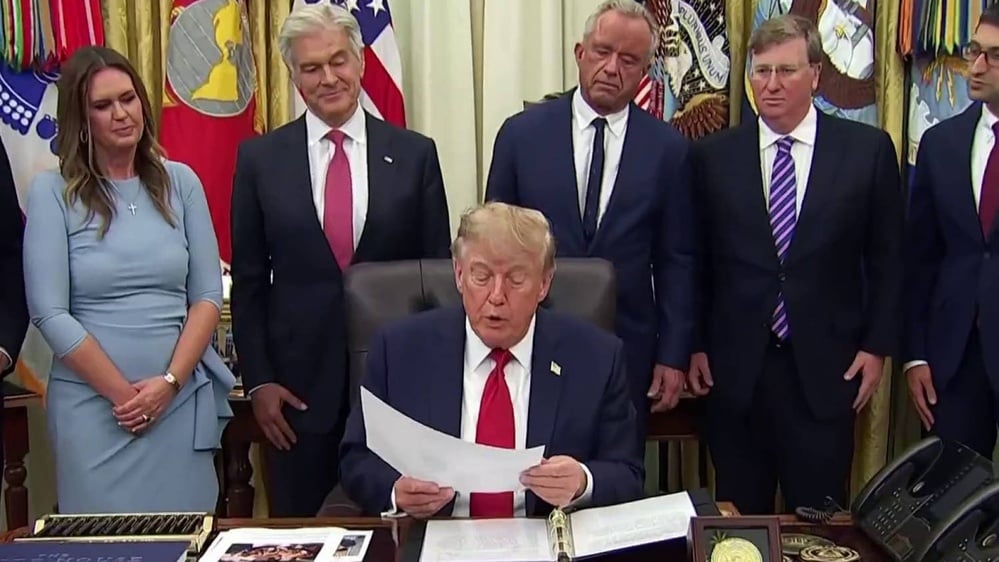
Frames the announced White House ban as a sharp escalation in the president's antagonism toward the press, while preserving attributed quotes from both Trump and CNN.
White House press access is administered through credentialing and workspace allocation controlled by the executive branch, so an announced exclusion of news outlets is a potentially significant First Amendment dispute.
Automated analysis; not human reviewed.
Limitations: The supplied text is truncated, includes promotional boilerplate, and leaves the second ownership reference blank, so the actual enforcement status of the ban and one ownership relationship remain unverified.
·
5 of 55 available dimensions scored; omitted dimensions are not treated as neutral.
·
Verified supporting quotes for 5 of 5 scored dimensions.
Claim: The article tilts mildly against a conservative president's press restrictions without taking an explicit partisan position.
“a sharp escalation in his antagonism toward the press” · exact text match
Counterevidence:
“President Donald Trump said on Friday that he was banning MS NOW, CNN, and Politico from the White House for their reporting on him” · exact text match
Why: The phrasing is a negative characterization of Trump's action, but both Trump and CNN are given direct quotes, keeping the lean modest.
Claim: The framing treats the White House press restriction as an unwarranted government move against the press.
“a sharp escalation in his antagonism toward the press” · exact text match
“CNN stands fully behind our White House team and their fair and accurate reporting.
We have a right under the U.S. Constitution to do that reporting without hindrance or interference from the government”
· exact text match
Why: The publisher's own phrase is critical, and the article prominently includes a constitutional-rights rebuttal, giving the story a libertarian-leaning cast.
Claim: The story is predominantly sourced and factual, with only a mild subjective overlay.
“President Donald Trump said on Friday that he was banning MS NOW, CNN, and Politico from the White House for their reporting on him” · exact text match
Counterevidence:
“a sharp escalation in his antagonism toward the press” · exact text match
Why: The lead is attributed and the article relies on quotation, but the 'sharp escalation' phrase is an evaluative interpolation.
Claim: The report is transparent about its sourcing and labels itself as updateable.
“This is a breaking news story and will be updated.” · exact text match
“a CNN spokesperson said in a statement” · exact text match
Why: The article's claims are traceable to named speakers and it flags the story's provisional status.
Claim: The article visibly separates direct quotes, attributed statements, and nonresponses, and does not present speculation as fact.
“a CNN spokesperson said in a statement” · exact text match
“MS NOW and Politico did not immediately respond to requests for comment sent on Friday.” · exact text match
Why: Attribution and nonresponse caveats are present, so the piece signals fairness and honesty.
The supplied text is truncated, includes promotional boilerplate, and leaves the second ownership reference blank, so the actual enforcement status of the ban and one ownership relationship remain unverified.
September 18, 2026 · 0 shares
Framing casts the White House outlet bans as an unconstitutional, authoritarian escalation, with press-freedom critics as the central credible voices.
Automated analysis; not human reviewed.
Limitations: No publication date or byline was supplied; the input appears to be an excerpt with formatting artifacts.
·
9 of 55 available dimensions scored; omitted dimensions are not treated as neutral.
·
Verified supporting quotes for 9 of 9 scored dimensions.
Claim: The report frames Trump's press restrictions as an unconstitutional assault on the press, using predominantly oppositional language.
“President has overseen an unprecedented restriction of access for major news media since start of second term” · exact text match
“In his latest attack on the US constitution’s first amendment and the press” · exact text match
Why: The phrasing and selected criticism place the report clearly on the liberal/opposition side of a partisan controversy.
Claim: The report defends press freedom and opposes government authority to exclude outlets.
“It is about the right of the American people to receive a full and independent account of the activities, policies and decisions of whoever occupies the nation’s highest office.” · exact text match
“The first amendment prohibits the president from punishing journalists because he doesn’t like their coverage” · exact text match
Why: The selected statements and surrounding narrative treat government control of press access as a violation of individual and public rights.
Claim: The report mixes neutral reporting with evaluative and emotional characterizations.
“In his latest attack on the US constitution’s first amendment and the press” · exact text match
“a chaotic news conference” · exact text match
Why: Words like 'attack' and 'chaotic' impose a subjective frame on otherwise reportable events.
Claim: The report includes evaluative editorial commentary alongside factual reporting.
“President has overseen an unprecedented restriction of access for major news media” · exact text match
“In his latest attack on the US constitution’s first amendment and the press” · exact text match
Why: These statements assert evaluative judgments rather than strictly neutral observation.
Claim: The report centers on a partisan conflict over constitutional rights and political criticism.
“Trump’s move drew swift condemnation from Democrats and free speech groups.” · exact text match
“That is the behavior of an authoritarian” · exact text match
Why: The article frames the story around Democratic and press-freedom objections to a presidential action, making it a politically charged report.
Claim: The report relies on institutional authorities and spokespeople to establish that the ban is unconstitutional.
“The White House press pool is a “public forum” under the first amendment, so the president cannot expel journalists from it on the basis of their viewpoints, said Jameel Jaffer” · exact text match
“In a statement, a spokesperson for CNN said” · exact text match
Why: The unconstitutionality claim is largely supported by expert and institutional statements rather than by independent legal analysis from the report itself.
Claim: The report's word choices convey a negative emotional response to the president's action.
“In his latest attack on the US constitution’s first amendment and the press” · exact text match
“a chaotic news conference” · exact text match
Why: Phrases such as 'attack' and 'chaotic' frame the events with alarm and disapproval.
Claim: The report uses named sources, direct quotes, and references to court proceedings.
“In a statement, a spokesperson for CNN said the network “stands fully behind our White House team and their fair and accurate reporting”.” · exact text match
“Jacqui Heinrich, president of the White House Correspondents’ Association (WHCA), said” · exact text match
Why: Visible attribution and direct quotation support credibility even though the framing is partisan.
Claim: The report grounds its criticism in legal reasoning and judicial outcomes rather than speculative claims.
“A federal judge later ruled the policy was unconstitutional.” · exact text match
“The first amendment prohibits the president from punishing journalists because he doesn’t like their coverage” · exact text match
Why: The narrative cites court rulings and constitutional arguments, though it applies them one-sidedly.
No publication date or byline was supplied; the input appears to be an excerpt with formatting artifacts.
September 19, 2026 · 0 shares
The framing attributes the ban to Trump's own statement, distances the report from his “fake news” label, and immediately highlights the action's legal uncertainty.
Automated analysis; not human reviewed. Limitations: Only a three-sentence excerpt was supplied, limiting confidence in broader editorial-pattern judgments.
Only a three-sentence excerpt was supplied, limiting confidence in broader editorial-pattern judgments.
September 19, 2026 · 0 shares
Framing foregrounds a First Amendment clash, with the ban presented through Trump's 'fake news' accusation and the targeted outlets' constitutional defenses, while the prose remains attributed and noncommittal.
Automated analysis; not human reviewed.
Limitations: The supplied text renders one outlet as 'MS NOW,' which is ambiguous or likely a typo; the analysis uses the article text as provided.
·
3 of 55 available dimensions scored; omitted dimensions are not treated as neutral.
·
Verified supporting quotes for 1 of 3 scored dimensions.
Claim: The report is neutral on a left-right spectrum: it attributes both the president's rationale and the affected outlets' First Amendment objections without endorsing either.
“"The ban is because they are fake news.
What they write is very bad," Trump said.”
· not found in supplied text
“"Should the ban which President Trump threatened go ahead, it would be an illegal assault on that fundamental and constitutionally protected right," the network said.” · not found in supplied text
Why: Trump's accusation and the outlets' rebuttals are both presented as attributed statements, and the publisher adds no partisan evaluation.
Claim: The story is written in a detached news style with direct quotations and no subjective commentary.
“President Donald Trump announced Friday that he is banning three major news outlets from the White House.” · exact text match
“In a post on Truth Social, Trump said CNN, MS NOW and Politico are subject to the ban, accusing them of reporting "fake news."” · not found in supplied text
Why: The report is composed of attributed announcements, quoted reactions, and one named-correspondent observation rather than personal judgment.
Claim: The article shows clear attribution and careful epistemic limitations.
“Despite Trump's announcement, Scripps News senior White House correspondent Haley Bull reported that CNN staff remained on the White House grounds as of Friday afternoon.” · exact text match
Why: It names the reporter, includes exact attribution to Trump, CNN, and Politico, and qualifies the enforcement status by noting staff remained on site.
The supplied text renders one outlet as 'MS NOW,' which is ambiguous or likely a typo; the analysis uses the article text as provided.
September 18, 2026 · 0 shares
Reporting frames the threatened White House press ban as punitive and constitutionally unacceptable, with the overwhelming weight of quoted reaction coming from critics.
Automated analysis; not human reviewed.
Limitations: The supplied text lacks an absolute publication date, so the timing references ('Friday,' 'earlier in September') cannot be anchored independently.
·
3 of 55 available dimensions scored; omitted dimensions are not treated as neutral.
·
Verified supporting quotes for 3 of 3 scored dimensions.
Claim: The publisher's framing characterizes the announcement as retaliation for unfavorable coverage and reports it alongside overwhelmingly negative critical reactions.
“The move is the latest in Trump’s ongoing efforts to punish news organizations and broadcasters for their coverage.” · exact text match
“Friday’s bans come as Trump’s approval ratings have sagged and with Democrats gaining a polling edge in many pivotal midterm races that could see Republicans lose control of Congress.” · exact text match
Why: The unqualified phrase 'ongoing efforts to punish' assigns a punitive motive, and the midterm context links the action to Trump's political weakness, a framing consistent with left-of-center criticism.
Claim: The report is mostly factual and attributed, but includes an unqualified evaluative characterization of presidential motive.
“The move is the latest in Trump’s ongoing efforts to punish news organizations and broadcasters for their coverage.” · exact text match
Why: Describing the action as 'efforts to punish' states a motive as fact rather than attributing it to critics.
Claim: The report demonstrates strong sourcing and precision about the status of the threatened ban.
“As of Friday afternoon, reporters from those three outlets were still at the White House.” · exact text match
“Trump also warned “other outlets” would “follow” but did not specify which.” · exact text match
Why: The publisher distinguishes what Trump said from what had actually happened, and notes when the administration did not specify details.
The supplied text lacks an absolute publication date, so the timing references ('Friday,' 'earlier in September') cannot be anchored independently.
September 18, 2026 · 0 shares
Framing casts the White House outlet bans as an unconstitutional, authoritarian escalation, with press-freedom critics as the central credible voices.
Automated analysis; not human reviewed.
Limitations: No publication date or byline was supplied; the input appears to be an excerpt with formatting artifacts.
·
9 of 55 available dimensions scored; omitted dimensions are not treated as neutral.
·
Verified supporting quotes for 9 of 9 scored dimensions.
Claim: The report frames Trump's press restrictions as an unconstitutional assault on the press, using predominantly oppositional language.
“President has overseen an unprecedented restriction of access for major news media since start of second term” · exact text match
“In his latest attack on the US constitution’s first amendment and the press” · exact text match
Why: The phrasing and selected criticism place the report clearly on the liberal/opposition side of a partisan controversy.
Claim: The report defends press freedom and opposes government authority to exclude outlets.
“It is about the right of the American people to receive a full and independent account of the activities, policies and decisions of whoever occupies the nation’s highest office.” · exact text match
“The first amendment prohibits the president from punishing journalists because he doesn’t like their coverage” · exact text match
Why: The selected statements and surrounding narrative treat government control of press access as a violation of individual and public rights.
Claim: The report mixes neutral reporting with evaluative and emotional characterizations.
“In his latest attack on the US constitution’s first amendment and the press” · exact text match
“a chaotic news conference” · exact text match
Why: Words like 'attack' and 'chaotic' impose a subjective frame on otherwise reportable events.
Claim: The report includes evaluative editorial commentary alongside factual reporting.
“President has overseen an unprecedented restriction of access for major news media” · exact text match
“In his latest attack on the US constitution’s first amendment and the press” · exact text match
Why: These statements assert evaluative judgments rather than strictly neutral observation.
Claim: The report centers on a partisan conflict over constitutional rights and political criticism.
“Trump’s move drew swift condemnation from Democrats and free speech groups.” · exact text match
“That is the behavior of an authoritarian” · exact text match
Why: The article frames the story around Democratic and press-freedom objections to a presidential action, making it a politically charged report.
Claim: The report relies on institutional authorities and spokespeople to establish that the ban is unconstitutional.
“The White House press pool is a “public forum” under the first amendment, so the president cannot expel journalists from it on the basis of their viewpoints, said Jameel Jaffer” · exact text match
“In a statement, a spokesperson for CNN said” · exact text match
Why: The unconstitutionality claim is largely supported by expert and institutional statements rather than by independent legal analysis from the report itself.
Claim: The report's word choices convey a negative emotional response to the president's action.
“In his latest attack on the US constitution’s first amendment and the press” · exact text match
“a chaotic news conference” · exact text match
Why: Phrases such as 'attack' and 'chaotic' frame the events with alarm and disapproval.
Claim: The report uses named sources, direct quotes, and references to court proceedings.
“In a statement, a spokesperson for CNN said the network “stands fully behind our White House team and their fair and accurate reporting”.” · exact text match
“Jacqui Heinrich, president of the White House Correspondents’ Association (WHCA), said” · exact text match
Why: Visible attribution and direct quotation support credibility even though the framing is partisan.
Claim: The report grounds its criticism in legal reasoning and judicial outcomes rather than speculative claims.
“A federal judge later ruled the policy was unconstitutional.” · exact text match
“The first amendment prohibits the president from punishing journalists because he doesn’t like their coverage” · exact text match
Why: The narrative cites court rulings and constitutional arguments, though it applies them one-sidedly.
No publication date or byline was supplied; the input appears to be an excerpt with formatting artifacts.
September 19, 2026 · 0 shares
The framing attributes the ban to Trump's own statement, distances the report from his “fake news” label, and immediately highlights the action's legal uncertainty.
Automated analysis; not human reviewed. Limitations: Only a three-sentence excerpt was supplied, limiting confidence in broader editorial-pattern judgments.
Only a three-sentence excerpt was supplied, limiting confidence in broader editorial-pattern judgments.
September 18, 2026 · 0 shares
Neutral, attributed reporting that treats Trump’s announced ban as a First Amendment test and contextualizes it with past press restrictions.
Automated analysis; not human reviewed.
Limitations: The supplied text is a short brief mixed with unrelated promotional blocks; no named reporter byline is present, and 'MS NOW' appears to be an uncorrected typo.
·
10 of 55 available dimensions scored; omitted dimensions are not treated as neutral.
·
Verified supporting quotes for 10 of 10 scored dimensions.
Claim: No partisan preference is expressed; the report attributes the announcement and notes context on both sides.
“President Donald Trump has said he is banning three major news organisations, CNN, MS NOW and Politico, from the White House with immediate effect” · exact text match
“While it is extremely rare for a US president to bar an entire news organisation from the White House, previous administrations have also imposed restrictions on individual outlets.” · exact text match
Why: The lead is attributed, and the historical note balances the novel action against earlier restrictions, so no clear left-right leaning is visible.
Claim: The framing leans toward press freedom by treating the ban as a First Amendment issue and stressing rarity.
“The move is the latest test of First Amendment protections guaranteeing freedom of the press in the United States.” · exact text match
“While it is extremely rare for a US president to bar an entire news organisation from the White House, previous administrations have also imposed restrictions on individual outlets.” · exact text match
Why: The article selects press-freedom framing and notes the rarity of full outlet bans rather than deferring to the administration’s access controls.
Claim: Reporting is largely objective, attributing claims and flagging unknowns.
“President Donald Trump has said he is banning three major news organisations, CNN, MS NOW and Politico, from the White House with immediate effect” · exact text match
“It is not yet clear what the ban will entail.” · exact text match
Why: The central claim is attributed to Trump and the article explicitly states what is unknown, avoiding subjective interpretation.
Claim: Mostly straightforward reporting, with only mildly confrontational wording in the headline.
“Trump threatens to ban CNN, MS NOW and Politico from the White House” · exact text match
“President Donald Trump has said he is banning three major news organisations, CNN, MS NOW and Politico, from the White House with immediate effect” · exact text match
Why: The body uses neutral attributed phrasing, but the word 'threatens' in the headline adds a slight confrontational gloss.
Claim: The article is descriptive, not prescriptive.
“It is also the latest move by Trump’s second administration to restrict press access.” · exact text match
“He has already tightened controls over which journalists can join the White House press pool, the small group of reporters who accompany the president into restricted spaces such as the Oval Office and aboard Air Force One.” · exact text match
Why: The piece narrates events and context without recommending what should be done.
Claim: The report is factual and non-opinionated.
“President Donald Trump has said he is banning three major news organisations, CNN, MS NOW and Politico, from the White House with immediate effect” · exact text match
“It is not yet clear what the ban will entail.” · exact text match
Why: The article describes statements and open questions rather than arguing for or against the ban.
Claim: Visible sourcing and attribution are strong for a brief news item.
“President Donald Trump has said he is banning three major news organisations, CNN, MS NOW and Politico, from the White House with immediate effect” · exact text match
“In a post on his Truth Social platform on Friday, the president said the three outlets “constantly write or report fiction and lies” about his administration, although he provided no specific examples.” · exact text match
Why: The central claim is traced to Trump and his Truth Social post, while the lack of examples is noted rather than hidden.
Claim: The report reasons with historical context and defined terms rather than alarm or assertion.
“He has already tightened controls over which journalists can join the White House press pool, the small group of reporters who accompany the president into restricted spaces such as the Oval Office and aboard Air Force One.” · exact text match
“While it is extremely rare for a US president to bar an entire news organisation from the White House, previous administrations have also imposed restrictions on individual outlets.” · exact text match
Why: The explanation of the press pool and the historical comparison are measured, contextual reasoning.
Claim: The report is transparent about attribution and uncertainty.
“President Donald Trump has said he is banning three major news organisations, CNN, MS NOW and Politico, from the White House with immediate effect” · exact text match
“It is not yet clear what the ban will entail.” · exact text match
Why: It attributes the ban to Trump and separately notes the uncertainty about its scope, a visible honesty signal.
Claim: The piece integrates relevant background and definitions into a concise brief.
“He has already tightened controls over which journalists can join the White House press pool, the small group of reporters who accompany the president into restricted spaces such as the Oval Office and aboard Air Force One.” · exact text match
“While it is extremely rare for a US president to bar an entire news organisation from the White House, previous administrations have also imposed restrictions on individual outlets.” · exact text match
Why: It supplies the press-pool definition and a historical comparison, giving useful context beyond the bare announcement.
The supplied text is a short brief mixed with unrelated promotional blocks; no named reporter byline is present, and 'MS NOW' appears to be an uncorrected typo.
September 19, 2026 · 0 shares
Framing foregrounds a First Amendment clash, with the ban presented through Trump's 'fake news' accusation and the targeted outlets' constitutional defenses, while the prose remains attributed and noncommittal.
Automated analysis; not human reviewed.
Limitations: The supplied text renders one outlet as 'MS NOW,' which is ambiguous or likely a typo; the analysis uses the article text as provided.
·
3 of 55 available dimensions scored; omitted dimensions are not treated as neutral.
·
Verified supporting quotes for 1 of 3 scored dimensions.
Claim: The report is neutral on a left-right spectrum: it attributes both the president's rationale and the affected outlets' First Amendment objections without endorsing either.
“"The ban is because they are fake news.
What they write is very bad," Trump said.”
· not found in supplied text
“"Should the ban which President Trump threatened go ahead, it would be an illegal assault on that fundamental and constitutionally protected right," the network said.” · not found in supplied text
Why: Trump's accusation and the outlets' rebuttals are both presented as attributed statements, and the publisher adds no partisan evaluation.
Claim: The story is written in a detached news style with direct quotations and no subjective commentary.
“President Donald Trump announced Friday that he is banning three major news outlets from the White House.” · exact text match
“In a post on Truth Social, Trump said CNN, MS NOW and Politico are subject to the ban, accusing them of reporting "fake news."” · not found in supplied text
Why: The report is composed of attributed announcements, quoted reactions, and one named-correspondent observation rather than personal judgment.
Claim: The article shows clear attribution and careful epistemic limitations.
“Despite Trump's announcement, Scripps News senior White House correspondent Haley Bull reported that CNN staff remained on the White House grounds as of Friday afternoon.” · exact text match
Why: It names the reporter, includes exact attribution to Trump, CNN, and Politico, and qualifies the enforcement status by noting staff remained on site.
The supplied text renders one outlet as 'MS NOW,' which is ambiguous or likely a typo; the analysis uses the article text as provided.
September 18, 2026 · 0 shares
Reporting frames the threatened White House press ban as punitive and constitutionally unacceptable, with the overwhelming weight of quoted reaction coming from critics.
Automated analysis; not human reviewed.
Limitations: The supplied text lacks an absolute publication date, so the timing references ('Friday,' 'earlier in September') cannot be anchored independently.
·
3 of 55 available dimensions scored; omitted dimensions are not treated as neutral.
·
Verified supporting quotes for 3 of 3 scored dimensions.
Claim: The publisher's framing characterizes the announcement as retaliation for unfavorable coverage and reports it alongside overwhelmingly negative critical reactions.
“The move is the latest in Trump’s ongoing efforts to punish news organizations and broadcasters for their coverage.” · exact text match
“Friday’s bans come as Trump’s approval ratings have sagged and with Democrats gaining a polling edge in many pivotal midterm races that could see Republicans lose control of Congress.” · exact text match
Why: The unqualified phrase 'ongoing efforts to punish' assigns a punitive motive, and the midterm context links the action to Trump's political weakness, a framing consistent with left-of-center criticism.
Claim: The report is mostly factual and attributed, but includes an unqualified evaluative characterization of presidential motive.
“The move is the latest in Trump’s ongoing efforts to punish news organizations and broadcasters for their coverage.” · exact text match
Why: Describing the action as 'efforts to punish' states a motive as fact rather than attributing it to critics.
Claim: The report demonstrates strong sourcing and precision about the status of the threatened ban.
“As of Friday afternoon, reporters from those three outlets were still at the White House.” · exact text match
“Trump also warned “other outlets” would “follow” but did not specify which.” · exact text match
Why: The publisher distinguishes what Trump said from what had actually happened, and notes when the administration did not specify details.
The supplied text lacks an absolute publication date, so the timing references ('Friday,' 'earlier in September') cannot be anchored independently.
September 18, 2026 · 0 shares
Frames the announced White House ban as a sharp escalation in the president's antagonism toward the press, while preserving attributed quotes from both Trump and CNN.
White House press access is administered through credentialing and workspace allocation controlled by the executive branch, so an announced exclusion of news outlets is a potentially significant First Amendment dispute.
Automated analysis; not human reviewed.
Limitations: The supplied text is truncated, includes promotional boilerplate, and leaves the second ownership reference blank, so the actual enforcement status of the ban and one ownership relationship remain unverified.
·
5 of 55 available dimensions scored; omitted dimensions are not treated as neutral.
·
Verified supporting quotes for 5 of 5 scored dimensions.
Claim: The article tilts mildly against a conservative president's press restrictions without taking an explicit partisan position.
“a sharp escalation in his antagonism toward the press” · exact text match
Counterevidence:
“President Donald Trump said on Friday that he was banning MS NOW, CNN, and Politico from the White House for their reporting on him” · exact text match
Why: The phrasing is a negative characterization of Trump's action, but both Trump and CNN are given direct quotes, keeping the lean modest.
Claim: The framing treats the White House press restriction as an unwarranted government move against the press.
“a sharp escalation in his antagonism toward the press” · exact text match
“CNN stands fully behind our White House team and their fair and accurate reporting.
We have a right under the U.S. Constitution to do that reporting without hindrance or interference from the government”
· exact text match
Why: The publisher's own phrase is critical, and the article prominently includes a constitutional-rights rebuttal, giving the story a libertarian-leaning cast.
Claim: The story is predominantly sourced and factual, with only a mild subjective overlay.
“President Donald Trump said on Friday that he was banning MS NOW, CNN, and Politico from the White House for their reporting on him” · exact text match
Counterevidence:
“a sharp escalation in his antagonism toward the press” · exact text match
Why: The lead is attributed and the article relies on quotation, but the 'sharp escalation' phrase is an evaluative interpolation.
Claim: The report is transparent about its sourcing and labels itself as updateable.
“This is a breaking news story and will be updated.” · exact text match
“a CNN spokesperson said in a statement” · exact text match
Why: The article's claims are traceable to named speakers and it flags the story's provisional status.
Claim: The article visibly separates direct quotes, attributed statements, and nonresponses, and does not present speculation as fact.
“a CNN spokesperson said in a statement” · exact text match
“MS NOW and Politico did not immediately respond to requests for comment sent on Friday.” · exact text match
Why: Attribution and nonresponse caveats are present, so the piece signals fairness and honesty.
The supplied text is truncated, includes promotional boilerplate, and leaves the second ownership reference blank, so the actual enforcement status of the ban and one ownership relationship remain unverified.
September 19, 2026 · 0 shares
Framing foregrounds a First Amendment clash, with the ban presented through Trump's 'fake news' accusation and the targeted outlets' constitutional defenses, while the prose remains attributed and noncommittal.
Automated analysis; not human reviewed.
Limitations: The supplied text renders one outlet as 'MS NOW,' which is ambiguous or likely a typo; the analysis uses the article text as provided.
·
3 of 55 available dimensions scored; omitted dimensions are not treated as neutral.
·
Verified supporting quotes for 1 of 3 scored dimensions.
Claim: The report is neutral on a left-right spectrum: it attributes both the president's rationale and the affected outlets' First Amendment objections without endorsing either.
“"The ban is because they are fake news.
What they write is very bad," Trump said.”
· not found in supplied text
“"Should the ban which President Trump threatened go ahead, it would be an illegal assault on that fundamental and constitutionally protected right," the network said.” · not found in supplied text
Why: Trump's accusation and the outlets' rebuttals are both presented as attributed statements, and the publisher adds no partisan evaluation.
Claim: The story is written in a detached news style with direct quotations and no subjective commentary.
“President Donald Trump announced Friday that he is banning three major news outlets from the White House.” · exact text match
“In a post on Truth Social, Trump said CNN, MS NOW and Politico are subject to the ban, accusing them of reporting "fake news."” · not found in supplied text
Why: The report is composed of attributed announcements, quoted reactions, and one named-correspondent observation rather than personal judgment.
Claim: The article shows clear attribution and careful epistemic limitations.
“Despite Trump's announcement, Scripps News senior White House correspondent Haley Bull reported that CNN staff remained on the White House grounds as of Friday afternoon.” · exact text match
Why: It names the reporter, includes exact attribution to Trump, CNN, and Politico, and qualifies the enforcement status by noting staff remained on site.
The supplied text renders one outlet as 'MS NOW,' which is ambiguous or likely a typo; the analysis uses the article text as provided.
September 18, 2026 · 0 shares
Framing casts the White House outlet bans as an unconstitutional, authoritarian escalation, with press-freedom critics as the central credible voices.
Automated analysis; not human reviewed.
Limitations: No publication date or byline was supplied; the input appears to be an excerpt with formatting artifacts.
·
9 of 55 available dimensions scored; omitted dimensions are not treated as neutral.
·
Verified supporting quotes for 9 of 9 scored dimensions.
Claim: The report frames Trump's press restrictions as an unconstitutional assault on the press, using predominantly oppositional language.
“President has overseen an unprecedented restriction of access for major news media since start of second term” · exact text match
“In his latest attack on the US constitution’s first amendment and the press” · exact text match
Why: The phrasing and selected criticism place the report clearly on the liberal/opposition side of a partisan controversy.
Claim: The report defends press freedom and opposes government authority to exclude outlets.
“It is about the right of the American people to receive a full and independent account of the activities, policies and decisions of whoever occupies the nation’s highest office.” · exact text match
“The first amendment prohibits the president from punishing journalists because he doesn’t like their coverage” · exact text match
Why: The selected statements and surrounding narrative treat government control of press access as a violation of individual and public rights.
Claim: The report mixes neutral reporting with evaluative and emotional characterizations.
“In his latest attack on the US constitution’s first amendment and the press” · exact text match
“a chaotic news conference” · exact text match
Why: Words like 'attack' and 'chaotic' impose a subjective frame on otherwise reportable events.
Claim: The report includes evaluative editorial commentary alongside factual reporting.
“President has overseen an unprecedented restriction of access for major news media” · exact text match
“In his latest attack on the US constitution’s first amendment and the press” · exact text match
Why: These statements assert evaluative judgments rather than strictly neutral observation.
Claim: The report centers on a partisan conflict over constitutional rights and political criticism.
“Trump’s move drew swift condemnation from Democrats and free speech groups.” · exact text match
“That is the behavior of an authoritarian” · exact text match
Why: The article frames the story around Democratic and press-freedom objections to a presidential action, making it a politically charged report.
Claim: The report relies on institutional authorities and spokespeople to establish that the ban is unconstitutional.
“The White House press pool is a “public forum” under the first amendment, so the president cannot expel journalists from it on the basis of their viewpoints, said Jameel Jaffer” · exact text match
“In a statement, a spokesperson for CNN said” · exact text match
Why: The unconstitutionality claim is largely supported by expert and institutional statements rather than by independent legal analysis from the report itself.
Claim: The report's word choices convey a negative emotional response to the president's action.
“In his latest attack on the US constitution’s first amendment and the press” · exact text match
“a chaotic news conference” · exact text match
Why: Phrases such as 'attack' and 'chaotic' frame the events with alarm and disapproval.
Claim: The report uses named sources, direct quotes, and references to court proceedings.
“In a statement, a spokesperson for CNN said the network “stands fully behind our White House team and their fair and accurate reporting”.” · exact text match
“Jacqui Heinrich, president of the White House Correspondents’ Association (WHCA), said” · exact text match
Why: Visible attribution and direct quotation support credibility even though the framing is partisan.
Claim: The report grounds its criticism in legal reasoning and judicial outcomes rather than speculative claims.
“A federal judge later ruled the policy was unconstitutional.” · exact text match
“The first amendment prohibits the president from punishing journalists because he doesn’t like their coverage” · exact text match
Why: The narrative cites court rulings and constitutional arguments, though it applies them one-sidedly.
No publication date or byline was supplied; the input appears to be an excerpt with formatting artifacts.
September 18, 2026 · 0 shares
Neutral, attributed reporting that treats Trump’s announced ban as a First Amendment test and contextualizes it with past press restrictions.
Automated analysis; not human reviewed.
Limitations: The supplied text is a short brief mixed with unrelated promotional blocks; no named reporter byline is present, and 'MS NOW' appears to be an uncorrected typo.
·
10 of 55 available dimensions scored; omitted dimensions are not treated as neutral.
·
Verified supporting quotes for 10 of 10 scored dimensions.
Claim: No partisan preference is expressed; the report attributes the announcement and notes context on both sides.
“President Donald Trump has said he is banning three major news organisations, CNN, MS NOW and Politico, from the White House with immediate effect” · exact text match
“While it is extremely rare for a US president to bar an entire news organisation from the White House, previous administrations have also imposed restrictions on individual outlets.” · exact text match
Why: The lead is attributed, and the historical note balances the novel action against earlier restrictions, so no clear left-right leaning is visible.
Claim: The framing leans toward press freedom by treating the ban as a First Amendment issue and stressing rarity.
“The move is the latest test of First Amendment protections guaranteeing freedom of the press in the United States.” · exact text match
“While it is extremely rare for a US president to bar an entire news organisation from the White House, previous administrations have also imposed restrictions on individual outlets.” · exact text match
Why: The article selects press-freedom framing and notes the rarity of full outlet bans rather than deferring to the administration’s access controls.
Claim: Reporting is largely objective, attributing claims and flagging unknowns.
“President Donald Trump has said he is banning three major news organisations, CNN, MS NOW and Politico, from the White House with immediate effect” · exact text match
“It is not yet clear what the ban will entail.” · exact text match
Why: The central claim is attributed to Trump and the article explicitly states what is unknown, avoiding subjective interpretation.
Claim: Mostly straightforward reporting, with only mildly confrontational wording in the headline.
“Trump threatens to ban CNN, MS NOW and Politico from the White House” · exact text match
“President Donald Trump has said he is banning three major news organisations, CNN, MS NOW and Politico, from the White House with immediate effect” · exact text match
Why: The body uses neutral attributed phrasing, but the word 'threatens' in the headline adds a slight confrontational gloss.
Claim: The article is descriptive, not prescriptive.
“It is also the latest move by Trump’s second administration to restrict press access.” · exact text match
“He has already tightened controls over which journalists can join the White House press pool, the small group of reporters who accompany the president into restricted spaces such as the Oval Office and aboard Air Force One.” · exact text match
Why: The piece narrates events and context without recommending what should be done.
Claim: The report is factual and non-opinionated.
“President Donald Trump has said he is banning three major news organisations, CNN, MS NOW and Politico, from the White House with immediate effect” · exact text match
“It is not yet clear what the ban will entail.” · exact text match
Why: The article describes statements and open questions rather than arguing for or against the ban.
Claim: Visible sourcing and attribution are strong for a brief news item.
“President Donald Trump has said he is banning three major news organisations, CNN, MS NOW and Politico, from the White House with immediate effect” · exact text match
“In a post on his Truth Social platform on Friday, the president said the three outlets “constantly write or report fiction and lies” about his administration, although he provided no specific examples.” · exact text match
Why: The central claim is traced to Trump and his Truth Social post, while the lack of examples is noted rather than hidden.
Claim: The report reasons with historical context and defined terms rather than alarm or assertion.
“He has already tightened controls over which journalists can join the White House press pool, the small group of reporters who accompany the president into restricted spaces such as the Oval Office and aboard Air Force One.” · exact text match
“While it is extremely rare for a US president to bar an entire news organisation from the White House, previous administrations have also imposed restrictions on individual outlets.” · exact text match
Why: The explanation of the press pool and the historical comparison are measured, contextual reasoning.
Claim: The report is transparent about attribution and uncertainty.
“President Donald Trump has said he is banning three major news organisations, CNN, MS NOW and Politico, from the White House with immediate effect” · exact text match
“It is not yet clear what the ban will entail.” · exact text match
Why: It attributes the ban to Trump and separately notes the uncertainty about its scope, a visible honesty signal.
Claim: The piece integrates relevant background and definitions into a concise brief.
“He has already tightened controls over which journalists can join the White House press pool, the small group of reporters who accompany the president into restricted spaces such as the Oval Office and aboard Air Force One.” · exact text match
“While it is extremely rare for a US president to bar an entire news organisation from the White House, previous administrations have also imposed restrictions on individual outlets.” · exact text match
Why: It supplies the press-pool definition and a historical comparison, giving useful context beyond the bare announcement.
The supplied text is a short brief mixed with unrelated promotional blocks; no named reporter byline is present, and 'MS NOW' appears to be an uncorrected typo.
September 18, 2026 · 0 shares
Framing casts the White House outlet bans as an unconstitutional, authoritarian escalation, with press-freedom critics as the central credible voices.
Automated analysis; not human reviewed.
Limitations: No publication date or byline was supplied; the input appears to be an excerpt with formatting artifacts.
·
9 of 55 available dimensions scored; omitted dimensions are not treated as neutral.
·
Verified supporting quotes for 9 of 9 scored dimensions.
Claim: The report frames Trump's press restrictions as an unconstitutional assault on the press, using predominantly oppositional language.
“President has overseen an unprecedented restriction of access for major news media since start of second term” · exact text match
“In his latest attack on the US constitution’s first amendment and the press” · exact text match
Why: The phrasing and selected criticism place the report clearly on the liberal/opposition side of a partisan controversy.
Claim: The report defends press freedom and opposes government authority to exclude outlets.
“It is about the right of the American people to receive a full and independent account of the activities, policies and decisions of whoever occupies the nation’s highest office.” · exact text match
“The first amendment prohibits the president from punishing journalists because he doesn’t like their coverage” · exact text match
Why: The selected statements and surrounding narrative treat government control of press access as a violation of individual and public rights.
Claim: The report mixes neutral reporting with evaluative and emotional characterizations.
“In his latest attack on the US constitution’s first amendment and the press” · exact text match
“a chaotic news conference” · exact text match
Why: Words like 'attack' and 'chaotic' impose a subjective frame on otherwise reportable events.
Claim: The report includes evaluative editorial commentary alongside factual reporting.
“President has overseen an unprecedented restriction of access for major news media” · exact text match
“In his latest attack on the US constitution’s first amendment and the press” · exact text match
Why: These statements assert evaluative judgments rather than strictly neutral observation.
Claim: The report centers on a partisan conflict over constitutional rights and political criticism.
“Trump’s move drew swift condemnation from Democrats and free speech groups.” · exact text match
“That is the behavior of an authoritarian” · exact text match
Why: The article frames the story around Democratic and press-freedom objections to a presidential action, making it a politically charged report.
Claim: The report relies on institutional authorities and spokespeople to establish that the ban is unconstitutional.
“The White House press pool is a “public forum” under the first amendment, so the president cannot expel journalists from it on the basis of their viewpoints, said Jameel Jaffer” · exact text match
“In a statement, a spokesperson for CNN said” · exact text match
Why: The unconstitutionality claim is largely supported by expert and institutional statements rather than by independent legal analysis from the report itself.
Claim: The report's word choices convey a negative emotional response to the president's action.
“In his latest attack on the US constitution’s first amendment and the press” · exact text match
“a chaotic news conference” · exact text match
Why: Phrases such as 'attack' and 'chaotic' frame the events with alarm and disapproval.
Claim: The report uses named sources, direct quotes, and references to court proceedings.
“In a statement, a spokesperson for CNN said the network “stands fully behind our White House team and their fair and accurate reporting”.” · exact text match
“Jacqui Heinrich, president of the White House Correspondents’ Association (WHCA), said” · exact text match
Why: Visible attribution and direct quotation support credibility even though the framing is partisan.
Claim: The report grounds its criticism in legal reasoning and judicial outcomes rather than speculative claims.
“A federal judge later ruled the policy was unconstitutional.” · exact text match
“The first amendment prohibits the president from punishing journalists because he doesn’t like their coverage” · exact text match
Why: The narrative cites court rulings and constitutional arguments, though it applies them one-sidedly.
No publication date or byline was supplied; the input appears to be an excerpt with formatting artifacts.
September 18, 2026 · 0 shares
Reporting frames the threatened White House press ban as punitive and constitutionally unacceptable, with the overwhelming weight of quoted reaction coming from critics.
Automated analysis; not human reviewed.
Limitations: The supplied text lacks an absolute publication date, so the timing references ('Friday,' 'earlier in September') cannot be anchored independently.
·
3 of 55 available dimensions scored; omitted dimensions are not treated as neutral.
·
Verified supporting quotes for 3 of 3 scored dimensions.
Claim: The publisher's framing characterizes the announcement as retaliation for unfavorable coverage and reports it alongside overwhelmingly negative critical reactions.
“The move is the latest in Trump’s ongoing efforts to punish news organizations and broadcasters for their coverage.” · exact text match
“Friday’s bans come as Trump’s approval ratings have sagged and with Democrats gaining a polling edge in many pivotal midterm races that could see Republicans lose control of Congress.” · exact text match
Why: The unqualified phrase 'ongoing efforts to punish' assigns a punitive motive, and the midterm context links the action to Trump's political weakness, a framing consistent with left-of-center criticism.
Claim: The report is mostly factual and attributed, but includes an unqualified evaluative characterization of presidential motive.
“The move is the latest in Trump’s ongoing efforts to punish news organizations and broadcasters for their coverage.” · exact text match
Why: Describing the action as 'efforts to punish' states a motive as fact rather than attributing it to critics.
Claim: The report demonstrates strong sourcing and precision about the status of the threatened ban.
“As of Friday afternoon, reporters from those three outlets were still at the White House.” · exact text match
“Trump also warned “other outlets” would “follow” but did not specify which.” · exact text match
Why: The publisher distinguishes what Trump said from what had actually happened, and notes when the administration did not specify details.
The supplied text lacks an absolute publication date, so the timing references ('Friday,' 'earlier in September') cannot be anchored independently.
September 18, 2026 · 0 shares
Frames the announced White House ban as a sharp escalation in the president's antagonism toward the press, while preserving attributed quotes from both Trump and CNN.
White House press access is administered through credentialing and workspace allocation controlled by the executive branch, so an announced exclusion of news outlets is a potentially significant First Amendment dispute.
Automated analysis; not human reviewed. Limitations: The supplied text is truncated, includes promotional boilerplate, and leaves the second ownership reference blank, so the actual enforcement status of the ban and one ownership relationship remain unverified. · 5 of 55 available dimensions scored; omitted dimensions are not treated as neutral. · Verified supporting quotes for 5 of 5 scored dimensions.
Claim: The article tilts mildly against a conservative president's press restrictions without taking an explicit partisan position.
“a sharp escalation in his antagonism toward the press” · exact text match
Counterevidence:
“President Donald Trump said on Friday that he was banning MS NOW, CNN, and Politico from the White House for their reporting on him” · exact text match
Why: The phrasing is a negative characterization of Trump's action, but both Trump and CNN are given direct quotes, keeping the lean modest.
Claim: The framing treats the White House press restriction as an unwarranted government move against the press.
“a sharp escalation in his antagonism toward the press” · exact text match
“CNN stands fully behind our White House team and their fair and accurate reporting. We have a right under the U.S. Constitution to do that reporting without hindrance or interference from the government” · exact text match
Why: The publisher's own phrase is critical, and the article prominently includes a constitutional-rights rebuttal, giving the story a libertarian-leaning cast.
Claim: The story is predominantly sourced and factual, with only a mild subjective overlay.
“President Donald Trump said on Friday that he was banning MS NOW, CNN, and Politico from the White House for their reporting on him” · exact text match
Counterevidence:
“a sharp escalation in his antagonism toward the press” · exact text match
Why: The lead is attributed and the article relies on quotation, but the 'sharp escalation' phrase is an evaluative interpolation.
Claim: The report is transparent about its sourcing and labels itself as updateable.
“This is a breaking news story and will be updated.” · exact text match
“a CNN spokesperson said in a statement” · exact text match
Why: The article's claims are traceable to named speakers and it flags the story's provisional status.
Claim: The article visibly separates direct quotes, attributed statements, and nonresponses, and does not present speculation as fact.
“a CNN spokesperson said in a statement” · exact text match
“MS NOW and Politico did not immediately respond to requests for comment sent on Friday.” · exact text match
Why: Attribution and nonresponse caveats are present, so the piece signals fairness and honesty.
The supplied text is truncated, includes promotional boilerplate, and leaves the second ownership reference blank, so the actual enforcement status of the ban and one ownership relationship remain unverified.
September 18, 2026 · 0 shares
Framing casts the White House outlet bans as an unconstitutional, authoritarian escalation, with press-freedom critics as the central credible voices.
Automated analysis; not human reviewed. Limitations: No publication date or byline was supplied; the input appears to be an excerpt with formatting artifacts. · 9 of 55 available dimensions scored; omitted dimensions are not treated as neutral. · Verified supporting quotes for 9 of 9 scored dimensions.
Claim: The report frames Trump's press restrictions as an unconstitutional assault on the press, using predominantly oppositional language.
“President has overseen an unprecedented restriction of access for major news media since start of second term” · exact text match
“In his latest attack on the US constitution’s first amendment and the press” · exact text match
Why: The phrasing and selected criticism place the report clearly on the liberal/opposition side of a partisan controversy.
Claim: The report defends press freedom and opposes government authority to exclude outlets.
“It is about the right of the American people to receive a full and independent account of the activities, policies and decisions of whoever occupies the nation’s highest office.” · exact text match
“The first amendment prohibits the president from punishing journalists because he doesn’t like their coverage” · exact text match
Why: The selected statements and surrounding narrative treat government control of press access as a violation of individual and public rights.
Claim: The report mixes neutral reporting with evaluative and emotional characterizations.
“In his latest attack on the US constitution’s first amendment and the press” · exact text match
“a chaotic news conference” · exact text match
Why: Words like 'attack' and 'chaotic' impose a subjective frame on otherwise reportable events.
Claim: The report includes evaluative editorial commentary alongside factual reporting.
“President has overseen an unprecedented restriction of access for major news media” · exact text match
“In his latest attack on the US constitution’s first amendment and the press” · exact text match
Why: These statements assert evaluative judgments rather than strictly neutral observation.
Claim: The report centers on a partisan conflict over constitutional rights and political criticism.
“Trump’s move drew swift condemnation from Democrats and free speech groups.” · exact text match
“That is the behavior of an authoritarian” · exact text match
Why: The article frames the story around Democratic and press-freedom objections to a presidential action, making it a politically charged report.
Claim: The report relies on institutional authorities and spokespeople to establish that the ban is unconstitutional.
“The White House press pool is a “public forum” under the first amendment, so the president cannot expel journalists from it on the basis of their viewpoints, said Jameel Jaffer” · exact text match
“In a statement, a spokesperson for CNN said” · exact text match
Why: The unconstitutionality claim is largely supported by expert and institutional statements rather than by independent legal analysis from the report itself.
Claim: The report's word choices convey a negative emotional response to the president's action.
“In his latest attack on the US constitution’s first amendment and the press” · exact text match
“a chaotic news conference” · exact text match
Why: Phrases such as 'attack' and 'chaotic' frame the events with alarm and disapproval.
Claim: The report uses named sources, direct quotes, and references to court proceedings.
“In a statement, a spokesperson for CNN said the network “stands fully behind our White House team and their fair and accurate reporting”.” · exact text match
“Jacqui Heinrich, president of the White House Correspondents’ Association (WHCA), said” · exact text match
Why: Visible attribution and direct quotation support credibility even though the framing is partisan.
Claim: The report grounds its criticism in legal reasoning and judicial outcomes rather than speculative claims.
“A federal judge later ruled the policy was unconstitutional.” · exact text match
“The first amendment prohibits the president from punishing journalists because he doesn’t like their coverage” · exact text match
Why: The narrative cites court rulings and constitutional arguments, though it applies them one-sidedly.
No publication date or byline was supplied; the input appears to be an excerpt with formatting artifacts.
September 19, 2026 · 0 shares
The framing attributes the ban to Trump's own statement, distances the report from his “fake news” label, and immediately highlights the action's legal uncertainty.
Automated analysis; not human reviewed. Limitations: Only a three-sentence excerpt was supplied, limiting confidence in broader editorial-pattern judgments.
Only a three-sentence excerpt was supplied, limiting confidence in broader editorial-pattern judgments.
September 18, 2026 · 0 shares
Neutral, attributed reporting that treats Trump’s announced ban as a First Amendment test and contextualizes it with past press restrictions.
Automated analysis; not human reviewed. Limitations: The supplied text is a short brief mixed with unrelated promotional blocks; no named reporter byline is present, and 'MS NOW' appears to be an uncorrected typo. · 10 of 55 available dimensions scored; omitted dimensions are not treated as neutral. · Verified supporting quotes for 10 of 10 scored dimensions.
Claim: No partisan preference is expressed; the report attributes the announcement and notes context on both sides.
“President Donald Trump has said he is banning three major news organisations, CNN, MS NOW and Politico, from the White House with immediate effect” · exact text match
“While it is extremely rare for a US president to bar an entire news organisation from the White House, previous administrations have also imposed restrictions on individual outlets.” · exact text match
Why: The lead is attributed, and the historical note balances the novel action against earlier restrictions, so no clear left-right leaning is visible.
Claim: The framing leans toward press freedom by treating the ban as a First Amendment issue and stressing rarity.
“The move is the latest test of First Amendment protections guaranteeing freedom of the press in the United States.” · exact text match
“While it is extremely rare for a US president to bar an entire news organisation from the White House, previous administrations have also imposed restrictions on individual outlets.” · exact text match
Why: The article selects press-freedom framing and notes the rarity of full outlet bans rather than deferring to the administration’s access controls.
Claim: Reporting is largely objective, attributing claims and flagging unknowns.
“President Donald Trump has said he is banning three major news organisations, CNN, MS NOW and Politico, from the White House with immediate effect” · exact text match
“It is not yet clear what the ban will entail.” · exact text match
Why: The central claim is attributed to Trump and the article explicitly states what is unknown, avoiding subjective interpretation.
Claim: Mostly straightforward reporting, with only mildly confrontational wording in the headline.
“Trump threatens to ban CNN, MS NOW and Politico from the White House” · exact text match
“President Donald Trump has said he is banning three major news organisations, CNN, MS NOW and Politico, from the White House with immediate effect” · exact text match
Why: The body uses neutral attributed phrasing, but the word 'threatens' in the headline adds a slight confrontational gloss.
Claim: The article is descriptive, not prescriptive.
“It is also the latest move by Trump’s second administration to restrict press access.” · exact text match
“He has already tightened controls over which journalists can join the White House press pool, the small group of reporters who accompany the president into restricted spaces such as the Oval Office and aboard Air Force One.” · exact text match
Why: The piece narrates events and context without recommending what should be done.
Claim: The report is factual and non-opinionated.
“President Donald Trump has said he is banning three major news organisations, CNN, MS NOW and Politico, from the White House with immediate effect” · exact text match
“It is not yet clear what the ban will entail.” · exact text match
Why: The article describes statements and open questions rather than arguing for or against the ban.
Claim: Visible sourcing and attribution are strong for a brief news item.
“President Donald Trump has said he is banning three major news organisations, CNN, MS NOW and Politico, from the White House with immediate effect” · exact text match
“In a post on his Truth Social platform on Friday, the president said the three outlets “constantly write or report fiction and lies” about his administration, although he provided no specific examples.” · exact text match
Why: The central claim is traced to Trump and his Truth Social post, while the lack of examples is noted rather than hidden.
Claim: The report reasons with historical context and defined terms rather than alarm or assertion.
“He has already tightened controls over which journalists can join the White House press pool, the small group of reporters who accompany the president into restricted spaces such as the Oval Office and aboard Air Force One.” · exact text match
“While it is extremely rare for a US president to bar an entire news organisation from the White House, previous administrations have also imposed restrictions on individual outlets.” · exact text match
Why: The explanation of the press pool and the historical comparison are measured, contextual reasoning.
Claim: The report is transparent about attribution and uncertainty.
“President Donald Trump has said he is banning three major news organisations, CNN, MS NOW and Politico, from the White House with immediate effect” · exact text match
“It is not yet clear what the ban will entail.” · exact text match
Why: It attributes the ban to Trump and separately notes the uncertainty about its scope, a visible honesty signal.
Claim: The piece integrates relevant background and definitions into a concise brief.
“He has already tightened controls over which journalists can join the White House press pool, the small group of reporters who accompany the president into restricted spaces such as the Oval Office and aboard Air Force One.” · exact text match
“While it is extremely rare for a US president to bar an entire news organisation from the White House, previous administrations have also imposed restrictions on individual outlets.” · exact text match
Why: It supplies the press-pool definition and a historical comparison, giving useful context beyond the bare announcement.
The supplied text is a short brief mixed with unrelated promotional blocks; no named reporter byline is present, and 'MS NOW' appears to be an uncorrected typo.
September 19, 2026 · 0 shares
Framing foregrounds a First Amendment clash, with the ban presented through Trump's 'fake news' accusation and the targeted outlets' constitutional defenses, while the prose remains attributed and noncommittal.
Automated analysis; not human reviewed. Limitations: The supplied text renders one outlet as 'MS NOW,' which is ambiguous or likely a typo; the analysis uses the article text as provided. · 3 of 55 available dimensions scored; omitted dimensions are not treated as neutral. · Verified supporting quotes for 1 of 3 scored dimensions.
Claim: The report is neutral on a left-right spectrum: it attributes both the president's rationale and the affected outlets' First Amendment objections without endorsing either.
“"The ban is because they are fake news. What they write is very bad," Trump said.” · not found in supplied text
“"Should the ban which President Trump threatened go ahead, it would be an illegal assault on that fundamental and constitutionally protected right," the network said.” · not found in supplied text
Why: Trump's accusation and the outlets' rebuttals are both presented as attributed statements, and the publisher adds no partisan evaluation.
Claim: The story is written in a detached news style with direct quotations and no subjective commentary.
“President Donald Trump announced Friday that he is banning three major news outlets from the White House.” · exact text match
“In a post on Truth Social, Trump said CNN, MS NOW and Politico are subject to the ban, accusing them of reporting "fake news."” · not found in supplied text
Why: The report is composed of attributed announcements, quoted reactions, and one named-correspondent observation rather than personal judgment.
Claim: The article shows clear attribution and careful epistemic limitations.
“Despite Trump's announcement, Scripps News senior White House correspondent Haley Bull reported that CNN staff remained on the White House grounds as of Friday afternoon.” · exact text match
Why: It names the reporter, includes exact attribution to Trump, CNN, and Politico, and qualifies the enforcement status by noting staff remained on site.
The supplied text renders one outlet as 'MS NOW,' which is ambiguous or likely a typo; the analysis uses the article text as provided.
September 18, 2026 · 0 shares
Reporting frames the threatened White House press ban as punitive and constitutionally unacceptable, with the overwhelming weight of quoted reaction coming from critics.
Automated analysis; not human reviewed. Limitations: The supplied text lacks an absolute publication date, so the timing references ('Friday,' 'earlier in September') cannot be anchored independently. · 3 of 55 available dimensions scored; omitted dimensions are not treated as neutral. · Verified supporting quotes for 3 of 3 scored dimensions.
Claim: The publisher's framing characterizes the announcement as retaliation for unfavorable coverage and reports it alongside overwhelmingly negative critical reactions.
“The move is the latest in Trump’s ongoing efforts to punish news organizations and broadcasters for their coverage.” · exact text match
“Friday’s bans come as Trump’s approval ratings have sagged and with Democrats gaining a polling edge in many pivotal midterm races that could see Republicans lose control of Congress.” · exact text match
Why: The unqualified phrase 'ongoing efforts to punish' assigns a punitive motive, and the midterm context links the action to Trump's political weakness, a framing consistent with left-of-center criticism.
Claim: The report is mostly factual and attributed, but includes an unqualified evaluative characterization of presidential motive.
“The move is the latest in Trump’s ongoing efforts to punish news organizations and broadcasters for their coverage.” · exact text match
Why: Describing the action as 'efforts to punish' states a motive as fact rather than attributing it to critics.
Claim: The report demonstrates strong sourcing and precision about the status of the threatened ban.
“As of Friday afternoon, reporters from those three outlets were still at the White House.” · exact text match
“Trump also warned “other outlets” would “follow” but did not specify which.” · exact text match
Why: The publisher distinguishes what Trump said from what had actually happened, and notes when the administration did not specify details.
The supplied text lacks an absolute publication date, so the timing references ('Friday,' 'earlier in September') cannot be anchored independently.
September 18, 2026 · 0 shares
Frames the announced White House ban as a sharp escalation in the president's antagonism toward the press, while preserving attributed quotes from both Trump and CNN.
White House press access is administered through credentialing and workspace allocation controlled by the executive branch, so an announced exclusion of news outlets is a potentially significant First Amendment dispute.
Automated analysis; not human reviewed. Limitations: The supplied text is truncated, includes promotional boilerplate, and leaves the second ownership reference blank, so the actual enforcement status of the ban and one ownership relationship remain unverified. · 5 of 55 available dimensions scored; omitted dimensions are not treated as neutral. · Verified supporting quotes for 5 of 5 scored dimensions.
Claim: The article tilts mildly against a conservative president's press restrictions without taking an explicit partisan position.
“a sharp escalation in his antagonism toward the press” · exact text match
Counterevidence:
“President Donald Trump said on Friday that he was banning MS NOW, CNN, and Politico from the White House for their reporting on him” · exact text match
Why: The phrasing is a negative characterization of Trump's action, but both Trump and CNN are given direct quotes, keeping the lean modest.
Claim: The framing treats the White House press restriction as an unwarranted government move against the press.
“a sharp escalation in his antagonism toward the press” · exact text match
“CNN stands fully behind our White House team and their fair and accurate reporting. We have a right under the U.S. Constitution to do that reporting without hindrance or interference from the government” · exact text match
Why: The publisher's own phrase is critical, and the article prominently includes a constitutional-rights rebuttal, giving the story a libertarian-leaning cast.
Claim: The story is predominantly sourced and factual, with only a mild subjective overlay.
“President Donald Trump said on Friday that he was banning MS NOW, CNN, and Politico from the White House for their reporting on him” · exact text match
Counterevidence:
“a sharp escalation in his antagonism toward the press” · exact text match
Why: The lead is attributed and the article relies on quotation, but the 'sharp escalation' phrase is an evaluative interpolation.
Claim: The report is transparent about its sourcing and labels itself as updateable.
“This is a breaking news story and will be updated.” · exact text match
“a CNN spokesperson said in a statement” · exact text match
Why: The article's claims are traceable to named speakers and it flags the story's provisional status.
Claim: The article visibly separates direct quotes, attributed statements, and nonresponses, and does not present speculation as fact.
“a CNN spokesperson said in a statement” · exact text match
“MS NOW and Politico did not immediately respond to requests for comment sent on Friday.” · exact text match
Why: Attribution and nonresponse caveats are present, so the piece signals fairness and honesty.
The supplied text is truncated, includes promotional boilerplate, and leaves the second ownership reference blank, so the actual enforcement status of the ban and one ownership relationship remain unverified.
September 19, 2026 · 0 shares
Framing foregrounds a First Amendment clash, with the ban presented through Trump's 'fake news' accusation and the targeted outlets' constitutional defenses, while the prose remains attributed and noncommittal.
Automated analysis; not human reviewed. Limitations: The supplied text renders one outlet as 'MS NOW,' which is ambiguous or likely a typo; the analysis uses the article text as provided. · 3 of 55 available dimensions scored; omitted dimensions are not treated as neutral. · Verified supporting quotes for 1 of 3 scored dimensions.
Claim: The report is neutral on a left-right spectrum: it attributes both the president's rationale and the affected outlets' First Amendment objections without endorsing either.
“"The ban is because they are fake news. What they write is very bad," Trump said.” · not found in supplied text
“"Should the ban which President Trump threatened go ahead, it would be an illegal assault on that fundamental and constitutionally protected right," the network said.” · not found in supplied text
Why: Trump's accusation and the outlets' rebuttals are both presented as attributed statements, and the publisher adds no partisan evaluation.
Claim: The story is written in a detached news style with direct quotations and no subjective commentary.
“President Donald Trump announced Friday that he is banning three major news outlets from the White House.” · exact text match
“In a post on Truth Social, Trump said CNN, MS NOW and Politico are subject to the ban, accusing them of reporting "fake news."” · not found in supplied text
Why: The report is composed of attributed announcements, quoted reactions, and one named-correspondent observation rather than personal judgment.
Claim: The article shows clear attribution and careful epistemic limitations.
“Despite Trump's announcement, Scripps News senior White House correspondent Haley Bull reported that CNN staff remained on the White House grounds as of Friday afternoon.” · exact text match
Why: It names the reporter, includes exact attribution to Trump, CNN, and Politico, and qualifies the enforcement status by noting staff remained on site.
The supplied text renders one outlet as 'MS NOW,' which is ambiguous or likely a typo; the analysis uses the article text as provided.
September 18, 2026 · 0 shares
Framing casts the White House outlet bans as an unconstitutional, authoritarian escalation, with press-freedom critics as the central credible voices.
Automated analysis; not human reviewed. Limitations: No publication date or byline was supplied; the input appears to be an excerpt with formatting artifacts. · 9 of 55 available dimensions scored; omitted dimensions are not treated as neutral. · Verified supporting quotes for 9 of 9 scored dimensions.
Claim: The report frames Trump's press restrictions as an unconstitutional assault on the press, using predominantly oppositional language.
“President has overseen an unprecedented restriction of access for major news media since start of second term” · exact text match
“In his latest attack on the US constitution’s first amendment and the press” · exact text match
Why: The phrasing and selected criticism place the report clearly on the liberal/opposition side of a partisan controversy.
Claim: The report defends press freedom and opposes government authority to exclude outlets.
“It is about the right of the American people to receive a full and independent account of the activities, policies and decisions of whoever occupies the nation’s highest office.” · exact text match
“The first amendment prohibits the president from punishing journalists because he doesn’t like their coverage” · exact text match
Why: The selected statements and surrounding narrative treat government control of press access as a violation of individual and public rights.
Claim: The report mixes neutral reporting with evaluative and emotional characterizations.
“In his latest attack on the US constitution’s first amendment and the press” · exact text match
“a chaotic news conference” · exact text match
Why: Words like 'attack' and 'chaotic' impose a subjective frame on otherwise reportable events.
Claim: The report includes evaluative editorial commentary alongside factual reporting.
“President has overseen an unprecedented restriction of access for major news media” · exact text match
“In his latest attack on the US constitution’s first amendment and the press” · exact text match
Why: These statements assert evaluative judgments rather than strictly neutral observation.
Claim: The report centers on a partisan conflict over constitutional rights and political criticism.
“Trump’s move drew swift condemnation from Democrats and free speech groups.” · exact text match
“That is the behavior of an authoritarian” · exact text match
Why: The article frames the story around Democratic and press-freedom objections to a presidential action, making it a politically charged report.
Claim: The report relies on institutional authorities and spokespeople to establish that the ban is unconstitutional.
“The White House press pool is a “public forum” under the first amendment, so the president cannot expel journalists from it on the basis of their viewpoints, said Jameel Jaffer” · exact text match
“In a statement, a spokesperson for CNN said” · exact text match
Why: The unconstitutionality claim is largely supported by expert and institutional statements rather than by independent legal analysis from the report itself.
Claim: The report's word choices convey a negative emotional response to the president's action.
“In his latest attack on the US constitution’s first amendment and the press” · exact text match
“a chaotic news conference” · exact text match
Why: Phrases such as 'attack' and 'chaotic' frame the events with alarm and disapproval.
Claim: The report uses named sources, direct quotes, and references to court proceedings.
“In a statement, a spokesperson for CNN said the network “stands fully behind our White House team and their fair and accurate reporting”.” · exact text match
“Jacqui Heinrich, president of the White House Correspondents’ Association (WHCA), said” · exact text match
Why: Visible attribution and direct quotation support credibility even though the framing is partisan.
Claim: The report grounds its criticism in legal reasoning and judicial outcomes rather than speculative claims.
“A federal judge later ruled the policy was unconstitutional.” · exact text match
“The first amendment prohibits the president from punishing journalists because he doesn’t like their coverage” · exact text match
Why: The narrative cites court rulings and constitutional arguments, though it applies them one-sidedly.
No publication date or byline was supplied; the input appears to be an excerpt with formatting artifacts.
September 18, 2026 · 0 shares
Neutral, attributed reporting that treats Trump’s announced ban as a First Amendment test and contextualizes it with past press restrictions.
Automated analysis; not human reviewed. Limitations: The supplied text is a short brief mixed with unrelated promotional blocks; no named reporter byline is present, and 'MS NOW' appears to be an uncorrected typo. · 10 of 55 available dimensions scored; omitted dimensions are not treated as neutral. · Verified supporting quotes for 10 of 10 scored dimensions.
Claim: No partisan preference is expressed; the report attributes the announcement and notes context on both sides.
“President Donald Trump has said he is banning three major news organisations, CNN, MS NOW and Politico, from the White House with immediate effect” · exact text match
“While it is extremely rare for a US president to bar an entire news organisation from the White House, previous administrations have also imposed restrictions on individual outlets.” · exact text match
Why: The lead is attributed, and the historical note balances the novel action against earlier restrictions, so no clear left-right leaning is visible.
Claim: The framing leans toward press freedom by treating the ban as a First Amendment issue and stressing rarity.
“The move is the latest test of First Amendment protections guaranteeing freedom of the press in the United States.” · exact text match
“While it is extremely rare for a US president to bar an entire news organisation from the White House, previous administrations have also imposed restrictions on individual outlets.” · exact text match
Why: The article selects press-freedom framing and notes the rarity of full outlet bans rather than deferring to the administration’s access controls.
Claim: Reporting is largely objective, attributing claims and flagging unknowns.
“President Donald Trump has said he is banning three major news organisations, CNN, MS NOW and Politico, from the White House with immediate effect” · exact text match
“It is not yet clear what the ban will entail.” · exact text match
Why: The central claim is attributed to Trump and the article explicitly states what is unknown, avoiding subjective interpretation.
Claim: Mostly straightforward reporting, with only mildly confrontational wording in the headline.
“Trump threatens to ban CNN, MS NOW and Politico from the White House” · exact text match
“President Donald Trump has said he is banning three major news organisations, CNN, MS NOW and Politico, from the White House with immediate effect” · exact text match
Why: The body uses neutral attributed phrasing, but the word 'threatens' in the headline adds a slight confrontational gloss.
Claim: The article is descriptive, not prescriptive.
“It is also the latest move by Trump’s second administration to restrict press access.” · exact text match
“He has already tightened controls over which journalists can join the White House press pool, the small group of reporters who accompany the president into restricted spaces such as the Oval Office and aboard Air Force One.” · exact text match
Why: The piece narrates events and context without recommending what should be done.
Claim: The report is factual and non-opinionated.
“President Donald Trump has said he is banning three major news organisations, CNN, MS NOW and Politico, from the White House with immediate effect” · exact text match
“It is not yet clear what the ban will entail.” · exact text match
Why: The article describes statements and open questions rather than arguing for or against the ban.
Claim: Visible sourcing and attribution are strong for a brief news item.
“President Donald Trump has said he is banning three major news organisations, CNN, MS NOW and Politico, from the White House with immediate effect” · exact text match
“In a post on his Truth Social platform on Friday, the president said the three outlets “constantly write or report fiction and lies” about his administration, although he provided no specific examples.” · exact text match
Why: The central claim is traced to Trump and his Truth Social post, while the lack of examples is noted rather than hidden.
Claim: The report reasons with historical context and defined terms rather than alarm or assertion.
“He has already tightened controls over which journalists can join the White House press pool, the small group of reporters who accompany the president into restricted spaces such as the Oval Office and aboard Air Force One.” · exact text match
“While it is extremely rare for a US president to bar an entire news organisation from the White House, previous administrations have also imposed restrictions on individual outlets.” · exact text match
Why: The explanation of the press pool and the historical comparison are measured, contextual reasoning.
Claim: The report is transparent about attribution and uncertainty.
“President Donald Trump has said he is banning three major news organisations, CNN, MS NOW and Politico, from the White House with immediate effect” · exact text match
“It is not yet clear what the ban will entail.” · exact text match
Why: It attributes the ban to Trump and separately notes the uncertainty about its scope, a visible honesty signal.
Claim: The piece integrates relevant background and definitions into a concise brief.
“He has already tightened controls over which journalists can join the White House press pool, the small group of reporters who accompany the president into restricted spaces such as the Oval Office and aboard Air Force One.” · exact text match
“While it is extremely rare for a US president to bar an entire news organisation from the White House, previous administrations have also imposed restrictions on individual outlets.” · exact text match
Why: It supplies the press-pool definition and a historical comparison, giving useful context beyond the bare announcement.
The supplied text is a short brief mixed with unrelated promotional blocks; no named reporter byline is present, and 'MS NOW' appears to be an uncorrected typo.
September 18, 2026 · 0 shares
Frames the announced White House ban as a sharp escalation in the president's antagonism toward the press, while preserving attributed quotes from both Trump and CNN.
White House press access is administered through credentialing and workspace allocation controlled by the executive branch, so an announced exclusion of news outlets is a potentially significant First Amendment dispute.
Automated analysis; not human reviewed. Limitations: The supplied text is truncated, includes promotional boilerplate, and leaves the second ownership reference blank, so the actual enforcement status of the ban and one ownership relationship remain unverified. · 5 of 55 available dimensions scored; omitted dimensions are not treated as neutral. · Verified supporting quotes for 5 of 5 scored dimensions.
Claim: The article tilts mildly against a conservative president's press restrictions without taking an explicit partisan position.
“a sharp escalation in his antagonism toward the press” · exact text match
Counterevidence:
“President Donald Trump said on Friday that he was banning MS NOW, CNN, and Politico from the White House for their reporting on him” · exact text match
Why: The phrasing is a negative characterization of Trump's action, but both Trump and CNN are given direct quotes, keeping the lean modest.
Claim: The framing treats the White House press restriction as an unwarranted government move against the press.
“a sharp escalation in his antagonism toward the press” · exact text match
“CNN stands fully behind our White House team and their fair and accurate reporting. We have a right under the U.S. Constitution to do that reporting without hindrance or interference from the government” · exact text match
Why: The publisher's own phrase is critical, and the article prominently includes a constitutional-rights rebuttal, giving the story a libertarian-leaning cast.
Claim: The story is predominantly sourced and factual, with only a mild subjective overlay.
“President Donald Trump said on Friday that he was banning MS NOW, CNN, and Politico from the White House for their reporting on him” · exact text match
Counterevidence:
“a sharp escalation in his antagonism toward the press” · exact text match
Why: The lead is attributed and the article relies on quotation, but the 'sharp escalation' phrase is an evaluative interpolation.
Claim: The report is transparent about its sourcing and labels itself as updateable.
“This is a breaking news story and will be updated.” · exact text match
“a CNN spokesperson said in a statement” · exact text match
Why: The article's claims are traceable to named speakers and it flags the story's provisional status.
Claim: The article visibly separates direct quotes, attributed statements, and nonresponses, and does not present speculation as fact.
“a CNN spokesperson said in a statement” · exact text match
“MS NOW and Politico did not immediately respond to requests for comment sent on Friday.” · exact text match
Why: Attribution and nonresponse caveats are present, so the piece signals fairness and honesty.
The supplied text is truncated, includes promotional boilerplate, and leaves the second ownership reference blank, so the actual enforcement status of the ban and one ownership relationship remain unverified.
September 18, 2026 · 0 shares
Reporting frames the threatened White House press ban as punitive and constitutionally unacceptable, with the overwhelming weight of quoted reaction coming from critics.
Automated analysis; not human reviewed. Limitations: The supplied text lacks an absolute publication date, so the timing references ('Friday,' 'earlier in September') cannot be anchored independently. · 3 of 55 available dimensions scored; omitted dimensions are not treated as neutral. · Verified supporting quotes for 3 of 3 scored dimensions.
Claim: The publisher's framing characterizes the announcement as retaliation for unfavorable coverage and reports it alongside overwhelmingly negative critical reactions.
“The move is the latest in Trump’s ongoing efforts to punish news organizations and broadcasters for their coverage.” · exact text match
“Friday’s bans come as Trump’s approval ratings have sagged and with Democrats gaining a polling edge in many pivotal midterm races that could see Republicans lose control of Congress.” · exact text match
Why: The unqualified phrase 'ongoing efforts to punish' assigns a punitive motive, and the midterm context links the action to Trump's political weakness, a framing consistent with left-of-center criticism.
Claim: The report is mostly factual and attributed, but includes an unqualified evaluative characterization of presidential motive.
“The move is the latest in Trump’s ongoing efforts to punish news organizations and broadcasters for their coverage.” · exact text match
Why: Describing the action as 'efforts to punish' states a motive as fact rather than attributing it to critics.
Claim: The report demonstrates strong sourcing and precision about the status of the threatened ban.
“As of Friday afternoon, reporters from those three outlets were still at the White House.” · exact text match
“Trump also warned “other outlets” would “follow” but did not specify which.” · exact text match
Why: The publisher distinguishes what Trump said from what had actually happened, and notes when the administration did not specify details.
The supplied text lacks an absolute publication date, so the timing references ('Friday,' 'earlier in September') cannot be anchored independently.
September 18, 2026 · 0 shares
Framing casts the White House outlet bans as an unconstitutional, authoritarian escalation, with press-freedom critics as the central credible voices.
Automated analysis; not human reviewed. Limitations: No publication date or byline was supplied; the input appears to be an excerpt with formatting artifacts. · 9 of 55 available dimensions scored; omitted dimensions are not treated as neutral. · Verified supporting quotes for 9 of 9 scored dimensions.
Claim: The report frames Trump's press restrictions as an unconstitutional assault on the press, using predominantly oppositional language.
“President has overseen an unprecedented restriction of access for major news media since start of second term” · exact text match
“In his latest attack on the US constitution’s first amendment and the press” · exact text match
Why: The phrasing and selected criticism place the report clearly on the liberal/opposition side of a partisan controversy.
Claim: The report defends press freedom and opposes government authority to exclude outlets.
“It is about the right of the American people to receive a full and independent account of the activities, policies and decisions of whoever occupies the nation’s highest office.” · exact text match
“The first amendment prohibits the president from punishing journalists because he doesn’t like their coverage” · exact text match
Why: The selected statements and surrounding narrative treat government control of press access as a violation of individual and public rights.
Claim: The report mixes neutral reporting with evaluative and emotional characterizations.
“In his latest attack on the US constitution’s first amendment and the press” · exact text match
“a chaotic news conference” · exact text match
Why: Words like 'attack' and 'chaotic' impose a subjective frame on otherwise reportable events.
Claim: The report includes evaluative editorial commentary alongside factual reporting.
“President has overseen an unprecedented restriction of access for major news media” · exact text match
“In his latest attack on the US constitution’s first amendment and the press” · exact text match
Why: These statements assert evaluative judgments rather than strictly neutral observation.
Claim: The report centers on a partisan conflict over constitutional rights and political criticism.
“Trump’s move drew swift condemnation from Democrats and free speech groups.” · exact text match
“That is the behavior of an authoritarian” · exact text match
Why: The article frames the story around Democratic and press-freedom objections to a presidential action, making it a politically charged report.
Claim: The report relies on institutional authorities and spokespeople to establish that the ban is unconstitutional.
“The White House press pool is a “public forum” under the first amendment, so the president cannot expel journalists from it on the basis of their viewpoints, said Jameel Jaffer” · exact text match
“In a statement, a spokesperson for CNN said” · exact text match
Why: The unconstitutionality claim is largely supported by expert and institutional statements rather than by independent legal analysis from the report itself.
Claim: The report's word choices convey a negative emotional response to the president's action.
“In his latest attack on the US constitution’s first amendment and the press” · exact text match
“a chaotic news conference” · exact text match
Why: Phrases such as 'attack' and 'chaotic' frame the events with alarm and disapproval.
Claim: The report uses named sources, direct quotes, and references to court proceedings.
“In a statement, a spokesperson for CNN said the network “stands fully behind our White House team and their fair and accurate reporting”.” · exact text match
“Jacqui Heinrich, president of the White House Correspondents’ Association (WHCA), said” · exact text match
Why: Visible attribution and direct quotation support credibility even though the framing is partisan.
Claim: The report grounds its criticism in legal reasoning and judicial outcomes rather than speculative claims.
“A federal judge later ruled the policy was unconstitutional.” · exact text match
“The first amendment prohibits the president from punishing journalists because he doesn’t like their coverage” · exact text match
Why: The narrative cites court rulings and constitutional arguments, though it applies them one-sidedly.
No publication date or byline was supplied; the input appears to be an excerpt with formatting artifacts.
September 18, 2026 · 0 shares
Reporting frames the threatened White House press ban as punitive and constitutionally unacceptable, with the overwhelming weight of quoted reaction coming from critics.
Automated analysis; not human reviewed. Limitations: The supplied text lacks an absolute publication date, so the timing references ('Friday,' 'earlier in September') cannot be anchored independently. · 3 of 55 available dimensions scored; omitted dimensions are not treated as neutral. · Verified supporting quotes for 3 of 3 scored dimensions.
Claim: The publisher's framing characterizes the announcement as retaliation for unfavorable coverage and reports it alongside overwhelmingly negative critical reactions.
“The move is the latest in Trump’s ongoing efforts to punish news organizations and broadcasters for their coverage.” · exact text match
“Friday’s bans come as Trump’s approval ratings have sagged and with Democrats gaining a polling edge in many pivotal midterm races that could see Republicans lose control of Congress.” · exact text match
Why: The unqualified phrase 'ongoing efforts to punish' assigns a punitive motive, and the midterm context links the action to Trump's political weakness, a framing consistent with left-of-center criticism.
Claim: The report is mostly factual and attributed, but includes an unqualified evaluative characterization of presidential motive.
“The move is the latest in Trump’s ongoing efforts to punish news organizations and broadcasters for their coverage.” · exact text match
Why: Describing the action as 'efforts to punish' states a motive as fact rather than attributing it to critics.
Claim: The report demonstrates strong sourcing and precision about the status of the threatened ban.
“As of Friday afternoon, reporters from those three outlets were still at the White House.” · exact text match
“Trump also warned “other outlets” would “follow” but did not specify which.” · exact text match
Why: The publisher distinguishes what Trump said from what had actually happened, and notes when the administration did not specify details.
The supplied text lacks an absolute publication date, so the timing references ('Friday,' 'earlier in September') cannot be anchored independently.
September 18, 2026 · 0 shares
Reporting frames the threatened White House press ban as punitive and constitutionally unacceptable, with the overwhelming weight of quoted reaction coming from critics.
Automated analysis; not human reviewed. Limitations: The supplied text lacks an absolute publication date, so the timing references ('Friday,' 'earlier in September') cannot be anchored independently. · 3 of 55 available dimensions scored; omitted dimensions are not treated as neutral. · Verified supporting quotes for 3 of 3 scored dimensions.
Claim: The publisher's framing characterizes the announcement as retaliation for unfavorable coverage and reports it alongside overwhelmingly negative critical reactions.
“The move is the latest in Trump’s ongoing efforts to punish news organizations and broadcasters for their coverage.” · exact text match
“Friday’s bans come as Trump’s approval ratings have sagged and with Democrats gaining a polling edge in many pivotal midterm races that could see Republicans lose control of Congress.” · exact text match
Why: The unqualified phrase 'ongoing efforts to punish' assigns a punitive motive, and the midterm context links the action to Trump's political weakness, a framing consistent with left-of-center criticism.
Claim: The report is mostly factual and attributed, but includes an unqualified evaluative characterization of presidential motive.
“The move is the latest in Trump’s ongoing efforts to punish news organizations and broadcasters for their coverage.” · exact text match
Why: Describing the action as 'efforts to punish' states a motive as fact rather than attributing it to critics.
Claim: The report demonstrates strong sourcing and precision about the status of the threatened ban.
“As of Friday afternoon, reporters from those three outlets were still at the White House.” · exact text match
“Trump also warned “other outlets” would “follow” but did not specify which.” · exact text match
Why: The publisher distinguishes what Trump said from what had actually happened, and notes when the administration did not specify details.
The supplied text lacks an absolute publication date, so the timing references ('Friday,' 'earlier in September') cannot be anchored independently.
Trump Administration and Supporters
September 18, 2026 · 0 shares
The brief is declarative about the access restrictions but explicitly attributes the 'one-sided coverage' rationale to Trump.
Automated analysis; not human reviewed. Limitations: The supplied text is a headline and two-sentence brief, with no implementation detail, independent sourcing, or outlet reaction to constrain or enrich the assessment.
The supplied text is a headline and two-sentence brief, with no implementation detail, independent sourcing, or outlet reaction to constrain or enrich the assessment.
September 18, 2026 · 0 shares
Frames the announced White House ban as a sharp escalation in the president's antagonism toward the press, while preserving attributed quotes from both Trump and CNN.
White House press access is administered through credentialing and workspace allocation controlled by the executive branch, so an announced exclusion of news outlets is a potentially significant First Amendment dispute.
Automated analysis; not human reviewed. Limitations: The supplied text is truncated, includes promotional boilerplate, and leaves the second ownership reference blank, so the actual enforcement status of the ban and one ownership relationship remain unverified. · 5 of 55 available dimensions scored; omitted dimensions are not treated as neutral. · Verified supporting quotes for 5 of 5 scored dimensions.
Claim: The article tilts mildly against a conservative president's press restrictions without taking an explicit partisan position.
“a sharp escalation in his antagonism toward the press” · exact text match
Counterevidence:
“President Donald Trump said on Friday that he was banning MS NOW, CNN, and Politico from the White House for their reporting on him” · exact text match
Why: The phrasing is a negative characterization of Trump's action, but both Trump and CNN are given direct quotes, keeping the lean modest.
Claim: The framing treats the White House press restriction as an unwarranted government move against the press.
“a sharp escalation in his antagonism toward the press” · exact text match
“CNN stands fully behind our White House team and their fair and accurate reporting. We have a right under the U.S. Constitution to do that reporting without hindrance or interference from the government” · exact text match
Why: The publisher's own phrase is critical, and the article prominently includes a constitutional-rights rebuttal, giving the story a libertarian-leaning cast.
Claim: The story is predominantly sourced and factual, with only a mild subjective overlay.
“President Donald Trump said on Friday that he was banning MS NOW, CNN, and Politico from the White House for their reporting on him” · exact text match
Counterevidence:
“a sharp escalation in his antagonism toward the press” · exact text match
Why: The lead is attributed and the article relies on quotation, but the 'sharp escalation' phrase is an evaluative interpolation.
Claim: The report is transparent about its sourcing and labels itself as updateable.
“This is a breaking news story and will be updated.” · exact text match
“a CNN spokesperson said in a statement” · exact text match
Why: The article's claims are traceable to named speakers and it flags the story's provisional status.
Claim: The article visibly separates direct quotes, attributed statements, and nonresponses, and does not present speculation as fact.
“a CNN spokesperson said in a statement” · exact text match
“MS NOW and Politico did not immediately respond to requests for comment sent on Friday.” · exact text match
Why: Attribution and nonresponse caveats are present, so the piece signals fairness and honesty.
The supplied text is truncated, includes promotional boilerplate, and leaves the second ownership reference blank, so the actual enforcement status of the ban and one ownership relationship remain unverified.
September 19, 2026 · 0 shares
Framing foregrounds a First Amendment clash, with the ban presented through Trump's 'fake news' accusation and the targeted outlets' constitutional defenses, while the prose remains attributed and noncommittal.
Automated analysis; not human reviewed. Limitations: The supplied text renders one outlet as 'MS NOW,' which is ambiguous or likely a typo; the analysis uses the article text as provided. · 3 of 55 available dimensions scored; omitted dimensions are not treated as neutral. · Verified supporting quotes for 1 of 3 scored dimensions.
Claim: The report is neutral on a left-right spectrum: it attributes both the president's rationale and the affected outlets' First Amendment objections without endorsing either.
“"The ban is because they are fake news. What they write is very bad," Trump said.” · not found in supplied text
“"Should the ban which President Trump threatened go ahead, it would be an illegal assault on that fundamental and constitutionally protected right," the network said.” · not found in supplied text
Why: Trump's accusation and the outlets' rebuttals are both presented as attributed statements, and the publisher adds no partisan evaluation.
Claim: The story is written in a detached news style with direct quotations and no subjective commentary.
“President Donald Trump announced Friday that he is banning three major news outlets from the White House.” · exact text match
“In a post on Truth Social, Trump said CNN, MS NOW and Politico are subject to the ban, accusing them of reporting "fake news."” · not found in supplied text
Why: The report is composed of attributed announcements, quoted reactions, and one named-correspondent observation rather than personal judgment.
Claim: The article shows clear attribution and careful epistemic limitations.
“Despite Trump's announcement, Scripps News senior White House correspondent Haley Bull reported that CNN staff remained on the White House grounds as of Friday afternoon.” · exact text match
Why: It names the reporter, includes exact attribution to Trump, CNN, and Politico, and qualifies the enforcement status by noting staff remained on site.
The supplied text renders one outlet as 'MS NOW,' which is ambiguous or likely a typo; the analysis uses the article text as provided.
September 18, 2026 · 0 shares
Framing casts the White House outlet bans as an unconstitutional, authoritarian escalation, with press-freedom critics as the central credible voices.
Automated analysis; not human reviewed. Limitations: No publication date or byline was supplied; the input appears to be an excerpt with formatting artifacts. · 9 of 55 available dimensions scored; omitted dimensions are not treated as neutral. · Verified supporting quotes for 9 of 9 scored dimensions.
Claim: The report frames Trump's press restrictions as an unconstitutional assault on the press, using predominantly oppositional language.
“President has overseen an unprecedented restriction of access for major news media since start of second term” · exact text match
“In his latest attack on the US constitution’s first amendment and the press” · exact text match
Why: The phrasing and selected criticism place the report clearly on the liberal/opposition side of a partisan controversy.
Claim: The report defends press freedom and opposes government authority to exclude outlets.
“It is about the right of the American people to receive a full and independent account of the activities, policies and decisions of whoever occupies the nation’s highest office.” · exact text match
“The first amendment prohibits the president from punishing journalists because he doesn’t like their coverage” · exact text match
Why: The selected statements and surrounding narrative treat government control of press access as a violation of individual and public rights.
Claim: The report mixes neutral reporting with evaluative and emotional characterizations.
“In his latest attack on the US constitution’s first amendment and the press” · exact text match
“a chaotic news conference” · exact text match
Why: Words like 'attack' and 'chaotic' impose a subjective frame on otherwise reportable events.
Claim: The report includes evaluative editorial commentary alongside factual reporting.
“President has overseen an unprecedented restriction of access for major news media” · exact text match
“In his latest attack on the US constitution’s first amendment and the press” · exact text match
Why: These statements assert evaluative judgments rather than strictly neutral observation.
Claim: The report centers on a partisan conflict over constitutional rights and political criticism.
“Trump’s move drew swift condemnation from Democrats and free speech groups.” · exact text match
“That is the behavior of an authoritarian” · exact text match
Why: The article frames the story around Democratic and press-freedom objections to a presidential action, making it a politically charged report.
Claim: The report relies on institutional authorities and spokespeople to establish that the ban is unconstitutional.
“The White House press pool is a “public forum” under the first amendment, so the president cannot expel journalists from it on the basis of their viewpoints, said Jameel Jaffer” · exact text match
“In a statement, a spokesperson for CNN said” · exact text match
Why: The unconstitutionality claim is largely supported by expert and institutional statements rather than by independent legal analysis from the report itself.
Claim: The report's word choices convey a negative emotional response to the president's action.
“In his latest attack on the US constitution’s first amendment and the press” · exact text match
“a chaotic news conference” · exact text match
Why: Phrases such as 'attack' and 'chaotic' frame the events with alarm and disapproval.
Claim: The report uses named sources, direct quotes, and references to court proceedings.
“In a statement, a spokesperson for CNN said the network “stands fully behind our White House team and their fair and accurate reporting”.” · exact text match
“Jacqui Heinrich, president of the White House Correspondents’ Association (WHCA), said” · exact text match
Why: Visible attribution and direct quotation support credibility even though the framing is partisan.
Claim: The report grounds its criticism in legal reasoning and judicial outcomes rather than speculative claims.
“A federal judge later ruled the policy was unconstitutional.” · exact text match
“The first amendment prohibits the president from punishing journalists because he doesn’t like their coverage” · exact text match
Why: The narrative cites court rulings and constitutional arguments, though it applies them one-sidedly.
No publication date or byline was supplied; the input appears to be an excerpt with formatting artifacts.
September 18, 2026 · 0 shares
Reporting frames the threatened White House press ban as punitive and constitutionally unacceptable, with the overwhelming weight of quoted reaction coming from critics.
Automated analysis; not human reviewed. Limitations: The supplied text lacks an absolute publication date, so the timing references ('Friday,' 'earlier in September') cannot be anchored independently. · 3 of 55 available dimensions scored; omitted dimensions are not treated as neutral. · Verified supporting quotes for 3 of 3 scored dimensions.
Claim: The publisher's framing characterizes the announcement as retaliation for unfavorable coverage and reports it alongside overwhelmingly negative critical reactions.
“The move is the latest in Trump’s ongoing efforts to punish news organizations and broadcasters for their coverage.” · exact text match
“Friday’s bans come as Trump’s approval ratings have sagged and with Democrats gaining a polling edge in many pivotal midterm races that could see Republicans lose control of Congress.” · exact text match
Why: The unqualified phrase 'ongoing efforts to punish' assigns a punitive motive, and the midterm context links the action to Trump's political weakness, a framing consistent with left-of-center criticism.
Claim: The report is mostly factual and attributed, but includes an unqualified evaluative characterization of presidential motive.
“The move is the latest in Trump’s ongoing efforts to punish news organizations and broadcasters for their coverage.” · exact text match
Why: Describing the action as 'efforts to punish' states a motive as fact rather than attributing it to critics.
Claim: The report demonstrates strong sourcing and precision about the status of the threatened ban.
“As of Friday afternoon, reporters from those three outlets were still at the White House.” · exact text match
“Trump also warned “other outlets” would “follow” but did not specify which.” · exact text match
Why: The publisher distinguishes what Trump said from what had actually happened, and notes when the administration did not specify details.
The supplied text lacks an absolute publication date, so the timing references ('Friday,' 'earlier in September') cannot be anchored independently.
September 18, 2026 · 0 shares
Neutral, attributed reporting that treats Trump’s announced ban as a First Amendment test and contextualizes it with past press restrictions.
Automated analysis; not human reviewed. Limitations: The supplied text is a short brief mixed with unrelated promotional blocks; no named reporter byline is present, and 'MS NOW' appears to be an uncorrected typo. · 10 of 55 available dimensions scored; omitted dimensions are not treated as neutral. · Verified supporting quotes for 10 of 10 scored dimensions.
Claim: No partisan preference is expressed; the report attributes the announcement and notes context on both sides.
“President Donald Trump has said he is banning three major news organisations, CNN, MS NOW and Politico, from the White House with immediate effect” · exact text match
“While it is extremely rare for a US president to bar an entire news organisation from the White House, previous administrations have also imposed restrictions on individual outlets.” · exact text match
Why: The lead is attributed, and the historical note balances the novel action against earlier restrictions, so no clear left-right leaning is visible.
Claim: The framing leans toward press freedom by treating the ban as a First Amendment issue and stressing rarity.
“The move is the latest test of First Amendment protections guaranteeing freedom of the press in the United States.” · exact text match
“While it is extremely rare for a US president to bar an entire news organisation from the White House, previous administrations have also imposed restrictions on individual outlets.” · exact text match
Why: The article selects press-freedom framing and notes the rarity of full outlet bans rather than deferring to the administration’s access controls.
Claim: Reporting is largely objective, attributing claims and flagging unknowns.
“President Donald Trump has said he is banning three major news organisations, CNN, MS NOW and Politico, from the White House with immediate effect” · exact text match
“It is not yet clear what the ban will entail.” · exact text match
Why: The central claim is attributed to Trump and the article explicitly states what is unknown, avoiding subjective interpretation.
Claim: Mostly straightforward reporting, with only mildly confrontational wording in the headline.
“Trump threatens to ban CNN, MS NOW and Politico from the White House” · exact text match
“President Donald Trump has said he is banning three major news organisations, CNN, MS NOW and Politico, from the White House with immediate effect” · exact text match
Why: The body uses neutral attributed phrasing, but the word 'threatens' in the headline adds a slight confrontational gloss.
Claim: The article is descriptive, not prescriptive.
“It is also the latest move by Trump’s second administration to restrict press access.” · exact text match
“He has already tightened controls over which journalists can join the White House press pool, the small group of reporters who accompany the president into restricted spaces such as the Oval Office and aboard Air Force One.” · exact text match
Why: The piece narrates events and context without recommending what should be done.
Claim: The report is factual and non-opinionated.
“President Donald Trump has said he is banning three major news organisations, CNN, MS NOW and Politico, from the White House with immediate effect” · exact text match
“It is not yet clear what the ban will entail.” · exact text match
Why: The article describes statements and open questions rather than arguing for or against the ban.
Claim: Visible sourcing and attribution are strong for a brief news item.
“President Donald Trump has said he is banning three major news organisations, CNN, MS NOW and Politico, from the White House with immediate effect” · exact text match
“In a post on his Truth Social platform on Friday, the president said the three outlets “constantly write or report fiction and lies” about his administration, although he provided no specific examples.” · exact text match
Why: The central claim is traced to Trump and his Truth Social post, while the lack of examples is noted rather than hidden.
Claim: The report reasons with historical context and defined terms rather than alarm or assertion.
“He has already tightened controls over which journalists can join the White House press pool, the small group of reporters who accompany the president into restricted spaces such as the Oval Office and aboard Air Force One.” · exact text match
“While it is extremely rare for a US president to bar an entire news organisation from the White House, previous administrations have also imposed restrictions on individual outlets.” · exact text match
Why: The explanation of the press pool and the historical comparison are measured, contextual reasoning.
Claim: The report is transparent about attribution and uncertainty.
“President Donald Trump has said he is banning three major news organisations, CNN, MS NOW and Politico, from the White House with immediate effect” · exact text match
“It is not yet clear what the ban will entail.” · exact text match
Why: It attributes the ban to Trump and separately notes the uncertainty about its scope, a visible honesty signal.
Claim: The piece integrates relevant background and definitions into a concise brief.
“He has already tightened controls over which journalists can join the White House press pool, the small group of reporters who accompany the president into restricted spaces such as the Oval Office and aboard Air Force One.” · exact text match
“While it is extremely rare for a US president to bar an entire news organisation from the White House, previous administrations have also imposed restrictions on individual outlets.” · exact text match
Why: It supplies the press-pool definition and a historical comparison, giving useful context beyond the bare announcement.
The supplied text is a short brief mixed with unrelated promotional blocks; no named reporter byline is present, and 'MS NOW' appears to be an uncorrected typo.
September 18, 2026 · 0 shares
Reporting frames the threatened White House press ban as punitive and constitutionally unacceptable, with the overwhelming weight of quoted reaction coming from critics.
Automated analysis; not human reviewed. Limitations: The supplied text lacks an absolute publication date, so the timing references ('Friday,' 'earlier in September') cannot be anchored independently. · 3 of 55 available dimensions scored; omitted dimensions are not treated as neutral. · Verified supporting quotes for 3 of 3 scored dimensions.
Claim: The publisher's framing characterizes the announcement as retaliation for unfavorable coverage and reports it alongside overwhelmingly negative critical reactions.
“The move is the latest in Trump’s ongoing efforts to punish news organizations and broadcasters for their coverage.” · exact text match
“Friday’s bans come as Trump’s approval ratings have sagged and with Democrats gaining a polling edge in many pivotal midterm races that could see Republicans lose control of Congress.” · exact text match
Why: The unqualified phrase 'ongoing efforts to punish' assigns a punitive motive, and the midterm context links the action to Trump's political weakness, a framing consistent with left-of-center criticism.
Claim: The report is mostly factual and attributed, but includes an unqualified evaluative characterization of presidential motive.
“The move is the latest in Trump’s ongoing efforts to punish news organizations and broadcasters for their coverage.” · exact text match
Why: Describing the action as 'efforts to punish' states a motive as fact rather than attributing it to critics.
Claim: The report demonstrates strong sourcing and precision about the status of the threatened ban.
“As of Friday afternoon, reporters from those three outlets were still at the White House.” · exact text match
“Trump also warned “other outlets” would “follow” but did not specify which.” · exact text match
Why: The publisher distinguishes what Trump said from what had actually happened, and notes when the administration did not specify details.
The supplied text lacks an absolute publication date, so the timing references ('Friday,' 'earlier in September') cannot be anchored independently.
Targeted Outlets and Press-Freedom Advocates
September 18, 2026 · 0 shares
Frames the announced White House ban as a sharp escalation in the president's antagonism toward the press, while preserving attributed quotes from both Trump and CNN.
White House press access is administered through credentialing and workspace allocation controlled by the executive branch, so an announced exclusion of news outlets is a potentially significant First Amendment dispute.
Automated analysis; not human reviewed. Limitations: The supplied text is truncated, includes promotional boilerplate, and leaves the second ownership reference blank, so the actual enforcement status of the ban and one ownership relationship remain unverified. · 5 of 55 available dimensions scored; omitted dimensions are not treated as neutral. · Verified supporting quotes for 5 of 5 scored dimensions.
Claim: The article tilts mildly against a conservative president's press restrictions without taking an explicit partisan position.
“a sharp escalation in his antagonism toward the press” · exact text match
Counterevidence:
“President Donald Trump said on Friday that he was banning MS NOW, CNN, and Politico from the White House for their reporting on him” · exact text match
Why: The phrasing is a negative characterization of Trump's action, but both Trump and CNN are given direct quotes, keeping the lean modest.
Claim: The framing treats the White House press restriction as an unwarranted government move against the press.
“a sharp escalation in his antagonism toward the press” · exact text match
“CNN stands fully behind our White House team and their fair and accurate reporting. We have a right under the U.S. Constitution to do that reporting without hindrance or interference from the government” · exact text match
Why: The publisher's own phrase is critical, and the article prominently includes a constitutional-rights rebuttal, giving the story a libertarian-leaning cast.
Claim: The story is predominantly sourced and factual, with only a mild subjective overlay.
“President Donald Trump said on Friday that he was banning MS NOW, CNN, and Politico from the White House for their reporting on him” · exact text match
Counterevidence:
“a sharp escalation in his antagonism toward the press” · exact text match
Why: The lead is attributed and the article relies on quotation, but the 'sharp escalation' phrase is an evaluative interpolation.
Claim: The report is transparent about its sourcing and labels itself as updateable.
“This is a breaking news story and will be updated.” · exact text match
“a CNN spokesperson said in a statement” · exact text match
Why: The article's claims are traceable to named speakers and it flags the story's provisional status.
Claim: The article visibly separates direct quotes, attributed statements, and nonresponses, and does not present speculation as fact.
“a CNN spokesperson said in a statement” · exact text match
“MS NOW and Politico did not immediately respond to requests for comment sent on Friday.” · exact text match
Why: Attribution and nonresponse caveats are present, so the piece signals fairness and honesty.
The supplied text is truncated, includes promotional boilerplate, and leaves the second ownership reference blank, so the actual enforcement status of the ban and one ownership relationship remain unverified.
September 19, 2026 · 0 shares
Framing foregrounds a First Amendment clash, with the ban presented through Trump's 'fake news' accusation and the targeted outlets' constitutional defenses, while the prose remains attributed and noncommittal.
Automated analysis; not human reviewed. Limitations: The supplied text renders one outlet as 'MS NOW,' which is ambiguous or likely a typo; the analysis uses the article text as provided. · 3 of 55 available dimensions scored; omitted dimensions are not treated as neutral. · Verified supporting quotes for 1 of 3 scored dimensions.
Claim: The report is neutral on a left-right spectrum: it attributes both the president's rationale and the affected outlets' First Amendment objections without endorsing either.
“"The ban is because they are fake news. What they write is very bad," Trump said.” · not found in supplied text
“"Should the ban which President Trump threatened go ahead, it would be an illegal assault on that fundamental and constitutionally protected right," the network said.” · not found in supplied text
Why: Trump's accusation and the outlets' rebuttals are both presented as attributed statements, and the publisher adds no partisan evaluation.
Claim: The story is written in a detached news style with direct quotations and no subjective commentary.
“President Donald Trump announced Friday that he is banning three major news outlets from the White House.” · exact text match
“In a post on Truth Social, Trump said CNN, MS NOW and Politico are subject to the ban, accusing them of reporting "fake news."” · not found in supplied text
Why: The report is composed of attributed announcements, quoted reactions, and one named-correspondent observation rather than personal judgment.
Claim: The article shows clear attribution and careful epistemic limitations.
“Despite Trump's announcement, Scripps News senior White House correspondent Haley Bull reported that CNN staff remained on the White House grounds as of Friday afternoon.” · exact text match
Why: It names the reporter, includes exact attribution to Trump, CNN, and Politico, and qualifies the enforcement status by noting staff remained on site.
The supplied text renders one outlet as 'MS NOW,' which is ambiguous or likely a typo; the analysis uses the article text as provided.
September 18, 2026 · 0 shares
Framing casts the White House outlet bans as an unconstitutional, authoritarian escalation, with press-freedom critics as the central credible voices.
Automated analysis; not human reviewed. Limitations: No publication date or byline was supplied; the input appears to be an excerpt with formatting artifacts. · 9 of 55 available dimensions scored; omitted dimensions are not treated as neutral. · Verified supporting quotes for 9 of 9 scored dimensions.
Claim: The report frames Trump's press restrictions as an unconstitutional assault on the press, using predominantly oppositional language.
“President has overseen an unprecedented restriction of access for major news media since start of second term” · exact text match
“In his latest attack on the US constitution’s first amendment and the press” · exact text match
Why: The phrasing and selected criticism place the report clearly on the liberal/opposition side of a partisan controversy.
Claim: The report defends press freedom and opposes government authority to exclude outlets.
“It is about the right of the American people to receive a full and independent account of the activities, policies and decisions of whoever occupies the nation’s highest office.” · exact text match
“The first amendment prohibits the president from punishing journalists because he doesn’t like their coverage” · exact text match
Why: The selected statements and surrounding narrative treat government control of press access as a violation of individual and public rights.
Claim: The report mixes neutral reporting with evaluative and emotional characterizations.
“In his latest attack on the US constitution’s first amendment and the press” · exact text match
“a chaotic news conference” · exact text match
Why: Words like 'attack' and 'chaotic' impose a subjective frame on otherwise reportable events.
Claim: The report includes evaluative editorial commentary alongside factual reporting.
“President has overseen an unprecedented restriction of access for major news media” · exact text match
“In his latest attack on the US constitution’s first amendment and the press” · exact text match
Why: These statements assert evaluative judgments rather than strictly neutral observation.
Claim: The report centers on a partisan conflict over constitutional rights and political criticism.
“Trump’s move drew swift condemnation from Democrats and free speech groups.” · exact text match
“That is the behavior of an authoritarian” · exact text match
Why: The article frames the story around Democratic and press-freedom objections to a presidential action, making it a politically charged report.
Claim: The report relies on institutional authorities and spokespeople to establish that the ban is unconstitutional.
“The White House press pool is a “public forum” under the first amendment, so the president cannot expel journalists from it on the basis of their viewpoints, said Jameel Jaffer” · exact text match
“In a statement, a spokesperson for CNN said” · exact text match
Why: The unconstitutionality claim is largely supported by expert and institutional statements rather than by independent legal analysis from the report itself.
Claim: The report's word choices convey a negative emotional response to the president's action.
“In his latest attack on the US constitution’s first amendment and the press” · exact text match
“a chaotic news conference” · exact text match
Why: Phrases such as 'attack' and 'chaotic' frame the events with alarm and disapproval.
Claim: The report uses named sources, direct quotes, and references to court proceedings.
“In a statement, a spokesperson for CNN said the network “stands fully behind our White House team and their fair and accurate reporting”.” · exact text match
“Jacqui Heinrich, president of the White House Correspondents’ Association (WHCA), said” · exact text match
Why: Visible attribution and direct quotation support credibility even though the framing is partisan.
Claim: The report grounds its criticism in legal reasoning and judicial outcomes rather than speculative claims.
“A federal judge later ruled the policy was unconstitutional.” · exact text match
“The first amendment prohibits the president from punishing journalists because he doesn’t like their coverage” · exact text match
Why: The narrative cites court rulings and constitutional arguments, though it applies them one-sidedly.
No publication date or byline was supplied; the input appears to be an excerpt with formatting artifacts.
September 18, 2026 · 0 shares
Framing casts the White House outlet bans as an unconstitutional, authoritarian escalation, with press-freedom critics as the central credible voices.
Automated analysis; not human reviewed. Limitations: No publication date or byline was supplied; the input appears to be an excerpt with formatting artifacts. · 9 of 55 available dimensions scored; omitted dimensions are not treated as neutral. · Verified supporting quotes for 9 of 9 scored dimensions.
Claim: The report frames Trump's press restrictions as an unconstitutional assault on the press, using predominantly oppositional language.
“President has overseen an unprecedented restriction of access for major news media since start of second term” · exact text match
“In his latest attack on the US constitution’s first amendment and the press” · exact text match
Why: The phrasing and selected criticism place the report clearly on the liberal/opposition side of a partisan controversy.
Claim: The report defends press freedom and opposes government authority to exclude outlets.
“It is about the right of the American people to receive a full and independent account of the activities, policies and decisions of whoever occupies the nation’s highest office.” · exact text match
“The first amendment prohibits the president from punishing journalists because he doesn’t like their coverage” · exact text match
Why: The selected statements and surrounding narrative treat government control of press access as a violation of individual and public rights.
Claim: The report mixes neutral reporting with evaluative and emotional characterizations.
“In his latest attack on the US constitution’s first amendment and the press” · exact text match
“a chaotic news conference” · exact text match
Why: Words like 'attack' and 'chaotic' impose a subjective frame on otherwise reportable events.
Claim: The report includes evaluative editorial commentary alongside factual reporting.
“President has overseen an unprecedented restriction of access for major news media” · exact text match
“In his latest attack on the US constitution’s first amendment and the press” · exact text match
Why: These statements assert evaluative judgments rather than strictly neutral observation.
Claim: The report centers on a partisan conflict over constitutional rights and political criticism.
“Trump’s move drew swift condemnation from Democrats and free speech groups.” · exact text match
“That is the behavior of an authoritarian” · exact text match
Why: The article frames the story around Democratic and press-freedom objections to a presidential action, making it a politically charged report.
Claim: The report relies on institutional authorities and spokespeople to establish that the ban is unconstitutional.
“The White House press pool is a “public forum” under the first amendment, so the president cannot expel journalists from it on the basis of their viewpoints, said Jameel Jaffer” · exact text match
“In a statement, a spokesperson for CNN said” · exact text match
Why: The unconstitutionality claim is largely supported by expert and institutional statements rather than by independent legal analysis from the report itself.
Claim: The report's word choices convey a negative emotional response to the president's action.
“In his latest attack on the US constitution’s first amendment and the press” · exact text match
“a chaotic news conference” · exact text match
Why: Phrases such as 'attack' and 'chaotic' frame the events with alarm and disapproval.
Claim: The report uses named sources, direct quotes, and references to court proceedings.
“In a statement, a spokesperson for CNN said the network “stands fully behind our White House team and their fair and accurate reporting”.” · exact text match
“Jacqui Heinrich, president of the White House Correspondents’ Association (WHCA), said” · exact text match
Why: Visible attribution and direct quotation support credibility even though the framing is partisan.
Claim: The report grounds its criticism in legal reasoning and judicial outcomes rather than speculative claims.
“A federal judge later ruled the policy was unconstitutional.” · exact text match
“The first amendment prohibits the president from punishing journalists because he doesn’t like their coverage” · exact text match
Why: The narrative cites court rulings and constitutional arguments, though it applies them one-sidedly.
No publication date or byline was supplied; the input appears to be an excerpt with formatting artifacts.
Conservative Media and Populist Right
September 18, 2026 · 0 shares
Frames the announced White House ban as a sharp escalation in the president's antagonism toward the press, while preserving attributed quotes from both Trump and CNN.
White House press access is administered through credentialing and workspace allocation controlled by the executive branch, so an announced exclusion of news outlets is a potentially significant First Amendment dispute.
Automated analysis; not human reviewed. Limitations: The supplied text is truncated, includes promotional boilerplate, and leaves the second ownership reference blank, so the actual enforcement status of the ban and one ownership relationship remain unverified. · 5 of 55 available dimensions scored; omitted dimensions are not treated as neutral. · Verified supporting quotes for 5 of 5 scored dimensions.
Claim: The article tilts mildly against a conservative president's press restrictions without taking an explicit partisan position.
“a sharp escalation in his antagonism toward the press” · exact text match
Counterevidence:
“President Donald Trump said on Friday that he was banning MS NOW, CNN, and Politico from the White House for their reporting on him” · exact text match
Why: The phrasing is a negative characterization of Trump's action, but both Trump and CNN are given direct quotes, keeping the lean modest.
Claim: The framing treats the White House press restriction as an unwarranted government move against the press.
“a sharp escalation in his antagonism toward the press” · exact text match
“CNN stands fully behind our White House team and their fair and accurate reporting. We have a right under the U.S. Constitution to do that reporting without hindrance or interference from the government” · exact text match
Why: The publisher's own phrase is critical, and the article prominently includes a constitutional-rights rebuttal, giving the story a libertarian-leaning cast.
Claim: The story is predominantly sourced and factual, with only a mild subjective overlay.
“President Donald Trump said on Friday that he was banning MS NOW, CNN, and Politico from the White House for their reporting on him” · exact text match
Counterevidence:
“a sharp escalation in his antagonism toward the press” · exact text match
Why: The lead is attributed and the article relies on quotation, but the 'sharp escalation' phrase is an evaluative interpolation.
Claim: The report is transparent about its sourcing and labels itself as updateable.
“This is a breaking news story and will be updated.” · exact text match
“a CNN spokesperson said in a statement” · exact text match
Why: The article's claims are traceable to named speakers and it flags the story's provisional status.
Claim: The article visibly separates direct quotes, attributed statements, and nonresponses, and does not present speculation as fact.
“a CNN spokesperson said in a statement” · exact text match
“MS NOW and Politico did not immediately respond to requests for comment sent on Friday.” · exact text match
Why: Attribution and nonresponse caveats are present, so the piece signals fairness and honesty.
The supplied text is truncated, includes promotional boilerplate, and leaves the second ownership reference blank, so the actual enforcement status of the ban and one ownership relationship remain unverified.
September 18, 2026 · 0 shares
Framing casts the White House outlet bans as an unconstitutional, authoritarian escalation, with press-freedom critics as the central credible voices.
Automated analysis; not human reviewed. Limitations: No publication date or byline was supplied; the input appears to be an excerpt with formatting artifacts. · 9 of 55 available dimensions scored; omitted dimensions are not treated as neutral. · Verified supporting quotes for 9 of 9 scored dimensions.
Claim: The report frames Trump's press restrictions as an unconstitutional assault on the press, using predominantly oppositional language.
“President has overseen an unprecedented restriction of access for major news media since start of second term” · exact text match
“In his latest attack on the US constitution’s first amendment and the press” · exact text match
Why: The phrasing and selected criticism place the report clearly on the liberal/opposition side of a partisan controversy.
Claim: The report defends press freedom and opposes government authority to exclude outlets.
“It is about the right of the American people to receive a full and independent account of the activities, policies and decisions of whoever occupies the nation’s highest office.” · exact text match
“The first amendment prohibits the president from punishing journalists because he doesn’t like their coverage” · exact text match
Why: The selected statements and surrounding narrative treat government control of press access as a violation of individual and public rights.
Claim: The report mixes neutral reporting with evaluative and emotional characterizations.
“In his latest attack on the US constitution’s first amendment and the press” · exact text match
“a chaotic news conference” · exact text match
Why: Words like 'attack' and 'chaotic' impose a subjective frame on otherwise reportable events.
Claim: The report includes evaluative editorial commentary alongside factual reporting.
“President has overseen an unprecedented restriction of access for major news media” · exact text match
“In his latest attack on the US constitution’s first amendment and the press” · exact text match
Why: These statements assert evaluative judgments rather than strictly neutral observation.
Claim: The report centers on a partisan conflict over constitutional rights and political criticism.
“Trump’s move drew swift condemnation from Democrats and free speech groups.” · exact text match
“That is the behavior of an authoritarian” · exact text match
Why: The article frames the story around Democratic and press-freedom objections to a presidential action, making it a politically charged report.
Claim: The report relies on institutional authorities and spokespeople to establish that the ban is unconstitutional.
“The White House press pool is a “public forum” under the first amendment, so the president cannot expel journalists from it on the basis of their viewpoints, said Jameel Jaffer” · exact text match
“In a statement, a spokesperson for CNN said” · exact text match
Why: The unconstitutionality claim is largely supported by expert and institutional statements rather than by independent legal analysis from the report itself.
Claim: The report's word choices convey a negative emotional response to the president's action.
“In his latest attack on the US constitution’s first amendment and the press” · exact text match
“a chaotic news conference” · exact text match
Why: Phrases such as 'attack' and 'chaotic' frame the events with alarm and disapproval.
Claim: The report uses named sources, direct quotes, and references to court proceedings.
“In a statement, a spokesperson for CNN said the network “stands fully behind our White House team and their fair and accurate reporting”.” · exact text match
“Jacqui Heinrich, president of the White House Correspondents’ Association (WHCA), said” · exact text match
Why: Visible attribution and direct quotation support credibility even though the framing is partisan.
Claim: The report grounds its criticism in legal reasoning and judicial outcomes rather than speculative claims.
“A federal judge later ruled the policy was unconstitutional.” · exact text match
“The first amendment prohibits the president from punishing journalists because he doesn’t like their coverage” · exact text match
Why: The narrative cites court rulings and constitutional arguments, though it applies them one-sidedly.
No publication date or byline was supplied; the input appears to be an excerpt with formatting artifacts.
September 18, 2026 · 0 shares
Reporting frames the threatened White House press ban as punitive and constitutionally unacceptable, with the overwhelming weight of quoted reaction coming from critics.
Automated analysis; not human reviewed. Limitations: The supplied text lacks an absolute publication date, so the timing references ('Friday,' 'earlier in September') cannot be anchored independently. · 3 of 55 available dimensions scored; omitted dimensions are not treated as neutral. · Verified supporting quotes for 3 of 3 scored dimensions.
Claim: The publisher's framing characterizes the announcement as retaliation for unfavorable coverage and reports it alongside overwhelmingly negative critical reactions.
“The move is the latest in Trump’s ongoing efforts to punish news organizations and broadcasters for their coverage.” · exact text match
“Friday’s bans come as Trump’s approval ratings have sagged and with Democrats gaining a polling edge in many pivotal midterm races that could see Republicans lose control of Congress.” · exact text match
Why: The unqualified phrase 'ongoing efforts to punish' assigns a punitive motive, and the midterm context links the action to Trump's political weakness, a framing consistent with left-of-center criticism.
Claim: The report is mostly factual and attributed, but includes an unqualified evaluative characterization of presidential motive.
“The move is the latest in Trump’s ongoing efforts to punish news organizations and broadcasters for their coverage.” · exact text match
Why: Describing the action as 'efforts to punish' states a motive as fact rather than attributing it to critics.
Claim: The report demonstrates strong sourcing and precision about the status of the threatened ban.
“As of Friday afternoon, reporters from those three outlets were still at the White House.” · exact text match
“Trump also warned “other outlets” would “follow” but did not specify which.” · exact text match
Why: The publisher distinguishes what Trump said from what had actually happened, and notes when the administration did not specify details.
The supplied text lacks an absolute publication date, so the timing references ('Friday,' 'earlier in September') cannot be anchored independently.
Legal-Institutional Scholars
September 18, 2026 · 0 shares
Framing casts the White House outlet bans as an unconstitutional, authoritarian escalation, with press-freedom critics as the central credible voices.
Automated analysis; not human reviewed. Limitations: No publication date or byline was supplied; the input appears to be an excerpt with formatting artifacts. · 9 of 55 available dimensions scored; omitted dimensions are not treated as neutral. · Verified supporting quotes for 9 of 9 scored dimensions.
Claim: The report frames Trump's press restrictions as an unconstitutional assault on the press, using predominantly oppositional language.
“President has overseen an unprecedented restriction of access for major news media since start of second term” · exact text match
“In his latest attack on the US constitution’s first amendment and the press” · exact text match
Why: The phrasing and selected criticism place the report clearly on the liberal/opposition side of a partisan controversy.
Claim: The report defends press freedom and opposes government authority to exclude outlets.
“It is about the right of the American people to receive a full and independent account of the activities, policies and decisions of whoever occupies the nation’s highest office.” · exact text match
“The first amendment prohibits the president from punishing journalists because he doesn’t like their coverage” · exact text match
Why: The selected statements and surrounding narrative treat government control of press access as a violation of individual and public rights.
Claim: The report mixes neutral reporting with evaluative and emotional characterizations.
“In his latest attack on the US constitution’s first amendment and the press” · exact text match
“a chaotic news conference” · exact text match
Why: Words like 'attack' and 'chaotic' impose a subjective frame on otherwise reportable events.
Claim: The report includes evaluative editorial commentary alongside factual reporting.
“President has overseen an unprecedented restriction of access for major news media” · exact text match
“In his latest attack on the US constitution’s first amendment and the press” · exact text match
Why: These statements assert evaluative judgments rather than strictly neutral observation.
Claim: The report centers on a partisan conflict over constitutional rights and political criticism.
“Trump’s move drew swift condemnation from Democrats and free speech groups.” · exact text match
“That is the behavior of an authoritarian” · exact text match
Why: The article frames the story around Democratic and press-freedom objections to a presidential action, making it a politically charged report.
Claim: The report relies on institutional authorities and spokespeople to establish that the ban is unconstitutional.
“The White House press pool is a “public forum” under the first amendment, so the president cannot expel journalists from it on the basis of their viewpoints, said Jameel Jaffer” · exact text match
“In a statement, a spokesperson for CNN said” · exact text match
Why: The unconstitutionality claim is largely supported by expert and institutional statements rather than by independent legal analysis from the report itself.
Claim: The report's word choices convey a negative emotional response to the president's action.
“In his latest attack on the US constitution’s first amendment and the press” · exact text match
“a chaotic news conference” · exact text match
Why: Phrases such as 'attack' and 'chaotic' frame the events with alarm and disapproval.
Claim: The report uses named sources, direct quotes, and references to court proceedings.
“In a statement, a spokesperson for CNN said the network “stands fully behind our White House team and their fair and accurate reporting”.” · exact text match
“Jacqui Heinrich, president of the White House Correspondents’ Association (WHCA), said” · exact text match
Why: Visible attribution and direct quotation support credibility even though the framing is partisan.
Claim: The report grounds its criticism in legal reasoning and judicial outcomes rather than speculative claims.
“A federal judge later ruled the policy was unconstitutional.” · exact text match
“The first amendment prohibits the president from punishing journalists because he doesn’t like their coverage” · exact text match
Why: The narrative cites court rulings and constitutional arguments, though it applies them one-sidedly.
No publication date or byline was supplied; the input appears to be an excerpt with formatting artifacts.
September 18, 2026 · 0 shares
Neutral, attributed reporting that treats Trump’s announced ban as a First Amendment test and contextualizes it with past press restrictions.
Automated analysis; not human reviewed. Limitations: The supplied text is a short brief mixed with unrelated promotional blocks; no named reporter byline is present, and 'MS NOW' appears to be an uncorrected typo. · 10 of 55 available dimensions scored; omitted dimensions are not treated as neutral. · Verified supporting quotes for 10 of 10 scored dimensions.
Claim: No partisan preference is expressed; the report attributes the announcement and notes context on both sides.
“President Donald Trump has said he is banning three major news organisations, CNN, MS NOW and Politico, from the White House with immediate effect” · exact text match
“While it is extremely rare for a US president to bar an entire news organisation from the White House, previous administrations have also imposed restrictions on individual outlets.” · exact text match
Why: The lead is attributed, and the historical note balances the novel action against earlier restrictions, so no clear left-right leaning is visible.
Claim: The framing leans toward press freedom by treating the ban as a First Amendment issue and stressing rarity.
“The move is the latest test of First Amendment protections guaranteeing freedom of the press in the United States.” · exact text match
“While it is extremely rare for a US president to bar an entire news organisation from the White House, previous administrations have also imposed restrictions on individual outlets.” · exact text match
Why: The article selects press-freedom framing and notes the rarity of full outlet bans rather than deferring to the administration’s access controls.
Claim: Reporting is largely objective, attributing claims and flagging unknowns.
“President Donald Trump has said he is banning three major news organisations, CNN, MS NOW and Politico, from the White House with immediate effect” · exact text match
“It is not yet clear what the ban will entail.” · exact text match
Why: The central claim is attributed to Trump and the article explicitly states what is unknown, avoiding subjective interpretation.
Claim: Mostly straightforward reporting, with only mildly confrontational wording in the headline.
“Trump threatens to ban CNN, MS NOW and Politico from the White House” · exact text match
“President Donald Trump has said he is banning three major news organisations, CNN, MS NOW and Politico, from the White House with immediate effect” · exact text match
Why: The body uses neutral attributed phrasing, but the word 'threatens' in the headline adds a slight confrontational gloss.
Claim: The article is descriptive, not prescriptive.
“It is also the latest move by Trump’s second administration to restrict press access.” · exact text match
“He has already tightened controls over which journalists can join the White House press pool, the small group of reporters who accompany the president into restricted spaces such as the Oval Office and aboard Air Force One.” · exact text match
Why: The piece narrates events and context without recommending what should be done.
Claim: The report is factual and non-opinionated.
“President Donald Trump has said he is banning three major news organisations, CNN, MS NOW and Politico, from the White House with immediate effect” · exact text match
“It is not yet clear what the ban will entail.” · exact text match
Why: The article describes statements and open questions rather than arguing for or against the ban.
Claim: Visible sourcing and attribution are strong for a brief news item.
“President Donald Trump has said he is banning three major news organisations, CNN, MS NOW and Politico, from the White House with immediate effect” · exact text match
“In a post on his Truth Social platform on Friday, the president said the three outlets “constantly write or report fiction and lies” about his administration, although he provided no specific examples.” · exact text match
Why: The central claim is traced to Trump and his Truth Social post, while the lack of examples is noted rather than hidden.
Claim: The report reasons with historical context and defined terms rather than alarm or assertion.
“He has already tightened controls over which journalists can join the White House press pool, the small group of reporters who accompany the president into restricted spaces such as the Oval Office and aboard Air Force One.” · exact text match
“While it is extremely rare for a US president to bar an entire news organisation from the White House, previous administrations have also imposed restrictions on individual outlets.” · exact text match
Why: The explanation of the press pool and the historical comparison are measured, contextual reasoning.
Claim: The report is transparent about attribution and uncertainty.
“President Donald Trump has said he is banning three major news organisations, CNN, MS NOW and Politico, from the White House with immediate effect” · exact text match
“It is not yet clear what the ban will entail.” · exact text match
Why: It attributes the ban to Trump and separately notes the uncertainty about its scope, a visible honesty signal.
Claim: The piece integrates relevant background and definitions into a concise brief.
“He has already tightened controls over which journalists can join the White House press pool, the small group of reporters who accompany the president into restricted spaces such as the Oval Office and aboard Air Force One.” · exact text match
“While it is extremely rare for a US president to bar an entire news organisation from the White House, previous administrations have also imposed restrictions on individual outlets.” · exact text match
Why: It supplies the press-pool definition and a historical comparison, giving useful context beyond the bare announcement.
The supplied text is a short brief mixed with unrelated promotional blocks; no named reporter byline is present, and 'MS NOW' appears to be an uncorrected typo.
September 19, 2026 · 0 shares
Framing foregrounds a First Amendment clash, with the ban presented through Trump's 'fake news' accusation and the targeted outlets' constitutional defenses, while the prose remains attributed and noncommittal.
Automated analysis; not human reviewed. Limitations: The supplied text renders one outlet as 'MS NOW,' which is ambiguous or likely a typo; the analysis uses the article text as provided. · 3 of 55 available dimensions scored; omitted dimensions are not treated as neutral. · Verified supporting quotes for 1 of 3 scored dimensions.
Claim: The report is neutral on a left-right spectrum: it attributes both the president's rationale and the affected outlets' First Amendment objections without endorsing either.
“"The ban is because they are fake news. What they write is very bad," Trump said.” · not found in supplied text
“"Should the ban which President Trump threatened go ahead, it would be an illegal assault on that fundamental and constitutionally protected right," the network said.” · not found in supplied text
Why: Trump's accusation and the outlets' rebuttals are both presented as attributed statements, and the publisher adds no partisan evaluation.
Claim: The story is written in a detached news style with direct quotations and no subjective commentary.
“President Donald Trump announced Friday that he is banning three major news outlets from the White House.” · exact text match
“In a post on Truth Social, Trump said CNN, MS NOW and Politico are subject to the ban, accusing them of reporting "fake news."” · not found in supplied text
Why: The report is composed of attributed announcements, quoted reactions, and one named-correspondent observation rather than personal judgment.
Claim: The article shows clear attribution and careful epistemic limitations.
“Despite Trump's announcement, Scripps News senior White House correspondent Haley Bull reported that CNN staff remained on the White House grounds as of Friday afternoon.” · exact text match
Why: It names the reporter, includes exact attribution to Trump, CNN, and Politico, and qualifies the enforcement status by noting staff remained on site.
The supplied text renders one outlet as 'MS NOW,' which is ambiguous or likely a typo; the analysis uses the article text as provided.
September 18, 2026 · 0 shares
Neutral, attributed reporting that treats Trump’s announced ban as a First Amendment test and contextualizes it with past press restrictions.
Automated analysis; not human reviewed. Limitations: The supplied text is a short brief mixed with unrelated promotional blocks; no named reporter byline is present, and 'MS NOW' appears to be an uncorrected typo. · 10 of 55 available dimensions scored; omitted dimensions are not treated as neutral. · Verified supporting quotes for 10 of 10 scored dimensions.
Claim: No partisan preference is expressed; the report attributes the announcement and notes context on both sides.
“President Donald Trump has said he is banning three major news organisations, CNN, MS NOW and Politico, from the White House with immediate effect” · exact text match
“While it is extremely rare for a US president to bar an entire news organisation from the White House, previous administrations have also imposed restrictions on individual outlets.” · exact text match
Why: The lead is attributed, and the historical note balances the novel action against earlier restrictions, so no clear left-right leaning is visible.
Claim: The framing leans toward press freedom by treating the ban as a First Amendment issue and stressing rarity.
“The move is the latest test of First Amendment protections guaranteeing freedom of the press in the United States.” · exact text match
“While it is extremely rare for a US president to bar an entire news organisation from the White House, previous administrations have also imposed restrictions on individual outlets.” · exact text match
Why: The article selects press-freedom framing and notes the rarity of full outlet bans rather than deferring to the administration’s access controls.
Claim: Reporting is largely objective, attributing claims and flagging unknowns.
“President Donald Trump has said he is banning three major news organisations, CNN, MS NOW and Politico, from the White House with immediate effect” · exact text match
“It is not yet clear what the ban will entail.” · exact text match
Why: The central claim is attributed to Trump and the article explicitly states what is unknown, avoiding subjective interpretation.
Claim: Mostly straightforward reporting, with only mildly confrontational wording in the headline.
“Trump threatens to ban CNN, MS NOW and Politico from the White House” · exact text match
“President Donald Trump has said he is banning three major news organisations, CNN, MS NOW and Politico, from the White House with immediate effect” · exact text match
Why: The body uses neutral attributed phrasing, but the word 'threatens' in the headline adds a slight confrontational gloss.
Claim: The article is descriptive, not prescriptive.
“It is also the latest move by Trump’s second administration to restrict press access.” · exact text match
“He has already tightened controls over which journalists can join the White House press pool, the small group of reporters who accompany the president into restricted spaces such as the Oval Office and aboard Air Force One.” · exact text match
Why: The piece narrates events and context without recommending what should be done.
Claim: The report is factual and non-opinionated.
“President Donald Trump has said he is banning three major news organisations, CNN, MS NOW and Politico, from the White House with immediate effect” · exact text match
“It is not yet clear what the ban will entail.” · exact text match
Why: The article describes statements and open questions rather than arguing for or against the ban.
Claim: Visible sourcing and attribution are strong for a brief news item.
“President Donald Trump has said he is banning three major news organisations, CNN, MS NOW and Politico, from the White House with immediate effect” · exact text match
“In a post on his Truth Social platform on Friday, the president said the three outlets “constantly write or report fiction and lies” about his administration, although he provided no specific examples.” · exact text match
Why: The central claim is traced to Trump and his Truth Social post, while the lack of examples is noted rather than hidden.
Claim: The report reasons with historical context and defined terms rather than alarm or assertion.
“He has already tightened controls over which journalists can join the White House press pool, the small group of reporters who accompany the president into restricted spaces such as the Oval Office and aboard Air Force One.” · exact text match
“While it is extremely rare for a US president to bar an entire news organisation from the White House, previous administrations have also imposed restrictions on individual outlets.” · exact text match
Why: The explanation of the press pool and the historical comparison are measured, contextual reasoning.
Claim: The report is transparent about attribution and uncertainty.
“President Donald Trump has said he is banning three major news organisations, CNN, MS NOW and Politico, from the White House with immediate effect” · exact text match
“It is not yet clear what the ban will entail.” · exact text match
Why: It attributes the ban to Trump and separately notes the uncertainty about its scope, a visible honesty signal.
Claim: The piece integrates relevant background and definitions into a concise brief.
“He has already tightened controls over which journalists can join the White House press pool, the small group of reporters who accompany the president into restricted spaces such as the Oval Office and aboard Air Force One.” · exact text match
“While it is extremely rare for a US president to bar an entire news organisation from the White House, previous administrations have also imposed restrictions on individual outlets.” · exact text match
Why: It supplies the press-pool definition and a historical comparison, giving useful context beyond the bare announcement.
The supplied text is a short brief mixed with unrelated promotional blocks; no named reporter byline is present, and 'MS NOW' appears to be an uncorrected typo.
International and State-Funded Media
September 18, 2026 · 0 shares
Neutral, attributed reporting that treats Trump’s announced ban as a First Amendment test and contextualizes it with past press restrictions.
Automated analysis; not human reviewed. Limitations: The supplied text is a short brief mixed with unrelated promotional blocks; no named reporter byline is present, and 'MS NOW' appears to be an uncorrected typo. · 10 of 55 available dimensions scored; omitted dimensions are not treated as neutral. · Verified supporting quotes for 10 of 10 scored dimensions.
Claim: No partisan preference is expressed; the report attributes the announcement and notes context on both sides.
“President Donald Trump has said he is banning three major news organisations, CNN, MS NOW and Politico, from the White House with immediate effect” · exact text match
“While it is extremely rare for a US president to bar an entire news organisation from the White House, previous administrations have also imposed restrictions on individual outlets.” · exact text match
Why: The lead is attributed, and the historical note balances the novel action against earlier restrictions, so no clear left-right leaning is visible.
Claim: The framing leans toward press freedom by treating the ban as a First Amendment issue and stressing rarity.
“The move is the latest test of First Amendment protections guaranteeing freedom of the press in the United States.” · exact text match
“While it is extremely rare for a US president to bar an entire news organisation from the White House, previous administrations have also imposed restrictions on individual outlets.” · exact text match
Why: The article selects press-freedom framing and notes the rarity of full outlet bans rather than deferring to the administration’s access controls.
Claim: Reporting is largely objective, attributing claims and flagging unknowns.
“President Donald Trump has said he is banning three major news organisations, CNN, MS NOW and Politico, from the White House with immediate effect” · exact text match
“It is not yet clear what the ban will entail.” · exact text match
Why: The central claim is attributed to Trump and the article explicitly states what is unknown, avoiding subjective interpretation.
Claim: Mostly straightforward reporting, with only mildly confrontational wording in the headline.
“Trump threatens to ban CNN, MS NOW and Politico from the White House” · exact text match
“President Donald Trump has said he is banning three major news organisations, CNN, MS NOW and Politico, from the White House with immediate effect” · exact text match
Why: The body uses neutral attributed phrasing, but the word 'threatens' in the headline adds a slight confrontational gloss.
Claim: The article is descriptive, not prescriptive.
“It is also the latest move by Trump’s second administration to restrict press access.” · exact text match
“He has already tightened controls over which journalists can join the White House press pool, the small group of reporters who accompany the president into restricted spaces such as the Oval Office and aboard Air Force One.” · exact text match
Why: The piece narrates events and context without recommending what should be done.
Claim: The report is factual and non-opinionated.
“President Donald Trump has said he is banning three major news organisations, CNN, MS NOW and Politico, from the White House with immediate effect” · exact text match
“It is not yet clear what the ban will entail.” · exact text match
Why: The article describes statements and open questions rather than arguing for or against the ban.
Claim: Visible sourcing and attribution are strong for a brief news item.
“President Donald Trump has said he is banning three major news organisations, CNN, MS NOW and Politico, from the White House with immediate effect” · exact text match
“In a post on his Truth Social platform on Friday, the president said the three outlets “constantly write or report fiction and lies” about his administration, although he provided no specific examples.” · exact text match
Why: The central claim is traced to Trump and his Truth Social post, while the lack of examples is noted rather than hidden.
Claim: The report reasons with historical context and defined terms rather than alarm or assertion.
“He has already tightened controls over which journalists can join the White House press pool, the small group of reporters who accompany the president into restricted spaces such as the Oval Office and aboard Air Force One.” · exact text match
“While it is extremely rare for a US president to bar an entire news organisation from the White House, previous administrations have also imposed restrictions on individual outlets.” · exact text match
Why: The explanation of the press pool and the historical comparison are measured, contextual reasoning.
Claim: The report is transparent about attribution and uncertainty.
“President Donald Trump has said he is banning three major news organisations, CNN, MS NOW and Politico, from the White House with immediate effect” · exact text match
“It is not yet clear what the ban will entail.” · exact text match
Why: It attributes the ban to Trump and separately notes the uncertainty about its scope, a visible honesty signal.
Claim: The piece integrates relevant background and definitions into a concise brief.
“He has already tightened controls over which journalists can join the White House press pool, the small group of reporters who accompany the president into restricted spaces such as the Oval Office and aboard Air Force One.” · exact text match
“While it is extremely rare for a US president to bar an entire news organisation from the White House, previous administrations have also imposed restrictions on individual outlets.” · exact text match
Why: It supplies the press-pool definition and a historical comparison, giving useful context beyond the bare announcement.
The supplied text is a short brief mixed with unrelated promotional blocks; no named reporter byline is present, and 'MS NOW' appears to be an uncorrected typo.
September 19, 2026 · 0 shares
Framing states the ban as fact in the headline, then attributes it to Trump in the body and angles the episode toward press-access implications.
White House press access is traditionally governed by the executive branch's credentialing system; denying a news organization access to the building or briefings is generally treated as a press-freedom matter.
Automated analysis; not human reviewed. Limitations: Only a short headline-led digest was supplied; no detailed article body, original quotes, or independent sourcing were available, so most bias dimensions could not be assessed. · 3 of 55 available dimensions scored; omitted dimensions are not treated as neutral. · Verified supporting quotes for 3 of 3 scored dimensions.
Claim: The supplied text is politically neutral rather than favoring a party or ideology.
“US President Donald Trump says he is banning media outlets CNN, MS NOW and Politico from the White House, accusing them of reporting ‘fake news.’” · exact text match
Why: The action and accusation are attributed to Trump with 'says' and 'accusing,' and no praise or criticism of Trump or the outlets is expressed; the headline's factive 'Trump bans' is a modest counterweight.
Claim: Reporting uses attributed language and avoids subjective commentary.
“US President Donald Trump says he is banning media outlets CNN, MS NOW and Politico from the White House, accusing them of reporting ‘fake news.’” · exact text match
Why: The body uses 'says' and 'accusing' to frame the ban as Trump's stated action rather than as the publisher's own assertion, though the headline states 'Trump bans' without qualification.
Claim: The content is descriptive and offers no recommendation or demanded action.
“NewsGuard Executive Editor James Warren discusses the implications for press access.” · exact text match
Why: The only forward-looking element is a stated discussion of implications, not a call to action or policy prescription.
Only a short headline-led digest was supplied; no detailed article body, original quotes, or independent sourcing were available, so most bias dimensions could not be assessed.
Business and Industry Stakeholders
September 18, 2026 · 0 shares
Reporting frames the threatened White House press ban as punitive and constitutionally unacceptable, with the overwhelming weight of quoted reaction coming from critics.
Automated analysis; not human reviewed. Limitations: The supplied text lacks an absolute publication date, so the timing references ('Friday,' 'earlier in September') cannot be anchored independently. · 3 of 55 available dimensions scored; omitted dimensions are not treated as neutral. · Verified supporting quotes for 3 of 3 scored dimensions.
Claim: The publisher's framing characterizes the announcement as retaliation for unfavorable coverage and reports it alongside overwhelmingly negative critical reactions.
“The move is the latest in Trump’s ongoing efforts to punish news organizations and broadcasters for their coverage.” · exact text match
“Friday’s bans come as Trump’s approval ratings have sagged and with Democrats gaining a polling edge in many pivotal midterm races that could see Republicans lose control of Congress.” · exact text match
Why: The unqualified phrase 'ongoing efforts to punish' assigns a punitive motive, and the midterm context links the action to Trump's political weakness, a framing consistent with left-of-center criticism.
Claim: The report is mostly factual and attributed, but includes an unqualified evaluative characterization of presidential motive.
“The move is the latest in Trump’s ongoing efforts to punish news organizations and broadcasters for their coverage.” · exact text match
Why: Describing the action as 'efforts to punish' states a motive as fact rather than attributing it to critics.
Claim: The report demonstrates strong sourcing and precision about the status of the threatened ban.
“As of Friday afternoon, reporters from those three outlets were still at the White House.” · exact text match
“Trump also warned “other outlets” would “follow” but did not specify which.” · exact text match
Why: The publisher distinguishes what Trump said from what had actually happened, and notes when the administration did not specify details.
The supplied text lacks an absolute publication date, so the timing references ('Friday,' 'earlier in September') cannot be anchored independently.
Helium Bias
Story Blindspots
September 18, 2026 · 0 shares
Neutral, attributed reporting that treats Trump’s announced ban as a First Amendment test and contextualizes it with past press restrictions.
Automated analysis; not human reviewed. Limitations: The supplied text is a short brief mixed with unrelated promotional blocks; no named reporter byline is present, and 'MS NOW' appears to be an uncorrected typo. · 10 of 55 available dimensions scored; omitted dimensions are not treated as neutral. · Verified supporting quotes for 10 of 10 scored dimensions.
Claim: No partisan preference is expressed; the report attributes the announcement and notes context on both sides.
“President Donald Trump has said he is banning three major news organisations, CNN, MS NOW and Politico, from the White House with immediate effect” · exact text match
“While it is extremely rare for a US president to bar an entire news organisation from the White House, previous administrations have also imposed restrictions on individual outlets.” · exact text match
Why: The lead is attributed, and the historical note balances the novel action against earlier restrictions, so no clear left-right leaning is visible.
Claim: The framing leans toward press freedom by treating the ban as a First Amendment issue and stressing rarity.
“The move is the latest test of First Amendment protections guaranteeing freedom of the press in the United States.” · exact text match
“While it is extremely rare for a US president to bar an entire news organisation from the White House, previous administrations have also imposed restrictions on individual outlets.” · exact text match
Why: The article selects press-freedom framing and notes the rarity of full outlet bans rather than deferring to the administration’s access controls.
Claim: Reporting is largely objective, attributing claims and flagging unknowns.
“President Donald Trump has said he is banning three major news organisations, CNN, MS NOW and Politico, from the White House with immediate effect” · exact text match
“It is not yet clear what the ban will entail.” · exact text match
Why: The central claim is attributed to Trump and the article explicitly states what is unknown, avoiding subjective interpretation.
Claim: Mostly straightforward reporting, with only mildly confrontational wording in the headline.
“Trump threatens to ban CNN, MS NOW and Politico from the White House” · exact text match
“President Donald Trump has said he is banning three major news organisations, CNN, MS NOW and Politico, from the White House with immediate effect” · exact text match
Why: The body uses neutral attributed phrasing, but the word 'threatens' in the headline adds a slight confrontational gloss.
Claim: The article is descriptive, not prescriptive.
“It is also the latest move by Trump’s second administration to restrict press access.” · exact text match
“He has already tightened controls over which journalists can join the White House press pool, the small group of reporters who accompany the president into restricted spaces such as the Oval Office and aboard Air Force One.” · exact text match
Why: The piece narrates events and context without recommending what should be done.
Claim: The report is factual and non-opinionated.
“President Donald Trump has said he is banning three major news organisations, CNN, MS NOW and Politico, from the White House with immediate effect” · exact text match
“It is not yet clear what the ban will entail.” · exact text match
Why: The article describes statements and open questions rather than arguing for or against the ban.
Claim: Visible sourcing and attribution are strong for a brief news item.
“President Donald Trump has said he is banning three major news organisations, CNN, MS NOW and Politico, from the White House with immediate effect” · exact text match
“In a post on his Truth Social platform on Friday, the president said the three outlets “constantly write or report fiction and lies” about his administration, although he provided no specific examples.” · exact text match
Why: The central claim is traced to Trump and his Truth Social post, while the lack of examples is noted rather than hidden.
Claim: The report reasons with historical context and defined terms rather than alarm or assertion.
“He has already tightened controls over which journalists can join the White House press pool, the small group of reporters who accompany the president into restricted spaces such as the Oval Office and aboard Air Force One.” · exact text match
“While it is extremely rare for a US president to bar an entire news organisation from the White House, previous administrations have also imposed restrictions on individual outlets.” · exact text match
Why: The explanation of the press pool and the historical comparison are measured, contextual reasoning.
Claim: The report is transparent about attribution and uncertainty.
“President Donald Trump has said he is banning three major news organisations, CNN, MS NOW and Politico, from the White House with immediate effect” · exact text match
“It is not yet clear what the ban will entail.” · exact text match
Why: It attributes the ban to Trump and separately notes the uncertainty about its scope, a visible honesty signal.
Claim: The piece integrates relevant background and definitions into a concise brief.
“He has already tightened controls over which journalists can join the White House press pool, the small group of reporters who accompany the president into restricted spaces such as the Oval Office and aboard Air Force One.” · exact text match
“While it is extremely rare for a US president to bar an entire news organisation from the White House, previous administrations have also imposed restrictions on individual outlets.” · exact text match
Why: It supplies the press-pool definition and a historical comparison, giving useful context beyond the bare announcement.
The supplied text is a short brief mixed with unrelated promotional blocks; no named reporter byline is present, and 'MS NOW' appears to be an uncorrected typo.
September 19, 2026 · 0 shares
Framing foregrounds a First Amendment clash, with the ban presented through Trump's 'fake news' accusation and the targeted outlets' constitutional defenses, while the prose remains attributed and noncommittal.
Automated analysis; not human reviewed. Limitations: The supplied text renders one outlet as 'MS NOW,' which is ambiguous or likely a typo; the analysis uses the article text as provided. · 3 of 55 available dimensions scored; omitted dimensions are not treated as neutral. · Verified supporting quotes for 1 of 3 scored dimensions.
Claim: The report is neutral on a left-right spectrum: it attributes both the president's rationale and the affected outlets' First Amendment objections without endorsing either.
“"The ban is because they are fake news. What they write is very bad," Trump said.” · not found in supplied text
“"Should the ban which President Trump threatened go ahead, it would be an illegal assault on that fundamental and constitutionally protected right," the network said.” · not found in supplied text
Why: Trump's accusation and the outlets' rebuttals are both presented as attributed statements, and the publisher adds no partisan evaluation.
Claim: The story is written in a detached news style with direct quotations and no subjective commentary.
“President Donald Trump announced Friday that he is banning three major news outlets from the White House.” · exact text match
“In a post on Truth Social, Trump said CNN, MS NOW and Politico are subject to the ban, accusing them of reporting "fake news."” · not found in supplied text
Why: The report is composed of attributed announcements, quoted reactions, and one named-correspondent observation rather than personal judgment.
Claim: The article shows clear attribution and careful epistemic limitations.
“Despite Trump's announcement, Scripps News senior White House correspondent Haley Bull reported that CNN staff remained on the White House grounds as of Friday afternoon.” · exact text match
Why: It names the reporter, includes exact attribution to Trump, CNN, and Politico, and qualifies the enforcement status by noting staff remained on site.
The supplied text renders one outlet as 'MS NOW,' which is ambiguous or likely a typo; the analysis uses the article text as provided.
September 18, 2026 · 0 shares
Framing casts the White House outlet bans as an unconstitutional, authoritarian escalation, with press-freedom critics as the central credible voices.
Automated analysis; not human reviewed. Limitations: No publication date or byline was supplied; the input appears to be an excerpt with formatting artifacts. · 9 of 55 available dimensions scored; omitted dimensions are not treated as neutral. · Verified supporting quotes for 9 of 9 scored dimensions.
Claim: The report frames Trump's press restrictions as an unconstitutional assault on the press, using predominantly oppositional language.
“President has overseen an unprecedented restriction of access for major news media since start of second term” · exact text match
“In his latest attack on the US constitution’s first amendment and the press” · exact text match
Why: The phrasing and selected criticism place the report clearly on the liberal/opposition side of a partisan controversy.
Claim: The report defends press freedom and opposes government authority to exclude outlets.
“It is about the right of the American people to receive a full and independent account of the activities, policies and decisions of whoever occupies the nation’s highest office.” · exact text match
“The first amendment prohibits the president from punishing journalists because he doesn’t like their coverage” · exact text match
Why: The selected statements and surrounding narrative treat government control of press access as a violation of individual and public rights.
Claim: The report mixes neutral reporting with evaluative and emotional characterizations.
“In his latest attack on the US constitution’s first amendment and the press” · exact text match
“a chaotic news conference” · exact text match
Why: Words like 'attack' and 'chaotic' impose a subjective frame on otherwise reportable events.
Claim: The report includes evaluative editorial commentary alongside factual reporting.
“President has overseen an unprecedented restriction of access for major news media” · exact text match
“In his latest attack on the US constitution’s first amendment and the press” · exact text match
Why: These statements assert evaluative judgments rather than strictly neutral observation.
Claim: The report centers on a partisan conflict over constitutional rights and political criticism.
“Trump’s move drew swift condemnation from Democrats and free speech groups.” · exact text match
“That is the behavior of an authoritarian” · exact text match
Why: The article frames the story around Democratic and press-freedom objections to a presidential action, making it a politically charged report.
Claim: The report relies on institutional authorities and spokespeople to establish that the ban is unconstitutional.
“The White House press pool is a “public forum” under the first amendment, so the president cannot expel journalists from it on the basis of their viewpoints, said Jameel Jaffer” · exact text match
“In a statement, a spokesperson for CNN said” · exact text match
Why: The unconstitutionality claim is largely supported by expert and institutional statements rather than by independent legal analysis from the report itself.
Claim: The report's word choices convey a negative emotional response to the president's action.
“In his latest attack on the US constitution’s first amendment and the press” · exact text match
“a chaotic news conference” · exact text match
Why: Phrases such as 'attack' and 'chaotic' frame the events with alarm and disapproval.
Claim: The report uses named sources, direct quotes, and references to court proceedings.
“In a statement, a spokesperson for CNN said the network “stands fully behind our White House team and their fair and accurate reporting”.” · exact text match
“Jacqui Heinrich, president of the White House Correspondents’ Association (WHCA), said” · exact text match
Why: Visible attribution and direct quotation support credibility even though the framing is partisan.
Claim: The report grounds its criticism in legal reasoning and judicial outcomes rather than speculative claims.
“A federal judge later ruled the policy was unconstitutional.” · exact text match
“The first amendment prohibits the president from punishing journalists because he doesn’t like their coverage” · exact text match
Why: The narrative cites court rulings and constitutional arguments, though it applies them one-sidedly.
No publication date or byline was supplied; the input appears to be an excerpt with formatting artifacts.
September 18, 2026 · 0 shares
The brief is declarative about the access restrictions but explicitly attributes the 'one-sided coverage' rationale to Trump.
Automated analysis; not human reviewed. Limitations: The supplied text is a headline and two-sentence brief, with no implementation detail, independent sourcing, or outlet reaction to constrain or enrich the assessment.
The supplied text is a headline and two-sentence brief, with no implementation detail, independent sourcing, or outlet reaction to constrain or enrich the assessment.
September 18, 2026 · 0 shares
Frames the announced White House ban as a sharp escalation in the president's antagonism toward the press, while preserving attributed quotes from both Trump and CNN.
White House press access is administered through credentialing and workspace allocation controlled by the executive branch, so an announced exclusion of news outlets is a potentially significant First Amendment dispute.
Automated analysis; not human reviewed. Limitations: The supplied text is truncated, includes promotional boilerplate, and leaves the second ownership reference blank, so the actual enforcement status of the ban and one ownership relationship remain unverified. · 5 of 55 available dimensions scored; omitted dimensions are not treated as neutral. · Verified supporting quotes for 5 of 5 scored dimensions.
Claim: The article tilts mildly against a conservative president's press restrictions without taking an explicit partisan position.
“a sharp escalation in his antagonism toward the press” · exact text match
Counterevidence:
“President Donald Trump said on Friday that he was banning MS NOW, CNN, and Politico from the White House for their reporting on him” · exact text match
Why: The phrasing is a negative characterization of Trump's action, but both Trump and CNN are given direct quotes, keeping the lean modest.
Claim: The framing treats the White House press restriction as an unwarranted government move against the press.
“a sharp escalation in his antagonism toward the press” · exact text match
“CNN stands fully behind our White House team and their fair and accurate reporting. We have a right under the U.S. Constitution to do that reporting without hindrance or interference from the government” · exact text match
Why: The publisher's own phrase is critical, and the article prominently includes a constitutional-rights rebuttal, giving the story a libertarian-leaning cast.
Claim: The story is predominantly sourced and factual, with only a mild subjective overlay.
“President Donald Trump said on Friday that he was banning MS NOW, CNN, and Politico from the White House for their reporting on him” · exact text match
Counterevidence:
“a sharp escalation in his antagonism toward the press” · exact text match
Why: The lead is attributed and the article relies on quotation, but the 'sharp escalation' phrase is an evaluative interpolation.
Claim: The report is transparent about its sourcing and labels itself as updateable.
“This is a breaking news story and will be updated.” · exact text match
“a CNN spokesperson said in a statement” · exact text match
Why: The article's claims are traceable to named speakers and it flags the story's provisional status.
Claim: The article visibly separates direct quotes, attributed statements, and nonresponses, and does not present speculation as fact.
“a CNN spokesperson said in a statement” · exact text match
“MS NOW and Politico did not immediately respond to requests for comment sent on Friday.” · exact text match
Why: Attribution and nonresponse caveats are present, so the piece signals fairness and honesty.
The supplied text is truncated, includes promotional boilerplate, and leaves the second ownership reference blank, so the actual enforcement status of the ban and one ownership relationship remain unverified.
September 18, 2026 · 0 shares
Framing casts the White House outlet bans as an unconstitutional, authoritarian escalation, with press-freedom critics as the central credible voices.
Automated analysis; not human reviewed. Limitations: No publication date or byline was supplied; the input appears to be an excerpt with formatting artifacts. · 9 of 55 available dimensions scored; omitted dimensions are not treated as neutral. · Verified supporting quotes for 9 of 9 scored dimensions.
Claim: The report frames Trump's press restrictions as an unconstitutional assault on the press, using predominantly oppositional language.
“President has overseen an unprecedented restriction of access for major news media since start of second term” · exact text match
“In his latest attack on the US constitution’s first amendment and the press” · exact text match
Why: The phrasing and selected criticism place the report clearly on the liberal/opposition side of a partisan controversy.
Claim: The report defends press freedom and opposes government authority to exclude outlets.
“It is about the right of the American people to receive a full and independent account of the activities, policies and decisions of whoever occupies the nation’s highest office.” · exact text match
“The first amendment prohibits the president from punishing journalists because he doesn’t like their coverage” · exact text match
Why: The selected statements and surrounding narrative treat government control of press access as a violation of individual and public rights.
Claim: The report mixes neutral reporting with evaluative and emotional characterizations.
“In his latest attack on the US constitution’s first amendment and the press” · exact text match
“a chaotic news conference” · exact text match
Why: Words like 'attack' and 'chaotic' impose a subjective frame on otherwise reportable events.
Claim: The report includes evaluative editorial commentary alongside factual reporting.
“President has overseen an unprecedented restriction of access for major news media” · exact text match
“In his latest attack on the US constitution’s first amendment and the press” · exact text match
Why: These statements assert evaluative judgments rather than strictly neutral observation.
Claim: The report centers on a partisan conflict over constitutional rights and political criticism.
“Trump’s move drew swift condemnation from Democrats and free speech groups.” · exact text match
“That is the behavior of an authoritarian” · exact text match
Why: The article frames the story around Democratic and press-freedom objections to a presidential action, making it a politically charged report.
Claim: The report relies on institutional authorities and spokespeople to establish that the ban is unconstitutional.
“The White House press pool is a “public forum” under the first amendment, so the president cannot expel journalists from it on the basis of their viewpoints, said Jameel Jaffer” · exact text match
“In a statement, a spokesperson for CNN said” · exact text match
Why: The unconstitutionality claim is largely supported by expert and institutional statements rather than by independent legal analysis from the report itself.
Claim: The report's word choices convey a negative emotional response to the president's action.
“In his latest attack on the US constitution’s first amendment and the press” · exact text match
“a chaotic news conference” · exact text match
Why: Phrases such as 'attack' and 'chaotic' frame the events with alarm and disapproval.
Claim: The report uses named sources, direct quotes, and references to court proceedings.
“In a statement, a spokesperson for CNN said the network “stands fully behind our White House team and their fair and accurate reporting”.” · exact text match
“Jacqui Heinrich, president of the White House Correspondents’ Association (WHCA), said” · exact text match
Why: Visible attribution and direct quotation support credibility even though the framing is partisan.
Claim: The report grounds its criticism in legal reasoning and judicial outcomes rather than speculative claims.
“A federal judge later ruled the policy was unconstitutional.” · exact text match
“The first amendment prohibits the president from punishing journalists because he doesn’t like their coverage” · exact text match
Why: The narrative cites court rulings and constitutional arguments, though it applies them one-sidedly.
No publication date or byline was supplied; the input appears to be an excerpt with formatting artifacts.
September 19, 2026 · 0 shares
The framing attributes the ban to Trump's own statement, distances the report from his “fake news” label, and immediately highlights the action's legal uncertainty.
Automated analysis; not human reviewed. Limitations: Only a three-sentence excerpt was supplied, limiting confidence in broader editorial-pattern judgments.
Only a three-sentence excerpt was supplied, limiting confidence in broader editorial-pattern judgments.
September 18, 2026 · 0 shares
Neutral, attributed reporting that treats Trump’s announced ban as a First Amendment test and contextualizes it with past press restrictions.
Automated analysis; not human reviewed. Limitations: The supplied text is a short brief mixed with unrelated promotional blocks; no named reporter byline is present, and 'MS NOW' appears to be an uncorrected typo. · 10 of 55 available dimensions scored; omitted dimensions are not treated as neutral. · Verified supporting quotes for 10 of 10 scored dimensions.
Claim: No partisan preference is expressed; the report attributes the announcement and notes context on both sides.
“President Donald Trump has said he is banning three major news organisations, CNN, MS NOW and Politico, from the White House with immediate effect” · exact text match
“While it is extremely rare for a US president to bar an entire news organisation from the White House, previous administrations have also imposed restrictions on individual outlets.” · exact text match
Why: The lead is attributed, and the historical note balances the novel action against earlier restrictions, so no clear left-right leaning is visible.
Claim: The framing leans toward press freedom by treating the ban as a First Amendment issue and stressing rarity.
“The move is the latest test of First Amendment protections guaranteeing freedom of the press in the United States.” · exact text match
“While it is extremely rare for a US president to bar an entire news organisation from the White House, previous administrations have also imposed restrictions on individual outlets.” · exact text match
Why: The article selects press-freedom framing and notes the rarity of full outlet bans rather than deferring to the administration’s access controls.
Claim: Reporting is largely objective, attributing claims and flagging unknowns.
“President Donald Trump has said he is banning three major news organisations, CNN, MS NOW and Politico, from the White House with immediate effect” · exact text match
“It is not yet clear what the ban will entail.” · exact text match
Why: The central claim is attributed to Trump and the article explicitly states what is unknown, avoiding subjective interpretation.
Claim: Mostly straightforward reporting, with only mildly confrontational wording in the headline.
“Trump threatens to ban CNN, MS NOW and Politico from the White House” · exact text match
“President Donald Trump has said he is banning three major news organisations, CNN, MS NOW and Politico, from the White House with immediate effect” · exact text match
Why: The body uses neutral attributed phrasing, but the word 'threatens' in the headline adds a slight confrontational gloss.
Claim: The article is descriptive, not prescriptive.
“It is also the latest move by Trump’s second administration to restrict press access.” · exact text match
“He has already tightened controls over which journalists can join the White House press pool, the small group of reporters who accompany the president into restricted spaces such as the Oval Office and aboard Air Force One.” · exact text match
Why: The piece narrates events and context without recommending what should be done.
Claim: The report is factual and non-opinionated.
“President Donald Trump has said he is banning three major news organisations, CNN, MS NOW and Politico, from the White House with immediate effect” · exact text match
“It is not yet clear what the ban will entail.” · exact text match
Why: The article describes statements and open questions rather than arguing for or against the ban.
Claim: Visible sourcing and attribution are strong for a brief news item.
“President Donald Trump has said he is banning three major news organisations, CNN, MS NOW and Politico, from the White House with immediate effect” · exact text match
“In a post on his Truth Social platform on Friday, the president said the three outlets “constantly write or report fiction and lies” about his administration, although he provided no specific examples.” · exact text match
Why: The central claim is traced to Trump and his Truth Social post, while the lack of examples is noted rather than hidden.
Claim: The report reasons with historical context and defined terms rather than alarm or assertion.
“He has already tightened controls over which journalists can join the White House press pool, the small group of reporters who accompany the president into restricted spaces such as the Oval Office and aboard Air Force One.” · exact text match
“While it is extremely rare for a US president to bar an entire news organisation from the White House, previous administrations have also imposed restrictions on individual outlets.” · exact text match
Why: The explanation of the press pool and the historical comparison are measured, contextual reasoning.
Claim: The report is transparent about attribution and uncertainty.
“President Donald Trump has said he is banning three major news organisations, CNN, MS NOW and Politico, from the White House with immediate effect” · exact text match
“It is not yet clear what the ban will entail.” · exact text match
Why: It attributes the ban to Trump and separately notes the uncertainty about its scope, a visible honesty signal.
Claim: The piece integrates relevant background and definitions into a concise brief.
“He has already tightened controls over which journalists can join the White House press pool, the small group of reporters who accompany the president into restricted spaces such as the Oval Office and aboard Air Force One.” · exact text match
“While it is extremely rare for a US president to bar an entire news organisation from the White House, previous administrations have also imposed restrictions on individual outlets.” · exact text match
Why: It supplies the press-pool definition and a historical comparison, giving useful context beyond the bare announcement.
The supplied text is a short brief mixed with unrelated promotional blocks; no named reporter byline is present, and 'MS NOW' appears to be an uncorrected typo.
September 19, 2026 · 0 shares
Framing foregrounds a First Amendment clash, with the ban presented through Trump's 'fake news' accusation and the targeted outlets' constitutional defenses, while the prose remains attributed and noncommittal.
Automated analysis; not human reviewed. Limitations: The supplied text renders one outlet as 'MS NOW,' which is ambiguous or likely a typo; the analysis uses the article text as provided. · 3 of 55 available dimensions scored; omitted dimensions are not treated as neutral. · Verified supporting quotes for 1 of 3 scored dimensions.
Claim: The report is neutral on a left-right spectrum: it attributes both the president's rationale and the affected outlets' First Amendment objections without endorsing either.
“"The ban is because they are fake news. What they write is very bad," Trump said.” · not found in supplied text
“"Should the ban which President Trump threatened go ahead, it would be an illegal assault on that fundamental and constitutionally protected right," the network said.” · not found in supplied text
Why: Trump's accusation and the outlets' rebuttals are both presented as attributed statements, and the publisher adds no partisan evaluation.
Claim: The story is written in a detached news style with direct quotations and no subjective commentary.
“President Donald Trump announced Friday that he is banning three major news outlets from the White House.” · exact text match
“In a post on Truth Social, Trump said CNN, MS NOW and Politico are subject to the ban, accusing them of reporting "fake news."” · not found in supplied text
Why: The report is composed of attributed announcements, quoted reactions, and one named-correspondent observation rather than personal judgment.
Claim: The article shows clear attribution and careful epistemic limitations.
“Despite Trump's announcement, Scripps News senior White House correspondent Haley Bull reported that CNN staff remained on the White House grounds as of Friday afternoon.” · exact text match
Why: It names the reporter, includes exact attribution to Trump, CNN, and Politico, and qualifies the enforcement status by noting staff remained on site.
The supplied text renders one outlet as 'MS NOW,' which is ambiguous or likely a typo; the analysis uses the article text as provided.
September 18, 2026 · 0 shares
Reporting frames the threatened White House press ban as punitive and constitutionally unacceptable, with the overwhelming weight of quoted reaction coming from critics.
Automated analysis; not human reviewed. Limitations: The supplied text lacks an absolute publication date, so the timing references ('Friday,' 'earlier in September') cannot be anchored independently. · 3 of 55 available dimensions scored; omitted dimensions are not treated as neutral. · Verified supporting quotes for 3 of 3 scored dimensions.
Claim: The publisher's framing characterizes the announcement as retaliation for unfavorable coverage and reports it alongside overwhelmingly negative critical reactions.
“The move is the latest in Trump’s ongoing efforts to punish news organizations and broadcasters for their coverage.” · exact text match
“Friday’s bans come as Trump’s approval ratings have sagged and with Democrats gaining a polling edge in many pivotal midterm races that could see Republicans lose control of Congress.” · exact text match
Why: The unqualified phrase 'ongoing efforts to punish' assigns a punitive motive, and the midterm context links the action to Trump's political weakness, a framing consistent with left-of-center criticism.
Claim: The report is mostly factual and attributed, but includes an unqualified evaluative characterization of presidential motive.
“The move is the latest in Trump’s ongoing efforts to punish news organizations and broadcasters for their coverage.” · exact text match
Why: Describing the action as 'efforts to punish' states a motive as fact rather than attributing it to critics.
Claim: The report demonstrates strong sourcing and precision about the status of the threatened ban.
“As of Friday afternoon, reporters from those three outlets were still at the White House.” · exact text match
“Trump also warned “other outlets” would “follow” but did not specify which.” · exact text match
Why: The publisher distinguishes what Trump said from what had actually happened, and notes when the administration did not specify details.
The supplied text lacks an absolute publication date, so the timing references ('Friday,' 'earlier in September') cannot be anchored independently.
September 18, 2026 · 0 shares
Frames the announced White House ban as a sharp escalation in the president's antagonism toward the press, while preserving attributed quotes from both Trump and CNN.
White House press access is administered through credentialing and workspace allocation controlled by the executive branch, so an announced exclusion of news outlets is a potentially significant First Amendment dispute.
Automated analysis; not human reviewed. Limitations: The supplied text is truncated, includes promotional boilerplate, and leaves the second ownership reference blank, so the actual enforcement status of the ban and one ownership relationship remain unverified. · 5 of 55 available dimensions scored; omitted dimensions are not treated as neutral. · Verified supporting quotes for 5 of 5 scored dimensions.
Claim: The article tilts mildly against a conservative president's press restrictions without taking an explicit partisan position.
“a sharp escalation in his antagonism toward the press” · exact text match
Counterevidence:
“President Donald Trump said on Friday that he was banning MS NOW, CNN, and Politico from the White House for their reporting on him” · exact text match
Why: The phrasing is a negative characterization of Trump's action, but both Trump and CNN are given direct quotes, keeping the lean modest.
Claim: The framing treats the White House press restriction as an unwarranted government move against the press.
“a sharp escalation in his antagonism toward the press” · exact text match
“CNN stands fully behind our White House team and their fair and accurate reporting. We have a right under the U.S. Constitution to do that reporting without hindrance or interference from the government” · exact text match
Why: The publisher's own phrase is critical, and the article prominently includes a constitutional-rights rebuttal, giving the story a libertarian-leaning cast.
Claim: The story is predominantly sourced and factual, with only a mild subjective overlay.
“President Donald Trump said on Friday that he was banning MS NOW, CNN, and Politico from the White House for their reporting on him” · exact text match
Counterevidence:
“a sharp escalation in his antagonism toward the press” · exact text match
Why: The lead is attributed and the article relies on quotation, but the 'sharp escalation' phrase is an evaluative interpolation.
Claim: The report is transparent about its sourcing and labels itself as updateable.
“This is a breaking news story and will be updated.” · exact text match
“a CNN spokesperson said in a statement” · exact text match
Why: The article's claims are traceable to named speakers and it flags the story's provisional status.
Claim: The article visibly separates direct quotes, attributed statements, and nonresponses, and does not present speculation as fact.
“a CNN spokesperson said in a statement” · exact text match
“MS NOW and Politico did not immediately respond to requests for comment sent on Friday.” · exact text match
Why: Attribution and nonresponse caveats are present, so the piece signals fairness and honesty.
The supplied text is truncated, includes promotional boilerplate, and leaves the second ownership reference blank, so the actual enforcement status of the ban and one ownership relationship remain unverified.
September 19, 2026 · 0 shares
Framing foregrounds a First Amendment clash, with the ban presented through Trump's 'fake news' accusation and the targeted outlets' constitutional defenses, while the prose remains attributed and noncommittal.
Automated analysis; not human reviewed. Limitations: The supplied text renders one outlet as 'MS NOW,' which is ambiguous or likely a typo; the analysis uses the article text as provided. · 3 of 55 available dimensions scored; omitted dimensions are not treated as neutral. · Verified supporting quotes for 1 of 3 scored dimensions.
Claim: The report is neutral on a left-right spectrum: it attributes both the president's rationale and the affected outlets' First Amendment objections without endorsing either.
“"The ban is because they are fake news. What they write is very bad," Trump said.” · not found in supplied text
“"Should the ban which President Trump threatened go ahead, it would be an illegal assault on that fundamental and constitutionally protected right," the network said.” · not found in supplied text
Why: Trump's accusation and the outlets' rebuttals are both presented as attributed statements, and the publisher adds no partisan evaluation.
Claim: The story is written in a detached news style with direct quotations and no subjective commentary.
“President Donald Trump announced Friday that he is banning three major news outlets from the White House.” · exact text match
“In a post on Truth Social, Trump said CNN, MS NOW and Politico are subject to the ban, accusing them of reporting "fake news."” · not found in supplied text
Why: The report is composed of attributed announcements, quoted reactions, and one named-correspondent observation rather than personal judgment.
Claim: The article shows clear attribution and careful epistemic limitations.
“Despite Trump's announcement, Scripps News senior White House correspondent Haley Bull reported that CNN staff remained on the White House grounds as of Friday afternoon.” · exact text match
Why: It names the reporter, includes exact attribution to Trump, CNN, and Politico, and qualifies the enforcement status by noting staff remained on site.
The supplied text renders one outlet as 'MS NOW,' which is ambiguous or likely a typo; the analysis uses the article text as provided.
September 18, 2026 · 0 shares
Framing casts the White House outlet bans as an unconstitutional, authoritarian escalation, with press-freedom critics as the central credible voices.
Automated analysis; not human reviewed. Limitations: No publication date or byline was supplied; the input appears to be an excerpt with formatting artifacts. · 9 of 55 available dimensions scored; omitted dimensions are not treated as neutral. · Verified supporting quotes for 9 of 9 scored dimensions.
Claim: The report frames Trump's press restrictions as an unconstitutional assault on the press, using predominantly oppositional language.
“President has overseen an unprecedented restriction of access for major news media since start of second term” · exact text match
“In his latest attack on the US constitution’s first amendment and the press” · exact text match
Why: The phrasing and selected criticism place the report clearly on the liberal/opposition side of a partisan controversy.
Claim: The report defends press freedom and opposes government authority to exclude outlets.
“It is about the right of the American people to receive a full and independent account of the activities, policies and decisions of whoever occupies the nation’s highest office.” · exact text match
“The first amendment prohibits the president from punishing journalists because he doesn’t like their coverage” · exact text match
Why: The selected statements and surrounding narrative treat government control of press access as a violation of individual and public rights.
Claim: The report mixes neutral reporting with evaluative and emotional characterizations.
“In his latest attack on the US constitution’s first amendment and the press” · exact text match
“a chaotic news conference” · exact text match
Why: Words like 'attack' and 'chaotic' impose a subjective frame on otherwise reportable events.
Claim: The report includes evaluative editorial commentary alongside factual reporting.
“President has overseen an unprecedented restriction of access for major news media” · exact text match
“In his latest attack on the US constitution’s first amendment and the press” · exact text match
Why: These statements assert evaluative judgments rather than strictly neutral observation.
Claim: The report centers on a partisan conflict over constitutional rights and political criticism.
“Trump’s move drew swift condemnation from Democrats and free speech groups.” · exact text match
“That is the behavior of an authoritarian” · exact text match
Why: The article frames the story around Democratic and press-freedom objections to a presidential action, making it a politically charged report.
Claim: The report relies on institutional authorities and spokespeople to establish that the ban is unconstitutional.
“The White House press pool is a “public forum” under the first amendment, so the president cannot expel journalists from it on the basis of their viewpoints, said Jameel Jaffer” · exact text match
“In a statement, a spokesperson for CNN said” · exact text match
Why: The unconstitutionality claim is largely supported by expert and institutional statements rather than by independent legal analysis from the report itself.
Claim: The report's word choices convey a negative emotional response to the president's action.
“In his latest attack on the US constitution’s first amendment and the press” · exact text match
“a chaotic news conference” · exact text match
Why: Phrases such as 'attack' and 'chaotic' frame the events with alarm and disapproval.
Claim: The report uses named sources, direct quotes, and references to court proceedings.
“In a statement, a spokesperson for CNN said the network “stands fully behind our White House team and their fair and accurate reporting”.” · exact text match
“Jacqui Heinrich, president of the White House Correspondents’ Association (WHCA), said” · exact text match
Why: Visible attribution and direct quotation support credibility even though the framing is partisan.
Claim: The report grounds its criticism in legal reasoning and judicial outcomes rather than speculative claims.
“A federal judge later ruled the policy was unconstitutional.” · exact text match
“The first amendment prohibits the president from punishing journalists because he doesn’t like their coverage” · exact text match
Why: The narrative cites court rulings and constitutional arguments, though it applies them one-sidedly.
No publication date or byline was supplied; the input appears to be an excerpt with formatting artifacts.
September 18, 2026 · 0 shares
Neutral, attributed reporting that treats Trump’s announced ban as a First Amendment test and contextualizes it with past press restrictions.
Automated analysis; not human reviewed. Limitations: The supplied text is a short brief mixed with unrelated promotional blocks; no named reporter byline is present, and 'MS NOW' appears to be an uncorrected typo. · 10 of 55 available dimensions scored; omitted dimensions are not treated as neutral. · Verified supporting quotes for 10 of 10 scored dimensions.
Claim: No partisan preference is expressed; the report attributes the announcement and notes context on both sides.
“President Donald Trump has said he is banning three major news organisations, CNN, MS NOW and Politico, from the White House with immediate effect” · exact text match
“While it is extremely rare for a US president to bar an entire news organisation from the White House, previous administrations have also imposed restrictions on individual outlets.” · exact text match
Why: The lead is attributed, and the historical note balances the novel action against earlier restrictions, so no clear left-right leaning is visible.
Claim: The framing leans toward press freedom by treating the ban as a First Amendment issue and stressing rarity.
“The move is the latest test of First Amendment protections guaranteeing freedom of the press in the United States.” · exact text match
“While it is extremely rare for a US president to bar an entire news organisation from the White House, previous administrations have also imposed restrictions on individual outlets.” · exact text match
Why: The article selects press-freedom framing and notes the rarity of full outlet bans rather than deferring to the administration’s access controls.
Claim: Reporting is largely objective, attributing claims and flagging unknowns.
“President Donald Trump has said he is banning three major news organisations, CNN, MS NOW and Politico, from the White House with immediate effect” · exact text match
“It is not yet clear what the ban will entail.” · exact text match
Why: The central claim is attributed to Trump and the article explicitly states what is unknown, avoiding subjective interpretation.
Claim: Mostly straightforward reporting, with only mildly confrontational wording in the headline.
“Trump threatens to ban CNN, MS NOW and Politico from the White House” · exact text match
“President Donald Trump has said he is banning three major news organisations, CNN, MS NOW and Politico, from the White House with immediate effect” · exact text match
Why: The body uses neutral attributed phrasing, but the word 'threatens' in the headline adds a slight confrontational gloss.
Claim: The article is descriptive, not prescriptive.
“It is also the latest move by Trump’s second administration to restrict press access.” · exact text match
“He has already tightened controls over which journalists can join the White House press pool, the small group of reporters who accompany the president into restricted spaces such as the Oval Office and aboard Air Force One.” · exact text match
Why: The piece narrates events and context without recommending what should be done.
Claim: The report is factual and non-opinionated.
“President Donald Trump has said he is banning three major news organisations, CNN, MS NOW and Politico, from the White House with immediate effect” · exact text match
“It is not yet clear what the ban will entail.” · exact text match
Why: The article describes statements and open questions rather than arguing for or against the ban.
Claim: Visible sourcing and attribution are strong for a brief news item.
“President Donald Trump has said he is banning three major news organisations, CNN, MS NOW and Politico, from the White House with immediate effect” · exact text match
“In a post on his Truth Social platform on Friday, the president said the three outlets “constantly write or report fiction and lies” about his administration, although he provided no specific examples.” · exact text match
Why: The central claim is traced to Trump and his Truth Social post, while the lack of examples is noted rather than hidden.
Claim: The report reasons with historical context and defined terms rather than alarm or assertion.
“He has already tightened controls over which journalists can join the White House press pool, the small group of reporters who accompany the president into restricted spaces such as the Oval Office and aboard Air Force One.” · exact text match
“While it is extremely rare for a US president to bar an entire news organisation from the White House, previous administrations have also imposed restrictions on individual outlets.” · exact text match
Why: The explanation of the press pool and the historical comparison are measured, contextual reasoning.
Claim: The report is transparent about attribution and uncertainty.
“President Donald Trump has said he is banning three major news organisations, CNN, MS NOW and Politico, from the White House with immediate effect” · exact text match
“It is not yet clear what the ban will entail.” · exact text match
Why: It attributes the ban to Trump and separately notes the uncertainty about its scope, a visible honesty signal.
Claim: The piece integrates relevant background and definitions into a concise brief.
“He has already tightened controls over which journalists can join the White House press pool, the small group of reporters who accompany the president into restricted spaces such as the Oval Office and aboard Air Force One.” · exact text match
“While it is extremely rare for a US president to bar an entire news organisation from the White House, previous administrations have also imposed restrictions on individual outlets.” · exact text match
Why: It supplies the press-pool definition and a historical comparison, giving useful context beyond the bare announcement.
The supplied text is a short brief mixed with unrelated promotional blocks; no named reporter byline is present, and 'MS NOW' appears to be an uncorrected typo.
September 19, 2026 · 0 shares
Framing foregrounds a First Amendment clash, with the ban presented through Trump's 'fake news' accusation and the targeted outlets' constitutional defenses, while the prose remains attributed and noncommittal.
Automated analysis; not human reviewed. Limitations: The supplied text renders one outlet as 'MS NOW,' which is ambiguous or likely a typo; the analysis uses the article text as provided. · 3 of 55 available dimensions scored; omitted dimensions are not treated as neutral. · Verified supporting quotes for 1 of 3 scored dimensions.
Claim: The report is neutral on a left-right spectrum: it attributes both the president's rationale and the affected outlets' First Amendment objections without endorsing either.
“"The ban is because they are fake news. What they write is very bad," Trump said.” · not found in supplied text
“"Should the ban which President Trump threatened go ahead, it would be an illegal assault on that fundamental and constitutionally protected right," the network said.” · not found in supplied text
Why: Trump's accusation and the outlets' rebuttals are both presented as attributed statements, and the publisher adds no partisan evaluation.
Claim: The story is written in a detached news style with direct quotations and no subjective commentary.
“President Donald Trump announced Friday that he is banning three major news outlets from the White House.” · exact text match
“In a post on Truth Social, Trump said CNN, MS NOW and Politico are subject to the ban, accusing them of reporting "fake news."” · not found in supplied text
Why: The report is composed of attributed announcements, quoted reactions, and one named-correspondent observation rather than personal judgment.
Claim: The article shows clear attribution and careful epistemic limitations.
“Despite Trump's announcement, Scripps News senior White House correspondent Haley Bull reported that CNN staff remained on the White House grounds as of Friday afternoon.” · exact text match
Why: It names the reporter, includes exact attribution to Trump, CNN, and Politico, and qualifies the enforcement status by noting staff remained on site.
The supplied text renders one outlet as 'MS NOW,' which is ambiguous or likely a typo; the analysis uses the article text as provided.
September 18, 2026 · 0 shares
Framing casts the White House outlet bans as an unconstitutional, authoritarian escalation, with press-freedom critics as the central credible voices.
Automated analysis; not human reviewed. Limitations: No publication date or byline was supplied; the input appears to be an excerpt with formatting artifacts. · 9 of 55 available dimensions scored; omitted dimensions are not treated as neutral. · Verified supporting quotes for 9 of 9 scored dimensions.
Claim: The report frames Trump's press restrictions as an unconstitutional assault on the press, using predominantly oppositional language.
“President has overseen an unprecedented restriction of access for major news media since start of second term” · exact text match
“In his latest attack on the US constitution’s first amendment and the press” · exact text match
Why: The phrasing and selected criticism place the report clearly on the liberal/opposition side of a partisan controversy.
Claim: The report defends press freedom and opposes government authority to exclude outlets.
“It is about the right of the American people to receive a full and independent account of the activities, policies and decisions of whoever occupies the nation’s highest office.” · exact text match
“The first amendment prohibits the president from punishing journalists because he doesn’t like their coverage” · exact text match
Why: The selected statements and surrounding narrative treat government control of press access as a violation of individual and public rights.
Claim: The report mixes neutral reporting with evaluative and emotional characterizations.
“In his latest attack on the US constitution’s first amendment and the press” · exact text match
“a chaotic news conference” · exact text match
Why: Words like 'attack' and 'chaotic' impose a subjective frame on otherwise reportable events.
Claim: The report includes evaluative editorial commentary alongside factual reporting.
“President has overseen an unprecedented restriction of access for major news media” · exact text match
“In his latest attack on the US constitution’s first amendment and the press” · exact text match
Why: These statements assert evaluative judgments rather than strictly neutral observation.
Claim: The report centers on a partisan conflict over constitutional rights and political criticism.
“Trump’s move drew swift condemnation from Democrats and free speech groups.” · exact text match
“That is the behavior of an authoritarian” · exact text match
Why: The article frames the story around Democratic and press-freedom objections to a presidential action, making it a politically charged report.
Claim: The report relies on institutional authorities and spokespeople to establish that the ban is unconstitutional.
“The White House press pool is a “public forum” under the first amendment, so the president cannot expel journalists from it on the basis of their viewpoints, said Jameel Jaffer” · exact text match
“In a statement, a spokesperson for CNN said” · exact text match
Why: The unconstitutionality claim is largely supported by expert and institutional statements rather than by independent legal analysis from the report itself.
Claim: The report's word choices convey a negative emotional response to the president's action.
“In his latest attack on the US constitution’s first amendment and the press” · exact text match
“a chaotic news conference” · exact text match
Why: Phrases such as 'attack' and 'chaotic' frame the events with alarm and disapproval.
Claim: The report uses named sources, direct quotes, and references to court proceedings.
“In a statement, a spokesperson for CNN said the network “stands fully behind our White House team and their fair and accurate reporting”.” · exact text match
“Jacqui Heinrich, president of the White House Correspondents’ Association (WHCA), said” · exact text match
Why: Visible attribution and direct quotation support credibility even though the framing is partisan.
Claim: The report grounds its criticism in legal reasoning and judicial outcomes rather than speculative claims.
“A federal judge later ruled the policy was unconstitutional.” · exact text match
“The first amendment prohibits the president from punishing journalists because he doesn’t like their coverage” · exact text match
Why: The narrative cites court rulings and constitutional arguments, though it applies them one-sidedly.
No publication date or byline was supplied; the input appears to be an excerpt with formatting artifacts.
September 18, 2026 · 0 shares
Reporting frames the threatened White House press ban as punitive and constitutionally unacceptable, with the overwhelming weight of quoted reaction coming from critics.
Automated analysis; not human reviewed. Limitations: The supplied text lacks an absolute publication date, so the timing references ('Friday,' 'earlier in September') cannot be anchored independently. · 3 of 55 available dimensions scored; omitted dimensions are not treated as neutral. · Verified supporting quotes for 3 of 3 scored dimensions.
Claim: The publisher's framing characterizes the announcement as retaliation for unfavorable coverage and reports it alongside overwhelmingly negative critical reactions.
“The move is the latest in Trump’s ongoing efforts to punish news organizations and broadcasters for their coverage.” · exact text match
“Friday’s bans come as Trump’s approval ratings have sagged and with Democrats gaining a polling edge in many pivotal midterm races that could see Republicans lose control of Congress.” · exact text match
Why: The unqualified phrase 'ongoing efforts to punish' assigns a punitive motive, and the midterm context links the action to Trump's political weakness, a framing consistent with left-of-center criticism.
Claim: The report is mostly factual and attributed, but includes an unqualified evaluative characterization of presidential motive.
“The move is the latest in Trump’s ongoing efforts to punish news organizations and broadcasters for their coverage.” · exact text match
Why: Describing the action as 'efforts to punish' states a motive as fact rather than attributing it to critics.
Claim: The report demonstrates strong sourcing and precision about the status of the threatened ban.
“As of Friday afternoon, reporters from those three outlets were still at the White House.” · exact text match
“Trump also warned “other outlets” would “follow” but did not specify which.” · exact text match
Why: The publisher distinguishes what Trump said from what had actually happened, and notes when the administration did not specify details.
The supplied text lacks an absolute publication date, so the timing references ('Friday,' 'earlier in September') cannot be anchored independently.
September 18, 2026 · 0 shares
Framing casts the White House outlet bans as an unconstitutional, authoritarian escalation, with press-freedom critics as the central credible voices.
Automated analysis; not human reviewed. Limitations: No publication date or byline was supplied; the input appears to be an excerpt with formatting artifacts. · 9 of 55 available dimensions scored; omitted dimensions are not treated as neutral. · Verified supporting quotes for 9 of 9 scored dimensions.
Claim: The report frames Trump's press restrictions as an unconstitutional assault on the press, using predominantly oppositional language.
“President has overseen an unprecedented restriction of access for major news media since start of second term” · exact text match
“In his latest attack on the US constitution’s first amendment and the press” · exact text match
Why: The phrasing and selected criticism place the report clearly on the liberal/opposition side of a partisan controversy.
Claim: The report defends press freedom and opposes government authority to exclude outlets.
“It is about the right of the American people to receive a full and independent account of the activities, policies and decisions of whoever occupies the nation’s highest office.” · exact text match
“The first amendment prohibits the president from punishing journalists because he doesn’t like their coverage” · exact text match
Why: The selected statements and surrounding narrative treat government control of press access as a violation of individual and public rights.
Claim: The report mixes neutral reporting with evaluative and emotional characterizations.
“In his latest attack on the US constitution’s first amendment and the press” · exact text match
“a chaotic news conference” · exact text match
Why: Words like 'attack' and 'chaotic' impose a subjective frame on otherwise reportable events.
Claim: The report includes evaluative editorial commentary alongside factual reporting.
“President has overseen an unprecedented restriction of access for major news media” · exact text match
“In his latest attack on the US constitution’s first amendment and the press” · exact text match
Why: These statements assert evaluative judgments rather than strictly neutral observation.
Claim: The report centers on a partisan conflict over constitutional rights and political criticism.
“Trump’s move drew swift condemnation from Democrats and free speech groups.” · exact text match
“That is the behavior of an authoritarian” · exact text match
Why: The article frames the story around Democratic and press-freedom objections to a presidential action, making it a politically charged report.
Claim: The report relies on institutional authorities and spokespeople to establish that the ban is unconstitutional.
“The White House press pool is a “public forum” under the first amendment, so the president cannot expel journalists from it on the basis of their viewpoints, said Jameel Jaffer” · exact text match
“In a statement, a spokesperson for CNN said” · exact text match
Why: The unconstitutionality claim is largely supported by expert and institutional statements rather than by independent legal analysis from the report itself.
Claim: The report's word choices convey a negative emotional response to the president's action.
“In his latest attack on the US constitution’s first amendment and the press” · exact text match
“a chaotic news conference” · exact text match
Why: Phrases such as 'attack' and 'chaotic' frame the events with alarm and disapproval.
Claim: The report uses named sources, direct quotes, and references to court proceedings.
“In a statement, a spokesperson for CNN said the network “stands fully behind our White House team and their fair and accurate reporting”.” · exact text match
“Jacqui Heinrich, president of the White House Correspondents’ Association (WHCA), said” · exact text match
Why: Visible attribution and direct quotation support credibility even though the framing is partisan.
Claim: The report grounds its criticism in legal reasoning and judicial outcomes rather than speculative claims.
“A federal judge later ruled the policy was unconstitutional.” · exact text match
“The first amendment prohibits the president from punishing journalists because he doesn’t like their coverage” · exact text match
Why: The narrative cites court rulings and constitutional arguments, though it applies them one-sidedly.
No publication date or byline was supplied; the input appears to be an excerpt with formatting artifacts.
September 18, 2026 · 0 shares
Framing casts the White House outlet bans as an unconstitutional, authoritarian escalation, with press-freedom critics as the central credible voices.
Automated analysis; not human reviewed.
Limitations: No publication date or byline was supplied; the input appears to be an excerpt with formatting artifacts.
·
9 of 55 available dimensions scored; omitted dimensions are not treated as neutral.
·
Verified supporting quotes for 9 of 9 scored dimensions.
Claim: The report frames Trump's press restrictions as an unconstitutional assault on the press, using predominantly oppositional language.
“President has overseen an unprecedented restriction of access for major news media since start of second term” · exact text match
“In his latest attack on the US constitution’s first amendment and the press” · exact text match
Why: The phrasing and selected criticism place the report clearly on the liberal/opposition side of a partisan controversy.
Claim: The report defends press freedom and opposes government authority to exclude outlets.
“It is about the right of the American people to receive a full and independent account of the activities, policies and decisions of whoever occupies the nation’s highest office.” · exact text match
“The first amendment prohibits the president from punishing journalists because he doesn’t like their coverage” · exact text match
Why: The selected statements and surrounding narrative treat government control of press access as a violation of individual and public rights.
Claim: The report mixes neutral reporting with evaluative and emotional characterizations.
“In his latest attack on the US constitution’s first amendment and the press” · exact text match
“a chaotic news conference” · exact text match
Why: Words like 'attack' and 'chaotic' impose a subjective frame on otherwise reportable events.
Claim: The report includes evaluative editorial commentary alongside factual reporting.
“President has overseen an unprecedented restriction of access for major news media” · exact text match
“In his latest attack on the US constitution’s first amendment and the press” · exact text match
Why: These statements assert evaluative judgments rather than strictly neutral observation.
Claim: The report centers on a partisan conflict over constitutional rights and political criticism.
“Trump’s move drew swift condemnation from Democrats and free speech groups.” · exact text match
“That is the behavior of an authoritarian” · exact text match
Why: The article frames the story around Democratic and press-freedom objections to a presidential action, making it a politically charged report.
Claim: The report relies on institutional authorities and spokespeople to establish that the ban is unconstitutional.
“The White House press pool is a “public forum” under the first amendment, so the president cannot expel journalists from it on the basis of their viewpoints, said Jameel Jaffer” · exact text match
“In a statement, a spokesperson for CNN said” · exact text match
Why: The unconstitutionality claim is largely supported by expert and institutional statements rather than by independent legal analysis from the report itself.
Claim: The report's word choices convey a negative emotional response to the president's action.
“In his latest attack on the US constitution’s first amendment and the press” · exact text match
“a chaotic news conference” · exact text match
Why: Phrases such as 'attack' and 'chaotic' frame the events with alarm and disapproval.
Claim: The report uses named sources, direct quotes, and references to court proceedings.
“In a statement, a spokesperson for CNN said the network “stands fully behind our White House team and their fair and accurate reporting”.” · exact text match
“Jacqui Heinrich, president of the White House Correspondents’ Association (WHCA), said” · exact text match
Why: Visible attribution and direct quotation support credibility even though the framing is partisan.
Claim: The report grounds its criticism in legal reasoning and judicial outcomes rather than speculative claims.
“A federal judge later ruled the policy was unconstitutional.” · exact text match
“The first amendment prohibits the president from punishing journalists because he doesn’t like their coverage” · exact text match
Why: The narrative cites court rulings and constitutional arguments, though it applies them one-sidedly.
No publication date or byline was supplied; the input appears to be an excerpt with formatting artifacts.
September 18, 2026 · 0 shares
Frames the announced White House ban as a sharp escalation in the president's antagonism toward the press, while preserving attributed quotes from both Trump and CNN.
White House press access is administered through credentialing and workspace allocation controlled by the executive branch, so an announced exclusion of news outlets is a potentially significant First Amendment dispute.
Automated analysis; not human reviewed.
Limitations: The supplied text is truncated, includes promotional boilerplate, and leaves the second ownership reference blank, so the actual enforcement status of the ban and one ownership relationship remain unverified.
·
5 of 55 available dimensions scored; omitted dimensions are not treated as neutral.
·
Verified supporting quotes for 5 of 5 scored dimensions.
Claim: The article tilts mildly against a conservative president's press restrictions without taking an explicit partisan position.
“a sharp escalation in his antagonism toward the press” · exact text match
Counterevidence:
“President Donald Trump said on Friday that he was banning MS NOW, CNN, and Politico from the White House for their reporting on him” · exact text match
Why: The phrasing is a negative characterization of Trump's action, but both Trump and CNN are given direct quotes, keeping the lean modest.
Claim: The framing treats the White House press restriction as an unwarranted government move against the press.
“a sharp escalation in his antagonism toward the press” · exact text match
“CNN stands fully behind our White House team and their fair and accurate reporting.
We have a right under the U.S. Constitution to do that reporting without hindrance or interference from the government”
· exact text match
Why: The publisher's own phrase is critical, and the article prominently includes a constitutional-rights rebuttal, giving the story a libertarian-leaning cast.
Claim: The story is predominantly sourced and factual, with only a mild subjective overlay.
“President Donald Trump said on Friday that he was banning MS NOW, CNN, and Politico from the White House for their reporting on him” · exact text match
Counterevidence:
“a sharp escalation in his antagonism toward the press” · exact text match
Why: The lead is attributed and the article relies on quotation, but the 'sharp escalation' phrase is an evaluative interpolation.
Claim: The report is transparent about its sourcing and labels itself as updateable.
“This is a breaking news story and will be updated.” · exact text match
“a CNN spokesperson said in a statement” · exact text match
Why: The article's claims are traceable to named speakers and it flags the story's provisional status.
Claim: The article visibly separates direct quotes, attributed statements, and nonresponses, and does not present speculation as fact.
“a CNN spokesperson said in a statement” · exact text match
“MS NOW and Politico did not immediately respond to requests for comment sent on Friday.” · exact text match
Why: Attribution and nonresponse caveats are present, so the piece signals fairness and honesty.
The supplied text is truncated, includes promotional boilerplate, and leaves the second ownership reference blank, so the actual enforcement status of the ban and one ownership relationship remain unverified.
September 19, 2026 · 0 shares
The framing attributes the ban to Trump's own statement, distances the report from his “fake news” label, and immediately highlights the action's legal uncertainty.
Automated analysis; not human reviewed. Limitations: Only a three-sentence excerpt was supplied, limiting confidence in broader editorial-pattern judgments.
Only a three-sentence excerpt was supplied, limiting confidence in broader editorial-pattern judgments.
September 19, 2026 · 0 shares
Framing foregrounds a First Amendment clash, with the ban presented through Trump's 'fake news' accusation and the targeted outlets' constitutional defenses, while the prose remains attributed and noncommittal.
Automated analysis; not human reviewed.
Limitations: The supplied text renders one outlet as 'MS NOW,' which is ambiguous or likely a typo; the analysis uses the article text as provided.
·
3 of 55 available dimensions scored; omitted dimensions are not treated as neutral.
·
Verified supporting quotes for 1 of 3 scored dimensions.
Claim: The report is neutral on a left-right spectrum: it attributes both the president's rationale and the affected outlets' First Amendment objections without endorsing either.
“"The ban is because they are fake news.
What they write is very bad," Trump said.”
· not found in supplied text
“"Should the ban which President Trump threatened go ahead, it would be an illegal assault on that fundamental and constitutionally protected right," the network said.” · not found in supplied text
Why: Trump's accusation and the outlets' rebuttals are both presented as attributed statements, and the publisher adds no partisan evaluation.
Claim: The story is written in a detached news style with direct quotations and no subjective commentary.
“President Donald Trump announced Friday that he is banning three major news outlets from the White House.” · exact text match
“In a post on Truth Social, Trump said CNN, MS NOW and Politico are subject to the ban, accusing them of reporting "fake news."” · not found in supplied text
Why: The report is composed of attributed announcements, quoted reactions, and one named-correspondent observation rather than personal judgment.
Claim: The article shows clear attribution and careful epistemic limitations.
“Despite Trump's announcement, Scripps News senior White House correspondent Haley Bull reported that CNN staff remained on the White House grounds as of Friday afternoon.” · exact text match
Why: It names the reporter, includes exact attribution to Trump, CNN, and Politico, and qualifies the enforcement status by noting staff remained on site.
The supplied text renders one outlet as 'MS NOW,' which is ambiguous or likely a typo; the analysis uses the article text as provided.
September 18, 2026 · 0 shares
Neutral, attributed reporting that treats Trump’s announced ban as a First Amendment test and contextualizes it with past press restrictions.
Automated analysis; not human reviewed.
Limitations: The supplied text is a short brief mixed with unrelated promotional blocks; no named reporter byline is present, and 'MS NOW' appears to be an uncorrected typo.
·
10 of 55 available dimensions scored; omitted dimensions are not treated as neutral.
·
Verified supporting quotes for 10 of 10 scored dimensions.
Claim: No partisan preference is expressed; the report attributes the announcement and notes context on both sides.
“President Donald Trump has said he is banning three major news organisations, CNN, MS NOW and Politico, from the White House with immediate effect” · exact text match
“While it is extremely rare for a US president to bar an entire news organisation from the White House, previous administrations have also imposed restrictions on individual outlets.” · exact text match
Why: The lead is attributed, and the historical note balances the novel action against earlier restrictions, so no clear left-right leaning is visible.
Claim: The framing leans toward press freedom by treating the ban as a First Amendment issue and stressing rarity.
“The move is the latest test of First Amendment protections guaranteeing freedom of the press in the United States.” · exact text match
“While it is extremely rare for a US president to bar an entire news organisation from the White House, previous administrations have also imposed restrictions on individual outlets.” · exact text match
Why: The article selects press-freedom framing and notes the rarity of full outlet bans rather than deferring to the administration’s access controls.
Claim: Reporting is largely objective, attributing claims and flagging unknowns.
“President Donald Trump has said he is banning three major news organisations, CNN, MS NOW and Politico, from the White House with immediate effect” · exact text match
“It is not yet clear what the ban will entail.” · exact text match
Why: The central claim is attributed to Trump and the article explicitly states what is unknown, avoiding subjective interpretation.
Claim: Mostly straightforward reporting, with only mildly confrontational wording in the headline.
“Trump threatens to ban CNN, MS NOW and Politico from the White House” · exact text match
“President Donald Trump has said he is banning three major news organisations, CNN, MS NOW and Politico, from the White House with immediate effect” · exact text match
Why: The body uses neutral attributed phrasing, but the word 'threatens' in the headline adds a slight confrontational gloss.
Claim: The article is descriptive, not prescriptive.
“It is also the latest move by Trump’s second administration to restrict press access.” · exact text match
“He has already tightened controls over which journalists can join the White House press pool, the small group of reporters who accompany the president into restricted spaces such as the Oval Office and aboard Air Force One.” · exact text match
Why: The piece narrates events and context without recommending what should be done.
Claim: The report is factual and non-opinionated.
“President Donald Trump has said he is banning three major news organisations, CNN, MS NOW and Politico, from the White House with immediate effect” · exact text match
“It is not yet clear what the ban will entail.” · exact text match
Why: The article describes statements and open questions rather than arguing for or against the ban.
Claim: Visible sourcing and attribution are strong for a brief news item.
“President Donald Trump has said he is banning three major news organisations, CNN, MS NOW and Politico, from the White House with immediate effect” · exact text match
“In a post on his Truth Social platform on Friday, the president said the three outlets “constantly write or report fiction and lies” about his administration, although he provided no specific examples.” · exact text match
Why: The central claim is traced to Trump and his Truth Social post, while the lack of examples is noted rather than hidden.
Claim: The report reasons with historical context and defined terms rather than alarm or assertion.
“He has already tightened controls over which journalists can join the White House press pool, the small group of reporters who accompany the president into restricted spaces such as the Oval Office and aboard Air Force One.” · exact text match
“While it is extremely rare for a US president to bar an entire news organisation from the White House, previous administrations have also imposed restrictions on individual outlets.” · exact text match
Why: The explanation of the press pool and the historical comparison are measured, contextual reasoning.
Claim: The report is transparent about attribution and uncertainty.
“President Donald Trump has said he is banning three major news organisations, CNN, MS NOW and Politico, from the White House with immediate effect” · exact text match
“It is not yet clear what the ban will entail.” · exact text match
Why: It attributes the ban to Trump and separately notes the uncertainty about its scope, a visible honesty signal.
Claim: The piece integrates relevant background and definitions into a concise brief.
“He has already tightened controls over which journalists can join the White House press pool, the small group of reporters who accompany the president into restricted spaces such as the Oval Office and aboard Air Force One.” · exact text match
“While it is extremely rare for a US president to bar an entire news organisation from the White House, previous administrations have also imposed restrictions on individual outlets.” · exact text match
Why: It supplies the press-pool definition and a historical comparison, giving useful context beyond the bare announcement.
The supplied text is a short brief mixed with unrelated promotional blocks; no named reporter byline is present, and 'MS NOW' appears to be an uncorrected typo.
September 18, 2026 · 0 shares
The brief is declarative about the access restrictions but explicitly attributes the 'one-sided coverage' rationale to Trump.
Automated analysis; not human reviewed. Limitations: The supplied text is a headline and two-sentence brief, with no implementation detail, independent sourcing, or outlet reaction to constrain or enrich the assessment.
The supplied text is a headline and two-sentence brief, with no implementation detail, independent sourcing, or outlet reaction to constrain or enrich the assessment.
September 18, 2026 · 0 shares
Reporting frames the threatened White House press ban as punitive and constitutionally unacceptable, with the overwhelming weight of quoted reaction coming from critics.
Automated analysis; not human reviewed.
Limitations: The supplied text lacks an absolute publication date, so the timing references ('Friday,' 'earlier in September') cannot be anchored independently.
·
3 of 55 available dimensions scored; omitted dimensions are not treated as neutral.
·
Verified supporting quotes for 3 of 3 scored dimensions.
Claim: The publisher's framing characterizes the announcement as retaliation for unfavorable coverage and reports it alongside overwhelmingly negative critical reactions.
“The move is the latest in Trump’s ongoing efforts to punish news organizations and broadcasters for their coverage.” · exact text match
“Friday’s bans come as Trump’s approval ratings have sagged and with Democrats gaining a polling edge in many pivotal midterm races that could see Republicans lose control of Congress.” · exact text match
Why: The unqualified phrase 'ongoing efforts to punish' assigns a punitive motive, and the midterm context links the action to Trump's political weakness, a framing consistent with left-of-center criticism.
Claim: The report is mostly factual and attributed, but includes an unqualified evaluative characterization of presidential motive.
“The move is the latest in Trump’s ongoing efforts to punish news organizations and broadcasters for their coverage.” · exact text match
Why: Describing the action as 'efforts to punish' states a motive as fact rather than attributing it to critics.
Claim: The report demonstrates strong sourcing and precision about the status of the threatened ban.
“As of Friday afternoon, reporters from those three outlets were still at the White House.” · exact text match
“Trump also warned “other outlets” would “follow” but did not specify which.” · exact text match
Why: The publisher distinguishes what Trump said from what had actually happened, and notes when the administration did not specify details.
The supplied text lacks an absolute publication date, so the timing references ('Friday,' 'earlier in September') cannot be anchored independently.
September 19, 2026 · 0 shares
Framing states the ban as fact in the headline, then attributes it to Trump in the body and angles the episode toward press-access implications.
White House press access is traditionally governed by the executive branch's credentialing system; denying a news organization access to the building or briefings is generally treated as a press-freedom matter.
Automated analysis; not human reviewed.
Limitations: Only a short headline-led digest was supplied; no detailed article body, original quotes, or independent sourcing were available, so most bias dimensions could not be assessed.
·
3 of 55 available dimensions scored; omitted dimensions are not treated as neutral.
·
Verified supporting quotes for 3 of 3 scored dimensions.
Claim: The supplied text is politically neutral rather than favoring a party or ideology.
“US President Donald Trump says he is banning media outlets CNN, MS NOW and Politico from the White House, accusing them of reporting ‘fake news.’” · exact text match
Why: The action and accusation are attributed to Trump with 'says' and 'accusing,' and no praise or criticism of Trump or the outlets is expressed; the headline's factive 'Trump bans' is a modest counterweight.
Claim: Reporting uses attributed language and avoids subjective commentary.
“US President Donald Trump says he is banning media outlets CNN, MS NOW and Politico from the White House, accusing them of reporting ‘fake news.’” · exact text match
Why: The body uses 'says' and 'accusing' to frame the ban as Trump's stated action rather than as the publisher's own assertion, though the headline states 'Trump bans' without qualification.
Claim: The content is descriptive and offers no recommendation or demanded action.
“NewsGuard Executive Editor James Warren discusses the implications for press access.” · exact text match
Why: The only forward-looking element is a stated discussion of implications, not a call to action or policy prescription.
Only a short headline-led digest was supplied; no detailed article body, original quotes, or independent sourcing were available, so most bias dimensions could not be assessed.
September 18, 2026 · 0 shares
Framing casts the White House outlet bans as an unconstitutional, authoritarian escalation, with press-freedom critics as the central credible voices.
Automated analysis; not human reviewed.
Limitations: No publication date or byline was supplied; the input appears to be an excerpt with formatting artifacts.
·
9 of 55 available dimensions scored; omitted dimensions are not treated as neutral.
·
Verified supporting quotes for 9 of 9 scored dimensions.
Claim: The report frames Trump's press restrictions as an unconstitutional assault on the press, using predominantly oppositional language.
“President has overseen an unprecedented restriction of access for major news media since start of second term” · exact text match
“In his latest attack on the US constitution’s first amendment and the press” · exact text match
Why: The phrasing and selected criticism place the report clearly on the liberal/opposition side of a partisan controversy.
Claim: The report defends press freedom and opposes government authority to exclude outlets.
“It is about the right of the American people to receive a full and independent account of the activities, policies and decisions of whoever occupies the nation’s highest office.” · exact text match
“The first amendment prohibits the president from punishing journalists because he doesn’t like their coverage” · exact text match
Why: The selected statements and surrounding narrative treat government control of press access as a violation of individual and public rights.
Claim: The report mixes neutral reporting with evaluative and emotional characterizations.
“In his latest attack on the US constitution’s first amendment and the press” · exact text match
“a chaotic news conference” · exact text match
Why: Words like 'attack' and 'chaotic' impose a subjective frame on otherwise reportable events.
Claim: The report includes evaluative editorial commentary alongside factual reporting.
“President has overseen an unprecedented restriction of access for major news media” · exact text match
“In his latest attack on the US constitution’s first amendment and the press” · exact text match
Why: These statements assert evaluative judgments rather than strictly neutral observation.
Claim: The report centers on a partisan conflict over constitutional rights and political criticism.
“Trump’s move drew swift condemnation from Democrats and free speech groups.” · exact text match
“That is the behavior of an authoritarian” · exact text match
Why: The article frames the story around Democratic and press-freedom objections to a presidential action, making it a politically charged report.
Claim: The report relies on institutional authorities and spokespeople to establish that the ban is unconstitutional.
“The White House press pool is a “public forum” under the first amendment, so the president cannot expel journalists from it on the basis of their viewpoints, said Jameel Jaffer” · exact text match
“In a statement, a spokesperson for CNN said” · exact text match
Why: The unconstitutionality claim is largely supported by expert and institutional statements rather than by independent legal analysis from the report itself.
Claim: The report's word choices convey a negative emotional response to the president's action.
“In his latest attack on the US constitution’s first amendment and the press” · exact text match
“a chaotic news conference” · exact text match
Why: Phrases such as 'attack' and 'chaotic' frame the events with alarm and disapproval.
Claim: The report uses named sources, direct quotes, and references to court proceedings.
“In a statement, a spokesperson for CNN said the network “stands fully behind our White House team and their fair and accurate reporting”.” · exact text match
“Jacqui Heinrich, president of the White House Correspondents’ Association (WHCA), said” · exact text match
Why: Visible attribution and direct quotation support credibility even though the framing is partisan.
Claim: The report grounds its criticism in legal reasoning and judicial outcomes rather than speculative claims.
“A federal judge later ruled the policy was unconstitutional.” · exact text match
“The first amendment prohibits the president from punishing journalists because he doesn’t like their coverage” · exact text match
Why: The narrative cites court rulings and constitutional arguments, though it applies them one-sidedly.
No publication date or byline was supplied; the input appears to be an excerpt with formatting artifacts.
September 19, 2026 · 0 shares
Framing foregrounds a First Amendment clash, with the ban presented through Trump's 'fake news' accusation and the targeted outlets' constitutional defenses, while the prose remains attributed and noncommittal.
Automated analysis; not human reviewed.
Limitations: The supplied text renders one outlet as 'MS NOW,' which is ambiguous or likely a typo; the analysis uses the article text as provided.
·
3 of 55 available dimensions scored; omitted dimensions are not treated as neutral.
·
Verified supporting quotes for 1 of 3 scored dimensions.
Claim: The report is neutral on a left-right spectrum: it attributes both the president's rationale and the affected outlets' First Amendment objections without endorsing either.
“"The ban is because they are fake news.
What they write is very bad," Trump said.”
· not found in supplied text
“"Should the ban which President Trump threatened go ahead, it would be an illegal assault on that fundamental and constitutionally protected right," the network said.” · not found in supplied text
Why: Trump's accusation and the outlets' rebuttals are both presented as attributed statements, and the publisher adds no partisan evaluation.
Claim: The story is written in a detached news style with direct quotations and no subjective commentary.
“President Donald Trump announced Friday that he is banning three major news outlets from the White House.” · exact text match
“In a post on Truth Social, Trump said CNN, MS NOW and Politico are subject to the ban, accusing them of reporting "fake news."” · not found in supplied text
Why: The report is composed of attributed announcements, quoted reactions, and one named-correspondent observation rather than personal judgment.
Claim: The article shows clear attribution and careful epistemic limitations.
“Despite Trump's announcement, Scripps News senior White House correspondent Haley Bull reported that CNN staff remained on the White House grounds as of Friday afternoon.” · exact text match
Why: It names the reporter, includes exact attribution to Trump, CNN, and Politico, and qualifies the enforcement status by noting staff remained on site.
The supplied text renders one outlet as 'MS NOW,' which is ambiguous or likely a typo; the analysis uses the article text as provided.
September 18, 2026 · 0 shares
Neutral, attributed reporting that treats Trump’s announced ban as a First Amendment test and contextualizes it with past press restrictions.
Automated analysis; not human reviewed.
Limitations: The supplied text is a short brief mixed with unrelated promotional blocks; no named reporter byline is present, and 'MS NOW' appears to be an uncorrected typo.
·
10 of 55 available dimensions scored; omitted dimensions are not treated as neutral.
·
Verified supporting quotes for 10 of 10 scored dimensions.
Claim: No partisan preference is expressed; the report attributes the announcement and notes context on both sides.
“President Donald Trump has said he is banning three major news organisations, CNN, MS NOW and Politico, from the White House with immediate effect” · exact text match
“While it is extremely rare for a US president to bar an entire news organisation from the White House, previous administrations have also imposed restrictions on individual outlets.” · exact text match
Why: The lead is attributed, and the historical note balances the novel action against earlier restrictions, so no clear left-right leaning is visible.
Claim: The framing leans toward press freedom by treating the ban as a First Amendment issue and stressing rarity.
“The move is the latest test of First Amendment protections guaranteeing freedom of the press in the United States.” · exact text match
“While it is extremely rare for a US president to bar an entire news organisation from the White House, previous administrations have also imposed restrictions on individual outlets.” · exact text match
Why: The article selects press-freedom framing and notes the rarity of full outlet bans rather than deferring to the administration’s access controls.
Claim: Reporting is largely objective, attributing claims and flagging unknowns.
“President Donald Trump has said he is banning three major news organisations, CNN, MS NOW and Politico, from the White House with immediate effect” · exact text match
“It is not yet clear what the ban will entail.” · exact text match
Why: The central claim is attributed to Trump and the article explicitly states what is unknown, avoiding subjective interpretation.
Claim: Mostly straightforward reporting, with only mildly confrontational wording in the headline.
“Trump threatens to ban CNN, MS NOW and Politico from the White House” · exact text match
“President Donald Trump has said he is banning three major news organisations, CNN, MS NOW and Politico, from the White House with immediate effect” · exact text match
Why: The body uses neutral attributed phrasing, but the word 'threatens' in the headline adds a slight confrontational gloss.
Claim: The article is descriptive, not prescriptive.
“It is also the latest move by Trump’s second administration to restrict press access.” · exact text match
“He has already tightened controls over which journalists can join the White House press pool, the small group of reporters who accompany the president into restricted spaces such as the Oval Office and aboard Air Force One.” · exact text match
Why: The piece narrates events and context without recommending what should be done.
Claim: The report is factual and non-opinionated.
“President Donald Trump has said he is banning three major news organisations, CNN, MS NOW and Politico, from the White House with immediate effect” · exact text match
“It is not yet clear what the ban will entail.” · exact text match
Why: The article describes statements and open questions rather than arguing for or against the ban.
Claim: Visible sourcing and attribution are strong for a brief news item.
“President Donald Trump has said he is banning three major news organisations, CNN, MS NOW and Politico, from the White House with immediate effect” · exact text match
“In a post on his Truth Social platform on Friday, the president said the three outlets “constantly write or report fiction and lies” about his administration, although he provided no specific examples.” · exact text match
Why: The central claim is traced to Trump and his Truth Social post, while the lack of examples is noted rather than hidden.
Claim: The report reasons with historical context and defined terms rather than alarm or assertion.
“He has already tightened controls over which journalists can join the White House press pool, the small group of reporters who accompany the president into restricted spaces such as the Oval Office and aboard Air Force One.” · exact text match
“While it is extremely rare for a US president to bar an entire news organisation from the White House, previous administrations have also imposed restrictions on individual outlets.” · exact text match
Why: The explanation of the press pool and the historical comparison are measured, contextual reasoning.
Claim: The report is transparent about attribution and uncertainty.
“President Donald Trump has said he is banning three major news organisations, CNN, MS NOW and Politico, from the White House with immediate effect” · exact text match
“It is not yet clear what the ban will entail.” · exact text match
Why: It attributes the ban to Trump and separately notes the uncertainty about its scope, a visible honesty signal.
Claim: The piece integrates relevant background and definitions into a concise brief.
“He has already tightened controls over which journalists can join the White House press pool, the small group of reporters who accompany the president into restricted spaces such as the Oval Office and aboard Air Force One.” · exact text match
“While it is extremely rare for a US president to bar an entire news organisation from the White House, previous administrations have also imposed restrictions on individual outlets.” · exact text match
Why: It supplies the press-pool definition and a historical comparison, giving useful context beyond the bare announcement.
The supplied text is a short brief mixed with unrelated promotional blocks; no named reporter byline is present, and 'MS NOW' appears to be an uncorrected typo.
September 18, 2026 · 0 shares
Reporting frames the threatened White House press ban as punitive and constitutionally unacceptable, with the overwhelming weight of quoted reaction coming from critics.
Automated analysis; not human reviewed.
Limitations: The supplied text lacks an absolute publication date, so the timing references ('Friday,' 'earlier in September') cannot be anchored independently.
·
3 of 55 available dimensions scored; omitted dimensions are not treated as neutral.
·
Verified supporting quotes for 3 of 3 scored dimensions.
Claim: The publisher's framing characterizes the announcement as retaliation for unfavorable coverage and reports it alongside overwhelmingly negative critical reactions.
“The move is the latest in Trump’s ongoing efforts to punish news organizations and broadcasters for their coverage.” · exact text match
“Friday’s bans come as Trump’s approval ratings have sagged and with Democrats gaining a polling edge in many pivotal midterm races that could see Republicans lose control of Congress.” · exact text match
Why: The unqualified phrase 'ongoing efforts to punish' assigns a punitive motive, and the midterm context links the action to Trump's political weakness, a framing consistent with left-of-center criticism.
Claim: The report is mostly factual and attributed, but includes an unqualified evaluative characterization of presidential motive.
“The move is the latest in Trump’s ongoing efforts to punish news organizations and broadcasters for their coverage.” · exact text match
Why: Describing the action as 'efforts to punish' states a motive as fact rather than attributing it to critics.
Claim: The report demonstrates strong sourcing and precision about the status of the threatened ban.
“As of Friday afternoon, reporters from those three outlets were still at the White House.” · exact text match
“Trump also warned “other outlets” would “follow” but did not specify which.” · exact text match
Why: The publisher distinguishes what Trump said from what had actually happened, and notes when the administration did not specify details.
The supplied text lacks an absolute publication date, so the timing references ('Friday,' 'earlier in September') cannot be anchored independently.
September 18, 2026 · 0 shares
Frames the announced White House ban as a sharp escalation in the president's antagonism toward the press, while preserving attributed quotes from both Trump and CNN.
White House press access is administered through credentialing and workspace allocation controlled by the executive branch, so an announced exclusion of news outlets is a potentially significant First Amendment dispute.
Automated analysis; not human reviewed. Limitations: The supplied text is truncated, includes promotional boilerplate, and leaves the second ownership reference blank, so the actual enforcement status of the ban and one ownership relationship remain unverified. · 5 of 55 available dimensions scored; omitted dimensions are not treated as neutral. · Verified supporting quotes for 5 of 5 scored dimensions.
Claim: The article tilts mildly against a conservative president's press restrictions without taking an explicit partisan position.
“a sharp escalation in his antagonism toward the press” · exact text match
Counterevidence:
“President Donald Trump said on Friday that he was banning MS NOW, CNN, and Politico from the White House for their reporting on him” · exact text match
Why: The phrasing is a negative characterization of Trump's action, but both Trump and CNN are given direct quotes, keeping the lean modest.
Claim: The framing treats the White House press restriction as an unwarranted government move against the press.
“a sharp escalation in his antagonism toward the press” · exact text match
“CNN stands fully behind our White House team and their fair and accurate reporting. We have a right under the U.S. Constitution to do that reporting without hindrance or interference from the government” · exact text match
Why: The publisher's own phrase is critical, and the article prominently includes a constitutional-rights rebuttal, giving the story a libertarian-leaning cast.
Claim: The story is predominantly sourced and factual, with only a mild subjective overlay.
“President Donald Trump said on Friday that he was banning MS NOW, CNN, and Politico from the White House for their reporting on him” · exact text match
Counterevidence:
“a sharp escalation in his antagonism toward the press” · exact text match
Why: The lead is attributed and the article relies on quotation, but the 'sharp escalation' phrase is an evaluative interpolation.
Claim: The report is transparent about its sourcing and labels itself as updateable.
“This is a breaking news story and will be updated.” · exact text match
“a CNN spokesperson said in a statement” · exact text match
Why: The article's claims are traceable to named speakers and it flags the story's provisional status.
Claim: The article visibly separates direct quotes, attributed statements, and nonresponses, and does not present speculation as fact.
“a CNN spokesperson said in a statement” · exact text match
“MS NOW and Politico did not immediately respond to requests for comment sent on Friday.” · exact text match
Why: Attribution and nonresponse caveats are present, so the piece signals fairness and honesty.
The supplied text is truncated, includes promotional boilerplate, and leaves the second ownership reference blank, so the actual enforcement status of the ban and one ownership relationship remain unverified.
September 19, 2026 · 0 shares
The framing attributes the ban to Trump's own statement, distances the report from his “fake news” label, and immediately highlights the action's legal uncertainty.
Automated analysis; not human reviewed. Limitations: Only a three-sentence excerpt was supplied, limiting confidence in broader editorial-pattern judgments.
Only a three-sentence excerpt was supplied, limiting confidence in broader editorial-pattern judgments.
September 18, 2026 · 0 shares
Neutral, attributed reporting that treats Trump’s announced ban as a First Amendment test and contextualizes it with past press restrictions.
Automated analysis; not human reviewed. Limitations: The supplied text is a short brief mixed with unrelated promotional blocks; no named reporter byline is present, and 'MS NOW' appears to be an uncorrected typo. · 10 of 55 available dimensions scored; omitted dimensions are not treated as neutral. · Verified supporting quotes for 10 of 10 scored dimensions.
Claim: No partisan preference is expressed; the report attributes the announcement and notes context on both sides.
“President Donald Trump has said he is banning three major news organisations, CNN, MS NOW and Politico, from the White House with immediate effect” · exact text match
“While it is extremely rare for a US president to bar an entire news organisation from the White House, previous administrations have also imposed restrictions on individual outlets.” · exact text match
Why: The lead is attributed, and the historical note balances the novel action against earlier restrictions, so no clear left-right leaning is visible.
Claim: The framing leans toward press freedom by treating the ban as a First Amendment issue and stressing rarity.
“The move is the latest test of First Amendment protections guaranteeing freedom of the press in the United States.” · exact text match
“While it is extremely rare for a US president to bar an entire news organisation from the White House, previous administrations have also imposed restrictions on individual outlets.” · exact text match
Why: The article selects press-freedom framing and notes the rarity of full outlet bans rather than deferring to the administration’s access controls.
Claim: Reporting is largely objective, attributing claims and flagging unknowns.
“President Donald Trump has said he is banning three major news organisations, CNN, MS NOW and Politico, from the White House with immediate effect” · exact text match
“It is not yet clear what the ban will entail.” · exact text match
Why: The central claim is attributed to Trump and the article explicitly states what is unknown, avoiding subjective interpretation.
Claim: Mostly straightforward reporting, with only mildly confrontational wording in the headline.
“Trump threatens to ban CNN, MS NOW and Politico from the White House” · exact text match
“President Donald Trump has said he is banning three major news organisations, CNN, MS NOW and Politico, from the White House with immediate effect” · exact text match
Why: The body uses neutral attributed phrasing, but the word 'threatens' in the headline adds a slight confrontational gloss.
Claim: The article is descriptive, not prescriptive.
“It is also the latest move by Trump’s second administration to restrict press access.” · exact text match
“He has already tightened controls over which journalists can join the White House press pool, the small group of reporters who accompany the president into restricted spaces such as the Oval Office and aboard Air Force One.” · exact text match
Why: The piece narrates events and context without recommending what should be done.
Claim: The report is factual and non-opinionated.
“President Donald Trump has said he is banning three major news organisations, CNN, MS NOW and Politico, from the White House with immediate effect” · exact text match
“It is not yet clear what the ban will entail.” · exact text match
Why: The article describes statements and open questions rather than arguing for or against the ban.
Claim: Visible sourcing and attribution are strong for a brief news item.
“President Donald Trump has said he is banning three major news organisations, CNN, MS NOW and Politico, from the White House with immediate effect” · exact text match
“In a post on his Truth Social platform on Friday, the president said the three outlets “constantly write or report fiction and lies” about his administration, although he provided no specific examples.” · exact text match
Why: The central claim is traced to Trump and his Truth Social post, while the lack of examples is noted rather than hidden.
Claim: The report reasons with historical context and defined terms rather than alarm or assertion.
“He has already tightened controls over which journalists can join the White House press pool, the small group of reporters who accompany the president into restricted spaces such as the Oval Office and aboard Air Force One.” · exact text match
“While it is extremely rare for a US president to bar an entire news organisation from the White House, previous administrations have also imposed restrictions on individual outlets.” · exact text match
Why: The explanation of the press pool and the historical comparison are measured, contextual reasoning.
Claim: The report is transparent about attribution and uncertainty.
“President Donald Trump has said he is banning three major news organisations, CNN, MS NOW and Politico, from the White House with immediate effect” · exact text match
“It is not yet clear what the ban will entail.” · exact text match
Why: It attributes the ban to Trump and separately notes the uncertainty about its scope, a visible honesty signal.
Claim: The piece integrates relevant background and definitions into a concise brief.
“He has already tightened controls over which journalists can join the White House press pool, the small group of reporters who accompany the president into restricted spaces such as the Oval Office and aboard Air Force One.” · exact text match
“While it is extremely rare for a US president to bar an entire news organisation from the White House, previous administrations have also imposed restrictions on individual outlets.” · exact text match
Why: It supplies the press-pool definition and a historical comparison, giving useful context beyond the bare announcement.
The supplied text is a short brief mixed with unrelated promotional blocks; no named reporter byline is present, and 'MS NOW' appears to be an uncorrected typo.
September 18, 2026 · 0 shares
Framing casts the White House outlet bans as an unconstitutional, authoritarian escalation, with press-freedom critics as the central credible voices.
Automated analysis; not human reviewed. Limitations: No publication date or byline was supplied; the input appears to be an excerpt with formatting artifacts. · 9 of 55 available dimensions scored; omitted dimensions are not treated as neutral. · Verified supporting quotes for 9 of 9 scored dimensions.
Claim: The report frames Trump's press restrictions as an unconstitutional assault on the press, using predominantly oppositional language.
“President has overseen an unprecedented restriction of access for major news media since start of second term” · exact text match
“In his latest attack on the US constitution’s first amendment and the press” · exact text match
Why: The phrasing and selected criticism place the report clearly on the liberal/opposition side of a partisan controversy.
Claim: The report defends press freedom and opposes government authority to exclude outlets.
“It is about the right of the American people to receive a full and independent account of the activities, policies and decisions of whoever occupies the nation’s highest office.” · exact text match
“The first amendment prohibits the president from punishing journalists because he doesn’t like their coverage” · exact text match
Why: The selected statements and surrounding narrative treat government control of press access as a violation of individual and public rights.
Claim: The report mixes neutral reporting with evaluative and emotional characterizations.
“In his latest attack on the US constitution’s first amendment and the press” · exact text match
“a chaotic news conference” · exact text match
Why: Words like 'attack' and 'chaotic' impose a subjective frame on otherwise reportable events.
Claim: The report includes evaluative editorial commentary alongside factual reporting.
“President has overseen an unprecedented restriction of access for major news media” · exact text match
“In his latest attack on the US constitution’s first amendment and the press” · exact text match
Why: These statements assert evaluative judgments rather than strictly neutral observation.
Claim: The report centers on a partisan conflict over constitutional rights and political criticism.
“Trump’s move drew swift condemnation from Democrats and free speech groups.” · exact text match
“That is the behavior of an authoritarian” · exact text match
Why: The article frames the story around Democratic and press-freedom objections to a presidential action, making it a politically charged report.
Claim: The report relies on institutional authorities and spokespeople to establish that the ban is unconstitutional.
“The White House press pool is a “public forum” under the first amendment, so the president cannot expel journalists from it on the basis of their viewpoints, said Jameel Jaffer” · exact text match
“In a statement, a spokesperson for CNN said” · exact text match
Why: The unconstitutionality claim is largely supported by expert and institutional statements rather than by independent legal analysis from the report itself.
Claim: The report's word choices convey a negative emotional response to the president's action.
“In his latest attack on the US constitution’s first amendment and the press” · exact text match
“a chaotic news conference” · exact text match
Why: Phrases such as 'attack' and 'chaotic' frame the events with alarm and disapproval.
Claim: The report uses named sources, direct quotes, and references to court proceedings.
“In a statement, a spokesperson for CNN said the network “stands fully behind our White House team and their fair and accurate reporting”.” · exact text match
“Jacqui Heinrich, president of the White House Correspondents’ Association (WHCA), said” · exact text match
Why: Visible attribution and direct quotation support credibility even though the framing is partisan.
Claim: The report grounds its criticism in legal reasoning and judicial outcomes rather than speculative claims.
“A federal judge later ruled the policy was unconstitutional.” · exact text match
“The first amendment prohibits the president from punishing journalists because he doesn’t like their coverage” · exact text match
Why: The narrative cites court rulings and constitutional arguments, though it applies them one-sidedly.
No publication date or byline was supplied; the input appears to be an excerpt with formatting artifacts.
September 18, 2026 · 0 shares
Framing casts the White House outlet bans as an unconstitutional, authoritarian escalation, with press-freedom critics as the central credible voices.
Automated analysis; not human reviewed. Limitations: No publication date or byline was supplied; the input appears to be an excerpt with formatting artifacts. · 9 of 55 available dimensions scored; omitted dimensions are not treated as neutral. · Verified supporting quotes for 9 of 9 scored dimensions.
Claim: The report frames Trump's press restrictions as an unconstitutional assault on the press, using predominantly oppositional language.
“President has overseen an unprecedented restriction of access for major news media since start of second term” · exact text match
“In his latest attack on the US constitution’s first amendment and the press” · exact text match
Why: The phrasing and selected criticism place the report clearly on the liberal/opposition side of a partisan controversy.
Claim: The report defends press freedom and opposes government authority to exclude outlets.
“It is about the right of the American people to receive a full and independent account of the activities, policies and decisions of whoever occupies the nation’s highest office.” · exact text match
“The first amendment prohibits the president from punishing journalists because he doesn’t like their coverage” · exact text match
Why: The selected statements and surrounding narrative treat government control of press access as a violation of individual and public rights.
Claim: The report mixes neutral reporting with evaluative and emotional characterizations.
“In his latest attack on the US constitution’s first amendment and the press” · exact text match
“a chaotic news conference” · exact text match
Why: Words like 'attack' and 'chaotic' impose a subjective frame on otherwise reportable events.
Claim: The report includes evaluative editorial commentary alongside factual reporting.
“President has overseen an unprecedented restriction of access for major news media” · exact text match
“In his latest attack on the US constitution’s first amendment and the press” · exact text match
Why: These statements assert evaluative judgments rather than strictly neutral observation.
Claim: The report centers on a partisan conflict over constitutional rights and political criticism.
“Trump’s move drew swift condemnation from Democrats and free speech groups.” · exact text match
“That is the behavior of an authoritarian” · exact text match
Why: The article frames the story around Democratic and press-freedom objections to a presidential action, making it a politically charged report.
Claim: The report relies on institutional authorities and spokespeople to establish that the ban is unconstitutional.
“The White House press pool is a “public forum” under the first amendment, so the president cannot expel journalists from it on the basis of their viewpoints, said Jameel Jaffer” · exact text match
“In a statement, a spokesperson for CNN said” · exact text match
Why: The unconstitutionality claim is largely supported by expert and institutional statements rather than by independent legal analysis from the report itself.
Claim: The report's word choices convey a negative emotional response to the president's action.
“In his latest attack on the US constitution’s first amendment and the press” · exact text match
“a chaotic news conference” · exact text match
Why: Phrases such as 'attack' and 'chaotic' frame the events with alarm and disapproval.
Claim: The report uses named sources, direct quotes, and references to court proceedings.
“In a statement, a spokesperson for CNN said the network “stands fully behind our White House team and their fair and accurate reporting”.” · exact text match
“Jacqui Heinrich, president of the White House Correspondents’ Association (WHCA), said” · exact text match
Why: Visible attribution and direct quotation support credibility even though the framing is partisan.
Claim: The report grounds its criticism in legal reasoning and judicial outcomes rather than speculative claims.
“A federal judge later ruled the policy was unconstitutional.” · exact text match
“The first amendment prohibits the president from punishing journalists because he doesn’t like their coverage” · exact text match
Why: The narrative cites court rulings and constitutional arguments, though it applies them one-sidedly.
No publication date or byline was supplied; the input appears to be an excerpt with formatting artifacts.
September 19, 2026 · 0 shares
The framing attributes the ban to Trump's own statement, distances the report from his “fake news” label, and immediately highlights the action's legal uncertainty.
Automated analysis; not human reviewed. Limitations: Only a three-sentence excerpt was supplied, limiting confidence in broader editorial-pattern judgments.
Only a three-sentence excerpt was supplied, limiting confidence in broader editorial-pattern judgments.
September 19, 2026 · 0 shares
Framing foregrounds a First Amendment clash, with the ban presented through Trump's 'fake news' accusation and the targeted outlets' constitutional defenses, while the prose remains attributed and noncommittal.
Automated analysis; not human reviewed. Limitations: The supplied text renders one outlet as 'MS NOW,' which is ambiguous or likely a typo; the analysis uses the article text as provided. · 3 of 55 available dimensions scored; omitted dimensions are not treated as neutral. · Verified supporting quotes for 1 of 3 scored dimensions.
Claim: The report is neutral on a left-right spectrum: it attributes both the president's rationale and the affected outlets' First Amendment objections without endorsing either.
“"The ban is because they are fake news. What they write is very bad," Trump said.” · not found in supplied text
“"Should the ban which President Trump threatened go ahead, it would be an illegal assault on that fundamental and constitutionally protected right," the network said.” · not found in supplied text
Why: Trump's accusation and the outlets' rebuttals are both presented as attributed statements, and the publisher adds no partisan evaluation.
Claim: The story is written in a detached news style with direct quotations and no subjective commentary.
“President Donald Trump announced Friday that he is banning three major news outlets from the White House.” · exact text match
“In a post on Truth Social, Trump said CNN, MS NOW and Politico are subject to the ban, accusing them of reporting "fake news."” · not found in supplied text
Why: The report is composed of attributed announcements, quoted reactions, and one named-correspondent observation rather than personal judgment.
Claim: The article shows clear attribution and careful epistemic limitations.
“Despite Trump's announcement, Scripps News senior White House correspondent Haley Bull reported that CNN staff remained on the White House grounds as of Friday afternoon.” · exact text match
Why: It names the reporter, includes exact attribution to Trump, CNN, and Politico, and qualifies the enforcement status by noting staff remained on site.
The supplied text renders one outlet as 'MS NOW,' which is ambiguous or likely a typo; the analysis uses the article text as provided.

2026 © Helium Trades
Privacy Policy & Disclosure
* Disclaimer: Nothing on this website constitutes investment advice, performance data or any recommendation that any particular security, portfolio of securities, transaction or investment strategy is suitable for any specific person. Helium Trades is not responsible in any way for the accuracy
of any model predictions or price data. Any mention of a particular security and related prediction data is not a recommendation to buy or sell that security. Investments in securities involve the risk of loss. Past performance is no guarantee of future results. Helium Trades is not responsible for any of your investment decisions,
you should consult a financial expert before engaging in any transaction.
Helium Research Assistant

How can I help you today?
Ask any question about this page.


