See whether Helium helps you make better-informed decisions. Try every Pro Trader feature for 30 days. No credit card required.
Try every Pro Trader feature for 30 days. No credit card required.
November 19, 2026 · 0 shares
Neutral, attribution-heavy summit coverage that balances official remarks with analyst skepticism and regional unease.
Helium Analysis
Limitations: The supplied text appears future-dated (Nov 19, 2026) and includes a likely typo 'unclear weapons'; no byline or independent verification is provided in the text.
·
11 of 56 available dimensions scored; omitted dimensions are not treated as neutral.
·
Verified supporting quotes for 11 of 11 scored dimensions.
Claim: Balances US and Chinese official characterizations without adopting a left-right ideological frame.
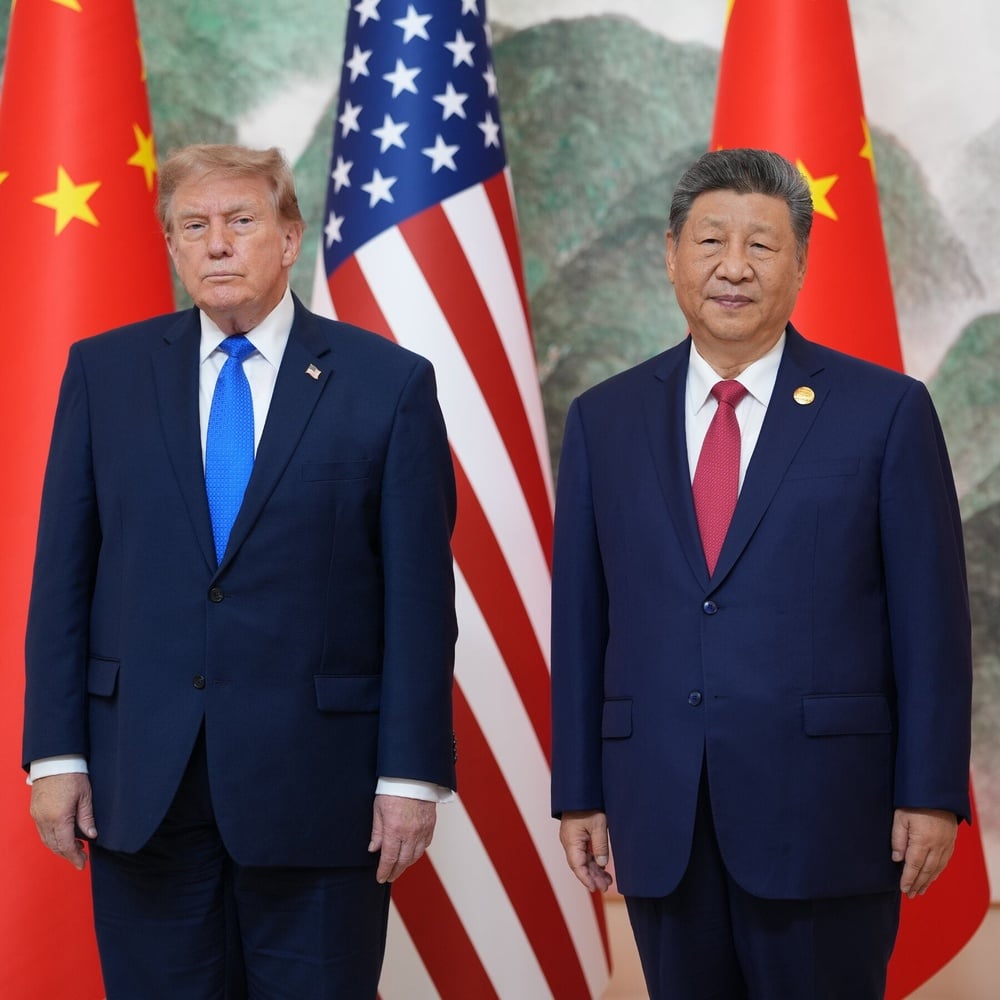
“Trump described Xi as a friend, saying they shared a “special relationship”.
He also praised progress in balancing trade between the two countries, including fairer tariff arrangements.”
· exact text match
“Meanwhile, Xi said China-US relations were stable and improving, expressing willingness to work with Trump to keep ties on the “correct course”.” · exact text match
Why: Both sides' characterizations are quoted without ideological endorsement.
Claim: Maintains objective reporting by attributing claims to leaders and unnamed analysts and noting competing priorities.
“But analysts have expressed low expectations of concrete breakthroughs as the leaders enter the talks with competing national interests and strategic priorities.” · exact text match
“Chinese media reported shortly before 4.30pm that the meeting was underway.” · exact text match
Why: Attribution and contextual caveats support an objective classification.
Claim: Uses neutral sourcing and measured context rather than sensational treatment.
“Chinese media reported shortly before 4.30pm that the meeting was underway.” · exact text match
Counterevidence:
“The leaders of China, the United States and Russia began unprecedented three-way talks on Thursday (Nov 19), amid mounting geopolitical tensions and competing priorities over global security.” · exact text match
Why: Neutral sourcing outweighs the limited dramatic language of 'unprecedented' and 'mounting tensions'.
Claim: Reports the event and statements without prescribing policy.
“The gathering follows talks between Xi and Trump at the same venue earlier on Thursday.” · exact text match
Why: The sentence is descriptive and the article does not advocate a policy outcome.
Claim: Includes a regional fear frame, but it is reported and balanced by low-expectation analyst context.
“It has also unnerved leaders of smaller economies, particularly in Europe and Asia, who fear the world's greatest military powers will disregard their interests.” · exact text match
Why: Fearful language is present but limited and attributed to regional leaders rather than amplified by the publisher.
Claim: The report is entirely about heads-of-state diplomacy and global security.
“The leaders of China, the United States and Russia began unprecedented three-way talks on Thursday (Nov 19), amid mounting geopolitical tensions and competing priorities over global security.” · exact text match
Why: The subject matter is explicitly political and geopolitical.
Claim: Credibility is supported by named attribution, direct quotes, and inclusion of skeptical analyst expectations.
“Chinese media reported shortly before 4.30pm that the meeting was underway.” · exact text match
“But analysts have expressed low expectations of concrete breakthroughs as the leaders enter the talks with competing national interests and strategic priorities.” · exact text match
Why: Visible sourcing, direct quotes, and caveats support a credible classification.
Claim: Uses attributed reporting and cautious analyst expectations rather than emotive or conspiratorial reasoning.
“But analysts have expressed low expectations of concrete breakthroughs as the leaders enter the talks with competing national interests and strategic priorities.” · exact text match
Why: The report relies on sourced claims and cautious expectations.
Claim: Contains forecast-style expectations from analysts, explicitly framed as expectations rather than certain outcomes.
“But analysts have expressed low expectations of concrete breakthroughs as the leaders enter the talks with competing national interests and strategic priorities.” · exact text match
Why: The forecast is attributed and qualified, yielding only mild speculation.
Claim: Fairness and candor are signaled by sourcing official claims and including skeptical expectations.
“But analysts have expressed low expectations of concrete breakthroughs as the leaders enter the talks with competing national interests and strategic priorities.” · exact text match
“Chinese media reported shortly before 4.30pm that the meeting was underway.” · exact text match
Why: The report attributes claims and includes caveats rather than presenting a one-sided narrative.
Claim: Provides historical context and prior bilateral details to interpret the summit.
“Their meeting has drawn comparisons with the 1945 Yalta Conference between the US, Britain and the Soviet Union that formalised spheres of influence and set the stage for the post-World War II order.” · exact text match
Why: Historical comparison and contextual detail support an above-average intelligence classification.
The supplied text appears future-dated (Nov 19, 2026) and includes a likely typo 'unclear weapons'; no byline or independent verification is provided in the text.
November 19, 2026 · 0 shares
The strongest framing is a 'historic' and 'first-ever' trilateral summit, conveyed through official statements and wire attribution with limited independent scrutiny.
Helium Analysis
Limitations: The report is brief and partly truncated, with unrelated Kyrgyz headline links appended; bias scores are based only on the substantive meeting passage.
·
7 of 56 available dimensions scored; omitted dimensions are not treated as neutral.
·
Verified supporting quotes for 7 of 7 scored dimensions.
Claim: The report is predominantly objective, using precise timings and attributed statements, though 'historic' adds evaluative framing.
“The gathering ended roughly 80 minutes later at 5.50 pm local time (0950GMT), after beginning around 4.30 pm (0830GMT).” · exact text match
Counterevidence:
“historic trilateral meeting” · exact text match
Why: Precise times and attributed statements dominate, with limited evaluative framing.
Claim: The report avoids sensational language overall, relying on measured detail, though the headline uses 'historic'.
“The three leaders delivered remarks during a media session lasting approximately 15 minutes before proceeding to closed-door discussions.” · exact text match
Counterevidence:
“historic trilateral meeting” · exact text match
Why: Factual scheduling detail outweighs the single evaluative headline label.
Claim: The report is mostly factual but includes evaluative framing in the word 'historic'.
“historic trilateral meeting” · exact text match
Why: The headline label is evaluative, while the body remains largely factual.
Claim: The report is centrally about a summit of global political leaders and security diplomacy.
“Xi, Trump, Putin conclude historic trilateral meeting in China's Shenzhen.” · exact text match
Why: The content is explicitly about heads of state and international security negotiations.
Claim: The report shows visible sourcing and attribution through Anadolu and SIPRI, though it is brief and does not independently verify leaders' claims.
“including a closed-door meeting, Anadolu reported.” · exact text match
“According to the Stockholm International Peace Research Institute, China possessed an estimated 620 nuclear warheads as of January 2026, compared with 5,042 held by the US and 5,420 by Russia.” · exact text match
Why: Named wire attribution and a named research institute provide visible sourcing.
Claim: The report is largely rational and evidence-oriented, citing an arms-control research institute and attributed official statements.
“According to the Stockholm International Peace Research Institute, China possessed an estimated 620 nuclear warheads as of January 2026, compared with 5,042 held by the US and 5,420 by Russia.” · exact text match
Why: Use of quantified, source-attributed data supports a rational and empirical classification.
Claim: The report includes context that qualifies China's position and attributes key information.
“China has repeatedly rejected calls to participate in nuclear disarmament negotiations, arguing that its nuclear arsenal is significantly smaller than those of the US and Russia.” · exact text match
Why: It presents China's stated rationale rather than omitting a relevant counterpoint.
The report is brief and partly truncated, with unrelated Kyrgyz headline links appended; bias scores are based only on the substantive meeting passage.
Framing is measured and analytical, balancing Chinese hosting ambitions against US priorities and expert doubts about APEC's relevance.
Helium Analysis
Limitations: Forward-looking summit outcomes and analyst forecasts are unverified in the supplied text, limiting confidence on speculation and authority dimensions.
·
15 of 56 available dimensions scored; omitted dimensions are not treated as neutral.
·
Verified supporting quotes for 15 of 15 scored dimensions.
Claim: The report avoids left-right ideological framing and presents US and Chinese priorities with comparable attribution.
“China wants to use the summit to burnish its image on the global stage, analysts said.” · exact text match
“Washington’s priorities lie elsewhere.” · exact text match
Why: Opposing national priorities are both attributed and neither is framed in left-right ideological terms.
Claim: Framing is predominantly objective, presenting official and analyst statements with attribution rather than publisher opinion.
“US officials have said the two leaders will hold a bilateral meeting and working lunch on Thursday.” · exact text match
“Analysts were divided on what the APEC forum itself can achieve.” · exact text match
Why: Claims are attributed to officials and analysts, with no clear first-person publisher judgment.
Claim: The report uses restrained language and avoids sensational claims.
“questions remain over what APEC itself can deliver - and whether a forum built to promote free trade can retain its relevance” · exact text match
Why: The wording is analytical and hedged rather than alarmist or hyperbolic.
Claim: The report describes priorities and expectations without prescribing policy.
“China wants to use the summit to burnish its image on the global stage, analysts said.” · exact text match
“Washington’s priorities lie elsewhere.” · exact text match
Why: The text reports stated aims and priorities rather than recommending actions.
Claim: The content is centered on high-level political and diplomatic leaders and state priorities.
“Leaders of the 21 Asia-Pacific Economic Cooperation (APEC) economies gather in Shenzhen this week, with eyes peeled for the first three-way talks between United States President Donald Trump, Chinese President Xi Jinping and Russian President Vladimir Putin on Thursday (Nov 19).” · exact text match
Why: The central subject is a summit of heads of state and their diplomatic priorities.
Claim: The report qualifies APEC's limits and avoids treating summit outcomes as simple or guaranteed.
“Decisions are made by consensus and commitments are voluntary.” · exact text match
“any declaration needs agreement from all members, and that might be a formidable task amid growing trade tensions and diverging approaches to economic integration.” · exact text match
Why: It explains consensus constraints and disagreement, reducing oversimplification.
Claim: The report relies substantially on named think-tank analysts and officials for interpretation.
“Xu Qinduo, a senior fellow at Pangoal Institution, a Beijing-based think-tank, told CNA.” · exact text match
“said Drew Thompson, a senior fellow at the Singapore-based think-tank S Rajaratnam School of International Studies (RSIS).” · exact text match
Why: Multiple named experts are used as interpretive authorities, though often to represent disagreement.
Claim: The report explicitly flags uncertainty about agreements and agendas.
“But the prospect of a more comprehensive agreement remains uncertain” · exact text match
“the exact agenda remains uncertain” · exact text match
Why: Explicit uncertainty statements undercut overconfident framing.
Claim: Tone is detached and unemotional, with no praise, outrage, or fear appeals.
“Analysts were divided on what the APEC forum itself can achieve.” · exact text match
“the exact agenda remains uncertain” · exact text match
Why: The prose remains analytical and avoids emotionally loaded language.
Claim: The report applies comparable scrutiny to Chinese image-building and US trade priorities.
“China wants to use the summit to burnish its image on the global stage, analysts said.” · exact text match
“Washington’s priorities lie elsewhere.” · exact text match
Why: Both sides' aims are described without evident asymmetric moral or factual standards.
Claim: The report attributes claims to officials, analysts, and a Reuters analysis and flags uncertainty.
“China bought US$7.2 billion of non-soybean US farm goods between January and September, according to a Reuters analysis” · exact text match
“Analysts were divided on what the APEC forum itself can achieve.” · exact text match
Why: Visible sourcing, named analysts, and explicit uncertainty support high internal credibility.
Claim: The report treats claims as conditional and notes disagreement rather than asserting certainty.
“Analysts were divided on what the APEC forum itself can achieve.” · exact text match
“the exact agenda remains uncertain” · exact text match
Why: Explicitly noting divided analysis and uncertainty supports a rational, evidence-qualified framing.
Claim: The report includes attributed forecasts about meeting outcomes and trade truce prospects.
“I think best case, the truce renewal continues beyond Jan 10” · exact text match
“He expects the meeting to be a “showcase” with “no real teeth”.” · exact text match
Why: Forward-looking expectations are present but clearly attributed to analysts.
Claim: The report includes qualifying evidence and competing assessments rather than one-sided claims.
“China bought US$7.2 billion of non-soybean US farm goods between January and September, according to a Reuters analysis, raising doubts about whether it can meet its purchasing commitment.” · exact text match
“Analysts were divided on what the APEC forum itself can achieve.” · exact text match
Why: Balancing official claims with data-based doubt and noting expert disagreement are observable fairness and honesty signals.
Claim: The report synthesizes official claims, trade data, and expert disagreement into a nuanced analysis.
“China bought US$7.2 billion of non-soybean US farm goods between January and September, according to a Reuters analysis, raising doubts about whether it can meet its purchasing commitment.” · exact text match
“Analysts were divided on what the APEC forum itself can achieve.” · exact text match
Why: It combines data, attribution, and competing assessments rather than relying on a single narrative.
Forward-looking summit outcomes and analyst forecasts are unverified in the supplied text, limiting confidence on speculation and authority dimensions.
November 19, 2026 · 0 shares
Neutral, attribution-heavy summit coverage that balances official remarks with analyst skepticism and regional unease.
Helium Analysis
Limitations: The supplied text appears future-dated (Nov 19, 2026) and includes a likely typo 'unclear weapons'; no byline or independent verification is provided in the text.
·
11 of 56 available dimensions scored; omitted dimensions are not treated as neutral.
·
Verified supporting quotes for 11 of 11 scored dimensions.
Claim: Balances US and Chinese official characterizations without adopting a left-right ideological frame.
“Trump described Xi as a friend, saying they shared a “special relationship”.
He also praised progress in balancing trade between the two countries, including fairer tariff arrangements.”
· exact text match
“Meanwhile, Xi said China-US relations were stable and improving, expressing willingness to work with Trump to keep ties on the “correct course”.” · exact text match
Why: Both sides' characterizations are quoted without ideological endorsement.
Claim: Maintains objective reporting by attributing claims to leaders and unnamed analysts and noting competing priorities.
“But analysts have expressed low expectations of concrete breakthroughs as the leaders enter the talks with competing national interests and strategic priorities.” · exact text match
“Chinese media reported shortly before 4.30pm that the meeting was underway.” · exact text match
Why: Attribution and contextual caveats support an objective classification.
Claim: Uses neutral sourcing and measured context rather than sensational treatment.
“Chinese media reported shortly before 4.30pm that the meeting was underway.” · exact text match
Counterevidence:
“The leaders of China, the United States and Russia began unprecedented three-way talks on Thursday (Nov 19), amid mounting geopolitical tensions and competing priorities over global security.” · exact text match
Why: Neutral sourcing outweighs the limited dramatic language of 'unprecedented' and 'mounting tensions'.
Claim: Reports the event and statements without prescribing policy.
“The gathering follows talks between Xi and Trump at the same venue earlier on Thursday.” · exact text match
Why: The sentence is descriptive and the article does not advocate a policy outcome.
Claim: Includes a regional fear frame, but it is reported and balanced by low-expectation analyst context.
“It has also unnerved leaders of smaller economies, particularly in Europe and Asia, who fear the world's greatest military powers will disregard their interests.” · exact text match
Why: Fearful language is present but limited and attributed to regional leaders rather than amplified by the publisher.
Claim: The report is entirely about heads-of-state diplomacy and global security.
“The leaders of China, the United States and Russia began unprecedented three-way talks on Thursday (Nov 19), amid mounting geopolitical tensions and competing priorities over global security.” · exact text match
Why: The subject matter is explicitly political and geopolitical.
Claim: Credibility is supported by named attribution, direct quotes, and inclusion of skeptical analyst expectations.
“Chinese media reported shortly before 4.30pm that the meeting was underway.” · exact text match
“But analysts have expressed low expectations of concrete breakthroughs as the leaders enter the talks with competing national interests and strategic priorities.” · exact text match
Why: Visible sourcing, direct quotes, and caveats support a credible classification.
Claim: Uses attributed reporting and cautious analyst expectations rather than emotive or conspiratorial reasoning.
“But analysts have expressed low expectations of concrete breakthroughs as the leaders enter the talks with competing national interests and strategic priorities.” · exact text match
Why: The report relies on sourced claims and cautious expectations.
Claim: Contains forecast-style expectations from analysts, explicitly framed as expectations rather than certain outcomes.
“But analysts have expressed low expectations of concrete breakthroughs as the leaders enter the talks with competing national interests and strategic priorities.” · exact text match
Why: The forecast is attributed and qualified, yielding only mild speculation.
Claim: Fairness and candor are signaled by sourcing official claims and including skeptical expectations.
“But analysts have expressed low expectations of concrete breakthroughs as the leaders enter the talks with competing national interests and strategic priorities.” · exact text match
“Chinese media reported shortly before 4.30pm that the meeting was underway.” · exact text match
Why: The report attributes claims and includes caveats rather than presenting a one-sided narrative.
Claim: Provides historical context and prior bilateral details to interpret the summit.
“Their meeting has drawn comparisons with the 1945 Yalta Conference between the US, Britain and the Soviet Union that formalised spheres of influence and set the stage for the post-World War II order.” · exact text match
Why: Historical comparison and contextual detail support an above-average intelligence classification.
The supplied text appears future-dated (Nov 19, 2026) and includes a likely typo 'unclear weapons'; no byline or independent verification is provided in the text.
Framing is measured and analytical, balancing Chinese hosting ambitions against US priorities and expert doubts about APEC's relevance.
Helium Analysis
Limitations: Forward-looking summit outcomes and analyst forecasts are unverified in the supplied text, limiting confidence on speculation and authority dimensions.
·
15 of 56 available dimensions scored; omitted dimensions are not treated as neutral.
·
Verified supporting quotes for 15 of 15 scored dimensions.
Claim: The report avoids left-right ideological framing and presents US and Chinese priorities with comparable attribution.
“China wants to use the summit to burnish its image on the global stage, analysts said.” · exact text match
“Washington’s priorities lie elsewhere.” · exact text match
Why: Opposing national priorities are both attributed and neither is framed in left-right ideological terms.
Claim: Framing is predominantly objective, presenting official and analyst statements with attribution rather than publisher opinion.
“US officials have said the two leaders will hold a bilateral meeting and working lunch on Thursday.” · exact text match
“Analysts were divided on what the APEC forum itself can achieve.” · exact text match
Why: Claims are attributed to officials and analysts, with no clear first-person publisher judgment.
Claim: The report uses restrained language and avoids sensational claims.
“questions remain over what APEC itself can deliver - and whether a forum built to promote free trade can retain its relevance” · exact text match
Why: The wording is analytical and hedged rather than alarmist or hyperbolic.
Claim: The report describes priorities and expectations without prescribing policy.
“China wants to use the summit to burnish its image on the global stage, analysts said.” · exact text match
“Washington’s priorities lie elsewhere.” · exact text match
Why: The text reports stated aims and priorities rather than recommending actions.
Claim: The content is centered on high-level political and diplomatic leaders and state priorities.
“Leaders of the 21 Asia-Pacific Economic Cooperation (APEC) economies gather in Shenzhen this week, with eyes peeled for the first three-way talks between United States President Donald Trump, Chinese President Xi Jinping and Russian President Vladimir Putin on Thursday (Nov 19).” · exact text match
Why: The central subject is a summit of heads of state and their diplomatic priorities.
Claim: The report qualifies APEC's limits and avoids treating summit outcomes as simple or guaranteed.
“Decisions are made by consensus and commitments are voluntary.” · exact text match
“any declaration needs agreement from all members, and that might be a formidable task amid growing trade tensions and diverging approaches to economic integration.” · exact text match
Why: It explains consensus constraints and disagreement, reducing oversimplification.
Claim: The report relies substantially on named think-tank analysts and officials for interpretation.
“Xu Qinduo, a senior fellow at Pangoal Institution, a Beijing-based think-tank, told CNA.” · exact text match
“said Drew Thompson, a senior fellow at the Singapore-based think-tank S Rajaratnam School of International Studies (RSIS).” · exact text match
Why: Multiple named experts are used as interpretive authorities, though often to represent disagreement.
Claim: The report explicitly flags uncertainty about agreements and agendas.
“But the prospect of a more comprehensive agreement remains uncertain” · exact text match
“the exact agenda remains uncertain” · exact text match
Why: Explicit uncertainty statements undercut overconfident framing.
Claim: Tone is detached and unemotional, with no praise, outrage, or fear appeals.
“Analysts were divided on what the APEC forum itself can achieve.” · exact text match
“the exact agenda remains uncertain” · exact text match
Why: The prose remains analytical and avoids emotionally loaded language.
Claim: The report applies comparable scrutiny to Chinese image-building and US trade priorities.
“China wants to use the summit to burnish its image on the global stage, analysts said.” · exact text match
“Washington’s priorities lie elsewhere.” · exact text match
Why: Both sides' aims are described without evident asymmetric moral or factual standards.
Claim: The report attributes claims to officials, analysts, and a Reuters analysis and flags uncertainty.
“China bought US$7.2 billion of non-soybean US farm goods between January and September, according to a Reuters analysis” · exact text match
“Analysts were divided on what the APEC forum itself can achieve.” · exact text match
Why: Visible sourcing, named analysts, and explicit uncertainty support high internal credibility.
Claim: The report treats claims as conditional and notes disagreement rather than asserting certainty.
“Analysts were divided on what the APEC forum itself can achieve.” · exact text match
“the exact agenda remains uncertain” · exact text match
Why: Explicitly noting divided analysis and uncertainty supports a rational, evidence-qualified framing.
Claim: The report includes attributed forecasts about meeting outcomes and trade truce prospects.
“I think best case, the truce renewal continues beyond Jan 10” · exact text match
“He expects the meeting to be a “showcase” with “no real teeth”.” · exact text match
Why: Forward-looking expectations are present but clearly attributed to analysts.
Claim: The report includes qualifying evidence and competing assessments rather than one-sided claims.
“China bought US$7.2 billion of non-soybean US farm goods between January and September, according to a Reuters analysis, raising doubts about whether it can meet its purchasing commitment.” · exact text match
“Analysts were divided on what the APEC forum itself can achieve.” · exact text match
Why: Balancing official claims with data-based doubt and noting expert disagreement are observable fairness and honesty signals.
Claim: The report synthesizes official claims, trade data, and expert disagreement into a nuanced analysis.
“China bought US$7.2 billion of non-soybean US farm goods between January and September, according to a Reuters analysis, raising doubts about whether it can meet its purchasing commitment.” · exact text match
“Analysts were divided on what the APEC forum itself can achieve.” · exact text match
Why: It combines data, attribution, and competing assessments rather than relying on a single narrative.
Forward-looking summit outcomes and analyst forecasts are unverified in the supplied text, limiting confidence on speculation and authority dimensions.
The headline foregrounds Trump's hard-line Iran nuclear statement, while the body otherwise presents a largely verbatim attributed quote.
Helium Analysis
Limitations: The supplied text is a very short headline-and-quote excerpt with no byline or broader reporting, limiting assessment of publisher context and most bias dimensions.
·
3 of 56 available dimensions scored; omitted dimensions are not treated as neutral.
·
Verified supporting quotes for 3 of 3 scored dimensions.
Claim: The report presents the content as a directly attributed quote rather than as publisher commentary.
“During the trilateral talks with Russian President Putin and Chinese President Xi, US President Donald Trump said, 'The United States, Russia, and China are uniquely positioned to discuss how to reduce the number of nuclear weapons on Earth, and also to lessen the risk that those weapons will ever be used.” · exact text match
Why: Minimal editorial language and direct attribution indicate an objective presentation.
Claim: The headline foregrounds the coercive Iran nonproliferation line while the body also includes arms-reduction remarks.
“'We're not going to let Iran have a nuclear weapon'-Trump during trilateral talks in Shenzhen, China.” · exact text match
Why: Selecting this assertive Iran statement as the lead gives the item a mildly hawkish framing, though not an explicit publisher endorsement.
Claim: The selected headline and quote center on a presidential foreign-policy and nuclear-proliferation statement.
“We're not going to let Iran have a nuclear weapon.” · exact text match
Why: Foreign policy and nuclear security are inherently political subjects.
The supplied text is a very short headline-and-quote excerpt with no byline or broader reporting, limiting assessment of publisher context and most bias dimensions.
November 19, 2026 · 0 shares
Neutral, attribution-heavy summit coverage that balances official remarks with analyst skepticism and regional unease.
Helium Analysis
Limitations: The supplied text appears future-dated (Nov 19, 2026) and includes a likely typo 'unclear weapons'; no byline or independent verification is provided in the text.
·
11 of 56 available dimensions scored; omitted dimensions are not treated as neutral.
·
Verified supporting quotes for 11 of 11 scored dimensions.
Claim: Balances US and Chinese official characterizations without adopting a left-right ideological frame.
“Trump described Xi as a friend, saying they shared a “special relationship”.
He also praised progress in balancing trade between the two countries, including fairer tariff arrangements.”
· exact text match
“Meanwhile, Xi said China-US relations were stable and improving, expressing willingness to work with Trump to keep ties on the “correct course”.” · exact text match
Why: Both sides' characterizations are quoted without ideological endorsement.
Claim: Maintains objective reporting by attributing claims to leaders and unnamed analysts and noting competing priorities.
“But analysts have expressed low expectations of concrete breakthroughs as the leaders enter the talks with competing national interests and strategic priorities.” · exact text match
“Chinese media reported shortly before 4.30pm that the meeting was underway.” · exact text match
Why: Attribution and contextual caveats support an objective classification.
Claim: Uses neutral sourcing and measured context rather than sensational treatment.
“Chinese media reported shortly before 4.30pm that the meeting was underway.” · exact text match
Counterevidence:
“The leaders of China, the United States and Russia began unprecedented three-way talks on Thursday (Nov 19), amid mounting geopolitical tensions and competing priorities over global security.” · exact text match
Why: Neutral sourcing outweighs the limited dramatic language of 'unprecedented' and 'mounting tensions'.
Claim: Reports the event and statements without prescribing policy.
“The gathering follows talks between Xi and Trump at the same venue earlier on Thursday.” · exact text match
Why: The sentence is descriptive and the article does not advocate a policy outcome.
Claim: Includes a regional fear frame, but it is reported and balanced by low-expectation analyst context.
“It has also unnerved leaders of smaller economies, particularly in Europe and Asia, who fear the world's greatest military powers will disregard their interests.” · exact text match
Why: Fearful language is present but limited and attributed to regional leaders rather than amplified by the publisher.
Claim: The report is entirely about heads-of-state diplomacy and global security.
“The leaders of China, the United States and Russia began unprecedented three-way talks on Thursday (Nov 19), amid mounting geopolitical tensions and competing priorities over global security.” · exact text match
Why: The subject matter is explicitly political and geopolitical.
Claim: Credibility is supported by named attribution, direct quotes, and inclusion of skeptical analyst expectations.
“Chinese media reported shortly before 4.30pm that the meeting was underway.” · exact text match
“But analysts have expressed low expectations of concrete breakthroughs as the leaders enter the talks with competing national interests and strategic priorities.” · exact text match
Why: Visible sourcing, direct quotes, and caveats support a credible classification.
Claim: Uses attributed reporting and cautious analyst expectations rather than emotive or conspiratorial reasoning.
“But analysts have expressed low expectations of concrete breakthroughs as the leaders enter the talks with competing national interests and strategic priorities.” · exact text match
Why: The report relies on sourced claims and cautious expectations.
Claim: Contains forecast-style expectations from analysts, explicitly framed as expectations rather than certain outcomes.
“But analysts have expressed low expectations of concrete breakthroughs as the leaders enter the talks with competing national interests and strategic priorities.” · exact text match
Why: The forecast is attributed and qualified, yielding only mild speculation.
Claim: Fairness and candor are signaled by sourcing official claims and including skeptical expectations.
“But analysts have expressed low expectations of concrete breakthroughs as the leaders enter the talks with competing national interests and strategic priorities.” · exact text match
“Chinese media reported shortly before 4.30pm that the meeting was underway.” · exact text match
Why: The report attributes claims and includes caveats rather than presenting a one-sided narrative.
Claim: Provides historical context and prior bilateral details to interpret the summit.
“Their meeting has drawn comparisons with the 1945 Yalta Conference between the US, Britain and the Soviet Union that formalised spheres of influence and set the stage for the post-World War II order.” · exact text match
Why: Historical comparison and contextual detail support an above-average intelligence classification.
The supplied text appears future-dated (Nov 19, 2026) and includes a likely typo 'unclear weapons'; no byline or independent verification is provided in the text.
November 19, 2026 · 0 shares
The report is largely a neutral, attribution-heavy diplomatic news account, though its headline and lead adopt mildly dramatic 'historic' and 'unprecedented' framing.
Helium Analysis
Limitations: The supplied text mixes the main report with unrelated related-article headlines, and the APEC meeting is dated 2026, limiting external verification; the analysis is limited to the visible main report.
·
8 of 56 available dimensions scored; omitted dimensions are not treated as neutral.
·
Verified supporting quotes for 8 of 8 scored dimensions.
Claim: The report is mostly objective and attribution-driven, with limited dramatic framing.
“According to the Stockholm International Peace Research Institute, China possessed an estimated 620 nuclear warheads as of January 2026, compared with 5,042 held by the U.S. and 5,420 by Russia.” · exact text match
Counterevidence:
“Trump, Xi and Putin hold historic trilateral talks.” · exact text match
Why: The body relies on attributed figures and official statements, while the headline uses a dramatic label.
Claim: The headline and lead use mildly dramatic language to elevate the meeting's significance.
“The presidents of China, the United States and Russia held an unprecedented summit in China on Nov. 19, with Donald Trump saying the three men were “making history.”” · exact text match
Why: Terms such as 'unprecedented' and 'making history' are dramatic, though the rest of the report is measured.
Claim: The first-ever trilateral meeting is a notable development.
“Chinese President Xi Jinping, U.S. President Donald Trump and Russian President Vladimir Putin held their first-ever trilateral talks on Nov. 19 in Shenzhen, China, including a closed-door meeting.” · exact text match
Why: The novelty and high-level participants make the report newsworthy.
Claim: The report is overwhelmingly descriptive rather than prescriptive.
“The three leaders delivered remarks during a media session lasting approximately 15 minutes before proceeding to closed-door discussions.” · exact text match
Why: It recounts proceedings and statements without urging a policy course.
Claim: The subject matter is highly political.
“Trump, Xi and Putin hold historic trilateral talks.” · exact text match
Why: The report concerns heads of state, nuclear security and the Russia-Ukraine war.
Claim: The report provides identifiable attribution and direct quotations but limited independent verification.
“According to the Stockholm International Peace Research Institute, China possessed an estimated 620 nuclear warheads as of January 2026, compared with 5,042 held by the U.S. and 5,420 by Russia.” · exact text match
“Xi said "positive interactions" among China, the U.S. and Russia were not an "option but a must," stressing their responsibilities as major global powers.” · exact text match
Why: SIPRI figures and leader quotes are cited, though no byline or corroborating sources are given.
Claim: The report shows high integrity through sourcing and inclusion of a countervailing position.
“According to the Stockholm International Peace Research Institute, China possessed an estimated 620 nuclear warheads as of January 2026, compared with 5,042 held by the U.S. and 5,420 by Russia.” · exact text match
“China has repeatedly rejected calls to participate in nuclear disarmament negotiations, arguing that its nuclear arsenal is significantly smaller than those of the U.S. and Russia.” · exact text match
Why: It cites an independent research institute and notes China's rejection, improving verifiability and fairness.
Claim: The report integrates relevant quantitative context into a coherent account.
“According to the Stockholm International Peace Research Institute, China possessed an estimated 620 nuclear warheads as of January 2026, compared with 5,042 held by the U.S. and 5,420 by Russia.” · exact text match
Why: It uses external warhead estimates to contextualize the disarmament discussion.
The supplied text mixes the main report with unrelated related-article headlines, and the APEC meeting is dated 2026, limiting external verification; the analysis is limited to the visible main report.
November 19, 2026 · 0 shares
The strongest framing is a 'historic' and 'first-ever' trilateral summit, conveyed through official statements and wire attribution with limited independent scrutiny.
Helium Analysis
Limitations: The report is brief and partly truncated, with unrelated Kyrgyz headline links appended; bias scores are based only on the substantive meeting passage.
·
7 of 56 available dimensions scored; omitted dimensions are not treated as neutral.
·
Verified supporting quotes for 7 of 7 scored dimensions.
Claim: The report is predominantly objective, using precise timings and attributed statements, though 'historic' adds evaluative framing.
“The gathering ended roughly 80 minutes later at 5.50 pm local time (0950GMT), after beginning around 4.30 pm (0830GMT).” · exact text match
Counterevidence:
“historic trilateral meeting” · exact text match
Why: Precise times and attributed statements dominate, with limited evaluative framing.
Claim: The report avoids sensational language overall, relying on measured detail, though the headline uses 'historic'.
“The three leaders delivered remarks during a media session lasting approximately 15 minutes before proceeding to closed-door discussions.” · exact text match
Counterevidence:
“historic trilateral meeting” · exact text match
Why: Factual scheduling detail outweighs the single evaluative headline label.
Claim: The report is mostly factual but includes evaluative framing in the word 'historic'.
“historic trilateral meeting” · exact text match
Why: The headline label is evaluative, while the body remains largely factual.
Claim: The report is centrally about a summit of global political leaders and security diplomacy.
“Xi, Trump, Putin conclude historic trilateral meeting in China's Shenzhen.” · exact text match
Why: The content is explicitly about heads of state and international security negotiations.
Claim: The report shows visible sourcing and attribution through Anadolu and SIPRI, though it is brief and does not independently verify leaders' claims.
“including a closed-door meeting, Anadolu reported.” · exact text match
“According to the Stockholm International Peace Research Institute, China possessed an estimated 620 nuclear warheads as of January 2026, compared with 5,042 held by the US and 5,420 by Russia.” · exact text match
Why: Named wire attribution and a named research institute provide visible sourcing.
Claim: The report is largely rational and evidence-oriented, citing an arms-control research institute and attributed official statements.
“According to the Stockholm International Peace Research Institute, China possessed an estimated 620 nuclear warheads as of January 2026, compared with 5,042 held by the US and 5,420 by Russia.” · exact text match
Why: Use of quantified, source-attributed data supports a rational and empirical classification.
Claim: The report includes context that qualifies China's position and attributes key information.
“China has repeatedly rejected calls to participate in nuclear disarmament negotiations, arguing that its nuclear arsenal is significantly smaller than those of the US and Russia.” · exact text match
Why: It presents China's stated rationale rather than omitting a relevant counterpoint.
The report is brief and partly truncated, with unrelated Kyrgyz headline links appended; bias scores are based only on the substantive meeting passage.
November 19, 2026 · 0 shares
The framing presents a single press-access exclusion as evidence of China's deliberate and tight stage-management of events.
Helium Analysis
Limitations: Only a headline and subhead are provided; there is no sourcing, byline, or detail on the talks, the reporter’s question, or China’s stated rationale.
·
7 of 56 available dimensions scored; omitted dimensions are not treated as neutral.
·
Verified supporting quotes for 7 of 7 scored dimensions.
Claim: The report mixes a factual headline with an evaluative interpretation of China's intent.
“The exclusion of the reporter after she shouted a question to President Trump is an example of how tightly China tries to stage-manage events.” · exact text match
Why: Calling the exclusion an example of tight stage-management is a subjective characterization, not a bare factual report.
Claim: The subheadline advances an opinion about China's control over events rather than only reporting the exclusion.
“an example of how tightly China tries to stage-manage events” · exact text match
Why: The phrase evaluates the incident as evidence of a broader intent, which is an opinionated framing.
Claim: The report is explicitly political, concerning a government barring a journalist from diplomatic talks involving President Trump.
“China Bars Bloomberg Reporter From Trilateral Talks for Asking a Question.” · exact text match
Why: The headline centers on government media access and presidential diplomacy, a clearly political subject.
Claim: The article compresses a diplomatic press-access incident into a simple example of Chinese stage-management without supporting detail.
“The exclusion of the reporter after she shouted a question to President Trump is an example of how tightly China tries to stage-manage events.” · exact text match
Why: A complex access decision is reduced to a single causal characterization with no details about the talks or alternative explanations.
Claim: The text asserts a broad Chinese intent to stage-manage events from one exclusion without demonstrating that pattern.
“an example of how tightly China tries to stage-manage events” · exact text match
Why: The broad intent claim is stated with certainty despite the minimal evidence supplied in the text.
Claim: The publisher infers Chinese intent and a pattern of event staging from the reporter's exclusion.
“an example of how tightly China tries to stage-manage events” · exact text match
Why: This goes beyond the reported fact of exclusion to speculate about motives and a broader pattern.
Claim: The phrase 'stage-manage events' is a loaded characterization that shapes interpretation of the exclusion.
“how tightly China tries to stage-manage events” · exact text match
Why: The loaded wording presents the action as intentional control, influencing how readers understand the event.
Only a headline and subhead are provided; there is no sourcing, byline, or detail on the talks, the reporter’s question, or China’s stated rationale.
November 19, 2026 · 0 shares
Neutral, attribution-heavy summit coverage that balances official remarks with analyst skepticism and regional unease.
Helium Analysis
Limitations: The supplied text appears future-dated (Nov 19, 2026) and includes a likely typo 'unclear weapons'; no byline or independent verification is provided in the text.
·
11 of 56 available dimensions scored; omitted dimensions are not treated as neutral.
·
Verified supporting quotes for 11 of 11 scored dimensions.
Claim: Balances US and Chinese official characterizations without adopting a left-right ideological frame.
“Trump described Xi as a friend, saying they shared a “special relationship”.
He also praised progress in balancing trade between the two countries, including fairer tariff arrangements.”
· exact text match
“Meanwhile, Xi said China-US relations were stable and improving, expressing willingness to work with Trump to keep ties on the “correct course”.” · exact text match
Why: Both sides' characterizations are quoted without ideological endorsement.
Claim: Maintains objective reporting by attributing claims to leaders and unnamed analysts and noting competing priorities.
“But analysts have expressed low expectations of concrete breakthroughs as the leaders enter the talks with competing national interests and strategic priorities.” · exact text match
“Chinese media reported shortly before 4.30pm that the meeting was underway.” · exact text match
Why: Attribution and contextual caveats support an objective classification.
Claim: Uses neutral sourcing and measured context rather than sensational treatment.
“Chinese media reported shortly before 4.30pm that the meeting was underway.” · exact text match
Counterevidence:
“The leaders of China, the United States and Russia began unprecedented three-way talks on Thursday (Nov 19), amid mounting geopolitical tensions and competing priorities over global security.” · exact text match
Why: Neutral sourcing outweighs the limited dramatic language of 'unprecedented' and 'mounting tensions'.
Claim: Reports the event and statements without prescribing policy.
“The gathering follows talks between Xi and Trump at the same venue earlier on Thursday.” · exact text match
Why: The sentence is descriptive and the article does not advocate a policy outcome.
Claim: Includes a regional fear frame, but it is reported and balanced by low-expectation analyst context.
“It has also unnerved leaders of smaller economies, particularly in Europe and Asia, who fear the world's greatest military powers will disregard their interests.” · exact text match
Why: Fearful language is present but limited and attributed to regional leaders rather than amplified by the publisher.
Claim: The report is entirely about heads-of-state diplomacy and global security.
“The leaders of China, the United States and Russia began unprecedented three-way talks on Thursday (Nov 19), amid mounting geopolitical tensions and competing priorities over global security.” · exact text match
Why: The subject matter is explicitly political and geopolitical.
Claim: Credibility is supported by named attribution, direct quotes, and inclusion of skeptical analyst expectations.
“Chinese media reported shortly before 4.30pm that the meeting was underway.” · exact text match
“But analysts have expressed low expectations of concrete breakthroughs as the leaders enter the talks with competing national interests and strategic priorities.” · exact text match
Why: Visible sourcing, direct quotes, and caveats support a credible classification.
Claim: Uses attributed reporting and cautious analyst expectations rather than emotive or conspiratorial reasoning.
“But analysts have expressed low expectations of concrete breakthroughs as the leaders enter the talks with competing national interests and strategic priorities.” · exact text match
Why: The report relies on sourced claims and cautious expectations.
Claim: Contains forecast-style expectations from analysts, explicitly framed as expectations rather than certain outcomes.
“But analysts have expressed low expectations of concrete breakthroughs as the leaders enter the talks with competing national interests and strategic priorities.” · exact text match
Why: The forecast is attributed and qualified, yielding only mild speculation.
Claim: Fairness and candor are signaled by sourcing official claims and including skeptical expectations.
“But analysts have expressed low expectations of concrete breakthroughs as the leaders enter the talks with competing national interests and strategic priorities.” · exact text match
“Chinese media reported shortly before 4.30pm that the meeting was underway.” · exact text match
Why: The report attributes claims and includes caveats rather than presenting a one-sided narrative.
Claim: Provides historical context and prior bilateral details to interpret the summit.
“Their meeting has drawn comparisons with the 1945 Yalta Conference between the US, Britain and the Soviet Union that formalised spheres of influence and set the stage for the post-World War II order.” · exact text match
Why: Historical comparison and contextual detail support an above-average intelligence classification.
The supplied text appears future-dated (Nov 19, 2026) and includes a likely typo 'unclear weapons'; no byline or independent verification is provided in the text.
Framing is measured and analytical, balancing Chinese hosting ambitions against US priorities and expert doubts about APEC's relevance.
Helium Analysis
Limitations: Forward-looking summit outcomes and analyst forecasts are unverified in the supplied text, limiting confidence on speculation and authority dimensions.
·
15 of 56 available dimensions scored; omitted dimensions are not treated as neutral.
·
Verified supporting quotes for 15 of 15 scored dimensions.
Claim: The report avoids left-right ideological framing and presents US and Chinese priorities with comparable attribution.
“China wants to use the summit to burnish its image on the global stage, analysts said.” · exact text match
“Washington’s priorities lie elsewhere.” · exact text match
Why: Opposing national priorities are both attributed and neither is framed in left-right ideological terms.
Claim: Framing is predominantly objective, presenting official and analyst statements with attribution rather than publisher opinion.
“US officials have said the two leaders will hold a bilateral meeting and working lunch on Thursday.” · exact text match
“Analysts were divided on what the APEC forum itself can achieve.” · exact text match
Why: Claims are attributed to officials and analysts, with no clear first-person publisher judgment.
Claim: The report uses restrained language and avoids sensational claims.
“questions remain over what APEC itself can deliver - and whether a forum built to promote free trade can retain its relevance” · exact text match
Why: The wording is analytical and hedged rather than alarmist or hyperbolic.
Claim: The report describes priorities and expectations without prescribing policy.
“China wants to use the summit to burnish its image on the global stage, analysts said.” · exact text match
“Washington’s priorities lie elsewhere.” · exact text match
Why: The text reports stated aims and priorities rather than recommending actions.
Claim: The content is centered on high-level political and diplomatic leaders and state priorities.
“Leaders of the 21 Asia-Pacific Economic Cooperation (APEC) economies gather in Shenzhen this week, with eyes peeled for the first three-way talks between United States President Donald Trump, Chinese President Xi Jinping and Russian President Vladimir Putin on Thursday (Nov 19).” · exact text match
Why: The central subject is a summit of heads of state and their diplomatic priorities.
Claim: The report qualifies APEC's limits and avoids treating summit outcomes as simple or guaranteed.
“Decisions are made by consensus and commitments are voluntary.” · exact text match
“any declaration needs agreement from all members, and that might be a formidable task amid growing trade tensions and diverging approaches to economic integration.” · exact text match
Why: It explains consensus constraints and disagreement, reducing oversimplification.
Claim: The report relies substantially on named think-tank analysts and officials for interpretation.
“Xu Qinduo, a senior fellow at Pangoal Institution, a Beijing-based think-tank, told CNA.” · exact text match
“said Drew Thompson, a senior fellow at the Singapore-based think-tank S Rajaratnam School of International Studies (RSIS).” · exact text match
Why: Multiple named experts are used as interpretive authorities, though often to represent disagreement.
Claim: The report explicitly flags uncertainty about agreements and agendas.
“But the prospect of a more comprehensive agreement remains uncertain” · exact text match
“the exact agenda remains uncertain” · exact text match
Why: Explicit uncertainty statements undercut overconfident framing.
Claim: Tone is detached and unemotional, with no praise, outrage, or fear appeals.
“Analysts were divided on what the APEC forum itself can achieve.” · exact text match
“the exact agenda remains uncertain” · exact text match
Why: The prose remains analytical and avoids emotionally loaded language.
Claim: The report applies comparable scrutiny to Chinese image-building and US trade priorities.
“China wants to use the summit to burnish its image on the global stage, analysts said.” · exact text match
“Washington’s priorities lie elsewhere.” · exact text match
Why: Both sides' aims are described without evident asymmetric moral or factual standards.
Claim: The report attributes claims to officials, analysts, and a Reuters analysis and flags uncertainty.
“China bought US$7.2 billion of non-soybean US farm goods between January and September, according to a Reuters analysis” · exact text match
“Analysts were divided on what the APEC forum itself can achieve.” · exact text match
Why: Visible sourcing, named analysts, and explicit uncertainty support high internal credibility.
Claim: The report treats claims as conditional and notes disagreement rather than asserting certainty.
“Analysts were divided on what the APEC forum itself can achieve.” · exact text match
“the exact agenda remains uncertain” · exact text match
Why: Explicitly noting divided analysis and uncertainty supports a rational, evidence-qualified framing.
Claim: The report includes attributed forecasts about meeting outcomes and trade truce prospects.
“I think best case, the truce renewal continues beyond Jan 10” · exact text match
“He expects the meeting to be a “showcase” with “no real teeth”.” · exact text match
Why: Forward-looking expectations are present but clearly attributed to analysts.
Claim: The report includes qualifying evidence and competing assessments rather than one-sided claims.
“China bought US$7.2 billion of non-soybean US farm goods between January and September, according to a Reuters analysis, raising doubts about whether it can meet its purchasing commitment.” · exact text match
“Analysts were divided on what the APEC forum itself can achieve.” · exact text match
Why: Balancing official claims with data-based doubt and noting expert disagreement are observable fairness and honesty signals.
Claim: The report synthesizes official claims, trade data, and expert disagreement into a nuanced analysis.
“China bought US$7.2 billion of non-soybean US farm goods between January and September, according to a Reuters analysis, raising doubts about whether it can meet its purchasing commitment.” · exact text match
“Analysts were divided on what the APEC forum itself can achieve.” · exact text match
Why: It combines data, attribution, and competing assessments rather than relying on a single narrative.
Forward-looking summit outcomes and analyst forecasts are unverified in the supplied text, limiting confidence on speculation and authority dimensions.
November 19, 2026 · 0 shares
Neutral, attribution-heavy summit coverage that balances official remarks with analyst skepticism and regional unease.
Helium Analysis Limitations: The supplied text appears future-dated (Nov 19, 2026) and includes a likely typo 'unclear weapons'; no byline or independent verification is provided in the text. · 11 of 56 available dimensions scored; omitted dimensions are not treated as neutral. · Verified supporting quotes for 11 of 11 scored dimensions.
Claim: Balances US and Chinese official characterizations without adopting a left-right ideological frame.
“Trump described Xi as a friend, saying they shared a “special relationship”. He also praised progress in balancing trade between the two countries, including fairer tariff arrangements.” · exact text match
“Meanwhile, Xi said China-US relations were stable and improving, expressing willingness to work with Trump to keep ties on the “correct course”.” · exact text match
Why: Both sides' characterizations are quoted without ideological endorsement.
Claim: Maintains objective reporting by attributing claims to leaders and unnamed analysts and noting competing priorities.
“But analysts have expressed low expectations of concrete breakthroughs as the leaders enter the talks with competing national interests and strategic priorities.” · exact text match
“Chinese media reported shortly before 4.30pm that the meeting was underway.” · exact text match
Why: Attribution and contextual caveats support an objective classification.
Claim: Uses neutral sourcing and measured context rather than sensational treatment.
“Chinese media reported shortly before 4.30pm that the meeting was underway.” · exact text match
Counterevidence:
“The leaders of China, the United States and Russia began unprecedented three-way talks on Thursday (Nov 19), amid mounting geopolitical tensions and competing priorities over global security.” · exact text match
Why: Neutral sourcing outweighs the limited dramatic language of 'unprecedented' and 'mounting tensions'.
Claim: Reports the event and statements without prescribing policy.
“The gathering follows talks between Xi and Trump at the same venue earlier on Thursday.” · exact text match
Why: The sentence is descriptive and the article does not advocate a policy outcome.
Claim: Includes a regional fear frame, but it is reported and balanced by low-expectation analyst context.
“It has also unnerved leaders of smaller economies, particularly in Europe and Asia, who fear the world's greatest military powers will disregard their interests.” · exact text match
Why: Fearful language is present but limited and attributed to regional leaders rather than amplified by the publisher.
Claim: The report is entirely about heads-of-state diplomacy and global security.
“The leaders of China, the United States and Russia began unprecedented three-way talks on Thursday (Nov 19), amid mounting geopolitical tensions and competing priorities over global security.” · exact text match
Why: The subject matter is explicitly political and geopolitical.
Claim: Credibility is supported by named attribution, direct quotes, and inclusion of skeptical analyst expectations.
“Chinese media reported shortly before 4.30pm that the meeting was underway.” · exact text match
“But analysts have expressed low expectations of concrete breakthroughs as the leaders enter the talks with competing national interests and strategic priorities.” · exact text match
Why: Visible sourcing, direct quotes, and caveats support a credible classification.
Claim: Uses attributed reporting and cautious analyst expectations rather than emotive or conspiratorial reasoning.
“But analysts have expressed low expectations of concrete breakthroughs as the leaders enter the talks with competing national interests and strategic priorities.” · exact text match
Why: The report relies on sourced claims and cautious expectations.
Claim: Contains forecast-style expectations from analysts, explicitly framed as expectations rather than certain outcomes.
“But analysts have expressed low expectations of concrete breakthroughs as the leaders enter the talks with competing national interests and strategic priorities.” · exact text match
Why: The forecast is attributed and qualified, yielding only mild speculation.
Claim: Fairness and candor are signaled by sourcing official claims and including skeptical expectations.
“But analysts have expressed low expectations of concrete breakthroughs as the leaders enter the talks with competing national interests and strategic priorities.” · exact text match
“Chinese media reported shortly before 4.30pm that the meeting was underway.” · exact text match
Why: The report attributes claims and includes caveats rather than presenting a one-sided narrative.
Claim: Provides historical context and prior bilateral details to interpret the summit.
“Their meeting has drawn comparisons with the 1945 Yalta Conference between the US, Britain and the Soviet Union that formalised spheres of influence and set the stage for the post-World War II order.” · exact text match
Why: Historical comparison and contextual detail support an above-average intelligence classification.
The supplied text appears future-dated (Nov 19, 2026) and includes a likely typo 'unclear weapons'; no byline or independent verification is provided in the text.
November 19, 2026 · 0 shares
The report is largely a neutral, attribution-heavy diplomatic news account, though its headline and lead adopt mildly dramatic 'historic' and 'unprecedented' framing.
Helium Analysis Limitations: The supplied text mixes the main report with unrelated related-article headlines, and the APEC meeting is dated 2026, limiting external verification; the analysis is limited to the visible main report. · 8 of 56 available dimensions scored; omitted dimensions are not treated as neutral. · Verified supporting quotes for 8 of 8 scored dimensions.
Claim: The report is mostly objective and attribution-driven, with limited dramatic framing.
“According to the Stockholm International Peace Research Institute, China possessed an estimated 620 nuclear warheads as of January 2026, compared with 5,042 held by the U.S. and 5,420 by Russia.” · exact text match
Counterevidence:
“Trump, Xi and Putin hold historic trilateral talks.” · exact text match
Why: The body relies on attributed figures and official statements, while the headline uses a dramatic label.
Claim: The headline and lead use mildly dramatic language to elevate the meeting's significance.
“The presidents of China, the United States and Russia held an unprecedented summit in China on Nov. 19, with Donald Trump saying the three men were “making history.”” · exact text match
Why: Terms such as 'unprecedented' and 'making history' are dramatic, though the rest of the report is measured.
Claim: The first-ever trilateral meeting is a notable development.
“Chinese President Xi Jinping, U.S. President Donald Trump and Russian President Vladimir Putin held their first-ever trilateral talks on Nov. 19 in Shenzhen, China, including a closed-door meeting.” · exact text match
Why: The novelty and high-level participants make the report newsworthy.
Claim: The report is overwhelmingly descriptive rather than prescriptive.
“The three leaders delivered remarks during a media session lasting approximately 15 minutes before proceeding to closed-door discussions.” · exact text match
Why: It recounts proceedings and statements without urging a policy course.
Claim: The subject matter is highly political.
“Trump, Xi and Putin hold historic trilateral talks.” · exact text match
Why: The report concerns heads of state, nuclear security and the Russia-Ukraine war.
Claim: The report provides identifiable attribution and direct quotations but limited independent verification.
“According to the Stockholm International Peace Research Institute, China possessed an estimated 620 nuclear warheads as of January 2026, compared with 5,042 held by the U.S. and 5,420 by Russia.” · exact text match
“Xi said "positive interactions" among China, the U.S. and Russia were not an "option but a must," stressing their responsibilities as major global powers.” · exact text match
Why: SIPRI figures and leader quotes are cited, though no byline or corroborating sources are given.
Claim: The report shows high integrity through sourcing and inclusion of a countervailing position.
“According to the Stockholm International Peace Research Institute, China possessed an estimated 620 nuclear warheads as of January 2026, compared with 5,042 held by the U.S. and 5,420 by Russia.” · exact text match
“China has repeatedly rejected calls to participate in nuclear disarmament negotiations, arguing that its nuclear arsenal is significantly smaller than those of the U.S. and Russia.” · exact text match
Why: It cites an independent research institute and notes China's rejection, improving verifiability and fairness.
Claim: The report integrates relevant quantitative context into a coherent account.
“According to the Stockholm International Peace Research Institute, China possessed an estimated 620 nuclear warheads as of January 2026, compared with 5,042 held by the U.S. and 5,420 by Russia.” · exact text match
Why: It uses external warhead estimates to contextualize the disarmament discussion.
The supplied text mixes the main report with unrelated related-article headlines, and the APEC meeting is dated 2026, limiting external verification; the analysis is limited to the visible main report.
November 19, 2026 · 0 shares
The strongest framing is a 'historic' and 'first-ever' trilateral summit, conveyed through official statements and wire attribution with limited independent scrutiny.
Helium Analysis Limitations: The report is brief and partly truncated, with unrelated Kyrgyz headline links appended; bias scores are based only on the substantive meeting passage. · 7 of 56 available dimensions scored; omitted dimensions are not treated as neutral. · Verified supporting quotes for 7 of 7 scored dimensions.
Claim: The report is predominantly objective, using precise timings and attributed statements, though 'historic' adds evaluative framing.
“The gathering ended roughly 80 minutes later at 5.50 pm local time (0950GMT), after beginning around 4.30 pm (0830GMT).” · exact text match
Counterevidence:
“historic trilateral meeting” · exact text match
Why: Precise times and attributed statements dominate, with limited evaluative framing.
Claim: The report avoids sensational language overall, relying on measured detail, though the headline uses 'historic'.
“The three leaders delivered remarks during a media session lasting approximately 15 minutes before proceeding to closed-door discussions.” · exact text match
Counterevidence:
“historic trilateral meeting” · exact text match
Why: Factual scheduling detail outweighs the single evaluative headline label.
Claim: The report is mostly factual but includes evaluative framing in the word 'historic'.
“historic trilateral meeting” · exact text match
Why: The headline label is evaluative, while the body remains largely factual.
Claim: The report is centrally about a summit of global political leaders and security diplomacy.
“Xi, Trump, Putin conclude historic trilateral meeting in China's Shenzhen.” · exact text match
Why: The content is explicitly about heads of state and international security negotiations.
Claim: The report shows visible sourcing and attribution through Anadolu and SIPRI, though it is brief and does not independently verify leaders' claims.
“including a closed-door meeting, Anadolu reported.” · exact text match
“According to the Stockholm International Peace Research Institute, China possessed an estimated 620 nuclear warheads as of January 2026, compared with 5,042 held by the US and 5,420 by Russia.” · exact text match
Why: Named wire attribution and a named research institute provide visible sourcing.
Claim: The report is largely rational and evidence-oriented, citing an arms-control research institute and attributed official statements.
“According to the Stockholm International Peace Research Institute, China possessed an estimated 620 nuclear warheads as of January 2026, compared with 5,042 held by the US and 5,420 by Russia.” · exact text match
Why: Use of quantified, source-attributed data supports a rational and empirical classification.
Claim: The report includes context that qualifies China's position and attributes key information.
“China has repeatedly rejected calls to participate in nuclear disarmament negotiations, arguing that its nuclear arsenal is significantly smaller than those of the US and Russia.” · exact text match
Why: It presents China's stated rationale rather than omitting a relevant counterpoint.
The report is brief and partly truncated, with unrelated Kyrgyz headline links appended; bias scores are based only on the substantive meeting passage.
The headline foregrounds Trump's hard-line Iran nuclear statement, while the body otherwise presents a largely verbatim attributed quote.
Helium Analysis Limitations: The supplied text is a very short headline-and-quote excerpt with no byline or broader reporting, limiting assessment of publisher context and most bias dimensions. · 3 of 56 available dimensions scored; omitted dimensions are not treated as neutral. · Verified supporting quotes for 3 of 3 scored dimensions.
Claim: The report presents the content as a directly attributed quote rather than as publisher commentary.
“During the trilateral talks with Russian President Putin and Chinese President Xi, US President Donald Trump said, 'The United States, Russia, and China are uniquely positioned to discuss how to reduce the number of nuclear weapons on Earth, and also to lessen the risk that those weapons will ever be used.” · exact text match
Why: Minimal editorial language and direct attribution indicate an objective presentation.
Claim: The headline foregrounds the coercive Iran nonproliferation line while the body also includes arms-reduction remarks.
“'We're not going to let Iran have a nuclear weapon'-Trump during trilateral talks in Shenzhen, China.” · exact text match
Why: Selecting this assertive Iran statement as the lead gives the item a mildly hawkish framing, though not an explicit publisher endorsement.
Claim: The selected headline and quote center on a presidential foreign-policy and nuclear-proliferation statement.
“We're not going to let Iran have a nuclear weapon.” · exact text match
Why: Foreign policy and nuclear security are inherently political subjects.
The supplied text is a very short headline-and-quote excerpt with no byline or broader reporting, limiting assessment of publisher context and most bias dimensions.
November 19, 2026 · 0 shares
Neutral, attribution-heavy summit coverage that balances official remarks with analyst skepticism and regional unease.
Helium Analysis Limitations: The supplied text appears future-dated (Nov 19, 2026) and includes a likely typo 'unclear weapons'; no byline or independent verification is provided in the text. · 11 of 56 available dimensions scored; omitted dimensions are not treated as neutral. · Verified supporting quotes for 11 of 11 scored dimensions.
Claim: Balances US and Chinese official characterizations without adopting a left-right ideological frame.
“Trump described Xi as a friend, saying they shared a “special relationship”. He also praised progress in balancing trade between the two countries, including fairer tariff arrangements.” · exact text match
“Meanwhile, Xi said China-US relations were stable and improving, expressing willingness to work with Trump to keep ties on the “correct course”.” · exact text match
Why: Both sides' characterizations are quoted without ideological endorsement.
Claim: Maintains objective reporting by attributing claims to leaders and unnamed analysts and noting competing priorities.
“But analysts have expressed low expectations of concrete breakthroughs as the leaders enter the talks with competing national interests and strategic priorities.” · exact text match
“Chinese media reported shortly before 4.30pm that the meeting was underway.” · exact text match
Why: Attribution and contextual caveats support an objective classification.
Claim: Uses neutral sourcing and measured context rather than sensational treatment.
“Chinese media reported shortly before 4.30pm that the meeting was underway.” · exact text match
Counterevidence:
“The leaders of China, the United States and Russia began unprecedented three-way talks on Thursday (Nov 19), amid mounting geopolitical tensions and competing priorities over global security.” · exact text match
Why: Neutral sourcing outweighs the limited dramatic language of 'unprecedented' and 'mounting tensions'.
Claim: Reports the event and statements without prescribing policy.
“The gathering follows talks between Xi and Trump at the same venue earlier on Thursday.” · exact text match
Why: The sentence is descriptive and the article does not advocate a policy outcome.
Claim: Includes a regional fear frame, but it is reported and balanced by low-expectation analyst context.
“It has also unnerved leaders of smaller economies, particularly in Europe and Asia, who fear the world's greatest military powers will disregard their interests.” · exact text match
Why: Fearful language is present but limited and attributed to regional leaders rather than amplified by the publisher.
Claim: The report is entirely about heads-of-state diplomacy and global security.
“The leaders of China, the United States and Russia began unprecedented three-way talks on Thursday (Nov 19), amid mounting geopolitical tensions and competing priorities over global security.” · exact text match
Why: The subject matter is explicitly political and geopolitical.
Claim: Credibility is supported by named attribution, direct quotes, and inclusion of skeptical analyst expectations.
“Chinese media reported shortly before 4.30pm that the meeting was underway.” · exact text match
“But analysts have expressed low expectations of concrete breakthroughs as the leaders enter the talks with competing national interests and strategic priorities.” · exact text match
Why: Visible sourcing, direct quotes, and caveats support a credible classification.
Claim: Uses attributed reporting and cautious analyst expectations rather than emotive or conspiratorial reasoning.
“But analysts have expressed low expectations of concrete breakthroughs as the leaders enter the talks with competing national interests and strategic priorities.” · exact text match
Why: The report relies on sourced claims and cautious expectations.
Claim: Contains forecast-style expectations from analysts, explicitly framed as expectations rather than certain outcomes.
“But analysts have expressed low expectations of concrete breakthroughs as the leaders enter the talks with competing national interests and strategic priorities.” · exact text match
Why: The forecast is attributed and qualified, yielding only mild speculation.
Claim: Fairness and candor are signaled by sourcing official claims and including skeptical expectations.
“But analysts have expressed low expectations of concrete breakthroughs as the leaders enter the talks with competing national interests and strategic priorities.” · exact text match
“Chinese media reported shortly before 4.30pm that the meeting was underway.” · exact text match
Why: The report attributes claims and includes caveats rather than presenting a one-sided narrative.
Claim: Provides historical context and prior bilateral details to interpret the summit.
“Their meeting has drawn comparisons with the 1945 Yalta Conference between the US, Britain and the Soviet Union that formalised spheres of influence and set the stage for the post-World War II order.” · exact text match
Why: Historical comparison and contextual detail support an above-average intelligence classification.
The supplied text appears future-dated (Nov 19, 2026) and includes a likely typo 'unclear weapons'; no byline or independent verification is provided in the text.
November 19, 2026 · 0 shares
The report is largely a neutral, attribution-heavy diplomatic news account, though its headline and lead adopt mildly dramatic 'historic' and 'unprecedented' framing.
Helium Analysis Limitations: The supplied text mixes the main report with unrelated related-article headlines, and the APEC meeting is dated 2026, limiting external verification; the analysis is limited to the visible main report. · 8 of 56 available dimensions scored; omitted dimensions are not treated as neutral. · Verified supporting quotes for 8 of 8 scored dimensions.
Claim: The report is mostly objective and attribution-driven, with limited dramatic framing.
“According to the Stockholm International Peace Research Institute, China possessed an estimated 620 nuclear warheads as of January 2026, compared with 5,042 held by the U.S. and 5,420 by Russia.” · exact text match
Counterevidence:
“Trump, Xi and Putin hold historic trilateral talks.” · exact text match
Why: The body relies on attributed figures and official statements, while the headline uses a dramatic label.
Claim: The headline and lead use mildly dramatic language to elevate the meeting's significance.
“The presidents of China, the United States and Russia held an unprecedented summit in China on Nov. 19, with Donald Trump saying the three men were “making history.”” · exact text match
Why: Terms such as 'unprecedented' and 'making history' are dramatic, though the rest of the report is measured.
Claim: The first-ever trilateral meeting is a notable development.
“Chinese President Xi Jinping, U.S. President Donald Trump and Russian President Vladimir Putin held their first-ever trilateral talks on Nov. 19 in Shenzhen, China, including a closed-door meeting.” · exact text match
Why: The novelty and high-level participants make the report newsworthy.
Claim: The report is overwhelmingly descriptive rather than prescriptive.
“The three leaders delivered remarks during a media session lasting approximately 15 minutes before proceeding to closed-door discussions.” · exact text match
Why: It recounts proceedings and statements without urging a policy course.
Claim: The subject matter is highly political.
“Trump, Xi and Putin hold historic trilateral talks.” · exact text match
Why: The report concerns heads of state, nuclear security and the Russia-Ukraine war.
Claim: The report provides identifiable attribution and direct quotations but limited independent verification.
“According to the Stockholm International Peace Research Institute, China possessed an estimated 620 nuclear warheads as of January 2026, compared with 5,042 held by the U.S. and 5,420 by Russia.” · exact text match
“Xi said "positive interactions" among China, the U.S. and Russia were not an "option but a must," stressing their responsibilities as major global powers.” · exact text match
Why: SIPRI figures and leader quotes are cited, though no byline or corroborating sources are given.
Claim: The report shows high integrity through sourcing and inclusion of a countervailing position.
“According to the Stockholm International Peace Research Institute, China possessed an estimated 620 nuclear warheads as of January 2026, compared with 5,042 held by the U.S. and 5,420 by Russia.” · exact text match
“China has repeatedly rejected calls to participate in nuclear disarmament negotiations, arguing that its nuclear arsenal is significantly smaller than those of the U.S. and Russia.” · exact text match
Why: It cites an independent research institute and notes China's rejection, improving verifiability and fairness.
Claim: The report integrates relevant quantitative context into a coherent account.
“According to the Stockholm International Peace Research Institute, China possessed an estimated 620 nuclear warheads as of January 2026, compared with 5,042 held by the U.S. and 5,420 by Russia.” · exact text match
Why: It uses external warhead estimates to contextualize the disarmament discussion.
The supplied text mixes the main report with unrelated related-article headlines, and the APEC meeting is dated 2026, limiting external verification; the analysis is limited to the visible main report.
November 19, 2026 · 0 shares
The strongest framing is a 'historic' and 'first-ever' trilateral summit, conveyed through official statements and wire attribution with limited independent scrutiny.
Helium Analysis Limitations: The report is brief and partly truncated, with unrelated Kyrgyz headline links appended; bias scores are based only on the substantive meeting passage. · 7 of 56 available dimensions scored; omitted dimensions are not treated as neutral. · Verified supporting quotes for 7 of 7 scored dimensions.
Claim: The report is predominantly objective, using precise timings and attributed statements, though 'historic' adds evaluative framing.
“The gathering ended roughly 80 minutes later at 5.50 pm local time (0950GMT), after beginning around 4.30 pm (0830GMT).” · exact text match
Counterevidence:
“historic trilateral meeting” · exact text match
Why: Precise times and attributed statements dominate, with limited evaluative framing.
Claim: The report avoids sensational language overall, relying on measured detail, though the headline uses 'historic'.
“The three leaders delivered remarks during a media session lasting approximately 15 minutes before proceeding to closed-door discussions.” · exact text match
Counterevidence:
“historic trilateral meeting” · exact text match
Why: Factual scheduling detail outweighs the single evaluative headline label.
Claim: The report is mostly factual but includes evaluative framing in the word 'historic'.
“historic trilateral meeting” · exact text match
Why: The headline label is evaluative, while the body remains largely factual.
Claim: The report is centrally about a summit of global political leaders and security diplomacy.
“Xi, Trump, Putin conclude historic trilateral meeting in China's Shenzhen.” · exact text match
Why: The content is explicitly about heads of state and international security negotiations.
Claim: The report shows visible sourcing and attribution through Anadolu and SIPRI, though it is brief and does not independently verify leaders' claims.
“including a closed-door meeting, Anadolu reported.” · exact text match
“According to the Stockholm International Peace Research Institute, China possessed an estimated 620 nuclear warheads as of January 2026, compared with 5,042 held by the US and 5,420 by Russia.” · exact text match
Why: Named wire attribution and a named research institute provide visible sourcing.
Claim: The report is largely rational and evidence-oriented, citing an arms-control research institute and attributed official statements.
“According to the Stockholm International Peace Research Institute, China possessed an estimated 620 nuclear warheads as of January 2026, compared with 5,042 held by the US and 5,420 by Russia.” · exact text match
Why: Use of quantified, source-attributed data supports a rational and empirical classification.
Claim: The report includes context that qualifies China's position and attributes key information.
“China has repeatedly rejected calls to participate in nuclear disarmament negotiations, arguing that its nuclear arsenal is significantly smaller than those of the US and Russia.” · exact text match
Why: It presents China's stated rationale rather than omitting a relevant counterpoint.
The report is brief and partly truncated, with unrelated Kyrgyz headline links appended; bias scores are based only on the substantive meeting passage.
November 19, 2026 · 0 shares
The framing presents a single press-access exclusion as evidence of China's deliberate and tight stage-management of events.
Helium Analysis Limitations: Only a headline and subhead are provided; there is no sourcing, byline, or detail on the talks, the reporter’s question, or China’s stated rationale. · 7 of 56 available dimensions scored; omitted dimensions are not treated as neutral. · Verified supporting quotes for 7 of 7 scored dimensions.
Claim: The report mixes a factual headline with an evaluative interpretation of China's intent.
“The exclusion of the reporter after she shouted a question to President Trump is an example of how tightly China tries to stage-manage events.” · exact text match
Why: Calling the exclusion an example of tight stage-management is a subjective characterization, not a bare factual report.
Claim: The subheadline advances an opinion about China's control over events rather than only reporting the exclusion.
“an example of how tightly China tries to stage-manage events” · exact text match
Why: The phrase evaluates the incident as evidence of a broader intent, which is an opinionated framing.
Claim: The report is explicitly political, concerning a government barring a journalist from diplomatic talks involving President Trump.
“China Bars Bloomberg Reporter From Trilateral Talks for Asking a Question.” · exact text match
Why: The headline centers on government media access and presidential diplomacy, a clearly political subject.
Claim: The article compresses a diplomatic press-access incident into a simple example of Chinese stage-management without supporting detail.
“The exclusion of the reporter after she shouted a question to President Trump is an example of how tightly China tries to stage-manage events.” · exact text match
Why: A complex access decision is reduced to a single causal characterization with no details about the talks or alternative explanations.
Claim: The text asserts a broad Chinese intent to stage-manage events from one exclusion without demonstrating that pattern.
“an example of how tightly China tries to stage-manage events” · exact text match
Why: The broad intent claim is stated with certainty despite the minimal evidence supplied in the text.
Claim: The publisher infers Chinese intent and a pattern of event staging from the reporter's exclusion.
“an example of how tightly China tries to stage-manage events” · exact text match
Why: This goes beyond the reported fact of exclusion to speculate about motives and a broader pattern.
Claim: The phrase 'stage-manage events' is a loaded characterization that shapes interpretation of the exclusion.
“how tightly China tries to stage-manage events” · exact text match
Why: The loaded wording presents the action as intentional control, influencing how readers understand the event.
Only a headline and subhead are provided; there is no sourcing, byline, or detail on the talks, the reporter’s question, or China’s stated rationale.
November 19, 2026 · 0 shares
Neutral, attribution-heavy summit coverage that balances official remarks with analyst skepticism and regional unease.
Helium Analysis Limitations: The supplied text appears future-dated (Nov 19, 2026) and includes a likely typo 'unclear weapons'; no byline or independent verification is provided in the text. · 11 of 56 available dimensions scored; omitted dimensions are not treated as neutral. · Verified supporting quotes for 11 of 11 scored dimensions.
Claim: Balances US and Chinese official characterizations without adopting a left-right ideological frame.
“Trump described Xi as a friend, saying they shared a “special relationship”. He also praised progress in balancing trade between the two countries, including fairer tariff arrangements.” · exact text match
“Meanwhile, Xi said China-US relations were stable and improving, expressing willingness to work with Trump to keep ties on the “correct course”.” · exact text match
Why: Both sides' characterizations are quoted without ideological endorsement.
Claim: Maintains objective reporting by attributing claims to leaders and unnamed analysts and noting competing priorities.
“But analysts have expressed low expectations of concrete breakthroughs as the leaders enter the talks with competing national interests and strategic priorities.” · exact text match
“Chinese media reported shortly before 4.30pm that the meeting was underway.” · exact text match
Why: Attribution and contextual caveats support an objective classification.
Claim: Uses neutral sourcing and measured context rather than sensational treatment.
“Chinese media reported shortly before 4.30pm that the meeting was underway.” · exact text match
Counterevidence:
“The leaders of China, the United States and Russia began unprecedented three-way talks on Thursday (Nov 19), amid mounting geopolitical tensions and competing priorities over global security.” · exact text match
Why: Neutral sourcing outweighs the limited dramatic language of 'unprecedented' and 'mounting tensions'.
Claim: Reports the event and statements without prescribing policy.
“The gathering follows talks between Xi and Trump at the same venue earlier on Thursday.” · exact text match
Why: The sentence is descriptive and the article does not advocate a policy outcome.
Claim: Includes a regional fear frame, but it is reported and balanced by low-expectation analyst context.
“It has also unnerved leaders of smaller economies, particularly in Europe and Asia, who fear the world's greatest military powers will disregard their interests.” · exact text match
Why: Fearful language is present but limited and attributed to regional leaders rather than amplified by the publisher.
Claim: The report is entirely about heads-of-state diplomacy and global security.
“The leaders of China, the United States and Russia began unprecedented three-way talks on Thursday (Nov 19), amid mounting geopolitical tensions and competing priorities over global security.” · exact text match
Why: The subject matter is explicitly political and geopolitical.
Claim: Credibility is supported by named attribution, direct quotes, and inclusion of skeptical analyst expectations.
“Chinese media reported shortly before 4.30pm that the meeting was underway.” · exact text match
“But analysts have expressed low expectations of concrete breakthroughs as the leaders enter the talks with competing national interests and strategic priorities.” · exact text match
Why: Visible sourcing, direct quotes, and caveats support a credible classification.
Claim: Uses attributed reporting and cautious analyst expectations rather than emotive or conspiratorial reasoning.
“But analysts have expressed low expectations of concrete breakthroughs as the leaders enter the talks with competing national interests and strategic priorities.” · exact text match
Why: The report relies on sourced claims and cautious expectations.
Claim: Contains forecast-style expectations from analysts, explicitly framed as expectations rather than certain outcomes.
“But analysts have expressed low expectations of concrete breakthroughs as the leaders enter the talks with competing national interests and strategic priorities.” · exact text match
Why: The forecast is attributed and qualified, yielding only mild speculation.
Claim: Fairness and candor are signaled by sourcing official claims and including skeptical expectations.
“But analysts have expressed low expectations of concrete breakthroughs as the leaders enter the talks with competing national interests and strategic priorities.” · exact text match
“Chinese media reported shortly before 4.30pm that the meeting was underway.” · exact text match
Why: The report attributes claims and includes caveats rather than presenting a one-sided narrative.
Claim: Provides historical context and prior bilateral details to interpret the summit.
“Their meeting has drawn comparisons with the 1945 Yalta Conference between the US, Britain and the Soviet Union that formalised spheres of influence and set the stage for the post-World War II order.” · exact text match
Why: Historical comparison and contextual detail support an above-average intelligence classification.
The supplied text appears future-dated (Nov 19, 2026) and includes a likely typo 'unclear weapons'; no byline or independent verification is provided in the text.
Great-Power Realist / Summitry Optimist
The headline foregrounds Trump's hard-line Iran nuclear statement, while the body otherwise presents a largely verbatim attributed quote.
Helium Analysis Limitations: The supplied text is a very short headline-and-quote excerpt with no byline or broader reporting, limiting assessment of publisher context and most bias dimensions. · 3 of 56 available dimensions scored; omitted dimensions are not treated as neutral. · Verified supporting quotes for 3 of 3 scored dimensions.
Claim: The report presents the content as a directly attributed quote rather than as publisher commentary.
“During the trilateral talks with Russian President Putin and Chinese President Xi, US President Donald Trump said, 'The United States, Russia, and China are uniquely positioned to discuss how to reduce the number of nuclear weapons on Earth, and also to lessen the risk that those weapons will ever be used.” · exact text match
Why: Minimal editorial language and direct attribution indicate an objective presentation.
Claim: The headline foregrounds the coercive Iran nonproliferation line while the body also includes arms-reduction remarks.
“'We're not going to let Iran have a nuclear weapon'-Trump during trilateral talks in Shenzhen, China.” · exact text match
Why: Selecting this assertive Iran statement as the lead gives the item a mildly hawkish framing, though not an explicit publisher endorsement.
Claim: The selected headline and quote center on a presidential foreign-policy and nuclear-proliferation statement.
“We're not going to let Iran have a nuclear weapon.” · exact text match
Why: Foreign policy and nuclear security are inherently political subjects.
The supplied text is a very short headline-and-quote excerpt with no byline or broader reporting, limiting assessment of publisher context and most bias dimensions.
November 19, 2026 · 0 shares
Neutral, attribution-heavy summit coverage that balances official remarks with analyst skepticism and regional unease.
Helium Analysis Limitations: The supplied text appears future-dated (Nov 19, 2026) and includes a likely typo 'unclear weapons'; no byline or independent verification is provided in the text. · 11 of 56 available dimensions scored; omitted dimensions are not treated as neutral. · Verified supporting quotes for 11 of 11 scored dimensions.
Claim: Balances US and Chinese official characterizations without adopting a left-right ideological frame.
“Trump described Xi as a friend, saying they shared a “special relationship”. He also praised progress in balancing trade between the two countries, including fairer tariff arrangements.” · exact text match
“Meanwhile, Xi said China-US relations were stable and improving, expressing willingness to work with Trump to keep ties on the “correct course”.” · exact text match
Why: Both sides' characterizations are quoted without ideological endorsement.
Claim: Maintains objective reporting by attributing claims to leaders and unnamed analysts and noting competing priorities.
“But analysts have expressed low expectations of concrete breakthroughs as the leaders enter the talks with competing national interests and strategic priorities.” · exact text match
“Chinese media reported shortly before 4.30pm that the meeting was underway.” · exact text match
Why: Attribution and contextual caveats support an objective classification.
Claim: Uses neutral sourcing and measured context rather than sensational treatment.
“Chinese media reported shortly before 4.30pm that the meeting was underway.” · exact text match
Counterevidence:
“The leaders of China, the United States and Russia began unprecedented three-way talks on Thursday (Nov 19), amid mounting geopolitical tensions and competing priorities over global security.” · exact text match
Why: Neutral sourcing outweighs the limited dramatic language of 'unprecedented' and 'mounting tensions'.
Claim: Reports the event and statements without prescribing policy.
“The gathering follows talks between Xi and Trump at the same venue earlier on Thursday.” · exact text match
Why: The sentence is descriptive and the article does not advocate a policy outcome.
Claim: Includes a regional fear frame, but it is reported and balanced by low-expectation analyst context.
“It has also unnerved leaders of smaller economies, particularly in Europe and Asia, who fear the world's greatest military powers will disregard their interests.” · exact text match
Why: Fearful language is present but limited and attributed to regional leaders rather than amplified by the publisher.
Claim: The report is entirely about heads-of-state diplomacy and global security.
“The leaders of China, the United States and Russia began unprecedented three-way talks on Thursday (Nov 19), amid mounting geopolitical tensions and competing priorities over global security.” · exact text match
Why: The subject matter is explicitly political and geopolitical.
Claim: Credibility is supported by named attribution, direct quotes, and inclusion of skeptical analyst expectations.
“Chinese media reported shortly before 4.30pm that the meeting was underway.” · exact text match
“But analysts have expressed low expectations of concrete breakthroughs as the leaders enter the talks with competing national interests and strategic priorities.” · exact text match
Why: Visible sourcing, direct quotes, and caveats support a credible classification.
Claim: Uses attributed reporting and cautious analyst expectations rather than emotive or conspiratorial reasoning.
“But analysts have expressed low expectations of concrete breakthroughs as the leaders enter the talks with competing national interests and strategic priorities.” · exact text match
Why: The report relies on sourced claims and cautious expectations.
Claim: Contains forecast-style expectations from analysts, explicitly framed as expectations rather than certain outcomes.
“But analysts have expressed low expectations of concrete breakthroughs as the leaders enter the talks with competing national interests and strategic priorities.” · exact text match
Why: The forecast is attributed and qualified, yielding only mild speculation.
Claim: Fairness and candor are signaled by sourcing official claims and including skeptical expectations.
“But analysts have expressed low expectations of concrete breakthroughs as the leaders enter the talks with competing national interests and strategic priorities.” · exact text match
“Chinese media reported shortly before 4.30pm that the meeting was underway.” · exact text match
Why: The report attributes claims and includes caveats rather than presenting a one-sided narrative.
Claim: Provides historical context and prior bilateral details to interpret the summit.
“Their meeting has drawn comparisons with the 1945 Yalta Conference between the US, Britain and the Soviet Union that formalised spheres of influence and set the stage for the post-World War II order.” · exact text match
Why: Historical comparison and contextual detail support an above-average intelligence classification.
The supplied text appears future-dated (Nov 19, 2026) and includes a likely typo 'unclear weapons'; no byline or independent verification is provided in the text.
November 19, 2026 · 0 shares
The report is largely a neutral, attribution-heavy diplomatic news account, though its headline and lead adopt mildly dramatic 'historic' and 'unprecedented' framing.
Helium Analysis Limitations: The supplied text mixes the main report with unrelated related-article headlines, and the APEC meeting is dated 2026, limiting external verification; the analysis is limited to the visible main report. · 8 of 56 available dimensions scored; omitted dimensions are not treated as neutral. · Verified supporting quotes for 8 of 8 scored dimensions.
Claim: The report is mostly objective and attribution-driven, with limited dramatic framing.
“According to the Stockholm International Peace Research Institute, China possessed an estimated 620 nuclear warheads as of January 2026, compared with 5,042 held by the U.S. and 5,420 by Russia.” · exact text match
Counterevidence:
“Trump, Xi and Putin hold historic trilateral talks.” · exact text match
Why: The body relies on attributed figures and official statements, while the headline uses a dramatic label.
Claim: The headline and lead use mildly dramatic language to elevate the meeting's significance.
“The presidents of China, the United States and Russia held an unprecedented summit in China on Nov. 19, with Donald Trump saying the three men were “making history.”” · exact text match
Why: Terms such as 'unprecedented' and 'making history' are dramatic, though the rest of the report is measured.
Claim: The first-ever trilateral meeting is a notable development.
“Chinese President Xi Jinping, U.S. President Donald Trump and Russian President Vladimir Putin held their first-ever trilateral talks on Nov. 19 in Shenzhen, China, including a closed-door meeting.” · exact text match
Why: The novelty and high-level participants make the report newsworthy.
Claim: The report is overwhelmingly descriptive rather than prescriptive.
“The three leaders delivered remarks during a media session lasting approximately 15 minutes before proceeding to closed-door discussions.” · exact text match
Why: It recounts proceedings and statements without urging a policy course.
Claim: The subject matter is highly political.
“Trump, Xi and Putin hold historic trilateral talks.” · exact text match
Why: The report concerns heads of state, nuclear security and the Russia-Ukraine war.
Claim: The report provides identifiable attribution and direct quotations but limited independent verification.
“According to the Stockholm International Peace Research Institute, China possessed an estimated 620 nuclear warheads as of January 2026, compared with 5,042 held by the U.S. and 5,420 by Russia.” · exact text match
“Xi said "positive interactions" among China, the U.S. and Russia were not an "option but a must," stressing their responsibilities as major global powers.” · exact text match
Why: SIPRI figures and leader quotes are cited, though no byline or corroborating sources are given.
Claim: The report shows high integrity through sourcing and inclusion of a countervailing position.
“According to the Stockholm International Peace Research Institute, China possessed an estimated 620 nuclear warheads as of January 2026, compared with 5,042 held by the U.S. and 5,420 by Russia.” · exact text match
“China has repeatedly rejected calls to participate in nuclear disarmament negotiations, arguing that its nuclear arsenal is significantly smaller than those of the U.S. and Russia.” · exact text match
Why: It cites an independent research institute and notes China's rejection, improving verifiability and fairness.
Claim: The report integrates relevant quantitative context into a coherent account.
“According to the Stockholm International Peace Research Institute, China possessed an estimated 620 nuclear warheads as of January 2026, compared with 5,042 held by the U.S. and 5,420 by Russia.” · exact text match
Why: It uses external warhead estimates to contextualize the disarmament discussion.
The supplied text mixes the main report with unrelated related-article headlines, and the APEC meeting is dated 2026, limiting external verification; the analysis is limited to the visible main report.
Framing is measured and analytical, balancing Chinese hosting ambitions against US priorities and expert doubts about APEC's relevance.
Helium Analysis Limitations: Forward-looking summit outcomes and analyst forecasts are unverified in the supplied text, limiting confidence on speculation and authority dimensions. · 15 of 56 available dimensions scored; omitted dimensions are not treated as neutral. · Verified supporting quotes for 15 of 15 scored dimensions.
Claim: The report avoids left-right ideological framing and presents US and Chinese priorities with comparable attribution.
“China wants to use the summit to burnish its image on the global stage, analysts said.” · exact text match
“Washington’s priorities lie elsewhere.” · exact text match
Why: Opposing national priorities are both attributed and neither is framed in left-right ideological terms.
Claim: Framing is predominantly objective, presenting official and analyst statements with attribution rather than publisher opinion.
“US officials have said the two leaders will hold a bilateral meeting and working lunch on Thursday.” · exact text match
“Analysts were divided on what the APEC forum itself can achieve.” · exact text match
Why: Claims are attributed to officials and analysts, with no clear first-person publisher judgment.
Claim: The report uses restrained language and avoids sensational claims.
“questions remain over what APEC itself can deliver - and whether a forum built to promote free trade can retain its relevance” · exact text match
Why: The wording is analytical and hedged rather than alarmist or hyperbolic.
Claim: The report describes priorities and expectations without prescribing policy.
“China wants to use the summit to burnish its image on the global stage, analysts said.” · exact text match
“Washington’s priorities lie elsewhere.” · exact text match
Why: The text reports stated aims and priorities rather than recommending actions.
Claim: The content is centered on high-level political and diplomatic leaders and state priorities.
“Leaders of the 21 Asia-Pacific Economic Cooperation (APEC) economies gather in Shenzhen this week, with eyes peeled for the first three-way talks between United States President Donald Trump, Chinese President Xi Jinping and Russian President Vladimir Putin on Thursday (Nov 19).” · exact text match
Why: The central subject is a summit of heads of state and their diplomatic priorities.
Claim: The report qualifies APEC's limits and avoids treating summit outcomes as simple or guaranteed.
“Decisions are made by consensus and commitments are voluntary.” · exact text match
“any declaration needs agreement from all members, and that might be a formidable task amid growing trade tensions and diverging approaches to economic integration.” · exact text match
Why: It explains consensus constraints and disagreement, reducing oversimplification.
Claim: The report relies substantially on named think-tank analysts and officials for interpretation.
“Xu Qinduo, a senior fellow at Pangoal Institution, a Beijing-based think-tank, told CNA.” · exact text match
“said Drew Thompson, a senior fellow at the Singapore-based think-tank S Rajaratnam School of International Studies (RSIS).” · exact text match
Why: Multiple named experts are used as interpretive authorities, though often to represent disagreement.
Claim: The report explicitly flags uncertainty about agreements and agendas.
“But the prospect of a more comprehensive agreement remains uncertain” · exact text match
“the exact agenda remains uncertain” · exact text match
Why: Explicit uncertainty statements undercut overconfident framing.
Claim: Tone is detached and unemotional, with no praise, outrage, or fear appeals.
“Analysts were divided on what the APEC forum itself can achieve.” · exact text match
“the exact agenda remains uncertain” · exact text match
Why: The prose remains analytical and avoids emotionally loaded language.
Claim: The report applies comparable scrutiny to Chinese image-building and US trade priorities.
“China wants to use the summit to burnish its image on the global stage, analysts said.” · exact text match
“Washington’s priorities lie elsewhere.” · exact text match
Why: Both sides' aims are described without evident asymmetric moral or factual standards.
Claim: The report attributes claims to officials, analysts, and a Reuters analysis and flags uncertainty.
“China bought US$7.2 billion of non-soybean US farm goods between January and September, according to a Reuters analysis” · exact text match
“Analysts were divided on what the APEC forum itself can achieve.” · exact text match
Why: Visible sourcing, named analysts, and explicit uncertainty support high internal credibility.
Claim: The report treats claims as conditional and notes disagreement rather than asserting certainty.
“Analysts were divided on what the APEC forum itself can achieve.” · exact text match
“the exact agenda remains uncertain” · exact text match
Why: Explicitly noting divided analysis and uncertainty supports a rational, evidence-qualified framing.
Claim: The report includes attributed forecasts about meeting outcomes and trade truce prospects.
“I think best case, the truce renewal continues beyond Jan 10” · exact text match
“He expects the meeting to be a “showcase” with “no real teeth”.” · exact text match
Why: Forward-looking expectations are present but clearly attributed to analysts.
Claim: The report includes qualifying evidence and competing assessments rather than one-sided claims.
“China bought US$7.2 billion of non-soybean US farm goods between January and September, according to a Reuters analysis, raising doubts about whether it can meet its purchasing commitment.” · exact text match
“Analysts were divided on what the APEC forum itself can achieve.” · exact text match
Why: Balancing official claims with data-based doubt and noting expert disagreement are observable fairness and honesty signals.
Claim: The report synthesizes official claims, trade data, and expert disagreement into a nuanced analysis.
“China bought US$7.2 billion of non-soybean US farm goods between January and September, according to a Reuters analysis, raising doubts about whether it can meet its purchasing commitment.” · exact text match
“Analysts were divided on what the APEC forum itself can achieve.” · exact text match
Why: It combines data, attribution, and competing assessments rather than relying on a single narrative.
Forward-looking summit outcomes and analyst forecasts are unverified in the supplied text, limiting confidence on speculation and authority dimensions.
November 19, 2026 · 0 shares
Neutral, attribution-heavy summit coverage that balances official remarks with analyst skepticism and regional unease.
Helium Analysis Limitations: The supplied text appears future-dated (Nov 19, 2026) and includes a likely typo 'unclear weapons'; no byline or independent verification is provided in the text. · 11 of 56 available dimensions scored; omitted dimensions are not treated as neutral. · Verified supporting quotes for 11 of 11 scored dimensions.
Claim: Balances US and Chinese official characterizations without adopting a left-right ideological frame.
“Trump described Xi as a friend, saying they shared a “special relationship”. He also praised progress in balancing trade between the two countries, including fairer tariff arrangements.” · exact text match
“Meanwhile, Xi said China-US relations were stable and improving, expressing willingness to work with Trump to keep ties on the “correct course”.” · exact text match
Why: Both sides' characterizations are quoted without ideological endorsement.
Claim: Maintains objective reporting by attributing claims to leaders and unnamed analysts and noting competing priorities.
“But analysts have expressed low expectations of concrete breakthroughs as the leaders enter the talks with competing national interests and strategic priorities.” · exact text match
“Chinese media reported shortly before 4.30pm that the meeting was underway.” · exact text match
Why: Attribution and contextual caveats support an objective classification.
Claim: Uses neutral sourcing and measured context rather than sensational treatment.
“Chinese media reported shortly before 4.30pm that the meeting was underway.” · exact text match
Counterevidence:
“The leaders of China, the United States and Russia began unprecedented three-way talks on Thursday (Nov 19), amid mounting geopolitical tensions and competing priorities over global security.” · exact text match
Why: Neutral sourcing outweighs the limited dramatic language of 'unprecedented' and 'mounting tensions'.
Claim: Reports the event and statements without prescribing policy.
“The gathering follows talks between Xi and Trump at the same venue earlier on Thursday.” · exact text match
Why: The sentence is descriptive and the article does not advocate a policy outcome.
Claim: Includes a regional fear frame, but it is reported and balanced by low-expectation analyst context.
“It has also unnerved leaders of smaller economies, particularly in Europe and Asia, who fear the world's greatest military powers will disregard their interests.” · exact text match
Why: Fearful language is present but limited and attributed to regional leaders rather than amplified by the publisher.
Claim: The report is entirely about heads-of-state diplomacy and global security.
“The leaders of China, the United States and Russia began unprecedented three-way talks on Thursday (Nov 19), amid mounting geopolitical tensions and competing priorities over global security.” · exact text match
Why: The subject matter is explicitly political and geopolitical.
Claim: Credibility is supported by named attribution, direct quotes, and inclusion of skeptical analyst expectations.
“Chinese media reported shortly before 4.30pm that the meeting was underway.” · exact text match
“But analysts have expressed low expectations of concrete breakthroughs as the leaders enter the talks with competing national interests and strategic priorities.” · exact text match
Why: Visible sourcing, direct quotes, and caveats support a credible classification.
Claim: Uses attributed reporting and cautious analyst expectations rather than emotive or conspiratorial reasoning.
“But analysts have expressed low expectations of concrete breakthroughs as the leaders enter the talks with competing national interests and strategic priorities.” · exact text match
Why: The report relies on sourced claims and cautious expectations.
Claim: Contains forecast-style expectations from analysts, explicitly framed as expectations rather than certain outcomes.
“But analysts have expressed low expectations of concrete breakthroughs as the leaders enter the talks with competing national interests and strategic priorities.” · exact text match
Why: The forecast is attributed and qualified, yielding only mild speculation.
Claim: Fairness and candor are signaled by sourcing official claims and including skeptical expectations.
“But analysts have expressed low expectations of concrete breakthroughs as the leaders enter the talks with competing national interests and strategic priorities.” · exact text match
“Chinese media reported shortly before 4.30pm that the meeting was underway.” · exact text match
Why: The report attributes claims and includes caveats rather than presenting a one-sided narrative.
Claim: Provides historical context and prior bilateral details to interpret the summit.
“Their meeting has drawn comparisons with the 1945 Yalta Conference between the US, Britain and the Soviet Union that formalised spheres of influence and set the stage for the post-World War II order.” · exact text match
Why: Historical comparison and contextual detail support an above-average intelligence classification.
The supplied text appears future-dated (Nov 19, 2026) and includes a likely typo 'unclear weapons'; no byline or independent verification is provided in the text.
Skeptic / Structural Analyst
November 19, 2026 · 0 shares
Neutral, attribution-heavy summit coverage that balances official remarks with analyst skepticism and regional unease.
Helium Analysis Limitations: The supplied text appears future-dated (Nov 19, 2026) and includes a likely typo 'unclear weapons'; no byline or independent verification is provided in the text. · 11 of 56 available dimensions scored; omitted dimensions are not treated as neutral. · Verified supporting quotes for 11 of 11 scored dimensions.
Claim: Balances US and Chinese official characterizations without adopting a left-right ideological frame.
“Trump described Xi as a friend, saying they shared a “special relationship”. He also praised progress in balancing trade between the two countries, including fairer tariff arrangements.” · exact text match
“Meanwhile, Xi said China-US relations were stable and improving, expressing willingness to work with Trump to keep ties on the “correct course”.” · exact text match
Why: Both sides' characterizations are quoted without ideological endorsement.
Claim: Maintains objective reporting by attributing claims to leaders and unnamed analysts and noting competing priorities.
“But analysts have expressed low expectations of concrete breakthroughs as the leaders enter the talks with competing national interests and strategic priorities.” · exact text match
“Chinese media reported shortly before 4.30pm that the meeting was underway.” · exact text match
Why: Attribution and contextual caveats support an objective classification.
Claim: Uses neutral sourcing and measured context rather than sensational treatment.
“Chinese media reported shortly before 4.30pm that the meeting was underway.” · exact text match
Counterevidence:
“The leaders of China, the United States and Russia began unprecedented three-way talks on Thursday (Nov 19), amid mounting geopolitical tensions and competing priorities over global security.” · exact text match
Why: Neutral sourcing outweighs the limited dramatic language of 'unprecedented' and 'mounting tensions'.
Claim: Reports the event and statements without prescribing policy.
“The gathering follows talks between Xi and Trump at the same venue earlier on Thursday.” · exact text match
Why: The sentence is descriptive and the article does not advocate a policy outcome.
Claim: Includes a regional fear frame, but it is reported and balanced by low-expectation analyst context.
“It has also unnerved leaders of smaller economies, particularly in Europe and Asia, who fear the world's greatest military powers will disregard their interests.” · exact text match
Why: Fearful language is present but limited and attributed to regional leaders rather than amplified by the publisher.
Claim: The report is entirely about heads-of-state diplomacy and global security.
“The leaders of China, the United States and Russia began unprecedented three-way talks on Thursday (Nov 19), amid mounting geopolitical tensions and competing priorities over global security.” · exact text match
Why: The subject matter is explicitly political and geopolitical.
Claim: Credibility is supported by named attribution, direct quotes, and inclusion of skeptical analyst expectations.
“Chinese media reported shortly before 4.30pm that the meeting was underway.” · exact text match
“But analysts have expressed low expectations of concrete breakthroughs as the leaders enter the talks with competing national interests and strategic priorities.” · exact text match
Why: Visible sourcing, direct quotes, and caveats support a credible classification.
Claim: Uses attributed reporting and cautious analyst expectations rather than emotive or conspiratorial reasoning.
“But analysts have expressed low expectations of concrete breakthroughs as the leaders enter the talks with competing national interests and strategic priorities.” · exact text match
Why: The report relies on sourced claims and cautious expectations.
Claim: Contains forecast-style expectations from analysts, explicitly framed as expectations rather than certain outcomes.
“But analysts have expressed low expectations of concrete breakthroughs as the leaders enter the talks with competing national interests and strategic priorities.” · exact text match
Why: The forecast is attributed and qualified, yielding only mild speculation.
Claim: Fairness and candor are signaled by sourcing official claims and including skeptical expectations.
“But analysts have expressed low expectations of concrete breakthroughs as the leaders enter the talks with competing national interests and strategic priorities.” · exact text match
“Chinese media reported shortly before 4.30pm that the meeting was underway.” · exact text match
Why: The report attributes claims and includes caveats rather than presenting a one-sided narrative.
Claim: Provides historical context and prior bilateral details to interpret the summit.
“Their meeting has drawn comparisons with the 1945 Yalta Conference between the US, Britain and the Soviet Union that formalised spheres of influence and set the stage for the post-World War II order.” · exact text match
Why: Historical comparison and contextual detail support an above-average intelligence classification.
The supplied text appears future-dated (Nov 19, 2026) and includes a likely typo 'unclear weapons'; no byline or independent verification is provided in the text.
Framing is measured and analytical, balancing Chinese hosting ambitions against US priorities and expert doubts about APEC's relevance.
Helium Analysis Limitations: Forward-looking summit outcomes and analyst forecasts are unverified in the supplied text, limiting confidence on speculation and authority dimensions. · 15 of 56 available dimensions scored; omitted dimensions are not treated as neutral. · Verified supporting quotes for 15 of 15 scored dimensions.
Claim: The report avoids left-right ideological framing and presents US and Chinese priorities with comparable attribution.
“China wants to use the summit to burnish its image on the global stage, analysts said.” · exact text match
“Washington’s priorities lie elsewhere.” · exact text match
Why: Opposing national priorities are both attributed and neither is framed in left-right ideological terms.
Claim: Framing is predominantly objective, presenting official and analyst statements with attribution rather than publisher opinion.
“US officials have said the two leaders will hold a bilateral meeting and working lunch on Thursday.” · exact text match
“Analysts were divided on what the APEC forum itself can achieve.” · exact text match
Why: Claims are attributed to officials and analysts, with no clear first-person publisher judgment.
Claim: The report uses restrained language and avoids sensational claims.
“questions remain over what APEC itself can deliver - and whether a forum built to promote free trade can retain its relevance” · exact text match
Why: The wording is analytical and hedged rather than alarmist or hyperbolic.
Claim: The report describes priorities and expectations without prescribing policy.
“China wants to use the summit to burnish its image on the global stage, analysts said.” · exact text match
“Washington’s priorities lie elsewhere.” · exact text match
Why: The text reports stated aims and priorities rather than recommending actions.
Claim: The content is centered on high-level political and diplomatic leaders and state priorities.
“Leaders of the 21 Asia-Pacific Economic Cooperation (APEC) economies gather in Shenzhen this week, with eyes peeled for the first three-way talks between United States President Donald Trump, Chinese President Xi Jinping and Russian President Vladimir Putin on Thursday (Nov 19).” · exact text match
Why: The central subject is a summit of heads of state and their diplomatic priorities.
Claim: The report qualifies APEC's limits and avoids treating summit outcomes as simple or guaranteed.
“Decisions are made by consensus and commitments are voluntary.” · exact text match
“any declaration needs agreement from all members, and that might be a formidable task amid growing trade tensions and diverging approaches to economic integration.” · exact text match
Why: It explains consensus constraints and disagreement, reducing oversimplification.
Claim: The report relies substantially on named think-tank analysts and officials for interpretation.
“Xu Qinduo, a senior fellow at Pangoal Institution, a Beijing-based think-tank, told CNA.” · exact text match
“said Drew Thompson, a senior fellow at the Singapore-based think-tank S Rajaratnam School of International Studies (RSIS).” · exact text match
Why: Multiple named experts are used as interpretive authorities, though often to represent disagreement.
Claim: The report explicitly flags uncertainty about agreements and agendas.
“But the prospect of a more comprehensive agreement remains uncertain” · exact text match
“the exact agenda remains uncertain” · exact text match
Why: Explicit uncertainty statements undercut overconfident framing.
Claim: Tone is detached and unemotional, with no praise, outrage, or fear appeals.
“Analysts were divided on what the APEC forum itself can achieve.” · exact text match
“the exact agenda remains uncertain” · exact text match
Why: The prose remains analytical and avoids emotionally loaded language.
Claim: The report applies comparable scrutiny to Chinese image-building and US trade priorities.
“China wants to use the summit to burnish its image on the global stage, analysts said.” · exact text match
“Washington’s priorities lie elsewhere.” · exact text match
Why: Both sides' aims are described without evident asymmetric moral or factual standards.
Claim: The report attributes claims to officials, analysts, and a Reuters analysis and flags uncertainty.
“China bought US$7.2 billion of non-soybean US farm goods between January and September, according to a Reuters analysis” · exact text match
“Analysts were divided on what the APEC forum itself can achieve.” · exact text match
Why: Visible sourcing, named analysts, and explicit uncertainty support high internal credibility.
Claim: The report treats claims as conditional and notes disagreement rather than asserting certainty.
“Analysts were divided on what the APEC forum itself can achieve.” · exact text match
“the exact agenda remains uncertain” · exact text match
Why: Explicitly noting divided analysis and uncertainty supports a rational, evidence-qualified framing.
Claim: The report includes attributed forecasts about meeting outcomes and trade truce prospects.
“I think best case, the truce renewal continues beyond Jan 10” · exact text match
“He expects the meeting to be a “showcase” with “no real teeth”.” · exact text match
Why: Forward-looking expectations are present but clearly attributed to analysts.
Claim: The report includes qualifying evidence and competing assessments rather than one-sided claims.
“China bought US$7.2 billion of non-soybean US farm goods between January and September, according to a Reuters analysis, raising doubts about whether it can meet its purchasing commitment.” · exact text match
“Analysts were divided on what the APEC forum itself can achieve.” · exact text match
Why: Balancing official claims with data-based doubt and noting expert disagreement are observable fairness and honesty signals.
Claim: The report synthesizes official claims, trade data, and expert disagreement into a nuanced analysis.
“China bought US$7.2 billion of non-soybean US farm goods between January and September, according to a Reuters analysis, raising doubts about whether it can meet its purchasing commitment.” · exact text match
“Analysts were divided on what the APEC forum itself can achieve.” · exact text match
Why: It combines data, attribution, and competing assessments rather than relying on a single narrative.
Forward-looking summit outcomes and analyst forecasts are unverified in the supplied text, limiting confidence on speculation and authority dimensions.
November 19, 2026 · 0 shares
The report is largely a neutral, attribution-heavy diplomatic news account, though its headline and lead adopt mildly dramatic 'historic' and 'unprecedented' framing.
Helium Analysis Limitations: The supplied text mixes the main report with unrelated related-article headlines, and the APEC meeting is dated 2026, limiting external verification; the analysis is limited to the visible main report. · 8 of 56 available dimensions scored; omitted dimensions are not treated as neutral. · Verified supporting quotes for 8 of 8 scored dimensions.
Claim: The report is mostly objective and attribution-driven, with limited dramatic framing.
“According to the Stockholm International Peace Research Institute, China possessed an estimated 620 nuclear warheads as of January 2026, compared with 5,042 held by the U.S. and 5,420 by Russia.” · exact text match
Counterevidence:
“Trump, Xi and Putin hold historic trilateral talks.” · exact text match
Why: The body relies on attributed figures and official statements, while the headline uses a dramatic label.
Claim: The headline and lead use mildly dramatic language to elevate the meeting's significance.
“The presidents of China, the United States and Russia held an unprecedented summit in China on Nov. 19, with Donald Trump saying the three men were “making history.”” · exact text match
Why: Terms such as 'unprecedented' and 'making history' are dramatic, though the rest of the report is measured.
Claim: The first-ever trilateral meeting is a notable development.
“Chinese President Xi Jinping, U.S. President Donald Trump and Russian President Vladimir Putin held their first-ever trilateral talks on Nov. 19 in Shenzhen, China, including a closed-door meeting.” · exact text match
Why: The novelty and high-level participants make the report newsworthy.
Claim: The report is overwhelmingly descriptive rather than prescriptive.
“The three leaders delivered remarks during a media session lasting approximately 15 minutes before proceeding to closed-door discussions.” · exact text match
Why: It recounts proceedings and statements without urging a policy course.
Claim: The subject matter is highly political.
“Trump, Xi and Putin hold historic trilateral talks.” · exact text match
Why: The report concerns heads of state, nuclear security and the Russia-Ukraine war.
Claim: The report provides identifiable attribution and direct quotations but limited independent verification.
“According to the Stockholm International Peace Research Institute, China possessed an estimated 620 nuclear warheads as of January 2026, compared with 5,042 held by the U.S. and 5,420 by Russia.” · exact text match
“Xi said "positive interactions" among China, the U.S. and Russia were not an "option but a must," stressing their responsibilities as major global powers.” · exact text match
Why: SIPRI figures and leader quotes are cited, though no byline or corroborating sources are given.
Claim: The report shows high integrity through sourcing and inclusion of a countervailing position.
“According to the Stockholm International Peace Research Institute, China possessed an estimated 620 nuclear warheads as of January 2026, compared with 5,042 held by the U.S. and 5,420 by Russia.” · exact text match
“China has repeatedly rejected calls to participate in nuclear disarmament negotiations, arguing that its nuclear arsenal is significantly smaller than those of the U.S. and Russia.” · exact text match
Why: It cites an independent research institute and notes China's rejection, improving verifiability and fairness.
Claim: The report integrates relevant quantitative context into a coherent account.
“According to the Stockholm International Peace Research Institute, China possessed an estimated 620 nuclear warheads as of January 2026, compared with 5,042 held by the U.S. and 5,420 by Russia.” · exact text match
Why: It uses external warhead estimates to contextualize the disarmament discussion.
The supplied text mixes the main report with unrelated related-article headlines, and the APEC meeting is dated 2026, limiting external verification; the analysis is limited to the visible main report.
November 19, 2026 · 0 shares
The strongest framing is a 'historic' and 'first-ever' trilateral summit, conveyed through official statements and wire attribution with limited independent scrutiny.
Helium Analysis Limitations: The report is brief and partly truncated, with unrelated Kyrgyz headline links appended; bias scores are based only on the substantive meeting passage. · 7 of 56 available dimensions scored; omitted dimensions are not treated as neutral. · Verified supporting quotes for 7 of 7 scored dimensions.
Claim: The report is predominantly objective, using precise timings and attributed statements, though 'historic' adds evaluative framing.
“The gathering ended roughly 80 minutes later at 5.50 pm local time (0950GMT), after beginning around 4.30 pm (0830GMT).” · exact text match
Counterevidence:
“historic trilateral meeting” · exact text match
Why: Precise times and attributed statements dominate, with limited evaluative framing.
Claim: The report avoids sensational language overall, relying on measured detail, though the headline uses 'historic'.
“The three leaders delivered remarks during a media session lasting approximately 15 minutes before proceeding to closed-door discussions.” · exact text match
Counterevidence:
“historic trilateral meeting” · exact text match
Why: Factual scheduling detail outweighs the single evaluative headline label.
Claim: The report is mostly factual but includes evaluative framing in the word 'historic'.
“historic trilateral meeting” · exact text match
Why: The headline label is evaluative, while the body remains largely factual.
Claim: The report is centrally about a summit of global political leaders and security diplomacy.
“Xi, Trump, Putin conclude historic trilateral meeting in China's Shenzhen.” · exact text match
Why: The content is explicitly about heads of state and international security negotiations.
Claim: The report shows visible sourcing and attribution through Anadolu and SIPRI, though it is brief and does not independently verify leaders' claims.
“including a closed-door meeting, Anadolu reported.” · exact text match
“According to the Stockholm International Peace Research Institute, China possessed an estimated 620 nuclear warheads as of January 2026, compared with 5,042 held by the US and 5,420 by Russia.” · exact text match
Why: Named wire attribution and a named research institute provide visible sourcing.
Claim: The report is largely rational and evidence-oriented, citing an arms-control research institute and attributed official statements.
“According to the Stockholm International Peace Research Institute, China possessed an estimated 620 nuclear warheads as of January 2026, compared with 5,042 held by the US and 5,420 by Russia.” · exact text match
Why: Use of quantified, source-attributed data supports a rational and empirical classification.
Claim: The report includes context that qualifies China's position and attributes key information.
“China has repeatedly rejected calls to participate in nuclear disarmament negotiations, arguing that its nuclear arsenal is significantly smaller than those of the US and Russia.” · exact text match
Why: It presents China's stated rationale rather than omitting a relevant counterpoint.
The report is brief and partly truncated, with unrelated Kyrgyz headline links appended; bias scores are based only on the substantive meeting passage.
Framing is measured and analytical, balancing Chinese hosting ambitions against US priorities and expert doubts about APEC's relevance.
Helium Analysis Limitations: Forward-looking summit outcomes and analyst forecasts are unverified in the supplied text, limiting confidence on speculation and authority dimensions. · 15 of 56 available dimensions scored; omitted dimensions are not treated as neutral. · Verified supporting quotes for 15 of 15 scored dimensions.
Claim: The report avoids left-right ideological framing and presents US and Chinese priorities with comparable attribution.
“China wants to use the summit to burnish its image on the global stage, analysts said.” · exact text match
“Washington’s priorities lie elsewhere.” · exact text match
Why: Opposing national priorities are both attributed and neither is framed in left-right ideological terms.
Claim: Framing is predominantly objective, presenting official and analyst statements with attribution rather than publisher opinion.
“US officials have said the two leaders will hold a bilateral meeting and working lunch on Thursday.” · exact text match
“Analysts were divided on what the APEC forum itself can achieve.” · exact text match
Why: Claims are attributed to officials and analysts, with no clear first-person publisher judgment.
Claim: The report uses restrained language and avoids sensational claims.
“questions remain over what APEC itself can deliver - and whether a forum built to promote free trade can retain its relevance” · exact text match
Why: The wording is analytical and hedged rather than alarmist or hyperbolic.
Claim: The report describes priorities and expectations without prescribing policy.
“China wants to use the summit to burnish its image on the global stage, analysts said.” · exact text match
“Washington’s priorities lie elsewhere.” · exact text match
Why: The text reports stated aims and priorities rather than recommending actions.
Claim: The content is centered on high-level political and diplomatic leaders and state priorities.
“Leaders of the 21 Asia-Pacific Economic Cooperation (APEC) economies gather in Shenzhen this week, with eyes peeled for the first three-way talks between United States President Donald Trump, Chinese President Xi Jinping and Russian President Vladimir Putin on Thursday (Nov 19).” · exact text match
Why: The central subject is a summit of heads of state and their diplomatic priorities.
Claim: The report qualifies APEC's limits and avoids treating summit outcomes as simple or guaranteed.
“Decisions are made by consensus and commitments are voluntary.” · exact text match
“any declaration needs agreement from all members, and that might be a formidable task amid growing trade tensions and diverging approaches to economic integration.” · exact text match
Why: It explains consensus constraints and disagreement, reducing oversimplification.
Claim: The report relies substantially on named think-tank analysts and officials for interpretation.
“Xu Qinduo, a senior fellow at Pangoal Institution, a Beijing-based think-tank, told CNA.” · exact text match
“said Drew Thompson, a senior fellow at the Singapore-based think-tank S Rajaratnam School of International Studies (RSIS).” · exact text match
Why: Multiple named experts are used as interpretive authorities, though often to represent disagreement.
Claim: The report explicitly flags uncertainty about agreements and agendas.
“But the prospect of a more comprehensive agreement remains uncertain” · exact text match
“the exact agenda remains uncertain” · exact text match
Why: Explicit uncertainty statements undercut overconfident framing.
Claim: Tone is detached and unemotional, with no praise, outrage, or fear appeals.
“Analysts were divided on what the APEC forum itself can achieve.” · exact text match
“the exact agenda remains uncertain” · exact text match
Why: The prose remains analytical and avoids emotionally loaded language.
Claim: The report applies comparable scrutiny to Chinese image-building and US trade priorities.
“China wants to use the summit to burnish its image on the global stage, analysts said.” · exact text match
“Washington’s priorities lie elsewhere.” · exact text match
Why: Both sides' aims are described without evident asymmetric moral or factual standards.
Claim: The report attributes claims to officials, analysts, and a Reuters analysis and flags uncertainty.
“China bought US$7.2 billion of non-soybean US farm goods between January and September, according to a Reuters analysis” · exact text match
“Analysts were divided on what the APEC forum itself can achieve.” · exact text match
Why: Visible sourcing, named analysts, and explicit uncertainty support high internal credibility.
Claim: The report treats claims as conditional and notes disagreement rather than asserting certainty.
“Analysts were divided on what the APEC forum itself can achieve.” · exact text match
“the exact agenda remains uncertain” · exact text match
Why: Explicitly noting divided analysis and uncertainty supports a rational, evidence-qualified framing.
Claim: The report includes attributed forecasts about meeting outcomes and trade truce prospects.
“I think best case, the truce renewal continues beyond Jan 10” · exact text match
“He expects the meeting to be a “showcase” with “no real teeth”.” · exact text match
Why: Forward-looking expectations are present but clearly attributed to analysts.
Claim: The report includes qualifying evidence and competing assessments rather than one-sided claims.
“China bought US$7.2 billion of non-soybean US farm goods between January and September, according to a Reuters analysis, raising doubts about whether it can meet its purchasing commitment.” · exact text match
“Analysts were divided on what the APEC forum itself can achieve.” · exact text match
Why: Balancing official claims with data-based doubt and noting expert disagreement are observable fairness and honesty signals.
Claim: The report synthesizes official claims, trade data, and expert disagreement into a nuanced analysis.
“China bought US$7.2 billion of non-soybean US farm goods between January and September, according to a Reuters analysis, raising doubts about whether it can meet its purchasing commitment.” · exact text match
“Analysts were divided on what the APEC forum itself can achieve.” · exact text match
Why: It combines data, attribution, and competing assessments rather than relying on a single narrative.
Forward-looking summit outcomes and analyst forecasts are unverified in the supplied text, limiting confidence on speculation and authority dimensions.
Small-State / Liberal-Internationalist Concern
November 19, 2026 · 0 shares
Neutral, attribution-heavy summit coverage that balances official remarks with analyst skepticism and regional unease.
Helium Analysis Limitations: The supplied text appears future-dated (Nov 19, 2026) and includes a likely typo 'unclear weapons'; no byline or independent verification is provided in the text. · 11 of 56 available dimensions scored; omitted dimensions are not treated as neutral. · Verified supporting quotes for 11 of 11 scored dimensions.
Claim: Balances US and Chinese official characterizations without adopting a left-right ideological frame.
“Trump described Xi as a friend, saying they shared a “special relationship”. He also praised progress in balancing trade between the two countries, including fairer tariff arrangements.” · exact text match
“Meanwhile, Xi said China-US relations were stable and improving, expressing willingness to work with Trump to keep ties on the “correct course”.” · exact text match
Why: Both sides' characterizations are quoted without ideological endorsement.
Claim: Maintains objective reporting by attributing claims to leaders and unnamed analysts and noting competing priorities.
“But analysts have expressed low expectations of concrete breakthroughs as the leaders enter the talks with competing national interests and strategic priorities.” · exact text match
“Chinese media reported shortly before 4.30pm that the meeting was underway.” · exact text match
Why: Attribution and contextual caveats support an objective classification.
Claim: Uses neutral sourcing and measured context rather than sensational treatment.
“Chinese media reported shortly before 4.30pm that the meeting was underway.” · exact text match
Counterevidence:
“The leaders of China, the United States and Russia began unprecedented three-way talks on Thursday (Nov 19), amid mounting geopolitical tensions and competing priorities over global security.” · exact text match
Why: Neutral sourcing outweighs the limited dramatic language of 'unprecedented' and 'mounting tensions'.
Claim: Reports the event and statements without prescribing policy.
“The gathering follows talks between Xi and Trump at the same venue earlier on Thursday.” · exact text match
Why: The sentence is descriptive and the article does not advocate a policy outcome.
Claim: Includes a regional fear frame, but it is reported and balanced by low-expectation analyst context.
“It has also unnerved leaders of smaller economies, particularly in Europe and Asia, who fear the world's greatest military powers will disregard their interests.” · exact text match
Why: Fearful language is present but limited and attributed to regional leaders rather than amplified by the publisher.
Claim: The report is entirely about heads-of-state diplomacy and global security.
“The leaders of China, the United States and Russia began unprecedented three-way talks on Thursday (Nov 19), amid mounting geopolitical tensions and competing priorities over global security.” · exact text match
Why: The subject matter is explicitly political and geopolitical.
Claim: Credibility is supported by named attribution, direct quotes, and inclusion of skeptical analyst expectations.
“Chinese media reported shortly before 4.30pm that the meeting was underway.” · exact text match
“But analysts have expressed low expectations of concrete breakthroughs as the leaders enter the talks with competing national interests and strategic priorities.” · exact text match
Why: Visible sourcing, direct quotes, and caveats support a credible classification.
Claim: Uses attributed reporting and cautious analyst expectations rather than emotive or conspiratorial reasoning.
“But analysts have expressed low expectations of concrete breakthroughs as the leaders enter the talks with competing national interests and strategic priorities.” · exact text match
Why: The report relies on sourced claims and cautious expectations.
Claim: Contains forecast-style expectations from analysts, explicitly framed as expectations rather than certain outcomes.
“But analysts have expressed low expectations of concrete breakthroughs as the leaders enter the talks with competing national interests and strategic priorities.” · exact text match
Why: The forecast is attributed and qualified, yielding only mild speculation.
Claim: Fairness and candor are signaled by sourcing official claims and including skeptical expectations.
“But analysts have expressed low expectations of concrete breakthroughs as the leaders enter the talks with competing national interests and strategic priorities.” · exact text match
“Chinese media reported shortly before 4.30pm that the meeting was underway.” · exact text match
Why: The report attributes claims and includes caveats rather than presenting a one-sided narrative.
Claim: Provides historical context and prior bilateral details to interpret the summit.
“Their meeting has drawn comparisons with the 1945 Yalta Conference between the US, Britain and the Soviet Union that formalised spheres of influence and set the stage for the post-World War II order.” · exact text match
Why: Historical comparison and contextual detail support an above-average intelligence classification.
The supplied text appears future-dated (Nov 19, 2026) and includes a likely typo 'unclear weapons'; no byline or independent verification is provided in the text.
November 19, 2026 · 0 shares
Frames a brief, attributed summit report with a passive, fear-laden warning about a global 'carve up,' adding speculative geopolitical alarm to otherwise factual leader-meeting details.
Helium Analysis Limitations: The supplied text is extremely short and duplicated, limiting evidence for many dimensions; no named source is given for the 'fears' cited.
The supplied text is extremely short and duplicated, limiting evidence for many dimensions; no named source is given for the 'fears' cited.
November 19, 2026 · 0 shares
The report is largely a neutral, attribution-heavy diplomatic news account, though its headline and lead adopt mildly dramatic 'historic' and 'unprecedented' framing.
Helium Analysis Limitations: The supplied text mixes the main report with unrelated related-article headlines, and the APEC meeting is dated 2026, limiting external verification; the analysis is limited to the visible main report. · 8 of 56 available dimensions scored; omitted dimensions are not treated as neutral. · Verified supporting quotes for 8 of 8 scored dimensions.
Claim: The report is mostly objective and attribution-driven, with limited dramatic framing.
“According to the Stockholm International Peace Research Institute, China possessed an estimated 620 nuclear warheads as of January 2026, compared with 5,042 held by the U.S. and 5,420 by Russia.” · exact text match
Counterevidence:
“Trump, Xi and Putin hold historic trilateral talks.” · exact text match
Why: The body relies on attributed figures and official statements, while the headline uses a dramatic label.
Claim: The headline and lead use mildly dramatic language to elevate the meeting's significance.
“The presidents of China, the United States and Russia held an unprecedented summit in China on Nov. 19, with Donald Trump saying the three men were “making history.”” · exact text match
Why: Terms such as 'unprecedented' and 'making history' are dramatic, though the rest of the report is measured.
Claim: The first-ever trilateral meeting is a notable development.
“Chinese President Xi Jinping, U.S. President Donald Trump and Russian President Vladimir Putin held their first-ever trilateral talks on Nov. 19 in Shenzhen, China, including a closed-door meeting.” · exact text match
Why: The novelty and high-level participants make the report newsworthy.
Claim: The report is overwhelmingly descriptive rather than prescriptive.
“The three leaders delivered remarks during a media session lasting approximately 15 minutes before proceeding to closed-door discussions.” · exact text match
Why: It recounts proceedings and statements without urging a policy course.
Claim: The subject matter is highly political.
“Trump, Xi and Putin hold historic trilateral talks.” · exact text match
Why: The report concerns heads of state, nuclear security and the Russia-Ukraine war.
Claim: The report provides identifiable attribution and direct quotations but limited independent verification.
“According to the Stockholm International Peace Research Institute, China possessed an estimated 620 nuclear warheads as of January 2026, compared with 5,042 held by the U.S. and 5,420 by Russia.” · exact text match
“Xi said "positive interactions" among China, the U.S. and Russia were not an "option but a must," stressing their responsibilities as major global powers.” · exact text match
Why: SIPRI figures and leader quotes are cited, though no byline or corroborating sources are given.
Claim: The report shows high integrity through sourcing and inclusion of a countervailing position.
“According to the Stockholm International Peace Research Institute, China possessed an estimated 620 nuclear warheads as of January 2026, compared with 5,042 held by the U.S. and 5,420 by Russia.” · exact text match
“China has repeatedly rejected calls to participate in nuclear disarmament negotiations, arguing that its nuclear arsenal is significantly smaller than those of the U.S. and Russia.” · exact text match
Why: It cites an independent research institute and notes China's rejection, improving verifiability and fairness.
Claim: The report integrates relevant quantitative context into a coherent account.
“According to the Stockholm International Peace Research Institute, China possessed an estimated 620 nuclear warheads as of January 2026, compared with 5,042 held by the U.S. and 5,420 by Russia.” · exact text match
Why: It uses external warhead estimates to contextualize the disarmament discussion.
The supplied text mixes the main report with unrelated related-article headlines, and the APEC meeting is dated 2026, limiting external verification; the analysis is limited to the visible main report.
Chinese Official / State Media View
November 19, 2026 · 0 shares
Neutral, attribution-heavy summit coverage that balances official remarks with analyst skepticism and regional unease.
Helium Analysis Limitations: The supplied text appears future-dated (Nov 19, 2026) and includes a likely typo 'unclear weapons'; no byline or independent verification is provided in the text. · 11 of 56 available dimensions scored; omitted dimensions are not treated as neutral. · Verified supporting quotes for 11 of 11 scored dimensions.
Claim: Balances US and Chinese official characterizations without adopting a left-right ideological frame.
“Trump described Xi as a friend, saying they shared a “special relationship”. He also praised progress in balancing trade between the two countries, including fairer tariff arrangements.” · exact text match
“Meanwhile, Xi said China-US relations were stable and improving, expressing willingness to work with Trump to keep ties on the “correct course”.” · exact text match
Why: Both sides' characterizations are quoted without ideological endorsement.
Claim: Maintains objective reporting by attributing claims to leaders and unnamed analysts and noting competing priorities.
“But analysts have expressed low expectations of concrete breakthroughs as the leaders enter the talks with competing national interests and strategic priorities.” · exact text match
“Chinese media reported shortly before 4.30pm that the meeting was underway.” · exact text match
Why: Attribution and contextual caveats support an objective classification.
Claim: Uses neutral sourcing and measured context rather than sensational treatment.
“Chinese media reported shortly before 4.30pm that the meeting was underway.” · exact text match
Counterevidence:
“The leaders of China, the United States and Russia began unprecedented three-way talks on Thursday (Nov 19), amid mounting geopolitical tensions and competing priorities over global security.” · exact text match
Why: Neutral sourcing outweighs the limited dramatic language of 'unprecedented' and 'mounting tensions'.
Claim: Reports the event and statements without prescribing policy.
“The gathering follows talks between Xi and Trump at the same venue earlier on Thursday.” · exact text match
Why: The sentence is descriptive and the article does not advocate a policy outcome.
Claim: Includes a regional fear frame, but it is reported and balanced by low-expectation analyst context.
“It has also unnerved leaders of smaller economies, particularly in Europe and Asia, who fear the world's greatest military powers will disregard their interests.” · exact text match
Why: Fearful language is present but limited and attributed to regional leaders rather than amplified by the publisher.
Claim: The report is entirely about heads-of-state diplomacy and global security.
“The leaders of China, the United States and Russia began unprecedented three-way talks on Thursday (Nov 19), amid mounting geopolitical tensions and competing priorities over global security.” · exact text match
Why: The subject matter is explicitly political and geopolitical.
Claim: Credibility is supported by named attribution, direct quotes, and inclusion of skeptical analyst expectations.
“Chinese media reported shortly before 4.30pm that the meeting was underway.” · exact text match
“But analysts have expressed low expectations of concrete breakthroughs as the leaders enter the talks with competing national interests and strategic priorities.” · exact text match
Why: Visible sourcing, direct quotes, and caveats support a credible classification.
Claim: Uses attributed reporting and cautious analyst expectations rather than emotive or conspiratorial reasoning.
“But analysts have expressed low expectations of concrete breakthroughs as the leaders enter the talks with competing national interests and strategic priorities.” · exact text match
Why: The report relies on sourced claims and cautious expectations.
Claim: Contains forecast-style expectations from analysts, explicitly framed as expectations rather than certain outcomes.
“But analysts have expressed low expectations of concrete breakthroughs as the leaders enter the talks with competing national interests and strategic priorities.” · exact text match
Why: The forecast is attributed and qualified, yielding only mild speculation.
Claim: Fairness and candor are signaled by sourcing official claims and including skeptical expectations.
“But analysts have expressed low expectations of concrete breakthroughs as the leaders enter the talks with competing national interests and strategic priorities.” · exact text match
“Chinese media reported shortly before 4.30pm that the meeting was underway.” · exact text match
Why: The report attributes claims and includes caveats rather than presenting a one-sided narrative.
Claim: Provides historical context and prior bilateral details to interpret the summit.
“Their meeting has drawn comparisons with the 1945 Yalta Conference between the US, Britain and the Soviet Union that formalised spheres of influence and set the stage for the post-World War II order.” · exact text match
Why: Historical comparison and contextual detail support an above-average intelligence classification.
The supplied text appears future-dated (Nov 19, 2026) and includes a likely typo 'unclear weapons'; no byline or independent verification is provided in the text.
November 19, 2026 · 0 shares
The strongest framing is a 'historic' and 'first-ever' trilateral summit, conveyed through official statements and wire attribution with limited independent scrutiny.
Helium Analysis Limitations: The report is brief and partly truncated, with unrelated Kyrgyz headline links appended; bias scores are based only on the substantive meeting passage. · 7 of 56 available dimensions scored; omitted dimensions are not treated as neutral. · Verified supporting quotes for 7 of 7 scored dimensions.
Claim: The report is predominantly objective, using precise timings and attributed statements, though 'historic' adds evaluative framing.
“The gathering ended roughly 80 minutes later at 5.50 pm local time (0950GMT), after beginning around 4.30 pm (0830GMT).” · exact text match
Counterevidence:
“historic trilateral meeting” · exact text match
Why: Precise times and attributed statements dominate, with limited evaluative framing.
Claim: The report avoids sensational language overall, relying on measured detail, though the headline uses 'historic'.
“The three leaders delivered remarks during a media session lasting approximately 15 minutes before proceeding to closed-door discussions.” · exact text match
Counterevidence:
“historic trilateral meeting” · exact text match
Why: Factual scheduling detail outweighs the single evaluative headline label.
Claim: The report is mostly factual but includes evaluative framing in the word 'historic'.
“historic trilateral meeting” · exact text match
Why: The headline label is evaluative, while the body remains largely factual.
Claim: The report is centrally about a summit of global political leaders and security diplomacy.
“Xi, Trump, Putin conclude historic trilateral meeting in China's Shenzhen.” · exact text match
Why: The content is explicitly about heads of state and international security negotiations.
Claim: The report shows visible sourcing and attribution through Anadolu and SIPRI, though it is brief and does not independently verify leaders' claims.
“including a closed-door meeting, Anadolu reported.” · exact text match
“According to the Stockholm International Peace Research Institute, China possessed an estimated 620 nuclear warheads as of January 2026, compared with 5,042 held by the US and 5,420 by Russia.” · exact text match
Why: Named wire attribution and a named research institute provide visible sourcing.
Claim: The report is largely rational and evidence-oriented, citing an arms-control research institute and attributed official statements.
“According to the Stockholm International Peace Research Institute, China possessed an estimated 620 nuclear warheads as of January 2026, compared with 5,042 held by the US and 5,420 by Russia.” · exact text match
Why: Use of quantified, source-attributed data supports a rational and empirical classification.
Claim: The report includes context that qualifies China's position and attributes key information.
“China has repeatedly rejected calls to participate in nuclear disarmament negotiations, arguing that its nuclear arsenal is significantly smaller than those of the US and Russia.” · exact text match
Why: It presents China's stated rationale rather than omitting a relevant counterpoint.
The report is brief and partly truncated, with unrelated Kyrgyz headline links appended; bias scores are based only on the substantive meeting passage.
November 19, 2026 · 0 shares
Frames a brief, attributed summit report with a passive, fear-laden warning about a global 'carve up,' adding speculative geopolitical alarm to otherwise factual leader-meeting details.
Helium Analysis Limitations: The supplied text is extremely short and duplicated, limiting evidence for many dimensions; no named source is given for the 'fears' cited.
The supplied text is extremely short and duplicated, limiting evidence for many dimensions; no named source is given for the 'fears' cited.
November 19, 2026 · 0 shares
The framing presents a single press-access exclusion as evidence of China's deliberate and tight stage-management of events.
Helium Analysis Limitations: Only a headline and subhead are provided; there is no sourcing, byline, or detail on the talks, the reporter’s question, or China’s stated rationale. · 7 of 56 available dimensions scored; omitted dimensions are not treated as neutral. · Verified supporting quotes for 7 of 7 scored dimensions.
Claim: The report mixes a factual headline with an evaluative interpretation of China's intent.
“The exclusion of the reporter after she shouted a question to President Trump is an example of how tightly China tries to stage-manage events.” · exact text match
Why: Calling the exclusion an example of tight stage-management is a subjective characterization, not a bare factual report.
Claim: The subheadline advances an opinion about China's control over events rather than only reporting the exclusion.
“an example of how tightly China tries to stage-manage events” · exact text match
Why: The phrase evaluates the incident as evidence of a broader intent, which is an opinionated framing.
Claim: The report is explicitly political, concerning a government barring a journalist from diplomatic talks involving President Trump.
“China Bars Bloomberg Reporter From Trilateral Talks for Asking a Question.” · exact text match
Why: The headline centers on government media access and presidential diplomacy, a clearly political subject.
Claim: The article compresses a diplomatic press-access incident into a simple example of Chinese stage-management without supporting detail.
“The exclusion of the reporter after she shouted a question to President Trump is an example of how tightly China tries to stage-manage events.” · exact text match
Why: A complex access decision is reduced to a single causal characterization with no details about the talks or alternative explanations.
Claim: The text asserts a broad Chinese intent to stage-manage events from one exclusion without demonstrating that pattern.
“an example of how tightly China tries to stage-manage events” · exact text match
Why: The broad intent claim is stated with certainty despite the minimal evidence supplied in the text.
Claim: The publisher infers Chinese intent and a pattern of event staging from the reporter's exclusion.
“an example of how tightly China tries to stage-manage events” · exact text match
Why: This goes beyond the reported fact of exclusion to speculate about motives and a broader pattern.
Claim: The phrase 'stage-manage events' is a loaded characterization that shapes interpretation of the exclusion.
“how tightly China tries to stage-manage events” · exact text match
Why: The loaded wording presents the action as intentional control, influencing how readers understand the event.
Only a headline and subhead are provided; there is no sourcing, byline, or detail on the talks, the reporter’s question, or China’s stated rationale.
November 19, 2026 · 0 shares
The framing presents a single press-access exclusion as evidence of China's deliberate and tight stage-management of events.
Helium Analysis Limitations: Only a headline and subhead are provided; there is no sourcing, byline, or detail on the talks, the reporter’s question, or China’s stated rationale. · 7 of 56 available dimensions scored; omitted dimensions are not treated as neutral. · Verified supporting quotes for 7 of 7 scored dimensions.
Claim: The report mixes a factual headline with an evaluative interpretation of China's intent.
“The exclusion of the reporter after she shouted a question to President Trump is an example of how tightly China tries to stage-manage events.” · exact text match
Why: Calling the exclusion an example of tight stage-management is a subjective characterization, not a bare factual report.
Claim: The subheadline advances an opinion about China's control over events rather than only reporting the exclusion.
“an example of how tightly China tries to stage-manage events” · exact text match
Why: The phrase evaluates the incident as evidence of a broader intent, which is an opinionated framing.
Claim: The report is explicitly political, concerning a government barring a journalist from diplomatic talks involving President Trump.
“China Bars Bloomberg Reporter From Trilateral Talks for Asking a Question.” · exact text match
Why: The headline centers on government media access and presidential diplomacy, a clearly political subject.
Claim: The article compresses a diplomatic press-access incident into a simple example of Chinese stage-management without supporting detail.
“The exclusion of the reporter after she shouted a question to President Trump is an example of how tightly China tries to stage-manage events.” · exact text match
Why: A complex access decision is reduced to a single causal characterization with no details about the talks or alternative explanations.
Claim: The text asserts a broad Chinese intent to stage-manage events from one exclusion without demonstrating that pattern.
“an example of how tightly China tries to stage-manage events” · exact text match
Why: The broad intent claim is stated with certainty despite the minimal evidence supplied in the text.
Claim: The publisher infers Chinese intent and a pattern of event staging from the reporter's exclusion.
“an example of how tightly China tries to stage-manage events” · exact text match
Why: This goes beyond the reported fact of exclusion to speculate about motives and a broader pattern.
Claim: The phrase 'stage-manage events' is a loaded characterization that shapes interpretation of the exclusion.
“how tightly China tries to stage-manage events” · exact text match
Why: The loaded wording presents the action as intentional control, influencing how readers understand the event.
Only a headline and subhead are provided; there is no sourcing, byline, or detail on the talks, the reporter’s question, or China’s stated rationale.
US Conservative / America-First
November 19, 2026 · 0 shares
Neutral, attribution-heavy summit coverage that balances official remarks with analyst skepticism and regional unease.
Helium Analysis Limitations: The supplied text appears future-dated (Nov 19, 2026) and includes a likely typo 'unclear weapons'; no byline or independent verification is provided in the text. · 11 of 56 available dimensions scored; omitted dimensions are not treated as neutral. · Verified supporting quotes for 11 of 11 scored dimensions.
Claim: Balances US and Chinese official characterizations without adopting a left-right ideological frame.
“Trump described Xi as a friend, saying they shared a “special relationship”. He also praised progress in balancing trade between the two countries, including fairer tariff arrangements.” · exact text match
“Meanwhile, Xi said China-US relations were stable and improving, expressing willingness to work with Trump to keep ties on the “correct course”.” · exact text match
Why: Both sides' characterizations are quoted without ideological endorsement.
Claim: Maintains objective reporting by attributing claims to leaders and unnamed analysts and noting competing priorities.
“But analysts have expressed low expectations of concrete breakthroughs as the leaders enter the talks with competing national interests and strategic priorities.” · exact text match
“Chinese media reported shortly before 4.30pm that the meeting was underway.” · exact text match
Why: Attribution and contextual caveats support an objective classification.
Claim: Uses neutral sourcing and measured context rather than sensational treatment.
“Chinese media reported shortly before 4.30pm that the meeting was underway.” · exact text match
Counterevidence:
“The leaders of China, the United States and Russia began unprecedented three-way talks on Thursday (Nov 19), amid mounting geopolitical tensions and competing priorities over global security.” · exact text match
Why: Neutral sourcing outweighs the limited dramatic language of 'unprecedented' and 'mounting tensions'.
Claim: Reports the event and statements without prescribing policy.
“The gathering follows talks between Xi and Trump at the same venue earlier on Thursday.” · exact text match
Why: The sentence is descriptive and the article does not advocate a policy outcome.
Claim: Includes a regional fear frame, but it is reported and balanced by low-expectation analyst context.
“It has also unnerved leaders of smaller economies, particularly in Europe and Asia, who fear the world's greatest military powers will disregard their interests.” · exact text match
Why: Fearful language is present but limited and attributed to regional leaders rather than amplified by the publisher.
Claim: The report is entirely about heads-of-state diplomacy and global security.
“The leaders of China, the United States and Russia began unprecedented three-way talks on Thursday (Nov 19), amid mounting geopolitical tensions and competing priorities over global security.” · exact text match
Why: The subject matter is explicitly political and geopolitical.
Claim: Credibility is supported by named attribution, direct quotes, and inclusion of skeptical analyst expectations.
“Chinese media reported shortly before 4.30pm that the meeting was underway.” · exact text match
“But analysts have expressed low expectations of concrete breakthroughs as the leaders enter the talks with competing national interests and strategic priorities.” · exact text match
Why: Visible sourcing, direct quotes, and caveats support a credible classification.
Claim: Uses attributed reporting and cautious analyst expectations rather than emotive or conspiratorial reasoning.
“But analysts have expressed low expectations of concrete breakthroughs as the leaders enter the talks with competing national interests and strategic priorities.” · exact text match
Why: The report relies on sourced claims and cautious expectations.
Claim: Contains forecast-style expectations from analysts, explicitly framed as expectations rather than certain outcomes.
“But analysts have expressed low expectations of concrete breakthroughs as the leaders enter the talks with competing national interests and strategic priorities.” · exact text match
Why: The forecast is attributed and qualified, yielding only mild speculation.
Claim: Fairness and candor are signaled by sourcing official claims and including skeptical expectations.
“But analysts have expressed low expectations of concrete breakthroughs as the leaders enter the talks with competing national interests and strategic priorities.” · exact text match
“Chinese media reported shortly before 4.30pm that the meeting was underway.” · exact text match
Why: The report attributes claims and includes caveats rather than presenting a one-sided narrative.
Claim: Provides historical context and prior bilateral details to interpret the summit.
“Their meeting has drawn comparisons with the 1945 Yalta Conference between the US, Britain and the Soviet Union that formalised spheres of influence and set the stage for the post-World War II order.” · exact text match
Why: Historical comparison and contextual detail support an above-average intelligence classification.
The supplied text appears future-dated (Nov 19, 2026) and includes a likely typo 'unclear weapons'; no byline or independent verification is provided in the text.
The headline foregrounds Trump's hard-line Iran nuclear statement, while the body otherwise presents a largely verbatim attributed quote.
Helium Analysis Limitations: The supplied text is a very short headline-and-quote excerpt with no byline or broader reporting, limiting assessment of publisher context and most bias dimensions. · 3 of 56 available dimensions scored; omitted dimensions are not treated as neutral. · Verified supporting quotes for 3 of 3 scored dimensions.
Claim: The report presents the content as a directly attributed quote rather than as publisher commentary.
“During the trilateral talks with Russian President Putin and Chinese President Xi, US President Donald Trump said, 'The United States, Russia, and China are uniquely positioned to discuss how to reduce the number of nuclear weapons on Earth, and also to lessen the risk that those weapons will ever be used.” · exact text match
Why: Minimal editorial language and direct attribution indicate an objective presentation.
Claim: The headline foregrounds the coercive Iran nonproliferation line while the body also includes arms-reduction remarks.
“'We're not going to let Iran have a nuclear weapon'-Trump during trilateral talks in Shenzhen, China.” · exact text match
Why: Selecting this assertive Iran statement as the lead gives the item a mildly hawkish framing, though not an explicit publisher endorsement.
Claim: The selected headline and quote center on a presidential foreign-policy and nuclear-proliferation statement.
“We're not going to let Iran have a nuclear weapon.” · exact text match
Why: Foreign policy and nuclear security are inherently political subjects.
The supplied text is a very short headline-and-quote excerpt with no byline or broader reporting, limiting assessment of publisher context and most bias dimensions.
Framing is measured and analytical, balancing Chinese hosting ambitions against US priorities and expert doubts about APEC's relevance.
Helium Analysis Limitations: Forward-looking summit outcomes and analyst forecasts are unverified in the supplied text, limiting confidence on speculation and authority dimensions. · 15 of 56 available dimensions scored; omitted dimensions are not treated as neutral. · Verified supporting quotes for 15 of 15 scored dimensions.
Claim: The report avoids left-right ideological framing and presents US and Chinese priorities with comparable attribution.
“China wants to use the summit to burnish its image on the global stage, analysts said.” · exact text match
“Washington’s priorities lie elsewhere.” · exact text match
Why: Opposing national priorities are both attributed and neither is framed in left-right ideological terms.
Claim: Framing is predominantly objective, presenting official and analyst statements with attribution rather than publisher opinion.
“US officials have said the two leaders will hold a bilateral meeting and working lunch on Thursday.” · exact text match
“Analysts were divided on what the APEC forum itself can achieve.” · exact text match
Why: Claims are attributed to officials and analysts, with no clear first-person publisher judgment.
Claim: The report uses restrained language and avoids sensational claims.
“questions remain over what APEC itself can deliver - and whether a forum built to promote free trade can retain its relevance” · exact text match
Why: The wording is analytical and hedged rather than alarmist or hyperbolic.
Claim: The report describes priorities and expectations without prescribing policy.
“China wants to use the summit to burnish its image on the global stage, analysts said.” · exact text match
“Washington’s priorities lie elsewhere.” · exact text match
Why: The text reports stated aims and priorities rather than recommending actions.
Claim: The content is centered on high-level political and diplomatic leaders and state priorities.
“Leaders of the 21 Asia-Pacific Economic Cooperation (APEC) economies gather in Shenzhen this week, with eyes peeled for the first three-way talks between United States President Donald Trump, Chinese President Xi Jinping and Russian President Vladimir Putin on Thursday (Nov 19).” · exact text match
Why: The central subject is a summit of heads of state and their diplomatic priorities.
Claim: The report qualifies APEC's limits and avoids treating summit outcomes as simple or guaranteed.
“Decisions are made by consensus and commitments are voluntary.” · exact text match
“any declaration needs agreement from all members, and that might be a formidable task amid growing trade tensions and diverging approaches to economic integration.” · exact text match
Why: It explains consensus constraints and disagreement, reducing oversimplification.
Claim: The report relies substantially on named think-tank analysts and officials for interpretation.
“Xu Qinduo, a senior fellow at Pangoal Institution, a Beijing-based think-tank, told CNA.” · exact text match
“said Drew Thompson, a senior fellow at the Singapore-based think-tank S Rajaratnam School of International Studies (RSIS).” · exact text match
Why: Multiple named experts are used as interpretive authorities, though often to represent disagreement.
Claim: The report explicitly flags uncertainty about agreements and agendas.
“But the prospect of a more comprehensive agreement remains uncertain” · exact text match
“the exact agenda remains uncertain” · exact text match
Why: Explicit uncertainty statements undercut overconfident framing.
Claim: Tone is detached and unemotional, with no praise, outrage, or fear appeals.
“Analysts were divided on what the APEC forum itself can achieve.” · exact text match
“the exact agenda remains uncertain” · exact text match
Why: The prose remains analytical and avoids emotionally loaded language.
Claim: The report applies comparable scrutiny to Chinese image-building and US trade priorities.
“China wants to use the summit to burnish its image on the global stage, analysts said.” · exact text match
“Washington’s priorities lie elsewhere.” · exact text match
Why: Both sides' aims are described without evident asymmetric moral or factual standards.
Claim: The report attributes claims to officials, analysts, and a Reuters analysis and flags uncertainty.
“China bought US$7.2 billion of non-soybean US farm goods between January and September, according to a Reuters analysis” · exact text match
“Analysts were divided on what the APEC forum itself can achieve.” · exact text match
Why: Visible sourcing, named analysts, and explicit uncertainty support high internal credibility.
Claim: The report treats claims as conditional and notes disagreement rather than asserting certainty.
“Analysts were divided on what the APEC forum itself can achieve.” · exact text match
“the exact agenda remains uncertain” · exact text match
Why: Explicitly noting divided analysis and uncertainty supports a rational, evidence-qualified framing.
Claim: The report includes attributed forecasts about meeting outcomes and trade truce prospects.
“I think best case, the truce renewal continues beyond Jan 10” · exact text match
“He expects the meeting to be a “showcase” with “no real teeth”.” · exact text match
Why: Forward-looking expectations are present but clearly attributed to analysts.
Claim: The report includes qualifying evidence and competing assessments rather than one-sided claims.
“China bought US$7.2 billion of non-soybean US farm goods between January and September, according to a Reuters analysis, raising doubts about whether it can meet its purchasing commitment.” · exact text match
“Analysts were divided on what the APEC forum itself can achieve.” · exact text match
Why: Balancing official claims with data-based doubt and noting expert disagreement are observable fairness and honesty signals.
Claim: The report synthesizes official claims, trade data, and expert disagreement into a nuanced analysis.
“China bought US$7.2 billion of non-soybean US farm goods between January and September, according to a Reuters analysis, raising doubts about whether it can meet its purchasing commitment.” · exact text match
“Analysts were divided on what the APEC forum itself can achieve.” · exact text match
Why: It combines data, attribution, and competing assessments rather than relying on a single narrative.
Forward-looking summit outcomes and analyst forecasts are unverified in the supplied text, limiting confidence on speculation and authority dimensions.
Helium Bias
November 19, 2026 · 0 shares
The framing presents a single press-access exclusion as evidence of China's deliberate and tight stage-management of events.
Helium Analysis Limitations: Only a headline and subhead are provided; there is no sourcing, byline, or detail on the talks, the reporter’s question, or China’s stated rationale. · 7 of 56 available dimensions scored; omitted dimensions are not treated as neutral. · Verified supporting quotes for 7 of 7 scored dimensions.
Claim: The report mixes a factual headline with an evaluative interpretation of China's intent.
“The exclusion of the reporter after she shouted a question to President Trump is an example of how tightly China tries to stage-manage events.” · exact text match
Why: Calling the exclusion an example of tight stage-management is a subjective characterization, not a bare factual report.
Claim: The subheadline advances an opinion about China's control over events rather than only reporting the exclusion.
“an example of how tightly China tries to stage-manage events” · exact text match
Why: The phrase evaluates the incident as evidence of a broader intent, which is an opinionated framing.
Claim: The report is explicitly political, concerning a government barring a journalist from diplomatic talks involving President Trump.
“China Bars Bloomberg Reporter From Trilateral Talks for Asking a Question.” · exact text match
Why: The headline centers on government media access and presidential diplomacy, a clearly political subject.
Claim: The article compresses a diplomatic press-access incident into a simple example of Chinese stage-management without supporting detail.
“The exclusion of the reporter after she shouted a question to President Trump is an example of how tightly China tries to stage-manage events.” · exact text match
Why: A complex access decision is reduced to a single causal characterization with no details about the talks or alternative explanations.
Claim: The text asserts a broad Chinese intent to stage-manage events from one exclusion without demonstrating that pattern.
“an example of how tightly China tries to stage-manage events” · exact text match
Why: The broad intent claim is stated with certainty despite the minimal evidence supplied in the text.
Claim: The publisher infers Chinese intent and a pattern of event staging from the reporter's exclusion.
“an example of how tightly China tries to stage-manage events” · exact text match
Why: This goes beyond the reported fact of exclusion to speculate about motives and a broader pattern.
Claim: The phrase 'stage-manage events' is a loaded characterization that shapes interpretation of the exclusion.
“how tightly China tries to stage-manage events” · exact text match
Why: The loaded wording presents the action as intentional control, influencing how readers understand the event.
Only a headline and subhead are provided; there is no sourcing, byline, or detail on the talks, the reporter’s question, or China’s stated rationale.
Story Blindspots
November 19, 2026 · 0 shares
The report is largely a neutral, attribution-heavy diplomatic news account, though its headline and lead adopt mildly dramatic 'historic' and 'unprecedented' framing.
Helium Analysis Limitations: The supplied text mixes the main report with unrelated related-article headlines, and the APEC meeting is dated 2026, limiting external verification; the analysis is limited to the visible main report. · 8 of 56 available dimensions scored; omitted dimensions are not treated as neutral. · Verified supporting quotes for 8 of 8 scored dimensions.
Claim: The report is mostly objective and attribution-driven, with limited dramatic framing.
“According to the Stockholm International Peace Research Institute, China possessed an estimated 620 nuclear warheads as of January 2026, compared with 5,042 held by the U.S. and 5,420 by Russia.” · exact text match
Counterevidence:
“Trump, Xi and Putin hold historic trilateral talks.” · exact text match
Why: The body relies on attributed figures and official statements, while the headline uses a dramatic label.
Claim: The headline and lead use mildly dramatic language to elevate the meeting's significance.
“The presidents of China, the United States and Russia held an unprecedented summit in China on Nov. 19, with Donald Trump saying the three men were “making history.”” · exact text match
Why: Terms such as 'unprecedented' and 'making history' are dramatic, though the rest of the report is measured.
Claim: The first-ever trilateral meeting is a notable development.
“Chinese President Xi Jinping, U.S. President Donald Trump and Russian President Vladimir Putin held their first-ever trilateral talks on Nov. 19 in Shenzhen, China, including a closed-door meeting.” · exact text match
Why: The novelty and high-level participants make the report newsworthy.
Claim: The report is overwhelmingly descriptive rather than prescriptive.
“The three leaders delivered remarks during a media session lasting approximately 15 minutes before proceeding to closed-door discussions.” · exact text match
Why: It recounts proceedings and statements without urging a policy course.
Claim: The subject matter is highly political.
“Trump, Xi and Putin hold historic trilateral talks.” · exact text match
Why: The report concerns heads of state, nuclear security and the Russia-Ukraine war.
Claim: The report provides identifiable attribution and direct quotations but limited independent verification.
“According to the Stockholm International Peace Research Institute, China possessed an estimated 620 nuclear warheads as of January 2026, compared with 5,042 held by the U.S. and 5,420 by Russia.” · exact text match
“Xi said "positive interactions" among China, the U.S. and Russia were not an "option but a must," stressing their responsibilities as major global powers.” · exact text match
Why: SIPRI figures and leader quotes are cited, though no byline or corroborating sources are given.
Claim: The report shows high integrity through sourcing and inclusion of a countervailing position.
“According to the Stockholm International Peace Research Institute, China possessed an estimated 620 nuclear warheads as of January 2026, compared with 5,042 held by the U.S. and 5,420 by Russia.” · exact text match
“China has repeatedly rejected calls to participate in nuclear disarmament negotiations, arguing that its nuclear arsenal is significantly smaller than those of the U.S. and Russia.” · exact text match
Why: It cites an independent research institute and notes China's rejection, improving verifiability and fairness.
Claim: The report integrates relevant quantitative context into a coherent account.
“According to the Stockholm International Peace Research Institute, China possessed an estimated 620 nuclear warheads as of January 2026, compared with 5,042 held by the U.S. and 5,420 by Russia.” · exact text match
Why: It uses external warhead estimates to contextualize the disarmament discussion.
The supplied text mixes the main report with unrelated related-article headlines, and the APEC meeting is dated 2026, limiting external verification; the analysis is limited to the visible main report.
November 19, 2026 · 0 shares
The strongest framing is a 'historic' and 'first-ever' trilateral summit, conveyed through official statements and wire attribution with limited independent scrutiny.
Helium Analysis Limitations: The report is brief and partly truncated, with unrelated Kyrgyz headline links appended; bias scores are based only on the substantive meeting passage. · 7 of 56 available dimensions scored; omitted dimensions are not treated as neutral. · Verified supporting quotes for 7 of 7 scored dimensions.
Claim: The report is predominantly objective, using precise timings and attributed statements, though 'historic' adds evaluative framing.
“The gathering ended roughly 80 minutes later at 5.50 pm local time (0950GMT), after beginning around 4.30 pm (0830GMT).” · exact text match
Counterevidence:
“historic trilateral meeting” · exact text match
Why: Precise times and attributed statements dominate, with limited evaluative framing.
Claim: The report avoids sensational language overall, relying on measured detail, though the headline uses 'historic'.
“The three leaders delivered remarks during a media session lasting approximately 15 minutes before proceeding to closed-door discussions.” · exact text match
Counterevidence:
“historic trilateral meeting” · exact text match
Why: Factual scheduling detail outweighs the single evaluative headline label.
Claim: The report is mostly factual but includes evaluative framing in the word 'historic'.
“historic trilateral meeting” · exact text match
Why: The headline label is evaluative, while the body remains largely factual.
Claim: The report is centrally about a summit of global political leaders and security diplomacy.
“Xi, Trump, Putin conclude historic trilateral meeting in China's Shenzhen.” · exact text match
Why: The content is explicitly about heads of state and international security negotiations.
Claim: The report shows visible sourcing and attribution through Anadolu and SIPRI, though it is brief and does not independently verify leaders' claims.
“including a closed-door meeting, Anadolu reported.” · exact text match
“According to the Stockholm International Peace Research Institute, China possessed an estimated 620 nuclear warheads as of January 2026, compared with 5,042 held by the US and 5,420 by Russia.” · exact text match
Why: Named wire attribution and a named research institute provide visible sourcing.
Claim: The report is largely rational and evidence-oriented, citing an arms-control research institute and attributed official statements.
“According to the Stockholm International Peace Research Institute, China possessed an estimated 620 nuclear warheads as of January 2026, compared with 5,042 held by the US and 5,420 by Russia.” · exact text match
Why: Use of quantified, source-attributed data supports a rational and empirical classification.
Claim: The report includes context that qualifies China's position and attributes key information.
“China has repeatedly rejected calls to participate in nuclear disarmament negotiations, arguing that its nuclear arsenal is significantly smaller than those of the US and Russia.” · exact text match
Why: It presents China's stated rationale rather than omitting a relevant counterpoint.
The report is brief and partly truncated, with unrelated Kyrgyz headline links appended; bias scores are based only on the substantive meeting passage.
November 19, 2026 · 0 shares
Frames a brief, attributed summit report with a passive, fear-laden warning about a global 'carve up,' adding speculative geopolitical alarm to otherwise factual leader-meeting details.
Helium Analysis Limitations: The supplied text is extremely short and duplicated, limiting evidence for many dimensions; no named source is given for the 'fears' cited.
The supplied text is extremely short and duplicated, limiting evidence for many dimensions; no named source is given for the 'fears' cited.
November 19, 2026 · 0 shares
The framing presents a single press-access exclusion as evidence of China's deliberate and tight stage-management of events.
Helium Analysis Limitations: Only a headline and subhead are provided; there is no sourcing, byline, or detail on the talks, the reporter’s question, or China’s stated rationale. · 7 of 56 available dimensions scored; omitted dimensions are not treated as neutral. · Verified supporting quotes for 7 of 7 scored dimensions.
Claim: The report mixes a factual headline with an evaluative interpretation of China's intent.
“The exclusion of the reporter after she shouted a question to President Trump is an example of how tightly China tries to stage-manage events.” · exact text match
Why: Calling the exclusion an example of tight stage-management is a subjective characterization, not a bare factual report.
Claim: The subheadline advances an opinion about China's control over events rather than only reporting the exclusion.
“an example of how tightly China tries to stage-manage events” · exact text match
Why: The phrase evaluates the incident as evidence of a broader intent, which is an opinionated framing.
Claim: The report is explicitly political, concerning a government barring a journalist from diplomatic talks involving President Trump.
“China Bars Bloomberg Reporter From Trilateral Talks for Asking a Question.” · exact text match
Why: The headline centers on government media access and presidential diplomacy, a clearly political subject.
Claim: The article compresses a diplomatic press-access incident into a simple example of Chinese stage-management without supporting detail.
“The exclusion of the reporter after she shouted a question to President Trump is an example of how tightly China tries to stage-manage events.” · exact text match
Why: A complex access decision is reduced to a single causal characterization with no details about the talks or alternative explanations.
Claim: The text asserts a broad Chinese intent to stage-manage events from one exclusion without demonstrating that pattern.
“an example of how tightly China tries to stage-manage events” · exact text match
Why: The broad intent claim is stated with certainty despite the minimal evidence supplied in the text.
Claim: The publisher infers Chinese intent and a pattern of event staging from the reporter's exclusion.
“an example of how tightly China tries to stage-manage events” · exact text match
Why: This goes beyond the reported fact of exclusion to speculate about motives and a broader pattern.
Claim: The phrase 'stage-manage events' is a loaded characterization that shapes interpretation of the exclusion.
“how tightly China tries to stage-manage events” · exact text match
Why: The loaded wording presents the action as intentional control, influencing how readers understand the event.
Only a headline and subhead are provided; there is no sourcing, byline, or detail on the talks, the reporter’s question, or China’s stated rationale.
November 19, 2026 · 0 shares
Neutral, attribution-heavy summit coverage that balances official remarks with analyst skepticism and regional unease.
Helium Analysis Limitations: The supplied text appears future-dated (Nov 19, 2026) and includes a likely typo 'unclear weapons'; no byline or independent verification is provided in the text. · 11 of 56 available dimensions scored; omitted dimensions are not treated as neutral. · Verified supporting quotes for 11 of 11 scored dimensions.
Claim: Balances US and Chinese official characterizations without adopting a left-right ideological frame.
“Trump described Xi as a friend, saying they shared a “special relationship”. He also praised progress in balancing trade between the two countries, including fairer tariff arrangements.” · exact text match
“Meanwhile, Xi said China-US relations were stable and improving, expressing willingness to work with Trump to keep ties on the “correct course”.” · exact text match
Why: Both sides' characterizations are quoted without ideological endorsement.
Claim: Maintains objective reporting by attributing claims to leaders and unnamed analysts and noting competing priorities.
“But analysts have expressed low expectations of concrete breakthroughs as the leaders enter the talks with competing national interests and strategic priorities.” · exact text match
“Chinese media reported shortly before 4.30pm that the meeting was underway.” · exact text match
Why: Attribution and contextual caveats support an objective classification.
Claim: Uses neutral sourcing and measured context rather than sensational treatment.
“Chinese media reported shortly before 4.30pm that the meeting was underway.” · exact text match
Counterevidence:
“The leaders of China, the United States and Russia began unprecedented three-way talks on Thursday (Nov 19), amid mounting geopolitical tensions and competing priorities over global security.” · exact text match
Why: Neutral sourcing outweighs the limited dramatic language of 'unprecedented' and 'mounting tensions'.
Claim: Reports the event and statements without prescribing policy.
“The gathering follows talks between Xi and Trump at the same venue earlier on Thursday.” · exact text match
Why: The sentence is descriptive and the article does not advocate a policy outcome.
Claim: Includes a regional fear frame, but it is reported and balanced by low-expectation analyst context.
“It has also unnerved leaders of smaller economies, particularly in Europe and Asia, who fear the world's greatest military powers will disregard their interests.” · exact text match
Why: Fearful language is present but limited and attributed to regional leaders rather than amplified by the publisher.
Claim: The report is entirely about heads-of-state diplomacy and global security.
“The leaders of China, the United States and Russia began unprecedented three-way talks on Thursday (Nov 19), amid mounting geopolitical tensions and competing priorities over global security.” · exact text match
Why: The subject matter is explicitly political and geopolitical.
Claim: Credibility is supported by named attribution, direct quotes, and inclusion of skeptical analyst expectations.
“Chinese media reported shortly before 4.30pm that the meeting was underway.” · exact text match
“But analysts have expressed low expectations of concrete breakthroughs as the leaders enter the talks with competing national interests and strategic priorities.” · exact text match
Why: Visible sourcing, direct quotes, and caveats support a credible classification.
Claim: Uses attributed reporting and cautious analyst expectations rather than emotive or conspiratorial reasoning.
“But analysts have expressed low expectations of concrete breakthroughs as the leaders enter the talks with competing national interests and strategic priorities.” · exact text match
Why: The report relies on sourced claims and cautious expectations.
Claim: Contains forecast-style expectations from analysts, explicitly framed as expectations rather than certain outcomes.
“But analysts have expressed low expectations of concrete breakthroughs as the leaders enter the talks with competing national interests and strategic priorities.” · exact text match
Why: The forecast is attributed and qualified, yielding only mild speculation.
Claim: Fairness and candor are signaled by sourcing official claims and including skeptical expectations.
“But analysts have expressed low expectations of concrete breakthroughs as the leaders enter the talks with competing national interests and strategic priorities.” · exact text match
“Chinese media reported shortly before 4.30pm that the meeting was underway.” · exact text match
Why: The report attributes claims and includes caveats rather than presenting a one-sided narrative.
Claim: Provides historical context and prior bilateral details to interpret the summit.
“Their meeting has drawn comparisons with the 1945 Yalta Conference between the US, Britain and the Soviet Union that formalised spheres of influence and set the stage for the post-World War II order.” · exact text match
Why: Historical comparison and contextual detail support an above-average intelligence classification.
The supplied text appears future-dated (Nov 19, 2026) and includes a likely typo 'unclear weapons'; no byline or independent verification is provided in the text.
November 19, 2026 · 0 shares
The report is largely a neutral, attribution-heavy diplomatic news account, though its headline and lead adopt mildly dramatic 'historic' and 'unprecedented' framing.
Helium Analysis Limitations: The supplied text mixes the main report with unrelated related-article headlines, and the APEC meeting is dated 2026, limiting external verification; the analysis is limited to the visible main report. · 8 of 56 available dimensions scored; omitted dimensions are not treated as neutral. · Verified supporting quotes for 8 of 8 scored dimensions.
Claim: The report is mostly objective and attribution-driven, with limited dramatic framing.
“According to the Stockholm International Peace Research Institute, China possessed an estimated 620 nuclear warheads as of January 2026, compared with 5,042 held by the U.S. and 5,420 by Russia.” · exact text match
Counterevidence:
“Trump, Xi and Putin hold historic trilateral talks.” · exact text match
Why: The body relies on attributed figures and official statements, while the headline uses a dramatic label.
Claim: The headline and lead use mildly dramatic language to elevate the meeting's significance.
“The presidents of China, the United States and Russia held an unprecedented summit in China on Nov. 19, with Donald Trump saying the three men were “making history.”” · exact text match
Why: Terms such as 'unprecedented' and 'making history' are dramatic, though the rest of the report is measured.
Claim: The first-ever trilateral meeting is a notable development.
“Chinese President Xi Jinping, U.S. President Donald Trump and Russian President Vladimir Putin held their first-ever trilateral talks on Nov. 19 in Shenzhen, China, including a closed-door meeting.” · exact text match
Why: The novelty and high-level participants make the report newsworthy.
Claim: The report is overwhelmingly descriptive rather than prescriptive.
“The three leaders delivered remarks during a media session lasting approximately 15 minutes before proceeding to closed-door discussions.” · exact text match
Why: It recounts proceedings and statements without urging a policy course.
Claim: The subject matter is highly political.
“Trump, Xi and Putin hold historic trilateral talks.” · exact text match
Why: The report concerns heads of state, nuclear security and the Russia-Ukraine war.
Claim: The report provides identifiable attribution and direct quotations but limited independent verification.
“According to the Stockholm International Peace Research Institute, China possessed an estimated 620 nuclear warheads as of January 2026, compared with 5,042 held by the U.S. and 5,420 by Russia.” · exact text match
“Xi said "positive interactions" among China, the U.S. and Russia were not an "option but a must," stressing their responsibilities as major global powers.” · exact text match
Why: SIPRI figures and leader quotes are cited, though no byline or corroborating sources are given.
Claim: The report shows high integrity through sourcing and inclusion of a countervailing position.
“According to the Stockholm International Peace Research Institute, China possessed an estimated 620 nuclear warheads as of January 2026, compared with 5,042 held by the U.S. and 5,420 by Russia.” · exact text match
“China has repeatedly rejected calls to participate in nuclear disarmament negotiations, arguing that its nuclear arsenal is significantly smaller than those of the U.S. and Russia.” · exact text match
Why: It cites an independent research institute and notes China's rejection, improving verifiability and fairness.
Claim: The report integrates relevant quantitative context into a coherent account.
“According to the Stockholm International Peace Research Institute, China possessed an estimated 620 nuclear warheads as of January 2026, compared with 5,042 held by the U.S. and 5,420 by Russia.” · exact text match
Why: It uses external warhead estimates to contextualize the disarmament discussion.
The supplied text mixes the main report with unrelated related-article headlines, and the APEC meeting is dated 2026, limiting external verification; the analysis is limited to the visible main report.
November 19, 2026 · 0 shares
The strongest framing is a 'historic' and 'first-ever' trilateral summit, conveyed through official statements and wire attribution with limited independent scrutiny.
Helium Analysis Limitations: The report is brief and partly truncated, with unrelated Kyrgyz headline links appended; bias scores are based only on the substantive meeting passage. · 7 of 56 available dimensions scored; omitted dimensions are not treated as neutral. · Verified supporting quotes for 7 of 7 scored dimensions.
Claim: The report is predominantly objective, using precise timings and attributed statements, though 'historic' adds evaluative framing.
“The gathering ended roughly 80 minutes later at 5.50 pm local time (0950GMT), after beginning around 4.30 pm (0830GMT).” · exact text match
Counterevidence:
“historic trilateral meeting” · exact text match
Why: Precise times and attributed statements dominate, with limited evaluative framing.
Claim: The report avoids sensational language overall, relying on measured detail, though the headline uses 'historic'.
“The three leaders delivered remarks during a media session lasting approximately 15 minutes before proceeding to closed-door discussions.” · exact text match
Counterevidence:
“historic trilateral meeting” · exact text match
Why: Factual scheduling detail outweighs the single evaluative headline label.
Claim: The report is mostly factual but includes evaluative framing in the word 'historic'.
“historic trilateral meeting” · exact text match
Why: The headline label is evaluative, while the body remains largely factual.
Claim: The report is centrally about a summit of global political leaders and security diplomacy.
“Xi, Trump, Putin conclude historic trilateral meeting in China's Shenzhen.” · exact text match
Why: The content is explicitly about heads of state and international security negotiations.
Claim: The report shows visible sourcing and attribution through Anadolu and SIPRI, though it is brief and does not independently verify leaders' claims.
“including a closed-door meeting, Anadolu reported.” · exact text match
“According to the Stockholm International Peace Research Institute, China possessed an estimated 620 nuclear warheads as of January 2026, compared with 5,042 held by the US and 5,420 by Russia.” · exact text match
Why: Named wire attribution and a named research institute provide visible sourcing.
Claim: The report is largely rational and evidence-oriented, citing an arms-control research institute and attributed official statements.
“According to the Stockholm International Peace Research Institute, China possessed an estimated 620 nuclear warheads as of January 2026, compared with 5,042 held by the US and 5,420 by Russia.” · exact text match
Why: Use of quantified, source-attributed data supports a rational and empirical classification.
Claim: The report includes context that qualifies China's position and attributes key information.
“China has repeatedly rejected calls to participate in nuclear disarmament negotiations, arguing that its nuclear arsenal is significantly smaller than those of the US and Russia.” · exact text match
Why: It presents China's stated rationale rather than omitting a relevant counterpoint.
The report is brief and partly truncated, with unrelated Kyrgyz headline links appended; bias scores are based only on the substantive meeting passage.
The headline foregrounds Trump's hard-line Iran nuclear statement, while the body otherwise presents a largely verbatim attributed quote.
Helium Analysis Limitations: The supplied text is a very short headline-and-quote excerpt with no byline or broader reporting, limiting assessment of publisher context and most bias dimensions. · 3 of 56 available dimensions scored; omitted dimensions are not treated as neutral. · Verified supporting quotes for 3 of 3 scored dimensions.
Claim: The report presents the content as a directly attributed quote rather than as publisher commentary.
“During the trilateral talks with Russian President Putin and Chinese President Xi, US President Donald Trump said, 'The United States, Russia, and China are uniquely positioned to discuss how to reduce the number of nuclear weapons on Earth, and also to lessen the risk that those weapons will ever be used.” · exact text match
Why: Minimal editorial language and direct attribution indicate an objective presentation.
Claim: The headline foregrounds the coercive Iran nonproliferation line while the body also includes arms-reduction remarks.
“'We're not going to let Iran have a nuclear weapon'-Trump during trilateral talks in Shenzhen, China.” · exact text match
Why: Selecting this assertive Iran statement as the lead gives the item a mildly hawkish framing, though not an explicit publisher endorsement.
Claim: The selected headline and quote center on a presidential foreign-policy and nuclear-proliferation statement.
“We're not going to let Iran have a nuclear weapon.” · exact text match
Why: Foreign policy and nuclear security are inherently political subjects.
The supplied text is a very short headline-and-quote excerpt with no byline or broader reporting, limiting assessment of publisher context and most bias dimensions.
November 19, 2026 · 0 shares
The report is largely a neutral, attribution-heavy diplomatic news account, though its headline and lead adopt mildly dramatic 'historic' and 'unprecedented' framing.
Helium Analysis Limitations: The supplied text mixes the main report with unrelated related-article headlines, and the APEC meeting is dated 2026, limiting external verification; the analysis is limited to the visible main report. · 8 of 56 available dimensions scored; omitted dimensions are not treated as neutral. · Verified supporting quotes for 8 of 8 scored dimensions.
Claim: The report is mostly objective and attribution-driven, with limited dramatic framing.
“According to the Stockholm International Peace Research Institute, China possessed an estimated 620 nuclear warheads as of January 2026, compared with 5,042 held by the U.S. and 5,420 by Russia.” · exact text match
Counterevidence:
“Trump, Xi and Putin hold historic trilateral talks.” · exact text match
Why: The body relies on attributed figures and official statements, while the headline uses a dramatic label.
Claim: The headline and lead use mildly dramatic language to elevate the meeting's significance.
“The presidents of China, the United States and Russia held an unprecedented summit in China on Nov. 19, with Donald Trump saying the three men were “making history.”” · exact text match
Why: Terms such as 'unprecedented' and 'making history' are dramatic, though the rest of the report is measured.
Claim: The first-ever trilateral meeting is a notable development.
“Chinese President Xi Jinping, U.S. President Donald Trump and Russian President Vladimir Putin held their first-ever trilateral talks on Nov. 19 in Shenzhen, China, including a closed-door meeting.” · exact text match
Why: The novelty and high-level participants make the report newsworthy.
Claim: The report is overwhelmingly descriptive rather than prescriptive.
“The three leaders delivered remarks during a media session lasting approximately 15 minutes before proceeding to closed-door discussions.” · exact text match
Why: It recounts proceedings and statements without urging a policy course.
Claim: The subject matter is highly political.
“Trump, Xi and Putin hold historic trilateral talks.” · exact text match
Why: The report concerns heads of state, nuclear security and the Russia-Ukraine war.
Claim: The report provides identifiable attribution and direct quotations but limited independent verification.
“According to the Stockholm International Peace Research Institute, China possessed an estimated 620 nuclear warheads as of January 2026, compared with 5,042 held by the U.S. and 5,420 by Russia.” · exact text match
“Xi said "positive interactions" among China, the U.S. and Russia were not an "option but a must," stressing their responsibilities as major global powers.” · exact text match
Why: SIPRI figures and leader quotes are cited, though no byline or corroborating sources are given.
Claim: The report shows high integrity through sourcing and inclusion of a countervailing position.
“According to the Stockholm International Peace Research Institute, China possessed an estimated 620 nuclear warheads as of January 2026, compared with 5,042 held by the U.S. and 5,420 by Russia.” · exact text match
“China has repeatedly rejected calls to participate in nuclear disarmament negotiations, arguing that its nuclear arsenal is significantly smaller than those of the U.S. and Russia.” · exact text match
Why: It cites an independent research institute and notes China's rejection, improving verifiability and fairness.
Claim: The report integrates relevant quantitative context into a coherent account.
“According to the Stockholm International Peace Research Institute, China possessed an estimated 620 nuclear warheads as of January 2026, compared with 5,042 held by the U.S. and 5,420 by Russia.” · exact text match
Why: It uses external warhead estimates to contextualize the disarmament discussion.
The supplied text mixes the main report with unrelated related-article headlines, and the APEC meeting is dated 2026, limiting external verification; the analysis is limited to the visible main report.
November 19, 2026 · 0 shares
The strongest framing is a 'historic' and 'first-ever' trilateral summit, conveyed through official statements and wire attribution with limited independent scrutiny.
Helium Analysis Limitations: The report is brief and partly truncated, with unrelated Kyrgyz headline links appended; bias scores are based only on the substantive meeting passage. · 7 of 56 available dimensions scored; omitted dimensions are not treated as neutral. · Verified supporting quotes for 7 of 7 scored dimensions.
Claim: The report is predominantly objective, using precise timings and attributed statements, though 'historic' adds evaluative framing.
“The gathering ended roughly 80 minutes later at 5.50 pm local time (0950GMT), after beginning around 4.30 pm (0830GMT).” · exact text match
Counterevidence:
“historic trilateral meeting” · exact text match
Why: Precise times and attributed statements dominate, with limited evaluative framing.
Claim: The report avoids sensational language overall, relying on measured detail, though the headline uses 'historic'.
“The three leaders delivered remarks during a media session lasting approximately 15 minutes before proceeding to closed-door discussions.” · exact text match
Counterevidence:
“historic trilateral meeting” · exact text match
Why: Factual scheduling detail outweighs the single evaluative headline label.
Claim: The report is mostly factual but includes evaluative framing in the word 'historic'.
“historic trilateral meeting” · exact text match
Why: The headline label is evaluative, while the body remains largely factual.
Claim: The report is centrally about a summit of global political leaders and security diplomacy.
“Xi, Trump, Putin conclude historic trilateral meeting in China's Shenzhen.” · exact text match
Why: The content is explicitly about heads of state and international security negotiations.
Claim: The report shows visible sourcing and attribution through Anadolu and SIPRI, though it is brief and does not independently verify leaders' claims.
“including a closed-door meeting, Anadolu reported.” · exact text match
“According to the Stockholm International Peace Research Institute, China possessed an estimated 620 nuclear warheads as of January 2026, compared with 5,042 held by the US and 5,420 by Russia.” · exact text match
Why: Named wire attribution and a named research institute provide visible sourcing.
Claim: The report is largely rational and evidence-oriented, citing an arms-control research institute and attributed official statements.
“According to the Stockholm International Peace Research Institute, China possessed an estimated 620 nuclear warheads as of January 2026, compared with 5,042 held by the US and 5,420 by Russia.” · exact text match
Why: Use of quantified, source-attributed data supports a rational and empirical classification.
Claim: The report includes context that qualifies China's position and attributes key information.
“China has repeatedly rejected calls to participate in nuclear disarmament negotiations, arguing that its nuclear arsenal is significantly smaller than those of the US and Russia.” · exact text match
Why: It presents China's stated rationale rather than omitting a relevant counterpoint.
The report is brief and partly truncated, with unrelated Kyrgyz headline links appended; bias scores are based only on the substantive meeting passage.
November 19, 2026 · 0 shares
Neutral, attribution-heavy summit coverage that balances official remarks with analyst skepticism and regional unease.
Helium Analysis Limitations: The supplied text appears future-dated (Nov 19, 2026) and includes a likely typo 'unclear weapons'; no byline or independent verification is provided in the text. · 11 of 56 available dimensions scored; omitted dimensions are not treated as neutral. · Verified supporting quotes for 11 of 11 scored dimensions.
Claim: Balances US and Chinese official characterizations without adopting a left-right ideological frame.
“Trump described Xi as a friend, saying they shared a “special relationship”. He also praised progress in balancing trade between the two countries, including fairer tariff arrangements.” · exact text match
“Meanwhile, Xi said China-US relations were stable and improving, expressing willingness to work with Trump to keep ties on the “correct course”.” · exact text match
Why: Both sides' characterizations are quoted without ideological endorsement.
Claim: Maintains objective reporting by attributing claims to leaders and unnamed analysts and noting competing priorities.
“But analysts have expressed low expectations of concrete breakthroughs as the leaders enter the talks with competing national interests and strategic priorities.” · exact text match
“Chinese media reported shortly before 4.30pm that the meeting was underway.” · exact text match
Why: Attribution and contextual caveats support an objective classification.
Claim: Uses neutral sourcing and measured context rather than sensational treatment.
“Chinese media reported shortly before 4.30pm that the meeting was underway.” · exact text match
Counterevidence:
“The leaders of China, the United States and Russia began unprecedented three-way talks on Thursday (Nov 19), amid mounting geopolitical tensions and competing priorities over global security.” · exact text match
Why: Neutral sourcing outweighs the limited dramatic language of 'unprecedented' and 'mounting tensions'.
Claim: Reports the event and statements without prescribing policy.
“The gathering follows talks between Xi and Trump at the same venue earlier on Thursday.” · exact text match
Why: The sentence is descriptive and the article does not advocate a policy outcome.
Claim: Includes a regional fear frame, but it is reported and balanced by low-expectation analyst context.
“It has also unnerved leaders of smaller economies, particularly in Europe and Asia, who fear the world's greatest military powers will disregard their interests.” · exact text match
Why: Fearful language is present but limited and attributed to regional leaders rather than amplified by the publisher.
Claim: The report is entirely about heads-of-state diplomacy and global security.
“The leaders of China, the United States and Russia began unprecedented three-way talks on Thursday (Nov 19), amid mounting geopolitical tensions and competing priorities over global security.” · exact text match
Why: The subject matter is explicitly political and geopolitical.
Claim: Credibility is supported by named attribution, direct quotes, and inclusion of skeptical analyst expectations.
“Chinese media reported shortly before 4.30pm that the meeting was underway.” · exact text match
“But analysts have expressed low expectations of concrete breakthroughs as the leaders enter the talks with competing national interests and strategic priorities.” · exact text match
Why: Visible sourcing, direct quotes, and caveats support a credible classification.
Claim: Uses attributed reporting and cautious analyst expectations rather than emotive or conspiratorial reasoning.
“But analysts have expressed low expectations of concrete breakthroughs as the leaders enter the talks with competing national interests and strategic priorities.” · exact text match
Why: The report relies on sourced claims and cautious expectations.
Claim: Contains forecast-style expectations from analysts, explicitly framed as expectations rather than certain outcomes.
“But analysts have expressed low expectations of concrete breakthroughs as the leaders enter the talks with competing national interests and strategic priorities.” · exact text match
Why: The forecast is attributed and qualified, yielding only mild speculation.
Claim: Fairness and candor are signaled by sourcing official claims and including skeptical expectations.
“But analysts have expressed low expectations of concrete breakthroughs as the leaders enter the talks with competing national interests and strategic priorities.” · exact text match
“Chinese media reported shortly before 4.30pm that the meeting was underway.” · exact text match
Why: The report attributes claims and includes caveats rather than presenting a one-sided narrative.
Claim: Provides historical context and prior bilateral details to interpret the summit.
“Their meeting has drawn comparisons with the 1945 Yalta Conference between the US, Britain and the Soviet Union that formalised spheres of influence and set the stage for the post-World War II order.” · exact text match
Why: Historical comparison and contextual detail support an above-average intelligence classification.
The supplied text appears future-dated (Nov 19, 2026) and includes a likely typo 'unclear weapons'; no byline or independent verification is provided in the text.
November 19, 2026 · 0 shares
The report is largely a neutral, attribution-heavy diplomatic news account, though its headline and lead adopt mildly dramatic 'historic' and 'unprecedented' framing.
Helium Analysis Limitations: The supplied text mixes the main report with unrelated related-article headlines, and the APEC meeting is dated 2026, limiting external verification; the analysis is limited to the visible main report. · 8 of 56 available dimensions scored; omitted dimensions are not treated as neutral. · Verified supporting quotes for 8 of 8 scored dimensions.
Claim: The report is mostly objective and attribution-driven, with limited dramatic framing.
“According to the Stockholm International Peace Research Institute, China possessed an estimated 620 nuclear warheads as of January 2026, compared with 5,042 held by the U.S. and 5,420 by Russia.” · exact text match
Counterevidence:
“Trump, Xi and Putin hold historic trilateral talks.” · exact text match
Why: The body relies on attributed figures and official statements, while the headline uses a dramatic label.
Claim: The headline and lead use mildly dramatic language to elevate the meeting's significance.
“The presidents of China, the United States and Russia held an unprecedented summit in China on Nov. 19, with Donald Trump saying the three men were “making history.”” · exact text match
Why: Terms such as 'unprecedented' and 'making history' are dramatic, though the rest of the report is measured.
Claim: The first-ever trilateral meeting is a notable development.
“Chinese President Xi Jinping, U.S. President Donald Trump and Russian President Vladimir Putin held their first-ever trilateral talks on Nov. 19 in Shenzhen, China, including a closed-door meeting.” · exact text match
Why: The novelty and high-level participants make the report newsworthy.
Claim: The report is overwhelmingly descriptive rather than prescriptive.
“The three leaders delivered remarks during a media session lasting approximately 15 minutes before proceeding to closed-door discussions.” · exact text match
Why: It recounts proceedings and statements without urging a policy course.
Claim: The subject matter is highly political.
“Trump, Xi and Putin hold historic trilateral talks.” · exact text match
Why: The report concerns heads of state, nuclear security and the Russia-Ukraine war.
Claim: The report provides identifiable attribution and direct quotations but limited independent verification.
“According to the Stockholm International Peace Research Institute, China possessed an estimated 620 nuclear warheads as of January 2026, compared with 5,042 held by the U.S. and 5,420 by Russia.” · exact text match
“Xi said "positive interactions" among China, the U.S. and Russia were not an "option but a must," stressing their responsibilities as major global powers.” · exact text match
Why: SIPRI figures and leader quotes are cited, though no byline or corroborating sources are given.
Claim: The report shows high integrity through sourcing and inclusion of a countervailing position.
“According to the Stockholm International Peace Research Institute, China possessed an estimated 620 nuclear warheads as of January 2026, compared with 5,042 held by the U.S. and 5,420 by Russia.” · exact text match
“China has repeatedly rejected calls to participate in nuclear disarmament negotiations, arguing that its nuclear arsenal is significantly smaller than those of the U.S. and Russia.” · exact text match
Why: It cites an independent research institute and notes China's rejection, improving verifiability and fairness.
Claim: The report integrates relevant quantitative context into a coherent account.
“According to the Stockholm International Peace Research Institute, China possessed an estimated 620 nuclear warheads as of January 2026, compared with 5,042 held by the U.S. and 5,420 by Russia.” · exact text match
Why: It uses external warhead estimates to contextualize the disarmament discussion.
The supplied text mixes the main report with unrelated related-article headlines, and the APEC meeting is dated 2026, limiting external verification; the analysis is limited to the visible main report.
November 19, 2026 · 0 shares
The strongest framing is a 'historic' and 'first-ever' trilateral summit, conveyed through official statements and wire attribution with limited independent scrutiny.
Helium Analysis Limitations: The report is brief and partly truncated, with unrelated Kyrgyz headline links appended; bias scores are based only on the substantive meeting passage. · 7 of 56 available dimensions scored; omitted dimensions are not treated as neutral. · Verified supporting quotes for 7 of 7 scored dimensions.
Claim: The report is predominantly objective, using precise timings and attributed statements, though 'historic' adds evaluative framing.
“The gathering ended roughly 80 minutes later at 5.50 pm local time (0950GMT), after beginning around 4.30 pm (0830GMT).” · exact text match
Counterevidence:
“historic trilateral meeting” · exact text match
Why: Precise times and attributed statements dominate, with limited evaluative framing.
Claim: The report avoids sensational language overall, relying on measured detail, though the headline uses 'historic'.
“The three leaders delivered remarks during a media session lasting approximately 15 minutes before proceeding to closed-door discussions.” · exact text match
Counterevidence:
“historic trilateral meeting” · exact text match
Why: Factual scheduling detail outweighs the single evaluative headline label.
Claim: The report is mostly factual but includes evaluative framing in the word 'historic'.
“historic trilateral meeting” · exact text match
Why: The headline label is evaluative, while the body remains largely factual.
Claim: The report is centrally about a summit of global political leaders and security diplomacy.
“Xi, Trump, Putin conclude historic trilateral meeting in China's Shenzhen.” · exact text match
Why: The content is explicitly about heads of state and international security negotiations.
Claim: The report shows visible sourcing and attribution through Anadolu and SIPRI, though it is brief and does not independently verify leaders' claims.
“including a closed-door meeting, Anadolu reported.” · exact text match
“According to the Stockholm International Peace Research Institute, China possessed an estimated 620 nuclear warheads as of January 2026, compared with 5,042 held by the US and 5,420 by Russia.” · exact text match
Why: Named wire attribution and a named research institute provide visible sourcing.
Claim: The report is largely rational and evidence-oriented, citing an arms-control research institute and attributed official statements.
“According to the Stockholm International Peace Research Institute, China possessed an estimated 620 nuclear warheads as of January 2026, compared with 5,042 held by the US and 5,420 by Russia.” · exact text match
Why: Use of quantified, source-attributed data supports a rational and empirical classification.
Claim: The report includes context that qualifies China's position and attributes key information.
“China has repeatedly rejected calls to participate in nuclear disarmament negotiations, arguing that its nuclear arsenal is significantly smaller than those of the US and Russia.” · exact text match
Why: It presents China's stated rationale rather than omitting a relevant counterpoint.
The report is brief and partly truncated, with unrelated Kyrgyz headline links appended; bias scores are based only on the substantive meeting passage.
November 19, 2026 · 0 shares
The framing presents a single press-access exclusion as evidence of China's deliberate and tight stage-management of events.
Helium Analysis Limitations: Only a headline and subhead are provided; there is no sourcing, byline, or detail on the talks, the reporter’s question, or China’s stated rationale. · 7 of 56 available dimensions scored; omitted dimensions are not treated as neutral. · Verified supporting quotes for 7 of 7 scored dimensions.
Claim: The report mixes a factual headline with an evaluative interpretation of China's intent.
“The exclusion of the reporter after she shouted a question to President Trump is an example of how tightly China tries to stage-manage events.” · exact text match
Why: Calling the exclusion an example of tight stage-management is a subjective characterization, not a bare factual report.
Claim: The subheadline advances an opinion about China's control over events rather than only reporting the exclusion.
“an example of how tightly China tries to stage-manage events” · exact text match
Why: The phrase evaluates the incident as evidence of a broader intent, which is an opinionated framing.
Claim: The report is explicitly political, concerning a government barring a journalist from diplomatic talks involving President Trump.
“China Bars Bloomberg Reporter From Trilateral Talks for Asking a Question.” · exact text match
Why: The headline centers on government media access and presidential diplomacy, a clearly political subject.
Claim: The article compresses a diplomatic press-access incident into a simple example of Chinese stage-management without supporting detail.
“The exclusion of the reporter after she shouted a question to President Trump is an example of how tightly China tries to stage-manage events.” · exact text match
Why: A complex access decision is reduced to a single causal characterization with no details about the talks or alternative explanations.
Claim: The text asserts a broad Chinese intent to stage-manage events from one exclusion without demonstrating that pattern.
“an example of how tightly China tries to stage-manage events” · exact text match
Why: The broad intent claim is stated with certainty despite the minimal evidence supplied in the text.
Claim: The publisher infers Chinese intent and a pattern of event staging from the reporter's exclusion.
“an example of how tightly China tries to stage-manage events” · exact text match
Why: This goes beyond the reported fact of exclusion to speculate about motives and a broader pattern.
Claim: The phrase 'stage-manage events' is a loaded characterization that shapes interpretation of the exclusion.
“how tightly China tries to stage-manage events” · exact text match
Why: The loaded wording presents the action as intentional control, influencing how readers understand the event.
Only a headline and subhead are provided; there is no sourcing, byline, or detail on the talks, the reporter’s question, or China’s stated rationale.
November 19, 2026 · 0 shares
Neutral, attribution-heavy summit coverage that balances official remarks with analyst skepticism and regional unease.
Helium Analysis Limitations: The supplied text appears future-dated (Nov 19, 2026) and includes a likely typo 'unclear weapons'; no byline or independent verification is provided in the text. · 11 of 56 available dimensions scored; omitted dimensions are not treated as neutral. · Verified supporting quotes for 11 of 11 scored dimensions.
Claim: Balances US and Chinese official characterizations without adopting a left-right ideological frame.
“Trump described Xi as a friend, saying they shared a “special relationship”. He also praised progress in balancing trade between the two countries, including fairer tariff arrangements.” · exact text match
“Meanwhile, Xi said China-US relations were stable and improving, expressing willingness to work with Trump to keep ties on the “correct course”.” · exact text match
Why: Both sides' characterizations are quoted without ideological endorsement.
Claim: Maintains objective reporting by attributing claims to leaders and unnamed analysts and noting competing priorities.
“But analysts have expressed low expectations of concrete breakthroughs as the leaders enter the talks with competing national interests and strategic priorities.” · exact text match
“Chinese media reported shortly before 4.30pm that the meeting was underway.” · exact text match
Why: Attribution and contextual caveats support an objective classification.
Claim: Uses neutral sourcing and measured context rather than sensational treatment.
“Chinese media reported shortly before 4.30pm that the meeting was underway.” · exact text match
Counterevidence:
“The leaders of China, the United States and Russia began unprecedented three-way talks on Thursday (Nov 19), amid mounting geopolitical tensions and competing priorities over global security.” · exact text match
Why: Neutral sourcing outweighs the limited dramatic language of 'unprecedented' and 'mounting tensions'.
Claim: Reports the event and statements without prescribing policy.
“The gathering follows talks between Xi and Trump at the same venue earlier on Thursday.” · exact text match
Why: The sentence is descriptive and the article does not advocate a policy outcome.
Claim: Includes a regional fear frame, but it is reported and balanced by low-expectation analyst context.
“It has also unnerved leaders of smaller economies, particularly in Europe and Asia, who fear the world's greatest military powers will disregard their interests.” · exact text match
Why: Fearful language is present but limited and attributed to regional leaders rather than amplified by the publisher.
Claim: The report is entirely about heads-of-state diplomacy and global security.
“The leaders of China, the United States and Russia began unprecedented three-way talks on Thursday (Nov 19), amid mounting geopolitical tensions and competing priorities over global security.” · exact text match
Why: The subject matter is explicitly political and geopolitical.
Claim: Credibility is supported by named attribution, direct quotes, and inclusion of skeptical analyst expectations.
“Chinese media reported shortly before 4.30pm that the meeting was underway.” · exact text match
“But analysts have expressed low expectations of concrete breakthroughs as the leaders enter the talks with competing national interests and strategic priorities.” · exact text match
Why: Visible sourcing, direct quotes, and caveats support a credible classification.
Claim: Uses attributed reporting and cautious analyst expectations rather than emotive or conspiratorial reasoning.
“But analysts have expressed low expectations of concrete breakthroughs as the leaders enter the talks with competing national interests and strategic priorities.” · exact text match
Why: The report relies on sourced claims and cautious expectations.
Claim: Contains forecast-style expectations from analysts, explicitly framed as expectations rather than certain outcomes.
“But analysts have expressed low expectations of concrete breakthroughs as the leaders enter the talks with competing national interests and strategic priorities.” · exact text match
Why: The forecast is attributed and qualified, yielding only mild speculation.
Claim: Fairness and candor are signaled by sourcing official claims and including skeptical expectations.
“But analysts have expressed low expectations of concrete breakthroughs as the leaders enter the talks with competing national interests and strategic priorities.” · exact text match
“Chinese media reported shortly before 4.30pm that the meeting was underway.” · exact text match
Why: The report attributes claims and includes caveats rather than presenting a one-sided narrative.
Claim: Provides historical context and prior bilateral details to interpret the summit.
“Their meeting has drawn comparisons with the 1945 Yalta Conference between the US, Britain and the Soviet Union that formalised spheres of influence and set the stage for the post-World War II order.” · exact text match
Why: Historical comparison and contextual detail support an above-average intelligence classification.
The supplied text appears future-dated (Nov 19, 2026) and includes a likely typo 'unclear weapons'; no byline or independent verification is provided in the text.
Framing is measured and analytical, balancing Chinese hosting ambitions against US priorities and expert doubts about APEC's relevance.
Helium Analysis Limitations: Forward-looking summit outcomes and analyst forecasts are unverified in the supplied text, limiting confidence on speculation and authority dimensions. · 15 of 56 available dimensions scored; omitted dimensions are not treated as neutral. · Verified supporting quotes for 15 of 15 scored dimensions.
Claim: The report avoids left-right ideological framing and presents US and Chinese priorities with comparable attribution.
“China wants to use the summit to burnish its image on the global stage, analysts said.” · exact text match
“Washington’s priorities lie elsewhere.” · exact text match
Why: Opposing national priorities are both attributed and neither is framed in left-right ideological terms.
Claim: Framing is predominantly objective, presenting official and analyst statements with attribution rather than publisher opinion.
“US officials have said the two leaders will hold a bilateral meeting and working lunch on Thursday.” · exact text match
“Analysts were divided on what the APEC forum itself can achieve.” · exact text match
Why: Claims are attributed to officials and analysts, with no clear first-person publisher judgment.
Claim: The report uses restrained language and avoids sensational claims.
“questions remain over what APEC itself can deliver - and whether a forum built to promote free trade can retain its relevance” · exact text match
Why: The wording is analytical and hedged rather than alarmist or hyperbolic.
Claim: The report describes priorities and expectations without prescribing policy.
“China wants to use the summit to burnish its image on the global stage, analysts said.” · exact text match
“Washington’s priorities lie elsewhere.” · exact text match
Why: The text reports stated aims and priorities rather than recommending actions.
Claim: The content is centered on high-level political and diplomatic leaders and state priorities.
“Leaders of the 21 Asia-Pacific Economic Cooperation (APEC) economies gather in Shenzhen this week, with eyes peeled for the first three-way talks between United States President Donald Trump, Chinese President Xi Jinping and Russian President Vladimir Putin on Thursday (Nov 19).” · exact text match
Why: The central subject is a summit of heads of state and their diplomatic priorities.
Claim: The report qualifies APEC's limits and avoids treating summit outcomes as simple or guaranteed.
“Decisions are made by consensus and commitments are voluntary.” · exact text match
“any declaration needs agreement from all members, and that might be a formidable task amid growing trade tensions and diverging approaches to economic integration.” · exact text match
Why: It explains consensus constraints and disagreement, reducing oversimplification.
Claim: The report relies substantially on named think-tank analysts and officials for interpretation.
“Xu Qinduo, a senior fellow at Pangoal Institution, a Beijing-based think-tank, told CNA.” · exact text match
“said Drew Thompson, a senior fellow at the Singapore-based think-tank S Rajaratnam School of International Studies (RSIS).” · exact text match
Why: Multiple named experts are used as interpretive authorities, though often to represent disagreement.
Claim: The report explicitly flags uncertainty about agreements and agendas.
“But the prospect of a more comprehensive agreement remains uncertain” · exact text match
“the exact agenda remains uncertain” · exact text match
Why: Explicit uncertainty statements undercut overconfident framing.
Claim: Tone is detached and unemotional, with no praise, outrage, or fear appeals.
“Analysts were divided on what the APEC forum itself can achieve.” · exact text match
“the exact agenda remains uncertain” · exact text match
Why: The prose remains analytical and avoids emotionally loaded language.
Claim: The report applies comparable scrutiny to Chinese image-building and US trade priorities.
“China wants to use the summit to burnish its image on the global stage, analysts said.” · exact text match
“Washington’s priorities lie elsewhere.” · exact text match
Why: Both sides' aims are described without evident asymmetric moral or factual standards.
Claim: The report attributes claims to officials, analysts, and a Reuters analysis and flags uncertainty.
“China bought US$7.2 billion of non-soybean US farm goods between January and September, according to a Reuters analysis” · exact text match
“Analysts were divided on what the APEC forum itself can achieve.” · exact text match
Why: Visible sourcing, named analysts, and explicit uncertainty support high internal credibility.
Claim: The report treats claims as conditional and notes disagreement rather than asserting certainty.
“Analysts were divided on what the APEC forum itself can achieve.” · exact text match
“the exact agenda remains uncertain” · exact text match
Why: Explicitly noting divided analysis and uncertainty supports a rational, evidence-qualified framing.
Claim: The report includes attributed forecasts about meeting outcomes and trade truce prospects.
“I think best case, the truce renewal continues beyond Jan 10” · exact text match
“He expects the meeting to be a “showcase” with “no real teeth”.” · exact text match
Why: Forward-looking expectations are present but clearly attributed to analysts.
Claim: The report includes qualifying evidence and competing assessments rather than one-sided claims.
“China bought US$7.2 billion of non-soybean US farm goods between January and September, according to a Reuters analysis, raising doubts about whether it can meet its purchasing commitment.” · exact text match
“Analysts were divided on what the APEC forum itself can achieve.” · exact text match
Why: Balancing official claims with data-based doubt and noting expert disagreement are observable fairness and honesty signals.
Claim: The report synthesizes official claims, trade data, and expert disagreement into a nuanced analysis.
“China bought US$7.2 billion of non-soybean US farm goods between January and September, according to a Reuters analysis, raising doubts about whether it can meet its purchasing commitment.” · exact text match
“Analysts were divided on what the APEC forum itself can achieve.” · exact text match
Why: It combines data, attribution, and competing assessments rather than relying on a single narrative.
Forward-looking summit outcomes and analyst forecasts are unverified in the supplied text, limiting confidence on speculation and authority dimensions.
November 19, 2026 · 0 shares
Neutral, attribution-heavy summit coverage that balances official remarks with analyst skepticism and regional unease.
Helium Analysis
Limitations: The supplied text appears future-dated (Nov 19, 2026) and includes a likely typo 'unclear weapons'; no byline or independent verification is provided in the text.
·
11 of 56 available dimensions scored; omitted dimensions are not treated as neutral.
·
Verified supporting quotes for 11 of 11 scored dimensions.
Claim: Balances US and Chinese official characterizations without adopting a left-right ideological frame.
“Trump described Xi as a friend, saying they shared a “special relationship”.
He also praised progress in balancing trade between the two countries, including fairer tariff arrangements.”
· exact text match
“Meanwhile, Xi said China-US relations were stable and improving, expressing willingness to work with Trump to keep ties on the “correct course”.” · exact text match
Why: Both sides' characterizations are quoted without ideological endorsement.
Claim: Maintains objective reporting by attributing claims to leaders and unnamed analysts and noting competing priorities.
“But analysts have expressed low expectations of concrete breakthroughs as the leaders enter the talks with competing national interests and strategic priorities.” · exact text match
“Chinese media reported shortly before 4.30pm that the meeting was underway.” · exact text match
Why: Attribution and contextual caveats support an objective classification.
Claim: Uses neutral sourcing and measured context rather than sensational treatment.
“Chinese media reported shortly before 4.30pm that the meeting was underway.” · exact text match
Counterevidence:
“The leaders of China, the United States and Russia began unprecedented three-way talks on Thursday (Nov 19), amid mounting geopolitical tensions and competing priorities over global security.” · exact text match
Why: Neutral sourcing outweighs the limited dramatic language of 'unprecedented' and 'mounting tensions'.
Claim: Reports the event and statements without prescribing policy.
“The gathering follows talks between Xi and Trump at the same venue earlier on Thursday.” · exact text match
Why: The sentence is descriptive and the article does not advocate a policy outcome.
Claim: Includes a regional fear frame, but it is reported and balanced by low-expectation analyst context.
“It has also unnerved leaders of smaller economies, particularly in Europe and Asia, who fear the world's greatest military powers will disregard their interests.” · exact text match
Why: Fearful language is present but limited and attributed to regional leaders rather than amplified by the publisher.
Claim: The report is entirely about heads-of-state diplomacy and global security.
“The leaders of China, the United States and Russia began unprecedented three-way talks on Thursday (Nov 19), amid mounting geopolitical tensions and competing priorities over global security.” · exact text match
Why: The subject matter is explicitly political and geopolitical.
Claim: Credibility is supported by named attribution, direct quotes, and inclusion of skeptical analyst expectations.
“Chinese media reported shortly before 4.30pm that the meeting was underway.” · exact text match
“But analysts have expressed low expectations of concrete breakthroughs as the leaders enter the talks with competing national interests and strategic priorities.” · exact text match
Why: Visible sourcing, direct quotes, and caveats support a credible classification.
Claim: Uses attributed reporting and cautious analyst expectations rather than emotive or conspiratorial reasoning.
“But analysts have expressed low expectations of concrete breakthroughs as the leaders enter the talks with competing national interests and strategic priorities.” · exact text match
Why: The report relies on sourced claims and cautious expectations.
Claim: Contains forecast-style expectations from analysts, explicitly framed as expectations rather than certain outcomes.
“But analysts have expressed low expectations of concrete breakthroughs as the leaders enter the talks with competing national interests and strategic priorities.” · exact text match
Why: The forecast is attributed and qualified, yielding only mild speculation.
Claim: Fairness and candor are signaled by sourcing official claims and including skeptical expectations.
“But analysts have expressed low expectations of concrete breakthroughs as the leaders enter the talks with competing national interests and strategic priorities.” · exact text match
“Chinese media reported shortly before 4.30pm that the meeting was underway.” · exact text match
Why: The report attributes claims and includes caveats rather than presenting a one-sided narrative.
Claim: Provides historical context and prior bilateral details to interpret the summit.
“Their meeting has drawn comparisons with the 1945 Yalta Conference between the US, Britain and the Soviet Union that formalised spheres of influence and set the stage for the post-World War II order.” · exact text match
Why: Historical comparison and contextual detail support an above-average intelligence classification.
The supplied text appears future-dated (Nov 19, 2026) and includes a likely typo 'unclear weapons'; no byline or independent verification is provided in the text.
November 19, 2026 · 0 shares
The report is largely a neutral, attribution-heavy diplomatic news account, though its headline and lead adopt mildly dramatic 'historic' and 'unprecedented' framing.
Helium Analysis
Limitations: The supplied text mixes the main report with unrelated related-article headlines, and the APEC meeting is dated 2026, limiting external verification; the analysis is limited to the visible main report.
·
8 of 56 available dimensions scored; omitted dimensions are not treated as neutral.
·
Verified supporting quotes for 8 of 8 scored dimensions.
Claim: The report is mostly objective and attribution-driven, with limited dramatic framing.
“According to the Stockholm International Peace Research Institute, China possessed an estimated 620 nuclear warheads as of January 2026, compared with 5,042 held by the U.S. and 5,420 by Russia.” · exact text match
Counterevidence:
“Trump, Xi and Putin hold historic trilateral talks.” · exact text match
Why: The body relies on attributed figures and official statements, while the headline uses a dramatic label.
Claim: The headline and lead use mildly dramatic language to elevate the meeting's significance.
“The presidents of China, the United States and Russia held an unprecedented summit in China on Nov. 19, with Donald Trump saying the three men were “making history.”” · exact text match
Why: Terms such as 'unprecedented' and 'making history' are dramatic, though the rest of the report is measured.
Claim: The first-ever trilateral meeting is a notable development.
“Chinese President Xi Jinping, U.S. President Donald Trump and Russian President Vladimir Putin held their first-ever trilateral talks on Nov. 19 in Shenzhen, China, including a closed-door meeting.” · exact text match
Why: The novelty and high-level participants make the report newsworthy.
Claim: The report is overwhelmingly descriptive rather than prescriptive.
“The three leaders delivered remarks during a media session lasting approximately 15 minutes before proceeding to closed-door discussions.” · exact text match
Why: It recounts proceedings and statements without urging a policy course.
Claim: The subject matter is highly political.
“Trump, Xi and Putin hold historic trilateral talks.” · exact text match
Why: The report concerns heads of state, nuclear security and the Russia-Ukraine war.
Claim: The report provides identifiable attribution and direct quotations but limited independent verification.
“According to the Stockholm International Peace Research Institute, China possessed an estimated 620 nuclear warheads as of January 2026, compared with 5,042 held by the U.S. and 5,420 by Russia.” · exact text match
“Xi said "positive interactions" among China, the U.S. and Russia were not an "option but a must," stressing their responsibilities as major global powers.” · exact text match
Why: SIPRI figures and leader quotes are cited, though no byline or corroborating sources are given.
Claim: The report shows high integrity through sourcing and inclusion of a countervailing position.
“According to the Stockholm International Peace Research Institute, China possessed an estimated 620 nuclear warheads as of January 2026, compared with 5,042 held by the U.S. and 5,420 by Russia.” · exact text match
“China has repeatedly rejected calls to participate in nuclear disarmament negotiations, arguing that its nuclear arsenal is significantly smaller than those of the U.S. and Russia.” · exact text match
Why: It cites an independent research institute and notes China's rejection, improving verifiability and fairness.
Claim: The report integrates relevant quantitative context into a coherent account.
“According to the Stockholm International Peace Research Institute, China possessed an estimated 620 nuclear warheads as of January 2026, compared with 5,042 held by the U.S. and 5,420 by Russia.” · exact text match
Why: It uses external warhead estimates to contextualize the disarmament discussion.
The supplied text mixes the main report with unrelated related-article headlines, and the APEC meeting is dated 2026, limiting external verification; the analysis is limited to the visible main report.
November 19, 2026 · 0 shares
The strongest framing is a 'historic' and 'first-ever' trilateral summit, conveyed through official statements and wire attribution with limited independent scrutiny.
Helium Analysis
Limitations: The report is brief and partly truncated, with unrelated Kyrgyz headline links appended; bias scores are based only on the substantive meeting passage.
·
7 of 56 available dimensions scored; omitted dimensions are not treated as neutral.
·
Verified supporting quotes for 7 of 7 scored dimensions.
Claim: The report is predominantly objective, using precise timings and attributed statements, though 'historic' adds evaluative framing.
“The gathering ended roughly 80 minutes later at 5.50 pm local time (0950GMT), after beginning around 4.30 pm (0830GMT).” · exact text match
Counterevidence:
“historic trilateral meeting” · exact text match
Why: Precise times and attributed statements dominate, with limited evaluative framing.
Claim: The report avoids sensational language overall, relying on measured detail, though the headline uses 'historic'.
“The three leaders delivered remarks during a media session lasting approximately 15 minutes before proceeding to closed-door discussions.” · exact text match
Counterevidence:
“historic trilateral meeting” · exact text match
Why: Factual scheduling detail outweighs the single evaluative headline label.
Claim: The report is mostly factual but includes evaluative framing in the word 'historic'.
“historic trilateral meeting” · exact text match
Why: The headline label is evaluative, while the body remains largely factual.
Claim: The report is centrally about a summit of global political leaders and security diplomacy.
“Xi, Trump, Putin conclude historic trilateral meeting in China's Shenzhen.” · exact text match
Why: The content is explicitly about heads of state and international security negotiations.
Claim: The report shows visible sourcing and attribution through Anadolu and SIPRI, though it is brief and does not independently verify leaders' claims.
“including a closed-door meeting, Anadolu reported.” · exact text match
“According to the Stockholm International Peace Research Institute, China possessed an estimated 620 nuclear warheads as of January 2026, compared with 5,042 held by the US and 5,420 by Russia.” · exact text match
Why: Named wire attribution and a named research institute provide visible sourcing.
Claim: The report is largely rational and evidence-oriented, citing an arms-control research institute and attributed official statements.
“According to the Stockholm International Peace Research Institute, China possessed an estimated 620 nuclear warheads as of January 2026, compared with 5,042 held by the US and 5,420 by Russia.” · exact text match
Why: Use of quantified, source-attributed data supports a rational and empirical classification.
Claim: The report includes context that qualifies China's position and attributes key information.
“China has repeatedly rejected calls to participate in nuclear disarmament negotiations, arguing that its nuclear arsenal is significantly smaller than those of the US and Russia.” · exact text match
Why: It presents China's stated rationale rather than omitting a relevant counterpoint.
The report is brief and partly truncated, with unrelated Kyrgyz headline links appended; bias scores are based only on the substantive meeting passage.
November 19, 2026 · 0 shares
Neutral, attribution-heavy summit coverage that balances official remarks with analyst skepticism and regional unease.
Helium Analysis
Limitations: The supplied text appears future-dated (Nov 19, 2026) and includes a likely typo 'unclear weapons'; no byline or independent verification is provided in the text.
·
11 of 56 available dimensions scored; omitted dimensions are not treated as neutral.
·
Verified supporting quotes for 11 of 11 scored dimensions.
Claim: Balances US and Chinese official characterizations without adopting a left-right ideological frame.
“Trump described Xi as a friend, saying they shared a “special relationship”.
He also praised progress in balancing trade between the two countries, including fairer tariff arrangements.”
· exact text match
“Meanwhile, Xi said China-US relations were stable and improving, expressing willingness to work with Trump to keep ties on the “correct course”.” · exact text match
Why: Both sides' characterizations are quoted without ideological endorsement.
Claim: Maintains objective reporting by attributing claims to leaders and unnamed analysts and noting competing priorities.
“But analysts have expressed low expectations of concrete breakthroughs as the leaders enter the talks with competing national interests and strategic priorities.” · exact text match
“Chinese media reported shortly before 4.30pm that the meeting was underway.” · exact text match
Why: Attribution and contextual caveats support an objective classification.
Claim: Uses neutral sourcing and measured context rather than sensational treatment.
“Chinese media reported shortly before 4.30pm that the meeting was underway.” · exact text match
Counterevidence:
“The leaders of China, the United States and Russia began unprecedented three-way talks on Thursday (Nov 19), amid mounting geopolitical tensions and competing priorities over global security.” · exact text match
Why: Neutral sourcing outweighs the limited dramatic language of 'unprecedented' and 'mounting tensions'.
Claim: Reports the event and statements without prescribing policy.
“The gathering follows talks between Xi and Trump at the same venue earlier on Thursday.” · exact text match
Why: The sentence is descriptive and the article does not advocate a policy outcome.
Claim: Includes a regional fear frame, but it is reported and balanced by low-expectation analyst context.
“It has also unnerved leaders of smaller economies, particularly in Europe and Asia, who fear the world's greatest military powers will disregard their interests.” · exact text match
Why: Fearful language is present but limited and attributed to regional leaders rather than amplified by the publisher.
Claim: The report is entirely about heads-of-state diplomacy and global security.
“The leaders of China, the United States and Russia began unprecedented three-way talks on Thursday (Nov 19), amid mounting geopolitical tensions and competing priorities over global security.” · exact text match
Why: The subject matter is explicitly political and geopolitical.
Claim: Credibility is supported by named attribution, direct quotes, and inclusion of skeptical analyst expectations.
“Chinese media reported shortly before 4.30pm that the meeting was underway.” · exact text match
“But analysts have expressed low expectations of concrete breakthroughs as the leaders enter the talks with competing national interests and strategic priorities.” · exact text match
Why: Visible sourcing, direct quotes, and caveats support a credible classification.
Claim: Uses attributed reporting and cautious analyst expectations rather than emotive or conspiratorial reasoning.
“But analysts have expressed low expectations of concrete breakthroughs as the leaders enter the talks with competing national interests and strategic priorities.” · exact text match
Why: The report relies on sourced claims and cautious expectations.
Claim: Contains forecast-style expectations from analysts, explicitly framed as expectations rather than certain outcomes.
“But analysts have expressed low expectations of concrete breakthroughs as the leaders enter the talks with competing national interests and strategic priorities.” · exact text match
Why: The forecast is attributed and qualified, yielding only mild speculation.
Claim: Fairness and candor are signaled by sourcing official claims and including skeptical expectations.
“But analysts have expressed low expectations of concrete breakthroughs as the leaders enter the talks with competing national interests and strategic priorities.” · exact text match
“Chinese media reported shortly before 4.30pm that the meeting was underway.” · exact text match
Why: The report attributes claims and includes caveats rather than presenting a one-sided narrative.
Claim: Provides historical context and prior bilateral details to interpret the summit.
“Their meeting has drawn comparisons with the 1945 Yalta Conference between the US, Britain and the Soviet Union that formalised spheres of influence and set the stage for the post-World War II order.” · exact text match
Why: Historical comparison and contextual detail support an above-average intelligence classification.
The supplied text appears future-dated (Nov 19, 2026) and includes a likely typo 'unclear weapons'; no byline or independent verification is provided in the text.
November 19, 2026 · 0 shares
Frames a brief, attributed summit report with a passive, fear-laden warning about a global 'carve up,' adding speculative geopolitical alarm to otherwise factual leader-meeting details.
Helium Analysis Limitations: The supplied text is extremely short and duplicated, limiting evidence for many dimensions; no named source is given for the 'fears' cited.
The supplied text is extremely short and duplicated, limiting evidence for many dimensions; no named source is given for the 'fears' cited.
Framing is measured and analytical, balancing Chinese hosting ambitions against US priorities and expert doubts about APEC's relevance.
Helium Analysis
Limitations: Forward-looking summit outcomes and analyst forecasts are unverified in the supplied text, limiting confidence on speculation and authority dimensions.
·
15 of 56 available dimensions scored; omitted dimensions are not treated as neutral.
·
Verified supporting quotes for 15 of 15 scored dimensions.
Claim: The report avoids left-right ideological framing and presents US and Chinese priorities with comparable attribution.
“China wants to use the summit to burnish its image on the global stage, analysts said.” · exact text match
“Washington’s priorities lie elsewhere.” · exact text match
Why: Opposing national priorities are both attributed and neither is framed in left-right ideological terms.
Claim: Framing is predominantly objective, presenting official and analyst statements with attribution rather than publisher opinion.
“US officials have said the two leaders will hold a bilateral meeting and working lunch on Thursday.” · exact text match
“Analysts were divided on what the APEC forum itself can achieve.” · exact text match
Why: Claims are attributed to officials and analysts, with no clear first-person publisher judgment.
Claim: The report uses restrained language and avoids sensational claims.
“questions remain over what APEC itself can deliver - and whether a forum built to promote free trade can retain its relevance” · exact text match
Why: The wording is analytical and hedged rather than alarmist or hyperbolic.
Claim: The report describes priorities and expectations without prescribing policy.
“China wants to use the summit to burnish its image on the global stage, analysts said.” · exact text match
“Washington’s priorities lie elsewhere.” · exact text match
Why: The text reports stated aims and priorities rather than recommending actions.
Claim: The content is centered on high-level political and diplomatic leaders and state priorities.
“Leaders of the 21 Asia-Pacific Economic Cooperation (APEC) economies gather in Shenzhen this week, with eyes peeled for the first three-way talks between United States President Donald Trump, Chinese President Xi Jinping and Russian President Vladimir Putin on Thursday (Nov 19).” · exact text match
Why: The central subject is a summit of heads of state and their diplomatic priorities.
Claim: The report qualifies APEC's limits and avoids treating summit outcomes as simple or guaranteed.
“Decisions are made by consensus and commitments are voluntary.” · exact text match
“any declaration needs agreement from all members, and that might be a formidable task amid growing trade tensions and diverging approaches to economic integration.” · exact text match
Why: It explains consensus constraints and disagreement, reducing oversimplification.
Claim: The report relies substantially on named think-tank analysts and officials for interpretation.
“Xu Qinduo, a senior fellow at Pangoal Institution, a Beijing-based think-tank, told CNA.” · exact text match
“said Drew Thompson, a senior fellow at the Singapore-based think-tank S Rajaratnam School of International Studies (RSIS).” · exact text match
Why: Multiple named experts are used as interpretive authorities, though often to represent disagreement.
Claim: The report explicitly flags uncertainty about agreements and agendas.
“But the prospect of a more comprehensive agreement remains uncertain” · exact text match
“the exact agenda remains uncertain” · exact text match
Why: Explicit uncertainty statements undercut overconfident framing.
Claim: Tone is detached and unemotional, with no praise, outrage, or fear appeals.
“Analysts were divided on what the APEC forum itself can achieve.” · exact text match
“the exact agenda remains uncertain” · exact text match
Why: The prose remains analytical and avoids emotionally loaded language.
Claim: The report applies comparable scrutiny to Chinese image-building and US trade priorities.
“China wants to use the summit to burnish its image on the global stage, analysts said.” · exact text match
“Washington’s priorities lie elsewhere.” · exact text match
Why: Both sides' aims are described without evident asymmetric moral or factual standards.
Claim: The report attributes claims to officials, analysts, and a Reuters analysis and flags uncertainty.
“China bought US$7.2 billion of non-soybean US farm goods between January and September, according to a Reuters analysis” · exact text match
“Analysts were divided on what the APEC forum itself can achieve.” · exact text match
Why: Visible sourcing, named analysts, and explicit uncertainty support high internal credibility.
Claim: The report treats claims as conditional and notes disagreement rather than asserting certainty.
“Analysts were divided on what the APEC forum itself can achieve.” · exact text match
“the exact agenda remains uncertain” · exact text match
Why: Explicitly noting divided analysis and uncertainty supports a rational, evidence-qualified framing.
Claim: The report includes attributed forecasts about meeting outcomes and trade truce prospects.
“I think best case, the truce renewal continues beyond Jan 10” · exact text match
“He expects the meeting to be a “showcase” with “no real teeth”.” · exact text match
Why: Forward-looking expectations are present but clearly attributed to analysts.
Claim: The report includes qualifying evidence and competing assessments rather than one-sided claims.
“China bought US$7.2 billion of non-soybean US farm goods between January and September, according to a Reuters analysis, raising doubts about whether it can meet its purchasing commitment.” · exact text match
“Analysts were divided on what the APEC forum itself can achieve.” · exact text match
Why: Balancing official claims with data-based doubt and noting expert disagreement are observable fairness and honesty signals.
Claim: The report synthesizes official claims, trade data, and expert disagreement into a nuanced analysis.
“China bought US$7.2 billion of non-soybean US farm goods between January and September, according to a Reuters analysis, raising doubts about whether it can meet its purchasing commitment.” · exact text match
“Analysts were divided on what the APEC forum itself can achieve.” · exact text match
Why: It combines data, attribution, and competing assessments rather than relying on a single narrative.
Forward-looking summit outcomes and analyst forecasts are unverified in the supplied text, limiting confidence on speculation and authority dimensions.
November 19, 2026 · 0 shares
The framing presents a single press-access exclusion as evidence of China's deliberate and tight stage-management of events.
Helium Analysis
Limitations: Only a headline and subhead are provided; there is no sourcing, byline, or detail on the talks, the reporter’s question, or China’s stated rationale.
·
7 of 56 available dimensions scored; omitted dimensions are not treated as neutral.
·
Verified supporting quotes for 7 of 7 scored dimensions.
Claim: The report mixes a factual headline with an evaluative interpretation of China's intent.
“The exclusion of the reporter after she shouted a question to President Trump is an example of how tightly China tries to stage-manage events.” · exact text match
Why: Calling the exclusion an example of tight stage-management is a subjective characterization, not a bare factual report.
Claim: The subheadline advances an opinion about China's control over events rather than only reporting the exclusion.
“an example of how tightly China tries to stage-manage events” · exact text match
Why: The phrase evaluates the incident as evidence of a broader intent, which is an opinionated framing.
Claim: The report is explicitly political, concerning a government barring a journalist from diplomatic talks involving President Trump.
“China Bars Bloomberg Reporter From Trilateral Talks for Asking a Question.” · exact text match
Why: The headline centers on government media access and presidential diplomacy, a clearly political subject.
Claim: The article compresses a diplomatic press-access incident into a simple example of Chinese stage-management without supporting detail.
“The exclusion of the reporter after she shouted a question to President Trump is an example of how tightly China tries to stage-manage events.” · exact text match
Why: A complex access decision is reduced to a single causal characterization with no details about the talks or alternative explanations.
Claim: The text asserts a broad Chinese intent to stage-manage events from one exclusion without demonstrating that pattern.
“an example of how tightly China tries to stage-manage events” · exact text match
Why: The broad intent claim is stated with certainty despite the minimal evidence supplied in the text.
Claim: The publisher infers Chinese intent and a pattern of event staging from the reporter's exclusion.
“an example of how tightly China tries to stage-manage events” · exact text match
Why: This goes beyond the reported fact of exclusion to speculate about motives and a broader pattern.
Claim: The phrase 'stage-manage events' is a loaded characterization that shapes interpretation of the exclusion.
“how tightly China tries to stage-manage events” · exact text match
Why: The loaded wording presents the action as intentional control, influencing how readers understand the event.
Only a headline and subhead are provided; there is no sourcing, byline, or detail on the talks, the reporter’s question, or China’s stated rationale.
November 19, 2026 · 0 shares
Frames a brief, attributed summit report with a passive, fear-laden warning about a global 'carve up,' adding speculative geopolitical alarm to otherwise factual leader-meeting details.
Helium Analysis Limitations: The supplied text is extremely short and duplicated, limiting evidence for many dimensions; no named source is given for the 'fears' cited.
The supplied text is extremely short and duplicated, limiting evidence for many dimensions; no named source is given for the 'fears' cited.
The headline foregrounds Trump's hard-line Iran nuclear statement, while the body otherwise presents a largely verbatim attributed quote.
Helium Analysis
Limitations: The supplied text is a very short headline-and-quote excerpt with no byline or broader reporting, limiting assessment of publisher context and most bias dimensions.
·
3 of 56 available dimensions scored; omitted dimensions are not treated as neutral.
·
Verified supporting quotes for 3 of 3 scored dimensions.
Claim: The report presents the content as a directly attributed quote rather than as publisher commentary.
“During the trilateral talks with Russian President Putin and Chinese President Xi, US President Donald Trump said, 'The United States, Russia, and China are uniquely positioned to discuss how to reduce the number of nuclear weapons on Earth, and also to lessen the risk that those weapons will ever be used.” · exact text match
Why: Minimal editorial language and direct attribution indicate an objective presentation.
Claim: The headline foregrounds the coercive Iran nonproliferation line while the body also includes arms-reduction remarks.
“'We're not going to let Iran have a nuclear weapon'-Trump during trilateral talks in Shenzhen, China.” · exact text match
Why: Selecting this assertive Iran statement as the lead gives the item a mildly hawkish framing, though not an explicit publisher endorsement.
Claim: The selected headline and quote center on a presidential foreign-policy and nuclear-proliferation statement.
“We're not going to let Iran have a nuclear weapon.” · exact text match
Why: Foreign policy and nuclear security are inherently political subjects.
The supplied text is a very short headline-and-quote excerpt with no byline or broader reporting, limiting assessment of publisher context and most bias dimensions.
A bare, decontextualized factual brief presents a Putin–Trump–Xi trilateral meeting as straightforward news without sourcing, evaluative language, or substantive detail.
APEC is an annual forum for Asia-Pacific economies, which explains the summit setting for the reported leaders' sidelines meeting.
Helium Analysis
Limitations: The supplied text is an extremely short headline plus one-sentence brief, with no date, sourcing, agenda, or outcome; this limits confidence on framing, credibility, and several bias dimensions.
·
6 of 56 available dimensions scored; omitted dimensions are not treated as neutral.
·
Verified supporting quotes for 6 of 6 scored dimensions.
Claim: The report contains only factual attribution and event description, not evaluative opinion.
“Russian President Vladimir Putin, US President Donald Trump and Chinese President Xi Jinping hold trilateral talks on the sidelines of the 33rd APEC Economic Leaders' Summit.” · exact text match
Why: The sentence consists of named officials, an action, and a venue, with no opinion or evaluative adjectives.
Claim: The wording is flat and avoids sensational modifiers or urgency.
“Russian President Vladimir Putin, US President Donald Trump and Chinese President Xi Jinping hold trilateral talks on the sidelines of the 33rd APEC Economic Leaders' Summit.” · exact text match
Why: The content is a straight listing of participants and venue.
Claim: The item describes a reported meeting without recommending any action or policy.
“Russian President Vladimir Putin, US President Donald Trump and Chinese President Xi Jinping hold trilateral talks on the sidelines of the 33rd APEC Economic Leaders' Summit.” · exact text match
Why: It states an event rather than advocating a policy or action.
Claim: The substantive content is entirely a political report about a meeting of national leaders at an international summit.
“Russian President Vladimir Putin, US President Donald Trump and Chinese President Xi Jinping hold trilateral talks on the sidelines of the 33rd APEC Economic Leaders' Summit.” · exact text match
Why: The subject is national leaders and a multinational summit, making the item overtly political.
Claim: The report reduces a complex trilateral leaders' meeting to a single sentence without agenda, date, source, or outcome.
“Putin,Trump and Xi hold trilateral talks on sidelines of 33rd APEC Economic Leaders' Summit in China.” · exact text match
Why: The entire substantive item is one sentence naming participants and venue, with no further context.
Claim: The tone carries no positive or negative emotional valence.
“Russian President Vladimir Putin, US President Donald Trump and Chinese President Xi Jinping hold trilateral talks on the sidelines of the 33rd APEC Economic Leaders' Summit.” · exact text match
Why: No emotional, praising, or condemning language appears in the substantive text.
The supplied text is an extremely short headline plus one-sentence brief, with no date, sourcing, agenda, or outcome; this limits confidence on framing, credibility, and several bias dimensions.
The headline foregrounds Trump's hard-line Iran nuclear statement, while the body otherwise presents a largely verbatim attributed quote.
Helium Analysis
Limitations: The supplied text is a very short headline-and-quote excerpt with no byline or broader reporting, limiting assessment of publisher context and most bias dimensions.
·
3 of 56 available dimensions scored; omitted dimensions are not treated as neutral.
·
Verified supporting quotes for 3 of 3 scored dimensions.
Claim: The report presents the content as a directly attributed quote rather than as publisher commentary.
“During the trilateral talks with Russian President Putin and Chinese President Xi, US President Donald Trump said, 'The United States, Russia, and China are uniquely positioned to discuss how to reduce the number of nuclear weapons on Earth, and also to lessen the risk that those weapons will ever be used.” · exact text match
Why: Minimal editorial language and direct attribution indicate an objective presentation.
Claim: The headline foregrounds the coercive Iran nonproliferation line while the body also includes arms-reduction remarks.
“'We're not going to let Iran have a nuclear weapon'-Trump during trilateral talks in Shenzhen, China.” · exact text match
Why: Selecting this assertive Iran statement as the lead gives the item a mildly hawkish framing, though not an explicit publisher endorsement.
Claim: The selected headline and quote center on a presidential foreign-policy and nuclear-proliferation statement.
“We're not going to let Iran have a nuclear weapon.” · exact text match
Why: Foreign policy and nuclear security are inherently political subjects.
The supplied text is a very short headline-and-quote excerpt with no byline or broader reporting, limiting assessment of publisher context and most bias dimensions.
November 19, 2026 · 0 shares
Neutral, attribution-heavy summit coverage that balances official remarks with analyst skepticism and regional unease.
Helium Analysis
Limitations: The supplied text appears future-dated (Nov 19, 2026) and includes a likely typo 'unclear weapons'; no byline or independent verification is provided in the text.
·
11 of 56 available dimensions scored; omitted dimensions are not treated as neutral.
·
Verified supporting quotes for 11 of 11 scored dimensions.
Claim: Balances US and Chinese official characterizations without adopting a left-right ideological frame.
“Trump described Xi as a friend, saying they shared a “special relationship”.
He also praised progress in balancing trade between the two countries, including fairer tariff arrangements.”
· exact text match
“Meanwhile, Xi said China-US relations were stable and improving, expressing willingness to work with Trump to keep ties on the “correct course”.” · exact text match
Why: Both sides' characterizations are quoted without ideological endorsement.
Claim: Maintains objective reporting by attributing claims to leaders and unnamed analysts and noting competing priorities.
“But analysts have expressed low expectations of concrete breakthroughs as the leaders enter the talks with competing national interests and strategic priorities.” · exact text match
“Chinese media reported shortly before 4.30pm that the meeting was underway.” · exact text match
Why: Attribution and contextual caveats support an objective classification.
Claim: Uses neutral sourcing and measured context rather than sensational treatment.
“Chinese media reported shortly before 4.30pm that the meeting was underway.” · exact text match
Counterevidence:
“The leaders of China, the United States and Russia began unprecedented three-way talks on Thursday (Nov 19), amid mounting geopolitical tensions and competing priorities over global security.” · exact text match
Why: Neutral sourcing outweighs the limited dramatic language of 'unprecedented' and 'mounting tensions'.
Claim: Reports the event and statements without prescribing policy.
“The gathering follows talks between Xi and Trump at the same venue earlier on Thursday.” · exact text match
Why: The sentence is descriptive and the article does not advocate a policy outcome.
Claim: Includes a regional fear frame, but it is reported and balanced by low-expectation analyst context.
“It has also unnerved leaders of smaller economies, particularly in Europe and Asia, who fear the world's greatest military powers will disregard their interests.” · exact text match
Why: Fearful language is present but limited and attributed to regional leaders rather than amplified by the publisher.
Claim: The report is entirely about heads-of-state diplomacy and global security.
“The leaders of China, the United States and Russia began unprecedented three-way talks on Thursday (Nov 19), amid mounting geopolitical tensions and competing priorities over global security.” · exact text match
Why: The subject matter is explicitly political and geopolitical.
Claim: Credibility is supported by named attribution, direct quotes, and inclusion of skeptical analyst expectations.
“Chinese media reported shortly before 4.30pm that the meeting was underway.” · exact text match
“But analysts have expressed low expectations of concrete breakthroughs as the leaders enter the talks with competing national interests and strategic priorities.” · exact text match
Why: Visible sourcing, direct quotes, and caveats support a credible classification.
Claim: Uses attributed reporting and cautious analyst expectations rather than emotive or conspiratorial reasoning.
“But analysts have expressed low expectations of concrete breakthroughs as the leaders enter the talks with competing national interests and strategic priorities.” · exact text match
Why: The report relies on sourced claims and cautious expectations.
Claim: Contains forecast-style expectations from analysts, explicitly framed as expectations rather than certain outcomes.
“But analysts have expressed low expectations of concrete breakthroughs as the leaders enter the talks with competing national interests and strategic priorities.” · exact text match
Why: The forecast is attributed and qualified, yielding only mild speculation.
Claim: Fairness and candor are signaled by sourcing official claims and including skeptical expectations.
“But analysts have expressed low expectations of concrete breakthroughs as the leaders enter the talks with competing national interests and strategic priorities.” · exact text match
“Chinese media reported shortly before 4.30pm that the meeting was underway.” · exact text match
Why: The report attributes claims and includes caveats rather than presenting a one-sided narrative.
Claim: Provides historical context and prior bilateral details to interpret the summit.
“Their meeting has drawn comparisons with the 1945 Yalta Conference between the US, Britain and the Soviet Union that formalised spheres of influence and set the stage for the post-World War II order.” · exact text match
Why: Historical comparison and contextual detail support an above-average intelligence classification.
The supplied text appears future-dated (Nov 19, 2026) and includes a likely typo 'unclear weapons'; no byline or independent verification is provided in the text.
2026 © Helium Trades
Privacy Policy & Disclosure
* Disclaimer: Nothing on this website constitutes investment advice, performance data or any recommendation that any particular security, portfolio of securities, transaction or investment strategy is suitable for any specific person. Helium Trades is not responsible in any way for the accuracy
of any model predictions or price data. Any mention of a particular security and related prediction data is not a recommendation to buy or sell that security. Investments in securities involve the risk of loss. Past performance is no guarantee of future results. Helium Trades is not responsible for any of your investment decisions,
you should consult a financial expert before engaging in any transaction.
Helium Research Assistant

How can I help you today?
Ask any question about this page.


