See whether Helium helps you make better-informed decisions. Try every Pro Trader feature for 30 days. No credit card required.
Try every Pro Trader feature for 30 days. No credit card required.
Factual reporting of a military aircraft crash with attributed sources and no editorializing.
Automated analysis; not human reviewed.
·
10 of 52 available dimensions scored; omitted dimensions are not treated as neutral.
·
Verified supporting quotes for 4 of 10 scored dimensions.
Claim: The article reports facts without subjective commentary.
“The pilot ejected before impact” · not found in supplied text
“No injuries have been reported on the ground” · exact text match
“classified as a 'Class A mishap'” · not found in supplied text
Why: The language is purely factual, attributing statements to official sources and avoiding personal judgment.
Claim: The article avoids sensationalism and emotionally charged language.
“The pilot was transported to a local medical facility in stable condition for evaluation and treatment of non-life-threatening injuries.” · not found in supplied text
Why: The tone is calm and measured, focusing on facts without dramatic exaggeration.
Claim: The article describes events without prescribing actions or policies.
“A U.S. Marine Corps F-35B Lightning II stealth fighter jet crashed at Marine Corps Air Station Miramar near San Diego on Friday morning, forcing the pilot to eject before impact.” · exact text match
Why: The sentence is a straightforward description of the incident with no directive language.
Claim: The article contains no political content.
“No political actors, parties, or policies are mentioned.” · not found in supplied text
Why: The coverage is limited to the military incident and its factual context, with no political framing.
Claim: The article is appropriately cautious about certainty.
“Officials have not disclosed what caused the crash” · exact text match
“The cause remains under investigation.” · not found in supplied text
Why: Repeatedly acknowledges that the cause is unknown, avoiding overstatement.
Claim: The emotional tone is neutral.
“The pilot was transported to a local medical facility in stable condition for evaluation and treatment of non-life-threatening injuries.” · not found in supplied text
Why: The language is clinical and unemotional, focusing on facts rather than eliciting a strong emotional response.
Claim: The article is credible based on visible sourcing and specificity.
“The aircraft, assigned to Marine Aircraft Group 11 under the 3rd Marine Aircraft Wing, went down at approximately 10:00 a.m. local time on the flightline at Miramar” · exact text match
“The pilot was transported to a local medical facility in stable condition for evaluation and treatment of non-life-threatening injuries, the Marine Corps said.” · exact text match
Why: Provides precise details: time, location, unit, classification, pilot status, and grounds all assertions in official statements.
Claim: The article presents information in a logical, evidence-based manner.
“Officials have not disclosed what caused the crash” · exact text match
“The cause of Friday’s crash remains under investigation.” · exact text match
Why: The article refrains from speculation and clearly states uncertainty about the cause.
Claim: The article demonstrates high journalistic integrity through proper attribution and transparency.
“according to the Marine Corps” · exact text match
“The Marine Corps added: 'More information will be released when available.'” · not found in supplied text
Why: Every key fact is attributed to an authoritative source, and the article openly states that the cause is under investigation, showing honesty about unknowns.
Factual reporting of an F-35 crash with neutral language and attribution to official sources.
Automated analysis; not human reviewed.
·
6 of 52 available dimensions scored; omitted dimensions are not treated as neutral.
·
Verified supporting quotes for 6 of 6 scored dimensions.
Claim: The article uses factual language without opinion or subjective judgment.
“The crash occurred around 10 a.m., near the base’s main hangars, west of Kearny Villa Road.” · exact text match
Why: The article reports observable facts and directly quotes official sources without editorial commentary.
Claim: The article avoids sensational language or exaggeration.
“Emergency crews could be seen dousing the jet more than an hour after the crash, and they had to deal with a small fire that started behind the aircraft.” · exact text match
Why: The tone is matter-of-fact; no dramatic words or hype.
Claim: The article is entirely descriptive, containing no recommendations or calls to action.
“An F-35B fighter aircraft crashed Friday morning in the flightline area of Marine Corps Air Station Miramar, a base spokesperson said.” · exact text match
Why: The article describes what happened and quotes officials; no prescriptive language.
Claim: The article maintains a neutral emotional tone throughout.
“The jet was part of Marine Aircraft Group 11, 3rd Marine Aircraft Wing.” · exact text match
Why: No emotional language; the negative event is reported factually.
Claim: The article attributes information to named official sources and provides direct quotes.
““The pilot ejected, (and) was transported to a local medical facility in stable condition for evaluation and treatment of non-life threatening injuries,” the base added in a statement.” · exact text match
Why: Direct quotes from base spokesperson and statement show sourcing.
Claim: The article includes relevant context about previous accidents, showing transparency.
“Accidents involving Miramar aircraft are not uncommon.
One of the most serious incidents happened in 2023 when a pilot was killed during a routine training flight.”
· exact text match
Why: The article mentions past fatalities, providing a balanced view of the base's safety record.
Factual reporting of a military aircraft crash with attributed sources and no editorializing.
Automated analysis; not human reviewed.
·
10 of 52 available dimensions scored; omitted dimensions are not treated as neutral.
·
Verified supporting quotes for 4 of 10 scored dimensions.
Claim: The article reports facts without subjective commentary.
“The pilot ejected before impact” · not found in supplied text
“No injuries have been reported on the ground” · exact text match
“classified as a 'Class A mishap'” · not found in supplied text
Why: The language is purely factual, attributing statements to official sources and avoiding personal judgment.
Claim: The article avoids sensationalism and emotionally charged language.
“The pilot was transported to a local medical facility in stable condition for evaluation and treatment of non-life-threatening injuries.” · not found in supplied text
Why: The tone is calm and measured, focusing on facts without dramatic exaggeration.
Claim: The article describes events without prescribing actions or policies.
“A U.S. Marine Corps F-35B Lightning II stealth fighter jet crashed at Marine Corps Air Station Miramar near San Diego on Friday morning, forcing the pilot to eject before impact.” · exact text match
Why: The sentence is a straightforward description of the incident with no directive language.
Claim: The article contains no political content.
“No political actors, parties, or policies are mentioned.” · not found in supplied text
Why: The coverage is limited to the military incident and its factual context, with no political framing.
Claim: The article is appropriately cautious about certainty.
“Officials have not disclosed what caused the crash” · exact text match
“The cause remains under investigation.” · not found in supplied text
Why: Repeatedly acknowledges that the cause is unknown, avoiding overstatement.
Claim: The emotional tone is neutral.
“The pilot was transported to a local medical facility in stable condition for evaluation and treatment of non-life-threatening injuries.” · not found in supplied text
Why: The language is clinical and unemotional, focusing on facts rather than eliciting a strong emotional response.
Claim: The article is credible based on visible sourcing and specificity.
“The aircraft, assigned to Marine Aircraft Group 11 under the 3rd Marine Aircraft Wing, went down at approximately 10:00 a.m. local time on the flightline at Miramar” · exact text match
“The pilot was transported to a local medical facility in stable condition for evaluation and treatment of non-life-threatening injuries, the Marine Corps said.” · exact text match
Why: Provides precise details: time, location, unit, classification, pilot status, and grounds all assertions in official statements.
Claim: The article presents information in a logical, evidence-based manner.
“Officials have not disclosed what caused the crash” · exact text match
“The cause of Friday’s crash remains under investigation.” · exact text match
Why: The article refrains from speculation and clearly states uncertainty about the cause.
Claim: The article demonstrates high journalistic integrity through proper attribution and transparency.
“according to the Marine Corps” · exact text match
“The Marine Corps added: 'More information will be released when available.'” · not found in supplied text
Why: Every key fact is attributed to an authoritative source, and the article openly states that the cause is under investigation, showing honesty about unknowns.
August 01, 2026 · 0 shares
Factual and well-sourced report on an F-35B crash, avoiding sensationalism or opinion.
Miramar airbase was formerly the home of the Navy's Top Gun pilot training school, which relocated to Nevada in 1996. The F-35B variant has an engine designed for short takeoffs and vertical landings.
Automated analysis; not human reviewed.
Limitations: The supplied text appended multiple unrelated headlines after the main report; only the coherent crash report was analyzed, potentially omitting context from those headlines if they were related.
·
11 of 52 available dimensions scored; omitted dimensions are not treated as neutral.
·
Verified supporting quotes for 0 of 11 scored dimensions.
Claim: The article presents facts without subjective commentary.
“"US military says F-35B jet fighter crashes in California, pilot safe." (headline)” · not found in supplied text
“"The pilot ejected, was transported to a local medical facility in stable condition for evaluation and treatment of non-life-threatening injuries," the Marine Corps said in a statement.” · verified after text normalization
Why: The article uses direct quotes and factual descriptions without opinion words.
Claim: The article avoids sensational language.
“"Aerial video from a news helicopter showed a plume of black smoke rising from the wreckage in a dirt field."” · not found in supplied text
“"What appeared to be white flame retardant covered the ground."” · not found in supplied text
Why: Descriptive but not hyperbolic; no emotional adjectives.
Claim: The article does not induce fear.
“States pilot is safe and in stable condition.” · not found in supplied text
“No exaggerated descriptions of danger.” · not found in supplied text
Why: Focus on pilot survival and factual details.
Claim: The article contains no opinion.
“No evaluative adjectives or persuasive language.” · not found in supplied text
“Format is straight news reporting.” · not found in supplied text
Why: No expressions of personal or editorial judgment.
Claim: The article is non-political.
“No reference to political figures, parties, or partisan policies.” · not found in supplied text
Why: The report is strictly about a military aircraft incident and program costs.
Claim: The article avoids overconfident statements.
“"The pilot ejected, was transported... the Marine Corps said."” · not found in supplied text
“Does not make unsupported claims about crash cause or future outcomes.” · not found in supplied text
Why: All assertions are attributed or clearly factual without unwarranted certainty.
Claim: The article has neutral emotional tone.
“Straightforward language without positive or negative emotional framing.” · not found in supplied text
“Reports pilot safe without celebration; reports crash without alarm.” · not found in supplied text
Why: No emotional words or tone.
Claim: The article is credible due to sourcing and factual reporting.
“"according to a 2024 analysis by the Government Accountability Office."” · not found in supplied text
“"the Marine Corps said"” · not found in supplied text
Why: Uses official statements and authoritative databases.
Claim: The article is rational and logical.
“Presents facts in chronological and contextual manner, including cost data and list of other crashes.” · not found in supplied text
“No emotional appeals or logical fallacies.” · not found in supplied text
Why: Structured reporting without irrational elements.
Claim: The article clearly attributes sources and does not present unsupported claims.
“"the Marine Corps said in a statement."” · not found in supplied text
“"according to a 2024 analysis by the Government Accountability Office."” · not found in supplied text
“"Candace Hadley, a spokesperson for San Diego Fire, said."” · not found in supplied text
Why: Every key claim is sourced to an official or report.
The supplied text appended multiple unrelated headlines after the main report; only the coherent crash report was analyzed, potentially omitting context from those headlines if they were related.
August 01, 2026 · 0 shares
Straightforward incident report relying on official and witness accounts with minimal editorializing.
Automated analysis; not human reviewed.
·
11 of 52 available dimensions scored; omitted dimensions are not treated as neutral.
·
Verified supporting quotes for 7 of 11 scored dimensions.
Claim: Article presents facts without subjective commentary.
“The aftermath of the crash was captured on film from several angles, which depict smoke coming from the area of the wreckage site somewhere in a California dirt tract inside the base.” · exact text match
Why: Reporting relies on observable facts and attributed statements.
Claim: Headline includes witness exclamation but overall reporting is objective.
“‘It just blew up’” · exact text match
Why: Witness quote in headline adds drama but article remains factual.
Claim: Article reports a routine military crash with no exceptional narrative.
“A U.S. military F-35 stealth fighter jet crashed near the Marine Corps Air Station Miramar in California Friday.” · not found in supplied text
Why: Standard incident report without compelling storytelling.
Claim: Article describes events without prescribing actions.
“Seven other military air mishaps have occurred in the U.S. in 2026, the outlet noted, per the Flight Safety Foundation’s Aviation Safety Network database.” · exact text match
Why: Provides factual context without policy advocacy.
Claim: Article does not take a stance on establishment institutions.
“U.S. Marine Corps classified the crash as a 'Class A mishap'” · not found in supplied text
Why: Reports military procedures without criticism or endorsement.
Claim: Article maintains neutral emotional tone.
““The pilot ejected, was transported to a local medical facility in stable condition”” · not found in supplied text
Why: Language is clinical; witness quote is the only emotional element but attributed.
Claim: Article cites multiple credible sources and acknowledges classification.
“The U.S. Marine Corps announced, according to The Associated Press (AP).” · not found in supplied text
“per the Flight Safety Foundation’s Aviation Safety Network database.” · exact text match
Why: Attribution to official and database sources enhances trustworthiness.
Claim: Article employs factual reporting with attribution.
““The pilot ejected, was transported to a local medical facility in stable condition for evaluation and treatment of non-life-threatening injuries,” the U.S. Marine Corps announced, according to The Associated Press (AP).” · exact text match
Why: Article cites official and witness sources, provides context on mishap classification and other incidents.
Claim: Article demonstrates sourcing and attribution practices.
““The pilot ejected, was transported to a local medical facility in stable condition for evaluation and treatment of non-life-threatening injuries,” the U.S. Marine Corps announced, according to The Associated Press (AP).” · exact text match
Why: Multiple attributions to official and news sources.
July 31, 2026 · 0 shares
Reports the crash factually using official sources, with no commentary or sensationalism.
Automated analysis; not human reviewed.
·
2 of 52 available dimensions scored; omitted dimensions are not treated as neutral.
·
Verified supporting quotes for 0 of 2 scored dimensions.
Claim: The article maintains a neutral emotional tone, neither emphasizing tragedy nor relief.
“The pilot ejected, was transported to a local medical facility in stable condition for evaluation and treatment of non-life-threatening injuries.” · not found in supplied text
Why: The language is clinical and factual; no emotive words or framing are used.
Claim: The article demonstrates high credibility through use of named official sources and specific data.
“Candace Hadley, a spokesperson for San Diego Fire, said firefighters were on scene...” · not found in supplied text
“The F-35s are considered the safest and most capable fighter jets the military has in its fleet, according to the Lexington Institute thinktank...” · not found in supplied text
Why: Multiple attributed sources and inclusion of a database reference enhance trustworthiness, though the think tank quote is an opinion.
Factual reporting of a military aircraft crash with attributed sources and no editorializing.
Automated analysis; not human reviewed.
·
10 of 52 available dimensions scored; omitted dimensions are not treated as neutral.
·
Verified supporting quotes for 4 of 10 scored dimensions.
Claim: The article reports facts without subjective commentary.
“The pilot ejected before impact” · not found in supplied text
“No injuries have been reported on the ground” · exact text match
“classified as a 'Class A mishap'” · not found in supplied text
Why: The language is purely factual, attributing statements to official sources and avoiding personal judgment.
Claim: The article avoids sensationalism and emotionally charged language.
“The pilot was transported to a local medical facility in stable condition for evaluation and treatment of non-life-threatening injuries.” · not found in supplied text
Why: The tone is calm and measured, focusing on facts without dramatic exaggeration.
Claim: The article describes events without prescribing actions or policies.
“A U.S. Marine Corps F-35B Lightning II stealth fighter jet crashed at Marine Corps Air Station Miramar near San Diego on Friday morning, forcing the pilot to eject before impact.” · exact text match
Why: The sentence is a straightforward description of the incident with no directive language.
Claim: The article contains no political content.
“No political actors, parties, or policies are mentioned.” · not found in supplied text
Why: The coverage is limited to the military incident and its factual context, with no political framing.
Claim: The article is appropriately cautious about certainty.
“Officials have not disclosed what caused the crash” · exact text match
“The cause remains under investigation.” · not found in supplied text
Why: Repeatedly acknowledges that the cause is unknown, avoiding overstatement.
Claim: The emotional tone is neutral.
“The pilot was transported to a local medical facility in stable condition for evaluation and treatment of non-life-threatening injuries.” · not found in supplied text
Why: The language is clinical and unemotional, focusing on facts rather than eliciting a strong emotional response.
Claim: The article is credible based on visible sourcing and specificity.
“The aircraft, assigned to Marine Aircraft Group 11 under the 3rd Marine Aircraft Wing, went down at approximately 10:00 a.m. local time on the flightline at Miramar” · exact text match
“The pilot was transported to a local medical facility in stable condition for evaluation and treatment of non-life-threatening injuries, the Marine Corps said.” · exact text match
Why: Provides precise details: time, location, unit, classification, pilot status, and grounds all assertions in official statements.
Claim: The article presents information in a logical, evidence-based manner.
“Officials have not disclosed what caused the crash” · exact text match
“The cause of Friday’s crash remains under investigation.” · exact text match
Why: The article refrains from speculation and clearly states uncertainty about the cause.
Claim: The article demonstrates high journalistic integrity through proper attribution and transparency.
“according to the Marine Corps” · exact text match
“The Marine Corps added: 'More information will be released when available.'” · not found in supplied text
Why: Every key fact is attributed to an authoritative source, and the article openly states that the cause is under investigation, showing honesty about unknowns.
August 01, 2026 · 0 shares
Straightforward incident report relying on official and witness accounts with minimal editorializing.
Automated analysis; not human reviewed.
·
11 of 52 available dimensions scored; omitted dimensions are not treated as neutral.
·
Verified supporting quotes for 7 of 11 scored dimensions.
Claim: Article presents facts without subjective commentary.
“The aftermath of the crash was captured on film from several angles, which depict smoke coming from the area of the wreckage site somewhere in a California dirt tract inside the base.” · exact text match
Why: Reporting relies on observable facts and attributed statements.
Claim: Headline includes witness exclamation but overall reporting is objective.
“‘It just blew up’” · exact text match
Why: Witness quote in headline adds drama but article remains factual.
Claim: Article reports a routine military crash with no exceptional narrative.
“A U.S. military F-35 stealth fighter jet crashed near the Marine Corps Air Station Miramar in California Friday.” · not found in supplied text
Why: Standard incident report without compelling storytelling.
Claim: Article describes events without prescribing actions.
“Seven other military air mishaps have occurred in the U.S. in 2026, the outlet noted, per the Flight Safety Foundation’s Aviation Safety Network database.” · exact text match
Why: Provides factual context without policy advocacy.
Claim: Article does not take a stance on establishment institutions.
“U.S. Marine Corps classified the crash as a 'Class A mishap'” · not found in supplied text
Why: Reports military procedures without criticism or endorsement.
Claim: Article maintains neutral emotional tone.
““The pilot ejected, was transported to a local medical facility in stable condition”” · not found in supplied text
Why: Language is clinical; witness quote is the only emotional element but attributed.
Claim: Article cites multiple credible sources and acknowledges classification.
“The U.S. Marine Corps announced, according to The Associated Press (AP).” · not found in supplied text
“per the Flight Safety Foundation’s Aviation Safety Network database.” · exact text match
Why: Attribution to official and database sources enhances trustworthiness.
Claim: Article employs factual reporting with attribution.
““The pilot ejected, was transported to a local medical facility in stable condition for evaluation and treatment of non-life-threatening injuries,” the U.S. Marine Corps announced, according to The Associated Press (AP).” · exact text match
Why: Article cites official and witness sources, provides context on mishap classification and other incidents.
Claim: Article demonstrates sourcing and attribution practices.
““The pilot ejected, was transported to a local medical facility in stable condition for evaluation and treatment of non-life-threatening injuries,” the U.S. Marine Corps announced, according to The Associated Press (AP).” · exact text match
Why: Multiple attributions to official and news sources.
July 31, 2026 · 0 shares
Reports the crash factually using official sources, with no commentary or sensationalism.
Automated analysis; not human reviewed.
·
2 of 52 available dimensions scored; omitted dimensions are not treated as neutral.
·
Verified supporting quotes for 0 of 2 scored dimensions.
Claim: The article maintains a neutral emotional tone, neither emphasizing tragedy nor relief.
“The pilot ejected, was transported to a local medical facility in stable condition for evaluation and treatment of non-life-threatening injuries.” · not found in supplied text
Why: The language is clinical and factual; no emotive words or framing are used.
Claim: The article demonstrates high credibility through use of named official sources and specific data.
“Candace Hadley, a spokesperson for San Diego Fire, said firefighters were on scene...” · not found in supplied text
“The F-35s are considered the safest and most capable fighter jets the military has in its fleet, according to the Lexington Institute thinktank...” · not found in supplied text
Why: Multiple attributed sources and inclusion of a database reference enhance trustworthiness, though the think tank quote is an opinion.
Factual reporting of a military aircraft crash with attributed sources and no editorializing.
Automated analysis; not human reviewed.
·
10 of 52 available dimensions scored; omitted dimensions are not treated as neutral.
·
Verified supporting quotes for 4 of 10 scored dimensions.
Claim: The article reports facts without subjective commentary.
“The pilot ejected before impact” · not found in supplied text
“No injuries have been reported on the ground” · exact text match
“classified as a 'Class A mishap'” · not found in supplied text
Why: The language is purely factual, attributing statements to official sources and avoiding personal judgment.
Claim: The article avoids sensationalism and emotionally charged language.
“The pilot was transported to a local medical facility in stable condition for evaluation and treatment of non-life-threatening injuries.” · not found in supplied text
Why: The tone is calm and measured, focusing on facts without dramatic exaggeration.
Claim: The article describes events without prescribing actions or policies.
“A U.S. Marine Corps F-35B Lightning II stealth fighter jet crashed at Marine Corps Air Station Miramar near San Diego on Friday morning, forcing the pilot to eject before impact.” · exact text match
Why: The sentence is a straightforward description of the incident with no directive language.
Claim: The article contains no political content.
“No political actors, parties, or policies are mentioned.” · not found in supplied text
Why: The coverage is limited to the military incident and its factual context, with no political framing.
Claim: The article is appropriately cautious about certainty.
“Officials have not disclosed what caused the crash” · exact text match
“The cause remains under investigation.” · not found in supplied text
Why: Repeatedly acknowledges that the cause is unknown, avoiding overstatement.
Claim: The emotional tone is neutral.
“The pilot was transported to a local medical facility in stable condition for evaluation and treatment of non-life-threatening injuries.” · not found in supplied text
Why: The language is clinical and unemotional, focusing on facts rather than eliciting a strong emotional response.
Claim: The article is credible based on visible sourcing and specificity.
“The aircraft, assigned to Marine Aircraft Group 11 under the 3rd Marine Aircraft Wing, went down at approximately 10:00 a.m. local time on the flightline at Miramar” · exact text match
“The pilot was transported to a local medical facility in stable condition for evaluation and treatment of non-life-threatening injuries, the Marine Corps said.” · exact text match
Why: Provides precise details: time, location, unit, classification, pilot status, and grounds all assertions in official statements.
Claim: The article presents information in a logical, evidence-based manner.
“Officials have not disclosed what caused the crash” · exact text match
“The cause of Friday’s crash remains under investigation.” · exact text match
Why: The article refrains from speculation and clearly states uncertainty about the cause.
Claim: The article demonstrates high journalistic integrity through proper attribution and transparency.
“according to the Marine Corps” · exact text match
“The Marine Corps added: 'More information will be released when available.'” · not found in supplied text
Why: Every key fact is attributed to an authoritative source, and the article openly states that the cause is under investigation, showing honesty about unknowns.
Publisher frames a routine military crash report with a sensational social media reaction and a partisan political poll, injecting emotion and politics into a factual incident.
Automated analysis; not human reviewed.
Limitations: The article contains embedded social media content and a poll; attribution of bias to the publisher for selecting these elements is inferential but supported by their placement.
·
9 of 52 available dimensions scored; omitted dimensions are not treated as neutral.
·
Verified supporting quotes for 7 of 9 scored dimensions.
Claim: Publisher frames the report with a conservative political poll.
“POLL: Is JD Vance A Better Vice President Than Mike Pence?” · exact text match
Why: The poll is partisan and irrelevant to the crash, indicating a conservative-leaning editorial choice.
Claim: Publisher includes subjective/emotional language via embedded social media content.
“Social media footage also showed a large plume of black smoke rising from the downed jet.” · exact text match
“JUST IN: A US F-35 aircraft HAS CRASHED at a base in California, and the crash site looks absolutely terrifying” · exact text match
Why: The inclusion of a tweet calling the scene 'absolutely terrifying' introduces subjective emotional framing beyond factual reporting.
Claim: Publisher amplifies sensational elements through social media and dramatic visuals.
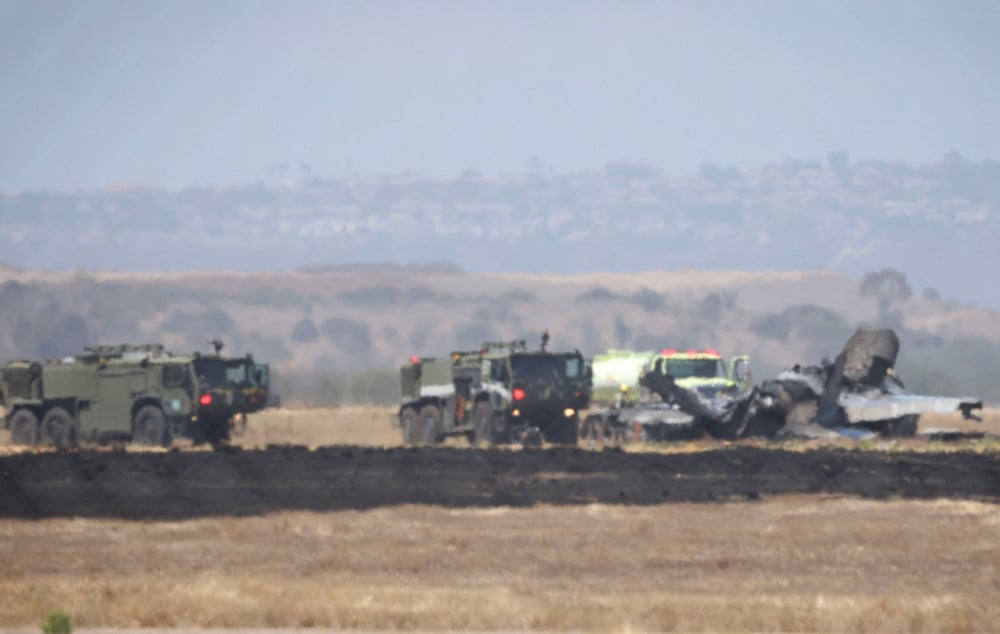
“Images from the scene showed the smoking wreckage resting in an open field near the base, with firefighters and military personnel surrounding the aircraft.” · exact text match
“Video from local television helicopters captured crews extinguishing the blaze while responders sprayed fire retardant around the crash site.” · exact text match
Why: Vivid descriptions and embedded social media sensationalize the crash, despite the factual core.
Claim: Publisher includes an opinion-oriented poll, blurring fact and opinion.
“POLL: Is JD Vance A Better Vice President Than Mike Pence?” · exact text match
Why: The poll asks for opinion on a political comparison, which is an opinion prompt rather than factual reporting.
Claim: Publisher introduces a political dimension through an unrelated poll about the vice presidency.
“POLL: Is JD Vance A Better Vice President Than Mike Pence?” · exact text match
Why: The poll is explicitly political and unrelated to the crash, indicating a politically motivated editorial addition.
Claim: Publisher uses emoticons and dramatic phrasing typical of less mature reporting.
“Pray for the pilots 📷📷” · not found in supplied text
“absolutely terrifying” · exact text match
Why: The use of a prayer-request emoji and hyperbolic language is characteristic of less serious or click-driven journalism.
Claim: Publisher presents the crash with emotionally charged language and imagery.
“absolutely terrifying” · exact text match
“Pray for the pilots 📷📷” · not found in supplied text
Why: The inclusion of a tweet with 'absolutely terrifying' and a prayer request evokes a negative emotional response, though the core report is mostly neutral.
Claim: Publisher's credibility is diminished by sensational framing and irrelevant political content.
“JUST IN: A US F-35 aircraft HAS CRASHED at a base in California, and the crash site looks absolutely terrifying” · exact text match
“POLL: Is JD Vance A Better Vice President Than Mike Pence?” · exact text match
Why: While the core facts are sourced and accurate, the addition of sensational social media and an irrelevant political poll reduces overall trustworthiness.
Claim: Publisher uses an unrelated poll to engage readers and drive partisan response.
“POLL: Is JD Vance A Better Vice President Than Mike Pence?” · exact text match
Why: Inserting a poll on a divisive topic after a news story is a manipulation technique to encourage interaction, though the effect is modest.
The article contains embedded social media content and a poll; attribution of bias to the publisher for selecting these elements is inferential but supported by their placement.
Publisher frames a routine military crash report with a sensational social media reaction and a partisan political poll, injecting emotion and politics into a factual incident.
Automated analysis; not human reviewed.
Limitations: The article contains embedded social media content and a poll; attribution of bias to the publisher for selecting these elements is inferential but supported by their placement.
·
9 of 52 available dimensions scored; omitted dimensions are not treated as neutral.
·
Verified supporting quotes for 7 of 9 scored dimensions.
Claim: Publisher frames the report with a conservative political poll.
“POLL: Is JD Vance A Better Vice President Than Mike Pence?” · exact text match
Why: The poll is partisan and irrelevant to the crash, indicating a conservative-leaning editorial choice.
Claim: Publisher includes subjective/emotional language via embedded social media content.
“Social media footage also showed a large plume of black smoke rising from the downed jet.” · exact text match
“JUST IN: A US F-35 aircraft HAS CRASHED at a base in California, and the crash site looks absolutely terrifying” · exact text match
Why: The inclusion of a tweet calling the scene 'absolutely terrifying' introduces subjective emotional framing beyond factual reporting.
Claim: Publisher amplifies sensational elements through social media and dramatic visuals.
“Images from the scene showed the smoking wreckage resting in an open field near the base, with firefighters and military personnel surrounding the aircraft.” · exact text match
“Video from local television helicopters captured crews extinguishing the blaze while responders sprayed fire retardant around the crash site.” · exact text match
Why: Vivid descriptions and embedded social media sensationalize the crash, despite the factual core.
Claim: Publisher includes an opinion-oriented poll, blurring fact and opinion.
“POLL: Is JD Vance A Better Vice President Than Mike Pence?” · exact text match
Why: The poll asks for opinion on a political comparison, which is an opinion prompt rather than factual reporting.
Claim: Publisher introduces a political dimension through an unrelated poll about the vice presidency.
“POLL: Is JD Vance A Better Vice President Than Mike Pence?” · exact text match
Why: The poll is explicitly political and unrelated to the crash, indicating a politically motivated editorial addition.
Claim: Publisher uses emoticons and dramatic phrasing typical of less mature reporting.
“Pray for the pilots 📷📷” · not found in supplied text
“absolutely terrifying” · exact text match
Why: The use of a prayer-request emoji and hyperbolic language is characteristic of less serious or click-driven journalism.
Claim: Publisher presents the crash with emotionally charged language and imagery.
“absolutely terrifying” · exact text match
“Pray for the pilots 📷📷” · not found in supplied text
Why: The inclusion of a tweet with 'absolutely terrifying' and a prayer request evokes a negative emotional response, though the core report is mostly neutral.
Claim: Publisher's credibility is diminished by sensational framing and irrelevant political content.
“JUST IN: A US F-35 aircraft HAS CRASHED at a base in California, and the crash site looks absolutely terrifying” · exact text match
“POLL: Is JD Vance A Better Vice President Than Mike Pence?” · exact text match
Why: While the core facts are sourced and accurate, the addition of sensational social media and an irrelevant political poll reduces overall trustworthiness.
Claim: Publisher uses an unrelated poll to engage readers and drive partisan response.
“POLL: Is JD Vance A Better Vice President Than Mike Pence?” · exact text match
Why: Inserting a poll on a divisive topic after a news story is a manipulation technique to encourage interaction, though the effect is modest.
The article contains embedded social media content and a poll; attribution of bias to the publisher for selecting these elements is inferential but supported by their placement.
August 01, 2026 · 0 shares
Factual and well-sourced report on an F-35B crash, avoiding sensationalism or opinion.
Miramar airbase was formerly the home of the Navy's Top Gun pilot training school, which relocated to Nevada in 1996. The F-35B variant has an engine designed for short takeoffs and vertical landings.
Automated analysis; not human reviewed.
Limitations: The supplied text appended multiple unrelated headlines after the main report; only the coherent crash report was analyzed, potentially omitting context from those headlines if they were related.
·
11 of 52 available dimensions scored; omitted dimensions are not treated as neutral.
·
Verified supporting quotes for 0 of 11 scored dimensions.
Claim: The article presents facts without subjective commentary.
“"US military says F-35B jet fighter crashes in California, pilot safe." (headline)” · not found in supplied text
“"The pilot ejected, was transported to a local medical facility in stable condition for evaluation and treatment of non-life-threatening injuries," the Marine Corps said in a statement.” · verified after text normalization
Why: The article uses direct quotes and factual descriptions without opinion words.
Claim: The article avoids sensational language.
“"Aerial video from a news helicopter showed a plume of black smoke rising from the wreckage in a dirt field."” · not found in supplied text
“"What appeared to be white flame retardant covered the ground."” · not found in supplied text
Why: Descriptive but not hyperbolic; no emotional adjectives.
Claim: The article does not induce fear.
“States pilot is safe and in stable condition.” · not found in supplied text
“No exaggerated descriptions of danger.” · not found in supplied text
Why: Focus on pilot survival and factual details.
Claim: The article contains no opinion.
“No evaluative adjectives or persuasive language.” · not found in supplied text
“Format is straight news reporting.” · not found in supplied text
Why: No expressions of personal or editorial judgment.
Claim: The article is non-political.
“No reference to political figures, parties, or partisan policies.” · not found in supplied text
Why: The report is strictly about a military aircraft incident and program costs.
Claim: The article avoids overconfident statements.
“"The pilot ejected, was transported... the Marine Corps said."” · not found in supplied text
“Does not make unsupported claims about crash cause or future outcomes.” · not found in supplied text
Why: All assertions are attributed or clearly factual without unwarranted certainty.
Claim: The article has neutral emotional tone.
“Straightforward language without positive or negative emotional framing.” · not found in supplied text
“Reports pilot safe without celebration; reports crash without alarm.” · not found in supplied text
Why: No emotional words or tone.
Claim: The article is credible due to sourcing and factual reporting.
“"according to a 2024 analysis by the Government Accountability Office."” · not found in supplied text
“"the Marine Corps said"” · not found in supplied text
Why: Uses official statements and authoritative databases.
Claim: The article is rational and logical.
“Presents facts in chronological and contextual manner, including cost data and list of other crashes.” · not found in supplied text
“No emotional appeals or logical fallacies.” · not found in supplied text
Why: Structured reporting without irrational elements.
Claim: The article clearly attributes sources and does not present unsupported claims.
“"the Marine Corps said in a statement."” · not found in supplied text
“"according to a 2024 analysis by the Government Accountability Office."” · not found in supplied text
“"Candace Hadley, a spokesperson for San Diego Fire, said."” · not found in supplied text
Why: Every key claim is sourced to an official or report.
The supplied text appended multiple unrelated headlines after the main report; only the coherent crash report was analyzed, potentially omitting context from those headlines if they were related.
Factual reporting of an F-35 crash with neutral language and attribution to official sources.
Automated analysis; not human reviewed.
·
6 of 52 available dimensions scored; omitted dimensions are not treated as neutral.
·
Verified supporting quotes for 6 of 6 scored dimensions.
Claim: The article uses factual language without opinion or subjective judgment.
“The crash occurred around 10 a.m., near the base’s main hangars, west of Kearny Villa Road.” · exact text match
Why: The article reports observable facts and directly quotes official sources without editorial commentary.
Claim: The article avoids sensational language or exaggeration.
“Emergency crews could be seen dousing the jet more than an hour after the crash, and they had to deal with a small fire that started behind the aircraft.” · exact text match
Why: The tone is matter-of-fact; no dramatic words or hype.
Claim: The article is entirely descriptive, containing no recommendations or calls to action.
“An F-35B fighter aircraft crashed Friday morning in the flightline area of Marine Corps Air Station Miramar, a base spokesperson said.” · exact text match
Why: The article describes what happened and quotes officials; no prescriptive language.
Claim: The article maintains a neutral emotional tone throughout.
“The jet was part of Marine Aircraft Group 11, 3rd Marine Aircraft Wing.” · exact text match
Why: No emotional language; the negative event is reported factually.
Claim: The article attributes information to named official sources and provides direct quotes.
““The pilot ejected, (and) was transported to a local medical facility in stable condition for evaluation and treatment of non-life threatening injuries,” the base added in a statement.” · exact text match
Why: Direct quotes from base spokesperson and statement show sourcing.
Claim: The article includes relevant context about previous accidents, showing transparency.
“Accidents involving Miramar aircraft are not uncommon.
One of the most serious incidents happened in 2023 when a pilot was killed during a routine training flight.”
· exact text match
Why: The article mentions past fatalities, providing a balanced view of the base's safety record.
Factual reporting of a military aircraft crash with attributed sources and no editorializing.
Automated analysis; not human reviewed. · 10 of 52 available dimensions scored; omitted dimensions are not treated as neutral. · Verified supporting quotes for 4 of 10 scored dimensions.
Claim: The article reports facts without subjective commentary.
“The pilot ejected before impact” · not found in supplied text
“No injuries have been reported on the ground” · exact text match
“classified as a 'Class A mishap'” · not found in supplied text
Why: The language is purely factual, attributing statements to official sources and avoiding personal judgment.
Claim: The article avoids sensationalism and emotionally charged language.
“The pilot was transported to a local medical facility in stable condition for evaluation and treatment of non-life-threatening injuries.” · not found in supplied text
Why: The tone is calm and measured, focusing on facts without dramatic exaggeration.
Claim: The article describes events without prescribing actions or policies.
“A U.S. Marine Corps F-35B Lightning II stealth fighter jet crashed at Marine Corps Air Station Miramar near San Diego on Friday morning, forcing the pilot to eject before impact.” · exact text match
Why: The sentence is a straightforward description of the incident with no directive language.
Claim: The article contains no political content.
“No political actors, parties, or policies are mentioned.” · not found in supplied text
Why: The coverage is limited to the military incident and its factual context, with no political framing.
Claim: The article is appropriately cautious about certainty.
“Officials have not disclosed what caused the crash” · exact text match
“The cause remains under investigation.” · not found in supplied text
Why: Repeatedly acknowledges that the cause is unknown, avoiding overstatement.
Claim: The emotional tone is neutral.
“The pilot was transported to a local medical facility in stable condition for evaluation and treatment of non-life-threatening injuries.” · not found in supplied text
Why: The language is clinical and unemotional, focusing on facts rather than eliciting a strong emotional response.
Claim: The article is credible based on visible sourcing and specificity.
“The aircraft, assigned to Marine Aircraft Group 11 under the 3rd Marine Aircraft Wing, went down at approximately 10:00 a.m. local time on the flightline at Miramar” · exact text match
“The pilot was transported to a local medical facility in stable condition for evaluation and treatment of non-life-threatening injuries, the Marine Corps said.” · exact text match
Why: Provides precise details: time, location, unit, classification, pilot status, and grounds all assertions in official statements.
Claim: The article presents information in a logical, evidence-based manner.
“Officials have not disclosed what caused the crash” · exact text match
“The cause of Friday’s crash remains under investigation.” · exact text match
Why: The article refrains from speculation and clearly states uncertainty about the cause.
Claim: The article demonstrates high journalistic integrity through proper attribution and transparency.
“according to the Marine Corps” · exact text match
“The Marine Corps added: 'More information will be released when available.'” · not found in supplied text
Why: Every key fact is attributed to an authoritative source, and the article openly states that the cause is under investigation, showing honesty about unknowns.
August 01, 2026 · 0 shares
Factual and well-sourced report on an F-35B crash, avoiding sensationalism or opinion.
Miramar airbase was formerly the home of the Navy's Top Gun pilot training school, which relocated to Nevada in 1996. The F-35B variant has an engine designed for short takeoffs and vertical landings.
Automated analysis; not human reviewed. Limitations: The supplied text appended multiple unrelated headlines after the main report; only the coherent crash report was analyzed, potentially omitting context from those headlines if they were related. · 11 of 52 available dimensions scored; omitted dimensions are not treated as neutral. · Verified supporting quotes for 0 of 11 scored dimensions.
Claim: The article presents facts without subjective commentary.
“"US military says F-35B jet fighter crashes in California, pilot safe." (headline)” · not found in supplied text
“"The pilot ejected, was transported to a local medical facility in stable condition for evaluation and treatment of non-life-threatening injuries," the Marine Corps said in a statement.” · verified after text normalization
Why: The article uses direct quotes and factual descriptions without opinion words.
Claim: The article avoids sensational language.
“"Aerial video from a news helicopter showed a plume of black smoke rising from the wreckage in a dirt field."” · not found in supplied text
“"What appeared to be white flame retardant covered the ground."” · not found in supplied text
Why: Descriptive but not hyperbolic; no emotional adjectives.
Claim: The article does not induce fear.
“States pilot is safe and in stable condition.” · not found in supplied text
“No exaggerated descriptions of danger.” · not found in supplied text
Why: Focus on pilot survival and factual details.
Claim: The article contains no opinion.
“No evaluative adjectives or persuasive language.” · not found in supplied text
“Format is straight news reporting.” · not found in supplied text
Why: No expressions of personal or editorial judgment.
Claim: The article is non-political.
“No reference to political figures, parties, or partisan policies.” · not found in supplied text
Why: The report is strictly about a military aircraft incident and program costs.
Claim: The article avoids overconfident statements.
“"The pilot ejected, was transported... the Marine Corps said."” · not found in supplied text
“Does not make unsupported claims about crash cause or future outcomes.” · not found in supplied text
Why: All assertions are attributed or clearly factual without unwarranted certainty.
Claim: The article has neutral emotional tone.
“Straightforward language without positive or negative emotional framing.” · not found in supplied text
“Reports pilot safe without celebration; reports crash without alarm.” · not found in supplied text
Why: No emotional words or tone.
Claim: The article is credible due to sourcing and factual reporting.
“"according to a 2024 analysis by the Government Accountability Office."” · not found in supplied text
“"the Marine Corps said"” · not found in supplied text
Why: Uses official statements and authoritative databases.
Claim: The article is rational and logical.
“Presents facts in chronological and contextual manner, including cost data and list of other crashes.” · not found in supplied text
“No emotional appeals or logical fallacies.” · not found in supplied text
Why: Structured reporting without irrational elements.
Claim: The article clearly attributes sources and does not present unsupported claims.
“"the Marine Corps said in a statement."” · not found in supplied text
“"according to a 2024 analysis by the Government Accountability Office."” · not found in supplied text
“"Candace Hadley, a spokesperson for San Diego Fire, said."” · not found in supplied text
Why: Every key claim is sourced to an official or report.
The supplied text appended multiple unrelated headlines after the main report; only the coherent crash report was analyzed, potentially omitting context from those headlines if they were related.
Factual reporting of an F-35 crash with neutral language and attribution to official sources.
Automated analysis; not human reviewed. · 6 of 52 available dimensions scored; omitted dimensions are not treated as neutral. · Verified supporting quotes for 6 of 6 scored dimensions.
Claim: The article uses factual language without opinion or subjective judgment.
“The crash occurred around 10 a.m., near the base’s main hangars, west of Kearny Villa Road.” · exact text match
Why: The article reports observable facts and directly quotes official sources without editorial commentary.
Claim: The article avoids sensational language or exaggeration.
“Emergency crews could be seen dousing the jet more than an hour after the crash, and they had to deal with a small fire that started behind the aircraft.” · exact text match
Why: The tone is matter-of-fact; no dramatic words or hype.
Claim: The article is entirely descriptive, containing no recommendations or calls to action.
“An F-35B fighter aircraft crashed Friday morning in the flightline area of Marine Corps Air Station Miramar, a base spokesperson said.” · exact text match
Why: The article describes what happened and quotes officials; no prescriptive language.
Claim: The article maintains a neutral emotional tone throughout.
“The jet was part of Marine Aircraft Group 11, 3rd Marine Aircraft Wing.” · exact text match
Why: No emotional language; the negative event is reported factually.
Claim: The article attributes information to named official sources and provides direct quotes.
““The pilot ejected, (and) was transported to a local medical facility in stable condition for evaluation and treatment of non-life threatening injuries,” the base added in a statement.” · exact text match
Why: Direct quotes from base spokesperson and statement show sourcing.
Claim: The article includes relevant context about previous accidents, showing transparency.
“Accidents involving Miramar aircraft are not uncommon. One of the most serious incidents happened in 2023 when a pilot was killed during a routine training flight.” · exact text match
Why: The article mentions past fatalities, providing a balanced view of the base's safety record.
August 01, 2026 · 0 shares
Straightforward incident report relying on official and witness accounts with minimal editorializing.
Automated analysis; not human reviewed. · 11 of 52 available dimensions scored; omitted dimensions are not treated as neutral. · Verified supporting quotes for 7 of 11 scored dimensions.
Claim: Article presents facts without subjective commentary.
“The aftermath of the crash was captured on film from several angles, which depict smoke coming from the area of the wreckage site somewhere in a California dirt tract inside the base.” · exact text match
Why: Reporting relies on observable facts and attributed statements.
Claim: Headline includes witness exclamation but overall reporting is objective.
“‘It just blew up’” · exact text match
Why: Witness quote in headline adds drama but article remains factual.
Claim: Article reports a routine military crash with no exceptional narrative.
“A U.S. military F-35 stealth fighter jet crashed near the Marine Corps Air Station Miramar in California Friday.” · not found in supplied text
Why: Standard incident report without compelling storytelling.
Claim: Article describes events without prescribing actions.
“Seven other military air mishaps have occurred in the U.S. in 2026, the outlet noted, per the Flight Safety Foundation’s Aviation Safety Network database.” · exact text match
Why: Provides factual context without policy advocacy.
Claim: Article does not take a stance on establishment institutions.
“U.S. Marine Corps classified the crash as a 'Class A mishap'” · not found in supplied text
Why: Reports military procedures without criticism or endorsement.
Claim: Article maintains neutral emotional tone.
““The pilot ejected, was transported to a local medical facility in stable condition”” · not found in supplied text
Why: Language is clinical; witness quote is the only emotional element but attributed.
Claim: Article cites multiple credible sources and acknowledges classification.
“The U.S. Marine Corps announced, according to The Associated Press (AP).” · not found in supplied text
“per the Flight Safety Foundation’s Aviation Safety Network database.” · exact text match
Why: Attribution to official and database sources enhances trustworthiness.
Claim: Article employs factual reporting with attribution.
““The pilot ejected, was transported to a local medical facility in stable condition for evaluation and treatment of non-life-threatening injuries,” the U.S. Marine Corps announced, according to The Associated Press (AP).” · exact text match
Why: Article cites official and witness sources, provides context on mishap classification and other incidents.
Claim: Article demonstrates sourcing and attribution practices.
““The pilot ejected, was transported to a local medical facility in stable condition for evaluation and treatment of non-life-threatening injuries,” the U.S. Marine Corps announced, according to The Associated Press (AP).” · exact text match
Why: Multiple attributions to official and news sources.
July 31, 2026 · 0 shares
Reports the crash factually using official sources, with no commentary or sensationalism.
Automated analysis; not human reviewed. · 2 of 52 available dimensions scored; omitted dimensions are not treated as neutral. · Verified supporting quotes for 0 of 2 scored dimensions.
Claim: The article maintains a neutral emotional tone, neither emphasizing tragedy nor relief.
“The pilot ejected, was transported to a local medical facility in stable condition for evaluation and treatment of non-life-threatening injuries.” · not found in supplied text
Why: The language is clinical and factual; no emotive words or framing are used.
Claim: The article demonstrates high credibility through use of named official sources and specific data.
“Candace Hadley, a spokesperson for San Diego Fire, said firefighters were on scene...” · not found in supplied text
“The F-35s are considered the safest and most capable fighter jets the military has in its fleet, according to the Lexington Institute thinktank...” · not found in supplied text
Why: Multiple attributed sources and inclusion of a database reference enhance trustworthiness, though the think tank quote is an opinion.
Factual reporting of a military aircraft crash with attributed sources and no editorializing.
Automated analysis; not human reviewed. · 10 of 52 available dimensions scored; omitted dimensions are not treated as neutral. · Verified supporting quotes for 4 of 10 scored dimensions.
Claim: The article reports facts without subjective commentary.
“The pilot ejected before impact” · not found in supplied text
“No injuries have been reported on the ground” · exact text match
“classified as a 'Class A mishap'” · not found in supplied text
Why: The language is purely factual, attributing statements to official sources and avoiding personal judgment.
Claim: The article avoids sensationalism and emotionally charged language.
“The pilot was transported to a local medical facility in stable condition for evaluation and treatment of non-life-threatening injuries.” · not found in supplied text
Why: The tone is calm and measured, focusing on facts without dramatic exaggeration.
Claim: The article describes events without prescribing actions or policies.
“A U.S. Marine Corps F-35B Lightning II stealth fighter jet crashed at Marine Corps Air Station Miramar near San Diego on Friday morning, forcing the pilot to eject before impact.” · exact text match
Why: The sentence is a straightforward description of the incident with no directive language.
Claim: The article contains no political content.
“No political actors, parties, or policies are mentioned.” · not found in supplied text
Why: The coverage is limited to the military incident and its factual context, with no political framing.
Claim: The article is appropriately cautious about certainty.
“Officials have not disclosed what caused the crash” · exact text match
“The cause remains under investigation.” · not found in supplied text
Why: Repeatedly acknowledges that the cause is unknown, avoiding overstatement.
Claim: The emotional tone is neutral.
“The pilot was transported to a local medical facility in stable condition for evaluation and treatment of non-life-threatening injuries.” · not found in supplied text
Why: The language is clinical and unemotional, focusing on facts rather than eliciting a strong emotional response.
Claim: The article is credible based on visible sourcing and specificity.
“The aircraft, assigned to Marine Aircraft Group 11 under the 3rd Marine Aircraft Wing, went down at approximately 10:00 a.m. local time on the flightline at Miramar” · exact text match
“The pilot was transported to a local medical facility in stable condition for evaluation and treatment of non-life-threatening injuries, the Marine Corps said.” · exact text match
Why: Provides precise details: time, location, unit, classification, pilot status, and grounds all assertions in official statements.
Claim: The article presents information in a logical, evidence-based manner.
“Officials have not disclosed what caused the crash” · exact text match
“The cause of Friday’s crash remains under investigation.” · exact text match
Why: The article refrains from speculation and clearly states uncertainty about the cause.
Claim: The article demonstrates high journalistic integrity through proper attribution and transparency.
“according to the Marine Corps” · exact text match
“The Marine Corps added: 'More information will be released when available.'” · not found in supplied text
Why: Every key fact is attributed to an authoritative source, and the article openly states that the cause is under investigation, showing honesty about unknowns.
Publisher frames a routine military crash report with a sensational social media reaction and a partisan political poll, injecting emotion and politics into a factual incident.
Automated analysis; not human reviewed. Limitations: The article contains embedded social media content and a poll; attribution of bias to the publisher for selecting these elements is inferential but supported by their placement. · 9 of 52 available dimensions scored; omitted dimensions are not treated as neutral. · Verified supporting quotes for 7 of 9 scored dimensions.
Claim: Publisher frames the report with a conservative political poll.
“POLL: Is JD Vance A Better Vice President Than Mike Pence?” · exact text match
Why: The poll is partisan and irrelevant to the crash, indicating a conservative-leaning editorial choice.
Claim: Publisher includes subjective/emotional language via embedded social media content.
“Social media footage also showed a large plume of black smoke rising from the downed jet.” · exact text match
“JUST IN: A US F-35 aircraft HAS CRASHED at a base in California, and the crash site looks absolutely terrifying” · exact text match
Why: The inclusion of a tweet calling the scene 'absolutely terrifying' introduces subjective emotional framing beyond factual reporting.
Claim: Publisher amplifies sensational elements through social media and dramatic visuals.
“Images from the scene showed the smoking wreckage resting in an open field near the base, with firefighters and military personnel surrounding the aircraft.” · exact text match
“Video from local television helicopters captured crews extinguishing the blaze while responders sprayed fire retardant around the crash site.” · exact text match
Why: Vivid descriptions and embedded social media sensationalize the crash, despite the factual core.
Claim: Publisher includes an opinion-oriented poll, blurring fact and opinion.
“POLL: Is JD Vance A Better Vice President Than Mike Pence?” · exact text match
Why: The poll asks for opinion on a political comparison, which is an opinion prompt rather than factual reporting.
Claim: Publisher introduces a political dimension through an unrelated poll about the vice presidency.
“POLL: Is JD Vance A Better Vice President Than Mike Pence?” · exact text match
Why: The poll is explicitly political and unrelated to the crash, indicating a politically motivated editorial addition.
Claim: Publisher uses emoticons and dramatic phrasing typical of less mature reporting.
“Pray for the pilots 📷📷” · not found in supplied text
“absolutely terrifying” · exact text match
Why: The use of a prayer-request emoji and hyperbolic language is characteristic of less serious or click-driven journalism.
Claim: Publisher presents the crash with emotionally charged language and imagery.
“absolutely terrifying” · exact text match
“Pray for the pilots 📷📷” · not found in supplied text
Why: The inclusion of a tweet with 'absolutely terrifying' and a prayer request evokes a negative emotional response, though the core report is mostly neutral.
Claim: Publisher's credibility is diminished by sensational framing and irrelevant political content.
“JUST IN: A US F-35 aircraft HAS CRASHED at a base in California, and the crash site looks absolutely terrifying” · exact text match
“POLL: Is JD Vance A Better Vice President Than Mike Pence?” · exact text match
Why: While the core facts are sourced and accurate, the addition of sensational social media and an irrelevant political poll reduces overall trustworthiness.
Claim: Publisher uses an unrelated poll to engage readers and drive partisan response.
“POLL: Is JD Vance A Better Vice President Than Mike Pence?” · exact text match
Why: Inserting a poll on a divisive topic after a news story is a manipulation technique to encourage interaction, though the effect is modest.
The article contains embedded social media content and a poll; attribution of bias to the publisher for selecting these elements is inferential but supported by their placement.
August 01, 2026 · 0 shares
Straightforward incident report relying on official and witness accounts with minimal editorializing.
Automated analysis; not human reviewed. · 11 of 52 available dimensions scored; omitted dimensions are not treated as neutral. · Verified supporting quotes for 7 of 11 scored dimensions.
Claim: Article presents facts without subjective commentary.
“The aftermath of the crash was captured on film from several angles, which depict smoke coming from the area of the wreckage site somewhere in a California dirt tract inside the base.” · exact text match
Why: Reporting relies on observable facts and attributed statements.
Claim: Headline includes witness exclamation but overall reporting is objective.
“‘It just blew up’” · exact text match
Why: Witness quote in headline adds drama but article remains factual.
Claim: Article reports a routine military crash with no exceptional narrative.
“A U.S. military F-35 stealth fighter jet crashed near the Marine Corps Air Station Miramar in California Friday.” · not found in supplied text
Why: Standard incident report without compelling storytelling.
Claim: Article describes events without prescribing actions.
“Seven other military air mishaps have occurred in the U.S. in 2026, the outlet noted, per the Flight Safety Foundation’s Aviation Safety Network database.” · exact text match
Why: Provides factual context without policy advocacy.
Claim: Article does not take a stance on establishment institutions.
“U.S. Marine Corps classified the crash as a 'Class A mishap'” · not found in supplied text
Why: Reports military procedures without criticism or endorsement.
Claim: Article maintains neutral emotional tone.
““The pilot ejected, was transported to a local medical facility in stable condition”” · not found in supplied text
Why: Language is clinical; witness quote is the only emotional element but attributed.
Claim: Article cites multiple credible sources and acknowledges classification.
“The U.S. Marine Corps announced, according to The Associated Press (AP).” · not found in supplied text
“per the Flight Safety Foundation’s Aviation Safety Network database.” · exact text match
Why: Attribution to official and database sources enhances trustworthiness.
Claim: Article employs factual reporting with attribution.
““The pilot ejected, was transported to a local medical facility in stable condition for evaluation and treatment of non-life-threatening injuries,” the U.S. Marine Corps announced, according to The Associated Press (AP).” · exact text match
Why: Article cites official and witness sources, provides context on mishap classification and other incidents.
Claim: Article demonstrates sourcing and attribution practices.
““The pilot ejected, was transported to a local medical facility in stable condition for evaluation and treatment of non-life-threatening injuries,” the U.S. Marine Corps announced, according to The Associated Press (AP).” · exact text match
Why: Multiple attributions to official and news sources.
Publisher frames a routine military crash report with a sensational social media reaction and a partisan political poll, injecting emotion and politics into a factual incident.
Automated analysis; not human reviewed. Limitations: The article contains embedded social media content and a poll; attribution of bias to the publisher for selecting these elements is inferential but supported by their placement. · 9 of 52 available dimensions scored; omitted dimensions are not treated as neutral. · Verified supporting quotes for 7 of 9 scored dimensions.
Claim: Publisher frames the report with a conservative political poll.
“POLL: Is JD Vance A Better Vice President Than Mike Pence?” · exact text match
Why: The poll is partisan and irrelevant to the crash, indicating a conservative-leaning editorial choice.
Claim: Publisher includes subjective/emotional language via embedded social media content.
“Social media footage also showed a large plume of black smoke rising from the downed jet.” · exact text match
“JUST IN: A US F-35 aircraft HAS CRASHED at a base in California, and the crash site looks absolutely terrifying” · exact text match
Why: The inclusion of a tweet calling the scene 'absolutely terrifying' introduces subjective emotional framing beyond factual reporting.
Claim: Publisher amplifies sensational elements through social media and dramatic visuals.
“Images from the scene showed the smoking wreckage resting in an open field near the base, with firefighters and military personnel surrounding the aircraft.” · exact text match
“Video from local television helicopters captured crews extinguishing the blaze while responders sprayed fire retardant around the crash site.” · exact text match
Why: Vivid descriptions and embedded social media sensationalize the crash, despite the factual core.
Claim: Publisher includes an opinion-oriented poll, blurring fact and opinion.
“POLL: Is JD Vance A Better Vice President Than Mike Pence?” · exact text match
Why: The poll asks for opinion on a political comparison, which is an opinion prompt rather than factual reporting.
Claim: Publisher introduces a political dimension through an unrelated poll about the vice presidency.
“POLL: Is JD Vance A Better Vice President Than Mike Pence?” · exact text match
Why: The poll is explicitly political and unrelated to the crash, indicating a politically motivated editorial addition.
Claim: Publisher uses emoticons and dramatic phrasing typical of less mature reporting.
“Pray for the pilots 📷📷” · not found in supplied text
“absolutely terrifying” · exact text match
Why: The use of a prayer-request emoji and hyperbolic language is characteristic of less serious or click-driven journalism.
Claim: Publisher presents the crash with emotionally charged language and imagery.
“absolutely terrifying” · exact text match
“Pray for the pilots 📷📷” · not found in supplied text
Why: The inclusion of a tweet with 'absolutely terrifying' and a prayer request evokes a negative emotional response, though the core report is mostly neutral.
Claim: Publisher's credibility is diminished by sensational framing and irrelevant political content.
“JUST IN: A US F-35 aircraft HAS CRASHED at a base in California, and the crash site looks absolutely terrifying” · exact text match
“POLL: Is JD Vance A Better Vice President Than Mike Pence?” · exact text match
Why: While the core facts are sourced and accurate, the addition of sensational social media and an irrelevant political poll reduces overall trustworthiness.
Claim: Publisher uses an unrelated poll to engage readers and drive partisan response.
“POLL: Is JD Vance A Better Vice President Than Mike Pence?” · exact text match
Why: Inserting a poll on a divisive topic after a news story is a manipulation technique to encourage interaction, though the effect is modest.
The article contains embedded social media content and a poll; attribution of bias to the publisher for selecting these elements is inferential but supported by their placement.
August 01, 2026 · 0 shares
Factual and well-sourced report on an F-35B crash, avoiding sensationalism or opinion.
Miramar airbase was formerly the home of the Navy's Top Gun pilot training school, which relocated to Nevada in 1996. The F-35B variant has an engine designed for short takeoffs and vertical landings.
Automated analysis; not human reviewed. Limitations: The supplied text appended multiple unrelated headlines after the main report; only the coherent crash report was analyzed, potentially omitting context from those headlines if they were related. · 11 of 52 available dimensions scored; omitted dimensions are not treated as neutral. · Verified supporting quotes for 0 of 11 scored dimensions.
Claim: The article presents facts without subjective commentary.
“"US military says F-35B jet fighter crashes in California, pilot safe." (headline)” · not found in supplied text
“"The pilot ejected, was transported to a local medical facility in stable condition for evaluation and treatment of non-life-threatening injuries," the Marine Corps said in a statement.” · verified after text normalization
Why: The article uses direct quotes and factual descriptions without opinion words.
Claim: The article avoids sensational language.
“"Aerial video from a news helicopter showed a plume of black smoke rising from the wreckage in a dirt field."” · not found in supplied text
“"What appeared to be white flame retardant covered the ground."” · not found in supplied text
Why: Descriptive but not hyperbolic; no emotional adjectives.
Claim: The article does not induce fear.
“States pilot is safe and in stable condition.” · not found in supplied text
“No exaggerated descriptions of danger.” · not found in supplied text
Why: Focus on pilot survival and factual details.
Claim: The article contains no opinion.
“No evaluative adjectives or persuasive language.” · not found in supplied text
“Format is straight news reporting.” · not found in supplied text
Why: No expressions of personal or editorial judgment.
Claim: The article is non-political.
“No reference to political figures, parties, or partisan policies.” · not found in supplied text
Why: The report is strictly about a military aircraft incident and program costs.
Claim: The article avoids overconfident statements.
“"The pilot ejected, was transported... the Marine Corps said."” · not found in supplied text
“Does not make unsupported claims about crash cause or future outcomes.” · not found in supplied text
Why: All assertions are attributed or clearly factual without unwarranted certainty.
Claim: The article has neutral emotional tone.
“Straightforward language without positive or negative emotional framing.” · not found in supplied text
“Reports pilot safe without celebration; reports crash without alarm.” · not found in supplied text
Why: No emotional words or tone.
Claim: The article is credible due to sourcing and factual reporting.
“"according to a 2024 analysis by the Government Accountability Office."” · not found in supplied text
“"the Marine Corps said"” · not found in supplied text
Why: Uses official statements and authoritative databases.
Claim: The article is rational and logical.
“Presents facts in chronological and contextual manner, including cost data and list of other crashes.” · not found in supplied text
“No emotional appeals or logical fallacies.” · not found in supplied text
Why: Structured reporting without irrational elements.
Claim: The article clearly attributes sources and does not present unsupported claims.
“"the Marine Corps said in a statement."” · not found in supplied text
“"according to a 2024 analysis by the Government Accountability Office."” · not found in supplied text
“"Candace Hadley, a spokesperson for San Diego Fire, said."” · not found in supplied text
Why: Every key claim is sourced to an official or report.
The supplied text appended multiple unrelated headlines after the main report; only the coherent crash report was analyzed, potentially omitting context from those headlines if they were related.
Factual reporting of an F-35 crash with neutral language and attribution to official sources.
Automated analysis; not human reviewed. · 6 of 52 available dimensions scored; omitted dimensions are not treated as neutral. · Verified supporting quotes for 6 of 6 scored dimensions.
Claim: The article uses factual language without opinion or subjective judgment.
“The crash occurred around 10 a.m., near the base’s main hangars, west of Kearny Villa Road.” · exact text match
Why: The article reports observable facts and directly quotes official sources without editorial commentary.
Claim: The article avoids sensational language or exaggeration.
“Emergency crews could be seen dousing the jet more than an hour after the crash, and they had to deal with a small fire that started behind the aircraft.” · exact text match
Why: The tone is matter-of-fact; no dramatic words or hype.
Claim: The article is entirely descriptive, containing no recommendations or calls to action.
“An F-35B fighter aircraft crashed Friday morning in the flightline area of Marine Corps Air Station Miramar, a base spokesperson said.” · exact text match
Why: The article describes what happened and quotes officials; no prescriptive language.
Claim: The article maintains a neutral emotional tone throughout.
“The jet was part of Marine Aircraft Group 11, 3rd Marine Aircraft Wing.” · exact text match
Why: No emotional language; the negative event is reported factually.
Claim: The article attributes information to named official sources and provides direct quotes.
““The pilot ejected, (and) was transported to a local medical facility in stable condition for evaluation and treatment of non-life threatening injuries,” the base added in a statement.” · exact text match
Why: Direct quotes from base spokesperson and statement show sourcing.
Claim: The article includes relevant context about previous accidents, showing transparency.
“Accidents involving Miramar aircraft are not uncommon. One of the most serious incidents happened in 2023 when a pilot was killed during a routine training flight.” · exact text match
Why: The article mentions past fatalities, providing a balanced view of the base's safety record.
Helium Bias
Story Blindspots
Factual reporting of a military aircraft crash with attributed sources and no editorializing.
Automated analysis; not human reviewed. · 10 of 52 available dimensions scored; omitted dimensions are not treated as neutral. · Verified supporting quotes for 4 of 10 scored dimensions.
Claim: The article reports facts without subjective commentary.
“The pilot ejected before impact” · not found in supplied text
“No injuries have been reported on the ground” · exact text match
“classified as a 'Class A mishap'” · not found in supplied text
Why: The language is purely factual, attributing statements to official sources and avoiding personal judgment.
Claim: The article avoids sensationalism and emotionally charged language.
“The pilot was transported to a local medical facility in stable condition for evaluation and treatment of non-life-threatening injuries.” · not found in supplied text
Why: The tone is calm and measured, focusing on facts without dramatic exaggeration.
Claim: The article describes events without prescribing actions or policies.
“A U.S. Marine Corps F-35B Lightning II stealth fighter jet crashed at Marine Corps Air Station Miramar near San Diego on Friday morning, forcing the pilot to eject before impact.” · exact text match
Why: The sentence is a straightforward description of the incident with no directive language.
Claim: The article contains no political content.
“No political actors, parties, or policies are mentioned.” · not found in supplied text
Why: The coverage is limited to the military incident and its factual context, with no political framing.
Claim: The article is appropriately cautious about certainty.
“Officials have not disclosed what caused the crash” · exact text match
“The cause remains under investigation.” · not found in supplied text
Why: Repeatedly acknowledges that the cause is unknown, avoiding overstatement.
Claim: The emotional tone is neutral.
“The pilot was transported to a local medical facility in stable condition for evaluation and treatment of non-life-threatening injuries.” · not found in supplied text
Why: The language is clinical and unemotional, focusing on facts rather than eliciting a strong emotional response.
Claim: The article is credible based on visible sourcing and specificity.
“The aircraft, assigned to Marine Aircraft Group 11 under the 3rd Marine Aircraft Wing, went down at approximately 10:00 a.m. local time on the flightline at Miramar” · exact text match
“The pilot was transported to a local medical facility in stable condition for evaluation and treatment of non-life-threatening injuries, the Marine Corps said.” · exact text match
Why: Provides precise details: time, location, unit, classification, pilot status, and grounds all assertions in official statements.
Claim: The article presents information in a logical, evidence-based manner.
“Officials have not disclosed what caused the crash” · exact text match
“The cause of Friday’s crash remains under investigation.” · exact text match
Why: The article refrains from speculation and clearly states uncertainty about the cause.
Claim: The article demonstrates high journalistic integrity through proper attribution and transparency.
“according to the Marine Corps” · exact text match
“The Marine Corps added: 'More information will be released when available.'” · not found in supplied text
Why: Every key fact is attributed to an authoritative source, and the article openly states that the cause is under investigation, showing honesty about unknowns.
Publisher frames a routine military crash report with a sensational social media reaction and a partisan political poll, injecting emotion and politics into a factual incident.
Automated analysis; not human reviewed. Limitations: The article contains embedded social media content and a poll; attribution of bias to the publisher for selecting these elements is inferential but supported by their placement. · 9 of 52 available dimensions scored; omitted dimensions are not treated as neutral. · Verified supporting quotes for 7 of 9 scored dimensions.
Claim: Publisher frames the report with a conservative political poll.
“POLL: Is JD Vance A Better Vice President Than Mike Pence?” · exact text match
Why: The poll is partisan and irrelevant to the crash, indicating a conservative-leaning editorial choice.
Claim: Publisher includes subjective/emotional language via embedded social media content.
“Social media footage also showed a large plume of black smoke rising from the downed jet.” · exact text match
“JUST IN: A US F-35 aircraft HAS CRASHED at a base in California, and the crash site looks absolutely terrifying” · exact text match
Why: The inclusion of a tweet calling the scene 'absolutely terrifying' introduces subjective emotional framing beyond factual reporting.
Claim: Publisher amplifies sensational elements through social media and dramatic visuals.
“Images from the scene showed the smoking wreckage resting in an open field near the base, with firefighters and military personnel surrounding the aircraft.” · exact text match
“Video from local television helicopters captured crews extinguishing the blaze while responders sprayed fire retardant around the crash site.” · exact text match
Why: Vivid descriptions and embedded social media sensationalize the crash, despite the factual core.
Claim: Publisher includes an opinion-oriented poll, blurring fact and opinion.
“POLL: Is JD Vance A Better Vice President Than Mike Pence?” · exact text match
Why: The poll asks for opinion on a political comparison, which is an opinion prompt rather than factual reporting.
Claim: Publisher introduces a political dimension through an unrelated poll about the vice presidency.
“POLL: Is JD Vance A Better Vice President Than Mike Pence?” · exact text match
Why: The poll is explicitly political and unrelated to the crash, indicating a politically motivated editorial addition.
Claim: Publisher uses emoticons and dramatic phrasing typical of less mature reporting.
“Pray for the pilots 📷📷” · not found in supplied text
“absolutely terrifying” · exact text match
Why: The use of a prayer-request emoji and hyperbolic language is characteristic of less serious or click-driven journalism.
Claim: Publisher presents the crash with emotionally charged language and imagery.
“absolutely terrifying” · exact text match
“Pray for the pilots 📷📷” · not found in supplied text
Why: The inclusion of a tweet with 'absolutely terrifying' and a prayer request evokes a negative emotional response, though the core report is mostly neutral.
Claim: Publisher's credibility is diminished by sensational framing and irrelevant political content.
“JUST IN: A US F-35 aircraft HAS CRASHED at a base in California, and the crash site looks absolutely terrifying” · exact text match
“POLL: Is JD Vance A Better Vice President Than Mike Pence?” · exact text match
Why: While the core facts are sourced and accurate, the addition of sensational social media and an irrelevant political poll reduces overall trustworthiness.
Claim: Publisher uses an unrelated poll to engage readers and drive partisan response.
“POLL: Is JD Vance A Better Vice President Than Mike Pence?” · exact text match
Why: Inserting a poll on a divisive topic after a news story is a manipulation technique to encourage interaction, though the effect is modest.
The article contains embedded social media content and a poll; attribution of bias to the publisher for selecting these elements is inferential but supported by their placement.
August 01, 2026 · 0 shares
Factual and well-sourced report on an F-35B crash, avoiding sensationalism or opinion.
Miramar airbase was formerly the home of the Navy's Top Gun pilot training school, which relocated to Nevada in 1996. The F-35B variant has an engine designed for short takeoffs and vertical landings.
Automated analysis; not human reviewed. Limitations: The supplied text appended multiple unrelated headlines after the main report; only the coherent crash report was analyzed, potentially omitting context from those headlines if they were related. · 11 of 52 available dimensions scored; omitted dimensions are not treated as neutral. · Verified supporting quotes for 0 of 11 scored dimensions.
Claim: The article presents facts without subjective commentary.
“"US military says F-35B jet fighter crashes in California, pilot safe." (headline)” · not found in supplied text
“"The pilot ejected, was transported to a local medical facility in stable condition for evaluation and treatment of non-life-threatening injuries," the Marine Corps said in a statement.” · verified after text normalization
Why: The article uses direct quotes and factual descriptions without opinion words.
Claim: The article avoids sensational language.
“"Aerial video from a news helicopter showed a plume of black smoke rising from the wreckage in a dirt field."” · not found in supplied text
“"What appeared to be white flame retardant covered the ground."” · not found in supplied text
Why: Descriptive but not hyperbolic; no emotional adjectives.
Claim: The article does not induce fear.
“States pilot is safe and in stable condition.” · not found in supplied text
“No exaggerated descriptions of danger.” · not found in supplied text
Why: Focus on pilot survival and factual details.
Claim: The article contains no opinion.
“No evaluative adjectives or persuasive language.” · not found in supplied text
“Format is straight news reporting.” · not found in supplied text
Why: No expressions of personal or editorial judgment.
Claim: The article is non-political.
“No reference to political figures, parties, or partisan policies.” · not found in supplied text
Why: The report is strictly about a military aircraft incident and program costs.
Claim: The article avoids overconfident statements.
“"The pilot ejected, was transported... the Marine Corps said."” · not found in supplied text
“Does not make unsupported claims about crash cause or future outcomes.” · not found in supplied text
Why: All assertions are attributed or clearly factual without unwarranted certainty.
Claim: The article has neutral emotional tone.
“Straightforward language without positive or negative emotional framing.” · not found in supplied text
“Reports pilot safe without celebration; reports crash without alarm.” · not found in supplied text
Why: No emotional words or tone.
Claim: The article is credible due to sourcing and factual reporting.
“"according to a 2024 analysis by the Government Accountability Office."” · not found in supplied text
“"the Marine Corps said"” · not found in supplied text
Why: Uses official statements and authoritative databases.
Claim: The article is rational and logical.
“Presents facts in chronological and contextual manner, including cost data and list of other crashes.” · not found in supplied text
“No emotional appeals or logical fallacies.” · not found in supplied text
Why: Structured reporting without irrational elements.
Claim: The article clearly attributes sources and does not present unsupported claims.
“"the Marine Corps said in a statement."” · not found in supplied text
“"according to a 2024 analysis by the Government Accountability Office."” · not found in supplied text
“"Candace Hadley, a spokesperson for San Diego Fire, said."” · not found in supplied text
Why: Every key claim is sourced to an official or report.
The supplied text appended multiple unrelated headlines after the main report; only the coherent crash report was analyzed, potentially omitting context from those headlines if they were related.
August 01, 2026 · 0 shares
Straightforward incident report relying on official and witness accounts with minimal editorializing.
Automated analysis; not human reviewed. · 11 of 52 available dimensions scored; omitted dimensions are not treated as neutral. · Verified supporting quotes for 7 of 11 scored dimensions.
Claim: Article presents facts without subjective commentary.
“The aftermath of the crash was captured on film from several angles, which depict smoke coming from the area of the wreckage site somewhere in a California dirt tract inside the base.” · exact text match
Why: Reporting relies on observable facts and attributed statements.
Claim: Headline includes witness exclamation but overall reporting is objective.
“‘It just blew up’” · exact text match
Why: Witness quote in headline adds drama but article remains factual.
Claim: Article reports a routine military crash with no exceptional narrative.
“A U.S. military F-35 stealth fighter jet crashed near the Marine Corps Air Station Miramar in California Friday.” · not found in supplied text
Why: Standard incident report without compelling storytelling.
Claim: Article describes events without prescribing actions.
“Seven other military air mishaps have occurred in the U.S. in 2026, the outlet noted, per the Flight Safety Foundation’s Aviation Safety Network database.” · exact text match
Why: Provides factual context without policy advocacy.
Claim: Article does not take a stance on establishment institutions.
“U.S. Marine Corps classified the crash as a 'Class A mishap'” · not found in supplied text
Why: Reports military procedures without criticism or endorsement.
Claim: Article maintains neutral emotional tone.
““The pilot ejected, was transported to a local medical facility in stable condition”” · not found in supplied text
Why: Language is clinical; witness quote is the only emotional element but attributed.
Claim: Article cites multiple credible sources and acknowledges classification.
“The U.S. Marine Corps announced, according to The Associated Press (AP).” · not found in supplied text
“per the Flight Safety Foundation’s Aviation Safety Network database.” · exact text match
Why: Attribution to official and database sources enhances trustworthiness.
Claim: Article employs factual reporting with attribution.
““The pilot ejected, was transported to a local medical facility in stable condition for evaluation and treatment of non-life-threatening injuries,” the U.S. Marine Corps announced, according to The Associated Press (AP).” · exact text match
Why: Article cites official and witness sources, provides context on mishap classification and other incidents.
Claim: Article demonstrates sourcing and attribution practices.
““The pilot ejected, was transported to a local medical facility in stable condition for evaluation and treatment of non-life-threatening injuries,” the U.S. Marine Corps announced, according to The Associated Press (AP).” · exact text match
Why: Multiple attributions to official and news sources.
July 31, 2026 · 0 shares
Reports the crash factually using official sources, with no commentary or sensationalism.
Automated analysis; not human reviewed. · 2 of 52 available dimensions scored; omitted dimensions are not treated as neutral. · Verified supporting quotes for 0 of 2 scored dimensions.
Claim: The article maintains a neutral emotional tone, neither emphasizing tragedy nor relief.
“The pilot ejected, was transported to a local medical facility in stable condition for evaluation and treatment of non-life-threatening injuries.” · not found in supplied text
Why: The language is clinical and factual; no emotive words or framing are used.
Claim: The article demonstrates high credibility through use of named official sources and specific data.
“Candace Hadley, a spokesperson for San Diego Fire, said firefighters were on scene...” · not found in supplied text
“The F-35s are considered the safest and most capable fighter jets the military has in its fleet, according to the Lexington Institute thinktank...” · not found in supplied text
Why: Multiple attributed sources and inclusion of a database reference enhance trustworthiness, though the think tank quote is an opinion.
Factual reporting of a military aircraft crash with attributed sources and no editorializing.
Automated analysis; not human reviewed. · 10 of 52 available dimensions scored; omitted dimensions are not treated as neutral. · Verified supporting quotes for 4 of 10 scored dimensions.
Claim: The article reports facts without subjective commentary.
“The pilot ejected before impact” · not found in supplied text
“No injuries have been reported on the ground” · exact text match
“classified as a 'Class A mishap'” · not found in supplied text
Why: The language is purely factual, attributing statements to official sources and avoiding personal judgment.
Claim: The article avoids sensationalism and emotionally charged language.
“The pilot was transported to a local medical facility in stable condition for evaluation and treatment of non-life-threatening injuries.” · not found in supplied text
Why: The tone is calm and measured, focusing on facts without dramatic exaggeration.
Claim: The article describes events without prescribing actions or policies.
“A U.S. Marine Corps F-35B Lightning II stealth fighter jet crashed at Marine Corps Air Station Miramar near San Diego on Friday morning, forcing the pilot to eject before impact.” · exact text match
Why: The sentence is a straightforward description of the incident with no directive language.
Claim: The article contains no political content.
“No political actors, parties, or policies are mentioned.” · not found in supplied text
Why: The coverage is limited to the military incident and its factual context, with no political framing.
Claim: The article is appropriately cautious about certainty.
“Officials have not disclosed what caused the crash” · exact text match
“The cause remains under investigation.” · not found in supplied text
Why: Repeatedly acknowledges that the cause is unknown, avoiding overstatement.
Claim: The emotional tone is neutral.
“The pilot was transported to a local medical facility in stable condition for evaluation and treatment of non-life-threatening injuries.” · not found in supplied text
Why: The language is clinical and unemotional, focusing on facts rather than eliciting a strong emotional response.
Claim: The article is credible based on visible sourcing and specificity.
“The aircraft, assigned to Marine Aircraft Group 11 under the 3rd Marine Aircraft Wing, went down at approximately 10:00 a.m. local time on the flightline at Miramar” · exact text match
“The pilot was transported to a local medical facility in stable condition for evaluation and treatment of non-life-threatening injuries, the Marine Corps said.” · exact text match
Why: Provides precise details: time, location, unit, classification, pilot status, and grounds all assertions in official statements.
Claim: The article presents information in a logical, evidence-based manner.
“Officials have not disclosed what caused the crash” · exact text match
“The cause of Friday’s crash remains under investigation.” · exact text match
Why: The article refrains from speculation and clearly states uncertainty about the cause.
Claim: The article demonstrates high journalistic integrity through proper attribution and transparency.
“according to the Marine Corps” · exact text match
“The Marine Corps added: 'More information will be released when available.'” · not found in supplied text
Why: Every key fact is attributed to an authoritative source, and the article openly states that the cause is under investigation, showing honesty about unknowns.
Factual reporting of an F-35 crash with neutral language and attribution to official sources.
Automated analysis; not human reviewed. · 6 of 52 available dimensions scored; omitted dimensions are not treated as neutral. · Verified supporting quotes for 6 of 6 scored dimensions.
Claim: The article uses factual language without opinion or subjective judgment.
“The crash occurred around 10 a.m., near the base’s main hangars, west of Kearny Villa Road.” · exact text match
Why: The article reports observable facts and directly quotes official sources without editorial commentary.
Claim: The article avoids sensational language or exaggeration.
“Emergency crews could be seen dousing the jet more than an hour after the crash, and they had to deal with a small fire that started behind the aircraft.” · exact text match
Why: The tone is matter-of-fact; no dramatic words or hype.
Claim: The article is entirely descriptive, containing no recommendations or calls to action.
“An F-35B fighter aircraft crashed Friday morning in the flightline area of Marine Corps Air Station Miramar, a base spokesperson said.” · exact text match
Why: The article describes what happened and quotes officials; no prescriptive language.
Claim: The article maintains a neutral emotional tone throughout.
“The jet was part of Marine Aircraft Group 11, 3rd Marine Aircraft Wing.” · exact text match
Why: No emotional language; the negative event is reported factually.
Claim: The article attributes information to named official sources and provides direct quotes.
““The pilot ejected, (and) was transported to a local medical facility in stable condition for evaluation and treatment of non-life threatening injuries,” the base added in a statement.” · exact text match
Why: Direct quotes from base spokesperson and statement show sourcing.
Claim: The article includes relevant context about previous accidents, showing transparency.
“Accidents involving Miramar aircraft are not uncommon. One of the most serious incidents happened in 2023 when a pilot was killed during a routine training flight.” · exact text match
Why: The article mentions past fatalities, providing a balanced view of the base's safety record.
July 31, 2026 · 0 shares
Factual reporting with attribution to official sources and no discernible framing bias.
Automated analysis; not human reviewed. Limitations: Analysis based on a short, straightforward news report; limited context may miss subtle framing. · 11 of 52 available dimensions scored; omitted dimensions are not treated as neutral. · Verified supporting quotes for 9 of 11 scored dimensions.
Claim: Reporting is politically neutral.
“An F-35 fighter jet crashed near a Marine Corps base in San Diego on Friday, sparking a small fire.” · exact text match
Why: The article does not mention political parties, ideologies, or policy debates; it focuses solely on factual accident details.
Claim: Reporting is objective, presenting facts and official statements.
“A Marine Corps spokesperson said the pilot ejected, was recovered, and is being transported to a medical facility.” · exact text match
Why: The text attributes statements to official sources and describes observable events without opinionated language.
Claim: Not sensational; language is factual and measured.
“sparking a small fire” · exact text match
Why: The qualifier 'small' and lack of dramatic adjectives keep the tone objective.
Claim: Moderate interest level; standard breaking news report.
“In 2024, a Marine Corps pilot ejected from an F-35 after experiencing a series of technical malfunctions during a heavy rainstorm. The plane continued to fly by itself for over 11 minutes, covering about 70 miles, before crashing.” · not found in supplied text
Why: The article includes some unusual details about past crashes, but the overall tone is routine news.
Claim: Descriptive reporting without prescription.
“The pilot has not been identified.” · exact text match
Why: The text states a fact without recommending any action or offering moral judgment.
Claim: Neutral toward establishment institutions.
“Marine Corps Air Station Miramar is about 10 miles north of San Diego. The base is home to over 15,000 Marines, sailors and civilians, and is the headquarters of the 3rd Marine Aircraft Wing.” · exact text match
Why: The article reports on a military incident without criticism or praise, presenting factual information about the base.
Claim: Emotionally neutral; no positive or negative emotional language.
“The pilot ejected, was recovered, and is being transported to a medical facility.” · not found in supplied text
Why: The phrasing is clinical and avoids fearful or uplifting adjectives.
Claim: Credible reporting due to sourcing, verification, and transparent uncertainty.
“A Marine Corps spokesperson said the pilot ejected, was recovered, and is being transported to a medical facility.” · exact text match
“The News Confirmed team was able to verify social media videos” · verified after text normalization
Why: The article attributes information to named spokespeople and describes its own verification process.
Claim: Reporting is rational and does not employ emotional or irrational language.
“It's not immediately clear what led to the crash.” · exact text match
Why: Acknowledging uncertainty is a rational epistemic stance; no hyperbole or conspiracy claims.
Claim: High integrity due to attribution, verification, and transparent reporting.
“The News Confirmed team was able to verify social media videos that showed a plume of black smoke emitting from the plane as responders spray it with fire retardant.” · verified after text normalization
“Footage taken by affiliate KFMB-TV's helicopter shows responders working to put out the fire.” · verified after text normalization
Why: The article explicitly cites verification efforts and sources, indicating care for accuracy.
Analysis based on a short, straightforward news report; limited context may miss subtle framing.
Factual reporting of a military aircraft crash with attributed sources and no editorializing.
Automated analysis; not human reviewed. · 10 of 52 available dimensions scored; omitted dimensions are not treated as neutral. · Verified supporting quotes for 4 of 10 scored dimensions.
Claim: The article reports facts without subjective commentary.
“The pilot ejected before impact” · not found in supplied text
“No injuries have been reported on the ground” · exact text match
“classified as a 'Class A mishap'” · not found in supplied text
Why: The language is purely factual, attributing statements to official sources and avoiding personal judgment.
Claim: The article avoids sensationalism and emotionally charged language.
“The pilot was transported to a local medical facility in stable condition for evaluation and treatment of non-life-threatening injuries.” · not found in supplied text
Why: The tone is calm and measured, focusing on facts without dramatic exaggeration.
Claim: The article describes events without prescribing actions or policies.
“A U.S. Marine Corps F-35B Lightning II stealth fighter jet crashed at Marine Corps Air Station Miramar near San Diego on Friday morning, forcing the pilot to eject before impact.” · exact text match
Why: The sentence is a straightforward description of the incident with no directive language.
Claim: The article contains no political content.
“No political actors, parties, or policies are mentioned.” · not found in supplied text
Why: The coverage is limited to the military incident and its factual context, with no political framing.
Claim: The article is appropriately cautious about certainty.
“Officials have not disclosed what caused the crash” · exact text match
“The cause remains under investigation.” · not found in supplied text
Why: Repeatedly acknowledges that the cause is unknown, avoiding overstatement.
Claim: The emotional tone is neutral.
“The pilot was transported to a local medical facility in stable condition for evaluation and treatment of non-life-threatening injuries.” · not found in supplied text
Why: The language is clinical and unemotional, focusing on facts rather than eliciting a strong emotional response.
Claim: The article is credible based on visible sourcing and specificity.
“The aircraft, assigned to Marine Aircraft Group 11 under the 3rd Marine Aircraft Wing, went down at approximately 10:00 a.m. local time on the flightline at Miramar” · exact text match
“The pilot was transported to a local medical facility in stable condition for evaluation and treatment of non-life-threatening injuries, the Marine Corps said.” · exact text match
Why: Provides precise details: time, location, unit, classification, pilot status, and grounds all assertions in official statements.
Claim: The article presents information in a logical, evidence-based manner.
“Officials have not disclosed what caused the crash” · exact text match
“The cause of Friday’s crash remains under investigation.” · exact text match
Why: The article refrains from speculation and clearly states uncertainty about the cause.
Claim: The article demonstrates high journalistic integrity through proper attribution and transparency.
“according to the Marine Corps” · exact text match
“The Marine Corps added: 'More information will be released when available.'” · not found in supplied text
Why: Every key fact is attributed to an authoritative source, and the article openly states that the cause is under investigation, showing honesty about unknowns.
August 01, 2026 · 0 shares
Factual and well-sourced report on an F-35B crash, avoiding sensationalism or opinion.
Miramar airbase was formerly the home of the Navy's Top Gun pilot training school, which relocated to Nevada in 1996. The F-35B variant has an engine designed for short takeoffs and vertical landings.
Automated analysis; not human reviewed. Limitations: The supplied text appended multiple unrelated headlines after the main report; only the coherent crash report was analyzed, potentially omitting context from those headlines if they were related. · 11 of 52 available dimensions scored; omitted dimensions are not treated as neutral. · Verified supporting quotes for 0 of 11 scored dimensions.
Claim: The article presents facts without subjective commentary.
“"US military says F-35B jet fighter crashes in California, pilot safe." (headline)” · not found in supplied text
“"The pilot ejected, was transported to a local medical facility in stable condition for evaluation and treatment of non-life-threatening injuries," the Marine Corps said in a statement.” · verified after text normalization
Why: The article uses direct quotes and factual descriptions without opinion words.
Claim: The article avoids sensational language.
“"Aerial video from a news helicopter showed a plume of black smoke rising from the wreckage in a dirt field."” · not found in supplied text
“"What appeared to be white flame retardant covered the ground."” · not found in supplied text
Why: Descriptive but not hyperbolic; no emotional adjectives.
Claim: The article does not induce fear.
“States pilot is safe and in stable condition.” · not found in supplied text
“No exaggerated descriptions of danger.” · not found in supplied text
Why: Focus on pilot survival and factual details.
Claim: The article contains no opinion.
“No evaluative adjectives or persuasive language.” · not found in supplied text
“Format is straight news reporting.” · not found in supplied text
Why: No expressions of personal or editorial judgment.
Claim: The article is non-political.
“No reference to political figures, parties, or partisan policies.” · not found in supplied text
Why: The report is strictly about a military aircraft incident and program costs.
Claim: The article avoids overconfident statements.
“"The pilot ejected, was transported... the Marine Corps said."” · not found in supplied text
“Does not make unsupported claims about crash cause or future outcomes.” · not found in supplied text
Why: All assertions are attributed or clearly factual without unwarranted certainty.
Claim: The article has neutral emotional tone.
“Straightforward language without positive or negative emotional framing.” · not found in supplied text
“Reports pilot safe without celebration; reports crash without alarm.” · not found in supplied text
Why: No emotional words or tone.
Claim: The article is credible due to sourcing and factual reporting.
“"according to a 2024 analysis by the Government Accountability Office."” · not found in supplied text
“"the Marine Corps said"” · not found in supplied text
Why: Uses official statements and authoritative databases.
Claim: The article is rational and logical.
“Presents facts in chronological and contextual manner, including cost data and list of other crashes.” · not found in supplied text
“No emotional appeals or logical fallacies.” · not found in supplied text
Why: Structured reporting without irrational elements.
Claim: The article clearly attributes sources and does not present unsupported claims.
“"the Marine Corps said in a statement."” · not found in supplied text
“"according to a 2024 analysis by the Government Accountability Office."” · not found in supplied text
“"Candace Hadley, a spokesperson for San Diego Fire, said."” · not found in supplied text
Why: Every key claim is sourced to an official or report.
The supplied text appended multiple unrelated headlines after the main report; only the coherent crash report was analyzed, potentially omitting context from those headlines if they were related.
August 01, 2026 · 0 shares
Straightforward incident report relying on official and witness accounts with minimal editorializing.
Automated analysis; not human reviewed. · 11 of 52 available dimensions scored; omitted dimensions are not treated as neutral. · Verified supporting quotes for 7 of 11 scored dimensions.
Claim: Article presents facts without subjective commentary.
“The aftermath of the crash was captured on film from several angles, which depict smoke coming from the area of the wreckage site somewhere in a California dirt tract inside the base.” · exact text match
Why: Reporting relies on observable facts and attributed statements.
Claim: Headline includes witness exclamation but overall reporting is objective.
“‘It just blew up’” · exact text match
Why: Witness quote in headline adds drama but article remains factual.
Claim: Article reports a routine military crash with no exceptional narrative.
“A U.S. military F-35 stealth fighter jet crashed near the Marine Corps Air Station Miramar in California Friday.” · not found in supplied text
Why: Standard incident report without compelling storytelling.
Claim: Article describes events without prescribing actions.
“Seven other military air mishaps have occurred in the U.S. in 2026, the outlet noted, per the Flight Safety Foundation’s Aviation Safety Network database.” · exact text match
Why: Provides factual context without policy advocacy.
Claim: Article does not take a stance on establishment institutions.
“U.S. Marine Corps classified the crash as a 'Class A mishap'” · not found in supplied text
Why: Reports military procedures without criticism or endorsement.
Claim: Article maintains neutral emotional tone.
““The pilot ejected, was transported to a local medical facility in stable condition”” · not found in supplied text
Why: Language is clinical; witness quote is the only emotional element but attributed.
Claim: Article cites multiple credible sources and acknowledges classification.
“The U.S. Marine Corps announced, according to The Associated Press (AP).” · not found in supplied text
“per the Flight Safety Foundation’s Aviation Safety Network database.” · exact text match
Why: Attribution to official and database sources enhances trustworthiness.
Claim: Article employs factual reporting with attribution.
““The pilot ejected, was transported to a local medical facility in stable condition for evaluation and treatment of non-life-threatening injuries,” the U.S. Marine Corps announced, according to The Associated Press (AP).” · exact text match
Why: Article cites official and witness sources, provides context on mishap classification and other incidents.
Claim: Article demonstrates sourcing and attribution practices.
““The pilot ejected, was transported to a local medical facility in stable condition for evaluation and treatment of non-life-threatening injuries,” the U.S. Marine Corps announced, according to The Associated Press (AP).” · exact text match
Why: Multiple attributions to official and news sources.
Factual reporting of a military aircraft crash with attributed sources and no editorializing.
Automated analysis; not human reviewed. · 10 of 52 available dimensions scored; omitted dimensions are not treated as neutral. · Verified supporting quotes for 4 of 10 scored dimensions.
Claim: The article reports facts without subjective commentary.
“The pilot ejected before impact” · not found in supplied text
“No injuries have been reported on the ground” · exact text match
“classified as a 'Class A mishap'” · not found in supplied text
Why: The language is purely factual, attributing statements to official sources and avoiding personal judgment.
Claim: The article avoids sensationalism and emotionally charged language.
“The pilot was transported to a local medical facility in stable condition for evaluation and treatment of non-life-threatening injuries.” · not found in supplied text
Why: The tone is calm and measured, focusing on facts without dramatic exaggeration.
Claim: The article describes events without prescribing actions or policies.
“A U.S. Marine Corps F-35B Lightning II stealth fighter jet crashed at Marine Corps Air Station Miramar near San Diego on Friday morning, forcing the pilot to eject before impact.” · exact text match
Why: The sentence is a straightforward description of the incident with no directive language.
Claim: The article contains no political content.
“No political actors, parties, or policies are mentioned.” · not found in supplied text
Why: The coverage is limited to the military incident and its factual context, with no political framing.
Claim: The article is appropriately cautious about certainty.
“Officials have not disclosed what caused the crash” · exact text match
“The cause remains under investigation.” · not found in supplied text
Why: Repeatedly acknowledges that the cause is unknown, avoiding overstatement.
Claim: The emotional tone is neutral.
“The pilot was transported to a local medical facility in stable condition for evaluation and treatment of non-life-threatening injuries.” · not found in supplied text
Why: The language is clinical and unemotional, focusing on facts rather than eliciting a strong emotional response.
Claim: The article is credible based on visible sourcing and specificity.
“The aircraft, assigned to Marine Aircraft Group 11 under the 3rd Marine Aircraft Wing, went down at approximately 10:00 a.m. local time on the flightline at Miramar” · exact text match
“The pilot was transported to a local medical facility in stable condition for evaluation and treatment of non-life-threatening injuries, the Marine Corps said.” · exact text match
Why: Provides precise details: time, location, unit, classification, pilot status, and grounds all assertions in official statements.
Claim: The article presents information in a logical, evidence-based manner.
“Officials have not disclosed what caused the crash” · exact text match
“The cause of Friday’s crash remains under investigation.” · exact text match
Why: The article refrains from speculation and clearly states uncertainty about the cause.
Claim: The article demonstrates high journalistic integrity through proper attribution and transparency.
“according to the Marine Corps” · exact text match
“The Marine Corps added: 'More information will be released when available.'” · not found in supplied text
Why: Every key fact is attributed to an authoritative source, and the article openly states that the cause is under investigation, showing honesty about unknowns.
Publisher frames a routine military crash report with a sensational social media reaction and a partisan political poll, injecting emotion and politics into a factual incident.
Automated analysis; not human reviewed. Limitations: The article contains embedded social media content and a poll; attribution of bias to the publisher for selecting these elements is inferential but supported by their placement. · 9 of 52 available dimensions scored; omitted dimensions are not treated as neutral. · Verified supporting quotes for 7 of 9 scored dimensions.
Claim: Publisher frames the report with a conservative political poll.
“POLL: Is JD Vance A Better Vice President Than Mike Pence?” · exact text match
Why: The poll is partisan and irrelevant to the crash, indicating a conservative-leaning editorial choice.
Claim: Publisher includes subjective/emotional language via embedded social media content.
“Social media footage also showed a large plume of black smoke rising from the downed jet.” · exact text match
“JUST IN: A US F-35 aircraft HAS CRASHED at a base in California, and the crash site looks absolutely terrifying” · exact text match
Why: The inclusion of a tweet calling the scene 'absolutely terrifying' introduces subjective emotional framing beyond factual reporting.
Claim: Publisher amplifies sensational elements through social media and dramatic visuals.
“Images from the scene showed the smoking wreckage resting in an open field near the base, with firefighters and military personnel surrounding the aircraft.” · exact text match
“Video from local television helicopters captured crews extinguishing the blaze while responders sprayed fire retardant around the crash site.” · exact text match
Why: Vivid descriptions and embedded social media sensationalize the crash, despite the factual core.
Claim: Publisher includes an opinion-oriented poll, blurring fact and opinion.
“POLL: Is JD Vance A Better Vice President Than Mike Pence?” · exact text match
Why: The poll asks for opinion on a political comparison, which is an opinion prompt rather than factual reporting.
Claim: Publisher introduces a political dimension through an unrelated poll about the vice presidency.
“POLL: Is JD Vance A Better Vice President Than Mike Pence?” · exact text match
Why: The poll is explicitly political and unrelated to the crash, indicating a politically motivated editorial addition.
Claim: Publisher uses emoticons and dramatic phrasing typical of less mature reporting.
“Pray for the pilots 📷📷” · not found in supplied text
“absolutely terrifying” · exact text match
Why: The use of a prayer-request emoji and hyperbolic language is characteristic of less serious or click-driven journalism.
Claim: Publisher presents the crash with emotionally charged language and imagery.
“absolutely terrifying” · exact text match
“Pray for the pilots 📷📷” · not found in supplied text
Why: The inclusion of a tweet with 'absolutely terrifying' and a prayer request evokes a negative emotional response, though the core report is mostly neutral.
Claim: Publisher's credibility is diminished by sensational framing and irrelevant political content.
“JUST IN: A US F-35 aircraft HAS CRASHED at a base in California, and the crash site looks absolutely terrifying” · exact text match
“POLL: Is JD Vance A Better Vice President Than Mike Pence?” · exact text match
Why: While the core facts are sourced and accurate, the addition of sensational social media and an irrelevant political poll reduces overall trustworthiness.
Claim: Publisher uses an unrelated poll to engage readers and drive partisan response.
“POLL: Is JD Vance A Better Vice President Than Mike Pence?” · exact text match
Why: Inserting a poll on a divisive topic after a news story is a manipulation technique to encourage interaction, though the effect is modest.
The article contains embedded social media content and a poll; attribution of bias to the publisher for selecting these elements is inferential but supported by their placement.
August 01, 2026 · 0 shares
Straightforward incident report relying on official and witness accounts with minimal editorializing.
Automated analysis; not human reviewed. · 11 of 52 available dimensions scored; omitted dimensions are not treated as neutral. · Verified supporting quotes for 7 of 11 scored dimensions.
Claim: Article presents facts without subjective commentary.
“The aftermath of the crash was captured on film from several angles, which depict smoke coming from the area of the wreckage site somewhere in a California dirt tract inside the base.” · exact text match
Why: Reporting relies on observable facts and attributed statements.
Claim: Headline includes witness exclamation but overall reporting is objective.
“‘It just blew up’” · exact text match
Why: Witness quote in headline adds drama but article remains factual.
Claim: Article reports a routine military crash with no exceptional narrative.
“A U.S. military F-35 stealth fighter jet crashed near the Marine Corps Air Station Miramar in California Friday.” · not found in supplied text
Why: Standard incident report without compelling storytelling.
Claim: Article describes events without prescribing actions.
“Seven other military air mishaps have occurred in the U.S. in 2026, the outlet noted, per the Flight Safety Foundation’s Aviation Safety Network database.” · exact text match
Why: Provides factual context without policy advocacy.
Claim: Article does not take a stance on establishment institutions.
“U.S. Marine Corps classified the crash as a 'Class A mishap'” · not found in supplied text
Why: Reports military procedures without criticism or endorsement.
Claim: Article maintains neutral emotional tone.
““The pilot ejected, was transported to a local medical facility in stable condition”” · not found in supplied text
Why: Language is clinical; witness quote is the only emotional element but attributed.
Claim: Article cites multiple credible sources and acknowledges classification.
“The U.S. Marine Corps announced, according to The Associated Press (AP).” · not found in supplied text
“per the Flight Safety Foundation’s Aviation Safety Network database.” · exact text match
Why: Attribution to official and database sources enhances trustworthiness.
Claim: Article employs factual reporting with attribution.
““The pilot ejected, was transported to a local medical facility in stable condition for evaluation and treatment of non-life-threatening injuries,” the U.S. Marine Corps announced, according to The Associated Press (AP).” · exact text match
Why: Article cites official and witness sources, provides context on mishap classification and other incidents.
Claim: Article demonstrates sourcing and attribution practices.
““The pilot ejected, was transported to a local medical facility in stable condition for evaluation and treatment of non-life-threatening injuries,” the U.S. Marine Corps announced, according to The Associated Press (AP).” · exact text match
Why: Multiple attributions to official and news sources.
July 31, 2026 · 0 shares
Reports the crash factually using official sources, with no commentary or sensationalism.
Automated analysis; not human reviewed. · 2 of 52 available dimensions scored; omitted dimensions are not treated as neutral. · Verified supporting quotes for 0 of 2 scored dimensions.
Claim: The article maintains a neutral emotional tone, neither emphasizing tragedy nor relief.
“The pilot ejected, was transported to a local medical facility in stable condition for evaluation and treatment of non-life-threatening injuries.” · not found in supplied text
Why: The language is clinical and factual; no emotive words or framing are used.
Claim: The article demonstrates high credibility through use of named official sources and specific data.
“Candace Hadley, a spokesperson for San Diego Fire, said firefighters were on scene...” · not found in supplied text
“The F-35s are considered the safest and most capable fighter jets the military has in its fleet, according to the Lexington Institute thinktank...” · not found in supplied text
Why: Multiple attributed sources and inclusion of a database reference enhance trustworthiness, though the think tank quote is an opinion.
Factual reporting of a military aircraft crash with attributed sources and no editorializing.
Automated analysis; not human reviewed. · 10 of 52 available dimensions scored; omitted dimensions are not treated as neutral. · Verified supporting quotes for 4 of 10 scored dimensions.
Claim: The article reports facts without subjective commentary.
“The pilot ejected before impact” · not found in supplied text
“No injuries have been reported on the ground” · exact text match
“classified as a 'Class A mishap'” · not found in supplied text
Why: The language is purely factual, attributing statements to official sources and avoiding personal judgment.
Claim: The article avoids sensationalism and emotionally charged language.
“The pilot was transported to a local medical facility in stable condition for evaluation and treatment of non-life-threatening injuries.” · not found in supplied text
Why: The tone is calm and measured, focusing on facts without dramatic exaggeration.
Claim: The article describes events without prescribing actions or policies.
“A U.S. Marine Corps F-35B Lightning II stealth fighter jet crashed at Marine Corps Air Station Miramar near San Diego on Friday morning, forcing the pilot to eject before impact.” · exact text match
Why: The sentence is a straightforward description of the incident with no directive language.
Claim: The article contains no political content.
“No political actors, parties, or policies are mentioned.” · not found in supplied text
Why: The coverage is limited to the military incident and its factual context, with no political framing.
Claim: The article is appropriately cautious about certainty.
“Officials have not disclosed what caused the crash” · exact text match
“The cause remains under investigation.” · not found in supplied text
Why: Repeatedly acknowledges that the cause is unknown, avoiding overstatement.
Claim: The emotional tone is neutral.
“The pilot was transported to a local medical facility in stable condition for evaluation and treatment of non-life-threatening injuries.” · not found in supplied text
Why: The language is clinical and unemotional, focusing on facts rather than eliciting a strong emotional response.
Claim: The article is credible based on visible sourcing and specificity.
“The aircraft, assigned to Marine Aircraft Group 11 under the 3rd Marine Aircraft Wing, went down at approximately 10:00 a.m. local time on the flightline at Miramar” · exact text match
“The pilot was transported to a local medical facility in stable condition for evaluation and treatment of non-life-threatening injuries, the Marine Corps said.” · exact text match
Why: Provides precise details: time, location, unit, classification, pilot status, and grounds all assertions in official statements.
Claim: The article presents information in a logical, evidence-based manner.
“Officials have not disclosed what caused the crash” · exact text match
“The cause of Friday’s crash remains under investigation.” · exact text match
Why: The article refrains from speculation and clearly states uncertainty about the cause.
Claim: The article demonstrates high journalistic integrity through proper attribution and transparency.
“according to the Marine Corps” · exact text match
“The Marine Corps added: 'More information will be released when available.'” · not found in supplied text
Why: Every key fact is attributed to an authoritative source, and the article openly states that the cause is under investigation, showing honesty about unknowns.
August 01, 2026 · 0 shares
Factual and well-sourced report on an F-35B crash, avoiding sensationalism or opinion.
Miramar airbase was formerly the home of the Navy's Top Gun pilot training school, which relocated to Nevada in 1996. The F-35B variant has an engine designed for short takeoffs and vertical landings.
Automated analysis; not human reviewed. Limitations: The supplied text appended multiple unrelated headlines after the main report; only the coherent crash report was analyzed, potentially omitting context from those headlines if they were related. · 11 of 52 available dimensions scored; omitted dimensions are not treated as neutral. · Verified supporting quotes for 0 of 11 scored dimensions.
Claim: The article presents facts without subjective commentary.
“"US military says F-35B jet fighter crashes in California, pilot safe." (headline)” · not found in supplied text
“"The pilot ejected, was transported to a local medical facility in stable condition for evaluation and treatment of non-life-threatening injuries," the Marine Corps said in a statement.” · verified after text normalization
Why: The article uses direct quotes and factual descriptions without opinion words.
Claim: The article avoids sensational language.
“"Aerial video from a news helicopter showed a plume of black smoke rising from the wreckage in a dirt field."” · not found in supplied text
“"What appeared to be white flame retardant covered the ground."” · not found in supplied text
Why: Descriptive but not hyperbolic; no emotional adjectives.
Claim: The article does not induce fear.
“States pilot is safe and in stable condition.” · not found in supplied text
“No exaggerated descriptions of danger.” · not found in supplied text
Why: Focus on pilot survival and factual details.
Claim: The article contains no opinion.
“No evaluative adjectives or persuasive language.” · not found in supplied text
“Format is straight news reporting.” · not found in supplied text
Why: No expressions of personal or editorial judgment.
Claim: The article is non-political.
“No reference to political figures, parties, or partisan policies.” · not found in supplied text
Why: The report is strictly about a military aircraft incident and program costs.
Claim: The article avoids overconfident statements.
“"The pilot ejected, was transported... the Marine Corps said."” · not found in supplied text
“Does not make unsupported claims about crash cause or future outcomes.” · not found in supplied text
Why: All assertions are attributed or clearly factual without unwarranted certainty.
Claim: The article has neutral emotional tone.
“Straightforward language without positive or negative emotional framing.” · not found in supplied text
“Reports pilot safe without celebration; reports crash without alarm.” · not found in supplied text
Why: No emotional words or tone.
Claim: The article is credible due to sourcing and factual reporting.
“"according to a 2024 analysis by the Government Accountability Office."” · not found in supplied text
“"the Marine Corps said"” · not found in supplied text
Why: Uses official statements and authoritative databases.
Claim: The article is rational and logical.
“Presents facts in chronological and contextual manner, including cost data and list of other crashes.” · not found in supplied text
“No emotional appeals or logical fallacies.” · not found in supplied text
Why: Structured reporting without irrational elements.
Claim: The article clearly attributes sources and does not present unsupported claims.
“"the Marine Corps said in a statement."” · not found in supplied text
“"according to a 2024 analysis by the Government Accountability Office."” · not found in supplied text
“"Candace Hadley, a spokesperson for San Diego Fire, said."” · not found in supplied text
Why: Every key claim is sourced to an official or report.
The supplied text appended multiple unrelated headlines after the main report; only the coherent crash report was analyzed, potentially omitting context from those headlines if they were related.
Factual reporting of an F-35 crash with neutral language and attribution to official sources.
Automated analysis; not human reviewed. · 6 of 52 available dimensions scored; omitted dimensions are not treated as neutral. · Verified supporting quotes for 6 of 6 scored dimensions.
Claim: The article uses factual language without opinion or subjective judgment.
“The crash occurred around 10 a.m., near the base’s main hangars, west of Kearny Villa Road.” · exact text match
Why: The article reports observable facts and directly quotes official sources without editorial commentary.
Claim: The article avoids sensational language or exaggeration.
“Emergency crews could be seen dousing the jet more than an hour after the crash, and they had to deal with a small fire that started behind the aircraft.” · exact text match
Why: The tone is matter-of-fact; no dramatic words or hype.
Claim: The article is entirely descriptive, containing no recommendations or calls to action.
“An F-35B fighter aircraft crashed Friday morning in the flightline area of Marine Corps Air Station Miramar, a base spokesperson said.” · exact text match
Why: The article describes what happened and quotes officials; no prescriptive language.
Claim: The article maintains a neutral emotional tone throughout.
“The jet was part of Marine Aircraft Group 11, 3rd Marine Aircraft Wing.” · exact text match
Why: No emotional language; the negative event is reported factually.
Claim: The article attributes information to named official sources and provides direct quotes.
““The pilot ejected, (and) was transported to a local medical facility in stable condition for evaluation and treatment of non-life threatening injuries,” the base added in a statement.” · exact text match
Why: Direct quotes from base spokesperson and statement show sourcing.
Claim: The article includes relevant context about previous accidents, showing transparency.
“Accidents involving Miramar aircraft are not uncommon. One of the most serious incidents happened in 2023 when a pilot was killed during a routine training flight.” · exact text match
Why: The article mentions past fatalities, providing a balanced view of the base's safety record.
Factual reporting of a military aircraft crash with attributed sources and no editorializing.
Automated analysis; not human reviewed.
·
10 of 52 available dimensions scored; omitted dimensions are not treated as neutral.
·
Verified supporting quotes for 4 of 10 scored dimensions.
Claim: The article reports facts without subjective commentary.
“The pilot ejected before impact” · not found in supplied text
“No injuries have been reported on the ground” · exact text match
“classified as a 'Class A mishap'” · not found in supplied text
Why: The language is purely factual, attributing statements to official sources and avoiding personal judgment.
Claim: The article avoids sensationalism and emotionally charged language.
“The pilot was transported to a local medical facility in stable condition for evaluation and treatment of non-life-threatening injuries.” · not found in supplied text
Why: The tone is calm and measured, focusing on facts without dramatic exaggeration.
Claim: The article describes events without prescribing actions or policies.
“A U.S. Marine Corps F-35B Lightning II stealth fighter jet crashed at Marine Corps Air Station Miramar near San Diego on Friday morning, forcing the pilot to eject before impact.” · exact text match
Why: The sentence is a straightforward description of the incident with no directive language.
Claim: The article contains no political content.
“No political actors, parties, or policies are mentioned.” · not found in supplied text
Why: The coverage is limited to the military incident and its factual context, with no political framing.
Claim: The article is appropriately cautious about certainty.
“Officials have not disclosed what caused the crash” · exact text match
“The cause remains under investigation.” · not found in supplied text
Why: Repeatedly acknowledges that the cause is unknown, avoiding overstatement.
Claim: The emotional tone is neutral.
“The pilot was transported to a local medical facility in stable condition for evaluation and treatment of non-life-threatening injuries.” · not found in supplied text
Why: The language is clinical and unemotional, focusing on facts rather than eliciting a strong emotional response.
Claim: The article is credible based on visible sourcing and specificity.
“The aircraft, assigned to Marine Aircraft Group 11 under the 3rd Marine Aircraft Wing, went down at approximately 10:00 a.m. local time on the flightline at Miramar” · exact text match
“The pilot was transported to a local medical facility in stable condition for evaluation and treatment of non-life-threatening injuries, the Marine Corps said.” · exact text match
Why: Provides precise details: time, location, unit, classification, pilot status, and grounds all assertions in official statements.
Claim: The article presents information in a logical, evidence-based manner.
“Officials have not disclosed what caused the crash” · exact text match
“The cause of Friday’s crash remains under investigation.” · exact text match
Why: The article refrains from speculation and clearly states uncertainty about the cause.
Claim: The article demonstrates high journalistic integrity through proper attribution and transparency.
“according to the Marine Corps” · exact text match
“The Marine Corps added: 'More information will be released when available.'” · not found in supplied text
Why: Every key fact is attributed to an authoritative source, and the article openly states that the cause is under investigation, showing honesty about unknowns.
August 01, 2026 · 0 shares
Factual and well-sourced report on an F-35B crash, avoiding sensationalism or opinion.
Miramar airbase was formerly the home of the Navy's Top Gun pilot training school, which relocated to Nevada in 1996. The F-35B variant has an engine designed for short takeoffs and vertical landings.
Automated analysis; not human reviewed.
Limitations: The supplied text appended multiple unrelated headlines after the main report; only the coherent crash report was analyzed, potentially omitting context from those headlines if they were related.
·
11 of 52 available dimensions scored; omitted dimensions are not treated as neutral.
·
Verified supporting quotes for 0 of 11 scored dimensions.
Claim: The article presents facts without subjective commentary.
“"US military says F-35B jet fighter crashes in California, pilot safe." (headline)” · not found in supplied text
“"The pilot ejected, was transported to a local medical facility in stable condition for evaluation and treatment of non-life-threatening injuries," the Marine Corps said in a statement.” · verified after text normalization
Why: The article uses direct quotes and factual descriptions without opinion words.
Claim: The article avoids sensational language.
“"Aerial video from a news helicopter showed a plume of black smoke rising from the wreckage in a dirt field."” · not found in supplied text
“"What appeared to be white flame retardant covered the ground."” · not found in supplied text
Why: Descriptive but not hyperbolic; no emotional adjectives.
Claim: The article does not induce fear.
“States pilot is safe and in stable condition.” · not found in supplied text
“No exaggerated descriptions of danger.” · not found in supplied text
Why: Focus on pilot survival and factual details.
Claim: The article contains no opinion.
“No evaluative adjectives or persuasive language.” · not found in supplied text
“Format is straight news reporting.” · not found in supplied text
Why: No expressions of personal or editorial judgment.
Claim: The article is non-political.
“No reference to political figures, parties, or partisan policies.” · not found in supplied text
Why: The report is strictly about a military aircraft incident and program costs.
Claim: The article avoids overconfident statements.
“"The pilot ejected, was transported... the Marine Corps said."” · not found in supplied text
“Does not make unsupported claims about crash cause or future outcomes.” · not found in supplied text
Why: All assertions are attributed or clearly factual without unwarranted certainty.
Claim: The article has neutral emotional tone.
“Straightforward language without positive or negative emotional framing.” · not found in supplied text
“Reports pilot safe without celebration; reports crash without alarm.” · not found in supplied text
Why: No emotional words or tone.
Claim: The article is credible due to sourcing and factual reporting.
“"according to a 2024 analysis by the Government Accountability Office."” · not found in supplied text
“"the Marine Corps said"” · not found in supplied text
Why: Uses official statements and authoritative databases.
Claim: The article is rational and logical.
“Presents facts in chronological and contextual manner, including cost data and list of other crashes.” · not found in supplied text
“No emotional appeals or logical fallacies.” · not found in supplied text
Why: Structured reporting without irrational elements.
Claim: The article clearly attributes sources and does not present unsupported claims.
“"the Marine Corps said in a statement."” · not found in supplied text
“"according to a 2024 analysis by the Government Accountability Office."” · not found in supplied text
“"Candace Hadley, a spokesperson for San Diego Fire, said."” · not found in supplied text
Why: Every key claim is sourced to an official or report.
The supplied text appended multiple unrelated headlines after the main report; only the coherent crash report was analyzed, potentially omitting context from those headlines if they were related.
Factual reporting of an F-35 crash with neutral language and attribution to official sources.
Automated analysis; not human reviewed.
·
6 of 52 available dimensions scored; omitted dimensions are not treated as neutral.
·
Verified supporting quotes for 6 of 6 scored dimensions.
Claim: The article uses factual language without opinion or subjective judgment.
“The crash occurred around 10 a.m., near the base’s main hangars, west of Kearny Villa Road.” · exact text match
Why: The article reports observable facts and directly quotes official sources without editorial commentary.
Claim: The article avoids sensational language or exaggeration.
“Emergency crews could be seen dousing the jet more than an hour after the crash, and they had to deal with a small fire that started behind the aircraft.” · exact text match
Why: The tone is matter-of-fact; no dramatic words or hype.
Claim: The article is entirely descriptive, containing no recommendations or calls to action.
“An F-35B fighter aircraft crashed Friday morning in the flightline area of Marine Corps Air Station Miramar, a base spokesperson said.” · exact text match
Why: The article describes what happened and quotes officials; no prescriptive language.
Claim: The article maintains a neutral emotional tone throughout.
“The jet was part of Marine Aircraft Group 11, 3rd Marine Aircraft Wing.” · exact text match
Why: No emotional language; the negative event is reported factually.
Claim: The article attributes information to named official sources and provides direct quotes.
““The pilot ejected, (and) was transported to a local medical facility in stable condition for evaluation and treatment of non-life threatening injuries,” the base added in a statement.” · exact text match
Why: Direct quotes from base spokesperson and statement show sourcing.
Claim: The article includes relevant context about previous accidents, showing transparency.
“Accidents involving Miramar aircraft are not uncommon.
One of the most serious incidents happened in 2023 when a pilot was killed during a routine training flight.”
· exact text match
Why: The article mentions past fatalities, providing a balanced view of the base's safety record.
July 31, 2026 · 0 shares
Factual reporting with attribution to official sources and no discernible framing bias.
Automated analysis; not human reviewed.
Limitations: Analysis based on a short, straightforward news report; limited context may miss subtle framing.
·
11 of 52 available dimensions scored; omitted dimensions are not treated as neutral.
·
Verified supporting quotes for 9 of 11 scored dimensions.
Claim: Reporting is politically neutral.
“An F-35 fighter jet crashed near a Marine Corps base in San Diego on Friday, sparking a small fire.” · exact text match
Why: The article does not mention political parties, ideologies, or policy debates; it focuses solely on factual accident details.
Claim: Reporting is objective, presenting facts and official statements.
“A Marine Corps spokesperson said the pilot ejected, was recovered, and is being transported to a medical facility.” · exact text match
Why: The text attributes statements to official sources and describes observable events without opinionated language.
Claim: Not sensational; language is factual and measured.
“sparking a small fire” · exact text match
Why: The qualifier 'small' and lack of dramatic adjectives keep the tone objective.
Claim: Moderate interest level; standard breaking news report.
“In 2024, a Marine Corps pilot ejected from an F-35 after experiencing a series of technical malfunctions during a heavy rainstorm.
The plane continued to fly by itself for over 11 minutes, covering about 70 miles, before crashing.”
· not found in supplied text
Why: The article includes some unusual details about past crashes, but the overall tone is routine news.
Claim: Descriptive reporting without prescription.
“The pilot has not been identified.” · exact text match
Why: The text states a fact without recommending any action or offering moral judgment.
Claim: Neutral toward establishment institutions.
“Marine Corps Air Station Miramar is about 10 miles north of San Diego.
The base is home to over 15,000 Marines, sailors and civilians, and is the headquarters of the 3rd Marine Aircraft Wing.”
· exact text match
Why: The article reports on a military incident without criticism or praise, presenting factual information about the base.
Claim: Emotionally neutral; no positive or negative emotional language.
“The pilot ejected, was recovered, and is being transported to a medical facility.” · not found in supplied text
Why: The phrasing is clinical and avoids fearful or uplifting adjectives.
Claim: Credible reporting due to sourcing, verification, and transparent uncertainty.
“A Marine Corps spokesperson said the pilot ejected, was recovered, and is being transported to a medical facility.” · exact text match
“The News Confirmed team was able to verify social media videos” · verified after text normalization
Why: The article attributes information to named spokespeople and describes its own verification process.
Claim: Reporting is rational and does not employ emotional or irrational language.
“It's not immediately clear what led to the crash.” · exact text match
Why: Acknowledging uncertainty is a rational epistemic stance; no hyperbole or conspiracy claims.
Claim: High integrity due to attribution, verification, and transparent reporting.
“The News Confirmed team was able to verify social media videos that showed a plume of black smoke emitting from the plane as responders spray it with fire retardant.” · verified after text normalization
“Footage taken by affiliate KFMB-TV's helicopter shows responders working to put out the fire.” · verified after text normalization
Why: The article explicitly cites verification efforts and sources, indicating care for accuracy.
Analysis based on a short, straightforward news report; limited context may miss subtle framing.
August 01, 2026 · 0 shares
Straightforward incident report relying on official and witness accounts with minimal editorializing.
Automated analysis; not human reviewed.
·
11 of 52 available dimensions scored; omitted dimensions are not treated as neutral.
·
Verified supporting quotes for 7 of 11 scored dimensions.
Claim: Article presents facts without subjective commentary.
“The aftermath of the crash was captured on film from several angles, which depict smoke coming from the area of the wreckage site somewhere in a California dirt tract inside the base.” · exact text match
Why: Reporting relies on observable facts and attributed statements.
Claim: Headline includes witness exclamation but overall reporting is objective.
“‘It just blew up’” · exact text match
Why: Witness quote in headline adds drama but article remains factual.
Claim: Article reports a routine military crash with no exceptional narrative.
“A U.S. military F-35 stealth fighter jet crashed near the Marine Corps Air Station Miramar in California Friday.” · not found in supplied text
Why: Standard incident report without compelling storytelling.
Claim: Article describes events without prescribing actions.
“Seven other military air mishaps have occurred in the U.S. in 2026, the outlet noted, per the Flight Safety Foundation’s Aviation Safety Network database.” · exact text match
Why: Provides factual context without policy advocacy.
Claim: Article does not take a stance on establishment institutions.
“U.S. Marine Corps classified the crash as a 'Class A mishap'” · not found in supplied text
Why: Reports military procedures without criticism or endorsement.
Claim: Article maintains neutral emotional tone.
““The pilot ejected, was transported to a local medical facility in stable condition”” · not found in supplied text
Why: Language is clinical; witness quote is the only emotional element but attributed.
Claim: Article cites multiple credible sources and acknowledges classification.
“The U.S. Marine Corps announced, according to The Associated Press (AP).” · not found in supplied text
“per the Flight Safety Foundation’s Aviation Safety Network database.” · exact text match
Why: Attribution to official and database sources enhances trustworthiness.
Claim: Article employs factual reporting with attribution.
““The pilot ejected, was transported to a local medical facility in stable condition for evaluation and treatment of non-life-threatening injuries,” the U.S. Marine Corps announced, according to The Associated Press (AP).” · exact text match
Why: Article cites official and witness sources, provides context on mishap classification and other incidents.
Claim: Article demonstrates sourcing and attribution practices.
““The pilot ejected, was transported to a local medical facility in stable condition for evaluation and treatment of non-life-threatening injuries,” the U.S. Marine Corps announced, according to The Associated Press (AP).” · exact text match
Why: Multiple attributions to official and news sources.
July 31, 2026 · 0 shares
Reports the crash factually using official sources, with no commentary or sensationalism.
Automated analysis; not human reviewed.
·
2 of 52 available dimensions scored; omitted dimensions are not treated as neutral.
·
Verified supporting quotes for 0 of 2 scored dimensions.
Claim: The article maintains a neutral emotional tone, neither emphasizing tragedy nor relief.
“The pilot ejected, was transported to a local medical facility in stable condition for evaluation and treatment of non-life-threatening injuries.” · not found in supplied text
Why: The language is clinical and factual; no emotive words or framing are used.
Claim: The article demonstrates high credibility through use of named official sources and specific data.
“Candace Hadley, a spokesperson for San Diego Fire, said firefighters were on scene...” · not found in supplied text
“The F-35s are considered the safest and most capable fighter jets the military has in its fleet, according to the Lexington Institute thinktank...” · not found in supplied text
Why: Multiple attributed sources and inclusion of a database reference enhance trustworthiness, though the think tank quote is an opinion.
August 01, 2026 · 0 shares
Straightforward incident report relying on official and witness accounts with minimal editorializing.
Automated analysis; not human reviewed.
·
11 of 52 available dimensions scored; omitted dimensions are not treated as neutral.
·
Verified supporting quotes for 7 of 11 scored dimensions.
Claim: Article presents facts without subjective commentary.
“The aftermath of the crash was captured on film from several angles, which depict smoke coming from the area of the wreckage site somewhere in a California dirt tract inside the base.” · exact text match
Why: Reporting relies on observable facts and attributed statements.
Claim: Headline includes witness exclamation but overall reporting is objective.
“‘It just blew up’” · exact text match
Why: Witness quote in headline adds drama but article remains factual.
Claim: Article reports a routine military crash with no exceptional narrative.
“A U.S. military F-35 stealth fighter jet crashed near the Marine Corps Air Station Miramar in California Friday.” · not found in supplied text
Why: Standard incident report without compelling storytelling.
Claim: Article describes events without prescribing actions.
“Seven other military air mishaps have occurred in the U.S. in 2026, the outlet noted, per the Flight Safety Foundation’s Aviation Safety Network database.” · exact text match
Why: Provides factual context without policy advocacy.
Claim: Article does not take a stance on establishment institutions.
“U.S. Marine Corps classified the crash as a 'Class A mishap'” · not found in supplied text
Why: Reports military procedures without criticism or endorsement.
Claim: Article maintains neutral emotional tone.
““The pilot ejected, was transported to a local medical facility in stable condition”” · not found in supplied text
Why: Language is clinical; witness quote is the only emotional element but attributed.
Claim: Article cites multiple credible sources and acknowledges classification.
“The U.S. Marine Corps announced, according to The Associated Press (AP).” · not found in supplied text
“per the Flight Safety Foundation’s Aviation Safety Network database.” · exact text match
Why: Attribution to official and database sources enhances trustworthiness.
Claim: Article employs factual reporting with attribution.
““The pilot ejected, was transported to a local medical facility in stable condition for evaluation and treatment of non-life-threatening injuries,” the U.S. Marine Corps announced, according to The Associated Press (AP).” · exact text match
Why: Article cites official and witness sources, provides context on mishap classification and other incidents.
Claim: Article demonstrates sourcing and attribution practices.
““The pilot ejected, was transported to a local medical facility in stable condition for evaluation and treatment of non-life-threatening injuries,” the U.S. Marine Corps announced, according to The Associated Press (AP).” · exact text match
Why: Multiple attributions to official and news sources.
August 01, 2026 · 0 shares
Straightforward incident report relying on official and witness accounts with minimal editorializing.
Automated analysis; not human reviewed.
·
11 of 52 available dimensions scored; omitted dimensions are not treated as neutral.
·
Verified supporting quotes for 7 of 11 scored dimensions.
Claim: Article presents facts without subjective commentary.
“The aftermath of the crash was captured on film from several angles, which depict smoke coming from the area of the wreckage site somewhere in a California dirt tract inside the base.” · exact text match
Why: Reporting relies on observable facts and attributed statements.
Claim: Headline includes witness exclamation but overall reporting is objective.
“‘It just blew up’” · exact text match
Why: Witness quote in headline adds drama but article remains factual.
Claim: Article reports a routine military crash with no exceptional narrative.
“A U.S. military F-35 stealth fighter jet crashed near the Marine Corps Air Station Miramar in California Friday.” · not found in supplied text
Why: Standard incident report without compelling storytelling.
Claim: Article describes events without prescribing actions.
“Seven other military air mishaps have occurred in the U.S. in 2026, the outlet noted, per the Flight Safety Foundation’s Aviation Safety Network database.” · exact text match
Why: Provides factual context without policy advocacy.
Claim: Article does not take a stance on establishment institutions.
“U.S. Marine Corps classified the crash as a 'Class A mishap'” · not found in supplied text
Why: Reports military procedures without criticism or endorsement.
Claim: Article maintains neutral emotional tone.
““The pilot ejected, was transported to a local medical facility in stable condition”” · not found in supplied text
Why: Language is clinical; witness quote is the only emotional element but attributed.
Claim: Article cites multiple credible sources and acknowledges classification.
“The U.S. Marine Corps announced, according to The Associated Press (AP).” · not found in supplied text
“per the Flight Safety Foundation’s Aviation Safety Network database.” · exact text match
Why: Attribution to official and database sources enhances trustworthiness.
Claim: Article employs factual reporting with attribution.
““The pilot ejected, was transported to a local medical facility in stable condition for evaluation and treatment of non-life-threatening injuries,” the U.S. Marine Corps announced, according to The Associated Press (AP).” · exact text match
Why: Article cites official and witness sources, provides context on mishap classification and other incidents.
Claim: Article demonstrates sourcing and attribution practices.
““The pilot ejected, was transported to a local medical facility in stable condition for evaluation and treatment of non-life-threatening injuries,” the U.S. Marine Corps announced, according to The Associated Press (AP).” · exact text match
Why: Multiple attributions to official and news sources.
Publisher frames a routine military crash report with a sensational social media reaction and a partisan political poll, injecting emotion and politics into a factual incident.
Automated analysis; not human reviewed.
Limitations: The article contains embedded social media content and a poll; attribution of bias to the publisher for selecting these elements is inferential but supported by their placement.
·
9 of 52 available dimensions scored; omitted dimensions are not treated as neutral.
·
Verified supporting quotes for 7 of 9 scored dimensions.
Claim: Publisher frames the report with a conservative political poll.
“POLL: Is JD Vance A Better Vice President Than Mike Pence?” · exact text match
Why: The poll is partisan and irrelevant to the crash, indicating a conservative-leaning editorial choice.
Claim: Publisher includes subjective/emotional language via embedded social media content.
“Social media footage also showed a large plume of black smoke rising from the downed jet.” · exact text match
“JUST IN: A US F-35 aircraft HAS CRASHED at a base in California, and the crash site looks absolutely terrifying” · exact text match
Why: The inclusion of a tweet calling the scene 'absolutely terrifying' introduces subjective emotional framing beyond factual reporting.
Claim: Publisher amplifies sensational elements through social media and dramatic visuals.
“Images from the scene showed the smoking wreckage resting in an open field near the base, with firefighters and military personnel surrounding the aircraft.” · exact text match
“Video from local television helicopters captured crews extinguishing the blaze while responders sprayed fire retardant around the crash site.” · exact text match
Why: Vivid descriptions and embedded social media sensationalize the crash, despite the factual core.
Claim: Publisher includes an opinion-oriented poll, blurring fact and opinion.
“POLL: Is JD Vance A Better Vice President Than Mike Pence?” · exact text match
Why: The poll asks for opinion on a political comparison, which is an opinion prompt rather than factual reporting.
Claim: Publisher introduces a political dimension through an unrelated poll about the vice presidency.
“POLL: Is JD Vance A Better Vice President Than Mike Pence?” · exact text match
Why: The poll is explicitly political and unrelated to the crash, indicating a politically motivated editorial addition.
Claim: Publisher uses emoticons and dramatic phrasing typical of less mature reporting.
“Pray for the pilots 📷📷” · not found in supplied text
“absolutely terrifying” · exact text match
Why: The use of a prayer-request emoji and hyperbolic language is characteristic of less serious or click-driven journalism.
Claim: Publisher presents the crash with emotionally charged language and imagery.
“absolutely terrifying” · exact text match
“Pray for the pilots 📷📷” · not found in supplied text
Why: The inclusion of a tweet with 'absolutely terrifying' and a prayer request evokes a negative emotional response, though the core report is mostly neutral.
Claim: Publisher's credibility is diminished by sensational framing and irrelevant political content.
“JUST IN: A US F-35 aircraft HAS CRASHED at a base in California, and the crash site looks absolutely terrifying” · exact text match
“POLL: Is JD Vance A Better Vice President Than Mike Pence?” · exact text match
Why: While the core facts are sourced and accurate, the addition of sensational social media and an irrelevant political poll reduces overall trustworthiness.
Claim: Publisher uses an unrelated poll to engage readers and drive partisan response.
“POLL: Is JD Vance A Better Vice President Than Mike Pence?” · exact text match
Why: Inserting a poll on a divisive topic after a news story is a manipulation technique to encourage interaction, though the effect is modest.
The article contains embedded social media content and a poll; attribution of bias to the publisher for selecting these elements is inferential but supported by their placement.
July 31, 2026 · 0 shares
Reports the crash factually using official sources, with no commentary or sensationalism.
Automated analysis; not human reviewed.
·
2 of 52 available dimensions scored; omitted dimensions are not treated as neutral.
·
Verified supporting quotes for 0 of 2 scored dimensions.
Claim: The article maintains a neutral emotional tone, neither emphasizing tragedy nor relief.
“The pilot ejected, was transported to a local medical facility in stable condition for evaluation and treatment of non-life-threatening injuries.” · not found in supplied text
Why: The language is clinical and factual; no emotive words or framing are used.
Claim: The article demonstrates high credibility through use of named official sources and specific data.
“Candace Hadley, a spokesperson for San Diego Fire, said firefighters were on scene...” · not found in supplied text
“The F-35s are considered the safest and most capable fighter jets the military has in its fleet, according to the Lexington Institute thinktank...” · not found in supplied text
Why: Multiple attributed sources and inclusion of a database reference enhance trustworthiness, though the think tank quote is an opinion.
Publisher frames a routine military crash report with a sensational social media reaction and a partisan political poll, injecting emotion and politics into a factual incident.
Automated analysis; not human reviewed.
Limitations: The article contains embedded social media content and a poll; attribution of bias to the publisher for selecting these elements is inferential but supported by their placement.
·
9 of 52 available dimensions scored; omitted dimensions are not treated as neutral.
·
Verified supporting quotes for 7 of 9 scored dimensions.
Claim: Publisher frames the report with a conservative political poll.
“POLL: Is JD Vance A Better Vice President Than Mike Pence?” · exact text match
Why: The poll is partisan and irrelevant to the crash, indicating a conservative-leaning editorial choice.
Claim: Publisher includes subjective/emotional language via embedded social media content.
“Social media footage also showed a large plume of black smoke rising from the downed jet.” · exact text match
“JUST IN: A US F-35 aircraft HAS CRASHED at a base in California, and the crash site looks absolutely terrifying” · exact text match
Why: The inclusion of a tweet calling the scene 'absolutely terrifying' introduces subjective emotional framing beyond factual reporting.
Claim: Publisher amplifies sensational elements through social media and dramatic visuals.
“Images from the scene showed the smoking wreckage resting in an open field near the base, with firefighters and military personnel surrounding the aircraft.” · exact text match
“Video from local television helicopters captured crews extinguishing the blaze while responders sprayed fire retardant around the crash site.” · exact text match
Why: Vivid descriptions and embedded social media sensationalize the crash, despite the factual core.
Claim: Publisher includes an opinion-oriented poll, blurring fact and opinion.
“POLL: Is JD Vance A Better Vice President Than Mike Pence?” · exact text match
Why: The poll asks for opinion on a political comparison, which is an opinion prompt rather than factual reporting.
Claim: Publisher introduces a political dimension through an unrelated poll about the vice presidency.
“POLL: Is JD Vance A Better Vice President Than Mike Pence?” · exact text match
Why: The poll is explicitly political and unrelated to the crash, indicating a politically motivated editorial addition.
Claim: Publisher uses emoticons and dramatic phrasing typical of less mature reporting.
“Pray for the pilots 📷📷” · not found in supplied text
“absolutely terrifying” · exact text match
Why: The use of a prayer-request emoji and hyperbolic language is characteristic of less serious or click-driven journalism.
Claim: Publisher presents the crash with emotionally charged language and imagery.
“absolutely terrifying” · exact text match
“Pray for the pilots 📷📷” · not found in supplied text
Why: The inclusion of a tweet with 'absolutely terrifying' and a prayer request evokes a negative emotional response, though the core report is mostly neutral.
Claim: Publisher's credibility is diminished by sensational framing and irrelevant political content.
“JUST IN: A US F-35 aircraft HAS CRASHED at a base in California, and the crash site looks absolutely terrifying” · exact text match
“POLL: Is JD Vance A Better Vice President Than Mike Pence?” · exact text match
Why: While the core facts are sourced and accurate, the addition of sensational social media and an irrelevant political poll reduces overall trustworthiness.
Claim: Publisher uses an unrelated poll to engage readers and drive partisan response.
“POLL: Is JD Vance A Better Vice President Than Mike Pence?” · exact text match
Why: Inserting a poll on a divisive topic after a news story is a manipulation technique to encourage interaction, though the effect is modest.
The article contains embedded social media content and a poll; attribution of bias to the publisher for selecting these elements is inferential but supported by their placement.
August 01, 2026 · 0 shares
Factual and well-sourced report on an F-35B crash, avoiding sensationalism or opinion.
Miramar airbase was formerly the home of the Navy's Top Gun pilot training school, which relocated to Nevada in 1996. The F-35B variant has an engine designed for short takeoffs and vertical landings.
Automated analysis; not human reviewed.
Limitations: The supplied text appended multiple unrelated headlines after the main report; only the coherent crash report was analyzed, potentially omitting context from those headlines if they were related.
·
11 of 52 available dimensions scored; omitted dimensions are not treated as neutral.
·
Verified supporting quotes for 0 of 11 scored dimensions.
Claim: The article presents facts without subjective commentary.
“"US military says F-35B jet fighter crashes in California, pilot safe." (headline)” · not found in supplied text
“"The pilot ejected, was transported to a local medical facility in stable condition for evaluation and treatment of non-life-threatening injuries," the Marine Corps said in a statement.” · verified after text normalization
Why: The article uses direct quotes and factual descriptions without opinion words.
Claim: The article avoids sensational language.
“"Aerial video from a news helicopter showed a plume of black smoke rising from the wreckage in a dirt field."” · not found in supplied text
“"What appeared to be white flame retardant covered the ground."” · not found in supplied text
Why: Descriptive but not hyperbolic; no emotional adjectives.
Claim: The article does not induce fear.
“States pilot is safe and in stable condition.” · not found in supplied text
“No exaggerated descriptions of danger.” · not found in supplied text
Why: Focus on pilot survival and factual details.
Claim: The article contains no opinion.
“No evaluative adjectives or persuasive language.” · not found in supplied text
“Format is straight news reporting.” · not found in supplied text
Why: No expressions of personal or editorial judgment.
Claim: The article is non-political.
“No reference to political figures, parties, or partisan policies.” · not found in supplied text
Why: The report is strictly about a military aircraft incident and program costs.
Claim: The article avoids overconfident statements.
“"The pilot ejected, was transported... the Marine Corps said."” · not found in supplied text
“Does not make unsupported claims about crash cause or future outcomes.” · not found in supplied text
Why: All assertions are attributed or clearly factual without unwarranted certainty.
Claim: The article has neutral emotional tone.
“Straightforward language without positive or negative emotional framing.” · not found in supplied text
“Reports pilot safe without celebration; reports crash without alarm.” · not found in supplied text
Why: No emotional words or tone.
Claim: The article is credible due to sourcing and factual reporting.
“"according to a 2024 analysis by the Government Accountability Office."” · not found in supplied text
“"the Marine Corps said"” · not found in supplied text
Why: Uses official statements and authoritative databases.
Claim: The article is rational and logical.
“Presents facts in chronological and contextual manner, including cost data and list of other crashes.” · not found in supplied text
“No emotional appeals or logical fallacies.” · not found in supplied text
Why: Structured reporting without irrational elements.
Claim: The article clearly attributes sources and does not present unsupported claims.
“"the Marine Corps said in a statement."” · not found in supplied text
“"according to a 2024 analysis by the Government Accountability Office."” · not found in supplied text
“"Candace Hadley, a spokesperson for San Diego Fire, said."” · not found in supplied text
Why: Every key claim is sourced to an official or report.
The supplied text appended multiple unrelated headlines after the main report; only the coherent crash report was analyzed, potentially omitting context from those headlines if they were related.
Factual reporting of an F-35 crash with neutral language and attribution to official sources.
Automated analysis; not human reviewed.
·
6 of 52 available dimensions scored; omitted dimensions are not treated as neutral.
·
Verified supporting quotes for 6 of 6 scored dimensions.
Claim: The article uses factual language without opinion or subjective judgment.
“The crash occurred around 10 a.m., near the base’s main hangars, west of Kearny Villa Road.” · exact text match
Why: The article reports observable facts and directly quotes official sources without editorial commentary.
Claim: The article avoids sensational language or exaggeration.
“Emergency crews could be seen dousing the jet more than an hour after the crash, and they had to deal with a small fire that started behind the aircraft.” · exact text match
Why: The tone is matter-of-fact; no dramatic words or hype.
Claim: The article is entirely descriptive, containing no recommendations or calls to action.
“An F-35B fighter aircraft crashed Friday morning in the flightline area of Marine Corps Air Station Miramar, a base spokesperson said.” · exact text match
Why: The article describes what happened and quotes officials; no prescriptive language.
Claim: The article maintains a neutral emotional tone throughout.
“The jet was part of Marine Aircraft Group 11, 3rd Marine Aircraft Wing.” · exact text match
Why: No emotional language; the negative event is reported factually.
Claim: The article attributes information to named official sources and provides direct quotes.
““The pilot ejected, (and) was transported to a local medical facility in stable condition for evaluation and treatment of non-life threatening injuries,” the base added in a statement.” · exact text match
Why: Direct quotes from base spokesperson and statement show sourcing.
Claim: The article includes relevant context about previous accidents, showing transparency.
“Accidents involving Miramar aircraft are not uncommon.
One of the most serious incidents happened in 2023 when a pilot was killed during a routine training flight.”
· exact text match
Why: The article mentions past fatalities, providing a balanced view of the base's safety record.
Official-source framing relies on Ukrainian Air Force statements (via Telegram) and a Moscow dateline from TASS to report the crash with minimal independent context.
Factual reporting of a military aircraft crash with attributed sources and no editorializing.
Automated analysis; not human reviewed. · 10 of 52 available dimensions scored; omitted dimensions are not treated as neutral. · Verified supporting quotes for 4 of 10 scored dimensions.
Claim: The article reports facts without subjective commentary.
“The pilot ejected before impact” · not found in supplied text
“No injuries have been reported on the ground” · exact text match
“classified as a 'Class A mishap'” · not found in supplied text
Why: The language is purely factual, attributing statements to official sources and avoiding personal judgment.
Claim: The article avoids sensationalism and emotionally charged language.
“The pilot was transported to a local medical facility in stable condition for evaluation and treatment of non-life-threatening injuries.” · not found in supplied text
Why: The tone is calm and measured, focusing on facts without dramatic exaggeration.
Claim: The article describes events without prescribing actions or policies.
“A U.S. Marine Corps F-35B Lightning II stealth fighter jet crashed at Marine Corps Air Station Miramar near San Diego on Friday morning, forcing the pilot to eject before impact.” · exact text match
Why: The sentence is a straightforward description of the incident with no directive language.
Claim: The article contains no political content.
“No political actors, parties, or policies are mentioned.” · not found in supplied text
Why: The coverage is limited to the military incident and its factual context, with no political framing.
Claim: The article is appropriately cautious about certainty.
“Officials have not disclosed what caused the crash” · exact text match
“The cause remains under investigation.” · not found in supplied text
Why: Repeatedly acknowledges that the cause is unknown, avoiding overstatement.
Claim: The emotional tone is neutral.
“The pilot was transported to a local medical facility in stable condition for evaluation and treatment of non-life-threatening injuries.” · not found in supplied text
Why: The language is clinical and unemotional, focusing on facts rather than eliciting a strong emotional response.
Claim: The article is credible based on visible sourcing and specificity.
“The aircraft, assigned to Marine Aircraft Group 11 under the 3rd Marine Aircraft Wing, went down at approximately 10:00 a.m. local time on the flightline at Miramar” · exact text match
“The pilot was transported to a local medical facility in stable condition for evaluation and treatment of non-life-threatening injuries, the Marine Corps said.” · exact text match
Why: Provides precise details: time, location, unit, classification, pilot status, and grounds all assertions in official statements.
Claim: The article presents information in a logical, evidence-based manner.
“Officials have not disclosed what caused the crash” · exact text match
“The cause of Friday’s crash remains under investigation.” · exact text match
Why: The article refrains from speculation and clearly states uncertainty about the cause.
Claim: The article demonstrates high journalistic integrity through proper attribution and transparency.
“according to the Marine Corps” · exact text match
“The Marine Corps added: 'More information will be released when available.'” · not found in supplied text
Why: Every key fact is attributed to an authoritative source, and the article openly states that the cause is under investigation, showing honesty about unknowns.
August 01, 2026 · 0 shares
Factual and well-sourced report on an F-35B crash, avoiding sensationalism or opinion.
Miramar airbase was formerly the home of the Navy's Top Gun pilot training school, which relocated to Nevada in 1996. The F-35B variant has an engine designed for short takeoffs and vertical landings.
Automated analysis; not human reviewed. Limitations: The supplied text appended multiple unrelated headlines after the main report; only the coherent crash report was analyzed, potentially omitting context from those headlines if they were related. · 11 of 52 available dimensions scored; omitted dimensions are not treated as neutral. · Verified supporting quotes for 0 of 11 scored dimensions.
Claim: The article presents facts without subjective commentary.
“"US military says F-35B jet fighter crashes in California, pilot safe." (headline)” · not found in supplied text
“"The pilot ejected, was transported to a local medical facility in stable condition for evaluation and treatment of non-life-threatening injuries," the Marine Corps said in a statement.” · verified after text normalization
Why: The article uses direct quotes and factual descriptions without opinion words.
Claim: The article avoids sensational language.
“"Aerial video from a news helicopter showed a plume of black smoke rising from the wreckage in a dirt field."” · not found in supplied text
“"What appeared to be white flame retardant covered the ground."” · not found in supplied text
Why: Descriptive but not hyperbolic; no emotional adjectives.
Claim: The article does not induce fear.
“States pilot is safe and in stable condition.” · not found in supplied text
“No exaggerated descriptions of danger.” · not found in supplied text
Why: Focus on pilot survival and factual details.
Claim: The article contains no opinion.
“No evaluative adjectives or persuasive language.” · not found in supplied text
“Format is straight news reporting.” · not found in supplied text
Why: No expressions of personal or editorial judgment.
Claim: The article is non-political.
“No reference to political figures, parties, or partisan policies.” · not found in supplied text
Why: The report is strictly about a military aircraft incident and program costs.
Claim: The article avoids overconfident statements.
“"The pilot ejected, was transported... the Marine Corps said."” · not found in supplied text
“Does not make unsupported claims about crash cause or future outcomes.” · not found in supplied text
Why: All assertions are attributed or clearly factual without unwarranted certainty.
Claim: The article has neutral emotional tone.
“Straightforward language without positive or negative emotional framing.” · not found in supplied text
“Reports pilot safe without celebration; reports crash without alarm.” · not found in supplied text
Why: No emotional words or tone.
Claim: The article is credible due to sourcing and factual reporting.
“"according to a 2024 analysis by the Government Accountability Office."” · not found in supplied text
“"the Marine Corps said"” · not found in supplied text
Why: Uses official statements and authoritative databases.
Claim: The article is rational and logical.
“Presents facts in chronological and contextual manner, including cost data and list of other crashes.” · not found in supplied text
“No emotional appeals or logical fallacies.” · not found in supplied text
Why: Structured reporting without irrational elements.
Claim: The article clearly attributes sources and does not present unsupported claims.
“"the Marine Corps said in a statement."” · not found in supplied text
“"according to a 2024 analysis by the Government Accountability Office."” · not found in supplied text
“"Candace Hadley, a spokesperson for San Diego Fire, said."” · not found in supplied text
Why: Every key claim is sourced to an official or report.
The supplied text appended multiple unrelated headlines after the main report; only the coherent crash report was analyzed, potentially omitting context from those headlines if they were related.
August 01, 2026 · 0 shares
Straightforward incident report relying on official and witness accounts with minimal editorializing.
Automated analysis; not human reviewed. · 11 of 52 available dimensions scored; omitted dimensions are not treated as neutral. · Verified supporting quotes for 7 of 11 scored dimensions.
Claim: Article presents facts without subjective commentary.
“The aftermath of the crash was captured on film from several angles, which depict smoke coming from the area of the wreckage site somewhere in a California dirt tract inside the base.” · exact text match
Why: Reporting relies on observable facts and attributed statements.
Claim: Headline includes witness exclamation but overall reporting is objective.
“‘It just blew up’” · exact text match
Why: Witness quote in headline adds drama but article remains factual.
Claim: Article reports a routine military crash with no exceptional narrative.
“A U.S. military F-35 stealth fighter jet crashed near the Marine Corps Air Station Miramar in California Friday.” · not found in supplied text
Why: Standard incident report without compelling storytelling.
Claim: Article describes events without prescribing actions.
“Seven other military air mishaps have occurred in the U.S. in 2026, the outlet noted, per the Flight Safety Foundation’s Aviation Safety Network database.” · exact text match
Why: Provides factual context without policy advocacy.
Claim: Article does not take a stance on establishment institutions.
“U.S. Marine Corps classified the crash as a 'Class A mishap'” · not found in supplied text
Why: Reports military procedures without criticism or endorsement.
Claim: Article maintains neutral emotional tone.
““The pilot ejected, was transported to a local medical facility in stable condition”” · not found in supplied text
Why: Language is clinical; witness quote is the only emotional element but attributed.
Claim: Article cites multiple credible sources and acknowledges classification.
“The U.S. Marine Corps announced, according to The Associated Press (AP).” · not found in supplied text
“per the Flight Safety Foundation’s Aviation Safety Network database.” · exact text match
Why: Attribution to official and database sources enhances trustworthiness.
Claim: Article employs factual reporting with attribution.
““The pilot ejected, was transported to a local medical facility in stable condition for evaluation and treatment of non-life-threatening injuries,” the U.S. Marine Corps announced, according to The Associated Press (AP).” · exact text match
Why: Article cites official and witness sources, provides context on mishap classification and other incidents.
Claim: Article demonstrates sourcing and attribution practices.
““The pilot ejected, was transported to a local medical facility in stable condition for evaluation and treatment of non-life-threatening injuries,” the U.S. Marine Corps announced, according to The Associated Press (AP).” · exact text match
Why: Multiple attributions to official and news sources.
2026 © Helium Trades
Privacy Policy & Disclosure
* Disclaimer: Nothing on this website constitutes investment advice, performance data or any recommendation that any particular security, portfolio of securities, transaction or investment strategy is suitable for any specific person. Helium Trades is not responsible in any way for the accuracy
of any model predictions or price data. Any mention of a particular security and related prediction data is not a recommendation to buy or sell that security. Investments in securities involve the risk of loss. Past performance is no guarantee of future results. Helium Trades is not responsible for any of your investment decisions,
you should consult a financial expert before engaging in any transaction.
Helium Research Assistant

How can I help you today?
Ask any question about this page.