See whether Helium helps you make better-informed decisions. Try every Pro Trader feature for 30 days. No credit card required.
Try every Pro Trader feature for 30 days. No credit card required.
October 09, 2026 · 0 shares
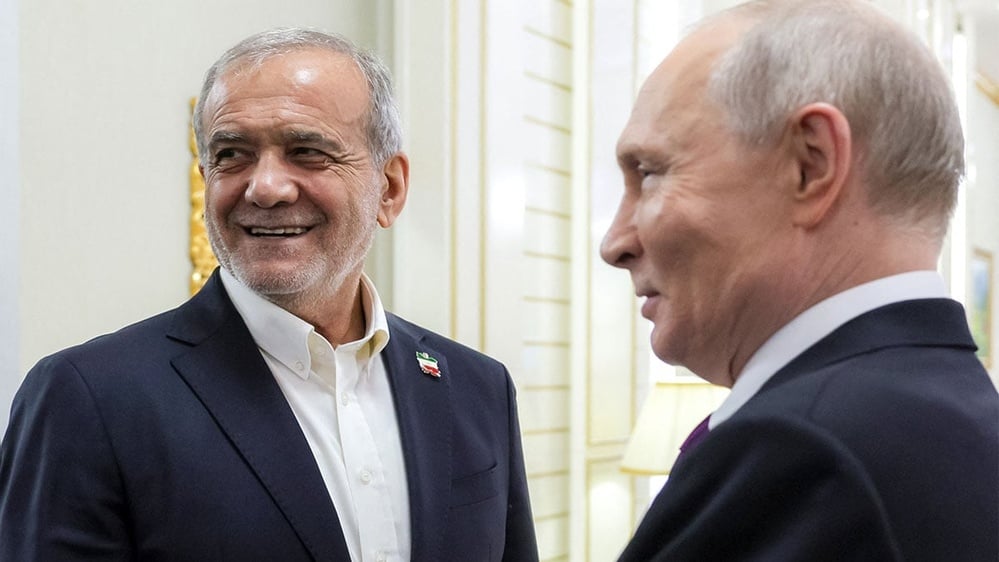
The report frames Putin's mediation offer and Iran's grievances through a mostly neutral wire-service lens, but amplifies anti-US and anti-Israel framing via quoted Iranian officials without equally balancing US/Israeli positions.
The CIS is a grouping of former Soviet nations established in 1991; Georgia withdrew after a 2008 war with Russia, Ukraine halted participation after the 2014 Crimea annexation, and Moldova left in 2023. Russia launched its offensive in Ukraine in February 2022.
Automated analysis; not human reviewed.
Limitations: The supplied text is a truncated, possibly duplicated article with aggregated sidebar headlines, limiting full assessment of the original report's completeness and balance.
·
55 of 55 available dimensions scored; omitted dimensions are not treated as neutral.
·
Verified supporting quotes for 4 of 55 scored dimensions.
Claim: The article is centrally about geopolitics, international relations, and war diplomacy.
“The leaders of two of the world's most sanctioned nations met after arriving in Turkmenistan” · verified after text normalization
Why: The content is entirely focused on political and diplomatic matters.
Claim: The article relies heavily on Russian and Iranian state media reports and officials for its central claims.
“Russian media reported” · exact text match
“Iranian state media quoted Pezeshkian as saying” · exact text match
Why: Central factual assertions are attributed to state-controlled media without independent verification.
Claim: The report treats the CIS and Russian sphere of influence as an institutionalized reality without significant critical framing.
“the CIS proves that it "actually has the orbit and that it has its own sphere of influence that is fortified and institutionalised"” · verified after text normalization
Why: Analyst quote frames Russian institutional power as established fact rather than contested.
Claim: The report gives extensive space to Iranian accusations against the US while providing minimal balancing US or Israeli perspective.
“Pezeshkian said Tehran wanted to see a "final framework" to end the war.” · verified after text normalization
“But he accused the United States of "trying to impose its policies and views on all countries".” · verified after text normalization
Why: Iranian grievances are quoted at length while US/Israeli positions are only briefly mentioned via Trump's statement.
The supplied text is a truncated, possibly duplicated article with aggregated sidebar headlines, limiting full assessment of the original report's completeness and balance.
October 08, 2026 · 0 shares
The report relays Vladimir Putin's positive characterization of Iran's role without scrutiny or added context.
Automated analysis; not human reviewed.
Limitations: Short TASS report; limited substantive content makes several bias dimensions weakly determinable.
·
44 of 55 available dimensions scored; omitted dimensions are not treated as neutral.
·
Verified supporting quotes for 0 of 44 scored dimensions.
Short TASS report; limited substantive content makes several bias dimensions weakly determinable.
October 09, 2026 · 0 shares
The report frames Putin's mediation offer and Iran's grievances through a mostly neutral wire-service lens, but amplifies anti-US and anti-Israel framing via quoted Iranian officials without equally balancing US/Israeli positions.
The CIS is a grouping of former Soviet nations established in 1991; Georgia withdrew after a 2008 war with Russia, Ukraine halted participation after the 2014 Crimea annexation, and Moldova left in 2023. Russia launched its offensive in Ukraine in February 2022.
Automated analysis; not human reviewed.
Limitations: The supplied text is a truncated, possibly duplicated article with aggregated sidebar headlines, limiting full assessment of the original report's completeness and balance.
·
55 of 55 available dimensions scored; omitted dimensions are not treated as neutral.
·
Verified supporting quotes for 4 of 55 scored dimensions.
Claim: The article is centrally about geopolitics, international relations, and war diplomacy.
“The leaders of two of the world's most sanctioned nations met after arriving in Turkmenistan” · verified after text normalization
Why: The content is entirely focused on political and diplomatic matters.
Claim: The article relies heavily on Russian and Iranian state media reports and officials for its central claims.
“Russian media reported” · exact text match
“Iranian state media quoted Pezeshkian as saying” · exact text match
Why: Central factual assertions are attributed to state-controlled media without independent verification.
Claim: The report treats the CIS and Russian sphere of influence as an institutionalized reality without significant critical framing.
“the CIS proves that it "actually has the orbit and that it has its own sphere of influence that is fortified and institutionalised"” · verified after text normalization
Why: Analyst quote frames Russian institutional power as established fact rather than contested.
Claim: The report gives extensive space to Iranian accusations against the US while providing minimal balancing US or Israeli perspective.
“Pezeshkian said Tehran wanted to see a "final framework" to end the war.” · verified after text normalization
“But he accused the United States of "trying to impose its policies and views on all countries".” · verified after text normalization
Why: Iranian grievances are quoted at length while US/Israeli positions are only briefly mentioned via Trump's statement.
The supplied text is a truncated, possibly duplicated article with aggregated sidebar headlines, limiting full assessment of the original report's completeness and balance.
The report relays Iranian state media's account of Putin's mediation offer with attribution and without endorsing it, though it frames Russia and Iran as sanctioned, mutually reliant allies.
The Middle East war is described as months-long and locked in a stalemate, with Iran blockading the Strait of Hormuz and the US counter-blockading Iranian ports.
Automated analysis; not human reviewed.
Limitations: Heavy reliance on Iranian state media (IRNA) for the central claims; key events such as the war's start are stated without independent corroboration in the supplied text.
·
55 of 55 available dimensions scored; omitted dimensions are not treated as neutral.
·
Verified supporting quotes for 0 of 55 scored dimensions.
Heavy reliance on Iranian state media (IRNA) for the central claims; key events such as the war's start are stated without independent corroboration in the supplied text.
October 08, 2026 · 0 shares
The framing is largely neutral and attributional, channeling controversial characterizations through the quoted speakers rather than adopting them, though it leans slightly on state-favorable phrasing such as 'enemy aggression' and 'resistance'.
Iran was facing growing international pressure, particularly from the United States, at the time of the reported October 2026 phone call between Putin and Pezeshkian.
Automated analysis; not human reviewed.
Limitations: The article text contains significant scraped page chrome (headlines, tags, footer links) mixed with the substantive report, so extracted facts were limited to the clearly attributable news segment.
·
50 of 55 available dimensions scored; omitted dimensions are not treated as neutral.
·
Verified supporting quotes for 13 of 50 scored dimensions.
Claim: The framing largely remains attributional, repeatedly marking statements as what speakers 'said' or 'described'.
“He said Iran would continue its resistance while also pursuing negotiations to protect the country’s rights.” · exact text match
Why: Frequent attribution markers keep the report in objective, reported territory.
Claim: The report uses neutral, sober language without sensational embellishment.
“Russia’s offer to Iran comes as Tehran faces growing pressure and seeks diplomatic options.” · exact text match
Why: Calm, factual phrasing without hype supports low sensationalism.
Claim: The article reports events and statements rather than advocating a course of action.
“The Russian president said Moscow is ready to play a role and provide assistance to help resolve the dispute.” · exact text match
Why: No explicit prescriptions from the publisher support a descriptive framing.
Claim: The report emphasizes dialogue and diplomatic solutions over military action.
“Russia has repeatedly called for dialogue and a diplomatic approach to regional disputes.” · exact text match
Why: Focus on diplomacy and tensions reduction leans slightly dovish.
Claim: The article's subject matter is inherently political and involves state leaders and international disputes.
“Russian President Vladimir Putin has offered Iran assistance to reduce tensions with the United States.” · exact text match
Why: High-level state diplomacy is a core political topic.
Claim: The report relies on statements from presidents Putin and Pezeshkian as its primary sources.
“Iranian President Masoud Pezeshkian spoke with Putin by phone, during which the Russian leader said cooperation would continue under their comprehensive strategic partnership agreement.” · exact text match
Why: Quoting heads of state as sources involves some reliance on authority.
Claim: The report includes Pezeshkian's characterization of Iran as under attack from every direction.
“Earlier, Pezeshkian told a cabinet meeting that Iran was facing what he described as a full-scale war from every direction.” · exact text match
Why: Inclusion of Iran's self-described victim status without balance provides a mild victimization frame.
Claim: The report identifies sources and attributes claims clearly, though it repeats the article segment in the scraped text.
“The Russian president said Moscow is ready to play a role and provide assistance to help resolve the dispute.” · exact text match
Why: Attribution and sourcing support moderate credibility.
Claim: The report mostly relays diplomatic statements without interrogating their factual basis.
“Putin described the Iranian people’s resistance against what he called enemy aggression as a historic moment.” · exact text match
Why: Contested claims are passed through without verification or counterpoint, slightly reducing rational scrutiny.
Claim: The report uses attributed framing but includes loaded terms like 'enemy aggression' without neutral qualifiers.
“Putin described the Iranian people’s resistance against what he called enemy aggression as a historic moment.” · exact text match
Why: Inclusion of loaded phrasing without critical framing suggests mild manipulative potential.
Claim: The article text is repetitive and includes scraped list fragments, suggesting possible automated generation or aggregation.
“Russian President Vladimir Putin has offered Iran assistance to reduce tensions with the United States.” · exact text match
Why: Repetition and structure resemble automated aggregation commonly used in AI-generated or scraped news content.
Claim: The report attributes claims to named speakers and avoids asserting them as fact.
“Putin also stressed that Russia supports a diplomatic solution to the ongoing tensions.” · exact text match
Why: Clear attribution of statements signals fair reporting practice.
Claim: The report relies on attributed claims without fact-checking or counterevidence.
“He said the situation had drawn attention from people around the world.” · exact text match
Why: Unverified assertions passed through, slightly reducing truth-seeking rigor.
The article text contains significant scraped page chrome (headlines, tags, footer links) mixed with the substantive report, so extracted facts were limited to the clearly attributable news segment.
October 09, 2026 · 0 shares
The article adopts a transactional, transmissive framing that relays Pezeshkian's praise of Putin and criticism of US 'unilateralism' with no opposing viewpoints or independent scrutiny.
The article reports remarks by Iranian President Masoud Pezeshkian at a meeting with Russian President Vladimir Putin in Turkmenistan, within the context of a US-Iran conflict and negotiations.
Automated analysis; not human reviewed.
Limitations: The article is a short wire report based heavily on one-sided quotes from Pezeshkian without independent verification, limiting assessment of balance and framing.
·
55 of 55 available dimensions scored; omitted dimensions are not treated as neutral.
·
Verified supporting quotes for 39 of 55 scored dimensions.
Claim: The article presents criticism of US 'dictating' to other countries, aligning with populist anti-elite framing.
“The US tries to dictate its viewpoint to countries all over the world.” · exact text match
Why: Direct quote framing the US as imposing its will, which supports a populist angle against perceived global elites.
Claim: The article emphasizes state sovereignty and opposition to unilateral imposition, fitting an authoritarian-skeptical but state-centric view.
“We need to move toward multilateralism, and prevent unilateralism from spreading across the world.” · exact text match
Why: The framing focuses on state-level multilateralism rather than individual liberties, mildly indicating an authoritarian tilt in international relations.
Claim: The report relies almost entirely on Pezeshkian's subjective statements without counterbalancing perspectives.
“Pezeshkian said at a meeting with Putin in Turkmenistan.” · exact text match
Why: The article primarily transmits one leader's viewpoint, making it somewhat subjective.
Claim: The article covers high-stakes geopolitical conflict and diplomatic exchanges, making it moderately interesting.
“The United States and Israel launched a war against Iran on February 28.” · exact text match
Why: Significant international conflict and diplomacy raise interest.
Claim: The article mostly describes statements and events without prescribing actions.
“The United States and Israel launched a war against Iran on February 28.” · exact text match
Why: The reporting is primarily descriptive of what was said and what occurred.
Claim: The article highlights diplomatic negotiations and a ceasefire, leaning slightly dovish.
“But we have never walked away from the negotiating table.” · not found in supplied text
Why: Emphasis on negotiations and peace efforts suggests a dovish slant.
Claim: Mentions of war and attacks introduce some fear-inducing content.
“The United States resumed large-scale attacks on Iran overnight to July 8.” · not found in supplied text
Why: Reporting violence can evoke fear, though it is factual.
Claim: The article assumes US unilateralism as a premise without substantiation.
“Pezeshkian emphasized that Putin always opposes unilateralism” · not found in supplied text
Why: The claim of unilateralism is presented without evidence, mildly begging the question.
Claim: The article includes diplomatic exchanges but not personal gossip.
“Pezeshkian thanked Putin” · not found in supplied text
Why: Focus on official meetings rather than personal details.
Claim: The article is largely composed of quoted opinions from Pezeshkian.
“We are trying to put an end to the war as soon as possible.” · exact text match
Why: Significant portion is opinion expressed by a source.
Claim: The article is entirely about international politics and diplomacy.
“Iranian President Masoud Pezeshkian thanked Russian President Vladimir Putin” · exact text match
Why: Subject matter is explicitly political.
Claim: The complex conflict is summarized in brief bullet points, potentially oversimplifying.
“The United States and Israel launched a war against Iran on February 28.” · exact text match
Why: Concise reporting may omit nuance.
Claim: The article heavily relies on statements from political authorities.
“Pezeshkian said at a meeting with Putin” · exact text match
Why: Quotes from presidents are central to the report.
Claim: The article is formal and serious, not immature.
“I would like to thank you for your stance in the region” · exact text match
Why: Diplomatic language is mature.
Claim: The article does not exhibit circular reasoning.
“Pezeshkian emphasized that Putin always opposes unilateralism” · not found in supplied text
Why: Claims are attributed rather than argued.
Claim: The article focuses on Iranian and Russian perspectives, minimally covering US responses.
“The Trump administration recently signaled an end to any large-scale use of force” · exact text match
Why: US response is mentioned briefly at the end.
Claim: Iran is portrayed as a victim of US unilateralism and attacks.
“Thanks to your assistance, they failed to impose a unilateral approach on us.” · exact text match
Why: Framing emphasizes Iran as target of imposition.
Claim: The article states events with certainty without hedging, though sources are attributed.
“The United States resumed large-scale attacks on Iran overnight to July 8.” · not found in supplied text
Why: Assertive tone but attributions provided.
Claim: The article is not spam or advertising.
“Iranian President Masoud Pezeshkian thanked Russian President Vladimir Putin” · exact text match
Why: News content.
Claim: The article reflects a specific geopolitical viewpoint without balancing.
“Pezeshkian emphasized that Putin always opposes unilateralism” · not found in supplied text
Why: One-sided presentation may indicate ideological lean.
Claim: The article reports on established state leaders and official positions, leaning toward establishment framing.
“Iranian President Masoud Pezeshkian thanked Russian President Vladimir Putin” · exact text match
Why: Focus on official state interactions supports establishment perspective.
Claim: The tone is relatively neutral, with slight negative emotion from conflict.
“We are trying to put an end to the war as soon as possible.” · exact text match
Why: Serious but not highly emotional.
Claim: The article does not compare cases to apply double standards.
“The United States resumed large-scale attacks on Iran overnight to July 8.” · not found in supplied text
Why: No comparative cases presented.
Claim: The article provides direct quotes and attributions but lacks independent verification or opposing views.
“Pezeshkian said at a meeting with Putin in Turkmenistan.” · exact text match
Why: Basic sourcing present, but limited balance.
Claim: No promotional or marketing content.
“Pezeshkian said at a meeting with Putin” · exact text match
Why: Not advertorial.
Claim: The article emphasizes state-level multilateralism, slightly collectivist.
“We need to move toward multilateralism” · exact text match
Why: Focus on collective international action.
Claim: The article includes some forward-looking statements about future actions.
“The Trump administration recently signaled an end to any large-scale use of force” · exact text match
Why: Mild speculation about policy shifts.
Claim: The article presents one-sided quotes without context, potentially manipulative.
“The US tries to dictate its viewpoint to countries all over the world.” · exact text match
Why: Omission of opposing views could be manipulative.
Claim: The article appears human-written with standard news structure.
“Pezeshkian said at a meeting with Putin in Turkmenistan.” · exact text match
Why: No strong AI indicators.
Claim: The article includes direct quotes and attributions, showing basic journalistic honesty.
“Pezeshkian said at a meeting with Putin in Turkmenistan.” · exact text match
Why: Attribution of quotes indicates some integrity, though limited independent verification.
Claim: The article presents clear, if brief, geopolitical information.
“We need to move toward multilateralism” · exact text match
Why: Informative but not deeply analytical.
Claim: No endorsement or justification of terrorism is present.
“We are trying to put an end to the war as soon as possible.” · exact text match
Why: The article focuses on diplomacy and conflict, not terrorism.
Claim: No fraud-related framing present.
“The United States and Israel launched a war against Iran on February 28.” · exact text match
Why: Not relevant to fraud.
Claim: No Marxist class analysis or advocacy present.
“We need to move toward multilateralism” · exact text match
Why: Content is geopolitical, not Marxist.
Claim: The article does not advocate Islamist governance, though it reports on Iran.
“Iranian President Masoud Pezeshkian thanked Russian President Vladimir Putin” · exact text match
Why: Reporting on Iran's president does not imply Islamist bias.
Claim: No anti-Jewish content.
“The United States and Israel launched a war against Iran on February 28.” · exact text match
Why: Mentions Israel in war context but no anti-Semitic tropes.
Claim: No LGBT-related content.
“Pezeshkian thanked Putin” · not found in supplied text
Why: Not relevant.
Claim: No racial generalizations.
“We need to move toward multilateralism” · exact text match
Why: Not relevant.
Claim: No identity politics or woke framing.
“We need to move toward multilateralism” · exact text match
Why: Not relevant.
Claim: No cruel or immoral framing.
“We are trying to put an end to the war as soon as possible.” · exact text match
Why: Focus on peace efforts.
Claim: No virtue signaling evident.
“I would like to thank you for your stance in the region” · exact text match
Why: Diplomatic thanks, not virtue signaling.
Claim: No conspiracy theories presented.
“The United States and Israel launched a war against Iran on February 28.” · exact text match
Why: Factual reporting of events.
Claim: No compassion-based advocacy for self-harm.
“We have never walked away from the negotiating table.” · not found in supplied text
Why: Not relevant.
Claim: The article blames the US for unilateralism and attacks, potentially scapegoating.
“The US tries to dictate its viewpoint to countries all over the world.” · exact text match
Why: Frames US as aggressor, but based on quotes.
Claim: No internal contradiction in standards evident.
“Pezeshkian said at a meeting with Putin” · exact text match
Why: Not applicable.
Claim: No rejection of reason or universal rights.
“We are trying to put an end to the war as soon as possible.” · exact text match
Why: Not relevant.
The article is a short wire report based heavily on one-sided quotes from Pezeshkian without independent verification, limiting assessment of balance and framing.
October 09, 2026 · 0 shares
The report frames Putin's mediation offer and Iran's grievances through a mostly neutral wire-service lens, but amplifies anti-US and anti-Israel framing via quoted Iranian officials without equally balancing US/Israeli positions.
The CIS is a grouping of former Soviet nations established in 1991; Georgia withdrew after a 2008 war with Russia, Ukraine halted participation after the 2014 Crimea annexation, and Moldova left in 2023. Russia launched its offensive in Ukraine in February 2022.
Automated analysis; not human reviewed.
Limitations: The supplied text is a truncated, possibly duplicated article with aggregated sidebar headlines, limiting full assessment of the original report's completeness and balance.
·
55 of 55 available dimensions scored; omitted dimensions are not treated as neutral.
·
Verified supporting quotes for 4 of 55 scored dimensions.
Claim: The article is centrally about geopolitics, international relations, and war diplomacy.
“The leaders of two of the world's most sanctioned nations met after arriving in Turkmenistan” · verified after text normalization
Why: The content is entirely focused on political and diplomatic matters.
Claim: The article relies heavily on Russian and Iranian state media reports and officials for its central claims.
“Russian media reported” · exact text match
“Iranian state media quoted Pezeshkian as saying” · exact text match
Why: Central factual assertions are attributed to state-controlled media without independent verification.
Claim: The report treats the CIS and Russian sphere of influence as an institutionalized reality without significant critical framing.
“the CIS proves that it "actually has the orbit and that it has its own sphere of influence that is fortified and institutionalised"” · verified after text normalization
Why: Analyst quote frames Russian institutional power as established fact rather than contested.
Claim: The report gives extensive space to Iranian accusations against the US while providing minimal balancing US or Israeli perspective.
“Pezeshkian said Tehran wanted to see a "final framework" to end the war.” · verified after text normalization
“But he accused the United States of "trying to impose its policies and views on all countries".” · verified after text normalization
Why: Iranian grievances are quoted at length while US/Israeli positions are only briefly mentioned via Trump's statement.
The supplied text is a truncated, possibly duplicated article with aggregated sidebar headlines, limiting full assessment of the original report's completeness and balance.
October 08, 2026 · 0 shares
The report frames the US-led war on Iran through Russian and Iranian official statements without independent verification or critical contextualization, presenting Putin's characterization of Iran as blameless largely at face value.
Iran and the United States are in an ongoing war, with diplomatic talks at an apparent impasse; Russia and Iran have deepened military and diplomatic ties under Western sanctions.
Automated analysis; not human reviewed.
Limitations: The article text appears truncated and includes unrelated aggregated headlines at the end, limiting assessment of the full original report.
·
55 of 55 available dimensions scored; omitted dimensions are not treated as neutral.
·
Verified supporting quotes for 30 of 55 scored dimensions.
Claim: The report centers on elite state leaders and official state-media channels rather than popular or grassroots perspectives.
“Russian President Vladimir Putin has told Iranian President Masoud Pezeshkian that Russia will “do everything” to help end the United States-led war on Iran, Russian news agencies reported.” · exact text match
Why: Sourcing and actors are exclusively heads of state and state news agencies, indicating an elite-focused framing.
Claim: The article presents great-power diplomatic and military cooperation as the operative frame, emphasizing state actors' strategic arrangements rather than individual liberty concerns.
“The two countries, which are under heavy Western sanctions, have reinforced diplomatic and military ties.” · exact text match
Why: The framing prioritizes state-to-state military and diplomatic alignment.
Claim: The article is mostly a summary of attributed statements with minimal subjective framing beyond the "US-led war" characterization.
“The two leaders met in Turkmenistan on Thursday ahead of the summit of the Commonwealth of Independent States, a group of former Soviet nations.” · exact text match
Why: Primarily descriptive reporting of events.
Claim: The report is largely unembellished, with no sensational language or dramatic cues.
“Putin also noted what he called a “positive evolution” in Iran-Russia relations.” · exact text match
Why: Tone is matter-of-fact and factual.
Claim: The article presents a mix of diplomatic activity and stated impasse, resting on a slightly cautious tone.
“Diplomatic efforts to resolve Russia’s offensive in Ukraine also appear deadlocked, even as both sides intensify attacks.” · exact text match
Why: Deadlock language suggests mild pessimism.
Claim: The article describes events and statements without prescribing policy or action.
“The meeting came as Iran-US talks stand at an apparent impasse.” · exact text match
Why: No normative recommendations are made.
Claim: The article reports on mediation and diplomacy without advocating military escalation.
“In a call on Wednesday, Putin told Pezeshkian that Moscow is prepared to mediate efforts to end the war in the Middle East, Iran’s IRNA news agency reported.” · exact text match
Why: Emphasis on mediation framing.
Claim: No fearful or rage-baiting language is present in the supplied text.
“Putin also noted what he called a “positive evolution” in Iran-Russia relations.” · exact text match
Why: Tone is measured.
Claim: The report presumes the conflict is accurately "US-led" without establishing that premise.
“Russian President Vladimir Putin has told Iranian President Masoud Pezeshkian that Russia will “do everything” to help end the United States-led war on Iran, Russian news agencies reported.” · exact text match
Why: The conflict characterization is asserted in the article's own voice without support.
Claim: The report is entirely about international political and military conflict involving heads of state.
“The meeting came as Iran-US talks stand at an apparent impasse.” · exact text match
Why: Content concerns war, diplomacy, and sanctions among governments.
Claim: Complex regional conflict dynamics are condensed into a brief report of leaders' statements and a claim of an impasse.
“The meeting came as Iran-US talks stand at an apparent impasse.” · exact text match
Why: The conflict is summarized in a few lines without deeper context.
Claim: The article repeatedly rests on statements by Putin and Trump and state news agencies rather than independent verification.
““You know our position.
On our part, we are ready to do everything we can to help you resolve this situation,” Interfax news agency said Putin told Pezeshkian.”
· exact text match
Why: Key claims derive from official statements relayed by state media.
Claim: The provided text is largely formal news prose without rage-bait or immature framing.
“Putin also noted what he called a “positive evolution” in Iran-Russia relations.” · exact text match
Why: Mature, factual tone.
Claim: The article's final sections pivot to unrelated headlines, potentially obscuring the original report's response to the Putin-Pezeshkian meeting.
“Three killed, 36 injured in Houthi attacks on Saudi airports, Riyadh says” · exact text match
Why: Appended unrelated content may function as filler around the main report.
Claim: The report relays a victimization framing of Iran via Putin's statement that the conflict is not Iran's fault.
““We know that Iran is making real efforts to end the conflict, which broke out through no fault of its own, no fault of Iran’s,” Putin said, according to Russian media.” · exact text match
Why: Iran is framed as a blameless party, though the framing is attributed to Putin.
Claim: The article states as fact that Russia will help end the war, based solely on Russian agency reports.
“Russian President Vladimir Putin has told Iranian President Masoud Pezeshkian that Russia will “do everything” to help end the United States-led war on Iran, Russian news agencies reported.” · exact text match
Why: The certainty of the pledge rests on state media sourcing.
Claim: The framing adopts a multipolar, anti-Western-sanctions lens by presenting Russia-Iran alignment as reactive to Western measures.
“The two countries, which are under heavy Western sanctions, have reinforced diplomatic and military ties.” · exact text match
Why: The phrasing situates the alignment as a consequence of Western sanctions.
Claim: The report foregrounds state leaders and their official positions rather than challenging establishments.
“Russian President Vladimir Putin has told Iranian President Masoud Pezeshkian that Russia will “do everything” to help end the United States-led war on Iran, Russian news agencies reported.” · exact text match
Why: Focus on official state actors.
Claim: The tone is neutral and unemotional, reporting official statements without emotive language.
“Putin also noted what he called a “positive evolution” in Iran-Russia relations.” · exact text match
Why: No emotionally charged language is present.
Claim: The report relays Putin's assertion that the conflict is not Iran's fault without counterbalancing perspectives, while noting Western accusations separately.
““We know that Iran is making real efforts to end the conflict, which broke out through no fault of its own, no fault of Iran’s,” Putin said, according to Russian media.” · exact text match
Why: The Russian framing is presented with attribution but without balancing context on responsibility for the conflict.
Claim: The article relies on named agencies (Interfax, IRNA) and attributes statements, providing minimal but basic sourcing.
“Russian President Vladimir Putin has told Iranian President Masoud Pezeshkian that Russia will “do everything” to help end the United States-led war on Iran, Russian news agencies reported.” · exact text match
Why: Attribution exists but is limited to state-affiliated outlets with no independent corroboration.
Claim: The report is largely a factual relay of official statements rather than analysis, leaning toward neutral reporting.
“Putin also noted what he called a “positive evolution” in Iran-Russia relations.” · exact text match
Why: Attributed statements without evaluative analysis.
Claim: The article notes a Wednesday call and prior summits but provides no forecasting beyond reported statements.
“In a call on Wednesday, Putin told Pezeshkian that Moscow is prepared to mediate efforts to end the war in the Middle East, Iran’s IRNA news agency reported.” · exact text match
Why: Minimal speculation; mostly attributed reporting.
Claim: The report presents the war as "US-led" in its own voice and frames Iran as blameless via attributed statements without qualifying context.
“Russian President Vladimir Putin has told Iranian President Masoud Pezeshkian that Russia will “do everything” to help end the United States-led war on Iran, Russian news agencies reported.” · exact text match
Why: Asymmetric framing of the conflict parties, though partly attributed to sources.
Claim: The text shows aggregated, repetitive headline patterns and mixed content typical of automated or scraped formatting.
“Putin pledges Russia’s support to end US-led war on Iran.” · verified after text normalization
Why: Repetition and unrelated appended headlines suggest possible aggregation rather than a single authored narrative.
Claim: The article attributes claims to named agencies and does not appear to distort statements.
“Russian President Vladimir Putin has told Iranian President Masoud Pezeshkian that Russia will “do everything” to help end the United States-led war on Iran, Russian news agencies reported.” · exact text match
Why: Basic attribution and no evident fabrication in supplied text.
Claim: The article is a straightforward, moderately informative report with limited analysis.
“The meeting came as Iran-US talks stand at an apparent impasse.” · exact text match
Why: Basic factual reporting without deep analysis.
Claim: No cruel framing or dehumanization is observable in the report.
“Putin also noted what he called a “positive evolution” in Iran-Russia relations.” · exact text match
Why: Neutral, factual reportage.
Claim: The article relays Putin's claim that the conflict is not Iran's fault, implying some other party is to blame, but does not identify or scapegoat a specific group.
““We know that Iran is making real efforts to end the conflict, which broke out through no fault of its own, no fault of Iran’s,” Putin said, according to Russian media.” · exact text match
Why: Blame attribution is indirect and limited.
Claim: The article notes Russian and Iranian partnership while Western sanctions are mentioned, without examining comparable Russian or Iranian actions beyond Western accusations.
“Ukraine and Western countries have accused Iran of supplying Russia with Shahed drones and short-range missiles for use in the Ukraine war.” · exact text match
Why: Limited examination of the sanctioned actors' own conduct.
The article text appears truncated and includes unrelated aggregated headlines at the end, limiting assessment of the full original report.
October 06, 2026 · 0 shares
A plainly attributed, wire-style announcement of Pezeshkian's first CIS invitation, with no commentary, evaluative language, or speculative framing.
Iran is not a CIS member state; an expanded meeting of the CIS Council of Heads of State typically includes invited non-member leaders alongside CIS member heads of state.
Automated analysis; not human reviewed.
Limitations: The supplied text is a page fragment mixing one developed news item with headline teasers, so analysis is based mainly on the lead story and may miss editorial context.
·
4 of 55 available dimensions scored; omitted dimensions are not treated as neutral.
·
Verified supporting quotes for 4 of 4 scored dimensions.
Claim: The report is framed objectively, with attribution and direct quotation rather than subjective commentary.
“Modern.az reports that this was stated by the country's President's assistant for international affairs, Yuri Ushakov.” · exact text match
“"For the first time in the history of the CIS, Iranian President Masoud Pezeshkian has been invited to an expanded meeting.
He will also participate in the Caspian ecology summit," Ushakov noted.”
· exact text match
Why: The article presents the development through a named official's statement and a verbatim quote, with no editorial adjectives or opinion.
Claim: The report is descriptive, stating an announced diplomatic plan without recommending or judging it.
“Iranian President Masoud Pezeshkian will participate for the first time in the expanded meeting of the CIS Council of Heads of State to be held in Turkmenistan.” · exact text match
Why: The language is declarative and informational; there is no imperative, recommendation, or value judgment.
Claim: The report shows visible sourcing and attribution appropriate to a brief wire-style item.
“Modern.az reports that this was stated by the country's President's assistant for international affairs, Yuri Ushakov.” · exact text match
Why: It names the source, quotes him directly, and identifies the reporting outlet, though it does not provide independent verification or a date.
Claim: The report is transparent about its source and presents the statement without distortion.
“"For the first time in the history of the CIS, Iranian President Masoud Pezeshkian has been invited to an expanded meeting.
He will also participate in the Caspian ecology summit," Ushakov noted.”
· exact text match
Why: The article clearly marks the claim as Ushakov's statement and does not mix in unlabeled opinion or paraphrase disguised as fact.
The supplied text is a page fragment mixing one developed news item with headline teasers, so analysis is based mainly on the lead story and may miss editorial context.
October 09, 2026 · 0 shares
Straightforward, attribution-bound reporting of a diplomatic proposal with no evident editorializing or loaded framing.
The Commonwealth of Independent States (CIS) is a regional organization of post-Soviet states; Iran is not a member and attended the Turkmenistan summit as a special guest.
Automated analysis; not human reviewed.
Limitations: The supplied text includes extensive unrelated headline links and repeated content, complicating isolation of the substantive article.
·
55 of 55 available dimensions scored; omitted dimensions are not treated as neutral.
·
Verified supporting quotes for 7 of 55 scored dimensions.
Claim: The article reports the proposal and remarks with direct attribution, minimizing subjective interpretation.
“RIA Novosti quoted Pezeshkian as saying at the summit that Iran sees itself as a natural part of the region’s interconnected geographic space” · exact text match
Why: Attribution to a news agency and direct quotes indicate objective reporting rather than subjective commentary.
Claim: The reporting is factual and avoids sensational language or emphasis.
““Iran proposes creating a flexible and effective mechanism for dialogue and cooperation in the format of ‘CIS countries + Iran’ or ‘CIS+1,’” the Iranian president said.” · exact text match
Why: The article uses neutral, declarative statements without sensational adjectives or urgency.
Claim: The article describes a proposal without prescribing policy or advocating action.
“Iran proposes creating a “CIS+1” format to develop cooperation between the organization and his country.” · not found in supplied text
Why: The verb 'proposes' and neutral reporting indicate description rather than prescription.
Claim: The subject matter concerns international diplomacy and governance, making it inherently political.
“Pezeshkian was invited to attend the CIS summit in Turkmenistan as a special guest” · exact text match
Why: Coverage of state-level diplomatic proposals is political in nature.
Claim: The article relies on statements from the Iranian president as the primary basis for its claims.
“Pezeshkian added that this would enable joint efforts to develop cooperation in areas such as energy, trade, mineral extraction, investment, technology, water resources and environmental protection, tourism, as well as scientific and cultural ties.” · exact text match
Why: The reporting centers on official pronouncements without independent verification, reflecting moderate reliance on authority.
Claim: The article shows moderate credibility through source attribution and direct quotation.
“RIA Novosti quoted Pezeshkian as saying at the summit” · exact text match
Why: Named agency attribution and direct quotes support credibility, though sourcing is limited to one outlet.
Claim: The report presents the proposal and its stated rationale in a coherent, non-fallacious manner.
“Iran proposes creating a “CIS+1” format to develop cooperation between the organization and his country.” · not found in supplied text
Why: The article conveys a clear, logical diplomatic proposal without emotional or irrational framing.
Claim: The article includes forward-looking statements about potential cooperation without forecasting outcomes.
“Pezeshkian added that this would enable joint efforts to develop cooperation in areas such as energy, trade, mineral extraction, investment, technology, water resources and environmental protection, tourism, as well as scientific and cultural ties.” · exact text match
Why: The conditional 'would enable' describes proposed possibilities, mildly speculative.
Claim: The text displays formulaic structure and repeated content, suggesting possible AI authorship.
“['', 'Iranian President Masoud Pezeshkian has proposed creating a “CIS+1” format to develop cooperation between the organization and his country.'],” · not found in supplied text
Why: Repetition, list formatting, and generic phrasing are weak indicators of AI generation.
Claim: The article attributes statements to named sources, showing fair and honest reporting signals.
“RIA Novosti quoted Pezeshkian as saying” · exact text match
Why: Explicit attribution to a news agency supports observable fairness and honesty in sourcing.
The supplied text includes extensive unrelated headline links and repeated content, complicating isolation of the substantive article.
October 09, 2026 · 0 shares
Straightforward, attribution-bound reporting of a diplomatic proposal with no evident editorializing or loaded framing.
The Commonwealth of Independent States (CIS) is a regional organization of post-Soviet states; Iran is not a member and attended the Turkmenistan summit as a special guest.
Automated analysis; not human reviewed.
Limitations: The supplied text includes extensive unrelated headline links and repeated content, complicating isolation of the substantive article.
·
55 of 55 available dimensions scored; omitted dimensions are not treated as neutral.
·
Verified supporting quotes for 7 of 55 scored dimensions.
Claim: The article reports the proposal and remarks with direct attribution, minimizing subjective interpretation.
“RIA Novosti quoted Pezeshkian as saying at the summit that Iran sees itself as a natural part of the region’s interconnected geographic space” · exact text match
Why: Attribution to a news agency and direct quotes indicate objective reporting rather than subjective commentary.
Claim: The reporting is factual and avoids sensational language or emphasis.
““Iran proposes creating a flexible and effective mechanism for dialogue and cooperation in the format of ‘CIS countries + Iran’ or ‘CIS+1,’” the Iranian president said.” · exact text match
Why: The article uses neutral, declarative statements without sensational adjectives or urgency.
Claim: The article describes a proposal without prescribing policy or advocating action.
“Iran proposes creating a “CIS+1” format to develop cooperation between the organization and his country.” · not found in supplied text
Why: The verb 'proposes' and neutral reporting indicate description rather than prescription.
Claim: The subject matter concerns international diplomacy and governance, making it inherently political.
“Pezeshkian was invited to attend the CIS summit in Turkmenistan as a special guest” · exact text match
Why: Coverage of state-level diplomatic proposals is political in nature.
Claim: The article relies on statements from the Iranian president as the primary basis for its claims.
“Pezeshkian added that this would enable joint efforts to develop cooperation in areas such as energy, trade, mineral extraction, investment, technology, water resources and environmental protection, tourism, as well as scientific and cultural ties.” · exact text match
Why: The reporting centers on official pronouncements without independent verification, reflecting moderate reliance on authority.
Claim: The article shows moderate credibility through source attribution and direct quotation.
“RIA Novosti quoted Pezeshkian as saying at the summit” · exact text match
Why: Named agency attribution and direct quotes support credibility, though sourcing is limited to one outlet.
Claim: The report presents the proposal and its stated rationale in a coherent, non-fallacious manner.
“Iran proposes creating a “CIS+1” format to develop cooperation between the organization and his country.” · not found in supplied text
Why: The article conveys a clear, logical diplomatic proposal without emotional or irrational framing.
Claim: The article includes forward-looking statements about potential cooperation without forecasting outcomes.
“Pezeshkian added that this would enable joint efforts to develop cooperation in areas such as energy, trade, mineral extraction, investment, technology, water resources and environmental protection, tourism, as well as scientific and cultural ties.” · exact text match
Why: The conditional 'would enable' describes proposed possibilities, mildly speculative.
Claim: The text displays formulaic structure and repeated content, suggesting possible AI authorship.
“['', 'Iranian President Masoud Pezeshkian has proposed creating a “CIS+1” format to develop cooperation between the organization and his country.'],” · not found in supplied text
Why: Repetition, list formatting, and generic phrasing are weak indicators of AI generation.
Claim: The article attributes statements to named sources, showing fair and honest reporting signals.
“RIA Novosti quoted Pezeshkian as saying” · exact text match
Why: Explicit attribution to a news agency supports observable fairness and honesty in sourcing.
The supplied text includes extensive unrelated headline links and repeated content, complicating isolation of the substantive article.
October 09, 2026 · 0 shares
The article is a straightforward report of a diplomatic proposal, largely sourced to Modern.az and the Iranian president's quoted statement, with little independent framing.
The CIS is a regional intergovernmental organization of post-Soviet states; the article also references a CIS Council of Heads of State meeting and a meeting between the Iranian, Azerbaijani, and Russian foreign ministers.
Automated analysis; not human reviewed.
·
3 of 55 available dimensions scored; omitted dimensions are not treated as neutral.
·
Verified supporting quotes for 0 of 3 scored dimensions.
The report is a straightforward, attribution-heavy account of President Pezeshkian's diplomatic proposal, framed around science and regional cooperation with little independent scrutiny.
The Caspian Sea's water level has been declining, and the Tehran Convention is the region's principal legally binding framework for protecting its marine environment.
Automated analysis; not human reviewed.
Limitations: The text is truncated mid-sentence near the end and appears to be a reposted wire-style summary, which limits assessment of independent editorial framing.
·
55 of 55 available dimensions scored; omitted dimensions are not treated as neutral.
·
Verified supporting quotes for 0 of 55 scored dimensions.
The text is truncated mid-sentence near the end and appears to be a reposted wire-style summary, which limits assessment of independent editorial framing.
The report relays Iranian state media's account of Putin's mediation offer with attribution and without endorsing it, though it frames Russia and Iran as sanctioned, mutually reliant allies.
The Middle East war is described as months-long and locked in a stalemate, with Iran blockading the Strait of Hormuz and the US counter-blockading Iranian ports.
Automated analysis; not human reviewed.
Limitations: Heavy reliance on Iranian state media (IRNA) for the central claims; key events such as the war's start are stated without independent corroboration in the supplied text.
·
55 of 55 available dimensions scored; omitted dimensions are not treated as neutral.
·
Verified supporting quotes for 0 of 55 scored dimensions.
Heavy reliance on Iranian state media (IRNA) for the central claims; key events such as the war's start are stated without independent corroboration in the supplied text.
October 08, 2026 · 0 shares
The report frames the US-led war on Iran through Russian and Iranian official statements without independent verification or critical contextualization, presenting Putin's characterization of Iran as blameless largely at face value.
Iran and the United States are in an ongoing war, with diplomatic talks at an apparent impasse; Russia and Iran have deepened military and diplomatic ties under Western sanctions.
Automated analysis; not human reviewed.
Limitations: The article text appears truncated and includes unrelated aggregated headlines at the end, limiting assessment of the full original report.
·
55 of 55 available dimensions scored; omitted dimensions are not treated as neutral.
·
Verified supporting quotes for 30 of 55 scored dimensions.
Claim: The report centers on elite state leaders and official state-media channels rather than popular or grassroots perspectives.
“Russian President Vladimir Putin has told Iranian President Masoud Pezeshkian that Russia will “do everything” to help end the United States-led war on Iran, Russian news agencies reported.” · exact text match
Why: Sourcing and actors are exclusively heads of state and state news agencies, indicating an elite-focused framing.
Claim: The article presents great-power diplomatic and military cooperation as the operative frame, emphasizing state actors' strategic arrangements rather than individual liberty concerns.
“The two countries, which are under heavy Western sanctions, have reinforced diplomatic and military ties.” · exact text match
Why: The framing prioritizes state-to-state military and diplomatic alignment.
Claim: The article is mostly a summary of attributed statements with minimal subjective framing beyond the "US-led war" characterization.
“The two leaders met in Turkmenistan on Thursday ahead of the summit of the Commonwealth of Independent States, a group of former Soviet nations.” · exact text match
Why: Primarily descriptive reporting of events.
Claim: The report is largely unembellished, with no sensational language or dramatic cues.
“Putin also noted what he called a “positive evolution” in Iran-Russia relations.” · exact text match
Why: Tone is matter-of-fact and factual.
Claim: The article presents a mix of diplomatic activity and stated impasse, resting on a slightly cautious tone.
“Diplomatic efforts to resolve Russia’s offensive in Ukraine also appear deadlocked, even as both sides intensify attacks.” · exact text match
Why: Deadlock language suggests mild pessimism.
Claim: The article describes events and statements without prescribing policy or action.
“The meeting came as Iran-US talks stand at an apparent impasse.” · exact text match
Why: No normative recommendations are made.
Claim: The article reports on mediation and diplomacy without advocating military escalation.
“In a call on Wednesday, Putin told Pezeshkian that Moscow is prepared to mediate efforts to end the war in the Middle East, Iran’s IRNA news agency reported.” · exact text match
Why: Emphasis on mediation framing.
Claim: No fearful or rage-baiting language is present in the supplied text.
“Putin also noted what he called a “positive evolution” in Iran-Russia relations.” · exact text match
Why: Tone is measured.
Claim: The report presumes the conflict is accurately "US-led" without establishing that premise.
“Russian President Vladimir Putin has told Iranian President Masoud Pezeshkian that Russia will “do everything” to help end the United States-led war on Iran, Russian news agencies reported.” · exact text match
Why: The conflict characterization is asserted in the article's own voice without support.
Claim: The report is entirely about international political and military conflict involving heads of state.
“The meeting came as Iran-US talks stand at an apparent impasse.” · exact text match
Why: Content concerns war, diplomacy, and sanctions among governments.
Claim: Complex regional conflict dynamics are condensed into a brief report of leaders' statements and a claim of an impasse.
“The meeting came as Iran-US talks stand at an apparent impasse.” · exact text match
Why: The conflict is summarized in a few lines without deeper context.
Claim: The article repeatedly rests on statements by Putin and Trump and state news agencies rather than independent verification.
““You know our position.
On our part, we are ready to do everything we can to help you resolve this situation,” Interfax news agency said Putin told Pezeshkian.”
· exact text match
Why: Key claims derive from official statements relayed by state media.
Claim: The provided text is largely formal news prose without rage-bait or immature framing.
“Putin also noted what he called a “positive evolution” in Iran-Russia relations.” · exact text match
Why: Mature, factual tone.
Claim: The article's final sections pivot to unrelated headlines, potentially obscuring the original report's response to the Putin-Pezeshkian meeting.
“Three killed, 36 injured in Houthi attacks on Saudi airports, Riyadh says” · exact text match
Why: Appended unrelated content may function as filler around the main report.
Claim: The report relays a victimization framing of Iran via Putin's statement that the conflict is not Iran's fault.
““We know that Iran is making real efforts to end the conflict, which broke out through no fault of its own, no fault of Iran’s,” Putin said, according to Russian media.” · exact text match
Why: Iran is framed as a blameless party, though the framing is attributed to Putin.
Claim: The article states as fact that Russia will help end the war, based solely on Russian agency reports.
“Russian President Vladimir Putin has told Iranian President Masoud Pezeshkian that Russia will “do everything” to help end the United States-led war on Iran, Russian news agencies reported.” · exact text match
Why: The certainty of the pledge rests on state media sourcing.
Claim: The framing adopts a multipolar, anti-Western-sanctions lens by presenting Russia-Iran alignment as reactive to Western measures.
“The two countries, which are under heavy Western sanctions, have reinforced diplomatic and military ties.” · exact text match
Why: The phrasing situates the alignment as a consequence of Western sanctions.
Claim: The report foregrounds state leaders and their official positions rather than challenging establishments.
“Russian President Vladimir Putin has told Iranian President Masoud Pezeshkian that Russia will “do everything” to help end the United States-led war on Iran, Russian news agencies reported.” · exact text match
Why: Focus on official state actors.
Claim: The tone is neutral and unemotional, reporting official statements without emotive language.
“Putin also noted what he called a “positive evolution” in Iran-Russia relations.” · exact text match
Why: No emotionally charged language is present.
Claim: The report relays Putin's assertion that the conflict is not Iran's fault without counterbalancing perspectives, while noting Western accusations separately.
““We know that Iran is making real efforts to end the conflict, which broke out through no fault of its own, no fault of Iran’s,” Putin said, according to Russian media.” · exact text match
Why: The Russian framing is presented with attribution but without balancing context on responsibility for the conflict.
Claim: The article relies on named agencies (Interfax, IRNA) and attributes statements, providing minimal but basic sourcing.
“Russian President Vladimir Putin has told Iranian President Masoud Pezeshkian that Russia will “do everything” to help end the United States-led war on Iran, Russian news agencies reported.” · exact text match
Why: Attribution exists but is limited to state-affiliated outlets with no independent corroboration.
Claim: The report is largely a factual relay of official statements rather than analysis, leaning toward neutral reporting.
“Putin also noted what he called a “positive evolution” in Iran-Russia relations.” · exact text match
Why: Attributed statements without evaluative analysis.
Claim: The article notes a Wednesday call and prior summits but provides no forecasting beyond reported statements.
“In a call on Wednesday, Putin told Pezeshkian that Moscow is prepared to mediate efforts to end the war in the Middle East, Iran’s IRNA news agency reported.” · exact text match
Why: Minimal speculation; mostly attributed reporting.
Claim: The report presents the war as "US-led" in its own voice and frames Iran as blameless via attributed statements without qualifying context.
“Russian President Vladimir Putin has told Iranian President Masoud Pezeshkian that Russia will “do everything” to help end the United States-led war on Iran, Russian news agencies reported.” · exact text match
Why: Asymmetric framing of the conflict parties, though partly attributed to sources.
Claim: The text shows aggregated, repetitive headline patterns and mixed content typical of automated or scraped formatting.
“Putin pledges Russia’s support to end US-led war on Iran.” · verified after text normalization
Why: Repetition and unrelated appended headlines suggest possible aggregation rather than a single authored narrative.
Claim: The article attributes claims to named agencies and does not appear to distort statements.
“Russian President Vladimir Putin has told Iranian President Masoud Pezeshkian that Russia will “do everything” to help end the United States-led war on Iran, Russian news agencies reported.” · exact text match
Why: Basic attribution and no evident fabrication in supplied text.
Claim: The article is a straightforward, moderately informative report with limited analysis.
“The meeting came as Iran-US talks stand at an apparent impasse.” · exact text match
Why: Basic factual reporting without deep analysis.
Claim: No cruel framing or dehumanization is observable in the report.
“Putin also noted what he called a “positive evolution” in Iran-Russia relations.” · exact text match
Why: Neutral, factual reportage.
Claim: The article relays Putin's claim that the conflict is not Iran's fault, implying some other party is to blame, but does not identify or scapegoat a specific group.
““We know that Iran is making real efforts to end the conflict, which broke out through no fault of its own, no fault of Iran’s,” Putin said, according to Russian media.” · exact text match
Why: Blame attribution is indirect and limited.
Claim: The article notes Russian and Iranian partnership while Western sanctions are mentioned, without examining comparable Russian or Iranian actions beyond Western accusations.
“Ukraine and Western countries have accused Iran of supplying Russia with Shahed drones and short-range missiles for use in the Ukraine war.” · exact text match
Why: Limited examination of the sanctioned actors' own conduct.
The article text appears truncated and includes unrelated aggregated headlines at the end, limiting assessment of the full original report.
October 08, 2026 · 0 shares
The report frames the US-led war on Iran through Russian and Iranian official statements without independent verification or critical contextualization, presenting Putin's characterization of Iran as blameless largely at face value.
Iran and the United States are in an ongoing war, with diplomatic talks at an apparent impasse; Russia and Iran have deepened military and diplomatic ties under Western sanctions.
Automated analysis; not human reviewed. Limitations: The article text appears truncated and includes unrelated aggregated headlines at the end, limiting assessment of the full original report. · 55 of 55 available dimensions scored; omitted dimensions are not treated as neutral. · Verified supporting quotes for 30 of 55 scored dimensions.
Claim: The report centers on elite state leaders and official state-media channels rather than popular or grassroots perspectives.
“Russian President Vladimir Putin has told Iranian President Masoud Pezeshkian that Russia will “do everything” to help end the United States-led war on Iran, Russian news agencies reported.” · exact text match
Why: Sourcing and actors are exclusively heads of state and state news agencies, indicating an elite-focused framing.
Claim: The article presents great-power diplomatic and military cooperation as the operative frame, emphasizing state actors' strategic arrangements rather than individual liberty concerns.
“The two countries, which are under heavy Western sanctions, have reinforced diplomatic and military ties.” · exact text match
Why: The framing prioritizes state-to-state military and diplomatic alignment.
Claim: The article is mostly a summary of attributed statements with minimal subjective framing beyond the "US-led war" characterization.
“The two leaders met in Turkmenistan on Thursday ahead of the summit of the Commonwealth of Independent States, a group of former Soviet nations.” · exact text match
Why: Primarily descriptive reporting of events.
Claim: The report is largely unembellished, with no sensational language or dramatic cues.
“Putin also noted what he called a “positive evolution” in Iran-Russia relations.” · exact text match
Why: Tone is matter-of-fact and factual.
Claim: The article presents a mix of diplomatic activity and stated impasse, resting on a slightly cautious tone.
“Diplomatic efforts to resolve Russia’s offensive in Ukraine also appear deadlocked, even as both sides intensify attacks.” · exact text match
Why: Deadlock language suggests mild pessimism.
Claim: The article describes events and statements without prescribing policy or action.
“The meeting came as Iran-US talks stand at an apparent impasse.” · exact text match
Why: No normative recommendations are made.
Claim: The article reports on mediation and diplomacy without advocating military escalation.
“In a call on Wednesday, Putin told Pezeshkian that Moscow is prepared to mediate efforts to end the war in the Middle East, Iran’s IRNA news agency reported.” · exact text match
Why: Emphasis on mediation framing.
Claim: No fearful or rage-baiting language is present in the supplied text.
“Putin also noted what he called a “positive evolution” in Iran-Russia relations.” · exact text match
Why: Tone is measured.
Claim: The report presumes the conflict is accurately "US-led" without establishing that premise.
“Russian President Vladimir Putin has told Iranian President Masoud Pezeshkian that Russia will “do everything” to help end the United States-led war on Iran, Russian news agencies reported.” · exact text match
Why: The conflict characterization is asserted in the article's own voice without support.
Claim: The report is entirely about international political and military conflict involving heads of state.
“The meeting came as Iran-US talks stand at an apparent impasse.” · exact text match
Why: Content concerns war, diplomacy, and sanctions among governments.
Claim: Complex regional conflict dynamics are condensed into a brief report of leaders' statements and a claim of an impasse.
“The meeting came as Iran-US talks stand at an apparent impasse.” · exact text match
Why: The conflict is summarized in a few lines without deeper context.
Claim: The article repeatedly rests on statements by Putin and Trump and state news agencies rather than independent verification.
““You know our position. On our part, we are ready to do everything we can to help you resolve this situation,” Interfax news agency said Putin told Pezeshkian.” · exact text match
Why: Key claims derive from official statements relayed by state media.
Claim: The provided text is largely formal news prose without rage-bait or immature framing.
“Putin also noted what he called a “positive evolution” in Iran-Russia relations.” · exact text match
Why: Mature, factual tone.
Claim: The article's final sections pivot to unrelated headlines, potentially obscuring the original report's response to the Putin-Pezeshkian meeting.
“Three killed, 36 injured in Houthi attacks on Saudi airports, Riyadh says” · exact text match
Why: Appended unrelated content may function as filler around the main report.
Claim: The report relays a victimization framing of Iran via Putin's statement that the conflict is not Iran's fault.
““We know that Iran is making real efforts to end the conflict, which broke out through no fault of its own, no fault of Iran’s,” Putin said, according to Russian media.” · exact text match
Why: Iran is framed as a blameless party, though the framing is attributed to Putin.
Claim: The article states as fact that Russia will help end the war, based solely on Russian agency reports.
“Russian President Vladimir Putin has told Iranian President Masoud Pezeshkian that Russia will “do everything” to help end the United States-led war on Iran, Russian news agencies reported.” · exact text match
Why: The certainty of the pledge rests on state media sourcing.
Claim: The framing adopts a multipolar, anti-Western-sanctions lens by presenting Russia-Iran alignment as reactive to Western measures.
“The two countries, which are under heavy Western sanctions, have reinforced diplomatic and military ties.” · exact text match
Why: The phrasing situates the alignment as a consequence of Western sanctions.
Claim: The report foregrounds state leaders and their official positions rather than challenging establishments.
“Russian President Vladimir Putin has told Iranian President Masoud Pezeshkian that Russia will “do everything” to help end the United States-led war on Iran, Russian news agencies reported.” · exact text match
Why: Focus on official state actors.
Claim: The tone is neutral and unemotional, reporting official statements without emotive language.
“Putin also noted what he called a “positive evolution” in Iran-Russia relations.” · exact text match
Why: No emotionally charged language is present.
Claim: The report relays Putin's assertion that the conflict is not Iran's fault without counterbalancing perspectives, while noting Western accusations separately.
““We know that Iran is making real efforts to end the conflict, which broke out through no fault of its own, no fault of Iran’s,” Putin said, according to Russian media.” · exact text match
Why: The Russian framing is presented with attribution but without balancing context on responsibility for the conflict.
Claim: The article relies on named agencies (Interfax, IRNA) and attributes statements, providing minimal but basic sourcing.
“Russian President Vladimir Putin has told Iranian President Masoud Pezeshkian that Russia will “do everything” to help end the United States-led war on Iran, Russian news agencies reported.” · exact text match
Why: Attribution exists but is limited to state-affiliated outlets with no independent corroboration.
Claim: The report is largely a factual relay of official statements rather than analysis, leaning toward neutral reporting.
“Putin also noted what he called a “positive evolution” in Iran-Russia relations.” · exact text match
Why: Attributed statements without evaluative analysis.
Claim: The article notes a Wednesday call and prior summits but provides no forecasting beyond reported statements.
“In a call on Wednesday, Putin told Pezeshkian that Moscow is prepared to mediate efforts to end the war in the Middle East, Iran’s IRNA news agency reported.” · exact text match
Why: Minimal speculation; mostly attributed reporting.
Claim: The report presents the war as "US-led" in its own voice and frames Iran as blameless via attributed statements without qualifying context.
“Russian President Vladimir Putin has told Iranian President Masoud Pezeshkian that Russia will “do everything” to help end the United States-led war on Iran, Russian news agencies reported.” · exact text match
Why: Asymmetric framing of the conflict parties, though partly attributed to sources.
Claim: The text shows aggregated, repetitive headline patterns and mixed content typical of automated or scraped formatting.
“Putin pledges Russia’s support to end US-led war on Iran.” · verified after text normalization
Why: Repetition and unrelated appended headlines suggest possible aggregation rather than a single authored narrative.
Claim: The article attributes claims to named agencies and does not appear to distort statements.
“Russian President Vladimir Putin has told Iranian President Masoud Pezeshkian that Russia will “do everything” to help end the United States-led war on Iran, Russian news agencies reported.” · exact text match
Why: Basic attribution and no evident fabrication in supplied text.
Claim: The article is a straightforward, moderately informative report with limited analysis.
“The meeting came as Iran-US talks stand at an apparent impasse.” · exact text match
Why: Basic factual reporting without deep analysis.
Claim: No cruel framing or dehumanization is observable in the report.
“Putin also noted what he called a “positive evolution” in Iran-Russia relations.” · exact text match
Why: Neutral, factual reportage.
Claim: The article relays Putin's claim that the conflict is not Iran's fault, implying some other party is to blame, but does not identify or scapegoat a specific group.
““We know that Iran is making real efforts to end the conflict, which broke out through no fault of its own, no fault of Iran’s,” Putin said, according to Russian media.” · exact text match
Why: Blame attribution is indirect and limited.
Claim: The article notes Russian and Iranian partnership while Western sanctions are mentioned, without examining comparable Russian or Iranian actions beyond Western accusations.
“Ukraine and Western countries have accused Iran of supplying Russia with Shahed drones and short-range missiles for use in the Ukraine war.” · exact text match
Why: Limited examination of the sanctioned actors' own conduct.
The article text appears truncated and includes unrelated aggregated headlines at the end, limiting assessment of the full original report.
October 09, 2026 · 0 shares
The report frames Putin's mediation offer and Iran's grievances through a mostly neutral wire-service lens, but amplifies anti-US and anti-Israel framing via quoted Iranian officials without equally balancing US/Israeli positions.
The CIS is a grouping of former Soviet nations established in 1991; Georgia withdrew after a 2008 war with Russia, Ukraine halted participation after the 2014 Crimea annexation, and Moldova left in 2023. Russia launched its offensive in Ukraine in February 2022.
Automated analysis; not human reviewed. Limitations: The supplied text is a truncated, possibly duplicated article with aggregated sidebar headlines, limiting full assessment of the original report's completeness and balance. · 55 of 55 available dimensions scored; omitted dimensions are not treated as neutral. · Verified supporting quotes for 4 of 55 scored dimensions.
Claim: The article is centrally about geopolitics, international relations, and war diplomacy.
“The leaders of two of the world's most sanctioned nations met after arriving in Turkmenistan” · verified after text normalization
Why: The content is entirely focused on political and diplomatic matters.
Claim: The article relies heavily on Russian and Iranian state media reports and officials for its central claims.
“Russian media reported” · exact text match
“Iranian state media quoted Pezeshkian as saying” · exact text match
Why: Central factual assertions are attributed to state-controlled media without independent verification.
Claim: The report treats the CIS and Russian sphere of influence as an institutionalized reality without significant critical framing.
“the CIS proves that it "actually has the orbit and that it has its own sphere of influence that is fortified and institutionalised"” · verified after text normalization
Why: Analyst quote frames Russian institutional power as established fact rather than contested.
Claim: The report gives extensive space to Iranian accusations against the US while providing minimal balancing US or Israeli perspective.
“Pezeshkian said Tehran wanted to see a "final framework" to end the war.” · verified after text normalization
“But he accused the United States of "trying to impose its policies and views on all countries".” · verified after text normalization
Why: Iranian grievances are quoted at length while US/Israeli positions are only briefly mentioned via Trump's statement.
The supplied text is a truncated, possibly duplicated article with aggregated sidebar headlines, limiting full assessment of the original report's completeness and balance.
October 08, 2026 · 0 shares
The report relays Vladimir Putin's positive characterization of Iran's role without scrutiny or added context.
Automated analysis; not human reviewed. Limitations: Short TASS report; limited substantive content makes several bias dimensions weakly determinable. · 44 of 55 available dimensions scored; omitted dimensions are not treated as neutral. · Verified supporting quotes for 0 of 44 scored dimensions.
Short TASS report; limited substantive content makes several bias dimensions weakly determinable.
October 09, 2026 · 0 shares
The report frames Putin's mediation offer and Iran's grievances through a mostly neutral wire-service lens, but amplifies anti-US and anti-Israel framing via quoted Iranian officials without equally balancing US/Israeli positions.
The CIS is a grouping of former Soviet nations established in 1991; Georgia withdrew after a 2008 war with Russia, Ukraine halted participation after the 2014 Crimea annexation, and Moldova left in 2023. Russia launched its offensive in Ukraine in February 2022.
Automated analysis; not human reviewed. Limitations: The supplied text is a truncated, possibly duplicated article with aggregated sidebar headlines, limiting full assessment of the original report's completeness and balance. · 55 of 55 available dimensions scored; omitted dimensions are not treated as neutral. · Verified supporting quotes for 4 of 55 scored dimensions.
Claim: The article is centrally about geopolitics, international relations, and war diplomacy.
“The leaders of two of the world's most sanctioned nations met after arriving in Turkmenistan” · verified after text normalization
Why: The content is entirely focused on political and diplomatic matters.
Claim: The article relies heavily on Russian and Iranian state media reports and officials for its central claims.
“Russian media reported” · exact text match
“Iranian state media quoted Pezeshkian as saying” · exact text match
Why: Central factual assertions are attributed to state-controlled media without independent verification.
Claim: The report treats the CIS and Russian sphere of influence as an institutionalized reality without significant critical framing.
“the CIS proves that it "actually has the orbit and that it has its own sphere of influence that is fortified and institutionalised"” · verified after text normalization
Why: Analyst quote frames Russian institutional power as established fact rather than contested.
Claim: The report gives extensive space to Iranian accusations against the US while providing minimal balancing US or Israeli perspective.
“Pezeshkian said Tehran wanted to see a "final framework" to end the war.” · verified after text normalization
“But he accused the United States of "trying to impose its policies and views on all countries".” · verified after text normalization
Why: Iranian grievances are quoted at length while US/Israeli positions are only briefly mentioned via Trump's statement.
The supplied text is a truncated, possibly duplicated article with aggregated sidebar headlines, limiting full assessment of the original report's completeness and balance.
October 08, 2026 · 0 shares
The report frames the US-led war on Iran through Russian and Iranian official statements without independent verification or critical contextualization, presenting Putin's characterization of Iran as blameless largely at face value.
Iran and the United States are in an ongoing war, with diplomatic talks at an apparent impasse; Russia and Iran have deepened military and diplomatic ties under Western sanctions.
Automated analysis; not human reviewed. Limitations: The article text appears truncated and includes unrelated aggregated headlines at the end, limiting assessment of the full original report. · 55 of 55 available dimensions scored; omitted dimensions are not treated as neutral. · Verified supporting quotes for 30 of 55 scored dimensions.
Claim: The report centers on elite state leaders and official state-media channels rather than popular or grassroots perspectives.
“Russian President Vladimir Putin has told Iranian President Masoud Pezeshkian that Russia will “do everything” to help end the United States-led war on Iran, Russian news agencies reported.” · exact text match
Why: Sourcing and actors are exclusively heads of state and state news agencies, indicating an elite-focused framing.
Claim: The article presents great-power diplomatic and military cooperation as the operative frame, emphasizing state actors' strategic arrangements rather than individual liberty concerns.
“The two countries, which are under heavy Western sanctions, have reinforced diplomatic and military ties.” · exact text match
Why: The framing prioritizes state-to-state military and diplomatic alignment.
Claim: The article is mostly a summary of attributed statements with minimal subjective framing beyond the "US-led war" characterization.
“The two leaders met in Turkmenistan on Thursday ahead of the summit of the Commonwealth of Independent States, a group of former Soviet nations.” · exact text match
Why: Primarily descriptive reporting of events.
Claim: The report is largely unembellished, with no sensational language or dramatic cues.
“Putin also noted what he called a “positive evolution” in Iran-Russia relations.” · exact text match
Why: Tone is matter-of-fact and factual.
Claim: The article presents a mix of diplomatic activity and stated impasse, resting on a slightly cautious tone.
“Diplomatic efforts to resolve Russia’s offensive in Ukraine also appear deadlocked, even as both sides intensify attacks.” · exact text match
Why: Deadlock language suggests mild pessimism.
Claim: The article describes events and statements without prescribing policy or action.
“The meeting came as Iran-US talks stand at an apparent impasse.” · exact text match
Why: No normative recommendations are made.
Claim: The article reports on mediation and diplomacy without advocating military escalation.
“In a call on Wednesday, Putin told Pezeshkian that Moscow is prepared to mediate efforts to end the war in the Middle East, Iran’s IRNA news agency reported.” · exact text match
Why: Emphasis on mediation framing.
Claim: No fearful or rage-baiting language is present in the supplied text.
“Putin also noted what he called a “positive evolution” in Iran-Russia relations.” · exact text match
Why: Tone is measured.
Claim: The report presumes the conflict is accurately "US-led" without establishing that premise.
“Russian President Vladimir Putin has told Iranian President Masoud Pezeshkian that Russia will “do everything” to help end the United States-led war on Iran, Russian news agencies reported.” · exact text match
Why: The conflict characterization is asserted in the article's own voice without support.
Claim: The report is entirely about international political and military conflict involving heads of state.
“The meeting came as Iran-US talks stand at an apparent impasse.” · exact text match
Why: Content concerns war, diplomacy, and sanctions among governments.
Claim: Complex regional conflict dynamics are condensed into a brief report of leaders' statements and a claim of an impasse.
“The meeting came as Iran-US talks stand at an apparent impasse.” · exact text match
Why: The conflict is summarized in a few lines without deeper context.
Claim: The article repeatedly rests on statements by Putin and Trump and state news agencies rather than independent verification.
““You know our position. On our part, we are ready to do everything we can to help you resolve this situation,” Interfax news agency said Putin told Pezeshkian.” · exact text match
Why: Key claims derive from official statements relayed by state media.
Claim: The provided text is largely formal news prose without rage-bait or immature framing.
“Putin also noted what he called a “positive evolution” in Iran-Russia relations.” · exact text match
Why: Mature, factual tone.
Claim: The article's final sections pivot to unrelated headlines, potentially obscuring the original report's response to the Putin-Pezeshkian meeting.
“Three killed, 36 injured in Houthi attacks on Saudi airports, Riyadh says” · exact text match
Why: Appended unrelated content may function as filler around the main report.
Claim: The report relays a victimization framing of Iran via Putin's statement that the conflict is not Iran's fault.
““We know that Iran is making real efforts to end the conflict, which broke out through no fault of its own, no fault of Iran’s,” Putin said, according to Russian media.” · exact text match
Why: Iran is framed as a blameless party, though the framing is attributed to Putin.
Claim: The article states as fact that Russia will help end the war, based solely on Russian agency reports.
“Russian President Vladimir Putin has told Iranian President Masoud Pezeshkian that Russia will “do everything” to help end the United States-led war on Iran, Russian news agencies reported.” · exact text match
Why: The certainty of the pledge rests on state media sourcing.
Claim: The framing adopts a multipolar, anti-Western-sanctions lens by presenting Russia-Iran alignment as reactive to Western measures.
“The two countries, which are under heavy Western sanctions, have reinforced diplomatic and military ties.” · exact text match
Why: The phrasing situates the alignment as a consequence of Western sanctions.
Claim: The report foregrounds state leaders and their official positions rather than challenging establishments.
“Russian President Vladimir Putin has told Iranian President Masoud Pezeshkian that Russia will “do everything” to help end the United States-led war on Iran, Russian news agencies reported.” · exact text match
Why: Focus on official state actors.
Claim: The tone is neutral and unemotional, reporting official statements without emotive language.
“Putin also noted what he called a “positive evolution” in Iran-Russia relations.” · exact text match
Why: No emotionally charged language is present.
Claim: The report relays Putin's assertion that the conflict is not Iran's fault without counterbalancing perspectives, while noting Western accusations separately.
““We know that Iran is making real efforts to end the conflict, which broke out through no fault of its own, no fault of Iran’s,” Putin said, according to Russian media.” · exact text match
Why: The Russian framing is presented with attribution but without balancing context on responsibility for the conflict.
Claim: The article relies on named agencies (Interfax, IRNA) and attributes statements, providing minimal but basic sourcing.
“Russian President Vladimir Putin has told Iranian President Masoud Pezeshkian that Russia will “do everything” to help end the United States-led war on Iran, Russian news agencies reported.” · exact text match
Why: Attribution exists but is limited to state-affiliated outlets with no independent corroboration.
Claim: The report is largely a factual relay of official statements rather than analysis, leaning toward neutral reporting.
“Putin also noted what he called a “positive evolution” in Iran-Russia relations.” · exact text match
Why: Attributed statements without evaluative analysis.
Claim: The article notes a Wednesday call and prior summits but provides no forecasting beyond reported statements.
“In a call on Wednesday, Putin told Pezeshkian that Moscow is prepared to mediate efforts to end the war in the Middle East, Iran’s IRNA news agency reported.” · exact text match
Why: Minimal speculation; mostly attributed reporting.
Claim: The report presents the war as "US-led" in its own voice and frames Iran as blameless via attributed statements without qualifying context.
“Russian President Vladimir Putin has told Iranian President Masoud Pezeshkian that Russia will “do everything” to help end the United States-led war on Iran, Russian news agencies reported.” · exact text match
Why: Asymmetric framing of the conflict parties, though partly attributed to sources.
Claim: The text shows aggregated, repetitive headline patterns and mixed content typical of automated or scraped formatting.
“Putin pledges Russia’s support to end US-led war on Iran.” · verified after text normalization
Why: Repetition and unrelated appended headlines suggest possible aggregation rather than a single authored narrative.
Claim: The article attributes claims to named agencies and does not appear to distort statements.
“Russian President Vladimir Putin has told Iranian President Masoud Pezeshkian that Russia will “do everything” to help end the United States-led war on Iran, Russian news agencies reported.” · exact text match
Why: Basic attribution and no evident fabrication in supplied text.
Claim: The article is a straightforward, moderately informative report with limited analysis.
“The meeting came as Iran-US talks stand at an apparent impasse.” · exact text match
Why: Basic factual reporting without deep analysis.
Claim: No cruel framing or dehumanization is observable in the report.
“Putin also noted what he called a “positive evolution” in Iran-Russia relations.” · exact text match
Why: Neutral, factual reportage.
Claim: The article relays Putin's claim that the conflict is not Iran's fault, implying some other party is to blame, but does not identify or scapegoat a specific group.
““We know that Iran is making real efforts to end the conflict, which broke out through no fault of its own, no fault of Iran’s,” Putin said, according to Russian media.” · exact text match
Why: Blame attribution is indirect and limited.
Claim: The article notes Russian and Iranian partnership while Western sanctions are mentioned, without examining comparable Russian or Iranian actions beyond Western accusations.
“Ukraine and Western countries have accused Iran of supplying Russia with Shahed drones and short-range missiles for use in the Ukraine war.” · exact text match
Why: Limited examination of the sanctioned actors' own conduct.
The article text appears truncated and includes unrelated aggregated headlines at the end, limiting assessment of the full original report.
October 06, 2026 · 0 shares
A plainly attributed, wire-style announcement of Pezeshkian's first CIS invitation, with no commentary, evaluative language, or speculative framing.
Iran is not a CIS member state; an expanded meeting of the CIS Council of Heads of State typically includes invited non-member leaders alongside CIS member heads of state.
Automated analysis; not human reviewed. Limitations: The supplied text is a page fragment mixing one developed news item with headline teasers, so analysis is based mainly on the lead story and may miss editorial context. · 4 of 55 available dimensions scored; omitted dimensions are not treated as neutral. · Verified supporting quotes for 4 of 4 scored dimensions.
Claim: The report is framed objectively, with attribution and direct quotation rather than subjective commentary.
“Modern.az reports that this was stated by the country's President's assistant for international affairs, Yuri Ushakov.” · exact text match
“"For the first time in the history of the CIS, Iranian President Masoud Pezeshkian has been invited to an expanded meeting. He will also participate in the Caspian ecology summit," Ushakov noted.” · exact text match
Why: The article presents the development through a named official's statement and a verbatim quote, with no editorial adjectives or opinion.
Claim: The report is descriptive, stating an announced diplomatic plan without recommending or judging it.
“Iranian President Masoud Pezeshkian will participate for the first time in the expanded meeting of the CIS Council of Heads of State to be held in Turkmenistan.” · exact text match
Why: The language is declarative and informational; there is no imperative, recommendation, or value judgment.
Claim: The report shows visible sourcing and attribution appropriate to a brief wire-style item.
“Modern.az reports that this was stated by the country's President's assistant for international affairs, Yuri Ushakov.” · exact text match
Why: It names the source, quotes him directly, and identifies the reporting outlet, though it does not provide independent verification or a date.
Claim: The report is transparent about its source and presents the statement without distortion.
“"For the first time in the history of the CIS, Iranian President Masoud Pezeshkian has been invited to an expanded meeting. He will also participate in the Caspian ecology summit," Ushakov noted.” · exact text match
Why: The article clearly marks the claim as Ushakov's statement and does not mix in unlabeled opinion or paraphrase disguised as fact.
The supplied text is a page fragment mixing one developed news item with headline teasers, so analysis is based mainly on the lead story and may miss editorial context.
October 09, 2026 · 0 shares
Straightforward, attribution-bound reporting of a diplomatic proposal with no evident editorializing or loaded framing.
The Commonwealth of Independent States (CIS) is a regional organization of post-Soviet states; Iran is not a member and attended the Turkmenistan summit as a special guest.
Automated analysis; not human reviewed. Limitations: The supplied text includes extensive unrelated headline links and repeated content, complicating isolation of the substantive article. · 55 of 55 available dimensions scored; omitted dimensions are not treated as neutral. · Verified supporting quotes for 7 of 55 scored dimensions.
Claim: The article reports the proposal and remarks with direct attribution, minimizing subjective interpretation.
“RIA Novosti quoted Pezeshkian as saying at the summit that Iran sees itself as a natural part of the region’s interconnected geographic space” · exact text match
Why: Attribution to a news agency and direct quotes indicate objective reporting rather than subjective commentary.
Claim: The reporting is factual and avoids sensational language or emphasis.
““Iran proposes creating a flexible and effective mechanism for dialogue and cooperation in the format of ‘CIS countries + Iran’ or ‘CIS+1,’” the Iranian president said.” · exact text match
Why: The article uses neutral, declarative statements without sensational adjectives or urgency.
Claim: The article describes a proposal without prescribing policy or advocating action.
“Iran proposes creating a “CIS+1” format to develop cooperation between the organization and his country.” · not found in supplied text
Why: The verb 'proposes' and neutral reporting indicate description rather than prescription.
Claim: The subject matter concerns international diplomacy and governance, making it inherently political.
“Pezeshkian was invited to attend the CIS summit in Turkmenistan as a special guest” · exact text match
Why: Coverage of state-level diplomatic proposals is political in nature.
Claim: The article relies on statements from the Iranian president as the primary basis for its claims.
“Pezeshkian added that this would enable joint efforts to develop cooperation in areas such as energy, trade, mineral extraction, investment, technology, water resources and environmental protection, tourism, as well as scientific and cultural ties.” · exact text match
Why: The reporting centers on official pronouncements without independent verification, reflecting moderate reliance on authority.
Claim: The article shows moderate credibility through source attribution and direct quotation.
“RIA Novosti quoted Pezeshkian as saying at the summit” · exact text match
Why: Named agency attribution and direct quotes support credibility, though sourcing is limited to one outlet.
Claim: The report presents the proposal and its stated rationale in a coherent, non-fallacious manner.
“Iran proposes creating a “CIS+1” format to develop cooperation between the organization and his country.” · not found in supplied text
Why: The article conveys a clear, logical diplomatic proposal without emotional or irrational framing.
Claim: The article includes forward-looking statements about potential cooperation without forecasting outcomes.
“Pezeshkian added that this would enable joint efforts to develop cooperation in areas such as energy, trade, mineral extraction, investment, technology, water resources and environmental protection, tourism, as well as scientific and cultural ties.” · exact text match
Why: The conditional 'would enable' describes proposed possibilities, mildly speculative.
Claim: The text displays formulaic structure and repeated content, suggesting possible AI authorship.
“['', 'Iranian President Masoud Pezeshkian has proposed creating a “CIS+1” format to develop cooperation between the organization and his country.'],” · not found in supplied text
Why: Repetition, list formatting, and generic phrasing are weak indicators of AI generation.
Claim: The article attributes statements to named sources, showing fair and honest reporting signals.
“RIA Novosti quoted Pezeshkian as saying” · exact text match
Why: Explicit attribution to a news agency supports observable fairness and honesty in sourcing.
The supplied text includes extensive unrelated headline links and repeated content, complicating isolation of the substantive article.
October 09, 2026 · 0 shares
The article is a straightforward report of a diplomatic proposal, largely sourced to Modern.az and the Iranian president's quoted statement, with little independent framing.
The CIS is a regional intergovernmental organization of post-Soviet states; the article also references a CIS Council of Heads of State meeting and a meeting between the Iranian, Azerbaijani, and Russian foreign ministers.
Automated analysis; not human reviewed. · 3 of 55 available dimensions scored; omitted dimensions are not treated as neutral. · Verified supporting quotes for 0 of 3 scored dimensions.
The report relays Iranian state media's account of Putin's mediation offer with attribution and without endorsing it, though it frames Russia and Iran as sanctioned, mutually reliant allies.
The Middle East war is described as months-long and locked in a stalemate, with Iran blockading the Strait of Hormuz and the US counter-blockading Iranian ports.
Automated analysis; not human reviewed. Limitations: Heavy reliance on Iranian state media (IRNA) for the central claims; key events such as the war's start are stated without independent corroboration in the supplied text. · 55 of 55 available dimensions scored; omitted dimensions are not treated as neutral. · Verified supporting quotes for 0 of 55 scored dimensions.
Heavy reliance on Iranian state media (IRNA) for the central claims; key events such as the war's start are stated without independent corroboration in the supplied text.
October 09, 2026 · 0 shares
The article adopts a transactional, transmissive framing that relays Pezeshkian's praise of Putin and criticism of US 'unilateralism' with no opposing viewpoints or independent scrutiny.
The article reports remarks by Iranian President Masoud Pezeshkian at a meeting with Russian President Vladimir Putin in Turkmenistan, within the context of a US-Iran conflict and negotiations.
Automated analysis; not human reviewed. Limitations: The article is a short wire report based heavily on one-sided quotes from Pezeshkian without independent verification, limiting assessment of balance and framing. · 55 of 55 available dimensions scored; omitted dimensions are not treated as neutral. · Verified supporting quotes for 39 of 55 scored dimensions.
Claim: The article presents criticism of US 'dictating' to other countries, aligning with populist anti-elite framing.
“The US tries to dictate its viewpoint to countries all over the world.” · exact text match
Why: Direct quote framing the US as imposing its will, which supports a populist angle against perceived global elites.
Claim: The article emphasizes state sovereignty and opposition to unilateral imposition, fitting an authoritarian-skeptical but state-centric view.
“We need to move toward multilateralism, and prevent unilateralism from spreading across the world.” · exact text match
Why: The framing focuses on state-level multilateralism rather than individual liberties, mildly indicating an authoritarian tilt in international relations.
Claim: The report relies almost entirely on Pezeshkian's subjective statements without counterbalancing perspectives.
“Pezeshkian said at a meeting with Putin in Turkmenistan.” · exact text match
Why: The article primarily transmits one leader's viewpoint, making it somewhat subjective.
Claim: The article covers high-stakes geopolitical conflict and diplomatic exchanges, making it moderately interesting.
“The United States and Israel launched a war against Iran on February 28.” · exact text match
Why: Significant international conflict and diplomacy raise interest.
Claim: The article mostly describes statements and events without prescribing actions.
“The United States and Israel launched a war against Iran on February 28.” · exact text match
Why: The reporting is primarily descriptive of what was said and what occurred.
Claim: The article highlights diplomatic negotiations and a ceasefire, leaning slightly dovish.
“But we have never walked away from the negotiating table.” · not found in supplied text
Why: Emphasis on negotiations and peace efforts suggests a dovish slant.
Claim: Mentions of war and attacks introduce some fear-inducing content.
“The United States resumed large-scale attacks on Iran overnight to July 8.” · not found in supplied text
Why: Reporting violence can evoke fear, though it is factual.
Claim: The article assumes US unilateralism as a premise without substantiation.
“Pezeshkian emphasized that Putin always opposes unilateralism” · not found in supplied text
Why: The claim of unilateralism is presented without evidence, mildly begging the question.
Claim: The article includes diplomatic exchanges but not personal gossip.
“Pezeshkian thanked Putin” · not found in supplied text
Why: Focus on official meetings rather than personal details.
Claim: The article is largely composed of quoted opinions from Pezeshkian.
“We are trying to put an end to the war as soon as possible.” · exact text match
Why: Significant portion is opinion expressed by a source.
Claim: The article is entirely about international politics and diplomacy.
“Iranian President Masoud Pezeshkian thanked Russian President Vladimir Putin” · exact text match
Why: Subject matter is explicitly political.
Claim: The complex conflict is summarized in brief bullet points, potentially oversimplifying.
“The United States and Israel launched a war against Iran on February 28.” · exact text match
Why: Concise reporting may omit nuance.
Claim: The article heavily relies on statements from political authorities.
“Pezeshkian said at a meeting with Putin” · exact text match
Why: Quotes from presidents are central to the report.
Claim: The article is formal and serious, not immature.
“I would like to thank you for your stance in the region” · exact text match
Why: Diplomatic language is mature.
Claim: The article does not exhibit circular reasoning.
“Pezeshkian emphasized that Putin always opposes unilateralism” · not found in supplied text
Why: Claims are attributed rather than argued.
Claim: The article focuses on Iranian and Russian perspectives, minimally covering US responses.
“The Trump administration recently signaled an end to any large-scale use of force” · exact text match
Why: US response is mentioned briefly at the end.
Claim: Iran is portrayed as a victim of US unilateralism and attacks.
“Thanks to your assistance, they failed to impose a unilateral approach on us.” · exact text match
Why: Framing emphasizes Iran as target of imposition.
Claim: The article states events with certainty without hedging, though sources are attributed.
“The United States resumed large-scale attacks on Iran overnight to July 8.” · not found in supplied text
Why: Assertive tone but attributions provided.
Claim: The article is not spam or advertising.
“Iranian President Masoud Pezeshkian thanked Russian President Vladimir Putin” · exact text match
Why: News content.
Claim: The article reflects a specific geopolitical viewpoint without balancing.
“Pezeshkian emphasized that Putin always opposes unilateralism” · not found in supplied text
Why: One-sided presentation may indicate ideological lean.
Claim: The article reports on established state leaders and official positions, leaning toward establishment framing.
“Iranian President Masoud Pezeshkian thanked Russian President Vladimir Putin” · exact text match
Why: Focus on official state interactions supports establishment perspective.
Claim: The tone is relatively neutral, with slight negative emotion from conflict.
“We are trying to put an end to the war as soon as possible.” · exact text match
Why: Serious but not highly emotional.
Claim: The article does not compare cases to apply double standards.
“The United States resumed large-scale attacks on Iran overnight to July 8.” · not found in supplied text
Why: No comparative cases presented.
Claim: The article provides direct quotes and attributions but lacks independent verification or opposing views.
“Pezeshkian said at a meeting with Putin in Turkmenistan.” · exact text match
Why: Basic sourcing present, but limited balance.
Claim: No promotional or marketing content.
“Pezeshkian said at a meeting with Putin” · exact text match
Why: Not advertorial.
Claim: The article emphasizes state-level multilateralism, slightly collectivist.
“We need to move toward multilateralism” · exact text match
Why: Focus on collective international action.
Claim: The article includes some forward-looking statements about future actions.
“The Trump administration recently signaled an end to any large-scale use of force” · exact text match
Why: Mild speculation about policy shifts.
Claim: The article presents one-sided quotes without context, potentially manipulative.
“The US tries to dictate its viewpoint to countries all over the world.” · exact text match
Why: Omission of opposing views could be manipulative.
Claim: The article appears human-written with standard news structure.
“Pezeshkian said at a meeting with Putin in Turkmenistan.” · exact text match
Why: No strong AI indicators.
Claim: The article includes direct quotes and attributions, showing basic journalistic honesty.
“Pezeshkian said at a meeting with Putin in Turkmenistan.” · exact text match
Why: Attribution of quotes indicates some integrity, though limited independent verification.
Claim: The article presents clear, if brief, geopolitical information.
“We need to move toward multilateralism” · exact text match
Why: Informative but not deeply analytical.
Claim: No endorsement or justification of terrorism is present.
“We are trying to put an end to the war as soon as possible.” · exact text match
Why: The article focuses on diplomacy and conflict, not terrorism.
Claim: No fraud-related framing present.
“The United States and Israel launched a war against Iran on February 28.” · exact text match
Why: Not relevant to fraud.
Claim: No Marxist class analysis or advocacy present.
“We need to move toward multilateralism” · exact text match
Why: Content is geopolitical, not Marxist.
Claim: The article does not advocate Islamist governance, though it reports on Iran.
“Iranian President Masoud Pezeshkian thanked Russian President Vladimir Putin” · exact text match
Why: Reporting on Iran's president does not imply Islamist bias.
Claim: No anti-Jewish content.
“The United States and Israel launched a war against Iran on February 28.” · exact text match
Why: Mentions Israel in war context but no anti-Semitic tropes.
Claim: No LGBT-related content.
“Pezeshkian thanked Putin” · not found in supplied text
Why: Not relevant.
Claim: No racial generalizations.
“We need to move toward multilateralism” · exact text match
Why: Not relevant.
Claim: No identity politics or woke framing.
“We need to move toward multilateralism” · exact text match
Why: Not relevant.
Claim: No cruel or immoral framing.
“We are trying to put an end to the war as soon as possible.” · exact text match
Why: Focus on peace efforts.
Claim: No virtue signaling evident.
“I would like to thank you for your stance in the region” · exact text match
Why: Diplomatic thanks, not virtue signaling.
Claim: No conspiracy theories presented.
“The United States and Israel launched a war against Iran on February 28.” · exact text match
Why: Factual reporting of events.
Claim: No compassion-based advocacy for self-harm.
“We have never walked away from the negotiating table.” · not found in supplied text
Why: Not relevant.
Claim: The article blames the US for unilateralism and attacks, potentially scapegoating.
“The US tries to dictate its viewpoint to countries all over the world.” · exact text match
Why: Frames US as aggressor, but based on quotes.
Claim: No internal contradiction in standards evident.
“Pezeshkian said at a meeting with Putin” · exact text match
Why: Not applicable.
Claim: No rejection of reason or universal rights.
“We are trying to put an end to the war as soon as possible.” · exact text match
Why: Not relevant.
The article is a short wire report based heavily on one-sided quotes from Pezeshkian without independent verification, limiting assessment of balance and framing.
Helium Bias
Story Blindspots
October 09, 2026 · 0 shares
The article adopts a transactional, transmissive framing that relays Pezeshkian's praise of Putin and criticism of US 'unilateralism' with no opposing viewpoints or independent scrutiny.
The article reports remarks by Iranian President Masoud Pezeshkian at a meeting with Russian President Vladimir Putin in Turkmenistan, within the context of a US-Iran conflict and negotiations.
Automated analysis; not human reviewed. Limitations: The article is a short wire report based heavily on one-sided quotes from Pezeshkian without independent verification, limiting assessment of balance and framing. · 55 of 55 available dimensions scored; omitted dimensions are not treated as neutral. · Verified supporting quotes for 39 of 55 scored dimensions.
Claim: The article presents criticism of US 'dictating' to other countries, aligning with populist anti-elite framing.
“The US tries to dictate its viewpoint to countries all over the world.” · exact text match
Why: Direct quote framing the US as imposing its will, which supports a populist angle against perceived global elites.
Claim: The article emphasizes state sovereignty and opposition to unilateral imposition, fitting an authoritarian-skeptical but state-centric view.
“We need to move toward multilateralism, and prevent unilateralism from spreading across the world.” · exact text match
Why: The framing focuses on state-level multilateralism rather than individual liberties, mildly indicating an authoritarian tilt in international relations.
Claim: The report relies almost entirely on Pezeshkian's subjective statements without counterbalancing perspectives.
“Pezeshkian said at a meeting with Putin in Turkmenistan.” · exact text match
Why: The article primarily transmits one leader's viewpoint, making it somewhat subjective.
Claim: The article covers high-stakes geopolitical conflict and diplomatic exchanges, making it moderately interesting.
“The United States and Israel launched a war against Iran on February 28.” · exact text match
Why: Significant international conflict and diplomacy raise interest.
Claim: The article mostly describes statements and events without prescribing actions.
“The United States and Israel launched a war against Iran on February 28.” · exact text match
Why: The reporting is primarily descriptive of what was said and what occurred.
Claim: The article highlights diplomatic negotiations and a ceasefire, leaning slightly dovish.
“But we have never walked away from the negotiating table.” · not found in supplied text
Why: Emphasis on negotiations and peace efforts suggests a dovish slant.
Claim: Mentions of war and attacks introduce some fear-inducing content.
“The United States resumed large-scale attacks on Iran overnight to July 8.” · not found in supplied text
Why: Reporting violence can evoke fear, though it is factual.
Claim: The article assumes US unilateralism as a premise without substantiation.
“Pezeshkian emphasized that Putin always opposes unilateralism” · not found in supplied text
Why: The claim of unilateralism is presented without evidence, mildly begging the question.
Claim: The article includes diplomatic exchanges but not personal gossip.
“Pezeshkian thanked Putin” · not found in supplied text
Why: Focus on official meetings rather than personal details.
Claim: The article is largely composed of quoted opinions from Pezeshkian.
“We are trying to put an end to the war as soon as possible.” · exact text match
Why: Significant portion is opinion expressed by a source.
Claim: The article is entirely about international politics and diplomacy.
“Iranian President Masoud Pezeshkian thanked Russian President Vladimir Putin” · exact text match
Why: Subject matter is explicitly political.
Claim: The complex conflict is summarized in brief bullet points, potentially oversimplifying.
“The United States and Israel launched a war against Iran on February 28.” · exact text match
Why: Concise reporting may omit nuance.
Claim: The article heavily relies on statements from political authorities.
“Pezeshkian said at a meeting with Putin” · exact text match
Why: Quotes from presidents are central to the report.
Claim: The article is formal and serious, not immature.
“I would like to thank you for your stance in the region” · exact text match
Why: Diplomatic language is mature.
Claim: The article does not exhibit circular reasoning.
“Pezeshkian emphasized that Putin always opposes unilateralism” · not found in supplied text
Why: Claims are attributed rather than argued.
Claim: The article focuses on Iranian and Russian perspectives, minimally covering US responses.
“The Trump administration recently signaled an end to any large-scale use of force” · exact text match
Why: US response is mentioned briefly at the end.
Claim: Iran is portrayed as a victim of US unilateralism and attacks.
“Thanks to your assistance, they failed to impose a unilateral approach on us.” · exact text match
Why: Framing emphasizes Iran as target of imposition.
Claim: The article states events with certainty without hedging, though sources are attributed.
“The United States resumed large-scale attacks on Iran overnight to July 8.” · not found in supplied text
Why: Assertive tone but attributions provided.
Claim: The article is not spam or advertising.
“Iranian President Masoud Pezeshkian thanked Russian President Vladimir Putin” · exact text match
Why: News content.
Claim: The article reflects a specific geopolitical viewpoint without balancing.
“Pezeshkian emphasized that Putin always opposes unilateralism” · not found in supplied text
Why: One-sided presentation may indicate ideological lean.
Claim: The article reports on established state leaders and official positions, leaning toward establishment framing.
“Iranian President Masoud Pezeshkian thanked Russian President Vladimir Putin” · exact text match
Why: Focus on official state interactions supports establishment perspective.
Claim: The tone is relatively neutral, with slight negative emotion from conflict.
“We are trying to put an end to the war as soon as possible.” · exact text match
Why: Serious but not highly emotional.
Claim: The article does not compare cases to apply double standards.
“The United States resumed large-scale attacks on Iran overnight to July 8.” · not found in supplied text
Why: No comparative cases presented.
Claim: The article provides direct quotes and attributions but lacks independent verification or opposing views.
“Pezeshkian said at a meeting with Putin in Turkmenistan.” · exact text match
Why: Basic sourcing present, but limited balance.
Claim: No promotional or marketing content.
“Pezeshkian said at a meeting with Putin” · exact text match
Why: Not advertorial.
Claim: The article emphasizes state-level multilateralism, slightly collectivist.
“We need to move toward multilateralism” · exact text match
Why: Focus on collective international action.
Claim: The article includes some forward-looking statements about future actions.
“The Trump administration recently signaled an end to any large-scale use of force” · exact text match
Why: Mild speculation about policy shifts.
Claim: The article presents one-sided quotes without context, potentially manipulative.
“The US tries to dictate its viewpoint to countries all over the world.” · exact text match
Why: Omission of opposing views could be manipulative.
Claim: The article appears human-written with standard news structure.
“Pezeshkian said at a meeting with Putin in Turkmenistan.” · exact text match
Why: No strong AI indicators.
Claim: The article includes direct quotes and attributions, showing basic journalistic honesty.
“Pezeshkian said at a meeting with Putin in Turkmenistan.” · exact text match
Why: Attribution of quotes indicates some integrity, though limited independent verification.
Claim: The article presents clear, if brief, geopolitical information.
“We need to move toward multilateralism” · exact text match
Why: Informative but not deeply analytical.
Claim: No endorsement or justification of terrorism is present.
“We are trying to put an end to the war as soon as possible.” · exact text match
Why: The article focuses on diplomacy and conflict, not terrorism.
Claim: No fraud-related framing present.
“The United States and Israel launched a war against Iran on February 28.” · exact text match
Why: Not relevant to fraud.
Claim: No Marxist class analysis or advocacy present.
“We need to move toward multilateralism” · exact text match
Why: Content is geopolitical, not Marxist.
Claim: The article does not advocate Islamist governance, though it reports on Iran.
“Iranian President Masoud Pezeshkian thanked Russian President Vladimir Putin” · exact text match
Why: Reporting on Iran's president does not imply Islamist bias.
Claim: No anti-Jewish content.
“The United States and Israel launched a war against Iran on February 28.” · exact text match
Why: Mentions Israel in war context but no anti-Semitic tropes.
Claim: No LGBT-related content.
“Pezeshkian thanked Putin” · not found in supplied text
Why: Not relevant.
Claim: No racial generalizations.
“We need to move toward multilateralism” · exact text match
Why: Not relevant.
Claim: No identity politics or woke framing.
“We need to move toward multilateralism” · exact text match
Why: Not relevant.
Claim: No cruel or immoral framing.
“We are trying to put an end to the war as soon as possible.” · exact text match
Why: Focus on peace efforts.
Claim: No virtue signaling evident.
“I would like to thank you for your stance in the region” · exact text match
Why: Diplomatic thanks, not virtue signaling.
Claim: No conspiracy theories presented.
“The United States and Israel launched a war against Iran on February 28.” · exact text match
Why: Factual reporting of events.
Claim: No compassion-based advocacy for self-harm.
“We have never walked away from the negotiating table.” · not found in supplied text
Why: Not relevant.
Claim: The article blames the US for unilateralism and attacks, potentially scapegoating.
“The US tries to dictate its viewpoint to countries all over the world.” · exact text match
Why: Frames US as aggressor, but based on quotes.
Claim: No internal contradiction in standards evident.
“Pezeshkian said at a meeting with Putin” · exact text match
Why: Not applicable.
Claim: No rejection of reason or universal rights.
“We are trying to put an end to the war as soon as possible.” · exact text match
Why: Not relevant.
The article is a short wire report based heavily on one-sided quotes from Pezeshkian without independent verification, limiting assessment of balance and framing.
The report relays Iranian state media's account of Putin's mediation offer with attribution and without endorsing it, though it frames Russia and Iran as sanctioned, mutually reliant allies.
The Middle East war is described as months-long and locked in a stalemate, with Iran blockading the Strait of Hormuz and the US counter-blockading Iranian ports.
Automated analysis; not human reviewed. Limitations: Heavy reliance on Iranian state media (IRNA) for the central claims; key events such as the war's start are stated without independent corroboration in the supplied text. · 55 of 55 available dimensions scored; omitted dimensions are not treated as neutral. · Verified supporting quotes for 0 of 55 scored dimensions.
Heavy reliance on Iranian state media (IRNA) for the central claims; key events such as the war's start are stated without independent corroboration in the supplied text.
October 09, 2026 · 0 shares
The report frames Putin's mediation offer and Iran's grievances through a mostly neutral wire-service lens, but amplifies anti-US and anti-Israel framing via quoted Iranian officials without equally balancing US/Israeli positions.
The CIS is a grouping of former Soviet nations established in 1991; Georgia withdrew after a 2008 war with Russia, Ukraine halted participation after the 2014 Crimea annexation, and Moldova left in 2023. Russia launched its offensive in Ukraine in February 2022.
Automated analysis; not human reviewed. Limitations: The supplied text is a truncated, possibly duplicated article with aggregated sidebar headlines, limiting full assessment of the original report's completeness and balance. · 55 of 55 available dimensions scored; omitted dimensions are not treated as neutral. · Verified supporting quotes for 4 of 55 scored dimensions.
Claim: The article is centrally about geopolitics, international relations, and war diplomacy.
“The leaders of two of the world's most sanctioned nations met after arriving in Turkmenistan” · verified after text normalization
Why: The content is entirely focused on political and diplomatic matters.
Claim: The article relies heavily on Russian and Iranian state media reports and officials for its central claims.
“Russian media reported” · exact text match
“Iranian state media quoted Pezeshkian as saying” · exact text match
Why: Central factual assertions are attributed to state-controlled media without independent verification.
Claim: The report treats the CIS and Russian sphere of influence as an institutionalized reality without significant critical framing.
“the CIS proves that it "actually has the orbit and that it has its own sphere of influence that is fortified and institutionalised"” · verified after text normalization
Why: Analyst quote frames Russian institutional power as established fact rather than contested.
Claim: The report gives extensive space to Iranian accusations against the US while providing minimal balancing US or Israeli perspective.
“Pezeshkian said Tehran wanted to see a "final framework" to end the war.” · verified after text normalization
“But he accused the United States of "trying to impose its policies and views on all countries".” · verified after text normalization
Why: Iranian grievances are quoted at length while US/Israeli positions are only briefly mentioned via Trump's statement.
The supplied text is a truncated, possibly duplicated article with aggregated sidebar headlines, limiting full assessment of the original report's completeness and balance.
October 09, 2026 · 0 shares
The report frames Putin's mediation offer and Iran's grievances through a mostly neutral wire-service lens, but amplifies anti-US and anti-Israel framing via quoted Iranian officials without equally balancing US/Israeli positions.
The CIS is a grouping of former Soviet nations established in 1991; Georgia withdrew after a 2008 war with Russia, Ukraine halted participation after the 2014 Crimea annexation, and Moldova left in 2023. Russia launched its offensive in Ukraine in February 2022.
Automated analysis; not human reviewed. Limitations: The supplied text is a truncated, possibly duplicated article with aggregated sidebar headlines, limiting full assessment of the original report's completeness and balance. · 55 of 55 available dimensions scored; omitted dimensions are not treated as neutral. · Verified supporting quotes for 4 of 55 scored dimensions.
Claim: The article is centrally about geopolitics, international relations, and war diplomacy.
“The leaders of two of the world's most sanctioned nations met after arriving in Turkmenistan” · verified after text normalization
Why: The content is entirely focused on political and diplomatic matters.
Claim: The article relies heavily on Russian and Iranian state media reports and officials for its central claims.
“Russian media reported” · exact text match
“Iranian state media quoted Pezeshkian as saying” · exact text match
Why: Central factual assertions are attributed to state-controlled media without independent verification.
Claim: The report treats the CIS and Russian sphere of influence as an institutionalized reality without significant critical framing.
“the CIS proves that it "actually has the orbit and that it has its own sphere of influence that is fortified and institutionalised"” · verified after text normalization
Why: Analyst quote frames Russian institutional power as established fact rather than contested.
Claim: The report gives extensive space to Iranian accusations against the US while providing minimal balancing US or Israeli perspective.
“Pezeshkian said Tehran wanted to see a "final framework" to end the war.” · verified after text normalization
“But he accused the United States of "trying to impose its policies and views on all countries".” · verified after text normalization
Why: Iranian grievances are quoted at length while US/Israeli positions are only briefly mentioned via Trump's statement.
The supplied text is a truncated, possibly duplicated article with aggregated sidebar headlines, limiting full assessment of the original report's completeness and balance.
October 09, 2026 · 0 shares
The report frames Putin's mediation offer and Iran's grievances through a mostly neutral wire-service lens, but amplifies anti-US and anti-Israel framing via quoted Iranian officials without equally balancing US/Israeli positions.
The CIS is a grouping of former Soviet nations established in 1991; Georgia withdrew after a 2008 war with Russia, Ukraine halted participation after the 2014 Crimea annexation, and Moldova left in 2023. Russia launched its offensive in Ukraine in February 2022.
Automated analysis; not human reviewed. Limitations: The supplied text is a truncated, possibly duplicated article with aggregated sidebar headlines, limiting full assessment of the original report's completeness and balance. · 55 of 55 available dimensions scored; omitted dimensions are not treated as neutral. · Verified supporting quotes for 4 of 55 scored dimensions.
Claim: The article is centrally about geopolitics, international relations, and war diplomacy.
“The leaders of two of the world's most sanctioned nations met after arriving in Turkmenistan” · verified after text normalization
Why: The content is entirely focused on political and diplomatic matters.
Claim: The article relies heavily on Russian and Iranian state media reports and officials for its central claims.
“Russian media reported” · exact text match
“Iranian state media quoted Pezeshkian as saying” · exact text match
Why: Central factual assertions are attributed to state-controlled media without independent verification.
Claim: The report treats the CIS and Russian sphere of influence as an institutionalized reality without significant critical framing.
“the CIS proves that it "actually has the orbit and that it has its own sphere of influence that is fortified and institutionalised"” · verified after text normalization
Why: Analyst quote frames Russian institutional power as established fact rather than contested.
Claim: The report gives extensive space to Iranian accusations against the US while providing minimal balancing US or Israeli perspective.
“Pezeshkian said Tehran wanted to see a "final framework" to end the war.” · verified after text normalization
“But he accused the United States of "trying to impose its policies and views on all countries".” · verified after text normalization
Why: Iranian grievances are quoted at length while US/Israeli positions are only briefly mentioned via Trump's statement.
The supplied text is a truncated, possibly duplicated article with aggregated sidebar headlines, limiting full assessment of the original report's completeness and balance.
October 08, 2026 · 0 shares
The report relays Vladimir Putin's positive characterization of Iran's role without scrutiny or added context.
Automated analysis; not human reviewed. Limitations: Short TASS report; limited substantive content makes several bias dimensions weakly determinable. · 44 of 55 available dimensions scored; omitted dimensions are not treated as neutral. · Verified supporting quotes for 0 of 44 scored dimensions.
Short TASS report; limited substantive content makes several bias dimensions weakly determinable.
The report relays Iranian state media's account of Putin's mediation offer with attribution and without endorsing it, though it frames Russia and Iran as sanctioned, mutually reliant allies.
The Middle East war is described as months-long and locked in a stalemate, with Iran blockading the Strait of Hormuz and the US counter-blockading Iranian ports.
Automated analysis; not human reviewed. Limitations: Heavy reliance on Iranian state media (IRNA) for the central claims; key events such as the war's start are stated without independent corroboration in the supplied text. · 55 of 55 available dimensions scored; omitted dimensions are not treated as neutral. · Verified supporting quotes for 0 of 55 scored dimensions.
Heavy reliance on Iranian state media (IRNA) for the central claims; key events such as the war's start are stated without independent corroboration in the supplied text.
October 08, 2026 · 0 shares
The framing is largely neutral and attributional, channeling controversial characterizations through the quoted speakers rather than adopting them, though it leans slightly on state-favorable phrasing such as 'enemy aggression' and 'resistance'.
Iran was facing growing international pressure, particularly from the United States, at the time of the reported October 2026 phone call between Putin and Pezeshkian.
Automated analysis; not human reviewed. Limitations: The article text contains significant scraped page chrome (headlines, tags, footer links) mixed with the substantive report, so extracted facts were limited to the clearly attributable news segment. · 50 of 55 available dimensions scored; omitted dimensions are not treated as neutral. · Verified supporting quotes for 13 of 50 scored dimensions.
Claim: The framing largely remains attributional, repeatedly marking statements as what speakers 'said' or 'described'.
“He said Iran would continue its resistance while also pursuing negotiations to protect the country’s rights.” · exact text match
Why: Frequent attribution markers keep the report in objective, reported territory.
Claim: The report uses neutral, sober language without sensational embellishment.
“Russia’s offer to Iran comes as Tehran faces growing pressure and seeks diplomatic options.” · exact text match
Why: Calm, factual phrasing without hype supports low sensationalism.
Claim: The article reports events and statements rather than advocating a course of action.
“The Russian president said Moscow is ready to play a role and provide assistance to help resolve the dispute.” · exact text match
Why: No explicit prescriptions from the publisher support a descriptive framing.
Claim: The report emphasizes dialogue and diplomatic solutions over military action.
“Russia has repeatedly called for dialogue and a diplomatic approach to regional disputes.” · exact text match
Why: Focus on diplomacy and tensions reduction leans slightly dovish.
Claim: The article's subject matter is inherently political and involves state leaders and international disputes.
“Russian President Vladimir Putin has offered Iran assistance to reduce tensions with the United States.” · exact text match
Why: High-level state diplomacy is a core political topic.
Claim: The report relies on statements from presidents Putin and Pezeshkian as its primary sources.
“Iranian President Masoud Pezeshkian spoke with Putin by phone, during which the Russian leader said cooperation would continue under their comprehensive strategic partnership agreement.” · exact text match
Why: Quoting heads of state as sources involves some reliance on authority.
Claim: The report includes Pezeshkian's characterization of Iran as under attack from every direction.
“Earlier, Pezeshkian told a cabinet meeting that Iran was facing what he described as a full-scale war from every direction.” · exact text match
Why: Inclusion of Iran's self-described victim status without balance provides a mild victimization frame.
Claim: The report identifies sources and attributes claims clearly, though it repeats the article segment in the scraped text.
“The Russian president said Moscow is ready to play a role and provide assistance to help resolve the dispute.” · exact text match
Why: Attribution and sourcing support moderate credibility.
Claim: The report mostly relays diplomatic statements without interrogating their factual basis.
“Putin described the Iranian people’s resistance against what he called enemy aggression as a historic moment.” · exact text match
Why: Contested claims are passed through without verification or counterpoint, slightly reducing rational scrutiny.
Claim: The report uses attributed framing but includes loaded terms like 'enemy aggression' without neutral qualifiers.
“Putin described the Iranian people’s resistance against what he called enemy aggression as a historic moment.” · exact text match
Why: Inclusion of loaded phrasing without critical framing suggests mild manipulative potential.
Claim: The article text is repetitive and includes scraped list fragments, suggesting possible automated generation or aggregation.
“Russian President Vladimir Putin has offered Iran assistance to reduce tensions with the United States.” · exact text match
Why: Repetition and structure resemble automated aggregation commonly used in AI-generated or scraped news content.
Claim: The report attributes claims to named speakers and avoids asserting them as fact.
“Putin also stressed that Russia supports a diplomatic solution to the ongoing tensions.” · exact text match
Why: Clear attribution of statements signals fair reporting practice.
Claim: The report relies on attributed claims without fact-checking or counterevidence.
“He said the situation had drawn attention from people around the world.” · exact text match
Why: Unverified assertions passed through, slightly reducing truth-seeking rigor.
The article text contains significant scraped page chrome (headlines, tags, footer links) mixed with the substantive report, so extracted facts were limited to the clearly attributable news segment.
October 09, 2026 · 0 shares
The report frames Putin's mediation offer and Iran's grievances through a mostly neutral wire-service lens, but amplifies anti-US and anti-Israel framing via quoted Iranian officials without equally balancing US/Israeli positions.
The CIS is a grouping of former Soviet nations established in 1991; Georgia withdrew after a 2008 war with Russia, Ukraine halted participation after the 2014 Crimea annexation, and Moldova left in 2023. Russia launched its offensive in Ukraine in February 2022.
Automated analysis; not human reviewed. Limitations: The supplied text is a truncated, possibly duplicated article with aggregated sidebar headlines, limiting full assessment of the original report's completeness and balance. · 55 of 55 available dimensions scored; omitted dimensions are not treated as neutral. · Verified supporting quotes for 4 of 55 scored dimensions.
Claim: The article is centrally about geopolitics, international relations, and war diplomacy.
“The leaders of two of the world's most sanctioned nations met after arriving in Turkmenistan” · verified after text normalization
Why: The content is entirely focused on political and diplomatic matters.
Claim: The article relies heavily on Russian and Iranian state media reports and officials for its central claims.
“Russian media reported” · exact text match
“Iranian state media quoted Pezeshkian as saying” · exact text match
Why: Central factual assertions are attributed to state-controlled media without independent verification.
Claim: The report treats the CIS and Russian sphere of influence as an institutionalized reality without significant critical framing.
“the CIS proves that it "actually has the orbit and that it has its own sphere of influence that is fortified and institutionalised"” · verified after text normalization
Why: Analyst quote frames Russian institutional power as established fact rather than contested.
Claim: The report gives extensive space to Iranian accusations against the US while providing minimal balancing US or Israeli perspective.
“Pezeshkian said Tehran wanted to see a "final framework" to end the war.” · verified after text normalization
“But he accused the United States of "trying to impose its policies and views on all countries".” · verified after text normalization
Why: Iranian grievances are quoted at length while US/Israeli positions are only briefly mentioned via Trump's statement.
The supplied text is a truncated, possibly duplicated article with aggregated sidebar headlines, limiting full assessment of the original report's completeness and balance.
October 08, 2026 · 0 shares
The report frames the US-led war on Iran through Russian and Iranian official statements without independent verification or critical contextualization, presenting Putin's characterization of Iran as blameless largely at face value.
Iran and the United States are in an ongoing war, with diplomatic talks at an apparent impasse; Russia and Iran have deepened military and diplomatic ties under Western sanctions.
Automated analysis; not human reviewed. Limitations: The article text appears truncated and includes unrelated aggregated headlines at the end, limiting assessment of the full original report. · 55 of 55 available dimensions scored; omitted dimensions are not treated as neutral. · Verified supporting quotes for 30 of 55 scored dimensions.
Claim: The report centers on elite state leaders and official state-media channels rather than popular or grassroots perspectives.
“Russian President Vladimir Putin has told Iranian President Masoud Pezeshkian that Russia will “do everything” to help end the United States-led war on Iran, Russian news agencies reported.” · exact text match
Why: Sourcing and actors are exclusively heads of state and state news agencies, indicating an elite-focused framing.
Claim: The article presents great-power diplomatic and military cooperation as the operative frame, emphasizing state actors' strategic arrangements rather than individual liberty concerns.
“The two countries, which are under heavy Western sanctions, have reinforced diplomatic and military ties.” · exact text match
Why: The framing prioritizes state-to-state military and diplomatic alignment.
Claim: The article is mostly a summary of attributed statements with minimal subjective framing beyond the "US-led war" characterization.
“The two leaders met in Turkmenistan on Thursday ahead of the summit of the Commonwealth of Independent States, a group of former Soviet nations.” · exact text match
Why: Primarily descriptive reporting of events.
Claim: The report is largely unembellished, with no sensational language or dramatic cues.
“Putin also noted what he called a “positive evolution” in Iran-Russia relations.” · exact text match
Why: Tone is matter-of-fact and factual.
Claim: The article presents a mix of diplomatic activity and stated impasse, resting on a slightly cautious tone.
“Diplomatic efforts to resolve Russia’s offensive in Ukraine also appear deadlocked, even as both sides intensify attacks.” · exact text match
Why: Deadlock language suggests mild pessimism.
Claim: The article describes events and statements without prescribing policy or action.
“The meeting came as Iran-US talks stand at an apparent impasse.” · exact text match
Why: No normative recommendations are made.
Claim: The article reports on mediation and diplomacy without advocating military escalation.
“In a call on Wednesday, Putin told Pezeshkian that Moscow is prepared to mediate efforts to end the war in the Middle East, Iran’s IRNA news agency reported.” · exact text match
Why: Emphasis on mediation framing.
Claim: No fearful or rage-baiting language is present in the supplied text.
“Putin also noted what he called a “positive evolution” in Iran-Russia relations.” · exact text match
Why: Tone is measured.
Claim: The report presumes the conflict is accurately "US-led" without establishing that premise.
“Russian President Vladimir Putin has told Iranian President Masoud Pezeshkian that Russia will “do everything” to help end the United States-led war on Iran, Russian news agencies reported.” · exact text match
Why: The conflict characterization is asserted in the article's own voice without support.
Claim: The report is entirely about international political and military conflict involving heads of state.
“The meeting came as Iran-US talks stand at an apparent impasse.” · exact text match
Why: Content concerns war, diplomacy, and sanctions among governments.
Claim: Complex regional conflict dynamics are condensed into a brief report of leaders' statements and a claim of an impasse.
“The meeting came as Iran-US talks stand at an apparent impasse.” · exact text match
Why: The conflict is summarized in a few lines without deeper context.
Claim: The article repeatedly rests on statements by Putin and Trump and state news agencies rather than independent verification.
““You know our position. On our part, we are ready to do everything we can to help you resolve this situation,” Interfax news agency said Putin told Pezeshkian.” · exact text match
Why: Key claims derive from official statements relayed by state media.
Claim: The provided text is largely formal news prose without rage-bait or immature framing.
“Putin also noted what he called a “positive evolution” in Iran-Russia relations.” · exact text match
Why: Mature, factual tone.
Claim: The article's final sections pivot to unrelated headlines, potentially obscuring the original report's response to the Putin-Pezeshkian meeting.
“Three killed, 36 injured in Houthi attacks on Saudi airports, Riyadh says” · exact text match
Why: Appended unrelated content may function as filler around the main report.
Claim: The report relays a victimization framing of Iran via Putin's statement that the conflict is not Iran's fault.
““We know that Iran is making real efforts to end the conflict, which broke out through no fault of its own, no fault of Iran’s,” Putin said, according to Russian media.” · exact text match
Why: Iran is framed as a blameless party, though the framing is attributed to Putin.
Claim: The article states as fact that Russia will help end the war, based solely on Russian agency reports.
“Russian President Vladimir Putin has told Iranian President Masoud Pezeshkian that Russia will “do everything” to help end the United States-led war on Iran, Russian news agencies reported.” · exact text match
Why: The certainty of the pledge rests on state media sourcing.
Claim: The framing adopts a multipolar, anti-Western-sanctions lens by presenting Russia-Iran alignment as reactive to Western measures.
“The two countries, which are under heavy Western sanctions, have reinforced diplomatic and military ties.” · exact text match
Why: The phrasing situates the alignment as a consequence of Western sanctions.
Claim: The report foregrounds state leaders and their official positions rather than challenging establishments.
“Russian President Vladimir Putin has told Iranian President Masoud Pezeshkian that Russia will “do everything” to help end the United States-led war on Iran, Russian news agencies reported.” · exact text match
Why: Focus on official state actors.
Claim: The tone is neutral and unemotional, reporting official statements without emotive language.
“Putin also noted what he called a “positive evolution” in Iran-Russia relations.” · exact text match
Why: No emotionally charged language is present.
Claim: The report relays Putin's assertion that the conflict is not Iran's fault without counterbalancing perspectives, while noting Western accusations separately.
““We know that Iran is making real efforts to end the conflict, which broke out through no fault of its own, no fault of Iran’s,” Putin said, according to Russian media.” · exact text match
Why: The Russian framing is presented with attribution but without balancing context on responsibility for the conflict.
Claim: The article relies on named agencies (Interfax, IRNA) and attributes statements, providing minimal but basic sourcing.
“Russian President Vladimir Putin has told Iranian President Masoud Pezeshkian that Russia will “do everything” to help end the United States-led war on Iran, Russian news agencies reported.” · exact text match
Why: Attribution exists but is limited to state-affiliated outlets with no independent corroboration.
Claim: The report is largely a factual relay of official statements rather than analysis, leaning toward neutral reporting.
“Putin also noted what he called a “positive evolution” in Iran-Russia relations.” · exact text match
Why: Attributed statements without evaluative analysis.
Claim: The article notes a Wednesday call and prior summits but provides no forecasting beyond reported statements.
“In a call on Wednesday, Putin told Pezeshkian that Moscow is prepared to mediate efforts to end the war in the Middle East, Iran’s IRNA news agency reported.” · exact text match
Why: Minimal speculation; mostly attributed reporting.
Claim: The report presents the war as "US-led" in its own voice and frames Iran as blameless via attributed statements without qualifying context.
“Russian President Vladimir Putin has told Iranian President Masoud Pezeshkian that Russia will “do everything” to help end the United States-led war on Iran, Russian news agencies reported.” · exact text match
Why: Asymmetric framing of the conflict parties, though partly attributed to sources.
Claim: The text shows aggregated, repetitive headline patterns and mixed content typical of automated or scraped formatting.
“Putin pledges Russia’s support to end US-led war on Iran.” · verified after text normalization
Why: Repetition and unrelated appended headlines suggest possible aggregation rather than a single authored narrative.
Claim: The article attributes claims to named agencies and does not appear to distort statements.
“Russian President Vladimir Putin has told Iranian President Masoud Pezeshkian that Russia will “do everything” to help end the United States-led war on Iran, Russian news agencies reported.” · exact text match
Why: Basic attribution and no evident fabrication in supplied text.
Claim: The article is a straightforward, moderately informative report with limited analysis.
“The meeting came as Iran-US talks stand at an apparent impasse.” · exact text match
Why: Basic factual reporting without deep analysis.
Claim: No cruel framing or dehumanization is observable in the report.
“Putin also noted what he called a “positive evolution” in Iran-Russia relations.” · exact text match
Why: Neutral, factual reportage.
Claim: The article relays Putin's claim that the conflict is not Iran's fault, implying some other party is to blame, but does not identify or scapegoat a specific group.
““We know that Iran is making real efforts to end the conflict, which broke out through no fault of its own, no fault of Iran’s,” Putin said, according to Russian media.” · exact text match
Why: Blame attribution is indirect and limited.
Claim: The article notes Russian and Iranian partnership while Western sanctions are mentioned, without examining comparable Russian or Iranian actions beyond Western accusations.
“Ukraine and Western countries have accused Iran of supplying Russia with Shahed drones and short-range missiles for use in the Ukraine war.” · exact text match
Why: Limited examination of the sanctioned actors' own conduct.
The article text appears truncated and includes unrelated aggregated headlines at the end, limiting assessment of the full original report.
October 09, 2026 · 0 shares
The article adopts a transactional, transmissive framing that relays Pezeshkian's praise of Putin and criticism of US 'unilateralism' with no opposing viewpoints or independent scrutiny.
The article reports remarks by Iranian President Masoud Pezeshkian at a meeting with Russian President Vladimir Putin in Turkmenistan, within the context of a US-Iran conflict and negotiations.
Automated analysis; not human reviewed. Limitations: The article is a short wire report based heavily on one-sided quotes from Pezeshkian without independent verification, limiting assessment of balance and framing. · 55 of 55 available dimensions scored; omitted dimensions are not treated as neutral. · Verified supporting quotes for 39 of 55 scored dimensions.
Claim: The article presents criticism of US 'dictating' to other countries, aligning with populist anti-elite framing.
“The US tries to dictate its viewpoint to countries all over the world.” · exact text match
Why: Direct quote framing the US as imposing its will, which supports a populist angle against perceived global elites.
Claim: The article emphasizes state sovereignty and opposition to unilateral imposition, fitting an authoritarian-skeptical but state-centric view.
“We need to move toward multilateralism, and prevent unilateralism from spreading across the world.” · exact text match
Why: The framing focuses on state-level multilateralism rather than individual liberties, mildly indicating an authoritarian tilt in international relations.
Claim: The report relies almost entirely on Pezeshkian's subjective statements without counterbalancing perspectives.
“Pezeshkian said at a meeting with Putin in Turkmenistan.” · exact text match
Why: The article primarily transmits one leader's viewpoint, making it somewhat subjective.
Claim: The article covers high-stakes geopolitical conflict and diplomatic exchanges, making it moderately interesting.
“The United States and Israel launched a war against Iran on February 28.” · exact text match
Why: Significant international conflict and diplomacy raise interest.
Claim: The article mostly describes statements and events without prescribing actions.
“The United States and Israel launched a war against Iran on February 28.” · exact text match
Why: The reporting is primarily descriptive of what was said and what occurred.
Claim: The article highlights diplomatic negotiations and a ceasefire, leaning slightly dovish.
“But we have never walked away from the negotiating table.” · not found in supplied text
Why: Emphasis on negotiations and peace efforts suggests a dovish slant.
Claim: Mentions of war and attacks introduce some fear-inducing content.
“The United States resumed large-scale attacks on Iran overnight to July 8.” · not found in supplied text
Why: Reporting violence can evoke fear, though it is factual.
Claim: The article assumes US unilateralism as a premise without substantiation.
“Pezeshkian emphasized that Putin always opposes unilateralism” · not found in supplied text
Why: The claim of unilateralism is presented without evidence, mildly begging the question.
Claim: The article includes diplomatic exchanges but not personal gossip.
“Pezeshkian thanked Putin” · not found in supplied text
Why: Focus on official meetings rather than personal details.
Claim: The article is largely composed of quoted opinions from Pezeshkian.
“We are trying to put an end to the war as soon as possible.” · exact text match
Why: Significant portion is opinion expressed by a source.
Claim: The article is entirely about international politics and diplomacy.
“Iranian President Masoud Pezeshkian thanked Russian President Vladimir Putin” · exact text match
Why: Subject matter is explicitly political.
Claim: The complex conflict is summarized in brief bullet points, potentially oversimplifying.
“The United States and Israel launched a war against Iran on February 28.” · exact text match
Why: Concise reporting may omit nuance.
Claim: The article heavily relies on statements from political authorities.
“Pezeshkian said at a meeting with Putin” · exact text match
Why: Quotes from presidents are central to the report.
Claim: The article is formal and serious, not immature.
“I would like to thank you for your stance in the region” · exact text match
Why: Diplomatic language is mature.
Claim: The article does not exhibit circular reasoning.
“Pezeshkian emphasized that Putin always opposes unilateralism” · not found in supplied text
Why: Claims are attributed rather than argued.
Claim: The article focuses on Iranian and Russian perspectives, minimally covering US responses.
“The Trump administration recently signaled an end to any large-scale use of force” · exact text match
Why: US response is mentioned briefly at the end.
Claim: Iran is portrayed as a victim of US unilateralism and attacks.
“Thanks to your assistance, they failed to impose a unilateral approach on us.” · exact text match
Why: Framing emphasizes Iran as target of imposition.
Claim: The article states events with certainty without hedging, though sources are attributed.
“The United States resumed large-scale attacks on Iran overnight to July 8.” · not found in supplied text
Why: Assertive tone but attributions provided.
Claim: The article is not spam or advertising.
“Iranian President Masoud Pezeshkian thanked Russian President Vladimir Putin” · exact text match
Why: News content.
Claim: The article reflects a specific geopolitical viewpoint without balancing.
“Pezeshkian emphasized that Putin always opposes unilateralism” · not found in supplied text
Why: One-sided presentation may indicate ideological lean.
Claim: The article reports on established state leaders and official positions, leaning toward establishment framing.
“Iranian President Masoud Pezeshkian thanked Russian President Vladimir Putin” · exact text match
Why: Focus on official state interactions supports establishment perspective.
Claim: The tone is relatively neutral, with slight negative emotion from conflict.
“We are trying to put an end to the war as soon as possible.” · exact text match
Why: Serious but not highly emotional.
Claim: The article does not compare cases to apply double standards.
“The United States resumed large-scale attacks on Iran overnight to July 8.” · not found in supplied text
Why: No comparative cases presented.
Claim: The article provides direct quotes and attributions but lacks independent verification or opposing views.
“Pezeshkian said at a meeting with Putin in Turkmenistan.” · exact text match
Why: Basic sourcing present, but limited balance.
Claim: No promotional or marketing content.
“Pezeshkian said at a meeting with Putin” · exact text match
Why: Not advertorial.
Claim: The article emphasizes state-level multilateralism, slightly collectivist.
“We need to move toward multilateralism” · exact text match
Why: Focus on collective international action.
Claim: The article includes some forward-looking statements about future actions.
“The Trump administration recently signaled an end to any large-scale use of force” · exact text match
Why: Mild speculation about policy shifts.
Claim: The article presents one-sided quotes without context, potentially manipulative.
“The US tries to dictate its viewpoint to countries all over the world.” · exact text match
Why: Omission of opposing views could be manipulative.
Claim: The article appears human-written with standard news structure.
“Pezeshkian said at a meeting with Putin in Turkmenistan.” · exact text match
Why: No strong AI indicators.
Claim: The article includes direct quotes and attributions, showing basic journalistic honesty.
“Pezeshkian said at a meeting with Putin in Turkmenistan.” · exact text match
Why: Attribution of quotes indicates some integrity, though limited independent verification.
Claim: The article presents clear, if brief, geopolitical information.
“We need to move toward multilateralism” · exact text match
Why: Informative but not deeply analytical.
Claim: No endorsement or justification of terrorism is present.
“We are trying to put an end to the war as soon as possible.” · exact text match
Why: The article focuses on diplomacy and conflict, not terrorism.
Claim: No fraud-related framing present.
“The United States and Israel launched a war against Iran on February 28.” · exact text match
Why: Not relevant to fraud.
Claim: No Marxist class analysis or advocacy present.
“We need to move toward multilateralism” · exact text match
Why: Content is geopolitical, not Marxist.
Claim: The article does not advocate Islamist governance, though it reports on Iran.
“Iranian President Masoud Pezeshkian thanked Russian President Vladimir Putin” · exact text match
Why: Reporting on Iran's president does not imply Islamist bias.
Claim: No anti-Jewish content.
“The United States and Israel launched a war against Iran on February 28.” · exact text match
Why: Mentions Israel in war context but no anti-Semitic tropes.
Claim: No LGBT-related content.
“Pezeshkian thanked Putin” · not found in supplied text
Why: Not relevant.
Claim: No racial generalizations.
“We need to move toward multilateralism” · exact text match
Why: Not relevant.
Claim: No identity politics or woke framing.
“We need to move toward multilateralism” · exact text match
Why: Not relevant.
Claim: No cruel or immoral framing.
“We are trying to put an end to the war as soon as possible.” · exact text match
Why: Focus on peace efforts.
Claim: No virtue signaling evident.
“I would like to thank you for your stance in the region” · exact text match
Why: Diplomatic thanks, not virtue signaling.
Claim: No conspiracy theories presented.
“The United States and Israel launched a war against Iran on February 28.” · exact text match
Why: Factual reporting of events.
Claim: No compassion-based advocacy for self-harm.
“We have never walked away from the negotiating table.” · not found in supplied text
Why: Not relevant.
Claim: The article blames the US for unilateralism and attacks, potentially scapegoating.
“The US tries to dictate its viewpoint to countries all over the world.” · exact text match
Why: Frames US as aggressor, but based on quotes.
Claim: No internal contradiction in standards evident.
“Pezeshkian said at a meeting with Putin” · exact text match
Why: Not applicable.
Claim: No rejection of reason or universal rights.
“We are trying to put an end to the war as soon as possible.” · exact text match
Why: Not relevant.
The article is a short wire report based heavily on one-sided quotes from Pezeshkian without independent verification, limiting assessment of balance and framing.
October 06, 2026 · 0 shares
A plainly attributed, wire-style announcement of Pezeshkian's first CIS invitation, with no commentary, evaluative language, or speculative framing.
Iran is not a CIS member state; an expanded meeting of the CIS Council of Heads of State typically includes invited non-member leaders alongside CIS member heads of state.
Automated analysis; not human reviewed. Limitations: The supplied text is a page fragment mixing one developed news item with headline teasers, so analysis is based mainly on the lead story and may miss editorial context. · 4 of 55 available dimensions scored; omitted dimensions are not treated as neutral. · Verified supporting quotes for 4 of 4 scored dimensions.
Claim: The report is framed objectively, with attribution and direct quotation rather than subjective commentary.
“Modern.az reports that this was stated by the country's President's assistant for international affairs, Yuri Ushakov.” · exact text match
“"For the first time in the history of the CIS, Iranian President Masoud Pezeshkian has been invited to an expanded meeting. He will also participate in the Caspian ecology summit," Ushakov noted.” · exact text match
Why: The article presents the development through a named official's statement and a verbatim quote, with no editorial adjectives or opinion.
Claim: The report is descriptive, stating an announced diplomatic plan without recommending or judging it.
“Iranian President Masoud Pezeshkian will participate for the first time in the expanded meeting of the CIS Council of Heads of State to be held in Turkmenistan.” · exact text match
Why: The language is declarative and informational; there is no imperative, recommendation, or value judgment.
Claim: The report shows visible sourcing and attribution appropriate to a brief wire-style item.
“Modern.az reports that this was stated by the country's President's assistant for international affairs, Yuri Ushakov.” · exact text match
Why: It names the source, quotes him directly, and identifies the reporting outlet, though it does not provide independent verification or a date.
Claim: The report is transparent about its source and presents the statement without distortion.
“"For the first time in the history of the CIS, Iranian President Masoud Pezeshkian has been invited to an expanded meeting. He will also participate in the Caspian ecology summit," Ushakov noted.” · exact text match
Why: The article clearly marks the claim as Ushakov's statement and does not mix in unlabeled opinion or paraphrase disguised as fact.
The supplied text is a page fragment mixing one developed news item with headline teasers, so analysis is based mainly on the lead story and may miss editorial context.
October 09, 2026 · 0 shares
Straightforward, attribution-bound reporting of a diplomatic proposal with no evident editorializing or loaded framing.
The Commonwealth of Independent States (CIS) is a regional organization of post-Soviet states; Iran is not a member and attended the Turkmenistan summit as a special guest.
Automated analysis; not human reviewed. Limitations: The supplied text includes extensive unrelated headline links and repeated content, complicating isolation of the substantive article. · 55 of 55 available dimensions scored; omitted dimensions are not treated as neutral. · Verified supporting quotes for 7 of 55 scored dimensions.
Claim: The article reports the proposal and remarks with direct attribution, minimizing subjective interpretation.
“RIA Novosti quoted Pezeshkian as saying at the summit that Iran sees itself as a natural part of the region’s interconnected geographic space” · exact text match
Why: Attribution to a news agency and direct quotes indicate objective reporting rather than subjective commentary.
Claim: The reporting is factual and avoids sensational language or emphasis.
““Iran proposes creating a flexible and effective mechanism for dialogue and cooperation in the format of ‘CIS countries + Iran’ or ‘CIS+1,’” the Iranian president said.” · exact text match
Why: The article uses neutral, declarative statements without sensational adjectives or urgency.
Claim: The article describes a proposal without prescribing policy or advocating action.
“Iran proposes creating a “CIS+1” format to develop cooperation between the organization and his country.” · not found in supplied text
Why: The verb 'proposes' and neutral reporting indicate description rather than prescription.
Claim: The subject matter concerns international diplomacy and governance, making it inherently political.
“Pezeshkian was invited to attend the CIS summit in Turkmenistan as a special guest” · exact text match
Why: Coverage of state-level diplomatic proposals is political in nature.
Claim: The article relies on statements from the Iranian president as the primary basis for its claims.
“Pezeshkian added that this would enable joint efforts to develop cooperation in areas such as energy, trade, mineral extraction, investment, technology, water resources and environmental protection, tourism, as well as scientific and cultural ties.” · exact text match
Why: The reporting centers on official pronouncements without independent verification, reflecting moderate reliance on authority.
Claim: The article shows moderate credibility through source attribution and direct quotation.
“RIA Novosti quoted Pezeshkian as saying at the summit” · exact text match
Why: Named agency attribution and direct quotes support credibility, though sourcing is limited to one outlet.
Claim: The report presents the proposal and its stated rationale in a coherent, non-fallacious manner.
“Iran proposes creating a “CIS+1” format to develop cooperation between the organization and his country.” · not found in supplied text
Why: The article conveys a clear, logical diplomatic proposal without emotional or irrational framing.
Claim: The article includes forward-looking statements about potential cooperation without forecasting outcomes.
“Pezeshkian added that this would enable joint efforts to develop cooperation in areas such as energy, trade, mineral extraction, investment, technology, water resources and environmental protection, tourism, as well as scientific and cultural ties.” · exact text match
Why: The conditional 'would enable' describes proposed possibilities, mildly speculative.
Claim: The text displays formulaic structure and repeated content, suggesting possible AI authorship.
“['', 'Iranian President Masoud Pezeshkian has proposed creating a “CIS+1” format to develop cooperation between the organization and his country.'],” · not found in supplied text
Why: Repetition, list formatting, and generic phrasing are weak indicators of AI generation.
Claim: The article attributes statements to named sources, showing fair and honest reporting signals.
“RIA Novosti quoted Pezeshkian as saying” · exact text match
Why: Explicit attribution to a news agency supports observable fairness and honesty in sourcing.
The supplied text includes extensive unrelated headline links and repeated content, complicating isolation of the substantive article.
October 09, 2026 · 0 shares
The article is a straightforward report of a diplomatic proposal, largely sourced to Modern.az and the Iranian president's quoted statement, with little independent framing.
The CIS is a regional intergovernmental organization of post-Soviet states; the article also references a CIS Council of Heads of State meeting and a meeting between the Iranian, Azerbaijani, and Russian foreign ministers.
Automated analysis; not human reviewed. · 3 of 55 available dimensions scored; omitted dimensions are not treated as neutral. · Verified supporting quotes for 0 of 3 scored dimensions.
The report is a straightforward, attribution-heavy account of President Pezeshkian's diplomatic proposal, framed around science and regional cooperation with little independent scrutiny.
The Caspian Sea's water level has been declining, and the Tehran Convention is the region's principal legally binding framework for protecting its marine environment.
Automated analysis; not human reviewed. Limitations: The text is truncated mid-sentence near the end and appears to be a reposted wire-style summary, which limits assessment of independent editorial framing. · 55 of 55 available dimensions scored; omitted dimensions are not treated as neutral. · Verified supporting quotes for 0 of 55 scored dimensions.
The text is truncated mid-sentence near the end and appears to be a reposted wire-style summary, which limits assessment of independent editorial framing.
October 08, 2026 · 0 shares
The report frames the US-led war on Iran through Russian and Iranian official statements without independent verification or critical contextualization, presenting Putin's characterization of Iran as blameless largely at face value.
Iran and the United States are in an ongoing war, with diplomatic talks at an apparent impasse; Russia and Iran have deepened military and diplomatic ties under Western sanctions.
Automated analysis; not human reviewed.
Limitations: The article text appears truncated and includes unrelated aggregated headlines at the end, limiting assessment of the full original report.
·
55 of 55 available dimensions scored; omitted dimensions are not treated as neutral.
·
Verified supporting quotes for 30 of 55 scored dimensions.
Claim: The report centers on elite state leaders and official state-media channels rather than popular or grassroots perspectives.
“Russian President Vladimir Putin has told Iranian President Masoud Pezeshkian that Russia will “do everything” to help end the United States-led war on Iran, Russian news agencies reported.” · exact text match
Why: Sourcing and actors are exclusively heads of state and state news agencies, indicating an elite-focused framing.
Claim: The article presents great-power diplomatic and military cooperation as the operative frame, emphasizing state actors' strategic arrangements rather than individual liberty concerns.
“The two countries, which are under heavy Western sanctions, have reinforced diplomatic and military ties.” · exact text match
Why: The framing prioritizes state-to-state military and diplomatic alignment.
Claim: The article is mostly a summary of attributed statements with minimal subjective framing beyond the "US-led war" characterization.
“The two leaders met in Turkmenistan on Thursday ahead of the summit of the Commonwealth of Independent States, a group of former Soviet nations.” · exact text match
Why: Primarily descriptive reporting of events.
Claim: The report is largely unembellished, with no sensational language or dramatic cues.
“Putin also noted what he called a “positive evolution” in Iran-Russia relations.” · exact text match
Why: Tone is matter-of-fact and factual.
Claim: The article presents a mix of diplomatic activity and stated impasse, resting on a slightly cautious tone.
“Diplomatic efforts to resolve Russia’s offensive in Ukraine also appear deadlocked, even as both sides intensify attacks.” · exact text match
Why: Deadlock language suggests mild pessimism.
Claim: The article describes events and statements without prescribing policy or action.
“The meeting came as Iran-US talks stand at an apparent impasse.” · exact text match
Why: No normative recommendations are made.
Claim: The article reports on mediation and diplomacy without advocating military escalation.
“In a call on Wednesday, Putin told Pezeshkian that Moscow is prepared to mediate efforts to end the war in the Middle East, Iran’s IRNA news agency reported.” · exact text match
Why: Emphasis on mediation framing.
Claim: No fearful or rage-baiting language is present in the supplied text.
“Putin also noted what he called a “positive evolution” in Iran-Russia relations.” · exact text match
Why: Tone is measured.
Claim: The report presumes the conflict is accurately "US-led" without establishing that premise.
“Russian President Vladimir Putin has told Iranian President Masoud Pezeshkian that Russia will “do everything” to help end the United States-led war on Iran, Russian news agencies reported.” · exact text match
Why: The conflict characterization is asserted in the article's own voice without support.
Claim: The report is entirely about international political and military conflict involving heads of state.
“The meeting came as Iran-US talks stand at an apparent impasse.” · exact text match
Why: Content concerns war, diplomacy, and sanctions among governments.
Claim: Complex regional conflict dynamics are condensed into a brief report of leaders' statements and a claim of an impasse.
“The meeting came as Iran-US talks stand at an apparent impasse.” · exact text match
Why: The conflict is summarized in a few lines without deeper context.
Claim: The article repeatedly rests on statements by Putin and Trump and state news agencies rather than independent verification.
““You know our position.
On our part, we are ready to do everything we can to help you resolve this situation,” Interfax news agency said Putin told Pezeshkian.”
· exact text match
Why: Key claims derive from official statements relayed by state media.
Claim: The provided text is largely formal news prose without rage-bait or immature framing.
“Putin also noted what he called a “positive evolution” in Iran-Russia relations.” · exact text match
Why: Mature, factual tone.
Claim: The article's final sections pivot to unrelated headlines, potentially obscuring the original report's response to the Putin-Pezeshkian meeting.
“Three killed, 36 injured in Houthi attacks on Saudi airports, Riyadh says” · exact text match
Why: Appended unrelated content may function as filler around the main report.
Claim: The report relays a victimization framing of Iran via Putin's statement that the conflict is not Iran's fault.
““We know that Iran is making real efforts to end the conflict, which broke out through no fault of its own, no fault of Iran’s,” Putin said, according to Russian media.” · exact text match
Why: Iran is framed as a blameless party, though the framing is attributed to Putin.
Claim: The article states as fact that Russia will help end the war, based solely on Russian agency reports.
“Russian President Vladimir Putin has told Iranian President Masoud Pezeshkian that Russia will “do everything” to help end the United States-led war on Iran, Russian news agencies reported.” · exact text match
Why: The certainty of the pledge rests on state media sourcing.
Claim: The framing adopts a multipolar, anti-Western-sanctions lens by presenting Russia-Iran alignment as reactive to Western measures.
“The two countries, which are under heavy Western sanctions, have reinforced diplomatic and military ties.” · exact text match
Why: The phrasing situates the alignment as a consequence of Western sanctions.
Claim: The report foregrounds state leaders and their official positions rather than challenging establishments.
“Russian President Vladimir Putin has told Iranian President Masoud Pezeshkian that Russia will “do everything” to help end the United States-led war on Iran, Russian news agencies reported.” · exact text match
Why: Focus on official state actors.
Claim: The tone is neutral and unemotional, reporting official statements without emotive language.
“Putin also noted what he called a “positive evolution” in Iran-Russia relations.” · exact text match
Why: No emotionally charged language is present.
Claim: The report relays Putin's assertion that the conflict is not Iran's fault without counterbalancing perspectives, while noting Western accusations separately.
““We know that Iran is making real efforts to end the conflict, which broke out through no fault of its own, no fault of Iran’s,” Putin said, according to Russian media.” · exact text match
Why: The Russian framing is presented with attribution but without balancing context on responsibility for the conflict.
Claim: The article relies on named agencies (Interfax, IRNA) and attributes statements, providing minimal but basic sourcing.
“Russian President Vladimir Putin has told Iranian President Masoud Pezeshkian that Russia will “do everything” to help end the United States-led war on Iran, Russian news agencies reported.” · exact text match
Why: Attribution exists but is limited to state-affiliated outlets with no independent corroboration.
Claim: The report is largely a factual relay of official statements rather than analysis, leaning toward neutral reporting.
“Putin also noted what he called a “positive evolution” in Iran-Russia relations.” · exact text match
Why: Attributed statements without evaluative analysis.
Claim: The article notes a Wednesday call and prior summits but provides no forecasting beyond reported statements.
“In a call on Wednesday, Putin told Pezeshkian that Moscow is prepared to mediate efforts to end the war in the Middle East, Iran’s IRNA news agency reported.” · exact text match
Why: Minimal speculation; mostly attributed reporting.
Claim: The report presents the war as "US-led" in its own voice and frames Iran as blameless via attributed statements without qualifying context.
“Russian President Vladimir Putin has told Iranian President Masoud Pezeshkian that Russia will “do everything” to help end the United States-led war on Iran, Russian news agencies reported.” · exact text match
Why: Asymmetric framing of the conflict parties, though partly attributed to sources.
Claim: The text shows aggregated, repetitive headline patterns and mixed content typical of automated or scraped formatting.
“Putin pledges Russia’s support to end US-led war on Iran.” · verified after text normalization
Why: Repetition and unrelated appended headlines suggest possible aggregation rather than a single authored narrative.
Claim: The article attributes claims to named agencies and does not appear to distort statements.
“Russian President Vladimir Putin has told Iranian President Masoud Pezeshkian that Russia will “do everything” to help end the United States-led war on Iran, Russian news agencies reported.” · exact text match
Why: Basic attribution and no evident fabrication in supplied text.
Claim: The article is a straightforward, moderately informative report with limited analysis.
“The meeting came as Iran-US talks stand at an apparent impasse.” · exact text match
Why: Basic factual reporting without deep analysis.
Claim: No cruel framing or dehumanization is observable in the report.
“Putin also noted what he called a “positive evolution” in Iran-Russia relations.” · exact text match
Why: Neutral, factual reportage.
Claim: The article relays Putin's claim that the conflict is not Iran's fault, implying some other party is to blame, but does not identify or scapegoat a specific group.
““We know that Iran is making real efforts to end the conflict, which broke out through no fault of its own, no fault of Iran’s,” Putin said, according to Russian media.” · exact text match
Why: Blame attribution is indirect and limited.
Claim: The article notes Russian and Iranian partnership while Western sanctions are mentioned, without examining comparable Russian or Iranian actions beyond Western accusations.
“Ukraine and Western countries have accused Iran of supplying Russia with Shahed drones and short-range missiles for use in the Ukraine war.” · exact text match
Why: Limited examination of the sanctioned actors' own conduct.
The article text appears truncated and includes unrelated aggregated headlines at the end, limiting assessment of the full original report.
October 08, 2026 · 0 shares
The report relays Vladimir Putin's positive characterization of Iran's role without scrutiny or added context.
Automated analysis; not human reviewed.
Limitations: Short TASS report; limited substantive content makes several bias dimensions weakly determinable.
·
44 of 55 available dimensions scored; omitted dimensions are not treated as neutral.
·
Verified supporting quotes for 0 of 44 scored dimensions.
Short TASS report; limited substantive content makes several bias dimensions weakly determinable.
October 08, 2026 · 0 shares
The report frames the US-led war on Iran through Russian and Iranian official statements without independent verification or critical contextualization, presenting Putin's characterization of Iran as blameless largely at face value.
Iran and the United States are in an ongoing war, with diplomatic talks at an apparent impasse; Russia and Iran have deepened military and diplomatic ties under Western sanctions.
Automated analysis; not human reviewed.
Limitations: The article text appears truncated and includes unrelated aggregated headlines at the end, limiting assessment of the full original report.
·
55 of 55 available dimensions scored; omitted dimensions are not treated as neutral.
·
Verified supporting quotes for 30 of 55 scored dimensions.
Claim: The report centers on elite state leaders and official state-media channels rather than popular or grassroots perspectives.
“Russian President Vladimir Putin has told Iranian President Masoud Pezeshkian that Russia will “do everything” to help end the United States-led war on Iran, Russian news agencies reported.” · exact text match
Why: Sourcing and actors are exclusively heads of state and state news agencies, indicating an elite-focused framing.
Claim: The article presents great-power diplomatic and military cooperation as the operative frame, emphasizing state actors' strategic arrangements rather than individual liberty concerns.
“The two countries, which are under heavy Western sanctions, have reinforced diplomatic and military ties.” · exact text match
Why: The framing prioritizes state-to-state military and diplomatic alignment.
Claim: The article is mostly a summary of attributed statements with minimal subjective framing beyond the "US-led war" characterization.
“The two leaders met in Turkmenistan on Thursday ahead of the summit of the Commonwealth of Independent States, a group of former Soviet nations.” · exact text match
Why: Primarily descriptive reporting of events.
Claim: The report is largely unembellished, with no sensational language or dramatic cues.
“Putin also noted what he called a “positive evolution” in Iran-Russia relations.” · exact text match
Why: Tone is matter-of-fact and factual.
Claim: The article presents a mix of diplomatic activity and stated impasse, resting on a slightly cautious tone.
“Diplomatic efforts to resolve Russia’s offensive in Ukraine also appear deadlocked, even as both sides intensify attacks.” · exact text match
Why: Deadlock language suggests mild pessimism.
Claim: The article describes events and statements without prescribing policy or action.
“The meeting came as Iran-US talks stand at an apparent impasse.” · exact text match
Why: No normative recommendations are made.
Claim: The article reports on mediation and diplomacy without advocating military escalation.
“In a call on Wednesday, Putin told Pezeshkian that Moscow is prepared to mediate efforts to end the war in the Middle East, Iran’s IRNA news agency reported.” · exact text match
Why: Emphasis on mediation framing.
Claim: No fearful or rage-baiting language is present in the supplied text.
“Putin also noted what he called a “positive evolution” in Iran-Russia relations.” · exact text match
Why: Tone is measured.
Claim: The report presumes the conflict is accurately "US-led" without establishing that premise.
“Russian President Vladimir Putin has told Iranian President Masoud Pezeshkian that Russia will “do everything” to help end the United States-led war on Iran, Russian news agencies reported.” · exact text match
Why: The conflict characterization is asserted in the article's own voice without support.
Claim: The report is entirely about international political and military conflict involving heads of state.
“The meeting came as Iran-US talks stand at an apparent impasse.” · exact text match
Why: Content concerns war, diplomacy, and sanctions among governments.
Claim: Complex regional conflict dynamics are condensed into a brief report of leaders' statements and a claim of an impasse.
“The meeting came as Iran-US talks stand at an apparent impasse.” · exact text match
Why: The conflict is summarized in a few lines without deeper context.
Claim: The article repeatedly rests on statements by Putin and Trump and state news agencies rather than independent verification.
““You know our position.
On our part, we are ready to do everything we can to help you resolve this situation,” Interfax news agency said Putin told Pezeshkian.”
· exact text match
Why: Key claims derive from official statements relayed by state media.
Claim: The provided text is largely formal news prose without rage-bait or immature framing.
“Putin also noted what he called a “positive evolution” in Iran-Russia relations.” · exact text match
Why: Mature, factual tone.
Claim: The article's final sections pivot to unrelated headlines, potentially obscuring the original report's response to the Putin-Pezeshkian meeting.
“Three killed, 36 injured in Houthi attacks on Saudi airports, Riyadh says” · exact text match
Why: Appended unrelated content may function as filler around the main report.
Claim: The report relays a victimization framing of Iran via Putin's statement that the conflict is not Iran's fault.
““We know that Iran is making real efforts to end the conflict, which broke out through no fault of its own, no fault of Iran’s,” Putin said, according to Russian media.” · exact text match
Why: Iran is framed as a blameless party, though the framing is attributed to Putin.
Claim: The article states as fact that Russia will help end the war, based solely on Russian agency reports.
“Russian President Vladimir Putin has told Iranian President Masoud Pezeshkian that Russia will “do everything” to help end the United States-led war on Iran, Russian news agencies reported.” · exact text match
Why: The certainty of the pledge rests on state media sourcing.
Claim: The framing adopts a multipolar, anti-Western-sanctions lens by presenting Russia-Iran alignment as reactive to Western measures.
“The two countries, which are under heavy Western sanctions, have reinforced diplomatic and military ties.” · exact text match
Why: The phrasing situates the alignment as a consequence of Western sanctions.
Claim: The report foregrounds state leaders and their official positions rather than challenging establishments.
“Russian President Vladimir Putin has told Iranian President Masoud Pezeshkian that Russia will “do everything” to help end the United States-led war on Iran, Russian news agencies reported.” · exact text match
Why: Focus on official state actors.
Claim: The tone is neutral and unemotional, reporting official statements without emotive language.
“Putin also noted what he called a “positive evolution” in Iran-Russia relations.” · exact text match
Why: No emotionally charged language is present.
Claim: The report relays Putin's assertion that the conflict is not Iran's fault without counterbalancing perspectives, while noting Western accusations separately.
““We know that Iran is making real efforts to end the conflict, which broke out through no fault of its own, no fault of Iran’s,” Putin said, according to Russian media.” · exact text match
Why: The Russian framing is presented with attribution but without balancing context on responsibility for the conflict.
Claim: The article relies on named agencies (Interfax, IRNA) and attributes statements, providing minimal but basic sourcing.
“Russian President Vladimir Putin has told Iranian President Masoud Pezeshkian that Russia will “do everything” to help end the United States-led war on Iran, Russian news agencies reported.” · exact text match
Why: Attribution exists but is limited to state-affiliated outlets with no independent corroboration.
Claim: The report is largely a factual relay of official statements rather than analysis, leaning toward neutral reporting.
“Putin also noted what he called a “positive evolution” in Iran-Russia relations.” · exact text match
Why: Attributed statements without evaluative analysis.
Claim: The article notes a Wednesday call and prior summits but provides no forecasting beyond reported statements.
“In a call on Wednesday, Putin told Pezeshkian that Moscow is prepared to mediate efforts to end the war in the Middle East, Iran’s IRNA news agency reported.” · exact text match
Why: Minimal speculation; mostly attributed reporting.
Claim: The report presents the war as "US-led" in its own voice and frames Iran as blameless via attributed statements without qualifying context.
“Russian President Vladimir Putin has told Iranian President Masoud Pezeshkian that Russia will “do everything” to help end the United States-led war on Iran, Russian news agencies reported.” · exact text match
Why: Asymmetric framing of the conflict parties, though partly attributed to sources.
Claim: The text shows aggregated, repetitive headline patterns and mixed content typical of automated or scraped formatting.
“Putin pledges Russia’s support to end US-led war on Iran.” · verified after text normalization
Why: Repetition and unrelated appended headlines suggest possible aggregation rather than a single authored narrative.
Claim: The article attributes claims to named agencies and does not appear to distort statements.
“Russian President Vladimir Putin has told Iranian President Masoud Pezeshkian that Russia will “do everything” to help end the United States-led war on Iran, Russian news agencies reported.” · exact text match
Why: Basic attribution and no evident fabrication in supplied text.
Claim: The article is a straightforward, moderately informative report with limited analysis.
“The meeting came as Iran-US talks stand at an apparent impasse.” · exact text match
Why: Basic factual reporting without deep analysis.
Claim: No cruel framing or dehumanization is observable in the report.
“Putin also noted what he called a “positive evolution” in Iran-Russia relations.” · exact text match
Why: Neutral, factual reportage.
Claim: The article relays Putin's claim that the conflict is not Iran's fault, implying some other party is to blame, but does not identify or scapegoat a specific group.
““We know that Iran is making real efforts to end the conflict, which broke out through no fault of its own, no fault of Iran’s,” Putin said, according to Russian media.” · exact text match
Why: Blame attribution is indirect and limited.
Claim: The article notes Russian and Iranian partnership while Western sanctions are mentioned, without examining comparable Russian or Iranian actions beyond Western accusations.
“Ukraine and Western countries have accused Iran of supplying Russia with Shahed drones and short-range missiles for use in the Ukraine war.” · exact text match
Why: Limited examination of the sanctioned actors' own conduct.
The article text appears truncated and includes unrelated aggregated headlines at the end, limiting assessment of the full original report.
October 09, 2026 · 0 shares
The report frames Putin's mediation offer and Iran's grievances through a mostly neutral wire-service lens, but amplifies anti-US and anti-Israel framing via quoted Iranian officials without equally balancing US/Israeli positions.
The CIS is a grouping of former Soviet nations established in 1991; Georgia withdrew after a 2008 war with Russia, Ukraine halted participation after the 2014 Crimea annexation, and Moldova left in 2023. Russia launched its offensive in Ukraine in February 2022.
Automated analysis; not human reviewed.
Limitations: The supplied text is a truncated, possibly duplicated article with aggregated sidebar headlines, limiting full assessment of the original report's completeness and balance.
·
55 of 55 available dimensions scored; omitted dimensions are not treated as neutral.
·
Verified supporting quotes for 4 of 55 scored dimensions.
Claim: The article is centrally about geopolitics, international relations, and war diplomacy.
“The leaders of two of the world's most sanctioned nations met after arriving in Turkmenistan” · verified after text normalization
Why: The content is entirely focused on political and diplomatic matters.
Claim: The article relies heavily on Russian and Iranian state media reports and officials for its central claims.
“Russian media reported” · exact text match
“Iranian state media quoted Pezeshkian as saying” · exact text match
Why: Central factual assertions are attributed to state-controlled media without independent verification.
Claim: The report treats the CIS and Russian sphere of influence as an institutionalized reality without significant critical framing.
“the CIS proves that it "actually has the orbit and that it has its own sphere of influence that is fortified and institutionalised"” · verified after text normalization
Why: Analyst quote frames Russian institutional power as established fact rather than contested.
Claim: The report gives extensive space to Iranian accusations against the US while providing minimal balancing US or Israeli perspective.
“Pezeshkian said Tehran wanted to see a "final framework" to end the war.” · verified after text normalization
“But he accused the United States of "trying to impose its policies and views on all countries".” · verified after text normalization
Why: Iranian grievances are quoted at length while US/Israeli positions are only briefly mentioned via Trump's statement.
The supplied text is a truncated, possibly duplicated article with aggregated sidebar headlines, limiting full assessment of the original report's completeness and balance.
October 09, 2026 · 0 shares
Straightforward, attribution-bound reporting of a diplomatic proposal with no evident editorializing or loaded framing.
The Commonwealth of Independent States (CIS) is a regional organization of post-Soviet states; Iran is not a member and attended the Turkmenistan summit as a special guest.
Automated analysis; not human reviewed.
Limitations: The supplied text includes extensive unrelated headline links and repeated content, complicating isolation of the substantive article.
·
55 of 55 available dimensions scored; omitted dimensions are not treated as neutral.
·
Verified supporting quotes for 7 of 55 scored dimensions.
Claim: The article reports the proposal and remarks with direct attribution, minimizing subjective interpretation.
“RIA Novosti quoted Pezeshkian as saying at the summit that Iran sees itself as a natural part of the region’s interconnected geographic space” · exact text match
Why: Attribution to a news agency and direct quotes indicate objective reporting rather than subjective commentary.
Claim: The reporting is factual and avoids sensational language or emphasis.
““Iran proposes creating a flexible and effective mechanism for dialogue and cooperation in the format of ‘CIS countries + Iran’ or ‘CIS+1,’” the Iranian president said.” · exact text match
Why: The article uses neutral, declarative statements without sensational adjectives or urgency.
Claim: The article describes a proposal without prescribing policy or advocating action.
“Iran proposes creating a “CIS+1” format to develop cooperation between the organization and his country.” · not found in supplied text
Why: The verb 'proposes' and neutral reporting indicate description rather than prescription.
Claim: The subject matter concerns international diplomacy and governance, making it inherently political.
“Pezeshkian was invited to attend the CIS summit in Turkmenistan as a special guest” · exact text match
Why: Coverage of state-level diplomatic proposals is political in nature.
Claim: The article relies on statements from the Iranian president as the primary basis for its claims.
“Pezeshkian added that this would enable joint efforts to develop cooperation in areas such as energy, trade, mineral extraction, investment, technology, water resources and environmental protection, tourism, as well as scientific and cultural ties.” · exact text match
Why: The reporting centers on official pronouncements without independent verification, reflecting moderate reliance on authority.
Claim: The article shows moderate credibility through source attribution and direct quotation.
“RIA Novosti quoted Pezeshkian as saying at the summit” · exact text match
Why: Named agency attribution and direct quotes support credibility, though sourcing is limited to one outlet.
Claim: The report presents the proposal and its stated rationale in a coherent, non-fallacious manner.
“Iran proposes creating a “CIS+1” format to develop cooperation between the organization and his country.” · not found in supplied text
Why: The article conveys a clear, logical diplomatic proposal without emotional or irrational framing.
Claim: The article includes forward-looking statements about potential cooperation without forecasting outcomes.
“Pezeshkian added that this would enable joint efforts to develop cooperation in areas such as energy, trade, mineral extraction, investment, technology, water resources and environmental protection, tourism, as well as scientific and cultural ties.” · exact text match
Why: The conditional 'would enable' describes proposed possibilities, mildly speculative.
Claim: The text displays formulaic structure and repeated content, suggesting possible AI authorship.
“['', 'Iranian President Masoud Pezeshkian has proposed creating a “CIS+1” format to develop cooperation between the organization and his country.'],” · not found in supplied text
Why: Repetition, list formatting, and generic phrasing are weak indicators of AI generation.
Claim: The article attributes statements to named sources, showing fair and honest reporting signals.
“RIA Novosti quoted Pezeshkian as saying” · exact text match
Why: Explicit attribution to a news agency supports observable fairness and honesty in sourcing.
The supplied text includes extensive unrelated headline links and repeated content, complicating isolation of the substantive article.
The report is a straightforward, attribution-heavy account of President Pezeshkian's diplomatic proposal, framed around science and regional cooperation with little independent scrutiny.
The Caspian Sea's water level has been declining, and the Tehran Convention is the region's principal legally binding framework for protecting its marine environment.
Automated analysis; not human reviewed.
Limitations: The text is truncated mid-sentence near the end and appears to be a reposted wire-style summary, which limits assessment of independent editorial framing.
·
55 of 55 available dimensions scored; omitted dimensions are not treated as neutral.
·
Verified supporting quotes for 0 of 55 scored dimensions.
The text is truncated mid-sentence near the end and appears to be a reposted wire-style summary, which limits assessment of independent editorial framing.
October 08, 2026 · 0 shares
The framing is largely neutral and attributional, channeling controversial characterizations through the quoted speakers rather than adopting them, though it leans slightly on state-favorable phrasing such as 'enemy aggression' and 'resistance'.
Iran was facing growing international pressure, particularly from the United States, at the time of the reported October 2026 phone call between Putin and Pezeshkian.
Automated analysis; not human reviewed.
Limitations: The article text contains significant scraped page chrome (headlines, tags, footer links) mixed with the substantive report, so extracted facts were limited to the clearly attributable news segment.
·
50 of 55 available dimensions scored; omitted dimensions are not treated as neutral.
·
Verified supporting quotes for 13 of 50 scored dimensions.
Claim: The framing largely remains attributional, repeatedly marking statements as what speakers 'said' or 'described'.
“He said Iran would continue its resistance while also pursuing negotiations to protect the country’s rights.” · exact text match
Why: Frequent attribution markers keep the report in objective, reported territory.
Claim: The report uses neutral, sober language without sensational embellishment.
“Russia’s offer to Iran comes as Tehran faces growing pressure and seeks diplomatic options.” · exact text match
Why: Calm, factual phrasing without hype supports low sensationalism.
Claim: The article reports events and statements rather than advocating a course of action.
“The Russian president said Moscow is ready to play a role and provide assistance to help resolve the dispute.” · exact text match
Why: No explicit prescriptions from the publisher support a descriptive framing.
Claim: The report emphasizes dialogue and diplomatic solutions over military action.
“Russia has repeatedly called for dialogue and a diplomatic approach to regional disputes.” · exact text match
Why: Focus on diplomacy and tensions reduction leans slightly dovish.
Claim: The article's subject matter is inherently political and involves state leaders and international disputes.
“Russian President Vladimir Putin has offered Iran assistance to reduce tensions with the United States.” · exact text match
Why: High-level state diplomacy is a core political topic.
Claim: The report relies on statements from presidents Putin and Pezeshkian as its primary sources.
“Iranian President Masoud Pezeshkian spoke with Putin by phone, during which the Russian leader said cooperation would continue under their comprehensive strategic partnership agreement.” · exact text match
Why: Quoting heads of state as sources involves some reliance on authority.
Claim: The report includes Pezeshkian's characterization of Iran as under attack from every direction.
“Earlier, Pezeshkian told a cabinet meeting that Iran was facing what he described as a full-scale war from every direction.” · exact text match
Why: Inclusion of Iran's self-described victim status without balance provides a mild victimization frame.
Claim: The report identifies sources and attributes claims clearly, though it repeats the article segment in the scraped text.
“The Russian president said Moscow is ready to play a role and provide assistance to help resolve the dispute.” · exact text match
Why: Attribution and sourcing support moderate credibility.
Claim: The report mostly relays diplomatic statements without interrogating their factual basis.
“Putin described the Iranian people’s resistance against what he called enemy aggression as a historic moment.” · exact text match
Why: Contested claims are passed through without verification or counterpoint, slightly reducing rational scrutiny.
Claim: The report uses attributed framing but includes loaded terms like 'enemy aggression' without neutral qualifiers.
“Putin described the Iranian people’s resistance against what he called enemy aggression as a historic moment.” · exact text match
Why: Inclusion of loaded phrasing without critical framing suggests mild manipulative potential.
Claim: The article text is repetitive and includes scraped list fragments, suggesting possible automated generation or aggregation.
“Russian President Vladimir Putin has offered Iran assistance to reduce tensions with the United States.” · exact text match
Why: Repetition and structure resemble automated aggregation commonly used in AI-generated or scraped news content.
Claim: The report attributes claims to named speakers and avoids asserting them as fact.
“Putin also stressed that Russia supports a diplomatic solution to the ongoing tensions.” · exact text match
Why: Clear attribution of statements signals fair reporting practice.
Claim: The report relies on attributed claims without fact-checking or counterevidence.
“He said the situation had drawn attention from people around the world.” · exact text match
Why: Unverified assertions passed through, slightly reducing truth-seeking rigor.
The article text contains significant scraped page chrome (headlines, tags, footer links) mixed with the substantive report, so extracted facts were limited to the clearly attributable news segment.
October 08, 2026 · 0 shares
The report frames the US-led war on Iran through Russian and Iranian official statements without independent verification or critical contextualization, presenting Putin's characterization of Iran as blameless largely at face value.
Iran and the United States are in an ongoing war, with diplomatic talks at an apparent impasse; Russia and Iran have deepened military and diplomatic ties under Western sanctions.
Automated analysis; not human reviewed.
Limitations: The article text appears truncated and includes unrelated aggregated headlines at the end, limiting assessment of the full original report.
·
55 of 55 available dimensions scored; omitted dimensions are not treated as neutral.
·
Verified supporting quotes for 30 of 55 scored dimensions.
Claim: The report centers on elite state leaders and official state-media channels rather than popular or grassroots perspectives.
“Russian President Vladimir Putin has told Iranian President Masoud Pezeshkian that Russia will “do everything” to help end the United States-led war on Iran, Russian news agencies reported.” · exact text match
Why: Sourcing and actors are exclusively heads of state and state news agencies, indicating an elite-focused framing.
Claim: The article presents great-power diplomatic and military cooperation as the operative frame, emphasizing state actors' strategic arrangements rather than individual liberty concerns.
“The two countries, which are under heavy Western sanctions, have reinforced diplomatic and military ties.” · exact text match
Why: The framing prioritizes state-to-state military and diplomatic alignment.
Claim: The article is mostly a summary of attributed statements with minimal subjective framing beyond the "US-led war" characterization.
“The two leaders met in Turkmenistan on Thursday ahead of the summit of the Commonwealth of Independent States, a group of former Soviet nations.” · exact text match
Why: Primarily descriptive reporting of events.
Claim: The report is largely unembellished, with no sensational language or dramatic cues.
“Putin also noted what he called a “positive evolution” in Iran-Russia relations.” · exact text match
Why: Tone is matter-of-fact and factual.
Claim: The article presents a mix of diplomatic activity and stated impasse, resting on a slightly cautious tone.
“Diplomatic efforts to resolve Russia’s offensive in Ukraine also appear deadlocked, even as both sides intensify attacks.” · exact text match
Why: Deadlock language suggests mild pessimism.
Claim: The article describes events and statements without prescribing policy or action.
“The meeting came as Iran-US talks stand at an apparent impasse.” · exact text match
Why: No normative recommendations are made.
Claim: The article reports on mediation and diplomacy without advocating military escalation.
“In a call on Wednesday, Putin told Pezeshkian that Moscow is prepared to mediate efforts to end the war in the Middle East, Iran’s IRNA news agency reported.” · exact text match
Why: Emphasis on mediation framing.
Claim: No fearful or rage-baiting language is present in the supplied text.
“Putin also noted what he called a “positive evolution” in Iran-Russia relations.” · exact text match
Why: Tone is measured.
Claim: The report presumes the conflict is accurately "US-led" without establishing that premise.
“Russian President Vladimir Putin has told Iranian President Masoud Pezeshkian that Russia will “do everything” to help end the United States-led war on Iran, Russian news agencies reported.” · exact text match
Why: The conflict characterization is asserted in the article's own voice without support.
Claim: The report is entirely about international political and military conflict involving heads of state.
“The meeting came as Iran-US talks stand at an apparent impasse.” · exact text match
Why: Content concerns war, diplomacy, and sanctions among governments.
Claim: Complex regional conflict dynamics are condensed into a brief report of leaders' statements and a claim of an impasse.
“The meeting came as Iran-US talks stand at an apparent impasse.” · exact text match
Why: The conflict is summarized in a few lines without deeper context.
Claim: The article repeatedly rests on statements by Putin and Trump and state news agencies rather than independent verification.
““You know our position.
On our part, we are ready to do everything we can to help you resolve this situation,” Interfax news agency said Putin told Pezeshkian.”
· exact text match
Why: Key claims derive from official statements relayed by state media.
Claim: The provided text is largely formal news prose without rage-bait or immature framing.
“Putin also noted what he called a “positive evolution” in Iran-Russia relations.” · exact text match
Why: Mature, factual tone.
Claim: The article's final sections pivot to unrelated headlines, potentially obscuring the original report's response to the Putin-Pezeshkian meeting.
“Three killed, 36 injured in Houthi attacks on Saudi airports, Riyadh says” · exact text match
Why: Appended unrelated content may function as filler around the main report.
Claim: The report relays a victimization framing of Iran via Putin's statement that the conflict is not Iran's fault.
““We know that Iran is making real efforts to end the conflict, which broke out through no fault of its own, no fault of Iran’s,” Putin said, according to Russian media.” · exact text match
Why: Iran is framed as a blameless party, though the framing is attributed to Putin.
Claim: The article states as fact that Russia will help end the war, based solely on Russian agency reports.
“Russian President Vladimir Putin has told Iranian President Masoud Pezeshkian that Russia will “do everything” to help end the United States-led war on Iran, Russian news agencies reported.” · exact text match
Why: The certainty of the pledge rests on state media sourcing.
Claim: The framing adopts a multipolar, anti-Western-sanctions lens by presenting Russia-Iran alignment as reactive to Western measures.
“The two countries, which are under heavy Western sanctions, have reinforced diplomatic and military ties.” · exact text match
Why: The phrasing situates the alignment as a consequence of Western sanctions.
Claim: The report foregrounds state leaders and their official positions rather than challenging establishments.
“Russian President Vladimir Putin has told Iranian President Masoud Pezeshkian that Russia will “do everything” to help end the United States-led war on Iran, Russian news agencies reported.” · exact text match
Why: Focus on official state actors.
Claim: The tone is neutral and unemotional, reporting official statements without emotive language.
“Putin also noted what he called a “positive evolution” in Iran-Russia relations.” · exact text match
Why: No emotionally charged language is present.
Claim: The report relays Putin's assertion that the conflict is not Iran's fault without counterbalancing perspectives, while noting Western accusations separately.
““We know that Iran is making real efforts to end the conflict, which broke out through no fault of its own, no fault of Iran’s,” Putin said, according to Russian media.” · exact text match
Why: The Russian framing is presented with attribution but without balancing context on responsibility for the conflict.
Claim: The article relies on named agencies (Interfax, IRNA) and attributes statements, providing minimal but basic sourcing.
“Russian President Vladimir Putin has told Iranian President Masoud Pezeshkian that Russia will “do everything” to help end the United States-led war on Iran, Russian news agencies reported.” · exact text match
Why: Attribution exists but is limited to state-affiliated outlets with no independent corroboration.
Claim: The report is largely a factual relay of official statements rather than analysis, leaning toward neutral reporting.
“Putin also noted what he called a “positive evolution” in Iran-Russia relations.” · exact text match
Why: Attributed statements without evaluative analysis.
Claim: The article notes a Wednesday call and prior summits but provides no forecasting beyond reported statements.
“In a call on Wednesday, Putin told Pezeshkian that Moscow is prepared to mediate efforts to end the war in the Middle East, Iran’s IRNA news agency reported.” · exact text match
Why: Minimal speculation; mostly attributed reporting.
Claim: The report presents the war as "US-led" in its own voice and frames Iran as blameless via attributed statements without qualifying context.
“Russian President Vladimir Putin has told Iranian President Masoud Pezeshkian that Russia will “do everything” to help end the United States-led war on Iran, Russian news agencies reported.” · exact text match
Why: Asymmetric framing of the conflict parties, though partly attributed to sources.
Claim: The text shows aggregated, repetitive headline patterns and mixed content typical of automated or scraped formatting.
“Putin pledges Russia’s support to end US-led war on Iran.” · verified after text normalization
Why: Repetition and unrelated appended headlines suggest possible aggregation rather than a single authored narrative.
Claim: The article attributes claims to named agencies and does not appear to distort statements.
“Russian President Vladimir Putin has told Iranian President Masoud Pezeshkian that Russia will “do everything” to help end the United States-led war on Iran, Russian news agencies reported.” · exact text match
Why: Basic attribution and no evident fabrication in supplied text.
Claim: The article is a straightforward, moderately informative report with limited analysis.
“The meeting came as Iran-US talks stand at an apparent impasse.” · exact text match
Why: Basic factual reporting without deep analysis.
Claim: No cruel framing or dehumanization is observable in the report.
“Putin also noted what he called a “positive evolution” in Iran-Russia relations.” · exact text match
Why: Neutral, factual reportage.
Claim: The article relays Putin's claim that the conflict is not Iran's fault, implying some other party is to blame, but does not identify or scapegoat a specific group.
““We know that Iran is making real efforts to end the conflict, which broke out through no fault of its own, no fault of Iran’s,” Putin said, according to Russian media.” · exact text match
Why: Blame attribution is indirect and limited.
Claim: The article notes Russian and Iranian partnership while Western sanctions are mentioned, without examining comparable Russian or Iranian actions beyond Western accusations.
“Ukraine and Western countries have accused Iran of supplying Russia with Shahed drones and short-range missiles for use in the Ukraine war.” · exact text match
Why: Limited examination of the sanctioned actors' own conduct.
The article text appears truncated and includes unrelated aggregated headlines at the end, limiting assessment of the full original report.
The report relays Iranian state media's account of Putin's mediation offer with attribution and without endorsing it, though it frames Russia and Iran as sanctioned, mutually reliant allies.
The Middle East war is described as months-long and locked in a stalemate, with Iran blockading the Strait of Hormuz and the US counter-blockading Iranian ports.
Automated analysis; not human reviewed.
Limitations: Heavy reliance on Iranian state media (IRNA) for the central claims; key events such as the war's start are stated without independent corroboration in the supplied text.
·
55 of 55 available dimensions scored; omitted dimensions are not treated as neutral.
·
Verified supporting quotes for 0 of 55 scored dimensions.
Heavy reliance on Iranian state media (IRNA) for the central claims; key events such as the war's start are stated without independent corroboration in the supplied text.
October 09, 2026 · 0 shares
The article adopts a transactional, transmissive framing that relays Pezeshkian's praise of Putin and criticism of US 'unilateralism' with no opposing viewpoints or independent scrutiny.
The article reports remarks by Iranian President Masoud Pezeshkian at a meeting with Russian President Vladimir Putin in Turkmenistan, within the context of a US-Iran conflict and negotiations.
Automated analysis; not human reviewed.
Limitations: The article is a short wire report based heavily on one-sided quotes from Pezeshkian without independent verification, limiting assessment of balance and framing.
·
55 of 55 available dimensions scored; omitted dimensions are not treated as neutral.
·
Verified supporting quotes for 39 of 55 scored dimensions.
Claim: The article presents criticism of US 'dictating' to other countries, aligning with populist anti-elite framing.
“The US tries to dictate its viewpoint to countries all over the world.” · exact text match
Why: Direct quote framing the US as imposing its will, which supports a populist angle against perceived global elites.
Claim: The article emphasizes state sovereignty and opposition to unilateral imposition, fitting an authoritarian-skeptical but state-centric view.
“We need to move toward multilateralism, and prevent unilateralism from spreading across the world.” · exact text match
Why: The framing focuses on state-level multilateralism rather than individual liberties, mildly indicating an authoritarian tilt in international relations.
Claim: The report relies almost entirely on Pezeshkian's subjective statements without counterbalancing perspectives.
“Pezeshkian said at a meeting with Putin in Turkmenistan.” · exact text match
Why: The article primarily transmits one leader's viewpoint, making it somewhat subjective.
Claim: The article covers high-stakes geopolitical conflict and diplomatic exchanges, making it moderately interesting.
“The United States and Israel launched a war against Iran on February 28.” · exact text match
Why: Significant international conflict and diplomacy raise interest.
Claim: The article mostly describes statements and events without prescribing actions.
“The United States and Israel launched a war against Iran on February 28.” · exact text match
Why: The reporting is primarily descriptive of what was said and what occurred.
Claim: The article highlights diplomatic negotiations and a ceasefire, leaning slightly dovish.
“But we have never walked away from the negotiating table.” · not found in supplied text
Why: Emphasis on negotiations and peace efforts suggests a dovish slant.
Claim: Mentions of war and attacks introduce some fear-inducing content.
“The United States resumed large-scale attacks on Iran overnight to July 8.” · not found in supplied text
Why: Reporting violence can evoke fear, though it is factual.
Claim: The article assumes US unilateralism as a premise without substantiation.
“Pezeshkian emphasized that Putin always opposes unilateralism” · not found in supplied text
Why: The claim of unilateralism is presented without evidence, mildly begging the question.
Claim: The article includes diplomatic exchanges but not personal gossip.
“Pezeshkian thanked Putin” · not found in supplied text
Why: Focus on official meetings rather than personal details.
Claim: The article is largely composed of quoted opinions from Pezeshkian.
“We are trying to put an end to the war as soon as possible.” · exact text match
Why: Significant portion is opinion expressed by a source.
Claim: The article is entirely about international politics and diplomacy.
“Iranian President Masoud Pezeshkian thanked Russian President Vladimir Putin” · exact text match
Why: Subject matter is explicitly political.
Claim: The complex conflict is summarized in brief bullet points, potentially oversimplifying.
“The United States and Israel launched a war against Iran on February 28.” · exact text match
Why: Concise reporting may omit nuance.
Claim: The article heavily relies on statements from political authorities.
“Pezeshkian said at a meeting with Putin” · exact text match
Why: Quotes from presidents are central to the report.
Claim: The article is formal and serious, not immature.
“I would like to thank you for your stance in the region” · exact text match
Why: Diplomatic language is mature.
Claim: The article does not exhibit circular reasoning.
“Pezeshkian emphasized that Putin always opposes unilateralism” · not found in supplied text
Why: Claims are attributed rather than argued.
Claim: The article focuses on Iranian and Russian perspectives, minimally covering US responses.
“The Trump administration recently signaled an end to any large-scale use of force” · exact text match
Why: US response is mentioned briefly at the end.
Claim: Iran is portrayed as a victim of US unilateralism and attacks.
“Thanks to your assistance, they failed to impose a unilateral approach on us.” · exact text match
Why: Framing emphasizes Iran as target of imposition.
Claim: The article states events with certainty without hedging, though sources are attributed.
“The United States resumed large-scale attacks on Iran overnight to July 8.” · not found in supplied text
Why: Assertive tone but attributions provided.
Claim: The article is not spam or advertising.
“Iranian President Masoud Pezeshkian thanked Russian President Vladimir Putin” · exact text match
Why: News content.
Claim: The article reflects a specific geopolitical viewpoint without balancing.
“Pezeshkian emphasized that Putin always opposes unilateralism” · not found in supplied text
Why: One-sided presentation may indicate ideological lean.
Claim: The article reports on established state leaders and official positions, leaning toward establishment framing.
“Iranian President Masoud Pezeshkian thanked Russian President Vladimir Putin” · exact text match
Why: Focus on official state interactions supports establishment perspective.
Claim: The tone is relatively neutral, with slight negative emotion from conflict.
“We are trying to put an end to the war as soon as possible.” · exact text match
Why: Serious but not highly emotional.
Claim: The article does not compare cases to apply double standards.
“The United States resumed large-scale attacks on Iran overnight to July 8.” · not found in supplied text
Why: No comparative cases presented.
Claim: The article provides direct quotes and attributions but lacks independent verification or opposing views.
“Pezeshkian said at a meeting with Putin in Turkmenistan.” · exact text match
Why: Basic sourcing present, but limited balance.
Claim: No promotional or marketing content.
“Pezeshkian said at a meeting with Putin” · exact text match
Why: Not advertorial.
Claim: The article emphasizes state-level multilateralism, slightly collectivist.
“We need to move toward multilateralism” · exact text match
Why: Focus on collective international action.
Claim: The article includes some forward-looking statements about future actions.
“The Trump administration recently signaled an end to any large-scale use of force” · exact text match
Why: Mild speculation about policy shifts.
Claim: The article presents one-sided quotes without context, potentially manipulative.
“The US tries to dictate its viewpoint to countries all over the world.” · exact text match
Why: Omission of opposing views could be manipulative.
Claim: The article appears human-written with standard news structure.
“Pezeshkian said at a meeting with Putin in Turkmenistan.” · exact text match
Why: No strong AI indicators.
Claim: The article includes direct quotes and attributions, showing basic journalistic honesty.
“Pezeshkian said at a meeting with Putin in Turkmenistan.” · exact text match
Why: Attribution of quotes indicates some integrity, though limited independent verification.
Claim: The article presents clear, if brief, geopolitical information.
“We need to move toward multilateralism” · exact text match
Why: Informative but not deeply analytical.
Claim: No endorsement or justification of terrorism is present.
“We are trying to put an end to the war as soon as possible.” · exact text match
Why: The article focuses on diplomacy and conflict, not terrorism.
Claim: No fraud-related framing present.
“The United States and Israel launched a war against Iran on February 28.” · exact text match
Why: Not relevant to fraud.
Claim: No Marxist class analysis or advocacy present.
“We need to move toward multilateralism” · exact text match
Why: Content is geopolitical, not Marxist.
Claim: The article does not advocate Islamist governance, though it reports on Iran.
“Iranian President Masoud Pezeshkian thanked Russian President Vladimir Putin” · exact text match
Why: Reporting on Iran's president does not imply Islamist bias.
Claim: No anti-Jewish content.
“The United States and Israel launched a war against Iran on February 28.” · exact text match
Why: Mentions Israel in war context but no anti-Semitic tropes.
Claim: No LGBT-related content.
“Pezeshkian thanked Putin” · not found in supplied text
Why: Not relevant.
Claim: No racial generalizations.
“We need to move toward multilateralism” · exact text match
Why: Not relevant.
Claim: No identity politics or woke framing.
“We need to move toward multilateralism” · exact text match
Why: Not relevant.
Claim: No cruel or immoral framing.
“We are trying to put an end to the war as soon as possible.” · exact text match
Why: Focus on peace efforts.
Claim: No virtue signaling evident.
“I would like to thank you for your stance in the region” · exact text match
Why: Diplomatic thanks, not virtue signaling.
Claim: No conspiracy theories presented.
“The United States and Israel launched a war against Iran on February 28.” · exact text match
Why: Factual reporting of events.
Claim: No compassion-based advocacy for self-harm.
“We have never walked away from the negotiating table.” · not found in supplied text
Why: Not relevant.
Claim: The article blames the US for unilateralism and attacks, potentially scapegoating.
“The US tries to dictate its viewpoint to countries all over the world.” · exact text match
Why: Frames US as aggressor, but based on quotes.
Claim: No internal contradiction in standards evident.
“Pezeshkian said at a meeting with Putin” · exact text match
Why: Not applicable.
Claim: No rejection of reason or universal rights.
“We are trying to put an end to the war as soon as possible.” · exact text match
Why: Not relevant.
The article is a short wire report based heavily on one-sided quotes from Pezeshkian without independent verification, limiting assessment of balance and framing.
October 09, 2026 · 0 shares
Straightforward, attribution-bound reporting of a diplomatic proposal with no evident editorializing or loaded framing.
The Commonwealth of Independent States (CIS) is a regional organization of post-Soviet states; Iran is not a member and attended the Turkmenistan summit as a special guest.
Automated analysis; not human reviewed.
Limitations: The supplied text includes extensive unrelated headline links and repeated content, complicating isolation of the substantive article.
·
55 of 55 available dimensions scored; omitted dimensions are not treated as neutral.
·
Verified supporting quotes for 7 of 55 scored dimensions.
Claim: The article reports the proposal and remarks with direct attribution, minimizing subjective interpretation.
“RIA Novosti quoted Pezeshkian as saying at the summit that Iran sees itself as a natural part of the region’s interconnected geographic space” · exact text match
Why: Attribution to a news agency and direct quotes indicate objective reporting rather than subjective commentary.
Claim: The reporting is factual and avoids sensational language or emphasis.
““Iran proposes creating a flexible and effective mechanism for dialogue and cooperation in the format of ‘CIS countries + Iran’ or ‘CIS+1,’” the Iranian president said.” · exact text match
Why: The article uses neutral, declarative statements without sensational adjectives or urgency.
Claim: The article describes a proposal without prescribing policy or advocating action.
“Iran proposes creating a “CIS+1” format to develop cooperation between the organization and his country.” · not found in supplied text
Why: The verb 'proposes' and neutral reporting indicate description rather than prescription.
Claim: The subject matter concerns international diplomacy and governance, making it inherently political.
“Pezeshkian was invited to attend the CIS summit in Turkmenistan as a special guest” · exact text match
Why: Coverage of state-level diplomatic proposals is political in nature.
Claim: The article relies on statements from the Iranian president as the primary basis for its claims.
“Pezeshkian added that this would enable joint efforts to develop cooperation in areas such as energy, trade, mineral extraction, investment, technology, water resources and environmental protection, tourism, as well as scientific and cultural ties.” · exact text match
Why: The reporting centers on official pronouncements without independent verification, reflecting moderate reliance on authority.
Claim: The article shows moderate credibility through source attribution and direct quotation.
“RIA Novosti quoted Pezeshkian as saying at the summit” · exact text match
Why: Named agency attribution and direct quotes support credibility, though sourcing is limited to one outlet.
Claim: The report presents the proposal and its stated rationale in a coherent, non-fallacious manner.
“Iran proposes creating a “CIS+1” format to develop cooperation between the organization and his country.” · not found in supplied text
Why: The article conveys a clear, logical diplomatic proposal without emotional or irrational framing.
Claim: The article includes forward-looking statements about potential cooperation without forecasting outcomes.
“Pezeshkian added that this would enable joint efforts to develop cooperation in areas such as energy, trade, mineral extraction, investment, technology, water resources and environmental protection, tourism, as well as scientific and cultural ties.” · exact text match
Why: The conditional 'would enable' describes proposed possibilities, mildly speculative.
Claim: The text displays formulaic structure and repeated content, suggesting possible AI authorship.
“['', 'Iranian President Masoud Pezeshkian has proposed creating a “CIS+1” format to develop cooperation between the organization and his country.'],” · not found in supplied text
Why: Repetition, list formatting, and generic phrasing are weak indicators of AI generation.
Claim: The article attributes statements to named sources, showing fair and honest reporting signals.
“RIA Novosti quoted Pezeshkian as saying” · exact text match
Why: Explicit attribution to a news agency supports observable fairness and honesty in sourcing.
The supplied text includes extensive unrelated headline links and repeated content, complicating isolation of the substantive article.
October 09, 2026 · 0 shares
The article is a straightforward report of a diplomatic proposal, largely sourced to Modern.az and the Iranian president's quoted statement, with little independent framing.
The CIS is a regional intergovernmental organization of post-Soviet states; the article also references a CIS Council of Heads of State meeting and a meeting between the Iranian, Azerbaijani, and Russian foreign ministers.
Automated analysis; not human reviewed.
·
3 of 55 available dimensions scored; omitted dimensions are not treated as neutral.
·
Verified supporting quotes for 0 of 3 scored dimensions.
October 06, 2026 · 0 shares
A plainly attributed, wire-style announcement of Pezeshkian's first CIS invitation, with no commentary, evaluative language, or speculative framing.
Iran is not a CIS member state; an expanded meeting of the CIS Council of Heads of State typically includes invited non-member leaders alongside CIS member heads of state.
Automated analysis; not human reviewed.
Limitations: The supplied text is a page fragment mixing one developed news item with headline teasers, so analysis is based mainly on the lead story and may miss editorial context.
·
4 of 55 available dimensions scored; omitted dimensions are not treated as neutral.
·
Verified supporting quotes for 4 of 4 scored dimensions.
Claim: The report is framed objectively, with attribution and direct quotation rather than subjective commentary.
“Modern.az reports that this was stated by the country's President's assistant for international affairs, Yuri Ushakov.” · exact text match
“"For the first time in the history of the CIS, Iranian President Masoud Pezeshkian has been invited to an expanded meeting.
He will also participate in the Caspian ecology summit," Ushakov noted.”
· exact text match
Why: The article presents the development through a named official's statement and a verbatim quote, with no editorial adjectives or opinion.
Claim: The report is descriptive, stating an announced diplomatic plan without recommending or judging it.
“Iranian President Masoud Pezeshkian will participate for the first time in the expanded meeting of the CIS Council of Heads of State to be held in Turkmenistan.” · exact text match
Why: The language is declarative and informational; there is no imperative, recommendation, or value judgment.
Claim: The report shows visible sourcing and attribution appropriate to a brief wire-style item.
“Modern.az reports that this was stated by the country's President's assistant for international affairs, Yuri Ushakov.” · exact text match
Why: It names the source, quotes him directly, and identifies the reporting outlet, though it does not provide independent verification or a date.
Claim: The report is transparent about its source and presents the statement without distortion.
“"For the first time in the history of the CIS, Iranian President Masoud Pezeshkian has been invited to an expanded meeting.
He will also participate in the Caspian ecology summit," Ushakov noted.”
· exact text match
Why: The article clearly marks the claim as Ushakov's statement and does not mix in unlabeled opinion or paraphrase disguised as fact.
The supplied text is a page fragment mixing one developed news item with headline teasers, so analysis is based mainly on the lead story and may miss editorial context.
October 09, 2026 · 0 shares
The report frames Putin's mediation offer and Iran's grievances through a mostly neutral wire-service lens, but amplifies anti-US and anti-Israel framing via quoted Iranian officials without equally balancing US/Israeli positions.
The CIS is a grouping of former Soviet nations established in 1991; Georgia withdrew after a 2008 war with Russia, Ukraine halted participation after the 2014 Crimea annexation, and Moldova left in 2023. Russia launched its offensive in Ukraine in February 2022.
Automated analysis; not human reviewed.
Limitations: The supplied text is a truncated, possibly duplicated article with aggregated sidebar headlines, limiting full assessment of the original report's completeness and balance.
·
55 of 55 available dimensions scored; omitted dimensions are not treated as neutral.
·
Verified supporting quotes for 4 of 55 scored dimensions.
Claim: The article is centrally about geopolitics, international relations, and war diplomacy.
“The leaders of two of the world's most sanctioned nations met after arriving in Turkmenistan” · verified after text normalization
Why: The content is entirely focused on political and diplomatic matters.
Claim: The article relies heavily on Russian and Iranian state media reports and officials for its central claims.
“Russian media reported” · exact text match
“Iranian state media quoted Pezeshkian as saying” · exact text match
Why: Central factual assertions are attributed to state-controlled media without independent verification.
Claim: The report treats the CIS and Russian sphere of influence as an institutionalized reality without significant critical framing.
“the CIS proves that it "actually has the orbit and that it has its own sphere of influence that is fortified and institutionalised"” · verified after text normalization
Why: Analyst quote frames Russian institutional power as established fact rather than contested.
Claim: The report gives extensive space to Iranian accusations against the US while providing minimal balancing US or Israeli perspective.
“Pezeshkian said Tehran wanted to see a "final framework" to end the war.” · verified after text normalization
“But he accused the United States of "trying to impose its policies and views on all countries".” · verified after text normalization
Why: Iranian grievances are quoted at length while US/Israeli positions are only briefly mentioned via Trump's statement.
The supplied text is a truncated, possibly duplicated article with aggregated sidebar headlines, limiting full assessment of the original report's completeness and balance.

2026 © Helium Trades
Privacy Policy & Disclosure
* Disclaimer: Nothing on this website constitutes investment advice, performance data or any recommendation that any particular security, portfolio of securities, transaction or investment strategy is suitable for any specific person. Helium Trades is not responsible in any way for the accuracy
of any model predictions or price data. Any mention of a particular security and related prediction data is not a recommendation to buy or sell that security. Investments in securities involve the risk of loss. Past performance is no guarantee of future results. Helium Trades is not responsible for any of your investment decisions,
you should consult a financial expert before engaging in any transaction.
Helium Research Assistant

How can I help you today?
Ask any question about this page.


