See whether Helium helps you make better-informed decisions. Try every Pro Trader feature for 30 days. No credit card required.
Try every Pro Trader feature for 30 days. No credit card required.
November 14, 2026 · 0 shares
Straightforward factual reporting with attributed technical details and restrained language; no evident ideological or sensational framing.
Helium Analysis
Limitations: The supplied text includes scraped page chrome, related-link lists, and a truncated author bio; analysis is limited to the substantive article sentences.
·
19 of 55 available dimensions scored; omitted dimensions are not treated as neutral.
·
Verified supporting quotes for 19 of 19 scored dimensions.
Claim: The substantive report contains no left-right ideological framing.
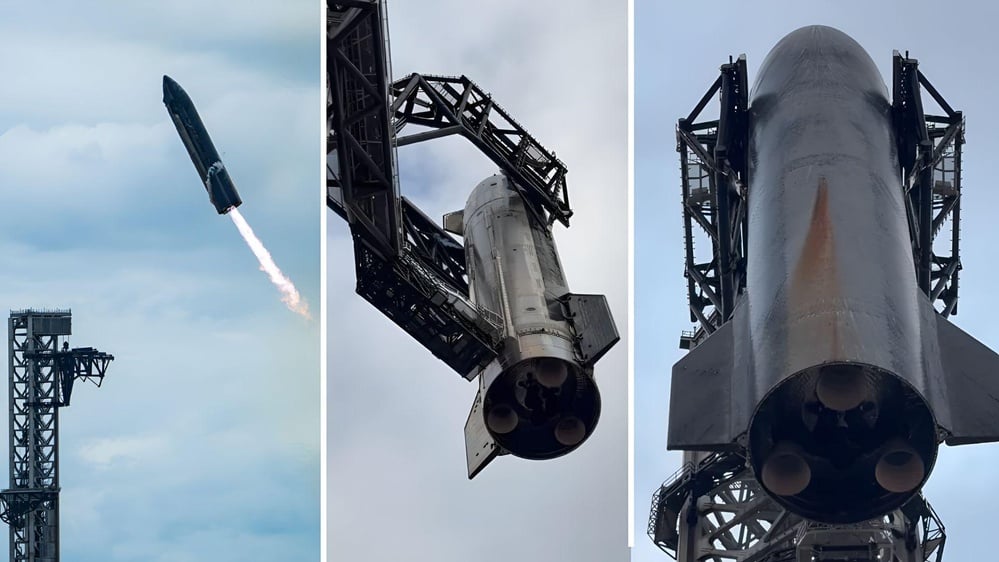
“SpaceX launched Starship on its 15th test flight on Friday, but called off its first attempt to catch both stages of the rocket.” · exact text match
Why: The content is a technical spaceflight report without liberal or conservative political cues.
Claim: The report does not frame the event in populist-versus-elite terms.
“The Super Heavy booster aborted its return to the launch tower and came down in the Gulf of Mexico instead.” · exact text match
Why: No populist or elitist political framing appears in the substantive text.
Claim: The report foregrounds verifiable events and source attribution rather than subjective evaluation.
“SpaceX launched Starship on its 15th test flight on Friday, but called off its first attempt to catch both stages of the rocket.” · exact text match
Why: The statement is a discrete event with no evaluative adjectives.
Claim: The writing recounts the abort and explosion in restrained language.
“It switched to a backup landing offshore, and exploded just before hitting the water, according to Spaceflight Now.” · exact text match
Why: Even an explosion is reported factually and attributed, not sensationalized.
Claim: The report contains moderately interesting technical developments: a failed booster catch, an orbiting ship, and a first upper-stage catch attempt.
“Catching the upper stage would be a key step towards a fully reusable rocket, which SpaceX says it needs to cut launch costs and fly to the Moon and Mars.” · exact text match
Why: The milestone context makes the event more than routine, though the prose is straightforward.
Claim: The article describes what happened and what is planned rather than prescribing policy or behavior.
“The Super Heavy booster aborted its return to the launch tower and came down in the Gulf of Mexico instead.” · exact text match
Why: The sentence is purely descriptive.
Claim: The substantive reporting is fact-based and avoids stated opinion.
“The upper stage, Ship 42, reached orbit and released 26 Starlink satellites, Spaceflight Now reported.” · exact text match
Why: A verifiable event is reported with attribution and no authorial opinion.
Claim: The report is non-political, focused on a spaceflight test and schedule.
“The rocket lifted off from Starbase at 4:47pm local time on Friday.” · exact text match
Why: No political actors, policies, or ideological claims appear in the substantive text.
Claim: Claims about causes and future plans are attributed or conditional rather than asserted with unsupported certainty.
“Instead, the booster cancelled the catch on its own after detecting a guidance and navigation problem, SpaceX commentator Dan Huot said on the company’s webcast.” · exact text match
Why: The cause is sourced to a SpaceX commentator, limiting overconfident assertion.
Claim: The substantive content is a news report, not repetitive promotional filler.
“SpaceX has caught a Super Heavy booster three times before.
However, it has never caught the newer, larger version 3 booster, or the upper stage.”
· exact text match
Why: The passage provides substantive context rather than spam-like repetition.
Claim: The report maintains neutral emotional tone despite covering an explosion and abort.
“It switched to a backup landing offshore, and exploded just before hitting the water, according to Spaceflight Now.” · exact text match
Why: The event is stated without emotive language.
Claim: The report relies on multiple named or specific sources and distinguishes reported facts from company statements.
“The upper stage, Ship 42, reached orbit and released 26 Starlink satellites, Spaceflight Now reported.” · exact text match
“This time, the ship is due to spend about 22 hours in orbit and circle the Earth about 14 times, UPI reported.” · exact text match
Why: Multiple external and company sources are attributed, supporting credibility.
Claim: The report explains the booster abort in technical, attributed terms rather than emotional or speculative language.
“Instead, the booster cancelled the catch on its own after detecting a guidance and navigation problem, SpaceX commentator Dan Huot said on the company’s webcast.” · exact text match
Why: A technical cause is attributed to a named webcast commentator, supporting rational over irrational framing.
Claim: The article reports on the test flight without advertorial calls to buy, subscribe, or promote SpaceX products.
“The Super Heavy booster aborted its return to the launch tower and came down in the Gulf of Mexico instead.” · exact text match
Why: Failure is reported plainly, and no marketing language appears in the substantive article.
Claim: The report is framed around engineering systems, telemetry, and orbital mechanics rather than superstition.
“Instead, the booster cancelled the catch on its own after detecting a guidance and navigation problem, SpaceX commentator Dan Huot said on the company’s webcast.” · exact text match
Why: The explanation invokes guidance and navigation, a scientific-technical frame.
Claim: The article shows fairness by reporting the aborted catch, prior successes, and unproven future plans with attribution.
“SpaceX has caught a Super Heavy booster three times before.
However, it has never caught the newer, larger version 3 booster, or the upper stage.”
· exact text match
Why: Including both achievements and limitations supports an observable fairness signal.
Claim: The article includes specific flight, payload, and recovery details in a coherent technical account.
“The upper stage, Ship 42, reached orbit and released 26 Starlink satellites, Spaceflight Now reported.” · exact text match
Why: Specific mission details and sourcing indicate above-average technical clarity.
The supplied text includes scraped page chrome, related-link lists, and a truncated author bio; analysis is limited to the substantive article sentences.
November 14, 2026 · 0 shares
Predominantly factual and attribution-heavy, with mild celebratory milestone framing around SpaceX's Starship catch while noting the booster was not recovered.
Helium Analysis
Limitations: Internal inconsistency appears in the supplied text, which calls the flight a first Ship catch while later saying SpaceX has not achieved a full ship catch yet; scores are limited to the provided article.
·
55 of 55 available dimensions scored; omitted dimensions are not treated as neutral.
·
Verified supporting quotes for 15 of 55 scored dimensions.
Claim: The report's own prose mostly sticks to verifiable events and explicitly notes unresolved future plans.
“No launch date has been set yet and no Starship has yet arrived in Florida.” · exact text match
“SpaceX confirmed hours later that while initially ‘go' for the catch, the flight termination system was triggered as the booster came down softly over the water” · exact text match
Why: Named confirmations and explicit unknowns keep the framing largely objective, despite some celebratory language.
Claim: Milestone language adds mild sensational or dramatic coloring to an otherwise factual report.
“a SpaceX Starship made history Nov. 14” · exact text match
“It was a major achievement for SpaceX” · exact text match
Counterevidence:
“However, that full reusability goal hasn't yet been achieved as Flight 15 failed to capture the booster after launch” · exact text match
Why: The publisher's own phrasing elevates the event but is qualified with technical caveats.
Claim: The report leans mildly positive on Starship's commercial and programmatic prospects while noting reusability and Falcon 9 concerns.
“Starship will be key not only to SpaceX's Starlink internet and AI satellite ambitions, but as a business for private and government launch services.” · exact text match
“Many in the space industry have voiced concern that companies and the government, especially NASA and the Space Force, need access to a reliable and affordable rocket” · exact text match
Why: Positive business framing is tempered by reported concerns.
Claim: The report frames the Ship catch as a positive industry milestone while acknowledging incomplete reusability.
“It was a major achievement for SpaceX, as the company aims for Starship to be fully reusable.” · exact text match
“the capture of the giant Ship immediately became an industry milestone” · exact text match
Counterevidence:
“However, that full reusability goal hasn't yet been achieved as Flight 15 failed to capture the booster after launch” · exact text match
Why: Positive framing is present but balanced by explicit caveats.
Claim: The article covers a novel spaceflight milestone with technical and programmatic detail.
“the capture of the giant Ship immediately became an industry milestone” · exact text match
Why: A first-of-its-kind spaceflight catch and future-plan details are inherently interesting.
Claim: The report describes events and announced plans without prescribing policy or action.
“SpaceX aims to launch Starship from Florida in the near future.” · exact text match
“No launch date has been set yet and no Starship has yet arrived in Florida.” · exact text match
Why: The prose is overwhelmingly descriptive rather than prescriptive.
Claim: Publisher prose includes a mild evaluative judgment that the catch 'made history'.
“a SpaceX Starship made history Nov. 14” · exact text match
“It was a major achievement for SpaceX” · exact text match
Counterevidence:
“However, that full reusability goal hasn't yet been achieved as Flight 15 failed to capture the booster after launch” · exact text match
Why: Mostly factual, with limited evaluative framing.
Claim: The piece carries a mild positive/celebratory tone through milestone language and quoted congratulations.
“It was a major achievement for SpaceX” · exact text match
“the capture of the giant Ship immediately became an industry milestone” · exact text match
Counterevidence:
“However, that full reusability goal hasn't yet been achieved as Flight 15 failed to capture the booster after launch” · exact text match
Why: Positive tone is present but mostly tied to celebrated achievement and attributed quotes.
Claim: The report uses named sources, direct attribution, and explicit uncertainty about future plans.
“SpaceX confirmed hours later that while initially ‘go' for the catch, the flight termination system was triggered” · exact text match
“No launch date has been set yet and no Starship has yet arrived in Florida.” · exact text match
Why: Sourcing and caveats support high credibility within the supplied text.
Claim: The report distinguishes confirmed events from unresolved causes and attributes claims to SpaceX officials.
“SpaceX confirmed hours later that while initially ‘go' for the catch, the flight termination system was triggered as the booster came down softly over the water” · exact text match
“But he noted that flight telemetry will need to be reviewed before reaching a definite conclusion.” · exact text match
Why: Sourced confirmation plus explicit uncertainty about telemetry supports a rational/empirical classification.
Claim: The report frames SpaceX's achievement positively while noting industry concerns and the booster failure.
“It was a major achievement for SpaceX” · exact text match
“Many in the space industry have voiced concern that companies and the government, especially NASA and the Space Force, need access to a reliable and affordable rocket” · exact text match
Counterevidence:
“SpaceX has already begun cutting back on flights of its proven workhorse Falcon 9 rocket.” · exact text match
Why: Mild pro-SpaceX framing is balanced by caveats and reported concerns.
Claim: The report is grounded in technical aerospace events and empirical descriptions.
“After orbiting Earth for more than 22 hours and deploying a batch of Starlink satellites” · exact text match
“the flight termination system was triggered as the booster came down softly over the water” · exact text match
Why: Technical, empirical framing strongly supports the scientific end of the dimension.
Claim: The report includes future plans and schedules but generally attributes them to SpaceX.
“SpaceX aims to launch Starship from Florida in the near future.” · exact text match
“On Artemis III, planned for 2027, a modified Starship will launch to Earth orbit and dock with the Orion spacecraft as a test.” · exact text match
Why: Forward-looking content is present but reported as attributed plans rather than the publisher's forecast.
Claim: The report attributes claims, names sources, and acknowledges the booster failure and unresolved telemetry review.
“SpaceX confirmed hours later that while initially ‘go' for the catch, the flight termination system was triggered as the booster came down softly over the water” · exact text match
“But he noted that flight telemetry will need to be reviewed before reaching a definite conclusion.” · exact text match
Why: Visible attribution and caveats support high internal integrity.
Claim: The report provides technical context, flight history, and future program details.
“After orbiting Earth for more than 22 hours and deploying a batch of Starlink satellites” · exact text match
“Flight 15 was the fourth launch of Starship V3 (Version 3), a radically different engineering design from the first two versions of Starship.” · exact text match
Why: Detailed aerospace context and distinction among vehicle versions indicate above-average article intelligence.
Internal inconsistency appears in the supplied text, which calls the flight a first Ship catch while later saying SpaceX has not achieved a full ship catch yet; scores are limited to the provided article.
November 14, 2026 · 0 shares
Straightforward factual reporting with attributed technical details and restrained language; no evident ideological or sensational framing.
Helium Analysis
Limitations: The supplied text includes scraped page chrome, related-link lists, and a truncated author bio; analysis is limited to the substantive article sentences.
·
19 of 55 available dimensions scored; omitted dimensions are not treated as neutral.
·
Verified supporting quotes for 19 of 19 scored dimensions.
Claim: The substantive report contains no left-right ideological framing.
“SpaceX launched Starship on its 15th test flight on Friday, but called off its first attempt to catch both stages of the rocket.” · exact text match
Why: The content is a technical spaceflight report without liberal or conservative political cues.
Claim: The report does not frame the event in populist-versus-elite terms.
“The Super Heavy booster aborted its return to the launch tower and came down in the Gulf of Mexico instead.” · exact text match
Why: No populist or elitist political framing appears in the substantive text.
Claim: The report foregrounds verifiable events and source attribution rather than subjective evaluation.
“SpaceX launched Starship on its 15th test flight on Friday, but called off its first attempt to catch both stages of the rocket.” · exact text match
Why: The statement is a discrete event with no evaluative adjectives.
Claim: The writing recounts the abort and explosion in restrained language.
“It switched to a backup landing offshore, and exploded just before hitting the water, according to Spaceflight Now.” · exact text match
Why: Even an explosion is reported factually and attributed, not sensationalized.
Claim: The report contains moderately interesting technical developments: a failed booster catch, an orbiting ship, and a first upper-stage catch attempt.
“Catching the upper stage would be a key step towards a fully reusable rocket, which SpaceX says it needs to cut launch costs and fly to the Moon and Mars.” · exact text match
Why: The milestone context makes the event more than routine, though the prose is straightforward.
Claim: The article describes what happened and what is planned rather than prescribing policy or behavior.
“The Super Heavy booster aborted its return to the launch tower and came down in the Gulf of Mexico instead.” · exact text match
Why: The sentence is purely descriptive.
Claim: The substantive reporting is fact-based and avoids stated opinion.
“The upper stage, Ship 42, reached orbit and released 26 Starlink satellites, Spaceflight Now reported.” · exact text match
Why: A verifiable event is reported with attribution and no authorial opinion.
Claim: The report is non-political, focused on a spaceflight test and schedule.
“The rocket lifted off from Starbase at 4:47pm local time on Friday.” · exact text match
Why: No political actors, policies, or ideological claims appear in the substantive text.
Claim: Claims about causes and future plans are attributed or conditional rather than asserted with unsupported certainty.
“Instead, the booster cancelled the catch on its own after detecting a guidance and navigation problem, SpaceX commentator Dan Huot said on the company’s webcast.” · exact text match
Why: The cause is sourced to a SpaceX commentator, limiting overconfident assertion.
Claim: The substantive content is a news report, not repetitive promotional filler.
“SpaceX has caught a Super Heavy booster three times before.
However, it has never caught the newer, larger version 3 booster, or the upper stage.”
· exact text match
Why: The passage provides substantive context rather than spam-like repetition.
Claim: The report maintains neutral emotional tone despite covering an explosion and abort.
“It switched to a backup landing offshore, and exploded just before hitting the water, according to Spaceflight Now.” · exact text match
Why: The event is stated without emotive language.
Claim: The report relies on multiple named or specific sources and distinguishes reported facts from company statements.
“The upper stage, Ship 42, reached orbit and released 26 Starlink satellites, Spaceflight Now reported.” · exact text match
“This time, the ship is due to spend about 22 hours in orbit and circle the Earth about 14 times, UPI reported.” · exact text match
Why: Multiple external and company sources are attributed, supporting credibility.
Claim: The report explains the booster abort in technical, attributed terms rather than emotional or speculative language.
“Instead, the booster cancelled the catch on its own after detecting a guidance and navigation problem, SpaceX commentator Dan Huot said on the company’s webcast.” · exact text match
Why: A technical cause is attributed to a named webcast commentator, supporting rational over irrational framing.
Claim: The article reports on the test flight without advertorial calls to buy, subscribe, or promote SpaceX products.
“The Super Heavy booster aborted its return to the launch tower and came down in the Gulf of Mexico instead.” · exact text match
Why: Failure is reported plainly, and no marketing language appears in the substantive article.
Claim: The report is framed around engineering systems, telemetry, and orbital mechanics rather than superstition.
“Instead, the booster cancelled the catch on its own after detecting a guidance and navigation problem, SpaceX commentator Dan Huot said on the company’s webcast.” · exact text match
Why: The explanation invokes guidance and navigation, a scientific-technical frame.
Claim: The article shows fairness by reporting the aborted catch, prior successes, and unproven future plans with attribution.
“SpaceX has caught a Super Heavy booster three times before.
However, it has never caught the newer, larger version 3 booster, or the upper stage.”
· exact text match
Why: Including both achievements and limitations supports an observable fairness signal.
Claim: The article includes specific flight, payload, and recovery details in a coherent technical account.
“The upper stage, Ship 42, reached orbit and released 26 Starlink satellites, Spaceflight Now reported.” · exact text match
Why: Specific mission details and sourcing indicate above-average technical clarity.
The supplied text includes scraped page chrome, related-link lists, and a truncated author bio; analysis is limited to the substantive article sentences.
November 14, 2026 · 0 shares
The framing is celebratory and promotional about SpaceX's technical milestone, using dramatic language while still attributing claims and acknowledging the booster failure.
Helium Analysis
Limitations: The supplied text includes multiple appended and duplicated snippet reports beyond the main AP report; scoring focuses on the main AP article.
·
9 of 55 available dimensions scored; omitted dimensions are not treated as neutral.
·
Verified supporting quotes for 8 of 9 scored dimensions.
Claim: Publisher uses subjective, evaluative language to frame the Starship recovery.
“triumphant return” · exact text match
“dramatic, sci-fi-like capture helped blot out the booster's messy miss” · exact text match
Why: These prose descriptors are evaluative rather than neutral, supporting a mildly subjective framing.
Claim: The recovery is framed as a dramatic, historic spectacle.
“dramatic first” · exact text match
“grand finale” · exact text match
Why: The headline and prose emphasize dramatic and historic spectacle, though factual details remain.
Claim: The report frames the catch as a triumph that outweighs the booster failure.
“SpaceX's Starship made a triumphant return to Earth” · exact text match
“helped blot out the booster's messy miss” · exact text match
Why: Positive triumph framing dominates despite the acknowledged booster failure.
Claim: The report aligns with institutional NASA and SpaceX framing of the mission.
“NASA welcomed Saturday's news.” · exact text match
“SpaceX officials said Saturday's catch demonstrates the full reusability of Starship” · exact text match
Why: Institutional sources and claims frame the event positively, with little adversarial framing.
Claim: The report conveys positive excitement through prose and quoted reactions.
“Calling it an "epic day,"” · exact text match
“"Look at her! Baby, she's back!"” · not found in supplied text
Why: Enthusiastic quotations and celebratory language support a positive emotional valence.
Claim: The report attributes claims and acknowledges the booster failure while providing technical context.
“SpaceX officials said Saturday's catch demonstrates the full reusability of Starship” · exact text match
“Engineers are still investigating the cause.” · exact text match
Why: Attribution and explicit acknowledgment of an unresolved failure support above-average credibility.
Claim: SpaceX's achievement is framed favorably, with its reusability claims prominently relayed.
“SpaceX officials said Saturday's catch demonstrates the full reusability of Starship” · exact text match
“SpaceX's Starship made a triumphant return to Earth” · exact text match
Counterevidence:
“Although Friday's booster recovery failed” · exact text match
Why: Prominent positive framing of SpaceX and its claims supports mild pro-corporate presentation.
Claim: The report is grounded in engineering and empirical detail rather than superstition.
“Engineers are still investigating the cause.” · exact text match
“The spacecraft completed 14 laps around Earth” · exact text match
Why: Engineering investigation and orbital specifications indicate a scientific/empirical orientation.
Claim: The article supplies technical specifications and mission context beyond the headline.
“a 407-foot (124-meter) behemoth” · exact text match
“completed 14 laps around Earth” · exact text match
Why: Specific dimensions and orbital details indicate substantive explanatory content.
The supplied text includes multiple appended and duplicated snippet reports beyond the main AP report; scoring focuses on the main AP article.
November 14, 2026 · 0 shares
Celebratory, company-friendly spaceflight coverage frames a first-ever orbital catch as a historic leap while retaining specific technical details and caveats about unresolved booster issues.
Helium Analysis
Limitations: Coverage relies heavily on SpaceX webcast/company statements and social-media praise; no independent technical assessment is included.
·
55 of 55 available dimensions scored; omitted dimensions are not treated as neutral.
·
Verified supporting quotes for 13 of 55 scored dimensions.
Claim: The report mixes factual reporting with mildly celebratory evaluative language.
“The achievement took the sting out of the previous day's aborted effort to catch the rocket's booster using the same system, minutes after liftoff.” · not found in supplied text
Counterevidence:
“SpaceX said the booster was diverted when its onboard system detected a fuel-system alarm.” · exact text match
Why: The subjective phrase 'took the sting out' is balanced by attributed factual detail, supporting a modest positive score.
Claim: The headline and framing use an exclamatory, dramatic hook for a technical achievement.
“Baby, She's Back!” · exact text match
Why: The exclamation and playful headline raise sensational presentation, though the body remains largely factual.
Claim: The article frames the test as a major success and emphasizes expansive future opportunities.
“Bringing Starship into full operation is expected to speed up deployment of Starlink satellites.” · exact text match
“More importantly, Starship is slated to serve as a landing system for NASA's crewed moon missions starting as early as 2028.” · exact text match
Why: Forward-looking expectations and emphasis on future missions produce a clearly optimistic framing.
Claim: The subject is a first-ever orbital rocket catch and record-long flight, providing high inherent interest.
“SpaceX brought back its Starship rocket's second stage today for a first-ever midair capture at its launch pad, capping a record-setting orbital flight test.” · exact text match
Why: A first-ever orbital capture and record duration are substantive high-interest developments.
Claim: The article primarily describes the launch test and company plans rather than prescribing policy or action.
“SpaceX plans to use the launch-pad arms to recover Starship's boosters and second stages on a routine basis, achieving company founder Elon Musk's goal of creating a fully reusable, orbital-class launch system.” · exact text match
Why: Reporting plans and goals descriptively, without advocating policy, supports a strongly descriptive score.
Claim: The presentation uses upbeat, celebratory language and audience-reaction color.
“SpaceX employees around the country and hundreds of onlookers near the Texas launch site cheered as Ship 42 descended, with "Baby, Come Back" playing as the soundtrack for the webcast.” · exact text match
“New era.” · exact text match
Why: Cheering, soundtrack detail, and the quoted 'New era' produce a positive emotional charge.
Claim: The article provides specific facts, named attribution, and caveats about unresolved technical issues.
“All of the satellites were in good health and beginning to raise their orbits to operational altitude, the company said.” · exact text match
“The root cause of the alarm is under investigation.” · exact text match
Why: Named sourcing and explicit uncertainty support high observable credibility.
Claim: The report grounds its account in specific technical details, timelines, and attributed company statements while flagging an ongoing investigation.
“The root cause of the alarm is under investigation.” · exact text match
“During the first hours of its 14-orbit flight, Starship deployed 26 more next-generation satellites for SpaceX's Starlink broadband internet network.” · exact text match
Why: Specific orbital duration, satellite count, and explicit uncertainty about the booster alarm indicate a rational, evidence-oriented treatment rather than irrational framing.
Claim: The article's celebratory coverage and Starlink/Mars future framing give it a mildly promotional feel.
“Bringing Starship into full operation is expected to speed up deployment of Starlink satellites.” · exact text match
Why: The positive focus on company capabilities is mildly promotional, but the piece is not structured as marketing.
Claim: The article presents SpaceX's commercial and exploratory plans in favorable, achievement-oriented terms.
“Bringing Starship into full operation is expected to speed up deployment of Starlink satellites.” · exact text match
“achieving company founder Elon Musk's goal of creating a fully reusable, orbital-class launch system.” · exact text match
Why: Framing company goals and Starlink expansion as benefits supports a pro-corporate score, though the article remains largely reported.
Claim: The report is framed through empirical spaceflight testing, orbital mechanics, and engineering data rather than superstition.
“SpaceX's team will analyze the data gathered about Starship's performance, including the ability of Ship 42's heat shield to stand up to the rigors of atmospheric re-entry.” · exact text match
Why: Emphasis on data analysis and engineering limits supports a strongly scientific score.
Claim: The article includes attributed long-term forecasts and future mission plans beyond the immediate test.
“Musk envisions creating a fleet of Starships that could offer point-to-point rocket travel on Earth, as well as mass transit to Mars and other off-Earth destinations.” · exact text match
Why: Future-oriented, attributed scenarios add moderate speculation while remaining clearly framed as plans or visions.
Claim: The report includes contextual caveats and does not omit the prior failed booster catch or unresolved technical questions.
“The root cause of the alarm is under investigation.” · exact text match
“including the ability of Ship 42's heat shield to stand up to the rigors of atmospheric re-entry.” · exact text match
Why: Disclosing the aborted booster effort and ongoing data review supports high observable integrity.
Claim: The article explains the significance and context of the test with appropriate technical and historical detail.
“The arm-capture system, nicknamed "Mechazilla," had been used three times previously to capture Starship Super Heavy boosters during suborbital flight tests, but this was the first time for a second stage coming in hot from orbit.” · exact text match
Why: Historical comparison and technical explanation indicate strong article intelligence.
Coverage relies heavily on SpaceX webcast/company statements and social-media praise; no independent technical assessment is included.
November 15, 2026 · 0 shares
The coverage frames the Starship catch as a historic, celebratory breakthrough, using dramatic and optimistic language while still including technical detail and the booster failure.
Starship is a two-stage system: the Super Heavy booster is the first stage, and the Starship upper stage is the orbital vehicle.
Helium Analysis
Limitations: The supplied text includes duplicated fragments and truncated 'LATEST DEVELOPMENTS' items; analysis is limited to the substantive Starship report.
·
10 of 56 available dimensions scored; omitted dimensions are not treated as neutral.
·
Verified supporting quotes for 10 of 10 scored dimensions.
Claim: The lead frames the Starship recovery with dramatic, breakthrough language.
“SpaceX has marked a historic achievement after recovering its Starship spacecraft in midair for the first time.” · exact text match
Why: The phrase 'historic achievement' is evaluative and heightens the event beyond a neutral report.
Claim: The article presents the recovery as a positive step toward full reusability.
“The successful spacecraft recovery marks a crucial step towards making launch vehicles entirely reusable, a goal that has eluded the industry for decades.” · exact text match
Why: The wording emphasizes progress and success, giving the coverage a positive and optimistic valence.
Claim: The report is primarily descriptive of mission events and specifications.
“The capture concluded a mission lasting roughly 22 and a half hours, during which the stainless steel craft completed 14 orbits of Earth, only its second journey into orbit.” · exact text match
Why: Detailed factual narration indicates a descriptive rather than prescriptive stance.
Claim: The article uses celebratory imagery around the recovery.
“Onlookers gathered on nearby Gulf of Mexico beaches erupted in celebration as the spacecraft settled into position.” · exact text match
Why: The scene of celebratory onlookers adds positive emotional coloring.
Claim: The article relies on named sources and specific mission details.
“Clayton Swope, an aerospace analyst at the Centre for Strategic and International Studies, described the mission as a "huge technical achievement" that "proves the whole idea of Starship as a fully reusable spaceship can work".” · exact text match
Why: Named expert attribution and concrete technical details support visible credibility.
Claim: The article explains the recovery challenge through technical comparisons.
“Recovering the upper stage posed far greater technical challenges than previous booster catches, as the spacecraft was travelling at much higher speeds and falling from a much greater altitude.” · exact text match
Why: It provides causal technical reasoning rather than emotive or illogical assertions.
Claim: The article frames a private aerospace company's success positively.
“SpaceX has marked a historic achievement after recovering its Starship spacecraft in midair for the first time.” · exact text match
Why: Calling SpaceX's recovery a 'historic achievement' presents the corporate actor favorably.
Claim: The article uses empirical and engineering details rather than superstition.
“Some of those satellites were also used to photograph the craft's heat shield, allowing engineers to assess its condition before re-entry.” · exact text match
Why: Describing engineering assessment of the heat shield reflects scientific and technical framing.
Claim: The report includes the mission's failure as well as its success and names sources.
“Those ambitions were scuppered on Friday when the Super Heavy booster encountered a guidance anomaly minutes after lift-off.” · exact text match
Why: Including the booster anomaly balances the celebratory framing and supports fairness and honesty.
Claim: The article supplies technical context and mission history beyond the headline claim.
“The mission had been conceived as a historic double-catch, with both stages of the 124-metre rocket returning intact to the launch site.” · exact text match
Why: Specific mission design context indicates above-average explanatory intelligence.
The supplied text includes duplicated fragments and truncated 'LATEST DEVELOPMENTS' items; analysis is limited to the substantive Starship report.
November 14, 2026 · 0 shares
Framing is celebratory and mildly sensational, treating the Ship catch as a historic milestone while retaining attribution and acknowledging the booster's failed catch.
Helium Analysis
Limitations: No explicit byline appears in the supplied text; 'Michael Wall' is identified only in a contributor bio.
·
11 of 55 available dimensions scored; omitted dimensions are not treated as neutral.
·
Verified supporting quotes for 10 of 11 scored dimensions.
Claim: The publisher frames the catch with mildly subjective evaluative language about its significance.
“a landmark achievement that could unlock the giant vehicle's immense potential” · exact text match
Counterevidence:
“That didn't happen; Starship's Super Heavy booster diverted to a Gulf of Mexico splashdown on Friday after experiencing a low-fuel alarm.” · exact text match
Why: This is an evaluative characterization of the event rather than a neutral statement of fact.
Claim: The headline and framing use elevated, dramatic language about the catch.
“'Now everything changes': SpaceX catches Starship upper stage for 1st time ever (video)” · exact text match
“notching a huge milestone for SpaceX and its dream of full rocket reuse” · exact text match
Why: The headline quote and milestone language heighten the event's drama beyond bare description.
Claim: The framing is notably optimistic about the catch's implications for SpaceX's reuse plans.
“a landmark achievement that could unlock the giant vehicle's immense potential” · exact text match
“SpaceX and its dream of full rocket reuse” · exact text match
Why: The language emphasizes future potential and achievement rather than risks or limitations.
Claim: The article includes some publisher evaluative language alongside factual reporting.
“But Ship succeeded in its attempt, notching a huge milestone for SpaceX and its dream of full rocket reuse.” · exact text match
Why: Calling the event a 'huge milestone' is an evaluative judgment.
Claim: The prose carries positive emotional coloring and celebratory imagery.
“And they got quite a show: Ship 42 nestled gently into Mechazilla's waiting arms, while "Baby Come Back" played over SpaceX's landing webcast.” · not found in supplied text
Why: The scene is described with warm, celebratory imagery rather than flat technical language.
Claim: The report provides specific timing, attribution, and an update note while acknowledging a setback.
“The Ship catch occurred today at 4:20 p.m. EST (2120 GMT; 3:20 p.m. local Texas time), roughly 22.5 hours after Flight 15 lifted off.” · exact text match
“Editor's note: This story was updated at 8 a.m. EST to include new details on SpaceX's Starship Flight 15 mission from SpaceX.” · exact text match
Why: Specific sourcing and transparent updates support high internal credibility.
Claim: The report is largely rational and evidence-bound, explaining technical constraints and acknowledging failure.
“The upper stage is a tougher target, for it flies higher, farther and faster than the booster.” · exact text match
“That didn't happen; Starship's Super Heavy booster diverted to a Gulf of Mexico splashdown on Friday after experiencing a low-fuel alarm.” · exact text match
Why: Technical explanation and disclosure of the booster failure show measured reasoning.
Claim: The article is grounded in engineering and empirical observation rather than superstition.
“Those images, combined with ground-based cameras, found Ship 42 to be in good shape and ready for its big moment.” · exact text match
Why: The framing relies on instrument-based inspection and technical mission details.
Claim: The article includes a forward-looking prediction about future SpaceX flights.
“So the company will doubtless try the maneuver again soon — probably on the next Starship flight, which won't be too far down the road.” · exact text match
Why: This is a forecast about future action rather than a report of a completed event.
Claim: The publisher includes corrective updates and acknowledges the booster's failed catch.
“That didn't happen; Starship's Super Heavy booster diverted to a Gulf of Mexico splashdown on Friday after experiencing a low-fuel alarm.” · exact text match
“Editor's note: This story was updated at 8 a.m. EST to include new details on SpaceX's Starship Flight 15 mission from SpaceX.” · exact text match
Why: Disclosing the failed booster catch and update history are internal signals of fair, transparent reporting.
Claim: The article explains the engineering significance with specific comparative and mission detail.
“The upper stage is a tougher target, for it flies higher, farther and faster than the booster.
Indeed, on Flight 15, Ship 42 came all the way back down from orbit.”
· exact text match
Why: This succinctly explains why the Ship catch was more difficult than prior booster catches.
No explicit byline appears in the supplied text; 'Michael Wall' is identified only in a contributor bio.
November 15, 2026 · 0 shares
Largely neutral and event-focused, the coverage presents the catch as a factual milestone and attributes celebratory language to SpaceX and NASA figures.
Helium Analysis
Limitations: The supplied text lacks an author byline and relies mainly on SpaceX's livestream and company statements for the central claim.
·
6 of 55 available dimensions scored; omitted dimensions are not treated as neutral.
·
Verified supporting quotes for 5 of 6 scored dimensions.
Claim: The report keeps evaluative language largely attributed to named sources while stating the event factually.
“SpaceX spokesman Dan Huot said, as quoted by NDTV.” · exact text match
“Administrator Jared Isaacman called Saturday's recovery "almost magic."” · not found in supplied text
Why: Celebratory and evaluative language is framed as quotations from named figures rather than presented as the publisher's own judgment.
Claim: The report describes flight and recovery details without prescribing actions or policies.
“Starship spent 22 hours in flight, orbiting Earth 14 times and deploying 26 satellites for Musk's Starlink internet network.” · exact text match
Why: The selected passage is factual and descriptive, with no recommendation or advocacy.
Claim: The report supports major claims with specific figures and named-source attribution.
“The recovery took place during the 15th test flight of the world's biggest and most powerful rocket system.” · exact text match
“SpaceX spokesman Dan Huot said, as quoted by NDTV.” · exact text match
Why: Specific operational details and attributed quotations provide visible sourcing for the central claims.
Claim: The report explains the technical distinction between catching boosters and catching Starship.
“SpaceX had previously caught its returning booster rockets three times.
Catching Starship posed a different challenge.
The spacecraft returned from a much higher altitude and descended at a far greater speed than the boosters.”
· exact text match
Why: The passage provides comparative technical context instead of asserting the milestone without explanation.
Claim: The framing is empirical and technical, reporting measurable flight details and a physical explanation of the catch challenge.
“Starship spent 22 hours in flight, orbiting Earth 14 times and deploying 26 satellites for Musk's Starlink internet network.” · exact text match
“The spacecraft returned from a much higher altitude and descended at a far greater speed than the boosters.” · exact text match
Why: The article relies on technical quantities and physical comparisons rather than speculative or non-empirical claims.
Claim: The report includes concise technical context and distinguishes the Starship catch from earlier booster catches.
“SpaceX had previously caught its returning booster rockets three times.
Catching Starship posed a different challenge.”
· exact text match
Why: The comparison shows explanatory context that raises the article's informational sophistication.
The supplied text lacks an author byline and relies mainly on SpaceX's livestream and company statements for the central claim.
November 14, 2026 · 0 shares
Frames the test as a major reusability milestone with positive technical language while still noting the booster failure and heat-shield limitations.
Helium Analysis
Limitations: The supplied text lacks named sourcing and full article context, limiting confidence in credibility and integrity judgments.
·
13 of 55 available dimensions scored; omitted dimensions are not treated as neutral.
·
Verified supporting quotes for 13 of 13 scored dimensions.
Claim: The report uses evaluative milestone language but grounds it in specific mission details.
“landmark aerial recovery of the rocket system's centrepiece vessel” · exact text match
“pivotal engineering milestone” · exact text match
Why: Evaluative adjectives introduce mild subjective framing.
Claim: The framing is emphatic about the milestone but not sensationalized.
“major reusability milestone” · exact text match
Counterevidence:
“failed to execute a pad return” · exact text match
Why: Strong but not alarmist language, with a caveat that tempers promotion.
Claim: The report presents the catch as a major step forward while acknowledging an unrecovered booster.
“marking a major step towards SpaceX's goal of a fully reusable rocket” · exact text match
Counterevidence:
“SpaceX has yet to recover both the booster and upper stage during a single launch.” · exact text match
Why: Positive milestone framing dominates, with a noted setback.
Claim: The reported orbital catch and reusability milestone are unusual and technically notable.
“SpaceX catches Starship after 22-hour orbital flight in major reusability milestone.” · exact text match
Why: The event is presented as a notable engineering and operational milestone.
Claim: The report describes mission events and company aims rather than prescribing action.
“Musk aims to achieve rapid turnaround times akin to commercial aviation.” · exact text match
Why: Aims are attributed descriptively; no policy recommendation is made.
Claim: Evaluative language is limited to milestone descriptions.
“landmark aerial recovery of the rocket system's centrepiece vessel” · exact text match
Why: Mild evaluative wording appears within mostly factual reporting.
Claim: Tone is mildly positive about the achievement while remaining largely neutral.
“major reusability milestone” · exact text match
Counterevidence:
“failed to execute a pad return” · exact text match
Why: Positive framing is balanced by the reported setback.
Claim: Specific mission figures and caveats support internal credibility, though no named sourcing appears.
“deployed 26 Starlink satellites into orbit on Friday evening whilst travelling at an altitude of approximately 260 kilometres” · exact text match
Why: Precise details and acknowledged limits strengthen credibility in the supplied text.
Claim: The report explains the descent and recovery sequence with technical specifics rather than emotional assertion.
“requires further refinement before achieving full reusability without extensive refurbishment between flights” · exact text match
Why: Technical sequencing and engineering details support a rational presentation.
Claim: The report relies on engineering and physical evidence rather than superstition.
“its orbital velocity of roughly 27,360 kilometres per hour slowed to a supersonic glide above south Texas” · exact text match
Why: Quantified physical description supports scientific and empirical framing.
Claim: Future plans are reported in attributed, low-certainty terms.
“Musk aims to achieve rapid turnaround times akin to commercial aviation.” · exact text match
Why: A speculative future goal is attributed as an aim, not stated as fact.
Claim: The report includes countervailing failures and engineering limits alongside the achievement.
“Whilst the towering Super Heavy booster failed to execute a pad return” · exact text match
“requires further refinement before achieving full reusability without extensive refurbishment between flights” · exact text match
Why: Including setbacks and limits signals fairness and honesty in the supplied text.
Claim: The report conveys technical detail and tradeoffs with above-average clarity.
“orbital velocity of roughly 27,360 kilometres per hour slowed to a supersonic glide above south Texas” · exact text match
Why: Specific quantitative and engineering context indicates high article intelligence.
The supplied text lacks named sourcing and full article context, limiting confidence in credibility and integrity judgments.
November 15, 2026 · 0 shares
The coverage frames the Starship catch as a historic, celebratory breakthrough, using dramatic and optimistic language while still including technical detail and the booster failure.
Starship is a two-stage system: the Super Heavy booster is the first stage, and the Starship upper stage is the orbital vehicle.
Helium Analysis
Limitations: The supplied text includes duplicated fragments and truncated 'LATEST DEVELOPMENTS' items; analysis is limited to the substantive Starship report.
·
10 of 56 available dimensions scored; omitted dimensions are not treated as neutral.
·
Verified supporting quotes for 10 of 10 scored dimensions.
Claim: The lead frames the Starship recovery with dramatic, breakthrough language.
“SpaceX has marked a historic achievement after recovering its Starship spacecraft in midair for the first time.” · exact text match
Why: The phrase 'historic achievement' is evaluative and heightens the event beyond a neutral report.
Claim: The article presents the recovery as a positive step toward full reusability.
“The successful spacecraft recovery marks a crucial step towards making launch vehicles entirely reusable, a goal that has eluded the industry for decades.” · exact text match
Why: The wording emphasizes progress and success, giving the coverage a positive and optimistic valence.
Claim: The report is primarily descriptive of mission events and specifications.
“The capture concluded a mission lasting roughly 22 and a half hours, during which the stainless steel craft completed 14 orbits of Earth, only its second journey into orbit.” · exact text match
Why: Detailed factual narration indicates a descriptive rather than prescriptive stance.
Claim: The article uses celebratory imagery around the recovery.
“Onlookers gathered on nearby Gulf of Mexico beaches erupted in celebration as the spacecraft settled into position.” · exact text match
Why: The scene of celebratory onlookers adds positive emotional coloring.
Claim: The article relies on named sources and specific mission details.
“Clayton Swope, an aerospace analyst at the Centre for Strategic and International Studies, described the mission as a "huge technical achievement" that "proves the whole idea of Starship as a fully reusable spaceship can work".” · exact text match
Why: Named expert attribution and concrete technical details support visible credibility.
Claim: The article explains the recovery challenge through technical comparisons.
“Recovering the upper stage posed far greater technical challenges than previous booster catches, as the spacecraft was travelling at much higher speeds and falling from a much greater altitude.” · exact text match
Why: It provides causal technical reasoning rather than emotive or illogical assertions.
Claim: The article frames a private aerospace company's success positively.
“SpaceX has marked a historic achievement after recovering its Starship spacecraft in midair for the first time.” · exact text match
Why: Calling SpaceX's recovery a 'historic achievement' presents the corporate actor favorably.
Claim: The article uses empirical and engineering details rather than superstition.
“Some of those satellites were also used to photograph the craft's heat shield, allowing engineers to assess its condition before re-entry.” · exact text match
Why: Describing engineering assessment of the heat shield reflects scientific and technical framing.
Claim: The report includes the mission's failure as well as its success and names sources.
“Those ambitions were scuppered on Friday when the Super Heavy booster encountered a guidance anomaly minutes after lift-off.” · exact text match
Why: Including the booster anomaly balances the celebratory framing and supports fairness and honesty.
Claim: The article supplies technical context and mission history beyond the headline claim.
“The mission had been conceived as a historic double-catch, with both stages of the 124-metre rocket returning intact to the launch site.” · exact text match
Why: Specific mission design context indicates above-average explanatory intelligence.
The supplied text includes duplicated fragments and truncated 'LATEST DEVELOPMENTS' items; analysis is limited to the substantive Starship report.
November 14, 2026 · 0 shares
Coverage is largely factual and measured, with mild celebratory language around SpaceX's first Ship catch and balanced acknowledgment of the booster's aborted catch and explosion.
Helium Analysis
Limitations: The excerpt is brief and contains an unattributed embedded social-media line ('Mechazilla catches Starship! Congratulations...'), so the assessment of full publisher framing and sourcing is limited.
·
5 of 55 available dimensions scored; omitted dimensions are not treated as neutral.
·
Verified supporting quotes for 5 of 5 scored dimensions.
Claim: Coverage is mostly objective but includes mildly evaluative positive language about SpaceX's achievement.
“SpaceX nailed its first catch attempt of the Starship upper stage” · exact text match
“some of its most ambitious goals yet” · exact text match
Why: The report relies on factual outcomes but uses colloquial/evaluative phrasing that leans positive rather than strictly neutral.
Claim: The report is largely non-sensational, describing technical milestones and a booster anomaly in measured terms.
“While Flight 15 succeeded in carrying out some of its main objectives — including deploying 26 Starlink V3 satellites to orbit and catching the Ship — the first stage booster experienced a problem on its way back down to Earth and aborted its catch attempt, instead changing course to splash down in the Gulf, where it exploded before hitting the water.” · exact text match
Why: Detailed technical reporting and explicit inclusion of the failure reduce sensational framing.
Claim: Positive achievement language gives the coverage a mildly positive emotional tone, though failure is also reported.
“SpaceX successfully catches Starship after launch for the first time.” · exact text match
“SpaceX nailed its first catch attempt of the Starship upper stage” · exact text match
Why: Success and 'nailed' framing convey mild positive affect; balanced failure reporting keeps it limited.
Claim: The report frames the event through engineering test objectives and orbital operations rather than superstition or supernatural claims.
“SpaceX launched Starship on Friday for its 15th test flight, in which it set out to achieve some of its most ambitious goals yet.” · exact text match
“deploying 26 Starlink V3 satellites to orbit” · exact text match
Why: The content is explicitly about a test flight and satellite deployment, supporting a strongly scientific/technical orientation.
Claim: The report shows internal fairness by including the booster's aborted catch and explosion alongside the successful Ship catch.
“While Flight 15 succeeded in carrying out some of its main objectives — including deploying 26 Starlink V3 satellites to orbit and catching the Ship — the first stage booster experienced a problem on its way back down to Earth and aborted its catch attempt, instead changing course to splash down in the Gulf, where it exploded before hitting the water.” · exact text match
Why: Including a material failure in the same account is an observable honesty/fairness signal.
The excerpt is brief and contains an unattributed embedded social-media line ('Mechazilla catches Starship! Congratulations...'), so the assessment of full publisher framing and sourcing is limited.
November 15, 2026 · 0 shares
Largely neutral and event-focused, the coverage presents the catch as a factual milestone and attributes celebratory language to SpaceX and NASA figures.
Helium Analysis
Limitations: The supplied text lacks an author byline and relies mainly on SpaceX's livestream and company statements for the central claim.
·
6 of 55 available dimensions scored; omitted dimensions are not treated as neutral.
·
Verified supporting quotes for 5 of 6 scored dimensions.
Claim: The report keeps evaluative language largely attributed to named sources while stating the event factually.
“SpaceX spokesman Dan Huot said, as quoted by NDTV.” · exact text match
“Administrator Jared Isaacman called Saturday's recovery "almost magic."” · not found in supplied text
Why: Celebratory and evaluative language is framed as quotations from named figures rather than presented as the publisher's own judgment.
Claim: The report describes flight and recovery details without prescribing actions or policies.
“Starship spent 22 hours in flight, orbiting Earth 14 times and deploying 26 satellites for Musk's Starlink internet network.” · exact text match
Why: The selected passage is factual and descriptive, with no recommendation or advocacy.
Claim: The report supports major claims with specific figures and named-source attribution.
“The recovery took place during the 15th test flight of the world's biggest and most powerful rocket system.” · exact text match
“SpaceX spokesman Dan Huot said, as quoted by NDTV.” · exact text match
Why: Specific operational details and attributed quotations provide visible sourcing for the central claims.
Claim: The report explains the technical distinction between catching boosters and catching Starship.
“SpaceX had previously caught its returning booster rockets three times.
Catching Starship posed a different challenge.
The spacecraft returned from a much higher altitude and descended at a far greater speed than the boosters.”
· exact text match
Why: The passage provides comparative technical context instead of asserting the milestone without explanation.
Claim: The framing is empirical and technical, reporting measurable flight details and a physical explanation of the catch challenge.
“Starship spent 22 hours in flight, orbiting Earth 14 times and deploying 26 satellites for Musk's Starlink internet network.” · exact text match
“The spacecraft returned from a much higher altitude and descended at a far greater speed than the boosters.” · exact text match
Why: The article relies on technical quantities and physical comparisons rather than speculative or non-empirical claims.
Claim: The report includes concise technical context and distinguishes the Starship catch from earlier booster catches.
“SpaceX had previously caught its returning booster rockets three times.
Catching Starship posed a different challenge.”
· exact text match
Why: The comparison shows explanatory context that raises the article's informational sophistication.
The supplied text lacks an author byline and relies mainly on SpaceX's livestream and company statements for the central claim.
November 15, 2026 · 0 shares
The coverage frames the Starship catch as a historic, celebratory breakthrough, using dramatic and optimistic language while still including technical detail and the booster failure.
Starship is a two-stage system: the Super Heavy booster is the first stage, and the Starship upper stage is the orbital vehicle.
Helium Analysis
Limitations: The supplied text includes duplicated fragments and truncated 'LATEST DEVELOPMENTS' items; analysis is limited to the substantive Starship report.
·
10 of 56 available dimensions scored; omitted dimensions are not treated as neutral.
·
Verified supporting quotes for 10 of 10 scored dimensions.
Claim: The lead frames the Starship recovery with dramatic, breakthrough language.
“SpaceX has marked a historic achievement after recovering its Starship spacecraft in midair for the first time.” · exact text match
Why: The phrase 'historic achievement' is evaluative and heightens the event beyond a neutral report.
Claim: The article presents the recovery as a positive step toward full reusability.
“The successful spacecraft recovery marks a crucial step towards making launch vehicles entirely reusable, a goal that has eluded the industry for decades.” · exact text match
Why: The wording emphasizes progress and success, giving the coverage a positive and optimistic valence.
Claim: The report is primarily descriptive of mission events and specifications.
“The capture concluded a mission lasting roughly 22 and a half hours, during which the stainless steel craft completed 14 orbits of Earth, only its second journey into orbit.” · exact text match
Why: Detailed factual narration indicates a descriptive rather than prescriptive stance.
Claim: The article uses celebratory imagery around the recovery.
“Onlookers gathered on nearby Gulf of Mexico beaches erupted in celebration as the spacecraft settled into position.” · exact text match
Why: The scene of celebratory onlookers adds positive emotional coloring.
Claim: The article relies on named sources and specific mission details.
“Clayton Swope, an aerospace analyst at the Centre for Strategic and International Studies, described the mission as a "huge technical achievement" that "proves the whole idea of Starship as a fully reusable spaceship can work".” · exact text match
Why: Named expert attribution and concrete technical details support visible credibility.
Claim: The article explains the recovery challenge through technical comparisons.
“Recovering the upper stage posed far greater technical challenges than previous booster catches, as the spacecraft was travelling at much higher speeds and falling from a much greater altitude.” · exact text match
Why: It provides causal technical reasoning rather than emotive or illogical assertions.
Claim: The article frames a private aerospace company's success positively.
“SpaceX has marked a historic achievement after recovering its Starship spacecraft in midair for the first time.” · exact text match
Why: Calling SpaceX's recovery a 'historic achievement' presents the corporate actor favorably.
Claim: The article uses empirical and engineering details rather than superstition.
“Some of those satellites were also used to photograph the craft's heat shield, allowing engineers to assess its condition before re-entry.” · exact text match
Why: Describing engineering assessment of the heat shield reflects scientific and technical framing.
Claim: The report includes the mission's failure as well as its success and names sources.
“Those ambitions were scuppered on Friday when the Super Heavy booster encountered a guidance anomaly minutes after lift-off.” · exact text match
Why: Including the booster anomaly balances the celebratory framing and supports fairness and honesty.
Claim: The article supplies technical context and mission history beyond the headline claim.
“The mission had been conceived as a historic double-catch, with both stages of the 124-metre rocket returning intact to the launch site.” · exact text match
Why: Specific mission design context indicates above-average explanatory intelligence.
The supplied text includes duplicated fragments and truncated 'LATEST DEVELOPMENTS' items; analysis is limited to the substantive Starship report.
November 14, 2026 · 0 shares
Framing presents SpaceX’s Starship catch as a historic engineering breakthrough with generally factual technical detail, celebratory language, and limited caveats about remaining reuse challenges.
Helium Analysis
Limitations: The supplied text includes duplicated subscription prompts and repeated headline/summary fragments; these were excluded from analysis.
·
11 of 55 available dimensions scored; omitted dimensions are not treated as neutral.
·
Verified supporting quotes for 10 of 11 scored dimensions.
Claim: The report mostly narrates technical events but uses evaluative milestone language.
“marking a major milestone in reusable rocket development” · exact text match
Why: The phrase is an evaluative characterization beyond the bare technical event, indicating mild subjectivity.
Claim: The headline and some body language amp up the achievement with dramatic phrasing.
“SpaceX catches Starship after blistering 17,000 mph orbital return in historic first.” · exact text match
Why: 'Blistering' and 'historic first' are sensational framing relative to the technical narration.
Claim: The report emphasizes progress and future potential more than risks.
“It also brought the company closer to its goal of making Starship fully reusable.” · exact text match
Why: This frames the event in terms of advancing a larger goal, a positive/optimistic valence.
Claim: The article centers on a novel first-time engineering feat.
“SpaceX caught Starship's Ship 42 upper stage at its Starbase launch tower for the first time.” · exact text match
Why: A first-time orbital upper-stage catch is an intrinsically notable event.
Claim: The passage is largely descriptive rather than advocating a course of action.
“Ship 42 subsequently reignited three engines to control its final descent.” · exact text match
Why: The quoted sentence narrates a technical sequence without prescription.
Claim: The tone is mildly positive and celebratory about the achievement.
“SpaceX employees gathered outside to watch the historic landing.” · exact text match
Why: The word 'historic' and celebratory scene carry a positive valence, though the body remains factual.
Claim: The report is generally credible through attribution, technical detail, and stated limitations.
“SpaceX commentator Dan Huot described the achievement as a major breakthrough in spaceflight.” · exact text match
“However, several engineering challenges remain.” · exact text match
Why: Named source and caveats are visible credibility signals.
Claim: The report relies on empirical engineering details rather than superstition.
“Starship reached orbital speeds of approximately 17,000 mph before beginning atmospheric reentry.” · exact text match
Why: Quantified physical performance supports a scientific/empirical orientation.
Claim: The report includes some attributed future plans and forecasts beyond the completed flight.
“SpaceX ultimately plans to build a constellation containing 100,000 satellites.” · exact text match
“SpaceX will likely attempt the maneuver again during an upcoming flight.” · not found in supplied text
Why: Future plans and a likelihood forecast introduce limited speculation, clearly tied to SpaceX.
Claim: The report includes caveats and attribution while not presenting the milestone as complete reusability.
“However, several engineering challenges remain.” · exact text match
“SpaceX has yet to recover both Starship stages during the same mission.” · exact text match
Why: Explicit limitations and unresolved issues support observable fairness/honesty.
Claim: The report conveys technical specifics and caveats in a coherent explanatory manner.
“The spacecraft completed 14 orbits around Earth during a roughly 22-hour mission.” · exact text match
“However, several engineering challenges remain.” · exact text match
Why: Quantitative mission details plus caveats indicate above-average explanatory intelligence.
The supplied text includes duplicated subscription prompts and repeated headline/summary fragments; these were excluded from analysis.
November 15, 2026 · 0 shares
The publisher frames the Starship catch as a historic but incomplete technical milestone, mixing mild celebratory language with repeated caveats about booster recovery, orbital refueling, and Artemis schedule risk.
Helium Analysis
Limitations: The supplied text is duplicated and partially truncated, and the AI disclosure/editor line is garbled, increasing uncertainty about full authorship and completeness.
·
14 of 55 available dimensions scored; omitted dimensions are not treated as neutral.
·
Verified supporting quotes for 13 of 14 scored dimensions.
Claim: The article is predominantly descriptive and evidence-based, with limited evaluative language.
“No mission has yet demonstrated fuel transfer on the scale required by the Starship lunar architecture.” · exact text match
“Saturday’s test showed that the upper stage could survive both the orbital flight and re-entry, complete a controlled descent, and return to the tower.” · exact text match
Why: It grounds claims in test outcomes and stated program constraints, though some adjectives remain.
Claim: Mildly sensational milestone language appears but is checked by technical caveats.
“completing a dramatic test that could eventually make repeated launches cheaper and faster” · exact text match
“a remarkable leap towards reusable spaceflight” · exact text match
Why: Dramatic descriptors are present but not dominant or unsupported.
Claim: The tone is slightly optimistic about technological progress but stresses conditional and unresolved steps.
“But America’s return to the Moon will depend on whether SpaceX can turn one spectacular recovery into a dependable chain of launches, dockings and fuel transfers in orbit.” · exact text match
“It’s an important step, though, because if SpaceX can recover and relaunch Starships quickly, it could make the multiple refueling launches needed for a Moon mission cheaper and more practical.” · exact text match
Why: Positive potential is paired with explicit dependence on unproven execution.
Claim: The article covers a novel orbital recovery with high-stakes lunar implications.
“It was the first time SpaceX had caught the Starship upper stage after an orbital flight.” · exact text match
Why: Novelty and program stakes make the content above average in interest.
Claim: The piece explains program status and requirements rather than advocating a course of action.
“SpaceX must also complete an uncrewed demonstration mission before NASA puts astronauts onboard.” · exact text match
“NASA says its HLS program is working toward returning astronauts to the Moon by 2028” · exact text match
Why: These are descriptive statements of plans and conditions, not prescriptions.
Claim: Mostly fact-based, with a small amount of evaluative language about the test.
“a remarkable leap towards reusable spaceflight” · exact text match
Why: This is a publisher evaluative phrase amid otherwise factual reporting.
Claim: The tone is mildly positive toward the achievement, with enthusiastic descriptors.
“Saturday’s catch shows that a spacecraft the size of Starship can return from orbit and be recovered directly at its launch site which is a remarkable leap towards reusable spaceflight.” · exact text match
Why: The word 'remarkable' signals modest positive affect without dominating the report.
Claim: The report uses named sources, official figures, and explicit caveats about uncertainty.
“NASA has invested nearly $7 billion into the wider HLS program and expects to spend more than $18 billion by 2030.” · exact text match
“NASA’s Office of Inspector General has continued to raise concerns about the technical challenges and schedule risks facing the HLS program.” · exact text match
Why: Specific attributions and inclusion of oversight concerns support visible credibility.
Claim: The report emphasizes unresolved technical prerequisites and does not treat the catch as conclusive.
“But the company must still master another, arguably more complicated, operation before Starship can take astronauts to the Moon: Refueling in orbit.” · exact text match
“SpaceX will need to assess the condition of its heat shield, engines, and other systems before the flight can be considered evidence of genuinely rapid reuse.” · exact text match
Why: Repeated causal and technical caveats show measured, rational framing rather than irrational enthusiasm.
Claim: The framing is empirical and engineering-focused rather than superstitious.
“SpaceX will need to assess the condition of its heat shield, engines, and other systems before the flight can be considered evidence of genuinely rapid reuse.” · exact text match
Why: It treats verification through physical inspection and testing as the standard.
Claim: Future launch counts and schedules are discussed speculatively but with attribution and caveats.
“Exactly how many tanker launches will be necessary remains unknown.” · exact text match
“Charlie Precourt, a member of NASA’s Aerospace Safety Advisory Panel suggested that the operation could require as many as 22 launches, while SpaceX CEO Elon Musk has argued that the figure will be closer to six or eight.” · exact text match
Why: Forecasts are present but flagged as estimates and attributed to named sources.
Claim: The article explicitly discloses use of an AI assistant in producing the story.
“’s reporters and editors used Martyn, our AI assistant to produce this story.” · not found in supplied text
Why: The disclosure is direct evidence of AI assistance, though not proof of full AI authorship.
Claim: The report openly notes the failed booster catch and unresolved questions.
“However, SpaceX didn’t achieve the double catch it had planned.” · exact text match
“Exactly how many tanker launches will be necessary remains unknown.” · exact text match
Why: Directly acknowledging failure and uncertainty is an internal honesty signal.
Claim: The article provides a coherent technical explanation of reusability, refueling, and Artemis dependencies.
“Starship can’t leave Earth carrying all the rocket fuel, or propellant, it needs to reach orbit and then continue to the Moon.” · exact text match
“No mission has yet demonstrated fuel transfer on the scale required by the Starship lunar architecture.” · exact text match
Why: It explains the causal engineering bottleneck and connects it to the lunar mission.
The supplied text is duplicated and partially truncated, and the AI disclosure/editor line is garbled, increasing uncertainty about full authorship and completeness.
November 14, 2026 · 0 shares
Frames the test as a major reusability milestone with positive technical language while still noting the booster failure and heat-shield limitations.
Helium Analysis
Limitations: The supplied text lacks named sourcing and full article context, limiting confidence in credibility and integrity judgments.
·
13 of 55 available dimensions scored; omitted dimensions are not treated as neutral.
·
Verified supporting quotes for 13 of 13 scored dimensions.
Claim: The report uses evaluative milestone language but grounds it in specific mission details.
“landmark aerial recovery of the rocket system's centrepiece vessel” · exact text match
“pivotal engineering milestone” · exact text match
Why: Evaluative adjectives introduce mild subjective framing.
Claim: The framing is emphatic about the milestone but not sensationalized.
“major reusability milestone” · exact text match
Counterevidence:
“failed to execute a pad return” · exact text match
Why: Strong but not alarmist language, with a caveat that tempers promotion.
Claim: The report presents the catch as a major step forward while acknowledging an unrecovered booster.
“marking a major step towards SpaceX's goal of a fully reusable rocket” · exact text match
Counterevidence:
“SpaceX has yet to recover both the booster and upper stage during a single launch.” · exact text match
Why: Positive milestone framing dominates, with a noted setback.
Claim: The reported orbital catch and reusability milestone are unusual and technically notable.
“SpaceX catches Starship after 22-hour orbital flight in major reusability milestone.” · exact text match
Why: The event is presented as a notable engineering and operational milestone.
Claim: The report describes mission events and company aims rather than prescribing action.
“Musk aims to achieve rapid turnaround times akin to commercial aviation.” · exact text match
Why: Aims are attributed descriptively; no policy recommendation is made.
Claim: Evaluative language is limited to milestone descriptions.
“landmark aerial recovery of the rocket system's centrepiece vessel” · exact text match
Why: Mild evaluative wording appears within mostly factual reporting.
Claim: Tone is mildly positive about the achievement while remaining largely neutral.
“major reusability milestone” · exact text match
Counterevidence:
“failed to execute a pad return” · exact text match
Why: Positive framing is balanced by the reported setback.
Claim: Specific mission figures and caveats support internal credibility, though no named sourcing appears.
“deployed 26 Starlink satellites into orbit on Friday evening whilst travelling at an altitude of approximately 260 kilometres” · exact text match
Why: Precise details and acknowledged limits strengthen credibility in the supplied text.
Claim: The report explains the descent and recovery sequence with technical specifics rather than emotional assertion.
“requires further refinement before achieving full reusability without extensive refurbishment between flights” · exact text match
Why: Technical sequencing and engineering details support a rational presentation.
Claim: The report relies on engineering and physical evidence rather than superstition.
“its orbital velocity of roughly 27,360 kilometres per hour slowed to a supersonic glide above south Texas” · exact text match
Why: Quantified physical description supports scientific and empirical framing.
Claim: Future plans are reported in attributed, low-certainty terms.
“Musk aims to achieve rapid turnaround times akin to commercial aviation.” · exact text match
Why: A speculative future goal is attributed as an aim, not stated as fact.
Claim: The report includes countervailing failures and engineering limits alongside the achievement.
“Whilst the towering Super Heavy booster failed to execute a pad return” · exact text match
“requires further refinement before achieving full reusability without extensive refurbishment between flights” · exact text match
Why: Including setbacks and limits signals fairness and honesty in the supplied text.
Claim: The report conveys technical detail and tradeoffs with above-average clarity.
“orbital velocity of roughly 27,360 kilometres per hour slowed to a supersonic glide above south Texas” · exact text match
Why: Specific quantitative and engineering context indicates high article intelligence.
The supplied text lacks named sourcing and full article context, limiting confidence in credibility and integrity judgments.
November 14, 2026 · 0 shares
Framing is celebratory and mildly sensational, treating the Ship catch as a historic milestone while retaining attribution and acknowledging the booster's failed catch.
Helium Analysis Limitations: No explicit byline appears in the supplied text; 'Michael Wall' is identified only in a contributor bio. · 11 of 55 available dimensions scored; omitted dimensions are not treated as neutral. · Verified supporting quotes for 10 of 11 scored dimensions.
Claim: The publisher frames the catch with mildly subjective evaluative language about its significance.
“a landmark achievement that could unlock the giant vehicle's immense potential” · exact text match
Counterevidence:
“That didn't happen; Starship's Super Heavy booster diverted to a Gulf of Mexico splashdown on Friday after experiencing a low-fuel alarm.” · exact text match
Why: This is an evaluative characterization of the event rather than a neutral statement of fact.
Claim: The headline and framing use elevated, dramatic language about the catch.
“'Now everything changes': SpaceX catches Starship upper stage for 1st time ever (video)” · exact text match
“notching a huge milestone for SpaceX and its dream of full rocket reuse” · exact text match
Why: The headline quote and milestone language heighten the event's drama beyond bare description.
Claim: The framing is notably optimistic about the catch's implications for SpaceX's reuse plans.
“a landmark achievement that could unlock the giant vehicle's immense potential” · exact text match
“SpaceX and its dream of full rocket reuse” · exact text match
Why: The language emphasizes future potential and achievement rather than risks or limitations.
Claim: The article includes some publisher evaluative language alongside factual reporting.
“But Ship succeeded in its attempt, notching a huge milestone for SpaceX and its dream of full rocket reuse.” · exact text match
Why: Calling the event a 'huge milestone' is an evaluative judgment.
Claim: The prose carries positive emotional coloring and celebratory imagery.
“And they got quite a show: Ship 42 nestled gently into Mechazilla's waiting arms, while "Baby Come Back" played over SpaceX's landing webcast.” · not found in supplied text
Why: The scene is described with warm, celebratory imagery rather than flat technical language.
Claim: The report provides specific timing, attribution, and an update note while acknowledging a setback.
“The Ship catch occurred today at 4:20 p.m. EST (2120 GMT; 3:20 p.m. local Texas time), roughly 22.5 hours after Flight 15 lifted off.” · exact text match
“Editor's note: This story was updated at 8 a.m. EST to include new details on SpaceX's Starship Flight 15 mission from SpaceX.” · exact text match
Why: Specific sourcing and transparent updates support high internal credibility.
Claim: The report is largely rational and evidence-bound, explaining technical constraints and acknowledging failure.
“The upper stage is a tougher target, for it flies higher, farther and faster than the booster.” · exact text match
“That didn't happen; Starship's Super Heavy booster diverted to a Gulf of Mexico splashdown on Friday after experiencing a low-fuel alarm.” · exact text match
Why: Technical explanation and disclosure of the booster failure show measured reasoning.
Claim: The article is grounded in engineering and empirical observation rather than superstition.
“Those images, combined with ground-based cameras, found Ship 42 to be in good shape and ready for its big moment.” · exact text match
Why: The framing relies on instrument-based inspection and technical mission details.
Claim: The article includes a forward-looking prediction about future SpaceX flights.
“So the company will doubtless try the maneuver again soon — probably on the next Starship flight, which won't be too far down the road.” · exact text match
Why: This is a forecast about future action rather than a report of a completed event.
Claim: The publisher includes corrective updates and acknowledges the booster's failed catch.
“That didn't happen; Starship's Super Heavy booster diverted to a Gulf of Mexico splashdown on Friday after experiencing a low-fuel alarm.” · exact text match
“Editor's note: This story was updated at 8 a.m. EST to include new details on SpaceX's Starship Flight 15 mission from SpaceX.” · exact text match
Why: Disclosing the failed booster catch and update history are internal signals of fair, transparent reporting.
Claim: The article explains the engineering significance with specific comparative and mission detail.
“The upper stage is a tougher target, for it flies higher, farther and faster than the booster. Indeed, on Flight 15, Ship 42 came all the way back down from orbit.” · exact text match
Why: This succinctly explains why the Ship catch was more difficult than prior booster catches.
No explicit byline appears in the supplied text; 'Michael Wall' is identified only in a contributor bio.
November 14, 2026 · 0 shares
Coverage is largely factual and measured, with mild celebratory language around SpaceX's first Ship catch and balanced acknowledgment of the booster's aborted catch and explosion.
Helium Analysis Limitations: The excerpt is brief and contains an unattributed embedded social-media line ('Mechazilla catches Starship! Congratulations...'), so the assessment of full publisher framing and sourcing is limited. · 5 of 55 available dimensions scored; omitted dimensions are not treated as neutral. · Verified supporting quotes for 5 of 5 scored dimensions.
Claim: Coverage is mostly objective but includes mildly evaluative positive language about SpaceX's achievement.
“SpaceX nailed its first catch attempt of the Starship upper stage” · exact text match
“some of its most ambitious goals yet” · exact text match
Why: The report relies on factual outcomes but uses colloquial/evaluative phrasing that leans positive rather than strictly neutral.
Claim: The report is largely non-sensational, describing technical milestones and a booster anomaly in measured terms.
“While Flight 15 succeeded in carrying out some of its main objectives — including deploying 26 Starlink V3 satellites to orbit and catching the Ship — the first stage booster experienced a problem on its way back down to Earth and aborted its catch attempt, instead changing course to splash down in the Gulf, where it exploded before hitting the water.” · exact text match
Why: Detailed technical reporting and explicit inclusion of the failure reduce sensational framing.
Claim: Positive achievement language gives the coverage a mildly positive emotional tone, though failure is also reported.
“SpaceX successfully catches Starship after launch for the first time.” · exact text match
“SpaceX nailed its first catch attempt of the Starship upper stage” · exact text match
Why: Success and 'nailed' framing convey mild positive affect; balanced failure reporting keeps it limited.
Claim: The report frames the event through engineering test objectives and orbital operations rather than superstition or supernatural claims.
“SpaceX launched Starship on Friday for its 15th test flight, in which it set out to achieve some of its most ambitious goals yet.” · exact text match
“deploying 26 Starlink V3 satellites to orbit” · exact text match
Why: The content is explicitly about a test flight and satellite deployment, supporting a strongly scientific/technical orientation.
Claim: The report shows internal fairness by including the booster's aborted catch and explosion alongside the successful Ship catch.
“While Flight 15 succeeded in carrying out some of its main objectives — including deploying 26 Starlink V3 satellites to orbit and catching the Ship — the first stage booster experienced a problem on its way back down to Earth and aborted its catch attempt, instead changing course to splash down in the Gulf, where it exploded before hitting the water.” · exact text match
Why: Including a material failure in the same account is an observable honesty/fairness signal.
The excerpt is brief and contains an unattributed embedded social-media line ('Mechazilla catches Starship! Congratulations...'), so the assessment of full publisher framing and sourcing is limited.
November 15, 2026 · 0 shares
Largely neutral and event-focused, the coverage presents the catch as a factual milestone and attributes celebratory language to SpaceX and NASA figures.
Helium Analysis Limitations: The supplied text lacks an author byline and relies mainly on SpaceX's livestream and company statements for the central claim. · 6 of 55 available dimensions scored; omitted dimensions are not treated as neutral. · Verified supporting quotes for 5 of 6 scored dimensions.
Claim: The report keeps evaluative language largely attributed to named sources while stating the event factually.
“SpaceX spokesman Dan Huot said, as quoted by NDTV.” · exact text match
“Administrator Jared Isaacman called Saturday's recovery "almost magic."” · not found in supplied text
Why: Celebratory and evaluative language is framed as quotations from named figures rather than presented as the publisher's own judgment.
Claim: The report describes flight and recovery details without prescribing actions or policies.
“Starship spent 22 hours in flight, orbiting Earth 14 times and deploying 26 satellites for Musk's Starlink internet network.” · exact text match
Why: The selected passage is factual and descriptive, with no recommendation or advocacy.
Claim: The report supports major claims with specific figures and named-source attribution.
“The recovery took place during the 15th test flight of the world's biggest and most powerful rocket system.” · exact text match
“SpaceX spokesman Dan Huot said, as quoted by NDTV.” · exact text match
Why: Specific operational details and attributed quotations provide visible sourcing for the central claims.
Claim: The report explains the technical distinction between catching boosters and catching Starship.
“SpaceX had previously caught its returning booster rockets three times. Catching Starship posed a different challenge. The spacecraft returned from a much higher altitude and descended at a far greater speed than the boosters.” · exact text match
Why: The passage provides comparative technical context instead of asserting the milestone without explanation.
Claim: The framing is empirical and technical, reporting measurable flight details and a physical explanation of the catch challenge.
“Starship spent 22 hours in flight, orbiting Earth 14 times and deploying 26 satellites for Musk's Starlink internet network.” · exact text match
“The spacecraft returned from a much higher altitude and descended at a far greater speed than the boosters.” · exact text match
Why: The article relies on technical quantities and physical comparisons rather than speculative or non-empirical claims.
Claim: The report includes concise technical context and distinguishes the Starship catch from earlier booster catches.
“SpaceX had previously caught its returning booster rockets three times. Catching Starship posed a different challenge.” · exact text match
Why: The comparison shows explanatory context that raises the article's informational sophistication.
The supplied text lacks an author byline and relies mainly on SpaceX's livestream and company statements for the central claim.
November 14, 2026 · 0 shares
Celebratory, company-friendly spaceflight coverage frames a first-ever orbital catch as a historic leap while retaining specific technical details and caveats about unresolved booster issues.
Helium Analysis Limitations: Coverage relies heavily on SpaceX webcast/company statements and social-media praise; no independent technical assessment is included. · 55 of 55 available dimensions scored; omitted dimensions are not treated as neutral. · Verified supporting quotes for 13 of 55 scored dimensions.
Claim: The report mixes factual reporting with mildly celebratory evaluative language.
“The achievement took the sting out of the previous day's aborted effort to catch the rocket's booster using the same system, minutes after liftoff.” · not found in supplied text
Counterevidence:
“SpaceX said the booster was diverted when its onboard system detected a fuel-system alarm.” · exact text match
Why: The subjective phrase 'took the sting out' is balanced by attributed factual detail, supporting a modest positive score.
Claim: The headline and framing use an exclamatory, dramatic hook for a technical achievement.
“Baby, She's Back!” · exact text match
Why: The exclamation and playful headline raise sensational presentation, though the body remains largely factual.
Claim: The article frames the test as a major success and emphasizes expansive future opportunities.
“Bringing Starship into full operation is expected to speed up deployment of Starlink satellites.” · exact text match
“More importantly, Starship is slated to serve as a landing system for NASA's crewed moon missions starting as early as 2028.” · exact text match
Why: Forward-looking expectations and emphasis on future missions produce a clearly optimistic framing.
Claim: The subject is a first-ever orbital rocket catch and record-long flight, providing high inherent interest.
“SpaceX brought back its Starship rocket's second stage today for a first-ever midair capture at its launch pad, capping a record-setting orbital flight test.” · exact text match
Why: A first-ever orbital capture and record duration are substantive high-interest developments.
Claim: The article primarily describes the launch test and company plans rather than prescribing policy or action.
“SpaceX plans to use the launch-pad arms to recover Starship's boosters and second stages on a routine basis, achieving company founder Elon Musk's goal of creating a fully reusable, orbital-class launch system.” · exact text match
Why: Reporting plans and goals descriptively, without advocating policy, supports a strongly descriptive score.
Claim: The presentation uses upbeat, celebratory language and audience-reaction color.
“SpaceX employees around the country and hundreds of onlookers near the Texas launch site cheered as Ship 42 descended, with "Baby, Come Back" playing as the soundtrack for the webcast.” · exact text match
“New era.” · exact text match
Why: Cheering, soundtrack detail, and the quoted 'New era' produce a positive emotional charge.
Claim: The article provides specific facts, named attribution, and caveats about unresolved technical issues.
“All of the satellites were in good health and beginning to raise their orbits to operational altitude, the company said.” · exact text match
“The root cause of the alarm is under investigation.” · exact text match
Why: Named sourcing and explicit uncertainty support high observable credibility.
Claim: The report grounds its account in specific technical details, timelines, and attributed company statements while flagging an ongoing investigation.
“The root cause of the alarm is under investigation.” · exact text match
“During the first hours of its 14-orbit flight, Starship deployed 26 more next-generation satellites for SpaceX's Starlink broadband internet network.” · exact text match
Why: Specific orbital duration, satellite count, and explicit uncertainty about the booster alarm indicate a rational, evidence-oriented treatment rather than irrational framing.
Claim: The article's celebratory coverage and Starlink/Mars future framing give it a mildly promotional feel.
“Bringing Starship into full operation is expected to speed up deployment of Starlink satellites.” · exact text match
Why: The positive focus on company capabilities is mildly promotional, but the piece is not structured as marketing.
Claim: The article presents SpaceX's commercial and exploratory plans in favorable, achievement-oriented terms.
“Bringing Starship into full operation is expected to speed up deployment of Starlink satellites.” · exact text match
“achieving company founder Elon Musk's goal of creating a fully reusable, orbital-class launch system.” · exact text match
Why: Framing company goals and Starlink expansion as benefits supports a pro-corporate score, though the article remains largely reported.
Claim: The report is framed through empirical spaceflight testing, orbital mechanics, and engineering data rather than superstition.
“SpaceX's team will analyze the data gathered about Starship's performance, including the ability of Ship 42's heat shield to stand up to the rigors of atmospheric re-entry.” · exact text match
Why: Emphasis on data analysis and engineering limits supports a strongly scientific score.
Claim: The article includes attributed long-term forecasts and future mission plans beyond the immediate test.
“Musk envisions creating a fleet of Starships that could offer point-to-point rocket travel on Earth, as well as mass transit to Mars and other off-Earth destinations.” · exact text match
Why: Future-oriented, attributed scenarios add moderate speculation while remaining clearly framed as plans or visions.
Claim: The report includes contextual caveats and does not omit the prior failed booster catch or unresolved technical questions.
“The root cause of the alarm is under investigation.” · exact text match
“including the ability of Ship 42's heat shield to stand up to the rigors of atmospheric re-entry.” · exact text match
Why: Disclosing the aborted booster effort and ongoing data review supports high observable integrity.
Claim: The article explains the significance and context of the test with appropriate technical and historical detail.
“The arm-capture system, nicknamed "Mechazilla," had been used three times previously to capture Starship Super Heavy boosters during suborbital flight tests, but this was the first time for a second stage coming in hot from orbit.” · exact text match
Why: Historical comparison and technical explanation indicate strong article intelligence.
Coverage relies heavily on SpaceX webcast/company statements and social-media praise; no independent technical assessment is included.
November 14, 2026 · 0 shares
Straightforward factual reporting with attributed technical details and restrained language; no evident ideological or sensational framing.
Helium Analysis Limitations: The supplied text includes scraped page chrome, related-link lists, and a truncated author bio; analysis is limited to the substantive article sentences. · 19 of 55 available dimensions scored; omitted dimensions are not treated as neutral. · Verified supporting quotes for 19 of 19 scored dimensions.
Claim: The substantive report contains no left-right ideological framing.
“SpaceX launched Starship on its 15th test flight on Friday, but called off its first attempt to catch both stages of the rocket.” · exact text match
Why: The content is a technical spaceflight report without liberal or conservative political cues.
Claim: The report does not frame the event in populist-versus-elite terms.
“The Super Heavy booster aborted its return to the launch tower and came down in the Gulf of Mexico instead.” · exact text match
Why: No populist or elitist political framing appears in the substantive text.
Claim: The report foregrounds verifiable events and source attribution rather than subjective evaluation.
“SpaceX launched Starship on its 15th test flight on Friday, but called off its first attempt to catch both stages of the rocket.” · exact text match
Why: The statement is a discrete event with no evaluative adjectives.
Claim: The writing recounts the abort and explosion in restrained language.
“It switched to a backup landing offshore, and exploded just before hitting the water, according to Spaceflight Now.” · exact text match
Why: Even an explosion is reported factually and attributed, not sensationalized.
Claim: The report contains moderately interesting technical developments: a failed booster catch, an orbiting ship, and a first upper-stage catch attempt.
“Catching the upper stage would be a key step towards a fully reusable rocket, which SpaceX says it needs to cut launch costs and fly to the Moon and Mars.” · exact text match
Why: The milestone context makes the event more than routine, though the prose is straightforward.
Claim: The article describes what happened and what is planned rather than prescribing policy or behavior.
“The Super Heavy booster aborted its return to the launch tower and came down in the Gulf of Mexico instead.” · exact text match
Why: The sentence is purely descriptive.
Claim: The substantive reporting is fact-based and avoids stated opinion.
“The upper stage, Ship 42, reached orbit and released 26 Starlink satellites, Spaceflight Now reported.” · exact text match
Why: A verifiable event is reported with attribution and no authorial opinion.
Claim: The report is non-political, focused on a spaceflight test and schedule.
“The rocket lifted off from Starbase at 4:47pm local time on Friday.” · exact text match
Why: No political actors, policies, or ideological claims appear in the substantive text.
Claim: Claims about causes and future plans are attributed or conditional rather than asserted with unsupported certainty.
“Instead, the booster cancelled the catch on its own after detecting a guidance and navigation problem, SpaceX commentator Dan Huot said on the company’s webcast.” · exact text match
Why: The cause is sourced to a SpaceX commentator, limiting overconfident assertion.
Claim: The substantive content is a news report, not repetitive promotional filler.
“SpaceX has caught a Super Heavy booster three times before. However, it has never caught the newer, larger version 3 booster, or the upper stage.” · exact text match
Why: The passage provides substantive context rather than spam-like repetition.
Claim: The report maintains neutral emotional tone despite covering an explosion and abort.
“It switched to a backup landing offshore, and exploded just before hitting the water, according to Spaceflight Now.” · exact text match
Why: The event is stated without emotive language.
Claim: The report relies on multiple named or specific sources and distinguishes reported facts from company statements.
“The upper stage, Ship 42, reached orbit and released 26 Starlink satellites, Spaceflight Now reported.” · exact text match
“This time, the ship is due to spend about 22 hours in orbit and circle the Earth about 14 times, UPI reported.” · exact text match
Why: Multiple external and company sources are attributed, supporting credibility.
Claim: The report explains the booster abort in technical, attributed terms rather than emotional or speculative language.
“Instead, the booster cancelled the catch on its own after detecting a guidance and navigation problem, SpaceX commentator Dan Huot said on the company’s webcast.” · exact text match
Why: A technical cause is attributed to a named webcast commentator, supporting rational over irrational framing.
Claim: The article reports on the test flight without advertorial calls to buy, subscribe, or promote SpaceX products.
“The Super Heavy booster aborted its return to the launch tower and came down in the Gulf of Mexico instead.” · exact text match
Why: Failure is reported plainly, and no marketing language appears in the substantive article.
Claim: The report is framed around engineering systems, telemetry, and orbital mechanics rather than superstition.
“Instead, the booster cancelled the catch on its own after detecting a guidance and navigation problem, SpaceX commentator Dan Huot said on the company’s webcast.” · exact text match
Why: The explanation invokes guidance and navigation, a scientific-technical frame.
Claim: The article shows fairness by reporting the aborted catch, prior successes, and unproven future plans with attribution.
“SpaceX has caught a Super Heavy booster three times before. However, it has never caught the newer, larger version 3 booster, or the upper stage.” · exact text match
Why: Including both achievements and limitations supports an observable fairness signal.
Claim: The article includes specific flight, payload, and recovery details in a coherent technical account.
“The upper stage, Ship 42, reached orbit and released 26 Starlink satellites, Spaceflight Now reported.” · exact text match
Why: Specific mission details and sourcing indicate above-average technical clarity.
The supplied text includes scraped page chrome, related-link lists, and a truncated author bio; analysis is limited to the substantive article sentences.
November 14, 2026 · 0 shares
The framing is celebratory and promotional about SpaceX's technical milestone, using dramatic language while still attributing claims and acknowledging the booster failure.
Helium Analysis Limitations: The supplied text includes multiple appended and duplicated snippet reports beyond the main AP report; scoring focuses on the main AP article. · 9 of 55 available dimensions scored; omitted dimensions are not treated as neutral. · Verified supporting quotes for 8 of 9 scored dimensions.
Claim: Publisher uses subjective, evaluative language to frame the Starship recovery.
“triumphant return” · exact text match
“dramatic, sci-fi-like capture helped blot out the booster's messy miss” · exact text match
Why: These prose descriptors are evaluative rather than neutral, supporting a mildly subjective framing.
Claim: The recovery is framed as a dramatic, historic spectacle.
“dramatic first” · exact text match
“grand finale” · exact text match
Why: The headline and prose emphasize dramatic and historic spectacle, though factual details remain.
Claim: The report frames the catch as a triumph that outweighs the booster failure.
“SpaceX's Starship made a triumphant return to Earth” · exact text match
“helped blot out the booster's messy miss” · exact text match
Why: Positive triumph framing dominates despite the acknowledged booster failure.
Claim: The report aligns with institutional NASA and SpaceX framing of the mission.
“NASA welcomed Saturday's news.” · exact text match
“SpaceX officials said Saturday's catch demonstrates the full reusability of Starship” · exact text match
Why: Institutional sources and claims frame the event positively, with little adversarial framing.
Claim: The report conveys positive excitement through prose and quoted reactions.
“Calling it an "epic day,"” · exact text match
“"Look at her! Baby, she's back!"” · not found in supplied text
Why: Enthusiastic quotations and celebratory language support a positive emotional valence.
Claim: The report attributes claims and acknowledges the booster failure while providing technical context.
“SpaceX officials said Saturday's catch demonstrates the full reusability of Starship” · exact text match
“Engineers are still investigating the cause.” · exact text match
Why: Attribution and explicit acknowledgment of an unresolved failure support above-average credibility.
Claim: SpaceX's achievement is framed favorably, with its reusability claims prominently relayed.
“SpaceX officials said Saturday's catch demonstrates the full reusability of Starship” · exact text match
“SpaceX's Starship made a triumphant return to Earth” · exact text match
Counterevidence:
“Although Friday's booster recovery failed” · exact text match
Why: Prominent positive framing of SpaceX and its claims supports mild pro-corporate presentation.
Claim: The report is grounded in engineering and empirical detail rather than superstition.
“Engineers are still investigating the cause.” · exact text match
“The spacecraft completed 14 laps around Earth” · exact text match
Why: Engineering investigation and orbital specifications indicate a scientific/empirical orientation.
Claim: The article supplies technical specifications and mission context beyond the headline.
“a 407-foot (124-meter) behemoth” · exact text match
“completed 14 laps around Earth” · exact text match
Why: Specific dimensions and orbital details indicate substantive explanatory content.
The supplied text includes multiple appended and duplicated snippet reports beyond the main AP report; scoring focuses on the main AP article.
November 14, 2026 · 0 shares
Framing presents SpaceX’s Starship catch as a historic engineering breakthrough with generally factual technical detail, celebratory language, and limited caveats about remaining reuse challenges.
Helium Analysis Limitations: The supplied text includes duplicated subscription prompts and repeated headline/summary fragments; these were excluded from analysis. · 11 of 55 available dimensions scored; omitted dimensions are not treated as neutral. · Verified supporting quotes for 10 of 11 scored dimensions.
Claim: The report mostly narrates technical events but uses evaluative milestone language.
“marking a major milestone in reusable rocket development” · exact text match
Why: The phrase is an evaluative characterization beyond the bare technical event, indicating mild subjectivity.
Claim: The headline and some body language amp up the achievement with dramatic phrasing.
“SpaceX catches Starship after blistering 17,000 mph orbital return in historic first.” · exact text match
Why: 'Blistering' and 'historic first' are sensational framing relative to the technical narration.
Claim: The report emphasizes progress and future potential more than risks.
“It also brought the company closer to its goal of making Starship fully reusable.” · exact text match
Why: This frames the event in terms of advancing a larger goal, a positive/optimistic valence.
Claim: The article centers on a novel first-time engineering feat.
“SpaceX caught Starship's Ship 42 upper stage at its Starbase launch tower for the first time.” · exact text match
Why: A first-time orbital upper-stage catch is an intrinsically notable event.
Claim: The passage is largely descriptive rather than advocating a course of action.
“Ship 42 subsequently reignited three engines to control its final descent.” · exact text match
Why: The quoted sentence narrates a technical sequence without prescription.
Claim: The tone is mildly positive and celebratory about the achievement.
“SpaceX employees gathered outside to watch the historic landing.” · exact text match
Why: The word 'historic' and celebratory scene carry a positive valence, though the body remains factual.
Claim: The report is generally credible through attribution, technical detail, and stated limitations.
“SpaceX commentator Dan Huot described the achievement as a major breakthrough in spaceflight.” · exact text match
“However, several engineering challenges remain.” · exact text match
Why: Named source and caveats are visible credibility signals.
Claim: The report relies on empirical engineering details rather than superstition.
“Starship reached orbital speeds of approximately 17,000 mph before beginning atmospheric reentry.” · exact text match
Why: Quantified physical performance supports a scientific/empirical orientation.
Claim: The report includes some attributed future plans and forecasts beyond the completed flight.
“SpaceX ultimately plans to build a constellation containing 100,000 satellites.” · exact text match
“SpaceX will likely attempt the maneuver again during an upcoming flight.” · not found in supplied text
Why: Future plans and a likelihood forecast introduce limited speculation, clearly tied to SpaceX.
Claim: The report includes caveats and attribution while not presenting the milestone as complete reusability.
“However, several engineering challenges remain.” · exact text match
“SpaceX has yet to recover both Starship stages during the same mission.” · exact text match
Why: Explicit limitations and unresolved issues support observable fairness/honesty.
Claim: The report conveys technical specifics and caveats in a coherent explanatory manner.
“The spacecraft completed 14 orbits around Earth during a roughly 22-hour mission.” · exact text match
“However, several engineering challenges remain.” · exact text match
Why: Quantitative mission details plus caveats indicate above-average explanatory intelligence.
The supplied text includes duplicated subscription prompts and repeated headline/summary fragments; these were excluded from analysis.
November 15, 2026 · 0 shares
The publisher frames the Starship catch as a historic but incomplete technical milestone, mixing mild celebratory language with repeated caveats about booster recovery, orbital refueling, and Artemis schedule risk.
Helium Analysis Limitations: The supplied text is duplicated and partially truncated, and the AI disclosure/editor line is garbled, increasing uncertainty about full authorship and completeness. · 14 of 55 available dimensions scored; omitted dimensions are not treated as neutral. · Verified supporting quotes for 13 of 14 scored dimensions.
Claim: The article is predominantly descriptive and evidence-based, with limited evaluative language.
“No mission has yet demonstrated fuel transfer on the scale required by the Starship lunar architecture.” · exact text match
“Saturday’s test showed that the upper stage could survive both the orbital flight and re-entry, complete a controlled descent, and return to the tower.” · exact text match
Why: It grounds claims in test outcomes and stated program constraints, though some adjectives remain.
Claim: Mildly sensational milestone language appears but is checked by technical caveats.
“completing a dramatic test that could eventually make repeated launches cheaper and faster” · exact text match
“a remarkable leap towards reusable spaceflight” · exact text match
Why: Dramatic descriptors are present but not dominant or unsupported.
Claim: The tone is slightly optimistic about technological progress but stresses conditional and unresolved steps.
“But America’s return to the Moon will depend on whether SpaceX can turn one spectacular recovery into a dependable chain of launches, dockings and fuel transfers in orbit.” · exact text match
“It’s an important step, though, because if SpaceX can recover and relaunch Starships quickly, it could make the multiple refueling launches needed for a Moon mission cheaper and more practical.” · exact text match
Why: Positive potential is paired with explicit dependence on unproven execution.
Claim: The article covers a novel orbital recovery with high-stakes lunar implications.
“It was the first time SpaceX had caught the Starship upper stage after an orbital flight.” · exact text match
Why: Novelty and program stakes make the content above average in interest.
Claim: The piece explains program status and requirements rather than advocating a course of action.
“SpaceX must also complete an uncrewed demonstration mission before NASA puts astronauts onboard.” · exact text match
“NASA says its HLS program is working toward returning astronauts to the Moon by 2028” · exact text match
Why: These are descriptive statements of plans and conditions, not prescriptions.
Claim: Mostly fact-based, with a small amount of evaluative language about the test.
“a remarkable leap towards reusable spaceflight” · exact text match
Why: This is a publisher evaluative phrase amid otherwise factual reporting.
Claim: The tone is mildly positive toward the achievement, with enthusiastic descriptors.
“Saturday’s catch shows that a spacecraft the size of Starship can return from orbit and be recovered directly at its launch site which is a remarkable leap towards reusable spaceflight.” · exact text match
Why: The word 'remarkable' signals modest positive affect without dominating the report.
Claim: The report uses named sources, official figures, and explicit caveats about uncertainty.
“NASA has invested nearly $7 billion into the wider HLS program and expects to spend more than $18 billion by 2030.” · exact text match
“NASA’s Office of Inspector General has continued to raise concerns about the technical challenges and schedule risks facing the HLS program.” · exact text match
Why: Specific attributions and inclusion of oversight concerns support visible credibility.
Claim: The report emphasizes unresolved technical prerequisites and does not treat the catch as conclusive.
“But the company must still master another, arguably more complicated, operation before Starship can take astronauts to the Moon: Refueling in orbit.” · exact text match
“SpaceX will need to assess the condition of its heat shield, engines, and other systems before the flight can be considered evidence of genuinely rapid reuse.” · exact text match
Why: Repeated causal and technical caveats show measured, rational framing rather than irrational enthusiasm.
Claim: The framing is empirical and engineering-focused rather than superstitious.
“SpaceX will need to assess the condition of its heat shield, engines, and other systems before the flight can be considered evidence of genuinely rapid reuse.” · exact text match
Why: It treats verification through physical inspection and testing as the standard.
Claim: Future launch counts and schedules are discussed speculatively but with attribution and caveats.
“Exactly how many tanker launches will be necessary remains unknown.” · exact text match
“Charlie Precourt, a member of NASA’s Aerospace Safety Advisory Panel suggested that the operation could require as many as 22 launches, while SpaceX CEO Elon Musk has argued that the figure will be closer to six or eight.” · exact text match
Why: Forecasts are present but flagged as estimates and attributed to named sources.
Claim: The article explicitly discloses use of an AI assistant in producing the story.
“’s reporters and editors used Martyn, our AI assistant to produce this story.” · not found in supplied text
Why: The disclosure is direct evidence of AI assistance, though not proof of full AI authorship.
Claim: The report openly notes the failed booster catch and unresolved questions.
“However, SpaceX didn’t achieve the double catch it had planned.” · exact text match
“Exactly how many tanker launches will be necessary remains unknown.” · exact text match
Why: Directly acknowledging failure and uncertainty is an internal honesty signal.
Claim: The article provides a coherent technical explanation of reusability, refueling, and Artemis dependencies.
“Starship can’t leave Earth carrying all the rocket fuel, or propellant, it needs to reach orbit and then continue to the Moon.” · exact text match
“No mission has yet demonstrated fuel transfer on the scale required by the Starship lunar architecture.” · exact text match
Why: It explains the causal engineering bottleneck and connects it to the lunar mission.
The supplied text is duplicated and partially truncated, and the AI disclosure/editor line is garbled, increasing uncertainty about full authorship and completeness.
November 14, 2026 · 0 shares
Frames the test as a major reusability milestone with positive technical language while still noting the booster failure and heat-shield limitations.
Helium Analysis Limitations: The supplied text lacks named sourcing and full article context, limiting confidence in credibility and integrity judgments. · 13 of 55 available dimensions scored; omitted dimensions are not treated as neutral. · Verified supporting quotes for 13 of 13 scored dimensions.
Claim: The report uses evaluative milestone language but grounds it in specific mission details.
“landmark aerial recovery of the rocket system's centrepiece vessel” · exact text match
“pivotal engineering milestone” · exact text match
Why: Evaluative adjectives introduce mild subjective framing.
Claim: The framing is emphatic about the milestone but not sensationalized.
“major reusability milestone” · exact text match
Counterevidence:
“failed to execute a pad return” · exact text match
Why: Strong but not alarmist language, with a caveat that tempers promotion.
Claim: The report presents the catch as a major step forward while acknowledging an unrecovered booster.
“marking a major step towards SpaceX's goal of a fully reusable rocket” · exact text match
Counterevidence:
“SpaceX has yet to recover both the booster and upper stage during a single launch.” · exact text match
Why: Positive milestone framing dominates, with a noted setback.
Claim: The reported orbital catch and reusability milestone are unusual and technically notable.
“SpaceX catches Starship after 22-hour orbital flight in major reusability milestone.” · exact text match
Why: The event is presented as a notable engineering and operational milestone.
Claim: The report describes mission events and company aims rather than prescribing action.
“Musk aims to achieve rapid turnaround times akin to commercial aviation.” · exact text match
Why: Aims are attributed descriptively; no policy recommendation is made.
Claim: Evaluative language is limited to milestone descriptions.
“landmark aerial recovery of the rocket system's centrepiece vessel” · exact text match
Why: Mild evaluative wording appears within mostly factual reporting.
Claim: Tone is mildly positive about the achievement while remaining largely neutral.
“major reusability milestone” · exact text match
Counterevidence:
“failed to execute a pad return” · exact text match
Why: Positive framing is balanced by the reported setback.
Claim: Specific mission figures and caveats support internal credibility, though no named sourcing appears.
“deployed 26 Starlink satellites into orbit on Friday evening whilst travelling at an altitude of approximately 260 kilometres” · exact text match
Why: Precise details and acknowledged limits strengthen credibility in the supplied text.
Claim: The report explains the descent and recovery sequence with technical specifics rather than emotional assertion.
“requires further refinement before achieving full reusability without extensive refurbishment between flights” · exact text match
Why: Technical sequencing and engineering details support a rational presentation.
Claim: The report relies on engineering and physical evidence rather than superstition.
“its orbital velocity of roughly 27,360 kilometres per hour slowed to a supersonic glide above south Texas” · exact text match
Why: Quantified physical description supports scientific and empirical framing.
Claim: Future plans are reported in attributed, low-certainty terms.
“Musk aims to achieve rapid turnaround times akin to commercial aviation.” · exact text match
Why: A speculative future goal is attributed as an aim, not stated as fact.
Claim: The report includes countervailing failures and engineering limits alongside the achievement.
“Whilst the towering Super Heavy booster failed to execute a pad return” · exact text match
“requires further refinement before achieving full reusability without extensive refurbishment between flights” · exact text match
Why: Including setbacks and limits signals fairness and honesty in the supplied text.
Claim: The report conveys technical detail and tradeoffs with above-average clarity.
“orbital velocity of roughly 27,360 kilometres per hour slowed to a supersonic glide above south Texas” · exact text match
Why: Specific quantitative and engineering context indicates high article intelligence.
The supplied text lacks named sourcing and full article context, limiting confidence in credibility and integrity judgments.
November 15, 2026 · 0 shares
Largely neutral and event-focused, the coverage presents the catch as a factual milestone and attributes celebratory language to SpaceX and NASA figures.
Helium Analysis Limitations: The supplied text lacks an author byline and relies mainly on SpaceX's livestream and company statements for the central claim. · 6 of 55 available dimensions scored; omitted dimensions are not treated as neutral. · Verified supporting quotes for 5 of 6 scored dimensions.
Claim: The report keeps evaluative language largely attributed to named sources while stating the event factually.
“SpaceX spokesman Dan Huot said, as quoted by NDTV.” · exact text match
“Administrator Jared Isaacman called Saturday's recovery "almost magic."” · not found in supplied text
Why: Celebratory and evaluative language is framed as quotations from named figures rather than presented as the publisher's own judgment.
Claim: The report describes flight and recovery details without prescribing actions or policies.
“Starship spent 22 hours in flight, orbiting Earth 14 times and deploying 26 satellites for Musk's Starlink internet network.” · exact text match
Why: The selected passage is factual and descriptive, with no recommendation or advocacy.
Claim: The report supports major claims with specific figures and named-source attribution.
“The recovery took place during the 15th test flight of the world's biggest and most powerful rocket system.” · exact text match
“SpaceX spokesman Dan Huot said, as quoted by NDTV.” · exact text match
Why: Specific operational details and attributed quotations provide visible sourcing for the central claims.
Claim: The report explains the technical distinction between catching boosters and catching Starship.
“SpaceX had previously caught its returning booster rockets three times. Catching Starship posed a different challenge. The spacecraft returned from a much higher altitude and descended at a far greater speed than the boosters.” · exact text match
Why: The passage provides comparative technical context instead of asserting the milestone without explanation.
Claim: The framing is empirical and technical, reporting measurable flight details and a physical explanation of the catch challenge.
“Starship spent 22 hours in flight, orbiting Earth 14 times and deploying 26 satellites for Musk's Starlink internet network.” · exact text match
“The spacecraft returned from a much higher altitude and descended at a far greater speed than the boosters.” · exact text match
Why: The article relies on technical quantities and physical comparisons rather than speculative or non-empirical claims.
Claim: The report includes concise technical context and distinguishes the Starship catch from earlier booster catches.
“SpaceX had previously caught its returning booster rockets three times. Catching Starship posed a different challenge.” · exact text match
Why: The comparison shows explanatory context that raises the article's informational sophistication.
The supplied text lacks an author byline and relies mainly on SpaceX's livestream and company statements for the central claim.
November 15, 2026 · 0 shares
The publisher frames the Starship catch as a historic but incomplete technical milestone, mixing mild celebratory language with repeated caveats about booster recovery, orbital refueling, and Artemis schedule risk.
Helium Analysis Limitations: The supplied text is duplicated and partially truncated, and the AI disclosure/editor line is garbled, increasing uncertainty about full authorship and completeness. · 14 of 55 available dimensions scored; omitted dimensions are not treated as neutral. · Verified supporting quotes for 13 of 14 scored dimensions.
Claim: The article is predominantly descriptive and evidence-based, with limited evaluative language.
“No mission has yet demonstrated fuel transfer on the scale required by the Starship lunar architecture.” · exact text match
“Saturday’s test showed that the upper stage could survive both the orbital flight and re-entry, complete a controlled descent, and return to the tower.” · exact text match
Why: It grounds claims in test outcomes and stated program constraints, though some adjectives remain.
Claim: Mildly sensational milestone language appears but is checked by technical caveats.
“completing a dramatic test that could eventually make repeated launches cheaper and faster” · exact text match
“a remarkable leap towards reusable spaceflight” · exact text match
Why: Dramatic descriptors are present but not dominant or unsupported.
Claim: The tone is slightly optimistic about technological progress but stresses conditional and unresolved steps.
“But America’s return to the Moon will depend on whether SpaceX can turn one spectacular recovery into a dependable chain of launches, dockings and fuel transfers in orbit.” · exact text match
“It’s an important step, though, because if SpaceX can recover and relaunch Starships quickly, it could make the multiple refueling launches needed for a Moon mission cheaper and more practical.” · exact text match
Why: Positive potential is paired with explicit dependence on unproven execution.
Claim: The article covers a novel orbital recovery with high-stakes lunar implications.
“It was the first time SpaceX had caught the Starship upper stage after an orbital flight.” · exact text match
Why: Novelty and program stakes make the content above average in interest.
Claim: The piece explains program status and requirements rather than advocating a course of action.
“SpaceX must also complete an uncrewed demonstration mission before NASA puts astronauts onboard.” · exact text match
“NASA says its HLS program is working toward returning astronauts to the Moon by 2028” · exact text match
Why: These are descriptive statements of plans and conditions, not prescriptions.
Claim: Mostly fact-based, with a small amount of evaluative language about the test.
“a remarkable leap towards reusable spaceflight” · exact text match
Why: This is a publisher evaluative phrase amid otherwise factual reporting.
Claim: The tone is mildly positive toward the achievement, with enthusiastic descriptors.
“Saturday’s catch shows that a spacecraft the size of Starship can return from orbit and be recovered directly at its launch site which is a remarkable leap towards reusable spaceflight.” · exact text match
Why: The word 'remarkable' signals modest positive affect without dominating the report.
Claim: The report uses named sources, official figures, and explicit caveats about uncertainty.
“NASA has invested nearly $7 billion into the wider HLS program and expects to spend more than $18 billion by 2030.” · exact text match
“NASA’s Office of Inspector General has continued to raise concerns about the technical challenges and schedule risks facing the HLS program.” · exact text match
Why: Specific attributions and inclusion of oversight concerns support visible credibility.
Claim: The report emphasizes unresolved technical prerequisites and does not treat the catch as conclusive.
“But the company must still master another, arguably more complicated, operation before Starship can take astronauts to the Moon: Refueling in orbit.” · exact text match
“SpaceX will need to assess the condition of its heat shield, engines, and other systems before the flight can be considered evidence of genuinely rapid reuse.” · exact text match
Why: Repeated causal and technical caveats show measured, rational framing rather than irrational enthusiasm.
Claim: The framing is empirical and engineering-focused rather than superstitious.
“SpaceX will need to assess the condition of its heat shield, engines, and other systems before the flight can be considered evidence of genuinely rapid reuse.” · exact text match
Why: It treats verification through physical inspection and testing as the standard.
Claim: Future launch counts and schedules are discussed speculatively but with attribution and caveats.
“Exactly how many tanker launches will be necessary remains unknown.” · exact text match
“Charlie Precourt, a member of NASA’s Aerospace Safety Advisory Panel suggested that the operation could require as many as 22 launches, while SpaceX CEO Elon Musk has argued that the figure will be closer to six or eight.” · exact text match
Why: Forecasts are present but flagged as estimates and attributed to named sources.
Claim: The article explicitly discloses use of an AI assistant in producing the story.
“’s reporters and editors used Martyn, our AI assistant to produce this story.” · not found in supplied text
Why: The disclosure is direct evidence of AI assistance, though not proof of full AI authorship.
Claim: The report openly notes the failed booster catch and unresolved questions.
“However, SpaceX didn’t achieve the double catch it had planned.” · exact text match
“Exactly how many tanker launches will be necessary remains unknown.” · exact text match
Why: Directly acknowledging failure and uncertainty is an internal honesty signal.
Claim: The article provides a coherent technical explanation of reusability, refueling, and Artemis dependencies.
“Starship can’t leave Earth carrying all the rocket fuel, or propellant, it needs to reach orbit and then continue to the Moon.” · exact text match
“No mission has yet demonstrated fuel transfer on the scale required by the Starship lunar architecture.” · exact text match
Why: It explains the causal engineering bottleneck and connects it to the lunar mission.
The supplied text is duplicated and partially truncated, and the AI disclosure/editor line is garbled, increasing uncertainty about full authorship and completeness.
November 15, 2026 · 0 shares
The coverage frames the Starship catch as a historic, celebratory breakthrough, using dramatic and optimistic language while still including technical detail and the booster failure.
Starship is a two-stage system: the Super Heavy booster is the first stage, and the Starship upper stage is the orbital vehicle.
Helium Analysis Limitations: The supplied text includes duplicated fragments and truncated 'LATEST DEVELOPMENTS' items; analysis is limited to the substantive Starship report. · 10 of 56 available dimensions scored; omitted dimensions are not treated as neutral. · Verified supporting quotes for 10 of 10 scored dimensions.
Claim: The lead frames the Starship recovery with dramatic, breakthrough language.
“SpaceX has marked a historic achievement after recovering its Starship spacecraft in midair for the first time.” · exact text match
Why: The phrase 'historic achievement' is evaluative and heightens the event beyond a neutral report.
Claim: The article presents the recovery as a positive step toward full reusability.
“The successful spacecraft recovery marks a crucial step towards making launch vehicles entirely reusable, a goal that has eluded the industry for decades.” · exact text match
Why: The wording emphasizes progress and success, giving the coverage a positive and optimistic valence.
Claim: The report is primarily descriptive of mission events and specifications.
“The capture concluded a mission lasting roughly 22 and a half hours, during which the stainless steel craft completed 14 orbits of Earth, only its second journey into orbit.” · exact text match
Why: Detailed factual narration indicates a descriptive rather than prescriptive stance.
Claim: The article uses celebratory imagery around the recovery.
“Onlookers gathered on nearby Gulf of Mexico beaches erupted in celebration as the spacecraft settled into position.” · exact text match
Why: The scene of celebratory onlookers adds positive emotional coloring.
Claim: The article relies on named sources and specific mission details.
“Clayton Swope, an aerospace analyst at the Centre for Strategic and International Studies, described the mission as a "huge technical achievement" that "proves the whole idea of Starship as a fully reusable spaceship can work".” · exact text match
Why: Named expert attribution and concrete technical details support visible credibility.
Claim: The article explains the recovery challenge through technical comparisons.
“Recovering the upper stage posed far greater technical challenges than previous booster catches, as the spacecraft was travelling at much higher speeds and falling from a much greater altitude.” · exact text match
Why: It provides causal technical reasoning rather than emotive or illogical assertions.
Claim: The article frames a private aerospace company's success positively.
“SpaceX has marked a historic achievement after recovering its Starship spacecraft in midair for the first time.” · exact text match
Why: Calling SpaceX's recovery a 'historic achievement' presents the corporate actor favorably.
Claim: The article uses empirical and engineering details rather than superstition.
“Some of those satellites were also used to photograph the craft's heat shield, allowing engineers to assess its condition before re-entry.” · exact text match
Why: Describing engineering assessment of the heat shield reflects scientific and technical framing.
Claim: The report includes the mission's failure as well as its success and names sources.
“Those ambitions were scuppered on Friday when the Super Heavy booster encountered a guidance anomaly minutes after lift-off.” · exact text match
Why: Including the booster anomaly balances the celebratory framing and supports fairness and honesty.
Claim: The article supplies technical context and mission history beyond the headline claim.
“The mission had been conceived as a historic double-catch, with both stages of the 124-metre rocket returning intact to the launch site.” · exact text match
Why: Specific mission design context indicates above-average explanatory intelligence.
The supplied text includes duplicated fragments and truncated 'LATEST DEVELOPMENTS' items; analysis is limited to the substantive Starship report.
November 14, 2026 · 0 shares
Predominantly factual and attribution-heavy, with mild celebratory milestone framing around SpaceX's Starship catch while noting the booster was not recovered.
Helium Analysis Limitations: Internal inconsistency appears in the supplied text, which calls the flight a first Ship catch while later saying SpaceX has not achieved a full ship catch yet; scores are limited to the provided article. · 55 of 55 available dimensions scored; omitted dimensions are not treated as neutral. · Verified supporting quotes for 15 of 55 scored dimensions.
Claim: The report's own prose mostly sticks to verifiable events and explicitly notes unresolved future plans.
“No launch date has been set yet and no Starship has yet arrived in Florida.” · exact text match
“SpaceX confirmed hours later that while initially ‘go' for the catch, the flight termination system was triggered as the booster came down softly over the water” · exact text match
Why: Named confirmations and explicit unknowns keep the framing largely objective, despite some celebratory language.
Claim: Milestone language adds mild sensational or dramatic coloring to an otherwise factual report.
“a SpaceX Starship made history Nov. 14” · exact text match
“It was a major achievement for SpaceX” · exact text match
Counterevidence:
“However, that full reusability goal hasn't yet been achieved as Flight 15 failed to capture the booster after launch” · exact text match
Why: The publisher's own phrasing elevates the event but is qualified with technical caveats.
Claim: The report leans mildly positive on Starship's commercial and programmatic prospects while noting reusability and Falcon 9 concerns.
“Starship will be key not only to SpaceX's Starlink internet and AI satellite ambitions, but as a business for private and government launch services.” · exact text match
“Many in the space industry have voiced concern that companies and the government, especially NASA and the Space Force, need access to a reliable and affordable rocket” · exact text match
Why: Positive business framing is tempered by reported concerns.
Claim: The report frames the Ship catch as a positive industry milestone while acknowledging incomplete reusability.
“It was a major achievement for SpaceX, as the company aims for Starship to be fully reusable.” · exact text match
“the capture of the giant Ship immediately became an industry milestone” · exact text match
Counterevidence:
“However, that full reusability goal hasn't yet been achieved as Flight 15 failed to capture the booster after launch” · exact text match
Why: Positive framing is present but balanced by explicit caveats.
Claim: The article covers a novel spaceflight milestone with technical and programmatic detail.
“the capture of the giant Ship immediately became an industry milestone” · exact text match
Why: A first-of-its-kind spaceflight catch and future-plan details are inherently interesting.
Claim: The report describes events and announced plans without prescribing policy or action.
“SpaceX aims to launch Starship from Florida in the near future.” · exact text match
“No launch date has been set yet and no Starship has yet arrived in Florida.” · exact text match
Why: The prose is overwhelmingly descriptive rather than prescriptive.
Claim: Publisher prose includes a mild evaluative judgment that the catch 'made history'.
“a SpaceX Starship made history Nov. 14” · exact text match
“It was a major achievement for SpaceX” · exact text match
Counterevidence:
“However, that full reusability goal hasn't yet been achieved as Flight 15 failed to capture the booster after launch” · exact text match
Why: Mostly factual, with limited evaluative framing.
Claim: The piece carries a mild positive/celebratory tone through milestone language and quoted congratulations.
“It was a major achievement for SpaceX” · exact text match
“the capture of the giant Ship immediately became an industry milestone” · exact text match
Counterevidence:
“However, that full reusability goal hasn't yet been achieved as Flight 15 failed to capture the booster after launch” · exact text match
Why: Positive tone is present but mostly tied to celebrated achievement and attributed quotes.
Claim: The report uses named sources, direct attribution, and explicit uncertainty about future plans.
“SpaceX confirmed hours later that while initially ‘go' for the catch, the flight termination system was triggered” · exact text match
“No launch date has been set yet and no Starship has yet arrived in Florida.” · exact text match
Why: Sourcing and caveats support high credibility within the supplied text.
Claim: The report distinguishes confirmed events from unresolved causes and attributes claims to SpaceX officials.
“SpaceX confirmed hours later that while initially ‘go' for the catch, the flight termination system was triggered as the booster came down softly over the water” · exact text match
“But he noted that flight telemetry will need to be reviewed before reaching a definite conclusion.” · exact text match
Why: Sourced confirmation plus explicit uncertainty about telemetry supports a rational/empirical classification.
Claim: The report frames SpaceX's achievement positively while noting industry concerns and the booster failure.
“It was a major achievement for SpaceX” · exact text match
“Many in the space industry have voiced concern that companies and the government, especially NASA and the Space Force, need access to a reliable and affordable rocket” · exact text match
Counterevidence:
“SpaceX has already begun cutting back on flights of its proven workhorse Falcon 9 rocket.” · exact text match
Why: Mild pro-SpaceX framing is balanced by caveats and reported concerns.
Claim: The report is grounded in technical aerospace events and empirical descriptions.
“After orbiting Earth for more than 22 hours and deploying a batch of Starlink satellites” · exact text match
“the flight termination system was triggered as the booster came down softly over the water” · exact text match
Why: Technical, empirical framing strongly supports the scientific end of the dimension.
Claim: The report includes future plans and schedules but generally attributes them to SpaceX.
“SpaceX aims to launch Starship from Florida in the near future.” · exact text match
“On Artemis III, planned for 2027, a modified Starship will launch to Earth orbit and dock with the Orion spacecraft as a test.” · exact text match
Why: Forward-looking content is present but reported as attributed plans rather than the publisher's forecast.
Claim: The report attributes claims, names sources, and acknowledges the booster failure and unresolved telemetry review.
“SpaceX confirmed hours later that while initially ‘go' for the catch, the flight termination system was triggered as the booster came down softly over the water” · exact text match
“But he noted that flight telemetry will need to be reviewed before reaching a definite conclusion.” · exact text match
Why: Visible attribution and caveats support high internal integrity.
Claim: The report provides technical context, flight history, and future program details.
“After orbiting Earth for more than 22 hours and deploying a batch of Starlink satellites” · exact text match
“Flight 15 was the fourth launch of Starship V3 (Version 3), a radically different engineering design from the first two versions of Starship.” · exact text match
Why: Detailed aerospace context and distinction among vehicle versions indicate above-average article intelligence.
Internal inconsistency appears in the supplied text, which calls the flight a first Ship catch while later saying SpaceX has not achieved a full ship catch yet; scores are limited to the provided article.
Helium Bias
November 15, 2026 · 0 shares
Celebratory, company-sourced framing presents the Starship recovery as a 'historic milestone' without independent verification or technical caveats.
Helium Analysis Limitations: The supplied article is truncated after 'Once it got into orbit,' and the headline's Washington-praise claim lacks body support, limiting assessment. · 6 of 55 available dimensions scored; omitted dimensions are not treated as neutral. · Verified supporting quotes for 6 of 6 scored dimensions.
Claim: The recovery is framed with an evaluative 'historic milestone' characterization rather than a purely technical description.
“marking a historic milestone” · exact text match
Why: The phrase is a subjective significance judgment embedded in the report.
Claim: The report uses mildly heightened, celebratory language to emphasize the event's significance.
“marking a historic milestone” · exact text match
Why: The wording is promotional in tone but not extreme or alarmist.
Claim: The report includes a positive evaluative judgment about the event.
“marking a historic milestone” · exact text match
Why: A milestone label expresses an opinion about importance rather than only reporting the touchdown.
Claim: Flight details are attributed to a company release, but the milestone evaluation lacks independent corroboration in the excerpt.
“the Elon Musk-headed company wrote in a Saturday release” · exact text match
“marking a historic milestone” · exact text match
Why: Visible attribution supports some credibility, while the unqualified evaluative claim and single-source basis limit it.
Claim: SpaceX is framed favorably as an innovative corporate actor achieving a major milestone.
“aerospace giant's effort to build reusable rockets” · exact text match
“marking a historic milestone” · exact text match
Why: The company receives achievement-oriented, positive framing with no critical context in the supplied excerpt.
Claim: The article is anchored in an empirical aerospace engineering achievement rather than superstition.
“effort to build reusable rockets” · exact text match
“launched from Starbase, Texas, on Friday for its 15th flight” · exact text match
Why: The content concerns rocket launches and reusable spacecraft, supporting a scientific/empirical classification.
The supplied article is truncated after 'Once it got into orbit,' and the headline's Washington-praise claim lacks body support, limiting assessment.
November 15, 2026 · 0 shares
Largely neutral and event-focused, the coverage presents the catch as a factual milestone and attributes celebratory language to SpaceX and NASA figures.
Helium Analysis Limitations: The supplied text lacks an author byline and relies mainly on SpaceX's livestream and company statements for the central claim. · 6 of 55 available dimensions scored; omitted dimensions are not treated as neutral. · Verified supporting quotes for 5 of 6 scored dimensions.
Claim: The report keeps evaluative language largely attributed to named sources while stating the event factually.
“SpaceX spokesman Dan Huot said, as quoted by NDTV.” · exact text match
“Administrator Jared Isaacman called Saturday's recovery "almost magic."” · not found in supplied text
Why: Celebratory and evaluative language is framed as quotations from named figures rather than presented as the publisher's own judgment.
Claim: The report describes flight and recovery details without prescribing actions or policies.
“Starship spent 22 hours in flight, orbiting Earth 14 times and deploying 26 satellites for Musk's Starlink internet network.” · exact text match
Why: The selected passage is factual and descriptive, with no recommendation or advocacy.
Claim: The report supports major claims with specific figures and named-source attribution.
“The recovery took place during the 15th test flight of the world's biggest and most powerful rocket system.” · exact text match
“SpaceX spokesman Dan Huot said, as quoted by NDTV.” · exact text match
Why: Specific operational details and attributed quotations provide visible sourcing for the central claims.
Claim: The report explains the technical distinction between catching boosters and catching Starship.
“SpaceX had previously caught its returning booster rockets three times. Catching Starship posed a different challenge. The spacecraft returned from a much higher altitude and descended at a far greater speed than the boosters.” · exact text match
Why: The passage provides comparative technical context instead of asserting the milestone without explanation.
Claim: The framing is empirical and technical, reporting measurable flight details and a physical explanation of the catch challenge.
“Starship spent 22 hours in flight, orbiting Earth 14 times and deploying 26 satellites for Musk's Starlink internet network.” · exact text match
“The spacecraft returned from a much higher altitude and descended at a far greater speed than the boosters.” · exact text match
Why: The article relies on technical quantities and physical comparisons rather than speculative or non-empirical claims.
Claim: The report includes concise technical context and distinguishes the Starship catch from earlier booster catches.
“SpaceX had previously caught its returning booster rockets three times. Catching Starship posed a different challenge.” · exact text match
Why: The comparison shows explanatory context that raises the article's informational sophistication.
The supplied text lacks an author byline and relies mainly on SpaceX's livestream and company statements for the central claim.
Story Blindspots
November 14, 2026 · 0 shares
Celebratory, company-friendly spaceflight coverage frames a first-ever orbital catch as a historic leap while retaining specific technical details and caveats about unresolved booster issues.
Helium Analysis Limitations: Coverage relies heavily on SpaceX webcast/company statements and social-media praise; no independent technical assessment is included. · 55 of 55 available dimensions scored; omitted dimensions are not treated as neutral. · Verified supporting quotes for 13 of 55 scored dimensions.
Claim: The report mixes factual reporting with mildly celebratory evaluative language.
“The achievement took the sting out of the previous day's aborted effort to catch the rocket's booster using the same system, minutes after liftoff.” · not found in supplied text
Counterevidence:
“SpaceX said the booster was diverted when its onboard system detected a fuel-system alarm.” · exact text match
Why: The subjective phrase 'took the sting out' is balanced by attributed factual detail, supporting a modest positive score.
Claim: The headline and framing use an exclamatory, dramatic hook for a technical achievement.
“Baby, She's Back!” · exact text match
Why: The exclamation and playful headline raise sensational presentation, though the body remains largely factual.
Claim: The article frames the test as a major success and emphasizes expansive future opportunities.
“Bringing Starship into full operation is expected to speed up deployment of Starlink satellites.” · exact text match
“More importantly, Starship is slated to serve as a landing system for NASA's crewed moon missions starting as early as 2028.” · exact text match
Why: Forward-looking expectations and emphasis on future missions produce a clearly optimistic framing.
Claim: The subject is a first-ever orbital rocket catch and record-long flight, providing high inherent interest.
“SpaceX brought back its Starship rocket's second stage today for a first-ever midair capture at its launch pad, capping a record-setting orbital flight test.” · exact text match
Why: A first-ever orbital capture and record duration are substantive high-interest developments.
Claim: The article primarily describes the launch test and company plans rather than prescribing policy or action.
“SpaceX plans to use the launch-pad arms to recover Starship's boosters and second stages on a routine basis, achieving company founder Elon Musk's goal of creating a fully reusable, orbital-class launch system.” · exact text match
Why: Reporting plans and goals descriptively, without advocating policy, supports a strongly descriptive score.
Claim: The presentation uses upbeat, celebratory language and audience-reaction color.
“SpaceX employees around the country and hundreds of onlookers near the Texas launch site cheered as Ship 42 descended, with "Baby, Come Back" playing as the soundtrack for the webcast.” · exact text match
“New era.” · exact text match
Why: Cheering, soundtrack detail, and the quoted 'New era' produce a positive emotional charge.
Claim: The article provides specific facts, named attribution, and caveats about unresolved technical issues.
“All of the satellites were in good health and beginning to raise their orbits to operational altitude, the company said.” · exact text match
“The root cause of the alarm is under investigation.” · exact text match
Why: Named sourcing and explicit uncertainty support high observable credibility.
Claim: The report grounds its account in specific technical details, timelines, and attributed company statements while flagging an ongoing investigation.
“The root cause of the alarm is under investigation.” · exact text match
“During the first hours of its 14-orbit flight, Starship deployed 26 more next-generation satellites for SpaceX's Starlink broadband internet network.” · exact text match
Why: Specific orbital duration, satellite count, and explicit uncertainty about the booster alarm indicate a rational, evidence-oriented treatment rather than irrational framing.
Claim: The article's celebratory coverage and Starlink/Mars future framing give it a mildly promotional feel.
“Bringing Starship into full operation is expected to speed up deployment of Starlink satellites.” · exact text match
Why: The positive focus on company capabilities is mildly promotional, but the piece is not structured as marketing.
Claim: The article presents SpaceX's commercial and exploratory plans in favorable, achievement-oriented terms.
“Bringing Starship into full operation is expected to speed up deployment of Starlink satellites.” · exact text match
“achieving company founder Elon Musk's goal of creating a fully reusable, orbital-class launch system.” · exact text match
Why: Framing company goals and Starlink expansion as benefits supports a pro-corporate score, though the article remains largely reported.
Claim: The report is framed through empirical spaceflight testing, orbital mechanics, and engineering data rather than superstition.
“SpaceX's team will analyze the data gathered about Starship's performance, including the ability of Ship 42's heat shield to stand up to the rigors of atmospheric re-entry.” · exact text match
Why: Emphasis on data analysis and engineering limits supports a strongly scientific score.
Claim: The article includes attributed long-term forecasts and future mission plans beyond the immediate test.
“Musk envisions creating a fleet of Starships that could offer point-to-point rocket travel on Earth, as well as mass transit to Mars and other off-Earth destinations.” · exact text match
Why: Future-oriented, attributed scenarios add moderate speculation while remaining clearly framed as plans or visions.
Claim: The report includes contextual caveats and does not omit the prior failed booster catch or unresolved technical questions.
“The root cause of the alarm is under investigation.” · exact text match
“including the ability of Ship 42's heat shield to stand up to the rigors of atmospheric re-entry.” · exact text match
Why: Disclosing the aborted booster effort and ongoing data review supports high observable integrity.
Claim: The article explains the significance and context of the test with appropriate technical and historical detail.
“The arm-capture system, nicknamed "Mechazilla," had been used three times previously to capture Starship Super Heavy boosters during suborbital flight tests, but this was the first time for a second stage coming in hot from orbit.” · exact text match
Why: Historical comparison and technical explanation indicate strong article intelligence.
Coverage relies heavily on SpaceX webcast/company statements and social-media praise; no independent technical assessment is included.
November 14, 2026 · 0 shares
Straightforward factual reporting with attributed technical details and restrained language; no evident ideological or sensational framing.
Helium Analysis Limitations: The supplied text includes scraped page chrome, related-link lists, and a truncated author bio; analysis is limited to the substantive article sentences. · 19 of 55 available dimensions scored; omitted dimensions are not treated as neutral. · Verified supporting quotes for 19 of 19 scored dimensions.
Claim: The substantive report contains no left-right ideological framing.
“SpaceX launched Starship on its 15th test flight on Friday, but called off its first attempt to catch both stages of the rocket.” · exact text match
Why: The content is a technical spaceflight report without liberal or conservative political cues.
Claim: The report does not frame the event in populist-versus-elite terms.
“The Super Heavy booster aborted its return to the launch tower and came down in the Gulf of Mexico instead.” · exact text match
Why: No populist or elitist political framing appears in the substantive text.
Claim: The report foregrounds verifiable events and source attribution rather than subjective evaluation.
“SpaceX launched Starship on its 15th test flight on Friday, but called off its first attempt to catch both stages of the rocket.” · exact text match
Why: The statement is a discrete event with no evaluative adjectives.
Claim: The writing recounts the abort and explosion in restrained language.
“It switched to a backup landing offshore, and exploded just before hitting the water, according to Spaceflight Now.” · exact text match
Why: Even an explosion is reported factually and attributed, not sensationalized.
Claim: The report contains moderately interesting technical developments: a failed booster catch, an orbiting ship, and a first upper-stage catch attempt.
“Catching the upper stage would be a key step towards a fully reusable rocket, which SpaceX says it needs to cut launch costs and fly to the Moon and Mars.” · exact text match
Why: The milestone context makes the event more than routine, though the prose is straightforward.
Claim: The article describes what happened and what is planned rather than prescribing policy or behavior.
“The Super Heavy booster aborted its return to the launch tower and came down in the Gulf of Mexico instead.” · exact text match
Why: The sentence is purely descriptive.
Claim: The substantive reporting is fact-based and avoids stated opinion.
“The upper stage, Ship 42, reached orbit and released 26 Starlink satellites, Spaceflight Now reported.” · exact text match
Why: A verifiable event is reported with attribution and no authorial opinion.
Claim: The report is non-political, focused on a spaceflight test and schedule.
“The rocket lifted off from Starbase at 4:47pm local time on Friday.” · exact text match
Why: No political actors, policies, or ideological claims appear in the substantive text.
Claim: Claims about causes and future plans are attributed or conditional rather than asserted with unsupported certainty.
“Instead, the booster cancelled the catch on its own after detecting a guidance and navigation problem, SpaceX commentator Dan Huot said on the company’s webcast.” · exact text match
Why: The cause is sourced to a SpaceX commentator, limiting overconfident assertion.
Claim: The substantive content is a news report, not repetitive promotional filler.
“SpaceX has caught a Super Heavy booster three times before. However, it has never caught the newer, larger version 3 booster, or the upper stage.” · exact text match
Why: The passage provides substantive context rather than spam-like repetition.
Claim: The report maintains neutral emotional tone despite covering an explosion and abort.
“It switched to a backup landing offshore, and exploded just before hitting the water, according to Spaceflight Now.” · exact text match
Why: The event is stated without emotive language.
Claim: The report relies on multiple named or specific sources and distinguishes reported facts from company statements.
“The upper stage, Ship 42, reached orbit and released 26 Starlink satellites, Spaceflight Now reported.” · exact text match
“This time, the ship is due to spend about 22 hours in orbit and circle the Earth about 14 times, UPI reported.” · exact text match
Why: Multiple external and company sources are attributed, supporting credibility.
Claim: The report explains the booster abort in technical, attributed terms rather than emotional or speculative language.
“Instead, the booster cancelled the catch on its own after detecting a guidance and navigation problem, SpaceX commentator Dan Huot said on the company’s webcast.” · exact text match
Why: A technical cause is attributed to a named webcast commentator, supporting rational over irrational framing.
Claim: The article reports on the test flight without advertorial calls to buy, subscribe, or promote SpaceX products.
“The Super Heavy booster aborted its return to the launch tower and came down in the Gulf of Mexico instead.” · exact text match
Why: Failure is reported plainly, and no marketing language appears in the substantive article.
Claim: The report is framed around engineering systems, telemetry, and orbital mechanics rather than superstition.
“Instead, the booster cancelled the catch on its own after detecting a guidance and navigation problem, SpaceX commentator Dan Huot said on the company’s webcast.” · exact text match
Why: The explanation invokes guidance and navigation, a scientific-technical frame.
Claim: The article shows fairness by reporting the aborted catch, prior successes, and unproven future plans with attribution.
“SpaceX has caught a Super Heavy booster three times before. However, it has never caught the newer, larger version 3 booster, or the upper stage.” · exact text match
Why: Including both achievements and limitations supports an observable fairness signal.
Claim: The article includes specific flight, payload, and recovery details in a coherent technical account.
“The upper stage, Ship 42, reached orbit and released 26 Starlink satellites, Spaceflight Now reported.” · exact text match
Why: Specific mission details and sourcing indicate above-average technical clarity.
The supplied text includes scraped page chrome, related-link lists, and a truncated author bio; analysis is limited to the substantive article sentences.
November 14, 2026 · 0 shares
Celebratory, company-friendly spaceflight coverage frames a first-ever orbital catch as a historic leap while retaining specific technical details and caveats about unresolved booster issues.
Helium Analysis Limitations: Coverage relies heavily on SpaceX webcast/company statements and social-media praise; no independent technical assessment is included. · 55 of 55 available dimensions scored; omitted dimensions are not treated as neutral. · Verified supporting quotes for 13 of 55 scored dimensions.
Claim: The report mixes factual reporting with mildly celebratory evaluative language.
“The achievement took the sting out of the previous day's aborted effort to catch the rocket's booster using the same system, minutes after liftoff.” · not found in supplied text
Counterevidence:
“SpaceX said the booster was diverted when its onboard system detected a fuel-system alarm.” · exact text match
Why: The subjective phrase 'took the sting out' is balanced by attributed factual detail, supporting a modest positive score.
Claim: The headline and framing use an exclamatory, dramatic hook for a technical achievement.
“Baby, She's Back!” · exact text match
Why: The exclamation and playful headline raise sensational presentation, though the body remains largely factual.
Claim: The article frames the test as a major success and emphasizes expansive future opportunities.
“Bringing Starship into full operation is expected to speed up deployment of Starlink satellites.” · exact text match
“More importantly, Starship is slated to serve as a landing system for NASA's crewed moon missions starting as early as 2028.” · exact text match
Why: Forward-looking expectations and emphasis on future missions produce a clearly optimistic framing.
Claim: The subject is a first-ever orbital rocket catch and record-long flight, providing high inherent interest.
“SpaceX brought back its Starship rocket's second stage today for a first-ever midair capture at its launch pad, capping a record-setting orbital flight test.” · exact text match
Why: A first-ever orbital capture and record duration are substantive high-interest developments.
Claim: The article primarily describes the launch test and company plans rather than prescribing policy or action.
“SpaceX plans to use the launch-pad arms to recover Starship's boosters and second stages on a routine basis, achieving company founder Elon Musk's goal of creating a fully reusable, orbital-class launch system.” · exact text match
Why: Reporting plans and goals descriptively, without advocating policy, supports a strongly descriptive score.
Claim: The presentation uses upbeat, celebratory language and audience-reaction color.
“SpaceX employees around the country and hundreds of onlookers near the Texas launch site cheered as Ship 42 descended, with "Baby, Come Back" playing as the soundtrack for the webcast.” · exact text match
“New era.” · exact text match
Why: Cheering, soundtrack detail, and the quoted 'New era' produce a positive emotional charge.
Claim: The article provides specific facts, named attribution, and caveats about unresolved technical issues.
“All of the satellites were in good health and beginning to raise their orbits to operational altitude, the company said.” · exact text match
“The root cause of the alarm is under investigation.” · exact text match
Why: Named sourcing and explicit uncertainty support high observable credibility.
Claim: The report grounds its account in specific technical details, timelines, and attributed company statements while flagging an ongoing investigation.
“The root cause of the alarm is under investigation.” · exact text match
“During the first hours of its 14-orbit flight, Starship deployed 26 more next-generation satellites for SpaceX's Starlink broadband internet network.” · exact text match
Why: Specific orbital duration, satellite count, and explicit uncertainty about the booster alarm indicate a rational, evidence-oriented treatment rather than irrational framing.
Claim: The article's celebratory coverage and Starlink/Mars future framing give it a mildly promotional feel.
“Bringing Starship into full operation is expected to speed up deployment of Starlink satellites.” · exact text match
Why: The positive focus on company capabilities is mildly promotional, but the piece is not structured as marketing.
Claim: The article presents SpaceX's commercial and exploratory plans in favorable, achievement-oriented terms.
“Bringing Starship into full operation is expected to speed up deployment of Starlink satellites.” · exact text match
“achieving company founder Elon Musk's goal of creating a fully reusable, orbital-class launch system.” · exact text match
Why: Framing company goals and Starlink expansion as benefits supports a pro-corporate score, though the article remains largely reported.
Claim: The report is framed through empirical spaceflight testing, orbital mechanics, and engineering data rather than superstition.
“SpaceX's team will analyze the data gathered about Starship's performance, including the ability of Ship 42's heat shield to stand up to the rigors of atmospheric re-entry.” · exact text match
Why: Emphasis on data analysis and engineering limits supports a strongly scientific score.
Claim: The article includes attributed long-term forecasts and future mission plans beyond the immediate test.
“Musk envisions creating a fleet of Starships that could offer point-to-point rocket travel on Earth, as well as mass transit to Mars and other off-Earth destinations.” · exact text match
Why: Future-oriented, attributed scenarios add moderate speculation while remaining clearly framed as plans or visions.
Claim: The report includes contextual caveats and does not omit the prior failed booster catch or unresolved technical questions.
“The root cause of the alarm is under investigation.” · exact text match
“including the ability of Ship 42's heat shield to stand up to the rigors of atmospheric re-entry.” · exact text match
Why: Disclosing the aborted booster effort and ongoing data review supports high observable integrity.
Claim: The article explains the significance and context of the test with appropriate technical and historical detail.
“The arm-capture system, nicknamed "Mechazilla," had been used three times previously to capture Starship Super Heavy boosters during suborbital flight tests, but this was the first time for a second stage coming in hot from orbit.” · exact text match
Why: Historical comparison and technical explanation indicate strong article intelligence.
Coverage relies heavily on SpaceX webcast/company statements and social-media praise; no independent technical assessment is included.
November 14, 2026 · 0 shares
Predominantly factual and attribution-heavy, with mild celebratory milestone framing around SpaceX's Starship catch while noting the booster was not recovered.
Helium Analysis Limitations: Internal inconsistency appears in the supplied text, which calls the flight a first Ship catch while later saying SpaceX has not achieved a full ship catch yet; scores are limited to the provided article. · 55 of 55 available dimensions scored; omitted dimensions are not treated as neutral. · Verified supporting quotes for 15 of 55 scored dimensions.
Claim: The report's own prose mostly sticks to verifiable events and explicitly notes unresolved future plans.
“No launch date has been set yet and no Starship has yet arrived in Florida.” · exact text match
“SpaceX confirmed hours later that while initially ‘go' for the catch, the flight termination system was triggered as the booster came down softly over the water” · exact text match
Why: Named confirmations and explicit unknowns keep the framing largely objective, despite some celebratory language.
Claim: Milestone language adds mild sensational or dramatic coloring to an otherwise factual report.
“a SpaceX Starship made history Nov. 14” · exact text match
“It was a major achievement for SpaceX” · exact text match
Counterevidence:
“However, that full reusability goal hasn't yet been achieved as Flight 15 failed to capture the booster after launch” · exact text match
Why: The publisher's own phrasing elevates the event but is qualified with technical caveats.
Claim: The report leans mildly positive on Starship's commercial and programmatic prospects while noting reusability and Falcon 9 concerns.
“Starship will be key not only to SpaceX's Starlink internet and AI satellite ambitions, but as a business for private and government launch services.” · exact text match
“Many in the space industry have voiced concern that companies and the government, especially NASA and the Space Force, need access to a reliable and affordable rocket” · exact text match
Why: Positive business framing is tempered by reported concerns.
Claim: The report frames the Ship catch as a positive industry milestone while acknowledging incomplete reusability.
“It was a major achievement for SpaceX, as the company aims for Starship to be fully reusable.” · exact text match
“the capture of the giant Ship immediately became an industry milestone” · exact text match
Counterevidence:
“However, that full reusability goal hasn't yet been achieved as Flight 15 failed to capture the booster after launch” · exact text match
Why: Positive framing is present but balanced by explicit caveats.
Claim: The article covers a novel spaceflight milestone with technical and programmatic detail.
“the capture of the giant Ship immediately became an industry milestone” · exact text match
Why: A first-of-its-kind spaceflight catch and future-plan details are inherently interesting.
Claim: The report describes events and announced plans without prescribing policy or action.
“SpaceX aims to launch Starship from Florida in the near future.” · exact text match
“No launch date has been set yet and no Starship has yet arrived in Florida.” · exact text match
Why: The prose is overwhelmingly descriptive rather than prescriptive.
Claim: Publisher prose includes a mild evaluative judgment that the catch 'made history'.
“a SpaceX Starship made history Nov. 14” · exact text match
“It was a major achievement for SpaceX” · exact text match
Counterevidence:
“However, that full reusability goal hasn't yet been achieved as Flight 15 failed to capture the booster after launch” · exact text match
Why: Mostly factual, with limited evaluative framing.
Claim: The piece carries a mild positive/celebratory tone through milestone language and quoted congratulations.
“It was a major achievement for SpaceX” · exact text match
“the capture of the giant Ship immediately became an industry milestone” · exact text match
Counterevidence:
“However, that full reusability goal hasn't yet been achieved as Flight 15 failed to capture the booster after launch” · exact text match
Why: Positive tone is present but mostly tied to celebrated achievement and attributed quotes.
Claim: The report uses named sources, direct attribution, and explicit uncertainty about future plans.
“SpaceX confirmed hours later that while initially ‘go' for the catch, the flight termination system was triggered” · exact text match
“No launch date has been set yet and no Starship has yet arrived in Florida.” · exact text match
Why: Sourcing and caveats support high credibility within the supplied text.
Claim: The report distinguishes confirmed events from unresolved causes and attributes claims to SpaceX officials.
“SpaceX confirmed hours later that while initially ‘go' for the catch, the flight termination system was triggered as the booster came down softly over the water” · exact text match
“But he noted that flight telemetry will need to be reviewed before reaching a definite conclusion.” · exact text match
Why: Sourced confirmation plus explicit uncertainty about telemetry supports a rational/empirical classification.
Claim: The report frames SpaceX's achievement positively while noting industry concerns and the booster failure.
“It was a major achievement for SpaceX” · exact text match
“Many in the space industry have voiced concern that companies and the government, especially NASA and the Space Force, need access to a reliable and affordable rocket” · exact text match
Counterevidence:
“SpaceX has already begun cutting back on flights of its proven workhorse Falcon 9 rocket.” · exact text match
Why: Mild pro-SpaceX framing is balanced by caveats and reported concerns.
Claim: The report is grounded in technical aerospace events and empirical descriptions.
“After orbiting Earth for more than 22 hours and deploying a batch of Starlink satellites” · exact text match
“the flight termination system was triggered as the booster came down softly over the water” · exact text match
Why: Technical, empirical framing strongly supports the scientific end of the dimension.
Claim: The report includes future plans and schedules but generally attributes them to SpaceX.
“SpaceX aims to launch Starship from Florida in the near future.” · exact text match
“On Artemis III, planned for 2027, a modified Starship will launch to Earth orbit and dock with the Orion spacecraft as a test.” · exact text match
Why: Forward-looking content is present but reported as attributed plans rather than the publisher's forecast.
Claim: The report attributes claims, names sources, and acknowledges the booster failure and unresolved telemetry review.
“SpaceX confirmed hours later that while initially ‘go' for the catch, the flight termination system was triggered as the booster came down softly over the water” · exact text match
“But he noted that flight telemetry will need to be reviewed before reaching a definite conclusion.” · exact text match
Why: Visible attribution and caveats support high internal integrity.
Claim: The report provides technical context, flight history, and future program details.
“After orbiting Earth for more than 22 hours and deploying a batch of Starlink satellites” · exact text match
“Flight 15 was the fourth launch of Starship V3 (Version 3), a radically different engineering design from the first two versions of Starship.” · exact text match
Why: Detailed aerospace context and distinction among vehicle versions indicate above-average article intelligence.
Internal inconsistency appears in the supplied text, which calls the flight a first Ship catch while later saying SpaceX has not achieved a full ship catch yet; scores are limited to the provided article.
November 14, 2026 · 0 shares
Framing is largely neutral and evidence-bound, balancing the orbital success with the aborted booster catch and attributing uncertainty to named SpaceX officials and an outside expert.
Helium Analysis Limitations: The text includes an unverified claim that SpaceX had a high-profile stock market debut raising about $85.7 billion, plus repeated headline fragments, which limits verification. · 10 of 55 available dimensions scored; omitted dimensions are not treated as neutral. · Verified supporting quotes for 7 of 10 scored dimensions.
Claim: The report is predominantly objective, using named outside expertise to characterize the mixed outcome.
“Clayton Swope, an aerospace expert at the Center for Strategic and International Studies, called the mission a "mixed bag so far"” · exact text match
Why: Attribution to an independent expert supports measured, non-opinionated framing.
Claim: The report is mostly restrained despite occasional vivid verbs.
“called the mission a "mixed bag so far" after the failure” · exact text match
Counterevidence:
“The 124-metre Starship roared into the sky” · exact text match
Why: Balanced sourcing outweighs limited colorful language.
Claim: The report is descriptive, outlining planned future actions rather than prescribing them.
“SpaceX plans to return Starship to Earth after more than 22 hours of flight and recover it at around 3:20 pm (2120 GMT) on Saturday at the launch site.” · exact text match
Why: Future actions are reported as plans, not recommendations.
Claim: Credibility is supported by named sources and direct attribution, though one major business claim lacks in-text sourcing.
“SpaceX's Dan Huot said” · not found in supplied text
“Clayton Swope, an aerospace expert at the Center for Strategic and International Studies, called the mission a "mixed bag so far"” · exact text match
Counterevidence:
“Following SpaceX's high-profile stock market debut in June that raised about $85.7 billion” · exact text match
Why: Attribution is generally visible, but the unsourced stock-debut claim reduces confidence.
Claim: The report handles mission uncertainty rationally by quoting an official's acknowledged lack of explanation.
“Not sure right now why we weren't able to bring it back” · not found in supplied text
Why: The article openly reports uncertainty rather than asserting a cause.
Claim: The report contains a mildly favorable corporate framing of SpaceX's achievements.
“has already revolutionised the space sector” · exact text match
Counterevidence:
“An unspecified problem forced Elon Musk's SpaceX on Friday to abort the recovery of the booster” · not found in supplied text
Why: Positive achievement language is present but balanced by prominent failure reporting.
Claim: The report is grounded in engineering and system-check framing rather than superstition.
“passes all of these system checks and decision gates along the way” · exact text match
Why: Mission decisions are described through technical checks and procedures.
Claim: The report includes forward-looking expectations about the spacecraft's return.
“expected to circle the globe 14 times before returning Saturday” · exact text match
“SpaceX plans to return Starship to Earth after more than 22 hours of flight” · exact text match
Why: Future outcomes are reported as expectations and plans rather than completed facts.
Claim: The report shows fairness by naming sources and acknowledging failure and uncertainty.
“"Not sure right now why we weren't able to bring it back," SpaceX's Dan Huot said.” · not found in supplied text
“called the mission a "mixed bag so far" after the failure” · exact text match
Why: Inclusion of failure and independent criticism signals fair, transparent reporting.
Claim: The report provides technical context for the difficulty of the planned catch.
“The "catch" is extraordinarily complex because the spaceship will be falling much faster and from a much higher altitude than the booster” · exact text match
Why: Explaining reentry speed and altitude shows above-average technical context.
The text includes an unverified claim that SpaceX had a high-profile stock market debut raising about $85.7 billion, plus repeated headline fragments, which limits verification.
November 14, 2026 · 0 shares
Celebratory, company-friendly spaceflight coverage frames a first-ever orbital catch as a historic leap while retaining specific technical details and caveats about unresolved booster issues.
Helium Analysis Limitations: Coverage relies heavily on SpaceX webcast/company statements and social-media praise; no independent technical assessment is included. · 55 of 55 available dimensions scored; omitted dimensions are not treated as neutral. · Verified supporting quotes for 13 of 55 scored dimensions.
Claim: The report mixes factual reporting with mildly celebratory evaluative language.
“The achievement took the sting out of the previous day's aborted effort to catch the rocket's booster using the same system, minutes after liftoff.” · not found in supplied text
Counterevidence:
“SpaceX said the booster was diverted when its onboard system detected a fuel-system alarm.” · exact text match
Why: The subjective phrase 'took the sting out' is balanced by attributed factual detail, supporting a modest positive score.
Claim: The headline and framing use an exclamatory, dramatic hook for a technical achievement.
“Baby, She's Back!” · exact text match
Why: The exclamation and playful headline raise sensational presentation, though the body remains largely factual.
Claim: The article frames the test as a major success and emphasizes expansive future opportunities.
“Bringing Starship into full operation is expected to speed up deployment of Starlink satellites.” · exact text match
“More importantly, Starship is slated to serve as a landing system for NASA's crewed moon missions starting as early as 2028.” · exact text match
Why: Forward-looking expectations and emphasis on future missions produce a clearly optimistic framing.
Claim: The subject is a first-ever orbital rocket catch and record-long flight, providing high inherent interest.
“SpaceX brought back its Starship rocket's second stage today for a first-ever midair capture at its launch pad, capping a record-setting orbital flight test.” · exact text match
Why: A first-ever orbital capture and record duration are substantive high-interest developments.
Claim: The article primarily describes the launch test and company plans rather than prescribing policy or action.
“SpaceX plans to use the launch-pad arms to recover Starship's boosters and second stages on a routine basis, achieving company founder Elon Musk's goal of creating a fully reusable, orbital-class launch system.” · exact text match
Why: Reporting plans and goals descriptively, without advocating policy, supports a strongly descriptive score.
Claim: The presentation uses upbeat, celebratory language and audience-reaction color.
“SpaceX employees around the country and hundreds of onlookers near the Texas launch site cheered as Ship 42 descended, with "Baby, Come Back" playing as the soundtrack for the webcast.” · exact text match
“New era.” · exact text match
Why: Cheering, soundtrack detail, and the quoted 'New era' produce a positive emotional charge.
Claim: The article provides specific facts, named attribution, and caveats about unresolved technical issues.
“All of the satellites were in good health and beginning to raise their orbits to operational altitude, the company said.” · exact text match
“The root cause of the alarm is under investigation.” · exact text match
Why: Named sourcing and explicit uncertainty support high observable credibility.
Claim: The report grounds its account in specific technical details, timelines, and attributed company statements while flagging an ongoing investigation.
“The root cause of the alarm is under investigation.” · exact text match
“During the first hours of its 14-orbit flight, Starship deployed 26 more next-generation satellites for SpaceX's Starlink broadband internet network.” · exact text match
Why: Specific orbital duration, satellite count, and explicit uncertainty about the booster alarm indicate a rational, evidence-oriented treatment rather than irrational framing.
Claim: The article's celebratory coverage and Starlink/Mars future framing give it a mildly promotional feel.
“Bringing Starship into full operation is expected to speed up deployment of Starlink satellites.” · exact text match
Why: The positive focus on company capabilities is mildly promotional, but the piece is not structured as marketing.
Claim: The article presents SpaceX's commercial and exploratory plans in favorable, achievement-oriented terms.
“Bringing Starship into full operation is expected to speed up deployment of Starlink satellites.” · exact text match
“achieving company founder Elon Musk's goal of creating a fully reusable, orbital-class launch system.” · exact text match
Why: Framing company goals and Starlink expansion as benefits supports a pro-corporate score, though the article remains largely reported.
Claim: The report is framed through empirical spaceflight testing, orbital mechanics, and engineering data rather than superstition.
“SpaceX's team will analyze the data gathered about Starship's performance, including the ability of Ship 42's heat shield to stand up to the rigors of atmospheric re-entry.” · exact text match
Why: Emphasis on data analysis and engineering limits supports a strongly scientific score.
Claim: The article includes attributed long-term forecasts and future mission plans beyond the immediate test.
“Musk envisions creating a fleet of Starships that could offer point-to-point rocket travel on Earth, as well as mass transit to Mars and other off-Earth destinations.” · exact text match
Why: Future-oriented, attributed scenarios add moderate speculation while remaining clearly framed as plans or visions.
Claim: The report includes contextual caveats and does not omit the prior failed booster catch or unresolved technical questions.
“The root cause of the alarm is under investigation.” · exact text match
“including the ability of Ship 42's heat shield to stand up to the rigors of atmospheric re-entry.” · exact text match
Why: Disclosing the aborted booster effort and ongoing data review supports high observable integrity.
Claim: The article explains the significance and context of the test with appropriate technical and historical detail.
“The arm-capture system, nicknamed "Mechazilla," had been used three times previously to capture Starship Super Heavy boosters during suborbital flight tests, but this was the first time for a second stage coming in hot from orbit.” · exact text match
Why: Historical comparison and technical explanation indicate strong article intelligence.
Coverage relies heavily on SpaceX webcast/company statements and social-media praise; no independent technical assessment is included.
November 14, 2026 · 0 shares
Straightforward factual reporting with attributed technical details and restrained language; no evident ideological or sensational framing.
Helium Analysis Limitations: The supplied text includes scraped page chrome, related-link lists, and a truncated author bio; analysis is limited to the substantive article sentences. · 19 of 55 available dimensions scored; omitted dimensions are not treated as neutral. · Verified supporting quotes for 19 of 19 scored dimensions.
Claim: The substantive report contains no left-right ideological framing.
“SpaceX launched Starship on its 15th test flight on Friday, but called off its first attempt to catch both stages of the rocket.” · exact text match
Why: The content is a technical spaceflight report without liberal or conservative political cues.
Claim: The report does not frame the event in populist-versus-elite terms.
“The Super Heavy booster aborted its return to the launch tower and came down in the Gulf of Mexico instead.” · exact text match
Why: No populist or elitist political framing appears in the substantive text.
Claim: The report foregrounds verifiable events and source attribution rather than subjective evaluation.
“SpaceX launched Starship on its 15th test flight on Friday, but called off its first attempt to catch both stages of the rocket.” · exact text match
Why: The statement is a discrete event with no evaluative adjectives.
Claim: The writing recounts the abort and explosion in restrained language.
“It switched to a backup landing offshore, and exploded just before hitting the water, according to Spaceflight Now.” · exact text match
Why: Even an explosion is reported factually and attributed, not sensationalized.
Claim: The report contains moderately interesting technical developments: a failed booster catch, an orbiting ship, and a first upper-stage catch attempt.
“Catching the upper stage would be a key step towards a fully reusable rocket, which SpaceX says it needs to cut launch costs and fly to the Moon and Mars.” · exact text match
Why: The milestone context makes the event more than routine, though the prose is straightforward.
Claim: The article describes what happened and what is planned rather than prescribing policy or behavior.
“The Super Heavy booster aborted its return to the launch tower and came down in the Gulf of Mexico instead.” · exact text match
Why: The sentence is purely descriptive.
Claim: The substantive reporting is fact-based and avoids stated opinion.
“The upper stage, Ship 42, reached orbit and released 26 Starlink satellites, Spaceflight Now reported.” · exact text match
Why: A verifiable event is reported with attribution and no authorial opinion.
Claim: The report is non-political, focused on a spaceflight test and schedule.
“The rocket lifted off from Starbase at 4:47pm local time on Friday.” · exact text match
Why: No political actors, policies, or ideological claims appear in the substantive text.
Claim: Claims about causes and future plans are attributed or conditional rather than asserted with unsupported certainty.
“Instead, the booster cancelled the catch on its own after detecting a guidance and navigation problem, SpaceX commentator Dan Huot said on the company’s webcast.” · exact text match
Why: The cause is sourced to a SpaceX commentator, limiting overconfident assertion.
Claim: The substantive content is a news report, not repetitive promotional filler.
“SpaceX has caught a Super Heavy booster three times before. However, it has never caught the newer, larger version 3 booster, or the upper stage.” · exact text match
Why: The passage provides substantive context rather than spam-like repetition.
Claim: The report maintains neutral emotional tone despite covering an explosion and abort.
“It switched to a backup landing offshore, and exploded just before hitting the water, according to Spaceflight Now.” · exact text match
Why: The event is stated without emotive language.
Claim: The report relies on multiple named or specific sources and distinguishes reported facts from company statements.
“The upper stage, Ship 42, reached orbit and released 26 Starlink satellites, Spaceflight Now reported.” · exact text match
“This time, the ship is due to spend about 22 hours in orbit and circle the Earth about 14 times, UPI reported.” · exact text match
Why: Multiple external and company sources are attributed, supporting credibility.
Claim: The report explains the booster abort in technical, attributed terms rather than emotional or speculative language.
“Instead, the booster cancelled the catch on its own after detecting a guidance and navigation problem, SpaceX commentator Dan Huot said on the company’s webcast.” · exact text match
Why: A technical cause is attributed to a named webcast commentator, supporting rational over irrational framing.
Claim: The article reports on the test flight without advertorial calls to buy, subscribe, or promote SpaceX products.
“The Super Heavy booster aborted its return to the launch tower and came down in the Gulf of Mexico instead.” · exact text match
Why: Failure is reported plainly, and no marketing language appears in the substantive article.
Claim: The report is framed around engineering systems, telemetry, and orbital mechanics rather than superstition.
“Instead, the booster cancelled the catch on its own after detecting a guidance and navigation problem, SpaceX commentator Dan Huot said on the company’s webcast.” · exact text match
Why: The explanation invokes guidance and navigation, a scientific-technical frame.
Claim: The article shows fairness by reporting the aborted catch, prior successes, and unproven future plans with attribution.
“SpaceX has caught a Super Heavy booster three times before. However, it has never caught the newer, larger version 3 booster, or the upper stage.” · exact text match
Why: Including both achievements and limitations supports an observable fairness signal.
Claim: The article includes specific flight, payload, and recovery details in a coherent technical account.
“The upper stage, Ship 42, reached orbit and released 26 Starlink satellites, Spaceflight Now reported.” · exact text match
Why: Specific mission details and sourcing indicate above-average technical clarity.
The supplied text includes scraped page chrome, related-link lists, and a truncated author bio; analysis is limited to the substantive article sentences.
November 14, 2026 · 0 shares
Framing is celebratory and mildly sensational, treating the Ship catch as a historic milestone while retaining attribution and acknowledging the booster's failed catch.
Helium Analysis Limitations: No explicit byline appears in the supplied text; 'Michael Wall' is identified only in a contributor bio. · 11 of 55 available dimensions scored; omitted dimensions are not treated as neutral. · Verified supporting quotes for 10 of 11 scored dimensions.
Claim: The publisher frames the catch with mildly subjective evaluative language about its significance.
“a landmark achievement that could unlock the giant vehicle's immense potential” · exact text match
Counterevidence:
“That didn't happen; Starship's Super Heavy booster diverted to a Gulf of Mexico splashdown on Friday after experiencing a low-fuel alarm.” · exact text match
Why: This is an evaluative characterization of the event rather than a neutral statement of fact.
Claim: The headline and framing use elevated, dramatic language about the catch.
“'Now everything changes': SpaceX catches Starship upper stage for 1st time ever (video)” · exact text match
“notching a huge milestone for SpaceX and its dream of full rocket reuse” · exact text match
Why: The headline quote and milestone language heighten the event's drama beyond bare description.
Claim: The framing is notably optimistic about the catch's implications for SpaceX's reuse plans.
“a landmark achievement that could unlock the giant vehicle's immense potential” · exact text match
“SpaceX and its dream of full rocket reuse” · exact text match
Why: The language emphasizes future potential and achievement rather than risks or limitations.
Claim: The article includes some publisher evaluative language alongside factual reporting.
“But Ship succeeded in its attempt, notching a huge milestone for SpaceX and its dream of full rocket reuse.” · exact text match
Why: Calling the event a 'huge milestone' is an evaluative judgment.
Claim: The prose carries positive emotional coloring and celebratory imagery.
“And they got quite a show: Ship 42 nestled gently into Mechazilla's waiting arms, while "Baby Come Back" played over SpaceX's landing webcast.” · not found in supplied text
Why: The scene is described with warm, celebratory imagery rather than flat technical language.
Claim: The report provides specific timing, attribution, and an update note while acknowledging a setback.
“The Ship catch occurred today at 4:20 p.m. EST (2120 GMT; 3:20 p.m. local Texas time), roughly 22.5 hours after Flight 15 lifted off.” · exact text match
“Editor's note: This story was updated at 8 a.m. EST to include new details on SpaceX's Starship Flight 15 mission from SpaceX.” · exact text match
Why: Specific sourcing and transparent updates support high internal credibility.
Claim: The report is largely rational and evidence-bound, explaining technical constraints and acknowledging failure.
“The upper stage is a tougher target, for it flies higher, farther and faster than the booster.” · exact text match
“That didn't happen; Starship's Super Heavy booster diverted to a Gulf of Mexico splashdown on Friday after experiencing a low-fuel alarm.” · exact text match
Why: Technical explanation and disclosure of the booster failure show measured reasoning.
Claim: The article is grounded in engineering and empirical observation rather than superstition.
“Those images, combined with ground-based cameras, found Ship 42 to be in good shape and ready for its big moment.” · exact text match
Why: The framing relies on instrument-based inspection and technical mission details.
Claim: The article includes a forward-looking prediction about future SpaceX flights.
“So the company will doubtless try the maneuver again soon — probably on the next Starship flight, which won't be too far down the road.” · exact text match
Why: This is a forecast about future action rather than a report of a completed event.
Claim: The publisher includes corrective updates and acknowledges the booster's failed catch.
“That didn't happen; Starship's Super Heavy booster diverted to a Gulf of Mexico splashdown on Friday after experiencing a low-fuel alarm.” · exact text match
“Editor's note: This story was updated at 8 a.m. EST to include new details on SpaceX's Starship Flight 15 mission from SpaceX.” · exact text match
Why: Disclosing the failed booster catch and update history are internal signals of fair, transparent reporting.
Claim: The article explains the engineering significance with specific comparative and mission detail.
“The upper stage is a tougher target, for it flies higher, farther and faster than the booster. Indeed, on Flight 15, Ship 42 came all the way back down from orbit.” · exact text match
Why: This succinctly explains why the Ship catch was more difficult than prior booster catches.
No explicit byline appears in the supplied text; 'Michael Wall' is identified only in a contributor bio.
November 14, 2026 · 0 shares
Coverage is largely factual and measured, with mild celebratory language around SpaceX's first Ship catch and balanced acknowledgment of the booster's aborted catch and explosion.
Helium Analysis Limitations: The excerpt is brief and contains an unattributed embedded social-media line ('Mechazilla catches Starship! Congratulations...'), so the assessment of full publisher framing and sourcing is limited. · 5 of 55 available dimensions scored; omitted dimensions are not treated as neutral. · Verified supporting quotes for 5 of 5 scored dimensions.
Claim: Coverage is mostly objective but includes mildly evaluative positive language about SpaceX's achievement.
“SpaceX nailed its first catch attempt of the Starship upper stage” · exact text match
“some of its most ambitious goals yet” · exact text match
Why: The report relies on factual outcomes but uses colloquial/evaluative phrasing that leans positive rather than strictly neutral.
Claim: The report is largely non-sensational, describing technical milestones and a booster anomaly in measured terms.
“While Flight 15 succeeded in carrying out some of its main objectives — including deploying 26 Starlink V3 satellites to orbit and catching the Ship — the first stage booster experienced a problem on its way back down to Earth and aborted its catch attempt, instead changing course to splash down in the Gulf, where it exploded before hitting the water.” · exact text match
Why: Detailed technical reporting and explicit inclusion of the failure reduce sensational framing.
Claim: Positive achievement language gives the coverage a mildly positive emotional tone, though failure is also reported.
“SpaceX successfully catches Starship after launch for the first time.” · exact text match
“SpaceX nailed its first catch attempt of the Starship upper stage” · exact text match
Why: Success and 'nailed' framing convey mild positive affect; balanced failure reporting keeps it limited.
Claim: The report frames the event through engineering test objectives and orbital operations rather than superstition or supernatural claims.
“SpaceX launched Starship on Friday for its 15th test flight, in which it set out to achieve some of its most ambitious goals yet.” · exact text match
“deploying 26 Starlink V3 satellites to orbit” · exact text match
Why: The content is explicitly about a test flight and satellite deployment, supporting a strongly scientific/technical orientation.
Claim: The report shows internal fairness by including the booster's aborted catch and explosion alongside the successful Ship catch.
“While Flight 15 succeeded in carrying out some of its main objectives — including deploying 26 Starlink V3 satellites to orbit and catching the Ship — the first stage booster experienced a problem on its way back down to Earth and aborted its catch attempt, instead changing course to splash down in the Gulf, where it exploded before hitting the water.” · exact text match
Why: Including a material failure in the same account is an observable honesty/fairness signal.
The excerpt is brief and contains an unattributed embedded social-media line ('Mechazilla catches Starship! Congratulations...'), so the assessment of full publisher framing and sourcing is limited.
November 14, 2026 · 0 shares
Straightforward factual reporting with attributed technical details and restrained language; no evident ideological or sensational framing.
Helium Analysis Limitations: The supplied text includes scraped page chrome, related-link lists, and a truncated author bio; analysis is limited to the substantive article sentences. · 19 of 55 available dimensions scored; omitted dimensions are not treated as neutral. · Verified supporting quotes for 19 of 19 scored dimensions.
Claim: The substantive report contains no left-right ideological framing.
“SpaceX launched Starship on its 15th test flight on Friday, but called off its first attempt to catch both stages of the rocket.” · exact text match
Why: The content is a technical spaceflight report without liberal or conservative political cues.
Claim: The report does not frame the event in populist-versus-elite terms.
“The Super Heavy booster aborted its return to the launch tower and came down in the Gulf of Mexico instead.” · exact text match
Why: No populist or elitist political framing appears in the substantive text.
Claim: The report foregrounds verifiable events and source attribution rather than subjective evaluation.
“SpaceX launched Starship on its 15th test flight on Friday, but called off its first attempt to catch both stages of the rocket.” · exact text match
Why: The statement is a discrete event with no evaluative adjectives.
Claim: The writing recounts the abort and explosion in restrained language.
“It switched to a backup landing offshore, and exploded just before hitting the water, according to Spaceflight Now.” · exact text match
Why: Even an explosion is reported factually and attributed, not sensationalized.
Claim: The report contains moderately interesting technical developments: a failed booster catch, an orbiting ship, and a first upper-stage catch attempt.
“Catching the upper stage would be a key step towards a fully reusable rocket, which SpaceX says it needs to cut launch costs and fly to the Moon and Mars.” · exact text match
Why: The milestone context makes the event more than routine, though the prose is straightforward.
Claim: The article describes what happened and what is planned rather than prescribing policy or behavior.
“The Super Heavy booster aborted its return to the launch tower and came down in the Gulf of Mexico instead.” · exact text match
Why: The sentence is purely descriptive.
Claim: The substantive reporting is fact-based and avoids stated opinion.
“The upper stage, Ship 42, reached orbit and released 26 Starlink satellites, Spaceflight Now reported.” · exact text match
Why: A verifiable event is reported with attribution and no authorial opinion.
Claim: The report is non-political, focused on a spaceflight test and schedule.
“The rocket lifted off from Starbase at 4:47pm local time on Friday.” · exact text match
Why: No political actors, policies, or ideological claims appear in the substantive text.
Claim: Claims about causes and future plans are attributed or conditional rather than asserted with unsupported certainty.
“Instead, the booster cancelled the catch on its own after detecting a guidance and navigation problem, SpaceX commentator Dan Huot said on the company’s webcast.” · exact text match
Why: The cause is sourced to a SpaceX commentator, limiting overconfident assertion.
Claim: The substantive content is a news report, not repetitive promotional filler.
“SpaceX has caught a Super Heavy booster three times before. However, it has never caught the newer, larger version 3 booster, or the upper stage.” · exact text match
Why: The passage provides substantive context rather than spam-like repetition.
Claim: The report maintains neutral emotional tone despite covering an explosion and abort.
“It switched to a backup landing offshore, and exploded just before hitting the water, according to Spaceflight Now.” · exact text match
Why: The event is stated without emotive language.
Claim: The report relies on multiple named or specific sources and distinguishes reported facts from company statements.
“The upper stage, Ship 42, reached orbit and released 26 Starlink satellites, Spaceflight Now reported.” · exact text match
“This time, the ship is due to spend about 22 hours in orbit and circle the Earth about 14 times, UPI reported.” · exact text match
Why: Multiple external and company sources are attributed, supporting credibility.
Claim: The report explains the booster abort in technical, attributed terms rather than emotional or speculative language.
“Instead, the booster cancelled the catch on its own after detecting a guidance and navigation problem, SpaceX commentator Dan Huot said on the company’s webcast.” · exact text match
Why: A technical cause is attributed to a named webcast commentator, supporting rational over irrational framing.
Claim: The article reports on the test flight without advertorial calls to buy, subscribe, or promote SpaceX products.
“The Super Heavy booster aborted its return to the launch tower and came down in the Gulf of Mexico instead.” · exact text match
Why: Failure is reported plainly, and no marketing language appears in the substantive article.
Claim: The report is framed around engineering systems, telemetry, and orbital mechanics rather than superstition.
“Instead, the booster cancelled the catch on its own after detecting a guidance and navigation problem, SpaceX commentator Dan Huot said on the company’s webcast.” · exact text match
Why: The explanation invokes guidance and navigation, a scientific-technical frame.
Claim: The article shows fairness by reporting the aborted catch, prior successes, and unproven future plans with attribution.
“SpaceX has caught a Super Heavy booster three times before. However, it has never caught the newer, larger version 3 booster, or the upper stage.” · exact text match
Why: Including both achievements and limitations supports an observable fairness signal.
Claim: The article includes specific flight, payload, and recovery details in a coherent technical account.
“The upper stage, Ship 42, reached orbit and released 26 Starlink satellites, Spaceflight Now reported.” · exact text match
Why: Specific mission details and sourcing indicate above-average technical clarity.
The supplied text includes scraped page chrome, related-link lists, and a truncated author bio; analysis is limited to the substantive article sentences.
November 14, 2026 · 0 shares
Celebratory, company-friendly spaceflight coverage frames a first-ever orbital catch as a historic leap while retaining specific technical details and caveats about unresolved booster issues.
Helium Analysis Limitations: Coverage relies heavily on SpaceX webcast/company statements and social-media praise; no independent technical assessment is included. · 55 of 55 available dimensions scored; omitted dimensions are not treated as neutral. · Verified supporting quotes for 13 of 55 scored dimensions.
Claim: The report mixes factual reporting with mildly celebratory evaluative language.
“The achievement took the sting out of the previous day's aborted effort to catch the rocket's booster using the same system, minutes after liftoff.” · not found in supplied text
Counterevidence:
“SpaceX said the booster was diverted when its onboard system detected a fuel-system alarm.” · exact text match
Why: The subjective phrase 'took the sting out' is balanced by attributed factual detail, supporting a modest positive score.
Claim: The headline and framing use an exclamatory, dramatic hook for a technical achievement.
“Baby, She's Back!” · exact text match
Why: The exclamation and playful headline raise sensational presentation, though the body remains largely factual.
Claim: The article frames the test as a major success and emphasizes expansive future opportunities.
“Bringing Starship into full operation is expected to speed up deployment of Starlink satellites.” · exact text match
“More importantly, Starship is slated to serve as a landing system for NASA's crewed moon missions starting as early as 2028.” · exact text match
Why: Forward-looking expectations and emphasis on future missions produce a clearly optimistic framing.
Claim: The subject is a first-ever orbital rocket catch and record-long flight, providing high inherent interest.
“SpaceX brought back its Starship rocket's second stage today for a first-ever midair capture at its launch pad, capping a record-setting orbital flight test.” · exact text match
Why: A first-ever orbital capture and record duration are substantive high-interest developments.
Claim: The article primarily describes the launch test and company plans rather than prescribing policy or action.
“SpaceX plans to use the launch-pad arms to recover Starship's boosters and second stages on a routine basis, achieving company founder Elon Musk's goal of creating a fully reusable, orbital-class launch system.” · exact text match
Why: Reporting plans and goals descriptively, without advocating policy, supports a strongly descriptive score.
Claim: The presentation uses upbeat, celebratory language and audience-reaction color.
“SpaceX employees around the country and hundreds of onlookers near the Texas launch site cheered as Ship 42 descended, with "Baby, Come Back" playing as the soundtrack for the webcast.” · exact text match
“New era.” · exact text match
Why: Cheering, soundtrack detail, and the quoted 'New era' produce a positive emotional charge.
Claim: The article provides specific facts, named attribution, and caveats about unresolved technical issues.
“All of the satellites were in good health and beginning to raise their orbits to operational altitude, the company said.” · exact text match
“The root cause of the alarm is under investigation.” · exact text match
Why: Named sourcing and explicit uncertainty support high observable credibility.
Claim: The report grounds its account in specific technical details, timelines, and attributed company statements while flagging an ongoing investigation.
“The root cause of the alarm is under investigation.” · exact text match
“During the first hours of its 14-orbit flight, Starship deployed 26 more next-generation satellites for SpaceX's Starlink broadband internet network.” · exact text match
Why: Specific orbital duration, satellite count, and explicit uncertainty about the booster alarm indicate a rational, evidence-oriented treatment rather than irrational framing.
Claim: The article's celebratory coverage and Starlink/Mars future framing give it a mildly promotional feel.
“Bringing Starship into full operation is expected to speed up deployment of Starlink satellites.” · exact text match
Why: The positive focus on company capabilities is mildly promotional, but the piece is not structured as marketing.
Claim: The article presents SpaceX's commercial and exploratory plans in favorable, achievement-oriented terms.
“Bringing Starship into full operation is expected to speed up deployment of Starlink satellites.” · exact text match
“achieving company founder Elon Musk's goal of creating a fully reusable, orbital-class launch system.” · exact text match
Why: Framing company goals and Starlink expansion as benefits supports a pro-corporate score, though the article remains largely reported.
Claim: The report is framed through empirical spaceflight testing, orbital mechanics, and engineering data rather than superstition.
“SpaceX's team will analyze the data gathered about Starship's performance, including the ability of Ship 42's heat shield to stand up to the rigors of atmospheric re-entry.” · exact text match
Why: Emphasis on data analysis and engineering limits supports a strongly scientific score.
Claim: The article includes attributed long-term forecasts and future mission plans beyond the immediate test.
“Musk envisions creating a fleet of Starships that could offer point-to-point rocket travel on Earth, as well as mass transit to Mars and other off-Earth destinations.” · exact text match
Why: Future-oriented, attributed scenarios add moderate speculation while remaining clearly framed as plans or visions.
Claim: The report includes contextual caveats and does not omit the prior failed booster catch or unresolved technical questions.
“The root cause of the alarm is under investigation.” · exact text match
“including the ability of Ship 42's heat shield to stand up to the rigors of atmospheric re-entry.” · exact text match
Why: Disclosing the aborted booster effort and ongoing data review supports high observable integrity.
Claim: The article explains the significance and context of the test with appropriate technical and historical detail.
“The arm-capture system, nicknamed "Mechazilla," had been used three times previously to capture Starship Super Heavy boosters during suborbital flight tests, but this was the first time for a second stage coming in hot from orbit.” · exact text match
Why: Historical comparison and technical explanation indicate strong article intelligence.
Coverage relies heavily on SpaceX webcast/company statements and social-media praise; no independent technical assessment is included.
November 14, 2026 · 0 shares
Predominantly factual and attribution-heavy, with mild celebratory milestone framing around SpaceX's Starship catch while noting the booster was not recovered.
Helium Analysis Limitations: Internal inconsistency appears in the supplied text, which calls the flight a first Ship catch while later saying SpaceX has not achieved a full ship catch yet; scores are limited to the provided article. · 55 of 55 available dimensions scored; omitted dimensions are not treated as neutral. · Verified supporting quotes for 15 of 55 scored dimensions.
Claim: The report's own prose mostly sticks to verifiable events and explicitly notes unresolved future plans.
“No launch date has been set yet and no Starship has yet arrived in Florida.” · exact text match
“SpaceX confirmed hours later that while initially ‘go' for the catch, the flight termination system was triggered as the booster came down softly over the water” · exact text match
Why: Named confirmations and explicit unknowns keep the framing largely objective, despite some celebratory language.
Claim: Milestone language adds mild sensational or dramatic coloring to an otherwise factual report.
“a SpaceX Starship made history Nov. 14” · exact text match
“It was a major achievement for SpaceX” · exact text match
Counterevidence:
“However, that full reusability goal hasn't yet been achieved as Flight 15 failed to capture the booster after launch” · exact text match
Why: The publisher's own phrasing elevates the event but is qualified with technical caveats.
Claim: The report leans mildly positive on Starship's commercial and programmatic prospects while noting reusability and Falcon 9 concerns.
“Starship will be key not only to SpaceX's Starlink internet and AI satellite ambitions, but as a business for private and government launch services.” · exact text match
“Many in the space industry have voiced concern that companies and the government, especially NASA and the Space Force, need access to a reliable and affordable rocket” · exact text match
Why: Positive business framing is tempered by reported concerns.
Claim: The report frames the Ship catch as a positive industry milestone while acknowledging incomplete reusability.
“It was a major achievement for SpaceX, as the company aims for Starship to be fully reusable.” · exact text match
“the capture of the giant Ship immediately became an industry milestone” · exact text match
Counterevidence:
“However, that full reusability goal hasn't yet been achieved as Flight 15 failed to capture the booster after launch” · exact text match
Why: Positive framing is present but balanced by explicit caveats.
Claim: The article covers a novel spaceflight milestone with technical and programmatic detail.
“the capture of the giant Ship immediately became an industry milestone” · exact text match
Why: A first-of-its-kind spaceflight catch and future-plan details are inherently interesting.
Claim: The report describes events and announced plans without prescribing policy or action.
“SpaceX aims to launch Starship from Florida in the near future.” · exact text match
“No launch date has been set yet and no Starship has yet arrived in Florida.” · exact text match
Why: The prose is overwhelmingly descriptive rather than prescriptive.
Claim: Publisher prose includes a mild evaluative judgment that the catch 'made history'.
“a SpaceX Starship made history Nov. 14” · exact text match
“It was a major achievement for SpaceX” · exact text match
Counterevidence:
“However, that full reusability goal hasn't yet been achieved as Flight 15 failed to capture the booster after launch” · exact text match
Why: Mostly factual, with limited evaluative framing.
Claim: The piece carries a mild positive/celebratory tone through milestone language and quoted congratulations.
“It was a major achievement for SpaceX” · exact text match
“the capture of the giant Ship immediately became an industry milestone” · exact text match
Counterevidence:
“However, that full reusability goal hasn't yet been achieved as Flight 15 failed to capture the booster after launch” · exact text match
Why: Positive tone is present but mostly tied to celebrated achievement and attributed quotes.
Claim: The report uses named sources, direct attribution, and explicit uncertainty about future plans.
“SpaceX confirmed hours later that while initially ‘go' for the catch, the flight termination system was triggered” · exact text match
“No launch date has been set yet and no Starship has yet arrived in Florida.” · exact text match
Why: Sourcing and caveats support high credibility within the supplied text.
Claim: The report distinguishes confirmed events from unresolved causes and attributes claims to SpaceX officials.
“SpaceX confirmed hours later that while initially ‘go' for the catch, the flight termination system was triggered as the booster came down softly over the water” · exact text match
“But he noted that flight telemetry will need to be reviewed before reaching a definite conclusion.” · exact text match
Why: Sourced confirmation plus explicit uncertainty about telemetry supports a rational/empirical classification.
Claim: The report frames SpaceX's achievement positively while noting industry concerns and the booster failure.
“It was a major achievement for SpaceX” · exact text match
“Many in the space industry have voiced concern that companies and the government, especially NASA and the Space Force, need access to a reliable and affordable rocket” · exact text match
Counterevidence:
“SpaceX has already begun cutting back on flights of its proven workhorse Falcon 9 rocket.” · exact text match
Why: Mild pro-SpaceX framing is balanced by caveats and reported concerns.
Claim: The report is grounded in technical aerospace events and empirical descriptions.
“After orbiting Earth for more than 22 hours and deploying a batch of Starlink satellites” · exact text match
“the flight termination system was triggered as the booster came down softly over the water” · exact text match
Why: Technical, empirical framing strongly supports the scientific end of the dimension.
Claim: The report includes future plans and schedules but generally attributes them to SpaceX.
“SpaceX aims to launch Starship from Florida in the near future.” · exact text match
“On Artemis III, planned for 2027, a modified Starship will launch to Earth orbit and dock with the Orion spacecraft as a test.” · exact text match
Why: Forward-looking content is present but reported as attributed plans rather than the publisher's forecast.
Claim: The report attributes claims, names sources, and acknowledges the booster failure and unresolved telemetry review.
“SpaceX confirmed hours later that while initially ‘go' for the catch, the flight termination system was triggered as the booster came down softly over the water” · exact text match
“But he noted that flight telemetry will need to be reviewed before reaching a definite conclusion.” · exact text match
Why: Visible attribution and caveats support high internal integrity.
Claim: The report provides technical context, flight history, and future program details.
“After orbiting Earth for more than 22 hours and deploying a batch of Starlink satellites” · exact text match
“Flight 15 was the fourth launch of Starship V3 (Version 3), a radically different engineering design from the first two versions of Starship.” · exact text match
Why: Detailed aerospace context and distinction among vehicle versions indicate above-average article intelligence.
Internal inconsistency appears in the supplied text, which calls the flight a first Ship catch while later saying SpaceX has not achieved a full ship catch yet; scores are limited to the provided article.
November 14, 2026 · 0 shares
Celebratory, company-friendly spaceflight coverage frames a first-ever orbital catch as a historic leap while retaining specific technical details and caveats about unresolved booster issues.
Helium Analysis Limitations: Coverage relies heavily on SpaceX webcast/company statements and social-media praise; no independent technical assessment is included. · 55 of 55 available dimensions scored; omitted dimensions are not treated as neutral. · Verified supporting quotes for 13 of 55 scored dimensions.
Claim: The report mixes factual reporting with mildly celebratory evaluative language.
“The achievement took the sting out of the previous day's aborted effort to catch the rocket's booster using the same system, minutes after liftoff.” · not found in supplied text
Counterevidence:
“SpaceX said the booster was diverted when its onboard system detected a fuel-system alarm.” · exact text match
Why: The subjective phrase 'took the sting out' is balanced by attributed factual detail, supporting a modest positive score.
Claim: The headline and framing use an exclamatory, dramatic hook for a technical achievement.
“Baby, She's Back!” · exact text match
Why: The exclamation and playful headline raise sensational presentation, though the body remains largely factual.
Claim: The article frames the test as a major success and emphasizes expansive future opportunities.
“Bringing Starship into full operation is expected to speed up deployment of Starlink satellites.” · exact text match
“More importantly, Starship is slated to serve as a landing system for NASA's crewed moon missions starting as early as 2028.” · exact text match
Why: Forward-looking expectations and emphasis on future missions produce a clearly optimistic framing.
Claim: The subject is a first-ever orbital rocket catch and record-long flight, providing high inherent interest.
“SpaceX brought back its Starship rocket's second stage today for a first-ever midair capture at its launch pad, capping a record-setting orbital flight test.” · exact text match
Why: A first-ever orbital capture and record duration are substantive high-interest developments.
Claim: The article primarily describes the launch test and company plans rather than prescribing policy or action.
“SpaceX plans to use the launch-pad arms to recover Starship's boosters and second stages on a routine basis, achieving company founder Elon Musk's goal of creating a fully reusable, orbital-class launch system.” · exact text match
Why: Reporting plans and goals descriptively, without advocating policy, supports a strongly descriptive score.
Claim: The presentation uses upbeat, celebratory language and audience-reaction color.
“SpaceX employees around the country and hundreds of onlookers near the Texas launch site cheered as Ship 42 descended, with "Baby, Come Back" playing as the soundtrack for the webcast.” · exact text match
“New era.” · exact text match
Why: Cheering, soundtrack detail, and the quoted 'New era' produce a positive emotional charge.
Claim: The article provides specific facts, named attribution, and caveats about unresolved technical issues.
“All of the satellites were in good health and beginning to raise their orbits to operational altitude, the company said.” · exact text match
“The root cause of the alarm is under investigation.” · exact text match
Why: Named sourcing and explicit uncertainty support high observable credibility.
Claim: The report grounds its account in specific technical details, timelines, and attributed company statements while flagging an ongoing investigation.
“The root cause of the alarm is under investigation.” · exact text match
“During the first hours of its 14-orbit flight, Starship deployed 26 more next-generation satellites for SpaceX's Starlink broadband internet network.” · exact text match
Why: Specific orbital duration, satellite count, and explicit uncertainty about the booster alarm indicate a rational, evidence-oriented treatment rather than irrational framing.
Claim: The article's celebratory coverage and Starlink/Mars future framing give it a mildly promotional feel.
“Bringing Starship into full operation is expected to speed up deployment of Starlink satellites.” · exact text match
Why: The positive focus on company capabilities is mildly promotional, but the piece is not structured as marketing.
Claim: The article presents SpaceX's commercial and exploratory plans in favorable, achievement-oriented terms.
“Bringing Starship into full operation is expected to speed up deployment of Starlink satellites.” · exact text match
“achieving company founder Elon Musk's goal of creating a fully reusable, orbital-class launch system.” · exact text match
Why: Framing company goals and Starlink expansion as benefits supports a pro-corporate score, though the article remains largely reported.
Claim: The report is framed through empirical spaceflight testing, orbital mechanics, and engineering data rather than superstition.
“SpaceX's team will analyze the data gathered about Starship's performance, including the ability of Ship 42's heat shield to stand up to the rigors of atmospheric re-entry.” · exact text match
Why: Emphasis on data analysis and engineering limits supports a strongly scientific score.
Claim: The article includes attributed long-term forecasts and future mission plans beyond the immediate test.
“Musk envisions creating a fleet of Starships that could offer point-to-point rocket travel on Earth, as well as mass transit to Mars and other off-Earth destinations.” · exact text match
Why: Future-oriented, attributed scenarios add moderate speculation while remaining clearly framed as plans or visions.
Claim: The report includes contextual caveats and does not omit the prior failed booster catch or unresolved technical questions.
“The root cause of the alarm is under investigation.” · exact text match
“including the ability of Ship 42's heat shield to stand up to the rigors of atmospheric re-entry.” · exact text match
Why: Disclosing the aborted booster effort and ongoing data review supports high observable integrity.
Claim: The article explains the significance and context of the test with appropriate technical and historical detail.
“The arm-capture system, nicknamed "Mechazilla," had been used three times previously to capture Starship Super Heavy boosters during suborbital flight tests, but this was the first time for a second stage coming in hot from orbit.” · exact text match
Why: Historical comparison and technical explanation indicate strong article intelligence.
Coverage relies heavily on SpaceX webcast/company statements and social-media praise; no independent technical assessment is included.
November 15, 2026 · 0 shares
The publisher frames the Starship catch as a historic but incomplete technical milestone, mixing mild celebratory language with repeated caveats about booster recovery, orbital refueling, and Artemis schedule risk.
Helium Analysis Limitations: The supplied text is duplicated and partially truncated, and the AI disclosure/editor line is garbled, increasing uncertainty about full authorship and completeness. · 14 of 55 available dimensions scored; omitted dimensions are not treated as neutral. · Verified supporting quotes for 13 of 14 scored dimensions.
Claim: The article is predominantly descriptive and evidence-based, with limited evaluative language.
“No mission has yet demonstrated fuel transfer on the scale required by the Starship lunar architecture.” · exact text match
“Saturday’s test showed that the upper stage could survive both the orbital flight and re-entry, complete a controlled descent, and return to the tower.” · exact text match
Why: It grounds claims in test outcomes and stated program constraints, though some adjectives remain.
Claim: Mildly sensational milestone language appears but is checked by technical caveats.
“completing a dramatic test that could eventually make repeated launches cheaper and faster” · exact text match
“a remarkable leap towards reusable spaceflight” · exact text match
Why: Dramatic descriptors are present but not dominant or unsupported.
Claim: The tone is slightly optimistic about technological progress but stresses conditional and unresolved steps.
“But America’s return to the Moon will depend on whether SpaceX can turn one spectacular recovery into a dependable chain of launches, dockings and fuel transfers in orbit.” · exact text match
“It’s an important step, though, because if SpaceX can recover and relaunch Starships quickly, it could make the multiple refueling launches needed for a Moon mission cheaper and more practical.” · exact text match
Why: Positive potential is paired with explicit dependence on unproven execution.
Claim: The article covers a novel orbital recovery with high-stakes lunar implications.
“It was the first time SpaceX had caught the Starship upper stage after an orbital flight.” · exact text match
Why: Novelty and program stakes make the content above average in interest.
Claim: The piece explains program status and requirements rather than advocating a course of action.
“SpaceX must also complete an uncrewed demonstration mission before NASA puts astronauts onboard.” · exact text match
“NASA says its HLS program is working toward returning astronauts to the Moon by 2028” · exact text match
Why: These are descriptive statements of plans and conditions, not prescriptions.
Claim: Mostly fact-based, with a small amount of evaluative language about the test.
“a remarkable leap towards reusable spaceflight” · exact text match
Why: This is a publisher evaluative phrase amid otherwise factual reporting.
Claim: The tone is mildly positive toward the achievement, with enthusiastic descriptors.
“Saturday’s catch shows that a spacecraft the size of Starship can return from orbit and be recovered directly at its launch site which is a remarkable leap towards reusable spaceflight.” · exact text match
Why: The word 'remarkable' signals modest positive affect without dominating the report.
Claim: The report uses named sources, official figures, and explicit caveats about uncertainty.
“NASA has invested nearly $7 billion into the wider HLS program and expects to spend more than $18 billion by 2030.” · exact text match
“NASA’s Office of Inspector General has continued to raise concerns about the technical challenges and schedule risks facing the HLS program.” · exact text match
Why: Specific attributions and inclusion of oversight concerns support visible credibility.
Claim: The report emphasizes unresolved technical prerequisites and does not treat the catch as conclusive.
“But the company must still master another, arguably more complicated, operation before Starship can take astronauts to the Moon: Refueling in orbit.” · exact text match
“SpaceX will need to assess the condition of its heat shield, engines, and other systems before the flight can be considered evidence of genuinely rapid reuse.” · exact text match
Why: Repeated causal and technical caveats show measured, rational framing rather than irrational enthusiasm.
Claim: The framing is empirical and engineering-focused rather than superstitious.
“SpaceX will need to assess the condition of its heat shield, engines, and other systems before the flight can be considered evidence of genuinely rapid reuse.” · exact text match
Why: It treats verification through physical inspection and testing as the standard.
Claim: Future launch counts and schedules are discussed speculatively but with attribution and caveats.
“Exactly how many tanker launches will be necessary remains unknown.” · exact text match
“Charlie Precourt, a member of NASA’s Aerospace Safety Advisory Panel suggested that the operation could require as many as 22 launches, while SpaceX CEO Elon Musk has argued that the figure will be closer to six or eight.” · exact text match
Why: Forecasts are present but flagged as estimates and attributed to named sources.
Claim: The article explicitly discloses use of an AI assistant in producing the story.
“’s reporters and editors used Martyn, our AI assistant to produce this story.” · not found in supplied text
Why: The disclosure is direct evidence of AI assistance, though not proof of full AI authorship.
Claim: The report openly notes the failed booster catch and unresolved questions.
“However, SpaceX didn’t achieve the double catch it had planned.” · exact text match
“Exactly how many tanker launches will be necessary remains unknown.” · exact text match
Why: Directly acknowledging failure and uncertainty is an internal honesty signal.
Claim: The article provides a coherent technical explanation of reusability, refueling, and Artemis dependencies.
“Starship can’t leave Earth carrying all the rocket fuel, or propellant, it needs to reach orbit and then continue to the Moon.” · exact text match
“No mission has yet demonstrated fuel transfer on the scale required by the Starship lunar architecture.” · exact text match
Why: It explains the causal engineering bottleneck and connects it to the lunar mission.
The supplied text is duplicated and partially truncated, and the AI disclosure/editor line is garbled, increasing uncertainty about full authorship and completeness.
November 15, 2026 · 0 shares
The publisher frames the Starship catch as a historic but incomplete technical milestone, mixing mild celebratory language with repeated caveats about booster recovery, orbital refueling, and Artemis schedule risk.
Helium Analysis Limitations: The supplied text is duplicated and partially truncated, and the AI disclosure/editor line is garbled, increasing uncertainty about full authorship and completeness. · 14 of 55 available dimensions scored; omitted dimensions are not treated as neutral. · Verified supporting quotes for 13 of 14 scored dimensions.
Claim: The article is predominantly descriptive and evidence-based, with limited evaluative language.
“No mission has yet demonstrated fuel transfer on the scale required by the Starship lunar architecture.” · exact text match
“Saturday’s test showed that the upper stage could survive both the orbital flight and re-entry, complete a controlled descent, and return to the tower.” · exact text match
Why: It grounds claims in test outcomes and stated program constraints, though some adjectives remain.
Claim: Mildly sensational milestone language appears but is checked by technical caveats.
“completing a dramatic test that could eventually make repeated launches cheaper and faster” · exact text match
“a remarkable leap towards reusable spaceflight” · exact text match
Why: Dramatic descriptors are present but not dominant or unsupported.
Claim: The tone is slightly optimistic about technological progress but stresses conditional and unresolved steps.
“But America’s return to the Moon will depend on whether SpaceX can turn one spectacular recovery into a dependable chain of launches, dockings and fuel transfers in orbit.” · exact text match
“It’s an important step, though, because if SpaceX can recover and relaunch Starships quickly, it could make the multiple refueling launches needed for a Moon mission cheaper and more practical.” · exact text match
Why: Positive potential is paired with explicit dependence on unproven execution.
Claim: The article covers a novel orbital recovery with high-stakes lunar implications.
“It was the first time SpaceX had caught the Starship upper stage after an orbital flight.” · exact text match
Why: Novelty and program stakes make the content above average in interest.
Claim: The piece explains program status and requirements rather than advocating a course of action.
“SpaceX must also complete an uncrewed demonstration mission before NASA puts astronauts onboard.” · exact text match
“NASA says its HLS program is working toward returning astronauts to the Moon by 2028” · exact text match
Why: These are descriptive statements of plans and conditions, not prescriptions.
Claim: Mostly fact-based, with a small amount of evaluative language about the test.
“a remarkable leap towards reusable spaceflight” · exact text match
Why: This is a publisher evaluative phrase amid otherwise factual reporting.
Claim: The tone is mildly positive toward the achievement, with enthusiastic descriptors.
“Saturday’s catch shows that a spacecraft the size of Starship can return from orbit and be recovered directly at its launch site which is a remarkable leap towards reusable spaceflight.” · exact text match
Why: The word 'remarkable' signals modest positive affect without dominating the report.
Claim: The report uses named sources, official figures, and explicit caveats about uncertainty.
“NASA has invested nearly $7 billion into the wider HLS program and expects to spend more than $18 billion by 2030.” · exact text match
“NASA’s Office of Inspector General has continued to raise concerns about the technical challenges and schedule risks facing the HLS program.” · exact text match
Why: Specific attributions and inclusion of oversight concerns support visible credibility.
Claim: The report emphasizes unresolved technical prerequisites and does not treat the catch as conclusive.
“But the company must still master another, arguably more complicated, operation before Starship can take astronauts to the Moon: Refueling in orbit.” · exact text match
“SpaceX will need to assess the condition of its heat shield, engines, and other systems before the flight can be considered evidence of genuinely rapid reuse.” · exact text match
Why: Repeated causal and technical caveats show measured, rational framing rather than irrational enthusiasm.
Claim: The framing is empirical and engineering-focused rather than superstitious.
“SpaceX will need to assess the condition of its heat shield, engines, and other systems before the flight can be considered evidence of genuinely rapid reuse.” · exact text match
Why: It treats verification through physical inspection and testing as the standard.
Claim: Future launch counts and schedules are discussed speculatively but with attribution and caveats.
“Exactly how many tanker launches will be necessary remains unknown.” · exact text match
“Charlie Precourt, a member of NASA’s Aerospace Safety Advisory Panel suggested that the operation could require as many as 22 launches, while SpaceX CEO Elon Musk has argued that the figure will be closer to six or eight.” · exact text match
Why: Forecasts are present but flagged as estimates and attributed to named sources.
Claim: The article explicitly discloses use of an AI assistant in producing the story.
“’s reporters and editors used Martyn, our AI assistant to produce this story.” · not found in supplied text
Why: The disclosure is direct evidence of AI assistance, though not proof of full AI authorship.
Claim: The report openly notes the failed booster catch and unresolved questions.
“However, SpaceX didn’t achieve the double catch it had planned.” · exact text match
“Exactly how many tanker launches will be necessary remains unknown.” · exact text match
Why: Directly acknowledging failure and uncertainty is an internal honesty signal.
Claim: The article provides a coherent technical explanation of reusability, refueling, and Artemis dependencies.
“Starship can’t leave Earth carrying all the rocket fuel, or propellant, it needs to reach orbit and then continue to the Moon.” · exact text match
“No mission has yet demonstrated fuel transfer on the scale required by the Starship lunar architecture.” · exact text match
Why: It explains the causal engineering bottleneck and connects it to the lunar mission.
The supplied text is duplicated and partially truncated, and the AI disclosure/editor line is garbled, increasing uncertainty about full authorship and completeness.
November 14, 2026 · 0 shares
Framing is celebratory and mildly sensational, treating the Ship catch as a historic milestone while retaining attribution and acknowledging the booster's failed catch.
Helium Analysis
Limitations: No explicit byline appears in the supplied text; 'Michael Wall' is identified only in a contributor bio.
·
11 of 55 available dimensions scored; omitted dimensions are not treated as neutral.
·
Verified supporting quotes for 10 of 11 scored dimensions.
Claim: The publisher frames the catch with mildly subjective evaluative language about its significance.
“a landmark achievement that could unlock the giant vehicle's immense potential” · exact text match
Counterevidence:
“That didn't happen; Starship's Super Heavy booster diverted to a Gulf of Mexico splashdown on Friday after experiencing a low-fuel alarm.” · exact text match
Why: This is an evaluative characterization of the event rather than a neutral statement of fact.
Claim: The headline and framing use elevated, dramatic language about the catch.
“'Now everything changes': SpaceX catches Starship upper stage for 1st time ever (video)” · exact text match
“notching a huge milestone for SpaceX and its dream of full rocket reuse” · exact text match
Why: The headline quote and milestone language heighten the event's drama beyond bare description.
Claim: The framing is notably optimistic about the catch's implications for SpaceX's reuse plans.
“a landmark achievement that could unlock the giant vehicle's immense potential” · exact text match
“SpaceX and its dream of full rocket reuse” · exact text match
Why: The language emphasizes future potential and achievement rather than risks or limitations.
Claim: The article includes some publisher evaluative language alongside factual reporting.
“But Ship succeeded in its attempt, notching a huge milestone for SpaceX and its dream of full rocket reuse.” · exact text match
Why: Calling the event a 'huge milestone' is an evaluative judgment.
Claim: The prose carries positive emotional coloring and celebratory imagery.
“And they got quite a show: Ship 42 nestled gently into Mechazilla's waiting arms, while "Baby Come Back" played over SpaceX's landing webcast.” · not found in supplied text
Why: The scene is described with warm, celebratory imagery rather than flat technical language.
Claim: The report provides specific timing, attribution, and an update note while acknowledging a setback.
“The Ship catch occurred today at 4:20 p.m. EST (2120 GMT; 3:20 p.m. local Texas time), roughly 22.5 hours after Flight 15 lifted off.” · exact text match
“Editor's note: This story was updated at 8 a.m. EST to include new details on SpaceX's Starship Flight 15 mission from SpaceX.” · exact text match
Why: Specific sourcing and transparent updates support high internal credibility.
Claim: The report is largely rational and evidence-bound, explaining technical constraints and acknowledging failure.
“The upper stage is a tougher target, for it flies higher, farther and faster than the booster.” · exact text match
“That didn't happen; Starship's Super Heavy booster diverted to a Gulf of Mexico splashdown on Friday after experiencing a low-fuel alarm.” · exact text match
Why: Technical explanation and disclosure of the booster failure show measured reasoning.
Claim: The article is grounded in engineering and empirical observation rather than superstition.
“Those images, combined with ground-based cameras, found Ship 42 to be in good shape and ready for its big moment.” · exact text match
Why: The framing relies on instrument-based inspection and technical mission details.
Claim: The article includes a forward-looking prediction about future SpaceX flights.
“So the company will doubtless try the maneuver again soon — probably on the next Starship flight, which won't be too far down the road.” · exact text match
Why: This is a forecast about future action rather than a report of a completed event.
Claim: The publisher includes corrective updates and acknowledges the booster's failed catch.
“That didn't happen; Starship's Super Heavy booster diverted to a Gulf of Mexico splashdown on Friday after experiencing a low-fuel alarm.” · exact text match
“Editor's note: This story was updated at 8 a.m. EST to include new details on SpaceX's Starship Flight 15 mission from SpaceX.” · exact text match
Why: Disclosing the failed booster catch and update history are internal signals of fair, transparent reporting.
Claim: The article explains the engineering significance with specific comparative and mission detail.
“The upper stage is a tougher target, for it flies higher, farther and faster than the booster.
Indeed, on Flight 15, Ship 42 came all the way back down from orbit.”
· exact text match
Why: This succinctly explains why the Ship catch was more difficult than prior booster catches.
No explicit byline appears in the supplied text; 'Michael Wall' is identified only in a contributor bio.
November 14, 2026 · 0 shares
The framing is celebratory and promotional about SpaceX's technical milestone, using dramatic language while still attributing claims and acknowledging the booster failure.
Helium Analysis
Limitations: The supplied text includes multiple appended and duplicated snippet reports beyond the main AP report; scoring focuses on the main AP article.
·
9 of 55 available dimensions scored; omitted dimensions are not treated as neutral.
·
Verified supporting quotes for 8 of 9 scored dimensions.
Claim: Publisher uses subjective, evaluative language to frame the Starship recovery.
“triumphant return” · exact text match
“dramatic, sci-fi-like capture helped blot out the booster's messy miss” · exact text match
Why: These prose descriptors are evaluative rather than neutral, supporting a mildly subjective framing.
Claim: The recovery is framed as a dramatic, historic spectacle.
“dramatic first” · exact text match
“grand finale” · exact text match
Why: The headline and prose emphasize dramatic and historic spectacle, though factual details remain.
Claim: The report frames the catch as a triumph that outweighs the booster failure.
“SpaceX's Starship made a triumphant return to Earth” · exact text match
“helped blot out the booster's messy miss” · exact text match
Why: Positive triumph framing dominates despite the acknowledged booster failure.
Claim: The report aligns with institutional NASA and SpaceX framing of the mission.
“NASA welcomed Saturday's news.” · exact text match
“SpaceX officials said Saturday's catch demonstrates the full reusability of Starship” · exact text match
Why: Institutional sources and claims frame the event positively, with little adversarial framing.
Claim: The report conveys positive excitement through prose and quoted reactions.
“Calling it an "epic day,"” · exact text match
“"Look at her! Baby, she's back!"” · not found in supplied text
Why: Enthusiastic quotations and celebratory language support a positive emotional valence.
Claim: The report attributes claims and acknowledges the booster failure while providing technical context.
“SpaceX officials said Saturday's catch demonstrates the full reusability of Starship” · exact text match
“Engineers are still investigating the cause.” · exact text match
Why: Attribution and explicit acknowledgment of an unresolved failure support above-average credibility.
Claim: SpaceX's achievement is framed favorably, with its reusability claims prominently relayed.
“SpaceX officials said Saturday's catch demonstrates the full reusability of Starship” · exact text match
“SpaceX's Starship made a triumphant return to Earth” · exact text match
Counterevidence:
“Although Friday's booster recovery failed” · exact text match
Why: Prominent positive framing of SpaceX and its claims supports mild pro-corporate presentation.
Claim: The report is grounded in engineering and empirical detail rather than superstition.
“Engineers are still investigating the cause.” · exact text match
“The spacecraft completed 14 laps around Earth” · exact text match
Why: Engineering investigation and orbital specifications indicate a scientific/empirical orientation.
Claim: The article supplies technical specifications and mission context beyond the headline.
“a 407-foot (124-meter) behemoth” · exact text match
“completed 14 laps around Earth” · exact text match
Why: Specific dimensions and orbital details indicate substantive explanatory content.
The supplied text includes multiple appended and duplicated snippet reports beyond the main AP report; scoring focuses on the main AP article.
November 14, 2026 · 0 shares
Coverage is largely factual and measured, with mild celebratory language around SpaceX's first Ship catch and balanced acknowledgment of the booster's aborted catch and explosion.
Helium Analysis
Limitations: The excerpt is brief and contains an unattributed embedded social-media line ('Mechazilla catches Starship! Congratulations...'), so the assessment of full publisher framing and sourcing is limited.
·
5 of 55 available dimensions scored; omitted dimensions are not treated as neutral.
·
Verified supporting quotes for 5 of 5 scored dimensions.
Claim: Coverage is mostly objective but includes mildly evaluative positive language about SpaceX's achievement.
“SpaceX nailed its first catch attempt of the Starship upper stage” · exact text match
“some of its most ambitious goals yet” · exact text match
Why: The report relies on factual outcomes but uses colloquial/evaluative phrasing that leans positive rather than strictly neutral.
Claim: The report is largely non-sensational, describing technical milestones and a booster anomaly in measured terms.
“While Flight 15 succeeded in carrying out some of its main objectives — including deploying 26 Starlink V3 satellites to orbit and catching the Ship — the first stage booster experienced a problem on its way back down to Earth and aborted its catch attempt, instead changing course to splash down in the Gulf, where it exploded before hitting the water.” · exact text match
Why: Detailed technical reporting and explicit inclusion of the failure reduce sensational framing.
Claim: Positive achievement language gives the coverage a mildly positive emotional tone, though failure is also reported.
“SpaceX successfully catches Starship after launch for the first time.” · exact text match
“SpaceX nailed its first catch attempt of the Starship upper stage” · exact text match
Why: Success and 'nailed' framing convey mild positive affect; balanced failure reporting keeps it limited.
Claim: The report frames the event through engineering test objectives and orbital operations rather than superstition or supernatural claims.
“SpaceX launched Starship on Friday for its 15th test flight, in which it set out to achieve some of its most ambitious goals yet.” · exact text match
“deploying 26 Starlink V3 satellites to orbit” · exact text match
Why: The content is explicitly about a test flight and satellite deployment, supporting a strongly scientific/technical orientation.
Claim: The report shows internal fairness by including the booster's aborted catch and explosion alongside the successful Ship catch.
“While Flight 15 succeeded in carrying out some of its main objectives — including deploying 26 Starlink V3 satellites to orbit and catching the Ship — the first stage booster experienced a problem on its way back down to Earth and aborted its catch attempt, instead changing course to splash down in the Gulf, where it exploded before hitting the water.” · exact text match
Why: Including a material failure in the same account is an observable honesty/fairness signal.
The excerpt is brief and contains an unattributed embedded social-media line ('Mechazilla catches Starship! Congratulations...'), so the assessment of full publisher framing and sourcing is limited.
November 15, 2026 · 0 shares
Strongly celebratory, first-person techno-optimistic framing presents the Starship catch as a historic engineering breakthrough and a leap toward routine spaceflight.
Helium Analysis
Limitations: The supplied text repeats the article and appends an Ars Technica subscription blurb; no author byline is present.
·
13 of 55 available dimensions scored; omitted dimensions are not treated as neutral.
·
Verified supporting quotes for 13 of 13 scored dimensions.
Claim: The report is dominated by first-person evaluative reactions rather than detached description.
“It felt like stepping into the future.” · exact text match
Why: A subjective sensory metaphor anchors the significance of the event.
Claim: The article uses heightened, dramatic language to frame the event as extraordinary.
“SpaceX has dazzled us before, by landing rockets on barges and returning humans to space with Crew Dragon.” · exact text match
Why: The verb 'dazzled' and the broader encomium make the framing sensational rather than measured.
Claim: The report is strongly bullish on SpaceX’s reusability progress.
“hugely significant step toward developing and optimizing a massive, rapidly reusable rocket.” · exact text match
Why: It treats the catch as a major positive advance for the company’s reusability goal.
Claim: The article projects a highly optimistic future for Starship and routine spaceflight.
“One day, we will take this all for granted.” · exact text match
Why: The forecast that today's marvel will become routine expresses strong optimism.
Claim: The narrative uses vivid, suspenseful description to make the technical event engaging.
“Slowly, gently, haltingly, the Starship upper stage eased its way toward the waiting tower where two arms extended outward, awaiting expectantly.” · exact text match
Why: The personified, slow-motion description is designed to be absorbing.
Claim: The article is explicitly evaluative and celebratory rather than neutral.
“This was a breathtaking feat; a brilliant technical achievement that required the best engineering minds to think through a million different, difficult problems.” · exact text match
Why: The sentence is an outright judgment of the event's quality and significance.
Claim: The prose carries a strong positive emotional charge.
“It felt like stepping into the future.” · exact text match
Why: The language conveys awe and exhilaration rather than emotional neutrality.
Claim: The report includes specific technical and historical details and acknowledges future difficulty.
“It will take time to reach a high rate of success with such landings, but Saturday’s safe return offered a proof of concept.” · exact text match
Why: The caveat tempers the enthusiasm and supports a moderately credible presentation.
Claim: The account interprets the catch primarily as a rational engineering problem-solving achievement.
“This was a breathtaking feat; a brilliant technical achievement that required the best engineering minds to think through a million different, difficult problems.” · exact text match
Why: Technical mastery and problem-solving are the stated basis for praise.
Claim: The article frames SpaceX as an admired, capable corporate actor.
“SpaceX has dazzled us before, by landing rockets on barges and returning humans to space with Crew Dragon.” · exact text match
Why: The company is praised for past and present achievements, producing a pro-SpaceX corporate valence.
Claim: The article explains the event through engineering and technical comparison rather than superstition.
“three Raptor rocket engines ignited and it swooped into a vertical position.” · exact text match
Why: The description is grounded in observable technical mechanisms.
Claim: The article extends the observed catch into confident forecasts about eventual perfection and routine use.
“Over time SpaceX will perfect the heat shield that is likely to be the most difficult aspect of rapid reuse.” · exact text match
Why: The sentence moves from current proof of concept to a future expectation of perfected rapid reuse.
Claim: The article integrates historical and technical comparison to explain the significance.
“The shuttles were engineering marvels.
But during the return to Earth they acted as gliders, not igniting their engines.”
· exact text match
Why: It uses a substantive comparative framework rather than mere assertion.
The supplied text repeats the article and appends an Ars Technica subscription blurb; no author byline is present.
November 15, 2026 · 0 shares
The coverage frames the Starship catch as a historic, celebratory breakthrough, using dramatic and optimistic language while still including technical detail and the booster failure.
Starship is a two-stage system: the Super Heavy booster is the first stage, and the Starship upper stage is the orbital vehicle.
Helium Analysis
Limitations: The supplied text includes duplicated fragments and truncated 'LATEST DEVELOPMENTS' items; analysis is limited to the substantive Starship report.
·
10 of 56 available dimensions scored; omitted dimensions are not treated as neutral.
·
Verified supporting quotes for 10 of 10 scored dimensions.
Claim: The lead frames the Starship recovery with dramatic, breakthrough language.
“SpaceX has marked a historic achievement after recovering its Starship spacecraft in midair for the first time.” · exact text match
Why: The phrase 'historic achievement' is evaluative and heightens the event beyond a neutral report.
Claim: The article presents the recovery as a positive step toward full reusability.
“The successful spacecraft recovery marks a crucial step towards making launch vehicles entirely reusable, a goal that has eluded the industry for decades.” · exact text match
Why: The wording emphasizes progress and success, giving the coverage a positive and optimistic valence.
Claim: The report is primarily descriptive of mission events and specifications.
“The capture concluded a mission lasting roughly 22 and a half hours, during which the stainless steel craft completed 14 orbits of Earth, only its second journey into orbit.” · exact text match
Why: Detailed factual narration indicates a descriptive rather than prescriptive stance.
Claim: The article uses celebratory imagery around the recovery.
“Onlookers gathered on nearby Gulf of Mexico beaches erupted in celebration as the spacecraft settled into position.” · exact text match
Why: The scene of celebratory onlookers adds positive emotional coloring.
Claim: The article relies on named sources and specific mission details.
“Clayton Swope, an aerospace analyst at the Centre for Strategic and International Studies, described the mission as a "huge technical achievement" that "proves the whole idea of Starship as a fully reusable spaceship can work".” · exact text match
Why: Named expert attribution and concrete technical details support visible credibility.
Claim: The article explains the recovery challenge through technical comparisons.
“Recovering the upper stage posed far greater technical challenges than previous booster catches, as the spacecraft was travelling at much higher speeds and falling from a much greater altitude.” · exact text match
Why: It provides causal technical reasoning rather than emotive or illogical assertions.
Claim: The article frames a private aerospace company's success positively.
“SpaceX has marked a historic achievement after recovering its Starship spacecraft in midair for the first time.” · exact text match
Why: Calling SpaceX's recovery a 'historic achievement' presents the corporate actor favorably.
Claim: The article uses empirical and engineering details rather than superstition.
“Some of those satellites were also used to photograph the craft's heat shield, allowing engineers to assess its condition before re-entry.” · exact text match
Why: Describing engineering assessment of the heat shield reflects scientific and technical framing.
Claim: The report includes the mission's failure as well as its success and names sources.
“Those ambitions were scuppered on Friday when the Super Heavy booster encountered a guidance anomaly minutes after lift-off.” · exact text match
Why: Including the booster anomaly balances the celebratory framing and supports fairness and honesty.
Claim: The article supplies technical context and mission history beyond the headline claim.
“The mission had been conceived as a historic double-catch, with both stages of the 124-metre rocket returning intact to the launch site.” · exact text match
Why: Specific mission design context indicates above-average explanatory intelligence.
The supplied text includes duplicated fragments and truncated 'LATEST DEVELOPMENTS' items; analysis is limited to the substantive Starship report.
November 14, 2026 · 0 shares
The headline frames SpaceX’s rocket catch as a 'breakthrough for Elon Musk' with celebratory, founder-centered language that presents the landing as a major advance.
Helium Analysis
Limitations: The supplied text is only a headline and subheadline, so the analysis cannot assess full-body sourcing, context, or correction practices.
·
5 of 55 available dimensions scored; omitted dimensions are not treated as neutral.
·
Verified supporting quotes for 5 of 5 scored dimensions.
Claim: The headline mixes factual reporting with the subjective characterization 'breakthrough'.
“breakthrough for Elon Musk” · exact text match
Why: The evaluative label adds a subjective judgment to the factual core of the rocket catch.
Claim: The headline uses the evaluative word 'breakthrough' to heighten the significance of the rocket catch.
“breakthrough for Elon Musk” · exact text match
Why: 'Breakthrough' is a dramatic characterization beyond a neutral report of a successful catch.
Claim: The headline frames the event positively through success and breakthrough language tied to Musk's Mars goal.
“Successful landing of upper stage” · exact text match
Why: Positive success language and emphasis on future Mars aims give the framing an optimistic valence.
Claim: The headline includes the evaluative judgment that the catch is a 'breakthrough'.
“breakthrough for Elon Musk” · exact text match
Why: Calling the event a breakthrough is an evaluative characterization rather than a bare factual statement.
Claim: The headline carries a positive celebratory valence through 'breakthrough' and 'successful'.
“breakthrough for Elon Musk” · exact text match
Why: The word 'breakthrough' gives a positive emotional coloring to the event.
The supplied text is only a headline and subheadline, so the analysis cannot assess full-body sourcing, context, or correction practices.
November 14, 2026 · 0 shares
No substantive article body was available beyond a headline, so publisher framing and epistemic practice cannot be assessed.
Helium Analysis Limitations: Only a headline and boilerplate were supplied; no article body was available for framing or bias assessment.
Only a headline and boilerplate were supplied; no article body was available for framing or bias assessment.
November 15, 2026 · 0 shares
Celebratory, company-sourced framing presents the Starship recovery as a 'historic milestone' without independent verification or technical caveats.
Helium Analysis
Limitations: The supplied article is truncated after 'Once it got into orbit,' and the headline's Washington-praise claim lacks body support, limiting assessment.
·
6 of 55 available dimensions scored; omitted dimensions are not treated as neutral.
·
Verified supporting quotes for 6 of 6 scored dimensions.
Claim: The recovery is framed with an evaluative 'historic milestone' characterization rather than a purely technical description.
“marking a historic milestone” · exact text match
Why: The phrase is a subjective significance judgment embedded in the report.
Claim: The report uses mildly heightened, celebratory language to emphasize the event's significance.
“marking a historic milestone” · exact text match
Why: The wording is promotional in tone but not extreme or alarmist.
Claim: The report includes a positive evaluative judgment about the event.
“marking a historic milestone” · exact text match
Why: A milestone label expresses an opinion about importance rather than only reporting the touchdown.
Claim: Flight details are attributed to a company release, but the milestone evaluation lacks independent corroboration in the excerpt.
“the Elon Musk-headed company wrote in a Saturday release” · exact text match
“marking a historic milestone” · exact text match
Why: Visible attribution supports some credibility, while the unqualified evaluative claim and single-source basis limit it.
Claim: SpaceX is framed favorably as an innovative corporate actor achieving a major milestone.
“aerospace giant's effort to build reusable rockets” · exact text match
“marking a historic milestone” · exact text match
Why: The company receives achievement-oriented, positive framing with no critical context in the supplied excerpt.
Claim: The article is anchored in an empirical aerospace engineering achievement rather than superstition.
“effort to build reusable rockets” · exact text match
“launched from Starbase, Texas, on Friday for its 15th flight” · exact text match
Why: The content concerns rocket launches and reusable spacecraft, supporting a scientific/empirical classification.
The supplied article is truncated after 'Once it got into orbit,' and the headline's Washington-praise claim lacks body support, limiting assessment.
November 15, 2026 · 0 shares
The publisher frames the Starship catch as a historic but incomplete technical milestone, mixing mild celebratory language with repeated caveats about booster recovery, orbital refueling, and Artemis schedule risk.
Helium Analysis
Limitations: The supplied text is duplicated and partially truncated, and the AI disclosure/editor line is garbled, increasing uncertainty about full authorship and completeness.
·
14 of 55 available dimensions scored; omitted dimensions are not treated as neutral.
·
Verified supporting quotes for 13 of 14 scored dimensions.
Claim: The article is predominantly descriptive and evidence-based, with limited evaluative language.
“No mission has yet demonstrated fuel transfer on the scale required by the Starship lunar architecture.” · exact text match
“Saturday’s test showed that the upper stage could survive both the orbital flight and re-entry, complete a controlled descent, and return to the tower.” · exact text match
Why: It grounds claims in test outcomes and stated program constraints, though some adjectives remain.
Claim: Mildly sensational milestone language appears but is checked by technical caveats.
“completing a dramatic test that could eventually make repeated launches cheaper and faster” · exact text match
“a remarkable leap towards reusable spaceflight” · exact text match
Why: Dramatic descriptors are present but not dominant or unsupported.
Claim: The tone is slightly optimistic about technological progress but stresses conditional and unresolved steps.
“But America’s return to the Moon will depend on whether SpaceX can turn one spectacular recovery into a dependable chain of launches, dockings and fuel transfers in orbit.” · exact text match
“It’s an important step, though, because if SpaceX can recover and relaunch Starships quickly, it could make the multiple refueling launches needed for a Moon mission cheaper and more practical.” · exact text match
Why: Positive potential is paired with explicit dependence on unproven execution.
Claim: The article covers a novel orbital recovery with high-stakes lunar implications.
“It was the first time SpaceX had caught the Starship upper stage after an orbital flight.” · exact text match
Why: Novelty and program stakes make the content above average in interest.
Claim: The piece explains program status and requirements rather than advocating a course of action.
“SpaceX must also complete an uncrewed demonstration mission before NASA puts astronauts onboard.” · exact text match
“NASA says its HLS program is working toward returning astronauts to the Moon by 2028” · exact text match
Why: These are descriptive statements of plans and conditions, not prescriptions.
Claim: Mostly fact-based, with a small amount of evaluative language about the test.
“a remarkable leap towards reusable spaceflight” · exact text match
Why: This is a publisher evaluative phrase amid otherwise factual reporting.
Claim: The tone is mildly positive toward the achievement, with enthusiastic descriptors.
“Saturday’s catch shows that a spacecraft the size of Starship can return from orbit and be recovered directly at its launch site which is a remarkable leap towards reusable spaceflight.” · exact text match
Why: The word 'remarkable' signals modest positive affect without dominating the report.
Claim: The report uses named sources, official figures, and explicit caveats about uncertainty.
“NASA has invested nearly $7 billion into the wider HLS program and expects to spend more than $18 billion by 2030.” · exact text match
“NASA’s Office of Inspector General has continued to raise concerns about the technical challenges and schedule risks facing the HLS program.” · exact text match
Why: Specific attributions and inclusion of oversight concerns support visible credibility.
Claim: The report emphasizes unresolved technical prerequisites and does not treat the catch as conclusive.
“But the company must still master another, arguably more complicated, operation before Starship can take astronauts to the Moon: Refueling in orbit.” · exact text match
“SpaceX will need to assess the condition of its heat shield, engines, and other systems before the flight can be considered evidence of genuinely rapid reuse.” · exact text match
Why: Repeated causal and technical caveats show measured, rational framing rather than irrational enthusiasm.
Claim: The framing is empirical and engineering-focused rather than superstitious.
“SpaceX will need to assess the condition of its heat shield, engines, and other systems before the flight can be considered evidence of genuinely rapid reuse.” · exact text match
Why: It treats verification through physical inspection and testing as the standard.
Claim: Future launch counts and schedules are discussed speculatively but with attribution and caveats.
“Exactly how many tanker launches will be necessary remains unknown.” · exact text match
“Charlie Precourt, a member of NASA’s Aerospace Safety Advisory Panel suggested that the operation could require as many as 22 launches, while SpaceX CEO Elon Musk has argued that the figure will be closer to six or eight.” · exact text match
Why: Forecasts are present but flagged as estimates and attributed to named sources.
Claim: The article explicitly discloses use of an AI assistant in producing the story.
“’s reporters and editors used Martyn, our AI assistant to produce this story.” · not found in supplied text
Why: The disclosure is direct evidence of AI assistance, though not proof of full AI authorship.
Claim: The report openly notes the failed booster catch and unresolved questions.
“However, SpaceX didn’t achieve the double catch it had planned.” · exact text match
“Exactly how many tanker launches will be necessary remains unknown.” · exact text match
Why: Directly acknowledging failure and uncertainty is an internal honesty signal.
Claim: The article provides a coherent technical explanation of reusability, refueling, and Artemis dependencies.
“Starship can’t leave Earth carrying all the rocket fuel, or propellant, it needs to reach orbit and then continue to the Moon.” · exact text match
“No mission has yet demonstrated fuel transfer on the scale required by the Starship lunar architecture.” · exact text match
Why: It explains the causal engineering bottleneck and connects it to the lunar mission.
The supplied text is duplicated and partially truncated, and the AI disclosure/editor line is garbled, increasing uncertainty about full authorship and completeness.
November 14, 2026 · 0 shares
Frames the test as a major reusability milestone with positive technical language while still noting the booster failure and heat-shield limitations.
Helium Analysis
Limitations: The supplied text lacks named sourcing and full article context, limiting confidence in credibility and integrity judgments.
·
13 of 55 available dimensions scored; omitted dimensions are not treated as neutral.
·
Verified supporting quotes for 13 of 13 scored dimensions.
Claim: The report uses evaluative milestone language but grounds it in specific mission details.
“landmark aerial recovery of the rocket system's centrepiece vessel” · exact text match
“pivotal engineering milestone” · exact text match
Why: Evaluative adjectives introduce mild subjective framing.
Claim: The framing is emphatic about the milestone but not sensationalized.
“major reusability milestone” · exact text match
Counterevidence:
“failed to execute a pad return” · exact text match
Why: Strong but not alarmist language, with a caveat that tempers promotion.
Claim: The report presents the catch as a major step forward while acknowledging an unrecovered booster.
“marking a major step towards SpaceX's goal of a fully reusable rocket” · exact text match
Counterevidence:
“SpaceX has yet to recover both the booster and upper stage during a single launch.” · exact text match
Why: Positive milestone framing dominates, with a noted setback.
Claim: The reported orbital catch and reusability milestone are unusual and technically notable.
“SpaceX catches Starship after 22-hour orbital flight in major reusability milestone.” · exact text match
Why: The event is presented as a notable engineering and operational milestone.
Claim: The report describes mission events and company aims rather than prescribing action.
“Musk aims to achieve rapid turnaround times akin to commercial aviation.” · exact text match
Why: Aims are attributed descriptively; no policy recommendation is made.
Claim: Evaluative language is limited to milestone descriptions.
“landmark aerial recovery of the rocket system's centrepiece vessel” · exact text match
Why: Mild evaluative wording appears within mostly factual reporting.
Claim: Tone is mildly positive about the achievement while remaining largely neutral.
“major reusability milestone” · exact text match
Counterevidence:
“failed to execute a pad return” · exact text match
Why: Positive framing is balanced by the reported setback.
Claim: Specific mission figures and caveats support internal credibility, though no named sourcing appears.
“deployed 26 Starlink satellites into orbit on Friday evening whilst travelling at an altitude of approximately 260 kilometres” · exact text match
Why: Precise details and acknowledged limits strengthen credibility in the supplied text.
Claim: The report explains the descent and recovery sequence with technical specifics rather than emotional assertion.
“requires further refinement before achieving full reusability without extensive refurbishment between flights” · exact text match
Why: Technical sequencing and engineering details support a rational presentation.
Claim: The report relies on engineering and physical evidence rather than superstition.
“its orbital velocity of roughly 27,360 kilometres per hour slowed to a supersonic glide above south Texas” · exact text match
Why: Quantified physical description supports scientific and empirical framing.
Claim: Future plans are reported in attributed, low-certainty terms.
“Musk aims to achieve rapid turnaround times akin to commercial aviation.” · exact text match
Why: A speculative future goal is attributed as an aim, not stated as fact.
Claim: The report includes countervailing failures and engineering limits alongside the achievement.
“Whilst the towering Super Heavy booster failed to execute a pad return” · exact text match
“requires further refinement before achieving full reusability without extensive refurbishment between flights” · exact text match
Why: Including setbacks and limits signals fairness and honesty in the supplied text.
Claim: The report conveys technical detail and tradeoffs with above-average clarity.
“orbital velocity of roughly 27,360 kilometres per hour slowed to a supersonic glide above south Texas” · exact text match
Why: Specific quantitative and engineering context indicates high article intelligence.
The supplied text lacks named sourcing and full article context, limiting confidence in credibility and integrity judgments.
November 14, 2026 · 0 shares
The report is largely factual and technical but notably celebratory, using evaluative terms such as “historic” and including an unattributed quote calling the catch “one of the greatest engineering achievements in history.”
Helium Analysis
Limitations: The celebratory passage is unattributed in the supplied text, so it is unclear whether it is the publisher’s own wording or an embedded quote.
·
55 of 55 available dimensions scored; omitted dimensions are not treated as neutral.
·
Verified supporting quotes for 17 of 55 scored dimensions.
Claim: Some evaluative and celebratory language qualifies an otherwise factual account.
“The historic maneuver took place on Saturday afternoon” · exact text match
“This is one of the greatest engineering achievements in history.” · exact text match
Why: The first phrase is an evaluative descriptor, and the second is a laudatory quote included in the report.
Claim: Sensationalism is limited but present through superlative and celebratory language.
“This is one of the greatest engineering achievements in history.” · exact text match
Counterevidence:
“The mission suffered an early setback when the Super Heavy first-stage booster failed to return to the launch tower.” · exact text match
Why: The hyperbolic quote raises the sensational tone slightly, while the failure detail keeps the overall report grounded.
Claim: The report frames the catch as a major positive advance for spaceflight and reusability.
“The recovery marks a major step toward SpaceX’s goal of making both stages of Starship fully reusable, potentially reducing launch costs and allowing more frequent flights.” · exact text match
Why: The language emphasizes progress and beneficial potential, yielding a modest optimistic rather than pessimistic tone.
Claim: The report covers a novel spaceflight milestone, making it substantively interesting.
“It’s the first time SpaceX has recovered a Starship spacecraft from orbit.” · exact text match
Why: A first-of-its-kind orbital recovery is an inherently notable development in the article.
Claim: The article is overwhelmingly descriptive and does not explicitly prescribe actions or policy.
“The recovery marks a major step toward SpaceX’s goal of making both stages of Starship fully reusable, potentially reducing launch costs and allowing more frequent flights.” · exact text match
Why: The passage describes the mission’s significance and potential consequences rather than advocating a course of action.
Claim: Mostly factual content is mixed with evaluative wording and a celebratory quote.
“The historic maneuver took place on Saturday afternoon” · exact text match
“This is one of the greatest engineering achievements in history.” · exact text match
Why: The evaluative descriptors and laudatory quote introduce mild opinion into a predominantly factual report.
Claim: The report is mostly event-focused with no explicit ideological program.
“The recovery marks a major step toward SpaceX’s goal of making both stages of Starship fully reusable” · exact text match
Why: The framing is centered on technology and company goals rather than an explicit ideology, though the celebratory tone is mild.
Claim: The overall emotional valence is mildly positive, centered on the successful catch.
“This is one of the greatest engineering achievements in history.
Congrats to the entire @SpaceX team!”
· exact text match
Counterevidence:
“The mission suffered an early setback when the Super Heavy first-stage booster failed to return to the launch tower.” · exact text match
Why: Celebratory language creates a positive tone, though the factual failure detail moderates it.
Claim: Including the booster failure alongside the successful catch is a visible fairness signal that supports credibility.
“The mission suffered an early setback when the Super Heavy first-stage booster failed to return to the launch tower.” · exact text match
Why: Balanced reporting of a major setback alongside the achievement is an observable credibility signal.
Claim: The framing is predominantly technical and empirical, including causal details and acknowledgment of the booster failure.
“SpaceX aborted the planned catch after the booster deviated from its intended trajectory, diverting it toward the Gulf of Mexico, where it exploded.” · exact text match
Why: The report explains mission failure in factual, technical terms rather than through emotive or irrational framing.
Claim: The report presents a commercial space company’s achievement in a favorable light.
“The recovery marks a major step toward SpaceX’s goal of making both stages of Starship fully reusable” · exact text match
Why: Favorable framing of SpaceX’s progress gives a mild pro-corporate tilt, though the article is focused on the engineering event.
Claim: The article is grounded in engineering and empirical mission details rather than superstition.
“The upper stage successfully reached orbit and deployed 26 next-generation Starlink satellites.” · exact text match
Why: Orbital mechanics, vehicle specifications, and mission outcomes are reported in scientific-technical terms.
Claim: The report includes limited future-oriented forecasting about costs, flight frequency, and exploration goals.
“potentially reducing launch costs and allowing more frequent flights” · exact text match
Why: The phrase explicitly marks a potential future effect, making the framing mildly speculative.
Claim: The supplied text has some repetitive and list-like formatting but not enough independent indicators to support an AI-authorship judgment.
“SpaceX catches Starship spacecraft with giant mechanical arms.” · exact text match
Why: The repetition and scraped-list structure could reflect reproduction artifacts rather than AI authorship.
Claim: The report includes the mission’s major setback, showing fair treatment of the event.
“The mission suffered an early setback when the Super Heavy first-stage booster failed to return to the launch tower.” · exact text match
Why: Including the booster failure alongside the successful catch is an observable fairness and honesty signal.
Claim: The report conveys technical mission details with sufficient context and causal explanation.
“The 124-meter Starship, the world’s largest and most powerful rocket, launched from the company’s Starbase facility in southern Texas on Friday.” · exact text match
Why: Specific vehicle, launch-site, timing, and mission details indicate a technically informed account.
Claim: The celebratory quote includes praise but does not clearly rise to faux virtue signaling.
“Congrats to the entire @SpaceX team!” · exact text match
Why: The phrase is congratulatory but brief and tied to the engineering event, so the signal is weak.
The celebratory passage is unattributed in the supplied text, so it is unclear whether it is the publisher’s own wording or an embedded quote.
November 14, 2026 · 0 shares
No publisher article framing is present; the supplied text is a single enthusiastic user comment.
Helium Analysis Limitations: The supplied text is a user comment rather than a substantive article, so publisher-framing and bias dimensions cannot be reliably assessed.
The supplied text is a user comment rather than a substantive article, so publisher-framing and bias dimensions cannot be reliably assessed.
November 14, 2026 · 0 shares
The comment is an enthusiastic, opinionated endorsement of SpaceX's Starship, using loaded Shuttle comparisons and unsourced categorical claims about safety and production.
Helium Analysis
Limitations: Only a single reader comment was supplied, not a full publisher article, so publisher-level framing cannot be fully assessed; scores reflect the comment's own opinionated framing.
·
7 of 55 available dimensions scored; omitted dimensions are not treated as neutral.
·
Verified supporting quotes for 7 of 7 scored dimensions.
Claim: The comment frames Starship through evaluative analogies and a futuristic promise rather than neutral reporting.
“Starship is, essentially, Space Shuttle done right” · exact text match
“The future we were promised in the 1970s is about to become real.” · exact text match
Why: Both quotes use subjective value judgments and a rhetorical future claim, supporting a strongly subjective classification.
Claim: The comment presents Starship as delivering a long-promised future and as revolutionary.
“The future we were promised in the 1970s is about to become real.” · exact text match
“Even more revolutionary, compared to Shuttle, Starship is built on an assembly line.” · exact text match
Why: The language is enthusiastic and forward-looking, supporting a strongly optimistic score.
Claim: The comment is heavily opinionated, using evaluative labels rather than a neutral report.
“Starship is, essentially, Space Shuttle done right” · exact text match
“so they scaled it back to the compromised version.” · exact text match
Why: The phrases 'done right' and 'compromised version' are explicit evaluations, supporting high opinion bias.
Claim: The comment reduces Shuttle and Starship safety comparisons to single design features.
“avoids Challenger disaster” · exact text match
“avoid Columbia disaster” · exact text match
Why: It attributes complex disaster outcomes to isolated design choices without qualification, supporting an oversimplification score.
Claim: The comment states categorical safety and production claims without hedging or sourcing.
“fully reusable booster without solid boosters (avoids Challenger disaster) and orbiter stacked on top instead of on the side (avoid Columbia disaster).” · exact text match
“They can build a booster ever 4 weeks and a ship every 2 weeks.” · exact text match
Why: Unqualified claims about avoiding disasters and exact build rates exceed the supplied evidence, supporting high overconfidence.
Claim: The comment's framing is positively enthusiastic about Starship and its production.
“Even more revolutionary” · exact text match
“The future we were promised in the 1970s is about to become real.” · exact text match
Why: The positive evaluative language supports a positive emotional-bias score.
Claim: The comment forecasts a broad technological future from Starship's development.
“The future we were promised in the 1970s is about to become real.” · exact text match
Why: This is a forward-looking prediction, supporting a speculative classification.
Only a single reader comment was supplied, not a full publisher article, so publisher-level framing cannot be fully assessed; scores reflect the comment's own opinionated framing.
November 14, 2026 · 0 shares
Framing is celebratory and mildly sensational, treating the Ship catch as a historic milestone while retaining attribution and acknowledging the booster's failed catch.
Helium Analysis
Limitations: No explicit byline appears in the supplied text; 'Michael Wall' is identified only in a contributor bio.
·
11 of 55 available dimensions scored; omitted dimensions are not treated as neutral.
·
Verified supporting quotes for 10 of 11 scored dimensions.
Claim: The publisher frames the catch with mildly subjective evaluative language about its significance.
“a landmark achievement that could unlock the giant vehicle's immense potential” · exact text match
Counterevidence:
“That didn't happen; Starship's Super Heavy booster diverted to a Gulf of Mexico splashdown on Friday after experiencing a low-fuel alarm.” · exact text match
Why: This is an evaluative characterization of the event rather than a neutral statement of fact.
Claim: The headline and framing use elevated, dramatic language about the catch.
“'Now everything changes': SpaceX catches Starship upper stage for 1st time ever (video)” · exact text match
“notching a huge milestone for SpaceX and its dream of full rocket reuse” · exact text match
Why: The headline quote and milestone language heighten the event's drama beyond bare description.
Claim: The framing is notably optimistic about the catch's implications for SpaceX's reuse plans.
“a landmark achievement that could unlock the giant vehicle's immense potential” · exact text match
“SpaceX and its dream of full rocket reuse” · exact text match
Why: The language emphasizes future potential and achievement rather than risks or limitations.
Claim: The article includes some publisher evaluative language alongside factual reporting.
“But Ship succeeded in its attempt, notching a huge milestone for SpaceX and its dream of full rocket reuse.” · exact text match
Why: Calling the event a 'huge milestone' is an evaluative judgment.
Claim: The prose carries positive emotional coloring and celebratory imagery.
“And they got quite a show: Ship 42 nestled gently into Mechazilla's waiting arms, while "Baby Come Back" played over SpaceX's landing webcast.” · not found in supplied text
Why: The scene is described with warm, celebratory imagery rather than flat technical language.
Claim: The report provides specific timing, attribution, and an update note while acknowledging a setback.
“The Ship catch occurred today at 4:20 p.m. EST (2120 GMT; 3:20 p.m. local Texas time), roughly 22.5 hours after Flight 15 lifted off.” · exact text match
“Editor's note: This story was updated at 8 a.m. EST to include new details on SpaceX's Starship Flight 15 mission from SpaceX.” · exact text match
Why: Specific sourcing and transparent updates support high internal credibility.
Claim: The report is largely rational and evidence-bound, explaining technical constraints and acknowledging failure.
“The upper stage is a tougher target, for it flies higher, farther and faster than the booster.” · exact text match
“That didn't happen; Starship's Super Heavy booster diverted to a Gulf of Mexico splashdown on Friday after experiencing a low-fuel alarm.” · exact text match
Why: Technical explanation and disclosure of the booster failure show measured reasoning.
Claim: The article is grounded in engineering and empirical observation rather than superstition.
“Those images, combined with ground-based cameras, found Ship 42 to be in good shape and ready for its big moment.” · exact text match
Why: The framing relies on instrument-based inspection and technical mission details.
Claim: The article includes a forward-looking prediction about future SpaceX flights.
“So the company will doubtless try the maneuver again soon — probably on the next Starship flight, which won't be too far down the road.” · exact text match
Why: This is a forecast about future action rather than a report of a completed event.
Claim: The publisher includes corrective updates and acknowledges the booster's failed catch.
“That didn't happen; Starship's Super Heavy booster diverted to a Gulf of Mexico splashdown on Friday after experiencing a low-fuel alarm.” · exact text match
“Editor's note: This story was updated at 8 a.m. EST to include new details on SpaceX's Starship Flight 15 mission from SpaceX.” · exact text match
Why: Disclosing the failed booster catch and update history are internal signals of fair, transparent reporting.
Claim: The article explains the engineering significance with specific comparative and mission detail.
“The upper stage is a tougher target, for it flies higher, farther and faster than the booster.
Indeed, on Flight 15, Ship 42 came all the way back down from orbit.”
· exact text match
Why: This succinctly explains why the Ship catch was more difficult than prior booster catches.
No explicit byline appears in the supplied text; 'Michael Wall' is identified only in a contributor bio.
November 15, 2026 · 0 shares
Largely neutral and event-focused, the coverage presents the catch as a factual milestone and attributes celebratory language to SpaceX and NASA figures.
Helium Analysis Limitations: The supplied text lacks an author byline and relies mainly on SpaceX's livestream and company statements for the central claim. · 6 of 55 available dimensions scored; omitted dimensions are not treated as neutral. · Verified supporting quotes for 5 of 6 scored dimensions.
Claim: The report keeps evaluative language largely attributed to named sources while stating the event factually.
“SpaceX spokesman Dan Huot said, as quoted by NDTV.” · exact text match
“Administrator Jared Isaacman called Saturday's recovery "almost magic."” · not found in supplied text
Why: Celebratory and evaluative language is framed as quotations from named figures rather than presented as the publisher's own judgment.
Claim: The report describes flight and recovery details without prescribing actions or policies.
“Starship spent 22 hours in flight, orbiting Earth 14 times and deploying 26 satellites for Musk's Starlink internet network.” · exact text match
Why: The selected passage is factual and descriptive, with no recommendation or advocacy.
Claim: The report supports major claims with specific figures and named-source attribution.
“The recovery took place during the 15th test flight of the world's biggest and most powerful rocket system.” · exact text match
“SpaceX spokesman Dan Huot said, as quoted by NDTV.” · exact text match
Why: Specific operational details and attributed quotations provide visible sourcing for the central claims.
Claim: The report explains the technical distinction between catching boosters and catching Starship.
“SpaceX had previously caught its returning booster rockets three times. Catching Starship posed a different challenge. The spacecraft returned from a much higher altitude and descended at a far greater speed than the boosters.” · exact text match
Why: The passage provides comparative technical context instead of asserting the milestone without explanation.
Claim: The framing is empirical and technical, reporting measurable flight details and a physical explanation of the catch challenge.
“Starship spent 22 hours in flight, orbiting Earth 14 times and deploying 26 satellites for Musk's Starlink internet network.” · exact text match
“The spacecraft returned from a much higher altitude and descended at a far greater speed than the boosters.” · exact text match
Why: The article relies on technical quantities and physical comparisons rather than speculative or non-empirical claims.
Claim: The report includes concise technical context and distinguishes the Starship catch from earlier booster catches.
“SpaceX had previously caught its returning booster rockets three times. Catching Starship posed a different challenge.” · exact text match
Why: The comparison shows explanatory context that raises the article's informational sophistication.
The supplied text lacks an author byline and relies mainly on SpaceX's livestream and company statements for the central claim.
November 14, 2026 · 0 shares
Coverage is largely factual and measured, with mild celebratory language around SpaceX's first Ship catch and balanced acknowledgment of the booster's aborted catch and explosion.
Helium Analysis Limitations: The excerpt is brief and contains an unattributed embedded social-media line ('Mechazilla catches Starship! Congratulations...'), so the assessment of full publisher framing and sourcing is limited. · 5 of 55 available dimensions scored; omitted dimensions are not treated as neutral. · Verified supporting quotes for 5 of 5 scored dimensions.
Claim: Coverage is mostly objective but includes mildly evaluative positive language about SpaceX's achievement.
“SpaceX nailed its first catch attempt of the Starship upper stage” · exact text match
“some of its most ambitious goals yet” · exact text match
Why: The report relies on factual outcomes but uses colloquial/evaluative phrasing that leans positive rather than strictly neutral.
Claim: The report is largely non-sensational, describing technical milestones and a booster anomaly in measured terms.
“While Flight 15 succeeded in carrying out some of its main objectives — including deploying 26 Starlink V3 satellites to orbit and catching the Ship — the first stage booster experienced a problem on its way back down to Earth and aborted its catch attempt, instead changing course to splash down in the Gulf, where it exploded before hitting the water.” · exact text match
Why: Detailed technical reporting and explicit inclusion of the failure reduce sensational framing.
Claim: Positive achievement language gives the coverage a mildly positive emotional tone, though failure is also reported.
“SpaceX successfully catches Starship after launch for the first time.” · exact text match
“SpaceX nailed its first catch attempt of the Starship upper stage” · exact text match
Why: Success and 'nailed' framing convey mild positive affect; balanced failure reporting keeps it limited.
Claim: The report frames the event through engineering test objectives and orbital operations rather than superstition or supernatural claims.
“SpaceX launched Starship on Friday for its 15th test flight, in which it set out to achieve some of its most ambitious goals yet.” · exact text match
“deploying 26 Starlink V3 satellites to orbit” · exact text match
Why: The content is explicitly about a test flight and satellite deployment, supporting a strongly scientific/technical orientation.
Claim: The report shows internal fairness by including the booster's aborted catch and explosion alongside the successful Ship catch.
“While Flight 15 succeeded in carrying out some of its main objectives — including deploying 26 Starlink V3 satellites to orbit and catching the Ship — the first stage booster experienced a problem on its way back down to Earth and aborted its catch attempt, instead changing course to splash down in the Gulf, where it exploded before hitting the water.” · exact text match
Why: Including a material failure in the same account is an observable honesty/fairness signal.
The excerpt is brief and contains an unattributed embedded social-media line ('Mechazilla catches Starship! Congratulations...'), so the assessment of full publisher framing and sourcing is limited.
November 14, 2026 · 0 shares
Straightforward factual reporting with attributed technical details and restrained language; no evident ideological or sensational framing.
Helium Analysis Limitations: The supplied text includes scraped page chrome, related-link lists, and a truncated author bio; analysis is limited to the substantive article sentences. · 19 of 55 available dimensions scored; omitted dimensions are not treated as neutral. · Verified supporting quotes for 19 of 19 scored dimensions.
Claim: The substantive report contains no left-right ideological framing.
“SpaceX launched Starship on its 15th test flight on Friday, but called off its first attempt to catch both stages of the rocket.” · exact text match
Why: The content is a technical spaceflight report without liberal or conservative political cues.
Claim: The report does not frame the event in populist-versus-elite terms.
“The Super Heavy booster aborted its return to the launch tower and came down in the Gulf of Mexico instead.” · exact text match
Why: No populist or elitist political framing appears in the substantive text.
Claim: The report foregrounds verifiable events and source attribution rather than subjective evaluation.
“SpaceX launched Starship on its 15th test flight on Friday, but called off its first attempt to catch both stages of the rocket.” · exact text match
Why: The statement is a discrete event with no evaluative adjectives.
Claim: The writing recounts the abort and explosion in restrained language.
“It switched to a backup landing offshore, and exploded just before hitting the water, according to Spaceflight Now.” · exact text match
Why: Even an explosion is reported factually and attributed, not sensationalized.
Claim: The report contains moderately interesting technical developments: a failed booster catch, an orbiting ship, and a first upper-stage catch attempt.
“Catching the upper stage would be a key step towards a fully reusable rocket, which SpaceX says it needs to cut launch costs and fly to the Moon and Mars.” · exact text match
Why: The milestone context makes the event more than routine, though the prose is straightforward.
Claim: The article describes what happened and what is planned rather than prescribing policy or behavior.
“The Super Heavy booster aborted its return to the launch tower and came down in the Gulf of Mexico instead.” · exact text match
Why: The sentence is purely descriptive.
Claim: The substantive reporting is fact-based and avoids stated opinion.
“The upper stage, Ship 42, reached orbit and released 26 Starlink satellites, Spaceflight Now reported.” · exact text match
Why: A verifiable event is reported with attribution and no authorial opinion.
Claim: The report is non-political, focused on a spaceflight test and schedule.
“The rocket lifted off from Starbase at 4:47pm local time on Friday.” · exact text match
Why: No political actors, policies, or ideological claims appear in the substantive text.
Claim: Claims about causes and future plans are attributed or conditional rather than asserted with unsupported certainty.
“Instead, the booster cancelled the catch on its own after detecting a guidance and navigation problem, SpaceX commentator Dan Huot said on the company’s webcast.” · exact text match
Why: The cause is sourced to a SpaceX commentator, limiting overconfident assertion.
Claim: The substantive content is a news report, not repetitive promotional filler.
“SpaceX has caught a Super Heavy booster three times before. However, it has never caught the newer, larger version 3 booster, or the upper stage.” · exact text match
Why: The passage provides substantive context rather than spam-like repetition.
Claim: The report maintains neutral emotional tone despite covering an explosion and abort.
“It switched to a backup landing offshore, and exploded just before hitting the water, according to Spaceflight Now.” · exact text match
Why: The event is stated without emotive language.
Claim: The report relies on multiple named or specific sources and distinguishes reported facts from company statements.
“The upper stage, Ship 42, reached orbit and released 26 Starlink satellites, Spaceflight Now reported.” · exact text match
“This time, the ship is due to spend about 22 hours in orbit and circle the Earth about 14 times, UPI reported.” · exact text match
Why: Multiple external and company sources are attributed, supporting credibility.
Claim: The report explains the booster abort in technical, attributed terms rather than emotional or speculative language.
“Instead, the booster cancelled the catch on its own after detecting a guidance and navigation problem, SpaceX commentator Dan Huot said on the company’s webcast.” · exact text match
Why: A technical cause is attributed to a named webcast commentator, supporting rational over irrational framing.
Claim: The article reports on the test flight without advertorial calls to buy, subscribe, or promote SpaceX products.
“The Super Heavy booster aborted its return to the launch tower and came down in the Gulf of Mexico instead.” · exact text match
Why: Failure is reported plainly, and no marketing language appears in the substantive article.
Claim: The report is framed around engineering systems, telemetry, and orbital mechanics rather than superstition.
“Instead, the booster cancelled the catch on its own after detecting a guidance and navigation problem, SpaceX commentator Dan Huot said on the company’s webcast.” · exact text match
Why: The explanation invokes guidance and navigation, a scientific-technical frame.
Claim: The article shows fairness by reporting the aborted catch, prior successes, and unproven future plans with attribution.
“SpaceX has caught a Super Heavy booster three times before. However, it has never caught the newer, larger version 3 booster, or the upper stage.” · exact text match
Why: Including both achievements and limitations supports an observable fairness signal.
Claim: The article includes specific flight, payload, and recovery details in a coherent technical account.
“The upper stage, Ship 42, reached orbit and released 26 Starlink satellites, Spaceflight Now reported.” · exact text match
Why: Specific mission details and sourcing indicate above-average technical clarity.
The supplied text includes scraped page chrome, related-link lists, and a truncated author bio; analysis is limited to the substantive article sentences.
November 15, 2026 · 0 shares
The coverage frames the Starship catch as a historic, celebratory breakthrough, using dramatic and optimistic language while still including technical detail and the booster failure.
Starship is a two-stage system: the Super Heavy booster is the first stage, and the Starship upper stage is the orbital vehicle.
Helium Analysis Limitations: The supplied text includes duplicated fragments and truncated 'LATEST DEVELOPMENTS' items; analysis is limited to the substantive Starship report. · 10 of 56 available dimensions scored; omitted dimensions are not treated as neutral. · Verified supporting quotes for 10 of 10 scored dimensions.
Claim: The lead frames the Starship recovery with dramatic, breakthrough language.
“SpaceX has marked a historic achievement after recovering its Starship spacecraft in midair for the first time.” · exact text match
Why: The phrase 'historic achievement' is evaluative and heightens the event beyond a neutral report.
Claim: The article presents the recovery as a positive step toward full reusability.
“The successful spacecraft recovery marks a crucial step towards making launch vehicles entirely reusable, a goal that has eluded the industry for decades.” · exact text match
Why: The wording emphasizes progress and success, giving the coverage a positive and optimistic valence.
Claim: The report is primarily descriptive of mission events and specifications.
“The capture concluded a mission lasting roughly 22 and a half hours, during which the stainless steel craft completed 14 orbits of Earth, only its second journey into orbit.” · exact text match
Why: Detailed factual narration indicates a descriptive rather than prescriptive stance.
Claim: The article uses celebratory imagery around the recovery.
“Onlookers gathered on nearby Gulf of Mexico beaches erupted in celebration as the spacecraft settled into position.” · exact text match
Why: The scene of celebratory onlookers adds positive emotional coloring.
Claim: The article relies on named sources and specific mission details.
“Clayton Swope, an aerospace analyst at the Centre for Strategic and International Studies, described the mission as a "huge technical achievement" that "proves the whole idea of Starship as a fully reusable spaceship can work".” · exact text match
Why: Named expert attribution and concrete technical details support visible credibility.
Claim: The article explains the recovery challenge through technical comparisons.
“Recovering the upper stage posed far greater technical challenges than previous booster catches, as the spacecraft was travelling at much higher speeds and falling from a much greater altitude.” · exact text match
Why: It provides causal technical reasoning rather than emotive or illogical assertions.
Claim: The article frames a private aerospace company's success positively.
“SpaceX has marked a historic achievement after recovering its Starship spacecraft in midair for the first time.” · exact text match
Why: Calling SpaceX's recovery a 'historic achievement' presents the corporate actor favorably.
Claim: The article uses empirical and engineering details rather than superstition.
“Some of those satellites were also used to photograph the craft's heat shield, allowing engineers to assess its condition before re-entry.” · exact text match
Why: Describing engineering assessment of the heat shield reflects scientific and technical framing.
Claim: The report includes the mission's failure as well as its success and names sources.
“Those ambitions were scuppered on Friday when the Super Heavy booster encountered a guidance anomaly minutes after lift-off.” · exact text match
Why: Including the booster anomaly balances the celebratory framing and supports fairness and honesty.
Claim: The article supplies technical context and mission history beyond the headline claim.
“The mission had been conceived as a historic double-catch, with both stages of the 124-metre rocket returning intact to the launch site.” · exact text match
Why: Specific mission design context indicates above-average explanatory intelligence.
The supplied text includes duplicated fragments and truncated 'LATEST DEVELOPMENTS' items; analysis is limited to the substantive Starship report.
November 15, 2026 · 0 shares
Strongly celebratory, first-person techno-optimistic framing presents the Starship catch as a historic engineering breakthrough and a leap toward routine spaceflight.
Helium Analysis Limitations: The supplied text repeats the article and appends an Ars Technica subscription blurb; no author byline is present. · 13 of 55 available dimensions scored; omitted dimensions are not treated as neutral. · Verified supporting quotes for 13 of 13 scored dimensions.
Claim: The report is dominated by first-person evaluative reactions rather than detached description.
“It felt like stepping into the future.” · exact text match
Why: A subjective sensory metaphor anchors the significance of the event.
Claim: The article uses heightened, dramatic language to frame the event as extraordinary.
“SpaceX has dazzled us before, by landing rockets on barges and returning humans to space with Crew Dragon.” · exact text match
Why: The verb 'dazzled' and the broader encomium make the framing sensational rather than measured.
Claim: The report is strongly bullish on SpaceX’s reusability progress.
“hugely significant step toward developing and optimizing a massive, rapidly reusable rocket.” · exact text match
Why: It treats the catch as a major positive advance for the company’s reusability goal.
Claim: The article projects a highly optimistic future for Starship and routine spaceflight.
“One day, we will take this all for granted.” · exact text match
Why: The forecast that today's marvel will become routine expresses strong optimism.
Claim: The narrative uses vivid, suspenseful description to make the technical event engaging.
“Slowly, gently, haltingly, the Starship upper stage eased its way toward the waiting tower where two arms extended outward, awaiting expectantly.” · exact text match
Why: The personified, slow-motion description is designed to be absorbing.
Claim: The article is explicitly evaluative and celebratory rather than neutral.
“This was a breathtaking feat; a brilliant technical achievement that required the best engineering minds to think through a million different, difficult problems.” · exact text match
Why: The sentence is an outright judgment of the event's quality and significance.
Claim: The prose carries a strong positive emotional charge.
“It felt like stepping into the future.” · exact text match
Why: The language conveys awe and exhilaration rather than emotional neutrality.
Claim: The report includes specific technical and historical details and acknowledges future difficulty.
“It will take time to reach a high rate of success with such landings, but Saturday’s safe return offered a proof of concept.” · exact text match
Why: The caveat tempers the enthusiasm and supports a moderately credible presentation.
Claim: The account interprets the catch primarily as a rational engineering problem-solving achievement.
“This was a breathtaking feat; a brilliant technical achievement that required the best engineering minds to think through a million different, difficult problems.” · exact text match
Why: Technical mastery and problem-solving are the stated basis for praise.
Claim: The article frames SpaceX as an admired, capable corporate actor.
“SpaceX has dazzled us before, by landing rockets on barges and returning humans to space with Crew Dragon.” · exact text match
Why: The company is praised for past and present achievements, producing a pro-SpaceX corporate valence.
Claim: The article explains the event through engineering and technical comparison rather than superstition.
“three Raptor rocket engines ignited and it swooped into a vertical position.” · exact text match
Why: The description is grounded in observable technical mechanisms.
Claim: The article extends the observed catch into confident forecasts about eventual perfection and routine use.
“Over time SpaceX will perfect the heat shield that is likely to be the most difficult aspect of rapid reuse.” · exact text match
Why: The sentence moves from current proof of concept to a future expectation of perfected rapid reuse.
Claim: The article integrates historical and technical comparison to explain the significance.
“The shuttles were engineering marvels. But during the return to Earth they acted as gliders, not igniting their engines.” · exact text match
Why: It uses a substantive comparative framework rather than mere assertion.
The supplied text repeats the article and appends an Ars Technica subscription blurb; no author byline is present.
Click points to explore news by date. News sentiment ranges from -10 (very negative) to +10 (very positive) where 0 is neutral.
2026 © Helium Trades
Privacy Policy & Disclosure
* Disclaimer: Nothing on this website constitutes investment advice, performance data or any recommendation that any particular security, portfolio of securities, transaction or investment strategy is suitable for any specific person. Helium Trades is not responsible in any way for the accuracy
of any model predictions or price data. Any mention of a particular security and related prediction data is not a recommendation to buy or sell that security. Investments in securities involve the risk of loss. Past performance is no guarantee of future results. Helium Trades is not responsible for any of your investment decisions,
you should consult a financial expert before engaging in any transaction.
Helium Research Assistant

How can I help you today?
Ask any question about this page.