See whether Helium helps you make better-informed decisions. Try every Pro Trader feature for 30 days. No credit card required.
Try every Pro Trader feature for 30 days. No credit card required.
September 21, 2026 · 0 shares
The framing presents United Russia's victory as Putin's own record result, attributing the party to him and relaying official preliminary tallies without critical context.
Automated analysis; not human reviewed.
Limitations: The supplied article text is a one-sentence excerpt, which restricts the analysis of editorial framing to this single sentence.
·
6 of 55 available dimensions scored; omitted dimensions are not treated as neutral.
·
Verified supporting quotes for 6 of 6 scored dimensions.
Claim: The reporting is largely objective, with the outcome attributed to an official source.
“according to preliminary results released by electoral chief Ella Pamfilova on Monday” · exact text match
Why: The sentence attributes the result to a named official and uses mostly neutral wording; the only mild framing is calling United Russia 'Putin's party.'
Claim: The text uses plain election-result language with no sensational elements.
“won a record number of 355 seats in Russia's 450-seat State Duma, the lower house of parliament, according to preliminary results” · exact text match
Why: No dramatic adjectives, exclamation, or hype; the statement is a straightforward report of an electoral outcome.
Claim: The text is strictly descriptive and urges no action or policy.
“President Vladimir Putin's United Russia party won a record number of 355 seats” · exact text match
Why: The sentence recounts an outcome without any imperative, recommendation, or prescription.
Claim: The text is emotionally neutral, with neither positive nor negative affect toward the event.
“United Russia party won a record number of 355 seats in Russia's 450-seat State Duma” · exact text match
Why: The wording is unemotional; 'won' and 'record' carry ordinary factual meaning without sentiment toward the reader.
Claim: The text is credible for a brief because it specifies who released the figures and labels them preliminary.
“according to preliminary results released by electoral chief Ella Pamfilova on Monday” · exact text match
Why: A specific official source and an epistemic qualifier support credibility; the text itself does not independently verify the figures.
Claim: The publisher identifies the source of the figures and flags them as preliminary, showing routine attribution.
“according to preliminary results released by electoral chief Ella Pamfilova on Monday” · exact text match
Why: Named attribution and the word 'preliminary' are observable honesty signals, though 'won' extends slightly beyond the hedge 'preliminary' would allow.
The supplied article text is a one-sentence excerpt, which restricts the analysis of editorial framing to this single sentence.
September 21, 2026 · 0 shares
Framing is restrained and attribution-heavy, presenting the result as a claim by United Russia relayed through Meduza and the Central Election Commission rather than as the publisher's own verified fact.
A constitutional majority in the 450-seat Russian State Duma is generally understood as the two-thirds threshold needed for constitutional amendments; 355 seats exceeds that threshold, which is why the result is described as a constitutional majority.
Automated analysis; not human reviewed.
Limitations: The supplied excerpt is a short fragment beginning mid-sentence; the analysis is limited to the visible text and may miss surrounding context.
·
3 of 55 available dimensions scored; omitted dimensions are not treated as neutral.
·
Verified supporting quotes for 3 of 3 scored dimensions.
Claim: The publisher separates attributed reportage from assertion through the verb 'claims' and dual sourcing.
“Putin's United Russia claims constitutional majority and record-sized faction in new parliament.” · exact text match
“Russian outlet Meduza reported on Sept.
21, citing the Central Election Commission.”
· exact text match
Why: The result is not stated as the publisher's own fact; 'claims' attributes the statement to the party, and the seat count is attributed to a named outlet and the commission.
Claim: The text offers a purely descriptive account with no recommendations or normative judgments.
“giving it 355 of the lower chamber’s 450 seats, Russian outlet Meduza reported on Sept.
21, citing the Central Election Commission.”
· exact text match
Why: All available clauses report facts, attributions, or results; no obligation, recommendation, or evaluative term is used.
Claim: The visible sourcing and attribution are reasonably credible, though limited by the excerpt.
“Russian outlet Meduza reported on Sept.
21, citing the Central Election Commission.”
· exact text match
Why: The text names a specific outlet, a date, and an official commission, which are verifiable elements; no external verification or correction practice can be seen from the excerpt.
The supplied excerpt is a short fragment beginning mid-sentence; the analysis is limited to the visible text and may miss surrounding context.
September 21, 2026 · 0 shares
The publisher frames Russia's election as a Kremlin-controlled process defined by suppression of dissent and a hollow mandate for United Russia.
Automated analysis; not human reviewed.
Limitations: The supplied article excerpt is truncated by ellipses, so the full original text and any additional context or counterpoints are unavailable.
·
5 of 55 available dimensions scored; omitted dimensions are not treated as neutral.
·
Verified supporting quotes for 5 of 5 scored dimensions.
Claim: The available text frames Russian election administration as state control suppressing political liberty.
“Elections under Putin are tightly controlled and few in Russia doubted United Russia would win.” · exact text match
Why: Calling the elections tightly controlled under Putin portrays the system as authoritarian and restricts liberty.
Claim: The wording is mostly declarative and factual, with any critical claim placed in a quotation.
“Moscow has banned criticism of its military campaign and the only party that called for an end to the war was removed from the election.” · exact text match
Why: The sentence reports observable actions without first-person judgment.
Claim: The article uses sober, unexaggerated language rather than emotional or sensationalizing terms.
“Elections under Putin are tightly controlled and few in Russia doubted United Russia would win.” · exact text match
Why: 'Tightly controlled' is strong but specific; there is no hyperbole or fear-mongering in the excerpt.
Claim: The text describes the election process and does not call for action or impose a remedy.
“Moscow has banned criticism of its military campaign and the only party that called for an end to the war was removed from the election.” · exact text match
Why: The statement is an assertion about what happened, not what should happen.
Claim: The article signals balance by attributing the harshest characterization to a quoted source and using a qualifier.
“The Kremlin silenced dissent, barred the only registered party that opposed its war in Ukraine, and shut out international election monitors.” · exact text match
“few in Russia doubted United Russia would win” · exact text match
Why: The quoted accusation is set apart from the publisher's voice, and 'few in Russia doubted' avoids absolute certainty.
The supplied article excerpt is truncated by ellipses, so the full original text and any additional context or counterpoints are unavailable.
September 21, 2026 · 0 shares
Frames the election as a managed exercise in which the Kremlin suppresses dissent and genuine opposition is absent, with observers reporting violations and a Russian soldier visible at a polling station in occupied Donetsk.
The State Duma is Russia's lower house of parliament and uses a mixed electoral system, with 225 deputies elected by party lists and 225 in single-member constituencies.
United Russia is the dominant pro-Kremlin party, and the smaller parties expected to enter parliament have routinely voted with the Kremlin.
The excerpt sets the election after Russia's full-scale invasion of Ukraine, amid intensified restrictions on dissent.
Automated analysis; not human reviewed.
Limitations: The supplied article excerpt is truncated and internally inconsistent about the electoral timing (referencing a full-scale invasion while describing a State Duma race), and the publisher is unidentified, which limits confidence in broader editorial characterization.
·
10 of 55 available dimensions scored; omitted dimensions are not treated as neutral.
·
Verified supporting quotes for 10 of 10 scored dimensions.
Claim: The publisher describes the election as tightly controlled by the Kremlin, with opposition suppressed, framing the outcome as the product of an unfree political system.
“tight control over the election in the absence of genuine opposition” · exact text match
“It has sought to avoid political risks by stamping out any dissent.” · exact text match
Why: The text repeatedly characterizes the Russian state as restrictive ('tight control,' 'absence of genuine opposition,' 'stamping out any dissent'), positioning the publisher against authoritarian governance.
Claim: The text separates facts from evaluative statements and attributes claims to named sources.
“according to Russia’s Central Election Commission” · exact text match
“The claims could not be independently verified.” · exact text match
Why: Heavy attribution and the verification note demonstrate a fact-oriented, objective news style rather than a first-person subjective essay.
Claim: The reporting is unemotional and measured even when describing disturbing events, such as the armed soldier at a polling station.
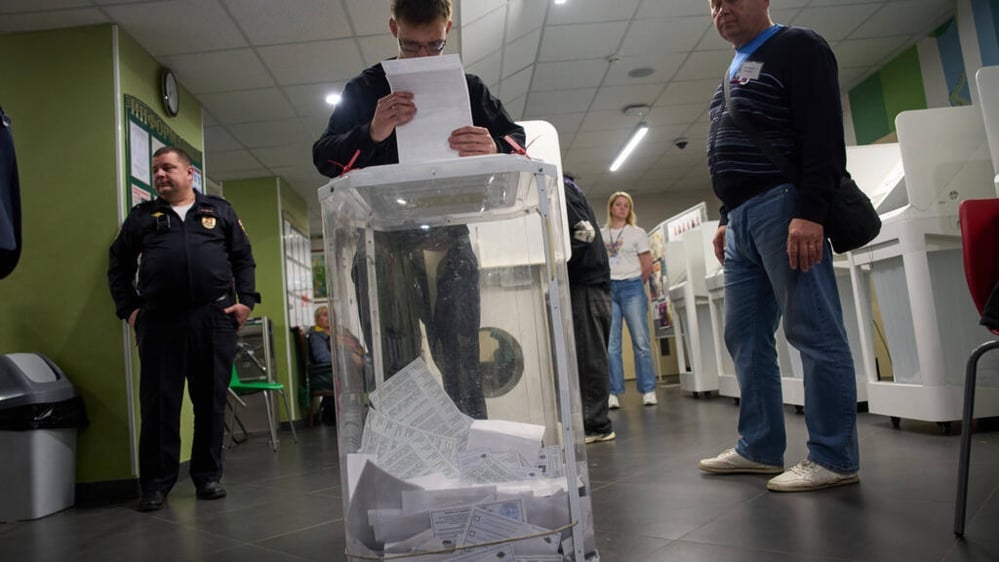
“At one polling station in the Russian-held part of the Donetsk region, voters dropped their ballots in a box as an armed Russian soldier stood nearby and watched.” · exact text match
Why: The description is delivered in a flat, factual tone without exclamation or dramatic adjectives; no attempt is made to heighten emotion.
Claim: The overall outlook is pessimistic about the possibility of a genuinely meaningful democratic outcome.
“Opposition sidelined as observers report violations” · exact text match
“Lidiya Klimenko said she did not think her vote would have any real impact.” · exact text match
Why: The publisher leads with the theme of sidelined opposition and reportedly widespread violations, and the featured voter expresses hopelessness about her vote's impact.
Claim: The text contains analytic statements that go beyond pure facts and interpret the meaning of the events.
“A massive state media campaign and tight control over the election in the absence of genuine opposition all but assure the Kremlin will keep tight control” · exact text match
Why: This is an interpretive prediction/assessment rather than an attributable factual claim, representing the publisher's editorial judgment.
Claim: The central subject is a political election and its legitimacy, with extensive coverage of political actors, parties, and institutions.
“United Russia had nearly 58 percent of the vote for the 225 deputies apportioned by party lists, according to Russia’s Central Election Commission.” · exact text match
“Opposition sidelined as observers report violations” · exact text match
Why: The entire piece addresses power, parties, electoral integrity, and international political criticism, constituting explicitly political coverage.
Claim: The publisher demonstrates high credibility through visible sourcing, attribution, and explicit uncertainty.
“according to Russia’s Central Election Commission” · exact text match
“The claims could not be independently verified.” · exact text match
Why: Sources are named and the text flags when claims cannot be verified, both hallmarks of a trustworthy journalistic approach.
Claim: The publisher relies on attribution, hedged language, and an explicit verification note, indicating a rational, evidence-based approach.
“according to Russia’s Central Election Commission” · exact text match
“The claims could not be independently verified.” · exact text match
Why: Rather than asserting fraud claims as fact, the publisher attributes them and flags their unverified status, reflecting systematic reasoning rather than emotional or conspiratorial argument.
Claim: The publisher makes forward-looking predictions about the election outcome and Kremlin control.
“United Russia also was poised to win most of those” · exact text match
“all but assure the Kremlin will keep tight control” · exact text match
Why: These are predictive statements about the likely outcome rather than reports of confirmed fact.
Claim: The publisher signals verification limits and attributes claims, demonstrating a cautious approach consistent with high integrity.
“The claims could not be independently verified.” · exact text match
“according to Russia’s Central Election Commission” · exact text match
Why: The explicit qualification about unverified claims is a hallmark of journalistic integrity; attribution is the standard mechanism for avoiding false assertion.
The supplied article excerpt is truncated and internally inconsistent about the electoral timing (referencing a full-scale invasion while describing a State Duma race), and the publisher is unidentified, which limits confidence in broader editorial characterization.
September 21, 2026 · 0 shares
Frames the Duma election as a Kremlin-managed exercise meant to project support for the Ukraine war, while foregrounding restrictions on opposition and war-related anxieties.
Automated analysis; not human reviewed.
Limitations: My assessment reflects the article’s own critical framing of the Kremlin, and I could not independently verify the identity of the leading party because the supplied text begins with an anaphoric reference.
·
4 of 55 available dimensions scored; omitted dimensions are not treated as neutral.
·
Verified supporting quotes for 4 of 4 scored dimensions.
“With the vote, the Kremlin aimed to showcase strong support for Putin’s war in Ukraine, now well into its fifth year.” · exact text match
“As Russia’s military incurs massive casualties for little progress on the battlefield, there are fears among Russians that the Kremlin plans a new mass mobilization to draft hundreds of thousands into the army after the elections.” · exact text match
Why: The report presents an unobserved Kremlin intention and an evaluative assessment of the military situation as fact, which is more subjective than purely objective reporting.
“The party got nearly 58% support with 90% of the vote counted, state newswires reported, citing Russia’s Central Election Commission.” · exact text match
“The election commission said turnout was 57%, state television reported, exceeding the level of the last election in 2021.” · exact text match
Why: The bulk of the article relays attributed electoral results and figures rather than prescribing what should be done, so it is strongly descriptive.
“With the vote, the Kremlin aimed to showcase strong support for Putin’s war in Ukraine, now well into its fifth year.” · exact text match
Why: This is an interpretive claim about Kremlin intent rather than a direct factual observation, giving the report a mildly opinionated framing.
“state newswires reported, citing Russia’s Central Election Commission” · exact text match
“Putin denies he has any such plans, calling the suggestion of a draft “complete nonsense” earlier this month.” · exact text match
Counterevidence:
“Russia’s military incurs massive casualties for little progress on the battlefield.” · not found in supplied text
Why: Most electoral facts are attributed and a denial is included, but a significant claim about military casualties and progress is asserted without attribution, leaving credibility only moderate.
My assessment reflects the article’s own critical framing of the Kremlin, and I could not independently verify the identity of the leading party because the supplied text begins with an anaphoric reference.
The publisher uses attributed sourcing and institutional skepticism toward Russian election results, while presenting Ukrainian drone strikes as retaliation for Russian bombardment.
The reported election and cross-border drone strikes are set against the ongoing Russia-Ukraine war, which began with Russia's full-scale invasion in February 2022.
Automated analysis; not human reviewed.
Limitations: The supplied text is fragmentary and contains ellipses, so the analysis rests on incomplete excerpts.
·
2 of 55 available dimensions scored; omitted dimensions are not treated as neutral.
·
Verified supporting quotes for 1 of 2 scored dimensions.
Claim: The publisher states a contested Ukrainian motive as fact rather than attributing it.
“Ukraine has targeted Russian infrastructure with drones throughout the war, in retaliation for Russian bombardment of its own towns and cities.” · exact text match
Why: The phrase 'in retaliation' attributes intent and justification to Ukraine without attribution, a subjective framing.
Claim: The reporting uses strong attribution and uncertainty markers.
“According to results reported by Russian news agencies after just over 71% of ballots were counted, United Russia took 57.5% of the vote.” · exact text match
“An exit poll published by a state-run pollster showed United Russia on course to win 49.4% of the vote.” · not found in supplied text
Why: Disputed figures are explicitly sourced, and the article distinguishes a state-run exit poll from official results.
The supplied text is fragmentary and contains ellipses, so the analysis rests on incomplete excerpts.
Frames Russian voting as a Kremlin-orchestrated sham, attaches moral labels to Russian leaders, and treats EU criticism as authoritative while tagging Russian official accounts as 'claimed.'
The September 2024 vote took place amid Russia's ongoing invasion of Ukraine; United Russia is President Putin's party; EU sanctions on Russian targets require unanimity and were approaching a renewal deadline.
Automated analysis; not human reviewed.
Limitations: The supplied article text is truncated with bracketed omissions and mixed story fragments, so full-article context and complete sentences are unavailable.
·
6 of 55 available dimensions scored; omitted dimensions are not treated as neutral.
·
Verified supporting quotes for 6 of 6 scored dimensions.
Claim: The publisher's descriptors align with a liberal-democratic critical stance toward Russian governance.
“manufactured approval” · exact text match
“Chechen dictator Ramzan Kadyrov, whose regime has become notorious for widespread suppression of human rights” · exact text match
Counterevidence:
“The federal list counted, the ruling United Russia party is on track to secure 57.83%” · not found in supplied text
Why: These phrases evaluate the election as fake and condemn Russian governance rather than neutrally reporting results.
Claim: The text mixes verifiable reporting with subjective moral labels.
“manufactured approval” · exact text match
“Chechen dictator Ramzan Kadyrov, whose regime has become notorious for widespread suppression of human rights” · exact text match
Counterevidence:
“Ella Pamfilova, head of Russia's Central Election Commission, claimed” · exact text match
Why: Attribution and factual statements are present, but 'manufactured' and 'dictator' are subjective conclusions.
Claim: The publisher embeds opinionated judgments in news prose.
“manufactured approval” · exact text match
“Chechen dictator Ramzan Kadyrov” · exact text match
Counterevidence:
“though the final results of the three-day-long election will not be fully tallied before Sept.
25”
· exact text match
Why: Calling an election result 'manufactured' and a leader 'dictator' are conclusions, not just reportage.
Claim: The wording carries a negative emotional charge toward Russian actors.
“Chechen dictator Ramzan Kadyrov, whose regime has become notorious for widespread suppression of human rights” · exact text match
“manufactured approval” · exact text match
Why: Words like 'notorious,' 'dictator,' and 'manufactured' cue condemnation rather than a neutral tone.
Claim: The report uses sourcing and caveats, though editorializing reduces its credibility score.
“Ella Pamfilova, head of Russia's Central Election Commission, claimed” · exact text match
“though the final results of the three-day-long election will not be fully tallied before Sept.
25”
· exact text match
Counterevidence:
“Chechen dictator Ramzan Kadyrov, whose regime has become notorious for widespread suppression of human rights” · exact text match
Why: Attribution and explicit uncertainty are visible, but unqualified subjective labels undercut measured credibility.
Claim: The article applies loaded framing and asymmetric skepticism toward Russian sources.
“With manufactured approval by Russian” · exact text match
“Ella Pamfilova, head of Russia's Central Election Commission, claimed” · exact text match
Counterevidence:
“Trump said that the deal would be more advantageous than buying fertilizer from Canada.” · not found in supplied text
Why: Russian statements are introduced with 'claimed' and 'manufactured,' while other leaders' comments are relayed with 'said,' producing an uneven evidentiary standard.
The supplied article text is truncated with bracketed omissions and mixed story fragments, so full-article context and complete sentences are unavailable.
September 21, 2026 · 0 shares
Frames the Duma election as a Kremlin-managed exercise meant to project support for the Ukraine war, while foregrounding restrictions on opposition and war-related anxieties.
Automated analysis; not human reviewed.
Limitations: My assessment reflects the article’s own critical framing of the Kremlin, and I could not independently verify the identity of the leading party because the supplied text begins with an anaphoric reference.
·
4 of 55 available dimensions scored; omitted dimensions are not treated as neutral.
·
Verified supporting quotes for 4 of 4 scored dimensions.
“With the vote, the Kremlin aimed to showcase strong support for Putin’s war in Ukraine, now well into its fifth year.” · exact text match
“As Russia’s military incurs massive casualties for little progress on the battlefield, there are fears among Russians that the Kremlin plans a new mass mobilization to draft hundreds of thousands into the army after the elections.” · exact text match
Why: The report presents an unobserved Kremlin intention and an evaluative assessment of the military situation as fact, which is more subjective than purely objective reporting.
“The party got nearly 58% support with 90% of the vote counted, state newswires reported, citing Russia’s Central Election Commission.” · exact text match
“The election commission said turnout was 57%, state television reported, exceeding the level of the last election in 2021.” · exact text match
Why: The bulk of the article relays attributed electoral results and figures rather than prescribing what should be done, so it is strongly descriptive.
“With the vote, the Kremlin aimed to showcase strong support for Putin’s war in Ukraine, now well into its fifth year.” · exact text match
Why: This is an interpretive claim about Kremlin intent rather than a direct factual observation, giving the report a mildly opinionated framing.
“state newswires reported, citing Russia’s Central Election Commission” · exact text match
“Putin denies he has any such plans, calling the suggestion of a draft “complete nonsense” earlier this month.” · exact text match
Counterevidence:
“Russia’s military incurs massive casualties for little progress on the battlefield.” · not found in supplied text
Why: Most electoral facts are attributed and a denial is included, but a significant claim about military casualties and progress is asserted without attribution, leaving credibility only moderate.
My assessment reflects the article’s own critical framing of the Kremlin, and I could not independently verify the identity of the leading party because the supplied text begins with an anaphoric reference.
September 21, 2026 · 0 shares
Frames the election as a managed exercise in which the Kremlin suppresses dissent and genuine opposition is absent, with observers reporting violations and a Russian soldier visible at a polling station in occupied Donetsk.
The State Duma is Russia's lower house of parliament and uses a mixed electoral system, with 225 deputies elected by party lists and 225 in single-member constituencies.
United Russia is the dominant pro-Kremlin party, and the smaller parties expected to enter parliament have routinely voted with the Kremlin.
The excerpt sets the election after Russia's full-scale invasion of Ukraine, amid intensified restrictions on dissent.
Automated analysis; not human reviewed.
Limitations: The supplied article excerpt is truncated and internally inconsistent about the electoral timing (referencing a full-scale invasion while describing a State Duma race), and the publisher is unidentified, which limits confidence in broader editorial characterization.
·
10 of 55 available dimensions scored; omitted dimensions are not treated as neutral.
·
Verified supporting quotes for 10 of 10 scored dimensions.
Claim: The publisher describes the election as tightly controlled by the Kremlin, with opposition suppressed, framing the outcome as the product of an unfree political system.
“tight control over the election in the absence of genuine opposition” · exact text match
“It has sought to avoid political risks by stamping out any dissent.” · exact text match
Why: The text repeatedly characterizes the Russian state as restrictive ('tight control,' 'absence of genuine opposition,' 'stamping out any dissent'), positioning the publisher against authoritarian governance.
Claim: The text separates facts from evaluative statements and attributes claims to named sources.
“according to Russia’s Central Election Commission” · exact text match
“The claims could not be independently verified.” · exact text match
Why: Heavy attribution and the verification note demonstrate a fact-oriented, objective news style rather than a first-person subjective essay.
Claim: The reporting is unemotional and measured even when describing disturbing events, such as the armed soldier at a polling station.
“At one polling station in the Russian-held part of the Donetsk region, voters dropped their ballots in a box as an armed Russian soldier stood nearby and watched.” · exact text match
Why: The description is delivered in a flat, factual tone without exclamation or dramatic adjectives; no attempt is made to heighten emotion.
Claim: The overall outlook is pessimistic about the possibility of a genuinely meaningful democratic outcome.
“Opposition sidelined as observers report violations” · exact text match
“Lidiya Klimenko said she did not think her vote would have any real impact.” · exact text match
Why: The publisher leads with the theme of sidelined opposition and reportedly widespread violations, and the featured voter expresses hopelessness about her vote's impact.
Claim: The text contains analytic statements that go beyond pure facts and interpret the meaning of the events.
“A massive state media campaign and tight control over the election in the absence of genuine opposition all but assure the Kremlin will keep tight control” · exact text match
Why: This is an interpretive prediction/assessment rather than an attributable factual claim, representing the publisher's editorial judgment.
Claim: The central subject is a political election and its legitimacy, with extensive coverage of political actors, parties, and institutions.
“United Russia had nearly 58 percent of the vote for the 225 deputies apportioned by party lists, according to Russia’s Central Election Commission.” · exact text match
“Opposition sidelined as observers report violations” · exact text match
Why: The entire piece addresses power, parties, electoral integrity, and international political criticism, constituting explicitly political coverage.
Claim: The publisher demonstrates high credibility through visible sourcing, attribution, and explicit uncertainty.
“according to Russia’s Central Election Commission” · exact text match
“The claims could not be independently verified.” · exact text match
Why: Sources are named and the text flags when claims cannot be verified, both hallmarks of a trustworthy journalistic approach.
Claim: The publisher relies on attribution, hedged language, and an explicit verification note, indicating a rational, evidence-based approach.
“according to Russia’s Central Election Commission” · exact text match
“The claims could not be independently verified.” · exact text match
Why: Rather than asserting fraud claims as fact, the publisher attributes them and flags their unverified status, reflecting systematic reasoning rather than emotional or conspiratorial argument.
Claim: The publisher makes forward-looking predictions about the election outcome and Kremlin control.
“United Russia also was poised to win most of those” · exact text match
“all but assure the Kremlin will keep tight control” · exact text match
Why: These are predictive statements about the likely outcome rather than reports of confirmed fact.
Claim: The publisher signals verification limits and attributes claims, demonstrating a cautious approach consistent with high integrity.
“The claims could not be independently verified.” · exact text match
“according to Russia’s Central Election Commission” · exact text match
Why: The explicit qualification about unverified claims is a hallmark of journalistic integrity; attribution is the standard mechanism for avoiding false assertion.
The supplied article excerpt is truncated and internally inconsistent about the electoral timing (referencing a full-scale invasion while describing a State Duma race), and the publisher is unidentified, which limits confidence in broader editorial characterization.
September 21, 2026 · 0 shares
Frames the Duma election as a Kremlin-managed exercise meant to project support for the Ukraine war, while foregrounding restrictions on opposition and war-related anxieties.
Automated analysis; not human reviewed.
Limitations: My assessment reflects the article’s own critical framing of the Kremlin, and I could not independently verify the identity of the leading party because the supplied text begins with an anaphoric reference.
·
4 of 55 available dimensions scored; omitted dimensions are not treated as neutral.
·
Verified supporting quotes for 4 of 4 scored dimensions.
“With the vote, the Kremlin aimed to showcase strong support for Putin’s war in Ukraine, now well into its fifth year.” · exact text match
“As Russia’s military incurs massive casualties for little progress on the battlefield, there are fears among Russians that the Kremlin plans a new mass mobilization to draft hundreds of thousands into the army after the elections.” · exact text match
Why: The report presents an unobserved Kremlin intention and an evaluative assessment of the military situation as fact, which is more subjective than purely objective reporting.
“The party got nearly 58% support with 90% of the vote counted, state newswires reported, citing Russia’s Central Election Commission.” · exact text match
“The election commission said turnout was 57%, state television reported, exceeding the level of the last election in 2021.” · exact text match
Why: The bulk of the article relays attributed electoral results and figures rather than prescribing what should be done, so it is strongly descriptive.
“With the vote, the Kremlin aimed to showcase strong support for Putin’s war in Ukraine, now well into its fifth year.” · exact text match
Why: This is an interpretive claim about Kremlin intent rather than a direct factual observation, giving the report a mildly opinionated framing.
“state newswires reported, citing Russia’s Central Election Commission” · exact text match
“Putin denies he has any such plans, calling the suggestion of a draft “complete nonsense” earlier this month.” · exact text match
Counterevidence:
“Russia’s military incurs massive casualties for little progress on the battlefield.” · not found in supplied text
Why: Most electoral facts are attributed and a denial is included, but a significant claim about military casualties and progress is asserted without attribution, leaving credibility only moderate.
My assessment reflects the article’s own critical framing of the Kremlin, and I could not independently verify the identity of the leading party because the supplied text begins with an anaphoric reference.
September 21, 2026 · 0 shares
Frames the election as a managed exercise in which the Kremlin suppresses dissent and genuine opposition is absent, with observers reporting violations and a Russian soldier visible at a polling station in occupied Donetsk.
The State Duma is Russia's lower house of parliament and uses a mixed electoral system, with 225 deputies elected by party lists and 225 in single-member constituencies.
United Russia is the dominant pro-Kremlin party, and the smaller parties expected to enter parliament have routinely voted with the Kremlin.
The excerpt sets the election after Russia's full-scale invasion of Ukraine, amid intensified restrictions on dissent.
Automated analysis; not human reviewed.
Limitations: The supplied article excerpt is truncated and internally inconsistent about the electoral timing (referencing a full-scale invasion while describing a State Duma race), and the publisher is unidentified, which limits confidence in broader editorial characterization.
·
10 of 55 available dimensions scored; omitted dimensions are not treated as neutral.
·
Verified supporting quotes for 10 of 10 scored dimensions.
Claim: The publisher describes the election as tightly controlled by the Kremlin, with opposition suppressed, framing the outcome as the product of an unfree political system.
“tight control over the election in the absence of genuine opposition” · exact text match
“It has sought to avoid political risks by stamping out any dissent.” · exact text match
Why: The text repeatedly characterizes the Russian state as restrictive ('tight control,' 'absence of genuine opposition,' 'stamping out any dissent'), positioning the publisher against authoritarian governance.
Claim: The text separates facts from evaluative statements and attributes claims to named sources.
“according to Russia’s Central Election Commission” · exact text match
“The claims could not be independently verified.” · exact text match
Why: Heavy attribution and the verification note demonstrate a fact-oriented, objective news style rather than a first-person subjective essay.
Claim: The reporting is unemotional and measured even when describing disturbing events, such as the armed soldier at a polling station.
“At one polling station in the Russian-held part of the Donetsk region, voters dropped their ballots in a box as an armed Russian soldier stood nearby and watched.” · exact text match
Why: The description is delivered in a flat, factual tone without exclamation or dramatic adjectives; no attempt is made to heighten emotion.
Claim: The overall outlook is pessimistic about the possibility of a genuinely meaningful democratic outcome.
“Opposition sidelined as observers report violations” · exact text match
“Lidiya Klimenko said she did not think her vote would have any real impact.” · exact text match
Why: The publisher leads with the theme of sidelined opposition and reportedly widespread violations, and the featured voter expresses hopelessness about her vote's impact.
Claim: The text contains analytic statements that go beyond pure facts and interpret the meaning of the events.
“A massive state media campaign and tight control over the election in the absence of genuine opposition all but assure the Kremlin will keep tight control” · exact text match
Why: This is an interpretive prediction/assessment rather than an attributable factual claim, representing the publisher's editorial judgment.
Claim: The central subject is a political election and its legitimacy, with extensive coverage of political actors, parties, and institutions.
“United Russia had nearly 58 percent of the vote for the 225 deputies apportioned by party lists, according to Russia’s Central Election Commission.” · exact text match
“Opposition sidelined as observers report violations” · exact text match
Why: The entire piece addresses power, parties, electoral integrity, and international political criticism, constituting explicitly political coverage.
Claim: The publisher demonstrates high credibility through visible sourcing, attribution, and explicit uncertainty.
“according to Russia’s Central Election Commission” · exact text match
“The claims could not be independently verified.” · exact text match
Why: Sources are named and the text flags when claims cannot be verified, both hallmarks of a trustworthy journalistic approach.
Claim: The publisher relies on attribution, hedged language, and an explicit verification note, indicating a rational, evidence-based approach.
“according to Russia’s Central Election Commission” · exact text match
“The claims could not be independently verified.” · exact text match
Why: Rather than asserting fraud claims as fact, the publisher attributes them and flags their unverified status, reflecting systematic reasoning rather than emotional or conspiratorial argument.
Claim: The publisher makes forward-looking predictions about the election outcome and Kremlin control.
“United Russia also was poised to win most of those” · exact text match
“all but assure the Kremlin will keep tight control” · exact text match
Why: These are predictive statements about the likely outcome rather than reports of confirmed fact.
Claim: The publisher signals verification limits and attributes claims, demonstrating a cautious approach consistent with high integrity.
“The claims could not be independently verified.” · exact text match
“according to Russia’s Central Election Commission” · exact text match
Why: The explicit qualification about unverified claims is a hallmark of journalistic integrity; attribution is the standard mechanism for avoiding false assertion.
The supplied article excerpt is truncated and internally inconsistent about the electoral timing (referencing a full-scale invasion while describing a State Duma race), and the publisher is unidentified, which limits confidence in broader editorial characterization.
September 18, 2026 · 0 shares
Framing foregrounds the Kremlin's strategic control of the election and treats the vote's result as predetermined, while elevating fears of post-election mobilization.
Automated analysis; not human reviewed.
Limitations: The supplied text is a single report; anonymous-source assertions and cited polling cannot be independently verified from the provided text.
·
9 of 55 available dimensions scored; omitted dimensions are not treated as neutral.
·
Verified supporting quotes for 9 of 9 scored dimensions.
Claim: The report frames the exclusion of a liberal anti-war party as a loss of the only open challenge to the war, implying sympathy with liberal-democratic opposition.
“removing the only political force remaining in Russia that was openly challenging the invasion of Ukraine” · exact text match
“a tightly controlled vote stripped of meaningful competition” · exact text match
Why: The wording treats the ban as eliminating meaningful opposition rather than merely reporting a legal decision; this reflects a liberal-democratic normative perspective, though the report does not adopt left/right economic positions.
Claim: The framing portrays Kremlin control as excessive—tightening grip, barring opposition, and suppressing turnout—implying an anti-authoritarian stance.
“the Kremlin has tightened its grip further” · exact text match
“By keeping the election subdued, Moscow hoped to depress turnout among disaffected and independent-minded voters” · exact text match
Why: Descriptive language characterizes state actions as control and manipulation, which signals disapproval of authoritarian measures without prescribing a specific libertarian alternative.
Claim: The reporting relies on sourced statements and named experts rather than first-person opinion.
“Vladimir Gelman, a professor of Russian politics at the University of Helsinki, said another purpose of the elections was to provide the Kremlin with a continuing source of legitimacy” · exact text match
“said a person close to the Kremlin, speaking on condition of anonymity” · exact text match
Why: Attribution is explicit and almost every evaluative claim is sourced, so the piece reads as journalistic reporting, though selection and framing still shape it.
Claim: The dominant emotional register is negative: fear of mobilization, anxiety about the war, and doubt about what follows the election.
“The anxiety has already prompted some young men to leave the country, hoping to wait out any new mobilisation” · exact text match
“few are certain what will happen after the voting” · exact text match
Why: The report's framing emphasizes apprehension and uncertainty, giving it a pessimistic tone even though it also reports facts neutrally.
Claim: The article describes events and quotes others' views; it issues no directives or policy prescriptions.
“Russians are going to the polls to elect a new State Duma in a tightly controlled vote stripped of meaningful competition and with little doubt about the result.” · exact text match
Why: The primary mode is indicative reporting; no recommendations, imperatives, or calls to action appear.
Claim: The article names its sources, gives position/affiliation, and separates attributed belief from observation.
“Vladimir Gelman, a professor of Russian politics at the University of Helsinki” · exact text match
“said Farida Rustamova, a political analyst and founder of the independent Vlast newsletter” · exact text match
Why: Specific named experts and an anonymous source with a described position provide visible sourcing that supports credibility, though the claim about Yabloko's polling is attributed to unnamed observers.
Claim: The analysis draws on polling, named analysts, and attributed logic rather than assertion or emotional appeal.
“polling has pointed to growing anxiety about the course of the fighting” · exact text match
“Several observers believe that officials had initially expected the party to receive a negligible result, demonstrating how little support remained for an explicitly anti-war platform.” · exact text match
Why: Causal reasoning is attributed and evidence-like, with no supernatural, conspiratorial, or anti-scientific claims.
Claim: The text is transparent about uncertainty and labels beliefs as beliefs rather than asserting them.
“Several observers believe that officials had initially expected the party to receive a negligible result” · exact text match
“said a person close to the Kremlin, speaking on condition of anonymity” · exact text match
Why: It distinguishes anonymous insider comments, named analysts, and observer beliefs, which are visible signals of fair attribution.
Claim: The report combines specific events, historical parallels, and multiple perspectives into a nuanced analysis.
“a sign, he said, that even among those with access to the system, few are certain what will happen after the voting” · exact text match
“scenes that carry echoes of September 2022, when hundreds of thousands of Russians fled after Putin announced the first wartime draft” · exact text match
Why: It integrates now/then context and internal Kremlin-adjacent uncertainty, showing analytical sophistication beyond a simple announcement story.
The supplied text is a single report; anonymous-source assertions and cited polling cannot be independently verified from the provided text.
September 21, 2026 · 0 shares
Frames the Duma election as a Kremlin-managed exercise meant to project support for the Ukraine war, while foregrounding restrictions on opposition and war-related anxieties.
Automated analysis; not human reviewed.
Limitations: My assessment reflects the article’s own critical framing of the Kremlin, and I could not independently verify the identity of the leading party because the supplied text begins with an anaphoric reference.
·
4 of 55 available dimensions scored; omitted dimensions are not treated as neutral.
·
Verified supporting quotes for 4 of 4 scored dimensions.
“With the vote, the Kremlin aimed to showcase strong support for Putin’s war in Ukraine, now well into its fifth year.” · exact text match
“As Russia’s military incurs massive casualties for little progress on the battlefield, there are fears among Russians that the Kremlin plans a new mass mobilization to draft hundreds of thousands into the army after the elections.” · exact text match
Why: The report presents an unobserved Kremlin intention and an evaluative assessment of the military situation as fact, which is more subjective than purely objective reporting.
“The party got nearly 58% support with 90% of the vote counted, state newswires reported, citing Russia’s Central Election Commission.” · exact text match
“The election commission said turnout was 57%, state television reported, exceeding the level of the last election in 2021.” · exact text match
Why: The bulk of the article relays attributed electoral results and figures rather than prescribing what should be done, so it is strongly descriptive.
“With the vote, the Kremlin aimed to showcase strong support for Putin’s war in Ukraine, now well into its fifth year.” · exact text match
Why: This is an interpretive claim about Kremlin intent rather than a direct factual observation, giving the report a mildly opinionated framing.
“state newswires reported, citing Russia’s Central Election Commission” · exact text match
“Putin denies he has any such plans, calling the suggestion of a draft “complete nonsense” earlier this month.” · exact text match
Counterevidence:
“Russia’s military incurs massive casualties for little progress on the battlefield.” · not found in supplied text
Why: Most electoral facts are attributed and a denial is included, but a significant claim about military casualties and progress is asserted without attribution, leaving credibility only moderate.
My assessment reflects the article’s own critical framing of the Kremlin, and I could not independently verify the identity of the leading party because the supplied text begins with an anaphoric reference.
September 21, 2026 · 0 shares
Framing presents the vote as a suppressed, internationally unaccredited exercise and casts United Russia’s supermajority as a false signal of public support for war.
The Duma is Russia’s lower house; United Russia is the political party aligned with President Vladimir Putin.
Automated analysis; not human reviewed.
Limitations: The supplied text is fragmentary, truncated, and interleaved with apparent headline links, making publisher-voice attribution uncertain in places.
·
3 of 55 available dimensions scored; omitted dimensions are not treated as neutral.
·
Verified supporting quotes for 3 of 3 scored dimensions.
Claim: The report contains a publisher-voiced analytic forecast amid otherwise attributed reporting.
“The continuation of the war risks entrenching policies, which are increasingly affecting average Russians and the parliamentary supermajority may struggle to change the dynamic.” · exact text match
Why: This sentence offers an un-attributed judgment about future risk and institutional capacity, making the report mildly subjective in addition to its factual reporting.
Claim: The report frames the political outcome through warnings about entrenched war policies and possible escalation.
“The continuation of the war risks entrenching policies, which are increasingly affecting average Russians and the parliamentary supermajority may struggle to change the dynamic.” · exact text match
Why: The publisher’s main analytical statement is a warning about the entrenchment of war-related policies, and the article also gives space to concerns about mobilisation, new repressions, harsher measures, and escalation.
Claim: The text uses named officials, a named analyst, and direct quotes, producing a generally well-sourced report.
“Ella Pamfilova, chair of the Central Electoral Commission, said Yabloko, the only registered anti-war party in Russia, did not win any seats at the national level.” · exact text match
“The EU’s top diplomat Kaja Kallas dismissed Russia’s “so-called” election.” · exact text match
Why: Named attribution and direct quotation support the report’s credibility, though one un-attributed analytical sentence and the truncated state of the supplied text lower the score somewhat.
The supplied text is fragmentary, truncated, and interleaved with apparent headline links, making publisher-voice attribution uncertain in places.
Frames Russian voting as a Kremlin-orchestrated sham, attaches moral labels to Russian leaders, and treats EU criticism as authoritative while tagging Russian official accounts as 'claimed.'
The September 2024 vote took place amid Russia's ongoing invasion of Ukraine; United Russia is President Putin's party; EU sanctions on Russian targets require unanimity and were approaching a renewal deadline.
Automated analysis; not human reviewed.
Limitations: The supplied article text is truncated with bracketed omissions and mixed story fragments, so full-article context and complete sentences are unavailable.
·
6 of 55 available dimensions scored; omitted dimensions are not treated as neutral.
·
Verified supporting quotes for 6 of 6 scored dimensions.
Claim: The publisher's descriptors align with a liberal-democratic critical stance toward Russian governance.
“manufactured approval” · exact text match
“Chechen dictator Ramzan Kadyrov, whose regime has become notorious for widespread suppression of human rights” · exact text match
Counterevidence:
“The federal list counted, the ruling United Russia party is on track to secure 57.83%” · not found in supplied text
Why: These phrases evaluate the election as fake and condemn Russian governance rather than neutrally reporting results.
Claim: The text mixes verifiable reporting with subjective moral labels.
“manufactured approval” · exact text match
“Chechen dictator Ramzan Kadyrov, whose regime has become notorious for widespread suppression of human rights” · exact text match
Counterevidence:
“Ella Pamfilova, head of Russia's Central Election Commission, claimed” · exact text match
Why: Attribution and factual statements are present, but 'manufactured' and 'dictator' are subjective conclusions.
Claim: The publisher embeds opinionated judgments in news prose.
“manufactured approval” · exact text match
“Chechen dictator Ramzan Kadyrov” · exact text match
Counterevidence:
“though the final results of the three-day-long election will not be fully tallied before Sept.
25”
· exact text match
Why: Calling an election result 'manufactured' and a leader 'dictator' are conclusions, not just reportage.
Claim: The wording carries a negative emotional charge toward Russian actors.
“Chechen dictator Ramzan Kadyrov, whose regime has become notorious for widespread suppression of human rights” · exact text match
“manufactured approval” · exact text match
Why: Words like 'notorious,' 'dictator,' and 'manufactured' cue condemnation rather than a neutral tone.
Claim: The report uses sourcing and caveats, though editorializing reduces its credibility score.
“Ella Pamfilova, head of Russia's Central Election Commission, claimed” · exact text match
“though the final results of the three-day-long election will not be fully tallied before Sept.
25”
· exact text match
Counterevidence:
“Chechen dictator Ramzan Kadyrov, whose regime has become notorious for widespread suppression of human rights” · exact text match
Why: Attribution and explicit uncertainty are visible, but unqualified subjective labels undercut measured credibility.
Claim: The article applies loaded framing and asymmetric skepticism toward Russian sources.
“With manufactured approval by Russian” · exact text match
“Ella Pamfilova, head of Russia's Central Election Commission, claimed” · exact text match
Counterevidence:
“Trump said that the deal would be more advantageous than buying fertilizer from Canada.” · not found in supplied text
Why: Russian statements are introduced with 'claimed' and 'manufactured,' while other leaders' comments are relayed with 'said,' producing an uneven evidentiary standard.
The supplied article text is truncated with bracketed omissions and mixed story fragments, so full-article context and complete sentences are unavailable.
September 21, 2026 · 0 shares
Frames Russia's election as a stage-managed vote whose result the Kremlin is expected to present as a war mandate, foregrounding the exclusion of anti-war candidates and the absence of a genuine contest.
Automated analysis; not human reviewed.
Limitations: The supplied text is truncated and appears to concatenate multiple news fragments, including a Kherson-strikes headline and a cut-off Moscow brief; the analysis prioritizes the coherent Russian-election report, so the boundaries between the pieces are uncertain.
·
7 of 55 available dimensions scored; omitted dimensions are not treated as neutral.
·
Verified supporting quotes for 7 of 7 scored dimensions.
Claim: The report is neutral on a liberal-conservative spectrum, attributing both official and critical facts without endorsing either.
“The election authorities say the three days of voting have proceeded smoothly despite cyberattacks reported on Saturday.” · exact text match
“Most anti-war candidates have been barred from the ballot.” · exact text match
Why: The government's smooth-voting claim and the exclusion of anti-war candidates are reported side by side with attribution and no value judgment, supporting a neutral rating.
Claim: The reporting is predominantly objective, relying on named sources and hedged analysis.
“Turnout was at over 50 per cent by early afternoon Moscow time, Interfax news agency reported, citing the Central Election Commission.” · exact text match
Why: Precise sourcing of a statistic is a marker of objective reporting; the single analytical forecast is explicitly qualified by 'likely.'
Claim: The article avoids sensational or emotional framing despite the charged subject.
“Complete results would be available on Monday.” · exact text match
Why: A flat, procedural statement about results timing exemplifies the report's unemotional register; no dramatic adjectives or alarmist verbs appear.
Claim: The article is nearly free of editorial commentary, with facts stated rather than judged.
“Most anti-war candidates have been barred from the ballot.” · exact text match
Why: The sentence presents the exclusion as a plain fact; although inclusion of the fact has critical implications, the wording itself is non-evaluative.
Claim: Visible attribution, named institutions, and careful hedging make the report highly credible on its own terms.
“Turnout was at over 50 per cent by early afternoon Moscow time, Interfax news agency reported, citing the Central Election Commission.” · exact text match
Why: The report names both the news agency and the commission, gives a specific time, and separates direct quotes and paraphrases from its own analysis.
Claim: The only speculative statement is a clearly hedged forecast about Kremlin messaging, not about the election result itself.
“The Kremlin is likely to present the outcome as evidence of public backing for Putin's policies and for the war” · verified after text normalization
Why: The adverb 'likely' identifies this as an inference about future conduct, keeping speculative load very low.
Claim: The report shows high integrity by hedging its main inference and including facts that complicate the Kremlin's account.
“The Kremlin is likely to present the outcome as evidence of public backing for Putin's policies and for the war” · verified after text normalization
“Most anti-war candidates have been barred from the ballot.” · exact text match
Why: 'Likely' marks the inference as one possible interpretation, and the barred-candidates fact checks the basis for the expected mandate claim.
The supplied text is truncated and appears to concatenate multiple news fragments, including a Kherson-strikes headline and a cut-off Moscow brief; the analysis prioritizes the coherent Russian-election report, so the boundaries between the pieces are uncertain.
September 21, 2026 · 0 shares
Frames the Duma election as a Kremlin-managed exercise meant to project support for the Ukraine war, while foregrounding restrictions on opposition and war-related anxieties.
Automated analysis; not human reviewed.
Limitations: My assessment reflects the article’s own critical framing of the Kremlin, and I could not independently verify the identity of the leading party because the supplied text begins with an anaphoric reference.
·
4 of 55 available dimensions scored; omitted dimensions are not treated as neutral.
·
Verified supporting quotes for 4 of 4 scored dimensions.
“With the vote, the Kremlin aimed to showcase strong support for Putin’s war in Ukraine, now well into its fifth year.” · exact text match
“As Russia’s military incurs massive casualties for little progress on the battlefield, there are fears among Russians that the Kremlin plans a new mass mobilization to draft hundreds of thousands into the army after the elections.” · exact text match
Why: The report presents an unobserved Kremlin intention and an evaluative assessment of the military situation as fact, which is more subjective than purely objective reporting.
“The party got nearly 58% support with 90% of the vote counted, state newswires reported, citing Russia’s Central Election Commission.” · exact text match
“The election commission said turnout was 57%, state television reported, exceeding the level of the last election in 2021.” · exact text match
Why: The bulk of the article relays attributed electoral results and figures rather than prescribing what should be done, so it is strongly descriptive.
“With the vote, the Kremlin aimed to showcase strong support for Putin’s war in Ukraine, now well into its fifth year.” · exact text match
Why: This is an interpretive claim about Kremlin intent rather than a direct factual observation, giving the report a mildly opinionated framing.
“state newswires reported, citing Russia’s Central Election Commission” · exact text match
“Putin denies he has any such plans, calling the suggestion of a draft “complete nonsense” earlier this month.” · exact text match
Counterevidence:
“Russia’s military incurs massive casualties for little progress on the battlefield.” · not found in supplied text
Why: Most electoral facts are attributed and a denial is included, but a significant claim about military casualties and progress is asserted without attribution, leaving credibility only moderate.
My assessment reflects the article’s own critical framing of the Kremlin, and I could not independently verify the identity of the leading party because the supplied text begins with an anaphoric reference.
September 20, 2026 · 0 shares
A terse wire-style framing presents a projected United Russia victory as the expected result of a 'tightly controlled' wartime vote, while describing the reported Ukrainian drone attack as 'massive'.
The 'wartime vote' refers to parliamentary elections held during Russia's full-scale invasion of Ukraine; United Russia is the pro-Kremlin party of President Vladimir Putin.
Automated analysis; not human reviewed.
Limitations: Only a short excerpt without byline, publication, date, or surrounding article was supplied, so the provenance of 'tightly controlled' and 'massive' and the fuller editorial context cannot be assessed.
·
2 of 55 available dimensions scored; omitted dimensions are not treated as neutral.
·
Verified supporting quotes for 2 of 2 scored dimensions.
Claim: The report is mostly factual but uses value-laden wording to characterize the election and the drone attack.
“tightly controlled parliamentary elections” · exact text match
“massive drone attack” · exact text match
Counterevidence:
“said city officials” · exact text match
Why: The projection and casualty report are attributed to exit polls and city officials, but 'tightly controlled' and 'massive' are editorial or unquantified descriptors presented without a named source.
Claim: The tone is restrained, though 'massive' adds dramatic emphasis to the drone attack.
“massive drone attack” · exact text match
Counterevidence:
“killing three people, said city officials” · exact text match
Why: The only clearly sensational element is the adjective 'massive'; the death toll is reported matter-of-factly and attributed, so the overall presentation remains largely objective.
Only a short excerpt without byline, publication, date, or surrounding article was supplied, so the provenance of 'tightly controlled' and 'massive' and the fuller editorial context cannot be assessed.
The publisher uses attributed sourcing and institutional skepticism toward Russian election results, while presenting Ukrainian drone strikes as retaliation for Russian bombardment.
The reported election and cross-border drone strikes are set against the ongoing Russia-Ukraine war, which began with Russia's full-scale invasion in February 2022.
Automated analysis; not human reviewed.
Limitations: The supplied text is fragmentary and contains ellipses, so the analysis rests on incomplete excerpts.
·
2 of 55 available dimensions scored; omitted dimensions are not treated as neutral.
·
Verified supporting quotes for 1 of 2 scored dimensions.
Claim: The publisher states a contested Ukrainian motive as fact rather than attributing it.
“Ukraine has targeted Russian infrastructure with drones throughout the war, in retaliation for Russian bombardment of its own towns and cities.” · exact text match
Why: The phrase 'in retaliation' attributes intent and justification to Ukraine without attribution, a subjective framing.
Claim: The reporting uses strong attribution and uncertainty markers.
“According to results reported by Russian news agencies after just over 71% of ballots were counted, United Russia took 57.5% of the vote.” · exact text match
“An exit poll published by a state-run pollster showed United Russia on course to win 49.4% of the vote.” · not found in supplied text
Why: Disputed figures are explicitly sourced, and the article distinguishes a state-run exit poll from official results.
The supplied text is fragmentary and contains ellipses, so the analysis rests on incomplete excerpts.
September 21, 2026 · 0 shares
Frames the election as a managed exercise in which the Kremlin suppresses dissent and genuine opposition is absent, with observers reporting violations and a Russian soldier visible at a polling station in occupied Donetsk.
The State Duma is Russia's lower house of parliament and uses a mixed electoral system, with 225 deputies elected by party lists and 225 in single-member constituencies.
United Russia is the dominant pro-Kremlin party, and the smaller parties expected to enter parliament have routinely voted with the Kremlin.
The excerpt sets the election after Russia's full-scale invasion of Ukraine, amid intensified restrictions on dissent.
Automated analysis; not human reviewed.
Limitations: The supplied article excerpt is truncated and internally inconsistent about the electoral timing (referencing a full-scale invasion while describing a State Duma race), and the publisher is unidentified, which limits confidence in broader editorial characterization.
·
10 of 55 available dimensions scored; omitted dimensions are not treated as neutral.
·
Verified supporting quotes for 10 of 10 scored dimensions.
Claim: The publisher describes the election as tightly controlled by the Kremlin, with opposition suppressed, framing the outcome as the product of an unfree political system.
“tight control over the election in the absence of genuine opposition” · exact text match
“It has sought to avoid political risks by stamping out any dissent.” · exact text match
Why: The text repeatedly characterizes the Russian state as restrictive ('tight control,' 'absence of genuine opposition,' 'stamping out any dissent'), positioning the publisher against authoritarian governance.
Claim: The text separates facts from evaluative statements and attributes claims to named sources.
“according to Russia’s Central Election Commission” · exact text match
“The claims could not be independently verified.” · exact text match
Why: Heavy attribution and the verification note demonstrate a fact-oriented, objective news style rather than a first-person subjective essay.
Claim: The reporting is unemotional and measured even when describing disturbing events, such as the armed soldier at a polling station.
“At one polling station in the Russian-held part of the Donetsk region, voters dropped their ballots in a box as an armed Russian soldier stood nearby and watched.” · exact text match
Why: The description is delivered in a flat, factual tone without exclamation or dramatic adjectives; no attempt is made to heighten emotion.
Claim: The overall outlook is pessimistic about the possibility of a genuinely meaningful democratic outcome.
“Opposition sidelined as observers report violations” · exact text match
“Lidiya Klimenko said she did not think her vote would have any real impact.” · exact text match
Why: The publisher leads with the theme of sidelined opposition and reportedly widespread violations, and the featured voter expresses hopelessness about her vote's impact.
Claim: The text contains analytic statements that go beyond pure facts and interpret the meaning of the events.
“A massive state media campaign and tight control over the election in the absence of genuine opposition all but assure the Kremlin will keep tight control” · exact text match
Why: This is an interpretive prediction/assessment rather than an attributable factual claim, representing the publisher's editorial judgment.
Claim: The central subject is a political election and its legitimacy, with extensive coverage of political actors, parties, and institutions.
“United Russia had nearly 58 percent of the vote for the 225 deputies apportioned by party lists, according to Russia’s Central Election Commission.” · exact text match
“Opposition sidelined as observers report violations” · exact text match
Why: The entire piece addresses power, parties, electoral integrity, and international political criticism, constituting explicitly political coverage.
Claim: The publisher demonstrates high credibility through visible sourcing, attribution, and explicit uncertainty.
“according to Russia’s Central Election Commission” · exact text match
“The claims could not be independently verified.” · exact text match
Why: Sources are named and the text flags when claims cannot be verified, both hallmarks of a trustworthy journalistic approach.
Claim: The publisher relies on attribution, hedged language, and an explicit verification note, indicating a rational, evidence-based approach.
“according to Russia’s Central Election Commission” · exact text match
“The claims could not be independently verified.” · exact text match
Why: Rather than asserting fraud claims as fact, the publisher attributes them and flags their unverified status, reflecting systematic reasoning rather than emotional or conspiratorial argument.
Claim: The publisher makes forward-looking predictions about the election outcome and Kremlin control.
“United Russia also was poised to win most of those” · exact text match
“all but assure the Kremlin will keep tight control” · exact text match
Why: These are predictive statements about the likely outcome rather than reports of confirmed fact.
Claim: The publisher signals verification limits and attributes claims, demonstrating a cautious approach consistent with high integrity.
“The claims could not be independently verified.” · exact text match
“according to Russia’s Central Election Commission” · exact text match
Why: The explicit qualification about unverified claims is a hallmark of journalistic integrity; attribution is the standard mechanism for avoiding false assertion.
The supplied article excerpt is truncated and internally inconsistent about the electoral timing (referencing a full-scale invasion while describing a State Duma race), and the publisher is unidentified, which limits confidence in broader editorial characterization.
September 18, 2026 · 0 shares
Frames Russia's parliamentary election as strange and suspect by foregrounding opposition-reported irregularities and a vodka-related monitor incident.
The election is for Russia's State Duma; Donetsk is Ukrainian territory under Russian occupation, and Russian voting there is internationally disputed.
Automated analysis; not human reviewed.
Limitations: The supplied text is a headline and summary rather than a full article, limiting confidence in broader framing and sourcing judgments.
·
3 of 55 available dimensions scored; omitted dimensions are not treated as neutral.
·
Verified supporting quotes for 3 of 3 scored dimensions.
Claim: The publisher uses editorializing language to characterize the election's opening.
“From vodka to vanished names: Russia’s parliamentary election gets off to a strange start” · exact text match
“opposition outlets report blocked observers, implausible turnout figures” · exact text match
Why: The headline calls the election 'strange,' an evaluative judgment, and the lead repeats 'implausible' in describing turnout, coloring the report with a suspicious tone.
Claim: The framing leads with colorful anomalies and an 'even' construction that heightens the oddity.
“From vodka to vanished names: Russia’s parliamentary election gets off to a strange start” · exact text match
“even an attempt to sideline monitors with vodka” · exact text match
Why: The headline's hook is the quirky vodka and vanished-names details, and 'even' amplifies the vodka incident instead of centering procedural election facts.
Claim: A factual election update is combined with an opinionated characterization.
“gets off to a strange start” · exact text match
Why: Calling an election's start 'strange' is an evaluative conclusion rather than a neutral observation.
The supplied text is a headline and summary rather than a full article, limiting confidence in broader framing and sourcing judgments.
Neutral, logistics-focused reporting states a September 25 tally deadline and defers to Central Election Commission data without commentary or spin.
Automated analysis; not human reviewed.
Limitations: The supplied article text is truncated mid-sentence at the phrase 'the United Russia party –', so all classifications rest on a single partial sentence and may not reflect the complete story.
·
2 of 55 available dimensions scored; omitted dimensions are not treated as neutral.
·
Verified supporting quotes for 2 of 2 scored dimensions.
Claim: The reporting is strictly objective, using a concrete deadline and institutional attribution without subjective or emotive terms.
“Final election results will not be tallied before September 25” · exact text match
“according to initial data from the Central Election Commission the United Russia party” · exact text match
Why: A precise date and explicit attribution to an official commission appear with no evaluative language; truncation prevents full-article certainty.
Claim: The reporting is non-sensational, presenting procedural election information plainly.
“Final election results will not be tallied before September 25” · exact text match
Why: The wording is plain and unemotional, but the brief excerpt cannot exclude later sensational framing.
The supplied article text is truncated mid-sentence at the phrase 'the United Russia party –', so all classifications rest on a single partial sentence and may not reflect the complete story.
September 21, 2026 · 0 shares
The framing presents United Russia's victory as Putin's own record result, attributing the party to him and relaying official preliminary tallies without critical context.
Automated analysis; not human reviewed. Limitations: The supplied article text is a one-sentence excerpt, which restricts the analysis of editorial framing to this single sentence. · 6 of 55 available dimensions scored; omitted dimensions are not treated as neutral. · Verified supporting quotes for 6 of 6 scored dimensions.
Claim: The reporting is largely objective, with the outcome attributed to an official source.
“according to preliminary results released by electoral chief Ella Pamfilova on Monday” · exact text match
Why: The sentence attributes the result to a named official and uses mostly neutral wording; the only mild framing is calling United Russia 'Putin's party.'
Claim: The text uses plain election-result language with no sensational elements.
“won a record number of 355 seats in Russia's 450-seat State Duma, the lower house of parliament, according to preliminary results” · exact text match
Why: No dramatic adjectives, exclamation, or hype; the statement is a straightforward report of an electoral outcome.
Claim: The text is strictly descriptive and urges no action or policy.
“President Vladimir Putin's United Russia party won a record number of 355 seats” · exact text match
Why: The sentence recounts an outcome without any imperative, recommendation, or prescription.
Claim: The text is emotionally neutral, with neither positive nor negative affect toward the event.
“United Russia party won a record number of 355 seats in Russia's 450-seat State Duma” · exact text match
Why: The wording is unemotional; 'won' and 'record' carry ordinary factual meaning without sentiment toward the reader.
Claim: The text is credible for a brief because it specifies who released the figures and labels them preliminary.
“according to preliminary results released by electoral chief Ella Pamfilova on Monday” · exact text match
Why: A specific official source and an epistemic qualifier support credibility; the text itself does not independently verify the figures.
Claim: The publisher identifies the source of the figures and flags them as preliminary, showing routine attribution.
“according to preliminary results released by electoral chief Ella Pamfilova on Monday” · exact text match
Why: Named attribution and the word 'preliminary' are observable honesty signals, though 'won' extends slightly beyond the hedge 'preliminary' would allow.
The supplied article text is a one-sentence excerpt, which restricts the analysis of editorial framing to this single sentence.
September 21, 2026 · 0 shares
Framing is restrained and attribution-heavy, presenting the result as a claim by United Russia relayed through Meduza and the Central Election Commission rather than as the publisher's own verified fact.
A constitutional majority in the 450-seat Russian State Duma is generally understood as the two-thirds threshold needed for constitutional amendments; 355 seats exceeds that threshold, which is why the result is described as a constitutional majority.
Automated analysis; not human reviewed. Limitations: The supplied excerpt is a short fragment beginning mid-sentence; the analysis is limited to the visible text and may miss surrounding context. · 3 of 55 available dimensions scored; omitted dimensions are not treated as neutral. · Verified supporting quotes for 3 of 3 scored dimensions.
Claim: The publisher separates attributed reportage from assertion through the verb 'claims' and dual sourcing.
“Putin's United Russia claims constitutional majority and record-sized faction in new parliament.” · exact text match
“Russian outlet Meduza reported on Sept. 21, citing the Central Election Commission.” · exact text match
Why: The result is not stated as the publisher's own fact; 'claims' attributes the statement to the party, and the seat count is attributed to a named outlet and the commission.
Claim: The text offers a purely descriptive account with no recommendations or normative judgments.
“giving it 355 of the lower chamber’s 450 seats, Russian outlet Meduza reported on Sept. 21, citing the Central Election Commission.” · exact text match
Why: All available clauses report facts, attributions, or results; no obligation, recommendation, or evaluative term is used.
Claim: The visible sourcing and attribution are reasonably credible, though limited by the excerpt.
“Russian outlet Meduza reported on Sept. 21, citing the Central Election Commission.” · exact text match
Why: The text names a specific outlet, a date, and an official commission, which are verifiable elements; no external verification or correction practice can be seen from the excerpt.
The supplied excerpt is a short fragment beginning mid-sentence; the analysis is limited to the visible text and may miss surrounding context.
September 21, 2026 · 0 shares
The publisher frames Russia's election as a Kremlin-controlled process defined by suppression of dissent and a hollow mandate for United Russia.
Automated analysis; not human reviewed. Limitations: The supplied article excerpt is truncated by ellipses, so the full original text and any additional context or counterpoints are unavailable. · 5 of 55 available dimensions scored; omitted dimensions are not treated as neutral. · Verified supporting quotes for 5 of 5 scored dimensions.
Claim: The available text frames Russian election administration as state control suppressing political liberty.
“Elections under Putin are tightly controlled and few in Russia doubted United Russia would win.” · exact text match
Why: Calling the elections tightly controlled under Putin portrays the system as authoritarian and restricts liberty.
Claim: The wording is mostly declarative and factual, with any critical claim placed in a quotation.
“Moscow has banned criticism of its military campaign and the only party that called for an end to the war was removed from the election.” · exact text match
Why: The sentence reports observable actions without first-person judgment.
Claim: The article uses sober, unexaggerated language rather than emotional or sensationalizing terms.
“Elections under Putin are tightly controlled and few in Russia doubted United Russia would win.” · exact text match
Why: 'Tightly controlled' is strong but specific; there is no hyperbole or fear-mongering in the excerpt.
Claim: The text describes the election process and does not call for action or impose a remedy.
“Moscow has banned criticism of its military campaign and the only party that called for an end to the war was removed from the election.” · exact text match
Why: The statement is an assertion about what happened, not what should happen.
Claim: The article signals balance by attributing the harshest characterization to a quoted source and using a qualifier.
“The Kremlin silenced dissent, barred the only registered party that opposed its war in Ukraine, and shut out international election monitors.” · exact text match
“few in Russia doubted United Russia would win” · exact text match
Why: The quoted accusation is set apart from the publisher's voice, and 'few in Russia doubted' avoids absolute certainty.
The supplied article excerpt is truncated by ellipses, so the full original text and any additional context or counterpoints are unavailable.
September 21, 2026 · 0 shares
Content is only a list of unrelated headlines, so no coherent publisher framing or editorial stance is discernible.
Automated analysis; not human reviewed. Limitations: Only headline text was supplied; without full article text, most bias dimensions cannot be assessed.
Only headline text was supplied; without full article text, most bias dimensions cannot be assessed.
September 21, 2026 · 0 shares
Frames the Duma election as a Kremlin-managed exercise meant to project support for the Ukraine war, while foregrounding restrictions on opposition and war-related anxieties.
Automated analysis; not human reviewed. Limitations: My assessment reflects the article’s own critical framing of the Kremlin, and I could not independently verify the identity of the leading party because the supplied text begins with an anaphoric reference. · 4 of 55 available dimensions scored; omitted dimensions are not treated as neutral. · Verified supporting quotes for 4 of 4 scored dimensions.
“With the vote, the Kremlin aimed to showcase strong support for Putin’s war in Ukraine, now well into its fifth year.” · exact text match
“As Russia’s military incurs massive casualties for little progress on the battlefield, there are fears among Russians that the Kremlin plans a new mass mobilization to draft hundreds of thousands into the army after the elections.” · exact text match
Why: The report presents an unobserved Kremlin intention and an evaluative assessment of the military situation as fact, which is more subjective than purely objective reporting.
“The party got nearly 58% support with 90% of the vote counted, state newswires reported, citing Russia’s Central Election Commission.” · exact text match
“The election commission said turnout was 57%, state television reported, exceeding the level of the last election in 2021.” · exact text match
Why: The bulk of the article relays attributed electoral results and figures rather than prescribing what should be done, so it is strongly descriptive.
“With the vote, the Kremlin aimed to showcase strong support for Putin’s war in Ukraine, now well into its fifth year.” · exact text match
Why: This is an interpretive claim about Kremlin intent rather than a direct factual observation, giving the report a mildly opinionated framing.
“state newswires reported, citing Russia’s Central Election Commission” · exact text match
“Putin denies he has any such plans, calling the suggestion of a draft “complete nonsense” earlier this month.” · exact text match
Counterevidence:
“Russia’s military incurs massive casualties for little progress on the battlefield.” · not found in supplied text
Why: Most electoral facts are attributed and a denial is included, but a significant claim about military casualties and progress is asserted without attribution, leaving credibility only moderate.
My assessment reflects the article’s own critical framing of the Kremlin, and I could not independently verify the identity of the leading party because the supplied text begins with an anaphoric reference.
The publisher uses attributed sourcing and institutional skepticism toward Russian election results, while presenting Ukrainian drone strikes as retaliation for Russian bombardment.
The reported election and cross-border drone strikes are set against the ongoing Russia-Ukraine war, which began with Russia's full-scale invasion in February 2022.
Automated analysis; not human reviewed. Limitations: The supplied text is fragmentary and contains ellipses, so the analysis rests on incomplete excerpts. · 2 of 55 available dimensions scored; omitted dimensions are not treated as neutral. · Verified supporting quotes for 1 of 2 scored dimensions.
Claim: The publisher states a contested Ukrainian motive as fact rather than attributing it.
“Ukraine has targeted Russian infrastructure with drones throughout the war, in retaliation for Russian bombardment of its own towns and cities.” · exact text match
Why: The phrase 'in retaliation' attributes intent and justification to Ukraine without attribution, a subjective framing.
Claim: The reporting uses strong attribution and uncertainty markers.
“According to results reported by Russian news agencies after just over 71% of ballots were counted, United Russia took 57.5% of the vote.” · exact text match
“An exit poll published by a state-run pollster showed United Russia on course to win 49.4% of the vote.” · not found in supplied text
Why: Disputed figures are explicitly sourced, and the article distinguishes a state-run exit poll from official results.
The supplied text is fragmentary and contains ellipses, so the analysis rests on incomplete excerpts.
Frames Russian voting as a Kremlin-orchestrated sham, attaches moral labels to Russian leaders, and treats EU criticism as authoritative while tagging Russian official accounts as 'claimed.'
The September 2024 vote took place amid Russia's ongoing invasion of Ukraine; United Russia is President Putin's party; EU sanctions on Russian targets require unanimity and were approaching a renewal deadline.
Automated analysis; not human reviewed. Limitations: The supplied article text is truncated with bracketed omissions and mixed story fragments, so full-article context and complete sentences are unavailable. · 6 of 55 available dimensions scored; omitted dimensions are not treated as neutral. · Verified supporting quotes for 6 of 6 scored dimensions.
Claim: The publisher's descriptors align with a liberal-democratic critical stance toward Russian governance.
“manufactured approval” · exact text match
“Chechen dictator Ramzan Kadyrov, whose regime has become notorious for widespread suppression of human rights” · exact text match
Counterevidence:
“The federal list counted, the ruling United Russia party is on track to secure 57.83%” · not found in supplied text
Why: These phrases evaluate the election as fake and condemn Russian governance rather than neutrally reporting results.
Claim: The text mixes verifiable reporting with subjective moral labels.
“manufactured approval” · exact text match
“Chechen dictator Ramzan Kadyrov, whose regime has become notorious for widespread suppression of human rights” · exact text match
Counterevidence:
“Ella Pamfilova, head of Russia's Central Election Commission, claimed” · exact text match
Why: Attribution and factual statements are present, but 'manufactured' and 'dictator' are subjective conclusions.
Claim: The publisher embeds opinionated judgments in news prose.
“manufactured approval” · exact text match
“Chechen dictator Ramzan Kadyrov” · exact text match
Counterevidence:
“though the final results of the three-day-long election will not be fully tallied before Sept. 25” · exact text match
Why: Calling an election result 'manufactured' and a leader 'dictator' are conclusions, not just reportage.
Claim: The wording carries a negative emotional charge toward Russian actors.
“Chechen dictator Ramzan Kadyrov, whose regime has become notorious for widespread suppression of human rights” · exact text match
“manufactured approval” · exact text match
Why: Words like 'notorious,' 'dictator,' and 'manufactured' cue condemnation rather than a neutral tone.
Claim: The report uses sourcing and caveats, though editorializing reduces its credibility score.
“Ella Pamfilova, head of Russia's Central Election Commission, claimed” · exact text match
“though the final results of the three-day-long election will not be fully tallied before Sept. 25” · exact text match
Counterevidence:
“Chechen dictator Ramzan Kadyrov, whose regime has become notorious for widespread suppression of human rights” · exact text match
Why: Attribution and explicit uncertainty are visible, but unqualified subjective labels undercut measured credibility.
Claim: The article applies loaded framing and asymmetric skepticism toward Russian sources.
“With manufactured approval by Russian” · exact text match
“Ella Pamfilova, head of Russia's Central Election Commission, claimed” · exact text match
Counterevidence:
“Trump said that the deal would be more advantageous than buying fertilizer from Canada.” · not found in supplied text
Why: Russian statements are introduced with 'claimed' and 'manufactured,' while other leaders' comments are relayed with 'said,' producing an uneven evidentiary standard.
The supplied article text is truncated with bracketed omissions and mixed story fragments, so full-article context and complete sentences are unavailable.
September 21, 2026 · 0 shares
Frames the Duma election as a Kremlin-managed exercise meant to project support for the Ukraine war, while foregrounding restrictions on opposition and war-related anxieties.
Automated analysis; not human reviewed. Limitations: My assessment reflects the article’s own critical framing of the Kremlin, and I could not independently verify the identity of the leading party because the supplied text begins with an anaphoric reference. · 4 of 55 available dimensions scored; omitted dimensions are not treated as neutral. · Verified supporting quotes for 4 of 4 scored dimensions.
“With the vote, the Kremlin aimed to showcase strong support for Putin’s war in Ukraine, now well into its fifth year.” · exact text match
“As Russia’s military incurs massive casualties for little progress on the battlefield, there are fears among Russians that the Kremlin plans a new mass mobilization to draft hundreds of thousands into the army after the elections.” · exact text match
Why: The report presents an unobserved Kremlin intention and an evaluative assessment of the military situation as fact, which is more subjective than purely objective reporting.
“The party got nearly 58% support with 90% of the vote counted, state newswires reported, citing Russia’s Central Election Commission.” · exact text match
“The election commission said turnout was 57%, state television reported, exceeding the level of the last election in 2021.” · exact text match
Why: The bulk of the article relays attributed electoral results and figures rather than prescribing what should be done, so it is strongly descriptive.
“With the vote, the Kremlin aimed to showcase strong support for Putin’s war in Ukraine, now well into its fifth year.” · exact text match
Why: This is an interpretive claim about Kremlin intent rather than a direct factual observation, giving the report a mildly opinionated framing.
“state newswires reported, citing Russia’s Central Election Commission” · exact text match
“Putin denies he has any such plans, calling the suggestion of a draft “complete nonsense” earlier this month.” · exact text match
Counterevidence:
“Russia’s military incurs massive casualties for little progress on the battlefield.” · not found in supplied text
Why: Most electoral facts are attributed and a denial is included, but a significant claim about military casualties and progress is asserted without attribution, leaving credibility only moderate.
My assessment reflects the article’s own critical framing of the Kremlin, and I could not independently verify the identity of the leading party because the supplied text begins with an anaphoric reference.
September 21, 2026 · 0 shares
Frames the election as a managed exercise in which the Kremlin suppresses dissent and genuine opposition is absent, with observers reporting violations and a Russian soldier visible at a polling station in occupied Donetsk.
The State Duma is Russia's lower house of parliament and uses a mixed electoral system, with 225 deputies elected by party lists and 225 in single-member constituencies. United Russia is the dominant pro-Kremlin party, and the smaller parties expected to enter parliament have routinely voted with the Kremlin. The excerpt sets the election after Russia's full-scale invasion of Ukraine, amid intensified restrictions on dissent.
Automated analysis; not human reviewed. Limitations: The supplied article excerpt is truncated and internally inconsistent about the electoral timing (referencing a full-scale invasion while describing a State Duma race), and the publisher is unidentified, which limits confidence in broader editorial characterization. · 10 of 55 available dimensions scored; omitted dimensions are not treated as neutral. · Verified supporting quotes for 10 of 10 scored dimensions.
Claim: The publisher describes the election as tightly controlled by the Kremlin, with opposition suppressed, framing the outcome as the product of an unfree political system.
“tight control over the election in the absence of genuine opposition” · exact text match
“It has sought to avoid political risks by stamping out any dissent.” · exact text match
Why: The text repeatedly characterizes the Russian state as restrictive ('tight control,' 'absence of genuine opposition,' 'stamping out any dissent'), positioning the publisher against authoritarian governance.
Claim: The text separates facts from evaluative statements and attributes claims to named sources.
“according to Russia’s Central Election Commission” · exact text match
“The claims could not be independently verified.” · exact text match
Why: Heavy attribution and the verification note demonstrate a fact-oriented, objective news style rather than a first-person subjective essay.
Claim: The reporting is unemotional and measured even when describing disturbing events, such as the armed soldier at a polling station.
“At one polling station in the Russian-held part of the Donetsk region, voters dropped their ballots in a box as an armed Russian soldier stood nearby and watched.” · exact text match
Why: The description is delivered in a flat, factual tone without exclamation or dramatic adjectives; no attempt is made to heighten emotion.
Claim: The overall outlook is pessimistic about the possibility of a genuinely meaningful democratic outcome.
“Opposition sidelined as observers report violations” · exact text match
“Lidiya Klimenko said she did not think her vote would have any real impact.” · exact text match
Why: The publisher leads with the theme of sidelined opposition and reportedly widespread violations, and the featured voter expresses hopelessness about her vote's impact.
Claim: The text contains analytic statements that go beyond pure facts and interpret the meaning of the events.
“A massive state media campaign and tight control over the election in the absence of genuine opposition all but assure the Kremlin will keep tight control” · exact text match
Why: This is an interpretive prediction/assessment rather than an attributable factual claim, representing the publisher's editorial judgment.
Claim: The central subject is a political election and its legitimacy, with extensive coverage of political actors, parties, and institutions.
“United Russia had nearly 58 percent of the vote for the 225 deputies apportioned by party lists, according to Russia’s Central Election Commission.” · exact text match
“Opposition sidelined as observers report violations” · exact text match
Why: The entire piece addresses power, parties, electoral integrity, and international political criticism, constituting explicitly political coverage.
Claim: The publisher demonstrates high credibility through visible sourcing, attribution, and explicit uncertainty.
“according to Russia’s Central Election Commission” · exact text match
“The claims could not be independently verified.” · exact text match
Why: Sources are named and the text flags when claims cannot be verified, both hallmarks of a trustworthy journalistic approach.
Claim: The publisher relies on attribution, hedged language, and an explicit verification note, indicating a rational, evidence-based approach.
“according to Russia’s Central Election Commission” · exact text match
“The claims could not be independently verified.” · exact text match
Why: Rather than asserting fraud claims as fact, the publisher attributes them and flags their unverified status, reflecting systematic reasoning rather than emotional or conspiratorial argument.
Claim: The publisher makes forward-looking predictions about the election outcome and Kremlin control.
“United Russia also was poised to win most of those” · exact text match
“all but assure the Kremlin will keep tight control” · exact text match
Why: These are predictive statements about the likely outcome rather than reports of confirmed fact.
Claim: The publisher signals verification limits and attributes claims, demonstrating a cautious approach consistent with high integrity.
“The claims could not be independently verified.” · exact text match
“according to Russia’s Central Election Commission” · exact text match
Why: The explicit qualification about unverified claims is a hallmark of journalistic integrity; attribution is the standard mechanism for avoiding false assertion.
The supplied article excerpt is truncated and internally inconsistent about the electoral timing (referencing a full-scale invasion while describing a State Duma race), and the publisher is unidentified, which limits confidence in broader editorial characterization.
September 21, 2026 · 0 shares
Frames the Duma election as a Kremlin-managed exercise meant to project support for the Ukraine war, while foregrounding restrictions on opposition and war-related anxieties.
Automated analysis; not human reviewed. Limitations: My assessment reflects the article’s own critical framing of the Kremlin, and I could not independently verify the identity of the leading party because the supplied text begins with an anaphoric reference. · 4 of 55 available dimensions scored; omitted dimensions are not treated as neutral. · Verified supporting quotes for 4 of 4 scored dimensions.
“With the vote, the Kremlin aimed to showcase strong support for Putin’s war in Ukraine, now well into its fifth year.” · exact text match
“As Russia’s military incurs massive casualties for little progress on the battlefield, there are fears among Russians that the Kremlin plans a new mass mobilization to draft hundreds of thousands into the army after the elections.” · exact text match
Why: The report presents an unobserved Kremlin intention and an evaluative assessment of the military situation as fact, which is more subjective than purely objective reporting.
“The party got nearly 58% support with 90% of the vote counted, state newswires reported, citing Russia’s Central Election Commission.” · exact text match
“The election commission said turnout was 57%, state television reported, exceeding the level of the last election in 2021.” · exact text match
Why: The bulk of the article relays attributed electoral results and figures rather than prescribing what should be done, so it is strongly descriptive.
“With the vote, the Kremlin aimed to showcase strong support for Putin’s war in Ukraine, now well into its fifth year.” · exact text match
Why: This is an interpretive claim about Kremlin intent rather than a direct factual observation, giving the report a mildly opinionated framing.
“state newswires reported, citing Russia’s Central Election Commission” · exact text match
“Putin denies he has any such plans, calling the suggestion of a draft “complete nonsense” earlier this month.” · exact text match
Counterevidence:
“Russia’s military incurs massive casualties for little progress on the battlefield.” · not found in supplied text
Why: Most electoral facts are attributed and a denial is included, but a significant claim about military casualties and progress is asserted without attribution, leaving credibility only moderate.
My assessment reflects the article’s own critical framing of the Kremlin, and I could not independently verify the identity of the leading party because the supplied text begins with an anaphoric reference.
September 21, 2026 · 0 shares
Frames the election as a managed exercise in which the Kremlin suppresses dissent and genuine opposition is absent, with observers reporting violations and a Russian soldier visible at a polling station in occupied Donetsk.
The State Duma is Russia's lower house of parliament and uses a mixed electoral system, with 225 deputies elected by party lists and 225 in single-member constituencies. United Russia is the dominant pro-Kremlin party, and the smaller parties expected to enter parliament have routinely voted with the Kremlin. The excerpt sets the election after Russia's full-scale invasion of Ukraine, amid intensified restrictions on dissent.
Automated analysis; not human reviewed. Limitations: The supplied article excerpt is truncated and internally inconsistent about the electoral timing (referencing a full-scale invasion while describing a State Duma race), and the publisher is unidentified, which limits confidence in broader editorial characterization. · 10 of 55 available dimensions scored; omitted dimensions are not treated as neutral. · Verified supporting quotes for 10 of 10 scored dimensions.
Claim: The publisher describes the election as tightly controlled by the Kremlin, with opposition suppressed, framing the outcome as the product of an unfree political system.
“tight control over the election in the absence of genuine opposition” · exact text match
“It has sought to avoid political risks by stamping out any dissent.” · exact text match
Why: The text repeatedly characterizes the Russian state as restrictive ('tight control,' 'absence of genuine opposition,' 'stamping out any dissent'), positioning the publisher against authoritarian governance.
Claim: The text separates facts from evaluative statements and attributes claims to named sources.
“according to Russia’s Central Election Commission” · exact text match
“The claims could not be independently verified.” · exact text match
Why: Heavy attribution and the verification note demonstrate a fact-oriented, objective news style rather than a first-person subjective essay.
Claim: The reporting is unemotional and measured even when describing disturbing events, such as the armed soldier at a polling station.
“At one polling station in the Russian-held part of the Donetsk region, voters dropped their ballots in a box as an armed Russian soldier stood nearby and watched.” · exact text match
Why: The description is delivered in a flat, factual tone without exclamation or dramatic adjectives; no attempt is made to heighten emotion.
Claim: The overall outlook is pessimistic about the possibility of a genuinely meaningful democratic outcome.
“Opposition sidelined as observers report violations” · exact text match
“Lidiya Klimenko said she did not think her vote would have any real impact.” · exact text match
Why: The publisher leads with the theme of sidelined opposition and reportedly widespread violations, and the featured voter expresses hopelessness about her vote's impact.
Claim: The text contains analytic statements that go beyond pure facts and interpret the meaning of the events.
“A massive state media campaign and tight control over the election in the absence of genuine opposition all but assure the Kremlin will keep tight control” · exact text match
Why: This is an interpretive prediction/assessment rather than an attributable factual claim, representing the publisher's editorial judgment.
Claim: The central subject is a political election and its legitimacy, with extensive coverage of political actors, parties, and institutions.
“United Russia had nearly 58 percent of the vote for the 225 deputies apportioned by party lists, according to Russia’s Central Election Commission.” · exact text match
“Opposition sidelined as observers report violations” · exact text match
Why: The entire piece addresses power, parties, electoral integrity, and international political criticism, constituting explicitly political coverage.
Claim: The publisher demonstrates high credibility through visible sourcing, attribution, and explicit uncertainty.
“according to Russia’s Central Election Commission” · exact text match
“The claims could not be independently verified.” · exact text match
Why: Sources are named and the text flags when claims cannot be verified, both hallmarks of a trustworthy journalistic approach.
Claim: The publisher relies on attribution, hedged language, and an explicit verification note, indicating a rational, evidence-based approach.
“according to Russia’s Central Election Commission” · exact text match
“The claims could not be independently verified.” · exact text match
Why: Rather than asserting fraud claims as fact, the publisher attributes them and flags their unverified status, reflecting systematic reasoning rather than emotional or conspiratorial argument.
Claim: The publisher makes forward-looking predictions about the election outcome and Kremlin control.
“United Russia also was poised to win most of those” · exact text match
“all but assure the Kremlin will keep tight control” · exact text match
Why: These are predictive statements about the likely outcome rather than reports of confirmed fact.
Claim: The publisher signals verification limits and attributes claims, demonstrating a cautious approach consistent with high integrity.
“The claims could not be independently verified.” · exact text match
“according to Russia’s Central Election Commission” · exact text match
Why: The explicit qualification about unverified claims is a hallmark of journalistic integrity; attribution is the standard mechanism for avoiding false assertion.
The supplied article excerpt is truncated and internally inconsistent about the electoral timing (referencing a full-scale invasion while describing a State Duma race), and the publisher is unidentified, which limits confidence in broader editorial characterization.
September 21, 2026 · 0 shares
Framing presents the vote as a suppressed, internationally unaccredited exercise and casts United Russia’s supermajority as a false signal of public support for war.
The Duma is Russia’s lower house; United Russia is the political party aligned with President Vladimir Putin.
Automated analysis; not human reviewed. Limitations: The supplied text is fragmentary, truncated, and interleaved with apparent headline links, making publisher-voice attribution uncertain in places. · 3 of 55 available dimensions scored; omitted dimensions are not treated as neutral. · Verified supporting quotes for 3 of 3 scored dimensions.
Claim: The report contains a publisher-voiced analytic forecast amid otherwise attributed reporting.
“The continuation of the war risks entrenching policies, which are increasingly affecting average Russians and the parliamentary supermajority may struggle to change the dynamic.” · exact text match
Why: This sentence offers an un-attributed judgment about future risk and institutional capacity, making the report mildly subjective in addition to its factual reporting.
Claim: The report frames the political outcome through warnings about entrenched war policies and possible escalation.
“The continuation of the war risks entrenching policies, which are increasingly affecting average Russians and the parliamentary supermajority may struggle to change the dynamic.” · exact text match
Why: The publisher’s main analytical statement is a warning about the entrenchment of war-related policies, and the article also gives space to concerns about mobilisation, new repressions, harsher measures, and escalation.
Claim: The text uses named officials, a named analyst, and direct quotes, producing a generally well-sourced report.
“Ella Pamfilova, chair of the Central Electoral Commission, said Yabloko, the only registered anti-war party in Russia, did not win any seats at the national level.” · exact text match
“The EU’s top diplomat Kaja Kallas dismissed Russia’s “so-called” election.” · exact text match
Why: Named attribution and direct quotation support the report’s credibility, though one un-attributed analytical sentence and the truncated state of the supplied text lower the score somewhat.
The supplied text is fragmentary, truncated, and interleaved with apparent headline links, making publisher-voice attribution uncertain in places.
September 21, 2026 · 0 shares
Frames Russia's election as a stage-managed vote whose result the Kremlin is expected to present as a war mandate, foregrounding the exclusion of anti-war candidates and the absence of a genuine contest.
Automated analysis; not human reviewed. Limitations: The supplied text is truncated and appears to concatenate multiple news fragments, including a Kherson-strikes headline and a cut-off Moscow brief; the analysis prioritizes the coherent Russian-election report, so the boundaries between the pieces are uncertain. · 7 of 55 available dimensions scored; omitted dimensions are not treated as neutral. · Verified supporting quotes for 7 of 7 scored dimensions.
Claim: The report is neutral on a liberal-conservative spectrum, attributing both official and critical facts without endorsing either.
“The election authorities say the three days of voting have proceeded smoothly despite cyberattacks reported on Saturday.” · exact text match
“Most anti-war candidates have been barred from the ballot.” · exact text match
Why: The government's smooth-voting claim and the exclusion of anti-war candidates are reported side by side with attribution and no value judgment, supporting a neutral rating.
Claim: The reporting is predominantly objective, relying on named sources and hedged analysis.
“Turnout was at over 50 per cent by early afternoon Moscow time, Interfax news agency reported, citing the Central Election Commission.” · exact text match
Why: Precise sourcing of a statistic is a marker of objective reporting; the single analytical forecast is explicitly qualified by 'likely.'
Claim: The article avoids sensational or emotional framing despite the charged subject.
“Complete results would be available on Monday.” · exact text match
Why: A flat, procedural statement about results timing exemplifies the report's unemotional register; no dramatic adjectives or alarmist verbs appear.
Claim: The article is nearly free of editorial commentary, with facts stated rather than judged.
“Most anti-war candidates have been barred from the ballot.” · exact text match
Why: The sentence presents the exclusion as a plain fact; although inclusion of the fact has critical implications, the wording itself is non-evaluative.
Claim: Visible attribution, named institutions, and careful hedging make the report highly credible on its own terms.
“Turnout was at over 50 per cent by early afternoon Moscow time, Interfax news agency reported, citing the Central Election Commission.” · exact text match
Why: The report names both the news agency and the commission, gives a specific time, and separates direct quotes and paraphrases from its own analysis.
Claim: The only speculative statement is a clearly hedged forecast about Kremlin messaging, not about the election result itself.
“The Kremlin is likely to present the outcome as evidence of public backing for Putin's policies and for the war” · verified after text normalization
Why: The adverb 'likely' identifies this as an inference about future conduct, keeping speculative load very low.
Claim: The report shows high integrity by hedging its main inference and including facts that complicate the Kremlin's account.
“The Kremlin is likely to present the outcome as evidence of public backing for Putin's policies and for the war” · verified after text normalization
“Most anti-war candidates have been barred from the ballot.” · exact text match
Why: 'Likely' marks the inference as one possible interpretation, and the barred-candidates fact checks the basis for the expected mandate claim.
The supplied text is truncated and appears to concatenate multiple news fragments, including a Kherson-strikes headline and a cut-off Moscow brief; the analysis prioritizes the coherent Russian-election report, so the boundaries between the pieces are uncertain.
September 21, 2026 · 0 shares
Frames the Duma election as a Kremlin-managed exercise meant to project support for the Ukraine war, while foregrounding restrictions on opposition and war-related anxieties.
Automated analysis; not human reviewed. Limitations: My assessment reflects the article’s own critical framing of the Kremlin, and I could not independently verify the identity of the leading party because the supplied text begins with an anaphoric reference. · 4 of 55 available dimensions scored; omitted dimensions are not treated as neutral. · Verified supporting quotes for 4 of 4 scored dimensions.
“With the vote, the Kremlin aimed to showcase strong support for Putin’s war in Ukraine, now well into its fifth year.” · exact text match
“As Russia’s military incurs massive casualties for little progress on the battlefield, there are fears among Russians that the Kremlin plans a new mass mobilization to draft hundreds of thousands into the army after the elections.” · exact text match
Why: The report presents an unobserved Kremlin intention and an evaluative assessment of the military situation as fact, which is more subjective than purely objective reporting.
“The party got nearly 58% support with 90% of the vote counted, state newswires reported, citing Russia’s Central Election Commission.” · exact text match
“The election commission said turnout was 57%, state television reported, exceeding the level of the last election in 2021.” · exact text match
Why: The bulk of the article relays attributed electoral results and figures rather than prescribing what should be done, so it is strongly descriptive.
“With the vote, the Kremlin aimed to showcase strong support for Putin’s war in Ukraine, now well into its fifth year.” · exact text match
Why: This is an interpretive claim about Kremlin intent rather than a direct factual observation, giving the report a mildly opinionated framing.
“state newswires reported, citing Russia’s Central Election Commission” · exact text match
“Putin denies he has any such plans, calling the suggestion of a draft “complete nonsense” earlier this month.” · exact text match
Counterevidence:
“Russia’s military incurs massive casualties for little progress on the battlefield.” · not found in supplied text
Why: Most electoral facts are attributed and a denial is included, but a significant claim about military casualties and progress is asserted without attribution, leaving credibility only moderate.
My assessment reflects the article’s own critical framing of the Kremlin, and I could not independently verify the identity of the leading party because the supplied text begins with an anaphoric reference.
The publisher uses attributed sourcing and institutional skepticism toward Russian election results, while presenting Ukrainian drone strikes as retaliation for Russian bombardment.
The reported election and cross-border drone strikes are set against the ongoing Russia-Ukraine war, which began with Russia's full-scale invasion in February 2022.
Automated analysis; not human reviewed. Limitations: The supplied text is fragmentary and contains ellipses, so the analysis rests on incomplete excerpts. · 2 of 55 available dimensions scored; omitted dimensions are not treated as neutral. · Verified supporting quotes for 1 of 2 scored dimensions.
Claim: The publisher states a contested Ukrainian motive as fact rather than attributing it.
“Ukraine has targeted Russian infrastructure with drones throughout the war, in retaliation for Russian bombardment of its own towns and cities.” · exact text match
Why: The phrase 'in retaliation' attributes intent and justification to Ukraine without attribution, a subjective framing.
Claim: The reporting uses strong attribution and uncertainty markers.
“According to results reported by Russian news agencies after just over 71% of ballots were counted, United Russia took 57.5% of the vote.” · exact text match
“An exit poll published by a state-run pollster showed United Russia on course to win 49.4% of the vote.” · not found in supplied text
Why: Disputed figures are explicitly sourced, and the article distinguishes a state-run exit poll from official results.
The supplied text is fragmentary and contains ellipses, so the analysis rests on incomplete excerpts.
September 20, 2026 · 0 shares
A terse wire-style framing presents a projected United Russia victory as the expected result of a 'tightly controlled' wartime vote, while describing the reported Ukrainian drone attack as 'massive'.
The 'wartime vote' refers to parliamentary elections held during Russia's full-scale invasion of Ukraine; United Russia is the pro-Kremlin party of President Vladimir Putin.
Automated analysis; not human reviewed. Limitations: Only a short excerpt without byline, publication, date, or surrounding article was supplied, so the provenance of 'tightly controlled' and 'massive' and the fuller editorial context cannot be assessed. · 2 of 55 available dimensions scored; omitted dimensions are not treated as neutral. · Verified supporting quotes for 2 of 2 scored dimensions.
Claim: The report is mostly factual but uses value-laden wording to characterize the election and the drone attack.
“tightly controlled parliamentary elections” · exact text match
“massive drone attack” · exact text match
Counterevidence:
“said city officials” · exact text match
Why: The projection and casualty report are attributed to exit polls and city officials, but 'tightly controlled' and 'massive' are editorial or unquantified descriptors presented without a named source.
Claim: The tone is restrained, though 'massive' adds dramatic emphasis to the drone attack.
“massive drone attack” · exact text match
Counterevidence:
“killing three people, said city officials” · exact text match
Why: The only clearly sensational element is the adjective 'massive'; the death toll is reported matter-of-factly and attributed, so the overall presentation remains largely objective.
Only a short excerpt without byline, publication, date, or surrounding article was supplied, so the provenance of 'tightly controlled' and 'massive' and the fuller editorial context cannot be assessed.
Frames Russian voting as a Kremlin-orchestrated sham, attaches moral labels to Russian leaders, and treats EU criticism as authoritative while tagging Russian official accounts as 'claimed.'
The September 2024 vote took place amid Russia's ongoing invasion of Ukraine; United Russia is President Putin's party; EU sanctions on Russian targets require unanimity and were approaching a renewal deadline.
Automated analysis; not human reviewed. Limitations: The supplied article text is truncated with bracketed omissions and mixed story fragments, so full-article context and complete sentences are unavailable. · 6 of 55 available dimensions scored; omitted dimensions are not treated as neutral. · Verified supporting quotes for 6 of 6 scored dimensions.
Claim: The publisher's descriptors align with a liberal-democratic critical stance toward Russian governance.
“manufactured approval” · exact text match
“Chechen dictator Ramzan Kadyrov, whose regime has become notorious for widespread suppression of human rights” · exact text match
Counterevidence:
“The federal list counted, the ruling United Russia party is on track to secure 57.83%” · not found in supplied text
Why: These phrases evaluate the election as fake and condemn Russian governance rather than neutrally reporting results.
Claim: The text mixes verifiable reporting with subjective moral labels.
“manufactured approval” · exact text match
“Chechen dictator Ramzan Kadyrov, whose regime has become notorious for widespread suppression of human rights” · exact text match
Counterevidence:
“Ella Pamfilova, head of Russia's Central Election Commission, claimed” · exact text match
Why: Attribution and factual statements are present, but 'manufactured' and 'dictator' are subjective conclusions.
Claim: The publisher embeds opinionated judgments in news prose.
“manufactured approval” · exact text match
“Chechen dictator Ramzan Kadyrov” · exact text match
Counterevidence:
“though the final results of the three-day-long election will not be fully tallied before Sept. 25” · exact text match
Why: Calling an election result 'manufactured' and a leader 'dictator' are conclusions, not just reportage.
Claim: The wording carries a negative emotional charge toward Russian actors.
“Chechen dictator Ramzan Kadyrov, whose regime has become notorious for widespread suppression of human rights” · exact text match
“manufactured approval” · exact text match
Why: Words like 'notorious,' 'dictator,' and 'manufactured' cue condemnation rather than a neutral tone.
Claim: The report uses sourcing and caveats, though editorializing reduces its credibility score.
“Ella Pamfilova, head of Russia's Central Election Commission, claimed” · exact text match
“though the final results of the three-day-long election will not be fully tallied before Sept. 25” · exact text match
Counterevidence:
“Chechen dictator Ramzan Kadyrov, whose regime has become notorious for widespread suppression of human rights” · exact text match
Why: Attribution and explicit uncertainty are visible, but unqualified subjective labels undercut measured credibility.
Claim: The article applies loaded framing and asymmetric skepticism toward Russian sources.
“With manufactured approval by Russian” · exact text match
“Ella Pamfilova, head of Russia's Central Election Commission, claimed” · exact text match
Counterevidence:
“Trump said that the deal would be more advantageous than buying fertilizer from Canada.” · not found in supplied text
Why: Russian statements are introduced with 'claimed' and 'manufactured,' while other leaders' comments are relayed with 'said,' producing an uneven evidentiary standard.
The supplied article text is truncated with bracketed omissions and mixed story fragments, so full-article context and complete sentences are unavailable.
September 21, 2026 · 0 shares
Frames the election as a managed exercise in which the Kremlin suppresses dissent and genuine opposition is absent, with observers reporting violations and a Russian soldier visible at a polling station in occupied Donetsk.
The State Duma is Russia's lower house of parliament and uses a mixed electoral system, with 225 deputies elected by party lists and 225 in single-member constituencies. United Russia is the dominant pro-Kremlin party, and the smaller parties expected to enter parliament have routinely voted with the Kremlin. The excerpt sets the election after Russia's full-scale invasion of Ukraine, amid intensified restrictions on dissent.
Automated analysis; not human reviewed. Limitations: The supplied article excerpt is truncated and internally inconsistent about the electoral timing (referencing a full-scale invasion while describing a State Duma race), and the publisher is unidentified, which limits confidence in broader editorial characterization. · 10 of 55 available dimensions scored; omitted dimensions are not treated as neutral. · Verified supporting quotes for 10 of 10 scored dimensions.
Claim: The publisher describes the election as tightly controlled by the Kremlin, with opposition suppressed, framing the outcome as the product of an unfree political system.
“tight control over the election in the absence of genuine opposition” · exact text match
“It has sought to avoid political risks by stamping out any dissent.” · exact text match
Why: The text repeatedly characterizes the Russian state as restrictive ('tight control,' 'absence of genuine opposition,' 'stamping out any dissent'), positioning the publisher against authoritarian governance.
Claim: The text separates facts from evaluative statements and attributes claims to named sources.
“according to Russia’s Central Election Commission” · exact text match
“The claims could not be independently verified.” · exact text match
Why: Heavy attribution and the verification note demonstrate a fact-oriented, objective news style rather than a first-person subjective essay.
Claim: The reporting is unemotional and measured even when describing disturbing events, such as the armed soldier at a polling station.
“At one polling station in the Russian-held part of the Donetsk region, voters dropped their ballots in a box as an armed Russian soldier stood nearby and watched.” · exact text match
Why: The description is delivered in a flat, factual tone without exclamation or dramatic adjectives; no attempt is made to heighten emotion.
Claim: The overall outlook is pessimistic about the possibility of a genuinely meaningful democratic outcome.
“Opposition sidelined as observers report violations” · exact text match
“Lidiya Klimenko said she did not think her vote would have any real impact.” · exact text match
Why: The publisher leads with the theme of sidelined opposition and reportedly widespread violations, and the featured voter expresses hopelessness about her vote's impact.
Claim: The text contains analytic statements that go beyond pure facts and interpret the meaning of the events.
“A massive state media campaign and tight control over the election in the absence of genuine opposition all but assure the Kremlin will keep tight control” · exact text match
Why: This is an interpretive prediction/assessment rather than an attributable factual claim, representing the publisher's editorial judgment.
Claim: The central subject is a political election and its legitimacy, with extensive coverage of political actors, parties, and institutions.
“United Russia had nearly 58 percent of the vote for the 225 deputies apportioned by party lists, according to Russia’s Central Election Commission.” · exact text match
“Opposition sidelined as observers report violations” · exact text match
Why: The entire piece addresses power, parties, electoral integrity, and international political criticism, constituting explicitly political coverage.
Claim: The publisher demonstrates high credibility through visible sourcing, attribution, and explicit uncertainty.
“according to Russia’s Central Election Commission” · exact text match
“The claims could not be independently verified.” · exact text match
Why: Sources are named and the text flags when claims cannot be verified, both hallmarks of a trustworthy journalistic approach.
Claim: The publisher relies on attribution, hedged language, and an explicit verification note, indicating a rational, evidence-based approach.
“according to Russia’s Central Election Commission” · exact text match
“The claims could not be independently verified.” · exact text match
Why: Rather than asserting fraud claims as fact, the publisher attributes them and flags their unverified status, reflecting systematic reasoning rather than emotional or conspiratorial argument.
Claim: The publisher makes forward-looking predictions about the election outcome and Kremlin control.
“United Russia also was poised to win most of those” · exact text match
“all but assure the Kremlin will keep tight control” · exact text match
Why: These are predictive statements about the likely outcome rather than reports of confirmed fact.
Claim: The publisher signals verification limits and attributes claims, demonstrating a cautious approach consistent with high integrity.
“The claims could not be independently verified.” · exact text match
“according to Russia’s Central Election Commission” · exact text match
Why: The explicit qualification about unverified claims is a hallmark of journalistic integrity; attribution is the standard mechanism for avoiding false assertion.
The supplied article excerpt is truncated and internally inconsistent about the electoral timing (referencing a full-scale invasion while describing a State Duma race), and the publisher is unidentified, which limits confidence in broader editorial characterization.
September 18, 2026 · 0 shares
Frames Russia's parliamentary election as strange and suspect by foregrounding opposition-reported irregularities and a vodka-related monitor incident.
The election is for Russia's State Duma; Donetsk is Ukrainian territory under Russian occupation, and Russian voting there is internationally disputed.
Automated analysis; not human reviewed. Limitations: The supplied text is a headline and summary rather than a full article, limiting confidence in broader framing and sourcing judgments. · 3 of 55 available dimensions scored; omitted dimensions are not treated as neutral. · Verified supporting quotes for 3 of 3 scored dimensions.
Claim: The publisher uses editorializing language to characterize the election's opening.
“From vodka to vanished names: Russia’s parliamentary election gets off to a strange start” · exact text match
“opposition outlets report blocked observers, implausible turnout figures” · exact text match
Why: The headline calls the election 'strange,' an evaluative judgment, and the lead repeats 'implausible' in describing turnout, coloring the report with a suspicious tone.
Claim: The framing leads with colorful anomalies and an 'even' construction that heightens the oddity.
“From vodka to vanished names: Russia’s parliamentary election gets off to a strange start” · exact text match
“even an attempt to sideline monitors with vodka” · exact text match
Why: The headline's hook is the quirky vodka and vanished-names details, and 'even' amplifies the vodka incident instead of centering procedural election facts.
Claim: A factual election update is combined with an opinionated characterization.
“gets off to a strange start” · exact text match
Why: Calling an election's start 'strange' is an evaluative conclusion rather than a neutral observation.
The supplied text is a headline and summary rather than a full article, limiting confidence in broader framing and sourcing judgments.
September 21, 2026 · 0 shares
Frames the Duma election as a Kremlin-managed exercise meant to project support for the Ukraine war, while foregrounding restrictions on opposition and war-related anxieties.
Automated analysis; not human reviewed. Limitations: My assessment reflects the article’s own critical framing of the Kremlin, and I could not independently verify the identity of the leading party because the supplied text begins with an anaphoric reference. · 4 of 55 available dimensions scored; omitted dimensions are not treated as neutral. · Verified supporting quotes for 4 of 4 scored dimensions.
“With the vote, the Kremlin aimed to showcase strong support for Putin’s war in Ukraine, now well into its fifth year.” · exact text match
“As Russia’s military incurs massive casualties for little progress on the battlefield, there are fears among Russians that the Kremlin plans a new mass mobilization to draft hundreds of thousands into the army after the elections.” · exact text match
Why: The report presents an unobserved Kremlin intention and an evaluative assessment of the military situation as fact, which is more subjective than purely objective reporting.
“The party got nearly 58% support with 90% of the vote counted, state newswires reported, citing Russia’s Central Election Commission.” · exact text match
“The election commission said turnout was 57%, state television reported, exceeding the level of the last election in 2021.” · exact text match
Why: The bulk of the article relays attributed electoral results and figures rather than prescribing what should be done, so it is strongly descriptive.
“With the vote, the Kremlin aimed to showcase strong support for Putin’s war in Ukraine, now well into its fifth year.” · exact text match
Why: This is an interpretive claim about Kremlin intent rather than a direct factual observation, giving the report a mildly opinionated framing.
“state newswires reported, citing Russia’s Central Election Commission” · exact text match
“Putin denies he has any such plans, calling the suggestion of a draft “complete nonsense” earlier this month.” · exact text match
Counterevidence:
“Russia’s military incurs massive casualties for little progress on the battlefield.” · not found in supplied text
Why: Most electoral facts are attributed and a denial is included, but a significant claim about military casualties and progress is asserted without attribution, leaving credibility only moderate.
My assessment reflects the article’s own critical framing of the Kremlin, and I could not independently verify the identity of the leading party because the supplied text begins with an anaphoric reference.
September 18, 2026 · 0 shares
Framing foregrounds the Kremlin's strategic control of the election and treats the vote's result as predetermined, while elevating fears of post-election mobilization.
Automated analysis; not human reviewed. Limitations: The supplied text is a single report; anonymous-source assertions and cited polling cannot be independently verified from the provided text. · 9 of 55 available dimensions scored; omitted dimensions are not treated as neutral. · Verified supporting quotes for 9 of 9 scored dimensions.
Claim: The report frames the exclusion of a liberal anti-war party as a loss of the only open challenge to the war, implying sympathy with liberal-democratic opposition.
“removing the only political force remaining in Russia that was openly challenging the invasion of Ukraine” · exact text match
“a tightly controlled vote stripped of meaningful competition” · exact text match
Why: The wording treats the ban as eliminating meaningful opposition rather than merely reporting a legal decision; this reflects a liberal-democratic normative perspective, though the report does not adopt left/right economic positions.
Claim: The framing portrays Kremlin control as excessive—tightening grip, barring opposition, and suppressing turnout—implying an anti-authoritarian stance.
“the Kremlin has tightened its grip further” · exact text match
“By keeping the election subdued, Moscow hoped to depress turnout among disaffected and independent-minded voters” · exact text match
Why: Descriptive language characterizes state actions as control and manipulation, which signals disapproval of authoritarian measures without prescribing a specific libertarian alternative.
Claim: The reporting relies on sourced statements and named experts rather than first-person opinion.
“Vladimir Gelman, a professor of Russian politics at the University of Helsinki, said another purpose of the elections was to provide the Kremlin with a continuing source of legitimacy” · exact text match
“said a person close to the Kremlin, speaking on condition of anonymity” · exact text match
Why: Attribution is explicit and almost every evaluative claim is sourced, so the piece reads as journalistic reporting, though selection and framing still shape it.
Claim: The dominant emotional register is negative: fear of mobilization, anxiety about the war, and doubt about what follows the election.
“The anxiety has already prompted some young men to leave the country, hoping to wait out any new mobilisation” · exact text match
“few are certain what will happen after the voting” · exact text match
Why: The report's framing emphasizes apprehension and uncertainty, giving it a pessimistic tone even though it also reports facts neutrally.
Claim: The article describes events and quotes others' views; it issues no directives or policy prescriptions.
“Russians are going to the polls to elect a new State Duma in a tightly controlled vote stripped of meaningful competition and with little doubt about the result.” · exact text match
Why: The primary mode is indicative reporting; no recommendations, imperatives, or calls to action appear.
Claim: The article names its sources, gives position/affiliation, and separates attributed belief from observation.
“Vladimir Gelman, a professor of Russian politics at the University of Helsinki” · exact text match
“said Farida Rustamova, a political analyst and founder of the independent Vlast newsletter” · exact text match
Why: Specific named experts and an anonymous source with a described position provide visible sourcing that supports credibility, though the claim about Yabloko's polling is attributed to unnamed observers.
Claim: The analysis draws on polling, named analysts, and attributed logic rather than assertion or emotional appeal.
“polling has pointed to growing anxiety about the course of the fighting” · exact text match
“Several observers believe that officials had initially expected the party to receive a negligible result, demonstrating how little support remained for an explicitly anti-war platform.” · exact text match
Why: Causal reasoning is attributed and evidence-like, with no supernatural, conspiratorial, or anti-scientific claims.
Claim: The text is transparent about uncertainty and labels beliefs as beliefs rather than asserting them.
“Several observers believe that officials had initially expected the party to receive a negligible result” · exact text match
“said a person close to the Kremlin, speaking on condition of anonymity” · exact text match
Why: It distinguishes anonymous insider comments, named analysts, and observer beliefs, which are visible signals of fair attribution.
Claim: The report combines specific events, historical parallels, and multiple perspectives into a nuanced analysis.
“a sign, he said, that even among those with access to the system, few are certain what will happen after the voting” · exact text match
“scenes that carry echoes of September 2022, when hundreds of thousands of Russians fled after Putin announced the first wartime draft” · exact text match
Why: It integrates now/then context and internal Kremlin-adjacent uncertainty, showing analytical sophistication beyond a simple announcement story.
The supplied text is a single report; anonymous-source assertions and cited polling cannot be independently verified from the provided text.
Neutral, logistics-focused reporting states a September 25 tally deadline and defers to Central Election Commission data without commentary or spin.
Automated analysis; not human reviewed. Limitations: The supplied article text is truncated mid-sentence at the phrase 'the United Russia party –', so all classifications rest on a single partial sentence and may not reflect the complete story. · 2 of 55 available dimensions scored; omitted dimensions are not treated as neutral. · Verified supporting quotes for 2 of 2 scored dimensions.
Claim: The reporting is strictly objective, using a concrete deadline and institutional attribution without subjective or emotive terms.
“Final election results will not be tallied before September 25” · exact text match
“according to initial data from the Central Election Commission the United Russia party” · exact text match
Why: A precise date and explicit attribution to an official commission appear with no evaluative language; truncation prevents full-article certainty.
Claim: The reporting is non-sensational, presenting procedural election information plainly.
“Final election results will not be tallied before September 25” · exact text match
Why: The wording is plain and unemotional, but the brief excerpt cannot exclude later sensational framing.
The supplied article text is truncated mid-sentence at the phrase 'the United Russia party –', so all classifications rest on a single partial sentence and may not reflect the complete story.
Kremlin and United Russia
September 21, 2026 · 0 shares
Frames Russia's election as a stage-managed vote whose result the Kremlin is expected to present as a war mandate, foregrounding the exclusion of anti-war candidates and the absence of a genuine contest.
Automated analysis; not human reviewed. Limitations: The supplied text is truncated and appears to concatenate multiple news fragments, including a Kherson-strikes headline and a cut-off Moscow brief; the analysis prioritizes the coherent Russian-election report, so the boundaries between the pieces are uncertain. · 7 of 55 available dimensions scored; omitted dimensions are not treated as neutral. · Verified supporting quotes for 7 of 7 scored dimensions.
Claim: The report is neutral on a liberal-conservative spectrum, attributing both official and critical facts without endorsing either.
“The election authorities say the three days of voting have proceeded smoothly despite cyberattacks reported on Saturday.” · exact text match
“Most anti-war candidates have been barred from the ballot.” · exact text match
Why: The government's smooth-voting claim and the exclusion of anti-war candidates are reported side by side with attribution and no value judgment, supporting a neutral rating.
Claim: The reporting is predominantly objective, relying on named sources and hedged analysis.
“Turnout was at over 50 per cent by early afternoon Moscow time, Interfax news agency reported, citing the Central Election Commission.” · exact text match
Why: Precise sourcing of a statistic is a marker of objective reporting; the single analytical forecast is explicitly qualified by 'likely.'
Claim: The article avoids sensational or emotional framing despite the charged subject.
“Complete results would be available on Monday.” · exact text match
Why: A flat, procedural statement about results timing exemplifies the report's unemotional register; no dramatic adjectives or alarmist verbs appear.
Claim: The article is nearly free of editorial commentary, with facts stated rather than judged.
“Most anti-war candidates have been barred from the ballot.” · exact text match
Why: The sentence presents the exclusion as a plain fact; although inclusion of the fact has critical implications, the wording itself is non-evaluative.
Claim: Visible attribution, named institutions, and careful hedging make the report highly credible on its own terms.
“Turnout was at over 50 per cent by early afternoon Moscow time, Interfax news agency reported, citing the Central Election Commission.” · exact text match
Why: The report names both the news agency and the commission, gives a specific time, and separates direct quotes and paraphrases from its own analysis.
Claim: The only speculative statement is a clearly hedged forecast about Kremlin messaging, not about the election result itself.
“The Kremlin is likely to present the outcome as evidence of public backing for Putin's policies and for the war” · verified after text normalization
Why: The adverb 'likely' identifies this as an inference about future conduct, keeping speculative load very low.
Claim: The report shows high integrity by hedging its main inference and including facts that complicate the Kremlin's account.
“The Kremlin is likely to present the outcome as evidence of public backing for Putin's policies and for the war” · verified after text normalization
“Most anti-war candidates have been barred from the ballot.” · exact text match
Why: 'Likely' marks the inference as one possible interpretation, and the barred-candidates fact checks the basis for the expected mandate claim.
The supplied text is truncated and appears to concatenate multiple news fragments, including a Kherson-strikes headline and a cut-off Moscow brief; the analysis prioritizes the coherent Russian-election report, so the boundaries between the pieces are uncertain.
September 18, 2026 · 0 shares
Framing foregrounds the Kremlin's strategic control of the election and treats the vote's result as predetermined, while elevating fears of post-election mobilization.
Automated analysis; not human reviewed. Limitations: The supplied text is a single report; anonymous-source assertions and cited polling cannot be independently verified from the provided text. · 9 of 55 available dimensions scored; omitted dimensions are not treated as neutral. · Verified supporting quotes for 9 of 9 scored dimensions.
Claim: The report frames the exclusion of a liberal anti-war party as a loss of the only open challenge to the war, implying sympathy with liberal-democratic opposition.
“removing the only political force remaining in Russia that was openly challenging the invasion of Ukraine” · exact text match
“a tightly controlled vote stripped of meaningful competition” · exact text match
Why: The wording treats the ban as eliminating meaningful opposition rather than merely reporting a legal decision; this reflects a liberal-democratic normative perspective, though the report does not adopt left/right economic positions.
Claim: The framing portrays Kremlin control as excessive—tightening grip, barring opposition, and suppressing turnout—implying an anti-authoritarian stance.
“the Kremlin has tightened its grip further” · exact text match
“By keeping the election subdued, Moscow hoped to depress turnout among disaffected and independent-minded voters” · exact text match
Why: Descriptive language characterizes state actions as control and manipulation, which signals disapproval of authoritarian measures without prescribing a specific libertarian alternative.
Claim: The reporting relies on sourced statements and named experts rather than first-person opinion.
“Vladimir Gelman, a professor of Russian politics at the University of Helsinki, said another purpose of the elections was to provide the Kremlin with a continuing source of legitimacy” · exact text match
“said a person close to the Kremlin, speaking on condition of anonymity” · exact text match
Why: Attribution is explicit and almost every evaluative claim is sourced, so the piece reads as journalistic reporting, though selection and framing still shape it.
Claim: The dominant emotional register is negative: fear of mobilization, anxiety about the war, and doubt about what follows the election.
“The anxiety has already prompted some young men to leave the country, hoping to wait out any new mobilisation” · exact text match
“few are certain what will happen after the voting” · exact text match
Why: The report's framing emphasizes apprehension and uncertainty, giving it a pessimistic tone even though it also reports facts neutrally.
Claim: The article describes events and quotes others' views; it issues no directives or policy prescriptions.
“Russians are going to the polls to elect a new State Duma in a tightly controlled vote stripped of meaningful competition and with little doubt about the result.” · exact text match
Why: The primary mode is indicative reporting; no recommendations, imperatives, or calls to action appear.
Claim: The article names its sources, gives position/affiliation, and separates attributed belief from observation.
“Vladimir Gelman, a professor of Russian politics at the University of Helsinki” · exact text match
“said Farida Rustamova, a political analyst and founder of the independent Vlast newsletter” · exact text match
Why: Specific named experts and an anonymous source with a described position provide visible sourcing that supports credibility, though the claim about Yabloko's polling is attributed to unnamed observers.
Claim: The analysis draws on polling, named analysts, and attributed logic rather than assertion or emotional appeal.
“polling has pointed to growing anxiety about the course of the fighting” · exact text match
“Several observers believe that officials had initially expected the party to receive a negligible result, demonstrating how little support remained for an explicitly anti-war platform.” · exact text match
Why: Causal reasoning is attributed and evidence-like, with no supernatural, conspiratorial, or anti-scientific claims.
Claim: The text is transparent about uncertainty and labels beliefs as beliefs rather than asserting them.
“Several observers believe that officials had initially expected the party to receive a negligible result” · exact text match
“said a person close to the Kremlin, speaking on condition of anonymity” · exact text match
Why: It distinguishes anonymous insider comments, named analysts, and observer beliefs, which are visible signals of fair attribution.
Claim: The report combines specific events, historical parallels, and multiple perspectives into a nuanced analysis.
“a sign, he said, that even among those with access to the system, few are certain what will happen after the voting” · exact text match
“scenes that carry echoes of September 2022, when hundreds of thousands of Russians fled after Putin announced the first wartime draft” · exact text match
Why: It integrates now/then context and internal Kremlin-adjacent uncertainty, showing analytical sophistication beyond a simple announcement story.
The supplied text is a single report; anonymous-source assertions and cited polling cannot be independently verified from the provided text.
September 21, 2026 · 0 shares
The framing presents United Russia's victory as Putin's own record result, attributing the party to him and relaying official preliminary tallies without critical context.
Automated analysis; not human reviewed. Limitations: The supplied article text is a one-sentence excerpt, which restricts the analysis of editorial framing to this single sentence. · 6 of 55 available dimensions scored; omitted dimensions are not treated as neutral. · Verified supporting quotes for 6 of 6 scored dimensions.
Claim: The reporting is largely objective, with the outcome attributed to an official source.
“according to preliminary results released by electoral chief Ella Pamfilova on Monday” · exact text match
Why: The sentence attributes the result to a named official and uses mostly neutral wording; the only mild framing is calling United Russia 'Putin's party.'
Claim: The text uses plain election-result language with no sensational elements.
“won a record number of 355 seats in Russia's 450-seat State Duma, the lower house of parliament, according to preliminary results” · exact text match
Why: No dramatic adjectives, exclamation, or hype; the statement is a straightforward report of an electoral outcome.
Claim: The text is strictly descriptive and urges no action or policy.
“President Vladimir Putin's United Russia party won a record number of 355 seats” · exact text match
Why: The sentence recounts an outcome without any imperative, recommendation, or prescription.
Claim: The text is emotionally neutral, with neither positive nor negative affect toward the event.
“United Russia party won a record number of 355 seats in Russia's 450-seat State Duma” · exact text match
Why: The wording is unemotional; 'won' and 'record' carry ordinary factual meaning without sentiment toward the reader.
Claim: The text is credible for a brief because it specifies who released the figures and labels them preliminary.
“according to preliminary results released by electoral chief Ella Pamfilova on Monday” · exact text match
Why: A specific official source and an epistemic qualifier support credibility; the text itself does not independently verify the figures.
Claim: The publisher identifies the source of the figures and flags them as preliminary, showing routine attribution.
“according to preliminary results released by electoral chief Ella Pamfilova on Monday” · exact text match
Why: Named attribution and the word 'preliminary' are observable honesty signals, though 'won' extends slightly beyond the hedge 'preliminary' would allow.
The supplied article text is a one-sentence excerpt, which restricts the analysis of editorial framing to this single sentence.
September 21, 2026 · 0 shares
Framing is restrained and attribution-heavy, presenting the result as a claim by United Russia relayed through Meduza and the Central Election Commission rather than as the publisher's own verified fact.
A constitutional majority in the 450-seat Russian State Duma is generally understood as the two-thirds threshold needed for constitutional amendments; 355 seats exceeds that threshold, which is why the result is described as a constitutional majority.
Automated analysis; not human reviewed. Limitations: The supplied excerpt is a short fragment beginning mid-sentence; the analysis is limited to the visible text and may miss surrounding context. · 3 of 55 available dimensions scored; omitted dimensions are not treated as neutral. · Verified supporting quotes for 3 of 3 scored dimensions.
Claim: The publisher separates attributed reportage from assertion through the verb 'claims' and dual sourcing.
“Putin's United Russia claims constitutional majority and record-sized faction in new parliament.” · exact text match
“Russian outlet Meduza reported on Sept. 21, citing the Central Election Commission.” · exact text match
Why: The result is not stated as the publisher's own fact; 'claims' attributes the statement to the party, and the seat count is attributed to a named outlet and the commission.
Claim: The text offers a purely descriptive account with no recommendations or normative judgments.
“giving it 355 of the lower chamber’s 450 seats, Russian outlet Meduza reported on Sept. 21, citing the Central Election Commission.” · exact text match
Why: All available clauses report facts, attributions, or results; no obligation, recommendation, or evaluative term is used.
Claim: The visible sourcing and attribution are reasonably credible, though limited by the excerpt.
“Russian outlet Meduza reported on Sept. 21, citing the Central Election Commission.” · exact text match
Why: The text names a specific outlet, a date, and an official commission, which are verifiable elements; no external verification or correction practice can be seen from the excerpt.
The supplied excerpt is a short fragment beginning mid-sentence; the analysis is limited to the visible text and may miss surrounding context.
September 21, 2026 · 0 shares
Frames the Duma election as a Kremlin-managed exercise meant to project support for the Ukraine war, while foregrounding restrictions on opposition and war-related anxieties.
Automated analysis; not human reviewed. Limitations: My assessment reflects the article’s own critical framing of the Kremlin, and I could not independently verify the identity of the leading party because the supplied text begins with an anaphoric reference. · 4 of 55 available dimensions scored; omitted dimensions are not treated as neutral. · Verified supporting quotes for 4 of 4 scored dimensions.
“With the vote, the Kremlin aimed to showcase strong support for Putin’s war in Ukraine, now well into its fifth year.” · exact text match
“As Russia’s military incurs massive casualties for little progress on the battlefield, there are fears among Russians that the Kremlin plans a new mass mobilization to draft hundreds of thousands into the army after the elections.” · exact text match
Why: The report presents an unobserved Kremlin intention and an evaluative assessment of the military situation as fact, which is more subjective than purely objective reporting.
“The party got nearly 58% support with 90% of the vote counted, state newswires reported, citing Russia’s Central Election Commission.” · exact text match
“The election commission said turnout was 57%, state television reported, exceeding the level of the last election in 2021.” · exact text match
Why: The bulk of the article relays attributed electoral results and figures rather than prescribing what should be done, so it is strongly descriptive.
“With the vote, the Kremlin aimed to showcase strong support for Putin’s war in Ukraine, now well into its fifth year.” · exact text match
Why: This is an interpretive claim about Kremlin intent rather than a direct factual observation, giving the report a mildly opinionated framing.
“state newswires reported, citing Russia’s Central Election Commission” · exact text match
“Putin denies he has any such plans, calling the suggestion of a draft “complete nonsense” earlier this month.” · exact text match
Counterevidence:
“Russia’s military incurs massive casualties for little progress on the battlefield.” · not found in supplied text
Why: Most electoral facts are attributed and a denial is included, but a significant claim about military casualties and progress is asserted without attribution, leaving credibility only moderate.
My assessment reflects the article’s own critical framing of the Kremlin, and I could not independently verify the identity of the leading party because the supplied text begins with an anaphoric reference.
September 21, 2026 · 0 shares
Frames the election as a managed exercise in which the Kremlin suppresses dissent and genuine opposition is absent, with observers reporting violations and a Russian soldier visible at a polling station in occupied Donetsk.
The State Duma is Russia's lower house of parliament and uses a mixed electoral system, with 225 deputies elected by party lists and 225 in single-member constituencies. United Russia is the dominant pro-Kremlin party, and the smaller parties expected to enter parliament have routinely voted with the Kremlin. The excerpt sets the election after Russia's full-scale invasion of Ukraine, amid intensified restrictions on dissent.
Automated analysis; not human reviewed. Limitations: The supplied article excerpt is truncated and internally inconsistent about the electoral timing (referencing a full-scale invasion while describing a State Duma race), and the publisher is unidentified, which limits confidence in broader editorial characterization. · 10 of 55 available dimensions scored; omitted dimensions are not treated as neutral. · Verified supporting quotes for 10 of 10 scored dimensions.
Claim: The publisher describes the election as tightly controlled by the Kremlin, with opposition suppressed, framing the outcome as the product of an unfree political system.
“tight control over the election in the absence of genuine opposition” · exact text match
“It has sought to avoid political risks by stamping out any dissent.” · exact text match
Why: The text repeatedly characterizes the Russian state as restrictive ('tight control,' 'absence of genuine opposition,' 'stamping out any dissent'), positioning the publisher against authoritarian governance.
Claim: The text separates facts from evaluative statements and attributes claims to named sources.
“according to Russia’s Central Election Commission” · exact text match
“The claims could not be independently verified.” · exact text match
Why: Heavy attribution and the verification note demonstrate a fact-oriented, objective news style rather than a first-person subjective essay.
Claim: The reporting is unemotional and measured even when describing disturbing events, such as the armed soldier at a polling station.
“At one polling station in the Russian-held part of the Donetsk region, voters dropped their ballots in a box as an armed Russian soldier stood nearby and watched.” · exact text match
Why: The description is delivered in a flat, factual tone without exclamation or dramatic adjectives; no attempt is made to heighten emotion.
Claim: The overall outlook is pessimistic about the possibility of a genuinely meaningful democratic outcome.
“Opposition sidelined as observers report violations” · exact text match
“Lidiya Klimenko said she did not think her vote would have any real impact.” · exact text match
Why: The publisher leads with the theme of sidelined opposition and reportedly widespread violations, and the featured voter expresses hopelessness about her vote's impact.
Claim: The text contains analytic statements that go beyond pure facts and interpret the meaning of the events.
“A massive state media campaign and tight control over the election in the absence of genuine opposition all but assure the Kremlin will keep tight control” · exact text match
Why: This is an interpretive prediction/assessment rather than an attributable factual claim, representing the publisher's editorial judgment.
Claim: The central subject is a political election and its legitimacy, with extensive coverage of political actors, parties, and institutions.
“United Russia had nearly 58 percent of the vote for the 225 deputies apportioned by party lists, according to Russia’s Central Election Commission.” · exact text match
“Opposition sidelined as observers report violations” · exact text match
Why: The entire piece addresses power, parties, electoral integrity, and international political criticism, constituting explicitly political coverage.
Claim: The publisher demonstrates high credibility through visible sourcing, attribution, and explicit uncertainty.
“according to Russia’s Central Election Commission” · exact text match
“The claims could not be independently verified.” · exact text match
Why: Sources are named and the text flags when claims cannot be verified, both hallmarks of a trustworthy journalistic approach.
Claim: The publisher relies on attribution, hedged language, and an explicit verification note, indicating a rational, evidence-based approach.
“according to Russia’s Central Election Commission” · exact text match
“The claims could not be independently verified.” · exact text match
Why: Rather than asserting fraud claims as fact, the publisher attributes them and flags their unverified status, reflecting systematic reasoning rather than emotional or conspiratorial argument.
Claim: The publisher makes forward-looking predictions about the election outcome and Kremlin control.
“United Russia also was poised to win most of those” · exact text match
“all but assure the Kremlin will keep tight control” · exact text match
Why: These are predictive statements about the likely outcome rather than reports of confirmed fact.
Claim: The publisher signals verification limits and attributes claims, demonstrating a cautious approach consistent with high integrity.
“The claims could not be independently verified.” · exact text match
“according to Russia’s Central Election Commission” · exact text match
Why: The explicit qualification about unverified claims is a hallmark of journalistic integrity; attribution is the standard mechanism for avoiding false assertion.
The supplied article excerpt is truncated and internally inconsistent about the electoral timing (referencing a full-scale invasion while describing a State Duma race), and the publisher is unidentified, which limits confidence in broader editorial characterization.
September 21, 2026 · 0 shares
Frames the Duma election as a Kremlin-managed exercise meant to project support for the Ukraine war, while foregrounding restrictions on opposition and war-related anxieties.
Automated analysis; not human reviewed. Limitations: My assessment reflects the article’s own critical framing of the Kremlin, and I could not independently verify the identity of the leading party because the supplied text begins with an anaphoric reference. · 4 of 55 available dimensions scored; omitted dimensions are not treated as neutral. · Verified supporting quotes for 4 of 4 scored dimensions.
“With the vote, the Kremlin aimed to showcase strong support for Putin’s war in Ukraine, now well into its fifth year.” · exact text match
“As Russia’s military incurs massive casualties for little progress on the battlefield, there are fears among Russians that the Kremlin plans a new mass mobilization to draft hundreds of thousands into the army after the elections.” · exact text match
Why: The report presents an unobserved Kremlin intention and an evaluative assessment of the military situation as fact, which is more subjective than purely objective reporting.
“The party got nearly 58% support with 90% of the vote counted, state newswires reported, citing Russia’s Central Election Commission.” · exact text match
“The election commission said turnout was 57%, state television reported, exceeding the level of the last election in 2021.” · exact text match
Why: The bulk of the article relays attributed electoral results and figures rather than prescribing what should be done, so it is strongly descriptive.
“With the vote, the Kremlin aimed to showcase strong support for Putin’s war in Ukraine, now well into its fifth year.” · exact text match
Why: This is an interpretive claim about Kremlin intent rather than a direct factual observation, giving the report a mildly opinionated framing.
“state newswires reported, citing Russia’s Central Election Commission” · exact text match
“Putin denies he has any such plans, calling the suggestion of a draft “complete nonsense” earlier this month.” · exact text match
Counterevidence:
“Russia’s military incurs massive casualties for little progress on the battlefield.” · not found in supplied text
Why: Most electoral facts are attributed and a denial is included, but a significant claim about military casualties and progress is asserted without attribution, leaving credibility only moderate.
My assessment reflects the article’s own critical framing of the Kremlin, and I could not independently verify the identity of the leading party because the supplied text begins with an anaphoric reference.
September 21, 2026 · 0 shares
Framing presents the vote as a suppressed, internationally unaccredited exercise and casts United Russia’s supermajority as a false signal of public support for war.
The Duma is Russia’s lower house; United Russia is the political party aligned with President Vladimir Putin.
Automated analysis; not human reviewed. Limitations: The supplied text is fragmentary, truncated, and interleaved with apparent headline links, making publisher-voice attribution uncertain in places. · 3 of 55 available dimensions scored; omitted dimensions are not treated as neutral. · Verified supporting quotes for 3 of 3 scored dimensions.
Claim: The report contains a publisher-voiced analytic forecast amid otherwise attributed reporting.
“The continuation of the war risks entrenching policies, which are increasingly affecting average Russians and the parliamentary supermajority may struggle to change the dynamic.” · exact text match
Why: This sentence offers an un-attributed judgment about future risk and institutional capacity, making the report mildly subjective in addition to its factual reporting.
Claim: The report frames the political outcome through warnings about entrenched war policies and possible escalation.
“The continuation of the war risks entrenching policies, which are increasingly affecting average Russians and the parliamentary supermajority may struggle to change the dynamic.” · exact text match
Why: The publisher’s main analytical statement is a warning about the entrenchment of war-related policies, and the article also gives space to concerns about mobilisation, new repressions, harsher measures, and escalation.
Claim: The text uses named officials, a named analyst, and direct quotes, producing a generally well-sourced report.
“Ella Pamfilova, chair of the Central Electoral Commission, said Yabloko, the only registered anti-war party in Russia, did not win any seats at the national level.” · exact text match
“The EU’s top diplomat Kaja Kallas dismissed Russia’s “so-called” election.” · exact text match
Why: Named attribution and direct quotation support the report’s credibility, though one un-attributed analytical sentence and the truncated state of the supplied text lower the score somewhat.
The supplied text is fragmentary, truncated, and interleaved with apparent headline links, making publisher-voice attribution uncertain in places.
Western Liberal-Democratic / EU
Frames Russian voting as a Kremlin-orchestrated sham, attaches moral labels to Russian leaders, and treats EU criticism as authoritative while tagging Russian official accounts as 'claimed.'
The September 2024 vote took place amid Russia's ongoing invasion of Ukraine; United Russia is President Putin's party; EU sanctions on Russian targets require unanimity and were approaching a renewal deadline.
Automated analysis; not human reviewed. Limitations: The supplied article text is truncated with bracketed omissions and mixed story fragments, so full-article context and complete sentences are unavailable. · 6 of 55 available dimensions scored; omitted dimensions are not treated as neutral. · Verified supporting quotes for 6 of 6 scored dimensions.
Claim: The publisher's descriptors align with a liberal-democratic critical stance toward Russian governance.
“manufactured approval” · exact text match
“Chechen dictator Ramzan Kadyrov, whose regime has become notorious for widespread suppression of human rights” · exact text match
Counterevidence:
“The federal list counted, the ruling United Russia party is on track to secure 57.83%” · not found in supplied text
Why: These phrases evaluate the election as fake and condemn Russian governance rather than neutrally reporting results.
Claim: The text mixes verifiable reporting with subjective moral labels.
“manufactured approval” · exact text match
“Chechen dictator Ramzan Kadyrov, whose regime has become notorious for widespread suppression of human rights” · exact text match
Counterevidence:
“Ella Pamfilova, head of Russia's Central Election Commission, claimed” · exact text match
Why: Attribution and factual statements are present, but 'manufactured' and 'dictator' are subjective conclusions.
Claim: The publisher embeds opinionated judgments in news prose.
“manufactured approval” · exact text match
“Chechen dictator Ramzan Kadyrov” · exact text match
Counterevidence:
“though the final results of the three-day-long election will not be fully tallied before Sept. 25” · exact text match
Why: Calling an election result 'manufactured' and a leader 'dictator' are conclusions, not just reportage.
Claim: The wording carries a negative emotional charge toward Russian actors.
“Chechen dictator Ramzan Kadyrov, whose regime has become notorious for widespread suppression of human rights” · exact text match
“manufactured approval” · exact text match
Why: Words like 'notorious,' 'dictator,' and 'manufactured' cue condemnation rather than a neutral tone.
Claim: The report uses sourcing and caveats, though editorializing reduces its credibility score.
“Ella Pamfilova, head of Russia's Central Election Commission, claimed” · exact text match
“though the final results of the three-day-long election will not be fully tallied before Sept. 25” · exact text match
Counterevidence:
“Chechen dictator Ramzan Kadyrov, whose regime has become notorious for widespread suppression of human rights” · exact text match
Why: Attribution and explicit uncertainty are visible, but unqualified subjective labels undercut measured credibility.
Claim: The article applies loaded framing and asymmetric skepticism toward Russian sources.
“With manufactured approval by Russian” · exact text match
“Ella Pamfilova, head of Russia's Central Election Commission, claimed” · exact text match
Counterevidence:
“Trump said that the deal would be more advantageous than buying fertilizer from Canada.” · not found in supplied text
Why: Russian statements are introduced with 'claimed' and 'manufactured,' while other leaders' comments are relayed with 'said,' producing an uneven evidentiary standard.
The supplied article text is truncated with bracketed omissions and mixed story fragments, so full-article context and complete sentences are unavailable.
September 21, 2026 · 0 shares
Framing presents the vote as a suppressed, internationally unaccredited exercise and casts United Russia’s supermajority as a false signal of public support for war.
The Duma is Russia’s lower house; United Russia is the political party aligned with President Vladimir Putin.
Automated analysis; not human reviewed. Limitations: The supplied text is fragmentary, truncated, and interleaved with apparent headline links, making publisher-voice attribution uncertain in places. · 3 of 55 available dimensions scored; omitted dimensions are not treated as neutral. · Verified supporting quotes for 3 of 3 scored dimensions.
Claim: The report contains a publisher-voiced analytic forecast amid otherwise attributed reporting.
“The continuation of the war risks entrenching policies, which are increasingly affecting average Russians and the parliamentary supermajority may struggle to change the dynamic.” · exact text match
Why: This sentence offers an un-attributed judgment about future risk and institutional capacity, making the report mildly subjective in addition to its factual reporting.
Claim: The report frames the political outcome through warnings about entrenched war policies and possible escalation.
“The continuation of the war risks entrenching policies, which are increasingly affecting average Russians and the parliamentary supermajority may struggle to change the dynamic.” · exact text match
Why: The publisher’s main analytical statement is a warning about the entrenchment of war-related policies, and the article also gives space to concerns about mobilisation, new repressions, harsher measures, and escalation.
Claim: The text uses named officials, a named analyst, and direct quotes, producing a generally well-sourced report.
“Ella Pamfilova, chair of the Central Electoral Commission, said Yabloko, the only registered anti-war party in Russia, did not win any seats at the national level.” · exact text match
“The EU’s top diplomat Kaja Kallas dismissed Russia’s “so-called” election.” · exact text match
Why: Named attribution and direct quotation support the report’s credibility, though one un-attributed analytical sentence and the truncated state of the supplied text lower the score somewhat.
The supplied text is fragmentary, truncated, and interleaved with apparent headline links, making publisher-voice attribution uncertain in places.
September 21, 2026 · 0 shares
Frames the election as a managed exercise in which the Kremlin suppresses dissent and genuine opposition is absent, with observers reporting violations and a Russian soldier visible at a polling station in occupied Donetsk.
The State Duma is Russia's lower house of parliament and uses a mixed electoral system, with 225 deputies elected by party lists and 225 in single-member constituencies. United Russia is the dominant pro-Kremlin party, and the smaller parties expected to enter parliament have routinely voted with the Kremlin. The excerpt sets the election after Russia's full-scale invasion of Ukraine, amid intensified restrictions on dissent.
Automated analysis; not human reviewed. Limitations: The supplied article excerpt is truncated and internally inconsistent about the electoral timing (referencing a full-scale invasion while describing a State Duma race), and the publisher is unidentified, which limits confidence in broader editorial characterization. · 10 of 55 available dimensions scored; omitted dimensions are not treated as neutral. · Verified supporting quotes for 10 of 10 scored dimensions.
Claim: The publisher describes the election as tightly controlled by the Kremlin, with opposition suppressed, framing the outcome as the product of an unfree political system.
“tight control over the election in the absence of genuine opposition” · exact text match
“It has sought to avoid political risks by stamping out any dissent.” · exact text match
Why: The text repeatedly characterizes the Russian state as restrictive ('tight control,' 'absence of genuine opposition,' 'stamping out any dissent'), positioning the publisher against authoritarian governance.
Claim: The text separates facts from evaluative statements and attributes claims to named sources.
“according to Russia’s Central Election Commission” · exact text match
“The claims could not be independently verified.” · exact text match
Why: Heavy attribution and the verification note demonstrate a fact-oriented, objective news style rather than a first-person subjective essay.
Claim: The reporting is unemotional and measured even when describing disturbing events, such as the armed soldier at a polling station.
“At one polling station in the Russian-held part of the Donetsk region, voters dropped their ballots in a box as an armed Russian soldier stood nearby and watched.” · exact text match
Why: The description is delivered in a flat, factual tone without exclamation or dramatic adjectives; no attempt is made to heighten emotion.
Claim: The overall outlook is pessimistic about the possibility of a genuinely meaningful democratic outcome.
“Opposition sidelined as observers report violations” · exact text match
“Lidiya Klimenko said she did not think her vote would have any real impact.” · exact text match
Why: The publisher leads with the theme of sidelined opposition and reportedly widespread violations, and the featured voter expresses hopelessness about her vote's impact.
Claim: The text contains analytic statements that go beyond pure facts and interpret the meaning of the events.
“A massive state media campaign and tight control over the election in the absence of genuine opposition all but assure the Kremlin will keep tight control” · exact text match
Why: This is an interpretive prediction/assessment rather than an attributable factual claim, representing the publisher's editorial judgment.
Claim: The central subject is a political election and its legitimacy, with extensive coverage of political actors, parties, and institutions.
“United Russia had nearly 58 percent of the vote for the 225 deputies apportioned by party lists, according to Russia’s Central Election Commission.” · exact text match
“Opposition sidelined as observers report violations” · exact text match
Why: The entire piece addresses power, parties, electoral integrity, and international political criticism, constituting explicitly political coverage.
Claim: The publisher demonstrates high credibility through visible sourcing, attribution, and explicit uncertainty.
“according to Russia’s Central Election Commission” · exact text match
“The claims could not be independently verified.” · exact text match
Why: Sources are named and the text flags when claims cannot be verified, both hallmarks of a trustworthy journalistic approach.
Claim: The publisher relies on attribution, hedged language, and an explicit verification note, indicating a rational, evidence-based approach.
“according to Russia’s Central Election Commission” · exact text match
“The claims could not be independently verified.” · exact text match
Why: Rather than asserting fraud claims as fact, the publisher attributes them and flags their unverified status, reflecting systematic reasoning rather than emotional or conspiratorial argument.
Claim: The publisher makes forward-looking predictions about the election outcome and Kremlin control.
“United Russia also was poised to win most of those” · exact text match
“all but assure the Kremlin will keep tight control” · exact text match
Why: These are predictive statements about the likely outcome rather than reports of confirmed fact.
Claim: The publisher signals verification limits and attributes claims, demonstrating a cautious approach consistent with high integrity.
“The claims could not be independently verified.” · exact text match
“according to Russia’s Central Election Commission” · exact text match
Why: The explicit qualification about unverified claims is a hallmark of journalistic integrity; attribution is the standard mechanism for avoiding false assertion.
The supplied article excerpt is truncated and internally inconsistent about the electoral timing (referencing a full-scale invasion while describing a State Duma race), and the publisher is unidentified, which limits confidence in broader editorial characterization.
September 21, 2026 · 0 shares
Frames the election as a managed exercise in which the Kremlin suppresses dissent and genuine opposition is absent, with observers reporting violations and a Russian soldier visible at a polling station in occupied Donetsk.
The State Duma is Russia's lower house of parliament and uses a mixed electoral system, with 225 deputies elected by party lists and 225 in single-member constituencies. United Russia is the dominant pro-Kremlin party, and the smaller parties expected to enter parliament have routinely voted with the Kremlin. The excerpt sets the election after Russia's full-scale invasion of Ukraine, amid intensified restrictions on dissent.
Automated analysis; not human reviewed. Limitations: The supplied article excerpt is truncated and internally inconsistent about the electoral timing (referencing a full-scale invasion while describing a State Duma race), and the publisher is unidentified, which limits confidence in broader editorial characterization. · 10 of 55 available dimensions scored; omitted dimensions are not treated as neutral. · Verified supporting quotes for 10 of 10 scored dimensions.
Claim: The publisher describes the election as tightly controlled by the Kremlin, with opposition suppressed, framing the outcome as the product of an unfree political system.
“tight control over the election in the absence of genuine opposition” · exact text match
“It has sought to avoid political risks by stamping out any dissent.” · exact text match
Why: The text repeatedly characterizes the Russian state as restrictive ('tight control,' 'absence of genuine opposition,' 'stamping out any dissent'), positioning the publisher against authoritarian governance.
Claim: The text separates facts from evaluative statements and attributes claims to named sources.
“according to Russia’s Central Election Commission” · exact text match
“The claims could not be independently verified.” · exact text match
Why: Heavy attribution and the verification note demonstrate a fact-oriented, objective news style rather than a first-person subjective essay.
Claim: The reporting is unemotional and measured even when describing disturbing events, such as the armed soldier at a polling station.
“At one polling station in the Russian-held part of the Donetsk region, voters dropped their ballots in a box as an armed Russian soldier stood nearby and watched.” · exact text match
Why: The description is delivered in a flat, factual tone without exclamation or dramatic adjectives; no attempt is made to heighten emotion.
Claim: The overall outlook is pessimistic about the possibility of a genuinely meaningful democratic outcome.
“Opposition sidelined as observers report violations” · exact text match
“Lidiya Klimenko said she did not think her vote would have any real impact.” · exact text match
Why: The publisher leads with the theme of sidelined opposition and reportedly widespread violations, and the featured voter expresses hopelessness about her vote's impact.
Claim: The text contains analytic statements that go beyond pure facts and interpret the meaning of the events.
“A massive state media campaign and tight control over the election in the absence of genuine opposition all but assure the Kremlin will keep tight control” · exact text match
Why: This is an interpretive prediction/assessment rather than an attributable factual claim, representing the publisher's editorial judgment.
Claim: The central subject is a political election and its legitimacy, with extensive coverage of political actors, parties, and institutions.
“United Russia had nearly 58 percent of the vote for the 225 deputies apportioned by party lists, according to Russia’s Central Election Commission.” · exact text match
“Opposition sidelined as observers report violations” · exact text match
Why: The entire piece addresses power, parties, electoral integrity, and international political criticism, constituting explicitly political coverage.
Claim: The publisher demonstrates high credibility through visible sourcing, attribution, and explicit uncertainty.
“according to Russia’s Central Election Commission” · exact text match
“The claims could not be independently verified.” · exact text match
Why: Sources are named and the text flags when claims cannot be verified, both hallmarks of a trustworthy journalistic approach.
Claim: The publisher relies on attribution, hedged language, and an explicit verification note, indicating a rational, evidence-based approach.
“according to Russia’s Central Election Commission” · exact text match
“The claims could not be independently verified.” · exact text match
Why: Rather than asserting fraud claims as fact, the publisher attributes them and flags their unverified status, reflecting systematic reasoning rather than emotional or conspiratorial argument.
Claim: The publisher makes forward-looking predictions about the election outcome and Kremlin control.
“United Russia also was poised to win most of those” · exact text match
“all but assure the Kremlin will keep tight control” · exact text match
Why: These are predictive statements about the likely outcome rather than reports of confirmed fact.
Claim: The publisher signals verification limits and attributes claims, demonstrating a cautious approach consistent with high integrity.
“The claims could not be independently verified.” · exact text match
“according to Russia’s Central Election Commission” · exact text match
Why: The explicit qualification about unverified claims is a hallmark of journalistic integrity; attribution is the standard mechanism for avoiding false assertion.
The supplied article excerpt is truncated and internally inconsistent about the electoral timing (referencing a full-scale invasion while describing a State Duma race), and the publisher is unidentified, which limits confidence in broader editorial characterization.
September 20, 2026 · 0 shares
A terse wire-style framing presents a projected United Russia victory as the expected result of a 'tightly controlled' wartime vote, while describing the reported Ukrainian drone attack as 'massive'.
The 'wartime vote' refers to parliamentary elections held during Russia's full-scale invasion of Ukraine; United Russia is the pro-Kremlin party of President Vladimir Putin.
Automated analysis; not human reviewed. Limitations: Only a short excerpt without byline, publication, date, or surrounding article was supplied, so the provenance of 'tightly controlled' and 'massive' and the fuller editorial context cannot be assessed. · 2 of 55 available dimensions scored; omitted dimensions are not treated as neutral. · Verified supporting quotes for 2 of 2 scored dimensions.
Claim: The report is mostly factual but uses value-laden wording to characterize the election and the drone attack.
“tightly controlled parliamentary elections” · exact text match
“massive drone attack” · exact text match
Counterevidence:
“said city officials” · exact text match
Why: The projection and casualty report are attributed to exit polls and city officials, but 'tightly controlled' and 'massive' are editorial or unquantified descriptors presented without a named source.
Claim: The tone is restrained, though 'massive' adds dramatic emphasis to the drone attack.
“massive drone attack” · exact text match
Counterevidence:
“killing three people, said city officials” · exact text match
Why: The only clearly sensational element is the adjective 'massive'; the death toll is reported matter-of-factly and attributed, so the overall presentation remains largely objective.
Only a short excerpt without byline, publication, date, or surrounding article was supplied, so the provenance of 'tightly controlled' and 'massive' and the fuller editorial context cannot be assessed.
September 22, 2026 · 0 shares
Framing treats Russia's parliamentary election as a foregone, tightly controlled outcome and foregrounds the silencing of genuine opposition rather than electoral mechanics.
Automated analysis; not human reviewed. Limitations: The supplied text is truncated mid-sentence after 'made the …', so the analysis covers only the opening fragment and cannot assess the article's full argument. · 10 of 55 available dimensions scored; omitted dimensions are not treated as neutral. · Verified supporting quotes for 10 of 10 scored dimensions.
Claim: The framing applies liberal-democratic criteria to Russia's election, treating the absence of genuine opposition and state control as a legitimacy deficit.
“The fact that genuine political opposition to the Kremlin and its costly war has been effectively silenced in recent years” · exact text match
Why: Criticizing electoral control and the silencing of opposition reflects pluralist, democratic-norms values rather than a conservative or regime-supporting stance.
Claim: The piece values political pluralism and treats state control of the election and suppression of opposition as defects.
“Russia’s tightly controlled parliamentary election” · exact text match
“genuine political opposition to the Kremlin and its costly war has been effectively silenced” · exact text match
Why: Characterizing the election as 'tightly controlled' and opposition as 'effectively silenced' implies an anti-authoritarian, pro-pluralism stance.
Claim: The piece mixes factual reporting with evaluative language and interpretive framing.
“a resounding win for the ruling United Russia party” · exact text match
“genuine political opposition to the Kremlin and its costly war has been effectively silenced” · exact text match
Why: Evaluative terms like 'resounding' and 'genuine' and the judgment 'never in serious doubt' indicate a subjective, commentary-style presentation.
Claim: The tone expresses a negative assessment of Russia's political conditions.
“genuine political opposition to the Kremlin and its costly war has been effectively silenced” · exact text match
Why: Highlighting the silencing of opposition and a predetermined result conveys pessimism about Russian democracy.
Claim: The piece advances interpretive judgments rather than confining itself to neutral factual reporting.
“The result of Russia’s tightly controlled parliamentary election was never in serious doubt” · exact text match
Why: The phrase 'never in serious doubt' is an editorial judgment about the election's predictability and legitimacy.
Claim: The content centers on electoral politics, the ruling party, and the war in Ukraine.
“a resounding win for the ruling United Russia party, which fervently backs President Vladimir Putin and Russia’s war in Ukraine” · exact text match
Why: The entire excerpt is devoted to a party-political contest and wartime alignment, making it highly political.
Claim: The piece asserts certainty about the election's predictability that exceeds the support visible in the excerpt.
“The result of Russia’s tightly controlled parliamentary election was never in serious doubt” · exact text match
Why: The absolute phrasing 'never in serious doubt' states a certainty beyond what the fragment substantiates.
Claim: The piece is critical of Russia's ruling establishment and its suppression of opposition.
“the ruling United Russia party” · exact text match
“opposition to the Kremlin and its costly war has been effectively silenced” · exact text match
Why: Describing the ruling party's dominance and the silencing of opposition positions the framing against the incumbent establishment.
Claim: The text offers a coherent causal explanation for the electoral outcome.
“The result of Russia’s tightly controlled parliamentary election was never in serious doubt” · exact text match
Why: The predictable result is tied to the stated condition of control, showing logical analysis rather than irrational assertion.
Claim: The excerpt demonstrates concise, coherent political analysis.
“The fact that genuine political opposition to the Kremlin and its costly war has been effectively silenced in recent years” · exact text match
Why: The fragment connects the suppression of opposition to the foregone result in a clear causal chain, showing analytical competence.
The supplied text is truncated mid-sentence after 'made the …', so the analysis covers only the opening fragment and cannot assess the article's full argument.
Frames Russian voting as a Kremlin-orchestrated sham, attaches moral labels to Russian leaders, and treats EU criticism as authoritative while tagging Russian official accounts as 'claimed.'
The September 2024 vote took place amid Russia's ongoing invasion of Ukraine; United Russia is President Putin's party; EU sanctions on Russian targets require unanimity and were approaching a renewal deadline.
Automated analysis; not human reviewed. Limitations: The supplied article text is truncated with bracketed omissions and mixed story fragments, so full-article context and complete sentences are unavailable. · 6 of 55 available dimensions scored; omitted dimensions are not treated as neutral. · Verified supporting quotes for 6 of 6 scored dimensions.
Claim: The publisher's descriptors align with a liberal-democratic critical stance toward Russian governance.
“manufactured approval” · exact text match
“Chechen dictator Ramzan Kadyrov, whose regime has become notorious for widespread suppression of human rights” · exact text match
Counterevidence:
“The federal list counted, the ruling United Russia party is on track to secure 57.83%” · not found in supplied text
Why: These phrases evaluate the election as fake and condemn Russian governance rather than neutrally reporting results.
Claim: The text mixes verifiable reporting with subjective moral labels.
“manufactured approval” · exact text match
“Chechen dictator Ramzan Kadyrov, whose regime has become notorious for widespread suppression of human rights” · exact text match
Counterevidence:
“Ella Pamfilova, head of Russia's Central Election Commission, claimed” · exact text match
Why: Attribution and factual statements are present, but 'manufactured' and 'dictator' are subjective conclusions.
Claim: The publisher embeds opinionated judgments in news prose.
“manufactured approval” · exact text match
“Chechen dictator Ramzan Kadyrov” · exact text match
Counterevidence:
“though the final results of the three-day-long election will not be fully tallied before Sept. 25” · exact text match
Why: Calling an election result 'manufactured' and a leader 'dictator' are conclusions, not just reportage.
Claim: The wording carries a negative emotional charge toward Russian actors.
“Chechen dictator Ramzan Kadyrov, whose regime has become notorious for widespread suppression of human rights” · exact text match
“manufactured approval” · exact text match
Why: Words like 'notorious,' 'dictator,' and 'manufactured' cue condemnation rather than a neutral tone.
Claim: The report uses sourcing and caveats, though editorializing reduces its credibility score.
“Ella Pamfilova, head of Russia's Central Election Commission, claimed” · exact text match
“though the final results of the three-day-long election will not be fully tallied before Sept. 25” · exact text match
Counterevidence:
“Chechen dictator Ramzan Kadyrov, whose regime has become notorious for widespread suppression of human rights” · exact text match
Why: Attribution and explicit uncertainty are visible, but unqualified subjective labels undercut measured credibility.
Claim: The article applies loaded framing and asymmetric skepticism toward Russian sources.
“With manufactured approval by Russian” · exact text match
“Ella Pamfilova, head of Russia's Central Election Commission, claimed” · exact text match
Counterevidence:
“Trump said that the deal would be more advantageous than buying fertilizer from Canada.” · not found in supplied text
Why: Russian statements are introduced with 'claimed' and 'manufactured,' while other leaders' comments are relayed with 'said,' producing an uneven evidentiary standard.
The supplied article text is truncated with bracketed omissions and mixed story fragments, so full-article context and complete sentences are unavailable.
Russian Opposition and Anti-War Activists
September 18, 2026 · 0 shares
Framing depicts Russia's elections as a Kremlin-orchestrated, repressive exercise and treats anti-war opposition voters as legitimate resisters.
The elections are for Russia's lower house of parliament; the unspecified 'war' refers to Russia's invasion of Ukraine. United Russia is the party aligned with President Vladimir Putin.
Automated analysis; not human reviewed. Limitations: Very short article text with no named source or further context, limiting the evidence for nuanced bias scoring. · 3 of 55 available dimensions scored; omitted dimensions are not treated as neutral. · Verified supporting quotes for 3 of 3 scored dimensions.
Claim: Framing is mildly sympathetic to anti-war opposition while criticizing Putin's party.
“anti-war activists seek to resist Putin's electoral machine” · exact text match
“some Russians intend to use the vote to express their opposition to the regime and the war” · exact text match
Why: The wording treats activists and opposition voters as legitimate resisters against a repressive regime.
Claim: The report uses interpretive, value-laden language rather than purely neutral attribution.
“electoral machine” · exact text match
“Orchestrated and tightly controlled by the Kremlin” · exact text match
Why: These are editorial characterizations presented as factual description without named sourcing.
Claim: The article is anti-establishment toward Russia's ruling political order.
“Putin's electoral machine” · exact text match
“Orchestrated and tightly controlled by the Kremlin” · exact text match
Why: Calling the ruling party's operation an 'electoral machine' and saying the Kremlin tightly controls the elections positions the text against the ruling establishment.
Very short article text with no named source or further context, limiting the evidence for nuanced bias scoring.
September 21, 2026 · 0 shares
Frames the election as a managed exercise in which the Kremlin suppresses dissent and genuine opposition is absent, with observers reporting violations and a Russian soldier visible at a polling station in occupied Donetsk.
The State Duma is Russia's lower house of parliament and uses a mixed electoral system, with 225 deputies elected by party lists and 225 in single-member constituencies. United Russia is the dominant pro-Kremlin party, and the smaller parties expected to enter parliament have routinely voted with the Kremlin. The excerpt sets the election after Russia's full-scale invasion of Ukraine, amid intensified restrictions on dissent.
Automated analysis; not human reviewed. Limitations: The supplied article excerpt is truncated and internally inconsistent about the electoral timing (referencing a full-scale invasion while describing a State Duma race), and the publisher is unidentified, which limits confidence in broader editorial characterization. · 10 of 55 available dimensions scored; omitted dimensions are not treated as neutral. · Verified supporting quotes for 10 of 10 scored dimensions.
Claim: The publisher describes the election as tightly controlled by the Kremlin, with opposition suppressed, framing the outcome as the product of an unfree political system.
“tight control over the election in the absence of genuine opposition” · exact text match
“It has sought to avoid political risks by stamping out any dissent.” · exact text match
Why: The text repeatedly characterizes the Russian state as restrictive ('tight control,' 'absence of genuine opposition,' 'stamping out any dissent'), positioning the publisher against authoritarian governance.
Claim: The text separates facts from evaluative statements and attributes claims to named sources.
“according to Russia’s Central Election Commission” · exact text match
“The claims could not be independently verified.” · exact text match
Why: Heavy attribution and the verification note demonstrate a fact-oriented, objective news style rather than a first-person subjective essay.
Claim: The reporting is unemotional and measured even when describing disturbing events, such as the armed soldier at a polling station.
“At one polling station in the Russian-held part of the Donetsk region, voters dropped their ballots in a box as an armed Russian soldier stood nearby and watched.” · exact text match
Why: The description is delivered in a flat, factual tone without exclamation or dramatic adjectives; no attempt is made to heighten emotion.
Claim: The overall outlook is pessimistic about the possibility of a genuinely meaningful democratic outcome.
“Opposition sidelined as observers report violations” · exact text match
“Lidiya Klimenko said she did not think her vote would have any real impact.” · exact text match
Why: The publisher leads with the theme of sidelined opposition and reportedly widespread violations, and the featured voter expresses hopelessness about her vote's impact.
Claim: The text contains analytic statements that go beyond pure facts and interpret the meaning of the events.
“A massive state media campaign and tight control over the election in the absence of genuine opposition all but assure the Kremlin will keep tight control” · exact text match
Why: This is an interpretive prediction/assessment rather than an attributable factual claim, representing the publisher's editorial judgment.
Claim: The central subject is a political election and its legitimacy, with extensive coverage of political actors, parties, and institutions.
“United Russia had nearly 58 percent of the vote for the 225 deputies apportioned by party lists, according to Russia’s Central Election Commission.” · exact text match
“Opposition sidelined as observers report violations” · exact text match
Why: The entire piece addresses power, parties, electoral integrity, and international political criticism, constituting explicitly political coverage.
Claim: The publisher demonstrates high credibility through visible sourcing, attribution, and explicit uncertainty.
“according to Russia’s Central Election Commission” · exact text match
“The claims could not be independently verified.” · exact text match
Why: Sources are named and the text flags when claims cannot be verified, both hallmarks of a trustworthy journalistic approach.
Claim: The publisher relies on attribution, hedged language, and an explicit verification note, indicating a rational, evidence-based approach.
“according to Russia’s Central Election Commission” · exact text match
“The claims could not be independently verified.” · exact text match
Why: Rather than asserting fraud claims as fact, the publisher attributes them and flags their unverified status, reflecting systematic reasoning rather than emotional or conspiratorial argument.
Claim: The publisher makes forward-looking predictions about the election outcome and Kremlin control.
“United Russia also was poised to win most of those” · exact text match
“all but assure the Kremlin will keep tight control” · exact text match
Why: These are predictive statements about the likely outcome rather than reports of confirmed fact.
Claim: The publisher signals verification limits and attributes claims, demonstrating a cautious approach consistent with high integrity.
“The claims could not be independently verified.” · exact text match
“according to Russia’s Central Election Commission” · exact text match
Why: The explicit qualification about unverified claims is a hallmark of journalistic integrity; attribution is the standard mechanism for avoiding false assertion.
The supplied article excerpt is truncated and internally inconsistent about the electoral timing (referencing a full-scale invasion while describing a State Duma race), and the publisher is unidentified, which limits confidence in broader editorial characterization.
September 18, 2026 · 0 shares
Frames Russia's parliamentary election as strange and suspect by foregrounding opposition-reported irregularities and a vodka-related monitor incident.
The election is for Russia's State Duma; Donetsk is Ukrainian territory under Russian occupation, and Russian voting there is internationally disputed.
Automated analysis; not human reviewed. Limitations: The supplied text is a headline and summary rather than a full article, limiting confidence in broader framing and sourcing judgments. · 3 of 55 available dimensions scored; omitted dimensions are not treated as neutral. · Verified supporting quotes for 3 of 3 scored dimensions.
Claim: The publisher uses editorializing language to characterize the election's opening.
“From vodka to vanished names: Russia’s parliamentary election gets off to a strange start” · exact text match
“opposition outlets report blocked observers, implausible turnout figures” · exact text match
Why: The headline calls the election 'strange,' an evaluative judgment, and the lead repeats 'implausible' in describing turnout, coloring the report with a suspicious tone.
Claim: The framing leads with colorful anomalies and an 'even' construction that heightens the oddity.
“From vodka to vanished names: Russia’s parliamentary election gets off to a strange start” · exact text match
“even an attempt to sideline monitors with vodka” · exact text match
Why: The headline's hook is the quirky vodka and vanished-names details, and 'even' amplifies the vodka incident instead of centering procedural election facts.
Claim: A factual election update is combined with an opinionated characterization.
“gets off to a strange start” · exact text match
Why: Calling an election's start 'strange' is an evaluative conclusion rather than a neutral observation.
The supplied text is a headline and summary rather than a full article, limiting confidence in broader framing and sourcing judgments.
September 18, 2026 · 0 shares
Framing foregrounds the Kremlin's strategic control of the election and treats the vote's result as predetermined, while elevating fears of post-election mobilization.
Automated analysis; not human reviewed. Limitations: The supplied text is a single report; anonymous-source assertions and cited polling cannot be independently verified from the provided text. · 9 of 55 available dimensions scored; omitted dimensions are not treated as neutral. · Verified supporting quotes for 9 of 9 scored dimensions.
Claim: The report frames the exclusion of a liberal anti-war party as a loss of the only open challenge to the war, implying sympathy with liberal-democratic opposition.
“removing the only political force remaining in Russia that was openly challenging the invasion of Ukraine” · exact text match
“a tightly controlled vote stripped of meaningful competition” · exact text match
Why: The wording treats the ban as eliminating meaningful opposition rather than merely reporting a legal decision; this reflects a liberal-democratic normative perspective, though the report does not adopt left/right economic positions.
Claim: The framing portrays Kremlin control as excessive—tightening grip, barring opposition, and suppressing turnout—implying an anti-authoritarian stance.
“the Kremlin has tightened its grip further” · exact text match
“By keeping the election subdued, Moscow hoped to depress turnout among disaffected and independent-minded voters” · exact text match
Why: Descriptive language characterizes state actions as control and manipulation, which signals disapproval of authoritarian measures without prescribing a specific libertarian alternative.
Claim: The reporting relies on sourced statements and named experts rather than first-person opinion.
“Vladimir Gelman, a professor of Russian politics at the University of Helsinki, said another purpose of the elections was to provide the Kremlin with a continuing source of legitimacy” · exact text match
“said a person close to the Kremlin, speaking on condition of anonymity” · exact text match
Why: Attribution is explicit and almost every evaluative claim is sourced, so the piece reads as journalistic reporting, though selection and framing still shape it.
Claim: The dominant emotional register is negative: fear of mobilization, anxiety about the war, and doubt about what follows the election.
“The anxiety has already prompted some young men to leave the country, hoping to wait out any new mobilisation” · exact text match
“few are certain what will happen after the voting” · exact text match
Why: The report's framing emphasizes apprehension and uncertainty, giving it a pessimistic tone even though it also reports facts neutrally.
Claim: The article describes events and quotes others' views; it issues no directives or policy prescriptions.
“Russians are going to the polls to elect a new State Duma in a tightly controlled vote stripped of meaningful competition and with little doubt about the result.” · exact text match
Why: The primary mode is indicative reporting; no recommendations, imperatives, or calls to action appear.
Claim: The article names its sources, gives position/affiliation, and separates attributed belief from observation.
“Vladimir Gelman, a professor of Russian politics at the University of Helsinki” · exact text match
“said Farida Rustamova, a political analyst and founder of the independent Vlast newsletter” · exact text match
Why: Specific named experts and an anonymous source with a described position provide visible sourcing that supports credibility, though the claim about Yabloko's polling is attributed to unnamed observers.
Claim: The analysis draws on polling, named analysts, and attributed logic rather than assertion or emotional appeal.
“polling has pointed to growing anxiety about the course of the fighting” · exact text match
“Several observers believe that officials had initially expected the party to receive a negligible result, demonstrating how little support remained for an explicitly anti-war platform.” · exact text match
Why: Causal reasoning is attributed and evidence-like, with no supernatural, conspiratorial, or anti-scientific claims.
Claim: The text is transparent about uncertainty and labels beliefs as beliefs rather than asserting them.
“Several observers believe that officials had initially expected the party to receive a negligible result” · exact text match
“said a person close to the Kremlin, speaking on condition of anonymity” · exact text match
Why: It distinguishes anonymous insider comments, named analysts, and observer beliefs, which are visible signals of fair attribution.
Claim: The report combines specific events, historical parallels, and multiple perspectives into a nuanced analysis.
“a sign, he said, that even among those with access to the system, few are certain what will happen after the voting” · exact text match
“scenes that carry echoes of September 2022, when hundreds of thousands of Russians fled after Putin announced the first wartime draft” · exact text match
Why: It integrates now/then context and internal Kremlin-adjacent uncertainty, showing analytical sophistication beyond a simple announcement story.
The supplied text is a single report; anonymous-source assertions and cited polling cannot be independently verified from the provided text.
September 21, 2026 · 0 shares
Frames the election as a managed exercise in which the Kremlin suppresses dissent and genuine opposition is absent, with observers reporting violations and a Russian soldier visible at a polling station in occupied Donetsk.
The State Duma is Russia's lower house of parliament and uses a mixed electoral system, with 225 deputies elected by party lists and 225 in single-member constituencies. United Russia is the dominant pro-Kremlin party, and the smaller parties expected to enter parliament have routinely voted with the Kremlin. The excerpt sets the election after Russia's full-scale invasion of Ukraine, amid intensified restrictions on dissent.
Automated analysis; not human reviewed. Limitations: The supplied article excerpt is truncated and internally inconsistent about the electoral timing (referencing a full-scale invasion while describing a State Duma race), and the publisher is unidentified, which limits confidence in broader editorial characterization. · 10 of 55 available dimensions scored; omitted dimensions are not treated as neutral. · Verified supporting quotes for 10 of 10 scored dimensions.
Claim: The publisher describes the election as tightly controlled by the Kremlin, with opposition suppressed, framing the outcome as the product of an unfree political system.
“tight control over the election in the absence of genuine opposition” · exact text match
“It has sought to avoid political risks by stamping out any dissent.” · exact text match
Why: The text repeatedly characterizes the Russian state as restrictive ('tight control,' 'absence of genuine opposition,' 'stamping out any dissent'), positioning the publisher against authoritarian governance.
Claim: The text separates facts from evaluative statements and attributes claims to named sources.
“according to Russia’s Central Election Commission” · exact text match
“The claims could not be independently verified.” · exact text match
Why: Heavy attribution and the verification note demonstrate a fact-oriented, objective news style rather than a first-person subjective essay.
Claim: The reporting is unemotional and measured even when describing disturbing events, such as the armed soldier at a polling station.
“At one polling station in the Russian-held part of the Donetsk region, voters dropped their ballots in a box as an armed Russian soldier stood nearby and watched.” · exact text match
Why: The description is delivered in a flat, factual tone without exclamation or dramatic adjectives; no attempt is made to heighten emotion.
Claim: The overall outlook is pessimistic about the possibility of a genuinely meaningful democratic outcome.
“Opposition sidelined as observers report violations” · exact text match
“Lidiya Klimenko said she did not think her vote would have any real impact.” · exact text match
Why: The publisher leads with the theme of sidelined opposition and reportedly widespread violations, and the featured voter expresses hopelessness about her vote's impact.
Claim: The text contains analytic statements that go beyond pure facts and interpret the meaning of the events.
“A massive state media campaign and tight control over the election in the absence of genuine opposition all but assure the Kremlin will keep tight control” · exact text match
Why: This is an interpretive prediction/assessment rather than an attributable factual claim, representing the publisher's editorial judgment.
Claim: The central subject is a political election and its legitimacy, with extensive coverage of political actors, parties, and institutions.
“United Russia had nearly 58 percent of the vote for the 225 deputies apportioned by party lists, according to Russia’s Central Election Commission.” · exact text match
“Opposition sidelined as observers report violations” · exact text match
Why: The entire piece addresses power, parties, electoral integrity, and international political criticism, constituting explicitly political coverage.
Claim: The publisher demonstrates high credibility through visible sourcing, attribution, and explicit uncertainty.
“according to Russia’s Central Election Commission” · exact text match
“The claims could not be independently verified.” · exact text match
Why: Sources are named and the text flags when claims cannot be verified, both hallmarks of a trustworthy journalistic approach.
Claim: The publisher relies on attribution, hedged language, and an explicit verification note, indicating a rational, evidence-based approach.
“according to Russia’s Central Election Commission” · exact text match
“The claims could not be independently verified.” · exact text match
Why: Rather than asserting fraud claims as fact, the publisher attributes them and flags their unverified status, reflecting systematic reasoning rather than emotional or conspiratorial argument.
Claim: The publisher makes forward-looking predictions about the election outcome and Kremlin control.
“United Russia also was poised to win most of those” · exact text match
“all but assure the Kremlin will keep tight control” · exact text match
Why: These are predictive statements about the likely outcome rather than reports of confirmed fact.
Claim: The publisher signals verification limits and attributes claims, demonstrating a cautious approach consistent with high integrity.
“The claims could not be independently verified.” · exact text match
“according to Russia’s Central Election Commission” · exact text match
Why: The explicit qualification about unverified claims is a hallmark of journalistic integrity; attribution is the standard mechanism for avoiding false assertion.
The supplied article excerpt is truncated and internally inconsistent about the electoral timing (referencing a full-scale invasion while describing a State Duma race), and the publisher is unidentified, which limits confidence in broader editorial characterization.
September 18, 2026 · 0 shares
Frames Russia's parliamentary election as strange and suspect by foregrounding opposition-reported irregularities and a vodka-related monitor incident.
The election is for Russia's State Duma; Donetsk is Ukrainian territory under Russian occupation, and Russian voting there is internationally disputed.
Automated analysis; not human reviewed. Limitations: The supplied text is a headline and summary rather than a full article, limiting confidence in broader framing and sourcing judgments. · 3 of 55 available dimensions scored; omitted dimensions are not treated as neutral. · Verified supporting quotes for 3 of 3 scored dimensions.
Claim: The publisher uses editorializing language to characterize the election's opening.
“From vodka to vanished names: Russia’s parliamentary election gets off to a strange start” · exact text match
“opposition outlets report blocked observers, implausible turnout figures” · exact text match
Why: The headline calls the election 'strange,' an evaluative judgment, and the lead repeats 'implausible' in describing turnout, coloring the report with a suspicious tone.
Claim: The framing leads with colorful anomalies and an 'even' construction that heightens the oddity.
“From vodka to vanished names: Russia’s parliamentary election gets off to a strange start” · exact text match
“even an attempt to sideline monitors with vodka” · exact text match
Why: The headline's hook is the quirky vodka and vanished-names details, and 'even' amplifies the vodka incident instead of centering procedural election facts.
Claim: A factual election update is combined with an opinionated characterization.
“gets off to a strange start” · exact text match
Why: Calling an election's start 'strange' is an evaluative conclusion rather than a neutral observation.
The supplied text is a headline and summary rather than a full article, limiting confidence in broader framing and sourcing judgments.
Ukrainian Government
September 21, 2026 · 0 shares
Frames Russia's election as a stage-managed vote whose result the Kremlin is expected to present as a war mandate, foregrounding the exclusion of anti-war candidates and the absence of a genuine contest.
Automated analysis; not human reviewed. Limitations: The supplied text is truncated and appears to concatenate multiple news fragments, including a Kherson-strikes headline and a cut-off Moscow brief; the analysis prioritizes the coherent Russian-election report, so the boundaries between the pieces are uncertain. · 7 of 55 available dimensions scored; omitted dimensions are not treated as neutral. · Verified supporting quotes for 7 of 7 scored dimensions.
Claim: The report is neutral on a liberal-conservative spectrum, attributing both official and critical facts without endorsing either.
“The election authorities say the three days of voting have proceeded smoothly despite cyberattacks reported on Saturday.” · exact text match
“Most anti-war candidates have been barred from the ballot.” · exact text match
Why: The government's smooth-voting claim and the exclusion of anti-war candidates are reported side by side with attribution and no value judgment, supporting a neutral rating.
Claim: The reporting is predominantly objective, relying on named sources and hedged analysis.
“Turnout was at over 50 per cent by early afternoon Moscow time, Interfax news agency reported, citing the Central Election Commission.” · exact text match
Why: Precise sourcing of a statistic is a marker of objective reporting; the single analytical forecast is explicitly qualified by 'likely.'
Claim: The article avoids sensational or emotional framing despite the charged subject.
“Complete results would be available on Monday.” · exact text match
Why: A flat, procedural statement about results timing exemplifies the report's unemotional register; no dramatic adjectives or alarmist verbs appear.
Claim: The article is nearly free of editorial commentary, with facts stated rather than judged.
“Most anti-war candidates have been barred from the ballot.” · exact text match
Why: The sentence presents the exclusion as a plain fact; although inclusion of the fact has critical implications, the wording itself is non-evaluative.
Claim: Visible attribution, named institutions, and careful hedging make the report highly credible on its own terms.
“Turnout was at over 50 per cent by early afternoon Moscow time, Interfax news agency reported, citing the Central Election Commission.” · exact text match
Why: The report names both the news agency and the commission, gives a specific time, and separates direct quotes and paraphrases from its own analysis.
Claim: The only speculative statement is a clearly hedged forecast about Kremlin messaging, not about the election result itself.
“The Kremlin is likely to present the outcome as evidence of public backing for Putin's policies and for the war” · verified after text normalization
Why: The adverb 'likely' identifies this as an inference about future conduct, keeping speculative load very low.
Claim: The report shows high integrity by hedging its main inference and including facts that complicate the Kremlin's account.
“The Kremlin is likely to present the outcome as evidence of public backing for Putin's policies and for the war” · verified after text normalization
“Most anti-war candidates have been barred from the ballot.” · exact text match
Why: 'Likely' marks the inference as one possible interpretation, and the barred-candidates fact checks the basis for the expected mandate claim.
The supplied text is truncated and appears to concatenate multiple news fragments, including a Kherson-strikes headline and a cut-off Moscow brief; the analysis prioritizes the coherent Russian-election report, so the boundaries between the pieces are uncertain.
September 21, 2026 · 0 shares
Frames the Duma election as a Kremlin-managed exercise meant to project support for the Ukraine war, while foregrounding restrictions on opposition and war-related anxieties.
Automated analysis; not human reviewed. Limitations: My assessment reflects the article’s own critical framing of the Kremlin, and I could not independently verify the identity of the leading party because the supplied text begins with an anaphoric reference. · 4 of 55 available dimensions scored; omitted dimensions are not treated as neutral. · Verified supporting quotes for 4 of 4 scored dimensions.
“With the vote, the Kremlin aimed to showcase strong support for Putin’s war in Ukraine, now well into its fifth year.” · exact text match
“As Russia’s military incurs massive casualties for little progress on the battlefield, there are fears among Russians that the Kremlin plans a new mass mobilization to draft hundreds of thousands into the army after the elections.” · exact text match
Why: The report presents an unobserved Kremlin intention and an evaluative assessment of the military situation as fact, which is more subjective than purely objective reporting.
“The party got nearly 58% support with 90% of the vote counted, state newswires reported, citing Russia’s Central Election Commission.” · exact text match
“The election commission said turnout was 57%, state television reported, exceeding the level of the last election in 2021.” · exact text match
Why: The bulk of the article relays attributed electoral results and figures rather than prescribing what should be done, so it is strongly descriptive.
“With the vote, the Kremlin aimed to showcase strong support for Putin’s war in Ukraine, now well into its fifth year.” · exact text match
Why: This is an interpretive claim about Kremlin intent rather than a direct factual observation, giving the report a mildly opinionated framing.
“state newswires reported, citing Russia’s Central Election Commission” · exact text match
“Putin denies he has any such plans, calling the suggestion of a draft “complete nonsense” earlier this month.” · exact text match
Counterevidence:
“Russia’s military incurs massive casualties for little progress on the battlefield.” · not found in supplied text
Why: Most electoral facts are attributed and a denial is included, but a significant claim about military casualties and progress is asserted without attribution, leaving credibility only moderate.
My assessment reflects the article’s own critical framing of the Kremlin, and I could not independently verify the identity of the leading party because the supplied text begins with an anaphoric reference.
The publisher uses attributed sourcing and institutional skepticism toward Russian election results, while presenting Ukrainian drone strikes as retaliation for Russian bombardment.
The reported election and cross-border drone strikes are set against the ongoing Russia-Ukraine war, which began with Russia's full-scale invasion in February 2022.
Automated analysis; not human reviewed. Limitations: The supplied text is fragmentary and contains ellipses, so the analysis rests on incomplete excerpts. · 2 of 55 available dimensions scored; omitted dimensions are not treated as neutral. · Verified supporting quotes for 1 of 2 scored dimensions.
Claim: The publisher states a contested Ukrainian motive as fact rather than attributing it.
“Ukraine has targeted Russian infrastructure with drones throughout the war, in retaliation for Russian bombardment of its own towns and cities.” · exact text match
Why: The phrase 'in retaliation' attributes intent and justification to Ukraine without attribution, a subjective framing.
Claim: The reporting uses strong attribution and uncertainty markers.
“According to results reported by Russian news agencies after just over 71% of ballots were counted, United Russia took 57.5% of the vote.” · exact text match
“An exit poll published by a state-run pollster showed United Russia on course to win 49.4% of the vote.” · not found in supplied text
Why: Disputed figures are explicitly sourced, and the article distinguishes a state-run exit poll from official results.
The supplied text is fragmentary and contains ellipses, so the analysis rests on incomplete excerpts.
September 20, 2026 · 0 shares
A terse wire-style framing presents a projected United Russia victory as the expected result of a 'tightly controlled' wartime vote, while describing the reported Ukrainian drone attack as 'massive'.
The 'wartime vote' refers to parliamentary elections held during Russia's full-scale invasion of Ukraine; United Russia is the pro-Kremlin party of President Vladimir Putin.
Automated analysis; not human reviewed. Limitations: Only a short excerpt without byline, publication, date, or surrounding article was supplied, so the provenance of 'tightly controlled' and 'massive' and the fuller editorial context cannot be assessed. · 2 of 55 available dimensions scored; omitted dimensions are not treated as neutral. · Verified supporting quotes for 2 of 2 scored dimensions.
Claim: The report is mostly factual but uses value-laden wording to characterize the election and the drone attack.
“tightly controlled parliamentary elections” · exact text match
“massive drone attack” · exact text match
Counterevidence:
“said city officials” · exact text match
Why: The projection and casualty report are attributed to exit polls and city officials, but 'tightly controlled' and 'massive' are editorial or unquantified descriptors presented without a named source.
Claim: The tone is restrained, though 'massive' adds dramatic emphasis to the drone attack.
“massive drone attack” · exact text match
Counterevidence:
“killing three people, said city officials” · exact text match
Why: The only clearly sensational element is the adjective 'massive'; the death toll is reported matter-of-factly and attributed, so the overall presentation remains largely objective.
Only a short excerpt without byline, publication, date, or surrounding article was supplied, so the provenance of 'tightly controlled' and 'massive' and the fuller editorial context cannot be assessed.
The publisher uses attributed sourcing and institutional skepticism toward Russian election results, while presenting Ukrainian drone strikes as retaliation for Russian bombardment.
The reported election and cross-border drone strikes are set against the ongoing Russia-Ukraine war, which began with Russia's full-scale invasion in February 2022.
Automated analysis; not human reviewed. Limitations: The supplied text is fragmentary and contains ellipses, so the analysis rests on incomplete excerpts. · 2 of 55 available dimensions scored; omitted dimensions are not treated as neutral. · Verified supporting quotes for 1 of 2 scored dimensions.
Claim: The publisher states a contested Ukrainian motive as fact rather than attributing it.
“Ukraine has targeted Russian infrastructure with drones throughout the war, in retaliation for Russian bombardment of its own towns and cities.” · exact text match
Why: The phrase 'in retaliation' attributes intent and justification to Ukraine without attribution, a subjective framing.
Claim: The reporting uses strong attribution and uncertainty markers.
“According to results reported by Russian news agencies after just over 71% of ballots were counted, United Russia took 57.5% of the vote.” · exact text match
“An exit poll published by a state-run pollster showed United Russia on course to win 49.4% of the vote.” · not found in supplied text
Why: Disputed figures are explicitly sourced, and the article distinguishes a state-run exit poll from official results.
The supplied text is fragmentary and contains ellipses, so the analysis rests on incomplete excerpts.
September 21, 2026 · 0 shares
Frames Russia's election as a stage-managed vote whose result the Kremlin is expected to present as a war mandate, foregrounding the exclusion of anti-war candidates and the absence of a genuine contest.
Automated analysis; not human reviewed. Limitations: The supplied text is truncated and appears to concatenate multiple news fragments, including a Kherson-strikes headline and a cut-off Moscow brief; the analysis prioritizes the coherent Russian-election report, so the boundaries between the pieces are uncertain. · 7 of 55 available dimensions scored; omitted dimensions are not treated as neutral. · Verified supporting quotes for 7 of 7 scored dimensions.
Claim: The report is neutral on a liberal-conservative spectrum, attributing both official and critical facts without endorsing either.
“The election authorities say the three days of voting have proceeded smoothly despite cyberattacks reported on Saturday.” · exact text match
“Most anti-war candidates have been barred from the ballot.” · exact text match
Why: The government's smooth-voting claim and the exclusion of anti-war candidates are reported side by side with attribution and no value judgment, supporting a neutral rating.
Claim: The reporting is predominantly objective, relying on named sources and hedged analysis.
“Turnout was at over 50 per cent by early afternoon Moscow time, Interfax news agency reported, citing the Central Election Commission.” · exact text match
Why: Precise sourcing of a statistic is a marker of objective reporting; the single analytical forecast is explicitly qualified by 'likely.'
Claim: The article avoids sensational or emotional framing despite the charged subject.
“Complete results would be available on Monday.” · exact text match
Why: A flat, procedural statement about results timing exemplifies the report's unemotional register; no dramatic adjectives or alarmist verbs appear.
Claim: The article is nearly free of editorial commentary, with facts stated rather than judged.
“Most anti-war candidates have been barred from the ballot.” · exact text match
Why: The sentence presents the exclusion as a plain fact; although inclusion of the fact has critical implications, the wording itself is non-evaluative.
Claim: Visible attribution, named institutions, and careful hedging make the report highly credible on its own terms.
“Turnout was at over 50 per cent by early afternoon Moscow time, Interfax news agency reported, citing the Central Election Commission.” · exact text match
Why: The report names both the news agency and the commission, gives a specific time, and separates direct quotes and paraphrases from its own analysis.
Claim: The only speculative statement is a clearly hedged forecast about Kremlin messaging, not about the election result itself.
“The Kremlin is likely to present the outcome as evidence of public backing for Putin's policies and for the war” · verified after text normalization
Why: The adverb 'likely' identifies this as an inference about future conduct, keeping speculative load very low.
Claim: The report shows high integrity by hedging its main inference and including facts that complicate the Kremlin's account.
“The Kremlin is likely to present the outcome as evidence of public backing for Putin's policies and for the war” · verified after text normalization
“Most anti-war candidates have been barred from the ballot.” · exact text match
Why: 'Likely' marks the inference as one possible interpretation, and the barred-candidates fact checks the basis for the expected mandate claim.
The supplied text is truncated and appears to concatenate multiple news fragments, including a Kherson-strikes headline and a cut-off Moscow brief; the analysis prioritizes the coherent Russian-election report, so the boundaries between the pieces are uncertain.
The publisher uses attributed sourcing and institutional skepticism toward Russian election results, while presenting Ukrainian drone strikes as retaliation for Russian bombardment.
The reported election and cross-border drone strikes are set against the ongoing Russia-Ukraine war, which began with Russia's full-scale invasion in February 2022.
Automated analysis; not human reviewed. Limitations: The supplied text is fragmentary and contains ellipses, so the analysis rests on incomplete excerpts. · 2 of 55 available dimensions scored; omitted dimensions are not treated as neutral. · Verified supporting quotes for 1 of 2 scored dimensions.
Claim: The publisher states a contested Ukrainian motive as fact rather than attributing it.
“Ukraine has targeted Russian infrastructure with drones throughout the war, in retaliation for Russian bombardment of its own towns and cities.” · exact text match
Why: The phrase 'in retaliation' attributes intent and justification to Ukraine without attribution, a subjective framing.
Claim: The reporting uses strong attribution and uncertainty markers.
“According to results reported by Russian news agencies after just over 71% of ballots were counted, United Russia took 57.5% of the vote.” · exact text match
“An exit poll published by a state-run pollster showed United Russia on course to win 49.4% of the vote.” · not found in supplied text
Why: Disputed figures are explicitly sourced, and the article distinguishes a state-run exit poll from official results.
The supplied text is fragmentary and contains ellipses, so the analysis rests on incomplete excerpts.
September 18, 2026 · 0 shares
Framing foregrounds the Kremlin's strategic control of the election and treats the vote's result as predetermined, while elevating fears of post-election mobilization.
Automated analysis; not human reviewed. Limitations: The supplied text is a single report; anonymous-source assertions and cited polling cannot be independently verified from the provided text. · 9 of 55 available dimensions scored; omitted dimensions are not treated as neutral. · Verified supporting quotes for 9 of 9 scored dimensions.
Claim: The report frames the exclusion of a liberal anti-war party as a loss of the only open challenge to the war, implying sympathy with liberal-democratic opposition.
“removing the only political force remaining in Russia that was openly challenging the invasion of Ukraine” · exact text match
“a tightly controlled vote stripped of meaningful competition” · exact text match
Why: The wording treats the ban as eliminating meaningful opposition rather than merely reporting a legal decision; this reflects a liberal-democratic normative perspective, though the report does not adopt left/right economic positions.
Claim: The framing portrays Kremlin control as excessive—tightening grip, barring opposition, and suppressing turnout—implying an anti-authoritarian stance.
“the Kremlin has tightened its grip further” · exact text match
“By keeping the election subdued, Moscow hoped to depress turnout among disaffected and independent-minded voters” · exact text match
Why: Descriptive language characterizes state actions as control and manipulation, which signals disapproval of authoritarian measures without prescribing a specific libertarian alternative.
Claim: The reporting relies on sourced statements and named experts rather than first-person opinion.
“Vladimir Gelman, a professor of Russian politics at the University of Helsinki, said another purpose of the elections was to provide the Kremlin with a continuing source of legitimacy” · exact text match
“said a person close to the Kremlin, speaking on condition of anonymity” · exact text match
Why: Attribution is explicit and almost every evaluative claim is sourced, so the piece reads as journalistic reporting, though selection and framing still shape it.
Claim: The dominant emotional register is negative: fear of mobilization, anxiety about the war, and doubt about what follows the election.
“The anxiety has already prompted some young men to leave the country, hoping to wait out any new mobilisation” · exact text match
“few are certain what will happen after the voting” · exact text match
Why: The report's framing emphasizes apprehension and uncertainty, giving it a pessimistic tone even though it also reports facts neutrally.
Claim: The article describes events and quotes others' views; it issues no directives or policy prescriptions.
“Russians are going to the polls to elect a new State Duma in a tightly controlled vote stripped of meaningful competition and with little doubt about the result.” · exact text match
Why: The primary mode is indicative reporting; no recommendations, imperatives, or calls to action appear.
Claim: The article names its sources, gives position/affiliation, and separates attributed belief from observation.
“Vladimir Gelman, a professor of Russian politics at the University of Helsinki” · exact text match
“said Farida Rustamova, a political analyst and founder of the independent Vlast newsletter” · exact text match
Why: Specific named experts and an anonymous source with a described position provide visible sourcing that supports credibility, though the claim about Yabloko's polling is attributed to unnamed observers.
Claim: The analysis draws on polling, named analysts, and attributed logic rather than assertion or emotional appeal.
“polling has pointed to growing anxiety about the course of the fighting” · exact text match
“Several observers believe that officials had initially expected the party to receive a negligible result, demonstrating how little support remained for an explicitly anti-war platform.” · exact text match
Why: Causal reasoning is attributed and evidence-like, with no supernatural, conspiratorial, or anti-scientific claims.
Claim: The text is transparent about uncertainty and labels beliefs as beliefs rather than asserting them.
“Several observers believe that officials had initially expected the party to receive a negligible result” · exact text match
“said a person close to the Kremlin, speaking on condition of anonymity” · exact text match
Why: It distinguishes anonymous insider comments, named analysts, and observer beliefs, which are visible signals of fair attribution.
Claim: The report combines specific events, historical parallels, and multiple perspectives into a nuanced analysis.
“a sign, he said, that even among those with access to the system, few are certain what will happen after the voting” · exact text match
“scenes that carry echoes of September 2022, when hundreds of thousands of Russians fled after Putin announced the first wartime draft” · exact text match
Why: It integrates now/then context and internal Kremlin-adjacent uncertainty, showing analytical sophistication beyond a simple announcement story.
The supplied text is a single report; anonymous-source assertions and cited polling cannot be independently verified from the provided text.
Frames Russian voting as a Kremlin-orchestrated sham, attaches moral labels to Russian leaders, and treats EU criticism as authoritative while tagging Russian official accounts as 'claimed.'
The September 2024 vote took place amid Russia's ongoing invasion of Ukraine; United Russia is President Putin's party; EU sanctions on Russian targets require unanimity and were approaching a renewal deadline.
Automated analysis; not human reviewed. Limitations: The supplied article text is truncated with bracketed omissions and mixed story fragments, so full-article context and complete sentences are unavailable. · 6 of 55 available dimensions scored; omitted dimensions are not treated as neutral. · Verified supporting quotes for 6 of 6 scored dimensions.
Claim: The publisher's descriptors align with a liberal-democratic critical stance toward Russian governance.
“manufactured approval” · exact text match
“Chechen dictator Ramzan Kadyrov, whose regime has become notorious for widespread suppression of human rights” · exact text match
Counterevidence:
“The federal list counted, the ruling United Russia party is on track to secure 57.83%” · not found in supplied text
Why: These phrases evaluate the election as fake and condemn Russian governance rather than neutrally reporting results.
Claim: The text mixes verifiable reporting with subjective moral labels.
“manufactured approval” · exact text match
“Chechen dictator Ramzan Kadyrov, whose regime has become notorious for widespread suppression of human rights” · exact text match
Counterevidence:
“Ella Pamfilova, head of Russia's Central Election Commission, claimed” · exact text match
Why: Attribution and factual statements are present, but 'manufactured' and 'dictator' are subjective conclusions.
Claim: The publisher embeds opinionated judgments in news prose.
“manufactured approval” · exact text match
“Chechen dictator Ramzan Kadyrov” · exact text match
Counterevidence:
“though the final results of the three-day-long election will not be fully tallied before Sept. 25” · exact text match
Why: Calling an election result 'manufactured' and a leader 'dictator' are conclusions, not just reportage.
Claim: The wording carries a negative emotional charge toward Russian actors.
“Chechen dictator Ramzan Kadyrov, whose regime has become notorious for widespread suppression of human rights” · exact text match
“manufactured approval” · exact text match
Why: Words like 'notorious,' 'dictator,' and 'manufactured' cue condemnation rather than a neutral tone.
Claim: The report uses sourcing and caveats, though editorializing reduces its credibility score.
“Ella Pamfilova, head of Russia's Central Election Commission, claimed” · exact text match
“though the final results of the three-day-long election will not be fully tallied before Sept. 25” · exact text match
Counterevidence:
“Chechen dictator Ramzan Kadyrov, whose regime has become notorious for widespread suppression of human rights” · exact text match
Why: Attribution and explicit uncertainty are visible, but unqualified subjective labels undercut measured credibility.
Claim: The article applies loaded framing and asymmetric skepticism toward Russian sources.
“With manufactured approval by Russian” · exact text match
“Ella Pamfilova, head of Russia's Central Election Commission, claimed” · exact text match
Counterevidence:
“Trump said that the deal would be more advantageous than buying fertilizer from Canada.” · not found in supplied text
Why: Russian statements are introduced with 'claimed' and 'manufactured,' while other leaders' comments are relayed with 'said,' producing an uneven evidentiary standard.
The supplied article text is truncated with bracketed omissions and mixed story fragments, so full-article context and complete sentences are unavailable.
The publisher uses attributed sourcing and institutional skepticism toward Russian election results, while presenting Ukrainian drone strikes as retaliation for Russian bombardment.
The reported election and cross-border drone strikes are set against the ongoing Russia-Ukraine war, which began with Russia's full-scale invasion in February 2022.
Automated analysis; not human reviewed. Limitations: The supplied text is fragmentary and contains ellipses, so the analysis rests on incomplete excerpts. · 2 of 55 available dimensions scored; omitted dimensions are not treated as neutral. · Verified supporting quotes for 1 of 2 scored dimensions.
Claim: The publisher states a contested Ukrainian motive as fact rather than attributing it.
“Ukraine has targeted Russian infrastructure with drones throughout the war, in retaliation for Russian bombardment of its own towns and cities.” · exact text match
Why: The phrase 'in retaliation' attributes intent and justification to Ukraine without attribution, a subjective framing.
Claim: The reporting uses strong attribution and uncertainty markers.
“According to results reported by Russian news agencies after just over 71% of ballots were counted, United Russia took 57.5% of the vote.” · exact text match
“An exit poll published by a state-run pollster showed United Russia on course to win 49.4% of the vote.” · not found in supplied text
Why: Disputed figures are explicitly sourced, and the article distinguishes a state-run exit poll from official results.
The supplied text is fragmentary and contains ellipses, so the analysis rests on incomplete excerpts.
Conservative / Realist (Sovereigntist) Western
Frames Russian voting as a Kremlin-orchestrated sham, attaches moral labels to Russian leaders, and treats EU criticism as authoritative while tagging Russian official accounts as 'claimed.'
The September 2024 vote took place amid Russia's ongoing invasion of Ukraine; United Russia is President Putin's party; EU sanctions on Russian targets require unanimity and were approaching a renewal deadline.
Automated analysis; not human reviewed. Limitations: The supplied article text is truncated with bracketed omissions and mixed story fragments, so full-article context and complete sentences are unavailable. · 6 of 55 available dimensions scored; omitted dimensions are not treated as neutral. · Verified supporting quotes for 6 of 6 scored dimensions.
Claim: The publisher's descriptors align with a liberal-democratic critical stance toward Russian governance.
“manufactured approval” · exact text match
“Chechen dictator Ramzan Kadyrov, whose regime has become notorious for widespread suppression of human rights” · exact text match
Counterevidence:
“The federal list counted, the ruling United Russia party is on track to secure 57.83%” · not found in supplied text
Why: These phrases evaluate the election as fake and condemn Russian governance rather than neutrally reporting results.
Claim: The text mixes verifiable reporting with subjective moral labels.
“manufactured approval” · exact text match
“Chechen dictator Ramzan Kadyrov, whose regime has become notorious for widespread suppression of human rights” · exact text match
Counterevidence:
“Ella Pamfilova, head of Russia's Central Election Commission, claimed” · exact text match
Why: Attribution and factual statements are present, but 'manufactured' and 'dictator' are subjective conclusions.
Claim: The publisher embeds opinionated judgments in news prose.
“manufactured approval” · exact text match
“Chechen dictator Ramzan Kadyrov” · exact text match
Counterevidence:
“though the final results of the three-day-long election will not be fully tallied before Sept. 25” · exact text match
Why: Calling an election result 'manufactured' and a leader 'dictator' are conclusions, not just reportage.
Claim: The wording carries a negative emotional charge toward Russian actors.
“Chechen dictator Ramzan Kadyrov, whose regime has become notorious for widespread suppression of human rights” · exact text match
“manufactured approval” · exact text match
Why: Words like 'notorious,' 'dictator,' and 'manufactured' cue condemnation rather than a neutral tone.
Claim: The report uses sourcing and caveats, though editorializing reduces its credibility score.
“Ella Pamfilova, head of Russia's Central Election Commission, claimed” · exact text match
“though the final results of the three-day-long election will not be fully tallied before Sept. 25” · exact text match
Counterevidence:
“Chechen dictator Ramzan Kadyrov, whose regime has become notorious for widespread suppression of human rights” · exact text match
Why: Attribution and explicit uncertainty are visible, but unqualified subjective labels undercut measured credibility.
Claim: The article applies loaded framing and asymmetric skepticism toward Russian sources.
“With manufactured approval by Russian” · exact text match
“Ella Pamfilova, head of Russia's Central Election Commission, claimed” · exact text match
Counterevidence:
“Trump said that the deal would be more advantageous than buying fertilizer from Canada.” · not found in supplied text
Why: Russian statements are introduced with 'claimed' and 'manufactured,' while other leaders' comments are relayed with 'said,' producing an uneven evidentiary standard.
The supplied article text is truncated with bracketed omissions and mixed story fragments, so full-article context and complete sentences are unavailable.
The publisher uses attributed sourcing and institutional skepticism toward Russian election results, while presenting Ukrainian drone strikes as retaliation for Russian bombardment.
The reported election and cross-border drone strikes are set against the ongoing Russia-Ukraine war, which began with Russia's full-scale invasion in February 2022.
Automated analysis; not human reviewed. Limitations: The supplied text is fragmentary and contains ellipses, so the analysis rests on incomplete excerpts. · 2 of 55 available dimensions scored; omitted dimensions are not treated as neutral. · Verified supporting quotes for 1 of 2 scored dimensions.
Claim: The publisher states a contested Ukrainian motive as fact rather than attributing it.
“Ukraine has targeted Russian infrastructure with drones throughout the war, in retaliation for Russian bombardment of its own towns and cities.” · exact text match
Why: The phrase 'in retaliation' attributes intent and justification to Ukraine without attribution, a subjective framing.
Claim: The reporting uses strong attribution and uncertainty markers.
“According to results reported by Russian news agencies after just over 71% of ballots were counted, United Russia took 57.5% of the vote.” · exact text match
“An exit poll published by a state-run pollster showed United Russia on course to win 49.4% of the vote.” · not found in supplied text
Why: Disputed figures are explicitly sourced, and the article distinguishes a state-run exit poll from official results.
The supplied text is fragmentary and contains ellipses, so the analysis rests on incomplete excerpts.
September 21, 2026 · 0 shares
Frames Russia's election as a stage-managed vote whose result the Kremlin is expected to present as a war mandate, foregrounding the exclusion of anti-war candidates and the absence of a genuine contest.
Automated analysis; not human reviewed. Limitations: The supplied text is truncated and appears to concatenate multiple news fragments, including a Kherson-strikes headline and a cut-off Moscow brief; the analysis prioritizes the coherent Russian-election report, so the boundaries between the pieces are uncertain. · 7 of 55 available dimensions scored; omitted dimensions are not treated as neutral. · Verified supporting quotes for 7 of 7 scored dimensions.
Claim: The report is neutral on a liberal-conservative spectrum, attributing both official and critical facts without endorsing either.
“The election authorities say the three days of voting have proceeded smoothly despite cyberattacks reported on Saturday.” · exact text match
“Most anti-war candidates have been barred from the ballot.” · exact text match
Why: The government's smooth-voting claim and the exclusion of anti-war candidates are reported side by side with attribution and no value judgment, supporting a neutral rating.
Claim: The reporting is predominantly objective, relying on named sources and hedged analysis.
“Turnout was at over 50 per cent by early afternoon Moscow time, Interfax news agency reported, citing the Central Election Commission.” · exact text match
Why: Precise sourcing of a statistic is a marker of objective reporting; the single analytical forecast is explicitly qualified by 'likely.'
Claim: The article avoids sensational or emotional framing despite the charged subject.
“Complete results would be available on Monday.” · exact text match
Why: A flat, procedural statement about results timing exemplifies the report's unemotional register; no dramatic adjectives or alarmist verbs appear.
Claim: The article is nearly free of editorial commentary, with facts stated rather than judged.
“Most anti-war candidates have been barred from the ballot.” · exact text match
Why: The sentence presents the exclusion as a plain fact; although inclusion of the fact has critical implications, the wording itself is non-evaluative.
Claim: Visible attribution, named institutions, and careful hedging make the report highly credible on its own terms.
“Turnout was at over 50 per cent by early afternoon Moscow time, Interfax news agency reported, citing the Central Election Commission.” · exact text match
Why: The report names both the news agency and the commission, gives a specific time, and separates direct quotes and paraphrases from its own analysis.
Claim: The only speculative statement is a clearly hedged forecast about Kremlin messaging, not about the election result itself.
“The Kremlin is likely to present the outcome as evidence of public backing for Putin's policies and for the war” · verified after text normalization
Why: The adverb 'likely' identifies this as an inference about future conduct, keeping speculative load very low.
Claim: The report shows high integrity by hedging its main inference and including facts that complicate the Kremlin's account.
“The Kremlin is likely to present the outcome as evidence of public backing for Putin's policies and for the war” · verified after text normalization
“Most anti-war candidates have been barred from the ballot.” · exact text match
Why: 'Likely' marks the inference as one possible interpretation, and the barred-candidates fact checks the basis for the expected mandate claim.
The supplied text is truncated and appears to concatenate multiple news fragments, including a Kherson-strikes headline and a cut-off Moscow brief; the analysis prioritizes the coherent Russian-election report, so the boundaries between the pieces are uncertain.
September 21, 2026 · 0 shares
Frames the Duma election as a Kremlin-managed exercise meant to project support for the Ukraine war, while foregrounding restrictions on opposition and war-related anxieties.
Automated analysis; not human reviewed. Limitations: My assessment reflects the article’s own critical framing of the Kremlin, and I could not independently verify the identity of the leading party because the supplied text begins with an anaphoric reference. · 4 of 55 available dimensions scored; omitted dimensions are not treated as neutral. · Verified supporting quotes for 4 of 4 scored dimensions.
“With the vote, the Kremlin aimed to showcase strong support for Putin’s war in Ukraine, now well into its fifth year.” · exact text match
“As Russia’s military incurs massive casualties for little progress on the battlefield, there are fears among Russians that the Kremlin plans a new mass mobilization to draft hundreds of thousands into the army after the elections.” · exact text match
Why: The report presents an unobserved Kremlin intention and an evaluative assessment of the military situation as fact, which is more subjective than purely objective reporting.
“The party got nearly 58% support with 90% of the vote counted, state newswires reported, citing Russia’s Central Election Commission.” · exact text match
“The election commission said turnout was 57%, state television reported, exceeding the level of the last election in 2021.” · exact text match
Why: The bulk of the article relays attributed electoral results and figures rather than prescribing what should be done, so it is strongly descriptive.
“With the vote, the Kremlin aimed to showcase strong support for Putin’s war in Ukraine, now well into its fifth year.” · exact text match
Why: This is an interpretive claim about Kremlin intent rather than a direct factual observation, giving the report a mildly opinionated framing.
“state newswires reported, citing Russia’s Central Election Commission” · exact text match
“Putin denies he has any such plans, calling the suggestion of a draft “complete nonsense” earlier this month.” · exact text match
Counterevidence:
“Russia’s military incurs massive casualties for little progress on the battlefield.” · not found in supplied text
Why: Most electoral facts are attributed and a denial is included, but a significant claim about military casualties and progress is asserted without attribution, leaving credibility only moderate.
My assessment reflects the article’s own critical framing of the Kremlin, and I could not independently verify the identity of the leading party because the supplied text begins with an anaphoric reference.
September 21, 2026 · 0 shares
Frames the election as a managed exercise in which the Kremlin suppresses dissent and genuine opposition is absent, with observers reporting violations and a Russian soldier visible at a polling station in occupied Donetsk.
The State Duma is Russia's lower house of parliament and uses a mixed electoral system, with 225 deputies elected by party lists and 225 in single-member constituencies. United Russia is the dominant pro-Kremlin party, and the smaller parties expected to enter parliament have routinely voted with the Kremlin. The excerpt sets the election after Russia's full-scale invasion of Ukraine, amid intensified restrictions on dissent.
Automated analysis; not human reviewed. Limitations: The supplied article excerpt is truncated and internally inconsistent about the electoral timing (referencing a full-scale invasion while describing a State Duma race), and the publisher is unidentified, which limits confidence in broader editorial characterization. · 10 of 55 available dimensions scored; omitted dimensions are not treated as neutral. · Verified supporting quotes for 10 of 10 scored dimensions.
Claim: The publisher describes the election as tightly controlled by the Kremlin, with opposition suppressed, framing the outcome as the product of an unfree political system.
“tight control over the election in the absence of genuine opposition” · exact text match
“It has sought to avoid political risks by stamping out any dissent.” · exact text match
Why: The text repeatedly characterizes the Russian state as restrictive ('tight control,' 'absence of genuine opposition,' 'stamping out any dissent'), positioning the publisher against authoritarian governance.
Claim: The text separates facts from evaluative statements and attributes claims to named sources.
“according to Russia’s Central Election Commission” · exact text match
“The claims could not be independently verified.” · exact text match
Why: Heavy attribution and the verification note demonstrate a fact-oriented, objective news style rather than a first-person subjective essay.
Claim: The reporting is unemotional and measured even when describing disturbing events, such as the armed soldier at a polling station.
“At one polling station in the Russian-held part of the Donetsk region, voters dropped their ballots in a box as an armed Russian soldier stood nearby and watched.” · exact text match
Why: The description is delivered in a flat, factual tone without exclamation or dramatic adjectives; no attempt is made to heighten emotion.
Claim: The overall outlook is pessimistic about the possibility of a genuinely meaningful democratic outcome.
“Opposition sidelined as observers report violations” · exact text match
“Lidiya Klimenko said she did not think her vote would have any real impact.” · exact text match
Why: The publisher leads with the theme of sidelined opposition and reportedly widespread violations, and the featured voter expresses hopelessness about her vote's impact.
Claim: The text contains analytic statements that go beyond pure facts and interpret the meaning of the events.
“A massive state media campaign and tight control over the election in the absence of genuine opposition all but assure the Kremlin will keep tight control” · exact text match
Why: This is an interpretive prediction/assessment rather than an attributable factual claim, representing the publisher's editorial judgment.
Claim: The central subject is a political election and its legitimacy, with extensive coverage of political actors, parties, and institutions.
“United Russia had nearly 58 percent of the vote for the 225 deputies apportioned by party lists, according to Russia’s Central Election Commission.” · exact text match
“Opposition sidelined as observers report violations” · exact text match
Why: The entire piece addresses power, parties, electoral integrity, and international political criticism, constituting explicitly political coverage.
Claim: The publisher demonstrates high credibility through visible sourcing, attribution, and explicit uncertainty.
“according to Russia’s Central Election Commission” · exact text match
“The claims could not be independently verified.” · exact text match
Why: Sources are named and the text flags when claims cannot be verified, both hallmarks of a trustworthy journalistic approach.
Claim: The publisher relies on attribution, hedged language, and an explicit verification note, indicating a rational, evidence-based approach.
“according to Russia’s Central Election Commission” · exact text match
“The claims could not be independently verified.” · exact text match
Why: Rather than asserting fraud claims as fact, the publisher attributes them and flags their unverified status, reflecting systematic reasoning rather than emotional or conspiratorial argument.
Claim: The publisher makes forward-looking predictions about the election outcome and Kremlin control.
“United Russia also was poised to win most of those” · exact text match
“all but assure the Kremlin will keep tight control” · exact text match
Why: These are predictive statements about the likely outcome rather than reports of confirmed fact.
Claim: The publisher signals verification limits and attributes claims, demonstrating a cautious approach consistent with high integrity.
“The claims could not be independently verified.” · exact text match
“according to Russia’s Central Election Commission” · exact text match
Why: The explicit qualification about unverified claims is a hallmark of journalistic integrity; attribution is the standard mechanism for avoiding false assertion.
The supplied article excerpt is truncated and internally inconsistent about the electoral timing (referencing a full-scale invasion while describing a State Duma race), and the publisher is unidentified, which limits confidence in broader editorial characterization.
September 21, 2026 · 0 shares
Framing presents the vote as a suppressed, internationally unaccredited exercise and casts United Russia’s supermajority as a false signal of public support for war.
The Duma is Russia’s lower house; United Russia is the political party aligned with President Vladimir Putin.
Automated analysis; not human reviewed. Limitations: The supplied text is fragmentary, truncated, and interleaved with apparent headline links, making publisher-voice attribution uncertain in places. · 3 of 55 available dimensions scored; omitted dimensions are not treated as neutral. · Verified supporting quotes for 3 of 3 scored dimensions.
Claim: The report contains a publisher-voiced analytic forecast amid otherwise attributed reporting.
“The continuation of the war risks entrenching policies, which are increasingly affecting average Russians and the parliamentary supermajority may struggle to change the dynamic.” · exact text match
Why: This sentence offers an un-attributed judgment about future risk and institutional capacity, making the report mildly subjective in addition to its factual reporting.
Claim: The report frames the political outcome through warnings about entrenched war policies and possible escalation.
“The continuation of the war risks entrenching policies, which are increasingly affecting average Russians and the parliamentary supermajority may struggle to change the dynamic.” · exact text match
Why: The publisher’s main analytical statement is a warning about the entrenchment of war-related policies, and the article also gives space to concerns about mobilisation, new repressions, harsher measures, and escalation.
Claim: The text uses named officials, a named analyst, and direct quotes, producing a generally well-sourced report.
“Ella Pamfilova, chair of the Central Electoral Commission, said Yabloko, the only registered anti-war party in Russia, did not win any seats at the national level.” · exact text match
“The EU’s top diplomat Kaja Kallas dismissed Russia’s “so-called” election.” · exact text match
Why: Named attribution and direct quotation support the report’s credibility, though one un-attributed analytical sentence and the truncated state of the supplied text lower the score somewhat.
The supplied text is fragmentary, truncated, and interleaved with apparent headline links, making publisher-voice attribution uncertain in places.
Helium Bias
Story Blindspots
September 21, 2026 · 0 shares
Frames the election as a managed exercise in which the Kremlin suppresses dissent and genuine opposition is absent, with observers reporting violations and a Russian soldier visible at a polling station in occupied Donetsk.
The State Duma is Russia's lower house of parliament and uses a mixed electoral system, with 225 deputies elected by party lists and 225 in single-member constituencies. United Russia is the dominant pro-Kremlin party, and the smaller parties expected to enter parliament have routinely voted with the Kremlin. The excerpt sets the election after Russia's full-scale invasion of Ukraine, amid intensified restrictions on dissent.
Automated analysis; not human reviewed. Limitations: The supplied article excerpt is truncated and internally inconsistent about the electoral timing (referencing a full-scale invasion while describing a State Duma race), and the publisher is unidentified, which limits confidence in broader editorial characterization. · 10 of 55 available dimensions scored; omitted dimensions are not treated as neutral. · Verified supporting quotes for 10 of 10 scored dimensions.
Claim: The publisher describes the election as tightly controlled by the Kremlin, with opposition suppressed, framing the outcome as the product of an unfree political system.
“tight control over the election in the absence of genuine opposition” · exact text match
“It has sought to avoid political risks by stamping out any dissent.” · exact text match
Why: The text repeatedly characterizes the Russian state as restrictive ('tight control,' 'absence of genuine opposition,' 'stamping out any dissent'), positioning the publisher against authoritarian governance.
Claim: The text separates facts from evaluative statements and attributes claims to named sources.
“according to Russia’s Central Election Commission” · exact text match
“The claims could not be independently verified.” · exact text match
Why: Heavy attribution and the verification note demonstrate a fact-oriented, objective news style rather than a first-person subjective essay.
Claim: The reporting is unemotional and measured even when describing disturbing events, such as the armed soldier at a polling station.
“At one polling station in the Russian-held part of the Donetsk region, voters dropped their ballots in a box as an armed Russian soldier stood nearby and watched.” · exact text match
Why: The description is delivered in a flat, factual tone without exclamation or dramatic adjectives; no attempt is made to heighten emotion.
Claim: The overall outlook is pessimistic about the possibility of a genuinely meaningful democratic outcome.
“Opposition sidelined as observers report violations” · exact text match
“Lidiya Klimenko said she did not think her vote would have any real impact.” · exact text match
Why: The publisher leads with the theme of sidelined opposition and reportedly widespread violations, and the featured voter expresses hopelessness about her vote's impact.
Claim: The text contains analytic statements that go beyond pure facts and interpret the meaning of the events.
“A massive state media campaign and tight control over the election in the absence of genuine opposition all but assure the Kremlin will keep tight control” · exact text match
Why: This is an interpretive prediction/assessment rather than an attributable factual claim, representing the publisher's editorial judgment.
Claim: The central subject is a political election and its legitimacy, with extensive coverage of political actors, parties, and institutions.
“United Russia had nearly 58 percent of the vote for the 225 deputies apportioned by party lists, according to Russia’s Central Election Commission.” · exact text match
“Opposition sidelined as observers report violations” · exact text match
Why: The entire piece addresses power, parties, electoral integrity, and international political criticism, constituting explicitly political coverage.
Claim: The publisher demonstrates high credibility through visible sourcing, attribution, and explicit uncertainty.
“according to Russia’s Central Election Commission” · exact text match
“The claims could not be independently verified.” · exact text match
Why: Sources are named and the text flags when claims cannot be verified, both hallmarks of a trustworthy journalistic approach.
Claim: The publisher relies on attribution, hedged language, and an explicit verification note, indicating a rational, evidence-based approach.
“according to Russia’s Central Election Commission” · exact text match
“The claims could not be independently verified.” · exact text match
Why: Rather than asserting fraud claims as fact, the publisher attributes them and flags their unverified status, reflecting systematic reasoning rather than emotional or conspiratorial argument.
Claim: The publisher makes forward-looking predictions about the election outcome and Kremlin control.
“United Russia also was poised to win most of those” · exact text match
“all but assure the Kremlin will keep tight control” · exact text match
Why: These are predictive statements about the likely outcome rather than reports of confirmed fact.
Claim: The publisher signals verification limits and attributes claims, demonstrating a cautious approach consistent with high integrity.
“The claims could not be independently verified.” · exact text match
“according to Russia’s Central Election Commission” · exact text match
Why: The explicit qualification about unverified claims is a hallmark of journalistic integrity; attribution is the standard mechanism for avoiding false assertion.
The supplied article excerpt is truncated and internally inconsistent about the electoral timing (referencing a full-scale invasion while describing a State Duma race), and the publisher is unidentified, which limits confidence in broader editorial characterization.
September 20, 2026 · 0 shares
A terse wire-style framing presents a projected United Russia victory as the expected result of a 'tightly controlled' wartime vote, while describing the reported Ukrainian drone attack as 'massive'.
The 'wartime vote' refers to parliamentary elections held during Russia's full-scale invasion of Ukraine; United Russia is the pro-Kremlin party of President Vladimir Putin.
Automated analysis; not human reviewed. Limitations: Only a short excerpt without byline, publication, date, or surrounding article was supplied, so the provenance of 'tightly controlled' and 'massive' and the fuller editorial context cannot be assessed. · 2 of 55 available dimensions scored; omitted dimensions are not treated as neutral. · Verified supporting quotes for 2 of 2 scored dimensions.
Claim: The report is mostly factual but uses value-laden wording to characterize the election and the drone attack.
“tightly controlled parliamentary elections” · exact text match
“massive drone attack” · exact text match
Counterevidence:
“said city officials” · exact text match
Why: The projection and casualty report are attributed to exit polls and city officials, but 'tightly controlled' and 'massive' are editorial or unquantified descriptors presented without a named source.
Claim: The tone is restrained, though 'massive' adds dramatic emphasis to the drone attack.
“massive drone attack” · exact text match
Counterevidence:
“killing three people, said city officials” · exact text match
Why: The only clearly sensational element is the adjective 'massive'; the death toll is reported matter-of-factly and attributed, so the overall presentation remains largely objective.
Only a short excerpt without byline, publication, date, or surrounding article was supplied, so the provenance of 'tightly controlled' and 'massive' and the fuller editorial context cannot be assessed.
September 18, 2026 · 0 shares
Frames Russia's parliamentary election as strange and suspect by foregrounding opposition-reported irregularities and a vodka-related monitor incident.
The election is for Russia's State Duma; Donetsk is Ukrainian territory under Russian occupation, and Russian voting there is internationally disputed.
Automated analysis; not human reviewed. Limitations: The supplied text is a headline and summary rather than a full article, limiting confidence in broader framing and sourcing judgments. · 3 of 55 available dimensions scored; omitted dimensions are not treated as neutral. · Verified supporting quotes for 3 of 3 scored dimensions.
Claim: The publisher uses editorializing language to characterize the election's opening.
“From vodka to vanished names: Russia’s parliamentary election gets off to a strange start” · exact text match
“opposition outlets report blocked observers, implausible turnout figures” · exact text match
Why: The headline calls the election 'strange,' an evaluative judgment, and the lead repeats 'implausible' in describing turnout, coloring the report with a suspicious tone.
Claim: The framing leads with colorful anomalies and an 'even' construction that heightens the oddity.
“From vodka to vanished names: Russia’s parliamentary election gets off to a strange start” · exact text match
“even an attempt to sideline monitors with vodka” · exact text match
Why: The headline's hook is the quirky vodka and vanished-names details, and 'even' amplifies the vodka incident instead of centering procedural election facts.
Claim: A factual election update is combined with an opinionated characterization.
“gets off to a strange start” · exact text match
Why: Calling an election's start 'strange' is an evaluative conclusion rather than a neutral observation.
The supplied text is a headline and summary rather than a full article, limiting confidence in broader framing and sourcing judgments.
The publisher uses attributed sourcing and institutional skepticism toward Russian election results, while presenting Ukrainian drone strikes as retaliation for Russian bombardment.
The reported election and cross-border drone strikes are set against the ongoing Russia-Ukraine war, which began with Russia's full-scale invasion in February 2022.
Automated analysis; not human reviewed. Limitations: The supplied text is fragmentary and contains ellipses, so the analysis rests on incomplete excerpts. · 2 of 55 available dimensions scored; omitted dimensions are not treated as neutral. · Verified supporting quotes for 1 of 2 scored dimensions.
Claim: The publisher states a contested Ukrainian motive as fact rather than attributing it.
“Ukraine has targeted Russian infrastructure with drones throughout the war, in retaliation for Russian bombardment of its own towns and cities.” · exact text match
Why: The phrase 'in retaliation' attributes intent and justification to Ukraine without attribution, a subjective framing.
Claim: The reporting uses strong attribution and uncertainty markers.
“According to results reported by Russian news agencies after just over 71% of ballots were counted, United Russia took 57.5% of the vote.” · exact text match
“An exit poll published by a state-run pollster showed United Russia on course to win 49.4% of the vote.” · not found in supplied text
Why: Disputed figures are explicitly sourced, and the article distinguishes a state-run exit poll from official results.
The supplied text is fragmentary and contains ellipses, so the analysis rests on incomplete excerpts.
September 20, 2026 · 0 shares
A terse wire-style framing presents a projected United Russia victory as the expected result of a 'tightly controlled' wartime vote, while describing the reported Ukrainian drone attack as 'massive'.
The 'wartime vote' refers to parliamentary elections held during Russia's full-scale invasion of Ukraine; United Russia is the pro-Kremlin party of President Vladimir Putin.
Automated analysis; not human reviewed. Limitations: Only a short excerpt without byline, publication, date, or surrounding article was supplied, so the provenance of 'tightly controlled' and 'massive' and the fuller editorial context cannot be assessed. · 2 of 55 available dimensions scored; omitted dimensions are not treated as neutral. · Verified supporting quotes for 2 of 2 scored dimensions.
Claim: The report is mostly factual but uses value-laden wording to characterize the election and the drone attack.
“tightly controlled parliamentary elections” · exact text match
“massive drone attack” · exact text match
Counterevidence:
“said city officials” · exact text match
Why: The projection and casualty report are attributed to exit polls and city officials, but 'tightly controlled' and 'massive' are editorial or unquantified descriptors presented without a named source.
Claim: The tone is restrained, though 'massive' adds dramatic emphasis to the drone attack.
“massive drone attack” · exact text match
Counterevidence:
“killing three people, said city officials” · exact text match
Why: The only clearly sensational element is the adjective 'massive'; the death toll is reported matter-of-factly and attributed, so the overall presentation remains largely objective.
Only a short excerpt without byline, publication, date, or surrounding article was supplied, so the provenance of 'tightly controlled' and 'massive' and the fuller editorial context cannot be assessed.
September 21, 2026 · 0 shares
Frames the Duma election as a Kremlin-managed exercise meant to project support for the Ukraine war, while foregrounding restrictions on opposition and war-related anxieties.
Automated analysis; not human reviewed. Limitations: My assessment reflects the article’s own critical framing of the Kremlin, and I could not independently verify the identity of the leading party because the supplied text begins with an anaphoric reference. · 4 of 55 available dimensions scored; omitted dimensions are not treated as neutral. · Verified supporting quotes for 4 of 4 scored dimensions.
“With the vote, the Kremlin aimed to showcase strong support for Putin’s war in Ukraine, now well into its fifth year.” · exact text match
“As Russia’s military incurs massive casualties for little progress on the battlefield, there are fears among Russians that the Kremlin plans a new mass mobilization to draft hundreds of thousands into the army after the elections.” · exact text match
Why: The report presents an unobserved Kremlin intention and an evaluative assessment of the military situation as fact, which is more subjective than purely objective reporting.
“The party got nearly 58% support with 90% of the vote counted, state newswires reported, citing Russia’s Central Election Commission.” · exact text match
“The election commission said turnout was 57%, state television reported, exceeding the level of the last election in 2021.” · exact text match
Why: The bulk of the article relays attributed electoral results and figures rather than prescribing what should be done, so it is strongly descriptive.
“With the vote, the Kremlin aimed to showcase strong support for Putin’s war in Ukraine, now well into its fifth year.” · exact text match
Why: This is an interpretive claim about Kremlin intent rather than a direct factual observation, giving the report a mildly opinionated framing.
“state newswires reported, citing Russia’s Central Election Commission” · exact text match
“Putin denies he has any such plans, calling the suggestion of a draft “complete nonsense” earlier this month.” · exact text match
Counterevidence:
“Russia’s military incurs massive casualties for little progress on the battlefield.” · not found in supplied text
Why: Most electoral facts are attributed and a denial is included, but a significant claim about military casualties and progress is asserted without attribution, leaving credibility only moderate.
My assessment reflects the article’s own critical framing of the Kremlin, and I could not independently verify the identity of the leading party because the supplied text begins with an anaphoric reference.
Frames Russian voting as a Kremlin-orchestrated sham, attaches moral labels to Russian leaders, and treats EU criticism as authoritative while tagging Russian official accounts as 'claimed.'
The September 2024 vote took place amid Russia's ongoing invasion of Ukraine; United Russia is President Putin's party; EU sanctions on Russian targets require unanimity and were approaching a renewal deadline.
Automated analysis; not human reviewed. Limitations: The supplied article text is truncated with bracketed omissions and mixed story fragments, so full-article context and complete sentences are unavailable. · 6 of 55 available dimensions scored; omitted dimensions are not treated as neutral. · Verified supporting quotes for 6 of 6 scored dimensions.
Claim: The publisher's descriptors align with a liberal-democratic critical stance toward Russian governance.
“manufactured approval” · exact text match
“Chechen dictator Ramzan Kadyrov, whose regime has become notorious for widespread suppression of human rights” · exact text match
Counterevidence:
“The federal list counted, the ruling United Russia party is on track to secure 57.83%” · not found in supplied text
Why: These phrases evaluate the election as fake and condemn Russian governance rather than neutrally reporting results.
Claim: The text mixes verifiable reporting with subjective moral labels.
“manufactured approval” · exact text match
“Chechen dictator Ramzan Kadyrov, whose regime has become notorious for widespread suppression of human rights” · exact text match
Counterevidence:
“Ella Pamfilova, head of Russia's Central Election Commission, claimed” · exact text match
Why: Attribution and factual statements are present, but 'manufactured' and 'dictator' are subjective conclusions.
Claim: The publisher embeds opinionated judgments in news prose.
“manufactured approval” · exact text match
“Chechen dictator Ramzan Kadyrov” · exact text match
Counterevidence:
“though the final results of the three-day-long election will not be fully tallied before Sept. 25” · exact text match
Why: Calling an election result 'manufactured' and a leader 'dictator' are conclusions, not just reportage.
Claim: The wording carries a negative emotional charge toward Russian actors.
“Chechen dictator Ramzan Kadyrov, whose regime has become notorious for widespread suppression of human rights” · exact text match
“manufactured approval” · exact text match
Why: Words like 'notorious,' 'dictator,' and 'manufactured' cue condemnation rather than a neutral tone.
Claim: The report uses sourcing and caveats, though editorializing reduces its credibility score.
“Ella Pamfilova, head of Russia's Central Election Commission, claimed” · exact text match
“though the final results of the three-day-long election will not be fully tallied before Sept. 25” · exact text match
Counterevidence:
“Chechen dictator Ramzan Kadyrov, whose regime has become notorious for widespread suppression of human rights” · exact text match
Why: Attribution and explicit uncertainty are visible, but unqualified subjective labels undercut measured credibility.
Claim: The article applies loaded framing and asymmetric skepticism toward Russian sources.
“With manufactured approval by Russian” · exact text match
“Ella Pamfilova, head of Russia's Central Election Commission, claimed” · exact text match
Counterevidence:
“Trump said that the deal would be more advantageous than buying fertilizer from Canada.” · not found in supplied text
Why: Russian statements are introduced with 'claimed' and 'manufactured,' while other leaders' comments are relayed with 'said,' producing an uneven evidentiary standard.
The supplied article text is truncated with bracketed omissions and mixed story fragments, so full-article context and complete sentences are unavailable.
September 21, 2026 · 0 shares
Frames the election as a managed exercise in which the Kremlin suppresses dissent and genuine opposition is absent, with observers reporting violations and a Russian soldier visible at a polling station in occupied Donetsk.
The State Duma is Russia's lower house of parliament and uses a mixed electoral system, with 225 deputies elected by party lists and 225 in single-member constituencies. United Russia is the dominant pro-Kremlin party, and the smaller parties expected to enter parliament have routinely voted with the Kremlin. The excerpt sets the election after Russia's full-scale invasion of Ukraine, amid intensified restrictions on dissent.
Automated analysis; not human reviewed. Limitations: The supplied article excerpt is truncated and internally inconsistent about the electoral timing (referencing a full-scale invasion while describing a State Duma race), and the publisher is unidentified, which limits confidence in broader editorial characterization. · 10 of 55 available dimensions scored; omitted dimensions are not treated as neutral. · Verified supporting quotes for 10 of 10 scored dimensions.
Claim: The publisher describes the election as tightly controlled by the Kremlin, with opposition suppressed, framing the outcome as the product of an unfree political system.
“tight control over the election in the absence of genuine opposition” · exact text match
“It has sought to avoid political risks by stamping out any dissent.” · exact text match
Why: The text repeatedly characterizes the Russian state as restrictive ('tight control,' 'absence of genuine opposition,' 'stamping out any dissent'), positioning the publisher against authoritarian governance.
Claim: The text separates facts from evaluative statements and attributes claims to named sources.
“according to Russia’s Central Election Commission” · exact text match
“The claims could not be independently verified.” · exact text match
Why: Heavy attribution and the verification note demonstrate a fact-oriented, objective news style rather than a first-person subjective essay.
Claim: The reporting is unemotional and measured even when describing disturbing events, such as the armed soldier at a polling station.
“At one polling station in the Russian-held part of the Donetsk region, voters dropped their ballots in a box as an armed Russian soldier stood nearby and watched.” · exact text match
Why: The description is delivered in a flat, factual tone without exclamation or dramatic adjectives; no attempt is made to heighten emotion.
Claim: The overall outlook is pessimistic about the possibility of a genuinely meaningful democratic outcome.
“Opposition sidelined as observers report violations” · exact text match
“Lidiya Klimenko said she did not think her vote would have any real impact.” · exact text match
Why: The publisher leads with the theme of sidelined opposition and reportedly widespread violations, and the featured voter expresses hopelessness about her vote's impact.
Claim: The text contains analytic statements that go beyond pure facts and interpret the meaning of the events.
“A massive state media campaign and tight control over the election in the absence of genuine opposition all but assure the Kremlin will keep tight control” · exact text match
Why: This is an interpretive prediction/assessment rather than an attributable factual claim, representing the publisher's editorial judgment.
Claim: The central subject is a political election and its legitimacy, with extensive coverage of political actors, parties, and institutions.
“United Russia had nearly 58 percent of the vote for the 225 deputies apportioned by party lists, according to Russia’s Central Election Commission.” · exact text match
“Opposition sidelined as observers report violations” · exact text match
Why: The entire piece addresses power, parties, electoral integrity, and international political criticism, constituting explicitly political coverage.
Claim: The publisher demonstrates high credibility through visible sourcing, attribution, and explicit uncertainty.
“according to Russia’s Central Election Commission” · exact text match
“The claims could not be independently verified.” · exact text match
Why: Sources are named and the text flags when claims cannot be verified, both hallmarks of a trustworthy journalistic approach.
Claim: The publisher relies on attribution, hedged language, and an explicit verification note, indicating a rational, evidence-based approach.
“according to Russia’s Central Election Commission” · exact text match
“The claims could not be independently verified.” · exact text match
Why: Rather than asserting fraud claims as fact, the publisher attributes them and flags their unverified status, reflecting systematic reasoning rather than emotional or conspiratorial argument.
Claim: The publisher makes forward-looking predictions about the election outcome and Kremlin control.
“United Russia also was poised to win most of those” · exact text match
“all but assure the Kremlin will keep tight control” · exact text match
Why: These are predictive statements about the likely outcome rather than reports of confirmed fact.
Claim: The publisher signals verification limits and attributes claims, demonstrating a cautious approach consistent with high integrity.
“The claims could not be independently verified.” · exact text match
“according to Russia’s Central Election Commission” · exact text match
Why: The explicit qualification about unverified claims is a hallmark of journalistic integrity; attribution is the standard mechanism for avoiding false assertion.
The supplied article excerpt is truncated and internally inconsistent about the electoral timing (referencing a full-scale invasion while describing a State Duma race), and the publisher is unidentified, which limits confidence in broader editorial characterization.
Frames Russian voting as a Kremlin-orchestrated sham, attaches moral labels to Russian leaders, and treats EU criticism as authoritative while tagging Russian official accounts as 'claimed.'
The September 2024 vote took place amid Russia's ongoing invasion of Ukraine; United Russia is President Putin's party; EU sanctions on Russian targets require unanimity and were approaching a renewal deadline.
Automated analysis; not human reviewed. Limitations: The supplied article text is truncated with bracketed omissions and mixed story fragments, so full-article context and complete sentences are unavailable. · 6 of 55 available dimensions scored; omitted dimensions are not treated as neutral. · Verified supporting quotes for 6 of 6 scored dimensions.
Claim: The publisher's descriptors align with a liberal-democratic critical stance toward Russian governance.
“manufactured approval” · exact text match
“Chechen dictator Ramzan Kadyrov, whose regime has become notorious for widespread suppression of human rights” · exact text match
Counterevidence:
“The federal list counted, the ruling United Russia party is on track to secure 57.83%” · not found in supplied text
Why: These phrases evaluate the election as fake and condemn Russian governance rather than neutrally reporting results.
Claim: The text mixes verifiable reporting with subjective moral labels.
“manufactured approval” · exact text match
“Chechen dictator Ramzan Kadyrov, whose regime has become notorious for widespread suppression of human rights” · exact text match
Counterevidence:
“Ella Pamfilova, head of Russia's Central Election Commission, claimed” · exact text match
Why: Attribution and factual statements are present, but 'manufactured' and 'dictator' are subjective conclusions.
Claim: The publisher embeds opinionated judgments in news prose.
“manufactured approval” · exact text match
“Chechen dictator Ramzan Kadyrov” · exact text match
Counterevidence:
“though the final results of the three-day-long election will not be fully tallied before Sept. 25” · exact text match
Why: Calling an election result 'manufactured' and a leader 'dictator' are conclusions, not just reportage.
Claim: The wording carries a negative emotional charge toward Russian actors.
“Chechen dictator Ramzan Kadyrov, whose regime has become notorious for widespread suppression of human rights” · exact text match
“manufactured approval” · exact text match
Why: Words like 'notorious,' 'dictator,' and 'manufactured' cue condemnation rather than a neutral tone.
Claim: The report uses sourcing and caveats, though editorializing reduces its credibility score.
“Ella Pamfilova, head of Russia's Central Election Commission, claimed” · exact text match
“though the final results of the three-day-long election will not be fully tallied before Sept. 25” · exact text match
Counterevidence:
“Chechen dictator Ramzan Kadyrov, whose regime has become notorious for widespread suppression of human rights” · exact text match
Why: Attribution and explicit uncertainty are visible, but unqualified subjective labels undercut measured credibility.
Claim: The article applies loaded framing and asymmetric skepticism toward Russian sources.
“With manufactured approval by Russian” · exact text match
“Ella Pamfilova, head of Russia's Central Election Commission, claimed” · exact text match
Counterevidence:
“Trump said that the deal would be more advantageous than buying fertilizer from Canada.” · not found in supplied text
Why: Russian statements are introduced with 'claimed' and 'manufactured,' while other leaders' comments are relayed with 'said,' producing an uneven evidentiary standard.
The supplied article text is truncated with bracketed omissions and mixed story fragments, so full-article context and complete sentences are unavailable.
The publisher uses attributed sourcing and institutional skepticism toward Russian election results, while presenting Ukrainian drone strikes as retaliation for Russian bombardment.
The reported election and cross-border drone strikes are set against the ongoing Russia-Ukraine war, which began with Russia's full-scale invasion in February 2022.
Automated analysis; not human reviewed. Limitations: The supplied text is fragmentary and contains ellipses, so the analysis rests on incomplete excerpts. · 2 of 55 available dimensions scored; omitted dimensions are not treated as neutral. · Verified supporting quotes for 1 of 2 scored dimensions.
Claim: The publisher states a contested Ukrainian motive as fact rather than attributing it.
“Ukraine has targeted Russian infrastructure with drones throughout the war, in retaliation for Russian bombardment of its own towns and cities.” · exact text match
Why: The phrase 'in retaliation' attributes intent and justification to Ukraine without attribution, a subjective framing.
Claim: The reporting uses strong attribution and uncertainty markers.
“According to results reported by Russian news agencies after just over 71% of ballots were counted, United Russia took 57.5% of the vote.” · exact text match
“An exit poll published by a state-run pollster showed United Russia on course to win 49.4% of the vote.” · not found in supplied text
Why: Disputed figures are explicitly sourced, and the article distinguishes a state-run exit poll from official results.
The supplied text is fragmentary and contains ellipses, so the analysis rests on incomplete excerpts.
September 21, 2026 · 0 shares
The framing presents United Russia's victory as Putin's own record result, attributing the party to him and relaying official preliminary tallies without critical context.
Automated analysis; not human reviewed. Limitations: The supplied article text is a one-sentence excerpt, which restricts the analysis of editorial framing to this single sentence. · 6 of 55 available dimensions scored; omitted dimensions are not treated as neutral. · Verified supporting quotes for 6 of 6 scored dimensions.
Claim: The reporting is largely objective, with the outcome attributed to an official source.
“according to preliminary results released by electoral chief Ella Pamfilova on Monday” · exact text match
Why: The sentence attributes the result to a named official and uses mostly neutral wording; the only mild framing is calling United Russia 'Putin's party.'
Claim: The text uses plain election-result language with no sensational elements.
“won a record number of 355 seats in Russia's 450-seat State Duma, the lower house of parliament, according to preliminary results” · exact text match
Why: No dramatic adjectives, exclamation, or hype; the statement is a straightforward report of an electoral outcome.
Claim: The text is strictly descriptive and urges no action or policy.
“President Vladimir Putin's United Russia party won a record number of 355 seats” · exact text match
Why: The sentence recounts an outcome without any imperative, recommendation, or prescription.
Claim: The text is emotionally neutral, with neither positive nor negative affect toward the event.
“United Russia party won a record number of 355 seats in Russia's 450-seat State Duma” · exact text match
Why: The wording is unemotional; 'won' and 'record' carry ordinary factual meaning without sentiment toward the reader.
Claim: The text is credible for a brief because it specifies who released the figures and labels them preliminary.
“according to preliminary results released by electoral chief Ella Pamfilova on Monday” · exact text match
Why: A specific official source and an epistemic qualifier support credibility; the text itself does not independently verify the figures.
Claim: The publisher identifies the source of the figures and flags them as preliminary, showing routine attribution.
“according to preliminary results released by electoral chief Ella Pamfilova on Monday” · exact text match
Why: Named attribution and the word 'preliminary' are observable honesty signals, though 'won' extends slightly beyond the hedge 'preliminary' would allow.
The supplied article text is a one-sentence excerpt, which restricts the analysis of editorial framing to this single sentence.
September 21, 2026 · 0 shares
Framing is restrained and attribution-heavy, presenting the result as a claim by United Russia relayed through Meduza and the Central Election Commission rather than as the publisher's own verified fact.
A constitutional majority in the 450-seat Russian State Duma is generally understood as the two-thirds threshold needed for constitutional amendments; 355 seats exceeds that threshold, which is why the result is described as a constitutional majority.
Automated analysis; not human reviewed. Limitations: The supplied excerpt is a short fragment beginning mid-sentence; the analysis is limited to the visible text and may miss surrounding context. · 3 of 55 available dimensions scored; omitted dimensions are not treated as neutral. · Verified supporting quotes for 3 of 3 scored dimensions.
Claim: The publisher separates attributed reportage from assertion through the verb 'claims' and dual sourcing.
“Putin's United Russia claims constitutional majority and record-sized faction in new parliament.” · exact text match
“Russian outlet Meduza reported on Sept. 21, citing the Central Election Commission.” · exact text match
Why: The result is not stated as the publisher's own fact; 'claims' attributes the statement to the party, and the seat count is attributed to a named outlet and the commission.
Claim: The text offers a purely descriptive account with no recommendations or normative judgments.
“giving it 355 of the lower chamber’s 450 seats, Russian outlet Meduza reported on Sept. 21, citing the Central Election Commission.” · exact text match
Why: All available clauses report facts, attributions, or results; no obligation, recommendation, or evaluative term is used.
Claim: The visible sourcing and attribution are reasonably credible, though limited by the excerpt.
“Russian outlet Meduza reported on Sept. 21, citing the Central Election Commission.” · exact text match
Why: The text names a specific outlet, a date, and an official commission, which are verifiable elements; no external verification or correction practice can be seen from the excerpt.
The supplied excerpt is a short fragment beginning mid-sentence; the analysis is limited to the visible text and may miss surrounding context.
September 21, 2026 · 0 shares
The publisher frames Russia's election as a Kremlin-controlled process defined by suppression of dissent and a hollow mandate for United Russia.
Automated analysis; not human reviewed. Limitations: The supplied article excerpt is truncated by ellipses, so the full original text and any additional context or counterpoints are unavailable. · 5 of 55 available dimensions scored; omitted dimensions are not treated as neutral. · Verified supporting quotes for 5 of 5 scored dimensions.
Claim: The available text frames Russian election administration as state control suppressing political liberty.
“Elections under Putin are tightly controlled and few in Russia doubted United Russia would win.” · exact text match
Why: Calling the elections tightly controlled under Putin portrays the system as authoritarian and restricts liberty.
Claim: The wording is mostly declarative and factual, with any critical claim placed in a quotation.
“Moscow has banned criticism of its military campaign and the only party that called for an end to the war was removed from the election.” · exact text match
Why: The sentence reports observable actions without first-person judgment.
Claim: The article uses sober, unexaggerated language rather than emotional or sensationalizing terms.
“Elections under Putin are tightly controlled and few in Russia doubted United Russia would win.” · exact text match
Why: 'Tightly controlled' is strong but specific; there is no hyperbole or fear-mongering in the excerpt.
Claim: The text describes the election process and does not call for action or impose a remedy.
“Moscow has banned criticism of its military campaign and the only party that called for an end to the war was removed from the election.” · exact text match
Why: The statement is an assertion about what happened, not what should happen.
Claim: The article signals balance by attributing the harshest characterization to a quoted source and using a qualifier.
“The Kremlin silenced dissent, barred the only registered party that opposed its war in Ukraine, and shut out international election monitors.” · exact text match
“few in Russia doubted United Russia would win” · exact text match
Why: The quoted accusation is set apart from the publisher's voice, and 'few in Russia doubted' avoids absolute certainty.
The supplied article excerpt is truncated by ellipses, so the full original text and any additional context or counterpoints are unavailable.
September 21, 2026 · 0 shares
Content is only a list of unrelated headlines, so no coherent publisher framing or editorial stance is discernible.
Automated analysis; not human reviewed. Limitations: Only headline text was supplied; without full article text, most bias dimensions cannot be assessed.
Only headline text was supplied; without full article text, most bias dimensions cannot be assessed.
September 21, 2026 · 0 shares
Framing is restrained and attribution-heavy, presenting the result as a claim by United Russia relayed through Meduza and the Central Election Commission rather than as the publisher's own verified fact.
A constitutional majority in the 450-seat Russian State Duma is generally understood as the two-thirds threshold needed for constitutional amendments; 355 seats exceeds that threshold, which is why the result is described as a constitutional majority.
Automated analysis; not human reviewed. Limitations: The supplied excerpt is a short fragment beginning mid-sentence; the analysis is limited to the visible text and may miss surrounding context. · 3 of 55 available dimensions scored; omitted dimensions are not treated as neutral. · Verified supporting quotes for 3 of 3 scored dimensions.
Claim: The publisher separates attributed reportage from assertion through the verb 'claims' and dual sourcing.
“Putin's United Russia claims constitutional majority and record-sized faction in new parliament.” · exact text match
“Russian outlet Meduza reported on Sept. 21, citing the Central Election Commission.” · exact text match
Why: The result is not stated as the publisher's own fact; 'claims' attributes the statement to the party, and the seat count is attributed to a named outlet and the commission.
Claim: The text offers a purely descriptive account with no recommendations or normative judgments.
“giving it 355 of the lower chamber’s 450 seats, Russian outlet Meduza reported on Sept. 21, citing the Central Election Commission.” · exact text match
Why: All available clauses report facts, attributions, or results; no obligation, recommendation, or evaluative term is used.
Claim: The visible sourcing and attribution are reasonably credible, though limited by the excerpt.
“Russian outlet Meduza reported on Sept. 21, citing the Central Election Commission.” · exact text match
Why: The text names a specific outlet, a date, and an official commission, which are verifiable elements; no external verification or correction practice can be seen from the excerpt.
The supplied excerpt is a short fragment beginning mid-sentence; the analysis is limited to the visible text and may miss surrounding context.
September 21, 2026 · 0 shares
Frames the election as a managed exercise in which the Kremlin suppresses dissent and genuine opposition is absent, with observers reporting violations and a Russian soldier visible at a polling station in occupied Donetsk.
The State Duma is Russia's lower house of parliament and uses a mixed electoral system, with 225 deputies elected by party lists and 225 in single-member constituencies. United Russia is the dominant pro-Kremlin party, and the smaller parties expected to enter parliament have routinely voted with the Kremlin. The excerpt sets the election after Russia's full-scale invasion of Ukraine, amid intensified restrictions on dissent.
Automated analysis; not human reviewed. Limitations: The supplied article excerpt is truncated and internally inconsistent about the electoral timing (referencing a full-scale invasion while describing a State Duma race), and the publisher is unidentified, which limits confidence in broader editorial characterization. · 10 of 55 available dimensions scored; omitted dimensions are not treated as neutral. · Verified supporting quotes for 10 of 10 scored dimensions.
Claim: The publisher describes the election as tightly controlled by the Kremlin, with opposition suppressed, framing the outcome as the product of an unfree political system.
“tight control over the election in the absence of genuine opposition” · exact text match
“It has sought to avoid political risks by stamping out any dissent.” · exact text match
Why: The text repeatedly characterizes the Russian state as restrictive ('tight control,' 'absence of genuine opposition,' 'stamping out any dissent'), positioning the publisher against authoritarian governance.
Claim: The text separates facts from evaluative statements and attributes claims to named sources.
“according to Russia’s Central Election Commission” · exact text match
“The claims could not be independently verified.” · exact text match
Why: Heavy attribution and the verification note demonstrate a fact-oriented, objective news style rather than a first-person subjective essay.
Claim: The reporting is unemotional and measured even when describing disturbing events, such as the armed soldier at a polling station.
“At one polling station in the Russian-held part of the Donetsk region, voters dropped their ballots in a box as an armed Russian soldier stood nearby and watched.” · exact text match
Why: The description is delivered in a flat, factual tone without exclamation or dramatic adjectives; no attempt is made to heighten emotion.
Claim: The overall outlook is pessimistic about the possibility of a genuinely meaningful democratic outcome.
“Opposition sidelined as observers report violations” · exact text match
“Lidiya Klimenko said she did not think her vote would have any real impact.” · exact text match
Why: The publisher leads with the theme of sidelined opposition and reportedly widespread violations, and the featured voter expresses hopelessness about her vote's impact.
Claim: The text contains analytic statements that go beyond pure facts and interpret the meaning of the events.
“A massive state media campaign and tight control over the election in the absence of genuine opposition all but assure the Kremlin will keep tight control” · exact text match
Why: This is an interpretive prediction/assessment rather than an attributable factual claim, representing the publisher's editorial judgment.
Claim: The central subject is a political election and its legitimacy, with extensive coverage of political actors, parties, and institutions.
“United Russia had nearly 58 percent of the vote for the 225 deputies apportioned by party lists, according to Russia’s Central Election Commission.” · exact text match
“Opposition sidelined as observers report violations” · exact text match
Why: The entire piece addresses power, parties, electoral integrity, and international political criticism, constituting explicitly political coverage.
Claim: The publisher demonstrates high credibility through visible sourcing, attribution, and explicit uncertainty.
“according to Russia’s Central Election Commission” · exact text match
“The claims could not be independently verified.” · exact text match
Why: Sources are named and the text flags when claims cannot be verified, both hallmarks of a trustworthy journalistic approach.
Claim: The publisher relies on attribution, hedged language, and an explicit verification note, indicating a rational, evidence-based approach.
“according to Russia’s Central Election Commission” · exact text match
“The claims could not be independently verified.” · exact text match
Why: Rather than asserting fraud claims as fact, the publisher attributes them and flags their unverified status, reflecting systematic reasoning rather than emotional or conspiratorial argument.
Claim: The publisher makes forward-looking predictions about the election outcome and Kremlin control.
“United Russia also was poised to win most of those” · exact text match
“all but assure the Kremlin will keep tight control” · exact text match
Why: These are predictive statements about the likely outcome rather than reports of confirmed fact.
Claim: The publisher signals verification limits and attributes claims, demonstrating a cautious approach consistent with high integrity.
“The claims could not be independently verified.” · exact text match
“according to Russia’s Central Election Commission” · exact text match
Why: The explicit qualification about unverified claims is a hallmark of journalistic integrity; attribution is the standard mechanism for avoiding false assertion.
The supplied article excerpt is truncated and internally inconsistent about the electoral timing (referencing a full-scale invasion while describing a State Duma race), and the publisher is unidentified, which limits confidence in broader editorial characterization.
September 21, 2026 · 0 shares
Frames the Duma election as a Kremlin-managed exercise meant to project support for the Ukraine war, while foregrounding restrictions on opposition and war-related anxieties.
Automated analysis; not human reviewed. Limitations: My assessment reflects the article’s own critical framing of the Kremlin, and I could not independently verify the identity of the leading party because the supplied text begins with an anaphoric reference. · 4 of 55 available dimensions scored; omitted dimensions are not treated as neutral. · Verified supporting quotes for 4 of 4 scored dimensions.
“With the vote, the Kremlin aimed to showcase strong support for Putin’s war in Ukraine, now well into its fifth year.” · exact text match
“As Russia’s military incurs massive casualties for little progress on the battlefield, there are fears among Russians that the Kremlin plans a new mass mobilization to draft hundreds of thousands into the army after the elections.” · exact text match
Why: The report presents an unobserved Kremlin intention and an evaluative assessment of the military situation as fact, which is more subjective than purely objective reporting.
“The party got nearly 58% support with 90% of the vote counted, state newswires reported, citing Russia’s Central Election Commission.” · exact text match
“The election commission said turnout was 57%, state television reported, exceeding the level of the last election in 2021.” · exact text match
Why: The bulk of the article relays attributed electoral results and figures rather than prescribing what should be done, so it is strongly descriptive.
“With the vote, the Kremlin aimed to showcase strong support for Putin’s war in Ukraine, now well into its fifth year.” · exact text match
Why: This is an interpretive claim about Kremlin intent rather than a direct factual observation, giving the report a mildly opinionated framing.
“state newswires reported, citing Russia’s Central Election Commission” · exact text match
“Putin denies he has any such plans, calling the suggestion of a draft “complete nonsense” earlier this month.” · exact text match
Counterevidence:
“Russia’s military incurs massive casualties for little progress on the battlefield.” · not found in supplied text
Why: Most electoral facts are attributed and a denial is included, but a significant claim about military casualties and progress is asserted without attribution, leaving credibility only moderate.
My assessment reflects the article’s own critical framing of the Kremlin, and I could not independently verify the identity of the leading party because the supplied text begins with an anaphoric reference.
September 21, 2026 · 0 shares
Frames the election as a managed exercise in which the Kremlin suppresses dissent and genuine opposition is absent, with observers reporting violations and a Russian soldier visible at a polling station in occupied Donetsk.
The State Duma is Russia's lower house of parliament and uses a mixed electoral system, with 225 deputies elected by party lists and 225 in single-member constituencies. United Russia is the dominant pro-Kremlin party, and the smaller parties expected to enter parliament have routinely voted with the Kremlin. The excerpt sets the election after Russia's full-scale invasion of Ukraine, amid intensified restrictions on dissent.
Automated analysis; not human reviewed. Limitations: The supplied article excerpt is truncated and internally inconsistent about the electoral timing (referencing a full-scale invasion while describing a State Duma race), and the publisher is unidentified, which limits confidence in broader editorial characterization. · 10 of 55 available dimensions scored; omitted dimensions are not treated as neutral. · Verified supporting quotes for 10 of 10 scored dimensions.
Claim: The publisher describes the election as tightly controlled by the Kremlin, with opposition suppressed, framing the outcome as the product of an unfree political system.
“tight control over the election in the absence of genuine opposition” · exact text match
“It has sought to avoid political risks by stamping out any dissent.” · exact text match
Why: The text repeatedly characterizes the Russian state as restrictive ('tight control,' 'absence of genuine opposition,' 'stamping out any dissent'), positioning the publisher against authoritarian governance.
Claim: The text separates facts from evaluative statements and attributes claims to named sources.
“according to Russia’s Central Election Commission” · exact text match
“The claims could not be independently verified.” · exact text match
Why: Heavy attribution and the verification note demonstrate a fact-oriented, objective news style rather than a first-person subjective essay.
Claim: The reporting is unemotional and measured even when describing disturbing events, such as the armed soldier at a polling station.
“At one polling station in the Russian-held part of the Donetsk region, voters dropped their ballots in a box as an armed Russian soldier stood nearby and watched.” · exact text match
Why: The description is delivered in a flat, factual tone without exclamation or dramatic adjectives; no attempt is made to heighten emotion.
Claim: The overall outlook is pessimistic about the possibility of a genuinely meaningful democratic outcome.
“Opposition sidelined as observers report violations” · exact text match
“Lidiya Klimenko said she did not think her vote would have any real impact.” · exact text match
Why: The publisher leads with the theme of sidelined opposition and reportedly widespread violations, and the featured voter expresses hopelessness about her vote's impact.
Claim: The text contains analytic statements that go beyond pure facts and interpret the meaning of the events.
“A massive state media campaign and tight control over the election in the absence of genuine opposition all but assure the Kremlin will keep tight control” · exact text match
Why: This is an interpretive prediction/assessment rather than an attributable factual claim, representing the publisher's editorial judgment.
Claim: The central subject is a political election and its legitimacy, with extensive coverage of political actors, parties, and institutions.
“United Russia had nearly 58 percent of the vote for the 225 deputies apportioned by party lists, according to Russia’s Central Election Commission.” · exact text match
“Opposition sidelined as observers report violations” · exact text match
Why: The entire piece addresses power, parties, electoral integrity, and international political criticism, constituting explicitly political coverage.
Claim: The publisher demonstrates high credibility through visible sourcing, attribution, and explicit uncertainty.
“according to Russia’s Central Election Commission” · exact text match
“The claims could not be independently verified.” · exact text match
Why: Sources are named and the text flags when claims cannot be verified, both hallmarks of a trustworthy journalistic approach.
Claim: The publisher relies on attribution, hedged language, and an explicit verification note, indicating a rational, evidence-based approach.
“according to Russia’s Central Election Commission” · exact text match
“The claims could not be independently verified.” · exact text match
Why: Rather than asserting fraud claims as fact, the publisher attributes them and flags their unverified status, reflecting systematic reasoning rather than emotional or conspiratorial argument.
Claim: The publisher makes forward-looking predictions about the election outcome and Kremlin control.
“United Russia also was poised to win most of those” · exact text match
“all but assure the Kremlin will keep tight control” · exact text match
Why: These are predictive statements about the likely outcome rather than reports of confirmed fact.
Claim: The publisher signals verification limits and attributes claims, demonstrating a cautious approach consistent with high integrity.
“The claims could not be independently verified.” · exact text match
“according to Russia’s Central Election Commission” · exact text match
Why: The explicit qualification about unverified claims is a hallmark of journalistic integrity; attribution is the standard mechanism for avoiding false assertion.
The supplied article excerpt is truncated and internally inconsistent about the electoral timing (referencing a full-scale invasion while describing a State Duma race), and the publisher is unidentified, which limits confidence in broader editorial characterization.
September 21, 2026 · 0 shares
Framing presents the vote as a suppressed, internationally unaccredited exercise and casts United Russia’s supermajority as a false signal of public support for war.
The Duma is Russia’s lower house; United Russia is the political party aligned with President Vladimir Putin.
Automated analysis; not human reviewed. Limitations: The supplied text is fragmentary, truncated, and interleaved with apparent headline links, making publisher-voice attribution uncertain in places. · 3 of 55 available dimensions scored; omitted dimensions are not treated as neutral. · Verified supporting quotes for 3 of 3 scored dimensions.
Claim: The report contains a publisher-voiced analytic forecast amid otherwise attributed reporting.
“The continuation of the war risks entrenching policies, which are increasingly affecting average Russians and the parliamentary supermajority may struggle to change the dynamic.” · exact text match
Why: This sentence offers an un-attributed judgment about future risk and institutional capacity, making the report mildly subjective in addition to its factual reporting.
Claim: The report frames the political outcome through warnings about entrenched war policies and possible escalation.
“The continuation of the war risks entrenching policies, which are increasingly affecting average Russians and the parliamentary supermajority may struggle to change the dynamic.” · exact text match
Why: The publisher’s main analytical statement is a warning about the entrenchment of war-related policies, and the article also gives space to concerns about mobilisation, new repressions, harsher measures, and escalation.
Claim: The text uses named officials, a named analyst, and direct quotes, producing a generally well-sourced report.
“Ella Pamfilova, chair of the Central Electoral Commission, said Yabloko, the only registered anti-war party in Russia, did not win any seats at the national level.” · exact text match
“The EU’s top diplomat Kaja Kallas dismissed Russia’s “so-called” election.” · exact text match
Why: Named attribution and direct quotation support the report’s credibility, though one un-attributed analytical sentence and the truncated state of the supplied text lower the score somewhat.
The supplied text is fragmentary, truncated, and interleaved with apparent headline links, making publisher-voice attribution uncertain in places.
September 18, 2026 · 0 shares
Framing foregrounds the Kremlin's strategic control of the election and treats the vote's result as predetermined, while elevating fears of post-election mobilization.
Automated analysis; not human reviewed. Limitations: The supplied text is a single report; anonymous-source assertions and cited polling cannot be independently verified from the provided text. · 9 of 55 available dimensions scored; omitted dimensions are not treated as neutral. · Verified supporting quotes for 9 of 9 scored dimensions.
Claim: The report frames the exclusion of a liberal anti-war party as a loss of the only open challenge to the war, implying sympathy with liberal-democratic opposition.
“removing the only political force remaining in Russia that was openly challenging the invasion of Ukraine” · exact text match
“a tightly controlled vote stripped of meaningful competition” · exact text match
Why: The wording treats the ban as eliminating meaningful opposition rather than merely reporting a legal decision; this reflects a liberal-democratic normative perspective, though the report does not adopt left/right economic positions.
Claim: The framing portrays Kremlin control as excessive—tightening grip, barring opposition, and suppressing turnout—implying an anti-authoritarian stance.
“the Kremlin has tightened its grip further” · exact text match
“By keeping the election subdued, Moscow hoped to depress turnout among disaffected and independent-minded voters” · exact text match
Why: Descriptive language characterizes state actions as control and manipulation, which signals disapproval of authoritarian measures without prescribing a specific libertarian alternative.
Claim: The reporting relies on sourced statements and named experts rather than first-person opinion.
“Vladimir Gelman, a professor of Russian politics at the University of Helsinki, said another purpose of the elections was to provide the Kremlin with a continuing source of legitimacy” · exact text match
“said a person close to the Kremlin, speaking on condition of anonymity” · exact text match
Why: Attribution is explicit and almost every evaluative claim is sourced, so the piece reads as journalistic reporting, though selection and framing still shape it.
Claim: The dominant emotional register is negative: fear of mobilization, anxiety about the war, and doubt about what follows the election.
“The anxiety has already prompted some young men to leave the country, hoping to wait out any new mobilisation” · exact text match
“few are certain what will happen after the voting” · exact text match
Why: The report's framing emphasizes apprehension and uncertainty, giving it a pessimistic tone even though it also reports facts neutrally.
Claim: The article describes events and quotes others' views; it issues no directives or policy prescriptions.
“Russians are going to the polls to elect a new State Duma in a tightly controlled vote stripped of meaningful competition and with little doubt about the result.” · exact text match
Why: The primary mode is indicative reporting; no recommendations, imperatives, or calls to action appear.
Claim: The article names its sources, gives position/affiliation, and separates attributed belief from observation.
“Vladimir Gelman, a professor of Russian politics at the University of Helsinki” · exact text match
“said Farida Rustamova, a political analyst and founder of the independent Vlast newsletter” · exact text match
Why: Specific named experts and an anonymous source with a described position provide visible sourcing that supports credibility, though the claim about Yabloko's polling is attributed to unnamed observers.
Claim: The analysis draws on polling, named analysts, and attributed logic rather than assertion or emotional appeal.
“polling has pointed to growing anxiety about the course of the fighting” · exact text match
“Several observers believe that officials had initially expected the party to receive a negligible result, demonstrating how little support remained for an explicitly anti-war platform.” · exact text match
Why: Causal reasoning is attributed and evidence-like, with no supernatural, conspiratorial, or anti-scientific claims.
Claim: The text is transparent about uncertainty and labels beliefs as beliefs rather than asserting them.
“Several observers believe that officials had initially expected the party to receive a negligible result” · exact text match
“said a person close to the Kremlin, speaking on condition of anonymity” · exact text match
Why: It distinguishes anonymous insider comments, named analysts, and observer beliefs, which are visible signals of fair attribution.
Claim: The report combines specific events, historical parallels, and multiple perspectives into a nuanced analysis.
“a sign, he said, that even among those with access to the system, few are certain what will happen after the voting” · exact text match
“scenes that carry echoes of September 2022, when hundreds of thousands of Russians fled after Putin announced the first wartime draft” · exact text match
Why: It integrates now/then context and internal Kremlin-adjacent uncertainty, showing analytical sophistication beyond a simple announcement story.
The supplied text is a single report; anonymous-source assertions and cited polling cannot be independently verified from the provided text.
September 21, 2026 · 0 shares
Frames the Duma election as a Kremlin-managed exercise meant to project support for the Ukraine war, while foregrounding restrictions on opposition and war-related anxieties.
Automated analysis; not human reviewed. Limitations: My assessment reflects the article’s own critical framing of the Kremlin, and I could not independently verify the identity of the leading party because the supplied text begins with an anaphoric reference. · 4 of 55 available dimensions scored; omitted dimensions are not treated as neutral. · Verified supporting quotes for 4 of 4 scored dimensions.
“With the vote, the Kremlin aimed to showcase strong support for Putin’s war in Ukraine, now well into its fifth year.” · exact text match
“As Russia’s military incurs massive casualties for little progress on the battlefield, there are fears among Russians that the Kremlin plans a new mass mobilization to draft hundreds of thousands into the army after the elections.” · exact text match
Why: The report presents an unobserved Kremlin intention and an evaluative assessment of the military situation as fact, which is more subjective than purely objective reporting.
“The party got nearly 58% support with 90% of the vote counted, state newswires reported, citing Russia’s Central Election Commission.” · exact text match
“The election commission said turnout was 57%, state television reported, exceeding the level of the last election in 2021.” · exact text match
Why: The bulk of the article relays attributed electoral results and figures rather than prescribing what should be done, so it is strongly descriptive.
“With the vote, the Kremlin aimed to showcase strong support for Putin’s war in Ukraine, now well into its fifth year.” · exact text match
Why: This is an interpretive claim about Kremlin intent rather than a direct factual observation, giving the report a mildly opinionated framing.
“state newswires reported, citing Russia’s Central Election Commission” · exact text match
“Putin denies he has any such plans, calling the suggestion of a draft “complete nonsense” earlier this month.” · exact text match
Counterevidence:
“Russia’s military incurs massive casualties for little progress on the battlefield.” · not found in supplied text
Why: Most electoral facts are attributed and a denial is included, but a significant claim about military casualties and progress is asserted without attribution, leaving credibility only moderate.
My assessment reflects the article’s own critical framing of the Kremlin, and I could not independently verify the identity of the leading party because the supplied text begins with an anaphoric reference.
September 18, 2026 · 0 shares
Framing foregrounds the Kremlin's strategic control of the election and treats the vote's result as predetermined, while elevating fears of post-election mobilization.
Automated analysis; not human reviewed. Limitations: The supplied text is a single report; anonymous-source assertions and cited polling cannot be independently verified from the provided text. · 9 of 55 available dimensions scored; omitted dimensions are not treated as neutral. · Verified supporting quotes for 9 of 9 scored dimensions.
Claim: The report frames the exclusion of a liberal anti-war party as a loss of the only open challenge to the war, implying sympathy with liberal-democratic opposition.
“removing the only political force remaining in Russia that was openly challenging the invasion of Ukraine” · exact text match
“a tightly controlled vote stripped of meaningful competition” · exact text match
Why: The wording treats the ban as eliminating meaningful opposition rather than merely reporting a legal decision; this reflects a liberal-democratic normative perspective, though the report does not adopt left/right economic positions.
Claim: The framing portrays Kremlin control as excessive—tightening grip, barring opposition, and suppressing turnout—implying an anti-authoritarian stance.
“the Kremlin has tightened its grip further” · exact text match
“By keeping the election subdued, Moscow hoped to depress turnout among disaffected and independent-minded voters” · exact text match
Why: Descriptive language characterizes state actions as control and manipulation, which signals disapproval of authoritarian measures without prescribing a specific libertarian alternative.
Claim: The reporting relies on sourced statements and named experts rather than first-person opinion.
“Vladimir Gelman, a professor of Russian politics at the University of Helsinki, said another purpose of the elections was to provide the Kremlin with a continuing source of legitimacy” · exact text match
“said a person close to the Kremlin, speaking on condition of anonymity” · exact text match
Why: Attribution is explicit and almost every evaluative claim is sourced, so the piece reads as journalistic reporting, though selection and framing still shape it.
Claim: The dominant emotional register is negative: fear of mobilization, anxiety about the war, and doubt about what follows the election.
“The anxiety has already prompted some young men to leave the country, hoping to wait out any new mobilisation” · exact text match
“few are certain what will happen after the voting” · exact text match
Why: The report's framing emphasizes apprehension and uncertainty, giving it a pessimistic tone even though it also reports facts neutrally.
Claim: The article describes events and quotes others' views; it issues no directives or policy prescriptions.
“Russians are going to the polls to elect a new State Duma in a tightly controlled vote stripped of meaningful competition and with little doubt about the result.” · exact text match
Why: The primary mode is indicative reporting; no recommendations, imperatives, or calls to action appear.
Claim: The article names its sources, gives position/affiliation, and separates attributed belief from observation.
“Vladimir Gelman, a professor of Russian politics at the University of Helsinki” · exact text match
“said Farida Rustamova, a political analyst and founder of the independent Vlast newsletter” · exact text match
Why: Specific named experts and an anonymous source with a described position provide visible sourcing that supports credibility, though the claim about Yabloko's polling is attributed to unnamed observers.
Claim: The analysis draws on polling, named analysts, and attributed logic rather than assertion or emotional appeal.
“polling has pointed to growing anxiety about the course of the fighting” · exact text match
“Several observers believe that officials had initially expected the party to receive a negligible result, demonstrating how little support remained for an explicitly anti-war platform.” · exact text match
Why: Causal reasoning is attributed and evidence-like, with no supernatural, conspiratorial, or anti-scientific claims.
Claim: The text is transparent about uncertainty and labels beliefs as beliefs rather than asserting them.
“Several observers believe that officials had initially expected the party to receive a negligible result” · exact text match
“said a person close to the Kremlin, speaking on condition of anonymity” · exact text match
Why: It distinguishes anonymous insider comments, named analysts, and observer beliefs, which are visible signals of fair attribution.
Claim: The report combines specific events, historical parallels, and multiple perspectives into a nuanced analysis.
“a sign, he said, that even among those with access to the system, few are certain what will happen after the voting” · exact text match
“scenes that carry echoes of September 2022, when hundreds of thousands of Russians fled after Putin announced the first wartime draft” · exact text match
Why: It integrates now/then context and internal Kremlin-adjacent uncertainty, showing analytical sophistication beyond a simple announcement story.
The supplied text is a single report; anonymous-source assertions and cited polling cannot be independently verified from the provided text.
September 21, 2026 · 0 shares
Frames Russia's election as a stage-managed vote whose result the Kremlin is expected to present as a war mandate, foregrounding the exclusion of anti-war candidates and the absence of a genuine contest.
Automated analysis; not human reviewed. Limitations: The supplied text is truncated and appears to concatenate multiple news fragments, including a Kherson-strikes headline and a cut-off Moscow brief; the analysis prioritizes the coherent Russian-election report, so the boundaries between the pieces are uncertain. · 7 of 55 available dimensions scored; omitted dimensions are not treated as neutral. · Verified supporting quotes for 7 of 7 scored dimensions.
Claim: The report is neutral on a liberal-conservative spectrum, attributing both official and critical facts without endorsing either.
“The election authorities say the three days of voting have proceeded smoothly despite cyberattacks reported on Saturday.” · exact text match
“Most anti-war candidates have been barred from the ballot.” · exact text match
Why: The government's smooth-voting claim and the exclusion of anti-war candidates are reported side by side with attribution and no value judgment, supporting a neutral rating.
Claim: The reporting is predominantly objective, relying on named sources and hedged analysis.
“Turnout was at over 50 per cent by early afternoon Moscow time, Interfax news agency reported, citing the Central Election Commission.” · exact text match
Why: Precise sourcing of a statistic is a marker of objective reporting; the single analytical forecast is explicitly qualified by 'likely.'
Claim: The article avoids sensational or emotional framing despite the charged subject.
“Complete results would be available on Monday.” · exact text match
Why: A flat, procedural statement about results timing exemplifies the report's unemotional register; no dramatic adjectives or alarmist verbs appear.
Claim: The article is nearly free of editorial commentary, with facts stated rather than judged.
“Most anti-war candidates have been barred from the ballot.” · exact text match
Why: The sentence presents the exclusion as a plain fact; although inclusion of the fact has critical implications, the wording itself is non-evaluative.
Claim: Visible attribution, named institutions, and careful hedging make the report highly credible on its own terms.
“Turnout was at over 50 per cent by early afternoon Moscow time, Interfax news agency reported, citing the Central Election Commission.” · exact text match
Why: The report names both the news agency and the commission, gives a specific time, and separates direct quotes and paraphrases from its own analysis.
Claim: The only speculative statement is a clearly hedged forecast about Kremlin messaging, not about the election result itself.
“The Kremlin is likely to present the outcome as evidence of public backing for Putin's policies and for the war” · verified after text normalization
Why: The adverb 'likely' identifies this as an inference about future conduct, keeping speculative load very low.
Claim: The report shows high integrity by hedging its main inference and including facts that complicate the Kremlin's account.
“The Kremlin is likely to present the outcome as evidence of public backing for Putin's policies and for the war” · verified after text normalization
“Most anti-war candidates have been barred from the ballot.” · exact text match
Why: 'Likely' marks the inference as one possible interpretation, and the barred-candidates fact checks the basis for the expected mandate claim.
The supplied text is truncated and appears to concatenate multiple news fragments, including a Kherson-strikes headline and a cut-off Moscow brief; the analysis prioritizes the coherent Russian-election report, so the boundaries between the pieces are uncertain.
September 21, 2026 · 0 shares
Frames the Duma election as a Kremlin-managed exercise meant to project support for the Ukraine war, while foregrounding restrictions on opposition and war-related anxieties.
Automated analysis; not human reviewed. Limitations: My assessment reflects the article’s own critical framing of the Kremlin, and I could not independently verify the identity of the leading party because the supplied text begins with an anaphoric reference. · 4 of 55 available dimensions scored; omitted dimensions are not treated as neutral. · Verified supporting quotes for 4 of 4 scored dimensions.
“With the vote, the Kremlin aimed to showcase strong support for Putin’s war in Ukraine, now well into its fifth year.” · exact text match
“As Russia’s military incurs massive casualties for little progress on the battlefield, there are fears among Russians that the Kremlin plans a new mass mobilization to draft hundreds of thousands into the army after the elections.” · exact text match
Why: The report presents an unobserved Kremlin intention and an evaluative assessment of the military situation as fact, which is more subjective than purely objective reporting.
“The party got nearly 58% support with 90% of the vote counted, state newswires reported, citing Russia’s Central Election Commission.” · exact text match
“The election commission said turnout was 57%, state television reported, exceeding the level of the last election in 2021.” · exact text match
Why: The bulk of the article relays attributed electoral results and figures rather than prescribing what should be done, so it is strongly descriptive.
“With the vote, the Kremlin aimed to showcase strong support for Putin’s war in Ukraine, now well into its fifth year.” · exact text match
Why: This is an interpretive claim about Kremlin intent rather than a direct factual observation, giving the report a mildly opinionated framing.
“state newswires reported, citing Russia’s Central Election Commission” · exact text match
“Putin denies he has any such plans, calling the suggestion of a draft “complete nonsense” earlier this month.” · exact text match
Counterevidence:
“Russia’s military incurs massive casualties for little progress on the battlefield.” · not found in supplied text
Why: Most electoral facts are attributed and a denial is included, but a significant claim about military casualties and progress is asserted without attribution, leaving credibility only moderate.
My assessment reflects the article’s own critical framing of the Kremlin, and I could not independently verify the identity of the leading party because the supplied text begins with an anaphoric reference.
The publisher uses attributed sourcing and institutional skepticism toward Russian election results, while presenting Ukrainian drone strikes as retaliation for Russian bombardment.
The reported election and cross-border drone strikes are set against the ongoing Russia-Ukraine war, which began with Russia's full-scale invasion in February 2022.
Automated analysis; not human reviewed. Limitations: The supplied text is fragmentary and contains ellipses, so the analysis rests on incomplete excerpts. · 2 of 55 available dimensions scored; omitted dimensions are not treated as neutral. · Verified supporting quotes for 1 of 2 scored dimensions.
Claim: The publisher states a contested Ukrainian motive as fact rather than attributing it.
“Ukraine has targeted Russian infrastructure with drones throughout the war, in retaliation for Russian bombardment of its own towns and cities.” · exact text match
Why: The phrase 'in retaliation' attributes intent and justification to Ukraine without attribution, a subjective framing.
Claim: The reporting uses strong attribution and uncertainty markers.
“According to results reported by Russian news agencies after just over 71% of ballots were counted, United Russia took 57.5% of the vote.” · exact text match
“An exit poll published by a state-run pollster showed United Russia on course to win 49.4% of the vote.” · not found in supplied text
Why: Disputed figures are explicitly sourced, and the article distinguishes a state-run exit poll from official results.
The supplied text is fragmentary and contains ellipses, so the analysis rests on incomplete excerpts.
September 20, 2026 · 0 shares
A terse wire-style framing presents a projected United Russia victory as the expected result of a 'tightly controlled' wartime vote, while describing the reported Ukrainian drone attack as 'massive'.
The 'wartime vote' refers to parliamentary elections held during Russia's full-scale invasion of Ukraine; United Russia is the pro-Kremlin party of President Vladimir Putin.
Automated analysis; not human reviewed. Limitations: Only a short excerpt without byline, publication, date, or surrounding article was supplied, so the provenance of 'tightly controlled' and 'massive' and the fuller editorial context cannot be assessed. · 2 of 55 available dimensions scored; omitted dimensions are not treated as neutral. · Verified supporting quotes for 2 of 2 scored dimensions.
Claim: The report is mostly factual but uses value-laden wording to characterize the election and the drone attack.
“tightly controlled parliamentary elections” · exact text match
“massive drone attack” · exact text match
Counterevidence:
“said city officials” · exact text match
Why: The projection and casualty report are attributed to exit polls and city officials, but 'tightly controlled' and 'massive' are editorial or unquantified descriptors presented without a named source.
Claim: The tone is restrained, though 'massive' adds dramatic emphasis to the drone attack.
“massive drone attack” · exact text match
Counterevidence:
“killing three people, said city officials” · exact text match
Why: The only clearly sensational element is the adjective 'massive'; the death toll is reported matter-of-factly and attributed, so the overall presentation remains largely objective.
Only a short excerpt without byline, publication, date, or surrounding article was supplied, so the provenance of 'tightly controlled' and 'massive' and the fuller editorial context cannot be assessed.
September 21, 2026 · 0 shares
Frames the election as a managed exercise in which the Kremlin suppresses dissent and genuine opposition is absent, with observers reporting violations and a Russian soldier visible at a polling station in occupied Donetsk.
The State Duma is Russia's lower house of parliament and uses a mixed electoral system, with 225 deputies elected by party lists and 225 in single-member constituencies. United Russia is the dominant pro-Kremlin party, and the smaller parties expected to enter parliament have routinely voted with the Kremlin. The excerpt sets the election after Russia's full-scale invasion of Ukraine, amid intensified restrictions on dissent.
Automated analysis; not human reviewed. Limitations: The supplied article excerpt is truncated and internally inconsistent about the electoral timing (referencing a full-scale invasion while describing a State Duma race), and the publisher is unidentified, which limits confidence in broader editorial characterization. · 10 of 55 available dimensions scored; omitted dimensions are not treated as neutral. · Verified supporting quotes for 10 of 10 scored dimensions.
Claim: The publisher describes the election as tightly controlled by the Kremlin, with opposition suppressed, framing the outcome as the product of an unfree political system.
“tight control over the election in the absence of genuine opposition” · exact text match
“It has sought to avoid political risks by stamping out any dissent.” · exact text match
Why: The text repeatedly characterizes the Russian state as restrictive ('tight control,' 'absence of genuine opposition,' 'stamping out any dissent'), positioning the publisher against authoritarian governance.
Claim: The text separates facts from evaluative statements and attributes claims to named sources.
“according to Russia’s Central Election Commission” · exact text match
“The claims could not be independently verified.” · exact text match
Why: Heavy attribution and the verification note demonstrate a fact-oriented, objective news style rather than a first-person subjective essay.
Claim: The reporting is unemotional and measured even when describing disturbing events, such as the armed soldier at a polling station.
“At one polling station in the Russian-held part of the Donetsk region, voters dropped their ballots in a box as an armed Russian soldier stood nearby and watched.” · exact text match
Why: The description is delivered in a flat, factual tone without exclamation or dramatic adjectives; no attempt is made to heighten emotion.
Claim: The overall outlook is pessimistic about the possibility of a genuinely meaningful democratic outcome.
“Opposition sidelined as observers report violations” · exact text match
“Lidiya Klimenko said she did not think her vote would have any real impact.” · exact text match
Why: The publisher leads with the theme of sidelined opposition and reportedly widespread violations, and the featured voter expresses hopelessness about her vote's impact.
Claim: The text contains analytic statements that go beyond pure facts and interpret the meaning of the events.
“A massive state media campaign and tight control over the election in the absence of genuine opposition all but assure the Kremlin will keep tight control” · exact text match
Why: This is an interpretive prediction/assessment rather than an attributable factual claim, representing the publisher's editorial judgment.
Claim: The central subject is a political election and its legitimacy, with extensive coverage of political actors, parties, and institutions.
“United Russia had nearly 58 percent of the vote for the 225 deputies apportioned by party lists, according to Russia’s Central Election Commission.” · exact text match
“Opposition sidelined as observers report violations” · exact text match
Why: The entire piece addresses power, parties, electoral integrity, and international political criticism, constituting explicitly political coverage.
Claim: The publisher demonstrates high credibility through visible sourcing, attribution, and explicit uncertainty.
“according to Russia’s Central Election Commission” · exact text match
“The claims could not be independently verified.” · exact text match
Why: Sources are named and the text flags when claims cannot be verified, both hallmarks of a trustworthy journalistic approach.
Claim: The publisher relies on attribution, hedged language, and an explicit verification note, indicating a rational, evidence-based approach.
“according to Russia’s Central Election Commission” · exact text match
“The claims could not be independently verified.” · exact text match
Why: Rather than asserting fraud claims as fact, the publisher attributes them and flags their unverified status, reflecting systematic reasoning rather than emotional or conspiratorial argument.
Claim: The publisher makes forward-looking predictions about the election outcome and Kremlin control.
“United Russia also was poised to win most of those” · exact text match
“all but assure the Kremlin will keep tight control” · exact text match
Why: These are predictive statements about the likely outcome rather than reports of confirmed fact.
Claim: The publisher signals verification limits and attributes claims, demonstrating a cautious approach consistent with high integrity.
“The claims could not be independently verified.” · exact text match
“according to Russia’s Central Election Commission” · exact text match
Why: The explicit qualification about unverified claims is a hallmark of journalistic integrity; attribution is the standard mechanism for avoiding false assertion.
The supplied article excerpt is truncated and internally inconsistent about the electoral timing (referencing a full-scale invasion while describing a State Duma race), and the publisher is unidentified, which limits confidence in broader editorial characterization.
September 21, 2026 · 0 shares
Frames the Duma election as a Kremlin-managed exercise meant to project support for the Ukraine war, while foregrounding restrictions on opposition and war-related anxieties.
Automated analysis; not human reviewed. Limitations: My assessment reflects the article’s own critical framing of the Kremlin, and I could not independently verify the identity of the leading party because the supplied text begins with an anaphoric reference. · 4 of 55 available dimensions scored; omitted dimensions are not treated as neutral. · Verified supporting quotes for 4 of 4 scored dimensions.
“With the vote, the Kremlin aimed to showcase strong support for Putin’s war in Ukraine, now well into its fifth year.” · exact text match
“As Russia’s military incurs massive casualties for little progress on the battlefield, there are fears among Russians that the Kremlin plans a new mass mobilization to draft hundreds of thousands into the army after the elections.” · exact text match
Why: The report presents an unobserved Kremlin intention and an evaluative assessment of the military situation as fact, which is more subjective than purely objective reporting.
“The party got nearly 58% support with 90% of the vote counted, state newswires reported, citing Russia’s Central Election Commission.” · exact text match
“The election commission said turnout was 57%, state television reported, exceeding the level of the last election in 2021.” · exact text match
Why: The bulk of the article relays attributed electoral results and figures rather than prescribing what should be done, so it is strongly descriptive.
“With the vote, the Kremlin aimed to showcase strong support for Putin’s war in Ukraine, now well into its fifth year.” · exact text match
Why: This is an interpretive claim about Kremlin intent rather than a direct factual observation, giving the report a mildly opinionated framing.
“state newswires reported, citing Russia’s Central Election Commission” · exact text match
“Putin denies he has any such plans, calling the suggestion of a draft “complete nonsense” earlier this month.” · exact text match
Counterevidence:
“Russia’s military incurs massive casualties for little progress on the battlefield.” · not found in supplied text
Why: Most electoral facts are attributed and a denial is included, but a significant claim about military casualties and progress is asserted without attribution, leaving credibility only moderate.
My assessment reflects the article’s own critical framing of the Kremlin, and I could not independently verify the identity of the leading party because the supplied text begins with an anaphoric reference.
September 21, 2026 · 0 shares
Frames the election as a managed exercise in which the Kremlin suppresses dissent and genuine opposition is absent, with observers reporting violations and a Russian soldier visible at a polling station in occupied Donetsk.
The State Duma is Russia's lower house of parliament and uses a mixed electoral system, with 225 deputies elected by party lists and 225 in single-member constituencies. United Russia is the dominant pro-Kremlin party, and the smaller parties expected to enter parliament have routinely voted with the Kremlin. The excerpt sets the election after Russia's full-scale invasion of Ukraine, amid intensified restrictions on dissent.
Automated analysis; not human reviewed. Limitations: The supplied article excerpt is truncated and internally inconsistent about the electoral timing (referencing a full-scale invasion while describing a State Duma race), and the publisher is unidentified, which limits confidence in broader editorial characterization. · 10 of 55 available dimensions scored; omitted dimensions are not treated as neutral. · Verified supporting quotes for 10 of 10 scored dimensions.
Claim: The publisher describes the election as tightly controlled by the Kremlin, with opposition suppressed, framing the outcome as the product of an unfree political system.
“tight control over the election in the absence of genuine opposition” · exact text match
“It has sought to avoid political risks by stamping out any dissent.” · exact text match
Why: The text repeatedly characterizes the Russian state as restrictive ('tight control,' 'absence of genuine opposition,' 'stamping out any dissent'), positioning the publisher against authoritarian governance.
Claim: The text separates facts from evaluative statements and attributes claims to named sources.
“according to Russia’s Central Election Commission” · exact text match
“The claims could not be independently verified.” · exact text match
Why: Heavy attribution and the verification note demonstrate a fact-oriented, objective news style rather than a first-person subjective essay.
Claim: The reporting is unemotional and measured even when describing disturbing events, such as the armed soldier at a polling station.
“At one polling station in the Russian-held part of the Donetsk region, voters dropped their ballots in a box as an armed Russian soldier stood nearby and watched.” · exact text match
Why: The description is delivered in a flat, factual tone without exclamation or dramatic adjectives; no attempt is made to heighten emotion.
Claim: The overall outlook is pessimistic about the possibility of a genuinely meaningful democratic outcome.
“Opposition sidelined as observers report violations” · exact text match
“Lidiya Klimenko said she did not think her vote would have any real impact.” · exact text match
Why: The publisher leads with the theme of sidelined opposition and reportedly widespread violations, and the featured voter expresses hopelessness about her vote's impact.
Claim: The text contains analytic statements that go beyond pure facts and interpret the meaning of the events.
“A massive state media campaign and tight control over the election in the absence of genuine opposition all but assure the Kremlin will keep tight control” · exact text match
Why: This is an interpretive prediction/assessment rather than an attributable factual claim, representing the publisher's editorial judgment.
Claim: The central subject is a political election and its legitimacy, with extensive coverage of political actors, parties, and institutions.
“United Russia had nearly 58 percent of the vote for the 225 deputies apportioned by party lists, according to Russia’s Central Election Commission.” · exact text match
“Opposition sidelined as observers report violations” · exact text match
Why: The entire piece addresses power, parties, electoral integrity, and international political criticism, constituting explicitly political coverage.
Claim: The publisher demonstrates high credibility through visible sourcing, attribution, and explicit uncertainty.
“according to Russia’s Central Election Commission” · exact text match
“The claims could not be independently verified.” · exact text match
Why: Sources are named and the text flags when claims cannot be verified, both hallmarks of a trustworthy journalistic approach.
Claim: The publisher relies on attribution, hedged language, and an explicit verification note, indicating a rational, evidence-based approach.
“according to Russia’s Central Election Commission” · exact text match
“The claims could not be independently verified.” · exact text match
Why: Rather than asserting fraud claims as fact, the publisher attributes them and flags their unverified status, reflecting systematic reasoning rather than emotional or conspiratorial argument.
Claim: The publisher makes forward-looking predictions about the election outcome and Kremlin control.
“United Russia also was poised to win most of those” · exact text match
“all but assure the Kremlin will keep tight control” · exact text match
Why: These are predictive statements about the likely outcome rather than reports of confirmed fact.
Claim: The publisher signals verification limits and attributes claims, demonstrating a cautious approach consistent with high integrity.
“The claims could not be independently verified.” · exact text match
“according to Russia’s Central Election Commission” · exact text match
Why: The explicit qualification about unverified claims is a hallmark of journalistic integrity; attribution is the standard mechanism for avoiding false assertion.
The supplied article excerpt is truncated and internally inconsistent about the electoral timing (referencing a full-scale invasion while describing a State Duma race), and the publisher is unidentified, which limits confidence in broader editorial characterization.
September 21, 2026 · 0 shares
Framing presents the vote as a suppressed, internationally unaccredited exercise and casts United Russia’s supermajority as a false signal of public support for war.
The Duma is Russia’s lower house; United Russia is the political party aligned with President Vladimir Putin.
Automated analysis; not human reviewed. Limitations: The supplied text is fragmentary, truncated, and interleaved with apparent headline links, making publisher-voice attribution uncertain in places. · 3 of 55 available dimensions scored; omitted dimensions are not treated as neutral. · Verified supporting quotes for 3 of 3 scored dimensions.
Claim: The report contains a publisher-voiced analytic forecast amid otherwise attributed reporting.
“The continuation of the war risks entrenching policies, which are increasingly affecting average Russians and the parliamentary supermajority may struggle to change the dynamic.” · exact text match
Why: This sentence offers an un-attributed judgment about future risk and institutional capacity, making the report mildly subjective in addition to its factual reporting.
Claim: The report frames the political outcome through warnings about entrenched war policies and possible escalation.
“The continuation of the war risks entrenching policies, which are increasingly affecting average Russians and the parliamentary supermajority may struggle to change the dynamic.” · exact text match
Why: The publisher’s main analytical statement is a warning about the entrenchment of war-related policies, and the article also gives space to concerns about mobilisation, new repressions, harsher measures, and escalation.
Claim: The text uses named officials, a named analyst, and direct quotes, producing a generally well-sourced report.
“Ella Pamfilova, chair of the Central Electoral Commission, said Yabloko, the only registered anti-war party in Russia, did not win any seats at the national level.” · exact text match
“The EU’s top diplomat Kaja Kallas dismissed Russia’s “so-called” election.” · exact text match
Why: Named attribution and direct quotation support the report’s credibility, though one un-attributed analytical sentence and the truncated state of the supplied text lower the score somewhat.
The supplied text is fragmentary, truncated, and interleaved with apparent headline links, making publisher-voice attribution uncertain in places.
September 21, 2026 · 0 shares
Frames the election as a managed exercise in which the Kremlin suppresses dissent and genuine opposition is absent, with observers reporting violations and a Russian soldier visible at a polling station in occupied Donetsk.
The State Duma is Russia's lower house of parliament and uses a mixed electoral system, with 225 deputies elected by party lists and 225 in single-member constituencies. United Russia is the dominant pro-Kremlin party, and the smaller parties expected to enter parliament have routinely voted with the Kremlin. The excerpt sets the election after Russia's full-scale invasion of Ukraine, amid intensified restrictions on dissent.
Automated analysis; not human reviewed. Limitations: The supplied article excerpt is truncated and internally inconsistent about the electoral timing (referencing a full-scale invasion while describing a State Duma race), and the publisher is unidentified, which limits confidence in broader editorial characterization. · 10 of 55 available dimensions scored; omitted dimensions are not treated as neutral. · Verified supporting quotes for 10 of 10 scored dimensions.
Claim: The publisher describes the election as tightly controlled by the Kremlin, with opposition suppressed, framing the outcome as the product of an unfree political system.
“tight control over the election in the absence of genuine opposition” · exact text match
“It has sought to avoid political risks by stamping out any dissent.” · exact text match
Why: The text repeatedly characterizes the Russian state as restrictive ('tight control,' 'absence of genuine opposition,' 'stamping out any dissent'), positioning the publisher against authoritarian governance.
Claim: The text separates facts from evaluative statements and attributes claims to named sources.
“according to Russia’s Central Election Commission” · exact text match
“The claims could not be independently verified.” · exact text match
Why: Heavy attribution and the verification note demonstrate a fact-oriented, objective news style rather than a first-person subjective essay.
Claim: The reporting is unemotional and measured even when describing disturbing events, such as the armed soldier at a polling station.
“At one polling station in the Russian-held part of the Donetsk region, voters dropped their ballots in a box as an armed Russian soldier stood nearby and watched.” · exact text match
Why: The description is delivered in a flat, factual tone without exclamation or dramatic adjectives; no attempt is made to heighten emotion.
Claim: The overall outlook is pessimistic about the possibility of a genuinely meaningful democratic outcome.
“Opposition sidelined as observers report violations” · exact text match
“Lidiya Klimenko said she did not think her vote would have any real impact.” · exact text match
Why: The publisher leads with the theme of sidelined opposition and reportedly widespread violations, and the featured voter expresses hopelessness about her vote's impact.
Claim: The text contains analytic statements that go beyond pure facts and interpret the meaning of the events.
“A massive state media campaign and tight control over the election in the absence of genuine opposition all but assure the Kremlin will keep tight control” · exact text match
Why: This is an interpretive prediction/assessment rather than an attributable factual claim, representing the publisher's editorial judgment.
Claim: The central subject is a political election and its legitimacy, with extensive coverage of political actors, parties, and institutions.
“United Russia had nearly 58 percent of the vote for the 225 deputies apportioned by party lists, according to Russia’s Central Election Commission.” · exact text match
“Opposition sidelined as observers report violations” · exact text match
Why: The entire piece addresses power, parties, electoral integrity, and international political criticism, constituting explicitly political coverage.
Claim: The publisher demonstrates high credibility through visible sourcing, attribution, and explicit uncertainty.
“according to Russia’s Central Election Commission” · exact text match
“The claims could not be independently verified.” · exact text match
Why: Sources are named and the text flags when claims cannot be verified, both hallmarks of a trustworthy journalistic approach.
Claim: The publisher relies on attribution, hedged language, and an explicit verification note, indicating a rational, evidence-based approach.
“according to Russia’s Central Election Commission” · exact text match
“The claims could not be independently verified.” · exact text match
Why: Rather than asserting fraud claims as fact, the publisher attributes them and flags their unverified status, reflecting systematic reasoning rather than emotional or conspiratorial argument.
Claim: The publisher makes forward-looking predictions about the election outcome and Kremlin control.
“United Russia also was poised to win most of those” · exact text match
“all but assure the Kremlin will keep tight control” · exact text match
Why: These are predictive statements about the likely outcome rather than reports of confirmed fact.
Claim: The publisher signals verification limits and attributes claims, demonstrating a cautious approach consistent with high integrity.
“The claims could not be independently verified.” · exact text match
“according to Russia’s Central Election Commission” · exact text match
Why: The explicit qualification about unverified claims is a hallmark of journalistic integrity; attribution is the standard mechanism for avoiding false assertion.
The supplied article excerpt is truncated and internally inconsistent about the electoral timing (referencing a full-scale invasion while describing a State Duma race), and the publisher is unidentified, which limits confidence in broader editorial characterization.
September 18, 2026 · 0 shares
Frames Russia's parliamentary election as strange and suspect by foregrounding opposition-reported irregularities and a vodka-related monitor incident.
The election is for Russia's State Duma; Donetsk is Ukrainian territory under Russian occupation, and Russian voting there is internationally disputed.
Automated analysis; not human reviewed. Limitations: The supplied text is a headline and summary rather than a full article, limiting confidence in broader framing and sourcing judgments. · 3 of 55 available dimensions scored; omitted dimensions are not treated as neutral. · Verified supporting quotes for 3 of 3 scored dimensions.
Claim: The publisher uses editorializing language to characterize the election's opening.
“From vodka to vanished names: Russia’s parliamentary election gets off to a strange start” · exact text match
“opposition outlets report blocked observers, implausible turnout figures” · exact text match
Why: The headline calls the election 'strange,' an evaluative judgment, and the lead repeats 'implausible' in describing turnout, coloring the report with a suspicious tone.
Claim: The framing leads with colorful anomalies and an 'even' construction that heightens the oddity.
“From vodka to vanished names: Russia’s parliamentary election gets off to a strange start” · exact text match
“even an attempt to sideline monitors with vodka” · exact text match
Why: The headline's hook is the quirky vodka and vanished-names details, and 'even' amplifies the vodka incident instead of centering procedural election facts.
Claim: A factual election update is combined with an opinionated characterization.
“gets off to a strange start” · exact text match
Why: Calling an election's start 'strange' is an evaluative conclusion rather than a neutral observation.
The supplied text is a headline and summary rather than a full article, limiting confidence in broader framing and sourcing judgments.
September 20, 2026 · 0 shares
A terse wire-style framing presents a projected United Russia victory as the expected result of a 'tightly controlled' wartime vote, while describing the reported Ukrainian drone attack as 'massive'.
The 'wartime vote' refers to parliamentary elections held during Russia's full-scale invasion of Ukraine; United Russia is the pro-Kremlin party of President Vladimir Putin.
Automated analysis; not human reviewed. Limitations: Only a short excerpt without byline, publication, date, or surrounding article was supplied, so the provenance of 'tightly controlled' and 'massive' and the fuller editorial context cannot be assessed. · 2 of 55 available dimensions scored; omitted dimensions are not treated as neutral. · Verified supporting quotes for 2 of 2 scored dimensions.
Claim: The report is mostly factual but uses value-laden wording to characterize the election and the drone attack.
“tightly controlled parliamentary elections” · exact text match
“massive drone attack” · exact text match
Counterevidence:
“said city officials” · exact text match
Why: The projection and casualty report are attributed to exit polls and city officials, but 'tightly controlled' and 'massive' are editorial or unquantified descriptors presented without a named source.
Claim: The tone is restrained, though 'massive' adds dramatic emphasis to the drone attack.
“massive drone attack” · exact text match
Counterevidence:
“killing three people, said city officials” · exact text match
Why: The only clearly sensational element is the adjective 'massive'; the death toll is reported matter-of-factly and attributed, so the overall presentation remains largely objective.
Only a short excerpt without byline, publication, date, or surrounding article was supplied, so the provenance of 'tightly controlled' and 'massive' and the fuller editorial context cannot be assessed.
Neutral, logistics-focused reporting states a September 25 tally deadline and defers to Central Election Commission data without commentary or spin.
Automated analysis; not human reviewed. Limitations: The supplied article text is truncated mid-sentence at the phrase 'the United Russia party –', so all classifications rest on a single partial sentence and may not reflect the complete story. · 2 of 55 available dimensions scored; omitted dimensions are not treated as neutral. · Verified supporting quotes for 2 of 2 scored dimensions.
Claim: The reporting is strictly objective, using a concrete deadline and institutional attribution without subjective or emotive terms.
“Final election results will not be tallied before September 25” · exact text match
“according to initial data from the Central Election Commission the United Russia party” · exact text match
Why: A precise date and explicit attribution to an official commission appear with no evaluative language; truncation prevents full-article certainty.
Claim: The reporting is non-sensational, presenting procedural election information plainly.
“Final election results will not be tallied before September 25” · exact text match
Why: The wording is plain and unemotional, but the brief excerpt cannot exclude later sensational framing.
The supplied article text is truncated mid-sentence at the phrase 'the United Russia party –', so all classifications rest on a single partial sentence and may not reflect the complete story.
The publisher uses attributed sourcing and institutional skepticism toward Russian election results, while presenting Ukrainian drone strikes as retaliation for Russian bombardment.
The reported election and cross-border drone strikes are set against the ongoing Russia-Ukraine war, which began with Russia's full-scale invasion in February 2022.
Automated analysis; not human reviewed. Limitations: The supplied text is fragmentary and contains ellipses, so the analysis rests on incomplete excerpts. · 2 of 55 available dimensions scored; omitted dimensions are not treated as neutral. · Verified supporting quotes for 1 of 2 scored dimensions.
Claim: The publisher states a contested Ukrainian motive as fact rather than attributing it.
“Ukraine has targeted Russian infrastructure with drones throughout the war, in retaliation for Russian bombardment of its own towns and cities.” · exact text match
Why: The phrase 'in retaliation' attributes intent and justification to Ukraine without attribution, a subjective framing.
Claim: The reporting uses strong attribution and uncertainty markers.
“According to results reported by Russian news agencies after just over 71% of ballots were counted, United Russia took 57.5% of the vote.” · exact text match
“An exit poll published by a state-run pollster showed United Russia on course to win 49.4% of the vote.” · not found in supplied text
Why: Disputed figures are explicitly sourced, and the article distinguishes a state-run exit poll from official results.
The supplied text is fragmentary and contains ellipses, so the analysis rests on incomplete excerpts.
Frames Russian voting as a Kremlin-orchestrated sham, attaches moral labels to Russian leaders, and treats EU criticism as authoritative while tagging Russian official accounts as 'claimed.'
The September 2024 vote took place amid Russia's ongoing invasion of Ukraine; United Russia is President Putin's party; EU sanctions on Russian targets require unanimity and were approaching a renewal deadline.
Automated analysis; not human reviewed. Limitations: The supplied article text is truncated with bracketed omissions and mixed story fragments, so full-article context and complete sentences are unavailable. · 6 of 55 available dimensions scored; omitted dimensions are not treated as neutral. · Verified supporting quotes for 6 of 6 scored dimensions.
Claim: The publisher's descriptors align with a liberal-democratic critical stance toward Russian governance.
“manufactured approval” · exact text match
“Chechen dictator Ramzan Kadyrov, whose regime has become notorious for widespread suppression of human rights” · exact text match
Counterevidence:
“The federal list counted, the ruling United Russia party is on track to secure 57.83%” · not found in supplied text
Why: These phrases evaluate the election as fake and condemn Russian governance rather than neutrally reporting results.
Claim: The text mixes verifiable reporting with subjective moral labels.
“manufactured approval” · exact text match
“Chechen dictator Ramzan Kadyrov, whose regime has become notorious for widespread suppression of human rights” · exact text match
Counterevidence:
“Ella Pamfilova, head of Russia's Central Election Commission, claimed” · exact text match
Why: Attribution and factual statements are present, but 'manufactured' and 'dictator' are subjective conclusions.
Claim: The publisher embeds opinionated judgments in news prose.
“manufactured approval” · exact text match
“Chechen dictator Ramzan Kadyrov” · exact text match
Counterevidence:
“though the final results of the three-day-long election will not be fully tallied before Sept. 25” · exact text match
Why: Calling an election result 'manufactured' and a leader 'dictator' are conclusions, not just reportage.
Claim: The wording carries a negative emotional charge toward Russian actors.
“Chechen dictator Ramzan Kadyrov, whose regime has become notorious for widespread suppression of human rights” · exact text match
“manufactured approval” · exact text match
Why: Words like 'notorious,' 'dictator,' and 'manufactured' cue condemnation rather than a neutral tone.
Claim: The report uses sourcing and caveats, though editorializing reduces its credibility score.
“Ella Pamfilova, head of Russia's Central Election Commission, claimed” · exact text match
“though the final results of the three-day-long election will not be fully tallied before Sept. 25” · exact text match
Counterevidence:
“Chechen dictator Ramzan Kadyrov, whose regime has become notorious for widespread suppression of human rights” · exact text match
Why: Attribution and explicit uncertainty are visible, but unqualified subjective labels undercut measured credibility.
Claim: The article applies loaded framing and asymmetric skepticism toward Russian sources.
“With manufactured approval by Russian” · exact text match
“Ella Pamfilova, head of Russia's Central Election Commission, claimed” · exact text match
Counterevidence:
“Trump said that the deal would be more advantageous than buying fertilizer from Canada.” · not found in supplied text
Why: Russian statements are introduced with 'claimed' and 'manufactured,' while other leaders' comments are relayed with 'said,' producing an uneven evidentiary standard.
The supplied article text is truncated with bracketed omissions and mixed story fragments, so full-article context and complete sentences are unavailable.
The publisher uses attributed sourcing and institutional skepticism toward Russian election results, while presenting Ukrainian drone strikes as retaliation for Russian bombardment.
The reported election and cross-border drone strikes are set against the ongoing Russia-Ukraine war, which began with Russia's full-scale invasion in February 2022.
Automated analysis; not human reviewed. Limitations: The supplied text is fragmentary and contains ellipses, so the analysis rests on incomplete excerpts. · 2 of 55 available dimensions scored; omitted dimensions are not treated as neutral. · Verified supporting quotes for 1 of 2 scored dimensions.
Claim: The publisher states a contested Ukrainian motive as fact rather than attributing it.
“Ukraine has targeted Russian infrastructure with drones throughout the war, in retaliation for Russian bombardment of its own towns and cities.” · exact text match
Why: The phrase 'in retaliation' attributes intent and justification to Ukraine without attribution, a subjective framing.
Claim: The reporting uses strong attribution and uncertainty markers.
“According to results reported by Russian news agencies after just over 71% of ballots were counted, United Russia took 57.5% of the vote.” · exact text match
“An exit poll published by a state-run pollster showed United Russia on course to win 49.4% of the vote.” · not found in supplied text
Why: Disputed figures are explicitly sourced, and the article distinguishes a state-run exit poll from official results.
The supplied text is fragmentary and contains ellipses, so the analysis rests on incomplete excerpts.
September 21, 2026 · 0 shares
Frames the Duma election as a Kremlin-managed exercise meant to project support for the Ukraine war, while foregrounding restrictions on opposition and war-related anxieties.
Automated analysis; not human reviewed. Limitations: My assessment reflects the article’s own critical framing of the Kremlin, and I could not independently verify the identity of the leading party because the supplied text begins with an anaphoric reference. · 4 of 55 available dimensions scored; omitted dimensions are not treated as neutral. · Verified supporting quotes for 4 of 4 scored dimensions.
“With the vote, the Kremlin aimed to showcase strong support for Putin’s war in Ukraine, now well into its fifth year.” · exact text match
“As Russia’s military incurs massive casualties for little progress on the battlefield, there are fears among Russians that the Kremlin plans a new mass mobilization to draft hundreds of thousands into the army after the elections.” · exact text match
Why: The report presents an unobserved Kremlin intention and an evaluative assessment of the military situation as fact, which is more subjective than purely objective reporting.
“The party got nearly 58% support with 90% of the vote counted, state newswires reported, citing Russia’s Central Election Commission.” · exact text match
“The election commission said turnout was 57%, state television reported, exceeding the level of the last election in 2021.” · exact text match
Why: The bulk of the article relays attributed electoral results and figures rather than prescribing what should be done, so it is strongly descriptive.
“With the vote, the Kremlin aimed to showcase strong support for Putin’s war in Ukraine, now well into its fifth year.” · exact text match
Why: This is an interpretive claim about Kremlin intent rather than a direct factual observation, giving the report a mildly opinionated framing.
“state newswires reported, citing Russia’s Central Election Commission” · exact text match
“Putin denies he has any such plans, calling the suggestion of a draft “complete nonsense” earlier this month.” · exact text match
Counterevidence:
“Russia’s military incurs massive casualties for little progress on the battlefield.” · not found in supplied text
Why: Most electoral facts are attributed and a denial is included, but a significant claim about military casualties and progress is asserted without attribution, leaving credibility only moderate.
My assessment reflects the article’s own critical framing of the Kremlin, and I could not independently verify the identity of the leading party because the supplied text begins with an anaphoric reference.
September 18, 2026 · 0 shares
Framing foregrounds the Kremlin's strategic control of the election and treats the vote's result as predetermined, while elevating fears of post-election mobilization.
Automated analysis; not human reviewed. Limitations: The supplied text is a single report; anonymous-source assertions and cited polling cannot be independently verified from the provided text. · 9 of 55 available dimensions scored; omitted dimensions are not treated as neutral. · Verified supporting quotes for 9 of 9 scored dimensions.
Claim: The report frames the exclusion of a liberal anti-war party as a loss of the only open challenge to the war, implying sympathy with liberal-democratic opposition.
“removing the only political force remaining in Russia that was openly challenging the invasion of Ukraine” · exact text match
“a tightly controlled vote stripped of meaningful competition” · exact text match
Why: The wording treats the ban as eliminating meaningful opposition rather than merely reporting a legal decision; this reflects a liberal-democratic normative perspective, though the report does not adopt left/right economic positions.
Claim: The framing portrays Kremlin control as excessive—tightening grip, barring opposition, and suppressing turnout—implying an anti-authoritarian stance.
“the Kremlin has tightened its grip further” · exact text match
“By keeping the election subdued, Moscow hoped to depress turnout among disaffected and independent-minded voters” · exact text match
Why: Descriptive language characterizes state actions as control and manipulation, which signals disapproval of authoritarian measures without prescribing a specific libertarian alternative.
Claim: The reporting relies on sourced statements and named experts rather than first-person opinion.
“Vladimir Gelman, a professor of Russian politics at the University of Helsinki, said another purpose of the elections was to provide the Kremlin with a continuing source of legitimacy” · exact text match
“said a person close to the Kremlin, speaking on condition of anonymity” · exact text match
Why: Attribution is explicit and almost every evaluative claim is sourced, so the piece reads as journalistic reporting, though selection and framing still shape it.
Claim: The dominant emotional register is negative: fear of mobilization, anxiety about the war, and doubt about what follows the election.
“The anxiety has already prompted some young men to leave the country, hoping to wait out any new mobilisation” · exact text match
“few are certain what will happen after the voting” · exact text match
Why: The report's framing emphasizes apprehension and uncertainty, giving it a pessimistic tone even though it also reports facts neutrally.
Claim: The article describes events and quotes others' views; it issues no directives or policy prescriptions.
“Russians are going to the polls to elect a new State Duma in a tightly controlled vote stripped of meaningful competition and with little doubt about the result.” · exact text match
Why: The primary mode is indicative reporting; no recommendations, imperatives, or calls to action appear.
Claim: The article names its sources, gives position/affiliation, and separates attributed belief from observation.
“Vladimir Gelman, a professor of Russian politics at the University of Helsinki” · exact text match
“said Farida Rustamova, a political analyst and founder of the independent Vlast newsletter” · exact text match
Why: Specific named experts and an anonymous source with a described position provide visible sourcing that supports credibility, though the claim about Yabloko's polling is attributed to unnamed observers.
Claim: The analysis draws on polling, named analysts, and attributed logic rather than assertion or emotional appeal.
“polling has pointed to growing anxiety about the course of the fighting” · exact text match
“Several observers believe that officials had initially expected the party to receive a negligible result, demonstrating how little support remained for an explicitly anti-war platform.” · exact text match
Why: Causal reasoning is attributed and evidence-like, with no supernatural, conspiratorial, or anti-scientific claims.
Claim: The text is transparent about uncertainty and labels beliefs as beliefs rather than asserting them.
“Several observers believe that officials had initially expected the party to receive a negligible result” · exact text match
“said a person close to the Kremlin, speaking on condition of anonymity” · exact text match
Why: It distinguishes anonymous insider comments, named analysts, and observer beliefs, which are visible signals of fair attribution.
Claim: The report combines specific events, historical parallels, and multiple perspectives into a nuanced analysis.
“a sign, he said, that even among those with access to the system, few are certain what will happen after the voting” · exact text match
“scenes that carry echoes of September 2022, when hundreds of thousands of Russians fled after Putin announced the first wartime draft” · exact text match
Why: It integrates now/then context and internal Kremlin-adjacent uncertainty, showing analytical sophistication beyond a simple announcement story.
The supplied text is a single report; anonymous-source assertions and cited polling cannot be independently verified from the provided text.
September 21, 2026 · 0 shares
Frames the election as a managed exercise in which the Kremlin suppresses dissent and genuine opposition is absent, with observers reporting violations and a Russian soldier visible at a polling station in occupied Donetsk.
The State Duma is Russia's lower house of parliament and uses a mixed electoral system, with 225 deputies elected by party lists and 225 in single-member constituencies.
United Russia is the dominant pro-Kremlin party, and the smaller parties expected to enter parliament have routinely voted with the Kremlin.
The excerpt sets the election after Russia's full-scale invasion of Ukraine, amid intensified restrictions on dissent.
Automated analysis; not human reviewed.
Limitations: The supplied article excerpt is truncated and internally inconsistent about the electoral timing (referencing a full-scale invasion while describing a State Duma race), and the publisher is unidentified, which limits confidence in broader editorial characterization.
·
10 of 55 available dimensions scored; omitted dimensions are not treated as neutral.
·
Verified supporting quotes for 10 of 10 scored dimensions.
Claim: The publisher describes the election as tightly controlled by the Kremlin, with opposition suppressed, framing the outcome as the product of an unfree political system.
“tight control over the election in the absence of genuine opposition” · exact text match
“It has sought to avoid political risks by stamping out any dissent.” · exact text match
Why: The text repeatedly characterizes the Russian state as restrictive ('tight control,' 'absence of genuine opposition,' 'stamping out any dissent'), positioning the publisher against authoritarian governance.
Claim: The text separates facts from evaluative statements and attributes claims to named sources.
“according to Russia’s Central Election Commission” · exact text match
“The claims could not be independently verified.” · exact text match
Why: Heavy attribution and the verification note demonstrate a fact-oriented, objective news style rather than a first-person subjective essay.
Claim: The reporting is unemotional and measured even when describing disturbing events, such as the armed soldier at a polling station.
“At one polling station in the Russian-held part of the Donetsk region, voters dropped their ballots in a box as an armed Russian soldier stood nearby and watched.” · exact text match
Why: The description is delivered in a flat, factual tone without exclamation or dramatic adjectives; no attempt is made to heighten emotion.
Claim: The overall outlook is pessimistic about the possibility of a genuinely meaningful democratic outcome.
“Opposition sidelined as observers report violations” · exact text match
“Lidiya Klimenko said she did not think her vote would have any real impact.” · exact text match
Why: The publisher leads with the theme of sidelined opposition and reportedly widespread violations, and the featured voter expresses hopelessness about her vote's impact.
Claim: The text contains analytic statements that go beyond pure facts and interpret the meaning of the events.
“A massive state media campaign and tight control over the election in the absence of genuine opposition all but assure the Kremlin will keep tight control” · exact text match
Why: This is an interpretive prediction/assessment rather than an attributable factual claim, representing the publisher's editorial judgment.
Claim: The central subject is a political election and its legitimacy, with extensive coverage of political actors, parties, and institutions.
“United Russia had nearly 58 percent of the vote for the 225 deputies apportioned by party lists, according to Russia’s Central Election Commission.” · exact text match
“Opposition sidelined as observers report violations” · exact text match
Why: The entire piece addresses power, parties, electoral integrity, and international political criticism, constituting explicitly political coverage.
Claim: The publisher demonstrates high credibility through visible sourcing, attribution, and explicit uncertainty.
“according to Russia’s Central Election Commission” · exact text match
“The claims could not be independently verified.” · exact text match
Why: Sources are named and the text flags when claims cannot be verified, both hallmarks of a trustworthy journalistic approach.
Claim: The publisher relies on attribution, hedged language, and an explicit verification note, indicating a rational, evidence-based approach.
“according to Russia’s Central Election Commission” · exact text match
“The claims could not be independently verified.” · exact text match
Why: Rather than asserting fraud claims as fact, the publisher attributes them and flags their unverified status, reflecting systematic reasoning rather than emotional or conspiratorial argument.
Claim: The publisher makes forward-looking predictions about the election outcome and Kremlin control.
“United Russia also was poised to win most of those” · exact text match
“all but assure the Kremlin will keep tight control” · exact text match
Why: These are predictive statements about the likely outcome rather than reports of confirmed fact.
Claim: The publisher signals verification limits and attributes claims, demonstrating a cautious approach consistent with high integrity.
“The claims could not be independently verified.” · exact text match
“according to Russia’s Central Election Commission” · exact text match
Why: The explicit qualification about unverified claims is a hallmark of journalistic integrity; attribution is the standard mechanism for avoiding false assertion.
The supplied article excerpt is truncated and internally inconsistent about the electoral timing (referencing a full-scale invasion while describing a State Duma race), and the publisher is unidentified, which limits confidence in broader editorial characterization.
September 20, 2026 · 0 shares
A terse wire-style framing presents a projected United Russia victory as the expected result of a 'tightly controlled' wartime vote, while describing the reported Ukrainian drone attack as 'massive'.
The 'wartime vote' refers to parliamentary elections held during Russia's full-scale invasion of Ukraine; United Russia is the pro-Kremlin party of President Vladimir Putin.
Automated analysis; not human reviewed.
Limitations: Only a short excerpt without byline, publication, date, or surrounding article was supplied, so the provenance of 'tightly controlled' and 'massive' and the fuller editorial context cannot be assessed.
·
2 of 55 available dimensions scored; omitted dimensions are not treated as neutral.
·
Verified supporting quotes for 2 of 2 scored dimensions.
Claim: The report is mostly factual but uses value-laden wording to characterize the election and the drone attack.
“tightly controlled parliamentary elections” · exact text match
“massive drone attack” · exact text match
Counterevidence:
“said city officials” · exact text match
Why: The projection and casualty report are attributed to exit polls and city officials, but 'tightly controlled' and 'massive' are editorial or unquantified descriptors presented without a named source.
Claim: The tone is restrained, though 'massive' adds dramatic emphasis to the drone attack.
“massive drone attack” · exact text match
Counterevidence:
“killing three people, said city officials” · exact text match
Why: The only clearly sensational element is the adjective 'massive'; the death toll is reported matter-of-factly and attributed, so the overall presentation remains largely objective.
Only a short excerpt without byline, publication, date, or surrounding article was supplied, so the provenance of 'tightly controlled' and 'massive' and the fuller editorial context cannot be assessed.
September 20, 2026 · 0 shares
A terse wire-style framing presents a projected United Russia victory as the expected result of a 'tightly controlled' wartime vote, while describing the reported Ukrainian drone attack as 'massive'.
The 'wartime vote' refers to parliamentary elections held during Russia's full-scale invasion of Ukraine; United Russia is the pro-Kremlin party of President Vladimir Putin.
Automated analysis; not human reviewed.
Limitations: Only a short excerpt without byline, publication, date, or surrounding article was supplied, so the provenance of 'tightly controlled' and 'massive' and the fuller editorial context cannot be assessed.
·
2 of 55 available dimensions scored; omitted dimensions are not treated as neutral.
·
Verified supporting quotes for 2 of 2 scored dimensions.
Claim: The report is mostly factual but uses value-laden wording to characterize the election and the drone attack.
“tightly controlled parliamentary elections” · exact text match
“massive drone attack” · exact text match
Counterevidence:
“said city officials” · exact text match
Why: The projection and casualty report are attributed to exit polls and city officials, but 'tightly controlled' and 'massive' are editorial or unquantified descriptors presented without a named source.
Claim: The tone is restrained, though 'massive' adds dramatic emphasis to the drone attack.
“massive drone attack” · exact text match
Counterevidence:
“killing three people, said city officials” · exact text match
Why: The only clearly sensational element is the adjective 'massive'; the death toll is reported matter-of-factly and attributed, so the overall presentation remains largely objective.
Only a short excerpt without byline, publication, date, or surrounding article was supplied, so the provenance of 'tightly controlled' and 'massive' and the fuller editorial context cannot be assessed.
September 22, 2026 · 0 shares
Framing treats Russia's parliamentary election as a foregone, tightly controlled outcome and foregrounds the silencing of genuine opposition rather than electoral mechanics.
Automated analysis; not human reviewed.
Limitations: The supplied text is truncated mid-sentence after 'made the …', so the analysis covers only the opening fragment and cannot assess the article's full argument.
·
10 of 55 available dimensions scored; omitted dimensions are not treated as neutral.
·
Verified supporting quotes for 10 of 10 scored dimensions.
Claim: The framing applies liberal-democratic criteria to Russia's election, treating the absence of genuine opposition and state control as a legitimacy deficit.
“The fact that genuine political opposition to the Kremlin and its costly war has been effectively silenced in recent years” · exact text match
Why: Criticizing electoral control and the silencing of opposition reflects pluralist, democratic-norms values rather than a conservative or regime-supporting stance.
Claim: The piece values political pluralism and treats state control of the election and suppression of opposition as defects.
“Russia’s tightly controlled parliamentary election” · exact text match
“genuine political opposition to the Kremlin and its costly war has been effectively silenced” · exact text match
Why: Characterizing the election as 'tightly controlled' and opposition as 'effectively silenced' implies an anti-authoritarian, pro-pluralism stance.
Claim: The piece mixes factual reporting with evaluative language and interpretive framing.
“a resounding win for the ruling United Russia party” · exact text match
“genuine political opposition to the Kremlin and its costly war has been effectively silenced” · exact text match
Why: Evaluative terms like 'resounding' and 'genuine' and the judgment 'never in serious doubt' indicate a subjective, commentary-style presentation.
Claim: The tone expresses a negative assessment of Russia's political conditions.
“genuine political opposition to the Kremlin and its costly war has been effectively silenced” · exact text match
Why: Highlighting the silencing of opposition and a predetermined result conveys pessimism about Russian democracy.
Claim: The piece advances interpretive judgments rather than confining itself to neutral factual reporting.
“The result of Russia’s tightly controlled parliamentary election was never in serious doubt” · exact text match
Why: The phrase 'never in serious doubt' is an editorial judgment about the election's predictability and legitimacy.
Claim: The content centers on electoral politics, the ruling party, and the war in Ukraine.
“a resounding win for the ruling United Russia party, which fervently backs President Vladimir Putin and Russia’s war in Ukraine” · exact text match
Why: The entire excerpt is devoted to a party-political contest and wartime alignment, making it highly political.
Claim: The piece asserts certainty about the election's predictability that exceeds the support visible in the excerpt.
“The result of Russia’s tightly controlled parliamentary election was never in serious doubt” · exact text match
Why: The absolute phrasing 'never in serious doubt' states a certainty beyond what the fragment substantiates.
Claim: The piece is critical of Russia's ruling establishment and its suppression of opposition.
“the ruling United Russia party” · exact text match
“opposition to the Kremlin and its costly war has been effectively silenced” · exact text match
Why: Describing the ruling party's dominance and the silencing of opposition positions the framing against the incumbent establishment.
Claim: The text offers a coherent causal explanation for the electoral outcome.
“The result of Russia’s tightly controlled parliamentary election was never in serious doubt” · exact text match
Why: The predictable result is tied to the stated condition of control, showing logical analysis rather than irrational assertion.
Claim: The excerpt demonstrates concise, coherent political analysis.
“The fact that genuine political opposition to the Kremlin and its costly war has been effectively silenced in recent years” · exact text match
Why: The fragment connects the suppression of opposition to the foregone result in a clear causal chain, showing analytical competence.
The supplied text is truncated mid-sentence after 'made the …', so the analysis covers only the opening fragment and cannot assess the article's full argument.
Neutral, logistics-focused reporting states a September 25 tally deadline and defers to Central Election Commission data without commentary or spin.
Automated analysis; not human reviewed.
Limitations: The supplied article text is truncated mid-sentence at the phrase 'the United Russia party –', so all classifications rest on a single partial sentence and may not reflect the complete story.
·
2 of 55 available dimensions scored; omitted dimensions are not treated as neutral.
·
Verified supporting quotes for 2 of 2 scored dimensions.
Claim: The reporting is strictly objective, using a concrete deadline and institutional attribution without subjective or emotive terms.
“Final election results will not be tallied before September 25” · exact text match
“according to initial data from the Central Election Commission the United Russia party” · exact text match
Why: A precise date and explicit attribution to an official commission appear with no evaluative language; truncation prevents full-article certainty.
Claim: The reporting is non-sensational, presenting procedural election information plainly.
“Final election results will not be tallied before September 25” · exact text match
Why: The wording is plain and unemotional, but the brief excerpt cannot exclude later sensational framing.
The supplied article text is truncated mid-sentence at the phrase 'the United Russia party –', so all classifications rest on a single partial sentence and may not reflect the complete story.
September 18, 2026 · 0 shares
Framing foregrounds the Kremlin's strategic control of the election and treats the vote's result as predetermined, while elevating fears of post-election mobilization.
Automated analysis; not human reviewed.
Limitations: The supplied text is a single report; anonymous-source assertions and cited polling cannot be independently verified from the provided text.
·
9 of 55 available dimensions scored; omitted dimensions are not treated as neutral.
·
Verified supporting quotes for 9 of 9 scored dimensions.
Claim: The report frames the exclusion of a liberal anti-war party as a loss of the only open challenge to the war, implying sympathy with liberal-democratic opposition.
“removing the only political force remaining in Russia that was openly challenging the invasion of Ukraine” · exact text match
“a tightly controlled vote stripped of meaningful competition” · exact text match
Why: The wording treats the ban as eliminating meaningful opposition rather than merely reporting a legal decision; this reflects a liberal-democratic normative perspective, though the report does not adopt left/right economic positions.
Claim: The framing portrays Kremlin control as excessive—tightening grip, barring opposition, and suppressing turnout—implying an anti-authoritarian stance.
“the Kremlin has tightened its grip further” · exact text match
“By keeping the election subdued, Moscow hoped to depress turnout among disaffected and independent-minded voters” · exact text match
Why: Descriptive language characterizes state actions as control and manipulation, which signals disapproval of authoritarian measures without prescribing a specific libertarian alternative.
Claim: The reporting relies on sourced statements and named experts rather than first-person opinion.
“Vladimir Gelman, a professor of Russian politics at the University of Helsinki, said another purpose of the elections was to provide the Kremlin with a continuing source of legitimacy” · exact text match
“said a person close to the Kremlin, speaking on condition of anonymity” · exact text match
Why: Attribution is explicit and almost every evaluative claim is sourced, so the piece reads as journalistic reporting, though selection and framing still shape it.
Claim: The dominant emotional register is negative: fear of mobilization, anxiety about the war, and doubt about what follows the election.
“The anxiety has already prompted some young men to leave the country, hoping to wait out any new mobilisation” · exact text match
“few are certain what will happen after the voting” · exact text match
Why: The report's framing emphasizes apprehension and uncertainty, giving it a pessimistic tone even though it also reports facts neutrally.
Claim: The article describes events and quotes others' views; it issues no directives or policy prescriptions.
“Russians are going to the polls to elect a new State Duma in a tightly controlled vote stripped of meaningful competition and with little doubt about the result.” · exact text match
Why: The primary mode is indicative reporting; no recommendations, imperatives, or calls to action appear.
Claim: The article names its sources, gives position/affiliation, and separates attributed belief from observation.
“Vladimir Gelman, a professor of Russian politics at the University of Helsinki” · exact text match
“said Farida Rustamova, a political analyst and founder of the independent Vlast newsletter” · exact text match
Why: Specific named experts and an anonymous source with a described position provide visible sourcing that supports credibility, though the claim about Yabloko's polling is attributed to unnamed observers.
Claim: The analysis draws on polling, named analysts, and attributed logic rather than assertion or emotional appeal.
“polling has pointed to growing anxiety about the course of the fighting” · exact text match
“Several observers believe that officials had initially expected the party to receive a negligible result, demonstrating how little support remained for an explicitly anti-war platform.” · exact text match
Why: Causal reasoning is attributed and evidence-like, with no supernatural, conspiratorial, or anti-scientific claims.
Claim: The text is transparent about uncertainty and labels beliefs as beliefs rather than asserting them.
“Several observers believe that officials had initially expected the party to receive a negligible result” · exact text match
“said a person close to the Kremlin, speaking on condition of anonymity” · exact text match
Why: It distinguishes anonymous insider comments, named analysts, and observer beliefs, which are visible signals of fair attribution.
Claim: The report combines specific events, historical parallels, and multiple perspectives into a nuanced analysis.
“a sign, he said, that even among those with access to the system, few are certain what will happen after the voting” · exact text match
“scenes that carry echoes of September 2022, when hundreds of thousands of Russians fled after Putin announced the first wartime draft” · exact text match
Why: It integrates now/then context and internal Kremlin-adjacent uncertainty, showing analytical sophistication beyond a simple announcement story.
The supplied text is a single report; anonymous-source assertions and cited polling cannot be independently verified from the provided text.
September 18, 2026 · 0 shares
Framing depicts Russia's elections as a Kremlin-orchestrated, repressive exercise and treats anti-war opposition voters as legitimate resisters.
The elections are for Russia's lower house of parliament; the unspecified 'war' refers to Russia's invasion of Ukraine.
United Russia is the party aligned with President Vladimir Putin.
Automated analysis; not human reviewed.
Limitations: Very short article text with no named source or further context, limiting the evidence for nuanced bias scoring.
·
3 of 55 available dimensions scored; omitted dimensions are not treated as neutral.
·
Verified supporting quotes for 3 of 3 scored dimensions.
Claim: Framing is mildly sympathetic to anti-war opposition while criticizing Putin's party.
“anti-war activists seek to resist Putin's electoral machine” · exact text match
“some Russians intend to use the vote to express their opposition to the regime and the war” · exact text match
Why: The wording treats activists and opposition voters as legitimate resisters against a repressive regime.
Claim: The report uses interpretive, value-laden language rather than purely neutral attribution.
“electoral machine” · exact text match
“Orchestrated and tightly controlled by the Kremlin” · exact text match
Why: These are editorial characterizations presented as factual description without named sourcing.
Claim: The article is anti-establishment toward Russia's ruling political order.
“Putin's electoral machine” · exact text match
“Orchestrated and tightly controlled by the Kremlin” · exact text match
Why: Calling the ruling party's operation an 'electoral machine' and saying the Kremlin tightly controls the elections positions the text against the ruling establishment.
Very short article text with no named source or further context, limiting the evidence for nuanced bias scoring.
September 18, 2026 · 0 shares
Framing foregrounds the Kremlin's strategic control of the election and treats the vote's result as predetermined, while elevating fears of post-election mobilization.
Automated analysis; not human reviewed.
Limitations: The supplied text is a single report; anonymous-source assertions and cited polling cannot be independently verified from the provided text.
·
9 of 55 available dimensions scored; omitted dimensions are not treated as neutral.
·
Verified supporting quotes for 9 of 9 scored dimensions.
Claim: The report frames the exclusion of a liberal anti-war party as a loss of the only open challenge to the war, implying sympathy with liberal-democratic opposition.
“removing the only political force remaining in Russia that was openly challenging the invasion of Ukraine” · exact text match
“a tightly controlled vote stripped of meaningful competition” · exact text match
Why: The wording treats the ban as eliminating meaningful opposition rather than merely reporting a legal decision; this reflects a liberal-democratic normative perspective, though the report does not adopt left/right economic positions.
Claim: The framing portrays Kremlin control as excessive—tightening grip, barring opposition, and suppressing turnout—implying an anti-authoritarian stance.
“the Kremlin has tightened its grip further” · exact text match
“By keeping the election subdued, Moscow hoped to depress turnout among disaffected and independent-minded voters” · exact text match
Why: Descriptive language characterizes state actions as control and manipulation, which signals disapproval of authoritarian measures without prescribing a specific libertarian alternative.
Claim: The reporting relies on sourced statements and named experts rather than first-person opinion.
“Vladimir Gelman, a professor of Russian politics at the University of Helsinki, said another purpose of the elections was to provide the Kremlin with a continuing source of legitimacy” · exact text match
“said a person close to the Kremlin, speaking on condition of anonymity” · exact text match
Why: Attribution is explicit and almost every evaluative claim is sourced, so the piece reads as journalistic reporting, though selection and framing still shape it.
Claim: The dominant emotional register is negative: fear of mobilization, anxiety about the war, and doubt about what follows the election.
“The anxiety has already prompted some young men to leave the country, hoping to wait out any new mobilisation” · exact text match
“few are certain what will happen after the voting” · exact text match
Why: The report's framing emphasizes apprehension and uncertainty, giving it a pessimistic tone even though it also reports facts neutrally.
Claim: The article describes events and quotes others' views; it issues no directives or policy prescriptions.
“Russians are going to the polls to elect a new State Duma in a tightly controlled vote stripped of meaningful competition and with little doubt about the result.” · exact text match
Why: The primary mode is indicative reporting; no recommendations, imperatives, or calls to action appear.
Claim: The article names its sources, gives position/affiliation, and separates attributed belief from observation.
“Vladimir Gelman, a professor of Russian politics at the University of Helsinki” · exact text match
“said Farida Rustamova, a political analyst and founder of the independent Vlast newsletter” · exact text match
Why: Specific named experts and an anonymous source with a described position provide visible sourcing that supports credibility, though the claim about Yabloko's polling is attributed to unnamed observers.
Claim: The analysis draws on polling, named analysts, and attributed logic rather than assertion or emotional appeal.
“polling has pointed to growing anxiety about the course of the fighting” · exact text match
“Several observers believe that officials had initially expected the party to receive a negligible result, demonstrating how little support remained for an explicitly anti-war platform.” · exact text match
Why: Causal reasoning is attributed and evidence-like, with no supernatural, conspiratorial, or anti-scientific claims.
Claim: The text is transparent about uncertainty and labels beliefs as beliefs rather than asserting them.
“Several observers believe that officials had initially expected the party to receive a negligible result” · exact text match
“said a person close to the Kremlin, speaking on condition of anonymity” · exact text match
Why: It distinguishes anonymous insider comments, named analysts, and observer beliefs, which are visible signals of fair attribution.
Claim: The report combines specific events, historical parallels, and multiple perspectives into a nuanced analysis.
“a sign, he said, that even among those with access to the system, few are certain what will happen after the voting” · exact text match
“scenes that carry echoes of September 2022, when hundreds of thousands of Russians fled after Putin announced the first wartime draft” · exact text match
Why: It integrates now/then context and internal Kremlin-adjacent uncertainty, showing analytical sophistication beyond a simple announcement story.
The supplied text is a single report; anonymous-source assertions and cited polling cannot be independently verified from the provided text.
Frames Russian voting as a Kremlin-orchestrated sham, attaches moral labels to Russian leaders, and treats EU criticism as authoritative while tagging Russian official accounts as 'claimed.'
The September 2024 vote took place amid Russia's ongoing invasion of Ukraine; United Russia is President Putin's party; EU sanctions on Russian targets require unanimity and were approaching a renewal deadline.
Automated analysis; not human reviewed.
Limitations: The supplied article text is truncated with bracketed omissions and mixed story fragments, so full-article context and complete sentences are unavailable.
·
6 of 55 available dimensions scored; omitted dimensions are not treated as neutral.
·
Verified supporting quotes for 6 of 6 scored dimensions.
Claim: The publisher's descriptors align with a liberal-democratic critical stance toward Russian governance.
“manufactured approval” · exact text match
“Chechen dictator Ramzan Kadyrov, whose regime has become notorious for widespread suppression of human rights” · exact text match
Counterevidence:
“The federal list counted, the ruling United Russia party is on track to secure 57.83%” · not found in supplied text
Why: These phrases evaluate the election as fake and condemn Russian governance rather than neutrally reporting results.
Claim: The text mixes verifiable reporting with subjective moral labels.
“manufactured approval” · exact text match
“Chechen dictator Ramzan Kadyrov, whose regime has become notorious for widespread suppression of human rights” · exact text match
Counterevidence:
“Ella Pamfilova, head of Russia's Central Election Commission, claimed” · exact text match
Why: Attribution and factual statements are present, but 'manufactured' and 'dictator' are subjective conclusions.
Claim: The publisher embeds opinionated judgments in news prose.
“manufactured approval” · exact text match
“Chechen dictator Ramzan Kadyrov” · exact text match
Counterevidence:
“though the final results of the three-day-long election will not be fully tallied before Sept.
25”
· exact text match
Why: Calling an election result 'manufactured' and a leader 'dictator' are conclusions, not just reportage.
Claim: The wording carries a negative emotional charge toward Russian actors.
“Chechen dictator Ramzan Kadyrov, whose regime has become notorious for widespread suppression of human rights” · exact text match
“manufactured approval” · exact text match
Why: Words like 'notorious,' 'dictator,' and 'manufactured' cue condemnation rather than a neutral tone.
Claim: The report uses sourcing and caveats, though editorializing reduces its credibility score.
“Ella Pamfilova, head of Russia's Central Election Commission, claimed” · exact text match
“though the final results of the three-day-long election will not be fully tallied before Sept.
25”
· exact text match
Counterevidence:
“Chechen dictator Ramzan Kadyrov, whose regime has become notorious for widespread suppression of human rights” · exact text match
Why: Attribution and explicit uncertainty are visible, but unqualified subjective labels undercut measured credibility.
Claim: The article applies loaded framing and asymmetric skepticism toward Russian sources.
“With manufactured approval by Russian” · exact text match
“Ella Pamfilova, head of Russia's Central Election Commission, claimed” · exact text match
Counterevidence:
“Trump said that the deal would be more advantageous than buying fertilizer from Canada.” · not found in supplied text
Why: Russian statements are introduced with 'claimed' and 'manufactured,' while other leaders' comments are relayed with 'said,' producing an uneven evidentiary standard.
The supplied article text is truncated with bracketed omissions and mixed story fragments, so full-article context and complete sentences are unavailable.
The publisher uses attributed sourcing and institutional skepticism toward Russian election results, while presenting Ukrainian drone strikes as retaliation for Russian bombardment.
The reported election and cross-border drone strikes are set against the ongoing Russia-Ukraine war, which began with Russia's full-scale invasion in February 2022.
Automated analysis; not human reviewed.
Limitations: The supplied text is fragmentary and contains ellipses, so the analysis rests on incomplete excerpts.
·
2 of 55 available dimensions scored; omitted dimensions are not treated as neutral.
·
Verified supporting quotes for 1 of 2 scored dimensions.
Claim: The publisher states a contested Ukrainian motive as fact rather than attributing it.
“Ukraine has targeted Russian infrastructure with drones throughout the war, in retaliation for Russian bombardment of its own towns and cities.” · exact text match
Why: The phrase 'in retaliation' attributes intent and justification to Ukraine without attribution, a subjective framing.
Claim: The reporting uses strong attribution and uncertainty markers.
“According to results reported by Russian news agencies after just over 71% of ballots were counted, United Russia took 57.5% of the vote.” · exact text match
“An exit poll published by a state-run pollster showed United Russia on course to win 49.4% of the vote.” · not found in supplied text
Why: Disputed figures are explicitly sourced, and the article distinguishes a state-run exit poll from official results.
The supplied text is fragmentary and contains ellipses, so the analysis rests on incomplete excerpts.
September 21, 2026 · 0 shares
Frames Russia's election as a stage-managed vote whose result the Kremlin is expected to present as a war mandate, foregrounding the exclusion of anti-war candidates and the absence of a genuine contest.
Automated analysis; not human reviewed.
Limitations: The supplied text is truncated and appears to concatenate multiple news fragments, including a Kherson-strikes headline and a cut-off Moscow brief; the analysis prioritizes the coherent Russian-election report, so the boundaries between the pieces are uncertain.
·
7 of 55 available dimensions scored; omitted dimensions are not treated as neutral.
·
Verified supporting quotes for 7 of 7 scored dimensions.
Claim: The report is neutral on a liberal-conservative spectrum, attributing both official and critical facts without endorsing either.
“The election authorities say the three days of voting have proceeded smoothly despite cyberattacks reported on Saturday.” · exact text match
“Most anti-war candidates have been barred from the ballot.” · exact text match
Why: The government's smooth-voting claim and the exclusion of anti-war candidates are reported side by side with attribution and no value judgment, supporting a neutral rating.
Claim: The reporting is predominantly objective, relying on named sources and hedged analysis.
“Turnout was at over 50 per cent by early afternoon Moscow time, Interfax news agency reported, citing the Central Election Commission.” · exact text match
Why: Precise sourcing of a statistic is a marker of objective reporting; the single analytical forecast is explicitly qualified by 'likely.'
Claim: The article avoids sensational or emotional framing despite the charged subject.
“Complete results would be available on Monday.” · exact text match
Why: A flat, procedural statement about results timing exemplifies the report's unemotional register; no dramatic adjectives or alarmist verbs appear.
Claim: The article is nearly free of editorial commentary, with facts stated rather than judged.
“Most anti-war candidates have been barred from the ballot.” · exact text match
Why: The sentence presents the exclusion as a plain fact; although inclusion of the fact has critical implications, the wording itself is non-evaluative.
Claim: Visible attribution, named institutions, and careful hedging make the report highly credible on its own terms.
“Turnout was at over 50 per cent by early afternoon Moscow time, Interfax news agency reported, citing the Central Election Commission.” · exact text match
Why: The report names both the news agency and the commission, gives a specific time, and separates direct quotes and paraphrases from its own analysis.
Claim: The only speculative statement is a clearly hedged forecast about Kremlin messaging, not about the election result itself.
“The Kremlin is likely to present the outcome as evidence of public backing for Putin's policies and for the war” · verified after text normalization
Why: The adverb 'likely' identifies this as an inference about future conduct, keeping speculative load very low.
Claim: The report shows high integrity by hedging its main inference and including facts that complicate the Kremlin's account.
“The Kremlin is likely to present the outcome as evidence of public backing for Putin's policies and for the war” · verified after text normalization
“Most anti-war candidates have been barred from the ballot.” · exact text match
Why: 'Likely' marks the inference as one possible interpretation, and the barred-candidates fact checks the basis for the expected mandate claim.
The supplied text is truncated and appears to concatenate multiple news fragments, including a Kherson-strikes headline and a cut-off Moscow brief; the analysis prioritizes the coherent Russian-election report, so the boundaries between the pieces are uncertain.
September 21, 2026 · 0 shares
Framing presents the vote as a suppressed, internationally unaccredited exercise and casts United Russia’s supermajority as a false signal of public support for war.
The Duma is Russia’s lower house; United Russia is the political party aligned with President Vladimir Putin.
Automated analysis; not human reviewed.
Limitations: The supplied text is fragmentary, truncated, and interleaved with apparent headline links, making publisher-voice attribution uncertain in places.
·
3 of 55 available dimensions scored; omitted dimensions are not treated as neutral.
·
Verified supporting quotes for 3 of 3 scored dimensions.
Claim: The report contains a publisher-voiced analytic forecast amid otherwise attributed reporting.
“The continuation of the war risks entrenching policies, which are increasingly affecting average Russians and the parliamentary supermajority may struggle to change the dynamic.” · exact text match
Why: This sentence offers an un-attributed judgment about future risk and institutional capacity, making the report mildly subjective in addition to its factual reporting.
Claim: The report frames the political outcome through warnings about entrenched war policies and possible escalation.
“The continuation of the war risks entrenching policies, which are increasingly affecting average Russians and the parliamentary supermajority may struggle to change the dynamic.” · exact text match
Why: The publisher’s main analytical statement is a warning about the entrenchment of war-related policies, and the article also gives space to concerns about mobilisation, new repressions, harsher measures, and escalation.
Claim: The text uses named officials, a named analyst, and direct quotes, producing a generally well-sourced report.
“Ella Pamfilova, chair of the Central Electoral Commission, said Yabloko, the only registered anti-war party in Russia, did not win any seats at the national level.” · exact text match
“The EU’s top diplomat Kaja Kallas dismissed Russia’s “so-called” election.” · exact text match
Why: Named attribution and direct quotation support the report’s credibility, though one un-attributed analytical sentence and the truncated state of the supplied text lower the score somewhat.
The supplied text is fragmentary, truncated, and interleaved with apparent headline links, making publisher-voice attribution uncertain in places.
September 21, 2026 · 0 shares
The framing presents United Russia's victory as Putin's own record result, attributing the party to him and relaying official preliminary tallies without critical context.
Automated analysis; not human reviewed.
Limitations: The supplied article text is a one-sentence excerpt, which restricts the analysis of editorial framing to this single sentence.
·
6 of 55 available dimensions scored; omitted dimensions are not treated as neutral.
·
Verified supporting quotes for 6 of 6 scored dimensions.
Claim: The reporting is largely objective, with the outcome attributed to an official source.
“according to preliminary results released by electoral chief Ella Pamfilova on Monday” · exact text match
Why: The sentence attributes the result to a named official and uses mostly neutral wording; the only mild framing is calling United Russia 'Putin's party.'
Claim: The text uses plain election-result language with no sensational elements.
“won a record number of 355 seats in Russia's 450-seat State Duma, the lower house of parliament, according to preliminary results” · exact text match
Why: No dramatic adjectives, exclamation, or hype; the statement is a straightforward report of an electoral outcome.
Claim: The text is strictly descriptive and urges no action or policy.
“President Vladimir Putin's United Russia party won a record number of 355 seats” · exact text match
Why: The sentence recounts an outcome without any imperative, recommendation, or prescription.
Claim: The text is emotionally neutral, with neither positive nor negative affect toward the event.
“United Russia party won a record number of 355 seats in Russia's 450-seat State Duma” · exact text match
Why: The wording is unemotional; 'won' and 'record' carry ordinary factual meaning without sentiment toward the reader.
Claim: The text is credible for a brief because it specifies who released the figures and labels them preliminary.
“according to preliminary results released by electoral chief Ella Pamfilova on Monday” · exact text match
Why: A specific official source and an epistemic qualifier support credibility; the text itself does not independently verify the figures.
Claim: The publisher identifies the source of the figures and flags them as preliminary, showing routine attribution.
“according to preliminary results released by electoral chief Ella Pamfilova on Monday” · exact text match
Why: Named attribution and the word 'preliminary' are observable honesty signals, though 'won' extends slightly beyond the hedge 'preliminary' would allow.
The supplied article text is a one-sentence excerpt, which restricts the analysis of editorial framing to this single sentence.
September 21, 2026 · 0 shares
Content is only a list of unrelated headlines, so no coherent publisher framing or editorial stance is discernible.
Automated analysis; not human reviewed. Limitations: Only headline text was supplied; without full article text, most bias dimensions cannot be assessed.
Only headline text was supplied; without full article text, most bias dimensions cannot be assessed.
September 21, 2026 · 0 shares
Frames the Duma election as a Kremlin-managed exercise meant to project support for the Ukraine war, while foregrounding restrictions on opposition and war-related anxieties.
Automated analysis; not human reviewed.
Limitations: My assessment reflects the article’s own critical framing of the Kremlin, and I could not independently verify the identity of the leading party because the supplied text begins with an anaphoric reference.
·
4 of 55 available dimensions scored; omitted dimensions are not treated as neutral.
·
Verified supporting quotes for 4 of 4 scored dimensions.
“With the vote, the Kremlin aimed to showcase strong support for Putin’s war in Ukraine, now well into its fifth year.” · exact text match
“As Russia’s military incurs massive casualties for little progress on the battlefield, there are fears among Russians that the Kremlin plans a new mass mobilization to draft hundreds of thousands into the army after the elections.” · exact text match
Why: The report presents an unobserved Kremlin intention and an evaluative assessment of the military situation as fact, which is more subjective than purely objective reporting.
“The party got nearly 58% support with 90% of the vote counted, state newswires reported, citing Russia’s Central Election Commission.” · exact text match
“The election commission said turnout was 57%, state television reported, exceeding the level of the last election in 2021.” · exact text match
Why: The bulk of the article relays attributed electoral results and figures rather than prescribing what should be done, so it is strongly descriptive.
“With the vote, the Kremlin aimed to showcase strong support for Putin’s war in Ukraine, now well into its fifth year.” · exact text match
Why: This is an interpretive claim about Kremlin intent rather than a direct factual observation, giving the report a mildly opinionated framing.
“state newswires reported, citing Russia’s Central Election Commission” · exact text match
“Putin denies he has any such plans, calling the suggestion of a draft “complete nonsense” earlier this month.” · exact text match
Counterevidence:
“Russia’s military incurs massive casualties for little progress on the battlefield.” · not found in supplied text
Why: Most electoral facts are attributed and a denial is included, but a significant claim about military casualties and progress is asserted without attribution, leaving credibility only moderate.
My assessment reflects the article’s own critical framing of the Kremlin, and I could not independently verify the identity of the leading party because the supplied text begins with an anaphoric reference.
September 18, 2026 · 0 shares
Frames Russia's parliamentary election as strange and suspect by foregrounding opposition-reported irregularities and a vodka-related monitor incident.
The election is for Russia's State Duma; Donetsk is Ukrainian territory under Russian occupation, and Russian voting there is internationally disputed.
Automated analysis; not human reviewed.
Limitations: The supplied text is a headline and summary rather than a full article, limiting confidence in broader framing and sourcing judgments.
·
3 of 55 available dimensions scored; omitted dimensions are not treated as neutral.
·
Verified supporting quotes for 3 of 3 scored dimensions.
Claim: The publisher uses editorializing language to characterize the election's opening.
“From vodka to vanished names: Russia’s parliamentary election gets off to a strange start” · exact text match
“opposition outlets report blocked observers, implausible turnout figures” · exact text match
Why: The headline calls the election 'strange,' an evaluative judgment, and the lead repeats 'implausible' in describing turnout, coloring the report with a suspicious tone.
Claim: The framing leads with colorful anomalies and an 'even' construction that heightens the oddity.
“From vodka to vanished names: Russia’s parliamentary election gets off to a strange start” · exact text match
“even an attempt to sideline monitors with vodka” · exact text match
Why: The headline's hook is the quirky vodka and vanished-names details, and 'even' amplifies the vodka incident instead of centering procedural election facts.
Claim: A factual election update is combined with an opinionated characterization.
“gets off to a strange start” · exact text match
Why: Calling an election's start 'strange' is an evaluative conclusion rather than a neutral observation.
The supplied text is a headline and summary rather than a full article, limiting confidence in broader framing and sourcing judgments.
The publisher uses attributed sourcing and institutional skepticism toward Russian election results, while presenting Ukrainian drone strikes as retaliation for Russian bombardment.
The reported election and cross-border drone strikes are set against the ongoing Russia-Ukraine war, which began with Russia's full-scale invasion in February 2022.
Automated analysis; not human reviewed.
Limitations: The supplied text is fragmentary and contains ellipses, so the analysis rests on incomplete excerpts.
·
2 of 55 available dimensions scored; omitted dimensions are not treated as neutral.
·
Verified supporting quotes for 1 of 2 scored dimensions.
Claim: The publisher states a contested Ukrainian motive as fact rather than attributing it.
“Ukraine has targeted Russian infrastructure with drones throughout the war, in retaliation for Russian bombardment of its own towns and cities.” · exact text match
Why: The phrase 'in retaliation' attributes intent and justification to Ukraine without attribution, a subjective framing.
Claim: The reporting uses strong attribution and uncertainty markers.
“According to results reported by Russian news agencies after just over 71% of ballots were counted, United Russia took 57.5% of the vote.” · exact text match
“An exit poll published by a state-run pollster showed United Russia on course to win 49.4% of the vote.” · not found in supplied text
Why: Disputed figures are explicitly sourced, and the article distinguishes a state-run exit poll from official results.
The supplied text is fragmentary and contains ellipses, so the analysis rests on incomplete excerpts.
September 20, 2026 · 0 shares
A terse wire-style framing presents a projected United Russia victory as the expected result of a 'tightly controlled' wartime vote, while describing the reported Ukrainian drone attack as 'massive'.
The 'wartime vote' refers to parliamentary elections held during Russia's full-scale invasion of Ukraine; United Russia is the pro-Kremlin party of President Vladimir Putin.
Automated analysis; not human reviewed.
Limitations: Only a short excerpt without byline, publication, date, or surrounding article was supplied, so the provenance of 'tightly controlled' and 'massive' and the fuller editorial context cannot be assessed.
·
2 of 55 available dimensions scored; omitted dimensions are not treated as neutral.
·
Verified supporting quotes for 2 of 2 scored dimensions.
Claim: The report is mostly factual but uses value-laden wording to characterize the election and the drone attack.
“tightly controlled parliamentary elections” · exact text match
“massive drone attack” · exact text match
Counterevidence:
“said city officials” · exact text match
Why: The projection and casualty report are attributed to exit polls and city officials, but 'tightly controlled' and 'massive' are editorial or unquantified descriptors presented without a named source.
Claim: The tone is restrained, though 'massive' adds dramatic emphasis to the drone attack.
“massive drone attack” · exact text match
Counterevidence:
“killing three people, said city officials” · exact text match
Why: The only clearly sensational element is the adjective 'massive'; the death toll is reported matter-of-factly and attributed, so the overall presentation remains largely objective.
Only a short excerpt without byline, publication, date, or surrounding article was supplied, so the provenance of 'tightly controlled' and 'massive' and the fuller editorial context cannot be assessed.
September 21, 2026 · 0 shares
Frames the election as a managed exercise in which the Kremlin suppresses dissent and genuine opposition is absent, with observers reporting violations and a Russian soldier visible at a polling station in occupied Donetsk.
The State Duma is Russia's lower house of parliament and uses a mixed electoral system, with 225 deputies elected by party lists and 225 in single-member constituencies.
United Russia is the dominant pro-Kremlin party, and the smaller parties expected to enter parliament have routinely voted with the Kremlin.
The excerpt sets the election after Russia's full-scale invasion of Ukraine, amid intensified restrictions on dissent.
Automated analysis; not human reviewed.
Limitations: The supplied article excerpt is truncated and internally inconsistent about the electoral timing (referencing a full-scale invasion while describing a State Duma race), and the publisher is unidentified, which limits confidence in broader editorial characterization.
·
10 of 55 available dimensions scored; omitted dimensions are not treated as neutral.
·
Verified supporting quotes for 10 of 10 scored dimensions.
Claim: The publisher describes the election as tightly controlled by the Kremlin, with opposition suppressed, framing the outcome as the product of an unfree political system.
“tight control over the election in the absence of genuine opposition” · exact text match
“It has sought to avoid political risks by stamping out any dissent.” · exact text match
Why: The text repeatedly characterizes the Russian state as restrictive ('tight control,' 'absence of genuine opposition,' 'stamping out any dissent'), positioning the publisher against authoritarian governance.
Claim: The text separates facts from evaluative statements and attributes claims to named sources.
“according to Russia’s Central Election Commission” · exact text match
“The claims could not be independently verified.” · exact text match
Why: Heavy attribution and the verification note demonstrate a fact-oriented, objective news style rather than a first-person subjective essay.
Claim: The reporting is unemotional and measured even when describing disturbing events, such as the armed soldier at a polling station.
“At one polling station in the Russian-held part of the Donetsk region, voters dropped their ballots in a box as an armed Russian soldier stood nearby and watched.” · exact text match
Why: The description is delivered in a flat, factual tone without exclamation or dramatic adjectives; no attempt is made to heighten emotion.
Claim: The overall outlook is pessimistic about the possibility of a genuinely meaningful democratic outcome.
“Opposition sidelined as observers report violations” · exact text match
“Lidiya Klimenko said she did not think her vote would have any real impact.” · exact text match
Why: The publisher leads with the theme of sidelined opposition and reportedly widespread violations, and the featured voter expresses hopelessness about her vote's impact.
Claim: The text contains analytic statements that go beyond pure facts and interpret the meaning of the events.
“A massive state media campaign and tight control over the election in the absence of genuine opposition all but assure the Kremlin will keep tight control” · exact text match
Why: This is an interpretive prediction/assessment rather than an attributable factual claim, representing the publisher's editorial judgment.
Claim: The central subject is a political election and its legitimacy, with extensive coverage of political actors, parties, and institutions.
“United Russia had nearly 58 percent of the vote for the 225 deputies apportioned by party lists, according to Russia’s Central Election Commission.” · exact text match
“Opposition sidelined as observers report violations” · exact text match
Why: The entire piece addresses power, parties, electoral integrity, and international political criticism, constituting explicitly political coverage.
Claim: The publisher demonstrates high credibility through visible sourcing, attribution, and explicit uncertainty.
“according to Russia’s Central Election Commission” · exact text match
“The claims could not be independently verified.” · exact text match
Why: Sources are named and the text flags when claims cannot be verified, both hallmarks of a trustworthy journalistic approach.
Claim: The publisher relies on attribution, hedged language, and an explicit verification note, indicating a rational, evidence-based approach.
“according to Russia’s Central Election Commission” · exact text match
“The claims could not be independently verified.” · exact text match
Why: Rather than asserting fraud claims as fact, the publisher attributes them and flags their unverified status, reflecting systematic reasoning rather than emotional or conspiratorial argument.
Claim: The publisher makes forward-looking predictions about the election outcome and Kremlin control.
“United Russia also was poised to win most of those” · exact text match
“all but assure the Kremlin will keep tight control” · exact text match
Why: These are predictive statements about the likely outcome rather than reports of confirmed fact.
Claim: The publisher signals verification limits and attributes claims, demonstrating a cautious approach consistent with high integrity.
“The claims could not be independently verified.” · exact text match
“according to Russia’s Central Election Commission” · exact text match
Why: The explicit qualification about unverified claims is a hallmark of journalistic integrity; attribution is the standard mechanism for avoiding false assertion.
The supplied article excerpt is truncated and internally inconsistent about the electoral timing (referencing a full-scale invasion while describing a State Duma race), and the publisher is unidentified, which limits confidence in broader editorial characterization.
September 21, 2026 · 0 shares
Frames the Duma election as a Kremlin-managed exercise meant to project support for the Ukraine war, while foregrounding restrictions on opposition and war-related anxieties.
Automated analysis; not human reviewed. Limitations: My assessment reflects the article’s own critical framing of the Kremlin, and I could not independently verify the identity of the leading party because the supplied text begins with an anaphoric reference. · 4 of 55 available dimensions scored; omitted dimensions are not treated as neutral. · Verified supporting quotes for 4 of 4 scored dimensions.
“With the vote, the Kremlin aimed to showcase strong support for Putin’s war in Ukraine, now well into its fifth year.” · exact text match
“As Russia’s military incurs massive casualties for little progress on the battlefield, there are fears among Russians that the Kremlin plans a new mass mobilization to draft hundreds of thousands into the army after the elections.” · exact text match
Why: The report presents an unobserved Kremlin intention and an evaluative assessment of the military situation as fact, which is more subjective than purely objective reporting.
“The party got nearly 58% support with 90% of the vote counted, state newswires reported, citing Russia’s Central Election Commission.” · exact text match
“The election commission said turnout was 57%, state television reported, exceeding the level of the last election in 2021.” · exact text match
Why: The bulk of the article relays attributed electoral results and figures rather than prescribing what should be done, so it is strongly descriptive.
“With the vote, the Kremlin aimed to showcase strong support for Putin’s war in Ukraine, now well into its fifth year.” · exact text match
Why: This is an interpretive claim about Kremlin intent rather than a direct factual observation, giving the report a mildly opinionated framing.
“state newswires reported, citing Russia’s Central Election Commission” · exact text match
“Putin denies he has any such plans, calling the suggestion of a draft “complete nonsense” earlier this month.” · exact text match
Counterevidence:
“Russia’s military incurs massive casualties for little progress on the battlefield.” · not found in supplied text
Why: Most electoral facts are attributed and a denial is included, but a significant claim about military casualties and progress is asserted without attribution, leaving credibility only moderate.
My assessment reflects the article’s own critical framing of the Kremlin, and I could not independently verify the identity of the leading party because the supplied text begins with an anaphoric reference.
September 21, 2026 · 0 shares
Frames the election as a managed exercise in which the Kremlin suppresses dissent and genuine opposition is absent, with observers reporting violations and a Russian soldier visible at a polling station in occupied Donetsk.
The State Duma is Russia's lower house of parliament and uses a mixed electoral system, with 225 deputies elected by party lists and 225 in single-member constituencies. United Russia is the dominant pro-Kremlin party, and the smaller parties expected to enter parliament have routinely voted with the Kremlin. The excerpt sets the election after Russia's full-scale invasion of Ukraine, amid intensified restrictions on dissent.
Automated analysis; not human reviewed. Limitations: The supplied article excerpt is truncated and internally inconsistent about the electoral timing (referencing a full-scale invasion while describing a State Duma race), and the publisher is unidentified, which limits confidence in broader editorial characterization. · 10 of 55 available dimensions scored; omitted dimensions are not treated as neutral. · Verified supporting quotes for 10 of 10 scored dimensions.
Claim: The publisher describes the election as tightly controlled by the Kremlin, with opposition suppressed, framing the outcome as the product of an unfree political system.
“tight control over the election in the absence of genuine opposition” · exact text match
“It has sought to avoid political risks by stamping out any dissent.” · exact text match
Why: The text repeatedly characterizes the Russian state as restrictive ('tight control,' 'absence of genuine opposition,' 'stamping out any dissent'), positioning the publisher against authoritarian governance.
Claim: The text separates facts from evaluative statements and attributes claims to named sources.
“according to Russia’s Central Election Commission” · exact text match
“The claims could not be independently verified.” · exact text match
Why: Heavy attribution and the verification note demonstrate a fact-oriented, objective news style rather than a first-person subjective essay.
Claim: The reporting is unemotional and measured even when describing disturbing events, such as the armed soldier at a polling station.
“At one polling station in the Russian-held part of the Donetsk region, voters dropped their ballots in a box as an armed Russian soldier stood nearby and watched.” · exact text match
Why: The description is delivered in a flat, factual tone without exclamation or dramatic adjectives; no attempt is made to heighten emotion.
Claim: The overall outlook is pessimistic about the possibility of a genuinely meaningful democratic outcome.
“Opposition sidelined as observers report violations” · exact text match
“Lidiya Klimenko said she did not think her vote would have any real impact.” · exact text match
Why: The publisher leads with the theme of sidelined opposition and reportedly widespread violations, and the featured voter expresses hopelessness about her vote's impact.
Claim: The text contains analytic statements that go beyond pure facts and interpret the meaning of the events.
“A massive state media campaign and tight control over the election in the absence of genuine opposition all but assure the Kremlin will keep tight control” · exact text match
Why: This is an interpretive prediction/assessment rather than an attributable factual claim, representing the publisher's editorial judgment.
Claim: The central subject is a political election and its legitimacy, with extensive coverage of political actors, parties, and institutions.
“United Russia had nearly 58 percent of the vote for the 225 deputies apportioned by party lists, according to Russia’s Central Election Commission.” · exact text match
“Opposition sidelined as observers report violations” · exact text match
Why: The entire piece addresses power, parties, electoral integrity, and international political criticism, constituting explicitly political coverage.
Claim: The publisher demonstrates high credibility through visible sourcing, attribution, and explicit uncertainty.
“according to Russia’s Central Election Commission” · exact text match
“The claims could not be independently verified.” · exact text match
Why: Sources are named and the text flags when claims cannot be verified, both hallmarks of a trustworthy journalistic approach.
Claim: The publisher relies on attribution, hedged language, and an explicit verification note, indicating a rational, evidence-based approach.
“according to Russia’s Central Election Commission” · exact text match
“The claims could not be independently verified.” · exact text match
Why: Rather than asserting fraud claims as fact, the publisher attributes them and flags their unverified status, reflecting systematic reasoning rather than emotional or conspiratorial argument.
Claim: The publisher makes forward-looking predictions about the election outcome and Kremlin control.
“United Russia also was poised to win most of those” · exact text match
“all but assure the Kremlin will keep tight control” · exact text match
Why: These are predictive statements about the likely outcome rather than reports of confirmed fact.
Claim: The publisher signals verification limits and attributes claims, demonstrating a cautious approach consistent with high integrity.
“The claims could not be independently verified.” · exact text match
“according to Russia’s Central Election Commission” · exact text match
Why: The explicit qualification about unverified claims is a hallmark of journalistic integrity; attribution is the standard mechanism for avoiding false assertion.
The supplied article excerpt is truncated and internally inconsistent about the electoral timing (referencing a full-scale invasion while describing a State Duma race), and the publisher is unidentified, which limits confidence in broader editorial characterization.
September 21, 2026 · 0 shares
Framing presents the vote as a suppressed, internationally unaccredited exercise and casts United Russia’s supermajority as a false signal of public support for war.
The Duma is Russia’s lower house; United Russia is the political party aligned with President Vladimir Putin.
Automated analysis; not human reviewed. Limitations: The supplied text is fragmentary, truncated, and interleaved with apparent headline links, making publisher-voice attribution uncertain in places. · 3 of 55 available dimensions scored; omitted dimensions are not treated as neutral. · Verified supporting quotes for 3 of 3 scored dimensions.
Claim: The report contains a publisher-voiced analytic forecast amid otherwise attributed reporting.
“The continuation of the war risks entrenching policies, which are increasingly affecting average Russians and the parliamentary supermajority may struggle to change the dynamic.” · exact text match
Why: This sentence offers an un-attributed judgment about future risk and institutional capacity, making the report mildly subjective in addition to its factual reporting.
Claim: The report frames the political outcome through warnings about entrenched war policies and possible escalation.
“The continuation of the war risks entrenching policies, which are increasingly affecting average Russians and the parliamentary supermajority may struggle to change the dynamic.” · exact text match
Why: The publisher’s main analytical statement is a warning about the entrenchment of war-related policies, and the article also gives space to concerns about mobilisation, new repressions, harsher measures, and escalation.
Claim: The text uses named officials, a named analyst, and direct quotes, producing a generally well-sourced report.
“Ella Pamfilova, chair of the Central Electoral Commission, said Yabloko, the only registered anti-war party in Russia, did not win any seats at the national level.” · exact text match
“The EU’s top diplomat Kaja Kallas dismissed Russia’s “so-called” election.” · exact text match
Why: Named attribution and direct quotation support the report’s credibility, though one un-attributed analytical sentence and the truncated state of the supplied text lower the score somewhat.
The supplied text is fragmentary, truncated, and interleaved with apparent headline links, making publisher-voice attribution uncertain in places.
September 21, 2026 · 0 shares
The publisher frames Russia's election as a Kremlin-controlled process defined by suppression of dissent and a hollow mandate for United Russia.
Automated analysis; not human reviewed. Limitations: The supplied article excerpt is truncated by ellipses, so the full original text and any additional context or counterpoints are unavailable. · 5 of 55 available dimensions scored; omitted dimensions are not treated as neutral. · Verified supporting quotes for 5 of 5 scored dimensions.
Claim: The available text frames Russian election administration as state control suppressing political liberty.
“Elections under Putin are tightly controlled and few in Russia doubted United Russia would win.” · exact text match
Why: Calling the elections tightly controlled under Putin portrays the system as authoritarian and restricts liberty.
Claim: The wording is mostly declarative and factual, with any critical claim placed in a quotation.
“Moscow has banned criticism of its military campaign and the only party that called for an end to the war was removed from the election.” · exact text match
Why: The sentence reports observable actions without first-person judgment.
Claim: The article uses sober, unexaggerated language rather than emotional or sensationalizing terms.
“Elections under Putin are tightly controlled and few in Russia doubted United Russia would win.” · exact text match
Why: 'Tightly controlled' is strong but specific; there is no hyperbole or fear-mongering in the excerpt.
Claim: The text describes the election process and does not call for action or impose a remedy.
“Moscow has banned criticism of its military campaign and the only party that called for an end to the war was removed from the election.” · exact text match
Why: The statement is an assertion about what happened, not what should happen.
Claim: The article signals balance by attributing the harshest characterization to a quoted source and using a qualifier.
“The Kremlin silenced dissent, barred the only registered party that opposed its war in Ukraine, and shut out international election monitors.” · exact text match
“few in Russia doubted United Russia would win” · exact text match
Why: The quoted accusation is set apart from the publisher's voice, and 'few in Russia doubted' avoids absolute certainty.
The supplied article excerpt is truncated by ellipses, so the full original text and any additional context or counterpoints are unavailable.
September 21, 2026 · 0 shares
Frames the Duma election as a Kremlin-managed exercise meant to project support for the Ukraine war, while foregrounding restrictions on opposition and war-related anxieties.
Automated analysis; not human reviewed. Limitations: My assessment reflects the article’s own critical framing of the Kremlin, and I could not independently verify the identity of the leading party because the supplied text begins with an anaphoric reference. · 4 of 55 available dimensions scored; omitted dimensions are not treated as neutral. · Verified supporting quotes for 4 of 4 scored dimensions.
“With the vote, the Kremlin aimed to showcase strong support for Putin’s war in Ukraine, now well into its fifth year.” · exact text match
“As Russia’s military incurs massive casualties for little progress on the battlefield, there are fears among Russians that the Kremlin plans a new mass mobilization to draft hundreds of thousands into the army after the elections.” · exact text match
Why: The report presents an unobserved Kremlin intention and an evaluative assessment of the military situation as fact, which is more subjective than purely objective reporting.
“The party got nearly 58% support with 90% of the vote counted, state newswires reported, citing Russia’s Central Election Commission.” · exact text match
“The election commission said turnout was 57%, state television reported, exceeding the level of the last election in 2021.” · exact text match
Why: The bulk of the article relays attributed electoral results and figures rather than prescribing what should be done, so it is strongly descriptive.
“With the vote, the Kremlin aimed to showcase strong support for Putin’s war in Ukraine, now well into its fifth year.” · exact text match
Why: This is an interpretive claim about Kremlin intent rather than a direct factual observation, giving the report a mildly opinionated framing.
“state newswires reported, citing Russia’s Central Election Commission” · exact text match
“Putin denies he has any such plans, calling the suggestion of a draft “complete nonsense” earlier this month.” · exact text match
Counterevidence:
“Russia’s military incurs massive casualties for little progress on the battlefield.” · not found in supplied text
Why: Most electoral facts are attributed and a denial is included, but a significant claim about military casualties and progress is asserted without attribution, leaving credibility only moderate.
My assessment reflects the article’s own critical framing of the Kremlin, and I could not independently verify the identity of the leading party because the supplied text begins with an anaphoric reference.
September 21, 2026 · 0 shares
The framing presents United Russia's victory as Putin's own record result, attributing the party to him and relaying official preliminary tallies without critical context.
Automated analysis; not human reviewed. Limitations: The supplied article text is a one-sentence excerpt, which restricts the analysis of editorial framing to this single sentence. · 6 of 55 available dimensions scored; omitted dimensions are not treated as neutral. · Verified supporting quotes for 6 of 6 scored dimensions.
Claim: The reporting is largely objective, with the outcome attributed to an official source.
“according to preliminary results released by electoral chief Ella Pamfilova on Monday” · exact text match
Why: The sentence attributes the result to a named official and uses mostly neutral wording; the only mild framing is calling United Russia 'Putin's party.'
Claim: The text uses plain election-result language with no sensational elements.
“won a record number of 355 seats in Russia's 450-seat State Duma, the lower house of parliament, according to preliminary results” · exact text match
Why: No dramatic adjectives, exclamation, or hype; the statement is a straightforward report of an electoral outcome.
Claim: The text is strictly descriptive and urges no action or policy.
“President Vladimir Putin's United Russia party won a record number of 355 seats” · exact text match
Why: The sentence recounts an outcome without any imperative, recommendation, or prescription.
Claim: The text is emotionally neutral, with neither positive nor negative affect toward the event.
“United Russia party won a record number of 355 seats in Russia's 450-seat State Duma” · exact text match
Why: The wording is unemotional; 'won' and 'record' carry ordinary factual meaning without sentiment toward the reader.
Claim: The text is credible for a brief because it specifies who released the figures and labels them preliminary.
“according to preliminary results released by electoral chief Ella Pamfilova on Monday” · exact text match
Why: A specific official source and an epistemic qualifier support credibility; the text itself does not independently verify the figures.
Claim: The publisher identifies the source of the figures and flags them as preliminary, showing routine attribution.
“according to preliminary results released by electoral chief Ella Pamfilova on Monday” · exact text match
Why: Named attribution and the word 'preliminary' are observable honesty signals, though 'won' extends slightly beyond the hedge 'preliminary' would allow.
The supplied article text is a one-sentence excerpt, which restricts the analysis of editorial framing to this single sentence.
September 21, 2026 · 0 shares
Framing is restrained and attribution-heavy, presenting the result as a claim by United Russia relayed through Meduza and the Central Election Commission rather than as the publisher's own verified fact.
A constitutional majority in the 450-seat Russian State Duma is generally understood as the two-thirds threshold needed for constitutional amendments; 355 seats exceeds that threshold, which is why the result is described as a constitutional majority.
Automated analysis; not human reviewed. Limitations: The supplied excerpt is a short fragment beginning mid-sentence; the analysis is limited to the visible text and may miss surrounding context. · 3 of 55 available dimensions scored; omitted dimensions are not treated as neutral. · Verified supporting quotes for 3 of 3 scored dimensions.
Claim: The publisher separates attributed reportage from assertion through the verb 'claims' and dual sourcing.
“Putin's United Russia claims constitutional majority and record-sized faction in new parliament.” · exact text match
“Russian outlet Meduza reported on Sept. 21, citing the Central Election Commission.” · exact text match
Why: The result is not stated as the publisher's own fact; 'claims' attributes the statement to the party, and the seat count is attributed to a named outlet and the commission.
Claim: The text offers a purely descriptive account with no recommendations or normative judgments.
“giving it 355 of the lower chamber’s 450 seats, Russian outlet Meduza reported on Sept. 21, citing the Central Election Commission.” · exact text match
Why: All available clauses report facts, attributions, or results; no obligation, recommendation, or evaluative term is used.
Claim: The visible sourcing and attribution are reasonably credible, though limited by the excerpt.
“Russian outlet Meduza reported on Sept. 21, citing the Central Election Commission.” · exact text match
Why: The text names a specific outlet, a date, and an official commission, which are verifiable elements; no external verification or correction practice can be seen from the excerpt.
The supplied excerpt is a short fragment beginning mid-sentence; the analysis is limited to the visible text and may miss surrounding context.
September 21, 2026 · 0 shares
Frames Russia's election as a stage-managed vote whose result the Kremlin is expected to present as a war mandate, foregrounding the exclusion of anti-war candidates and the absence of a genuine contest.
Automated analysis; not human reviewed. Limitations: The supplied text is truncated and appears to concatenate multiple news fragments, including a Kherson-strikes headline and a cut-off Moscow brief; the analysis prioritizes the coherent Russian-election report, so the boundaries between the pieces are uncertain. · 7 of 55 available dimensions scored; omitted dimensions are not treated as neutral. · Verified supporting quotes for 7 of 7 scored dimensions.
Claim: The report is neutral on a liberal-conservative spectrum, attributing both official and critical facts without endorsing either.
“The election authorities say the three days of voting have proceeded smoothly despite cyberattacks reported on Saturday.” · exact text match
“Most anti-war candidates have been barred from the ballot.” · exact text match
Why: The government's smooth-voting claim and the exclusion of anti-war candidates are reported side by side with attribution and no value judgment, supporting a neutral rating.
Claim: The reporting is predominantly objective, relying on named sources and hedged analysis.
“Turnout was at over 50 per cent by early afternoon Moscow time, Interfax news agency reported, citing the Central Election Commission.” · exact text match
Why: Precise sourcing of a statistic is a marker of objective reporting; the single analytical forecast is explicitly qualified by 'likely.'
Claim: The article avoids sensational or emotional framing despite the charged subject.
“Complete results would be available on Monday.” · exact text match
Why: A flat, procedural statement about results timing exemplifies the report's unemotional register; no dramatic adjectives or alarmist verbs appear.
Claim: The article is nearly free of editorial commentary, with facts stated rather than judged.
“Most anti-war candidates have been barred from the ballot.” · exact text match
Why: The sentence presents the exclusion as a plain fact; although inclusion of the fact has critical implications, the wording itself is non-evaluative.
Claim: Visible attribution, named institutions, and careful hedging make the report highly credible on its own terms.
“Turnout was at over 50 per cent by early afternoon Moscow time, Interfax news agency reported, citing the Central Election Commission.” · exact text match
Why: The report names both the news agency and the commission, gives a specific time, and separates direct quotes and paraphrases from its own analysis.
Claim: The only speculative statement is a clearly hedged forecast about Kremlin messaging, not about the election result itself.
“The Kremlin is likely to present the outcome as evidence of public backing for Putin's policies and for the war” · verified after text normalization
Why: The adverb 'likely' identifies this as an inference about future conduct, keeping speculative load very low.
Claim: The report shows high integrity by hedging its main inference and including facts that complicate the Kremlin's account.
“The Kremlin is likely to present the outcome as evidence of public backing for Putin's policies and for the war” · verified after text normalization
“Most anti-war candidates have been barred from the ballot.” · exact text match
Why: 'Likely' marks the inference as one possible interpretation, and the barred-candidates fact checks the basis for the expected mandate claim.
The supplied text is truncated and appears to concatenate multiple news fragments, including a Kherson-strikes headline and a cut-off Moscow brief; the analysis prioritizes the coherent Russian-election report, so the boundaries between the pieces are uncertain.
September 21, 2026 · 0 shares
Frames the Duma election as a Kremlin-managed exercise meant to project support for the Ukraine war, while foregrounding restrictions on opposition and war-related anxieties.
Automated analysis; not human reviewed. Limitations: My assessment reflects the article’s own critical framing of the Kremlin, and I could not independently verify the identity of the leading party because the supplied text begins with an anaphoric reference. · 4 of 55 available dimensions scored; omitted dimensions are not treated as neutral. · Verified supporting quotes for 4 of 4 scored dimensions.
“With the vote, the Kremlin aimed to showcase strong support for Putin’s war in Ukraine, now well into its fifth year.” · exact text match
“As Russia’s military incurs massive casualties for little progress on the battlefield, there are fears among Russians that the Kremlin plans a new mass mobilization to draft hundreds of thousands into the army after the elections.” · exact text match
Why: The report presents an unobserved Kremlin intention and an evaluative assessment of the military situation as fact, which is more subjective than purely objective reporting.
“The party got nearly 58% support with 90% of the vote counted, state newswires reported, citing Russia’s Central Election Commission.” · exact text match
“The election commission said turnout was 57%, state television reported, exceeding the level of the last election in 2021.” · exact text match
Why: The bulk of the article relays attributed electoral results and figures rather than prescribing what should be done, so it is strongly descriptive.
“With the vote, the Kremlin aimed to showcase strong support for Putin’s war in Ukraine, now well into its fifth year.” · exact text match
Why: This is an interpretive claim about Kremlin intent rather than a direct factual observation, giving the report a mildly opinionated framing.
“state newswires reported, citing Russia’s Central Election Commission” · exact text match
“Putin denies he has any such plans, calling the suggestion of a draft “complete nonsense” earlier this month.” · exact text match
Counterevidence:
“Russia’s military incurs massive casualties for little progress on the battlefield.” · not found in supplied text
Why: Most electoral facts are attributed and a denial is included, but a significant claim about military casualties and progress is asserted without attribution, leaving credibility only moderate.
My assessment reflects the article’s own critical framing of the Kremlin, and I could not independently verify the identity of the leading party because the supplied text begins with an anaphoric reference.
Frames Russian voting as a Kremlin-orchestrated sham, attaches moral labels to Russian leaders, and treats EU criticism as authoritative while tagging Russian official accounts as 'claimed.'
The September 2024 vote took place amid Russia's ongoing invasion of Ukraine; United Russia is President Putin's party; EU sanctions on Russian targets require unanimity and were approaching a renewal deadline.
Automated analysis; not human reviewed. Limitations: The supplied article text is truncated with bracketed omissions and mixed story fragments, so full-article context and complete sentences are unavailable. · 6 of 55 available dimensions scored; omitted dimensions are not treated as neutral. · Verified supporting quotes for 6 of 6 scored dimensions.
Claim: The publisher's descriptors align with a liberal-democratic critical stance toward Russian governance.
“manufactured approval” · exact text match
“Chechen dictator Ramzan Kadyrov, whose regime has become notorious for widespread suppression of human rights” · exact text match
Counterevidence:
“The federal list counted, the ruling United Russia party is on track to secure 57.83%” · not found in supplied text
Why: These phrases evaluate the election as fake and condemn Russian governance rather than neutrally reporting results.
Claim: The text mixes verifiable reporting with subjective moral labels.
“manufactured approval” · exact text match
“Chechen dictator Ramzan Kadyrov, whose regime has become notorious for widespread suppression of human rights” · exact text match
Counterevidence:
“Ella Pamfilova, head of Russia's Central Election Commission, claimed” · exact text match
Why: Attribution and factual statements are present, but 'manufactured' and 'dictator' are subjective conclusions.
Claim: The publisher embeds opinionated judgments in news prose.
“manufactured approval” · exact text match
“Chechen dictator Ramzan Kadyrov” · exact text match
Counterevidence:
“though the final results of the three-day-long election will not be fully tallied before Sept. 25” · exact text match
Why: Calling an election result 'manufactured' and a leader 'dictator' are conclusions, not just reportage.
Claim: The wording carries a negative emotional charge toward Russian actors.
“Chechen dictator Ramzan Kadyrov, whose regime has become notorious for widespread suppression of human rights” · exact text match
“manufactured approval” · exact text match
Why: Words like 'notorious,' 'dictator,' and 'manufactured' cue condemnation rather than a neutral tone.
Claim: The report uses sourcing and caveats, though editorializing reduces its credibility score.
“Ella Pamfilova, head of Russia's Central Election Commission, claimed” · exact text match
“though the final results of the three-day-long election will not be fully tallied before Sept. 25” · exact text match
Counterevidence:
“Chechen dictator Ramzan Kadyrov, whose regime has become notorious for widespread suppression of human rights” · exact text match
Why: Attribution and explicit uncertainty are visible, but unqualified subjective labels undercut measured credibility.
Claim: The article applies loaded framing and asymmetric skepticism toward Russian sources.
“With manufactured approval by Russian” · exact text match
“Ella Pamfilova, head of Russia's Central Election Commission, claimed” · exact text match
Counterevidence:
“Trump said that the deal would be more advantageous than buying fertilizer from Canada.” · not found in supplied text
Why: Russian statements are introduced with 'claimed' and 'manufactured,' while other leaders' comments are relayed with 'said,' producing an uneven evidentiary standard.
The supplied article text is truncated with bracketed omissions and mixed story fragments, so full-article context and complete sentences are unavailable.

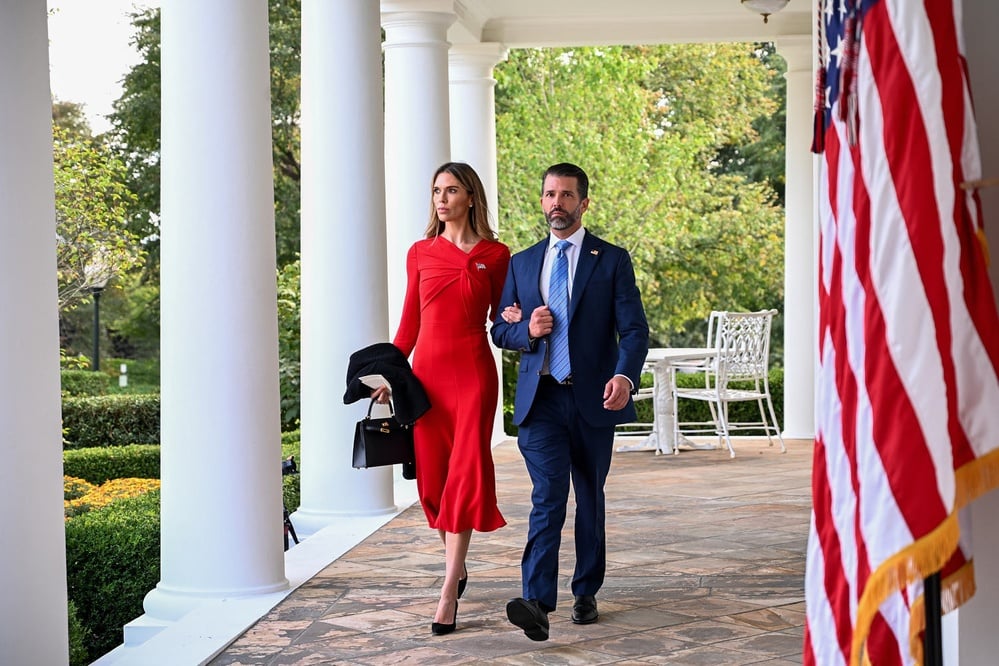
2026 © Helium Trades
Privacy Policy & Disclosure
* Disclaimer: Nothing on this website constitutes investment advice, performance data or any recommendation that any particular security, portfolio of securities, transaction or investment strategy is suitable for any specific person. Helium Trades is not responsible in any way for the accuracy
of any model predictions or price data. Any mention of a particular security and related prediction data is not a recommendation to buy or sell that security. Investments in securities involve the risk of loss. Past performance is no guarantee of future results. Helium Trades is not responsible for any of your investment decisions,
you should consult a financial expert before engaging in any transaction.
Helium Research Assistant

How can I help you today?
Ask any question about this page.


