See whether Helium helps you make better-informed decisions. Try every Pro Trader feature for 30 days. No credit card required.
Try every Pro Trader feature for 30 days. No credit card required.
November 12, 2026 · 0 shares
The report is broadly factual and attribution-heavy, with a modestly enthusiastic, wonder-driven framing of ESA's Euclid data release.
Helium Analysis
Limitations: The supplied text includes newsletter/subscription chrome and an incomplete author bio; these were excluded or treated cautiously.
·
8 of 55 available dimensions scored; omitted dimensions are not treated as neutral.
·
Verified supporting quotes for 4 of 8 scored dimensions.
Claim: The report uses evaluative wonder language in otherwise factual coverage.
“this cornucopia of data” · exact text match
“stunning space images” · exact text match
Why: These are subjective descriptors that add a mild evaluative tone without dominating the report.
Claim: The framing heightens the data release with vivid, wonder-oriented descriptors.
“stunning space images” · exact text match
“this cornucopia of data” · exact text match
Why: The lively wording adds excitement beyond a bare factual report, though it is not sustained hyperbole.
Claim: The report frames Euclid as successfully delivering and likely to complete an ambitious survey.
“A telescope tasked with creating the largest-ever 3D map of the universe is making good on its promise.” · exact text match
“Euclid is on track to collect one of the most comprehensive datasets of the universe ever” · exact text match
Counterevidence:
“With about 85% of its survey left to go” · exact text match
Why: Progress is described in positive terms while acknowledging remaining work.
Claim: The report mostly describes data, mission details, and attributed statements rather than advocating actions.
“shared the first major data release from its Euclid space telescope” · exact text match
“according to ESA” · exact text match
Why: Descriptive reporting dominates, with no visible prescriptions or calls to action.
Claim: Claims are attributed to ESA or named experts and include specific quantitative details.
“Carole Mundell, ESA's director of science, said in a statement.” · not found in supplied text
“more than 900 million galaxies and 60 million black-hole-powered light sources” · exact text match
Why: Named sourcing and specific figures support visible credibility without claiming independent verification.
Claim: The article uses empirical, scientific framing rather than supernatural explanation.
“Gravitational lenses are nature's biggest magnifying glasses.” · not found in supplied text
“offering clues about its composition and distance from Earth, according to ESA.” · exact text match
Why: Explanations are physical and observational, with no superstitious framing.
Claim: Named attribution and quotation are used for major claims.
“Carole Mundell, ESA's director of science, said in a statement.” · not found in supplied text
“Natalie Lines, a Euclid Consortium member working at the University of Portsmouth in the UK, said in the statement.” · exact text match
Why: Transparent sourcing supports visible fairness and honesty in the supplied text.
Claim: The report explains the scientific value and context of the observations.
“Gravitational lenses are nature's biggest magnifying glasses.” · not found in supplied text
“offering clues about its composition and distance from Earth, according to ESA.” · exact text match
Why: It concisely explains phenomena and survey methodology for a general audience.
The supplied text includes newsletter/subscription chrome and an incomplete author bio; these were excluded or treated cautiously.
Framing is predominantly neutral, explanatory, and source-attributed, with mild enthusiastic language about the scale of Euclid’s data release.
Helium Analysis
Limitations: The article’s stated Nov. 12, 2026 release date is future-dated relative to the environment date, so I treat it as the article’s claim rather than verified fact; subscription and bio material were excluded.
·
48 of 55 available dimensions scored; omitted dimensions are not treated as neutral.
·
Verified supporting quotes for 14 of 48 scored dimensions.
Claim: The report attributes observations and significance claims to ESA and named astronomers rather than presenting them as the reporter’s unqualified assertions.
“said ESA’s director of science Carole Mundell in a statement” · exact text match
“says Gaudi, who is not involved in the Euclid program.” · exact text match
Why: Sourcing and attribution make the framing largely objective.
Claim: The prose is mostly measured but uses a mild wonder adjective for the data release.
“captures nearly a billion celestial objects in stunning detail” · exact text match
Why: The enthusiastic adjective is limited; the rest is explanatory.
Claim: The report frames the release as enabling future discovery and a potentially record-setting map.
“laying the foundation of future discovery in a new regime for astronomy” · exact text match
“could be the most comprehensive three-dimensional map of the universe ever made” · exact text match
Why: Positive future-oriented language is present but hedged with 'could'.
Claim: The article emphasizes record-scale cosmic mapping and a near-billion-object survey.
“nearly a billion celestial objects” · exact text match
“most comprehensive three-dimensional map of the universe ever made” · exact text match
Why: Large-scale astronomy and a record map are substantive interest cues.
Claim: The text describes observations, mechanisms, and expert interpretations without advocating policy or reader action.
“Euclid’s latest release also includes a large amount of data on galaxy clusters.” · exact text match
“will help astronomers piece together the most in-depth 3D map of the universe yet made” · exact text match
Why: It remains explanatory and descriptive rather than prescriptive.
Claim: Significance claims lean on named ESA officials and astronomers.
“said ESA’s director of science Carole Mundell in a statement” · exact text match
“says Gaudi, who is not involved in the Euclid program.” · exact text match
Why: Expert quotation is appropriate but observable; the appeal-to-authority bias is low.
Claim: Positive affect is mild and tied to scientific scale.
“captures nearly a billion celestial objects in stunning detail” · exact text match
Why: A positive adjective signals mild positive affect without strong emotional manipulation.
Claim: The report relies on named ESA and independent astronomical sources and labels lensing detections as candidates.
“around 15,000 strong candidates for gravitational lensing” · exact text match
“says Gaudi, who is not involved in the Euclid program.” · exact text match
Why: Visible sourcing and appropriate uncertainty support credibility; the date ambiguity is noted separately.
Claim: The article explains the lensing mechanism and uses independent expert comment to qualify the mission’s significance.
“Euclid is aided in its observations by a cosmic phenomenon known as gravitational lensing.” · exact text match
“says Gaudi, who is not involved in the Euclid program.” · exact text match
Why: Mechanistic explanation and independent sourcing support a rational framing.
Claim: The report is grounded in instrument specifications, empirical survey counts, and astrophysical mechanisms.
“using its approximately 600-megapixel visible-light camera to capture images of the cosmos” · exact text match
“Euclid has identified around 15,000 strong candidates for gravitational lensing” · exact text match
Why: Empirical and mechanistic framing is strongly scientific.
Claim: Future benefits are forecast in attributed, hedged terms rather than asserted as settled outcomes.
“could be the most comprehensive three-dimensional map of the universe ever made” · exact text match
“will help astronomers piece together” · exact text match
Why: Some forecasting is present, but it is limited and largely hedged.
Claim: The article distinguishes independent comment and uses named institutional sources.
“says Gaudi, who is not involved in the Euclid program.” · exact text match
“said ESA’s director of science Carole Mundell in a statement” · exact text match
Why: Transparent attribution and named sources indicate high integrity.
Claim: The article explains gravitational lensing and mission complementarity with technical specificity.
“gravity bends and magnifies the light, making it brighter and easier to detect for telescopes such as Euclid” · exact text match
“Euclid is going for as much area as possible, whereas Roman is focusing in the infrared” · exact text match
Why: Clear technical exposition supports high article intelligence.
Claim: The report is oriented toward empirical observation and mechanistic explanation.
“Euclid has identified around 15,000 strong candidates for gravitational lensing” · exact text match
“gravity bends and magnifies the light” · exact text match
Why: Empirical and mechanistic content supports a truth-seeking score.
The article’s stated Nov. 12, 2026 release date is future-dated relative to the environment date, so I treat it as the article’s claim rather than verified fact; subscription and bio material were excluded.
November 12, 2026 · 0 shares
Enthusiastic science-promotional framing celebrates Euclid's first data release as a major step toward mapping dark energy and dark matter.
Helium Analysis
Limitations: Only a popular-science text is supplied; political, financial, and conflict dimensions lack relevant evidence.
·
55 of 55 available dimensions scored; omitted dimensions are not treated as neutral.
·
Verified supporting quotes for 11 of 55 scored dimensions.
Claim: The framing uses subjective metaphor and evaluative language about Euclid's results.
“We're only at the appetizer of the visual and scientific feast that Euclid will deliver.” · exact text match
Why: The feast metaphor is evaluative and subjective rather than neutral description.
Claim: The article uses mildly sensational descriptors for Euclid's imagery.
“a stunning ring galaxy about 33 million light years away” · exact text match
Why: The adjective 'stunning' adds promotional emphasis to an otherwise descriptive image reference.
Claim: The article expresses an optimistic forecast about the mission's future performance.
“It's off to a strong start and will only get better.” · exact text match
Why: The sentence predicts continued improvement in clearly positive terms.
Claim: The article actively frames the findings as engaging and visually exciting.
“We're only at the appetizer of the visual and scientific feast that Euclid will deliver.” · exact text match
Why: The vivid metaphor is used to make the data release sound especially compelling.
Claim: The text is largely descriptive of mission design rather than prescriptive about policy or action.
“The Wide Survey is Euclid's primary campaign and will cover almost half of the galactic sky.” · exact text match
Why: The sentence describes a survey's role and scope without recommending what anyone should do.
Claim: The article includes a modest evaluative opinion about the mission's progress.
“It's off to a strong start and will only get better.” · exact text match
Why: The sentence is an evaluative judgment rather than a strictly factual status report.
Claim: The article's tone is positively evaluative about the mission's progress.
“It's off to a strong start and will only get better.” · exact text match
Why: The wording conveys clear positive feeling about the mission's current and future status.
Claim: The report includes specific mission details and institutional image credits, supporting visible credibility.
“DR1-Foundation covers a sky area as large as about 9,500 full moons, and captures light from more than one billion objects.” · not found in supplied text
“Image Credit: ESA/Euclid/Euclid Consortium/NASA; ESA/Gaia/DPAC; ESA/Planck Collaboration.” · exact text match
Why: Specific figures and credited institutional sources are present, though the text remains popular-science reporting.
Claim: The article explains the scientific rationale in a structured, evidence-oriented way.
“The effects of dark energy and dark matter are felt at large scales, and by constructing an image of galaxy superclusters and the filaments they exist on, as well as the voids between those filaments, Euclid will lead to new understandings of both dark energy and dark matter.” · exact text match
Why: The passage provides a coherent explanatory rationale rather than an emotional or irrational appeal.
Claim: The framing is grounded in cosmological evidence and empirical survey goals.
“Understanding dark energy and dark matter means studying as much of the Universe as possible.” · exact text match
Why: The article explains the mission through empirical study of the universe rather than superstition.
Claim: The article forecasts future scientific payoff from the mission.
“Euclid will lead to new understandings of both dark energy and dark matter.” · exact text match
Why: The statement predicts future scientific results rather than reporting only completed observations.
Claim: The article makes a clear technical comparison of survey capabilities.
“Euclid's will have more depth and volume, and since it's space-based while DESI is ground-based, it won't have to deal with atmospheric interference and will have a higher resolution.” · exact text match
Why: The comparison identifies concrete technical advantages and is presented with relevant detail.
Only a popular-science text is supplied; political, financial, and conflict dimensions lack relevant evidence.
Framing is predominantly neutral, explanatory, and source-attributed, with mild enthusiastic language about the scale of Euclid’s data release.
Helium Analysis
Limitations: The article’s stated Nov. 12, 2026 release date is future-dated relative to the environment date, so I treat it as the article’s claim rather than verified fact; subscription and bio material were excluded.
·
48 of 55 available dimensions scored; omitted dimensions are not treated as neutral.
·
Verified supporting quotes for 14 of 48 scored dimensions.
Claim: The report attributes observations and significance claims to ESA and named astronomers rather than presenting them as the reporter’s unqualified assertions.
“said ESA’s director of science Carole Mundell in a statement” · exact text match
“says Gaudi, who is not involved in the Euclid program.” · exact text match
Why: Sourcing and attribution make the framing largely objective.
Claim: The prose is mostly measured but uses a mild wonder adjective for the data release.
“captures nearly a billion celestial objects in stunning detail” · exact text match
Why: The enthusiastic adjective is limited; the rest is explanatory.
Claim: The report frames the release as enabling future discovery and a potentially record-setting map.
“laying the foundation of future discovery in a new regime for astronomy” · exact text match
“could be the most comprehensive three-dimensional map of the universe ever made” · exact text match
Why: Positive future-oriented language is present but hedged with 'could'.
Claim: The article emphasizes record-scale cosmic mapping and a near-billion-object survey.
“nearly a billion celestial objects” · exact text match
“most comprehensive three-dimensional map of the universe ever made” · exact text match
Why: Large-scale astronomy and a record map are substantive interest cues.
Claim: The text describes observations, mechanisms, and expert interpretations without advocating policy or reader action.
“Euclid’s latest release also includes a large amount of data on galaxy clusters.” · exact text match
“will help astronomers piece together the most in-depth 3D map of the universe yet made” · exact text match
Why: It remains explanatory and descriptive rather than prescriptive.
Claim: Significance claims lean on named ESA officials and astronomers.
“said ESA’s director of science Carole Mundell in a statement” · exact text match
“says Gaudi, who is not involved in the Euclid program.” · exact text match
Why: Expert quotation is appropriate but observable; the appeal-to-authority bias is low.
Claim: Positive affect is mild and tied to scientific scale.
“captures nearly a billion celestial objects in stunning detail” · exact text match
Why: A positive adjective signals mild positive affect without strong emotional manipulation.
Claim: The report relies on named ESA and independent astronomical sources and labels lensing detections as candidates.
“around 15,000 strong candidates for gravitational lensing” · exact text match
“says Gaudi, who is not involved in the Euclid program.” · exact text match
Why: Visible sourcing and appropriate uncertainty support credibility; the date ambiguity is noted separately.
Claim: The article explains the lensing mechanism and uses independent expert comment to qualify the mission’s significance.
“Euclid is aided in its observations by a cosmic phenomenon known as gravitational lensing.” · exact text match
“says Gaudi, who is not involved in the Euclid program.” · exact text match
Why: Mechanistic explanation and independent sourcing support a rational framing.
Claim: The report is grounded in instrument specifications, empirical survey counts, and astrophysical mechanisms.
“using its approximately 600-megapixel visible-light camera to capture images of the cosmos” · exact text match
“Euclid has identified around 15,000 strong candidates for gravitational lensing” · exact text match
Why: Empirical and mechanistic framing is strongly scientific.
Claim: Future benefits are forecast in attributed, hedged terms rather than asserted as settled outcomes.
“could be the most comprehensive three-dimensional map of the universe ever made” · exact text match
“will help astronomers piece together” · exact text match
Why: Some forecasting is present, but it is limited and largely hedged.
Claim: The article distinguishes independent comment and uses named institutional sources.
“says Gaudi, who is not involved in the Euclid program.” · exact text match
“said ESA’s director of science Carole Mundell in a statement” · exact text match
Why: Transparent attribution and named sources indicate high integrity.
Claim: The article explains gravitational lensing and mission complementarity with technical specificity.
“gravity bends and magnifies the light, making it brighter and easier to detect for telescopes such as Euclid” · exact text match
“Euclid is going for as much area as possible, whereas Roman is focusing in the infrared” · exact text match
Why: Clear technical exposition supports high article intelligence.
Claim: The report is oriented toward empirical observation and mechanistic explanation.
“Euclid has identified around 15,000 strong candidates for gravitational lensing” · exact text match
“gravity bends and magnifies the light” · exact text match
Why: Empirical and mechanistic content supports a truth-seeking score.
The article’s stated Nov. 12, 2026 release date is future-dated relative to the environment date, so I treat it as the article’s claim rather than verified fact; subscription and bio material were excluded.
November 15, 2026 · 0 shares
The framing is neutral, data-forward, and scientifically explanatory, with clear attribution to ESA and cautious candidate labeling.
Helium Analysis
Limitations: The supplied text includes duplicated passages and an unnamed quote, creating minor attribution ambiguity; the substantive science content is clear.
·
8 of 55 available dimensions scored; omitted dimensions are not treated as neutral.
·
Verified supporting quotes for 8 of 8 scored dimensions.
Claim: The presentation is anchored in specific quantities and attributed release details rather than subjective impressions.
“The release, named DR1-Foundation, contains about 13 months of observations.” · exact text match
Why: A concrete dataset name and duration exemplify factual, non-subjective reporting.
Claim: The tone is measured, using numerical catalog counts and candidate language instead of sensational emphasis.
“The Euclid first data release contains roughly 15,000 strong gravitational lens candidates.” · exact text match
Why: The sentence states a quantified result with the qualifying term 'candidates,' indicating objective rather than sensational framing.
Claim: The article is primarily descriptive, reporting the mission and data release without prescribing policy or reader action.
“Euclid is on a six-year mission to map about one-third of the sky in three dimensions.” · exact text match
Why: The quoted sentence describes the mission's scope rather than advocating a course of action.
Claim: Credibility is high because the report supplies concrete figures, attributes expectations to ESA, and notes a source discrepancy.
“The main article says ESA expects the complete Data Release 1 in mid-2027.” · exact text match
“Release timing differs between sources.” · exact text match
Why: Named attribution, specific timing, and transparent acknowledgment of differing accounts indicate visible sourcing and caution.
Claim: The report explains astronomical phenomena through physical mechanisms and measured survey quantities rather than unsupported assertions.
“A gravitational lens forms when a massive object bends light from a more distant source.” · exact text match
Why: The quoted explanation is mechanistic and empirically framed, supporting a strongly rational rather than irrational presentation.
Claim: The report is strongly scientific, explaining phenomena through established physics and empirical measurement.
“A gravitational lens forms when a massive object bends light from a more distant source.” · exact text match
Why: The quoted material presents a physical mechanism, supporting an empirical rather than superstitious framing.
Claim: The report shows high integrity by qualifying detections as candidates and openly noting that release timing differs between sources.
“The Euclid first data release contains roughly 15,000 strong gravitational lens candidates.” · exact text match
“Release timing differs between sources.” · exact text match
Why: Candidate labeling and explicit acknowledgment of source discrepancy are observable honesty and fairness signals.
Claim: The article conveys technical astronomy concepts with definitions and quantitative context.
“A spectrum splits light into its component wavelengths, and certain gases leave recognizable markers in that pattern.” · exact text match
Why: This explanatory sentence demonstrates clear, educational synthesis of technical material.
The supplied text includes duplicated passages and an unnamed quote, creating minor attribution ambiguity; the substantive science content is clear.
November 14, 2026 · 0 shares
Celebratory science-institutional framing foregrounds awe and data scale while relying on credited ESA/NASA imagery and attributed expert quotation.
Helium Analysis
Limitations: The supplied text includes subscription boilerplate and repeated image-credit lines; analysis is limited to the substantive Euclid article body.
·
11 of 55 available dimensions scored; omitted dimensions are not treated as neutral.
·
Verified supporting quotes for 11 of 11 scored dimensions.
Claim: The article includes mild subjective aesthetic framing while remaining largely factual.
“Here are just some of our favorite new images from Euclid:” · exact text match
“breathtaking views” · exact text match
Why: The 'favorite' image selection and aesthetic praise introduce limited subjectivity, though most content is descriptive.
Claim: The article uses mild enthusiastic language but does not substantially sensationalize the findings.
“Fans of space, data and pretty pictures, rejoice” · exact text match
“breathtaking views” · exact text match
Why: Enthusiastic phrasing is present, but specific data and credits keep the tone largely objective.
Claim: The article presents the release in a mildly optimistic, celebratory light.
“replete with cosmic mysteries and breathtaking views” · exact text match
“Fans of space, data and pretty pictures, rejoice” · exact text match
Why: The publisher's own enthusiastic phrasing frames the release positively, though the article remains primarily factual.
Claim: The article emphasizes visually and scientifically striking cosmic imagery to sustain interest.
“breathtaking views” · exact text match
“stunning detail” · exact text match
Why: Awe-oriented language and selected spectacular images support high interestingness framing.
Claim: The article is overwhelmingly descriptive rather than prescriptive.
“Euclid launched in 2023 with the aim of capturing wide panoramic views of space with high resolution” · exact text match
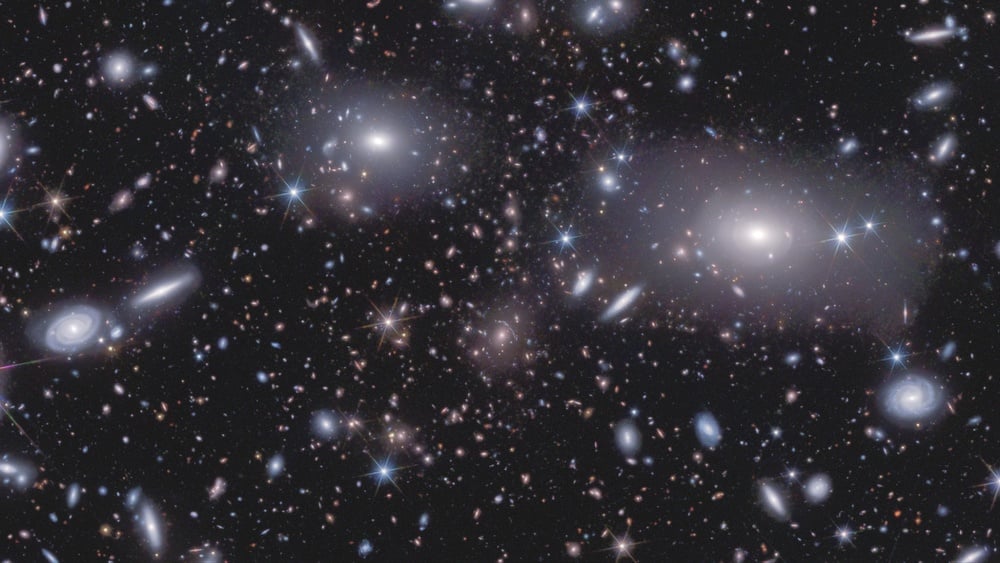
“This image shows Abell 3128, a cluster that includes hundreds of galaxies of various shapes and forms.” · exact text match
Why: The text reports mission facts and image contents without recommending actions or policies.
Claim: The article uses positive, enthusiastic language about the discoveries.
“Fans of space, data and pretty pictures, rejoice” · exact text match
“breathtaking views” · exact text match
Why: Warm, celebratory phrasing indicates positive emotional framing while remaining mostly factual.
Claim: The article provides specific measurements, image credits, and attributed expert statements.
“recorded more than a billion objects over 13 months of observation” · exact text match
“ESA/Euclid/Euclid Consortium/NASA; J.-C. Cuillandre and E. Bertin (image processing) (CC BY-SA 3.0 IGO)” · exact text match
Why: Concrete data and transparent sourcing support high visible credibility.
Claim: The article frames the release through empirical, quantitative scientific observation.
“Euclid launched in 2023 with the aim of capturing wide panoramic views of space with high resolution” · exact text match
“recorded more than a billion objects over 13 months of observation” · exact text match
Why: Quantitative mission details and measurement-based descriptions support a strongly rational/scientific presentation.
Claim: The article is strongly empirical and scientific in its framing.
“recorded more than a billion objects over 13 months of observation” · exact text match
“It’s made up of 740 observations and includes more than 900 million galaxies.” · exact text match
Why: Observation counts and survey data anchor the report in empirical science rather than superstition.
Claim: The article shows strong attribution and transparency through detailed image credits and named expert quotation.
“ESA/Euclid/Euclid Consortium/NASA; J.-C. Cuillandre and E. Bertin (image processing) (CC BY-SA 3.0 IGO)” · exact text match
“said Carole Mundell, the agency’s director of science, in a statement” · exact text match
Why: Repeated credits and clear attribution to an ESA official support a high-integrity presentation.
Claim: The article integrates specific quantitative details and attributed expert claims.
“It spans nearly 500 gigapixels in size—equivalent to at least 10,000 high-quality smartphone images.” · exact text match
“said Carole Mundell, the agency’s director of science, in a statement” · exact text match
Why: Precise measurements and named attribution indicate a relatively intelligent, informed presentation.
The supplied text includes subscription boilerplate and repeated image-credit lines; analysis is limited to the substantive Euclid article body.
November 12, 2026 · 0 shares
Enthusiastic science-promotional framing celebrates Euclid's first data release as a major step toward mapping dark energy and dark matter.
Helium Analysis
Limitations: Only a popular-science text is supplied; political, financial, and conflict dimensions lack relevant evidence.
·
55 of 55 available dimensions scored; omitted dimensions are not treated as neutral.
·
Verified supporting quotes for 11 of 55 scored dimensions.
Claim: The framing uses subjective metaphor and evaluative language about Euclid's results.
“We're only at the appetizer of the visual and scientific feast that Euclid will deliver.” · exact text match
Why: The feast metaphor is evaluative and subjective rather than neutral description.
Claim: The article uses mildly sensational descriptors for Euclid's imagery.
“a stunning ring galaxy about 33 million light years away” · exact text match
Why: The adjective 'stunning' adds promotional emphasis to an otherwise descriptive image reference.
Claim: The article expresses an optimistic forecast about the mission's future performance.
“It's off to a strong start and will only get better.” · exact text match
Why: The sentence predicts continued improvement in clearly positive terms.
Claim: The article actively frames the findings as engaging and visually exciting.
“We're only at the appetizer of the visual and scientific feast that Euclid will deliver.” · exact text match
Why: The vivid metaphor is used to make the data release sound especially compelling.
Claim: The text is largely descriptive of mission design rather than prescriptive about policy or action.
“The Wide Survey is Euclid's primary campaign and will cover almost half of the galactic sky.” · exact text match
Why: The sentence describes a survey's role and scope without recommending what anyone should do.
Claim: The article includes a modest evaluative opinion about the mission's progress.
“It's off to a strong start and will only get better.” · exact text match
Why: The sentence is an evaluative judgment rather than a strictly factual status report.
Claim: The article's tone is positively evaluative about the mission's progress.
“It's off to a strong start and will only get better.” · exact text match
Why: The wording conveys clear positive feeling about the mission's current and future status.
Claim: The report includes specific mission details and institutional image credits, supporting visible credibility.
“DR1-Foundation covers a sky area as large as about 9,500 full moons, and captures light from more than one billion objects.” · not found in supplied text
“Image Credit: ESA/Euclid/Euclid Consortium/NASA; ESA/Gaia/DPAC; ESA/Planck Collaboration.” · exact text match
Why: Specific figures and credited institutional sources are present, though the text remains popular-science reporting.
Claim: The article explains the scientific rationale in a structured, evidence-oriented way.
“The effects of dark energy and dark matter are felt at large scales, and by constructing an image of galaxy superclusters and the filaments they exist on, as well as the voids between those filaments, Euclid will lead to new understandings of both dark energy and dark matter.” · exact text match
Why: The passage provides a coherent explanatory rationale rather than an emotional or irrational appeal.
Claim: The framing is grounded in cosmological evidence and empirical survey goals.
“Understanding dark energy and dark matter means studying as much of the Universe as possible.” · exact text match
Why: The article explains the mission through empirical study of the universe rather than superstition.
Claim: The article forecasts future scientific payoff from the mission.
“Euclid will lead to new understandings of both dark energy and dark matter.” · exact text match
Why: The statement predicts future scientific results rather than reporting only completed observations.
Claim: The article makes a clear technical comparison of survey capabilities.
“Euclid's will have more depth and volume, and since it's space-based while DESI is ground-based, it won't have to deal with atmospheric interference and will have a higher resolution.” · exact text match
Why: The comparison identifies concrete technical advantages and is presented with relevant detail.
Only a popular-science text is supplied; political, financial, and conflict dimensions lack relevant evidence.
November 15, 2026 · 0 shares
The framing is neutral, data-forward, and scientifically explanatory, with clear attribution to ESA and cautious candidate labeling.
Helium Analysis
Limitations: The supplied text includes duplicated passages and an unnamed quote, creating minor attribution ambiguity; the substantive science content is clear.
·
8 of 55 available dimensions scored; omitted dimensions are not treated as neutral.
·
Verified supporting quotes for 8 of 8 scored dimensions.
Claim: The presentation is anchored in specific quantities and attributed release details rather than subjective impressions.
“The release, named DR1-Foundation, contains about 13 months of observations.” · exact text match
Why: A concrete dataset name and duration exemplify factual, non-subjective reporting.
Claim: The tone is measured, using numerical catalog counts and candidate language instead of sensational emphasis.
“The Euclid first data release contains roughly 15,000 strong gravitational lens candidates.” · exact text match
Why: The sentence states a quantified result with the qualifying term 'candidates,' indicating objective rather than sensational framing.
Claim: The article is primarily descriptive, reporting the mission and data release without prescribing policy or reader action.
“Euclid is on a six-year mission to map about one-third of the sky in three dimensions.” · exact text match
Why: The quoted sentence describes the mission's scope rather than advocating a course of action.
Claim: Credibility is high because the report supplies concrete figures, attributes expectations to ESA, and notes a source discrepancy.
“The main article says ESA expects the complete Data Release 1 in mid-2027.” · exact text match
“Release timing differs between sources.” · exact text match
Why: Named attribution, specific timing, and transparent acknowledgment of differing accounts indicate visible sourcing and caution.
Claim: The report explains astronomical phenomena through physical mechanisms and measured survey quantities rather than unsupported assertions.
“A gravitational lens forms when a massive object bends light from a more distant source.” · exact text match
Why: The quoted explanation is mechanistic and empirically framed, supporting a strongly rational rather than irrational presentation.
Claim: The report is strongly scientific, explaining phenomena through established physics and empirical measurement.
“A gravitational lens forms when a massive object bends light from a more distant source.” · exact text match
Why: The quoted material presents a physical mechanism, supporting an empirical rather than superstitious framing.
Claim: The report shows high integrity by qualifying detections as candidates and openly noting that release timing differs between sources.
“The Euclid first data release contains roughly 15,000 strong gravitational lens candidates.” · exact text match
“Release timing differs between sources.” · exact text match
Why: Candidate labeling and explicit acknowledgment of source discrepancy are observable honesty and fairness signals.
Claim: The article conveys technical astronomy concepts with definitions and quantitative context.
“A spectrum splits light into its component wavelengths, and certain gases leave recognizable markers in that pattern.” · exact text match
Why: This explanatory sentence demonstrates clear, educational synthesis of technical material.
The supplied text includes duplicated passages and an unnamed quote, creating minor attribution ambiguity; the substantive science content is clear.
November 15, 2026 · 0 shares
Largely neutral, evidence-based science reporting with quantified claims and named attribution, framed by mildly celebratory headline language about record-breaking discoveries and the telescope's capabilities.
Helium Analysis
Limitations: No author byline is supplied; the report is a ScienceDaily summary of ESA materials and does not describe independent replication.
·
9 of 55 available dimensions scored; omitted dimensions are not treated as neutral.
·
Verified supporting quotes for 9 of 9 scored dimensions.
Claim: The body is largely objective and data-driven, though some adjectives add subjective color.
“Among the 31 newly identified quasars, 12 have a redshift of 7 or greater.” · exact text match
Counterevidence:
“Two objects stand out as particularly extraordinary.” · exact text match
Why: Quantified survey data dominates, with limited evaluative language.
Claim: The headline uses vivid, awe-oriented language while the body remains quantified.
“Euclid discovers ancient cosmic beacons from the dawn of time, shining like a trillion suns.” · exact text match
Why: The cosmic-beacon and trillion-suns phrasing is mildly sensational but not misleading.
Claim: The publisher frames the telescope's results as transformative and the discovery pace as remarkable.
“Euclid is transforming that search.” · exact text match
“The pace of discovery is especially remarkable.” · exact text match
Why: Positive framing about scientific progress supports mild optimism.
Claim: The report is overwhelmingly descriptive, explaining findings without prescribing actions.
“A redshift of at least 7 places these quasars within the Universe's first 770 million years.” · exact text match
Why: Explanation of redshift and survey results is descriptive rather than prescriptive.
Claim: The framing carries positive awe and enthusiasm, largely through selected quotes and adjectives.
“Euclid is a true game-changer,” · exact text match
Why: Enthusiastic wording supports a mildly positive emotional tone.
Claim: The report supplies named experts, a discovery paper, and specific measurements.
“Daming Yang of Leiden University in the Netherlands, lead author of the Euclid discovery paper” · exact text match
“The most ancient, EUCL J172902.75+641018.1, has a redshift of 7.77” · exact text match
Why: Named attribution and precise values support visible credibility.
Claim: The report uses quantitative astrophysical reasoning and avoids irrational claims.
“A redshift of at least 7 places these quasars within the Universe's first 770 million years.” · exact text match
Why: It explains inference from redshift to cosmic age in a logical, evidence-bound way.
Claim: The article is empirically grounded, relying on telescope survey observations and redshift measurements.
“All 31 quasars were identified using observations from the Euclid Wide Survey” · exact text match
Why: It explicitly attributes findings to empirical survey data, opposite superstition.
Claim: The article explains technical concepts and quantifies findings in an accessible way.
“A redshift of at least 7 places these quasars within the Universe's first 770 million years.” · exact text match
Why: It translates redshift into cosmic age and cites specific data, indicating high clarity.
No author byline is supplied; the report is a ScienceDaily summary of ESA materials and does not describe independent replication.
November 12, 2026 · 0 shares
The report is broadly factual and attribution-heavy, with a modestly enthusiastic, wonder-driven framing of ESA's Euclid data release.
Helium Analysis
Limitations: The supplied text includes newsletter/subscription chrome and an incomplete author bio; these were excluded or treated cautiously.
·
8 of 55 available dimensions scored; omitted dimensions are not treated as neutral.
·
Verified supporting quotes for 4 of 8 scored dimensions.
Claim: The report uses evaluative wonder language in otherwise factual coverage.
“this cornucopia of data” · exact text match
“stunning space images” · exact text match
Why: These are subjective descriptors that add a mild evaluative tone without dominating the report.
Claim: The framing heightens the data release with vivid, wonder-oriented descriptors.
“stunning space images” · exact text match
“this cornucopia of data” · exact text match
Why: The lively wording adds excitement beyond a bare factual report, though it is not sustained hyperbole.
Claim: The report frames Euclid as successfully delivering and likely to complete an ambitious survey.
“A telescope tasked with creating the largest-ever 3D map of the universe is making good on its promise.” · exact text match
“Euclid is on track to collect one of the most comprehensive datasets of the universe ever” · exact text match
Counterevidence:
“With about 85% of its survey left to go” · exact text match
Why: Progress is described in positive terms while acknowledging remaining work.
Claim: The report mostly describes data, mission details, and attributed statements rather than advocating actions.
“shared the first major data release from its Euclid space telescope” · exact text match
“according to ESA” · exact text match
Why: Descriptive reporting dominates, with no visible prescriptions or calls to action.
Claim: Claims are attributed to ESA or named experts and include specific quantitative details.
“Carole Mundell, ESA's director of science, said in a statement.” · not found in supplied text
“more than 900 million galaxies and 60 million black-hole-powered light sources” · exact text match
Why: Named sourcing and specific figures support visible credibility without claiming independent verification.
Claim: The article uses empirical, scientific framing rather than supernatural explanation.
“Gravitational lenses are nature's biggest magnifying glasses.” · not found in supplied text
“offering clues about its composition and distance from Earth, according to ESA.” · exact text match
Why: Explanations are physical and observational, with no superstitious framing.
Claim: Named attribution and quotation are used for major claims.
“Carole Mundell, ESA's director of science, said in a statement.” · not found in supplied text
“Natalie Lines, a Euclid Consortium member working at the University of Portsmouth in the UK, said in the statement.” · exact text match
Why: Transparent sourcing supports visible fairness and honesty in the supplied text.
Claim: The report explains the scientific value and context of the observations.
“Gravitational lenses are nature's biggest magnifying glasses.” · not found in supplied text
“offering clues about its composition and distance from Earth, according to ESA.” · exact text match
Why: It concisely explains phenomena and survey methodology for a general audience.
The supplied text includes newsletter/subscription chrome and an incomplete author bio; these were excluded or treated cautiously.
November 15, 2026 · 0 shares
The framing is neutral, data-forward, and scientifically explanatory, with clear attribution to ESA and cautious candidate labeling.
Helium Analysis
Limitations: The supplied text includes duplicated passages and an unnamed quote, creating minor attribution ambiguity; the substantive science content is clear.
·
8 of 55 available dimensions scored; omitted dimensions are not treated as neutral.
·
Verified supporting quotes for 8 of 8 scored dimensions.
Claim: The presentation is anchored in specific quantities and attributed release details rather than subjective impressions.
“The release, named DR1-Foundation, contains about 13 months of observations.” · exact text match
Why: A concrete dataset name and duration exemplify factual, non-subjective reporting.
Claim: The tone is measured, using numerical catalog counts and candidate language instead of sensational emphasis.
“The Euclid first data release contains roughly 15,000 strong gravitational lens candidates.” · exact text match
Why: The sentence states a quantified result with the qualifying term 'candidates,' indicating objective rather than sensational framing.
Claim: The article is primarily descriptive, reporting the mission and data release without prescribing policy or reader action.
“Euclid is on a six-year mission to map about one-third of the sky in three dimensions.” · exact text match
Why: The quoted sentence describes the mission's scope rather than advocating a course of action.
Claim: Credibility is high because the report supplies concrete figures, attributes expectations to ESA, and notes a source discrepancy.
“The main article says ESA expects the complete Data Release 1 in mid-2027.” · exact text match
“Release timing differs between sources.” · exact text match
Why: Named attribution, specific timing, and transparent acknowledgment of differing accounts indicate visible sourcing and caution.
Claim: The report explains astronomical phenomena through physical mechanisms and measured survey quantities rather than unsupported assertions.
“A gravitational lens forms when a massive object bends light from a more distant source.” · exact text match
Why: The quoted explanation is mechanistic and empirically framed, supporting a strongly rational rather than irrational presentation.
Claim: The report is strongly scientific, explaining phenomena through established physics and empirical measurement.
“A gravitational lens forms when a massive object bends light from a more distant source.” · exact text match
Why: The quoted material presents a physical mechanism, supporting an empirical rather than superstitious framing.
Claim: The report shows high integrity by qualifying detections as candidates and openly noting that release timing differs between sources.
“The Euclid first data release contains roughly 15,000 strong gravitational lens candidates.” · exact text match
“Release timing differs between sources.” · exact text match
Why: Candidate labeling and explicit acknowledgment of source discrepancy are observable honesty and fairness signals.
Claim: The article conveys technical astronomy concepts with definitions and quantitative context.
“A spectrum splits light into its component wavelengths, and certain gases leave recognizable markers in that pattern.” · exact text match
Why: This explanatory sentence demonstrates clear, educational synthesis of technical material.
The supplied text includes duplicated passages and an unnamed quote, creating minor attribution ambiguity; the substantive science content is clear.
November 12, 2026 · 0 shares
The report is broadly factual and attribution-heavy, with a modestly enthusiastic, wonder-driven framing of ESA's Euclid data release.
Helium Analysis Limitations: The supplied text includes newsletter/subscription chrome and an incomplete author bio; these were excluded or treated cautiously. · 8 of 55 available dimensions scored; omitted dimensions are not treated as neutral. · Verified supporting quotes for 4 of 8 scored dimensions.
Claim: The report uses evaluative wonder language in otherwise factual coverage.
“this cornucopia of data” · exact text match
“stunning space images” · exact text match
Why: These are subjective descriptors that add a mild evaluative tone without dominating the report.
Claim: The framing heightens the data release with vivid, wonder-oriented descriptors.
“stunning space images” · exact text match
“this cornucopia of data” · exact text match
Why: The lively wording adds excitement beyond a bare factual report, though it is not sustained hyperbole.
Claim: The report frames Euclid as successfully delivering and likely to complete an ambitious survey.
“A telescope tasked with creating the largest-ever 3D map of the universe is making good on its promise.” · exact text match
“Euclid is on track to collect one of the most comprehensive datasets of the universe ever” · exact text match
Counterevidence:
“With about 85% of its survey left to go” · exact text match
Why: Progress is described in positive terms while acknowledging remaining work.
Claim: The report mostly describes data, mission details, and attributed statements rather than advocating actions.
“shared the first major data release from its Euclid space telescope” · exact text match
“according to ESA” · exact text match
Why: Descriptive reporting dominates, with no visible prescriptions or calls to action.
Claim: Claims are attributed to ESA or named experts and include specific quantitative details.
“Carole Mundell, ESA's director of science, said in a statement.” · not found in supplied text
“more than 900 million galaxies and 60 million black-hole-powered light sources” · exact text match
Why: Named sourcing and specific figures support visible credibility without claiming independent verification.
Claim: The article uses empirical, scientific framing rather than supernatural explanation.
“Gravitational lenses are nature's biggest magnifying glasses.” · not found in supplied text
“offering clues about its composition and distance from Earth, according to ESA.” · exact text match
Why: Explanations are physical and observational, with no superstitious framing.
Claim: Named attribution and quotation are used for major claims.
“Carole Mundell, ESA's director of science, said in a statement.” · not found in supplied text
“Natalie Lines, a Euclid Consortium member working at the University of Portsmouth in the UK, said in the statement.” · exact text match
Why: Transparent sourcing supports visible fairness and honesty in the supplied text.
Claim: The report explains the scientific value and context of the observations.
“Gravitational lenses are nature's biggest magnifying glasses.” · not found in supplied text
“offering clues about its composition and distance from Earth, according to ESA.” · exact text match
Why: It concisely explains phenomena and survey methodology for a general audience.
The supplied text includes newsletter/subscription chrome and an incomplete author bio; these were excluded or treated cautiously.
Framing is predominantly neutral, explanatory, and source-attributed, with mild enthusiastic language about the scale of Euclid’s data release.
Helium Analysis Limitations: The article’s stated Nov. 12, 2026 release date is future-dated relative to the environment date, so I treat it as the article’s claim rather than verified fact; subscription and bio material were excluded. · 48 of 55 available dimensions scored; omitted dimensions are not treated as neutral. · Verified supporting quotes for 14 of 48 scored dimensions.
Claim: The report attributes observations and significance claims to ESA and named astronomers rather than presenting them as the reporter’s unqualified assertions.
“said ESA’s director of science Carole Mundell in a statement” · exact text match
“says Gaudi, who is not involved in the Euclid program.” · exact text match
Why: Sourcing and attribution make the framing largely objective.
Claim: The prose is mostly measured but uses a mild wonder adjective for the data release.
“captures nearly a billion celestial objects in stunning detail” · exact text match
Why: The enthusiastic adjective is limited; the rest is explanatory.
Claim: The report frames the release as enabling future discovery and a potentially record-setting map.
“laying the foundation of future discovery in a new regime for astronomy” · exact text match
“could be the most comprehensive three-dimensional map of the universe ever made” · exact text match
Why: Positive future-oriented language is present but hedged with 'could'.
Claim: The article emphasizes record-scale cosmic mapping and a near-billion-object survey.
“nearly a billion celestial objects” · exact text match
“most comprehensive three-dimensional map of the universe ever made” · exact text match
Why: Large-scale astronomy and a record map are substantive interest cues.
Claim: The text describes observations, mechanisms, and expert interpretations without advocating policy or reader action.
“Euclid’s latest release also includes a large amount of data on galaxy clusters.” · exact text match
“will help astronomers piece together the most in-depth 3D map of the universe yet made” · exact text match
Why: It remains explanatory and descriptive rather than prescriptive.
Claim: Significance claims lean on named ESA officials and astronomers.
“said ESA’s director of science Carole Mundell in a statement” · exact text match
“says Gaudi, who is not involved in the Euclid program.” · exact text match
Why: Expert quotation is appropriate but observable; the appeal-to-authority bias is low.
Claim: Positive affect is mild and tied to scientific scale.
“captures nearly a billion celestial objects in stunning detail” · exact text match
Why: A positive adjective signals mild positive affect without strong emotional manipulation.
Claim: The report relies on named ESA and independent astronomical sources and labels lensing detections as candidates.
“around 15,000 strong candidates for gravitational lensing” · exact text match
“says Gaudi, who is not involved in the Euclid program.” · exact text match
Why: Visible sourcing and appropriate uncertainty support credibility; the date ambiguity is noted separately.
Claim: The article explains the lensing mechanism and uses independent expert comment to qualify the mission’s significance.
“Euclid is aided in its observations by a cosmic phenomenon known as gravitational lensing.” · exact text match
“says Gaudi, who is not involved in the Euclid program.” · exact text match
Why: Mechanistic explanation and independent sourcing support a rational framing.
Claim: The report is grounded in instrument specifications, empirical survey counts, and astrophysical mechanisms.
“using its approximately 600-megapixel visible-light camera to capture images of the cosmos” · exact text match
“Euclid has identified around 15,000 strong candidates for gravitational lensing” · exact text match
Why: Empirical and mechanistic framing is strongly scientific.
Claim: Future benefits are forecast in attributed, hedged terms rather than asserted as settled outcomes.
“could be the most comprehensive three-dimensional map of the universe ever made” · exact text match
“will help astronomers piece together” · exact text match
Why: Some forecasting is present, but it is limited and largely hedged.
Claim: The article distinguishes independent comment and uses named institutional sources.
“says Gaudi, who is not involved in the Euclid program.” · exact text match
“said ESA’s director of science Carole Mundell in a statement” · exact text match
Why: Transparent attribution and named sources indicate high integrity.
Claim: The article explains gravitational lensing and mission complementarity with technical specificity.
“gravity bends and magnifies the light, making it brighter and easier to detect for telescopes such as Euclid” · exact text match
“Euclid is going for as much area as possible, whereas Roman is focusing in the infrared” · exact text match
Why: Clear technical exposition supports high article intelligence.
Claim: The report is oriented toward empirical observation and mechanistic explanation.
“Euclid has identified around 15,000 strong candidates for gravitational lensing” · exact text match
“gravity bends and magnifies the light” · exact text match
Why: Empirical and mechanistic content supports a truth-seeking score.
The article’s stated Nov. 12, 2026 release date is future-dated relative to the environment date, so I treat it as the article’s claim rather than verified fact; subscription and bio material were excluded.
November 12, 2026 · 0 shares
Enthusiastic science-promotional framing celebrates Euclid's first data release as a major step toward mapping dark energy and dark matter.
Helium Analysis Limitations: Only a popular-science text is supplied; political, financial, and conflict dimensions lack relevant evidence. · 55 of 55 available dimensions scored; omitted dimensions are not treated as neutral. · Verified supporting quotes for 11 of 55 scored dimensions.
Claim: The framing uses subjective metaphor and evaluative language about Euclid's results.
“We're only at the appetizer of the visual and scientific feast that Euclid will deliver.” · exact text match
Why: The feast metaphor is evaluative and subjective rather than neutral description.
Claim: The article uses mildly sensational descriptors for Euclid's imagery.
“a stunning ring galaxy about 33 million light years away” · exact text match
Why: The adjective 'stunning' adds promotional emphasis to an otherwise descriptive image reference.
Claim: The article expresses an optimistic forecast about the mission's future performance.
“It's off to a strong start and will only get better.” · exact text match
Why: The sentence predicts continued improvement in clearly positive terms.
Claim: The article actively frames the findings as engaging and visually exciting.
“We're only at the appetizer of the visual and scientific feast that Euclid will deliver.” · exact text match
Why: The vivid metaphor is used to make the data release sound especially compelling.
Claim: The text is largely descriptive of mission design rather than prescriptive about policy or action.
“The Wide Survey is Euclid's primary campaign and will cover almost half of the galactic sky.” · exact text match
Why: The sentence describes a survey's role and scope without recommending what anyone should do.
Claim: The article includes a modest evaluative opinion about the mission's progress.
“It's off to a strong start and will only get better.” · exact text match
Why: The sentence is an evaluative judgment rather than a strictly factual status report.
Claim: The article's tone is positively evaluative about the mission's progress.
“It's off to a strong start and will only get better.” · exact text match
Why: The wording conveys clear positive feeling about the mission's current and future status.
Claim: The report includes specific mission details and institutional image credits, supporting visible credibility.
“DR1-Foundation covers a sky area as large as about 9,500 full moons, and captures light from more than one billion objects.” · not found in supplied text
“Image Credit: ESA/Euclid/Euclid Consortium/NASA; ESA/Gaia/DPAC; ESA/Planck Collaboration.” · exact text match
Why: Specific figures and credited institutional sources are present, though the text remains popular-science reporting.
Claim: The article explains the scientific rationale in a structured, evidence-oriented way.
“The effects of dark energy and dark matter are felt at large scales, and by constructing an image of galaxy superclusters and the filaments they exist on, as well as the voids between those filaments, Euclid will lead to new understandings of both dark energy and dark matter.” · exact text match
Why: The passage provides a coherent explanatory rationale rather than an emotional or irrational appeal.
Claim: The framing is grounded in cosmological evidence and empirical survey goals.
“Understanding dark energy and dark matter means studying as much of the Universe as possible.” · exact text match
Why: The article explains the mission through empirical study of the universe rather than superstition.
Claim: The article forecasts future scientific payoff from the mission.
“Euclid will lead to new understandings of both dark energy and dark matter.” · exact text match
Why: The statement predicts future scientific results rather than reporting only completed observations.
Claim: The article makes a clear technical comparison of survey capabilities.
“Euclid's will have more depth and volume, and since it's space-based while DESI is ground-based, it won't have to deal with atmospheric interference and will have a higher resolution.” · exact text match
Why: The comparison identifies concrete technical advantages and is presented with relevant detail.
Only a popular-science text is supplied; political, financial, and conflict dimensions lack relevant evidence.
November 15, 2026 · 0 shares
The framing is neutral, data-forward, and scientifically explanatory, with clear attribution to ESA and cautious candidate labeling.
Helium Analysis Limitations: The supplied text includes duplicated passages and an unnamed quote, creating minor attribution ambiguity; the substantive science content is clear. · 8 of 55 available dimensions scored; omitted dimensions are not treated as neutral. · Verified supporting quotes for 8 of 8 scored dimensions.
Claim: The presentation is anchored in specific quantities and attributed release details rather than subjective impressions.
“The release, named DR1-Foundation, contains about 13 months of observations.” · exact text match
Why: A concrete dataset name and duration exemplify factual, non-subjective reporting.
Claim: The tone is measured, using numerical catalog counts and candidate language instead of sensational emphasis.
“The Euclid first data release contains roughly 15,000 strong gravitational lens candidates.” · exact text match
Why: The sentence states a quantified result with the qualifying term 'candidates,' indicating objective rather than sensational framing.
Claim: The article is primarily descriptive, reporting the mission and data release without prescribing policy or reader action.
“Euclid is on a six-year mission to map about one-third of the sky in three dimensions.” · exact text match
Why: The quoted sentence describes the mission's scope rather than advocating a course of action.
Claim: Credibility is high because the report supplies concrete figures, attributes expectations to ESA, and notes a source discrepancy.
“The main article says ESA expects the complete Data Release 1 in mid-2027.” · exact text match
“Release timing differs between sources.” · exact text match
Why: Named attribution, specific timing, and transparent acknowledgment of differing accounts indicate visible sourcing and caution.
Claim: The report explains astronomical phenomena through physical mechanisms and measured survey quantities rather than unsupported assertions.
“A gravitational lens forms when a massive object bends light from a more distant source.” · exact text match
Why: The quoted explanation is mechanistic and empirically framed, supporting a strongly rational rather than irrational presentation.
Claim: The report is strongly scientific, explaining phenomena through established physics and empirical measurement.
“A gravitational lens forms when a massive object bends light from a more distant source.” · exact text match
Why: The quoted material presents a physical mechanism, supporting an empirical rather than superstitious framing.
Claim: The report shows high integrity by qualifying detections as candidates and openly noting that release timing differs between sources.
“The Euclid first data release contains roughly 15,000 strong gravitational lens candidates.” · exact text match
“Release timing differs between sources.” · exact text match
Why: Candidate labeling and explicit acknowledgment of source discrepancy are observable honesty and fairness signals.
Claim: The article conveys technical astronomy concepts with definitions and quantitative context.
“A spectrum splits light into its component wavelengths, and certain gases leave recognizable markers in that pattern.” · exact text match
Why: This explanatory sentence demonstrates clear, educational synthesis of technical material.
The supplied text includes duplicated passages and an unnamed quote, creating minor attribution ambiguity; the substantive science content is clear.
November 15, 2026 · 0 shares
Largely neutral, evidence-based science reporting with quantified claims and named attribution, framed by mildly celebratory headline language about record-breaking discoveries and the telescope's capabilities.
Helium Analysis Limitations: No author byline is supplied; the report is a ScienceDaily summary of ESA materials and does not describe independent replication. · 9 of 55 available dimensions scored; omitted dimensions are not treated as neutral. · Verified supporting quotes for 9 of 9 scored dimensions.
Claim: The body is largely objective and data-driven, though some adjectives add subjective color.
“Among the 31 newly identified quasars, 12 have a redshift of 7 or greater.” · exact text match
Counterevidence:
“Two objects stand out as particularly extraordinary.” · exact text match
Why: Quantified survey data dominates, with limited evaluative language.
Claim: The headline uses vivid, awe-oriented language while the body remains quantified.
“Euclid discovers ancient cosmic beacons from the dawn of time, shining like a trillion suns.” · exact text match
Why: The cosmic-beacon and trillion-suns phrasing is mildly sensational but not misleading.
Claim: The publisher frames the telescope's results as transformative and the discovery pace as remarkable.
“Euclid is transforming that search.” · exact text match
“The pace of discovery is especially remarkable.” · exact text match
Why: Positive framing about scientific progress supports mild optimism.
Claim: The report is overwhelmingly descriptive, explaining findings without prescribing actions.
“A redshift of at least 7 places these quasars within the Universe's first 770 million years.” · exact text match
Why: Explanation of redshift and survey results is descriptive rather than prescriptive.
Claim: The framing carries positive awe and enthusiasm, largely through selected quotes and adjectives.
“Euclid is a true game-changer,” · exact text match
Why: Enthusiastic wording supports a mildly positive emotional tone.
Claim: The report supplies named experts, a discovery paper, and specific measurements.
“Daming Yang of Leiden University in the Netherlands, lead author of the Euclid discovery paper” · exact text match
“The most ancient, EUCL J172902.75+641018.1, has a redshift of 7.77” · exact text match
Why: Named attribution and precise values support visible credibility.
Claim: The report uses quantitative astrophysical reasoning and avoids irrational claims.
“A redshift of at least 7 places these quasars within the Universe's first 770 million years.” · exact text match
Why: It explains inference from redshift to cosmic age in a logical, evidence-bound way.
Claim: The article is empirically grounded, relying on telescope survey observations and redshift measurements.
“All 31 quasars were identified using observations from the Euclid Wide Survey” · exact text match
Why: It explicitly attributes findings to empirical survey data, opposite superstition.
Claim: The article explains technical concepts and quantifies findings in an accessible way.
“A redshift of at least 7 places these quasars within the Universe's first 770 million years.” · exact text match
Why: It translates redshift into cosmic age and cites specific data, indicating high clarity.
No author byline is supplied; the report is a ScienceDaily summary of ESA materials and does not describe independent replication.
Framing is predominantly neutral, explanatory, and source-attributed, with mild enthusiastic language about the scale of Euclid’s data release.
Helium Analysis Limitations: The article’s stated Nov. 12, 2026 release date is future-dated relative to the environment date, so I treat it as the article’s claim rather than verified fact; subscription and bio material were excluded. · 48 of 55 available dimensions scored; omitted dimensions are not treated as neutral. · Verified supporting quotes for 14 of 48 scored dimensions.
Claim: The report attributes observations and significance claims to ESA and named astronomers rather than presenting them as the reporter’s unqualified assertions.
“said ESA’s director of science Carole Mundell in a statement” · exact text match
“says Gaudi, who is not involved in the Euclid program.” · exact text match
Why: Sourcing and attribution make the framing largely objective.
Claim: The prose is mostly measured but uses a mild wonder adjective for the data release.
“captures nearly a billion celestial objects in stunning detail” · exact text match
Why: The enthusiastic adjective is limited; the rest is explanatory.
Claim: The report frames the release as enabling future discovery and a potentially record-setting map.
“laying the foundation of future discovery in a new regime for astronomy” · exact text match
“could be the most comprehensive three-dimensional map of the universe ever made” · exact text match
Why: Positive future-oriented language is present but hedged with 'could'.
Claim: The article emphasizes record-scale cosmic mapping and a near-billion-object survey.
“nearly a billion celestial objects” · exact text match
“most comprehensive three-dimensional map of the universe ever made” · exact text match
Why: Large-scale astronomy and a record map are substantive interest cues.
Claim: The text describes observations, mechanisms, and expert interpretations without advocating policy or reader action.
“Euclid’s latest release also includes a large amount of data on galaxy clusters.” · exact text match
“will help astronomers piece together the most in-depth 3D map of the universe yet made” · exact text match
Why: It remains explanatory and descriptive rather than prescriptive.
Claim: Significance claims lean on named ESA officials and astronomers.
“said ESA’s director of science Carole Mundell in a statement” · exact text match
“says Gaudi, who is not involved in the Euclid program.” · exact text match
Why: Expert quotation is appropriate but observable; the appeal-to-authority bias is low.
Claim: Positive affect is mild and tied to scientific scale.
“captures nearly a billion celestial objects in stunning detail” · exact text match
Why: A positive adjective signals mild positive affect without strong emotional manipulation.
Claim: The report relies on named ESA and independent astronomical sources and labels lensing detections as candidates.
“around 15,000 strong candidates for gravitational lensing” · exact text match
“says Gaudi, who is not involved in the Euclid program.” · exact text match
Why: Visible sourcing and appropriate uncertainty support credibility; the date ambiguity is noted separately.
Claim: The article explains the lensing mechanism and uses independent expert comment to qualify the mission’s significance.
“Euclid is aided in its observations by a cosmic phenomenon known as gravitational lensing.” · exact text match
“says Gaudi, who is not involved in the Euclid program.” · exact text match
Why: Mechanistic explanation and independent sourcing support a rational framing.
Claim: The report is grounded in instrument specifications, empirical survey counts, and astrophysical mechanisms.
“using its approximately 600-megapixel visible-light camera to capture images of the cosmos” · exact text match
“Euclid has identified around 15,000 strong candidates for gravitational lensing” · exact text match
Why: Empirical and mechanistic framing is strongly scientific.
Claim: Future benefits are forecast in attributed, hedged terms rather than asserted as settled outcomes.
“could be the most comprehensive three-dimensional map of the universe ever made” · exact text match
“will help astronomers piece together” · exact text match
Why: Some forecasting is present, but it is limited and largely hedged.
Claim: The article distinguishes independent comment and uses named institutional sources.
“says Gaudi, who is not involved in the Euclid program.” · exact text match
“said ESA’s director of science Carole Mundell in a statement” · exact text match
Why: Transparent attribution and named sources indicate high integrity.
Claim: The article explains gravitational lensing and mission complementarity with technical specificity.
“gravity bends and magnifies the light, making it brighter and easier to detect for telescopes such as Euclid” · exact text match
“Euclid is going for as much area as possible, whereas Roman is focusing in the infrared” · exact text match
Why: Clear technical exposition supports high article intelligence.
Claim: The report is oriented toward empirical observation and mechanistic explanation.
“Euclid has identified around 15,000 strong candidates for gravitational lensing” · exact text match
“gravity bends and magnifies the light” · exact text match
Why: Empirical and mechanistic content supports a truth-seeking score.
The article’s stated Nov. 12, 2026 release date is future-dated relative to the environment date, so I treat it as the article’s claim rather than verified fact; subscription and bio material were excluded.
November 12, 2026 · 0 shares
The report is broadly factual and attribution-heavy, with a modestly enthusiastic, wonder-driven framing of ESA's Euclid data release.
Helium Analysis Limitations: The supplied text includes newsletter/subscription chrome and an incomplete author bio; these were excluded or treated cautiously. · 8 of 55 available dimensions scored; omitted dimensions are not treated as neutral. · Verified supporting quotes for 4 of 8 scored dimensions.
Claim: The report uses evaluative wonder language in otherwise factual coverage.
“this cornucopia of data” · exact text match
“stunning space images” · exact text match
Why: These are subjective descriptors that add a mild evaluative tone without dominating the report.
Claim: The framing heightens the data release with vivid, wonder-oriented descriptors.
“stunning space images” · exact text match
“this cornucopia of data” · exact text match
Why: The lively wording adds excitement beyond a bare factual report, though it is not sustained hyperbole.
Claim: The report frames Euclid as successfully delivering and likely to complete an ambitious survey.
“A telescope tasked with creating the largest-ever 3D map of the universe is making good on its promise.” · exact text match
“Euclid is on track to collect one of the most comprehensive datasets of the universe ever” · exact text match
Counterevidence:
“With about 85% of its survey left to go” · exact text match
Why: Progress is described in positive terms while acknowledging remaining work.
Claim: The report mostly describes data, mission details, and attributed statements rather than advocating actions.
“shared the first major data release from its Euclid space telescope” · exact text match
“according to ESA” · exact text match
Why: Descriptive reporting dominates, with no visible prescriptions or calls to action.
Claim: Claims are attributed to ESA or named experts and include specific quantitative details.
“Carole Mundell, ESA's director of science, said in a statement.” · not found in supplied text
“more than 900 million galaxies and 60 million black-hole-powered light sources” · exact text match
Why: Named sourcing and specific figures support visible credibility without claiming independent verification.
Claim: The article uses empirical, scientific framing rather than supernatural explanation.
“Gravitational lenses are nature's biggest magnifying glasses.” · not found in supplied text
“offering clues about its composition and distance from Earth, according to ESA.” · exact text match
Why: Explanations are physical and observational, with no superstitious framing.
Claim: Named attribution and quotation are used for major claims.
“Carole Mundell, ESA's director of science, said in a statement.” · not found in supplied text
“Natalie Lines, a Euclid Consortium member working at the University of Portsmouth in the UK, said in the statement.” · exact text match
Why: Transparent sourcing supports visible fairness and honesty in the supplied text.
Claim: The report explains the scientific value and context of the observations.
“Gravitational lenses are nature's biggest magnifying glasses.” · not found in supplied text
“offering clues about its composition and distance from Earth, according to ESA.” · exact text match
Why: It concisely explains phenomena and survey methodology for a general audience.
The supplied text includes newsletter/subscription chrome and an incomplete author bio; these were excluded or treated cautiously.
November 12, 2026 · 0 shares
Enthusiastic science-promotional framing celebrates Euclid's first data release as a major step toward mapping dark energy and dark matter.
Helium Analysis Limitations: Only a popular-science text is supplied; political, financial, and conflict dimensions lack relevant evidence. · 55 of 55 available dimensions scored; omitted dimensions are not treated as neutral. · Verified supporting quotes for 11 of 55 scored dimensions.
Claim: The framing uses subjective metaphor and evaluative language about Euclid's results.
“We're only at the appetizer of the visual and scientific feast that Euclid will deliver.” · exact text match
Why: The feast metaphor is evaluative and subjective rather than neutral description.
Claim: The article uses mildly sensational descriptors for Euclid's imagery.
“a stunning ring galaxy about 33 million light years away” · exact text match
Why: The adjective 'stunning' adds promotional emphasis to an otherwise descriptive image reference.
Claim: The article expresses an optimistic forecast about the mission's future performance.
“It's off to a strong start and will only get better.” · exact text match
Why: The sentence predicts continued improvement in clearly positive terms.
Claim: The article actively frames the findings as engaging and visually exciting.
“We're only at the appetizer of the visual and scientific feast that Euclid will deliver.” · exact text match
Why: The vivid metaphor is used to make the data release sound especially compelling.
Claim: The text is largely descriptive of mission design rather than prescriptive about policy or action.
“The Wide Survey is Euclid's primary campaign and will cover almost half of the galactic sky.” · exact text match
Why: The sentence describes a survey's role and scope without recommending what anyone should do.
Claim: The article includes a modest evaluative opinion about the mission's progress.
“It's off to a strong start and will only get better.” · exact text match
Why: The sentence is an evaluative judgment rather than a strictly factual status report.
Claim: The article's tone is positively evaluative about the mission's progress.
“It's off to a strong start and will only get better.” · exact text match
Why: The wording conveys clear positive feeling about the mission's current and future status.
Claim: The report includes specific mission details and institutional image credits, supporting visible credibility.
“DR1-Foundation covers a sky area as large as about 9,500 full moons, and captures light from more than one billion objects.” · not found in supplied text
“Image Credit: ESA/Euclid/Euclid Consortium/NASA; ESA/Gaia/DPAC; ESA/Planck Collaboration.” · exact text match
Why: Specific figures and credited institutional sources are present, though the text remains popular-science reporting.
Claim: The article explains the scientific rationale in a structured, evidence-oriented way.
“The effects of dark energy and dark matter are felt at large scales, and by constructing an image of galaxy superclusters and the filaments they exist on, as well as the voids between those filaments, Euclid will lead to new understandings of both dark energy and dark matter.” · exact text match
Why: The passage provides a coherent explanatory rationale rather than an emotional or irrational appeal.
Claim: The framing is grounded in cosmological evidence and empirical survey goals.
“Understanding dark energy and dark matter means studying as much of the Universe as possible.” · exact text match
Why: The article explains the mission through empirical study of the universe rather than superstition.
Claim: The article forecasts future scientific payoff from the mission.
“Euclid will lead to new understandings of both dark energy and dark matter.” · exact text match
Why: The statement predicts future scientific results rather than reporting only completed observations.
Claim: The article makes a clear technical comparison of survey capabilities.
“Euclid's will have more depth and volume, and since it's space-based while DESI is ground-based, it won't have to deal with atmospheric interference and will have a higher resolution.” · exact text match
Why: The comparison identifies concrete technical advantages and is presented with relevant detail.
Only a popular-science text is supplied; political, financial, and conflict dimensions lack relevant evidence.
Framing is predominantly neutral, explanatory, and source-attributed, with mild enthusiastic language about the scale of Euclid’s data release.
Helium Analysis Limitations: The article’s stated Nov. 12, 2026 release date is future-dated relative to the environment date, so I treat it as the article’s claim rather than verified fact; subscription and bio material were excluded. · 48 of 55 available dimensions scored; omitted dimensions are not treated as neutral. · Verified supporting quotes for 14 of 48 scored dimensions.
Claim: The report attributes observations and significance claims to ESA and named astronomers rather than presenting them as the reporter’s unqualified assertions.
“said ESA’s director of science Carole Mundell in a statement” · exact text match
“says Gaudi, who is not involved in the Euclid program.” · exact text match
Why: Sourcing and attribution make the framing largely objective.
Claim: The prose is mostly measured but uses a mild wonder adjective for the data release.
“captures nearly a billion celestial objects in stunning detail” · exact text match
Why: The enthusiastic adjective is limited; the rest is explanatory.
Claim: The report frames the release as enabling future discovery and a potentially record-setting map.
“laying the foundation of future discovery in a new regime for astronomy” · exact text match
“could be the most comprehensive three-dimensional map of the universe ever made” · exact text match
Why: Positive future-oriented language is present but hedged with 'could'.
Claim: The article emphasizes record-scale cosmic mapping and a near-billion-object survey.
“nearly a billion celestial objects” · exact text match
“most comprehensive three-dimensional map of the universe ever made” · exact text match
Why: Large-scale astronomy and a record map are substantive interest cues.
Claim: The text describes observations, mechanisms, and expert interpretations without advocating policy or reader action.
“Euclid’s latest release also includes a large amount of data on galaxy clusters.” · exact text match
“will help astronomers piece together the most in-depth 3D map of the universe yet made” · exact text match
Why: It remains explanatory and descriptive rather than prescriptive.
Claim: Significance claims lean on named ESA officials and astronomers.
“said ESA’s director of science Carole Mundell in a statement” · exact text match
“says Gaudi, who is not involved in the Euclid program.” · exact text match
Why: Expert quotation is appropriate but observable; the appeal-to-authority bias is low.
Claim: Positive affect is mild and tied to scientific scale.
“captures nearly a billion celestial objects in stunning detail” · exact text match
Why: A positive adjective signals mild positive affect without strong emotional manipulation.
Claim: The report relies on named ESA and independent astronomical sources and labels lensing detections as candidates.
“around 15,000 strong candidates for gravitational lensing” · exact text match
“says Gaudi, who is not involved in the Euclid program.” · exact text match
Why: Visible sourcing and appropriate uncertainty support credibility; the date ambiguity is noted separately.
Claim: The article explains the lensing mechanism and uses independent expert comment to qualify the mission’s significance.
“Euclid is aided in its observations by a cosmic phenomenon known as gravitational lensing.” · exact text match
“says Gaudi, who is not involved in the Euclid program.” · exact text match
Why: Mechanistic explanation and independent sourcing support a rational framing.
Claim: The report is grounded in instrument specifications, empirical survey counts, and astrophysical mechanisms.
“using its approximately 600-megapixel visible-light camera to capture images of the cosmos” · exact text match
“Euclid has identified around 15,000 strong candidates for gravitational lensing” · exact text match
Why: Empirical and mechanistic framing is strongly scientific.
Claim: Future benefits are forecast in attributed, hedged terms rather than asserted as settled outcomes.
“could be the most comprehensive three-dimensional map of the universe ever made” · exact text match
“will help astronomers piece together” · exact text match
Why: Some forecasting is present, but it is limited and largely hedged.
Claim: The article distinguishes independent comment and uses named institutional sources.
“says Gaudi, who is not involved in the Euclid program.” · exact text match
“said ESA’s director of science Carole Mundell in a statement” · exact text match
Why: Transparent attribution and named sources indicate high integrity.
Claim: The article explains gravitational lensing and mission complementarity with technical specificity.
“gravity bends and magnifies the light, making it brighter and easier to detect for telescopes such as Euclid” · exact text match
“Euclid is going for as much area as possible, whereas Roman is focusing in the infrared” · exact text match
Why: Clear technical exposition supports high article intelligence.
Claim: The report is oriented toward empirical observation and mechanistic explanation.
“Euclid has identified around 15,000 strong candidates for gravitational lensing” · exact text match
“gravity bends and magnifies the light” · exact text match
Why: Empirical and mechanistic content supports a truth-seeking score.
The article’s stated Nov. 12, 2026 release date is future-dated relative to the environment date, so I treat it as the article’s claim rather than verified fact; subscription and bio material were excluded.
November 15, 2026 · 0 shares
The framing is neutral, data-forward, and scientifically explanatory, with clear attribution to ESA and cautious candidate labeling.
Helium Analysis Limitations: The supplied text includes duplicated passages and an unnamed quote, creating minor attribution ambiguity; the substantive science content is clear. · 8 of 55 available dimensions scored; omitted dimensions are not treated as neutral. · Verified supporting quotes for 8 of 8 scored dimensions.
Claim: The presentation is anchored in specific quantities and attributed release details rather than subjective impressions.
“The release, named DR1-Foundation, contains about 13 months of observations.” · exact text match
Why: A concrete dataset name and duration exemplify factual, non-subjective reporting.
Claim: The tone is measured, using numerical catalog counts and candidate language instead of sensational emphasis.
“The Euclid first data release contains roughly 15,000 strong gravitational lens candidates.” · exact text match
Why: The sentence states a quantified result with the qualifying term 'candidates,' indicating objective rather than sensational framing.
Claim: The article is primarily descriptive, reporting the mission and data release without prescribing policy or reader action.
“Euclid is on a six-year mission to map about one-third of the sky in three dimensions.” · exact text match
Why: The quoted sentence describes the mission's scope rather than advocating a course of action.
Claim: Credibility is high because the report supplies concrete figures, attributes expectations to ESA, and notes a source discrepancy.
“The main article says ESA expects the complete Data Release 1 in mid-2027.” · exact text match
“Release timing differs between sources.” · exact text match
Why: Named attribution, specific timing, and transparent acknowledgment of differing accounts indicate visible sourcing and caution.
Claim: The report explains astronomical phenomena through physical mechanisms and measured survey quantities rather than unsupported assertions.
“A gravitational lens forms when a massive object bends light from a more distant source.” · exact text match
Why: The quoted explanation is mechanistic and empirically framed, supporting a strongly rational rather than irrational presentation.
Claim: The report is strongly scientific, explaining phenomena through established physics and empirical measurement.
“A gravitational lens forms when a massive object bends light from a more distant source.” · exact text match
Why: The quoted material presents a physical mechanism, supporting an empirical rather than superstitious framing.
Claim: The report shows high integrity by qualifying detections as candidates and openly noting that release timing differs between sources.
“The Euclid first data release contains roughly 15,000 strong gravitational lens candidates.” · exact text match
“Release timing differs between sources.” · exact text match
Why: Candidate labeling and explicit acknowledgment of source discrepancy are observable honesty and fairness signals.
Claim: The article conveys technical astronomy concepts with definitions and quantitative context.
“A spectrum splits light into its component wavelengths, and certain gases leave recognizable markers in that pattern.” · exact text match
Why: This explanatory sentence demonstrates clear, educational synthesis of technical material.
The supplied text includes duplicated passages and an unnamed quote, creating minor attribution ambiguity; the substantive science content is clear.
November 15, 2026 · 0 shares
Largely neutral, evidence-based science reporting with quantified claims and named attribution, framed by mildly celebratory headline language about record-breaking discoveries and the telescope's capabilities.
Helium Analysis Limitations: No author byline is supplied; the report is a ScienceDaily summary of ESA materials and does not describe independent replication. · 9 of 55 available dimensions scored; omitted dimensions are not treated as neutral. · Verified supporting quotes for 9 of 9 scored dimensions.
Claim: The body is largely objective and data-driven, though some adjectives add subjective color.
“Among the 31 newly identified quasars, 12 have a redshift of 7 or greater.” · exact text match
Counterevidence:
“Two objects stand out as particularly extraordinary.” · exact text match
Why: Quantified survey data dominates, with limited evaluative language.
Claim: The headline uses vivid, awe-oriented language while the body remains quantified.
“Euclid discovers ancient cosmic beacons from the dawn of time, shining like a trillion suns.” · exact text match
Why: The cosmic-beacon and trillion-suns phrasing is mildly sensational but not misleading.
Claim: The publisher frames the telescope's results as transformative and the discovery pace as remarkable.
“Euclid is transforming that search.” · exact text match
“The pace of discovery is especially remarkable.” · exact text match
Why: Positive framing about scientific progress supports mild optimism.
Claim: The report is overwhelmingly descriptive, explaining findings without prescribing actions.
“A redshift of at least 7 places these quasars within the Universe's first 770 million years.” · exact text match
Why: Explanation of redshift and survey results is descriptive rather than prescriptive.
Claim: The framing carries positive awe and enthusiasm, largely through selected quotes and adjectives.
“Euclid is a true game-changer,” · exact text match
Why: Enthusiastic wording supports a mildly positive emotional tone.
Claim: The report supplies named experts, a discovery paper, and specific measurements.
“Daming Yang of Leiden University in the Netherlands, lead author of the Euclid discovery paper” · exact text match
“The most ancient, EUCL J172902.75+641018.1, has a redshift of 7.77” · exact text match
Why: Named attribution and precise values support visible credibility.
Claim: The report uses quantitative astrophysical reasoning and avoids irrational claims.
“A redshift of at least 7 places these quasars within the Universe's first 770 million years.” · exact text match
Why: It explains inference from redshift to cosmic age in a logical, evidence-bound way.
Claim: The article is empirically grounded, relying on telescope survey observations and redshift measurements.
“All 31 quasars were identified using observations from the Euclid Wide Survey” · exact text match
Why: It explicitly attributes findings to empirical survey data, opposite superstition.
Claim: The article explains technical concepts and quantifies findings in an accessible way.
“A redshift of at least 7 places these quasars within the Universe's first 770 million years.” · exact text match
Why: It translates redshift into cosmic age and cites specific data, indicating high clarity.
No author byline is supplied; the report is a ScienceDaily summary of ESA materials and does not describe independent replication.
November 12, 2026 · 0 shares
The report is broadly factual and attribution-heavy, with a modestly enthusiastic, wonder-driven framing of ESA's Euclid data release.
Helium Analysis
Limitations: The supplied text includes newsletter/subscription chrome and an incomplete author bio; these were excluded or treated cautiously.
·
8 of 55 available dimensions scored; omitted dimensions are not treated as neutral.
·
Verified supporting quotes for 4 of 8 scored dimensions.
Claim: The report uses evaluative wonder language in otherwise factual coverage.
“this cornucopia of data” · exact text match
“stunning space images” · exact text match
Why: These are subjective descriptors that add a mild evaluative tone without dominating the report.
Claim: The framing heightens the data release with vivid, wonder-oriented descriptors.
“stunning space images” · exact text match
“this cornucopia of data” · exact text match
Why: The lively wording adds excitement beyond a bare factual report, though it is not sustained hyperbole.
Claim: The report frames Euclid as successfully delivering and likely to complete an ambitious survey.
“A telescope tasked with creating the largest-ever 3D map of the universe is making good on its promise.” · exact text match
“Euclid is on track to collect one of the most comprehensive datasets of the universe ever” · exact text match
Counterevidence:
“With about 85% of its survey left to go” · exact text match
Why: Progress is described in positive terms while acknowledging remaining work.
Claim: The report mostly describes data, mission details, and attributed statements rather than advocating actions.
“shared the first major data release from its Euclid space telescope” · exact text match
“according to ESA” · exact text match
Why: Descriptive reporting dominates, with no visible prescriptions or calls to action.
Claim: Claims are attributed to ESA or named experts and include specific quantitative details.
“Carole Mundell, ESA's director of science, said in a statement.” · not found in supplied text
“more than 900 million galaxies and 60 million black-hole-powered light sources” · exact text match
Why: Named sourcing and specific figures support visible credibility without claiming independent verification.
Claim: The article uses empirical, scientific framing rather than supernatural explanation.
“Gravitational lenses are nature's biggest magnifying glasses.” · not found in supplied text
“offering clues about its composition and distance from Earth, according to ESA.” · exact text match
Why: Explanations are physical and observational, with no superstitious framing.
Claim: Named attribution and quotation are used for major claims.
“Carole Mundell, ESA's director of science, said in a statement.” · not found in supplied text
“Natalie Lines, a Euclid Consortium member working at the University of Portsmouth in the UK, said in the statement.” · exact text match
Why: Transparent sourcing supports visible fairness and honesty in the supplied text.
Claim: The report explains the scientific value and context of the observations.
“Gravitational lenses are nature's biggest magnifying glasses.” · not found in supplied text
“offering clues about its composition and distance from Earth, according to ESA.” · exact text match
Why: It concisely explains phenomena and survey methodology for a general audience.
The supplied text includes newsletter/subscription chrome and an incomplete author bio; these were excluded or treated cautiously.
Publisher framing is restrained, quantitative science reporting with explicit mission and agency attribution and minimal evaluative language.
Helium Analysis
Limitations: Analysis is based on a very short excerpt, limiting evidence for most framing dimensions.
·
6 of 55 available dimensions scored; omitted dimensions are not treated as neutral.
·
Verified supporting quotes for 6 of 6 scored dimensions.
Claim: Presents measurable survey facts and mission details rather than subjective evaluation.
“Capturing more than a billion objects and covering an area of the sky as big as 9500 full Moons” · exact text match
Why: The sentence is dominated by quantitative descriptive data rather than opinion or affect.
Claim: Uses largely measured, quantitative language with only a mild superlative.
“covering an area of the sky as big as 9500 full Moons” · exact text match
Counterevidence:
“the largest-ever 3D map of the cosmos” · exact text match
Why: The quantitative comparison is restrained, while 'largest-ever' is a mild superlative that slightly qualifies neutrality.
Claim: Provides specific agency, launch, and scale details but no named source or direct citation.
“ESA's dark Universe detective” · exact text match
Why: Attribution to ESA and precise figures support credibility, though the excerpt lacks explicit sourcing depth.
Claim: Frames the mission in empirical astronomical terms with no superstitious content.
“Capturing more than a billion objects” · exact text match
Why: The text reports an astronomical survey and object count rather than supernatural or superstitious claims.
Claim: Includes a modest forward-looking claim about a future map.
“has laid the foundation to create the largest-ever 3D map of the cosmos” · exact text match
Why: The language describes future capability rather than a completed result, but the forecast is limited and closely tied to the data release.
Claim: Delivers specific quantities and mission context concisely.
“Euclid space telescope just dropped its first major release of data since launch in 2023” · exact text match
Why: It supplies a named mission, launch date, release status, and scale in a compact report.
Analysis is based on a very short excerpt, limiting evidence for most framing dimensions.
November 12, 2026 · 0 shares
Enthusiastic science-promotional framing celebrates Euclid's first data release as a major step toward mapping dark energy and dark matter.
Helium Analysis
Limitations: Only a popular-science text is supplied; political, financial, and conflict dimensions lack relevant evidence.
·
55 of 55 available dimensions scored; omitted dimensions are not treated as neutral.
·
Verified supporting quotes for 11 of 55 scored dimensions.
Claim: The framing uses subjective metaphor and evaluative language about Euclid's results.
“We're only at the appetizer of the visual and scientific feast that Euclid will deliver.” · exact text match
Why: The feast metaphor is evaluative and subjective rather than neutral description.
Claim: The article uses mildly sensational descriptors for Euclid's imagery.
“a stunning ring galaxy about 33 million light years away” · exact text match
Why: The adjective 'stunning' adds promotional emphasis to an otherwise descriptive image reference.
Claim: The article expresses an optimistic forecast about the mission's future performance.
“It's off to a strong start and will only get better.” · exact text match
Why: The sentence predicts continued improvement in clearly positive terms.
Claim: The article actively frames the findings as engaging and visually exciting.
“We're only at the appetizer of the visual and scientific feast that Euclid will deliver.” · exact text match
Why: The vivid metaphor is used to make the data release sound especially compelling.
Claim: The text is largely descriptive of mission design rather than prescriptive about policy or action.
“The Wide Survey is Euclid's primary campaign and will cover almost half of the galactic sky.” · exact text match
Why: The sentence describes a survey's role and scope without recommending what anyone should do.
Claim: The article includes a modest evaluative opinion about the mission's progress.
“It's off to a strong start and will only get better.” · exact text match
Why: The sentence is an evaluative judgment rather than a strictly factual status report.
Claim: The article's tone is positively evaluative about the mission's progress.
“It's off to a strong start and will only get better.” · exact text match
Why: The wording conveys clear positive feeling about the mission's current and future status.
Claim: The report includes specific mission details and institutional image credits, supporting visible credibility.
“DR1-Foundation covers a sky area as large as about 9,500 full moons, and captures light from more than one billion objects.” · not found in supplied text
“Image Credit: ESA/Euclid/Euclid Consortium/NASA; ESA/Gaia/DPAC; ESA/Planck Collaboration.” · exact text match
Why: Specific figures and credited institutional sources are present, though the text remains popular-science reporting.
Claim: The article explains the scientific rationale in a structured, evidence-oriented way.
“The effects of dark energy and dark matter are felt at large scales, and by constructing an image of galaxy superclusters and the filaments they exist on, as well as the voids between those filaments, Euclid will lead to new understandings of both dark energy and dark matter.” · exact text match
Why: The passage provides a coherent explanatory rationale rather than an emotional or irrational appeal.
Claim: The framing is grounded in cosmological evidence and empirical survey goals.
“Understanding dark energy and dark matter means studying as much of the Universe as possible.” · exact text match
Why: The article explains the mission through empirical study of the universe rather than superstition.
Claim: The article forecasts future scientific payoff from the mission.
“Euclid will lead to new understandings of both dark energy and dark matter.” · exact text match
Why: The statement predicts future scientific results rather than reporting only completed observations.
Claim: The article makes a clear technical comparison of survey capabilities.
“Euclid's will have more depth and volume, and since it's space-based while DESI is ground-based, it won't have to deal with atmospheric interference and will have a higher resolution.” · exact text match
Why: The comparison identifies concrete technical advantages and is presented with relevant detail.
Only a popular-science text is supplied; political, financial, and conflict dimensions lack relevant evidence.
November 12, 2026 · 0 shares
The report is broadly factual and attribution-heavy, with a modestly enthusiastic, wonder-driven framing of ESA's Euclid data release.
Helium Analysis
Limitations: The supplied text includes newsletter/subscription chrome and an incomplete author bio; these were excluded or treated cautiously.
·
8 of 55 available dimensions scored; omitted dimensions are not treated as neutral.
·
Verified supporting quotes for 4 of 8 scored dimensions.
Claim: The report uses evaluative wonder language in otherwise factual coverage.
“this cornucopia of data” · exact text match
“stunning space images” · exact text match
Why: These are subjective descriptors that add a mild evaluative tone without dominating the report.
Claim: The framing heightens the data release with vivid, wonder-oriented descriptors.
“stunning space images” · exact text match
“this cornucopia of data” · exact text match
Why: The lively wording adds excitement beyond a bare factual report, though it is not sustained hyperbole.
Claim: The report frames Euclid as successfully delivering and likely to complete an ambitious survey.
“A telescope tasked with creating the largest-ever 3D map of the universe is making good on its promise.” · exact text match
“Euclid is on track to collect one of the most comprehensive datasets of the universe ever” · exact text match
Counterevidence:
“With about 85% of its survey left to go” · exact text match
Why: Progress is described in positive terms while acknowledging remaining work.
Claim: The report mostly describes data, mission details, and attributed statements rather than advocating actions.
“shared the first major data release from its Euclid space telescope” · exact text match
“according to ESA” · exact text match
Why: Descriptive reporting dominates, with no visible prescriptions or calls to action.
Claim: Claims are attributed to ESA or named experts and include specific quantitative details.
“Carole Mundell, ESA's director of science, said in a statement.” · not found in supplied text
“more than 900 million galaxies and 60 million black-hole-powered light sources” · exact text match
Why: Named sourcing and specific figures support visible credibility without claiming independent verification.
Claim: The article uses empirical, scientific framing rather than supernatural explanation.
“Gravitational lenses are nature's biggest magnifying glasses.” · not found in supplied text
“offering clues about its composition and distance from Earth, according to ESA.” · exact text match
Why: Explanations are physical and observational, with no superstitious framing.
Claim: Named attribution and quotation are used for major claims.
“Carole Mundell, ESA's director of science, said in a statement.” · not found in supplied text
“Natalie Lines, a Euclid Consortium member working at the University of Portsmouth in the UK, said in the statement.” · exact text match
Why: Transparent sourcing supports visible fairness and honesty in the supplied text.
Claim: The report explains the scientific value and context of the observations.
“Gravitational lenses are nature's biggest magnifying glasses.” · not found in supplied text
“offering clues about its composition and distance from Earth, according to ESA.” · exact text match
Why: It concisely explains phenomena and survey methodology for a general audience.
The supplied text includes newsletter/subscription chrome and an incomplete author bio; these were excluded or treated cautiously.
November 12, 2026 · 0 shares
Enthusiastic science-promotional framing celebrates Euclid's first data release as a major step toward mapping dark energy and dark matter.
Helium Analysis
Limitations: Only a popular-science text is supplied; political, financial, and conflict dimensions lack relevant evidence.
·
55 of 55 available dimensions scored; omitted dimensions are not treated as neutral.
·
Verified supporting quotes for 11 of 55 scored dimensions.
Claim: The framing uses subjective metaphor and evaluative language about Euclid's results.
“We're only at the appetizer of the visual and scientific feast that Euclid will deliver.” · exact text match
Why: The feast metaphor is evaluative and subjective rather than neutral description.
Claim: The article uses mildly sensational descriptors for Euclid's imagery.
“a stunning ring galaxy about 33 million light years away” · exact text match
Why: The adjective 'stunning' adds promotional emphasis to an otherwise descriptive image reference.
Claim: The article expresses an optimistic forecast about the mission's future performance.
“It's off to a strong start and will only get better.” · exact text match
Why: The sentence predicts continued improvement in clearly positive terms.
Claim: The article actively frames the findings as engaging and visually exciting.
“We're only at the appetizer of the visual and scientific feast that Euclid will deliver.” · exact text match
Why: The vivid metaphor is used to make the data release sound especially compelling.
Claim: The text is largely descriptive of mission design rather than prescriptive about policy or action.
“The Wide Survey is Euclid's primary campaign and will cover almost half of the galactic sky.” · exact text match
Why: The sentence describes a survey's role and scope without recommending what anyone should do.
Claim: The article includes a modest evaluative opinion about the mission's progress.
“It's off to a strong start and will only get better.” · exact text match
Why: The sentence is an evaluative judgment rather than a strictly factual status report.
Claim: The article's tone is positively evaluative about the mission's progress.
“It's off to a strong start and will only get better.” · exact text match
Why: The wording conveys clear positive feeling about the mission's current and future status.
Claim: The report includes specific mission details and institutional image credits, supporting visible credibility.
“DR1-Foundation covers a sky area as large as about 9,500 full moons, and captures light from more than one billion objects.” · not found in supplied text
“Image Credit: ESA/Euclid/Euclid Consortium/NASA; ESA/Gaia/DPAC; ESA/Planck Collaboration.” · exact text match
Why: Specific figures and credited institutional sources are present, though the text remains popular-science reporting.
Claim: The article explains the scientific rationale in a structured, evidence-oriented way.
“The effects of dark energy and dark matter are felt at large scales, and by constructing an image of galaxy superclusters and the filaments they exist on, as well as the voids between those filaments, Euclid will lead to new understandings of both dark energy and dark matter.” · exact text match
Why: The passage provides a coherent explanatory rationale rather than an emotional or irrational appeal.
Claim: The framing is grounded in cosmological evidence and empirical survey goals.
“Understanding dark energy and dark matter means studying as much of the Universe as possible.” · exact text match
Why: The article explains the mission through empirical study of the universe rather than superstition.
Claim: The article forecasts future scientific payoff from the mission.
“Euclid will lead to new understandings of both dark energy and dark matter.” · exact text match
Why: The statement predicts future scientific results rather than reporting only completed observations.
Claim: The article makes a clear technical comparison of survey capabilities.
“Euclid's will have more depth and volume, and since it's space-based while DESI is ground-based, it won't have to deal with atmospheric interference and will have a higher resolution.” · exact text match
Why: The comparison identifies concrete technical advantages and is presented with relevant detail.
Only a popular-science text is supplied; political, financial, and conflict dimensions lack relevant evidence.
Framing is predominantly neutral, explanatory, and source-attributed, with mild enthusiastic language about the scale of Euclid’s data release.
Helium Analysis
Limitations: The article’s stated Nov. 12, 2026 release date is future-dated relative to the environment date, so I treat it as the article’s claim rather than verified fact; subscription and bio material were excluded.
·
48 of 55 available dimensions scored; omitted dimensions are not treated as neutral.
·
Verified supporting quotes for 14 of 48 scored dimensions.
Claim: The report attributes observations and significance claims to ESA and named astronomers rather than presenting them as the reporter’s unqualified assertions.
“said ESA’s director of science Carole Mundell in a statement” · exact text match
“says Gaudi, who is not involved in the Euclid program.” · exact text match
Why: Sourcing and attribution make the framing largely objective.
Claim: The prose is mostly measured but uses a mild wonder adjective for the data release.
“captures nearly a billion celestial objects in stunning detail” · exact text match
Why: The enthusiastic adjective is limited; the rest is explanatory.
Claim: The report frames the release as enabling future discovery and a potentially record-setting map.
“laying the foundation of future discovery in a new regime for astronomy” · exact text match
“could be the most comprehensive three-dimensional map of the universe ever made” · exact text match
Why: Positive future-oriented language is present but hedged with 'could'.
Claim: The article emphasizes record-scale cosmic mapping and a near-billion-object survey.
“nearly a billion celestial objects” · exact text match
“most comprehensive three-dimensional map of the universe ever made” · exact text match
Why: Large-scale astronomy and a record map are substantive interest cues.
Claim: The text describes observations, mechanisms, and expert interpretations without advocating policy or reader action.
“Euclid’s latest release also includes a large amount of data on galaxy clusters.” · exact text match
“will help astronomers piece together the most in-depth 3D map of the universe yet made” · exact text match
Why: It remains explanatory and descriptive rather than prescriptive.
Claim: Significance claims lean on named ESA officials and astronomers.
“said ESA’s director of science Carole Mundell in a statement” · exact text match
“says Gaudi, who is not involved in the Euclid program.” · exact text match
Why: Expert quotation is appropriate but observable; the appeal-to-authority bias is low.
Claim: Positive affect is mild and tied to scientific scale.
“captures nearly a billion celestial objects in stunning detail” · exact text match
Why: A positive adjective signals mild positive affect without strong emotional manipulation.
Claim: The report relies on named ESA and independent astronomical sources and labels lensing detections as candidates.
“around 15,000 strong candidates for gravitational lensing” · exact text match
“says Gaudi, who is not involved in the Euclid program.” · exact text match
Why: Visible sourcing and appropriate uncertainty support credibility; the date ambiguity is noted separately.
Claim: The article explains the lensing mechanism and uses independent expert comment to qualify the mission’s significance.
“Euclid is aided in its observations by a cosmic phenomenon known as gravitational lensing.” · exact text match
“says Gaudi, who is not involved in the Euclid program.” · exact text match
Why: Mechanistic explanation and independent sourcing support a rational framing.
Claim: The report is grounded in instrument specifications, empirical survey counts, and astrophysical mechanisms.
“using its approximately 600-megapixel visible-light camera to capture images of the cosmos” · exact text match
“Euclid has identified around 15,000 strong candidates for gravitational lensing” · exact text match
Why: Empirical and mechanistic framing is strongly scientific.
Claim: Future benefits are forecast in attributed, hedged terms rather than asserted as settled outcomes.
“could be the most comprehensive three-dimensional map of the universe ever made” · exact text match
“will help astronomers piece together” · exact text match
Why: Some forecasting is present, but it is limited and largely hedged.
Claim: The article distinguishes independent comment and uses named institutional sources.
“says Gaudi, who is not involved in the Euclid program.” · exact text match
“said ESA’s director of science Carole Mundell in a statement” · exact text match
Why: Transparent attribution and named sources indicate high integrity.
Claim: The article explains gravitational lensing and mission complementarity with technical specificity.
“gravity bends and magnifies the light, making it brighter and easier to detect for telescopes such as Euclid” · exact text match
“Euclid is going for as much area as possible, whereas Roman is focusing in the infrared” · exact text match
Why: Clear technical exposition supports high article intelligence.
Claim: The report is oriented toward empirical observation and mechanistic explanation.
“Euclid has identified around 15,000 strong candidates for gravitational lensing” · exact text match
“gravity bends and magnifies the light” · exact text match
Why: Empirical and mechanistic content supports a truth-seeking score.
The article’s stated Nov. 12, 2026 release date is future-dated relative to the environment date, so I treat it as the article’s claim rather than verified fact; subscription and bio material were excluded.
November 15, 2026 · 0 shares
Largely neutral, evidence-based science reporting with quantified claims and named attribution, framed by mildly celebratory headline language about record-breaking discoveries and the telescope's capabilities.
Helium Analysis
Limitations: No author byline is supplied; the report is a ScienceDaily summary of ESA materials and does not describe independent replication.
·
9 of 55 available dimensions scored; omitted dimensions are not treated as neutral.
·
Verified supporting quotes for 9 of 9 scored dimensions.
Claim: The body is largely objective and data-driven, though some adjectives add subjective color.
“Among the 31 newly identified quasars, 12 have a redshift of 7 or greater.” · exact text match
Counterevidence:
“Two objects stand out as particularly extraordinary.” · exact text match
Why: Quantified survey data dominates, with limited evaluative language.
Claim: The headline uses vivid, awe-oriented language while the body remains quantified.
“Euclid discovers ancient cosmic beacons from the dawn of time, shining like a trillion suns.” · exact text match
Why: The cosmic-beacon and trillion-suns phrasing is mildly sensational but not misleading.
Claim: The publisher frames the telescope's results as transformative and the discovery pace as remarkable.
“Euclid is transforming that search.” · exact text match
“The pace of discovery is especially remarkable.” · exact text match
Why: Positive framing about scientific progress supports mild optimism.
Claim: The report is overwhelmingly descriptive, explaining findings without prescribing actions.
“A redshift of at least 7 places these quasars within the Universe's first 770 million years.” · exact text match
Why: Explanation of redshift and survey results is descriptive rather than prescriptive.
Claim: The framing carries positive awe and enthusiasm, largely through selected quotes and adjectives.
“Euclid is a true game-changer,” · exact text match
Why: Enthusiastic wording supports a mildly positive emotional tone.
Claim: The report supplies named experts, a discovery paper, and specific measurements.
“Daming Yang of Leiden University in the Netherlands, lead author of the Euclid discovery paper” · exact text match
“The most ancient, EUCL J172902.75+641018.1, has a redshift of 7.77” · exact text match
Why: Named attribution and precise values support visible credibility.
Claim: The report uses quantitative astrophysical reasoning and avoids irrational claims.
“A redshift of at least 7 places these quasars within the Universe's first 770 million years.” · exact text match
Why: It explains inference from redshift to cosmic age in a logical, evidence-bound way.
Claim: The article is empirically grounded, relying on telescope survey observations and redshift measurements.
“All 31 quasars were identified using observations from the Euclid Wide Survey” · exact text match
Why: It explicitly attributes findings to empirical survey data, opposite superstition.
Claim: The article explains technical concepts and quantifies findings in an accessible way.
“A redshift of at least 7 places these quasars within the Universe's first 770 million years.” · exact text match
Why: It translates redshift into cosmic age and cites specific data, indicating high clarity.
No author byline is supplied; the report is a ScienceDaily summary of ESA materials and does not describe independent replication.
The headline frames an incomplete science report with hyperbolic, awe-laden imagery—'dawn of time' and 'a trillion suns'—rather than precise observational detail.
Helium Analysis
Limitations: The supplied text is only a headline and an incomplete lede fragment ending at 'has,' so details, sourcing, and full framing cannot be assessed.
·
3 of 55 available dimensions scored; omitted dimensions are not treated as neutral.
·
Verified supporting quotes for 3 of 3 scored dimensions.
Claim: The headline uses figurative, value-laden language rather than precise observational description.
“ancient cosmic beacons from the dawn of time, shining like a trillion suns” · exact text match
Why: The metaphors 'dawn of time' and 'shining like a trillion suns' make the framing evocative and subjective rather than strictly descriptive.
Claim: The headline employs hyperbolic imagery to dramatize the reported telescope discovery.
“ancient cosmic beacons from the dawn of time, shining like a trillion suns” · exact text match
Why: Phrases like 'dawn of time' and 'a trillion suns' are sensational scale imagery.
Claim: The language evokes positive awe or wonder around the discovery.
“shining like a trillion suns” · exact text match
Why: The brightness metaphor conveys grandeur and a positive emotional tone.
The supplied text is only a headline and an incomplete lede fragment ending at 'has,' so details, sourcing, and full framing cannot be assessed.
Publisher framing is restrained, quantitative science reporting with explicit mission and agency attribution and minimal evaluative language.
Helium Analysis
Limitations: Analysis is based on a very short excerpt, limiting evidence for most framing dimensions.
·
6 of 55 available dimensions scored; omitted dimensions are not treated as neutral.
·
Verified supporting quotes for 6 of 6 scored dimensions.
Claim: Presents measurable survey facts and mission details rather than subjective evaluation.
“Capturing more than a billion objects and covering an area of the sky as big as 9500 full Moons” · exact text match
Why: The sentence is dominated by quantitative descriptive data rather than opinion or affect.
Claim: Uses largely measured, quantitative language with only a mild superlative.
“covering an area of the sky as big as 9500 full Moons” · exact text match
Counterevidence:
“the largest-ever 3D map of the cosmos” · exact text match
Why: The quantitative comparison is restrained, while 'largest-ever' is a mild superlative that slightly qualifies neutrality.
Claim: Provides specific agency, launch, and scale details but no named source or direct citation.
“ESA's dark Universe detective” · exact text match
Why: Attribution to ESA and precise figures support credibility, though the excerpt lacks explicit sourcing depth.
Claim: Frames the mission in empirical astronomical terms with no superstitious content.
“Capturing more than a billion objects” · exact text match
Why: The text reports an astronomical survey and object count rather than supernatural or superstitious claims.
Claim: Includes a modest forward-looking claim about a future map.
“has laid the foundation to create the largest-ever 3D map of the cosmos” · exact text match
Why: The language describes future capability rather than a completed result, but the forecast is limited and closely tied to the data release.
Claim: Delivers specific quantities and mission context concisely.
“Euclid space telescope just dropped its first major release of data since launch in 2023” · exact text match
Why: It supplies a named mission, launch date, release status, and scale in a compact report.
Analysis is based on a very short excerpt, limiting evidence for most framing dimensions.
November 15, 2026 · 0 shares
The framing is neutral, data-forward, and scientifically explanatory, with clear attribution to ESA and cautious candidate labeling.
Helium Analysis
Limitations: The supplied text includes duplicated passages and an unnamed quote, creating minor attribution ambiguity; the substantive science content is clear.
·
8 of 55 available dimensions scored; omitted dimensions are not treated as neutral.
·
Verified supporting quotes for 8 of 8 scored dimensions.
Claim: The presentation is anchored in specific quantities and attributed release details rather than subjective impressions.
“The release, named DR1-Foundation, contains about 13 months of observations.” · exact text match
Why: A concrete dataset name and duration exemplify factual, non-subjective reporting.
Claim: The tone is measured, using numerical catalog counts and candidate language instead of sensational emphasis.
“The Euclid first data release contains roughly 15,000 strong gravitational lens candidates.” · exact text match
Why: The sentence states a quantified result with the qualifying term 'candidates,' indicating objective rather than sensational framing.
Claim: The article is primarily descriptive, reporting the mission and data release without prescribing policy or reader action.
“Euclid is on a six-year mission to map about one-third of the sky in three dimensions.” · exact text match
Why: The quoted sentence describes the mission's scope rather than advocating a course of action.
Claim: Credibility is high because the report supplies concrete figures, attributes expectations to ESA, and notes a source discrepancy.
“The main article says ESA expects the complete Data Release 1 in mid-2027.” · exact text match
“Release timing differs between sources.” · exact text match
Why: Named attribution, specific timing, and transparent acknowledgment of differing accounts indicate visible sourcing and caution.
Claim: The report explains astronomical phenomena through physical mechanisms and measured survey quantities rather than unsupported assertions.
“A gravitational lens forms when a massive object bends light from a more distant source.” · exact text match
Why: The quoted explanation is mechanistic and empirically framed, supporting a strongly rational rather than irrational presentation.
Claim: The report is strongly scientific, explaining phenomena through established physics and empirical measurement.
“A gravitational lens forms when a massive object bends light from a more distant source.” · exact text match
Why: The quoted material presents a physical mechanism, supporting an empirical rather than superstitious framing.
Claim: The report shows high integrity by qualifying detections as candidates and openly noting that release timing differs between sources.
“The Euclid first data release contains roughly 15,000 strong gravitational lens candidates.” · exact text match
“Release timing differs between sources.” · exact text match
Why: Candidate labeling and explicit acknowledgment of source discrepancy are observable honesty and fairness signals.
Claim: The article conveys technical astronomy concepts with definitions and quantitative context.
“A spectrum splits light into its component wavelengths, and certain gases leave recognizable markers in that pattern.” · exact text match
Why: This explanatory sentence demonstrates clear, educational synthesis of technical material.
The supplied text includes duplicated passages and an unnamed quote, creating minor attribution ambiguity; the substantive science content is clear.
November 15, 2026 · 0 shares
Largely neutral, evidence-based science reporting with quantified claims and named attribution, framed by mildly celebratory headline language about record-breaking discoveries and the telescope's capabilities.
Helium Analysis
Limitations: No author byline is supplied; the report is a ScienceDaily summary of ESA materials and does not describe independent replication.
·
9 of 55 available dimensions scored; omitted dimensions are not treated as neutral.
·
Verified supporting quotes for 9 of 9 scored dimensions.
Claim: The body is largely objective and data-driven, though some adjectives add subjective color.
“Among the 31 newly identified quasars, 12 have a redshift of 7 or greater.” · exact text match
Counterevidence:
“Two objects stand out as particularly extraordinary.” · exact text match
Why: Quantified survey data dominates, with limited evaluative language.
Claim: The headline uses vivid, awe-oriented language while the body remains quantified.
“Euclid discovers ancient cosmic beacons from the dawn of time, shining like a trillion suns.” · exact text match
Why: The cosmic-beacon and trillion-suns phrasing is mildly sensational but not misleading.
Claim: The publisher frames the telescope's results as transformative and the discovery pace as remarkable.
“Euclid is transforming that search.” · exact text match
“The pace of discovery is especially remarkable.” · exact text match
Why: Positive framing about scientific progress supports mild optimism.
Claim: The report is overwhelmingly descriptive, explaining findings without prescribing actions.
“A redshift of at least 7 places these quasars within the Universe's first 770 million years.” · exact text match
Why: Explanation of redshift and survey results is descriptive rather than prescriptive.
Claim: The framing carries positive awe and enthusiasm, largely through selected quotes and adjectives.
“Euclid is a true game-changer,” · exact text match
Why: Enthusiastic wording supports a mildly positive emotional tone.
Claim: The report supplies named experts, a discovery paper, and specific measurements.
“Daming Yang of Leiden University in the Netherlands, lead author of the Euclid discovery paper” · exact text match
“The most ancient, EUCL J172902.75+641018.1, has a redshift of 7.77” · exact text match
Why: Named attribution and precise values support visible credibility.
Claim: The report uses quantitative astrophysical reasoning and avoids irrational claims.
“A redshift of at least 7 places these quasars within the Universe's first 770 million years.” · exact text match
Why: It explains inference from redshift to cosmic age in a logical, evidence-bound way.
Claim: The article is empirically grounded, relying on telescope survey observations and redshift measurements.
“All 31 quasars were identified using observations from the Euclid Wide Survey” · exact text match
Why: It explicitly attributes findings to empirical survey data, opposite superstition.
Claim: The article explains technical concepts and quantifies findings in an accessible way.
“A redshift of at least 7 places these quasars within the Universe's first 770 million years.” · exact text match
Why: It translates redshift into cosmic age and cites specific data, indicating high clarity.
No author byline is supplied; the report is a ScienceDaily summary of ESA materials and does not describe independent replication.
November 15, 2026 · 0 shares
The framing is neutral, data-forward, and scientifically explanatory, with clear attribution to ESA and cautious candidate labeling.
Helium Analysis
Limitations: The supplied text includes duplicated passages and an unnamed quote, creating minor attribution ambiguity; the substantive science content is clear.
·
8 of 55 available dimensions scored; omitted dimensions are not treated as neutral.
·
Verified supporting quotes for 8 of 8 scored dimensions.
Claim: The presentation is anchored in specific quantities and attributed release details rather than subjective impressions.
“The release, named DR1-Foundation, contains about 13 months of observations.” · exact text match
Why: A concrete dataset name and duration exemplify factual, non-subjective reporting.
Claim: The tone is measured, using numerical catalog counts and candidate language instead of sensational emphasis.
“The Euclid first data release contains roughly 15,000 strong gravitational lens candidates.” · exact text match
Why: The sentence states a quantified result with the qualifying term 'candidates,' indicating objective rather than sensational framing.
Claim: The article is primarily descriptive, reporting the mission and data release without prescribing policy or reader action.
“Euclid is on a six-year mission to map about one-third of the sky in three dimensions.” · exact text match
Why: The quoted sentence describes the mission's scope rather than advocating a course of action.
Claim: Credibility is high because the report supplies concrete figures, attributes expectations to ESA, and notes a source discrepancy.
“The main article says ESA expects the complete Data Release 1 in mid-2027.” · exact text match
“Release timing differs between sources.” · exact text match
Why: Named attribution, specific timing, and transparent acknowledgment of differing accounts indicate visible sourcing and caution.
Claim: The report explains astronomical phenomena through physical mechanisms and measured survey quantities rather than unsupported assertions.
“A gravitational lens forms when a massive object bends light from a more distant source.” · exact text match
Why: The quoted explanation is mechanistic and empirically framed, supporting a strongly rational rather than irrational presentation.
Claim: The report is strongly scientific, explaining phenomena through established physics and empirical measurement.
“A gravitational lens forms when a massive object bends light from a more distant source.” · exact text match
Why: The quoted material presents a physical mechanism, supporting an empirical rather than superstitious framing.
Claim: The report shows high integrity by qualifying detections as candidates and openly noting that release timing differs between sources.
“The Euclid first data release contains roughly 15,000 strong gravitational lens candidates.” · exact text match
“Release timing differs between sources.” · exact text match
Why: Candidate labeling and explicit acknowledgment of source discrepancy are observable honesty and fairness signals.
Claim: The article conveys technical astronomy concepts with definitions and quantitative context.
“A spectrum splits light into its component wavelengths, and certain gases leave recognizable markers in that pattern.” · exact text match
Why: This explanatory sentence demonstrates clear, educational synthesis of technical material.
The supplied text includes duplicated passages and an unnamed quote, creating minor attribution ambiguity; the substantive science content is clear.
Framing is predominantly neutral, explanatory, and source-attributed, with mild enthusiastic language about the scale of Euclid’s data release.
Helium Analysis Limitations: The article’s stated Nov. 12, 2026 release date is future-dated relative to the environment date, so I treat it as the article’s claim rather than verified fact; subscription and bio material were excluded. · 48 of 55 available dimensions scored; omitted dimensions are not treated as neutral. · Verified supporting quotes for 14 of 48 scored dimensions.
Claim: The report attributes observations and significance claims to ESA and named astronomers rather than presenting them as the reporter’s unqualified assertions.
“said ESA’s director of science Carole Mundell in a statement” · exact text match
“says Gaudi, who is not involved in the Euclid program.” · exact text match
Why: Sourcing and attribution make the framing largely objective.
Claim: The prose is mostly measured but uses a mild wonder adjective for the data release.
“captures nearly a billion celestial objects in stunning detail” · exact text match
Why: The enthusiastic adjective is limited; the rest is explanatory.
Claim: The report frames the release as enabling future discovery and a potentially record-setting map.
“laying the foundation of future discovery in a new regime for astronomy” · exact text match
“could be the most comprehensive three-dimensional map of the universe ever made” · exact text match
Why: Positive future-oriented language is present but hedged with 'could'.
Claim: The article emphasizes record-scale cosmic mapping and a near-billion-object survey.
“nearly a billion celestial objects” · exact text match
“most comprehensive three-dimensional map of the universe ever made” · exact text match
Why: Large-scale astronomy and a record map are substantive interest cues.
Claim: The text describes observations, mechanisms, and expert interpretations without advocating policy or reader action.
“Euclid’s latest release also includes a large amount of data on galaxy clusters.” · exact text match
“will help astronomers piece together the most in-depth 3D map of the universe yet made” · exact text match
Why: It remains explanatory and descriptive rather than prescriptive.
Claim: Significance claims lean on named ESA officials and astronomers.
“said ESA’s director of science Carole Mundell in a statement” · exact text match
“says Gaudi, who is not involved in the Euclid program.” · exact text match
Why: Expert quotation is appropriate but observable; the appeal-to-authority bias is low.
Claim: Positive affect is mild and tied to scientific scale.
“captures nearly a billion celestial objects in stunning detail” · exact text match
Why: A positive adjective signals mild positive affect without strong emotional manipulation.
Claim: The report relies on named ESA and independent astronomical sources and labels lensing detections as candidates.
“around 15,000 strong candidates for gravitational lensing” · exact text match
“says Gaudi, who is not involved in the Euclid program.” · exact text match
Why: Visible sourcing and appropriate uncertainty support credibility; the date ambiguity is noted separately.
Claim: The article explains the lensing mechanism and uses independent expert comment to qualify the mission’s significance.
“Euclid is aided in its observations by a cosmic phenomenon known as gravitational lensing.” · exact text match
“says Gaudi, who is not involved in the Euclid program.” · exact text match
Why: Mechanistic explanation and independent sourcing support a rational framing.
Claim: The report is grounded in instrument specifications, empirical survey counts, and astrophysical mechanisms.
“using its approximately 600-megapixel visible-light camera to capture images of the cosmos” · exact text match
“Euclid has identified around 15,000 strong candidates for gravitational lensing” · exact text match
Why: Empirical and mechanistic framing is strongly scientific.
Claim: Future benefits are forecast in attributed, hedged terms rather than asserted as settled outcomes.
“could be the most comprehensive three-dimensional map of the universe ever made” · exact text match
“will help astronomers piece together” · exact text match
Why: Some forecasting is present, but it is limited and largely hedged.
Claim: The article distinguishes independent comment and uses named institutional sources.
“says Gaudi, who is not involved in the Euclid program.” · exact text match
“said ESA’s director of science Carole Mundell in a statement” · exact text match
Why: Transparent attribution and named sources indicate high integrity.
Claim: The article explains gravitational lensing and mission complementarity with technical specificity.
“gravity bends and magnifies the light, making it brighter and easier to detect for telescopes such as Euclid” · exact text match
“Euclid is going for as much area as possible, whereas Roman is focusing in the infrared” · exact text match
Why: Clear technical exposition supports high article intelligence.
Claim: The report is oriented toward empirical observation and mechanistic explanation.
“Euclid has identified around 15,000 strong candidates for gravitational lensing” · exact text match
“gravity bends and magnifies the light” · exact text match
Why: Empirical and mechanistic content supports a truth-seeking score.
The article’s stated Nov. 12, 2026 release date is future-dated relative to the environment date, so I treat it as the article’s claim rather than verified fact; subscription and bio material were excluded.
November 15, 2026 · 0 shares
The framing is neutral, data-forward, and scientifically explanatory, with clear attribution to ESA and cautious candidate labeling.
Helium Analysis Limitations: The supplied text includes duplicated passages and an unnamed quote, creating minor attribution ambiguity; the substantive science content is clear. · 8 of 55 available dimensions scored; omitted dimensions are not treated as neutral. · Verified supporting quotes for 8 of 8 scored dimensions.
Claim: The presentation is anchored in specific quantities and attributed release details rather than subjective impressions.
“The release, named DR1-Foundation, contains about 13 months of observations.” · exact text match
Why: A concrete dataset name and duration exemplify factual, non-subjective reporting.
Claim: The tone is measured, using numerical catalog counts and candidate language instead of sensational emphasis.
“The Euclid first data release contains roughly 15,000 strong gravitational lens candidates.” · exact text match
Why: The sentence states a quantified result with the qualifying term 'candidates,' indicating objective rather than sensational framing.
Claim: The article is primarily descriptive, reporting the mission and data release without prescribing policy or reader action.
“Euclid is on a six-year mission to map about one-third of the sky in three dimensions.” · exact text match
Why: The quoted sentence describes the mission's scope rather than advocating a course of action.
Claim: Credibility is high because the report supplies concrete figures, attributes expectations to ESA, and notes a source discrepancy.
“The main article says ESA expects the complete Data Release 1 in mid-2027.” · exact text match
“Release timing differs between sources.” · exact text match
Why: Named attribution, specific timing, and transparent acknowledgment of differing accounts indicate visible sourcing and caution.
Claim: The report explains astronomical phenomena through physical mechanisms and measured survey quantities rather than unsupported assertions.
“A gravitational lens forms when a massive object bends light from a more distant source.” · exact text match
Why: The quoted explanation is mechanistic and empirically framed, supporting a strongly rational rather than irrational presentation.
Claim: The report is strongly scientific, explaining phenomena through established physics and empirical measurement.
“A gravitational lens forms when a massive object bends light from a more distant source.” · exact text match
Why: The quoted material presents a physical mechanism, supporting an empirical rather than superstitious framing.
Claim: The report shows high integrity by qualifying detections as candidates and openly noting that release timing differs between sources.
“The Euclid first data release contains roughly 15,000 strong gravitational lens candidates.” · exact text match
“Release timing differs between sources.” · exact text match
Why: Candidate labeling and explicit acknowledgment of source discrepancy are observable honesty and fairness signals.
Claim: The article conveys technical astronomy concepts with definitions and quantitative context.
“A spectrum splits light into its component wavelengths, and certain gases leave recognizable markers in that pattern.” · exact text match
Why: This explanatory sentence demonstrates clear, educational synthesis of technical material.
The supplied text includes duplicated passages and an unnamed quote, creating minor attribution ambiguity; the substantive science content is clear.
Framing is predominantly neutral, explanatory, and source-attributed, with mild enthusiastic language about the scale of Euclid’s data release.
Helium Analysis Limitations: The article’s stated Nov. 12, 2026 release date is future-dated relative to the environment date, so I treat it as the article’s claim rather than verified fact; subscription and bio material were excluded. · 48 of 55 available dimensions scored; omitted dimensions are not treated as neutral. · Verified supporting quotes for 14 of 48 scored dimensions.
Claim: The report attributes observations and significance claims to ESA and named astronomers rather than presenting them as the reporter’s unqualified assertions.
“said ESA’s director of science Carole Mundell in a statement” · exact text match
“says Gaudi, who is not involved in the Euclid program.” · exact text match
Why: Sourcing and attribution make the framing largely objective.
Claim: The prose is mostly measured but uses a mild wonder adjective for the data release.
“captures nearly a billion celestial objects in stunning detail” · exact text match
Why: The enthusiastic adjective is limited; the rest is explanatory.
Claim: The report frames the release as enabling future discovery and a potentially record-setting map.
“laying the foundation of future discovery in a new regime for astronomy” · exact text match
“could be the most comprehensive three-dimensional map of the universe ever made” · exact text match
Why: Positive future-oriented language is present but hedged with 'could'.
Claim: The article emphasizes record-scale cosmic mapping and a near-billion-object survey.
“nearly a billion celestial objects” · exact text match
“most comprehensive three-dimensional map of the universe ever made” · exact text match
Why: Large-scale astronomy and a record map are substantive interest cues.
Claim: The text describes observations, mechanisms, and expert interpretations without advocating policy or reader action.
“Euclid’s latest release also includes a large amount of data on galaxy clusters.” · exact text match
“will help astronomers piece together the most in-depth 3D map of the universe yet made” · exact text match
Why: It remains explanatory and descriptive rather than prescriptive.
Claim: Significance claims lean on named ESA officials and astronomers.
“said ESA’s director of science Carole Mundell in a statement” · exact text match
“says Gaudi, who is not involved in the Euclid program.” · exact text match
Why: Expert quotation is appropriate but observable; the appeal-to-authority bias is low.
Claim: Positive affect is mild and tied to scientific scale.
“captures nearly a billion celestial objects in stunning detail” · exact text match
Why: A positive adjective signals mild positive affect without strong emotional manipulation.
Claim: The report relies on named ESA and independent astronomical sources and labels lensing detections as candidates.
“around 15,000 strong candidates for gravitational lensing” · exact text match
“says Gaudi, who is not involved in the Euclid program.” · exact text match
Why: Visible sourcing and appropriate uncertainty support credibility; the date ambiguity is noted separately.
Claim: The article explains the lensing mechanism and uses independent expert comment to qualify the mission’s significance.
“Euclid is aided in its observations by a cosmic phenomenon known as gravitational lensing.” · exact text match
“says Gaudi, who is not involved in the Euclid program.” · exact text match
Why: Mechanistic explanation and independent sourcing support a rational framing.
Claim: The report is grounded in instrument specifications, empirical survey counts, and astrophysical mechanisms.
“using its approximately 600-megapixel visible-light camera to capture images of the cosmos” · exact text match
“Euclid has identified around 15,000 strong candidates for gravitational lensing” · exact text match
Why: Empirical and mechanistic framing is strongly scientific.
Claim: Future benefits are forecast in attributed, hedged terms rather than asserted as settled outcomes.
“could be the most comprehensive three-dimensional map of the universe ever made” · exact text match
“will help astronomers piece together” · exact text match
Why: Some forecasting is present, but it is limited and largely hedged.
Claim: The article distinguishes independent comment and uses named institutional sources.
“says Gaudi, who is not involved in the Euclid program.” · exact text match
“said ESA’s director of science Carole Mundell in a statement” · exact text match
Why: Transparent attribution and named sources indicate high integrity.
Claim: The article explains gravitational lensing and mission complementarity with technical specificity.
“gravity bends and magnifies the light, making it brighter and easier to detect for telescopes such as Euclid” · exact text match
“Euclid is going for as much area as possible, whereas Roman is focusing in the infrared” · exact text match
Why: Clear technical exposition supports high article intelligence.
Claim: The report is oriented toward empirical observation and mechanistic explanation.
“Euclid has identified around 15,000 strong candidates for gravitational lensing” · exact text match
“gravity bends and magnifies the light” · exact text match
Why: Empirical and mechanistic content supports a truth-seeking score.
The article’s stated Nov. 12, 2026 release date is future-dated relative to the environment date, so I treat it as the article’s claim rather than verified fact; subscription and bio material were excluded.
November 15, 2026 · 0 shares
Largely neutral, evidence-based science reporting with quantified claims and named attribution, framed by mildly celebratory headline language about record-breaking discoveries and the telescope's capabilities.
Helium Analysis Limitations: No author byline is supplied; the report is a ScienceDaily summary of ESA materials and does not describe independent replication. · 9 of 55 available dimensions scored; omitted dimensions are not treated as neutral. · Verified supporting quotes for 9 of 9 scored dimensions.
Claim: The body is largely objective and data-driven, though some adjectives add subjective color.
“Among the 31 newly identified quasars, 12 have a redshift of 7 or greater.” · exact text match
Counterevidence:
“Two objects stand out as particularly extraordinary.” · exact text match
Why: Quantified survey data dominates, with limited evaluative language.
Claim: The headline uses vivid, awe-oriented language while the body remains quantified.
“Euclid discovers ancient cosmic beacons from the dawn of time, shining like a trillion suns.” · exact text match
Why: The cosmic-beacon and trillion-suns phrasing is mildly sensational but not misleading.
Claim: The publisher frames the telescope's results as transformative and the discovery pace as remarkable.
“Euclid is transforming that search.” · exact text match
“The pace of discovery is especially remarkable.” · exact text match
Why: Positive framing about scientific progress supports mild optimism.
Claim: The report is overwhelmingly descriptive, explaining findings without prescribing actions.
“A redshift of at least 7 places these quasars within the Universe's first 770 million years.” · exact text match
Why: Explanation of redshift and survey results is descriptive rather than prescriptive.
Claim: The framing carries positive awe and enthusiasm, largely through selected quotes and adjectives.
“Euclid is a true game-changer,” · exact text match
Why: Enthusiastic wording supports a mildly positive emotional tone.
Claim: The report supplies named experts, a discovery paper, and specific measurements.
“Daming Yang of Leiden University in the Netherlands, lead author of the Euclid discovery paper” · exact text match
“The most ancient, EUCL J172902.75+641018.1, has a redshift of 7.77” · exact text match
Why: Named attribution and precise values support visible credibility.
Claim: The report uses quantitative astrophysical reasoning and avoids irrational claims.
“A redshift of at least 7 places these quasars within the Universe's first 770 million years.” · exact text match
Why: It explains inference from redshift to cosmic age in a logical, evidence-bound way.
Claim: The article is empirically grounded, relying on telescope survey observations and redshift measurements.
“All 31 quasars were identified using observations from the Euclid Wide Survey” · exact text match
Why: It explicitly attributes findings to empirical survey data, opposite superstition.
Claim: The article explains technical concepts and quantifies findings in an accessible way.
“A redshift of at least 7 places these quasars within the Universe's first 770 million years.” · exact text match
Why: It translates redshift into cosmic age and cites specific data, indicating high clarity.
No author byline is supplied; the report is a ScienceDaily summary of ESA materials and does not describe independent replication.

Click points to explore news by date. News sentiment ranges from -10 (very negative) to +10 (very positive) where 0 is neutral.
2026 © Helium Trades
Privacy Policy & Disclosure
* Disclaimer: Nothing on this website constitutes investment advice, performance data or any recommendation that any particular security, portfolio of securities, transaction or investment strategy is suitable for any specific person. Helium Trades is not responsible in any way for the accuracy
of any model predictions or price data. Any mention of a particular security and related prediction data is not a recommendation to buy or sell that security. Investments in securities involve the risk of loss. Past performance is no guarantee of future results. Helium Trades is not responsible for any of your investment decisions,
you should consult a financial expert before engaging in any transaction.
Helium Research Assistant

How can I help you today?
Ask any question about this page.


