See whether Helium helps you make better-informed decisions. Try every Pro Trader feature for 30 days. No credit card required.
Try every Pro Trader feature for 30 days. No credit card required.
August 07, 2026 · 0 shares
Neutral factual reporting of executive actions and legal context, with direct quotes from Trump.
Automated analysis; not human reviewed.
·
13 of 53 available dimensions scored; omitted dimensions are not treated as neutral.
·
Verified supporting quotes for 7 of 13 scored dimensions.
Claim: The article shows balanced reporting without partisan slant.
“The Supreme Court – by a 6-3 vote – rejected Trump's executive order denying birthright citizenship to children of undocumented immigrants or temporary residents, upholding birthright citizenship.” · not found in supplied text
Why: The article reports both Trump's action and the court's rejection without editorializing.
Claim: The article presents facts and direct quotes without subjective commentary.
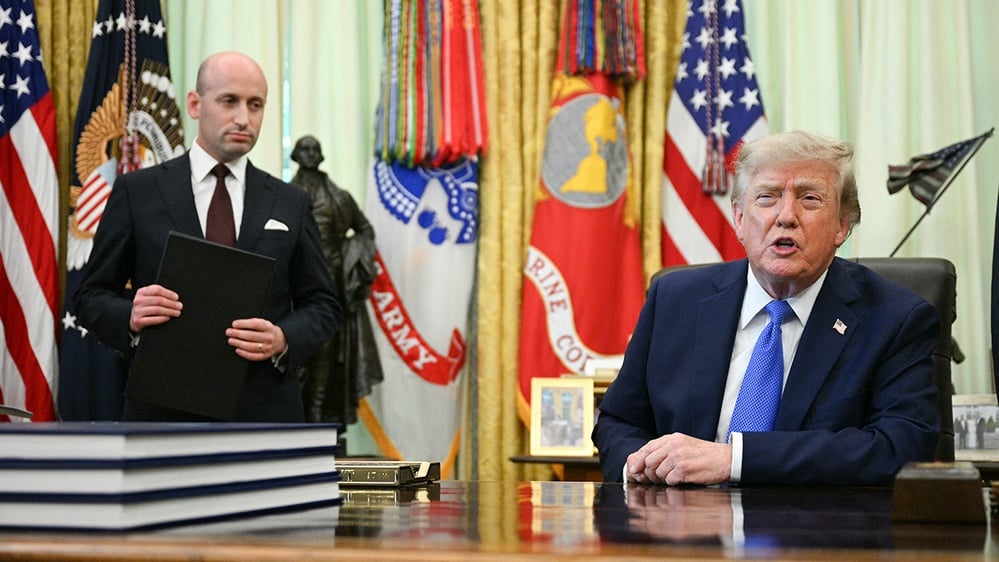
“Trump said in the White House Oval Office as he signed the new orders.” · exact text match
Why: The article attributes statements and uses neutral reporting verbs.
Claim: The article avoids sensationalism and uses measured language.
“US President Donald Trump on Thursday signed two executive orders to narrow birthright citizenship – a new effort by the administration following the Supreme Court's ruling against its previous order.” · exact text match
Why: The headline and lead are factual, not hyperbolic.
Claim: The article describes events and legal definitions without recommending actions.
“The other order expands the definitions of people ineligible for birthright citizenship, including children of foreign government employees, children of members of a designated Foreign Terrorist Organization, as well as children of people who engaged in fraudulent activity to obtain citizenship.” · exact text match
Why: The language is descriptive, listing terms without prescriptive language.
Claim: The article is political in subject matter, covering executive orders and Supreme Court rulings.
“Trump signs 2 executive orders to narrow birthright citizenship” · exact text match
Why: The content directly addresses a divisive political issue, but the reporting itself is neutral.
Claim: The article does not assert certainty beyond what is reported.
“Trump signed two executive orders to narrow birthright citizenship – a new effort by the administration” · not found in supplied text
Why: Uses 'signed' for a verifiable action and 'a new effort' as a descriptive label, not an overconfident prediction.
Claim: The article maintains a neutral emotional tone.
“The 14th Amendment of the US Constitution, ratified in 1868, states that...” · not found in supplied text
“Multiple lower courts had ruled in favor of the plaintiffs, and the executive order never took effect.” · exact text match
Why: No emotional language; the only emotional word ('unfortunate') is a direct quote from Trump.
Claim: The article is credible due to specific dates, court votes, and attributed quotes.
“On June 30, 2026, the Supreme Court – by a 6-3 vote – rejected Trump's executive order” · exact text match
Why: Provides specific numeric and temporal details that enhance verifiability.
Claim: The article uses factual language and avoids emotional appeals.
“One of the orders targets 'birth tourism,' which is defined as the entry of any foreigners into the United States via a nonimmigrant visa for the purpose of giving birth on US soil, or any effort by any foreigners to facilitate such entry, according to the White House.” · not found in supplied text
Why: The description is straightforward and definitional, not speculative or emotional.
Claim: The article appears to be written by a human, given natural variability and contextual details.
“The 14th Amendment of the US Constitution, ratified in 1868, states that...” · not found in supplied text
“On January 20, 2025 – the inauguration day of his second term – Trump signed an executive order” · exact text match
Why: Includes specific dates and a direct quote, which are typical of human reporting; no strong AI indicators.
Claim: The article demonstrates integrity through accurate and contextual reporting.
“The 14th Amendment of the US Constitution, ratified in 1868, states that 'all persons born or naturalized in the United States, and subject to the jurisdiction thereof, are citizens of the United States and of the state wherein they reside.'” · not found in supplied text
Why: Includes the full constitutional text and the timeline of legal challenges, showing fairness.
August 07, 2026 · 0 shares
Presents the executive orders and reactions from both sides with balanced sourcing and direct quotes, avoiding editorial comment.
Automated analysis; not human reviewed.
·
7 of 53 available dimensions scored; omitted dimensions are not treated as neutral.
·
Verified supporting quotes for 0 of 7 scored dimensions.
Claim: The article is neutral on the liberal-conservative spectrum.
“"We had a very unfortunate decision in the Supreme Court concerning birthright, it was close," Mr. Trump said...” · not found in supplied text
“"The Supreme Court already decided this issue: Birthright citizenship is guaranteed by the Constitution.
No additional executive order can change the meaning of the Constitution." Cody Wofsy, deputy director of the ACLU's Immigrants' Rights Project, said...”
· not found in supplied text
Why: The article gives equal weight to Trump's and the ACLU's positions without favoring either.
Claim: The article does not exhibit populist or elitist framing.
“Presents factual reporting of executive orders and legal responses without populist rhetoric or elitist dismissal.” · not found in supplied text
Why: No language that elevates 'the people' against elites or vice versa.
Claim: The article is highly objective, relying on direct quotes and factual reporting.
“Trump said in an Oval Office signing...” · not found in supplied text
“The Supreme Court ruled 6-3...” · not found in supplied text
“The American Civil Liberties Union condemned the executive order...” · not found in supplied text
Why: No editorial opinion; all claims are attributed to named sources or official documents.
Claim: The article is purely descriptive, describing events and statements without prescription.
“One of the orders lists out several categories of people who it says should not be granted citizenship documents...” · not found in supplied text
“The 14th Amendment, ratified in 1868, states...” · not found in supplied text
Why: Only reports actions, quotes, and legal text; does not advocate for any policy.
Claim: The article is about a political subject and is highly political in content.
“President Trump on Thursday signed two executive orders in his latest effort to refuse citizenship to some children born in the United States...” · not found in supplied text
“The Supreme Court ruled 6-3 that the president's first executive order... was unlawful...” · not found in supplied text
Why: The entire article covers a political conflict between the executive and judiciary, with political actors and implications.
Claim: The article demonstrates high credibility through transparent sourcing and attribution.
“Melissa Quinn contributed to this report.” · verified after text normalization
“"This was done right after the Civil War," Mr. Trump said Thursday.” · not found in supplied text
“Cody Wofsy, deputy director of the ACLU's Immigrants' Rights Project, said in a statement.” · exact text match
Why: All major claims are attributed to named individuals or official documents; no anonymous sources.
Claim: The article shows high integrity by including opposing viewpoints and not distorting.
“Includes direct quotes from Trump and Stephen Miller promoting the orders, as well as from the ACLU opposing them.” · not found in supplied text
“Quotes Chief Justice Roberts and the solicitor general during oral arguments.” · not found in supplied text
Why: Balanced representation of arguments without misrepresentation.
August 07, 2026 · 0 shares
Frames the executive orders as an expectedly unsuccessful attempt to narrow birthright citizenship.
The 14th Amendment to the US Constitution states that all persons born or naturalized in the United States and subject to its jurisdiction are citizens, a principle known as birthright citizenship.
The Supreme Court has historically interpreted this to include nearly all children born on US soil, with few exceptions such as children of foreign diplomats or enemy forces.
Automated analysis; not human reviewed.
Limitations: My knowledge that RT.com is a Russian state-funded outlet with a record of disseminating Kremlin-friendly narratives may influence my baseline credibility assessment, but the text alone appears to be a straightforward news report.
·
1 of 53 available dimensions scored; omitted dimensions are not treated as neutral.
·
Verified supporting quotes for 1 of 1 scored dimensions.
Claim: The article is heavily focused on political actions and legal challenges.
“US President Donald Trump has signed two executive orders seeking to restrict birthright citizenship, renewing his administration’s push to narrow the constitutional provision.” · exact text match
“Restricting birthright citizenship is an aspect of Trump’s broader immigration agenda, which was a central theme of his campaign for a second term.” · exact text match
Why: The entire article is about a political executive order, its constitutional context, and expected legal battles.
My knowledge that RT.com is a Russian state-funded outlet with a record of disseminating Kremlin-friendly narratives may influence my baseline credibility assessment, but the text alone appears to be a straightforward news report.
August 07, 2026 · 0 shares
Neutral factual reporting with balanced inclusion of Trump's statements and Democratic opposition.
The 14th Amendment grants citizenship to all persons born in the U.S. The Supreme Court in June ruled 6-3 that the president cannot unilaterally end birthright citizenship.
Automated analysis; not human reviewed.
·
4 of 53 available dimensions scored; omitted dimensions are not treated as neutral.
·
Verified supporting quotes for 1 of 4 scored dimensions.
Claim: The article presents a neutral balance between Trump's actions and Democratic criticism.
“Trump called that decision by the high court 'very unfair'” · not found in supplied text
“Sen.
Alex Padilla (D-Calif.) also responded on the platform, writing, 'Trump doesn’t understand the Constitution — but the 14th Amendment’s promise of birthright citizenship and equality speaks for itself.'”
· not found in supplied text
Why: Both Trump's own justification and direct quotes from Democratic opponents are included, showing no obvious partisan slant.
Claim: The article uses factual reporting with minimal subjective language, relying on direct quotes and legal references.
“Trump signed a pair of executive orders purporting to narrow it — including by cracking down on 'birth tourism' and limiting which children born to immigrants in the U.S. qualify.” · not found in supplied text
“The orders were immediately criticized by proponents of birthright citizenship as an indefensible attempt by the president and his administration to make an end run around the Supreme Court’s clear finding” · exact text match
Why: The language is descriptive; the criticism is attributed to proponents, not stated as fact.
No editorializing by the publisher.
Claim: The article is highly political in content, focusing on a partisan conflict over constitutional interpretation.
“Trump's continued crusade to end birthright citizenship is blatantly illegal” · not found in supplied text
“Senate Minority Leader Chuck Schumer (D-N.Y.) said in a statement” · exact text match
Why: The entire report centers on a dispute between the president and Democratic officials, with legal and constitutional arguments, making it inherently political.
Claim: The article is credible, with named sources, direct quotes, and reference to specific court rulings.
“In its 6-3 decision in June, the Supreme Court rejected Trump’s first order” · exact text match
“A spokesperson for California Atty.
Gen.
Rob Bonta’s office”
· exact text match
Why: The article provides explicit citations to the Supreme Court decision, quotes from named officials, and references to specific legal provisions.
August 07, 2026 · 0 shares
Neutral factual reporting of executive actions and legal context, with direct quotes from Trump.
Automated analysis; not human reviewed.
·
13 of 53 available dimensions scored; omitted dimensions are not treated as neutral.
·
Verified supporting quotes for 7 of 13 scored dimensions.
Claim: The article shows balanced reporting without partisan slant.
“The Supreme Court – by a 6-3 vote – rejected Trump's executive order denying birthright citizenship to children of undocumented immigrants or temporary residents, upholding birthright citizenship.” · not found in supplied text
Why: The article reports both Trump's action and the court's rejection without editorializing.
Claim: The article presents facts and direct quotes without subjective commentary.
“Trump said in the White House Oval Office as he signed the new orders.” · exact text match
Why: The article attributes statements and uses neutral reporting verbs.
Claim: The article avoids sensationalism and uses measured language.
“US President Donald Trump on Thursday signed two executive orders to narrow birthright citizenship – a new effort by the administration following the Supreme Court's ruling against its previous order.” · exact text match
Why: The headline and lead are factual, not hyperbolic.
Claim: The article describes events and legal definitions without recommending actions.
“The other order expands the definitions of people ineligible for birthright citizenship, including children of foreign government employees, children of members of a designated Foreign Terrorist Organization, as well as children of people who engaged in fraudulent activity to obtain citizenship.” · exact text match
Why: The language is descriptive, listing terms without prescriptive language.
Claim: The article is political in subject matter, covering executive orders and Supreme Court rulings.
“Trump signs 2 executive orders to narrow birthright citizenship” · exact text match
Why: The content directly addresses a divisive political issue, but the reporting itself is neutral.
Claim: The article does not assert certainty beyond what is reported.
“Trump signed two executive orders to narrow birthright citizenship – a new effort by the administration” · not found in supplied text
Why: Uses 'signed' for a verifiable action and 'a new effort' as a descriptive label, not an overconfident prediction.
Claim: The article maintains a neutral emotional tone.
“The 14th Amendment of the US Constitution, ratified in 1868, states that...” · not found in supplied text
“Multiple lower courts had ruled in favor of the plaintiffs, and the executive order never took effect.” · exact text match
Why: No emotional language; the only emotional word ('unfortunate') is a direct quote from Trump.
Claim: The article is credible due to specific dates, court votes, and attributed quotes.
“On June 30, 2026, the Supreme Court – by a 6-3 vote – rejected Trump's executive order” · exact text match
Why: Provides specific numeric and temporal details that enhance verifiability.
Claim: The article uses factual language and avoids emotional appeals.
“One of the orders targets 'birth tourism,' which is defined as the entry of any foreigners into the United States via a nonimmigrant visa for the purpose of giving birth on US soil, or any effort by any foreigners to facilitate such entry, according to the White House.” · not found in supplied text
Why: The description is straightforward and definitional, not speculative or emotional.
Claim: The article appears to be written by a human, given natural variability and contextual details.
“The 14th Amendment of the US Constitution, ratified in 1868, states that...” · not found in supplied text
“On January 20, 2025 – the inauguration day of his second term – Trump signed an executive order” · exact text match
Why: Includes specific dates and a direct quote, which are typical of human reporting; no strong AI indicators.
Claim: The article demonstrates integrity through accurate and contextual reporting.
“The 14th Amendment of the US Constitution, ratified in 1868, states that 'all persons born or naturalized in the United States, and subject to the jurisdiction thereof, are citizens of the United States and of the state wherein they reside.'” · not found in supplied text
Why: Includes the full constitutional text and the timeline of legal challenges, showing fairness.
August 07, 2026 · 0 shares
Presents the executive orders and reactions from both sides with balanced sourcing and direct quotes, avoiding editorial comment.
Automated analysis; not human reviewed.
·
7 of 53 available dimensions scored; omitted dimensions are not treated as neutral.
·
Verified supporting quotes for 0 of 7 scored dimensions.
Claim: The article is neutral on the liberal-conservative spectrum.
“"We had a very unfortunate decision in the Supreme Court concerning birthright, it was close," Mr. Trump said...” · not found in supplied text
“"The Supreme Court already decided this issue: Birthright citizenship is guaranteed by the Constitution.
No additional executive order can change the meaning of the Constitution." Cody Wofsy, deputy director of the ACLU's Immigrants' Rights Project, said...”
· not found in supplied text
Why: The article gives equal weight to Trump's and the ACLU's positions without favoring either.
Claim: The article does not exhibit populist or elitist framing.
“Presents factual reporting of executive orders and legal responses without populist rhetoric or elitist dismissal.” · not found in supplied text
Why: No language that elevates 'the people' against elites or vice versa.
Claim: The article is highly objective, relying on direct quotes and factual reporting.
“Trump said in an Oval Office signing...” · not found in supplied text
“The Supreme Court ruled 6-3...” · not found in supplied text
“The American Civil Liberties Union condemned the executive order...” · not found in supplied text
Why: No editorial opinion; all claims are attributed to named sources or official documents.
Claim: The article is purely descriptive, describing events and statements without prescription.
“One of the orders lists out several categories of people who it says should not be granted citizenship documents...” · not found in supplied text
“The 14th Amendment, ratified in 1868, states...” · not found in supplied text
Why: Only reports actions, quotes, and legal text; does not advocate for any policy.
Claim: The article is about a political subject and is highly political in content.
“President Trump on Thursday signed two executive orders in his latest effort to refuse citizenship to some children born in the United States...” · not found in supplied text
“The Supreme Court ruled 6-3 that the president's first executive order... was unlawful...” · not found in supplied text
Why: The entire article covers a political conflict between the executive and judiciary, with political actors and implications.
Claim: The article demonstrates high credibility through transparent sourcing and attribution.
“Melissa Quinn contributed to this report.” · verified after text normalization
“"This was done right after the Civil War," Mr. Trump said Thursday.” · not found in supplied text
“Cody Wofsy, deputy director of the ACLU's Immigrants' Rights Project, said in a statement.” · exact text match
Why: All major claims are attributed to named individuals or official documents; no anonymous sources.
Claim: The article shows high integrity by including opposing viewpoints and not distorting.
“Includes direct quotes from Trump and Stephen Miller promoting the orders, as well as from the ACLU opposing them.” · not found in supplied text
“Quotes Chief Justice Roberts and the solicitor general during oral arguments.” · not found in supplied text
Why: Balanced representation of arguments without misrepresentation.
August 06, 2026 · 0 shares
The framing strongly supports Trump's executive orders as necessary corrections to systemic abuses, using official quotes and no opposing perspectives.
Automated analysis; not human reviewed.
·
12 of 53 available dimensions scored; omitted dimensions are not treated as neutral.
·
Verified supporting quotes for 0 of 12 scored dimensions.
Claim: The framing is strongly conservative, supporting Trump's immigration actions without criticism.
“Trump called the Supreme Court decision 'very unfortunate' and 'very unfair'” · not found in supplied text
“Miller called birth tourism 'one of the gravest and most egregious abuses'” · not found in supplied text
Why: The article exclusively quotes Trump and officials praising the orders, uses emotionally loaded language against the prior policy, and omits any opposing views.
Claim: The framing appeals to common sense and anti-elite sentiment by portraying birth tourism as a fraudulent abuse of the system.
“Miller said 'people come here pretending to be a tourist... the real reason they’re here is to have a child'” · not found in supplied text
“Miller referred to 'this broken system'” · not found in supplied text
Why: The article presents the orders as correcting a loophole exploited by outsiders, using language that resonates with populist distrust of immigration systems.
Claim: The article is highly subjective, presenting only the administration's perspective and using value-laden quotes.
“The article does not include any counterarguments or independent analysis” · not found in supplied text
“Miller's statement 'this practice is hereby banned' is presented as factual” · not found in supplied text
Why: The entire article is a one-sided narrative of the administration's actions and justifications, lacking any critical or neutral reporting.
Claim: The article uses sensational language to describe the immigration issue.
“Miller said 'grave and most egregious abuses'” · not found in supplied text
“Trump said 'very unfortunate decision' and 'very unfair'” · not found in supplied text
Why: The quotes chosen emphasize drama and moral outrage, going beyond neutral reporting.
Claim: The article is prescriptive, advocating for the orders as necessary and good.
“Miller said 'this practice is hereby banned' and 'it keeps American citizenship sacred'” · not found in supplied text
“The article frames the orders as corrections to 'abuses'” · not found in supplied text
Why: The article does not merely describe; it presents the orders as justified and beneficial, using proponents' statements to endorse them.
Claim: The article reflects a hawkish stance on immigration, supporting strict enforcement and limiting citizenship.
“Miller said 'it keeps American citizenship sacred'” · not found in supplied text
“The orders end birth tourism and expand exceptions to birthright citizenship” · not found in supplied text
Why: The article portrays the orders as necessary to protect national sovereignty and prevent fraud, consistent with hawkish immigration policy.
Claim: The article is highly political, focusing on a partisan executive action and its justification.
“The entire article is about Trump's executive orders and officials' political statements” · not found in supplied text
“No mention of non-political aspects” · not found in supplied text
Why: The content is exclusively about a political issue and the administration's actions, with clear partisan alignment.
Claim: The article relies heavily on statements from Trump, Miller, Scharf, and Lutnick as authoritative support.
“Each major claim is supported by a direct quote from an official” · not found in supplied text
“No independent experts or sources are cited” · not found in supplied text
Why: The article builds its entire case on the authority of the administration figures, presenting their words as unassailable fact.
Claim: The article expresses certainty beyond the evidence, presenting the orders as definitively correct.
“Miller said 'I would put this in the top three in terms of importance'” · not found in supplied text
“No caveats or uncertainties are mentioned” · not found in supplied text
Why: The article asserts the effectiveness and necessity of the orders without acknowledging legal challenges, implementation difficulties, or opposing views.
Claim: The article is ideologically conservative, reflecting a consistent right-wing perspective on immigration and executive power.
“The article supports limiting birthright citizenship and ending birth tourism” · not found in supplied text
“Quotes emphasize national sovereignty and anti-immigration sentiment” · not found in supplied text
Why: The entire framing aligns with conservative ideology, with no attempt to present alternative viewpoints or nuanced analysis.
Claim: The article uses manipulative techniques by omitting counterarguments and using loaded language.
“No opposing views or legal analysis are presented” · not found in supplied text
“Miller's description of 'broken system' and 'egregious abuses' is emotionally charged” · not found in supplied text
Why: The article selectively presents only the administration's narrative, shaping reader perception through omission and emotional rhetoric.
Claim: The article scapegoats birth tourists, portraying them as fraudulent and abusive.
“Miller said 'people come here pretending to be a tourist... the real reason they’re here is to have a child'” · not found in supplied text
“Miller called it 'fraudulent purpose'” · not found in supplied text
Why: The article singles out birth tourists as a group exploiting the system, using negative generalizations without evidence of widespread fraud.
August 06, 2026 · 0 shares
A balanced, objective report that frames the birth tourism executive orders within the Trump administration's broader immigration crackdown while acknowledging data gaps and attributed sources.
The U.S. Constitution's 14th Amendment generally grants citizenship to anyone born in the United States; 'birth tourism' is the practice of traveling to the U.S. specifically to give birth so the child obtains American citizenship.
Automated analysis; not human reviewed.
Limitations: The supplied text includes residual headlines for unrelated stories without content, which limits contextual assessment; the analysis focuses on the birth-tourism portion.
·
8 of 53 available dimensions scored; omitted dimensions are not treated as neutral.
·
Verified supporting quotes for 5 of 8 scored dimensions.
Claim: The report presents the executive action and surrounding estimates without endorsing a political side.
“There are no official figures tallying the number of foreigners who come to the US for the explicit purpose of giving birth and obtaining citizenship for their children, or the cost to taxpayers.” · exact text match
“The Center for Immigration Studies, which supports lower levels of immigration, estimated in an analysis in 2020 that between 20,000-25,000 mothers came to the US for birth tourism in a year-long period between 2016-2017.” · exact text match
Why: The article includes the lack of official data and attributes the estimate to a group explicitly described as supporting lower immigration, indicating a balanced presentation.
Claim: The reporting is factual and relies on attributed information rather than opinion.
“US President Donald Trump signed two executive orders on Thursday aimed at denying citizenship to children born in the United States because of commercial "birth tourism."” · not found in supplied text
“An earlier effort by Trump was rejected by the Supreme Court in June, prompting him to call upon Congress to act.” · exact text match
Why: The sentences present verifiable events and decisions without evaluative language.
Claim: The article uses restrained, matter-of-fact language and avoids dramatic or emotive presentation.
“Trump is also seeking to deny birthright citizenship for children born of some foreign diplomatic staff in the US and, potentially, US territories in the future, according to an Axios report.” · exact text match
“People who engage in birth tourism schemes could be prosecuted for fraud or other related crimes.” · exact text match
Why: These statements are clinical and legalistic, without sensational vocabulary.
Claim: The report describes actions and regulations without recommending a course of action.
“No US law outright bars birth tourism, but a federal regulation implemented in 2020 during Trump’s first term prohibits using temporary tourist and business \for the primary purpose of obtaining U.S. citizenship for a newborn.” · not found in supplied text
“There are no official figures tallying the number of foreigners who come to the US for the explicit purpose of giving birth and obtaining citizenship for their children, or the cost to taxpayers.” · exact text match
Why: The article merely states what the law and regulations are, and notes data gaps, without prescribing policy.
Claim: The article focuses on a contentious political issue and places it within the administration's enforcement agenda.
“Limiting birthright citizenship has been one of the top priorities in the Republican president's crackdown on immigration.” · exact text match
“An earlier effort by Trump was rejected by the Supreme Court in June, prompting him to call upon Congress to act.” · exact text match
Why: The framing explicitly ties the executive orders to a partisan priority and government action.
Claim: The article maintains an unemotional, dispassionate tone.
“US President Donald Trump signed two executive orders on Thursday aimed at denying citizenship to children born in the United States because of commercial "birth tourism."” · not found in supplied text
“The Center for Immigration Studies, which supports lower levels of immigration, estimated in an analysis in 2020 that between 20,000-25,000 mothers came to the US for birth tourism in a year-long period between 2016-2017.” · exact text match
Why: The language is neutral and does not convey emotion.
Claim: The article is credible because it relies on authoritative sources and precise attribution.
“according to an Axios report.” · exact text match
“An earlier effort by Trump was rejected by the Supreme Court in June, prompting him to call upon Congress to act.” · exact text match
Why: The inclusion of the Supreme Court action and the Axios attribution demonstrate sourcing.
Claim: The article demonstrates fairness by acknowledging missing data and attributed estimates.
“There are no official figures tallying the number of foreigners who come to the US for the explicit purpose of giving birth and obtaining citizenship for their children, or the cost to taxpayers.” · exact text match
“The Center for Immigration Studies, which supports lower levels of immigration, estimated in an analysis in 2020 that between 20,000-25,000 mothers came to the US for birth tourism in a year-long period between 2016-2017.” · exact text match
Why: The article transparently notes the absence of official statistics and identifies the source and its stance.
The supplied text includes residual headlines for unrelated stories without content, which limits contextual assessment; the analysis focuses on the birth-tourism portion.
August 06, 2026 · 0 shares
Frames Trump's executive orders as a necessary response to an unjust Supreme Court decision and a 'disgraceful' abuse of the system, using supportive quotes from Trump and Miller without presenting opposing viewpoints.
The 14th Amendment's citizenship clause generally grants automatic citizenship to all persons born in the U.S. The Supreme Court case Trump v. Barbara (or similar) reaffirmed this interpretation in June.
Automated analysis; not human reviewed. Limitations: The article text contains embedded HTML and promotional content, making it difficult to isolate the core news article from surrounding ads and trending list. Analysis is based on the substantive news paragraphs. · 6 of 53 available dimensions scored; omitted dimensions are not treated as neutral. · Verified supporting quotes for 2 of 6 scored dimensions.
Claim: The article presents Trump's actions as a justified response to an unfavorable Supreme Court decision, using only supportive quotes and no opposing views.
“We had a very unfortunate decision in the Supreme Court concerning birthright [citizenship] … so we’re making adjustments” · exact text match
“It's a disgrace” · verified after text normalization
“one of the gravest and most egregious abuses of the American system” · exact text match
Why: The article selectively quotes Trump and Miller criticizing the Supreme Court and birth tourism without any countering perspectives or legal analysis, indicating a conservative framing.
Claim: The article includes Trump's populist rhetoric against wealthy individuals exploiting birthright citizenship.
“People are building businesses around it, from—wealthy people are building businesses around birthright citizenship. That’s not the way it’s supposed to work. It’s a disgrace.” · not found in supplied text
“They’re buying their way in, and we’re not going to let it happen.” · exact text match
Why: Trump's language targets wealthy elites and portrays birth tourism as a corrupt system, which the article reports without qualification, aligning with a populist stance.
Claim: The article presents executive orders restricting constitutional rights as legitimate without questioning executive power.
“President Donald Trump signed two executive orders on Thursday aimed at limiting birthright citizenship” · exact text match
“The second order directs the secretaries of state and homeland security to end the practice of birth tourism” · exact text match
Why: The article reports the orders as straightforward policy actions and does not discuss limits on executive authority or potential constitutional conflicts, implying acceptance of authoritarian measures.
Claim: The article includes a prescriptive statement from Miller regarding the sacredness of citizenship.
“What that means is that no one in the world is anymore allowed to obtain a visa for this fraudulent purpose ... it keeps American citizenship sacred.” · not found in supplied text
Why: While largely descriptive, the inclusion of Miller's value-laden prescription ('keeps American citizenship sacred') introduces a prescriptive element.
Claim: The article is heavily political, covering a partisan executive action with strong political rhetoric.
“Trump ... said 'We had a very unfortunate decision in the Supreme Court concerning birthright [citizenship]'” · not found in supplied text
“Stephen Miller said birth tourism is banned under the order, calling the practice 'one of the gravest and most egregious abuses of the American system'” · not found in supplied text
Why: The entire article focuses on a politically charged immigration policy and uses partisan language from Trump and Miller, making it highly political.
Claim: The article omits any opposing viewpoints, legal analysis, or criticism of the executive orders, lowering its integrity.
“No counterargument or expert commentary is included in the article.” · not found in supplied text
Why: By presenting only supportive quotes and no alternative perspectives, the article fails to provide balanced reporting, which is a dimension of integrity.
The article text contains embedded HTML and promotional content, making it difficult to isolate the core news article from surrounding ads and trending list. Analysis is based on the substantive news paragraphs.
August 07, 2026 · 0 shares
Neutral factual reporting of executive actions and legal context, with direct quotes from Trump.
Automated analysis; not human reviewed. · 13 of 53 available dimensions scored; omitted dimensions are not treated as neutral. · Verified supporting quotes for 7 of 13 scored dimensions.
Claim: The article shows balanced reporting without partisan slant.
“The Supreme Court – by a 6-3 vote – rejected Trump's executive order denying birthright citizenship to children of undocumented immigrants or temporary residents, upholding birthright citizenship.” · not found in supplied text
Why: The article reports both Trump's action and the court's rejection without editorializing.
Claim: The article presents facts and direct quotes without subjective commentary.
“Trump said in the White House Oval Office as he signed the new orders.” · exact text match
Why: The article attributes statements and uses neutral reporting verbs.
Claim: The article avoids sensationalism and uses measured language.
“US President Donald Trump on Thursday signed two executive orders to narrow birthright citizenship – a new effort by the administration following the Supreme Court's ruling against its previous order.” · exact text match
Why: The headline and lead are factual, not hyperbolic.
Claim: The article describes events and legal definitions without recommending actions.
“The other order expands the definitions of people ineligible for birthright citizenship, including children of foreign government employees, children of members of a designated Foreign Terrorist Organization, as well as children of people who engaged in fraudulent activity to obtain citizenship.” · exact text match
Why: The language is descriptive, listing terms without prescriptive language.
Claim: The article is political in subject matter, covering executive orders and Supreme Court rulings.
“Trump signs 2 executive orders to narrow birthright citizenship” · exact text match
Why: The content directly addresses a divisive political issue, but the reporting itself is neutral.
Claim: The article does not assert certainty beyond what is reported.
“Trump signed two executive orders to narrow birthright citizenship – a new effort by the administration” · not found in supplied text
Why: Uses 'signed' for a verifiable action and 'a new effort' as a descriptive label, not an overconfident prediction.
Claim: The article maintains a neutral emotional tone.
“The 14th Amendment of the US Constitution, ratified in 1868, states that...” · not found in supplied text
“Multiple lower courts had ruled in favor of the plaintiffs, and the executive order never took effect.” · exact text match
Why: No emotional language; the only emotional word ('unfortunate') is a direct quote from Trump.
Claim: The article is credible due to specific dates, court votes, and attributed quotes.
“On June 30, 2026, the Supreme Court – by a 6-3 vote – rejected Trump's executive order” · exact text match
Why: Provides specific numeric and temporal details that enhance verifiability.
Claim: The article uses factual language and avoids emotional appeals.
“One of the orders targets 'birth tourism,' which is defined as the entry of any foreigners into the United States via a nonimmigrant visa for the purpose of giving birth on US soil, or any effort by any foreigners to facilitate such entry, according to the White House.” · not found in supplied text
Why: The description is straightforward and definitional, not speculative or emotional.
Claim: The article appears to be written by a human, given natural variability and contextual details.
“The 14th Amendment of the US Constitution, ratified in 1868, states that...” · not found in supplied text
“On January 20, 2025 – the inauguration day of his second term – Trump signed an executive order” · exact text match
Why: Includes specific dates and a direct quote, which are typical of human reporting; no strong AI indicators.
Claim: The article demonstrates integrity through accurate and contextual reporting.
“The 14th Amendment of the US Constitution, ratified in 1868, states that 'all persons born or naturalized in the United States, and subject to the jurisdiction thereof, are citizens of the United States and of the state wherein they reside.'” · not found in supplied text
Why: Includes the full constitutional text and the timeline of legal challenges, showing fairness.
August 07, 2026 · 0 shares
Presents the executive orders and reactions from both sides with balanced sourcing and direct quotes, avoiding editorial comment.
Automated analysis; not human reviewed. · 7 of 53 available dimensions scored; omitted dimensions are not treated as neutral. · Verified supporting quotes for 0 of 7 scored dimensions.
Claim: The article is neutral on the liberal-conservative spectrum.
“"We had a very unfortunate decision in the Supreme Court concerning birthright, it was close," Mr. Trump said...” · not found in supplied text
“"The Supreme Court already decided this issue: Birthright citizenship is guaranteed by the Constitution. No additional executive order can change the meaning of the Constitution." Cody Wofsy, deputy director of the ACLU's Immigrants' Rights Project, said...” · not found in supplied text
Why: The article gives equal weight to Trump's and the ACLU's positions without favoring either.
Claim: The article does not exhibit populist or elitist framing.
“Presents factual reporting of executive orders and legal responses without populist rhetoric or elitist dismissal.” · not found in supplied text
Why: No language that elevates 'the people' against elites or vice versa.
Claim: The article is highly objective, relying on direct quotes and factual reporting.
“Trump said in an Oval Office signing...” · not found in supplied text
“The Supreme Court ruled 6-3...” · not found in supplied text
“The American Civil Liberties Union condemned the executive order...” · not found in supplied text
Why: No editorial opinion; all claims are attributed to named sources or official documents.
Claim: The article is purely descriptive, describing events and statements without prescription.
“One of the orders lists out several categories of people who it says should not be granted citizenship documents...” · not found in supplied text
“The 14th Amendment, ratified in 1868, states...” · not found in supplied text
Why: Only reports actions, quotes, and legal text; does not advocate for any policy.
Claim: The article is about a political subject and is highly political in content.
“President Trump on Thursday signed two executive orders in his latest effort to refuse citizenship to some children born in the United States...” · not found in supplied text
“The Supreme Court ruled 6-3 that the president's first executive order... was unlawful...” · not found in supplied text
Why: The entire article covers a political conflict between the executive and judiciary, with political actors and implications.
Claim: The article demonstrates high credibility through transparent sourcing and attribution.
“Melissa Quinn contributed to this report.” · verified after text normalization
“"This was done right after the Civil War," Mr. Trump said Thursday.” · not found in supplied text
“Cody Wofsy, deputy director of the ACLU's Immigrants' Rights Project, said in a statement.” · exact text match
Why: All major claims are attributed to named individuals or official documents; no anonymous sources.
Claim: The article shows high integrity by including opposing viewpoints and not distorting.
“Includes direct quotes from Trump and Stephen Miller promoting the orders, as well as from the ACLU opposing them.” · not found in supplied text
“Quotes Chief Justice Roberts and the solicitor general during oral arguments.” · not found in supplied text
Why: Balanced representation of arguments without misrepresentation.
August 07, 2026 · 0 shares
Neutral factual reporting with balanced inclusion of Trump's statements and Democratic opposition.
The 14th Amendment grants citizenship to all persons born in the U.S. The Supreme Court in June ruled 6-3 that the president cannot unilaterally end birthright citizenship.
Automated analysis; not human reviewed. · 4 of 53 available dimensions scored; omitted dimensions are not treated as neutral. · Verified supporting quotes for 1 of 4 scored dimensions.
Claim: The article presents a neutral balance between Trump's actions and Democratic criticism.
“Trump called that decision by the high court 'very unfair'” · not found in supplied text
“Sen. Alex Padilla (D-Calif.) also responded on the platform, writing, 'Trump doesn’t understand the Constitution — but the 14th Amendment’s promise of birthright citizenship and equality speaks for itself.'” · not found in supplied text
Why: Both Trump's own justification and direct quotes from Democratic opponents are included, showing no obvious partisan slant.
Claim: The article uses factual reporting with minimal subjective language, relying on direct quotes and legal references.
“Trump signed a pair of executive orders purporting to narrow it — including by cracking down on 'birth tourism' and limiting which children born to immigrants in the U.S. qualify.” · not found in supplied text
“The orders were immediately criticized by proponents of birthright citizenship as an indefensible attempt by the president and his administration to make an end run around the Supreme Court’s clear finding” · exact text match
Why: The language is descriptive; the criticism is attributed to proponents, not stated as fact. No editorializing by the publisher.
Claim: The article is highly political in content, focusing on a partisan conflict over constitutional interpretation.
“Trump's continued crusade to end birthright citizenship is blatantly illegal” · not found in supplied text
“Senate Minority Leader Chuck Schumer (D-N.Y.) said in a statement” · exact text match
Why: The entire report centers on a dispute between the president and Democratic officials, with legal and constitutional arguments, making it inherently political.
Claim: The article is credible, with named sources, direct quotes, and reference to specific court rulings.
“In its 6-3 decision in June, the Supreme Court rejected Trump’s first order” · exact text match
“A spokesperson for California Atty. Gen. Rob Bonta’s office” · exact text match
Why: The article provides explicit citations to the Supreme Court decision, quotes from named officials, and references to specific legal provisions.
August 07, 2026 · 0 shares
Presents Trump's actions and quotes without challenge, but includes context of prior Supreme Court ruling that struck down similar effort.
Automated analysis; not human reviewed. Limitations: Article text is a short excerpt; full context of framing and editorial choices unavailable. · 5 of 53 available dimensions scored; omitted dimensions are not treated as neutral. · Verified supporting quotes for 3 of 5 scored dimensions.
Claim: The publisher frames the event neutrally, balancing Trump's statements with factual context.
“Trump signed two executive orders on Thursday aimed at further restricting birthright citizenship.” · exact text match
“Supreme Court struck down his previous effort to restrict the constitutionally granted right.” · exact text match
Why: Both statements are factual and presented without evaluative language.
Claim: The article maintains an objective tone through attribution and factual description.
“One of the orders targets 'birth tourism,' defined as the entry of any foreign national into the US on a nonimmigrant visa for the purpose of giving birth on US soil, or any effort by foreigners to facilitate such entry, according to the White House.” · not found in supplied text
Why: The use of 'according to the White House' and factual definitions indicates objectivity.
Claim: The publisher does not express opinion; all evaluative language is attributed.
“It's a disgrace, Trump said after signing an order banning birthright citizenship for children born to temporary visitors in the US.” · not found in supplied text
Why: The only opinionated statement is a direct quote from Trump.
Claim: The article reports on a political action without taking a partisan stance.
“Trump signed two executive orders on Thursday aimed at further restricting birthright citizenship.” · exact text match
Why: The description is purely factual and focuses on the action itself.
Claim: The article uses clear attribution and direct quotes, enhancing credibility.
“according to the White House” · exact text match
“Trump told journalists in the Oval Office” · exact text match
Why: Attribution to sources and direct quotes support trustworthiness.
Article text is a short excerpt; full context of framing and editorial choices unavailable.
August 07, 2026 · 0 shares
Neutral factual reporting of executive actions and legal context, with direct quotes from Trump.
Automated analysis; not human reviewed. · 13 of 53 available dimensions scored; omitted dimensions are not treated as neutral. · Verified supporting quotes for 7 of 13 scored dimensions.
Claim: The article shows balanced reporting without partisan slant.
“The Supreme Court – by a 6-3 vote – rejected Trump's executive order denying birthright citizenship to children of undocumented immigrants or temporary residents, upholding birthright citizenship.” · not found in supplied text
Why: The article reports both Trump's action and the court's rejection without editorializing.
Claim: The article presents facts and direct quotes without subjective commentary.
“Trump said in the White House Oval Office as he signed the new orders.” · exact text match
Why: The article attributes statements and uses neutral reporting verbs.
Claim: The article avoids sensationalism and uses measured language.
“US President Donald Trump on Thursday signed two executive orders to narrow birthright citizenship – a new effort by the administration following the Supreme Court's ruling against its previous order.” · exact text match
Why: The headline and lead are factual, not hyperbolic.
Claim: The article describes events and legal definitions without recommending actions.
“The other order expands the definitions of people ineligible for birthright citizenship, including children of foreign government employees, children of members of a designated Foreign Terrorist Organization, as well as children of people who engaged in fraudulent activity to obtain citizenship.” · exact text match
Why: The language is descriptive, listing terms without prescriptive language.
Claim: The article is political in subject matter, covering executive orders and Supreme Court rulings.
“Trump signs 2 executive orders to narrow birthright citizenship” · exact text match
Why: The content directly addresses a divisive political issue, but the reporting itself is neutral.
Claim: The article does not assert certainty beyond what is reported.
“Trump signed two executive orders to narrow birthright citizenship – a new effort by the administration” · not found in supplied text
Why: Uses 'signed' for a verifiable action and 'a new effort' as a descriptive label, not an overconfident prediction.
Claim: The article maintains a neutral emotional tone.
“The 14th Amendment of the US Constitution, ratified in 1868, states that...” · not found in supplied text
“Multiple lower courts had ruled in favor of the plaintiffs, and the executive order never took effect.” · exact text match
Why: No emotional language; the only emotional word ('unfortunate') is a direct quote from Trump.
Claim: The article is credible due to specific dates, court votes, and attributed quotes.
“On June 30, 2026, the Supreme Court – by a 6-3 vote – rejected Trump's executive order” · exact text match
Why: Provides specific numeric and temporal details that enhance verifiability.
Claim: The article uses factual language and avoids emotional appeals.
“One of the orders targets 'birth tourism,' which is defined as the entry of any foreigners into the United States via a nonimmigrant visa for the purpose of giving birth on US soil, or any effort by any foreigners to facilitate such entry, according to the White House.” · not found in supplied text
Why: The description is straightforward and definitional, not speculative or emotional.
Claim: The article appears to be written by a human, given natural variability and contextual details.
“The 14th Amendment of the US Constitution, ratified in 1868, states that...” · not found in supplied text
“On January 20, 2025 – the inauguration day of his second term – Trump signed an executive order” · exact text match
Why: Includes specific dates and a direct quote, which are typical of human reporting; no strong AI indicators.
Claim: The article demonstrates integrity through accurate and contextual reporting.
“The 14th Amendment of the US Constitution, ratified in 1868, states that 'all persons born or naturalized in the United States, and subject to the jurisdiction thereof, are citizens of the United States and of the state wherein they reside.'” · not found in supplied text
Why: Includes the full constitutional text and the timeline of legal challenges, showing fairness.
August 07, 2026 · 0 shares
Presents the executive orders and reactions from both sides with balanced sourcing and direct quotes, avoiding editorial comment.
Automated analysis; not human reviewed. · 7 of 53 available dimensions scored; omitted dimensions are not treated as neutral. · Verified supporting quotes for 0 of 7 scored dimensions.
Claim: The article is neutral on the liberal-conservative spectrum.
“"We had a very unfortunate decision in the Supreme Court concerning birthright, it was close," Mr. Trump said...” · not found in supplied text
“"The Supreme Court already decided this issue: Birthright citizenship is guaranteed by the Constitution. No additional executive order can change the meaning of the Constitution." Cody Wofsy, deputy director of the ACLU's Immigrants' Rights Project, said...” · not found in supplied text
Why: The article gives equal weight to Trump's and the ACLU's positions without favoring either.
Claim: The article does not exhibit populist or elitist framing.
“Presents factual reporting of executive orders and legal responses without populist rhetoric or elitist dismissal.” · not found in supplied text
Why: No language that elevates 'the people' against elites or vice versa.
Claim: The article is highly objective, relying on direct quotes and factual reporting.
“Trump said in an Oval Office signing...” · not found in supplied text
“The Supreme Court ruled 6-3...” · not found in supplied text
“The American Civil Liberties Union condemned the executive order...” · not found in supplied text
Why: No editorial opinion; all claims are attributed to named sources or official documents.
Claim: The article is purely descriptive, describing events and statements without prescription.
“One of the orders lists out several categories of people who it says should not be granted citizenship documents...” · not found in supplied text
“The 14th Amendment, ratified in 1868, states...” · not found in supplied text
Why: Only reports actions, quotes, and legal text; does not advocate for any policy.
Claim: The article is about a political subject and is highly political in content.
“President Trump on Thursday signed two executive orders in his latest effort to refuse citizenship to some children born in the United States...” · not found in supplied text
“The Supreme Court ruled 6-3 that the president's first executive order... was unlawful...” · not found in supplied text
Why: The entire article covers a political conflict between the executive and judiciary, with political actors and implications.
Claim: The article demonstrates high credibility through transparent sourcing and attribution.
“Melissa Quinn contributed to this report.” · verified after text normalization
“"This was done right after the Civil War," Mr. Trump said Thursday.” · not found in supplied text
“Cody Wofsy, deputy director of the ACLU's Immigrants' Rights Project, said in a statement.” · exact text match
Why: All major claims are attributed to named individuals or official documents; no anonymous sources.
Claim: The article shows high integrity by including opposing viewpoints and not distorting.
“Includes direct quotes from Trump and Stephen Miller promoting the orders, as well as from the ACLU opposing them.” · not found in supplied text
“Quotes Chief Justice Roberts and the solicitor general during oral arguments.” · not found in supplied text
Why: Balanced representation of arguments without misrepresentation.
August 04, 2026 · 0 shares
Frames the Supreme Court ruling as a decisive, final defeat of Trump's 'crusade' to end birthright citizenship, emphasizing the constitutional basis and Trump's incorrect claims.
Automated analysis; not human reviewed. · 14 of 53 available dimensions scored; omitted dimensions are not treated as neutral. · Verified supporting quotes for 14 of 14 scored dimensions.
Claim: The article exhibits a liberal bias by using dismissive language toward Trump and positive framing of the Supreme Court ruling.
“puts final nail in coffin of Trump's long-shot demand” · exact text match
“signature crusades” · exact text match
“ultra-conservative wing” · exact text match
Why: Descriptive phrases such as 'final nail in coffin' and 'signature crusades' carry a dismissive tone toward Trump, while labeling dissenting justices as 'ultra-conservative' signals a liberal perspective.
Claim: The article shows a modest elitist bias by relying on Supreme Court authority and dismissing Trump's populist claims.
“the court’s majority decision rests on constitutional grounds, meaning that it would indeed take a constitutional amendment to undo it” · exact text match
Why: The article emphasizes constitutional procedure over popular will, which tilts toward an elitist institutional perspective.
Claim: The article is moderately subjective due to loaded framing while still reporting facts.
“puts final nail in coffin of Trump's long-shot demand” · exact text match
“He was wrong” · exact text match
Why: The headline and concluding statement use opinionated language, though the body includes factual reporting and quotes.
Claim: The article uses sensational language to heighten drama.
“puts final nail in coffin” · exact text match
“decisive blow” · exact text match
Why: Terms like 'final nail in coffin' and 'decisive blow' are dramatic and intended to attract attention.
Claim: The article is slightly prescriptive in its concluding judgment.
“He was wrong” · exact text match
Why: The article mostly describes events but ends with a prescriptive statement about Trump's error.
Claim: The article is opinionated through loaded phrasing and editorial judgment.
“decisive blow on one of the key issues of his presidency” · exact text match
“He was wrong” · exact text match
Why: The article interjects commentary and judgment, not just neutral reporting.
Claim: The article is highly political, covering a partisan issue with clear sides.
“Supreme Court puts final nail in coffin of Trump's long-shot demand” · exact text match
Why: The entire article centers on a political controversy between Trump and the judiciary, using partisan framing.
Claim: The article oversimplifies the legal complexity by presenting the ruling as a straightforward defeat.
“puts final nail in coffin” · exact text match
Why: While accurate, the headline simplifies a nuanced legal process into a binary outcome.
Claim: The article appeals to the Supreme Court's authority as the final arbiter.
“the court’s majority decision rests on constitutional grounds” · exact text match
Why: The article relies on the court's ruling and constitutional interpretation to justify the outcome.
Claim: The article reflects a clear ideological perspective critical of Trump.
“Trump’s efforts to gut the citizenship protections” · exact text match
“ultra-conservative wing” · exact text match
Why: The choice of words like 'gut' and 'ultra-conservative' signals a liberal ideological lens.
Claim: The article supports the Supreme Court's authority and the constitutional order, reflecting pro-establishment bias.
“the court’s majority decision rests on constitutional grounds” · exact text match
Why: The article validates the court's ruling and dismisses Trump's challenge, aligning with institutional legitimacy.
Claim: The article carries a negative emotional tone toward Trump.
“puts final nail in coffin” · exact text match
“decisive blow” · exact text match
Why: The language evokes finality and defeat, conveying a negative sentiment toward Trump.
Claim: The article is fairly credible due to attribution to AP and specific quotes.
“according to the Associated Press” · exact text match
“Trump saying last month on his Truth Social platform” · exact text match
Why: Sources are cited, but the framing reduces perceived objectivity.
Claim: The article uses manipulative framing techniques such as dramatic headlines and loaded descriptors.
“puts final nail in coffin” · exact text match
“ultra-conservative wing” · exact text match
Why: The headline and labels are designed to shape reader perception rather than neutrally inform.
August 07, 2026 · 0 shares
Presents the executive orders and reactions from both sides with balanced sourcing and direct quotes, avoiding editorial comment.
Automated analysis; not human reviewed. · 7 of 53 available dimensions scored; omitted dimensions are not treated as neutral. · Verified supporting quotes for 0 of 7 scored dimensions.
Claim: The article is neutral on the liberal-conservative spectrum.
“"We had a very unfortunate decision in the Supreme Court concerning birthright, it was close," Mr. Trump said...” · not found in supplied text
“"The Supreme Court already decided this issue: Birthright citizenship is guaranteed by the Constitution. No additional executive order can change the meaning of the Constitution." Cody Wofsy, deputy director of the ACLU's Immigrants' Rights Project, said...” · not found in supplied text
Why: The article gives equal weight to Trump's and the ACLU's positions without favoring either.
Claim: The article does not exhibit populist or elitist framing.
“Presents factual reporting of executive orders and legal responses without populist rhetoric or elitist dismissal.” · not found in supplied text
Why: No language that elevates 'the people' against elites or vice versa.
Claim: The article is highly objective, relying on direct quotes and factual reporting.
“Trump said in an Oval Office signing...” · not found in supplied text
“The Supreme Court ruled 6-3...” · not found in supplied text
“The American Civil Liberties Union condemned the executive order...” · not found in supplied text
Why: No editorial opinion; all claims are attributed to named sources or official documents.
Claim: The article is purely descriptive, describing events and statements without prescription.
“One of the orders lists out several categories of people who it says should not be granted citizenship documents...” · not found in supplied text
“The 14th Amendment, ratified in 1868, states...” · not found in supplied text
Why: Only reports actions, quotes, and legal text; does not advocate for any policy.
Claim: The article is about a political subject and is highly political in content.
“President Trump on Thursday signed two executive orders in his latest effort to refuse citizenship to some children born in the United States...” · not found in supplied text
“The Supreme Court ruled 6-3 that the president's first executive order... was unlawful...” · not found in supplied text
Why: The entire article covers a political conflict between the executive and judiciary, with political actors and implications.
Claim: The article demonstrates high credibility through transparent sourcing and attribution.
“Melissa Quinn contributed to this report.” · verified after text normalization
“"This was done right after the Civil War," Mr. Trump said Thursday.” · not found in supplied text
“Cody Wofsy, deputy director of the ACLU's Immigrants' Rights Project, said in a statement.” · exact text match
Why: All major claims are attributed to named individuals or official documents; no anonymous sources.
Claim: The article shows high integrity by including opposing viewpoints and not distorting.
“Includes direct quotes from Trump and Stephen Miller promoting the orders, as well as from the ACLU opposing them.” · not found in supplied text
“Quotes Chief Justice Roberts and the solicitor general during oral arguments.” · not found in supplied text
Why: Balanced representation of arguments without misrepresentation.
August 06, 2026 · 0 shares
A balanced, objective report that frames the birth tourism executive orders within the Trump administration's broader immigration crackdown while acknowledging data gaps and attributed sources.
The U.S. Constitution's 14th Amendment generally grants citizenship to anyone born in the United States; 'birth tourism' is the practice of traveling to the U.S. specifically to give birth so the child obtains American citizenship.
Automated analysis; not human reviewed. Limitations: The supplied text includes residual headlines for unrelated stories without content, which limits contextual assessment; the analysis focuses on the birth-tourism portion. · 8 of 53 available dimensions scored; omitted dimensions are not treated as neutral. · Verified supporting quotes for 5 of 8 scored dimensions.
Claim: The report presents the executive action and surrounding estimates without endorsing a political side.
“There are no official figures tallying the number of foreigners who come to the US for the explicit purpose of giving birth and obtaining citizenship for their children, or the cost to taxpayers.” · exact text match
“The Center for Immigration Studies, which supports lower levels of immigration, estimated in an analysis in 2020 that between 20,000-25,000 mothers came to the US for birth tourism in a year-long period between 2016-2017.” · exact text match
Why: The article includes the lack of official data and attributes the estimate to a group explicitly described as supporting lower immigration, indicating a balanced presentation.
Claim: The reporting is factual and relies on attributed information rather than opinion.
“US President Donald Trump signed two executive orders on Thursday aimed at denying citizenship to children born in the United States because of commercial "birth tourism."” · not found in supplied text
“An earlier effort by Trump was rejected by the Supreme Court in June, prompting him to call upon Congress to act.” · exact text match
Why: The sentences present verifiable events and decisions without evaluative language.
Claim: The article uses restrained, matter-of-fact language and avoids dramatic or emotive presentation.
“Trump is also seeking to deny birthright citizenship for children born of some foreign diplomatic staff in the US and, potentially, US territories in the future, according to an Axios report.” · exact text match
“People who engage in birth tourism schemes could be prosecuted for fraud or other related crimes.” · exact text match
Why: These statements are clinical and legalistic, without sensational vocabulary.
Claim: The report describes actions and regulations without recommending a course of action.
“No US law outright bars birth tourism, but a federal regulation implemented in 2020 during Trump’s first term prohibits using temporary tourist and business \for the primary purpose of obtaining U.S. citizenship for a newborn.” · not found in supplied text
“There are no official figures tallying the number of foreigners who come to the US for the explicit purpose of giving birth and obtaining citizenship for their children, or the cost to taxpayers.” · exact text match
Why: The article merely states what the law and regulations are, and notes data gaps, without prescribing policy.
Claim: The article focuses on a contentious political issue and places it within the administration's enforcement agenda.
“Limiting birthright citizenship has been one of the top priorities in the Republican president's crackdown on immigration.” · exact text match
“An earlier effort by Trump was rejected by the Supreme Court in June, prompting him to call upon Congress to act.” · exact text match
Why: The framing explicitly ties the executive orders to a partisan priority and government action.
Claim: The article maintains an unemotional, dispassionate tone.
“US President Donald Trump signed two executive orders on Thursday aimed at denying citizenship to children born in the United States because of commercial "birth tourism."” · not found in supplied text
“The Center for Immigration Studies, which supports lower levels of immigration, estimated in an analysis in 2020 that between 20,000-25,000 mothers came to the US for birth tourism in a year-long period between 2016-2017.” · exact text match
Why: The language is neutral and does not convey emotion.
Claim: The article is credible because it relies on authoritative sources and precise attribution.
“according to an Axios report.” · exact text match
“An earlier effort by Trump was rejected by the Supreme Court in June, prompting him to call upon Congress to act.” · exact text match
Why: The inclusion of the Supreme Court action and the Axios attribution demonstrate sourcing.
Claim: The article demonstrates fairness by acknowledging missing data and attributed estimates.
“There are no official figures tallying the number of foreigners who come to the US for the explicit purpose of giving birth and obtaining citizenship for their children, or the cost to taxpayers.” · exact text match
“The Center for Immigration Studies, which supports lower levels of immigration, estimated in an analysis in 2020 that between 20,000-25,000 mothers came to the US for birth tourism in a year-long period between 2016-2017.” · exact text match
Why: The article transparently notes the absence of official statistics and identifies the source and its stance.
The supplied text includes residual headlines for unrelated stories without content, which limits contextual assessment; the analysis focuses on the birth-tourism portion.
Trump Administration and Restriction Advocates
August 07, 2026 · 0 shares
Presents Trump's actions and quotes without challenge, but includes context of prior Supreme Court ruling that struck down similar effort.
Automated analysis; not human reviewed. Limitations: Article text is a short excerpt; full context of framing and editorial choices unavailable. · 5 of 53 available dimensions scored; omitted dimensions are not treated as neutral. · Verified supporting quotes for 3 of 5 scored dimensions.
Claim: The publisher frames the event neutrally, balancing Trump's statements with factual context.
“Trump signed two executive orders on Thursday aimed at further restricting birthright citizenship.” · exact text match
“Supreme Court struck down his previous effort to restrict the constitutionally granted right.” · exact text match
Why: Both statements are factual and presented without evaluative language.
Claim: The article maintains an objective tone through attribution and factual description.
“One of the orders targets 'birth tourism,' defined as the entry of any foreign national into the US on a nonimmigrant visa for the purpose of giving birth on US soil, or any effort by foreigners to facilitate such entry, according to the White House.” · not found in supplied text
Why: The use of 'according to the White House' and factual definitions indicates objectivity.
Claim: The publisher does not express opinion; all evaluative language is attributed.
“It's a disgrace, Trump said after signing an order banning birthright citizenship for children born to temporary visitors in the US.” · not found in supplied text
Why: The only opinionated statement is a direct quote from Trump.
Claim: The article reports on a political action without taking a partisan stance.
“Trump signed two executive orders on Thursday aimed at further restricting birthright citizenship.” · exact text match
Why: The description is purely factual and focuses on the action itself.
Claim: The article uses clear attribution and direct quotes, enhancing credibility.
“according to the White House” · exact text match
“Trump told journalists in the Oval Office” · exact text match
Why: Attribution to sources and direct quotes support trustworthiness.
Article text is a short excerpt; full context of framing and editorial choices unavailable.
August 07, 2026 · 0 shares
Frames Trump's executive orders as necessary corrections to a broken system, relying uncritically on his and Miller's statements.
The 14th Amendment's Citizenship Clause grants automatic citizenship to persons born in the U.S., subject to its jurisdiction. The Supreme Court has historically interpreted this to include children of non-citizens residing in the country.
Automated analysis; not human reviewed. Limitations: The article text appears truncated and includes a repeated artifact at the end, which may indicate incomplete content; analysis is based on the available portion. · 9 of 53 available dimensions scored; omitted dimensions are not treated as neutral. · Verified supporting quotes for 0 of 9 scored dimensions.
Claim: The article frames the executive orders positively by omitting opposing views and using Trump's critical language without challenge.
“Trump called it “a big deal” and said during the signing ceremony that birthright citizenship has been made into a joke.” · exact text match
“Miller said the 14th Amendment “had no other meaning and purpose other than that” (ensuring citizenship for children of slaves).” · not found in supplied text
Why: The article presents only administration sources and their characterizations, aligning with a conservative stance on immigration and citizenship.
Claim: The article lacks balance, presenting only one side of the debate without counterarguments.
“No quotes from opponents or legal scholars are included.” · not found in supplied text
Why: Omission of alternative viewpoints makes the reporting appear subjective, though the text itself is factual.
Claim: The selection of only administration voices creates an editorial slant.
“The article contains no independent analysis or opposing views.” · not found in supplied text
Why: While the text is factual, the unbalanced sourcing suggests an opinionated framing.
Claim: The article covers a highly political executive order and uses political language.
“The entire article is about Trump signing executive orders and reacting to a Supreme Court decision.” · not found in supplied text
Why: The subject matter is inherently political, and the article focuses on political actors and their statements.
Claim: The article simplifies complex constitutional issues into sound bites.
“"birthright citizenship has been made into a joke" and "it’s a disgrace" without legal nuance.” · not found in supplied text
Why: The article does not explore the legal precedent or debate around the 14th Amendment, relying on Trump's rhetoric.
Claim: The article portrays Trump as challenging the established system and the Supreme Court.
“Trump: “We’re making adjustments because it’s very unfair.”” · not found in supplied text
Why: The narrative criticizes the status quo (Supreme Court, existing birthright citizenship) and presents Trump as corrective.
Claim: The article uses emotionally charged quotes from Trump to convey a negative tone.
“Trump said the Supreme Court decision was “very unfortunate” and “very unfair,” and called birthright citizenship a “disgrace.”” · not found in supplied text
Why: Repeated negative emotional language without counterpoint tilts the overall emotional valence negative.
Claim: The article omits counterarguments and legal context that could alter interpretation.
“No mention of the 14th Amendment's full text or Supreme Court precedent.” · not found in supplied text
Why: Material omission of opposing perspectives and legal nuance can manipulate reader perception.
The article text appears truncated and includes a repeated artifact at the end, which may indicate incomplete content; analysis is based on the available portion.
August 06, 2026 · 0 shares
The framing strongly supports Trump's executive orders as necessary corrections to systemic abuses, using official quotes and no opposing perspectives.
Automated analysis; not human reviewed. · 12 of 53 available dimensions scored; omitted dimensions are not treated as neutral. · Verified supporting quotes for 0 of 12 scored dimensions.
Claim: The framing is strongly conservative, supporting Trump's immigration actions without criticism.
“Trump called the Supreme Court decision 'very unfortunate' and 'very unfair'” · not found in supplied text
“Miller called birth tourism 'one of the gravest and most egregious abuses'” · not found in supplied text
Why: The article exclusively quotes Trump and officials praising the orders, uses emotionally loaded language against the prior policy, and omits any opposing views.
Claim: The framing appeals to common sense and anti-elite sentiment by portraying birth tourism as a fraudulent abuse of the system.
“Miller said 'people come here pretending to be a tourist... the real reason they’re here is to have a child'” · not found in supplied text
“Miller referred to 'this broken system'” · not found in supplied text
Why: The article presents the orders as correcting a loophole exploited by outsiders, using language that resonates with populist distrust of immigration systems.
Claim: The article is highly subjective, presenting only the administration's perspective and using value-laden quotes.
“The article does not include any counterarguments or independent analysis” · not found in supplied text
“Miller's statement 'this practice is hereby banned' is presented as factual” · not found in supplied text
Why: The entire article is a one-sided narrative of the administration's actions and justifications, lacking any critical or neutral reporting.
Claim: The article uses sensational language to describe the immigration issue.
“Miller said 'grave and most egregious abuses'” · not found in supplied text
“Trump said 'very unfortunate decision' and 'very unfair'” · not found in supplied text
Why: The quotes chosen emphasize drama and moral outrage, going beyond neutral reporting.
Claim: The article is prescriptive, advocating for the orders as necessary and good.
“Miller said 'this practice is hereby banned' and 'it keeps American citizenship sacred'” · not found in supplied text
“The article frames the orders as corrections to 'abuses'” · not found in supplied text
Why: The article does not merely describe; it presents the orders as justified and beneficial, using proponents' statements to endorse them.
Claim: The article reflects a hawkish stance on immigration, supporting strict enforcement and limiting citizenship.
“Miller said 'it keeps American citizenship sacred'” · not found in supplied text
“The orders end birth tourism and expand exceptions to birthright citizenship” · not found in supplied text
Why: The article portrays the orders as necessary to protect national sovereignty and prevent fraud, consistent with hawkish immigration policy.
Claim: The article is highly political, focusing on a partisan executive action and its justification.
“The entire article is about Trump's executive orders and officials' political statements” · not found in supplied text
“No mention of non-political aspects” · not found in supplied text
Why: The content is exclusively about a political issue and the administration's actions, with clear partisan alignment.
Claim: The article relies heavily on statements from Trump, Miller, Scharf, and Lutnick as authoritative support.
“Each major claim is supported by a direct quote from an official” · not found in supplied text
“No independent experts or sources are cited” · not found in supplied text
Why: The article builds its entire case on the authority of the administration figures, presenting their words as unassailable fact.
Claim: The article expresses certainty beyond the evidence, presenting the orders as definitively correct.
“Miller said 'I would put this in the top three in terms of importance'” · not found in supplied text
“No caveats or uncertainties are mentioned” · not found in supplied text
Why: The article asserts the effectiveness and necessity of the orders without acknowledging legal challenges, implementation difficulties, or opposing views.
Claim: The article is ideologically conservative, reflecting a consistent right-wing perspective on immigration and executive power.
“The article supports limiting birthright citizenship and ending birth tourism” · not found in supplied text
“Quotes emphasize national sovereignty and anti-immigration sentiment” · not found in supplied text
Why: The entire framing aligns with conservative ideology, with no attempt to present alternative viewpoints or nuanced analysis.
Claim: The article uses manipulative techniques by omitting counterarguments and using loaded language.
“No opposing views or legal analysis are presented” · not found in supplied text
“Miller's description of 'broken system' and 'egregious abuses' is emotionally charged” · not found in supplied text
Why: The article selectively presents only the administration's narrative, shaping reader perception through omission and emotional rhetoric.
Claim: The article scapegoats birth tourists, portraying them as fraudulent and abusive.
“Miller said 'people come here pretending to be a tourist... the real reason they’re here is to have a child'” · not found in supplied text
“Miller called it 'fraudulent purpose'” · not found in supplied text
Why: The article singles out birth tourists as a group exploiting the system, using negative generalizations without evidence of widespread fraud.
August 06, 2026 · 0 shares
A balanced, objective report that frames the birth tourism executive orders within the Trump administration's broader immigration crackdown while acknowledging data gaps and attributed sources.
The U.S. Constitution's 14th Amendment generally grants citizenship to anyone born in the United States; 'birth tourism' is the practice of traveling to the U.S. specifically to give birth so the child obtains American citizenship.
Automated analysis; not human reviewed. Limitations: The supplied text includes residual headlines for unrelated stories without content, which limits contextual assessment; the analysis focuses on the birth-tourism portion. · 8 of 53 available dimensions scored; omitted dimensions are not treated as neutral. · Verified supporting quotes for 5 of 8 scored dimensions.
Claim: The report presents the executive action and surrounding estimates without endorsing a political side.
“There are no official figures tallying the number of foreigners who come to the US for the explicit purpose of giving birth and obtaining citizenship for their children, or the cost to taxpayers.” · exact text match
“The Center for Immigration Studies, which supports lower levels of immigration, estimated in an analysis in 2020 that between 20,000-25,000 mothers came to the US for birth tourism in a year-long period between 2016-2017.” · exact text match
Why: The article includes the lack of official data and attributes the estimate to a group explicitly described as supporting lower immigration, indicating a balanced presentation.
Claim: The reporting is factual and relies on attributed information rather than opinion.
“US President Donald Trump signed two executive orders on Thursday aimed at denying citizenship to children born in the United States because of commercial "birth tourism."” · not found in supplied text
“An earlier effort by Trump was rejected by the Supreme Court in June, prompting him to call upon Congress to act.” · exact text match
Why: The sentences present verifiable events and decisions without evaluative language.
Claim: The article uses restrained, matter-of-fact language and avoids dramatic or emotive presentation.
“Trump is also seeking to deny birthright citizenship for children born of some foreign diplomatic staff in the US and, potentially, US territories in the future, according to an Axios report.” · exact text match
“People who engage in birth tourism schemes could be prosecuted for fraud or other related crimes.” · exact text match
Why: These statements are clinical and legalistic, without sensational vocabulary.
Claim: The report describes actions and regulations without recommending a course of action.
“No US law outright bars birth tourism, but a federal regulation implemented in 2020 during Trump’s first term prohibits using temporary tourist and business \for the primary purpose of obtaining U.S. citizenship for a newborn.” · not found in supplied text
“There are no official figures tallying the number of foreigners who come to the US for the explicit purpose of giving birth and obtaining citizenship for their children, or the cost to taxpayers.” · exact text match
Why: The article merely states what the law and regulations are, and notes data gaps, without prescribing policy.
Claim: The article focuses on a contentious political issue and places it within the administration's enforcement agenda.
“Limiting birthright citizenship has been one of the top priorities in the Republican president's crackdown on immigration.” · exact text match
“An earlier effort by Trump was rejected by the Supreme Court in June, prompting him to call upon Congress to act.” · exact text match
Why: The framing explicitly ties the executive orders to a partisan priority and government action.
Claim: The article maintains an unemotional, dispassionate tone.
“US President Donald Trump signed two executive orders on Thursday aimed at denying citizenship to children born in the United States because of commercial "birth tourism."” · not found in supplied text
“The Center for Immigration Studies, which supports lower levels of immigration, estimated in an analysis in 2020 that between 20,000-25,000 mothers came to the US for birth tourism in a year-long period between 2016-2017.” · exact text match
Why: The language is neutral and does not convey emotion.
Claim: The article is credible because it relies on authoritative sources and precise attribution.
“according to an Axios report.” · exact text match
“An earlier effort by Trump was rejected by the Supreme Court in June, prompting him to call upon Congress to act.” · exact text match
Why: The inclusion of the Supreme Court action and the Axios attribution demonstrate sourcing.
Claim: The article demonstrates fairness by acknowledging missing data and attributed estimates.
“There are no official figures tallying the number of foreigners who come to the US for the explicit purpose of giving birth and obtaining citizenship for their children, or the cost to taxpayers.” · exact text match
“The Center for Immigration Studies, which supports lower levels of immigration, estimated in an analysis in 2020 that between 20,000-25,000 mothers came to the US for birth tourism in a year-long period between 2016-2017.” · exact text match
Why: The article transparently notes the absence of official statistics and identifies the source and its stance.
The supplied text includes residual headlines for unrelated stories without content, which limits contextual assessment; the analysis focuses on the birth-tourism portion.
Constitutional and Civil-Liberties Opposition
August 07, 2026 · 0 shares
Presents the executive orders and reactions from both sides with balanced sourcing and direct quotes, avoiding editorial comment.
Automated analysis; not human reviewed. · 7 of 53 available dimensions scored; omitted dimensions are not treated as neutral. · Verified supporting quotes for 0 of 7 scored dimensions.
Claim: The article is neutral on the liberal-conservative spectrum.
“"We had a very unfortunate decision in the Supreme Court concerning birthright, it was close," Mr. Trump said...” · not found in supplied text
“"The Supreme Court already decided this issue: Birthright citizenship is guaranteed by the Constitution. No additional executive order can change the meaning of the Constitution." Cody Wofsy, deputy director of the ACLU's Immigrants' Rights Project, said...” · not found in supplied text
Why: The article gives equal weight to Trump's and the ACLU's positions without favoring either.
Claim: The article does not exhibit populist or elitist framing.
“Presents factual reporting of executive orders and legal responses without populist rhetoric or elitist dismissal.” · not found in supplied text
Why: No language that elevates 'the people' against elites or vice versa.
Claim: The article is highly objective, relying on direct quotes and factual reporting.
“Trump said in an Oval Office signing...” · not found in supplied text
“The Supreme Court ruled 6-3...” · not found in supplied text
“The American Civil Liberties Union condemned the executive order...” · not found in supplied text
Why: No editorial opinion; all claims are attributed to named sources or official documents.
Claim: The article is purely descriptive, describing events and statements without prescription.
“One of the orders lists out several categories of people who it says should not be granted citizenship documents...” · not found in supplied text
“The 14th Amendment, ratified in 1868, states...” · not found in supplied text
Why: Only reports actions, quotes, and legal text; does not advocate for any policy.
Claim: The article is about a political subject and is highly political in content.
“President Trump on Thursday signed two executive orders in his latest effort to refuse citizenship to some children born in the United States...” · not found in supplied text
“The Supreme Court ruled 6-3 that the president's first executive order... was unlawful...” · not found in supplied text
Why: The entire article covers a political conflict between the executive and judiciary, with political actors and implications.
Claim: The article demonstrates high credibility through transparent sourcing and attribution.
“Melissa Quinn contributed to this report.” · verified after text normalization
“"This was done right after the Civil War," Mr. Trump said Thursday.” · not found in supplied text
“Cody Wofsy, deputy director of the ACLU's Immigrants' Rights Project, said in a statement.” · exact text match
Why: All major claims are attributed to named individuals or official documents; no anonymous sources.
Claim: The article shows high integrity by including opposing viewpoints and not distorting.
“Includes direct quotes from Trump and Stephen Miller promoting the orders, as well as from the ACLU opposing them.” · not found in supplied text
“Quotes Chief Justice Roberts and the solicitor general during oral arguments.” · not found in supplied text
Why: Balanced representation of arguments without misrepresentation.
August 07, 2026 · 0 shares
Presents the executive orders and reactions from both sides with balanced sourcing and direct quotes, avoiding editorial comment.
Automated analysis; not human reviewed. · 7 of 53 available dimensions scored; omitted dimensions are not treated as neutral. · Verified supporting quotes for 0 of 7 scored dimensions.
Claim: The article is neutral on the liberal-conservative spectrum.
“"We had a very unfortunate decision in the Supreme Court concerning birthright, it was close," Mr. Trump said...” · not found in supplied text
“"The Supreme Court already decided this issue: Birthright citizenship is guaranteed by the Constitution. No additional executive order can change the meaning of the Constitution." Cody Wofsy, deputy director of the ACLU's Immigrants' Rights Project, said...” · not found in supplied text
Why: The article gives equal weight to Trump's and the ACLU's positions without favoring either.
Claim: The article does not exhibit populist or elitist framing.
“Presents factual reporting of executive orders and legal responses without populist rhetoric or elitist dismissal.” · not found in supplied text
Why: No language that elevates 'the people' against elites or vice versa.
Claim: The article is highly objective, relying on direct quotes and factual reporting.
“Trump said in an Oval Office signing...” · not found in supplied text
“The Supreme Court ruled 6-3...” · not found in supplied text
“The American Civil Liberties Union condemned the executive order...” · not found in supplied text
Why: No editorial opinion; all claims are attributed to named sources or official documents.
Claim: The article is purely descriptive, describing events and statements without prescription.
“One of the orders lists out several categories of people who it says should not be granted citizenship documents...” · not found in supplied text
“The 14th Amendment, ratified in 1868, states...” · not found in supplied text
Why: Only reports actions, quotes, and legal text; does not advocate for any policy.
Claim: The article is about a political subject and is highly political in content.
“President Trump on Thursday signed two executive orders in his latest effort to refuse citizenship to some children born in the United States...” · not found in supplied text
“The Supreme Court ruled 6-3 that the president's first executive order... was unlawful...” · not found in supplied text
Why: The entire article covers a political conflict between the executive and judiciary, with political actors and implications.
Claim: The article demonstrates high credibility through transparent sourcing and attribution.
“Melissa Quinn contributed to this report.” · verified after text normalization
“"This was done right after the Civil War," Mr. Trump said Thursday.” · not found in supplied text
“Cody Wofsy, deputy director of the ACLU's Immigrants' Rights Project, said in a statement.” · exact text match
Why: All major claims are attributed to named individuals or official documents; no anonymous sources.
Claim: The article shows high integrity by including opposing viewpoints and not distorting.
“Includes direct quotes from Trump and Stephen Miller promoting the orders, as well as from the ACLU opposing them.” · not found in supplied text
“Quotes Chief Justice Roberts and the solicitor general during oral arguments.” · not found in supplied text
Why: Balanced representation of arguments without misrepresentation.
August 07, 2026 · 0 shares
Neutral factual reporting with balanced inclusion of Trump's statements and Democratic opposition.
The 14th Amendment grants citizenship to all persons born in the U.S. The Supreme Court in June ruled 6-3 that the president cannot unilaterally end birthright citizenship.
Automated analysis; not human reviewed. · 4 of 53 available dimensions scored; omitted dimensions are not treated as neutral. · Verified supporting quotes for 1 of 4 scored dimensions.
Claim: The article presents a neutral balance between Trump's actions and Democratic criticism.
“Trump called that decision by the high court 'very unfair'” · not found in supplied text
“Sen. Alex Padilla (D-Calif.) also responded on the platform, writing, 'Trump doesn’t understand the Constitution — but the 14th Amendment’s promise of birthright citizenship and equality speaks for itself.'” · not found in supplied text
Why: Both Trump's own justification and direct quotes from Democratic opponents are included, showing no obvious partisan slant.
Claim: The article uses factual reporting with minimal subjective language, relying on direct quotes and legal references.
“Trump signed a pair of executive orders purporting to narrow it — including by cracking down on 'birth tourism' and limiting which children born to immigrants in the U.S. qualify.” · not found in supplied text
“The orders were immediately criticized by proponents of birthright citizenship as an indefensible attempt by the president and his administration to make an end run around the Supreme Court’s clear finding” · exact text match
Why: The language is descriptive; the criticism is attributed to proponents, not stated as fact. No editorializing by the publisher.
Claim: The article is highly political in content, focusing on a partisan conflict over constitutional interpretation.
“Trump's continued crusade to end birthright citizenship is blatantly illegal” · not found in supplied text
“Senate Minority Leader Chuck Schumer (D-N.Y.) said in a statement” · exact text match
Why: The entire report centers on a dispute between the president and Democratic officials, with legal and constitutional arguments, making it inherently political.
Claim: The article is credible, with named sources, direct quotes, and reference to specific court rulings.
“In its 6-3 decision in June, the Supreme Court rejected Trump’s first order” · exact text match
“A spokesperson for California Atty. Gen. Rob Bonta’s office” · exact text match
Why: The article provides explicit citations to the Supreme Court decision, quotes from named officials, and references to specific legal provisions.
Helium Bias
August 06, 2026 · 0 shares
The framing strongly supports Trump's executive orders as necessary corrections to systemic abuses, using official quotes and no opposing perspectives.
Automated analysis; not human reviewed. · 12 of 53 available dimensions scored; omitted dimensions are not treated as neutral. · Verified supporting quotes for 0 of 12 scored dimensions.
Claim: The framing is strongly conservative, supporting Trump's immigration actions without criticism.
“Trump called the Supreme Court decision 'very unfortunate' and 'very unfair'” · not found in supplied text
“Miller called birth tourism 'one of the gravest and most egregious abuses'” · not found in supplied text
Why: The article exclusively quotes Trump and officials praising the orders, uses emotionally loaded language against the prior policy, and omits any opposing views.
Claim: The framing appeals to common sense and anti-elite sentiment by portraying birth tourism as a fraudulent abuse of the system.
“Miller said 'people come here pretending to be a tourist... the real reason they’re here is to have a child'” · not found in supplied text
“Miller referred to 'this broken system'” · not found in supplied text
Why: The article presents the orders as correcting a loophole exploited by outsiders, using language that resonates with populist distrust of immigration systems.
Claim: The article is highly subjective, presenting only the administration's perspective and using value-laden quotes.
“The article does not include any counterarguments or independent analysis” · not found in supplied text
“Miller's statement 'this practice is hereby banned' is presented as factual” · not found in supplied text
Why: The entire article is a one-sided narrative of the administration's actions and justifications, lacking any critical or neutral reporting.
Claim: The article uses sensational language to describe the immigration issue.
“Miller said 'grave and most egregious abuses'” · not found in supplied text
“Trump said 'very unfortunate decision' and 'very unfair'” · not found in supplied text
Why: The quotes chosen emphasize drama and moral outrage, going beyond neutral reporting.
Claim: The article is prescriptive, advocating for the orders as necessary and good.
“Miller said 'this practice is hereby banned' and 'it keeps American citizenship sacred'” · not found in supplied text
“The article frames the orders as corrections to 'abuses'” · not found in supplied text
Why: The article does not merely describe; it presents the orders as justified and beneficial, using proponents' statements to endorse them.
Claim: The article reflects a hawkish stance on immigration, supporting strict enforcement and limiting citizenship.
“Miller said 'it keeps American citizenship sacred'” · not found in supplied text
“The orders end birth tourism and expand exceptions to birthright citizenship” · not found in supplied text
Why: The article portrays the orders as necessary to protect national sovereignty and prevent fraud, consistent with hawkish immigration policy.
Claim: The article is highly political, focusing on a partisan executive action and its justification.
“The entire article is about Trump's executive orders and officials' political statements” · not found in supplied text
“No mention of non-political aspects” · not found in supplied text
Why: The content is exclusively about a political issue and the administration's actions, with clear partisan alignment.
Claim: The article relies heavily on statements from Trump, Miller, Scharf, and Lutnick as authoritative support.
“Each major claim is supported by a direct quote from an official” · not found in supplied text
“No independent experts or sources are cited” · not found in supplied text
Why: The article builds its entire case on the authority of the administration figures, presenting their words as unassailable fact.
Claim: The article expresses certainty beyond the evidence, presenting the orders as definitively correct.
“Miller said 'I would put this in the top three in terms of importance'” · not found in supplied text
“No caveats or uncertainties are mentioned” · not found in supplied text
Why: The article asserts the effectiveness and necessity of the orders without acknowledging legal challenges, implementation difficulties, or opposing views.
Claim: The article is ideologically conservative, reflecting a consistent right-wing perspective on immigration and executive power.
“The article supports limiting birthright citizenship and ending birth tourism” · not found in supplied text
“Quotes emphasize national sovereignty and anti-immigration sentiment” · not found in supplied text
Why: The entire framing aligns with conservative ideology, with no attempt to present alternative viewpoints or nuanced analysis.
Claim: The article uses manipulative techniques by omitting counterarguments and using loaded language.
“No opposing views or legal analysis are presented” · not found in supplied text
“Miller's description of 'broken system' and 'egregious abuses' is emotionally charged” · not found in supplied text
Why: The article selectively presents only the administration's narrative, shaping reader perception through omission and emotional rhetoric.
Claim: The article scapegoats birth tourists, portraying them as fraudulent and abusive.
“Miller said 'people come here pretending to be a tourist... the real reason they’re here is to have a child'” · not found in supplied text
“Miller called it 'fraudulent purpose'” · not found in supplied text
Why: The article singles out birth tourists as a group exploiting the system, using negative generalizations without evidence of widespread fraud.
August 06, 2026 · 0 shares
The framing strongly supports Trump's executive orders as necessary corrections to systemic abuses, using official quotes and no opposing perspectives.
Automated analysis; not human reviewed. · 12 of 53 available dimensions scored; omitted dimensions are not treated as neutral. · Verified supporting quotes for 0 of 12 scored dimensions.
Claim: The framing is strongly conservative, supporting Trump's immigration actions without criticism.
“Trump called the Supreme Court decision 'very unfortunate' and 'very unfair'” · not found in supplied text
“Miller called birth tourism 'one of the gravest and most egregious abuses'” · not found in supplied text
Why: The article exclusively quotes Trump and officials praising the orders, uses emotionally loaded language against the prior policy, and omits any opposing views.
Claim: The framing appeals to common sense and anti-elite sentiment by portraying birth tourism as a fraudulent abuse of the system.
“Miller said 'people come here pretending to be a tourist... the real reason they’re here is to have a child'” · not found in supplied text
“Miller referred to 'this broken system'” · not found in supplied text
Why: The article presents the orders as correcting a loophole exploited by outsiders, using language that resonates with populist distrust of immigration systems.
Claim: The article is highly subjective, presenting only the administration's perspective and using value-laden quotes.
“The article does not include any counterarguments or independent analysis” · not found in supplied text
“Miller's statement 'this practice is hereby banned' is presented as factual” · not found in supplied text
Why: The entire article is a one-sided narrative of the administration's actions and justifications, lacking any critical or neutral reporting.
Claim: The article uses sensational language to describe the immigration issue.
“Miller said 'grave and most egregious abuses'” · not found in supplied text
“Trump said 'very unfortunate decision' and 'very unfair'” · not found in supplied text
Why: The quotes chosen emphasize drama and moral outrage, going beyond neutral reporting.
Claim: The article is prescriptive, advocating for the orders as necessary and good.
“Miller said 'this practice is hereby banned' and 'it keeps American citizenship sacred'” · not found in supplied text
“The article frames the orders as corrections to 'abuses'” · not found in supplied text
Why: The article does not merely describe; it presents the orders as justified and beneficial, using proponents' statements to endorse them.
Claim: The article reflects a hawkish stance on immigration, supporting strict enforcement and limiting citizenship.
“Miller said 'it keeps American citizenship sacred'” · not found in supplied text
“The orders end birth tourism and expand exceptions to birthright citizenship” · not found in supplied text
Why: The article portrays the orders as necessary to protect national sovereignty and prevent fraud, consistent with hawkish immigration policy.
Claim: The article is highly political, focusing on a partisan executive action and its justification.
“The entire article is about Trump's executive orders and officials' political statements” · not found in supplied text
“No mention of non-political aspects” · not found in supplied text
Why: The content is exclusively about a political issue and the administration's actions, with clear partisan alignment.
Claim: The article relies heavily on statements from Trump, Miller, Scharf, and Lutnick as authoritative support.
“Each major claim is supported by a direct quote from an official” · not found in supplied text
“No independent experts or sources are cited” · not found in supplied text
Why: The article builds its entire case on the authority of the administration figures, presenting their words as unassailable fact.
Claim: The article expresses certainty beyond the evidence, presenting the orders as definitively correct.
“Miller said 'I would put this in the top three in terms of importance'” · not found in supplied text
“No caveats or uncertainties are mentioned” · not found in supplied text
Why: The article asserts the effectiveness and necessity of the orders without acknowledging legal challenges, implementation difficulties, or opposing views.
Claim: The article is ideologically conservative, reflecting a consistent right-wing perspective on immigration and executive power.
“The article supports limiting birthright citizenship and ending birth tourism” · not found in supplied text
“Quotes emphasize national sovereignty and anti-immigration sentiment” · not found in supplied text
Why: The entire framing aligns with conservative ideology, with no attempt to present alternative viewpoints or nuanced analysis.
Claim: The article uses manipulative techniques by omitting counterarguments and using loaded language.
“No opposing views or legal analysis are presented” · not found in supplied text
“Miller's description of 'broken system' and 'egregious abuses' is emotionally charged” · not found in supplied text
Why: The article selectively presents only the administration's narrative, shaping reader perception through omission and emotional rhetoric.
Claim: The article scapegoats birth tourists, portraying them as fraudulent and abusive.
“Miller said 'people come here pretending to be a tourist... the real reason they’re here is to have a child'” · not found in supplied text
“Miller called it 'fraudulent purpose'” · not found in supplied text
Why: The article singles out birth tourists as a group exploiting the system, using negative generalizations without evidence of widespread fraud.
August 07, 2026 · 0 shares
Frames Trump's executive orders on birthright citizenship as a fascist, Nazi-like attack on constitutional rights, advocating for working-class revolution against a capitalist dictatorship.
The 14th Amendment to the U.S. Constitution grants citizenship to all persons born or naturalized in the United States, subject to its jurisdiction. The Supreme Court had previously upheld birthright citizenship in United States v. Wong Kim Ark (1898).
Automated analysis; not human reviewed. · 12 of 53 available dimensions scored; omitted dimensions are not treated as neutral. · Verified supporting quotes for 9 of 12 scored dimensions.
Claim: The publisher frames Trump's actions as a fascist assault using extreme left-wing rhetoric and class analysis.
“Trump transforms this wartime exception into an expansive political category controlled by the executive.” · exact text match
“The policy recalls the Nazi doctrine of Sippenhaft, or “kin liability,” under which relatives of alleged political enemies were imprisoned regardless of their involvement or knowledge.” · exact text match
Why: The article employs heavily charged leftist language, compares policy to Nazism, and advocates working-class revolution, indicating a strong liberal bias.
Claim: The publisher adopts a populist stance against corporate and political elites.
“For the oligarchy, residency and eventual citizenship are available for purchase. For workers and their children, citizenship is an undeserved “gift” to be withheld by executive decree.” · exact text match
Why: The article contrasts 'oligarchy' with 'workers,' using populist framing that attacks elites and defends the common person.
Claim: The article is heavily subjective, presenting strong opinion as fact.
“Speaking alongside Trump, fascist White House Deputy Chief of Staff Stephen Miller said the new order would “expand the definition of people who are ineligible for birthright citizenship.”” · exact text match
Why: The use of 'fascist' as an unqualified descriptor and the emotional narrative indicate a subjective, opinion-driven piece.
Claim: The article employs sensational language to evoke strong emotional responses.
“It establishes the framework for a hereditary caste of people born in the United States whom the government can declare “aliens,” seize through the immigration Gestapo, imprison and deport to countries they may never have visited.” · exact text match
Why: Words like 'Gestapo' and 'hereditary caste' are sensational and designed to shock.
Claim: The article uses fear-evoking language to portray a slide into dictatorship.
“The immigration apparatus has already been used as a political police force against opponents of US imperialism and the Gaza genocide.” · exact text match
Why: Portraying immigration enforcement as a 'political police force' is designed to inspire fear.
Claim: The article is overwhelmingly opinionated rather than factual reporting.
“Protecting the fruits of the American revolutions...cannot be left to a bourgeoisie driven by the contradictions of capitalism to embrace increasingly dictatorial forms of rule. Today that historic task must be taken up by the working class under its independent banner.” · not found in supplied text
Why: The concluding call for working-class revolution is explicitly an opinion, not a report of events.
Claim: The article is deeply political, aligned with a specific ideological movement.
“As the Web Site wrote following the June ruling: “Protecting the fruits of the American revolutions...must be taken up by the working class under its independent banner.”” · not found in supplied text
Why: The article explicitly advocates for a Marxist- Leninist political position.
Claim: The article heavily emphasizes victimhood of immigrants and the working class.
“None was accused of participating, but the White House celebrated their detention and threatened them with collective deportation.” · exact text match
Why: Focus on innocent families being punished frames them as victims of an oppressive system.
Claim: The article is rigidly ideological, filtering all facts through a predetermined worldview.
“The rights enumerated in the Declaration of Independence and Bill of Rights, and those won through the Second American Revolution, the Civil War, will not be defended by a capitalist ruling class turning toward dictatorship and world war.” · exact text match
Why: The article applies a deterministic capitalist-dictatorship narrative to every development.
Claim: The article is extremely anti-establishment, attacking both major parties and institutions.
“Nor will the Democratic Party defend these rights. The Democrats built the deportation apparatus under Obama and Biden” · exact text match
Why: The article rejects both parties and calls for extra-institutional action by the working class.
Claim: The article conveys a strongly negative emotional tone.
“ICE thugs seized Hayam El Gamal and her five children, including a four-year-old, following the arrest of her husband” · not found in supplied text
Why: Use of 'thugs' and describing children being seized evokes anger and fear.
Claim: The article promotes Marxist class analysis and revolutionary conclusion.
“Today that historic task must be taken up by the working class under its independent banner.” · exact text match
Why: The call for working-class revolution and the framing of conflicts as class struggle are central Marxist themes.
Story Blindspots
August 07, 2026 · 0 shares
Presents the executive orders and reactions from both sides with balanced sourcing and direct quotes, avoiding editorial comment.
Automated analysis; not human reviewed. · 7 of 53 available dimensions scored; omitted dimensions are not treated as neutral. · Verified supporting quotes for 0 of 7 scored dimensions.
Claim: The article is neutral on the liberal-conservative spectrum.
“"We had a very unfortunate decision in the Supreme Court concerning birthright, it was close," Mr. Trump said...” · not found in supplied text
“"The Supreme Court already decided this issue: Birthright citizenship is guaranteed by the Constitution. No additional executive order can change the meaning of the Constitution." Cody Wofsy, deputy director of the ACLU's Immigrants' Rights Project, said...” · not found in supplied text
Why: The article gives equal weight to Trump's and the ACLU's positions without favoring either.
Claim: The article does not exhibit populist or elitist framing.
“Presents factual reporting of executive orders and legal responses without populist rhetoric or elitist dismissal.” · not found in supplied text
Why: No language that elevates 'the people' against elites or vice versa.
Claim: The article is highly objective, relying on direct quotes and factual reporting.
“Trump said in an Oval Office signing...” · not found in supplied text
“The Supreme Court ruled 6-3...” · not found in supplied text
“The American Civil Liberties Union condemned the executive order...” · not found in supplied text
Why: No editorial opinion; all claims are attributed to named sources or official documents.
Claim: The article is purely descriptive, describing events and statements without prescription.
“One of the orders lists out several categories of people who it says should not be granted citizenship documents...” · not found in supplied text
“The 14th Amendment, ratified in 1868, states...” · not found in supplied text
Why: Only reports actions, quotes, and legal text; does not advocate for any policy.
Claim: The article is about a political subject and is highly political in content.
“President Trump on Thursday signed two executive orders in his latest effort to refuse citizenship to some children born in the United States...” · not found in supplied text
“The Supreme Court ruled 6-3 that the president's first executive order... was unlawful...” · not found in supplied text
Why: The entire article covers a political conflict between the executive and judiciary, with political actors and implications.
Claim: The article demonstrates high credibility through transparent sourcing and attribution.
“Melissa Quinn contributed to this report.” · verified after text normalization
“"This was done right after the Civil War," Mr. Trump said Thursday.” · not found in supplied text
“Cody Wofsy, deputy director of the ACLU's Immigrants' Rights Project, said in a statement.” · exact text match
Why: All major claims are attributed to named individuals or official documents; no anonymous sources.
Claim: The article shows high integrity by including opposing viewpoints and not distorting.
“Includes direct quotes from Trump and Stephen Miller promoting the orders, as well as from the ACLU opposing them.” · not found in supplied text
“Quotes Chief Justice Roberts and the solicitor general during oral arguments.” · not found in supplied text
Why: Balanced representation of arguments without misrepresentation.
August 06, 2026 · 0 shares
The framing strongly supports Trump's executive orders as necessary corrections to systemic abuses, using official quotes and no opposing perspectives.
Automated analysis; not human reviewed. · 12 of 53 available dimensions scored; omitted dimensions are not treated as neutral. · Verified supporting quotes for 0 of 12 scored dimensions.
Claim: The framing is strongly conservative, supporting Trump's immigration actions without criticism.
“Trump called the Supreme Court decision 'very unfortunate' and 'very unfair'” · not found in supplied text
“Miller called birth tourism 'one of the gravest and most egregious abuses'” · not found in supplied text
Why: The article exclusively quotes Trump and officials praising the orders, uses emotionally loaded language against the prior policy, and omits any opposing views.
Claim: The framing appeals to common sense and anti-elite sentiment by portraying birth tourism as a fraudulent abuse of the system.
“Miller said 'people come here pretending to be a tourist... the real reason they’re here is to have a child'” · not found in supplied text
“Miller referred to 'this broken system'” · not found in supplied text
Why: The article presents the orders as correcting a loophole exploited by outsiders, using language that resonates with populist distrust of immigration systems.
Claim: The article is highly subjective, presenting only the administration's perspective and using value-laden quotes.
“The article does not include any counterarguments or independent analysis” · not found in supplied text
“Miller's statement 'this practice is hereby banned' is presented as factual” · not found in supplied text
Why: The entire article is a one-sided narrative of the administration's actions and justifications, lacking any critical or neutral reporting.
Claim: The article uses sensational language to describe the immigration issue.
“Miller said 'grave and most egregious abuses'” · not found in supplied text
“Trump said 'very unfortunate decision' and 'very unfair'” · not found in supplied text
Why: The quotes chosen emphasize drama and moral outrage, going beyond neutral reporting.
Claim: The article is prescriptive, advocating for the orders as necessary and good.
“Miller said 'this practice is hereby banned' and 'it keeps American citizenship sacred'” · not found in supplied text
“The article frames the orders as corrections to 'abuses'” · not found in supplied text
Why: The article does not merely describe; it presents the orders as justified and beneficial, using proponents' statements to endorse them.
Claim: The article reflects a hawkish stance on immigration, supporting strict enforcement and limiting citizenship.
“Miller said 'it keeps American citizenship sacred'” · not found in supplied text
“The orders end birth tourism and expand exceptions to birthright citizenship” · not found in supplied text
Why: The article portrays the orders as necessary to protect national sovereignty and prevent fraud, consistent with hawkish immigration policy.
Claim: The article is highly political, focusing on a partisan executive action and its justification.
“The entire article is about Trump's executive orders and officials' political statements” · not found in supplied text
“No mention of non-political aspects” · not found in supplied text
Why: The content is exclusively about a political issue and the administration's actions, with clear partisan alignment.
Claim: The article relies heavily on statements from Trump, Miller, Scharf, and Lutnick as authoritative support.
“Each major claim is supported by a direct quote from an official” · not found in supplied text
“No independent experts or sources are cited” · not found in supplied text
Why: The article builds its entire case on the authority of the administration figures, presenting their words as unassailable fact.
Claim: The article expresses certainty beyond the evidence, presenting the orders as definitively correct.
“Miller said 'I would put this in the top three in terms of importance'” · not found in supplied text
“No caveats or uncertainties are mentioned” · not found in supplied text
Why: The article asserts the effectiveness and necessity of the orders without acknowledging legal challenges, implementation difficulties, or opposing views.
Claim: The article is ideologically conservative, reflecting a consistent right-wing perspective on immigration and executive power.
“The article supports limiting birthright citizenship and ending birth tourism” · not found in supplied text
“Quotes emphasize national sovereignty and anti-immigration sentiment” · not found in supplied text
Why: The entire framing aligns with conservative ideology, with no attempt to present alternative viewpoints or nuanced analysis.
Claim: The article uses manipulative techniques by omitting counterarguments and using loaded language.
“No opposing views or legal analysis are presented” · not found in supplied text
“Miller's description of 'broken system' and 'egregious abuses' is emotionally charged” · not found in supplied text
Why: The article selectively presents only the administration's narrative, shaping reader perception through omission and emotional rhetoric.
Claim: The article scapegoats birth tourists, portraying them as fraudulent and abusive.
“Miller said 'people come here pretending to be a tourist... the real reason they’re here is to have a child'” · not found in supplied text
“Miller called it 'fraudulent purpose'” · not found in supplied text
Why: The article singles out birth tourists as a group exploiting the system, using negative generalizations without evidence of widespread fraud.
August 06, 2026 · 0 shares
Frames Trump's executive orders as a necessary response to an unjust Supreme Court decision and a 'disgraceful' abuse of the system, using supportive quotes from Trump and Miller without presenting opposing viewpoints.
The 14th Amendment's citizenship clause generally grants automatic citizenship to all persons born in the U.S. The Supreme Court case Trump v. Barbara (or similar) reaffirmed this interpretation in June.
Automated analysis; not human reviewed. Limitations: The article text contains embedded HTML and promotional content, making it difficult to isolate the core news article from surrounding ads and trending list. Analysis is based on the substantive news paragraphs. · 6 of 53 available dimensions scored; omitted dimensions are not treated as neutral. · Verified supporting quotes for 2 of 6 scored dimensions.
Claim: The article presents Trump's actions as a justified response to an unfavorable Supreme Court decision, using only supportive quotes and no opposing views.
“We had a very unfortunate decision in the Supreme Court concerning birthright [citizenship] … so we’re making adjustments” · exact text match
“It's a disgrace” · verified after text normalization
“one of the gravest and most egregious abuses of the American system” · exact text match
Why: The article selectively quotes Trump and Miller criticizing the Supreme Court and birth tourism without any countering perspectives or legal analysis, indicating a conservative framing.
Claim: The article includes Trump's populist rhetoric against wealthy individuals exploiting birthright citizenship.
“People are building businesses around it, from—wealthy people are building businesses around birthright citizenship. That’s not the way it’s supposed to work. It’s a disgrace.” · not found in supplied text
“They’re buying their way in, and we’re not going to let it happen.” · exact text match
Why: Trump's language targets wealthy elites and portrays birth tourism as a corrupt system, which the article reports without qualification, aligning with a populist stance.
Claim: The article presents executive orders restricting constitutional rights as legitimate without questioning executive power.
“President Donald Trump signed two executive orders on Thursday aimed at limiting birthright citizenship” · exact text match
“The second order directs the secretaries of state and homeland security to end the practice of birth tourism” · exact text match
Why: The article reports the orders as straightforward policy actions and does not discuss limits on executive authority or potential constitutional conflicts, implying acceptance of authoritarian measures.
Claim: The article includes a prescriptive statement from Miller regarding the sacredness of citizenship.
“What that means is that no one in the world is anymore allowed to obtain a visa for this fraudulent purpose ... it keeps American citizenship sacred.” · not found in supplied text
Why: While largely descriptive, the inclusion of Miller's value-laden prescription ('keeps American citizenship sacred') introduces a prescriptive element.
Claim: The article is heavily political, covering a partisan executive action with strong political rhetoric.
“Trump ... said 'We had a very unfortunate decision in the Supreme Court concerning birthright [citizenship]'” · not found in supplied text
“Stephen Miller said birth tourism is banned under the order, calling the practice 'one of the gravest and most egregious abuses of the American system'” · not found in supplied text
Why: The entire article focuses on a politically charged immigration policy and uses partisan language from Trump and Miller, making it highly political.
Claim: The article omits any opposing viewpoints, legal analysis, or criticism of the executive orders, lowering its integrity.
“No counterargument or expert commentary is included in the article.” · not found in supplied text
Why: By presenting only supportive quotes and no alternative perspectives, the article fails to provide balanced reporting, which is a dimension of integrity.
The article text contains embedded HTML and promotional content, making it difficult to isolate the core news article from surrounding ads and trending list. Analysis is based on the substantive news paragraphs.
August 07, 2026 · 0 shares
Neutral factual reporting of executive actions and legal context, with direct quotes from Trump.
Automated analysis; not human reviewed. · 13 of 53 available dimensions scored; omitted dimensions are not treated as neutral. · Verified supporting quotes for 7 of 13 scored dimensions.
Claim: The article shows balanced reporting without partisan slant.
“The Supreme Court – by a 6-3 vote – rejected Trump's executive order denying birthright citizenship to children of undocumented immigrants or temporary residents, upholding birthright citizenship.” · not found in supplied text
Why: The article reports both Trump's action and the court's rejection without editorializing.
Claim: The article presents facts and direct quotes without subjective commentary.
“Trump said in the White House Oval Office as he signed the new orders.” · exact text match
Why: The article attributes statements and uses neutral reporting verbs.
Claim: The article avoids sensationalism and uses measured language.
“US President Donald Trump on Thursday signed two executive orders to narrow birthright citizenship – a new effort by the administration following the Supreme Court's ruling against its previous order.” · exact text match
Why: The headline and lead are factual, not hyperbolic.
Claim: The article describes events and legal definitions without recommending actions.
“The other order expands the definitions of people ineligible for birthright citizenship, including children of foreign government employees, children of members of a designated Foreign Terrorist Organization, as well as children of people who engaged in fraudulent activity to obtain citizenship.” · exact text match
Why: The language is descriptive, listing terms without prescriptive language.
Claim: The article is political in subject matter, covering executive orders and Supreme Court rulings.
“Trump signs 2 executive orders to narrow birthright citizenship” · exact text match
Why: The content directly addresses a divisive political issue, but the reporting itself is neutral.
Claim: The article does not assert certainty beyond what is reported.
“Trump signed two executive orders to narrow birthright citizenship – a new effort by the administration” · not found in supplied text
Why: Uses 'signed' for a verifiable action and 'a new effort' as a descriptive label, not an overconfident prediction.
Claim: The article maintains a neutral emotional tone.
“The 14th Amendment of the US Constitution, ratified in 1868, states that...” · not found in supplied text
“Multiple lower courts had ruled in favor of the plaintiffs, and the executive order never took effect.” · exact text match
Why: No emotional language; the only emotional word ('unfortunate') is a direct quote from Trump.
Claim: The article is credible due to specific dates, court votes, and attributed quotes.
“On June 30, 2026, the Supreme Court – by a 6-3 vote – rejected Trump's executive order” · exact text match
Why: Provides specific numeric and temporal details that enhance verifiability.
Claim: The article uses factual language and avoids emotional appeals.
“One of the orders targets 'birth tourism,' which is defined as the entry of any foreigners into the United States via a nonimmigrant visa for the purpose of giving birth on US soil, or any effort by any foreigners to facilitate such entry, according to the White House.” · not found in supplied text
Why: The description is straightforward and definitional, not speculative or emotional.
Claim: The article appears to be written by a human, given natural variability and contextual details.
“The 14th Amendment of the US Constitution, ratified in 1868, states that...” · not found in supplied text
“On January 20, 2025 – the inauguration day of his second term – Trump signed an executive order” · exact text match
Why: Includes specific dates and a direct quote, which are typical of human reporting; no strong AI indicators.
Claim: The article demonstrates integrity through accurate and contextual reporting.
“The 14th Amendment of the US Constitution, ratified in 1868, states that 'all persons born or naturalized in the United States, and subject to the jurisdiction thereof, are citizens of the United States and of the state wherein they reside.'” · not found in supplied text
Why: Includes the full constitutional text and the timeline of legal challenges, showing fairness.
August 06, 2026 · 0 shares
The framing strongly supports Trump's executive orders as necessary corrections to systemic abuses, using official quotes and no opposing perspectives.
Automated analysis; not human reviewed. · 12 of 53 available dimensions scored; omitted dimensions are not treated as neutral. · Verified supporting quotes for 0 of 12 scored dimensions.
Claim: The framing is strongly conservative, supporting Trump's immigration actions without criticism.
“Trump called the Supreme Court decision 'very unfortunate' and 'very unfair'” · not found in supplied text
“Miller called birth tourism 'one of the gravest and most egregious abuses'” · not found in supplied text
Why: The article exclusively quotes Trump and officials praising the orders, uses emotionally loaded language against the prior policy, and omits any opposing views.
Claim: The framing appeals to common sense and anti-elite sentiment by portraying birth tourism as a fraudulent abuse of the system.
“Miller said 'people come here pretending to be a tourist... the real reason they’re here is to have a child'” · not found in supplied text
“Miller referred to 'this broken system'” · not found in supplied text
Why: The article presents the orders as correcting a loophole exploited by outsiders, using language that resonates with populist distrust of immigration systems.
Claim: The article is highly subjective, presenting only the administration's perspective and using value-laden quotes.
“The article does not include any counterarguments or independent analysis” · not found in supplied text
“Miller's statement 'this practice is hereby banned' is presented as factual” · not found in supplied text
Why: The entire article is a one-sided narrative of the administration's actions and justifications, lacking any critical or neutral reporting.
Claim: The article uses sensational language to describe the immigration issue.
“Miller said 'grave and most egregious abuses'” · not found in supplied text
“Trump said 'very unfortunate decision' and 'very unfair'” · not found in supplied text
Why: The quotes chosen emphasize drama and moral outrage, going beyond neutral reporting.
Claim: The article is prescriptive, advocating for the orders as necessary and good.
“Miller said 'this practice is hereby banned' and 'it keeps American citizenship sacred'” · not found in supplied text
“The article frames the orders as corrections to 'abuses'” · not found in supplied text
Why: The article does not merely describe; it presents the orders as justified and beneficial, using proponents' statements to endorse them.
Claim: The article reflects a hawkish stance on immigration, supporting strict enforcement and limiting citizenship.
“Miller said 'it keeps American citizenship sacred'” · not found in supplied text
“The orders end birth tourism and expand exceptions to birthright citizenship” · not found in supplied text
Why: The article portrays the orders as necessary to protect national sovereignty and prevent fraud, consistent with hawkish immigration policy.
Claim: The article is highly political, focusing on a partisan executive action and its justification.
“The entire article is about Trump's executive orders and officials' political statements” · not found in supplied text
“No mention of non-political aspects” · not found in supplied text
Why: The content is exclusively about a political issue and the administration's actions, with clear partisan alignment.
Claim: The article relies heavily on statements from Trump, Miller, Scharf, and Lutnick as authoritative support.
“Each major claim is supported by a direct quote from an official” · not found in supplied text
“No independent experts or sources are cited” · not found in supplied text
Why: The article builds its entire case on the authority of the administration figures, presenting their words as unassailable fact.
Claim: The article expresses certainty beyond the evidence, presenting the orders as definitively correct.
“Miller said 'I would put this in the top three in terms of importance'” · not found in supplied text
“No caveats or uncertainties are mentioned” · not found in supplied text
Why: The article asserts the effectiveness and necessity of the orders without acknowledging legal challenges, implementation difficulties, or opposing views.
Claim: The article is ideologically conservative, reflecting a consistent right-wing perspective on immigration and executive power.
“The article supports limiting birthright citizenship and ending birth tourism” · not found in supplied text
“Quotes emphasize national sovereignty and anti-immigration sentiment” · not found in supplied text
Why: The entire framing aligns with conservative ideology, with no attempt to present alternative viewpoints or nuanced analysis.
Claim: The article uses manipulative techniques by omitting counterarguments and using loaded language.
“No opposing views or legal analysis are presented” · not found in supplied text
“Miller's description of 'broken system' and 'egregious abuses' is emotionally charged” · not found in supplied text
Why: The article selectively presents only the administration's narrative, shaping reader perception through omission and emotional rhetoric.
Claim: The article scapegoats birth tourists, portraying them as fraudulent and abusive.
“Miller said 'people come here pretending to be a tourist... the real reason they’re here is to have a child'” · not found in supplied text
“Miller called it 'fraudulent purpose'” · not found in supplied text
Why: The article singles out birth tourists as a group exploiting the system, using negative generalizations without evidence of widespread fraud.
August 07, 2026 · 0 shares
Neutral factual reporting of executive actions and legal context, with direct quotes from Trump.
Automated analysis; not human reviewed. · 13 of 53 available dimensions scored; omitted dimensions are not treated as neutral. · Verified supporting quotes for 7 of 13 scored dimensions.
Claim: The article shows balanced reporting without partisan slant.
“The Supreme Court – by a 6-3 vote – rejected Trump's executive order denying birthright citizenship to children of undocumented immigrants or temporary residents, upholding birthright citizenship.” · not found in supplied text
Why: The article reports both Trump's action and the court's rejection without editorializing.
Claim: The article presents facts and direct quotes without subjective commentary.
“Trump said in the White House Oval Office as he signed the new orders.” · exact text match
Why: The article attributes statements and uses neutral reporting verbs.
Claim: The article avoids sensationalism and uses measured language.
“US President Donald Trump on Thursday signed two executive orders to narrow birthright citizenship – a new effort by the administration following the Supreme Court's ruling against its previous order.” · exact text match
Why: The headline and lead are factual, not hyperbolic.
Claim: The article describes events and legal definitions without recommending actions.
“The other order expands the definitions of people ineligible for birthright citizenship, including children of foreign government employees, children of members of a designated Foreign Terrorist Organization, as well as children of people who engaged in fraudulent activity to obtain citizenship.” · exact text match
Why: The language is descriptive, listing terms without prescriptive language.
Claim: The article is political in subject matter, covering executive orders and Supreme Court rulings.
“Trump signs 2 executive orders to narrow birthright citizenship” · exact text match
Why: The content directly addresses a divisive political issue, but the reporting itself is neutral.
Claim: The article does not assert certainty beyond what is reported.
“Trump signed two executive orders to narrow birthright citizenship – a new effort by the administration” · not found in supplied text
Why: Uses 'signed' for a verifiable action and 'a new effort' as a descriptive label, not an overconfident prediction.
Claim: The article maintains a neutral emotional tone.
“The 14th Amendment of the US Constitution, ratified in 1868, states that...” · not found in supplied text
“Multiple lower courts had ruled in favor of the plaintiffs, and the executive order never took effect.” · exact text match
Why: No emotional language; the only emotional word ('unfortunate') is a direct quote from Trump.
Claim: The article is credible due to specific dates, court votes, and attributed quotes.
“On June 30, 2026, the Supreme Court – by a 6-3 vote – rejected Trump's executive order” · exact text match
Why: Provides specific numeric and temporal details that enhance verifiability.
Claim: The article uses factual language and avoids emotional appeals.
“One of the orders targets 'birth tourism,' which is defined as the entry of any foreigners into the United States via a nonimmigrant visa for the purpose of giving birth on US soil, or any effort by any foreigners to facilitate such entry, according to the White House.” · not found in supplied text
Why: The description is straightforward and definitional, not speculative or emotional.
Claim: The article appears to be written by a human, given natural variability and contextual details.
“The 14th Amendment of the US Constitution, ratified in 1868, states that...” · not found in supplied text
“On January 20, 2025 – the inauguration day of his second term – Trump signed an executive order” · exact text match
Why: Includes specific dates and a direct quote, which are typical of human reporting; no strong AI indicators.
Claim: The article demonstrates integrity through accurate and contextual reporting.
“The 14th Amendment of the US Constitution, ratified in 1868, states that 'all persons born or naturalized in the United States, and subject to the jurisdiction thereof, are citizens of the United States and of the state wherein they reside.'” · not found in supplied text
Why: Includes the full constitutional text and the timeline of legal challenges, showing fairness.
August 07, 2026 · 0 shares
Presents the executive orders and reactions from both sides with balanced sourcing and direct quotes, avoiding editorial comment.
Automated analysis; not human reviewed. · 7 of 53 available dimensions scored; omitted dimensions are not treated as neutral. · Verified supporting quotes for 0 of 7 scored dimensions.
Claim: The article is neutral on the liberal-conservative spectrum.
“"We had a very unfortunate decision in the Supreme Court concerning birthright, it was close," Mr. Trump said...” · not found in supplied text
“"The Supreme Court already decided this issue: Birthright citizenship is guaranteed by the Constitution. No additional executive order can change the meaning of the Constitution." Cody Wofsy, deputy director of the ACLU's Immigrants' Rights Project, said...” · not found in supplied text
Why: The article gives equal weight to Trump's and the ACLU's positions without favoring either.
Claim: The article does not exhibit populist or elitist framing.
“Presents factual reporting of executive orders and legal responses without populist rhetoric or elitist dismissal.” · not found in supplied text
Why: No language that elevates 'the people' against elites or vice versa.
Claim: The article is highly objective, relying on direct quotes and factual reporting.
“Trump said in an Oval Office signing...” · not found in supplied text
“The Supreme Court ruled 6-3...” · not found in supplied text
“The American Civil Liberties Union condemned the executive order...” · not found in supplied text
Why: No editorial opinion; all claims are attributed to named sources or official documents.
Claim: The article is purely descriptive, describing events and statements without prescription.
“One of the orders lists out several categories of people who it says should not be granted citizenship documents...” · not found in supplied text
“The 14th Amendment, ratified in 1868, states...” · not found in supplied text
Why: Only reports actions, quotes, and legal text; does not advocate for any policy.
Claim: The article is about a political subject and is highly political in content.
“President Trump on Thursday signed two executive orders in his latest effort to refuse citizenship to some children born in the United States...” · not found in supplied text
“The Supreme Court ruled 6-3 that the president's first executive order... was unlawful...” · not found in supplied text
Why: The entire article covers a political conflict between the executive and judiciary, with political actors and implications.
Claim: The article demonstrates high credibility through transparent sourcing and attribution.
“Melissa Quinn contributed to this report.” · verified after text normalization
“"This was done right after the Civil War," Mr. Trump said Thursday.” · not found in supplied text
“Cody Wofsy, deputy director of the ACLU's Immigrants' Rights Project, said in a statement.” · exact text match
Why: All major claims are attributed to named individuals or official documents; no anonymous sources.
Claim: The article shows high integrity by including opposing viewpoints and not distorting.
“Includes direct quotes from Trump and Stephen Miller promoting the orders, as well as from the ACLU opposing them.” · not found in supplied text
“Quotes Chief Justice Roberts and the solicitor general during oral arguments.” · not found in supplied text
Why: Balanced representation of arguments without misrepresentation.
August 07, 2026 · 0 shares
Frames the executive orders as an expectedly unsuccessful attempt to narrow birthright citizenship.
The 14th Amendment to the US Constitution states that all persons born or naturalized in the United States and subject to its jurisdiction are citizens, a principle known as birthright citizenship. The Supreme Court has historically interpreted this to include nearly all children born on US soil, with few exceptions such as children of foreign diplomats or enemy forces.
Automated analysis; not human reviewed. Limitations: My knowledge that RT.com is a Russian state-funded outlet with a record of disseminating Kremlin-friendly narratives may influence my baseline credibility assessment, but the text alone appears to be a straightforward news report. · 1 of 53 available dimensions scored; omitted dimensions are not treated as neutral. · Verified supporting quotes for 1 of 1 scored dimensions.
Claim: The article is heavily focused on political actions and legal challenges.
“US President Donald Trump has signed two executive orders seeking to restrict birthright citizenship, renewing his administration’s push to narrow the constitutional provision.” · exact text match
“Restricting birthright citizenship is an aspect of Trump’s broader immigration agenda, which was a central theme of his campaign for a second term.” · exact text match
Why: The entire article is about a political executive order, its constitutional context, and expected legal battles.
My knowledge that RT.com is a Russian state-funded outlet with a record of disseminating Kremlin-friendly narratives may influence my baseline credibility assessment, but the text alone appears to be a straightforward news report.
August 07, 2026 · 0 shares
Neutral factual reporting with balanced inclusion of Trump's statements and Democratic opposition.
The 14th Amendment grants citizenship to all persons born in the U.S. The Supreme Court in June ruled 6-3 that the president cannot unilaterally end birthright citizenship.
Automated analysis; not human reviewed. · 4 of 53 available dimensions scored; omitted dimensions are not treated as neutral. · Verified supporting quotes for 1 of 4 scored dimensions.
Claim: The article presents a neutral balance between Trump's actions and Democratic criticism.
“Trump called that decision by the high court 'very unfair'” · not found in supplied text
“Sen. Alex Padilla (D-Calif.) also responded on the platform, writing, 'Trump doesn’t understand the Constitution — but the 14th Amendment’s promise of birthright citizenship and equality speaks for itself.'” · not found in supplied text
Why: Both Trump's own justification and direct quotes from Democratic opponents are included, showing no obvious partisan slant.
Claim: The article uses factual reporting with minimal subjective language, relying on direct quotes and legal references.
“Trump signed a pair of executive orders purporting to narrow it — including by cracking down on 'birth tourism' and limiting which children born to immigrants in the U.S. qualify.” · not found in supplied text
“The orders were immediately criticized by proponents of birthright citizenship as an indefensible attempt by the president and his administration to make an end run around the Supreme Court’s clear finding” · exact text match
Why: The language is descriptive; the criticism is attributed to proponents, not stated as fact. No editorializing by the publisher.
Claim: The article is highly political in content, focusing on a partisan conflict over constitutional interpretation.
“Trump's continued crusade to end birthright citizenship is blatantly illegal” · not found in supplied text
“Senate Minority Leader Chuck Schumer (D-N.Y.) said in a statement” · exact text match
Why: The entire report centers on a dispute between the president and Democratic officials, with legal and constitutional arguments, making it inherently political.
Claim: The article is credible, with named sources, direct quotes, and reference to specific court rulings.
“In its 6-3 decision in June, the Supreme Court rejected Trump’s first order” · exact text match
“A spokesperson for California Atty. Gen. Rob Bonta’s office” · exact text match
Why: The article provides explicit citations to the Supreme Court decision, quotes from named officials, and references to specific legal provisions.
August 07, 2026 · 0 shares
Neutral factual reporting of executive actions and legal context, with direct quotes from Trump.
Automated analysis; not human reviewed. · 13 of 53 available dimensions scored; omitted dimensions are not treated as neutral. · Verified supporting quotes for 7 of 13 scored dimensions.
Claim: The article shows balanced reporting without partisan slant.
“The Supreme Court – by a 6-3 vote – rejected Trump's executive order denying birthright citizenship to children of undocumented immigrants or temporary residents, upholding birthright citizenship.” · not found in supplied text
Why: The article reports both Trump's action and the court's rejection without editorializing.
Claim: The article presents facts and direct quotes without subjective commentary.
“Trump said in the White House Oval Office as he signed the new orders.” · exact text match
Why: The article attributes statements and uses neutral reporting verbs.
Claim: The article avoids sensationalism and uses measured language.
“US President Donald Trump on Thursday signed two executive orders to narrow birthright citizenship – a new effort by the administration following the Supreme Court's ruling against its previous order.” · exact text match
Why: The headline and lead are factual, not hyperbolic.
Claim: The article describes events and legal definitions without recommending actions.
“The other order expands the definitions of people ineligible for birthright citizenship, including children of foreign government employees, children of members of a designated Foreign Terrorist Organization, as well as children of people who engaged in fraudulent activity to obtain citizenship.” · exact text match
Why: The language is descriptive, listing terms without prescriptive language.
Claim: The article is political in subject matter, covering executive orders and Supreme Court rulings.
“Trump signs 2 executive orders to narrow birthright citizenship” · exact text match
Why: The content directly addresses a divisive political issue, but the reporting itself is neutral.
Claim: The article does not assert certainty beyond what is reported.
“Trump signed two executive orders to narrow birthright citizenship – a new effort by the administration” · not found in supplied text
Why: Uses 'signed' for a verifiable action and 'a new effort' as a descriptive label, not an overconfident prediction.
Claim: The article maintains a neutral emotional tone.
“The 14th Amendment of the US Constitution, ratified in 1868, states that...” · not found in supplied text
“Multiple lower courts had ruled in favor of the plaintiffs, and the executive order never took effect.” · exact text match
Why: No emotional language; the only emotional word ('unfortunate') is a direct quote from Trump.
Claim: The article is credible due to specific dates, court votes, and attributed quotes.
“On June 30, 2026, the Supreme Court – by a 6-3 vote – rejected Trump's executive order” · exact text match
Why: Provides specific numeric and temporal details that enhance verifiability.
Claim: The article uses factual language and avoids emotional appeals.
“One of the orders targets 'birth tourism,' which is defined as the entry of any foreigners into the United States via a nonimmigrant visa for the purpose of giving birth on US soil, or any effort by any foreigners to facilitate such entry, according to the White House.” · not found in supplied text
Why: The description is straightforward and definitional, not speculative or emotional.
Claim: The article appears to be written by a human, given natural variability and contextual details.
“The 14th Amendment of the US Constitution, ratified in 1868, states that...” · not found in supplied text
“On January 20, 2025 – the inauguration day of his second term – Trump signed an executive order” · exact text match
Why: Includes specific dates and a direct quote, which are typical of human reporting; no strong AI indicators.
Claim: The article demonstrates integrity through accurate and contextual reporting.
“The 14th Amendment of the US Constitution, ratified in 1868, states that 'all persons born or naturalized in the United States, and subject to the jurisdiction thereof, are citizens of the United States and of the state wherein they reside.'” · not found in supplied text
Why: Includes the full constitutional text and the timeline of legal challenges, showing fairness.
August 07, 2026 · 0 shares
Presents the executive orders and reactions from both sides with balanced sourcing and direct quotes, avoiding editorial comment.
Automated analysis; not human reviewed. · 7 of 53 available dimensions scored; omitted dimensions are not treated as neutral. · Verified supporting quotes for 0 of 7 scored dimensions.
Claim: The article is neutral on the liberal-conservative spectrum.
“"We had a very unfortunate decision in the Supreme Court concerning birthright, it was close," Mr. Trump said...” · not found in supplied text
“"The Supreme Court already decided this issue: Birthright citizenship is guaranteed by the Constitution. No additional executive order can change the meaning of the Constitution." Cody Wofsy, deputy director of the ACLU's Immigrants' Rights Project, said...” · not found in supplied text
Why: The article gives equal weight to Trump's and the ACLU's positions without favoring either.
Claim: The article does not exhibit populist or elitist framing.
“Presents factual reporting of executive orders and legal responses without populist rhetoric or elitist dismissal.” · not found in supplied text
Why: No language that elevates 'the people' against elites or vice versa.
Claim: The article is highly objective, relying on direct quotes and factual reporting.
“Trump said in an Oval Office signing...” · not found in supplied text
“The Supreme Court ruled 6-3...” · not found in supplied text
“The American Civil Liberties Union condemned the executive order...” · not found in supplied text
Why: No editorial opinion; all claims are attributed to named sources or official documents.
Claim: The article is purely descriptive, describing events and statements without prescription.
“One of the orders lists out several categories of people who it says should not be granted citizenship documents...” · not found in supplied text
“The 14th Amendment, ratified in 1868, states...” · not found in supplied text
Why: Only reports actions, quotes, and legal text; does not advocate for any policy.
Claim: The article is about a political subject and is highly political in content.
“President Trump on Thursday signed two executive orders in his latest effort to refuse citizenship to some children born in the United States...” · not found in supplied text
“The Supreme Court ruled 6-3 that the president's first executive order... was unlawful...” · not found in supplied text
Why: The entire article covers a political conflict between the executive and judiciary, with political actors and implications.
Claim: The article demonstrates high credibility through transparent sourcing and attribution.
“Melissa Quinn contributed to this report.” · verified after text normalization
“"This was done right after the Civil War," Mr. Trump said Thursday.” · not found in supplied text
“Cody Wofsy, deputy director of the ACLU's Immigrants' Rights Project, said in a statement.” · exact text match
Why: All major claims are attributed to named individuals or official documents; no anonymous sources.
Claim: The article shows high integrity by including opposing viewpoints and not distorting.
“Includes direct quotes from Trump and Stephen Miller promoting the orders, as well as from the ACLU opposing them.” · not found in supplied text
“Quotes Chief Justice Roberts and the solicitor general during oral arguments.” · not found in supplied text
Why: Balanced representation of arguments without misrepresentation.
August 07, 2026 · 0 shares
Frames Trump's executive orders as necessary corrections to a broken system, relying uncritically on his and Miller's statements.
The 14th Amendment's Citizenship Clause grants automatic citizenship to persons born in the U.S., subject to its jurisdiction. The Supreme Court has historically interpreted this to include children of non-citizens residing in the country.
Automated analysis; not human reviewed. Limitations: The article text appears truncated and includes a repeated artifact at the end, which may indicate incomplete content; analysis is based on the available portion. · 9 of 53 available dimensions scored; omitted dimensions are not treated as neutral. · Verified supporting quotes for 0 of 9 scored dimensions.
Claim: The article frames the executive orders positively by omitting opposing views and using Trump's critical language without challenge.
“Trump called it “a big deal” and said during the signing ceremony that birthright citizenship has been made into a joke.” · exact text match
“Miller said the 14th Amendment “had no other meaning and purpose other than that” (ensuring citizenship for children of slaves).” · not found in supplied text
Why: The article presents only administration sources and their characterizations, aligning with a conservative stance on immigration and citizenship.
Claim: The article lacks balance, presenting only one side of the debate without counterarguments.
“No quotes from opponents or legal scholars are included.” · not found in supplied text
Why: Omission of alternative viewpoints makes the reporting appear subjective, though the text itself is factual.
Claim: The selection of only administration voices creates an editorial slant.
“The article contains no independent analysis or opposing views.” · not found in supplied text
Why: While the text is factual, the unbalanced sourcing suggests an opinionated framing.
Claim: The article covers a highly political executive order and uses political language.
“The entire article is about Trump signing executive orders and reacting to a Supreme Court decision.” · not found in supplied text
Why: The subject matter is inherently political, and the article focuses on political actors and their statements.
Claim: The article simplifies complex constitutional issues into sound bites.
“"birthright citizenship has been made into a joke" and "it’s a disgrace" without legal nuance.” · not found in supplied text
Why: The article does not explore the legal precedent or debate around the 14th Amendment, relying on Trump's rhetoric.
Claim: The article portrays Trump as challenging the established system and the Supreme Court.
“Trump: “We’re making adjustments because it’s very unfair.”” · not found in supplied text
Why: The narrative criticizes the status quo (Supreme Court, existing birthright citizenship) and presents Trump as corrective.
Claim: The article uses emotionally charged quotes from Trump to convey a negative tone.
“Trump said the Supreme Court decision was “very unfortunate” and “very unfair,” and called birthright citizenship a “disgrace.”” · not found in supplied text
Why: Repeated negative emotional language without counterpoint tilts the overall emotional valence negative.
Claim: The article omits counterarguments and legal context that could alter interpretation.
“No mention of the 14th Amendment's full text or Supreme Court precedent.” · not found in supplied text
Why: Material omission of opposing perspectives and legal nuance can manipulate reader perception.
The article text appears truncated and includes a repeated artifact at the end, which may indicate incomplete content; analysis is based on the available portion.
August 07, 2026 · 0 shares
Neutral factual reporting with balanced inclusion of Trump's statements and Democratic opposition.
The 14th Amendment grants citizenship to all persons born in the U.S. The Supreme Court in June ruled 6-3 that the president cannot unilaterally end birthright citizenship.
Automated analysis; not human reviewed. · 4 of 53 available dimensions scored; omitted dimensions are not treated as neutral. · Verified supporting quotes for 1 of 4 scored dimensions.
Claim: The article presents a neutral balance between Trump's actions and Democratic criticism.
“Trump called that decision by the high court 'very unfair'” · not found in supplied text
“Sen. Alex Padilla (D-Calif.) also responded on the platform, writing, 'Trump doesn’t understand the Constitution — but the 14th Amendment’s promise of birthright citizenship and equality speaks for itself.'” · not found in supplied text
Why: Both Trump's own justification and direct quotes from Democratic opponents are included, showing no obvious partisan slant.
Claim: The article uses factual reporting with minimal subjective language, relying on direct quotes and legal references.
“Trump signed a pair of executive orders purporting to narrow it — including by cracking down on 'birth tourism' and limiting which children born to immigrants in the U.S. qualify.” · not found in supplied text
“The orders were immediately criticized by proponents of birthright citizenship as an indefensible attempt by the president and his administration to make an end run around the Supreme Court’s clear finding” · exact text match
Why: The language is descriptive; the criticism is attributed to proponents, not stated as fact. No editorializing by the publisher.
Claim: The article is highly political in content, focusing on a partisan conflict over constitutional interpretation.
“Trump's continued crusade to end birthright citizenship is blatantly illegal” · not found in supplied text
“Senate Minority Leader Chuck Schumer (D-N.Y.) said in a statement” · exact text match
Why: The entire report centers on a dispute between the president and Democratic officials, with legal and constitutional arguments, making it inherently political.
Claim: The article is credible, with named sources, direct quotes, and reference to specific court rulings.
“In its 6-3 decision in June, the Supreme Court rejected Trump’s first order” · exact text match
“A spokesperson for California Atty. Gen. Rob Bonta’s office” · exact text match
Why: The article provides explicit citations to the Supreme Court decision, quotes from named officials, and references to specific legal provisions.
August 06, 2026 · 0 shares
The framing strongly supports Trump's executive orders as necessary corrections to systemic abuses, using official quotes and no opposing perspectives.
Automated analysis; not human reviewed. · 12 of 53 available dimensions scored; omitted dimensions are not treated as neutral. · Verified supporting quotes for 0 of 12 scored dimensions.
Claim: The framing is strongly conservative, supporting Trump's immigration actions without criticism.
“Trump called the Supreme Court decision 'very unfortunate' and 'very unfair'” · not found in supplied text
“Miller called birth tourism 'one of the gravest and most egregious abuses'” · not found in supplied text
Why: The article exclusively quotes Trump and officials praising the orders, uses emotionally loaded language against the prior policy, and omits any opposing views.
Claim: The framing appeals to common sense and anti-elite sentiment by portraying birth tourism as a fraudulent abuse of the system.
“Miller said 'people come here pretending to be a tourist... the real reason they’re here is to have a child'” · not found in supplied text
“Miller referred to 'this broken system'” · not found in supplied text
Why: The article presents the orders as correcting a loophole exploited by outsiders, using language that resonates with populist distrust of immigration systems.
Claim: The article is highly subjective, presenting only the administration's perspective and using value-laden quotes.
“The article does not include any counterarguments or independent analysis” · not found in supplied text
“Miller's statement 'this practice is hereby banned' is presented as factual” · not found in supplied text
Why: The entire article is a one-sided narrative of the administration's actions and justifications, lacking any critical or neutral reporting.
Claim: The article uses sensational language to describe the immigration issue.
“Miller said 'grave and most egregious abuses'” · not found in supplied text
“Trump said 'very unfortunate decision' and 'very unfair'” · not found in supplied text
Why: The quotes chosen emphasize drama and moral outrage, going beyond neutral reporting.
Claim: The article is prescriptive, advocating for the orders as necessary and good.
“Miller said 'this practice is hereby banned' and 'it keeps American citizenship sacred'” · not found in supplied text
“The article frames the orders as corrections to 'abuses'” · not found in supplied text
Why: The article does not merely describe; it presents the orders as justified and beneficial, using proponents' statements to endorse them.
Claim: The article reflects a hawkish stance on immigration, supporting strict enforcement and limiting citizenship.
“Miller said 'it keeps American citizenship sacred'” · not found in supplied text
“The orders end birth tourism and expand exceptions to birthright citizenship” · not found in supplied text
Why: The article portrays the orders as necessary to protect national sovereignty and prevent fraud, consistent with hawkish immigration policy.
Claim: The article is highly political, focusing on a partisan executive action and its justification.
“The entire article is about Trump's executive orders and officials' political statements” · not found in supplied text
“No mention of non-political aspects” · not found in supplied text
Why: The content is exclusively about a political issue and the administration's actions, with clear partisan alignment.
Claim: The article relies heavily on statements from Trump, Miller, Scharf, and Lutnick as authoritative support.
“Each major claim is supported by a direct quote from an official” · not found in supplied text
“No independent experts or sources are cited” · not found in supplied text
Why: The article builds its entire case on the authority of the administration figures, presenting their words as unassailable fact.
Claim: The article expresses certainty beyond the evidence, presenting the orders as definitively correct.
“Miller said 'I would put this in the top three in terms of importance'” · not found in supplied text
“No caveats or uncertainties are mentioned” · not found in supplied text
Why: The article asserts the effectiveness and necessity of the orders without acknowledging legal challenges, implementation difficulties, or opposing views.
Claim: The article is ideologically conservative, reflecting a consistent right-wing perspective on immigration and executive power.
“The article supports limiting birthright citizenship and ending birth tourism” · not found in supplied text
“Quotes emphasize national sovereignty and anti-immigration sentiment” · not found in supplied text
Why: The entire framing aligns with conservative ideology, with no attempt to present alternative viewpoints or nuanced analysis.
Claim: The article uses manipulative techniques by omitting counterarguments and using loaded language.
“No opposing views or legal analysis are presented” · not found in supplied text
“Miller's description of 'broken system' and 'egregious abuses' is emotionally charged” · not found in supplied text
Why: The article selectively presents only the administration's narrative, shaping reader perception through omission and emotional rhetoric.
Claim: The article scapegoats birth tourists, portraying them as fraudulent and abusive.
“Miller said 'people come here pretending to be a tourist... the real reason they’re here is to have a child'” · not found in supplied text
“Miller called it 'fraudulent purpose'” · not found in supplied text
Why: The article singles out birth tourists as a group exploiting the system, using negative generalizations without evidence of widespread fraud.
August 06, 2026 · 0 shares
A balanced, objective report that frames the birth tourism executive orders within the Trump administration's broader immigration crackdown while acknowledging data gaps and attributed sources.
The U.S. Constitution's 14th Amendment generally grants citizenship to anyone born in the United States; 'birth tourism' is the practice of traveling to the U.S. specifically to give birth so the child obtains American citizenship.
Automated analysis; not human reviewed. Limitations: The supplied text includes residual headlines for unrelated stories without content, which limits contextual assessment; the analysis focuses on the birth-tourism portion. · 8 of 53 available dimensions scored; omitted dimensions are not treated as neutral. · Verified supporting quotes for 5 of 8 scored dimensions.
Claim: The report presents the executive action and surrounding estimates without endorsing a political side.
“There are no official figures tallying the number of foreigners who come to the US for the explicit purpose of giving birth and obtaining citizenship for their children, or the cost to taxpayers.” · exact text match
“The Center for Immigration Studies, which supports lower levels of immigration, estimated in an analysis in 2020 that between 20,000-25,000 mothers came to the US for birth tourism in a year-long period between 2016-2017.” · exact text match
Why: The article includes the lack of official data and attributes the estimate to a group explicitly described as supporting lower immigration, indicating a balanced presentation.
Claim: The reporting is factual and relies on attributed information rather than opinion.
“US President Donald Trump signed two executive orders on Thursday aimed at denying citizenship to children born in the United States because of commercial "birth tourism."” · not found in supplied text
“An earlier effort by Trump was rejected by the Supreme Court in June, prompting him to call upon Congress to act.” · exact text match
Why: The sentences present verifiable events and decisions without evaluative language.
Claim: The article uses restrained, matter-of-fact language and avoids dramatic or emotive presentation.
“Trump is also seeking to deny birthright citizenship for children born of some foreign diplomatic staff in the US and, potentially, US territories in the future, according to an Axios report.” · exact text match
“People who engage in birth tourism schemes could be prosecuted for fraud or other related crimes.” · exact text match
Why: These statements are clinical and legalistic, without sensational vocabulary.
Claim: The report describes actions and regulations without recommending a course of action.
“No US law outright bars birth tourism, but a federal regulation implemented in 2020 during Trump’s first term prohibits using temporary tourist and business \for the primary purpose of obtaining U.S. citizenship for a newborn.” · not found in supplied text
“There are no official figures tallying the number of foreigners who come to the US for the explicit purpose of giving birth and obtaining citizenship for their children, or the cost to taxpayers.” · exact text match
Why: The article merely states what the law and regulations are, and notes data gaps, without prescribing policy.
Claim: The article focuses on a contentious political issue and places it within the administration's enforcement agenda.
“Limiting birthright citizenship has been one of the top priorities in the Republican president's crackdown on immigration.” · exact text match
“An earlier effort by Trump was rejected by the Supreme Court in June, prompting him to call upon Congress to act.” · exact text match
Why: The framing explicitly ties the executive orders to a partisan priority and government action.
Claim: The article maintains an unemotional, dispassionate tone.
“US President Donald Trump signed two executive orders on Thursday aimed at denying citizenship to children born in the United States because of commercial "birth tourism."” · not found in supplied text
“The Center for Immigration Studies, which supports lower levels of immigration, estimated in an analysis in 2020 that between 20,000-25,000 mothers came to the US for birth tourism in a year-long period between 2016-2017.” · exact text match
Why: The language is neutral and does not convey emotion.
Claim: The article is credible because it relies on authoritative sources and precise attribution.
“according to an Axios report.” · exact text match
“An earlier effort by Trump was rejected by the Supreme Court in June, prompting him to call upon Congress to act.” · exact text match
Why: The inclusion of the Supreme Court action and the Axios attribution demonstrate sourcing.
Claim: The article demonstrates fairness by acknowledging missing data and attributed estimates.
“There are no official figures tallying the number of foreigners who come to the US for the explicit purpose of giving birth and obtaining citizenship for their children, or the cost to taxpayers.” · exact text match
“The Center for Immigration Studies, which supports lower levels of immigration, estimated in an analysis in 2020 that between 20,000-25,000 mothers came to the US for birth tourism in a year-long period between 2016-2017.” · exact text match
Why: The article transparently notes the absence of official statistics and identifies the source and its stance.
The supplied text includes residual headlines for unrelated stories without content, which limits contextual assessment; the analysis focuses on the birth-tourism portion.
August 06, 2026 · 0 shares
Frames Trump's executive orders as a necessary response to an unjust Supreme Court decision and a 'disgraceful' abuse of the system, using supportive quotes from Trump and Miller without presenting opposing viewpoints.
The 14th Amendment's citizenship clause generally grants automatic citizenship to all persons born in the U.S. The Supreme Court case Trump v. Barbara (or similar) reaffirmed this interpretation in June.
Automated analysis; not human reviewed. Limitations: The article text contains embedded HTML and promotional content, making it difficult to isolate the core news article from surrounding ads and trending list. Analysis is based on the substantive news paragraphs. · 6 of 53 available dimensions scored; omitted dimensions are not treated as neutral. · Verified supporting quotes for 2 of 6 scored dimensions.
Claim: The article presents Trump's actions as a justified response to an unfavorable Supreme Court decision, using only supportive quotes and no opposing views.
“We had a very unfortunate decision in the Supreme Court concerning birthright [citizenship] … so we’re making adjustments” · exact text match
“It's a disgrace” · verified after text normalization
“one of the gravest and most egregious abuses of the American system” · exact text match
Why: The article selectively quotes Trump and Miller criticizing the Supreme Court and birth tourism without any countering perspectives or legal analysis, indicating a conservative framing.
Claim: The article includes Trump's populist rhetoric against wealthy individuals exploiting birthright citizenship.
“People are building businesses around it, from—wealthy people are building businesses around birthright citizenship. That’s not the way it’s supposed to work. It’s a disgrace.” · not found in supplied text
“They’re buying their way in, and we’re not going to let it happen.” · exact text match
Why: Trump's language targets wealthy elites and portrays birth tourism as a corrupt system, which the article reports without qualification, aligning with a populist stance.
Claim: The article presents executive orders restricting constitutional rights as legitimate without questioning executive power.
“President Donald Trump signed two executive orders on Thursday aimed at limiting birthright citizenship” · exact text match
“The second order directs the secretaries of state and homeland security to end the practice of birth tourism” · exact text match
Why: The article reports the orders as straightforward policy actions and does not discuss limits on executive authority or potential constitutional conflicts, implying acceptance of authoritarian measures.
Claim: The article includes a prescriptive statement from Miller regarding the sacredness of citizenship.
“What that means is that no one in the world is anymore allowed to obtain a visa for this fraudulent purpose ... it keeps American citizenship sacred.” · not found in supplied text
Why: While largely descriptive, the inclusion of Miller's value-laden prescription ('keeps American citizenship sacred') introduces a prescriptive element.
Claim: The article is heavily political, covering a partisan executive action with strong political rhetoric.
“Trump ... said 'We had a very unfortunate decision in the Supreme Court concerning birthright [citizenship]'” · not found in supplied text
“Stephen Miller said birth tourism is banned under the order, calling the practice 'one of the gravest and most egregious abuses of the American system'” · not found in supplied text
Why: The entire article focuses on a politically charged immigration policy and uses partisan language from Trump and Miller, making it highly political.
Claim: The article omits any opposing viewpoints, legal analysis, or criticism of the executive orders, lowering its integrity.
“No counterargument or expert commentary is included in the article.” · not found in supplied text
Why: By presenting only supportive quotes and no alternative perspectives, the article fails to provide balanced reporting, which is a dimension of integrity.
The article text contains embedded HTML and promotional content, making it difficult to isolate the core news article from surrounding ads and trending list. Analysis is based on the substantive news paragraphs.
August 06, 2026 · 0 shares
A balanced, objective report that frames the birth tourism executive orders within the Trump administration's broader immigration crackdown while acknowledging data gaps and attributed sources.
The U.S. Constitution's 14th Amendment generally grants citizenship to anyone born in the United States; 'birth tourism' is the practice of traveling to the U.S. specifically to give birth so the child obtains American citizenship.
Automated analysis; not human reviewed. Limitations: The supplied text includes residual headlines for unrelated stories without content, which limits contextual assessment; the analysis focuses on the birth-tourism portion. · 8 of 53 available dimensions scored; omitted dimensions are not treated as neutral. · Verified supporting quotes for 5 of 8 scored dimensions.
Claim: The report presents the executive action and surrounding estimates without endorsing a political side.
“There are no official figures tallying the number of foreigners who come to the US for the explicit purpose of giving birth and obtaining citizenship for their children, or the cost to taxpayers.” · exact text match
“The Center for Immigration Studies, which supports lower levels of immigration, estimated in an analysis in 2020 that between 20,000-25,000 mothers came to the US for birth tourism in a year-long period between 2016-2017.” · exact text match
Why: The article includes the lack of official data and attributes the estimate to a group explicitly described as supporting lower immigration, indicating a balanced presentation.
Claim: The reporting is factual and relies on attributed information rather than opinion.
“US President Donald Trump signed two executive orders on Thursday aimed at denying citizenship to children born in the United States because of commercial "birth tourism."” · not found in supplied text
“An earlier effort by Trump was rejected by the Supreme Court in June, prompting him to call upon Congress to act.” · exact text match
Why: The sentences present verifiable events and decisions without evaluative language.
Claim: The article uses restrained, matter-of-fact language and avoids dramatic or emotive presentation.
“Trump is also seeking to deny birthright citizenship for children born of some foreign diplomatic staff in the US and, potentially, US territories in the future, according to an Axios report.” · exact text match
“People who engage in birth tourism schemes could be prosecuted for fraud or other related crimes.” · exact text match
Why: These statements are clinical and legalistic, without sensational vocabulary.
Claim: The report describes actions and regulations without recommending a course of action.
“No US law outright bars birth tourism, but a federal regulation implemented in 2020 during Trump’s first term prohibits using temporary tourist and business \for the primary purpose of obtaining U.S. citizenship for a newborn.” · not found in supplied text
“There are no official figures tallying the number of foreigners who come to the US for the explicit purpose of giving birth and obtaining citizenship for their children, or the cost to taxpayers.” · exact text match
Why: The article merely states what the law and regulations are, and notes data gaps, without prescribing policy.
Claim: The article focuses on a contentious political issue and places it within the administration's enforcement agenda.
“Limiting birthright citizenship has been one of the top priorities in the Republican president's crackdown on immigration.” · exact text match
“An earlier effort by Trump was rejected by the Supreme Court in June, prompting him to call upon Congress to act.” · exact text match
Why: The framing explicitly ties the executive orders to a partisan priority and government action.
Claim: The article maintains an unemotional, dispassionate tone.
“US President Donald Trump signed two executive orders on Thursday aimed at denying citizenship to children born in the United States because of commercial "birth tourism."” · not found in supplied text
“The Center for Immigration Studies, which supports lower levels of immigration, estimated in an analysis in 2020 that between 20,000-25,000 mothers came to the US for birth tourism in a year-long period between 2016-2017.” · exact text match
Why: The language is neutral and does not convey emotion.
Claim: The article is credible because it relies on authoritative sources and precise attribution.
“according to an Axios report.” · exact text match
“An earlier effort by Trump was rejected by the Supreme Court in June, prompting him to call upon Congress to act.” · exact text match
Why: The inclusion of the Supreme Court action and the Axios attribution demonstrate sourcing.
Claim: The article demonstrates fairness by acknowledging missing data and attributed estimates.
“There are no official figures tallying the number of foreigners who come to the US for the explicit purpose of giving birth and obtaining citizenship for their children, or the cost to taxpayers.” · exact text match
“The Center for Immigration Studies, which supports lower levels of immigration, estimated in an analysis in 2020 that between 20,000-25,000 mothers came to the US for birth tourism in a year-long period between 2016-2017.” · exact text match
Why: The article transparently notes the absence of official statistics and identifies the source and its stance.
The supplied text includes residual headlines for unrelated stories without content, which limits contextual assessment; the analysis focuses on the birth-tourism portion.
August 06, 2026 · 0 shares
A balanced, objective report that frames the birth tourism executive orders within the Trump administration's broader immigration crackdown while acknowledging data gaps and attributed sources.
The U.S. Constitution's 14th Amendment generally grants citizenship to anyone born in the United States; 'birth tourism' is the practice of traveling to the U.S. specifically to give birth so the child obtains American citizenship.
Automated analysis; not human reviewed. Limitations: The supplied text includes residual headlines for unrelated stories without content, which limits contextual assessment; the analysis focuses on the birth-tourism portion. · 8 of 53 available dimensions scored; omitted dimensions are not treated as neutral. · Verified supporting quotes for 5 of 8 scored dimensions.
Claim: The report presents the executive action and surrounding estimates without endorsing a political side.
“There are no official figures tallying the number of foreigners who come to the US for the explicit purpose of giving birth and obtaining citizenship for their children, or the cost to taxpayers.” · exact text match
“The Center for Immigration Studies, which supports lower levels of immigration, estimated in an analysis in 2020 that between 20,000-25,000 mothers came to the US for birth tourism in a year-long period between 2016-2017.” · exact text match
Why: The article includes the lack of official data and attributes the estimate to a group explicitly described as supporting lower immigration, indicating a balanced presentation.
Claim: The reporting is factual and relies on attributed information rather than opinion.
“US President Donald Trump signed two executive orders on Thursday aimed at denying citizenship to children born in the United States because of commercial "birth tourism."” · not found in supplied text
“An earlier effort by Trump was rejected by the Supreme Court in June, prompting him to call upon Congress to act.” · exact text match
Why: The sentences present verifiable events and decisions without evaluative language.
Claim: The article uses restrained, matter-of-fact language and avoids dramatic or emotive presentation.
“Trump is also seeking to deny birthright citizenship for children born of some foreign diplomatic staff in the US and, potentially, US territories in the future, according to an Axios report.” · exact text match
“People who engage in birth tourism schemes could be prosecuted for fraud or other related crimes.” · exact text match
Why: These statements are clinical and legalistic, without sensational vocabulary.
Claim: The report describes actions and regulations without recommending a course of action.
“No US law outright bars birth tourism, but a federal regulation implemented in 2020 during Trump’s first term prohibits using temporary tourist and business \for the primary purpose of obtaining U.S. citizenship for a newborn.” · not found in supplied text
“There are no official figures tallying the number of foreigners who come to the US for the explicit purpose of giving birth and obtaining citizenship for their children, or the cost to taxpayers.” · exact text match
Why: The article merely states what the law and regulations are, and notes data gaps, without prescribing policy.
Claim: The article focuses on a contentious political issue and places it within the administration's enforcement agenda.
“Limiting birthright citizenship has been one of the top priorities in the Republican president's crackdown on immigration.” · exact text match
“An earlier effort by Trump was rejected by the Supreme Court in June, prompting him to call upon Congress to act.” · exact text match
Why: The framing explicitly ties the executive orders to a partisan priority and government action.
Claim: The article maintains an unemotional, dispassionate tone.
“US President Donald Trump signed two executive orders on Thursday aimed at denying citizenship to children born in the United States because of commercial "birth tourism."” · not found in supplied text
“The Center for Immigration Studies, which supports lower levels of immigration, estimated in an analysis in 2020 that between 20,000-25,000 mothers came to the US for birth tourism in a year-long period between 2016-2017.” · exact text match
Why: The language is neutral and does not convey emotion.
Claim: The article is credible because it relies on authoritative sources and precise attribution.
“according to an Axios report.” · exact text match
“An earlier effort by Trump was rejected by the Supreme Court in June, prompting him to call upon Congress to act.” · exact text match
Why: The inclusion of the Supreme Court action and the Axios attribution demonstrate sourcing.
Claim: The article demonstrates fairness by acknowledging missing data and attributed estimates.
“There are no official figures tallying the number of foreigners who come to the US for the explicit purpose of giving birth and obtaining citizenship for their children, or the cost to taxpayers.” · exact text match
“The Center for Immigration Studies, which supports lower levels of immigration, estimated in an analysis in 2020 that between 20,000-25,000 mothers came to the US for birth tourism in a year-long period between 2016-2017.” · exact text match
Why: The article transparently notes the absence of official statistics and identifies the source and its stance.
The supplied text includes residual headlines for unrelated stories without content, which limits contextual assessment; the analysis focuses on the birth-tourism portion.
August 07, 2026 · 0 shares
Neutral factual reporting of executive actions and legal context, with direct quotes from Trump.
Automated analysis; not human reviewed.
·
13 of 53 available dimensions scored; omitted dimensions are not treated as neutral.
·
Verified supporting quotes for 7 of 13 scored dimensions.
Claim: The article shows balanced reporting without partisan slant.
“The Supreme Court – by a 6-3 vote – rejected Trump's executive order denying birthright citizenship to children of undocumented immigrants or temporary residents, upholding birthright citizenship.” · not found in supplied text
Why: The article reports both Trump's action and the court's rejection without editorializing.
Claim: The article presents facts and direct quotes without subjective commentary.
“Trump said in the White House Oval Office as he signed the new orders.” · exact text match
Why: The article attributes statements and uses neutral reporting verbs.
Claim: The article avoids sensationalism and uses measured language.
“US President Donald Trump on Thursday signed two executive orders to narrow birthright citizenship – a new effort by the administration following the Supreme Court's ruling against its previous order.” · exact text match
Why: The headline and lead are factual, not hyperbolic.
Claim: The article describes events and legal definitions without recommending actions.
“The other order expands the definitions of people ineligible for birthright citizenship, including children of foreign government employees, children of members of a designated Foreign Terrorist Organization, as well as children of people who engaged in fraudulent activity to obtain citizenship.” · exact text match
Why: The language is descriptive, listing terms without prescriptive language.
Claim: The article is political in subject matter, covering executive orders and Supreme Court rulings.
“Trump signs 2 executive orders to narrow birthright citizenship” · exact text match
Why: The content directly addresses a divisive political issue, but the reporting itself is neutral.
Claim: The article does not assert certainty beyond what is reported.
“Trump signed two executive orders to narrow birthright citizenship – a new effort by the administration” · not found in supplied text
Why: Uses 'signed' for a verifiable action and 'a new effort' as a descriptive label, not an overconfident prediction.
Claim: The article maintains a neutral emotional tone.
“The 14th Amendment of the US Constitution, ratified in 1868, states that...” · not found in supplied text
“Multiple lower courts had ruled in favor of the plaintiffs, and the executive order never took effect.” · exact text match
Why: No emotional language; the only emotional word ('unfortunate') is a direct quote from Trump.
Claim: The article is credible due to specific dates, court votes, and attributed quotes.
“On June 30, 2026, the Supreme Court – by a 6-3 vote – rejected Trump's executive order” · exact text match
Why: Provides specific numeric and temporal details that enhance verifiability.
Claim: The article uses factual language and avoids emotional appeals.
“One of the orders targets 'birth tourism,' which is defined as the entry of any foreigners into the United States via a nonimmigrant visa for the purpose of giving birth on US soil, or any effort by any foreigners to facilitate such entry, according to the White House.” · not found in supplied text
Why: The description is straightforward and definitional, not speculative or emotional.
Claim: The article appears to be written by a human, given natural variability and contextual details.
“The 14th Amendment of the US Constitution, ratified in 1868, states that...” · not found in supplied text
“On January 20, 2025 – the inauguration day of his second term – Trump signed an executive order” · exact text match
Why: Includes specific dates and a direct quote, which are typical of human reporting; no strong AI indicators.
Claim: The article demonstrates integrity through accurate and contextual reporting.
“The 14th Amendment of the US Constitution, ratified in 1868, states that 'all persons born or naturalized in the United States, and subject to the jurisdiction thereof, are citizens of the United States and of the state wherein they reside.'” · not found in supplied text
Why: Includes the full constitutional text and the timeline of legal challenges, showing fairness.
August 07, 2026 · 0 shares
Presents the executive orders and reactions from both sides with balanced sourcing and direct quotes, avoiding editorial comment.
Automated analysis; not human reviewed.
·
7 of 53 available dimensions scored; omitted dimensions are not treated as neutral.
·
Verified supporting quotes for 0 of 7 scored dimensions.
Claim: The article is neutral on the liberal-conservative spectrum.
“"We had a very unfortunate decision in the Supreme Court concerning birthright, it was close," Mr. Trump said...” · not found in supplied text
“"The Supreme Court already decided this issue: Birthright citizenship is guaranteed by the Constitution.
No additional executive order can change the meaning of the Constitution." Cody Wofsy, deputy director of the ACLU's Immigrants' Rights Project, said...”
· not found in supplied text
Why: The article gives equal weight to Trump's and the ACLU's positions without favoring either.
Claim: The article does not exhibit populist or elitist framing.
“Presents factual reporting of executive orders and legal responses without populist rhetoric or elitist dismissal.” · not found in supplied text
Why: No language that elevates 'the people' against elites or vice versa.
Claim: The article is highly objective, relying on direct quotes and factual reporting.
“Trump said in an Oval Office signing...” · not found in supplied text
“The Supreme Court ruled 6-3...” · not found in supplied text
“The American Civil Liberties Union condemned the executive order...” · not found in supplied text
Why: No editorial opinion; all claims are attributed to named sources or official documents.
Claim: The article is purely descriptive, describing events and statements without prescription.
“One of the orders lists out several categories of people who it says should not be granted citizenship documents...” · not found in supplied text
“The 14th Amendment, ratified in 1868, states...” · not found in supplied text
Why: Only reports actions, quotes, and legal text; does not advocate for any policy.
Claim: The article is about a political subject and is highly political in content.
“President Trump on Thursday signed two executive orders in his latest effort to refuse citizenship to some children born in the United States...” · not found in supplied text
“The Supreme Court ruled 6-3 that the president's first executive order... was unlawful...” · not found in supplied text
Why: The entire article covers a political conflict between the executive and judiciary, with political actors and implications.
Claim: The article demonstrates high credibility through transparent sourcing and attribution.
“Melissa Quinn contributed to this report.” · verified after text normalization
“"This was done right after the Civil War," Mr. Trump said Thursday.” · not found in supplied text
“Cody Wofsy, deputy director of the ACLU's Immigrants' Rights Project, said in a statement.” · exact text match
Why: All major claims are attributed to named individuals or official documents; no anonymous sources.
Claim: The article shows high integrity by including opposing viewpoints and not distorting.
“Includes direct quotes from Trump and Stephen Miller promoting the orders, as well as from the ACLU opposing them.” · not found in supplied text
“Quotes Chief Justice Roberts and the solicitor general during oral arguments.” · not found in supplied text
Why: Balanced representation of arguments without misrepresentation.
August 07, 2026 · 0 shares
Neutral factual reporting with balanced inclusion of Trump's statements and Democratic opposition.
The 14th Amendment grants citizenship to all persons born in the U.S. The Supreme Court in June ruled 6-3 that the president cannot unilaterally end birthright citizenship.
Automated analysis; not human reviewed.
·
4 of 53 available dimensions scored; omitted dimensions are not treated as neutral.
·
Verified supporting quotes for 1 of 4 scored dimensions.
Claim: The article presents a neutral balance between Trump's actions and Democratic criticism.
“Trump called that decision by the high court 'very unfair'” · not found in supplied text
“Sen.
Alex Padilla (D-Calif.) also responded on the platform, writing, 'Trump doesn’t understand the Constitution — but the 14th Amendment’s promise of birthright citizenship and equality speaks for itself.'”
· not found in supplied text
Why: Both Trump's own justification and direct quotes from Democratic opponents are included, showing no obvious partisan slant.
Claim: The article uses factual reporting with minimal subjective language, relying on direct quotes and legal references.
“Trump signed a pair of executive orders purporting to narrow it — including by cracking down on 'birth tourism' and limiting which children born to immigrants in the U.S. qualify.” · not found in supplied text
“The orders were immediately criticized by proponents of birthright citizenship as an indefensible attempt by the president and his administration to make an end run around the Supreme Court’s clear finding” · exact text match
Why: The language is descriptive; the criticism is attributed to proponents, not stated as fact.
No editorializing by the publisher.
Claim: The article is highly political in content, focusing on a partisan conflict over constitutional interpretation.
“Trump's continued crusade to end birthright citizenship is blatantly illegal” · not found in supplied text
“Senate Minority Leader Chuck Schumer (D-N.Y.) said in a statement” · exact text match
Why: The entire report centers on a dispute between the president and Democratic officials, with legal and constitutional arguments, making it inherently political.
Claim: The article is credible, with named sources, direct quotes, and reference to specific court rulings.
“In its 6-3 decision in June, the Supreme Court rejected Trump’s first order” · exact text match
“A spokesperson for California Atty.
Gen.
Rob Bonta’s office”
· exact text match
Why: The article provides explicit citations to the Supreme Court decision, quotes from named officials, and references to specific legal provisions.
August 06, 2026 · 0 shares
Frames Trump's executive orders as a necessary response to an unjust Supreme Court decision and a 'disgraceful' abuse of the system, using supportive quotes from Trump and Miller without presenting opposing viewpoints.
The 14th Amendment's citizenship clause generally grants automatic citizenship to all persons born in the U.S. The Supreme Court case Trump v. Barbara (or similar) reaffirmed this interpretation in June.
Automated analysis; not human reviewed.
Limitations: The article text contains embedded HTML and promotional content, making it difficult to isolate the core news article from surrounding ads and trending list.
Analysis is based on the substantive news paragraphs.
·
6 of 53 available dimensions scored; omitted dimensions are not treated as neutral.
·
Verified supporting quotes for 2 of 6 scored dimensions.
Claim: The article presents Trump's actions as a justified response to an unfavorable Supreme Court decision, using only supportive quotes and no opposing views.
“We had a very unfortunate decision in the Supreme Court concerning birthright [citizenship] … so we’re making adjustments” · exact text match
“It's a disgrace” · verified after text normalization
“one of the gravest and most egregious abuses of the American system” · exact text match
Why: The article selectively quotes Trump and Miller criticizing the Supreme Court and birth tourism without any countering perspectives or legal analysis, indicating a conservative framing.
Claim: The article includes Trump's populist rhetoric against wealthy individuals exploiting birthright citizenship.
“People are building businesses around it, from—wealthy people are building businesses around birthright citizenship.
That’s not the way it’s supposed to work.
It’s a disgrace.”
· not found in supplied text
“They’re buying their way in, and we’re not going to let it happen.” · exact text match
Why: Trump's language targets wealthy elites and portrays birth tourism as a corrupt system, which the article reports without qualification, aligning with a populist stance.
Claim: The article presents executive orders restricting constitutional rights as legitimate without questioning executive power.
“President Donald Trump signed two executive orders on Thursday aimed at limiting birthright citizenship” · exact text match
“The second order directs the secretaries of state and homeland security to end the practice of birth tourism” · exact text match
Why: The article reports the orders as straightforward policy actions and does not discuss limits on executive authority or potential constitutional conflicts, implying acceptance of authoritarian measures.
Claim: The article includes a prescriptive statement from Miller regarding the sacredness of citizenship.
“What that means is that no one in the world is anymore allowed to obtain a visa for this fraudulent purpose ... it keeps American citizenship sacred.” · not found in supplied text
Why: While largely descriptive, the inclusion of Miller's value-laden prescription ('keeps American citizenship sacred') introduces a prescriptive element.
Claim: The article is heavily political, covering a partisan executive action with strong political rhetoric.
“Trump ... said 'We had a very unfortunate decision in the Supreme Court concerning birthright [citizenship]'” · not found in supplied text
“Stephen Miller said birth tourism is banned under the order, calling the practice 'one of the gravest and most egregious abuses of the American system'” · not found in supplied text
Why: The entire article focuses on a politically charged immigration policy and uses partisan language from Trump and Miller, making it highly political.
Claim: The article omits any opposing viewpoints, legal analysis, or criticism of the executive orders, lowering its integrity.
“No counterargument or expert commentary is included in the article.” · not found in supplied text
Why: By presenting only supportive quotes and no alternative perspectives, the article fails to provide balanced reporting, which is a dimension of integrity.
The article text contains embedded HTML and promotional content, making it difficult to isolate the core news article from surrounding ads and trending list.
Analysis is based on the substantive news paragraphs.
August 07, 2026 · 0 shares
Frames Trump's executive orders as necessary corrections to a broken system, relying uncritically on his and Miller's statements.
The 14th Amendment's Citizenship Clause grants automatic citizenship to persons born in the U.S., subject to its jurisdiction.
The Supreme Court has historically interpreted this to include children of non-citizens residing in the country.
Automated analysis; not human reviewed.
Limitations: The article text appears truncated and includes a repeated artifact at the end, which may indicate incomplete content; analysis is based on the available portion.
·
9 of 53 available dimensions scored; omitted dimensions are not treated as neutral.
·
Verified supporting quotes for 0 of 9 scored dimensions.
Claim: The article frames the executive orders positively by omitting opposing views and using Trump's critical language without challenge.
“Trump called it “a big deal” and said during the signing ceremony that birthright citizenship has been made into a joke.” · exact text match
“Miller said the 14th Amendment “had no other meaning and purpose other than that” (ensuring citizenship for children of slaves).” · not found in supplied text
Why: The article presents only administration sources and their characterizations, aligning with a conservative stance on immigration and citizenship.
Claim: The article lacks balance, presenting only one side of the debate without counterarguments.
“No quotes from opponents or legal scholars are included.” · not found in supplied text
Why: Omission of alternative viewpoints makes the reporting appear subjective, though the text itself is factual.
Claim: The selection of only administration voices creates an editorial slant.
“The article contains no independent analysis or opposing views.” · not found in supplied text
Why: While the text is factual, the unbalanced sourcing suggests an opinionated framing.
Claim: The article covers a highly political executive order and uses political language.
“The entire article is about Trump signing executive orders and reacting to a Supreme Court decision.” · not found in supplied text
Why: The subject matter is inherently political, and the article focuses on political actors and their statements.
Claim: The article simplifies complex constitutional issues into sound bites.
“"birthright citizenship has been made into a joke" and "it’s a disgrace" without legal nuance.” · not found in supplied text
Why: The article does not explore the legal precedent or debate around the 14th Amendment, relying on Trump's rhetoric.
Claim: The article portrays Trump as challenging the established system and the Supreme Court.
“Trump: “We’re making adjustments because it’s very unfair.”” · not found in supplied text
Why: The narrative criticizes the status quo (Supreme Court, existing birthright citizenship) and presents Trump as corrective.
Claim: The article uses emotionally charged quotes from Trump to convey a negative tone.
“Trump said the Supreme Court decision was “very unfortunate” and “very unfair,” and called birthright citizenship a “disgrace.”” · not found in supplied text
Why: Repeated negative emotional language without counterpoint tilts the overall emotional valence negative.
Claim: The article omits counterarguments and legal context that could alter interpretation.
“No mention of the 14th Amendment's full text or Supreme Court precedent.” · not found in supplied text
Why: Material omission of opposing perspectives and legal nuance can manipulate reader perception.
The article text appears truncated and includes a repeated artifact at the end, which may indicate incomplete content; analysis is based on the available portion.
August 06, 2026 · 0 shares
The framing strongly supports Trump's executive orders as necessary corrections to systemic abuses, using official quotes and no opposing perspectives.
Automated analysis; not human reviewed.
·
12 of 53 available dimensions scored; omitted dimensions are not treated as neutral.
·
Verified supporting quotes for 0 of 12 scored dimensions.
Claim: The framing is strongly conservative, supporting Trump's immigration actions without criticism.
“Trump called the Supreme Court decision 'very unfortunate' and 'very unfair'” · not found in supplied text
“Miller called birth tourism 'one of the gravest and most egregious abuses'” · not found in supplied text
Why: The article exclusively quotes Trump and officials praising the orders, uses emotionally loaded language against the prior policy, and omits any opposing views.
Claim: The framing appeals to common sense and anti-elite sentiment by portraying birth tourism as a fraudulent abuse of the system.
“Miller said 'people come here pretending to be a tourist... the real reason they’re here is to have a child'” · not found in supplied text
“Miller referred to 'this broken system'” · not found in supplied text
Why: The article presents the orders as correcting a loophole exploited by outsiders, using language that resonates with populist distrust of immigration systems.
Claim: The article is highly subjective, presenting only the administration's perspective and using value-laden quotes.
“The article does not include any counterarguments or independent analysis” · not found in supplied text
“Miller's statement 'this practice is hereby banned' is presented as factual” · not found in supplied text
Why: The entire article is a one-sided narrative of the administration's actions and justifications, lacking any critical or neutral reporting.
Claim: The article uses sensational language to describe the immigration issue.
“Miller said 'grave and most egregious abuses'” · not found in supplied text
“Trump said 'very unfortunate decision' and 'very unfair'” · not found in supplied text
Why: The quotes chosen emphasize drama and moral outrage, going beyond neutral reporting.
Claim: The article is prescriptive, advocating for the orders as necessary and good.
“Miller said 'this practice is hereby banned' and 'it keeps American citizenship sacred'” · not found in supplied text
“The article frames the orders as corrections to 'abuses'” · not found in supplied text
Why: The article does not merely describe; it presents the orders as justified and beneficial, using proponents' statements to endorse them.
Claim: The article reflects a hawkish stance on immigration, supporting strict enforcement and limiting citizenship.
“Miller said 'it keeps American citizenship sacred'” · not found in supplied text
“The orders end birth tourism and expand exceptions to birthright citizenship” · not found in supplied text
Why: The article portrays the orders as necessary to protect national sovereignty and prevent fraud, consistent with hawkish immigration policy.
Claim: The article is highly political, focusing on a partisan executive action and its justification.
“The entire article is about Trump's executive orders and officials' political statements” · not found in supplied text
“No mention of non-political aspects” · not found in supplied text
Why: The content is exclusively about a political issue and the administration's actions, with clear partisan alignment.
Claim: The article relies heavily on statements from Trump, Miller, Scharf, and Lutnick as authoritative support.
“Each major claim is supported by a direct quote from an official” · not found in supplied text
“No independent experts or sources are cited” · not found in supplied text
Why: The article builds its entire case on the authority of the administration figures, presenting their words as unassailable fact.
Claim: The article expresses certainty beyond the evidence, presenting the orders as definitively correct.
“Miller said 'I would put this in the top three in terms of importance'” · not found in supplied text
“No caveats or uncertainties are mentioned” · not found in supplied text
Why: The article asserts the effectiveness and necessity of the orders without acknowledging legal challenges, implementation difficulties, or opposing views.
Claim: The article is ideologically conservative, reflecting a consistent right-wing perspective on immigration and executive power.
“The article supports limiting birthright citizenship and ending birth tourism” · not found in supplied text
“Quotes emphasize national sovereignty and anti-immigration sentiment” · not found in supplied text
Why: The entire framing aligns with conservative ideology, with no attempt to present alternative viewpoints or nuanced analysis.
Claim: The article uses manipulative techniques by omitting counterarguments and using loaded language.
“No opposing views or legal analysis are presented” · not found in supplied text
“Miller's description of 'broken system' and 'egregious abuses' is emotionally charged” · not found in supplied text
Why: The article selectively presents only the administration's narrative, shaping reader perception through omission and emotional rhetoric.
Claim: The article scapegoats birth tourists, portraying them as fraudulent and abusive.
“Miller said 'people come here pretending to be a tourist... the real reason they’re here is to have a child'” · not found in supplied text
“Miller called it 'fraudulent purpose'” · not found in supplied text
Why: The article singles out birth tourists as a group exploiting the system, using negative generalizations without evidence of widespread fraud.
August 07, 2026 · 0 shares
Frames Trump's executive orders on birthright citizenship as a fascist, Nazi-like attack on constitutional rights, advocating for working-class revolution against a capitalist dictatorship.
The 14th Amendment to the U.S. Constitution grants citizenship to all persons born or naturalized in the United States, subject to its jurisdiction.
The Supreme Court had previously upheld birthright citizenship in United States v. Wong Kim Ark (1898).
Automated analysis; not human reviewed.
·
12 of 53 available dimensions scored; omitted dimensions are not treated as neutral.
·
Verified supporting quotes for 9 of 12 scored dimensions.
Claim: The publisher frames Trump's actions as a fascist assault using extreme left-wing rhetoric and class analysis.
“Trump transforms this wartime exception into an expansive political category controlled by the executive.” · exact text match
“The policy recalls the Nazi doctrine of Sippenhaft, or “kin liability,” under which relatives of alleged political enemies were imprisoned regardless of their involvement or knowledge.” · exact text match
Why: The article employs heavily charged leftist language, compares policy to Nazism, and advocates working-class revolution, indicating a strong liberal bias.
Claim: The publisher adopts a populist stance against corporate and political elites.
“For the oligarchy, residency and eventual citizenship are available for purchase.
For workers and their children, citizenship is an undeserved “gift” to be withheld by executive decree.”
· exact text match
Why: The article contrasts 'oligarchy' with 'workers,' using populist framing that attacks elites and defends the common person.
Claim: The article is heavily subjective, presenting strong opinion as fact.
“Speaking alongside Trump, fascist White House Deputy Chief of Staff Stephen Miller said the new order would “expand the definition of people who are ineligible for birthright citizenship.”” · exact text match
Why: The use of 'fascist' as an unqualified descriptor and the emotional narrative indicate a subjective, opinion-driven piece.
Claim: The article employs sensational language to evoke strong emotional responses.
“It establishes the framework for a hereditary caste of people born in the United States whom the government can declare “aliens,” seize through the immigration Gestapo, imprison and deport to countries they may never have visited.” · exact text match
Why: Words like 'Gestapo' and 'hereditary caste' are sensational and designed to shock.
Claim: The article uses fear-evoking language to portray a slide into dictatorship.
“The immigration apparatus has already been used as a political police force against opponents of US imperialism and the Gaza genocide.” · exact text match
Why: Portraying immigration enforcement as a 'political police force' is designed to inspire fear.
Claim: The article is overwhelmingly opinionated rather than factual reporting.
“Protecting the fruits of the American revolutions...cannot be left to a bourgeoisie driven by the contradictions of capitalism to embrace increasingly dictatorial forms of rule.
Today that historic task must be taken up by the working class under its independent banner.”
· not found in supplied text
Why: The concluding call for working-class revolution is explicitly an opinion, not a report of events.
Claim: The article is deeply political, aligned with a specific ideological movement.
“As the Web Site wrote following the June ruling: “Protecting the fruits of the American revolutions...must be taken up by the working class under its independent banner.”” · not found in supplied text
Why: The article explicitly advocates for a Marxist- Leninist political position.
Claim: The article heavily emphasizes victimhood of immigrants and the working class.
“None was accused of participating, but the White House celebrated their detention and threatened them with collective deportation.” · exact text match
Why: Focus on innocent families being punished frames them as victims of an oppressive system.
Claim: The article is rigidly ideological, filtering all facts through a predetermined worldview.
“The rights enumerated in the Declaration of Independence and Bill of Rights, and those won through the Second American Revolution, the Civil War, will not be defended by a capitalist ruling class turning toward dictatorship and world war.” · exact text match
Why: The article applies a deterministic capitalist-dictatorship narrative to every development.
Claim: The article is extremely anti-establishment, attacking both major parties and institutions.
“Nor will the Democratic Party defend these rights.
The Democrats built the deportation apparatus under Obama and Biden”
· exact text match
Why: The article rejects both parties and calls for extra-institutional action by the working class.
Claim: The article conveys a strongly negative emotional tone.
“ICE thugs seized Hayam El Gamal and her five children, including a four-year-old, following the arrest of her husband” · not found in supplied text
Why: Use of 'thugs' and describing children being seized evokes anger and fear.
Claim: The article promotes Marxist class analysis and revolutionary conclusion.
“Today that historic task must be taken up by the working class under its independent banner.” · exact text match
Why: The call for working-class revolution and the framing of conflicts as class struggle are central Marxist themes.
August 04, 2026 · 0 shares
Frames the Supreme Court ruling as a decisive, final defeat of Trump's 'crusade' to end birthright citizenship, emphasizing the constitutional basis and Trump's incorrect claims.
Automated analysis; not human reviewed.
·
14 of 53 available dimensions scored; omitted dimensions are not treated as neutral.
·
Verified supporting quotes for 14 of 14 scored dimensions.
Claim: The article exhibits a liberal bias by using dismissive language toward Trump and positive framing of the Supreme Court ruling.
“puts final nail in coffin of Trump's long-shot demand” · exact text match
“signature crusades” · exact text match
“ultra-conservative wing” · exact text match
Why: Descriptive phrases such as 'final nail in coffin' and 'signature crusades' carry a dismissive tone toward Trump, while labeling dissenting justices as 'ultra-conservative' signals a liberal perspective.
Claim: The article shows a modest elitist bias by relying on Supreme Court authority and dismissing Trump's populist claims.
“the court’s majority decision rests on constitutional grounds, meaning that it would indeed take a constitutional amendment to undo it” · exact text match
Why: The article emphasizes constitutional procedure over popular will, which tilts toward an elitist institutional perspective.
Claim: The article is moderately subjective due to loaded framing while still reporting facts.
“puts final nail in coffin of Trump's long-shot demand” · exact text match
“He was wrong” · exact text match
Why: The headline and concluding statement use opinionated language, though the body includes factual reporting and quotes.
Claim: The article uses sensational language to heighten drama.
“puts final nail in coffin” · exact text match
“decisive blow” · exact text match
Why: Terms like 'final nail in coffin' and 'decisive blow' are dramatic and intended to attract attention.
Claim: The article is slightly prescriptive in its concluding judgment.
“He was wrong” · exact text match
Why: The article mostly describes events but ends with a prescriptive statement about Trump's error.
Claim: The article is opinionated through loaded phrasing and editorial judgment.
“decisive blow on one of the key issues of his presidency” · exact text match
“He was wrong” · exact text match
Why: The article interjects commentary and judgment, not just neutral reporting.
Claim: The article is highly political, covering a partisan issue with clear sides.
“Supreme Court puts final nail in coffin of Trump's long-shot demand” · exact text match
Why: The entire article centers on a political controversy between Trump and the judiciary, using partisan framing.
Claim: The article oversimplifies the legal complexity by presenting the ruling as a straightforward defeat.
“puts final nail in coffin” · exact text match
Why: While accurate, the headline simplifies a nuanced legal process into a binary outcome.
Claim: The article appeals to the Supreme Court's authority as the final arbiter.
“the court’s majority decision rests on constitutional grounds” · exact text match
Why: The article relies on the court's ruling and constitutional interpretation to justify the outcome.
Claim: The article reflects a clear ideological perspective critical of Trump.
“Trump’s efforts to gut the citizenship protections” · exact text match
“ultra-conservative wing” · exact text match
Why: The choice of words like 'gut' and 'ultra-conservative' signals a liberal ideological lens.
Claim: The article supports the Supreme Court's authority and the constitutional order, reflecting pro-establishment bias.
“the court’s majority decision rests on constitutional grounds” · exact text match
Why: The article validates the court's ruling and dismisses Trump's challenge, aligning with institutional legitimacy.
Claim: The article carries a negative emotional tone toward Trump.
“puts final nail in coffin” · exact text match
“decisive blow” · exact text match
Why: The language evokes finality and defeat, conveying a negative sentiment toward Trump.
Claim: The article is fairly credible due to attribution to AP and specific quotes.
“according to the Associated Press” · exact text match
“Trump saying last month on his Truth Social platform” · exact text match
Why: Sources are cited, but the framing reduces perceived objectivity.
Claim: The article uses manipulative framing techniques such as dramatic headlines and loaded descriptors.
“puts final nail in coffin” · exact text match
“ultra-conservative wing” · exact text match
Why: The headline and labels are designed to shape reader perception rather than neutrally inform.
August 07, 2026 · 0 shares
Frames the executive orders as an expectedly unsuccessful attempt to narrow birthright citizenship.
The 14th Amendment to the US Constitution states that all persons born or naturalized in the United States and subject to its jurisdiction are citizens, a principle known as birthright citizenship.
The Supreme Court has historically interpreted this to include nearly all children born on US soil, with few exceptions such as children of foreign diplomats or enemy forces.
Automated analysis; not human reviewed.
Limitations: My knowledge that RT.com is a Russian state-funded outlet with a record of disseminating Kremlin-friendly narratives may influence my baseline credibility assessment, but the text alone appears to be a straightforward news report.
·
1 of 53 available dimensions scored; omitted dimensions are not treated as neutral.
·
Verified supporting quotes for 1 of 1 scored dimensions.
Claim: The article is heavily focused on political actions and legal challenges.
“US President Donald Trump has signed two executive orders seeking to restrict birthright citizenship, renewing his administration’s push to narrow the constitutional provision.” · exact text match
“Restricting birthright citizenship is an aspect of Trump’s broader immigration agenda, which was a central theme of his campaign for a second term.” · exact text match
Why: The entire article is about a political executive order, its constitutional context, and expected legal battles.
My knowledge that RT.com is a Russian state-funded outlet with a record of disseminating Kremlin-friendly narratives may influence my baseline credibility assessment, but the text alone appears to be a straightforward news report.
August 07, 2026 · 0 shares
Presents Trump's executive order as a legally doomed attack on birthright citizenship.
Automated analysis; not human reviewed.
Limitations: Limited article length and presence of boilerplate may reduce evidence for nuanced bias assessment.
·
10 of 53 available dimensions scored; omitted dimensions are not treated as neutral.
·
Verified supporting quotes for 5 of 10 scored dimensions.
Claim: The article frames Trump's action negatively, suggesting a liberal leaning.
“Trump's new attack on birthright citizenship faces uphill legal battle” · exact text match
Why: The word 'attack' is loaded, and the headline emphasizes an uphill battle, which casts doubt on the policy's viability, aligning with liberal opposition to restrictive immigration measures.
Claim: The article is somewhat objective but uses subjective language.
“legal experts said the new action, which is certain to face legal challenges, is likely doomed” · not found in supplied text
Why: The article attributes the assessment to experts, but the headline's use of 'attack' is subjective.
Overall, it balances fact with attributed opinion.
Claim: The article is primarily descriptive, reporting actions and legal opinions.
“Trump tried again on Thursday, signing two executive orders, largely aimed at birth tourism.” · exact text match
Why: The core content describes events and expert opinions without prescribing policy changes.
Claim: The article contains opinionated framing and attributed predictions.
“Trump's new attack on birthright citizenship” · exact text match
Why: The word 'attack' is an opinionated characterization, though the rest of the article is factual.
Claim: The article is highly political, covering a contentious immigration policy battle.
“Trump's new attack on birthright citizenship faces uphill legal battle” · exact text match
Why: The topic is inherently political, involving presidential executive orders, Supreme Court rulings, and immigration policy.
Claim: The article relies on legal experts and the Supreme Court as authorities.
“legal experts said the new action ... is likely doomed” · not found in supplied text
Why: The prediction is attributed to legal experts, and the background is based on a Supreme Court ruling, appealing to established legal authority.
Claim: The article defers to institutional authority (Supreme Court, legal experts) against an anti-establishment figure.
“legal experts said the new action ... is likely doomed” · not found in supplied text
Why: By highlighting that legal experts predict failure based on a Supreme Court ruling, the article aligns with establishment legal institutions against the executive action.
Claim: The tone is slightly negative toward Trump's action.
“Trump's new attack on birthright citizenship” · exact text match
Why: The word 'attack' carries negative connotation, but the overall tone is restrained and factual.
Claim: The article appears credible with attributed sources and references to a Supreme Court ruling.
“When the U.S. Supreme Court in June ruled in favor of broad citizenship rights for babies born in the United States” · not found in supplied text
Why: The article cites the specific court ruling and quotes a justice, providing verifiable information and attributed expert opinions.
Claim: The article includes an attributed prediction about the outcome of the executive order.
“legal experts said the new action ... is likely doomed” · not found in supplied text
Why: The prediction is attributed to experts, reducing speculation bias, but the article frames it as a likelihood rather than a certainty.
Limited article length and presence of boilerplate may reduce evidence for nuanced bias assessment.
August 06, 2026 · 0 shares
The framing strongly supports Trump's executive orders as necessary corrections to systemic abuses, using official quotes and no opposing perspectives.
Automated analysis; not human reviewed.
·
12 of 53 available dimensions scored; omitted dimensions are not treated as neutral.
·
Verified supporting quotes for 0 of 12 scored dimensions.
Claim: The framing is strongly conservative, supporting Trump's immigration actions without criticism.
“Trump called the Supreme Court decision 'very unfortunate' and 'very unfair'” · not found in supplied text
“Miller called birth tourism 'one of the gravest and most egregious abuses'” · not found in supplied text
Why: The article exclusively quotes Trump and officials praising the orders, uses emotionally loaded language against the prior policy, and omits any opposing views.
Claim: The framing appeals to common sense and anti-elite sentiment by portraying birth tourism as a fraudulent abuse of the system.
“Miller said 'people come here pretending to be a tourist... the real reason they’re here is to have a child'” · not found in supplied text
“Miller referred to 'this broken system'” · not found in supplied text
Why: The article presents the orders as correcting a loophole exploited by outsiders, using language that resonates with populist distrust of immigration systems.
Claim: The article is highly subjective, presenting only the administration's perspective and using value-laden quotes.
“The article does not include any counterarguments or independent analysis” · not found in supplied text
“Miller's statement 'this practice is hereby banned' is presented as factual” · not found in supplied text
Why: The entire article is a one-sided narrative of the administration's actions and justifications, lacking any critical or neutral reporting.
Claim: The article uses sensational language to describe the immigration issue.
“Miller said 'grave and most egregious abuses'” · not found in supplied text
“Trump said 'very unfortunate decision' and 'very unfair'” · not found in supplied text
Why: The quotes chosen emphasize drama and moral outrage, going beyond neutral reporting.
Claim: The article is prescriptive, advocating for the orders as necessary and good.
“Miller said 'this practice is hereby banned' and 'it keeps American citizenship sacred'” · not found in supplied text
“The article frames the orders as corrections to 'abuses'” · not found in supplied text
Why: The article does not merely describe; it presents the orders as justified and beneficial, using proponents' statements to endorse them.
Claim: The article reflects a hawkish stance on immigration, supporting strict enforcement and limiting citizenship.
“Miller said 'it keeps American citizenship sacred'” · not found in supplied text
“The orders end birth tourism and expand exceptions to birthright citizenship” · not found in supplied text
Why: The article portrays the orders as necessary to protect national sovereignty and prevent fraud, consistent with hawkish immigration policy.
Claim: The article is highly political, focusing on a partisan executive action and its justification.
“The entire article is about Trump's executive orders and officials' political statements” · not found in supplied text
“No mention of non-political aspects” · not found in supplied text
Why: The content is exclusively about a political issue and the administration's actions, with clear partisan alignment.
Claim: The article relies heavily on statements from Trump, Miller, Scharf, and Lutnick as authoritative support.
“Each major claim is supported by a direct quote from an official” · not found in supplied text
“No independent experts or sources are cited” · not found in supplied text
Why: The article builds its entire case on the authority of the administration figures, presenting their words as unassailable fact.
Claim: The article expresses certainty beyond the evidence, presenting the orders as definitively correct.
“Miller said 'I would put this in the top three in terms of importance'” · not found in supplied text
“No caveats or uncertainties are mentioned” · not found in supplied text
Why: The article asserts the effectiveness and necessity of the orders without acknowledging legal challenges, implementation difficulties, or opposing views.
Claim: The article is ideologically conservative, reflecting a consistent right-wing perspective on immigration and executive power.
“The article supports limiting birthright citizenship and ending birth tourism” · not found in supplied text
“Quotes emphasize national sovereignty and anti-immigration sentiment” · not found in supplied text
Why: The entire framing aligns with conservative ideology, with no attempt to present alternative viewpoints or nuanced analysis.
Claim: The article uses manipulative techniques by omitting counterarguments and using loaded language.
“No opposing views or legal analysis are presented” · not found in supplied text
“Miller's description of 'broken system' and 'egregious abuses' is emotionally charged” · not found in supplied text
Why: The article selectively presents only the administration's narrative, shaping reader perception through omission and emotional rhetoric.
Claim: The article scapegoats birth tourists, portraying them as fraudulent and abusive.
“Miller said 'people come here pretending to be a tourist... the real reason they’re here is to have a child'” · not found in supplied text
“Miller called it 'fraudulent purpose'” · not found in supplied text
Why: The article singles out birth tourists as a group exploiting the system, using negative generalizations without evidence of widespread fraud.
August 06, 2026 · 0 shares
A balanced, objective report that frames the birth tourism executive orders within the Trump administration's broader immigration crackdown while acknowledging data gaps and attributed sources.
The U.S. Constitution's 14th Amendment generally grants citizenship to anyone born in the United States; 'birth tourism' is the practice of traveling to the U.S. specifically to give birth so the child obtains American citizenship.
Automated analysis; not human reviewed.
Limitations: The supplied text includes residual headlines for unrelated stories without content, which limits contextual assessment; the analysis focuses on the birth-tourism portion.
·
8 of 53 available dimensions scored; omitted dimensions are not treated as neutral.
·
Verified supporting quotes for 5 of 8 scored dimensions.
Claim: The report presents the executive action and surrounding estimates without endorsing a political side.
“There are no official figures tallying the number of foreigners who come to the US for the explicit purpose of giving birth and obtaining citizenship for their children, or the cost to taxpayers.” · exact text match
“The Center for Immigration Studies, which supports lower levels of immigration, estimated in an analysis in 2020 that between 20,000-25,000 mothers came to the US for birth tourism in a year-long period between 2016-2017.” · exact text match
Why: The article includes the lack of official data and attributes the estimate to a group explicitly described as supporting lower immigration, indicating a balanced presentation.
Claim: The reporting is factual and relies on attributed information rather than opinion.
“US President Donald Trump signed two executive orders on Thursday aimed at denying citizenship to children born in the United States because of commercial "birth tourism."” · not found in supplied text
“An earlier effort by Trump was rejected by the Supreme Court in June, prompting him to call upon Congress to act.” · exact text match
Why: The sentences present verifiable events and decisions without evaluative language.
Claim: The article uses restrained, matter-of-fact language and avoids dramatic or emotive presentation.
“Trump is also seeking to deny birthright citizenship for children born of some foreign diplomatic staff in the US and, potentially, US territories in the future, according to an Axios report.” · exact text match
“People who engage in birth tourism schemes could be prosecuted for fraud or other related crimes.” · exact text match
Why: These statements are clinical and legalistic, without sensational vocabulary.
Claim: The report describes actions and regulations without recommending a course of action.
“No US law outright bars birth tourism, but a federal regulation implemented in 2020 during Trump’s first term prohibits using temporary tourist and business \for the primary purpose of obtaining U.S. citizenship for a newborn.” · not found in supplied text
“There are no official figures tallying the number of foreigners who come to the US for the explicit purpose of giving birth and obtaining citizenship for their children, or the cost to taxpayers.” · exact text match
Why: The article merely states what the law and regulations are, and notes data gaps, without prescribing policy.
Claim: The article focuses on a contentious political issue and places it within the administration's enforcement agenda.
“Limiting birthright citizenship has been one of the top priorities in the Republican president's crackdown on immigration.” · exact text match
“An earlier effort by Trump was rejected by the Supreme Court in June, prompting him to call upon Congress to act.” · exact text match
Why: The framing explicitly ties the executive orders to a partisan priority and government action.
Claim: The article maintains an unemotional, dispassionate tone.
“US President Donald Trump signed two executive orders on Thursday aimed at denying citizenship to children born in the United States because of commercial "birth tourism."” · not found in supplied text
“The Center for Immigration Studies, which supports lower levels of immigration, estimated in an analysis in 2020 that between 20,000-25,000 mothers came to the US for birth tourism in a year-long period between 2016-2017.” · exact text match
Why: The language is neutral and does not convey emotion.
Claim: The article is credible because it relies on authoritative sources and precise attribution.
“according to an Axios report.” · exact text match
“An earlier effort by Trump was rejected by the Supreme Court in June, prompting him to call upon Congress to act.” · exact text match
Why: The inclusion of the Supreme Court action and the Axios attribution demonstrate sourcing.
Claim: The article demonstrates fairness by acknowledging missing data and attributed estimates.
“There are no official figures tallying the number of foreigners who come to the US for the explicit purpose of giving birth and obtaining citizenship for their children, or the cost to taxpayers.” · exact text match
“The Center for Immigration Studies, which supports lower levels of immigration, estimated in an analysis in 2020 that between 20,000-25,000 mothers came to the US for birth tourism in a year-long period between 2016-2017.” · exact text match
Why: The article transparently notes the absence of official statistics and identifies the source and its stance.
The supplied text includes residual headlines for unrelated stories without content, which limits contextual assessment; the analysis focuses on the birth-tourism portion.
August 07, 2026 · 0 shares
Neutral factual reporting of executive actions and legal context, with direct quotes from Trump.
Automated analysis; not human reviewed. · 13 of 53 available dimensions scored; omitted dimensions are not treated as neutral. · Verified supporting quotes for 7 of 13 scored dimensions.
Claim: The article shows balanced reporting without partisan slant.
“The Supreme Court – by a 6-3 vote – rejected Trump's executive order denying birthright citizenship to children of undocumented immigrants or temporary residents, upholding birthright citizenship.” · not found in supplied text
Why: The article reports both Trump's action and the court's rejection without editorializing.
Claim: The article presents facts and direct quotes without subjective commentary.
“Trump said in the White House Oval Office as he signed the new orders.” · exact text match
Why: The article attributes statements and uses neutral reporting verbs.
Claim: The article avoids sensationalism and uses measured language.
“US President Donald Trump on Thursday signed two executive orders to narrow birthright citizenship – a new effort by the administration following the Supreme Court's ruling against its previous order.” · exact text match
Why: The headline and lead are factual, not hyperbolic.
Claim: The article describes events and legal definitions without recommending actions.
“The other order expands the definitions of people ineligible for birthright citizenship, including children of foreign government employees, children of members of a designated Foreign Terrorist Organization, as well as children of people who engaged in fraudulent activity to obtain citizenship.” · exact text match
Why: The language is descriptive, listing terms without prescriptive language.
Claim: The article is political in subject matter, covering executive orders and Supreme Court rulings.
“Trump signs 2 executive orders to narrow birthright citizenship” · exact text match
Why: The content directly addresses a divisive political issue, but the reporting itself is neutral.
Claim: The article does not assert certainty beyond what is reported.
“Trump signed two executive orders to narrow birthright citizenship – a new effort by the administration” · not found in supplied text
Why: Uses 'signed' for a verifiable action and 'a new effort' as a descriptive label, not an overconfident prediction.
Claim: The article maintains a neutral emotional tone.
“The 14th Amendment of the US Constitution, ratified in 1868, states that...” · not found in supplied text
“Multiple lower courts had ruled in favor of the plaintiffs, and the executive order never took effect.” · exact text match
Why: No emotional language; the only emotional word ('unfortunate') is a direct quote from Trump.
Claim: The article is credible due to specific dates, court votes, and attributed quotes.
“On June 30, 2026, the Supreme Court – by a 6-3 vote – rejected Trump's executive order” · exact text match
Why: Provides specific numeric and temporal details that enhance verifiability.
Claim: The article uses factual language and avoids emotional appeals.
“One of the orders targets 'birth tourism,' which is defined as the entry of any foreigners into the United States via a nonimmigrant visa for the purpose of giving birth on US soil, or any effort by any foreigners to facilitate such entry, according to the White House.” · not found in supplied text
Why: The description is straightforward and definitional, not speculative or emotional.
Claim: The article appears to be written by a human, given natural variability and contextual details.
“The 14th Amendment of the US Constitution, ratified in 1868, states that...” · not found in supplied text
“On January 20, 2025 – the inauguration day of his second term – Trump signed an executive order” · exact text match
Why: Includes specific dates and a direct quote, which are typical of human reporting; no strong AI indicators.
Claim: The article demonstrates integrity through accurate and contextual reporting.
“The 14th Amendment of the US Constitution, ratified in 1868, states that 'all persons born or naturalized in the United States, and subject to the jurisdiction thereof, are citizens of the United States and of the state wherein they reside.'” · not found in supplied text
Why: Includes the full constitutional text and the timeline of legal challenges, showing fairness.
August 07, 2026 · 0 shares
Presents the executive orders and reactions from both sides with balanced sourcing and direct quotes, avoiding editorial comment.
Automated analysis; not human reviewed. · 7 of 53 available dimensions scored; omitted dimensions are not treated as neutral. · Verified supporting quotes for 0 of 7 scored dimensions.
Claim: The article is neutral on the liberal-conservative spectrum.
“"We had a very unfortunate decision in the Supreme Court concerning birthright, it was close," Mr. Trump said...” · not found in supplied text
“"The Supreme Court already decided this issue: Birthright citizenship is guaranteed by the Constitution. No additional executive order can change the meaning of the Constitution." Cody Wofsy, deputy director of the ACLU's Immigrants' Rights Project, said...” · not found in supplied text
Why: The article gives equal weight to Trump's and the ACLU's positions without favoring either.
Claim: The article does not exhibit populist or elitist framing.
“Presents factual reporting of executive orders and legal responses without populist rhetoric or elitist dismissal.” · not found in supplied text
Why: No language that elevates 'the people' against elites or vice versa.
Claim: The article is highly objective, relying on direct quotes and factual reporting.
“Trump said in an Oval Office signing...” · not found in supplied text
“The Supreme Court ruled 6-3...” · not found in supplied text
“The American Civil Liberties Union condemned the executive order...” · not found in supplied text
Why: No editorial opinion; all claims are attributed to named sources or official documents.
Claim: The article is purely descriptive, describing events and statements without prescription.
“One of the orders lists out several categories of people who it says should not be granted citizenship documents...” · not found in supplied text
“The 14th Amendment, ratified in 1868, states...” · not found in supplied text
Why: Only reports actions, quotes, and legal text; does not advocate for any policy.
Claim: The article is about a political subject and is highly political in content.
“President Trump on Thursday signed two executive orders in his latest effort to refuse citizenship to some children born in the United States...” · not found in supplied text
“The Supreme Court ruled 6-3 that the president's first executive order... was unlawful...” · not found in supplied text
Why: The entire article covers a political conflict between the executive and judiciary, with political actors and implications.
Claim: The article demonstrates high credibility through transparent sourcing and attribution.
“Melissa Quinn contributed to this report.” · verified after text normalization
“"This was done right after the Civil War," Mr. Trump said Thursday.” · not found in supplied text
“Cody Wofsy, deputy director of the ACLU's Immigrants' Rights Project, said in a statement.” · exact text match
Why: All major claims are attributed to named individuals or official documents; no anonymous sources.
Claim: The article shows high integrity by including opposing viewpoints and not distorting.
“Includes direct quotes from Trump and Stephen Miller promoting the orders, as well as from the ACLU opposing them.” · not found in supplied text
“Quotes Chief Justice Roberts and the solicitor general during oral arguments.” · not found in supplied text
Why: Balanced representation of arguments without misrepresentation.


2026 © Helium Trades
Privacy Policy & Disclosure
* Disclaimer: Nothing on this website constitutes investment advice, performance data or any recommendation that any particular security, portfolio of securities, transaction or investment strategy is suitable for any specific person. Helium Trades is not responsible in any way for the accuracy
of any model predictions or price data. Any mention of a particular security and related prediction data is not a recommendation to buy or sell that security. Investments in securities involve the risk of loss. Past performance is no guarantee of future results. Helium Trades is not responsible for any of your investment decisions,
you should consult a financial expert before engaging in any transaction.
Helium Research Assistant

How can I help you today?
Ask any question about this page.